“Whaaa ?” You wake up suddenly, wondering what was that noise. Your partner sits up beside you. The bedside clock says it’s 5 a.m While you’re still wondering what it was, there’s another crash. Your front door? “The children!” you think, jumping out of bed to protect them, as you hear men bursting into your house, running up the stairs ….. Too late, they’re in the doorway of your bedroom, shouting at you, at your partner, pointing guns at you … you can hear one of the children screaming ….
On Tuesday this week, 18th August, members of the Garda Armed Response Unit raided the homes of Irish Republicans in Dublin, Cork, Laois and Kerry, smashing through the front doors of their houses, frightening children ….
They took away laptops, phones, paperwork (including children’s school work and test results). In helpless rage or frightened, their victims could only watch ……. they were outnumbered and the invaders of their homes were armed.
Much more than an information-gathering exercise, this was a brutal act of State terror, to intimidate Republican activists, terrify their partners and children.
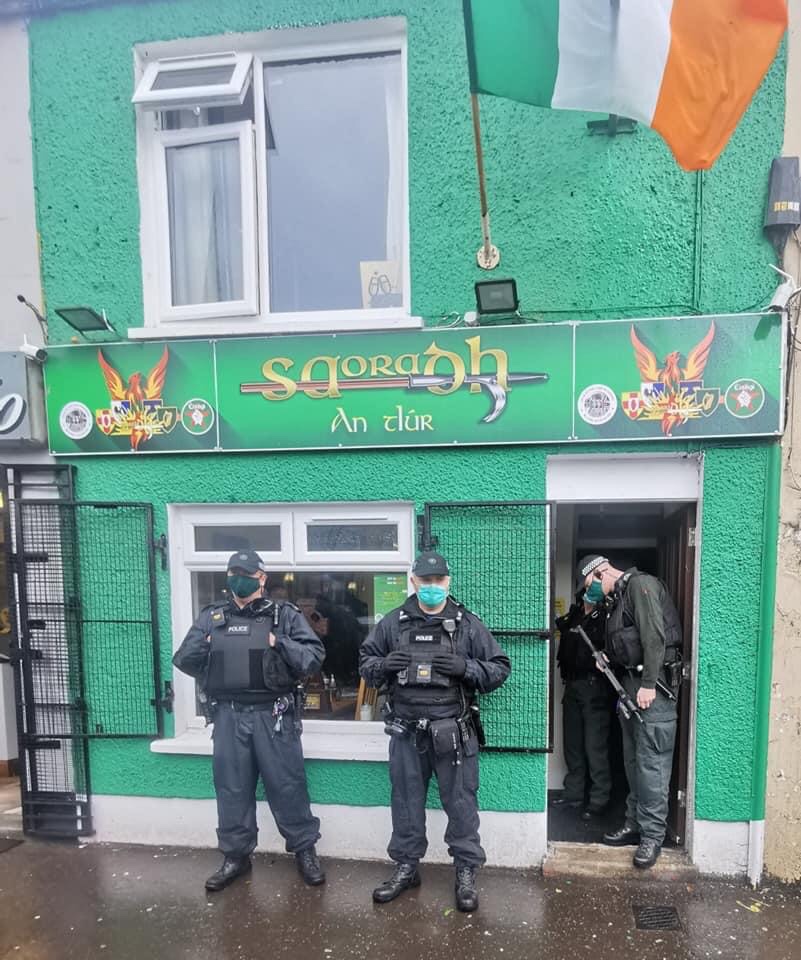
On the other side of the British Border, the counterparts of the Gardaí, the PSNI, armed British colonial police, raided Republican centres in Belfast, Derry, Dungannon and Lurgan, turning the places upside down, confiscating electronic equipment and documents. On Tuesday 18th, they also detained people, holding seven men and two women without charge and, according to a legal firm acting for some of the victims, were intending to hold them for further five days without charge.
PSNI, mostly in their ‘normal’ uniform at one of the scenes of raids (Photo source: Saoradh)
The activists subjected to the early morning raids by the Garda Armed Response Unit are all supporters of the socialist Republican organisation Saoradh and it was their centres that were raided by the PSNI. For months members have had their cars stopped by the PSNI and searched as they went about their lives. The raiding parties claimed to be searching for evidence of involvement in “the New IRA” (a previously unheard of organisation).
SHAMEFUL REPORTING AND FELON-SETTING
The media reporting on this was a shameful exercise in parroting the line of the States involved, giving the victims no voice to tie the “New IRA” (sic) in with the killing of Lyra McKee, which has never been proven and going further to call it “murder” (i.e intentional homicide) which has not been proven either (and was most likely unintentional – an organisation calling itself the “IRA” did claim the shooting and stated the killing was accidental).
Irish newspapers quoted Sinn Féin fears of bomb attacks on them by the organisation on the basis of information they allegedly received from the PSNI, which is dubious reporting at best (hearsay second-hand from an unverifiable source) and absolutely shameful felon-setting collaboration from Provisional Sinn Féin. BBC reporting to its credit did not report the PSF-PSNI allegations, nor call the killing of Lyra McKee “murder”, though it did link “the New IRA” to her killing and also prejudged the detained (who have not even been charged), calling them the “New IRA nine”; interestingly, the report gave MI5 as the source for the intelligence upon which the raids were allegedly based.
Felon-setting: Gerry Kelly and Michelle O’Neill, Vice-President SF, who publicly alleged ‘dissident’ bomb threat against them on the basis of unverified PSNI statement. (Photo source: Internet)
The linking of the raids both sides of the Border on the proclaimed basis of information from the British secret service, MI5, raises questions not only about democratic rights and the powers of the states in question but even about the alleged independence of the Irish State. It intensifies the speculation that was rife when Drew Harris was appointed Garda Commissioner, having come straight from the PSNI, with allegations that he was an MI5 asset.
SOLIDARITY?
What should be our response to these raids, as Irish Republicans, as Socialists or as just plain Democratic people? Clearly it should be solidarity with the victims and condemnation of the attacks by the states. Of whatever the states may or may not suspect the organisation, according to the alleged democratic system, they are supposed to charge them or leave them alone. We are not supposed to tolerate the states deciding they don’t like an organisation or consider it “dangerous” and on that basis set out to harass and intimidate them and terrorise their families. States where that can happen are not democratic and we are all vulnerable to those assumptions of secret services and the actions of police forces. Gárdaí acting in this manner led to the unjust jailing of the IRSP Three, the false confession forced out of Joanna Hayes and her family, the harassment of the McBrearties, etc. In Britain it led to the jailing of a score of innocent Irish people in five different cases in the 1970s (including the Birmingham Six) under the Prevention of Terrorism Act and, in fact, the successor of that Act is now the Terrorism Act in the UK, the one under which nine Republicans are detained currently in the British colony.
PSNI, the British colonial police, next to a Saoradh centre. (Photo source: Saoradh)
It is not too difficult to proclaim one’s solidarity with struggles far from home, particularly when they gather a lot of international support. It is a different matter to stand in solidarity with the victims of the State at home. It is also more of a test when one may not agree with the ideology or some of the actions of those persecuted by the State. But if we do not stand in solidarity with victims of the State, we are telling it, in effect, that it may continue acting in the way it is doing, until the early morning we wake to our own doors being battered down, our own partner and children being terrorised and ourselves sitting in cells without daylight being deprived of sleep and interrogated without access to solicitor, family or our own doctor.
end.
British colonial police, the PSNI, raiding a Republican centre, some with guns unlimbered. (Photo source: Saoradh)
On June 24th, as the repressive Offences Against the State Act was up for debate in the Dáil, it was voted for renewal by TDs of the Fianna Fáil, Fine Gael and Green parties, along with Labour, while only a Solidarity/People Before Profit and two Independent TDs voted against. For the first time since Sinn Féin had TDs present in the Dáil in 1997, they abstained in the vote. They failed to vote against an undemocratic Act that was brought into being precisely to repress their own political ancestors.
The Offences Against the State Act was made law by the De Valera Government (Fianna Fáil) in 1939 and 1940 to nullify the writ of habeas corpus served by Seán McBride (Irish Republican, former IRA officer and later one of the founders of Amnesty International) which gained the release of IRA prisoners interned without trial under the previous Emergency Powers Act 1939. The Act established the Special Criminal Court which processed the rearrested internees and sent them back to prison and concentration camp in the Curragh.
BRITISH INTELLIGENCE FATAL BOMBING HELPED TOUGHEN LAW AGAINST REPUBLICANS
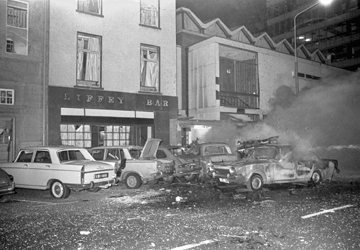
In 1972 the Fianna Fáil Government sought to strengthen the Act even further, among other attacks on civil liberties to permit an inference of guilt by the Special Criminal Court from refusal to answer questions by the Gardaí, along with the taking of a senior Garda officer’s word, unsupported by any substantial evidence, as the main “proof” of membership of an illegal organisation. However, the forecast looked bad for the Government since the Labour Party and Fine Gael were predicted to vote the Amendment down. During the debate, two bombs exploded in Dublin killing two Dublin public transport workers and injuring a number of others, some horrifically (two years later a similar bombing team was to kill 33 and injure around 260 in Dublin and Monaghan). The 1972 explosions, most likely the work of Loyalists working with British Intelligence, were blamed on the IRA and the opposition to the Amendment crumbled, ensuring it passed into law — and there it has remained.
A photo of the bombing adjacent to Liberty Hall (Photo source: Internet)
The Act empowers the Government to bring internment without trial into force by order (i.e without debate, even if the Government should be a minority one). Among its powers the OAS permits the State to ban organisations and subsequently (with its 1972 Amendment) jail people for membership of said organisation, the unsupported testimony of a Garda not below the rank of Chief Superintendent being considered prima facie evidence of said membership.
In a state where trials of all indictable offences under criminal law are by jury with a judge presiding, the Special Criminal Court is a non-jury court. Virtually all Irish Republicans serving time in prisons of the State have been convicted in the SCC, where even the unsupported word of a senior Garda officer is considered important proof and the standard of additional evidence required is very low. As one might expect in such conditions, the conviction rate is unusually high. On the charge of “membership of an illegal organisation” and largely on the word of senior Garda officer, conviction is almost certain and becomes an easy way to remove Irish Republican activists from circulation for the standard two years.
“GREATEST MISCARRIAGE OF JUSTICE IN THE IRISH STATE”
In two trials in 1978, the Special Criminal Court, in what has been called “the greatest miscarriage of justice of the Irish State”, tried and sentenced three Republicans to long terms of imprisonment for a mail train robbery at Sallins in which they had played no part. The judges in the Court chose to believe what 12 jurors would likely not have done: that the defendants had voluntarily confessed to actions they had not committed, that they had not been beaten by Gardaí and that the defendants’ bruising had been self-inflicted. The Garda “Heavy Gang” went on to obtain “voluntary confessions” from others, including Joanna Hayes and her relations in the “Kerry Babies” case, later also cleared and recipients of a Government apology in 2019. Those convicted of the Sallins mail train robbery were eventually cleared and released. The circumstances of those false “voluntary confessions” accepted by the SCC have never been investigated.
A poster from the campaign in support of four framed activists in the Special Criminal Court. All but the last one to the left were convicted and sentenced for up to 12 years, being eventually exonerated after long campaigning. The Gardaí involved were never even disciplined and some went on to frame others. (Image source: http://www.thewhistleblower.ie).Joanna Hayes, another who “confessed” to a crime she had not committed as did members of her family. Some of the Garda Heavy Gang, permitted by the SCC to get away with beating false confessions in the Sallins Train frameup, went on to be involved in the Hayes case. Even after the Government and Gardaí apologised to her years later, still no investigation. (Photo source: Internet)
In 2001 Colm Murphy was convicted in the Special Criminal Court of conspiracy to cause a bombing on the basis of Garda evidence which Murphy said was untrue — but the judges chose to believe the Gardaí. The Court of Appeal ordered a retrial when it was shown that the Gardaí’s notes had been fabricated and Murphy was cleared in the SCC in 2010.
In 2003 Michael McKevitt was convicted in the Special Court of leadership of the Real IRA on evidence widely believed not to have met the standard necessary for conviction, including that given by a paid informer. McKevitt is still serving his 20-year sentence.
Although the title of the Court includes the word “criminal” it was clearly created for political purposes and until 1998 all but one of its trials have been of Irish Republicans. That did not prevent the TDs of the Greens, a party with a record of previous opposition to the Act, using gang crime along with Labour as an excuse for voting for the Act’s renewal during the recent debate.
“THE SPECIAL BRANCH ACT”
The granting of wide powers to the State to use against their political opponents has resulted in even those powers being regularly exceeded. Without ever even charging anyone with any crime, the Act has been used by generations of the Special Branch, the political police renamed the Special Detective Unit, to harass and intimidate Republican activists and their supporters. People have been approached and their contact details demanded by these secret police when they have attended a protest picket or rally, public meeting, visited a Republican office or were observed talking to a Republican. People have been searched in the street, had their vehicles stopped and searched also.
Sellers and distributors of Republican newspapers have been harassed and threatened. Without any authorisation even by the Act, officers have approached parents of young activists and their school or college, as well as the place of employment of older activists, to express their concern at the activity or associations of the activists concerned. Officers of the special unit, all of which go armed, have displayed their weapons on occasion to intimidate Republicans (on one famous occasion discharging their firearm in a busy shop). They have filmed and photographed Republicans without any legal right to do so, followed them around, sat obtrusively outside their offices and even their homes, often day after day for months or even years. So widely have the secret police of the Irish State come to see the Act as entitling their intimidation and file-building that when, at a recent Dublin picket about political prisoners, a Republican asked what legal authority the officer had for harassing him, the man replied in all seriousness: “Special Branch Act.”
But on the 24th June, only three TDs voted against the Act’s renewal: Mick Barry (Solidarity/ People Before Profit), Michael MacNamara (Independent, formerly Labour) and Thomas Pringle (Independent). Two TD abstentions were recorded: Pa Daly and Martin Kenny (both Sinn Féin).
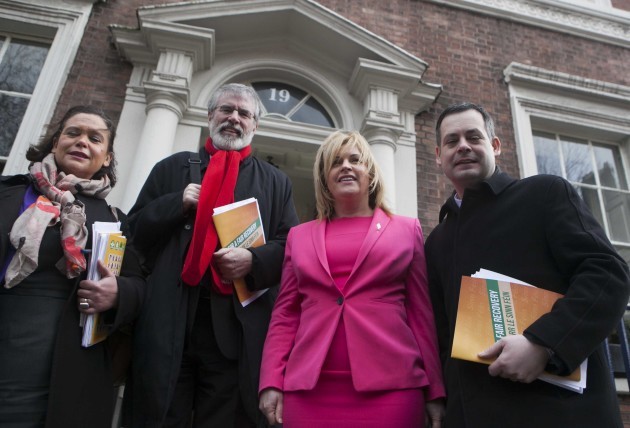
Leaders of Sinn Féin photographed in 2016 after announcing they would put their traditional opposition to the OAS in their election manifesto. (Photo source: Internet)
“UNTENABLE IN A DEMOCRACY”
Traditionally, Sinn Féin, along with other Irish Republicans, have opposed this undemocratic repressive legislation. But not just SF, also the Irish Council for Civil Liberties, Amnesty International, Irish and international jurists and UN Rapporteurs and Committees on democratic rights of the United Nations. And not just once but a number of times. The following statement was released by the ICCL in the week before the debate.
23 June 2020
The Irish Council for Civil Liberties (ICCL), ahead of the mooted renewal of the Offences Against the State Act next week and the Dáil debate tomorrow, renews our call for repeal of the Act and with it the abolition of the non-jury Special Criminal Court.
There is no jury at the Special Criminal Court and it accepts secret evidence from gardaí. This is in violation of our right to a fair trial, our right to trial by jury and our right to equality before the law. ICCL has opposed both the Act and the Court since their introduction to deal with a terrorist threat in 1972. We continue to strongly oppose these emergency measures which have now become the norm in dealing with organised crime.
ICCL’s Executive Director, Liam Herrick, said:
“It’s untenable that in a democracy like ours, which prides itself on its human rights record abroad, a law and court like these can exist.
The State contends that it needs the Special in order to protect juries but it has never considered alternatives to abandoning jury trial.”
The protection of jury members is of deep concern to ICCL. But the State has never demonstrated, as required by human rights law, that alternatives to a non-jury trial are ineffective. There are a number of obvious options for protecting juries such as anonymising juries, the use of video link for juries, or granting special protections for juries.
Last year at the Special Criminal Court, Judge Tara Burns acquitted two men of IRA membership after the head of the Garda Special Detective Unit refused to disclose underlying evidence pertaining to “belief evidence” to the prosecution. This meant gardaí were seeking a conviction without disclosing evidence to the defendant’s legal team, the Court or the DPP. ICCL welcomed the Judge’s decision but the case revealed some concerning attitudes and practices at the Court.
ICCL is not alone in our opposition to the Special Criminal Court. Various UN human rights independent experts and the UN Human Rights Committee have repeatedly declared the State to be in violation of its human rights obligations because of the continued use of the Court beyond the emergency it was designed to address. Eminent Irish legal experts, Mr. Justice Hederman, Professor Dermot Walsh and Professor William Binchy have also called for abolition of the Court.
At its introduction in 1972, the Special Criminal Court was considered a radical and purely temporary departure from the norm. Forty years have passed since then. It’s time for its abolition. Statement ends.
CONCLUSION
Defenders of Sinn Féin have said that dropping opposition to the OAS from their election program for government and even after their party won the highest number of elected TDs (delegates) in the February 2020 General Election, was purely a temporary tactical one. Presumably this decision was in response to Mícheál Martin’s statement last year that Sinn Féin was not a legitimate choice for government because they were against the Act.
Part of the sculpture outside the modern criminal courts building in Dublin, which also houses the Special Criminal Court. (Image sourced: Intenet)Special no-jury Criminal Court. Image sourced: internet)
Not a legitimate choice for whom? one might ask. Do the mass of working people in the country want this undemocratic Act in place? Not that they were ever asked by any Irish Government! Now there was an opportunity to put this before the electorate — but it is not the opinion of the mass of working people that Sinn Féin worries about but that of the ruling class and their media hounds.
When however the two main parties of the Irish Gombeen capitalist class went into coalition with the “alternative” Green Party in order to exclude Sinn Féin from government – and one might have thought SF had nothing now to lose by voting against the renewal of the OAS – even then they failed to oppose it. Some say SF’s tacticians expected the negotiations between the other parties to collapse and then to be able to put themselves forward as a credible alternative. But again, credible to whom?
For years now, Sinn Féin has been at pains to demonstrate that it is a safe pair of hands for Irish capitalism (which entails also being safe for foreign capitalism and British colonialism). It is not necessarily a question of supporting armed struggle or not but to enter into the administration of an invader, as SF did in 2007 when it became part of the British colony’s government, would for most patriots and anti-imperialists be considered a clear crossing of the line. After WW2 many liberated countries executed a number of those who had taken part in such administrations and from one example, a new adjective entered the English language: “quisling”.
Sinn Féin has gone even further now to show the Irish ruling classes and both states that their panoply of repression on both sides of the British Border is safe: undemocratic legislation granting special powers to the police, politicised police forces and special non-jury courts with low quality “proof” required for convictions.
It is understandable with so little viable alternative choice that so many voted for SF candidates in February and in fact, would probably have elected even more had the party fielded sufficient candidates. All the other main parties and even the Greens have been in Government previously, all have approved bank bailouts and austerity budgets.
Sinn Féin is the only major party who had not been in Government and those who wanted to see them in practice had a reasonable point. But seeing them in “opposition” is also instructive. A political party that is so afraid of the ruling class and its media that even in opposition it will not vote against undemocratic repressive legislation and instruments, that were brought in precisely against its own earlier members and supporters – is not going to be braver in government, when it will inevitably be in a coalition with a capitalist party or parties.
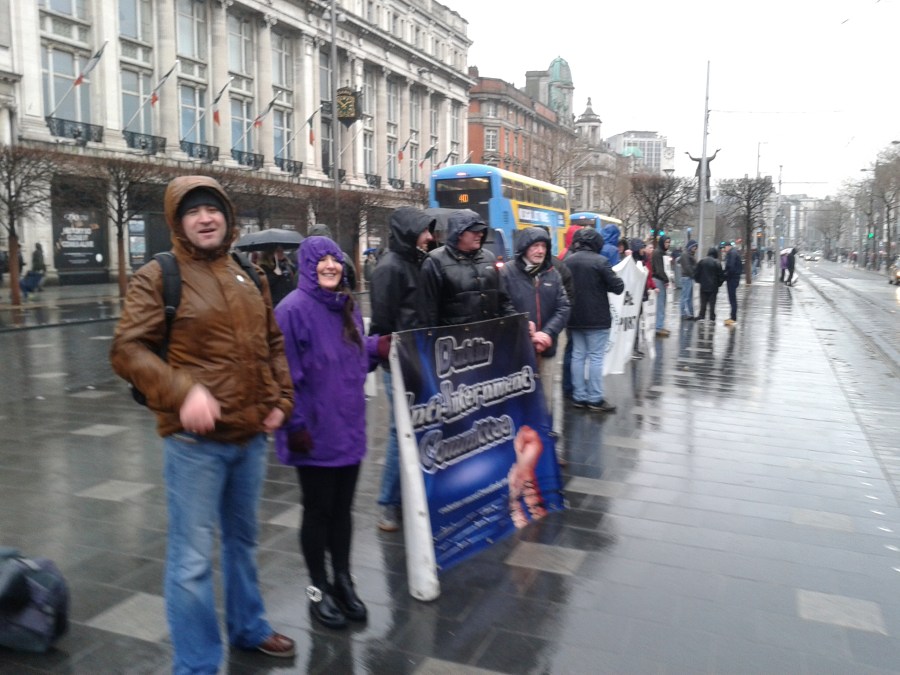
Protesters from a variety of Republican organisations and none protest the Special Courts in Dublin City Centre on a rainy afternoon in 2018. (Photo: D.Breatnach)
However, the undemocratic Offences Against the State Act and its non-jury Special Courts remain and must be opposed. The struggle against them will continue to be waged by its victims, currently the “dissident” Republicans and by people and bodies concerned with civil rights. As the State encounters increasing resistance to austerity measures it may well be that it will widen the list of targets of this Act to include social and economic campaigners, as it was rumoured considering against the Jobstown water protest defendants in 2017, all of whom were cleared by the jury who did not believe Garda witness lies (exposed by recordings).
It is essential to oppose this Act and a wider opposition to it needs to be built – one that does not depend on false friends.
Looking back along the road we’ve travelled, I can see we have come a long way to get where we are today. I’ve traveled a long way. I was very young then, when I started. We all were. In particular, I remember, Carl and Eva and I, we were in secondary school, fifteen years of age.
We discussed the situation often and pretty quickly became revolutionaries. We knew people in the Party – well, we called it the Old Party after awhile, you’ll see why soon. Yes and they wanted to recruit us. If enough of us joined them, voted for them, they would be able to change things, they told us. And they had some credibility because some of them had fought in the old days, when things were even worse. Some had lost relatives killed and some had gone to jail.
But we were not taken in, we weren’t fooled. It wasn’t just that theirs looked a really slow way to change things; we didn’t believe it would ever succeed. And we thought they knew that, deep inside and were just prepared to settle for things much as they were. Make the best of it (which for some of them meant shady deals and lining their pockets).
And we were never going to do that.
We weren’t in the armed group, the three of us but we supported them. The armed group were our heroes, the sharp end of our resistance. Over time they would weaken our oppressors and in the end we’d get the freedom we wanted. And these young men and women, they really fought. They paid for their resistance too; plenty of them were killed and if caught, they were tortured and sent to jail for really long sentences.
We delighted in their successes, marched in their funerals, supported them in their struggles in the jails and, later, honoured them when eventually they were released. We did the best we could ourselves against the oppression and general injustice but without actually taking up the gun: put up posters, painted graffiti slogans on wall, held protest marches and pickets, gave out leaflets, held public meetings. Of course, the oppressors went after us and we were out there, in plain sight, more or less.
Our oppressors had made some laws under which they could declare just about anything we did illegal. Unless we sat at home and did nothing. Or joined the Old Party. They called that group of laws the Anti-Terrorist Legislation.
ARREST AND TORTURE
One night while were out postering in memory of a couple of our martyrs, on the anniversary of their being killed by the police, we got caught. They gave us a bit of a beating and took us to the police station, telling us on the way what they were going to do to us.
Under the ATL they could keep us in a police station for five days without access to any of our friends and relatives or even a lawyer. I’m sorry to say they broke me in the first 24 hours. You might think that was a pretty short period – it didn’t seem like it at the time. Being held in a dark windowless cell, hooded, being threatened with all kinds of horrible things you know they can do, listening to the screams of other people having some of those things done to them, having a plastic bag put over your head until you can’t breathe anymore and you feel sure you’re going to die, your lungs straining ….. It’s amazing how long 24 hours can seem. And even if you lasted that 24 hours, you knew there were another 96 hours to go after that.
Yes, I signed a “confession”, what they told me to say. According to the confession, we were honouring the martyrs because they wanted to overthrow the State, which is why we were putting up posters about them. We wanted more people to join the fighters to help recruitment. Not really about honouring their memory at all. “Glorifying and Supporting Terrorism” was what I was going to be charged with which, if convicted, would get me three years in jail. And the others: my “confession” was not only about me but about Eva and Carl too.
After I signed the “confession” they left me more or less alone but somewhere I could hear shouting and screaming. I thought it might be Eva and Carl, hoped it wasn’t. And I still had to wear a hood whenever any of the guards came in the cell or their doctor examined me. Well, they told me he was a doctor. I told him I felt ok – I knew the guards were listening and I’d get repeat treatment if I said anything against them. And it wouldn’t do any good anyway.
By the third day, or what I thought might the third day, I didn’t hear what sounded like a female screaming any more but could still hear shouting. And sometimes someone crying.
I know it was the fifth day when they brought us to court, put us all in the same cell, waiting for our trial to start. Eva and Carl looked pretty rough and I suppose I did a bit too. Eva burst into tears and told us she had signed a confession against us after the second day. We put our arms around her and held her while she cried. I admitted I had signed too, assuming we all had. I didn’t say I had only held out for about 24 hours, though.
Well, women detainees, they get it especially hard. As well as the rest of it, they are kept naked or semi-naked and, if on their monthly periods, refused tampons or cloths. They are fondled in their private parts, threatened with rape, humiliated and sometimes have something pushed inside them ….. The police don’t do things like that to male detainees ….. well, occasionally, if they know one is gay ….
A frequent method of combining asphyxiation torture with humiliation for female political prisoners in number of jurisdictions. (Photo source: Basque Country social media)
The shock was that Carl had not signed a confession – he hadn’t broken. So how come they had brought him to trial early on the fifth day with the rest of us? Well, they must have decided he wasn’t going to break; apparently most people break by the fourth day, which is why the limit is set at five. And anyway they had our statements implicating him.
We swore we would retract our statements during the trial, declare they had been obtained under torture. That would invalidate the statements, surely?
We were tried together in a special Anti-Terrorist Legislation court. One judge, no jury. No public. We had lawyers our family and friends had got for us but they were only given five minutes with us before the trial. The Prosecutor produced the statements against us all, those of the police who arrested us and my “confession” and Eva’s. Lied through their teeth that we had made them voluntarily. They produced a statement too for Carl but his lawyer objected it didn’t have his signature, so the police couldn’t show that they hadn’t made it all up.
When we gave our evidence, Carl denied he had made any statement whatsoever and we retracted ours, talked about the torture we had suffered. Eva was magnificent, denouncing them through her tears and shaking. The Prosecutor brought the police back to testify who of course denied not only the torture but any kind of coercion. Some of them even appeared shocked at the allegations. And the doctor – his voice sounded familiar so he probably had been the man who had “examined” me — said I had made no complaint (true) and had seemed calm and rested (not possible).
Image source: Internet
The courtroom is a funny place. Things the whole world knows are not true appear reasonable while the preposterous can seem logical. Not only had they not tortured us, the police witnesses said, but they had never heard of it being done. So why had we made such detailed statements and then retracted them, accusing them of torture. Well, they were mystified about that. Except …. some had heard that this was a propaganda tactic popular among our group, to smear the police. But why then had we given them a statement at all …. well, at least two of us? Skilled interviewing, was the reply. Trained interrogators, going over the suspect’s stories again and again, exposing every contradiction.
The only thing skilled about them was in making sure they stopped short of killing us and generally left no bruises, especially on our faces. Oh yeah, and the acting in court – that was very skilled.
The case against us, with our repudiation of the statements, should have got us at most a few months or maybe even a fine for postering agitational material on public property. Eva and I got three years each, while Carl got nearly four. I suppose the fact they hadn’t broken him pissed them off and they made out he was our leader so the judge gave him extra.
PRISON
Prison was bad but it was a relief after the police station. They moved us around jails a few times over the years, we didn’t often see one another and our families and friends had to travel long distances to visit us. When they were permitted to or we hadn’t been moved the day before the visit. We learned later, though no-one told us at the time, that Carl’s aunt had a serious accident on the motorway. Long distances, tiring, unaccustomed to motorway driving, bad luck …. With a couple of operations and time, she was able to walk again but the family had to invent excuses why she couldn’t visit him, especially because they had always been close.
Most of the prison warders were hostile but some were sadists, constantly trying to provoke me, finding ways to frustrate whatever little pleasure or diversion I was permitted. Sometimes it was “too wet” to go in the exercise yard for my permitted two hours daily. Sometimes the library was “closed for stocktaking” or “due to staff shortages.” All prisoner mail is opened before being given to or sent by the prisoner but sometimes I got a letter that looked like it had been spat on. Or it smelled bad. Often, it would be two weeks later than the date stamp. Some letters were returned to the sender, I learned later, marked “UNSUITABLE”. I had one returned to me, although I was always careful what I wrote, this one marked “BREACHING PRISON SECURITY” — I had made some remarks about the prison food.
Image source: Internet
Some of the social prisoners were ok whenever I was in contact with them, some were hostile, seemed fascist. Sometimes a warder would make comments about me in the hearing of those kinds of prisoners. Anytime out of my cell I felt I had to be alert, with 180 degrees vision.
I did physical exercises in my cell to keep my body healthy and studied for the sake of my mind. Law was the subject I studied most, so I could represent activists in court and file motions and so on but I also studied politics and economics.
When I got out, I enrolled in a law studies course. I wrote to Carl – I hadn’t been allowed to previously. From his letters, he seemed ok but you never know for sure, do you? Not when you know the letters have to pass the prison censor and the prisoner has to keep up a strong front also. I met Eva too, she was released same time as I but a long distance away; she was subdued, a kind of frightened look in her eyes. Not surprising but she still kept in the movement, though we each took a step back from the more illegal street work, where we could be isolated – like postering. I qualified to practice law at a basic level.
THE POLITICAL PARTY
We began to discuss founding a political party and standing in elections. The armed struggle would go on, we thought, but over time we could push the Old Party back, take a lot of their votes. After all, what were they doing (except some of their leaders and contacts lining their pockets)? We could really expose them with our policies.
So we formed a political party, a New Party, for which we had to agree to respect the Constitution. We were doing well but, just before the elections, our party was disqualified by the State. “Connections with terrorism” was the reason given. We were furious and so were our supporters. And we formed another party. The State disqualified that one and, for good measure, banned it. Now one could go to jail for being a member.
This kind of thing went on over years, different versions of the New Party and more people going to jail and we rarely got a chance to stand in elections, much less to build up momentum.
We tried forming a coalition with some more moderate elements, even some we had called “collaborationist” in the old days but the State said we would have to denounce the armed struggle to be a legal constitutional party. We couldn’t do that because we’d be turning our back on not only our martyrs but on hundreds of activists in jail. And our own people wouldn’t stand for it. By this time I had risen to General Secretary of our underground Party.
After long discussions with the leaders of the armed wing, eventually we all agreed to announce an end to the armed struggle and to hope for the legalisation of our Party and early release of prisoners. It was a hard decision but not as hard as one might think because we were all pretty worn down and our military wing hadn’t been doing all that well for some time. The State had penetrated both sides of our movement with agents and people turned informer — hundreds were in jail or awaiting trial.
What was harder was getting our supporters to agree but by managing a few meetings, ensuring we had people with a militant reputation to speak in favour of the plan, ensuring people for the idea got more time to talk than those who didn’t and a few other things, we got it through. Besides, a lot of them believed us when we whispered that it was all a game to fool our oppressors.
Eventually, after we declared our total opposition to any armed struggle and total commitment to the electoral process, we got legalised and now we are chipping away at the Old Party, though it looks like it may take a long time to supplant them.
But some of the young people, and some older ones like Carl, are saying we have compromised too much, that the road we’ve chosen is too long and anyway is never going to get us justice. These people do things we’d rather they didn’t, that we’ve dropped, like illegal postering and spraying slogans, holding illegal commemorations for martyrs, protest marches, getting into trouble with the police ….. Making us look bad.
And what’s more, unbelievable as it might seem, they’re calling us “The Old Party”!!!
Mick Healy interviewed me about a number of my experiences in revolutionary work over the years and this is Part 1 (Part 2 will shortly be published), nearly all about some of my three decades in London. It contains a number of errors by me, for example the apartheid rugby team was South Africa’s one which were not called the “All Blacks”, that being New Zealand’s. Also I believe the giant Hunger Strikers solidarity march in London was to Michael Foot’s home, not Tony Benn’s. Still, here it is for what it’s worth with many thanks to Mick.
Diarmuid a long time political agitator was active in London from 1967, in interview part one, he talks about his involvement with Marxism-Leninism-Anarchism. His involvement in the Vietnam and Rhodesia solidarity campaigns, Anti-fascist mobilisation, solidarity Ireland, family squatting. In addition the campaign against the Prevention of Terrorism Act and the 1969 Peoples Democracy march from Belfast-Dublin.
(Reading time RB article: 5 mins; I.Times article: 3 mins)
In court on 6th March in Dublin, Garda Sean Lucey, who had struck an RTÉ cameraman with his baton in the groin, although his statement was “less than an apology”, received a suspended prison sentence. He had been found guilty by a jury in December but the Judge had postponed sentencing. Antifascists arrested on the same day as the assault by Garda Lucey, while preventing the proposed Dublin launch of the European islamophobic group Pegida, have been fined and three are still facing trial.
Garda Sean Lucey, leaving the court after his sentencing for assault on a journalist. (Source: Irish Times).
It was back on 6th February 2016, coincidentally the centenary of the 1916 Rising, when the islamophobic European organisation Pegida, announcing its intention to launch itself in a major city in every European state, planned a rally to launch an Irish branch in Dublin. The individuals and organisations supporting this initiative included racist, fascist and generally far-Right groups and individuals in Europe, including in Ireland.
Long before the planned Pegida rally, anti-racists and antifascists had occupied the intended space outside the GPO, while groups of anti-fascists mingled with curious bystanders on the other side of the street. Quite soon, some fascists of Eastern European background began to insult some women and also to threaten a filmmaker from Rabble, an independent alternative media organisation, calling him a “ fucking communist”.
Earlier that day, the anti-fascists and anti-racists had occupied the site of the planned Pegida rally. (Photo: D.Breatnach)Fascists of E. European origin make their presence known in North Earl Street through threats and insults. (Photo source: Antifascist photographer)
Having revealed themselves, the fascists quickly became the targets of antifascist hostility and scattered down North Earl Street. Some scuffles took place there and some of the fascists ran on down Talbot Street. Gardaí, including riot police (Public Order Unit) waded into the antifascists and also beat up a fascist, in an apparent case of mistaken identity. Subsequently the Gardaícordoned off that area with drawn batons and police dogs.
It was soon revealed that some other fascists were holed up ina bar in Cathedral Street and many antifascists made their way there, only to run into another confrontation with riot police who repeatedly struck anti-fascists in order to drive them out into O’Connell Street. It was there that the assault on the RTÉ journalist took place. It took until December 2020 for the case to come to court while, in the meantime, anti-fascists were charged, convicted and fined.
Gardaí wielding batons in Cathedral St. (Photo source: Antifascist photographer)
The report of the case in the Irish Times (see References, Sources) reveals three things, it seems:
The fact that his victim was a journalist of the State broadcaster and supported by his union and employers meant the Gardaí could not get away with the assault without some kind of punishment;
On the other hand the Judge was determined to treat the assault as leniently as possible under the circumstances;
The Garda’s whole attitude was in essence that he had done nothing really wrong.
Regarding Garda Lucey’s attitude, which even Judge Melinda Greally remarked upon (“his statement of regret falling short of an apology”), it suggested that he might well have assaulted or would in future assault some other member of the public – especially if he were not a journalist of a State broadcasting service. Perhaps an independent journalist …. or an anti-fascist demonstrator …. or even some member of the public who voiced some objection to his behaviour.
Furthermore, before Garda Lucey struck Mr. Colm Hand in the groin, he struck at his camera. What can that mean? Surely nothing less than that he did not wish his actions or those of his colleagues to be recorded! And perhaps a message to other potential journalists in future. Colm Hand declared that apart from the pain of the injury at the time (which could have caused permanent injury), “what happened on that day shattered my confidence and I have never fully recovered.” The five-day trial in December last year, necessary because Garda Lucey did not admit initially to the offence, was also stressful for Mr. Hand and that and the period leading up to it had caused him worry and sleeplessness.
The Judge must’ve been aware of all these possibilities in future and past Garda behaviour and yet, despite Garda Lucey’s attitude, decided to view his assault as “an aberration.”
This was because, she said, he had no previous blots on his career. But how would those blots have appeared if he had, indeed, behaved similarly in previous situations? Who would have recorded those incidents in his career? The only reason this occasion was noted was because he had struck a journalist of a state broadcasting service and neither the victim, his employers nor his union had been prepared to drop the matter so that, eventually, it had to come to court.
QUESTIONS NOT ASKED
The Irish mass media – including RTÉ itself — does not ask such questions. Nor speculate whether Garda violence was inflicted on others in that area on that day. It was and I myself witnessed it.
Part of the struggle in Cathedral Street. (Photo source: Internet)
After I moved forward to denounce one Garda who was beating the protectively-raised hands of a protester, one huge member of the POU struck at my fingers with his baton several times and when I evaded the blows, shoved the baton into my stomach, which caused me in reflex to grab it and engage in a short tugging battle, during which he grew increasingly irate and I increasingly worried for my personal safety.
During a sit-down protest outside the Dáil some years ago, Gardaí drew their batons and assaulted demonstrators peacefully sitting down, which was photographed in clear evidence. Not one Garda was charged with assault (nor likely reprimanded) arising out of that incident. And there have been many other such incidents.
No judge should quote an unblotted record of a Garda as any reason for leniency in sentencing. But of course, the judiciary realise that the Gardaí are the first physical line of defence of the system they uphold and for that reason they will always get special consideration. As Judge Greally was quoted as saying, “she has the highest regard for the work of the Gardaí.”
END AND AFTERMATH OF THE PEGIDA CONFLICT
The Pegida V Anti-racists conflict in which that assault on Colm Hand took place is only vaguely referred to in the Irish Times report – surely a deliberate occluding of context and of an event that would have been of interest to its readers.
After the various struggles in North Earl and Cathedral Streets, Gardaí pretended to arrest the fascists and brought them out in police vans to safety while decoy vans made their way into O’Connell Street, drawing large crowds of anti-fascists to block them and curious onlookers to view the event. Earlier, some Irish fascists coming in to town by LUAS had run into antifascists and never made it to the intended Pegida launch, one needing to go to A&E instead.
Subsequently, antifascists monitoring fascist communications reported that some Eastern European fascists complained of the lack of spine of their Irish counterparts and swore they would never again cooperate with them. Dublin may have been the only European capital where Pegida did not succeed in launching itself and subsequently the whole initiative faded from the news.
Launch of the Pegida ship in Dublin. (Cartoon D.Breatnach)
As noted earlier, a number of antifascists faced charges and were sentenced in court, including fined. Three Irish Republicans of different allegiances were charged and are currently awaiting trial; their charges are of “violent disorder” which on conviction carry a sentence of up to ten years imprisonment, an unspecified fine, or both. It is the first time this charge has been used by the Irish State against political activists.
Garda Armed Support Unit patrol car, one of a great many seen driving around many parts of Dublin including the city centre. (Image source: Internet)
Last year, a Garda shot dead a man sitting inside a car who was harming himself with a Stanley knife. In June 2019 the Department of Public Prosecution decided not to even charge the Garda who fired the shot. What does this mean?
Since the evidence from witnesses (including his own colleagues) is that Garda A fired a deliberate shot at close range that killed Mark Hennessy through a closed window and that the man was not at that moment posing a threat to anyone (apart from himself), never mind a lethal one — how can we view this as anything but an on-the-spot execution by a Garda? Since we are told that Gardaí are not authorised to carry out executions (and the State has abolished the death penalty), what can this be but MURDER?
It is useful to remember too that the founders of the Irish State deliberately resolved to set up the Garda Síochána as an primarily unarmed police force (in direct opposition to the armed colonial police forces that had suppressed Irish people in the past and continued to do so in the Six occupied Counties).
Not even charged? For the moment, we need to forget about the fact that all the evidence points to the victim having murdered a child and hidden her body. Killing the man could not bring her back (in fact might even have prevented her body being found but luckily the location was written on a piece of paper inside the car).
How can this killing be justified? What possible legal reason can be given? Dubious though it may be, the Gardaí who shot Mac Lochlainn (see below) at least claimed he had pointed a gun at them (interestingly, the officer who fired the fatal shot was himself killed a few years later in what was described as a firearm accident involving a colleague). Well, in fact, in the Mark Hennessy killing NO REASON WHATSOEVER WAS GIVEN. The DPP just “decided not to prosecute”.
Garda of the Armed Response Unit with machine gun. (Image source: Internet)
If a Gardaí can decide when someone needs to die and act upon that decision, anyone might be a victim in future: political activist, whistleblower, personal enemy, mistaken identity ….
Unlikely? Why?
There have been a number of questionable killings by Gardaí, including the shooting dead of Real IRA Volunteer Ronan Mac Lochlainn on May 1st 1988. Mac Lochlainn was driving away from a Garda Special Branch ambush of a robbery team when he was shot dead by the Gardaí. The matter was not seriously investigated until 20 years later when the investigators decided for whatever reason to clear all the Gardaí involved, leaving many important questions unanswered.
Another incident that might have ended fatally occurred in 2005 between two drunken senior Gardai who got into a fight and pulled guns on one another! A personal quarrell ….
Armed Gardaí Detectives after a raid. (Image source: Internet)
One can see on any day in Dublin the vehicles of the Garda Armed Response Unit driving around the city. Nor do they restrict themselves to the duties for which one might imagine Gardaí would need to carry arms. They have been seen stopping cars in traffic incidents, driving through busy streets, surveilling political demonstrations and even on one occasion last year stopping to caution people demonstrating against internment in Temple Bar.
In 2014 they turned up at a protest against Irish Water in Clonmell. On another occasion last year they turned up to dispute between a private landlord and two of his tenants in Dublin and at a separate housing occupation action in Cork. Last year also they attended a farmers’ protest in Limerick.
Is the Irish public being subjected to an armed Gardaí normalisation process? Why are the DPP not being made to justify their decisions not to prosecute Garda perpetrators of homicide? How long before another unjustifiable killing?
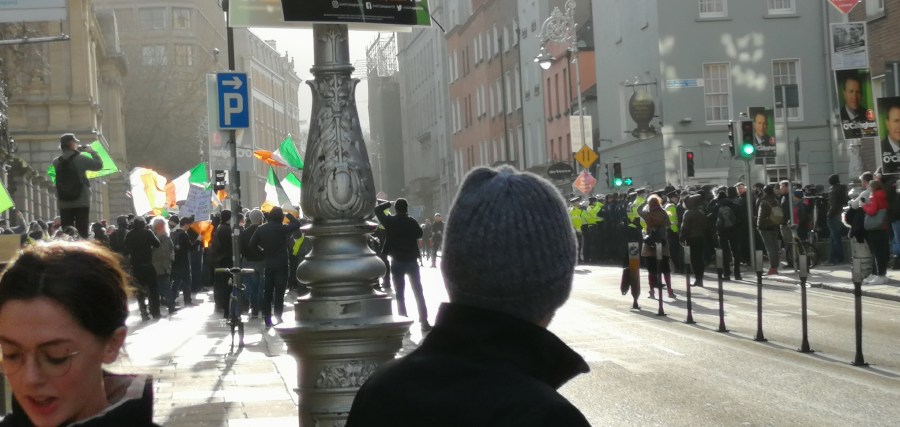
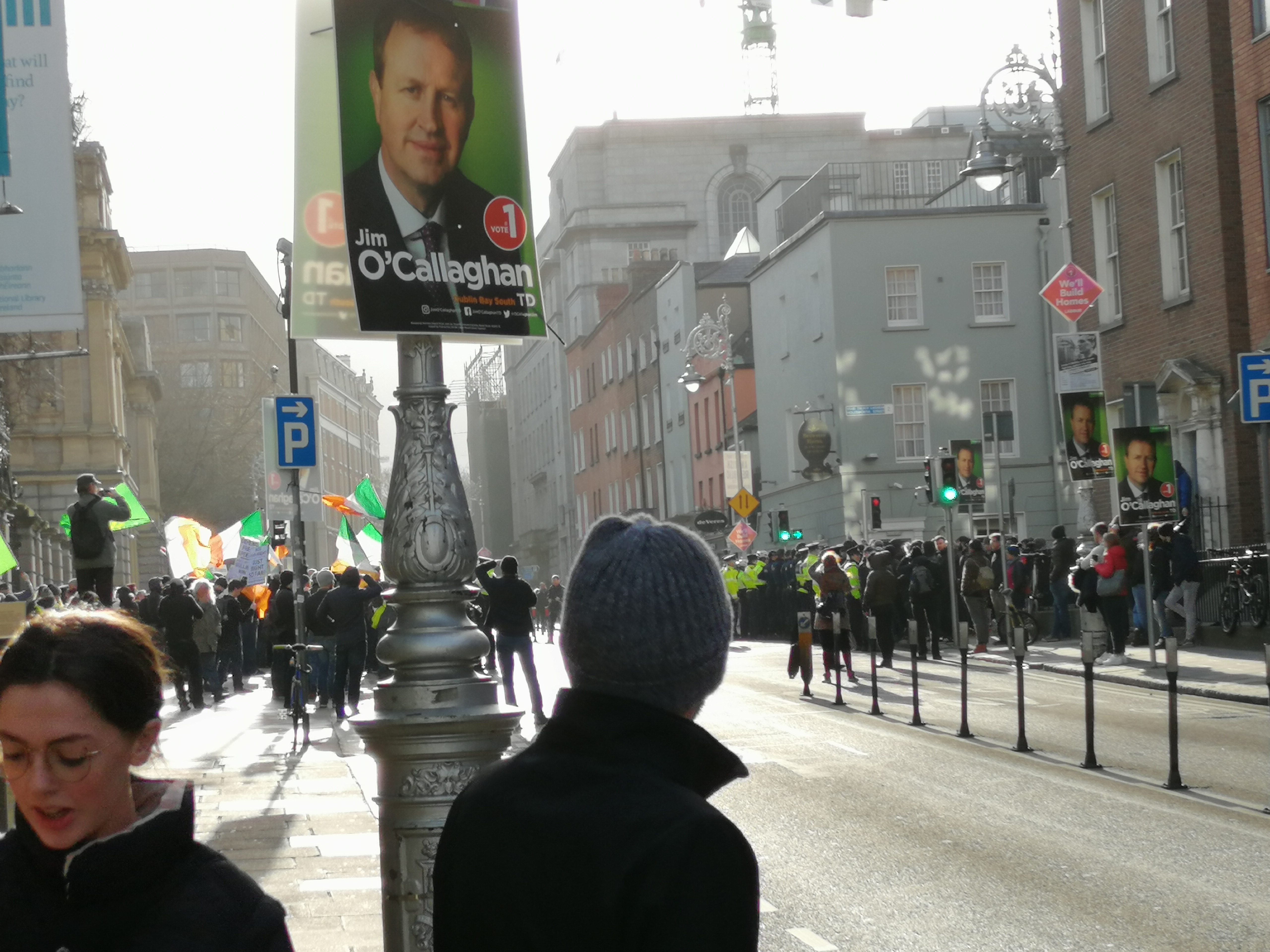
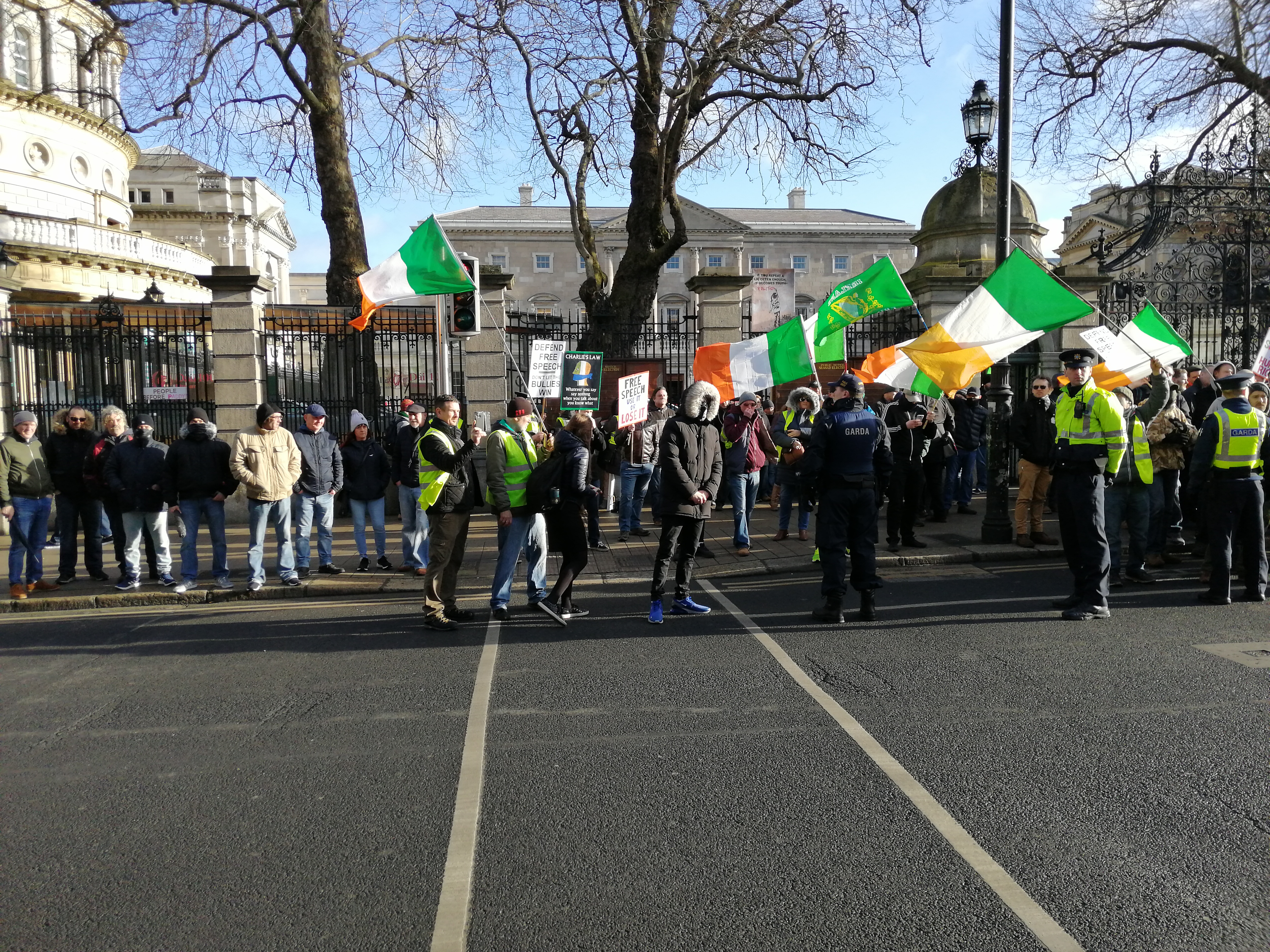
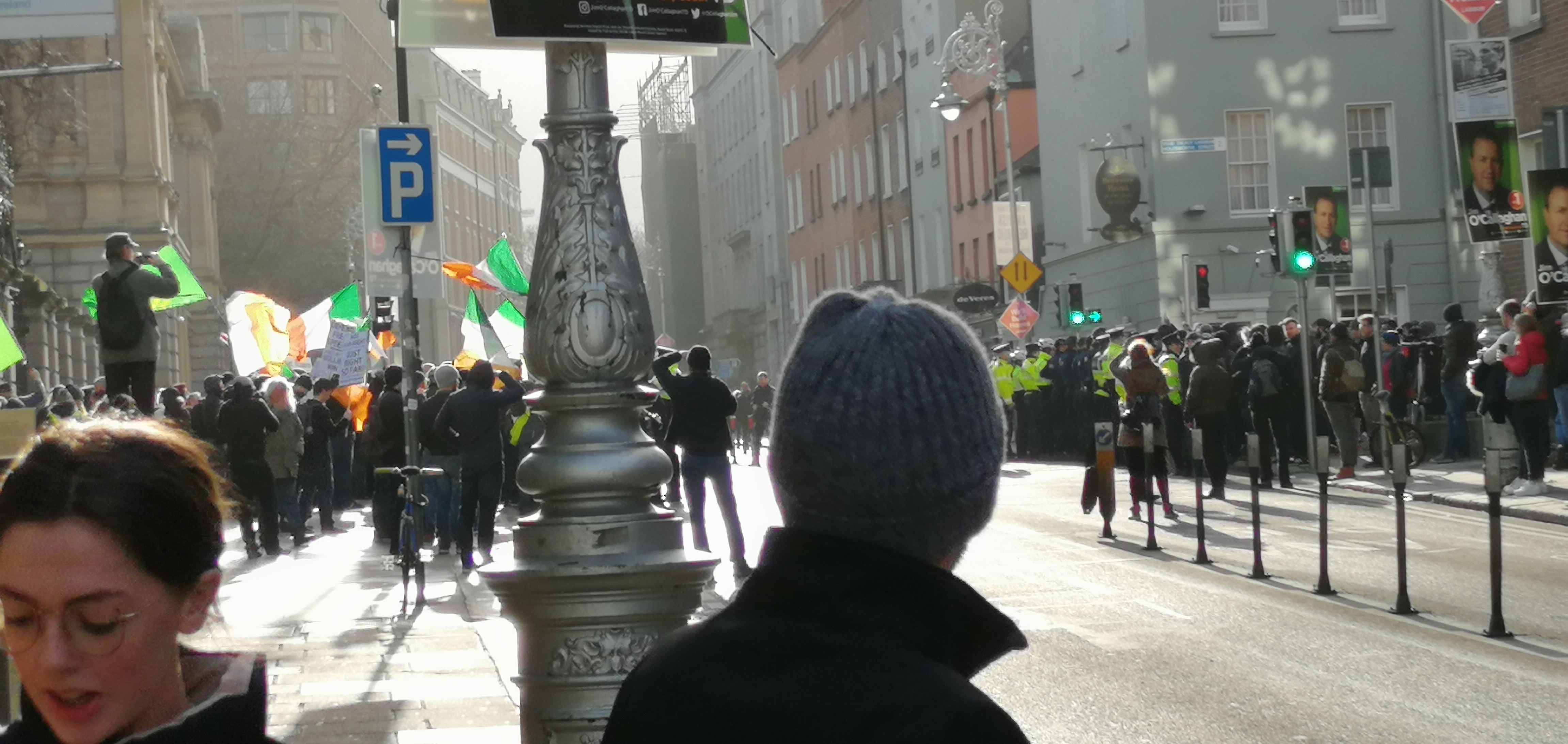
After weeks of propaganda and whipping up their support, a much-reduced turnout of the Irish far-Right lined up in front of Leinster House on Saturday 1st February and were confronted by an anti-fascist, anti-racist opposition a little smaller in size but which had been convened by word of mouth alone. There were some scuffles and a couple of arrests and the far-Rightists begged for a Garda escort to leave their protest after little more than one hour.
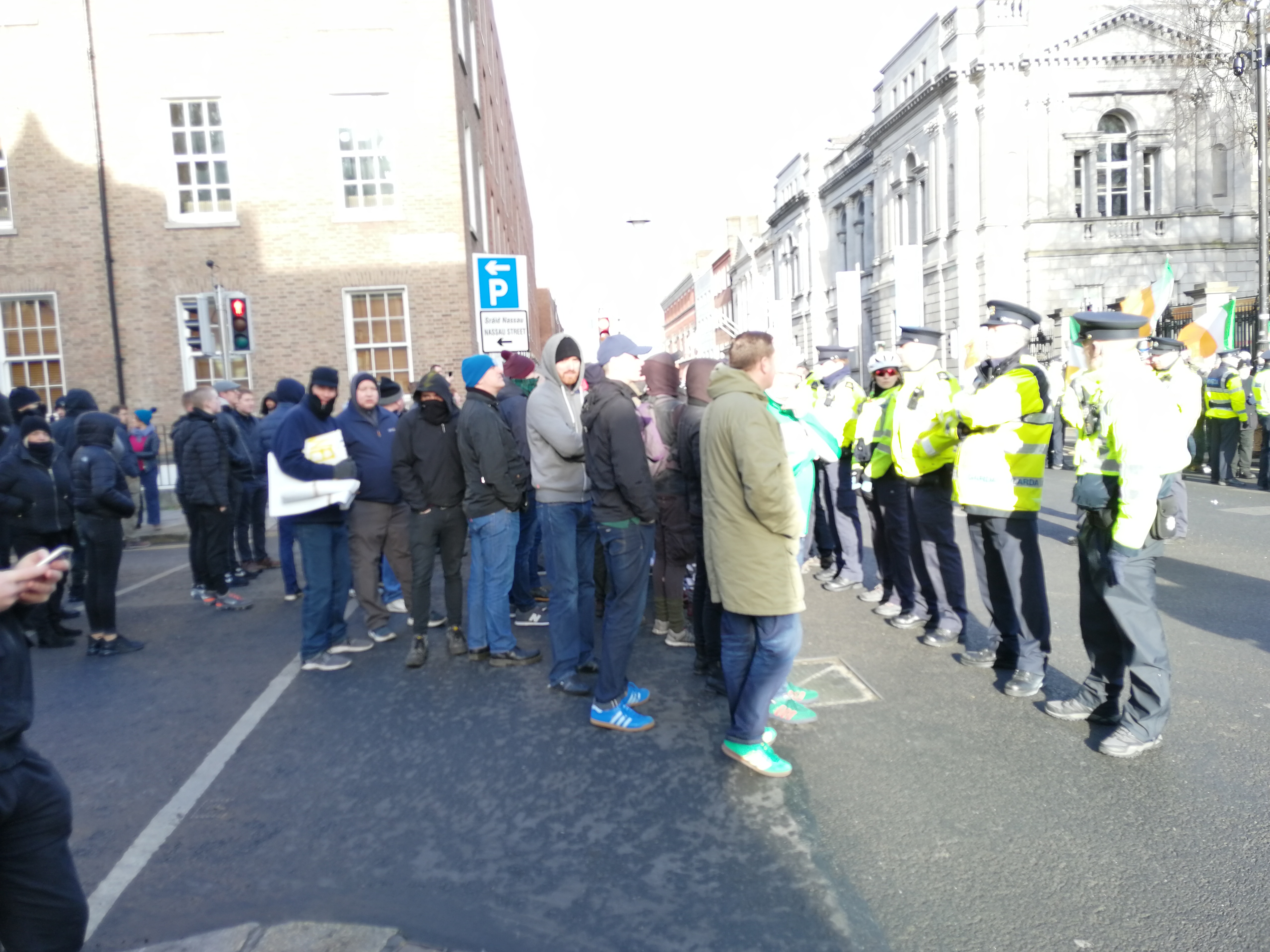
Confronting one another across Kildare St, far-Right and anti-fascists, seen from a little distance (Photo: D.Breatnach)
“FREE SPEECH”?
The far-Rightists had called the demonstration allegedly in defence of “free speech”, protesting legislation proposed recently by Fine Gael against “hate speech”. Apart from the fact that the detail of the legislation has not been published yet, most on the non-institutional Left in Ireland and perhaps especially Irish Republicans, would be extremely wary of such widely-framed legislation, known to have been used in other administrations primarily against people denouncing the police, political parties, politicians and even royalty.
However, most Republicans and the non-institutional Left would not agree with the “right to free speech” which the far-Right is seeking, which is the “right” to spout virulent and lying material in the course of their racism, islamophobia, LBGTphobia, attacks on women seeking pregnancy termination or campaigning for the right to choose. In fact, we can trace the public start of the far-Right concern with “free speech” in Ireland to July 2019 when Gemma O’Doherty had her Youtube account suspended and then closed by Google, due to complaints that her racist rants were violating Google’s own standards. A similar case occurred in January in Spain when the relatively new far-Right Spanish party Vox had their Twitter account suspended, after they had accused a municipal education program on equality of “using public funds to promote paedophilia”. (see also FAR RIGHT CHANTS OF “PAEDOS” below for more on this issue).
The far-Right demonstrators with Leinster House in the background. They fly a lot of Tricolour flags in an attempt to convey themselves as ‘patriotic’. (Photo: D.Breatnach)
Even thinking about the issue for a few seconds will make it clear that there is not and never has been an unfettered right to say whatever one wants in public. Long before there were modern laws against defamation of an individual based on lies, it was forbidden by the Brehon laws (the oldest surviving codified legal systemin Europe) which laid down punishment for the offence. Judaic and Christian traditions have it forbidden in the Ten Commandments as have those of many other cultures. The issue is not that all speech should be free but what kind of discourse should be permitted and which should not. And it is precisely that racist discourse, LBGTphobia, Islamophobia and attacks on the rights of women that the Republicans and non-institutional Left oppose, partly for its own sake and partly because it is along those lines that fascism seeks to build itself and split the working people in order to come to rule — in a dictatorship that will soon ban any criticism whatsoever of those in power.
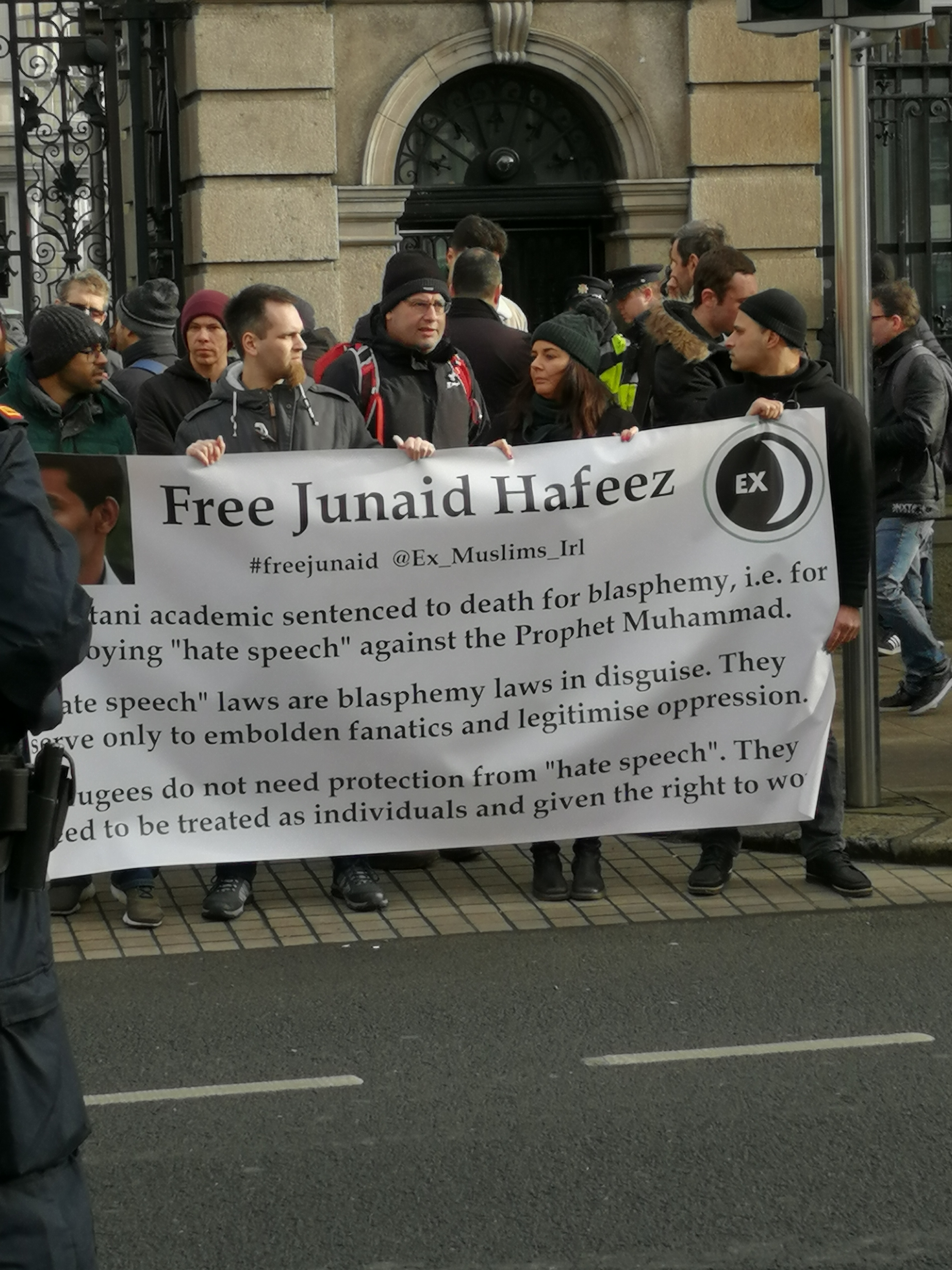
Some confused or misguided Asian anti-blasphemy laws protesters among the far-Rightists, despite the common anti-migration and racist discourse of the far-Right. (Photo: D.Breatnach)
FAR-RIGHT CHANTS OF “PAEDOS”
Among the exchange of insults between both sides, at one point the far-Rightists were heard to chant “paedos” at their opposition. The word is an abbreviation of the word “paedophiles”, which describes people who sexually abuse children for their own twisted gratification.
Imagine if some of these far-Rightists were in one’s neighbourhood and began to accuse an anti-fascist of being a paedophile! This is one of the ways in which they abuse any right to free speech.
But in any case, what is the basis for this chant? Do they really believe that their opponents are all paedophiles? No, like the Spanish far-Right party Vox referred to earlier, they count LGBT people as equal to paedophiles, i.e people who sexually abuse children. That is how sick their thinking is. Nor do they believe that all their opponents are LGBT themselves but according to the far-Right, the fact that we uphold the right of people to decide their own sexuality and for consenting adults to choose their relationships, makes us the equivalent of those who sexually abuse children!
View of the anti-fascist, anti-racist demonstrators, at the Molesworth St. intersection, viewed northward down Kildare St. (Photo: D.Breatnach)
SURGE, SCUFFLES AND ARRESTS
At one point, a surge developed among the anti-fascists towards the south of their numbers and the general Gardaí and Public Order unit (the Gardaí are the police force of the Irish state) charged the anti-fascists with batons drawn, with which they struck a number of antifascists. A man reported to be a fascist, on the steps outside a building on the same side of the street as the antifascists, was seen lashing out downwards, presumably at antifascists, with a pair of crutches. At that point the Gardaí restrained him and later it seems arrested him but apparently they had already arrested an anti-fascist. Most of the police dived at the anti-fascists during this brief episode and a few activists were rescued from police hands. However, a fascist who crossed the road from the Leinster House side with a stick, who took a number of swings at anti-fascists, was escorted back across the road by Gardaí, apparently without any attempt to arrest him.
The man seeing striking out at anti-fascists with crutches before being restrained by Gardaí. An antifascist was arrested during this incident. (Photo: D.Breatnach)
The far-Right rally had been scheduled for 1.00pm and at 2.15 pm they left, having begged the Gardaí for an escort, with which they were provided. Meanwhile, the riot police prevented the anti-fascists from following them.
However, a brief encounter on the quays a little later between small numbers of both groups necessitated the Gardaí once again to protect these “nationalist” warriors.
Yellow Vest Ireland fuhrer Glen Miller seeking escort from senior Garda officer. (Photo source: antifascist participant)
DIMINISHING AND DESERTED BY LEADERS?
Those who fancy themselves as the public leaders of the motley crew of the far-Rightists left their acolytes deserted, for apart from Yellow Vest leader and islamophobe Glen Miller, they did not attend. Neither Gemma O’Doherty nor Justin Barrett were to be seen there and the ex-British Army soldier Rowan Croft made only a brief appearance before vanishing.
As mentioned earlier, although extensively publicised in advance, the numbers of the far-Right were significantly down on previous events outside Leinster House, which may point to a limited reservoir of activists in the far-Right in Ireland, also to some inability to sustain an extended program of public events (after all, keyboard activism has been their main activity until recently).
On the other hand, their opponents, using personal contact only to mobilise from among Irish Republicans, Socialists, Anarchists and general Anti-Fascists of different organisations and none, were able to put together a counter-demonstration of a size approaching that of the far-Rightists.
However, it would be unwise to relax. The far-Right is on the rise across most of Europe; the capitalist system world-wide is heading for crisis and at such times turns to fascism to force the working people to pay for the crisis through austerity. In addition, in Ireland we are already in part of an austerity program with the bank bailout draining our taxes, our health service in crisis and no public housing program to counter spiraling homelessness and mortgage debt.
The Gombeens and foreign capitalists who feed on our sweat and blood will hesitate before taking on the working people in this country in an open fight. But with fascists and racists splitting the working people and diverting them from the cause of our woes, that would be a different matter. Continuing vigilance is required, along with mobilisation to counter their public events. But also, education of the people and giving genuine leadership in fighting for a decent life for working people of all ethnic backgrounds in Ireland.
Anti-Fascist Action Ireland (they published a report from which I took some of the information here, the rest being based on my observation): https://www.facebook.com/afaireland/?
I write to say how much I admired your attempt to have the Royal Irish Constabulary and the Dublin Metropolitan Police honoured in Ireland. It was never going to be easy to propose such a ceremony in a country that was occupied by les Anglais for nearly eight centuries and a part of which it is still occupying. But you did not flinch! It took real courage and I empathise with you on its failure (temporary, I hope).
Royal Irish Constabulary assisting landlord in relocation of a tenant in Co. Clare. (Photo sourcede: Internet)
Perhaps it was a little too soon. But as you know, I’m sure, once the unthinkable has been proposed, it is no longer unthinkable; then some day ….
It must be particularly galling for you to see the response of the “swinish multitude”, as your own orator Edmund Burke would have had it, result in the pushing into No.1 slot in the ITunes charts of that odious song of Dominic Behan’s, performed by that rabble-rousing folk group, the Wolfe Tones. To see that disgusting song enter the current Irish charts at No.33 –- and from there reach the No.1 played in the British and Irish charts! But go straight to No.1 in Scotland! Not to mention doing well in the USA and in Canada …..
How hurtful also to see the proliferation of mocking cartoons, videos and memes (all over social media, it seems). And coming up to the anniversary of the introduction of that great band of public servants, too: the RIC Special Reserve and the Auxiliaries.
But as I said earlier, it took courage to attempt what you did – something lacking in your silent partners in government, Fianna Fáil, who remained silent until they could see how the public wind would blow. Someone could get hurt in the rush to disassociate! It is the fate of courageous individuals such as yourself, if I may borrow a phrase from a popular science fiction series, “to boldly go where no-one has gone before.” Even if it looks like no-one follows.
Crowd gathering around gallant RIC Inspector felled by a hurley stick in Dublin 1917. (Photo sourcede: Internet)
Would that we had men of your calibre here in France! The legitimacy of the Vichy Government (1940-1945) was denied by ‘Free France‘ during WWII and by all subsequent French governments after that. They maintained that the Vichy government was an illegal one run by traitors – hard to believe, I know but look it up on Wikipedia! A group of us have been trying to get German soldiers and the Vichy police honoured for some time now but can we find even one politician of any stature who would risk his reputation in the attempt? No, we seem to have no Monsieur Flanagans here in France, c’est dommage!
We have a network of people with similar interests in a number of other countries, including Russia, Poland, Vietnam and Algeria – you may smile when you see the network’s acronym: RIC! Of course the letters stand for other words in our case: Rehabilitation of Invader Collaborators. Whether it was the Russians or Poles who aided the German invaders, or the Algerians who aided our French occupation or the Vietnamese who aided the US invaders, they all have something in common: they did a difficult job, hated by most of their compatriots.
Bandying around words like “concentration camps”, “torture”, “massacres”, “rape” and “executions” does not conceal the truth that ultimately these men (and women, it must be said) were obeying orders. Some of those words I hear have been bandied around about the RIC and DMP too, including those of “spies”, “informers”, “shoneens” and “Castle Catholics”. One must admit that the Irish have a capacity for les bon mots, however one might disdain what they mean – while not mincing words they certainly know how to weave them, if you’ll pardon the mixed metaphors.
Perhaps some day when you can be spared from your Ministerial duties (or when you have retired, far away be the day!), you could come and address the annual general meeting of our RIC – it would be a great honour for us.
DMP teaching people respect for the law, Dublin 31 August 1913. Note some agitators are continuing to cause trouble even lying down. (Photo sourced: Internet)
When, some day in the future, the Irish public recognises how deserving the RIC and DMP are of State honouring, the logical consequence will be of course to honour the Black and Tans and the Auxilliaries, who were sent specifically by Churchill to work in support of – and closely with – those two bodies of fine men. And once that has been accepted it should not be difficult to have the successors of the RIC in Northern Ireland honoured too: the Royal Ulster Constabulary and the B-Specials. Of course, there will be some die-hards who will mutter “sectarianism”, “brutality” and “Loyalist murder gang collusion” but one can never quite get rid of those bitter people, can one? God knows, the English tried!
Speaking of bitter words, I hear some Irish people are saying that as Minister for Justice, rather than honouring “traitors” and “murderers” (sic) you should be pursuing the English to disclose their secret papers regarding the murder of 33 people in the Dublin and Monaghan Bombing by alleged British agents in 1974. How unkind! Some people just can’t forget and move on, can they? Do they not realise that those bombers, whoever they were, were just obeying orders too?
And even bitterer! Some have been heard to say that if Michael Collins were alive he’d have had you shot, given that he had enough RIC, ‘Tans and Auxiliaries shot himself. One can understand some bitterness but that is really nasty, given that Collins can be said to be one of the founders of your own party. And who can truthfully say what Collins would or would not have done? He certainly surprised a lot of Republicans in 1922 when he borrowed British cannon to open fire on Republican positions in Dublin!
When the day comes in the future for Irish rehabilitation for those noble collaborators of foreign occupation, the Royal Ulster Constabulary and Dublin Metropolitan Police, then hopefully the Blueshirts, that fine body of men, co-founders of your own party Fine Gael, can be rehabilitated too. And who knows, some day even reconstituted and formally brought into government? It is not beyond the bounds of possibility, even though the sympathisers of those kinds of politics are very few at the moment ….
And then there’s the man they called “Lord Haw Haw”, William Joyce, of similar ideology — was he not an Irishman also? Did he not carry out his orders too? Of course, that might not go down too well with les Anglais due to his broadcasts in English from Nazi Germany — even though he was an informer against the IRA for the British during the War of Independence. Or perhaps precisely because of it: the English can never quite forgive one they consider theirs, once he turns against them, can they? One must be careful sometimes – after all, les Anglais still have quite some influence in the world, especially in your own country, n’est ce pas?
Friends and Comrades, self-respecting people of all organisations and none, Irish or migrants, who understand what it is to resist colonialism and imperialism and exploitation of labour: this is an appeal to act in defence of our self-respect.
As you must all be aware by now, the current Government of the Irish State plans to hold an event honouring the Royal Irish Constabulary and the Dublin Metropolitan Police in Dublin on the 17th of this month. Some at least are probably already considering how to react to this shameful event; I hope you are and if so, that you will give my suggestions some consideration. If you have not yet decided to respond to this event then I hope all the more that you will consider what I have to say.
The need to protest this event in a large and unified way is great. It is a matter of our self-respect as a nation, as a colonised people (and colonised peoples) that never ceased resisting, as workers, as trade unionists, as Irish Republicans and all varieties of the Left in Ireland.
The RIC and the DMP were not only the eyes and ears of the English colonist regime but also its first rank arm of repression after the British Army; they were the enforcement bodies of the landlords and bosses.
RIC still on site after assisting an eviction — see the battering ram that was used by the bailiffs to demolish much of the wall. (Photo source: Internet)
ROYAL IRISH CONSTABULARY
Formed in 1822, the armed nationwide Irish Constabulary got the “Royal” appellation from Victoria, the Famine Queen herself, in recognition of that organisation’s role in the suppression of the Fenian uprising of 1867. During the evictions of poor peasants and agricultural labourers from their lowly cottages and huts, the RIC attended every one, having become the FIRST RANK force of repression in Ireland, the Army being relegated to their backup should it be required. The RIC was the ever-present force of repression during the Tithes War, the Great Hunger and the Land War and was the main force responsible for the suppression of the Young Irelanders in 1848. On 5th May 1882 in Ballina, Co. Mayo, there were children among the slain when the RIC opened fire on a demonstration celebrating the release of the Land League leader prisoners.
RIC constables assisting eviction of Thomas Considine and family, Moyasta, Co. Clare 1767. (Source photo: Internet)
During the 1916 Rising, the RIC again played its part in repression of the resistance movement, particularly outside Dublin and it was they who attacked the Kent house in Cork, killing one son and arresting two others, including Thomas Kent which the British colonial regime executed, being one of the Sixteen the British killed in reprisal for the Rising. The RIC was the principal organisation supplying the names of non-participants in the Rising to be arrested and interned in jails and concentration camps in Britain.
After the Rising, the RIC continued one of its main roles as the eyes and ears of the British occupation in Ireland, collecting information on anyone who sang patriotic songs, spoke for independence or against the landlords, joined an Irish cultural organisation, agitated for women’s suffrage, organised a trade union branch ….
It was largely due to this role that the armed Republican forces made the RIC its first target in the War of Independence and in fact, the very first shots of that war were fired at the RIC in Soloheadbeg, killing two of them – this very month, 21st January 1919, 101 years ago and only four days after the date upon which this quisling State plans to honour that force.
RIC assisting bailiffs carrying out an eviction. The defenders have blocked the door with thorn brush and are throwing hot water out on their attackers. (Source photo: Internet)
When the “Black and Tans” and “Auxiliaries”, the RIC Special Reserve and the RIC Auxiliary Division to give them their official titles, were dispatched in March 1920 at Churchill’s initiative to terrorise and murder Irish people, outside Dublin they became part of the of the RIC and from then on, the existing RIC became responsible not only for its prior crimes but for those of the ‘Tans and Auxies too, such as the many murders, including those of the Mayors of Cork and Limerick; the torture of suspects and violation of women; the burning of farmhouses and cooperatives and even of villages and towns: Tuam, Trim, Balbriggan, Knockcroghery, Thurles and Cork – among others.
In 1922, while the RIC ceased to exist in the ‘Free State’, they became the Royal Ulster Constabulary in the Six Counties, with their even-more murderous reserve, the B-Specials. The B-Specials were incorporated into the Ulster Defence Regiment in 1970 and the RUC was renamed the PSNI (Police Force of Northern Ireland) in 2001. Both organisations have been active in carrying out or in collusion with sectarian murders, acting as members or in collusion with Loyalist paramilitaries and under British intelligence operatives.
Bailiffs using battering ram to gain entry to evict a family in Ireland. The RIC are present to protect the bailiffs. (Photo source: Internet)RIC King Street barracks after attack during War of Independence. (Photo source: Internet)
DUBLIN METROPOLITAN POLICE
The DMP was the colonial police force specifically responsible for controlling Dublin, the capital city of the colony. During the 1913 Lockout it showed itself capable of serving Irish capitalists, whether native or of colonist background, without discrimination. Indeed the leader of the Dublin 400 capitalists out to break the Irish Transport and General Workers’ Union, was an Irish nationalist, Catholic and owner of The Irish Independent: William Martin Murphy.
Apart from any others this force of tall thugs may have killed or fatally injured with beatings in their cells, the DMP killed a number of workers during the eight months of the struggle, raided houses and sent many to jail. Two workers, James Nolan and John Burke, died of their injuries within days of the DMP’s baton charge on a street meeting in Eden Quay just by Liberty Hall on 30th August 1913. The following day, in what became known as Bloody Sunday Dublin 1913, the DMP was in action again on O’Connell Street and in Princes Street, mercilessly beating people there (including those already knocked down), during which they knocked unconscious Patsy O’Connor, a young Fianna boy of 16 giving first aid to one of the wounded. Patsy died two years later from his injuries at the age of 18.
The DMP in action on O’Connell St on Bloody Sunday 1913, the second day of police riots in Dublin, early during the Lockout. (Photo source: Internet)
In a rage at the defence by the residents of Corporation Flats of people fleeing the police charge on Eden Quay, the DMP returned there on the 31st, leaving hardly a door or stick of furniture unbroken or person unbeaten, including women and children.
The special political secret police in Dublin were the G Division of the DMP, spying and compiling files on active nationalists, republicans, socialists, suffragettes, Irish speakers, pacifists. After the Surrender of the 1916 Rising, it was they who came among the prisoners to identify them for the British Army, leading to many receiving death and jail sentences. During the 1916 Rising it appears that three DMP officers were killed by the Irish Citizen Army – while many hid in their cells.
Arrest of Jim Larkin by DMP, shortly before the rest of the DMP present attacked supporters and onlookers. (Photo source: Internet)
During the War of Independence, the DMP G Division spied on and targeted Irish Republicans and other dissident groups. The Irish Republican Army of course targeted this force and killed a number of them. On the day when the IRA mobilised in Dublin to eliminate the special British Army counterinsurgency intelligence network, the DMP and the Auxiliaries seconded to them had already murdered Conor Clune and Volunteers Peadar Clancy and Dick McKee in Dublin Castle.
Later that day, the DMP and RIC went down to attack the GAA and murdered 14 unarmed people, including two players on the field, also injuring 60-70 people.
Aftermath of DMP baton attack on Sinn Féin public meeting in front of ruins of Liberty Hall to arrest Cathal Brugha and George Snr. Plunkett. Inspector John Mills was struck on the head by a hurley and died later in Jervis St. Hospital. His assailant was a member of Na Fianna and he was never apprehended. Mills was the first DMP officer killed after 1916 and the blow was probably not intended to be fatal. A number were shot with intention to kill during the War of Independence. (Photo source: Internet)
AN ADEQUATE PUBLIC RESPONSE IS NECESSARY
It is not only appropriate but absolutely necessary, as a matter of self-respect, that we mobilise a public opposition to this disgusting honouring of the spies on our people and the murderers of our martyrs.
There are many ways that this can be done but I would humbly suggest that two in particular are necessary:
A mass public demonstration near the day of the ceremony (or at least near it) and near Dublin Castle (where the event is to be held);
An electronic petition something along the lines of “Self-Respect: Against honouring colonial spies and murderers of our martyrs”.
Although our people have achieved a number of successes in struggle over the years, we have often failed too. In particular we failed to give an adequate response to the visit of the British Queen (and Commander-in-Chief of the Paratroopers) to Dublin, or to Wall of Shame in Glasnevin Cemetery. There were some other visits of notable imperialists which also did not receive an adequate response.
Failure is not fatal and we can recover from it – but we cannot build on failure. We can only build on success. This public response needs to be a success and in order to achieve that it cannot be the response of one organisation or of two but needs to be a broad one in which anyone can take part who are not racists or fascists. In order to achieve that, the organising committee should be broad enough to include activists from across the oppositional spectrum who are not part of a party of government (or part of previous government) in either jurisdiction in Ireland. Such an organising committee should be able to include representatives of socialist and republican parties and collectives and also trade unionists.
A broad demonstration of that kind should be free of paramilitary displays which would represent only a section and quite probably alienate another. But all Irish and migrant community and trade union flags and banners should be permitted (with the exception of racist or fascist ones) and the broad banner on the front should spell the general theme of the demonstration.
I am conscious that I am nobody in particular to make this call but given that I think such a response is necessary and that I really want to see this, I make the call anyway and pledge myself to help.
(Reading time: 1 minute; watching time: 3 minutes per video)
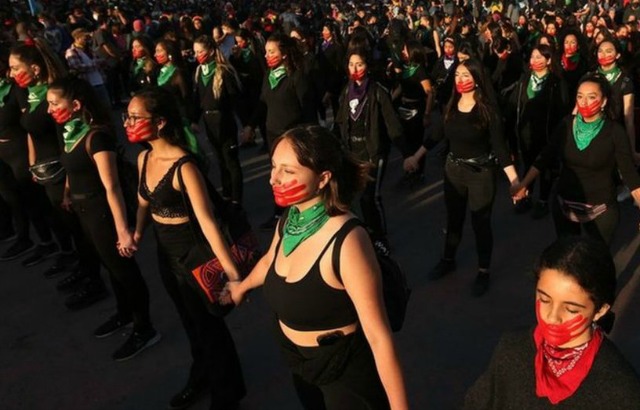
A choreographed protest against violence against women is sweeping the world. It was first seen on International Day Against Violence Against Women, 27th November in the centre of Santiago, the capital city of Chile. Organised by feminist group La Tesis, it formed part of the popular resistance to the the Sebastián Piñera regime and its repression, since accusations of rape and other sexual violence against the repressive forces have, according to a number of human rights agencies, amounted to 15% of the total (at least 70 separate cases in the first month of protests).
Source: Internet
The lyrics chanted were, in translation: Patriarchy is a judge who judges us for being born
and our punishment is the violence that you don’t see.
It’s femicide, impunity for my murderer,
it’s disappearance, it’s rape.
And it wasn’t my fault, where I was or how I was dressed.
The rapist is you. The rapist is you.
It’s the police, the judges, the State, the President.
The oppressive State is a macho rapist.
This was an extremely powerful and effective protest and caught the imagination of others, with videos spread by social media and also appeals across borders by feminist networks.
No doubt the continuation of the protest will take place in other contexts but it remain a powerful and innovative call.
As with other protests in Chile, those congregating in the area were attacked by forces of the State soon afterwards — the same forces against which the protest had been organised.