USA’s ambitions bring danger of war

Diarmuid Breatnach

(Reading time: 13 mins.)

“Wars and rumours of wars …”1 The sabres are rattling around Eastern Europe. The mass media in our latitudes largely takes the position of the USA under the guise of democracy; however with some text and the use of a few maps I hope to show that Russia’s position is essentially defensive in this regard and that the USA is the main aggressor. I hope to do that without expressing any support for the Russian regime.

WHAT IS ACTUALLY HAPPENING?

The USA sees Russia as its main opponent or competitor in Europe and has been working since the post-WWII decades to neutralise it, earlier under the guise of stopping the spread of “communism” and defending “democracy”. Since the fall of the USSR system the talk is no longer about defeating “communism” but “defending democracy” continues to used in anti-Russian rhetoric. Russia is no democracy but the notion that the US, the world superpower, the biggest imperialist power on the planet since WWII, cares about democracy should make us laugh. It would perhaps, except that the mass media keeps feeding us the USA’s rhetoric and shaping us to support it in war.

The USA is actually squeezing Russia from two directions — from Europe and from the Middle East. NATO, the North Atlantic Treaty Organisation is a US-led military alliance which now has the membership of most states in the EU, along with the UK and nearly every state of the former USSR to the west of Russia. A look at the map of NATO states will demonstrate that2. Nearly every state in the Middle East is also formally or informally in the sphere of influence of US imperialism3.

“Russia says it wants Western guarantees that Nato will not allow Ukraine and other former Soviet countries to join as members. Moscow has also demanded the alliance halt weapons deployments to Ukraine and roll back its forces from eastern Europe – demands flatly rejected by the West.4

Map NATO & non-NATO countries in Europe, showing also periodic expansion (Source: The Economist)

So the Russian ruling class is naturally worried and feeling besieged. On or near their European borders they only have Sweden, Finland, Moldova, Belarus and Ukraine which are not formally part of NATO and Ukraine has clearly indicated an interest in that direction. Beyond those last three aforementioned, all the states through central Europe are NATO members right through to the UK: Poland, Slovakia, Hungary and Romania actually bordering on Russia, with – heading generally westward and south-westward– Czech Republic, Croatia, Slovenia, Bulgaria, Albania, Greece, Germany, Netherlands, Belgium, Italy, Spain, Portugal, France and UK. In addition, some of those states have highly-developed military power such as Germany and two of them have nuclear armament of their own — UK and France – while the US has ready-to-launch nuclear missiles on the lands of many of the NATO states — Belgium, Germany, Italy, the Netherlands and Turkey5.

Sweden, Austria and Switzerland may remain nominally neutral but are in general politically aligned with the EU and the USA rather than with Russia, while non-NATO Finland is definitely, for historical and geographical reasons, extremely wary of its Russian neighbour.

The smaller non-NATO states of the former Yugoslavia – Bosnia & Herzegovina, Serbia, Montenegro, Montenegro and Kosovo are in some cases friendly towards Russia (or not overly-friendly towards NATO) but they are completely surrounded by NATO states.

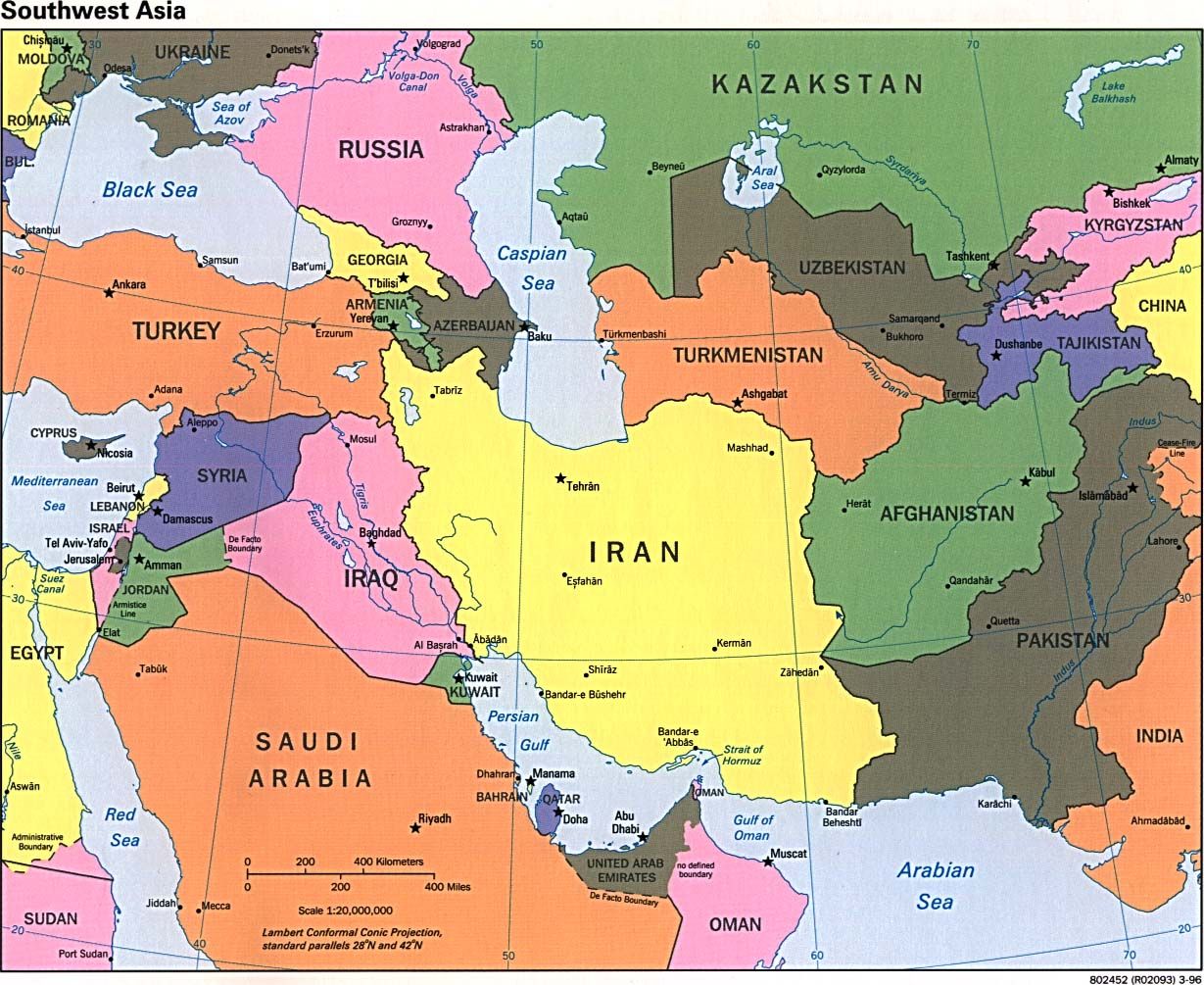
On its borders with the Middle East, Russia is also being squeezed. Turkey has long been a major NATO state in the region and only Georgia is located between it an Russia to the latter’s south-west, with Armenia and Azerbaijan to its south-east. Nearly all of the states in the Middle East are in formal or informal alliance with the West and therefore with the US: Cyprus, Lebanon, Iraq, Israel, Jordan, Egypt, Sudan, Libya, Saudi Arabia, Kuwait, Oman, Bahrain, Qatar and United Arab Emirates. Yemen is embroiled in its own Saudi and West-proxy war, while Syria is threatened by Israel, Turkey and NATO. Only Iran is fairly safe for the moment on that part of Russia’s border, which is why Russia will take its side in any conflict with the West, despite the Russian ruling class’ dislike of and vulnerability in some regions, as in Chechnya, to militant fundamentalist Islam.

Middle East states and Russia (Source: Internet)

Syria is next to Iran which is also why Russia has been supporting the Assad regime and why, during the past week, it has warned Israel about its bombing raids into Syria as the latter attacks Hizbollah bases there. In fact we may see the invasions by western alliances of Iraq and Libya as part of huge US/NATO ‘domino’ plan to attack Syria with Iran next; then the pressure on Azerbaijan and Georgia on Russia’s doorstep. While on the eastern side of Iran, Afghanistan and Pakistan are also allies of the West ….

Further east, there is India which has long been friendly to Russia and in tussles with Pakistan — and China, which is not openly hostile to Russia as a rule but which is not a real friend either, though its competition and contention with the US keeps it friendly enough towards Russia for the moment.

What the Russian ruling class is doing is attempting to bring a halt to its encirclement by NATO at the point of Ukraine. And the US-NATO and EU are issuing a counter-threat – an open one of sanctions and a more veiled one, in the case of US-NATO, of armed action.

This week it appears that some parts of Ukraine have sought to break away from the main part, probably instigated by Russia or at least promised support if they did – which has materialised in Russian diplomatic recognition and in troop movements. This may amount to an annexation or may not but what is clear is that Russia, in the face of what it considers a threat to its existence and NATO intransigence, has decided to take some decisive action.

WHAT IS REPORTED

The western mass media reports the situation painting a picture of big powerful Russia threatening its much smaller neighbour, by threat of invasion seeking to force it into submission to Russia’s regime, in denial of the small nation’s democratic rights. And the democratic West, through NATO, is moving troops to support the Ukraine, warning Russia of consequences.

Russian Tanks and Troops Reportedly entering part of Ukraine (Photo source: The Telegraph)

The picture contains much truth but overall it is a lie. Russia is much bigger than the Ukraine and it is threatening it with troop movements. And NATO is moving troops up to counter-threaten. But to evaluate a situation properly, we need to know its antecedents, what led up to it. We also need to see the situation through the eyes of the participants, whether we agree with them or not. The mass media, apart from a couple of honest analysts tucked away inside a newspaper, far from the headlines, does not supply us with that information.

The Irish Times, one of Ireland’s main daily newspapers, on 12 February reported that “Russia’s military build-up near Ukraine and a surge of Russia’s military activity has fueled fears that Russia could invade the country. Russia denies having any such plans. However a US official has said that the US had picked up intelligence that Russia is looking at Wednesday as a target date for an incursion.”

So on the basis of the quoted paragraph, we were to draw the conclusion that Russia was threatening to invade Ukraine. OK, Russia denied it but then why the military buildup near Ukraine? Finally, the authority voice of the USA, quoting what we are supposed to see as excellent intelligence sources (which we cannot of course question), predicting a probable Russian invasion four days away. So which state are most people in this part of the world likely to believe, the Russians or the US?

Some weeks earlier, on 25th January, another Irish daily newspaper, the Examiner, reported on reactions to a Russian naval fleet exercise in the Atlantic. The Irish Government told the Russians the exercise was not welcome although not illegal6, because the area of the exercise is regarded as international waters. This from the same government that facilitates US military flights via Shannon airport, i.e on its own national territory. And NATO carries out at least one major exercise in European waters annualy, with the UK doing so twice yearly without complaint from the Irish Government.7

The Ukrainian Ambassador to Ireland, Ms Gerasko moved to take advantage of the situation “A plan to hold a major exercise by the Russian navy and air force in the Atlantic off the southwest coast of Ireland is yet another demonstration of the threat that Russia poses for the world,” she said, in a statement to the Irish Examiner.” 8

Attempts were made at the same time to whip up Irish offshore fishermen against the Russians and to whip up the Irish public in defence of “our fishermen”. The latter project failed miserably since the Russian Ambassador to Ireland met and negotiated with the fishermen, leading one of their leaders to comment that the Russians had treated his members better than their own (Irish) government.

We might expect an alternative discourse about the Ukraine crisis from Al Jazeera but its report on the 24th of January, although emphasising US military movements in the area, attached a number of articles which were generally relaying the western line. The Irish Independent carried a much more in-depth explanation, though based on the position of the UK through its premier, Boris Johnson; however it did list the Russian demand that NATO cease pushing towards them and that Russia considered Ukraine joining NATO “an existential threat” while in general still following the general anti-Russian pattern9.

Closing ceremony of Sea Breeze, NATO-Ukraine joint naval exercises in the Black Sea 12 July 2019 (Photo by US Naval Officer)

POSITION OF THE IRISH STATE

An analysis piece in its business section by the Irish State’s national broadcaster, RTÉ, concentrated on the possible economic impact of loss or drastic reduction in gas and oil exports from Russia, either as a direct consequence of conflict or through imposition of sanctions by the West. “Russia produces 11% of global oil supplies and according to David Horgan, managing director of Petrel Resources, any significant loss of Russian energy exports would result in a further spike in prices.”10

Russia is the biggest supplier of gas in the world and the largest to Europe with a third of of its gas pipeline supply to Europe crossing Ukraine. Ireland’s electricity supply is highly dependent on gas for its generating stations so any disruption will impact heavily of prices which “have already gone from $2 to about $30 per million BTU”, according to the Petrel managing director.11

It is clear that while the USA is driving the agenda through its dominance of NATO and the the threat of sanctions on Russia, which the USA regularly insists upon when teaching other countries a lesson, its own economy would suffer little as a result. However, it is a different question for the European states, which would be obliged to bear the weight of economic impact. Mícheál Martin, the Taoiseach (Prime Minister) of the Irish State felt obliged to comment on this possibility but, rather than criticise the USA and NATO’s expansionism, spoke about the need to break from their dependence on Russian energy supplies.

Micheál Martin said the EU is unified in responding “very strongly” to any Russian invasion of Ukraine and stated that in Europe’s view the huge build-up of troops by Russia on the Ukraine border is “not justifiable” in any circumstances. While calling for “diplomacy and de-escalation” he clearly sided with the USA in the conflict as both the Irish ruling class and the EU’s would expect of him.12

Despite many criticisms to the contrary, the policy of the Irish state during WWII was essentially one of neutrality in favour of the Allied forces while the government of the Six Counties was of course wholly aligned with the UK. Nevertheless Irish commercial shipping was sunk by Nazi German action and cost many Irish seamen their lives.

So far the Irish state has remained outside NATO but over the past decade there has been discussion envisaging the creation of an EU rapid deployment force made up of personnel contributed from all member states. It would hardly be surprising if such a move appealed to some within the career personnel in the Irish armed forces, envisaging taking part in wider military action, alongside varied forces, employing advanced weapons and systems and with possibly better promotion prospects. Additionally in recent weeks there has been media discussion of greater funding for those forces.

Ireland – and not only the UK’s colony here – can be dragged into war more easily than we perhaps imagine and also into being targeted for retaliatory action. Indeed, the facilitation of US military personnel and materiel through Ireland’s airport at Shannon, along with CIA transport of secret prisoners (“rendition”) has already exposed the State (and succeeding governments) to accusations of military partisanship.

Contrary to popular belief, the Irish State’s ‘neutrality’ is in general a matter of government policy rather than a requirement of the Constitution or Statute law.13 

The principal statute governing the Irish Defence Forces is the Defence Act 1954, which did not oblige members of the Irish Army to serve outside the state (members of the Air Corps and Naval Service are not so excused). A 1960 amendment intended to allow deployment in United Nations Peacekeeping missions requires three forms of authorisation, since the 1990s often described as the “triple lock”:

  1. A UN Security Council Resolution or UN General Assembly Resolution;
  2. A formal decision by the Irish government;
  3. Approval by a resolution of Dáil Éireann (the lower house of the Oireachtas, to which the government is responsible).
From those last two it is clear that the 26 Counties can be put on a war footing by a decision of the Irish Government or even a majority vote in favour in the Dáil. Anyone who believes that the party with most TDs would necessarily vote against such a motion is fooling themselves since the SF party has been at pains to portray itself as a safe pair of hands for Irish capitalism and recently called for greater funding for the armed forces of the Irish state; in addition it has long had an uncritically friendly relationship with the USA, in particular – though not only – with its Democratic Party.

A resolution from the UN Security Council obliging the Irish state to go to war against Russia is impossible and though such from the General Council might be possible, albeit unlikely.14

These provisions were modified in 1993 to allow for UN Chapter VII missions and again in 2006 to allow for regionally organised UN missions.

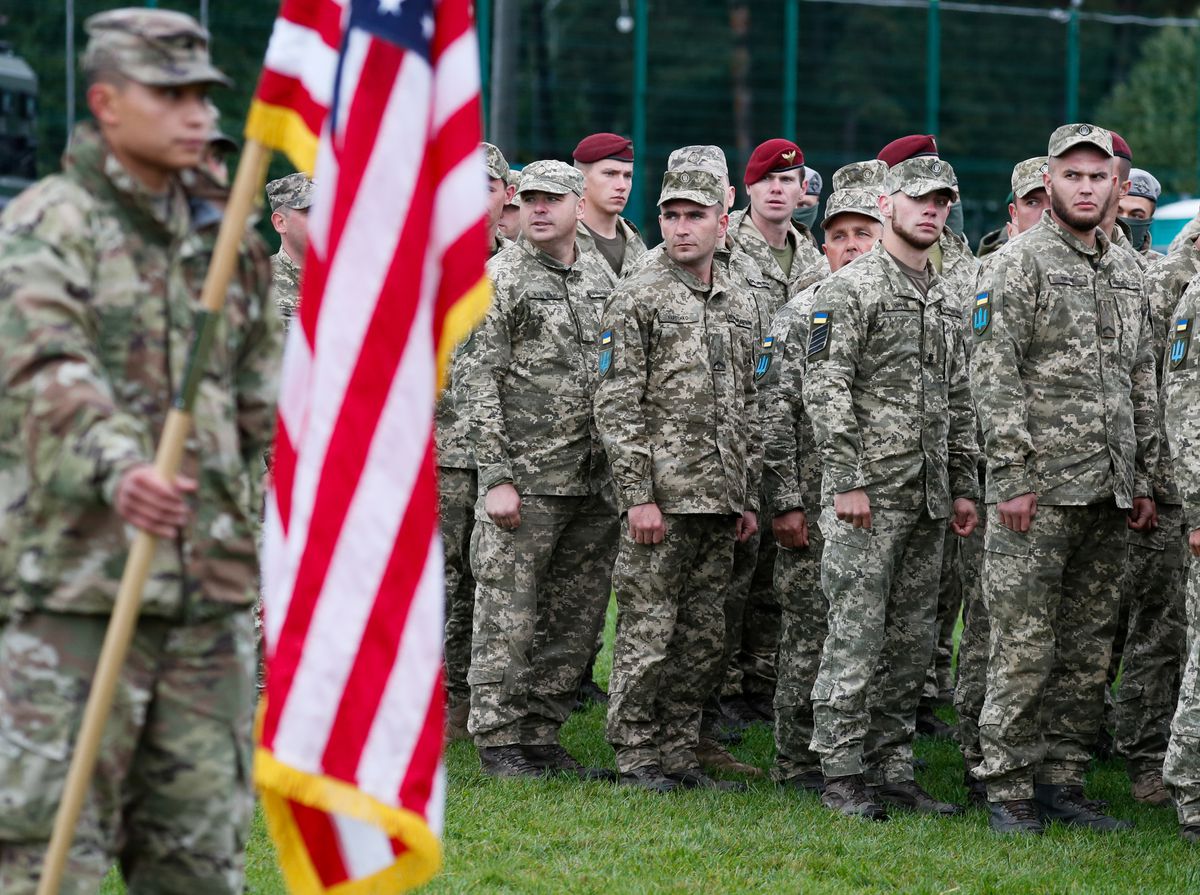
Joint NATO-Ukraine military exercise September 2021 (Photo sourced: Internet)

WHAT WE CAN DO

There seems no middle way — either NATO will back down or Russia will. No doubt the Western powers think it reasonable that Russia be the one to blink but as commented earlier, for the latter NATO creep to their borders is seen as a threat to their very existence. The same people who thought it reasonable for John Kennedy as President of the US to threaten war on the Soviet Union for the location of some missiles on the Caribbean island of Cuba think Russia should accept the advance of NATO to its borders.

In practical terms there seems little we can do in Ireland except struggle to resist the state and colony in which we live being dragged into war – for which we need to mobilise the opposition we can on the street. Sadly the anti-imperialist war movement in Ireland of years ago was allowed to deteriorate — but we should work to rebuild it.

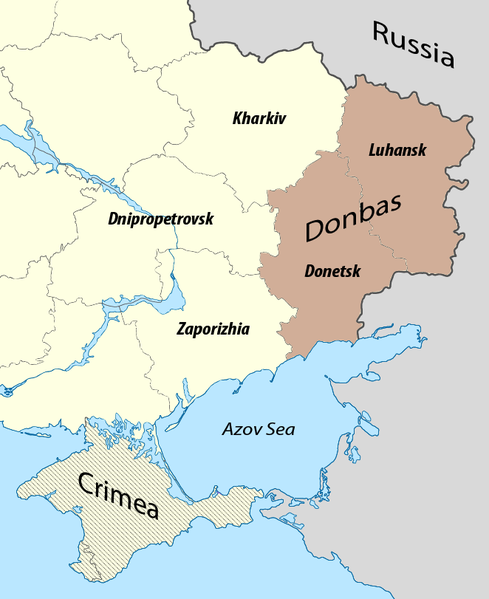
In order to assist in this it is essential that we expose the reality of what is going on in the world. Some will say that because the USA is the main aggressor in this case and the biggest bully, we should support Russia but to do so would be a big mistake. Not long ago, while joining others in anti-fascist solidarity with people in the Donbas region in SE Ukraine, I found us being increasingly nudged towards support for Russia which I did not view as being the same thing at all.

Russia has its own crimes against people and workers and calling for support for it now will cause confusion when in future we will need to condemn it. Our position should be that while neither the USA’s regime or Russia’s is to be supported, the biggest danger of war comes from the USA and therefore it will be the main target of our hostility – besides which it is the power with which the ruling classes of Ireland and the UK are aligned. It is the biggest imperialist power in the world by far along with being the biggest military power in most of the world.

Most Irish people have no wish to be dragged into an armed conflict anywhere where they do not feel threatened. On the other hand our society is conditioned not only by decades of strong cultural influences from the USA, in particular through film but also by media reporting that is biased towards the dominant western European view and that of the USA. In that paradigm, the Russians are the bad guys, the gunfighters in the black hats, while the US and the West in general are on the side of the angels.

With the 1916 Rising in the middle of WWI, Ireland became the first country to carry out an uprising against world war15, against the dominant trend throughout Europe at the time — a tradition worth upholding. As long as imperialism exists, the world will continue to suffer smaller wars and the danger of another major war. It is necessary to overthrow imperialism and we can best contribute towards that aim by coordinating our struggles with the aim of carrying out a revolution in Ireland, thereby depriving imperialism of one of its supporters in Europe.

End.

FOOTNOTES
1
“And you will begin to hear of wars and rumors of wars. Behold, do not be alarmed; for it is necessary to take place, but the end is not yet” — Christian New Testament Bible, Matthew, Chapter 24:6.

2See map NATO states

3See appropriate map for this also

4https://www.breakingnews.ie/world/white-house-calls-russian-moves-on-ukraine-an-invasion-1262219.html

5https://armscontrolcenter.org/fact-sheet-u-s-nuclear-weapons-in-europe/

6https://www.irishexaminer.com/news/arid-40792923.html

7https://www.royalnavy.mod.uk/news-and-latest-activity/operations/united-kingdom/exercise-joint-warrior

8Ibid.

9https://www.independent.ie/world-news/europe/ukraine-crisis-why-russia-might-invade-and-what-could-happen-next-41279592.html

10https://www.rte.ie/news/business/2022/0128/1276522-ukraine-ireland-analysis/

11Ibid.

12https://www.irishexaminer.com/news/arid-40811598.html

13According to Wikipedia: “One exception is Article 29, section 4, subsection 9° of the Irish constitution:

The State shall not adopt a decision taken by the European Council to establish a common defence pursuant to Article 42 of the Treaty on European Union where that common defence would include the State.

This was originally inserted by the 2002 amendment ratifying the Treaty of Nice,and updated by the 2009 amendment ratifying the Treaty of Lisbon. An earlier bill intended to ratify the Treaty of Nice did not include a common defence opt-out, and was rejected in the first Nice referendum, in 2001.”

14Resolutions of the UN Security Council, the only ones binding on all member states, require unanimous agreement by all five Permanent Members: UK, France, USA, Russia and China. Forcing a vote such as this in the UN General Assembly would likely lead to the fracture of the organisation.

15The following year there were two in Russia and in 1918 another in Germany.

SOURCES

Matthew 24:6 https://biblehub.com › matthew

https://www.dw.com/en/thousands-of-russian-troops-leave-ukraine-border/a-60257452

https://www.breakingnews.ie/world/putin-orders-forces-to-maintain-peace-in-eastern-ukraine-1261744.html

https://www.breakingnews.ie/world/emergency-meeting-called-by-un-security-council-over-ukraine-crisis-1261794.html

Map Middle-East towards Russia: https://www.pinterest.com/pin/291678513336896419/

European states holding US nuclear weapons: https://armscontrolcenter.org/fact-sheet-u-s-nuclear-weapons-in-europe/

Map NATO states towards Russia: https://www.businessinsider.com/map-europe-divided-nato-russia-2016-7?r=US&IR=T

UK bi-annual military including naval exercises: https://www.royalnavy.mod.uk/news-and-latest-activity/operations/united-kingdom/exercise-joint-warrior

NATO exercise 2021: https://mc.nato.int/media-centre/news/2021/nato-exercise-dynamic-mariner-and-joint-warrior-begins-in-the-atlantic#:~:text=It%20runs%20between%2018%20and,Kingdom%20and%20the%20United%20States.

Mass media:

Ireland, on Russian Naval fleet in the Atlantic and Ukraine Ambassador: https://www.irishexaminer.com/news/arid-40792923.html

Al Jazeera on the Ukraine confrontation: https://www.aljazeera.com/news/2022/1/24/uk-pulls-staff-from-ukraine-as-fears-of-war-rise-liveblog

Much more in-depth coverage with emphasis on the UK position: https://www.independent.ie/world-news/europe/ukraine-crisis-why-russia-might-invade-and-what-could-happen-next-41279592.html

Irish Government position: https://www.irishexaminer.com/news/arid-40811598.html

Irish neutrality — facts: https://en.wikipedia.org/wiki/Irish_neutrality

Calls for a joint EU countries armed force: https://www.france24.com/en/europe/20210902-proposals-for-an-eu-army-re-emerge-after-afghan-pullout-%E2%80%93-but-many-remain-hard-to-convince

PROTESTS GREET PRESENTATION OF CHANCELORSHIP TO HILLARY CLINTON

Diarmuid Breatnach

(Reading time: mins.)

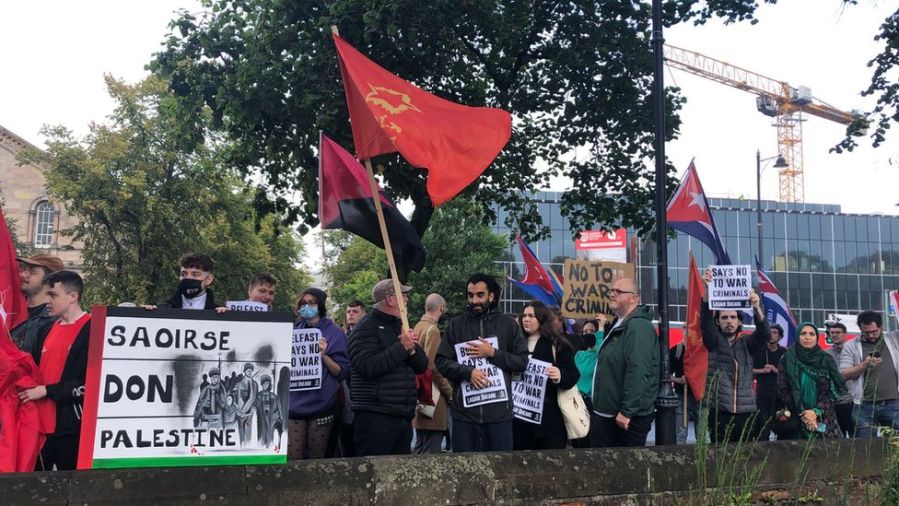
Queen’s University Belfast appointed Hillary Clinton as the institution’s Chancellor1. On 24th September 2021 the University authorities organised an event to mark her formal inauguration; however a large and voluble crowd gathered to protest the inauguration and the authorities’ choosing her as Chancellor of the University. Among the shouts of protesters were “War criminal!” and “Hillary, Hillary, Hillary – Out, out, out!” (This story is now “old”, apologies but nevertheless worth posting for those who might not be aware of it as media coverage was muted)

Although the Belfast Telegraph’s coverage of the event made no mention whatsoever of protests, they were reported in a number of other media. The protest saw Irish Republican and Left socialist groups come together to carry out the protest, with a number of them taking turns to speak.

The speakers at the protest included Pól Torbóid of Lasair Dhearg; Aidan Moran, a former ISM activist in Occupied Palestine, on behalf of Cairde Palestine; Conal MacMathúna on behalf of the Connolly Youth Movement; Local Councillor Michael Collins from People Before Profit; and Dr. Azadeh Sobout, Scholar of Transitional Justice and Peace building and Member of Academics for Palestine.

In addition to Irish organisations’ banners and flags, the national flags of Palestine and Cuba were also in evidence.

Hillary Clinton has been a member of the USA Congress from 2001 to 2009, followed by Secretary of State from 2009 to 2013, having also held the ceremonial position of First Lady during her husband Bill Clinton’s tenure as President of the USA 1993-2001. The Secretary of State of the USA, appointed by the President with the advice and consent of the Senate, is the President’s chief foreign affairs adviser. The Secretary carries out the President’s foreign policies through the State Department and the Foreign Service of the United States.

Lasair Dhearg’s Pól Torbóid, who helped organise and also spoke at the event, said, “Queen’s University’s complicity in the whitewashing of Hillary Clinton and her war crimes further epitomises the university’s role in an international framework of imperialism that sees it not only glorify warmongers like Clinton, but have immense financial investment in military contracts and companies guilty of immense environmental destruction.”

“Queen’s has facilitated the visitation of many war criminals and parasites over the years, but arguably none as big as the visit of Hillary Clinton as its chancellor. A proud Zionist and imperialist; with a war record as long as your arm, Clinton has helped oversee US bombing campaigns in over 9 countries.”

“As US secretary for war, she authorised over 400 drone strikes across multiple nations, which overwhelmingly killed civilians and even children at a proportion of almost 90%.”

“She labelled black men ‘super-predators’ when she helped lobby for the 1994 US Clinton Crime Bill, which was immensely important in creating the mass incarceration levels that exists today in the US to benefit the prison-industrial complex – which is a system of slavery by new means.”

Section of the protest as seen from the inside of the University (Photo sourced: Internet)

“A Zionist, Hillary Clinton has shown herself to be an enemy of Palestinian liberation, siding with the oppressor every time it mattered, like during the 2014 Israeli bombing campaign of Gaza. She increased annual US funding to Israel from 2.5billion, to 3.1 billion US dollars whilst she was US Secretary of State, and she stated that countering the BDS movement globally should be a priority for Israel’s defence.”

“All this – and Queen’s award her chancellor for her Peace and Reconciliation efforts. For all the books Queen’s have at its disposal, I don’t think their management have ever read one! PEACE IS SOMETHING HILLARY CLINTON CAN’T EVEN SPELL, NEVER MIND DISPENSE!”

Full video below (with thanks to Lasair Dhearg organisation):

(Photo sourced: Internet)

FOOTNOTES

  1. In the UK university system, the office of Chancellor is held by a distinguished individual, from academia or public life, who is not usually resident and does not hold any other University office.

SOURCES

https://www.thejournal.ie/hillary-clinton-installed-chancellor-queens-university-belfast-5557234-Sep2021/

https://www.v-c.admin.cam.ac.uk/chancellors-role

HOWARD ZINN — US INTELLECTUAL CRITIC AND ACTIVIST

By Geoff Cobb

(Reading time: 3 mins.)

Like many Brooklyn Jews of his generation, Howard Zinn, an icon of the American left, questioned laissez fair American capitalism and American nationalist glorification of country. He was the author of “A People’s History of the United States,” a best seller which sold more than two million copies and inspired a generation of high school and college students to rethink American history. He was also a strong supporter of the civil rights movement and an opponent of the Vietnam war, as well as being a much-loved professor. Proudly, unabashedly radical, Zinn delighted in debating ideological foes, including his own college president, and in attacking conventional ideas, not the least that American history was a heroic march toward democracy.

One of the many different jacket covers for reprints of Zinn’s most famous book — this one abridged for teaching purposes (Image sourced: Internet)

Born Aug. 24, 1922, Howard Zinn grew up in Bedford Stuyvesant. His parents were Jewish immigrants who met in a factory. His father worked as a ditch digger and window cleaner during the Depression. His father and mother ran a neighborhood candy store for a brief time, barely getting by. For many years his father was in the waiter’s union and worked as a waiter for weddings and bar mitzvahs. “We moved a lot, one step ahead of the landlord,” Zinn recalled. “I lived in all of Brooklyn’s best slums.”

“NO LONGER A LIBERAL”

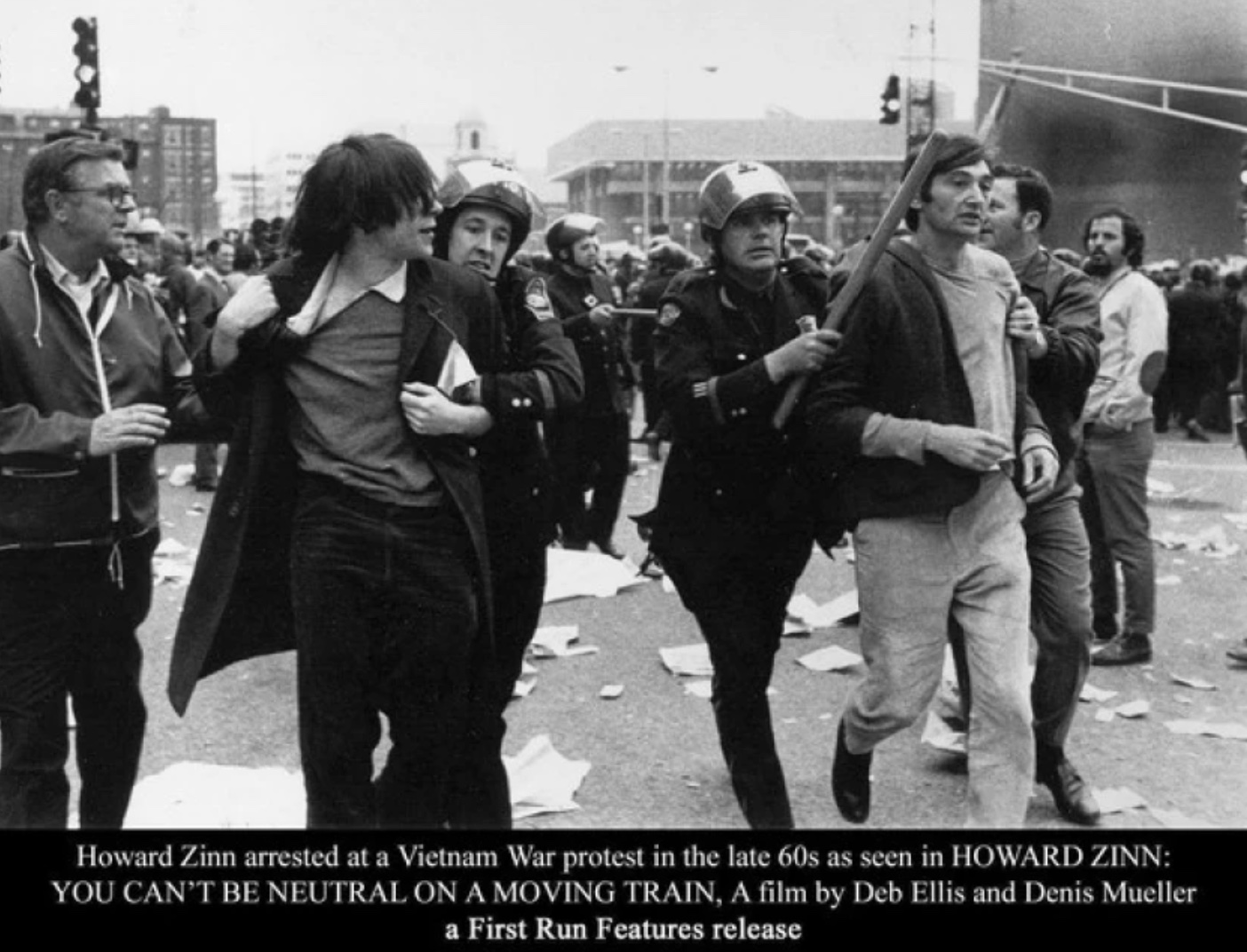
His parents were not intellectuals and Zinn recalled that there were no books in his home growing up. At some point his parents, knowing his interest in books, and never having heard of Charles Dickens, sent in a coupon with a dime each month to the New York Post and received one of ultimately twenty volumes of Dickens’ complete works. He became interested in fascism and began to read about its rise in Europe and to engage in political discussions and debates with some young Communists in his neighborhood. Zinn was radicalized thanks to a peaceful political rally in Times Square, where mounted police charged the marchers, hit Zinn knocked him unconscious. Zinn explained, “From that moment on, I was no longer a liberal, a believer in the self-correcting character of American democracy. . . The situation required not just a new president or new laws, but an uprooting of the old order, the introduction of a new kind of society—cooperative, peaceful, egalitarian.”

After graduating from Thomas Jefferson High School, Zinn became an apprentice shipfitter in the Brooklyn Navy Yard, where he and a few other apprentices began to discuss books and strategize about how to improve their dangerous working conditions. Excluded from the craft unions of skilled workers, they formed their own Apprentice Association. On an overnight boat trip he organized to raise money for the association, he met his future wife, Roslyn Shechter, who shared Howard’s progressive views and was also a Jewish child of immigrants. Zinn joined the Army Air Corps in 1943, eager to fight the fascists, and became a bombardier in a B-17. While in the Air Force he was disturbed by the race and class inequality among the servicemen. It wasn’t until years after the war that he questioned the necessity of the bombs that he dropped.  But at the end of the war, back in New York, he deposited his medals in an envelope and wrote: “Never Again.”

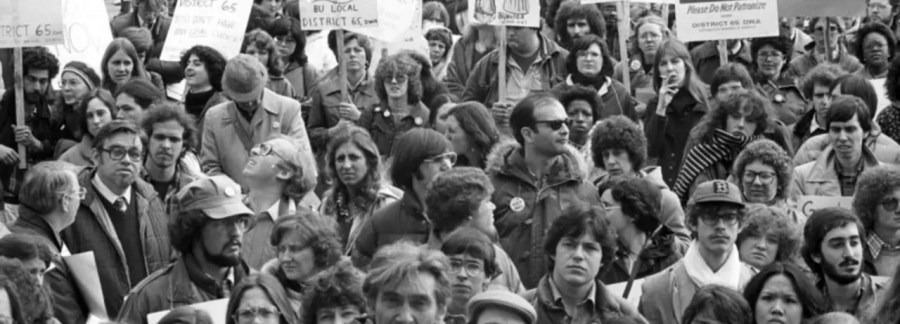
View of students and faculty carrying signs during a strike by faculty and staff of Boston University, on Commonwealth Avenue, Boston, 1979. Historian Howard Zinn, then a professor at BU, is just visible in the centre foreground. (Photo by Spencer Grant/Getty Images)

“I would not deny that [WWII] had a certain moral core, but that made it easier for Americans to treat all subsequent wars with a kind of glow,” Zinn said. “Every enemy becomes Hitler.”

After the war, he went back to interview victims of the bombing, and later wrote about it in two books. His own experience and his subsequent interviews led him to conclude that the bombing had been ordered more to enhance the careers of senior officers than for any military imperative, and he later wrote about the ethics of bombing in the context of Hiroshima and Nagasaki, Tokyo and Dresden, as well as Iraq.

Zinn and Roz married in 1944. While Zinn worked various jobs after the war, they lived on meager income in a rat-infested basement apartment in Brooklyn. Their daughter Myla was born in 1947 and Jeff in 1949. They moved to new public housing in 1949 and Zinn went to New York University for his B.A in history.

Thanks to the GI Bill, which paid the tuition of veterans, Zinn went to Columbia, where he earned an MA in 1952 with a thesis about a famous coalminers’ strike in Colorado, then obtained his PhD with a dissertation about the career in Congress of Fiorello LaGuardia, the reforming mayor of New York. He studied at Columbia under Richard Hofstadter who taught Zinn that American liberals were not as liberal as they thought they were, and that the two common threads in all American history were nationalism and capitalism.

PROFESSOR ZINN

In 1956, Zinn accepted a professorship at Spelman College, a traditionally black college for women in Atlanta, Georgia. Among his students were Maria Wright Edelman, the campaigner for children’s rights, and the future novelist Alice Walker, author of The Color Purple. At Spelman, he was a mentor to and later the historian of the Student Non-Violent Co-ordinating Committee (SNCC), the radical student wing of the civil rights movement. Zinn took part in many civil rights protests, and he encouraged his students to join him in these marches, which angered Spelman’s president. Zinn angered the authorities at Spelman over his insistence that its students should not be trained to be ladies, but should be actively involved in politics. “I was fired for insubordination,” he recalled. “Which happened to be true.” Zinn moved to Boston University in 1964, where he quickly became an outspoken critic of the Vietnam War. He angered many Americans, including Boston University’s president, by traveling with the Rev. Daniel Berrigan to Hanoi to receive prisoners released by the North Vietnamese, and produced the antiwar books “Vietnam: The Logic of Withdrawal” (1967) and “Disobedience and Democracy” (1968). When Daniel Ellsberg, a previously gung-ho John F Kennedy and Lyndon B Johnson administration official, came out against the war, he gave one copy of the Pentagon Papers (officially titled United States-Vietnam Relations, 1945–1967: A Study Prepared by the Department of Defense, the government’s secret history of the war) to Zinn and his wife, Roslyn. Zinn and Noam Chomsky edited what became known as the Mike Gravel edition, published in Boston in 1971-72 by the Beacon Press.

In 1980, he published his most successful work, A People’s History of the United States, which was a highly controversial revision of American history. Instead of the usual congratulatory tone of most American history textbooks, his work concentrated on what he saw as the genocidal depredations of Christopher Columbus, the blood lust of Theodore Roosevelt and the racial failings of Abraham Lincoln. He also highlighted the revolutionary struggles of impoverished farmers, feminists, laborers and resisters of slavery and war. Bruce Springsteen said the starkest of his many albums, “Nebraska,” drew inspiration in part from Mr. Zinn’s writings.

For decades, he poured out articles attacking war and government secrecy. 

When President Ronald Reagan bombed Tripoli in 1986, Zinn wrote: “There is no flag large enough to cover the shame of killing innocent people for a purpose which is unattainable.” He denounced the invasion of Iraq and also criticized President Barack Obama’s intensification of the war in Afghanistan. He was sharply attacked in Israel and by many of his fellow American Jews for saying that war was morally the equivalent of terrorism.

Howard Zinn (Photo sourced: Internet)

Mr. Zinn retired in 1988, concluding his last class early so he could join a picket line. He invited his students to join him. Zinn also wrote three plays: “Daughter of Venus,” “Marx in Soho” and “Emma,” about the life of the anarchist Emma Goldman. All have been produced. Zinn died in 2010.

Zinn always believed in standing up to injustice and fighting for oppression. He said near the end of his life, “Where progress has been made, wherever any kind of injustice has been overturned, it’s been because people acted as citizens, and not as politicians. They didn’t just moan. They worked, they acted, they organized, they rioted if necessary to bring their situation to the attention of people in power. And that’s what we have to do today.”

End.

POSTSCRIPT from Rebel Breeze:

TRUMP ATTACKS ZINN AFTER LATTER’S DEATH

“If you want to read a real history book,” Matt Damon’s character tells his therapist, played by Robin Williams, in the 1997 film “Good Will Hunting,” “read Howard Zinn’s ‘A People’s History of the United States.’ That book will knock you on your ass.”

It is very unlikely that President Donald Trump knew who Howard Zinn was before he saw the name on his teleprompter. And it is even less likely that he’s read “A People’s History of the United States.” But that didn’t stop him from saying — at the White House Conference on American History on Thursday — that today’s “left-wing rioting and mayhem are the direct result of decades of left-wing indoctrination in our schools. It’s gone on far too long. Our children are instructed from propaganda tracts, like those of Howard Zinn, that try to make students ashamed of their own history.”

Quoted from https://www.commondreams.org/views/2020/09/23/rights-long-war-howard-zinn-reaches-white-house

WHO ARE “WE”?

Diarmuid Breatnach

(Reading time: one minute)

When I read or hear someone say something like: “We should stop supporting Israel” or even “We need to stop ignoring Israel’s crimes”, my hackles rise somewhat and I ask myself “Who are this ‘we'”?

Are you turning a blind eye? No, you are not. Amy I? Are those who post the crimes of the Zionist state and all the others who have “liked” those posts, or the thousands who have demonstrated in Ireland in solidarity with Palestine? Or those who go on solidarity visits every year, braving Zionist surveillance and traveling under cover? Or the unknown thousands who don’t buy goods produced in Israel, so much so that when supermarkets display avocados from Israel they leave off the country of origin and one no longer sees herbs for Israel on sale in their shops (not in Dublin anyway). No matter the limited effect these actions have, clearly “they” are not supporting Israel and are in solidarity with the Palestinians.

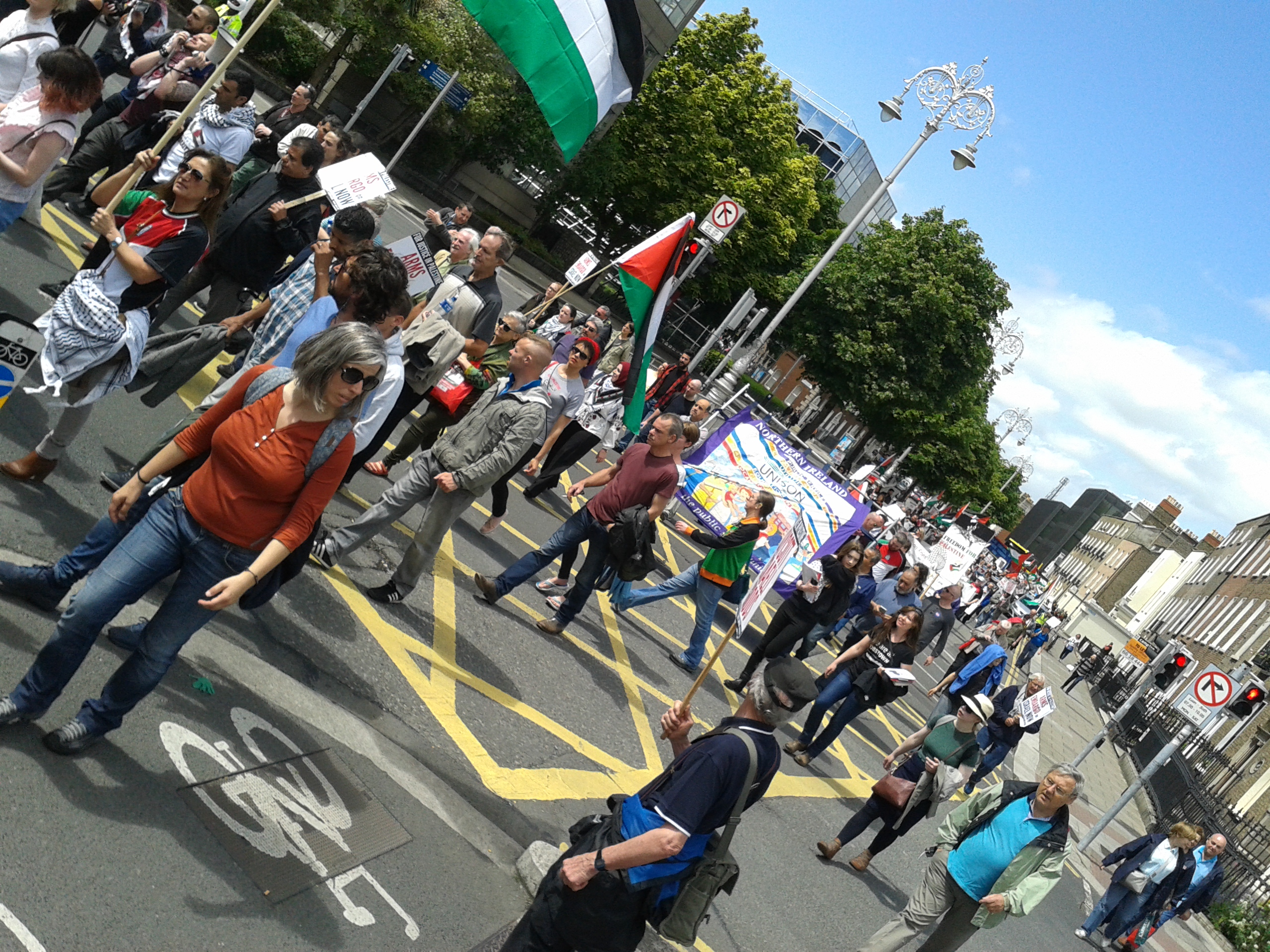
Part of Palestine solidarity march in Baggot Street, Dublin, June 2021 (Photo: D.Breatnach)

This is more than personal protest at being lumped in with the imperialists and their collaborators or even the apathetic in the “we”. More importantly, I am making what I consider to be an essential political point.

I and “we” are not part of the oppressors (nor of the apathetic sections, those who have not yet awoken). To speak in that way is liberalism. It implies that you and I and so many others are part of a society that we order and run and that its rulers represent us. We are not and they do not.

Our society’s managers are representatives of capitalists and worse, monopoly capitalists, whose governing ethos is profit, maximisation of profit and continuation of profit, amen. In pursuit of that they compete with other monopoly capitalists and other monopoly capitalist-run states but also cooperate and collude with them when their interests coincide. Clearly for some substantial time now the interests of the rulers of the EU and other Western capitalist states coincide with those of the USA. And clearly, Israel serves US interests in the Middle East, the only state in that region which is safe from a) socialist revolution and b) take over by anti-imperialist Islamicism.

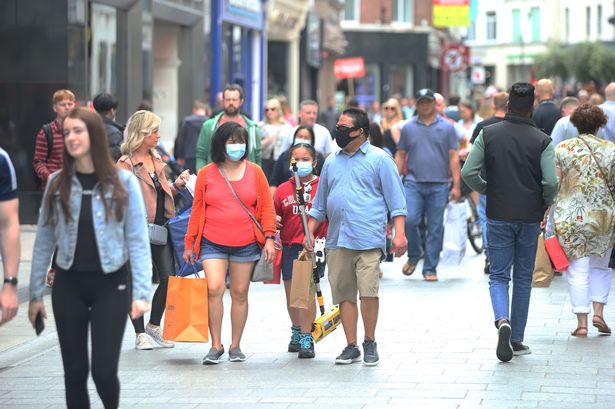
People in Grafton Street, Dublin (Photo credit: Stephen Collins)

So if WE are in solidarity with Palestine and WE want to see it free, WE must be against Israel. And if WE are against Israel, WE have to be against the USA. And if WE are for that people and against those powers, then WE are on the other side of a line from the Zionists and their local supporters. The greatest help WE can give the Palestinians in addition to expressions of solidarity is to overthrow the imperial powers and their monopoly capitalist allies wherever WE are.

If we think of those rulers as being part of us, as part of “We”, we are ideologically disarmed and unfit to go into battle against them. In that case, the assistance WE can give the Palestinians will be even more limited than that for which we have the potential at the moment.

end.

INTERNATIONALIST SOLIDARITY – THE DIVIDING LINE BETWEEN THE PEOPLE AND OUR RULERS

Diarmuid Breatnach

(Reading time: 12 mins.)

The oppression of the Palestinians led to an outbreak of active resistance recently in Jerusalem, to which the Israeli Army reacted with increased repression, timed to harass Palestinian Muslims during the period of Ramadan.

At the height of devotees attending the Al-Aqsa mosque, this escalated into attacks on worshippers within the temple itself. At the same time, Israeli Zionist settlers threatened dozens of Palestinian families with eviction from their homes in East Jerusalem.

Reacting to these events, one of the Palestinian organisations fired home-made rockets into officially Israeli territory, to which the Israeli armed forces responded in turn with drone missiles and missiles from its air force jets on Gaza.

The Zionist military fired on protesting Palestinians in the West Bank with live ammunition. The death toll has climbed to 200 Palestinians, according to Gaza’s Health Ministry, including 59 children and 35 women, with 1,305 people wounded. Ten Israelis have been killed, two of them children.

The casualty figures once again show the gross disproportion between what the Palestinians and their Zionist masters experience: in civil and human rights, citizenship, in land ownership, electricity and clean water supply, heating, fishing, education facilities, building materials …

… in freedom to travel inside and outside the state, in depth and breadth of surveillance, in arms and defence capability, in states that support them.

And in city structural damage: despite the many home-made rockets launched against the zionists, there has yet been no significant damage in Israeli towns, while their armed forces have effected large-scale structural damage in Gaza and bodies are still being pulled from the rubble.

In only one area perhaps do the Palestinians have the advantage over the Israeli Zionists: in support among the people around the world.


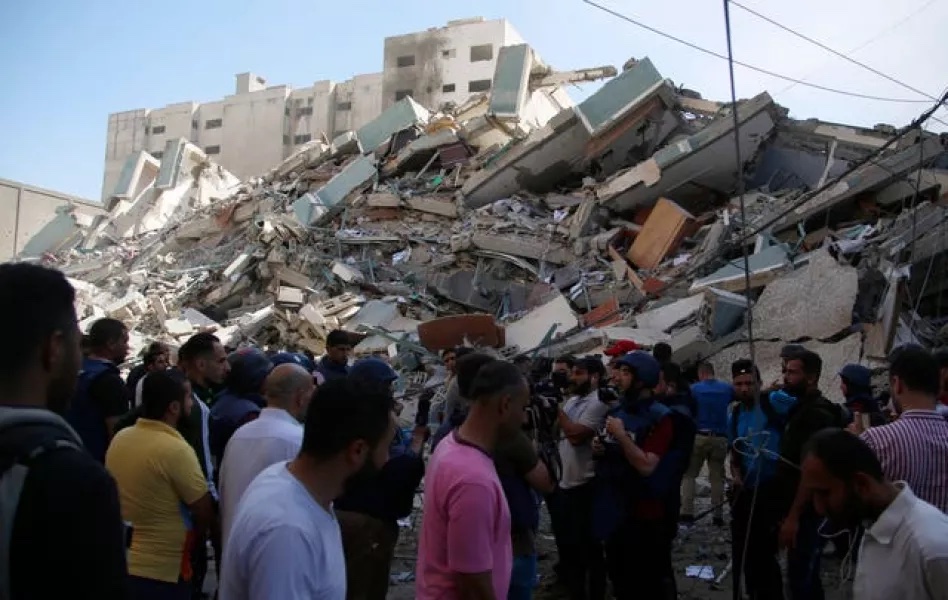
Israeli Zionist missiles strike the tower housing many media services, including Associated Press and Al Jazeera, which drew broad criticism from the mass media for a change. But families also lived here. Everyone was given ten minutes to get out. The Israeli Occupation Force has not yet bothered to explain its rationale for targeting this building. (Photo source: Internet)

PALESTINIAN SOLIDARITY MARCH DEFIES POLICE THREATS

Responding to these attacks on Palestinians, the Ireland Palestine Solidarity Campaign, the main organiser of Palestinian solidarity action in Ireland, called for solidarity demonstrations and in particular advertised a solidarity rally to take place in Dublin’s city centre for 2pm on Saturday 15th May.

The organisation asked those in attendance to comply with measures against Covid19 infection, to wear masks, maintain social distancing and comply with stewards’ instructions.

However the IPSC was contacted by the Irish police force, the Gardaí, who told them not to go ahead with the event, that if they did they would intervene to stop it and also made threats of €5,000 fines and prison against the organisers.

In a later public statement the Gardaí declared that they “have no role in permitting or authorising marches or gatherings. There is no permit/ authorisation required for such events”!

But there is apparently an ability and power to intimidate and threaten progressive organisations to deter them from organising solidarity events.

Or to kettle socialist and socialist republican Mayday marchers and demand all their names, addresses and dates of birth before threatening them with arrest if they did not disperse.

Or to threaten Debenham workers and their supporters, assaulting some of them while escorting KPMG forces in to evaluate stocks during pandemic restrictions.

A Palestinian policeman stands among the rubble of the tower in Gaza recently occupied by families and media agencies. (Photo source: Internet)

The predicament of the IPSC exposed the vulnerability to this kind of intimidation of a broad organisation that seeks to win friends in ruling circles. The leaders and organisers are placed in a position of not only personal but also of organisational vulnerability.

Even should they be prepared to defy the State to fine and/or imprison them, would they also be prepared to damage their organisation or to lose some friends they are cultivating in the circles of political influence?

What was one of the strengths of a broad organisation thus becomes a weakness; a more radical or even revolutionary organisation, with less influence in influential circles can decide on defiance, risk fines and jail with however perhaps less possibility of influencing official opinion and ultimately, action.

Fortunately in this case one such organisation did step forward and took up the baton: the Trinity College BDS group expressed its solidarity with the IPSC on its treatment by the Gardaí and called their own rally for the exact same place and time as the original one called by the IPSC.

https://www.irishtimes.com/news/ireland/irish-news/thousands-attend-rallies-in-irish-cities-in-solidarity-with-palestine-1.4566435

Video of rally at end of demonstration, near Israeli Embassy

Despite concern over Covid19 transmission and Garda threats – and the extremely short notice and much smaller circle of contacts of the TC BDS group — the response was magnificent, both in internationalist solidarity and in maintenance of the right to organise such progressive events.

Before the appointed hour, people began to gather in large numbers at the Spire in O’Connell Street, Dublin’s main street and north city centre.

After being addressed by a number of speakers, they set off in a march towards the Israeli Zionist Embassy near Ballsbridge, beyond the south city centre. As they marched their numbers grew until, approaching the Embassy, they numbered several thousand.

Along the way, bystanders applauded the marchers and passing vehicles blew their horns in solidarity.

A section of the Dublin rally in solidarity with Palestine photographed outside the GPO in the city’s main street before they set off on the 5.5km march to the Israeli Embassy (Photo credit: PA, Breaking News)

Marchers shouted slogans of solidarity with the Palestinians, calling for the freedom of Palestine and the expulsion of the Israeli Ambassador as a mark of the Irish people’s objection to what is being done to the Palestinians.

Near the Embassy, a number of speakers addressed the crowd and after dispersing, a number of demonstrators boarding public transport to return home were congratulated by the drivers.

LESSONS FOR US

The situation regarding calling and holding the demonstration in Dublin outlined some of the weaknesses of a broad organisation when it faces repression from the State and the greater resilience of a smaller organisation in being able to defy the State.

It may be necessary in future to maintain support for both types of organisation, each being appropriate for particular situations.

Also demonstrated was the necessity to openly defy unjust laws and prohibitions at times and particularly around the right to organise, to protest and to show solidarity, which the demonstrators did so well on Saturday.

Such situations also reveal the difficulty for the Gardaí in carrying out repressive actions and they are reduced to threatening individuals.

THE FAR-RIGHT MARCHES TOO – FOR WHAT?

Meanwhile, a couple of hundred of the far-Right also marched in Dublin, allegedly in defence of civil liberty. Not in solidarity with the Palestinians’ civil liberties and not in defence of our civil liberty to organise to show solidarity with people in other struggles.

No, they marched in defence of the right to defy health protection regulations, in proclaiming the Covid19 pandemic to be a) a hoax or b) greatly exaggerated and in claiming that wearing masks damages one’s health and even intelligence(!).

They were insisting that vaccinations are a) dangerous to one’s health or b) means of injecting nano-machines into people’s bloodstream in order to control them.

A clip posted by Ireland Against Fascism showed one of the QAnon Saturday screechers for months outside the GPO, Dolores Webster, aka Dee Wall, lately self-declared “digital journalist” (don’t laugh) posting her reactionary propaganda.

In apparent total ignorance of the actual reality (but when has that mattered?), she broadcasted a claim by video from her studio (her car), accompanied by the strains of Abba from the headphones of her head-bobbing passenger.

She claimed that the “scum in the Dawl” had allowed the Palestinian solidarity march to go ahead to distract from the alleged general removal of freedom and in particular from the far-Right group Irish Yellow Vests to hold their rally on May 1st!

When all the Covid19 precautionary restrictions are removed, what will these elements have to march about? The will need to return to the topics that engaged many of them in the recent past: racism, anti-immigrants, islamophobia, homophobia and anti-socialism, along with their false patriotism.

None of that is welcome of course but at least it will be without this false concern for “civil rights and freedom” and closer to the reality of what the far-Right in general – and fascists in particular — stand for.

SUPERPOWER BACKING AND IMPUNITY

The current atrocities of the Zionist State, which it carries out with impunity, along with its history, starkly reveals the effect of its main backing power, the USA, and the imperialist alliance dominated by that Power.

The USA backs Israel with military aid to the tune of $10 Million daily, which is aside from other direct and indirect aid. Israel is the only state in the Middle East which is not only very friendly to the USA but totally dependent on the support of that superpower.

For the ruling class of the USA, Israel is the only state in the Middle East which is totally safe forever from fundamentalist Muslim revolution or from left-wing anti-imperialist revolution and is therefore an extremely important factor in the USA’s plans to totally dominate the Middle East.

Solidarity marcher in Dublin on Friday with a home-made placard (Photo Credit: PA, Breaking News.ie)

This imperialist alliance finds reflection not only in the action/ inaction of governments in Europe, for example but also in the reporting of the mass media.

One of the latter’s tropes is the constant emphasis on the numbers of Palestinian missiles fired, without revealing their general ineffectiveness in delivering destruction, in total contrast to the Israeli missiles. Another is their constant repetition of a lie, that “Hamas seized power in Gaza”.

The truth is that Hamas swept the board in the 2006 elections for the Palestinian Authority. The “seizing” that was done was by Al Fatah, which usurped the results in the West Bank and installed themselves there; they tried to do the same in Gaza and, in a short fierce struggle, were beaten.

But the Western powers decided that Hamas was illegitimately in power, seized funds due to it and supported its blockading – by both Israel and Egypt.

No explanation is offered in the general mass media as to how a generally politically-secular Palestinian public would turn from its decades of allegiance to Fatah to vote for the fundamentalist Muslim Hamas.

The main reason was Fatah’s surrender of the goals of Palestinian independence and freedom and the return of the refugees, in exchange for running a colonial administration with opportunities for living off bribery and corruption and Fatah’s settling down to that status quo.

CASTING A GIANT DARK SHADOW

It was not only in Dublin and in towns across Ireland that Palestine solidarity demonstrations were held on May 15th but by people across much of the world, generally in opposition to the wishes of their governments and ruling elites.

It is worth thinking about how this has come about, in particular in contradiction to a mass media hostile to the Palestinians.

Palestinians come to view the remains of the tower block that was home to families and that housed a number of media agencies. (Photo source: Internet)

The Zionist state of Israel was declared in 1948, its anniversary actually only three days ago – May 14th, the first states to recognise it being the USA and the USSR. In Ireland at the time, there was general support for the new state which continued to the “June War” of 1967 and somewhat beyond.

The general Irish population were horrified by the history of the Nazi-organised Holocaust and sympathised with the Jewish survivors.

Irish nationalists and even Republicans empathised with the Zionist civil and armed struggle against the British (who, ironically, had begun the process of Zionisisation of Palestine).

The 1966 film Cast a Giant Shadow purporting to show that struggle, starring Kirk Douglas and a cameo appearance by Frank Sinatra, was widely enjoyed and cheered in cinemas across Ireland.

Though some of the film’s characters were based on real-life counterparts, the general narrative was a grotesque distortion, hiding the massacres of Palestinians and the expulsion of thousands as the Zionist state was created.

Many Irish language supporters admired how the new state had brought the Hebrew language, for centuries only spoken in religious contexts, back into everyday usage.

Solidarity marcher in Dublin on Friday with a home-made placard and a thought-provoking message (Photo Credit: Sam Boal, The Journal)

Yet, by a few years ago, general pro-Palestinian sympathy across Ireland had become so strong that Israel’s Ambassador to Ireland declared the country “the most anti-semitic in Europe”. That of course is the Zionists term for anyone who supports the Palestinians or criticises the Israeli state harshly.

Only a few days ago, the current Ambassador accused some politicians of spewing hate towards Israel. He was responding not only to Left and Sinn Féin TDs who criticised the actions of Israel towards the Palestinians, but also to the Tánaiste (Deputy Prime Minister equivalent) Leo Varadkar!

Varadkar had commented that Israel’s actions are “indefensible” and Government Minister for Foreign Affairs Simon Coveney said at an EU conference that the EU had “fallen short” and failed to project its influence in agreeing a position in against illegal activity by the Israelis against Palestinians.

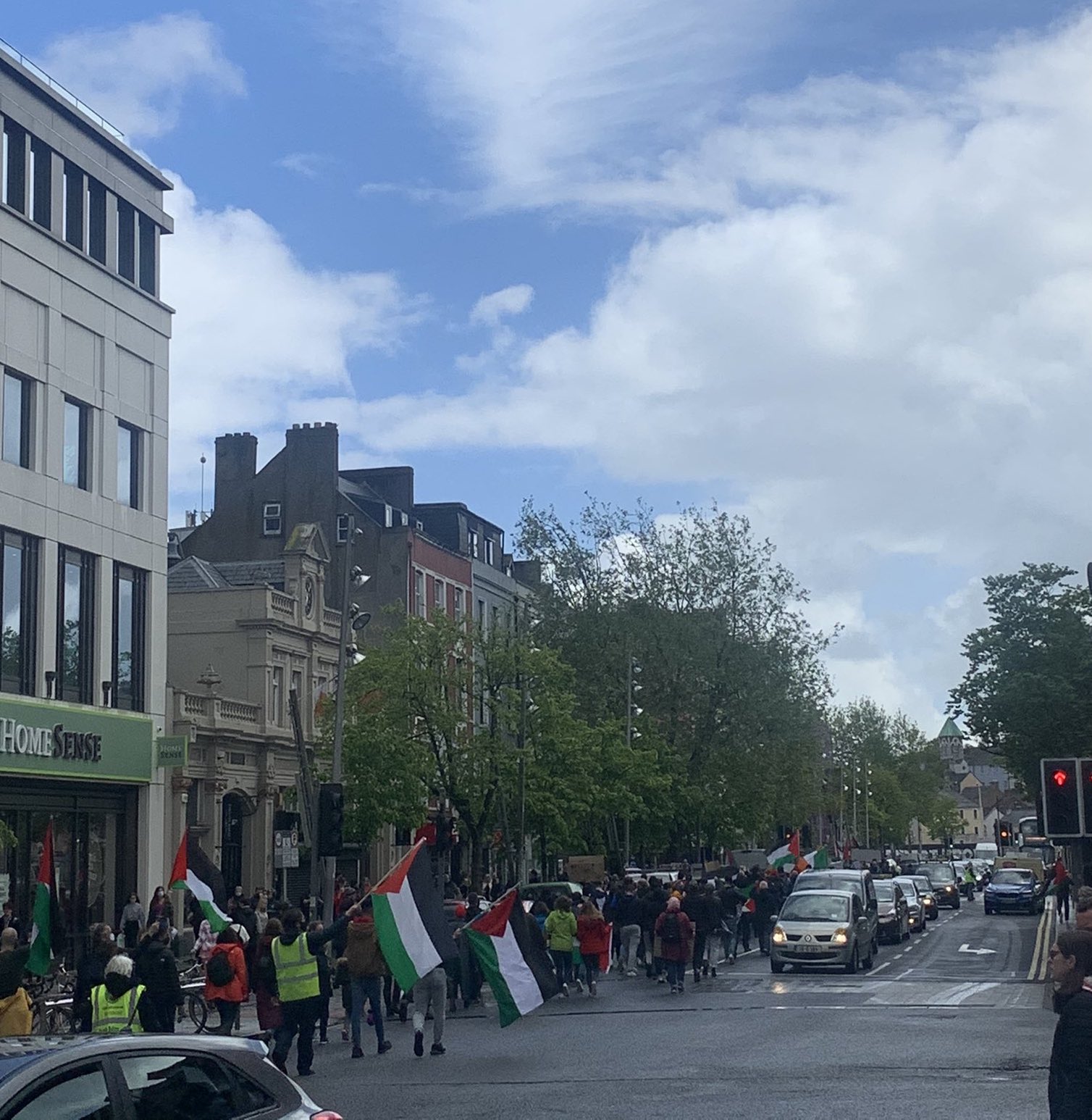
Palestinian solidarity march in Cork on Saturday (Photo source: Internet)

The fact that establishment right-wing/ conservative politicians feel obliged to take a public stand, however ineffectively, against actions of the Israeli Zionists is a strong indication of how much Irish public opinion has changed over decades.

Implicitly such stands reflect against the Zionists’ biggest international backer and world superpower, the USA. Since the Cast a Giant Shadow film, the state’s shadow of which we are aware now is indeed frighteningly giant and very dark.

In response, the natural cultural and historical feelings of the Irish people have stirred in sympathy with the oppressed Palestinians – and in defiance of threatened police repression at home.

end.

SOURCES

Coverage of events in Ireland: https://www.thejournal.ie/peacful-protests-solidarity-with-palestine-5438356-May2021/

https://www.irishtimes.com/news/ireland/irish-news/thousands-attend-rallies-in-irish-cities-in-solidarity-with-palestine-1.4566435

https://www.breakingnews.ie/ireland/protests-held-around-the-country-in-support-of-palestine-1127787.html

Recent reports on the conflict: https://www.nbcphiladelphia.com/news/national-international/weary-gaza-marks-muslim-feast-as-violence-spreads-in-israel/2812715/

https://www.bbc.com/news/world-middle-east-57138996

Israeli Ambasador to Ireland clashing with politicians: https://www.irishtimes.com/news/politics/israeli-ambassador-accuses-some-tds-of-spewing-hate-towards-jewish-state-1.4564184

USA DEMOCRATS AND COLOMBIA: BUSINESS AS USUAL

By GEARÓID Ó LOINGSIGH

(Reading time: 8 mins.)

— BOGOTA — The recent election of Joe Biden as president of the U.S. has been met with a round of applause from left reformist currents in Colombia, some even eager to claim Biden as one of their own. Underlying such praise is the notion that the Democrats are more progressive and will treat Colombia fairly, or at least better than the Republicans. There is no evidence on which to base such a claim.

Historically, some of the greatest blows to Colombia have come from Democratic administrations, starting with the smiling, handsome, charismatic JFK, whose policies left few smiling in the country. It was under JFK that two U.S military delegations visited the country and made recommendations that the Colombian state set up armed civilian groups, which are now commonly referred to as paramilitaries. By 1965, Colombia introduced legislation to give effect to those proposals and thus began a long sordid history of the state setting up death squads and providing them with legal status.

Of course, JFK was a long time ago, some would argue, though obviously no Democrat would countenance publicly criticizing him on such matters. Many of those who rushed to endorse Biden are unaware of this aspect of their history, but not so, the leading politicians such as Senator Gustavo Petro, a former mayor of Bogotá and the most successful left-wing candidate for the presidency ever. They are only too aware of the history of paramilitary violence in the country, yet prefer to ignore it on the altar of realpolitik.

The most recent embodiments of charming, handsome U.S. presidents also get a free pass now, just as they did when they were in power. Bill Clinton is perhaps the most notorious of recent U.S. presidents whose policies can be measured in bodies, forced displacement, and the mass destruction of the environment through the aerial fumigation of coca crops. Clinton was the architect of Plan Colombia, a massive supposed anti-drugs policy, which strengthened the Colombian military and under the guise of a concern for public health helped the Colombian military gain the technical and logistical capacity to wage war, including the expansion of paramilitary units throughout the country.

“Handsome US Presidents”, in particular Democratic ones, have helped Columbian ruling circles carry out a murderous reign of terror against social activists. (Photo source: Internet)

Plan Colombia was of course, implemented by George W. Bush as Clinton finished his second term shortly after concluding the agreement, a sign that policy on Colombia has always been bipartisan. When Clinton announced the initiative he lied. He stated that the motives were public health ones and that cocaine was killing 50,000 people per year in the U.S., when at the time the CDC put the figure for all deaths from all drug abuse, excluding alcohol and tobacco, but including legal pharmaceuticals at just over 15,000. Alcohol alone doubled that figure.  The ruse worked and Congress passed Plan Colombia, thanks in part to Biden, who fought for the plan in the Senate Foreign Relations Committee. Clinton finished his term with controversial presidential pardons, including Marc Rich, but in Colombia, he is remembered for his clemency deal with Harvey Weinig, a U.S. lawyer convicted of laundering $19 million for the Cali Cartel.[1]  Whilst attacking impoverished farmers, he indulged the wealthy individuals higher up the chain.

Thanks to the Plan, paramilitaries swept through the country taking over, not only rural areas, but some major urban centers. The Colombian military was in a position to aid them in that and also hold on to those areas, once the dirty work had been done. Their first targets were areas of military and economic strategic importance, with gold and oil deposits and also areas that were earmarked for major transformations in the rural economy. As part of this drugs initiative, peasants were “encouraged” to switch crops. Plan Colombia financed major agribusiness projects, particularly African Palm, and in preparation for the Free Trade Agreement that would be signed under Bush but come into effect under Obama, the country geared its agricultural production toward export markets and opted for importing basic food staples such as rice, beans, and cereals. For example, corn imports from the U.S. began to decline notably from 2008 onwards, but once the FTA came into force in 2012 under the Obama administration, the year of the lowest amount of corn imports in a long time, they quickly increased and by 2016 almost doubled the figure for 2008. By 2018, 80% of all corn consumed in Colombia was imported and barely 20% was produced nationally.

Thanks to Bill Clinton and Obama, Colombia is now one of the major recipients of military aid. Between 2001 and 2019, it received $9 billion in aid, just over 66% of it under the guise of anti-narcotics aid.[1] All anti-narcotics operations in Colombia involve the deployment of ground troops following the strafing of farms by helicopters, displacement of peasant farmers, threats and not infrequently the murder of leaders in the areas. Furthermore, many of these soldiers involved in operations were trained by the U.S. In the same period, 107,486 Colombian military personnel received training from the U.S., making it the largest recipient of such training followed by Afghanistan.[2]Both the aid and training reached their peak under Bush, as part of Clinton’s Plan Colombia, but continued steadily under Obama, though government to government and private arms sales peaked under Obama.

Barak Obama when he was US President with Vice-President, now President Joe Biden. Obama’s presidency was a disaster for the Colombian people and his running mate then, now President too, looks set to follow in his footsteps. (Photo source: Internet)

Nothing could stop Biden and Obama from backing their murderous ally to the south, not even the False Positive scandal. The so called False Positives entailed the luring of young men to rural areas with the promise of work, who were then dressed up in military uniform and executed and presented to the media as guerrillas killed in combat. Amongst the victims were impoverished working-class men, children with cognitive impairments, and even included the kidnapping and murder of professional soldiers recovering from wounds received in combat. The scandal broke in 2008, following the murder of 22 young men from the city of Soacha.

In his preliminary report the UN Special Rapporteur Phillip Alston stated: “But there are two problems with the narrative focused on falsos positivos and Soacha. The first is that the term provides a sort of technical aura to describe a practice which is better characterized as cold-blooded, premeditated murder of innocent civilians for profit. The second is that the focus on Soacha encourages the perception that the phenomenon was limited both geographically and temporally. But while the Soacha killings were undeniably blatant and obscene, my investigations show that they were but the tip of the iceberg.”[3]

He did say they were widespread but not official state policy. However, every soldier who killed one of these young men was paid a bonus by the then Minister of Defense, Juan Manuel Santos, who would become president in 2010. Santos enjoyed the support of Biden and Obama during his tenure and although he began peace talks with the FARC guerrillas in 2012, his regime never stopped murdering social leaders. From 2012 to 2018, 606 social leaders were murdered; there were a further 3371 other acts committed against these leaders, including threats, displacements, and prosecutions. None of this caused Biden or Obama to express their concern. It was business as usual for them. The total number of False Positives is now calculated to be in the region of 10,000 youths, and despite Alston’s diplomatic statement that it was not official policy, no one buys that. We are not even sure whether Alston himself could stand by that statement, outside of his role as a UN diplomat.

It is true that the current regime in Colombia, under Duque, is but a mere remold of the Uribe governments (2002-2010), and the situation has deteriorated in the country. Duque openly backed Trump, and Colombian government officials illegally intervened in the U.S. elections, calling for votes for Trump in Florida. So brazen was their involvement, the U.S. ambassador to Colombia, Phillip S. Goldberg, publicly warned them against campaigning.[5] There may well be a reckoning of some sort with Duque on this point, but it is unlikely that there will be any major change in policy towards the country.

President Iv√°n Duque (L) of Colombia speaks during a meeting with US President Donald Trump at the United Nations in New York September 25, 2018. (Photo by Nicholas Kamm / AFP) (Photo credit should read NICHOLAS KAMM/AFP/Getty Images)

Duque may well be publicly chastised by Biden and given a few well-placed mediatic slaps across the face. It will be mere window dressing. Prior to the implementation of Plan Colombia, Clinton sought and obtained the disbandment of the Colombia’s notorious XX Brigade; charged with intelligence and counterintelligence, it was an exercise in public relations. It did not affect intelligence agencies’ role in the murders, torture, forced displacement, and disappearances, nor the spying on left-wing politicians and human rights organizations, which continues unabated to the present day. On Colombia, the Democrats are very media friendly and good at dressing things up.

The war on drugs is likely to continue in one form or another, and though some left reformists hope that Biden will pressure Duque to restart the stalled peace process with the ELN guerrillas, it is unlikely. During the talks with the FARC, Biden and Obama wouldn’t release from a U.S. jail the FARC commander Simon Trinidad, in jail for his supposed role in the capture and imprisonment of three U.S. Dyncorp mercenaries. The ELN do not represent the same military threat that the FARC did. They are less militarist and much more political, and any threat they may represent is in the political arena. But they have long attacked U.S. companies and oil pipelines, and such attacks may be used as an excuse for further increases in military aid and greater involvement in the conflict. U.S. troops are already involved in the protection of the Caño Limón-Coveñas pipeline as it passes through the ELN stronghold of the department of Arauca. It will be very much business as usual under Biden.

Top photo: Protesters march against President Iván Duque’s policies, including police brutality and disappearances of political activists, in October 2020 in Bogotá. (Louisa Gonzalez / Reuters)

Sources:


[1] The New York Times (04/14/2001) SPECIAL PLEADING; A Felon’s Well-Connected Path to Clemencyhttps://www.nytimes.com/2001/04/14/nyregion/special-pleading-a-felon-s-well-connected-path-to-clemency.html

[2] Statistics taken from https://securityassistance.org/

[3] Ibíd.,

[4] Alston, P. (2009) Statement by Professor Philip Alston, UN Special Rapporteur on extrajudicial executions – Mission to Colombia 8-18 June 2009.https://newsarchive.ohchr.org/EN/NewsEvents/Pages/DisplayNews.aspx?NewsID=9219&LangID=E

[5] The Guardian (27/10/2020) US embassy warns Colombian politicians not to get involvd in US electionshttps://www.theguardian.com/world/2020/oct/27/embassy-warns-colombian-politicians-us-elections

Drugs, War and the ELN

It’s not the guerrillas that are running the drug cartels …..

by Gearóid Ó Loingsigh

(Versión en castellano: https://rebelion.org/wp-content/uploads/2020/12/colombia_drogas_eln.pdf)

(Published elsewhere earlier in December, including Red Line; published here with author’s permission and section headings, photo choices (except one) and intro line are by Rebel Breeze editing)

The issue of drugs is one that is never far from public discourse on the Colombian conflict. Biased or just simply lazy journalists use the issue to ascribe motives for an endless list of events, massacre and murders. It is true that drug trafficking has permeated all of Colombian society and there is no sector that has not been impacted by it. But not everyone in Colombia is a drug trafficker. However, once again the King of Clubs is played to describe the conflict in terms of a drug problem.

Several Colombian newspapers have recently published articles on the supposed relationship of the guerrillas of the National Liberation Army (ELN) with drug trafficking and there are already eleven commanders who are under investigation for such crimes and are sought in extradition.[1]  They talk as if the ELN dominated the drugs trade, and talk of settling of accounts over drug money, as if they were a crime gang, instead of saying that the ELN takes drastic measures against its members who get involved in drug trafficking and that those internal executions are due to the indiscipline and betrayal of principles of some people and are not an internal dispute over money.[2]  Of course, the ELN in an open letter widely distributed on social networks and alternative press, denied any links to the drug trade.[3]  But, how true is this new tale?  Before looking at the accusations levelled against the ELN it is worth going over the history of drug trafficking in Colombia and the reality of the business in international terms.

POLITICIANS, GUERRILLAS AND BANKS

Let’s start with the obvious.  When the FARC and the ELN were founded in 1964 drug trafficking was not a problem in the country and there were no large plantations, i.e. the existence of the guerrillas predates the drugs trade.  Later in the 1970s the country went through the marijuana bonanza on the Caribbean coast, but it is the emergence of the large drugs cartels in 1980s around the production of cocaine that would define forever the shape drug trafficking in the country would take.  Up till the 1990s the country was not self sufficient in coca leaf, even though it was the main manufacturer of the final product: cocaine.  Escobar was dead by the time Colombia achieved self sufficiency and it is in that context that the discourse of blaming the FARC for the drugs trade gained ground, completely ignoring that the main narcos were the founders of the paramilitary groups.  One of the most notorious paramilitary groups in the 1980s was the MAS (Death to Kidnappers) founded by the Cali Cartel and other drug traffickers in response to the kidnapping by M-19 of Marta Nieves Ochoa a relative of the Ochoa drug barons.

That discourse, however, was useful in justifying Plan Colombia and there was an element of truth to it, but not that much back then.  The FARC’s relationship with the drugs trade has not been static and has evolved over time.  Almost everyone accepts that they began by imposing a tax on the production of coca leaf, coca base or cocaine in the territories they controlled.  The initial relationship changed and the FARC went from just collecting a revolutionary tax to promoting the crop, protecting laboratories and even having laboratories of their own and in some cases, such as the deceased commander Negro Acacio, got directly involved in the drug trade.  There is no doubt on the issue.  But neither were they the big drug barons that they tried to have us believe, those barons are in the ranks not just of the Democratic Centre but also the Liberal and Conservative parties.  It is forgotten that Samper’s (1994-1998) excuse regarding drug money entering his campaign’s coffers was and still is that it was done behind his back, but no one denies that drug trafficking has to some degree financed every electoral campaign in the country.  Although companies like Odebrecht play a role at a national level, at a local and regional level drug trafficking decides who becomes mayor, governor, representative in the house and even senators.  Even the brother of the current Vice-President Marta Lucía Ramírez was a drug trafficker and there are loads of photos of many politicians with Ñeñe Hernández and Uribe appears in photos with the son of the paramilitary drug trafficker Cuco Vanoy.  It is a matter of public knowledge that several high ranking police officers close to Uribe such as his former head of security Mauricio Santoyo were extradited to the USA for drug related crimes and Uribe’s excuse was the same as Samper’s: it was all done behind his back.

Alvaro Uribe, ex-President of Colombia and patron of current President Duque is under house arrest and investigation for close links with drug cartels and murder paramilitary organisations. (Photo source: Internet)
Late drug mafia boss”Nene” Jose Guillermo Hernandez (r) with President Ivan Duque ((Photo source: La Nueva Prensa)

NOT THE ELN

But when we look at the extent of illicit crops in Colombia, we can clearly see the reason why they are linked to the FARC for so long and not to the ELN.  The reason is simple, the majority of the large plantations of coca and opium poppy were to be found in areas under the influence of the FARC.  If we look at the crop monitoring carried out by the United Nations Office on Drugs and Crime (UNODC) we can see that in 2001 the main departments (administrative regions: Colombia has 32 — RB editing) where there were crops were almost exclusively FARC fiefdoms.

In 2001, coca was to be found in 22 departments of the country, compared to just 12 in 1999.  However, despite the expansion, just two areas accounted for the majority of the crops:  Putumayo-Caquetá had 45% of the total amount of coca (about 65,000 hectares) and Meta-Guaviare-Vaupés with 34% of the area (about 49,000 hectares) i.e. 79% of the total area under coca.[4]  They were areas that were completely dominated by the FARC, not a single eleno was to be found in those territories and if they did venture in, it was undercover at the risk of execution by the FARC were they discovered as the FARC did not tolerate political competition in their fiefdoms. When one looks at the map of crops back then, one can see not only the concentration in those areas but also almost all the other departments were dominated by the FARC and those where there were significant amounts of coca and also an ELN presence, one finds Cauca with 3,139 hectares, Nariño with 7,494 hectares and the Norte de Santander with 9,145 hectares.  But in those areas there was a certain territorial balance between the different guerrillas and one of the few departments where the ELN was clearly the dominant force was Arauca with 2,749 hectares.[5]  But when we look at the counties we can see that it is not as clear cut, as in the Norte de Santander 83% of the coca crops were to be found in just one county: Tibú, FARC fiefdom for many years before the paramilitary takeover in 1999.[6]  In Arauca the county of Araquita accounted for 60% of the crops in the department and it was also a FARC fiefdom within an area dominated by the ELN.  Thus it is obvious as to why they spoke almost exclusively about the role of the FARC in drug trafficking and not the ELN at that time.

Years later the situation had not changed much, the main producing departments were the FARC fiefdoms.  The UNODC study on coca crops in the country in 2013 continues to show a concentration in FARC fiefdoms, with a displacement from Putumayo to Nariño due to aerial spraying and the persecution of the FARC by the State.  In 2013, there were just 48,000 hectares of coca in the entire country, with significant reductions in some parts. Nariño, Putumayo, Guaviare and Caquetá accounted for 62% of the land under coca, with Norte de Santander representing 13% and Cauca with just 9%.[7]  There was a reduction and a displacement of the crops towards new areas with Nariño accounting for the most dramatic increase of all departments.

In 2019, there was 154,000 hectares of coca, a little over three times the amount grown in 2013, though it was slightly down on 2018 when there was 169,000 hectares.[8]  Coca production recovered after 2014 in the middle of the peace process with the FARC.  It stands out that in 2019, Arauca, a department dominated by the ELN the UNODC did not report any coca crops.[9]  Once again Norte de Santander is a department with widespread coca leaf production almost quadrupling the amount reported in 2001.  It had 41,749 hectares of coca but the county of Tibú alone had 20,000 hectares and the same UNODC report indicated that these are not new areas and show that the crop has deep roots in the area.[10]

THE BANKS, THE BANKS!

However, despite the role of the FARC in the drugs trade, they weren’t the big drug barons we were led to believe.  How can we be sure?  Their demobilisation did not alter the flow of cocaine towards the USA and Europe.  The big drugs capos in the companies, the Congress of the Republic, the international banks did not stop for a second.  Neither did people such as Ñeñe Hernández and other associates of right wing political parties in Colombia stop for a single instant.

Neither the production nor consumption of cocaine halted.  The UNODC’s World Drug Report says as much about both phenomena.  According to the UNODC consumption of cocaine fell from 2.5% in 2002 to 1.5% in 2011 in the USA, but from that year it increased again reaching 2.0% in 2018 and also there are indications of an increase in the sale of cocaine of high purity at lower prices between 2013 and 2017.  The price of a gram fell by 29% and the purity increased by 32%.[11]  The report also indicates that in Europe there was a significant increase in various places such as the Netherlands, Norway, Denmark, Estonia and Germany.  Nevertheless, some of those countries had seen decreases in consumption in the first years of the century.[12]  All of this suggests that there is a greater supply of the drug.  This can be seen not only in the previously mentioned figures of an increase in the production of coca leaf in Colombia (or in other countries such as Peru and Bolivia), but can also be seen in drug seizures.  An increase in seizures may indicate greater efficiency by the police forces, but combined with stability or an increase in consumption and a reduction in price, rather indicate an increase in production and availability.

According to the UNODC cocaine seizures have increased dramatically since the commencement of Plan Colombia, indicating, although they do not acknowledge it, the failure of their anti-drugs strategy and the tactic of aerial spraying with glyphosate.  In 1998 400 tonnes were seized globally and that figure remained relatively stable till 2003, reaching 750 tonnes in 2005 and surpassing the threshold of 900 tonnes in 2015 to finish off at 1,300 tonnes in 2018,[13] i.e. there was no reduction in consumption or the production of cocaine.  Throughout the years with or without the FARC there has been coca production and of course the main drug barons never demobilised, the heads of the banks remain in their posts.

The real drug traffickers wear a tie, own large estates, meet with President Duque, it is not the ELN that moves hundreds of tonnes of cocaine around the world.  In 2012, the Swiss bank HSBC reached an agreement with the US authorities to pay a kind of fine of $1,920 million dollars for having laundered $881 million dollars from the Sinaloa Cartel and the Cartel of Northern Valle, Colombia.  The bank had, despite everything, classified Mexico as a low risk country, thus excluding $670 billion dollars in transactions from monitoring systems and the bank was notified by the authorities but ignored them.[14]  Nobody went to jail, in fact no one was prosecuted.  As Senator Warren in a session of the Senate Banking Commission pointed out, no one was going to go to jail for this massive crime.  Moreover, the Sub Secretary for Terrorism and Financial Intelligence, David S. Cohen refused to recommend a criminal investigation against the bank.  There is no need to state that no ELN commander is on the board of this or other banks.  The ELN is usually accused of infiltrating universities, but to date no one has accused them of having infiltrated the boards of banks.

In 2012, the Swiss bank HSBC paid US authorities a penalty of $1,920 million for having laundered $881 million dollars from the Sinaloa Cartel and the Cartel of Northern Valle, Colombia. The bank had classified Mexico as a low risk country (!), thus excluding $670 billion dollars in transactions from monitoring systems. (Photo sourced: Internet)
HSBC bank has bought building of former Central Bank Ireland on Central Plaza, Dame Street, Dublin (Photo sourced: Internet).

It is not the only bank implicated in money laundering, in 2015 London was described as one of the main centres for money laundering the proceeds of drug trafficking.[15]  A report by the UK National Crime Agency states, on the basis of a UN calculation that between 2% and 5% of global GDP are laundered funds “that there is a realistic possibility [defined as between 40-50%] that it is in the hundreds of billions of pounds annually”[16] and the majority of it comes from crimes committed outside of the UK.  There is no need to say that no ELN commander is a director of those companies, nor is there any need to state that these companies continue to operate and their directors are walking about free and according to the report they could only recover £132 million.[17]  The NCA cites favourably the reports of Transparency International.  According to this organisation, 1,201 companies operating in the British Overseas Territories inflicted £250 billion in damage through corruption in recent decades.  They analysed 237 cases of corruption in the last 30 years.  The majority of the companies are registered in the British Virgin Islands (92%) and the majority (90%) of the cases happened there[18] in the favourite headquarters of many companies that operate in Colombia, without mentioning those who finance election campaigns.  Once again, the ELN does not operate in those territories, although many mining companies in Colombia are registered there.  The report points out that due to legislative changes there are fewer reasons to buy property in the UK through those companies registered in the Overseas Territories, yet the number of properties has remained relatively stable at some 28,000.[19]  Of course not all them are the result of illicit funds, however… As far as we know the ELN’s Central Command is not the owner of any of these properties.

Transparency International continued with its investigations and its last report highlighted the number of British companies involved in money laundering or dubious transactions.  It states that there are 86 banks and financial institutions, 81 legal firms and 62 accounting companies (including the big four that dominate the market).  According to this NGO

Whether unwittingly or otherwise, these businesses helped acquire the following assets and entities used to obtain, move and defend corrupt or suspicious wealth: 2,225 Companies  incorporated in the UK, its Overseas Territories and Crown Dependencies directly involved in making payments; 17,000 more companies incorporated in the UK that we have reasonable grounds to suspect have facilitated similar activity; 421 Properties in the UK worth more than £5 billion; 7 Luxury Jets 3 Luxury Yachts  worth around £237 million worth around £170 million. [20]

Of course not all the laundered funds are drug related but they are all illicit in origin.  However, the USA has not sought in extradition any of the banking capos, legal firms and less still the four big accountancy companies in the world.  It would simply collapse the financial system were they to do so.

The extradition of criminals from Colombia has always been problematic in legal and political terms.  Nowadays, the majority of those extradited are extradited for drug trafficking.  The USA receives 73% of all those extradited from Colombia and 60% of them face charges of drug trafficking or money laundering.[21]  Though not all those extradited are guilty and there are various cases of people being returned to Colombia, after their extradition, or others more fortunate who managed to demonstrate their innocence before being extradited, such is the case of Ariel Josué, a carpenter from San Vicente del Caguán who didn’t even know how to use a computer and yet for

… the United States and then the Colombian justice system, Ariel Josué was the head of an electronic money laundering network, and had to pay for his crime in a north American prison.

In the absence of an independent investigation nor the verification of his identity, the Supreme Court issued a court order in favour of his extradition and even President Juan Manuel Santos signed the order for him to be taken.[22]

OPEN LETTER FROM THE ELN

Despite those extradited, when not innocent, being poor people or those who have some relationship with right wing political parties or the economic elites of the country, the media and the Colombian and US governments’ focus on the problem is always the same: the guerrillas and not the banks or business leaders.  In fact, one of the most famous people extradited is Simón Trinidad, a FARC commander and part of the negotiating team in the Caguán.  Trinidad was extradited for drug trafficking and despite being a FARC commander they didn’t manage to prove any link to the drugs trade and thus resorted to the detention and captivity of three north American mercenaries hired by the Dyncorp company, a company denounced for crimes such as trafficking in minors, prostitution, sexual abuse amongst others.[23]  So we should be very careful when it comes to accepting these new allegations against the ELN.

Private company mercenaries in Yemen conflict, paid by United Arab Emirates. Dyncorp have replaced Blackwater/ Academi there, who were faring badly against President-loyal troops and guerrillas’ resistance. Vulture capitalists Cerberus now own Dyncorp which has ex-Vice President USA Dan Quayle and Israeli billionaire Steve Feinberg as directors. (Photo source: voltairenet.org)

The ELN in its open letter acknowledges that they collect taxes from the buyers of coca base and cocaine who come into their areas of influence, as they do with other economic activities.  So if the ELN is not involved in drug trafficking, how can we explain the presence of illicit crops[24] in their areas?  The ELN commanders explain the presence of these crops in the same manner and the same dynamic they describe could be seen in all the regions where they had to deal with the FARC.  There was a dispute between the two organisations as to what to do regarding the crops and drug trafficking itself.  Initially the ELN opposed the planting of coca and opium poppy in the regions, but the FARC said yes and they authorised the peasants to grow it and moreover in some parts they were willing to buy base or cocaine itself, depending on the region.  Faced with this reality the ELN felt that it had no choice but to allow the growing of the crop, as otherwise they would have to militarily face the FARC and the communities.  That is why the ELN is to be found in areas with a coca tradition and as they acknowledge in their open letter they tax the buyers as they do with other economic activities.  However, it is worth pointing out that the FARC also initially only charged taxes, but given the long ELN tradition on drugs it is unlikely, though not impossible that they do the same.

ELN guerrilla patrol in Colombia (Photo source: GL)

Its open letter not only refutes the allegations against it, but they also put forward proposals as to what to do regarding the problem of crops and drug consumption.  It extends an invitation to various organisms to carry out in situ visits and inspections to see the reality of their relationship to the drugs trade, but they go further than clearing up the question of their links or otherwise to the drugs trade and they put forward proposals on the drugs problem as such.

PROPOSALSSOLUTIONS?

To pick up the proposals made on various occasions by the ELN with the aim of reaching an Agreement that overcomes the phenomenon of drug trafficking that includes the participation of the international community, the communities in the regions that suffer this scourge and various sectors of Colombian society.[25]

The issue of drug trafficking is not one that Colombia can solve on its own, it is an international issue in nature, not just in terms of the distribution and consumption of the final products, such as cocaine and heroine or ecstasy and other drugs generally produced in northern countries, but also because Colombia’s obligations on the issue are covered by various international UN treaties.  The ELN makes various points.

  • Only the legalisation of psychotropic substances will put end to the extraordinary profits of drug trafficking and its raison d’être.

This position has been discussed thousands of times in various fora and international settings. It is partially true.  No doubt the legalisation demanded by various social organisations, including health organisations, would put an end to the mafia’s profits, but not the profits as such.  The medicinal uses of coca and opium have never been banned, rather the International Narcotics Control Board (INCB) regulates and controls its production and end use.  The UNODC calculates that in 2018 there just under 12 billion daily doses of opiates available in the legal market, double the amount available in 1998.[26]  Cocaine and medicinal opiates, including heroin, have always been used in a medical context and the use and regulation of cannabis is a growing market.  The legalisation of recreational consumption is another matter, the state of Colorado in the USA and Uruguay are two places where they legalised the recreational consumption, with various benefits in terms of crime, health and taxes.  The profits are lower in these legal markets but they are large, nonetheless, as are they for other legal drugs such as alcohol and tobacco, products that are controlled in terms of quality and their impact on the health of the consumer.  The legal marijuana market in Colorado amounted to $1,750 millions in 2019 with 69,960,024 transactions with an average price per transaction of $51.89, but the price to the consumer continues to fall and quality is guaranteed.[27]  However, both Colorado and Uruguay have experienced legal problems with the banking system as their legalisation has no international recognition.  The ELN’s proposal could only happen in the context of an international debate and a paradigm shift in the states and regulatory bodies at an international level such as the UNODC and the INCB, amongst others and the recent decision by the WHO on the medicinal use of cannabis is a good start.[28]

  • A pact on shared responsibility between drug producer and consumer countries is required

This pact already exists.  There are various UN pacts on the issue starting with the Single Convention of 1961, the Convention on Psychotropic Substances of 1981 and United Nations Convention Against Illicit Traffic in Narcotic Drugs and Psychotropic Substances.  This last treaty deals with aspects related to organised crime, precursor chemicals etc.  What is lacking is political will, not another pact. The factories where the acids used to make cocaine are not bombarded but they do attack and bombard the producer communities, neither do they bombard the factories of illegal drugs such as ecstasy in the Netherlands.  It is not the case that there is a lack of pacts but rather as they say the law is for the ragged and in geopolitical terms, Colombia is very ragged

  • The drug addicts are sick and should be treated by the states and should not be pursued as criminals.

This is one point that is always overlooked in the discussions on illicit crops and despite the belligerent tone of the USA, both the north American health system and that of the majority of countries in Europe deal with it as such, some countries do not even pursue consumption as such, acknowledging its character as a health problem and only go after related crimes.  The UN accepts the need for treatment for drug addicts and calculates in its World Drug Report that 35.6 million people in the world abuse drugs and just 12.5% of those who need treatment get it, i.e. about 4.45 million people.[29]

  • The peasants who work with illicit use crops, should have alternative plans for food production or industrial raw materials, financed by the states in order to solve their sustenance without seeking recourse in illicit use crops.

Although this point is well intentioned it makes the same mistake as the FARC, the NGOs, international aid etc. Whilst it is true that the peasants should have alternative plans and receive economic support from the states, the problem is a core issue and cannot be solved through projects or credits: the economic aperture ruined the agricultural production of the country and the peasants can’t compete with the imports subsidised by the US and European governments.  The underlying problem is not agricultural, nor economic but political and requires national and international changes.  The free trade agreements, the monopoly in the agricultural and food sector exercised by multinationals such as Cargill, Nestlé, Barry Callebaut amongst others are not resolved by subsidies or projects.[30]

  • As well as pursuing the Cartels in the narcotic producing countries they should also pursue the distribution Cartels in the industrialised consuming countries; as well as the Cartels for the precursor chemicals and money laundering of narco funds in the international financial system and the tax havens.

This is a key point.  As long as drugs are illegal, they should go after the points in the production chain there, both the banks and the companies that engage in money laundering and the companies whose chemicals are used in the manufacture of cocaine.  They don’t do this, one little bit or not much at least.  Whilst the USA seek in extradition just about anyone in Colombia, they have never sought nor will they seek the directors of banks such as HSBC.

There are reasons to accept the ELN’s word on the issue of drugs, and there are more than sufficient reasons to accept the debate on drugs and what to do about them.  It is a debate that never occurred in the context of the negotiations with the FARC.  The FARC opted to negotiate benefits for themselves, their social base and they never touched the structure of the agricultural economy in the country nor the international law in force on drugs.[31]

The allegations against the ELN lack any basis in fact, but the media does not ask us to treat it as truth, rather it serves as an excuse to delegitimise this organisation in the eyes of Colombian people and in the international area they are useful as excuse to continue to militarily support the Colombian state and in a given moment can be used as a pretext for more direct interventions against the ELN and perhaps Venezuela.

End.

“Freedom for political prisoners; Jail for those who oppress the people.” Cartoon poster from Chile but which applies to Colombia with thousands of political prisoners (Image sourced: Internet)

FOOTNOTES

[1] El Tiempo (05/10/2020) Los 11 elenos que EE.UU. pide en extradición por narcotráfico https://www.eltiempo.com/unidad-investigativa/los-11-miembros-del-eln-que-estados-unidos-pide-en-extradicion-por-narcotrafico-541475

[2] El Tiempo (16/10/2020) Confirman vendetta por coca en las entrañas del Elnhttps://www.eltiempo.com/unidad-investigativa/eln-alias-pablito-ordena-ejecutar-a-3-lideres-por-temas-de-narcotrafico-543671

[3] ELN (12/10/2020) Carta abierta al Departamento de Estado, a la Fiscalía Federal de los Estados Unidos y al gobierno colombiano https://eln-voces.net/carta-abierta-al-departamento-de-estado-a-la-fiscalia-federal-de-los-estados-unidos-y-al-gobierno-colombiano/

[4] UNODC (2002) Annual Coca Cultivation Survey 2001, SIMCI Project AD/COL/99/E67 p.4

[5] Ibíd., p.6

[6] Calculations made on the basis of the Coca Census November 1st 2001, SIMCI Project.

[7] UNODC (2014) Colombia: Monitoreo de Cultivos de Coca 2013.  Colombia.  UNODC p. 17

[8] UNODC (2020) Colombia: Monitoreo de Cultivos de Coca 2019.  Colombia.  UNODC p.15

[9] Ibíd., p.22

[10] Ibíd., p.81

[11] UNODC (2020) World Drug Report Vol. 2 Drug Use and Health Consequences. UNODC. Vienna, p. 26

[12] Ibíd., p.29

[13] UNODC (2020) World Drug Report Vol. 3 Drug Supply. UNODC. Vienna. p.28

[14] Reuters (11/12/2020) HSBC to pay $1.9 billion U.S. fine in money laundering case https://www.reuters.com/article/us-hsbc-probe-idUSBRE8BA05M20121211

[15] The Independent (25/12/2015) London is now the global money-laundering centre for the drug trade, says crime expert.https://www.independent.co.uk/news/uk/crime/london-

[16] NCA (2020) National Strategic Assessment of Serious and Organised Crime. NCA. London p.54 https://www.nationalcrimeagency.gov.uk/who-we-are/publications/437-national-strategic-assessment-of-serious-and-organised-crime-2020/file

[17] Ibíd., p.55

[18] Transparency International UK (2018) The Cost of Secrecy: The role played by companies registered in the UK’s Overseas Territories in money launderin and corruption. TIUK. London. p.2https://www.transparency.org.uk/sites/default/files/pdf/publications/TIUK-CostofSecrecy-WEB-v2.pdf

[19] Ibíd., p.4

[20] Transparency International (2019) At Your Service: Investigating how UK businesses and institutions help corrupt individuals and regimes launder their money and reputations p.13https://www.transparency.org.uk/sites/default/files/pdf/publications/TIUK_AtYourService_WEB.pdf

[21] Rojas Castañeda, D. (16/07/2020) Estados Unidos recibió 73% de extraditados desde Colombia en los últimos tres añoshttps://www.asuntoslegales.com.co/consumidor/estados-unido-recibio-73-de-extraditados-desde-colombia-en-los-ultimos-tres-anos-3032110

[22] This and other stories can be consulted at https://www.kienyke.com/krimen-y-korrupcion/indignantes-historias-de-inocentes-que-fueron-prision-por-errores-judiciales

[23] The description of Dyncorp as a mercenary company may seem controversial, but their own webpage leaves in no doubt on the issue.  It has 15,000 employees and contractors in 36 countries in the world and they offer their services to all branches of the US military forces, federal agencies and other international “clients”.  See  https://www.dyn-intl.com/  .  Furthermore, the company has been publicly denounced for various activities, amongst them the ill-treatment of its employees and child trafficking and prostitution in Bosnia and Afghanistan.  See https://www.mintpressnews.com/lawsuit-military-contractor-enslaved-american-employees-sewage-flooded-barracks-tent-cities/250994/ The website https://trello.com/b/KdjpFSGS/dyncorp-crimes-by-country  gives a list of the companies crimes by country.

[24] Some NGOs prefer the expression illicit use crops, but it is misnomer.  The international treaties on the matter leave us in no doubt on the issue, the crop itself is illicit.  The Single Convention of 1961, the convention in force on the issue, in Article 22 No.1 demands the total eradication, the coca leaf and its derivatives are banned.  The treaty demands that even the plants belonging to indigenous people be destroyed.

[25] ELN (12/10/2020) Op. Cit.

[26] UNODC (2020) World Drug Report Vol 6. Other Drug Policy Issues. Vienna. UNODC p.9

[27] MPG (2020) 2019 Regulated Marijuana Market Update.https://www.colorado.gov/pacific/sites/default/files/2019 Regulated Marijuana Market Update Report Final.pdf

[28] For more information on the WHO decision see Jelsma, M. (2020) Potential fall-out from the vote on the WHO cannabis recommendationshttps://www.tni.org/en/article/potential-fall-out-from-the-vote-on-the-who-cannabis-recommendations

[29] UNODC (2020) World Drug Report Vol 5. Socioeconomic Characteristics and Drug Use Disorders.  Vienna. UNODC.

[30] For a critique of the Colombian agricultural model in the sub region of Southern Bolivar, North East of Antioquia and Bajo Cauca see Ó Loingsigh, G. (27/07/2014) El Modelo Agro-Exportador y las Comunidades Campesinashttps://www.academia.edu/44677017/El_Modelo_Agro_Exportador_y_las_Comunidades_Campesinas  and Ó Loingsigh, G. (2019) Extractivismo y muerte en el nororiente. Bogotá. Equipo Jurídico Pueblos https://www.equipopueblos.com/project/extractivismo-y-muerte-en-el-nororiente/

[31] Ó Loingsigh, G. (2016) Las Drogas y la Paz.  El Salmón. No.27  Ibagué pp. 42 – 46 https://www.academia.edu/30669926/La_Paz_y_las_Drogas

THE CAULDRON CALLING THE KETTLE BLACK

Diarmuid Breatnach

(Total reading time: 5 mins.)

It is reported in the news today that Trump has ordered the deregistration on the Stock Exchange of three China companies in the belief that they are basically fronts for the Chinese military. It is reported also that the incumbent, Joe Biden, is unlikely to take a different line and that “US officials have complained that China’s ruling Communist Party takes advantage of access to American technology and investment to expand its military, already one of the world’s biggest and most heavily armed.”

China’s military may indeed be one of the world’s biggest and most heavily armed but there is no question of which power is the most heavily-armed, far above all others: the USA. According to statistics supplied by an EU armed forces comparison site (see SOURCES below), China spends $288 billion on its military, which is much more than doubled by the USA’s $610 billions. And the USA’s military share of its GDP (Gross Domestic Production), at %3.1 is way ahead that of China’s 1.9%.

One of the few areas in which China’s military outstrips the USA’s is in active personnel, at 2,300,000 against 1,281,900. Which is hardly surprising, as China’s population is more than four times that of the USA’s (1.43 billion, compared with 329 million). And that too would account for its reservist imbalance, 8,000,000 versus the USA’s 811,000.

China Type99 Tank. Armoured vehicles and numbers of personnel are the few areas in which China outstrips the USA. (Photo source: Internet)

Another area in which the Chinese military outstrips the USA’s is in tanks, armoured vehicles, artillery, self-propelled artillery and rocket artillery (that last by not so large a margin). But the USA has three times the total military aircraft of China, twice the number of attack aircraft, nearly four times the number of multirole aircraft and over four times the number of helicopters. Only in fighter aircraft does China outnumber the US’s and that by a significant amount: 1,150 against 587 – but multirole aircraft, of which the USA has 2,192, are designed for air-to-air combat as well as missile launching against ground targets.

In naval power, although China’s total of 780 looks impressive next to the USA’s 437, the USA has 20 aircraft carriers while China has …. two. The USA is not bothered with frigates or corvettes, of which China has respectively 54 and 42 but the USA’s 85 destroyers are more than double China’s 36. In submarines they are not far off level pegging, with China’s 76 against the USA’s 71.

The USA has 20 aircraft carriers while China has just two. This hi-tech US carrier cost $13 Billion. (Photo source: Internet)

These figures tell us that the USA far outranks China in military hardware and also that its military production per head of population is vastly greater than China’s. But when we look at the type of weapons in which one predominates over another (without regard to quality or modernity), it tells us something else: the USA is far better fitted for long-range warfare than is China. No state is safe from long-range attack by the USA military but many parts of the world are relatively secure from such an attack by China’s current military capability.

Furthermore, in a war between both powers, the USA would rely on hitting China from afar with bombing raids from air bases in countries with US-friendly regimes (e.g Pakistan, Indonesia, Australia, Thailand, Philippines, South Korea, Japan) and from its fleet of aircraft carriers.

China could perhaps overrun the USA’s defences on the ground but how could their troops and vehicles reach America?

Of course, the USA vastly outnumbers China in nuclear warheads too: 6,500 against 280.

MILITARISATION OF THE ECONOMY

Lenin and others wrote that increasingly in the capitalist countries, finance capital had become merged with industrial and whereas finance had earlier fed industrial development, it was towards the end of the 19th Century deserting industry at home to invest in super-profits available through exploitation of natural resources and labour power in the developing world. Countries that had large colonial territories and foreign investment preferments or monopolies were neglecting their industries in the time of imperialism while capitalist countries without the same outlets were concentrating their capital on modernising their production models and methods.

In the USA, finance capital merged long ago with industrial but, since WW2, with military expenditure also. But not only merged — the military side has come to dominate. Not necessarily in actual production statistics, though these are pretty high – according to industrial analyst Louise Echitelle writing in 2017, Roughly 10% of the $2.2 trillion in factory output in the United States goes into the production of weapons sold mainly to the Defense Department for use by the armed forces. But in addition, over half the World’s arms sales in 2013, according to a SIPRI (Stockholm International Peace Research Institute) pie chart quoted by Wikipedia, were by the USA and this share is likely to have increased since.

USA’s multirole fighters far outnumber China’s. This is the F-15E Strike Eagle. (Photo source: Internet)

Military production is publicly funded in Government purchasing and also in allocation of production sites – Echitelle wrote three years ago that the bidding to get a major company to locate in a municipality

“can sometimes top $100 million per factory location. A manufacturer who finally accepts a municipality’s bid collects tax breaks, a gift of land on which to put a factory and sometimes the cost of building and equipping the factory itself at taxpayers’ expense.”

Share of arms sales by state in 2013: chart by the Stockholm International Peace Research Institute (Photo source: Wikipedia)

Incidentally, that level of reliance on military production also makes for a militarisation of the labour force, a binding of workers and trade unions to military production. This will be reflected also in cultural products such as war films (documentaries of US Wars, fictional or semi-fictional war films, Sci-Fi with US military in the future), war games and novels, USA Armed Forces Day barbecues and street parties on the third Saturday of each May, all together resulting in social support for war, invasion of other countries and …. further military expenditure.

Although the figures here have concentrated on military production and its public funding in the USA, one has to take into account many other aspects, such as that expended on raising and educating a child to military age and all that is involved in that huge investment over a period of 18 years or so.

Another factor in the calculation is what is not being produced because of the concentration on military production and its secure source of public funding. Or no longer being produced. Echitelle points out that at the end of WW2, US industry produced cars and appliances, clothing, shoes, houses and furnishings for the home market and exported many of them too. The reliance on military spending in production facility and its public funding has seen the US give way to foreign competitors in those consumer goods not only abroad but in its domestic economy too. On the other hand, China is increasingly producing such goods for its huge home market and even exporting some, for example in communication technology products.

One does not need to be a supporter of the Chinese regime to burst out laughing at the irony when a US President or US officials accuse the Chinese of militarising their economy.

End.

SOURCES

https://www.breakingnews.ie/world/new-york-stock-exchange-to-delist-three-chinese-companies-under-trump-order-1058223.html

https://armedforces.eu/compare/country_China_vs_USA

Irish painter of Native Americans

Few people know the pain of being dispossessed of their land better than the Irish, but tragically in the 1870s, thousands of impoverished Irish immigrants ended up enlisting in American armies that were fighting to push Native Americans off their land.

Irishmen fought and died in the most iconic conflict between Native Americans and the United States Army at the Battle of the Little Bighorn in Montana. The defeat of the General Custer’s 7th Cavalry by Native Americans on June 25, 1876 has become legendary. Many people know the story of Custer’s defeat, but few are aware of the role the Irish played in fighting the battle, and in creating the most famous painting of it.

One hundred and three Irish soldiers perished on that fateful day, and yet another Irishman, John Mulvany, realizing the popularity a canvas of the battle would create, painted his iconic “Custer’s Last Rally,” which remains today one of the most celebrated paintings of the American West.

Custer’s Last Rally, painted by John Mulvaney (Photo sourced: Internet)

In the 1870s, the hard and dangerous life of an American cavalry trooper was still the best option for many poor, newly arrived Irish immigrants. In 1875, Custer’s 7th Cavalry was full of Irish-born recruits when gold was discovered in the Black Hills of South Dakota, the sacred ground to the Lakota. These soldiers must have known the danger they faced when the United States claimed the land and invaded it, despite treaties the American government had signed with the Lakota, guaranteeing them its ownership. The military’s armed incursion into the area led many Sioux and Cheyenne tribesmen to leave their reservations, joining the rebel leaders, Sitting Bull and Crazy Horse, in Montana. By the spring of 1876, more than 10,000 Native Americans were camped along the Little Bighorn River – defying a War Department order to return to their reservations and setting the stage for the famous battle.

The charismatic General George Armstrong Custer and almost 600 troops of the 7th Cavalry rode into the Little Bighorn Valley, determined to attack the native encampments. Riding with Custer were over 100 Irishmen, ranging in rank from newly recruited troopers, many of whom could barely control their mounts, to Captain Myles Keogh, a heroic veteran of the Civil War from County Carlow. There were 15 Irish sergeants and three Irish corporals in Custer’s command, the backbone of his noncommissioned officers.

Today, we imagine Custer wearing his trademark buckskin jacket – it was sewn by an Irishman, Sergeant Jeremiah Finley from Tipperary, the regiment’s tailor. The song of the 7th Cavalry was another Irish influence. Just prior to Custer’s arrival in Fort Riley, Kansas, where he took command of the 7th Cavalry, Custer ran into an Irish trooper who, “under the influence of spirits,” was singing “Garryowen,” an Irish song. Custer loved the melody and began to hum the catchy tune to himself. Custer made it the official song of the 7th Cavalry and it was the last song played before Custer and his men separated from General Terry’s column at the Powder River and rode off into history.

Centre section of The Battle of Aughrim, by John Mulvany. (Photo sourced: internet

John Mulvany, who is known for his paintings of the American West and in particular “Custer’s Last Rally,” also painted “The Battle of Aughrim,” in 1885, which was exhibited in Dublin in 2010.
The battle, fought between the Jacobite and the Williamites forces in Aughrim, County Galway on July 12, 1699, it was one of the bloodiest battles in Ireland’s history, over 7,000 killed. 
The battle marked the end of Jacobitism in Ireland, a movement that aimed to restore the Roman Catholic Stuart King James II of England and Ireland (as James VII in Scotland) to the throne

Before the battle, the legendary Lakota chief Sitting Bull had a vision in which he saw many soldiers, “as thick as grasshoppers,” falling upside down into the Lakota camp, which his people saw as a foreshadowing of a major victory in which a large number of soldiers would be killed. Custer, however, blinded by ego and visions of glory, made a reckless decision to attack the huge gathering of Native Americans head on, saying, ironically, “Boys, hold your horses, there are plenty down there for us all.”

Foolishly splitting his command into three units, Custer tried in vain to attack and envelop the largest concentration of Native American fighters ever to face the American Army. The first assault against the Native American encampment was launched shortly after noon by three companies – 140 officers and men – led by Major Marcus Reno, whose men attacked along the valley floor towards the far end of the camp. Thrown back with many casualties, the survivors scrambled meekly for their lives to the top of a hill. Custer, with five companies totaling more than 200 men, advanced along the ridgeline, commanding the river valley on its eastern side. He further divided this force into two groups, one of them led by Captain Keogh.

There is debate about what occurred when Custer engaged the Native American forces just after 3 p.m. because the General and all his men were killed, so no one from Custer’s command could tell their tragic tale. Archaeological evidence suggests that Keogh and his men fought bravely, being killed while trying to reach Custer’s final position after the right wing collapsed.

On June 27, 1876, members of Gen. Terry’s column reached the Little Bighorn battlefield and began identifying bodies. Keogh was found with a small group of his men and his was one of the few bodies that had not been mutilated, apparently owing to a papal or religious medal that he wore about his neck (Keogh had once served in the in the Battalion of St. Patrick, Papal Army). Although Captain Keogh did not survive the battle, his horse, Comanche, did. The horse, spared by the Native American fighters for its heroism, recovered from its serious wounds and was falsely honored as the lone survivor of the battle (many other U.S. Army horses also survived). Comanche was retired with honors by the United States Army and lived on another 15 years. When Comanche died he was stuffed, and to this day remains in a glass case at the University of Kansas.

Comanche, Keogh’s horse, which survived his master who died at the battle. (Sourced: Internet)

White Americans, shocked and angered by the defeat of Custer and his men, demanded retaliation. And they got it. Soon after, over 1,000 U.S. troops under the leadership of General Ranald Mackenzie opened fire on a sleeping village of Cheyenne, killing many in the first few minutes. They burned all the Cheyenne’s winter food and slit the throats of their horses. The survivors, half naked, faced an 11-day walk north to Crazy Horse’s camp of Oglalas.

The victory at Little Big Horn marked the beginning of the end of the Native Americans’ ability to resist the U.S. government, but 37-year-old John Mulvany from County Meath saw opportunity in the tragedy.

John Mulvaney, photo by Anne Webber (Sourced: Internet)

12 YEARS OLD IN THE USA

Mulvany arrived in America as a 12-year-old. He went to art school in New York City and became an assistant of famed Civil War photographer Mathew Brady. He later covered the Civil War as a sketch artist for a Chicago newspaper, developing an amazing ability to capture battlefields on canvas.

Mulvany knew that a painting of the fight would be a sensation. He visited the battlefield twice and also found Sitting Bull in Canada so that his painting could capture even minute details of the battle and its combatants. Mulvany finished the epic 11 ft. x 20 ft. canvas in 1881, which was hailed as a masterpiece, and began a 17-year tour of the United States. The canvas made Mulvany the toast of Chicago, but his good fortune would not last.

Sitting Bull of the Lakota, photo by William Notman. John Mulvany sought him out to consult him about the Battle of the Little Big Horn. (Image sourced: Internet)

Mulvany eventually sold his painting and ended up destitute in Brooklyn, where he drowned in the East River in 1909 in what many labeled a suicide. Mulvany quickly became forgotten, but not the fame of his great canvas, which recently sold for $25 million. Mulvany painted many great works, but they are lost and there is a concerted effort to find these missing canvases. Perhaps we will soon find more works of this great, tragic Irish painter.

end.

CONSPIRACIES AND CONVERGENCE OF INTERESTS

(Reading time: 10 mins)

Diarmuid Breatnach

Conspiracy theorists get laughed at which, since some of the theories are indeed laughable, seems fair enough. Conspiracy deniers, on the other hand, get an easy time of it, which is a pity – because there are conspiracies going on. All of the time.

People wearing reptile masks — one of the more laughable conspiracy theories but believed by many in the US is that they are being ruled by lizard people.
(Image source: Internet)

Then there’s simple convergence of interests, which give rise to conspiracies but can also operate independently.

A current example of convergence of interests: The EU and all its constituent governments decide that the struggle between Catalonia and the Spanish State is an internal matter for the Spanish ruling class and can they please sort it out without dragging most of Europe into the mess? In fact, if they don’t sort it out, it endangers a number of key players in the EU and, inevitably, the EU itself.

As the current President of the EU Commission, Jean-Claude Junker reminded everyone on the question of Catalonian independence in 2017, there are member states of the EU other than the Spanish one that are vulnerable to the same kind of ‘problem’, i.e that of a bid for separation and independence of some part (or parts) of the state in question.

And if we look at Europe outside the Spanish State, we can see what he might have meant. There’s the French state, which contains within it three provinces out of the seven of the Basque Country, a part of Catalonia, also Brittany, Occitania and Corsica. Each of those regions was at one time an independent kingdom or part of a kingdom other than that of France; each also has its own language and each has struggled against French domination at some time or other.

Italy is a state with huge differences between its north and south, a composite of many different parts that did not come under one state rule even formally until 1871, at which time the spoken language of one region could hardly be understood in another. And there is Sardinia, still with its own language and currently engaged in another struggle for independence.

The UK is in the process of ceasing to become part of the EU now but it is still a part of the pattern of alliances (and hostilities) that forms part of modern Europe. And the UK contains the Six Counties of Northern Ireland, not long out of the three-decades guerrilla war, also Scotland with a strong popular movement for independence. In addition the Celtic nation of Wales was subjugated but still has a strong language movement and there are some stirrings of nationalism in the Celtic nation of Cornwall.

Belgium is a united state but containing the French-speaking Waloons and the Dutch-speaking Flemish and, although both languages are officially recognised, as polities, the two groups don’t get on very well together.

Even the separation of Catalonia from the Spanish State’s territory on its own would be bad enough from the point of view of EU leaders – but it could also precipitate the separation of the four southern Basque provinces, also of Galicia and Asturies. Which would certainly attract the interest of the southern regions of the French state.

In summary then, a successful bid for independence by Catalonia would start an “infection” (which is what Borrell, the Spanish Foreign Minister to the EU called Catalan independentism) which has the potential to cause the breakup of a number of major and medium states of the EU. And Junker also said that he didn’t want “an EU of ninety-nine states”. Of course not, such a union would be very difficult for the big European states to dominate and, in fact, those same European states would not be so big any more.

Conspiracy? Probably not – just convergence of interests. The ruling elites would have no need to get together, decide what they wanted their politicians to do, then have their various ministers sit down, formulate the policy of each state, have the foreign ministers of each get together and then inform the managers of the EU. The politicians have been trained and schooled, they know in general what their ruling elites want, without having to be told. They would react to Catalonian independence almost instinctively – with rejection. They view nationalism and independence, if it breaks up a rival power (such as the Eastern Bloc), as a good thing – but not in their own group!

President Reagan of the USA lied when he denied any truth in the allegations of arms being sold to Iran to fund the Contra war against the Nicaraguan state. (Photo source: Internet)

THE USA IRAN-CONTRA CONSPIRACY

However, conspiracies do indeed happen, of course they do – and often. We have just passed by the anniversary of a key point in one huge one, the point when the “Iran-Contra” scandal began to break, in early November 1986. And President Reagan of the USA said that “the speculation that the US has sold arms to Iran has no foundation”, which was of course a lie. Basically, the US sold arms to the fundamentalist theocratic regime in Iran but, due to a US Congress embargo on such exports there, had to do it through Israel. They did so for two reasons, one for money to fund a military terrorist campaign against the government of Nicaragua which the US Congress would not approve, second in order to seduce the Iranian military (as they have done with the Egyptian military) and having them overthrow the Iranian regime. And the US wanted the Nicaraguan revolutionary government overthrown because it was not aligning itself with US foreign policy in what the USA considers its back yard (and a major source of raw materials) and also because a successful state of the type which Nicaragua was (then) would provide a ‘bad example’ to the other states of Latin America.

The Israeli Zionist ruling elite went for the deal because they too hoped the Iranian military would overthrow the theocratic regime and bring Iran back under the western-imperialist umbrella, as it once had been so secure that the CIA had its HQ for the whole Middle East located right there (and got caught with its pants down, or its secret documents in the process of shredding). And besides, the USA is the No.1 supporter of the Israeli Zionist regime in the world (another example of convergence of interests).

But despite the convergence of interests between the ruling elites of the USA and Israel, along with former Nicaraguan military, right-wing groups (for terrorist personnel) and US client regimes such as Honduras (for Contra bases) and Panama (for drug money to also fund the Contras, apparently through the CIA to sell in California – another conspiracy theory), a conspiracy was necessary to execute the operation. This was because of the unusual nature of the arms deal, its illegality according to US (and presumably Israeli) law and the number of partners involved. And the silent complicity of the US mass media was necessary, at least until a CIA plane delivering weapons was shot down by Nicaraguan forces over their territory and an operative, Eugene Hasenfus, captured alive.

A COMMON KIND OF CONSPIRACY

          Another example of conspiracy is that of price-fixing between big companies on given products. There have been a number of these exposed over the years. A conspiracy is necessary in this case because normally, the interest of big companies is to increase their share of the market over that of the competition. But at times, they perceive that it is in their joint interests to cease cutting one another’s throats and to regulate the prices of their products by agreement among themselves. Not only is this illegal in most administrations but it runs counter to the philosophy of capitalism, i.e that competition, instead of the cooperation advocated by socialists, is good for society. The fact that price-fixing is out of the norm of capitalism requires coming to formal agreement between the participants and the fact that it is illegal and undermines capitalist propaganda, requires secrecy – hence conspiracy.

However, most of what goes on in the world when government or other reactionary elements cooperate is probably just the result of convergence of interests, easily recognised by the participants.

(Image source: Internet)

A CONVERGENCE OF VERY DIFFERENT INTERESTS

Generally speaking, it is when their partnerships are put under pressure that the established convergence begins to crack; when one partner or another decides that the price of remaining in it is too high or that it’s time for sauve qui peut (everyone for himself). What can achieve that level of pressure is another kind of convergence of interests, that of the masses of wage-earners, small business people, peasants and indigenous people, recognising that by acting together, they can overthrow the existing system and set up an alternative that corresponds to their needs.

End.

REFERENCES:

Noam Chomsky short excerpt: https://libcom.org/history/the-iran-contra-affair

More detailed summary from Wikipedia: https://en.wikipedia.org/wiki/Contras

Concern about price-fixing in the insurance sector: https://www.independent.ie/irish-news/insurance-pricefixing-allegations-to-be-probed-by-watchdog-38405133.html

A case of price-fixing for contract bidding in Ireland: https://www.irishtimes.com/news/crime-and-law/sentencing-in-price-fixing-case-should-be-increased-to-encourage-whistleblowers-dpp-1.3515484