News & Views No.9: Chile Coup – Twin Towers – the Legacy Bill
Diarmuid Breatnach (Reading time: 5 mins.)
September 11th is the anniversary of the al Qaeda attack on the new World Trade Center in the USA known as “the Twin Towers” and also of the Pinochet Coup in Chile. The former caused the deaths of 2,996 people and the latter of over 40,000.
These are not happy anniversaries and US Imperialism bears a major portion of the blame for both events.
How so, one might ask? The coup in Chile, probably with CIA help, sure. But the Twin Towers? That was a Muslim jihadist attack AGAINST the USA! Surely we’re not expected to believe that stupid conspiracy theory that the USA ruling class actually staged the attack?
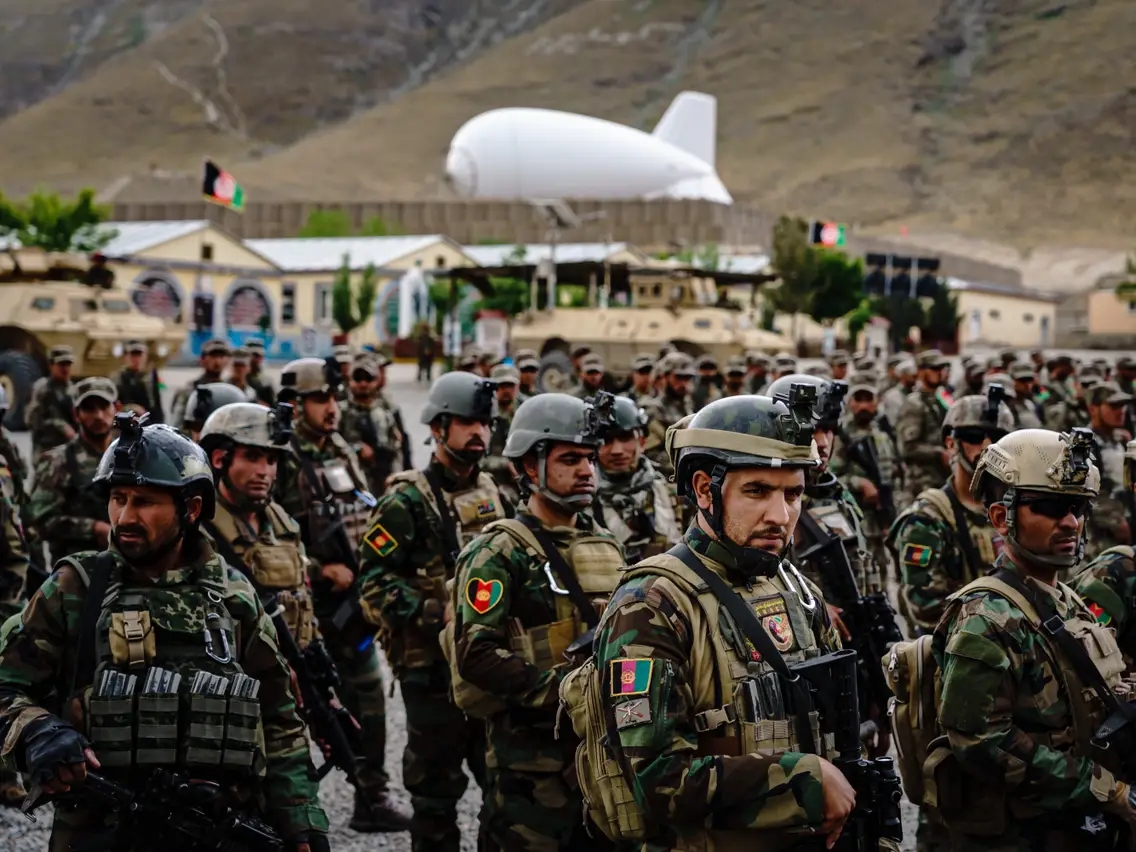
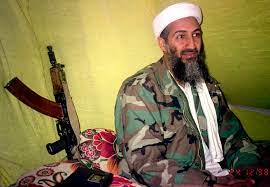
US proxy soldiers, Special forces Afghan National Army, 2021 (Photo sourced: Internet)Osama Bin Laden (10 March 1957 – 2 May 2011), Saudi-born founder and first general emir of Al Qaeda from 1988 until his assassination. (Photo sourced: Internet)
That is truly a crazy conspiracy theory but the historical truth does indeed involve a conspiracy. In 1997 the government of Afghanistan was socialist which was worrying for the USA, so in partnership with Saudi elements, they funded and even founded Muslim jihadist groups there.
These groups were to be encouraged to overthrow the socialist regime and when the USSR sent troops to support the government, to defeat the Russians too. Which they did.
But forget about fantasy stories of traditional tribesmen with ancient muskets fighting a world power’s army – these were jihadists, fundamentalists, armed with modern automatic weapons and mobile missile launchers including SAMs (Surface to Air Missiles).
Forget too about Rambo-led simple hill people – since the US achieved the overthrow of the socialist regime and invaded Afghanistan alongside their British allies, those jihadist groups have been squabbling over their share of the spoils, often murderously.
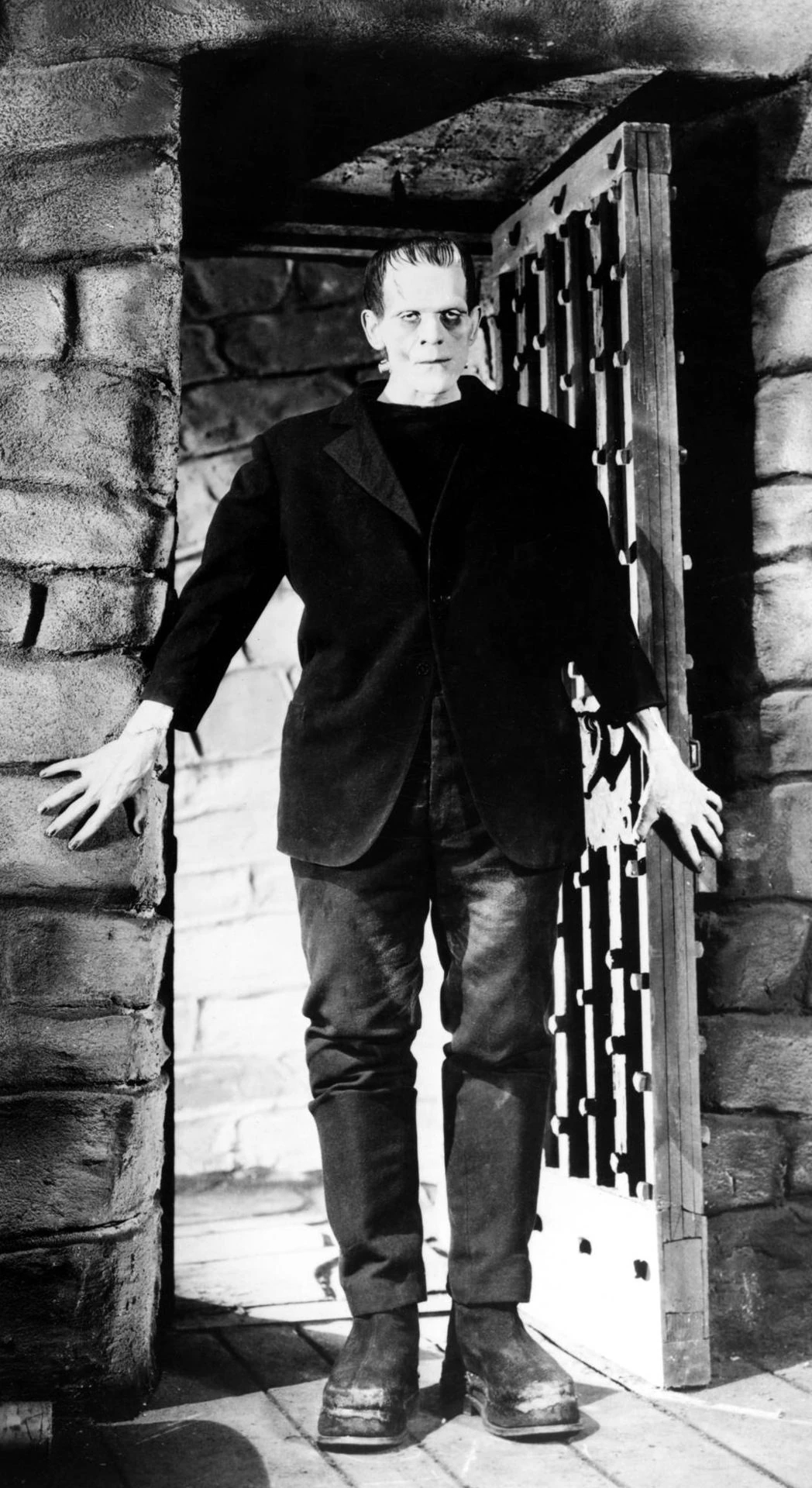
In fact, US imperialism is largely responsible for the world pestilence of not only jihadism of the Al Qaeda type, but the even more virulent Islamic State variety (which indicates Mary Wollstonecraft’s story of Frankenstein’s monster to be more prediction than fiction).
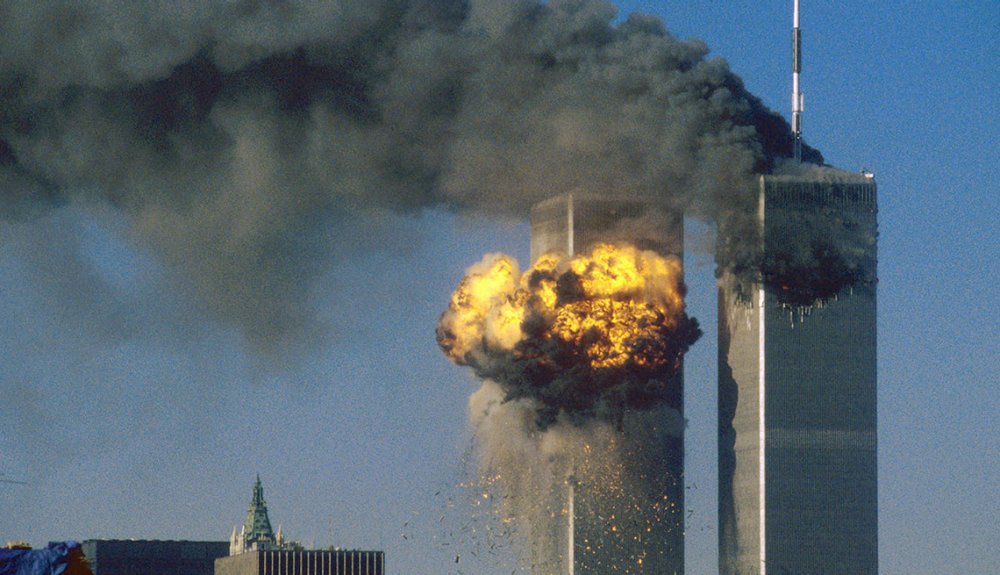
Explosion in one of the Twin Towers on 11th September 2001 in Al Qaeda attack. (Photo: Sean Adair/ Reuters)Frankenstein’s monster in Mary Wollstonecraft’s famous story; he returns to attack his creator (Image sourced: Internet)
Although US Imperialism had created Al Qaeda and although Saddam Hussein’s regime in Iraq was totally opposed to the jihadist group (and vice versa), US politicians used the attack on the Twin Towers to ‘justify’ the US military invasion of Iraq.
“Sweet are the uses of adversity” indeed when manipulated by US Imperialism for domestic consumption and for world public opinion, also when assisted by British Imperialism’s Labour Government, in particular by lying-through-his-teeth Tony Blair.
The US-led campaign against Iraq resulted in about 1.5 million deaths through economic sanctions alone followed by over 300,000 civilians in the Western military campaign. These figures do not include deaths and injuries of Iraqi military and of the invading allies under the USA and UK.
Nor do those figures include the many deaths, military and civilian, in internal conflicts since the invasion of Iraq which continue to mount.
The deaths resulting from the coup in Chile were overwhelmingly of civilians as the coup was carried out by the Army with little opposition within the military and the civilian population were mostly unarmed.
Most of the deaths occurred in succeeding days and years as the regime rounded up communists, trade union militants and others suspected of having supported Allende’s party, to torture and execute them, including most famously the renowned musician and singer-songwriter Victor Jara.
The anniversaries of both the Pinochet coup and the Twin Towers have been commemorated in various parts of the world with, it appears, the coup being remembered in most of them, not only in Latin America but also in many countries in Europe where Chilean political exiles found refuge.
In the USA, of course, the attack on the Twin Towers was officially commemorated and probably communally too much more so than the coup in Chile.
Another imperialist-generated disaster, the anniversary of which falls only a couple of days after those two, is that of the Oslo Accords, signed on 13th September 1993 and often also known as a stage in “the Palestinian Peace Process”.
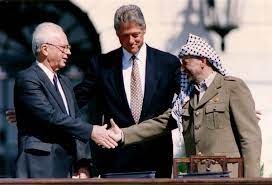
At the White House, supervised by Bill Clinton, elected chief of US Imperialism at the time, Yitzak Rabin for the Israeli Zionist state and Yasser Arafat, for the Palestine Liberation Organisation, signed an agreement, as a result of which the PLO would be permitted to run their own statelet.
Oslo Accords, 13 September 1993, Washington: Yasser Arafat of the PLO shakes hands with Yitzak Rabin of the Zionist State under the stewardship of (then) US President Bill Clinton, representing US Imperialism. (Photo: Gary Hershom/ Reuters)
Hailed as a great breakthrough by most media at the time, the PLO, dominated by Arafat’s Al Fatah, got to have limited self-government within the Zionist State, with the borders of any future Palestinian state undefined and no mention of the millions of Palestinian exiles around the world.
Although the increasing encroachment on Palestinian lands by Zionist settlers was temporarily halted, the land already taken and built upon remained in Zionist hands, that issue and others ‘to be discussed later’ but the Palestinians were to give up the armed resistance immediately.
The South African pacification process had begun earlier and, though enfranchisement of non-white South Africans was not to come until 1994, it was clearly on the way. The ANC promoted pacification processes to Al Fatah and both parties promoted them to Provisional Sinn Féin.1
The Palestinian ‘Process’ was controversial among their people from the start and grew more so as it became clear how little the Palestinian cause had gained and how much had been set aside, along with the growing official corruption and nepotism growing among the Al Fatah organisation.
Though the pacification process was widely rejected in Palestine and failed to install a widely-recognised ‘official’ collusive leadership, it did achieve the fragmentation of the Palestinian leadership and helped to ‘justify’ the demonisation of Hamas, winner of the 2006 elections.
ALTERNATIVES
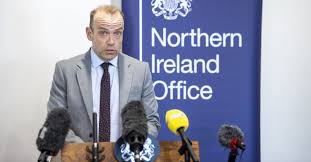
The Secretary of State for Northern Ireland (sic) is quoted in the media as saying that there is no alternative to the UK’s legacy legislation, which proposes to prevent recourse in law for any crimes committed by its soldiers, colonial police, proxies or Government Ministers.
Secretary of State for the Northern Ireland (sic) colony, Chris Heaton Harris (Photo cred: PA)
The legislation in question is titled The Troubles (Legacy and Reconciliation) Bill.
All political parties in Ireland on both sides of the British Border have vigorously opposed this legislation and THERE CLEARLY IS AN ALTERNATIVE, which is to abandon it. What the UK’s ‘colonial governor’ of the Six Counties means is: no alternative acceptable to the ruling class.
While we’re on alternatives, all liberation movements had and have the alternatives to embracing pacification processes, which is to maintain the path of resistance upon which they embarked until the day they win that for which their people and fighters have sacrificed their liberty and lives.
Allende and the communists in Chile had the alternative of arming the people and purging the Army but instead chose to put their faith in the ‘loyalty’ of Pinochet, ‘democracy’ and the opinion of the Western powers.
“The people armed cannot be harmed”, perhaps, rather than “The people united can never be defeated”.2 Allende’s error cost him his life but also the lives of hundreds of thousands of others.
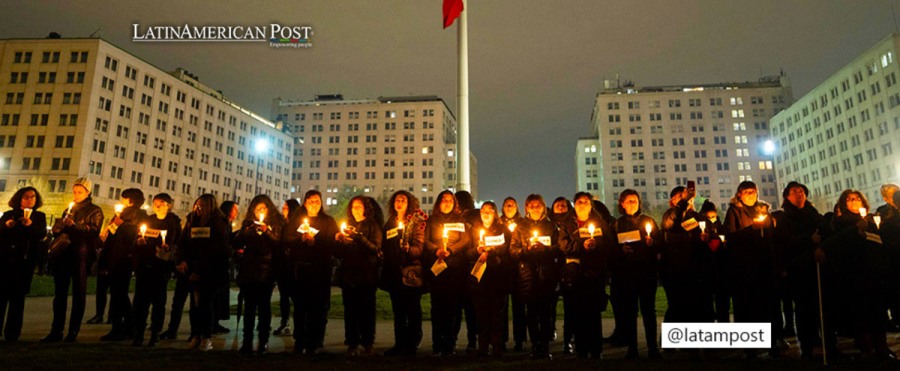
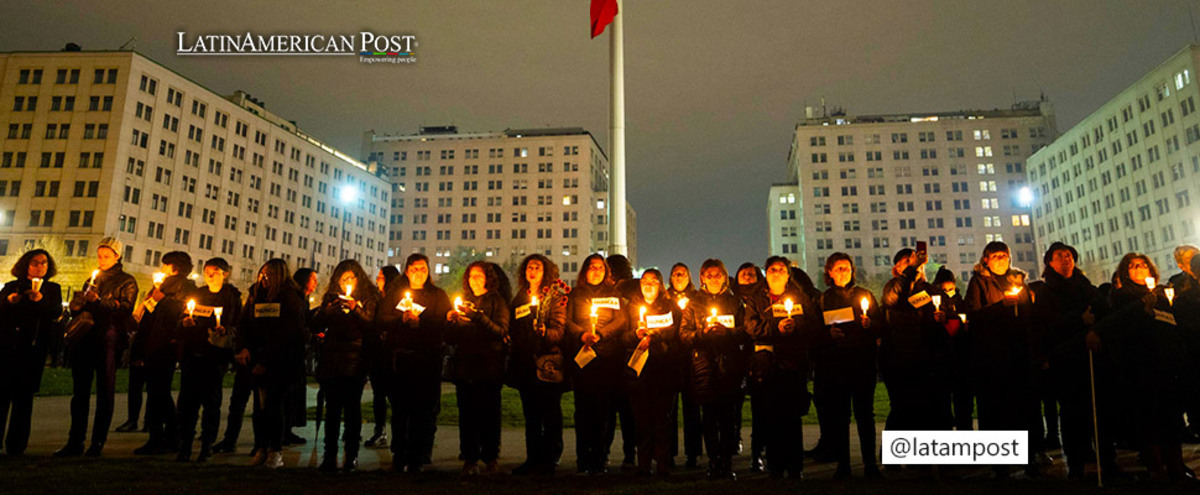
Women on 11th September hold a candlelit commemoration at La Moneda, Santiago, Chile for the victims – in particular of sexual violence – of the Pinochet coup and dictatorship. (Photo: Adriana Thomasa / EFE)
Imperialists have the alternative of respecting the right to self-determination of the peoples of the world and to cease from exploiting, oppressing and repressing them.
But if they did that, they wouldn’t be imperialists, would they? And since they cannot change their nature, they have to be overthrown.
End.
FOOTNOTES
1Provisional Sinn Féin signed up to the Irish Pacification Process in 1998 and they and the ANC then moved on to promote a pacification process to the leadership of the Basque movement for independence, which also finally signed up to it without even obtaining release of the political prisoners. By that time the Palestinian Process had shown its empty promise and the Second Intifada (2000-2005) demonstrated its rejection by most Palestinian youth and the elections to the 2006 Palestinian Legislative Council were won convincingly by Hamas.
2An alternative slogan to “El pueblo unido jamás será vencido” was even then being promoted by a smaller communist group: “El pueblo armado jamás será aplastado!”, i.e ‘The armed people will never be crushed’.
The Irish State has issued a new commemorative stamp to celebrate its joining the League of Nations in 1923 to which its representative referred as commemorating “the significance of Ireland taking our place among our fellow nations.”1
Well, sorry to poop on your party, Gombeen Government and to point out your lie. The truncated IrishState was admitted to the League of Nations, not “Ireland”, of which one-fifth was held in arms by the British occupier – who was one of the founders of the League.
Furthermore, the Gombeen state’s management committee entered the League as the victors in the Civil War – Britain’s proxy war in Ireland – dripping in the blood of those who fought for Ireland’s freedom. But that was not unfitting for the League was full of blood-drenched governments too.
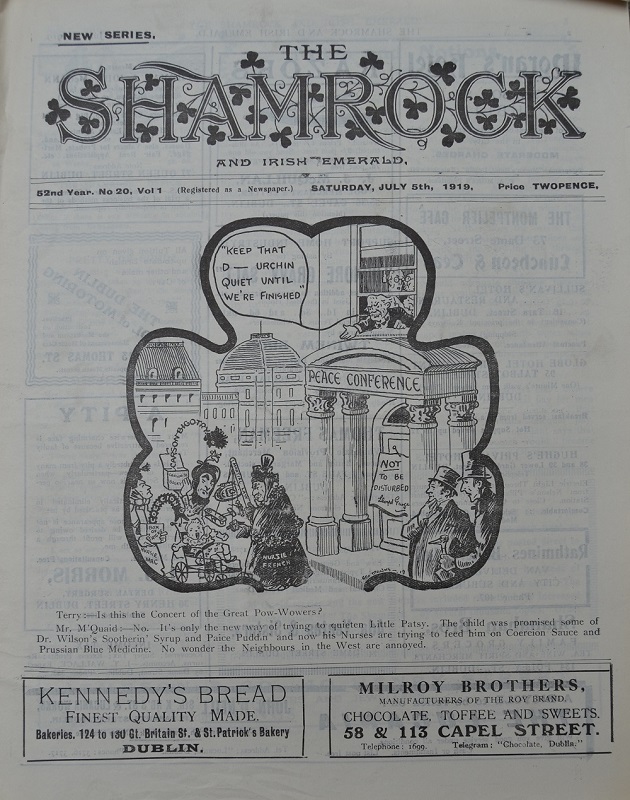
The League was formed in 1920 and though the true government of the Irish nation, the First Dáil,2 applied for membership, its emissaries were not even received. At the Paris Peace Conference, US President Woodrow Wilson did not even reply to the Irish Delegation’s letter.3
Irish nationalist media commentary on the exclusion of Ireland by Lloyd George from the Paris Conference (Image sourced: Internet)
The original permanent members of the League’s Executive Council (it had four non-permanent members too) were Britain, France, Italy and Japan and its languages reflected those of the dominant European and American powers: English and French.
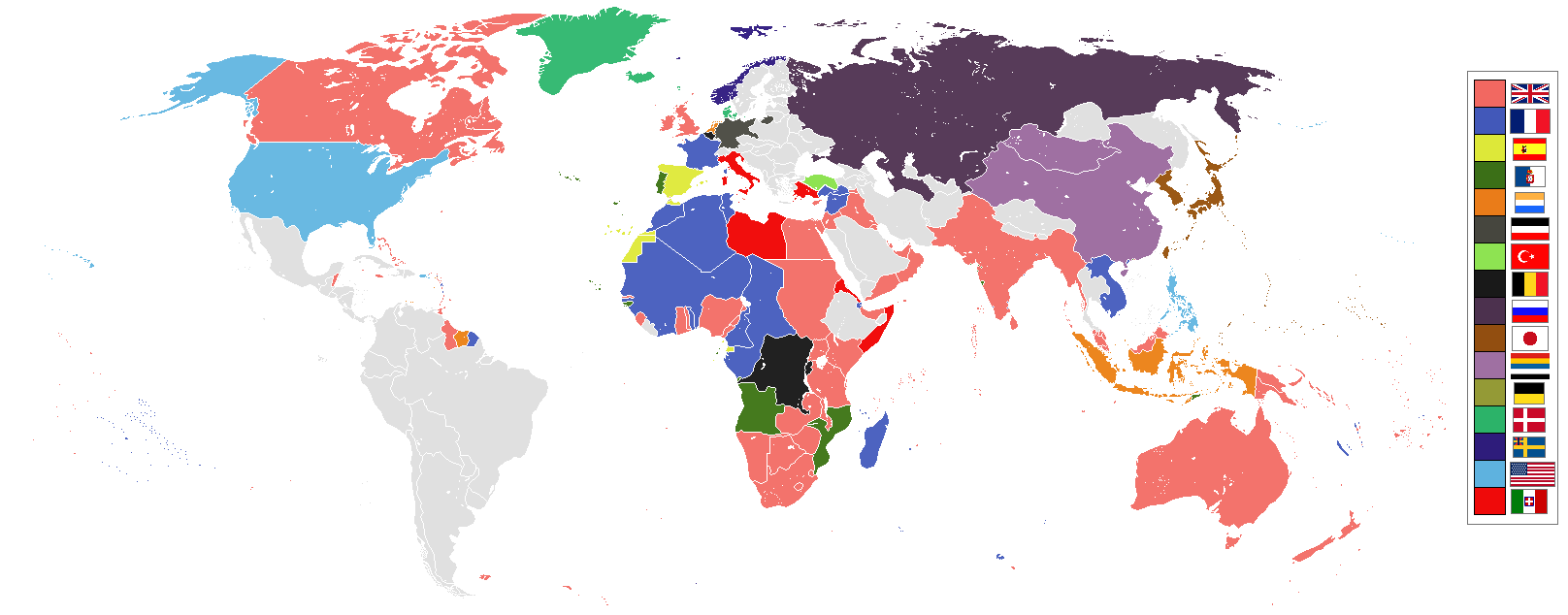
Britain came into the League with its Empire of allegedly independent states: Australia, Canada, India (which incorporated present-day Pakistan and Bangladesh), New Zealand and South Africa.
Map showing empires and colonies in the world in 1920 but there were also areas of influence apart from colonies. (Image sourced: Wikicommons)
PEACE?
Allegedly about peace, the League was formed as a club to discuss the areas of the world owned by the European colonial powers and to create a space where the losers and winners could discuss those lines, over which they had just fought a four-year bloody war.
Henceforth, there would be many, many wars, but mostly of colonial conquest and repression of resistance – but the European powers would not war among themselves, leastways except by finance and diplomacy. Until another 19 years, that is.
In fact, one of the major causes of WWII was the Treaty of Versailles, containing the crushing and humiliating WWI reparations demanded of Germany by the British and French imperialist powers. That Treaty was incorporated into the terms of the League of Nations.
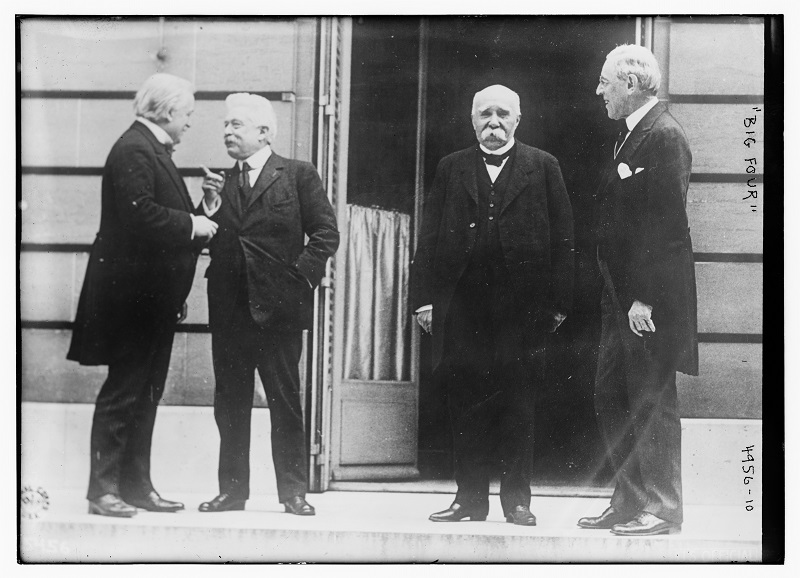
The Big Four that framed the Treaty of Versailles; L-R: Lloyd George of Britain, Vittorio Emanuele Orlando of Italy, Georges Clemenceau of France, and Woodrow Wilson of the U.S. (Photo sourced: Internet)
Ireland would see short armed liberation struggles in the 1930s, 1940s and of three decades from 1969. Hundreds of armed liberation struggles would break out across the rest of the world, in every continent except Antartica. And yes, including Europe.
The League of Nations was a club, chiefly of European colonial powers in which the conquest and suppression of a huge number of other nations was agreed and ratified. It was followed by the hugely-expanded United Nations after the next World War.
The UN has much the same role and of its 193 members, its only binding decisions are made by five Security Council Permanent Members voting without dissent: USA, UK, France, Russia and China. The vast majority of the other states are clients of one or other of those five.
The Irish state joined that earlier League not as one of the colonial powers but as a defeated nation, a neo-colonial client regime, an experiment in native self-government under external colonial control, one to be adopted by the other imperial powers and replicated across the world.
The Irish state joined the United Nations in December 1955 in exactly the same client relationship to its old masters but over time the yearly tribute has been shared among new part-masters, first the USA and then EU imperialism.
Neither the state’s advent to the League of Nations nor to its successor, the United Nations, has anything whatsoever of which to be proud. An opportunity for Irish real independence and world friendship of nations was squandered.
The new stamp should carry a black border in mourning.
End.
FOOTNOTES
1Words of Mícheál Martin, the Tánaiste (Deputy Prime Minister) of the Irish Government quoted in numerous media reports.
2The First Dáil was founded in January 1919 in defiance of British occupation, based on the results of the UK’s December 1918 General Election results in Ireland which returned 73 MPs of the newly-reconstituted Sinn Féin party out of a total of 101 MPs elected in Ireland. The SF members set about organising an Irish Government and, though declared illegal by the British occupiers shortly afterwards, continued to operate as a government until it split over whether to accept the terms of the British offer in 1921, which led to the Civil War of 1922-1923.
3 Seehttps://www.irishtimes.com/culture/heritage/how-the-plea-for-irish-independence-made-its-way-to-paris-1.3742328. Though interestingly, Wilson did reply to the young Ho Chi Minh’s in respect of Vietnam (Ho Chi Minh, while working in Britain, had commented admiringly on the Irish capacity for resistance at the time of Mac Swiney’s funeral march in London from Brixton Jail to Southwark Cathedral). Most of Indochina at the time was a French colonial possession.
Oscar DíazTranslation from Castilian Spanish by D.Breatnach (Reading time main piece: 10 mins.)
1. What is Herri Ekimena?
Herri Ekimena is an initiative that emerged in March 2022. A series of organizations began to get together due to concern about the offensive of Atlanticist imperialism in Ukraine, in addition to the blatant manipulation of the media to get us to support their war strategy.
We also observed that, in a context of capitalist crisis and with the excuse of the war against Russia, economic measures were being imposed that resulted in greater impoverishment of the working class.
That is why we took to the streets at that time with the slogan “NATO and the EU condemn us to war and misery”, to turn the official discourse around a little and point to these two organizations as the main ones responsible for the increase in international tensions, as well as for the oppression of the working classes of the imperialist bloc itself.
Also in the month of June of that 2022 we called a demonstration in Bilbo, “against the imperialism of NATO and the EU” and calling for the end of the Russophobia that is still being promoted.
In parallel to the NATO summit that was held in Madrid, we also carried out a 48-hour poster campaign in Gernika, a city with great anti-fascist symbolism that the Ukrainian Nazis tried to appropriate, citing it in a speech before the Spanish Parliament by Zelensky himself.
After a short break, we resumed the fight in the streets at the end of the year, with the “Free Euskal Herria out of NATO and the EU” campaign. In March we held a massive demonstration in Bilbo, together with Askapena1 and the Bardenas Ya2 collective.
View of demonstration against NATO and war in Bilbao, June 2022. (Photo source: Bultza Herri Ekimena)
This demonstration was exciting to us as we saw that the work that had been done was already bearing fruit and that the anti-imperialist spirit that has historically characterized Euskal Herria was projected in the streets.
We are currently in a restructuring process in order to be more effective, and give new impetus to the anti-imperialist struggle in the streets, which is where this game is truly played.
2. Why combine anti-fascist and anti-imperialist slogans?
The imperialist offensive, which has to do with the systemic crisis of capitalism and the rise of new economic powers, is being accompanied by a general reduction of rights and freedoms.
Those in power fear popular revolts, like those that have been taking place in the French State in recent months.
In Euskal Herria we know well what emergency laws or illegal practices are employed to put an end to dissent, but these types of measures are spreading and becoming normalized throughout Europe. Concentration camps for migrants, deportations without any type of legal guarantee, electronic anklet tags are also normalized…
And also in the case of the countries bordering Russia, imperialism is responsible for waving old supremacist and anti-Slavic flags, such as is happening in Ukraine or Poland.
We see therefore that capitalism, in its most decadent phase, has little scruple when it comes to reactivating liberticidal policies or inciting openly Nazi military and paramilitary shock forces.
So in effect, we believe that the anti-imperialist struggle and the anti-fascist struggle are inseparable parts of the same struggle for our rights and freedoms.
3. A few years ago one could see Donbass flags in the stands of Atlethic3. Why mix football and politics?
Through various institutions, including football clubs, they want to force down our throats the supposed “depoliticization of public spaces.” It is false, because they are the first to try to control absolutely all areas of our lives that we may become submissive and uncritical people.
The media bombardment is constant, generating false debates among humble people about insecurity, occupying empty properties… They thus try to legitimize, by action or omission, measures of social control and police repression that are very, very worrying.
So when someone puts a poster on the street to denounce any injustice, or puts up a banner, or paints graffiti… They are calling into question that false normality that they want to impose on us.
Banner displayed by Athletic Bilbao FC fans during a match. The text is difficult to see in its entirety but in general it is clearly in solidarity with the Donbas region against attack from the Kiev administration.
It is sad — but this situation also reflects the weakness of the system in terms of political legitimacy. Who explicitly supports them? Who is not fed up with everything that is happening? So they are afraid of the flame that starts a prairie fire.
Sports venues do not escape this logic of imposing false normality, even if the laws have to be twisted or passed directly through the triumphal arch.
A Donetsk flag, for example, ruins their photo and calls into question the story that people agree with what they do. So they impose fines of €3,000 just for displaying the flag of a People’s Republic.
Let’s hope that in not many years we will be able to analyze all this as the blows of a dying regime, but for now it is up to us to organize the response and popular solidarity. Repression should not be normalized, nor should people who step forward feel alone.
We do not believe that the social base of EH Bildu is in favor of NATO. That is, if we asked EH Bildu voters if they were in favor of NATO, surely 99% would say no. The problem is that, for its leaders, opposing Atlanticist imperialism is not currently on the list of priorities.
Regarding the issue of the war in Ukraine, Arnaldo Otegi5 has openly positioned himself in favor of Ukrainian “sovereignty” and against the Russian “occupation.” Is Ukraine now a sovereign state? Or is it rather a puppet of NATO in its offensive against Russia?
Doesn’t Russia have the right to defend itself from NATO attacks? What about the thousands of people killed in Donbass since 2014? Should Russia have been obliged to watch this genocide impassively?
Have the self-determination processes in Donetsk, in Lugansk, in Crimea … not been practical exercises of sovereignty? In this context, we can say that the speech of some EH Bildu leaders has favored and continues to favor the interests of NATO.
Their support for the State Budget deserves special mention, which includes a 25% increase in military spending. A measure imposed precisely by NATO to approach 2% of GDP in 2029, which is truly outrageous.
So… perhaps it is harsh to say that EH Bildu is in favor of NATO so let us put it another way: What is EH Bildu doing to make Euskal Herria break with NATO? What teaching are they carrying out among their social base and at a public level to create a truly anti-imperialist consciousness?
Very little or nothing, we believe, that is the reality.
5. Will it be possible to continue to see reliable information about Ukraine in the Basque Country and the Spanish state now that military juntas have been formed in African countries that have expelled French embassies? They are very different countries and thousands of kilometers away…
The events that are taking place in the SAHEL area are complex processes, and surely have many sides that make it difficult for us to equate them with the decolonization processes that we have known historically.
But we would be committing a mistake if, due to these supposed “imperfections” with respect to the theoretical manual, we stopped supporting countries that are fighting for nothing less than to expel their occupiers (since those are true occupiers who try to impose themselves by force of weapons thousands of kilometers from their borders) and also to gain control of their enormous natural resources.
How can it be that in extraordinarily rich countries, like Niger or Gabon, the majority of the population survives in absolute poverty? We will have to carefully observe all these processes, but in anti-imperialist Euskal Herria we can only rejoice and tell them that they are not alone.
In this land that, to a degree, also knows what it is to fight against armed occupiers and various collaborators, we know very well that solidarity is the love between people.
Regarding the quality of the information that we are able to receive in Euskal Herria or in the Spanish state, we believe that right now it is below minimum.
It is pathetic to see how, every time an event occurs that could undermine the hegemony of Atlantic imperialism, the mainstream media wait to receive instructions before even reporting the event.
The control of capital over the big media is a reality, so we must promote and support alternative means of information and communication. And also to fight openly in the streets, so that they have no choice but to report our demands.
6. Couldn’t the creation of a multipolar world be dangerous on a war level?
Yes, in fact it already is. We had been talking for years about the end of Yankee hegemony and the economic rise of countries like Brazil, Russia, India, China and South Africa, the so-called BRICS.
Perhaps we thought that this change of orientation of world hegemony was going to be a calm process, without any surprises…
But nothing could be further from the truth. While it is true that Yankee imperialism is mortally injured (which we believe it is), the truth is that it seems willing to kill as it dies.
Currently it has restructured NATO in a few months, has de facto absorbed the European Union and is reconfiguring its alliance policy on a global scale. It is increasingly easier to identify “which side” the different states are on, which can be the prelude to a conflict on a planetary scale.
We have been able to verify this recently with Morocco. NATO and the EU buy Morocco and abandon the Sahara to its fate.6 What should the Sahrawis do if Algeria, Russia or China offer them help to win their rights and survive as a people?
Of course there may be geopolitical interests in this aid from emerging powers, but it is necessary to analyze whether the agreements, commercial exchanges, donations and aid are produced with mutual respect for sovereignty and benefit the currently oppressed nations.
Of course, from a revolutionary point of view we have to be exacting, and not give a blank cheque to these emerging powers.
In this entire process of multipolarity, whether we like it or not, which is already making its mark upon world geopolitics, there is a class struggle that we must not ignore.
But this critical stance cannot lead us to fall into ninism and evade our own historical responsibility: to combat Atlanticist imperialism from the very heart of the beast.
7. You say “Euskal Herria free from NATO.” And what about the rest of the Spanish state?
We say Euskal Herria should be free outside NATO, but also outside the EU. We believe that this contribution is important, since for many years consideration of leaving the EU has been a kind of taboo, also in Euskal Herria.
Some thought that the EU might even support a possible independence process in Euskal Herria, just as was thought in Catalonia.
“A Free Basque Country out of NATO and the EU”.
But the EU has definitively been revealed as a capitalist lobby, as an instrument at the service of elites with a more than dubious past, even with regard to their support for Nazism.
Úrsula von der Leyen, Josep Borrell… are faithful representatives of the EU of Capital, authoritarian and totally committed to the interests of the US. That is why we say that neither the nation nor as a class have a future within the EU.
We make this statement from Euskal Herria, which is our area of struggle. But of course it extends to the entire Spanish State, as well as to the French State and all the peoples of Europe.
A future in freedom is not possible belonging to these criminal organizations, neither in Euskal Herria nor anywhere else.
8. What do you think of the military administration by Margarita Robles of the PSOE/UP government?7
Margarita Robles is a pit bull of Spanish politics, a woman who knows perfectly the ins and outs of the State from the offices to the sewers. Not for nothing has she been in positions of power for more than 30 years, originally in the shadow of Belloch, later of Rubalcaba…
At first it may have been surprising to see her at the head of a Ministry like the Defense Ministry, she who comes from the judiciary and who, even in relation to the conflict between Euskal Herria and the Spanish State, had adopted a dialogue profile at certain times.
We are missing a lot of information (I wish that we in Herri Ekimena knew what was going on in the Ministry of Defense, haha), but Margarita Robles is probably dedicating herself to doing in the Spanish military what she also did in her day in the Ministry of Justice and Interior.
That was to send the most archaic elements to the refrigerator in a non-traumatic way to perfectly adapt to the current standards and guidelines of NATO and the EU. Change a minimum so that everything remains absolutely the same.
Can anyone imagine Spanish generals standing up for Spanish national sovereignty in the face of Atlanticist imposition? This could happen in the French State, in fact it would not be unreasonable for something like this to happen.
In the Spanish State it is much more unlikely, but it is the responsibility of politicians like Mrs. Robles that nothing should deviate from the script written by Washington and Brussels.
In this regard, it is worth highlighting the role of the PSOE in what has been the process of integration of the Spanish State into imperialist structures. In addition to Felipe González, we could mention Javier Solana (who became Secretary General of NATO), Josep Borrell8…
Whether it is a matter of affinity, or a matter of pragmatism, the truth is that it appears that the PSOE generates a lot more trust among the imperialist powers than any other political party at the level of the State.
9. There were elections this past July 23, 2023. Did any of the political forces propose the departure of NATO from the Spanish state?
We are not aware that this was the case. As we have said before, this government is responsible for the largest increase in military spending in history, and faithfully complies with NATO and EU mandates.
“No to NATO – Out of Bardenas!”
Vice President Yolanda Díaz has publicly supported sending weapons to Ukraine and, as far as we know, no party that supports the government has opposed these shipments as a matter of principle.
We remember that these are weapons that are being used by Nazi soldiers to bomb and murder, not alone Russian soldiers but also the civilian population of Donbass. So we have to organize and fight in the streets, because if we don’t, things will remain exactly the same or worse.
This is the reason for existence of Herri Ekimena, to activate the popular struggle against the imperialism of NATO and the EU. We are working at it and, if all goes well, there will be good news in this regard in the coming weeks.
1Askapena was the internationalist solidarity arm of the broad Basque national liberation organisation but split from it many years ago in concern at the deviation from the path of resistance by the leadership under Arnaldo Otegi.
2Bardenas Ya is an organisation campaiging against the military installation in Bardenas, Nafarroa (Navarre).
3Athletic Bilbao FC, whose fans and many of its players have a strong anti-fascist and pro-Basque independence tradition.
4EH Bildu is the political party of the current compliant ‘official’ leadership of the Basque national movement, replacing the Herri Batasuna of the past.
5Leader of EH Bildu who has led the party into what many consider its collaborationist current stance.
6Western Sahara was a Spanish colonial possession and it abandoned it without decolonisation, which allowed Morocco and Mauritania to invade and occupy it against the wishes of the Saharawi people. As a result of the national liberation struggle of the Polisario Front, Mauritania withdrew but Morocco remained in occupation and carrying out repression against the resistance. Shortly before Trump’s departure from the USA’s presidency, he agreed to endorse Moroccan defiance of the UN-recognised Sahawarwi resistance to occupation in exchange for Morocco reversing its long anti-Zionist policy and formally recognising the Zionist occupation of Palestine, which the Moroccan Kingdom has done.
7The recent coalition Government of the Spanish State, the social-democratic PSOE with the Left-social democratic alliance of Unidas Podemos. Currently, the PSOE is endeavouring to form a government in coalition with a somewhat reconfigured Left-social democratic coalition called Sumar.
8All three have been PSOE politicians, Felipe González a prime minister and widely believed head of the GAL anti-Basque terrorist gang. Borrell was President of the European Parliament (2004-2007) and Minister of Foreign Affairs of the Spanish Government from 2018 to 2019. He attacked Catalan self-determination which he characterised as part of a disease, despite his own Catalan origin and he is now the Foreign Minister of the European Union.
News reaches us that military forces in Gabon, yet another colony (say neo-colony) of French imperialism in West Africa, have carried out a coup, deposed the titular President and put him under house arrest.
Actually, some of the reporting called it “an attempted coup” which seems strange: the military in control of its own bases, national broadcastings stations and with the former leadership under arrest seems a lot more than an “attempt”.
Map of African states and cities (By: GISGeography Last Updated: August 9, 2023). Gabon is located on the west coast (down from Cameroun and up from Angola).
Given recent nationalist military coups in a number of former French colonies, a lot of speculation is taking place as to whether this case is a harbinger of future uprisings against French imperialism and also as to whether the new apparently nationalist administration of Gabon has a future.
CENTURIES OF SCRAMBLE FOR AFRICAN RESOURCES
Throughout the 17th, 18th 19th centuries, European colonial powers scrambled for control of African natural resources, including slaves (and slave-like labour after the abolition of slavery). Vast resources of oil, valuable metals, minerals and gem stones are still being extracted from Africa.
Much of Africa was conquered and occupied by French colonialism1 and in most of those countries French is a ‘national’ language of the state and sometimes the only one so recognised. After “independence” France continued to extract natural resources and labour power from the regions.
Recently2 the military of some of those neo-colonies carried out coups and overthrew their France-aligned rulers, accusing them of being effectively administrators of French neo-colonialism. Niger was the most recent in July 2003, Burkina Faso in January 2022 Mali in August 2020.
There have been others too but those three countries border one another and have also declared an alliance against any invasion, such as that threatened by the pro-imperialist alliance of ECOWAS3 of which the dominant member is Nigeria.
NEO-COLONIALISM
There have been historically more than one method of effectively colonising a country. It may be invaded and resistance crushed, the administration (taxation etc) henceforth being managed directly from the invading country or from a government dependent on the invader.
The system may include large-scale settlement of land (as in Ireland and Algeria) but in any case the cities will include enclaves of invader settlers and administrators, charitable, religious and educational institutions, nearly always teaching a curriculum based on the occupiers’ culture.
Deposed President Ali Bongo Ondima in Residence Libreville 30 September 2023 (Photo cred: BTP Advisors to the President via AP)
There were also ‘protectorates’, such as Palestine for example, under British control and accepted so by other powers, without a direct system of colonial occupation or administration.
Ireland had the colonial-settler-parliament system under the British occupation until 1800 when by bribery and self-interest, the Irish Parliament4 dissolved itself and almost immediately joined the United Kingdom, Irish elected MPs then having to attend parliament in Westminster.
In 1921, that system continued for the British colony of the Six Counties but control of the rest of Ireland was exercised a distance through the governments and State departments of the majority section of the Irish national capitalist class, the Gombeens.5
That system was developed by British imperialism throughout its Empire, piece by piece. The French followed but the ruling classes of Belgium, Holland and Portugal were slower to adapt. After WWII, the USA used the system increasingly in Latin America6, Africa and Asia.
GABON HISTORY
Gabon of course has a long history before Africa was ever occupied and settled by European powers. Africa after all is the cradle of humanity.
Bantu migrants settled the area in the early 14th century. In the late 15th century Portuguese explorers and traders arrived in the area and in the 16th century the coast became a centre of the transatlantic slave trade with European slave traders arriving to the region.
France occupied Gabon in 1885, but did not administer it until 1903. In 1910 Gabon became one of the four territories of French Equatorial Africa. On 15 July 1960 France agreed to Gabon becoming an independent state but the reality was that it became one of France’s neo-colonies.
Unexpectedly perhaps, there was a WWII battle there: in November 1940 Free French forces were sent by De Gaul to take the area from the Vichy-loyal administration there. The Battle of Gabon lasted four days and ended in victory for De Gaulle’s forces.
WHERE TO NOW?
Whether Gabon’s neighbours would invade remains to be seen and the country is separated by over 2,000 km distance from Niger, the nearest one of the three Sahel French colonies in rebellion, a shortest distance that traverses the currently hostile major state of ECOWAS, Nigeria.
Crowds celebrating the army coup in Libreville, capital of Gabon, 30 August 2023 (Photo cred: Al Jazeera)
The three Sahel colonies themselves seem somewhat more secure in so far as they can support one another7 and also in so far as the clients of the Western powers are reluctant to take military action against them, a reluctance already demonstrated by the failure of ECOWAS to invade to date.8
Overall, these developments cannot but have given heart to national liberation forces, including revolutionary ones, across Africa and even beyond. French client regimes will be looking over their shoulder but so too will the client regimes of the British and the USA.
2Not so recent was Algiers, where the people fought a hard and bitter struggle against the colonists and France and declared independence in 1954. Some other countries also declared independence but were subverted or imperial client regimes came to power in them, often also by coup.
4For most of its history since the Reformation, only Anglican MPs had been admitted to this Parliament and for much of that time too, only Anglicans could vote. Progressive national bourgeoisie such as Grattan and Tone had failed to overturn this exclusiveness and it was that which convinced Wolfe Tone and other United Irishmen that a revolution was necessary. They rose unsuccessfully in 1798 and again in 1803.
5Na Gaimbíní, the Irish capitalist class that arose under British occupation to which it was subservient. Some at least of the wealth accumulated by this class was through gaining control of lands abandoned or having to be sold at a loss by their occupants during the Great Hunger of 1845-1849. The name has now passed on to describe the foreign-dependent client capitalist class of the Irish state, first subservient to British colonialism, then to US imperialism and finally to EU imperialism.
6As we recognise USA dominance of Latin America today through invasions, sponsored coups and financial controls, we are likely to be surprised to find that Latin America was largely a British imperialist preserve through much of the 19th Century and up until WWII, when it had to cede much of it to the USA in exchange for war material support.
The leaders of the Nigerien coup of 31st July, breaking the bondage of the country to its neo-colonial French masters, may be applying lessons from French history all the same.
Not from the Liberté, Egalité et Fraternité of the French Revolution of 17891, however.
No, instead they may be remembering the history of the Paris Commune on 18th March 1871, the first city in the world to come under a revolutionary socialist regime.2
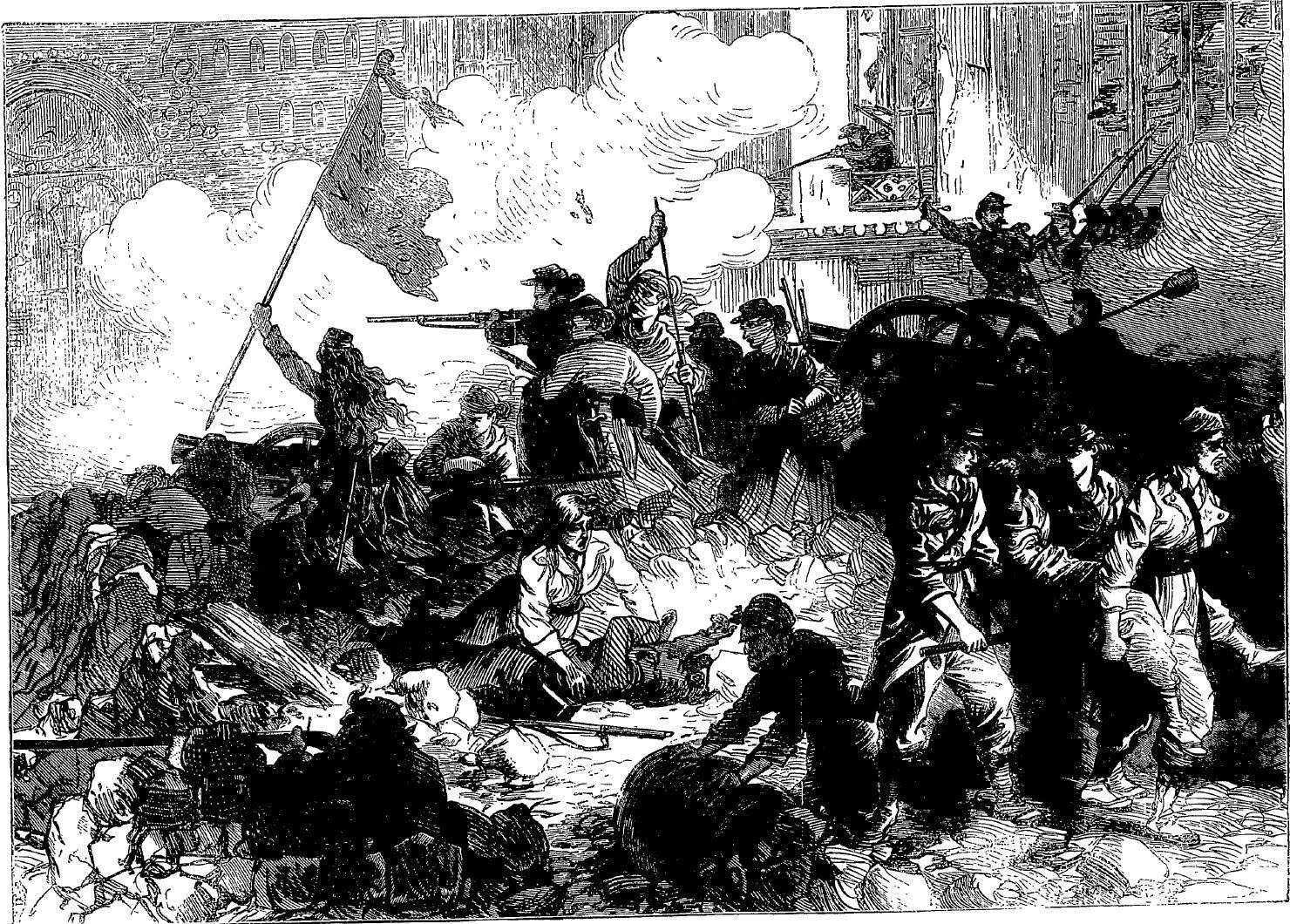
The final battle in defence of the Paris Commune 1871 (Image sourced: Internet)
In the midst of a crisis impelled by the defeat of France by Prussia under Bismark and Paris being under siege, along with crushing armistice terms for France accepted by Chief Executive Adolphe Thiers, Paris was experiencing much social and political unrest.
The authorities under the leadership of Thiers moved to disarm the people by removing canon that had been paid for by popular subscription. Crowds refused to allow this and protests grew into insurrection as soldiers of the National Guard3 joined the demonstrators.
The Communards overthrew the authorities in Paris but failed to prevent many of their enemies leaving the city.
Advised by General Vinoy, Thiers ordered the evacuation to Versailles of all the regular forces in Paris, some 40,000 soldiers, including those in the fortresses around the city; the regrouping of all the army units in Versailles; and the departure of all government ministries from the city.
Thiers set up his government in Versailles where he and his advisors plotted the retaking of Paris and the defeat of the Commune, which showed all the signs of becoming permanent.
However, Thiers lacked sufficient armed forces to fight through the Prussians. In the end he reaffirmed their crushing armistice terms in defeat and begged the Prussians to allow his armed forces (partly composed of released POWs) through the Prussian encirclement to attack Paris.
Bismark agreed and the French troops under Marshall Mahon4 (who had himself escaped from Paris) were given safe conduct towards Paris and through the besieging Prussians so that they could attack the city.
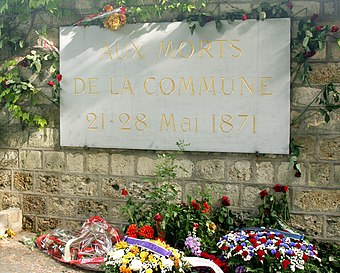
After fierce fighting but often under inefficient military leadership, the Commune was defeated by French troops on 28th May 1871, with wounded defenders bayoneted and prisoners executed en masse or, in the cases of some leaders, tried and executed or exiled.5
Plaque in Paris at the scene of many of the French executions of Communards (Image sourced: Internet)
NIGER TODAY
The Niger coup leaders today are holding the former elected President, Mohamed Bazoum, the neo-colonial puppet of the French, along with his family, under house arrest. Western leaders call for their release, which no doubt seems humanitarian, but the coup leaders refuse.
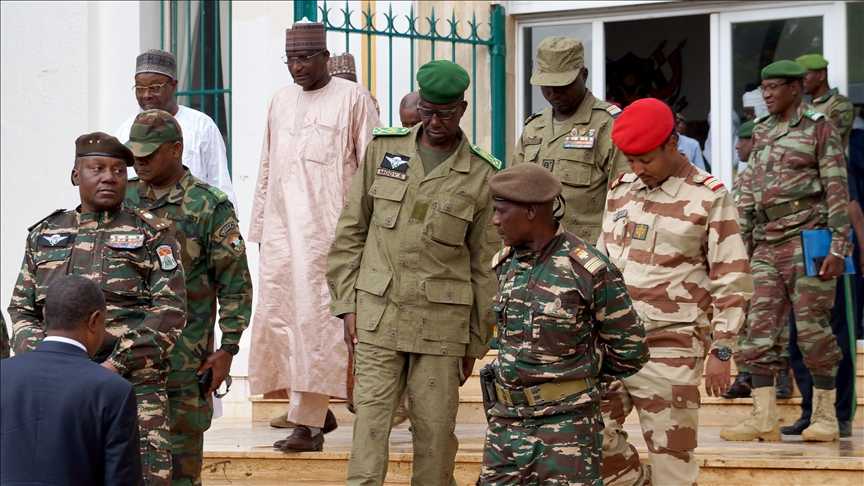
Nigerian military including coup leaders and civilian administrators (Photo sourced: Internet)
Certainly the coup leaders are treating their captives better than have been many leaders of former regimes overthrown by coup or invasion.
General Franco’s regime tortured and murdered around 200,000 civilians in his military-fascist coup 1936-1939, most of them after the war in Spain.
Nationalist elected President Patrice Lumumba of the Congo was murdered in 1961 by the Belgian-USA puppet Moise Tshombe’s forces.
When South Vietnam’s USA-friendly President Ngô Đình Diệm began to show tendencies towards independence in 1963, he was murdered in a coup by General Dương Văn Minh with CIA collusion. Salvador Allende was murdered in the 1976 CIA-masterminded coup in Chile.
National leader of Iraq Saddam Hussein6 (2006) and Muammar Ghadaffi of Libya (2011) were murdered by internal but USA-allied forces.
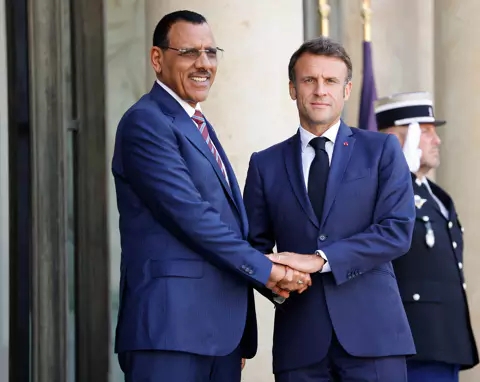
MohamedBazoum, deposed President of Niger and Emmanuel Macron, President of France, photographed in happier days for them both (Photo cred: Ludovic MARIN / AFP)
Mohamed Bazoum is alive and under house arrest with his wife and son, reportedly with canned food but without electricity and running water, though he is permitted regular contact with the West and recently met with the premier of Chad on 31st July.
Although Niger is a land extremely rich in natural resources including oil, gold and uranium being exploited by foreign companies, 80% of the population ruled under Bazoum’s presidency have never had electrity or domestic running water.
Despite demands from the Western powers, the coup leaders, perhaps remembering the history of the Paris Commune, refuse free Mohamed Bazoum, perhaps to act as a figurehead to lead a western-supported army back to ‘liberate’ Niger and to ‘restore democracy’.
End.
FOOTNOTES
1 These principles were of course not applied to France’s colonies, as the sad history of Haiti demonstrates. The African slaves there took the principles seriously but Napoleon waged war upon them and eventually, through the treachery of captains of Toussaint L’Ouverture, leader of the successful slave insurrection, delivered L’Ouverture and his family to end their days in French dungeons. Haiti was returned to French rule, where it remained until eventually overthrown again but under French neo-colonial, later USA neo-colonial dominion where it remains today.
prohibition of fines imposed by employers on their workmen.
3 The National Guard had defended Paris while the French Army was in the field and became the army of the Commune.
4 Patrice de Mac Mahon, of part of the Mac Mathúna/ Mac Mahon clan from Ireland emigrated to and settled in France (14 members of the family served in the army).
5 The national forces killed in battle or quickly executed between 10,000 and 15,000 Communards, though one unconfirmed estimate from 1876 put the toll as high as 20,000. Fifteen thousand were tried, 13,500 of whom were found guilty. Ninety-five were sentenced to death, 251 to forced labor, and 1,169 to deportation (Wikipedia).
6 Saddam Hussein at least had a trial and the question is not whether, if one agrees with a death penalty, he deserved to die but that it was the ‘justice of the victor’, in this case that being the USA, certainly guilty of many more murders and tortures than was Hussein. Ghadaffi was murdered most painfuly without any trial by his captors.
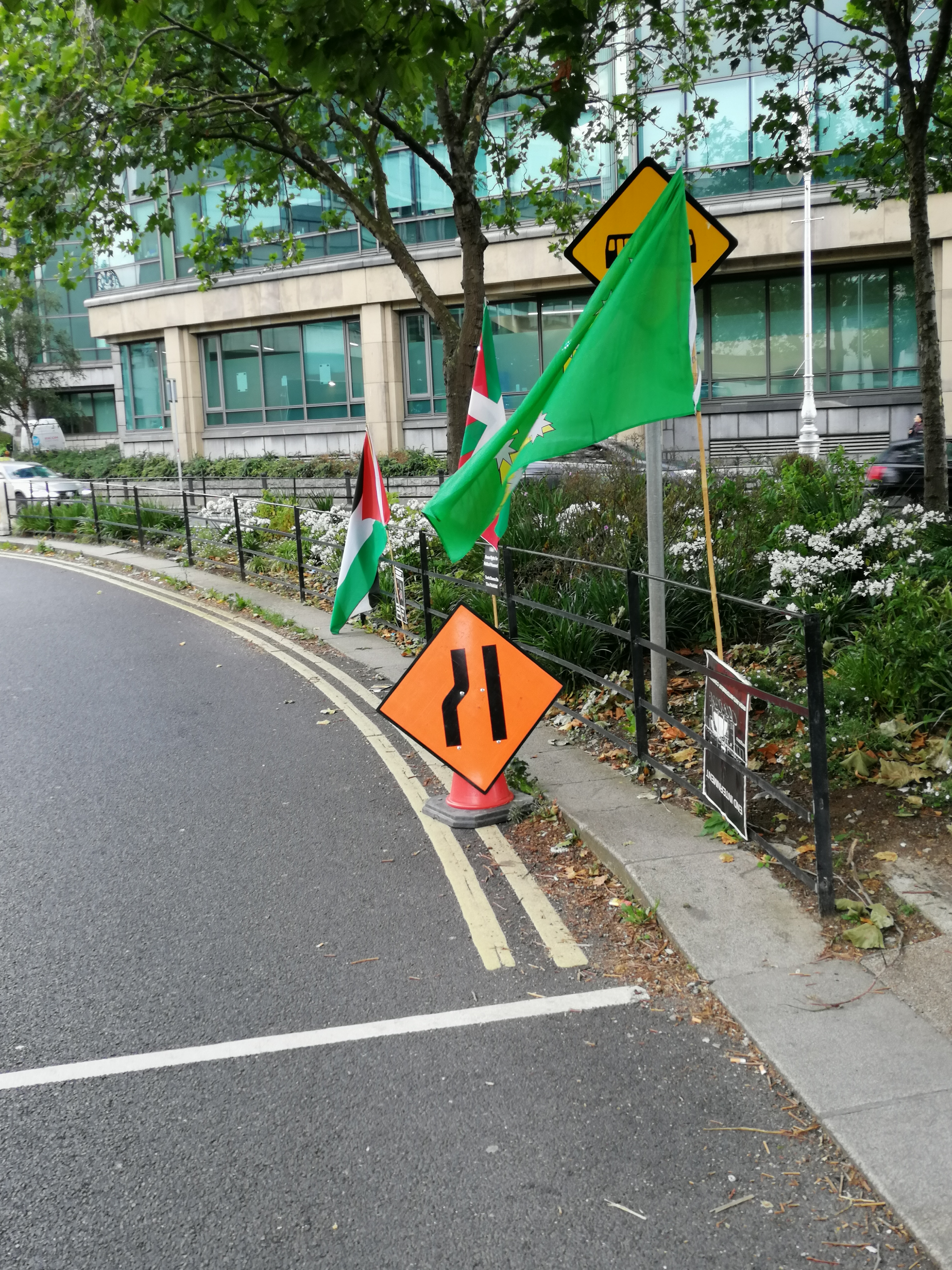
Socialist republicans and communists gathered on a traffic island in Dublin’s city centre to mark the International Day of the Prisoner. They flew flags to represent prisoners in Ireland (‘Starry Plough’), the Basque Country and Palestine.
They also displayed a number of placards.
(Photo: IAIC).
The choice of location, apart from being passed by road traffic in three directions, was because of the presence there of the Universal Links on Human Rights memorial sculpture with an eternal flame, commissioned by the Amnesty International organisation.
A plaque near the sculpture bears the following words: “The candle burns not for us but for all those whom we failed to rescue from prison. Who were tortured. Who were kidnapped. Who disappeared. That is what the candle is for.”
Plaque in the ground on the approach to the sculpture. (Photo: IAIC).
Somewhat ironically, one of the placards carried the words: “Amnesty International, do Irish Republican prisoners not have human rights too?” Irish Republicans have long complained that the organisation in question does not raise any issues with regard to Irish political prisoners.
Some have indicated as a possible reason or part-reason the location of the head office of Amnesty International being based in London, capital city of the occupying power. Its interventions on Ireland even during three decades of war in the colony have been very few indeed.
Other placards displayed referred to political prisoners from the liberation wars in India and in the Philippines, the innocent Craigavon Two still in jail and ongoing internment through refusal of bail to Republicansappearing before the no-jury special courts in both administrations.
Some leaflets were distributed about ongoing internment in Ireland through long remands in custody of Republican activists. Between convicted and awaiting trial there are close to 50 political prisoners in jails in Ireland between both administrations.
The Universal Links sculpture by Tony O’Malley (welding by Jim O’Connor) commissioned by Amnesty International. (Photo: IAIC)
The Zionist Israeli state holds 5,000 political prisoners (almost all Palestinian), of which over 1,132 are not even charged (‘administrative detention’). There are 33 female Palestinian political prisoners and 160 child prisoners. Philippines has 803 political prisoners.
The Spanish and French states hold between them around 170 Basque political prisoners.
The event to mark International Day of the Prisoner was organised by the Ireland Anti-Internment Campaign and a spokesperson gave a short explanation on video of the reason for the event with the human rights sculpture in the background.
End.
Some of the flags displayed (Photo: IAIC).Passer-by in conversation with a leafleter. (Photo: IAIC). (Photo: IAIC).
The media has alerted us to a military coup taking place in an African country most of us won’t even have heard of: Niger.
Apparently Niger had a democratically-elected leader overthrown by the coup and many states, including France and the US, are very concerned about this. Naturally so. Military juntas are surely no fit replacement for democracy.
Map of much of Africa showing Niger in green and surrounding states (Source: Wikipedia)
But it turns out that the USA and France have other reasons to be concerned apart from questions of democracy: both states have military stationed there, the USA including in fact a major military installation producing and operating drones, some of which are armed.
But why are they there? Well, to defend Niger against fundamentalist Muslim jihadists. That’s good, right? Helping the Nigerien people. It’s true that some unkind (and possibly ungrateful) people accuse the US of having given birth to the islamist fundamentalists originally, but, well …
We learned just recently two very strange facts, side by side: 1) Niger is one of the poorest countries in the world and 2) it is the seventh-largest exporter of a highly-valuable material: uranium.
Niger also has gold mines (two years ago 18 people were killed in a mine collapse) but curiously, Niger has no gold reserves at all. France, on the other hand, which has no gold mines whatsoever had 2,437 tonnes of the metal in their reserves at the end of the second quarter of this year.
Uranium is valuable because it is used in the production of nuclear power which, in turn, in many parts of the world, is used to generate electricity. France being one of those countries, where 80% of its uranium comes from … Niger. And 20% of the EU’s electricity likewise.
Hmm. So there might be reasons apart from restoring democracy for France being so upset at the coup, especially when the coup leaders say they want to break with France.
Urban scene in Niger, exact location and date unknown (Source: Internet)
But going back to this country being one of the poorest in the world, at least they must have plenty of generated power, right? Well, no. It turns out that 80% of the people have no electricity supply whatsoever. Democratic government or not, that can’t be right, can it?
Anyway, France has ordered the coup leaders to reinstate the deposed president with a deadline of last Sunday or it would take stern action. The deadline has passed quietly without an invasion or other attack.
Niger was a colony of France and became independent in 1960 so it’s kind of strange that France has such a grip on the country still.
Another five states border Niger including Mali and Burkina Faso, also ex-French colonies, also under recent military coup juntas. Their leaders have said any attack on Niger would be considered an attack on them.
Algeria was also a French colony and fought a very hard liberation struggle for independence, since when it has friendly relations with Russia. Algerian armoured vehicles have moved to the border with Niger, in what will be understood as a warning to other states not to invade.
Chad is another ex-French colony in the region but it made some threatening noises against the military coup leaders in Niger; Senegal too is an ex-French colony loyal to France.
Senegal’s political opposition leader Ousmane Sonko is on hunger strike in jail and his lawyer Juan Branco, extradited from Mauritania is in jail too for defending Sonko but nobody seems to be shouting about Senegal’s lack of democracy – not that we can hear, at least.
The west-friendly (some say neo-colonial) state of Nigeria, the leading state in the pro-western African alliance COWAS has imposed sanctions and threatened to invade Niger if the previous regime is not reinstated. Nigeria is huge and with extremely valuable resources, including oil.
In 1995, in defence of British Petroleum’s operations, Nigeria hanged peaceful environmental activists in the Delta region, the Ogoni Nine. As many as 4 in 10 Nigerians live below the national poverty line with 133 million living in poverty, according to its own national statistics.
Regarding Africa and coups, we Irish have cause to remember the Congo where Irish UN peacekeeping soldiers were killed, after a military uprising in a province against the elected patriot Patrice Lumumba was carried out in support of Belgian mining interests, supported by the USA.
And Uganda’s military rule under Idi Amin was generally OK with the western powers until he began to throw his weight around against the British, who had trained and supported him, so they had to bring him down.
Supporters in Niger of the military coup there demonstrating. (Photo sourced: Internet)
Elsewhere, for example in Latin America, military coups in many countries including Brazil, Chile and Argentina have been supported by the western powers or indeed instigated by them. As in what is now Iran, when the British overthrew the Shah in 1941 to replace him with his son.
Dictatorship from 1965 in Indonesia was widely seen by the western powers as necessary to stop the spread of socialist and national liberation ideas and, as in most such coups, the toll in massacres and torture by the new regime was huge. None such in Niger though, at least so far.
If we were citizens of Niger would we think ourselves better off under a military junta rather than a democratically-elected President? We might initially be more concerned as to whether the riches of our country were to be used to lift us from such poverty.
To give us education, hospitals, medicines, food, work, clean water, refuge from heat, power … or instead extracted and shipped out to some other country.
And what would we think of France, possibly backed by other NATO countries and their client states, coming to invade our land and bring back the old state of affairs?
End.
Niger’s National Council for the Safeguard of the Homeland Colonel-Major Amadou Abdramane, center, is greeted by supporters as he arrives for rally at the Stade General Seyni Kountche in Niger’s capital city Niamey, on August 6, 2023.(Photo cred.: Rebecca Blackwell, AP)
Original Breaking News article: DAVID YOUNG, PA (with commentary in italics by Diarmuid Breatnach)
The rededication of a memorial to the National Army soldiers killed in the Civil War enables their memory to be rehabilitated, a ceremony in Dublin has heard.
Defence Forces Chief of Staff Lieutenant General Sean Clancy paid tribute to the some 810 soldiers killed serving on the Free State side in the 1922-2023 conflict as he addressed the event at Glasnevin Cemetery on Sunday.
Descendants of some of those who died, representative of all four provinces, were invited guests at the ceremony, among them relatives of Michael Collins, the commander in chief of the National Army who under direction by Churchill, gave the orders that began the Irish Civil War and who was killed in 1922.
Taoiseach Leo Varadkar and Tánaiste Micheál Martin, the leaders of Fine Gael and Fianna Fáil, the two main parties forged from the divisions of the Civil War, also attended the rededication of the National Army Monument.
Sinn Féin TD Matt Carthy also attended the military commemoration, as did Dublin Lord Mayor Daithí de Róiste.
This neatly brought together political parties of the neo-colonial and neo-liberal Irish State with opposing histories: Varadkar to represent the pro-British and fascist neo-colonial origins of Fine Gael; Mícheál Martin and De Róiste representing Fianna Fáil, the allegedly Republican but in reality Irish Gombeen split from the previous iteration of Sinn Féin; Carthy for the current neo-colonial, neo-liberal and colonial servant Sinn Féin.
Taoiseach Varadkar (Fine Gael) and Tánaiste Martin (Fianna Fáil) unveiling monument to soldiers of the ‘Free State’ killed in the Civil War 1922-1923. (Photo cred: Brian Lawless/ PA)Matt Carthy TD, who represented his party Sinn Féin at the unveiling and dedication of the monument to soldiers of the Free State killed in the Civil War 1922-1923. (Photo sourced: Internet)
Prior to the ceremony, there was no monument in the country specifically dedicated to the soldiers of the National Army who fought against the anti-Treaty side in the Civil War.
Weeks after the war ended, on August 3rd, 1923, the Oireachtas passed legislation that led to the creation of the modern-day Defence Forces, Óglaigh na hÉireann. That is, the defence forces of the neo-colonial ruling class who created the Irish state.
The rededication event for the forgotten fallen of the National Army, which had already robbed the Irish language version name of the IRA, adopted the name Óglaigh na hÉireann during the Civil War, took place on the Sunday prior to the centenary of that date.
“It is appropriate then, in the spirit of real inclusiveness, of ethical remembering, and with a full desire to deal with some of the more uncomfortable aspects of our shared history, that we remember some of 810 uniformed members of Óglaigh na hÉireann who gave their lives in the service of the State during the tragic and critical period at the foundation of our democracy,” Lt Gen Clancy told the ceremony.
It is necessary, in order to bury any idea of achieving the Republic declared at the start of the 1916 Rising, that we honour some of the 810 men we recruited to bury that Republic in 1922, kitted out in uniforms, armed and transported by our ancient enemy. We wish to pass over quickly over not only the kidnappings, torture, murders, killing of disarmed prisoners and even sexual assaults by this fine body of men – the precursors to the current army of the Irish State – but also their terrorising of major part of the country with raids on homes and internment of men and women. Although this fine body of men were fighting to establish a neo-colony not even covering the whole of Ireland, we make no apology for calling them what they clearly were not, Óglaigh na hÉireann, i.e “Warriors of Ireland”.
The monument in Glasnevin to soldiers of the Free State killed during the Civil War – apart from the Free State Army having appropriated the name in Irish of the IRA, the legend claims they “died for their country”, a clearly inaccurate statement since at best they were fighting for the government and state of the 26 Counties, which excludes the UK colony of the Six Counties (‘Northern Ireland’ sic). (Photo cred: PA)
“For far too long there has been no memorial of any kind, nor any complete listing of the National Army war dead.” Understandably.
“Indeed, this year represents perhaps the last real opportunity to rectify that.”
As we prepare to commit this armed force to NATO at some point in the future and to PESCO in the nearer future, it is important to take a further step in legitimising this armed force of the neo-colonial state.
The remains of some 180 of the 810 soldiers who died serving in the National Army are buried at the plot in Glasnevin Cemetery. Uncomfortably close to graves of many of their victims.
“Sources at the archives show that the average soldier buried here was in his early 20s, was unmarried and from a working-class background,” said Lt Gen Clancy. In other words, the typical recruitment profile of lower-rank soldiers in capitalist and imperialist armies.
“Many had previously served in the IRA during the War of Independence, some even in the 1916 rising, many others had served in the British Army, underlying yet again how complex is the weave of Irish history.”
Actually, “many” is a questionable though vague estimate of the numbers who had “served in the IRA during the War of Independence”, though some had, including some of the most vicious, such as Major-General Paddy Daly, torturer and murderer.
The chief of staff highlighted the “poignant example” of two young Belfast-born Dublin-raised brothers – Frederick (18) and Gerald McKenna (16) – who were buried in Glasnevin after being killed together in action in Cork in August 1922 only a month after joining the National Army.
Aye, two men born in Belfast, a city which the Free State was fighting to ensure remained a direct colony of the United Kingdom.
“Whatever the often very legitimate reasons our forebears may have had for forgetting in the intervening 100 years, I think it’s appropriate now that I as the 32nd Chief of Staff of Oglaigh na h Eireann should finally take this opportunity to rehabilitate their memory,” said Lt Gen Clancy.
Especially as I try to establish a legitimate background to the armed force of an illegitimate State preparing to enter foreign imperialist wars and suppression of legitimate uprisings.
After all, we have great experience in all that, as the history behind this monument shows.
In all areas of endeavour and no less in revolutionary work it is essential to review our actions (and those of others) periodically in order that we may draw lessons to improve the success of future activity.
Irish history provides an abundance of material to revise.
The most recent period worthy of intensive review in my opinion is the three-decade war, mostly in the Six Counties but also having repercussions within the territory of the Irish State, in Britain and even further abroad.
An article in the July issue of An Phoblacht Abú1, monthly hard-copy newspaper of the Anti-Imperialist Action organisation, discusses the psychological and organisational problems arising from the way that three-decade struggle came to an end and its effects on the resistance movement.
That period in Ireland commenced with a struggle for democratic civil rights, not one of the demands of which were for more than was already well established in the rest of the ‘UK’. But it soon changed into a guerrilla war with huge numbers of political prisoners and jail struggles.
The movement experienced a number of splits and changes of leadership but for most of of the time it was led by the Provisional organisation’s leadership although changes took place inside its own leadership too.
Ruairí Ó Brádaigh, President Provisional Sinn Féin 1970-1983, speaking at GPO rally 1976. He led an unwinnable war. (Photo cred: Pat Langan/ Irish Times)
Some of the Provisional IRA leadership following the 1970s split: Martin McGuinness, Dáithí Ó Conaill, Sean Mac Stiofáin, IRA press conference 1972, Derry. (Photo cred: LarryDoherty)
The period ended with that leadership not only abandoning armed struggle but being coopted with its structures into joint management of the colonial occupation and preparing for joint management of the neo-colonial Irish state, a number of smaller splits in the movement a much disillusion.
The An Phoblacht Abú article concentrates on building or rebuilding trust in leadership through measures such as clear communication, discussion, organisational restructuring, collective solidarity, open discussion, transparent communication and education.
The article does not say this but in my opinion one of the basic educational needs is to acknowledge that in the circumstances, what happened was inevitable (and to consider how different circumstances might be constructed in future).
UNWINNABLE
It is essential in my view to acknowledge that the struggle, as it was waged, was bound to lose. Yes, unwinnable: an unassisted armed struggle against a world imperialist power fought primarily in one-fifth of our territory where the population is deeply divided – how could we think otherwise?
Clearly, the Provisional leadership did think otherwise. Assuming they were not insane or very stupid, on what could their belief have been based?
I can see only two rational possibilities:
1) They believed the British had no essential need to retain the 6-Co. Colony and would abandon it if put under enough pressure, or
2) that the Irish ruling class, through its government, would step in and join the struggle.
If they believed the first, their analysis was not historically-based. Since its invasion and occupation of Ireland in the mid-12th Century, the British ruling class has repeatedly gone to enormous efforts to suppress Irish self-determination.
When they had the opportunity to leave in 1921 they had cultivated a client bourgeoisie, then instigated a civil war and partitioned the land, leaving themselves a firm foothold in the country.
Their initial response to a call for simple civil rights in the late 1960s was violent suppression on the streets, abolition of habeas corpus and introduction of internment without trial – and army massacres.
If the previous lessons of history were not clear to the movement’s leadership, then those events up to 1972 should have made them crystal clear.
If the Republican leadership believed the Irish ruling class would step up, they failed to draw the lessons of history since at least 1921 and to understand the neo-colonial nature of the Gombeen class, amply illustrated in the preceding 50 years of the Irish State.
As embarked upon and fought, the war could not be won but a strugglewas potentially winnable.
However, to have a chance of winning, the struggle would have to be over the whole 32 Counties. And to engage the maximum number of people, it would have to take up the social, cultural, economic and political deficits across the Irish state and across the colony.
The social rights of women and LBG2 people were widely-acknowledged deficit areas, yet the Republican movement did not seriously address them. Of course, doing so would have put the Movement in direct opposition to the Catholic Church hierarchy and its followers.
Why should that be a problem? Hadn’t the Hierarchy been pro-British occupation since the late 1800s3 and anti-Republican since the 1790s? Wasn’t it one of the cornerstones of the neo-colonial Irish State, its social prop and social control mechanism?
Yes but the problem was that some of the leadership themselves were in that ideological ambit and were in any case afraid to disaffect many of their followers. A natural fear, of course. Yet only in that way could the struggle go forward across the Irish state’s territory.
It was left to campaigners mostly outside the Republican Movement, including social democrats and liberals, to fight for the rights to contraception, divorce, equality for women, LGB rights. And later, to take on the huge institutional abuses of the Catholic Church in Ireland.
Those issues affected directly well over half the population of the Irish state and the the leadership lacked the interest or the courage4 to take part in their struggles, never mind lead them, which it left to mostly non-revolutionary leaderships.
There were many other issues that affected people in the 32 Counties which a revolutionary leadership could take up and, I would argue, should have taken up.
The latter includes emigration, rights of the Irish diaspora (particularly in Britain), foreign penetration of the Irish economy, foreign land ownership, housing shortage, industrial struggles, academic freedom, Irish language rights, Church control of education and the health service …
Some of those issues were taken up for a while by the movement in parts of the 26 Cos. prior to the split in the Republican Movement but were progressively dropped as the armed struggle in the 6 Cos. took off.
When years later the Provisional leadership got interested in social democratic reformism, they found they could hardly make any headway in the unions against the Labour Party and the remains of the Workers’ Party – because of the Provos’ earlier overwhelming neglect of that area of struggle.
SUMMARY
The struggle in the Six Counties could not be won precisely because it was primarily confined to that area and also one in which a powerful enemy had seduced a huge section of the population.
When the leadership acknowledged the unwinnability of the struggle as being waged, instead of changing their methods and aims of struggle to take in the whole 32 Cos, they decided on capitulation and getting the most possible out of it for themselves.
A change in the top leadership of Sinn Féin and the IRA: Gerry Adams and Martin McGuinness photographed in 1987. They recognised they could not win and set about managing abandoning it while getting something out of the system for the leadership. (Photo: PA)
The leadership of the Republican movement was unwilling to widen the struggle because they believed that it was unnecessary to do so and/ or they were unwilling to overcome their own ideological indoctrination and/or lacked the courage to confront prejudices among their following.
Some of the social struggles have now been won or hugely progressed but without the leadership of the Republican Movement, in fact by leaderships of mostly reformist trends.
Due to leaving the industrial struggle to social democrats, the trade union movement has degenerated hugely and is in a poor state to take on any substantial economic or rights struggle, to say nothing of a revolutionary one.
The surviving Republican movement seems unwilling to acknowledge those historical facts and its failure thus far in leadership. Admission of the facts is necessary in order to commence to repair the movement and to prepare for a struggle with a prospect of success.
End.
FOOTNOTES
1Page 9, entitled COMRADESHIP – GUARD AGAINST BETRAYAL; I intend to review the July issue of the newspaper separately some time soon.
2I have omitted the T from LGB because it is only comparatively recently that the transexual issue has gained wide acknowledgement, whereas the Gay, Lesbian and even Bi-Sexual issue were widely known about at the time under discussion.
3The Irish (settler) Parliament passed an act giving middle-class and higher Catholics the right to vote in 1793.
(This article is reprinted from Socialist Democracy by kind permission of the author Gearóid Ó Loingsigh)
(Reading time: 3 mins.)
The USA has announced that it will supply cluster bombs to Ukraine as part of its support for the war against Russia.
On one level the move is not surprising, on another it reveals some fundamental truths about the course of the war and US intentions.
They are banned by international treaty, one which has not been signed by Russia or Ukraine, and of course, neither has it been signed by the US. The US has always dragged its feet on the question of the banning of certain types of weapons.
Cluster bombs, are simply put bombs that break up into smaller components leaving small explosive devices scattered over a large area of land. They are a
…conventional munition that is designed to disperse or release explosive submunitions each weighing less than 20 kilograms, and includes those explosive submunitions…
These weapons are designed for use against massed formations of troops and armour or broad targets, such as airfields. Cluster submunitions, however, sometimes fail to explode on impact and can kill or maim civilians who later come into contact with them. These unexploded submunitions may remain dangerous for decades.(1)
Cluster bomb capsule (Photo sourced
They have all the potential to leave Ukraine like the US left Cambodia and Laos in the 1970s.
According to Cluster Munition Monitor 23,082 casualties were confirmed by the year 2021, with around 18,426 resulting from unexploded munitions.
Biden has a long and chequered history on the use of the weapons.
His ambassador to the UN had condemned their use by Russia, stating they had no legitimate place on the battlefield, though two days later the State Department censored the official transcript of her intervention to remove the phrase.
Biden had criticised the use of and access to such weapons in the past. (2)
Whilst it is all very interesting and even of humanitarian concern that the US would wish to turn Ukraine in another Laos and Cambodia, though unlike Kissinger they will be telling no lies about their bombs, it is of greater interest what it says about the war.
Biden’s official reason is that Ukraine is running out of munitions and they need the cluster bombs. We have been told from the word go that this war is winnable, i.e. that Ukraine can win it.
This of course ignores that Ukraine is not the only warring party fighting Russia; NATO is part of the war, although it is not putting many boots on the ground, though it clearly has had a hand in some operations.
Every week we hear announcements that the counter offensive will smash Russia, almost there, one more push, the Russians have run out of weapons, their army is demoralised and deserting etc. Now it turns out that Ukraine needs these weapons or else.
These weapons are very useful in halting advances by your enemy, they are not as necessary in situations where your enemy is routed, unless you think it may regroup and retake the initiative.
Ireland has wholeheartedly supported the war in Ukraine, confirming to those who wish to see that it is not a neutral country. It has had little to say on the issue of these banned weapons.
They will make parts of Ukraine uninhabitable and make agriculture a dangerous profession as sowing and reaping become potentially life-threatening activities. If Biden will go to these lengths, what else will he do?
Children view unexploded cluster bomb sub-munition near their village, Laos, 2019 (Photo cred: Sarah Bronstein)
Despite the media talking about Putin’s willingness to use nuclear weapons, it really has to be asked whether the US is willing to go that far as well.
What then of the former leftists running round chanting victory for NATO, or as they would put it for Ukraine? None of them have said much either on Biden’s choice of weaponry. Is there no length to which the US will go that marks a turning point for them? The answer is no.
Should Biden propose facilitating large scale rocket attacks on Moscow they are as likely to cheer them on as to remain silent. What they will not do, ever, is oppose the escalation of the war. Modern day Kautskys.









 rebelbreeze