THE MYSTERY OF THE MISSING RAILINGS – Generosity, Solidarity, Propaganda and Secrecy in WWII

Diarmuid Breatnach

A central character in a Cory Doctorow novel comments that the cast-iron railings donated by householders in Britain for use in making munitions during WWII were instead dumped into the Channel.

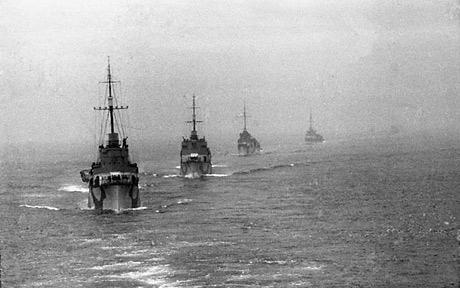
Doctorow takes liberties with the present and the future but not so much with the past. Even so I doubted this story. I doubted even more the reason given, that the iron was allegedly unsuitable for making munitions but that the people were not told in order to keep their morale up – the belief that their sacrifice was helping the war. While working in London I had heard stories myself of the railings going to help Soviet Russia, convoys carrying the iron on those awful Artic runs to Murmansk, across a sea infested with Nazi submarines and so cold that your body in the sea had minutes at most to live. And no ship would stop to pick you up either, because it would endanger their whole crew and the rest of the convoy.WW2 Artic Convoy
Did I doubt that the British Government was capable of keeping the truth from the people in the cause of war morale? Not for one minute – they have lied and concealed truth from the people for reasons much worse throughout history …. and continue to do so. No, what I doubted was that the metal was unusable. I’ve worked in a few foundries and although they were non-ferrous, I think I know a little about metal and its preparation. I’ve been a welder too.
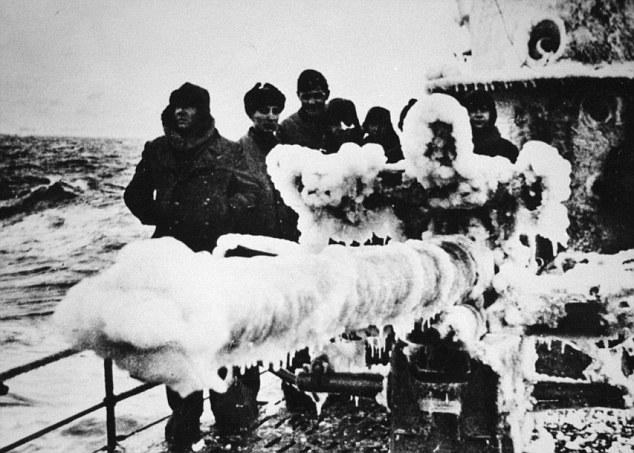
Allied warship in Artic waters during WWII giving some idea of the conditions

Cast iron is what it sounds like, iron that has been cast – melted in high heat and then poured into molds to the required shape. But it isn’t just iron – among other things it also contains carbon. So does steel, even the lower-carbon steels – but cast iron contains a much higher proportion of carbon, at least 2% and often just over 4%. Not much, you might think but it does make a big difference.

Once, many familiar objects were made out of cast iron – gutters, drainpipes, gas pipes, sewer pipes, manhole covers, gas lamp-poles, baths ….. A very hard metal but also brittle. You’ve seen an old metal broken drainpipe, right? Broken into a point? Cast iron, for sure. Steel doesn’t break like that. Corrodes, dents, bends and under extreme pressure, shears – but doesn’t shatter or break off like cast iron when it gets a hard enough knock. Well, maybe steel will shatter in extreme cold but we’re talking about within a normal range of temperatures here.
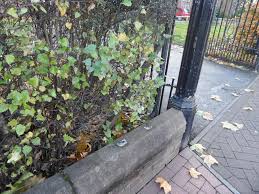
Wall Missing Railings showing lead
A wall of a former girl’s boarding school showing where railings were removed during WWII (no doubt to the warm approval of the local lads). The holes show the lead that was poured into the hole in the stone around the railing bar to grip it tightly when it set.

Cast iron is denser and heavier than steel and needs a greater thickness than steel to make something, it being possible to work the latter while very thin.  Think of a food ‘tin can’: it’s not tin, though typically it had a coating of tin inside. It is steel, pressed very thinly – “thin can” would have been a more accurate name. Now, think of those cans you’ve seen, rusting away from the outside (the reason for the protective coating of tin inside).

So why use cast iron at all? Well, corrosion-resistance is one of the reasons to choose it as a material — cast iron doesn’t corrode as badly or as quickly as steel (stainless steel of course is something else). And cast iron melts at a lower temperature than steel, which makes it significantly cheaper to produce.  Cast iron is very good under compression, i.e. at bearing weight and, when used in arches, could and did make effective iron bridges (though not good under tension or “pull”, where steel has it beat). And it can be machined well – so engine blocks and big machine frames could be made from it. And the kitchen range stove.

For years my mother wanted a big cast iron frying pan like those she had been familiar with from the Spanish state, because the heat stayed in the pan longer and food stuck less (this was before Teflon and other non-stick surfaces). The cast iron pan is heavy to manipulate but I prefer cooking in it myself.
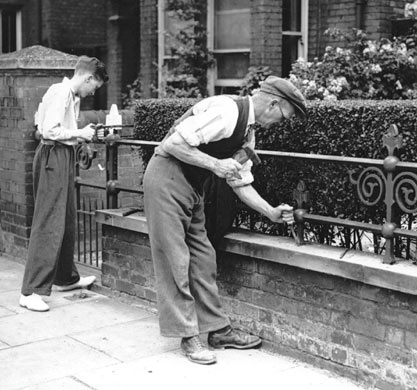
Removing Railings WWII
Boy and possibly father or grandfather removing railings, probably during WWII

Now, iron is common to cast iron, steel and wrought iron. All iron can be melted down and re-used. You might have to process some other elements out and add other elements but so what? Is it being suggested that Britain in the mid-20th Century did not have the technology to do so?  Or even that it was cheaper to dump the cast iron, at a time when cheaper imports could not possibly be available?

But then what happened to the missing railings? They were definitely removed and to this day you can see some walls in Britain, with rows of holes filled with lead, where the railings were secured. The newspaper magnate and owner of the Daily Express, Lord Beaverbrook (William Maxwell Aitken), who was variously Minister for for Aircraft Production and later for Supply, had put out the call for the public to donate the cast-iron railings for armament production.
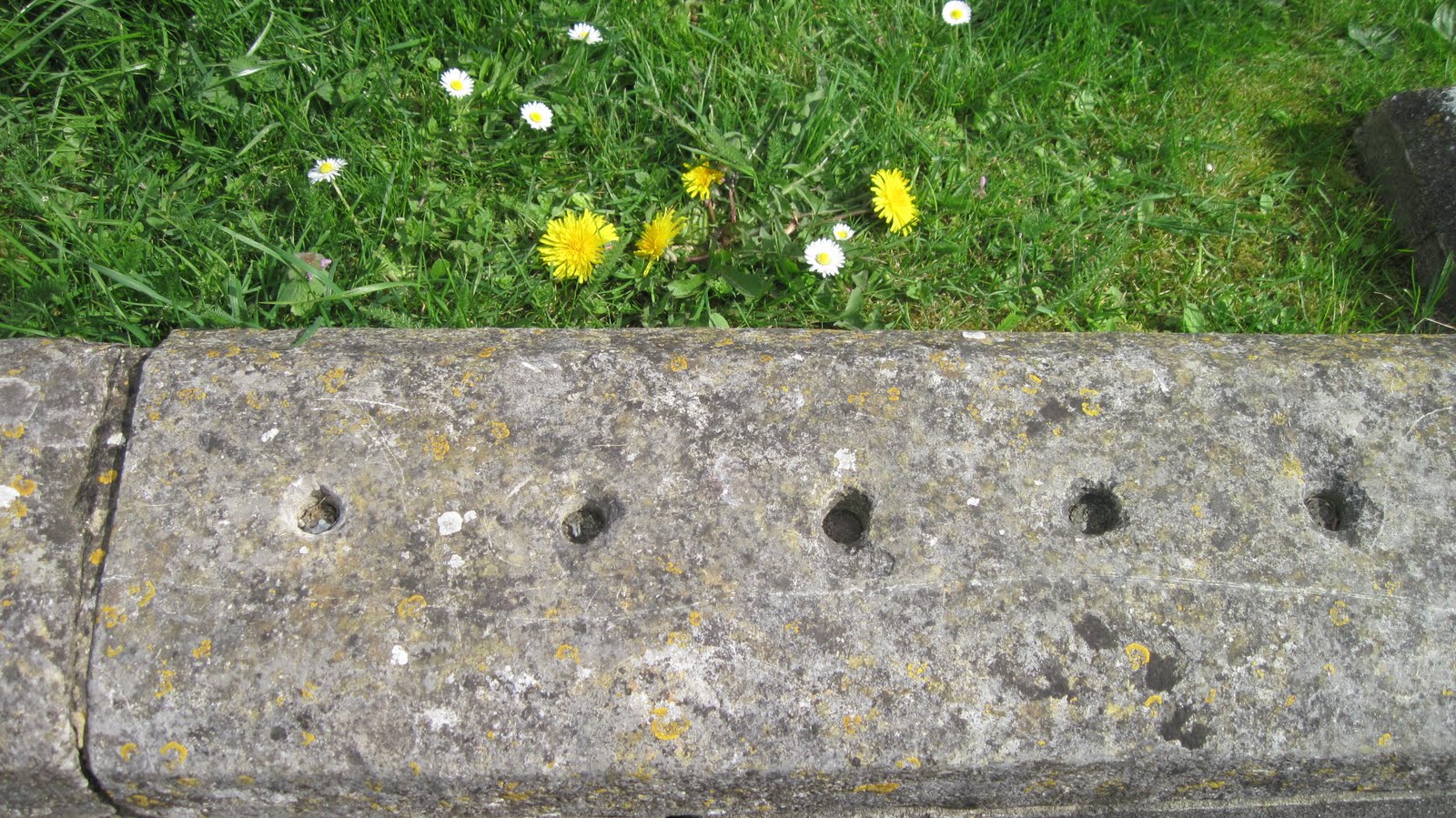
Wall Missing Railings & lead
A stone wall, probably limestone, showing the holes once occupied by railings. Curiously there is no sign of the lead that was also poured into the holes to hold the railings firmly in place. Perhaps it was removed at some time when the scrap price for lead made such extraction worth the trouble.

There are at least hundreds of recorded eye-witness accounts of the removal of railings and gates, as well as quite a few photographs showing people working on their removal. But where they went is a mystery. There are no similar eye-witness accounts of the arrival of those railings in the steelworks of England, Wales and Scotland, even though the histories of those steelworks are well documented.

Discounting the popular belief that the metal was “unsuitable”, the London Gardens Trust website writer has this to say:

“Another more likely explanation is that far more iron was collected – over one millions tons by September 1944 – than was needed or could be processed. Certainly the huge underground munitions factory Beaverbook set up at Corsham in Wiltshire ran far below capacity for its short life.”

So why not just halt the collection? One reason might be that Government Ministers hate admitting mistakes. But another could be the desire to keep the war effort morale going among the population:

“Faced with an oversupply, rather than halt the collection, which had turned out to be a unifying effort for the country and of great propaganda value, the government allowed it to continue. The ironwork collected was stockpiled away from public view in depots, quarries, railway sidings. After the war, even when raw materials were still in short supply, the widely held view is that the government did not want to reveal that the sacrifice of so much highly valued ironwork had been in vain, and so it was quietly disposed of, or even buried in landfill or at sea.”

John Farr wrote an article in Picture Postcard Monthly, (‘Who Stole our Gates”, PPM No 371, March 2010), in which he claims that only 26% of the iron work collected was used for munitions. He also states that “most of the pertinent records at the Public Records Office had been shredded”.

A recurring tale in London is that the railings were taken out on barges and dumped in the Thames Estuary. The source for this seems to be an 1984 often-quoted letter to the Evening Standard by journalist Christopher Long.  It seems too that this might have been Cory Doctorrow’s source, although his character said “the Channel” (hardly likely in time of war),

Christopher Long claimed to have this information from dockers in Canning Town, East London, who gave accounts of the disposal. So much was dumped, they said, that ships in the estuary needed local pilots to guide them because their compasses were made unreliable by the sheer amount of iron down below.
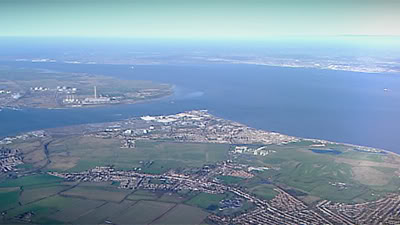
Aerial view of the Thames Estuary -- was this the final destination of the railings?
Aerial view of the Thames Estuary — was this the final destination of the railings?

Sadly, we are unlikely to verify or disprove this story except through archaeological underwater investigation. Strangely, Christopher Long appears not to have rigorously documented his sources or to have recorded the names of his informants, much less made oral history recordings.  If he did do all that, he did not refer to it in his letter or subsequent publication.

But it does seem extraordinary that, if true, this information could be kept a secret for so long. One possible reason is a political one – but from the Left rather than the Government. Support for the Soviet Union from British workers was a significant element in British Left-wing discourse during the War and afterwards. It may not have suited the Left to undermine the dominant narrative of British railings, torn out by British workers, going to make Soviet tanks. And collectors of oral history among working class communities tend to be of Left-wing ideology, it would appear.

But it would also seem that these stories are not too far away in time to be investigated, as other investigations of oral history of WWI in Britain or the 1916 Rising in Dublin have shown. And how hard would it be to investigate the often-repeated story that some of the railings are to be found in West African ports, as allegedly they had been used as ballast in ships bound for Africa?

It occurs to me that one unexpected effect of the mass removal of railings would have been rendering public many of the parks in bourgeois areas, previously accessible to “residents only”. Perhaps working class people living nearby would have been particularly enthusiastic about removing these to support the war effort?


End.


Some links to information sources:

http://www.londongardenstrust.org/features/railings3.htm

http://greatwen.com/2012/04/17/secret-london-the-mystery-of-londons-world-war-ii-railings/


LAUNCH OF “BATTLEGROUND 1916 — THE LANEWAYS OF HISTORY”

Diarmuid Breatnach

On a very stormy Wednesday night (17 Nov. 2015) in Dublin around 150 people attended the launch of the video “Laneways of History” at Wynne’s Hotel, Lwr. Abbey Street.

Poster Launch Video


The video maker is Marcus Howard who has videoed a number of interviews with relatives of 1916 heroes as part of a campaign to preserve the historic Moore Street 1916 Terrace and the laneways surrounding it. Marcus also videoed the second Arms Around Moore Street event, which was organised by the Save Moore Street Demolition campaign.

The video itself uses footage shot in a Dublin of today, tracing the footsteps in Easter Week 1916 of James Connolly from Williams Lane to the GPO, then of the garrison’s retreat from the burning building to Moore Street. It also stops at 21 Henry St. where the 1916 Proclamation was signed and follows the ill-fated heroic charge led by The O’Rahilly up Moore Street against the British barricade at the end, on Parnell Street.Musicians

The narrative is provided by Jim Connolly Heron (great grandson of James Connolly) and Proinsias O Rathaille, grandson of The O’Rahilly, and also by excerpts from witness statements of participants read by Marcus Howardand a woman whose name I did not catch (but will record when I find out).Citizen Army on guard

Sound effects on images of the past are firing from artillery, rifles and machine guns and clips from the Cabra Historical Society are used to good effect.  The video also includes recent footage from the campaign, including Taoiseach (Prime Minister) Enda Kenny being shown around the Moore Street Battlefield and the 2nd Arms Around Moore Street event, which was organised by the Save Moore Street from Demolition campaign.

Volunteers in various outfits

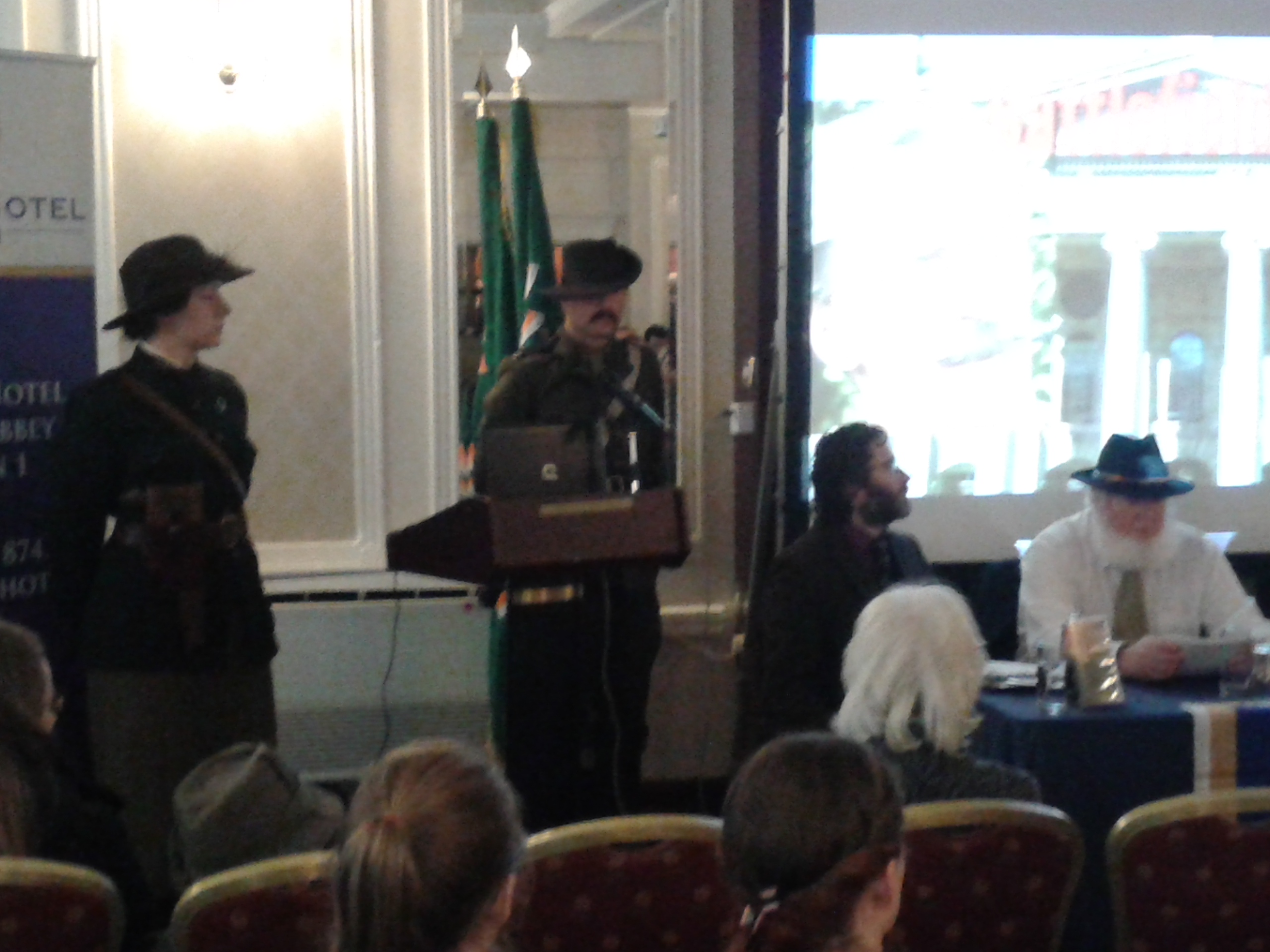
Around the function room there were men and women in Ctiizen Army and Volunteer uniforms and typical IRA War of Independence dress to protect us from a raid by the British Army, Dublin Metropolitan Police or the Auxillaries (or perhaps to keep an eye out for unruly elements).

Music and some songs were provided before the speakers by two members of the Dublin band The Invincibles, one of which Paul Stone, sang Where Is Our James Connolly to a hushed room.

The main speakers were James Connolly Heron, Críona Ní Dhálaigh (SF Mayor of Dublin), Proinsias O Rathaille and Marcus Howard. Also called up to speak a few words were long-time supporters of the campaign TD Maureen O’Sullivan and Frank Allen.

Frank Allen speaking from the podium

Frank unveilled the 1916 Commemoration Bond and invited everyone to buy one at €100 each. Frank announced that the aim is to make sufficient on sales at home and abroad, to buy the threatened 1916 Terrace.

Presentations of the first three bonds were made to long-time supporters of the campaign Brendan O NeillColette Palsgraaf and Pat Waters (who had written the song for the “16 Signatories” production).

Crowding outside the bar

Frank also thanked Diarmuid and Mel (also thanked by Marcus Howard) for their long presence in Moore Street (the Save Moore Street from Demolition Campaign, which also includes Bróna Uí Loing).

Pat Waters in conversation in the bar

There were some questions and interventions from the floor before people repaired to buy a DVD and/or a bond and thence to the bar, to chat and no doubt plot further steps in the campaign.  Among the contributors from the floor were TV presenter Duncan Stewart, Donna Cooney (PRO 1916 Relatives’ Committee and grand-niece of Elizabeth O’Farrell), Manus O’Riordan (includ. Friends of the International Brigades in Ireland), Diarmuid Breatnach (includ. Save Moore Street from Demolition campaign), Bernie Hughes (Finglas community campaigner against the Water Charge).  A Dutch woman living here 15 years made the point that migrants should be included in the vision — a point echoed by at least another two from the floor, one of whom drew attention to the fact that James Connolly had been a migrant.

Some more from inside the bar (an ID parade?)

Indeed, this was so, both to the USA and to Ireland, as was the case with Jim Larkin too; Tom Clarke had been born in England also and a number of those who fought for the Republic in the Rising (especially the Kimmage group) had been born and brought up in British cities and a few had no Irish connections at all.

Two women drew attention to the exclusion of the Irish language from the video and presentation.  This last was a particularly relevant point, given that one of the seven signatories of the Proclamation was a writer in Irish and in English, as well as an educator and that five of them had been members of the Gaelic League (as were others of the executed or who died in the fight).  One asked what the strategic purpose of the bonds was and how this fit into the campaign.

Overall, any criticisms or doubts aside, everyone who spoke was positive about the video and wholeheartedly in favour of the retention of the historic buildings and laneways.  It was notable that no-one, from panel, podium or the floor, expressed faith in the Government or in most politicians — quite the contrary.

Among the historians present were Lorcán Ó Coilleáin and Mícheál Ó Doibhlín.  Also seen were Aengus Ó Snodaigh TD, Robert Ballagh (Reclaim the Spirit of 1916) and Barry Lyons (Save 16 Moore Street).


(Photos, mostly long-range dodgy mobile ones: D.Breatnach)

A chríoch.


Links:

Personnell in costume were provided by Dave Swift of Claoímh (http://www.claiomh.ie) and Irish Volunteers commemorative association (http://irishvolunteers.org)

Copies of video DVDs €10 each NOT including post and package from email are available through easterrisingstories@gmail.com

Save Moore Street from Demolition: https://www.facebook.com/groups/757869557584223/?fref=ts and https://www.facebook.com/save.moore.st.from.demolition/?fref=ts

Save 16 Moore Street: https://www.facebook.com/groups/114656558567416/?fref=ts


CLOSE QUARTER COMBAT BY A 1916 RISING DOUBLE ACT

Diarmuid Breatnach

Derek Molyneux and Darren Kelly are a great 1916 Rising history double act. Taking turns at the narrative, bouncing one off the other at times, sometimes one correcting the other, interrupting one another and on occasion comically resenting the

Darren Kelly and Derek Molyneux presenting their talk at the Cobblestone

interruption. They are great entertainment. But they are also very knowledgeable on the history of the 1916 Rising and on comparative military history, as well as being passionate about the subject.

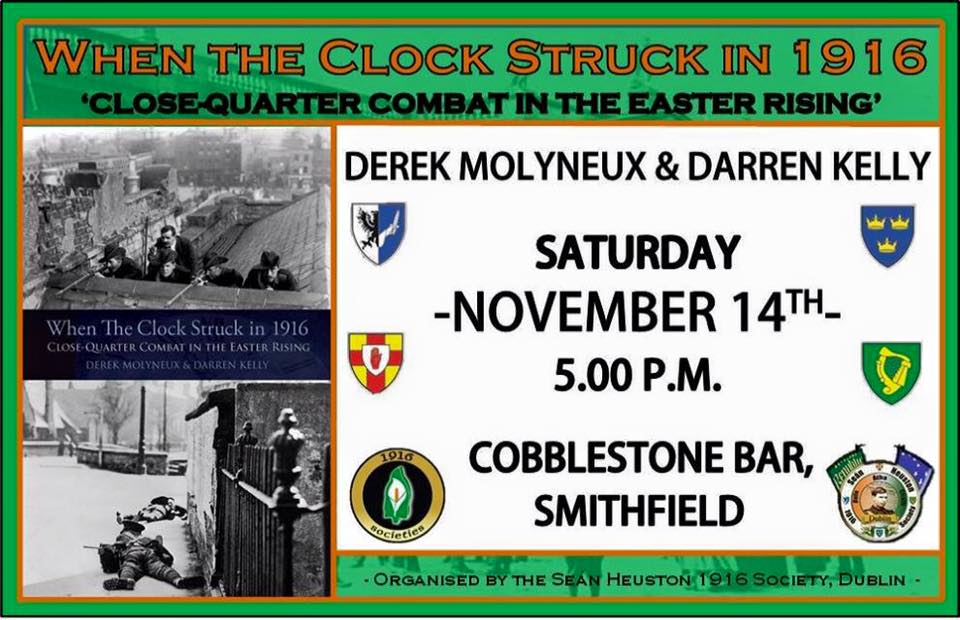
They are joint authors of “When the Clock Struck in 1916” by Collins Press (2015) and were the guest speakers presenting a talk on “Close Quarter Combat in the Easter Rising” in the back room of the Cobblestone on Saturday (07/11/2015). The talk was one of a series organised by the Sean Heuston 1916 Society.
Poster for the event

Their lively and engaging narrative focused more on the insurgent participants and their feelings and on some of the main locations of the fighting than on the leaders. They also speculated on some of the thoughts of the British soldiers engaged in the fighting and quoted from a few of their officers. Contrary to some historical narratives, the duo emphasised the good military sense of the planning and the locations chosen for fortification, as well as the effective fields of fire created. Criticisms of some failures, for example to occupy Trinity College, they ascribed to the confusion occasioned by Mac Neill’s countermanding order canceling “parades, marches or other movements” scheduled for Sunday, which resulted in a serious depletion of numbers turning out to challenge the Empire on Easter Monday.

Front cover of their book launched this year
Front cover of their book launched earlier this year
Their points were well made and although in my opinion did not completely refute some of the criticisms, in terms of fields of fire as illustrated their points were interesting and convincing.
The talk was a little overlong in my opinion and the subsequent discussion in question-and-answer time cut short accordingly, as the room had to be cleared for a music group event. However, some of the audience and the speakers carried on an interesting discussion in the bar, a discussion that broke up into smaller groups and ranged far and wide for hours afterwards.
An interesting and enjoyable talk I would recommend highly – even without the bar follow-up.

31st AUGUST 102 YEARS AGO — BLOODY SUNDAY IN DUBLIN 1913/ HOY, HACE 102 ANOS — EL DOMINGO SANGRIENTO DEL 31 DE AGOSTO 1913

Diarmuid Breatnach (published originally in Dublin Political History Tours)

(Miren de bajo para la versión en castellano).

The 31st of August 1913 was one of several ‘Bloody Sundays’ in Irish history and it took place in O’Connell Street (then Sackville Street).

A rally had been called to hear the leader of the IT&GWU) speak. The rally had been prohibited by a judge but the leader, Jim Larkin, burning the prohibition order in front of a big demonstration of workers on the evening of the 29th, promised to attend and address the public.

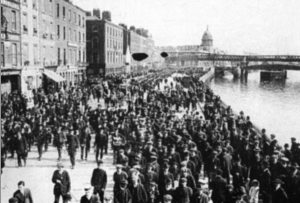
On the day in O’Connell Street, the Dublin police with their batons attacked the crowd, including many curious bystanders and passers by, wounding many by which at least one died later from his injuries.

One could say that on that street on the 31st, or in the nearby Eden Quay on the night of the 30th, when the police batoned to death two workers, was born the workers’ militia, the Irish Citizen Army, in a desire that very soon would be made flesh.

La carga policial contra los manifestantes y transeúntes en la Calle O'Connell en el 31 Agosto 1913/ DMP attack on demonstrators and passers-by on 31st August 1913 in Dublin's O'Connell Street
La carga policial contra los manifestantes y transeúntes en la Calle O’Connell en el 31 Agosto 1913/ DMP attack on demonstrators and passers-by on 31st August 1913 in Dublin’s O’Connell Street

THE EMPLOYERS’ LOCKOUT

Bloody Sunday Dublin occurred during the employers’ Lockout of 1913. Under Jim Larkin’s leadership, the Liverpudlian of the Irish diaspora, the young ITGWU was going from strength to strength and increasing in membership, with successful strikes and representation in Dublin firms. But in July 1913, one of Dublin’s foremost businessmen, William Martin Murphy, called 200 businessmen to a meeting, where they resolved to break the trade union.

Murphy was an Irish nationalist, of the political line that wished for autonomy within the British Empire; among his businesses were the Dublin tram company, the Imperial Hotel in O’Connell Street and the national daily newspaper “The Irish Independent”.

The employers decided to present all their workers with a declaration to sign that the workers would not be part of the ITGWU, nor would they support them in any action; in the case of refusal to sign, they would be sacked.

The members of the ITGWU would have to reject the document or leave the union, which nearly none of them were willing to do.

Nor could the other unions accept that condition, despite any differences they may have had with Larkin, with his ideology and his tactics, because at some point in the future the employers could use the same tactic against their own members.

The Dublin (and Wexford) workers rejected the ultimatum and on the 26th began a tram strike, which was followed by the Lockout and mixed with other strikes — a struggle that lasted for eight months.

Dublin had remarkable poverty, with infectious diseases such as tuberculosis and others, including the sexually-transmitted ones, the city being a merchant port and also having many British Army barracks. The percentage of infantile mortality was higher than that in Calcutta. Workers’ housing was in terrible condition, often with entire families living in one room, in houses sometimes of 12 rooms, each one full of people, with one or two toilets in the outside yard.

In those conditions, 2,000 Dublin workers confronted their employers, the latter aided by their Metropolitan Police, the Irish colonial police and the British Army. As well as the workers, many small traders suffered, those selling in the street or from little shops.

On that Monday, the 31st of September 1913, some trade unionists and curious people congregated in Dublin’s main street, then called Sackville Street, in front of and around the main door of the big Clery’s shop. In the floors above the shop, was the Imperial Hotel, with a restaurant.

The main part of the union went that day to their grounds in Fairview, to avoid presenting the opportunity for another confrontation with the Dublin Municipal Police. Others in the leadership had argued that the police should not be given the opportunity and that there would be many other confrontations during the Lockout. But Larkin swore that he would attend and that a judge should not be permitted to ban a workers’ rally.
Daily Mirror Arrest Larkin photoThere were many police but nothing was happening and Larkin did not appear. After a while, a horse-drawn carriage drove up and an elderly church minister alighted, assisted by a woman, and entered the shop. They took the lift to the restaurant floor. A little later Larkin appeared at the restaurant open window, in church minister’s clothing, spoke a few words to the crowd and ran inside. Those in the street were very excited and when the police took Larkin out under arrest, they cheered him, urged on by Constance Markievicz. The police drew their batons and attacked the crowd — any man not wearing a police uniform.
 

THE UNION’S ARMY

The Irish Citizen Army was founded for the union on the 6th November 1913 by Larkin, Connolly and others with Seán Ó Cathasaigh/ O’Casey, playwright and author, including the first history of the organisation.

The Citizen Army at Croydon House, at the ITGWU's grounds in Fairview/ El Ejercito Ciudadano en su parte del parque en Fairview.
The Citizen Army at Croydon House, at the ITGWU’s grounds in Fairview/ El Ejercito Ciudadano en su parte del parque en Fairview.

As distinct from the Irish Volunteers, women could enter the ICA, within which they had equal rights.

Funeral of James Byrne, who died as a result of his imprisonment during the 1913 Lockout
Funeral of James Byrne, who died as a result of his imprisonment during the 1913 Lockout/ Procesión funébre de James Byrne, fallecido por razón de su encarcelamiento durante el Cierre de 1913, pasando por el muelle sur Eden’s Quay, partiendo de la Salla de la Libertad.

It was reorganised in 1914 as the union was recovering from its defeat during the Lockout, and 200 fought alongside the Volunteers in the 1916 Easter Rising, after which two of its leaders, Michael Mallin and James Connolly, were executed. Among the nearly 100 death sentences there were others of the ICA, including Markievicz, but their death sentences were commuted (14 were executed in Dublin, one in Cork and one was hanged in London).

The main fighting locations of the ICA in 1916 were in Stephen’s Green and in the Royal College of Surgeons, in City Hall and, with Volunteers in the GPO and in the terrace in Moore Street, the street market.

The Imperial Hotel on the other side of the street from the GPO was occupied too by the ICA and on top of it they attached their new flag, the “Starry Plough/ Plough and Stars”, the design in gold colour on a green background, the

The flag of the ICA, flown over Murphy's Imperial Hotel in 1916
The flag of the ICA, flown over Murphy’s Imperial Hotel in 1916

constellation of Ursa Mayor, which the Irish perceived in the form of a plough, an instrument of work. And there the flag still flew after the Rising, having survived the bombardment and the fire which together destroyed the building and all others up to the GPO, on both sides of the street. Then a British officer happened to notice the flag and ordered a soldier to climb up and take it down — we know not where it went.


TODAY

Today, after various amalgamations, the once-noble ITGWU has become SIPTU, the largest trade union in Ireland but one which does not fight. The skyscraper containing its offices, Liberty hall, occupies the spot of the original Liberty Hall, prior to its destruction by British bombardment in 1916.

The Irish newspaper the “Irish Independent” continues to exist, known as quite right-wing in its editorial line. Murphy’s trams came to an end during the 1950 decade and those in Dublin today have nothing to do with Murphy.

The Imperial Hotel no longer exists and, until very recently, Clery had taken over the whole building, but they sacked their workers and closed the building, saying that they were losing money.

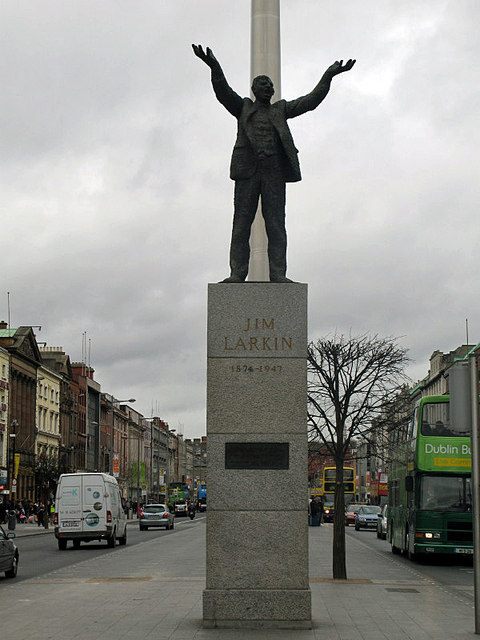
In front of the building, in the pedestrianised central reservation, stands the monument as a representation of Jim Larkin. The form of the statue, with its hands in the air, is from a photo taken of Larkin during the Lockout, as he addressed another rally in the same street. It is said that in those moments, he was finishing a quotation which he used during that struggle (but which had also been written previously by James Connolly in 1897, and which something similar had been written by the liberal monarchist Étienne de La Boétie [1530–1563] and later by the French republican revolutionary Camille Desmoulins [1760–1794]): “The great appear great because we are on our knees – LET US ARISE!”


The Jim Larkin monument in O'Connell Street today/ El monumento de Jim Larkin in la Calle O'Connell hoy en día
The Jim Larkin monument in O’Connell Street today/ El monumento de Jim Larkin in la Calle O’Connell hoy en día


EL 31 DE AGOSTO EN El 1913 FUE UNO DE LOS DOMINGOS SANGRIENTOS DE IRLANDA Y OCURRIÓ EN LA CALLE PRINCIPAL DE DUBLÍN.

Hubo una concentración para escuchar al líder del sindicato de Trabajadores de Transporte y de General de Irlanda (IT&GWU) hablar. La manifestación fue prohibida por juez pero el líder, Jim Larkin, quemando el documento de prohibición en frente de manifestación grande la noche del 29, prometió que iba a asistir y hablar al publico.

El día 31 en la Calle O’Connell, la policía de Dublin con sus porras atacaron la concentración y a muchos otros curiosos o pasando por casualidad, hiriendo a muchos por lo cual murió uno por lo menos mas tarde de sus heridas.

Se puede decir que en esa calle en el 31, o en la cerca muelle, Eden Quay, la noche del 30, cuando mataron a porras dos trabajadores, se dio luz a la milicia sindical, el Ejercito Ciudadano de Irlanda, en deseo que poco mas tarde estaría fundado en actualidad.

EL CIERRE PATRONAL

El Domingo Sangriento ocurrió durante el Cierre Patronal de Dublín en el 1913. Bajo el liderazgo de Jim Larkin, el Liverpoolés de diáspora Irlandesa, el joven sindicato ITGWU fue yendo de fuerza a fuerza y aumentando en miembros, con éxitos en sus huelgas y reconocido en muchas de las empresas de Dublín. Pero en Julio del 1913, uno de los principales empresarios de Dublín, William Martin Murphy, llamó a 200 de los empresarios a mitin y resolvieron romper el sindicato.

Murphy era nacionalista Irlandés, de la linea de pedir autonomía pero adentro del Imperio británico; entre sus empresas le pertenecía la linea de tranvías de Dublín, el Hotel Imperial en la Calle O’Connell y el periódico diario nacional The Irish Independent.

Resolvieron los empresarios presentar a todos sus trabajadores una declaración para firmar que no serían parte del sindicato ITGWU ni les darían ningún apoyo en cualquiera acción; en caso de negar firmar, se les despedirían.

Los miembros del ITGWU tendrían que rechazar el documento o salir del sindicato, lo cual casi lo total no estuvieron dispuestos hacer.

Los otros sindicatos, pese a cualquiera diferencias tuvieron con Larkin, con sus pensamientos y sus tácticas, tampoco podían acceder a esa condición por que mas tarde se podría usar la misma táctica en contra de sus miembros también.

Los trabajadores de Dublín (y de Wexford) rechazaron el ultimátum y empezaron el 26 de Agosto una huelga de los tranvías, seguido por el Cierre Patronal, mixta con otras huelgas, una lucha que duró ocho meses en total.

Dublín tuvo una pobreza impresionante, con infecciones de tuberculosis y otras, incluido las transmitidas por el sexo, siendo puerto mercantil y teniendo muchos cuarteles del ejercito británico. El porcentaje de la mortalidad infantil era mas de la de la ciudad de Calcuta. Las viviendas de los trabajadores estaban en terribles condiciones, con a menudo familias grandes enteras viviendo en una habitación, en casas a veces de 12 habitaciones, cada uno llena de gente, con una o dos servicios en el patio exterior.

En esas condiciones 2,000 trabajadores de Dublín se enfrentaron al patronal de Dublín, con su policía metropolitana, la policía colonial de Irlanda y el ejercito británico. Además de los trabajadores, muchos pequeños empresarios, vendiendo en la calle o en tiendas pequeños, sufrieron.

Ese Domingo, del 31o de Setiembre 1913, algunos sindicalistas y gente curiosa se congregaron en la calle principal de Dublín, entonces nombrado Sackville Street, en frente y al rededor de la puerta principal de la gran tienda de Clery. En las plantas después de la primera, estaba el Hotel Imperial, con un restaurante.

La mayor parte del sindicato se fueron ese día a una parte de parque que les pertenecía por la costa, para evitar otra enfrentamiento con la Policía Metropolitana de Dublín. Habían argumentado otros de la dirección del sindicato que no se debe dar les la oportunidad a la policía y que habría muchos otros enfrentamientos durante el Cierre. Pero Larkin juró que lo iba a asistir y que no se podía permitir a un juez prohibir manifestaciones obreras.

Había mucha policía pero nada pasaba y Larkin no aparecía. Después de un rato, un coche de caballos llegó y un viejo sacerdote salió, apoyado por una mujer, y entraron en la tienda de Clery. Subieron en el ascensor hacía el restaurante. Poco después, Larkin apareció en la ventana abierta del restaurante, en el traje del cura y habló unas palabras, antes de correr adentro. Los de abajo en la calle muy entusiasmados y cuando la policía salieron agarrando le a Larkin, la multitud le dieron vítores, alentados por Constance Markievicz. La Policía Municipal sacaron sus porras y atacaron a la multitud – a cualquier hombre que no llevaba uniforme policial.


EL EJERCITO DEL SINDICATO

El Ejercito Ciudadano de Irlanda (Irish Citizen Army) fue fundado para el sindicato en el 6 de Noviembre del 1913 por Larkin, Connolly y otros con Seán Ó Cathasaigh/ O’Casey, escritor de obras para teatro y algunas otras, incluso la primera historia de la organización. A lo contrario de Los Voluntarios, el ICA permitía entrada a mujeres, donde tenían derechos iguales.

Fue reorganizada en 1914 cuando el sindicato se fue recobrando de la derrota del Cierre Patronal, y 200 lucharon con los Voluntarios en el Alzamiento de Pascuas de 1916, después de lo cual dos de sus líderes, Michael Mallin y James Connolly, fueron ejecutados. Entre los casi 100 condenas de muerte, habían otros del ICA, incluso Constance Markievicz, pero sus condenas de muerte fueron conmutadas (se les ejecutaron a 14 en Dublín y a uno en Cork, y a otro le ahorcaron en Londres).

Los lugares principales de lucha del ICA en 1916 fueron en el Stephen’s Green y en el Collegio Real de Cirujanos (Royal College of Surgeons), en el Ayuntamiento y, con Voluntarios, en la Principal Oficina de Correos (GPO) y en la manzana del Moore Street, el mercado callejero.

El Hotel Imperial al otro lado de la calle del GPO lo ocuparon también el ICA, y encima colocaron su nueva bandera, el Arado de Estrellas (“Starry Plough/ Plough and Stars”), el diseño en color oro sobre fondo verde, la formación celeste del Ursa Mayor, que lo veían los Irlandeses en forma del arado, una herramienta de trabajo. Y ahí ondeó la bandera después del Alzamiento, habiendo sobrevivido el bombardeo británico y el fuego que destruyeron el edificio y la calle entera hacía el GPO, en ambos lados. Entonces un oficial británico se dio cuenta de la bandera y le mandó a soldado hir a recoger la – no se sabe donde terminó.


HOY EN DÍA

Hoy en día, después de varias fusiones, el noble ITGWU se ha convertido en el SIPTU, el sindicato mas grande de Irlanda y parecido en su falta de lucha a Comisiones Obreras del Estado Español. El rasca cielos de sus oficinas, La Sala de la Liberta (Liberty Hall), ocupa el mismo lugar que ocupó la antigua Liberty Hall, antes de su destrucción por bombardeo británico en 1916.

El periódico Irish Independent sigue existiendo, conocido por ser bastante de derechas en su linea editorial. Los tranvías de Murphy terminaron en la década del 1950 y los de hoy en Dublín no tienen nada que ver con los de antes.

El Hotel Imperial ya no existe y, hasta hace muy poco, la empresa Clery lo tenía todo el edificio, pero despidieron a sus trabajadores y cerraron el edificio, diciendo que perdían dinero.

En frente del edificio, en la reserva peatonal del centro de la calle, está el monumento representando a Jim Larkin. La forma de la estatua, con las manos en el aire, lo tiene de foto que le hicieron durante el Cierre Patronal, cuando habló en otro manifestación en la misma calle. Dicen que en ese momento, estaba terminando una frase famosa que usó durante esa lucha (pero que también lo escribió Connolly antes en 1897, y que lo había escrito algo parecido primero el monárquico reformista Étienne de La Boétie [1530–1563] y luego el revolucionario republicano francés Camille Desmoulins [1760–1794]): “Los grandes aparecen grande por que estamos de rodillas – levantamanos!”


Fin

REMEMBER

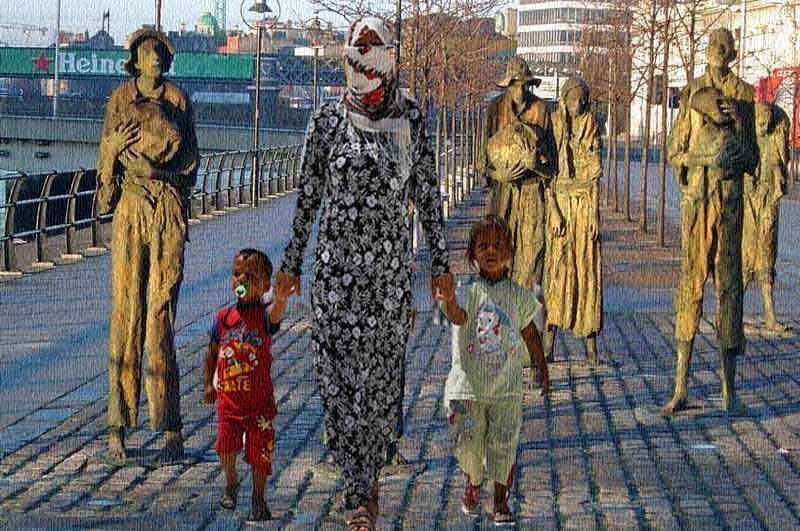
Famine emigrants monument on the north quays of the river Liffey, Dublin, with superimposed image of African woman and children. Image from Memet Uludag on Facebook.
The Great Hunger (1845-1849) emigrants’ monument on the north quays of the river Liffey, Dublin, with superimposed image of African woman and children (image from Memet Uludag on Facebook).
Diarmuid Breatnach
Remember? Remember when we were migrants?
Remember when we fled murder and rapine
and many another terrible scene
When death and torture were at hand
and we sought succour in other lands?
Remember?
Remember when our little nation
was devastated by starvation.
disease and desolation,
our hope in emigration ….
Remember?
Remember when we died by
mountain, valley and sea
and we braved
the rolling waves
to go where we might be free?
Remember, oh do you remember?
Escape, the vote,
in leaky boats
in anything to float,
fear in throat,
today they launch
for our shores.
Remember? We must remember!
end

HISTORIC SITE OF HASANKEYF AND LOCAL HOMES THREATENED BY TURKISH DAM – INTERNATIONAL PROTESTS

Louise Michel

The historic ruins of Hasankeyf, which may have been settled more than two thousand years BCE, are threatened by a Turkish dam along with the homes of Kurdish, Armenian and Arab people. A number of archaeologists and historians believe that the fortified town was referred to in inscriptions on the Mari tablets (1,800-1,750 BCE).  The rocky outcrop also contains many human-made caves.

Some of the caves at the Hasankeyf site

As well as being the site of an ancient town, it is also an urban and outer settled district located along the Tigris River in the Batman Province in southeastern Turkey, with a recent combined population approaching 70,000.

The project that threatens to submerge much of Hasankeyf is the Isilu Dam being built by Turkey. Despite the foundation stone being laid as late as 2006, in 1971it was already being actively considered as one of the sites for a number of dam projects for hydro-electric generation and number of other purposes. A study by an international team between 1980 and 1982 recommended the building of the Isilu dam despite the 1981 declaration by the Turkish Government itself of Hasankeyf as a natural conservation area.

Opposition to the dam

The project had run into funding difficulties over the years. Due to international protests on environmental, archaeological and human rights grounds, and also protests within Turkey and from inside Hasankeyf, a number of international funders backed off. The British Government refused $236 million in funding in 2000 and in 2009, a consortium of Austrian, Swiss and German credit agencies withdrew their offer of $610 million.

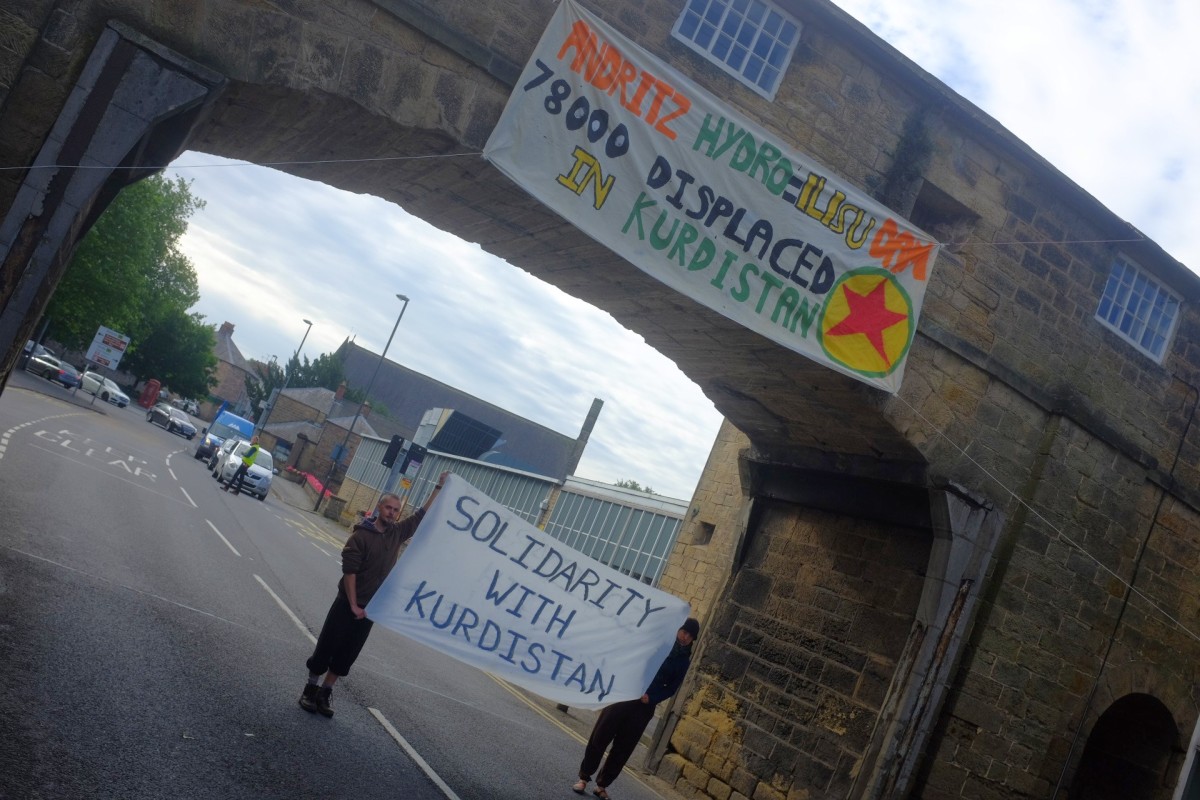
Solidarity picket outside the Andritz company plant in England

The consortium had suspended the loan in 2008 and had given the Turkish Government 6 months to comply with international standards, which they had failed to do. However in July 2010 the Austrian firm Andritz Hydro announced it was lifting its suspension and would provide the six huge turbines specified for the power plant.

Excavations for the main body of the dam began in May 2011 and the Turkish Government projected that all works would be completed this year. A 250m (820ft) permanent steel-girder bridge with concrete supports has been constructed just downstream of the dam and construction of new villages is currently underway. The diversion of the Tigris River began during August 2012. According to Government figures, by April 2014 the project was 60% completed while 73% of the Hasankeyf population had been resettled.

Protests continue within the area, peaceful and not. According to the Government, in January 2015 Kurdistan Workers’ Party (PKK) threatened the lives of workers and anti-Government sources confirmed that a number of workers left the site. On 3 February 2015 a convoy of supplies for the dam was attacked, injuring three persons and several days later a worker was killed in his home, according to the Government by suspected PKK militants. Peaceful protests have included pickets and demonstrations (see photos) and some of these have also taken place abroad, including recent ones in England (see photos).

Locals, probably mostly if not all Kurds, protest at the Hasankeyf site

The completion of the Ilısu Dam will cause the flooding of the ancient city of Hasankeyf and about 185 villages and hamlets will be fully or partially affected by flooding, according to the Kurdish Human Rights Project. From 55,000–65,000 people will be forcibly resettled, says the KHRP, while even the Turkish Government estimates 40,000. According to a statement released on the 24th August by a solidarity group protesting outside the Austrian Andritz company’s facility in England, the completed project will reduce water flow to Syria by 40% and Iraq by 80% and the dam also provides the facility for political control of those areas through further restriction of water supplies.England picket Isilu Dam company

Turkey is a member of NATO and extremely important strategically to the the military alliance, as well as having some significant natural resources. However its regularly-renewed applications to join the EU have always been turned down because of its human rights record, both in the course of recent wars with its ethnic Kurds as well as with regard to protest movements among ethnic Turks. Recently Turkey came in for adverse international publicity again as it was seen to be blocking Kurds trying to get through the Turkish border with Syria in order to defend areas under attack by ISIS (Islamic State), while Turkey has also been accused of more directly assisting ISIS in its attacks. Although the state has Moslem fundamentalist political parties which occasionally come into government, Turkey itself has been secular since it became a republic in 1922.


End


More information, including photographs on http://www.al-monitor.com/pulse/originals/2013/10/hasankeyf-civilization-condemned-death.html

and on http://www.hasankeyfmatters.com

and on http://www.smithsonianmag.com/travel/endangered-site-the-city-of-hasankeyf-turkey-51947364/

and about Kurdish human rights http://www.khrp.org

SPANISH STATE TO CLOSE OVER 100 BASQUE SOCIAL CENTRES

Diarmuid Breatnach


The Spanish state is set to close 107 Basque social centres, confiscate their funds and sell off their assets, including property. With allegiance to the Basque Patriotic Left, the “Izquierda Abertzale” as it terms itself in Spanish, the Herriko Tabernak (“Peoples’ Taverns”) function as centres for social, cultural and political activity. The sale of coffee, alcohol and pintxos (a variety of home-produced small items of food, mostly eaten cold) also generates income with which to employ some activists within the movement and also to fund some of its political activities.

Outside the Errondabide street Herriko Taberna in the Casco Viejo part of Bilbao

Those are the socially-useful functions of the Herriko Tabernak and precisely the reasons the Spanish state plans to close them down. Not that they say that openly, of course – the official line is that the taverns “fund terrorism”. Never mind that the police have never furnished any evidence of that, never mind too that the alleged recipient, the armed organisation ETA, has been in uninterrupted ceasefire since 5th September 2011, confirmed as “permanent” in a statement the following January and again as a “permanent cessation of armed activity” in October 2012.

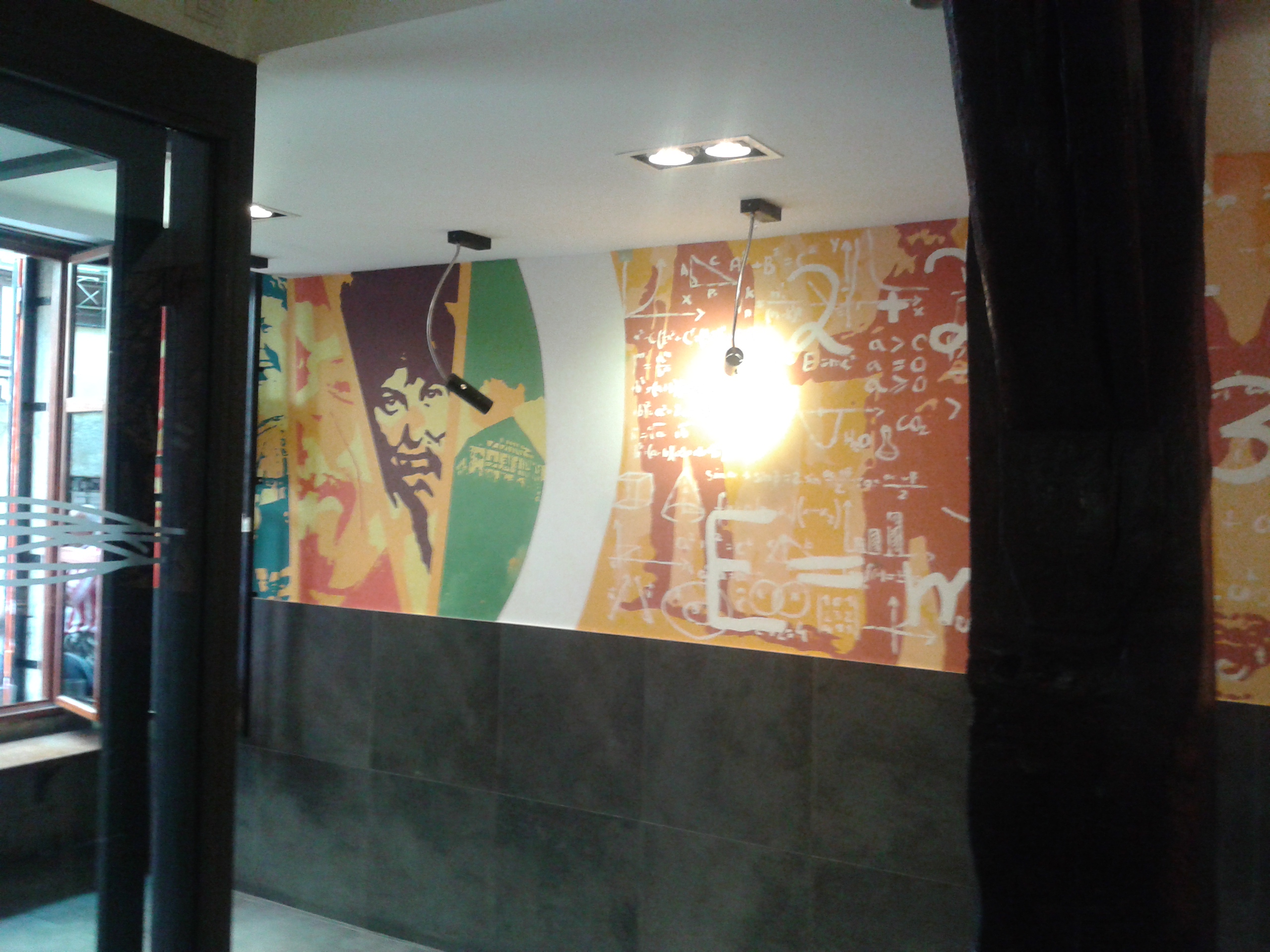
Entrance wall mural
Entrance wall mural

There is an herriko taberna in many vilages and in every town throughout much of the southern Basque Country (i.e the part under Spanish state rule) and Bilbao, for example, has several. They vary from one another but typically have a front bar area and a rear or upstairs function room which may be used for political, cultural,

Section of the function room at the back of the Herriko.

educational or social event, or hired for personal social functions such as celebrating a birthday, successful conclusion of studies, an engagement or wedding, a return for a migrant. Social functions of a more political nature such as welcoming a recently-released political prisoner or a commemoration of some figure of the resistance are also held there.

Inside the Herriko, the bar area and some afternoon customers

Although people hostile to the ‘herrikos’ would not usually enter one, anyone can do so and order coffee, beer or soft drink, perhaps buy some pintxos – no-one will bother them. The language of conversation inside may be Euskera (Basque) or Castellano (Spanish) but all the staff have at least enough Euskera for the customers’ needs and many are fluent.

On the walls notices and posters carry political, cultural or social messages or advertise an event, either specific to the Basque Country or perhaps in solidarity with the Palestinians, the Saharaui (Western Sahara people), or to do with gender and sexuality-social issues, workers’ and migrants’ rights, animal rights ….

Some pintxos in the Herriko, home-made Basque 'fast food'
Some pintxos in the Herriko, home-made Basque ‘fast food’

Banners and Basque flag propped against wall in the function area

Photo portraits of prisoners are “glorification of terrorism”

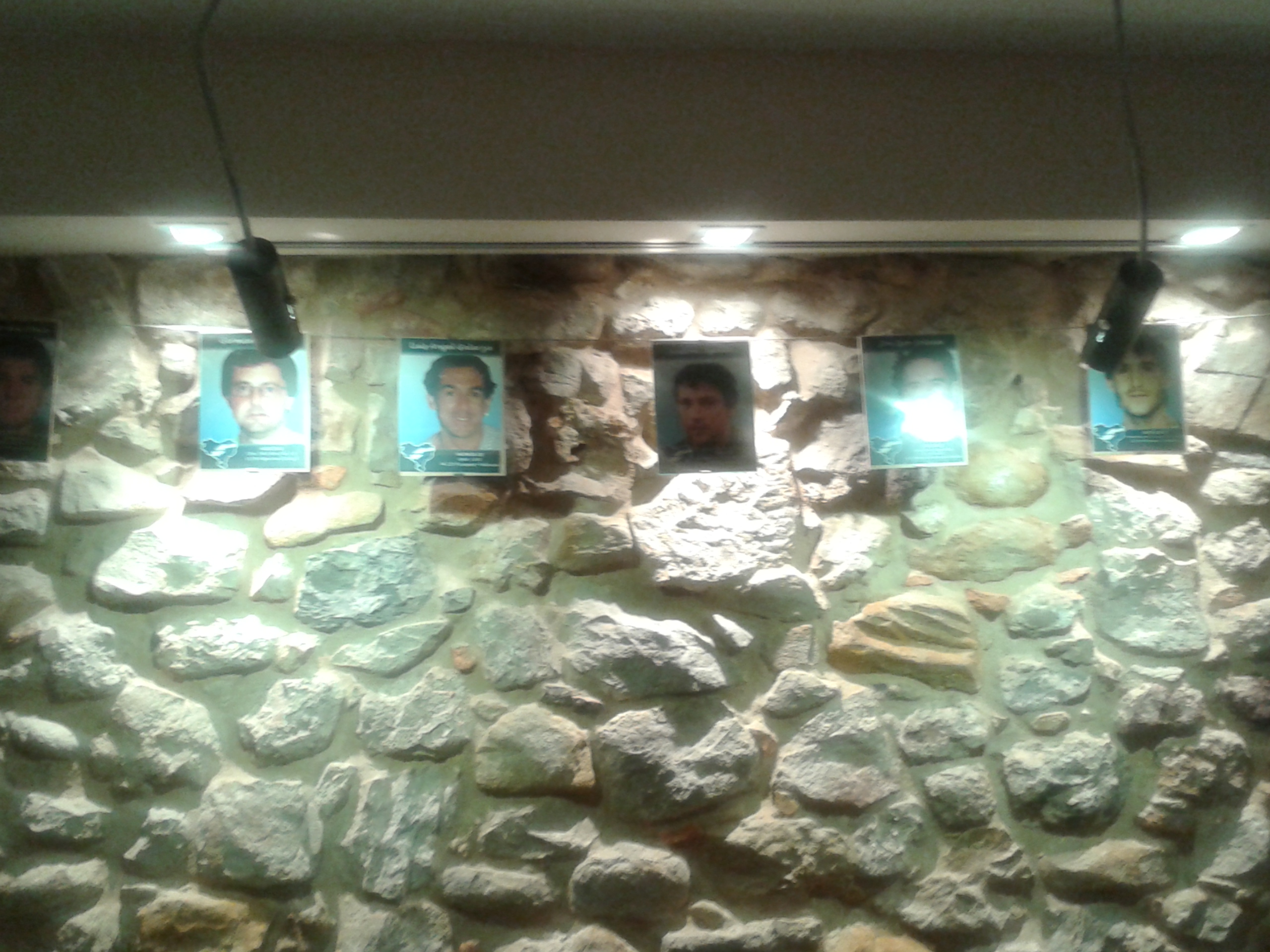
Recently, the walls carried photo portraits of political prisoners from the area. After the Spanish National Court decreed, a few years ago, that these were expressions of “glorification of terrorism”, the police raided many herriko tabernak (and also sympathetic bars) and arrested those who refused to take them down. The herrikos and bars affected then removed the portraits but replaced them with black silhouettes. Despite a widespread expectation that those arrested would face prison terms, nothing happened and the pictures are back up on the walls of the herrikos.

Portraits of local activists in jail prominently displayed on the wall in the bar area of the Herriko

The herriko closures are expected after the Spanish state’s General Elections, which must be held before December and are expected in October or November. According to opinion polls, both traditional governing parties, the PP and the PSOE, are ahead of all others and even Podemos, with its meteoric rise to December 2014, did not overtake them and continues to show a decline in the voting intentions of those polled. In the southern Basque Country itself, the christian democratic Basque Nationalist Party continues to dominate and, even if they wished to help the party to their left (and they don’t), could not stand up against the Spanish state. A political solution therefore is out of reach.

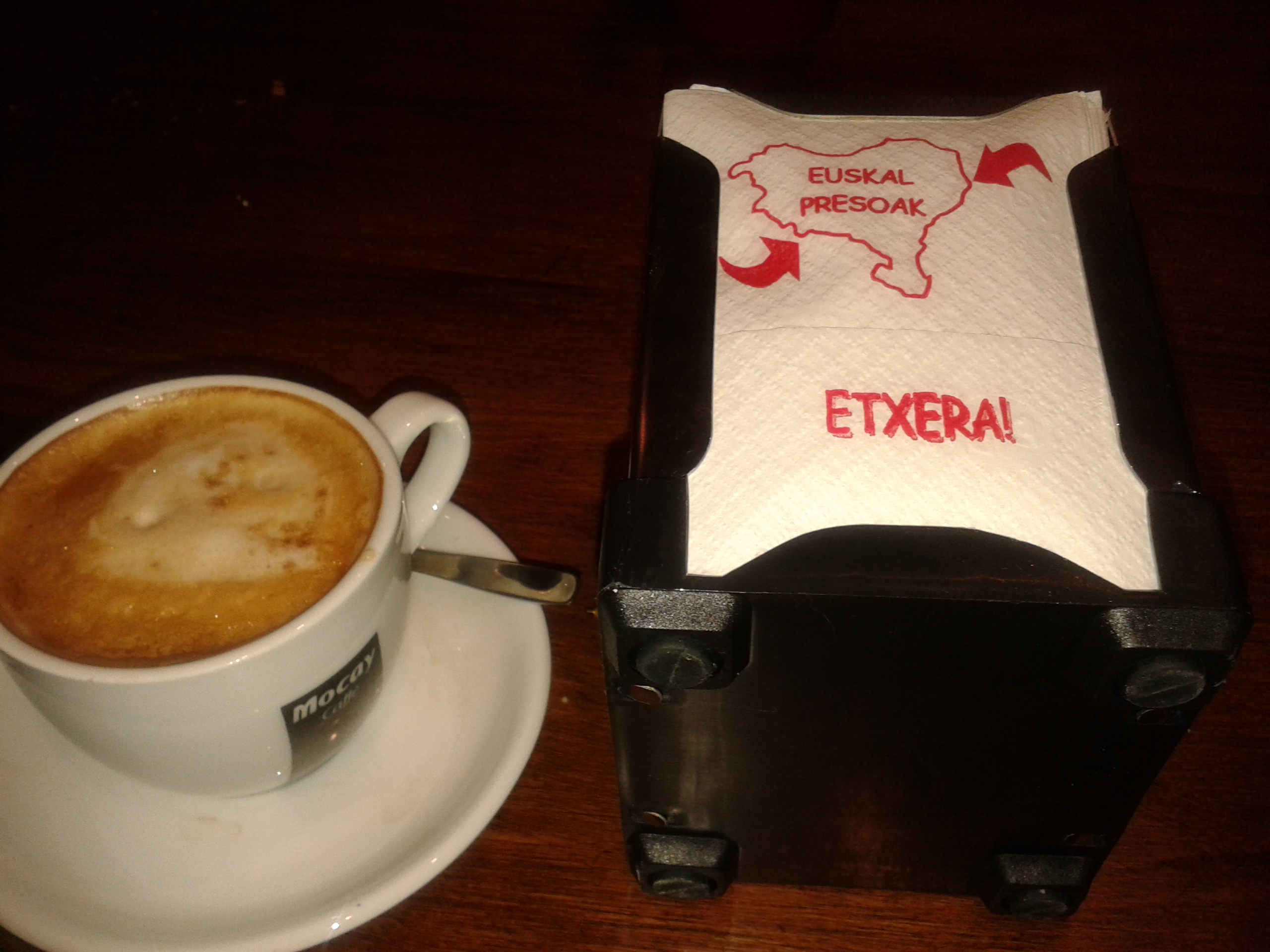
Cafesnea (coffee and milk) with the standard Herriko tissues, stamped with the slogan calling for the Basque prisoners to be sent home from dispersal (and also to be freed).

When the herrikos close, the loss will be enormous: the organised movement will suffer politically, culturally and financially and the social and cultural life of thousands will suffer. There seems little that the Abertzale Left movement can do within the Spanish state – its legal challenge in the Supreme Court has failed. It can apply to the Constitutional Court but decisions there usually concur with those of the Supreme. After the Constitutional, it can apply to Europe, to either the Court of Human Rights at Strasbourg or the Court of International Justice at the Hague but the delay in cases being heard there can take years and by the time they are heard, the herrikos will have been closed and properties auctioned off. Nor are the European Courts’ decisions necessarily to the benefit of the Basques – although a number of times Strasbourg has found against the Spanish state for failing to investigate a claim of torture by a political prisoner, it has never actually found the state guilty of the torture itself. And when the Abertzale Left’s political party, Herri Batasuna, was banned by the Spanish Supreme Court (and confirmed by the Constitutional) in 2003, the movement took the case to Strasbourg. Eventually, in 2009, the Court delivered its judgement – incredibly, it decided that banning a political party with electoral support varying from 15% to nearly 25% in the southern Basque Country was not an abuse of the human rights of the people concerned.

This Herriko is mainly patronised by youth but the age range is complete, from babies brought by their parents to the elderly


Considering the options and Spanish democracy

Now the people are considering their options in action outside the courts. Should they occupy the buildings and resist their takeover by the Spanish state? Maybe that would make sense where their location is a fairly high-profile one. But others are in back streets and laneways; the “Zipayos” (pejorative name for the Euskadi police, the Ertzaintza) can swarm those places, assault the occupants and evict them in a matter of hours. That they can do the same in the more high-profile locations is without doubt but at least the community and passers-by will see the resistance there. In the smaller villages, herrikos may change their name and perhaps replace the buildings’ renters or lessees. Whatever course they take, the disruption overall will be huge.

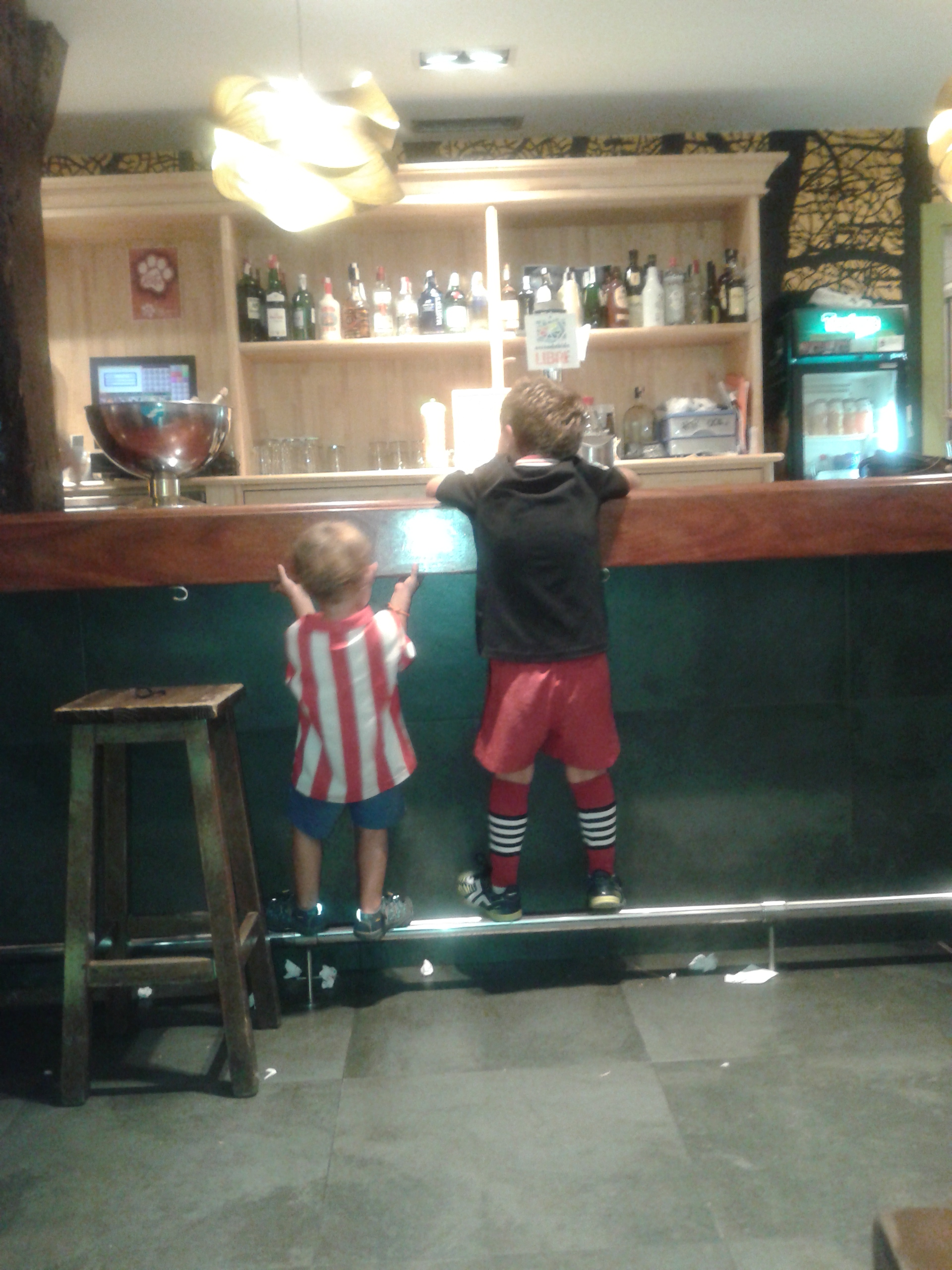
The upcoming generation, one wearing an Athletic Bilbao shirt

In 1998, the Spanish National Court judge Balthazar Garzon (beloved of many liberals around the world) closed down the Basque-language newspaper Egin, a bilingual daily in Euskera and Castellano first published 20 years earlier. Over a year later, a judge ruled that the newspaper could reopen but by then its machinery had been dismantled or left unusable and its owners left without funds as they were using them in court proceedings. In 2009, a Spanish court finally decided that there had been no grounds for closing it in the first place. A year later, there was a similar decision in the case of Egunkaria, the first-ever daily in the Basque language, closed down by the Spanish state in 2003. In 2010, the National Court decided that there had been no reason to close the newspaper and that the accused were innocent, hinting that the accusation of torture was true. But no formal apology followed, nor was there any compensation paid and Otamendi, the newspaper’s manager, had to take his torture case to Strasbourg, where in 2012 he was awarded compensation of €20,000 (and €4,000 legal costs) against the Spanish state because (as usual) they had not bothered to investigate his claims of torture. No compensation has yet been paid for Egunkaria‘s closure and its successor, Berria, reportedly struggles financially today.

Posters and information on the Herriko wall near the front of the bar area

Basques smile ruefully when students of recent Spanish history talk about the “democratisation” of the State through the “Transition” from General Franco’s dictatorship. Apart from the killing by Spanish police and state-supported fascist gangs during that Transition, the southern Basque Country has seen state-organised assassination squads, bannings of newspapers and radio stations, bannings of political parties, youth and cultural organisations and arrests, torture and jailing of political activists. This is the reality behind the words of “Spanish state democracy”.

End.

DISSIDENTS — A FLAWED CONTRIBUTION TO THE HISTORY OF A NEGLECTED GROUP

REVIEWING DISSIDENTS BY ANNE MATTHEWS:

Diarmuid Breatnach

The role of women has been often ignored and undervalued in the body of Irish historical writing. Whatever the reasons for this state of affairs, a tendency in more recent writing has been, at least to a degree, to attempt to rectify this. In the decades since Margaret Ward’s Unmanageable Revolutionaries (Brandon, Ireland, 1983), this rectification has been slowly gathering pace. Dissidents – Irish Republican women 1923-1941, by Anne Matthews (Mercier, 2012), is a contribution to this movement in historical writing; it is essentially the history of an Irish women’s political movement, Cumann na mBan, during the years outlined. A previous work of hers, “Renegades”, deals with Irish Republican women from 1901 to 1922. 

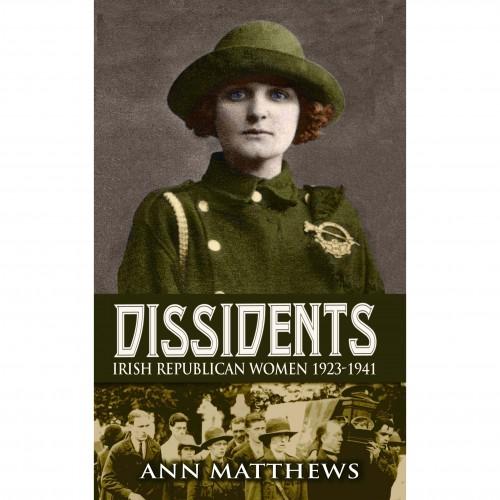
Dissidents Irish Republican Women bookAlthough Dissidents deals with the period 1923-1941, Cumann na mBan was founded on 2nd April 1914 as an auxiliary to the all-male Irish Volunteers’ organisation, which had been founded in 1913. In 1914 the Volunteers split after John Redmond, leader of the Irish Parliamentary Party (in Westminster) and the main open Irish political party in Ireland, committed the Irish Volunteers to fight in the British Army in WW1. The smaller section of the split went on to participate in the 1916 Uprising and more coherently later in the War of Independence (1919-1921). Redmond’s party and “constitutional” Irish nationalism was all but wiped out in the British General Elections of 1918, at which time the whole of Ireland was still under British rule and Redmond’s nationalist opponents, then amalgamated under the name of the reformed Sinn Féin, gained the vast majority of parliamentary seats in Ireland.

Today it is common to define the ideology of both both Cumann na mBan and the Irish Volunteers as “Irish Republican” and, although they quickly became so, and the impulse in the formation of the Volunteers in 1913 was of the secret Republican organisation the IRB (Irish Republican Brotherhood), both organisations at first could be more accurately described as broadly nationalist. Both organisations contained prominently in their midst people whose ideology conformed to that of Irish Republicanism as well as those whose thinking did not, people who expressed a strong interest in equality for women as well as those who were against it, people with at least a sympathy for socialist ideas and those who condemned any such tendencies – and of course variations in between.

In the period specifically chosen by Matthews, 1923-1941, the Irish Volunteers had morphed into the political party Sinn Féin and the armed organisation the IRA (Irish Republican Army) and become Irish Republican in ideology, as had Cumann na mBan. They had in fact been that way since 1919, although the period 1921-’23 was to expose some deep fracture lines which found expression in the Civil War (1922-1923) and later again with the founding of Fianna Fáil and its eventual management of the Irish State (the 26 Counties).

In order to compile her history, Matthews has consulted minutes of committee meetings of Cumann na mBan in its various incarnations (she identifies four periods, or versions of the organisation), personal recollections of participants recorded in writings, interviews, comments quoted by contemporaries, newspaper reports and articles, the Republican movement’s own publications, as well as records of prisons and police under both British and subsequently Free State rule. And she has used some of this material to reproduce and also compile lists such as the numbers and names of women convicted and jailed, the women who went on hunger-strike and the length of time on that protest. The lists also include figures on the decline of Cumann branches between 1934 and 1936, as well as a list of “women in organisations listed as dangerous by the Free State CID in 1934”. These lists are a particularly valuable contribution and will be of great use to many writing on the political movements of the period in Ireland.

Looking at some of those lists alone, one is struck by the sheer extent to which the contribution of women activists to the struggle for Irish independence, and the price they had to pay, has been overlooked. In 1930 twenty-nine women were in organisations listed as “dangerous” by the Free State detective branch of the police – twelve of these were in senior positions of Cumann na mBan, three in directing positions in Saor Éire, three for Comhairle na Poblachta, three also for Sinn Féin, one for the Prisoners’ Defence Organisation, two for Women Prisoners’ Defence League and one for the Anti-Imperialist League. The rest were rank-and-file members of those organisations and one was in Friends of Soviet Russia.

The Free State interned 645 women during the Civil War (as against over16,000 men). In her Introduction, Matthews points out that “There were twenty-four strikes in the three (women’s) prisons during the period from November 1922 to November 1923, in which 219 women took part.”  According to the table drawn up by Matthews, one woman was on hunger strike for 35 days, another for 34, seven for 31, many for different amounts of days but the vast majority into double figures. Furthermore, some of them were on hunger strike more than once.

Matthews also provides a list of the occupations of 79 women activists jailed in the North Dublin Union, which were surveyed in August 1923: the highest number for a single occupation were the 19 listed as “at home”, while the next were 11 whose occupations were given as “packer in Jacob’s” (the biscuit factory in Dublin); 10 had been engaged in “printing”; eight were “shop assistants” while 15 were variously listed as “typist” or “clerk”. This list shows quite a variety of social background among what one presumes to be fairly politically-active women which the Free State considered its enemies.

Republican women acting as couriers or delivering weapons made many journeys by bicycle, often at night without lights in order to avoid Free State patrols, “often round trips of up to forty miles” Matthew tells us (p.32).

BIAS

As has been pointed out by a number of commentators, history writing involves a degree of bias. This bias is exercised not only in explicit judgements but in inferences made, choice of phrasing and so on. Choices are made in what sources to use and what prominence to give them as well as in the opposite, which sources to disregard.

If the Fall of Lucifer and his angel followers were a historical event, for example, we would expect Lucifer’s version to be very different from the Judaeo-Christian story with its sympathy for the Archangel Michael (a great example of history being written by the victors). There might be yet other versions, for example by the Seraphim and Cherubim, one of which might be in partial sympathy with the Fallen side and the other which might be against both sides of the conflict.

Whereas in the ancient past history writing was blatantly partial, in the past century historians have generally claimed to be impartial dispassionate observers recording what they discover. But every one of those writers had views influenced by class, ethnicity, gender, position in or out of power groups, status, upbringing and personal experience. And those views influenced their historical judgements, quite likely their choice of sources and possibly their choice of audience. Written records could only be left by literate people and yet for most of history the majority of people have been illiterate. A more recent trend in history writing is to recognise the inevitability of bias and for the historian to declare which is his or hers.

One should beware of historians who don’t declare their bias at the outset. That will not be a problem with Anne Matthews because although she does not formally introduce her bias to her readers, it very soon becomes clear. Or maybe that is not quite accurate, for in order to have a bias against a group one must presumably also have a bias in favour of another. It is difficult indeed in the pages of this book to find any group for which Matthews has any sympathy or, even more important for a historian, empathy.

To express a bias is expected, as I commented earlier. But unless one is engaged in pure propaganda or character assassination (or glorification), one should present the evidence in favour as well as that against and, in weighing one against the other, make a judgement. When Matthews has anything favourable to say about her subjects it seems to be an accident which will soon be remedied a little later – just keep reading!

A particularly clear and nasty example of this bias is in Matthews’ treatment of Constance Markievicz whom she calls a “self-proclaimed heroine” (p.28) but does not tell us when and where Markievicz allegedly “proclaimed” herself to be a “heroine”. Matthews also inferred that Markievicz was a given to warlike statements but a coward who ran away to Scotland. Whatever the reason for her departure in 1922, one wonders how, no matter how much she may dislike the person, someone could call Markievicz, who prominently took up arms and fought for a week against the British Empire, a coward.

In the Matthews view of the organisation, Cumann na mBan was a largely ineffective body, doctrinaire and full of in-fighting. The leadership and many prominent activists were aristocratic or upper middle class, used to the privileges afforded by their class. The working and lower-middle class members accepted the leadership’s decisions or just deserted.

Some of those things may be true and there might even be some truth in all of them — but where is the counter-argument before coming to judge? One doesn’t find it in Matthews, except by an inference that one can make from the lists I mentioned earlier and other information.

If a woman came from a higher social class and was used to having servants do her cleaning, do those facts diminish in the least her courage in facing bullets in insurrection, the threat of the firing squad, the pangs on hunger-strike and the risk of permanent damage to health, the risk of physical beatings and unhealthy prison conditions? Or on the contrary, in some ways, are those risks and sacrifices not all the more remarkable for one from such a background as that? And if an upper-class mother can pay a nanny to look after her children while she herself in in jail, does that take away from her courage and fortitude? A working-class mother without those resources (though she might be able to avail of extended family) of course has even more obstacles to surmount and deserves our greater praise but that is no reason to disparage the sacrifice or commitment of a woman of a higher class.

And if infighting and bad policy choices were a significant feature of the organisation, were there not others to weigh against them on the scales of judgement? What of transporting, hiding and distributing weapons? Of carrying secret correspondence and intelligence? Or of continuing to feed the flame of resistance while men were in prison, organising pickets and demonstrations, outside jails etc? What of creating the enduring 1916 emblem and Republican commemoration emblem, the Easter Lilly? Or of organising Republican commemorations year after year, as well as funerals of fighters in the midst of repression? Or the work of supporting prisoners and their dependents? Matthews records these and often the difficulties entailed but without a word of approval to balance the censorious words used in her criticisms. Nor do we see an attempt to understand the choices these women made or the constraints upon them, much less see anything to admire; we are shown few lessons to learn from, unless it is something like “don’t be these people or anything like them”.

In Dissidents, Anne Matthews has made a contribution to the story of Republican women but its judgement is clearly skewed and the work suffers as a result. Matthews could have recorded all the negative information that she did but also the points to throw in the balance – had she done so, her book would have been a much better return on her investment in historical research and writing as well as a better reward for the reader.

End.

IRISH HISTORY … AND HERDS OF ELEPHANTS

Diarmuid Breatnach

Politics is about the present and the future, obviously … but it is also about the past.

Different political interests interpret and/or represent the past in different ways, emphasising or understating different events or aspects or even ignoring or suppressing them entirely. There is choice exercised in whom (and even what particular pronouncement) to quote and upon what other material to rely. And by “political interests” I mean not only groups, formal (such as political parties) or informal, but also individuals. Each individual is political in some way, having opinions about some aspects of questions that are political or at least partly-political. For example, one often hears individuals say today that they have no interest in politics, yet express strong opinions of one kind or another about the right to gay and lesbian marriage, the influence of the Catholic Church, and how the country is being run by Governments

So when an individual writes a history book, there are going to be political interpretations, although not all writers admit to their political position, their prejudices or leanings, in advance or even in the course of their writing. One historian who does so is Padraig Yeates, author of a number of historical books: Lockout Dublin 1913 (a work unlikely to be ever equalled on the subject of the title), A City In Wartime — 1914-1919, A City in Turmoil 1919-1921and his latest, A City in Civil War – Dublin 1921-’24. The latter was launched on Tuesday of this week, 12th May and therefore much too early for people for who did not receive an earlier copy to review it. So it is not on the book that I am commenting here but rather on the speeches during the launch, which were laden with overtly political references to the past and to the present. If a review is what you wanted, this would be an appropriate moment to stop reading and exit – and no hard feelings.

The launch had originally been intended to take place at the new address at 17 D’Olier Street, D2, of Books Upstairs. However the interest indicated in attending was so great that Padraig Yeates, realising that the venue was going to be too small, went searching for a larger one. Having regard to how short a time he then had to find one and with his SIPTU connections, Liberty Hall would have been an obvious choice. Whether he had earlier been asked to speak at the launch I do not know but, having approached Jack O’Connor personally to obtain the use of Liberty Hall, in the latter’s role of President of SIPTU, the owners of that much-underused theatre building, it was inevitable too that O’Connor would be asked to speak and act as the MC for the event.

O’Connor’s introduction was perhaps of medium length as these things go. He talked about the author’s work in trade unions, as a journalist and as an author of books about history. O’Connor’s speech however contained much political comment. Speaking of the period of the Civil War (1919-1923), he said it had “formed what we have become as a people”. That is a statement which is of dubious accuracy or, at very least, is open to a number of conflicting interpretations. The Civil War, in which the colonialism-compromising Irish capitalist class defeated the anti-colonial elements of the nationalist or republican movement, formed what the State has become – not the people. The distinction between State and People is an essential one in our history and no less so in Ireland today.

Talking about the State that had been created in 1921 (and not mentioning once the creation of the other statelet, the Six Counties) and referring to the fact that alone among European nations, our population had not risen during most of the 20th Century and remained lower than it had been up to nearly the mid-Nineteenth, a state of affairs due to constant emigration, O’Connor laid the blame on the 26-County State and in passing, on the capitalist class which it served. He was undoubtedly correct in blaming the State for its failure to create an economic and social environment which would stop or slow down the rate of emigration – but he did not explain why it was in the interests of the capitalists ruling the state to do so. Nor did he refer to the cause of the original drastic reduction in Ireland’s population and the start of a tradition of emigration – the Great Hunger 1845-’49.

The Great Hunger memorial on Dublin's Custom House Quay. The Great Hunger and its immediate aftermath initiated mass Irish emigration.
The Great Hunger memorial on Dublin’s Custom House Quay. The Great Hunger and its immediate aftermath initiated mass Irish emigration.

Even allowing for the fact that O’Connor wished to focus on the responsibility of the 26-County State, the Great Hunger was surely worthy of some mention in the context of Irish population decline.  Just a little eastward along the docks from Liberty Hall is the memorial to that start of mass Irish emigration. It was the colonial oppression of the Irish people which had created the conditions in which the organism Phytophthora infestans could create such devastation, such that in much less than a decade, Ireland lost between 20% and 25% of its population, due to death by starvation and attendant disease and due also to emigration (not forgetting that many people emigrating died prematurely too, on the journey, upon reaching their destination and subsequently). Phytophthora devastated potato crops in the USA in 1843 and spread throughout Europe thereafter, without however causing such a human disaster as it did in Ireland. In Mitchell’s famous words: “The Almighty, indeed, sent the potato blight, but the English created the famine.” And that is what makes that period of population decline uncomfortable for some historical commentators.

Indeed, O’Connor did not mention British colonialism once, nor Partition, nor imperialism. And nor did either of the other two speakers, nor the author. I remarked on this to an Irish Republican present, to which he responded with a rhetorical question: “Did you expect them to?” Well, yes, perhaps naively, I did. While not expecting an Irish Republican analysis from Padraig Yeates and perhaps not either from anyone he would consider appropriate to speak at the launch of one of his books, dammit, we are talking about history. The presence of Norman/English/British Colonialism for 800 years prior to the creation of the Irish Free State, and its influence on that state’s creation and on subsequent events in Ireland, is worthy of at least a mention in launching a book about the Civil War. Not to mention its continuing occupation of one-fifth of the nation’s territory.

Colonialism and Imperialism and, in particular, the Irish experience of the British variant, were not so much ‘the elephant in the room at the launch as a veritable herd of pachyderms. They overshadowed us at the launch and crowded around us, we could hear them breathing and smell their urine and excreta – but no-one mentioned them. The date of the launch was the anniversary of the execution of James Connolly 99 years ago, a man whom the Labour Party claims as its founder (correctly historically, if not politically), a former General Secretary of the ITGWU, forerunner of SIPTU and the HQ building of which, Liberty Hall, was a forerunner too of the very building in which the launch was taking place. His name and the anniversary was referred to once, though not by O’Connor, without a mention of Sean Mac Diarmada, executed in the same place on the same day. And most significantly of all, no mention of who had Connolly shot and under which authority.

That circumspection, that avoidance, meant that a leader of Dublin capitalists, William Martin Murphy, could not be mentioned with regard to Connolly’s death either i.e. his post-Rising editorial in the Irish Independent calling for the execution of the insurgents’ leaders. But of course he did get a mention, or at least the class alliance he led in 1913 did, in a bid to smash the ITGWU, then under the leadership of Larkin and Connolly. This struggle, according to O’Connor and, it must be said also to Padraig Yeates, was the real defining struggle of the early years of the 20th Century, not the 1916 Rising, the War of Independence nor yet the Irish Civil War. It was in 1913 that “the wrong side won”.

One-eyed as that historical vision must be, we have to question whether it is even partially correct. The Lockout was a great defeat for the ITGWU and for the leading elements in the Irish workers’ movement. But the Lockout did not break the trade union and, in fact, it later began to grow in membership and in branches. Other trade unions also survived and some expanded. So in what manner was 1913 decisive in ensuring that “the wrong side won” in later years? The Irish trade union movement was still able to organise a general strike against conscription in April 1918 and the class to organise a wave of occupations of workplaces in April 1919. 

True, the Irish working class had lost one of its foremost theoreticians and propagandists by then, in the person of James Connolly. And who was it who had him shot? Not Murphy (though he’d have had no hesitation in doing so) nor the rest of the Irish capitalist class. In fact, worried about the longer-term outcome, the political representatives of the Irish nationalist capitalist class for so long, the Irish Parliamentary Party, right at the outset and throughout, desperately called for the executions to halt. General Maxwell, with the support of British Prime Minister Asquith, ordered and confirmed the executions of Connolly and Mallin of the Irish Citizen Army and British Army personnel pulled the triggers; in essence it was British colonialism that executed them, along with the other fourteen.

For the leaders of the Labour Party and of some of the trade unions, and for some authors, Padraig Yeates among them, the participation of Connolly and the Irish Citizen Army in the Rising was an aberration. For these social democrats, the struggle should have been against the Irish capitalist class only (and preferably by an unarmed working class). It is an inconvenient fact that Ireland was under colonial occupation of a state that had strangled much of the nation’s economic potential (and therefore of the growth of the working class) in support of the interests of the British capitalist class. It is an inconvenient fact that the Irish capitalist class had been divided into Unionist and Nationalist sections, the former being descendants of planter landowners and entrepreneurs whose interests were completely bound up in Union with Britain. It is an inconvenient fact that the British and the Unionists had suppressed the last truly independent expression of the Irish bourgeoisie, the United Irishmen and, in order to do so effectively, had created and enhanced sectarian divisions among the urban and rural working and middle classes. It is also an inconvenient fact that the British cultivated a client “nationalist” capitalist class in Ireland and that the police and military forces used to back up Murphy’s coalition in 1913 were under British colonial control.

To my mind, a good comprehensive analysis of the decline in prominence of the Irish working class on the political stage from its high point in early 1913 and even in 1916, has yet to be written. One can see a number of factors that must have played a part and the killing of Connolly was one. But something else happened between 1913 and 1916 which had a negative impact on the working class, not just in Ireland but throughout the World. In July 1914, WW1 started and in rising against British colonialism in Ireland, Connolly also intended to strike a blow against this slaughter. As the Lockout struggle drew to its close at the end of 1913 and early 1914, many union members had been replaced in their jobs and many would find it hard to regain employment, due to their support for the workers and their resistance to the campaign to break the ITGWU. It is hard to avoid the conclusion that many joined the British Army or went to work in war industries in Britain. Although the Irish capitalist class supported the British in that War (up to most of 1917 at any rate) it was imperialism which had begun the war and British Imperialism which recruited Irish workers into its armed forces and industries.

Reaching back in history but to different parts of Europe, Padraig Yeates, in his short and often amusing launch speech, cracked that “for years many people thought Karl Kautsky’s first name was ‘Renegade’ ” — a reference to the title of one of Lenin’s pamphlets: The Proletarian Revolution and the Renegade Kautsky. Yeates apparently admires Kautsky and quoted him on Ireland. But Kautsky advocated no uprisings against imperialism or colonialism in the belief that “super-imperialism” (also called “Hyper Imperialism”) would regulate itself peacefully, letting socialists get on with the task of evolving socialism. Two World Wars since then and current developments have negated Kautsky’s theory but more to the point, to advocate his theory as a guiding principle at the time he did was a major ideological threat to proletarian revolution and to the evolving anti-colonial struggles of the world and therefore he was a renegade to any variant of genuine socialism and socialist struggle.

This is relevant in analysing the position of the trade union leaders and the Irish Labour Party today. They are social democrats and their central thesis is that it is possible to reform capitalism, by pressure on and by involvement in the State. They deny what Lenin and others across the revolutionary socialist spectrum declare, that the state serves the ruling class and cannot be coopted or taken over but for socialism to succeed, must be overthrown.

It is the social-democratic analysis that underpinned decades of the trade union leaders’ social partnership with the employers and the State, decades that left them totally unprepared, even if they had been willing, to declare even one day’s general strike against the successive attacks on their members, the rest of the Irish working class and indeed the lower middle class too since 2011. Indeed Padraig Yeates, speaking at a discussion on trade unions at the Anarchist Bookfair a year or two ago, conceded that social partnership had “gone too far”. Can Jack or any other collaborationist trade union leader blame that on the transitory defeat of the 1913 Lockout? They may try to but it is clear to most people that the blame does not lie there.

Two other speakers addressed the audience at the launch, Katherine O’Donnell and Caitriona Crowe. Catriona Crowe is Head of Special Projects at the National Archives of Ireland and, among other responsibilities, is Manager of the Irish Census Online Project, an Editor of Documents on Irish Foreign Policy, Vice-President of the Irish Labour History Society. She is also Chairperson of the SAOL Project, a rehabilitation initiative for women with addiction problems, based in the North Inner City. It was her, I think, who made the only mention of “Blueshirts” and her also that mentioned the anniversary of James Connolly. Although her speech was overlong in my opinion for a book launch in which she had already been preceded by two longish speeches, strangely I can remember very little of what she had to say.

Katherine O’Donnell’s contribution however made a considerable impression upon me. She declared herself early in the speech to be lesbian and a campaigner for gay and lesbian rights and is Director of the Women’s Studies Centre at the School of Social Justice at UCD. O’Donnell began by praising Padraig Yeates’ work, of which she declared herself “a fan”. In a speech which at times had me (and sometimes others too) laughing out loud, she discussed the contrast in the fields of historical representation between some historians and those who construct historical stories through the use of imagination as well as data; she denounced the social conservatism of the state, including the parameters of the upcoming referendum on same-sex marriage, the legal status of marriage in general and the climate of fear of prosecution engendered by the shameful capitulation of RTE to the Iona Institute on the accusation of “homophobia” (she did not mention them specifically but everyone knew to what she was referring).

After the launch speeches -- (L-R) Padraig Yeates, Katherine O'Donnell, Caitriona Crowe.
After the launch speeches — (L-R) Padraig Yeates, Katherine O’Donnell, Caitriona Crowe.

Jack O’Connor, between speeches, made a reference to a giant banner hanging off Liberty Hall which had the word “NO” displayed prominently, saying that they had received congratulatory calls from people who thought it was against same-sex marriage. The banner was however against privatisation of bus services. The current banner on Liberty Hall says “YES” to the proposal in the forthcoming referendum and he said that now busmen were calling them up complaining …. to laughter, O’Connor commented that “it’s hard to the right thing, sometimes”. Presumably what he meant was that it is hard to know what the right thing to do is, or perhaps to please everybody. 

It is indeed hard to please everybody but I’d have to say that it is not hard to know that the purpose of and ‘the right thing to do’ for a trade union, is to fight effectively and with commitment for its members and for the working class in general. And that is precisely the responsibility which has been abrogated by Jack

In the background to this photograph of a Reclaim the Streets demonstration in 2002 is Liberty Hall, draped in a hug "Vote Labour" banner. SIPTU has maintained that position through a number of coalition governments in which Labour has participated and that have attacked the living standards and rights of workers.
In the background to this photograph of a Reclaim the Streets demonstration in 2002 is Liberty Hall, draped in a hug “Vote Labour” banner. SIPTU has maintained that position through a number of coalition governments in which Labour has participated and that have attacked the living standards and rights of workers.

O’Connor personally, along with other leaders of most of the trade unions, including the biggest ones for many years, SIPTU and IMPACT. And also by the Irish Congress of Trade Unions. That is why Jack O’Connor gets booed now if he ever dares stand on a public platform related to trade union struggle, a treatment received also by David Beggs before he retired from the Presidency of ICTU.

Back in 2011, another giant banner hung from Liberty Hall – that time it urged us to VOTE LABOUR, as did leaders of other trade unions. Stretching magnanimity, we might give the trade union leaders the benefit of the doubt and say they had forgotten that the Labour Party had only ever been in Government in coalition, most often with the right-wing Blueshirt Fine Gael party and that its most recent spell sharing power had given us one of the most repressive governments in the history of the State. Let us imagine for a moment that these social-democratic union leaders had forgotten all that. But, after February 2011, as Labour and Fine Gael went into coalition and both reneged on their election promises, as the Coalition government began to attack the working class and the lower middle class, what is their excuse then? When did they denounce the Labour Party to their members, publicly disaffiliating from the party? No, never, and the fact that those disgusting connections continue was underlined by the presence at the book launch of a Labour Party junior Government Minister and the late arrival of none other than Joan Burton, Minister for Social Constriction …. er, sorry, Protection.

Plaques in Glasnevin's Republican Plot recording the names of 77 of the 81 Irish Volunteers officially executed by the Free State between November 1922 and May 1923. Their police and military killed about another 150 without judicial procedure.
Plaques in Glasnevin’s Republican Plot recording the names of 77 of the 81 Irish Volunteers officially executed by the Free State between November 1922 and May 1923. Their police and military killed about another 150 without judicial procedure.

Considering that the book being launched was about the Civil War, it is really extraordinary that no speaker mentioned the repression by the Free State during and after that war. I am certain that Padraig Yeates has not glossed over that, he is much too honest and too good a historian to do so. But that only one speaker at the launch (Catriona Crowe) should mention the sinister Oriel House and none the at least 25 murders its occupants organised, nor the 125 other murders by Irish Free State soldiers and police, nor the 81 state executions between November 1922 and January 1923, sets one wondering at just how much self-hypnosis sections of our political and academic classes are capable.

Elephants, elephants everywhere

but not one can be seen!

End.

THE BLOODIEST BATTLE OF THE EASTER RISING

D. Breatnach

99 YEARS AGO ON 26th APRIL, THE BLOODIEST BATTLE OF THE EASTER RISING WAS FOUGHT IN A DUBLIN SUBURB

At a little past 6am on 26th April 1916, the SS Tynwald and SS Patriotic, two British troop-ships, had berthed in Dun Laoghaire harbour. The harbour and town had been renamed Kingstown by Unionist elements when King George IV came to visit the new port under construction in 1821. Although the town returned to its former name in 1920, it was known as “Kingstown” by most people in 1916, whatever their allegiance.

The troopships had been requested by General Maxwell, who had been given the responsibility for suppression of the Easter Rising, which was now in its third day. Several British thousand troops from the 59th Midland division began to disembark on a bright sunny morning. Hundreds of civilians went down to see them despite the early hour. Many in that town, especially around the seafront and some of the big houses, would have been sympathetic to the British – but by no means all and no doubt some eyes were noting the arrivals in order to report to the insurgents.

Around 9am, disembarkation completed, the soldiers were formed up and inspected, equipment checked and the Sherwood Foresters set off marching towards Dublin city centre, seven miles away, to be followed by Nottingham and Derby regiments around 10.30hrs. Their forces appear to have split up, with two Battalions marching to the city along the coast road and another two heading inland.

To reach the city centre from Dun Laoghaire, the most direct route is to proceed northward along the coast to Mount Merrion. Once there, the coast road goes through the railway level crossing to the right and continues along the seafront, into Ringsend and then along what is now Pearse Street to Trinity College. The British officers did not lead their men in that direction, perhaps because they had received intelligence of the Boland’s Mill strongpoint along their route. There would be no going past that without first taking it, which might prove a lengthy and difficult battle.

But one could avoid that by not turning right at Mount Merrion and instead continuing on what has become the main road, through Ballsbridge and Northumberland Road, across the Grand Union Canal at Mount Street Bridge, past the fashionable Merrion Square and into Nasseau Street and the city centre. That seemed the obvious choice, not just because of the Jacob’s garrison but also because at Mount Street Bridge was located Beggars’ Bush Barracks, one of the many such of the British Army in Dublin city.

Northumberland Road looking southwards. The Irish insurgents first saw the British troops coming up this road.
Northumberland Road looking southwards. The Irish insurgents first saw the British troops coming up this road.  The Parochial Hall and Schoolhouse are to the left but out of the photo.  The canal is behind the photographer.  (Photo D.Breatnach)

Before the British troops arrived in the area, a female courier, probably Cumann na mBan, had brought news of the troops landed in Dún Laoghaire and that they were heading towards them to the insurgents waiting in the Mount Street Bridge area.

At around noon a burst of fire hit the forward sections of the British troops marching in from Dun Laoghaire. When fired upon, in order to find effective cover, it is important to know from where the firing is coming but the soldiers were unsure. No. 25 Northumberland Road, a house at the junction with Haddington Road, seemed to some to be the source of the firing but by how many was unknown.

Screams from wounded men filled the air in the quiet suburban upper-middle class and largely Loyalist residential street.

Soldiers began to maneouver to outflank No.25 Northumberland Road and a detachment reached Baggot Street Bridge, further west, which was apparently undefended. From there it is a straight road into Stephens Green and the southside city centre. The rest of the soldiers were not led by their officers in that direction, a decision which was to cost them dearly. Instead, shortly after being fired upon, at least two British platoons attacked 25 Northumberland Road but were driven back in disarray by fire from the building’s upper floors; yet as they turned they were also shot down in droves.

Perhaps under cover of that assault, at around 1pm some of the 2/7th Battalion Sherwood Foresters got past the corner house and made their way on to Percy Place, which runs along the south side of the canal between Mount Street and Baggot Street bridges. Now they came under fire from in front and from their left. They huddled for cover along the Canal.

The fire from the left of the British at this point was coming at long distance from the towers of Jacob’s Factory in Bishop Street, one of the insurgent strongpoints. A defensive line with insufficient mobilised insurgent numbers to hold it for very long stretched from Jacob’s down to the railway connecting Dublin and Dun Laoghaire and to Boland’s Mill beside it, overlooking the south bank of the Liffey. Roughly in the middle of this chain or defensive line were the Irish Volunteers in the Mount Street Bridge area, an outpost of the Boland’s Mill garrison.  The total strength of the insurgent force defending that area had been 17 Volunteers but two had been sent home, being thought too young.   

New Clanwilliam House, Mount Street, north side of the Royal Cana. Looking eastward.
New Clanwilliam House, Mount Street, north side of the Royal Canal, looking eastward. The Bridge and Canal are to the right but out of shot. (Photo D.Breatnach)
The Schoolhouse, Northumberland Road, today (a snack-cafe nowadays). The Bridge is to the right; the British troops were advancing along the road from the right.

Incredible as it seemed to the British when they learned of it later, there were only two Volunteers in No.25 Northumberland Road: 27 year-old Volunteer Lieutenant Michael Malone, a carpenter by trade, and Section Commander James Grace. In the Schoolhouse on the right-hand side just before the Bridge, there were two Volunteers. Next to that building was the Parochial Hall, held by four men: P.J. Doyle in command, Joe Clarke, William Christian and J. McGrath. Clanwilliam House, across the canal on the right-hand corner with the junction with Mount Street Lower, was occupied by seven Volunteers; the frontal fire hitting the British was coming from there.

The British were scattered around gardens and behind the granite steps leading up the to front doors of the elegant houses in the street. Their officers called them out and they launched an attack on the Schoolhouse in Northumberland Road. As they charged up the road they came under fire from across the Canal from Clanwilliam House; about a dozen reached the Schoolhouse but they left many bodies behind. And they were still coming under fire from across the Canal too.

The officers now attempted to outflank Mount Street Bridge and Northumberland Road by advancing along Shelbourne Road to the east but were stopped as they came under fire from Volunteers along the railway line and from positions in and around Horan’s Shop nearby.

The column advancing from Dun Laoghaire had set up a temporary HQ in Ballsbridge Town Hall. Incredibly, the officers there, receiving regular dispatches reporting their troops being slaughtered around Mount Street Bridge and, presumably, knowing that other troops had found Baggot Street Bridge undefended, continued to press for an advance across the killing field.

But at least the officers on the battlefield for the time being seem to have had enough of death-or-glory charges, which were bringing plenty of death and no glory. The soldiers are now crawling along the road but whenever any are visible, which is often, they are being fired at. Clanwilliam House is wreathed in smoke.

Mauser Model 71 small
The Mauser Mark 71

The weapon the Volunteers were using was almost certainly the Mauser Model 71, the weapon of most Volunteers and Irish Citizen Army during the Rising; 1,500 had been been delivered in two landings in July 1914, first at Howth, north Dublin and then at Kilcoole, Wicklow. It had been the first cartridge rifle adopted by the Prussian Army in 1872 which by 1914 had gone on to another more advanced model, presumably the reason that the rifle was being sold cheaply. The Model 71 fired a larger bullet than the British Army standard-issue Lee Enfield .303 but did not have a magazine, each cartridge having to be ejected and anew one inserted before firing again; its rate of fire was only four or five rounds a minute. The Lee Enfield took a ten-bullet magazine and the British Army were trained to fire fifteen rounds a minute. Despite this, the occupants in Clanwillian House and in No.25 in particular were able to lay down a tremendous rate of fire. Their guns grew so hot they burned to the touch and they had to cool them with wet rags. Down below, British officers blew their whistles and soldiers carried out more charges, only to be cut down by the Volunteers’ rifle fire.

During the late afternoon, a nurse ran on to the road and began treating the wounded British soldiers. The Volunteers agreed to a ceasefire as doctors and nurses from Sir Patrick Dunne’s hospital nearby went into Northumberland Road. But after a while the British attempted to use the ceasefire to advance their positions and the Volunteers ended it. Those wounded still to be tended lay where they were. This had been very different situation to what was to be seen in other areas of Dublin during the Rising, when British troops refused to allow wounded to be taken out unless the insurgents surrendered and when they accused Nurse Elizabeth Farrell of being a spy and tore her Red Cross bibfront off her.

The British got a machine gun up to the bell-tower of the church on Haddington Road so that they could fire over the roofs of the houses at Clanwilliam House, the bullets knocking chips off the outer walls and zipping through windows. They were also being backed by rifle snipers.

British soldiers recommenced attacking No.25, now with hand grenades as well as rifle fire. Finally they got close enough to blow the door in with explosives but incredibly were fired upon from inside as they tried to gain entry, injuring a number of them. They hurled grenades in and after they exploded, dashed in again. Coming down the stairs to meet them was Volunteer Lieutenant Michael Malone, his pipe in his mouth and was shot dead.

Section Commander James Grace had been downstairs using a cooker as cover from bullets and shrapnel and such was the bomb damage to the room that the British assumed anyone in there had to be dead. There was still plenty of fighting to do – they had not even crossed the Canal yet.

If they believed that two men alone had held out against repeated assaults for four hours and had inflicted such damage upon them, they must have been very fearful leaving No.25. But perhaps they thought there had been others who must have escaped in the last minutes. James Grace did escape to get out of the area after lying low for some hours; however he was arrested some days later.

With No.25 taken, the Sherwood Foresters are soon able to take the Parochial Hall but they find it empty. The garrison of four Volunteers had run out of rifle ammunition and evacuated into Percy Place, where British troops, who were now all around the area, captured them.

An officer takes Volunteer Joe Clarke‘s loaded pistol off him, puts him with his back to a door and fires at him. Missing Joe, the bullet goes through the door to where a doctor is attending to injured British soldiers. He storms out in rage, berating the officer and Joe Clarke’s life is saved (he continued active in the IRA and in Republican politics nearly until his death in 1976 at the age of 94).

British soldiers are occupying nearby houses for cover and for firing positions and they are also crouched behind the low wall along Percy Place. They are still being hit. Now, they attack the Schoolhouse from its front, running across enfilading fire from Clanwilliam House to their left as they attack and from other positions to their front. When they enter, they find the Schoolhouse unoccupied by any Volunteer, alive or dead. However, their storm of bullets during the attack has riddled the bodies of its caretaker and his wife.

The cost to the British has been enormous but they have at last taken the southern side of the Canal around Mount Street Bridge. Across it, waiting for them, is Clanwilliam House. And to the east, their right-hand side, snipers at Boland’s Mill and nearby positions are also firing at them.

Now the officers order forward their reserves who had been sheltering in St Mary’s Road. The soldiers charge for the Bridge, answering to their discipline and their officers as they and many like them will do across the WWI battlefields of Europe, Greece, Turkey and Russia for another three years. It is partly against this slaughter that James Connolly led the men and women of the Irish Citizen Army out this week. One of the ICA’s detachments is not far away, under the command of Michael Malin and Constance Markievicz, in the College of Surgeons on the side of Stephens Green and they have already taken casualties.

Despite the covering fire from the Vickers Machine Gun firing incendiary bullets from St Mary’s Church, this charge too is driven back, their casualties adding to the pile of khaki-clad bodies and wounded on Northumberland Road, the Canal banks and the Bridge.

Around 8pm, the British are finally across Mount Street Bridge. An officer was in the charge, one of their few unwounded, and is at Clanwilliam House’s outer walls. Firing continues from the windows of this last insurgent bastion and from the east, a hail of Mauser death is still hitting the Bridge and the northern side of the Canal.

The British are now close enough to throw grenades but one, thrown by a British NCO, bounced back from a second floor window and exploded next to his head, killing him. The British begin to make their way into the now-burning Clanwilliam House but are forced to retreat by the flames, leaving the fire to consume the bodies of the presumed dead Volunteers inside. They will not know now how many there were. In fact, there were only seven Volunteers, three are dead and the remaining four have escaped out the back.

Clanwilliam House after the Rising
The four survivors of the Clanwilliam House garrison.

Ninety-nine years ago in the Battle of Mount Street Bridge, despite having only single-shot rifles and some pistols, the  Volunteers held off two British Battalions, numbering approximately1,600 between them, for five hours. Approximately 234 men (including 18 officers) of the British Army had become casualties at the hands of fifteen insurgents.

Mount Street Battle Monument on the south side of the Bridge. (Photo D.Breatnach)
Mount Street Battle Monument on the Bridge
Mount St Bridge Gaeilge pla
Part of the memorial on the south side of the canal. (Photo D.Breatnach)

End

Sources:

Article in http://www.irishtimes.com/culture/books/an-easter-rising-timeline-wednesday-april-26th-1916-1.2188089 drawing on When The Clock Struck in 1916 – Close-Quarter Combat in the Easter Rising by Derek Molyneux and Darren Kelly, Collins Press, at €17.99.

Remembering the Past – the battle of Mount Street Bridge, by Aengus O Snodaigh, article in http://www.anphoblacht.com/contents/6137

Article on the “Howth rifle” in http://www.historyireland.com/20th-century-contemporary-history/the-mauser-model-71-rifle/