Israel is justifying its bombardment of Gaza as the right to defend the state, effectively in the right to take revenge, with which the western states are in agreement.
Leaving aside the question of whether bombing homes, bakeries, markets and hospitals constitutes ‘defence’, what should we think about the right of a state to defend itself as a principle?
It seems natural that every state should have the right to defend itself; perhaps that right is extrapolated from the generally-agreed right of the individual to self-defence. In bourgeois law, the need to defend oneself can be a valid legal defence even against a murder charge.
The individual is generally understood to have the right of self-defence particularly in their home but also in public places. However, it is important to note that this right, even in bourgeois law, is not considered valid in every conceivable case.
For example, the right of one individual to use violence in their defence can be cancelled by the right of their victim to self-defence if the latter is being seriously harmed by the former, so that violence by the victim might be considered a reasonable response in their own self-defence.
People carrying out a robbery or kidnapping, to take another instance, are not considered to have the right to use violence if attacked in the course of the robbery by the victim or by security forces or even a passer-by.
Proceeding to the question of the rights of states to defence, we might say that the UK had the right to defend itself from Nazi attack during WWII and certainly so did the USSR, so too later with the rights of Vietnam, Laos and Cambodia from the USA’s invasions and bombings in the 1970s.
But did the Cambodian state have the right to defend itself from Vietnamese invasion when the Pol Pot regime was carrying out mass exterminations of sections of its population? Or the did the states of Nazi Germany and Fascist Italy have the right to defence against the Allied forces?
Continuing in consideration of the right of a state to defence, how does that go when the attack comes from within the territory of the state itself?
Most Irish and democratic people outside would probably deny that the English Crown had the right to defend itself against the Irish rebellions of the clans (1167-1690s) or of the United Irish republicans, or against the Fenian insurrections, the 1916 Rising and the War of Independence (1919-1921).
Similarly, most would deny the right of the English or French monarchies to defend themselves against the internal republican uprisings of 1649 and 1789, respectively.
When the “internal” force attacking is a nation, then national rights of self-determination counter and supersede the rights of the state to self-defence. The case of the United Irishmen has already been noted but slave colony Haiti and colonial Algeria against France could be listed there too.
ISRAEL
The Israeli State is a colonial regime sitting on the Palestinian people’s land. It is in addition a state which is deeply religiously sectarian on the basis of Judaeism, in a sense which is far more racial than it is religious and, in many cases, may have no religious aspect at all.
Aftermath of Israeli militia massacre of Palestinian village Deir Yassin (9th April 1948 – five weeks before the the founding of the Israeli state). After the massacre, the Zionists took over the village, and in 1980 the occupation established settlement units on top of the original buildings of the village, and gave the names of the “Argon”, “Etzel”, “Palmach” and “Haganah” murder gangs to places in it. 700,000 Palestinians were expelled or forced to flee the land. (Source photos: Internet)
Being able to claim Jewish descent is the qualification for Israeli citizenship, not religious practice or even belief. As for the Palestinians, whether Muslim or Christian, Arab or Berber, they are ‘other’, second-class or even third-class at best.
Third-class because the Ashkenazi Jewish colonists discriminate against other Jews too, for example the Ethiopian (because many are black), the Sephardic and Mizrahi (because they are not Ashkenazi). They will all speak Hebrew now but many additional languages are spoken too.
The Zionist trend in the Jewish world insisting that Jews had a right to a state of their own on a land of their own, even if some other people already lived there, was a minority trend among Jews until fairly recently, though it gained dominance in the West over years after the establishment of Israel.
Indeed there are sections of Jewish society that consider the creation of a Jewish state to be contrary to the teachings of the Torah. But as observed earlier, Zionism is not really about religion.
The establishment of the Zionist state was achieved at the price of the expulsion of 700,000 Palestinians, the imposition of racist and sectarian laws, apartheid, massacres,1 oppression of the Palestinians and repression of their resistance.
The story of the state of Israel in the land of Palestine until now can be characterised by two images: the murder of Palestinian people along with the expulsion of 700,000 Palestinians in 1948 as the Zionist state came into being – and the genocidal bombing of Gaza these three weeks.
As of some hours ago, over 7,000 Palestinians have been killed in the past three weeks – including nearly 3,000 children.
Medical staff in Gaza treating children and woman injured by Israeli bombing, uploaded 26 October. (Source image: Al Jazeera)
There are many ways to kill, including despair, lack of or obstruction to medical treatment or access to good water and food. But from 1948 to 2021 (i.e excluding the killings since then and this year’s), well over 20,000 Palestinian civilians have been directly killed by the Israeli state’s military and settlers.
To claim that “Israel has the right to defence” is to say that all those things are justified and must be defended, must be perpetuated, that we must be complicit in it and that the best we can do is to ask Israel to practice its racism, colonialism, oppression and repression somewhat more gently.
Israeli bombing wide-scale destruction of Gaza, October 2023 (Photo sourced: Internet)
Israel – which is to say the Zionist project — has absolutely no right to defence.
End.
FOOTNOTES
1When hostilities erupted in 1948, the villagers of Deir Yassin and those of the nearby Jewish village of Giv’at Shaul signed a pact, later approved at Haganah headquarters, to maintain their good relations, exchange information on movement of outsiders through village territory, and ensure the safety of vehicles from the village. The inhabitants of Deir Yassin upheld the agreement scrupulously, resisting infiltration by Arab irregulars. Though this was known to the Irgun and Lehi forces, they attacked the village on April 9, 1948. The assault was beaten off initially, with the attackers suffering 40 wounded. Only the intervention of a Palmach unit, using mortars,[20] allowed them to occupy the village. Houses were blown up with people inside and people shot: 107 villagers, including women and children, were killed. The survivors were loaded on trucks that were driven through Jerusalem in a victory parade,[19][21] with some sources describing further violence by Lehi soldiers.[22] Four Irgun or Lehi men were killed.[23] The incident became known as the Deir Yassin massacre.
On April 10, 1948, one day after the Deir Yassin massacre, Albert Einstein wrote a critical letter to the American Friends of Fighters for the Freedom of Israel (the U.S chapter of Lehi) refusing to assist them with aid or support to raise money for their cause in Palestine.[24][25] On December 2, 1948, many prominent American Jews signed and published an op-ed article in The New York Times critical of Menachem Begin and the massacre at Deir Yassin. (Wikipedia)
News & Views No.9: Chile Coup – Twin Towers – the Legacy Bill
Diarmuid Breatnach (Reading time: 5 mins.)
September 11th is the anniversary of the al Qaeda attack on the new World Trade Center in the USA known as “the Twin Towers” and also of the Pinochet Coup in Chile. The former caused the deaths of 2,996 people and the latter of over 40,000.
These are not happy anniversaries and US Imperialism bears a major portion of the blame for both events.
How so, one might ask? The coup in Chile, probably with CIA help, sure. But the Twin Towers? That was a Muslim jihadist attack AGAINST the USA! Surely we’re not expected to believe that stupid conspiracy theory that the USA ruling class actually staged the attack?
US proxy soldiers, Special forces Afghan National Army, 2021 (Photo sourced: Internet)Osama Bin Laden (10 March 1957 – 2 May 2011), Saudi-born founder and first general emir of Al Qaeda from 1988 until his assassination. (Photo sourced: Internet)
That is truly a crazy conspiracy theory but the historical truth does indeed involve a conspiracy. In 1997 the government of Afghanistan was socialist which was worrying for the USA, so in partnership with Saudi elements, they funded and even founded Muslim jihadist groups there.
These groups were to be encouraged to overthrow the socialist regime and when the USSR sent troops to support the government, to defeat the Russians too. Which they did.
But forget about fantasy stories of traditional tribesmen with ancient muskets fighting a world power’s army – these were jihadists, fundamentalists, armed with modern automatic weapons and mobile missile launchers including SAMs (Surface to Air Missiles).
Forget too about Rambo-led simple hill people – since the US achieved the overthrow of the socialist regime and invaded Afghanistan alongside their British allies, those jihadist groups have been squabbling over their share of the spoils, often murderously.
In fact, US imperialism is largely responsible for the world pestilence of not only jihadism of the Al Qaeda type, but the even more virulent Islamic State variety (which indicates Mary Wollstonecraft’s story of Frankenstein’s monster to be more prediction than fiction).
Explosion in one of the Twin Towers on 11th September 2001 in Al Qaeda attack. (Photo: Sean Adair/ Reuters)Frankenstein’s monster in Mary Wollstonecraft’s famous story; he returns to attack his creator (Image sourced: Internet)
Although US Imperialism had created Al Qaeda and although Saddam Hussein’s regime in Iraq was totally opposed to the jihadist group (and vice versa), US politicians used the attack on the Twin Towers to ‘justify’ the US military invasion of Iraq.
“Sweet are the uses of adversity” indeed when manipulated by US Imperialism for domestic consumption and for world public opinion, also when assisted by British Imperialism’s Labour Government, in particular by lying-through-his-teeth Tony Blair.
The US-led campaign against Iraq resulted in about 1.5 million deaths through economic sanctions alone followed by over 300,000 civilians in the Western military campaign. These figures do not include deaths and injuries of Iraqi military and of the invading allies under the USA and UK.
Nor do those figures include the many deaths, military and civilian, in internal conflicts since the invasion of Iraq which continue to mount.
The deaths resulting from the coup in Chile were overwhelmingly of civilians as the coup was carried out by the Army with little opposition within the military and the civilian population were mostly unarmed.
Most of the deaths occurred in succeeding days and years as the regime rounded up communists, trade union militants and others suspected of having supported Allende’s party, to torture and execute them, including most famously the renowned musician and singer-songwriter Victor Jara.
The anniversaries of both the Pinochet coup and the Twin Towers have been commemorated in various parts of the world with, it appears, the coup being remembered in most of them, not only in Latin America but also in many countries in Europe where Chilean political exiles found refuge.
In the USA, of course, the attack on the Twin Towers was officially commemorated and probably communally too much more so than the coup in Chile.
Another imperialist-generated disaster, the anniversary of which falls only a couple of days after those two, is that of the Oslo Accords, signed on 13th September 1993 and often also known as a stage in “the Palestinian Peace Process”.
At the White House, supervised by Bill Clinton, elected chief of US Imperialism at the time, Yitzak Rabin for the Israeli Zionist state and Yasser Arafat, for the Palestine Liberation Organisation, signed an agreement, as a result of which the PLO would be permitted to run their own statelet.
Oslo Accords, 13 September 1993, Washington: Yasser Arafat of the PLO shakes hands with Yitzak Rabin of the Zionist State under the stewardship of (then) US President Bill Clinton, representing US Imperialism. (Photo: Gary Hershom/ Reuters)
Hailed as a great breakthrough by most media at the time, the PLO, dominated by Arafat’s Al Fatah, got to have limited self-government within the Zionist State, with the borders of any future Palestinian state undefined and no mention of the millions of Palestinian exiles around the world.
Although the increasing encroachment on Palestinian lands by Zionist settlers was temporarily halted, the land already taken and built upon remained in Zionist hands, that issue and others ‘to be discussed later’ but the Palestinians were to give up the armed resistance immediately.
The South African pacification process had begun earlier and, though enfranchisement of non-white South Africans was not to come until 1994, it was clearly on the way. The ANC promoted pacification processes to Al Fatah and both parties promoted them to Provisional Sinn Féin.1
The Palestinian ‘Process’ was controversial among their people from the start and grew more so as it became clear how little the Palestinian cause had gained and how much had been set aside, along with the growing official corruption and nepotism growing among the Al Fatah organisation.
Though the pacification process was widely rejected in Palestine and failed to install a widely-recognised ‘official’ collusive leadership, it did achieve the fragmentation of the Palestinian leadership and helped to ‘justify’ the demonisation of Hamas, winner of the 2006 elections.
ALTERNATIVES
The Secretary of State for Northern Ireland (sic) is quoted in the media as saying that there is no alternative to the UK’s legacy legislation, which proposes to prevent recourse in law for any crimes committed by its soldiers, colonial police, proxies or Government Ministers.
Secretary of State for the Northern Ireland (sic) colony, Chris Heaton Harris (Photo cred: PA)
The legislation in question is titled The Troubles (Legacy and Reconciliation) Bill.
All political parties in Ireland on both sides of the British Border have vigorously opposed this legislation and THERE CLEARLY IS AN ALTERNATIVE, which is to abandon it. What the UK’s ‘colonial governor’ of the Six Counties means is: no alternative acceptable to the ruling class.
While we’re on alternatives, all liberation movements had and have the alternatives to embracing pacification processes, which is to maintain the path of resistance upon which they embarked until the day they win that for which their people and fighters have sacrificed their liberty and lives.
Allende and the communists in Chile had the alternative of arming the people and purging the Army but instead chose to put their faith in the ‘loyalty’ of Pinochet, ‘democracy’ and the opinion of the Western powers.
“The people armed cannot be harmed”, perhaps, rather than “The people united can never be defeated”.2 Allende’s error cost him his life but also the lives of hundreds of thousands of others.
Women on 11th September hold a candlelit commemoration at La Moneda, Santiago, Chile for the victims – in particular of sexual violence – of the Pinochet coup and dictatorship. (Photo: Adriana Thomasa / EFE)
Imperialists have the alternative of respecting the right to self-determination of the peoples of the world and to cease from exploiting, oppressing and repressing them.
But if they did that, they wouldn’t be imperialists, would they? And since they cannot change their nature, they have to be overthrown.
End.
FOOTNOTES
1Provisional Sinn Féin signed up to the Irish Pacification Process in 1998 and they and the ANC then moved on to promote a pacification process to the leadership of the Basque movement for independence, which also finally signed up to it without even obtaining release of the political prisoners. By that time the Palestinian Process had shown its empty promise and the Second Intifada (2000-2005) demonstrated its rejection by most Palestinian youth and the elections to the 2006 Palestinian Legislative Council were won convincingly by Hamas.
2An alternative slogan to “El pueblo unido jamás será vencido” was even then being promoted by a smaller communist group: “El pueblo armado jamás será aplastado!”, i.e ‘The armed people will never be crushed’.
News reaches us that military forces in Gabon, yet another colony (say neo-colony) of French imperialism in West Africa, have carried out a coup, deposed the titular President and put him under house arrest.
Actually, some of the reporting called it “an attempted coup” which seems strange: the military in control of its own bases, national broadcastings stations and with the former leadership under arrest seems a lot more than an “attempt”.
Map of African states and cities (By: GISGeography Last Updated: August 9, 2023). Gabon is located on the west coast (down from Cameroun and up from Angola).
Given recent nationalist military coups in a number of former French colonies, a lot of speculation is taking place as to whether this case is a harbinger of future uprisings against French imperialism and also as to whether the new apparently nationalist administration of Gabon has a future.
CENTURIES OF SCRAMBLE FOR AFRICAN RESOURCES
Throughout the 17th, 18th 19th centuries, European colonial powers scrambled for control of African natural resources, including slaves (and slave-like labour after the abolition of slavery). Vast resources of oil, valuable metals, minerals and gem stones are still being extracted from Africa.
Much of Africa was conquered and occupied by French colonialism1 and in most of those countries French is a ‘national’ language of the state and sometimes the only one so recognised. After “independence” France continued to extract natural resources and labour power from the regions.
Recently2 the military of some of those neo-colonies carried out coups and overthrew their France-aligned rulers, accusing them of being effectively administrators of French neo-colonialism. Niger was the most recent in July 2003, Burkina Faso in January 2022 Mali in August 2020.
There have been others too but those three countries border one another and have also declared an alliance against any invasion, such as that threatened by the pro-imperialist alliance of ECOWAS3 of which the dominant member is Nigeria.
NEO-COLONIALISM
There have been historically more than one method of effectively colonising a country. It may be invaded and resistance crushed, the administration (taxation etc) henceforth being managed directly from the invading country or from a government dependent on the invader.
The system may include large-scale settlement of land (as in Ireland and Algeria) but in any case the cities will include enclaves of invader settlers and administrators, charitable, religious and educational institutions, nearly always teaching a curriculum based on the occupiers’ culture.
Deposed President Ali Bongo Ondima in Residence Libreville 30 September 2023 (Photo cred: BTP Advisors to the President via AP)
There were also ‘protectorates’, such as Palestine for example, under British control and accepted so by other powers, without a direct system of colonial occupation or administration.
Ireland had the colonial-settler-parliament system under the British occupation until 1800 when by bribery and self-interest, the Irish Parliament4 dissolved itself and almost immediately joined the United Kingdom, Irish elected MPs then having to attend parliament in Westminster.
In 1921, that system continued for the British colony of the Six Counties but control of the rest of Ireland was exercised a distance through the governments and State departments of the majority section of the Irish national capitalist class, the Gombeens.5
That system was developed by British imperialism throughout its Empire, piece by piece. The French followed but the ruling classes of Belgium, Holland and Portugal were slower to adapt. After WWII, the USA used the system increasingly in Latin America6, Africa and Asia.
GABON HISTORY
Gabon of course has a long history before Africa was ever occupied and settled by European powers. Africa after all is the cradle of humanity.
Bantu migrants settled the area in the early 14th century. In the late 15th century Portuguese explorers and traders arrived in the area and in the 16th century the coast became a centre of the transatlantic slave trade with European slave traders arriving to the region.
France occupied Gabon in 1885, but did not administer it until 1903. In 1910 Gabon became one of the four territories of French Equatorial Africa. On 15 July 1960 France agreed to Gabon becoming an independent state but the reality was that it became one of France’s neo-colonies.
Unexpectedly perhaps, there was a WWII battle there: in November 1940 Free French forces were sent by De Gaul to take the area from the Vichy-loyal administration there. The Battle of Gabon lasted four days and ended in victory for De Gaulle’s forces.
WHERE TO NOW?
Whether Gabon’s neighbours would invade remains to be seen and the country is separated by over 2,000 km distance from Niger, the nearest one of the three Sahel French colonies in rebellion, a shortest distance that traverses the currently hostile major state of ECOWAS, Nigeria.
Crowds celebrating the army coup in Libreville, capital of Gabon, 30 August 2023 (Photo cred: Al Jazeera)
The three Sahel colonies themselves seem somewhat more secure in so far as they can support one another7 and also in so far as the clients of the Western powers are reluctant to take military action against them, a reluctance already demonstrated by the failure of ECOWAS to invade to date.8
Overall, these developments cannot but have given heart to national liberation forces, including revolutionary ones, across Africa and even beyond. French client regimes will be looking over their shoulder but so too will the client regimes of the British and the USA.
2Not so recent was Algiers, where the people fought a hard and bitter struggle against the colonists and France and declared independence in 1954. Some other countries also declared independence but were subverted or imperial client regimes came to power in them, often also by coup.
4For most of its history since the Reformation, only Anglican MPs had been admitted to this Parliament and for much of that time too, only Anglicans could vote. Progressive national bourgeoisie such as Grattan and Tone had failed to overturn this exclusiveness and it was that which convinced Wolfe Tone and other United Irishmen that a revolution was necessary. They rose unsuccessfully in 1798 and again in 1803.
5Na Gaimbíní, the Irish capitalist class that arose under British occupation to which it was subservient. Some at least of the wealth accumulated by this class was through gaining control of lands abandoned or having to be sold at a loss by their occupants during the Great Hunger of 1845-1849. The name has now passed on to describe the foreign-dependent client capitalist class of the Irish state, first subservient to British colonialism, then to US imperialism and finally to EU imperialism.
6As we recognise USA dominance of Latin America today through invasions, sponsored coups and financial controls, we are likely to be surprised to find that Latin America was largely a British imperialist preserve through much of the 19th Century and up until WWII, when it had to cede much of it to the USA in exchange for war material support.
Recently the Taoiseach1 of the Irish State criticised people protesting the Government’s plans to slide the state into external military alliances of “misappropriating” the Irish Tricolour and, incredibly, even of “weaponising” it.
The Irish tricolour was a weapon from the moment it was sewn – a psychological weapon, laden with political meaning, sewn by French revolutionaries, presented to and flown by Irish Republican revolutionaries from generation to generation.
Painting by Philoppoteaux depicting the revolutionaries of the French 1848 Revolution outside the Paris Town Hall and Lamartine rejecting the Red Flag in favour of the French Republican one. Women participants in this revolution presented the Irish Tricolour sewn in silk to Young Irelanders including Thomas Francis Meagher (Source photo: Wikipeda) [When Paris rose again in 1871 under the Paris Commune, the preference was for the Red flag.]
Prior to the advent of the Tricolour, the Irish Republican flag was typically the gold harp on a green background2 but when a group of Young Irelanders went to Paris in solidarity with the revolution of 1848 there, the Tricolour sewn in silk was presented to them by revolutionary French women.
The symbolism of the Tricolour was firstly in its form; the French Revolution adopted a tricolour in opposition to the monarchist Fleur-de-Lison a blue background and different tricolours became popular as flags of new republics.
In the Irish Tricolour, the ancient Irish and the Norman-Irish, basically Catholics, were represented symbolically by green, with orange for the settlers (after William of Orange) of one sect or another of the Protestant faith; the colour white, symbolised peaceful national unity in an Irish Republic.
And it presented an equal unity, as opposed to the unity of Scotland and Ireland with England but under the clear domination of the latter, as represented in the Union Jack, which incorporates the St. Andrew’s and St. Patrick’s crosses with the English one of St. George.
THE TRICOLOUR UNFURLED IN IRELAND
The Irish Tricolour we know was first unfurled by Thomas Francis Meagher “of the Sword” at the Wolfe Tone Club in Wexford on 7th March 1848 and in Dublin in Lower Abbey Street on 13th April 1848.
Meagher’s nickname was due to his renunciation of the Gombeens of his day trying to deny the right to resort to arms if necessary to win freedom3.
Meagher and other Young Irelanders were arrested around the failed uprising of 1848, just after the worst year of the Great Hunger and, after wide-scale international and domestic protests at the sentences of execution, transported to penal colonies, from which many escaped.
Taking his Republicanism and inclusivity seriously, both in Ireland and abroad, Meagher raised and commanded the Irish Brigade (composed of five regiments4) in the United States, fondly nicknamed Mrs. Meagher’s Own, to fight for the Union against the Confederacy and slavery.
As the years of struggle progressed, the Tricolour took its place among the ranks of Irish Republicans alongside the older Harp on Green or, for some Fenians, the gold or orange Sunburst on a blue background and so it was in the 1916 Rising when it began to be the most chosen.
Other flags were flown during the 1916 Rising also but the Tricolour was one of two erected on the roof of the GPO, headquarters of the Rising and became the most prominent during the War of Independence (1919-1921).
The Irish Tricolour in modern times flying over the General Post Office building in Dublin City’s main street (Source photo: Internet)
During the Irish Civil war by the British-supported, armed and provisioned Free State Army against the Republican movement (1922-1923), it was flown by both sides. Even after the defeat of the Republican movement and repression, it was not immediately named the state’s flag.
Though it was displayed by the Free State when joining the League of Nations in 1923, and denounced by the Republican movement as an usurpation, it did not seem that the new state was too attached to it5 and some Irish ships flew the British Red Ensign until 1939 and WW2.
The first time the Tricolour was formally adopted by the Irish State was in the 1937 Bunreacht (Constitution) which was brought in by De Valera’s Fianna Fáil6 Government and even then it was under a pretence of Republicanism with claim laid to the whole of Ireland.
Display of the Tricolour was suppressed in the Six Counties colony from 1922 and officially banned under the Flags and Emblems Acts (1954). Many a battle was fought with the colonial police by people asserting their right to display it, the Act not being repealed until 1987.7
“A FLAG OF INCLUSIVITY, MISAPPROPRIATED BY A MINORITY”
One must agree with Varadkar that the flag signifies inclusivity and was misappropriated by fascists and other racists in recent years but it is shameful of him to attribute similar exclusivity to Republicans, who in many cases fought those same fascists to which he referred.
Leo Varadkar, current Taoiseach of the Irish Government, who accused protesters for Irish neutrality of “weaponising” the Irish Tricolour (Source photo: Internet)
Not only fought them in recent years but also back in the 1930s, when Irish fascists were called the Blueshirts. Surely Varadgar is familiar with the latter’s history also, since they were one of three reactionary groups that joined to create Fine Gael – yes, Varadkar’s own political party.
And the first Irish Republicans, the United Irishmen, sought the unity of “Catholic, Protestant (Anglican) and Dissenter (other Protestant sects)” for an independent Republic, an ideology carried on by all Republican groups thereafter and given expression in the 1916 Proclamation.
But this is not the first time that people in authority have tried to equate Irish Republicans with fascists, as a few years ago Garda Commissioner Drew Harris issued a press statement in which he accused Republicans of having organised a far-Right demonstration — which he later recanted.
One would think Drew Harris, ex-Assistant Commissioner of the British colonial police force, the PSNI8, well-known for their sectarianism and collusion with the colonial brand of fascism, the Loyalists, would be able to distinguish between Irish Republicans and fascists with ease.
Varadkar is ridiculous in accusing Republicans of “weaponising” the Tricolour since it wasalways an ideological weapon from the moment of its creation and then eventually used by the State to try, with monumental lack of success, to deny it to Republicans.
But Varadkar is right in that the Irish Tricolour has been misappropriated by a minority; but rather than Republicans, that minority is the Gombeen ruling class, foreign-dependent, neo-liberal, selling out the country’s resources and networks to foreign capitalist monopolies.
And causing homelessness, or rent and mortgage hopelessness, emigration and austerity for the vast majority of the people in the Irish state, both native and immigrant, for the benefit of a tiny minority of parasites incapable of even developing a viable Irish national economy.
Republican groups, like all groups are minorities but so are the elites, though even smaller. But in representation? Republicans, whatever faults they may have from time to time clearly represent a much larger and wider section of society than do the Gombeens.
This has been evidenced by the militant opposition of wide Irish society to triple water taxation and privatisation, repugnance for the celebration of British occupation forces and the wide opposition to joining a military alliance, all projects pushed by the Gombeens in different governments.
The Irish Tricolour has been commented upon in a number of Irish Republican songs, sometimes even in the song title: White, Orange and Green and Green, White and Gold.
Probably it is most appropriately referenced in the chorus of a song directed at the Gombeens, the very minority who have misappropriated it:
Take it down from the mast, Irish Traitors, It’s the flag we Republicans claim; It can never belong to Free Staters For you’ve brought on it nothing but shame9.
End.
The Irish Tricolour that was flown over the GPO in 1916 (Source photo: 1916 Rebellion Tours)
FOOTNOTES
1 Currently Prime Minister of the Coalition Government of Fianna Fáil, Fine Gael and the Greens.
2 Flag of the Society of United Irishmen, who led insurrections in 1798 and 1803.
3 Daniel O’Connell’s son intended to force a motion of that kind on the Irish Repeal Association founded by his father and also sought to have the motion passed without debate. O’Meagher said that while he did not exalt violence, neither would he allow his sword to be taken from him in case it should be needed. He and others such as Thomas Davis left the Association at that point and became known as “the Young Irelanders”, first mockingly and later with pride.
4 Including the 69th New York Infantry or “Fitghting 69th”. 7,715 men served in the brigade, 961 were killed or mortally wounded and around 3,000 were wounded. (Wikipedia The Irish Brigade)
5 A 1928 British document said: The government in Ireland have taken over the so called Free State Flag in order to forestall its use by republican element and avoid legislative regulation, to leave them free to adopt a more suitable emblem later. (Wikipedia)
6 The party was a split from the losers of the Civil War of which De Valera had been leader, formed in order to participate in elections for Government and presented itself as Republican. The 1937 Bunreacht also laid claim in Articles 2 & 3 to the whole of Ireland which were removed in
7 During a period of direct rule by the British Government.
8 The colonial gendarmerie, formerly the Royal Ulster Constabulary for the Six Counties, preceded by the Royal Irish Constabulary for the whole of Ireland.
9 Soldiers of ‘22 by Brian Ó hUigín, acclaiming the Republican resistance to the counter-revolution of the Free State during the Civil War.
According to reports, a Dublin City Councillor and former Lord Mayor, Niall Ring, along with his son, were racially abused and assaulted in a pub in Fulham, a part of SW London in which the Chelsea FC stadium is located.
Ring recounted how, having a pint after watching a game at the Chelsea stadium, first his son was racially abused and then, as they tried to leave, each assaulted, requiring a hospital attendance for both.
Decades ago I was active in a building occupation for homeless families five minutes’ walk from the stadium as Fulham became gentrified and even then, though like many parts of London it had its Irish community with pubs and trad music, Chelsea FC was particularly known for its fascist ultras.
Whether affiliated to the National Front or its successor the British Movement, they took part in attacks on migrants and ethnic minorities, including the Irish and in particular on marches in Irish solidarity, when groups like AFA, Red Action and some Irish Republicans led the counterattack.
And the police usually restricted themselves to attack the Irish and antifascists.
Some years after that period in Fulham, I joined the Irish in Britain Representation Group and soon after was elected to the Ard-Choiste, which had meetings approximately monthly. Since the branches ranged from NE Lancashire to London, the meeting city venues were rotated.
Consequently I was often enough on a train journey between London and Manchester and on one occasion was unfortunate enough to share a carriage on a full train with a load of racist and fascist Chelsea FC fans returning to London.
I plugged my walkman leads into my ears to avoid getting into conversation with any of them but played no music so I could listen to what went on. In the course of that horror journey I heard racist chants against the martyred Bobby Sands and even against the population of Liverpool.
I also noted their use of the term “Fenians”, not at all common among the English, presumably learned from equally racist Rangers and Linfield FC fans. A white man walking through the carriage with a dark woman elicited hisses of “race traitor”.
This is the kind of scum that the boot-boys of fascism everywhere are and which are trying to get a foothold here in Ireland through the protests against refugees (which Ring referenced briefly).
In late November last year the UK’s Home Secretary1 referred to refugees and migrants entering Britain as “an invasion”, for which a Hollocaust survivor, 83-year-old Joan Salter, challenged her, likening her speech to that of the Nazis.
An NGO working with refugees, Freedom From Torture, posted some of the exchange on Twitter. In turn, the NGO came under pressure from the Home Office to retract the video.
This month, not only did the charity refuse but did so publicly, fully endorsing the content of the video.
Anyone would well understand the difference between invading a country and entering it as a refugee, asylum seeker or even economic migrant. Those come unarmed, fleeing to safety or trying to make a living for themselves and their family.
A minister of a British Government should be extremely well-placed to understand the distinction. After all, there is no continent and very few countries, including its near neighbours, which the British ruling class has not caused to be invaded at some time or other.2
Map of areas of the world ‘owned’ by Britain or the UK at one time (Source: Internet)
From the time the descendants of the Anglo-Saxon invaders of Celtic England merged with the descendants of the later Norman invaders, England has gone from being a major invading and colonising military and naval power to being a major imperialist one.
Imperialist action did not always end in invasion; pressure could be applied in other ways, through bribery — or open threat. The term “gunboat diplomacy” was coined to describe imperialist actions short of actual invasion and Britain was renowned for actions of that type.
The ruling class of Britain has waged war against people to take over trade routes, to colonise land and extract resources, in competition with other colonial powers, to quash resistance and even for the right to sell opium in China.
In the course of those colonial and imperialist activities, Britain has carried out many invasions. In fact, Suella’s parents themselves come from former colonies.
Braverman is a child of migrants
Suella Braverman is the daughter of parents of Indian origin who emigrated to Britain in the 1960s: Uma (née Mootien-Pillay) from Mauritius and Christie Fernandes, from Kenya. Both those countries have indeed been invaded by Britain.
Kenya in particular from 1952-1960 had one of the worst experiences of colonial treatment by the British military, including wide-scale murder, torture and rape. India and Pakistan had their infrastructure and manufacture undermined by Britain leading to regular country-wide famines.
Suella Braverman, MP, currently UK Home Secretary. (Sourced: Internet)
Suella should know about invasions, refugees and migrants but is on record as saying that the British Empire was on the whole a beneficial experience for its conquered. This is a prime example of the “slave mind” that apes the invader and wants to collaborate with it.3
Such “slave-minded” people can be even more vicious and callous in their attitudes than the conquerors themselves and Braverman certainly fills that bill. And it’s not just in occasional choice of words that Braverman nears Nazi appearance.
During Braverman’s unsuccessful campaign for selection as leader of the Conservative Party last July, she said her priorities would have included to “solve the problem of boats crossing the Channel” and “to withdraw the UK from the European Convention of Human Rights.”
In October 2022, Braverman said that she would love to see a front page of The Daily Telegraph sending asylum seekers to Rwanda4 and described it as her “dream” and “obsession.” No doubt she includes human rights and legality concerns as “all of this woke rubbish.5”
A courageous NGO
Holocaust survivor Joan Salter, the woman who accused Braverman of Nazi-like speech, is the daughter of refugees from Nazi persecution who survived but endured imprisonment and hazardous journeys. She has an MBE for her work on Holocaust education.
Joan Salter, Holocaust survivor who challenged the Home Secretary. (Sourced: Internet)
In response to a Home Office accusation that the clip is only partial and therefore misleading, the NGO’s CEO Sonya Sceats pointed out the full exchange is available in video on its website and said the charity will not remove the Twitter clip.
“As an organisation providing therapy to torture survivors who feel targeted by her language and who know first-hand where such dehumanising language can lead, we will not do so. She has used language she should be ashamed of, and we won’t be pressured into helping her hide it.”
Non-Governmental Organisations nearly always rely on government funding, whether directly or indirectly and as a result tend not to rock the boat too much, in case they find their boat getting smaller or their team even being tossed overboard.
Sony Sceats, CEO of Freedom From Torture charity who stood up to the Home Secretary.
As a result, in public the CEOs of those organisations tend to vary from generally totally compliant6 to cautiously critical on certain occasions. In that context, the actions of Salter in the initial video and of the Freedom From Torture NGO in militantly backing her can only be admired.
1This is the UK’s equivalent to Minister for Home Affairs, these days normally restricted to Britain (i.e excluding the colony in Ireland) and in particular England and Wales (i.e often excluding even Scotland).
3The concept of the ‘slave mind’ or ‘colonised mind’ has been addressed by a number of writers on national liberation, notably Patrick Pearse (1879-1916) from Ireland and Franz Fanon (1925-1961) from Martinique.
4That plan has been condemned by many human and civil rights organisations and also denounced as illegal.
5A quote dating from her attempt at Leader of the Conservative Party.
(Translated from Publico report by Danilo Albin and with comment by D.Breatnach)
A few days before Nazi bookseller Pedro Varela’s date for trial in Malaga for the continued crime of provoking hatred and discrimination, the Hitlerite activist gave a talk in which he called for founding “cells of Christian, white, and European men.”
The audience listened in silence. On stage was Pedro Varela, the great leader of Spanish neo-Nazis and one of the few Hitlerites tried in Spain for spreading genocidal ideas.1
It was the morning of Sunday, November 6, there were a few days left before another trial for spreading hate and Varela, in his usual style, had not planned to move an inch from his script.
“You go down a street in Madrid or Barcelona and you see black boys, handsome, tall, stocky, who measure 1.90. They are going to be the owners of the situation and the owners of the country. Do you think they are going to pay your pensions?”2
That was one of the statements made by the owner of Librería Europa during the conference held that day, according to a video that has just seen the light.
The Nazi activist’s speech, organized by the far-right publishing house Fides, was made on November 6 within the framework of the XVI Days of Dissidence3.
The event, which was initially going to be held in a conference room on Calle Hilarión Eslava in Madrid, had to change location after the publication of a news item about said meeting by Público4.
That change of location angered Varela, who did not hesitate to lash out at this newspaper. “As you know, lovers of freedom of expression and democracy have tried and succeeded in cancelling the room in Madrid that for years we used for this rally,” he said.
“The Público newspaper, a pamphlet from the extreme left5, announced the address where the Sixteen Days of Dissidence were going to take place, and encouraged the anti-fascist mobs to call, bother, and outrage the owners of that place so that they finally barred us access to it for holding the ‘Dissidents’,” he continued.
This veteran Nazi activist also referred to an episode of the Cuéntame series in which there was an allusion to his bookshop, located in Barcelona and dedicated to the sale of National Socialist materials.
“The propaganda against this small group of 200 or 300 people here today is tremendous. A newspaper like Público, a television program like Cuéntame, dedicate part of their efforts to combat the spread of our thought and our struggle,” he warned.
As established by Court Number 11 of Barcelona in 2010, this “thought” and this “fight” imply the crime of spreading genocidal ideas. Varela was imprisoned between December 2010 and March 2012.
In 2016, after a raid on the Nazi bookstore in which the Mossos d’Esquadra seized 15,000 books glorifying genocide, the activist spent a few days on the run until he turned himself in at a police station.
Nazi Pedro Varela attending court in Malaga, Spanish state. (Image sourced: Internet)
He then paid a bail of 30,000 euros and returned to the street. Currently he is awaiting a new trial.
The Prosecutor for Hate Crimes and Discrimination requested 12 years in prison for exaltation, justification and denial of the Holocaust and for crimes of incitement to hatred against Jews, migrants, Muslims and homosexuals, among others, as well as the permanent closure of its business, the Europa bookshop in Barcelona.
“Do not fear prison or persecution”
“Whoever had something interesting to say who has not been in prison for that? Do not fear prison or persecution, because they are medalsto your credit in the afterlife,” he said during the conference on November 6.
The latter was held a few days before he was due to face another trial in Malaga as a result of a complaint made by the Movement against Intolerance directed by Esteban Ibarra.
The prosecutor in this case – which is now pending resolution – requested three and a half years in prison for Varela for the continued crime of incitement to hatred and discrimination as a result of the content of some conferences held in Seville and Malaga.
This was given that his rallies created “an evident feeling of hostility towards the affected groups (African, Muslim or Jewish migrants, basically) that generated an objective dangerous to peaceful coexistence”, affirms the Public Ministry.
In the talk on November 6 in Madrid, Varela returned to raise similar issues. Among other things, he linked the number of migrants to the “increase in rape on the streets of Spain, including Valencia.”
“The Spanish are peaceful people6, almost all of them have a partner, a girlfriend, a family… they have a culture of respect for women, something that does not happen with these immigrants.”7
At another point in his speech, he asserted that “60 million blacks are needed to take the place of 100,000 abortions per year that Spain has.”
He also alleged out that immigrants “go to look for a partner in Spain, and if Spanish women do not decide to become their partner, what is happening happens.”
Varela not only did not hesitate to refer to himself as “National Socialist”, but also claimed the role of the ‘Napola’, the male boarding schools of the Hitler Youth that served as a school for the Nazi elites.
In these centres “they educated them in austerity, order and discipline” and offered them “a sense of mission in life”, according to his interpretation.
He encouraged the founding of “those cells of Christian, white, European men”
“What do we have to do to face this world? We cannot organize the Napola, because they are going to be banned, but yes, you can form a Napola among yourselves, in your family, in your circles of friends.”
“You have to mould the youth, your family, the children and yourselves” – he remarked – “in the character of the Napola kids”.
The Nazi bookseller proclaimed that “resistance must be not only political, ideological and human, but also familial, ethical and religious”, while encouraging his followers to have children and “found those cells of Christian, white and European men who, with respect and good neighbourliness with other races and cultures, prefers to defend his own than to succumb”.
“What Happened at Auschwitz”
He alleged that in Spain there is a “gradual loss of freedom of expression” and condemned the Democratic Memory Law8, which he compared to the German laws against Nazi apology.
“In Germany, as you know, the whole question of what happened, what did not happen or could have happened in Auschwitz is not debatable, it is not debatable,” he indicated. “Any German who claims to defend his own identity is suspicious of Auschwitz.”
In his opinion, “this dictatorship against freedom of expression also exists here. This law of historical memory and cancellation of white culture9 is carried out in all Western countries.”10
He even asserted that the legal persecution against Nazi broadcasting in Germany is a “sword of Damocles that hangs above all Germans so that any possible resistance to the cultural and ethnic invasion of the country does not take place.”
Pedro Varela addressing a fascist meeting in the Spanish state (Image sourced: Internet)
“Where do the transsexuals go?”
His speech was also loaded with transphobia. “I read a very curious joke the other day. – Hey dad, women go to the gynaecologist, right? – Yes. – And do men go to the urologist? – Yes.
And where do transgender people go? – I don’t know, kid, probably to the psychiatrist“. As can be seen in the video, the transphobic joke was followed by laughter and applause from the ultra-rightists who inhabited the room.
“This is of course a joke, because otherwise transgender people are going to sue me.11 Humour is what it is, but that is the biological reality. You can feel whatever you want, but biology says what you are.
You are a man or a woman, or to the urologist or the gynaecologist, you cannot go anywhere else,” he concluded.
COMMENT by Diarmuid Breatnach
Fascism in Spain, then and now
The first thing to take into account is that unlike anywhere else in Europe, there was no overthrow of fascism in the Spanish State.
A cosmetic job of painting over four decades of the savage Franco dictatorship with pseudo-democracy was managed by the fascist ruling class with all their politicians, senior military and police officers, judges, bishops, bankers and media moguls remaining in place.
The second thing to note is that despite antifascist laws being passed as part of that “Transition” process, fascist glorification continued to be rampant in the Spanish state with fascist salutes and iconography regularly displayed in public and on photographs and video.
Spanish fascists against Catalan independence, Barcelona January 2020. (Image sourced: Internet)
And fascist speeches too, all with impunity. Except in this case, which is why the report states that Varela is one of the few Hitlerites to be tried: not because there are only a few of them but because the State has decided to make Varela an exception to the rule.
Varela complains about the “dictatorship” that he feels being exercised against him and his rhetoric. Fascists always raise the flag of democracy, which they despise, only when they feel unable to use the mailed fist. Once in power, they give democracy to none except their own12.
It’s not a little amusing that the State is trying to close Varela’s fascist bookshop through the court because they closed Basque social centres, newspapers and social media sites merely be decree and even when their own Constitutional Court made them recant, are yet to pay a cent in compensation.
Hollocaust denial is one pretty frequent plank in the fascist platform, wherever in the world it is erected.
This too is curious, in a way because in the 1930s and 1940s, the Nazis and other fascists boasted about what they were doing, in particular to the Jews in Germany, Austria and in Occupied Europe.
True, they did not admit publicly to the mass exterminations but all the rest of it, expropriations, mass round-ups, concentration camps were no secret and they corresponded among themselves and reported to authority about the rest – the story the photos, film and survivors told the world later.
Vulnerability of the fascist male ego
Varela’s worries about Spanish women’s vulnerability to men of migrant background is another area of irony, given the problem of Spanish gender violence (see below).
Whilst there have been prominent female fascists, historically the cult of the superior male has been prominent in most fascist movements. Indeed Hitler’s Nazis proclaimed the correct areas for women’s activity to be “kinder, kuche und kirke” (‘children, kitchen and church’).
Most fascist movements and organisations have denounced homosexuality and many gays and lesbians have been killed by them, including an estimated 60% fatalities of the 50-60,000 sent to concentration camps by Nazi German courts.
In their hetero-sexual male insecurity, fascists and other racists often fear “their” women being attracted to other men, specifically to men of other ethnic groups13.
Conversely, fascists regularly see themselves as the “defenders” of “helpless females” while simultaneously detesting any exhibition of female independence or assertiveness.
Those circumstances encourage acts of rape and other sexual violence towards women: last year in the Spanish state 37 women died in violence by men and 46 the previous year.
People still remember the “Manada” (‘wolf-pack’) case where five men videoed themselves raping a young woman whom they left in a doorway after they stole her mobile phone. Although it occurred in the Basque province of Navarra, all the assailants were Spanish.
What’s more, one was a Spanish policeman while the other was military and some had previously videoed themselves in a van with an unconscious woman, talking about their intentions. The “Manada” was the name of a WhatsApp group of which they were members.
Historical memory and mass graves
Many people hope that changes in Spanish law, such as the Law of Historical Memory in 2007 and more recent practical steps herald a coming to terms with the state’s fascist past.
Some mass graves of fascist victims have been exhumed and removal Franco’s remains in October 2029 and projected removal of Primo de Rivera’s from their mausoleum in the Valle de Los Caidios gives hope to some14.
The remains of General Queipo de Llano, believed personally responsible for the execution of poet and dramatist Garcia Federico Lorca in 1936, were removed from the La Macarena basilica in Seville on 2nd November this year.
Postcard of fascist General Queipo de Llano, whose remains were exhumed recently from the Macarena Basilica and reinterred in a family cemetery recently. (Image sourced: Internet)
After Cambodia, the Spanish state remains the one with most mass graves in the world and the majority of those have not been exhumed15. The names of fascists still decorate streets and, as noted earlier, fascist events continue with public displays of fascist affiliation.
The fascist political party Vox continues in existence with currently 52 (out of 250) members of the Congress (lower house) of the Spanish Parliament.
There exists a deep fascist pool which has reflected at various times the political parties Partido Popular, Ciudadanos and now Vox with the votes of the pool being divided among those parties according to the wishes of the day.
As is usually the case, Spanish fascism is combined with a reactionary ‘nationalism’ of a unitary Spain based on Castille and León but including all its current territories.
They tack on to that a fictional concept of Spain with Flamenco in Andalusia and holidays in the Balearics and Canaries but seek the suppression of any national self-determination.
The Basque Country, Catalonia and Galicia have all historically declared for self-determination but all three were murderously suppressed during the Civil War and the Dictatorship, with the former two suffering heavy repression in the post-Franco ‘democratic’ Spain.
Any move towards self-determination in those nations stirs a fascist hornet’s nest to venomous buzzing and threats.
Overall, the signs are not favourable for a future Spanish state cleansed of fascism – at any rate not by moderate and peaceful means.
2A variation of the “white replacement” irrational anxiety of racists.
316 Days of activism against gender-based violence:16 Days of Activism against Gender-Based Violence is an international campaign held every year. It begins on November 25, the International Day for the Elimination of Violence against Women, and runs until December 10, Human Rights Day. It is ironic, to say the least, for fascists to locate their events within this framework.
5From the perspective of fascists and far-right in the Spanish state, that on-line newspaper may seem “extreme Left” but although on the Left it is not even revolutionary.
6Oblivious to past and more recent history, obviously!
Recognition of the victims of political, religious and ideological violence on both sides of the Spanish Civil War and of Franco’s State.
Condemnation of the Francoist State
Prohibition of political events at the Valley of the Fallen – Franco’s former burial place.
The removal of objects which exalt the July 1936 coup, civil war and Francoist repression from public buildings and spaces. Exceptions may be given for artistic or architectural reasons, or in the case of religious spaces.
State help in the tracing, identification and eventual exhumation of victims of Francoist repression whose corpses are still missing, often buried in mass graves.
Rejection of the legitimacy of laws passed and trials conducted by the Francoist State.
Temporary change to Spanish nationality law, granting the right of return and de origen citizenship to those who left Spain under Franco for political or economic reasons, and their descendants.
Provision of aid to the victims and descendants of victims of the Civil War and the Francoist State.
9To Varela, there is such a thing as “white culture”, which will be a surprise at least to, let’s say Irish, Basque and Russians.
12And not even to their own, on occasion, as with the violent suppression of the whole leadership of the Browshirts by the Gestapo in The Night of the Long Knives 30th June-2 July 1934 in Germany.
13This has been nowhere more observable perhaps than in the ‘Deep Southern’ states of the USA, where black men were regularly lynched for alleged rape of white women without any proof. Conversely, the evidence of rape of black women in the same area during and after slavery is legion.
14Franco was the fascist dictator of four decades and Primo de Rivera was the founder of the fascist Falange, executed by the Spanish Republic.
15Holding the remains of an estimated 100,000 men and women.
The colonies have been striking back at the Empire in film for some time and why not? Sure the Empire’s been colonising them all over again for decades, also through film.
But for a long time the liberal anti-colonial script-writers couldn’t bring themselves to make the main heroes of the film the indigenous colonised in Africa, America, Asia or Oceania – or else the finance backers doubted they’d recover their investment.
So the situation of the colonised had to be seen through the eyes of a liberal hero of European background or ancestry1 — someone with which, as they thought the the white European audience could identify2.
Stories figuring the Europeans colonised by England, i.e the Irish and the Scots, many who were in turn used by the Empire to colonise the lands of others — gets the film-makers over that difficulty.
Script-writers and casting directors in that ex-colony-now-superpower have been getting back at the English for years, of course, in historical drama3 but also portraying their villains with English accents4. Posh accents at first and then regional and London-Cockney5.
But rarely against the Irish, being often heroes in US films, providing they are Irish-Americans, which is to say Irish UStaters.
Two productions I’ve watched recently had as heroes people exported by the Empire from their own conquered homelands to other conquered colonies, in each case forming alliances with indigenous people.
Billy (Baykali Ganambarr) and Clare (Aisling Franciosi) in a scene from the Nightingale film (Image sourced: Internet)
Both productions have also given coverage to native languages of the indigenous people and, in one of them, also to a fair bit of the Irish language, spoken and sung.
THE NIGHTINGALE IN TASMANIA
The Nightingale (2018) is set in the British colony of Tasmania in 1825. In that period, which is not the main story, the Black War took place, in which an estimated 600-900 indigenous Tasmanians were killed, nearly wiping out their entire population. The killers were British colonial armed forces and settlers.
Political or social prisoners in the UK6 of the period were often transported to serve their time in penal colonies where, if they survived, they could be freed upon completion of their sentences or even earlier by agreement but to return was impossible unless they could purchase passage home.
Clare — “The Nightingale”, so nicknamed for her singing voice — is one such social prisoner, an Irish woman convicted of stealing and transported to Van Diemen’s land to serve her time.
She is part of the household staff of a British officer stationed there but is permitted to marry a free Irishman, Aidan; they live together in a hut and have a child together. The officer desires Clare and acts violently upon that desire, giving rise to a chain of tragic events.
Clare sets out to track the officer down and wreak revenge upon him but, needing a tracker-guide, employs an indigenous Tasmanian for that purpose. The story then is not only about her journey but about the uneasy relationship between these two victims of colonialism and occasional glimpses of other aspects of colonial rule, particularly in Tasmania.
IRISH, SCOTS AND INDIGENOUS
Frontier (2016) was originally a series for Television and, like The Nightingale, found a home later on Netflix. It features Irish and Scots heroes against the British Authorities and military.
It is set in British Canada in a historical struggle for control of the fur trade between the Hudson Bay Trading Company, a monopoly jealously protected by the UK, and a consortium of trappers striving for independence in trade.
Tavern owner Kate Emberly (Zoe Boyle) being meneaced by Captain Chesterfield (Evan Jonikeit) in the Frontier series (Image sourced: Internet)
The indigenous people are represented too, with a female warrior and communities, speaking Cree and a number of other Indigenous languages, including Inuit, with subtitles providing a translation.
The main hero is Declan Harp (now there’s names with an Irish connection!) who is half-Cree and half-Irish; after his parents were killed, he is adopted by Benton, the British administrator of the area but Harp later grows to hate Benton, who had his wife and child murdered.
A lesser male hero and ally is Michael, totally Irish but with a shaky moral compass. The main female heroes are a Cree warrior/ hunter and a Scottish woman, owner-manager of a tavern.
A female sort of anti-hero is a wealthy English woman of aristocratic type and there’s an Irish woman of humble background, being schooled to be “a lady”. There are a number of male Scottish anti-heroes too and there’s a Metis (of mixed Indigenous and French [or Breton or Basque?] parentage) helper, trapper and guide.
The Frontier has a couple of villains of US-origin but that’s allowed, this is Canada after all, its domination taken over by the USA from England. Otherwise nearly all the bad characters, the “black hats”, are English and so too with The Nightingale.
The British soldiers in both stories have regional English accents but so do some of their lower-ranking officers. Most of them are brutal and drunkards, some also murderers and rapists. Anti-English propaganda? No doubt but from what we know of history and even of more contemporary colonialism, very likely true enough.
Reviews have praised Jason Momoa’s portrayal of Declan Harp in The Frontier and certainly his physical size and appearance (long tangled locks, one eye clouded, looking out under lowered eyebrows) does focus one’s attention.
Jason Momoa as Declan Harp and Jessica Matten as Sokanon in a scene from the Frontier series (Image sourced: Internet)
Personally I found the number of times he survives torture, serious beatings and wounds straining credulity and, in a way, tending towards boring, as though the Director or screenplay writer thought: Let’s get Declan to have another massive bloody fight here, we haven’t had one of those in a couple of episodes now.
However, even with at times difficult-to-believe plot turns, there are some excellent performances, chiefly perhaps and not surprisingly Alun Armstrong as Lord Benton and Shawn Doyle as the ruthless smoothly urbane but underneath volcanic Samuel Grant
Greg Bryk as Grant’s smooth and sinister manservant-lover Cobbs Pond puts in effective performances too. Evan Jonigkeit as Captain Chesterfield, is also good, particularly in his anguished frustrated desire for the tavern owner Grace Emberly (Zoe Boyle), and his burning desire to rise above his social station.
Jessica Matten is believable as the Cree warrior-hunter Sokanon, despite her gender being unlikely in that role, but her frowning expression grows repetitious after a while.
Katie McGrath played the plotting and provocative English aristocrat Mrs. Carruthers well in her unfortunately short run as a character (but Wardrobe and Sequence, would she wear the same lace-sleeved undergarment so many day in a row?).
Katie McGrath as Lady Carruthers in Frontier. (Image sourced: Internet)
The female who develops something of a penchant for killing violent dominating males and disposing of their bodies is an interesting character creation though her appearances in that role are few.
When Declan Harp commandeers a ship to take him and McTaggart (Jamie Sives) to Scotland to rescue Grace and avenge himself on Lord Benton, we are introduced to a Portuguese ship captain and a Polynesian mariner, the latter also singing and praying in his native language.
In Scotland, Harp recruits local toughs to attack the English Castle Benton where Lord Benton has taken residence and they kill many redcoats.
STEREO OR TRUE-TYPES
The main characters in The Nightingale are of course the vengeful woman Clare (Aisling Franciosi), her aboriginal guide and companion ‘Billy’ (Baykali Ganambarr), along with the British Lieutenant Hawkins (Sam Claffin) and Sergeant Ruse (Damon Herriman) she pursues.
All are believable characters with strong performances by the actors. England is an evil bastard in this story, represented by the officer Hawkins and sergeant Ruse but some decent English individuals make their appearance on occasion too.
The dialogue is mostly English but the Tasmanian language spoken and sung in the film is Palawa Kani. Some Irish is spoken between Aidan and Clare, the latter singing mainly English folk songs but to her child sings the Irish language lyrics of Cailín Álainn to the Scottish air of the Mingalay Boat Song7.
Speaking their own language makes the subjects their own people; speaking English, usually badly or with heavy un-English accents, though making them more intelligible to English fluents also presents them to the English-speaker as lesser-English, lesser-UStater, lesser-Canadian — in total: lesser human.
End.
FOOTNOTES
1 For example the plight of the Cheyenne in 1864 was represented in Soldier Blue through the eyes of the European woman Cresta Lee (Candice Bergin); it’s the liberal newspaper editor Donald Woods (Kevin Kline) who we accompany as we follow the story of the hero Biko in Cry Freedom, murdered by the South African white minority regime. Even in the British colony in Ireland, where the natives are white, the heroes may be English (Brian Cox playing an honest English cop in Hidden Agenda, Emma Thompson as the lawyer in Name of the Father).
2 When the promoters and financiers finally realised that a large part of their paying audiences were not in fact white European is when one started to see heroes of other backgrounds and ‘blacksploitation’ films.
3 Mel Gibson’s The Patriot and Bravehart, for example but going much further back, Disney’s The FightingPrince of Donegal (1966).
4 For examples Grand Moff Tarkin in original Starwars trilogy (1977-1983), Steven Berkoff in Beverly Hills Cop (1994), Scar in The Lion King (1994), arguably Anthony Hopkins [though Welsh and playing a Lithuanian] in Silence of the Lambs (1991), Sher Khan in The Jungle Book (1996) and sequel.
6 Not just the British – the French had their penal colonies abroad, for example in Guyana and the Spanish state sent prisoners to Ceuta, in North Africa even in modern times.
7 An anachronism, since the composer of the Irish lyrics of An Cailín Álainn is Tomás ‘Jimmy’ Mac Eoin from An Bóthar Buí in An Cheathrú Rua, Conamara, Galway, Ireland – and he was only born in 1937. The lyrics of the Mingalay Boat Song are also apparently sung to a much older air and one supposes the original lyrics would have been in Gaedhlig.
The media informs us of the visit on the 22nd July of Mícheál Martin, Prime Minister of the Irish state, to the concentration camp where his uncle was a prisoner of the Japanese after the fall of Singapore in World War II.
Many Irish fought in the UK and British Commonwealth armies against Nazi Germany, Fascist Italy and Imperial Japan.
But there is another strong and ironic Irish connection to the fall of Singapore. The Lieut.-General Arthur Percival who surrendered the Singapore fortress to the Japanese Army in 942 had been Intelligence Officer (and torturer) for the Essex Rifles against the IRA in West Cork 1920-’21.
Major (then) Arthur Percival, C/O 1st Company Essex Regiment (later Intelligence Officer) in Ireland with senior officer of the colonial gendarmerie, the Royal Irish Constabulary, c.1920/21. (Image sourced: British Imperial War Museum)
PERCIVAL IN IRELAND
Percival served first as a company commander then as Intelligence Officer of the Essex Rifles in Kinsale, Co. Cork, where he “stood out for his violent, sadistic behaviour towards IRA prisoners, suspects and innocent civilians……
“He also participated in reprisals, burning farms and businesses in response to IRA attacks,” according to a USA historian. General Tom Barry, IRA commander in West Cork, said that Percival was “easily the most vicious anti-Irish of all serving British officers”1.
Two victims in particular were IRA Brigade Commander Tom Hales and Quatermaster Patrick Harte. Both reported being beaten and tortured with pliers to private parts and extraction of nails. Percival got an OBE for their capture; Harte died in a mental hospital in 1925.
Tom Barry recorded that after a number of ignored warnings, the IRA in Cork placed the Essex Rifles on the same status as the Black ‘n Tans and the Auxilliaries – they could depend on no mercy if captured.
Percival was also the man who unconditionally surrendered Singapore to a much smaller invading force of Japanese in 1942, thereby condemning thousands of soldiers and civilians to a terrible fate.
British Army prisoners of the Japanese after the surrender of Singapore (Image sourced: Internet)
LARGEST BRITISH SURRENDER IN HISTORY — AND TO LESSER NUMBERS
Singapore had been a British colonial possession since 18262. At the time of WWII the British considered it a strong fortress, a thick jungle and hills on the landward side and with huge 15” cannon facing out to sea against a possible naval invasion.
The British High Command considered no navy in the world could survive an assault on the island and no army capable of penetrating the thick jungle. Apparently no-one told the Imperial Japanese that for come through the jungle they did, marching or riding on bicycles.
The UK and Commonwealth troops on the landward side fought but were outgunned and badly commanded. After seven days of fighting, Percival decided to surrender unconditionally, with most of the 85,000 troops on the island not yet having engaged the 36,000 of the enemy.
The surrender of Singapore delivered 80,000 UK and Commonwealth troops, along with a million civilians, into captivity in the hands of the Imperial Japanese Army. Three days after the British surrender, the Japanese began the “Sook Ching” purge, killing thousands of civilians3.
The day before the surrender, Japanese soldiers also invaded the Victoria Hospital and murdered over 250 soldiers, doctors, male staff and patients.
Most of the soldiers taken captive had not been given a chance by Percival to even fire a shot at the advancing Japanese Army, to the contempt of their captors, led by officers with a strong military tradition and pride (not to say arrogance).
Whether that fact contributed to the cruel and inhumane treatment of the prisoners by their captors and guards is not certain but it seems to have done. In any case, many who died day by day and month by month building the Burma Railway would no doubt have preferred to die fighting.
Most of the civilians massacred would probably also have preferred to die fighting.
Around 30,000 Allied Prisoners of War of the Japanese died in captivity of cruel treatment including inadequate food, disease and overwork; working from statistics R.J. Rummel estimates a death rate of around 29% for POWs4. Huge numbers of civilians died similarly also.
Australian Russell Braddon, who wrote about his experiences in the Japanese concentration camp at Changi and on the slave-labour construction of the Burma railroad5, was extremely bitter about the surrender and the general Allied High Command management of the war in Malaya.
Many no doubt did so out of a desire to fight fascism — surely an admirable motivation6.
But once the War ended, any Irish remaining in the British armed forces anywhere could not claim to be doing anything else than helping the domination of many nations and millions of people by what was at the time the world’s biggest imperialist power (though soon to be eclipsed by the USA).
Mícheál Martin at Changi concentration camp where his uncle was a POW, now a museum (Photo: RTÉ)
If anti-fascism motivated his uncle and that is what Mícheál Martin appreciates about him, one would wonder why the police of the state which he leads protected fascists in Ireland and attacked antifascists on a number of occasions in recent years.
Of course there may be a more sinister aspect to Martin’s publicised visit. It may be a public expression of the desire among the Irish elite to be part of a western military alliance, either the US-NATO or an EU such, which would in the end amount to much the same thing.
And such an alliance in these times would not be fighting — even in part – against fascism but rather alongside it.
End.
FOOTNOTES
1Guerrilla Days in Ireland (1949 and many reprints since) by Tom Barry.
2Singapore became an independent republic on 9 August 1965.
3People from all ethnic groups were massacred but the Chinese most of all. Though the Japanese government years later paid some compensation to relatives of victims, it has never accepted responsibility for the events. Nor has the UK. “Since 1998, Singapore has observed Total Defence Day on 15 February each year, marking the anniversary of the surrender of Singapore. The concept of Total Defence as a national defence strategy was first introduced in 1984, which serves as a significant reminder that only Singaporeans with a stake in the country can effectively defend Singapore from future threats.” (Wikipedia)
5The Naked Island (1952) sold over a million copies. Russel Braddon (1921-1925) had a breakdown soon after the war and felt suicidal but, once recovered, became a successful writer of novels, articles and TV scripts. https://en.wikipedia.org/wiki/Russell_Braddon
6I met one of those, curiously enough a Corkman in a lodging house in London. Denis was a decent man, very big, who rarely talked about the war except sometimes when he had drink taken. Strangely, he never had a bad word to say against the Japanese – even the concentration camp guards.
This year’s celebration of the Patum 2022 festival in Berga has sung and chanted for independence. With the square full of about 6,000 people on Thursday, the massive Catalan independence flag, the Estelada (with the white star in a blue triangle)1 was launched across the crowd as they sang the Catalan national anthem, Els Segadors2 (the Reapers).
With the song finished, some began to shout “independencia” (independence) and this was quickly taken up by the mass, revisiting the tradition of protest that existed before the pandemic. The Catalan independence movement has been somewhat becalmed of late, with serious divisions between the two main nationalist political parties and a lack of grass-roots activity.
Scene with traditional giant figures from the festival (Photo sourced: Internet)
The Patum festival is a traditional Catalan festival of great importance and is recognised by UNESCO as a Masterpiece of the Oral and Intangible Heritage of Humanity. “The fiesta coincides with Corpus Christi and includes a whole series of theatrical representations, characters and figures that fill the town of Berga every spring. It is a religious commemoration that dates back to the Middle Ages, which has managed to preserve both its religious and profane roots.
“La Patum de Berga has been held annually for centuries during Corpus Christi, and includes street entertainment and shows with different figures typical of these fiestas (giants, “big-heads”, eagles, guitas (dragons), plens (devils)). Fire and dance play a central role. The fiesta really gets underway on the Thursday of Corpus Christi, with the Ceremonial Patum. The salto de plens is the apotheosis of the fiesta. It represents an infernal orgy where fire devils jump to the rhythm of music. The following day is the Children’s Patum.”3
Scene with the giant Catalan independence flag during the singing and chanting at the festival on Thursday (Photo sourced: Internet)
Berga is in the Barcelona region but over 107km from the city (and about half-way to Andorra). The Patum Festival of this year 2022, which began Wednesday, June 15 and will last until Sunday, June 19, was expected to be even more crowded than usual after two years in a row without being able to celebrate it due to the pandemic.
1The other Catalan nationalist flag commonly seen is the Vermelha, with a red star and no blue. The white X on a black background is also flown but more rarely, it draws on history also and signifies ‘death before surrender’.
2An anarchist, Emili Guanyavents won the competition to compose the national anthem lyrics in 1899 and based it upon a traditional historical cultural expression arising out of an uprising of Catalan rural workers in 1640 against the chief minister of Philip IV of Spain. The lyrics are, as might be expected, very militant and, since even the Catalan lanugage was banned, the song was of course banned during the four decades of the Spanish Franco dictatorship


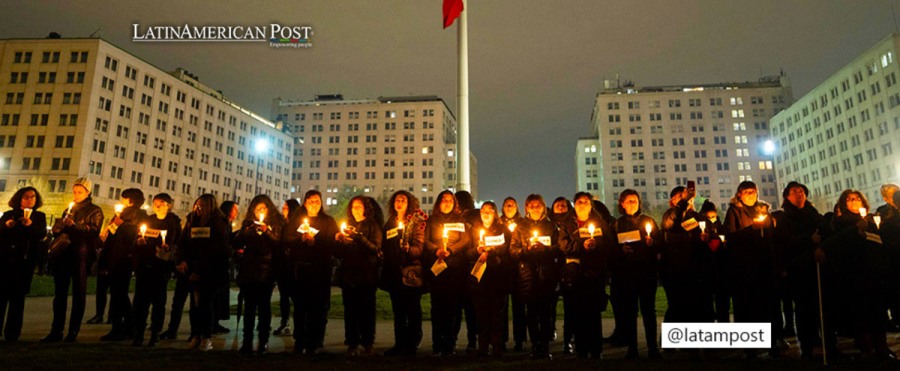
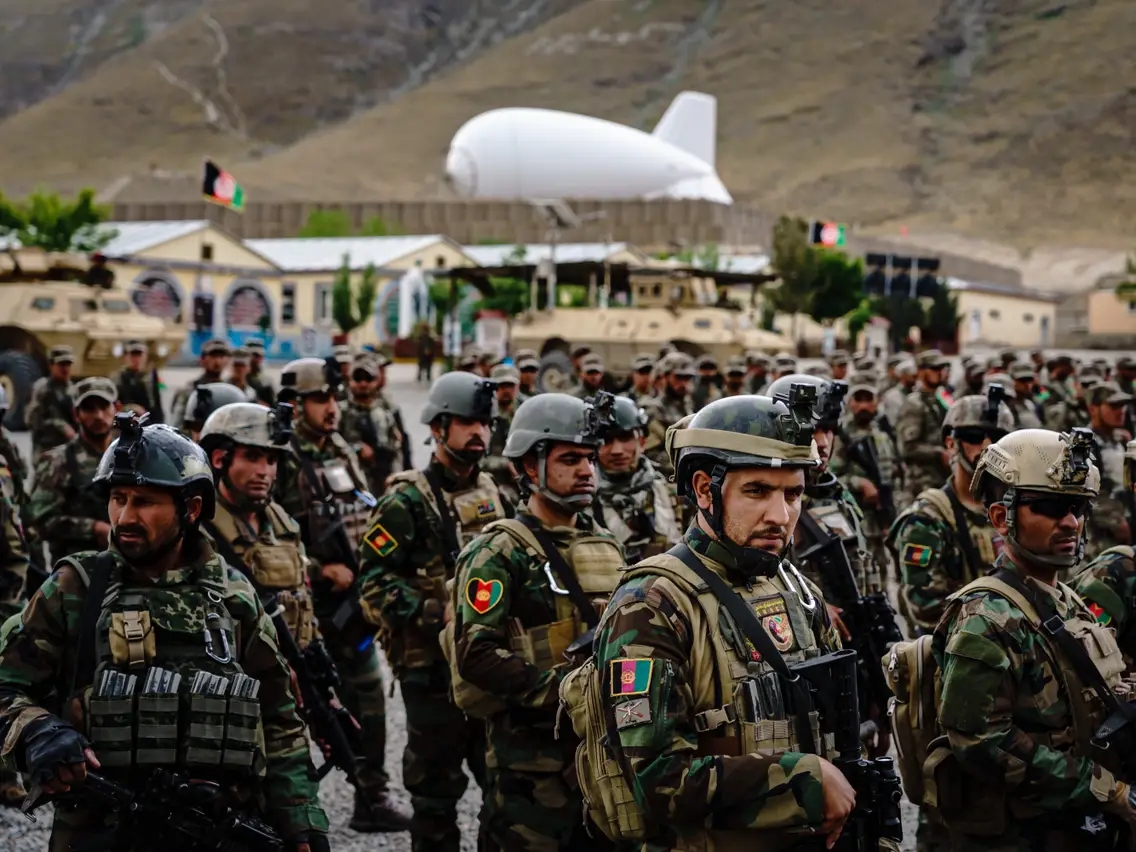
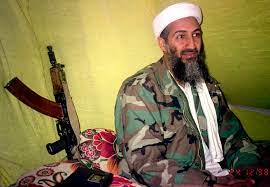
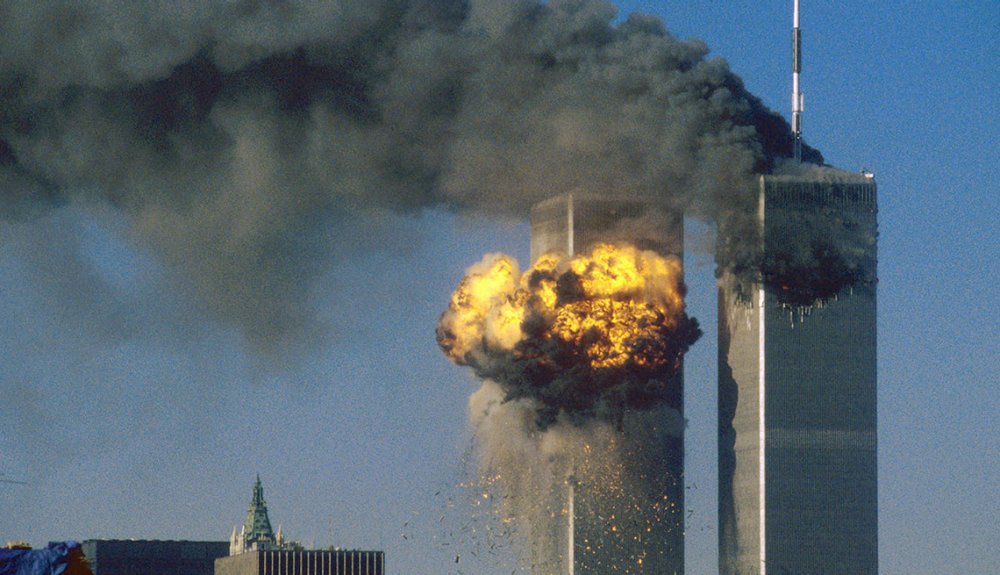
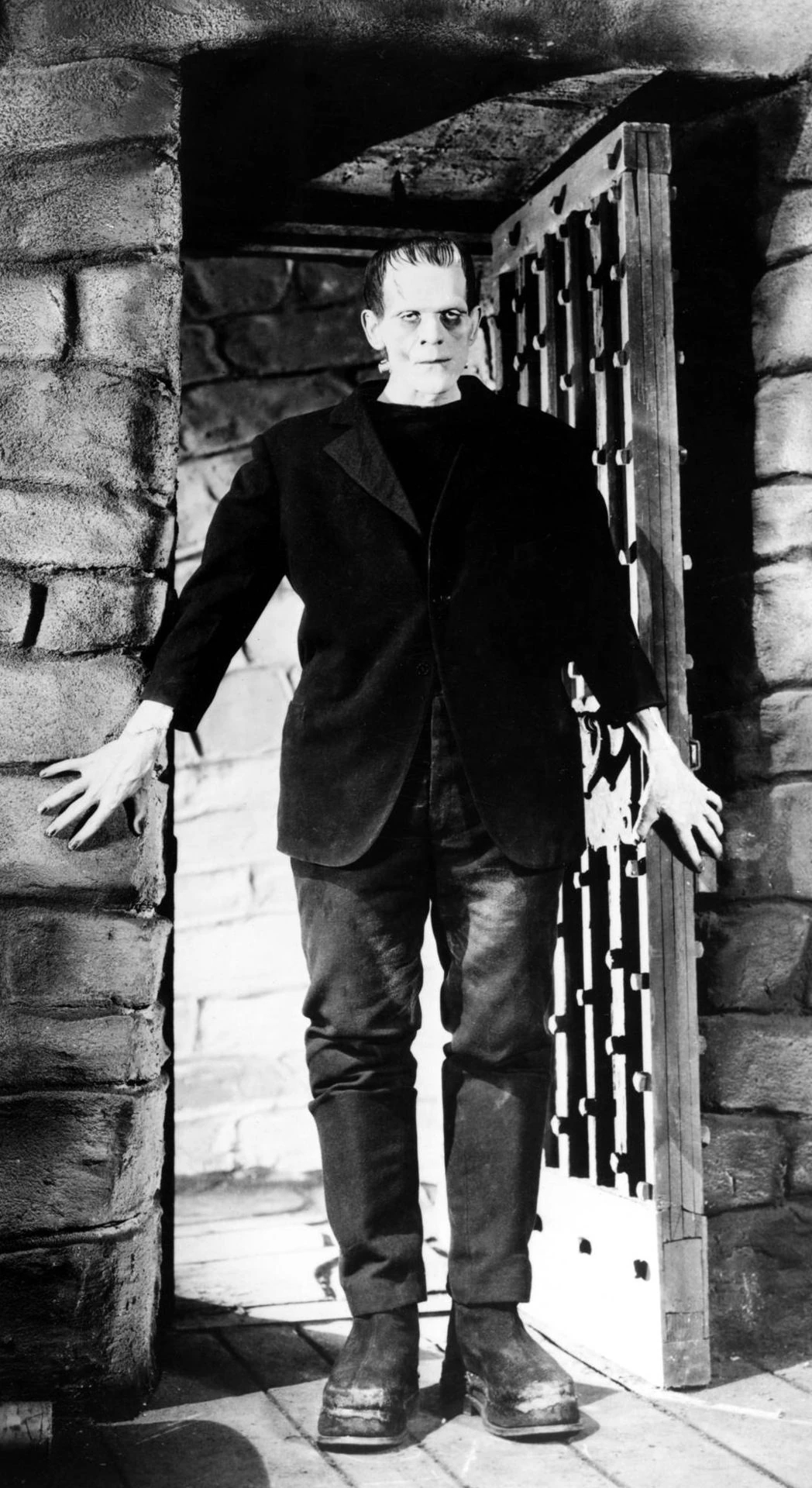
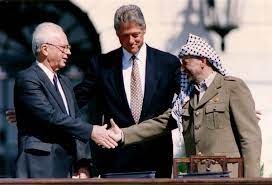
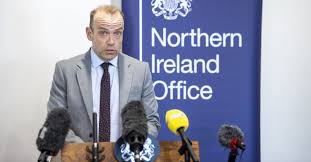
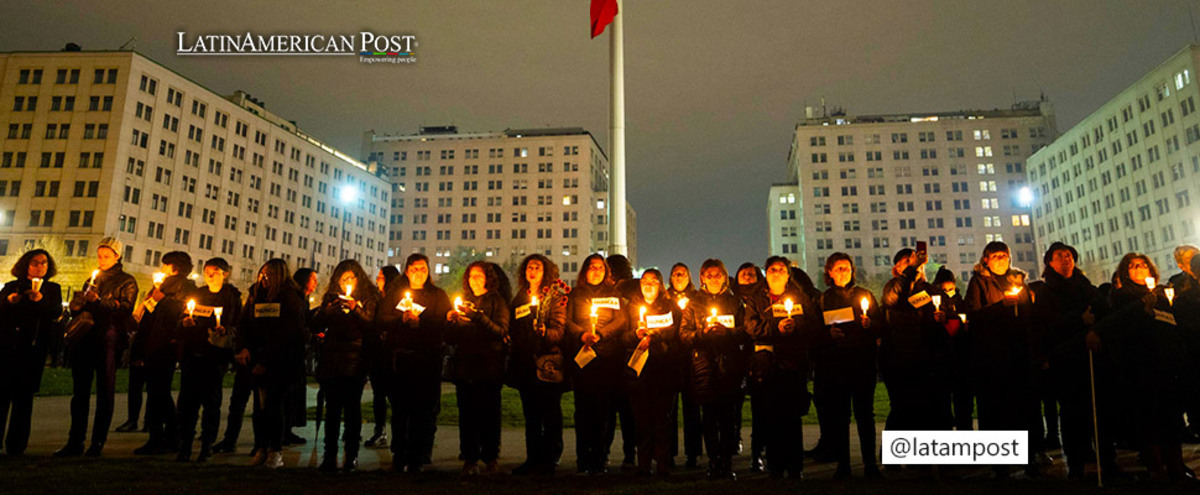


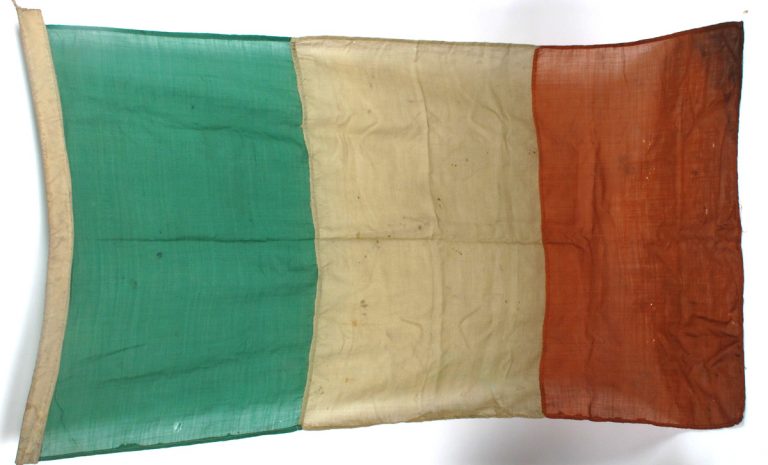

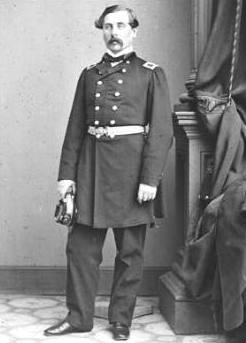
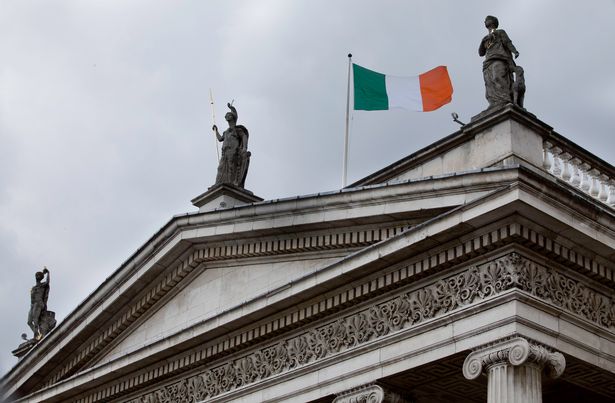



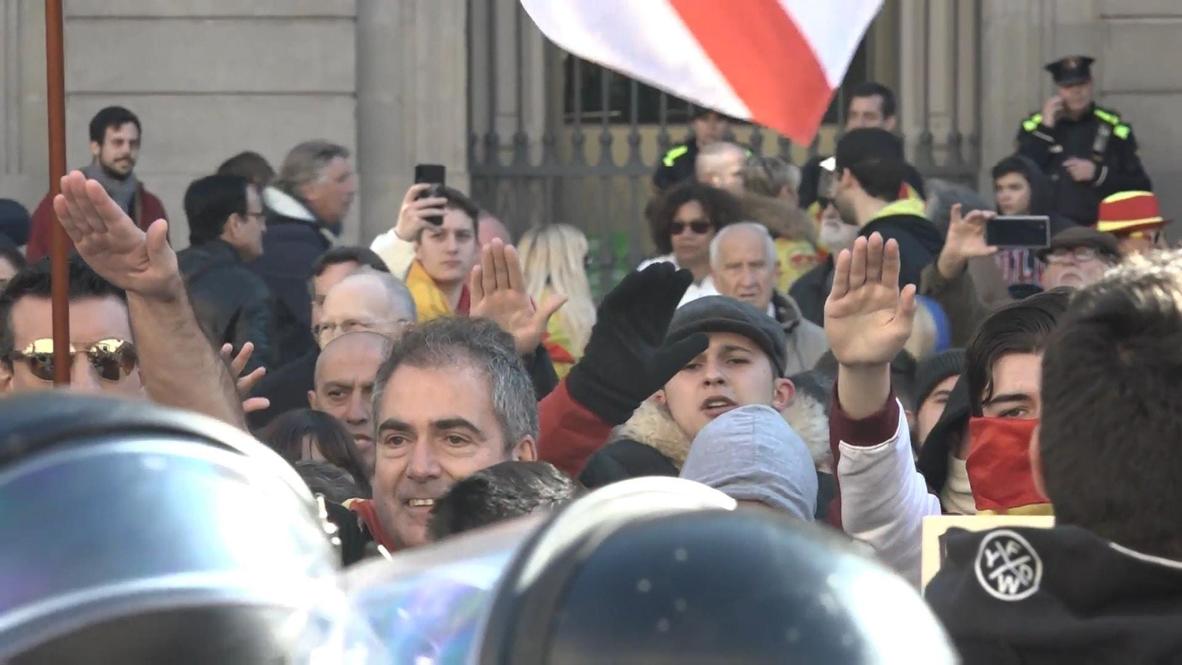
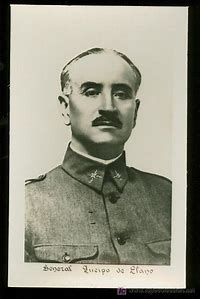


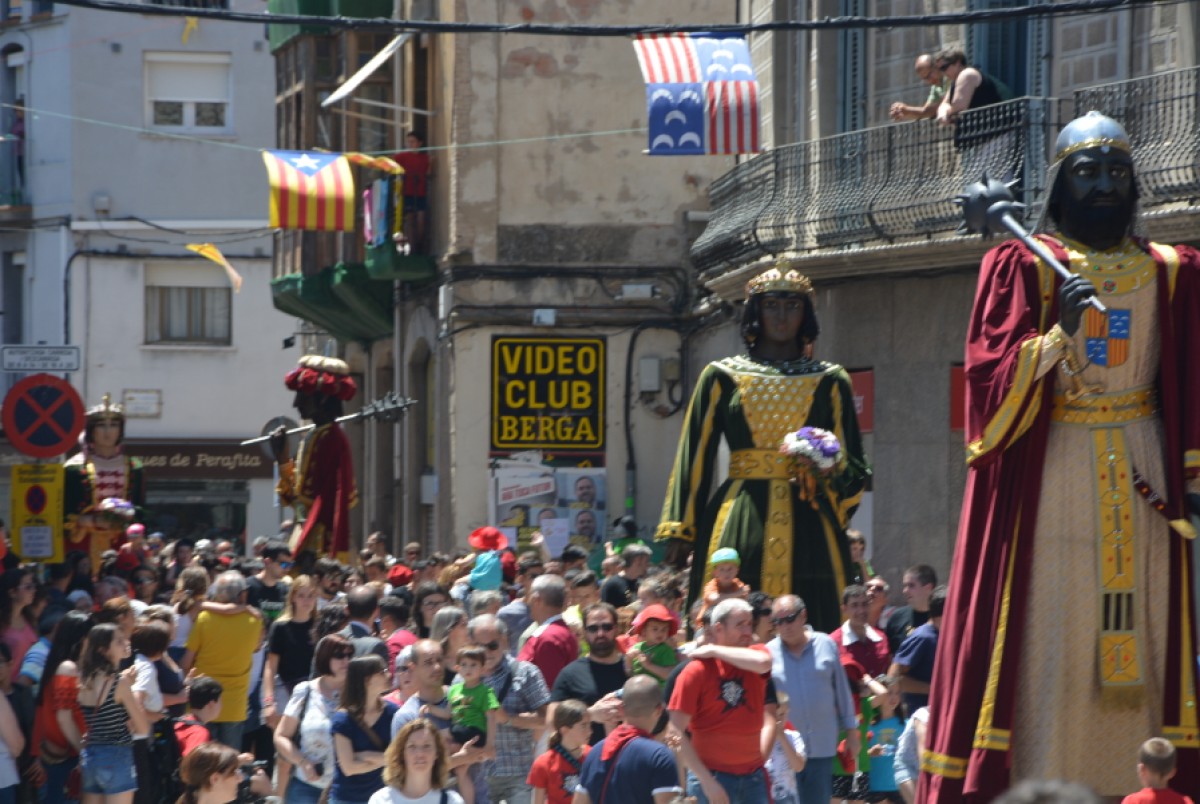
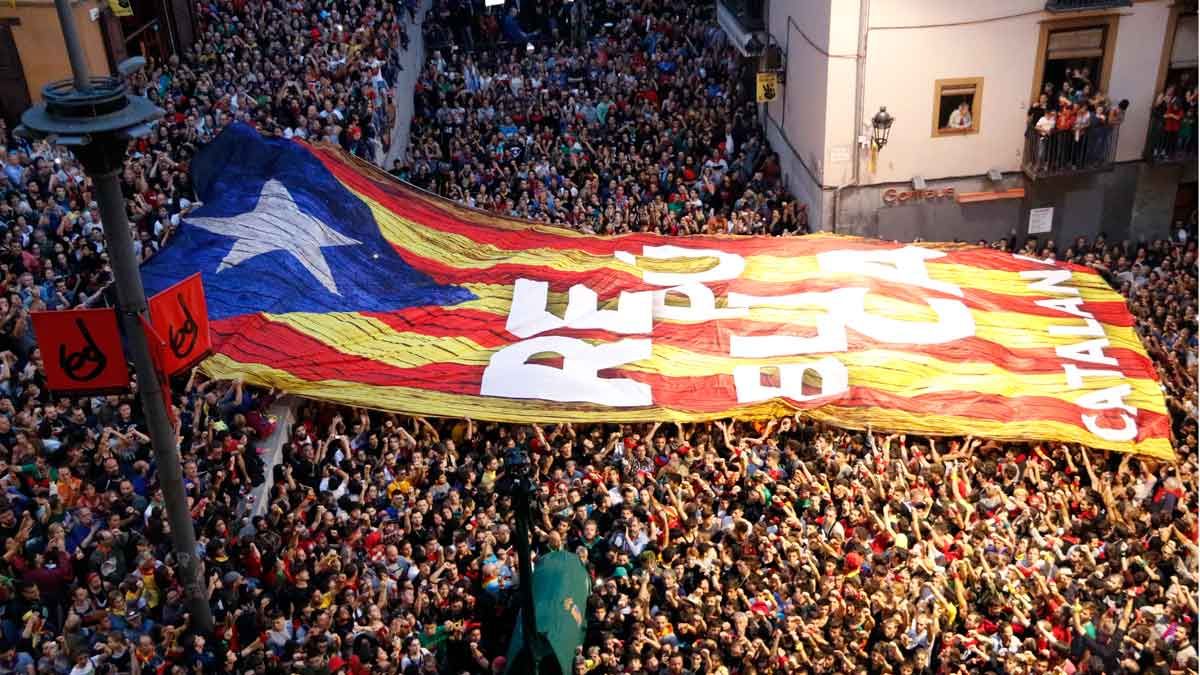
 rebelbreeze