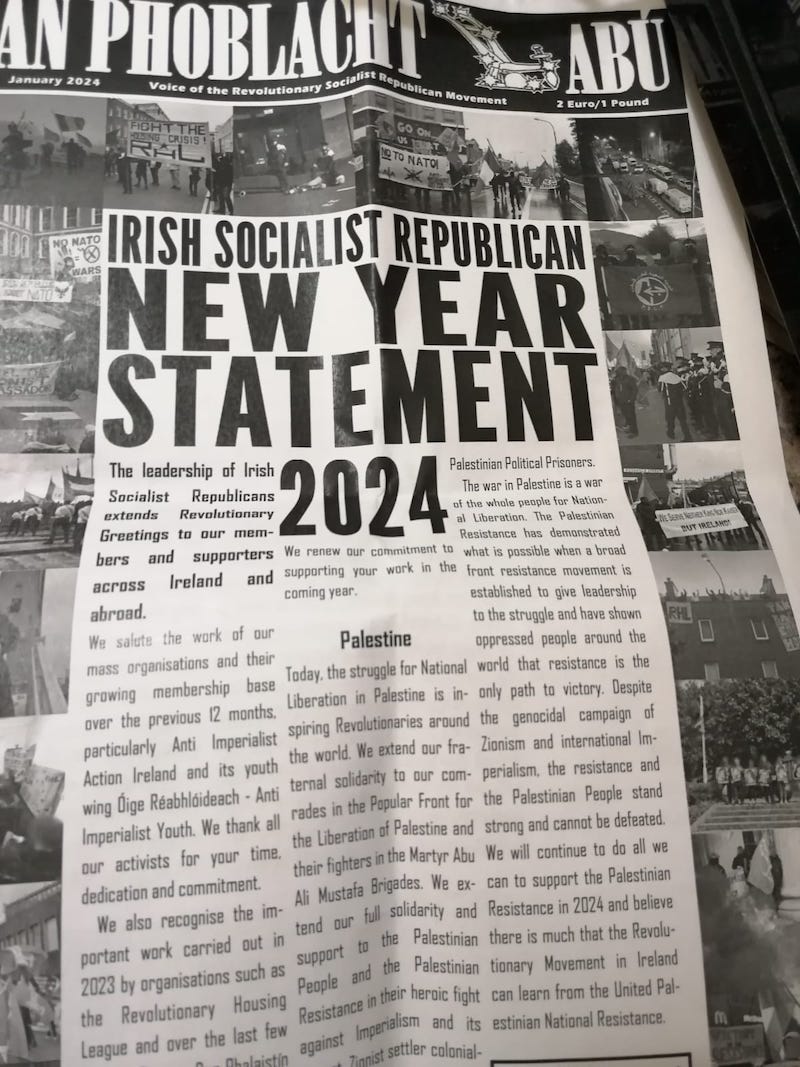
The first edition of the socialist republican weekly newspaper An Phoblacht Abú for 2024 has been available in hard copy from sellers now for several weeks; I am reviewing it here as I have done on occasion with another few issues during 2023.
APA is a hard-copy newspaper of usually 12 x A4 sides, produced monthly from I believe the last months of 2022, including articles on anti-imperialism, anti-fascism, recent Irish history, internationalist solidarity and sometimes on older history, culture and reports on events, selling at €2/£1 per issue.
Hard-copy revolutionary papers are important as a means of distribution to those who don’t wish – or are unlikely — to seek it online but more than that, they also provide the opportunity to make contact on a personal and organisational level with people with whom to discuss events.
Masthead image taken from the An Phoblacht Abú Facebook page.
However, back issues are also available electronically, I’m told, from the producers.
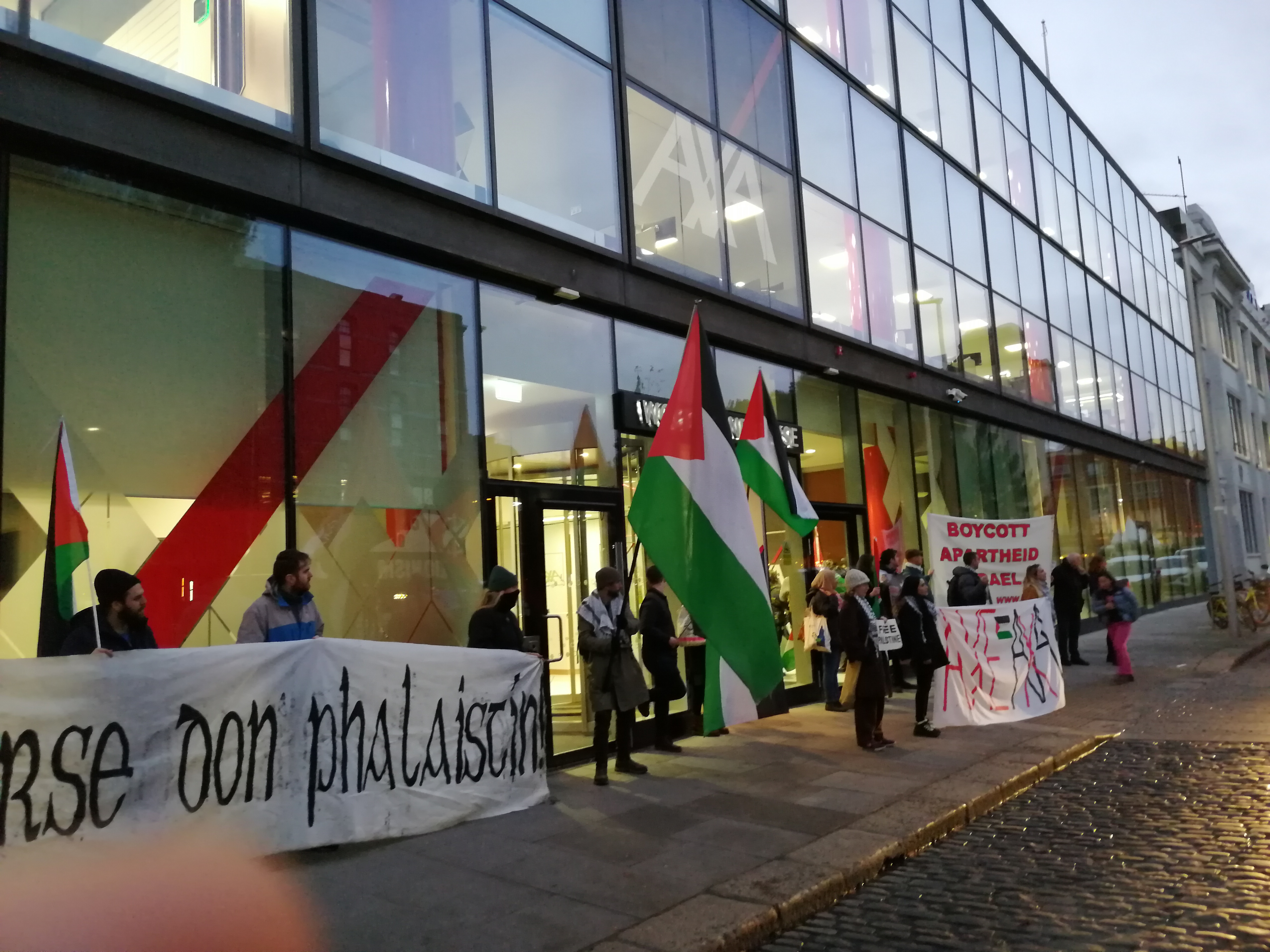
This particular issue reports on the Palestinian struggle and the solidarity movement in Ireland, featuring a report of an occupation of the Israeli Embassy on 19th December with a following picket and blockade of the gates to the building which hosts it for many hours.
Another page carries a report on Palestine solidarity actions across the country and a “Hands Off Iran & Iraq” item, also an obituary on the death of a recent comrade of the organisers. Separately there is a report and comment on the death of an Irishman in the conflict in Ukraine.
Political prisonersin Ireland and the Basque Country are also covered, the latter focussing on the ‘non-compliant’ Basque prisoners and their support network, in contrast to the colluding “official leadership” and the great majority of prisoners who have come under their influence.
An article comments on the upcoming Referendum on Article 41 of the Constitution of the Irish State, condemns the treatment of women historically by the Irish ruling class and, without recommending how to vote, calls for the destruction of the State.
Commemorations of historical events, including martyrs, are an important part of the culture of all peoples in struggle and APA reports on some. A statement on the escape from justice by natural death of war criminal Brigadier Kitson was widely shared in appreciation on social media.
NEW YEAR CALL FOR BROAD FRONT UNITY
Organisations traditionally issue New Year statements, perhaps reflecting on the past year but always looking to the coming year. The ISR NY Statement covered three pages and called attention to all the struggles discussed in the reports, along with some others.
The one theme in the Statement dominating all others was the call for united action in developing a broad anti-imperialism united front to work for unity “around common Republican principles” while at the same time maintaining “the autonomy and independence of different groups.”
In furtherance, ISR proposes that a “Broad Front Congress” be organised before the end of this year and called on those interested to contact them “to turn the demand of the Republican base into action.”
COMMENT
The importance of revolutionary newspapers is underlined historically by the preparations of the British Government prior to the General Strike of 1926, when they purchased all stocks of newsprint paper to deny them to revolutionaries and other strikers.
Governments today can close down social media transmission and reception over an area and even nation-wide.
The APA editorial is undoubtedly correct in its call for a broad front while stipulating independence of organisations within that front. A congress may further this aim but I wonder if it will, without some advance agreement on working principles (about which I have written previously).
I find it striking that in the New Year’s message which mentions working class communities, there is nothing about workplace organisation, or trade unionism, to give it another name. Working class people do not live in communities alone – they also work many hours outside them.
And in the most commonly-imagined scenario for revolution in western countries, revolution is preceded by a general strike. To organise and carry out such a strike and maintain it against external repression and internal undermining, requires leadership deep and wide within the movement.
How this is to be achieved is an issue, the resolution of which can only follow of course from recognition of its necessity. Across the Left and Socialist Republican movement I see no sign of this recognition.
The founding of this newspaper for socialist republicanism and its monthly production and distribution is a great achievement and to their credit for a young and still relatively small organisation.
Some typographical errors persist in APA which could be removed by greater editorial checking. The reproduction of images might be improved substantially too, space made for enlargement possibly by reduction in the area covered by print, increasing the visual attractiveness of the page.
However, APA is right to concentrate on the written word and the spread of themes, the reporting of actions and the reasoning behind them. A regular revolutionary newspaper has long been needed but missing and monthly production at least is needed for its effectiveness.
Fáilte uaimse roimh an nuachtán míosúil réabhlóideach seo, An Phoblacht Abú!
end.
Note: Back copies of An Phoblacht Abú are available electronically from isrmedia@protonmail.com
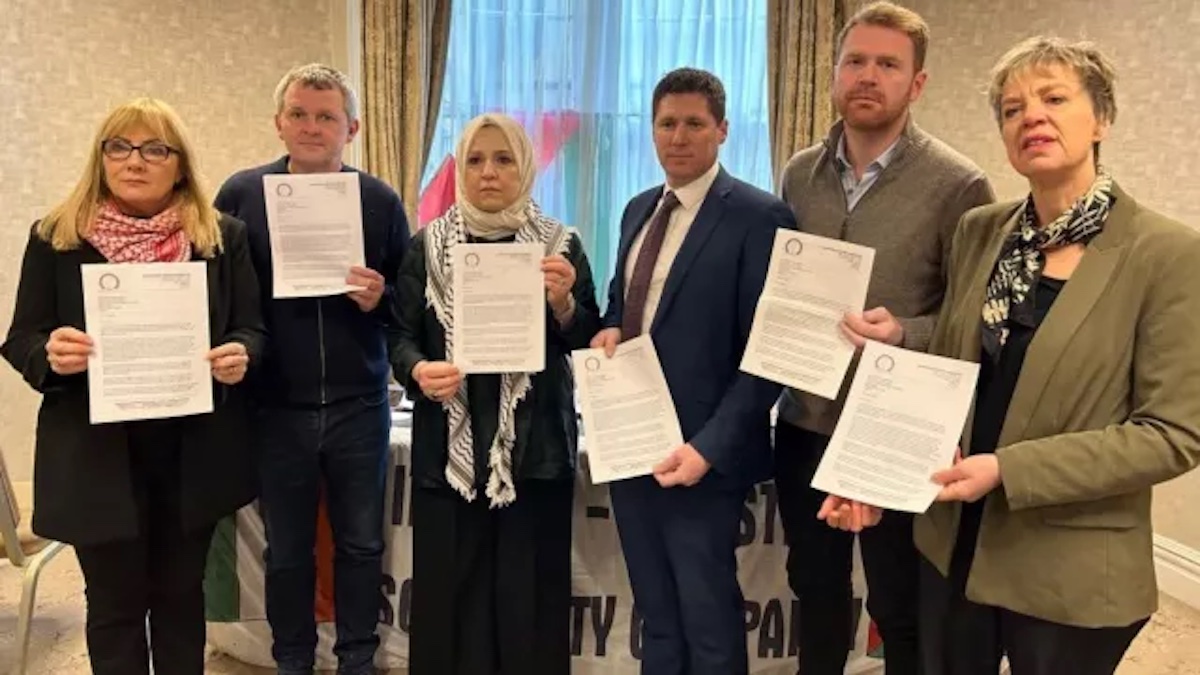
The main political opposition parties in the Irish parliament have made a united call on the Irish Government, a Coalition of Fianna Fáil, Fine Gael and Greens, to join in the genocide case against the Israeli state at the International Court of Justice.
The original case was opened recently by the South African government and the Israeli Government, to some surprise, indicated it would attend and defend itself. It is due to begin public hearing 11-12 January.
The Irish Opposition parties represented in the call on the Irish Government represent a cross-section politically: Sinn Féin, Social Democrats, the Irish Labour Party and People Before Profit. Other smaller parties have one TD1 and there are many Independent TDs of varying hues.
Accompanying the party representatives at a press conference were Frances Black, independent Senator who moved the Occupied Territories Bill to ban products from those regions, also Fatin al Tamimi, from Palestine and Chairperson of the Ireland Palestine Solidarity Campaign.
Some of these parties have moved motions in Leinster House, home of the Irish Parliament, for the expulsion of the Israeli Ambassador to Ireland. The Irish government successfully opposed that motion and also opposes joining the South African motion.
The motivation of the concerned party representatives may well mirror their own personal or political feelings, some more than others but it is undeniable that it reflect the feeling across most of Ireland (with the notable exception of Loyalist areas in the British colony).
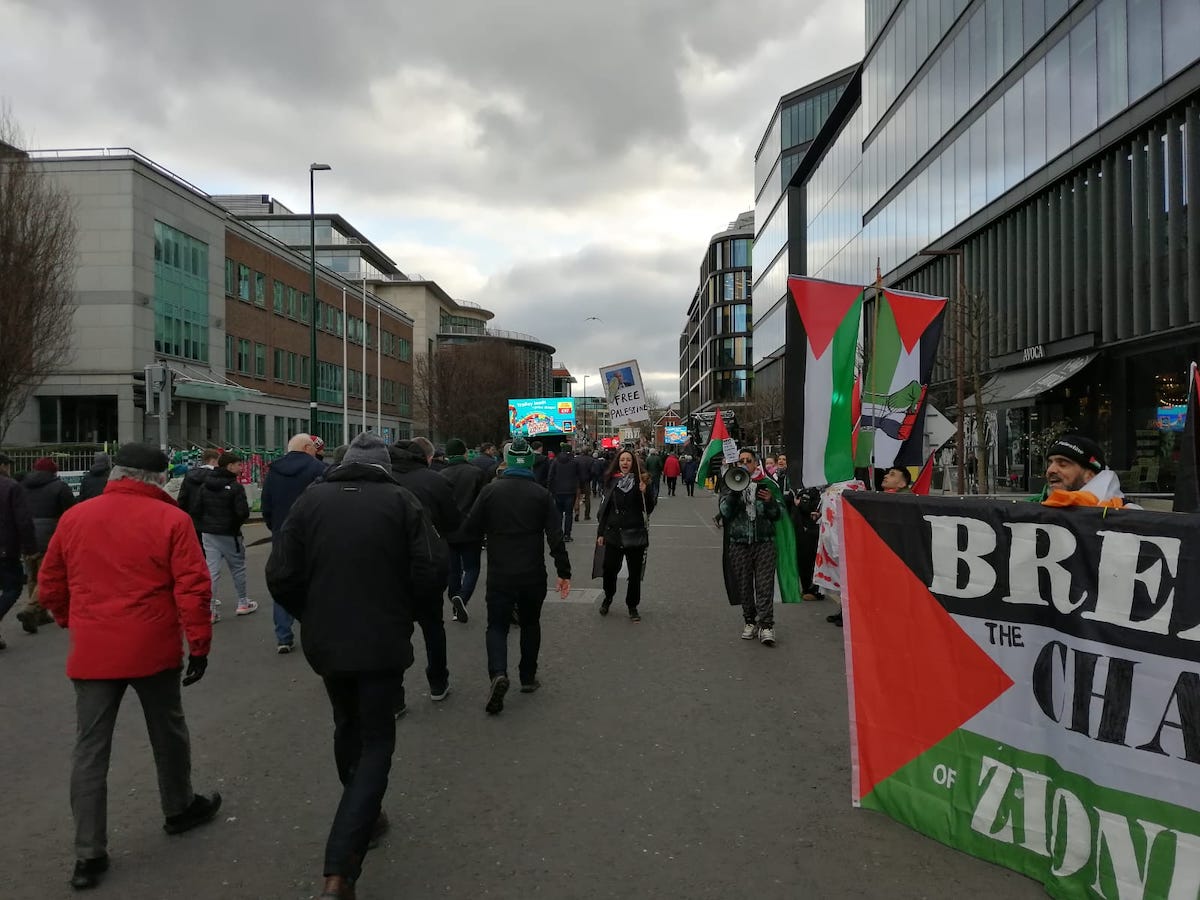
That has been the general case for decades but has grown enormously since the Zionist State’s genocidal bombardment of Gaza. Every week has seen large marches, rallies and smaller pickets in solidarity with Palestine in Irish cities and towns.
The Department of Foreign Affairs’ main office was paint-bombed in red, the company leasing the Israeli Ambassador’s offices was occupied, as was a hotel bought with a loan from an Israeli bank and also Axa Insurance, the Embassy was briefly occupied and is regularly picketed.
MacDonald’s and Starbucks have also been picketed in various areas and supermarkets have seen regular protests over their sale of goods from the Zionist State. Drivers regularly beep their horns in support as they pass Palestinian solidarity demonstrations.
Photographed at the press conference announcing their joint call, from left to right: Senator Frances Black (Independent), Richard Boyd Barrett (PBP), Fatin al Tamimi (Chair IPSC), Matt Carthy (Sinn Féin), Gary Gannon (Progressive Democrats), Ivana Bacik (Labour Party). (Photo from: Breaking News report)
THE PARLIAMENTARY PARTIES SUPPORTING THE CALL
The number and pitch of the protests and the numbers involved have definitely pushed some of the parties forward in parliamentary action, in particular Sinn Féin, widely expected to form the next Irish government coalition (though with whom remains to be seen).
Though the party was quick to ride the earlier anti-Russian publicity and call for the Russian Ambassador’s expulsion, it initially balked at doing the same with regard to the Israel one; however it had to support the call in answer to popular opinion and no doubt within its own membership.
The position of the Social Democrats on the question has been surprisingly strong and it was their leader who moved the Ambassador expulsion motion in Leinster House.2 The Labour Party3 has not been generally vocal on the issue though supported the expulsion call.
People Before Profit4 has always had a strong pro-Palestine stand but one of its leading members and TDs5 also attacked the Palestinian incursion on October 7th. Later the party developed the slogan for demonstrations that “In the face of occupation, resistance is an obligation!”
The South African case of genocide against the Israeli State seems to be gaining some support but few governments have so far joined it, despite the Deputy Prime Minister of Belgium and others advocating its support. The EU itself has hardly blinked in its support for the Israeli State.
THE INTERNATIONAL COURT OF JUSTICE
The ICJ is an organ of the United Nations and, like the International Criminal Court, with which it is often confused, is based in the Hague, Netherlands. There have been criticisms of its effectiveness and its likelihood of bias according to the state origin of each Judge.
At this moment, the main benefit of the legal charge against is the Zionist state is of public opinion against its genocidal bombing but the ICJ can also impose interim restrictions. Whether the Israeli State will obey those or indeed accept an eventual ruling against it is another matter entirely.
The Israeli state’s founding philosophy of Zionism is a genocidal one as is also its very nature of a white European settler occupation of a land already occupied by indigenous populations. It is difficult to imagine how it can tolerate condemnation of its very essence.
Nevertheless, for the moment the case and increased support for it has publicity value. However, the solidarity movement cannot afford to relax on iota and in fact needs to up the pressure on the Zionist entity and all its supporters, be they states or corporations.
End.
Footnotes
1TD = Teachta Dála, elected Parliamentary representative.
2Her speech to the rally outside Leinster House the evening of the debate was more militant than Sinn Féin’s representative.
3The party, though founded by militant syndicalist Jim Larkin and revolutionary James Connolly, has been in coalition government a few times, mostly with the right-wing Fine Gael and was noted for attacks on the working class, despite its trade union support base.
4Like its namesake in Britain, it is mainly a version of the Irish iteration of the Socialist Workers’ Party, founded in the UK.
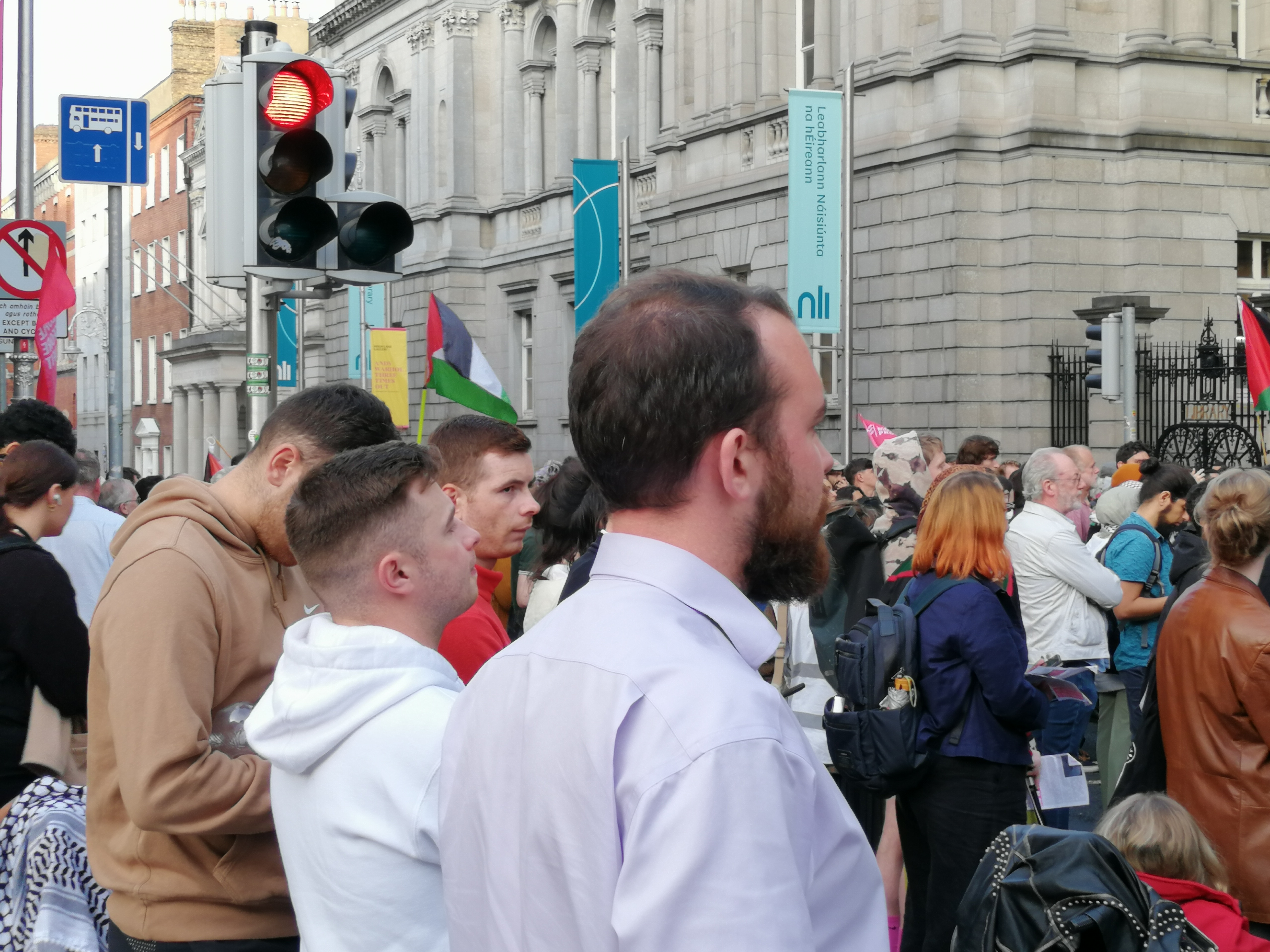
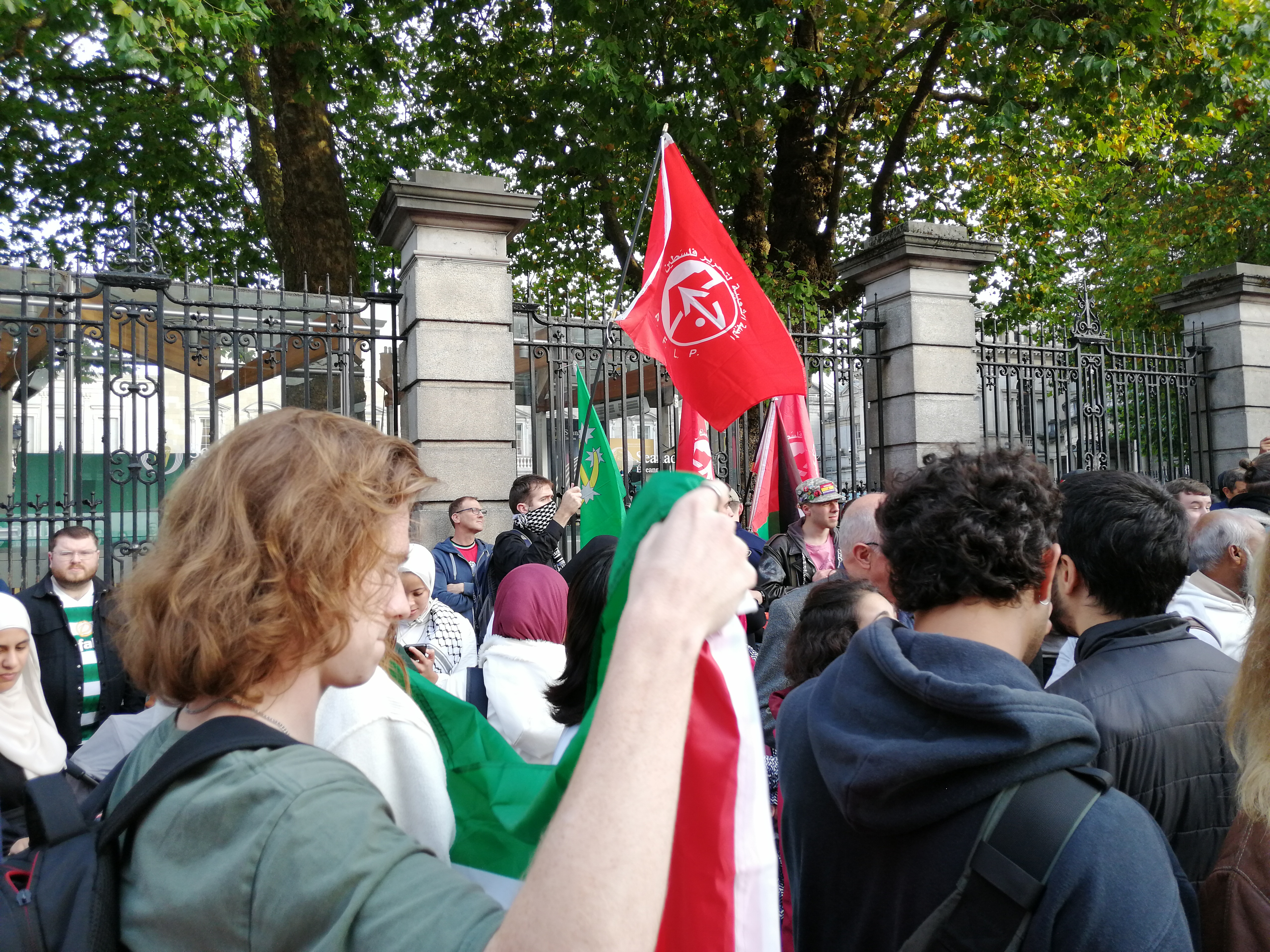
As smoke rose over the homes and shops of Gaza, an unseasonal October brought sunshine on to the streets of Dublin city centre and the crowds with Palestinian flags outside Leinster House, the home of the parliament of the Irish State.
As the sound of explosions, wailing of ambulances and of people rang around the streets of Gaza, the call-and-answer of solidarity rang out in Kildare Street: In our hundreds, in our millions – We are all Palestinians! From the river to the sea – Palestine will be free!
The Dublin rally was one of a number of Palestine solidarity events organised in Ireland after the unprecedented attack on Israel by Hamas’ military wing, the Al Qassam Brigades on Saturday and the Zionist State’s bombardment of civilian structures and people in Gaza.
Small section of the rally (Photo: D.Breatnach)
The Zionist State, which also controls Palestine’s water supply to Gaza, as well as exit from and entry to the enclave, has cut off water and electrical power as well as barred entry to everything including food, medicine and heating gas.
The Dublin rally was called at very short notice by the Irish Anti-War Movement (IAWM), a broad front organisation formed by the People Before Profit party around 2003 to oppose the imperialist war against Iraq waged by the Coalition of states led by the USA.1
Section of the solidarity rally earlier (Photo: D.Breatnach)
A branch of the Student’s Union of Ireland also supported the rally, which had a high percentage of Middle Eastern people present, presumably mostly Palestinians. The flags in evidence were mostly national Palestinian, some of the PFLP,2 a couple of Starry Ploughs and one Tricolour.3
Speakers from the Palestinian community, IAWM and PBP condemned the decades of attacks by the Israeli state on the Palestinians in general and on those in the Gaza enclave in particular, going back to the expulsion of 700,000 Palestinians4 as the Zionist state was founded in 1948.
Starry Plough flag can be seen centre distance next to some PLPF flags (Photo: D.Breatnach)
Richard Boyd-Barret TD (PBP) spoke as did also Ibrahim Halawa from Dublin, who was a prisoner of the Egyptian regime for four years without trial. Halawa said that awareness-raising and education served the ignorant but that action is required from those who know the real situation.
Some of the orators spoke about the right to resistance of the Palestinians, some about being against killing and war (but blaming the Zionist state for causing it), some about the plight of the Palestinian civilians, particularly in Gaza and one referred to the thousands of political prisoners.
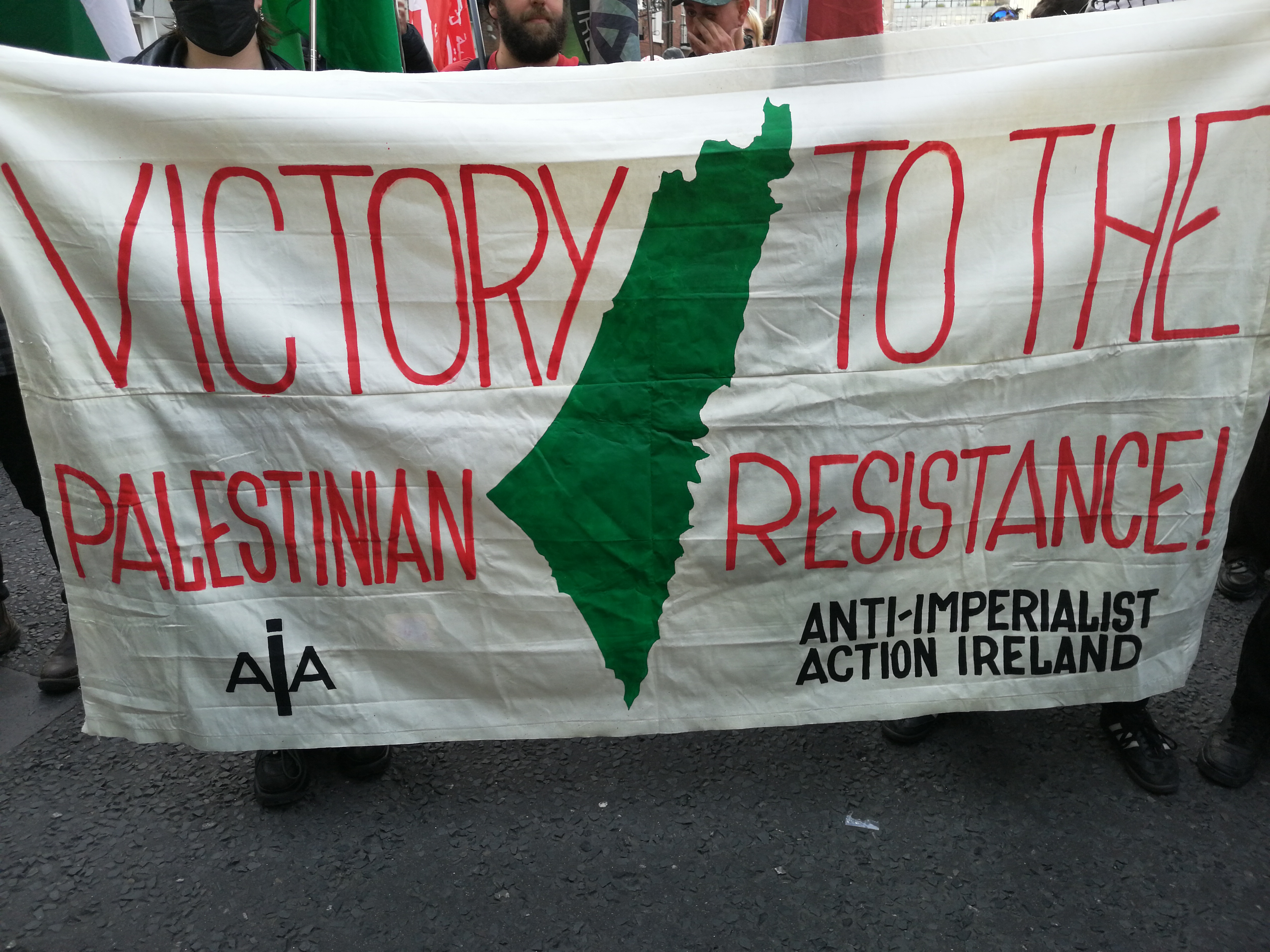
Woman carries home-made giant placard spray-painted “Victory to the Palestinians!” (Photo: D.Breatnach)
MIND THE LANGUAGE!
A number of speakers referred to the “International Community” and when one listens to them in context it becomes clear that this imagined “community” is one of capitalism and imperialism.
It is not the community of workers, much less the community of people struggling for freedom. In Ireland, the overwhelming majority of people have over decades seen through the Zionist propaganda and switched from being pro-Israeli State to being pro-Palestinian.
We should take more care with the words we use lest we reinforce capitalist-imperialist dominance in the world of concepts in addition to their dominance over the physical world. Another trap is the term “illegal” and Boyd-Barret used it in reference to Russia’s invasion of eastern Ukraine.
Banner seen at the rally (Photo: D.Breatnach)
Who makes the international laws by which something is ‘legal’ or ‘illegal’? It is of course the imperialists who do so on the international scale while the capitalists define legality within their states; by their standards the actions of Israeli Zionism are lawful but of Palestinians, illegal.
All the speeches and all the slogans chanted were in English, as were the words on banners. I participated in some Irish conversation near where I was standing but saw only one placard in Irish. The fact that this is normal is part of the problem in this neo-colonial state.
A lone placard in the Irish language seeks “Freedom for Gaza” (Photo: D.Breatnach)
Eoghan Ó Ceannabháin, from an Irish speaking-family from Connemara and himself an Irish speaker, also spoke in English as he introduced the song he was about to sing, in the same language as the lyrics of Patrick Galvin’s Where Is Our James Connolly?
Eoghan is a PBP supporter and a fine singer, particularly in sean-nós5 style and has an amazing range. It was good to hear references to James Connolly at such a rally, something that all too rarely happens, nor is the flag of his Irish Citizen’s Army often seen at internationalist events either.6
CONDEMNATION IN COLLUSION, CONFUSION AND ILLUSION
The imperialist states that united in condemnation of the attack by the Izz ad-Din al-Qassam Brigades, Hamas’ military wing, were joined by leaders of neo-colonial states such as the Irish one. Naturally also by parties competing to lead the neo-colonial Executive, such as Sinn Féin.
Media reports noted Mary Lou Mac Donald’s condemnation of Hamas as a change in Sinn Féin policy7. Indeed it is such a change but is generally in line also with the party’s trajectory of presenting itself as a safe pair of hands for management of the neo-colonial state.
Sinn Fein President Mary Lou McDonald and Micheál Martin, leader of Fianna Fáil and currently Tánaiste. (Images sourced: Internet)
Mícheál Martin, Tánaiste (Vice-Premier), who earlier had condemned Hamas, stated that the Government’s position is to support the “two state solution”, more correctly “the two-state illusion” and this, if not already SF’s position on Palestine will no doubt soon be so.
This is the position of all the imperialist and capitalist states, also of social-democratic and liberal groups. It is worth taking a minute to look at this “solution” which in the first place was totally undesirable and which since conceived has been undermined by the Zionists themselves by their colonial expansion.
If it could even be implemented now it would leave the Palestinians with in reality a colonial-type Bantustan-status client of the Israeli Zionist state8, owning less than 40% of their land area and most of their good land and water taken by Zionist settlers.
In addition, their territory would be fragmented, linked by “corridors” through areas of Israeli dominance. In any case, as of 2021, in a poll by the Palestinian Centre for Policy and Survey Research most Palestinians were against the two-state solution.9
Since this is not in the least a practicable solution, why does Mícheál Martin and Joe Biden, among many others10 keep saying it’s their preferred solution?
Biden, because it allows US imperialism to pretend that it supports some kind of solution other than total Zionist appropriation and expansion. Mr. Martin? For the same reason or just because his Gombeen class follows the world imperialism leader’s lead.
The only real solution, i.e the only one both just and capable of bringing peace, is the one that we hardly ever see or hear even mentioned: a secular republic with equal citizenship for all, return of refugees and reparations to the dispossessed Palestinians.
(Photo: D.Breatnach)
The Zionists will not accept the loss of their Zionist empire; US imperialism (and other imperialisms) won’t accept the loss of their only safe strategic foothold in the Middle East – free from the dangers of either Islamic fundamentalist or national liberationist revolution.
US imperialism, now sending an aircraft carrier against the Palestinian people who have neither air force nor navy, is the main financial and political prop supporting the Zionist state. But whatever they thought, I heard no speaker in Dublin call for the necessary defeat of US imperialism.
end.
Scene earlier of the rally as people keep arriving (Photo: D.Breatnach)
FOOTNOTES
1The IAWM seems to have no permanent existence but can be revived in order to organise events such as today’s from time to time. There is nothing wrong with a party creating a broad front on a specific issue but when it is a front of the Party rather than a people’s front, it will of course suffer when the party’s activists, limited in number, are organising on other issues and cannot keep the ‘broad front’ going, much less expand it.
2The Popular Front for the Liberation of Palestine, a secular socialist organisation fighting for Palestinian national liberation; it has consistently been the 2nd-largest of the groups comprising the Palestine Liberation Organisation.
3The Starry Plough was the flag of the Irish Citizen Army, the first workers’ army in the world and usually signifies socialist Irish republicanism. The Plough painted in gold follows the shape of the Ursa Mayor constellation on a green background, the seven stars in white or silver. Another version appeared in the 1930s, the Ursa Mayor shape in white stars on a light blue background.
Obviously people carry Palestinian flags to show solidarity with Palestine but would it not be useful to carry Irish flags at such an event to demonstrate the solidarity of the Irish movements for national liberation and social progress with the corresponding movements in Palestine?
4That figure represented over half the pre-WWII Arab population (Muslim and Christian) of Palestine.
5Literally “old-style”, a traditional style of singing with ornamentation having a number of regional variations, nearly always unaccompanied and solo-voiced.
6James Connolly was a Scottish-Irish socialist revolutionary, writer, journalist, trade union organiser and historian, one of the Seven Signatories of the 1916 Proclamation, Dublin Commandant in the 1916 Rising, one of the 16 executed by British firing squads. He was a co-founder of the Irish Citizen Army to defend the strikers and locked-out workers in 1913 from vicious police attacks, the first workers’ army in the world, which also recruited women, some of whom were officers. The ICA fought alongside other progressive organisations in the Rising.
7And one which cut across the quoted posts of a number of the party’s TDs, including those of Chris Andrews (see Irish Times report in Sources).
8A real irony since Israel is a kind of colony, a state founded by Zionist settlers with imperial support.
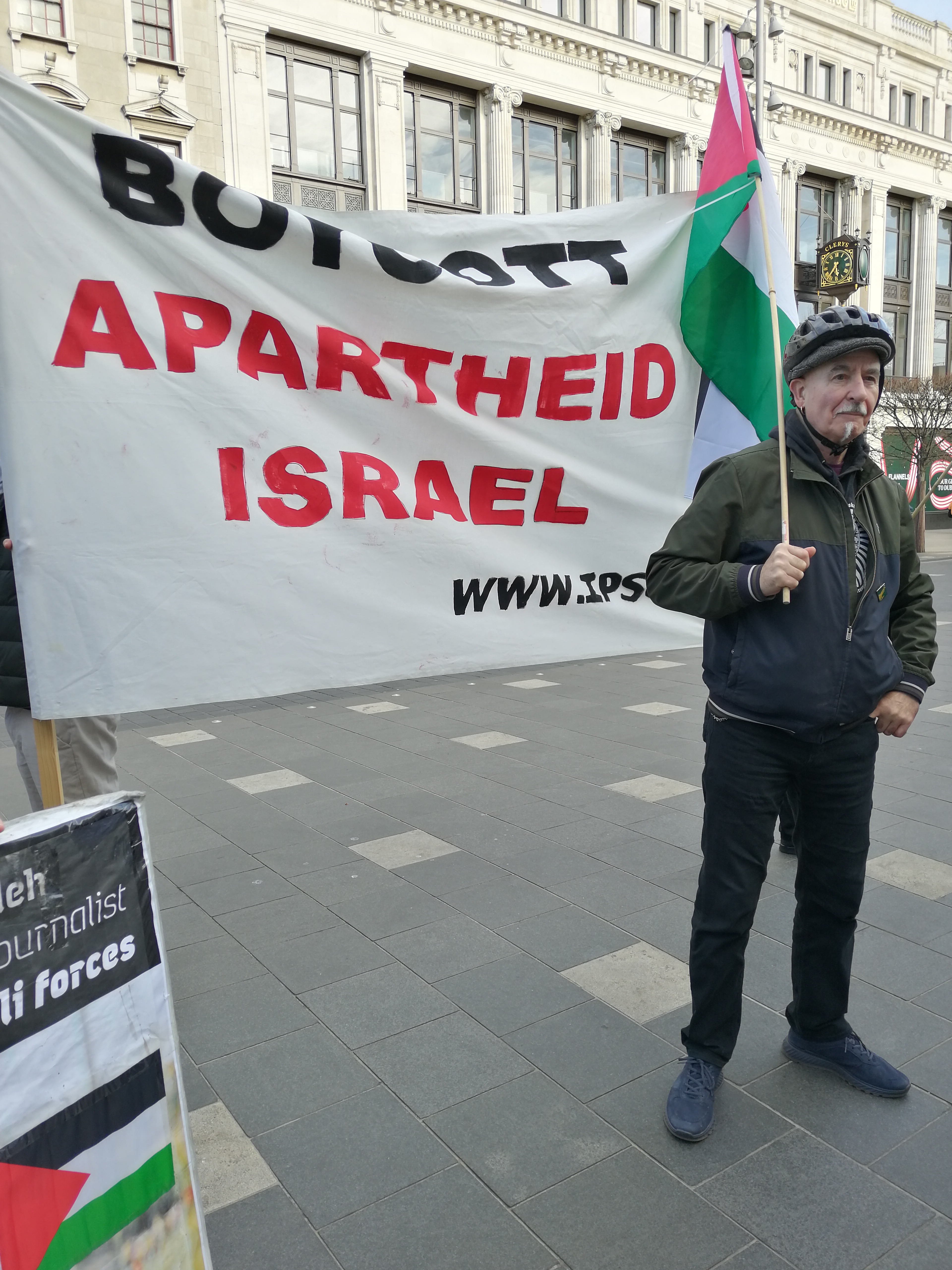
Palestinian flags waved as people gathered on the pedestrian reservation in Dublin’s main thoroughfare, O’Connell Street, to mark Palestinian Land Day March 30th, anniversary of the 1976 confiscation of Palestinian land by the Israeli Zionist State.
Naturally, the event also addresses the continual threat to additional Palestinian land by Zionist settler occupation, Israeli judicial and army demolition of Palestinian housing and intimidation, harassment and terrorism against Palestinians in Jerusalem.
Palestine supporters gathering for Land Day (Photo: D.Breatnach)
The Dublin event was organised by the Ireland Palestine Solidarity Campaign, a broad organisation that receives broad support not only across the Irish Left and Republican spectrum but also from a great many non-aligned Irish people and even many among voters for mainstream political parties.
This support was emphasised by frequent drivers in passing traffic, both public, taxis and entirely private, blowing their horns in approval of the rally. The population of the Irish state has gone from being in general support of the Israeli State to being generally hostile to its behaviour.1
Zionists tend to depict anti-Israeli Zionism as being anti-Jewish and therefore, according to them, “anti-semitic”2. Quite apart from the wide inapplicability of the term and some isolated historical examples dredged up3, it fails to account for the change in public attitudes over recent decades.
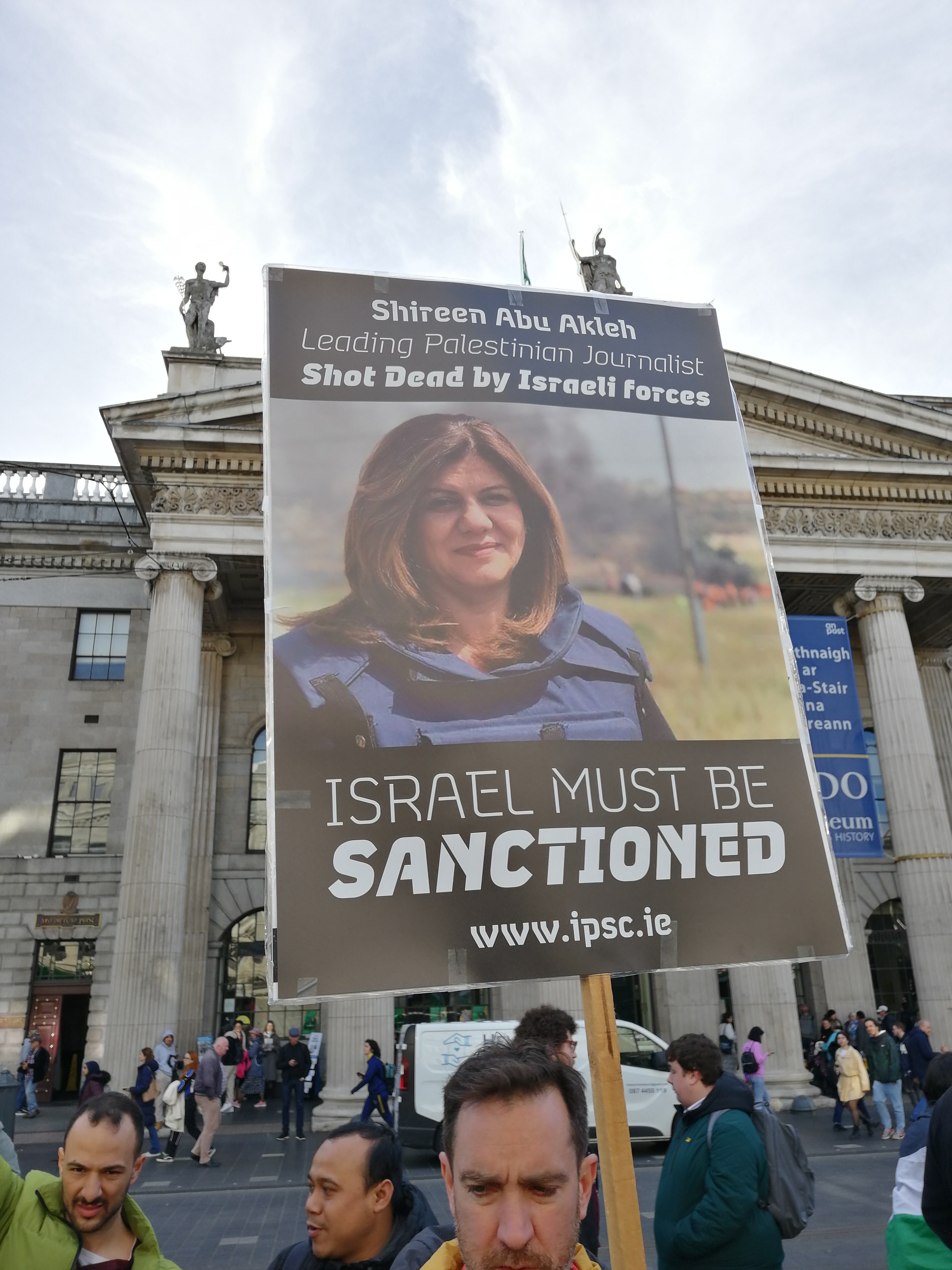
The iconic GPO in the background (Photo: D.Breatnach)
It has been years of viewing even media-sanitised coverage of massacres of Palestinians by the Israeli armed forces with international impunity that has radically altered the opinion of the public in Ireland, in all probability drawing on their own historical experience of foreign occupation.
An elderly Irishman voicing anti-Jewish views did in fact approach the rally but was confronted by other Irish people who emphasised that they were against the Zionist state and not against Jews, soon causing the first man to depart unhappily.
The continual occupation of Palestinian land by Zionist settlers has invalidated even the “two-state solution” (sic) beloved of liberals, making it a practical impossibility, undermining the main ‘concession’ of the supposed solution of the USA-mediated “Palestinian peace process” of 1991.
(Photo: D.Breatnach)
The refusal of the Israeli authorities to permit the return of Palestinian exiles while welcoming Jewish settlers, most of whom had no even ancestral connection to Palestine, means that the future for Palestinians in the Israeli state can be at best as an oppressed minority.4
(Photo: D.Breatnach)
Other Palestine news
Even as preparations for the Dublin rally took place, Israeli police shot dead a Palestinian they claimed had tried to wrest a gun from them at the Al Haq Mosque but whom Palestinian eye-witnesses said had merely been protesting the police harassment of a woman.
Since the rally, another two Palestinians have been killed in an by Israeli armed forces raid on Nablus. This brings the total number of Palestinians killed by Israeli forces this year alone to over 90, with a high proportion of them children.
Mass protests and even mini-riots by Israeli Jews are currently expressing opposition to the current government’s plans to ‘reform’ the judiciary, to bring it under the greater control of the Executive.
While Israeli Jews are deeply divided on this question the vast majority are agreed on the need to suppress Palestinians, to enforce apartheid and to keep the State as ‘Jewish’ one.
Meanwhile an April 1st Fool’s Day hoax depicting an executive of the sports shoe manufacturer company Puma declaring a boycott of the Zionist state was widely shared on the Twitter social media to overwhelmingly welcoming comment.
Exposure of the hoax received mixed responses, with wide condemnation from pro-Israeli and even some pro-Palestinian sources but others claiming it helped to widely publicise the manufacturer Puma’s close links to the Zionist State and that would enhance its boycott by many.
End.
(Image accessed: Internet)
Footnotes
1Dublin City has had Jewish municipal Councillors and the sixth President of Israel, Chaim Herzog (Hebrew: חיים הרצוג; 17 September 1918 – 17 April 1997) was an Irish-born Israeli politician, general, lawyer and author who served as the 6th President of Israel between 1983 and 1993. He was born in Belfast and raised primarily in Dublin; his father was Ireland’s Chief rabbi Yitzhak HaLevi Herzog, who immigrated to the British protectorate of Palestine in 1935 and served in the Haganah Zionist paramilitary group, later the Israeli Army where he reached the rank of Major-General. As recently as 1967 the prevailing Irish public opinion seemed sympathetic to the Israeli State and the fictional propaganda and wildly inaccurate historical Hollywood films Exodus (1960) and Cast a Giant Shadow (1966) were widely viewed sympathetically in Ireland.
2The term originally included hatred or fear of all Semitic people, including Arabs and Jews but has come to be understood as exclusively meaning a racist attitudes towards Jews. By no means all Jews are Zionist though Zionists have worked long and hard to make both descriptions interchangeable with a great deal of success among the world Jewish population with possible unfortunate consequences for Jewish populations outside Israel. However many Jews have criticised the behaviour of the Zionist State towards Palestinians, earning the hatred of the Zionists, who cannot label them as anti-semitic and therefore call them “self-hating Jews”.
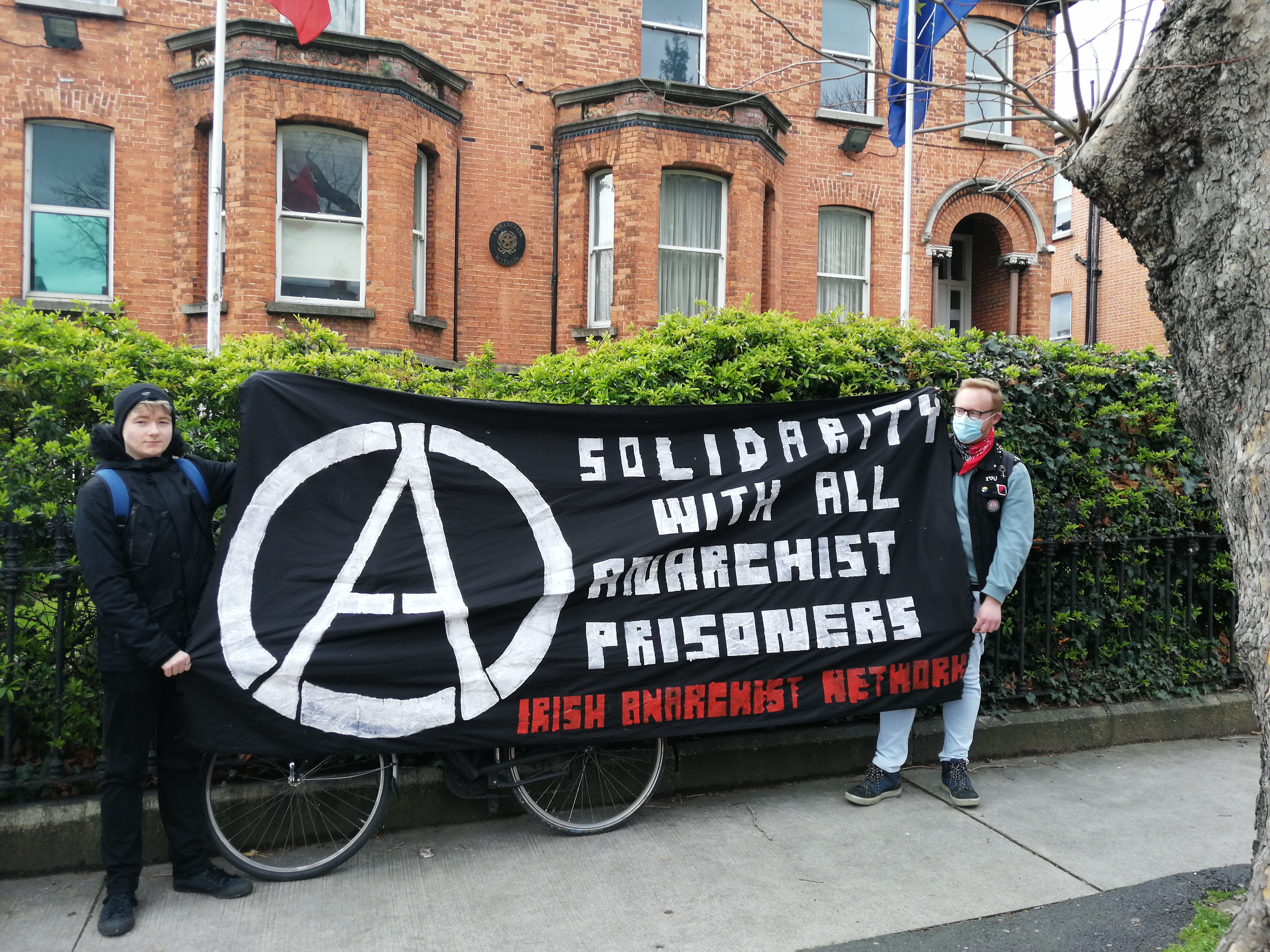
A picket outside the Italian Embassy in Dublin on Thursday (23rd) was part of a day of action across Europe in solidarity with an Anarchist prisoner on hunger strike since October in a struggle for more humane prison conditions.
The picket, organised at short notice, included Irish Republicans, Anarchists and revolutionary Socialists. Banners and placards indicated the presence of Saoradh, Irish Anarchist Network and Ireland Anti-Internment Campaign.
At one point five uniformed Gardaí stood near the Embassy’s gate while three plain-clothes Special Branch (i.e. political police) watched from a car across the road. The police numbers may have been due to a request from the Embassy in the midst of attacks on some Italian Embassies in Europe.
Despite the presence of Gardaí, Embassy staff appeared nervous, meeting one visitor at the gate to check her reason for attendance after speaking to her on her mobile phone, rather than first allowing her to enter the garden and approach the main entrance.
Some of the uniformed Gardaí attending the solidarity picket and some of the protesters. (Photo: IAIC)
Three Special Branch Gardaí (political police) parked across from the picketers, surveilling them (Photo: IAIC)
THE HARSHEST ITALIAN PRISON CONDITIONS
Alfredo Cospito is an Italian political prisoner kept under the harshest Italian prison conditions, “41-bis”, which include solitary confinement for most of the day, family visit once a month through glass, no reading matter sent from outside and no phone calls in either direction or lawyer privacy.
According to information on the Internet, these inhumane conditions were developed for Mafiosa leaders, in order to prevent them running their organisations from inside jail and also to pressure them into breaking ranks and informing on their colleagues.
Whatever we may say about that, what can be the intention of subjecting a political prisoner to those conditions, except to break him or to destabilise him mentally? EU recommended rules on prisoner management don’t recommend more than three weeks in solitary confinement.
Lawyers for political prisoner Nadia Lioce, who has been living under the 41-bis regime for two decades, have said due to limited hours permitted contact, she has effectively only interacted with people for a total of 15 hours in the space of a year.
Italian media reported Lioce’s lawyers as saying she is now so “psychologically isolated” that, when her mother and sister visit, she is unable to speak to them for more than a few minutes.
Some of the picketers, the Italian Embassy in the background (Photo: IAIC)
Amnesty International and the European Court of Human Rights have both criticised several aspects of the 41-bis, and in 2007 a US court refused to extradite a convicted Mafia drug trafficker on the grounds that the 41-bis regime he would face in Italy would have “constituted torture”.
The Anti-Imperialist Front gave a call for an international solidarity day of action which found an active response in many countries.
Alfredo Cospito’s case is up for review by the Italian prison system this month and pickets and other actions have been organised around Europe to exert pressure on the Italian penal authorities to release Cospito into house arrest in his sister’s home.
The picket displayed not only internationalist solidarity but exemplary broad unity of disparate political forces in solidarity with an Anarchist political prisoner. Hopefully this unity will continue to be built upon as time goes on, for the unfolding struggles of class and nation demand it.
Hopefully the international actions will cause the Italian authorities to relax the inhumane conditions of Alfredo Cospito’s incarceration but now Italian authorities are claiming that Cospito is somehow coordinating violent actions from within his extreme isolation.
Another two of the picketers (Photo: IAIC)
A side trip into history
The Italian Embassy is in Northumberland Road, on the south side of the Grand Canal (near the Israeli and US Embassies).
As they were leaving, some of the picketers took time to look at a plaque and monument to the Mount Street Bridge Battle between Irish Volunteers and British soldiers in 1916. Four Volunteers were killed and between 26 and 30 Sherwood Foresters, with 134 more wounded.
Mount Street Battle Monument, on the Bridge over the Grand Canal itself. The English explanation is on the reverse. (Photo: IAIC)
A number of Volunteers were captured but a number got away also. Two of the buildings from which the Volunteers fought remain, bearing the marks of bullet strikes. The third, Clanwilliam House was set on fire by the British and was replaced by a 1960s-type office building later.
2022 was a busy year for the anti-internment campaign organisation, involving, along with its public awareness-rising events, a reorganisation with a new constitution, a new name and expansion of membership.
Origins
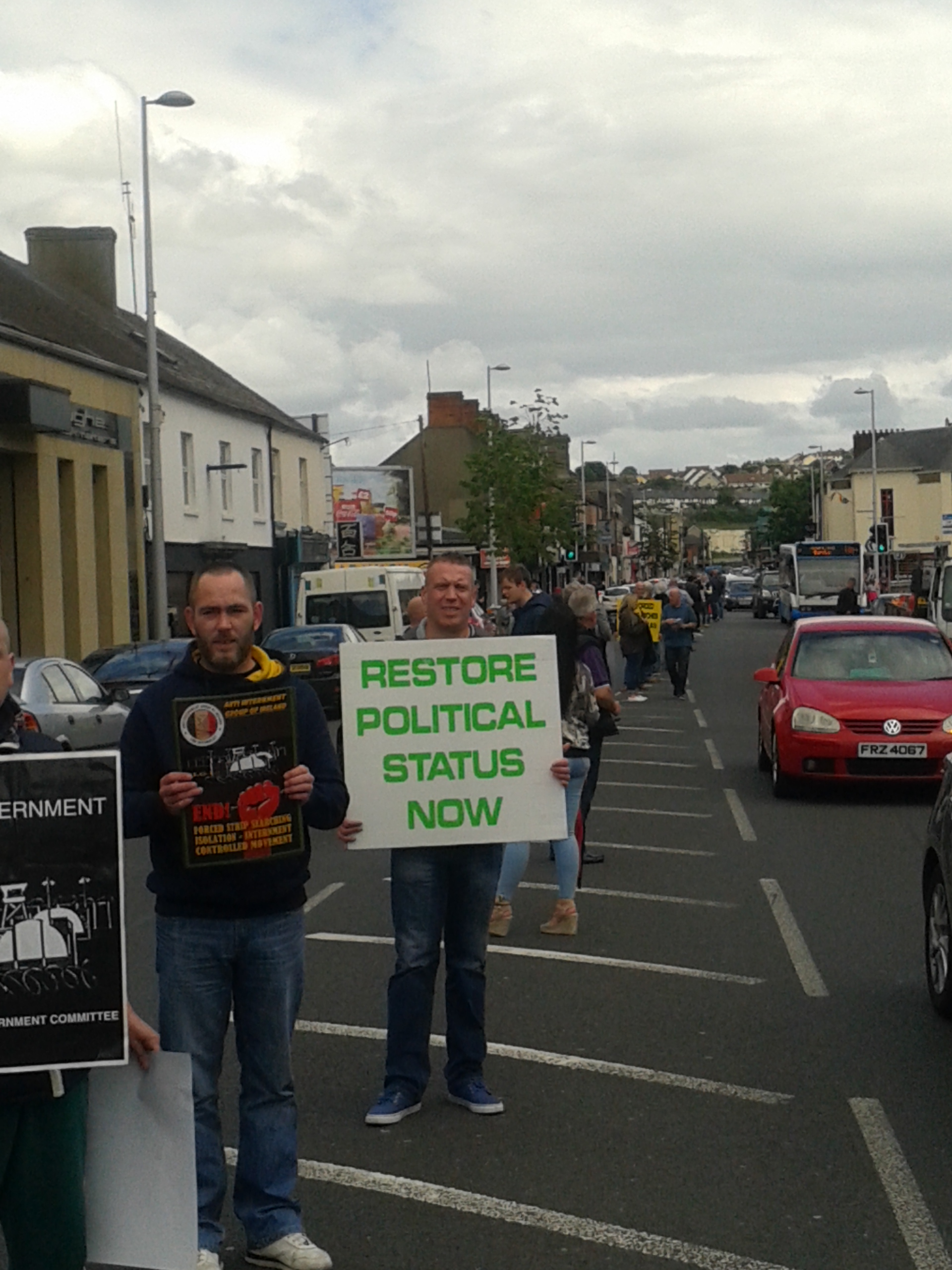
The formation of an anti-internment campaign was sparked by the revoking of the licence of ex-political prisoner Marian Price in May 2011 for the “crime” of steadying the written speech of an IRA speaker during a windy Easter Rising commemoration in Milltown Cemetery, Belfast.
In addition to revocation of the licence under which Republican prisoners were released under the Good Friday Agreement, other activists were also being charged under “anti-terrorist” legislation and routinely being refused bail, if not granted it under severe restrictions.
The wait for a trial is often two years and regardless of the eventual outcome, the individuals had already spent two years in jail or at home, barred from travel or political activity and harassed by police visits to their homes.
Early banner-placard protesting the internment of Marian Price (Image sourced: Libcom.org)Front section of Anti-Internment March, coming into top part of Parnell Square, Dublin 2013. (Image sourced: IAIC archives)
These conditions were considered to be in effect the same as internment without trial and the campaign against internment was founded as an independent one, a status it maintained despite a number of attempts to take it over or to intimidate with threats and State harassment.
Throughout its history the Anti-Internment Campaign has organised the annual Newry event (not since 2021 unfortunately), many pickets (including in protest against Amnesty Ireland) and a march in Dublin, spoken at or participated in public events in Belfast, Cork, Derry, Glasgow and Wexford.
It has also organised and hosted conferences and public meetings, for example with speakers from the campaigns for the Craigavon Two, Munir Farooqi and Tony Taylor and about the Right to Protest with a speaker from the Irish Council for Civil Liberties.
Section of the annual Anti-Internment white-line picket Newry, August 2016 (Image sourced: IAIC archives)
Annual Anti-Internment, Newry, rallying after white-line picket, August 2019 (Image sourced: IAIC archives)
A busy year
As stated in the introduction above, 2022 was a busy year for the anti-internment campaign group, involving, along with its public awareness-rising events a reorganisation with a new constitution and a new name. The campaign organised nine public events and participated in more.
Most of those public events were awareness-raising pickets with placards, banners, flags and leaflet distribution. Usually the pickets alternated between the Henry Street/ Liffey Street junction and at Crown Alley by the square in the Temple Bar area, both areas busy with shoppers and tourists.
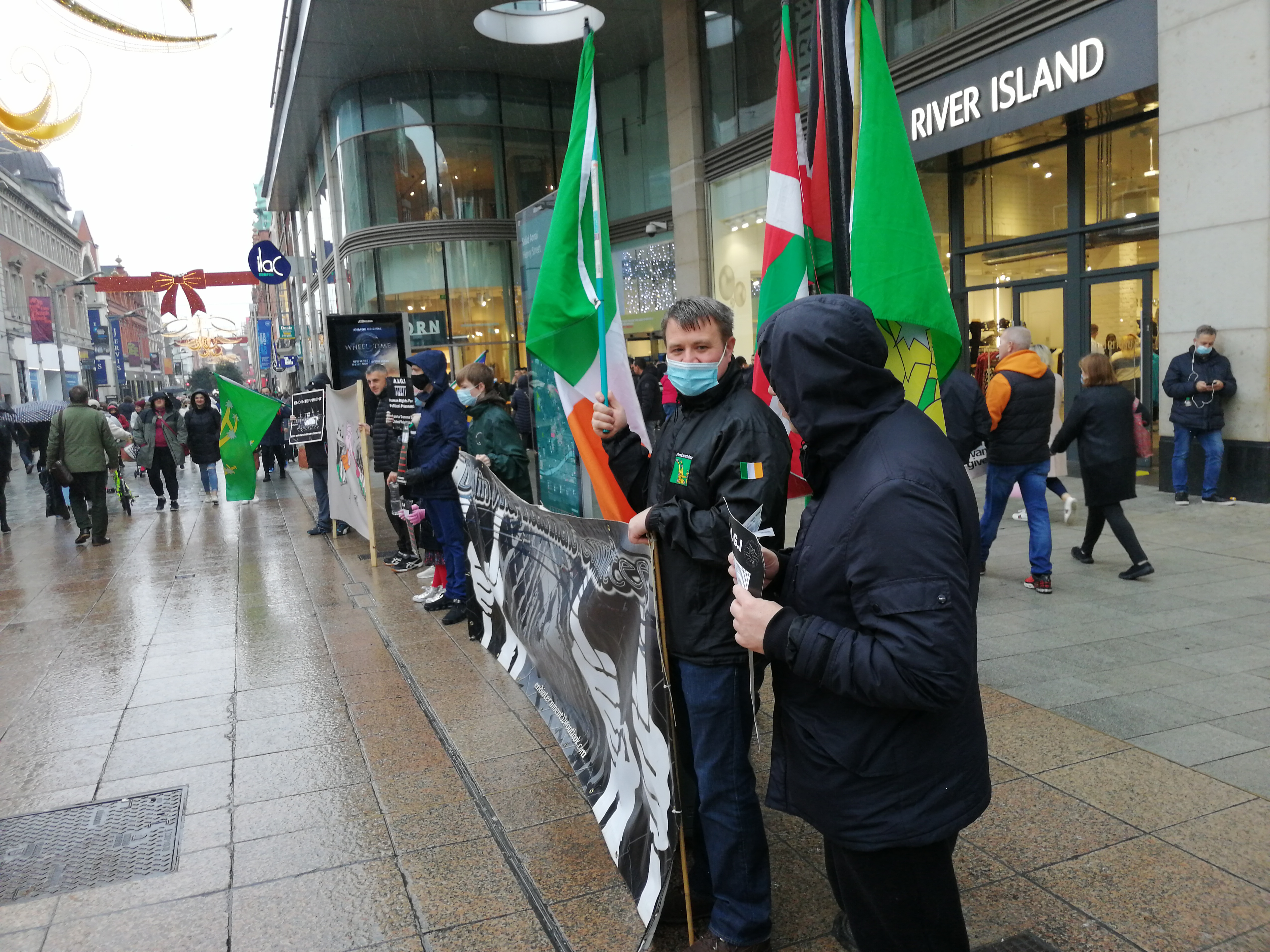
Anti-Internment picket in Henry Street, November, Dublin 2022 (Photo: IAIC)
The campaign carried out pickets in Henry Street on 9th April, 6th August and 19th November and in Temple Bar on 5th March, 21st May, 2nd July and 27th August. On 22nd October, with a special focus on Palestinian prisoners, we were on the iconic Ha’penny Bridge.
It has always been of particular interest to the campaign group to reach working people and large numbers of that class of all ages pass through those areas. Of interest also are people from other lands and the Basque and Palestinian flags alongside the Irish ones often stimulate discussion.
In September the campaign attended the Peter Daly commemoration in Wexford and provided a speaker at the Dublin meeting to re-launch the End State Repression campaign which our group had supported in the past but which had waned over the Covid epidemic period since.
Our campaign group also took part in the planning of and participation in the joint prisoner’s solidarity picket in Dublin on 17th December 2022.
Reorganisation
It had been clear for some time that the organisation was in need of reorganisation to facilitate expansion but the process had been difficult.
Eventually in July the decision was taken to close down the Anti-Internment Group of Ireland and to reform under another name. This was done and, after democratic consultation process a new constitution was agreed, with the Ireland Anti-Internment Campaign as the new name.
According to agreed decisions, a new banner with the organisation’s new name was commissioned (though it would take some time to come to fruition). A new Facebook identity for the group was constructed with a statement explaining the development.
The new constitution, more explicitly democratically-based than had been previously the case, was published.
Anti-Internment picket in Temple Bar, Dublin, March 2022 (Photo: IAIC)
Year planning
In the reorganisation process, the IAIG lost one member but gained three new activists and the return of two lapsed members. With renewed energy, members began planning for the rest of the year, to conclude with participation in the annual Bloody Sunday March for Justice in Derry.
Issuing a statement to explain the reorganisation, commissioning a new banner, scheduling a number of pickets in Dublin and organising the annual Prisoners’ Solidarity Picket in Dublin December were part of the planning and most of the target actions were completed.
In December and in good time, the campaign’s members organised to purchase, sign and mail Christmas cards to all Irish Republican prisoners, also a number of non-complying Basque political prisoners and the Catalan jailed revolutionary Catalonian rapper Pablo Hasel.
The proposal to organise the annual Prisoners’ Solidarity picket in December jointly with the Irish Republican Prisoners’ Welfare Association and with Ireland Anti-Imperialist Action was agreed and the joint event went ahead on 17th December with around 40 participating.
Section of the joint AICI, AIA and IRPWA Republican Prisoners’ solidarity picket 17 December 2022, O’Connell Street, Dublin 2022 (Photo: IAIC)
The picket with placards and banners, including the illuminated words of the IAIC’s “SAOIRSE” (“Freedom”) attracted attention and passers-by, both Irish and from abroad engaged leafleters and other participants in discussion. A speaker from each group gave a short statement.
The year’s programming ended with the specific scheduling of participation with a new banner in the annual Bloody Sunday March for Justice in Derry.
New Banner Aired at Bloody Sunday March for Justice in Derry
The new banner got its first public airing at the annual march in Derry, commemorating the massacre of unarmed civilians by the British Army in Derry in January 1972 and was carried as part of the march from the Creggan, through a large part of Derry and down to Free Derry Corner.
The marchers in different political parties, campaign organisations and independent individuals marched trough cold rain and strong wind-gusts through the nearly 5-kilometre walk. The members of four Republican Flute Bands played bravely throughout.
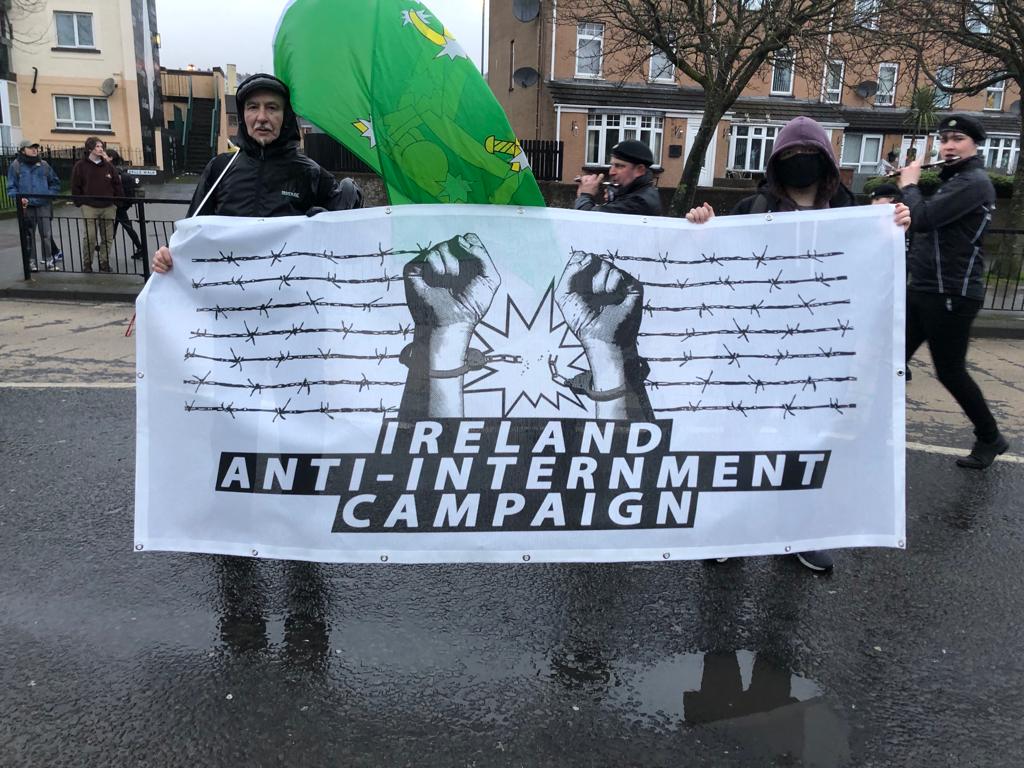
The new banner of the Ireland Anti-Internment Committee carried in the Bloody Sunday March for Justice in Derry in January 2023. (Photo: IAIC archives)
The IAIC will shortly begin its year-planning for the rest of the year, its calendar again probably ending at 2024’s Bloody Sunday March for Justice and meanwhile organising events to publicise the on-going undemocratic jailing of activists without trial both sides of the British Border.
The IAIC considers that the jailing of people without trial by both administrations is, in addition to political repression, a significant assault on civil rights and a threat to all opposition groups and that it is in the interests of all to unite in opposing the practice.
The Campaign welcomes the active support of all democratically-minded individuals at its public events.
On Wednesday (May 11th), a Palestinian journalist, Shireen Abu Akleh was shot dead by Israeli military with one shot to the head. At the time of her murder, she was wearing conflict protective clothing clearly marked “PRESS” but the bullet entered her head under the helmet. Ms. Abu Akleh’s murder has caused outrage around the world, which has been intensified by the Israeli military’s attack on mourners, even on the bearers of her coffin (one of whom has since died) and their attempt to blame the Palestinian resistance for killing the journalist.
(Credit photo: Ahmad Gharabi/ Getty)
WHY THE OUTRAGE THIS TIME, ABOUT THIS JOURNALIST?
Ms. Abu Akleh was a journalist of nearly 25 years’ experience, employed since 1997 by the Qhatari-based news agency Al Jazeera and her reports were familiar to millions in the Arab and wider Muslim world. She was with other journalists, one of whom was also shot but wounded in the back and is expected to recover, covering an Israeli Army raid into the refugee camp in Jenin in Palestine. Both Al Jazeera and Associated Press agencies insisted that the shooters were Israeli military and mapping on-the-spot investigation has discredited the Israeli version firstly that the killer was a Palestinian fighter and then latterly, that it might have been.
Shireen Abu Akleh lies dead or mortally wounded while her terrified colleague fears the same fate (Source: Internet)
“This is one person,” remarked a commentator, “ but hundreds are being killed in the Ukraine war!” Another commented that the Russians have shot journalists in the Ukraine.
Thousands and millions and thousands of millions of people are killed in wars and as a result of wars. Yes and in a way their very numbers makes that difficult to grasp. In the war in the Ukraine before the Russian invasion, 14,000 is the number of estimated dead. Since the invasion, 9,599–24,5991 civilians have been killed, such a wide disparity in estimates a reflection that the conflict is still ongoing and also of the propaganda battle being fought over almost every aspect of the conflict.
In Palestine, the conflict death toll began mostly from 1936 and rose to unknown numbers of Palestinians (due the huge expulsions and fleeing terror) in 1948 when the state of Israel was created, and between 2008 and 2020 alone the death toll is estimated at 5,8502, not counting of course this year and last, with another three added since Sunday, including Abu Akleh. The overall figure of Palestinian civilians killed between 1936 and 2020, with huge gaps where the numbers are unknown, is 2,816,410.3
All three of the latest of Israel’s victims (unless they’ve killed more before I finish writing and editing) were unarmed civilians. Unarmed civilians are the group most likely to be killed in war (10 million in WWI; 50–55 million in WWII, whilst 2,000,000 civilians is the estimate for the Vietnam War). Even though the killing of civilians is an automatic result of war, there are all kind of laws and conventions agreed by most states, including major warlike ones, against the deliberate killing of civilians. But it does seem as though some states have carte blanche in that regard, international law or not.
Israeli police attack funeral of Shireen Abu Akleh, including beating pall-bearers — one of the injured died later. (Photo credit: May Levin/ AP)
For many people, every killing of a Palestinian announced adds to that ongoing toll by Israel, year after year for nearly eight decades. That’s one important significance of the death of Shireen Abu Akleh – she comes to personalise, to give a face to the millions of victims of Israeli Zionism.
Another significance of this murder is that Abu Akleh is the most recent of at least 45 journalists killed by Israeli military since 2000 – that’s more than two per year. The UNESCO Observatory lists 22 journalists killed by Israeli military since 2002 and the case remains “unresolved” in 19 of Israel’s judicial investigation — with no investigation at all listed in two of them.
One of the nearly 50 journalists killed by the Israeli military since 2000 — Yasser Murtagh in 2018 (Photo: Reuters)
Raising the issue of Russian armed forces’ alleged deliberate killing of civilians and of reporters, whether true or not, just does not compare. The allegations might be true, of course — an invading army is likely to encounter opposition in the course of which some of its personnel may kill civilians by intention and without justification. Indeed, armies before now have killed even those of their own country, their own ethnic group. In the currently relentless onslaught of western commentary, often quoting Ukrainian or NATO sources without question, along with the banning of much alternative comment, it is — and will continue to be for some time – difficult to say which is true and which is not. But the two conflicts do not compare, neither in scale nor in length of existence, nor does the death toll of civilians including reporters.
“WHATABOUTERY“
When Russia invaded the Ukraine, anybody who raised the issue of Palestine with regard to the other conflict, e.g “what about the US/NATO support for Israel?” was accused of ‘whataboutery’. ‘Whataboutery’ is thought of as a device to distract from confronting the actual issues initially under discussion by introducing another different or tangential one.
Of course, people do such things and rational discussion is frequently undermined and even shattered by such practice. But, in this case, when US/NATO was saying that it was supporting the post-Maidan Ukrainian regime for reasons of democracy and self-determination, was it justified to point out its record of war and invasion in the Middle East and its support of Israeli Zionist aggression? It seems clear to me that it was but that would not in itself be proof that the Ukrainian regime was wrong. Was it right to point to the regime’s attacks on Russian-speakers and in particular on the Crimea and Donbas regions? It seems to me that it was, in that gave context to secessionist feeling in those areas to which the Russian regime could well want to give military support, whether that were for protection of ethnic kindred or for its own selfish reasons.
None of that “whataboutery” takes away from the tragedy of war in the Ukraine, of course not, but it is valid in considering motivation, given that the US, the leading power in NATO, is also the biggest supporter of the Zionist state and that the EU is not far behind. Palestine exposed that whatever the rights and wrongs in the conflict, NATO and the EU’s motives were not about justice and peace.
When international sporting and cultural organisations of the western capitalist world began to ban Russian teams and individuals from participation, were people justified in saying “Hey, what about Israel?” Surely they were, for that ongoing struggle in which Palestinian land has been ripped from the hands of its people, in which the latter are daily oppressed and from time to time massacred, in which they suffer military occupation, daily discrimination, ethnic cleansing, racism and apartheid – have they not been calling for decades for banning and boycotting Israeli and its sporting teams? And what was the response? They they were bringing politics into sport! And those who did show their solidarity in sports competitions were often penalised for doing so.
When states began to apply economic sanctions to Russia and to Russian individuals, were Palestinians and their supporters not justified in crying out “Hey, what about Israel?” Of course they were.
The strange thing is that those who accused others of “whataboutery” in the past for raising the issue of Palestine in the context of the war in the Ukraine have now begun to cry “what about the Ukraine?” in the context of the international outrage about the murder of Shireen Abu Akleh. Former critics of ‘whataboutery’ have themselves become ‘whatabouters’ now – and without even the shadow of the justification of their accused predecessors.
‘INTERNATIONAL’ OUTRAGE
It’s worth asking what we mean by “international” in the case of the outrage over the murder of Shireen Abu Akleh. That “international” includes a large part of the Arab world. It includes a large part of the non-Arab but Muslim word4. It includes a large part of the non-Arab, non-Muslim world in western Europe and in the USA and in many other parts too. Certainly the Irish public in general has empathised with the Palestinians for decades.5
But it does not include what the western media mean when they use the words “the international community” – the outrage does not encompass the ruling classes of the Western European countries, much less of the USA, nor even the ruling classes of much of the Arab and Muslim world. In this they are being to a degree, honest. Because those ruling classes have either supported the Israeli Zionists directly, or have supported the USA which keeps Israel alive. Only seven elected representatives of the USA’s Democratic Party – out of the 225 it has in the US Congress, quickly expressed condemnation of the killing and called for a quick and independent investigation. Not one of the 210 Republicans expressed condemnation at the time – even though Shireen Abu Akleh was a citizen of the USA!
Protest in Delhi at the Israeli murder of Shireen Abu Akleh — and clearly not by Muslims alone (Hindus and Sikhs seen here also). (Photo source: Internet)
Shireen Abu Akleh murder protest march passing through Grafton Street, Dublin, Ireland yesterday (Photo source: IPSC FB page)
Leaders of a few countries expressed regret but could not bring themselves to even say that she had been killed by the Israeli military. The authorities in Berlin banned an attempt to hold a vigil over the death of the Palestinian journalist, including it in their ban on any Palestinian solidarity events at this time of year, when people commemorate the Palestinian ‘Nakba’. That is what Palestinians call the ‘Catastrophe’ that resulted from the seizure of Palestine by the Israeli Zionists, the creation of its state and the mass expulsion of Palestinians.
It is worth noting too that the media we are reading, which at first either ignored this murder, downplayed it or repeated the Israeli lies that Shireen Abu Akleh had been shot, not by Israeli military but by Palestinian resistance fighters, is compiled by journalists too. On the one hand this points to the severe loss to the world when a journalist who exposes injustice is killed (or persecuted and jailed for extradition to another country, as in the case of Julian Assange). On the other, it points to what a large contingent of hired liars and prevaricators is included among the ranks of journalists, that they cannot even stand up for the truth and protest the murder of one of their own occupation or trade.
Source images: Internet
And it teaches us how much our sources of information are mediated and manipulated by the national and corporative news media. Years ago we were being told that social media would free us from their manipulation or at least provide a viable alternative – independent news and commentary sources would flourish and we could be our own media. Yet the bans and exclusions put in place by Youtube, Facebook, Twitter and governments have shown us what an illusion all that was – in terms of information, we are generally even more controlled and manipulated now than we were before the advent of social media.
Hopefully, those who did not know this already will have learned, both from the coverage of the war in Ukraine and from the murder of this journalist. Those who thought that there was any justice in Israel or generally in the western governments towards the Palestinians, will hopefully have been disabused of that illusion too. Shireen Abu Akleh cannot be brought back to life nor can she be replaced. What we can do is strive to pull down that State that killed her and to knock away all its props around the world.
4Because a great many non-Arab Muslims sympathise with the Palestinians, who mostly ascribe to the faith of Islam and to Muslim culture. However, some Palestinians are Christian, some of Jewish (in the sense that a minority of the population of Palestine was Jewish for decades before the Israeli Zionist occupation) and some of no religion. Shireen Abu Akleh was baptised a Christian; her funeral service was held in a Catholic church and her remains were taken to a Protestant cemetery.
5The Irish cannot fail but be struck too by some parallels with the British occupation of Ireland – the impunity of the Zionist occupiers, for example and the attempt firstly to blame the resistance for those killed by the British Army, followed by a fog of conjecture and holding their own inquiry; the attack on mourners, the seizing of the national flag and attacking people for displaying it (the display of the flag was officially illegal under Israeli law in 1967 and unbanned in 1993 but as seen, is still often objected to by Israeli police).
SPEECH DELIVERED AT THE RALLIES ORGANISED BY JARDUN IN RESPONSE TO THE MURDER OF CORSICAN POLITICAL PRISONER YVAN COLONNA (Se encuentra la versión anterior en castellano/español al fondo)
Yvan Colonna was from a young age a member of the Corsican liberation movement. After being forced to remain in hiding for four years, he was arrested in 2003, accused of participating in an action carried out by an anonymous group. The accusation was based on statements of several of the movement’s members detained at the police station, who later rejected the statements but Yvan was sentenced to life imprisonment.
Posters demanding justice for Yvan Colonna after his arrest (Photo sourced: Internet)
Colonna was left in a very serious coma after the beating by a jihadist prisoner in Arles prison. On Monday of this week, Yvan passed away after three weeks in hospital. During that time there were riots denouncing the role of the French state in Yvan’s murder.
Yvan was murdereded by the penitentiary policy of dispersal and the conditions of the prison. We in the JARDUN Coordination charge that the beating and death received by Yvan was a direct consequence of the penitentiary policy of the French State. Likewise, we want to underline the need to create an organisation in support of the freedom of political prisoners and the fight against oppression and exploitation.
It should not be forgotten that in Corsica, the struggle for independence has been ongoing for decades with the aim of overcoming the political-economic system imposed by the French State and fighting for a popular and democratic government that would act in favour of the Corsican people. The struggle of the Corsicans is the struggle against French imperialism, against the oppression of the local working people and against the exploitation they suffer.
In Euskal Herria (the Basque Country – Trans.) we are well aware of the repression and oppression by oppressive states and we are witnesses to the massacres committed so many times by the French State. Because we cannot forget the imperialist attitude of the French State in Algiers and other colonies, becoming, together with the United States, the main promoters of contemporary torture.
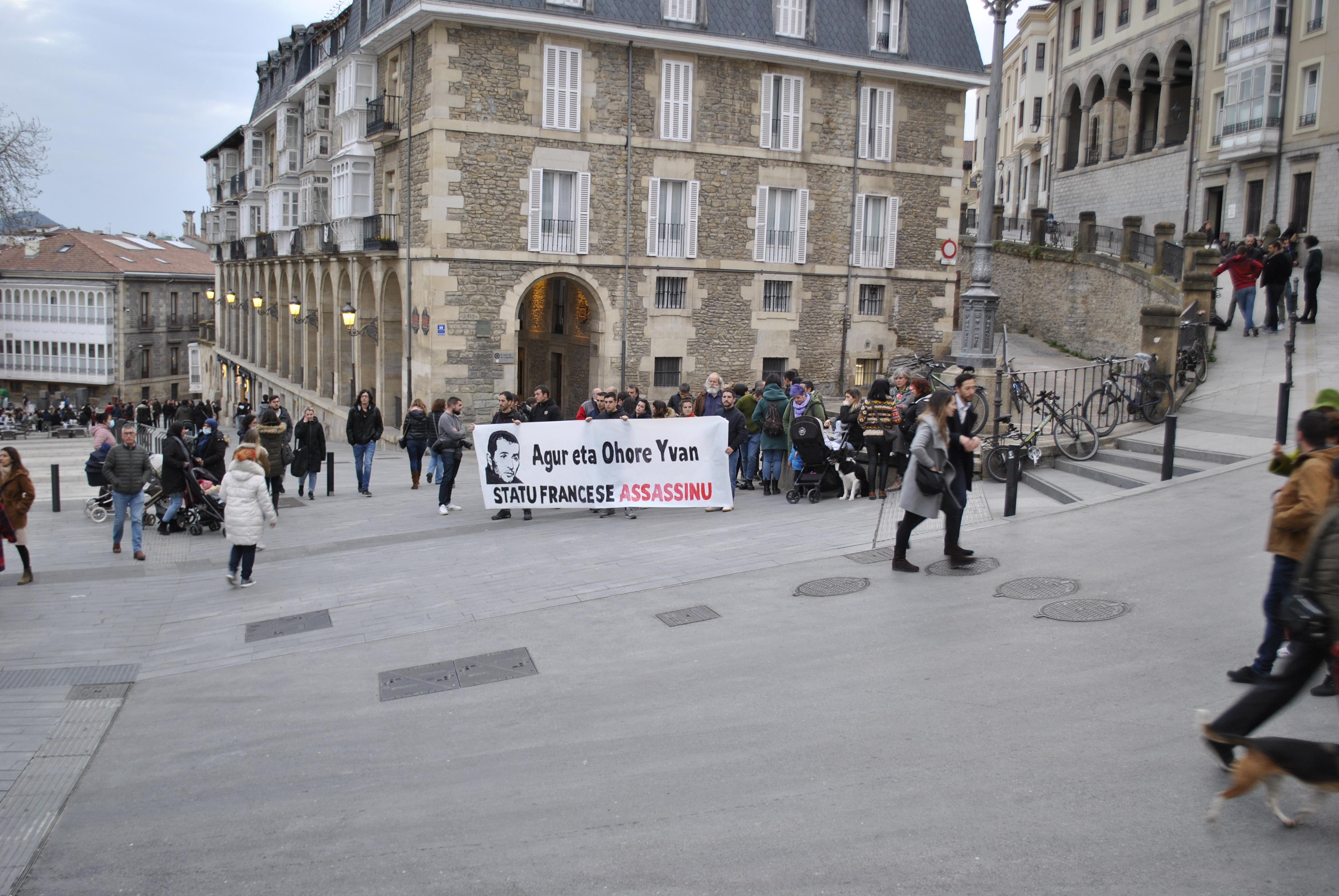
Solidarity picket in Gastheiz/ Vitoria, southern Basque Country, on Friday 25th (Photo: Jardun Koordinadora)
All of this shows us nothing less than the need for the organisation of the working class. It is evident that both the imperialist power and the oppressive States exercise a monopoly on violence to defend their economic interests and, in every nation, those who pay are always the working class.
It is time to denounce the fraud of social peace, it is time to denounce the warlike attitude of NATO, in Donbass, the Sahara, Palestine, today they are waging endless wars in defence of the interests of imperialism and its servants — and in view of this, it is time to awaken internationalist solidarity!
For this reason, we in JARDUN proclaim that it is time to turn to revolutionary organisation for all working people! Because only the organised people can offer real help and, as far as we are concerned, only the Basque working people can obstruct the participation of the Spanish and French States, organizing themselves in Euskal Herria to face the enemy, working for a political system in favour of the Basque working people.
We are clear that struggle is the only way and we will loudly proclaim that we have to confront the enemy, exploitation and class oppression. That is why we encourage you to join the organisation, because it is time to fight, it is essential to resist!
AGUR ETA OHORE YVAN! (Farewell with Honour Yvan!)
GORA KORSIKAKO HERRI LANGILEAREN BORROKA! (Long live the struggle of the Corsican working people!)
GORA EUSKAL HERRIA ASKATUTA! (Long live a free Basque Country!).
end.
Solidarity picket in Donosti/San Sebastian, southern Basque Country, on 26th March (Photo: Jardun Koordinadora)
Lectura lanzada en las concentraciones organizadas por JARDUN ante el asesinato de Yvan Colonna
Yvan Colonna era miembro del movimiento de liberación corso, en el que militó desde joven. Tras ser obligada a permanecer 4 años en la clandestinidad, fue detenida en 2003 acusada de participar en una acción llevada a cabo por un grupo anónimo. La acusación se fundamenta en la declaración de varios de los miembros detenidos en la comisaría, que posteriormente rechazaron la declaración, pero Yvan fue condenado a cadena perpetua.
Colonna quedó en coma muy grave tras la paliza de un preso yihadista en la cárcel de Arlés. El lunes de esta semana, Yvan falleció cuando llevaba 3 semanas hospitalizado. Con el objetivo de denunciar el papel del Estado francés en el asesinato de Yvan desde que ingresó en hospital, durante ese tiempo ha habido disturbios.
Yvan fue asesinado por la política penitenciaria por la dispersión vivida y las condiciones de la prisión. Desde la coordinadora JARDUN denunciamos que la paliza y la muerte recibida por Yvan ha sido consecuencia directa de la política penitenciaria del estado francés. Asimismo, queremos subrayar la necesidad de articular una organización a favor de la libertad de los presos políticos y de la lucha contra la opresión y la explotación.
No hay que olvidar que en Córcega, la lucha por la independencia se ha dado durante décadas con el objetivo de superar el sistema político económico impuesto por el Estado francés y luchar por un gobierno popular y democrático que actuara en favor del pueblo corso. La lucha de los corsos es la lucha contra el imperialismo francés, la opresión del pueblo obrero local y la lucha contra la explotación que sufren.
En Euskal Herria conocemos bien la represión y la opresión de los estados opresores y somos testigos de las masacres cometidas tantas veces por el Estado francés. Porque no podemos olvidar la actitud imperialista del Estado francés en Argel y otras colonias, llegando a ser, junto con los Estados Unidos, los principales impulsores de la tortura contemporánea.
Todo ello no nos demuestra más que la necesidad de la organización de la clase trabajadora.. Es evidente que tanto la potencia imperialista como los Estados opresores ejercen el monopolio de la violencia para defender sus intereses económicos, y en todo pueblo, su pagador, es siempre la clase obrera.
Es hora de denunciar el fraude de la paz social, es tiempo de denunciar la actitud guerrera de la OTAN, Donbass, el Sáhara, Palestina, hoy en día están dando un sinfín de guerras en defensa de los intereses del imperialismo y de sus siervos, ¡y ante eso es tiempo de despertar la solidaridad internacionalista!
Para ello, desde JARDUN proclamamos que es hora de volcarse en la organización revolucionaria para todo pueblo obrero!! ¡Porque sólo el pueblo organizado puede ofrecer una verdadera ayuda, y en lo que a nosotros se refiere, sólo el pueblo trabajador vasco puede interrumpir la participación de los Estados Español y Francés, organizándose en Euskal Herria para hacer frente al enemigo, trabajando por un sistema político a favor del pueblo trabajador vasco.
Nosotros tenemos claro que la lucha es el único camino y proclamaremos en voz alta que tenemos que enfrentar al enemigo, a la explotación y la opresión de clase. Por eso os animamos a uniros a la organización, porque es tiempo de lucha, ¡es imprescindible resistir!
The Dublin Anti-Internment Committee held a well-attended picket on Saturday (5th March) against the continuing practice of interning Irish Republicans without trial and also in support of human rights for political prisoners. At one point the picket was subjected to the unwelcome attention of the Irish political police.
(Photo: C.Sulish)
The event was in furtherance of the Committee’s advertised intention to hold monthly public events to highlight the deprivation of civil rights from Irish Republicans — on both sides of the British border — through the operation of special legislation and in particular of the no-jury political courts (Special Criminal Courts in the Irish state and Diplock Court in the British colony). The Committee has admitted that it does not always succeed in holding a public event every month and in fact its most recent public appearance was during the December festive season, in solidarity with Irish Republican prisoners, when it was supported by a number of organisations and independent activists.
(Photo: C.Sulish)
WHY THESE PUBLIC EVENTS?
The Dublin Committee holds these public events because it believes that most people are unaware of the abuse of civil rights in Ireland, the civil right to belong to an organisation that criticises the State and seeks profound change. The reaction of people receiving a leaflet at their public events would seem to bear this out.
(Photo: C.Sulish)
Choosing a couple of extracts from their current leaflet: ‘At various times in Ireland’s history, people have been rounded up and jailed without bothering with a trial – people whom the government found troublesome and wished removed. Today the same process carries on although they don’t call it “internment” now – other names such as “due process”, “remanded in custody” are used ….”
‘Even when Republican activists are granted bail, it is on outrageous conditions such as not being permitted to reside in their own home, having to observe a curfew and wear an electronic tag, not being permitted to attend meetings and demonstrations …..’
The leaflet text makes the point that one doesn’t have to agree with the politics of Irish Republicans to see that these injustices are profoundly undemocratic abuses of civil rights — and “are ultimately a danger to all oppositional movements, whether Republican or not”. One aspect of their protest was against the denial of open family visits to Republican prisoners in the jails of the British colony in the north-east of Ireland — a violation of human rights.
The surprise in learning the facts is not confined to Irish people because often it is expressed by tourists or migrants, even if they have encountered such practices in their own countries of origin.
INTERNATIONALIST DIMENSION
An example of the interest from abroad on Saturday was of a Basque man and, separately, of two young Basque women, reacting warmly to seeing the Basque flag among the picketers. The Dublin Committee objects not only to the incarceration of Irish Republicans but also of people seeking freedom in many other parts of the world, for which reason the Palestinian and Basque flags are frequently flown on their pickets, next to the revolutionary Irish workers’ flag of the Starry Plough.
A person who expressed support for the right to campaign without state repression was, interestingly, from Barcelona. However he did not wish for Catalan independence, wanting instead a unitary but democratic Spanish state – a position held by some communists and the main socia-democratic parties there. Although his position did not concur with that of the picketers, who tend to support the struggles for self-determination, the conversation was conducted without hostility.
Not so with another individual, who approached some picketers to argue for their support for the Ukrainian state in the current armed conflict there, a question that has deeply divided the Irish Left and Republican movements. He went further and announced his support for the Azov Battalion, an East European fascist organisation integrated into the Ukrainian state’s military, at which point the tolerance of the picketers for his intervention ended and he was urged to depart.
Starry Plough flags next to Palestinian and Basque Ikurrina flags at the picket in Temple Bar. (Photo: C.Sulish)
POLITICAL POLICE INTIMIDATION
Another temporary presence unwelcome to the picketers was of three members of the Irish State’s political police. These are members of what used to be called the Special Branch but are now officially called the Special Detective Unit, formerly C3 and successor to the CID when the Irish State was created. This type of political police force is modelled on the Irish Special Branch of Scotland Yard, the HQ of the British police, founded to spy on the influence and activities of the “Fenians” (i.e the Irish Republican Brotherhood) in the cities of Victorian-era Britain. However, in Dublin under British occupation, their parallel force was the G Division of the Dublin Metropolitan Police, known as “G-men”; it was they who identified many Republican and other prisoners of the British military after the 1916 Rising, ensuring death sentences for many (though most commuted to life imprisonment) and jail sentence for many others. During the War of Independence (1919-1921 they were identified as the intelligence service of the British occupation and many were selectively assassinated by the IRA of the time.
The Garda “Branch” (as they are known colloquially) of the Irish State have a long history of harassment of and spying on Irish Republicans, sometimes associated with violence and often with perjury in court. Their unsupported observations through the mouth of a Garda officer at the rank of Superintendent has been enough “evidence”, in the no-jury Special Criminal Court, to send many Irish Republicans to jail on a charge of “membership of an illegal organisation.”
Two picketers confront the plainclothes political police officer harassing a young leafletter on Saturday (Photo: C.Sulish)
One of these gentlemen on Saturday approached the youngest supporter of the picket, who was distributing leaflets to passers-by, identified himself as a Gárda officer in plain-clothes and demanded the young activist’s name. His accosting of the leafletter attracted the attention of others on the picket and two went quickly to support the subject of State harassment. The Branchman demanded no further information and sone moved away. However, when he had reached about half-way along the picketters, he stopped and began filming them.
At that point one of the picketers began to call out to passers-by, many of whom were tourists, that this man was a member of the secret political police, who was filming and attempting to intimidate people on a legal political protest, that this is the kind of ‘democracy’ that exists in the Irish state, etc, etc. Shortly thereafter, the Branchman departed, along with another two of his colleagues that had been observed further down towards Temple Bar.
A picketer loudly denounces the political policeman’s filming of the picketers. (Photo: C.Sulish)
According to picket participants this intervention of the political police represented an escalation of their attentions in recent times, though not in the least unusual in the past, when every picketer might have their name (and even their address) demanded and jotted down.
A spokesperson of the Dublin Anti-Internment Committee stated that it is independent of any political party or organisation and that it welcomes the participation at its public events of democratic individuals, whether independent activists or members of organisations and had distributed many of its leaflets. It regrets that a number of political activists — who should have an interest, even if only in self-preservation – in defending the democratic rights to organise and to protest, decline to support their events.
Palestinian flags fluttered in the breeze over the iconic Ha’penny Bridge in Dublin City centre, while banners festooned its length on New Year’s Eve. The numbers were down from previous years, more likely from the soaring Covid19 infection rate than from any lessening of the long-running Ireland solidarity with the oppressed Palestinians. This was ironic since, unlike previous years, this was not a rally braving sleet, snow, rain or icy wind – in fact, the very mild weather raised only the amount of breeze necessary to set the flags fluttering.
(Photo by Tamin Al Fatin, IPSC)
Tamin Al Fatin, IPSC Chairperson, centre photo (Photo by IPSC))
The event is organised every year for New Year’s Eve at the same location by the Ireland Palestine Solidarity Campaign and supporters, among which were Irish and Palestinians, handed out leaflets encouraging BDS (boycott, divestment and sanctions) of Israel, an apartheid ste. Martin Quigley, for the IPSC led some chants on a megaphone, which were taken up by people on the pedestrian Bridge, among which were that “Israel is a terrorist state”, that “Palestine will be free” and in solidarity that “we are ALL Palestinians”.
Each year more Palestinian land is stolen, more of their homes demolished or under threat of eviction, in Gaza they have periods without electricity, they are restricted in importing fuel for heating or cooking (never mind transport), or building materials (so much has been destroyed by the Israeli bombardments), they continue to be harassed and made have lengthy waits at checkpoints, their inshore sea is polluted, their fishing boats further out are attacked and harassed ….
(Photo by Tamin Al Fatin, IPSC)
As of 2019, more than 5.6 million Palestinians were registered with UNRWA as refugees, of which more than 1.5 million live in UNRWA-run camps.
According to prisoners’ rights group Addameer, there are currently (2021) 4,650 Palestinians held in Israeli jails in Israel and the occupied territories. Palestinians view them as political prisoners attempting to end Israel’s illegal occupation. Of those: 520 are being held without charge or trial.
At the end of September 2020, 157 Palestinian minors were held in Israeli prisons as security detainees and prisoners, at least two of whom were held in administrative detention. Another 2 Palestinian minors were held in Israel Prison Service facilities for being in Israel illegally. The IPS considers these minors – both detainees and prisoners – criminal offenders. In addition, a small number of minors are held in IDF-run facilities for short periods of time. (And the Israeli Prison Service since October 2020 has been refusing to publish figures or to supply Palestinian human rights groups with them).
BIG POWERS BACKING ISRAELI ZIONISM
The United States is the major power backing the Israeli Zionists and partly because of its position in the world and partly also for their own economic or political interests, most of the European states back the Zionists too.
In 2018 Donald Trump, as US President, moved the US Embassy for Israel into Jerusalem, endorsing the Zionist claim that the multi-faith city is Jewish and Zionist, although it is an occupied city even in international law. Shortly before he reluctantly left the office of the US Presidency, Donald Trump also endorsed Morocco’s illegal occupation of Western Sahara in exchange for Morocco recognising Israel. So far, Joe Biden, Trump’s successor, has not reversed either of those decisions.
(Photo by D.Breatnach)
THE PEOPLE OF THE WORLD SUPPORT THE PALESTINIANS
As is usually the case, it is the ordinary people in Ireland and around the world that support the Palestinians, while the big capitalists and imperialists, while occasionally criticising the Israeli Zionists, continue to support them politically, economically, culturally and militarily. Even in the United Nations, an organisation controlled by the big powers, a majority condemned the Zionist state in 17 separate motions in 2020 and last year formally ratified another six resolutions criticising Israel.
So why has international action not been taken against this terrorist state? The answer is that although the UN has 193 member states, only its Security Council decisions have to be carried out and there are only five permanent members of the Security Council: USA, UK, France, Russia and China. And what’s more, their decisions have to be unanimous.
(Photo by Tamin Al Fatin, IPSC)
On the other hand, so many civil organisations around the world have declared themselves in solidarity with the Palestinians and in Ireland. Hundreds of thousands have marched in so many countries and sports people, many popular culture stars and academics have refused to perform or attend conferences in Israel. One can no longer find Israeli goods in most shops or supermarkets (and when on occasion they are on sale, their country of origin is not marked on the product).