IRISH HISTORY … AND HERDS OF ELEPHANTS

Diarmuid Breatnach

Politics is about the present and the future, obviously … but it is also about the past.

Different political interests interpret and/or represent the past in different ways, emphasising or understating different events or aspects or even ignoring or suppressing them entirely. There is choice exercised in whom (and even what particular pronouncement) to quote and upon what other material to rely. And by “political interests” I mean not only groups, formal (such as political parties) or informal, but also individuals. Each individual is political in some way, having opinions about some aspects of questions that are political or at least partly-political. For example, one often hears individuals say today that they have no interest in politics, yet express strong opinions of one kind or another about the right to gay and lesbian marriage, the influence of the Catholic Church, and how the country is being run by Governments

So when an individual writes a history book, there are going to be political interpretations, although not all writers admit to their political position, their prejudices or leanings, in advance or even in the course of their writing. One historian who does so is Padraig Yeates, author of a number of historical books: Lockout Dublin 1913 (a work unlikely to be ever equalled on the subject of the title), A City In Wartime — 1914-1919, A City in Turmoil 1919-1921and his latest, A City in Civil War – Dublin 1921-’24. The latter was launched on Tuesday of this week, 12th May and therefore much too early for people for who did not receive an earlier copy to review it. So it is not on the book that I am commenting here but rather on the speeches during the launch, which were laden with overtly political references to the past and to the present. If a review is what you wanted, this would be an appropriate moment to stop reading and exit – and no hard feelings.

The launch had originally been intended to take place at the new address at 17 D’Olier Street, D2, of Books Upstairs. However the interest indicated in attending was so great that Padraig Yeates, realising that the venue was going to be too small, went searching for a larger one. Having regard to how short a time he then had to find one and with his SIPTU connections, Liberty Hall would have been an obvious choice. Whether he had earlier been asked to speak at the launch I do not know but, having approached Jack O’Connor personally to obtain the use of Liberty Hall, in the latter’s role of President of SIPTU, the owners of that much-underused theatre building, it was inevitable too that O’Connor would be asked to speak and act as the MC for the event.

O’Connor’s introduction was perhaps of medium length as these things go. He talked about the author’s work in trade unions, as a journalist and as an author of books about history. O’Connor’s speech however contained much political comment. Speaking of the period of the Civil War (1919-1923), he said it had “formed what we have become as a people”. That is a statement which is of dubious accuracy or, at very least, is open to a number of conflicting interpretations. The Civil War, in which the colonialism-compromising Irish capitalist class defeated the anti-colonial elements of the nationalist or republican movement, formed what the State has become – not the people. The distinction between State and People is an essential one in our history and no less so in Ireland today.

Talking about the State that had been created in 1921 (and not mentioning once the creation of the other statelet, the Six Counties) and referring to the fact that alone among European nations, our population had not risen during most of the 20th Century and remained lower than it had been up to nearly the mid-Nineteenth, a state of affairs due to constant emigration, O’Connor laid the blame on the 26-County State and in passing, on the capitalist class which it served. He was undoubtedly correct in blaming the State for its failure to create an economic and social environment which would stop or slow down the rate of emigration – but he did not explain why it was in the interests of the capitalists ruling the state to do so. Nor did he refer to the cause of the original drastic reduction in Ireland’s population and the start of a tradition of emigration – the Great Hunger 1845-’49.

The Great Hunger memorial on Dublin's Custom House Quay. The Great Hunger and its immediate aftermath initiated mass Irish emigration.
The Great Hunger memorial on Dublin’s Custom House Quay. The Great Hunger and its immediate aftermath initiated mass Irish emigration.

Even allowing for the fact that O’Connor wished to focus on the responsibility of the 26-County State, the Great Hunger was surely worthy of some mention in the context of Irish population decline.  Just a little eastward along the docks from Liberty Hall is the memorial to that start of mass Irish emigration. It was the colonial oppression of the Irish people which had created the conditions in which the organism Phytophthora infestans could create such devastation, such that in much less than a decade, Ireland lost between 20% and 25% of its population, due to death by starvation and attendant disease and due also to emigration (not forgetting that many people emigrating died prematurely too, on the journey, upon reaching their destination and subsequently). Phytophthora devastated potato crops in the USA in 1843 and spread throughout Europe thereafter, without however causing such a human disaster as it did in Ireland. In Mitchell’s famous words: “The Almighty, indeed, sent the potato blight, but the English created the famine.” And that is what makes that period of population decline uncomfortable for some historical commentators.

Indeed, O’Connor did not mention British colonialism once, nor Partition, nor imperialism. And nor did either of the other two speakers, nor the author. I remarked on this to an Irish Republican present, to which he responded with a rhetorical question: “Did you expect them to?” Well, yes, perhaps naively, I did. While not expecting an Irish Republican analysis from Padraig Yeates and perhaps not either from anyone he would consider appropriate to speak at the launch of one of his books, dammit, we are talking about history. The presence of Norman/English/British Colonialism for 800 years prior to the creation of the Irish Free State, and its influence on that state’s creation and on subsequent events in Ireland, is worthy of at least a mention in launching a book about the Civil War. Not to mention its continuing occupation of one-fifth of the nation’s territory.

Colonialism and Imperialism and, in particular, the Irish experience of the British variant, were not so much ‘the elephant in the room at the launch as a veritable herd of pachyderms. They overshadowed us at the launch and crowded around us, we could hear them breathing and smell their urine and excreta – but no-one mentioned them. The date of the launch was the anniversary of the execution of James Connolly 99 years ago, a man whom the Labour Party claims as its founder (correctly historically, if not politically), a former General Secretary of the ITGWU, forerunner of SIPTU and the HQ building of which, Liberty Hall, was a forerunner too of the very building in which the launch was taking place. His name and the anniversary was referred to once, though not by O’Connor, without a mention of Sean Mac Diarmada, executed in the same place on the same day. And most significantly of all, no mention of who had Connolly shot and under which authority.

That circumspection, that avoidance, meant that a leader of Dublin capitalists, William Martin Murphy, could not be mentioned with regard to Connolly’s death either i.e. his post-Rising editorial in the Irish Independent calling for the execution of the insurgents’ leaders. But of course he did get a mention, or at least the class alliance he led in 1913 did, in a bid to smash the ITGWU, then under the leadership of Larkin and Connolly. This struggle, according to O’Connor and, it must be said also to Padraig Yeates, was the real defining struggle of the early years of the 20th Century, not the 1916 Rising, the War of Independence nor yet the Irish Civil War. It was in 1913 that “the wrong side won”.

One-eyed as that historical vision must be, we have to question whether it is even partially correct. The Lockout was a great defeat for the ITGWU and for the leading elements in the Irish workers’ movement. But the Lockout did not break the trade union and, in fact, it later began to grow in membership and in branches. Other trade unions also survived and some expanded. So in what manner was 1913 decisive in ensuring that “the wrong side won” in later years? The Irish trade union movement was still able to organise a general strike against conscription in April 1918 and the class to organise a wave of occupations of workplaces in April 1919. 

True, the Irish working class had lost one of its foremost theoreticians and propagandists by then, in the person of James Connolly. And who was it who had him shot? Not Murphy (though he’d have had no hesitation in doing so) nor the rest of the Irish capitalist class. In fact, worried about the longer-term outcome, the political representatives of the Irish nationalist capitalist class for so long, the Irish Parliamentary Party, right at the outset and throughout, desperately called for the executions to halt. General Maxwell, with the support of British Prime Minister Asquith, ordered and confirmed the executions of Connolly and Mallin of the Irish Citizen Army and British Army personnel pulled the triggers; in essence it was British colonialism that executed them, along with the other fourteen.

For the leaders of the Labour Party and of some of the trade unions, and for some authors, Padraig Yeates among them, the participation of Connolly and the Irish Citizen Army in the Rising was an aberration. For these social democrats, the struggle should have been against the Irish capitalist class only (and preferably by an unarmed working class). It is an inconvenient fact that Ireland was under colonial occupation of a state that had strangled much of the nation’s economic potential (and therefore of the growth of the working class) in support of the interests of the British capitalist class. It is an inconvenient fact that the Irish capitalist class had been divided into Unionist and Nationalist sections, the former being descendants of planter landowners and entrepreneurs whose interests were completely bound up in Union with Britain. It is an inconvenient fact that the British and the Unionists had suppressed the last truly independent expression of the Irish bourgeoisie, the United Irishmen and, in order to do so effectively, had created and enhanced sectarian divisions among the urban and rural working and middle classes. It is also an inconvenient fact that the British cultivated a client “nationalist” capitalist class in Ireland and that the police and military forces used to back up Murphy’s coalition in 1913 were under British colonial control.

To my mind, a good comprehensive analysis of the decline in prominence of the Irish working class on the political stage from its high point in early 1913 and even in 1916, has yet to be written. One can see a number of factors that must have played a part and the killing of Connolly was one. But something else happened between 1913 and 1916 which had a negative impact on the working class, not just in Ireland but throughout the World. In July 1914, WW1 started and in rising against British colonialism in Ireland, Connolly also intended to strike a blow against this slaughter. As the Lockout struggle drew to its close at the end of 1913 and early 1914, many union members had been replaced in their jobs and many would find it hard to regain employment, due to their support for the workers and their resistance to the campaign to break the ITGWU. It is hard to avoid the conclusion that many joined the British Army or went to work in war industries in Britain. Although the Irish capitalist class supported the British in that War (up to most of 1917 at any rate) it was imperialism which had begun the war and British Imperialism which recruited Irish workers into its armed forces and industries.

Reaching back in history but to different parts of Europe, Padraig Yeates, in his short and often amusing launch speech, cracked that “for years many people thought Karl Kautsky’s first name was ‘Renegade’ ” — a reference to the title of one of Lenin’s pamphlets: The Proletarian Revolution and the Renegade Kautsky. Yeates apparently admires Kautsky and quoted him on Ireland. But Kautsky advocated no uprisings against imperialism or colonialism in the belief that “super-imperialism” (also called “Hyper Imperialism”) would regulate itself peacefully, letting socialists get on with the task of evolving socialism. Two World Wars since then and current developments have negated Kautsky’s theory but more to the point, to advocate his theory as a guiding principle at the time he did was a major ideological threat to proletarian revolution and to the evolving anti-colonial struggles of the world and therefore he was a renegade to any variant of genuine socialism and socialist struggle.

This is relevant in analysing the position of the trade union leaders and the Irish Labour Party today. They are social democrats and their central thesis is that it is possible to reform capitalism, by pressure on and by involvement in the State. They deny what Lenin and others across the revolutionary socialist spectrum declare, that the state serves the ruling class and cannot be coopted or taken over but for socialism to succeed, must be overthrown.

It is the social-democratic analysis that underpinned decades of the trade union leaders’ social partnership with the employers and the State, decades that left them totally unprepared, even if they had been willing, to declare even one day’s general strike against the successive attacks on their members, the rest of the Irish working class and indeed the lower middle class too since 2011. Indeed Padraig Yeates, speaking at a discussion on trade unions at the Anarchist Bookfair a year or two ago, conceded that social partnership had “gone too far”. Can Jack or any other collaborationist trade union leader blame that on the transitory defeat of the 1913 Lockout? They may try to but it is clear to most people that the blame does not lie there.

Two other speakers addressed the audience at the launch, Katherine O’Donnell and Caitriona Crowe. Catriona Crowe is Head of Special Projects at the National Archives of Ireland and, among other responsibilities, is Manager of the Irish Census Online Project, an Editor of Documents on Irish Foreign Policy, Vice-President of the Irish Labour History Society. She is also Chairperson of the SAOL Project, a rehabilitation initiative for women with addiction problems, based in the North Inner City. It was her, I think, who made the only mention of “Blueshirts” and her also that mentioned the anniversary of James Connolly. Although her speech was overlong in my opinion for a book launch in which she had already been preceded by two longish speeches, strangely I can remember very little of what she had to say.

Katherine O’Donnell’s contribution however made a considerable impression upon me. She declared herself early in the speech to be lesbian and a campaigner for gay and lesbian rights and is Director of the Women’s Studies Centre at the School of Social Justice at UCD. O’Donnell began by praising Padraig Yeates’ work, of which she declared herself “a fan”. In a speech which at times had me (and sometimes others too) laughing out loud, she discussed the contrast in the fields of historical representation between some historians and those who construct historical stories through the use of imagination as well as data; she denounced the social conservatism of the state, including the parameters of the upcoming referendum on same-sex marriage, the legal status of marriage in general and the climate of fear of prosecution engendered by the shameful capitulation of RTE to the Iona Institute on the accusation of “homophobia” (she did not mention them specifically but everyone knew to what she was referring).
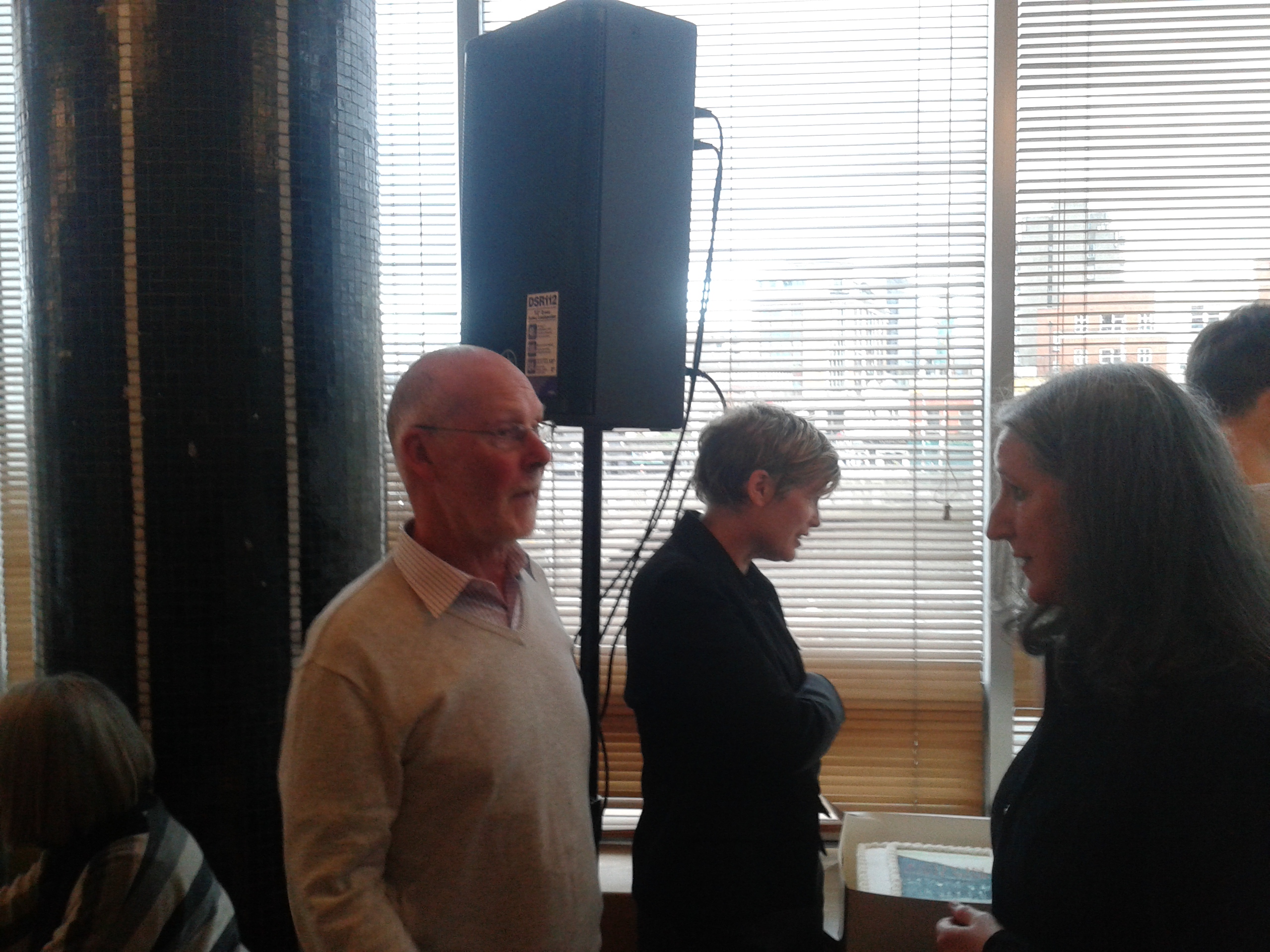
After the launch speeches -- (L-R) Padraig Yeates, Katherine O'Donnell, Caitriona Crowe.
After the launch speeches — (L-R) Padraig Yeates, Katherine O’Donnell, Caitriona Crowe.

Jack O’Connor, between speeches, made a reference to a giant banner hanging off Liberty Hall which had the word “NO” displayed prominently, saying that they had received congratulatory calls from people who thought it was against same-sex marriage. The banner was however against privatisation of bus services. The current banner on Liberty Hall says “YES” to the proposal in the forthcoming referendum and he said that now busmen were calling them up complaining …. to laughter, O’Connor commented that “it’s hard to the right thing, sometimes”. Presumably what he meant was that it is hard to know what the right thing to do is, or perhaps to please everybody. 

It is indeed hard to please everybody but I’d have to say that it is not hard to know that the purpose of and ‘the right thing to do’ for a trade union, is to fight effectively and with commitment for its members and for the working class in general. And that is precisely the responsibility which has been abrogated by Jack
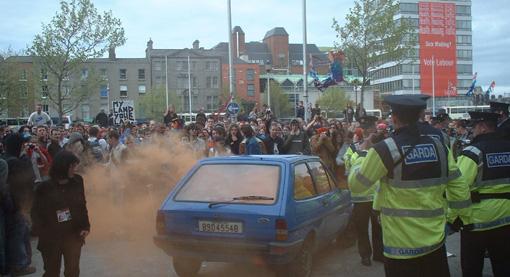
In the background to this photograph of a Reclaim the Streets demonstration in 2002 is Liberty Hall, draped in a hug "Vote Labour" banner. SIPTU has maintained that position through a number of coalition governments in which Labour has participated and that have attacked the living standards and rights of workers.
In the background to this photograph of a Reclaim the Streets demonstration in 2002 is Liberty Hall, draped in a hug “Vote Labour” banner. SIPTU has maintained that position through a number of coalition governments in which Labour has participated and that have attacked the living standards and rights of workers.

O’Connor personally, along with other leaders of most of the trade unions, including the biggest ones for many years, SIPTU and IMPACT. And also by the Irish Congress of Trade Unions. That is why Jack O’Connor gets booed now if he ever dares stand on a public platform related to trade union struggle, a treatment received also by David Beggs before he retired from the Presidency of ICTU.

Back in 2011, another giant banner hung from Liberty Hall – that time it urged us to VOTE LABOUR, as did leaders of other trade unions. Stretching magnanimity, we might give the trade union leaders the benefit of the doubt and say they had forgotten that the Labour Party had only ever been in Government in coalition, most often with the right-wing Blueshirt Fine Gael party and that its most recent spell sharing power had given us one of the most repressive governments in the history of the State. Let us imagine for a moment that these social-democratic union leaders had forgotten all that. But, after February 2011, as Labour and Fine Gael went into coalition and both reneged on their election promises, as the Coalition government began to attack the working class and the lower middle class, what is their excuse then? When did they denounce the Labour Party to their members, publicly disaffiliating from the party? No, never, and the fact that those disgusting connections continue was underlined by the presence at the book launch of a Labour Party junior Government Minister and the late arrival of none other than Joan Burton, Minister for Social Constriction …. er, sorry, Protection.
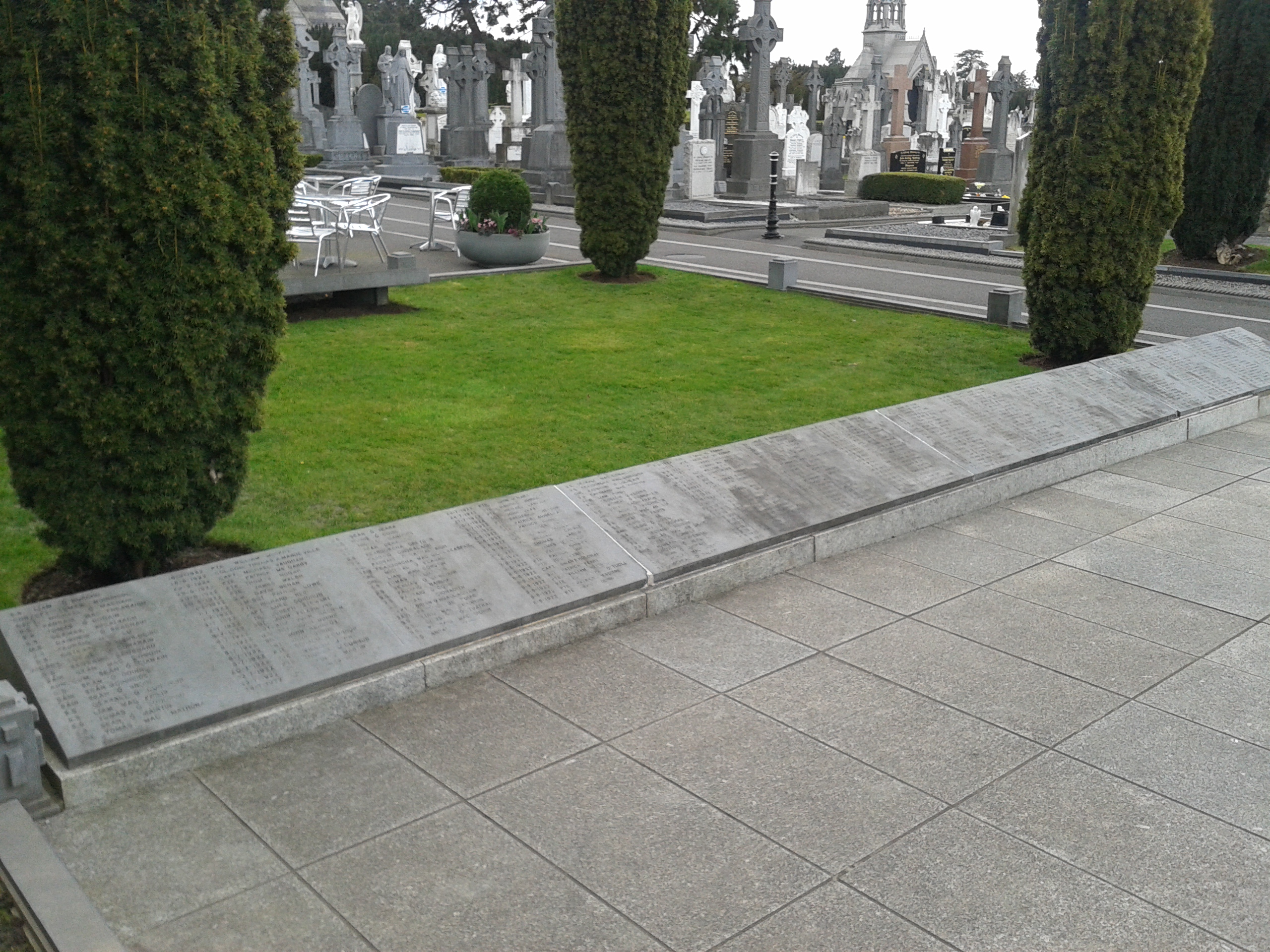
Plaques in Glasnevin's Republican Plot recording the names of 77 of the 81 Irish Volunteers officially executed by the Free State between November 1922 and May 1923. Their police and military killed about another 150 without judicial procedure.
Plaques in Glasnevin’s Republican Plot recording the names of 77 of the 81 Irish Volunteers officially executed by the Free State between November 1922 and May 1923. Their police and military killed about another 150 without judicial procedure.

Considering that the book being launched was about the Civil War, it is really extraordinary that no speaker mentioned the repression by the Free State during and after that war. I am certain that Padraig Yeates has not glossed over that, he is much too honest and too good a historian to do so. But that only one speaker at the launch (Catriona Crowe) should mention the sinister Oriel House and none the at least 25 murders its occupants organised, nor the 125 other murders by Irish Free State soldiers and police, nor the 81 state executions between November 1922 and January 1923, sets one wondering at just how much self-hypnosis sections of our political and academic classes are capable.

Elephants, elephants everywhere

but not one can be seen!

End.
A DEPRESSING DISCUSSION ABOUT TRADE UNIONS

Diarmuid Breatnach

I attended a meeting last night discussing the state of trade unions in Ireland and I found the meeting depressing. Not the state of the unions, which could be grounds enough for depression it’s true, but the state of the Left that sits down to discuss these questions. Because where else can the remedy come from except from the activists on the Left and if they don’t have a solution ….!

Practically all the 40 or so in the room were activists in trade union, community and political struggles, many with decades of experience. Many have suffered in the struggle, made financial and other sacrifices, some have suffered unemployment as a result of their commitment and some have even seen the inside of a prison. As the result of that combination of experience, one would think that they would come up with a good way – or number of ways – forward, out of the dire situation in which the trade union movement finds itself at the moment. One would think …. but alas!

The title of the meeting was TRADE UNIONS — RADICAL OR REDUNDANT? It was held on the second day of the week-long program of political discussion and cultural events of the James Connolly Festival, organised by the Communist Party of Ireland. Billed as a “debate & discussion on the future for trade unions”, the panel was chaired by Garret Gareth Murphy of Trade Union Left Forum and consisted (in speaking order and in personal capacity) of Louise O’Reilly (SIPTU), Dave Gibney (Mandate), Ann Farrelly (Swords Says No but also a member of a teacher’s trade union), Laura Duggan of Work Must Pay, Bernie Hughes (unemployed member of SIPTU but also a community activist and recently jailed for allegedly breaking an injunction sought by Sierra/ Irish Water).

Having attended a public commemoration of the death of Bobby Sands and nine other hunger-strikers which was also to start at 6pm, I arrived late for the meeting and so missed one panel speaker’s contribution and much of what another said. But that still left the rest of what the second one had to say and the other three.

At 7.15pm, the panel speakers finished and the meeting was opened to comment from the floor. Around an hour of speakers and less than an hour allocated for contributions from the audience, a discussion which then had to be cut to allow the panel to respond. This unfortunately is standard for Irish Left meetings, right across the political spectrum. Of course the intention expressed was to keep the contributions to five minutes from each and of course too some of them went way over. In this case, with five panel speakers, I had in fact predicted what would happen on the FB page of the event, though of course I would have been glad to have been proven wrong.

It is understandable, in a way. Left-wing speakers tend to be communicators and have a lot to say. They are also often kept out of many arenas where they could express their ideas. But arrogance has to be a factor too, when one knows that a meeting is scheduled to last about two hours and there are five speakers and a chair – and one still takes over 20 minutes to speak. Where does one think that extra 15 minutes (or much more) is going to come from? It is going to be deducted from other speakers probably and certainly from the audience. Or if the meeting goes on longer to make up the deficit, the risk is of wearing out the audience. The solution is crystal clear but probably won’t be applied – book less speakers and chair the meeting rigorously.

So why are so many speakers invited? Sometimes it’s because a broad representation of opinion is sought and at other times it might be that a number of organisations are expecting to be given a speaker. Then each speaker might attract a different audience or members of a different organisation. I have taken part in organising rallies and public meetings too and I know that these issues present difficulties but I also know that they have to be addressed. If we want participation and are democratically minded, we should not continue to organise debates/ discussions in this way.

All the speakers I heard expressed the opinion that there was something seriously wrong with the trade union movement. That was hardly revelatory – it is the opinion of the overwhelming majority of people on the street and in the workplace, if they have an opinion about the trade unions at all. And quite a few have hardly any opinion about trade unions – they don’t enter their view of the world to any degree whatsoever. Laura Duggan related that many young workers, finding themselves in difficulties with Job Bridge or otherwise at work, when looking for help, go first to Citizens’ Advice or to her organisation’s Facebook page – the last place many of them go to is a trade union.

Since that dismal view of the trade unions’ performance is so widespread and was shared by the panel speakers, I would have thought a few sentences could have been devoted to it and the rest of the speakers’ contributions could have been dedicated to prescribing or at least exploring solutions. Exactly the reverse is what happened – most of the contributions I heard were about ways in which the trade unions have failed, including much about personal experiences, but very little about what the solutions might be. Well, maybe the title of the meeting could be partly to blame but as activists, are we not mostly about solutions? Did Marx’s dictum on philosophy totally pass us by, that “heretofore philosophers have only interpreted the world, in various ways; the point, however, is to change it”?

So what were the solutions presented by the speakers? I recall “that the unions should recruit more young workers”, “respond more to young workers’ issues”, “there should be one big union”, “there should be education about political economy and history”, the unions should “continue participating in the struggles against the Water Tax”, “fight more strikes, especially when the membership have called for it” …..

Sure, OK, fine, brothers and sisters – but what if they don’t? What if the leadership, because that is what we are talking about in the failure of the trade unions, what if they don’t do what you think needs doing — what then? What are you going to do? What should we do?

The contributions from the floor followed much of the same pattern with however a greater amount pointed towards solutions. But again, it was mostly what was wanted from the leadership rather than what we could do to achieve the desired ends, especially in the face of the leadership’s intransigence. The need for young people to join the movement was expressed from the floor with on two occasions fulsome praise accompanied by applause for the one young person on the panel – well-intentioned no doubt but to me an embarrassing expression of the activists’ desperation.

Emigration, the 1990s Industrial Relations Act, leadership out of touch, the media … were all variously listed as being the reasons for the lack of resistance by the Irish trade union movement as well, of course, as the social partnership of decades between the unions and the employers and state.

One interesting contribution from the floor referred to an alleged ballot-rigging of which SIPTU had been found guilty in court years ago but which they appealed to the High Court. The brother relating this alleged that the Fianna Fáil Government of the day had the High Court clear SIPTU in exchange for the compliance of the trade union thereafter. Another brother a little later however denied there had been ballot-rigging (he actually said that “it was worse than that”!) and an argument broke out until the Chair quickly brought the meeting to order.

One brother in the audience stated that the problem was not at bottom whether the unions were fighting for better wages or not but about the politics of the union – if the politics were about social-democracy then of course the union would not act in the way we wanted. No-one responded to that contribution, presumably because either they agreed with it but couldn’t see how to progress from a union that isn’t even defending its membership to one with a revolutionary socialist ideology, or because they are basically in favour of social democracy, so long as it’s of a leftier kind.

I made one contribution to the discussion, in which I stated that although I have been a trade union member of different unions for most of my working life, and although I believe we should join a trade union, of course the trade unions are redundant. That is the opinion of most people at work and in the street and is the reality. But that doesn’t mean that trade unionism is redundant.

People will join a trade union if they see it fighting for its members. The workers who left the NUDL to join Larkin’s breakaway IT&GWU did so because they felt the NUDL had sold them out but they knew that Larkin wouldn’t do that and that his union would fight the employers. That was the same reason other workers joined the union too. If workers don’t see the union fighting, why should they join it?

I referred to all the bad history and difficult conditions for the operation of trade unions listed by contributors to the discussion. I pointed out that much worse conditions had been encountered and overcome by trade union organisers in the past – they had been deported in chains to Australia and in the United States many had been shot dead.

The Left in Ireland traditionally tries to deal with collaborationist trade union leadership by mobilising votes to replace the current leadership with Left candidates; I said that this process is too long if at all practicable and that our agreed Left candidates, if successful, are often corrupted by the trade union regime so that we have to start again. I proposed the same solution that I had done some years ago and on a number of occasions since, that trade union activists should form an organisation or network across the unions, in order to attend pickets when strikes break out, as people did with the Greyhound strike, to support the workers in struggle, to talk to them and also try to recruit them so as to have them go with us to the next strike and support the workers there.

I related some years ago being elected to the steering group of an organisation that was allegedly going to fulfill some of those expectations, the Trade Union Activists’ Network. I attended nearly every internal meeting for a year and was constantly trying to push it into action but it became clear to me, over time, that most of those present on the Steering Group had no real interest in the work and may have even been there for no other reason than to prevent activists from occupying their positions. Nevertheless, a grassroots network across the unions is still the only solution, I concluded; if we don’t build that we will continue to attend meetings like this in years to come, bemoaning the lack of success of our trade unions.

Some people – perhaps even most — may think they know better and after all, why should my ideas be any more likely to work than theirs? Well, perhaps for no reason; but their approaches have been tried without success for years – so why not try the one I advocate?

A somewhat separate issue which I did not address in my contribution was the much-promoted alleged support of trade unions for the Right to Water campaign. It is a fact that not one of those trade unions has advocated non-registration and non-payment. No trade union has advocated resistance to the Water Tax or its implementation by its members and, as one speaker from the floor pointed out, a number of local authority workers had been transferred to a private company installing water meters, without any resistance from the local authority trade unions.

Near the end of the meeting, speakers from the floor began to coincide in saying that we should continue to encourage trade union membership through recruitment, wearing our union badge, education, etc, etc. One went so far as to state that saying that trade unions are redundant is something some right-wing people and employers would love to hear, at which point I interjected that he was implying that “the critics are the problem”, something he hotly denied. But the fact is that the opinion of people about the trade unions is a result of the actions and inactions of those unions, rather than anything said in a meeting of around 40 people (or even a thousand).

I began this report by saying that I found the meeting depressing but that was not, it seems, what most others who attended felt. I found it depressing because despite all the lessons the Left is being taught, it seems unable to learn from them. But when the panel speakers came back to respond to the discussion, for me there were a couple of gleams of gold or at least something shiny in the bottom of the pan: Dave Gibney said that young workers will join a union when they see it fighting and spoke of the young workers in Dunne’s Stores who were enthused and politicised by their recent experience of being on a picket line; Louise O’Reilly said it was a waste of time expecting more sympathetic treatment from the media and that what we need is our own, left-wing newspaper.

End.

Credentials:

Diarmuid has been employed in many capacities, including as a factory labourer, construction labourer, kitchen porter, cleaner, laboratory assistant, foundry furnace operative, machine moulder, fitter-welder, youth worker, community worker, adult education tutor, hostel worker, hostel and addiction services team manager.

In the course of those, he has been a member in Britain at different times of the following trade unions:
Amalgamated Engineering Union
Construction Engineering Union
AEU (Foundry
Workers)

Community & Youthworkers’ Union
NALGO (ILEA: Youthworkers; Adult Education Tutors)

NALGO (Local Authority, Education)

Unison

……. and in Ireland of:
SIPTU (Marine and Port)
SIPTU (Health workers)

Diarmuid has made serious attempts to found union branches in a number of manual workplaces with some successes and some failures, including being sacked from two workplaces for trade union or solidarity activity. He has also founded a union branch (managerial section) in his more recent work managing teams working with the homeless and people with substance misuse issues, along with facilitating union branch founding for other grades of workers in workplaces he managed. During his employment by NGOs, Diarmuid has faced disciplinary proceedings three times and beaten them twice, once at the initial stage and at the appeal stage in the second; he took the third to Labour Court and was awarded compensation.

Elected Shop Steward and/or Health & Safety Staff Representative in NALGO and in Unison, Diarmuid has campaigned for health & safety improvements (including organising comprehensive risk assessments by the team) as well as representing workers at disciplinary hearings (with mixed results). Elected unpaid Assistant Branch Secretary, he has been active in organising a strike, speaking at shop meetings and organising and participating in pickets. For a year, he edited a trade union branch newsletter and contributed articles to it.

As a trade union, community and political activist, among the pickets he has supported have been at car manufacturers (Fords), building sites, newspaper (Wapping), refuse workers (Greyhound), catering workers (Subway, Mac Donald’s), against cuts and closures of services, also collecting money for miners’, fire fighters’ and health workers’ strikes.

THE BLOODIEST BATTLE OF THE EASTER RISING

D. Breatnach

99 YEARS AGO ON 26th APRIL, THE BLOODIEST BATTLE OF THE EASTER RISING WAS FOUGHT IN A DUBLIN SUBURB

At a little past 6am on 26th April 1916, the SS Tynwald and SS Patriotic, two British troop-ships, had berthed in Dun Laoghaire harbour. The harbour and town had been renamed Kingstown by Unionist elements when King George IV came to visit the new port under construction in 1821. Although the town returned to its former name in 1920, it was known as “Kingstown” by most people in 1916, whatever their allegiance.

The troopships had been requested by General Maxwell, who had been given the responsibility for suppression of the Easter Rising, which was now in its third day. Several British thousand troops from the 59th Midland division began to disembark on a bright sunny morning. Hundreds of civilians went down to see them despite the early hour. Many in that town, especially around the seafront and some of the big houses, would have been sympathetic to the British – but by no means all and no doubt some eyes were noting the arrivals in order to report to the insurgents.

Around 9am, disembarkation completed, the soldiers were formed up and inspected, equipment checked and the Sherwood Foresters set off marching towards Dublin city centre, seven miles away, to be followed by Nottingham and Derby regiments around 10.30hrs. Their forces appear to have split up, with two Battalions marching to the city along the coast road and another two heading inland.

To reach the city centre from Dun Laoghaire, the most direct route is to proceed northward along the coast to Mount Merrion. Once there, the coast road goes through the railway level crossing to the right and continues along the seafront, into Ringsend and then along what is now Pearse Street to Trinity College. The British officers did not lead their men in that direction, perhaps because they had received intelligence of the Boland’s Mill strongpoint along their route. There would be no going past that without first taking it, which might prove a lengthy and difficult battle.

But one could avoid that by not turning right at Mount Merrion and instead continuing on what has become the main road, through Ballsbridge and Northumberland Road, across the Grand Union Canal at Mount Street Bridge, past the fashionable Merrion Square and into Nasseau Street and the city centre. That seemed the obvious choice, not just because of the Jacob’s garrison but also because at Mount Street Bridge was located Beggars’ Bush Barracks, one of the many such of the British Army in Dublin city.

Northumberland Road looking southwards. The Irish insurgents first saw the British troops coming up this road.
Northumberland Road looking southwards. The Irish insurgents first saw the British troops coming up this road.  The Parochial Hall and Schoolhouse are to the left but out of the photo.  The canal is behind the photographer.  (Photo D.Breatnach)

Before the British troops arrived in the area, a female courier, probably Cumann na mBan, had brought news of the troops landed in Dún Laoghaire and that they were heading towards them to the insurgents waiting in the Mount Street Bridge area.

At around noon a burst of fire hit the forward sections of the British troops marching in from Dun Laoghaire. When fired upon, in order to find effective cover, it is important to know from where the firing is coming but the soldiers were unsure. No. 25 Northumberland Road, a house at the junction with Haddington Road, seemed to some to be the source of the firing but by how many was unknown.

Screams from wounded men filled the air in the quiet suburban upper-middle class and largely Loyalist residential street.

Soldiers began to maneouver to outflank No.25 Northumberland Road and a detachment reached Baggot Street Bridge, further west, which was apparently undefended. From there it is a straight road into Stephens Green and the southside city centre. The rest of the soldiers were not led by their officers in that direction, a decision which was to cost them dearly. Instead, shortly after being fired upon, at least two British platoons attacked 25 Northumberland Road but were driven back in disarray by fire from the building’s upper floors; yet as they turned they were also shot down in droves.

Perhaps under cover of that assault, at around 1pm some of the 2/7th Battalion Sherwood Foresters got past the corner house and made their way on to Percy Place, which runs along the south side of the canal between Mount Street and Baggot Street bridges. Now they came under fire from in front and from their left. They huddled for cover along the Canal.

The fire from the left of the British at this point was coming at long distance from the towers of Jacob’s Factory in Bishop Street, one of the insurgent strongpoints. A defensive line with insufficient mobilised insurgent numbers to hold it for very long stretched from Jacob’s down to the railway connecting Dublin and Dun Laoghaire and to Boland’s Mill beside it, overlooking the south bank of the Liffey. Roughly in the middle of this chain or defensive line were the Irish Volunteers in the Mount Street Bridge area, an outpost of the Boland’s Mill garrison.  The total strength of the insurgent force defending that area had been 17 Volunteers but two had been sent home, being thought too young.   

New Clanwilliam House, Mount Street, north side of the Royal Cana. Looking eastward.
New Clanwilliam House, Mount Street, north side of the Royal Canal, looking eastward. The Bridge and Canal are to the right but out of shot. (Photo D.Breatnach)
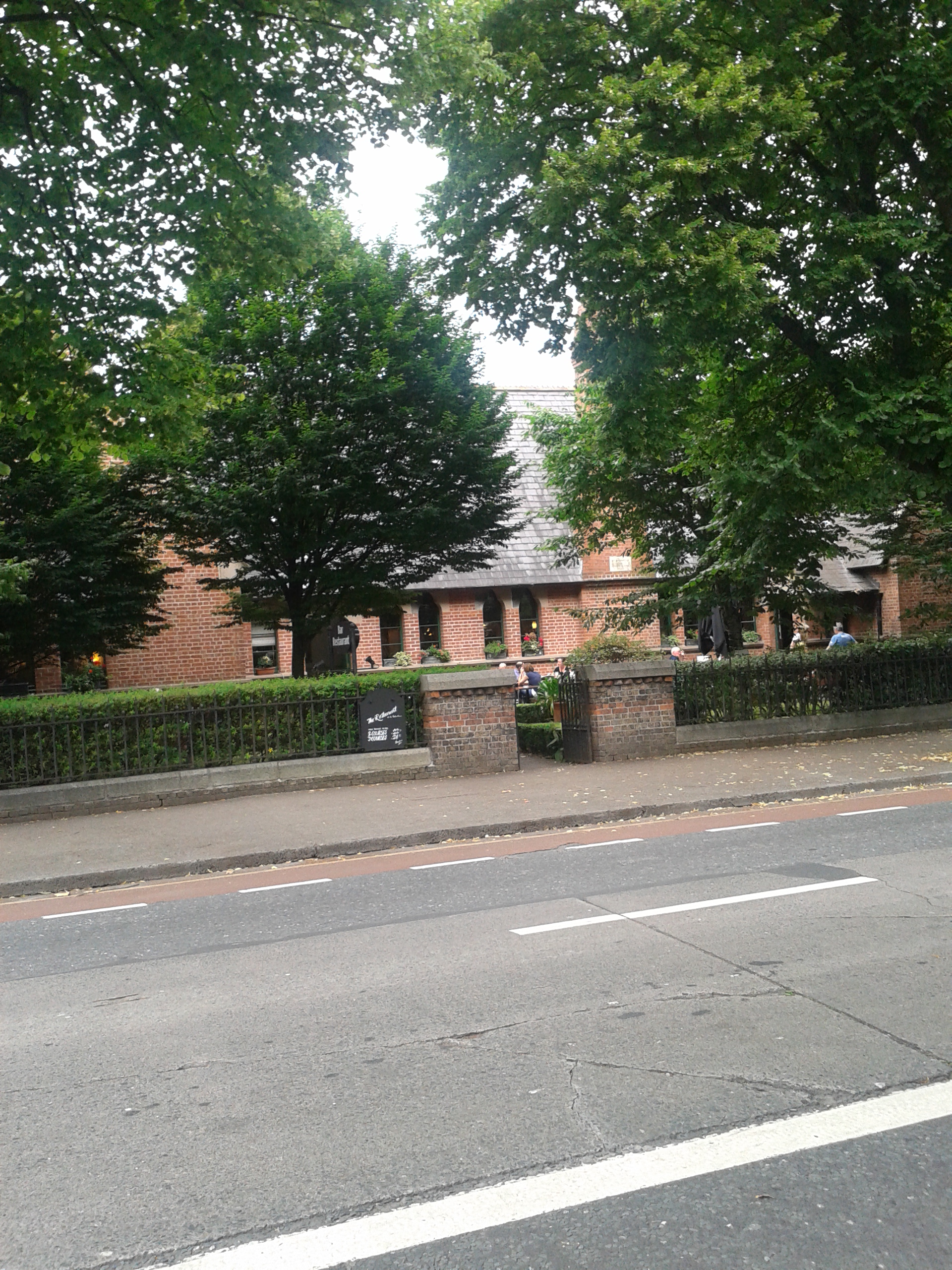
The Schoolhouse, Northumberland Road, today (a snack-cafe nowadays). The Bridge is to the right; the British troops were advancing along the road from the right.

Incredible as it seemed to the British when they learned of it later, there were only two Volunteers in No.25 Northumberland Road: 27 year-old Volunteer Lieutenant Michael Malone, a carpenter by trade, and Section Commander James Grace. In the Schoolhouse on the right-hand side just before the Bridge, there were two Volunteers. Next to that building was the Parochial Hall, held by four men: P.J. Doyle in command, Joe Clarke, William Christian and J. McGrath. Clanwilliam House, across the canal on the right-hand corner with the junction with Mount Street Lower, was occupied by seven Volunteers; the frontal fire hitting the British was coming from there.

The British were scattered around gardens and behind the granite steps leading up the to front doors of the elegant houses in the street. Their officers called them out and they launched an attack on the Schoolhouse in Northumberland Road. As they charged up the road they came under fire from across the Canal from Clanwilliam House; about a dozen reached the Schoolhouse but they left many bodies behind. And they were still coming under fire from across the Canal too.

The officers now attempted to outflank Mount Street Bridge and Northumberland Road by advancing along Shelbourne Road to the east but were stopped as they came under fire from Volunteers along the railway line and from positions in and around Horan’s Shop nearby.

The column advancing from Dun Laoghaire had set up a temporary HQ in Ballsbridge Town Hall. Incredibly, the officers there, receiving regular dispatches reporting their troops being slaughtered around Mount Street Bridge and, presumably, knowing that other troops had found Baggot Street Bridge undefended, continued to press for an advance across the killing field.

But at least the officers on the battlefield for the time being seem to have had enough of death-or-glory charges, which were bringing plenty of death and no glory. The soldiers are now crawling along the road but whenever any are visible, which is often, they are being fired at. Clanwilliam House is wreathed in smoke.

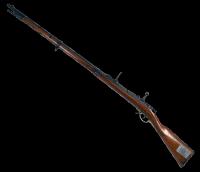
Mauser Model 71 small
The Mauser Mark 71

The weapon the Volunteers were using was almost certainly the Mauser Model 71, the weapon of most Volunteers and Irish Citizen Army during the Rising; 1,500 had been been delivered in two landings in July 1914, first at Howth, north Dublin and then at Kilcoole, Wicklow. It had been the first cartridge rifle adopted by the Prussian Army in 1872 which by 1914 had gone on to another more advanced model, presumably the reason that the rifle was being sold cheaply. The Model 71 fired a larger bullet than the British Army standard-issue Lee Enfield .303 but did not have a magazine, each cartridge having to be ejected and anew one inserted before firing again; its rate of fire was only four or five rounds a minute. The Lee Enfield took a ten-bullet magazine and the British Army were trained to fire fifteen rounds a minute. Despite this, the occupants in Clanwillian House and in No.25 in particular were able to lay down a tremendous rate of fire. Their guns grew so hot they burned to the touch and they had to cool them with wet rags. Down below, British officers blew their whistles and soldiers carried out more charges, only to be cut down by the Volunteers’ rifle fire.

During the late afternoon, a nurse ran on to the road and began treating the wounded British soldiers. The Volunteers agreed to a ceasefire as doctors and nurses from Sir Patrick Dunne’s hospital nearby went into Northumberland Road. But after a while the British attempted to use the ceasefire to advance their positions and the Volunteers ended it. Those wounded still to be tended lay where they were. This had been very different situation to what was to be seen in other areas of Dublin during the Rising, when British troops refused to allow wounded to be taken out unless the insurgents surrendered and when they accused Nurse Elizabeth Farrell of being a spy and tore her Red Cross bibfront off her.

The British got a machine gun up to the bell-tower of the church on Haddington Road so that they could fire over the roofs of the houses at Clanwilliam House, the bullets knocking chips off the outer walls and zipping through windows. They were also being backed by rifle snipers.

British soldiers recommenced attacking No.25, now with hand grenades as well as rifle fire. Finally they got close enough to blow the door in with explosives but incredibly were fired upon from inside as they tried to gain entry, injuring a number of them. They hurled grenades in and after they exploded, dashed in again. Coming down the stairs to meet them was Volunteer Lieutenant Michael Malone, his pipe in his mouth and was shot dead.

Section Commander James Grace had been downstairs using a cooker as cover from bullets and shrapnel and such was the bomb damage to the room that the British assumed anyone in there had to be dead. There was still plenty of fighting to do – they had not even crossed the Canal yet.

If they believed that two men alone had held out against repeated assaults for four hours and had inflicted such damage upon them, they must have been very fearful leaving No.25. But perhaps they thought there had been others who must have escaped in the last minutes. James Grace did escape to get out of the area after lying low for some hours; however he was arrested some days later.

With No.25 taken, the Sherwood Foresters are soon able to take the Parochial Hall but they find it empty. The garrison of four Volunteers had run out of rifle ammunition and evacuated into Percy Place, where British troops, who were now all around the area, captured them.

An officer takes Volunteer Joe Clarke‘s loaded pistol off him, puts him with his back to a door and fires at him. Missing Joe, the bullet goes through the door to where a doctor is attending to injured British soldiers. He storms out in rage, berating the officer and Joe Clarke’s life is saved (he continued active in the IRA and in Republican politics nearly until his death in 1976 at the age of 94).

British soldiers are occupying nearby houses for cover and for firing positions and they are also crouched behind the low wall along Percy Place. They are still being hit. Now, they attack the Schoolhouse from its front, running across enfilading fire from Clanwilliam House to their left as they attack and from other positions to their front. When they enter, they find the Schoolhouse unoccupied by any Volunteer, alive or dead. However, their storm of bullets during the attack has riddled the bodies of its caretaker and his wife.

The cost to the British has been enormous but they have at last taken the southern side of the Canal around Mount Street Bridge. Across it, waiting for them, is Clanwilliam House. And to the east, their right-hand side, snipers at Boland’s Mill and nearby positions are also firing at them.

Now the officers order forward their reserves who had been sheltering in St Mary’s Road. The soldiers charge for the Bridge, answering to their discipline and their officers as they and many like them will do across the WWI battlefields of Europe, Greece, Turkey and Russia for another three years. It is partly against this slaughter that James Connolly led the men and women of the Irish Citizen Army out this week. One of the ICA’s detachments is not far away, under the command of Michael Malin and Constance Markievicz, in the College of Surgeons on the side of Stephens Green and they have already taken casualties.

Despite the covering fire from the Vickers Machine Gun firing incendiary bullets from St Mary’s Church, this charge too is driven back, their casualties adding to the pile of khaki-clad bodies and wounded on Northumberland Road, the Canal banks and the Bridge.

Around 8pm, the British are finally across Mount Street Bridge. An officer was in the charge, one of their few unwounded, and is at Clanwilliam House’s outer walls. Firing continues from the windows of this last insurgent bastion and from the east, a hail of Mauser death is still hitting the Bridge and the northern side of the Canal.

The British are now close enough to throw grenades but one, thrown by a British NCO, bounced back from a second floor window and exploded next to his head, killing him. The British begin to make their way into the now-burning Clanwilliam House but are forced to retreat by the flames, leaving the fire to consume the bodies of the presumed dead Volunteers inside. They will not know now how many there were. In fact, there were only seven Volunteers, three are dead and the remaining four have escaped out the back.

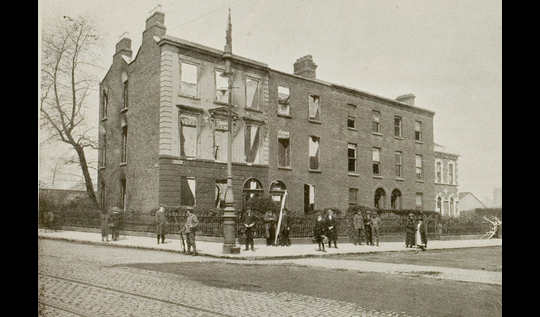
Clanwilliam House after the Rising
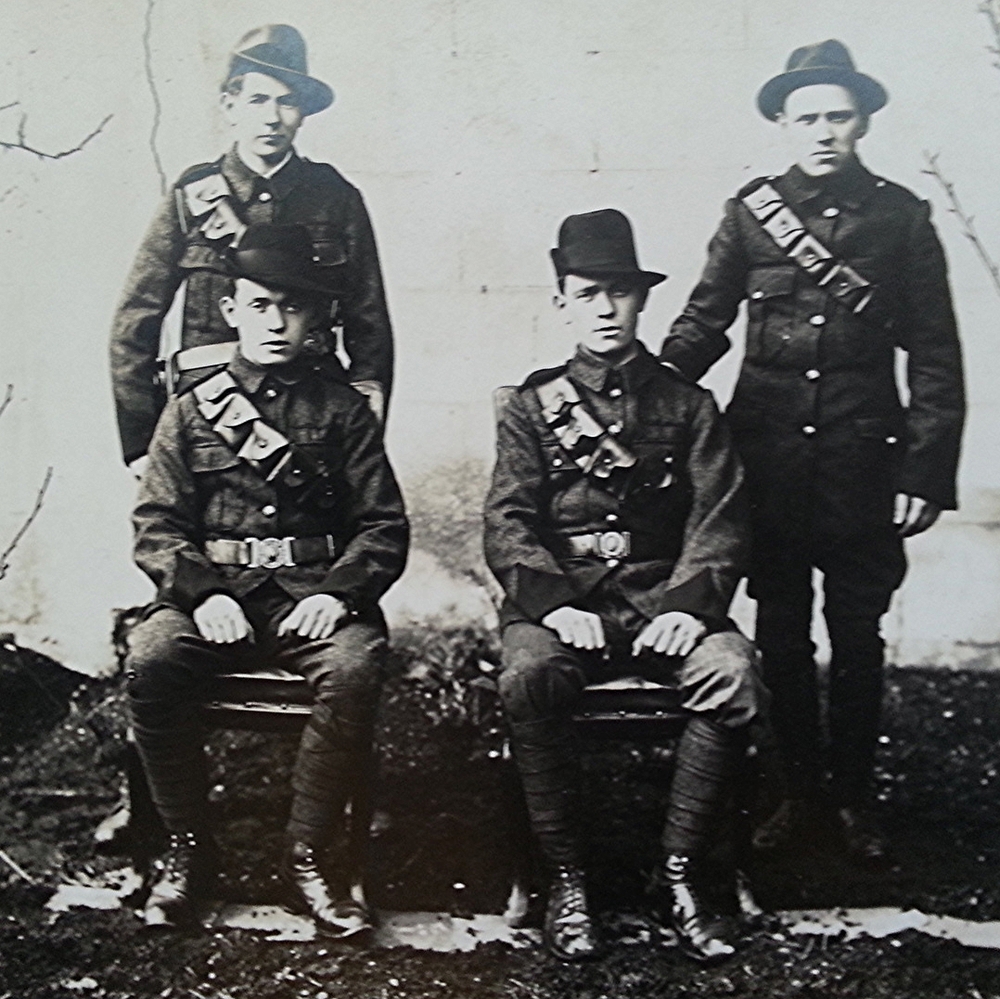
The four survivors of the Clanwilliam House garrison.

Ninety-nine years ago in the Battle of Mount Street Bridge, despite having only single-shot rifles and some pistols, the  Volunteers held off two British Battalions, numbering approximately1,600 between them, for five hours. Approximately 234 men (including 18 officers) of the British Army had become casualties at the hands of fifteen insurgents.

Mount Street Battle Monument on the south side of the Bridge. (Photo D.Breatnach)
Mount Street Battle Monument on the Bridge
Mount St Bridge Gaeilge pla
Part of the memorial on the south side of the canal. (Photo D.Breatnach)

End

Sources:

Article in http://www.irishtimes.com/culture/books/an-easter-rising-timeline-wednesday-april-26th-1916-1.2188089 drawing on When The Clock Struck in 1916 – Close-Quarter Combat in the Easter Rising by Derek Molyneux and Darren Kelly, Collins Press, at €17.99.

Remembering the Past – the battle of Mount Street Bridge, by Aengus O Snodaigh, article in http://www.anphoblacht.com/contents/6137

Article on the “Howth rifle” in http://www.historyireland.com/20th-century-contemporary-history/the-mauser-model-71-rifle/

A BLOC FOR WHAT?

Diarmuid Breatnach

From time to time people are asked to join a political bloc of some type. Should one join or not?

A political bloc is an arrangement of temporary unity, of as little as some hours of duration, for example on a demonstration, or of weeks, perhaps in a campaign to get an agreed list (i.e. “a slate”) of candidates elected or to vote a particular amendment to a resolution being proposed.

Blocs may be of longer duration, as for example with the Bolshevik bloc in the lead-up to the Russian socialist revolution. This last example is illustrative of the nature of blocs, which are generally not only for something but also against, or at least different to something else. There was a whole mass of political factions against Kerensky’s government in 1917 but the Bolshevik leadership sought to create a bloc not only against Kerensky and his followers’ maneuverings but also different to that of the Mensheviks and the Socialist Revolutionaries. What the Bolsheviks were for, apart from the slogan “All power to the Soviets” (the workers’, soldiers’ and sailors’ councils and assemblies), was a revolution as soon as possible, the overthrow of the capitalist-monarchist State and the creation of a socialist one (as well as pulling the Russian Army out of World War One).

Although the facts of the successful overthrow of the state and withdrawal from the War are not usually questioned by historians or political theorists, the fate of that state is. And the bloc itself had a very mixed history after the Revolution.

But what essentially is the purpose of blocs? Are they composed of like-minded people who don’t want to belong to a political party-type organisation, or perhaps of people of a variety of party political allegiances, but who want to join for the moment to promote a general idea? Or are they attempts by one group to create hegemony, to bring people of different perceptions together in temporary action, with the intention of building a more permanent organisation? Or perhaps crudely an attempt by one (or two) organisations to recruit members to their own organisations? I have over the years participated in blocs and it seems to me that different blocs have at different times been each one of those things. So I ask myself, is that ok? As political activists, should we consider blocs a legitimate type of temporary political organisation? Is each of those purposes outlined above of equal value?

A Black Bloc against repression in Germany -- location and year uncertain
A Black Bloc against repression in Germany — location and year uncertain

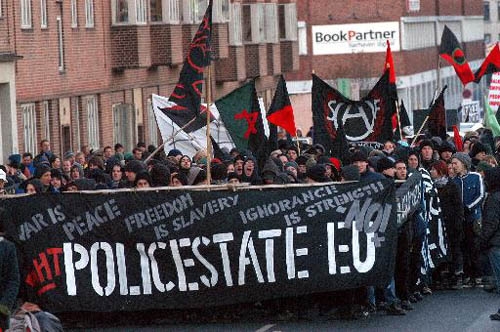
Around this time of year in 2010, early on in the protests against austerity, although then called “Right to Work”, back in the last year of the Fianna Fáil/ Green Party coalition government, there was a bloc formed for participating in demonstrations against the bank bailouts and consequent cuts in social spending and wages being imposed or proposed by that Coalition Government. Called the “Anti-Capitalist Bloc”, it seemed composed in the main of the anarchist WSM and what would often be described as “dissident Republicans”, chief among which at the time was the Éirigí organisation. There was a fair sprinkling of non-aligned activists (i.e. not belonging to any party or particular organisation) whose politics could be described variously as socialist republican, anarchist or communist.

Anti-Capitalist Bloc in Dawson Street, Dublin, marching to join anti-austerity demonstration at Dáíl in 2010

This bloc gathered at a different rallying point to the rest of the Right to Work march but marched to meet it at the Dáil. In that role, it survived I think three demonstrations. The first one was attacked by police after the demonstrators refused to be prevented from marching to join the other demonstration.

What was the purpose of this bloc, at least in the eyes of its organisers? I have no documentation to hand but as I recall, it was to say something like: “the problem is not this or that economic measure or this or that party or government; the problem is capitalism itself.” It seemed to be implying that therefore we needed a revolution. I would and did agree with such a statement and with its implication. Not only did I agree with it

Black Bloc against the EU, possibly a section of the
Black Bloc against the EU, possibly a section of the “March for an Alternative” in London in March 2011.

but it seems to me a crucial point to make, if we are to end our vulnerability to the vagaries of the capitalist system’s fortunes and to its particular rapacity at various times.

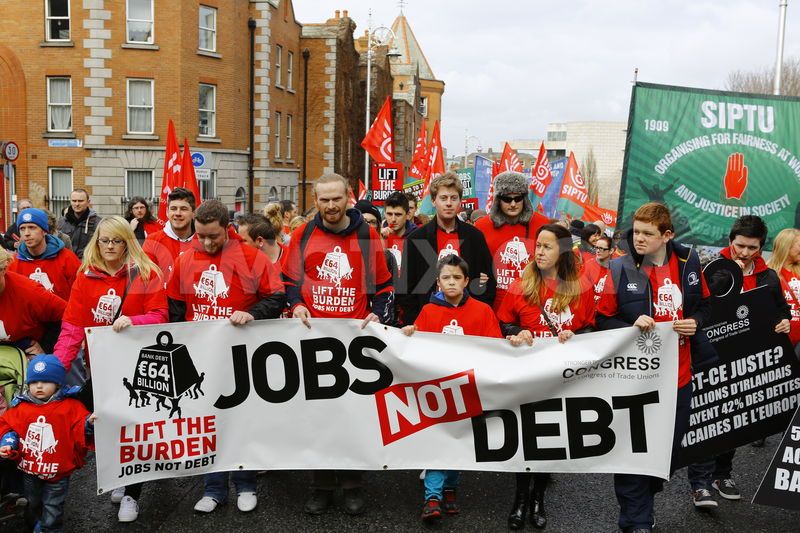
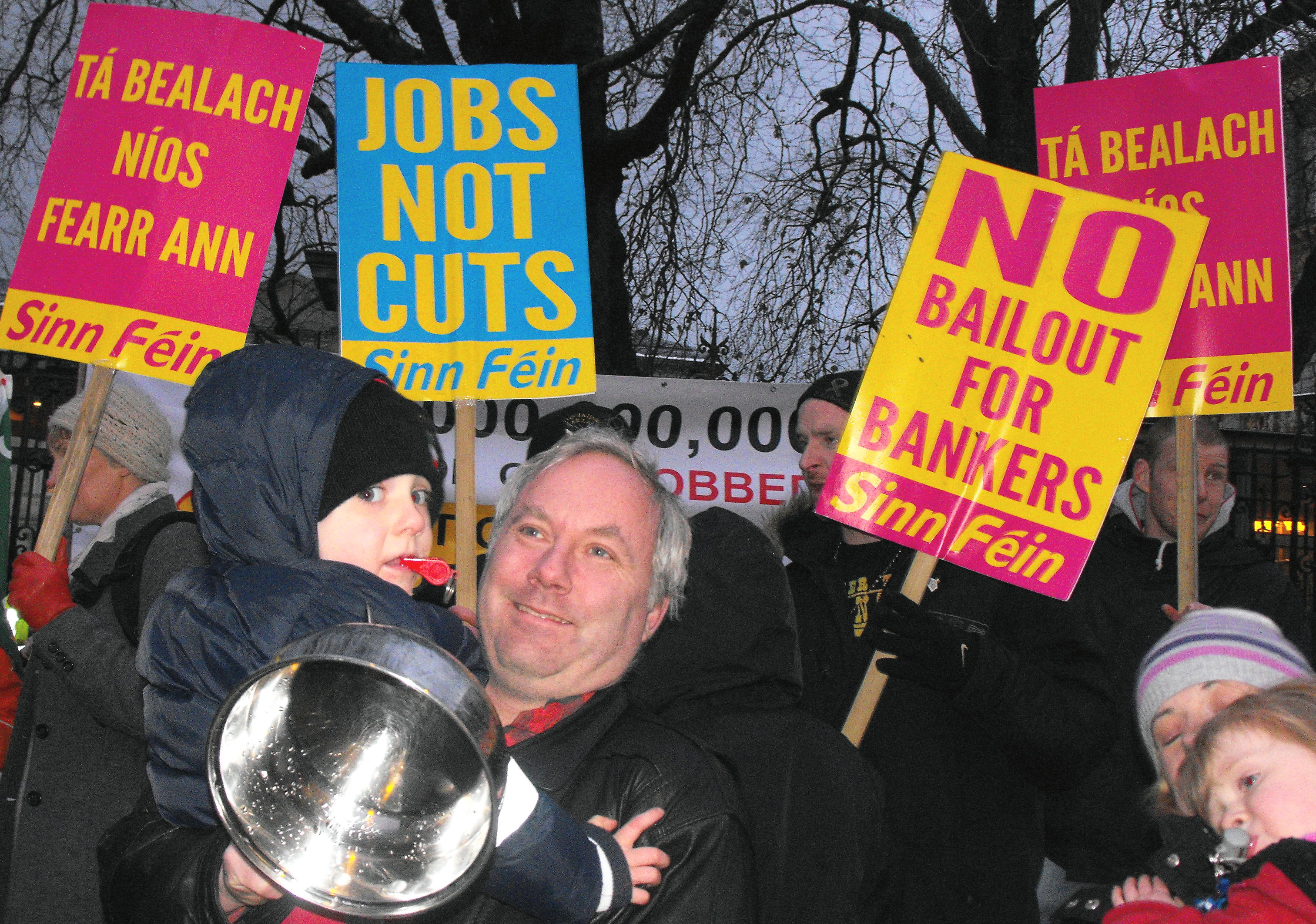
This was a message clearly different from that of some sections of opposition to the Government: SIPTU and the ICTU were saying that there was a fairer way of sharing the burden, which was about what Sinn Féin was saying with “Tá bealach níos fearr/There is a better way”.

Reformist trade union slogan on anti-austerity march in 2010

But could those participants in the bloc not have presented that point of view while still joining the other demonstration at its rallying point and marching with it? Perhaps – by each person being given specific placards, for example, agreeing a joint leaflet or by having speakers to represent their point of view. But all of those present difficulties – the production of an agreed placard slogan to say nothing of the difficulties of agreeing a leaflet. And a speaker might not be permitted by the organisers of the rest of the demonstration or their message would get lost among the others being put forward, even if the speech itself could be agreed by the bloc in advance. All the bloc participants could dress in a similar colour (like the “Black Bloc” on some demonstrations overseas in the past). But a separate bloc, marching behind a banner with a slogan with which each bloc participant could agree, was surely the least complicated way to deliver that message – and very visible. The police who attacked it certainly must have thought so.

Sinn Féin demonstration at the Dail in 2010 -- all totally reformist slogans apart from possibly the "Don't Pay the Bankers" slogan
Sinn Féin demonstration at the Dail in 2010 — all totally reformist slogans apart from possibly the “Don’t Pay the Bankers” slogan

There is another factor in such a way of organising a bloc – it permits a visible assessment of its size, of the identities of its participants (unless they go masked, as many of the Black Blocs abroad did). Of course this has a down side also in that the state’s political police can take notes on the participants for the purpose of their files. But it has a positive effect too in terms of future progressive and revolutionary action. A mailing list can be compiled for calling to future events, individuals can be introduced to other like-minded individuals, organisations can get to cooperate – all factors militating against the fragmentation of the radical and revolutionary sector.

Some people on the other part of the march accused the Anti-Capitalist Bloc of being politically sectarian. Perhaps some even thought them elitist. These are of course dangers. But was it or was it not an important statement to make, that the problem was not the governing party but the system, and that a revolution was necessary? And if it was an important point to make, was such an eye-catching way of making it not justified?

Let’s consider what happened in the months and years afterwards and where we are now. In the face of a wide-scale howl of protest at the bank deals of the Government, their economic measures, and recent individual politician scandals, Fianna Fáil were deserted by their Green Party coalition partners. FF dumped their leader and elected a new one for their party and for the Government. It was all too little, too late and they were obliged to agree to a general election, the result of which was that FF’s number of TDs (elected representatives) was cut by nearly 80%, the greatest electoral defeat suffered by either of the main political parties in the history of the state. And the Green Party was wiped out as an electoral force, almost disappearing entirely off the political map.

The electoral verdict otherwise was mixed. The main rival of FF, Fine Gael, got the most votes with the social democratic Labour getting the next largest amount. Sinn Féin jumped from four to fourteen, a Trotskyist party and a different Trotskyist led-alliance got four between them for the first time, twenty Independents were elected, most of them left-wing. But whether socialist, republican, conservative or social-democratic, all candidates had been elected on platforms of opposition to the deals the previous government had made with the banks and with the EEC’s banking regulators.

Despite that, Fine Gael and Labour formed a coalition government and proceeded — in fact — to endorse what their predecessors had done and furthermore, to intensify a regime of austerity on working people, introducing three new taxes and supporting legislation to squeeze the people still further. The message of the Anti-Capitalist Bloc was vindicated.

Would the whole demonstration marching under a banner of “Overthrow Capitalism” have significantly changed that electoral result? Extremely unlikely. But it would have posed the question to the participants and to observers. It would have effected subsequent campaigns of resistance to austerity measures and additional taxes. And it would have built a much wider consensus eight or nine years later that the overthrow of capitalism was the only solution with perhaps a growing consensus that such an outcome was possible.

Because here we are now nine years after those three appearances of the Anti-Capitalist Bloc and once again it seems a general election is looming. Once again, we see other political parties pushing forward to be elected on programs without any perspective of overthrowing capitalism. Political alliances based on continuing the system are being mooted. On social media one sees calls for for kicking out Fine Gael or Labour or both, rather than capitalism. On demonstrations against the Water Tax we hear slogans against Enda Kenny, leader of Fine Gael, or against the Labour Party – but few against the capitalist system. Sinn Fein seek to cut down Labour as they court the social democratic vote which, in the past, they have largely ignored (for example, they have little history in the trade union movement). The Trotskyist groups will also attack Labour, also going for the social-democratic vote as they have traditionally done.

Most people feel that the Government will fall soon but when they pose alternatives they are doing so within the framework of capitalism. That means that same class that commanded the deal with the banks and with the EU will remain in power. Their representatives in government will change but the class will remain. And if they remain, their exploitation remains. Not only that but in the present economic climate, their austerity program will remain too – perhaps with some tweaks here and there but austerity still.

A determined campaign of political leadership over the past nine years giving a clear direction of the need to overthrow capitalism could have us in a very different political position now.

So, the next time we get a call to join a bloc for a demonstration, should we rush to it? Well, not necessarily. Let us question what the bloc is for and what it aims to do. Is the bloc in question a tactic, for example like the Black Bloc, where we identify a revolutionary opposition by colour and also, by masking, make it harder for the State to identify us? There may well be a time and place for such. Or is it to declare a revolutionary principle such as “capitalism is the problem; revolution is necessary’? Or “Non-Payment of the Water Charge is what is required”? Then it seems to me that the answer is that yes, we should.

But if it is to draw some particular lines of political affiliation, for example to say that although the participants may belong to separate organisations or none, “we are all communists” or “we are all republicans” or “we are all anarchists”, then I fail to see how that helps the popular resistance movement proceed forward at all, to say nothing of revolution. If that is the purpose of a bloc, it is fine for the followers of that particular ideology but they would be best fulfilling it by holding public meetings and conferences.

On the street, we need to be motivating observers for participation in resistance, and motivating participants for unity in effective actions, for revolution. Motivation has an emotional component but also an ideological one and in that regard the message has to be to overthrow capitalism. At the moment it is that idea that needs to gain hegemony rather than any particular political party or organisation.

End.

UP TO TEN THOUSAND MARCH IN SOLIDARITY WITH JAILED AND ARRESTED WATER TAX PROTESTERS

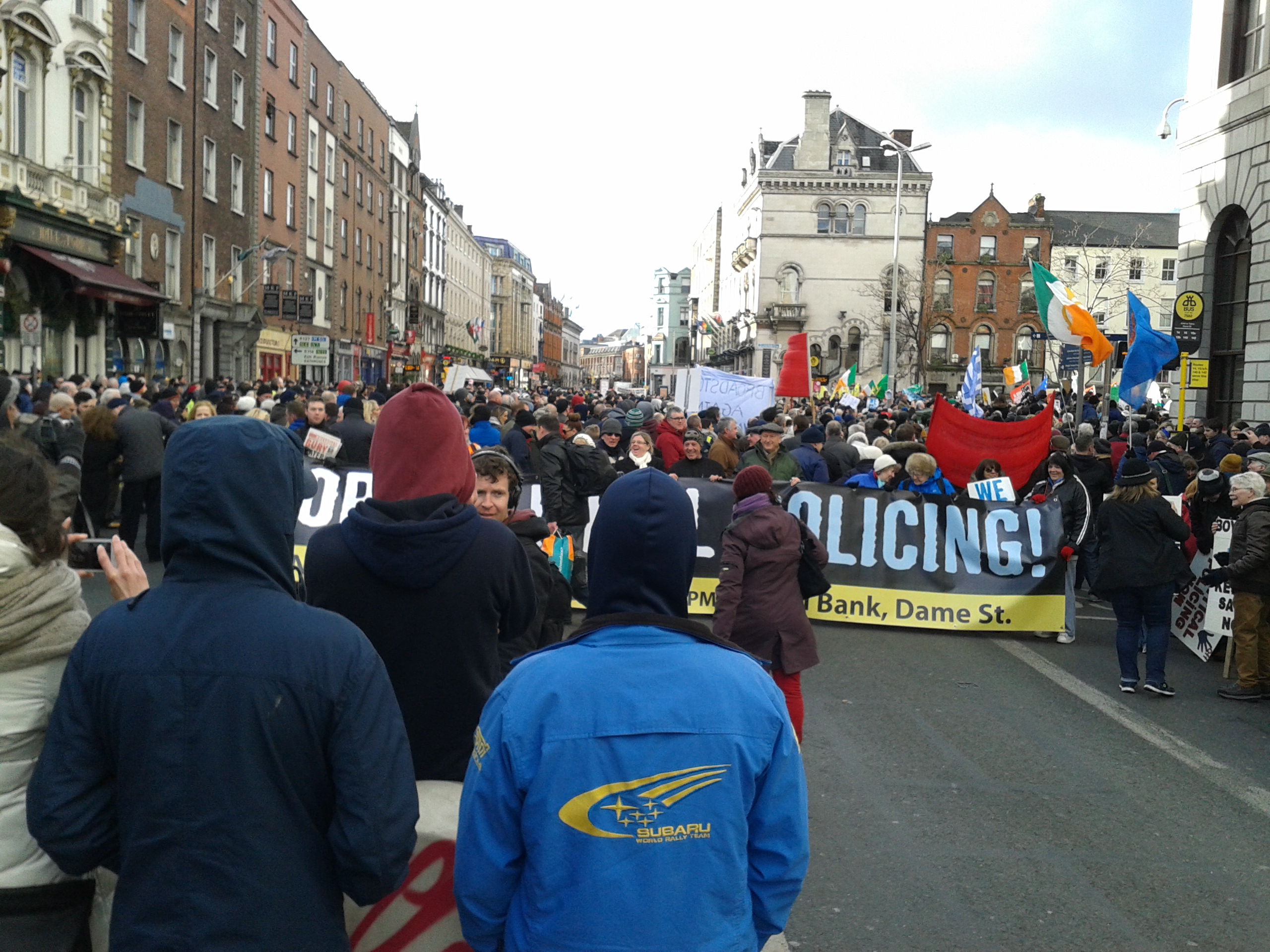
Start of the march in Dame Street after rally in Central Plaza

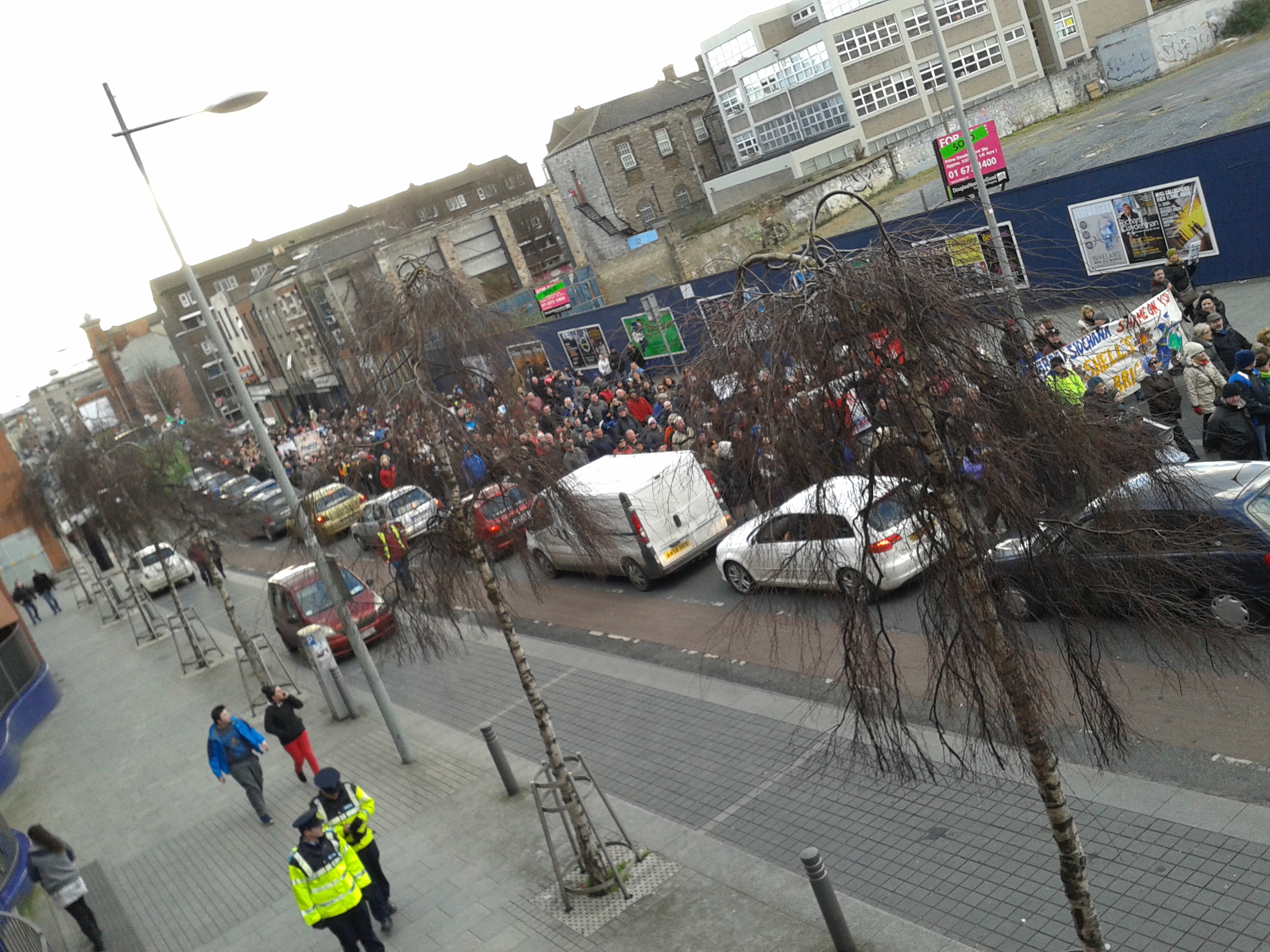
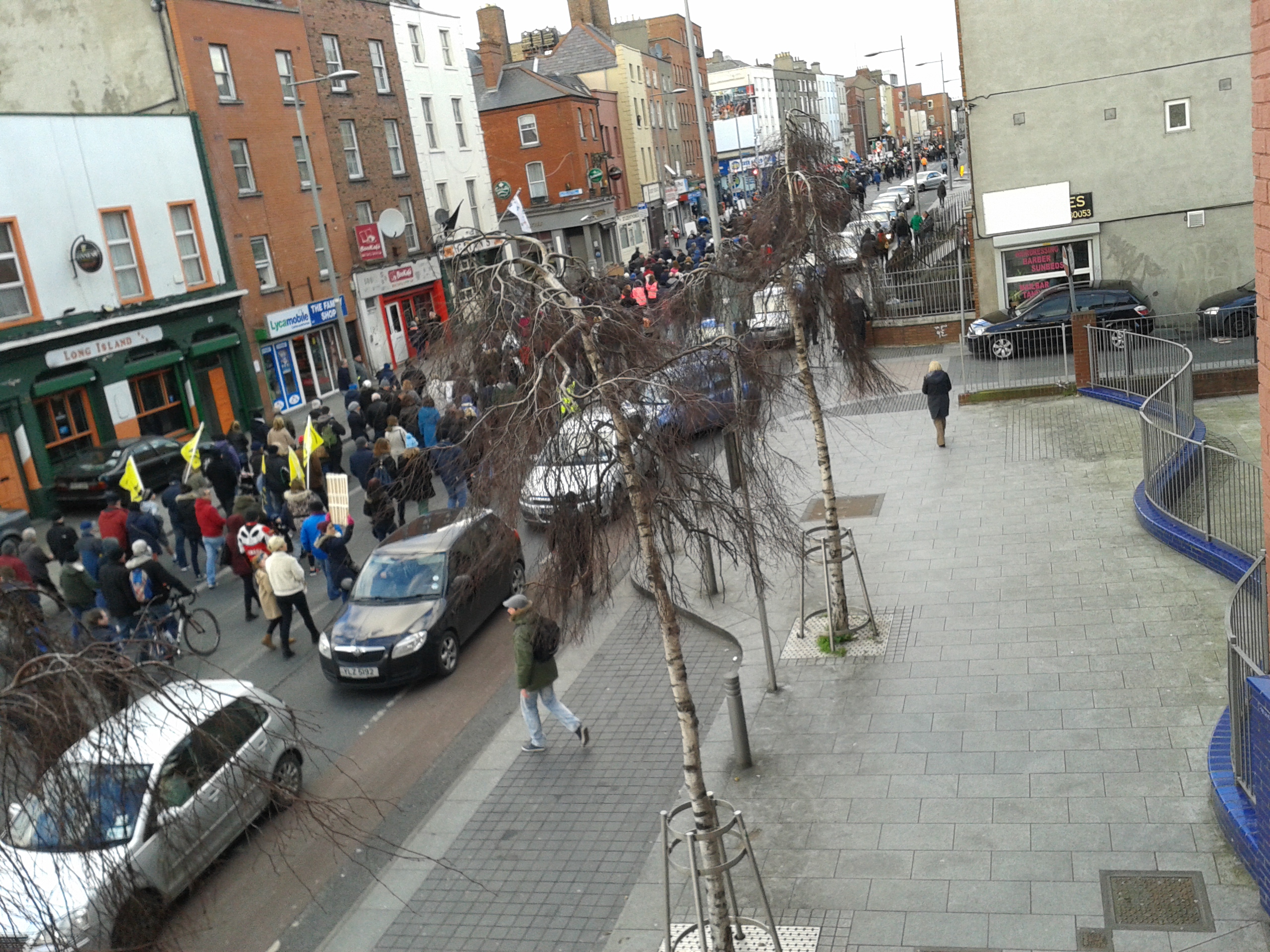
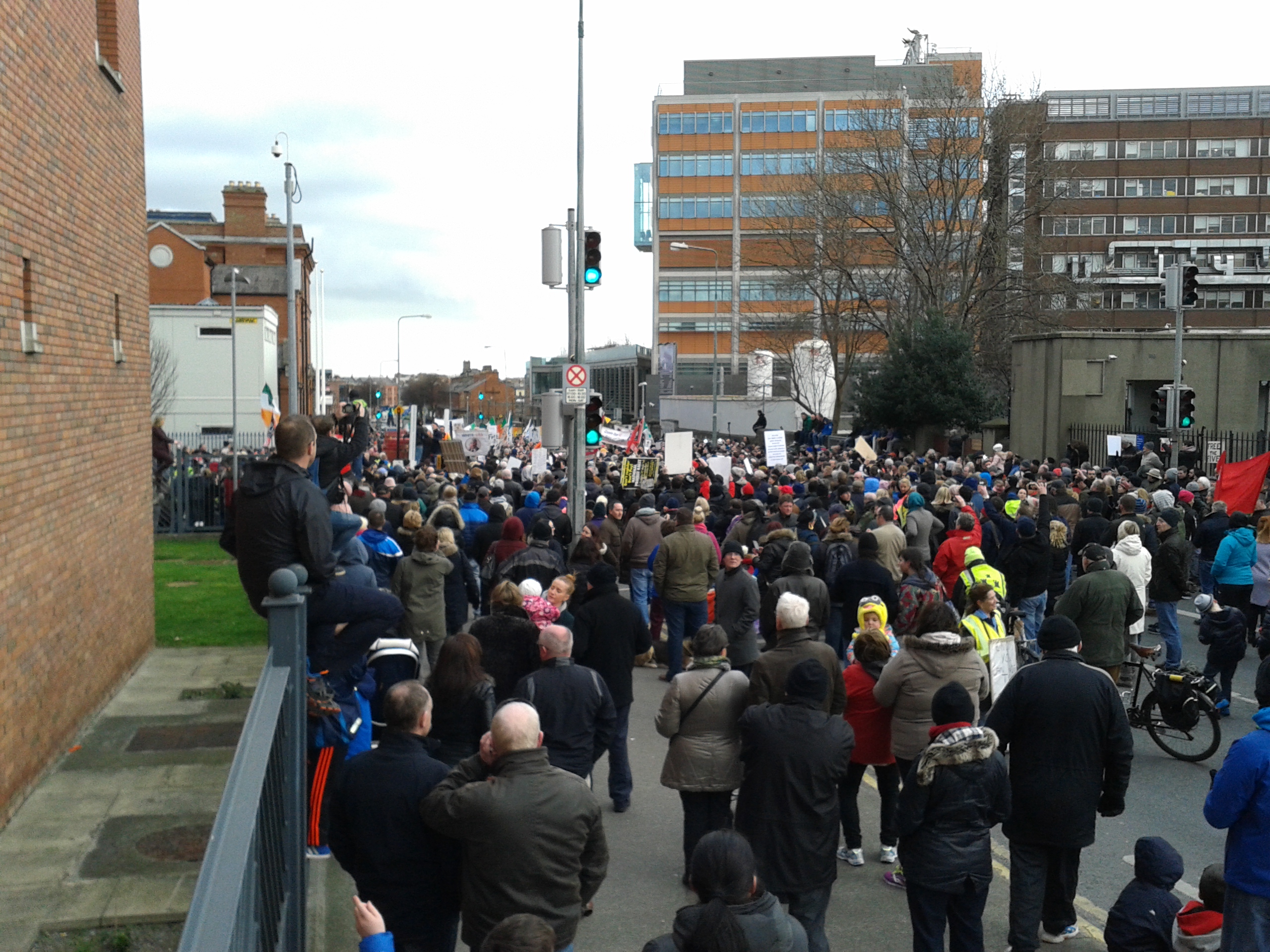
On Saturday 21 February, at two days’ notice, somewhere between eight and ten thousand people gathered in Dublin in solidarity with those water tax protesters jailed by the State and those recently arrested.  They marched to Mountjoy Prison and packed the road outside it and in front of the local Garda (police station).


Dame St Start March V Repression Water Tax Protesters 21 Feb2015
The march gets going in Dame Street. Photo shows only the front of the march.


Parnell Square West from Granby Place.  The front of the march has turned into Dorset Street and is marching there but the end has yet to come around the corner into the square from Parnell Street
Parnell Square West from Granby Place. The front of the march has turned into Dorset Street and is marching there but the end has yet to come around the corner into the square from Parnell Street

The crowd were addressed by relatives and friends of the jailed, anti-Water Tax campaigners as well as by Paul Murphy, Joan Collins and Clare Daly (both TDs of the United Left) and Dessie Ellis (TD of Sinn Fein).

All of the speakers denounced the politicians and the State for the jailing of the protesters while the bankers and politicians who created the crisis and colluded in the bank bailout went free. Most speakers called on the crowd not to pay the water tax and to build resistance on the streets. Dessie Ellis, in keeping with his party’s position, did not call for non-payment, though he did call for “unity of the Left”. The march was notable for the absence of SF banners and placards — apparerently they were having their own protest at Leinster House.

One of the protesters made an emotional appeal on behalf of two of the five who received jail sentences, who have gone on hunger strike, and on behalf of another, Derek Byrne, also on hunger strike, but who has declared his intention of refusing to take fluids from Monday if he is not released. (NB: Since posting that paragraph it has emerged that the demand of all three hunger-strikers is a return to Mountjoy [they had been separated and sent off to a prison facility near Clondalkin] and an end to 23-hour lockup in their cells. These are basic human rights.)

Large sections of the crowd seemed taken aback by this information and unsure how to react.

Paul Murphy pointed out that this use of the police to attack people protesting injustice has been a feature of the State since its creation and mentioned the threats of jail to striking workers, the jailing of the Rossport Five and of Margaretta D’Arcy. Clare Daly asked the Gardaí which side they were on, that of the polticians and bankers or of the people, saying that if they chose the former it is they who would become isolated, not the protesters. Joan Collins, Murphy and Daly all pointed to the need to create a socialist society. They also, along with most other speakers, called for a build up and huge turn out of support for the demonstration scheduled for March.  Many speakers declared that the increased repression is a sign of the Government’s or the system’s weakness, not of their strength and called on the movement not to falter now.

Robert Ballagh, who also spoke, called for the release of the five and pointed out that the class of people who rule and profit out of this society are not those who find themselves in jails.

Section of the march in Dorset Street, looking west
Section of the march in Dorset Street, looking west (another section is behind the camera — see next photo — but a large section of the march has yet to come around the corner from Parnell Square.)


The same road, photo taken a few seconds later but looking east.


The mood of the crowd in general was of good-humoured determination. The composition seemed to cross social groupings, ages and genders and a number had brought their children along. Some had come from other parts of the country.

Crowd outside Mountjoy.  some have left and many are still further down the north Circular Road
Crowd outside Mountjoy. some have left and many are still further down the north Circular Road (the Mater Hospital is to the right of photo).

The Irish War of Independence and the retreat from stated objectives in spite of the precariousness of the British position

(This is reprinted with minimal editing from a section of a much longer piece of mine published in English and in Spanish a year ago https://rebelbreeze.wordpress.com/2014/01/30/how-can-a-people-defeat-a-stronger-invader-or-occupying-power-2/)


Diarmuid Breatnach

The War of Independence 1919-1921 and retreat from stated objectives

Three years later (after the 1916 Rising), the nationalist revolutionaries returned to the armed struggle, this time without a workers’ militia or an effective socialist leadership as allies, and began a political struggle which was combined a little later with a rural guerilla war which soon spread into some urban areas (particularly the cities of Dublin and Cork). The political struggle mobilised thousands and also resulted in the majority of those elected in Ireland during the General Election (in the United Kingdom, of which Ireland was part) being of their party.

The struggle in Ireland and the British response to it was generating much interest and critical comment around the world and even in political and intellectual and artistic circles within Britain itself. In addition, many nationalist and socialist revolutionaries around the world were drawing inspiration from that fierce anti-colonial struggle so near to England, within the United Kingdom itself.

The dismantling by the nationalist forces, by threats and by armed action, of much of the control network of the colonial police force, which consequently dismantled much of their counter-insurgency intelligence service, led the British to set up two new special armed police forces to counter the Irish insurgency. Both these forces gained a very bad reputation not only among the nationalists but also among many British loyalists. The special paramilitary police forces resorted more and more to torture, murder and arson but nevertheless, in some areas of Ireland such as Dublin, Kerry and Cork, they had to be reinforced by British soldiers as they were largely not able to deal effectively with the insurgents, who were growing more resolute, experienced and confident with each passing week.

However, two-and-a-half years after the beginning of the guerrilla war, a majority of the Irish political leadership of the nationalist revolutionary movement settled for the partition of their country with Irish independence for one part of it within the British Commonwealth.

Much discussion has taken part around the events that led to this development. We are told that British Prime Minister Lloyd George blackmailed the negotiating delegation with threats of “immediate and terrible war” if they did not agree to the terms. The delegation were forced to answer without being allowed to consult their comrades at home. Some say that the President of the nationalist political party, De Valera, sent an allegedly inexperienced politically Michael Collins to the negotiations, knowing that he would end up accepting a bad deal from which De Valera could then distance himself. Michael Collins, in charge of supplying the guerrillas with arms, stated afterwards that he had only a few rounds of ammunition left to supply each fighter and that the IRA, the guerrilla army, could not fight the war Lloyd George threatened. He also said that the deal would be a stepping stone towards the full independence of a united Ireland in the near future. None of those reasons appear convincing to me.

How could the leadership of a movement at the height of their successes cave in like that? Of course, the British were threatening a worse war, but they had made threats before and the Irish had met them without fear. If the IRA were truly in a difficult situation with regard to ammunition (and I’m not sure that there is any evidence for that apart from Collins’ own statement), that would be a valid reason for a reduction in their military operations, not for accepting a deal far short of what they had fought for. The IRA was, after all, a volunteer guerrilla army, much of it of a part-time nature. It could be withdrawn from offensive operations and most of the fighters could melt back into the population or, if necessary, go “on the run”.

If the military supply situation of the Irish nationalists was indeed dire in the face of the superior arms and military experience of Britain, was that the only factor to be taken into account? An army needs more than arms and experience in order to wage war – there are other factors which affect its ability and effectiveness.

The precariousness of the British situation

In 1919, at the end of the War, the British, although on the victorious side, were in a precarious position. During the war itself there had been a serious mutiny in the army (during which NCOs and officers had been killed by privates) and as the soldiers were demobbed into civilian life and into their old social conditions there was widespread dissatisfaction. Industrial strikes had been forbidden during the War (although some had taken place nonetheless) and a virtual strike movement was now under way.

In 1918 and again in 1919, police went on strike in Britain. Also during 1919, the railway workers went on strike and so did others in a wave that had been building up since the previous year. In 1918 strikes had already cost 6 million working days. This increased to nearly 35 million in 1919, with a daily average of 100,000 workers on strike. Glasgow in 1921 saw a strike with a picket of 60,000 and pitched battles with the police. The local unit of the British Army was detained in barracks by its officers and units from further away were sent in with machine guns, a howitzer and tanks.

James Wolfe in his work Mutiny in United States and British Armed forces in the Twentieth Century(http://www.mellenpress.com/mellenpress.cfm?bookid=8271&pc=9) includes the following chapter headings:

Workers pass an overturned tram in London during the 1926 British General Strike. In general, goods travelled through Britain with authorisation from the workers or under police and troop protection.

Workers pass an overturned tram in London during the 1926 British General Strike. In much of the country no transport operated unless authorised by the local trade union council or under police and army escort.

4.2 The Army Mutinies of January/February 1919
4.3 The Val de Lievre Mutiny
4.4 Three Royal Air Force Mutinies January 1919
4.5 Mutiny in the Royal Marines – Russia,
February to June 1919
4.6 Naval Mutinies of 1919
4.7 Demobilization Riots 1918/1919
4.8 The Kinmel Park Camp Riots 1919
4.9 No “Land Fit For Heroes” – the Ex-servicemen’s Riot in Luton
4 4.10 Ongoing Unrest – Mid-1919 to Year’s End

 The British Government feared their police force would be insufficient against the British workers and was concerned about the reliability of their army if used in this way. There had already been demonstrations, riots and mutinies in the armed forces about delays in demobilisation (and also in being used against the Russian Bolshevik Revolution).

Elsewhere in the British Empire things were unstable too. The Arabs were outraged at Britain’s reneging on their promise to give them their freedom in exchange for fighting the Turks and rebellions were breaking out which would continue over the next few years. The British were also facing unrest in Palestine as they began to settle Jewish immigrants who were buying up Arab land there. An uprising took place in Mesopotamia (Iraq) against the British in 1918 and again in 1919. The Third Afghan War took place in 1919; Ghandi and his followers began their campaign of civil disobedience in 1920 while in 1921 the Malabar region of India rose up in armed revolt against British rule. Secret communiques (but now accessible) between such as Winston Churchill, Lloyd George and the Chief of Staff of the British armed forces reveal concerns about the reliability of their soldiers in the future against insurrections and industrial action in Britain and even whether, as servicemen demanded demobilisation, they would have enough soldiers left for the tasks facing them throughout the Empire.

The Irish nationalist revolutionaries in 1921were in a very strong position to continue their struggle until they had won independence and quite possibly even to be the catalyst for socialist revolution in Britain and the death of the British Empire. But they backed down and gave the Empire the breathing space it needed to deal with the various hotspots of rebellion elsewhere and to prepare for the showdown with British militant trade unionists that came with the General Strike of 1926. Instead, the Treatyites turned their guns on their erstwhile comrades in the vicious Civil War that broke out in 1922. The new state executed IRA prisoners (often without recourse to a trial) and repression continued even after it had defeated the IRA in the Civil War.

If the revolutionary Irish nationalist leaders were not aware of all the problems confronting the British Empire, they were certainly aware of many of them. The 1920 hunger strike and death of McSwiney, Lord Mayor of Cork, had caught international attention and Indian nationalists had made contact with the McSwiney family. The presence of large Irish working class communities in Britain, from London to GlaSgow, provided ample opportunity for keeping abreast of industrial disputes, even if the Irish nationalists did not care to open links with British militant trade unionists. Sylvia Pankhurst, member of the famous English suffragette family and a revolutionary communist, had letters published in The Irish Worker, newspaper of the IT&GWU. The presence of large numbers of Irish still in the British Army was another source of ready information.

Anti-Treaty cartoon, 1921, depicts Ireland being coerced by Michael Collins, representing the Free State Army, along with the Catholic Church, in the service of British Imperialism

Anti-Treaty cartoon, 1921, depicts Ireland being coerced by Michael Collins, representing the Free State Army, along with the Catholic Church, in the service of British Imperialism

The revolutionary Irish nationalist leaders were mostly of petite bourgeois background and had no programme of the expropriation of the large landowners and industrialists. They did not seek to represent the interests of the Irish workers—indeed at times sections of them demonstrated a hostility to workers, preventing landless Irish rural poor seizing large estates and to divide them among themselves. Historically the petite bourgeoisie has shown itself incapable of sustaining a revolution in its own class interests and in Ireland it was inevitable that the Irish nationalists would come to follow the interests of the Irish national bourgeoisie. The Irish socialists were too few and weak to offer another pole of attraction to the petite bourgeoisie. The Irish national bourgeoisie had not been a revolutionary class since their defeat in 1798 and were not to be so now. Originally, along with the Catholic Church with which they shared many interests in common, they had declined to support the revolutionary nationalists but decided to join with them when they saw an opportunity to improve their position and also what appeared to be an imminent defeat of the British.

In the face of the evident possibilities it is difficult to avoid the conclusion that the section of revolutionary Irish nationalists who opted for the deal offered by Lloyd George did so because they preferred it to the alternatives. They preferred to settle for a slice rather than fight for the whole cake. And the Irish bourgeoisie would do well out of the deal, even if the majority of the population did not. The words of James Connolly that the working class were “the incorruptible heirs” of Ireland’s fight had a corollary – that the Irish bourgeoisie would always compromise the struggle. It is also possible that the alternative the nationalists feared was not so much “immediate and terrible war” but rather a possible Irish social revolution in which they would lose their privileges.

Irish Free State bombardment 4 Courts
Start of the Irish Civil War 1922: Irish Free State bombardment, with cannon on loan from the British Army, of the Republican HQ at the Four Courts, Dublin.


Another serious challenge to the Empire from Irish nationalist revolutionaries would not take place until nearly fifty years later, and it would be largely confined to the colony of the Six Counties.

end selected extract

TWO DARING DECEMBER AMBUSHES BY NATIONAL LIBERATION ARMIES

Diarmuid Breatnach

In the third week of the month of December two daring ambushes took place, one in Ireland and one in Spain. Both were carried out by national liberation organisations and both were very daring, aimed at extremely high-level military and state targets who were well-protected in cities controlled by the occupying state. The ambushes were one day on the calendar apart but 64 years separated them; the date of the Dublin one was December 19th 1919 and the the other took place on December 20th 1973 in Madrid.

BACKGROUND TO THE IRISH ASSASSINATION ATTEMPT

The target of the Irish ambush was Field Marshal John French. No-one resident in Ireland could rank higher in the British Empire; the British Queen and state’s representative in Ireland, French had been appointed Lord Lieutenant and Supreme Commander of the British Army in Ireland in 1918. Of course, it was not the first time that the Irish resistance had set its sights so high – in 1882 in Phoenix Park in Dublin, the Republican group The Invincibles had assassinated the Chief Secretary for Ireland, at that time the Queen’s representative, along with Thomas Burke, the Permanent Undersecretary and the Queen’s most senior civil servant in Ireland.

Field Marshal John French had previously held the positions of Commander-in-Chief of the British Home Forces and, at the start of the First World War, Commander-in-Chief of the British Expeditionary Force in France. Under General Maxwell, he oversaw the suppression of the 1916 Rising and subsequent executions. Had the British government imposed conscription in Ireland in 1918, as threatened, he would have been in charge of seeing it through and had in fact pressed for the measure to be introduced. In the event, the opposition to conscription in Ireland was so widescale, including from the Irish Catholic Church, usually so loyal to the British, that an insurrection was feared if they went ahead with it.

John French was from a Norman-English family settled in Wexford in the fourteenth century with large property in Roscommon and, though his family had gone to live in England in the eighteenth century and he himself was born in Kent, French always regarded himself as “Irish”. John’s father had been a Royal Navy Commander and John himself pursued a military career, first in the Royal Navy and later in the Army. His record in the Navy was below expectations, as was his initial Army career. However, he made his name on a number of military engagements in the Second Boer War and Second Morocco Crisis and with the help of some allies who had political and military clout, was appointed Chief of the Imperial Military Staff in 1912. He resigned his position over the Curragh ‘Mutiny’ incident in 1914 but was given command of the British Expeditionary Force in France and in Belgium during the First World War. He was later forced to resign over his handling of this command, particularly in regard to his difficult relations with high-level French officers, but was given command of the defence of Britain.

In May 1918, French was appointed Lord Lieutenant and Supreme Commander of the British Army in Ireland. The political situation in Ireland was unstable as the republican (or “advanced nationalist”) opposition was gaining ground against the old nationalist opposition. The latter had been embarrassed by the British failure to implement Home Rule, which was on the statute books but not enacted, while the former varied from those demanding Home Rule immediately to those who wanted complete national independence. The formerly Irish monarchist party Sinn Féin had been coopted by the Irish Republican Brotherhood after the 1916 Rising and it became a republican/nationalist hegemonising political force while at the same time being a coalition of different political viewpoints. Outside of this, Labour also had some sway, particularly in some areas and was also opposed to the Nationalist party; Sinn Féin and Labour Councillors cooperated with one another on many occasions. In the British General Elections of December 1918, in Ireland, the newly-changed Sinn Féin nearly wiped the Nationalist party off the electoral map and decided to set up their own parliament, or Dáil, in Ireland and not to attend the British Parliament in Westminster.

The Royal Irish Constabulary, the armed colonial police force in Ireland since 1822, was the subject of a boycott campaign and physical attacks on its members.

The Irish Republican Army, reorganised after the Rising, was in training in many areas. Some of its foremost soldiers and leaders, men like Dan Breen, Sean Treacey, Sean Hogan and Séamus Robinson were of the opinion that only through a liberation war could Ireland be freed from British rule; they were therefore eager for that war to start.

There was no indication that this was the dominant opinion among the elected representatives of Sinn Féin, the TDs (Teachtaí Dála) and, indeed, many were of the opinion that the British could be pressured into a negotiated settlement, without the need for any armed struggle. One of the latter was Arthur Griffiths himself, founder of the party.

On the same day as the setting up of the Dáil and its declaration of independence from Britain, 21st January 1919, Breen, Treacey, Hogan, Robinson and five other less famous IRA volunteers ambushed a Royal Irish Constabulary escort for a consignment of gelignite in Tipperary, during which they shot dead both of the police escort and took their weapons as well as the explosives. The shooting dead of the RIC in the Soloheadbeg Ambush was a calculated act and Dan Breen later wrote:

…we took the action deliberately, having thought over the matter and talked it over between us. Treacy had stated to me that the only way of starting a war was to kill someone, and we wanted to start a war, so we intended to kill some of the police whom we looked upon as the foremost and most important branch of the enemy forces … The only regret that we had following the ambush was that there were only two policemen in it, instead of the six we had expected.

Nevertheless, they had begun the War of Independence, which was to last three years.

A number of times during 1919, the armed struggle advocates in the IRA carried out military operations through which they sought to provoke a response from the British that would launch the national liberation war and sweep the Dáil into going on a war footing too. Tens of RIC were killed along with a few British soldiers. The British responded by imposing martial law on particular areas and carrying out raids and arrests. The IRA however were moving towards a full war footing with the British and, in many areas, were already there.

As 1919 moved on the British outlawed Irish political and cultural organisations: the Dáil, Sinn Féin, Conradh na Gaeilge and other nationalist organisations and publications had been banned, along with the Freeman’s Journal and some other weeklies. In addition, cattle fairs and other gatherings had been forbidden and all car licences apart from those for lorries had to be applied for to the police, a requirement which had occasioned a chauffeurs’ strike. However, neither Sinn Féin nor the Dáil considered itself at war yet.

The planned ambush on Ashtown Road on 19th December 1921 was intended to change that irrevocably for the target was none other than Field Marshal John French, Lord Lieutenant and Supreme Commander of the British Army in Ireland.

THE ASHTOWN ROAD AMBUSH

According to some sources, the IRA had set out to kill French on 12 separate occasions but each time something had intervened. One of those occasions was on November 11th 1919. Expecting him to pass in minutes on Grattan Bridge on his way to a banquet at Trinity College, Seán Hogan had pulled and thrown away the pins on two grenades and was holding down the timers with his fingers. French did not show and Hogan had to walk all the way to a safe house with his fingers holding down the timers on the grenades in his pockets. Luckily they had spare pins in the house.

Lord John French and General Macready, probably 1920

In December, French had gone down to his family country estate at Frenchpark, Co. Roscommon, to host a reception there and was expected back in a couple of days. His movements were being monitored and the day he would set off by train for Dublin was reported to the ambush squad. He was expected to get out at Ashtown train station, the last one before the Broadstone terminus, and go from there with military escort to the Lord Lieutenant’s Residence (nowadays the US Ambassador’s) in Phoenix Park. An IRA party of 11, including Breen, Treacey, Robinson and Hogan set out to ambush the convoy and assassinate Lord Lieutenant French. The ambush party was already in place at Kelly’s pub (now called the Halfway House) on the Ashdown road as ‘chance customers’ when word reached them that French had alighted from the train. A Royal Irish Constabulary officer who had accosted them earlier had been knocked unconscious and dumped to one side. The information received was that French would be in the second car in the convoy.

A hay cart had been placed half-way across the road. As the first car and outrider passed it, the IRA Volunteers pushed the cart the rest of the way and engaged the second car with grenades, Mills bombs, rifles and pistols. However, French was in the first car and got away unhurt and the soldiers in the third car in the convoy arrived and began firing with machine guns and rifles at the Volunteers, along with the soldiers in the second car returning fire.

Martin Savage, a Volunteer who had met Breen and Hogan by chance the previous day and begged to be allowed to participate, was fatally wounded and his body had to be left near the scene. Several RIC and British soldiers were wounded with perhaps a fatality and the convoy withdrew towards Phoenix Park. The Volunteers knew that reinforcements would be sent soon so they dispersed to safe houses. Breen had been shot in the leg but managed to get away by bicycle.

Vol. Martin Savage
Volunteer Martin Savage

The next morning, the Irish Independent published an article which described the attackers as “assassins” and included other such terms as “criminal folly”, “outrage” and “murder.” Taking these terms as an insult to their dead comrade, on Sunday, at 9pm, between twenty and thirty Volunteers under Peadar Clancy entered the offices of the Independent and began to dismantle and smash the machinery.

REACTION OF THE DÁIL AND SOME OTHER REPUBLICANS

Many of the Dáil TDs were shocked by the assassination attempt and among Irish Republicans who severely criticised the IRA within the movement was Charlotte Despard.

Charlotte Despard and Maud Gonne at prisoners' solidarity protest outside Mountjoy Jail
Charlotte Despard and Maud Gonne at prisoners’ solidarity protest outside Mountjoy Jail

This might have been expected since she was sister to Field Marshal French, except that Charlotte had developed Republican sympathies and had settled in Dublin after the War. She had a background in social welfare and socialist political activity in Britain, including active membership in the Social Democratic Federation, the Independent Labour Party and the sufragette Women’s Social and Political Union and was a fierce critic of her brother. During the Irish War of Independence, Charlotte Despard, together with Maud Gonne, formed the Women’s Prisoners’ Defence League which organised support for republican prisoners. Later, as a member of Cumann na mBan, she was to oppose the Anglo-Irish Treaty and to be imprisoned by the Free State Government during the Civil War.

REACTION OF THE BRITISH

The British military and police, under orders from French, of course replied to the assassination attempt with intensified repression and harassment of the civilian population in an attempt to drive a wedge between them and the IRA. The ambush and attempt on the life of the Lord Lieutenant and Supreme Commander of the British Army in Ireland no doubt helped Churchill, Secretary of War and Minister of the Air, push his idea of special counter-insurgency forces to act as auxillary police in Ireland, i.e. forces of state terrorism, who were to become known as the “Black and Tans” (abbreviated to “Tans”). Recruitment began that very month in London and the first recruits were in the field in January 1920. In July, the Auxillary Division of the RIC was set up, a much more efficient terror force composed almost entirely of British ex-soldiers of former NCO and officer rank.

With the “Tans” and the “Auxies” in the field, along with the crumbling RIC and the British Army, a full guerrilla war raged in many counties and cities of Ireland from 1920 to 1921, with torture and shooting or imprisonment of prisoners by the British, along with the burning of non-combatants’ homes and cooperatives.  The IRA were carrying out ambushes and assassinations of RIC and their special auxiliary forces, British soldiers and Irish spies. Ironically 1921 was the year the Dáil finally declared war on the British and also the year of the Truce, negotiations and the controversial signing of the Treaty by the Dáil’s delegation in London, in which they accepted Dominion status for a partitioned Ireland.

Dominic Behan wrote a song about the ambush.  It has been sung in different versions and with some verses added and omitted.  Dominic Behan’s version is on here on 30.23 mins:   Wolfhound did their own version here which, on the whole, I prefer, though a little too drawn out and finishing on a climax (which traditional songs never do, anywhere in the world, apparently) .

BACKGROUND TO THE MADRID AMBUSH

Like John French, Don Luis Carrero Blanco, 1st Duke of Carrero Blanco, Spanish Grandee, was a military career man. He entered the Spanish naval academy in 1918, at the age of 14 and participated in the colonial Rif War of 1924-1926. When General Franco and the other Generals led the military uprising against the Popular Front Government in 1936, Carrero Blanco was behind the Republican line and took refuge in the Mexican and later French embassies before working his way across the front to reach the fascist side in June 1937 and serving in their navy.

Admiral Luis Blanco Carerro, Gen. Franco's chosen successor
Admiral Luis Blanco Carerro, Gen. Franco’s chosen successor

After the victory of the fascist forces in April 1939 and the instalation of General Franco as Dictator, Carerro Blanco became one of his closest collaborators; he was made vice-admiral (1963) and admiral (1966); he held the post of Vice-President of the state council from 1967 to 1973 and commanded the Navy. On 8th June 1973 Franco named Carerro Blanco Prime Minister of Spain.

Carrero Blanco was very much a supporter of the Spanish military-fascist dictatorship of Franco, a monarchist (Franco had himself installed Juan Carlos de Borbón, the present monarch, as King of Spain) and close to the secretive Opus Dei organisation of Catholic technocrats. Opus Dei, although in favour of authoritarian control of society, was opposed to the fascist Falange and favoured liberalisation of some laws and the penetration of foreign capital, particularly from the US and Europe, to which the Falange were opposed.

It is said that Carrero also opposed the state entering into World War II on the Axis side, for which the Falange were pushing. In the event, neither the Spanish state nor Portugal, both under fascist dictatorships, entered the War and as a result were the only two European fascist regimes which were not overthrown by invasion of one or various of the Allied forces or by popular resistance around the end of the War.

In the 1970s the Spanish ruling class was under pressure to relax its fascist grip and bring in the trappings of capitalist democracy: legalised opposition parties, legalised trade unions, a “free” press, etc. But Spain was ruled by a coalition of various interests, including the fascist Falange, the military caste, Spanish aristocracy, arriviste capitalists, Catholic Church hierarchy …. And they faced not only demands for democracy but also for socialism, including from the rank-and-file of the Communist Party of Spain and of the social-democratic party, the PSOE. Other groups specific to regions or nations within the Spanish state also had demands for democracy and socialism. The Basque Nationalist Party (PNV) and ETA had been raising demands for regional autonomy or independence and a similar desire was evident in Catalonia.

But most of the Spanish ruling class feared the breakup of the Spanish state and also feared socialism. Many opposed even social-democracy, from those who feared being held to account for their crimes against humanity during the Civil War to those afraid of a moral ‘loosening’ and loss of social control by the Church. But they were also increasingly aware that the military-fascist lid could not be kept on the pot forever – the pressure was building up and something would have to give. However, as Franco went into his old age and illness the Spanish ruling class also feared what would happen after his death. He had been such a central figure of authority, his face even on coinage and stamps, and a unifying force either through fear or loyalty. Although Carrero Blanco was not favourable towards the Falange they trusted him to keep the state going essentially the way it was and so Franco nominating the Admiral as his successor calmed a lot of fears.

ENTER ETA

Euskadi Ta Askatasuna, ETA, had been formed in the Basque Country in 1959 from socialist and Basque patriotic youth. A youth section of the Basque Nationalist Party, tired of the timidity and lack of action of the parent organisation, had been part of its forming and had accepted the socialist orientation of others graduating from the group EKIN. The young ETA organisation was subjected to the repression usual in the Spanish state after the Civil War and particularly harsh wherever the breakup of the State was threatened – and this was particularly so in the Basque Country. ETA’s supporters were watched and arrests and torture were a constant danger.

The ETA symbol: the axe for armed resistance and the snake for wisdom
The ETA symbol: the axe for armed resistance and the snake for wisdom (“bietan jarrai” = both always/ continuously)

In the late 1960s some ETA members began to carry arms. On 7th June 1968, ETA member Txabi Etxebarrieta faced a routine road check by the Guardia Civil. Txabi was armed and determined not to be arrested and tortured — he shot a Guardia Civil member dead and fled on foot; he was chased and himself shot dead. The next ETA armed action that year was however a planned operation. Chief of secret police Melitón Manzanas had a long record of torture inflicted on detainees and of hunting Jews escaping Occupied Europe over the French border and returning them to the Nazis. ETA killed him and from then on ETA was on a guerilla war footing.

In the summer of 1973, a group of Basques pretending to be sculptors rented a flat in Madrid to carry out Operación Ogro (Operation Ogre). Over five months they dug a tunnel under the street outside and filled it with 80 kgs of explosives which had been stolen from a government depot.

On December 20th, 1973, Carrero Blanco was being driven from attending mass to his home in Madrid and accompanied by his bodyguard. As it travelled down the road, a bomb exploded in a tunnel under it with such force that the vehicle was blown right over the roofs of nearby buildings and landed on a balcony on the other side. Both driver and bodyguard were killed immediately and Carrero Blanco died shortly after. One epitaph of macabre humour was that Carerro Blanco had lived a very complete life: he had been born on earth, had lived at sea and died in the air.

In an interview explaining their rationale for Operación Ogro, the ETA operation group said:

“The execution in itself had an order and some clear objectives. From the beginning of 1951 Carrero Blanco practically occupied the government headquarters in the regime. Carrero Blanco symbolized better than anyone else the figure of “pure Francoism” and without totally linking himself to any of the Francoist tendencies, he covertly attempted to push Opus Dei into power. A man without scruples conscientiously mounted his own State within the State: he created a network of informers within the Ministries, in the Army, in the Falange, and also in Opus Dei. His police managed to put themselves into all the Francoist apparatus. Thus he made himself the key element of the system and a fundamental piece of the oligarchy’s political game. On the other hand, he came to be irreplaceable for his experience and capacity to manoeuvre and because nobody managed as he did to maintain the internal equilibrium of Francoism.”

Julen Agirre, Operation Ogro: The Execution of Admiral Luis Carrero Blanco (1975)

There was little criticism of the assassination from the Spanish opposition in exile or underground in the Spanish state. The Spanish ruling class of course condemned the action but it was thrown into disarray. In the confusion, the “modernising” and “liberalising” elements were able to take the initiative.

Franco & J.Carlos uniforms
Left to right: General Franco and his protege, King Juan Carlos de Borbón (who in June 2014 abdicated in favour of his son, Felipe)

Less than three months after Carrero Blanco’s assassination his successor, the new prime minister Carlos Arias Navarro, in his first speech to the Cortes (Parliament) on 12 February 1974, promised liberalizing reforms including the right to form political associations. He faced opposition from hardliners within the regime but the transition had begun (how much of a “transition” is another issue).

The assassination of Carrero Blanco was an action taken by ETA perhaps primarily for the Basque struggle for independence and socialism but it had a deep effect across the whole Spanish state. It hastened the “Transition” and turned out to be a Christmas present to the Spanish social democratic and reformist opposition. Later years were to witness how badly they were to repay the Basque resistance.

End.

INTERNMENT AND ANTI-DEMOCRATIC AND POLITICAL SENTENCING IN THE SIX COUNTIES TODAY

Diarmuid Breatnach

Sixteen years after the signing of the Good Friday Agreement, cases of Irish Republican political activists appearing before colonial judges are none too rare in what some call “Northern Ireland”. Of course, the Republicans are not from Provisional Sinn Féin, who have made their peace with Queen and Empire – but they are Irish Republicans none the less.

Despite their fairly common occurrence, one recent case seemed to symptomise the state of civil liberties in the colonial statelet so as to deserve some detailed analysis. On January 6th Gary Donnelly (43) and two other Derry Republicans, Terry Porter (56) and William Brogan (51), won their appeals against a sentence of six months imprisonment for painting slogans on the famous Derry Walls but money was paid on their behalves into the court.

End Internment Now Derry Walls

The judge, Philip Babbington, ordered the £2,600 (€3,300) compensation to be equally divided between the Northern Ireland Environment Agency, which has responsibility for the upkeep of the Derry Walls, and the charity Foyle Search and Rescue. No explanation seems to have been given as to why the total sum, which was supposed to have been necessary to remove the anti-internment slogans, was not to be paid in its entirety to the Environment Agency; nor am I aware of any detailed examination of the alleged cost of £2,600 (€3,300) to remove a few painted slogans.

Speaking outside the court Colr. Donnelly said he was ‘relieved’ that the case was finally settled. He said: “I am glad that I am now able to represent the voters of the Moor ward who elected me. There had been a lot of donations made towards this case by people in the city and I am glad that it is going to Foyle Search and Rescue.” He denied that there had been any brinkmanship in the case and said when first arrested they had been held for two days and police had tried to prevent them getting bail.

Cnclr. Donnelly went on: “Graffiti has long been a tool of the working class for years and there was even graffiti on the walls calling for Home Rule1. More damage was caused to the Walls by the installation of lights and the building of the Millennium Form than by anything we did. “I have no regrets for anything I have done.”2

A previous use of Derry's Walls to highlight a case of internment
A previous use of Derry’s Walls to highlight a case of internment

The appeal hearing was attended by four TDs3: Éamonn O’Cuív (Fianna Fáil), Clare Daly (United Left Alliance), Thomas Pringle and Maureen O’Sullivan (both Independents). Also in attendance were numerous councillors from local authorities on both sides of the Border. This attendance, at the court case of one with whose politics most of them would not be in agreement, indicated perhaps some sense of solidarity among public elected representatives but probably more a rising concern among some (albeit not nearly enough) at the state of civil liberties in the Six Counties.

When Donnelly and the other two republicans had last appeared before another judge to answer a charge of “malicious damage” to the Walls (by painting the slogans), no money had been made available to the court and they had been sentenced to six month’s imprisonment. The judge hearing the appeal, Babbington, replaced that sentence with a conditional discharge for 12 months. This means that they will serve no prison term on this charge but if, within 12 months they are again arrested and convicted, this conviction will be taken into account and could result in prison terms.

The original sentence of six months’ jail for painting slogans, even at such an alleged cost of their removal, was excessive. But the impact of this sentence in the case of Gary Donnelly went far beyond that on him, his family and friends. Gary Donnelly is a Councillor, elected to the Derry & Strabane Super-Council and, according to the rules of that body, a sentence in excess of three months would cause him to lose his seat. That in turn would have disenfranchised those who voted for him.

Donnelly was one of four new Independent councillors elected last year, the other three being Darren O’ Reilly, Dee Quigley and Paul Gallagher (Strabane). Gary Donnelly, standing as an Independent, topped the poll in the Moor ward (home of the Deputy First Minister Martin McGuinness), out-polling former Sinn Féin Mayor Kevin Campbell by 50 votes. The three Derry-based Independent councillors have taken two SDLP and one Sinn Féin seat.

These new Independent councillors have a background of years dealing with issues affecting their local communities, often on a daily basis, such as poverty, anti-social behaviour and the growing addiction crisis. Judge McElholm had been made aware that Donnelly would lose his seat if the judge went ahead with his sentence but he was not to be swayed from his course.

Naturally, it is not being suggested that elected Councillors (or any others, including appointed judges) should be permitted to act as they please without consequences, merely because of their office. However, a judge behaving in accord with the principles of a democratic system would take care that the sentence leaned away from disenfranchisement of voters if possible. And of course, it was possible, since a non-custodial sentence or one of anything up to three months’ jail would not have had Donnelly lose his seat or disenfranchised his voters.

For those who are aware of the history and current reality of the Six Counties, that colonial statelet often called “Northern Ireland”, associating it “with the principles of a democratic system” is bound to raise at least one eyebrow. The formation of the statelet was in itself a denial of democracy and self-determination to the Irish people in 1921 and its laws and practice were so undemocratic, so discriminatory against the large Catholic minority, as to give rise to the popular movement for civil rights that began in 1968. The infamous repression exercised by the statelet’s police and courts and its sectarian civilian allies on that movement led in turn to a war of 30 years. Not a single democratic reform was granted by the statelet until that war was well underway. Nevertheless, since its administrators claim it is democratic, it may be useful to subject it to the test of compliance with recognised democratic principles.

THE JUDGES AND THE SYSTEM

During all that history of lack of democracy, institutional discrimination and repression in the Six Counties, judges played their part, faithful to the system. Today, despite some hard-won reforms especially in housing allocation and in voting qualification, the statelet continues to be a colonial one, undemocratic still in many ways, with a sectarian and repressive police force. And the judges continue to play their part.

The original judge dealing with Donnelly’s case, McElholm, revealed his own political bias on a number of occasions during the conduct of the case, even without taking into account the six-month jail sentence. According to media reports, when the three appeared before him again for non-payment of the fines, he said that the painting of the walls was a “wholly uncalled-for exercise”.  He stated that “internment ended ‘a long time ago’, and that it was insulting to the entire legal system to say it continues.”4

Well, was the judge sentencing the three Republicans for “criminal damage”, the words appearing on their charge-sheet, or for carrying out what he considered politically or morally to be a “totally uncalled-for exercise” and for “insulting … the entire legal system”? I would have thought that his words are evidence of a clear political bias.

Nor was it the only occasion when the same judge expressed political bias in respect of Gary Donnelly. When the Irish Republican made his application for the abolition of his curfew (which he had accepted as a condition of being granted bail when first charged), he did so on the basis that having to be indoors by 8pm was a serious restriction on his campaigning work for election, an infringement on his democratic rights and on those who might vote for him. Again, Judge McElholm saw fit to express his political bias in heavy sarcasm. According to media reports, although he granted an exemption of two hours (i.e. until 10pm) on the curfew, Judge McElholm then asked: “Is he going to put up posters or paint his name on walls saying vote Donzo?” He went on to say: “It is clear the democratic process is very dear to Mr Donnelly’s heart”5 and The great working class people I’m sure will now come flooding to his door.”6

BAIL CONDITIONS AND CURFEW AS A POLITICAL WEAPON

The issue of Donnelly’s bail conditions and curfew have been alluded to earlier. People in the West outside of the Six Counties (with the exception of people in other European areas of repressive colonial occupation, such as the southern Basque Country) may be surprised to learn that the imposition of a curfew has become customary as a condition of granting bail to Republicans in the colony. This might have made some sense in the case of slogan-painting, with which Donnelly was accused, and which one would imagine would take place at night. But even so, did a curfew have to be imposed? Would it not be enough that if he were caught doing it again before trial, that his bail would be revoked?

In a democratic system, since the accused are to be “presumed innocent until proven guilty”, they should be at liberty until such time as are tried and receive a verdict. That is the purpose of releasing those charged “on bail” while awaiting trial. They may be found “not guilty” at the end of their trial and even if found “guilty”, the sentence may be a non-custodial one. So, if the accused is thought not to require a custodial sentence, why should he already have spent time in jail? However it is a fact that many Irish Republicans have spent time in jail while awaiting trial. In Donnelly’s case, after two days in custody and against police advice, he was given bail but on a number of conditions.

The purpose of conditions being set for bail is supposed to be related to the specific case and to be reasonable. A financial surety is set in order to deter the accused from absconding before trial. Other than that, what conditions are reasonable? Well, a man accused of assault on another may have a bail condition not to approach his alleged victim and to stay away from that person’s home or place of work. Or to stay away from people who are to be called as witnesses. But how is it to be considered reasonable to set a curfew as a bail condition? And of wearing an electronic tag to ensure compliance? Or of not going to political meetings or meeting with political activists? Or to not reside in a particular town?

These conditions and variations of them have been imposed on a number of Irish Republican activists in the Six Counties. In fact, that same Judge McElhome also imposed a nightly curfew on Gary Donnelly on a previous charge, in August 2010, when he released him on bail to face charges under “anti-terror” legislation, relating to pipe bombs incidents in September 2009. In December 2010, the charges were dropped.

Martin Corey, a Republican prisoner released under licence under the Good Friday Agreement, had his licence revoked and after four years in prison (without even a police interview or charge, never mind a court appearance) was released on a kind of bail or licence under conditions which he is not permitted to divulge but are rumoured to include wearing a tag and not associating with “known dissidents”.

Perhaps one of the most illustrative examples was that of Stephen Murney, an activist with the Éirigí group, who was arrested on spurious charges in November 2012 and refused bail. When his appeal against that refusal was heard after six months in jail, the judge granted bail but on conditions: Murney was to wear a tag, observe curfew, stay away from certain political activists and stay away from Newry — the town in which he lived and where his partner and child also lived. To his credit and taking an important stand for civil rights, Murney refused to accept the conditions and spent 14 months in custody awaiting trial. Eventually, some of the charges were dropped and he was found not guilty of all remaining charges.

CRIMINAL OR POLITICAL CONVICTIONS?

A member of the 32-County Sovereignty Movement, Gary Donnelly has been politically active for many years. Something has been made in reporting of the case that Gary Donnelly has previous criminal convictions – he has a police record and he has also had a number of charges eventually dropped. In March 2010, he was sentenced to seven months jail on a charge of assaulting a police officer. At one of his recent court appearances, a police officer said he he had criminal convictions also for public order offences and one for arson.

Garry Donnelly, Irish Republican and elected Councillor

In many societies outside the Six Counties this might seem extraordinary for an elected representative but I would submit that it is the system in the Six Counties that is extraordinary, at least with regard to what might be expected of a European democracy.

Donnelly’s “criminal convictions” would have been no secret and his voters put him in office despite those convictions and quite possibly even in part because of them. I do not have the details of the incidents that gave rise to them but any half-awake observer of life in the Six Counties knows that with a sectarian and repressive police force hostile to Republicans, acquiring convictions for “assault on police officers” may be the result of police concoction, self-defence by the charged or even actual assault but in all those cases, the likelihood is that the incidents are overtly political in nature.

Convictions for “public order offences” are probably the most easily-acquired by political activists and often mean merely that the person convicted refused to cease his or her protest when ordered to do so by a police officer. It is rarely possible, with any hope of success, to challenge the justification of the police officer in ordering the protest to finish.

“Arson” can also be a political offence and I once heard a Garda senior officer declare that burning a purchased US flag in a public protest was “arson”! And, as has been clearly demonstrated, the “criminal damage” which has now been added to Donnelly’s police record, both in its content and in its treatment, was political.

INTERNMENT – WHEN IS IT NOT?

Although no-one denies that the British implemented internment between August 1971 and December 1975, when 342 people were subjected to it7, there is far from universal agreement that the British are practicing internment in their colony today. One supposes that the socialists and social-democrats there at present don’t agree that it is being practiced — or surely they would be protesting against it! And, as we saw earlier, Judge McElhone declared that internment had ended back in the 1970s and that to state that it was still being practiced was “insulting …. to the entire legal system”. Sinn Féin don’t call it internment on the rare occasions upon which they refer to the victims but that may be more an issue of convenience than of terminology. Even a member of a Republican organisation which is opposed to the Good Friday Agreement recently argued with me that what is happening is repression but is not internment.

British soldiers detaining a man in the Six Counties during the internment operation in August 1971.

Well, I’m quite interested in correct use of terminology myself, so I thought I’d better look up the definition in a number of on-line dictionaries. It turns out that dictionary definitions of “internment” vary somewhat. Wikipedia has it asthe imprisonment or confinement of people, commonly in large groups, without trial, while for Dictionary.com it isthe act of interning or state of being interned, esp of enemy citizens in wartime or of terrorism suspects”. Dictionary.com goes on to elaborate that “Internment means putting a person in prison or other kind of detention, generally in wartime. ………….. Internment usually doesn’t involve a trial, so you’re being held because someone thinks you might be dangerous, but there’s no proof.”

Grammarist has it as “the act of detaining a person or a group of people, especially a group perceived to be a threat during wartime,” while for Cambridge Dictionaries on line it is the act of putting someone in prison for political or military reasons, especially during a war.” Macmillan Dictionary defines it as the act of putting someone in a prison without officially accusing them of a crime, especially when this is done for political reasons”.

Sifting through these definitions then, the most common aspect is that internment involves imprisonment without trial. It may be applied to many or a few (and let us remember that Oswald Mosley, of the British Union of Fascists, was interned by the British on his own during WW2 albeit in a house with grounds). Two definitions mention wartime, while some allude to “terrorism” and a few mention “political reasons”. On the basis of those definitions, internment is undoubtedly being practiced in the Six Counties.

Refusing Republicans bail (e.g. Stephen Murney, Colin Duffy and man others) and revoking licences (e.g. Marian Price, Martin Corey) have all resulted in imprisonment without trial – for periods varying from a year to four years. The individuals may be – and often are – eventually found “not guilty”, or their convictions overturned (as with Colin Duffy, Brian Shivers and, one hopes, the “Craigavon Two”) or released on “humanitarian grounds” but they will already have spent time in jail. This was the reasoning which no doubt lies behind a number of political activities against the current internment and certainly was expressed at the founding meeting of the Anti-Internment Group of Ireland (of which I am proud to be a member) which has organized public meetings, demonstrations and information pickets in various communities in Dublin and in other parts of Ireland.  The non-party Group was set up by some of the campaigners in the also non-party Dublin Free Marian Price Campaign after the partially-successful conclusion of that struggle (Marian Price was released on “humanitarian grounds” but already in broken health).  The AIGI can be found on https://www.facebook.com/pages/End-Internment/581232915354743?fref=ts

Information picket (with table across the road) organized by Anti-Internment Group of Ireland in September 2014 at Thomas St./ Meath St. junction, Dublin.  They returned there in December and in January supported a picket in Cork, handing out leaflets on the Craigavon Two injustice.
Information picket (with table across the road) organized by Anti-Internment Group of Ireland in September 2014 at Thomas St./ Meath St. junction, Dublin. They returned there in December and in January supported a picket in Cork, handing out leaflets on the Craigavon Two injustice.

Imprisonment puts a strain on the individual prisoner and also on friends and relations – and, indeed, on relationships. It disrupts the political work of the person jailed and of their organizations. And it serves as a threat to others considering becoming active in opposition to the State. Its purpose in these cases is primarily political. The deprivation of liberty without due cause is a violation of human rights and to do so for political reasons, which is clearly the case here, is a violation too of civil rights.

That the legal system in the Six Counties is being used in this way should come as no surprise to those familiar with the operation of colonial law or indeed to any readers of Brigadier Frank Kitson’s Low Intensity Operations (1971)8. Kitson completed the book while on military service in the Six Counties but mainly drawing on his experiences in repression of resistance in Kenya and in Malaya in the 1950s. In the Six Counties Kitson was commander of 39 Airportable Brigade from September 1970 to April 1972, with responsibility for one of the British Army’s three main regional sub-commands in the Six Counties, the greater Belfast and Eastern area.

One of the units under Kitson’s command, 1st Para, was the main actor in killing and wounding a large number of civilians in Ballymurphy in July 1971 and in Derry’s Bloody Sunday in January 1972.

The Military Reaction Force, a special covert operations unit, was based at Kitson’s headquarters in Palace Barracks outside Belfast. Last November (2013), a BBC ‘Panorama’ investigative program on British counterinsurgency in the Six Counties in the early 1970s featured members of the MRF admitting to the murder of suspects and unarmed Catholic civilians.

Back in April 1972, within a few weeks of Bloody Sunday and his receipt of a CBE for his service in the Six Counties, Brigadier Kitson was flown to England to head the Infantry School at Warminster and Low Intensity Operations would become a British Army manual on counterinsurgency and counter-subversion.

In that book, Kitson approvingly quoted another repression “expert”9:

the Law should be used as just another weapon in the government’s arsenal, and in this case it becomes little more than a propaganda cover for the disposal of unwanted members of the public. For this to happen efficiently, the activities of the legal services have to be tied into the war effort in as discreet a way as possible..”

And so it has been in the Six Counties (and long before Kitson described its operation): the legal system being “just another weapon in the government’s arsenal.” At the moment, the “unwanted members of the public” being “disposed” of are Irish Republicans who do not agree with the Good Friday agreement and who organise to oppose British colonialism, some with arms but most through political agitationn — “unwanted” by British imperialism and Six County capitalism, that is. Their treatment should be enough to bring democratic people out in oppositon to these state practices but should it not do so, those people may wish to consider that tomorrow those designated as “unwanted members of the public” may be people protesting cuts in services, fracking operations, privatisation, or militant trade unionists ….

end

Footnotes:

1 A movement for Irish autonomy within the UK (or, later, Commonwealth) between 1870 and 1914.  Teachtaí Dála: Members of the Irish Parliament

3 Teachtaí Dála: Members of the Irish Parliament

6http://www.derrynow.com/article/2893 (accessed 20 January 2015)

7  Even now a case is being taken by the Irish state against the British state to the European Court of Human Rights, over the torture of 14 victims of that internment. The Irish Government took the case of the 14 “hooded men” to the ECHR in the 1970s and won a judgement that the men had been tortured; however the British state appealed the verdict and it was changed to “cruel and inhuman treatment” (!). The Irish Government left the case there but recently RTÉ, the Irish TV broadcasting service, screened their programme The Torture Files based on documentation uncovered by the Pat Finucane Centre, showing the British Government had lied to the ECHR. Amnesty International publicly called on the Irish Government to reopen the case with the ECHR.

8 Faber and Faber — reprint 1999

9  Sir Robert Thompson, Defeating Communist Insurgency; the lessons of Malaya and Vietnam (1966), F.A. Praeger, New York.

LÁ FHÉILE STIOFÁIN/ ST. STEPHENS’ DAY

Diarmuid  Breatnach
(Traducido al castellano al fondo)

Singing Wren 46 (Michael Finn)

(Reading time: 5 minutes)

  ” We made it!  We made it!  Safe for another year!”

Wren on rock


“Shut up, you idiot!  The day’s not over yet!”


Meanwhile, not far away ….

Wren Boys Sligo
Mummers Sligo maybe

THE WREN-BOY TRADITION IN IRELAND

In England it is called “Boxing Day” but in Ireland the 26th of December is “St. Stephen’s Day”.  Despite the Christian designation it has long been the occasion in Ireland for customs much closer to paganism.

It was common for a group of boys (usually) to gather and hunt down a wren.  The wren can fly but tends to do so in short bursts from bush to bush and so can be hunted down by determined boys.  The bird might be killed or kept alive, tied to a staff or in a miniature bower constructed for the occasion.

The Wren Boys would then parade it from house to house while they themselves appeared dressed in costume and/or with painted faces.  In some areas they might only carry staff or wands decorated with colourful ribbons and metallic paper while they might in other areas dress in elaborate costumes, some of them made of straw (Straw Boys) and these were sometimes also known as Mummers although a distinction should be drawn between these two groups.  The Mummers in particular would have involved acting repertoires with traditional character roles and costumes, music and dance routines while the simpler Wren Boys might each just contribute a short dance, piece of music or song.  In all cases traditional phrases were used upon arrival, the Mummers having the largest repertoire for in fact they were producing a kind of mini-play.

The origins of the customs are the subject of debate but a number of Irish folk tales surround the wren.  The bird is said in one story to have betrayed the Gaels to the Vikings, leading to the defeat of the former.  There is a Traveller tradition that accuses the wren of betraying Jesus Christ to soldiers while another tradition has the bird supplying the nails (its claws) for the crucifixion of Jesus Christ.  Yet another tradition has the wren as King of the Birds, having used its cunning in a competition to determine who would be the avian King, hiding itself under the Eagle’s wind and flying out above the exhausted bird when it seemed to have won, having left all others behind and could fly no higher.

By the 1960s the Wren Boy custom was beginning to die out even in areas where it had held fast but it slowly began to be revived by some enthusiasts.  Nowadays fake wrens are used.  Christmas Day in Ireland was traditionally a day to go to religious service and to spend at home with family or to go visiting neighbours.  It was not a day of presents or of lights or Christmas Trees, customs brought in by the English colonizers in particular from Prince Albert, the British Queen Victoria’s royal consort, who was German.  St. Stephen’s Day may have celebrated the Winter Solstice (the wren being a bird that on occasion sings even in winter) but moved to a Christian feast day; in any case it produced colour and excitement at a time which did not have the religious and commercial Christmas season to which, in decades, we have become accustomed.

The lovely song The Boys of Barr na Sráide from a poem by Sigerson Clifford takes as its binding thread the boys in his childhood with whom Sigurson went “hunting the wren”.  It is sung here by Muhammed Al-Hussaini (currently resident in London and part of the singing circle of Comhaltas Ceoltóirí na hÉireann, meeting in the Camden Irish Centre).  There are recordings of others performing this song well but the unusual origin of this one as well as its quality persuaded me to choose this one.  In addition, I had the pleasure of participating in a singing circle with this lovely and modest singer in London in October this year (see The London Visit on the blog), who greeted me in Irish.  Muhammed also plays the violin on this, accompanied by Mark Patterson on mandolin and Paul Sims on guitar.

ends.

LA TRADICIÓN DE “CHICOS DEL REYEZUELO” EN IRLANDA

Diarmuid Breatnach


En Inglaterra se llama “Boxing Day”, pero en Irlanda el 26 de diciembre es “
la fiesta de San Esteban“. A pesar de la designación cristiana, ha sido durante mucho tiempo la ocasión en Irlanda de costumbres mucho más cercanas al paganismo.

          Para eso era común que un grupo de niños (generalmente) o chavales se reuniera y cazara a un reyezuelo. Ese pájaro es capaz de volar pero tiende a hacerlo en ráfagas cortas de arbusto a arbusto y, por lo tanto, puede ser cazado por niños determinados. El pájaro podía ser asesinado o mantenido vivo, atado a un bastón o en una glorieta en miniatura construida para la ocasión.

Los “Wren Boys” (Chicos del Reyezuelo) lo desfilarían de casa en casa mientras ellos mismos aparecían vestidos con disfraces y / o con caras pintadas. En algunas áreas, solo pueden llevar bastos o varitas decoradas con cintas de colores y papel metálico, mientras que en otras áreas pueden vestirse con trajes elaborados, algunos de ellos hechos de paja (Straw Boys/ Buachaillí TuI = Chicos de la Paja) y a veces también se los conoce como Mummers, aunque se debe hacer una distinción entre estos dos grupos. Los Mummers en particular tenían repertorios involucrados de actuación con roles y disfraces de personajes tradicionales, música y rutinas de baile, mientras que los Wren Boys más simples podrían contribuir con un baile corto, una pieza musical o una canción. En todos los casos se usaron frases tradicionales a la llegada, los Mummers tenían el mayor repertorio porque de hecho estaban produciendo una especie de pequeño teatro. Se les daba dinero , pastel o caramelos.

Los orígenes de las costumbres son objeto de debate, pero una serie de cuentos populares irlandeses rodean al reyezuelo. En una historia se dice que el pájaro traicionó a los Gaels a los Vikingos, lo que llevó a la derrota de los primeros. Hay una tradición de los Travellers (gente étnica nómada de Irlanda) que acusa al reyezuelo de traicionar a Jesucristo a los soldados, mientras que otra tradición dice que el pájaro suministra los tornillos (sus garras) para la crucifixión de Jesucristo. Sin embargo, otra tradición le tiene al reyezuelo como el Rey de los Pájaros, después de haber usado su astucia en una competencia para determinar quién sería el Rey de las aves, escondiéndose bajo el viento del Águila y volando por encima del pájaro agotado cuando parecía haber ganado, todos los demás detrás y no poder volar más alto.

En la década de 1960, la costumbre de Wren Boy comenzaba a desaparecer incluso en áreas donde se había mantenido firme, pero algunos entusiastas comenzaron a revivirla lentamente. Hoy en día se usan reyezuelos falsos. El día de Navidad en Irlanda era tradicionalmente un día para ir al servicio religioso y para pasarlo en casa con la familia o para visitar a los vecinos. No fue un día de regalos ni de luces ni de árboles de Navidad, costumbres traídas por los colonizadores ingleses en particular del alemán Príncipe Alberto, el consorte real de la Reina Victoria británica. El día de San Esteban puede haber celebrado el solsticio de invierno (el reyezuelo es un pájaro que en ocasiones canta incluso en invierno) pero se mudó a una fiesta cristiana; en cualquier caso, produjo color y emoción en un momento que no tenía la temporada de Navidad religiosa ni entonces la comercial a la que, en décadas, nos hemos acostumbrado.

La encantadora canción The Boys of Barr na Sráide (mezcla del inglés con el gaélico: “Los Chicos de la Altura de la Calle” [toponómico de puebo en el Condado de Kerry]) de un poema por Sigerson Clifford toma como hilo conductor a los chicos de su infancia con quienes Sigurson fue “cazando al reyezuelo”. Aquí lo canta Muhammed Al-Hussaini (actualmente residente en Londres y parte del círculo de canto de Comhaltas Ceoltóirí na hÉireann, reunido en el Centro Irlandés de Camden). Hay grabaciones de otros interpretando bien esta canción, pero el origen inusual de esta, así como su calidad, me convenció para elegir esta. Además, tuve el placer de participar en un círculo de canto con este encantador y modesto cantante en Londres en octubre de este año (ver The London Visit en el blog), que me recibió en irlandés. Muhammed también toca el violín en esto, acompañado por Mark Patterson con mandolina y Paul Sims con guitarra.

Fin.