A campaign for conservation of the ancient Moore Street Dublin inner-city street market area and 1916 Battleground, in its 11th year of Saturdays on the actual street is seeking to reach 2000 on-line signatures for the group’s petition this year.
The site was formerly under threat of construction of a giant ‘shopping mall’ from the ILAC to O’Connell Street. However ‘shopping malls’ are not making so much money nowadays so the new plan is largely a ‘shopping area’ with an hotel and a new road from the ILAC to O’Connell Street.
Picket/ lobby of Dublin City Council in 2014, petition stretch and posters organised by the Save Moore Street From Demolition Group, founded a couple of months earlier to prevent Dublin City Council City Manager giving property speculator Joe O’Reilly Nos. 24-25 in exchange for Nos.14-17, which would have allowed him to demolish from No.25-No.18. The campaign was successful in preventing that as councillors voted against the swap. (Photo: SMSFD archives)
Moore Street is of course already ‘a shopping area’ but what that means to property speculators is a street of chain stores, something like the Grafton and Henry Streets. Such streets are busy during shopping hours but largely deserted at night and anathema to the living social city centre.
Independent small shops and street stalls characterise a street market, typically with some cafes, a bakery and restaurant. But the agent of Hammerson, the speculator company, has closed down a bakery and a number of successful restaurants and cafés on the street.
On the Friday of Easter Week, 300 or so of the GPO garrison evacuated the burning building and occupied the central terrace in Moore Street to gain a respite, setting up their new HQ there and a field hospital caring for their wounded and for a wounded soldier of the British Army.
The new intended street would cut right through the historic 1916 terrace, the footprint and path traversed by much of the 300 or so GPO Garrison in 1916 as they evacuated their burning former HQ and prepared to relocate to William & Woods site in nearby King’s Inn Street.
Moore Street, according to campaigners, is of great Irish cultural and historical importance but is also of international historical stature: surrender site of the first anti-colonial uprising of the 20th Century and of the first rising against World War and last location in freedom of five of its leaders.
Those five, Connolly, Pearse, Clarke, Mac Diarmada and Plunkett, were also five of the Seven Signatories of the 1916 Proclamation, a document of huge symbolic significance in history and still often referenced in contemporary discourse.
Campaigners point to the presence in the street of the Irish Citizen Army, which they claim as “the first workers’ army” and of its leader, Connolly along with three of the first women’s republican military organisation, Cumann na mBan: Elizabeth O’Farrell, Julia Grenan and Winifred Carney.
The Irish Citizen Army recruited women too, including appointing some of them as officers in command of male Volunteers, another first in world history.
Signed petition sheets sellotaped edge to edge in January 2016, stretched along Moore Street as the 6-day occupation of the endangered buildings came to an end and shortly before the 6-week blockade began. (Photo: SMSFD archive)
SUCCESSES AND DEFEATS
The campaign has had some previous successes, including four buildings being declared a historical monument in 2007, refusal of land-swap in 2014 (see photo), a six-week blockade of the site and a High Court declaration in 2016 of the whole area being a national historical monument.
However, the campaign insists the historical monument is all 16 buildings in the terrace, not just four. And the High Court decision was successfully appealed in February 2017 by the Minister of Heritage on the grounds that a Judge did not have the power to declare a national monument.
The campaigners, now in their 11th year of Saturdays on the street, say that they stopped counting hard copy petition signatures once they passed 380,000. But last year they started an electronic petition in which they aimed for 1,000 by year’s end — and exceeded their target.
Women Christmas shopping crowding around the petition table to sign hard copy and on-line petition last Saturday. (Photo from weekly SMSFDalbum 20 December 2025.)
This year they’ve aimed to reach 2,000 but, with nearly another 300 needed with a week to go before the end of 2025, reaching their target seems very unlikely.
The campaign group supporters say that they have held the line so long because of the support of hundreds of thousands, not only of indigenous Irish but also of settled migrants (the latter being the mainstay of the traditional fresh fruit and vegetable stalls) and want the signatures to reflect all that.
“At this stage, the strongest help we can get from ordinary people is to sign the on-line petition and to get their contacts to do so too,” said one of the campaigners on the street recently. “On-line signatures are identifiable to one person, verifiable and the total can be checked on line.”
“The authorities will remember that people took direct action in the past to halt demolition, as in the occupation and blockade of 2016 but thousands of online petition signatures are an indication that the activists represent much more than themselves alone”.
The Save Moore Street From Demolition campaigners are on the street every Saturday from 11.30am-1.30pm and their online petition is on https://my.uplift.ie/petitions/save-moore-street The group has Instagram and Facebook pages also.
end.
Note: If you found this article of interest, why not register with Rebel Breeze for free, so that you will be notified by email of subsequent articles. You can de-register any time you wish.
Last week saw the anniversary of the creation of the Irish Citizen Army, a militia formed initially to defend the workers from attacks of the Dublin Metropolitan Police on behalf of the Dublin capitalists but that went on to fight in the 1916 Rising.
The ICA was born in the struggle of the consortium of Dublin employers, led by big capitalist and Irish nationalist William Martin Murphy, to smash the militant and successful Irish Transport & General Workers Union in Dublin, where the union had its headquarters, in August 1913.
The workers were presented with a declaration to sign that they would not support the ITGWU but no union in Dublin at the time, whatever they thought of the targeted union and its founder,1 could sign such a declaration. As workers began to be sacked, others came out in solidarity strikes.
Dublin entered an extended struggle between the organised capitalists and the organised workers. In such a struggle of course, the organised capitalists had on their side the magistrates, the hierarchy of the various churches, the mass media2 – and the Dublin Metropolitan Police.
Anti-WW1 banner across Liberty Hall, HQ of the Irish Transport & General Workers’ Union in October 1914, with the Irish Citizen Army parading outside.
The DMP, a British colonial police force for Dublin would have needed no specific instructions to attack demonstrations of the ITGWU, their instincts as guardians of colonial ‘law and order’ sufficing but in addition, the attitude of the media would have outlined their ‘duty’.
And after representation from W.M. Murphy to Dublin Castle, the HQ of British control, the ‘duty’ of the DMP was outlined and they were reinforced by a number of the colonial gendarmerie,3 the Royal Irish Constabulary.4
On the evening of 30th August a mass meeting of the ITGWU in Beresford Place, outside the union’s headquarters, Liberty Hall, was attacked by a baton-wielding force of the DMP, leaving two workers mortally wounded5 with resulting running battles towards city working class areas.6
The following day, the DMP again viciously attacked crowds in O’Connell Street in front of Clery’s from which Larkin attempted to address the crowd in a meeting banned by the city magistrate.7
Not long after, a marching music band leading a strikers’ parade was also attacked by the DMP with musical instruments damaged and members injured and the leadership of the union decided that a counter-strategy was required for self-defence and possibly the very survival of the union.
The Lawrence O’Toole Pipe Band’s website lays claims to having been the victims of this attack while other history talks and articles have claimed that the ITGWU’s Fintan Lawlor Pipe Band was the one attacked. It is not impossible that the DMP attacked both.
On 19th November 1913 the Irish Citizen Army was born8 following a suggestion by Seán O’Casey and a call by Jim Larkin as a workers’ defence militia. After Larkin left Ireland for the USA in 1914, James Connolly took over leadership of the ICA and wielded it into a revolutionary force.
I recall attending a book launch or talk about the ICA in which it was described as “the first workers’ army in the world” but searching for that quotation I now find it refuted by AI online and replaced by “first working-class army”.9 I cannot agree with the latter.
Most armies, especially nowadays, are “working class” in that this most numerous social class will contribute the vast majority of its rank-and-file. In the past, the peasantry and landless labourers would have been the majority.
Despite the overwhelming worker membership of the ICA, its most important distinction was not in the social class of its membership. Nor was it totally working class, containing as it did some notable members of middle-commercial and one of a landowning classes.10
What made the Irish Citizen Army very different from other armies and qualified it, I maintain, for the title of “workers’ army” were the intentions and ideological perspective of its founders, the conditions of its birth, ethos of its members and – most of all – its declared purpose.
The ICA was founded with the express intention and necessity of defending a worker’s organisation which was resisting an attempt by the capitalist employers to break that organisation. The struggle was led by declared openly-socialist leaders who gave the call for the ICA’s founding.
In every respect, I maintain, even without a specifically socialist constitution, this was a workers’ army, formed by workers, in a workers’ struggle in defence of their organisation and of the right to organise, defending their previously-won improvements and their dignity.
And the lack of evidence of any such precursor qualifies the Irish Citizen Army as “the first workers’ army in the world.”
However, none of the preceding makes it a socialist organisation, in my opinion. A socialist organisation would have as one of its principal objectives the attainment (whether by reformist or revolutionary methods) of a socialist organisation of society.
As to Lenin having allegedly called the ICA “the first Red Army in the world”, I have searched for the original reference without success, finding only it quoted by speakers, writers, organisations and authors – but never with a reference of where and when Lenin supposedly said it.
I strongly suspect that Lenin never said that. But even if he had, the ICA’s constitution does not support it, being rather of a democratic nationalist and anti-colonial character.11
Socialist Republicans today approve of the Irish Citizen Army throughout the 1913-1916 period. But it is not unknown for them to go further and to characterise it as socialist republican in nature and orientation. I don’t see evidence of this in either the ICA’s constitution or in its membership.
Though certainly Irish nationalist in intention, the word ‘Republic’ is not mentioned anywhere in the constitution. One might argue that it was understood but I can’t see the evidence for that either. Some contemporary prominent Irish nationalists were not even wedded to the idea of a Republic.
The 1919-1921 IRA was not a socialist organisation. Nor was the monarchist Sinn Féin party, even after its founder Griffiths permitted its reformation as Republican in order for the disparate nationalist movement to contest the UK’s 1918 General Election on an abstentionist manifesto.
The political leadership of the Republican movement split over the British offer of dominion status with partition as against a unitary Republic. Churchill was quite adamant that the new Irish State could not be a Republic and it was not declared so until the 1937 Constitution.
Certainly the founders of the ICA were socialist Republicans but in the absence of its constitution being of a kind, for the organisation to qualify as such it must be shown to have been also the widely-embraced ethos of its membership.
Even if imagining that the membership of the ICA, like its founders and a number of its officers, were Irish Republicans, it is still a greater step to assert that they were socialist Republicans, in the sense of intending the socialist organisation of society and elimination of capitalism.12
Irish Citizen Army on the roof of Liberty Hall during a flag-raising activity. (Photo sourced from Internet)
TODAY AND TOMORROW
Whereas these historical questions may fuel debate, no debate should be needed regarding the right of workers to organise to defend and improve their conditions, nor to change the dominant political shape and allegiance of their country, nor to defend their organisation from the police.
Indeed, not only can we take those rights as legitimate and necessary to exercise but it also becomes clear that at some point we will, as workers, as socialists and/ or as Republicans, need such an army. The ruling class has its physical force organisations in the Gardaí and the Irish Army.
The history of ruling classes bears testament to the fact they never relinquish power without using violence against challenges from the rising social forces; even such social and political rights as we have were won through hard struggle, sacrifice and indeed martyrdom.
Commemorative postcard 1916, showing severe British shelling damage to the original Liberty Hall building, Beresford Place, Dublin.
The Far-Right has also given ample proof of their readiness to employ violence against the vulnerable sections of our class and against also those they consider opposed to them ideologically; the history of fascism too warns us of the need to organise our defence.
In that respect too let me briefly comment on the false “ICA” recently proclaimed in a video which, while claiming a 32-County outlook and repeating that Britain has no right in Ireland, filled the rest of their video with racist anti-migrant rhetoric, conspiracy theory and lies.
Of course they contain nothing of the workers’ solidarity ethos of the ranks of the real ICA, not to mention the anti-fascist, anti-racist internationalist and socialist outlook of the ICA’s leadership.
The ICA developed as a force for physical defence of workers’ rights on the streets, which is where the DMP and RIC attacked them. It was some years later, in the course of inter-imperialist World War I that the ICA fought in an armed rising alongside other democratic national forces.
Some, usually only among Irish Republicans, have striven also to organise a fighting force. Typically they concentrated on gaining arms and planning armed actions. Isolated from the masses, they were easily infiltrated by State agents, resulting in activists going to jail.
Captain White & Irish Citizen Army on parade on their grounds at Croydon House, Fairview, N. Dublin City. (Sourced: Internet)
While needed, I believe a workers’ defence force should, in current circumstances, concentrate on street defence-and-offence fighting tactics, also that it should be based on the broad democratic political front, on unity in action against imperialism, colonialism, fascism and Loyalism.
Defence on a broad front basis can and should educate the whole resistance movement, in its disparate ideological influences, as it may be that similar recruits in the Irish Citizen Army were educated and trained under the leadership of revolutionary socialists and republicans.
End.
Note: If you found this article of interest, why not register with Rebel Breeze for free, so that you will be notified by email of subsequent articles. You can de-register any time you wish.
1913 – A Policeman’s Lot and Murphy’s Law. Talk given at Garda Historical Society at Store Street Station, August 29th 2013 and Dublin Castle at Police Memorabilia Exhibition, November 16th, 2013 (speaker’s name not listed). https://1913committee.ie/blog/?p=1800
1Jim Larkin, a migrant and union organiser from Liverpool, had formed the ITGWU as a split from the British-based National Union of Dock Labourers after serious clashes with the latter’s General Secretary, ?????? Sexton (also an Irish nationalist). Larkin was very popular with the ITGWU’s members but much less so with other union leaders around Dublin.
2Not least the editorial and management boards of the Irish Independent, owned by William Martin Murphy, leader of the union-busting consortium.
3An armed police force under central State control, like the Guardia Civil (Spain), Carabinieri (Italy) and similar in France and Turkey.
5James Nolan and John Byrne, which Wikipedia has for years erroneously recorded as killed the subsequent day in another DMP riot in O’Connell Street, known as Bloody Sunday (1913).
6South-eastwards along Townsend Street towards Ringsend and Northwards towards Corporation Street in the Montgomery (Monto) Street area. There the residents defended the strikers and attacked the police, an example of class solidarity for which they paid soon afterwhen a DMP force paid them a visit, smashing household furniture and ornaments and beating John McDonagh. Paralysed from the waist down and in bed, McDonagh was unable to effectively defend himself and when his wife attempted to do so, she also was beaten and McDonagh died shortly afterwards in Jervis Street Hospital. (see Police Retaliation [sic] in APoliceman’s Lot and Murphy’s Lawhttps://1913committee.ie/blog/?p=1800)
7See a number of entries, including Wikipedia on Bloody Sunday Dublin 1913. Though some of those claim the deaths of James Nolan and Patrick Byrne were caused then, in fact it was the previous day that they received their fatal wounds from the police. Unmentioned in most is the case of Fianna Éireann youth Patsy O’Connor, knocked unconscious as he gave first aid to another victim of the police. Patsy O’Connor suffered repeated headaches thereafter and died on 15th June 1915 at the age of 18. https://1913committee.ie/blog/?p=2293
10I state this qualification despite Connolly’s remark in Workers’ Republic, 30 October 1915: Hitherto the workers of Ireland have fought as parts of the armies led by their masters, never as a member of any army officered, trained and inspired by men of their own class. Now, with arms in their hands, they propose to steer their own course, to carve their own future.
Constance Markievicz and Katherine Lynn were officers in the ICA but neither were born into the working class.
12I am not unaware that a significant number of individuals and organisations claiming to be Irish socialist Republicans currently spend hardly any time at all discussing the socialist organisation of society.
For many years the Starry Plough flag in Ireland, associated with socialist Irish Republicanism, was the form of the Ursa Mayor1 constellation in white or silver stars on a blue background, from the time of the Republican Congress (1934-’36).
Somewhat later a different design including an actual plough following the stars and shape of Ursa Mayor on a green background began to be seen. But which was the original? And how, when and why did the other version come into existence?
It is not disputed that the Starry Plough was designed for the Irish Citizen Army, nor that it came to be designed in 1914, as the ICA was reorganising following the defeat of the Dublin workers in the 1913 Lockout. Whatever its colour, that was clearly the original.
It is beyond dispute that the Starry Plough was raised above Clery’s building, across the road from the GPO, during the 1916 Rising. It survived the burning of the building even though one witness spoke of a melted glass stream from its windows running across O’Connell (then Sackville) Street.
The flag disappeared thereafter. A British officer claimed to have taken it as a trophy. If there was more than one copy of that flag at the time, no-one has spoken of it.
When the Republican Congress was founded in 1934 the need for its own flag was felt. The Starry Plough of the ICA seemed appropriate and former members of the ICA were consulted as to the original design and colour and it appears that memories diverged on that issue.
Some remembered the background colour as green, some as blue. Prominent in the latter group was playwright Sean O’Casey, who had been Secretary of the ICA for a brief period in 1914 and presumably was present when the flag design was approved.
Whether or not, between April 1914 and April 1916, surely the flag had been paraded through the Dublin streets on a number of occasions and in any case it had flown over Clery’s in O’Connell Street for five or six days.
Nevertheless when the former members of the ICA were consulted in the 1930s there appeared to be uncertainty about the background colour – was it green or blue? Possibly the majority remembered it as blue or perhaps the opinion of O’Casey, who insisted on blue, was taken as the most valid.
In May 2022 former IRSP comrades of former leading IRSP activist Mick Plunkett stretch the blue Starry Plough version over the coffin containing the remains of the latter. During the 1970s-to the 2000 the blue version of the flag had been particularly associated with the IRSP.(Source photo: Seamus Costello Memorial Committee FB page).
So the flag of the Republican Congress was made a plain blue background with the shape of Ursa Mayor outlined in white or silver stars (and no actual plough design). That design was flown in Irish Republican colour parties from the 1960s at least and adopted too by the Irish Labour Party.2
A problem for the claim that the original was blue arose in the 1950s when an ex-British Army officer offered the Irish National Museum what he claimed to have been the Starry Plough which he said he had removed from the ruin of Clery’s. The background colour was green.
O’Casey was contacted by the NMI and insisted it could not be the original, maintaining that had been blue. To bear this out, he submitted a watercolour of what he claimed was Megahey’s (original artist) design work, in which the background was blue but did include a plough.3
The watercolour submitted by O’Casey which he claimed was the original design of the man who designed the flag, William Magahey. (Copied from article about the conservation of the original flag in History Ireland).
There was no way to prove the provenance of the watercolour. Nor was it impossible that a change of mind had led from a blue background on a design artwork to green on the produced flag. But O’Casey insisted that not only the artwork but the finished product had been blue.
Well then, why not investigate the artefact, the one claimed to be that which had been taken back to England by the British officer?
The original flag in the possession of the NMI back to front prior to conservation work. (Copied from article about the conservation of the original flag in History Ireland).
The NMI curator invited former members of the ICA only4 to view the artefact and although distressed at the state in which they saw it they confirmed that it matched their recollection. For the curator it seems that was the clincher and he then authorised its purchase in 1956.5
Around 2012 (the article does not give a date) an NMI curator charged with preserving the artefact set out to carry out modern method analysis of the material and its construction, paint and the more than 50 holes in it corresponding to .303 machine gun bullet impacts.6
The original Starry Plough flag in correct orientation (Photo sourced: NMI on line)
Former ICA members had remembered a golden edging on the flag, traces of which were indeed found on the green specimen. It all checked out. A clever hoax? Possibly, but for an eventual price of £150, a relatively small amount even back in 1954?
The ICA members viewing the artefact believed it was the original, the British Officer testified as to his having taken it and also produced an Irish Times account by himself dated 11 May 1916.7 The NMI tests all pointed to the conclusion that it was the original flag – and the background was green.
But O’Casey was adamant that it had been blue. And what about the blue watercolour, allegedly the artist’s design?
It’s possible that between the design outline and manufacture, a change in the desired background colour had taken place. But not only colour – the plough design on the watercolour is very different from that on what we must now conclude was the original flag.
We have no evidence to verify that the watercolour was the original designer’s. O’Casey might have painted it himself, from his mistaken memory, for example. Or is it possible that he falsified its origin in order to convince the NMI that the flag had been blue and not green?
Any such effort would not have been about an aesthetical judgement in favour of one colour over another but rather about removing the colour associated with nationalism.
O’Casey resigned from the ICA in a dispute8 about allying with nationalism but more tellingly, he disagreed after the fact with Connolly throwing himself and his forces into an uprising against colonialism9 – a nationalist rather than socialist uprising, as O’Casey would have seen it.
Connolly’s thesis was that the advance towards socialism was not possible in a colony such as Ireland without allying the socialist forces with the most progressive and revolutionary national bourgeois forces, i.e the IRB and the Irish Volunteers.10 O’Casey could not agree with that.
In Innisfallen Fare Thee Well (1949)11 he wrote: “The Easter Rising had pulled down a dark curtain of eternal separation between him and his best friends: and the few that had remained alive and delightful, now lay deep, with convivial virtues, under the smoking rubblement of the Civil War.”
The symbolism of the original green, the colour of Irish Republicanism since the United Irishmen of the late 18th Century would have been anathema to the later O’Casey. Was he indulging in revisionist wishful thinking?
Or perhaps trying to ensure that in any future conflicts, the Irish Republican and Socialist trends would be kept firmly separate?
Two green Starry Ploughs on view among other flags carried by a section of marchers at the Bloody Sunday massacre commemoration March for Justice in Derry in January 2025. The one in centre of photo is a mass-produced reproduction whereas to the left one can see part of a quilted sewn individual one. (Photo: D.Breatnach)
There are others who strive to ensure the exact opposite, who as Connolly did, see in the combination of those two strands Ireland’s only chance for freedom from colonialism, neo-colonialism and an advance towards a socialist society.
For them, the original design and colours of the Starry Plough is their flag and its entire symbolism points the way forward.
End.
FOOTNOTES
1In the USA this constellation is commonly referred to as “the Big Dipper”.
2Rarely used by the Irish Labour Party nowadays. It was popular with the Irish Republican Socialist Party for decades but nowadays a version in white stars on a black panel on a red flag is flown by the organisation.
7‘The rebels, on taking possession of the Imperial Hotel in Sackville Street, hoisted their flag over the building, and there it remained intact on one of the ridges of the front wall while the entire contents of the premises were being consumed by fire. At great personal risk the flag was eventually brought down by second Lieutenant T.A. Williams of the 9th Reserve Cavalry, Kildare Barracks, assisted by Inspector Barrett, Dublin Metropolitan Police.’https://historyireland.com/citizen-armys-starry-plough-flag/
8https://www.dib.ie/biography/ocasey-sean-a6553 O’Casey objected to the enrolment of Constance Markievicz in the Irish Citizen Army because she was also a member of Cumann na mBan, which had been set up as a female auxiliary organisation to the Irish Volunteers. O’Casey proposed that membership of the ICA precluded joint membership with any Irish nationalist organisation. Having had his motion defeated, O’Casey resigned from the ICA in July 2014.
9‘[Connolly’s] speeches and his writings had long indicated his new trend of thought, and his actions now proclaimed trumpet-tongued that the appeal of Caitlin Ní hUllacháin—“If anyone would give me help, he must give me himself, he must give me all”—was in his ears a louder cry than the appeal of the Internationale, which years of contemplative thought had almost written in letters of fire upon his broad and noble soul. Liberty Hall was now no longer the headquarters of the Irish Labour movement, but the centre of Irish National disaffection.’ https://historyireland.com/sean-ocaseys-battle-of-words-with-the-volunteers/
An Irish Republican Easter Rising commemoration conducted on Sunday 20th April followed tradition in some aspects but departed in others. The event in Glasnevin Cemetery was organised by the Anti-Imperialist Action group.
As the 1916 Rising commenced on Easter Monday it is traditionally commemorated on various days around the Easter weekend. The actual date however was 24th April which a now-deceased socialist Republican activist publicly celebrated every year as Republic Day in front of the GPO.1
Taken from near rear of the marching columns approaching Cross Guns Bridge. (Photo: R.Breeze)
Among the commemorations organised by Irish Republicans around the past weekend was that by the AIA group on Sunday, rallying by the Phibsboro shopping parade for 1pm, before marching out to Glasnevin cemetry along the Phibsboro Road in two parallel separate lines.
This gathering in the past has been marred by the Special Branch, the political plainclothes police, harassing and attempting to intimidate those present, demanding their names and addresses under anti-terrorist (sic) special legislation. This time they were there but did not approach.2
Just after passing Crossguns Bridge over the Royal Canal, a flare was lit and the march stopped in the street.3
After a short pause the march resumed, led by the colour party,4 six men and women, each carrying a different flag with the Tricolour and Starry Plough in the lead, all dressed in black trousers, white shirts, black berets, sunglasses and lower face masked.
The images of each of the Seven Signatories of the 1916 Proclamation, all shot by British firing squads were on large placards were carried among the marchers: Tom Clarke, James Connolly, Patrick Pearse, Seán Mac Diarmada, Joseph Plunkett, Thomas McDonagh, Eamonn Ceannt.
(Photo: R.Breeze)
A variety of flags were also flown among the marchers, including the green and gold Starry Plough,5 Palestinian flag, Basque Ikurrina and red flags (with gold hammer and sickle emblem on at least one).6 The AIA banner carried at the front bore a quotation from Bobby Sands in Irish.
The march soon passed the main gates of Glasnevin Cemetery to their right but continued before turning leftward to then cross over the pedestrian railway bridge to the newer part of Glasnevin Cemetery and up to the monument to the Six armed struggles referred to in the Proclamation.7
Formed in two lines the attendance was welcomed in Irish and English by the event’s MC, calling also for the reading of the Proclamation of Independence, which a man stepped forward to do. The MC recommended a careful reading of the still-relevant document to attendees from abroad.
Section on the left of the attendance at the commemoration rally with another section to the right out of shot. (Photo: R.Breeze)
Following the reading, the MC commented on the important role of culture in the 1916 Rising8and called on an activist who he said has done much to promote traditional and folk Irish song, who proceed to sing Patrick Galvin’s Where Oh Where Is Our James Connolly? “with some changes”.
Next the call was given for those who wished to lay floral tributes while the colour party lowered their flags in homage to the fallen to commands in Irish, then slowly raised them again before responding to the command in Irish to stand ‘at ease’.
(Photo: R.Breeze)
Another activist was called to read the 1915 statement on the Irish Citizen Army by James Connolly in which the revolutionary leader outlined the police violence during the 1913 Lockout that created the need for the ICA and how it had gone beyond defence in assertiveness.
The statement declared its class allegiance and origins “Hitherto the workers of Ireland have fought as parts of the armies led by their masters, never as members of an army officered, trained, and inspired by men of their own class.”
Reading Connolly’s “To the Irish Citizen Army” (Photo: R.Breeze)
The PA amplification failed on the reader but she carried on in a strong voice reading Connolly’s words that the ICA sought alliance with all progressive forces but remained independent, not to be bound by the limits others set themselves and going further on their own if necessary.9
Another singer was called to perform Erin Go Bragh10 specifically about the 1916 Rising (by Dominic Behan, originally called A Row in the Town).
Singing Erin Go Bragh at the Monument (Photo: R.Breeze)
It is traditional for organisations to deliver a keynote message or statement of aims at 1916 commemorations and a statement was read on behalf of the Irish Socialist Republican Movement (of which the AIA is a part) restating the objectives of national independence and socialism.
In that context the struggles against the Irish ruling class putting the State into imperialist alliance and against the British occupation of the nation, also a NATO member, were greatly important and the Gardaí had broken a comrade’s foot in that struggle.
(Photo: R.Breeze)
Referring to the international context of the 1916 Rising and the international connections of the revolutionary movement in 1916, the MC read out a fraternal message to AIA from the People’s Front for the Liberation of Palestine,11 declaring that the struggles of both peoples are one.
The event concluded at around 2.45pm with a singer performing Amhrán na bhFiann12 (first verse and chorus) followed by an announcement or reminder of a public meeting organised by the AIA titled Rebuilding the Republic to take place at 4pm at a venue not very far distant.
End. Footnotes
1Easter is a religious festival and its date varies from year to year according to computations based on the lunar and solar calendars and cannot fall on the same date annually in the Gregorian calendar (or the Julian one). After the insurrectionary forces had taken possession of the building, Patrick Pearse with James Connolly by his side read the Proclamation outside the General Post Office (GPO) building on the first day of the Rising (after its rescheduling from the previous day, Sunday): 24 April 1916. Tom Stokes tried for years to have the date adopted as Republic Day and annually organised an event outside the GPO on that date. After his death others carried on commemorating the date but rather than outside the GPO, at Arbour Hill. The Republican movement continues to hold its 1916 commemoration events over the Easter weekend.
2Possibly because the dust has not yet settled on the Gardaí’s recent violent arrests on 23 peaceful activists in three different events over four days (See Rebel Breeze’s IrishState Ramps Up Repression) recently.
3This spot has a 1916 history: A group of Irish Volunteers walked from Maynooth on Easter Monday along the banks of the Royal Canal, meeting two Irish Volunteers guarding the bridge and that night slept in Glasnevin Cemetery. The following morning they continued their journey to the city centre. Later, as the Rising was being suppressed, the British soldiers placed a barrier on the Bridge and prevented most people from passing through. A local man who had been deaf from birth failed to heed the soldiers’ challenge and they shot him dead.
4The ‘colour party’ carries the ‘colours’, i.e the flags and usually marches at the front. The number and type of flags varies but Irish Republican colour parties always carry the Tricolour among them, usually followed by the Starry Plough of which for many years the white stars on a blue background version was the most common. Often a flag of each of the four provinces would also carried and the Gal Gréine (or Sunburst) of the Fianna and of the Fenians would be carried too. The Harp on a Green background was another flag that was often carried by Colour Parties.
5The original design of the flag of the first workers’ army in the world, the Irish Citizen Army, created in 1914. It is a plough following the form of the Ursa Mayor constellation with a sword replacing the ploughshare.
6This is usually considered a symbol inherited from the Bolsheviks, the sickle representing the agricultural workers and the hammer, the industrial workers, their conjunction symbolising unity of peasants and industrial proletariat.
71798 and 1803 (United Irishmen), 1848 (Young Irelanders), 1867 (Fenians), 1882 (Invincibles group within the Fenians), 1916 (IRB, Irish Volunteers, Irish Citizen Army, Cumann na mBan, Fianna Éireann)
8Irish language revival, national theatre groups, national sports, poetry, music and song all contributed to an atmosphere conducive to resistance and uprising.
9However it may be for others, for us of the Citizen Army there is but one ideal – an Ireland ruled, and owned, by Irish men and women, sovereign and independent from the centre to the sea, and flying its own flag outward over all the oceans. We cannot be swerved from our course by honeyed words, lulled into carelessness by freedom to parade and strut in uniforms, nor betrayed by high-sounding phrases.
The Irish Citizen Army will only co-operate in a forward movement. The moment that forward movement ceases it reserves to itself the right to step out of the alignment, and advance by itself if needs be, in an effort to plant the banner of freedom one reach further towards its goal. https://www.marxists.org/archive/connolly/1915/10/forca.htm
10The slogan Éirinn (or Éire) go brách (“Ireland for ever”) was rendered in English spelling as Erin go bragh.
11 A socialist and secular resistance Palestinian resistance organisation; its armed wing is Brigades of the Martyr Abu Ali Mustafa which has been part of the armed resistance throughout the period, often in coordination with other groups.
12In a reversal of the usual sequence, the lyrics of this song by Peadar Kearney and Patrick Heeney were first composed in English but later translated to Irish, that being the most popular version of the chorus today.
A packed picket yesterday evening protested plans of the Irish Government to sidestep the “Triple Lock” in the Irish State’s Constitutionin order to proceed to committing the State’s armed forces to a western imperialist military alliance.
Contrary to the belief of many, the Irish State is not constitutionally bound to neutrality but there is a constitutional defence against a Government making an executive decision to send its armed forces into a foreign conflict and it is this that is known as the “Triple Lock”.1
As things stand at present, in order to send more than 12 Irish armed forces on a military mission abroad (e.g. as peacekeepers), the conflict response would need to be approved
not only by the Irish Government but
also by the Oireachtas (the Irish Parliament)
and by the United Nations.
However legislation of the Cabinet is being drafted to change the number from 12 to 50 which many see as the thin edge of a wedge to gradually widen the gap through which the Armed Forces can be employed in conflicts abroad alongside imperialist forces of NATO or the EU.
I joined the protest yesterday evening for a little over an hour. Most of the participants were packed behind banners on the southern side of the main gates of Leinster House so that photos don’t perhaps give a true impression of the numbers.
The main and very long banner bore the slogan We serve neither King nor Kaiser, recalling the words on a banner displayed on the Irish Transport and General Workers’ HQ, Liberty Hall, in 19142. More problematic were the United Nation flags waved by a few, some also wearing blue berets.3
In addition there were a number of Palestinian flags and, indeed, the politicisation and drive to activity of the Palestine solidarity movement does seem to be having a spill over into other issues in Ireland. Surprising perhaps was the number of flags of the Social Democrats party.
Another banner called for “Peace keepers, not military groups”. “Peace-keeping” in UN deployment can often mean stabilising the imperialist status quo in regions and the inaction of the UN leadership in response to the genocide in Palestine by some of its members has been shocking.
On the northern side of the gates there were two protesters in hospital scrubs, displaying a Palestine national flag and a large placard bearing the image of Dr. Abu Safiya, Director of Kamala Adwan Hospital in Gaza who was taken from there on 27 and January and disappeared for a time.
Dr. Abu Safiya was later traced to the notorious Sde Teiman Detention Centre in Israeli custody, then Ofer Prison where his lawyer finally gained access to him and reported recently that the Doctor has a number of broken ribs and was being refused treatment for his heart condition.4
On 25th March Dr. Abu Safiya’s sentence of six months administrative detention, effectively internment without trial, was confirmed by an Israeli Court on the basis of alleged documentation that, as is the rule in such cases, neither Dr. Abu Safiy nor his lawyer were permitted to see.5
On 25th October Dr. Abu Safiya’s 15-year-old son Ibrahim was killed by an Israeli drone strike on the hospital’s entrance.
One can only imagine the furore to which such a case would give rise if the detaining authority were one of which the Western Powers did not approve: A Doctor? Head of a Hospital arrested? Broke his ribs? Sent him to jail without a trial or allowed to see the evidence?Murdered his son?!
Vigil in hospital scrubs presumably for Dr. Abu Safiya’s safety and release. Also numbers of Gardaí in response to the main demonstration. (Photo: D.Breatnach)
No doubt many who would have joined the health workers in solidarity protest were in the other group protesting an attempt to have the Irish state join imperialist war ventures.
JOINING NATO
The crowd were kept lively with songs, speeches and a series of caller-and-response chants of which I can only recall the following:
Caller: From Letterkenny to Killarney — Crowd: We don’t want your EU army! Caller: From Dublin, Cork or Donegal — Crowd: No to NATO, No to War!
Caller: You can’t fool us with your lies — Crowd: We won’t send our kids to die!
TD6 Paul Murphy of the People Before Profit – Solidarity party addressed the crowd at one point. Among the songs performed by Jimi Cullen were You Fascists Bound to Lose and his own We Are All Palestinians and I sang Pearse’s verses of Gráinne Mhaol, the crowd joining the chorus.
Jimi Cullen performing his We Are All Palestinians; in the background Fae Clarke who also sang. (Photo: D.Breatnach)
The Government, some other politicians and the media have for some time been building up a propaganda picture depicting Ireland as vulnerable to invasion by the Russian Federation and this has intensified with the USA’s Trump Administration’s comments about its contribution to NATO.
Even the blowing up of the Russian Nord Stream gas pipeline to Germany7 – clearly an action that most benefited the USA, which also had the most opportunity and means to achieve — was used by the media to whip up fears of Russian (!) attacks on subsea cables to and from Ireland.
The war in the Ukraine was also used not only to drum up support for the US/NATO proxy Kyiv regime but to whip up fear of the Russian Federation and to suggest that rather than defending itself against US/NATO encirclement, the aim was to gradually invade all of western Europe.
The presence of a Russian Trawler in the Irish sea was also used in this regard with the assumption that it was spying on Ireland. If indeed spying, why could it not have been on the UK? Anyway, we are being intensely spied upon daily by at least the UK and USA as it is.
The irony of seeking to join the Irish State with NATO, of which the UK is a prominent member, seems to have escaped the intelligence of the Irish elite: a state which has been at war with the Irish people for 800 years and is currently in armed occupation of one-sixth of its territory.
The only Starry Plough flag I observed, here held by myself. ((Photo taken by a participant)
Indeed it may occasionally occur to some that Ireland could easily be thought of as Ironyland as on-line Irish-based media The Ditch not long ago revealed that the Irish Government secretly agreed to have the UK’s Royal Air Force patrol Irish skies for the State’s protection.
The Government refused to confirm or deny this even to an FOI request by a Senator Craughwell, who sought and was granted leave on 18 March to challenge that refusal in the High Court, despite an Irish Government defence that boiled down to: We don’t have to tell if we don’t want to.
More will come to light on this as time goes on and perhaps also about another Ditch revelation, i.e about arms for the genocidal Zionist state being flown through Irish airspace. And of course there is the open secret scandal of US military flights being refuelled at Shannon International Airport.
Another view of a section of the protest showing how closely they were packed. (Photo: D.Breatnach)
EU INSTEAD OF NATO?
The softer option to NATO might seem to join some European joint military organisation but the EU is dominated by imperialist states such as Germany — which is second supplier in quantity of arms to ‘Israeli’ Zionism’s genocide in Palestine — and France has colonies in parts of the world.
In addition, France, Spain, Italy and the UK contain other conquered nations which have at various times agitated for greater or total independence and it is standard practice since Imperial Roman times to send troops from different areas to quell unrest in regions.
Irish troops in an EU joint force could be sent to put down uprisings in Catalonia, the Basque Country or Sardinia, while Spanish, French or Italian troops might be deployed on our streets in protests upon which Irish soldiers might be reluctant to fire.
Or all could be happily deployed together against the oppressed people of the Middle East, Africa or Asia, in all of which most EU states, if not all, have economic, political and strategic stakes.
This struggle against the incorporation of the Irish State into western imperialist armed forces has been going on for years, alternating between greater and lesser periods of intensity but it may that for reasons in the international arena it is once again entering an intense phase.
At last week’s Wednesday evening’s protest there were less than 20 participating throughout; last night there were a couple of hundred present, some at quite short notice. The organisers announced tthat they intend these protests to take place daily for the near future.
End.
View northward close along the protest. (Photo: D.Breatnach)
While Article 29.4.9° does not explicitly mention a referendum, the constitutional framework as a whole ensures that the government cannot join a common defence system without the consent of the Irish people, as expressed through a referendum.
2The Irish Citizen Army was photographed in 1914 drawn up in front of Liberty Hall beneath the banner reading: We serve neither King nor Kaiser but Ireland.
3The United Nations is a profoundly undemocratic and imperialist-dominated institution. Its only enforceable decisions are those made by five Permanent Members of the Security Council: the UK, France, United States, Russian Federation and China, each of which can nullify a decision by use of its veto. Its failure to act to prevent the genocide in Palestine, in which two of its members, the UK and USA are directly assisting, has been a disappointment to many.
4On 11 February 2025, Abu Safiya was allowed to meet his lawyer in Ofer Prison, located in the occupied West Bank. During their meeting, he reported being subjected to various forms of torture and abuse, including being forcibly stripped, tightly shackled, and forced to sit on sharp gravel for hours. He also endured violent physical assaults, such as beatings with batons and electric shock sticks. Abu Safiya described being held in solitary confinement for 25 days, during which he was subjected to nearly constant interrogation for 10 days. Despite multiple requests for medical care, Israeli authorities denied him treatment for his heart condition.[12][13]
Myself and my sister, Brenda went on the Rebel Women’s Tour in the General Post Office on Saturday, 1st February 2025. Our Guide was Kim.
Two women’s groups were highlighted: Inghinidhe na hÉireann which was founded by Maud Gonne in 1900 and inspired Cumann na mBan. Inghinide na hÉireann is Irish for “Daughters of Ireland”. It was founded solely for women and adopted Saint Brigid as their patron saint.
Cumann na mBan:
In 1914, Inghinide (modern spelling ‘Iníní’) na hÉireann was merged with Cumann na mBan (abbreviated C na mBan, translated in English as the “Women’s League”). It was formed in Wynn’s Hotel on Lower Abbey Street on the 2nd of April 1914.
Brenda’s husband’s grandmother, Christina Caffrey, was a member. Our Grand Aunt, Theresa Rudkins nee Byrne was also a member as was also an old neighbour of our sister Eileen, Mary Breslin. Cumann na mBan was then led by Kathleen Lane O’Kelley.
One key member whom we are all familiar with is Countess Constance Markiewicz who took an active role in the 1916 Easter Rising which I will come to later.
Cumann na mBan uniform on display in the GPO Museum (Photo: O. Dunne)
1913 Lockout:
During the 1913 Lockout by an employers’ consortium, women including Dr Kathleen Lynn, Helena Moloney, Delia Larkin (sister of Jim Larkin) and Rosie Hackett opened soup kitchens at Liberty Hall to assist struggling workers and families.
The 1916 Easter Rising:
It is estimated that approximately 200 women took part in the Rising and 77 were imprisoned. The only woman sentenced to death was Countess Markiewicz who was second-in-command to Commandant Michael Mallin in St. Stephen’s Green.
Constance Markievicz (colourised) in ICA uniform (Source photo: Internet)
However due to her being female, it was then changed to life imprisonment. She subsequently served 13 months in prison in both Ireland and England. She was outraged that she would not be executed.
Winifred Carney:
Winifred Carney was named as the first woman to enter the GPO on Easter Monday 1916. It is thought that she entered the building wielding a typewriter and revolver.
Winifred Carney (Source photo: Internet)
Elizabeth O’Farrell:
Elizabeth O’Farrell was one of the last three women to remain with the GPO garrison along with Julia Grennan and Winifred Carney and all three spent their last days of freedom in Moore Street. Ms O’Farrell accompanied Patrick Pearse on his journey of surrender to the British forces.
Elizabeth O’Farrell(colourised) after release from jail (Source photo: Internet)
There is a photograph of this and all that can be seen of her are her feet and the end of her dress, as she stood at the far end of Pearse from the photographer.
Julia Grennan (Source photo: Internet)
WOMEN DURING THE WAR OF INDEPENDENCE:
Women also played a significant part during the War of Independence. Over 300 women are believed to have assisted by smuggling weapons and ammunition into Ireland and relaying messages from area to area.
WOMEN DURING THE IRISH CIVIL WAR:
The Irish Civil War lasted for almost one year from June 1922 to May 1923 and again women participated in the struggle, believed to have been mainly on the Anti-Treaty side. Female members of the Irish Citizen Army were armed.
Grace Gifford (colourised) with paintbrush and easel (Source photo: Internet)
One such example is Grace Gifford Plunkett who married her beloved fiance, Joseph Mary Plunkett in May 1916 just hours before his execution. She herself was incarcerated in February 1923 in Kilmainham Gaol for her part in the Civil War.
While there she painted a copy of Mary and Child on the wall of the cell.
Easter is the time of year in Ireland for Easter Egg hunts and/or for attendance at religious services but for the Republican movement it is one of commemoration of the Easter Rising and its martyrs, with parades and speeches.
The commemoration parade proceeding along Phibsboro and approaching the Cross Guns canal bridge. (Photo: Rebel Breeze)
Easter Monday in Dublin saw one of those commemorations organised by the Socialist Republican organisation Anti-Imperialist Action at the Citizen Army plot in the St. Paul’s section of the famous Glasnevin Cemetery at the Republican Struggle Monument1.
Participants rallied near the Phibsboro Shopping Centre to march from there to the Cemetery, a distance of around two kilometres, over the “Cross Guns” bridge over the Royal Canal, then passing the main entrance to the Glasnevin Cemetery on the right before turning left for St. Paul’s.
Garda POU van parked extremely dangerously, hiding left turn from view of eastbound traffic, as they chat with other Gardaí and a ‘Branch man.As is said, “one rule for the people …!” In the laneway between houses visible in the background, a cameraman lurked taking photos. (Photo: Rebel Breeze)
In a marked departure from the previous year, the State’s political police, plainclothes Gardaí of the “Special Branch”2 did not approach the participants to attempt to intimidate them and gather intelligence, demanding their names and addresses under the Offences Against the State Act.3
That had been followed up by a raid on the home of one of the leading activists. Sunday’s police behaviour was an even greater difference from Saturday’s, when a different Republican group, Saoradh, had their Easter Rising commemoration in Dublin’s city centre.
Around 300 police, including many in riot cop uniform (Public Order Unit) had harassed the participants demanding names, addresses and other information, attempting to intimidate them. At least seven police vans had been in attendance also to the bemusement of onlookers.4
(Photo: Rebel Breeze)
LOCAL 1916 HISTORY
The Phibsboro/ Glasnevin area also figured in the 1916 Rising, with an insurgent barricade in Phibsboro and a Fianna youth, Sean Healy, mortally wounded at the crossroads by a British artillery shell fragment (a plaque on the ground at the SW corner commemorates his death.
Earlier, Irish Volunteers had guarded the canal bridge briefly; these were seen by the dozen Volunteers that marched along the canal from Maynooth, slept in Glasnevin Cemetery and got into the headquarters garrison at the General Post Office on Tuesday.
Later British soldiers set up a barricade on the Bridge preventing even foot traffic across and shooting dead a deaf and dumb man who could not hear their challenge.
EYE IN THE SKY? (Photo: Rebel Breeze)
PARADE THROUGH STREETS TO CEMETERY
The parade from Phibsboro on Sunday was led by the Glasgow Republican Flute band (formerly the Garngad RFB, which is where most of them are based) playing the airs of known Republican ballads, muted to regular tocks on their drums as they entered the housing estate.
(Photo: Rebel Breeze)
Also leading was the colour party dressed in white shirts, black trousers, jackets, berets and sunglasses, carrying the traditional flags for Republican colour parties: the Tricolour, Starry Plough, Sunburst, followed by the flags of the four provinces of Ireland: Connacht, Leinster, Munster and Ulster.
Over the marchers the flags of the Tricolour and the Starry Plough, flag of the Irish Citizen Army flew in the breeze while those of the Basque nation, Palestine and of the People’s Front for the Liberation of Palestine lent an international flavour to the commemoration of the Irish Rising.
There was some beeping of passing traffic and cheering from bystanders at the entrance to the laneway that leads to the bridge across the railway tracks to the St. Paul’s section of the graveyard. The marchers filed in and proceeded to the monument.
The Chair of the proceedings welcomed the attendance before reading from the 1916 Proclamation of Independence and calling a singer to step forward. Revolutionary activist Diarmuid Breatnach introduced the two songs he was going to sing as emphasising the role of the working class in the Rising.
(Photo: Rebel Breeze)
“The decision to go ahead with the Rising on Easter Monday was taken in Liberty Hall, the headquarters of the working class at the time,” he reminded the gathering, “which is also where the Proclamation of Independence was printed.”
He sang the “JimLarkin Ballad”: In Dublin City in 1913, the boss was rich and the poor were slaves; The women working, the children hungry, till on came Larkin like a might wave …
Diarmuid Breatnach singing(Photo: Donated by participant)
Pausing to focus on a different key, the singer followed the ballad with Patrick Galvin’s Where Is Our James Connolly?
After applause, floral tributes were laid on behalf of Anti-Imperialism Action Ireland and of Dublin Republicans Against Fascism.
(Photo: Rebel Breeze)(Photo: Donated by participant)
The chairperson asked for a minute’s silence in honour of those men and women who had given their lives in the struggle for freedom in Ireland. The colour party lowered their flags slowly in homage to the fallen, raising them again slowly to signify the continuation of the struggle.
(Photo: Rebel Breeze)
John Heaney, Republican ex-prisoner from Armagh was called to give the oration for the event, which he dedicated to all those men and women who had opened their doors and their homes to fighters in the struggle, whether the latter were in hiding or just resting – his audience applauded.
The speaker also congratulated on those who came forward to carry on the struggle, youth, women and stated he was proud to see the traditions of struggle being upheld in the process to achieve the Republic for which so many gave their lives.
The speaker, John Heaney delivering his oration. (Photo: Rebel Breeze)
The marching band then played the air of Amhrán na bhFiann/ The Soldiers’ Song, verse and chorus and the formal part of the event came to an end. Band members lined up in front of the Monument for photos and a little later played the air of “Black Is the Colour” on whistles, to general applause.
SECOND 1916 COMMEMORATION FOR AIA THIS EASTER
This was the second 1916 Rising Commemoration to be attended by Anti-Imperialist Action as they had also participated in another organised by the Seamus Costello Memorial Committee in Bray on the previous day.
AIA is a young organisation, founded by socialist Republicans unhappy with the direction of the Republican organisation of which they had been members but now containing many young people.
AIA gave rise to the Revolutionary Housing League that occupied empty buildings in a campaign against homelessness and called for a general occupation campaign across the state. A number of court cases against them followed but sadly their lead was not followed.
(Photo: Rebel Breeze)
AIA have also been very active against NATO, picketing promotional meetings and a number have been charged following a demonstration against a visiting British Navy ship in Dublin last November.5 They have also been active as part of the Saoirse don Phalaistín activist group.
Following the event in Glasnevin, many of the participants relaxed at a social evening in a different part of the city where many songs of struggle were sung.
(Photo: Rebel Breeze)
OTHER EASTER COMMEMORATIONS
Other Easter Rising commemorations have been held around this time, for example: Lasair Dhearg held one in Belfast on Easter Monday, while Independent Dublin Republicans held theirs in the capital, marching from Liberty Hall to the GPO, then to Moore Street to lay a floral tribute.
On Monday too the Derry 1916 Memorial Committee held an event in its city.6
Former revolutionary Republican party Sinn Féin held theirs in Arbour Hill7 cemetery on Sunday; a large part of their President’s address was devoted to justification of support for the EU and a plea to support the party whenever the state’s general elections are held (this year or next)8.
1My name for the Monument in the St. Paul’s part of Glasnevin Cemetery which stands in recognition of six periods of Irish Republican-led insurrectionary activity in Ireland: 1798-1916.
2Now officially the Special Detective Unit, they were previously known as the “Special Branch”, a name they inherited from the British occupation which had set up a political intelligence unit, the Irish Special Branch, to spy on and disrupt the Fenian movement among the Irish diaspora in British cities. Most political activists in Ireland continue to call them “the Special Branch” or simply “the Branch”. Their equivalent in Britain today and in a number of its colonies and former colonies continues to officially bear the name “Special Branch”.
3As amended in 1972 after a British Intelligence bombing killing two public transport workers in Dublin but blamed on the IRA; the amendment also permitted the setting up of no-jury Special Courts which are in existence to this day.
4In the context of assaults on persons in the city centre there have been regular complaints in the media and in the Parliament about the lack of Gardaí visibly patrolling the area.
7Where the 14 Dublin 1916 executed were buried, now a national monument in a former prison and church graveyard around the back of the former military barracks and now National Museum of Collins Barracks
The 1916 Rising is usually seen as a nationalist Rising of Irish Republicans with perhaps some socialist involvement. Even Connolly is often portrayed as a patriot only (see the song James Connolly the Irish Rebel) with socialist views.
Of the six organisations that participated actively in the 1916 Rising1 only one of them was specifically of the Irish working class. Perhaps that’s why the great influence of the working class on the Rising tends to be generally overlooked.
As is well-known, James Connolly is one of the Seven Signatories2 of that wonderful and progressive document, the 1916 Proclamation of Independence. However, Connolly only became part of the planning committee for the Rising a very short time before the scheduled date.3
That is true but we should ask ourselves why they included him at all. The Irish Volunteers had a nationwide organisation with the also nationwide Cumann na mBan as auxiliaries, whereas Connolly could perhaps mobilise a couple of hundred fighters.
(Photo sourced: Internet)
It is said he was brought on board because the IRB believed that his constant demand for a Rising during WWI and the military exercises of the Irish Citizen Army indicated that Connolly was likely to lead the ICA to rise on their own and would spoil their schedule.
How likely was he to do that? It’s true that as a socialist Connolly was horrified by the slaughter of war, where workers of one state are sent to kill and be killed by workers4 of another and perusal of his writings do show that he thought an uprising to sabotage war was desperately needed.
Would he have gone ahead alone with the roughly 250 men and women of the Irish Citizen Army, hoping perhaps to inspire a popular upsurge and to encourage the Irish Volunteers to join it, in spite of even their leaders?5 It’s hard to believe so but of course it’s possible.
However, from the moment the Republican planners of the Rising took Connolly on board, we can see a significant organisational shift towards the working class in Dublin and nowhere more so than around Liberty Hall, where the first flag for an uprising was hoisted and the Proclamation printed.
Liberty Hall was of course the headquarters of the Irish Transport & General Workers’ union,of which James Connolly was the leader at that time and also editor of its newspaper,The Irish Worker.
And for a person brought in to the planning so recently, how extraordinary that Connolly was given the rank of Commandant General! A responsibility he took seriously, sending couriers around the country and attempting to direct defence preparations around the various Dublin garrisons.
The first battle flag of the Rising
A week before the Rising Connolly and the Irish Citizen Army had an Irish Republican flag raised above Liberty Hall as a flag of war and the one chosen to do the raising was a girl of 16 years, Molly O’Reilly.6
The associated circumstances are worth retelling, if only to illustrate the difference between the Liberty Hall of then and today. Adults took classes in Irish language and cultural activities there while their children and those of union activists waited for their parents, took dancing classes or played.
In playing, Molly O’Reilly accidentally broke a window and in terror and shame, ran home.
When Connolly sent a message to her home that he wanted to see her, she went to Liberty Hall expecting a severe telling off. Instead he told her not to worry and what he was asking of her. She was proud to do it but so small she had to stand on a chair to pull the cord raising the flag.
Remnant of the flag raised on Liberty Hall (Image sourced: National Museum)Commemoration ceremony “Women of 1916” with relatives of Molly O’Reilly in place of honour (note the uniforms are of Irish Volunteers rather than Irish Citizen Army).(Photo: D.Breatnach)
Of course we know that flag was not of the revolutionary workers but instead the harp on green which was that of the early Fenians and was very similar to that of the United Irishmen, the first revolutionary Irish Republican organisation.7
Those early Fenians were mostly composed of working class members and their 1867 proclamation to the world was largely proletarian in outlook. In Britain, the Fenians formed part of the First International Workingmen’s Association which was led by Marx and Engels.
Their flag was flown over at least one of the 1916 Rising garrisons, I believe at theJameson Distillery in Marrowbone Lane.
Similar flag to that hoisted over Liberty Hall (Photo sourced: Internet)
The other flags of the Rising included the Tricolour, presented to the Irish Republicans of the ‘Young Irelanders’ by women in revolutionary Paris in 1848, which was one of two flown on the roof of the GPO, the headquarters of the Rising.
Sharing the GPO roof with the Tricolour was the flag made only days before from domestic material and painted with the words “Irish Republic” in the house of Constance Markievicz, an officer in the Irish Citizen Army, shortly before the Rising.
The Irish Citizen Army’s own flag, the Starry Plough, flew over the Clery’s building facing the GPO. Sadly today most Irish people do not know that flag, though awareness of it and its background is growing among the indigenous Irish and the migrant community.
The design of the Starry Plough, flag of the ICA as it was in 1916 (Image sourced: Internet)
The Irish Citizen Army was formed as a workers’ militia during the great Lockout and strike of 1913-1914, to defend against the attacks of the police, the physical repressive front line of the capitalist class; the ICA’s flag was placed above Murphy’s Imperial Hotel in Clery’s.9
The Irish Citizen Army on exercises at their grounds near what is Fairview today (Photo sourced: Internet)
Though its constitution was more nationalist than socialist, the ICA was in its membership and purpose the first workers’ army in the world and when reorganised a few years later, represented also working class feminism, recruiting women, some of whom were officers commanding men.
Once the preparations for the Rising were in tatters with MacNeil’s countermanding order, where did organisers gather to discuss what to do? In Liberty Hall, the building of the Irish Transport and General Workers Union and it was there that the decision to rise on Monday instead was taken.
It is hard to overstate the importance of the fact that the decision to go ahead with insurrection was taken in the building which had become de facto the HQ of the revolutionary working class in Dublin, with an illegal flag of rebellion flying and where the Proclamation was to be printed.
The writing and text of the Proclamation
The wording of the Proclamation is thought largely composed by Pearse but influenced by Connolly, including its address to “Irish men and Irish women” and perhaps “We declare the right of the people of Ireland to the ownership of Ireland, and to the unfettered control of Irish destinies”.
Another section which could bear Connolly’s fingerprint reads: The Republic guarantees religious and civil liberty, equal rights and equal opportunities to all its citizens, and declares its resolve to pursue the happiness and prosperity of the whole nation and of all its parts, cherishing all the children of the nation equally.
(Image sourced: Internet)
But, whoever composed or influenced the Proclamation text, it was printed in Liberty Hall. An Irish Citizen Army member went to Stafford Street (Wolfe Tone St. today) to borrow the print type from a printer there to bring back to Liberty Hall, which was under daily 24-hour armed guard.
Having printed the Proclamation in Liberty Hall under armed guard and having decided there to rise on Easter Monday, where did the assault groups for Stephens Green, Castle and the GPO, including the Headquarters Battalion, meet on the morning of the Rising? …. Again, at Liberty Hall.
An early non-combatant casualty of the Rising was Ernest Kavanagh,10 who drew cartoons for the newspaper of the ITGWU, The Irish Worker. For some reason he went to Liberty Hall on Tuesday and was shot dead on the steps of the union building, presumably by a British Army sniper.
The working class in armed resistance
Once the Rising was in motion, the Irish Citizen Army had primary responsibility for two areas, the Stephens Green/ College of Surgeons garrison and the Dublin Castle/ City Hall garrison but also fought in other areas, for example on Annesley Bridge and in the GPO/ Moore Street area.
All who fought alongside them commented on their courage and discipline. After the surrender, many, along with Irish Volunteers were sentenced to death, most being commuted to life imprisonment. But two leaders of the Irish Citizen Army were shot by firing squad.
One of the areas from which the British forces were sniped at for days after the Rising was the docks area, then predominantly surrounded by working class residential areas.
A question we should ask ourselves is why the forces coming from Britain to suppress the Rising landed at Dún Laoghaire, from where they had to march nearly 12 km (approaching eight miles) to Dublin city centre, instead of at the excellent Dublin docks on the Liffey.
Hugo McGuinness, who specialises in history of the North Wall area, believes that the British expected Dublin to be in the hands of the working class resistance and that it was simply too dangerous to land British troops there, though gunboats could fire from the Liffey.
Certainly, the British believed Liberty Hall and buildings along Eden Quay were occupied as fighting posts by the Irish Citizen Army and they fired artillery at the union building from Tara Street, as photos of shell holes in that building and right through to the next testify.
Photo shell-damage Liberty Hall (first building with corner towards the camera, viewed northwards from Butt Bridge) as one of a set of commemorative postcards. (Photo sourced: Internet)Another postcard with closeup of shelling damage to Liberty Hall and to the building next to it. Interestingly, in this one Liberty Hall is labeled “the Rebel Headquarters”. (Photo sourced: Internet)
Much is made in some historical accounts of the opposition to the Rising from sections of the Dublin population, during and immediately after the Rising. The city was the capital of a British colony, only just over a century earlier spoken of as “the second city of the British Empire”.
A substantial proportion of the wealthy and middle classes were Loyalist, including some Catholics; even ‘nationalist’ sections were committed to supporting the UK in WWI and John Redmond, leader of the ‘nationalist’ political party had openly recruited for the British Army.
Also, among the working class and the lumpen elements, many were depending on “Separation Allowances” with regard to males serving in the British Army. It is true that the insurgents in some places had to threaten, club or even shoot some civilians who tried to obstruct the Rising.11
These incidents during the Rising were not many but afterwards there were insults and other things thrown at prisoners being marched to imprisonment (or firing squad). The city was under martial law but even so a Canadian journalist reported the insurgents being cheered in working class areas.
There were also other individual witness accounts, such as a man on a tram saluting prisoners in Parnell Street until threatened by soldier escorts and a firefighter in the GPO doing likewise. A year later most of even the earlier hostility had changed to admiration and pride in the fighters.
Leadership of the working class
James Connolly wrote and said many things of importance but surely, with regard to the struggle for Irish national independence, the greatest of these was: “Only the Irish working class remains as the incorruptible inheritors of the fight for freedom in Ireland.”
By that he meant — and I agree — that all other social classes can gain something from selling out the interests and resources of Irish nationhood but that the working class can gain nothing from that.
The Irish working class staked their claim on the struggle for Irish independence in 1916 but have not succeeded in leading it and because of that, that struggle remains to be won.
Today and in other days, remembering that long struggle and the class whose leadership revolutionary socialists seek to represent and to uphold, we declare the need for that leadership over a broad front of all others who wish to struggle to advance.
In doing so, we declare that far from the working class having to wait for socialism, in the course of national struggle it must also shapeits own demands around the economy, natural resources, infrastructure, social services, social questions, culture and, above all, to the fruits of its labour.
End.
FOOTNOTES
1Irish Republican Brotherhood, Irish Volunteers, Irish Citizen Army, Cumann na mBan, Na Fianna Éireann, Hibernian Rifles.
2All of which were executed by British firing squad, along with another seven in Dublin and yet another in Cork. The 16th execution was by hanging in London.
3(See Sources: Cooption of James Connolly etc) Connolly was a lifelong socialist and a revolutionary throughout his adult life, author, historian, journalist, song-writer, trade union organiser; active politically in Scotland, Ireland, New York and back in Ireland.
4The international socialist movement viewed the imperialists’ movement towards war with horror and in international conferences vowed to oppose it with all their might, including turning war resistance into revolution (“War against war”). However, once imperialist war was declared that resolve collapsed in most states, Russia, Germany and Ireland being notable exceptions and each saw a rising against war, in Ireland’s being the first.
5Joseph E.A. O’Connell (Jnr.) suggests a possible intention of goading of the State into attacking him and the ICA which might spark the general rising.
9It was a good central location but more than that – the Hotel was one of the businesses of William Martin Murphy, chief organiser of the employers’ bloc to break the Irish Transport & General Workers’ Union.
10Kavanagh was a supporter of the workers, of votes for women and against participation in the imperialist war, contributing cartoons also to the Irish Citizen, Fianna and Irish Freedom publications, also to accompany poems of his sister, Maeve Cavanagh McDowell.
11I do not include in this the three members of the Dublin Metropolitan Police who were a force for the British occupation and also for the Dublin capitalists. The Irish Citizen Army in particular had good reason to settle accounts with them for attacks on them including inflicting mortal baton injuries on two workers during a charge on a union meeting on 30th September 1913 on Eden Quay and beating people and smashing up furniture in Corporation Street a little later.
The founding of the Irish Citizen Army, the first workers’ army in the world1, was commemorated in Dublin at the site of Wolfe Tone monument in Stephens Greeen, in song and speech on 23rd November 2022.
Organised by the Connolly Youth Movement, the other participating organisations represented were the Irish Communist Party, Independent Workers Union, Lasair Dhearg2 and Welsh Socialist Republican Solidarity (Ireland) – the Irish branch of the Welsh Underground Network.
In addition, a number of independent activists were also present.
CYM speaker beside the Wolf Tone Monument (by Edward Delaney) which was blown up by Loyalists in 1969; it was recast and the surviving head incorporated. (Photo: Rebel Breeze)
THE IRISH CITIZEN ARMY
The Irish Citizen Army was founded on 23rd November 1913 on a call from Jim Larkin and James Connolly, both leading the Irish Transport and General Workers’ Union in its titanic struggle against the federation of Dublin Employers’ plan to break and disperse the union.
The call for the formation of the ICA arose due to the attacks of the Dublin Metropolitan Police on the workers and their supporters; already in August 1913 the DMP had killed two workers by truncheon blows and injured many, including a youth who would die later as a result.
The ICA’s initial organiser was the writer and dramatist Seán O’Casey, later succeeded by Boer War veteran Jack White.3 In addition to requiring its recruits to be union members, the ICA enrolled women as well as men and some of the former were officers commanding both genders4.
While the ITGWU was defeated in the eight months of the Lockout, it was not smashed and came back stronger in a relatively short period. The ICA faded away then but was reorganised over following years and approximately 120 took part as a unit in the 1916 Rising, alongside other units.5
SPEECHES AND SONG
A small crowd had gathered at the advertised location, the Wolfe Tone Monument in Stephen’s Green and the chairperson of the event called people to order.
Diarmuid Breatnach, an independent activist, was asked to sing one of Connolly’s compositions, ironically titled Be Moderate, often referred to instead by its refrain, “We only Want the Earth”.
An older man with a Dublin accent, Breatnach told his audience that Connolly published the lyrics in New York in 1907, going on to sing the five verses to the air of Thomas Davis’ A Nation Once Again6, using the chorus part to repeat the refrain that “ … we only want the Earth!”7
A representative of the Independent Workers’ Union, a young man with an Ulster accent, spoke about the need for workers to have a trade union and for that union not to align itself with employers or with the State.
In order to truly represent the interests of the workers, the union needs to be independent, he maintained and also democratic in its decision-making.
In conclusion, the speaker said that the IWU is the union that is needed and called on people present to join it and to support it.
“MAKE THE VISION A REALITY”
Amy Margaret, a young woman, also with an Ulster accent, delivered a speech on behalf of the organisers of the event, the Connolly Youth Movement.
“The Citizen Army was a direct response to the brutality carried out by the RIC and Dublin Metropolitan Police during the Dublin Lockout” she said; “the police killed two workers, injured hundreds more with baton charges, and frequently ransacked the tenements where strikers lived.”
“The Citizen Army fought back with some succes” she continued “and as one pointed out, a hurley has a longer reach than a baton. It was in the Citizen Army that the working-class stood up to the RIC and employers,” she continued.
“The same RIC that torched farmer’s homes during the Land war, the same employers who often owned the slums where workers lived; it was here at Stephen’s Green (and elsewhere in the city) that the Citizen Army stood up to the British Empire, alongside comrades in the Irish Volunteers.”
She told her audience that when, during a dockers’ strike in 1915, scabs were imported and police harassed picketers, Connolly sent a squad of the ICA with fixed bayonets to the scene, resulting in the dispute’s resolution with “a considerable increase in wages to the dockers concerned”.
“The Citizen Army was not simply workers armed with guns,” the speaker said, “but also armed with culture” and referred to weekly concerts in Liberty Hall (the ITGWU’s HQ) and to the dramatic acting history of Seán Connolly and whistle-playing of Michael Malin, both 1916 martyrs
“What the ICA stood and fought for in their own words, “… is but one ideal – an Ireland ruled and owned by Irish men and women, sovereign and independent, from the centre to the sea.”
“Connolly was clear however that such a Republic would have no place for the “rack-renting, slum-owning landlord” or the “profit-grinding capitalist”, but should rather be a “beacon-light to the oppressed of every land”.
“The most fitting tribute for the ICA then is to make that Republic a reality. To do so we must learn from the past and their examples. We can learn from them to never be cowed by the odds against us, we can learn from their comradeship to each other.
We can learn from how they combined political, economic and cultural methods to advance the cause of a worker’s republic. But more importantly we must be able to learn from their shortcomings.
After the Rising and the loss of its leadership the ICA began to devolve into a social club and whilst some members played an important role during the Tan War, the ICA was not the revolutionary workers’ army it once was.
Therefore we must build a truly mass movement – not just a committed core of activists, and we must build a movement not reliant upon key personalities so that it can function no matter what.
We all know that things must change in Ireland, and so we reaffirm the principle that the Citizen Army stood by; only the Irish working class is capable of waging the revolutionary struggle necessary to change things; not capitalists and landlords.
Helena Molony of the ICA, said, “We saw a vision of Ireland, free, pure and happy. We did not realise that vision. But we saw it.”
As the socialist-republican youth of today, we commit ourselves to make that vision a reality and to build a Republic that the men and women of the Citizen Army would gladly call their own.”
Some of the gathering at the Wolfe Tone Monument (out of shot to the right) to commemorate the creation of Irish Citizen Army (Photo: Rebel Breeze)
MARKIEVICZ: “RESOLUTION, COURAGE AND COMMITMENT“
Breatnach was called back to the microphone and talked about the lessons to be learned from Constance Markievicz, co-founder of Na Fianna Éireann, the Irish Citizen Army and of Cumann na mBan, born in Britain “as were a number of our national and class heroes”, he said.
“Constance was born into a settler landlord family, the Gore-Booths”, he told the audience and her experience of witnessing deprivation, along with her sister Eva, during the Great Hunger, had a strong effect on both, inclining them to social reform and they became also suffragettes.
The speaker said that in that latter aspect and as a poet Eva became well-known particularly in England but Constance was better known as a revolutionary and for her allegiance to the working class and to the Irish nation.
He reminded his listeners that Markievicz was artistic and apt to strike poses; O’Casey, founder of the ICA had been hostile to her and co-founder of Cumann na mBan and wife of Tom Clarke of the IRB, Kathleen Clarke, had found her irritating.
Breatnach said that Markievicz was 3rd in 1916 garrison command at Stephen Green and had been accused not only shooting dead there a member of the DMP but of exulting in it; however according to witness accounts she had not even been present when the officer was killed.8
Bust of Volunteer Markievicz in Stephen’s Green (Photo: Rebel Breeze).
A British officer at her court-martial after the surrender of the 1916 Rising had claimed that she begged for her life at the court-martial but the official British records published later gave the lie to that and her own account that she demanded equal treatment with the executed leaders rings true.
“Her life as an example,” Breatnach continued, “teaches us not to judge people only by their background or indeed by their idiosyncrasies but primarily by their resolution, courage and commitment, all of which Constance Markievicz had by the bucket-load.”
The speaker also reminded those present that the very Wolfe Tone monument beside which he stood had been blown up in a number of British Loyalist bombings of the city during the 1970s, a number of which would soon be commemorated on the December anniversary of one of them.
The Irish State had prosecuted not a single one of the perpetrators, not even for the Dublin and Monaghan bombings, with the highest death toll9 of any one day during the recent 30 Years War. Instead, they had used the 1972 bombing to pass emergency legislation to attack Irish Republicans!10
Speaking briefly as a historical memory conservation activist, primarily active in the campaign to save the Moore Street market and 1916 battleground from speculators, Breatnach remarked that it was fortunate that the area behind him was a public park.
Otherwise it would all have been a prime target for property speculators. People sometimes express surprise that Irish governments do so little to protect areas of insurrectionary history. He stated however that this was natural since it was not their history but that of the struggling people.
“The history of the Irish ruling class is of a foreign-dependent one”, Breatnach stated, “rather than that of a national bourgeoisie willing to fight for independence. The last time Ireland had such a bourgeoisie was in 1798, mostly led by descendants of settlers and planters.”
“This is why Connolly pointed out that the Irish working class are the true inheritors of the Irish struggle for freedom. National independence and socialism are two different objectives but interdependent in Ireland and for the struggles to succeed they must be led by the working class.”
CONCLUDING
Wreaths were laid on behalf of a number of organisations, including Lasair Dhearg and the chairperson thanked all for their attendance, leaving people to their various ways into the mild autumn-like afternoon.
End.
(Cropped photo: Rebel Breeze)
(Photo: Rebel Breeze)
FOOTNOTES
SOURCES
1Clearly not the first army composed of workers, since these are the members of most armies; nor the first to fight for the workers, as did some for the Paris Commune in 18th March-28th May1871. However, the ICA was founded specifically for the defence of workers, the first in the world to be so, though its constitution was largely Irish nationalist.
2Socialist and anti-fascist Irish Republican organisation mostly represented in Belfast. The name means “Red Flame”.
3A number of Irish were veterans of the Boer War, the British against Dutch colonists in South Africa, most like White were on the British side but some fought for the Boers, to the extent of forming an Irish Brigade for the purpose. Later, a number from both groups ended up fighting alongside one another in the 1916 Rising (and no doubt against others who remained in the British Army).
5The Irish Volunteers, Cumann na mBan, Na Fianna Éireann, the Hibernian Rifles and of course the Irish Republican Brotherhood, the chief architects of the Rising, its members fighting as members of other units, chiefly the Volunteers and the Fianna (the membership of both those organisations was exclusively male though its couriers were often female but Tom Clarke’s wife, Kathleen Clarke, was the IRB’s liaison from Dublin with the sister organisation in the USA.
6James Connolly (1868-1916) did not prescribe any air for the lyrics and they have been sung to several. A Nation Once Again was composed by leading member of the Young Irelanders, Thomas Davis (1814–1845) and published in 1844, for many years considered a candidate for Irish national anthem.
7“For our demands most moderate are: we only want the Earth!”
8Breatnach also said that least two and probably three members of the DMP were killed during the Rising, each one in an area under the control of the ICA, who no doubt remembered well the force’s actions during the 1913 Lockout.
91974: 33 male and female civilians and a full-term unborn baby.
10The Amendment to the Offences Against the State Act, including the introduction of the no-jury Special Courts, essentially for trying Irish Republicans with a much lower quality of evidence required to convict, including the unsupported word of a senior Garda officer.
The Dublin police played a fundamental role in the creation of the first workers’ army in the world, the Irish Citizen Army.
The Dublin employer syndicate’s offensive against the working-class “syndicalism” of the Irish Transport & General Worker’s Union1 began with the 1913 Lockout, in turn triggering strikes on August 26th, when workers were presented with a document they were to sign declaring that they would leave the ITG&WU or, if not a member, would refuse to support it in any action2. Most workers of any union and none refused to sign and 20,000 workers were confronted by 400 employers.
However, the employers’ numbers were added to by the Dublin Metropolitan Police and the Royal Irish Constabulary, backed up by the judiciary. Morally and ideologically the Irish Times and Irish Independent (the latter owned by W.M. Murphy, leader of the employers) backed the employers as, to a large extent, did the Irish Catholic Church hierarchy3.
Workers’ demonstration with newsboys (WM Murphy owned the Irish Independent newspaper). (Source image: Internet)
The national (non-workers’) movement was divided in its opinion: many of Redmond’s Irish Parliamentary Party representatives were employers or landlords and their sympathies were naturally not with the workers. But for example Seán Mac Diarmada, a republican and national revolutionary, organiser for the secret Irish Republican Brotherhood4, opposed the strike on the basis that foreign business interests would profit by the paralysing of Irish business concerns5. On the other hand, Mac Diarmada’s mentor and head of the IRB in Ireland, Tom Clarke, was sympathetic to the strikers.
POLICE RIOTS
Unlike the gendarmerie6 British police force throughout Ireland of the Royal Irish Constabulary, at this time the constables of the DMP were unarmed except with truncheons but even with those they managed to kill people. On 30th August 1913 the DMP baton-charged a crowd in a street meeting on Eden Quay, outside Liberty Hall, HQ of the union7. Among the many injured were James Nolan and John Byrne who died 31st August and 4th September respectively, both in Jervis St. Hospital. (see also other riots and police attacks in Sources & Further Reading below).
On the 31st Jim Larkin went in disguise to address an advertised public meeting, banned by a magistrate, in Sackville (now O’Connell) St., Dublin. In view of the behaviour of the police, most of the IT&GWU activists went instead to their rented facilities at Fairview but a large enough crowd of the committed and the curious were assembled in O’Connell Street, along with large force of the DMP. Larkin, disguised as an elderly Protestant minister arrived by horse-drawn carriage and, as befitted a man made infirm by age, was assisted by Nellie Gifford8 into the Clery’s building which housed the Imperial Hotel restaurant, which belonged to W.M. Murphy (as did the Dublin Tram Co.). In order that Larkin’s strong Liverpool accent should not give him away, Nellie Gifford did all the talking to the staff inside. Shortly afterwards Larkin appeared at a restaurant window on the first floor and, top hat removed, spoke briefly to the crowd below but, as DMP rushed into the building, tried to make his getaway.
The arrest of Jim Larkin on 31st August 1913, being removed from the Clery’s building (see plinth of the Nelson Pillar behind and to the left) in O’Connell Street, just before the Dublin Metropolitan Police attack on the crowd. (Source image: Internet)
The DMP arrested Larkin and when the crowd cheered him (led by Constance Markievicz), the DMP baton-charged the crowd, striking out indiscriminately, including knocking unconscious a Fianna (Republican youth organisation) boy Patsy O’Connor who was giving First Aid to a man the police had already knocked to the ground. Between 400 and 600 were injured and Patsy suffered from headaches thereafter; though active in the Republican movement (he was prominent in the 1914 Howth guns collection9) he died in 1915, the year before the Rising. Among those beaten were journalists and casual passers-by. Those caught in Princes Street10 between DMP already in that street and the police charging across the main street were beaten particularly savagely.
The police attack became known as “Bloody Sunday 1913” (though two workers had been fatally injured on Eden Quay the day before and are often wrongly listed as having been killed on that day).
A photo of the police riot taking place on 31st August 1913 in O’Connell St; police can be seen striking with their truncheons even those on the ground. (Source image: Internet)
Also on that day the DMP attacked the poor working-class dwellings of Corporation Buildings (in “the Monto”, off Talbot St11), beat the residents and smashed their paltry furniture. The raid was a revenge attack for the reception of bottles and stones they had received on the 30th, when they were chasing fleeing workers from Liberty Hall (others crossed Butt Bridge to the south side and a running battle took place along Townsend Street and almost to Ringsend.
Protest march goes past closed-down Clery’s to the left in 2016 while Larkin looks down from his pedestal to the right. (Photo: D.Breatnach)
THE IRISH CITIZEN ARMY 1913 AND 1916
Very soon after those attacks, Larkin and Connolly each called publicly for the formation of a workers’ defence force, which became the Irish Citizen Army. Around 120 ICA, including female members fought with distinction in the 1916 Rising and raised their flag, the Starry Plough on the roof of WM Murphy’s Imperial Hotel on the upper floors of Clery’s building, opposite the GPO13. A number of its Volunteers were killed or wounded in action and two of the ICA’s leaders, Connolly and Mallin, were executed afterwards; another, Constance Markievicz, had her sentence of death commuted.
Irish Citizen Army on parade at their facility in Fairview. (Source image: Internet)
A much-diminished ICA took part in the War of Independence.
The end of August 1913 on Eden Quay and in O’Connell Street may be seen as the period and birthplaces of the ICA, the “first workers’ army in the world” and the first also to recruit women, some of whom were officers.
The Jim Larkin monument stands opposite the Clery’s building, which is now under renovation but without a mention on the monument or on the building of Bloody Sunday 1913 or its background and result. Sic transit gloria proletariis
end.
Today’s DMP, Garda Public Order Unit guarding far-Right gathering in O’Connell Street in 2020 (facing them, out of photo view). The Larkin monument can be seen in part at the top right-hand corner. (Photo: D.Breatnach)
FOOTNOTES
1The ITGWU was formed in 1909 by James Larkin, former organiser for the National Union of Dock Labourers after his bitter departure from that union. Most of the members Larkin had recruited for the NUDL, with the exception of the Belfast Protestant membership, left the NUDL and joined the IT&GWU.
2The provision in the declaration for members of unions other than the iT&GWU was necessary for the employers because of the general credo in Irish trade unionism that one did not cross a picket line, whether of one’s own union or of another, a credo that persisted in Ireland until the 1980s when the Irish Trade Union Council joined the “Social Partnership” of the State and the employers’ Federation. In addition, Larkin had added the principle that goods from a workplace on strike, even if strike-breakers could be got to bring them out, were “tainted goods” and would not be handled by members of the IT&GWU, nor should they be by any other union either.
3 Apart from any statements by bishops and priests, the religious charity organisation, the St. Vincent de Paul, refused assistance to families of strikers.
4 The IRB was founded simultaneously in Dublin and New York on 17th March 1858 and became known as “the Fenians”. In 1913 the movement had declined but was being rebuilt under the leadership of Tom Clarke, who went on to become one of the Seven Signatories of the 1916 Proclamation of Independence, all of which were executed b y firing squad after surrendering, along with another nine. Both were signatories of the Proclamation of Independence.
5It is one of the many ironies that on May 12th 1916, the last of the of the 14 surrendered leadership executed in Dublin (another two were executed elsewhere, one in Cork and the last in London) were Mac Diarmada and James Connolly, shot by British firing squads in Kilmainham Jail; the one an opponent of the workers’ action and the other one of its leadership.
6The gendarmerie is a particular militarised type of police force, armed and often operating out of barracks, like the Carabinieri of Italy, Gendarmerie of Turkey and Guardia Civil of the Spanish State. It is an armed force of state repression designed to control wide areas of potentially rebellious populations and it is notable that the parallel of the RIC did not exist in Britain, where the police force was mostly unarmed except by truncheon.
7Liberty Hall is still there today but a very different building (the original was shelled by the British in 1916) and SIPTU is a very different union too.
8Nellie was one of 12 children of a mixed religion marriage and was, like all her sisters (unlike the six unionist boys), a nationalist and supporter of women’s suffrage. Her sister Grace married Volunteer Joseph Plunkett hours before his execution and is, with Plunkett, the subject of the plaintive ballad “Grace” and Muriel married Thomas McDonagh, one of the Seven Signatories of the Proclamation, all of whom were among the 16 executed after surrendering in 1916. Nellie Gifford was the only one who participated in the Rising; she was a member of the Irish Citizen Army and was active in the Stephen’s Green/ College of Surgeons garrison, jailed and continued to be active after her release.
926th July 1914, when the yacht Asgard, captained by the Englishman Erskine Childrers, delivered a consignment of Mauser rifles and ammunition to the Irish Volunteers.
10Those may have been heading for Williams Lane which even today leads out from Princes Street to Middle Abbey Street (the junction of which is where James Connolly received the impact to his ankle in 1916).
11Corporation Buildings as one might expect housed working class people and the “Monto” (Montgomery Street) was a notorious red light district.
12The police station is still there, staffed by the Garda Síochána but in 1913 it housed also a British Army garrison.
13This flag, one of at least four different flags flown during the Rising, is now in the Irish National Museum at Collins Barrack. Shortly after the Rising it was noted by a British Army officer still in place upon the gutted Clery’s building and taken by him as a trophy to England. In 1966, the 50th anniversary of the Rising, the officer’s family returned the flag to the Irish people.

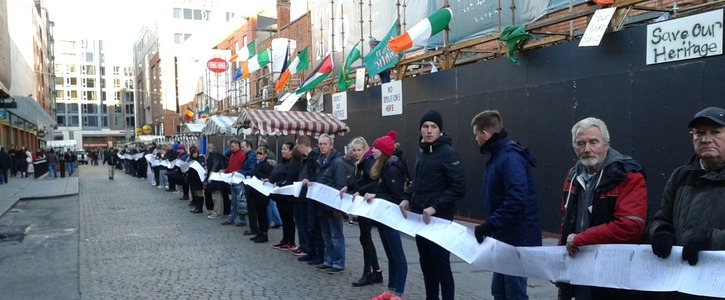
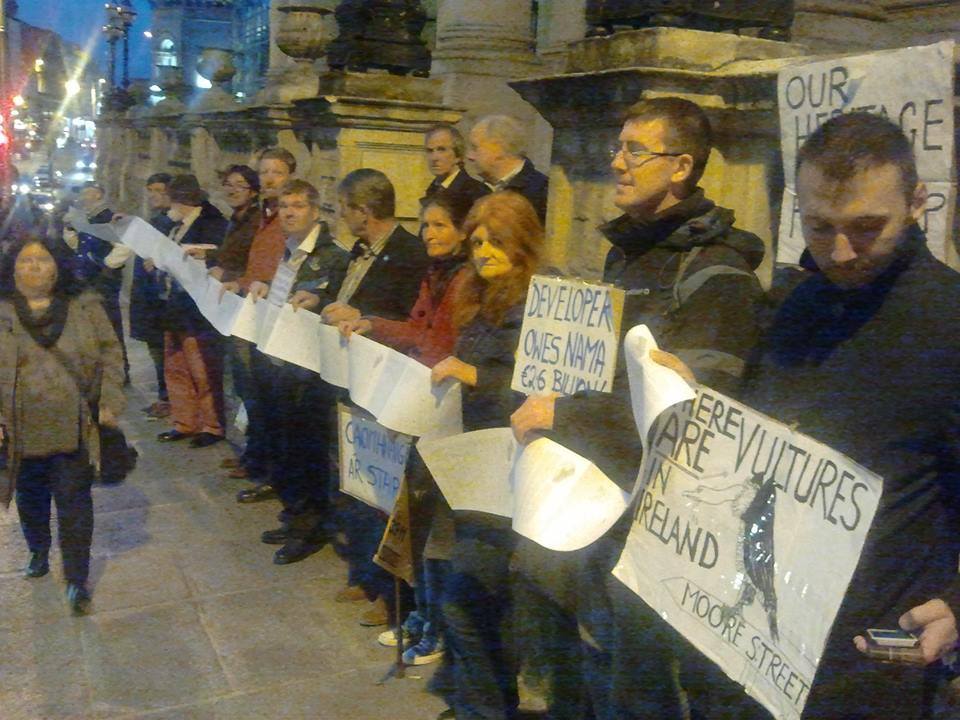
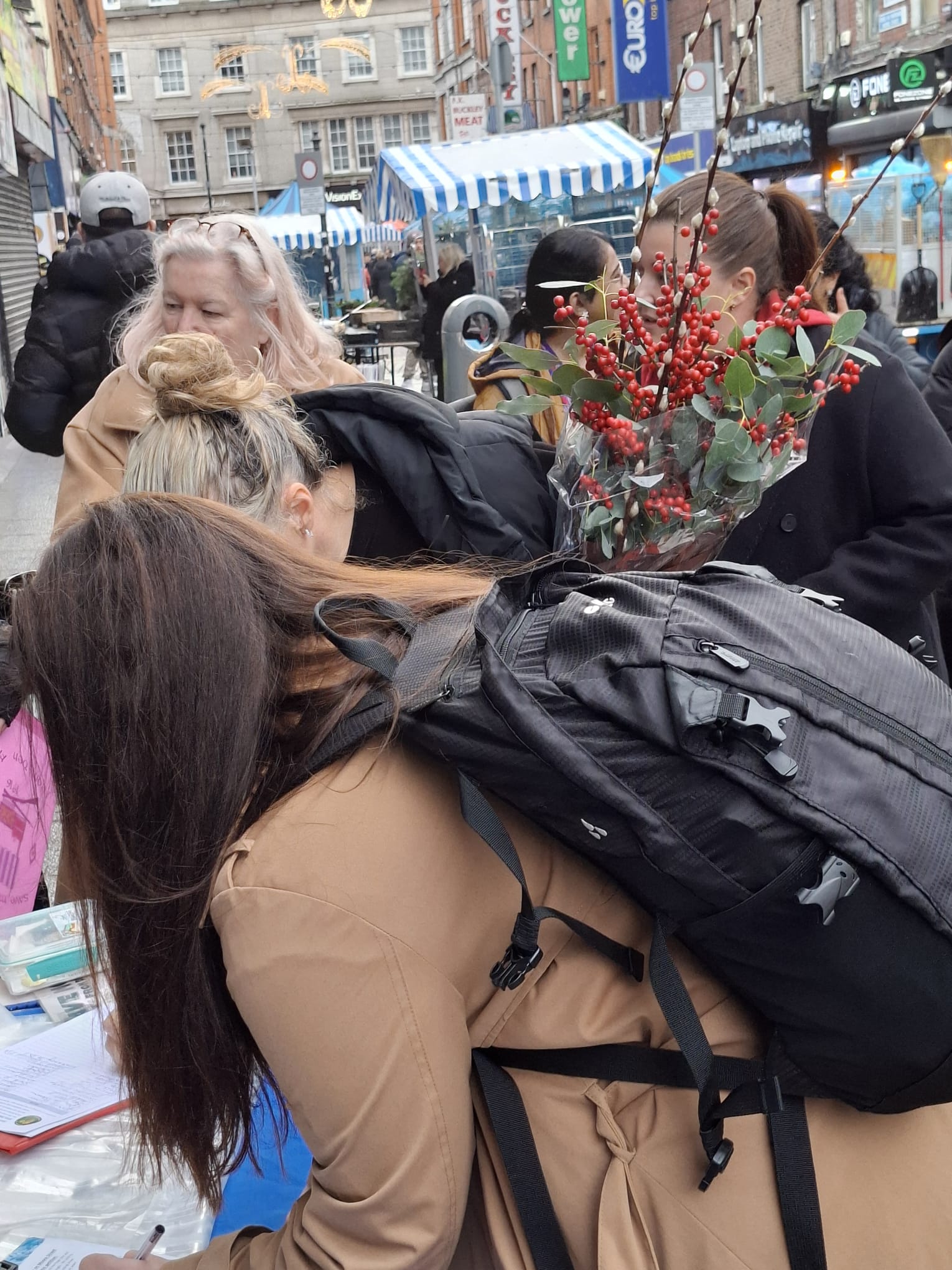


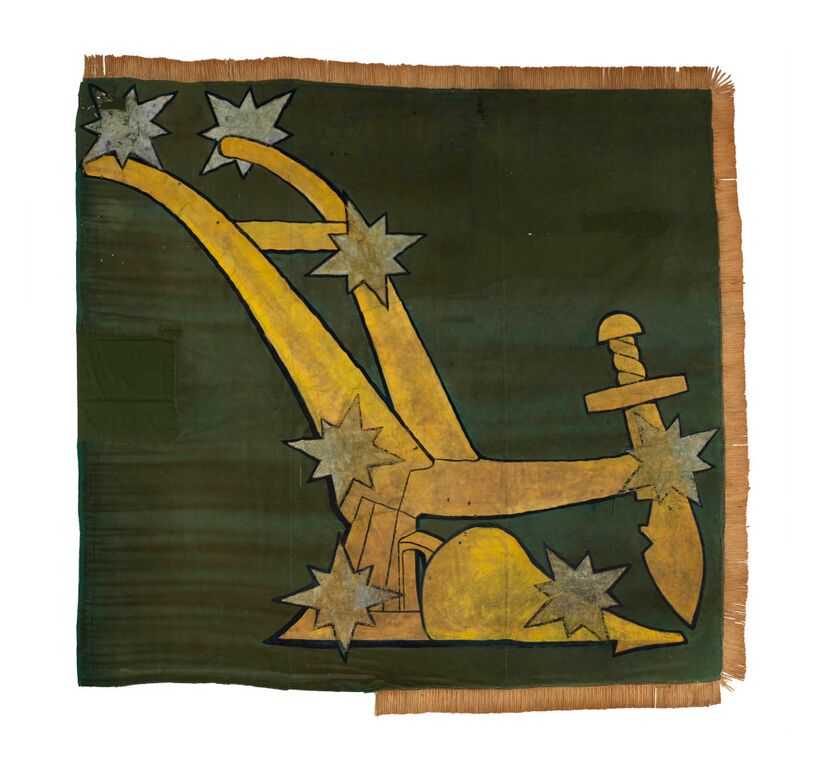

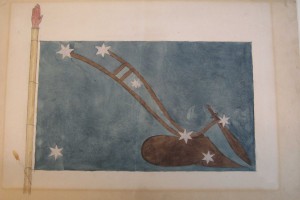


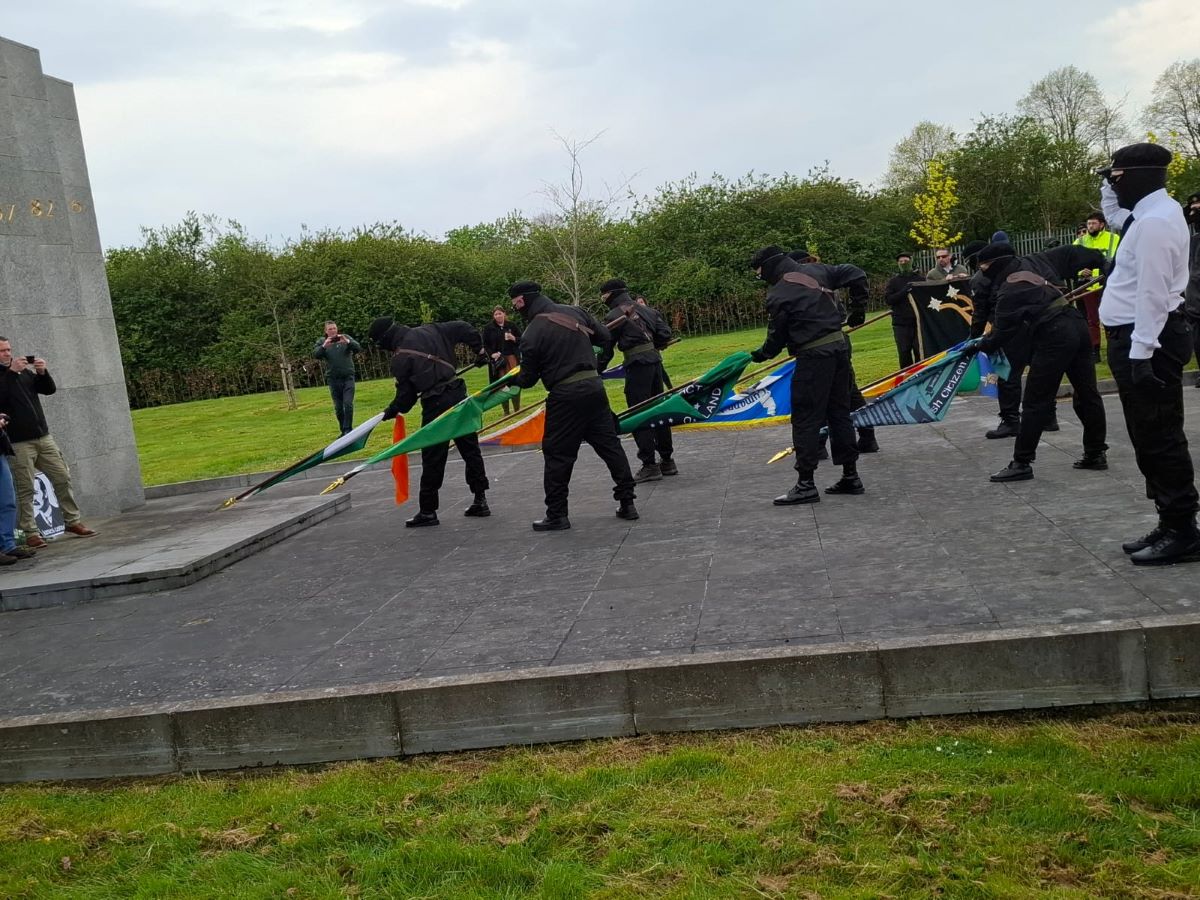
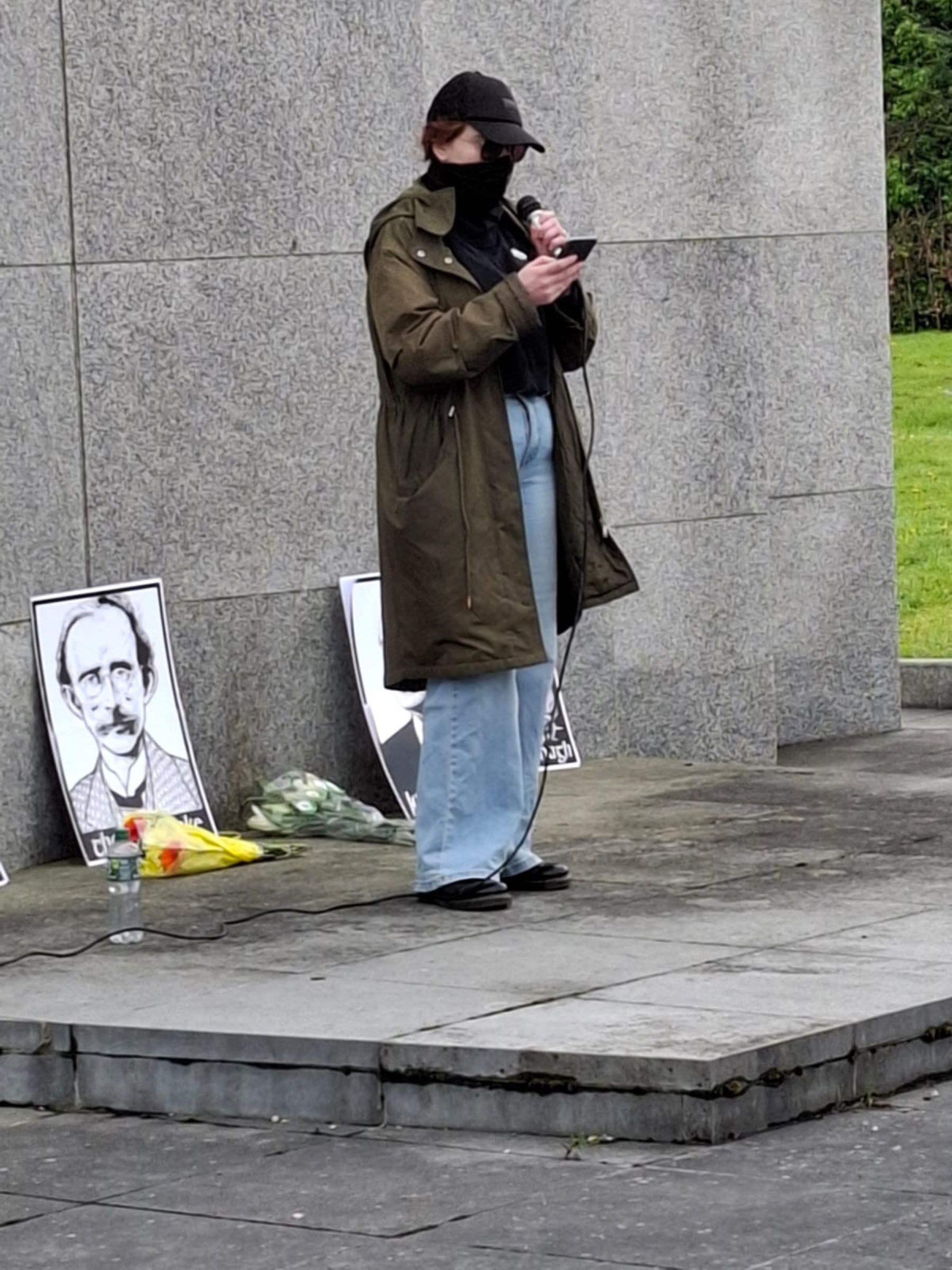
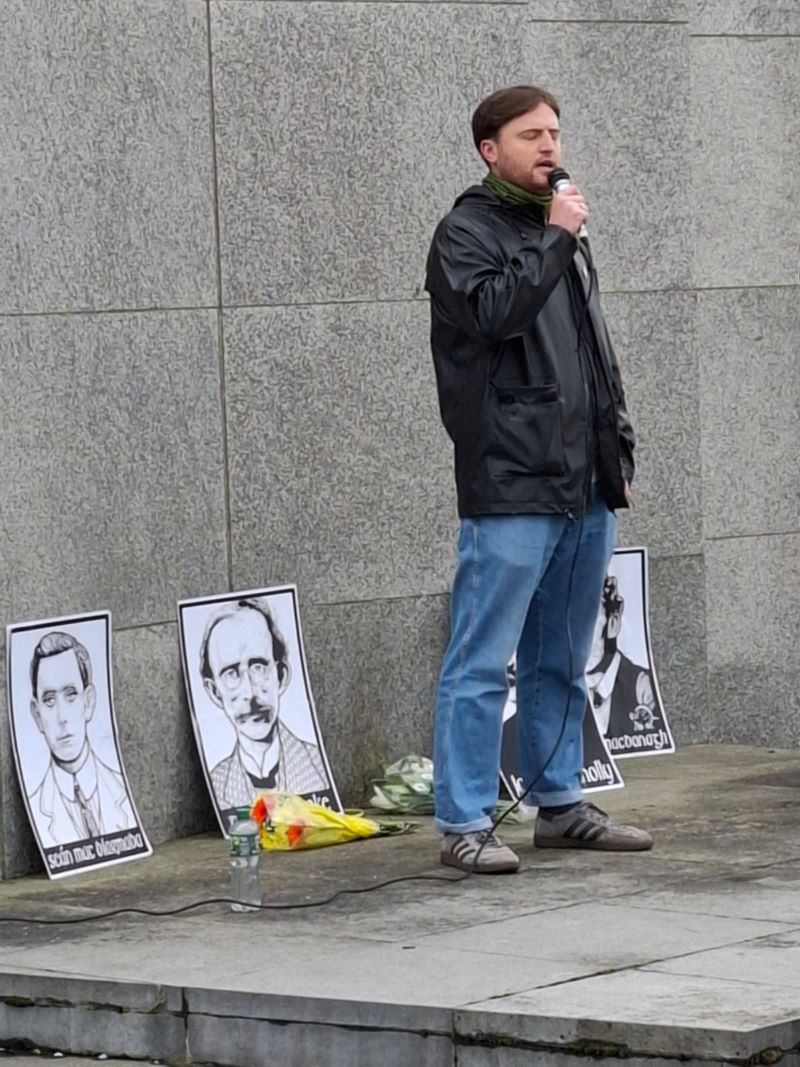


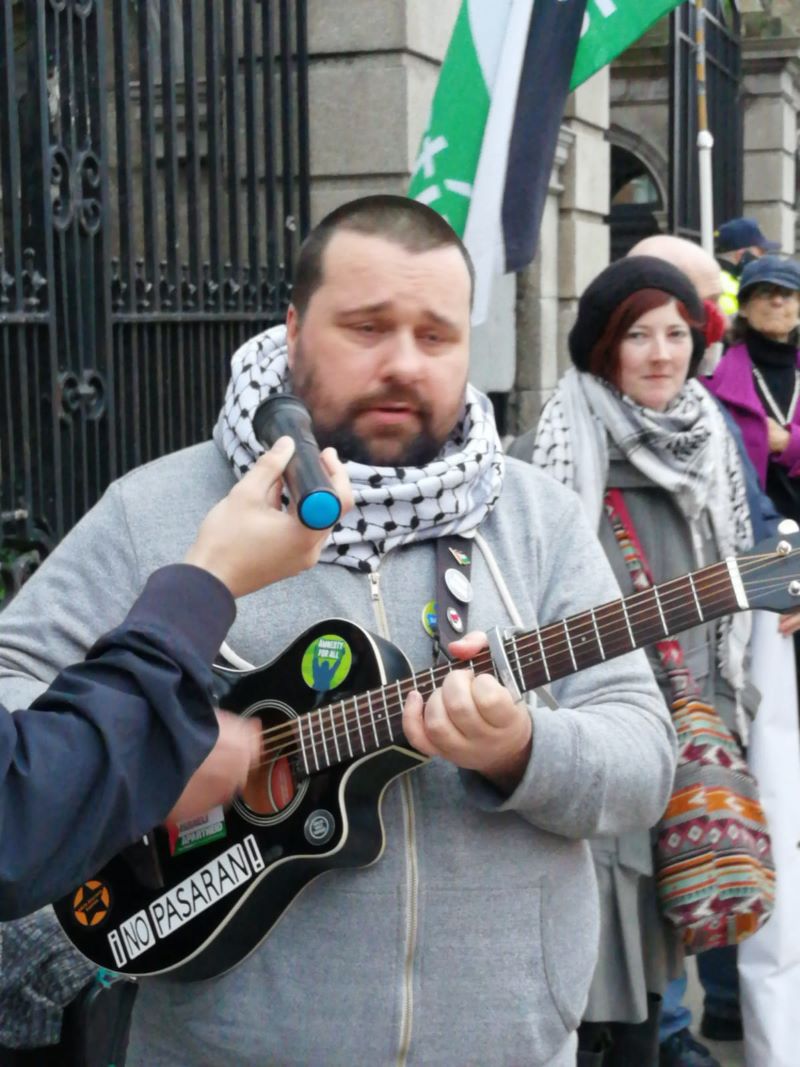

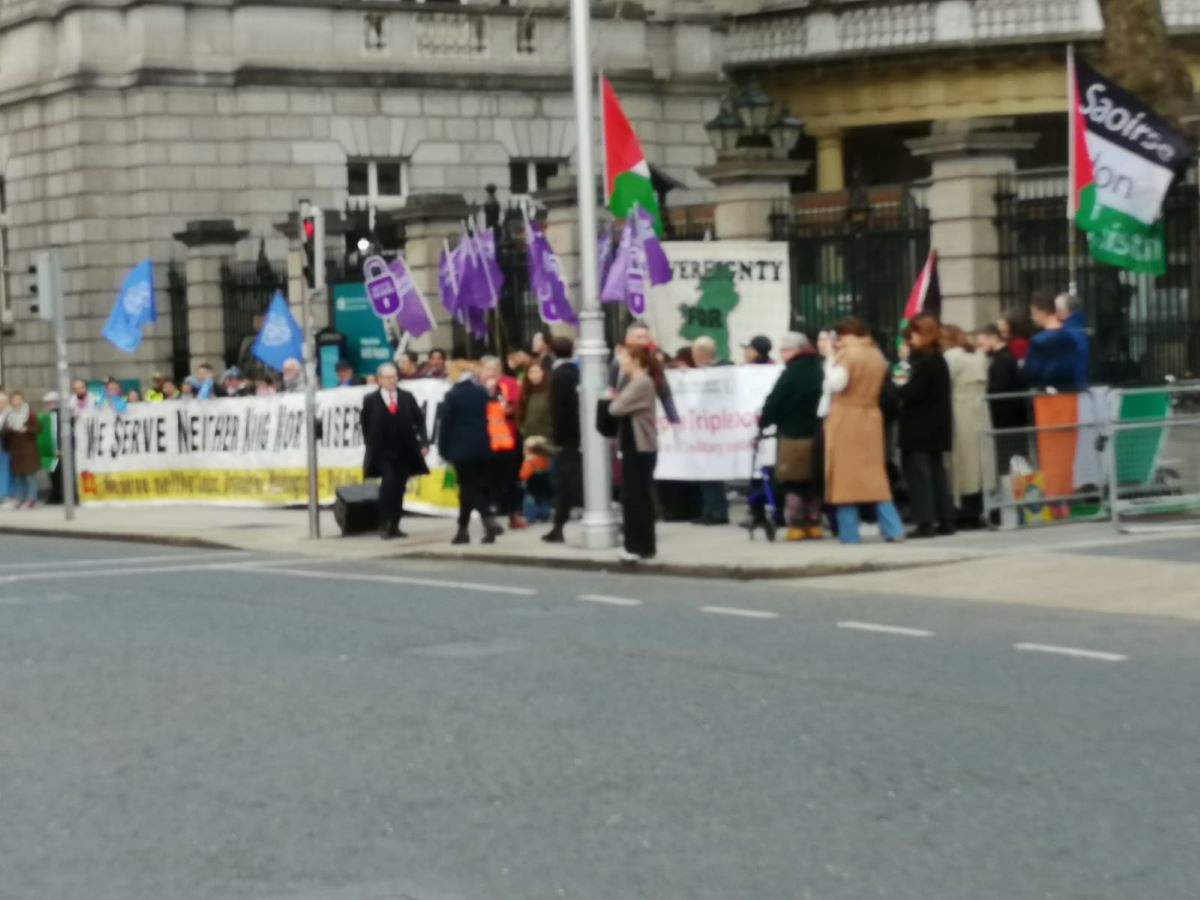

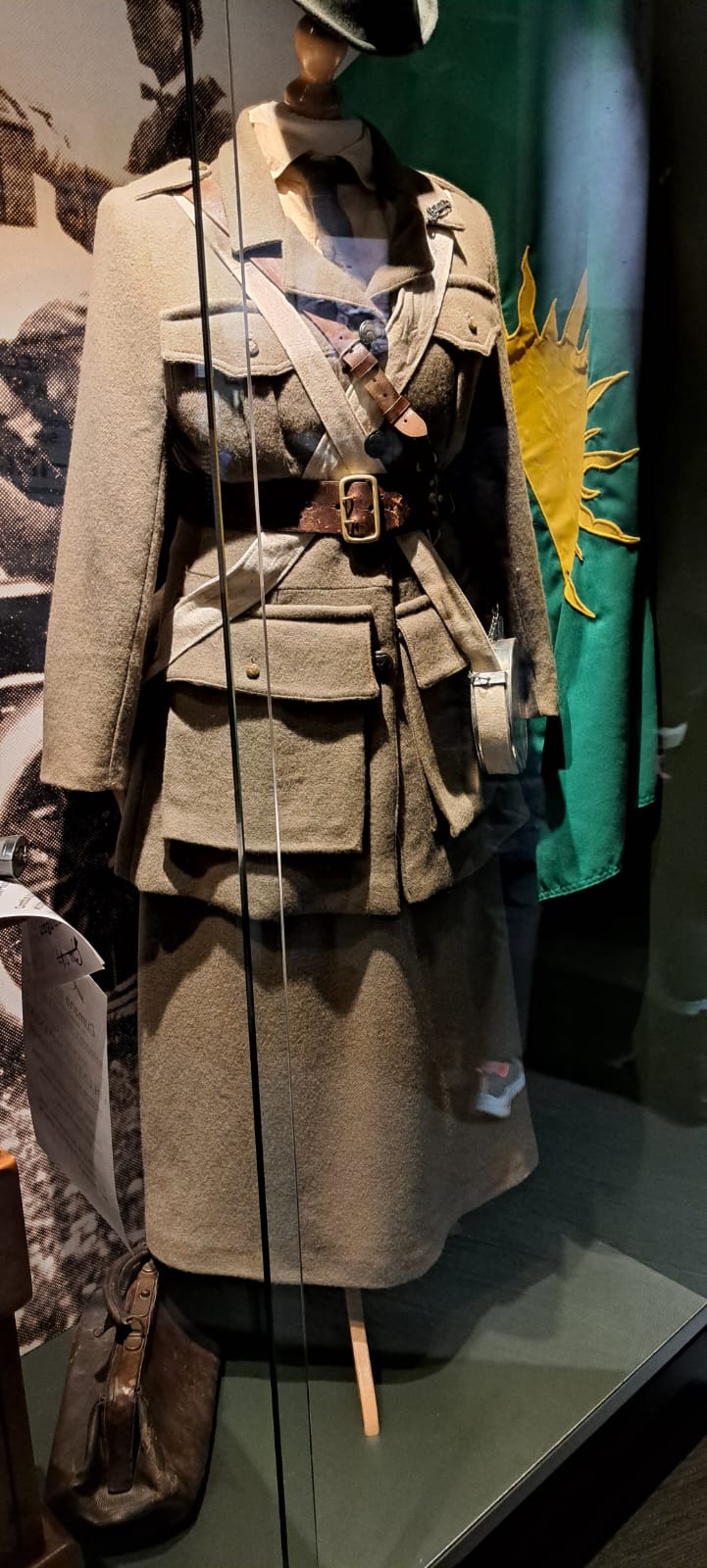


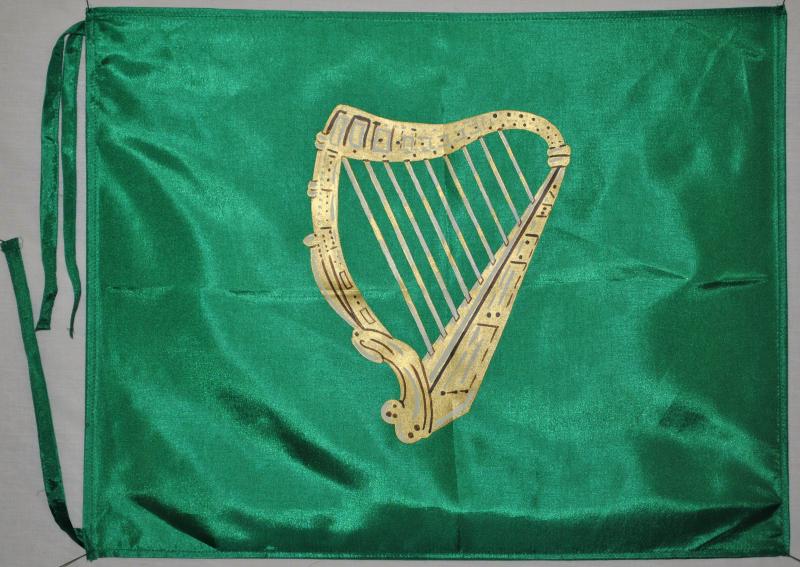

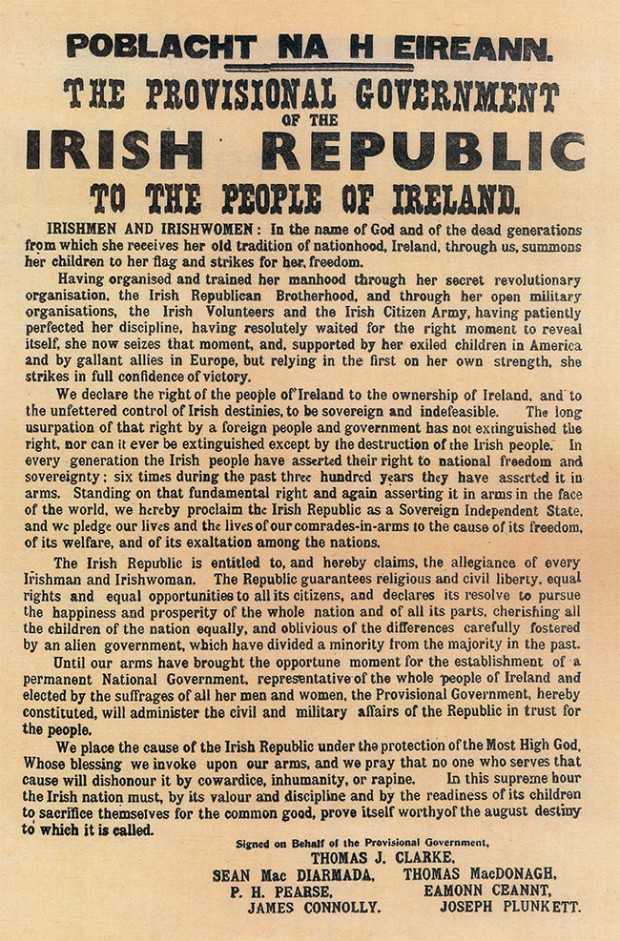
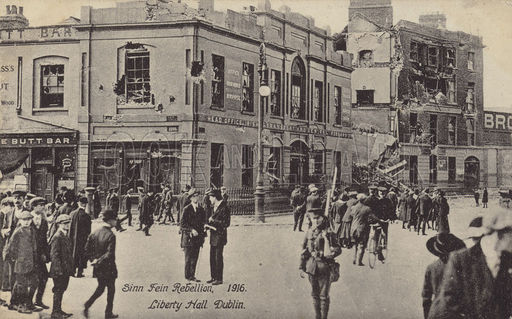
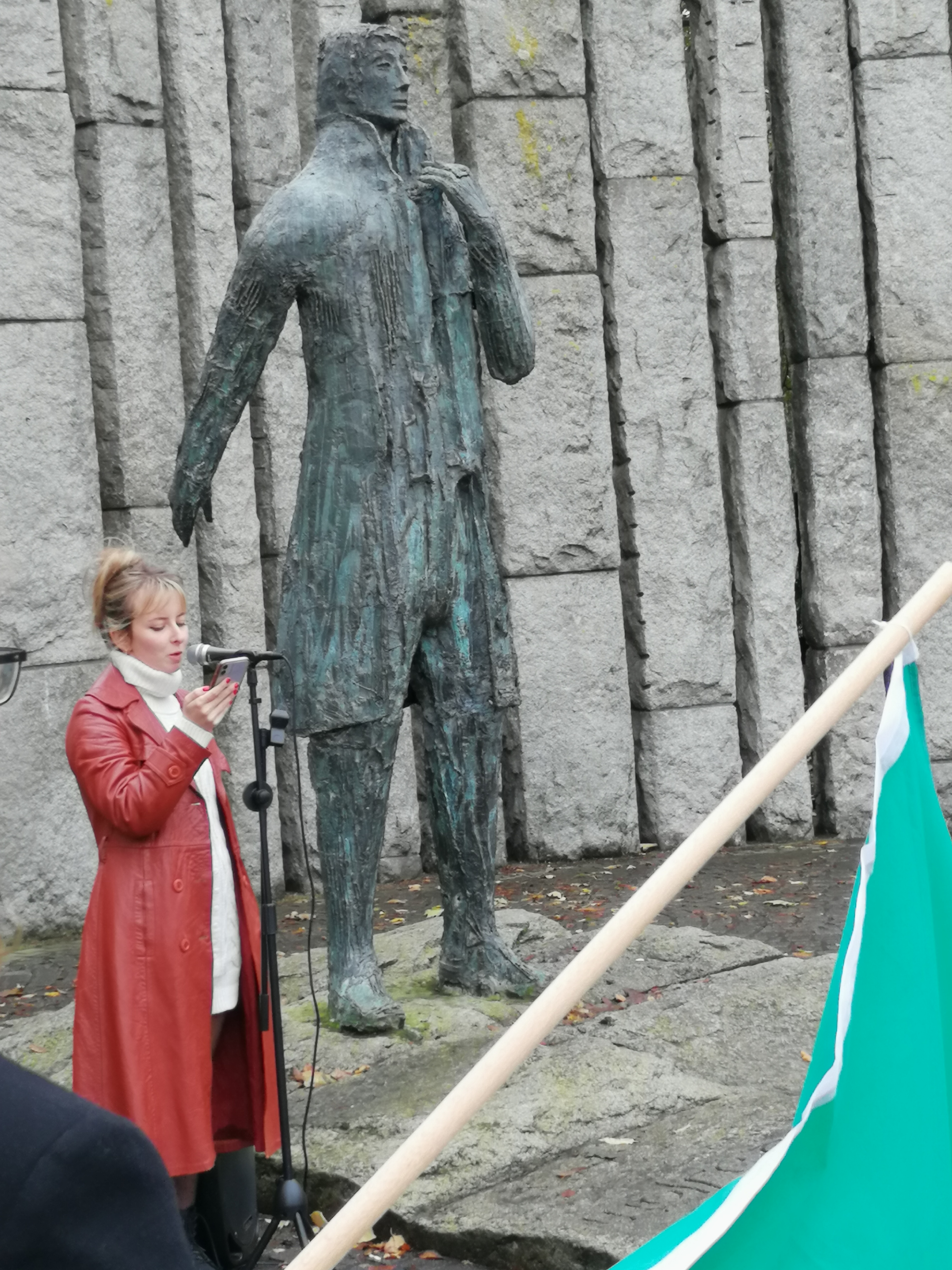
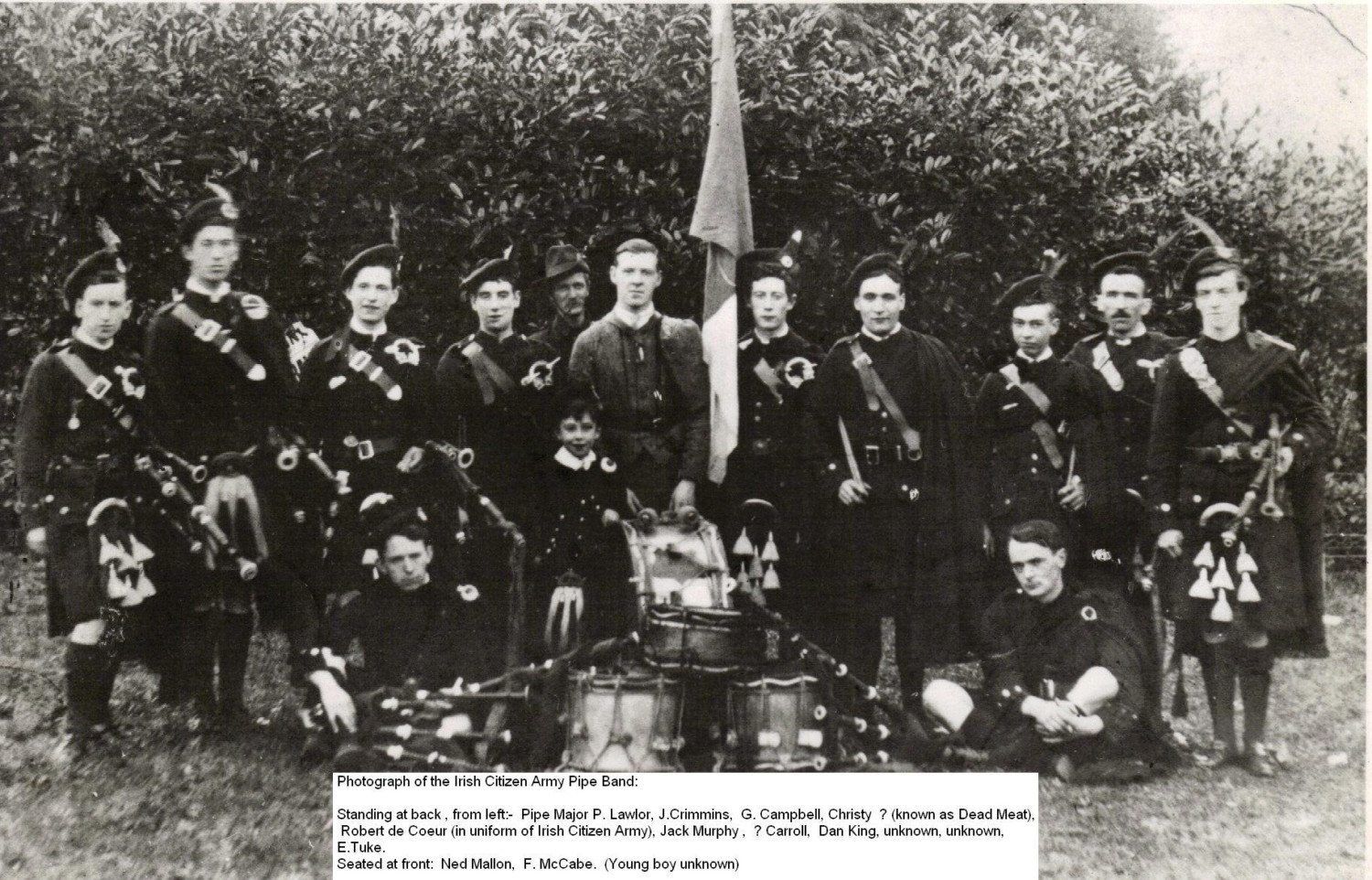
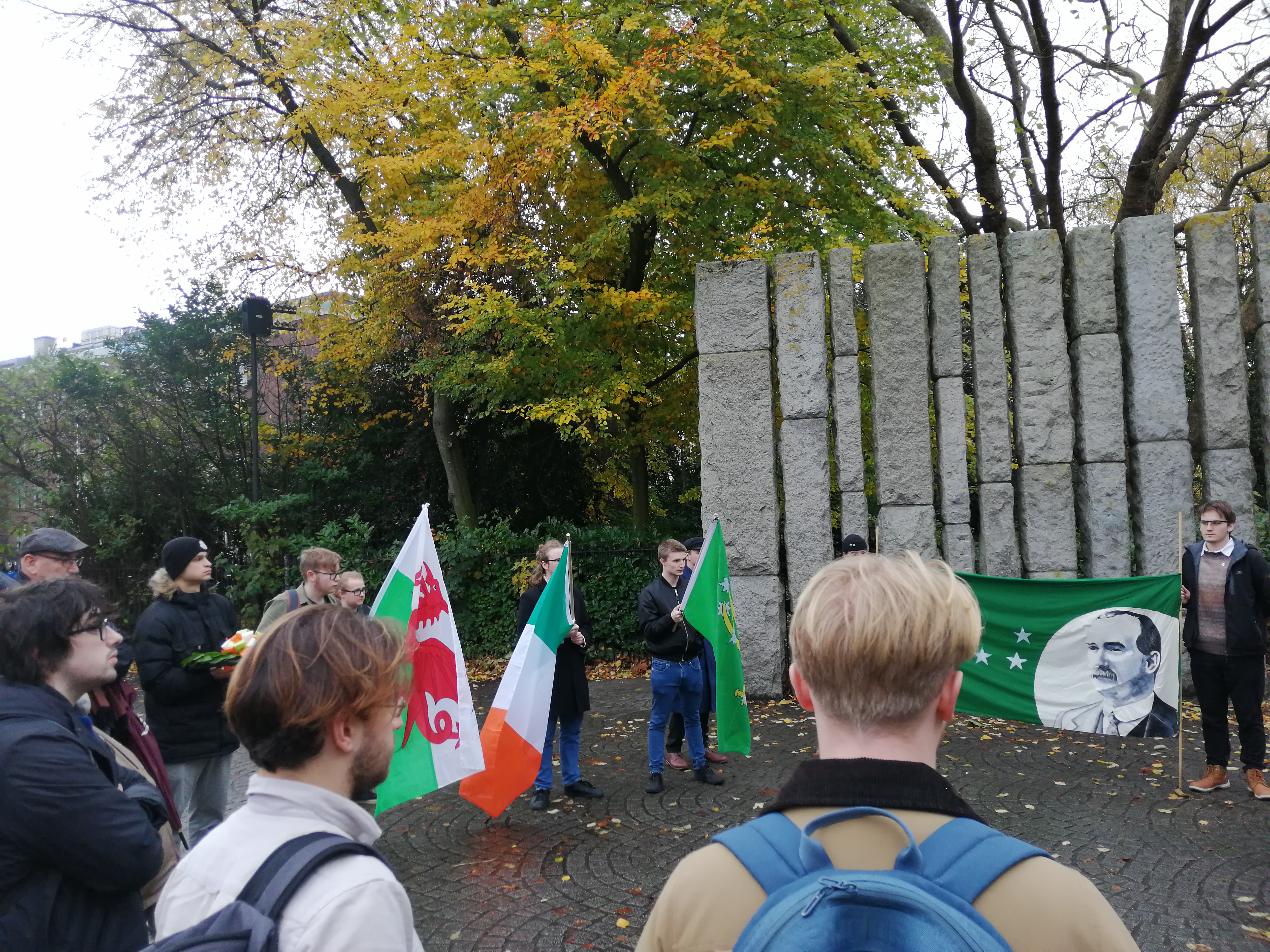
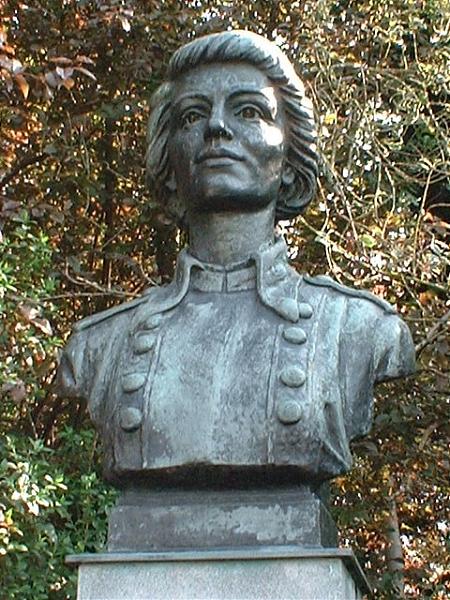
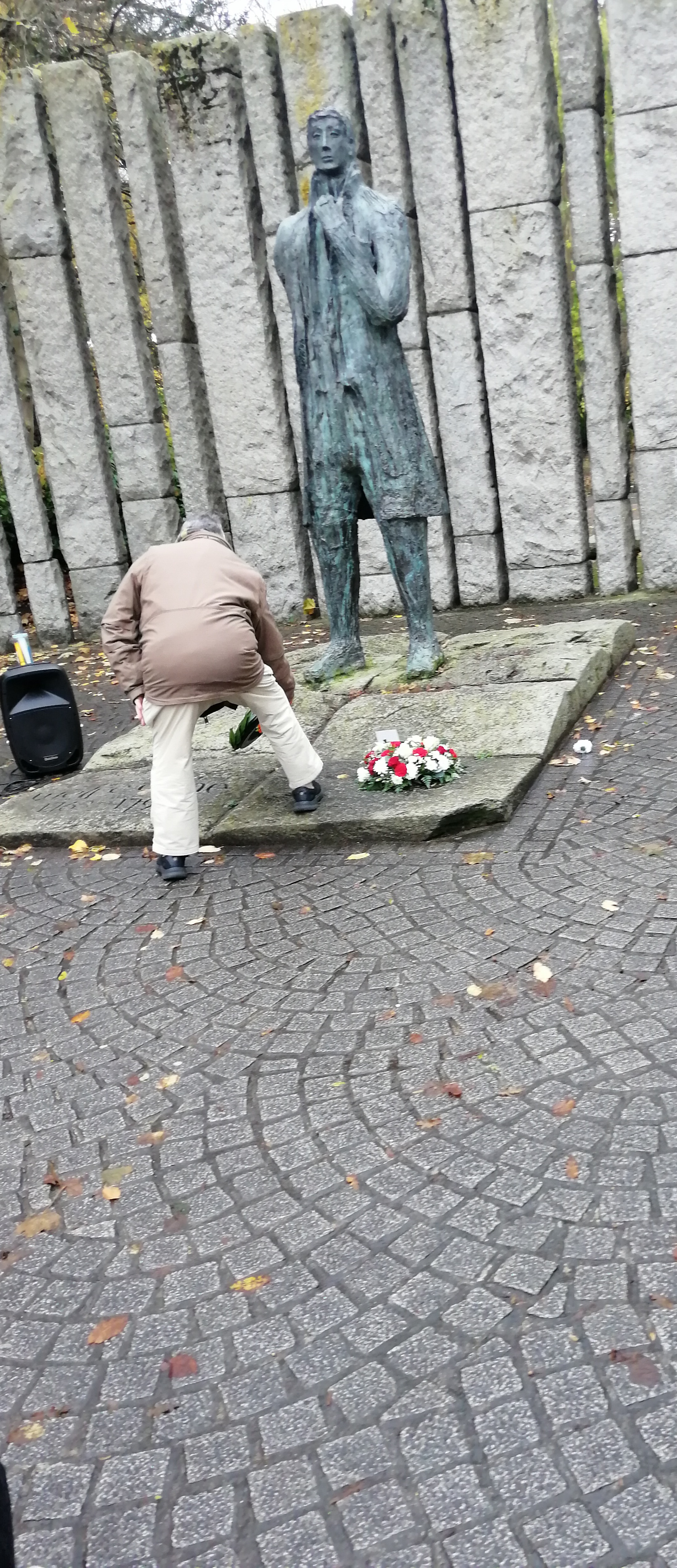
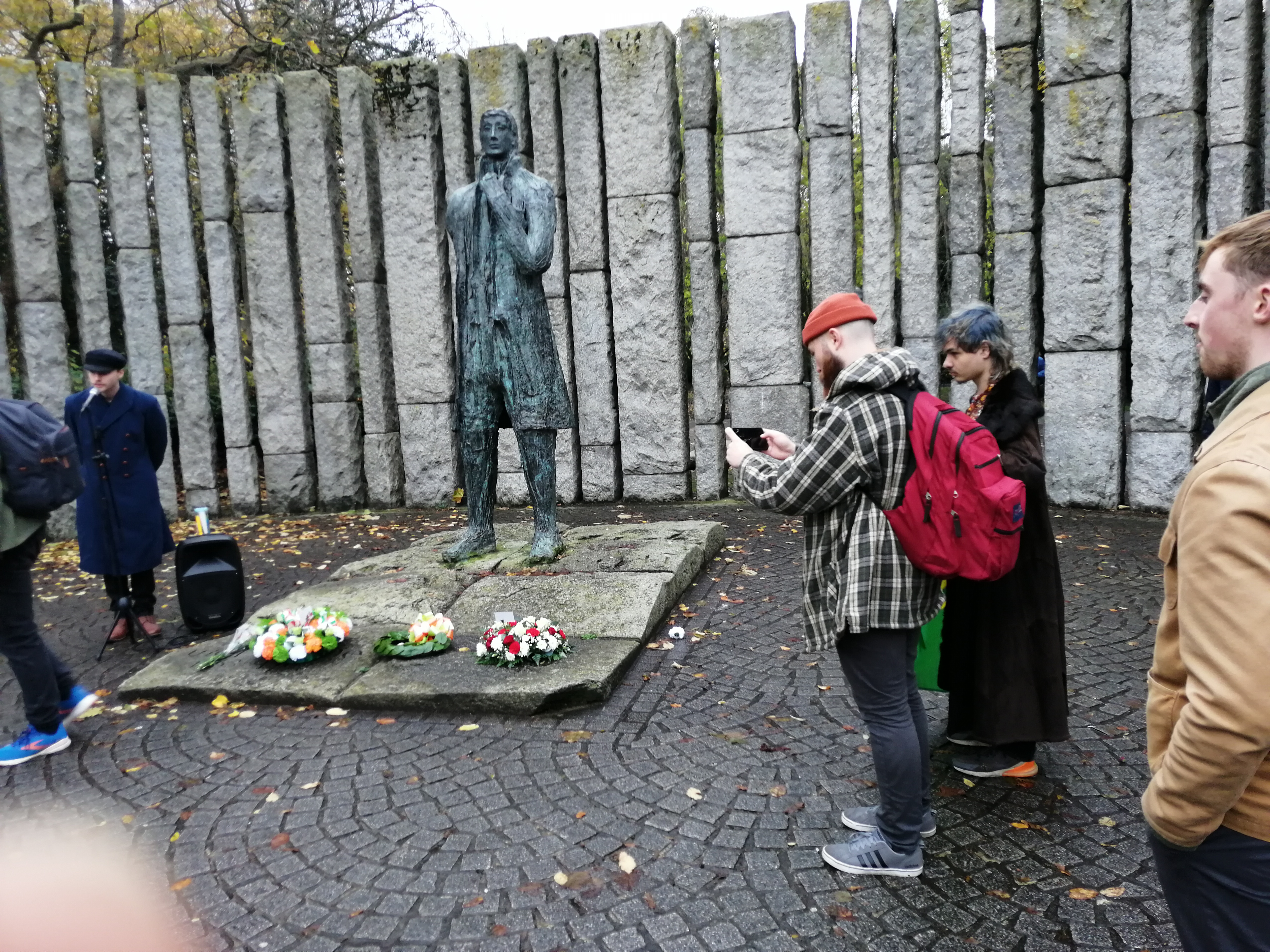
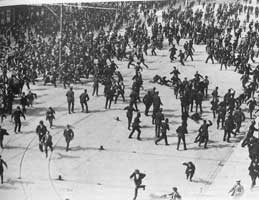
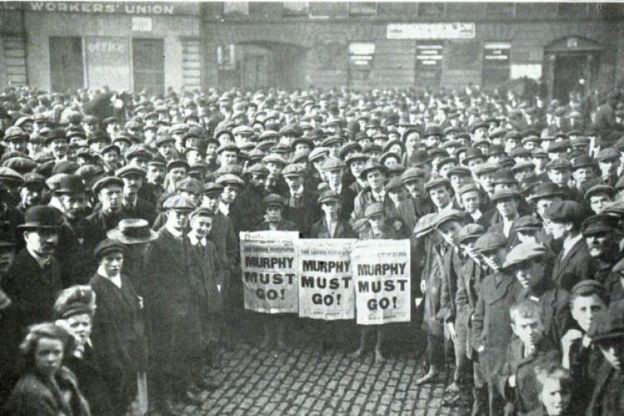
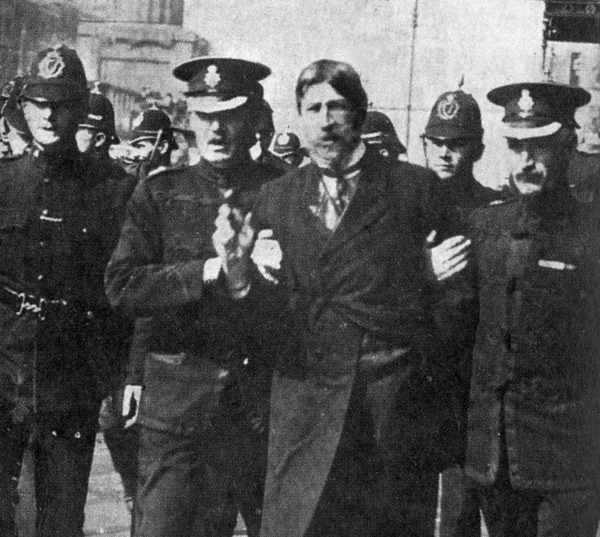
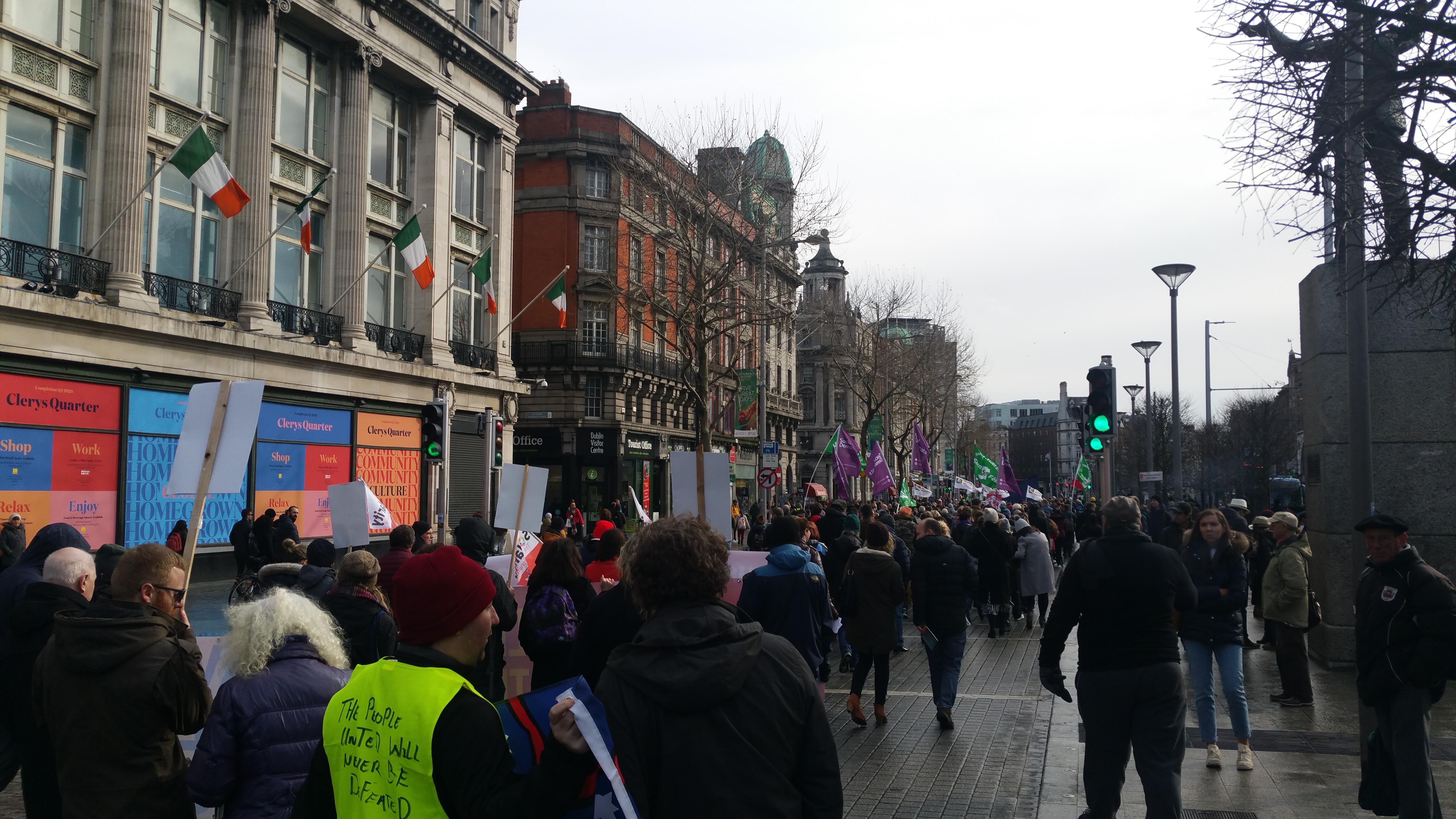
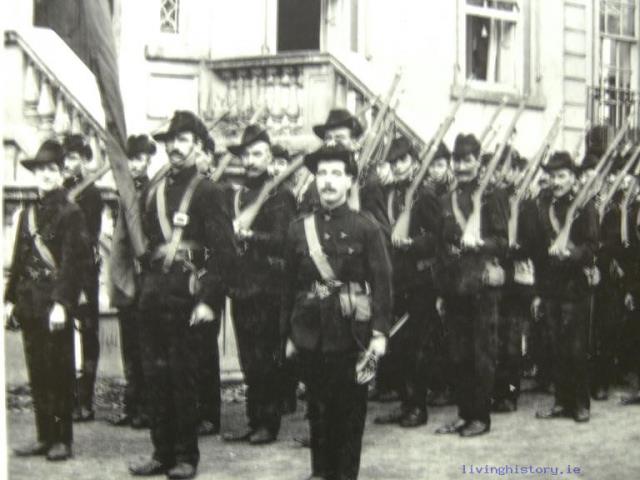
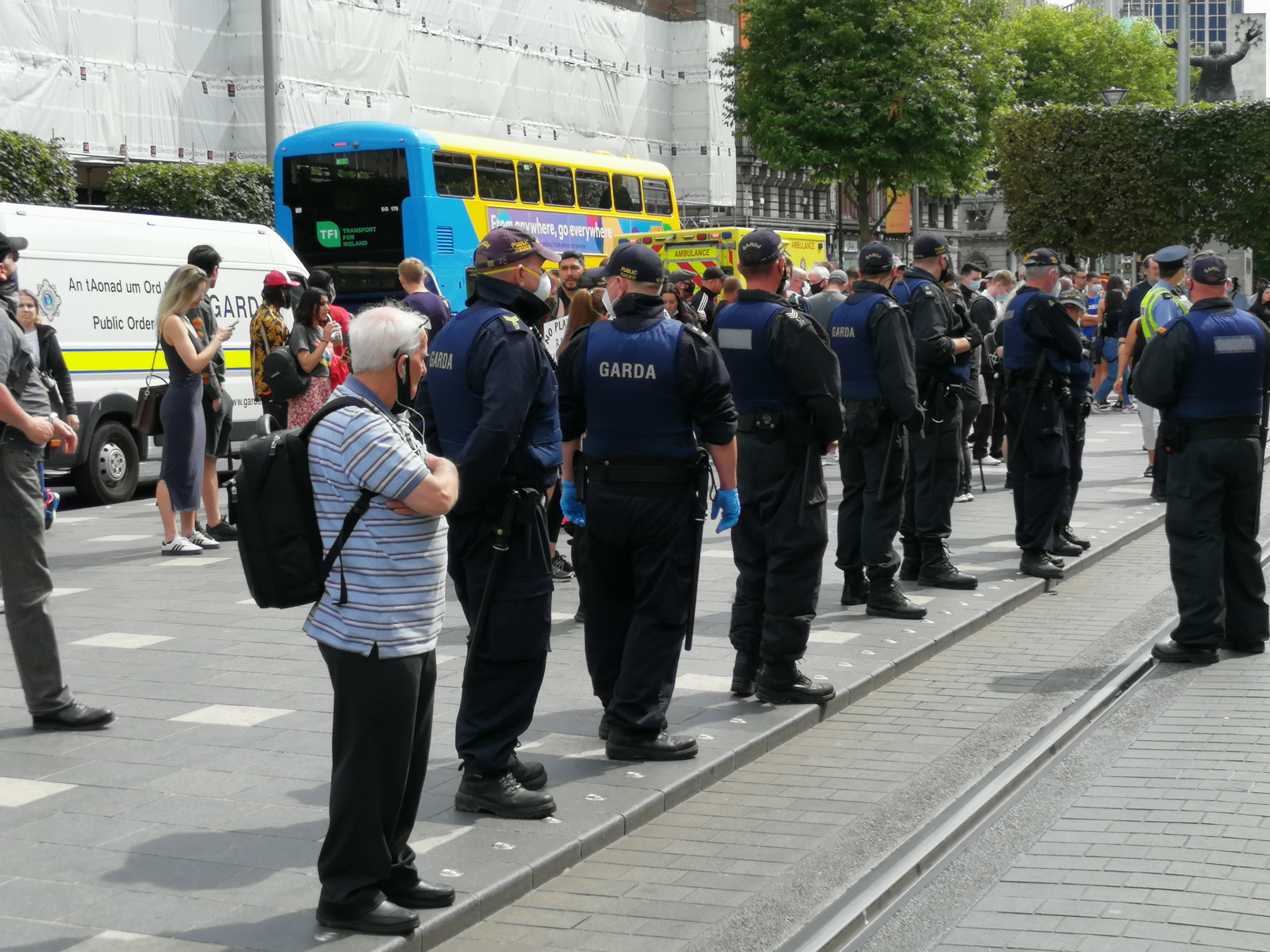
 rebelbreeze