IRISH REPUBLICAN, SOCIALIST, ANTI-RACIST, TRADE UNION FOUNDER: MICHAEL J. QUILL

“A man the ages will remember.” -Rev. Dr. Martin Luther King, Jr.

By Kevin Rooney (reprinted by kind permission of author).

Michael J. Quill and Martin Luther King at a trade union conference, USA, 1961, to which Quill had invited ML King.
(Photo source: Internet)

Michael Joseph Quill was born in Gortloughera, near Kilgarvan Co. Kerry on 18 September, 1905. His parents were John Daniel Quill and Margaret (née Lynch). Fighting injustice seemed to be in his blood. He remembered: “My father knew where every fight against an eviction had taken place in all the parishes around”. His Irish-speaking family’s home served as headquarters for the No. 2 Kerry Brigade Of The Irish Republican Army during the War Of Independence Of 1919-1921. His uncle’s house was so well known for rebel activity, it is said that the Black and Tans in the area referred to the house as “Liberty Hall”; a reference to James Connolly’s ITGWU Union Headquarters in Dublin which was to prove prophetic.

IRISH REPUBLICAN ACTIVITY

          While still a boy of 14, Michael was a dispatch rider for the IRA during the War of Independence. He served in 3rd Battalion of the No. 2 Kerry Brigade. Once on a scouting mission, he stumbled on a patrol of Black and tans asleep in a ditch. He stole all their ammunition without rousing them. He eventually graduated to carrying a rifle and organized a group of about thirty boys in the village into an IRA scout group, and drilled several times a week.

When the Civil War began in 1921, Quill joined the Republican side which opposed the Anglo-Irish Treaty that ended the War Of Independence. He took part in the re-capture of the town of Kenmare from The Free State Army in August of 1922, one of few Republican victories. He was said to have been involved in robbing a bank for the IRA during the war. He was much affected by the brutality and violence dished out by the Government Forces (Free Staters) to his Republican comrades in Kerry who were captured.

Michael J. Quill Centre, Kilgarvan, Co. Kerry, Ireland
(Photo source: Internet)

The worst atrocity was the Ballyseedy massacre where eight Republican prisoners were killed by being tied to a landmine, which was then detonated. In March of 1923, at total of 23 Republican prisoners in Kerry were killed in similar manner, or summarily executed by shooting on different occasions. Another five were officially executed by firing squad. The most of any county.

His mother died in September 1923. The local priest refused to request a temporary amnesty so that Michael and his brother John could attend her funeral without risking arrest by National troops. It left a lasting bitterness in him toward the Catholic Church.

During the Wars, he met many prominent Republican leaders of the time who passed through his area; including Eamon de Valera, Liam Lynch, Tom Barry, Liam Deasy, Dan Breen, Erskine Childers among them. While still young, he conversed with these great minds.

EMIGRATION TO THE USA

          After the war, Quill found opportunities limited for him as he had supported the losing side. He was also blacklisted after a sit-in strike with his brother John at a saw mill in Kenmare. He emigrated to the US, arriving on 16 March, 1926 in New York, where he stayed with an aunt on 104th Street in East Harlem (New York).

He hustled to make a living working a series of menial jobs which included what was called “bootlegging”: smuggling alcohol during Prohibition, during which time the sale of alcohol was illegal in the US. He worked passing coal and peddling roach powder and religious articles in Pennsylvania coal country. While there he wrote his father his observation that “the cows and pigs in Kerry were better housed and fed than were the miners’ children in America.”

Quill returned to New York and met a young Kerry woman named Maria Theresa O’Neill, known as Mollie who came from Cahersiveen. With the onset of the Great Depression she became unemployed and decided to return to Ireland. She and Quill maintained a patient long-distance courtship, keeping in touch with weekly letters.

Quill found employment with the IRT (Interborough Rapid Transit) railroad in 1929. He worked several jobs before becoming a ticket agent. The IRT, the largest transit company in New York attracted employment from many Irishmen; particularly Republican veterans of the Irish Civil War like Quill. There was a joke that IRT stood for “Irish Republican Transit”. Their advantage over other immigrant groups was that they already spoke English. Coming from mostly farm land, they were also able for the twelve to fourteen-hour days demanded of them seven days a week. About half of the employees were Irish.

Moving from station to station, he got to know many of the employees. Along with deplorable working conditions, Quill also observed discrimination based on racism and bigotry, which he hated. He said: “During those twelve hour nights we’d chat about the motormen, conductors, guards etc. whose conditions were even worse. They had to work a ‘spread’ of 16 hours each day in order to get 10 hours pay. Negro workers could get jobs only as porters. They were subjected to treatment that makes Little Rock (Arkansas) and Birmingham (Alabama) seem liberal and respectable by comparison. I also saw Catholic ticket agents fired by Catholic bosses for going to Mass early in the morning while the porter ‘covered’ the booth for half an hour. Protestant bosses fired Protestant workers for similar crimes, going to Church. The Jewish workers had no trouble with the subway bosses. Jews were denied employment in the transit lines”.

INFLUENCED BY CONNOLLY’S WRITINGS

          While working a 12-hour overnight shift, Quill passed the time with reading to supplement his education, which had ended with National school. The main influence on his political thinking was James Connolly. Connolly had also organised unions in New York, where he lived for a few years before returning to Dublin where he was executed in 1916 for his part in the Easter Rising.

Michael J. Quill speaking at a conference with the image of James Connolly, whose writings he admired, on the wall behind him, uncomfortably perhaps next to the flag of the USA.
(Photo source: Internet)

Quill’s second wife Shirley later wrote: “Connolly’s two basic theories were to guide Mike Quill’s thinking for the next three decades: that economic power precedes and conditions political power, and that the only satisfactory expression of the workers’ demands is to be found politically in a separate and independent labour party, and economically in the industrial union.” He then set about organizing a union. He stood on his soap box during lunch hour in power-houses and shops all over the city.

Quill recalled: “We were no experts in the field of labor organization, but we had something in common with our fellow workers; we were all poor, we were all overworked, we were all victims of the 84 hour week. In fact, we were all so low down on the economic and social ladder that we had nowhere to go but up.”

Quill and some of his fellow Irish immigrants became involved in Irish Worker’s Clubs that were established by James Gralton, and were affiliated with the American Communist Party. Gralton’s political views got him deported from Ireland in 1933 as an “undesirable alien”; even though he was born in Co. Leitrim because of pressure from the Catholic Church. This made him the only Irishman ever to be deported by the Irish government.

Quill didn’t find much difference in the attitude of Irish-American Organisations that were Catholic church-based. Quill recalled: “We went to the Friendly Sons of St. Patrick, but they would have nothing to do with the idea of organizing Irishmen into a legitimate union. We went to the Ancient Order of Hibernians, and they threw us out of their meeting hall. They wanted no part of Irish rebels or Irish rabble. That was the reception we got from those conservative descendants of Ireland’s revolutionists of a hundred years ago.”

Making no bones or apologies, he said “I worked with the Communists. In 1933 I would have made a pact with the Devil himself if he could have given us the money, the mimeograph machines and the manpower to launch the Transport Workers Union. The Communist Party needed me, and I needed them. I knew what the transit workers needed. The men craved dignity, longed to be treated like human beings. The time had come to get off our knees and fight back.”

FOUNDING A TRADE UNION

          On 12 April 1934, Quill, along with six other Irishmen including Thomas H. O’Shea and Austin Hogan from Co. Cork, and Gerald O’Reilly from Co. Meath formed the Transport Workers Union of America (TWU). All seven including Quill were members of Clan na Gael, an Irish Republican organisation that succeeded the Fenian Brotherhood as the American branch of the Irish Republican Brotherhood (IRB). They were said to have initially applied the rules and practices of secrecy from that tradition. Quill was to remain a silent financial supporter of the Republican cause in Ireland his whole life.

Like Quill, they were all influenced by Connolly’s ideas and writings; in particular, Connolly’s 1910 pamphlet “The Axe To The Root” where he wrote specifically about a recent 1910 transit workers strike in New York that had failed, known as the New York Express Strike.

Connolly wrote: “It was not the scabs (strikebreakers, replacements) however, who turned the scale against the strikers in favour of the masters. That service to capital was performed by good union men with union cards in their pockets. These men were the engineers in their power-houses which supplied the electric power to run their cars, and without whom all the scabs combined could not have run a single trip.”

The very name of the union was a tip of the hat to James Larkin and James Connolly’s Irish Transport & General Workers Union (ITGWU). In fact the word “Transit” is more normally used than “Transport” regarding that industry in the US. Thomas H. O’Shea was the Union’s first president, followed by Quill, who would remain president for the remainder of his life.

The Union began with a membership of 400, then eventually represented all 14,000 IRT workers. An African-American porter named Clarence King was elected to the first TWU executive board. In 1937 there was a sit-down strike on the Brooklyn-Manhattan Transit (BMT); the second-largest Transit company in New York. Two BMT employees at the Kent Avenue Brooklyn station were fired for union activity. The 500 members of TWU in the company secured their re-instatement. It eventually represented all BMT employees as well.

Quill began to involve himself in city politics and was elected to the New York City Council in 1937 representing the American Labor Party. His whole career people loved or hated him, with no middle ground. He returned to Ireland to marry Mollie on 26 December 1937. They would return to New York to live, where she bore a son; John Daniel Quill, named after Michael’s father. Theirs proved to be an unhappy marriage of convenience. Quill filled this void first with drink, later with extramarital romance.

While in Ireland, he met with Michael O’Riordan from Co. Cork, who was headed to Spain to fight for the Spanish Republic in that country’s Civil War; which side Quill supported. Michael Lehane, the child of a neighbor from Kilgarvan, also went to Spain to fight fascism.

AGAINST ANTI-SEMITISM

          In 1939, he organized a rally against anti-semitism in a heavily Irish neighborhood in The South Bronx attended by four thousand. This was in response to Father Charles Coughlin’s anti-semitic campaign preaching to New York’s Irish. Fr. Coughlin was born in Canada of Irish parents, but moved to the US. He began radio broadcasting in 1926 in response to a Ku Klux Klan anti-catholic attack on his church in Michigan, but moved into political commentary and also moved far to the political right. Fr. Coughlin’s sympathies to the fascism of Hitler and Mussolini got him removed from the air later in 1939.

Having little use for the church, this is how Quill summed up his personal philosophy: “I believe in the Corporal Works Of Mercy, the Ten Commandments, the American Declaration Of Independence and James Connolly’s outline of a socialist society. Most of my life I’ve been called a lunatic because I believe that I am my brother’s keeper. I organise poor and exploited workers, I fight for the civil rights of minorities, and I believe in peace. It appears to have become old-fashioned to make social commitments; to want a world free of war, poverty and disease. This is my religion.”

TESTIFYING AT MC CARTHY HEARINGS

          In April of 1940, former TWU President and founder Thomas O’Shea; who had been earlier been ousted from the union testified against his former fellow union leaders including Quill. He alleged that the union was in complete control of the communist party and their goal was to promote revolution through strikes. Quill testified in the US House Of Representatives before the House Committee on Un-American Activities and denied these allegations, calling O’Shea a “stool pigeon.” He told Chairman Martin Dies: “You are afraid to hear the truth about our union. You can’t take it, but the American labour movement will live.”

Also in 1940, the city purchased the BMT and IRT. This put Quill in the path of every New York mayor from then on, beginning with Italian-American Republican Fiorello LaGuardia. Years ahead of his time, in 1944, Quill introduced a bill in the City Council to establish free childcare centers for working mothers. Also in 1944, he ended a TWU wildcat (unauthorised) strike in Philadelphia initiated by a racist reaction to a contract that secured promotions to conductor for eight black porters.

After World War II and the Holocaust, Quill said “We licked the race haters in Europe, but the millions of Jewish dead cannot be restored to life”. He was re-elected to the City Council also in 1945. His election campaign manager was Shirley Ukin, a fiery former communist born in Brooklyn Of Russian-Jewish parents with whom he began a longtime affair. She had worked with him in TWU from the beginning. In the late 40’s the union expanded to include airline workers, utility workers and railroad workers.

Also after the war, under pressure from the government on communists in the labor movement but mostly his own dissatisfaction and mistrust caused him to purge the communists out of the Union. In 1948 he secured a large increase for subway workers from Democratic Mayor William O’Dwyer, a native of Bohola, Co. Mayo.

In the 50’s he supported the candidacy of Democrat Robert F. Wagner for mayor. Wagner’s German-born father, a US Senator for New York (Democrat 1927-1949) had authored the Wagner Act Of 1935 that created the National Labor Relations Board (NLRB), which protected workers’ rights to organise and strike.

Quill’s past relationship with the communist party continued to be criticised. He was nicknamed “Red Mike”. Wagner was elected to three terms and his administration was able to come to collective bargaining agreements with the TWU.

IN THE US TRADE UNION MOVEMENT AGAINST RACISM

          Mollie died August 16, 1959. In 1961 he married Shirley; his longtime girlfriend who had previously been married and divorced twice. She would later carry on his union work and write his biography. Also in 1961, Quill received a letter from twenty-five TWU members in Tennessee protesting the Union’s support for Civil Rights and de-segregation. He responded by inviting a prominent black Civil Rights leader to address the Union Convention, the Rev. Dr. Martin Luther King, Jr., whom he admired.

He introduced Dr. King as “The man who is entrusted with the banner of American liberty that was taken from Lincoln when he was shot 95 years ago.” This was indeed high praise as the only two pictures in Quill’s office were of President Abraham Lincoln and James Connolly. The two became friends. As far back as 1938, Quill made a statement much like Dr. King’s famous speeches: “If we, black and white, Catholic and non-Catholic, Jew and gentile, are good enough to slave and sweat together, then we are good enough to unite and fight together”.

In November 1965, John Lindsay was elected Mayor. The aristocratic Protestant Republican whose name he intentionally mispronounced as “Linsley” immediately rubbed Quill the wrong way. Quill quipped: “we explored his mind (Lindsay) yesterday and found nothing there.” This was amid the union negotiating a raise for its members due to inflation caused by the War in Vietnam, of which Quill was typically an early critic.

STRIKE!

          The TWU had always threatened a strike that could cripple the city of New York, the largest in the US; a city of 8 million where many people’s commutes involve travel across rivers. Manhattan, the center of commerce is an island. Quill knew and stated that this was from where came the union’s power. Quill had seen many Mayors come and go and such a situation had always been averted.

Before he took office, Lindsay felt empowered and entitled to “call their bluff”. He felt such a strike was illegal as it would endanger public safety as transportation is a public utility. He also seemed to feel the union was incapable of pulling it off as history had shown. Irish-American newspaper journalist Jimmy Breslin observed: “[Lindsay] was talking down to old Mike Quill, and when Mike Quill looked up at John Lindsay he saw the Church of England. Within an hour, we had one hell of a transit strike.”

Lindsay was sworn in on 1 January 1966. The same day, 33,000 members of the TWU announced a strike and 2,000 members of the Amalgamated Transit Union (ATU) also joined them. This demonstrated James Connolly’s lesson from “Axe To The Root” put into action.

(Photo source: Internet)

A legal injunction was issued to stop the strike along with an order for the arrest of Quill and eight others: Matthew Guinan, Frank Sheehan, Daniel Gilmartin, Ellis Van Riper, and Mark Kavanagh of the TWU and John Rowland, William Mangus, and Frank Kleess of the ATU) effective at 1am January 4th.

Quill tore up the injunction and famously said in his thick Kerry accent: “The judge can drop dead in his black robes. I don’t care if I rot in jail. I will not call off the strike.” Only two hours after being imprisoned; Quill who was sixty years old and had health issues with his heart, suffered a heart attack and was sent to Bellevue Hospital. He had ignored all medical advice from his doctors and the strain of the battle was taking its toll. Ironically, he had to wait two hours for an ambulance because the strike had indeed brought the city to a grinding halt.

Right-wing newspaper Daily News headline and photo showing Mike Quill tearing up a court order.
(Photo source: Internet)


15,000 workers picketed City Hall on 10 January. The strike ended on 13 January with a huge victory. The TWU had secured the workers a package worth $60 million. Hourly wages rose from $3.18 to $4.14 per hour. Quill seemed to be on the mend and was released from the hospital on 25 January. Quill died in his sleep of congestive heart failure on 28 January. Like ancient Irish High King Brian Boru, he had won his greatest victory at the cost of his own life. His coffin was draped in the Irish

Pickets during the January 1961 strike of the TWU.
(Photo source: Internet)

tricolour.

Scene from TWU strike Jan 1966.
Pickets during the January 1961 strike of the TWU.
(Photo source: Internet)
Pickets during the January 1966 strike of the TWU.
(Photo source: Internet)

Upon his death, the TWU Express newspaper reported: “Mike Quill did not hesitate or equivocate. He died as he lived fighting the good fight for the TWU and its members.” His friend Rev. Dr. Martin Luther King said of him: “Mike Quill was a fighter for decent things all his life: Irish independence, labor organization, and racial equality. He spent his life ripping the chains of bondage off his fellow man. When the totality of a man’s life is consumed with enriching the lives of others, this is a man the ages will remember. This is a man who has passed on but who has not died.”

Aerial view of Michael J Quill cultural & sports centre in East Durham, NY, USA.
(Photo source: Internet)

In 1987, The Michael J. Quill Cultural & Sports Centre was opened in the predominantly Irish-American hamlet of East Durham, NY featuring an authentic Irish cottage and the largest scale map of Ireland in the world. There is also a Michael J. Quill centre in Kilgarvan, Co. Kerry. In 1999, the MTA named the West Side bus garage the Michael J. Quill Depot. The TWU today has a diverse membership of over 100,000.

Kevin Rooney©️

*Originally posted by K. Rooney September 23, 2018

POSTSCRIPT

by Diarmuid Breatnach

In 1964 the TWU offered the Irish Government to carefully remove Nelson’s Column in O’Connell Street.  Quill wrote that the scale of the statue and its location would give the impression to visitors that the Irish looked up to Nelson and that it meant to them what the Statue of Liberty meant to US citizens.  The TWU volunteered to pay for its removal and its replacement with a more appropriate one among which they included Pearse, Connolly or Larkin.

A British soldier stands guard over the shell of the GPO after the 1916 Rising behind him. Nelson’s Pillar is to the right of the photo. In 1966 a Republican explosion left only the stump, later removed by the State.
(Photo source: Dublin Libraries)

The Irish Government passed the letter to Dublin Corporation (now DCC) who claimed that since the column was managed by a Trust, the Corporation had no power to remove it.

Two years later, the 50th anniversary year of the Easter Rising, a ‘dissident’ group of the IRA, Saor Éire, took matters into their own hands and demolished the structure, commonly known as Nelson’t Pillar.

End.
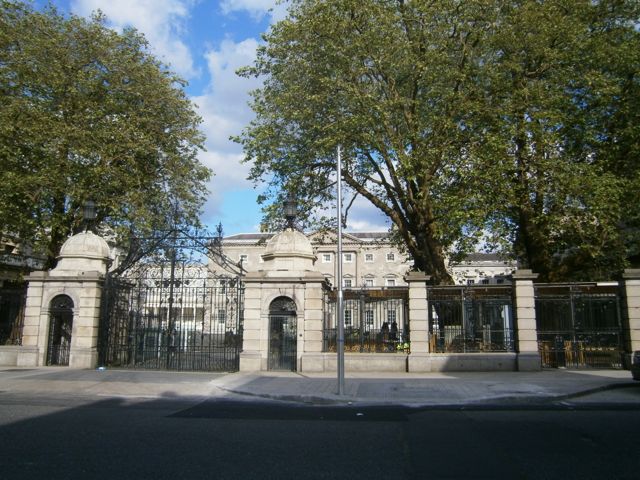
Plaque on the Manhattan depot named in honour of Michael J. Quill.
Pickets during the January 1961 strike of the TWU.
(Photo source: Internet)


FURTHER READING


Red Mike Quill and Nelson’s Pillar.

Equality, Racism & Republicanism

Anne Waters

(A talk given at a recent session of the monthly 1916 Performing Arts Club, published by permission of the author)

I want to say a few words on the subject of ‘Equality’ in particular as it pertains to racism. It is a word that is bandied about quite a bit lately and it is in danger of being misappropriated by some factions with their own agenda.

          Now when we speak of equality, one of the most important points to remember is that true equality recognises difference but it apportions an equal value to all difference. Understanding equality therefore is an acceptance that we are not homogenous or in other words we are not all the same.

Also, Equality is not finite so granting rights to one group does not erode the rights of another or reduce their entitlements.

To achieve an egalitarian society is most likely a myth, as society itself, applies a hierarchy to almost every facet of our lives. However, it is the struggle for equality that is important. That struggle has enabled conditions to be put in place that level the playing field and assist the least advantaged to achieve better outcomes.

The introduction of relatively free access to education and the introduction of employment regulations and human rights laws are but some changes that have lessened disadvantage. By striving for equality, and there is a long way to go, we are creating an active democracy by attempting to give equal voice to those from all walks of life regardless of colour, class or creed.

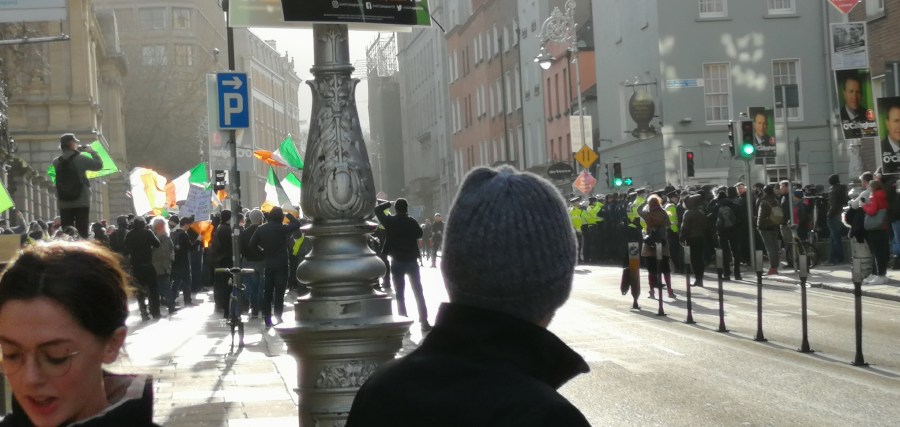
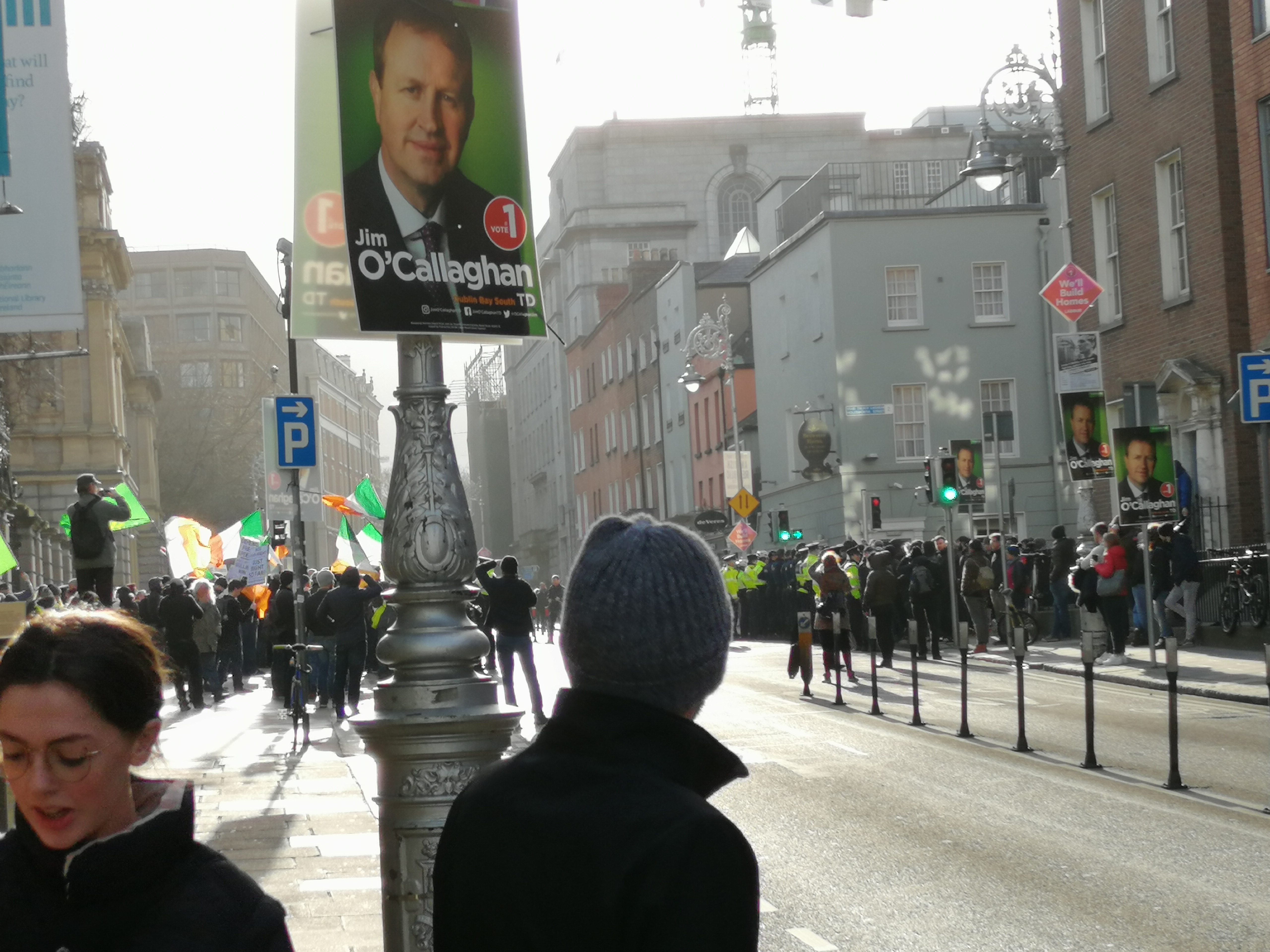
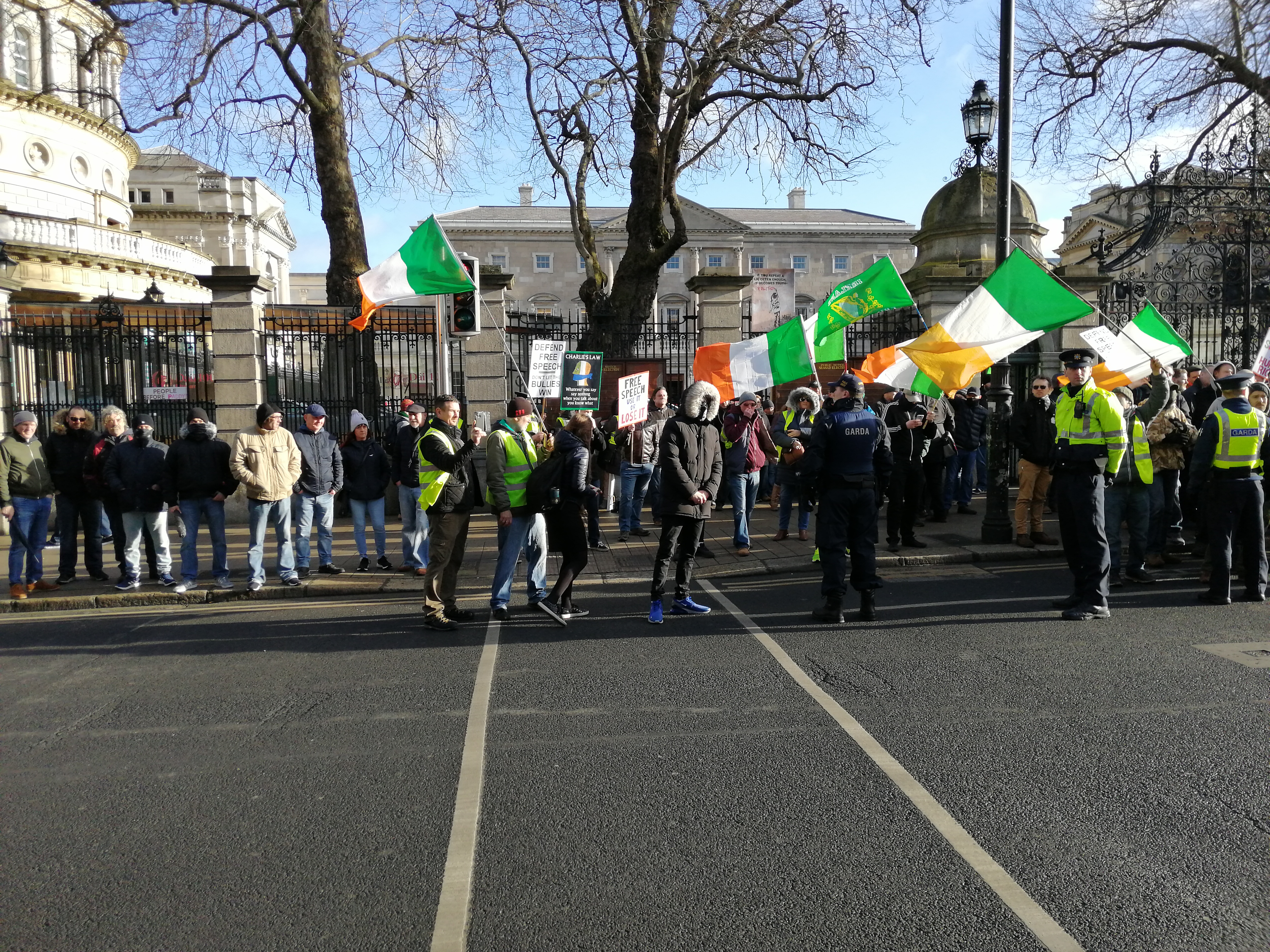
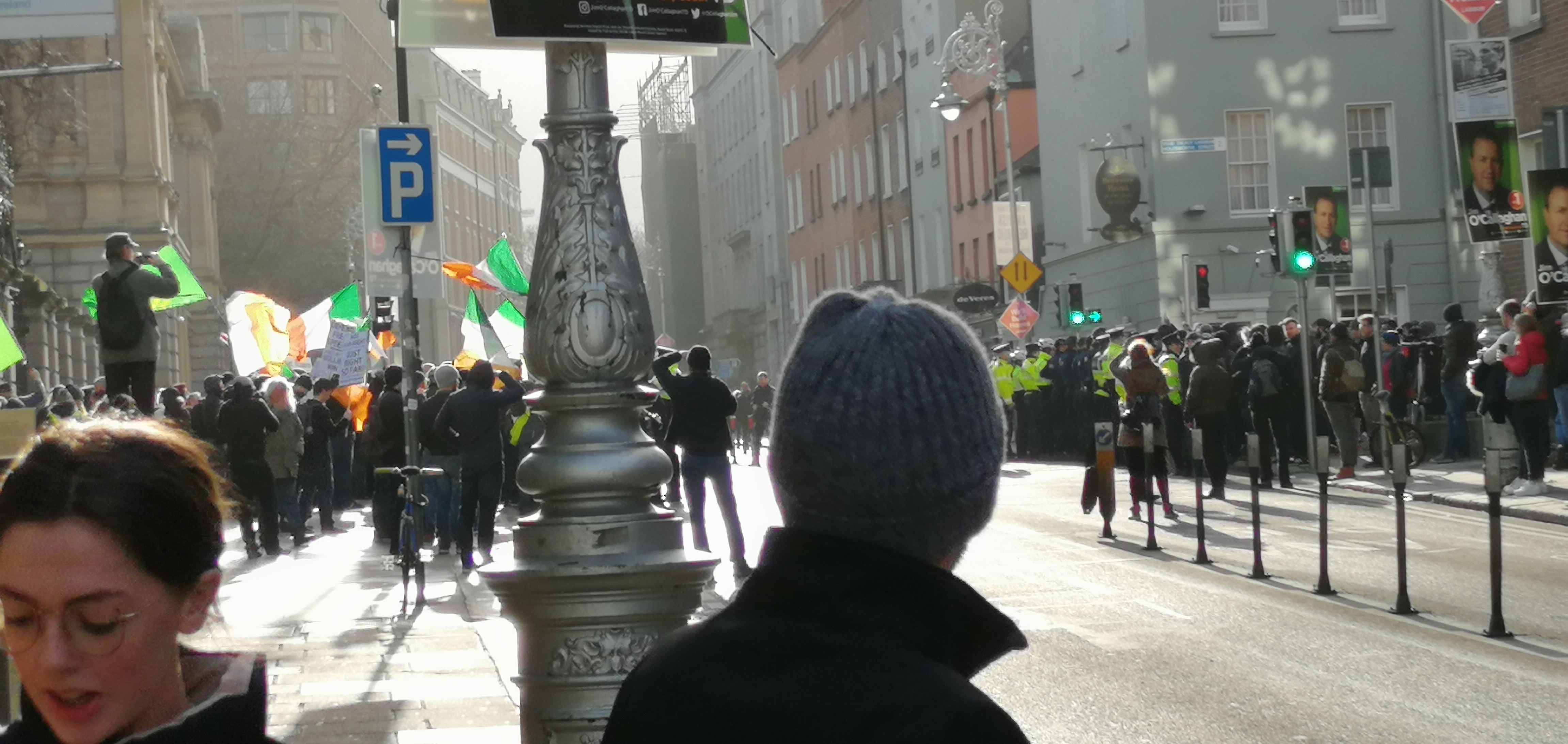
Left photo background: Mixed far-right demonstration outside Dept. Justice, Dublin, early Nov. 2019 — note presence of Irish Tricolour flags to indicate exclusive ‘Irish nationalism’. Left foreground and right of photo: counter-demonstrators. (Source photo: D.Breatnach)

The antithesis of Republicanism

          Now the last number of years has seen a rise in a type of neo- nationalism across the West and Ireland is not immune. This type of nationalism is the antithesis of Republicanism as it seeks to exclude. Republicanism on the other hand seeks to embrace and is inclusive regardless of colour or class.

Far right extremists attempts to engender a sense of unity and nationhood through demonising the ‘other’ and are utilising equality as a weapon.

They ignore the part the West played and continues to play in the perpetuation of poverty and war in Africa, Asia etc and how the consequences of their actions have a direct link to the numbers of refugees seeking asylum.

Instead they purport to speak for the disenfranchised ‘true national’ implying that their taxes are paying for the less deserving and they are ending up with an unequal share as a consequence.

There is a new narrative that promotes the idea that ‘equality and charity begins at home’ and ‘let’s look after our own first’. It hijacks the word ‘equality’ to engender a belief that the rights of the stereotypical national are being diminished.

Anti-Irish migrants racist cartoon, USA, 19th Century.
(Source image: Internet)

Think of our recent presidential election. Peter Casey was trailing in the polls until his vitriolic tirade against Travellers. His support swelled, because he appealed to those who believe they are paying more than their fair share of tax but are still receiving less than, in their minds, an undeserving group such as Travellers. The implication being that there is an inequitable division and they have to wait longer for what is rightly their due.

Brexit is similar in that it developed a narrative around who is the true British person. Why should they allow ‘others’ into their country and use British taxes to house and feed the stranger resulting in longer waiting lists for housing, health etc for the indigenous population. And I emphasise again, the part the West has played in ravaging the countries from which many people now flee is ignored.

I just ask that when someone comes looking for your vote and is spouting the word ‘equality’, just pause a moment and consider how they are using that word. Instead of seeing the richness that our interaction with people of all shades of colour has given to our society, that was once so insular, are some candidates utilising the word equality as a form of discrimination and exclusion?

Fascism and ‘free speech’

          The right to free speech is not without restraint and carries a duty of care. Implicit in any egalitarian society, which gives voice to diverse groups, is respect and tolerance. Fascism and racism therefore have no place in any society struggling for equality as their invective generates hate and creates division and discrimination. Unfortunately the rise in authoritarian leaders such as Trump, Bolsonaro, Orban has given licence (under the guise of freedom) to those who only spout hate.

Leaders of Italian and German fascism in the 1930s — their parties insisted on the right to free speech for them but once in power, imprisoned, tortured and killed their political opponents.
(Source photo: Internet)

Racism

          A comment I have often heard, by mainly white people, is that they never see colour, only the person. This is supposedly well meaning and a display of openness. However, the question has to be asked that if they don’t see black what do they see? In a perverse way they are actually racist as our colour is a signifier of who we are. To refuse to see a person’s colour be it black or any shade is a denial of a fundamental part of identity. Black people are some of the most disadvantaged carrying centuries of oppression and discrimination. If we refuse to see ‘black’ then how can we put conditions in place to alleviate the disadvantage that has accompanied colour?

End.

CORK REBELS FOR PEACE COUNTER FAR-RIGHT RALLY

Diarmuid Breatnach

(Reading time: 3 minutes)

“THERE ARE MORE OF US THAN THERE ARE OF THE BULLIES”

Learning of the intention of a far-Right coalition to hold a rally at Cork Town Hall on 4th December, a coalition of anti-racists and anti-fascists containing a range of Left and Irish Republican organisations, community and anti-deportation groups organised a counter-rally which dwarfed the numbers of the racists and fascists, who object to migrants, asylum seekers and LBGT people. Two TDs and a number of councillors also attended.

One of the organisers, Tracy Ryan, said that she had her two sons with her at the rally. “I’ve brought up my children to believe that everyone is equal and everyone deserves the same opportunities and chances in life,” she said.

View of counter rally half hour before due to start
(Photo: Students Against Racism)
Placard displayed at counter-rally
(Photo: Shamim Melekian)
Anti-racist football club supporters at the counter-rally.
(Photo: Shamim Melekian)

FREE SPEECH?

The specific rallying issue for the far-Right on this occasion, as it was in Dublin on 14th December last year (see https://rebelbreeze.wordpress.com/2019/12/15/dublin-counter-rally-outnumbers-racists-and-fascists/), was the legislation proposed by the Fine Gael Government against “hate speech”. The mixture of social conservatives, racists and fascists that make up the far-Right in Ireland have been complaining for some time that they are being denied freedom of speech, in particular since the most prominent member of their ranks, ex-journalist Gemma O’Doherty, had her two Youtube channels shut down by Google in 2019 after, according to Google, she broadcast racist statements and continued to do so after one of the channels was suspended for a week.

There is a wide variety of views on the proposed legislation outside of the far-Right, some socialists and Republicans remarking that “hate speech” is too wide a label and that they have seen such legislation used against themselves when they denounce prominent politicians or businessmen, the police or Loyalists. What unites all these groups demonstrating against the far-Right is not a defence of the Government’s proposed legislation but a determined opposition to allowing the far-Right to gain a foothold in Ireland, from which it may expand to introduce a fascist regime, reversing gains in social legislation, banning oppositional groups, terrorising minorities and restricting further the rights of unionised workers.

One of the groups on the counter-rally
(Photo: Shamim Melekian)
One of the many pointed placards on the counter-rally held by a supporter.
(Photo: Shamim Melekian)

Opponents of the far-Right point out that they begin by seeking freedom of speech to attack minority groups and their political opponents but once they have established a base, move to physically removing their opposition and banning freedom of speech of anyone who disagrees with them.

“There are more of us than there are of the bullies”, said one of the organising group, speaking to news media the day before the counter-rally. Poet and community worker Kathy D’Arcy added: “We are one people, one human race, one unified city whose people are known throughout the world for kindness, friendliness, good humour and inclusiveness.”

Declan Power of Waterford, organiser of a much smaller rally of the far-Right over the same weekend, rejected the accusation that they were racists or had any other agenda than freedom of speech. However at the event Diarmuid Ó Cadhla, of a group called The People’s Convention, revealed that he wanted to limit migration and was against the Government’s policies which, he alleged, are for “globalisation and open borders”. Presumably this was a reference to one of the conspiracy theories of the far-Right, viz. that the EU allegedly has a policy of opening all borders to mass immigration and replacing the Irish with foreigners. Laughable as this may seem to some and flying against all the evidence as it does, it is believed by some on the far-Right and used to whip up fears and hatred of migrants.

View of far-Right rally over section of counter-rally.
(Photo: Shamim Melekian
Closeup of some of the far-Right group in Cork (Photo: Shamim Melekian)

Woman on counter-rally holds up a placard addressing the far-Right
(Photo: Shamim Melekian)

HISTORY OF ANTI-RACIST MARCHES IN CORK

          The rally on 4th January this year was far from being the first anti-racist demonstration in Cork: an anti-racist march took place in March last year and or five years before that, there had been an anti-racist march in Cork every year.

Speaking in advance of the anti-racist march last year, Joe Moore of Cork Says No to Racism pointed out that while racism still exists in Cork, it is “a small number of people who have racist views towards minority religions, asylum seekers Travellers and the Roma community.”

Mr. Moore also pointed out some gaps in State provision, stating that the school books for children contain no mention of the Traveller community in Ireland, which itself has housing and education issues.

There is also a history of fascism in 1930s Cork when the Blueshirt fascist movement was opposed by anti-fascists and socialists inside and outside the IRA. Ironically, while opposition to the Fine Gael Government’s proposed legislation is the purported rallying point for the far-Right, the Blueshirts were one of the three groups that joined to form the Fine Gael party (which is why many opponents of the party call them “Blueshirts” to this day).

Fascist salutes at a Blueshirt rally in 1934 in Charleville, Cork.
(Photo source: History Ireland).

End.
SOURCES & REFERENCES:

Quotation from Kathy D’Arcy: https://www.echolive.ie/corknews/Rally-for-peace-to-take-place-outside-City-Hall-tomorrow-775f0af9-1083-47b3-9920-48a20ec234ac-ds

Irish Times report: https://www.irishtimes.com/news/ireland/irish-news/cork-rejects-politics-of-hate-from-far-right-groups-rally-hears-1.4131626?

Cork Echo report: https://www.echolive.ie/corklives/New-anti-racism-group-takes-to-streets-of-Cork-2cf76e9c-e240-4653-b2a5-084c8d31d57d-ds?fbclid=IwAR1yfgu5qcL-71qJQMk1jzt-NhtbBmJ4VW9hYm1DMQwGKdD9nunl3Ju-O40

Previous anti-racist marches in Cork: https://www.corkindependent.com/news/topics/articles/2019/03/20/4171273-antiracism-rally-planned/

Blueshirt fascist movement with reference to Cork:

https://www.historyireland.com/20th-century-contemporary-history/eoin-oduffys-blueshirts-and-the-abyssinian-crisis/

https://www.theirishstory.com/2012/05/18/the-blueshirts-fascism-in-ireland/#.XhTtZSOLRsM

Counter-rally supporter mocks conspiracy theory that Soros Foundation is funding all the anti-racist and anti-fascist activists.
(Photo: Shamim Melekian)
Another pointed placard message on the counter-rally.
(Photo: Shamim Melekian)
Woman on counter-rally displaying presumably dire conditions on halting sites for Travellers.
(Photo: Shamim Melekian)


Women of varied ages and backgrounds applauding speaker at counter rally.
(Photo: Shamim Melekian)
Counter rally supporter sends pointed message on placard
(Photo: Shamim Melekian)
Young supporter of counter rally sports a T-Shirt display which might become very popular.
(Photo: Shamim Melekian)
Section of counter rally on the march through Cork city centre.
(Photo: Shamim Melekian)

DREAMS of BURGLARY, COUSINS, and a CUBAN AUTHOR

Diarmuid Breatnach

          I awoke from a dream, unsettled.

          I and another man had been burgling a building, one which I later recognised as bearing a resemblance in part to a place in which I had once worked. My dreams are often located in scenarios reminiscent of my working life but usually they are of the industrial period, factories, vast or small and dilapidated. The building in my dream was in part from a later period and the office space was reminiscent of a hostel for the homeless in London, where my job had been that of the Deputy Manager.

That hostel had been of course in 24-hour operation, with staff on rota throughout all those hours but, in the dream, it was open only during the day (like some facilities for the homeless whose management have the confidence to tell those who run 24-hour operations how they should manage their establishments and whom they should not exclude).

In the first scene I remember I was in an alley outside the target building and my accomplice appears to have been inside already. The building’s doorway was near the mouth of the alley, which opened on to a main road. I shrank back into the doorway as someone left a nearby building, either at the corner or just around it, calling out something to whoever he was leaving behind. Then the door was opened by my accomplice and I stepped inside.
Having closed the door, I saw that somehow he was already in the office while I was in the entry passageway. Looking at him through the glass of the reception office, I saw he had the safe open already but was awkwardly keeping the office door open with an outstretched foot. He beckoned me in with an impatient gesture.

Entering the office, I kept the door open while he emptied the safe of money. I knew that if the door was allowed to close it would set off an alarm (yes, I know, crazy and why did we not just wedge it open?).

Soon, I was further down the corridor and opening up another safe and taking out bundles of currency notes. Closing the safe, since our intention was to delay discovery of the theft, I brought the money up to the reception office. Now, at this late stage, I began to worry about concealed video recording cameras and drew a scarf partly across my face.  I mentioned my fear to my accomplice, who commented that if CCTV cameras were installed, they already had our faces so why worry?

Of course, that was not very reassuring. I began to regret the whole operation.

“So what do you want to do?” he asked.

“I know what I feel like doing,” I replied. “I feel like leaving the money here and leaving. But I am not sure what I really want to do.”
“Leave the money, after all we’ve gone through to get in here?”

“I know, I know. OK, let’s just finish the job.”

“Just keep denying it and they can’t prove anything,” he replied and that is about when I awoke.

***   ***  ***

(Image source: Internet)

As noted earlier, I felt very unsettled by the dream and could not get back to sleep – so I switched on the bedside lamp to read awhile, a novel by a Cuban writer called Leonardo Padura.

Sometime later, I switched off the light and was soon back asleep. And dreaming again.

***   ***  ***

There is only one scene from that dream I remember: a plain room, perhaps a kitchen, a rectangular table, at my long side of which one woman sits on a chair, another on the other side and yet another on the short side, both also on chairs. There is another chair in front of me, empty, into which I am ushering a youngish and tall man I know to be my Irish cousin.

The woman to my left might be my mother but if so, much younger than matches my adult age. The other woman nearest is to my right, sitting back somewhat from the short side of the table and is in her early to mid-twenties. On the opposite side of the table to me, is a somewhat older woman who appears to be in her thirties. Again improbably, I think she is the mother of the younger woman.

I seat the young man on the empty chair and then go to the youngest woman, whom I now know to be a cousin also. She bends towards the older woman and whispers something to her but I take her by the elbow and steer her towards my male cousin, reflecting while doing so that maybe I should have done this the other way around.

As I reach him, I say to my male cousin that “I wish to introduce the delectable S—-” (I am uncertain about the exact adjective I used but it was something like that).

I think they shook hands and then she sat down again.

***   ***  ***

The mobile alarm woke me but I was tired, so reset it for another hour and was soon asleep. And dreaming again.

The scene this time was similar to that of an Asian buffet in Moore Street, Dublin, that I frequent from time to time. But the man behind the counter was Latin American, not Asian. I asked him about the Mexican Bay Tree – were its leaves used for flavouring as with the bay tree with which we are more familiar here in Ireland?

He seemed puzzled and asked me where I had heard about this tree.

I replied that it had been mentioned in a book by a Cuban author, Padura. He burst into scornful laughter and exclaimed something like “Ni vive, ni siquiera estuvo nunca ahi!” (“He neither lives nor was even ever there,” i.e in Cuba). And he called out in Spanish to another staff member of the restaurant.

I said then that I was not surprised, for Padura’s main character Conde comments quite negatively on the state of affairs in Cuba, which reflects badly on its management and I felt he could hardly continue doing so if he actually lived there.

The reset alarm went off and I awoke with the rapidly-fading memory of yet a fourth dream (now gone completely).

COMMENT

          I would have loved to take these dreams to my mother for analysis but she is dead a dozen years now. She followed the Jungean method and had done some amazing analyses of dreams for members of the family and also for some close acquaintances. Amazing, in terms of perceptiveness and apparent relevance to the individual concerned.

The basis of the Jungean system is to recognise that everything in a dream is from the subconscious, which speaks to the conscious mind in symbols. Therefore things, words and people dreamed of tend to be representing something else and people in particular, whether male or female, young or old, known or unknown to represent parts of one’s subconscious.  Carl Jung also spoke of archetypes, representations of events, figures and motifs which he believed all humans shared from the earliest beginning of the human race but which are also overlain with their own specific ethnic and period culture.

The Burglary

          So what would my mother have made of the burglary dream? She would of course consult the known archetypes but would also interrogate me about some of the dominant aspects, asking what they represented to me, personally.

What would she have made of the fact that the representation of my accomplice was an Irish “dissident” Republican known to me, along with my fear of discovery? The man could represent dissidence, disobedience of authority (in the conscious world of reality, both of State and of some party leaders) but also honesty, dedication, courage. And my fear? Maybe a real one, of danger from the repressive apparatus of the State. Nothing new there, however.

Then there was the reception office door that must not be closed!  I must be open to receive something?

The building in part represented a place in which I had worked once and had been treated very badly as an employee. In the course of my work there I had to take two separate grievances against my manager on the grounds of his impeding my professional development, in both of which I succeeded in gaining access to the steps I sought (training and practice). My manager had taken out two disciplinary procedures against me, both of which turned out to be unsuccessful but which naturally, caused me a lot of stress.

The background was that he had wanted another candidate to succeed in the interview procedure in which I had come highest and he had objected to the decision of the interviewing panel; subsequently they had announced that no-one had reached the required level. I sought feedback on this, seeking the scoring in my case and a senior manager ordered another round, this time with a union rep and an Equalities rep on the panel with the manager in question. Although, as I learned later, I had come highest again, due to the sitting manager’s insistence on another candidate, the panel recommended an isometric test to decide between the two top applicants and I had come out on top of that procedure too.

I was appointed to the post.

When I first met my manager-to-be some days later to discuss starting work at the hostel, he told me he had not been pleased with recruitment procedure. I replied that there were some aspects that had not pleased me either but that we had best leave all that behind us. It was subsequently clear that either he was unable to do that or did not wish to.

But a building in dream analysis often represents one’s own head or, more precisely, one’s brain ….

And stealing from it? I don’t know.

Ma! Are you there? Ma! Ma!

The Cousins

          The lack of detail apart from the figures in that dream is striking, forcing one to concentrate on the actors, without distraction.

In reality, on the Irish side of my antecedents, only one siblin of my father had children (six, five brothers and one sister, also just like ours). In the real world, my female cousin is actually named S— but although she might well be considered delectable, is not tall and fair-haired, as she was in my dream. And ALL my Irish cousins are siblings, which made the introduction of one Irish cousin to another ridiculous. In the real world, ridiculous yes – but in the world of symbolic representations?

There were three women in the dream and one male, other than myself. Two of the women played observing roles while the third seemed somewhat reluctant to be introduced to the male cousin. It seems to me that this represents a need for some female parts of my brain to come to greater ease with the male parts. The female represened is family, so is close but as a cousin, slightly distant; the mother figures, one very close (mother) and the other (aunt) slightly distant, observe rather benignly. The male cousin, willing to be introduced, would be a representation of a male part of myself.

The Cuban Author

           The book I had been reading was indeed by Padura and in reality I had been wondering about this “Mexican bay tree”, making a mental note to ask the Oracle (Google) about it. And I had wondered about Padura’s comments about Cuba (through his main character). Although I was sure Cuba was no paradise and had heard of a decline in revolutionary standards of the leadership and in society, I wondered whether a) things were as bad as Padura’s character Conde thinks and says and b) how or why Padura lives there if that’s how things are.

So, a straightforward carrying through of waking questions into a dream? Perhaps. But why would they be of such importance as to be dreamed about? It seems one should dig deeper.

The scene presented in the Asian buffet was familiar and yet exotic too, in the food on offer. Cuba is exotic to me as would be, I presume a Mexican bay tree, whatever that is. But the bay tree with which I am familiar has fragrant leaves and I use it often in cooking.

And that’s as far as I can get.

Ma! Are you there? Ma! Ma!

End.

Mexican Bay Tree
(Photo source: Internet)

POSTSCRIPT

According to Wikipedia

Leonardo de la Caridad Padura Fuentes (born on October 10th, 1955) is a Cuban novelist and journalist. As of 2007, he is one of Cuba’s best-known writers internationally. In his native Spanish, as well as in English and some other languages, he is often referred to by the shorter form of his name, Leonardo Padura. He has written screenplays, two books of short stories, and a series of detective novels translated into 10 languages. In 2012, Padura was awarded the National Prize for Literature, Cuba’s national literary award and the most important award of its kind. In 2015, he was awarded thePremio Principe de Asturias de las Letras of Spain, one of the most important literary prizes in the Spanish-speaking world and usually considered as the Iberoamerican Nobel Prize.[1]

The reference, mostly about the writer, has some passages which are critical of the regime. And yes, Padura does live in Havana, Cuba.

According to one site, the Mexican Bay Tree (Litsea glaucescens) is an uncommon shrub:

A small, evergreen tree growing to 15-20 feet. Leaves are leathery and elongated in shape, growing up to 3″. They are distinct in having a blue-green coloration to their undersides. Flowers are small, white-green in color. Fruits are small, at most 1/2″ across and ripen to a deep purple-black. There are supposedly a handful of varieties or variants of this species, though minimal attention seems to be given to propagating select types.

According to Wikipedia,

It grows in the mountains, on the banks of rivers and is planted in the garden of houses. It is used as seasoning. It is in danger of extinction,[3][citation needed] because it has been used extensively for various uses, medicinal and culinary purposes even religious during the celebration of Palm Sunday. The species is one of the most important non-wood trees of Mexico. This species has been exploited for different purposes: religious,[2] dietary and medicinal, where the young branches and leaf tissues are used. This has resulted in a considerable exploitation in virtually all their range.

Of course, these aspects of the plant would have brought a whole lot of other aspects into the dream analysis, except that I didn’t know them then.

Or did I, subconsciously somehow …..?

NULLIFYING FASCISM IN IRELAND

Diarmuid Breatnach

(Reading time10 mins)

As fascism begins again to raise its ugly head in Ireland, it is necessary for all its opponents, whether social-democrats, revolutionary socialists of various types or democrats, to consider effective means to restrain its growth and to nullify its influence upon the ordinary masses of Irish society. These masses are at this point generally hostile to fascism and to racism (a seed-bed of fascism) but that can change and in history, has changed before, not just in other lands but in Ireland too during the 1930s.

          Traditionally, the views on effective means of defeating fascism in western european society have varied between defeating their arguments, legislating against them or denying them any public space within which to grow. It might be useful to briefly examine the premise and experience of these different approaches in order to evaluate their efficacy.

DENYING FASCISM ANY PUBLIC SPACE

          Taking the last case above first, most active antifascists, whether Anarchist, Irish Republican, Communist or Socialist, proclaim the need to physically prevent fascists gathering in public spaces or on platforms. This approach puts these elements into direct confrontation with the forces of the State which see the methods of the Antifa as illegal, as subverting their own roles and, often enough at different times, as a threat to their own plans for repression of resistance to regimes of austerity. 1

In 1970s Britain, those who advocated such an approach, despite the fairly recent history of the War Against Fascism and the 1930s struggles in Britain, were in a small minority and seen, not just by social-democrats and liberals but also by most of the socialist and communist Left, as “ultra-leftists”, “adventurists” or just plain “hooligans and thugs”.

Attempt by Sir Oswald Mosely, leader of the British Union of Fascists (Blackshirts) to rebuild the fascist movement meets clear resistance in 1960s Manchester.
(Photo source: Internet)
Depiction of an earlier anti-fascist event, the Battle of Cable Street 1936, mainly against London Metropolitan Police escorting Blackshirts to Jewish settlement area in East London.
(Photo source: Internet)

A small English marxist-leninist party2, with its African, Asian and Latin American student connections, promoted the “no free speech for fascists” policy and managed, for awhile, to have the similar “no platform for fascists” policy adopted by the National Union of Students. Some revolutionary Communists, Socialists and Anarchists combined with some militant groups of the ethnic minorities targeted by the fascists to pursue this policy on the streets. The National Front and the British Movement found their marches, meetings, concerts3 and rallies attacked and they were eventually driven off the streets, with many sacrifices in the antifascist movement from the deaths of at least two antifascists4 to jail sentences, heavy fines and physical injuries.

In 2016, the islamophobic party Pegida was prevented by popular direct action from launching itself in Dublin. This approach does seem to have been successful in Britain, at least for decades, and in some other European areas, with ethnic and other minorities gaining a space in which to promote their culture and develop their politics. At the same time, it has to be acknowledge that many of the concerns of the ruling British elite had been successfully addressed or contained during the 1980s: restriction on the trade unions through industrial relations legislation, defeat of the National Union of Miners (1984-’85), of the printing unions at Wapping (1986-87), of the dockers through buy-outs and redundancies; repression of the Irish community through the operation of the Prevention of Terrorism (sic) Act 1974 and the jailing of nearly two score Irish people framed on bombing charges in five separate trials; increasing workers’ insecurity and dependence through large-scale change from being renter-occupiers to mortgage holders.

The sinking instead of launching of Pegida in Dublin, 2016.
Cartoon by D.Breatnach)

LEGISLATING AGAINST FASCISM

          Legislating against fascism in western european democracies has largely been imposed opportunistically, as with France, Spain and the UK, as the ruling elites faced up to war with states where fascism was already dominant. In the Spanish state it proved ineffective and heroic popular resistance was ferociously overcome by a military-fascist uprising backed by the resources of two fascist states, while the ‘democracies’ stood by or imposed a blockade on relief for the beleaguered Republic. In France, any measures were nullified by the German Nazi invasion. In the UK, the measures proved effective due to the wartime posture of the ruling elites, facing a possible invasion and needing a mobilisation of the entire population to resist that possibility5. In the Irish state, where a new quasi-Republican government was facing the real possibility of a fascist coup aided by elements in the military, some banning measures were effective but these were preceded and assisted by popular mobilisation and direct action against the Blueshirts.

After the defeat of fascism by war and popular resistance, antifascist legislation was imposed on the defeated fascist states by victorious insurgents or by conquering forces. But today, fascism is on the rise in all those states that have been the subject of antifascist legislation. In the Spanish state, where fascism was victorious and remained so for three decades, fascists and their crimes were actually protected and, despite the democratic veneer of the “Transition”, no action was taken against fascists openly parading, displaying fascist paraphernalia and honouring fascist leaders such as General Franco and Primo Rivera (founder of the fascist Falange).

Liberal, social-democratic and even some socialist elements call for the State to bring in and to enforce legislation against “hate speech”. However, apart from being an insufficient answer, the label of “hate speech” has been used in the Spanish state to penalise denunciation of the Spanish State and its police forces.

DEFEATING THE ARGUMENTS OF FASCISM

          Defeating the arguments of fascism, such as racist propaganda against ethnic minorities and for special rights for one section of the population, conservative and homophobic ideology, arguments in favour of male superiority, are argued to be necessary to defeat fascism since legal repression and active suppression can only drive those forces temporarily underground, from where sooner or later, they will emerge again.

Not quite the same but a similar non-State and pacific line is that the fascists need to be over-awed by the mobilisation of their opponents and their pariah status demonstrated to a passive public by the mass of anti-fascist numbers.

In the 1970s and 1980s in Britain, this was the dominant line among anti-fascists, among social-democrats such as the Labour Party, liberals, the Communist Party of Great Britain and the Trotskyists of the Workers’ Revolutionary Party and of the Socialist Workers’ Party6. Their first tactic upon hearing of a plan for a fascist mobilisation was to build an antifascist mobilisation near the same point, to show large numbers opposing and hopefully outnumbering the fascists.

However, the fascists were already attacking ethnic minorities and other groups and hanging around oppositional mobilisations to pick off individuals or small groups. They had also attacked a number of antifascist public meetings with clubs and bottles and even a gas spray into eyes. Left-wing paper sellers were targeted on the street. Irish solidarity and other solidarity marches and meetings were also attacked and though certainly the Irish proved able to defend themselves, during the scuffles, the police were able to find an excuse to arrest the Irish marchers.

The leaders of the peaceful opposition to fascism policy refused to change their line and, as the likelihood of violent confrontations between fascists and their opponents increased, would call for a rally near the fascist mobilisation and then lead the antifascist march away from the fascists. The SWP promoted youth concerts under the banner of Rock Against Racism, but the fascists continued to mobilise.

In retrospect, it did seem as though the small and large-scale pitched battles with with fascists and with the police escorting and protecting them were what was demoralising the fascists and leading to splits within their organisation, ultimately defeating the fascist offensive of those decades.

Even so, the leaders of AFA (Anti-Fascist Action) which mobilised most of the successful actions against the British fascist organisations and their mobilisations, certainly in London, argued that it was necessary also to defeat fascism politically7 and that failure to do so would ensure a resurgence of fascism at some time in the future. This prediction has surely come true in Britain with EDL and UKIP, for example.

One of the successful antifascist battles in Portland USA, June 2018.
(Photo source: Internet)

EVALUATING CONCLUSION

          In my opinion, each of these approaches is necessary but overall reliance on any individual approach is likely to bring the democratic forces to tragic defeat.

The model of active denial of a public space has a position of central importance; the action to prevent the launch of Pegida proved successful and no doubt such actions will be necessary again in the future (though perhaps learning from that action to prevent or at least minimise arrests of antifascists).

I do not believe it is the role of antifascists to call for capitalist state action against fascists and any prohibitive legislation should be specifically anti-racist, anti-homophobic etc. A wide catch-all “anti-hate speech” legislation will find revolutionaries its targets more often than it does fascists (as is happening in the Spanish state at the moment).

Defeating the arguments of fascism must have a role in denying the fascists many of their recruits. As in European countries in the 1930s including Ireland and Germany in particular, some of the foot soldiers of the fascists are the oppressed poor, the educationally disadvantaged, the misguided as to who their real enemies are and where they are to be found.

In the 1930s the enemy was portrayed as being the Jews, Communists and homosexuals inside the country, whilst today those bogeymen are replaced by migrants, moslems, gays and supporters the right to choose abortion. In the 1930s the external enemy was the then-dominant European powers, France and the UK, as well as the Soviet Union; today, it is the EU.

It is not the role of anti-fascists to defend the EU (which to my mind is indefensible and which in any case will gain us nothing) but rather to point towards the real enemy, Irish capitalism and foreign imperialism. We need to show that through constant demonstration of examples and by leading struggles against those institutions.

In particular in Ireland it is of the utmost necessity to expose the nationalist posture of the fascists and racists. In two showings of Gemma Doherty supporters in Dublin recently, they flew many Irish tricolours, played ‘rebel songs’ and sang the Irish National Anthem (The Soldiers’ Song, by Republican Peadar Kearney). In a confrontation between them and the anti-fascists, it can seem that the fascists and the racists are upholding the honour of the nation. However the Blueshirts actually upheld the partition of the nation and the granting of a portion to a foreign power and fascists will end up supporting our foreign-dependent capitalist class. In addition, Irish fascists have been seen making overtures to Loyalists in the Six Counties, forces loyal to an occupying power.

James Connolly monument, Dublin. This Irish working-class martyr did not see Ireland until he was sent there in the British Army, from which he soon enough deserted.
(Photo source: Internet)
Constance Markievicz in Irish Citizen Army officer uniform. She was born in England to a planter family.
(Photo source: Internet)
Robert Erskine Childers and wife Molly, bringing rifles into Howth for the Irish Volunteers. Molly was from the USA. Childers was English, later he joined the IRA in the War of Independence and in the Civil War. He was executed by the Irish Free State in 1922.

Apart from the fact that we are all descended from migrants, many of those historic heroes celebrated in ‘rebel songs’ were born abroad, were descended from recent migrants or had at least one foreign parent; that list would include Wolfe Tone, Henry Joy and Mary McCracken, Thomas Davis, Tom Clarke, Patrick Pearse, James Connolly, Jim Larkin, Constance Markievicz, Eamon De Valera, Erkine and Molly Childers …..

We need to deny the fascists any place in popular anti-capitalist struggles, as successfully done with the brief flare of Yellow Vests organisation in Dublin and will no doubt need to be done again, for example in housing demonstrations.

Migrants need to organise themselves against attacks and increased exploitation and we need to be active in their support. This is the case too for other targeted groups; liberal cries for justice or for the application of “anti-hate speech” legislation will avail them not at all in the long run.

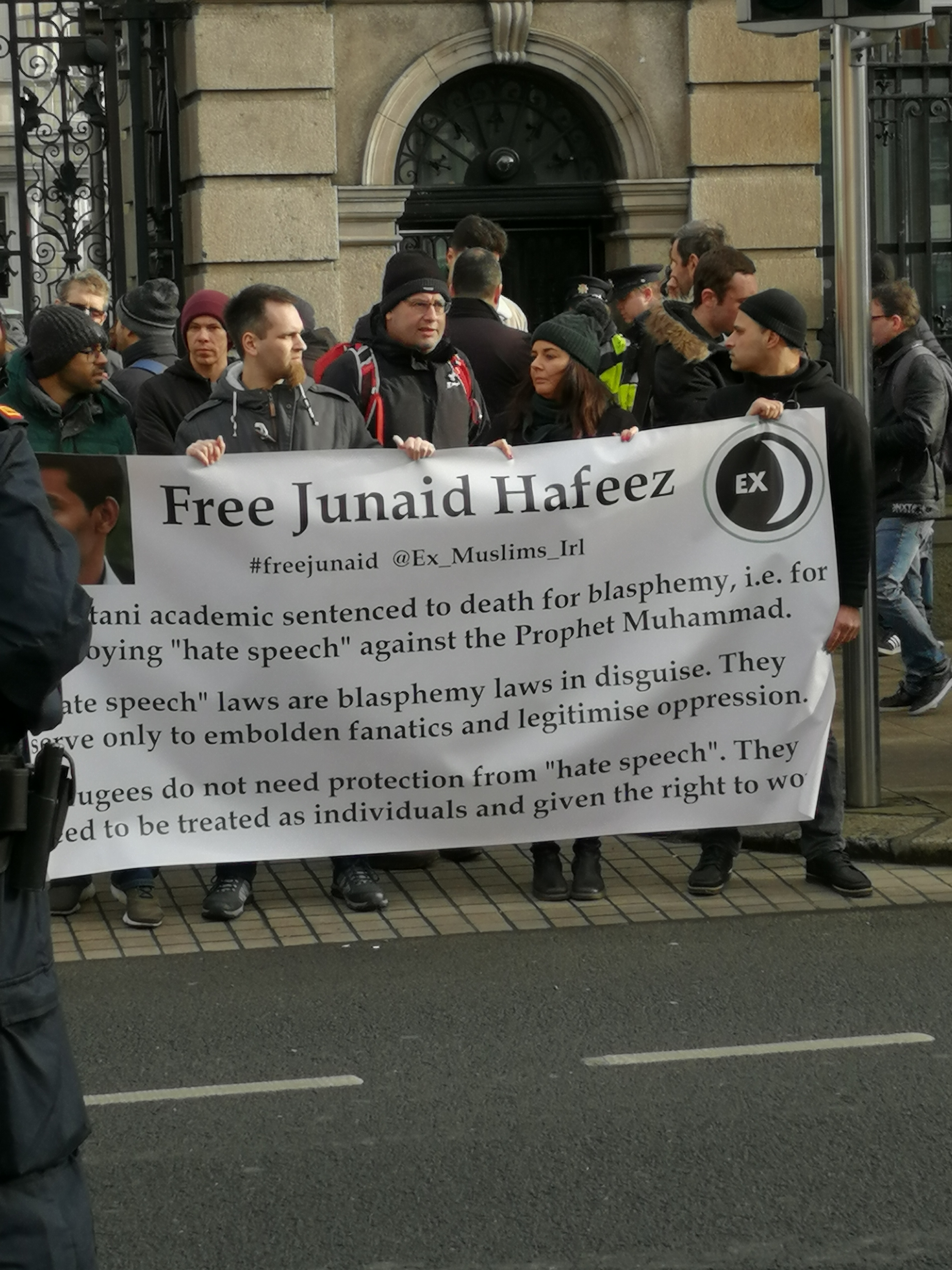
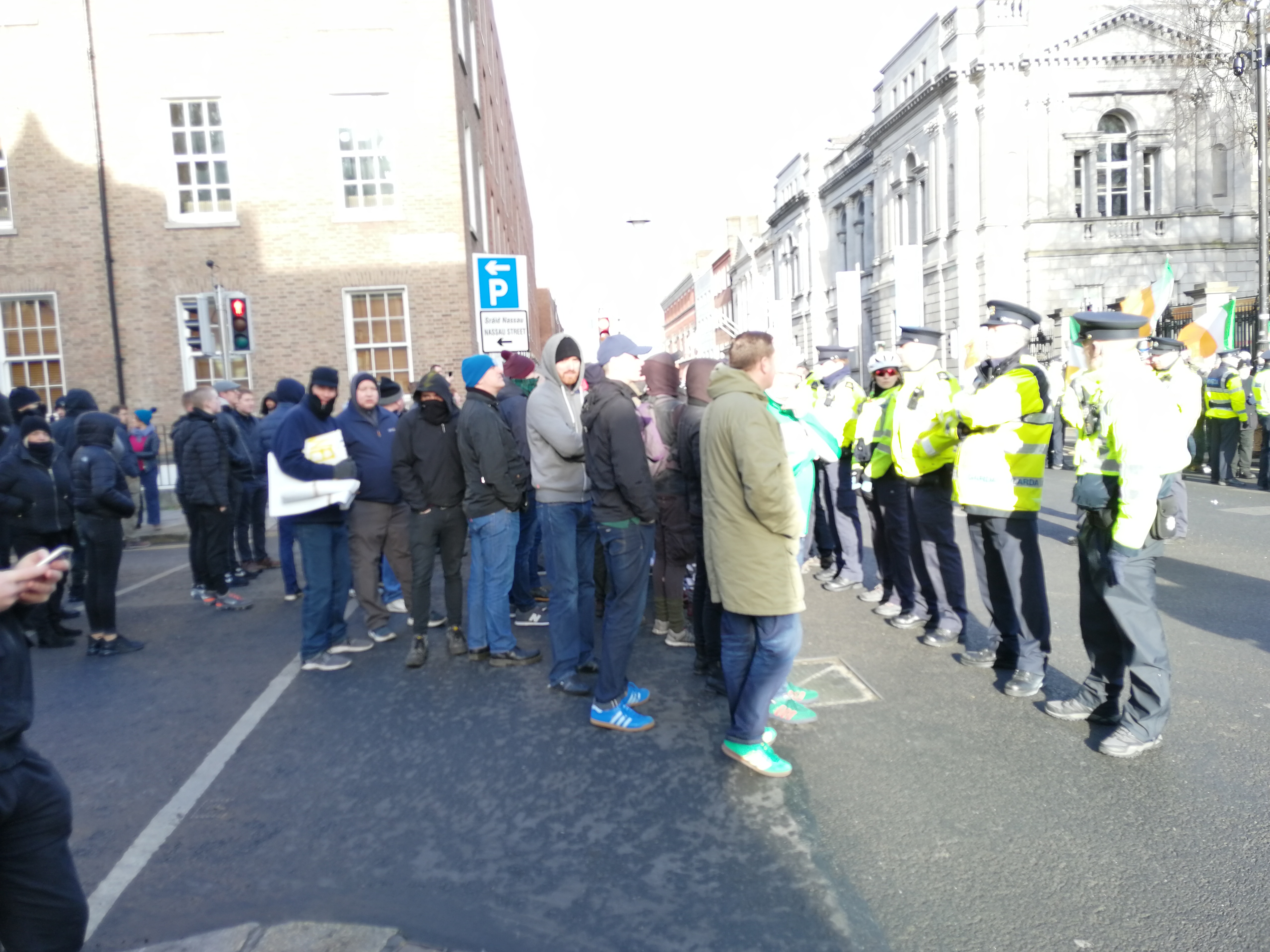
Recent racist and fascist demonstration at the Dáil against proposed legislation banning “hate speech”.
(Photo source: Internet)

Having said that active denial of a public space for fascists is necessary, I would add that secret mobilisations should be for work that needs to be secret; however it is ludicrous to gather secretly and then to march out to stand in front of the fascists shouting at them. That work of visible opposition does need to be done but publicly, with mass mobilisations – antifascist forces should be able to outnumber the fascist and racist mobilisations in Ireland by a factor of ten to one. We should have effective amplification systems, play antifascist songs, and fly relevant flags (in particular, in my opinion, the Starry Plough, flag of the Irish working class in struggle in 1913 and in 1916).

It is crucial for us to realise that without revolutionary answers to crisis, fascism will present false solutions and diversions, calculated to have an appeal to sections of the population. And the revolutionary answers need to be not only theoretical but seen in practice also, actions that seem as though the revolutionaries and their allies are seriously fighting the system to advance the cause of the working people.

Fascism is one of the faces of Capitalism in specific circumstances. Ultimately, as long as capitalism exists, the danger of Fascism will never be far away.

End.

FOOTNOTES:

1Recently the media reported judgement against a number of people who had allegedly attacked Irish fascists while the latter were on their way to the 2016 attempt to launch the Islamophobic party Pegida in Dublin. Others are currently awaiting trial for allegedly attacking apparently Polish fascists who were trying support the same launch. Of all the European countries where the launch of Pegida had been planned, Ireland may be the only one where this was signally unsuccessful.

2English Communist Movement (Marxist-Leninist), which became the EC Party (m-l). It was mostly active in London and Birmingham. The NUS currently has a a “No Platform” policy but which applies to specific organisations and individuals, including some British fascist and racist organisations.

3For example of the fascist skinhead band Skrewdriver.

4Both were killed by London Metropolitan Police truncheons: Kevin Gately, Leeds student of Irish parents, 1974; Blair Peach, New Zealand teacher, 1979.

5In the USA, fascism was only repressed to any great extent when the USA decided to enter the Second World War, which was after the bombing by the Imperial Japanese of Pearl Harbour.

6There were elements within all these sections that did not agree with official line and some acted in opposition to it. The SWP expelled those who practiced direct action against fascists and many of those elements went on to form Red Action and Anti-Fascist Action.

7For this premise and a partial history of the physical struggle against fascist organisations in 1980s and 1990s Britain, see for example, Beating the Fascists – the untold story of Anti-Fascist Action, by Sean Birchall, Freedom Press, 2010.

NATIONALISM AND FASCISM

Diarmuid Breatnach

(Reading time: 10 minutes )

All kinds of socialists deride nationalism, as do some republicans. It is often seen as a recruiting base for fascism, for imperialism and the cause or justification for war. Indeed it has been all those things. And yet …. Perhaps the way in which nationalism has been viewed by the Left and Republicans is one-sided and its progressive potential overlooked. And perhaps taking a look at Basque, Catalan and Irish nationalism can demonstrate this.

James Connolly (Photo sourced: Internet)

Was James Connolly1 being reactionary when he upheld the rights of the Irish nation to separation from the United Kingdom, to self-determination? Was Thomas Davis being reactionary when he composed the words

Oh can such hope be vain?

That Ireland, long a province be

a nation once again!”2

Thomas Davis monument, statue and fountain, College Green/ Dame St, Dublin.
(Photo: D.Breatnach)

Recently I began to question some of the criticisms of nationalism politically while at the same time I had struggled with them culturally for much longer. A few people may say that it matters nothing to them whether they are Irish, Italian or Iraqi. But most Irish people identify themselves quite strongly as “Irish”. I think that is primarily a cultural question. They have accents, sayings and history they share, character flaws and positive aspects, heroes, songs, poems, writers …. It is not the same for everyone but some of those aspects, in some kind of mix, are there for each person who identifies themselves as Irish. And of course, the sadly neglected Irish language. I don’t believe identifying oneself as Irish (or Icelandic, Iranian or Indonesian) makes one any less an internationalist.

OK,” the socialist and the republican might say, especially the socialist, “but what does that matter? You can have regional cultures too. They do not detract from the fact that we are all socialists, fighting for the working class everywhere.”

And I would agree.

But the socialist is not finished. “It’s a different matter entirely when you elevate that cultural distinction to a political one, which is nationalism. That creed puts your nation above others and is a breeding ground for fascism and war and, in powerful nations, for imperialism.”

He has a strong case – but we’ll see.

Fascism is on the rise all across Europe and many other parts of the world and we see signs of its resurgence here in Ireland, with discourses against migrants, moslems and social freedoms on the rise. The fascists and the racists working among those discourses are indeed using nationalism as a cover and at the same time as some kind of a base. Recently, supporting Gemma Doherty, they were playing the Soldiers’ Song and Irish Republican ballads and they were waving the Tricolour. Some of them approached the antifa opposing them, asking questions like “Are we not all Irish?” 3

Now, as it happens, the national flag, the Tricolour, is not only about inclusiveness, i.e of a unity (white) between the descendants of colonists (orange) with those of the indigenous (green), but was also made by foreigners and presented by them to the Irish. It was in fact republican women of Paris, which was then amid revolution, who presented it to Thomas Francis Meagher in 1848.

The Irish tricolour flag, design presented to the Irish nation by French women revolutionaries in 1848.
(Photo sourced: Internet)

Of the heroes and martyrs mentioned in the ballads, many were born outside of Ireland, including two of the signatories of the 1916 Proclamation of Independence: Tom Clarke and James Connolly. Constance Markievicz too was born in England, daughter of a colonist family in Ireland; Wolfe Tone and Henry Joy McCracken, Republican leaders and martyrs of the 1798 United Irish uprising, were descendants of French Protestants. Many too were the sons of a non-Irish parent, such as Thomas Davis, whose father was Welsh and Patrick and William Pearse, whose father was English., also Eamonn De Valera, son of a Cuban father. The man who organised the sea journey to Howth with German Mausers as illicit cargo for the Irish Volunteers in 1914, Erkine Childers, was English and his wife and one of his crew, Molly, was from the USA.

On the other hand, those who made the deal with the British ruling class after years of liberation struggle were Irish — in 1921 they paralysed the revolutionary struggle, agreed to the partition of the country and in 1922 set out, even using artillery on loan from the British, to slaughter their opposition, their former comrades who wished to continue the revolution. Childers, the English gun-runner to Howth, joined the IRA in the War of Independence and in the Civil War, during which the new Irish State executed him.

The conservative forces, political and religious, that were the base of the new state and gave rise to the Civil War, had a kind of nationalism but it was quite weak. Most of Ireland became part of the British Dominions4, owed allegiance to the British Crown and “God Save the King” continued to be played at state occasions even while the Tricolour waved overhead. And it was from that seedbed that Irish fascism sprung for the first time, in the form of the Army Comrades Association, popularly known as “The Blueshirts”.

Irish fascists, the “Blueshirts”, at Bluebell Cemetery 1934.
(Photo sourced: Internet)

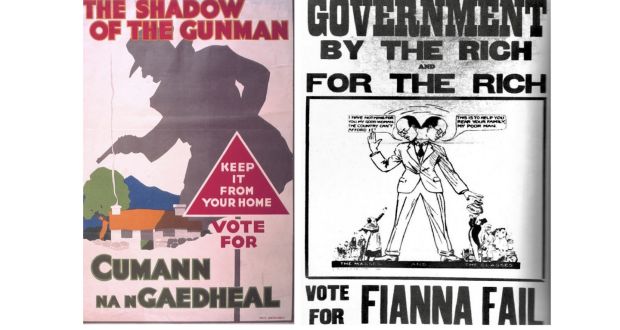
And because this fascism came from what was perceived as a State that had sold out the struggle to the foreign oppressing power, the Irish Republican movement found itself obliged to fight it and did so. From the most anti-communist right-wing Republicans to the most left-wing, they fought the fascists with publicity and physically, with fists and boots and, occasionally, with pistol shots. Socialists and democrats fought them too but it was the Republican-nationalist Government of Fianna Fáil5 that banned the Blueshirt march intended to lead to a coup and forced the organisation to back down, after which, despite enthusiastic support of the Catholic Church hierarchy, it did not again pose a serious threat of assuming state power.

Since those years and particularly since the end of WWII, Irish society has been on the whole anti-fascist in sentiment and the Irish Republican movement, with some exceptions, particularly so.

It seems to me, upon reflection, that although much of this sentiment is based on democratic and even socialist ideals, it is also, in part, a defence of Irish nationalism, a deep-seated wish for independence and self-determination, a memory that fascism in Ireland serves British domination.

And not only a memory but current reality: British Loyalism in Ireland, the militant force that garrisons and underpins colonial possession of the Six Counties (one-sixth of the area of Ireland) by Britain, is extremely reactionary. Apart from the numerous links with British (and even European) fascist groups over the years, Loyalism is deeply socially and politically reactionary. British Loyalism in Ireland is opposed to immigration, has been implicated in racist attacks on migrants, is opposed to any state recognition of the Irish language or civil rights for people of Catholic background, in addition to being against the struggles of the Palestinians, Basques, Catalans; also to gay rights and to the right to choose abortion.

SPAIN AND “THE RISE OF THE RIGHT”

          In another part of Europe, there is a state which had experienced a military-fascist coup and war, after which it suffered four decades of fascist repression. Spain, after the death of the dictator Franco, went through a supposed Transition to democracy but the fascists remained in their positions of power which they handed down to their sons and daughters, these making room for a few social-democratic climbers at the table.

The November 10th elections this year in the Spanish State saw the rise, it is being widely said, of the far-right. It would seem so on the surface but one needs to understand that all the parties of the Right in the Spanish state have their origins in the Dictatorship: the allegedly “conservative” Partido Popular was created by followers of Franco; the allegedly “centre-right” Ciudadanos was formed by deserters of the Partido Popular, while the “ultra-Right” Vox was formed by deserters of Partido Popular and of Ciudadanos. There is in fact little political difference between those who vote for different parties of the Right and certainly none between those who voted for Ciudadanos before and those who have now voted for Vox. Most of the trumpeted “rise of the Right” in the Spanish territory is in fact a re-allocation of votes from one right-wing quasi-fascist Spanish party to another, rather than an increase of votes for fascism. Of course, that does not at all mean that there is no danger to popular and democratic forces but still …..

Map of voting results in the November elections in the Spanish state.
(Image source: Wikipedia)

Viewing the rise of those votes for Vox and their pattern across the territory of the Spanish State, one can see that Catalonia and the Basque Country remain untouched, as any map of voting results will show. Basque and Catalan independentists tend to be proud of this, no doubt justifiably so but perhaps there is a danger here too. Do they think that at base, Basque and Catalan people are superior to those in the rest of the Spanish state? If so, they should think again …. and think deeply.

The Basque Country was, until the military-fascist coup, ruled by deeply conservative and Catholic elites. When Franco and the other Generals struck with German Nazi and Fascist Italian assistance in 1936, of the four Basque provinces within the territory, only two unequivocally decided to fight it: Bizkaia and Gipuzkoa. Alava’s resistance was half-hearted and in Nafarroa, the conservative Carlists wiped out three thousand socialists, anarchists and democrats and joined the fascist-military forces.

Until very recently, the Nafarroan regional government has been dominated by the UPN, a Basque version of the Partido Popular and, after a brief interval, they are in power again. The other three southern Basque provinces have a separate regional government which, for most of its existence, has been in the hands of the right-wing Basque Nationalist Party and the only time it has not, has been a brief period under the Basque version of the Spanish social-democratic party, the PSOE.

In 1936 the attempt to bring Catalonia into the fascist-military side was only prevented by a workers’ uprising and actual street battles. After the death of Franco Catalonia was also run, until very recently, by right-wing Catalan forces which, not so long ago, sent its regional police force, the Mossos d’Esquadra, to beat social and economic protesters off the streets and to shoot them at close range with rubber bullets, causing around a dozen young men and women to lose an eye.

On the other hand, the regional Government of Andalusia, now seen as a stronghold of the Vox party, has been ruled by the social-democratic PSOE from the moment the region had democratic elections after the Transition. However years of corruption and lack of concern for the fate of working people and high unemployment in the region has whittled away the electoral lead of the PSOE until this year, when Vox and Ciudadanos were able to combine and to take over the regional government.

FOR NATION, AGAINST FASCISM

          Within both Catalonia and the Basque Country, independentist forces, which is to say, those of a nationalist and republican motivation, have evolved to be led by groups espousing left-wing ideology. Generally, the young activists and supporters are atheist or agnostic, anti-racist, liberal socially and environmentally conscious. But they also defend their language, enjoy their cultural expressions and either support independence or at least the right to self-determination. The opposition of these forces to fascism seems to me to rest on two pillars: 1) left-democratic ideology and 2) defence of the nation.

Similarly to the case of Ireland, those of unionist ideology and opposed to self-determination in Catalonia and the Basque Country tend to be on the Right with a fascist core and the major support for those fascists and unionists comes directly from the Spanish State through its police, military and judicial systems, as well as from fascist groups mobilised from outside Basque and Catalan territories. English and English-colonist nationalism tends to be based on colonial and imperialist history and thinking, to be reactionary and even fascist, features which it shares with Spanish nationalism, with the added factor that the forces creating and managing the Spanish state in its current form have been actually fascist and fascist-collusive.

A fairly recent Spanish fascist commemoration in Madrid, including Spanish colours and fascist salutes.
(Photo sourced: Internet)

I have therefore come to the conclusion that Basque, Catalan and Irish people are no better than anyone else fundamentally, including the English and the Spanish, but that the conditions governing the development of their culture and their resistance to foreign occupation and domination have given rise to a different kind of nationalism. This nationalism tends to be progressive, democratic, inclusive and anti-fascist …. and is playing a progressive role in the world.

End.

FOOTNOTES

1James Connolly (1868-1916), born into the Irish diaspora in Edinburgh, is considered by many the foremost revolutionary socialist thinker in western Europe in his time but he was also a trade union organiser, founder of political parties, journalist, historian, author and song-writer. He was a co-founder of the Irish Citizen Army, the first worker’s army in the world, which also recruited women on an equal basis.

2A Nation Once Again, published in The Nation, by Thomas Davis (1814-1845), Irish Republican journalist and song-writer.

3Protest of racist campaigner Gemma Doherty against proposed restrictions on “hate speech” at the Irish Department of Justice, Stephens’ Green, Dublin at the beginning of November this year.

4This however changed in 1937 with De Valera’s new Bunreacht (Constitution) which declared the Irish State to be a Republic and the Articles 2 and 3 of which laid claim to the Six Counties (overturned in 1999).

5A 1926 split from Sinn Féin on the issue of occupying seats in the Dáil (the Irish Parliament), it grew quickly and was soon elected to government (1932) and, as the preferred party of the native Irish capitalist class, has been in government more years than any other Irish political party. Despite its Republican origins and rhetoric, it continued to support the capitalist-Catholic Church alliance of its predecessor until very recently, when it criticised abuses by the Church of those in its care and failure to pay adequate compensation.

THE DÁIL: IRISH ESTABLISHMENT SUPPORTS THE SPANISH STATE’S ATTACK ON CATALAN SELF-DETERMINATION

Clive Sulish

A representative of the Irish (Fine Gael) Government’s Minister for Foreign Affairs and Trade last night not only called for non-interference in the “internal affairs” of the Spanish State but defended the Spanish Constitution of 1978 and the “independent Spanish judiciary”. She was answering a question regarding the Spanish State and Catalan independence movement and her stance was supported by representatives of the two other traditional parties of Irish Government, Fianna Fáil and Labour. Five Teachtaí Dála, elected members of the Irish Parliament, argued passionately against them.

Section of Catalonia supporters in Kildare St. waiting to attend the Foreign Affairs Minister’s Question time.
(Photo: Rebel Breeze)

THE VOICES OF THE ESTABLISHMENT

This was Minister’s Question time, when Ministers (or their representatives) appear in the Chamber to answer questions about areas of the remit of their Departments and earlier, Ministers had been quizzed about areas of childcare, social care funding, local government funding ……

The Dáil chamber looked mostly deserted but in the public gallery sat a score of Catalans and some Irish, listening intently. Normally, these sessions are attended only by the TDs asking the questions and the relevant Ministerial spokesperson – and only for the question being asked. And of course also in attendance is the Ceann Comhairle, the presiding person acting as Chair – and secretaries. Sometimes by members of the media but by no means always, since reporters can monitor the televised broadcasts of the session.

The Minister’s reply on the question of Catalan self-determination delivered by Minister of State Helen McEntee TD followed a predictable pattern – predictable because it is so often trotted out: the Irish and Spanish Governments have a long history of good relations and friendly links, lots of Irish people go there on holidays, lots of people from there come to Ireland every year, Spain is a democracy, its constitution must be abided by, it would be wrong to interfere in its internal affairs. Inclusions to that in litany in recent times are that the question of Catalonia is emotive throughout the Spanish State and that Catalan society is divided over it, that the rule of law must be upheld and that violence has no place in politics.

The Fianna Fáil representative, Seán Haughey TD, echoed that line, adding also that the Spanish Constitution of 1978 is unitary and does not allow any part to become independent. He also quoted some survey results that he claimed indicated that support for independence was now in a minority among Catalans.

The Labour Party representative, Jan O’Sullivan TD, went further and specifically supported the present Government of her “sister party in Spain”, the PSOE and suggested that the “inflexible” previous government of Rajoy (of the PP) had helped to bring the current situation about and that Sanchez, the Prime Minister, would help calm the whole situation down. The only concessions she made were to suggest that the lengthy jail sentences were perhaps not the best way to deal with the issue and to include the police by mention in her call for “end to violence by all sides”. However, she went further than others in the Establishment parties with a specific condemnation of the jailed activists when she said that “it is not acceptable for politicians to lead citizens into conflict”.

Early arrivals for the Minister’s Question time
line up in Kildare St. below a photo of the First Dáil 1919.
(Photo: Rebel Breeze)

THE OPPOSITION

“Reactionary Spanish nationalism”

          The first TD to speak in reply to the Establishment politicians was Eoin Ó Broin, a comparatively recent Sinn Féin Deputy (2016) for Dublin Mid-West. Ó Broin was in Catalonia as one of the international observers of the Catalan Referendum on Independence on 1st October, which was attacked by Spanish police with around 1,000 Catalans injured.1

Speaking about his experiences there, Ó Broin related his meeting with 83-year-old Antonio, bruised and with his fractured arm in a sling, beaten while trying to vote earlier that day, queuing again at a polling station in Barceloneta. The SF TD spoke about what he had seen there and the “increasingly reactionary Spanish nationalism”, then went on to list the elected politicians and their jail sentences. Denying it was an internal matter for Spain, Ó Broin said it was about human rights and required international independent mediation. The Dáil would be implicitly in collusion with the Spanish Government if it left the matter to internal resolution only.

“The working class are the incorruptible heirs …”

          Paul Murphy TD, a socialist activist2 who has recently left the Socialist Party of Ireland to form a platform called Rise, shared speaking time with Eoin Ó Broin. Calling for a “reality check” he said that jailing politicians and activists for organising a peaceful ballot could hardly be the work of a normal democracy. Responding to the Labour Party spokesperson with regard to the Spanish PSOE Prime Minister, he said that “Sanchez is in Government” and that he was “sending thousands of troops and police” to suppress the Catalan independence movement and mounting “a publicity campaign” to blame the convicted leaders.

The Spanish Government would one day come to be haunted, Murphy said, by the words of James Connolly in 19143 when he said:

“If you strike at, imprison or kill us, out of our graves or prisons we will still evoke a spirit that will thwart you, and perhaps, create a force that will rise up and destroy you. We defy you! Do your worst.”

Murphy said that the Catalan popular movement was impressive with their demonstrations, marches and the recent general strike. Against that, the Spanish police and army were carrying out “a campaign of terror” injuring hundreds and anyone who didn’t believe it only had to go on line and see the videos. “Francoism is baring its ugly head”, Murphy said and pointed out that the Spanish legal systems is riddled with a contempt for democracy, echoed by those at the top in the European Union.

The recent Catalan General Strike, according to Murphy, “showed the way forward” and he quoted again from Connolly, that “the working class are the incorruptible heirs of Irish freedom”. The Spanish State had a long history of suppression of national self-determination, including those of the Basques, Murphy said and the way forward would be for a voluntary socialist federation.

Catalan independence supporters gathering in Kildare St. waiting to attend the Foreign Affairs Minister’s Question time.
(Photo: Rebel Breeze)

“The judicialisation of politics”

          Next to speak was Thomas Pringle, Independent TD for Donegal since 2011, with a socialist Irish Republican background, a member of Sinn Féin for few years but who left the party in 2004. He opened his contribution by referring to “the judicialisation of politics” in the Spanish state and, in reference to the scale of the Spanish repression, mentioned the 700 Catalan town mayors who await judicial process due to their support for the Catalan Referendum in 2017.

Pringle said the Spanish Constitution purported to guarantee the rights of different people within the state, which would be a joke if the reality were not so grim. “The EU continues to ignore” what is going on in its member Spanish State, “as it did in the Six Counties,” he said.

“Catalonia in 2019 is Ireland  a century ago”

          “Self-determination is a human right,” said the next to speak: Peadar Tóibín, TD for Meath West since 2011, who left Sinn Féin in 2018 and went on to form Aontú in January 2019. Tóibín reminded all that the First Dáil had sent out a call to the world for recognition of Irish independence in 1919 and that most states had not done so then4.

“Catalonia in 2019 is Ireland a hundred years ago”, Tóibín said and went on to say that if the Irish Government remained silent on repression by the Spanish State then it shared culpability for it.

“ … a short memory in this House”

          “We sometimes have a short memory in this House” said Mattie McGrath when it was his turn to speak, a TD since 2007 who has been an Independent since he left the Fianna Fáil party in 2011. McGrath referred to the recent long war in the north-east of Ireland and said that conflict resolution process was the only way to resolve the issue.

McGrath referred to Clare Daly (elected MEP this year after being a socialist TD for some years) and her statements on the issue. “Self-determination is a fundamental human right”, McGrath said, and went on to speak about “the right of freedom of assembly”, which was under attack by the Spanish State.

“Ireland is a small island nation”, Mc Grath said, “very sympathetic to the rights of people” (apparently contrasting this to the attitude of the Establishment in the Dáil).

In the time allowed by procedure for final response from the Minister, her representative reiterated the position she had outlined earlier and, though she conceded that most of the Catalan demonstrations had been peaceful, said that some recent “scenes of violence” had been “of concern”.

Section of Catalonia supporters in Kildare St. waiting to attend the Foreign Affairs Minister’s Question time. Behind them, enlarged photo of the First Dáil, 1919.
(Photo: Rebel Breeze)

COMMENT

Fianna Fáil‘s origins are in the split with Sinn Féin led by De Valera in 1926 over the question of taking seats in the “partitionist” Irish parliament, the Dáil, and rapidly became the preferred party of the native Irish capitalist class, having been in government since more than any other Irish party.

The origins of Fine Gael, currently in minority Government at the tolerance of Fianna Fáil, has its origin in the setting up of the Irish State after the War of Independence and represents the victors of the Civil War against the Republicans. It was composed of a coalition of a right-wing Irish Republican party (followers of Michael Collins, Griffiths etc), a small right-wing farmer’s party and the fascist Blueshirts (a name by which FG are still often called by their enemies).

Hard to believe today, the Irish Labour Party was founded by, among others, James Connolly and is the oldest of the three parties. A progressive party in the early days, it was not a participant in the Civil War, during which its representatives criticised the Free State Government about its abuse of civil rights, repression, large-scale arrests, internment without trial, torture and murder. Over the years it lost more and more of its socialist credentials and has been in coalition government with the right-wing Fine Gael on two separate occasions. The main trade unions in Ireland retain connections to the Labour Party, with the possible exception of the rapidly-growing British-based UNITE.

(Photo: Rebel Breeze)

The supposed inviolability of the Spanish Constitution of 1798 is one of the questions at the heart of the matter. The boast of the Spanish Government and its supporters abroad is that the majority of the people within the Spanish State voted for it. Well, so they did, except in the Basque Country – but what of it? If in a wedding, one of the partners says “I do”, does that mean that person is forever forbidden from leaving? Do we not have the right to divorce acknowledged now in most states around the world and certainly in “the democracies”? If one agrees to join a club or organisation, does that mean one can never choose to leave? Well, maybe in the Mafia, or the Cosa Nostra ….

Furthermore, that monarchist Constitution was put forward to a population that had endured four decades of fascist dictatorship, with the collusion of the allegedly socialist and republican PSOE and the allegedly communist and republican Communist Party of Spain, restraining their trade union and party members in the wave of state repression and murders during the Transition to “democracy”. Isn’t there something about the invalidity of agreements made under duress?

The issue of non-interference in the internal affairs of another state is a bogus one, since all governments do that at one time and another and Irish governments and political parties are no exception. In 1936, the representatives of Fine Gael loudly supported the military-fascist uprising led by Franco against the democratically-elected Government of the Spanish State. The Irish Government of Fianna Fáil did nothing to prevent the Blueshirts going off to fight for Franco and the Bishops of the Irish Catholic Church blessed them as they sailed off. The reality is that states that agree with one another generally do not interfere in one another’s internal affairs.

The constant mantra of reference to “the rule of law” and the condemnation of “violence in politics” is not only an irrelevance but turning truth on its head. It was not illegal according to the Spanish Constitution or laws to hold a referendum on independence 5. It is also against the Spanish law to use violence against others and even the police are not legally empowered to do so except in self-defence or in defence of others. On October 1st the actions of the Spanish police had 1,000 people requiring treatment and another few hundred have been injured in recent days. The Internet is full of videos of different incidents of gratuitous Spanish police violence, often the perpetrators showing no fear of being filmed – clearly because Spanish (and more recently, Catalan) police know they have impunity. Recently, however, it seems that some Spanish police have become sensitive to being filmed during their violent acts and have begun to target photo-journalists, both with personal violence and with rubber bullets.

A total of five people have now lost an eye from the impact of the rubber bullets of the Spanish police. Apart from the fact that these are banned in Catalonia, the bullets are supposed to be fired to ricochet and not directly at people, nor are they supposed to be fired at close quarters. Clearly, the rules are not being adhered to and nobody is enforcing them, granting impunity to the Spanish police.

When the representative of the Minister for Foreign Affairs acknowledged the overall peaceful nature of Catalan independence demonstrations but expressed concern over some recent scenes of violence, what was she really saying? It was this: that the violence of the police against the peaceful demonstrators could continue but the victims using force in defence or in retaliation is a cause for concern!

End.

FOOTNOTES

1  Eoin Ó Broin, often described as on the (small) left wing of Sinn Féin (a wing badly needed by that party) has in the past had relations with the Abertzale Left in the Basque Country and wrote a book on the movement there in his time, Matxinada – Basque Nationalism and Radical Basque Youth Movements. He is also author of Sinn Féin and the Politics of Left Republicanism.

2  Paul Murphy has been, while a Socialist Party TD, dragged by police out of a housing protest and with others faced serious charges arising out of a protest about Irish water against a Labour Party Minister, of which he and the others were acquitted by the jury after an infamous trial. He remains in the PBP-Solidarity parliamentary coalition.

3  James Connolly (1868-1916) was at that time active in the Irish Labour Party and leader of the Irish Transport & General Workers’ Union, which was struggling to recover from an 8-month fight against a group of employers that had set out to crush the union (Dublin Lockout). Connolly was a revolutionary socialist, republican, journalist, historian, author and organiser and was horrified by the very idea of the First World War which began in 1914. He was shot dead by British firing squad, along with other leaders and some others of the 1916 Rising.

4  This reference seems particularly appropriate. In January 1919 the majority of MPs elected in Ireland in the UK General Elections of December 1918, carried out the “Sinn Féin” platform’s election promise not to go to Westminster and convened a parliament in Dublin. This is known as “The First Dáil” even by the Irish State, which numbers its parliaments from then onwards. The First Dáil declared independence and called on the states of the world to recognise Irish independence (see References) but only the young USSR did so. Ireland had no legal right under British law to break away from the UK unless it were agreed by majority in Westminster (where the Irish MPs would always be outnumbered by the British). The First Dáil was banned by the British in September of that year and its members were arrested if they could be found.

5  Though possibly the declaration of Republic was – but that was suspended in less than five minutes.

REFERENCES & FURTHER INFORMATION

Clip of Eoin Ó Broin TD reply: https://www.facebook.com/EoinOBroinTD/videos/1138199326378630/

Clip of Paul Murphy TD reply: https://www.facebook.com/paulmurphytd/videos/424540844872189/?t=11

Clip of Thomas Pringle TD reply: https://www.facebook.com/ThomasPringleTD/videos/416766079224197/

Clip of Peadar Tóibín TD reply: https://www.facebook.com/740004202875853/videos/738458029959798/?t=124

(currently seeking remaining TD, also footage of the whole debate)

Text of all contributions to the debate: https://www.oireachtas.ie/en/debates/debate/dail/2019-10-22/34/

First Dáil’s Message to the Free Nations of the World: https://en.wikipedia.org/wiki/Message_to_the_Free_Nations_of_the_World

Some organisations of Catalan solidarity in Ireland:

ANC Ireland: https://www.facebook.com/IrlandaPerLaIndependenciaDeCatalunya/

CDR Dublin: https://www.facebook.com/CDRDublin/

With Catalonia/ Leis an Chatalóin: https://www.facebook.com/WithCataloniaIreland/

DISSIDENCE IN THE BASQUE PRO-INDEPENDENCE MOVEMENT

Diarmuid Breatnach

(Reading time: 5 minutes)

When ETA, the armed Basque Left pro-Independence group) abandoned armed resistance and decommissioned its weapons, many wondered at the absence of public dissent among its ranks. A dissident trend did appear in the Basque pro-independence movement but it took longer than it had in Ireland; it is in existence now and growing.


In using the term “dissident”, a description not always accepted by those to whom it is applied, I mean those who disagree with the direction taken by the leadership of the organisation and who have therefore separated themselves from the organisation. It becomes a problematic term when it is implied that the “dissidents” have diverged from the original path – on the contrary, those who have left the organisation would say, it is the leadership which has left the path and it is those being called “dissidents” who remain on the “true path”.

ATA demonstration in Donosti/ San Sebastian, 8th September 2019.
(Photo source: Amnistia Garrasia FB page)


In the Basque pro-independence movement, as in the Irish Republican movement, the “dissidents” are in a minority but that should not be taken to mean that those who have remained within the “official” movement are in complete agreement with the leadership nor happy with the state of affairs within the movement. Indeed, within the Izquierda Abertzale (Basque Left pro-Independence movement), many are very unhappy indeed. Some do not agree with alliances with social democrats or attempted with the PNV (Basque Nationalist Party), others with complete disarmament, some with disarmament without concessions in return, yet others with particular decisions at various junctures (such as pleading guilty to “terrorism” when the work they had been doing was nothing of the sort, as happened recently in the mass trial of prisoner solidarity activists arrested back in 2013). Or with “apologising to the victims” as the Spanish State has been pressing on prisoners and detainees (the Spanish State of course apologises for nothing, neither the fascist-military uprising of Franco and company, nor the Dictatorship of almost four decades, nor executions, nor recent torture).

There were splits enough in the Irish Republican movement even soon after the Civil War but they also came thick and fast in the early 1970s, out of which grew the Provisionals (Sinn Féin and PIRA) and the IRSP and INLA, leaving Official Sinn Féin and OIRA as a rapidly-diminishing and eventually disintegrating remainder. Another split came about as a result of the electoral path of Provisional SF in 1986, out of which came Republican Sinn Féin. But it was the Good Friday Agreement and its effects which caused the most splits and desertions from the ranks of the Provisionals, leading to the creation of a number of organisations over time: éirigi, 32 County Sovereignty Movement, 1916 Societies, Saoradh and others.

POLITICAL PRISONERS, IRELAND & BASQUE COUNTRY

Most unfortunately, the number of Republican organisations led also to a number of political prisoner support groups and currently there are three main ones: Cabhair (RSF), Cogus (mainly 32 CSM) and Irish Republican Prisoners’ Welfare Association (mainly Saoradh).

In the Basque movement, the Izquierda Abertzale, although there were the abiding split has come over the issue of the Republican prisoners. The traditional line of the IA has always been that the prisoners, whether captured ETA volunteers or political activist victims of repression, are political prisoners. It follows that they should be released in any settlement of the Basque national question. But in the meantime, if prisoners, they should be kept in prisons near their homes so that they can be visited without too much difficulty by relatives and friends. That is not only a humane principle but is underwritten by EU and UN policy recommendations on the treatment of prisoners. The Spanish State, however, keeps its political prisoners dispersed throughout its territory, hundreds and even a thousand kilometres away from the family and friends of the prisoners (as does the French State). This is not only an additional punishment on the prisoners, one which was not a specified part of their sentence but also – and perhaps principally – on their relatives, children, partners and friends.

The organisation Amnistia (Gestoras pro Amnistia) was created in 1970 within the movement to agitate for a total amnesty for the prisoners. As is usual with the Spanish State, in 2002 it banned this organisation also as one “assisting terrorism”, threatened its activists with prison and the organisation ceased to exist publicly, their trial beginning in 2008. The State’s outlook was fully expressed in the infamous statement of the former judge and overseer of torture but so beloved of liberals, Baltazar Garzon: “Everything is ETA”.

The organisation of relatives of prisoners on the movement’s “official” list, Etxerat (Homeward) continued to exist and to organise visits, share information and agitate about the prisoners’ treatment but it is not a political organisation as such, which is difficult to combine with welfare work.

To carry out the specifically political work around the prisoners, the organisation Herrira (to the Homeland) was created some years ago. The Spanish State reacted in the usual manner and arrested a number of its activists – for “assisting terrorism”, of course. After that, it was noted that the official line had changed – while not specifically abandoning the call for amnesty, now only the call for and end to dispersal was heard (along with of course the repatriation of seriously or terminally-ill political prisoners).

View from the rear of ATA demonstration in Donosti/ San Sebastian, 8th September 2019.
(Photo source: Amnistia Garrasia FB page)

LEADERSHIP CHANGE IN LINE AND DISSIDENCE

The change in line, the dropping of the demand for amnesty, led to the creation of a new Amnestia, but with the addition of Ta Askatasuna (and Freedom), this time in the hands of “dissidents”. The “oficialistas”, the current leadership of the main body of the pro-independence movement, Otegi, EH Bildu etc, say this is pure opportunism on the part of the dissidents, who are expressing their disagreement with the abandonment of armed struggle and dissolution of ETA by seizing on the issue of amnesty for political prisoners. They could be right, of course, at least in part. But unlike the leadership of SF and PIRA, the Basque “oficialistas” got no deal whatsoever for their prisoners.

Recently, a significant part of their youth section Ernai left the “oficialistas” and maintains a working relationship with the new ATA. Their issue was that they had prepared a position paper for discussion at the annual congress and the “oficialistas” had refused to permit it to be discussed, since it was critical of current leadership positions.

Another group, Jarki, is revolutionary, socialist, for independence, internationalist and in defence of the language and has been organising.

Apart from those three trends, there also exist anti-authoritarian, ecological etc trends that owe no allegiance to the official leadership of the movement. These are national in the sense that they are spread across the Basque Country and also in that they speak and write in Euskera (Basque language); they are also for social justice, feminist, anti-racist and anti-sexuality discrimination.

It remains to be seen to what degree these various trends will coalesce and whether the “official” movement will continue to see defections from its ranks.

End.

HOW TO WIN THE WAR – GETTING INTO POSITION

(Reading time: Introduction, one minute; Part One: 5 mins; Part Two 2 mins: Part Three: 3 mins; Part Four: 2 mins; Total: 13 mins.)

Diarmuid Breatnach

INTRODUCTION:

Although I often think about the big questions – and am generally guided by my philosophy on them, my mind and energy are usually too occupied with specific struggles to focus on them for long. Recently however I had the opportunity and the need to think about the war, the one we have yet to win.

Storming Bastille Painting Jean-Pierre Houel
The Storming of the Bastille (translation), French Revolution, 1789 by Jean-Pierre Houel. (Image sourced: Internet)

But to which war am I referring? The Irish war of national liberation that has been flaring up for centuries, being lost each time before flaring up again? Or the class war, which has had a few sharp Irish episodes but has been, for the most part in Ireland, in abeyance? The answer is BOTH, though it may seem that my emphasis in the discussion, certainly in the early part, is on the national liberation war.

In order to imagine how we might win, it is helpful to examine past struggles and analyse what went wrong with them. Pessimists love to focus on those things I know – but in order to push us towards reformism or just surrender; my approach instead is from a revolutionary perspective.

Generally, Socialists analysing the class struggle don’t even ask themselves why we have not had a revolution yet. From week to week, month to month, they tend to focus on this or that particular trade union or social struggle but without going into the big picture. It seems as though they can’t even imagine a socialist uprising in Ireland, it’s just too far away to think about, apparently. But if one can’t even imagine such a revolution, how could one consider the necessary steps to get there?

Communards Paris Barricade 1871
Communards at barricade, Paris Commune 1871. (Image source: Internet)

Irish Republicans on the other hand are often thinking in terms of revolution, usually including armed struggle. However it seems to me that Irish Republicans don’t like analysing past failures of the movement but when they do, their verdicts tend to be that the leaders betrayed the struggle or that taking part in public elections corrupted the movement; or that infiltration, spies and informers was the problem. And some other reasons. The thing is, although all those things played a particular part, they are not the fundamental reason.

Defeat Rebels Vinegar Hill Drawing George Cruikshank
“Defeat of the Rebels at Vinegar Hill” by George Cruikshanks, i.e United Irishmen last major position in Wexford overrun, 1798.

PART ONE: THE THIRTY-YEARS’ WAR – DOOMED TO LOSE

(Reading time this section: less than 5 minutes)

Free Derry Corner Gas Mask Images
Derry Monument and Mural of the Civil Rights struggle which preceded the armed struggle in the Six Counties. (Image sourced: Internet)

          The national liberation war that began in 1969 in the Six Counties and ended in 1998 (though some armed incidents continue from time to time) began as a civil rights struggle and changed into a war of communal defence and of national liberation. The military part of the struggle for the most part took place in the occupied Six Counties. The political element of the struggle was waged all over Ireland (and abroad) but in the main consisted of support for the struggle in the Six occupied Counties.

Fought in that way, the struggle was bound to lose. It could never win. How could anyone imagine that they could win a struggle fought against a world power in one-sixth of the country, where even the population there was divided against them? What could they have been thinking?

To my mind, there are only two possible sane replies to that question, which is that they believed: 1) that the British ruling class would get worn down by struggle and leave and/ or 2) that the Irish ruling class would intervene in some way to assist the struggle and make continued British occupation untenable.

1) ‘The British ruling class would get worn down and leave’: This theory must have depended on British repression being condemned abroad and being unpopular at home but had to rest fundamentally on the British having no great stake in continuing its possession of its colony there.

Anyone who thought that (and there were many who did and still many who do, not just Irish Republicans) made a fundamental error. Time and again the British ruling class has shown its determination to hang on to what might be considered its first colony, even as the ruling class’ composition changed from feudal-colonialist to capitalist-imperialist and as the world changed around it.

Collusion State Murder Mural
Mural in nationalist area in the Six Counties (Image sourced: Internet)

Even when the British ruling class, weakened by WW1 and facing an Irish guerrilla war which enjoyed the support of the vast majority of Irish people, with national liberation uprisings breaking out across its Empire and with its repression in Ireland increasingly unpopular at home, entered into negotiations with the Irish resistance, it held on to a foothold, the Six Counties.

Subsequently, it had that colony managed in a permanent state of emergency laws, with institutionalised sectarian discrimination at all official levels and outbreaks of pogroms in the street and workplace.

That became even more exposed during the civil rights struggle and the national liberation war that followed when the British State compromised whatever good international reputation remained to its Armed Forces, its judiciary, its legal establishment, its media and its very legal framework.

Even now, when many believe that the Good Friday Agreement means that a 50% plus-one-vote in favour in the Six Counties will be sufficient to end Partition, they do not realise that such a decision will have to also obtain a majority in the British Parliament and be endorsed by the British Monarch. They are also forgetting the broken promises that surrounded Partition in the first place.

British Soldiers Helmeted Belfast 1969
British Army in Belfast 1969 (bayonets and guns pointed towards nationalist area). (Image sourced: Internet)

When analysing what holding on to the Six Counties has cost the British State in terms of reputation, military and financial contributions, one can only rationally assume that continuing to hold on to that foothold is of great importance to the British State. One may speculate as to the reasons underlying that but the central fact cannot be denied.

2) ‘The Irish ruling class would intervene in some way to assist the struggle and make continued British occupation untenable’:

There was some basis for this belief in that a section of Fianna Fáil, a party that had emerged from a split in Sinn Féin in the 1930s and had become one of the mainstream parties in the Irish state, had retained some traditional commitment to seeking a united Ireland. However it was a thin enough basis on which to depend in a national liberation struggle since that section had no majority within the party itself, to say nothing of the foreign-dependent nature of the Irish native capitalist class, the Gombeens, as a whole.

The question came to a trial of strength in the Arms Crisis of 1970, in which at least two Fianna Fáil Government Ministers were involved in secretly buying arms for the defence of nationalist areas in the Six Counties (since the IRA had insufficient weapons at the time) from rampaging Loyalist mobs and the Royal Ulster Constabulary (including the part-time B-Specials). The Ministers alleged that they had acted in the full knowledge of the rest of the Government. By the time the whole affair was over, two Ministers had been sacked and another two resigned in protest.

If it had not been clear before that the Gombeens, the native Irish capitalist class was no patriotic capitalist class but rather a neo-colonial one, it should have been clear after that. But the armed struggle in the Six Counties intensified, especially after the massacres of unarmed civilians carried out by British Paratroopers the following year, 1971 in Belfast and again in Derry in 1972. And the war lasted until 1998.

If, as had been demonstrated to be the case that the British ruling class were determined to hold on to the Six Counties and the Irish ruling class was not going to seriously challenge that possession, did the Republican movement have any other option than to fight on a war that they could not possibly win?

I am clear that it did.

Clearly, in order to have a chance of success, the war had to be extended to the other five-fifths of the country, which is to say into the territory under the control of the Irish native capitalist class. This class had seized power after the War of Independence (1919-1921) and had beaten and suppressed its opposition during and after the Civil War (1922-1923) and furthermore was supported by a powerful ally, the Irish Catholic Church. Since the founding of the first Irish Republican organisation, the United Irishmen of the late 1790s, the Catholic Church hierarchy had opposed Irish Republicanism; it had condemned four Irish priests who participated in the uprising of 1798, excommunicated the Fenians, had at first condemned the 1916 Rising and the War of Independence only to latch on to it at the end along with the Gombeen class.

The general Irish population likely would not have supported or sustained an armed struggle in the 1970s against the Gombeen class but that class could have been fought politically, through agitation and mobilisation, on many social, political and economic fronts. Without going into the specific details of each, these were:

  1. against the huge wastage of Irish youth through emigration

  2. to remedy the shortage of affordable housing (which in part contributed to the above)

  3. to end unemployment (also contributing hugely to emigration)

  4. to raise the level of wages and lower wage earners’ taxation

  5. for the right to divorce

  6. for equality for women in law

  7. for the right to contraception devices and medication for men and women

  8. against decriminalisation and for equal rights for gay and lesbians

  9. to halt the decline of the Irish language, in particular of the rural Irish-speaking areas

  10. to improve services for the rural areas

  11. to oppose the open-door policy for foreign multinationals to exploit Irish natural and human resources

  12. to secularise the education service

  13. and the health service.

  14. to remove the privileged status of the Catholic Church within the state.

Irish Womens Liberation Connolly Station
Irish women photographed at Connolly Station 1971, about to board train to Belfast to purchase contraceptives to bring back to the Irish state, illegal at the time. There was no right to abortion either or divorce and a husband’s signed permission was necessary to take out a hire purchase agreement. (Image sourced: Internet)

The Republican movement in general, with some exceptions, declined to take on any of those struggles. They did not organise in the trade union movement, left the social struggles to others and most of all, declined to take on the Catholic Church on any issue except its opposition to the national liberation struggle. Even there, it was happy to publicly avail of the services of members of the Church clergy who supported them. Republicanism was, from its very beginning, as well as anti-monarchist, about separation of Church and State but it was difficult to see that in the Irish Republican movement, particularly after the War of Independence.

A full half of those fourteen points above (nos. 5,6, 7, 8, 12, 13 and 14) would have meant taking on the Church head-on and no doubt the hierarchy would have hindered the struggle over most of the others too, due to its strong links with the State and its ruling class.

Because of its tactical and no doubt ideological refusal to take up those struggles, the Republican movement could do little more in the 26-County state than to agitate for solidarity with the beleaguered nationalist population inside the British colony.

Though this could be effective for a time it could not become a mass movement, nor survive a long struggle, without any remedy being sought for the issues facing the population within the state.

The wonder is not that the majority leadership of the Republican Movement threw in the towel on the military struggle in 1998 but that they had waited so long to do it. Of course, they never admitted the true nature of what they were doing: abandoning the armed struggle and revolution in total and instead, using their negotiating position to advance themselves politically – not in the economic, social and political struggle envisioned above but rather in a political struggle to find themselves a place among the Gombeen political class in the Irish state and as accomplices in the governing of the colonial state.

PART 2: COLLECTING THE FORCES FOR REVOLUTION

(Reading time this section: 2 minutes)

          A successful revolution in Ireland, as in most places, would require the involvement of a mass movement. That mass movement would be unlikely to be one that had national self-determination as its only aim – certainly not in the 26 Counties (the Irish state). Mass movements arise at times around different issues and exist as long as the issue does or instead until the movement gets worn down or broken up. Such movements arose around the Household Tax and, later, around the additional Water Charges.

Water Protest Long View 29 Aug 2015
Section of protest against water charges, O’Connell Street, Dublin, 29 Aug. 2015 (Image source: Internet)

Even though the objectives of such movements are often not revolutionary, the participation in them by revolutionaries is necessary if, in the future, there is to be a revolution. Revolutionary activists can make contacts and prove themselves by the way they participate whilst at the same time pointing out that a revolution is necessary in order to resolve all these issues completely and permanently. Such activists can also influence the movement (or sections of it) to act in more revolutionary ways, so that the movement can be guided by – and imbued with — revolutionary spirit.

Working people in struggles come up against concrete problems which need to be resolved in order to move forward. Prior to 1913 in Ireland, workers learned the need for unity in struggle which was emphasised by the employers’ attempts to break the Irish Transport and General Workers’ Union in August 1913. The attacks on them by the Dublin Metropolitan Police illustrated the need for organised defence and Larkin and Connolly called for the formation of what became the Irish Citizen Army, which later also fought prominently in the 1916 Rising.

Packed Workers Liberty Hall 1913
Members and supporters of the Irish Transport & General Workers’ Union cheering outside the union’s HQ, Liberty Hall, August 1913. Later the union formed the ICA to defend themselves from the DMP; the ICA took a prominent part in the 1916 Rising. (Image source: Internet)

Trade unions are the only mass organisations of the working class in Ireland and it is necessary for revolutionaries to be active within them. Currently, other than social democrats, it is mainly members of both trotskyist parties and independent activists who engage politically with the trade unions. Those members are mostly in clerical work and their political work tends to concentrate on employment demands around wages and working conditions. When they introduce politics it is generally to get some motion passed by their branch. Also at times, they will campaign to get a perceived left-wing candidate elected to some position within the trade union bureaucracy.

None of the above are without value but they remain disjointed in terms of program and often confined to just one trade union. Not only that, but often the Left party involved will engage in order to recruit some new members and in order also to retain their own members by providing them with activity. When broad front trade union groups are formed, they tend to become an arena where the dominant trotskyist parties compete for dominance.

If we are to have a successful revolution – and in particular a socialist one – participation in the struggles of workers in the trade union movement is absolutely necessary. But participation should be primarily among the rank and file of the trade union and also across trade unions, focused on providing solidarity to members of whichever union is in struggle – in addition to encouraging unorganised workers to organise and become active. The objective is not to help make one trade union or one section more militant but rather to create a militant workers solidarity movement within the whole trade union movement. It is essential to have members in the ‘blue-collar’ work unions or departments as well as in the clerical unions or sections. And the cross-union organisation I advocated should be independent — the preserve of no political party.

Participation in such struggles provides an opportunity for revolutionaries to make contact with people who are activists but not yet revolutionaries and to give those people an opportunity to evaluate the revolutionaries in terms of their actual practice. Revolutionaries can support the people struggling for worthwhile reforms while at the same time pointing to their partial and temporary nature. Revolutionary activists can play an educational role in the mass movements while at the same time becoming educated themselves by the daily reality faced by the masses in this system.

PART 3: THE ABSOLUTE NEED FOR UNITY – BUT WHAT KIND?

(Reading time this section: 3 minutes)

          It is, most people would think, a ‘no-brainer’ (i.e an obvious truth) that unity is necessary in the struggle to overthrow the current system. It might be thought surprising, therefore, that disunity is more the rule among those who aspire to revolution.

Generally, those who claim to be revolutionary socialists will not unite with Irish Republicans. In addition, those socialists of one party will often fail to unite with those of a different party. The same dynamic is to be seen among Irish Republicans also.

There have been many attempts to overcome this problem. In the 1930s the Republican Congress sought to unite Irish Republicans with revolutionary socialists. In the face of hostility within the mainstream Republican movement and also with divisions among the communist element in Ireland at the time, faced in addition with anti-communist hysteria whipped up by the Catholic Church, the experiment failed. The leadership of the Sinn Féin and the IRA of the later 1960s tried to combine socialism and republicanism within one party and military organisation, an attempt that crashed when it was discovered that the arms necessary to defend ‘nationalist’ community areas in the Six Counties, particularly in Belfast, were unavailable, leading to an acrimonious split in the movement. A subsequent attempt to combine the socialist and republican elements in another organisation survived a little longer but also failed for a number of reasons, some internal and also due to Irish State repression.

Shankhill Rd Republican Congress WT Commemoration 1934
Socialist Republicans, members of Republican Congress from Shankhill Road, marching to annual Wolfe Tone commemoration, Bodenstown 1934. They were attacked by conservative Republicans. (Photo source: Internet)

There have been some attempts to unite the non-republican Left itself also, which usually failed due in part to ideological differences but also to political sectarianism and personality clashes. Currently both trotskyist parties have an uneasy working relationship, the small grouping of Independents for Change exists also, the Communist Party is very small too and the anarchists are scattered and unable for years now, for the most part, to mount united action.

Attempts to unite the various parts of the Irish Republican movement have, in general, focused on creating a new organisation or absorbing activists unhappy with one organisation into another.

A frequent approach has been for some people to sit down and produce what they consider solid policy and a constitution, then to propose this format to others around which to unite. Even when accepting amendments from the elements they seek to recruit, these attempts too have largely failed.

It seems a rational approach: if we want unity, surely first we have to agree on what for, how, etc, etc before we can go into action? I believe, contrary though it may seem, that actually we should unite in action first. Uniting in action tends to break down barriers of mistrust that are built on hearsay or suspicions fostered by sectarian elements. Action also tends to clarify certain questions that until then are theoretical only. Of course, at some point, action will need to be guided by worked out policy but initially the action itself can be sufficient guide, especially since approaching the question the other way around has been so generally unproductive.

Unity Is Strength Image copy

The question then arises: with whom to unite? In general, I would say that the answer is: with all with whom we can, in actual practice, unite: different types of revolutionary socialists (including anarchists), Irish Republicans, Left social democrats, human and civil rights activists.

There are some exceptions I think necessary to mention: fascists, racists, religious sectarians and parties that participate in Government. Fascists seek to impose an undemocratic regime completely hostile to the interests of working people and, far from our uniting with them, need to be defeated; racists and religious sectarians seek to divide the movement along lines of ethnicity or religious affiliation. Revolutionaries need to draw a clear line of distinction between the movements of resistance and those who participate in a native capitalist or colonial government, i.e the management organisations of the enemy.

Many issues lend themselves to united action but perhaps none more so, and none are more essential, than against repression.

PART FOUR: UNITY AGAINST REPRESSION

(Reading time this section: 3 minutes)

          All revolutionary movements – and many that are progressive but not revolutionary – face repression at some point in their existence. Not to recognise that fact and to have some kind of preparation for it, even if very basic, is indicative of a non-revolutionary attitude to the State. Nor have we any reason in Ireland to be complacent on this question.

The Irish State turned to military suppression in the first year of its existence as did also the colonial statelet. Detentions, torture, murders and official executions were carried out by Free State forces over a number of years, followed by censorship and arrests, all facilitated by emergency repressive legislation. In the Six Counties, in addition to similar even more repressive legislation, there were two sectarian militarised police forces and sectarian civilian organisations.

After a change of government, the Irish State introduced internment without trial during the Emergency (1939-1946), the Offences Against the State Act in 1939, Special Criminal (sic) Courts in 1972 and the Amendment to the OAS in that same year.

Bloody Sunday march Derry 2014
Poster for 2014 Commemoration of Bloody Sunday massacre, Derry 1972. The poster calls for unity. (Image source: Internet)

The Six County statelet had the Special Powers Act (1922) and brought in internment without trial in 1971 (the Ballymurphy Massacre that year and the Derry Massacre the following year, both by the Parachute Regiment, were of people protesting the introduction of internment). The statelet also introduced the Emergency Provisions Act and the no-jury Diplock Courts in 1973 and, though technically abolished in 2007, non-jury trials can and do take place up to today.

The British state targeted the Irish diaspora in Britain in 1974 with the Prevention of Terrorism (sic) Act and that same year and the following, framed and convicted nearly a score of innocent people of bombings in five different cases – had the death penalty not been previously abolished for murder, most of them would have been executed. It took the victims over 15 years to win their freedom, by which time one had died in jail. Brought in as a temporary measure, the PTA continued in force until 1989 but a general Terrorism Act was brought into British Law in 2000 and remains in force today.

Birmingham Six Photos Bruises
Photos of the Birmingham Six, Irishmen resident in England, showing bruises from police beatings after their arrest in 1974; they were also beaten by jailers. Also arrested, brutalised, framed and convicted were the Guildford Four, Maguire Seven and Giuseppe Conlon and Judith Ward. (Photo source: Internet)

State repression rarely targets the whole population and, particularly in a capitalist “democracy” focuses on particular groups which it fears or feels it can safely persecute. However, we should also recall Pastor Niemoller’s words about the creeping repression which even the German Nazi state instituted, going after first one group, then another, and another …. Among the list of groups targeted eventually by the Nazis were Jews, Roma, Communists, Socialists, Anarchists, Social Democrats, Jehova’s Witnesses, Free Masons, Gays and Lesbians, Mentally Ill or challenged, physically challenged ….

It is in the interests of the vast majority of the population to oppose repression of different groups, whether those groups be based on ethnicity, gender, sexuality, citizenship status or democratic politics. Not everyone recognises this of course but one might expect that political activists challenging the status quo would do so. Sadly, experience shows that they do not in practice (though they may acknowledge it intellectually).

Lineup Clenched Fists & Banner
Anti-Internment and political prisoner solidarity picket September 2016 at Kilmainham Jail, Dublin (a former place of detention and execution for political prisoners under both the British occupation and the Irish State, now a museum). (Photo source: Rebel Breeze)

With some periodic exceptions, socialist groups in Ireland do not support protests against repression of republicans. Furthermore, some republican groups will not support others when the latter are subjected to repression. Yet at any time, Republicans of any group can be and are regularly harassed in public or raided at home; their employers may be warned about them by the political police; they may be detained on special repressive legislation, denied bail, effectively interned; they can be easily convicted in the non-jury Special Criminal Courts or Diplock Courts; ex-prisoners released on licence in the Six Counties can be returned to jail without any charge or possibility of defence.

The Irish State’s non-jury Special Criminal Court is a tempting facility for putting away people whom the State finds annoying and it is widely thought it was considered for the trials of the Jobstown protesters. The result of the trial, where the jury clearly took a different view to the presiding judge, may well have justified the opinion of those in the State who considered sending the defendants to the SCC.

solidarity woodcut

Unity against repression is a fundamental need of a healthy society and of movements that challenge the status quo. Practical unity in any kind of action also tends to break down barriers and assists general revolutionary broad unity. Unity against repression is so basic a need that agreement with this or that individual is unnecessary, nor with this or that organisation in order to defend them against repression. Basic democratic rights were fought for by generations and have to be defended; in addition they give activists some room to act without being jailed. On this basis, all must unite in practice and political sectarianism has no place in that.

Without some basic unity in practice across the sector challenging the status quo, there can be no revolution. But more than that: we stand together against repression ….. or we go to jail separately.

End.

Diarmuid Breatnach is a veteran independent revolutionary activist, currently particularly active in committees against repression, in some areas of internationalist solidarity and in defence of historical memory.

PART 3: THE ABSOLUTE NEED FOR UNITY – BUT WHAT KIND?

(Reading time this section: 3 minutes)

Diarmuid Breatnach

(Part of series “HOW TO WIN THE WAR  — GETTING INTO POSITION”.  See also INTRODUCTION; PART 1: THE THIRTY-YEARS’ WAR – DOOMED TO LOSE;                      PART 2: COLLECTING THE FORCES FOR REVOLUTION; PART 4: UNITY AGAINST REPRESSION)

It is, most people would think, a ‘no-brainer’ (i.e an obvious truth) that unity is necessary in the struggle to overthrow the current system. It might be thought surprising, therefore, that disunity is more the rule among those who aspire to revolution.

Generally, those who claim to be revolutionary socialists will not unite with Irish Republicans. In addition, those socialists of one party will often fail to unite with those of a different party. The same dynamic is to be seen among Irish Republicans also.

There have been many attempts to overcome this problem. In the 1930s the Republican Congress sought to unite Irish Republicans with revolutionary socialists. In the face of hostility within the mainstream Republican movement and also with divisions among the communist element in Ireland at the time, faced in addition with anti-communist hysteria whipped up by the Catholic Church, the experiment failed. The leadership of the Sinn Féin and the IRA of the later 1960s tried to combine socialism and republicanism within one party and military organisation, an attempt that crashed when it was discovered that the arms necessary to defend ‘nationalist’ community areas in the Six Counties, particularly in Belfast, were unavailable, leading to an acrimonious split in the movement. A subsequent attempt to combine the socialist and republican elements in another organisation survived a little longer but also failed for a number of reasons, some internal and also due to Irish State repression.

Shankhill Rd Republican Congress WT Commemoration 1934
Socialist Republicans, members of Republican Congress from Shankhill Road, marching to annual Wolfe Tone commemoration, Bodenstown 1934. They were attacked by conservative Republicans. (Photo source: Internet)

There have been some attempts to unite the non-republican Left itself also, which usually failed due in part to ideological differences but also to political sectarianism and personality clashes. Currently both trotskyist parties have an uneasy working relationship, the small grouping of Independents for Change exists also, the Communist Party is very small too and the anarchists are scattered and unable for years now, for the most part, to mount united action.

Attempts to unite the various parts of the Irish Republican movement have, in general, focused on creating a new organisation or absorbing activists unhappy with one organisation into another.

A frequent approach has been for some people to sit down and produce what they consider solid policy and a constitution, then to propose this format to others around which to unite. Even when accepting amendments from the elements they seek to recruit, these attempts too have largely failed.

It seems a rational approach: if we want unity, surely first we have to agree on what for, how, etc, etc before we can go into action? I believe, contrary though it may seem, that actually we should unite in action first. Uniting in action tends to break down barriers of mistrust that are built on hearsay or suspicions fostered by sectarian elements. Action also tends to clarify certain questions that until then are theoretical only. Of course, at some point, action will need to be guided by worked out policy but initially the action itself can be sufficient guide, especially since approaching the question the other way around has been so generally unproductive.

The question then arises: with whom to unite? In general, I would say that the answer is: with all with whom we can, in actual practice, unite: different types of revolutionary socialists (including anarchists), Irish Republicans, Left social democrats, human and civil rights activists.

Unity Is Strength Image copy

There are some exceptions I think necessary to mention: fascists, racists, religious sectarians and parties that participate in Government. Fascists seek to impose an undemocratic regime completely hostile to the interests of working people and, far from our uniting with them, need to be defeated; racists and religious sectarians seek to divide the movement along lines of ethnicity or religious affiliation. Revolutionaries need to draw a clear line of distinction between the movements of resistance and those who participate in a native capitalist or colonial government, i.e the management organisations of the enemy.

Many issues lend themselves to united action but perhaps none more so, and none are more essential, than against repression.

Diarmuid Breatnach is a veteran independent revolutionary activist, currently particularly active in committees against repression, in some areas of internationalist solidarity and in defence of historical memory.