THE DÁIL: IRISH ESTABLISHMENT SUPPORTS THE SPANISH STATE’S ATTACK ON CATALAN SELF-DETERMINATION

Clive Sulish

A representative of the Irish (Fine Gael) Government’s Minister for Foreign Affairs and Trade last night not only called for non-interference in the “internal affairs” of the Spanish State but defended the Spanish Constitution of 1978 and the “independent Spanish judiciary”. She was answering a question regarding the Spanish State and Catalan independence movement and her stance was supported by representatives of the two other traditional parties of Irish Government, Fianna Fáil and Labour. Five Teachtaí Dála, elected members of the Irish Parliament, argued passionately against them.

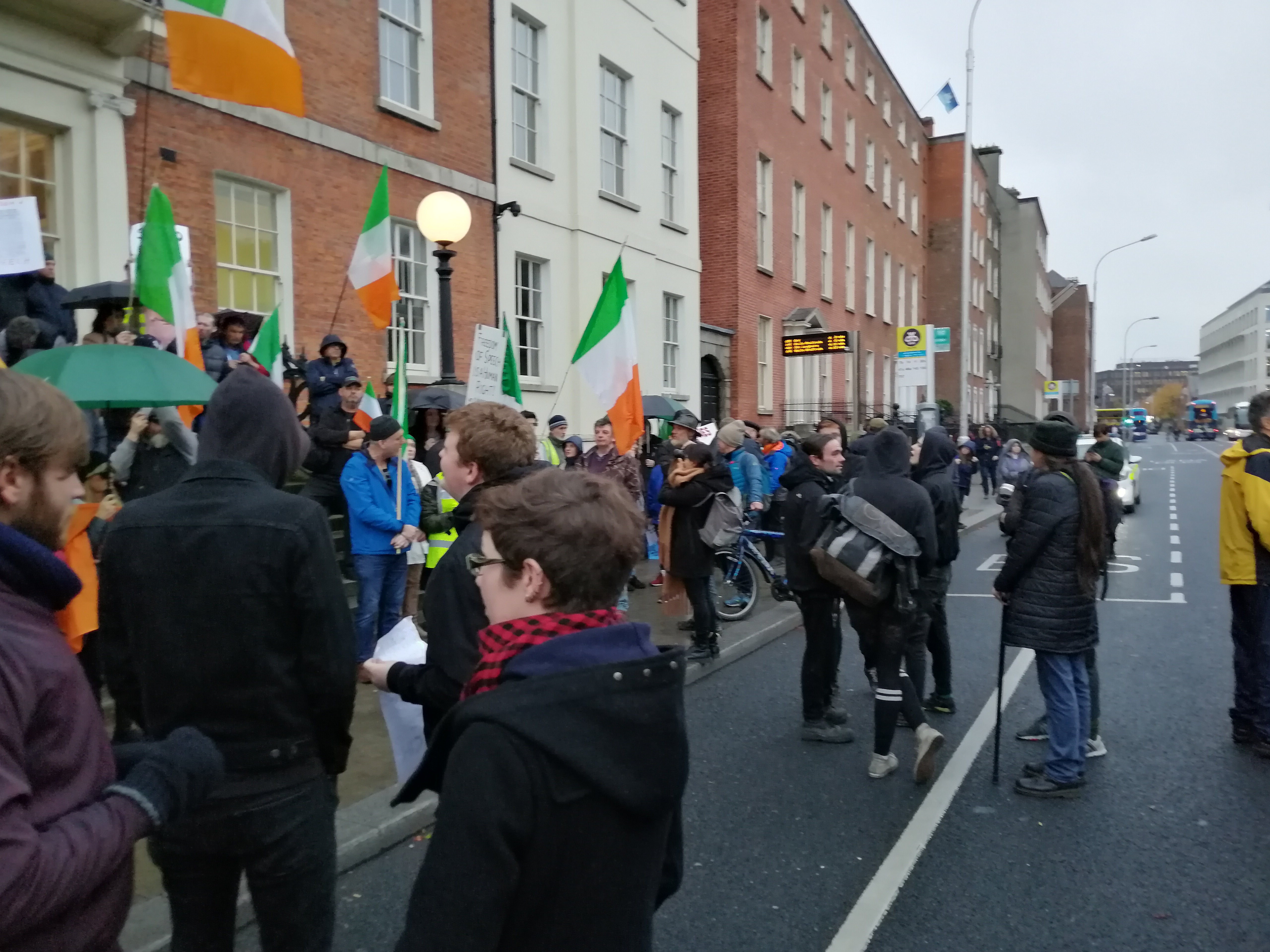
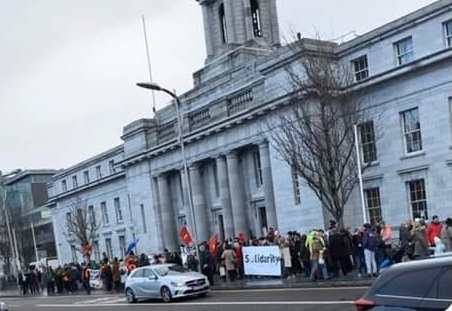
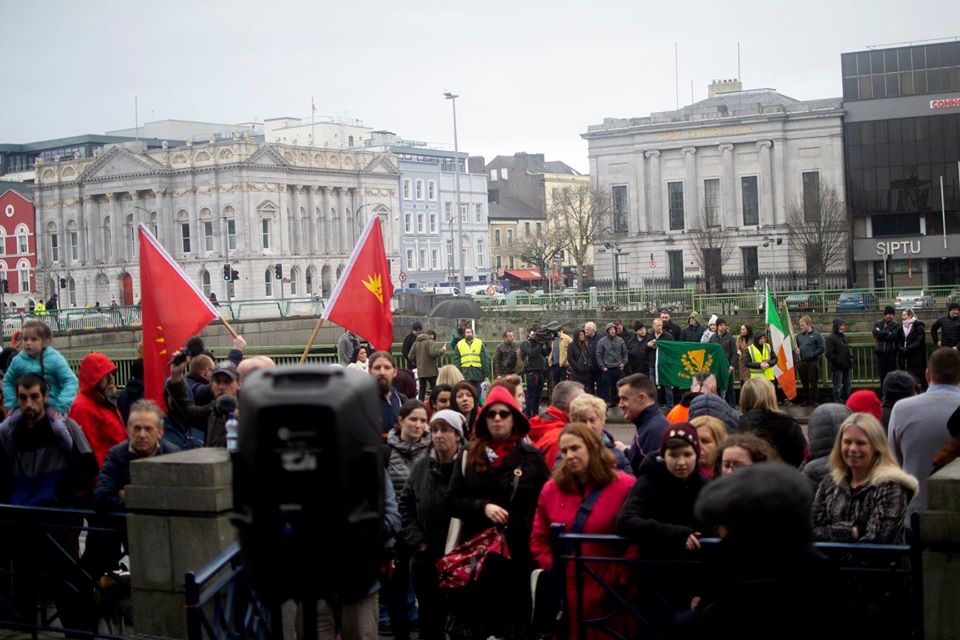
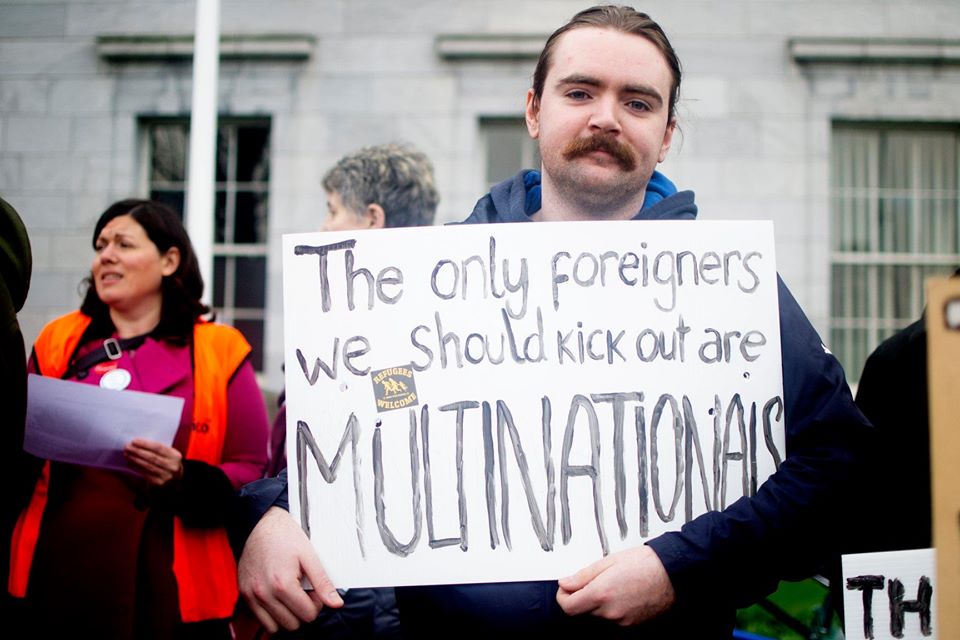
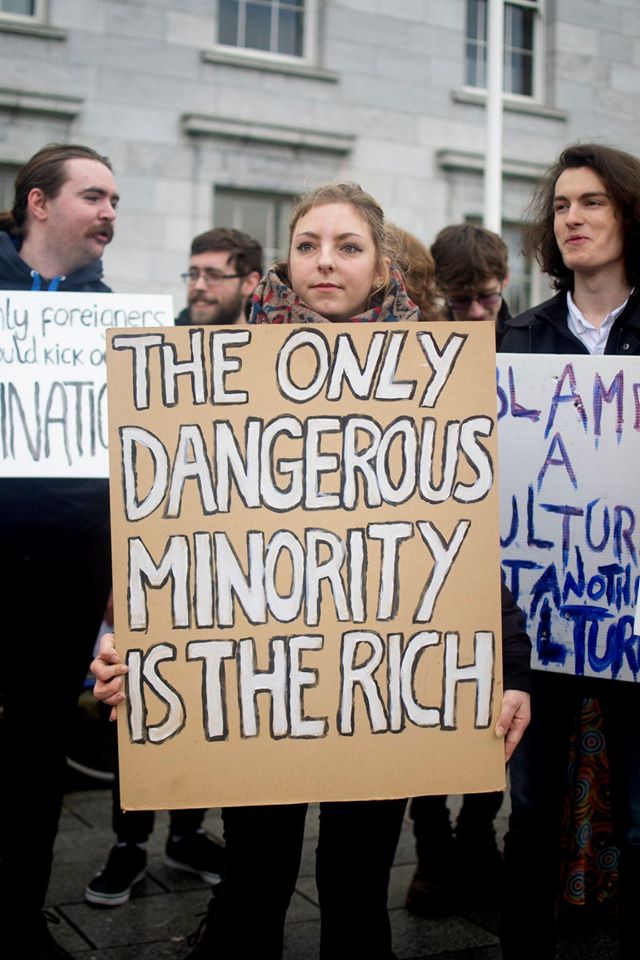
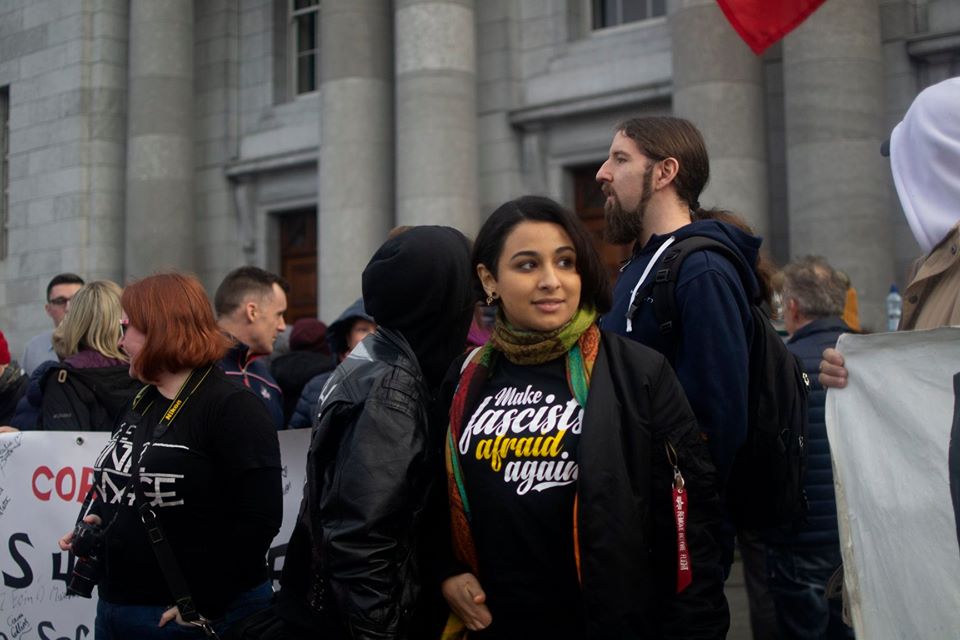
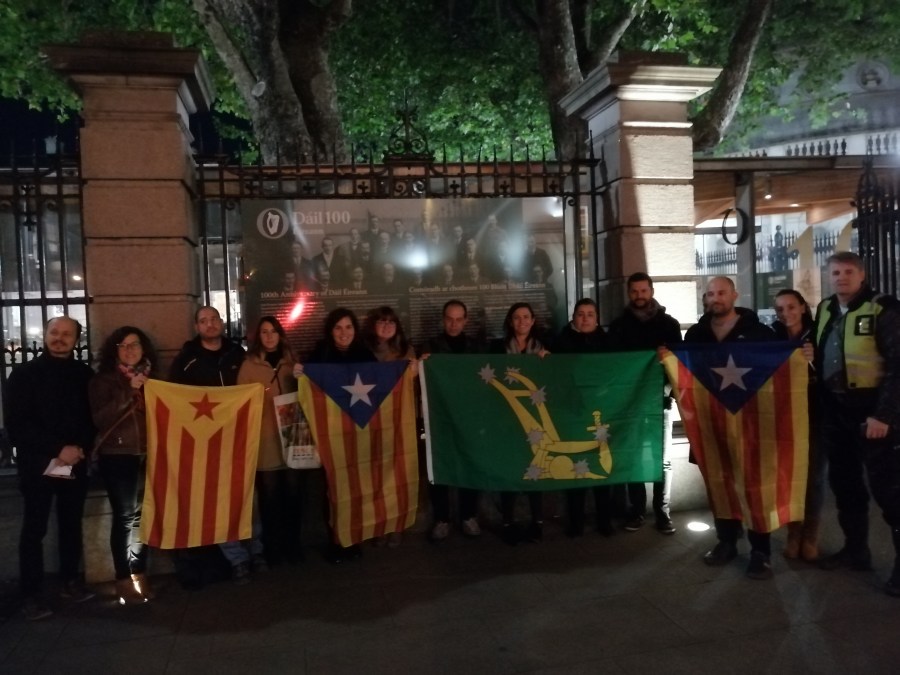
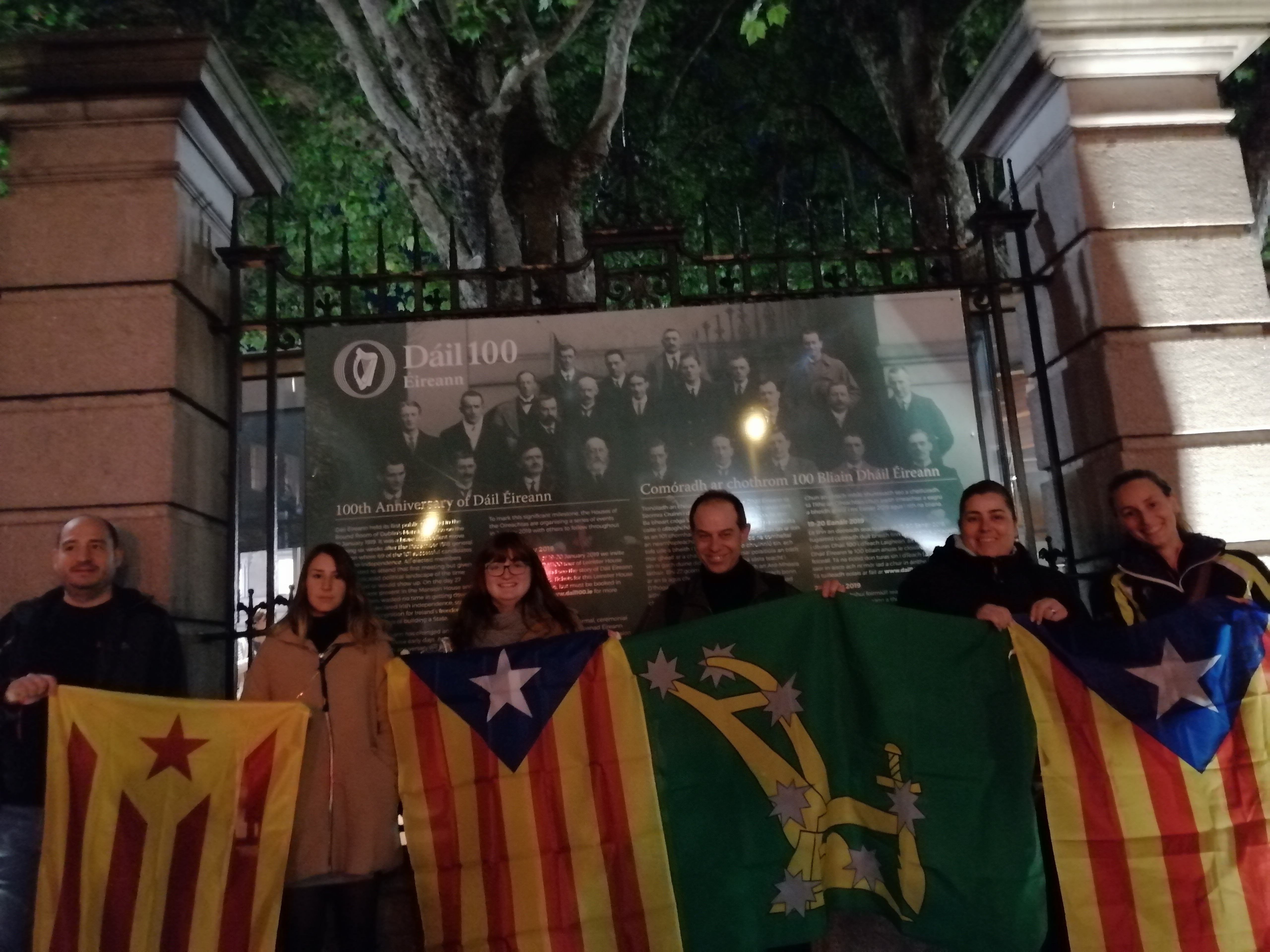
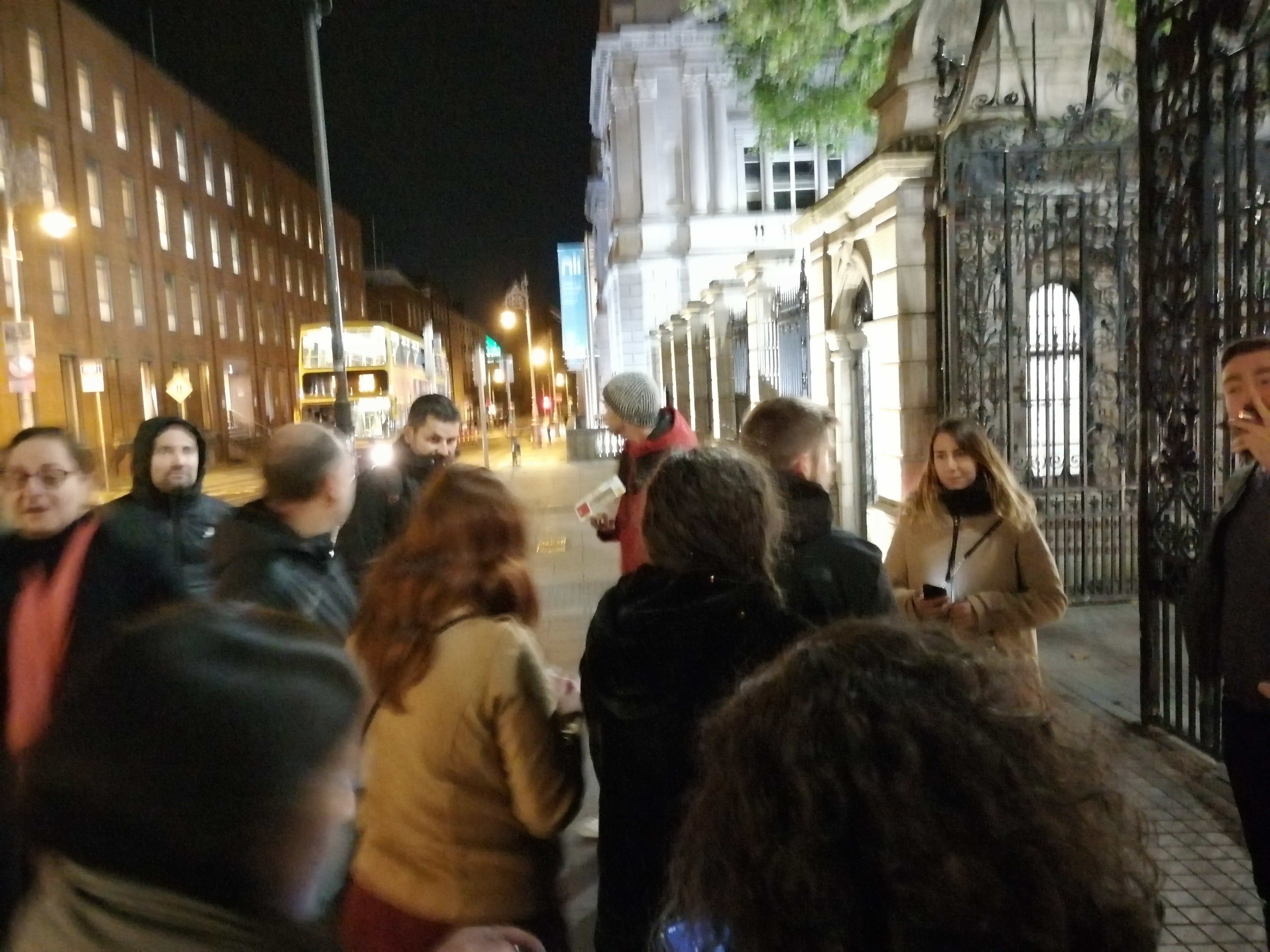
Section of Catalonia supporters in Kildare St. waiting to attend the Foreign Affairs Minister’s Question time.
(Photo: Rebel Breeze)

THE VOICES OF THE ESTABLISHMENT

This was Minister’s Question time, when Ministers (or their representatives) appear in the Chamber to answer questions about areas of the remit of their Departments and earlier, Ministers had been quizzed about areas of childcare, social care funding, local government funding ……

The Dáil chamber looked mostly deserted but in the public gallery sat a score of Catalans and some Irish, listening intently. Normally, these sessions are attended only by the TDs asking the questions and the relevant Ministerial spokesperson – and only for the question being asked. And of course also in attendance is the Ceann Comhairle, the presiding person acting as Chair – and secretaries. Sometimes by members of the media but by no means always, since reporters can monitor the televised broadcasts of the session.

The Minister’s reply on the question of Catalan self-determination delivered by Minister of State Helen McEntee TD followed a predictable pattern – predictable because it is so often trotted out: the Irish and Spanish Governments have a long history of good relations and friendly links, lots of Irish people go there on holidays, lots of people from there come to Ireland every year, Spain is a democracy, its constitution must be abided by, it would be wrong to interfere in its internal affairs. Inclusions to that in litany in recent times are that the question of Catalonia is emotive throughout the Spanish State and that Catalan society is divided over it, that the rule of law must be upheld and that violence has no place in politics.

The Fianna Fáil representative, Seán Haughey TD, echoed that line, adding also that the Spanish Constitution of 1978 is unitary and does not allow any part to become independent. He also quoted some survey results that he claimed indicated that support for independence was now in a minority among Catalans.

The Labour Party representative, Jan O’Sullivan TD, went further and specifically supported the present Government of her “sister party in Spain”, the PSOE and suggested that the “inflexible” previous government of Rajoy (of the PP) had helped to bring the current situation about and that Sanchez, the Prime Minister, would help calm the whole situation down. The only concessions she made were to suggest that the lengthy jail sentences were perhaps not the best way to deal with the issue and to include the police by mention in her call for “end to violence by all sides”. However, she went further than others in the Establishment parties with a specific condemnation of the jailed activists when she said that “it is not acceptable for politicians to lead citizens into conflict”.

Early arrivals for the Minister’s Question time
line up in Kildare St. below a photo of the First Dáil 1919.
(Photo: Rebel Breeze)

THE OPPOSITION

“Reactionary Spanish nationalism”

          The first TD to speak in reply to the Establishment politicians was Eoin Ó Broin, a comparatively recent Sinn Féin Deputy (2016) for Dublin Mid-West. Ó Broin was in Catalonia as one of the international observers of the Catalan Referendum on Independence on 1st October, which was attacked by Spanish police with around 1,000 Catalans injured.1

Speaking about his experiences there, Ó Broin related his meeting with 83-year-old Antonio, bruised and with his fractured arm in a sling, beaten while trying to vote earlier that day, queuing again at a polling station in Barceloneta. The SF TD spoke about what he had seen there and the “increasingly reactionary Spanish nationalism”, then went on to list the elected politicians and their jail sentences. Denying it was an internal matter for Spain, Ó Broin said it was about human rights and required international independent mediation. The Dáil would be implicitly in collusion with the Spanish Government if it left the matter to internal resolution only.

“The working class are the incorruptible heirs …”

          Paul Murphy TD, a socialist activist2 who has recently left the Socialist Party of Ireland to form a platform called Rise, shared speaking time with Eoin Ó Broin. Calling for a “reality check” he said that jailing politicians and activists for organising a peaceful ballot could hardly be the work of a normal democracy. Responding to the Labour Party spokesperson with regard to the Spanish PSOE Prime Minister, he said that “Sanchez is in Government” and that he was “sending thousands of troops and police” to suppress the Catalan independence movement and mounting “a publicity campaign” to blame the convicted leaders.

The Spanish Government would one day come to be haunted, Murphy said, by the words of James Connolly in 19143 when he said:

“If you strike at, imprison or kill us, out of our graves or prisons we will still evoke a spirit that will thwart you, and perhaps, create a force that will rise up and destroy you. We defy you! Do your worst.”

Murphy said that the Catalan popular movement was impressive with their demonstrations, marches and the recent general strike. Against that, the Spanish police and army were carrying out “a campaign of terror” injuring hundreds and anyone who didn’t believe it only had to go on line and see the videos. “Francoism is baring its ugly head”, Murphy said and pointed out that the Spanish legal systems is riddled with a contempt for democracy, echoed by those at the top in the European Union.

The recent Catalan General Strike, according to Murphy, “showed the way forward” and he quoted again from Connolly, that “the working class are the incorruptible heirs of Irish freedom”. The Spanish State had a long history of suppression of national self-determination, including those of the Basques, Murphy said and the way forward would be for a voluntary socialist federation.

Catalan independence supporters gathering in Kildare St. waiting to attend the Foreign Affairs Minister’s Question time.
(Photo: Rebel Breeze)

“The judicialisation of politics”

          Next to speak was Thomas Pringle, Independent TD for Donegal since 2011, with a socialist Irish Republican background, a member of Sinn Féin for few years but who left the party in 2004. He opened his contribution by referring to “the judicialisation of politics” in the Spanish state and, in reference to the scale of the Spanish repression, mentioned the 700 Catalan town mayors who await judicial process due to their support for the Catalan Referendum in 2017.

Pringle said the Spanish Constitution purported to guarantee the rights of different people within the state, which would be a joke if the reality were not so grim. “The EU continues to ignore” what is going on in its member Spanish State, “as it did in the Six Counties,” he said.

“Catalonia in 2019 is Ireland  a century ago”

          “Self-determination is a human right,” said the next to speak: Peadar Tóibín, TD for Meath West since 2011, who left Sinn Féin in 2018 and went on to form Aontú in January 2019. Tóibín reminded all that the First Dáil had sent out a call to the world for recognition of Irish independence in 1919 and that most states had not done so then4.

“Catalonia in 2019 is Ireland a hundred years ago”, Tóibín said and went on to say that if the Irish Government remained silent on repression by the Spanish State then it shared culpability for it.

“ … a short memory in this House”

          “We sometimes have a short memory in this House” said Mattie McGrath when it was his turn to speak, a TD since 2007 who has been an Independent since he left the Fianna Fáil party in 2011. McGrath referred to the recent long war in the north-east of Ireland and said that conflict resolution process was the only way to resolve the issue.

McGrath referred to Clare Daly (elected MEP this year after being a socialist TD for some years) and her statements on the issue. “Self-determination is a fundamental human right”, McGrath said, and went on to speak about “the right of freedom of assembly”, which was under attack by the Spanish State.

“Ireland is a small island nation”, Mc Grath said, “very sympathetic to the rights of people” (apparently contrasting this to the attitude of the Establishment in the Dáil).

In the time allowed by procedure for final response from the Minister, her representative reiterated the position she had outlined earlier and, though she conceded that most of the Catalan demonstrations had been peaceful, said that some recent “scenes of violence” had been “of concern”.

Section of Catalonia supporters in Kildare St. waiting to attend the Foreign Affairs Minister’s Question time. Behind them, enlarged photo of the First Dáil, 1919.
(Photo: Rebel Breeze)

COMMENT

Fianna Fáil‘s origins are in the split with Sinn Féin led by De Valera in 1926 over the question of taking seats in the “partitionist” Irish parliament, the Dáil, and rapidly became the preferred party of the native Irish capitalist class, having been in government since more than any other Irish party.

The origins of Fine Gael, currently in minority Government at the tolerance of Fianna Fáil, has its origin in the setting up of the Irish State after the War of Independence and represents the victors of the Civil War against the Republicans. It was composed of a coalition of a right-wing Irish Republican party (followers of Michael Collins, Griffiths etc), a small right-wing farmer’s party and the fascist Blueshirts (a name by which FG are still often called by their enemies).

Hard to believe today, the Irish Labour Party was founded by, among others, James Connolly and is the oldest of the three parties. A progressive party in the early days, it was not a participant in the Civil War, during which its representatives criticised the Free State Government about its abuse of civil rights, repression, large-scale arrests, internment without trial, torture and murder. Over the years it lost more and more of its socialist credentials and has been in coalition government with the right-wing Fine Gael on two separate occasions. The main trade unions in Ireland retain connections to the Labour Party, with the possible exception of the rapidly-growing British-based UNITE.

(Photo: Rebel Breeze)

The supposed inviolability of the Spanish Constitution of 1798 is one of the questions at the heart of the matter. The boast of the Spanish Government and its supporters abroad is that the majority of the people within the Spanish State voted for it. Well, so they did, except in the Basque Country – but what of it? If in a wedding, one of the partners says “I do”, does that mean that person is forever forbidden from leaving? Do we not have the right to divorce acknowledged now in most states around the world and certainly in “the democracies”? If one agrees to join a club or organisation, does that mean one can never choose to leave? Well, maybe in the Mafia, or the Cosa Nostra ….

Furthermore, that monarchist Constitution was put forward to a population that had endured four decades of fascist dictatorship, with the collusion of the allegedly socialist and republican PSOE and the allegedly communist and republican Communist Party of Spain, restraining their trade union and party members in the wave of state repression and murders during the Transition to “democracy”. Isn’t there something about the invalidity of agreements made under duress?

The issue of non-interference in the internal affairs of another state is a bogus one, since all governments do that at one time and another and Irish governments and political parties are no exception. In 1936, the representatives of Fine Gael loudly supported the military-fascist uprising led by Franco against the democratically-elected Government of the Spanish State. The Irish Government of Fianna Fáil did nothing to prevent the Blueshirts going off to fight for Franco and the Bishops of the Irish Catholic Church blessed them as they sailed off. The reality is that states that agree with one another generally do not interfere in one another’s internal affairs.

The constant mantra of reference to “the rule of law” and the condemnation of “violence in politics” is not only an irrelevance but turning truth on its head. It was not illegal according to the Spanish Constitution or laws to hold a referendum on independence 5. It is also against the Spanish law to use violence against others and even the police are not legally empowered to do so except in self-defence or in defence of others. On October 1st the actions of the Spanish police had 1,000 people requiring treatment and another few hundred have been injured in recent days. The Internet is full of videos of different incidents of gratuitous Spanish police violence, often the perpetrators showing no fear of being filmed – clearly because Spanish (and more recently, Catalan) police know they have impunity. Recently, however, it seems that some Spanish police have become sensitive to being filmed during their violent acts and have begun to target photo-journalists, both with personal violence and with rubber bullets.

A total of five people have now lost an eye from the impact of the rubber bullets of the Spanish police. Apart from the fact that these are banned in Catalonia, the bullets are supposed to be fired to ricochet and not directly at people, nor are they supposed to be fired at close quarters. Clearly, the rules are not being adhered to and nobody is enforcing them, granting impunity to the Spanish police.

When the representative of the Minister for Foreign Affairs acknowledged the overall peaceful nature of Catalan independence demonstrations but expressed concern over some recent scenes of violence, what was she really saying? It was this: that the violence of the police against the peaceful demonstrators could continue but the victims using force in defence or in retaliation is a cause for concern!

End.

FOOTNOTES

1  Eoin Ó Broin, often described as on the (small) left wing of Sinn Féin (a wing badly needed by that party) has in the past had relations with the Abertzale Left in the Basque Country and wrote a book on the movement there in his time, Matxinada – Basque Nationalism and Radical Basque Youth Movements. He is also author of Sinn Féin and the Politics of Left Republicanism.

2  Paul Murphy has been, while a Socialist Party TD, dragged by police out of a housing protest and with others faced serious charges arising out of a protest about Irish water against a Labour Party Minister, of which he and the others were acquitted by the jury after an infamous trial. He remains in the PBP-Solidarity parliamentary coalition.

3  James Connolly (1868-1916) was at that time active in the Irish Labour Party and leader of the Irish Transport & General Workers’ Union, which was struggling to recover from an 8-month fight against a group of employers that had set out to crush the union (Dublin Lockout). Connolly was a revolutionary socialist, republican, journalist, historian, author and organiser and was horrified by the very idea of the First World War which began in 1914. He was shot dead by British firing squad, along with other leaders and some others of the 1916 Rising.

4  This reference seems particularly appropriate. In January 1919 the majority of MPs elected in Ireland in the UK General Elections of December 1918, carried out the “Sinn Féin” platform’s election promise not to go to Westminster and convened a parliament in Dublin. This is known as “The First Dáil” even by the Irish State, which numbers its parliaments from then onwards. The First Dáil declared independence and called on the states of the world to recognise Irish independence (see References) but only the young USSR did so. Ireland had no legal right under British law to break away from the UK unless it were agreed by majority in Westminster (where the Irish MPs would always be outnumbered by the British). The First Dáil was banned by the British in September of that year and its members were arrested if they could be found.

5  Though possibly the declaration of Republic was – but that was suspended in less than five minutes.

REFERENCES & FURTHER INFORMATION

Clip of Eoin Ó Broin TD reply: https://www.facebook.com/EoinOBroinTD/videos/1138199326378630/

Clip of Paul Murphy TD reply: https://www.facebook.com/paulmurphytd/videos/424540844872189/?t=11

Clip of Thomas Pringle TD reply: https://www.facebook.com/ThomasPringleTD/videos/416766079224197/

Clip of Peadar Tóibín TD reply: https://www.facebook.com/740004202875853/videos/738458029959798/?t=124

(currently seeking remaining TD, also footage of the whole debate)

Text of all contributions to the debate: https://www.oireachtas.ie/en/debates/debate/dail/2019-10-22/34/

First Dáil’s Message to the Free Nations of the World: https://en.wikipedia.org/wiki/Message_to_the_Free_Nations_of_the_World

Some organisations of Catalan solidarity in Ireland:

ANC Ireland: https://www.facebook.com/IrlandaPerLaIndependenciaDeCatalunya/

CDR Dublin: https://www.facebook.com/CDRDublin/

With Catalonia/ Leis an Chatalóin: https://www.facebook.com/WithCataloniaIreland/

DISSIDENCE IN THE BASQUE PRO-INDEPENDENCE MOVEMENT

Diarmuid Breatnach

(Reading time: 5 minutes)

When ETA, the armed Basque Left pro-Independence group) abandoned armed resistance and decommissioned its weapons, many wondered at the absence of public dissent among its ranks. A dissident trend did appear in the Basque pro-independence movement but it took longer than it had in Ireland; it is in existence now and growing.


In using the term “dissident”, a description not always accepted by those to whom it is applied, I mean those who disagree with the direction taken by the leadership of the organisation and who have therefore separated themselves from the organisation. It becomes a problematic term when it is implied that the “dissidents” have diverged from the original path – on the contrary, those who have left the organisation would say, it is the leadership which has left the path and it is those being called “dissidents” who remain on the “true path”.

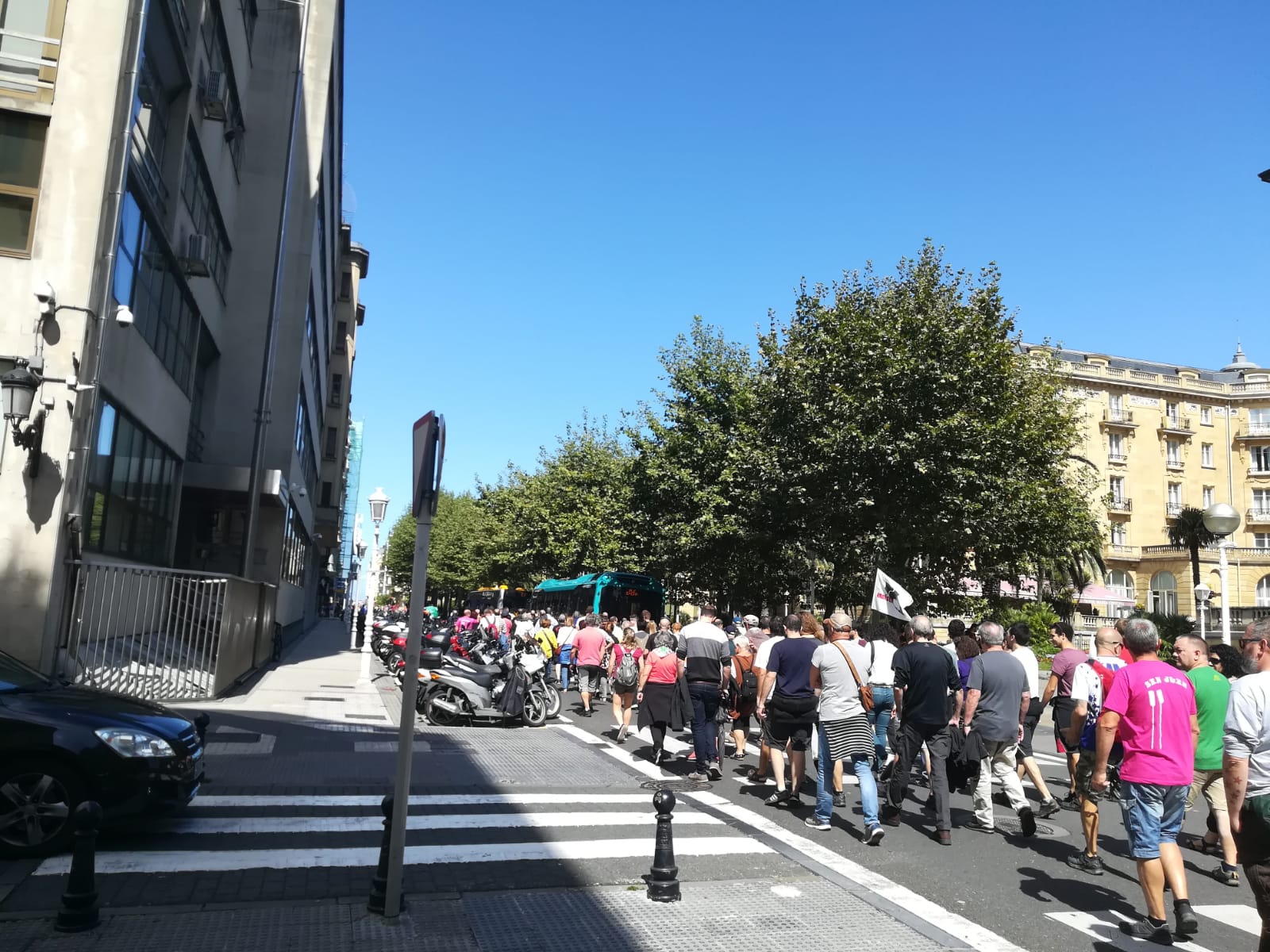
ATA demonstration in Donosti/ San Sebastian, 8th September 2019.
(Photo source: Amnistia Garrasia FB page)


In the Basque pro-independence movement, as in the Irish Republican movement, the “dissidents” are in a minority but that should not be taken to mean that those who have remained within the “official” movement are in complete agreement with the leadership nor happy with the state of affairs within the movement. Indeed, within the Izquierda Abertzale (Basque Left pro-Independence movement), many are very unhappy indeed. Some do not agree with alliances with social democrats or attempted with the PNV (Basque Nationalist Party), others with complete disarmament, some with disarmament without concessions in return, yet others with particular decisions at various junctures (such as pleading guilty to “terrorism” when the work they had been doing was nothing of the sort, as happened recently in the mass trial of prisoner solidarity activists arrested back in 2013). Or with “apologising to the victims” as the Spanish State has been pressing on prisoners and detainees (the Spanish State of course apologises for nothing, neither the fascist-military uprising of Franco and company, nor the Dictatorship of almost four decades, nor executions, nor recent torture).

There were splits enough in the Irish Republican movement even soon after the Civil War but they also came thick and fast in the early 1970s, out of which grew the Provisionals (Sinn Féin and PIRA) and the IRSP and INLA, leaving Official Sinn Féin and OIRA as a rapidly-diminishing and eventually disintegrating remainder. Another split came about as a result of the electoral path of Provisional SF in 1986, out of which came Republican Sinn Féin. But it was the Good Friday Agreement and its effects which caused the most splits and desertions from the ranks of the Provisionals, leading to the creation of a number of organisations over time: éirigi, 32 County Sovereignty Movement, 1916 Societies, Saoradh and others.

POLITICAL PRISONERS, IRELAND & BASQUE COUNTRY

Most unfortunately, the number of Republican organisations led also to a number of political prisoner support groups and currently there are three main ones: Cabhair (RSF), Cogus (mainly 32 CSM) and Irish Republican Prisoners’ Welfare Association (mainly Saoradh).

In the Basque movement, the Izquierda Abertzale, although there were the abiding split has come over the issue of the Republican prisoners. The traditional line of the IA has always been that the prisoners, whether captured ETA volunteers or political activist victims of repression, are political prisoners. It follows that they should be released in any settlement of the Basque national question. But in the meantime, if prisoners, they should be kept in prisons near their homes so that they can be visited without too much difficulty by relatives and friends. That is not only a humane principle but is underwritten by EU and UN policy recommendations on the treatment of prisoners. The Spanish State, however, keeps its political prisoners dispersed throughout its territory, hundreds and even a thousand kilometres away from the family and friends of the prisoners (as does the French State). This is not only an additional punishment on the prisoners, one which was not a specified part of their sentence but also – and perhaps principally – on their relatives, children, partners and friends.

The organisation Amnistia (Gestoras pro Amnistia) was created in 1970 within the movement to agitate for a total amnesty for the prisoners. As is usual with the Spanish State, in 2002 it banned this organisation also as one “assisting terrorism”, threatened its activists with prison and the organisation ceased to exist publicly, their trial beginning in 2008. The State’s outlook was fully expressed in the infamous statement of the former judge and overseer of torture but so beloved of liberals, Baltazar Garzon: “Everything is ETA”.

The organisation of relatives of prisoners on the movement’s “official” list, Etxerat (Homeward) continued to exist and to organise visits, share information and agitate about the prisoners’ treatment but it is not a political organisation as such, which is difficult to combine with welfare work.

To carry out the specifically political work around the prisoners, the organisation Herrira (to the Homeland) was created some years ago. The Spanish State reacted in the usual manner and arrested a number of its activists – for “assisting terrorism”, of course. After that, it was noted that the official line had changed – while not specifically abandoning the call for amnesty, now only the call for and end to dispersal was heard (along with of course the repatriation of seriously or terminally-ill political prisoners).

View from the rear of ATA demonstration in Donosti/ San Sebastian, 8th September 2019.
(Photo source: Amnistia Garrasia FB page)

LEADERSHIP CHANGE IN LINE AND DISSIDENCE

The change in line, the dropping of the demand for amnesty, led to the creation of a new Amnestia, but with the addition of Ta Askatasuna (and Freedom), this time in the hands of “dissidents”. The “oficialistas”, the current leadership of the main body of the pro-independence movement, Otegi, EH Bildu etc, say this is pure opportunism on the part of the dissidents, who are expressing their disagreement with the abandonment of armed struggle and dissolution of ETA by seizing on the issue of amnesty for political prisoners. They could be right, of course, at least in part. But unlike the leadership of SF and PIRA, the Basque “oficialistas” got no deal whatsoever for their prisoners.

Recently, a significant part of their youth section Ernai left the “oficialistas” and maintains a working relationship with the new ATA. Their issue was that they had prepared a position paper for discussion at the annual congress and the “oficialistas” had refused to permit it to be discussed, since it was critical of current leadership positions.

Another group, Jarki, is revolutionary, socialist, for independence, internationalist and in defence of the language and has been organising.

Apart from those three trends, there also exist anti-authoritarian, ecological etc trends that owe no allegiance to the official leadership of the movement. These are national in the sense that they are spread across the Basque Country and also in that they speak and write in Euskera (Basque language); they are also for social justice, feminist, anti-racist and anti-sexuality discrimination.

It remains to be seen to what degree these various trends will coalesce and whether the “official” movement will continue to see defections from its ranks.

End.

HOW TO WIN THE WAR – GETTING INTO POSITION

(Reading time: Introduction, one minute; Part One: 5 mins; Part Two 2 mins: Part Three: 3 mins; Part Four: 2 mins; Total: 13 mins.)

Diarmuid Breatnach

INTRODUCTION:

Although I often think about the big questions – and am generally guided by my philosophy on them, my mind and energy are usually too occupied with specific struggles to focus on them for long. Recently however I had the opportunity and the need to think about the war, the one we have yet to win.

Storming Bastille Painting Jean-Pierre Houel
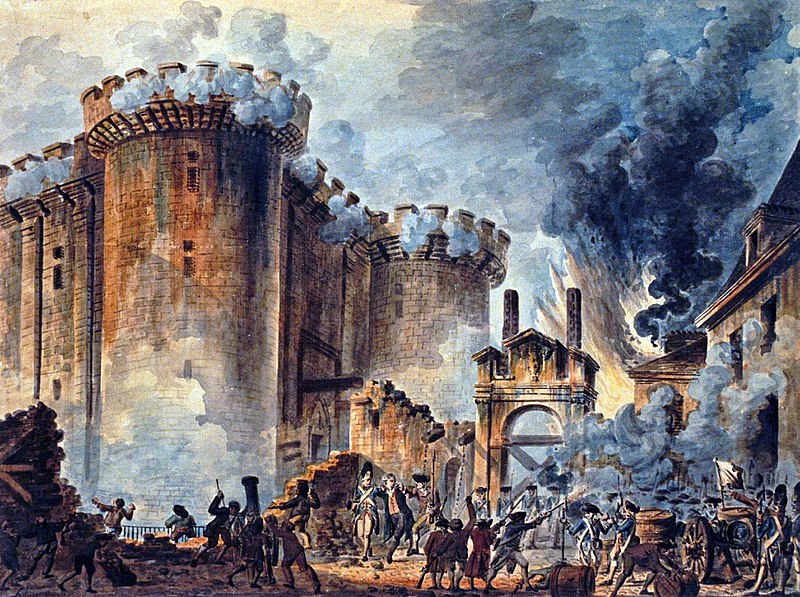
The Storming of the Bastille (translation), French Revolution, 1789 by Jean-Pierre Houel. (Image sourced: Internet)

But to which war am I referring? The Irish war of national liberation that has been flaring up for centuries, being lost each time before flaring up again? Or the class war, which has had a few sharp Irish episodes but has been, for the most part in Ireland, in abeyance? The answer is BOTH, though it may seem that my emphasis in the discussion, certainly in the early part, is on the national liberation war.

In order to imagine how we might win, it is helpful to examine past struggles and analyse what went wrong with them. Pessimists love to focus on those things I know – but in order to push us towards reformism or just surrender; my approach instead is from a revolutionary perspective.

Generally, Socialists analysing the class struggle don’t even ask themselves why we have not had a revolution yet. From week to week, month to month, they tend to focus on this or that particular trade union or social struggle but without going into the big picture. It seems as though they can’t even imagine a socialist uprising in Ireland, it’s just too far away to think about, apparently. But if one can’t even imagine such a revolution, how could one consider the necessary steps to get there?

Communards Paris Barricade 1871
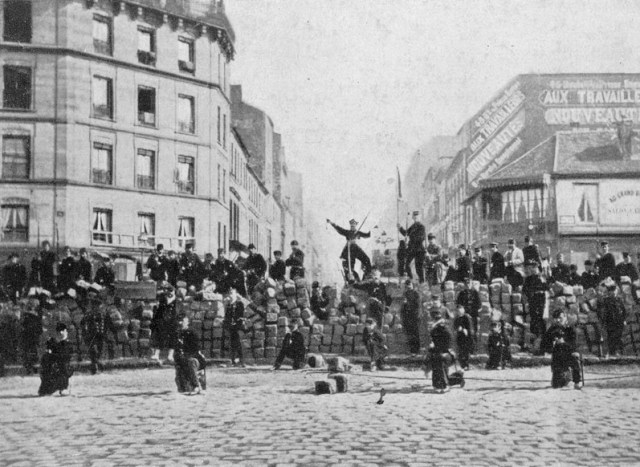
Communards at barricade, Paris Commune 1871. (Image source: Internet)

Irish Republicans on the other hand are often thinking in terms of revolution, usually including armed struggle. However it seems to me that Irish Republicans don’t like analysing past failures of the movement but when they do, their verdicts tend to be that the leaders betrayed the struggle or that taking part in public elections corrupted the movement; or that infiltration, spies and informers was the problem. And some other reasons. The thing is, although all those things played a particular part, they are not the fundamental reason.

Defeat Rebels Vinegar Hill Drawing George Cruikshank
“Defeat of the Rebels at Vinegar Hill” by George Cruikshanks, i.e United Irishmen last major position in Wexford overrun, 1798.

PART ONE: THE THIRTY-YEARS’ WAR – DOOMED TO LOSE

(Reading time this section: less than 5 minutes)

Free Derry Corner Gas Mask Images
Derry Monument and Mural of the Civil Rights struggle which preceded the armed struggle in the Six Counties. (Image sourced: Internet)

          The national liberation war that began in 1969 in the Six Counties and ended in 1998 (though some armed incidents continue from time to time) began as a civil rights struggle and changed into a war of communal defence and of national liberation. The military part of the struggle for the most part took place in the occupied Six Counties. The political element of the struggle was waged all over Ireland (and abroad) but in the main consisted of support for the struggle in the Six occupied Counties.

Fought in that way, the struggle was bound to lose. It could never win. How could anyone imagine that they could win a struggle fought against a world power in one-sixth of the country, where even the population there was divided against them? What could they have been thinking?

To my mind, there are only two possible sane replies to that question, which is that they believed: 1) that the British ruling class would get worn down by struggle and leave and/ or 2) that the Irish ruling class would intervene in some way to assist the struggle and make continued British occupation untenable.

1) ‘The British ruling class would get worn down and leave’: This theory must have depended on British repression being condemned abroad and being unpopular at home but had to rest fundamentally on the British having no great stake in continuing its possession of its colony there.

Anyone who thought that (and there were many who did and still many who do, not just Irish Republicans) made a fundamental error. Time and again the British ruling class has shown its determination to hang on to what might be considered its first colony, even as the ruling class’ composition changed from feudal-colonialist to capitalist-imperialist and as the world changed around it.

Collusion State Murder Mural
Mural in nationalist area in the Six Counties (Image sourced: Internet)

Even when the British ruling class, weakened by WW1 and facing an Irish guerrilla war which enjoyed the support of the vast majority of Irish people, with national liberation uprisings breaking out across its Empire and with its repression in Ireland increasingly unpopular at home, entered into negotiations with the Irish resistance, it held on to a foothold, the Six Counties.

Subsequently, it had that colony managed in a permanent state of emergency laws, with institutionalised sectarian discrimination at all official levels and outbreaks of pogroms in the street and workplace.

That became even more exposed during the civil rights struggle and the national liberation war that followed when the British State compromised whatever good international reputation remained to its Armed Forces, its judiciary, its legal establishment, its media and its very legal framework.

Even now, when many believe that the Good Friday Agreement means that a 50% plus-one-vote in favour in the Six Counties will be sufficient to end Partition, they do not realise that such a decision will have to also obtain a majority in the British Parliament and be endorsed by the British Monarch. They are also forgetting the broken promises that surrounded Partition in the first place.

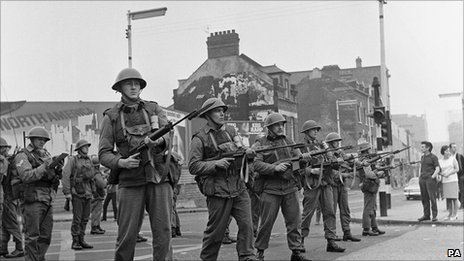
British Soldiers Helmeted Belfast 1969
British Army in Belfast 1969 (bayonets and guns pointed towards nationalist area). (Image sourced: Internet)

When analysing what holding on to the Six Counties has cost the British State in terms of reputation, military and financial contributions, one can only rationally assume that continuing to hold on to that foothold is of great importance to the British State. One may speculate as to the reasons underlying that but the central fact cannot be denied.

2) ‘The Irish ruling class would intervene in some way to assist the struggle and make continued British occupation untenable’:

There was some basis for this belief in that a section of Fianna Fáil, a party that had emerged from a split in Sinn Féin in the 1930s and had become one of the mainstream parties in the Irish state, had retained some traditional commitment to seeking a united Ireland. However it was a thin enough basis on which to depend in a national liberation struggle since that section had no majority within the party itself, to say nothing of the foreign-dependent nature of the Irish native capitalist class, the Gombeens, as a whole.

The question came to a trial of strength in the Arms Crisis of 1970, in which at least two Fianna Fáil Government Ministers were involved in secretly buying arms for the defence of nationalist areas in the Six Counties (since the IRA had insufficient weapons at the time) from rampaging Loyalist mobs and the Royal Ulster Constabulary (including the part-time B-Specials). The Ministers alleged that they had acted in the full knowledge of the rest of the Government. By the time the whole affair was over, two Ministers had been sacked and another two resigned in protest.

If it had not been clear before that the Gombeens, the native Irish capitalist class was no patriotic capitalist class but rather a neo-colonial one, it should have been clear after that. But the armed struggle in the Six Counties intensified, especially after the massacres of unarmed civilians carried out by British Paratroopers the following year, 1971 in Belfast and again in Derry in 1972. And the war lasted until 1998.

If, as had been demonstrated to be the case that the British ruling class were determined to hold on to the Six Counties and the Irish ruling class was not going to seriously challenge that possession, did the Republican movement have any other option than to fight on a war that they could not possibly win?

I am clear that it did.

Clearly, in order to have a chance of success, the war had to be extended to the other five-fifths of the country, which is to say into the territory under the control of the Irish native capitalist class. This class had seized power after the War of Independence (1919-1921) and had beaten and suppressed its opposition during and after the Civil War (1922-1923) and furthermore was supported by a powerful ally, the Irish Catholic Church. Since the founding of the first Irish Republican organisation, the United Irishmen of the late 1790s, the Catholic Church hierarchy had opposed Irish Republicanism; it had condemned four Irish priests who participated in the uprising of 1798, excommunicated the Fenians, had at first condemned the 1916 Rising and the War of Independence only to latch on to it at the end along with the Gombeen class.

The general Irish population likely would not have supported or sustained an armed struggle in the 1970s against the Gombeen class but that class could have been fought politically, through agitation and mobilisation, on many social, political and economic fronts. Without going into the specific details of each, these were:

  1. against the huge wastage of Irish youth through emigration

  2. to remedy the shortage of affordable housing (which in part contributed to the above)

  3. to end unemployment (also contributing hugely to emigration)

  4. to raise the level of wages and lower wage earners’ taxation

  5. for the right to divorce

  6. for equality for women in law

  7. for the right to contraception devices and medication for men and women

  8. against decriminalisation and for equal rights for gay and lesbians

  9. to halt the decline of the Irish language, in particular of the rural Irish-speaking areas

  10. to improve services for the rural areas

  11. to oppose the open-door policy for foreign multinationals to exploit Irish natural and human resources

  12. to secularise the education service

  13. and the health service.

  14. to remove the privileged status of the Catholic Church within the state.

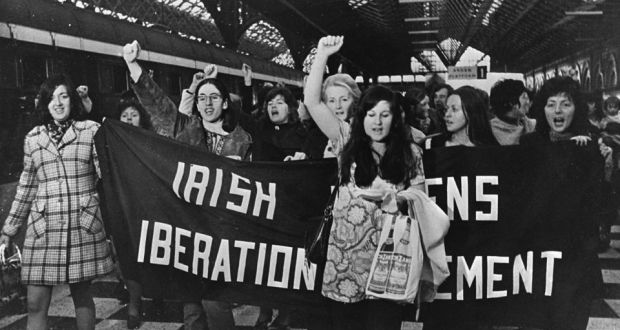
Irish Womens Liberation Connolly Station
Irish women photographed at Connolly Station 1971, about to board train to Belfast to purchase contraceptives to bring back to the Irish state, illegal at the time. There was no right to abortion either or divorce and a husband’s signed permission was necessary to take out a hire purchase agreement. (Image sourced: Internet)

The Republican movement in general, with some exceptions, declined to take on any of those struggles. They did not organise in the trade union movement, left the social struggles to others and most of all, declined to take on the Catholic Church on any issue except its opposition to the national liberation struggle. Even there, it was happy to publicly avail of the services of members of the Church clergy who supported them. Republicanism was, from its very beginning, as well as anti-monarchist, about separation of Church and State but it was difficult to see that in the Irish Republican movement, particularly after the War of Independence.

A full half of those fourteen points above (nos. 5,6, 7, 8, 12, 13 and 14) would have meant taking on the Church head-on and no doubt the hierarchy would have hindered the struggle over most of the others too, due to its strong links with the State and its ruling class.

Because of its tactical and no doubt ideological refusal to take up those struggles, the Republican movement could do little more in the 26-County state than to agitate for solidarity with the beleaguered nationalist population inside the British colony.

Though this could be effective for a time it could not become a mass movement, nor survive a long struggle, without any remedy being sought for the issues facing the population within the state.

The wonder is not that the majority leadership of the Republican Movement threw in the towel on the military struggle in 1998 but that they had waited so long to do it. Of course, they never admitted the true nature of what they were doing: abandoning the armed struggle and revolution in total and instead, using their negotiating position to advance themselves politically – not in the economic, social and political struggle envisioned above but rather in a political struggle to find themselves a place among the Gombeen political class in the Irish state and as accomplices in the governing of the colonial state.

PART 2: COLLECTING THE FORCES FOR REVOLUTION

(Reading time this section: 2 minutes)

          A successful revolution in Ireland, as in most places, would require the involvement of a mass movement. That mass movement would be unlikely to be one that had national self-determination as its only aim – certainly not in the 26 Counties (the Irish state). Mass movements arise at times around different issues and exist as long as the issue does or instead until the movement gets worn down or broken up. Such movements arose around the Household Tax and, later, around the additional Water Charges.

Water Protest Long View 29 Aug 2015
Section of protest against water charges, O’Connell Street, Dublin, 29 Aug. 2015 (Image source: Internet)

Even though the objectives of such movements are often not revolutionary, the participation in them by revolutionaries is necessary if, in the future, there is to be a revolution. Revolutionary activists can make contacts and prove themselves by the way they participate whilst at the same time pointing out that a revolution is necessary in order to resolve all these issues completely and permanently. Such activists can also influence the movement (or sections of it) to act in more revolutionary ways, so that the movement can be guided by – and imbued with — revolutionary spirit.

Working people in struggles come up against concrete problems which need to be resolved in order to move forward. Prior to 1913 in Ireland, workers learned the need for unity in struggle which was emphasised by the employers’ attempts to break the Irish Transport and General Workers’ Union in August 1913. The attacks on them by the Dublin Metropolitan Police illustrated the need for organised defence and Larkin and Connolly called for the formation of what became the Irish Citizen Army, which later also fought prominently in the 1916 Rising.

Packed Workers Liberty Hall 1913
Members and supporters of the Irish Transport & General Workers’ Union cheering outside the union’s HQ, Liberty Hall, August 1913. Later the union formed the ICA to defend themselves from the DMP; the ICA took a prominent part in the 1916 Rising. (Image source: Internet)

Trade unions are the only mass organisations of the working class in Ireland and it is necessary for revolutionaries to be active within them. Currently, other than social democrats, it is mainly members of both trotskyist parties and independent activists who engage politically with the trade unions. Those members are mostly in clerical work and their political work tends to concentrate on employment demands around wages and working conditions. When they introduce politics it is generally to get some motion passed by their branch. Also at times, they will campaign to get a perceived left-wing candidate elected to some position within the trade union bureaucracy.

None of the above are without value but they remain disjointed in terms of program and often confined to just one trade union. Not only that, but often the Left party involved will engage in order to recruit some new members and in order also to retain their own members by providing them with activity. When broad front trade union groups are formed, they tend to become an arena where the dominant trotskyist parties compete for dominance.

If we are to have a successful revolution – and in particular a socialist one – participation in the struggles of workers in the trade union movement is absolutely necessary. But participation should be primarily among the rank and file of the trade union and also across trade unions, focused on providing solidarity to members of whichever union is in struggle – in addition to encouraging unorganised workers to organise and become active. The objective is not to help make one trade union or one section more militant but rather to create a militant workers solidarity movement within the whole trade union movement. It is essential to have members in the ‘blue-collar’ work unions or departments as well as in the clerical unions or sections. And the cross-union organisation I advocated should be independent — the preserve of no political party.

Participation in such struggles provides an opportunity for revolutionaries to make contact with people who are activists but not yet revolutionaries and to give those people an opportunity to evaluate the revolutionaries in terms of their actual practice. Revolutionaries can support the people struggling for worthwhile reforms while at the same time pointing to their partial and temporary nature. Revolutionary activists can play an educational role in the mass movements while at the same time becoming educated themselves by the daily reality faced by the masses in this system.

PART 3: THE ABSOLUTE NEED FOR UNITY – BUT WHAT KIND?

(Reading time this section: 3 minutes)

          It is, most people would think, a ‘no-brainer’ (i.e an obvious truth) that unity is necessary in the struggle to overthrow the current system. It might be thought surprising, therefore, that disunity is more the rule among those who aspire to revolution.

Generally, those who claim to be revolutionary socialists will not unite with Irish Republicans. In addition, those socialists of one party will often fail to unite with those of a different party. The same dynamic is to be seen among Irish Republicans also.

There have been many attempts to overcome this problem. In the 1930s the Republican Congress sought to unite Irish Republicans with revolutionary socialists. In the face of hostility within the mainstream Republican movement and also with divisions among the communist element in Ireland at the time, faced in addition with anti-communist hysteria whipped up by the Catholic Church, the experiment failed. The leadership of the Sinn Féin and the IRA of the later 1960s tried to combine socialism and republicanism within one party and military organisation, an attempt that crashed when it was discovered that the arms necessary to defend ‘nationalist’ community areas in the Six Counties, particularly in Belfast, were unavailable, leading to an acrimonious split in the movement. A subsequent attempt to combine the socialist and republican elements in another organisation survived a little longer but also failed for a number of reasons, some internal and also due to Irish State repression.

Shankhill Rd Republican Congress WT Commemoration 1934
Socialist Republicans, members of Republican Congress from Shankhill Road, marching to annual Wolfe Tone commemoration, Bodenstown 1934. They were attacked by conservative Republicans. (Photo source: Internet)

There have been some attempts to unite the non-republican Left itself also, which usually failed due in part to ideological differences but also to political sectarianism and personality clashes. Currently both trotskyist parties have an uneasy working relationship, the small grouping of Independents for Change exists also, the Communist Party is very small too and the anarchists are scattered and unable for years now, for the most part, to mount united action.

Attempts to unite the various parts of the Irish Republican movement have, in general, focused on creating a new organisation or absorbing activists unhappy with one organisation into another.

A frequent approach has been for some people to sit down and produce what they consider solid policy and a constitution, then to propose this format to others around which to unite. Even when accepting amendments from the elements they seek to recruit, these attempts too have largely failed.

It seems a rational approach: if we want unity, surely first we have to agree on what for, how, etc, etc before we can go into action? I believe, contrary though it may seem, that actually we should unite in action first. Uniting in action tends to break down barriers of mistrust that are built on hearsay or suspicions fostered by sectarian elements. Action also tends to clarify certain questions that until then are theoretical only. Of course, at some point, action will need to be guided by worked out policy but initially the action itself can be sufficient guide, especially since approaching the question the other way around has been so generally unproductive.

Unity Is Strength Image copy

The question then arises: with whom to unite? In general, I would say that the answer is: with all with whom we can, in actual practice, unite: different types of revolutionary socialists (including anarchists), Irish Republicans, Left social democrats, human and civil rights activists.

There are some exceptions I think necessary to mention: fascists, racists, religious sectarians and parties that participate in Government. Fascists seek to impose an undemocratic regime completely hostile to the interests of working people and, far from our uniting with them, need to be defeated; racists and religious sectarians seek to divide the movement along lines of ethnicity or religious affiliation. Revolutionaries need to draw a clear line of distinction between the movements of resistance and those who participate in a native capitalist or colonial government, i.e the management organisations of the enemy.

Many issues lend themselves to united action but perhaps none more so, and none are more essential, than against repression.

PART FOUR: UNITY AGAINST REPRESSION

(Reading time this section: 3 minutes)

          All revolutionary movements – and many that are progressive but not revolutionary – face repression at some point in their existence. Not to recognise that fact and to have some kind of preparation for it, even if very basic, is indicative of a non-revolutionary attitude to the State. Nor have we any reason in Ireland to be complacent on this question.

The Irish State turned to military suppression in the first year of its existence as did also the colonial statelet. Detentions, torture, murders and official executions were carried out by Free State forces over a number of years, followed by censorship and arrests, all facilitated by emergency repressive legislation. In the Six Counties, in addition to similar even more repressive legislation, there were two sectarian militarised police forces and sectarian civilian organisations.

After a change of government, the Irish State introduced internment without trial during the Emergency (1939-1946), the Offences Against the State Act in 1939, Special Criminal (sic) Courts in 1972 and the Amendment to the OAS in that same year.

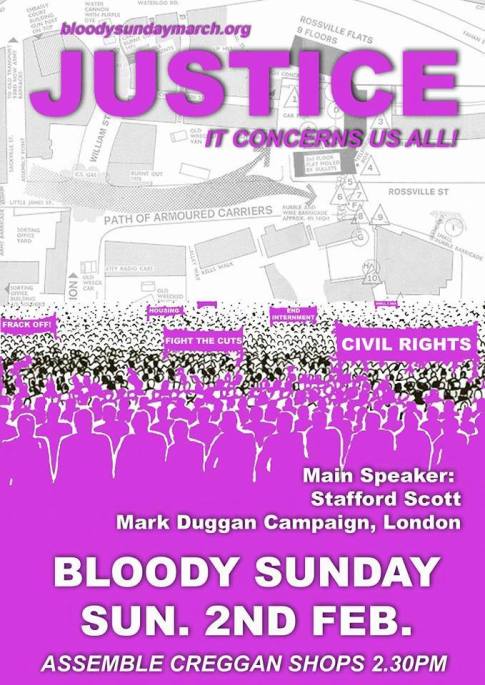
Bloody Sunday march Derry 2014
Poster for 2014 Commemoration of Bloody Sunday massacre, Derry 1972. The poster calls for unity. (Image source: Internet)

The Six County statelet had the Special Powers Act (1922) and brought in internment without trial in 1971 (the Ballymurphy Massacre that year and the Derry Massacre the following year, both by the Parachute Regiment, were of people protesting the introduction of internment). The statelet also introduced the Emergency Provisions Act and the no-jury Diplock Courts in 1973 and, though technically abolished in 2007, non-jury trials can and do take place up to today.

The British state targeted the Irish diaspora in Britain in 1974 with the Prevention of Terrorism (sic) Act and that same year and the following, framed and convicted nearly a score of innocent people of bombings in five different cases – had the death penalty not been previously abolished for murder, most of them would have been executed. It took the victims over 15 years to win their freedom, by which time one had died in jail. Brought in as a temporary measure, the PTA continued in force until 1989 but a general Terrorism Act was brought into British Law in 2000 and remains in force today.

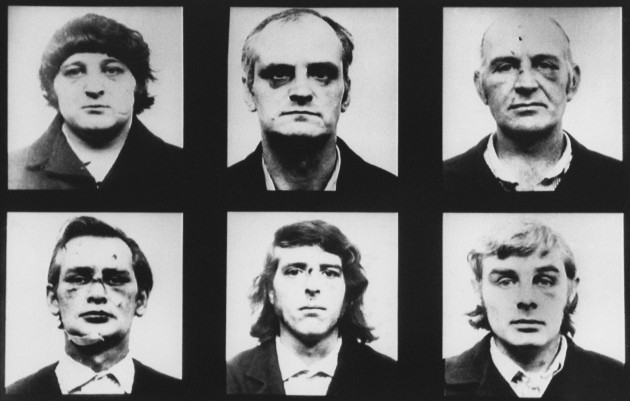
Birmingham Six Photos Bruises
Photos of the Birmingham Six, Irishmen resident in England, showing bruises from police beatings after their arrest in 1974; they were also beaten by jailers. Also arrested, brutalised, framed and convicted were the Guildford Four, Maguire Seven and Giuseppe Conlon and Judith Ward. (Photo source: Internet)

State repression rarely targets the whole population and, particularly in a capitalist “democracy” focuses on particular groups which it fears or feels it can safely persecute. However, we should also recall Pastor Niemoller’s words about the creeping repression which even the German Nazi state instituted, going after first one group, then another, and another …. Among the list of groups targeted eventually by the Nazis were Jews, Roma, Communists, Socialists, Anarchists, Social Democrats, Jehova’s Witnesses, Free Masons, Gays and Lesbians, Mentally Ill or challenged, physically challenged ….

It is in the interests of the vast majority of the population to oppose repression of different groups, whether those groups be based on ethnicity, gender, sexuality, citizenship status or democratic politics. Not everyone recognises this of course but one might expect that political activists challenging the status quo would do so. Sadly, experience shows that they do not in practice (though they may acknowledge it intellectually).

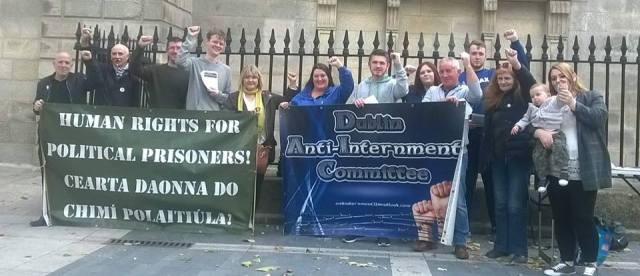
Lineup Clenched Fists & Banner
Anti-Internment and political prisoner solidarity picket September 2016 at Kilmainham Jail, Dublin (a former place of detention and execution for political prisoners under both the British occupation and the Irish State, now a museum). (Photo source: Rebel Breeze)

With some periodic exceptions, socialist groups in Ireland do not support protests against repression of republicans. Furthermore, some republican groups will not support others when the latter are subjected to repression. Yet at any time, Republicans of any group can be and are regularly harassed in public or raided at home; their employers may be warned about them by the political police; they may be detained on special repressive legislation, denied bail, effectively interned; they can be easily convicted in the non-jury Special Criminal Courts or Diplock Courts; ex-prisoners released on licence in the Six Counties can be returned to jail without any charge or possibility of defence.

The Irish State’s non-jury Special Criminal Court is a tempting facility for putting away people whom the State finds annoying and it is widely thought it was considered for the trials of the Jobstown protesters. The result of the trial, where the jury clearly took a different view to the presiding judge, may well have justified the opinion of those in the State who considered sending the defendants to the SCC.

solidarity woodcut

Unity against repression is a fundamental need of a healthy society and of movements that challenge the status quo. Practical unity in any kind of action also tends to break down barriers and assists general revolutionary broad unity. Unity against repression is so basic a need that agreement with this or that individual is unnecessary, nor with this or that organisation in order to defend them against repression. Basic democratic rights were fought for by generations and have to be defended; in addition they give activists some room to act without being jailed. On this basis, all must unite in practice and political sectarianism has no place in that.

Without some basic unity in practice across the sector challenging the status quo, there can be no revolution. But more than that: we stand together against repression ….. or we go to jail separately.

End.

Diarmuid Breatnach is a veteran independent revolutionary activist, currently particularly active in committees against repression, in some areas of internationalist solidarity and in defence of historical memory.

PART 3: THE ABSOLUTE NEED FOR UNITY – BUT WHAT KIND?

(Reading time this section: 3 minutes)

Diarmuid Breatnach

(Part of series “HOW TO WIN THE WAR  — GETTING INTO POSITION”.  See also INTRODUCTION; PART 1: THE THIRTY-YEARS’ WAR – DOOMED TO LOSE;                      PART 2: COLLECTING THE FORCES FOR REVOLUTION; PART 4: UNITY AGAINST REPRESSION)
It is, most people would think, a ‘no-brainer’ (i.e an obvious truth) that unity is necessary in the struggle to overthrow the current system. It might be thought surprising, therefore, that disunity is more the rule among those who aspire to revolution.

Generally, those who claim to be revolutionary socialists will not unite with Irish Republicans. In addition, those socialists of one party will often fail to unite with those of a different party. The same dynamic is to be seen among Irish Republicans also.

There have been many attempts to overcome this problem. In the 1930s the Republican Congress sought to unite Irish Republicans with revolutionary socialists. In the face of hostility within the mainstream Republican movement and also with divisions among the communist element in Ireland at the time, faced in addition with anti-communist hysteria whipped up by the Catholic Church, the experiment failed. The leadership of the Sinn Féin and the IRA of the later 1960s tried to combine socialism and republicanism within one party and military organisation, an attempt that crashed when it was discovered that the arms necessary to defend ‘nationalist’ community areas in the Six Counties, particularly in Belfast, were unavailable, leading to an acrimonious split in the movement. A subsequent attempt to combine the socialist and republican elements in another organisation survived a little longer but also failed for a number of reasons, some internal and also due to Irish State repression.

Shankhill Rd Republican Congress WT Commemoration 1934
Socialist Republicans, members of Republican Congress from Shankhill Road, marching to annual Wolfe Tone commemoration, Bodenstown 1934. They were attacked by conservative Republicans. (Photo source: Internet)

There have been some attempts to unite the non-republican Left itself also, which usually failed due in part to ideological differences but also to political sectarianism and personality clashes. Currently both trotskyist parties have an uneasy working relationship, the small grouping of Independents for Change exists also, the Communist Party is very small too and the anarchists are scattered and unable for years now, for the most part, to mount united action.

Attempts to unite the various parts of the Irish Republican movement have, in general, focused on creating a new organisation or absorbing activists unhappy with one organisation into another.

A frequent approach has been for some people to sit down and produce what they consider solid policy and a constitution, then to propose this format to others around which to unite. Even when accepting amendments from the elements they seek to recruit, these attempts too have largely failed.

It seems a rational approach: if we want unity, surely first we have to agree on what for, how, etc, etc before we can go into action? I believe, contrary though it may seem, that actually we should unite in action first. Uniting in action tends to break down barriers of mistrust that are built on hearsay or suspicions fostered by sectarian elements. Action also tends to clarify certain questions that until then are theoretical only. Of course, at some point, action will need to be guided by worked out policy but initially the action itself can be sufficient guide, especially since approaching the question the other way around has been so generally unproductive.

The question then arises: with whom to unite? In general, I would say that the answer is: with all with whom we can, in actual practice, unite: different types of revolutionary socialists (including anarchists), Irish Republicans, Left social democrats, human and civil rights activists.

Unity Is Strength Image copy

There are some exceptions I think necessary to mention: fascists, racists, religious sectarians and parties that participate in Government. Fascists seek to impose an undemocratic regime completely hostile to the interests of working people and, far from our uniting with them, need to be defeated; racists and religious sectarians seek to divide the movement along lines of ethnicity or religious affiliation. Revolutionaries need to draw a clear line of distinction between the movements of resistance and those who participate in a native capitalist or colonial government, i.e the management organisations of the enemy.

Many issues lend themselves to united action but perhaps none more so, and none are more essential, than against repression.

Diarmuid Breatnach is a veteran independent revolutionary activist, currently particularly active in committees against repression, in some areas of internationalist solidarity and in defence of historical memory.

PART ONE: THE THIRTY-YEARS’ WAR – DOOMED TO LOSE

(Reading time this section: less than 5 minutes)

Part of the series HOW TO WIN THE WAR — GETTING INTO POSITION

See also:

INTRODUCTION: https://rebelbreeze.wordpress.com/2019/08/07/how-to-win-the-war-getting-into-position/

PART TWO: COLLECTING THE FORCES FOR REVOLUTION https://rebelbreeze.wordpress.com/2019/08/07/part-2-collecting-the-forces-for-revolution/

PART THREE: THE ABSOLUTE NEED FOR UNITY – BUT HOW AND WHAT KIND? WITH WHOM?

PART FOUR: UNITY AGAINST REPRESSION

The national liberation war that began in 1969 in the Six Counties and ended in 1998 (though some armed incidents continue from time to time) began as a civil rights struggle and changed into a war of communal defence and of national liberation. The military part of the struggle for the most part took place in the occupied Six Counties. The political element of the struggle was waged all over Ireland (and abroad) but in the main consisted of support for the struggle in the Six occupied Counties.

Free Derry Corner Gas Mask Images
Derry Monument and Mural of the Civil Rights struggle which preceded the armed struggle in the Six Counties. (Image sourced: Internet)

Fought in that way, the struggle was bound to lose. It could never win. How could anyone imagine that they could win a struggle fought against a world power in one-sixth of the country, where even the population there was divided against them? What could they have been thinking?

To my mind, there are only two possible sane replies to that question, which is that they believed: 1) that the British ruling class would get worn down by struggle and leave and/ or 2) that the Irish ruling class would intervene in some way to assist the struggle and make continued British occupation untenable.

1) ‘The British ruling class would get worn down and leave’: This theory must have depended on British repression being condemned abroad and being unpopular at home but had to rest fundamentally on the British having no great stake in continuing its possession of its colony there.

Anyone who thought that (and there were many who did and still many who do, not just Irish Republicans) made a fundamental error. Time and again the British ruling class has shown its determination to hang on to what might be considered its first colony, even as its ruling class’ composition changed from feudal-colonialist to capitalist-imperialist and as the world changed around it.

Collusion State Murder Mural
Mural in nationalist area in the Six Counties (Image sourced: Internet)

Even when the British ruling class, weakened by WW1 and facing an Irish guerrilla war with the support of the vast majority of Irish people, with national liberation uprisings breaking out across its Empire and with its repression in Ireland increasingly unpopular at home, entered into negotiations with the Irish resistance, it held on to a foothold, the Six Counties.

Subsequently, it had that colony managed in a permanent state of emergency laws, with institutionalised sectarian discrimination at all official levels and outbreaks of pogroms in the street and workplace.

That became even more exposed during the civil rights struggle and the national liberation war that followed when the British State compromised whatever good international reputation its Armed Forces had, its judiciary, its legal establishment, its media and its very legal framework.

Even now, when many believe that the Good Friday Agreement means that a 50% plus one vote in favour in the Six Counties will be sufficient to end Partition, they do not realise that such a decision will have to also obtain a majority in the British Parliament and be endorsed by the British Monarch. They are also forgetting the broken promises that surrounded Partition in the first place.

When analysing what holding on to the Six Counties has cost the British State in terms of reputation, military and financial contributions, one can only rationally assume that continuing to hold on to that foothold is of great importance to the British State. One may speculate as to the reasons underlying that but the central fact cannot be denied.

2) that the Irish ruling class would intervene in some way to assist the struggle and make continued British occupation untenable:

There was some basis for this belief in that a section of Fianna Fáil, a party that had emerged from a split in Sinn Féin in the 1930s and had become one of the mainstream parties in the Irish state, had retained some traditional commitment to seeking a united Ireland. However it was a thin enough basis on which to depend in a national liberation struggle since that section had no majority within the party itself, to say nothing of the foreign-dependent nature of the Irish native capitalist class, the Gombeens, as a whole.

British Soldiers Helmeted Belfast 1969
British Army in Belfast 1969 (bayonets and guns pointed towards nationalist area). (Image sourced: Internet)

The question came to a trial of strength in the Arms Crisis of 1970, in which at least two Fianna Fáil Government Ministers were involved in secretly buying arms for the defence of nationalist areas in the Six Counties (since the IRA had insufficient weapons at the time) from rampaging Loyalist mobs and the Royal Ulster Constabulary (including the part-time B-Specials). The Ministers alleged that they had acted in the full knowledge of the rest of the Government. By the time the whole affair was over, two Ministers had been sacked and another two resigned in protest.

If it had not been clear before that the Gombeens, the native Irish capitalist class was no patriotic capitalist class but rather a neo-colonial one, it should have been clear after that. But the armed struggle in the Six Counties intensified, especially after the massacres of unarmed civilians carried out by British Paratroopers the following year, 1971 in Belfast and again in Derry in 1972. And the war lasted until 1998.

If, as had been demonstrated to be the case that the British ruling class were determined to hold on to the Six Counties and the Irish ruling class was not going to seriously challenge that possession, did the Republican movement have any other option than to fight on a war that they could not possibly win?

I am clear that they did.  

Clearly, in order to have a chance of success, the war had to be extended to the other five-fifths of the country, which is to say into the territory under the control of the Irish native capitalist class. This class had seized power after the War of Independence 1919-1921 and had beaten and suppressed its opposition during the Civil War (1922-1923) and after and furthermore was supported by a powerful ally, the Irish Catholic Church. Since the founding of the first Irish Republican organisation, the United Irishmen of the late 1790s, the Catholic Church hierarchy had opposed Irish Republicanism; it had condemned four Irish priests who participated in the uprising of 1798, excommunicated the Fenians, had at first condemned the 1916 Rising and the War of Independence only to latch on to it at the end along with the Gombeen class.

The general Irish

population likely would not have supported or sustained an armed struggle in the 1970s against the Gombeen class but that class could have been fought politically, through agitation and mobilisation, on many social, political and economic fronts. Without going into the specific details of each, these were:

  1. against the huge wastage of Irish youth through emigration

  2. to remedy the shortage of affordable housing (which in part contributed to the above)

  3. to end unemployment (also contributing hugely to emigration)

  4. to raise the level of wages and lower wage earners’ taxation

  5. for the right to divorce

  6. for equality for women in law

  7. for the right to contraception devices and medication for men and women

  8. against decriminalisation and for equal rights for gay and lesbians

  9. to halt the decline of the Irish language, in particular of the rural Irish-speaking areas

  10. to improve services for the rural areas

  11. to oppose the open-door policy for foreign multinationals to exploit Irish natural and human resources

  12. to secularise the education service

  13. and the health service.

  14. to remove the privileged status of the Catholic Church within the state.

The Republican movement in general, with some exceptions, declined to take on any of those struggles. They did not organise in the trade union movement, left the social struggles to others and most of all, declined to take on the Catholic Church on any issue except its opposition to the national liberation struggle. Even there, it was happy to publicly avail of the services of members of the Church clergy who supported them. Republicanism was, from its very beginning, as well as anti-monarchist, about separation of Church and State but it was difficult to see that in the Irish Republican movement, particularly after the War of Independence.

Irish Womens Liberation Connolly Station
Irish women photographed at Connolly Station 1971, about to board train to Belfast to purchase contraceptives to bring back to the Irish state, illegal at the time. There was no right to abortion either or divorce and a husband’s signed permission was necessary to take out a hire purchase agreement. (Image sourced: Internet)

A full half of those fourteen points above (nos. 5,6, 7, 8, 12, 13 and 14) would have meant taking on the Church head-on and no doubt the hierarchy would have hindered the struggle over most of the others too, due to its strong links with the State and its ruling class.

Because of its tactical and no doubt ideological refusal to take up those struggles, the Republican movement could do little more in the 26-County state than to agitate for solidarity with the beleaguered nationalist population inside the British colony.

Though this could be effective for a time it could become a mass movement, nor survive a long struggle, without any remedy being sought to the issues facing the population within the state.

The wonder is not that the majority leadership of the Republican Movement threw in the towel on the military struggle in 1998 but that they had waited so long to do it. Of course, they never admitted the true nature of what they were doing: abandoning the armed struggle and revolution in total and instead, using their negotiating position to advance themselves politically – not in the economic, social and political struggle envisioned above but rather in a political struggle to find themselves a place among the Gombeen political class in the Irish state and as accomplices in the governing of the colonial state.

Diarmuid Breatnach is a veteran independent revolutionary activist, currently particularly active in committees against repression, in some areas of internationalist solidarity and in defence of historical memory.

CASTLE TOUR – CASTLE IDEOLOGY

Diarmuid Breatnach

          Dublin Castle, located in the south city centre, has been the centre of the British occupation of Ireland since 1171 until 1921 (and even after that, some would say).The site offers one-hour guided tours to the public for much of the day, at approximately an hour apart, seven days a week and last year claimed a visitor total of nearly half a million. As a Dubliner interested in history and a walking tour guide, I was well overdue to take an official guided tour of the place, which I did recently.

          Overall the State Rooms Tour was interesting and I did learn some things but I was also aware of many gaps. Was this unavoidable in a tour of one hour covering more than eleven hundred years (given that Viking Dublin was also covered) of history? Of course – but in the choices of what to leave out, was there an ideology at play, one that sought to diminish the repressive history of the institution and the struggle against it?

An artist’s impression of Viking Dublin in 9th Century

The first presentation to us by the tour guide was of Viking Dublin, the settlement of which took place in the 7th Century. The Vikings had a confrontational occupation of England but this had not been the case here, we were told – the Vikings settled amongst us, intermarried, introduced personal and family names, place-names, etc.

Well, somehow the tour spiel had ignored the many battles between the Vikings and the natives in Ireland even after the settlement in Dublin (and other areas), leading up the famous Battle of Clontarf in 1014, fought on what is now the north side of Dublin city. The 12-hour battle was important enough to be recorded elsewhere in Europe and in a Viking saga. Yes, it had also been an inter-Irish battle, in particular between the King of Leinster and the High King of Ireland but Viking Dublin played an important part, as did Viking allies and mercenaries from Manx and the Orkneys – and its result had ended forever any possibility of a Viking takeover of Ireland.

A noticeable gap in Irish-Viking history of Dublin to omit it, one might say.

Nevertheless, the tour guide gave us interesting information about the Viking settlement and a map showed an artist’s impression of how it would have looked.

Down in the base of what had been the Powder Tower, it was interesting to see the stone work, to hear the guide talk about the foundation of the Viking wall below us and how the cement used to bind the stones was a mixture of sand, oxblood, horsehair and eggshells. To me it was also interesting to see the stone course lines of one pointed arch above a curved one but unsure what I was looking at — and we were a big group, the tour guide some distance away to ask.

Powder Tower base incorporating some of the original Viking wall.
Two separate arch stone courses, one above the other in the base of the Powder Tower.

Down below the walkway, where water lay on the ground a couple of inches deep, some green plant was growing in the lights illuminating the work. This was above the route of the Poddle, I supposed, which once fed the Linn Dubh (black pool) and which now runs underneath Castle and city before emptying into the Liffey.

“BEYOND THE PALE”

     The Normans reached Dublin in 1171 after landing in Wexford in 1169, our guide informed us but we were not told that in the process they defeated Irish resistance and the Dublin Vikings and, most curiously, there was no mention of the Pale. That would have been an interesting explanation to visitors of the origin of the expression “beyond the Pale” and what it implied1.

The guide did tell us later in the St. Patrick’s Hall (the State banquet room) that the paintings on the ceiling were to demonstrate to the Irish that all the civilising influences had come from the English to the Irish savages, that if the Irish were now civilised, their ranking was definitely below the English.

One of the ceiling paintings in St. Patrick’s Hall, where the Uachtarán is inaugurated and which is also the State’s banqueting hall

That might have been an appropriate time to mention of the Statutes of Killkenny 1366, nearly two centuries after the Norman invasion and how the Irish Normans had, outside Dublin, adopted ‘uncivilised’ Gaelic tongue, custom and even law, so that their cousins in England were now calling them “the degenerate English” who had become “more Irish than the Irish themselves”.

If the English Reformation got a mention I must have missed it but certainly there was nothing said about the imposition of the new religion on Ireland, colonists and natives alike and the many wars that resulted. Anglicanism had become the religion of the English State, with its monarch at the head of the Church but none of the Irish natives and most of the colonists did not wish to adopt that religion. So it led to many uprisings, first notably from the Irish Normans (Gall-Ghael), then by the Irish and a number of major wars, including the Cromwellian and Williamite ones, also to the Penal Laws. That State religion was the reason that Elizabeth I had founded Trinity College, so that the sons of the colonists would be educated in the “true faith”. Religion had been used by the coloniser to try to undermine unity among the inhabitants of Ireland and had been employed to physically divide the island in 1922, which had also led to a much more recent war of nearly three decades.

The Reformation and its effects seemed a quite significant portion to leave out of Irish history in general and of Dublin history in particular.

Apparently a Lord Lieutenant of Tudor times riding out of (or returning to) the Castle with his knights and soldiers to deal (or having dealt) with the troublesome Irish natives (a representation on display in the Castle).

As the Castle had briefly been acknowledged as being, among other things, a prison, it seemed strange to omit the escape after four years of captivity of Red Hugh O’Donnel and two O’Neill brothers in 1592 — particularly so since the whole experience had left O’Donnell with a seething hatred of the English occupation which only ended years later in a poisoned death in Spain at the hands of an English agent. Aodh Ruadh Ó Domhnaill, as he was known then to most of Ireland (and Scotland), fought the English occupation from 1591 to 1602. Apart from being an important part of the Castle’s history one would have thought it would make an exciting and interesting story for tourists.

Aodh Rua Ó Domhnaill monument
(Photo source: Internet)

However, the story was omitted – but then so were the tortures carried out in the Castle, the severed heads erected on spikes on Castle walls and, although it was said that it took the English 400 years to conquer the rest of Ireland, this was apparently because “there were no roads and there were lots of bogs”!

Commenting on later medieval Dublin city, the guide told us about the many diseases that were endemic, due to lack of sanitation in the city, along with blood-letting being the major medical treatment. It was strange that she did not mention the effects of the Black Death or Bubonic Plaque, which travelled through Ireland in 1634. The plague, carried by fleas on the black rat, affecting almost alone the city populations, almost wiped out the English colony in Ireland.

Artist’s impression of medieval Dublin City (perhaps 17th Century?). The guide told us it would have been pretty smelly.

IRISH WOOD, FAKE STONE COLUMNS

Chapel main stained glass window, looking east

     In the Chapel, the guide pointed out the names and coats of arms on each side as being those of Lord Lieutenants of Ireland, i.e the representatives of the English monarch in governing Ireland. There were of course no native Irish names among them and few even of the Gall-Ghael.

One that took my attention, near the doorway, was that of Cornwallis, dated 1798. Lord Cornwallis (“Cornwall’” in the traditional ballad The Croppy Boy) was in charge of the suppression of the United Irishmen uprising in 1798, at which he was successful but less so in the Thirteen Colonies of North America, which he lost to rebellious colonists, some of whom were relatives and friends of the beaten republicans in Ireland.

Among the other Lord Lieutenants of Ireland, Lord Cornwallis’ coat of arms; he was suppressor of the 1798 Rising in Ireland but lost the war against the 13 Colonies of North America.
The ‘fake stone’ columns and one line of coats of arms of former Lord Lieutenants of Ireland.

In response to an enquiry as to whether there were any questions, I asked who were represented by the sculpted heads along the chapel wall on the outside. Some represented Christian saints and some kings, such as Brian Boru2, she replied. Is there a list available of who they all are? No, I was told, only of some of them and I could consult that later.

Amazingly, only the floor and walls in the chapel were stone. The columns, she told us, were Irish oak plastered over to look like stone.

Section of ceiling and columns in the Chapel.

MONARCHS AND PRESIDENTS

     In her introduction to the tour, our guide had informed us that Lords, Kings, Queens and Presidents had visited the Castle. The creation of the role of President in the 1937 Constitution, she told us later, had been to replace that of the English Monarch. I had not been aware of that. She told us that he commanded the Army, which was news to me too (or I had forgotten) and it turns out to be true, though more so in form than in substance for, as she informed us, real power is vested in the Taoiseach (Prime Minister).

An extremely heavy chandelier in the Throne Room, mostly solid brass, with the emblems of the English Rose, the Scottish Thistle and the Irish Shamrock worked into it.
The ceremonial throne upon which Queen Victoria had to be lifted.

In the Throne Room we were told that Queen Victoria had visited Ireland 1n 1849 and had to be lifted up to the Throne, as she was so small (bit of a deflater for the lines in the “Monto” song!3).

In her visit to Ireland the guide told us, the Monarch had been shocked by the scenes of hunger during the “Famine” (the Great Hunger) and that aid to the starving improved after her visit. Well, perhaps but the effects of the Great Hunger were covered in newspapers and appeals long before 1849 and the worst of the holocaust was over before then, the statistics of which the guide gave us; in our folk history Victoria is referred to as “the Famine Queen”.

The guide made much of the fact that Queen Elizabeth II (who might be known in a republic as: “Ms. Elizabeth Windsor”), had visited the Castle, had spoken in Irish at the reception banquet and how this was the first time an English monarch had spoken English at a State occasion, though Elizabeth I she told us knew a few Irish phrases.4 The guide attached no little importance to Elizabeth I’s gesture and to the whole visit as an act of reconciliation and we know that no less than the Irish President at the time, Mary Mac Aleese, had looked around mouthing “Wow!” when the monarch spoke five words in Irish: “A Uachtaráin agus a chairde … (“President and friends” …).

Such is the sycophancy of the Castle Irish mentality, that five words in the native language of a country being visited by a head of a foreign state should evoke such wonder and gratitude in their hearts. Forgetting that the very colonial regime of that state had for centuries worked to stamp out that language, barring it from all public arenas and educational institutions. One must wonder that a monarch whose armed forces are in occupation of one-sixth of the nation’s territory should be so honoured by the head of this state and other dignitaries from the areas of politics and visual, written and performing arts!5

I could have commented that during the Monarch’s visit, huge areas of the city centre had been barred to traffic by the police force of this “republic” in a huge negation of civil liberties; that police had been taking down posters against the visit and ripping even Irish tricololour flags from the hands of protester to stuff them in rubbish bins and truck; that Dublin City Council workmen had been removing anti-Royal graffiti while workers’ housing estates had been waiting for years for a cleanup service.

Guiding a small Latin American tour through the Castle grounds a few days before the scheduled banquet-reception, we were accosted by secret police who required us to state and prove our identities, state our reasons for being there (!) and the tour group to hand over their cameras for the agents to scroll through their histories.  And the agents seemed surprised when I failed to agree with them that their actions had been reasonable.

I could have said that during Elizabeth Windsor’s reception banquet I had been with others in Thomas Street protesting her Castle reception and that at the corner with Patrick Street, we had been prevented by lines of riot Gardai from proceeding any further – not out of concern for her security but so that Her Majesty should not even hear any sound or see anything to disturb the serenity of her visit.

I did not say any of that – I still had a tour to finish and, besides, no doubt this is the Castle Tour Discourse, not to be blamed on one guide.

We were shown too the two banquet halls, the original and the one for state visits nowadays as the original was “too small”.6 And the sights of hunger outside the Castle walls in 1849 had not seemed to intrude on the guests enjoying the five-course meal served at Victoria’s welcoming banquet.

St. Patrick’s Hall, where the Uachtarán is inaugurated and which is also the State banquet room.

Seeming somewhat out of place, there was also an exhibition of Irish painting of the modernist school.

Portraits of the Presidents of the Irish State lined the corridor through which we passed to St. Patrick’s Hall (also the Irish State banquet room) and I could not help but contemplate that of the nine Presidents to date, one had been a founder of an organisation banned by the British occupation, another two had been soldiers against the British occupation but had since taken part in the suppression of their erstwhile comrades.

Portrait of Erskine Childers, one of the past Presidents of Ireland. His mother was a UStater, his father, also Erskine, was English and ran guns into Howth for the Irish Volunteers and later joined to fight for Ireland in the War of Independence. In the Irish Civil War he fought against the State, which captured and executed him.

Another was the son of an Englishman who became an Irish Republican and was executed by the Irish state and another had resigned after being insulted in the Dáil by a Minister of the Government.

Not surprisingly, perhaps, nothing was said about any of that, either.

NO CASTLE CATHOLICS OR COPS?

     Coming into more modern times, the I916 Rising got a reference, unsurprisingly as a detachment of the Irish Citizen Army had besieged the Castle for a couple of days, mostly from the nearby City Hall; the ICA’s leader, ironically, had been brought a wounded prisoner from Moore Street and treated in the Castle too. That was James Connolly and he was mentioned — though the ICA was not, nor were we informed that he was a revolutionary socialist. We were told we could visit the room named after him in which he had been held and treated on a bed there. After the end of the guided tour I went there and although it was an experience to enter the room of course the actual display was disappointingly sparse.

View of the Connolly Room with the supposed hospital bed on which he was treated for gangrene and also courtmartialed prior to being taken to Kilmainham Gaol and shot.
(Photo source: Internet)

As headquarters of the British occupation of Ireland and necessarily of repression of resistance, the Castle always had soldiers stationed or passing through there. But it also held a police force, the secret service of the Dublin Metropolitan Police. Usually unarmed with more than a truncheon up until 1916, the uniformed DMP maintained order and bourgeois public morality in Dublin but also repressed public resistance to the British occupation. Not only sex workers and drunks were arrested but so were singers of patriotic ballads, protesters and public speakers. During times of Fenian activity, the DMP also worked to counter the influence of Irish patriots in the city and the plain-clothes G Division was created in 1874 to recruit informers and hunt down active Fenians.

A section of the Fenians were however prepared to counter this with assassinations of informers, some DMP and attempts on the lives of senior DMP officials in the city7 during the mid 19th Century. In the early years of the 20th Century it was G Division which also spied on activists in the trade union and labour movement, nationalists, republicans, the Irish language movement and suffragettes and it was they who identified Irish insurgent prisoners captured by the British Army in 1916, ensuring the death sentence for many (though 14 were eventually executed in Dublin).

The DMP, mostly the uniformed officers, could in fact be credited with being the inspiration to form the Irish Citizen Army: the vicious and sometimes murderous attacks of the DMP on workers’ assemblies during the 1913 Dublin Lockout had decided James Connolly and Jim Larkin to call for the creation of the workers’ militia. During the Rising, it seems that three DMP were shot dead, all by members of the ICA, one of them being at the Dublin Castle entrance.

On Bloody Sunday 1920, during the War of Independence, two IRA officers and an Irish language enthusiast prisoners were tortured and killed in Dublin Castle by police, including the specially-recruited terrorists of the Auxiliary Division. In order to cover up their actions, the police staged photos which they claimed depicted the prisoners not properly guarded and then jumping their guards to seize their weapons, which is how they came by their deaths, according to the cover story.

Plaque commemorating the police murder of three prisoners on Bloody Sunday (erected by the independent National Graves Association).

Soon after that, G Division detectives were being killed in various parts of the city by Collins’ Squad and the Dublin IRA. In fact, a number of the officers and of British Army spies took up residence in the Castle itself, for protection.

After the creation of the Irish Free State in 1921, the independence movement split and in the following Civil War (1922-1923) the repression of the continuing resistance was mostly the work of the Irish National Army. However, when the Irish police force was established, the Gardaí Síochána, their Special Branch detectives were again based in Dublin Castle,8 though they are based elsewhere now.

First in the series of staged photos allegedly showing the three prisoners and their guards on Bloody Sunday
The second of the staged photos to cover up the police murders, even more ridiculous than the first.

Since there was no mention of any this on our tour, a significant part of Castle history was being omitted.

CASTLE CATHOLIC IDEOLOGY?

There existed during the British occupation a social group — or perhaps more than one — that in the commentary of most Irish, perhaps, were referred to as “Castle Catholics”. This was not a reference to Catholics who owned a castle but to those of the native and Norman-Irish stock, i.e nearly all Catholics who, while maintaining their religion, bowed to the English occupation in everything else. And particularly the more elevated echelons among that group, for whom attendance at functions in the Castle were the high point of their social calendars and indeed their lives. Ag sodar i ndiaidh na n-uaisle9, as the Irish have it in their native tongue.

With some exceptions, I thought the tour and commentary, although interesting and of course catering to the expectations of foreign tourists, had more than a little of “Castle Catholic” or, better said, “Castle Irish” to it.

And it therefore lost a lot in the telling.

End.

FOOTNOTES:

1Effectively an English anti-Irish racist term: “The Pale” referred at first to the areas enclosed by the Normans by an earthworks surmounted by a wooden palisade, i.e the area of colonist control. “Beyond the Pale” were the areas still under control of the Irish clans, uncivilised in the viewpoint of the colonists and the expression survives in English today to describe something as being a horror.

2A missed opportunity to mention the Battle of Clontarf and the defeat of the Dublin Viking and Irish Leinster forces!

3“The Queen she came to call on us,

She wanted to see all of us;

I’m glad she didn’t fall on us,

She’s eighteen stone! ….”

4Apparently Elizabeth I had a fair bit of linguistic ability, being fluent in English, Latin and French. It is believed by some that she knew more than a few phrases of Irish, having been taught by a tutor she recruited.

5Among them were the musicians The Chieftains and the poet laureate Heaney who had, some decades earlier written that “no glass was ever raised in our house to an English King or Queen”!

6There were 172 dinner guests at the banquet to welcome Elizabeth I of the UK.

7For a good atmospheric account of the struggle between the two forces, see The Shadow of the Brotherhood – the Temple Bar shootings by Barry Kennerc, Mercer (2010)

8An Irish Republican ballad of the early 1970s based on an earlier song had it thus:

“Oh the Special Branch in Dublin,
They’re something for to see:
They crawl out from the Castle
To inform on you and me.
But the day is coming soon me boys
And the rifles they will bark –

And the only snakes in Dublin

Will be up in Phoenix Park!”

(i.e in Dublin Zoo(

9“Trotting after the nobles.”

REFERENCES AND LINKS:

Dublin Castle OPW: http://www.dublincastle.ie/

Tour times and prices: http://www.dublincastle.ie/tickets-and-times/

Black Death in Ireland: https://www.historyireland.com/medieval-history-pre-1500/unheard-of-mortality-the-black-death-in-ireland/

What the British Queen said: https://www.thejournal.ie/%E2%80%9Ca-uachtarain-agus-a-chairde%E2%80%9D-%E2%80%93-queen-offers-%E2%80%9Csincere-sympathy%E2%80%9D-to-victims-of-anglo-irish-conflict-139244-May2011/

https://en.wikipedia.org/wiki/Dublin_Metropolitan_Police

DISCURSO DEL COMÍTE ANTI INTERNAMIENTO DE DUBLÍN PARA LA CONMEMORACIÓN DE PASCUA ABRIL 2019

DISCURSO DEL COMÍTE ANTI INTERNAMIENTO DE DUBLÍN PARA LA CONMEMORACIÓN DE PASCUA ABRIL 2019


A Chomrádaith agus a chairde, go raibh maith agaibh (“Companer@s y amig@s, gracias”) al Acción Anti-Imperialista de Irlanda por invitar al Comité de Anti-Internamiento de Dublín a hablar en este evento.

Tradicionalmente este es un tiempo cada año de conmemoraciones.

Conmemoramos en primer lugar a las mujeres, hombres y chicos que salieron a luchar contra un Imperio, el más grande jamás conocido y, en ese momento, el militar más poderoso del mundo. Algun@s lucharon solo por la independencia de Irlanda, much@s lucharon también por la justicia social y otr@s lucharon contra la guerra imperialista. El nuestro fue el primer alzamiento contra la carnicería de la Guerra imperialista y el mundo tuvo que esperar un año antes de que hubiera otro, en Rusia, y dos años antes del alzamiento espartaquista en Alemania.

Pero también conmemoramos a aquell@s much@s otr@s que lucharon y much@s que dieron su vida contra el invasor a través de los siglos, contra el colonizador, los ladrones de tierras, contra la monarquía inglesa por una República, contra los traidores de la causa de la independencia, contra los Gombeen (capitalistas nativos). Los gobernantes de nuestro propio Estado y los gobernantes coloniales de la colonia inglesa restante en suelo irlandés.

Es correcto y apropiado conmemorar los hechos heroicos y el sacrificio del pasado.

Pero no se trata solo del pasado; también se trata del presente y del futuro. A chomrádaithe (“companer@s), la lucha aún no está terminada y sus objetivos aún no se han alcanzado. Vivimos en un país dividido por una frontera británica y también dividido entre ricos y pobres, donde una pequeña minoría de explotadores vive de los trabajadores y de la clase media baja, convirtiendo la miseria de much@s en los euros y libras de unos pocos.

A medida que el fascismo asoma su fea cabeza y destapa sus sangrientos colmillos nuevamente por todo el mundo, nuestros gobernantes aquí en Irlanda también se vuelven cada vez más a la represión. Recordamos a los que están en juicio ahora por oponerse exitosamente al lanzamiento del fascista Pegida en Dublín en 2012. Y los partidarios del Sinn Féin Republicano atacados en Newry mientras conmemoraban el mismo Alzamiento de 1916 el año pasado, también en juicio ahora, una repetición de los ataques del RUC bajo la Ley de Poderes Especiales. Y las redadas en los hogares de much@s republican@s de otras organizaciones a lo largo del año. Y aquellos que languidecen en la cárcel después de la condena por cortes especiales sin jurado en ambos lados de la Frontera.

Parte del arsenal de la represión ha sido tradicionalmente el internamiento sin juicio. Y camaradas, tras el Alzamiento de 1916, hubo una gran ola de detenciones en Irlanda. Más de 3.500 hombres y mujeres fueron arrestados y se dictaron noventa sentencias de muerte, aunque más tarde todas menos 16 fueron conmutados. 1,852 mujeres y hombres fueron internados en campos de concentración y prisiones en Inglaterra y Gales.

Los británicos recurrieron nuevamente al internamiento durante la Guerra de la Independencia, al igual que los gobiernos irlandeses durante la Guerra Civil y en los años 30 y 40, y los británicos en los Seis Condados en los años 70. Eso fue internamiento masivo, pero el internamiento continúa hoy de forma más selectiva, a través de la revocación de la licencia para ex presos y la negativa de la libertad a fianza para otros. Tod@s l@s republican@s deben oponerse a esta práctica represiva y no solo l@s republican@s, sino también l@s socialistas y, de hecho, todas las personas democráticas. La historia muestra una y otra vez que lo que el Estado se sale con la suya contra un grupo, lo usa más tarde contra otro.

El Comité contra el internamiento de Dublín se esfuerza por celebrar un piquete mensual de información en diferentes partes de Dublín y un evento anual en Newry. No somos sectarios y somos independientes de cualquier partido u organización política, lo que significa que TODAS las organizaciones republicanas deben apoyar nuestros eventos, ya que el internmiento nos afecta a todos. O nos oponemos juntos a la represión estatal, camaradas … o vamos a la cárcel por separado.

Go raibh maith agaibh (gracias a vos).

INTERNATIONAL WORKERS’ DAY DUBLIN 2019

Clive Sulish

Two quite different celebrations of International Workers’ Day took place in Dublin on the afternoon of the appropriate date, 1st of May. One was small and of a decidely revolutionary flavour while the other, much larger, was of a more mixed nature and tending towards the reformist. In addition, a workers’ solidarity picket was mounted on a Dublin city centre eatery.

NOTHING TO LOSE BUT OUR CHAINS

          The first of the celebrations was organised by theAnti-Imperialist Action Ireland organisation and took place at the James Connolly Monument in Dublin’s Beresford Place. There a statue of James Connolly stands upon a plinth, behind the the design of the Irish Citizen Army flag, based upon the constellation that in Ireland is called the Starry Plough but in the USA is known as the Big Dipper. James Connolly was a revolutionary socialist and trade union organiser, historian, journalist and songwriter who was Commander of the Dublin insurrectionary forces in the 1916 Rising. The Irish Citizen Army, possibly the first formaly-organised army for and of the workers, had been formed during the Dublin Lockout as a defence force against the attacks of the Dublin Metropolitan Police.

The ICA took part in the 1916 Rising in Dublin and after the surrender of the insurrectionary forces, 16 participants, including two of the ICA, were executed by British firing squad: Michael Mallin on 8th May and James Connoly on 12th May.

In the here and now, on their way to the Connolly Monument, a number of participants were stopped by a man in plain clothes identifying himself as a police officer, i.e a member of the Garda Special Branch.  He wished to know their names, which they declined to give them.

At the Monument, both speakers for the Anti-Imperialist Action Ireland organisation were youths.

The first to speak gave his oration in Irish on behalf of Macra – Irish Socialist Republican Youth and said that they were there to celebrate socialism, trade unionism and workers oppressed throughout the world and, that although James Connolly had been murdered in Kilmainham Jail, his work was ongoing.

Stating that James Connolly and the Irish Citizen Army had gone out in 1916 to break with imperialism and found a socialist society, the youth went on to say that “Macra is a revolutionary organisation with socialism as one of our objectives and we also believe in the words of Pearse: ‘Ireland not only free but Gaelic, not only Gaelic but free.’ Free from the bankers, free from landlords, free from poverty.”

The speaker concluded in Irish and in English with the renowned sentence from the Communist Manifesto.: Bíodh critheagla ar aicmí cheannais roimh réabhlóid Chumannach. Níl tada le cailiúint ag na Prólatáirigh ach a slabhraí. Tá saol mór le gnóthú acu. Oibrithe an tSaoil Mhóir, cuirigí le chéile!”

Let the ruling classes tremble before a communist revolution. The Proletariat have nothing to lose but their chains, they have the whole world to gain. Workers of the world unite!”

The second speaker delivered his speech in English and linked the liberation of Ireland with the liberation of the working class and went on to praise Séamus Costello (1939-1977), which he said had embodied that aspiration. The youth praised the creation of the Irish Republican Socialist Party by Costello as well as the creation of the Irish National Liberation Army and Costello’s participation and membership in a number of democratic organisations — including his election to Bray District Council.

Condemning “the bankers and politicians” who bring deprivation to the workers, the speaker said that they try to point the finger instead at Muslims and migrants but it is not migrants who cause job losses, create homelessness etc but “the elite”. The speaker ended by saying he wished to remember all those who had given their lives for Irish freedom.

Assembled at the Connolly Monument, Beresford Place, Dublin (Photo: Anti-Imperialist Action Ireland)

WE WANT THE EARTH

          Diarmuid Breatnach was then introduced to sing Be Moderate, a song with an ironic title by James Connolly. “The Irish working class does not have a huge history in Ireland, apart from a short period in the early decades of the last century,” Breatnach said, giving as reasons the forced underdevelopment of Irish industry, the British-fostered sectarianism in the most industrialised north-east and the focus on the national struggle as a competing pole of attraction.

The Irish abroad, however, have made a huge contribution to the workers’ movement,” Breatnach said. “And in 1889, Jim Connell from near Cill Scíre in Co. Meath, composed lyrics of The Red Flag to the air of the White Cockade, starting it on the train to his home in South London from a demonstration in central London and apparently completing it in the home of another Irish man.

The song was later adopted by the International Workers of the World, a syndicalist organisation mostly active in the USA, Breatnach said and reminded them that James Connolly joined the IWW when he migrated to the USA. “In 1907, James Connolly published a songbook, Songs of Freedom, in which he included the lyrics of Be Moderate,” Breatnach stated and went on to say that no air had been published to which the words should be sung. As a result Be Moderate has been sung to a number of airs but in London Breatnach heard it sung by an avant-garde musical composer and Marxist-Leninist, Cornelius Cardew, to the air of A Nation Once Again. In Breatnach’s opinion the lyrics fit well to this air and it also provides a chorus, which he encouraged the participants to sing.

James Connolly’s lyrics were sung by Breatnach then, competing with sounds of passing traffic on the ground and the occasional trains rumbling by on the bridge overhead, participants joining in on the chorus:

We only want the Earth,

We only want the Earth

And our demands most moderate are:

We only want the Earth!

and the last line of the last verse “We want the Earth!” echoing across Beresford Place.

TRADE UNION AND POLITICAL ORGANISATION BANNERS

Section of the 1st May parade about to move off from outside the Garden of Remembrance, Parnell Square.
(Photo: D.Breatnach)

          Across the road, a stage and crowd barriers were being set up outside Liberty Hall, the multi-storeyed headquarters of SIPTU, the largest union in Ireland and which, by amalgamations, had grown from the Irish Transport & General Workers’ Union, originally formed early in the 20th Century by Jim Larkin, James Connolly and others (and the destruction of which had been the object of the 1913 Lockout). The stage was being prepared for speakers to address a rally which would follow a Mayday parade from Dublin’s Garden of Remembrance (a small park dedicated “to those who gave their lives for Irish freedom”).

Even the larger Mayday demonstrations in Dublin, although organised through the Dublin Council of Trade Unions, i.e with affiliation from most trade unions in the city, do not tend to be very big by comparison with other cities in many other parts of the world.

Anti-Pesco banner on 1st May parade (Photo: D.Breatnach)

Banners of some unions mixed with those of political organisations and campaign groups, including the Ireland Palestine Solidarity Campaign and another against Irish state participation in PESCO, which is seen by many as an embryonic EU Army and undermining the Irish state’s neutrality.

Section of the 1st May on the move down Parnell Square.
(Photo: D.Breatnach)

Led by a lone piper, the parade made its way past crowds of onlookers down Dublin city’s main thoroughfare, O’Connell Street, then left along Eden Quay to Liberty Hall where they were to be addressed by speakers on the temporary stage in Beresford Place, across from the Connolly Monument.

Anti-Pesco banner on 1st May parade (Photo: D.Breatnach)


Meanwhile, a small group had left, to form a picket line outside the Ivy Dawson Street restaurant, in solidarity with staff and in opposition to the management appropriating a portion of the tips left for staff, with more to join them there later from the Mayday parade.
(see
https://rebelbreeze.wordpress.com/2019/05/02/tipping-the-bosses/).

A NOTE ON THE HISTORICAL ORIGIN OF INTERNATIONAL WORKERS’ DAY

          The First of May has been celebrated as the international day for workers since 1892, to call for the 8-hour maximum working day, socialism and universal peace. Its inspiration was a train of events that began with a workers’ strike and demonstrations on May 1st 1886 in many parts of the USA but in Chicago ended in the State execution of four anarchists, with police and state militia massacres of workers along the way as well as with acts of workers’ resistance. The celebration and commemoration throughout the world was formally agreed at the Second Congress of the Second International Workers’ Association in Brussels in 1892 and at its Sixth Congress (Amsterdam, 1904) declared it mandatory for the proletarian organisations of all countries to stop work on that day, wherever that could be done without injury to the workers (bearing in mind violently repressive regimes).

Artwork depicting police attacking striking workers at McCormick’s factory who were agitating for the 8-hour working day.
(Image source: Internet)

In many states around the world now, the 1st of May is a public and bank holiday and has been so in Ireland since 1994. Its public celebration was banned under the fascist regimes in Spain and Portugal but is legal in both those states now; however it is still banned in some other states while in some areas, though not banned, may be subject to attack by police, army, state agents or by fascist elements.

End.

LARGE EASTER RISING COMMEMORATION BY ‘DISSIDENTS’ ON DUBLIN’S MAIN STREET

(Reading time 15 mins. approximately)

Clive Sulish

          The Irish Republican organisation Saoradh staged a large demonstration of its support on Dublin’s O’Connell Street on Saturday afternoon (20th April). Republican marching bands and hundreds of supporters followed the traditional ‘colour party’ flags and lines of men and some women dressed in green-brown military-style clothing, black berets and dark sunglasses.

view section of parade proceeding south along east side of O’Connell St.

   Beginning at the Garden of Remembrance, the procession, carrying large portraits of the executed martyrs of the 1916 Rising, wound its way down the main street past thousands of viewers, many of those taking photos and filming, down to the wall of Trinity College and the Bank of Ireland building, then back up Westmoreland street and up the west side of O’Connell Street to the GPO building, the site of the HQ of the Rising in 1916, for speeches as the ceremony of the commemoration.

Parade forming up at Garden of Remembrance
The Wolfe Tone RFB from Craigneuk, Glasgow, at the Parnell St/ O’Connell St. junction
Long view of section of the parade proceeding south along the east side of Parnell Square.


     The parade assembled at Dublin’s Garden of Remembrance and remained there for some time without the reason being clear, until the arrival of the participants dressed in green-brown military-style clothing, black berets and dark sunglasses, which many in the waiting crowd applauded. Presumably these were meant to represent the IRA but from the physical appearance of many it was clear that their active duty days, if they had them, were behind them. Presumably too, any organisation that did have an armed section would be reluctant to offer them up to the State for arrest on a parade and their all appearing at the last minute like that was also perhaps to reduce the opportunity for Garda harassment.

Another colur party but in War of Independence (1919-1921) period costume at the Garden of Remembrance, waiting to begin.

   However, the uniformed Garda presence was in low numbers and although the Special Branch had officers there, they did not appear to be harassing Republicans for their names and addresses, as is their usual wont.

The route of the parade had been prepared placards bearing the words “The Unfinished Revolution” and “Saoradh” with tricolour flags attached at intervals to traffic sign and street light posts, including also at least one Palestinian flag. As the colour party and people in uniform lined up with banners and a band behind them and set off down towards the city centre, people joined in behind the band, with another band bringing up the rear.

TRAGEDY AND CONDEMNATION

          The crowd appeared to contain many different elements, mostly men but quite a few women, some parents with small children and some teenagers, young men and older. Included among the attendance were a number of independent Republicans and socialists and a number expressed their decision to attend as having been influenced by the tragedy of the previous Thursday and the media campaign against ‘dissident’ Republicans, along with the apprehension that the Gardaí might take advantage of that to block or harass the paraders.

   A scheduled Easter commemoration by a committee including apparently members of Saoradh to be held in Derry on Easter Monday had been cancelled as a result of a tragic incident. The armed British colonial police force in the Six Counties, the PSNI, had been carrying out house searches in the Galiagh and Creggan areas of Derry, allegedly for arms, to which youth had responded with stones and petrol bombs. During that incident, a gun was fired from the direction of the youth towards the colonial police but struck Lyra McKee, a young female reporter standing near them instead. Tragically the wound was fatal.

Section of banners coming back across O’Connell Bridge towards the GPO

   Saoradh had issued a statement after the event expressing regret for the death and extending condolences to Lyra McKee’s family and friends but also putting the incident in the context of regular harassing raids by the PSNI on houses in ‘nationalist’ areas and the always likely result of resistance (see Links for full statement).

   Possibly in reference to that tragedy, a very tall long-haired man stepped in front of a section of marchers with his hands in the air. Stewards quickly blocked him peacefully and diverted participants around him.

   Past the objector and into O’Connell Street, both the east side pavement and the pedestrian middle reservation were thronged with people watching, photographing and filming. The parade passed on to O’Connell Bridge, into D’Olier Street, turned right towards the Bank of Ireland building and back up Westmoreland Street to the General Post Office, location of the HQ of the Rising in 1916, outside of which the 1916 Proclamation had been read on 24th April by Patrick Pearse with James Connolly by his side.

At the GPO, Saoradh party chairman Brian Kenna welcomed the participants.

Portraits of the executed 1916 martyrs being carried back across O’Connell Bridge


Section of the Coatbridge Unitedmen RFB, Glasgow, marching southward in O’Connell Street.

THE SPEECHES AND CEREMONY

          At the GPO, Saoradh party chairman Brian Kenna welcomed the participants. Republican Easter Rising commemorations tend to follow an established pattern, no matter which organisation is involved: the reading of the Proclamation; messages of solidarity from Republican prisoners; a speech by a representative of the organisation; the lowering of the flags to a drum roll and their raising again, in honour of the fallen; the singing of Amhrán na bhFiann, the Irish National Anthem. In the past, a statement from the IRA was also read but in recent years this have not been customary, for a number of reasons.

   The usual components of the ceremony were present on Saturday outside the GPO with a few variations: a poem by a supporter read out, “James Connolly, the Irish Rebel” sung by another and “Róisín Dubh” played on the uileann pipes. The James Connolly song, with some powerful imagery and an attractive slow air, gives no indication whatsoever of the man’s revolutionary socialism and seems to incorporate him into the IRA, instead of the Irish Citizen Army which he co-founded or even of the Irish Volunteers, with which he joined forces only weeks before the Rising.

In the distance at the GPO, Chairperson of Saoradh Brian Kenna, MC of the event

   The RFB (Republican Flute Band) marching bands were from Scotland: The Wolfe Tone RFB Craigneuk and the Coatbridge Unitedmen RFB. One of the bands played “Take It Down From the Mast, Irish Traitors”, the lyrics of which deny the Tricolour to the Free Staters who waged the Civil War against the Republicans, the legitimate bearers of the flag. A participant remarked that the song was sung first against Free Staters, later against Fianna Fáil, later still against the “Stickies” and more recently against Sinn Féin.

   In his speech on behalf of Saoradh, Dee Fennel from Belfast began by sending solidarity messages to Republican prisoners in Irish jails and to the relatives of all those who had fallen in the struggle against British imperialim. He said that the objectives set out in the 1916 Proclamation had not been achieved and referred to those participants in the struggle who had left it along the way, some to collude in upholding the two failed states of the divided nation.

(at right of photo) Dee Fennel of Saoradh delivering the main oration at the GPO

   Referring to his own activism, Fennel recollected how four years previously he had spoken at an Easter commemoration as an independent Republican, i.e not a member of any political party. He had spoken of the need for Republican activists to engage more with one another and also in the struggles of communities, women and trade unions. Fennel said that as a result of a discussion among Republicans, some had formed Saoradh, building on “maturity and commitment” while others “retreated to their flags” and went on to list the wide areas of struggle in which he said Saoradh activists could be found.

   Fennel also referred to the activity of the IRA and said that while British imperialism remains in possession of a part of Ireland and prevents the exercise of sovereignty of the nation, there will be some form of armed resistance and that this is borne out by history.

   Referring to the harassment and persecution to which Fennel said Saoradh activists were being subjected, including “tens of thousands of stop-and-searches, hundreds of house raids”, he linked that to the PSNI raids in the Creggan area of Derry earlier that week and the tragic accidental killing of Lyra McKee when “a Volunteer fired shots at PSNI forces”. Going on to say that the IRA do make mistakes from time to time, and referring to two women killed by the Provisional IRA in error years before, Fennel said that the IRA should admit and apologise for their mistakes (NB: The New IRA did later issue an apology and express condolences), though he also said that no words could compensate for the feeling of loss.

   In reference to Brexit, Fennel said that the discussion is being focused on what kind of Border is to be imposed, while Republicans object to any kind of Border whatsoever. He stated that as socialists they also object to “the increasingly neo-liberal EU” and concluded with a call for solidarity with Irish Republican prisoners “in Maghaberry, Portlaoise and Mountjoy” who “are in captivity for no other reason thantheir commitment to Republicanism and a 32-county, secular socialist Republic.”

Salute to the fallen as drums roll and flags are lowered slowly and then raised slowly.

TRADITION OF THE PAST AND CLAIM ON TOMORROW

          Republican organisations tend to commemorate the Easter Rising not only as a historic event but also to highlight that for which the Rising was fought has yet to be achieved. But they also do so to show that they are here, present, working for those objectives and often, to promote their organisation, to attract support.

   The display involved in this Easter commemoration was impressive (despite a media claim that the numbers were only “around two hundred”), particularly in view of the inevitable bad press following the death in Derry and the system politicians’ statements on what a social media poster dubbed “The Opportunist Condemnatory Bandwagon”. It also seemed to show an organisation not much harmed overall in Ireland by a recent split over an alleged lack of internal democracy.

end.

Floral wreath carriers re-crossing O’Connell Bridge in the parade on their way to the GPO

Floral wreath from the Information Group of Sweden
Floral wreaths deposited outside the GPO (at the window where the Cúchulainn sculpture symbolises the 1916 Rising.

LINKS

Saoradh statement on the killing of Lyra McKee: http://saoradh.ie/the-death-of-lyra-mckee-in-derry-saoradh-statement/?fbclid=IwAR2nH20ILtiGjgCyih2eo0HEpkK27_F89MRptEb_OIMfA0SbRz4YB8Fneiw

Media and politician reaction to “dissident” Easter Rising commemorations in Dublin (many other similar examples): https://www.independent.ie/irish-news/politics/video-an-insult-to-irish-people-republican-groups-march-48-hours-after-lyra-mckee-murder-dishonored-the-irish-flag-varadkar-38035393.html

Irish Times inaccurate reporting:

https://www.irishtimes.com/news/ireland/irish-news/revolutionary-party-saoradh-in-paramilitary-parade-through-dublin-1.3867379?fbclid=IwAR24E5sZ9iMfINxDcor0T9uRmF5-0yV9_bfWylcCfzC0rctjMaCfmFDfv6w

IRISH REPUBLIC DAY CELEBRATION – FIRST YEAR WITHOUT TOM STOKES

Diarmuid Breatnach


April 24th is Republic Day, the date on which the 1916 Rising began and when Patrick Pearse read out the 1916 Proclamation. Back in 2014, Tom Stokes began a campaign to have this date acknowledged as the Irish national day.  This year, it was celebrated in his absence.

The late Tom Stokes speaking at a Republic Day commemoration (Photo: D.Breatnach)

“Easter Monday is a moving date, different each year,” Tom Stokes had said. “St. Patrick’s Day is based on a religious feast day. The nation needs a fixed day and one to celebrate the Irish Republic.” Tom Stokes would have agree with those who might say that “the Irish Republic” was yet to be achieved, or that it was more aspirational than reality. As he spoke at each annual commemoration of the date, he railed against many of the faults of the Irish state and in particular on its treatment of women. He was a champion of Republican women of the past, for example Margaret Skinnider, Dr. Kathleen Lynne, Winnie Carney, Elizabeth O’Farrell and celebrated that some of the women had been lesbians, supported the right to choose abortion (though some Irish Republicans would have disagreed on the latter).

Banner leaning against the Arbour Hill monument wall.
(Photo B. Hoppenbrouwers)

Tom Stokes died December last year but some people were determined that the celebration of Republic Day should carry on. On the 24th April 2019, some of them gathered in Arbour Hill, by the monument to the executed in the 1916 Rising, the words of the Proclamation etched in large letters, in Irish and in English, on to the stone wall overlooking the site.

The event was chaired by Pearse Brugha (incidentally a descendant of Cathal Brugha, the 1916 Rising veteran and subsequently part-organiser of the IRA, killed by a Free State soldier in the early days of the Irish Civil Wa)r.

Pearse Brugha chairing the event. (Photo B. Hoppenbrouwers)

Brugha welcomed the attendance and in particular members of the Stokes family, then went through the background to Tom Stokes’ campaign for the commemoration of Republic Day, saying that Tom had wished it to be a national holiday. Brugha then asked on the attendance for a minute’s silence in memoriam and called on Tom’s widow Anne Stokes and their son to lay floral wreaths on behalf of the family at the 1916 Rising Monument.

Next, Brugha presented Cormac Bowel and his young son Fionn, who approached playing Fáinne Geal an Lae (“The Dawning of the Day”) on their bagpipes, Cormac in Volunteer officer uniform and Fionn in traditional piping kilt. It was only Fionn’s second public playing, the attendance were told.

Cormac Bowel reciting the 1916 Proclamation. (Photo B. Hoppenbrouwers)
Cormac Bowel and son Fionn approaching the monument while playing Fáinne Geal an Lae. (Photo B. Hoppenbrouwers)

A number of other parts of the ceremony followed.

Fergus Russell sang “The Foggy Dew” and Frank Allen, who had been involved with Frank Stokes in organising Republic Day commemorations, gave an oration praising Tom Stokes as a “true Republican” who believed passionately in equality and also as “a true internationalist, who would be just as likely to be found on a Palestine solidarity demonstration”. Allen also criticised heavily the Irish regime, as Stokes had done in his speeches.

Pat Waters played his own composition, “Where Is Our Republic?”, which he had composed at the request of Tom Stokes.

Cormac Bowell recited from memory the 1916 Proclamation and Fionn played a solo lament on the pipes.

Shane Stokes, speaking, also paid tribute to his father Tom Stokes and to the campaign to have a Republic Day on 24th April.

Fergus Russel singing The Foggy Dew.
(Photo B. Hoppenbrouwers)
Frank Allen speaking at the event. (Photo B. Hoppenbrouwers)
Pat Waters performing his own compostition “Where Is Our Republic?”
(Photo B. Hoppenbrouwers)
Shane Stokes, a son of Tom Stokes, speaking at the event.
(Photo B. Hoppenbrouwers)
Very young piper Fionn Bowel playing a solo lament.
(Photo B. Hoppenbrouwers)

Pearse Brugha, who had been chairing the event throughout, also recited all three verses of the Soldiers’ Song and then sang the chorus, then thanked all for their attendance.

Among those in attendance were members of the 1916 Performing Arts club, activists of the Save Moore Street From Demolition campaign group and Niall Ring, Lord Mayor of Dublin. Also present were Dave Swift, historian and enacter; Las and Dónal Fallon, historians and authors; Brian O’Neill; Deirdre O’Shea; Jim Connolly Heron.