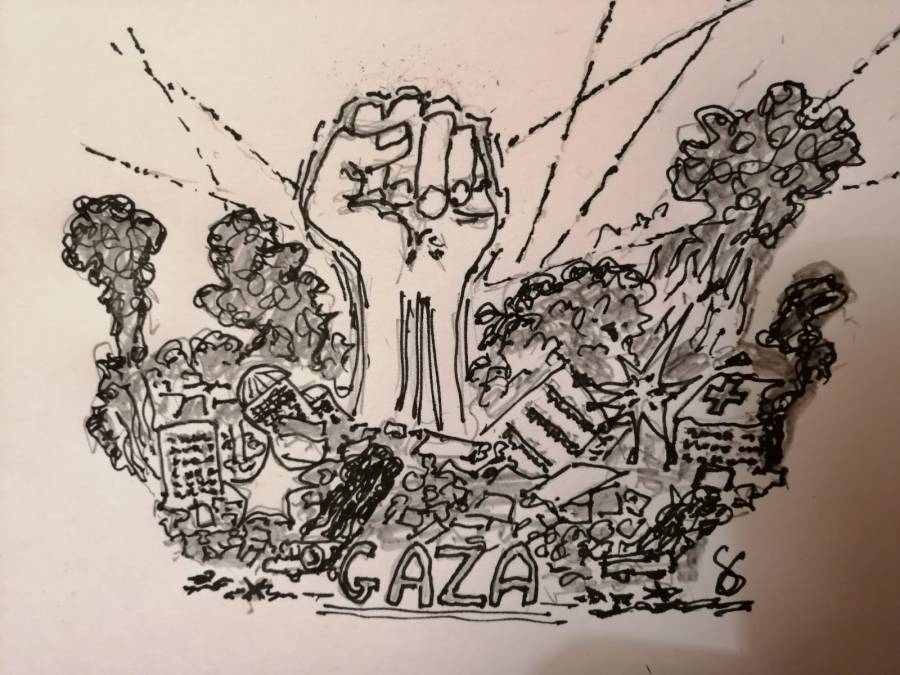
There’s a new Wailing Wall … THERE’S A NEW WAILING WALL; It’s in Gaza, and here mothers and fathers wail at the bloody bodies of their children; children wail at the bloody bodies of parents; all wail over the bodies of friends and neighbours; the wailing rises and the tears fall.
At this Wailing Wall … AT THIS WAILING WALL, we wail the mendacity of Israel and the West, we wail the complicity of the media in the West; while rockets, shells and bombs rained down upon us the lies fell faster and thicker than rain, a torrent of lies that never stopped. To surge in flood over the bodies of our slain.
You come now with your flag of peace … YOU COME NOW WITH YOUR FLAG OF PEACE tramping along the bloodstained road and up the mountain of our bones and the rubble of our homes and offer us business as before or – bombardment once more.
Now that the bombs have stopped … NOW THAT THE BOMBS HAVE STOPPED we too stop and look around us: our schools gutted and bloodstained, mosques and hospitals in ruins, so many of our buildings rubble, or with gaping shell-holes, in the hell-hole you have made of Gaza.
We had so little and you destroyed so much. WE HAD SO LITTLE AND YOU DESTROYED SO MUCH!
In the days to come, more will sicken and die, of wounds on flesh and wounds on soul, of lack of medicine, fuel or food as even in pause you take your toll.
Many are numb, some try to forget … MANY ARE NUMB, SOME TRY TO FORGET, some try to live without forgetting, but there is a begetting, for in many hearts too, your phosphorus flakes are snowing, the embers of hate are glowing, their machine guns and bombs are mowing you and your children for generations to come.
Against your Goliath … AGAINST YOUR GOLIATH, our slingshots were of no use; yes, God was with you – he’s no longer Hebrew or English – He’s American now; you shot us down like fish in the shooting barrel you made of Gaza.
You wish us to recognise you? YOU WISH US TO RECOGNISE YOU? Of course we recognise you – the imprint of your boots are upon our necks; we carry them from cradle to the grave.
But we will never agree to accept or agree that you should keep what you have stolen and plundered the land you have sundered or that you can make us second-class citizens in our own land.
While we struggle to endure … WHILE WE STRUGGLE TO ENDURE and to ensure that you never defeat us let it be that we do not learn to treat others as you now treat us.
What did you learn from your oppressors? WHAT DID YOU LEARN FROM YOUR OPPRESSORS? If all you learned was how to also do so much of what they did, then truly have the six million died in vain and you mock their memory by invoking them.
Diarmuid, Feabhra 2009
I began to write this just as the December 2008- January 2009 bombardment of Gaza by Israel was coming to an end and I rounded it off in February.
That was the one they called “Operation Cast Lead”, which killed over 1,400 Palestinians, mostly non-combatants, including 400 children and injured over 5,300 — again, mostly non-combatants.
I little thought that so few years later Israel would unleash an even worse bombardment upon the beleaguered Palestinians in Gaza, as it did in July 2014, during which it killed over 2,300, again mostly non-combatants and that time nearly 500 children.
The damage to infrastructure is colossal and the Israeli-Egyptian blockade makes significant repair impossible.
The commentary above was written in 2014. Apart from killing in raids, there were more massacres to come: March 2018, more than 700 Palestinian refugees killed at the borders of the Israeli state and in 2021, over 260 Palestinians killed after Zionist provocation at the Al Aqsa Mosque, in Jerusalem.
In August 2022, over 30 Palestinians, including women and children, killed in Israeli missile attacks and this year, by August, Israel had killed 172 Palestinians. Now, over October-November 2023, they have killed 133 Palestinians in the West Bank and over 9,000 in Gaza, including 3,760 children.
There is no question that this is genocide: “the deliberate killing of a large number of people from a particular nation or ethnic group with the aim of destroying that nation or group.”
“Any of the following acts committed with intent to destroy, in whole or in part, a national, ethnical, racial or religious group, as such:
Killing members of the group;
Causing serious bodily or mental harm to members of the group;
Deliberately inflicting on the group conditions of life calculated to bring about its physical destruction in whole or in part;
Imposing measures intended to prevent births within the group;
Forcibly transferring children of the group to another group.”
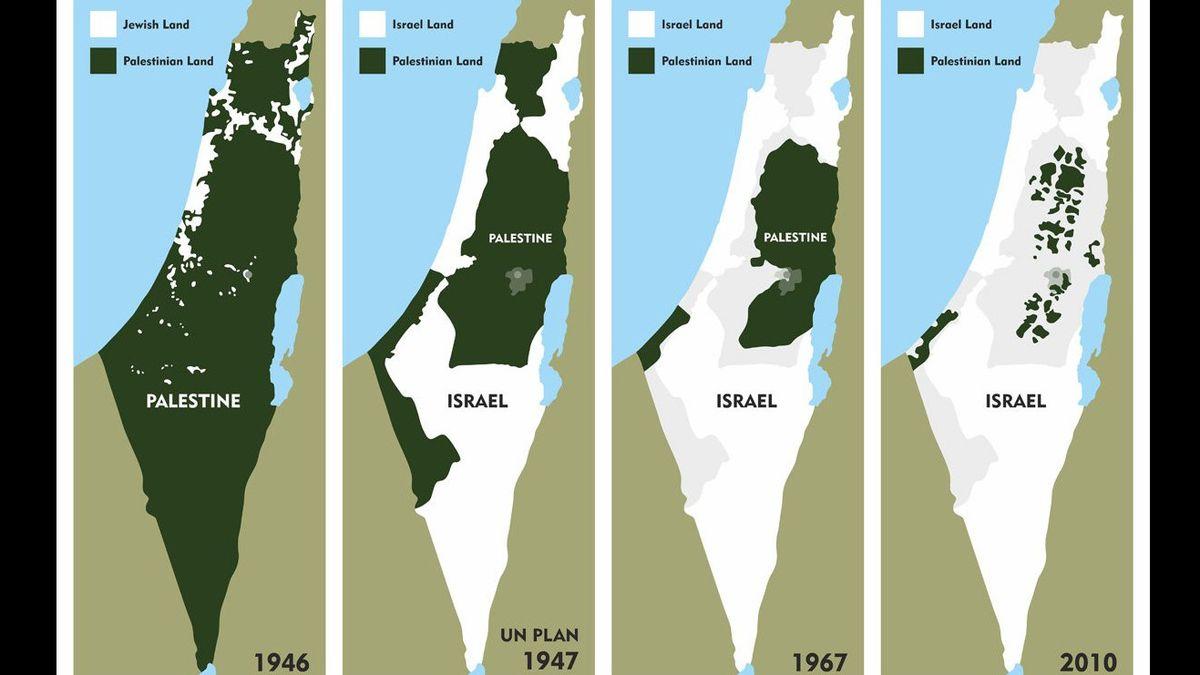
Nor did that genocide begin in October this year, nor last year, nor the year before. It began in 1948 with the creation of the state of Israel and has been continuing since.
We understand the pressure under which news media organisations are under and how easy it is to lapse into descriptions that have become common usage in the profession and so have issued this guide to greater accuracy.
Gaza Hell by Israeli bombing (Photo cred: Ahmed Zakot/SOPA Images/Sipa USA)
TERM IN COMMON MEDIA USE
Palestinian militant
OUR CORRECTION
Palestinian
TERM IN COMMON MEDIA USE
Hamas/ Palestinian terrorist
OUR CORRECTION
Hamas/ Palestinian freedom fighter
TERM IN COMMON MEDIA USE
Hamas rampage into Israel
OUR CORRECTION
Hamas breakthrough into Israeli-controlled territory
TERM IN COMMON MEDIA USE
Israel bombardment of Gaza in response to Hamas attack on October 7th
OUR CORRECTION
Israeli attack on Gaza in response to Palestinian response to 75 years of oppression, murders and massacres, including well over 200 Palestinians killed by August this year.3
TERM IN COMMON MEDIA USE
Palestinian attack on Israel
OUR CORRECTION
see above
TERM IN COMMON MEDIA USE
Israeli civilians
OUR CORRECTION
Israeli armed settlers, military reservists – and civilians
Most capitalist imperialist states around the world
TERM IN COMMON MEDIA USE
Israel’s right to defence
OUR CORRECTION
Right of the Zionists to occupy land, massacre and terrorise the inhabitants, treat them as third-class citizens and massacre and terrorise again if they resist.
TERM IN COMMON MEDIA USE
Palestinians were killed/ Hamas killed Israelis
OUR CORRECTION
Israel killed Palestinians/ Hamas killed Israelis
TERM IN COMMON MEDIA USE
Jewish state
OUR CORRECTION
Zionist state
TERM IN COMMON MEDIA USE
Illegally-occupied lands outside Israel
OUR CORRECTION
Part of unjustly-occupied whole of Palestine
TERM IN COMMON MEDIA USE
Contested attribution of bombing of Al-Ahli Hospital in Gaza
OUR CORRECTION
Israeli bombing of Al-Ahli Hospital in Gaza5 after telling hospitals to evacuate
TERM IN COMMON MEDIA USE
Uncertainty around accuracy of Palestinian casualty figures
OUR CORRECTION
Absolute accuracy of Palestinian casualty figures, accepted by a wide section of international organisations including bodies of the United Nations.
FOOTNOTES
1We’re aware that the term “war” often brings to mind the air forces, armies and navies of two states in conflict and that the Palestinians have neither air force nor navy and that their army is collectively composed of guerrilla groups. Nevertheless, for convenience and in the tradition of naming armed long conflicts of liberation “wars” we consider the term useable in this context.
2Hamas won the 2006 Palestinian Legislative Elections throughout the territory – not just in Gaza but also in the West Bank. Al Fatah did not accept the results and tried to stage an armed coup in Gaza and in a short and brutal struggle were defeated by Hamas which, however left the West Bank in more-or-less Fatah hands. The then-Fatah choice for President of the Palestinian Authority, Mahmoud Abbas, remained in power and has not authorised elections since. The PA has a huge number of security personnel (over 80,000) widely regarded as brutal, repressive and colluding with the Israeli regime against Palestinians.
3The massacres by Zionist militias forced 700,000 Palestinians out of Palestine in 1948 as the State of Israel was being founded. Since then, in regular raids, massacres and bombardments, Israel had killed an estimated 65,000 Palestinians just up to 2021, after which there have been a number of bombardments of Gaza and raids into the West Bank at intervals with thousands more deaths in total. The vast majority of those `Palestinian deaths have been and continue to be those of civilians, over half of women and children, the latter over one-third.
4At the end of June 2023, the Israel Prison Service (IPS) was holding 4,499 Palestinians in detention or in prison on what it defined “security” grounds. According to recent reports, since the attack on Gaza, that number has doubled.
Changes in the Palestinian territories and Israel.
Occasionally in the “debates” on the Arab world and Palestine in particular statements are made that “they want to destroy Israel” as a criticism or “Israel has the right to exist” as if it were a human being.
The Left abandoned any discussion on the issue following the Oslo Accord where the Palestine Liberation Organisation (PLO) surrendered and agreed to govern some Bantustans(1) in the name of peace.
The Palestinian “problem” was resolved through the half-measure of autonomy where the Palestinian Authority has less power than a small municipality anywhere in the world and the left replicated and took on as its own the right-liberal demand for Two States.
It is worth looking at the question of destroying Israel and its supposed right to exist. We should be clear though that no state has a right to exist. States exist because they exist, through force, popular support, or cunning and guile. States come and go.
In the 19th Century two states came into being, ten years apart, one being Italy through the struggles of Garibaldi and others and Germany, unified under Bismarck. These two states underwent various important changes in their nature, borders and ideological discourse on unity.
In the case of Italy (1861), the Papal States were reduced in size and a significant part of what we now call Italy belonged to Austria. It wasn’t until after the First World War that Italy came to have borders similar to what it now has and changed from a monarchy to a republic.
In the case of Germany, its borders waxed and waned throughout the 19th Century until unification under Bismarck in 1871. Later Hitler would expand them once again under the Third Reich or as it was officially called since 1871, the German Reich.
Following the Second World War, nobody argued that the Nazi state had a right to exist. It was partially dismantled. Poland recovered a part of its land, the Sudetenland, once again, became part of Checoslovakia, Austria recovered its independence.
The great racial nation of Germans was wiped off the face of the earth. The Allies divided the rest into four parts, with three of them becoming the Federal Republic of Germany in 1949 and the other the German Democratic Republic, until 1991 when they were united.
Other states such as the Austro-Hungarian and Ottoman empires also disappeared after the First World War.
These were not the only states to undergo dramatic change. There are more interesting examples from the anti-imperialist struggles. The Vietnamese guerrillas wiped off the face of the earth the reactionary (North American) state of South Vietnam.
The Algerian revolutionaries wiped off the face of the earth the French colonial department of Algeria and erected in its place the Republic of Algeria.
So, is the state of Israel immutable? Does it have a right to exist? Should that right be defended? It is easier to answer that question if we ask ourselves what defending that right means.
Israel’s existence is the theft of land, it is the Nakba, the displacement of 750,000 people in 1948. It is the invasion of the West Bank and Gaza in 1967. It is also the current genocide the modern-day Nazis are trying to carry out in Gaza.
Israeli destruction 31 October 2023 of Jabalia Refugee Camp, which was Gaza Strip’s largest of 8 camps. 150 were injured in this attack and 50 killed. (Photo cred: Anas al-Shareef/Reuters)
On that point, there are those who don’t propose to wipe Israel off the face of the earth, but rather to set up two states.
Amongst those who sometimes wave that flag is the USA and others who are more serious about it, such as Al Fatah, the dominant faction in what was the PLO, European liberals and the press.
There are also those who believe it is a pragmatic solution, but they are usually people who ignore the question of class as a factor in the Arab world.
Two states means acknowledging and accepting the invasion of 1948, the Nakba, the systematic theft, murder and torture. It also means not accepting the right of return of those displaced in 1948 i.e. to accept and reward the mass violation of the human rights of the Palestinian people.
It was worth recalling that the PLO and the various organisations that formed part of it were founded before the 1967 war, so propose two states is to propose the Zionist victory over the territory stolen in 1948.
It is to accept that if you commit mass human rights violations and crimes against humanity, the solution is to commit even more, so that some liberal or former leftist can come along and say we have to accept some degree of crime and blood.
So, what is the solution? It is not easy, though it is simple, at least conceptually. It is the historic Palestinian demand of One State. The Palestinians themselves proposed this from the word go, knowing that it brought up the problem of what to do with the Jews who had arrived.
One of the old factions of the PLO stated:
However, the DFLP had come to a premature recognition that as well as the Palestinian national question there was also a “Jewish question” which inevitably has to be resolved if one aims to reach a democratic solution to the conflict, emphasising that the resolution of the Jewish question was conditional on freeing itself from the zionist project and the necessary coexistence with the Palestinian Arabs on an equal footing under the slogan of a “Popular Democratic State” which would be built on the ruins of the State of Israel; but, how would this aim be achieved in the light of the overwhelming superiority of Israel and its firm commitment to North American Imperialism?
The answer is to be found in the “prolonged people’s war throughout the all Palestinian and Arab territories”.(2)
Such voices were, back then and continue to be, a minority, but what they say is true. Those millions of Arabs that have come out on to the streets to protest against the Zionist regime face various enemies, one of them being their own bourgeoisies, the Arab states that have betrayed the Palestinian people time and again.
However, a Pan-Arabist revolution is a far way off but not impossible. None of the Arab regimes are progressive and they exist because they repress their own people, their own working class. But what would happen to the Jews who lived in the new state?
Well, many of them, Netanyahu style Nazis would flee to the USA alongside the Yanks that have arrived in recent decades, those from Western Europe, and the Ukrainians, amongst others. Something similar happened with whites when the racist apartheid regime in Rhodesia was overthrown in 1979.
The white population fell from 240,000 to 28,000 now. In Algeria a million Pieds-Noirs fled. Others, those that descend from families that have been in the region for centuries will stay, others will have to negotiate their future in the new state.
But not an inch can be given on the right of return of ALL the Palestinians, not only to the country, but also to their farms, olive and lemon fields, their rural and urban houses in the whole country.
So, should Israel be wiped off the face of the earth? Of course it should, and a new Palestinian secular democratic state should be built on the ruins of Zionism and Apartheid. The Arab states and elites should also be wiped off the face of the earth.
Later the war criminals and those responsible for crimes against humanity will have to be tried. The Zionists rightly put the German Nazi Adolf Eichmann in the dock. It was an act of justice.
Now the Palestinians and the rest of us have to put Nethanyahu and the other criminals in the dock, perhaps with the same consequences.
Though whether they spend the rest of their miserable lives in prison or they go to the gallows may be up for discussion, what is beyond debate is whether they should be tried for crimes against humanity. They should be tried as such.
Long live Palestine Free and United!
Notes
(1) The Bantustans were segregated zones set aside for blacks in South Africa under Apartheid. They were supposedly independent from the regime but in reality had no autonomy. They were governed by black “leaders” that supported the regime, or at least were not very critical in the same way as the Palestinian Authority.
(2) F. Suleiman, (n/d), La Izquierda Palestina Revolucionaria: Tres décadas de exp eriencia de lucha (1969-1999), FDLP http://www.fdlpalestina.org/index.htm
Israel is justifying its bombardment of Gaza as the right to defend the state, effectively in the right to take revenge, with which the western states are in agreement.
Leaving aside the question of whether bombing homes, bakeries, markets and hospitals constitutes ‘defence’, what should we think about the right of a state to defend itself as a principle?
It seems natural that every state should have the right to defend itself; perhaps that right is extrapolated from the generally-agreed right of the individual to self-defence. In bourgeois law, the need to defend oneself can be a valid legal defence even against a murder charge.
The individual is generally understood to have the right of self-defence particularly in their home but also in public places. However, it is important to note that this right, even in bourgeois law, is not considered valid in every conceivable case.
For example, the right of one individual to use violence in their defence can be cancelled by the right of their victim to self-defence if the latter is being seriously harmed by the former, so that violence by the victim might be considered a reasonable response in their own self-defence.
People carrying out a robbery or kidnapping, to take another instance, are not considered to have the right to use violence if attacked in the course of the robbery by the victim or by security forces or even a passer-by.
Proceeding to the question of the rights of states to defence, we might say that the UK had the right to defend itself from Nazi attack during WWII and certainly so did the USSR, so too later with the rights of Vietnam, Laos and Cambodia from the USA’s invasions and bombings in the 1970s.
But did the Cambodian state have the right to defend itself from Vietnamese invasion when the Pol Pot regime was carrying out mass exterminations of sections of its population? Or the did the states of Nazi Germany and Fascist Italy have the right to defence against the Allied forces?
Continuing in consideration of the right of a state to defence, how does that go when the attack comes from within the territory of the state itself?
Most Irish and democratic people outside would probably deny that the English Crown had the right to defend itself against the Irish rebellions of the clans (1167-1690s) or of the United Irish republicans, or against the Fenian insurrections, the 1916 Rising and the War of Independence (1919-1921).
Similarly, most would deny the right of the English or French monarchies to defend themselves against the internal republican uprisings of 1649 and 1789, respectively.
When the “internal” force attacking is a nation, then national rights of self-determination counter and supersede the rights of the state to self-defence. The case of the United Irishmen has already been noted but slave colony Haiti and colonial Algeria against France could be listed there too.
ISRAEL
The Israeli State is a colonial regime sitting on the Palestinian people’s land. It is in addition a state which is deeply religiously sectarian on the basis of Judaeism, in a sense which is far more racial than it is religious and, in many cases, may have no religious aspect at all.
Aftermath of Israeli militia massacre of Palestinian village Deir Yassin (9th April 1948 – five weeks before the the founding of the Israeli state). After the massacre, the Zionists took over the village, and in 1980 the occupation established settlement units on top of the original buildings of the village, and gave the names of the “Argon”, “Etzel”, “Palmach” and “Haganah” murder gangs to places in it. 700,000 Palestinians were expelled or forced to flee the land. (Source photos: Internet)
Being able to claim Jewish descent is the qualification for Israeli citizenship, not religious practice or even belief. As for the Palestinians, whether Muslim or Christian, Arab or Berber, they are ‘other’, second-class or even third-class at best.
Third-class because the Ashkenazi Jewish colonists discriminate against other Jews too, for example the Ethiopian (because many are black), the Sephardic and Mizrahi (because they are not Ashkenazi). They will all speak Hebrew now but many additional languages are spoken too.
The Zionist trend in the Jewish world insisting that Jews had a right to a state of their own on a land of their own, even if some other people already lived there, was a minority trend among Jews until fairly recently, though it gained dominance in the West over years after the establishment of Israel.
Indeed there are sections of Jewish society that consider the creation of a Jewish state to be contrary to the teachings of the Torah. But as observed earlier, Zionism is not really about religion.
The establishment of the Zionist state was achieved at the price of the expulsion of 700,000 Palestinians, the imposition of racist and sectarian laws, apartheid, massacres,1 oppression of the Palestinians and repression of their resistance.
The story of the state of Israel in the land of Palestine until now can be characterised by two images: the murder of Palestinian people along with the expulsion of 700,000 Palestinians in 1948 as the Zionist state came into being – and the genocidal bombing of Gaza these three weeks.
As of some hours ago, over 7,000 Palestinians have been killed in the past three weeks – including nearly 3,000 children.
Medical staff in Gaza treating children and woman injured by Israeli bombing, uploaded 26 October. (Source image: Al Jazeera)
There are many ways to kill, including despair, lack of or obstruction to medical treatment or access to good water and food. But from 1948 to 2021 (i.e excluding the killings since then and this year’s), well over 20,000 Palestinian civilians have been directly killed by the Israeli state’s military and settlers.
To claim that “Israel has the right to defence” is to say that all those things are justified and must be defended, must be perpetuated, that we must be complicit in it and that the best we can do is to ask Israel to practice its racism, colonialism, oppression and repression somewhat more gently.
Israeli bombing wide-scale destruction of Gaza, October 2023 (Photo sourced: Internet)
Israel – which is to say the Zionist project — has absolutely no right to defence.
End.
FOOTNOTES
1When hostilities erupted in 1948, the villagers of Deir Yassin and those of the nearby Jewish village of Giv’at Shaul signed a pact, later approved at Haganah headquarters, to maintain their good relations, exchange information on movement of outsiders through village territory, and ensure the safety of vehicles from the village. The inhabitants of Deir Yassin upheld the agreement scrupulously, resisting infiltration by Arab irregulars. Though this was known to the Irgun and Lehi forces, they attacked the village on April 9, 1948. The assault was beaten off initially, with the attackers suffering 40 wounded. Only the intervention of a Palmach unit, using mortars,[20] allowed them to occupy the village. Houses were blown up with people inside and people shot: 107 villagers, including women and children, were killed. The survivors were loaded on trucks that were driven through Jerusalem in a victory parade,[19][21] with some sources describing further violence by Lehi soldiers.[22] Four Irgun or Lehi men were killed.[23] The incident became known as the Deir Yassin massacre.
On April 10, 1948, one day after the Deir Yassin massacre, Albert Einstein wrote a critical letter to the American Friends of Fighters for the Freedom of Israel (the U.S chapter of Lehi) refusing to assist them with aid or support to raise money for their cause in Palestine.[24][25] On December 2, 1948, many prominent American Jews signed and published an op-ed article in The New York Times critical of Menachem Begin and the massacre at Deir Yassin. (Wikipedia)
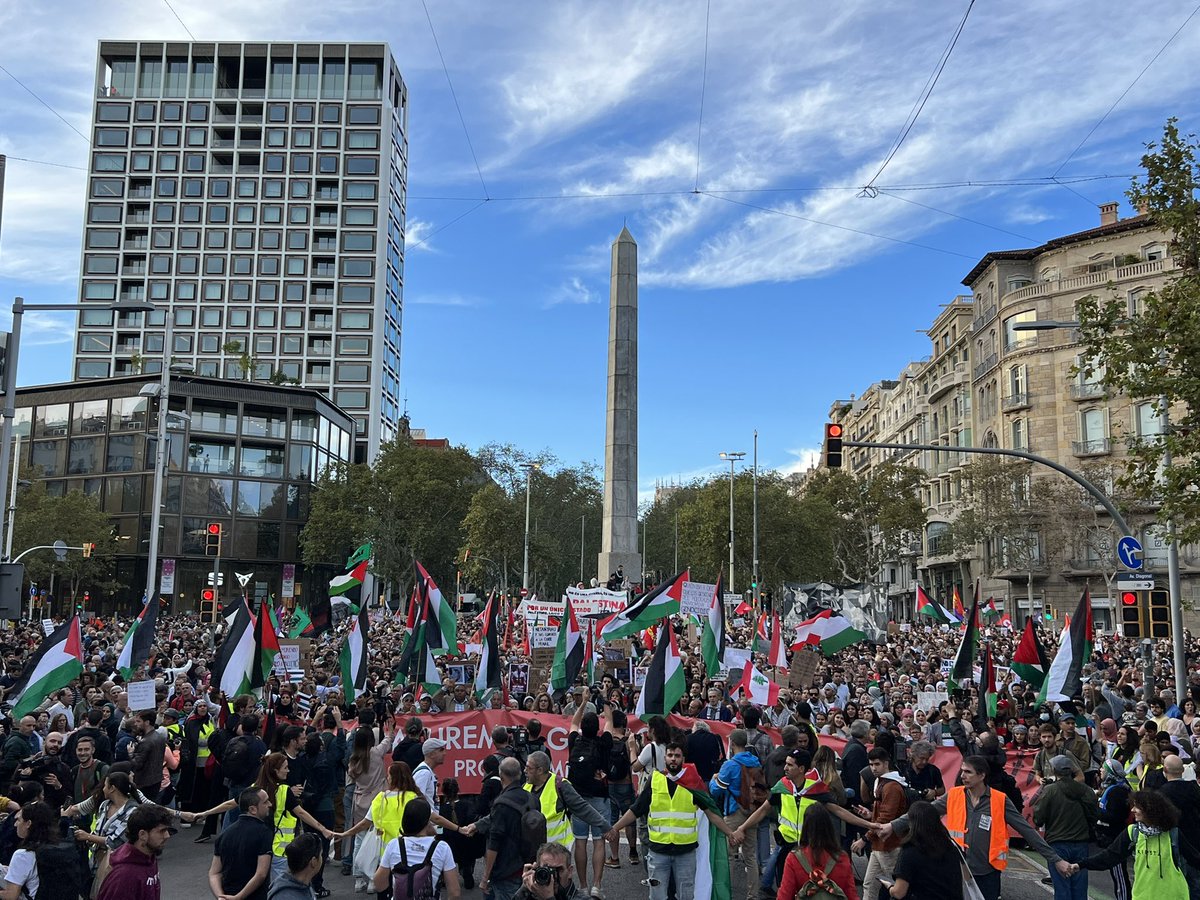
Thousands of people gathered this Saturday in Barcelona to defend the rights of the Palestinian people and to condemn the bombings and attacks by the State of Israel in the Gaza Strip.
The demonstration was sponsored by the Palestinian Community of Catalonia and the Prou Complicitat amb Israel (Enough of Complicity with Israel – trans.) coalition and supported by more than 100 entities and social movements in Catalonia.
The event began at six in the afternoon at the crossroads between Avinguda Diagonal and Passeig de Gràcia of the Catalan capital.
Demonstration in support of Palestine in Barcelona, October 21, 2023. — Lorena Sopêna / EUROPA PRESS
All organisations signed the manifesto “Let’s stop the genocide in Palestine. Stop the arms trade with Israel” with a clear desire to condemn the historical repression of the Palestinian people and calling on governments “to stop being complicit in this televised massacre.”
The participating entities declare what is being done is “not in our name.”
The call brought together a cross-section in attendance, from young people to seniors and entire families.
Shouting “Long live the Palestinian struggle” or “Israel murders, Europe sponsors”, the protesters proceeded to Plaça de Catalunya, waving Palestinian flags and posters with slogans in Catalan, Spanish, English and Arabic and images of the crimes committed in Gaza by the Israeli army.
Explanatory leaflets were also distributed directing use of correct terminology when talking about Palestine, encouraging protesters to change expressions such as “conflict between Israel and Palestine” to “Israeli colonisation of Palestine” or “IDF (Israel Defense Forces)” by “FOI (Israel Occupation Forces).
In this same vein, banners could be read expressing “if you are the occupying force, you are not defending yourself”, “Collective punishment is a war crime. Stop the genocide in Palestine” or “Apartheid was wrong in South Africa and is wrong in Palestine.”
EUROPE AND USA DENOUNCED
Given the latest visits by the President of the United States, Joe Biden, and of the European Commission, Ursula von der Leyen, to Israeli President Benjamin Netanyahu, the protesters also accused the European and American institutions of “complicity” and ” sponsorship of genocide.”
The manifesto signed by the more than 100 entities stated: “The EU continues to consider Israel, despite being an extremely racist and far-right government, as a strategic partner, and the United States provides $1 billion in military aid.”
The Spanish Government is not free from reproach either, since, as the manifesto describes, “they have authorised the export of weapons to Israel worth 137 million euros since 2000.”
Faced with the recent Israeli forces’ attacks on Gaza, protesters demanded that the Spanish Government and the EU force Israel to declare an immediate ceasefire and the establishment of humanitarian corridors.
They also called for the suspension of the arms trade and the sanctioning of Israel to end the “occupation, colonialism and apartheid of the Palestinian people” and to “allow the return of the eight million Palestinian refugees.”
(Photo sourced: Prou Complicitat amb Israel)
Finally, they also demanded that the Generalitat of Catalonia “stop considering Israel as a strategic region in the Agency for Business Competitiveness” and have required the breaking of the friendship association between Barcelona and Tel Aviv.
The current Mayor, Jaume Collboni, reinstated that relationship after taking office, overturning its suspension by the former mayor Ada Colau.
COMMENTby D.Breatnach
Despite the overall majority for Catalan independence in Catalonia, there are sharp divisions within the movement on how to proceed and respond to Spanish State repression and these differences find expression also in attitudes to the Israeli State.
In the Basque Country too there have been demonstrations in towns across the southern country (i.e in the Spanish state) by different organisations which have been very clear in their condemnation of the current Israeli bombing but also of the entire Zionist project and Israel’s history.
On the other hand, the only demonstration organised by the “officialistas” of EH Bildu and social democratic allies, which took place in Donosti/ San Sebastian on 20th September confined itself to calls for “peace”, “negotiation” and equal treatment by the Israeli state.
Publicity poster for Palestine solidarity and defending the right to resistance demonstration scheduled for Saturday 28th in Bilbao.
This sharp divergence in what might be called “the Palestinian solidarity movement” has been observed in other parts of Europe too, including Ireland as some elements seek not to stray too far from their state’s consensus while others are determined to break from it.
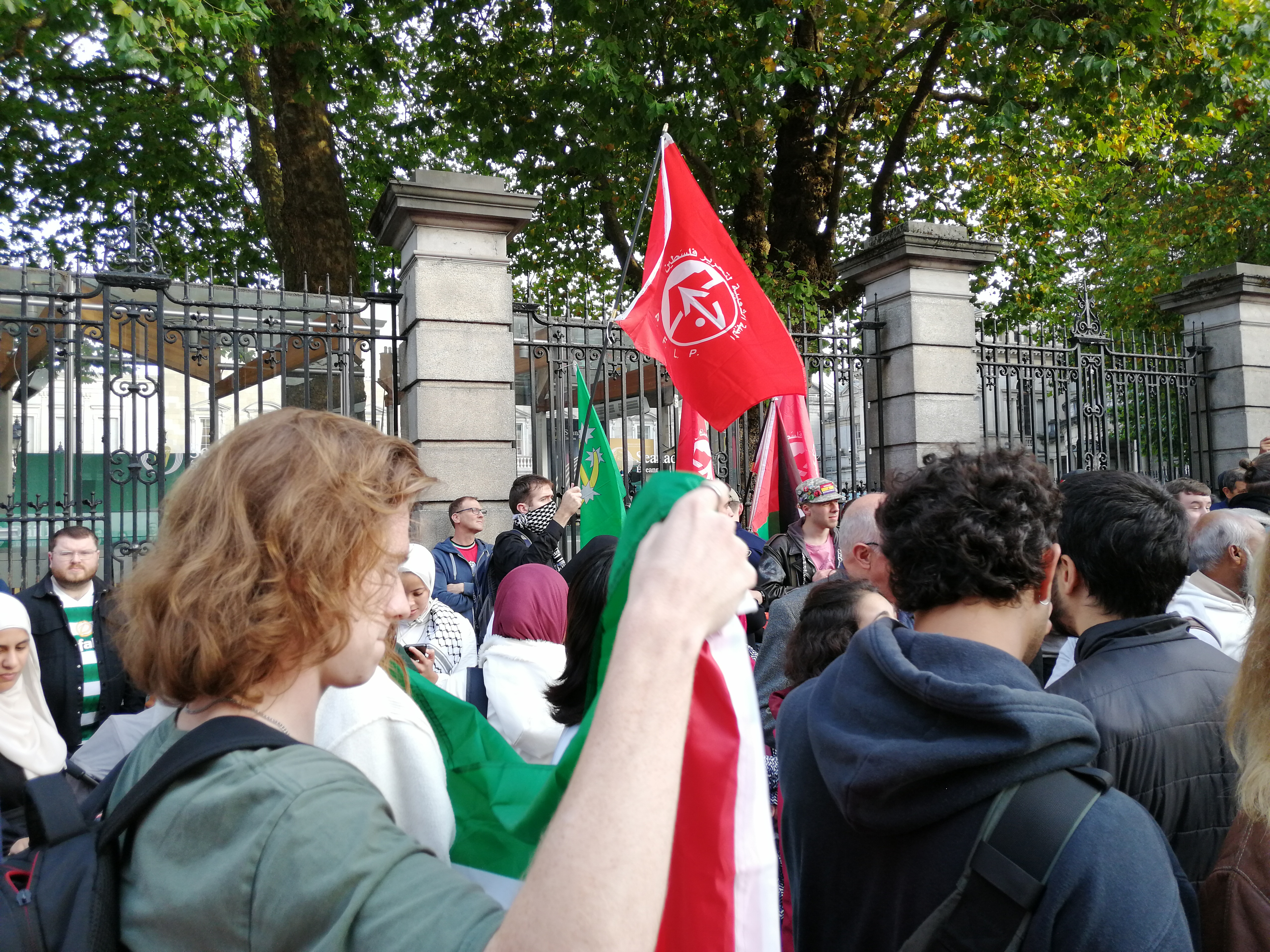
The roar of Palestinian solidarity slogans outside the Irish Parliament, Leinster House on Wednesday night must surely have reached the ears of the elected representatives as they debated a motion that “Israel has a right to defend itself”.
The motion is widely seen as part of a narrative, under the cover of self-defence, endorsing the Israeli State in its decades of racism, apartheid, genocide and war crimes and takes place during the Zionist state’s genocidal bombardment of Gaza.
Solidarity colours in the rain (Photo: D.Breatnach)
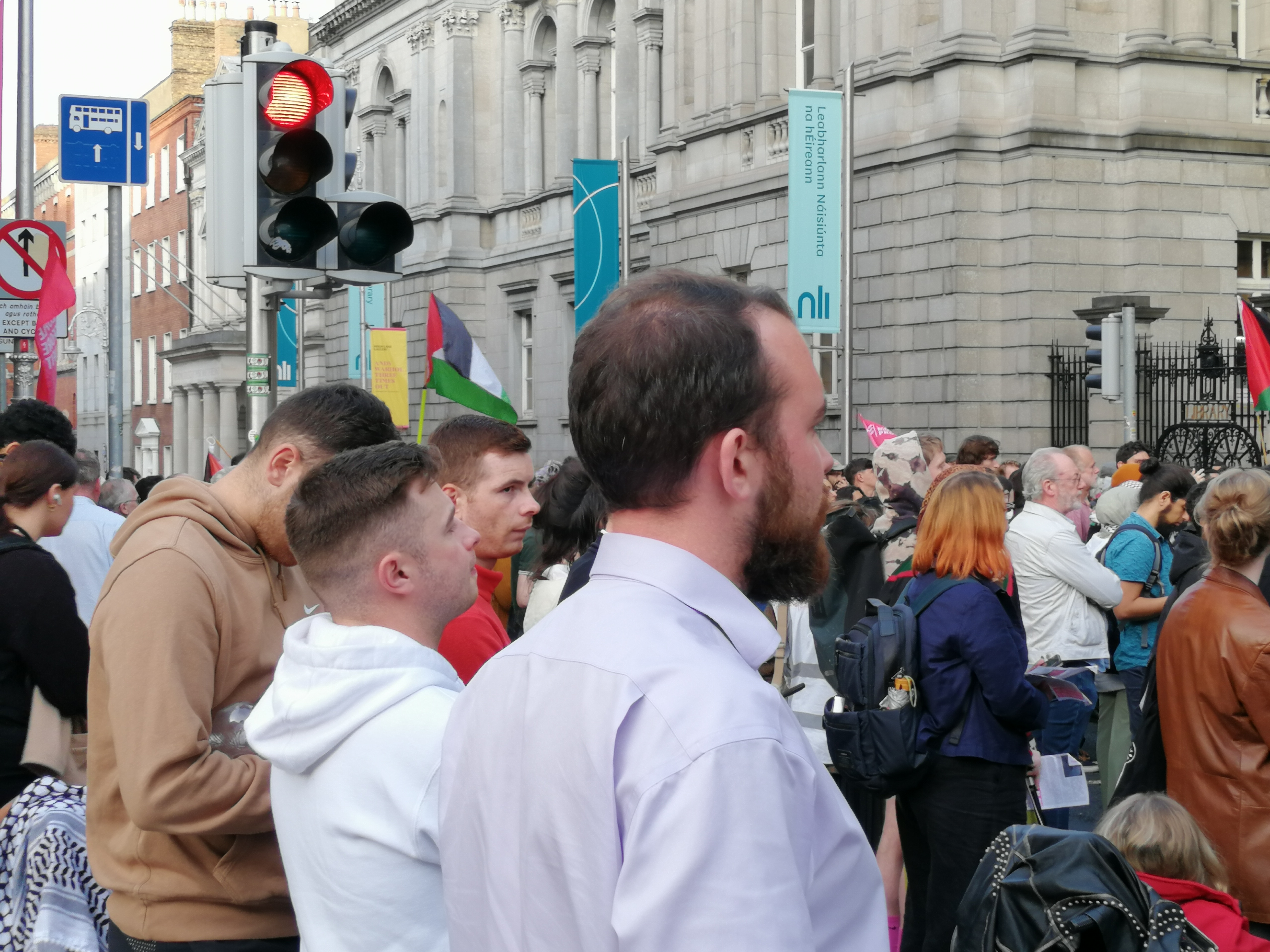
The rally, the third since last Saturday week1 organised by the Ireland Palestine Solidarity Campaign, attracted many hundreds willing to stand in persistent rain, listen to contributions from speakers and chant slogans, these led by voices in both Irish and Middle Eastern accents.
In fact, a strong trend increasing over recent years has been the presence of Palestinian voices at such rallies, both in speaking and in leading slogan chants, which the rally organisers have not hesitated to facilitate.
View late in the rally (Photo: D.Breatnach)
SLOGANS, SONG AND POEM
On Wednesday evening, some slogans were in Arabic also, such as I think “Tahya Filistina!” (long live Palestine) but sadly not the equivalent in Irish, such as “An Phalaistín abú!” or an alternative, for example: “Saoirse don Phalaistín!” However, one placard in Irish was present (see photos).
(Photo: D.Breatnach)
The slogans in English ran the usual range of call and answer: “Free, free – Palestine! From the river to the sea – Palestine will be free! One, two, three, four – occupation no more; five, six, seven, eight – Israel is a terrorist state! (I prefer “Israel is a fascist state!” myself).
In our thousands, in our millions – we are ALL Palestinians! Boycott — Israel! Irish Government – shame on you!
In 2009, as yet another Gaza bombardment came to an end, I had composed a poem I called The New Wailing Wall. On Wednesday I got it printed in a photocopying shop on my way to the event, by which time it was raining fairly heavily but I was glad to be permitted to read it out at the rally.2
A Palestinian woman sang in Arabic a “song of sadness”, i.e a lament the rhythm of which a lot of people got into, clapping in time. In Irish singing we often don’t like this, as it tends to drown out the words and the musical detail but it seemed to work well enough there.
Later she told me that she very rarely sings but felt she had to give voice to her feelings – and I know some of what she means.
Seen from behind, Palestinian woman singing a lament in Arabic at the rally (Photo: D.Breatnach)
MOTION DEBATED
Inside the home of the Irish Parliament,“the Dáil”3 a motion of support for the Zionist state proposed by the Government had run into problems even before Israel’s bombing of the hospital in Gaza, after which they intensified; the Government insists it will not condemn Israel to any degree.
It is likely that a majority-agreed motion amendment will pass but however will neither assert the right of the Palestinians to their land nor to resistance, nor to the return of refugees, much less condemn Zionism; it should be a cause of shame to all parties and individuals who support it.4
Section of the rally crowed after an hour (some had gone home) in front of the gates of Leinster House (Photo: D.Breatnach)
“Expel the Israeli Ambassador!”
In the street outside Leinster House, there were many calls for the expulsion of the Israeli Ambassador (Out! Out! Out!)
Truly that seems the most effective solidarity move of which we are capable currently.5 Sadly there seems no chance that the Government would even consider doing so.
Even among the Opposition, Sinn Féin these days looks unlikely to support such a move. This is so even though the party’s President, Mary Lou called for the expulsion of the Russian Ambassador in April last year6 and a decade ago, Gerry Adams, for the expulsion of the Israeli Ambassador.7
Some solidarity demonstrators as far back as Molesworth Street while most are in front of Leinster House (Photo: D.Breatnach)Rally supporters refuse to be squashed up on the pavements and spill over into the road. Once again the Gardaí have failed to close a road to avoid accidents and Dublin Bus has failed to instruct drivers to take alternate routes; the roof of a trapped bus may be seen in the far background. (Photo: D.Breatnach)
Colombia threatened to expel8 the Israeli Ambassador but the leaderships of the EU and the UK are securely tied to the war-chariot of the USA and there’s never any doubt about what the US wants, which is total support for its safe9 Middle Eastern foothold – Israel.
Colombia told the ambassador to behave himself or leave, after the Zionist publicly criticised Colombia’s President comparing the Israeli state’s discourse about and treatment of the Palestinians to that of the Nazis towards the Jews10 (but Israel is Colombia’s main weapons supplier).
A sentiment increasingly finding favour (Photo: D.Breatnach)
OUTLOOK FOR THE FUTURE
In the immediate future, the Zionist authorities have said they intend to invade Gaza to clear out “Hamas”, in which they will of course include all Palestinian armed resistance. Of course, solidarity demonstrations will continue or even intensify.
If Israel invades, it is difficult to imagine that the Palestinian guerrilla resistance movement, including Hamas, Islamic Jihad and PFLP11, will allow that without putting up a fierce struggle.
(Photo: D.Breatnach)
Israel has the tanks and planes but fighting on the ground in ruined urban landscapes, when every pile of rubble may hide a tunnel, a bomb or a rocket-launcher, is a different game.The 5-months-long Battle of Stalingrad comes to mind and an Al Jazeera contributor came to the same conclusion.12
Also, other elements such a Hizbollah may open up new fronts, in particular in the Golan Heights and Lebannon, as the PFLP has urged. Imperialism and complicit Arab regimes are extremely worried about a flame reaching their combustible possessions in the region.
Massive solidarity demonstrations marched through Yemen, Lebanon and Jordan and even the collaborator military regime in Egypt was obliged to open the Rafah crossing gates for humanitarian aid to reach Gaza (with which the Zionists and the US had to reluctantly agree).
Huge solidarity and protest demonstrations have also taken place in Athens, London and other European cities, while the French government banned any such demonstrations. Texas in the USA also saw a huge demonstration and 500 Israeli protesters were arrested demonstrating in Israel.
However the regimes have weathered such storms before and may do so this time again.
Possibly the West Bank will rise up too, although Al Fatah still has a lot of influence there, despite its discrediting by corruption, nepotism and signing the Oslo Accords and with its leadership deeply compromised as a result.13
The Palestinian Authority goons (there are 80,000 of them) fired on demonstrations demanding action in solidarity with Gaza, and in Jenin killed a 12-year-old girl and seriously wounded a first-year university student. 14
The military command of Al Fatah told collaborator Abbas to step down15 but their objective is still the discredited and impossible two-state “solution”.
The 2-State idea was bad in 1993 but …
… even worse in 2019 (Source image: Carnegie Council)
This “solution”, which the US and the rest of the Western states support, proposed to give the Palestinians less than 40% of their territory, the worst and least-watered, chopped into sections with narrow corridors through the Israeli lands and always under the guns of Israel.16
A Palestinian state would have neither true environmental, population, political nor civil control. Never a good choice instead of a secular state of Palestine for all, even this colonial option is clearly unworkable, sabotaged by the Zionists themselves with their settlements dotted all over it.
It is shameful to even propose it as any kind of solution.17
In the longer term, Israel’s consolidation of partnerships with a number of Arab states may have been harmed by the Zionists’ savagery and racist discourse towards the Palestinians but how deeply is difficult to predict.
Whether the Palestinian resistance and particularly Hamas is strengthened or weakened in the eyes of the Palestinian mass likewise remains to be seen.
The mostly imperialist western states of Europe and America show no sign of weakening their allegiance to the world imperialist leader, the USA and therefore, once they get over their weak criticisms of Israel’s genocide, will continue to support the Zionist state into the future.
Like many other problems on this Earth, workable solutions depend on changing some fundamental features in the world order.
end.
A historical reference to the Balfour Declaration of the Imperial Conference of British Empire leaders in 1926 giving European Jews rights to the British Mandate territory of Palestine, where approximately 10% of the population were Middle Eastern Jews at the time, the rest being Palestinian Muslims and Christians. (Photo: D.Breatnach)The rally, though thinning, is still ongoing behind photographer after perhaps two hours. Gardaí have FINALLY closed Kildare Street and a Dublin Bus has managed to turn around and exit. This has been the pattern in a number of Palestine solidarity rallies so far, when the Gardaí must have known the attendance would be large and the street should be closed for safety and traveler convenience sake. (Photo: D.Breatnach)
FOOTNOTES
1Another, last Monday week, had been organised by the Irish Anti-War Movement (effectively the People Before Profit political party).
3That is its name but there are those who refuse to call it that, saying that only an all-Ireland parliament deserves that title, such as the one founded during the War of Independence 1919-1921.
8It was reported that Colombia HAD expelled him and that was repeated at the rally but according to reports from there reaching now, he was only threatened with expulsion if he didn’t shut up.
9Probably the only state in the Middle East, because of its colonialist nature, that is safe from either national liberation uprising or Muslim fundamentalist revolution.
10This is a parallel so obvious that it occurs to a great many people across the globe but it is one that the Israeli authorities rejects and which it condemns as “anti-semitic” with the backing of many different authorities in the West.
17And the history of the Zionist colonisers shows that even with that, they would be forever pushing further, grabbing more land, killing more Palestinians in flare-ups (think the history of the European colonisation of the indigenous Americans in what is now the USA).
Dublin city centre saw the second rally in one week in solidarity with Palestine on Wednesday evening. Unlike Monday’s outside Leinster House, this one was on the central pedestrian reservation on Dublin’s main O’Connell Street.
Thursday’s was organised by the Ireland Palestine Solidarity Campaign whereas Monday’s, outside the home of the Irish State’s parliament, had been organised by the Irish Anti-War Movement (more or less really the People Before Profit party).1
(Photo: D.Breatnach)
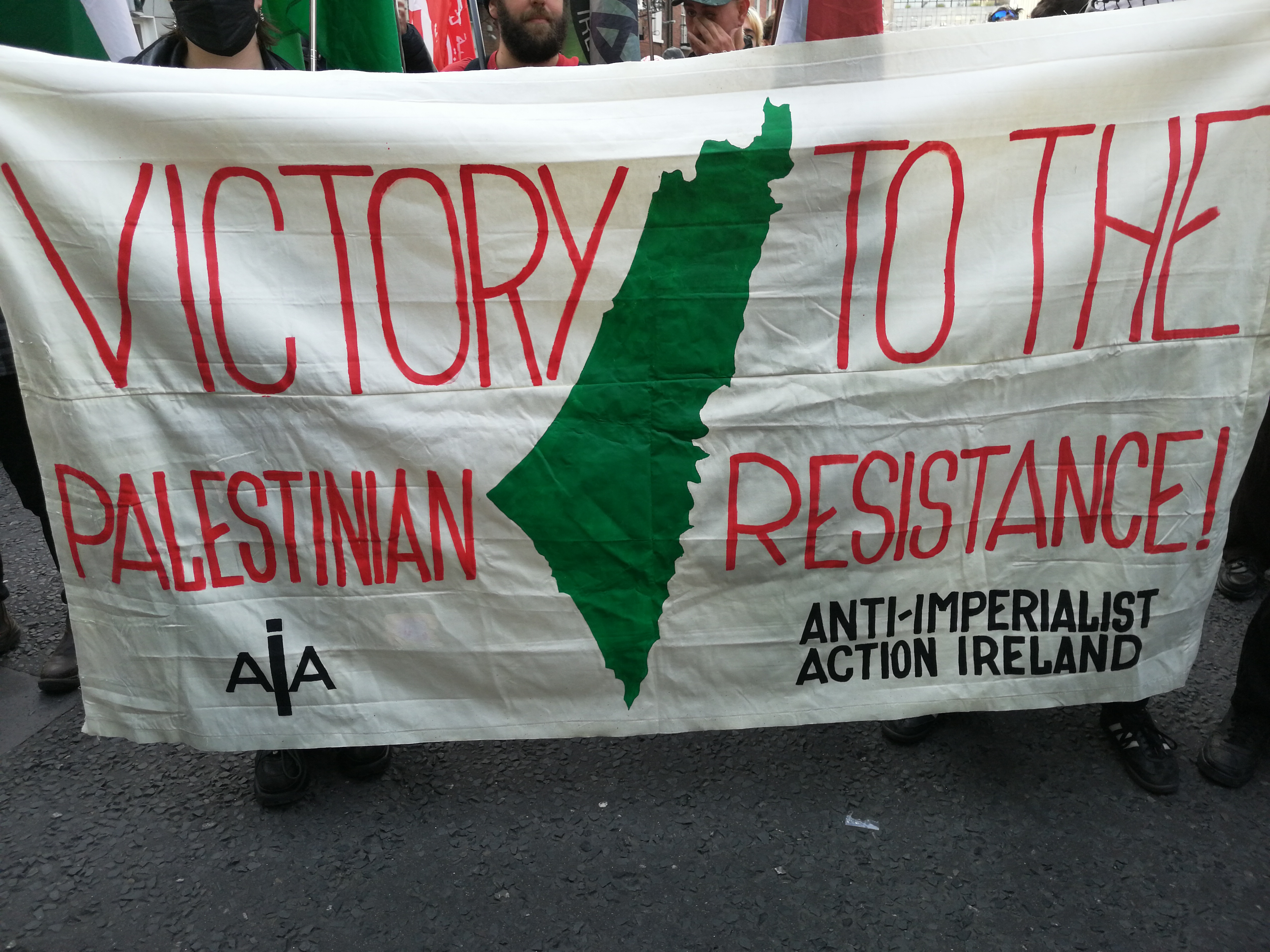
After Monday’s rally, a substantial number had spontaneously marched to the Israeli Embassy where an Anti-Imperialist Action supporter had painted their door in red to symbolise blood before Gardaí knocked him to the ground and kept him lying handcuffed before arresting him.
The crowd had objected to this treatment whereupon the Garda attacked and arrested more demonstrators. The AIA supporter was later charged with “criminal damage” which is ironic considering the criminal and murderous damage by Zionist bombs and missiles on Gaza.
A rather blurry view of section of the rally from the west side. (Photo: D.Breatnach)
BOMBING GAZA
For the sixth consecutive day Israeli air strikes are pounding the Gaza Strip, Israel on Thursday boasting it has dropped 6,000 bombs weighing 4,000 tonnes on Gaza during the period, according to Palestinian sources killing more than 1,400 people and destroying huge amounts of housing.
At least 140 of those Palestinians killed are children.
There’s nowhere safe in Gaza (Photo cred: Edel Hana/ AP)
This is the fifth siege and bombing of Gaza by Israel in the last 15years, each time destroying what the Palestinians rebuild or patch and repair, such as their sewage treatment plant. Palestinian casualties overall during the period have been 6,407 Palestinians as against 308 Israelis.2
One siege lasted 51 days! Factories and apartment blocks, flower and vegetable production glasshouses and sewage treatment plants have all been destroyed and the coastal waters are polluted, while the Israeli Navy attacks fishing boats that dare go further out to sea.
Gaza was already a severely-deprived area occupied by 2.2 millions with 59% below the poverty level, 46% unemployment but youth unemployment at 63%. Since Hamas won the elections the Israeli state permits no-one to leave or enter Gaza except by special arrangement.
One of the most advanced military states in the world is attacking a people that has no navy, no airforce, no anti-aircraft defences and no standing army. The Zionists say they will soon send in a ground attack also, tanks grinding over the rubble to kill and maim more Palestinians.
Imagine you went into Sousi Mosque to pray for your family and neighbours to be kept safe, or just because the Israelis wouldn’t bomb it, would they? This is what’s left of it now. (Photo cred: Mahmoud Hams/ AFP)
Meanwhile the Zionist state is permitting no water, electricity, fuel, food, medicine, building materials or equipment to enter Gaza through the gate they control and, shamefully, the Egyptian regime in step with the Zionists is doing the same at the other gate, which the Arab state controls.
War crimes? We hear a lot about them in the war in Ukraine, right? The Israeli state is committing them daily now and has been doing so yearly, often monthly since 1948. But the USA backs Israel and so the western states do so too, supporting the war criminals and complicit in their crimes.
The IPSC rally was advertised for 5.30pm but people had begun to gather a half hour earlier, with more continuing to arrive until after 6pm. From physical appearance it seemed that people from the Middle East, presumably Palestinian, at least equalled those Irish present.
Rally supporters very tightly packed and before Gardaí move patrol cars in keeping them hemmed in (Photo: D.Breatnach)Gardaí beginning to move patrol cars in to keep rally packed in the central reservation (Palestine supporters also visible to left of photo, i.e on eastern pavement. (Photo: D.Breatnach)Gardaí place patrol car to keep the Palestine supporters (or this particular section?) off the road. (Photo: D.Breatnach)
The chanting of solidarity slogans was almost continuous, with short breaks for speakers, most of whom were introduced as Palestinians. These were the usual chants but often led in non-Irish as well as native accents: From the river to the sea – Palestine will be free!
Also: In our hundreds, in our millions – we are all Palestinians! One, two, three, four – occupation no more! Five, six, seven, eight – Israel is a terrorist state! But there were also new ones from a section: Long live the Resistance! And: Only one solution – intifada revolution!
(Photo: D.Breatnach)
That was taken up by many whereas Saoirse don Phailistín! And: You’ve got tanks, we’ve got hang-gliders – glory to the freedom fighters! were chanted by a small section. Four Palestinians were briefly heard trying without success to get the Alah’ akbar!3 chant going.
From Irish backgrounds, Senator Frances Black, Richard Boyd Barret TD, Chris Andrews TD and Cnlr. Daithí Doolan spoke. Senator Black sponsored the Occupied Territories Bill4 which was approved by all sides of the Oireachtas but held back by the Government from becoming law.
Richard Boyd Barret of PBP spoke with passion as he usually does and was applauded. Some of his observations, though more liberal than socialist, unequivocally however put the blame on the Israeli state and castigated also the western states’ support of the Zionists.
(Photo: D.Breatnach)
Many of the Palestinian speakers were very complimentary to the Irish people present at the rally but also to the Irish population overall for their generally supportive attitude towards the Palestinians and their struggle.
Andrews and Doolan are both prominent members of the Sinn Féin party and, as a result of their President’s recent condemnation of Hamas (a change in position for the party), came in for some heckling.
They may be genuinely supportive of the Palestinian resistance as individuals but if they tolerate their party’s leader lining up with the Zionists and imperialists in condemnation of the resistance of the oppressed, they must accept the criticism thrown at them.
(Photo: D.Breatnach)
THEY SAID
The leaders of Sinn Féin and of the DUP both separately and recently claimed that the pacification negotiations in Ireland can be used to assist in resolving the conflict in Palestine.5
Really? It was precisely following a similar road that led to the corruption and fall from position of Palestinian leadership of Al Fatah and Yasser Arafat, eruption of the Second Intifada and the generally secular-voting Palestinians electing Muslim fundamentalist Hamas in 2007.
(Photo: D.Breatnach)
On Thursday the Prime Minister of the Irish State said that Israel was inflicting collective punishment on Gaza by cutting off water and electricity but no mention of the bombing, which he seemed to endorse.
Collective punishment is a war crime in international law so what is Varadkar saying the Irish Government will do? Demand action by the EU and UN? Expel the Israeli Ambassador? Demand sanctions against Israel? No – request a humanitarian corridor for food and medicine.
Photo taken from west side, with LUAS tram rails showing and northward bus stopped at traffic lights. (Photo: D.Breatnach)
At the rally there was generally little denunciation of the Irish Government.
From Palestinians possibly because they felt they were guests in the country but one would have expected much harder criticism by the native speakers of the Government’s condemnation of the Palestinian resistance.
View of section from western side (Photo: D.Breatnach)
INTO THE STREET, ON TO THE BRIDGE
Over a thousand Palestine supporters were mostly crammed into a short section of the central pedestrian reservation on O’Connell Street, boxed in by police vehicles and the northward and southward traffic lanes on one side and the LUAS tram line on the other.
Rally participants have taken the initiative to relieve the crush in the central section by moving on to the road (Photo: D.Breatnach)
There was also an overspill on to the western and eastern pavements but at an initiative from within the crowd, demonstrators spilled from the east pavement and the central reservation on to the southward traffic lane, bringing traffic to a halt there.
After some time, one of the IPSC’s leaders approached the demonstrators in the road and asked them to allow the trapped cars and buses to continue southward, with which request the demonstrators complied – but the police had made this a dangerous exercise.
With the rally supporters now in the road, southbound traffic is unable to go forward and also unable to turn back. Senior IPSC activist (in green T-shirt) may be contemplating how he get the traffic through for awhile. (Photo: D.Breatnach)
A Garda patrol car was parked in the road next to the central reservation, obliging buses moving southward to manoeuvre around it, bringing them very close to the thickly-crowded eastern pavement. Some shouts of “Move the cop car!” were ignored by the Gardaí.
When the trapped vehicles worked their way past the rally, the supporters returned to the road, remaining there until the conclusion of the rally. Clearly the road should have been closed earlier and traffic diverted but the authorities prefer to have people complain about protesters.
With the road temporarily cleared willingly by Palestine supporters, the trapped traffic can move forward. But the placing of the Garda patrol car obliges the driver to swing over to their left bringing the bus dangerously close to the crowded eastern pavement, instead of staying in the middle of the street. (Photo: D.Breatnach)
Subsequently that evening, by which time the rally had been continuing for getting near to three hours, many of the attendance followed a banner of the Anti-Imperialist Action group to occupy O’Connell Bridge for a period and light flares there, after which they dispersed.
This is the southbound lane, so no traffic will approaching the rally on the road from this side. So why all those Gardaí there? Perhaps intending to prevent an impromptu southward march, perhaps to the Israeli Embassy (as occurred on Monday). In any case, they did not managed a march to O’Connell Bridge to occupy that traffic junction for a while. (Photo: D.Breatnach)
Rallies in solidarity with Palestine have been held and new ones are being organised across Ireland, including Belfast, Cork, Derry, Galway, Limerick, Naas, Sligo and the IPSC has called another one for this Saturday for Dublin 1pm in O’Connell Street.
The people in Ireland will continue to express their solidarity with Palestine but the main political parties and Government …!
End.
“The root of violence is oppression”. (Photo: D.Breatnach)
4 The bill would ban any goods or services produced, even partially, in the territories occupied by Israel after 1967 and ruled ‘illegal’ by the UN —including the Golan Heights.
5Presumably she means the process that her party embraced which entailed colluding with a colonial occupying power, a sectarian armed colonial gendarmerie and aspiring to manage a neo-colonial, neo-liberal state.
As smoke rose over the homes and shops of Gaza, an unseasonal October brought sunshine on to the streets of Dublin city centre and the crowds with Palestinian flags outside Leinster House, the home of the parliament of the Irish State.
As the sound of explosions, wailing of ambulances and of people rang around the streets of Gaza, the call-and-answer of solidarity rang out in Kildare Street: In our hundreds, in our millions – We are all Palestinians! From the river to the sea – Palestine will be free!
The Dublin rally was one of a number of Palestine solidarity events organised in Ireland after the unprecedented attack on Israel by Hamas’ military wing, the Al Qassam Brigades on Saturday and the Zionist State’s bombardment of civilian structures and people in Gaza.
Small section of the rally (Photo: D.Breatnach)
The Zionist State, which also controls Palestine’s water supply to Gaza, as well as exit from and entry to the enclave, has cut off water and electrical power as well as barred entry to everything including food, medicine and heating gas.
The Dublin rally was called at very short notice by the Irish Anti-War Movement (IAWM), a broad front organisation formed by the People Before Profit party around 2003 to oppose the imperialist war against Iraq waged by the Coalition of states led by the USA.1
Section of the solidarity rally earlier (Photo: D.Breatnach)
A branch of the Student’s Union of Ireland also supported the rally, which had a high percentage of Middle Eastern people present, presumably mostly Palestinians. The flags in evidence were mostly national Palestinian, some of the PFLP,2 a couple of Starry Ploughs and one Tricolour.3
Speakers from the Palestinian community, IAWM and PBP condemned the decades of attacks by the Israeli state on the Palestinians in general and on those in the Gaza enclave in particular, going back to the expulsion of 700,000 Palestinians4 as the Zionist state was founded in 1948.
Starry Plough flag can be seen centre distance next to some PLPF flags (Photo: D.Breatnach)
Richard Boyd-Barret TD (PBP) spoke as did also Ibrahim Halawa from Dublin, who was a prisoner of the Egyptian regime for four years without trial. Halawa said that awareness-raising and education served the ignorant but that action is required from those who know the real situation.
Some of the orators spoke about the right to resistance of the Palestinians, some about being against killing and war (but blaming the Zionist state for causing it), some about the plight of the Palestinian civilians, particularly in Gaza and one referred to the thousands of political prisoners.
Woman carries home-made giant placard spray-painted “Victory to the Palestinians!” (Photo: D.Breatnach)
MIND THE LANGUAGE!
A number of speakers referred to the “International Community” and when one listens to them in context it becomes clear that this imagined “community” is one of capitalism and imperialism.
It is not the community of workers, much less the community of people struggling for freedom. In Ireland, the overwhelming majority of people have over decades seen through the Zionist propaganda and switched from being pro-Israeli State to being pro-Palestinian.
We should take more care with the words we use lest we reinforce capitalist-imperialist dominance in the world of concepts in addition to their dominance over the physical world. Another trap is the term “illegal” and Boyd-Barret used it in reference to Russia’s invasion of eastern Ukraine.
Banner seen at the rally (Photo: D.Breatnach)
Who makes the international laws by which something is ‘legal’ or ‘illegal’? It is of course the imperialists who do so on the international scale while the capitalists define legality within their states; by their standards the actions of Israeli Zionism are lawful but of Palestinians, illegal.
All the speeches and all the slogans chanted were in English, as were the words on banners. I participated in some Irish conversation near where I was standing but saw only one placard in Irish. The fact that this is normal is part of the problem in this neo-colonial state.
A lone placard in the Irish language seeks “Freedom for Gaza” (Photo: D.Breatnach)
Eoghan Ó Ceannabháin, from an Irish speaking-family from Connemara and himself an Irish speaker, also spoke in English as he introduced the song he was about to sing, in the same language as the lyrics of Patrick Galvin’s Where Is Our James Connolly?
Eoghan is a PBP supporter and a fine singer, particularly in sean-nós5 style and has an amazing range. It was good to hear references to James Connolly at such a rally, something that all too rarely happens, nor is the flag of his Irish Citizen’s Army often seen at internationalist events either.6
CONDEMNATION IN COLLUSION, CONFUSION AND ILLUSION
The imperialist states that united in condemnation of the attack by the Izz ad-Din al-Qassam Brigades, Hamas’ military wing, were joined by leaders of neo-colonial states such as the Irish one. Naturally also by parties competing to lead the neo-colonial Executive, such as Sinn Féin.
Media reports noted Mary Lou Mac Donald’s condemnation of Hamas as a change in Sinn Féin policy7. Indeed it is such a change but is generally in line also with the party’s trajectory of presenting itself as a safe pair of hands for management of the neo-colonial state.
Sinn Fein President Mary Lou McDonald and Micheál Martin, leader of Fianna Fáil and currently Tánaiste. (Images sourced: Internet)
Mícheál Martin, Tánaiste (Vice-Premier), who earlier had condemned Hamas, stated that the Government’s position is to support the “two state solution”, more correctly “the two-state illusion” and this, if not already SF’s position on Palestine will no doubt soon be so.
This is the position of all the imperialist and capitalist states, also of social-democratic and liberal groups. It is worth taking a minute to look at this “solution” which in the first place was totally undesirable and which since conceived has been undermined by the Zionists themselves by their colonial expansion.
If it could even be implemented now it would leave the Palestinians with in reality a colonial-type Bantustan-status client of the Israeli Zionist state8, owning less than 40% of their land area and most of their good land and water taken by Zionist settlers.
In addition, their territory would be fragmented, linked by “corridors” through areas of Israeli dominance. In any case, as of 2021, in a poll by the Palestinian Centre for Policy and Survey Research most Palestinians were against the two-state solution.9
Since this is not in the least a practicable solution, why does Mícheál Martin and Joe Biden, among many others10 keep saying it’s their preferred solution?
Biden, because it allows US imperialism to pretend that it supports some kind of solution other than total Zionist appropriation and expansion. Mr. Martin? For the same reason or just because his Gombeen class follows the world imperialism leader’s lead.
The only real solution, i.e the only one both just and capable of bringing peace, is the one that we hardly ever see or hear even mentioned: a secular republic with equal citizenship for all, return of refugees and reparations to the dispossessed Palestinians.
(Photo: D.Breatnach)
The Zionists will not accept the loss of their Zionist empire; US imperialism (and other imperialisms) won’t accept the loss of their only safe strategic foothold in the Middle East – free from the dangers of either Islamic fundamentalist or national liberationist revolution.
US imperialism, now sending an aircraft carrier against the Palestinian people who have neither air force nor navy, is the main financial and political prop supporting the Zionist state. But whatever they thought, I heard no speaker in Dublin call for the necessary defeat of US imperialism.
end.
Scene earlier of the rally as people keep arriving (Photo: D.Breatnach)
FOOTNOTES
1The IAWM seems to have no permanent existence but can be revived in order to organise events such as today’s from time to time. There is nothing wrong with a party creating a broad front on a specific issue but when it is a front of the Party rather than a people’s front, it will of course suffer when the party’s activists, limited in number, are organising on other issues and cannot keep the ‘broad front’ going, much less expand it.
2The Popular Front for the Liberation of Palestine, a secular socialist organisation fighting for Palestinian national liberation; it has consistently been the 2nd-largest of the groups comprising the Palestine Liberation Organisation.
3The Starry Plough was the flag of the Irish Citizen Army, the first workers’ army in the world and usually signifies socialist Irish republicanism. The Plough painted in gold follows the shape of the Ursa Mayor constellation on a green background, the seven stars in white or silver. Another version appeared in the 1930s, the Ursa Mayor shape in white stars on a light blue background.
Obviously people carry Palestinian flags to show solidarity with Palestine but would it not be useful to carry Irish flags at such an event to demonstrate the solidarity of the Irish movements for national liberation and social progress with the corresponding movements in Palestine?
4That figure represented over half the pre-WWII Arab population (Muslim and Christian) of Palestine.
5Literally “old-style”, a traditional style of singing with ornamentation having a number of regional variations, nearly always unaccompanied and solo-voiced.
6James Connolly was a Scottish-Irish socialist revolutionary, writer, journalist, trade union organiser and historian, one of the Seven Signatories of the 1916 Proclamation, Dublin Commandant in the 1916 Rising, one of the 16 executed by British firing squads. He was a co-founder of the Irish Citizen Army to defend the strikers and locked-out workers in 1913 from vicious police attacks, the first workers’ army in the world, which also recruited women, some of whom were officers. The ICA fought alongside other progressive organisations in the Rising.
7And one which cut across the quoted posts of a number of the party’s TDs, including those of Chris Andrews (see Irish Times report in Sources).
8A real irony since Israel is a kind of colony, a state founded by Zionist settlers with imperial support.
Diarmuid Breatnach – previously published in the Pensive Quill
(Reading time main text: 6 mins.)
At the end of last month, in Johannesburg, South Africa, over 76 residents perished in a fire sweeping through one of a number of “illegal” buildings, home to some of the city’s poor who are desperate for somewhere to live.
How is this possible we may ask. Didn’t the South African people win their struggle after many years of sacrifice? Didn’t Mandela and the ANC lead them to victory in 1994?
The huge South African majority people fought a long and hard struggle against the domination and exploitation of a European settler minority and institutional racism. But they also fought against capitalist exploitation and imperialist plunder of their rich natural resources.
Some of the results of the Sharpeville Massacre, 1960 after South African police opened fire without warning at unarmed black people protesting the pass (apartheid) laws. In total, 69 people were killed and more than 180 people were injured, mostly shot in the back as they fled the violence. A later report would state over 700 bullets had been fired, all by police. (Photo sourced: Internet)
Despite the riches of those natural resources in gems, precious metals and minerals,1 most non-white Africans2 in South Africa lived in abject poverty with poor health care, scarce or non-existent infrastructures and services, including education and training.
In the decades leading up to the fall of the formal apartheid system, that struggle was led by the ‘triple alliance’ of the (banned) African National Congress,3 the National Union of Mineworkers (of S.A.) and the (banned) Communist Party of South Africa.
Township in South African photographed in 2018, over 20 years after enfranchisement and ANC government (Photo credit: Andrea Lindner/ Getty Images)
Their struggles defeated the apartheid system and in April 1994 all residents of South Africa were enfranchised. National elections brought 1990, was elected President of the country.
Yet shortly after that great change, it was noted that the living standards of the mass of people were even lower than before, that the settler capitalists continued to reap their profits and that imperialism had actually intensified their penetration of the South African economy.5
Today approximately 55.5 percent (30.3 million people) of the S.A population is living in poverty at the national upper poverty line (~ZAR 992) while a total of 13.8 million people (25 percent) are experiencing food poverty. Municipal services to the huge ‘townships’ are unreliable at best.
Almost one in every three of work-available people is unemployed and only 95% of the population have basic literacy, which means that one in 20 doesn’t have it.
It is in that context that we can begin to understand hundreds of people living in an “illegal” building without even a fire escape, obliged to take the risk of such accommodation, in a land that continues to be rich in great wealth which however, never comes near the mass of people.
PACIFICATION PROCESSES
In the 1990s a number of people began to promote processes to resolve a number of long-ongoing conflicts around the world, mostly where imperialism or colonial settlers were oppressing the people of a country. The promoters called them “peace processes”.
Palestine was the first of those in which a “peace process” was introduced and South Africa was next in 1994, followed by Ireland in 1998. As it took root in one country, former resistance activists went from there to other conflicts to encourage people there to embrace the process too.
In fact the progress of this process seemed like the US imperialist ‘dominoes’ theory, only in reverse: rather than ‘communism’ in one country influencing people in another to go the same way, capitulation in one country was used to infect the next.
Palestinian and South African delegates attended Sinn Féin congresses to promote their ‘peace process’ to the party’s membership; subsequently SF delegates in turn joined South African ones in selling the process to the Basque national liberation movement.6
Arnaldo Otegi (centre photo) foremost of the Basque movement’s ‘official leadership’ and EH Bildu party in 2019 – the banner behind asks for “one further step” in Castilian (Spanish) and “yes” in Euskera (Basque). (Photo cred: EFE)
Some movements declined to imbibe the process wine but those that drank it found their movements split, their leaderships increasingly accommodated to their people’s exploiters and nowhere at all were any of the movement’s principal objectives achieved.
Except, that is, in South Africa, where at least the people were enfranchised. But the right to vote is intended to help shape the polity for improvement and that has not happened in South Africa. The ANC, NUM and CPSA of the ‘triple alliance’ have become part of the system instead.
THE OPPOSITION BECAME THE SYSTEM’S GUARDIANS
Western imperialism recognised the vulnerability and isolation of the minority settler regime, convincing its leadership to concede mass enfranchisement rather than suffer revolution. And in order to prevent the mass going ‘too far’, they brought the resistance leaders into the deal.
Bishop Tutu7 once remarked that “The ANC stopped the gravy train just long enough to get on it”, which angered his friend, Nelson Mandela. But when forty striking miners were murdered by police of the ANC Government with NUM collusion in 2012, Mandela did not condemn them.
The kopje or hillock at Marikana, near the Lonmin mine, South Africa, where the striking miners were massacred by police of the ANC government in 2012. Over a decade later, plans for a memorial park have still not borne fruit. (Photo sourced: Internet)
This corruption did not grow overnight. Jacob Zuma,8 while President of the ANC, has been formally accused of rape, indicted a number of times and eventually convicted of financial corruption. Winnie, Mandela’s ex-wife led a clique accused of political corruption and murder.
Cyril Ramaphosa, now President, was a millionaire even during the apartheid regime while General Secretary of the National Union of Mineworkers and, because the striking mineworkers in 2012 were rejecting the NUM as corrupt, is widely believed to have organised the massacre.
There should have been many signs of this corruption in the ANC prior to entering government – and there were.
The ANC ran concentration camps notably in Angola, Zambia, Tanzania and Uganda where they punished and even killed “dissidents”.9 And in South Africa perhaps they had their own ‘Steak Knife’10 to organise “Pirelli necklacing”11 for alleged informers.
Mandela knew about the camps and the “necklacing” but did not condemn them, possibly out of mistaken solidarity or ‘the greater good’ theory, as acted upon by some of the solidarity movement abroad.
Ronnie Kasrills, a senior member of the Communist Party of SA and formerly on the ANC’s National Executive Council, who now criticises the pacification process, claims they were concentrating on the political process and took their eye off the economic one.
And no doubt many at home and abroad thought all this could be sorted out once the domination of the white settler regime was broken and African majority had the vote. But political plants grown in contaminated soil do not grow healthy fruit.
And so we come to 76 or more poverty-stricken dead and well over a hundred injured by fire in a building owned by the City, which is run by a black South-African administration that doesn’t care, in a state run by a corrupt black South African government in partnership with the settler class.
Plastic-shrouded bodies of some of the 76 fatal victims of the fire in the housing block in Johannesburg, South Africa. (Photo cred: Jerome Delay/AP )
Armed resistance campaigns, uprisings and revolutions kill but they have in their favour that they are striving for a better world. Pacification processes kill without any chance of achieving a substantial improvement.
Pacification processes murder dreams but kill physically too: in massacres and avoidable disasters but also by overwork, ill-health, work injury, despair, substance abuse, suicide, and the many ways in which the capitalist-imperialist system causes misery wherever it lives.
End.
FOOTNOTES
1South Africa holds the world’s largest reported reserves of gold, platinum group metals, chrome ore and manganese ore, and the second-largest reserves of zirconium, vanadium and titanium. In 2021, South Africa’s diamond production amounted to 9.7 million carats, an increase on the previous year’s 8.5 million carats. The country ranked fifth among the world’s largest diamond producers by volume.
2The racialcategories introduced by the Apartheid regime remain ingrained in South African society with South Africans officially continuing to classify themselves, and each other, as belonging to one of the four defined race groups (Blacks, Whites, Coloureds and Indians).
3Banned by the South African settler government from 1960 until early 1990; now a mass party in government.
4The ANC is still in government at the time of writing, without a break since 1994.
5See The Shock Doctrine – the rise of disaster capitalism by Naomi Klein (2007).
6Palestine faded as a promoter of the pacification process since it had failed spectacularly there, its mass rejection resulting in the resistance upsurge of the Second Intifada followed by the fall of Al Fatah and the Palestinian Authority from their leadership position and the huge turn to the Islamist Hamas by a society generally voting along political rather than religious lines.
The Spanish ruling class was interested only in crushing the Basque resistance and made little attempt to sweeten the surrender of the leadership (Arnaldo Otegi and company) who nevertheless capitulated. Other areas where the process landed or attempted to do so were Colombia, Sri Lanka, Turkey (Kurdish national liberation movement), India, Phillipines (both latter agrarian movements). Only in Colombia was it adopted by both the rulers and the resistance and proved a disaster for the latter.
7A Christian bishop and campaigner for most of his life against the rule of the settler minority.
8South African politician who served as the fourth President of South Africa from 2009 to 2018. Zuma was a former anti-apartheid activist, member of the ANC’s military wing Umkhonto we Sizwe, and president of the ANC from 2007 to 2017.
10MI5 codename for senior Provisional IRA member Freddie Scappaticci who led the guerrilla organisation’s internal security department, which tortured and executed alleged informers.
11A car tyre, doused in flammable fuel, was placed over the terrified victim while still alive and set alight, often in front of a crowd.