From FB page of Dublin Basque Solidarity Committee
SPANISH STATE APPOINTS POLICE OFFICER CONVICTED OF TORTURE TO UNITED NATIONS COMMITTEE FOR THE PREVENTION OF TORTURE.
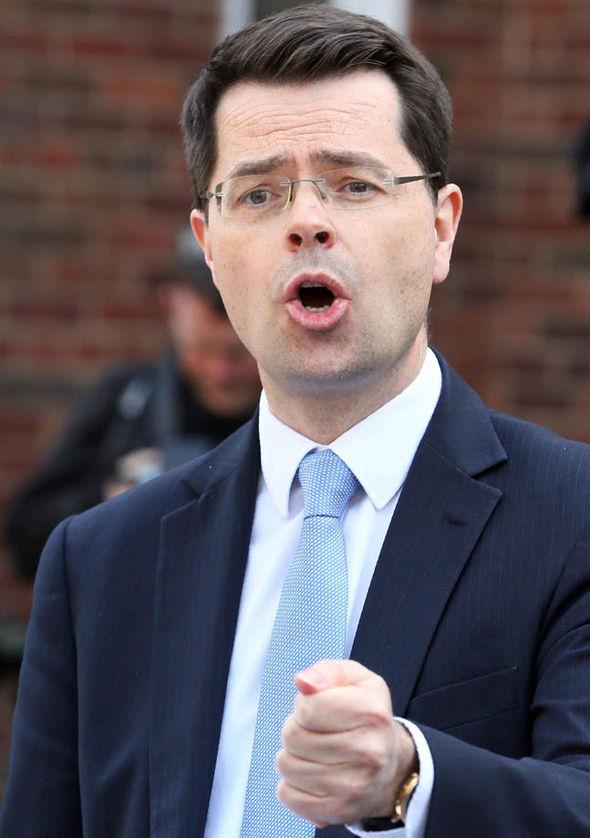
Convicted Guardia Civil torturer of prisoner, Jose Maria De las Cuevas Carretero, appointed by the Spanish State to the UN Committee for the Prevention of Torture. (Photo sourced from Gara newspaper)
No-one could accuse the Spanish authorities of failing to appreciate irony.
In 1997, in one of the rare cases of the Spanish authorities charging a police officer with torture and even rarer of conviction, Captain (then a Sergeant) José María De las Cuevas Carretero, along with fellow Guardia Civil officers Manuel Sánchez Corbi and Antonio Lozano García were found guilty of torturing Basque ETA suspect Kepa Urra when they detained him in 1992. A further three police accused were found not guilty but the medical evidence on Mr. Urra’s admission to hospital six hours after his arrest made it impossible for the Bizkaya court not to find his captorsguilty. Despite the police officers’ denials, the three were found guilty of having taken Mr. Urra to a deserted spot after this arrest and there, while he was handcuffed, to have beaten him with a blunt object and dragged him along the ground. They were sentenced to four years in prison and barred for six years from public office (a common accompaniment to prison sentence in the Spanish State).
However, one year later the Spanish Supreme Tribunal reduced the prison sentence of each to one year which meant they were free to go but with the public office disqualification still in force. The following year, they were pardoned by the Spanish Minister of Justice of the incoming PP Government of Aznar and Mr.De las Cuevas Carretero carried on with his police career, rising to the rank of Captain and participating in fora of the State and internationally.
Mr. De las Cuevas Carretero, who is a qualified lawyer, has been lecturing of the treatment of prisoners and about corruption. And who could say that he is not eminently qualified to lecture on those subjects? Or to represent the Spanish State authorities on those issues?
(News and photo source: Gara, also some background Internet research)
While eastbound drivers in Thomas Street on Friday 3rd March gawped, traffic slowed in the westbound lane to allow az small procession pushing a gallows, trundling along on wheels. There were surprisingly few witty comments, even the notoriously quick Dubliners too surprised to come up with a witty bon mot (or even a focal maith).
Diarmuid Breatnach outside St. Catherine’s Church, Thomas Street. (Photo: /////)
The procession stopped at the Robert Emmet plaque, in the railing wall of the former Protestant St. Catherine’s Church, approximate place of execution of Robert Emmet on 20th December 1803.
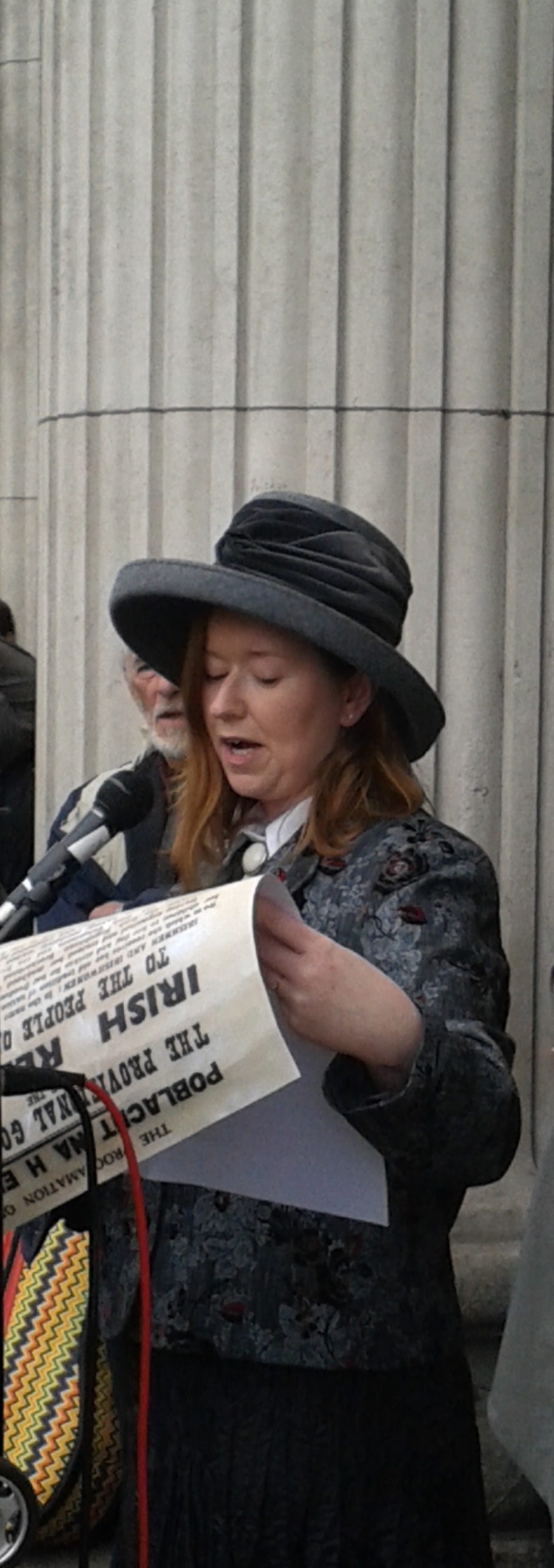
Elayne Harrington, aka Temperamental MiscElaynous performing her piece outside St. Catherine’s Church, Thomas Street. (Photo: D.Breatnach)
Despite continuous rain a small crowd had gathered on the pavement in front of the monument and the gallows, with a small platform less than a foot high, was placed facing them. Dublin artist Elayne Harrington, also known as the well-established street poet/ rapper artist from Finglas, Temperamental MiscElayneous, stood on the platform to announce that the event was to honour Robert Emmet and was a project as part of the Liberties Street Project, a continuation of the IPIP (In Public In Particular) program at the National College of Art and Design, Thomas Street, Dublin 8.
Harrington thanked people for attending despite the weather and, after outlining the program for the event, announced Diarmuid Breatnach, who took up position with the gallows and hanging noose just behind him.
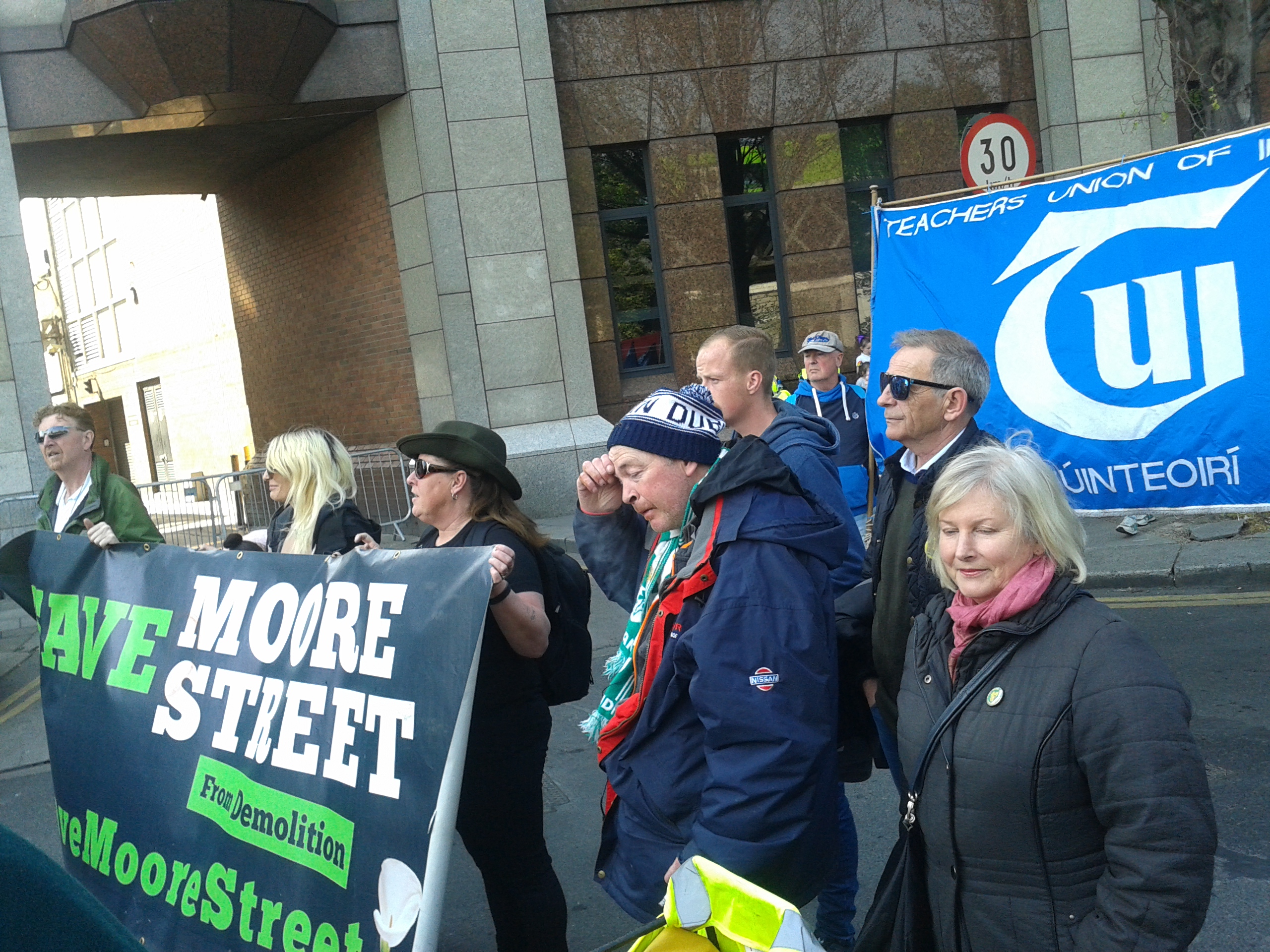
Breatnach is best known as a co-founder of the Save Moore Street From Demolition campaign, maintaining a campaign table with a petition and leaflets on the market street for a few hours every Saturday but is also known as an acapella singer, particularly in Dublin traditional-folk circles.
Section of the crowd at the event outside St. Catherine’s Church, Thomas Street. (Photo: D.Breatnach)
After thanking MiscElayneous for the invitation and the crowd for attendance, Breatnach proceeded to reiterate that the event was taking place very near the spot where, at the age of 25, Robert Emmet had been hung and then decapitated by the British colonial administration in 1803.
Harrington reminded him to stand on the low platform which Breatnach did, drawing a laugh from the crowd when he indicated the hanging noose and commented: “Me Ma always said I’d end up like this.”
Breatnach asked the audience to imagine the scene of the execution in 1803 and referred them to a painting of the scene available on the Internet, showing a huge crowd, with people looking out of windows in nearby buildings and mounted redcoats keeping the crowd back from the gallows. Many of in the crowd would have been supporters but the better-known would not have been there – they were in jail or in hiding.
The execution was carried out there, Breatnach said, because the whole Thomas Street and Liberties was known as a revolutionary area, which Breatnach went on to describe (see video below).
Elayne Harrington, aka Temperamental MiscElaynous performing her piece outside Stl Catherine’s Church, Thomas Street. (Photo: D.Breatnach)
Executions, said Breatnach, have been carried out down through the ages on Irish people resisting invasion, colonialism and imperialism and fighting for social justice. The gallows have become an enduring image in Irish history and a number of songs (Breatnach mentioned ten from the 19th century up to the present) refer to it.
The state we have now, said Breatnach, set up in 1922, preferred shooting, which was the method by which it eliminated its opponents at the time, 81 of them in official executions. Hanging remained however in this state but the last execution was in 1954.
Breatnach stated that we are often taught history as a dead subject, something in the past to which we are largely unrelated but he believed history to be a living thing, in the stones of walls and streets, in the air and in the words people have left us. And in our songs.
Breatnach selected three songs that mentioned Robert Emmet: The Three Flowers, written early last Century by Norman G. Reddin (two verses); Bold Robert Emmet perhaps by Tom Maguire around 1916 but certainly published in 1934; and Anne Devlin in recent decades by Pete St. John. Breatnach sang the three songs one after the other with MiscElayneous accompanying on her bodhrán.
Diarmuid Breatnach outside St. Catherine’s Church, Thomas Street, talking about the radical revolutionary history of the area. (Photo: ////)
During the applause which greeted the end of Breatnach’s performance, Elayne Harrington replaced him on the stage, thanked him and introduced herself as Temperamental Miscellaneous and spoke about her contribution, which was to be an extract of Emmet’s famous speech from the dock in the Green Street Courthouse, but re-worked into more modern Dublin idiom. Harrington then launched into a spirited rendition of her piece (see video below for the full performance).
No matter what words I utter, it’ll fail to change your mind and I wouldn’t have it any other way. You’ve made me a bed and I’ll lie in it. ………….
There’s plenty I could tell why my reputation should be kept clean from the utter lies and slander which’ve been lashed upon it. ……………
I wouldn’t dream that I could impress upon a court as trapped in its own self and corrupted, a fair impression of my character. …………………….
If merely dying was the case, after being deemed in the wrong and you in the right I’d take it on the chin and I wouldn’t breathe a word but that same law that not only wants to get rid of me also aims at filthying my name and sullying the memory of me. ……………..
In the hope that my memory won’t fade and that it might retain its honour among my brothers and sisters, I’ll stand up for myself and my integrity and weaken those charges against me. ……………
…. our cloths are entwined, mine and the martyred heroes of the gallows and battlefield, consecrated by sacrifice … for protection and guardianship of their homestead and their righteousness. ………..
This is what I hope: for my memory and name to serve those who live on by it being a source of empowerment …. witness the malignant malicious government that gains its false riches through sin alone, that treats a people as wolves to be domesticated and blooded to the taste of their fellows, to dance to their tune and to the death knell ……………..
Concluding the event, Harrington thanked the attendance and invited them to place small pots of growing flowers she had provided in front of the monument, which they did.
Stablising the scaffold outside St. Catherine’s Church, Thomas Street. (Photo: D.Breatnach)
WHY THE EVENT?
What had led Elayne Harrington to choose this act as part of her course?
“I was interested in Robert Emmet and his uprising ever since I heard a Dublin tour guide dismiss Robert Emmet while briefly mentioning his uprising”, explained the rapper from Finglas.
“I came to think that although Emmet failed in his objective, he had attempted a brave and good thing and his speech was really impressive. His uprising attempt took place in the area where my college is and he was executed just down the road, so that’s how I came to think of this event.
“I’m thankful to my course tutor and fellow students for supporting me in this act and to another tutor who helped me with the construction of the gallows. I am grateful to Diarmuid Breatnach also, who has been very supportive and contributed to the performance and I was really glad that my Da was able to be here and help today too.”
Why did Harrington call this “the first of the verbal execution series”?
“I see this as an event that can be brought to other places – like the gallows I built, it is transportable” she says with a grin but then turns serious. “The performances can be adapted also to other occasions of which Irish history is full.”
We’ll be watching this space!
Elayne Harrington and section of audience outside St. Catherine’s Church, Thomas Street, looking eastward (in the direction of Dublin Castle, ten minute’s walk away). (Photo: D.Breatnach)
Yes we do – or at least most of us do. There are a few who do not.
Some people think that those few who do not want change are our rulers, the big capitalists — but they are mistaken. The capitalist class forced change to overthrow the feudal system, which was hampering their growth and the development of industry and commerce. And capitalists know that change is inevitable, so it is better to go with it than to try to stop it. That is why they set up courses such as those called “Change Management” — if change is inevitable, then manage it, the thinking goes. Manage it so that it comes out to capitalist advantage, naturally.
(Source Internet, using “change management” as search words)
Change Management courses, particularly those dealing with personnel, emphasise managing change as smoothly as possible, making it non-traumatic. In that way, it is assumed, there will be less reaction against the change, less opposition.
But in fact, sometimes capitalism wants the exact opposite – it wants change to be as traumatic as possible. These are the situations described under the title “Shock Doctrine” by economic/ environmental activist and theorist Naomi Klein (2007). This has two mechanisms: in the first, the shocking change taking place disarms people from the psychological ability to organise resistance; in the second, the speed of the shock (or shocks) of the economic and political manoeuvres of the capitalists moves faster than the opposition can organise, achieving their goals before opposition can coordinate an effective resistance.
Klein has described how huge natural disasters such as earthquake (Haiti), tsunami (Thailand, Indonesia) and flood (New Orleans, USA) are used to force foreign or native private takeovers of sectors of the national economy while the people and the regime in power are reeling under the impact of the disaster.
Political and economic disasters are also used in this model, such as the military coup in Chile and the collapse of the USSR (in the case of Poland), the economic collapse in Bolivia, the invasion of Iraq, the financial collapse of the “Tiger economies” of SE Asia. Even a potentially beneficial change of great magnitude may be used, such as the collapse of white minority rule in South Africa, during which the black majority won formal equality and citizenship but lost control of most of the economy (and lost a lot more which I do not intend to discuss here).
There is in fact a military precursor to this which has been called, in the context of US military strategy, “Shock and Awe”. This doctrine was described by its authors, Harlan K. Ullman and James P. Wade (1996), as “attempting to impose this overwhelming level of Shock and Awe against an adversary on an immediate or sufficiently timely basis to paralyze its will to carry on … [to] seize control of the environment and paralyze or so overload an adversary’s perceptions and understanding of events that the enemy would be incapable of resistance at the tactical and strategic levels”.
Of course there were many elements of this in the Blitzkrieg of the Nazi German army in its invasions of other countries and even the medieval invasions by the Huns and of the Mongols. Cromwell employed elements of it in Ireland in his army’s massacres at Wexford and Drogheda.
Aside from needing change to overcome feudalism, managing change to its advantage and use of shock doctrine to facilitate changes it wants, the capitalist system itself promotes change as part of its system. Small capitalists combine and form conglomerates, in which big capitalists come to power and, in turn, eat up smaller capitalists in order to dominate their sphere of economic activity. We have seen the growth of supermarkets and the decline of small shops, the rise of chain stores killing independent clothes shops, chain cafes and eateries driving indpendent cafes and restaurants out of business.
Capitalists also promote inventions and discoveries so as to increase their wealth but also in order to stay in front of the competition – a capitalist concern that stays at its original level will be taken over or driven out of business by its competitors. Our grandparents hardly knew about the possibility of mobile phones and computers, let alone small hand-held audio-visual connections to the Internet; our children today play with visual electronic games, films and music before they learn to talk. To be sure, monopolies also suppress inventions but they can only do so to an extent as some capitalist somewhere will break the embargo or consensus (if the discovery can be used to make sufficient profits making the attempt worth the risk).
OK, but we want change too and, we think, what we want is not the capitalist kind of change we’ve been talking about until now, although innovations and discoveries should continue and in fact accelerate – but for the benefit of the people, not the capitalists. Technological advances and innovations that do not make big profits may nevertheless be very valuable to us for all kinds of reasons.
So, yes, we want change. But what kind of change? Change to what? Change how? There a vast panorama opens.
We want to eliminate homelessness; have an efficient universally affordable health service; not to have to struggle for a decent standard of living in food, housing and small luxuries; to enjoy universal and affordable access to education at all levels; not to harm the environment; to have the positive aspects of our cultural inheritance, including history, valued and promoted. We want equal rights and respect between people regardless of race or ethnicity, gender, sexuality, ability … and freedom of choice.
In 1930s Germany, people wanted those things too, except that a lot of people were convinced that the contents of the last sentence above were harmful and not what they wanted. But there were many, many people who did want those contents too. The issue was in doubt for awhile.
In the 1928 elections the Nazi Party achieved just 12 seats (2.6% of the vote) in the Reichstag (German Parliament) and in three areas the Nazi Party failed to gain even 1% of the vote. In the Presidential elections of March 1929, the Nazi candidate Erich Ludendorff gained only 1.1% of votes cast, and was the only candidate to poll fewer than a million votes.
We know that elections are not everything – but still.
Five years later, the Nazis were in power — but even after the Communist Party was declared illegal their candidates polled a million votes.
The people definitely wanted change and the established ‘democratic’ parties were unable or unwilling to deliver it. The change the people ended up with was not probably what most had imagined and for some time it spelt disaster for Germany – and unbelievable suffering for large parts of the rest of the world … and also for millions of German citizens.
To look closer to home, people wanted change here too and from 1917 onwards they showed that electorally by voting for the newly-reorganised Sinn Féin party. From 1919 a significant section of the populace took to arms to pursue change and had the active or tacit support of a huge part of the population. But in 1921 the movement and the people split about what kind of change they wanted. A civil war followed with a heavy level of brutality against civilians and combatants, particularly by the State side, which won the contest — and we ended up with the State we now have.
Bombardment of Republican-held Four Courts in Dublin by Free State forces from the bottom of Winetavern Street (with British artillery on loan) starts the Civil War on 28 June 1922 (Source image: Internet)
It is well to be fairly clear about the change we want and what we do not want. There was no such general clarity in the ranks of those fighting for change from 1916 to 1921. It turned out that many who were fighting for change were fighting for different things.
Differences must have come up over the years of struggle and we know from some evidence that they did. We also must assume from the political nature of prominent people in the struggle that there were differences. Even within the IRB itself, only one of the organisations involved, there were differences that surfaced in attitude to the 1913 Lockout, the control of the Volunteers in 1914 and the Treaty of 1922.
Of course, we need maximum unity against the principal enemy. But that is unity in action only. If we put unity in thought, principles or political or social program first, as some organisations have and some others claim to do, we end up with small organisations unable to effectively counter the resistance of the ruling class to the change we want and, in the end, unable to overcome that resistance. On the other hand, if we sacrifice everything to unity against the enemy, we leave ourselves hostages to events in the future and to what kind of society will emerge from the struggle.
Somewhere between those two is where we need to be, preserving the freedom to discuss, explore and proclaim differences of opinion and social program, while avoiding unnecessary squabbles and maintaining unity in action. It is a difficult balance to strike but it needs to be done. In the midst of fighting the common enemy and striving for unity in action against it, we must fight for that freedom also inside the resistance movement, the freedom to discuss, explore and yes, also to criticise.
A most interesting and stimulating lecture was held on Wednesday night at Pearse House in Dublin. Hosted by Misneach, an Irish language campaigning organisation, the lecture was titled “Miotas agus Aineolas faoin nGaeilge” (“Myth and Ignorance about the Irish Language”).
What Colm Ó Broin, who described himself as an Irish language activist, has done is to take a number of frequently-expressed ideas hostile to or dismissive of the Irish language and to deconstruct them, analyse them and compare them with other languages and social situations. For the purpose of the lecture, he took around ten of those ideas, encapsulated in stock phrases well known to Irish speakers and campaigners – and probably to many others not within those categories.
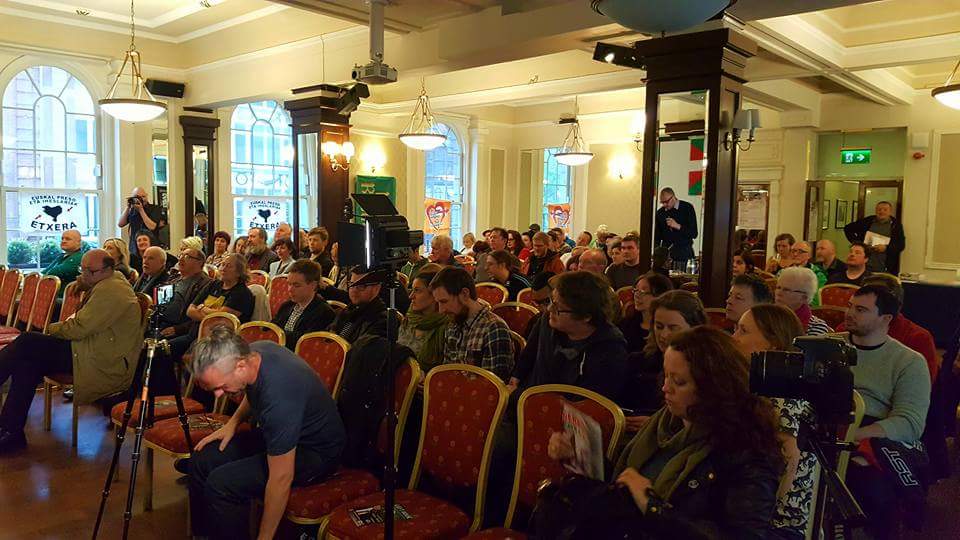
Some of the attendance at the lecture before its start
Over the years, we have heard and read these stock phrases and ideas expressed with tedious regularity, for example that the language is archaic or dead, is full of English words, that it is an expensive commodity, that Irish language schools are elitist, that the language is or was badly taught or that it was “beat into” people. Over the years, many speakers and activists have of course countered these ideas, sometimes by reasoned argument and sometimes by a trenchant phrase, such as: “What, was it only Irish that was bet into you then?” or “Was it only Irish that was taught with an overwhelming concentration on grammar to the exclusion of conversation?”
But Ó Broin has gone about this work scientifically, methodically. For the purpose of his lecture he took around ten of these propositions, deconstructed and exploded them, revealing their underlying lack of logic and scientific fact. For example, dealing with the proposition that the language is dead, Ó Broin produced a long list of living languages around the world – the vast majority, actually – that have less speakers than does Irish. On the allegation that Irish is full of English words, he produced pages of English-language words that are of French origin (leaving aside the easier and also huge list of words or Greek or Roman origin).
Colm Ó Broin, Irish language activist and presenter of the lecture
Having revealed the lack of scientific truth or logic as a basis for hostility or contempt towards the Irish language, Ó Broin turned to psychology as an explanation, finding fear and/or shame as the motivating factor. Turning back to history, he reminded his audience of the Statutes of Kilkenny of 1366, when the England-based descendants of the Norman Conquest of England dating from 1066, attacked the ‘gone native’ customs of the Irish-based descendants of the Norman Conquest of Ireland beginning in 1169 (though Ó Broin did not say so, the English Normans had gone quite ‘native’ themselves by then, integrating with the Saxon nobility and the Statutes were written in English, not French).
The Statutes forbade the Irish Normans (“the degenerate English” who had become “more Irish than the Irish themselves”) from playing Irish games and music, speaking Irish, submitting themselves to Irish law, adopting Irish cultural and social customs including marriage. It was the coloniser’s fear, fear of the Irish-Normans losing their allegiance to the English Crown, that was at the heart of that hostility.
Since the Irish who oppose the Irish language cannot be said to be “the coloniser”, something else must be at work there. Ó Broin twice in his lecture called on the state-funded or supported Irish-language organisations Foras na Gaeilge and Connradh na Gaeilge to undertake social research into what is behind this attitude among large sections of the public (according to opinion polls).
Some of the attendance at the lecture
This would of course be useful work, especially if it led to the production of measures to counter such myths and ignorance. It is likely however that the answer has already been supplied, by for example the work Patrick Pearse (1879-1916) and Franz Fanon (1925-1961), though it would be useful to have more up-to-date validation. Fanon’s work focused on the coloniser’s view being culturally and psychologically internalised by the colonised individual and society and Pearse focused more on the mechanisms by which that was done through the educational system run by the coloniser. The idea is expressed succinctly, though in a different context, in the words of a popular nationalist song, Memory of the Dead by John Kells Ingram (1823 – 1907):
“He’s all a knave or half a slave
who slights his country thus …”.
The lecture was delivered by Ó Broin in Irish to an audience that contained Irish speakers and presumably all present could at least understand the language. My feeling was that this research and deconstruction needs to go out to the non-Irish-speaking public in this country. In response to a question, Ó Broin replied that he had in fact written some of it in English some years ago and that material had been posted on a website that no longer exists. Currently, his work exists only in Irish. It is to be hoped that he returns to putting this work out there among the people who perhaps most need it.
The Basque Country is one of the few places in the world where popular opposition successfully prevented the completion of a nuclear power plant; the opposition consisted of both popular mobilisations and armed action. But is the Spanish state now about to reimpose a nuclear program on the Basques?
In the 1960s, the Spanish state began a program of nuclear plant construction in the territory under its dominion. This was an era of great enthusiasm among states and industrialists for nuclear power and generally there was little popular opposition – most of the nuclear opposition at the time being focused on use of nuclear (and earlier, atomic) weapons and nuclear-powered military vessels.
Broad popular opposition to nuclear power itself began to build in particular after the accident at the nuclear reactor at Three-Mile Island (Pennsylvania, USA, 1979) and a catalogue of smaller nuclear reactor accidents (such as those at Sellafield, Wales, for example).
The lobby in favour of nuclear power tends to emphasize the ‘cleaness’ of the fuel (i.e. as opposed to ‘acid rain’ carbon dioxide and other pollution from coal-burning and oil-burning stations, and oil tanker disasters), relative ‘cheapness’ to produce (as opposed to oil, gas and coal) and possibly inexhaustible power (as opposed to fossil fuels). The lobby against nuclear power quotes environmental damage from accidents with potentially greater consequences and points out that the ‘cheapness’ is created by ignoring the costs of safe disposal of nuclear waste material which, if taken into account, would make it much more expensive.
Of course there are powerful interests in favour of nuclear power programs, including military, industrial energy production and construction industry. Employment opportunities in work-poor areas often build local support for construction of such plants also but in some areas it is precisely the local community that opposes the construction and that was the case in the southern Basque Country (the four provinces in Spanish-controlled territory).
Nuclear reactors tend to be built away from especially large population centres; if one accepts the necessity of such plants this policy makes sense but exposes people in areas far from the national decision-making centres to the pro-nuclear policy and its consequences, actual and potential. The later stages of the Spanish nuclear program included building three reactors in the Basque Country and one had already been built in the first phase at Garoňa, in the nearby Spanish province of Burgos.
LEMOIZ: A HISTORY OF STRUGGLE AGAINST NUCLEAR REACTORS IN THE BASQUE COUNTRY
The first site of the Basque-location phase of construction was at the small harbour of Lemoiz (Lemoniz in Spanish), situated in a picturesque part of Bizkaia (Biscay) province and attracted opposition from a coalition of interests: militant Basque left-nationalists, anti-nuclear and environmental campaigners.
Lemoiz nuclear reactor site seen from a distance (photo source Internet)
Popular demonstrations began in the 1970s while the site was under construction with people traveling to the site to protest, also holding protests elsewhere and there were even some incidents of sabotage inside the facility, which was guarded by a Guardia Civil (Spanish Francoist paramilitary police force) post. This took place during the life of the Franco regime (he died in 1975) and also after his death during the repression of the “Transición” process which was not completed until 1982. Festivals and marches were also organised elsewhere in the Basque Country against the project.
The first armed attack by ETA was carried out 18 December 1977 with an attack on the Guardia Civil post at the site, during which David Álverez Peña,one of the ETA group’s members was injured, causing his death a month later. ETA later succeeded in planting a bomb in the reactor of the station which exploded on 17 March 1978, causing the death of two employees (Andrés Guerra and Alberto Negro), and wounding another two. Substantial damage was caused to the structure in the explosion, delaying construction.
Scene one hour after killing of Gladys del Estal in Tudela, Nafarroa in 1983, her body still lying on the ground (photo source Internet)
On an International Day of Action Against Nuclear Power, 3rd June 1979, a police bullet resulted in the death of an anti-nuclear activist during a demonstration in Tudela, a town in the Basque province of Nafarroa; her name was Gladys del Estal and she was from Donostia/ San Sebastian in Gipuzkoa province. Demonstrations against the facility were now a weekly event.
Traditional honor dance being performed by two Basque women at a ceremony commemorating Gladys Estal, shot by police at an anti-nuclear demonstration in Tudela, Nafarroa province. (photo source Internet)
ETA struck again on 13 June of that year with another bomb placed inside the site, on this occasion in the turbine area which, when it detonated, caused the death of another employee, Ángel Baños.
The deaths of employees in explosions might not have been intentional but on 29th January 1981 ETA kidnapped the chief engineer of the power station, José María Ryan, from Bilbao. The armed organisation issued an ultimatum to demolish the facility or to face the death of their hostage. Despite a demonstration organised against this threat, ETA killed engineer when the company did not back down.
The company replaced Ryan with Ángel Pascual as chief project engineer and ETA assassinated him on the 5th May 1982. Work at the site ground to a halt and Iberduero, the company developing the site temporarily halted work, calling on the Basque Government to commit itself to supporting the project.
Mass demonstration 1979 at Lemoiz against the nuclear reactor (photo source Internet)
The Government of the Autonomous Basque regionin which the site was located was in the hands of the Basque Nationalist Party (PNV) which, although completely opposed to ETA and by no means socialist, feared to go publicly against popular opinion opposed to the nuclear project. In 1983 the company officially stopped work, at which time both reactors were almost ready to go into production.
The deadlock was broken by the PSOE (Spanish unionist social-democratic party) winning the general election in 1984 on an anti-nuclear power policy and their government declared a moratorium on the building of all nuclear reactors throughout the state.
SPANISH STATE RETURNING TO A NUCLEAR -BUILDING PROGRAM?
The Spanish state currently has seven nuclear reactors generating a fifth of its electricity and its first commercial nuclear power reactor began operating in 1968.
After the horrificnuclear reactor disaster of Chernobyl (USSR 1986), people probably assumed that no further nuclear reactors would ever be built in the Spanish state. But the PSOE, the main establishment political party that formerly forced the nuclear moratorium showssigns of beginning to waver on the issue and even the nuclear reactor disaster at Fukishima (Japan 2011) does not appear to have deterred them. The PP, the right-wing Spanish unionist party, has always been in favour of nuclear reactors so that now a ruling class consensus favourable to more reactors seems to be forming (or formed).
(Source: Internet)
Last month, according to press reports in the Basque Country, José Ramón Torralbo, president of Nuclenor, the operator of the Garoña plant, stated that a “two-year-long” “comprehensive” evaluation of the nuclear power plant found no reason that the reactor could not be restarted “with some modifications”, although consideration of the request to reopen the plant is not complete and asked that deliberations of the CSN (Nuclear Safety Council) “should not be interfered with”.
Around the same time it was reported that the reopening of the Lemoiz plant was being considered also.
The decision on reopening is not to be based on questions of feasibility in the short term alone but on the decision of the Spanish Government with regard to its energy policy in general and with regard to nuclear power in particular. The President of Nuclenor indicated when speaking about the Garoña plant that a commitment to operate for 40 years only would rule out feasibility and that they would be looking for a 60-year minimum commitment and preferably for 90 years – presumably this would apply also to the Lemoiz plant.
Referring to environmental and other opposition to nuclear power generation, the president of the Forum of the Spanish Nuclear Industry, Antonio Cornadó, claimed it an “error” to “mix ideological with technological considerations”, stating that has “negative consequences” for the state energy model and for the economy, since the sector generates an important contribution to GDP and taxes.
Cornadó put this figure at €2,781 million contribution of the nuclear industry to Spanish GDP, the equivalent of 30% of the textile and footwear industry and said that “environmental taxes are becoming fashionable and seem set to increase”, stating that of every 100 euros of business, 25 go to the payment of taxes which contributes 781 million euros in taxes overall.
In addition Cornadó raised the fear of “irreversible risk …. of failing to meet climate change targets” and that “Spain is not ready to tackle the massive dismantling of all its nuclear power plants, which would be a very difficult and very expensive technological plan.”
A new uranium mining project is also commencing.
SPANISH STATE READY TO REOPEN LEMOIZ DESPITE ITS HISTORY?
With regard to Lemoiz and plans for any further nuclear reactors in the Basque Country, the factors to consider of course are much than financial viability, given the history of the plant. The Spanish state and indeed the ‘Autonomous’ Basque Government may feel that the current political situation favours a return to the nuclear program in the Basque Country or at least is less favourable to the forces that oppose it. This is despite the leading PNV (Basque Nationalist Party) official in Araba province declaring his opposition to it.
Some Basque trade union sources have claimed that Iberduero, the company owning the Lemoiz plant, have communicated to them that it has no plans to reopen Lemoiz but it is not clear whether these statements are merely trying to calm fears or possibly even enlist trade union support for employment at the plant.
Demonstration in Gastheiz/ Vitoria, Araba province last June calling for closure of Garona plant (photo source: Gara)
The leadership of the Abertzale (pro-Basque independence) Left has chosen to abandon the armed struggle (ETA has been on “permanent ceasefire” since 2011) and, under the leadership of Arnaldo Otegi, to pursue a national independence program electorally in alliance with social democratic parties, which has seen a fall in street opposition activities also. The opposition to the Abertzale Left’s approach within the broad movement is growing but currently weak and, to an extent, divided. It is difficult to see how the movement’s current mainstream approach can hope to prevent a vigorous return to a Spanish State nuclear program throughout the territory it controls, including the southern four provinces of the Basque Country.
On the other hand, the Spanish ruling class finds itself politically divided and with neither of its main political parties able to form a government, with increasing talk of both of them, the PP and the PSOE, coming to an agreement for a national coalition government. That may bring the Spanish ruling class further problems in the future as the possibility of democratic alternative choices become more remote and are seen to be so. The discontent of broad sections of society within the Spanish state in recent years has been expressed in monster demonstrations, strikes, some movements and in elections, in which oppositional but mainly radical social-democratic parties across the state have made gains, sometimes huge ones. At the moment, the revolutionary opposition movement(s) in all parts of the state is weak and divided but this may change as the situation develops.
One often hears it said that we need more unity, that “unity is strength” and on the other side the despairing wail (and sometimes facile sneer) that “the Left (or Republicans) are too disunited to do anything”. But rarely does one see the question analysed. Unity with whom? On what basis? For how long? Can unity actually contribute to weakness instead of strength?
I have five siblings and at times we quarreled among ourselves, especially the older ones. I remember my mother telling me about a father (or it might have been a mother), who asked his five sons (who presumably also quarreled) to bring him ten sticks as long as their hands and as thick as their thumbs. Of they went, probably quarreling about where would be the best place to get them, who should be in charge, what kind of wood etc……. But eventually, they arrived and produced the ten sticks.
The father handed one stick to each son and then asked them to snap it in two. Puzzled, each one tried and, of course, succeeded easily. Then the father picked up the remaining five sticks and tied them together in a bundle. He handed the bundle over to his youngest son and asked him to snap the bundle in two. The youngest son tried until sweat broke out on his brow but was unable to break them.
“Hand the bundle over to your brother,” said the father, indicating the next youngest of the brothers. The son shamefacedly handed over the bundle. But he cheered up when he saw that brother couldn’t break it either. And so it went, the bundle passing up the line until it came to the eldest and though he sweated and strained, he also failed.
“Do you see,” asked the father, “how easy it was to break any one of you on your own? And how impossible when you were all together?”
My mother had adapted an old European story attributed to a Greek slave called Aesop in the 4th or 5th century BCE but we didn’t know that then. As we grew older the story seemed to reflect a truism, one that had been incorporated into movements of resistance including defensive ones such as trade unions.1
The bundle of sticks motif on advertisement by union banner artists, with the motto “Unity Is Strength” (Source: Internet)
But of course, we also saw movements and organisations grow and split. I witnessed a lot of such activity (and participated in some of it) while working in London and some of my siblings passed through Sinn Féin, Official Sinn Féin and the IRSP and another passed through Sinn Féin and Provisional Sinn Féin (as did my father before he left that and joined Republican Sinn Féin).
And always the wailing cry all around – if only we were all united! The call for unity seems so intuitive, so basic that one rarely gets to hear any of the harmful effects of unity. But is that because there are no harmful effects? On the contrary!
IRELAND AND CHINA
The nationalist Irish Volunteers organisation was formed in 1913, ostensibly in response to the formation of the Ulster Volunteers the previous year with a declared aim of preventing Home Rule (a kind of national autonomy similar to that of the Dominion territories then) which had been promised to the nationalists (broadly-speaking, the vast majority of the Irish population). The Irish Republican Brotherhood, the moving force behind the foundation of the Irish Volunteers, had plans to use it in insurrection against Britain.
The nationalist Irish Parliamentary Party, the preferred conservative, constitutionalist and even pro-Empire party of the Catholic Irish bourgeoisie, at first ignored the movement. But when it grew to 100,000 members amid enormous enthusiasm, the IPP became worried it might oppose them politically and John Redmond, the party leader, demanded an additional 25 places for nominees of theirs on the Volunteers’ 25-member executive, even though it already contained some supporters of theirs. The IRB, who despised Redmond as a collaborator with British rule, held a meeting among themselves and agreed to vote against accepting that pressure. Most of them did vote against but some changed their mind and, along with some non-IRB nationalists on the executive voted in favour, so that the Redmonites were admitted on to the organisation’s controlling body.
At that time, the IPP was the largest Irish nationalist party and no other party came even close in winning the votes of Catholic men eligible to vote. It is easy to see what the majority on the executive must’ve thought when they voted to accept them: “We’ll be stronger after this, more united; the Catholic Church and the Catholic media will be friendly towards us and encourage even more recruitment. Britain will have to give us Home Rule and we can have an argument later about what kind of politics we want for Ireland when we have our own Dáil” (Parliament). On the other hand, they might have thought that unity with Redmond and his IPP would be far better than being opposed by them.
IRB men Thomas Clarke and Seán Mac Diarmada and others were furious – they foresaw a time in the future when Redmond and his IPP would use their positions, along with allies they had made on the Executive, to try to sabotage the project of Irish independence, upon which the IRB had set its mind and heart. Such an event came to pass after the outbreak of the First World War when John Redmond made his speech on 20th September 1914, on the occasion of reviewing a Volunteer troop at Woodenbridge, Co. Wicklow, encouraging the Volunteers to enlist in the British Army.
That call, and the resistance to it from within the movement and its executive body, led to a split which reduced the Irish Volunteers from the 170,000 membership which it had reached to a force of 12,300, the majority siding with Redmond and many going on to the war slaughter on the Continent.
The IRB continued to organise in secret among the remaining Volunteers but a number of the Volunteers’ founding executive had always been non-IRB, such as Eoin Mac Neill and The O’Rahilly, and that continued to be the case. When they learned at the last moment that the IRB nucleus planned to proceed with an uprising on Easter Sunday 1916 and calling out the Volunteers to join, Eoin Mac Neill and The O’Rahilly2 did everything they could to halt it. They succeeded only in sabotaging it sufficiently that only about on third of the Volunteers mobilised, and they mostly in Dublin, on Easter Monday instead.
The above lines in these examples are not typed to suggest that thousands of Irish would not have gone to join the British Army in 1914 or even that the whole of the Irish Volunteers would have taken part in the Rising were it not for a) Redmond’s split and b) the cancellation by Mac Neill. I reproduce them only to show that unity can have harmful effects too.
After the 1916 Rising, the survivors of Cumann na mBan, Irish Volunteers, Fianna Éireann and some from the Irish Citizen Army reformed their military organisation which in time came to be called the Irish Republican Army and fought the War of Independence from 1919-1921 against the British. The IRA and the party that had grown around them, Sinn Féin, was also a coalition of people of different ideologies and, when the British offered a partial compromise of a partitioned Dominion status “independence”, the movement split again, out of which emerged the State and its vicious Civil War, with the execution of 83 Republicans by the new State and many unofficial murders carried out by its security forces.
L-R: Chiang Kai Shek, Mao Zedong, photographed in 1945 during short-lived repetition of Chinese Nationalist-Communist alliance against Japanese invasion (photo: Jack Wilkes, Internet)
Let us go a bit further in geography though not so far in time to the unity between the Communist Party of China and the Kuomintang of Chiang Kai Check, a national bourgeois party, against feudal warlords and the plunder of their country by foreign imperialists. The First United Front, also known as the KMT–CPC Alliance, was formed in 1923. Together, they formed the National Revolutionary Army and set out in 1926 on the Northern Expedition. The alliance fell apart due to factors and incidents we need not go into but the result was an anti-communist purge of Communists and the Shanghai massacre of 1927, in which between 300 and 400 were purged and 5,000 communist and trade union militants disappeared. It took the Communist Party two decades to recover their strength and begin to build their influence.
Again, recounting this history is not necessarily in order to prove that the Communists were wrong in their attempt at unity but merely to show the disastrous effect of the way in which events turned out for them and how vulnerable they were because of that unity at that time. In the 1940s, on the other hand, another unity worked out better for the Communist-led patriotic forces, though Chiang Kai Shek had to be forced into that alliance.
“THE PEOPLE, UNITED, CAN NEVER BE …”
In Chile in the early 1970s, a left-wing democratic anti-imperialist movement grew. It had many different components: nationalistic and/ or social democratic petit-bourgeoisie; revolutionary communists; revolutionary socialists of other types; masses of supporters of unclear ideology but focused on social justice and opportunity to make more of their lives and the lives of their children. Its party was the Popular Unity party and the leader of this coalition was Salvador Allende, essentially a social-democrat, who was elected President.
The United States ruling class, the major imperialist power in the area, not only seriously disliked many of the policies of the new Chilean regime but also feared that the ideas might catch on in other parts of the world or, even worse, that people outside Chile in Latin America would gain hope and confidence from what was going on in Chile and attempt the same in their own countries. The problem was that the Chilean people had voted by majority for the Allende option. Well, not so much of a problem for the USA – they had disposed of democratically-elected governments in the under-developed world before. Obviously a coup was what was needed – and the CIA began to work for one.
The CIA or even 50 CIAs cannot overthrow a government – to do so they need an army of some sort. It might be by US military invasion, as they did in Nicaragua in 1912, Haiti in 1915, or Dominican Republic in 1916. Or it might be by invasion of a neighbouring region, as they did by supporting and instigating the invasion of Guatemala from Honduras in 1954 or of Iran by Iraq in 1980. The Iraq-Iran war lasted eight years but the Iranian government did not fall and Iraq was defeated. Or it might be by a “rebel” army, such as the infamous Bay of Pigs US-funded invasion of Cuba in 1961 or the Contras, funded and trained by the USA, against the Sandinista Nicaraguan Government from 1979 to the early 1990s. Or it might be the army of the very State they want to subvert — and so it was in Chile in 1973.
Now, how was it that Allende didn’t see that coming? Was he stupid? Far from it – Allende knew the history of the USA in Latin America and he knew that the commanders of Chile’s Army, Navy, Air Force and Police, and most if not all of the higher ranks of the three services too, were right-wing in ideology, some downright fascist in outlook.
Allende’s options were to try and deal with the senior military ranks and hope they would remain loyal, or to dismiss them and appoint others more trustworthy, from lower ranks. But dismissing them might precipitate the very thing he was trying to avoid – a right-wing military coup. However, that threat could be met by arming the workers.
On the other hand, arming the workers might provoke the military and police.
Both options were risky. To a revolutionary, I would think, relying on the loyalty of the military was the riskiest while the second, much less so. But Allende was a social-democrat, not a revolutionary. He chose to hope thatthe military would not revolt and when the coup came, it was not just he who paid with his life but thousands of his followers and others on the Left. They didn’t have enough arms with which to resist for long and arrest, torture and death awaited them. The toll of the coup was over 3,000 dead or missing, thousands of prisoners tortured, and 200,000 Chileans forced into exile.
Poster bearing the alternative slogan, sourced on Internet. It was produced by the Ad Hoc Committee to Establish Solidarity With Resistance in Chile, on the occasion of the Speaking and Fund Raising Tour Across Canada by a Representative of the People’s Front of Chile.
Before the coup, a slogan that had become popular in Allende’s Chile declared: “El pueblo, unido, jamás sera vencido”. It has been changed by socialists abroad to “The workers, united, will never be defeated”, as though saying “workers” instead of “people” made the slogan more revolutionary. But a large swathe of the people in Chile were united, and even more united were the workers — they had marched and voted for the Allende option and were eagerly awaiting the benefits of a different regime. And still they were defeated – by a much smaller but much better armed and much more ruthless enemy.
A different slogan came into being after the coup (and perhaps it had been around earlier too but got drowned out by the other): “El pueblo, armado, jamás sera aplastado” (the armed people will never be crushed). People may argue that is simplistic and they may be right – but it contains a lot more truth and sophistication than the slogan it replaced.
IRELAND TODAY
We are constantly being urged today in Ireland towards “unity of the Left” and “unity of Irish Republicans” and, before we nod our heads in reflex action and shake them in despair, it would be worthwhile to look at this proposition a little more closely.
Firstly, what is the unity for? As a minimum it can only be, if we are to consider it a serious proposition, to strengthen our resistance and to defeat austerity measures and state repression.
Then, who are we to unite with? “The Left” means different things to different people and that too needs some exploring. For example, is the Labour Party to be included? Some would say “yes”, including many trade union leaders and activists.
Yet the Labour Party is part of a Government that is heaping austerity upon working people and of a State that is using its police, courts and jails to repress resistance. How can we unite with that? And if the Party is not the same as its members in the Government, why doesn’t the Party denounce and disown those Ministers? No, this cannot be – we cannot have unity with those who work with our enemies.
Others would include Sinn Féin in the list of groups with which we should join for “unity of the Left”. But in what way can Sinn Féin be seriously considered to be part of the Left? In the Six Counties, it is part of a Government of a colonial state and has imposed austerity on the working people there. It has also colluded in State repression of Republicans. SF is mounting no serious opposition to any austerity measure either side of the Border although it often makes the appropriate noises. It does not support the necessary and appropriate action of civil disobedience, never mind organise it. Its mantra is “Vote for us and we’ll see everything is made ok”. That is not a suitable partner in any “unity of the Left”.
Excluding Sinn Féin and the Labour Party removes the largest party and the most TDs from the proposed “united Left” and that is one reason some do not wish to exclude them. However it would be dangerously stupid to try to build unity with these and, even if temporarily successful in some imagined scenario of the future, both elements would desert and even betray us at a crucial moment when we would be preparing a campaign of serious disobedience, to say nothing of revolution.
PRINCIPLES AND TACTICS OF UNITY
Who does that leave? Well, tiny parties and even smaller groups of independent TDs and local authority Councillors, a wide variety of independent activists and a number of campaigns of varying size. Well, better small than rotten at the core, right? And there are millions of others out there yet for us to draw support from in future!
But having unity across that broad mass of individuals and organisations? How? Shall we draw up a constitution and get everyone to agree? They never will and we’ll waste valuable time on the project. Is it all hopeless then?
Not at all. What we need is agreement upon a few fundamentals – the bare necessities, as in the title of Terry Gilkison’s lyrics in the 1967 Disney film “Jungle Book”. Let’s imagine we have come together to discuss cultivating a field. We dropped the Labour Party from our work force because they had been sowing fields with weedkiller. We dropped Sinn Féin because they had sowed a part of the field with weedkiller and were arguing that we didn’t need to clear stones and weeds or dig in the rest of it.
That’s not to say that we won’t have any problems with any of those left but let’s see, eh?
So all the remainder agree that the field needs cultivating, that stones and weeds need removing and digging needs doing. There might be some who don’t (or won’t) agree on what crops to sow and when but at the moment we have the maximum unity, admittedly on paper, for the minimum tasks required.
It might be that on the first day some turn up at the appointed time, 8am and others straggle in at 9, 10, 11 …. OK, it’s early days yet. But those who didn’t turn up at all? They are on notice of dismissal. That is fair – we all agreed that this work needed doing and they are not contributing to it at all.
Now, it turns out that some got tired or bored at noon and left the job, while others worked on to 8pm. Some of those who worked until later are those who turned up later so, although not in the way we expected and agreed, they have put in their hours (and twice that of some who turned up at 8am and were gone by noon). We don’t expect people to work 12 hour shifts every day but we will set a minimum – a realistic one according to our numbers and our people.
Probably, when we started we set up a committee to administer and organise the work – organise tools, meals, accommodation, allocate work to different areas, organise delivery of fertilizer …. And later, decisions will need to be made about what seeds to sow and seasonal work priorities but we can make those at a democratic assembly. And assemblies can elect the members of the administration too – but as individuals, not as the slates of parties or coalitions.
As the year progresses, more will join the work and some will leave or be expelled – but the decision will be made on the basis of the minimum necessary work for the minimum task. If the project succeeds or is seen to be doing well, others will become interested and some of those will join. And they will see who works well and who does not, whom they feel they can trust and who not. And they will also learn to organise, propose solutions or questions, join in collective decision-making.
We may lose the small political parties along the way and some will wail at the loss. But what we have noticed about the parties up to now is that on the whole they put the Party first and the struggle (which also means the people) second. Of course not all ego-trippers, glory-hunters, niche-seekers and petty dictators are in political parties and we’ll have to deal with those individuals too, and their cliques. And not everyone in a party is a party hack. But the work decides (or it doesn’t and we learn from our mistakes) and the decisions are democratic, by popular vote of people involved in the work.
When the work required for the day or week is done or in quiet seasons we should run courses on agriculture. There will be different schools of agricultural thought – OK, fine, let each set up a school, or run workshops, print manuals, newsletters, run FB pages, etc, etc.
It seems to me that is a practical unity, one that can work. We can and I think need to tolerate differences of opinion. But anyone found spreading weedkiller on crop-ground – well, that needs dealing with very firmly. And those who don’t want to dig, remove stones, pull weeds? Their choice — but they won’t be in our workforce or eat from our field.
So, the principles developed in the example were:
The maximum unity on the minimum task
Unity in practice more than in words
Equal rights for all who contribute (and no special rights for anyone)
Freedom of speech and press (subject to the basic safeguards) for all who contribute
Open to all who join on the same basis
Democratic decision-making
It seems to me that kind of unity will indeed be strength. Unity on other bases? Disaster waiting to happen, early or late.
FOOTNOTES
1 In doing a snap piece of research for this article I note that the Nottinghamshire Miners’ Association had the fable represented on their banner – ironically or perhaps of necessity, considering the fractured history of the miners in that area. It was also on a Durham trade union banner, according to Wikipedia.
2The O’Rahilly, seeing the Rising going ahead despite his efforts, joined it and presented his car for use in a barricade. On the Friday of Easter Week, he was mortally wounded leading a charge against rifles and a machine-gun behind a British Army barricade at the Parnell Street end of Moore Street. He died in a nearby laneway which now bears the name O’Rahilly Parade and where there is a monument to him, including a copy of his farewell letter to his wife in his own words script.
The Sunday November 6th meeting of Marxism 20161 on the theme “When Governments Lie” hosted as speakers four women campaigners and Eamon McCann, a male campaigner, addressing the packed downstairs hall of the Club na Múinteoirí. A number of cancellations of speakers had taken place, including Gareth Pierce who sent a message which was read out to the meeting.
Brid Smith of the SWP (centre photo) chairing the meeting When Governments Lie public meeting at Marxism 2016 weekend (Photo: I.O’Kelly)
On the podium, taking turns to speak, were Sheila Coleman of the Hilsborough Justice Campaign, Kate Nash of the Bloody Sunday Justice Campaign, Joanne Donnelly of the Justice for the Craigavon Two Campaign, and Antoinette Keegan of the Justice for Stardust/ 48 Never Came Home Campaign (summary of these campaigns below).
After being introduced by Bríd Smith, chairing the event, Joe Black with guitar, accompanied wonderfully by a musician on bazouki (if I can get his name will insert it here), launched the evening with Black’s powerful song about Giuseppe Conlon, father of Gerry Conlon of the Guildford Four. The Guildford Four were wrongly convicted in 1975 of IRA bombings and served fourteen years before they were cleared. Giuseppe Conlon, who went to England to clear his son, was also jailed, as were his relatives the Maguire family. The Maguire1 Seven were cleared in 1991 but by that time Giuseppe had died in prison, an event that, along with his own imprisonment, devastated his son and affected him for his remaining years until he died in 2004 at the age of only sixty years.
All of the speakers emphasised that the State’s officials lied with regard to their respective cases and concealed evidence and most speakers also accused the media of complicity. In the cases of Bloody Sunday, the Craigavon Two and Hillsborough, the British state was placed in the dock by the speakers while the Stardust fire cover-up was laid at the feet of the Irish state.
Most of the speakers also warned people in similar circumstances to beware of establishment party politicians who try to flatter campaigners and decide which are the “reasonable” ones to deal with, always at the price of reducing the objectives being sought. The speakers for the Bloody Sunday and Hillsborough campaigns in particular warned against this element, Kate Nash singling out Sinn Féin as the party that acted that way with regard to Bloody Sunday (Kate Nash’s brother was killed that day and her father shot and injured) and how they tried to bring the campaign to an end with an apology from the then British Prime Minister, while no senior officer or government official was held to account and while one of the unarmed dead remained accused of carrying a nail bomb.
Sheila Coleman of the Hillsborough Justice Campaign addressing When Governments Lie public meeting at Marxism 2016 weekend (Photo D.Breatnach)
Eamon McCann, who was on the march in Derry on Bloody Sunday 1972, finished the evening with one of the rants for which he is famous, going beyond his allocated time by a fair bit and despite the Chairperson’s frequent reminders. McCann located the similarities of the cases within the class system – most of those injustices represented were about repression of working class communities, or ignoring the damage done to them and the lies were told to protect the system and its supporters – big businessmen, politicians, the police, the Army.
The meeting ended to sustained applause but without any opportunity to ask questions or to make contributions, to the regret certainly of a number of Republicans and campaigners against what they consider to be ongoing internment without trial. All however seemed agreed that the talks had been interesting and educating in at least some aspect of the issues and events covered.
WHY SO LONG?
It is good that this meeting about State injustice and lies was held by an Irish socialist organisation. It is the duty of socialist organisations to point out the injustice of the State even when the victims are not socialists – or not socialists in the way that socialist organisations think they should be. Prominent socialists Karl Marx and Frederick Engels were not Fenians but they campaigned for the release of Fenian prisoners being held in English jails (where, by the way, it said that one third of them died and one third went insane).
It is said that we learn more from our mistakes than we do from our successes and certainly, if we are to bring about a revolution and the society we want, we must learn from our failures. And in that spirit, I must ask: why has it taken so long for Irish socialist organisations, particularly in Dublin, to wake up to the repression being exercised against Irish Republicans?
Five years ago Marian Price, a former Republican prisoner released under licence as part of the Good Friday Agreement, had her licence revoked and was taken to Maghaberry jail, kept for months without charge or bail, eventually charged and kept in jail without bail, sick, until her mental and physical health was broken. In Dublin the socialist organisations sent a couple of representatives to one demonstration for her freedom and never attended a picket about her case afterwards.
After the Marian Price campaign ended with her release in 2013 on “compassionate (sic) grounds”, some of those involved in Dublin launched a campaign against “internment by other names”, a process by which ex-prisoners released on licence are returned to jail without even a trial in the no-jury courts of the Six Counties2 and other Republican political activists are harassed and arrested and refused bail on spurious charges which eventually collapse after the accused have been held for months or years in jail3.
I must ask again: why has it taken so long for Irish socialist organisations, particularly in Dublin where the major part of their organisation is located and most of their activities organised, to wake up to the repression being exercised against Irish Republicans?
Is it perhaps because the socialists feared to be painted with the nationalist brush? But did they not fear being daubed with complicity with imperialism instead? It is a strange kind of socialist organisation that can’t make common cause with Republicans against the tyranny of the colonial statelet and capitalist State! In that failure, it misses the opportunity to unite forces against its enemies’ state and also to disseminate its ideas among Republican activists. One might also remark that a failure of people who are prepared at times to unite with social democrats for reforms, to unite with Irish Republicans against a capitalist state is a strange indication of revolutionary socialism!
Or is it purely because they didn’t care – it wasn’t happening to them – that Irish socialist organisations haven’tt campaigned against State repression of Irish Republicans, or even protested in solidarity with them? If so, they will by the seed of their inactivity one day certainly reap a harvest of repression for themselves too. Solidarity against State attacks is not only a noble thing with a long tradition; it is a necessity for revolutionaries.
So now that this “Marxism” weekend is over, when its organisers are taking a deserved rest, or writing it up for the British and Irish version of their newspaper, or compiling their recruitment slips to see how many new members or at least mailing list contacts they have gained – will they do anything different?
Will we see the highlighting, from time to time, of the almost everyday harassment of Irish Republicans in the leaflets and newspaper of the SWP and PBP? Will their TDs in the Dáil raise these issues where they might get some bourgeois media coverage? Are we going to see PBP and SWP militants on the regular pickets organised by the Anti-Internment Group of Ireland anywhere and, in particular on those called by the Dublin Anti-Internment Committee?
We can hope, I suppose.
Diarmuid Breatnach
APPENDIX: THE CAMPAIGNS
Hillsborough Justice Campaign seeks vindication that the original disaster was due to crowd mismanagement by the South Yorkshire Police and that some of the subsequent deaths were also due to their mismanagement of some still-breathing victims and lack of coordination of the emergency services. The disaster took place at Hillsborough football stadium in Sheffield, England, UK, on 15 April 1989, during the 1988–89 FA Cup semi-final game between Liverpool and Nottingham Forest. With 96 fatalities and 766 injured it is the worst disaster in British sporting history. Originally, the Liverpool football fans were blamed for the disaster but subsequently it became clear that the blame lay elsewhere.
Bloody Sunday Justice Campaign seeks a proper accounting of the deaths of 14 and injury of at least 14 after British troops opened fire on unarmed people demonstrating in Derry on 30th January 1972 against Internment. Originally, the British Army and Government claimed that they had shot “terrorists” in “returning fire” after being first fired on and a British enquiry backed them on this and claimed to have evidence that some of the dead had been handling weapons.
Founded in 2012, a campaign to overturn the clearly unjust convictions in May 2012 of John Paul Wooton and Brendan McConville for the killing of a member of the British colonial police force, the PSNI, in March 2009.
The forensic evidence was contradictory and in a number of cases even pointed to the innocence of the accused, electronic surveillance equipment had been interfered with by the British Army; the State produced no witnesses to the incident and only one who placed one of the accused at the scene – this witness came forward a year after the arrests of the two, his account of his movements that evening were not supported by his wife; a close family relative called him a habitual liar and then this family member was arrested and subjected to intimidation by the colonial police after he had given a statement to the accused’s legal team..
In the early hours of 14 February 48 young people died in a fire at a disco at the Stardust nightclub in Artane, Dublin and 214 were injured.
The campaign seeks to shift the blame from alleged “arsonists” to a fault in the premises wiring and other factors within the responsibility of the club’s management and owners, including blocked emergency exits. The allegation is that there has been a cover-up connived at by the Irish Government to exonerate businessmen friends, who to add insult to injury, received substantial financial compensation for the loss of the building. An ongoing controversy over inquiry findings and ignoring of important pieces of evidence have lent increasing credence to the version of the campaigners.
1This is organised annually in Dublin, Ireland by the Socialist Workers’ Party
2A prominent example in the past has been Martin Corey of Republican Sinn Féin; a current example is Tony Taylor
3For example Stephen Murney of the éirigí political party and the independent activist Colin Duffy and members of his family
FIFTEEN YEARS PRISON THREATENED FOR BASQUE YOUTHS IN BAR ALTERCATION PROVOKED BY SPANISH POLICE – SIX ALREADY IN JAIL
Monday 15 November 2016
Diarmuid Breatnach
Six Basque youths are in jail without bail tonight and altogether twelve face fifteen years in prison, in a case arising out of an altercation in a bar in the southern Basque Country (i.e under Spanish occupation) involving two officers of the Guardia Civil (Spanish militarised police force) in Altsasu in the province of Nafarroa (Navarra).
Protest demonstration in Altsasu tonight. The slogan says: “FREE THE DETAINED!” (Source: Basque contacts)
Altsasu is known as a town with a particularly strong history of Basque resistance and a continuing sympathy among the population. The town also has, by no means accidentally, one of the strongest barracks of the Guardia Civil.
On the night of 15th October, the two male Guardia Civil officers, off duty and with their female partners, went into Taberna Koxka, a well-known bar and night spot frequented by the Abertzale (pro-Basque Independence) Left, where they behaved provocatively. Inevitably the policemen were challenged by some of the patrons of the bar and a scuffle broke out.
No injuries were sustained by the police although one of them claimed an injury to his ankle, a story that fell flat when it was revealed that he was already on sick leave at the time of the incident due to an injury to his ankle. In addition, the Guardia Civil report itself, though claiming the officers’ behaviour was non-provocative and peaceful, did not claim police injuries and the province’s “autonomous” police force (but very hostile to the Abertzale Left), the Policía Foral, also denied there had been any injuries.
The pro-Spanish media not only spread police lies but added to them, one surreal story alleging that the quietly relaxing police officers and their partners had been attacked by 50 Abertzale Left youth throwing martial arts punches and kicks. Tragically, such lies will find a ready audience in much of the Spanish state outside the Basque and Catalan countries.
At first the police classified the incident as a “hate crime” but the State Prosecution upgraded its classification to “terrorism”.
The eight youths were detained in police raids this morning and taken to the National Court in Madrid although, upon learning that they had been namedby the Guardia Civil in a list of 12 people involved, they had already voluntarily presented themselves to testify before a judge in Irunea who, however, could not be found. Despite that earlier voluntary attendance, a “risk of fleeing” was given as the primary reason for refusing them bail. Two others were released under stringent reporting to police conditions and two others, who also presented themselves voluntarily to be tried with the others, were told to return to court tomorrow.
Guardia Civil provocatively driving through an Abertzale Left demonstration. The people in costume are Zapantzarak, traditional performers particularly in Spring festivals but often participating in Abertzale Left events also. (Source: Basque contacts).
“Terrorism”
The Prosecution has asked for the Basque youths to be tried under Article 573 of the new Penal Code, set aside for crimes of “terrorism”, the definition of which even the UN has declared to be “excessively imprecise and broad” and which “may criminalise behaviour which is not terrorist.” Conviction under Article 573 can carry a sentence of 15 years in jail.
Tonight in Altsasu, Basque youth took to the streets in peaceful but militant protest demonstration (see photo).
This incident is not without a context: in recent months the town has seen hundreds of Guardia Civil driving through the town at various times and a demonstration organised by Abertzale Left on 22ndOctober was penetrated by Guardia Civil vehicles (see photo). The strongest anti-repression organisation in the Basque Country, “Ospa Mugimendua”, has an active following in the town.
Guardia Civil has his photo taken mocking an event organised by the anti-repression organisation Ospa Mugimendua. (Source: Basque contacts).
The Guardia Civil, although established in the Spanish state in 1844, is a militarised police force (type of carabinieri) associated in the minds of most Basques, Catalans and progressive Spaniards with the Spanish Civil War and with General Franco, whom the force enthusiastically supported. The force has a long history of violent repression, torture, murder and even rape. After the “reform” of the State with the death of Franco, the force was neither abolished nor reformed. The Guardia Civil is also much loved by the Spanish Right and the “Association of Victims of Terrorism” (sic), which regularly demands increased repression against Basques and Basque political prisoners, is mostly composed of relatives of the Guardia.
Manager of Dublin City Council Road Management Department
Dear Sir/ Madam,
Please allow me to extend my heartfelt thanks for your work on the city roads and more than that, the ingenuity displayed by your staff. Dublin and to an extent the whole of Ireland is being kept safe, thanks to the work of your Department, from Japanese Army invasion. Or any other cycle-born troops.
I must admit I was not expecting to find that people working for the local authority had studied the Imperial Japanese Army assault on Singapore in 1942 and who had learned from it. If only there were more like your staff in the rest of Ireland! But no, complacency rules. “Ah, sure it’ll do” is the order of the day.
Few people now seem to recall the complacency with which Lieut. General Arthur Percival faced the Imperial Japanese threat to Singapore in 1942. Almost an island, Singapore had massive artillery pointed out to sea, ready to pound the Japanese invasion fleet. No artillery of any size was pointing towards the mainland. The jungle there was impassable to an army of any size, apparently.
Unfortunately someone neglected to tell the Imperial Japanese Army that. They sent their soldiers on bicycles down jungle trails, moving thousands of troops into position in days. Then they stormed across the Causeway and attacked Singapore.
Lieut. General Arthur Percival surrendered an estimated 85,000 soldiers, most of whom had never fired a shot in Singapore. The Japanese had nothing but contempt for these soldiers and officers who had been surrendered by Percival, not only that, but had done so for the most part without putting up any kind of resistance at all. That was part of the reason they treated the prisoners so badly.
British soldiers surrendering to Japanese Army at the Surrender of Singapore 1942. (Sourced on Internet)
Had the British command in the region not been so complacent, they would not only have turned some of Percival’s big guns around to fire on the mainland but would have sent sappers – British and Commonwealth Armies’ engineers — out into the jungle to dig bicycle traps. Like your engineers have installed on Dublin city streets, roads and laneways.
How Lieut. General Arthur Percival could have used your engineers, if only he had realised the danger in time! But your engineers have used ingenuity above and beyond anything that British sappers might have thought up. A simple hole in the road after all is visible, even at night in dim Dublin street lighting — and may be avoided. But your engineers are more skilled than that – they consider: “OK, so the invading cyclist will see this hole and swerve to avoid it. He’ll swerve on the inside, so he doesn’t get hit by a passing vehicle. So we’ll place another hole, a little further on, on the inside.”
Excellent bicycle trap designed by Dublin City engineers, one of many in a whole defence network
Now, a rather pedestrian (if you’ll forgive the pun) engineer, might very well leave it at that. But no – your engineers ask themselves: “But after a number of disasters, jarring bumps, split tires and crashes, won’t the invading cyclists automatically swerve to the outside when they spot a hole ahead?” And so naturally, just to vary the rule, the engineers put another hole on the outside of the first from time to time.
Your engineers go yet further. “Wouldn’t it be better if they couldn’t see the hole at all?” they ask one another. After all, this is a common feature of traps – almost obligatory, one might think — so no great credit to your engineers in thinking of that. No, their genius is in how they carry out the disguising.
Normally, on a jungle path or trail, a pit (or a land-mine) would be covered over with loose earth and dead leaves to disguise it. But on a tarmacadamed road such is not possible (and even if it were, might claim the lives of innocent pedestrians or even motorists, for example trying to pass other traffic on the inside). This is where the true genius of your engineers is displayed.
Firstly, they place the holes in dark places – e.g where street lamps are not functioning, or under shade of trees. Sometimes instead of a hole, they construct a sharp dip in the tar macadam. And aware that cyclists often look ahead, see darker patches in the shade and swerve to avoid them, thinking “Aha! The sappers have placed a hole in the shade!” (sorry, I don’t know how to say that in Japanese) – yes, imagining that, your sappers darken a small area of road a little before a real dip! The cyclist sees the darker spot, thinks “Aha!” etc, swerves to avoid and, a moment later, hits the real dip. Masterly!
Of course, holes and dips are not the only useful anti-cycling device – ridges function quite well at times and can take unawares a cyclist who has been on the lookout for holes. Another clever ruse is the one of making the ridge small, therefore not too destructive to ride over, but placing a number of ridges beyond it, so that the cyclist experiences a shuddering sensation going over one ridge after another. He might even be induced to swerve here, when a passing vehicle may obligingly side-swipe him.
Then there is the principle of distraction. I don’t know what Percival’s engineers might have done, perhaps placed pictures of disrobing geishas near a pit but your engineers are more prosaic. Besides, exposure to many pictures of disrobing geishas might dull the effect over a period, or even become unfortunately forever associated in the minds of Japanese soldiers with pits and horrible crashes. No, your engineers think to themselves: “At what locations are the eyes of all cyclists likely to be diverted from the road surface straight ahead?” And they hit upon the answer, of course (perhaps they even had some cyclist double-agents working for them?).
Cyclists take their eyes off the surface of the road ahead when approaching traffic lights, or intersections, or crossing intersections or just having crossed one. They want to be sure that they obey the traffic lights and even more than that, that they don’t get hit by a vehicle coming from another direction, or side-swiped by one as they swerve out to avoid a parked vehicle just after having safely got across another intersection. So holes, dips and wheel seizing cracks are placed in shortly before traffic lights, in the middle of intersections or just on the other side!
There is also an economic benefit to all this necessary work of cyclist-trapping, and it is in the saving of the Motor Tax allocated to the local authority. The money saved by not filling in these holes goes to pay the Water Charge – a worthy recipient and appropriate diversion of revenue, if ever there was one!
There is even, dare I say it, a greening side-benefit, for inside those holes, little plants, grasses and even shrubs can take hold, bringing more green to our sometimes too grey city.
In days to come I hope that the work of your engineers, ably led and directed by yourselves, of course, may become properly recognised. Some recognition is surely due to men (and women?) who toil in anonymity to save us from a bicycle-mounted troop invasion. Besides which we don’t want to have to learn Japanese, being already fluent in another conqueror’s language – we have enough difficulty ordering food by numbers in Chinese restaurants. And if were taught Japanese in school, we wouldn’t want to have to actually speak it (as can be seen from the case of our National Language).
For appropriate recognition of the work of your Department, a public monument could be considered – perhaps one constructed from crushed bicycles. And plaques – perhaps set into roads at appropriate places or on signs as one approaches traffic lights and junctions. One can only hope. Keep up the good work!