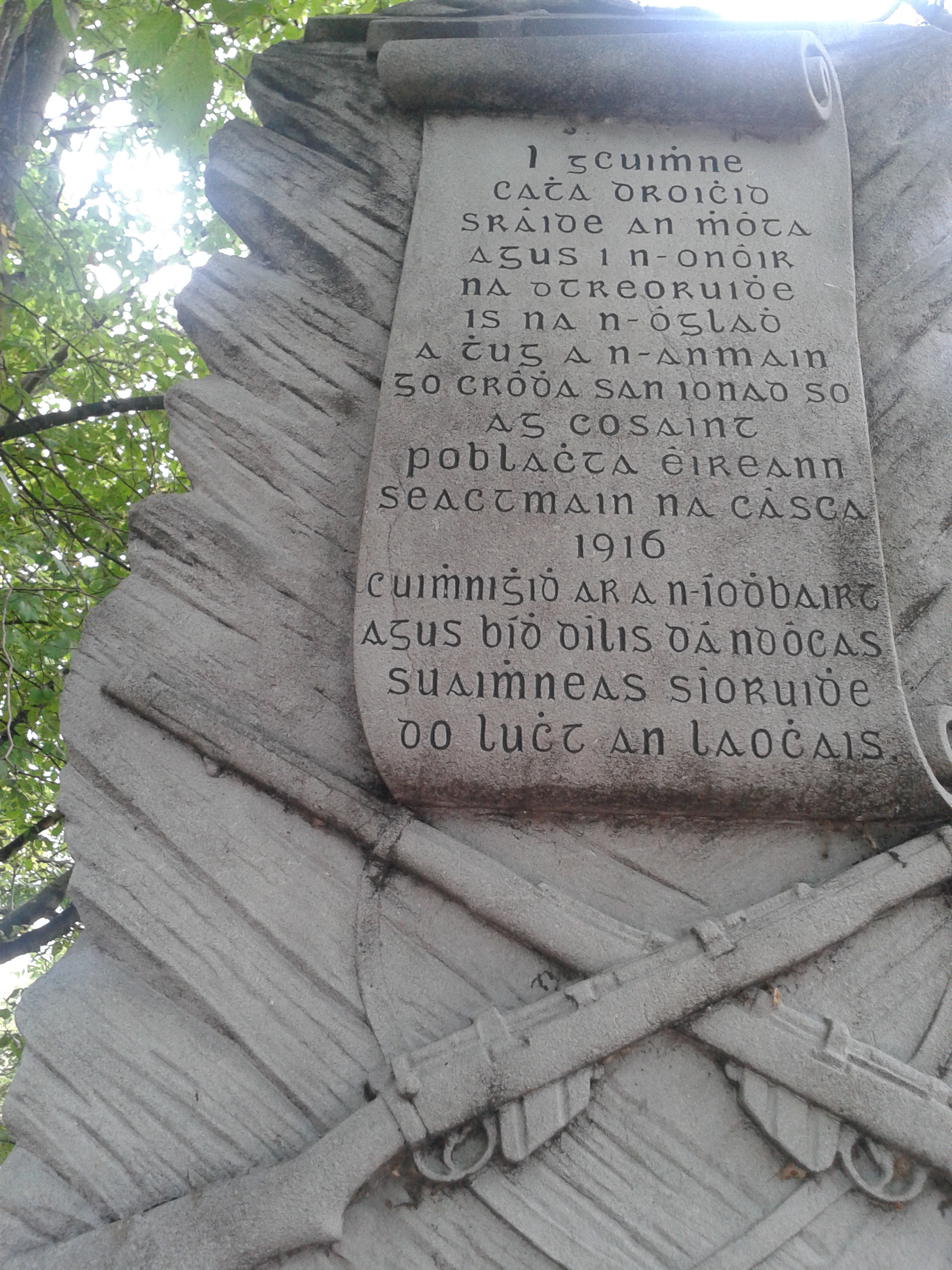
THE GAELTACHT AND IRISH: Dying, or in need of an emergency operation?

Diarmuid Breatnach

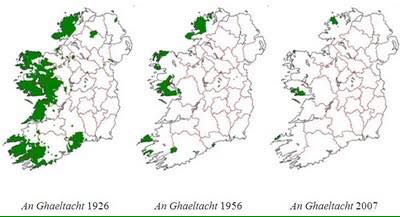
Maps showing the decline in the Irish-speaking areas, the Gaeltacht, during the life of the Irish state

“Irish is nearly dead as a spoken language.” A shock ran through the Irish-speaking community at the news…. but although the after-shocks reached linguists afar …. the news caused but a small ripple in Irish society at large.

It should have been big news. In only nine decades of the existence of the Irish state, the Irish-speaking areas had shrunk by 90%. This seemed to herald the imminent death of Irish as a spoken language – a language that, albeit shrunk to being the mother-tongue of small minority of the Irish population, had survived almost a millennium of colonial occupation and a consistent policy to replace it with English.

The loss would be greater than Ireland’s alone – this is an early Indo-European Celtic language of more than four thousand years of development, the language of the earliest vernacular literature of Western Europe, an extremely rich literature of pagan mythology and folklore containing epics which did not suffer the extent of moralistic destruction which either the Reformation or the Inquisition visited upon so many others across Europe. The language is probably unique on the Continent in being that of a state and which is also that of the first recorded settlers of the land. It was (perhaps still is) the Celtic language with the largest number of speakers. It is the mother of Scots Gaelic and Manx Gaelic too.

It seemed almost too difficult to grasp that this had occurred in a state that claims to be independent, which also claimed the language as the first in status in the State, according to its Constitution. And this has, seemingly contradictorily, occurred at a time when there are more Irish-medium schools, Gaelscoileanna, than ever before in the history of the State.

How did it come to pass? Emigration, some might say. Certainly emigration on a large scale has been a feature of Ireland’s demographics since at least the Great Hunger (although it was in the years after that disaster that the outlying western areas began to hemorrhage). Even so, although emigration has been a constant, so also has been the population – in other words, the birth-and-survival-rate kept up with the emigration. Did the Gaeltacht areas experience higher emigration rates than elsewhere then? Certainly – not just to go overseas but also to Irish cities, especially to Dublin. Industry was scarce in the Irish-speaking areas, despite the efforts of cooperatives and Gael-Linn and the land in most places is rocky and poor.
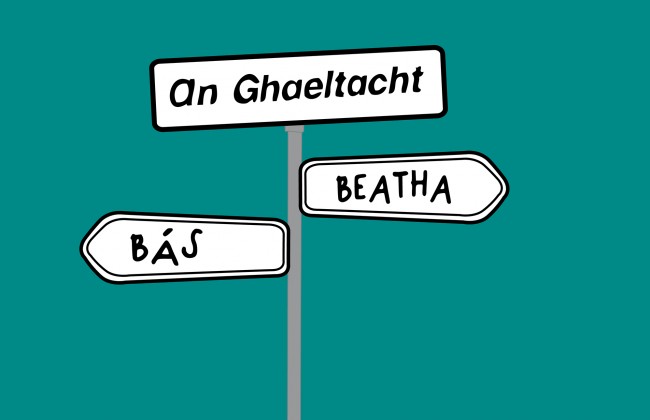
The Gaeltacht  Death or Life
The Gaeltacht
Death or Life (image downloaded from the Internet)

Yet, the reality appears to be that the Gaeltacht population reached a level at which it stayed – so how can there be a continual reduction reaching 90% in the Irish-speaking areas? If the population has not decreased, certainly not to that extent – then the Irish-speakers must have. Have many ceased to speak the language then, losing it over a generation, or two, or three? Or has an inward migration of English-language-only speakers replaced Irish-speakers? Yes to the first and yes, to an extent, to the second.

The Basques have a saying: “No language was ever lost because people didn’t learn it but rather because those who had it, stopped speaking it.” (As an aside, I find myself wanting to say “her”, because in Irish the word “language” is of feminine gender: “Beatha teanga í a labhairt” — literally “the life of a language is to speak her”).  Observers speak of children raised in Irish-speaking families, or in a mixed-language household, even in the Gaeltacht, speaking English with their peers as they leave the primary school where the subjects are taught through Irish.

So, the people make a choice and some people of other mother-tongues move in – that’s democracy, isn’t it? Freedom to move, freedom to speak the language you want. But is it really so? Certainly one can assume that the people moving in are making a free choice (unless one takes into account dearer house prices in the cities). But are the ones moving out making a free choice?  If the absence of industry and therefore employment is a constant in the Gaeltacht then it is not an entirely free choice to leave. If the work were there, one can assume many of the people would stay.

Ok, but the ones who stop speaking Irish – surely that is a free choice?  One suspects cultural factors at play there. The attractive world for pre-teenager – which is what most childhood years have become — and teenager, is a world dominated by and represented through the English language. It is transmitted in English through so many media …. all with very little competition in Irish. The Irish-language TV channel, TG4 is in practice a bilingual one. Publishers find only a small market for books aimed at children and young adults in Irish, whereas the English-language market stretches not only throughout Ireland but abroad — Britain, the USA, Canada, Australia, New Zealand … All of this without mentioning TV, pop-song lyrics, video games, Internet, films ….

But one must also take into account the fact that when those Gaeltacht children visit their nearby towns and cities – Letterkenny, Dublin, Waterford, Cork, Tralee, Galway, Ballina – they hear English all around them. Worse … they hear only English around them – unless they hear other languages from tourists or perhaps an Eastern European language from migrants. What they are practically guaranteed NOT to hear is Irish.

So, hardly anyone speaks her – sorry, it – and it’s not cool and most people of your age around the country don’t speak the language and what do you need it for anyway? It’s not surprising Irish-speaking is in decline.

“You can’t blame the State – they tried their best, didn’t they? Sure Irish is still a compulsory subject in the schools.”  “The national broadcaster has provided a radio station and TV channel for Irish-language use, too! And they give some grants to families speaking Irish in the Gaeltacht, right?”

Ní mar a shíltear a bhítear (loosely translated as “not all is as it seems”. Yes, Irish is taught in the schools but no attempt has ever been made to make it a language of daily use – for work, public transport, banking, shopping, post office, health service, education … Radió na Gaeltachta was won through a civil rights campaign – Feachtas Cearta Sibhialta Muintir na Gaeltachta – and people refused to pay their radio and TV licenses, were dragged to court, fined, refused and some even went to jail before TG4’s precursor, Teilifís na Gaeilge, was supplied. The Irish-speaking grants were a help to households but were not properly administered so that houses that were not Irish-speaking, or had lapsed, continued to receive them. This gave rise to false statistics that helped to conceal the decline in the Irish-speaking areas.

The Gaelscoileanna outside the Gaeltacht, at 143 in the 26 Counties, though an impressive success story, are not State initiatives — they were started by local groups who then battled for state support. Many are still in temporary buildings or in need of repair while others are awaiting the funding that will allow them to employ teachers. As for the other services – nothing. Oh, yes, some of them are supposed to have one designated member of staff who can provide a service in Irish – you can avail of him or her if she or he is not off sick, on holiday, on training or relocated. And if you can wait ….. and put up with the embarrassment while you hold up the queue. Even having one’s address used in the Irish form requires a battle, sometimes drawn out and one still finds one’s letters, from time to time, forwarded from someone else’s address or disappearing somewhere forever. Or discovering that one’s address, which one gave in Irish, has been converted back to English in some office.

A couple of years ago a Dublin court ruled that a man did not have a right to have the case against him heard through Irish. Gardaí are not subject to even the notional obligations to carry out their tasks through Irish or answerable to the Language Ombudsman and, although citizens have a right to have any legally-required procedure in Irish, cases regularly arise of people detained and threatened for insisting on being dealt with through Irish by the Gardaí (police).

Ó Glíosáin showed in research published in the 1980s the decline in Irish-speaking competency among people who had learned Irish at school and who had considered themselves competent speakers upon leaving secondary education. The rate of decline was in the order of a third for every decade passing since they left school. For all its faults, the blame cannot be placed on the educational system, the usual scapegoat. Ó Glíosáin spoke about the absence of “domains of language” for Irish outside the Gaeltacht. In Dublin, with a population of over a million, there is only one social space where everything should happen through Irish. One social space, in the capital of the State, to serve a population of over a million, more than one-fifth of the entire population of the State!

The lack of Irish services obtains even in the Gaeltacht, believe it or not. A man wrote recently of a bank branch in Connemara unable to deal with him making a withdrawal through Irish that asked him to make an appointment. Some years ago, I went to an AIB branch in the Donegal Gaeltacht area and, among a staff of five who were serving customers, could find not one able to give me a service in Irish. People in the Gaeltacht cannot get a decent service in Irish from their local authority, their health service nor, in many cases, their GP. This was so even when, decades ago, many Gaeltacht people hardly knew English.

Anyway, it’s all over now ….

So beat the drum slowly
and play the fife lowly ….


Cnag go mall ar an druma
is séid ar an fhíf go híseal …

Or is it? Irish has been in difficult situations before and still managed to survive. But this may be its greatest emergency. Can Irish-speaking survive if the Gaeltacht dies? Some say not, some say yes. But it will be without a doubt another great blow to the language and a great fall in its status. We should say NO — we will not suffer that to happen!  We will not bequeath a headstone to future generations.

But what can we do?

What can be done – what must be done – must be done by us, each an every one of us, and also by the State. We must accustom the public to hear Irish spoken. Some will respond and some will not. Some will be hostile. But it must be done and WE must do it. And the more it is heard, the more it will be acknowledged, the more people will think it worthwhile to speak what they know, to learn more, to demand services through Irish, to keep speaking the Irish they know. Spreagan Gaeilge Gaeilge – “Irish inspires/ generates Irish”.

We can greet the bus or taxi driver or shop assistant or post office official in Irish and thank them, saying goodbye in the same language. In pubs and cafes we can ask for our drinks, tea, coffee in Irish (we can repeat the request in English if the response seems uncertain; our purpose here is not to embarrass or shame or be superior, only to have the language heard). I know all of this can be done because a few people have been doing it for years. We can ensure our greetings are always in Irish – “the first word in Irish” is a transposition of a slogan from the Basque Country. We can ensure wherever signs, slogans and banners may be, that we provide these in Irish too. Sure, this is the cúpla focal, tokenistic …. but tokens are not to be disparaged; we do not disparage tokens of love and affection. Of course the tokens must be followed by the real practice, just as needs be the case with tokens of love.
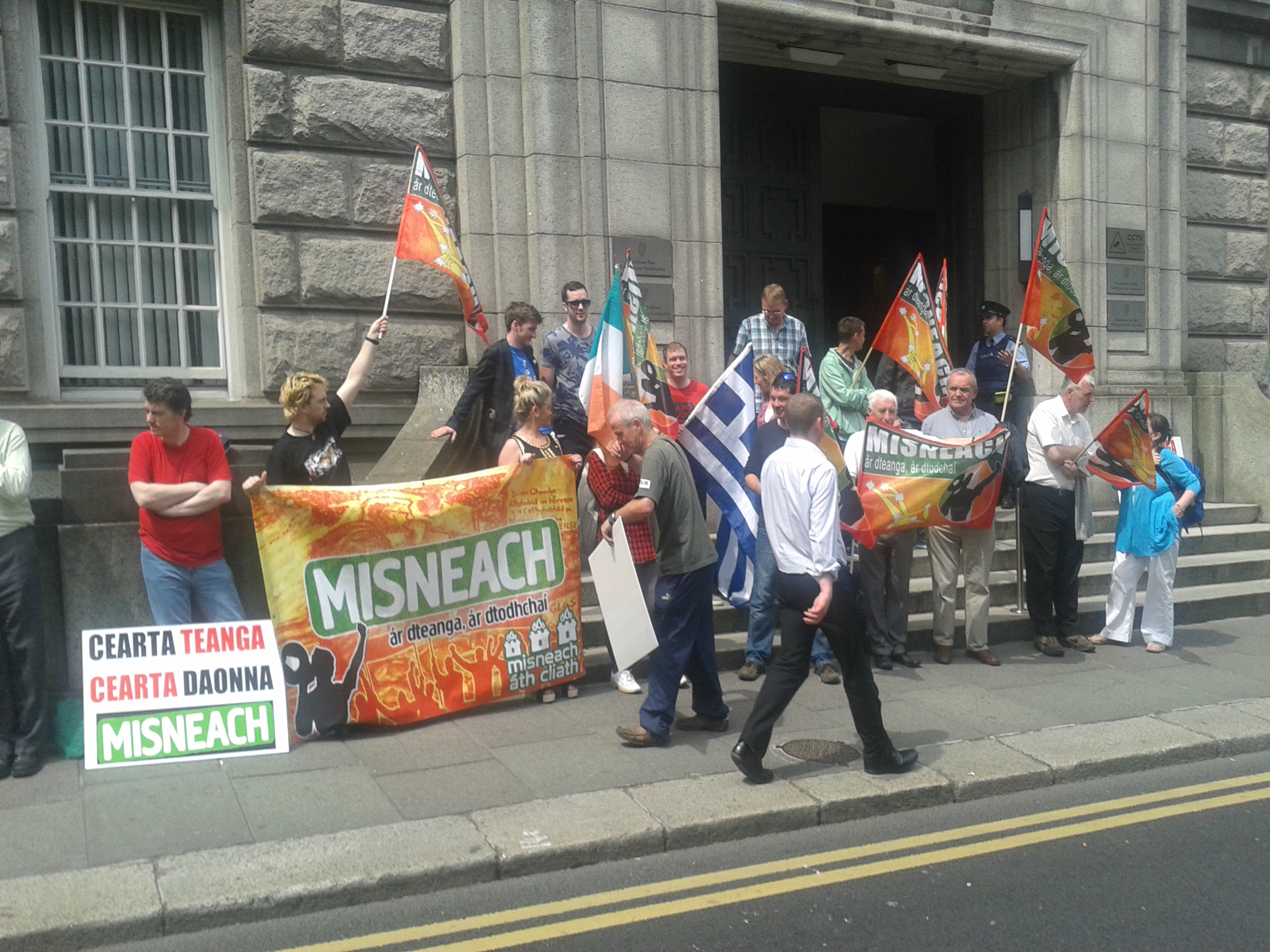
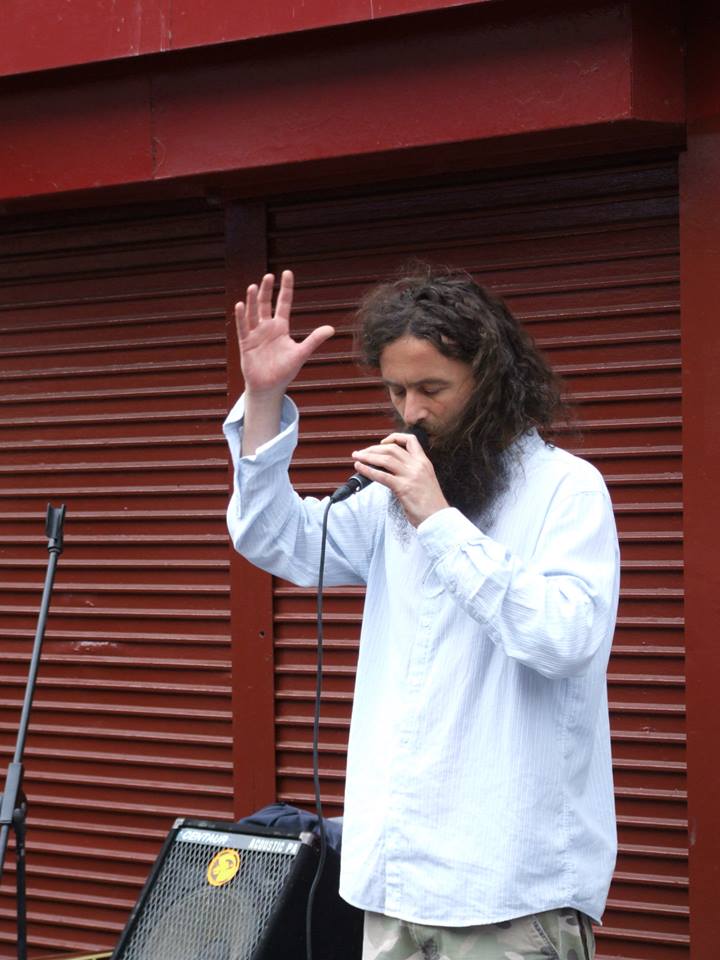
Part of a recent lunchtime demonstration outside the office of the Department responsible for the Gaeltacht.  It was called by a new incarnation of Misneach, an organisation active in the mid-1960s.
Part of a recent lunchtime demonstration outside the office of the Department responsible for the Gaeltacht. It was called by a new incarnation of Misneach, an organisation active in the mid-1960s. (Photo D. Breatnach)


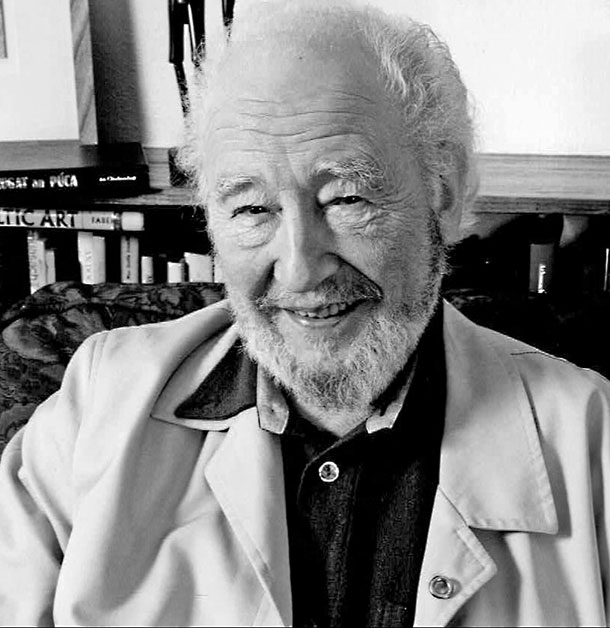
Deasún Breatnach
Deasún Breatnach (1921-2007), a founder member of the language-campaigning organisation Misneach, who went to jail in the 1960s to win the right to have his car insurance documentation in Irish or bilingual.

And there are battles that must be fought with the State, with local authorities, with utilities and service providers including private companies. Both logic and history make it clear that this is so. I have already alluded to the civil rights campaign in the Gaeltacht areas and the refusals to pay radio and TV licenses. In the 1960s a Dublin man asked Norwich Union to supply him a bilingual vehicle insurance document or one in Irish. The company declined. The man bought the insurance but refused to display an English-only document on his car. The State’s laws require that every driver display a document showing that they had insurance but no law required a private company to provide that documentation in Irish. The Gardaí regularly stopped the man who explained his stance and they noted his details and allowed him to proceed. For about a year nothing else happened until one day he was summoned to go to court and, despite his explanation and his reference to his right under the Constitution, he was fined. He refused to pay the fine and went to prison. Demonstrations followed with a friend of his playing the bagpipes outside Mountjoy Jail.  In less than a fortnight, “an anonymous cleric paid the fine” and subsequently the law was changed. Every vehicle insurance company wishing to practice in Ireland subsequently has to provide Irish documentation or a bilingual version.

Some policies will have to be put in place in the Gaeltacht and closely followed.  Policies relating to housing, employment and service delivery will be among them.  Some will be welcome and some controversial … but needs must.

The State has already shown by its attitude and by the sad statistics that it does not wish to save Irish as a spoken language. Nor is it only the record of the Gaeltacht decline which speaks volumes. Recently this Government showcased in a video its plan for the centenary commemoration of the 1916 Rising. Among the many criticisms the video attracted was that the Irish in it was of a terrible quality – the Government had employed a translator who had used Google Translate. The video was withdrawn.
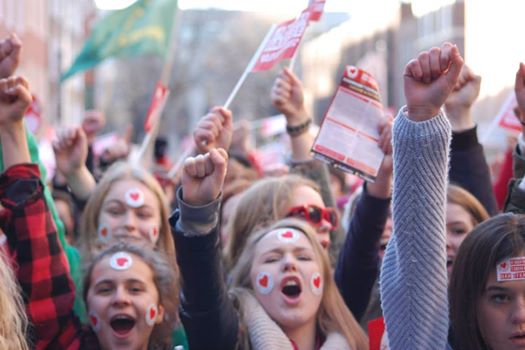
Small section of crowd in large "Dearg le Fearg" (Red with Rage) demonstration March 2014 about lack of support for the irish language.
Small section of crowd in large “Dearg le Fearg” (Red with Rage) demonstration March 2014 about lack of support for the irish language. (image downloaded from the Internet)

Towards the end of 2013, the Irish Language Commissioner, a public servant, accusing the State of “lip-service” towards Irish and actual obstruction, announced that he would not seek reappointment at the end of his term – an announcement that led to a number of big demonstrations in 2014 under the slogan “Dearg le Fearg” (Red with Rage).  In July 2014, the Government appointed a Minister for the Department of Arts, Heritage and Gaeltacht who does not speak Irish – Heather Humphreys. She has, in turn, a Minister of State with specific responsibility for the Gaeltacht, Joe McHugh, appointed in the same month … and, although apparently he is learning it, he does not speak Irish either. And note that responsibility for “Culture” is longer in the same Department as Irish – it has been moved to the much more prestigious Department of Tourism, Culture and Sport.

The State is being challenged from many diverse directions – on issues of services, state finances, centennial commemoration of the fight for independence, conservation, social housing, social welfare, employment and employment rights, health service, gender and sexuality equality, natural resources, Traveller rights, migrant rights … Irish must be seen and heard in these battles and the civil rights of Irish speakers inside and outside the Gaeltacht must also be presented separately, as an issue in itself. These are battles to be fought in campaigns to be planned and time is short. But we can start today, with ourselves. Beatha teanga í a labhairt.

críoch

LINKING ARMS AROUND MOORE STREET TO PROTECT IT FROM SPECULATORS

Diarmuid Breatnach

The 28th of June was not a normal Sunday in Moore Street. On a normal Sunday, Moore Street is not a busy street, although it is not quiet either. The stallholders are on a day off to come back on Monday but a number of small shops are open as are the supermarkets and the ILAC shopping centre, one of which doors opens up on to Moore Street. But on this Sunday, crowds packed a part of the street for the event organised by the Save Moore Street from Demolition group.

Part of the crowd lining up around the 1916 Terrace in Moore Street
Paul O'Toole, who played a number of sets, including singing some songs of his own composition
Paul O’Toole, who played a number of sets, including singing some songs of his own composition

As a crowd had gathered already by 1.30pm, a half an hour early, singer-musician Paul O’Toole responded to his performing instincts and started playing a set of compositions of his own and of others. A song against the Water Charges opened his set, to be followed by another of his own, We Shall Not Lie Down.

Meanwhile the Save Moore Street from Demolition (non-political party) group, had set up their stall as they had done the previous day there and on another 41 Saturday afternoons in Moore Street. The folding table, covered in a Cumann na mBan flag donated by a diaspora supporter, was staffed by Bróna Uí Loing, a relation of 1916 veterans and of Fenians involved in the famous Manchester prison van escape, and Vivienne Lee, another early activist in the campaign. On the table was a petition to save the street and leaflets were being handed out by helpers. Nearby, some Irish tricolours, the Starry Plough and the Irish Republic flag fluttered and a number of placards indicated the concerns of the campaign: “NÍL SAOIRSE GAN STAIR (“There is no freedom without history”) stated one, while another said “NO TO SPECULATORS”.

MOORE STREET IN HISTORY

Moore Street is the sole remaining street of a market quarter going back hundreds of years comprising three parallel streets with many lane-ways in between, all the rest of which are now buried underneath the ILAC shopping centre and a Dunne’s Stores; people lived in those streets and laneways and clothes and shoes, meat and fish, fruit and vegetables and furniture were sold there.

But in 1916, Moore Street, its back yards and its surrounding streets were host to history of a different kind: in the last days of the 1916 Rising, the GPO roof burning and the ceiling unsafe, around 300 Irish Citizen Army and Irish Volunteers evacuated the building and made their way through a side door, across a Henry Street made hazardous by flying bullets, and into Henry Place. It was probably here that the English revolutionary socialist, Weekes (also variously Weeks, Wicks) who had joined the Rising, fell dead.

The insurgents’ evacuation group included three women: Elizabeth O’Farrell, her life-long friend Julia Grennan and Winifred Carney, James Connolly’s secretary who, on leaving Liberty Hall on Easter Monday, had packed a Webley pistol along with her typewriter. All three had refused to leave as the other Cumann na mBan women made their own earlier hazardous way helping the wounded fighters to Jervis Street hospital.

As the evacuees made their way hurriedly through the Henry Place laneway, they encountered a storm of machine-gun and rifle fire at the intersection of the lane and another, now named Moore Lane. The fire was coming from a British Army barricade at the top, in what is now Parnell Street. Here Michael Mulvihill fell, mortally wounded; he was also fresh over from England but originally from Kerry. Volunteers broke into a yard and dragged a car out, placing it across the gap and taking a breath, they ran across, mostly one by one. Connolly was being carried on a makeshift stretcher, his ankle shattered earlier by a ricocheting bullet in Williams Lane, ironically just next to Independent House, owned by leader of Dublin “nationalist” capitalists, William Martin Murphy and also ironically, across the road from the former office of the Irish Socialist Republican Party, founded by Connolly in 1896, sixteen years earlier.

Shortly before the evacuating group were making their way across that murderous gap, Michael The O’Rahilly had led a dozen fighters who had volunteered for the task in a charge at another British barricade and machine-gun a the top of Moore Street, also in what is now Parnell Street. Since the GPO was being evacuated, there was no covering fire from the top of that building and the fire coming down the street must have been terrific. None made it as far as the barricade. The O’Rahilly was apparently unharmed and got quite close; he sheltered in a doorway on the west side of the street and then ran across to a lane on the other side. A burst of machine-gun fire caught him and in the laneway, now named O’Rahilly Parade, he died, after having penned a note to his wife. The note is reproduced now on a bronze plaque in that street.

The other group, having made it through Henry Lane and prevented from further progress by the firing of that same machine-gun, broke into the first house of a Moore St. Terrace on the north side of the terrace and began to tunnel northwards from house to house, occupying in time the whole terrace by the time their leaders gave up their plan of breakout and, in an attempt to save further loss of civilian life, surrendered themselves and all the garrisons of the Rising on both sides of the Liffey on Saturday of Easter Week.

The surrender party of Pearse and O’Flaherty met General Lowe in what is now Parnell Street (exactly where is disputed but from the photo of the event it would appear to be outside of where In Cahoots café is now). The GPO/ Moore Street garrison marched up O’Connell Street and surrendered their arms outside the Gresham Hotel and were kept prisoner in the garden of the Rotunda, the building where the first public meeting to found the Irish Volunteers had been held in 1913. A British soldier posed later for a photo with the Irish Republic flag held upside down in front of the Parnell Monument and at some point a whole group of British officers posed for another photo, also holding the flag upside-down to signify the defeat of the rebels.

From that tunneled-through terrace in Moore Street, six were among the 14 shot by firing squad, including five of the signatories of the Proclamation: Tom Clarke (whose tobacconist shop was where the Centra shop is now, across from the Parnell Monument), Patrick Pearse, James Connolly, Seán Mac Diarmada and Joseph Plunkett. Another, William Pearse, was also executed.

MOORE STREET ON THE 28th JUNE 2015

Jumping forward to June 28th 2015, while Paul O’Toole was playing and singing to keep the audience interested, shouted slogans from the Henry Street end of Moore Street announced the arrival of the Dublin Says No weekly march, come to support the campaign.

Paul O’Toole’s place was taken later by Kev and Dwayne, who played and sang a set of Dublin and 1916 ballads, to be followed by a performance of two of his pieces by John Cummins, Poetician, champion of the Slam Poetry competition. His piece on Moore Street was particularly well received.

John Cummins, poetician, performing his Moore Street piece
Kev and Dwaine, who also provided entertainment with a set of Dublin and 1916 songs

Diarmuid Breatnach of the Save Moore Street from Demolition group, who had been MCing the entertainment part of the event, then called on the crowd to line up on the street and stretch arms in a symbolic act of: “Love for Moore Street and our heritage and resistance to the plans of property speculators to destroy it”. Paul O’Toole came back on and played as the crowd eventually stretched around all four sides of the “1916 terrace”, areas where in 1916 bullets flew and people died as a relatively small group of women and men took on the British Empire. Cries could be heard of
“Save Moore Street, save it all,
Save the Terrace and the stalls!”

When the ‘Arms Around’ exercise had been completed, photographed and filmed, Breatnach called the participants to gather back around to the Moor Street terrace and introduced Mel Mac Giobúin, to speak on behalf of the SMSFD group and to MC the final part of the event.

Mel thanked the crowd for encircling the 1916 terrace in defence of “ ‘me jewel and darlin’ Dublin’ as Éamon Mac Thomáis would say”. Mel explained that the small group of which he was part had run an information and petition stall “every Saturday for over 40 weeks in Moore Street, in rain, cold and now sunshine” and paid tribute to all those who had campaigned over the years. He spoke of the support of ordinary people who shop in the street, who come up to the stall not only to sign the petition but to tell us their memories of shopping or working in Moore Street, of relatives who were involved in the 1916 Rising and/ or in the War of Independence.

The line stretching around from Moore St, to the corner of Moore Lane with Henry Place, then (out of frame) up Moore Lane to O'Rahilly Parade and back into Moore St.
The line stretching around from Moore St, to the corner of Moore Lane with Henry Place, then (out of frame) up Moore Lane to O’Rahilly Parade and back into Moore St.
Mel Mac Giobúin, speaking on behalf of the Save Moore Street from Demolition group

Enumerating some of the advances that had been made over the years, Mel denounced the Chartered Land giant “shopping mall” proposal and the NAMA process through which property speculator Joe O’Reilly was now going and Moore Street along with him. (Joe O’Reilly was, at €12.8 billion, top of the list of NAMA debtors not long ago but is now at No.6 of the Top Ten. He is still in business and being paid €120,000 annually by the State to manage his debts; also was recently involved in bidding for another big property site — DB). Dublin City Council had received a large number of submissions, Mel said, and was now beginning to think that another shopping mall might not be the best idea for Moore Street.

Bróna Uí Loing and Vivienne Lee, members of the campaigning group
Bróna Uí Loing and Vivienne Lee, members of the campaigning group with the campaign table displaying petition and leaflets

“We should continue to recognise the important significance of the 1916 Rising and the long tradition of the street market” Mel said and, in concluding, he thanked the crowd but asked them to be ready to be called out again in defence of the Moore Street historic quarter.

Next to speak was Donna Cooney, representing the 1916 Relatives Association, who spoke of the Cumann na mBan women in Moore Street in 1916, one of them being her great grand-aunt, Elizabeth O’Farrell. Donna recounted how O’Farrell had tripped in Moore Lane during the evacuation but had been caught and saved by Sean McGarry. On entering No.10, the first thing O’Farrell remembered seeing was Connolly on a stretcher and went to tend to him (she was a nurse by profession).

Donna spoke of the perilous journey O’Farrell had to take twice in the negotiations with General Lowe and then later, more danger in the unhappy task of taking the surrender instructions from Pearse and Connolly to insurgent strongholds in various parts of Dublin. “The Government needs to do much more”, said Donna, referring to Government plans to commemorate the centenary of the Rising in 2016 and was warmly applauded by the crowd.

Donna Cooney, great-grandniece of Elizabeth O'Farrell, speaking on behalf of the 1916 Relatives' Assocation
Donna Cooney, great-grandniece of Elizabeth O’Farrell, speaking on behalf of the 1916 Relatives’ Assocation

Proinnsias Ó Rathaille, called up next by Mel, is also a 1916 hero’s relative – his grandfather was The O’Rahilly, who died in the lane that now bears his name. Proinnsias spoke briefly of the international importance of the 1916 Rising, which had given such inspiration and encouragement for their own revolutions to nations around the world, particularly those under the British Empire. Turning to the importance of the Irish diaspora to the struggles, Proinnsias singled out Maeve O’Leary who continues to promote the cause from Australia where her home is now and who had recently returned to her native Dublin for a short while (and worked with the Save Moore Street from Demolition group — DB).

Proinnsias concluded by reading the moving poem written by Yeats to the memory of The O’Rahilly to great applause.

Proinnsias Ó Raithille, grandson of The O'Rahilly
Proinnsias Ó Raithille, grandson of The O’Rahilly and a campaigner for Moore Street

The final speaker introduced by Mel was Jim Connolly Heron, great-grandson of James Connolly, a long-time campaigner for the appropriate preservation of Moore Street. Jim spoke about how the Chartered Land plan to destroy Moore Street had been agreed by a Minister in the current government and how a land-swap deal, which would have facilitated the destruction of much of the 1916 terrace, had been voted down by elected councillors of a number of political parties and independents.

Jim Connolly Heron, great grandson of James Connolly and a long-time campaigner about Moore St.

Jim went on to speak of the NAMA sell-off of assets due for the following day, when among other properties, Chartered Land’s stake in the ILAC and Moore Street was to be sold off to the highest bidder. “Moore Street is not for sale”, he said, to cheers. Jim went on to speak of “the golden generation” who had risen in 1916 and the need to honour their memory and to commemorate the event properly and how conserving the historic Moore Street quarter, the only surviving 1916 battle-site, is very important part of that. Jim concluded to loud cheering and applause by saying that “Moore Street will not be sold on our watch!”

Paul O’Toole then played and sang again his “We Will Not Lie Down”, with the crowd joining in on the chorus, after which he accompanied Diarmuid Breatnach singing “Amhrán na bhFiann”, the first verse solo and everyone joining in on the chorus.

And so the third Arms Around Moore Street event in six years (along with other types of campaign events) came to a close. Next Saturday, the Save Moore Street from Demolition information and petition table will be there again, for people to sign, to read, to share their memories, their anger, their hope that the market, the terrace, the quarter are saved. In the meantime, people will sign the petition on line and post supportive comments on the SMSFD Facebook pages and others. It is not just their past – it is their future too.

End

Section of the crowd of supporters in Moore Street

IN SPAIN THE PEOPLE SHOULD RULE — THAT WOULD BE DIGNITY

Rebel Breeze: This piece was received months ago but somehow got overlooked for which we apologise.  Events since then make the points in this short document perhaps even more relevant.

Red Roja describes itself as “a revolutionary marxist organisation active within the Spanish state”.  It states that it is “an autonomous organisation independent of any other party or organisation and also economically and politically independent of the State or of any other power, being anticapitalist, of the class, feminist, radically democratic, internationalist, anti-fascist and ecologist.”
(Translation D.Breatnach from http://redroja.net/index.php/que-es-red-roja/quienes-somos)

In Spain, ‘The people should rule — that would be Dignity’
Red Roja Red Network Rede Vermelha
Traducido por  John Catalinotto

The following is a statement of the organization Red Network in Spain to the Dignity marches of March 21, a year after a similar march brought 1.5 million people to Madrid to protest austerity measures.

On March 22, 2014, more than a million people from all over the Spanish state marched in Madrid for ‘Dignity’ against austerity.

On March 22, 2014, more than a million people from all over the Spanish state
marched in Madrid for ‘Dignity’ against austerity

We once again demand that those who caused the crisis be made to pay for it.

An unpayable debt is crushing us, we who suffer every day from unbearable job insecurity, dismantling and privatization of health and education, increasing retirement age, the disappearance of aid for dependents, and our millions of unemployed people who are worth less than nothing to those in power. … The austerity measures and cuts are only being used to pay for a debt created to rescue the gang of bankers, big business people and their servants in the National Assembly, who are playing chess with our lives. Besides using our suffering to line their pockets, they expect us to hang our heads and die in silence. That we refuse to do.

Regarding this, we are nowhere near satisfied with hearing only about “restructuring” or “audits” of that debt. We cannot stop at half-measures when our lives are at stake, when there can be no doubt that this debt is responsible for the criminal foreclosures, the endless unemployment and for the disappearance of even the modest steps taken against domestic violence that condemns many women to terror, suffering and death. It is not a technical problem to say, “NO DEBT PAYMENT.” It is a punch that the people can throw to demand control of their own lives.

In these times, it is understandable that there are illusions that an election can bring “victory,” that we can “throw out the PP” [the rightist Popular Party] or “get rid of the wealthy strata.” But more is needed. No one involved in the new electoral initiatives is speaking about the national and European laws that impose the payment of that illegitimate and criminal debt before anything else. Good will is not enough; neither is honesty. Proof of this is the victory of Syriza in Greece, which has not pushed back by even one step the measures the Troika [the European Commission, the International Monetary Fund and the European Central Bank] had taken against the Greek people. It has become clear who rules Greece: It’s the EU dictatorship. Democracy is an illusion.

Moreover, even this demonstration, though necessary, is insufficient. It is not enough to come together to demand “Bread, Work and Housing” (things that would only be possible after we refuse to pay the debt), or to have a great demonstration of dignity. As seen in Greece and as we see every day in our streets, bankers and big business are not going to give up lining their pockets out of good will.

We need to unite, to organize neighborhoods, towns, businesses and schools, and strike a blow together, all at one time. Only through the unification of our struggles, only if the people who are working and suffering get organized, can we bring about policies that work in our own favor.

The vote is not enough. The people need to organize. The people need to rule.

That would be Dignity.

DISSIDENTS — A FLAWED CONTRIBUTION TO THE HISTORY OF A NEGLECTED GROUP

REVIEWING DISSIDENTS BY ANNE MATTHEWS:

Diarmuid Breatnach

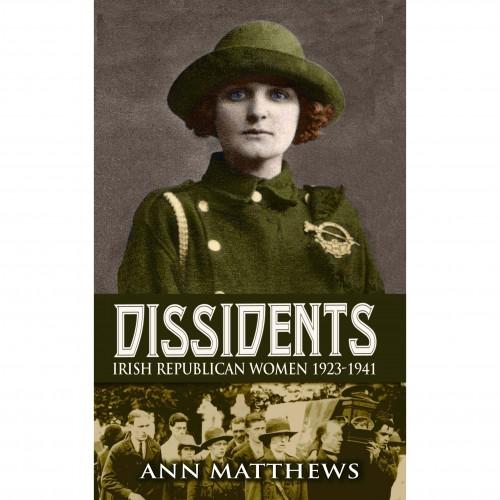
The role of women has been often ignored and undervalued in the body of Irish historical writing. Whatever the reasons for this state of affairs, a tendency in more recent writing has been, at least to a degree, to attempt to rectify this. In the decades since Margaret Ward’s Unmanageable Revolutionaries (Brandon, Ireland, 1983), this rectification has been slowly gathering pace. Dissidents – Irish Republican women 1923-1941, by Anne Matthews (Mercier, 2012), is a contribution to this movement in historical writing; it is essentially the history of an Irish women’s political movement, Cumann na mBan, during the years outlined. A previous work of hers, “Renegades”, deals with Irish Republican women from 1901 to 1922. 

Dissidents Irish Republican Women bookAlthough Dissidents deals with the period 1923-1941, Cumann na mBan was founded on 2nd April 1914 as an auxiliary to the all-male Irish Volunteers’ organisation, which had been founded in 1913. In 1914 the Volunteers split after John Redmond, leader of the Irish Parliamentary Party (in Westminster) and the main open Irish political party in Ireland, committed the Irish Volunteers to fight in the British Army in WW1. The smaller section of the split went on to participate in the 1916 Uprising and more coherently later in the War of Independence (1919-1921). Redmond’s party and “constitutional” Irish nationalism was all but wiped out in the British General Elections of 1918, at which time the whole of Ireland was still under British rule and Redmond’s nationalist opponents, then amalgamated under the name of the reformed Sinn Féin, gained the vast majority of parliamentary seats in Ireland.

Today it is common to define the ideology of both both Cumann na mBan and the Irish Volunteers as “Irish Republican” and, although they quickly became so, and the impulse in the formation of the Volunteers in 1913 was of the secret Republican organisation the IRB (Irish Republican Brotherhood), both organisations at first could be more accurately described as broadly nationalist. Both organisations contained prominently in their midst people whose ideology conformed to that of Irish Republicanism as well as those whose thinking did not, people who expressed a strong interest in equality for women as well as those who were against it, people with at least a sympathy for socialist ideas and those who condemned any such tendencies – and of course variations in between.

In the period specifically chosen by Matthews, 1923-1941, the Irish Volunteers had morphed into the political party Sinn Féin and the armed organisation the IRA (Irish Republican Army) and become Irish Republican in ideology, as had Cumann na mBan. They had in fact been that way since 1919, although the period 1921-’23 was to expose some deep fracture lines which found expression in the Civil War (1922-1923) and later again with the founding of Fianna Fáil and its eventual management of the Irish State (the 26 Counties).

In order to compile her history, Matthews has consulted minutes of committee meetings of Cumann na mBan in its various incarnations (she identifies four periods, or versions of the organisation), personal recollections of participants recorded in writings, interviews, comments quoted by contemporaries, newspaper reports and articles, the Republican movement’s own publications, as well as records of prisons and police under both British and subsequently Free State rule. And she has used some of this material to reproduce and also compile lists such as the numbers and names of women convicted and jailed, the women who went on hunger-strike and the length of time on that protest. The lists also include figures on the decline of Cumann branches between 1934 and 1936, as well as a list of “women in organisations listed as dangerous by the Free State CID in 1934”. These lists are a particularly valuable contribution and will be of great use to many writing on the political movements of the period in Ireland.

Looking at some of those lists alone, one is struck by the sheer extent to which the contribution of women activists to the struggle for Irish independence, and the price they had to pay, has been overlooked. In 1930 twenty-nine women were in organisations listed as “dangerous” by the Free State detective branch of the police – twelve of these were in senior positions of Cumann na mBan, three in directing positions in Saor Éire, three for Comhairle na Poblachta, three also for Sinn Féin, one for the Prisoners’ Defence Organisation, two for Women Prisoners’ Defence League and one for the Anti-Imperialist League. The rest were rank-and-file members of those organisations and one was in Friends of Soviet Russia.

The Free State interned 645 women during the Civil War (as against over16,000 men). In her Introduction, Matthews points out that “There were twenty-four strikes in the three (women’s) prisons during the period from November 1922 to November 1923, in which 219 women took part.”  According to the table drawn up by Matthews, one woman was on hunger strike for 35 days, another for 34, seven for 31, many for different amounts of days but the vast majority into double figures. Furthermore, some of them were on hunger strike more than once.

Matthews also provides a list of the occupations of 79 women activists jailed in the North Dublin Union, which were surveyed in August 1923: the highest number for a single occupation were the 19 listed as “at home”, while the next were 11 whose occupations were given as “packer in Jacob’s” (the biscuit factory in Dublin); 10 had been engaged in “printing”; eight were “shop assistants” while 15 were variously listed as “typist” or “clerk”. This list shows quite a variety of social background among what one presumes to be fairly politically-active women which the Free State considered its enemies.

Republican women acting as couriers or delivering weapons made many journeys by bicycle, often at night without lights in order to avoid Free State patrols, “often round trips of up to forty miles” Matthew tells us (p.32).

BIAS

As has been pointed out by a number of commentators, history writing involves a degree of bias. This bias is exercised not only in explicit judgements but in inferences made, choice of phrasing and so on. Choices are made in what sources to use and what prominence to give them as well as in the opposite, which sources to disregard.

If the Fall of Lucifer and his angel followers were a historical event, for example, we would expect Lucifer’s version to be very different from the Judaeo-Christian story with its sympathy for the Archangel Michael (a great example of history being written by the victors). There might be yet other versions, for example by the Seraphim and Cherubim, one of which might be in partial sympathy with the Fallen side and the other which might be against both sides of the conflict.

Whereas in the ancient past history writing was blatantly partial, in the past century historians have generally claimed to be impartial dispassionate observers recording what they discover. But every one of those writers had views influenced by class, ethnicity, gender, position in or out of power groups, status, upbringing and personal experience. And those views influenced their historical judgements, quite likely their choice of sources and possibly their choice of audience. Written records could only be left by literate people and yet for most of history the majority of people have been illiterate. A more recent trend in history writing is to recognise the inevitability of bias and for the historian to declare which is his or hers.

One should beware of historians who don’t declare their bias at the outset. That will not be a problem with Anne Matthews because although she does not formally introduce her bias to her readers, it very soon becomes clear. Or maybe that is not quite accurate, for in order to have a bias against a group one must presumably also have a bias in favour of another. It is difficult indeed in the pages of this book to find any group for which Matthews has any sympathy or, even more important for a historian, empathy.

To express a bias is expected, as I commented earlier. But unless one is engaged in pure propaganda or character assassination (or glorification), one should present the evidence in favour as well as that against and, in weighing one against the other, make a judgement. When Matthews has anything favourable to say about her subjects it seems to be an accident which will soon be remedied a little later – just keep reading!

A particularly clear and nasty example of this bias is in Matthews’ treatment of Constance Markievicz whom she calls a “self-proclaimed heroine” (p.28) but does not tell us when and where Markievicz allegedly “proclaimed” herself to be a “heroine”. Matthews also inferred that Markievicz was a given to warlike statements but a coward who ran away to Scotland. Whatever the reason for her departure in 1922, one wonders how, no matter how much she may dislike the person, someone could call Markievicz, who prominently took up arms and fought for a week against the British Empire, a coward.

In the Matthews view of the organisation, Cumann na mBan was a largely ineffective body, doctrinaire and full of in-fighting. The leadership and many prominent activists were aristocratic or upper middle class, used to the privileges afforded by their class. The working and lower-middle class members accepted the leadership’s decisions or just deserted.

Some of those things may be true and there might even be some truth in all of them — but where is the counter-argument before coming to judge? One doesn’t find it in Matthews, except by an inference that one can make from the lists I mentioned earlier and other information.

If a woman came from a higher social class and was used to having servants do her cleaning, do those facts diminish in the least her courage in facing bullets in insurrection, the threat of the firing squad, the pangs on hunger-strike and the risk of permanent damage to health, the risk of physical beatings and unhealthy prison conditions? Or on the contrary, in some ways, are those risks and sacrifices not all the more remarkable for one from such a background as that? And if an upper-class mother can pay a nanny to look after her children while she herself in in jail, does that take away from her courage and fortitude? A working-class mother without those resources (though she might be able to avail of extended family) of course has even more obstacles to surmount and deserves our greater praise but that is no reason to disparage the sacrifice or commitment of a woman of a higher class.

And if infighting and bad policy choices were a significant feature of the organisation, were there not others to weigh against them on the scales of judgement? What of transporting, hiding and distributing weapons? Of carrying secret correspondence and intelligence? Or of continuing to feed the flame of resistance while men were in prison, organising pickets and demonstrations, outside jails etc? What of creating the enduring 1916 emblem and Republican commemoration emblem, the Easter Lilly? Or of organising Republican commemorations year after year, as well as funerals of fighters in the midst of repression? Or the work of supporting prisoners and their dependents? Matthews records these and often the difficulties entailed but without a word of approval to balance the censorious words used in her criticisms. Nor do we see an attempt to understand the choices these women made or the constraints upon them, much less see anything to admire; we are shown few lessons to learn from, unless it is something like “don’t be these people or anything like them”.

In Dissidents, Anne Matthews has made a contribution to the story of Republican women but its judgement is clearly skewed and the work suffers as a result. Matthews could have recorded all the negative information that she did but also the points to throw in the balance – had she done so, her book would have been a much better return on her investment in historical research and writing as well as a better reward for the reader.

End.

THE BLOODIEST BATTLE OF THE EASTER RISING

D. Breatnach

99 YEARS AGO ON 26th APRIL, THE BLOODIEST BATTLE OF THE EASTER RISING WAS FOUGHT IN A DUBLIN SUBURB

At a little past 6am on 26th April 1916, the SS Tynwald and SS Patriotic, two British troop-ships, had berthed in Dun Laoghaire harbour. The harbour and town had been renamed Kingstown by Unionist elements when King George IV came to visit the new port under construction in 1821. Although the town returned to its former name in 1920, it was known as “Kingstown” by most people in 1916, whatever their allegiance.

The troopships had been requested by General Maxwell, who had been given the responsibility for suppression of the Easter Rising, which was now in its third day. Several British thousand troops from the 59th Midland division began to disembark on a bright sunny morning. Hundreds of civilians went down to see them despite the early hour. Many in that town, especially around the seafront and some of the big houses, would have been sympathetic to the British – but by no means all and no doubt some eyes were noting the arrivals in order to report to the insurgents.

Around 9am, disembarkation completed, the soldiers were formed up and inspected, equipment checked and the Sherwood Foresters set off marching towards Dublin city centre, seven miles away, to be followed by Nottingham and Derby regiments around 10.30hrs. Their forces appear to have split up, with two Battalions marching to the city along the coast road and another two heading inland.

To reach the city centre from Dun Laoghaire, the most direct route is to proceed northward along the coast to Mount Merrion. Once there, the coast road goes through the railway level crossing to the right and continues along the seafront, into Ringsend and then along what is now Pearse Street to Trinity College. The British officers did not lead their men in that direction, perhaps because they had received intelligence of the Boland’s Mill strongpoint along their route. There would be no going past that without first taking it, which might prove a lengthy and difficult battle.

But one could avoid that by not turning right at Mount Merrion and instead continuing on what has become the main road, through Ballsbridge and Northumberland Road, across the Grand Union Canal at Mount Street Bridge, past the fashionable Merrion Square and into Nasseau Street and the city centre. That seemed the obvious choice, not just because of the Jacob’s garrison but also because at Mount Street Bridge was located Beggars’ Bush Barracks, one of the many such of the British Army in Dublin city.

Northumberland Road looking southwards. The Irish insurgents first saw the British troops coming up this road.
Northumberland Road looking southwards. The Irish insurgents first saw the British troops coming up this road.  The Parochial Hall and Schoolhouse are to the left but out of the photo.  The canal is behind the photographer.  (Photo D.Breatnach)

Before the British troops arrived in the area, a female courier, probably Cumann na mBan, had brought news of the troops landed in Dún Laoghaire and that they were heading towards them to the insurgents waiting in the Mount Street Bridge area.

At around noon a burst of fire hit the forward sections of the British troops marching in from Dun Laoghaire. When fired upon, in order to find effective cover, it is important to know from where the firing is coming but the soldiers were unsure. No. 25 Northumberland Road, a house at the junction with Haddington Road, seemed to some to be the source of the firing but by how many was unknown.

Screams from wounded men filled the air in the quiet suburban upper-middle class and largely Loyalist residential street.

Soldiers began to maneouver to outflank No.25 Northumberland Road and a detachment reached Baggot Street Bridge, further west, which was apparently undefended. From there it is a straight road into Stephens Green and the southside city centre. The rest of the soldiers were not led by their officers in that direction, a decision which was to cost them dearly. Instead, shortly after being fired upon, at least two British platoons attacked 25 Northumberland Road but were driven back in disarray by fire from the building’s upper floors; yet as they turned they were also shot down in droves.

Perhaps under cover of that assault, at around 1pm some of the 2/7th Battalion Sherwood Foresters got past the corner house and made their way on to Percy Place, which runs along the south side of the canal between Mount Street and Baggot Street bridges. Now they came under fire from in front and from their left. They huddled for cover along the Canal.

The fire from the left of the British at this point was coming at long distance from the towers of Jacob’s Factory in Bishop Street, one of the insurgent strongpoints. A defensive line with insufficient mobilised insurgent numbers to hold it for very long stretched from Jacob’s down to the railway connecting Dublin and Dun Laoghaire and to Boland’s Mill beside it, overlooking the south bank of the Liffey. Roughly in the middle of this chain or defensive line were the Irish Volunteers in the Mount Street Bridge area, an outpost of the Boland’s Mill garrison.  The total strength of the insurgent force defending that area had been 17 Volunteers but two had been sent home, being thought too young.   

New Clanwilliam House, Mount Street, north side of the Royal Cana. Looking eastward.
New Clanwilliam House, Mount Street, north side of the Royal Canal, looking eastward. The Bridge and Canal are to the right but out of shot. (Photo D.Breatnach)
The Schoolhouse, Northumberland Road, today (a snack-cafe nowadays). The Bridge is to the right; the British troops were advancing along the road from the right.

Incredible as it seemed to the British when they learned of it later, there were only two Volunteers in No.25 Northumberland Road: 27 year-old Volunteer Lieutenant Michael Malone, a carpenter by trade, and Section Commander James Grace. In the Schoolhouse on the right-hand side just before the Bridge, there were two Volunteers. Next to that building was the Parochial Hall, held by four men: P.J. Doyle in command, Joe Clarke, William Christian and J. McGrath. Clanwilliam House, across the canal on the right-hand corner with the junction with Mount Street Lower, was occupied by seven Volunteers; the frontal fire hitting the British was coming from there.

The British were scattered around gardens and behind the granite steps leading up the to front doors of the elegant houses in the street. Their officers called them out and they launched an attack on the Schoolhouse in Northumberland Road. As they charged up the road they came under fire from across the Canal from Clanwilliam House; about a dozen reached the Schoolhouse but they left many bodies behind. And they were still coming under fire from across the Canal too.

The officers now attempted to outflank Mount Street Bridge and Northumberland Road by advancing along Shelbourne Road to the east but were stopped as they came under fire from Volunteers along the railway line and from positions in and around Horan’s Shop nearby.

The column advancing from Dun Laoghaire had set up a temporary HQ in Ballsbridge Town Hall. Incredibly, the officers there, receiving regular dispatches reporting their troops being slaughtered around Mount Street Bridge and, presumably, knowing that other troops had found Baggot Street Bridge undefended, continued to press for an advance across the killing field.

But at least the officers on the battlefield for the time being seem to have had enough of death-or-glory charges, which were bringing plenty of death and no glory. The soldiers are now crawling along the road but whenever any are visible, which is often, they are being fired at. Clanwilliam House is wreathed in smoke.

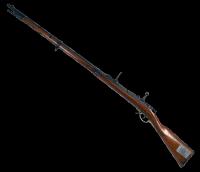
Mauser Model 71 small
The Mauser Mark 71

The weapon the Volunteers were using was almost certainly the Mauser Model 71, the weapon of most Volunteers and Irish Citizen Army during the Rising; 1,500 had been been delivered in two landings in July 1914, first at Howth, north Dublin and then at Kilcoole, Wicklow. It had been the first cartridge rifle adopted by the Prussian Army in 1872 which by 1914 had gone on to another more advanced model, presumably the reason that the rifle was being sold cheaply. The Model 71 fired a larger bullet than the British Army standard-issue Lee Enfield .303 but did not have a magazine, each cartridge having to be ejected and anew one inserted before firing again; its rate of fire was only four or five rounds a minute. The Lee Enfield took a ten-bullet magazine and the British Army were trained to fire fifteen rounds a minute. Despite this, the occupants in Clanwillian House and in No.25 in particular were able to lay down a tremendous rate of fire. Their guns grew so hot they burned to the touch and they had to cool them with wet rags. Down below, British officers blew their whistles and soldiers carried out more charges, only to be cut down by the Volunteers’ rifle fire.

During the late afternoon, a nurse ran on to the road and began treating the wounded British soldiers. The Volunteers agreed to a ceasefire as doctors and nurses from Sir Patrick Dunne’s hospital nearby went into Northumberland Road. But after a while the British attempted to use the ceasefire to advance their positions and the Volunteers ended it. Those wounded still to be tended lay where they were. This had been very different situation to what was to be seen in other areas of Dublin during the Rising, when British troops refused to allow wounded to be taken out unless the insurgents surrendered and when they accused Nurse Elizabeth Farrell of being a spy and tore her Red Cross bib–front off her.

The British got a machine gun up to the bell-tower of the church on Haddington Road so that they could fire over the roofs of the houses at Clanwilliam House, the bullets knocking chips off the outer walls and zipping through windows. They were also being backed by rifle snipers.

British soldiers recommenced attacking No.25, now with hand grenades as well as rifle fire. Finally they got close enough to blow the door in with explosives but incredibly were fired upon from inside as they tried to gain entry, injuring a number of them. They hurled grenades in and after they exploded, dashed in again. Coming down the stairs to meet them was Volunteer Lieutenant Michael Malone, his pipe in his mouth and was shot dead.

Section Commander James Grace had been downstairs using a cooker as cover from bullets and shrapnel and such was the bomb damage to the room that the British assumed anyone in there had to be dead. There was still plenty of fighting to do – they had not even crossed the Canal yet.

If they believed that two men alone had held out against repeated assaults for four hours and had inflicted such damage upon them, they must have been very fearful leaving No.25. But perhaps they thought there had been others who must have escaped in the last minutes. James Grace did escape to get out of the area after lying low for some hours; however he was arrested some days later.

With No.25 taken, the Sherwood Foresters are soon able to take the Parochial Hall but they find it empty. The garrison of four Volunteers had run out of rifle ammunition and evacuated into Percy Place, where British troops, who were now all around the area, captured them.

An officer takes Volunteer Joe Clarke‘s loaded pistol off him, puts him with his back to a door and fires at him. Missing Joe, the bullet goes through the door to where a doctor is attending to injured British soldiers. He storms out in rage, berating the officer and Joe Clarke’s life is saved (he continued active in the IRA and in Republican politics nearly until his death in 1976 at the age of 94).

British soldiers are occupying nearby houses for cover and for firing positions and they are also crouched behind the low wall along Percy Place. They are still being hit. Now, they attack the Schoolhouse from its front, running across enfilading fire from Clanwilliam House to their left as they attack and from other positions to their front. When they enter, they find the Schoolhouse unoccupied by any Volunteer, alive or dead. However, their storm of bullets during the attack has riddled the bodies of its caretaker and his wife.

The cost to the British has been enormous but they have at last taken the southern side of the Canal around Mount Street Bridge. Across it, waiting for them, is Clanwilliam House. And to the east, their right-hand side, snipers at Boland’s Mill and nearby positions are also firing at them.

Now the officers order forward their reserves who had been sheltering in St Mary’s Road. The soldiers charge for the Bridge, answering to their discipline and their officers as they and many like them will do across the WWI battlefields of Europe, Greece, Turkey and Russia for another three years. It is partly against this slaughter that James Connolly led the men and women of the Irish Citizen Army out this week. One of the ICA’s detachments is not far away, under the command of Michael Malin and Constance Markievicz, in the College of Surgeons on the side of Stephens Green and they have already taken casualties.

Despite the covering fire from the Vickers Machine Gun firing incendiary bullets from St Mary’s Church, this charge too is driven back, their casualties adding to the pile of khaki-clad bodies and wounded on Northumberland Road, the Canal banks and the Bridge.

Around 8pm, the British are finally across Mount Street Bridge. An officer was in the charge, one of their few unwounded, and is at Clanwilliam House’s outer walls. Firing continues from the windows of this last insurgent bastion and from the east, a hail of Mauser death is still hitting the Bridge and the northern side of the Canal.

The British are now close enough to throw grenades but one, thrown by a British NCO, bounced back from a second floor window and exploded next to his head, killing him. The British begin to make their way into the now-burning Clanwilliam House but are forced to retreat by the flames, leaving the fire to consume the bodies of the presumed dead Volunteers inside. They will not know now how many there were. In fact, there were only seven Volunteers, three are dead and the remaining four have escaped out the back.

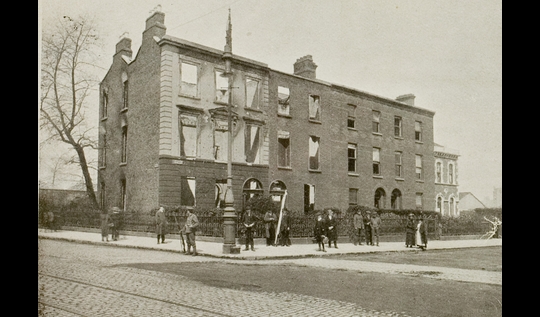
Clanwilliam House after the Rising
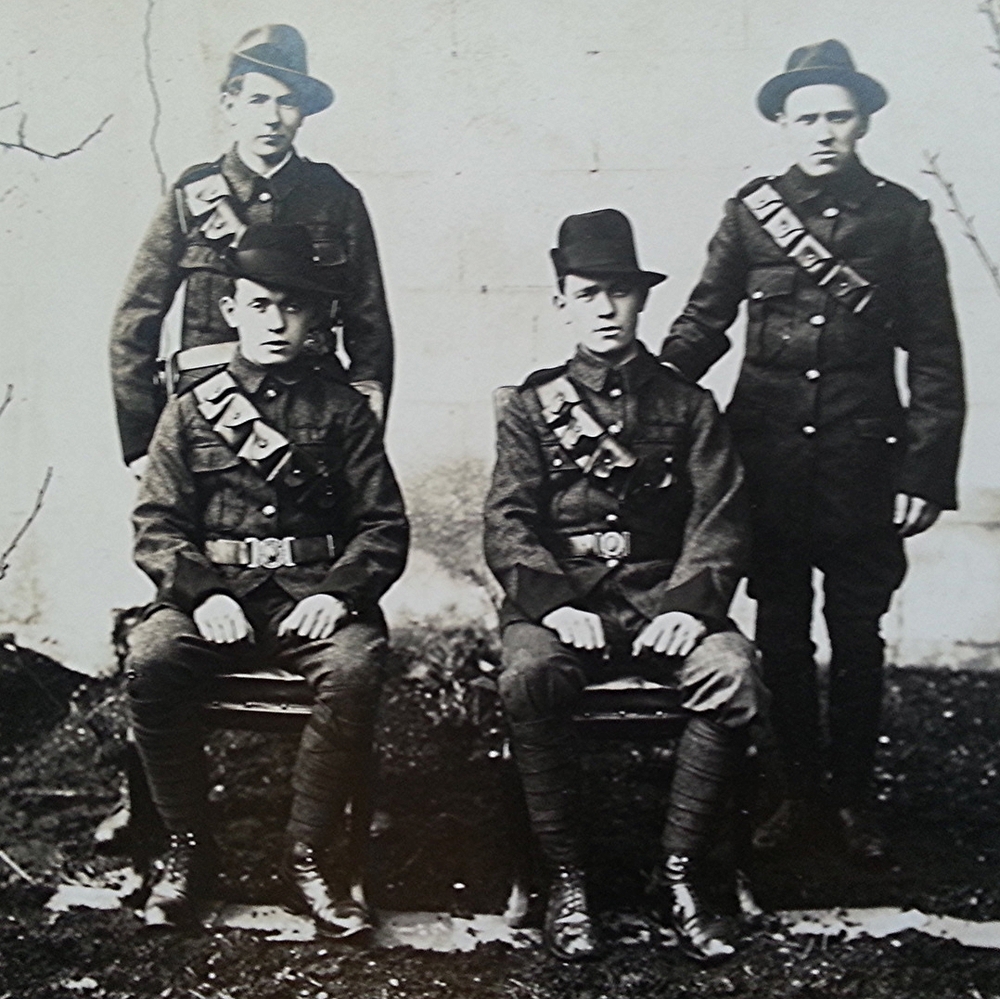
The four survivors of the Clanwilliam House garrison.

Ninety-nine years ago in the Battle of Mount Street Bridge, despite having only single-shot rifles and some pistols, the  Volunteers held off two British Battalions, numbering approximately1,600 between them, for five hours. Approximately 234 men (including 18 officers) of the British Army had become casualties at the hands of fifteen insurgents.

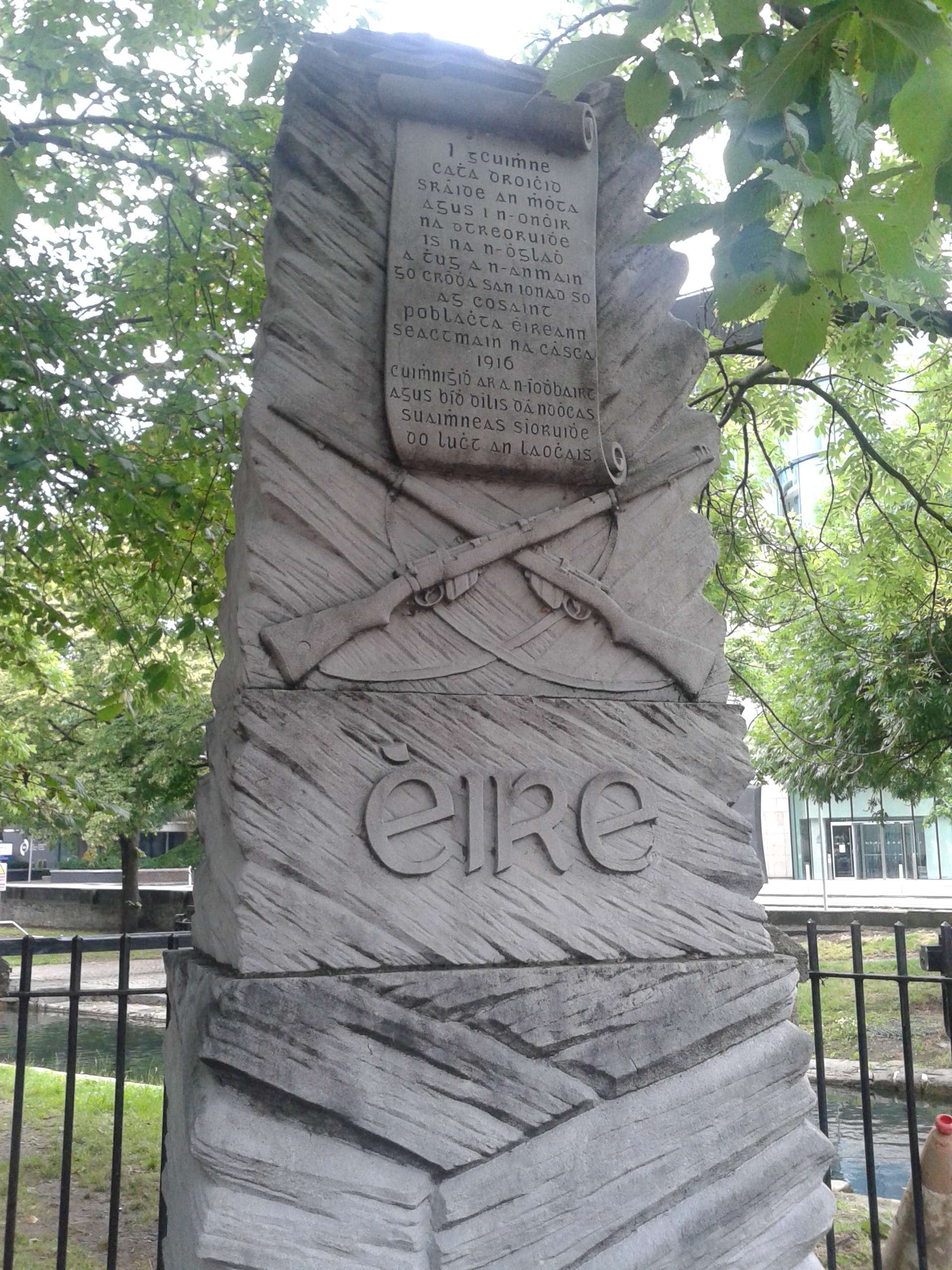
Mount Street Battle Monument on the south side of the Bridge. (Photo D.Breatnach)
Mount Street Battle Monument on the Bridge
Mount St Bridge Gaeilge pla
Part of the memorial on the south side of the canal. (Photo D.Breatnach)

End

Sources:

Article in http://www.irishtimes.com/culture/books/an-easter-rising-timeline-wednesday-april-26th-1916-1.2188089 drawing on When The Clock Struck in 1916 – Close-Quarter Combat in the Easter Rising by Derek Molyneux and Darren Kelly, Collins Press, at €17.99.

Remembering the Past – the battle of Mount Street Bridge, by Aengus O Snodaigh, article in http://www.anphoblacht.com/contents/6137

Article on the “Howth rifle” in http://www.historyireland.com/20th-century-contemporary-history/the-mauser-model-71-rifle/

WHEN EAGLES SING — Kurdish singer and fighter Viyan Peyman falls in battle/ Cantante y Luchadora Kurda falla en batalla

Viyan Peyman, famous fighter-singer of the YPJ, fell in battle against Islamic State in Serekaniye (Yazira canton) on Monday 6th April 2015, according to news agency Hawar News.

Viyan Peyman, famosa luchadora y cantante del YPJ cayó én lucha contra el Estado Islamico el lunes 6 de Abril 2015, según la agencia de noticias Hawar News (miren enlace al fondo de este corto trozo para las noticias en castellano).

When Eagles Sing

(I ndil chuimhne Viyan Peyman/Gulistan Tali Cingalo)

A bird fell from the sky —

the birdsong now has died. 


A songbird but also a fighter — 


When eagles sing 


our struggle is made lighter.

She flies now in different skies,


skies of our memory,


of our heart, spirt and mind


where her song cannot be silenced


for Kurds or for humankind.

Diarmuid Breatnach April 2013

Viyan’s real name was Gulistan Tali Cingalo (Gulistan means “garden”) and she was from Mako city in the part of Kurdistan located within the Iranian state’s territory.

The song she sings in the video was composed by her; the lyrics say:

“Oh, mother, woe to me!


My heart cries today — what disaster has fallen upon us!


I will sing today of the resistance of Kobane,

that it may be a poem recited for the world and humanity, oh mother!


Today again our Kurdish boys and girls have made their chests into shields

against the tanks and bombs …
Oh, mother, woe to me!


Today I imagine the mothers of Kobane crying in the streets;


I imagine the boys, the girls, the elderly screaming in pain and rage.


I see the tears of the children of Kobane as if they were the Euphrates river, 


flooding the streets of Kobane!


Oh, mother, woe is me!”

Information and song lyrics translated from Castillian text sourced here: 
https://comitesaharaui.wordpress.com/…/cae-en-combate-la-c…/

THE OTHER PATRICK

Diarmuid Breatnach


According to Sean O’Casey, generations of boys after 1690 were named “Patrick” or “Pádraig” in memory not of the Christian saint, patron saint of Ireland (whose position was often less than St. Bridget’s) but instead in memory of Patrick Sarsfield, First Earl of Lucan.


Patrick Sarsfield Earl Lucan
Portrait of Patrick Sarsfield

Sarsfield, as a younger son of an aristocratic Anglo-Irish (“Old English”) family became a soldier. He fought in the English Royalist Army in England and took part in the suppression of the Monmouth Rebellion. During the Civil War he fought again briefly for the Royalist cause and went to France after the victory of Parliament. He had come into his inheritance by then due to the death of his older brother. Sarsfield came to Ireland from France with James II to raise an Irish army to support James against the British Parliament and their Dutch King William of Orange.

Ballyneety Raid Painting
“Sarsfield’s the word and Sarsfield’s the man!” Depiction of the raid led by Sarsfield on William’s waggon train of equipment and supplies for the First Siege of Limerick. Ironically, the English password that evening for the sentries was “Sarsfield”.

Up to this point he had an unremarkable military career (though an eventful personal one). The raid he led on William’s siege train at Ballyneety led to the defeat of the first Siege of Limerick. The password of the sentries of William’s siege train was “Sarsfield” which, as well as being a great irony, also indicates that his name was of some import in the ranks of the enemy. He was also mentioned in enemy accounts of the Battle of the Boyne where they praised his management of a fighting retreat after that great disaster for the Irish cause.

THE TREATY OF LIMERICK

Sarsfield negotiated the very generous surrender terms at Limerick which ended the Second Siege and the war — terms which however were broken by the English side “‘ere the ink …. was dry”. The Irish soldiers went off the France to serve in the French royal army and from there also to other armies on the Continent. The ships that were supposed to bring the women after them were never supplied, giving us Irish Jacobite songs of great romantic loss.


Sarsfield Statue Limerick
Statue of Sarsfield, Limerick City

AFTER LIMERICK

The Penal Laws followed, institutionalising religious discrimination against Catholics but also all non-Anglican sections of the Protestant faith which, a century later, led to the forming of the United Irishmen and the uprisings of 1798 and 1803. And so on … and on.

Fighting in the French royal army in the Nine Years’ War, Patrick Sarsfield was wounded at the Battle of Landen 1693, fighting once again against the armies of William (and of his allies). His rank was Lieutenant-General at the time. Sarsfield died days later at Huy, Belgium, where he is buried in St. Martin’s Church grounds; he was around 33 years of age.

There are a number of songs remembering Patrick Sarsfield and one of the finest, in my opinion, is “The Jackets Green” by Michael Scanlan. I don’t sing it to the air as recorded by the Wolfe Tones but instead to the air of Seosamh Ó hÉanaigh’s way of singing McAlpine’s Fusiliers (which is also much nicer than the usual McAlpine’s Fusiliers, in my opinion).


THE JACKETS GREEN

Michael Scanlan

When I was a maiden fair and young,
On the pleasant banks of Lee,
No bird that in the greenwood sung,
Was half so blithe and free.
My heart ne’er beat with flying feet,
No love sang me his queen,
Till down the glen rode Sarsfield’s men,
And they wore the jackets green.

Young Dónal sat on his gallant grey
Like a king on a royal seat,
And my heart leaped out on his regal way
To worship at his feet.
O Love, had you come in those colours dressed,
And wooed with a soldier’s mein,
I’d have laid my head on your throbbing breast
For the sake of your jacket green.

No hoarded wealth did my love own,
Save the good sword that he bore;
But I loved him for himself alone
And the colour bright he wore.
For had he come in England’s red
To make me England’s Queen,
I’d have roved the high green hills instead
For the sake of the Irish green.

When William stormed with shot and shell
At the walls of Garryowen,
In the breach of death my Dónal fell,
And he sleeps near the Treaty Stone.
That breach the foeman never crossed
While he swung his broadsword keen;
But I do not weep my darling lost,
For he fell in his jacket green.

When Sarsfield sailed away I wept
As I heard the wild ochone.
I felt then dead as the men who slept
‘Neath the fields of Garryowen.
While Ireland held my Dónal blessed,
No wild sea rolled between,
Till I would fold him to my breast
All robed in his Irish green.

My soul has sobbed like waves of woe,
That sad o’er tombstones break,
For I buried my heart in his grave below,
For his and for Ireland’s sake.
And I cry. “Make way for the soldier’s bride
In your halls of death, sad queen
For I long to rest by my true love’s side
And wrapped in the folds of green.”

I saw the Shannon’s purple tide
Roll by the Irish town,
As I stood in the breach by Dónal’s side
When England’s flag went down.
And now it lowers when I seek the skies,
Like a blood red curse between.
I weep, but ’tis not women’s sighs
Will raise our Irish green.

Oh, Ireland, said is thy lonely soul,
And loud beats the winter sea,
But sadder and higher the wild waves roll
O’er the hearts that break for thee.
Yet grief shall come to our heartless foes,
And their thrones in the dust be seen,
So, Irish Maids, love none but those
Who wear the jackets green.


end.

“BELIEVE” — short poem by Donal O’Meadhra

From their homes stolen lives.
Injustice never new.
Not one crime done nor crime seen.
A sentence served undue.

Witness blind and judge astray.
Trial a kangaroo.
You want a reason to believe?
My friend, I’ll give you two.

Two sons of Craigavon Ireland,
Our voices now are due.
The cry should shout until it cracks
For justice to the two.

It happens time and time again,
Shadows of me and you.
Where once stood four and then the six,
The mirror shows the two.

Together we can make this right.
As one we’ll see it through.
You want a reason to believe?
My friend, I’ll give you two.

Believe poster J4C2


The poem is about the incarceration of the “Craigavon Two”, Brendan McConville and John Paul Wooton.  On the 30th of March 2012 both men were convicted and given life sentences.  They were accused of the fatal shooting of Constable Steven Carroll in Craigavon on the 9th of March 2010.  The evidence was a hotch-potch of questionable material including an “eyewitness” who only came forward a year later after both Republicans had been in jail for a considerable time, a man whose evidence was contested by that of his wife and of his own father.

The case against them was so riddled with inconsistencies and suspect material, alongside new evidence of police interference with witnesses for the Defence, that there were high hopes of both men being cleared and freed when the appeal concluded in October last year.  However, to the shock of many, including a number of Independent TDs (members of the Dáíl, the Irish parliament) and the late Gerry Conlon, their appeal was denied.

The campaign is on-going and supported by a number of organisations and individuals.  It was in support of the Two that Gerry Conlon, formerly of the Guildford Four (and a subject of the film In the Name of the Father), made his last public statement days before he died.

Their campaign website http://justiceforthecraigavontwo.com/we-are-innocent/

“Where once stood four and then the six” in the second-to-last stanza is a reference to the Guildford Four and to the Birmingham Six, ten people (all Irish save one) who in 1974 were wrongly convicted of bombings in Britain and were finally cleared only fifteen and sixteen years later.  Also wrongly convicted were the Maguire Seven (which included Giuseppe Conlon, Gerry’s father, and teenagers) and Judith Ward (a woman who was mentally ill at the time).

YOUNG WOMAN GOES TO TRIAL IN LONDON ACCUSED OF TRYING TO JOIN KURDISH WOMEN FIGHTING ISIS

C0mpiled with introduction by

Diarmuid Breatnach

An 18-year old woman of the Kurdish diaspora in London, Silhan Ozcelik, has been sent for trial at London’s Central Criminal Court (the “Old Bailey”) accused of trying to join the Kurdish-led resistance against ISIS (“Islamic State”).  A British journalist called the trial “disgusting” and said it left him “almost without words” to describe the travesty of justice.  (article below)

http://www.independent.co.uk/news/uk/crime/silhan-ozcelik-disgusting-trial-for-young-woman-who-tried-to-fight-against-isis-10105004.html

Face Paint Kurdish W Fighters
A different kind of face paint: female fighter of the Kurdish guerrilla YPG checks another female comrade as they prepare to go into action with their male comrades on the front line against ISIS in Syria.

This post contains:

  • An article about the trial by J0nathan Owen in yesterday’s British newsaper The Independent (see above)

  • A short article from pro-Kurdish PUK Media containing a discussion on the role of Kurdish women fighters in Syria, with quotes from a wide variety of sources (right at end of this post)

  • A video of an Australian documentary, “60 Minutes”, from the war zone, with war footage, interviews with women fighters and commanders, victims of ISIS (see further down)

  • Background comment or introduction from me (immediately below)

Background Comment:

The Kurds in the region, numbering around 28 million, have the right to self-determination.  They are divided by borders of states set up in the past by the colonial imperialists of Britain, France and the Ottoman Empire and also by ambitions of the states subsequently created: Turkey, Syria, Iraq, Iran and Azerbaijan (there is also a huge Kurdish diaspora in parts of Europe, the USA, Canada).  The Kurds in the region also face differences in political leadership, dialect and religious influence as well as containing among them other ethnic groups (many of these also oppressed): Arabs, Armenians, Azeris, Turkmen, Yazidis …. The whole Kurdish region extends across an area of great strategic importance (the gateway to Europe and to the East) and also of considerable natural resources, including water.  It is envisaged that an oil pipeline will cross this area and a number of dams have already been built there.

The Kurds in Turkey (the largest population of Kurds) has been mostly led by the PKK (and various political organisations friendly to it), a communist-type national liberation organisation, largely secular (though some of their areas can be religiously conservative) and with a very large guerrilla force which has included many women fighters.  They have fought the Turkish armed forces for decades and remain undefeated.  Turkey’s nationalism under Kemal Attaturk declared that Kurds did not exist — they were just “mountain Turks”.  Kurdish has been forbidden, the flying of Kurdish national colours a crime, and state repression has included bannings of parties and newspapers, jailings of political and human rights activists, kidnapping, torture, assassination squads, creation of strategic villages, aerial bombardment, etc.  The imprisoned leader of the PKK, Abdullah Ocalan, last week from prison called on his followers to lay down their arms and to engage in a “peace process” in which however the Turkish Government shows no interest.  Ocalan enjoys an adulation among the PKK and its supporters somewhat as Chairman Mao did among Chinese communists and his portrait can be seen on demonstrations, in pickets and in their secure areas.

The Kurds in Iraq have mostly come under the political dominance of two political leaders with tribal following, Barzani and Talibani.  Iraqi Kurds are mostly Sunni Muslim with a minority Shia population (Fayli) in central and and SE Iraq.  The Kurds were oppressed by the Iraq regime and rose up against them a number of times only to be massacred, including when the US called on them to rise during the Kuwait war but left them on their own.  Their fighters, “peshmergas” are mostly male and during the Iraq Invasion by the US-led coalition, they fought the Iraqi Armed forces but entered Baghdad like bandits and set up various areas of control under different war lords, occasionally fighting even one another.  In the past on one occasion the peshmergas were also deployed against the PKK in conjunction with a Turkish attack on them.

The Syrian Kurds have their own fighters but have not been as prominent in the past as those of the Kurds in Turkey and Iraq.  The Syrian regime does not favour declarations of different ethnicity coupled to aspirations of self-determination and has suppressed expressions of Kurdish nationalism, including jailing singers and musicians whose work includes those expressions. In recent months, the Syrian Kurds and their fighting organisation, the YPG, have had the most success in halting and in places forcing back ISIS — the “Islamic State”.  The YPG rescued a large population of mostly Yazidis (including also some other ethnic groups) after ISIS swept aside the army of the NATO-client Iraqi regime, massacred tens of hundreds of civilians and kidnapped tens of hundreds more, including women which they took or sold as concubines.

The Kurds in Iran have been in recent times the most suppressed perhaps of all the Kurdish populations.  Under the Islamic clerical regime a number of Kurdish political activists have been executed for “crimes against God” (i.e. being atheists and socialists and sharing their political beliefs).  Under the Shah the repression was also heavy and Savak, the secret police, along with their informers, were almost everywhere.  Torture was endemic under the Shah and almost certainly continues under the present regime.

Although the NATO powers fear ISIS, they have also had a hand in its creation in the drive to overthrow regimes resisting NATO’s penetration of the area (and encirclement of Russia) by direct assault or by proxy: Libya and Iraq (already overthrown), Syria (under attack), Iran (constantly being threatened).  They are trying to bring the YPG into the fold but Turkey, an important member of NATO, would rather see the Kurdish fighters wiped out and seals its border to prevent fighters and supplies reaching the YPG.  The USA therefore confined itself to some bombings of ISIS positions around Rojava and diplomatic overtures to the Kurds.  They have not committed ground troops (which the YPG have not asked for) or supplied arms (which the YPG have asked for — repeatedly) and continue to support forces attempting to overthrow the Syrian state.  The YPG rarely fight alongside the state’s Syrian Army but at times both forces are simultaneously in action against ISIS, though seemingly not in coordination

.

The Kurds, as the largest force in their region of Syria and one of the largest ethnic group in the whole region, form a focus of resistance to assimilation and to repressive regimes of states but may be seen by other ethnic groups as themselves posing a threat of assimilating them.

Video documentary “60 Minutes” by Australian television containing Syrian war area footage of Kurdish women fighters and commanders and interviews (and also occasionally irritating comment by the interviewer)

Less Photogenic Kurd Women Fighters
Less photogenic perhaps than the images we are currently being shown of Kurdish female guerrilla fighters, this photo is probably of a female guerrilla unit of the PKK in Turkish Kurdistan taken perhaps a couple of decades ago. In order to counter accusations by the Turkish state of female guerrilla “immoral” behaviour, the PKK kept the genders in separate fighting units.
Two Kurdish Women Fighters kefiyah headscarf
Two female guerrillas of the YPG resting but ready to go into action. They are on the front line against ISIS in Syria.

A discussion on women in Kurdistan and Kurdish women fighters (note that there are two parts of Kurdistan under discussion here – Iraqi and Syrian; however there is also Turkey, where the majority of the Kurds live and Iran):

http://pukmedia.com/EN/EN_Direje.aspx?Jimare=22709

Kurdish Women Heavy Machine gun v ISIS N_Iraq
Female fighters of the guerrilla YPG with a heavy machine gun (light cannon?) in the front line against ISIS
Kurdish women guerrilas against FSA, Syria
Kurdish female guerrilla fighters opposing the Free Syrian Army, sponsored by NATO against the Syrian state, in 2011. The FSA has since been overcome or incorporated into ISIS.

CATHERINE BYRNE, DUBLIN FINE GAEL TD, SAID “WE SHOULD TAKE BACK OUR FLAG”. MAYBE SHE’S RIGHT ….

CATHERINE BYRNE, DUBLIN TD, SAID “WE SHOULD TAKE BACK OUR FLAG”. MAYBE SHE’S RIGHT ….


Dublin South-Central TD Catherine Byrne was warmly applauded when she said that they should ”take back our flag” from people who have been using it in protests against water charges and other issues.  She made the statement at the Fine Gael political party’s two-day conference in Castlebar, Co. Mayo, held under strict security.

Arts Minister Heather Humphreys supported that view and told delegates in a secret session on the 1916 commemorations (a session which exposed divisions in the party): ”Some have used our flag to portray a different message – it’s time to reclaim our flag.”

They are both right, in a way.

Listen to this: