Unapologetic Killers, Unrelenting Liars, And Their Uncaring Supporters

Brandon Sullivan ✒ (in The Pensive Quill)

From the window of the government building I worked in, I noticed a gathering of men.
Mostly dressed in motorcycle leathers, many of them very overweight, and bearded, the crowd grew to perhaps 70 or 80. Some of the men were wearing maroon berets. They were a comedic spectacle: imagine a few score of Ken Maginnis-types in motorcycle leathers. They lined up in military formation, their physical condition making this pretence pathetic rather than sinister, and unfurled a very small banner which read “WE SUPPORT SOLDIER F.”

I couldn’t help thinking of protests against the injustices visited upon the Guilford Four and the Birmingham Six, protests held in England. How society seems to have changed, and not for the better.

Douglas Murray, a neo-conservative thinker and writer much respected and admired by many on the right, had this to say about Soldier F in his peerless account of the Bloody Sunday Inquiry: Soldier F — who fired 13 rounds on the day — whose performance in 1972 and 2003 was most disturbing. It always seemed to me that if anyone was deserving of prosecution, then it was him.

Murray also had this to say about the killers of 14 civilians on Bloody Sunday: “The soldiers of 1 Para weren’t just unapologetic killers, but unrelenting liars.”

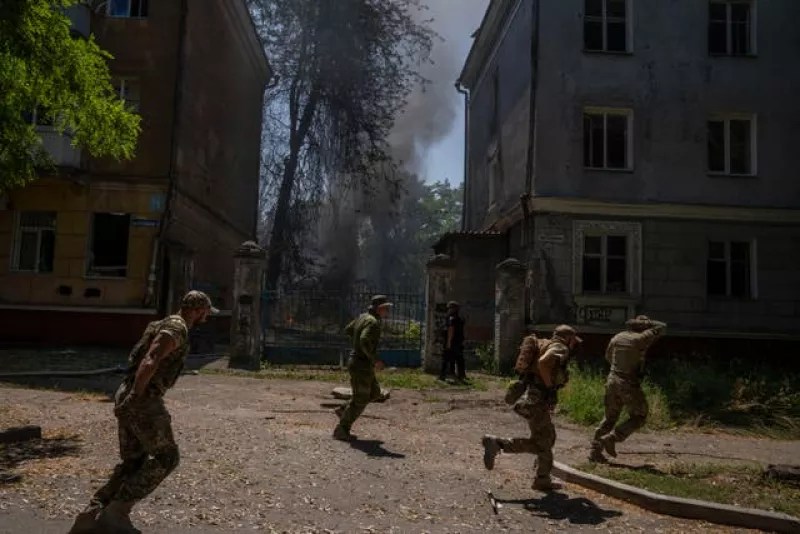
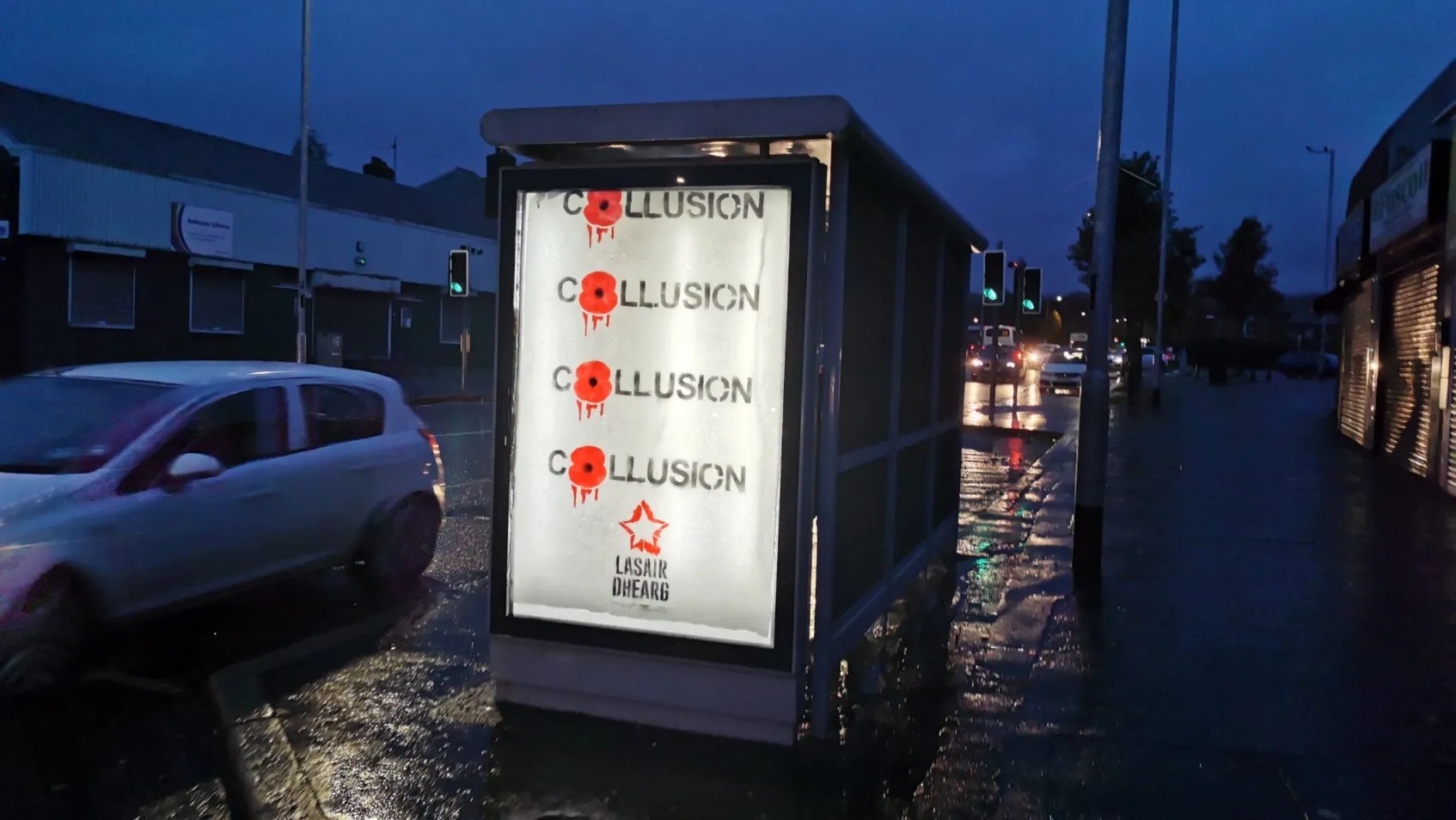
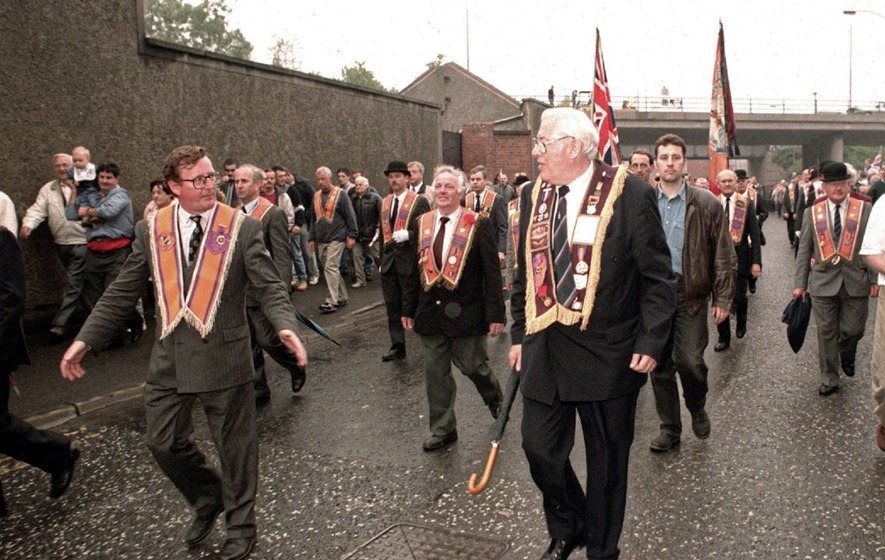
“Support the Paras (Parachute Regiment) and Soldier F” — i.e any British soldier who has murdered people from the Nationalist community. (Image sourced: Internet)

Recently, former British solider Dennis Hutchings faced trial for the killing of John Pat Cunningham. Hutchings received much support, including high profile political support, from those who objected to his prosecution. The circumstances of John Pat’s death could scarcely be more upsetting:

A Benburb doctor said the victim, who was his patient, had been born with an incomplete development of mind, and had been declared a person requiring special care. The doctor said that about a year earlier, near the scene of the shooting, he had come across soldiers pushing John Cunningham into a Saracen armoured car. He spoke to the soldiers who said he had been hiding in the bushes and acting suspiciously. The doctor said he had told the young man’s mother about the incident and advised her to keep a special watch on her son’s movements, in view of his apprehension towards soldiers and their uniforms.

Dennis Hutchings is alleged to have shot John Pat in the back as he ran away from an army patrol. There is simply no way that John Pat was a threat to them. British and Unionist politicians were outraged over a prosecution taking place. They were silent when the prosecution of Soldier F, a perjurer, multiple-killer, and perhaps the single greatest recruiting sergeant the PIRA ever had, fell apart.

From tragedy to farce, we can now look at the case of Donald MacNaughton, who was tried and acquitted of attempted murder in 1974. The case against him fell apart because of “inconsistencies” with the victim’s evidence, and the evidence of MacNaughton and his comrades “fitted together and was not mutually contradictory .” MacNaughton was a member of the Parachute Regiment, whose soldiers colluded with each other to lie to several British Government Inquiries, and indeed to British Army investigators. The farce in this case, I think, demonstrates something of the self-degradation of those on the English right: MacNaughton became a Brexit Party campaigner, and is widely believed to have thrown yogurt over himself to gain media attention.

Motorbike rally in Belfast in support of Soldier F, who admitted to firing 13 bullets during the 1972 massacre of unarmed protestors in Derry. (Image sourced: Internet)

Hutchings died before his trial, and will be given full military honours at his funeral. Soldier F was promoted and decorated several times in his military career. Just as their killings of Irish citizens did not unduly affect their lives for decades, was there any serious attempt at prosecuting them to the full extent of the law?

But their prosecution is not really the point. The level of support for them is.

What does it say about sections of society, and politicians, if they can support those suspected of murder, so long as it was committed by a uniformed killer, regardless of the status of the victim?

⏩ Brandon Sullivan is a middle aged, middle management, centre-left Belfast man. Would prefer people focused on the actual bad guys.

“DEADLY CUTS” FILM IS … DEADLY

Clive Sulish

(Reading time: 4 mins.)

“DEADLY CUTS” FILM IS … DEADLY1

Michelle (Angeline Ball) runs a hairdressing salon in Piglinstown, a fictional Dublin city suburb that looks like Finglas3 and the area is suffering the attention of a local gang of thugs led by Deano (Ian Lloyd Anderson). The Gardaí4, represented by one individual played by Dermot Ward, are ineffectual in dealing with local crime and seem also well-disposed to a local politician, a Dublin City councillor, whose solution to the area is demolition of a parade of shops, including the hairdressing salon, followed by redevelopment. Michelle’s staff are Stacey (Ericka Roe), Chantelle (Shauna Higgins) and Gemma (Lauren Larkin).

Playing smaller roles are the local butcher Jonner (Aaron Edo), along with owners of the fish and chip shop, the local pub, pub entertainment organiser and three elderly ladies in particular.

Darren Flynn (Aidan McArdle) is the local politician, a Dublin City Councillor, who lets slip later in the film that he has a lot of property speculators waiting to get their hands on the area. Of course, in real life, nothing like that would happen in Dublin City Council, among the Councillors or the City Managers, would it? Quite apart from that, one must feel some sympathy for a certain Dublin City councillor who must surely wince every time he hears “Councillor Flynn” mentioned in the film’s dialogue.

(Image sourced: Internet)

If you know Dublin working and lower-middle class suburbs then some of the visual scenes will be familiar, the streets of housing, the green area, short strips of shops, including the chipper, the cheeky kids on bikes, the pub as a social centre. But for women the hairdressing salon plays a social role too as one can see from the varied ages and requirements of the customers. There was a time in some areas when the local barber shop played the same role for men, the waiting customers, the customer in the chair and the barber all taking part in the same conversation.

You’ll know too that unemployment tends to be higher in such areas and that there are social problems in particular with bored and disengaged youth, drug-taking and selling …. but not necessarily more of the taking than occurs in middle-class areas, particularly when the young people start clubbing.

Areas that could do with regeneration around the local community are not unusual in and around Irish cities but when that regeneration takes place it’s usually for another class – the gentrification project. That’s what’s in store for Piglinstown, if Mr. Flynn and his invisible property speculators have their way. This film is making its debut at a time when property speculators are visibly running wild over Dublin, building hotels, residential apartment and student accommodation blocks (of which most students can’t afford the rents), meanwhile destroying communities, cultural amenities and historical sites. And Dublin City Managers are giving the go-ahead for these planning applications while An Bord Pleanála regularly turns down appeals or moderates the application somewhat but rarely in essence.

The highpoint of the film both in tension and in flash and showbiz buzz is the Ahh Hair competition, which the Piglinstown hair dressing salon wants to win in order to boost their profile and avoid demolition by the speculators. Here Pippa (Victoria Smurfit) plays the vicious upper-class nasty with abandon, aided by her three familiars, the snooty Eimear (Sorcha Fahey) chief among them, many hands in the film’s audience surely itching to slap. Nor is the nastiness only verbal.

Snooty upper-class hair stylist Pippa, played by Victoria Smurfit, at the Ahh Hair competition. (Image sourced: Internet)

But it is also high satire, from Thommas Kane-Byrne as Kevin, the camp announcer and poseur judges with ridiculous hyperbole, including the star hairdresser D’Logan Doyle (Louis Lovett), to the cheering hooray henry and henrietta types in the audience. Even the finalist hairdressing creations would be to most people ridiculous, as are some of the creations and installations that win the annual Turner prize. Are the real hairdressing competitions anything like this?

Among the actors, it’s good to see Angeline Ball who charmed us in The Commitments (1991), 30 years ago and still looking good as the salon owner Michelle and Pauline McLynn who insisted in the eponymous series that Father Ted would have a cup of tea, “Ah, you will, you will, you will”. Comedienne Enya Martin, from Giz a Laugh sketches plays the staff’s somewhat sluttish friend.

The Deadly Cuts salon team in film promotion poster (Image sourced: Internet)

As I noted earlier, most reviewers have given the film high marks for entertainment value – not so Peter Bradshaw, who dealt it savage cuts in the Guardian and gave it only two stars out of five. “With violent gangsters, a gentrification storyline and a hairdressing competition, this movie can’t figure out what it wants to be.” Really, Peter? It seems to me that the film is all those things and manages them well within an overall comedic form, something like Dario Fo and the problem is that you just don’t get it.

The incidental music is a series of lively hip hop by clips from different artists, including the mixed English-Irish language group Kneecap. These should have your foot tapping and body swaying as you follow the plot and the dialogue, smoothly edited from scene to scene, laughing and occasionally shocked.

The resolution of the Piglinstown community’s problems in the film is as drastic as unlikely, (however much some viewers may agree with it). But the film is a very enjoyable and if you haven’t seen it already, I strongly recommend you do so.

End.

FOOTNOTES

1“Deadly” was a common Dublin slang expression which has fallen out of use but would still be recognised by many; in the way that much counter-culture slang uses the opposite from an accepted term, “deadly” meant “excellent” and is being employed here in that sense.

2Notably at the moment threats of demolition to the street market and historical site of Moore Street, part of the traditional music pub the Cobblestone and to the laneway at the Merchant’s Arch.

3In fact, Finglas’ in one of the communities acknowledged in the credits, the other being Loughlinstown.

4Police force of the Irish state.

SOURCES

https://www.imdb.com/title/tt11366736/

https://www.rte.ie/entertainment/movie-reviews/2021/1008/1251092-irish-comedy-deadly-cuts-is-a-cut-above-the-competition/

https://www.rottentomatoes.com/m/deadly_cuts

https://www.dublinlive.ie/news/celebs/giz-laugh-comedian-enya-martin-21694809

https://www.theguardian.com/film/2021/oct/06/deadly-cuts-review-ortonesque-dublin-comedy-thats-more-silly-than-funny

STATE MOVES TO BAN LEFT WING SPANISH PARTY

Political Statement against the new banning attempt: the Ministry of the Interior initiatates a procedure in the Spanish National Court for the “extinction” of Izquierda Castellana

(Translated by D.Breatnach from https://izca.net/2021/08/06/declaracion-politica-ante-el-nuevo-intento-de-ilegalizacion-el-ministerio-del-interior-impulsa-un-procedimiento-en-la-audiencia-nacional-para-la-extincion-de-izquierda-castellana/ )

The Central Contentious-Administrative Court No. 6 of the Spanish National Court has notified us on August 5th of the motion put forward by the Ministry of the Interior through the State Lawyers in which the “extinction” of Izquierda Castellana is sought, that is, its disappearance as a legal political organization.

Demonstration of Izquierda Castellana with their logo on banner declaring “Spanish State Prison of Peoples”.

On this occasion, the Ministry of the Interior resorts to administrative tricks, arguing that IzCa’s statutes do not comply with the changes introduced through the legislative reform of Organic Law 3/2015, of March 30, on the control of the financial-economic activity of Political Parties.

It is paradoxical that a political organization that, as is the case with Izquierda Castellana, never in its entire history requested or received any financial subsidy, is intended to be outlawed based on these kinds of reasons, especially when most of the political parties that ostensibly breach the legal regulations on such matters are not even warned of such a possibility.

In our opinion, the attempted extinction / banning of IzCa sponsored by the Ministry of the Interior has a political motivation: the intention of making disappear an organization whose essential activity is the denunciation of all the corrupt, antisocial, antidemocratic and antipatriotic activities of the current Regime of the 2nd Bourbon Restoration; and whose ultimate aim inevitably passes through the establishment of a democratic, republican and social rights system.

IzCa, as we pointed out, has not received or requested a single euro from the public treasury. Our activity is based solely and exclusively on our resources, especially on our human resources, that is, on the militants and activists who support us every day in one way or another. IzCa does not have as such – nor does it claim – representation in the institutions of this post-Franco regime. We do not despise this sphere of action, but it seems to us that the most important and useful thing in this historical moment is to promote the movement and popular organization in the various sectors, and we focus on this and we also believe with some success; that is what the Regime and its successive governments have not forgiven us.

IzCa has suffered permanent harassment from the constituted power since our founding; numerous media-police operations have been plotted against our organization. In 2008 there was already an attempt to ban IzCa, which was finally archived without action in the National Court itself. Last December the trial against our comrade Luis Ocampo was held – Doris Benegas was also on trial – with regard to the events that occurred in the Republican demonstration in Madrid in October 2014. In that trial, a year and a half in prison was requested by the Prosecution. Finally, our comrade was acquitted; in its judgment, the Madrid Provincial Court Court recorded that his version of events was fully credible.

IzCa has been denouncing the repressive policy towards the popular movement and at the same time favourable to the extreme Right that has been carried out by the Ministry of the Interior and very especially by the Government Delegation in Madrid, intensified repression since the beginning of the Covid-19 pandemic. We accurately forecast the overwhelming defeat of the institutional Left in Madrid in the last regional elections on May 4; and we predict – we believe that without the slightest possibility of error – the defeat of the institutional Left in the next general elections if it continues on the current path. If you try to make activist organizations disappear, those that with more dedication and commitment defend the interests of the working classes, you are facilitating the path of access to the government by the Right. If the interests of the peoples of the Spanish State are subordinated to those of imperialism – certainly in a phase of full decline – one of the most significant expressions of which is the scheduled holding of the next NATO summit in Madrid in 2022, it is refusing to build its own project in solidarity with the peoples of the world and, once again, facilitating the advance of the right wing, militarism and warmongering.

We are going to fight against our outlawing at the National High Court and before all judicial bodies, including European ones, where it is necessary. In the National Court, that special court of which we do not recognize any democratic legitimacy, nor for the entire institutional framework of the ’78 Regime,starting with its Head of State, just as “exemplary” in its general terms as the rest of its institutions and whose legality is based on Franco’s legality. But above all, we will continue to fight in the streets.

Study and reflect; organize and mobilize; build popular power. That’s the only way.

Izquierda Castellana, August 6, 2021

COMMENT:


The Izquierda Castellana is a revolutionary socialist organisation basing itself on the territory of Castille (a central area of the Spanish state including Madrid) and claiming its right to self-determination, drawing its historical inspiration from the revolt of the Comuneros in the 1520s. The party or organisation seeks social justice internally, self-determination for its own territory and supports the struggles for self-determination of others (for example, the Basques and Catalans), is opposed to imperialism abroad and military alliances such as NATO. IzCa is anti-racist and anti-fascist and has suffered repression.

The potential for revolution in the Spanish State is not in the Basque Country and Catalonia alone, nor only in other areas such as Galiza and Asturies but in the heartland of the State also, in Madrid and in other parts of Castille. It seems clear that the struggles for independence of the Basque Country and Catalonia as in the past will be met with heavy Spanish repression and the only possibility for success in such circumstances would a situation in which the State was met with uprisings in other parts also. I have long advocated the building of the type of alliances that could make that possible.

Diarmuid Breatnach

USEFUL LINKS

Izquierda Castellana website: https://izca.net/

IzCa on Facebook: https://www.facebook.com/Izquierda-Castellana-IzCa-110789122300175/

TEN SIMPLE STEPS IN INVASION VENTURE

Diarmuid Breatnach

Scene from Rambo film promoting USA-aided Islamic fundamentalist insurgency against Soviet puppet Afghanistan Government (Photo sourced: Internet)
  1. Foster Islamic fundamentalist groups and arm them to overthrow a competitor’s puppet government. Use a nearby ally as a conduit.
  2. Portray the fundamentalist insurgency as a liberation war and keep supplying them with weapons, training, through your nearby ally. This might cost as much as US$20 billion. Have a film made about it in which a former male porn film star is the USA hero with the local fundamentalist Islamic militias (underplay the Islamic part).
  3. When they’ve overthrown the competitor’s puppet, attempt to instal your own puppet instead.
  4. When your Islamic fundamentalist warlords don’t accept this and become a problem, invade the country. You have to get lots of your own soldiers killed because you armed and trained the opposition, they have grown more powerful and why should anyone fight them for you?
  5. Keep telling the relatives of your dead soldiers (and those not yet dead) that they are fighting for democracy and to protect their homes (although they are nowhere near their homes).
  6. Set up your own puppet regime, build a local army, let your investors back home in to gobble up what they can, dispense bribes (even to notorious warlords, torturers, murderers).
  7. Use airpower to bomb your previous allies, even though you will be killing a lot of uninvolved people (and even though airpower didn’t work in the end for the other’s puppet government).
  8. When it’s clear you are not going to win without an even more massive investment of money and your soldiers’ lives (which will make your politicians unpopular at home), pull out. Leave your puppets and local employees behind (shoot some as they try to get on your planes).
  9. Then blame your puppet government for running. Blame the puppet army soldiers for surrendering, ignoring the fact that thousands of them have been killed even when you gave them air cover and that was then withdrawn or that surrounded units fought on for days on promises of relieving columns that never came.
  10. You might lose some superpower status and get criticised at home. BUT your arms industry has increased its profits at least TEN TIMES since the invasion. After all, who really matters in all this?
  11. Get ready for your next adventure.
US troops in Afghanistan marching towards evacuation helicopter (Photo sourced: Internet)
Afghan people climb on plane Kabul Airport Photo- Wakil Kohsar / AFP 16 Aug 2021
Afghans crowd the tarmac of Kabul airport to flee the country. Photo- AFP
Taliban fighters take control of Afghan presidential palace in Kabul after Afghan President Ashraf Ghani fled the country. Photo- AP/Zabi Karimi
U.S soldiers take a position to guard along a perimeter at the international airport in Kabul, Afghanistan, Monday, Aug. 16, 2021. Picture- AP Photo/Shekib Rahmani
USA President justifying USA pullout of Afghanistan and blaming Afghan people (Photo sourced: Internet)

FURTHER READING

Quick overview of Afghanistan history (without listing USA support for Taliban: https://www.nationalgeographic.com/history/article/how-centuries-of-strife-shaped-modern-afghanistan

US support for Taliban: https://www.jstor.org/stable/29768089

https://www.democracynow.org/shows/2021/8/17# (For Afghanistan jump to Haran Rahoumi at 17.19 mins. on video to 31.4 mins; and again to from 37mins. with Azmat Khan to 46mins. In my opinion much more informative than ex-US Col. Amy Wright, now in Codepink, Vets for Peace.)

https://www.foxnews.com/world/taliban-fighters-execute-22-afghan-commandos

SPANISH CATHOLIC HIERARCHY EXPRESSES FEAR OF REVOLUTION

Diarmuid Breatnach

(Reading time: 10 mins.)

Actually what the hierarchy referenced fearing in a recent 95-page statement was “two Spains”, which most commentators took as being a reference to a repeat of the Anti-Fascist war of 1936-1939, with Republican Spain and Fascist Spain. The statement of the Spanish Episcopal Conference (CEE) spoke of the “stability” which the 1978 Constitution has given the Spanish State. So have they suddenly now become democrats? Of course, one can think of another way of imagining such a dichotomy: Rich Spain and Worker Spain. I think the Bishops fear another kind of civil war – i.e revolution.

The 95-page document entitled ‘Faithful to missionary sending’ was prepared not only by the collegiate bodies of the CEE but also by external collaborators. Less open to different interpretations are the other concerns raised by the Bishop’s Conference, regarding the increasing secularisation of society, the scandals around abuse of those in the care of Church institutions and pastors, along with the other scandal of church appropriation of public property, including even a UNESCO site1. The Bishops feel that some of these processes and issues are not merely accidental or incidental to modern times but rather are deliberately driven by people in hostility to the Church.

CHURCH AND POLITICS

It is customary and has been so throughout history for the dominant religious institution to have a close relationship with the dominant class in society and this has certainly been the case with the Catholic Church in the Spanish Kingdom. The Spanish ruling elite at the turn of the last century, in a country with underdeveloped capitalist industry was an alliance of two different social classes, the aristocracy and the capitalist-financier class. The social atmosphere was deeply conservative and dominated by the Catholic Church hierarchy which, through them and the religious male and female orders, controlled institutions of social and educational provision. Progressive artists were penalised and often enough went into exile.2

The First Spanish Republic, a brief attempt to liberalise and democratise the State after the abdication of King Amadeo in 1873, survived not even two years before being overthrown in a military coup, followed by repression causing the exile of many of republican leaders and supporters.

However, a wave of revolt against the conservatism and lack of democracy of the Spanish Kingdom came around again and in 1931 the Second Republic was created, overthrowing the dictatorship of General Primo Rivera. Initially the composition of the government was right-wing and the revolt of the Asturian miners was cruelly suppressed by the Army and the militarised police force of the Guardia Civil3. The right-wing government fell in 1936 when a democratic left-wing Popular Front government was elected, which set about legislating for greater social freedoms, equality and discussing autonomy for nations4 within the State.

DEMOCRATIC GOVERNMENT AND MILITARY-FASCIST UPRISING

That was the signal for the forces of reaction to strike and most of the military high command, allied with the fascist Falange5, staged a coup. In Barcelona, the coupists were quickly suppressed by a popular upsurge which took on a revolutionary character. In some other parts, particularly in Madrid, the coupists were suppressed too but without a revolution.

General Franco in partnership with another three generals and senior naval commanders led or joined the coup but Franco’s forces were isolated in part of North Africa (then a Spanish colony). While the ‘democratic’ European powers ‘blockaded the conflict’, Nazi Germany and Fascist Italy provided the logistical support6 to get Franco’s forces to the Canary Islands, then to Spain, where they found little organised opposition but nevertheless carried out a reign of terror. The Spanish Catholic Church hierarchy and most of its priests and religious orders supported the military and fascist rebellious forces with enthusiasm.

Spanish Catholic hierarchy supporting fascist military (Photo sourced: Internet)

A conflict variously called “the Spanish Civil War” or “the Spanish Antifascist War” followed, ending in 1939 with victory for the military-fascist forces, who lost an estimated 175,000 killed in action, and 110,000 died fighting for the Republic.7

Following the earlier pattern of areas the fascists had conquered, a wave of repression ensued against republicans, communists, socialists, anarchists, democrats, trade unionists, Basque, Catalan and Galician nationalists, gays and lesbians, with summary executions, military tribunals and executions, mass jailing, public humiliation of women …. Estimates of executions behind the fascist-military lines during the War range from fewer than 50,000to 200,0008. Most of the victims were killed without a trial in the first months of the war and their corpses were left on the sides of roads or in clandestine and unmarked mass graves.Spain has the highest number of mass graves anywhere in the world with the exception of Cambodia9, with 740 mass graves containing the remains of some 9,000 people having been found so far. The support of the Catholic Church for the military and fascists did not waver throughout.

THREE DECADES OF FASCIST DICTATORSHIP

After that initial phase, three decades of political and social repression followed under the Franco dictatorship, again fully supported by the Spanish Catholic Church.

However, the dictatorship was always resisted to some degree or another and that resistance began to grow apace during the 1960s. The Partido Comunista de España and the social-democratic Partido Socialista Obrero de España, both banned, were organising underground and becoming increasingly popular. Both had affiliated trade union organisations and the Comisiones Obreras10, linked to the PCE was particularly widespread. The youth of the Basque Nationalist Party (PNV) broke with the conservative and inactive leadership and, joining with a revolutionary socialist movement in the southern Basque Country, formed ETA11, taking up armed struggle at the end of the 1960s.

Fascist dictator General Franco (R) with his protege and nominated successor, Juan Carlos (L), later King of Spain. (Photo sourced: Internet)

As the Dictator aged the imperialists began to worry about the potential for a revolution in Spain and contacts in influential circles were sought to persuade the ruling class to replace the Dictatorship with a parliamentary democracy. Some elements in the Spanish Catholic Church opposed those initiatives but one which embraced it was the technocratic Opus Dei, which with some others, steered the country through the Transición.

Amidst a wave of repression including murders of activists by State and other fascist forces, with fear of an indefinite continuation of the Dictatorship, a Referendum on a monarchist and unitary state constitution was held. The PCE and the PSOE were legalised and, with their support, the 1978 Constitution received majority support. It is that Constitution which is regularly quoted when the State declines to permit the Basque and Catalan nations to even hold a referendum on independence.

In summary then, the Spanish State has evolved from a deeply conservative and repressive state, through a fascist-military uprising to a fascist and socially conservative dictatorship, all along with the support of the Spanish Catholic Church. When a revolution was feared, in consultation with imperialist advisers, the technocrat section of the Church, with the support of the social democratic and communist parties, helped prepare a transition to a parliamentary democratic form. Central to the Transition was preserving the mostly fascist ruling class and ensuring it would remain safe from any reparations, not to speak of criminal charges for murder, rape, torture, large-scale thefts …

But now, the Church hierarchy is sounding a warning. If it fears revolution, it has cause to.

VULNERABILITY OF THE SPANISH STATE

The possibility of revolution in Spain may seem far distant to most external and internal observers but two things should be taken into account:

  1. Revolution often grows and matures very quickly from what seemed like unready conditions and
  2. the Spanish State is by far the most vulnerable in the whole of the EU.

INTERNAL FORCES HOSTILE TO THE SPANISH STATE

The Spanish State consists of a number of nations, of which Catalonia, the Basque Country (Euskal Herria) and Galicia (Galiza) are the most obvious. But “Paisos Catalans” includes also Valencia and the Balearic Islands, all areas where Catalan is spoken and Asturias also consider themselves a Celtic nation (as does Galiza).

Map showing regions and nations of the Spanish state (Photo sourced: Internet)

The southern Basque Country has spent decades mobilising for independence in a wide social and political opposition to the Spanish State and though the official leadership of its movement is now pacified, a strong potential remains there. As the momentum of the latter declined, the movement for independence in Catalonia increasingly matured and in 2017 an unsanctioned referendum returned a majority for independence. Spanish police raided polling booths, attacked the voters and later nine social and political leaders were jailed by the State while others were obliged to go into exile. The 2021 elections returned a majority of pro-independence candidates and the total vote for independence exceeded 50% for the first time since pro-independence candidates presented themselves in elections.

The movements for independence respectively in Galiza and Asturies are nowhere near at the same level as those of the Basque Country or of Catalonia but they are growing. This is true also of the Paisos Catalans and the Islas Canarias.

With regard to the wide workers’ organisations, while the Comisiones and UGT at present maintain overall control, the majority of organised workers in the Basque Country and Galiza belong to trade unions supporting independence. Intersindical, a class trade union12 movement, also supporting independence, is growing in Catalonia and the Canaries.

Generally the Spanish State finds itself increasingly isolated at home and abroad. Its repression measures against the Basques and Catalans have not only disaffected people in those nations but also, despite general media and fascist propaganda, sectors of the Spanish intelligentsia. Writers, actors, artists have experienced repression or have spoken out against the repression of members of their sector. Political activist and rapper Pablo Hasel is in jail while Valtonyc, another rapper, is in exile to avoid imprisonment, both because of their lyrics.

Repeated financial corruption scandals have increasingly undermined confidence in the political and business classes.

FORCES SUPPORTING THE SPANISH STATE

The image of the Spanish Monarchy has suffered probably irreparable damage. The previous King, Juan Carlos, who was a visible link between the Dictatorship and the current parliamentary system but credited by liberal commentators as managing the “transition to democracy”, has abdicated. His personal reputation was damaged by a number of public relations disasters and he is now being pursued on allegations of financial and political corruption. His son-in-law is serving a jail sentence for financial and political corruption too. The current King, Juan Carlos’ son Felipe VI, though by no means compromised to any similar degree, has not built up any significant social support either, despite a generally sycophantic Spanish media.

Coronation King Felipe VI of Spain, son of the abdicated King Juan Carlos (Photo sourced: Internet)

The Catholic Church, the great organisation of social control for centuries and throughout the Dictatorship, has lost much of its influence, a fact bewailed by the Bishops in their communique. In the Basque Country and in Catalonia, the Hierarchy had little influence anyway because of its support for Franco. But the scandals of physical and sexual abuse in church institutions and by pastors, common across much of the western world, have impacted on the Church across the Spanish state too. In addition, the increasing secularisation of modern western society has also weakened the Church’s influence, as have its opposition to contraception and abortion, divorce, homosexuality and of course same-sex marriage, all of which are now legal.

(Photo sourced: Internet)

Surveys indicated that only 3% of Spaniards consider religion as one of their three most important values, lower than the 5% European average, though religious festivals remain popular on a mainly cultural level.

According to the Spanish Centre for Sociological Research, as of July 2021, while 58.6% of Spanish citizens self-identify as Catholic, only 18.6% define themselves as practicing, with 40% as not practicing. Another 37% have no religion, identifying variously as atheists (15.1%), agnostics (11.5%) or non-believers (10.4%)13. The total number of parish priests, i.e the level of Church personnel most in direct contact with the population, shrank from 24,300 in 1975 to 18,500 in 2018, with an average age of 65.5 years.14

However, the COPE radio network, owned by the Catholic Spanish Bishops’ Conference, broadcasts material ranging from the conservative to the fascist and always for Spanish unionism. COPE, an acronym for Cadena de Ondas Populares Españolas (“People’s Radiowaves of Spain Network”) formerly called Radio Popular, is the second most played among Spain’s generalist radio. COPE owns music stations Cadena 100, Rock FM and Megastar FM, in addition to the Spanish generalist TV channel Trece. The station is associated with the right-wing Spanish journal Diario ABC.

The privately-owned media in the Spanish state, whether favouring the PSOE (e.g El País) or the Partido Popular (e.g El Mundo and ABC) tends to be supportive of the union and the status quo15, with the state TV networks even more so. The bias against for example Basque or Catalan independence activists is remarkably obvious, with TV cameras accompanying police on raids to arrests of activists and publication of prejudicial statements long before the accused face trial and again during the trial itself.

Both traditional main political parties have their origins in the Spanish Anti-Fascist War. In common with most European parliamentary democracies, the two-party system has lost support in the Spanish state, resulting in recent governments being coalitions of political parties. This increases the potential for political thinking along class rather than party lines while also creating internal difficulties for the coalitions.

The right-wing Partido Popular was formed in 1989 but was a reconfiguration of the Alianza Popular, formed after the State’s change to the parliamentary system to give fascists and deep conservative supporters of Franco a representation in elections. Much reduced now, the PP has given rise to a chain of splits, first to form Ciudadanos, in turn shedding some members to form the more or less openly fascist Vox party. Any return of the PP to governing the Spanish state would require it to form a coalition with one or both of Cs and Vox.

The PSOE, formerly illegal under the Dictatorship, has on the surface many of the features of a western social-democratic party. However, it has been deeply implicated in repression of struggles in the Basque Country, including wide-scale torture of prisoners. Further, under the Felipe Gonzales presidency (prime ministership), the Spanish State ran terrorist squads carrying out kidnapping, torture, murder and bombings against pro-independence Basques. The operation was exposed in a series of articles in El Mundo and, although Gonzales didn’t face even a police interview, the eventual resulting list of convictions included the Minister of the Interior, Director of State Security, Sec-General of the PSOE in the Basque province of Bizkaia, Czar of the “Antiterrorist Struggle”, Bilbao Chief of Police Intelligence Brigade, another Police Chief, regional Governor for the Spanish State in Bizkaia, and a colonel, Chief of the Guardia Civil HQ in Intxaurrondo (Basque Country).

Although successfully unseating the PP Government on a vote of “no confidence” in the Government’s 2018 budget, the PSOE’s leader, Pedro Sanchez, was only able to enter government by forming a coalition with Unidas Podemos16, itself a coalition of left social-democrats, trotskyists and communists. Since the new Government took over the repression of Catalans of its predecessor, only releasing imprisoned Catalan activists on parole recently, it does not have the support of the Catalan independentists, with the exception of one major party which voted to help the Government’s budget scrape through, as did the official leadership of the Basque independence movement17.

Fascism was never defeated in the Spanish state, it merely put on a democratic mask, albeit faded and patched. The current members of the ruling class are mostly descendants of the military-fascist alliance of 1936 and virtually all beneficiaries of the Dictatorship, often sitting on wealth, industry and media expropriated from their opponents defeated in the Antifascist War. There are sections of active and militant fascists across the Spanish state with wide police and military connections, denouncing the independence initiatives in Catalonia, criticising immigration, ridiculing equality measures and parading with fascist symbols and salutes to exalt the memory of General Franco and Primo Rivera. Although some of those activities are illegal, they act with visible impunity. The Vox political party has stated openly that it wants to amend the Constitution to remove the status of regional autonomy, which they believe encourages aspiration for independence and thereby endangers the unity of the Spanish State.

Spanish fascists demonstrating in Madrid in 2018, fascist salutes and symbols illegal but none arrested (Photo sourced: Internet)
Spanish fascist flags and salutes, Catalonia 2019 (Photo sourced: Internet)

Some government antifascist measures of late, along with the rise of independence activism in Catalonia have caused apprehension among this section of fascists, which finds expression in more rallies and demonstrations and increasingly threatening language and displays. The Government measures include the removal — long-promised by the PSOE — of Franco and Rivera’s remains from the mausoleum in the fascist monumental park of the Valle de los Caidos (“Valley of the Fallen”) which was built with political prisoner labour. The State’s TV service covered the event at length and in a manner resembling a homage ceremony.

Currently historical memory legislation is being promoted to assist in the discovery, investigation and honouring of the graves of the victims of Franco, while another piece of legislation seeks to make illegal any promotion of Franco or of fascism generally. The future of these initiatives is uncertain but the fact that even the current anti-fascist legislation is not upheld does not inspire confidence.

Map of known mass grave locations across the Spanish state (Photo sourced: Internet)

In conclusion,

The Bishops’ concerns about the safety of the 1978 Constitutional State seem to be twofold: on the one hand they see the demands for self-determination of nations within its territory as a threat to the State while on the other hand they fear that the fascists will push matters to an extreme, i.e that “civil war” – and this time, the fascists will lose, in the course of which the State will fall. However a close reading also looks like a threat to the national liberation and democratic forces, a warning to desist from their challenges to the status quo – or else!

As to their concerns for their Church, the Bishops are correct in believing that it is under attack but misunderstand the nature of the opposition, a large part of which is more to do with resenting the privileged position of the Church within the Spanish State than a hatred of the institution and faith as a whole. The Church received €144 million in funding from the State18 in 2019, ultimately from the taxes levied on people, no matter what their religion or state of faith, their opinion of the institutions or of their activities. And the tax-payers have no control over those institutions.

Of course, the Church does have its enemies, people who will never forgive it for the role it has played in the abuse of people and for its role in history, in particular its support for the military-fascist uprising, the horrific repression during that war and again during the subsequent dictatorship.

But the Bishops are right about one thing – the Spanish state is very vulnerable. Which is no doubt also the reason for the general contradictory stance of most other states in the EU, which on the one hand wish the Spanish State would act in a more subtle way than naked repression, while on the other fearing the spillover effect of possible revolution and the territorial breakup of “Spain”.

End.

FOOTNOTES

1This is too big an issue in itself to detail here but in essence it refers to property titles given over to the Catholic Church by Franco early in the Dictatorship and subsequently extended to cover 34,961 by Aznar’s PP government since 1998. One of those is the Cordoba Mosque, a UNESCO Heritage site. More about that controversy may be read about here: https://www.irishtimes.com/news/world/europe/c%C3%B3rdoba-s-mosque-cathedral-dispute-puts-spanish-identity-at-centre-stage-1.4195391 and the general issue in further detail but in Castillian (Spanish) here: https://elpais.com/sociedad/2021-02-16/todas-las-propiedades-inmatriculadas-por-la-iglesia.html?rel=listapoyo

2Cervantes, the most famous Spanish writer and much praised by the State today, never received any support from the Spanish Kingdom. In 1569 he fled a warrant for arrest due to wounding an opponent a duel. Later, his family could not afford his ransom when captured by Corsairs but his freedom was eventually bought by an organisation working to free Christian slaves in the Ottoman Empire. Employed later by the Spanish as a tax collector he was jailed briefly a number of times for “irregularities. He is celebrated as a writer not only in Spanish but his Don Quixote de la Mancha has been widely read in translation.

3The Guardia Civil is a Spanish state-wide police force but militarised — they have military ranks and live in barracks. The gendarme-type force is one common in states needing to control a disparate population with a history of rebellion, eg: the Carabinieri of Italy, Gendarmerie of France, Royal Irish Constabulary of Ireland under British rule (then the RUC in the colony, now the PSNI).

4Catalonia got its autonomy during its popular suppression of the coup attempt and, once the war was underway, three southern Basque provinces got theirs too, while the conservative Carlists in the fourth province, Nafarroa (Navarra) sided with the coup and massacred any supporters of the Government they could find. Galician autonomy was under discussion but after only two weeks of fighting in July 1936, the fascists took control and the project was abandoned. The fascists killed 800,000 people there, mostly civilians and after the hostilities.

5La Falangia Española, a fascist organisation founded by Primo Rivera (son of the General of the same name) in October 1933. It was later remodeled by Franco to unite all the fascist and right-wing nationalist organisations and from then was the only legal political party during the Franco Dictatorship.

6Both fascist powers also provided personnel, weapons, military transport, tanks …. the infamous urban centre bombing of Gernika was carried out by German and Italian planes. The Republican side received some assistance from the Mexican Government and in particular the Soviet Union and volunteers for the International Brigades. The balance of equipment and trained personnel was always however in favour of the fascist-military insurgents.

7See https://en.wikipedia.org/wiki/Spanish_Civil_War

8Historians differ — Hugh Thomas: 75,000; Secundino Serrano: 90,000; Josep Fontana: 150,000; and Julián Casanova: 100,000

9See map

10The Comisiones today is much less under the influence of the PCE and, together with UGT, which remains under the control of the PSOE, form the two main Spanish trade unions, their leaderships institutionalised and generally collaborative with the State and for the union of Spain.

11Euskadi Ta Askatasuna (Basque Country And Freedom) was much more than the depiction of “terrorist” organisation one finds in most descriptions. It was a cultural and social Basque liberation organisation, persecuted by the Spanish State, against which it took up arms after almost a decade of repression and torture. After years of decline but during which the wider movement expanded hugely, ETA disbanded around 2012. Many of its convicted fighters remain dispersed throughout the jails of the Spanish and French states while others are in exile.

12A class union does not recruit members repressive forces (e.g. police, jailers, armed forces), nor of management in work places. Also Intersindical has a very democratic structure with an elected General Secretary permitted to serve for only two years.

13See Sources and References, Religion.

14Ibid.

15An exception is the attitude to the Catholic Church, which is generally critical in El País, in line with its more secular identity.

16Izquierda Unida (United Left), the often disunited coalition of mostly Trotskyist small groups coordinated by the CPE, formed an electoral coalition with Podemos just before the elections. Podemos arose from a small group of Trotskyists that emerged from 13M, the huge popular opposition to the Spanish State, especially in Madrid, in turn engendered by the protest movement commonly known as “Los Indignados”. Podemos rode that wave of indignation to win five seats in their first participation in elections, those to to the European Parliament in May 2014. In the 2015 General Elections on 20 December 2015, Podemos received 21% of the vote and became the third largest party in the Parliament, with 69 out of 350 seats. In subsequent elections, as part of coalitions, Podemos’ number of MPs in the Spanish Parliament has fallen consecutively to 49, 47, 32 and 26, with its 5 MEPs reduced to three. Conversely, the party’s membership is growing, according to reports.

17Esquerra Republicana de Catalunya and Amaiur.

18In addition to €284m through 7% voluntary deductions from people’s tax returns, a benefit which no other organisation is permitted.

SOURCES AND REFERENCES

Statement of Spanish Bishops: https://elpais.com/sociedad/2021-08-02/los-obispos-dibujan-un-panorama-catastrofico-de-la-politica-espanola.html

https://www.thetimes.co.uk/article/spain-sliding-back-to-civil-war-era-bishops-warn-kxlcrww58?fbclid=IwAR0mHPwCJAfQGo8_pY7kzsDKa_v6usf4Pgxz65IlhVskWHTrxFWQEMx8nf4

Executions behind fascist-military lines: https://en.wikipedia.org/wiki/White_Terror_(Spain)

Mass graves etc: https://www.reuters.com/article/us-spain-mass-grave-ring-idUSKBN26626T

Overall number of deaths: https://en.wikipedia.org/wiki/Spanish_Civil_War

Trade unions (site very biased against Intersindical): http://progressivespain.com/labourfile-a-guide-to-spanish-trade-unions/

https://en.wikipedia.org/wiki/List_of_trade_unions_in_Spain

Religion and the Catholic Church: https://en.wikipedia.org/wiki/Religion_in_Spain

https://english.elpais.com/society/2020-02-21/catholic-church-gets-a-record-284m-of-donations-from-spanish-taxpayers.html

Podemos political party: https://en.wikipedia.org/wiki/Podemos_(Spanish_political_party)

BELARUS: SURE TO HEAR “UNDEMOCRATIC POLITICALLY-MOTIVATED CHARGES” FROM THE SPANISH GOVERNMENT

Diarmuid Breatnach

(Reading time: 2 mins)

Viktor Babariko, leading political opposition leader until he was arrested on corruption charges just before the Presidential election last August, has been sentenced in Belarus to 14 years in jail and a fine equivalent to a little over €47,990. Viktor Babariko was the head of a bank owned by the gas company Gazprom.

Viktor Babariko in Minsk courtroom cage July 2021 (Photo credit Rami Nasibulin BelTA Pool/ AP)

The news has already drawn condemnation of the Lukashenko regime in Belarus from the USA’s Embassy and howls of protest are sure to be heard across the EU also. The hypocrisy there on this kind of treatment of political opponents is stark – the Spanish state jailed nine political leaders for their involvement in an independence referendum in 2017, sentencing them to up to 13 years in prison (the State Prosecution asked for around 50 years), while leaders of most EU states and main political parties remained silent.

To be sure, European regimes, even the Spanish one, are more liberal than the one in Belarus. After four years in jail, the Spanish regime recently released those Catalan political activists on conditional pardons, a move unlikely to be equalled in Belarus. But those Catalans are barred from standing in elections and face a return to jail for “any repetition of their crimes” – i.e organising politically for Catalan independence. And some others are in jail for activities during the protest general strikes and over 3,000 are threatened with judicial process for involvement in the 2017 Referendum. Other Catalan political leaders are in exile, including the former President of Catalonia’s autonomous region, who is a Member of the European Parliament.

And European regimes wouldn’t use financial wrongdoing charges against political opponents, would they? Or try to cripple them financially? Actually, right at this moment, the Spanish State, through its audit court, is pursuing former Catalan Government ministers and officials on charges of misusing their Government’s funds, demanding a total of €50.4 million from them (sums of over €2m each). Furthermore, they must put those amounts up as bonds — without being convicted of financial wrongdoing in any criminal court — and have only weeks to do so.

Oriol Junqueras, former Deputy Leader of Catalonia (also elected an MEP while in jail), has been ordered to “repay” €1.9m. Carles Puigdemont, former Catalan President now in exile in Belgium, has also been ordered to pay €1.9m. On Tuesday Puigdemont commented on Twitter that his lawyer had been given only three hours to read 500 pages of court documents and 10 minutes to put his case.

What if those being targeted refuse to pay or simply can’t pay? Their property, including house and car can be seized along with a portion of their income, quite possibly deducted for the rest of their lives.

Andreu Mas-Colell, 76, a former Catalan finance minister, also faces a court demand for a large repayment. A former Harvard economics professor, he has received the support of 53 economists, including 33 Nobel laureates, who last week wrote a letter urging the Spanish state not to impose a large fine on him. His son, Gabriel Mas, told the Financial Times: “In the next 15 days, Andreu will have to deposit a guarantee of €670,000-€2.8m as the result of an administrative decision in which not a single judge has participated.”

With regard to the Babariko sentence, the stink of hypocrisy rising from the Spanish State is appalling — but it covers most of the EU too.

End.

REFERENCES

Belarus court convicts and jails Viktor Babariko: https://www.breakingnews.ie/world/belarus-sentences-former-presidential-contender-to-14-years-1152525.html

Conditional pardons of jailed Catalan activists: https://www.euractiv.com/section/politics/news/spanish-government-pardons-jailed-catalan-separatist-leaders/

Financial penalties on Catalan political activists:

https://www.ft.com/content/85555e23-a7fa-43f1-b5f2-40fa63d64a69

https://euobserver.com/opinion/152346

https://www.theguardian.com/world/2021/jun/28/catalonia-threat-impose-massive-fines-ex-minister-prompt-outcry

Lina Jiménez Numpaque: Victim in the Andino Case Frame-up

Interview of framed ex-prisoner awaiting trial by Gearóid Ó Loingsigh

(Reading time: 8 mins.)

(28/02/2021)

In June 2017 a bomb exploded in the Centro Andino shopping centre in the north of Bogotá, Colombia, cutting down three people. A few days later the police arrested ten youths for their supposed participation in the attack, amongst them Lina Jiménez, an arts student, whose photo went viral. These youths all had something in common and it wasn’t their participation in the attack but rather that they were all friends.

We all met in the university, as we studied together. Some of us studied Law, Politics and others Sociology. I met some of them in optional classes were we coincided. We had a common position on the defence of human rights and the student movement, we met in one or other coffee shops, assemblies that took place in various parts of the university.

Friends to the point that six of them were arrested together a few days after the attack whilst on holidays in the El Espinal area. The precise moment she was arrested was the first time that Lina became aware that the Prosecutor had issued an arrest warrant for her.

I was on holiday in El Espinal and we were going to meet up in a spa resort. In El Espinal there are some festivals for Saint John’s and Saint Peter’s day and that is why we were there and I was in a taxi when various cars surrounded us and stopped us. Then they took me out of the car and officers from the Special Operations Group (GOES) and the Judicial Investigative Police (SIJIN) read out the arrest warrant. They never showed it to me or read me my rights.

It wasn’t just any order. The weaker the State’s case the more need it has to make it appear solid and to show the dangerousness of the detainees.

We were taken to the main police station in El Espinal. There were loads of them, all those that took part in the operation. Later on, one of the police officers who was guarding us said that they had around 1,200 officers involved in our capture in El Espinal. It was basically full of police officers.

Lina Jimenez during interview (Photo credit: Gearóid Ó Loingsigh)

We don’t know whether the figure of 1,200 officers is correct or not, but there is no doubt it was an enormous operation. I asked her jokingly whether such a disproportionate and unnecessary deployment made her feel important. She laughed and said no

That didn’t make me feel important, what made me feel important was the flight, as they brought us in a plane from El Espinal to Bogotá. They took us to the police station, searched us, took our prints and whatnot. They never said it was for terrorism. I was told it was for conspiracy, we were only told it was for terrorism when we got to Bogotá- They took us out of the station well guarded with motorbikes, cars, loads of officers and they took us from Flandes airport to Catam [Military Airport].

As Lina herself acknowledges such an operation was a bad omen for any detainee, even when innocent. When they took her to the airport she knew nothing good could come of it, that the State was going all out against her and would do everything possible to show results in the case and they charged her with terrorism, conspiracy, homicide and attempted homicide with a possible sentence of 60 years.

When we were being taken to the airport in Flandes, I said to myself, this thing is not so that they invalidate our arrest. If they are setting up such an operation to get some people on holidays, they are definitely not going to let us go. Regardless of whether we did it or not, these people are going to convict us. To see how they organised the truth, leaves you feeling powerless.

In fact, later she found out when she could read the press that they had already convicted her, that both state functionaries and the press had declared that the guilty ones had been captured. They published identikit pictures of some of those arrested that matched them so neatly they seemed to be photos, but they did not match the statements from the witnesses. The identikit photos had been prepared days before the attack.

Little did Lina know when she was arrested the legally doubtful manoeuvres the State would resort to, re-arresting her three times in contravention of court orders to free her. The State sought out judges in their pocket to legalise what was illegal and to justify her re-arrest and even open up another slightly different case against her. Amongst the manoeuvres of state was the harassment of the relatives and attempts made to force them to give information or testify against other detainees.

The strategy did not work when it came to the relatives, but one of the detainees, Natalia Trujillo, could not withstand captivity and the pressure on her and handed herself over to the State, reaching an agreement with the Prosecutor which consisted in her not serving any time in exchange for her false testimony against her friends and fellow students. It was a potentially serious blow in the legal case, but it was also a hard knock in personal terms. You could understand bitterness in a case like this, but when Lina speaks of her former cell mate, there is no trace in her voice, but rather of pain and also an understanding of how a person could break like that.

You feel enormous hurt, you just don’t expect that to happen, especially as we went through this process together, together we experienced what was happening, together we felt the same pressure from the State and what happened to her is sort of like that. We all have different ways of dealing psychologically with this type of severe pressure. It is no secret that the State seeks to weave its own truth and as part of doing so it resorts to these type of situations, to push people to their physical and psychological limits that they end up saying things that are not true. It was really hurtful.

Natalia suffered the legal process for more than two years, but in August 2019 she turned up testifying against Lina and other people linked to the case.

As I said, we don’t all have the same capacity and I can’t say that I didn’t feel pain nor exhaustion during all of this process, because it was really severe and there are days you just don’t want to move an inch. I believe in the power of love and I really believe that solidarity also picks you up and saves you from many things. When you are down the other person picks you up and you pick them up, there are series of bonds which are built and that pushes you forward, but we don’t all have the same capacity to say ‘right I can take a little more of this’.

Perhaps, Lina was stronger and she showed that in a photo that went viral. She is seen with her hands tied behind her back leaning in towards a journalist, seething and shouting. I asked her about that photo, as in person she is nothing like that, but an arrest is not a normal situation for anyone.

We were in the station in Puente Aranda and it has to be said that it is a horrible place. It was a complicated situation, we had nowhere to sleep. I hadn’t a clue about the hearing to legalise our arrest, that was explained to me the next day and we were heavily guarded. We left Puente Aranda in an armoured car with police vehicles surrounding it. We got there and the armoured car took a while in getting us out. When I got there I saw relatives and some friends crying, I could see their deep pain in the midst of all the rage and impotence and they were very quiet. I felt the need to say it wasn’t true, that this was about something else.

Of course, they had told me ‘You’re to keep your mouth shut’ and in that moment I felt I couldn’t let this go… You feel a rage for your own life, but also seeing your family subjected to such complex situations, that the police push them around. We were walking and there was a lot of press there and we were guarded by the police and they didn’t want us to talk. So as soon as I got down out of the armoured car I started shouting that this was a judicial false positive that this had got to do with electoral interests at the time, that is was part of the Uribista strategy. I started shouting that and that photo was taken when I was going up the stairs and a journalist from City TV came up to me and I was really upset as whilst I was shouting a policeman tried to push back the journalists and he shouted at me ‘shut up, shut up, don’t say anything!’ Obviously that was like winding me up more. Looking back on it, it would have been very different had we remained silent.

And that is certainly the case. In the entire process none of those arrested bowed their heads, they have even appeared in videos from the jail, some have written articles and others were even spokespersons for prisoners in prison protests. Unjustly detained, but not defeated.

All prisons try to crush the individual, to break them, to take away their dignity, their sense of being alive. Colombia’s prisons are no different in this matter and in fact various problems such as overcrowding and poor health and educational services make the situation worse still. Being a political prisoner can be dangerous, but when the numbers allow for it, being part of a prisoners’ collective has its advantages. Lina was taken to the Good Shepherd Prison (Buen Pastor) in Bogotá and following her processing she was placed in the political prisoners’ wing.

It is very interesting, because when we got there, the last political prisoners of the FARC were beginning to leave, we were eight days in the police station and they put the fear of God into us, that ‘you are just posh kids and in the Good Shepherd prison they are going to rob you and attack you.’

But when we go to Wing Six, the political prisoners really surprised us, they had cleaned our cells, clean sheets, everything was organised, they had hot soup, coffee, toilet paper and other things. There were around 34 prisoners from the FARC and the ELN. After a while the FARC prisoners were released and social prisoners began to arrive and it was very different. As it was a high security wing, people connected to the drugs trade began to be put in it. There was a complete change in the atmosphere as their money could be seen, they paid for whiskey to be brought in, which when the political prisoners where there, that didn’t happen. When the social prisoners came, it was different, a huge change.

Although states usually try to treat political prisoners as common criminals, they are not and it can be seen in how they organise in prison and how they relate to the prison authorities. And to form part of a collective had, as Lina saw when she arrived, certain advantages for own safety and well being.

The prisoners had outside support and they reported things, the guards called Wing Six the wing for the complaints as we were always reporting to the Procurator, the Public Defender’s Office etc. The Director consulted the prisoners about how to do certain things. Meetings were held with the Director. This didn’t happen on other wings; they didn’t take the prisoners’ views into account. The political prisoners won a space, these were not concessions from the prison authorities, but rather they were won through protests and even hunger strikes over the years.

7 killed in Colombia protests against police brutality - Weekly Voice
Colombian riot police attack a demonstrator (Photo sourced: Internet)

But it is not just people like Lina who suffer the effects of judicial frame-ups, but also their families, especially when they are accused of a crime such as the attack on the Centro Andino. The State harasses the relatives and tries to put pressure on them as part of its legal strategy.

There is an enormous pressure put on our families as well as the social stigma. In my case, when I was captured, they were raiding my home at the same time and it was severe as I live on a main avenue and they closed the entire avenue off, there were armoured cars, and at least ten anti-explosives vehicles and a huge number of police officers and everyone was asking, what happened? And since my release, they haven’t stopped following me and taking photos and there is a permanent presence of plainclothes cops.

To her, the case and other processes against other students are state strategies to defeat the social movement and hand down exemplary sentences as a warning to all those who think differently and want to change the country. The legal cases try to break grassroots processes and the detainees themselves. In her case, it didn’t work that well.

To see the misery of this system in the flesh makes you understand and treat this space as another space for political struggle. In the legal process itself and the prison, you see the system so cruelly unmasked because this can only be done by people who have no respect for life, for humanity, for nothing. You feel you have to continue struggling for what you believe in, for life. This system has been in crisis for a long time and I left the prison and we are in a pandemic, we face a very complicated situation which is not far removed from the logic of the system. In this system there are humans who are in the top category and then there are those who are not in any category. And my position and that of my friends in the case, is the type of position that has to be hidden out of view and that is the role of the prison.

You see the State’s aim take shape, to continue suppressing and depleting the movement because, amongst other things that is one of the tools in creating the idea that there has to be an exemplary punishment that has to be handed down and it seeks out the tools to rob people of their humanity.

Although Lina and the others unjustly arrested for the Andino Case are at liberty, the legal case against them continues. It is to be hoped that the judges make a finding in law, as has already happened in the case of Mateo Gutiérrez who was also accused of belonging to the same organisation that supposedly carried out the attack and he managed to demonstrate and prove his innocence. But in Colombia justice limps along and sometimes never gets there.

end.

Photo credit: Gearóid Ó Loingsigh

RUPTURE AND REVOLUTION – PART I

Environment and the National Question

Diarmuid Breatnach

(Reading time main text: 8 mins.)

A new periodical has emerged from the Irish Left. At the time of writing two issues of Rupture have been produced and Parts I and II of this article consist of a political overview (but of course from my individual viewpoint) of a number of issues discussed in the magazine. While the assessment of some is highly critical, overall my opinion is that Rupture is a welcome introduction to socialist analysis of conditions in Ireland.

Rupture is a quarterly magazine format produced by RISE, a group of socialists whose most publicly-prominent individual is Paul Murphy (see Appendix) who is also a TD, i.e a member of the Parliament of the 26 Counties. The formation of the party RISE was announced in September 2019 when Murphy announced his departure from the Socialist Party and his joining this new organisation, of which he is a founding member.

Rupture espouses “eco-socialism”, a drive to organise the production of food and fuel under socialist control while dramatically reducing its harmful impact on the environment. Most of its contributors address issues from a Marxist perspective but interviews with activists from some other perspectives are included.

The magazine’s two issues to date included features on public health and private services, the environment and food production. In addition there have been a number of articles on developing a broad socialist front, combating racism and fascism, multi-national companies and neo-liberal capitalism, Big Pharm and trade union struggle. For the first time, the latest issue (November 2020) addressed the issue of the national question (and struggle) in Ireland. PART I of this article deals mostly with the magazine’s discussion of a) the Environment and b) the National Question, while PART II focuses on its coverage of c) the Health Service and d) the Broad Front and Anti-Fascism. As a consequence each Part contains both positive and negative evaluation.

For another aspect, the layout is generally attractive and mostly easy to read with photography and artwork which is interesting (if its relevance is not always clear). Some articles are perhaps on the longer side for some tastes but then these are big issues being discussed, in many cases literally of life-and/or-death dimensions.

An annual subscription costs €40 all Ireland or €60 international and I would recommend taking out one for 2021).

Environment

As with most serious commentators on the environment, the articles in Rupture point to an accelerating crisis and the need for urgent action right now. At the same time they point to the unwillingness or inability of the capitalist system – which means the governments of most states today — to take the necessary steps. In fact, unwillingness and inability are almost the same thing with the capitalist system because if one capitalist does not maximise his profit he will be undercut and crushed – or taken over – by another who will do “what is necessary” according to the rules and logic of the system. Even if in the longer term (or the medium term, in this case) the scramble for profit maximisation destroys the very resource — cod and herring, for example or rainforest. In this case, without the slightest exaggeration, it is the whole civilisation-sustaining environment that is at stake.

Not Fun Facts

“In 2017 a habitat area the size of a football field was lost every second.” “Eirgrid has projected that 2027 as much as 31% of Ireland’s electricty could by consumed by data centres” (most of it for cooling the servers to prevent them overheating). “In Ireland a fairly normal herd of pigs consists of 3,000 animals — only 2% of pigs are living in small herds of 5 or less. ….. a flock of chickens can normally be around 3,000.” Diseases due to overcrowding of animals enter the food chain for humans, causing infections of “bird ‘flu” and “swine ‘flu” through ‘zoonotic spillover’ (remember that term — you’ll be hearing more of it in future).

The prediction a fairly long time ago that the choice, rather than being between socialism or capitalism is in reality socialism or barbarism, is facing us now as an urgent practical question. Because when civilisation crashes the remaining groups of humanity around the world, assuming their survival, will indeed be thrust back into barbarism.

The contributors to Rupture quote writings of Karl Marx and Engels which one never hears from non-Marxist environmentalists and rarely either from Marxists themselves. These early developers of Marxist thought studied not only economics, class struggle and philosophy but also (and dare I say it, necessarily), history, science and culture too.

Mental health is an issue discussed in the magazine not only in respect to the appalling lack of health services in that area or the stresses and strains of work under capitalism but also in the divorcing of most humans in cities from nature. The agricultural landscape, having been moulded by humanity is far from natural and yet retains much of nature, the environment in which humanity first came to exist and in which it developed …. but most people in the West are not employed in agriculture. In these times of fear of infection along with isolation from our regular social contacts, even a walk in a park, in woods, on hills or botanic gardens can be rewarding and a reminder of what we have lost and are losing.

It is a challenge to radically change the way we produce food and generate power in a long-term sustainable way but only a socialist system, with overall benefit replacing profit as the ruling motivation has the possibility of bringing an end to the ruthless exploitation of not only labour but the very environment.

THE NATIONAL STRUGGLE

This is a question rarely dealt with by the socialist parties in Ireland, a situation which surprises revolutionary socialists across Latin America and much of Europe in particular. Some might ascribe that to the British origin of a number of those parties, particularly the main Trotskyist ones which in that respect established a tradition very far from the theory and personal practice of Karl Marx. So although I have much to disagree with in this article, the fact that it is being discussed at all should be encouraged.

I hope it will serve to encourage further discussion rather than its opposite when I summarise the piece as containing partial history and poor analysis with however one important recommendation. This critique really deserves a treatment all of its own but since this evaluation of the magazine has already got appreciably longer than was my original intent, I will have to be brief and therefore blunt.

The brief overview of history does not even mention that the United Irishmen (and therefore the uprisings of 1798 and 1803) was led almost exclusively by a section of the colonist-descended bourgeoisie, which is why the leadership was virtually all of various Protestant religious backgrounds. This is important because this is not the same bourgeoisie that rules the Irish state today. The article also omits any mention whatsoever of the linguistic genocidal legislation and practice of the conquerors of Ireland and for any treatment of “the national question” one would have to wonder how or why one would omit that. In dealing with the occupied Six Counties, the treatment of the civil rights movement is poor, even for a very brief overview – it was not only “anti-Unionist unity” that drove or characterised it but opposition to the violent response of the Unionist statelet, Loyalist mobs and paramilitaries and their resolute backing by the armed force of the British State.

Wolfe Tone Monument by Edward Delaney (d.2009) at Stephen’s Green (image sourced: Internet). He and other United Irishmen leaders represented the revolutionary national Protestant bourgeoise and they were descended from colonists.

The article remarks on the“weak capitalist class” in Ireland. But what is the nature of the weakness of this class? In other words, towards which forces are they weak? Not towards the working class, with programs of austerity funding bank bailouts, decades of emigration, slow adoption of equal social rights, high homelessness. Not towards the working class, with the Army used to undermine the Dublin Bus strikers in 1963 and 1979 or the restrictions on the right to strike and solidarity action. Not towards the Irish Republican movement with its Civil War history, special non-jury courts, its repressive legislation and armed police.

No, it is not those towards which the Irish capitalist class is weak. But it is weak in developing its own industry and developing an independent political line. Its weakness economically is marked by the takeover by big foreign capitalists of nearly all of its industry and telecommunications network, along with chunks of its transport infrastructure and services, its health services (private religious and foreign companies) and its national airline and large pieces of its agriculture. Its weakness is demonstrated in failure to develop its own natural resources and selling them off or giving them away.

The weakness of the Irish capitalist class is demonstrated in its firstly accepting the partition if its national territory and going to war with the independence movement rather than join it gaining total independence. The same weakness manifested itself in its inability to unite its territory and subsequently abandoning any claim to do so. The weakness of the Irish capitalist class is demonstrated in its permitting atrocities committed against its citizens at home and abroad by the occupying power, only once taking a case against it to the European Courts of Human Rights and never to the European Court of Justice or the United Nations. And it permitted without protest the intelligence services of that occupying power to bomb its capital city many times, including in 1974, with the murder of 26 people (and another eight in Monaghan). And there are many other examples too.

The article admits that the Irish capitalist class has been “acting to facilitate the exploitation of people and resources by foreign capital”. What would we call a capitalist class that behaved like that in Latin America, Asia or Africa? Yes, neo-colonial. Or in Latin America, possibly “comprador”. The difference is not just in location but in the minds of the Irish electoral Left – but none of any significance in the reality on the ground. As the contributor from Talamh Beo points out, “even though we’re geographically in Europe, our land history is radically different.” Of course defining the Irish capitalist class as neo-colonial might give one a very different outlook on the national struggle, right?

And also on socialist revolution, which we would understand to be opposed in Ireland not only by the majority native and the minority colonial capitalist classes and their apparatus, not only by our powerful imperialist neighbour, but also against economic interests in the imperialist USA and EU.

In addition, despite the officially neutral status of the Irish State, its armed forces are being integrated into the European imperialist military alliance. Ireland has not (yet) joined NATO but has the EU Battlegroups, as part of the Common Security and Defence Policy (CSDP) of the European Union (EU).

Fianna Fáil, although a split from Sinn Féin in the 1930s and therefore the losing side in the Civil War, has become the first party of choice of the Irish national bourgeoisie, the “Gombeen” class, a neo-colonial capitalist class. In the historically two-party state, it is currently in power in coalition with its main rival, Fine Gael (and the Greens).
Fine Gael, although formed from the victorious side in the Civil War, has become only the second party of choice of the Irish national bourgeoisie, the “Gombeen” class, a neo-colonial capitalist class. In the historically two-party state, it is currently in power in coalition with its main rival, Fianna Fáil (and the Greens).
Ireland’s main social-democratic party, whenever in Government it has always been as a minor partner in coalition. It always supports the Irish national bourgeoisie, the “Gombeen” neo-colonial capitalist class. It is currently sits on the Opposition bench.

The truth is that in the above respects, Irish Republicans in general have a much better understanding of the Irish State, the representative of that neo-colonial capitalist class, than do the electoral left parties in Ireland. The Republicans have traditions and history and recurring practical experience that teaches them.

The Green Party of Ireland, whenever in Government it has always been as a minor partner in coalition. It always supports the Irish national bourgeoisie, the “Gombeen” neo-colonial capitalist class. In the historically two-party state, it is currently in power in coalition with Fine Gael and Fianna Fáil.

The electoral socialist Left, far from joining with the Republicans, chooses instead to snipe at them on occasion and to ignore them the rest of the time. And to permit their civil liberties and human rights to be attacked for the most part without protest.

POSITIVE RECOMMENDATION

The positive recommendation in the article regards the projected Border Poll. While not wishing for any kind of capitalist Ireland, whether partitioned or united, the article recommends voting YES in any such referendum. I myself must agree with that and along with them find it difficult to imagine how any socialists could advocate any other position.

Recommending a NO vote even if for the best of reasons would isolate any party from the majority of the Irish people, while recommending abstention would leave the party on the sidelines not only regarding the poll but in important debates about what kind of Ireland we should have. Even the British & Irish Communist Organisation deviation of the 1960s and 1970s with their two-nation theory, although it generated much discussion, never looked likely to grow to any size, much less become a mass party of the Left.

I am far from convinced however that a genuine poll on the reunification of Ireland will ever be agreed by the ruling classes of the UK and of Ireland or, should it be held and have a majority for reunification, that the ruling classes will implement the verdict.

End.

(See also Part II published separately)

APPENDIX

A BRIEF INTRODUCTION TO PAUL MURPHY (RISE)

Formerly an activist and TD of the Irish Socialist Party, an Irish child of the British Trotskyist organisation the Socialist Party (and formerly, Militant, the largest among a number of entrist groups into the British Labour Party), Murphy left them gently in September 2019 to form the RISE group. It may be remembered that Clare Daly, also a TD, left the SP in August 2012 in a somewhat more acrimonious dispute and became part of Independent Left with some other socialist TDs and municipal councillors, since when she and her partner Mick Wallace were elected Members of the European Parliament and virtually disappeared from the Irish political scene (to be missed by many without allegiance to either group). Paul Murphy has also been an MEP in the past, from 2011-2014. Although now a member of a different political party, he has remained in the Solidarity-People Before Profit coalition of SP and PBP which retains another five TDs (four essentially of the Socialist Workers’ Party but no longer any of the SP).

Murphy has a long record of activism and has been violently handled by the Gardaí (Irish state police force) on a number of occasions and also arrested as part of the celebrated Jobstown case defendants in 2015 (all acquitted two years later). His international activism includes participation in the Gaza blockade flotilla in 2011 and high seas capture by the Israeli Zionist state, detention and deportation. His production of regular video broadcasts to date during the Covid19 crisis, both from home and of his interventions in the Dáil have included lashing the Government on placing accommodation of capitalism above the lives or ordinary people, denouncing its “yo-yo policy” of precautionary restrictions followed by much-too-early relaxation and also demanding the nationalisation of private health facilities.

NEGATIONIST MARCH LED BY FASCISTS & FASCIST VIOLENCE

Diarmuid Breatnach

(Reading time: 7 mins.)

An antifascist and anti-racist march in Dublin on Saturday 12th September ended without any major incident. However a handful of counter-protesters who attended a negationist protest outside Leinster House were assaulted by a mob of fascists, a woman being struck on the head with a blunt object causing an injury requiring hospital treatment. Photographs and some video footage shocked many as the Gardaí were seen to take no action against the assailants and instead, to usher the counter-protesters further away from the fascists, with a woman bleeding copiously from her head.

Left: Ms Izzy Kamikaze being pushed by Gardai down Kildare Street after being struck on the head with a club by a fascist. Right: Closeup (Photos sourced: Internet)

View of the antifascist rally northward (Photo: D.Breatnach)

          The Irish Yellow Vests, led by notorious islamophobe Glen Miller and the fascist Catholic fundamentalist and racist organisation Síol na hÉireann, led by Niall McConnell, cooperated in staging a rally and march from Custom House Quay to Government Buildings in Merrion Street. Custom House Quay was the scene of another IYV-organised event on 22nd August when a counter-protest of men and women was attacked by mob of masked and often gloved men (supporting an anti-mask rally!), many armed with clubs and metal bars. On that occasion too the Gardaí had arrested none of the attackers but pushed and shoved the counter-protesters away, threatening them with uplifted batons. On that occasion too a counter-protester had required hospital treatment, having been knocked unconscious.

The anti-fascist demonstration on O’Connell Street was called by the United Against Racism organisation and the People Before Profit/ Anti-Austerity Alliance and, since it had received threats of attack from fascists, it was supported too by independent antifascist activists from Anarchist, Republican and Socialist backgrounds.

(Photo: D.Breatnach)

(Photo: D.Breatnach)

A number of speakers addressed the rally though the sound did not carry very well towards the rear of the rally but also many were distracted by keeping an eye out for fascists. One IYV activist approached the rally to photograph participants and soon got into an altercation with them, whereupon Gardaí arrived and removed him to the side of the road. Another brandished a placard, which was promptly seized by antifascists and torn. Some fascists were seen passing by, presumably on their way to Custom House Quay or Leinster House – one was observed carrying a thick length of wood with the Irish Tricolour attached to it — but did not engage with the antifascists.

A view southward of the anti-fascist rally
(Photo: D.Breatnach)

The “Refugees Welcome” flag accompanies the Irish Tricolour and Transgender flags with the GPO and its Tricolour in the background. The Proclamation read out in front of that building in 1916 included the words: “The Republic guarantees civil and religious freedom to all ….”
(Photo: D.Breatnach)

Across on the other side of the road, at the corner with Princes Street, two or three older people had set up a couple of banners protesting about ill-treatment of the elderly in nursing homes — an entirely justified cause for protest however it is known to have been adopted by the Far-Right in Ireland. A very high proportion of Covid19 deaths in Ireland were in nursing homes and linked to Covid19 infection through lack of effective controls, which is a strange issue for the Far-Right to embrace since they variously claim that Covid19 is a hoax or that it is not at all a serious virus.

LED BY FAKE PATRIOTS BUT REAL FASCISTS

          The rally on Merchants Quay, organised by the Irish Yellow Vest seemed somewhat larger than the one in O’Connell Street but a number were brought in from other parts of the country. Their promotional video showed the crowd being addressed in an energetic style by a man with a North American accent. His message was to refuse to wear masks, using exceptions permitted in the legislation, not to be afraid and to remain united. At one point he seemed to be arguing for anti-racism, which was somewhat bizarre while standing next to him was the mc of the event, Glen Miller, notorious racist and islamophobe.

After a little, the crowd formed up behind the colour party of Síol na hÉireann, a tiny fascist, racist and fundamentalist Catholic party from Donegal led by Niall McConnell. Apparently without any sense of irony, the party flew the Irish Tricolour, the “Irish Republic” flag and the golden Harp on a green field flag, with “Erin go bragh” (sic) of the Fenians.

The Tricolour signifies cooperation between Irish of different religions which, as we will see, is something McConnell will have no truck with; in addition the original pattern was sewn by French revolutionary women and presented to Thomas Meagher in 1848. Meagher was a member of the “Young Irelanders”, composed of Irish nationalists of both Protestant and Catholic religious backgrounds and he himself led a Union Army brigade in the American Civil War.

The Harp on a green field was modelled on the flag of the United Irishmen who rose against the British in 1798 and 1803 – nearly every one of their leaders was Protestant. The Fenians were a mixture of religious backgrounds (and perhaps none) and were excommunicated by the Irish Catholic hierarchy. The Fenians in England were accepted into the First Socialist International, led by Marx and Engels.

The “Irish Republic” flag was prepared in the home of Constance Markievicz for display in the 1916 Rising; she was a Socialist Republican and fought in the Rising as an officer in the Irish Citizen Army, the first working class army in the world.

March organised by Far-Right in D’Olier Street Saturday. (Photo sourced: Internet)

COLOUR PARTY LEADER REVEALS HIS TRUE COLOURS

          Approaching the four Gardaí standing by a couple of unsecured crowd barriers at the end of the Quay, a little farce was played out in which the Gardaí seemed unwilling to move and then were “forced” to do so by the crowd. Those who have participated in protests over the years and seen the Gardaí in action and their barriers, when they truly wished to stop a march, would laugh to see the video recorded by the Far-Right of the event.

At a junction the procession stopped for people to catch up (some participants even complaining at Miller’s exhortation to give consideration to the elderly and children) and were addressed by a number of speakers. The man with the North American accent was in action again in revivalist style and Ben Gilroy, Miller’s lieutenant, also spoke. In a video during the week, Gilroy had minimised the Covid19 deaths by stating that all but 100 of them had been of people with underlying health issues. Given that according to the HSE over 30% of Irish people suffer from underlying conditions of ill-health, it was a shockingly uncaring statement to make in support of the negationist cause.

Here Niall McConnell spoke too, announcing himself as the leader of “Síol na hÉireann, a hard-line Catholic Irish nationalist party”, having the effrontery to quote, completely out of context James Connolly, revolutionary socialist and Republican. McConnell insisted that Ireland is for the Irish and, attacking the EU, hinted at the “Replacement” conspiracy theory, in which the EU is allegedly trying to replace Irish people with migrants. He also accused it of spreading “LGBT ideology”. “Ireland is a Catholic country”, he insisted and, in total contradiction to at least 220 years of recent history, ascribed the Catholic faith to the motivation of our ancestors in fighting for freedom. Then he got down on his knees and recited The Lord’s Prayer in Irish!

It was noticeable that only a small number followed him on to their knees and also that a number of his statements drew uncertain responses. Following his speech, Lorraine Eglinton of the Irish Yellow Vests spoke, stressing the need for unity, which might be taken as an implied criticism of McConnell for introducing religion and race into the equation or perhaps just for stating his beliefs so baldly at a shared event.

FASCIST ATTACK ON WOMAN COUNTER-PROTESTER

          While the major part of the Irish Yellow Vests march went to rally outside Government Buildings in Merrion Street, a smaller group of maybe 40 or 50 people went to protest a block away outside Leinster House, seat of the Irish state’s Parliament. This was apparently a split in the Far Right.

If this split was trying to attract less fascist and racist people what followed was truly bizarre. A couple of people who attended in a counter-protest but at some remove were approached by Far-Right supporters who appeared to argue with them, which is recorded on video. This soon attracted a mob, some masked (!) and one of which can be seen grasping a length of wood attached to an Irish Tricolour. They begin to push the couple of counter-protesters roughly and then one of them strikes the woman on the head, opening a wound with much blood running down her face and knocking her to the ground. She regains her feet and continues to stand as Gardaí move in and gently usher the fascists back, making no attempt to arrest any of them and soon pushing the counter-protesters down the road.

The woman received hospital treatment later, being released the following morning. In a press release following the event the Gardaí reported that no arrests or serious incidents had occurred! When they were contacted by journalists and shown video taken at the scene they changed their story to say that “some demonstrators had to be separated” and ultimately changing it again to say that “they are investigating the incident” and “had not received a complaint”. Are the Gardaí saying that although they witness an assault, or at least the immediate aftermath of one, they can take no action unless they receive a complaint?

Ms Izzy Kamikaze, an LGBT campaigner and writer, who had received the head injury, said that she intended to make a complaint, not just about the assault but also about the behaviour of the Gardaí. Some photos have appeared on social media allegedly identifying two of the attackers by name and as members of the fascist National Party. According to media journalists, the Gardaí have video camera footage tracing one of the assailants also which would be no surprise as the area around Leinster House is one of the most highly covered by CCTV video cameras in Dublin.

A PATTERN OF GARDA COLLUSION

          This is not the first occasion in recent times that the Gardaí have been accused of collusion with fascist violence. On July 11th a small counter-protest to the large homophobic rally outside Leinster House was physically attacked and their banners ripped without Garda interference for a period and, when they did intervene, arrested none of the assailants. On two different occasions fascists within the QAnon negationists outside the GPO attacked a peaceful counter-protester without being arrested by the Gardaí. However when, following these attacks, antifascists surged into the Qanon crowd, the Gardaí quickly intervened and arrested at least one of the antifascists. On August 22nd at Custom House Quay a mob of over 50 men, many of them masked and gloved (supporting an anti-masking rally!) and carrying wooden clubs and metal bars, attacked a peaceful smaller counter-protest and knocked one antifascist unconscious. A few Gardaí then gently shooed the fascists back while more, including the Public Order Unit, began to scream at the antifascists to get back, threatening them with raised batons and pushing them violently, knocking some over and preventing them from even assisting their unconscious comrade. Those scenes too were recorded on video and shared on social media, both by fascists glorying in their actions and by antifascists exposing the fascist violence and Garda collusion.

A Parliamentary Question about Garda behaviour to the Minister for Justice from Independents for Change TD Catherine Connolly was refused, she being told that this is an area within the competence of the Garda Commissioner.

End.

REFERENCES

Media report: https://www.irishtimes.com/news/crime-and-law/garda%C3%AD-investigating-assault-at-anti-mask-protest-in-dublin-1.4353875

JARDUN MANIFESTO OF AIMS

Translation by D.Breatnach

(Reading time:  5 mins)

The construction of an Independent and Socialist State that integrates Araba, Bizkaia, Gipuzkoa, Lapurdi, Nafarroa Behera, Nafarroa Garaia and Zuberoa.

(On the 18th I reported on the launch of the Basque organisation Jardun, a coordinating body seeking to unite Basque left-national organisations and collectives in a revolutionary movement.  Since then they have published a fuller manifesto of their aims, here translated from the Castillian version.)

The construction of a society based on the power of the Basque working class, on overcoming the class struggle and on the socialization of the means of production.

Overcoming all oppression against working women.

Reunification of Euskal Herria.

Remaking Euskal Herria Basque-speaking.

Map showing the seven provinces of the Basque Country — the three northern ones are currently ruled by the French State, the others by the Spanish State.
(Source image: Internet)

The new alternative of the Basque Working People is a pro-independence and socialist political project whose ideological principles have six main points:

Independence.

Socialism.

Internationalism.

Class feminism.

Amnesty.

Environmentalism.

Independence.
The national question is framed within the various oppressions suffered by the Basque Working People, oppression that in the opinion of this coordinating organisation can only be overcome through independence. In other words, when we speak of self-determination, we are referring to the undeniable right of the Basque Working People to separate from the states that oppress them and to undertake a process of building an independent and socialist state.

Socialism.
Before talking about socialism, it is convenient to specify what we mean when we speak of the Basque Working People. The Basque Working People is made up of everyone who lives and sells their labour power in Euskal Herria. Every worker within the Basque Working People, from the moment they suffer exploitation and oppression, that is, from the moment they suffer the blow of capital in a crude way in their day to day life, has the potential to organize the revolution. Therefore, when we speak of socialism, we refer to overcoming the class oppression suffered by the Basque Working People, on the way to creating a classless society.

Internationalism.
We must understand that the Basque Working People cannot undertake the fight against capital alone. It is necessary to maintain contact with the different oppressed peoples and to accept mutual aid. Even so, JARDUN will always set down an unpassable red line, that the national framework of the Basque working people can never be doubted. (Translator’s note: I was unsure about what exactly was meant by this sentence but one Jardun’s supporters told me it means that any struggle expecting solidarity from Jardun must accept the Basque people as a nation).

Class feminism.
It is necessary to overcome the sex-gender dichotomy and the reproductive role that capital imposes on working women, in order to overcome the oppression suffered by working women and the structural reasons that originate it.

“Freedom for political prisoners; Jail for those who oppress the people.”
Cartoon poster from Chile but which summarises the Jardun position.
(Image sourced: Internet)

Amnesty.
Amnesty is a strategic term that, going beyond confining itself to the freedom of all those fighters who have worked for the freedom of Euskal Herria, implies political recognition in the eyes of working people of the struggle they have carried out and placing at the disposal of popular justice those who have systematically oppressed them.

Environmentalism.
Within the current capitalist production model, the environment suffers from overexploitation, responding to the logic of obtaining the highest possible economic performance, generating more waste than can be managed and creating a degradation that in many cases puts living conditions at risk. That is why the environmental struggle can only be approached from a root change in the production processes.

Photo taken during the Albertia battle commemoration and launch of Jardun earlier this month.
(Photo source: Jardun)

The six points outlined above that define the ideology of JARDUN cannot be understood or addressed in an isolated way, since if their achievement does not go hand in hand with the others, the only thing that we will achieve will be to perpetuate the oppression suffered by the Basque Working People. In the same way, only by addressing these points from a class point of view will the workers of Euskal Herria be able to obtain control of the productive processes and political power, neutralizing the bourgeoisie.

Although the Basque Working People have the potential to carry out the revolution, only by acquiring awareness of their situation and organizing themselves in pursuit of national and social liberation can they begin the revolutionary process, forming the Basque Revolutionary Proletariat. JARDUN needs to be the organizational space of the Basque Revolutionary Proletariat. At the same time, the working people at an organic level should be composed of different sectoral organizations working under the same strategic objectives, for the construction of an independent and socialist Euskal Herria.

In the same way that our predecessors faced the oppression that this people has suffered and fought against fascism in Albertia, today, it is up to us to confront the oppression that working people suffer and for that, unity is necessary, it is necessary join forces. It is time to start joining forces. It is time to start adding forces. It is necessary to get together with different groups in Euskal Herria and defend a common project. It is necessary for different groups to join JARDUN, so that each one from their own fighting trenches can contribute what they can, with a firm commitment, and thus respond as a people, as a working people to capital. Since we are very clear about the way forward and what strategy has to be carried out. And let there be no doubt that we will continue working in that direction. For those who have given their lives, for Euskal Herria and for the workers of Euskal Herria.

Gora Euskal Herria askatuta!

Inependentzia eta sozialismoa!

Albertia, 2020ko abuztuaren 15

Reference:

http://www.euskoekintza.eu/presentacion-de-jardun-coordinadora-de-izquierda-independentista-en-el-albertia-eguna-2020/#more-2164