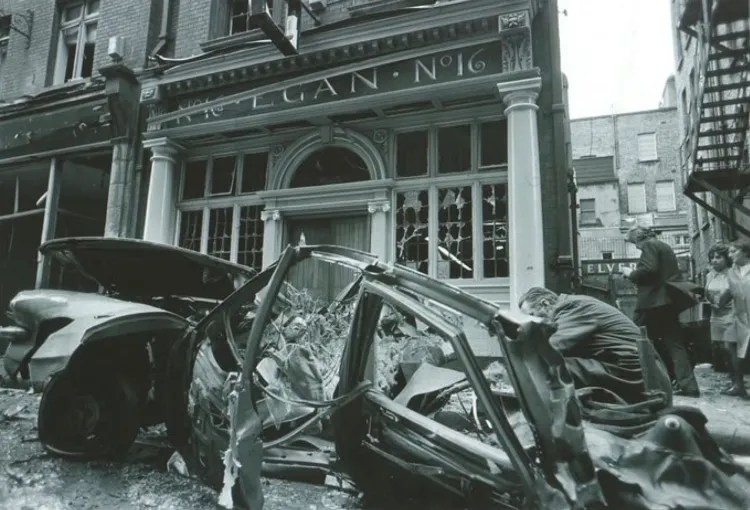
The 1974 British Intelligence and Loyalist bombing of Dublin and Monaghan towns, with the highest number of people killed in one day during the 30 Years’ War, was commemorated in Dublin today at the Memorial in Talbot Street, near the corner with Amiens Street. The commemoration, organised by the perennial Justice for the Forgotten campaign, was addressed by the Taoiseach (Irish Prime Minister) and elected representatives of Dublin and Monaghan municipalities. A poet and two musicians performed, wreaths were laid and one former politician gave a strong oration highly critical of the Irish, British colonial and British authorities.
On 17th May 1974, around the work-leaving and shopping-ending busy time of 5.30pm, three car bombs exploded within minutes of each other in the centre of Dublin. The car bombs had been parked in the mainly working and lower-middle class sParnell Street, Talbot Street, and South Leinster Street (as distinct from such streets as Henry, Grafton or Dawson streets, for example). Twenty-six people were killed in Dublin. To cover their way back across the British border, another car-bomb was set off in Monaghan Town, killing another seven. Even excluding a full-term unborn child, the total death toll was 33, the highest number killed in any one day of the three decades of conflict. Around 300 were injured.
Suspicion should naturally fall in the first place on the British Loyalists, since they had been planting bombs in Dublin since 1969 and in 1972 and 1973 their bombs had killed Dublin public transport workers. But the authorities had pretended to believe that the IRA was responsible for the 1972 bombing and used the panic around it to steamroll repressive political legislation through the Dáil, thereby setting up the no-jury Special Criminal Courts to sent Irish Republicans to jail.
However, it is believed that Irish Army Intelligence and Garda Intelligence were quickly aware that the Dublin and Monaghan bombers had in fact been Loyalists of the Ulster Volunteer Force and even knew the names of a number of them.
“No one has ever been charged with the bombings. A campaign by the victims’ families led to an Irish government inquiry under Justice Henry Barron. His 2003 report criticised the Garda Síochána‘s investigation and said the investigators stopped their work prematurely. It also criticised the Fine Gael/Labourgovernment of the time for its inaction and lack of interest in the bombings. The report said it was likely that British security force personnel or MI5 intelligence was involved but had insufficient evidence of higher-level involvement.” (Wikipedia)
Incredibly, despite long-standing allegations of collusion between the colonial police, the RUC (now the PSNI) and Loyalists, the Gardaí sent the car-bomb remnants to the RUC for analysis. Shortly after that, Ned Garvey rose from the Deputy position to Gárda Commissioner and met with a British secret agent in his office – without informing his superiors. When the agent began to blow the whistle on his past activities he exposed Garvey as a British “asset” – Garvey of course denied it but had to admit he had indeed met clandestinely with the agent in his office. When the Fianna Fáil goverment came in, they sacked Garvey as “not having confidence” in him but did it so baldly and outside established procedures that Garvey was able to take the Government to court, have his pension secured and have damages awarded to him!
BRITISH POLICY OF COLLUSION WITH LOYALIST MURDER GANGS
Most experts have been clear that construction of the type of bomb used was beyond the capability of the Loyalists at that time and, in any case, it is clear that British Intelligence and military were working with Loyalist gangs, as were the RUC (some of whom were members of the gangs) and RUC Special Branch. In addition there were reports of British accents in connection with suspects.
Collusion of that type had been openly advocated by a British military expert on counter-insurgency, Major (later Brigadier) Frank Kitson, for example in his “Gangs and Counter-gangs” (1960), based on his experiences in fighting the Kenyan insurgency for national liberation.
Frank Kitson (now Brigadier) in 1971 (Photo source: Internet)
Brigadier Frank Kitson was operational commander of the occupation forces in the British colony from 1970-’72 and left a substantial legacy of military assassinations and collusion with Loyalist murder gangs, along with other “dirty war” operations before he went on to lecture at British military training college.
“….. the de Silva Report (2013) on collusion with loyalist paramilitaries led to two further ‘unconditional’ British apologies for the behaviour of its security forces in Northern Ireland. In November 2013, a BBC ‘Panorama’ investigation into British counterinsurgency in Northern Ireland in the early 1970s revealed that members of a special covert operations unit known as the Military Reaction Force (MRF) admitted to the murder of suspects and unarmed Catholic civilians. These admissions by the state or its agents confirm previous claims by critics dating back many decades. Such abuses were not merely low-level tactical excesses by undisciplined and racist troops but were institutional, systematic, and approved or covered up at the highest levels ….”1
The British State has admitted it has secret papers relating to this atrocity but has refused to hand over copies to successive Irish goverments.
“THE LARGEST MASS MURDER IN THE HISTORY OF THE STATE”
Maureen O’Sullivan, ex-TD (Member of Irish Parliament) for the local area gave the main oration for the Justice for the Forgotten Campaign and called the bombing “the largest mass murder in the history of the State”. She went on to castigate successive governments and most of the political class for their lack of interest in pursuing the planners and perpetrators of the massacre over the years. In her repeated reference to their “ignorance”, O’Sullivan inferred that the legislators’ lack of interest was such that they could not even be bothered to inform themselves of the known facts.
Maureen O’Sullivan castigating the authorities (Photo: Rebel Breeze)
In addition to the Taoiseach, the Ard-Mhaora of Dublin and Cathaoirleach of Monaghan Council spoke and a Catholic priest delivered a short blessing. The event was chaired throughout by a representative of the Justice for the Forgotten campaign group.
Rachael O’Hegarty introduced and recited one of her collection of poems about the victims, this one about Maureen Shields who was 44 years of age when she was killed in Talbot Street.
Rachael O’Hegarty speaking and reciting her poem (Photo: Rebel Breeze)
Cormac Breatnach and Eoin Dillon on whistles played Sí Beag, Sí Mór and later Dillon playing the lament known as Táimse I Mo Chodhladh (I Am Asleep), accompanied by Breatnach on whistle, concluded the event.
Cormac Breatnach and Eoin Dillon on whistles (Photo: Rebel Breeze)
Eoin Dillon on uileann pipes and Cormac Breatnach on whistle (Photo: Rebel Breeze)
THE BOMBINGS EXPOSED THE NEO-COLONIAL NATURE OF THE IRISH CAPITALIST CLASS
In summary, a foreign power — which is also occupying by force one-sixth of Ireland — carried out a number of terrorist attacks in the capital city of the Irish State culminating in a massacre intended to cause maximum loss of life and limb – “the largest mass murder in the history of the Irish State”, as Maureen O’Sullivan correctly characterised it.
The Irish ruling elite failed to stop the escalating attacks and turned the investigation of the massacre into a farce. The Irish ruling elite failed to prevent the foreign power subverting the highest rank of its police force (and no doubt other levels in other areas).
Section of the crowd at the commemoration, the Taoiseach, Mícheál Martin speaking (Photo: Rebel Breeze)
The Irish ruling elite failed to take a full range of diplomatic and legal action to condemn the UK, the foreign power over its actions and failure to respond to requests for release of relevant secret papers. The ruling elite continues in that failure today as can be read into the weak speeches of Government Ministers at this ceremony – this time by the Taoiseach and last time the Minister for Justice.
No self-respecting elite or ruling class of any independent state would permit such violations of the security of its capital city and citizens without taking resolute and persistent action. The Irish ruling class is a neo-colonial capitalist class, undeserving even within capitalist terms to be in charge of any Irish state.
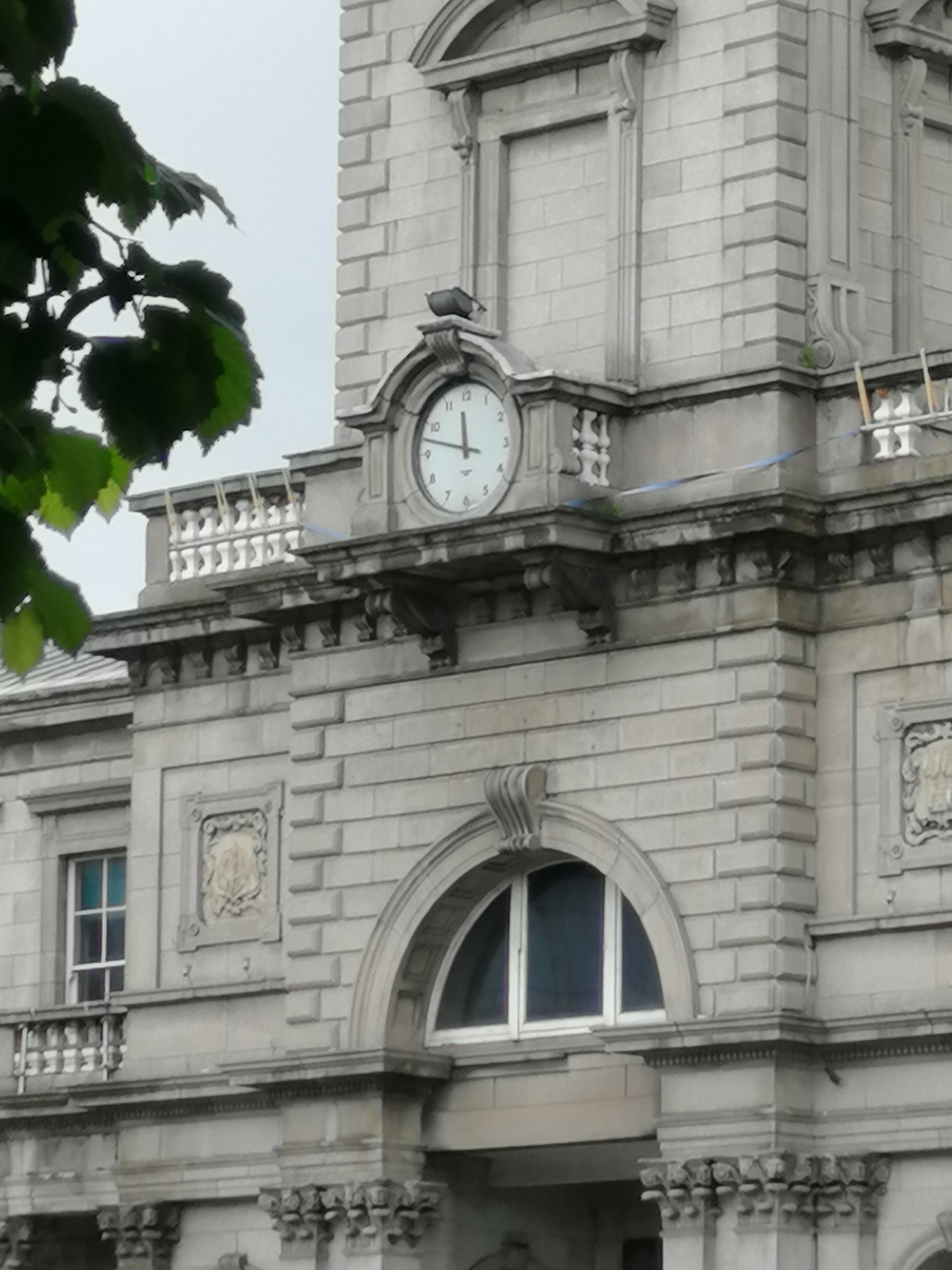
The north side of the Memorial (Photo: Rebel Breeze)The south side of the Memorial (Photo: Rebel Breeze)The clock on the tower of Connolly (formerly Amiens Street) Station — British soldiers fired a machine gun from that tower at Irish insurgents in 1916. (Photo: Rebel Breeze)
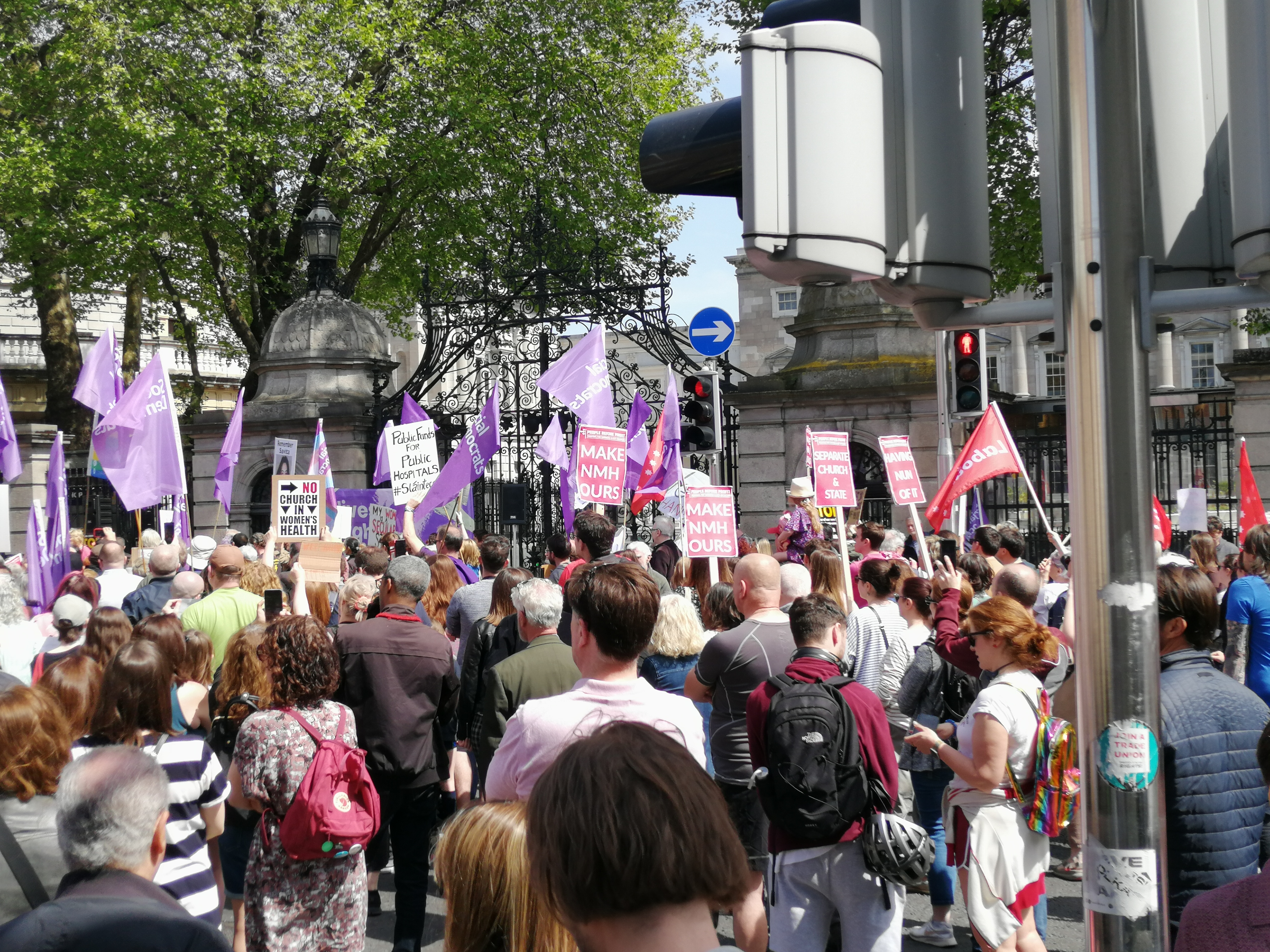
View of section of the crowd from Molesworth Street (Photo: Rebel Breeze)
Around two thousand demonstrators, including a high proportion of women, held a rally on Saturday afternoon outside Leinster House, the building housing the Irish Parliament. They were protesting the lack of clarity around whether the new maternity hospital will carry out pregnancy terminations on demand — with the suspicion that it will not.
View of section of the crowd in Molesworth Street (Photo: Rebel Breeze)
But speaker after speaker went further still and demanded the secularisation of the Irish health service and of society in general.
The issue arises in the first place due to the necessity to relocate the Dublin maternity services currently based at Holles Street due to the inability of the latter to meet the demand. However, the Government decided to relocate the facility to land near St. Vincent’s Hospital, owned by a Catholic Church organisation, which in turn formed a company to buy the land and lease it to the State at a nominal annual rate. It is the perceived Church veto on some procedures that has raised so much concern.
View of section of the crowd in Kildare Street looking northwards (Photo: Rebel Breeze)
A SECULAR SOCIETY – A REPUBLICAN DEMAND
A secular society is a fundamentally republican demand, up there with opposition to monarchy. English Republicanism failed to achieve1 it even after the execution by Parliament of Charles I in 1649 but the French revolution did not, which was one of the reasons why the Irish Catholic Church hierarchy was against La Republique and against the United Irishmen too.
View of centre section of the crowd in Kildare Street (Photo: Rebel Breeze)
Irish Republicans after the United Irishmen have had at best an ambivalent attitude to the Catholic Church – although the Young Irelanders and even more so the Fenians were decidedly anti-clerical, the Republicans in the first two decades of the last century were not so in general and many actually courted the support of the Church. The fact that the Irish Republican movement during the rest of the century failed to lead social struggles is adequate testimony to its leadership at the very least not wishing to earn the hostility of the Catholic hierarchy. That in turn was one of the factors ensuring that the Republican movement failed to broaden its struggle to encompass the majority of the nation … a factor sufficient on its own to ensure its defeat.
On the whole it has been left to writers, revolutionary socialists, social democrats and liberals to fight the secularisation battles – but above all, left to women. Control of fertility, access to contraceptives, personal sexual freedom, gender equality in law, equal pay, and termination of pregnancy were all hard battles won over decades by women. And often at huge personal cost. Most of those battles confronted the authority of the Church Hierarchy and even when some did not so directly, they did so by implication, undermining its basic judgement that the role of a woman is as wife to husband and mother to children.
Section of the southern end of the protest crowd in Kildare Street (Photo: Rebel Breeze)
The position of the Church hierarchy in Irish society was one of moral judge, jury and practical punisher and when punishment failed to correct, the State took over. In fact, we can view the Irish State in social and political terms as a partnership of native capitalist class – the Gombeens – and the Church hierarchy. In return for its role in social control, the State permitted the education, health and social care systems to be run by the Church either wholly or in part. Which in turn increased the power and authority of the Church hierarchy further. And it was that unquestioned (and unquestionable) authority that fostered the decades of physical, mental and sexual abuse carried out by so many clergy, in particular on women and children.
Women are still to the forefront of the struggle for the secularisation of the State and they are too in this struggle over an important branch of the health service. The people need a well-resourced national health service, with free access – but it needs to be secular also. Irish Republicans who do not actively support this struggle are failing not only the society they hope one day to lead but, in secularisation, failing also a fundamental principle of republicanism. That one of the issues with regard to Church influence on the maternity hospital is a suspicion that it will not carry out elective pregnancy termination should not prevent even those Irish Republicans opposed to elective termination from supporting its secularisation.
Quite simply, one is either a Republican and therefore in favour of a secular health service — or one is not a Republican.
End.
FOOTNOTES
Since 1524, not only is the UK a monarchy but the monarch, the Head of State, is also the head of the (Anglican) Church of England.
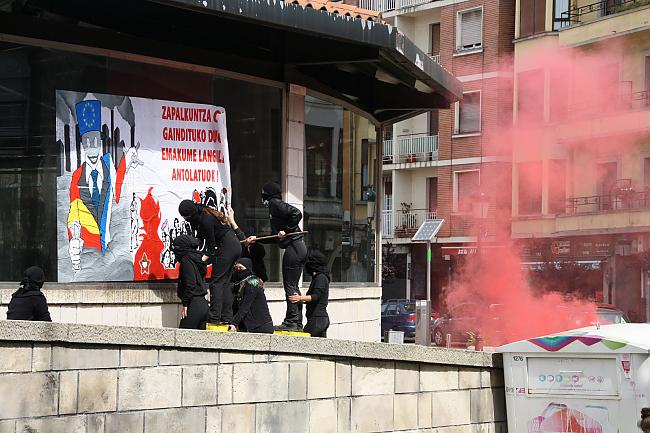
The revolutionary Basque socialist coordination organisation Jardun Koordinadora organised a celebration of Aberri Eguna, the Basque national day, combining political, social and cultural forms. Aberri Eguna takes place annually on Easter Sunday, a date chosen by its founder Elias Gallestegi based on a traditional commemoration day of the Easter Rising in Ireland. Aberri Eguna was first celebrated in Bilbo in 1932 attended by 65,000 people, including members of Emakume Abertzale Batza1, the Basque nationalist women’s organisation founded by Gallestegi also in emulation of the Irish organisation Cumann na mBan. Around 1,000 people, with a high representation of youth but also of veterans of the struggle, attended the events in Gernika2.
Jardun-organised Aberri Eguna procession passing through Gernika (Photo courtesy Jardun)
The Irish connection was reiterated on Sunday by the reading at the political rally of messages of solidarity from three Irish-based sources: Anti-Imperialist Action, Anti-Internment Committee of Ireland and Dublin Basque Solidarity Committee.
Jardun Koordinatora is a relatively new initiative which is a sharp departure from the trajectory in recent decades of the official leadership of the Abertzale Left, a trajectory which has served to dismember and dishearten the movement.
La Haine Report
(Translation by Dublin Basque with explanatory notes in italics)
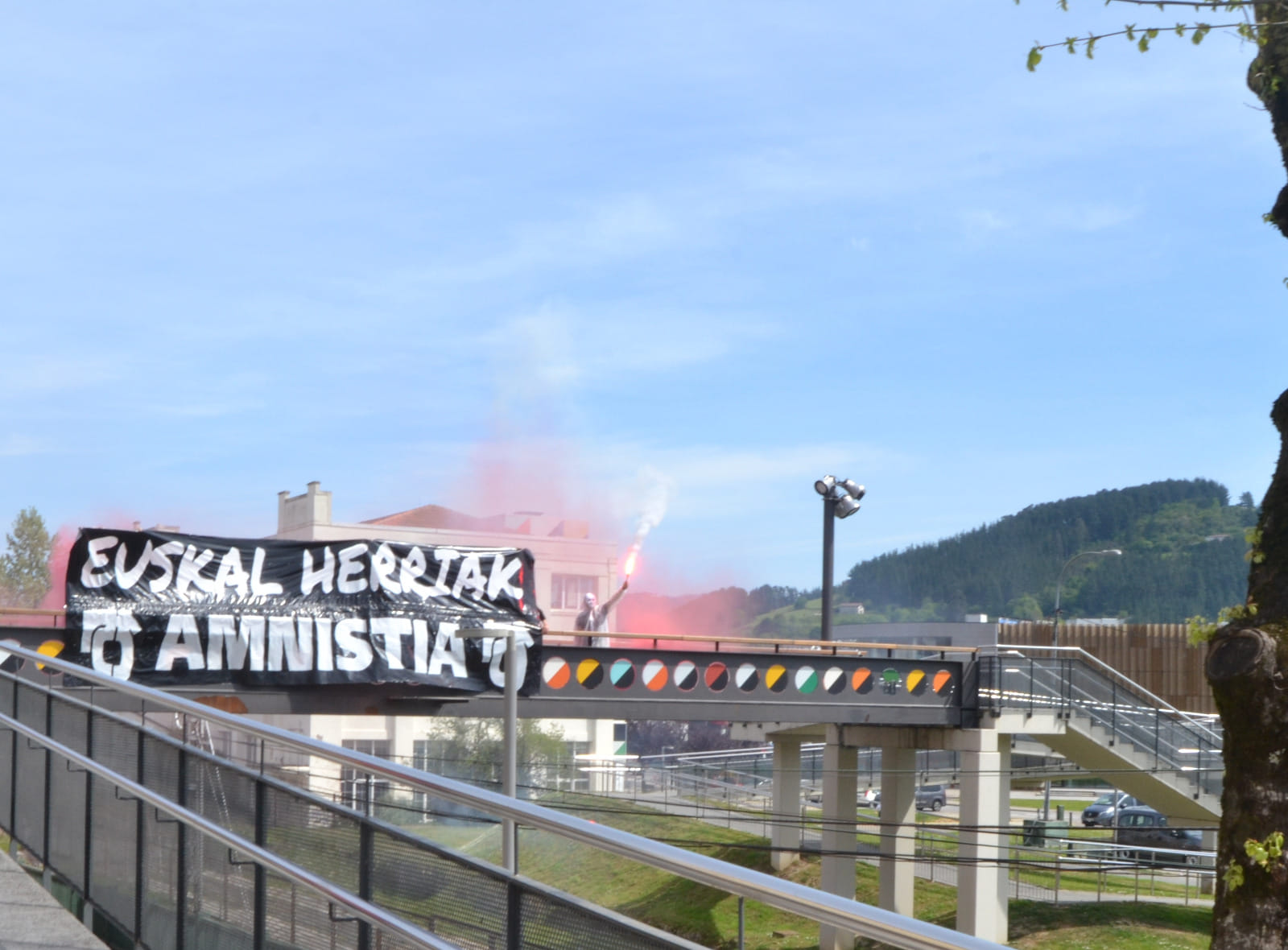
The different organisations comprising this Coordination (Jardun) demonstrated in Gernika under the slogans “Aberri gorria, biharko Euskal Herria, “Independentzia eta Sozialismoa”, “Euskal Herrilangilea Aurrera”, “Presoak Kalera Amnistia osoa” and “Amnistiarik gabe bakerik ez” (“Bright future in tomorrow’s Basque Country” “Independence and Socialism”, “Forward Basque workers”, “Prisoners Free with Full Amnesty” and “No Peace Without Amnesty”).
This Sunday, April 17, the JARDUN Coordination convened the Aberri Eguna (Basque National Day) gathering some 1,000 people to claim the national objective of the Basque Working People.
Along with a Zanpantzar group (performers with bells in traditional costumes representing animals), the event began with a march starting from Plaza Mercurio and during the journey different acts were carried out to demand prisoner amnesty and rights for working women. The event ended with the speeches read in Pasealeku Plaza: the first two were messages of solidarity sent by Anti-Imperialist Action and Anti-Internment Committee (both of Ireland) and ended with the political statement of the JARDUN Coordination.
Tradition Zapantzarak lead the procession (Photo courtesy Jardun)
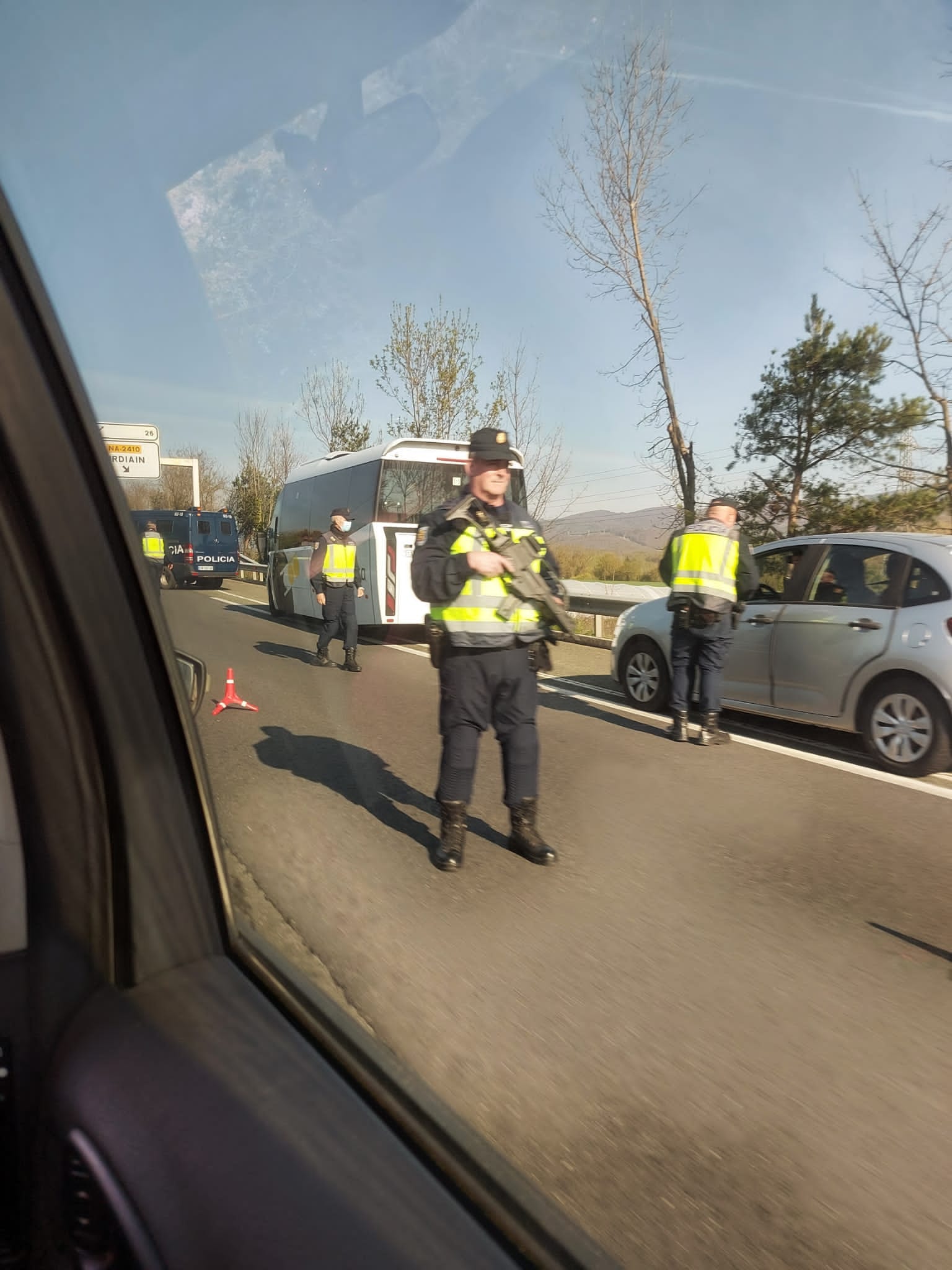
The demonstration went smoothly. However, the bus that departed from Irunea/ Pamplona had problems getting there because the National Police stopped it in Urdiain, taking details of the occupants.
To conclude, JARDUN Coordination stated that the only alternative for the Basque Working People will come from the hand of independence and socialism. To conclude, the Internationale and the Eusko Gudariak (Basque Soldier) were sung.
Spanish armed police stopped the contingent from Irunea/ Pamplona heading for Gernika and recorded their details. (Courtesy of Jardun)
Jardun Statement for Aberri Eguna 2022 (Translated by D.Breatnach from text supplied in Castillian Spanish)
Under capitalism, we workers are condemned to survive. We build our lives around work and the exploitation we suffer in it, while the bourgeoisie lives at the expense of this work. Such is the dynamic of capital. This is the logic of the economic system currently in force in the world. That is why it is important to clearly identify and point out the adversary facing us; because the capitalist system, the bourgeoisie, normalises and legitimises the fears and the repression that it produces daily to absorb the blood of the workers.
(Photo courtesy Jardun)
But with 19 years in prison for the freedom of his people, the murder of Iván Colona, a direct consequence of the criminal French prison policy, is not normal. The situation of the working people of Ireland, suffering from crushing British occupation for more than 800 years, is not normal. After eight long years of war, the situation of the working people of Donbass, who experience bombings, murders and massacres on a daily basis, is not normal. And much more heinous, outside of the norm, are the attempts to whitewash and legitimise criminal institutions such as NATO murderers.
We must situate ourselves in that context, understand within that reality, the situation that Euskal Herria (the Basque Country) is experiencing. Today our country are controlled by both the French and Spanish states. Not only do both these states not recognise Euskal Herria but they carry out an oppression based on that denial against the working class of Euskal Herria. In effect, we must understand well that, beyond the national question providing the a joint market for the states, the working class can only use the political project of the bourgeoisie as an element of unity to support and protect it, promoting interclassist attitudes.
“We, the organized women workers, will overcome all oppression!” (Photo courtesy Jardun)
The aforementioned denial, as well as the attacks carried out by the Spanish and French States against the Basque Working People, must be understood as an ideological motivation of the national State. We must, therefore, situate the oppression of Euskal Herria in the very creation of the Spanish and French capitalist states; because the objective of the denial is clear, the assimilation of Euskal Herria. To do this, the states take advantage of the institutions aimed at creating divisions and gaps in the Basque consciousness. And to protect these institutions and guarantee the supremacy of the bourgeoisie, they take advantage of dogs of various colours to attack the working people. To promote alienation and renounce our identity, in addition to normalising the attacks against the language, they have turned the Basque language and culture into souvenirs of a territory that today wants to dedicate itself to tourism, since for the bourgeoisie everything is business, to the point of commodifying our places of residence.
This being the case, given that denial is a decision of a political nature, we must cover with a political character the oppression experienced by Euskal Herria to view it with a class vision. We have to be clear about the concept of the political nature with regard to Euskal Herria nationality. Therefore, we have to fight against normalised oppression. Along this path, it is up to the workers of Euskal Herria to build our own political project and in response to this we have to equip ourselves with our own institutions that have to arise out of the counter-power that we need to form. And for this it is necessary for a Workers’ Euskal Herria to break politically with the Spanish and French states.
Photo shows a substantial following by veterans of the struggle (Photo courtesy Jardun)
These States offer the working people the use and threat of both persecution and violence, within the capitalist system that condemns the working class to servitude for the benefit of the bourgeoisie. For this reason, to carry out the aforementioned political rupture, political confrontation must be a valued concept in order to carry out the political project of the workers of Euskal Herria. Political confrontation must also be the engine of the revolutionary process aimed at achieving an independent and socialist Basque state in Euskal Herria.
For this, it is necessary to take the revolutionary process to the extreme and form a political body that must feed the revolutionary alternative. Specifically, a political body to be formed by organised workers in favour of national and social liberation and the sale of their labour power in the Basque Country. A political body that is committed to achieving an independent and socialist Basque State. Because the Basque Working People cannot be limited to the forms of work authorised by the capitalist system. These not only destroy the revolutionary potential of the working class, but are aimed at sustaining and reproducing the ideology of the bourgeoisie; because the enemy will not give, in any way, more than he is willing to give. The bourgeoisie will not voluntarily give up its privileges.
(Photo courtesy Jardun)
It is essential to set in motion the revolutionary process that must take place on the path of a classless society, towards the acquisition of political power by the working class; the aforementioned subject will only be achieved through the confrontation carried out with the capitalist state. Through the counter-power built in the confrontation, the Basque Working People must articulate revolutionary structures that wear down the centres of power of the oppressor and guarantee his liberation against the exploiters, to guarantee the achievements obtained during the revolutionary process. Because the political power of the Basque Working People must be based on counter power. In other words, the revolutionary alternative of the working people will be built and take root as the control and power of the capitalist states over the workers of the Basque Country is annulled. The revolutionary alternative must be a comprehensive political alternative that satisfies the needs of the Basque Working People.
It must be understood that this will be capable of leading struggles based on the activation and commitment of the workers. Therefore, in order to weave and build a revolutionary alternative at this time, the priority is the activation of workers aimed at promoting the ideological struggle and mobilization, understanding the JARDUN coordinator as an instrument to achieve this. In short, JARDUN is a framework created with the aim of promoting the organisation of bodies and militants to win the freedom of Euskal Herria. Its objective is that, under a common political project and strategic approach, each organisation carries out its contribution in specific political areas, but that all act within the framework of a common strategy and direction.
We have to be aware that this will be achieved through gradual activation and participation through the awareness of the Basque Working People. In this process, the revolutionary process itself will be carried out gradually, and the Alternative of the Basque Working People must carry out struggles based on the different forces, conditions and problems of the moment. As its political work deepens and Basque workers’ participation in the Coordination increases, JARDUN will create new framework organisations and acquire comprehensiveness and integrity, with the revolutionary movement’s priority being to create the conditions to achieve it.
(Photo courtesy Jardun)
When talking about the liberation of Euskal Herria, self-determination is a frequently mentioned term: self-determination, a term that appears many times when a nation is subjected to the sovereignty of another against its will. But when we speak of self-determination, considering the revolutionary process developed under a counter-power based on political rupture, we are not referring, in any way, to the vote marked, accepted and facilitated by the States that persecute Euskal Herria, but to the process of separation of one nation from the state structures of another nation. Self-determination as synonymous with the revolutionary process that must be carried out to achieve an independent and socialist Basque State, in the case of Euskal Herria.
Autonomism, because it is a struggle based on the management of the remains provided by the states, is not an option. It is not a legitimate choice on the table for the revolutionary movement, since this implies reformism and the strengthening of the position of power and subjugation of the States, together with the renunciation of the strategic objectives aimed at the liberation of the Basque Working People. However, it would be a serious mistake to believe that, through national liberation, the liberation of the workers will take place mechanically. This must be understood within the class struggle, in which we must place self-determination itself within the class conflict.
On the other hand, there exists the denial, underestimation or rejection of the national question, the strengthening of the repression that the capitalist states carry out and accepting the framework of the oppressive nation imposed, in the name of socialism, with the argument of unity of the workers. Regarding the national issue, the lack of correct position also allows the French and Spanish States to continue applying unjust laws and coercion, helping to hide the dimension of oppression suffered by the working class of Euskal Herria. Keeping silent before a crushing stomp, since taking a neutral position means protection from crushing; taking neutral positions allows oppressive power relations to continue unchanged over time and space, perpetuating them.
The political rally of Jardun’s celebration of Aberri Eguna in Gernika (Photo courtesy Jardun)
Consequently, the mere demand for independence only benefits the interest and political project of the bourgeoisie of the Basque Country. And the socialism that in Euskal Herria does not address the national question goes hand-in-hand with denial, denying in class parameters the revolutionary potential of the national question. The achieving of the independent and socialist State must be the result of the revolutionary process of Euskal Herria due to the national oppression suffered by the Basque workers. Revolutionary alternatives beyond the essential defence of independence and socialism must be the basis of the political position of the Basque Working People. They are only alternative for the Basque Working People, because it inevitably comes hand-in-hand with independence and socialism.
Long live a free Basque Country!
Long live a socialist Basque Country!
End.
FOOTNOTES
1A strong organisation in the antifascist resistance to the fascist-military uprising against the Spanish Republic but no longer in existence.
Yes, indeed, we have been. Let us look back over the campaign of misinformation about conflict in Ireland for it has much to teach us about the mass media, about human credulity. We don’t need to go back over 800 years – just to the recent the 30-Year War.
In 1968 a civil rights campaign1 took off in the British Six-County colony in Ireland to include a number of marches and sit-ins, which was regularly met with violence from Loyalist2 mobs and the State. As part of the campaign, in 1969 a march from Belfast to Dublin was organised under the slogan “Civil Rights – North and South”. One of that march’s stops was in Lurgan, Co. Armagh, where the marchers sat at a crossroads and were instantly attacked by the armed British colonial police (then the RUC3, now the PSNI).
Some of the marchers had come from Britain to support the campaign and after being attacked in Lurgan, they bought an English newspaper to see whether the incident had been reported. An occurrence in the town had been reported alright but not what had occurred – the report told their readers that a fight between Catholics and Protestants had been broken up by the RUC, keeping the two sides apart. “There wasn’t a Protestant in sight,” commented a marcher angrily, “except those in RUC uniform …. or unless he was one of us4.”
Later that year, in August, the RUC killed four civilians, including a child, in the Divis Flats area of Belfast by firing at the area with a machine-gun mounted on an armoured car. Their claim they were returning fire from the area was widely refuted by local people but repeated in the media. The incident was not investigated until decades later when the claims of family and local witnesses were vindicated in an Ombudsman’s report.
The representation of the RUC as a force for peace between two groups in a sectarian conflict was to be a repeated media disinformation line through the ongoing conflict, as the struggle became an armed one — although to a large degree the honest broker ‘peacemaker’ cloak shifted from the colonial police on to the British Army.
British troops were sent in to the colony (by a Labour Government, in case we had illusions) in August 1969 and were initially greeted by many people in the ‘nationalist’5 community as saviours, sent to keep the sectarian RUC and Loyalist mobs (often enough amounting to the same thing) away from them. Most politicians and the media represented them as peace-keepers. For most nationalists the illusions did not last long as the Army turned their guns on them.
Although no British soldier had been killed in the Six Counties by the IRA as yet6, on 3rd July 1970 the British Army invaded the staunchly nationalist area of the Lower Falls and forced their way into homes, saying they were searching for arms. Local youths mobilised and attacked the soldiers with stones and petrol bombs7. The soldiers responded by pumping CS gas into the area and soon gun-battles between the IRA and the British Army broke out.
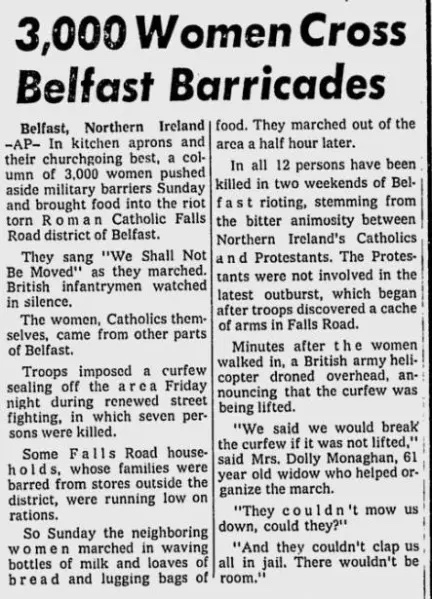
‘After four hours of continuous clashes, the British commander sealed off the area, which comprised 3,000 homes, and imposed a curfew which would last for 36 hours. Thousands of British troops moved into the curfew zone and carried out house-to-house searches for weapons, while coming under intermittent attack from the IRA and rioters. The searches caused much destruction, and a large amount of CS gas was fired into the area. Many residents complained of suffering abuse at the hands of the soldiers. On 5 July, the curfew was brought to an end when thousands of women and children from Anderstonstown8 marched into the curfew zone with food and other supplies for the locals.
‘During the operation, four civilians were killed by the British Army, at least 78 people were wounded and 337 were arrested. Eighteen soldiers were also wounded. Large quantities of weapons and ammunition were (allegedly – DB) captured. The British Army admitted afterwards that some of its soldiers had been involved in looting.’9
Mural on the Falls Road depicting Andersonstown women breaking the British cordon, Falls Curfew, 1970 (Source photo: Wikipedia)Cutting of unknown newspaper report displaying misrepresentation of the struggle, despite being friendly towards the women who broke the British Army siege of the Falls Road, July 1970. (Source photo: Step Back Ireland)
At the time, most of the media reported the clashes as unruly elements irrationally attacking the Army who were there to protect them and were only doing their job. However, the opinion of the nationalist community, though ignored by the media had undergone a huge shift and the first serving British soldier (of many to follow) was killed by the IRA the following year.10
Later in 1970, during riots in Derry, the Army shot two men from the nationalist area, Seamus Cusack and Desmond Beattie, claiming afterwards that they were armed, a claim local people denied. There was no investigation by the authorities, obliging the constitutionalist SDLP11 to withdraw from the colony’s parliament in protest.
On 4th December 1971, an explosion in the Catholic-owned McGurk’s Bar in Belfast killed 15 people and injured 16. Due to the bar’s ownership and location, the most logical attribution would be to Loyalists or British forces. It would be hard to pin it on the IRA – unless it could be said to have been an accidental explosion of an IRA bomb during storage or transportation. That was what the “security forces” came up with, which of course was repeated by the media. An alternative media theory was that in some manner it was a result of a feud between the Official and Provisional IRA. In order to construct that theory, the denials of the IRA had to be discounted12, despite the organisations’ track record of taking public responsibility for its actions.
The explosion had occurred in the pub’s doorway, which would have thrown doubt on the “IRA bomb in transit” story but somehow, the RUC’s forensic examination did not determine that. But even worse, the evidence of an eyewitness had to be dismissed.
‘On 6 December, however, the RUC took a witness statement from an 8-year-old boy. He said that a car had stopped outside the pub with four men inside and “a wee Union Jack stuck in the back window”. He said one left a package in the Great George’s Street doorway and ran back to the car, which sped off just moments before the package exploded. A man and a woman backed up his story, although they did not witness as much as the boy.’13
‘In March 1976 the RUC received intelligence that linked UVF member Robert Campbell and four others to the McGurk’s bombing. Campbell was arrested on 27 July 1977 and held at Castlereagh RUC base. He was interviewed seven times during 27 and 28 July. He admitted his part in the bombing but refused to name the others.Campbell’s story matches that given by the young boy witness.’14
On 29 July 1977, Campbell was charged with the 15 murders and 17 attempted murders and in September 1978 pleaded guilty to all charges (he also had a separate conviction for the murder of a Protestant delivery driver in 1976). He eventually served fifteen years in prison, being released on 9th September 1993.15
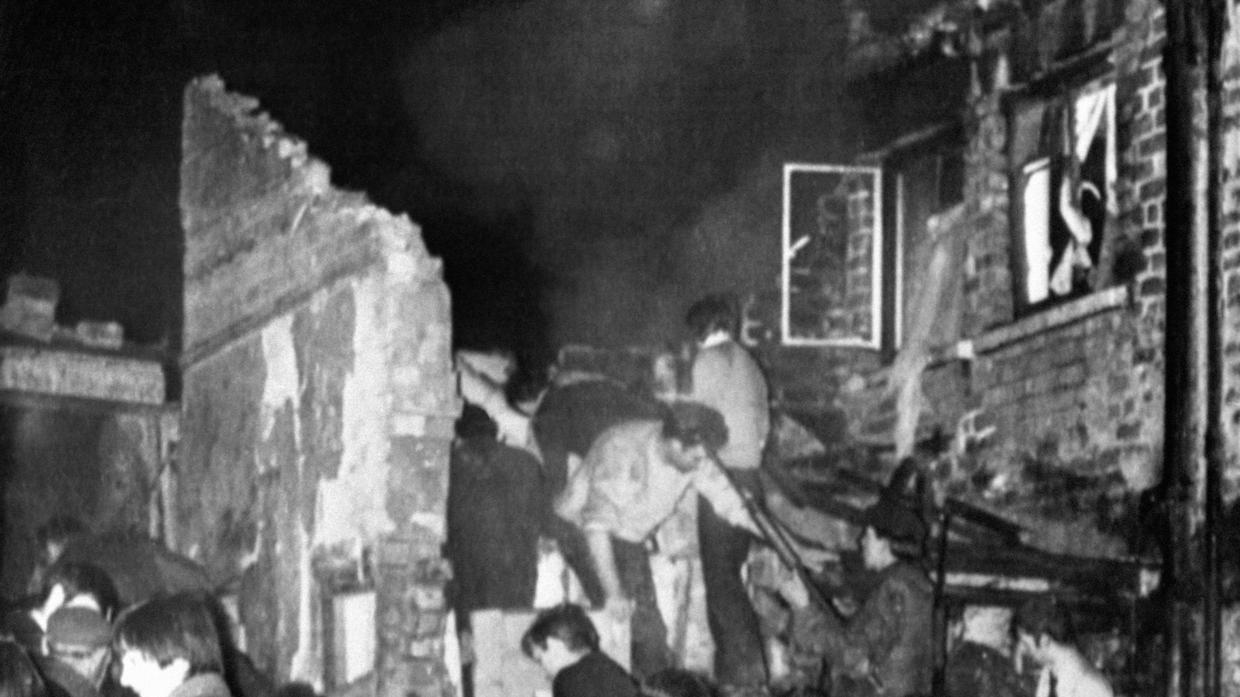
Local people searching in the rubble of McGurk’s Bar after the bombing by Loyalists killing 15 but which was blamed on the Republican armed organisations. (Photo credit: AP)
Despite the 1978 convictions and even Campbell’s confessions, the “own goal bomb” theory of responsibility lingered and relatives sought for years to have the case properly investigated, some also alleging that the RUC had colluded in helping the killers get away out of the area and in the false atrributions later, possibly even with the intention of setting the two IRA organisations at one another’s throats.
In what has become a depressingly familiar story, the relatives campaigned on in the face of police inaction and media disinterest for years, during which many of the directly-affected died through natural causes, to receive partial vindication at last in an Ombudsman’s report which laid the blame squarely on a Loyalist gang and castigated the RUC for a biased and inadequate investigation. The report was published in February 2011– it had taken the campaigners only 40 years16.
The introduction of internment without trial in August 1971 was, according to the media, a necessary measure to deal with political violence from all sides. Not one Loyalist was arrested that year, or the next and it was not until 1973 that a single Loyalist had been interned, the total by December 1975, when the measure was ended, having been 107 against 1,874 from the Nationalist community.17
The Paratroop Regiment, British Army shocktroops, were sent into the colony that year too18. Between 9th and 11th August in the Belfast area of Ballymurphy, the Paratroopers caused the deaths of 10 men and a woman and wounded many19. The Paratroopers claimed they had been shot at and were returning fire and that all their targets had been “terrorists”20. The media repeated these lies and, if reporters interviewed wounded and other witnesses, their accounts were not published. There was no investigation and, as with the deaths of many victims of RUC and British Army, there was no inquest concluded until decades later (2021 for these victims21).
The nationalist community called a demonstration in Derry for 30th January the following year to protest the massacres and against the introduction of internment. The Paratroopers were there again and they and other British Army soldiers shot down unarmed demonstrators, causing the deaths of 14 and injuring at least another 15. The Army claimed they had been returning fire from Irish Republicans and had shot only gunmen and bombers and on the whole, the media parroted their claims.
The British put their top judge, Lord Chief Justice Widgery, to hold an inquiry and in April that year his verdict upheld the Army’s version and also blamed the organisers of the march. The media of course promoted that verdict too. It was not until the extraordinarilyy long and hugely expensive Bloody Sunday Inquiry set up 1998 22 produced the Saville Report in 2010 that the British officially (and then of course also the media) accepted what all of Derry and much of Ireland already knew, that the Paras had opened fire in a non-threatening situation and selectively targeted and killed unarmed civilians23.
British soldiers shot another five unarmed people dead in the Springhill area of Belfast on July 9th, yet again as in Ballymurphy the previous year, including a priest administering the last rites but this time their tally was also an thirteen-year-old girl24. The original ‘official’ account of the shootings— that those shot were ‘gunmen’ — was almost immediately discredited, and was changed shortly after; the claim then became that those murdered were simply caught in the crossfire. Again the media covered the Army story without investigation or challenge.
In 1988 on Sunday 6th March British SAS soldiers shot dead three unarmed IRA volunteers in Gibraltar. When it was revealed that the three had been unarmed, firstly the media claimed that they had been about to trigger an explosion but some time later the British found the explosives in a car in a Spanish carpark across the border without any electronic link to the dead volunteers. When the British claimed that the Volunteers had made threatening moves, eyewitnessed testified that not only had they been unarmed when shot but had been extra-judicially executed as they lay on the ground with their hands up in surrender position. One of the eye-witnesses was Gibraltar resident Carmen Proetta, who then became a target for British media slurs, even going to the extent of suggesting that she was a sex-worker.
On Monday 7 March all eleven British national daily newspapers reported the story that a bomb had been found. Many gave detailed information about the size (mostly 500 pounds), purpose and type of the bomb as well as how it was defused. The Daily Mail suggested that the bomb might have a ‘video timing device’, while Today and the Independent mentioned ‘remote control’. The Daily Mirror told us that ‘a controlIed explosion failed to set off the bomb’ whilst the Daily Mail added ‘RAF disposal men defused it later’.25
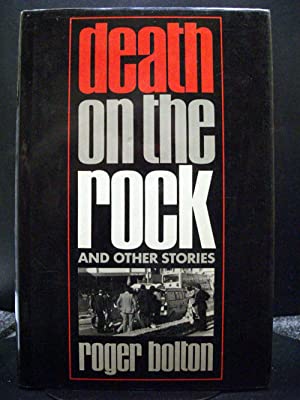
On 28 April 1988, almost two months after the Gibraltar shootings, the ITV television channel defied British Government pressure and threats of legal action to broadcast “Death on the Rock” an episode of its current affairs series This Week, produced by Thames Television, based on investigations of three journalists and many interviews. This led to a ferocious media attack on the documentary, its programers and the IBA, the governing watchdog authority.
Documentary program maker Roger Bolton’s account of his hounding by government and media about an accurate documentary of the 1988 SAS murders of three unarmed IRA Volunteers in Gibraltar. (Image sourced: Internet).
‘Over the following weeks, newspapers repeatedly printed stories about the documentary’s witnesses, in particular Carmen Proetta, who gave an account of seeing McCann and Farrell shot without warning by soldiers who arrived in a Gibraltar Police car. Proetta subsequently sued several newspapers for libel and won substantial damages. The Sunday Times conducted its own investigation and reported that “Death on the Rock” had misrepresented the views of its witnesses; those involved later complained to other newspapers that The Sunday Times had distorted their comments.’26
A great number of situations arose during the 30 Years War in the British colony that were either unreported or misrepresented by the mass media, including “confessions” obtained through torture, RUC and British Army collusion with Loyalist murder gangs, inhumane treatment of political prisoners, Army shooting of unarmed civilians, extra-judicial executions of Republican Volunteers and blackmailing individuals for information or to carry out agent-provocateur actions.
WITHIN THE IRISH STATE
In 1969 the grave of Wolfe Tone in Bodenstown was blown up by Loyalists27 and between 1971 and 1974 there was a series of bombings in Dublin by Loyalists and British Intelligence. The bombing campaign began by aiming at symbolic structures and went on to target civilians which cost the lives of 36 civilians (and a full-term unborn child) and injured around 490, presumably to pressurise the Irish Government into increased repression of Republican paramilitaries.
In January 1971 the O’Connell Tower in Glasnevin Cemetery was damaged (not repaired finally until 2019, 47 years later)28, presumably as an attack on a prominent Irish Catholic29 icon. But in February 1971 the Wolfe Tone30 monument in Stephen’s Green was also blown up, like the blowing up of the grave, an attack on Irish Republicanism and its rebellious Protestant origins31. Bombings now aimed at civilians in Dublin followed and between 26 November 1972 and 20 January 1973, there were four paramilitary bombings in the centre of Dublin, claiming the lives of three public transport workers and injuring 185.
The first suspicion of responsibility for those bombings should naturally have fallen on the Loyalists and perhaps, by extension, on a British intelligence agency. It didn’t though; in the media and political circles, it was projected on to the IRA.
That could not have made logical sense, since such explosions could only have harmed the IRA among the Irish population. However there was another specific reason why it made even less sense, (if possible): in 1972 Leinster House32 was about to debate repressive legislation that would set up special no-jury courts to convict Republicans with the word of a police officer (at the rank of Superintendent or above) sufficient to convict of “membership of an illegal organisation”, with an automatic two-year jail sentence. The proposed legislation was being put forward by Fianna Fáil but Fine Gael and the Labour Party were mustering to vote against it and if they did, the new legislation would fall.
Scene of 1973 bombing in Sackville Place, Dublin city centre. The bombing the previous year was irrationally blamed on the IRA and the panic was used to collapse the opposition to proposed undemocratic repressive legislation, which was passed and is with us to this day. (Photo sourced: Stair na hÉireann Facebookpage)
In the midst of the horror about the bombing, the opposition crumbled and the bill went through, against protests of many human and civil rights agencies33; it became law, has sent many people to jail on dubious ‘evidence’ and is in force to this day.
The illogical focus on the IRA as the source of the 1972 and ‘73 bombings and the consequent failure to investigate them and follow up on the likely perpetrators had a horrific result in 1974: three bombs in Dublin city centre and one in Monaghan town centre killed 34 and injured around 30034, the highest number of people killed in any one day during the 30 Years War (often conveniently forgotten by the media, as for example in this report https://www.belfasttelegraph.co.uk/news/northern-ireland/army-knew-mcgurks-bar-bomb-was-placed-in-doorway-solicitor-says-35516460.html.)
Not only that, but the failure to energetically investigate the 1974 bombing meant that some of the Loyalist perpetrators were free to murder many civilians in the following years – some of the bombers were members of the infamous Glennane Gang, a Loyalist-RUC-British Intelligence group of killers responsible for up to 120 murders of civilians35.
WITHIN BRITAIN
The events in Ireland were of course being felt by the Irish diaspora in England too. Marches, pickets and public meetings protesting the RUC’s repression of marches for civil rights were held in many British cities, as they were against sending the British Army into the Six Counties, introduction of internment without trial and shooting protesters dead. Some groups on the British Left were also attending these events and occasionally organising their own. Irish solidarity was becoming a major issue for anti-imperialist solidarity in Britain and abroad, in addition to being in a sense a major domestic issue in Britain too.
The IRA began to extend Britain’s war to their homeland in a bombing campaign in 1971, at first targeting property. However, in 1974 bombs in two pubs in Birmingham killed 21 people which was difficult to understand but according to an alleged perpetrator, the warning intended by the bombers was frustrated through out-of-order public telephone boxes. The Guildford and Woolwich bombs, aimed at pubs frequented by British soldiers, killed five soldiers and two civilians overall and injured 101 people.
The horror and outrage resulting from that carnage gave the British State the environment in which they could launch a wholesale clampdown on the Irish diaspora. The Prevention of Terrorism Act was rushed through the Westminster Parliament in 1974, specifically targeting the Irish community. The Act empowered the police to raid homes, to hold suspects without access to a solicitor for up to five days and longer on special application and to summarily deport Irish people from Britain – even to their own colony. It also empowered the police to stop and question Irish people without warrant or having to show cause and thousands were stopped and questioned at ports and airports as they travelled from Ireland to Britain or vice versa, sometimes missing their flights or boat as a result. People were questioned on the street too and on Irish solidarity demonstrations.
In that atmosphere, of which the media was the main facilitator in British society, it was fairly easy for the State to frame nearly a score of innocent people on bombing charges and to sentence them to many years in jail on the flimsiest of “evidence”, later to refuse their right to appeal, later still, granting that right but denying the justice of their cases.
Judith Ward was arrested in February 1974, sentenced to life imprisonment plus 30 years in October 1974 and her conviction overturned in May 1992.
The Birmingham Six were arrested in November 1974, sentenced to jail for life in August 1975, their convictions finally overturned in March 1991.
The Guildford Four were arrested in December 1974, sentenced to imprisonment for life in October 1975, their convictions finally overturned in October 1989.
Giuseppe Conlon and the Maguire Six were arrested in December 1974, sentenced to 4, 51, 12 and 14 years in 1976, their convictions overturned in 1991. By that time Vincent and Patrick had already served their sentences and Giuseppe Conlon, father of Gerry Conlon of the Guildford Four, had died in jail.
1Patrick Maguire was only 14 at the time and Vincent only 17.
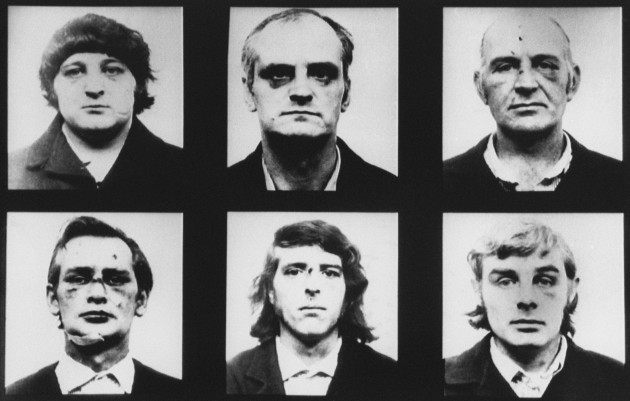
The innocent Birmingham Six at their appearance in court after being beaten up by prison warders as they arrived at the jail falsely charged with the bombings in Birmingham. The mass media played a major role in their being found guilty and in frustrating campaigns to free them which only succeeded 17 years later. (Image sourced: Internet)
The UK media in particular played a huge part in setting the atmosphere in which these unjust convictions could take place and in making the struggle of the innocent for justice difficult. Even after their acquittal, some of the media insinuated that they had been guilty and had got free through some kind of legal loopholes.
Could the media have known differently? Yes, certainly, not one of the cases would stand up to reasonable inspection. The Guildford Four were hippies living in a squat, the Birmingham Six were escorting the body of a deceased IRA man to Ireland when the bombs exploded, the Maguires were a Tory-voting woman with teenage children, Giuseppe was only in London to help his son after the latter’s arrest and Judith Ward was mentally ill, homeless and penniless37. Their ‘confessions’, obtained through torture and intimidation38, were admitted as evidence against them, although they all retracted them and declared how they had been obtained. The forensic evidence was faulty and besides recording a false positive and even though the defence team had a forensic expert to refute it during their trial, the Prosecution’s expert was the one accepted.
The February 1977 confession by an IRA unit to the Woolwich and Guildford bombing after their capture in the Balcome Street siege was not accepted, although they were able to give details of the bombing. So tortured and retracted ‘confessions’ were acceptable whereas one voluntarily given was not.
Apart from the logical doubts that should have arisen in even a light examination of the cases, the media also had access to detailed refutation of the case against the Birmingham Six. Although much has been made recently of the investigation of the case by Chris Mullin, the publication of his book Error of Judgment: The Truth About the Birmingham Pub Bombings (1985), the research for which went into the earlier 1984 ITV World in Action documentary, a detailed challenge to the convictions had been published much earlier. Only two years after the arrest of the Birmingham Six, Fathers Murray and Faul had published The Birmingham Framework39, which they had sent to British politicians and media agents. In 1982 the Irish in Britain Representation Group40 also publicly called for the freeing of the framed prisoners and continued to do so for every year thereafter. Other organisations such as the Troops Out Movement41 called for their release also and trade union branches began to support such calls.
Exposure of the case against the Birmingham Six published by Frs. Murray and Faul as early as one year after the convictions of the innocent men. (Source image: Internet)
It suited the State that the British public think the prisoners guilty and the British media played their part in that purpose. In a way, it also suited the State if the Irish community knew the prisoners were innocent since, if even the innocent could be jailed so easily, how could any Irish person be safe except by keeping his or her head down low? Irish solidarity activities declined in occurrence and in numbers attending. With few exceptions, the Irish community in Britain was cowed from 1974 until the Hunger Strikes of 1981 brought them out on the streets again, the terror broken by the spirit of solidarity and outrage.
WHY?
The above examples are only a selection of situations in Ireland during the period under discussion about which we and the world were misinformed or censored. Throughout the 30 Years’ War so many accusations against the British armed forces, including their armed colonial police, have been ignored or recorded disbelievingly by the media – in particular the British section but within the Irish state also – and repeated by media services abroad, to be picked up by other media …. and so on, and on. And likewise with accusations against British intelligence services and their domestic police force.
Why then are the current claims of the Ukrainian government published through the mass media being accepted without question on every count? Why is everything the Russian government says discounted or ignored without checking? Why are we not concerned at banning of alternative media and censorship of commentators who are not repeating the party line? Why are we not outraged at the agreed delivery of Julian Assange by the UK to the USA on charges of “spying” because he exposed their lies and murderous activities in Iraq and Afghanistan? Given our own experience over 30 years of the UK media’s dismal record of reporting on the conflict in Ireland – and its equally dismal repetition in the western media – why are we now believing without critical examination the western media reporting on the war in the Ukraine?
End.
FOOTNOTES
1The civil rights campaign in the Six Counties was in pursuance of equal rights for the Catholic minority with the Protestant majority there, in the electoral franchise, in housing and employment, along with the repeal of the repressive Special Powers Act.
2‘Loyalists’ is a term describing militants – always of Protestant community background – in various organisations — who insist on remaining within the UK. The first armed actions in the 30 Years War were by Loyalists.
3Although the Royal Ulster Constabulary was created in 1922, when Ireland was partitioned, it was in effect a continuation of the Royal Irish Constabulary, the British occupation’s gendarmerie (nation-wide semi-military police force, such as exists in Spain, Turkey, Italy, France, etc) in existence throughout all of Ireland since 1822. Although the personnel of the RIC had been mostly Catholic in background (usually with Protestant senior officers), the RUC was determinedly Protestant from the start, both in its full-time and part-time membership. However, a minority of the civil rights campaigners were also from Protestant backgrounds.
4As part of the control structures in the Six Counties, the authorities had recruited only non-Catholics into the colonial police force, which helped unionist politicians and media represent an attack on the police as a sectarian attack. Though a few Catholics have been recruited since the 1990s and Sinn Féin has been supporting recruitment drives in nationalist areas, the PSNI personnel remain overwhelmingly of Protestant background.
5A convenient term used to describe the large minority community, mostly of Catholic background, mostly of the original population but with some earlier intermarriage into the majority community, which is of mostly colonist/ settler origin.
6Ironically, the first serving British soldier killed in the Six Counties was killed by indescriminate firing by the RUC into the nationalist area of Divis Flats in Belfast. Trooper Hugh McCabe of the Queen’s Royal Irish Hussars was home on leave, staying with his family when the RUC opened fire with machine-gun on the nationalist area (this was one of the incidents that led to the barricading of “no go” areas excluding the RUC and later also the British Army). Three others were also killed by RUC bullets, including a nine-year-old boy. It took over 50 years for the families to get an acknowledgement and apology after an Ombudsman’s report. https://www.theguardian.com/uk-news/2021/may/06/ruc-erred-at-troubles-dawn-by-firing-on-flats-from-armoured-cars#:~:text=Patrick%20Rooney%2C%20nine%2C%20Hugh%20McCabe,the%20Divis%20and%20Ardoyne%20areas.
7People had learned to make those in defence against RUC and Loyalist attacks during the earlier Civil Rights period.
8A large Belfast nationalist area separated from the Falls area by unionist areas and the city centre.
11The Social and Democratic Labour Party, advocating reform through legal and constitutional methods.
12Two days after the explosion, on December 6th, both the Official and Provisional IRAs issued statements condemning the bombing and denying any involvement. Local people also denied any association between the pub and either of the armed organisations.
18Despite some time searching online I have not come across the exact date they were there by May 1971 and it may be that they had been sent there as part of plan that included the introduction of internment without trial later that year.
20The fact that one fatal victim was a mother of eight children and another, a local priest, should have alerted media to the fact that the Paras were likely lying and local people likely telling the truth.
22Likely initiated as as a payoff to the Provisionals for buying into the Peace/ Pacification Process, the other being the early release on licence of their members in jail, the inquiry lasted twelve years and cost £195 million.
23No senior Army officer or senior politician of the time has even been charged for those murders. One lower-ranking soldier was eventually charged but in July 2021, the Public Prosecution Service decided it would no longer prosecute him either.
29Daniel O’Connell, a constitutional Irish nationalist politician and Catholic, campaigned for the repeal of the anti-Catholic Penal Laws in which he was largely successful in 1869 and unsuccessfully for repeal of the Act of Union, which had transferred the internal legislation of Ireland through its Parliament to Westminster instead in 1801.
30Theobald ‘Wolfe’ Tone was an Anglican campaigner for reform of anti-Catholic legislation (only Anglicans could be elected to the Irish Parliament) who became a revolutionary Irish Republican when those attempts failed. He was a founder of the revolutionary republican United Irishmen organisation. He was captured by the British after surrender of the French naval ship on which he was travelling on 12th October 1978. Although an officer in the Army of France he was tried for treason and sentenced to be executed; on 19th September 1798 he died in prison of wounds, apparently self-inflicted to deny the State his public execution.
40The IBRG was formed late in 1981 as an independent community organisation, among the issues it took up were those of anti-Irish racism, access to resources for the community, an end to strip-searching of prisoners, freedom for the framed prisoners and British withdrawal from Ireland.
41The Troops Out Movement was founded in 1973 as a broad organisation to mobilise the British public for withdrawal of British troops from Ireland; with branches in many parts of Britain, it organised marches, pickets, public meetings and published pamphlets. The relevant Wikipedia incorrectly claims it was “an Irish Republican organisation” — though it naturally did contain Irish Republicans, it also contained British revolutionary left and social-democratic elements. Though maintaining its independence for decades, it did towards the end of the 1990s become closely linked to Provisional Sinn Féin.
We are a people – or nation – that has been invaded; we have resisted and suffered in that resistance. Naturally we tend to sympathise with other countries who have been – or are being – invaded too. Many other peoples have been invaded more often than has Ireland; the Book of Invasions and Occupations of some of those would run to many pages. Few however have been occupied for nearing a millenium by what has been essentially the same invader – as has our little nation. So the question as to whether invasions are always wrong is bound to arouse an emotional feeling of rejection in us, of hostility to the questioner, even. Still, I ask the question and turn to history for the answer, our own history and that of other places.
INVASIONS OF IRELAND
The Vikings invaded Ireland (a sovereign state or collection of states) in successive waves from Norway and Denmark areas, took people to be sold as slaves, pillaged and looted and in time occupied parts of our land. They were hardly welcome but after their defeat at the Battle of Clontarf (sic) in 1014, left little permanent damage.
The Normans, invading in 1169, were a different matter, with less pillaging but wreaking far-reaching adverse changes, especially as they became the English ruling class, a mixing of Norman and Anglo-Saxon elites. Our land was turned into a colony, competing industries destroyed, the majority population turned into second-class subjects, our produce used to fuel the British industrial revolution, followed by famine here, mass emigration, our resistance repressed ……
In our strivings to be free from the English Occupation, we invited an invasion from the Spanish Kingdom to Ireland and one arrived in 1601, which was followed by the Siege and Battle of Kinsale (2nd October 1601-3rd January 1602) between Irish clans and their Spanish allies against the English. The latter’s victory resulted in English conquest over the whole island and the destruction of the remains of the Gaelic social and legal order in Ireland.
Battle of Kinsale map (Image sourced: Internet)
During the Jacobite War (1689-1691), the Irish and Anglo-Irish clans invited Royal French forces to invade Ireland in order to assist them in supporting King James II his bid to regain the English Crown1 and that too ended badly for the Irish with the Limerick Treaty, the flight of the Wild Geese and the religious Penal Laws.
In the late 1790s, the United Irishmen once again invited the French forces — but this time Republican – to assist them in overthrowing English rule in Ireland in what was a semi-sovereign state. The planned French invasion failed due to adverse weather conditions in 1796 and a smaller force successfully landed in Mayo in the closing weeks of the 1798 Rising, joined with Irish insurgents and defeated English military units but was soon surrounded and, massively outnumbered, surrendered.
DURING WWI
During WWI sovereign states in large areas of the world, in particular in Europe and in the Middle East, were invaded by the armies of many states, comprising those of the Central Powers of Germany, Austro-Hungary and Turkey on one side and those of the Entente — UK, France, USA, Turkey, Russia, Italy and Japan – on the other. The cause of the war was contention between imperial powers and no side could be said to have been justified in the alliance they joined or in invasions carried out as a result. One revealing example of the gap between justication propaganda and reality was that the UK claimed that it was waging war with Germany in defence of the little nation of Belgium, while it repressed a rising of the little nation of Ireland. Likewise, the USA, which claimed to want a post-war world of peace and security for small nations, refused to receive the delegations of a number of small or weaker nations, including that of Ireland, to the Paris Peace Conference2.
AND WWII
In the runup to WWII and during it, parts of Africa, Asia and most of Europe, including many sovereign states3, were invaded by the Nazis and Fascist powers of Germany, Italy or Japan4, with horrific consequences for the people who lived in the invaded lands.
German motorised Nazi troops invading the USSR during WWII(Image sourced: Internet)
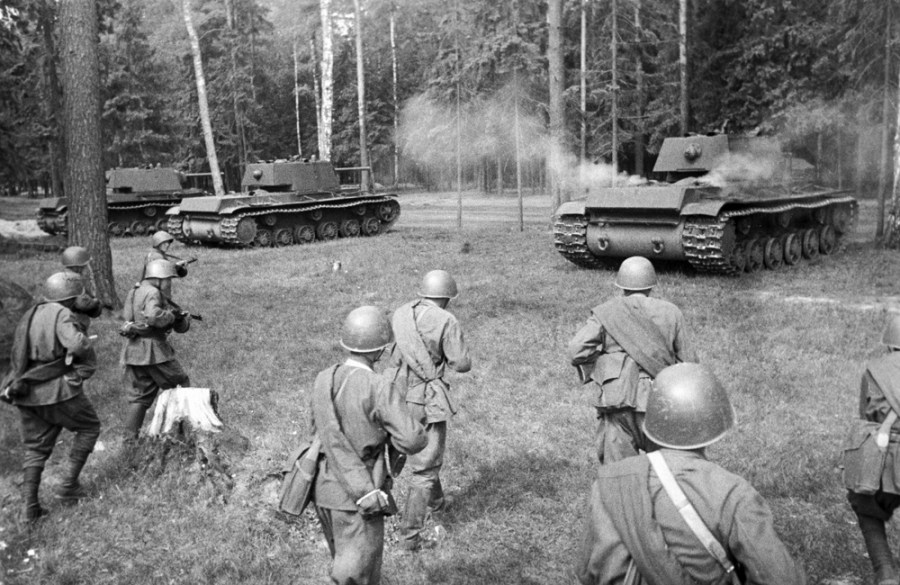
Would we have countenanced an invasion of Nazi Germany to prevent what it was going to do? In any case, during the War, the counter-attack of the Allies also invaded huge parts of the world, including sovereign states that had colluded with the Nazis, as well countries totally dominated by them: the USSR invaded Eastern Europe beyond the USSR’s earlier borders, also sovereign Germany and sovereign Austria; the USA and UK invaded France (part-sovereign, part-occupied) and Italy (part-liberated by popular revolt) and all three invaded sovereign Germany and Austria too, but also North Africa; the USA invaded the Phillippines and Indo-China. Had we been alive then, most of us would have cheered those invasions – they brought down the terrible Axis forces, liberated death camps, freed people from fascist rule.
Soviet infantry follow Soviet tanks in counterattack on Nazi forces during WWII. (Image sourced: Internet)
US troops invading France in the Normandy Landings during WWII (Image sourced: Internet)
But the UK and France retook their colonies, where they had been suppressing and repressing the people for generations.5 The UK and USA prevented the Greeks from stopping the return of their monarch (their sovereign) and, combining former fascist police with their own armed forces, suppressed the Greek rising. And the USA installed themselves in the Phillippines, making them their neo-colonies. The USA also began to cultivate elites as clients in Indo-China, particularly in Korea and Vietnam.
The reoccupations of colonies and transfer of control to new masters were the cause of a wave of anti-colonial struggles and wars of repression in India and Malaya with the UK; in North Africa with the French; in Korea with the USA; in Vietnam with the French first and then with the USA; in the Middle East and West Africa with the UK and France. They also facilitated the creation of the Zionist state of Israel with horrific consequences (including invasions by it) that continue to be played out to this day.
The struggles of people resulted in the eventual national liberation of areas of the world, including part of Korea and later, Vietnam, creating states. Cambodia and Laos, having been bombed by the USA in its war with the Vietnamese people, came under new national regimes. But the new rulers of Cambodia’s sovereign state, under the Pol Pot regime, developed a new kind of horrific rule resulting in the distinction of becoming the country with most mass graves in the world6. That sovereign regime was toppled by an intervention of Vietnamese forces and those of us alive then cheered that invasion.
The Portuguese colonies in Angola and Mozambique were freed by liberation struggles but in Mozambique were assisted by Cuban troops, which also helped them resist invasion by South African troops and proxies.7
Much closer to our own time, the UK and USA/NATO, leading coalitions of other states, invaded Afghanistan, Iraq and Libya, destabilising them and destroying for years the development potential of those countries8. They attempted the same with Syria and that conflict is ongoing. The excuse given was always along the lines of countering a threat to the world (Iraq: “Weapons of mass destruction”, “Al Khaeda”) or liberating their populations (Afghanistan, Iraq, Libya, Syria).
US tanks and soldiers in Iraq, six days after the fall of Baghdad (Photo credit: John Moore/ AP)
INVASIONS GENERALLY — AND WHAT ABOUT UKRAINE?
So, reviewing the historical record, very few would say that invading another region — even a sovereign state — is wrong on every occasion. Most would say, I think, that it would depend on the motivation for the invasion, how it is conducted and what the invaders do afterwards.
Hopefully this can help us to mediate the automatic Irish sympathetic reaction to the war in the Ukraine and with regard to the Western-dominated discourse that Russia is automatically wrong – purely because its troops invaded the Ukrainian sovereign state. Russia may indeed be wrong – but not purely on the fact that it invaded.
Which then moves the evaluation on to a more productive and rational basis. Was the reason for the invasion justified? How did Russian troops conduct themselves during the invasion? What is intended as the longer-term outcome of the invasion?
Here, unfortunately we are in a marsh of propaganda, fake news, partial accounts, censorship9 ….. and the war has not yet concluded. But we can try to navigate our way across this marsh relying on the fairly firm patches we can find and hopefully avoiding getting stuck or even sucked down.
Justification for the invasion?
Russia says it invaded because it was being encircled and threatened by NATO, while the latter denies this. The evidence is however on the side of Russia in this disagreement10.
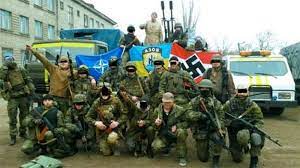
Putin also says that he did so to “de-nazify” the Ukraine. Considering the number of active fascists in Russia, this does not ring true, though the presence of nazi militia in the Azov Battalion is undeniable and the the Ukrainian regime is certainly glorifying Nazis in its past.
Conduct during the invasion
When Russia invaded it says that it fought to confront military units and to keep civilian casualties to a minimum. In the early days of the war this does seem to have been the case. As the fighting grew fiercer around Kyiv and Mariupol, it was harder to ascertain the truth, with Ukranian claim the Russians were targeting civilian structures and Russian counter-claim that, in Mariupol in particular, the Ukrainian forces were firing from civilian structures, which naturally attracted Russian return fire. And of course, bombardment of any large area is going to result, whether intended or not, in damage to civilian structures.
Another Ukrainian accusation, widely covered in the western media, is that the Russians were kidnapping civilians and transporting them back to Russia. The latter responded that they were facilitating the evacuation of civilians from danger areas. A similar Ukranian removal of civilians, on the face of it, is represented as a humanitarian action. Humanitarian evacuation or kidnapping? By one or the other, or by both?
There have been Ukranian accusations that the Russians executed captured Ukrainian soldiers and civilians and the Western media and political leaders have repeated those accusations. What appears to be bodies of civilians have been photographed in the streets of Bucha and Irpin after the Russians forces retreated, some of which appeared to have their hands tied behind their backs.
The Russians have rejected the whole story as fake news, pointing out that the Mayor of Bucha had smilingly recorded a video message after the Russian military evacuation of his town, during which he had made no mention at all of any such executions. Also that the reports of the alleged executions did not emerge until four days after they had evacuated the town.
However the Ukrainians also say that a mass grave containing 410 bodies has been uncovered outside Kyiv. Russia has said it wants the issue discussed at the UN Security Council11 but so far have been blocked by another permanent member, the UK (the latter holds the Presidency of the Security Council at the moment)12.
We must await some kind of even semi-independent investigation but if any of these allegations turn out to be true it will certainly be a powerful indictment of Russia’s conduct during the invasion.
Post-invasion actions
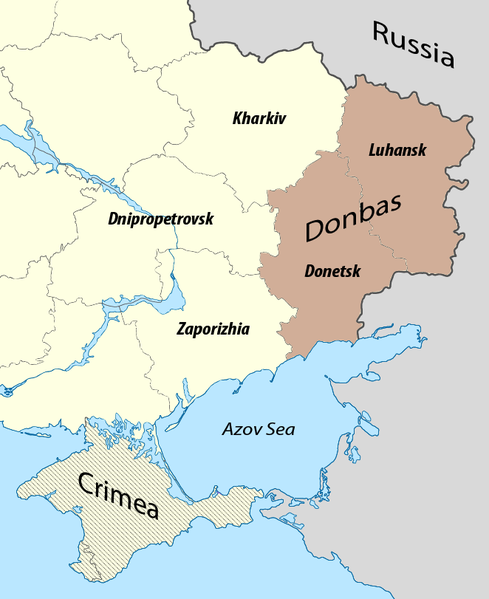
We do not know for certain what the situtation will look like post-conflict but it looks likely that Russia will withdraw from most of the Ukraine, which will remain outside NATO and with much-reduced armament, which was part of what Russia was seeking even years before the conflict. But it also looks as though Russia will retain the Crimea and the Donbas area.
Simple neutral map showing the Ukraine in yellow with Donetsk and Luhansk areas in brown (together known as Donbas) and the Crimea (lined pattern) with the western shore of the Sea of Azov running between the two enclaves. East of that Sea and of Donbas is Russia (shown in grey). Kiyv is far to the north-west in Ukraine. (Image sourced: Internet)
To judge whether that retention is just or not, one has to choose between two narratives (or some synthesis of both).
The Russian narrative is that after the change of government in 2014 there was a campaign against ethnic and linguistic minorities, in particular Russian-speakers, by the Ukrainian authorities, aided by fascist forces. These attacked the Russian-speaking areas, the latter mobilised to defend themselves and asked Russia to come to their defence.
The Western narrative is that Russia egged on Russian speakers to fight the Ukrainians and to secede and that the whole thing was just a Russian land grab.
But one way or another, the bare fact of Russian invasion is not sufficient to decide against them, much less to agree with what is essentially the dominant US/NATO discourse of the western media – the bigger and longer picture needs to be examined.
End.
FOOTNOTES
1Both Irish and Anglo-Irish sought an end to religious oppression of Catholics and retention of their lands; the Irish clans may have also sought recovery of some of their ancestral lands.
2More about the division of the world between victorious powers and punishing the losers, than about peace.
3The Austrian state was subverted under threat by the Nazis, as was also the Norwegian, followed quickly by invasion.
4Nazi Germany also recruited fascist units from Spain, Ukraine and Romania into their army and Japan recruited Koreans; in addition an Indian natiolal liberation army fought the English occupation in coalition with the Japanese.
5The Japanese were asked to hold on to their conquered territory in parts of SE Asia until the French could move back in, for example in Vietnam.
6Spain is the second, dating from its Civil War/ Anti-fascist War, a sovereign monarchical state evolving from a successful fascist-military coup against an elected Republican government.
7A highly simplified description, as there were civil war elements also with fighting for control between different factions of the former liberation movement.
8The UK holds the record for countries invaded, while the USA holds the record for involvement in military conflicts since WWII.
9Twitter has taken down an archive of six years of Chris Hedges’ Contact programs, Netflix has removed the Oliver Stone documentary “Ukraine Is Burning”, the US and UK has banned RT and Russia then banned BBC, China has banned BBC and Facebook, the latter has unbanned the fascist Ukrainian Azov Battallion …. And the Western Left is ignoring Naom Chomsky.
10Just Google “Map NATO states in Eastern Europe”.
11The United Nations is a body containing essentially two general decision-making bodies, the General Assemby of every full member nation — currently 193 – and the 15-member Security Council, which makes the only binding decisions. However, the decisions of the rest can be vetoed by any of the five Permanent Members of the Security Council: USA, UK, France, Russia and China.
12Any entering of the words “Russia” combined with “war-crimes” or “executions” into a search engine will bring an avalanche of western reporting of the allegations but scant treatment of the Russian response. As balance I have included only two rare more balanced western reports in the Sources section.
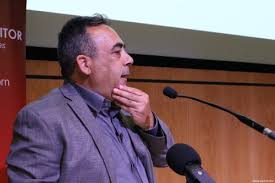
The online publication Middle East Eye published on March 22nd an open letter from Palestinian political analyst As’ad Ghanem sharply criticising the Ukrainian President, Volodomir Zelensky, for the latter’s March 20th speech by Zoom before the Knesset, the Israeli parliament. The Palestinian academic’s criticism was, at base, entirely irrational.
As’ad Ghanem is a senior lecturer at the School of Political Sciences, University of Haifa. Ghanem’s theoretical work has explored the legal, institutional and political conditions in ethnic states. He has covered issues such as Palestinian political orientations, the establishment and political structure of the Palestinian Authority, and majority-minority politics in a comparative perspective. His books include Palestinian Politics after Arafat: A Failed National Movement (Indiana Series in Middle East Studies). Ghanem has initiated several empowerment programs for Palestinians in Israel.
As’ad Ghanem at a speaking engagement (Photo sourced: Internet)
Ghanem’s opening paragraph, though a denunciation of Zelensky’s speech, seemed to display a misapprehension of the conflict in the Ukraine and of Zelensky’s role there: Your recent speech before the Israeli Knesset was a disgrace when it comes to global struggles for freedom and liberation, particularly of the Palestinian people. You reversed the roles of occupier and occupied. You missed another opportunity to demonstrate the justice of your cause and the broader cause of freedom.
Any hope that Ghanem’s words were some kind of subtle attack on imperialism in Eastern Europe, an exposure of its false defence of national sovereignty, democracy and freedom, were swiftly expelled in reading the third and fourth paragraphs of his letter:
I am angry and sad that Russia is seeking to occupy your country and to crush the rights of the Ukrainian people to self-determination and freedom, and I believe that every possible support must be given to Ukrainians as they resist this barbaric aggression……
And while I admire your success in building a large international coalition to support your struggle against Russian aggression, I wish we as Palestinians could persuade the world to mobilise in a similar fashion, and force Israel to abide by international resolutions.
But Ghanem wants to show that although he may be a liberal, he is also an anti-imperialist. So he adds the following line to his third paragraph: At the same time, I reject the policies of the US and its Nato allies around the globe.
What an irrational position to hold! “The policies of the US and its Nato allies around the world” being enacted are precisely what is causing the current conflict in the Ukraine and it is those forces that are backing Zelensky and employing him in their contention with Russia.
Asad Ghanem’s plaintive criticism and appeal to Zelensky and — by implication — to imperialism exposes the ideological bankruptsy of the liberal critics of imperialism1. He is disappointed by Zelensky’s support for the murderous and racist rule of Israeli Zionism and sees it as somehow in contradiction with his position in the Ukrainian state’s conflict with Russia.
TO GAIN UNDERSTANDING, ASK BASIC QUESTIONS
The answers to a few simple questions would have disabused Ghanem and other pro-Palestinian liberal critics of imperialism of any confusion or illusion about the situation: Which major imperialist military bloc is supporting the Ukraine in the current conflict? NATO. Which imperialist state controls NATO at least since 1951? The USA. Which power fundamentally props up and defends the Zionist state? US imperialism.
Even without any consideration of the reported Zionist state’s training and arming of the Ukrainian Azov, Zelensky’s stance towards Israeli Zionism is entirely in line with his alliances and Ghanem’s criticism completely irrational. If Zelensky is to be criticised politically for anything, it is for perhaps making his alliances so clear.
RATIONAL STANCE TOWARDS IMPERIALISM
Ghanem concludes his letter thus:
I know that most Palestinians are watching your stubborn struggle and wishing you victory over Russia’s brutal aggression. (Really? I sincerely doubt it – DB2). I also know that a Russian victory would be a great gift to Israel’s aggressive posture – a victory for its “Iron Wall” concept, which regulates its dealings with us until our complete defeat.
On the other hand, the struggle and victory of your people, even with the destruction of much of your country and the displacement of scores of Ukrainians, would give hope to other peoples struggling against oppression and erasure, rekindling our hopes for return and liberation. To this end, I urge you to stop supporting our oppressors.
The only rational stands towards imperialism are outright support or outright opposition — and the latter is the revolutionary position. Liberals want to criticise imperialism without being revolutionary, presumably because they feel more comfortable in the imperialist world than fear they would in a revolutionary one. They ask imperialism (which is what they usually mean by “the international community”) to remedy a situation here and there, a situation that usually only exists directly or indirectly because of imperialism.
Of course, imperialism regularly disappoints them but, like besotted lovers in an abusive relationship, they never learn, they never abandon their relationship but instead keep returning, asking their partner to behave better this time.
End.
FOOTNOTES
1Which is certainly no worse than that of the appalling stance of a major part of the Western Left
2“The two Arab Israeli (this is Zionist apartheid code for Palestinians – DB) parties chose to snub Ukrainian President Volodymyr Zelensky’s speech to the Knesset on Sunday night, with only one Arab lawmaker out of their 10 MPs showing up. Joint List chief Ayman Odeh skipped the speech, as did the two other lawmakers from his Hadash faction, party officials said. A spokesperson for Odeh did not respond to a request for comment. “Our position is that NATO and its leader America imposed this war,” said Mansour Dahamsheh, the Hadash party’s secretary-general, in a phone call with The Times of Israel. https://www.timesofisrael.com/arab-israeli-mks-skip-zelenskys-knesset-speech-nato-imposed-this-war/
We are surrounded by propaganda: to favour this or that political and economic system, those products, accept this way of life and to reject that other, to emulate or aspire to be like those people or to reject others …. The propaganda is constant but perhaps most evident in times of conflict: social conflict and wars in particular. We cannot be free of it but we can attempt to navigate it, to reach that fabled destination, the port of Truth.
Political propaganda by Cartoon: Left, Chancellor of the Exchequer Sunak shown as superhero, saving the economy and Right, former Leader of the Opposition Jeremy Corbyn shown as a Russian, suggesting he is a communist. (Images sourced: Internet)
OUR OWN PERSONAL BIAS
Firstly, we need to be aware of our own personal bias. Are we for reasons of culture, position, location or habit likely to incline to one side rather than to the other? Of course, that might be the right (or least bad) side but ….. are we being blinded by our own bias?
Our own personal biases are formed through our familial group, our schooling, training and experiences but some are engendered through the wider society, our culture.
Our cultural bias in the western world and, in particular in the English-speaking one, is towards the USA. We watch films in which the admired characters have UStater accents and even employ UStater turns of phrase and idioms1; their life-styles are recogniseably western. These cultural products cover a range from comedy to thriller or tragedy, their situations varying from urban to rural life, their genres from romance to crime to war to science fiction. In fact, both latter genres tend to present us with war-heroes who not only speak like UStaters but evoke the armed forces of the United States, whether in past real armed conflicts or in imagined ones to come. Earlier Irish generations were familiar with the dramatised plight of European settlers in the western regions of the USA being attacked by Indigenous people, only to be saved by the arrival of the US military – in that genre, the US Cavalry.2
Another major cultural influence on the English-speaking world is the UK and, to a lesser extent3, Australia. Although in Ireland there is a certain residual historical resistance to UK acculturation, some UK cultural products gained a large enough following, particularly the Coronation Street and EastEnders series4.
In comics the characters and often their environments are identifiably Western — usually of the USA5 — and even the popular Asian-based ones tend to have their facial features shaded towards European ones. Many of the electronic games also have a Western cultural bias.
And of course, we speak English. A high proportion of the Irish population is English-monoglot and even among Irish/English bilinguals, either the English is dominant or at least easily-accessible. From childhood to adulthood we see signs in English, hear it on the street, use it daily in most places, read it, are educated and instructed through it, access the Internet through it – in fact, we mostly think in English. All of which makes the pathways for accessing US and UK cultural products easy and our acceptance of the dominant discourse more probable.
Dominant discourse is of course a fact of life, some aspects of which are necessary for our social existence but other aspects of which are laden with unhelpful cultural and even political bias. We need to be alert to those aspects and prepared to investigate and analyse them.
Sometimes it looks like just about everyone is in agreement with a particular opinion and it is also the one that accords with our own inbuilt bias. Now we need to be REALLY careful, because those are two factors working together to put us at our ease on one side of a conflict and making it very difficult for us to even investigate the fact that the dominant discourse, on at least this occasion, might be mistaken. And clearly at times in history widely-accepted views HAVE been wrong – the literal seven-day creation belief, the sun going around the earth, the divine right of monarchs, the unsuitability of women for equality, the unnatural inclination of gay and lesbian people ……
OURSOURCES
In conjunction with being aware of and taking into account our own bias and prejudices, we need to the same with our sources of information, which in industrial and post-industrial cultures – apart from educational establishments — is mostly the mass media: television, newspapers and the Internet (in particular social media).
All the owners of non-State-owned mass media that we access (and that in turn accesses us) are capitalists and not only that but monopoly capitalist. Although he has recently exited his media empire6, this was the situation six years ago: “Denis O’Brien, reputedly Ireland’s richest man, is the largest shareholder in the country’s largest newspaper publisher, Independent News & Media (INM). That company has now agreed a deal to add seven more newspaper titles to its stable by acquiring the Celtic Media Group (CMG). They include the Anglo-Celt in Cavan, the Meath Chronicle and the Connaught Telegraph in Mayo. In all, it extends INM’s footprint to five more counties.
“INM is already the major player at national level. It publishes Ireland’s two largest-selling titles, the Irish Independent and Sunday Independent, plus the Sunday World and the Dublin Herald. It also has 50% of the Irish Daily Star. O’Brien’s other media company, Communicorp, owns Ireland’s two leading commercial radio talk stations: Newstalk and Today FM. In addition, it owns Dublin’s 98FM, SPIN 1038, TXFM and SPIN South West.”7
Media companies in the USA went from 50 1984 only six conglomerates controlling 90% of the United States’s in 2011: GE/Comcast (NBC, Universal), News Corp (Fox News, Wall Street Journal, New York Post), Disney (ABC, ESPN, Pixar), Viacom (MTV, BET, Paramount Pictures), Time Warner (CNN, HBO, Warner Bros.), and CBS (Showtime, NFL.com).8
“Take the UK’s newspaper industry: in a national market of 20 daily and Sunday newspaper titles, just three companies control 90 percent of newspaper circulation. Lord Rothermere’s DMG Media—publishers of the Daily Mail, the Mail on Sunday, the Metro, and the i—accounts for almost 40 percent of all national newspapers sold each week in the UK, while Rupert Murdoch’s News UK and Reach (which publishes the Mirror and Express titles) command one-third and one-fifth of the market, respectively.
“When online readers are included, the same companies control a four-fifths market share among the major newspaper groups, giving these publishers an unparalleled influence for setting the agenda across the rest of the news media.”9
“Most of the social media we use on our laptops, Iphones or tablets is owned by five conglomerates in the USA: Meta Platforms, Inc., doing business as Meta and formerly known as Facebook, Inc., …..is the parent organization of Faecebook, Instragram and WhatsApp among other subsidiaries. Meta is one of the world’s most valuable companies. It is one of the Big Five American companies, alongside Google, Amazon, Apple and Microsoft.”10
It should not surprise us if that media exhibits a strong bias towards capitalism, for example in praising businessmen (capitalists) and businesses (exploitation operations) and in criticising or slanted reporting on strikes (workers’ resistance) or on what they might term ‘terrorism’ (but is often oppressed people’s resistance).
The State-owned media, in the UK the BBC and RTÉ in Ireland, are not of course the property of capitalists, however the states in question are capitalist states. It would be surprising therefore if such media were to take a stance in opposition to that of their state and their dominant classes and, by an large they do not. If, in times of conflict elements within the program-making sections of the State-owned media veer significantly away from the State’s line, official reprimands, cuts in funding, sackings and outright censorship may follow.11
This mass media, as well as being orientated in defence of monopoly capitalism, is also orientated towards the expansion of monopoly capitalism beyond its origins, i.e imperialism. And imperialists have their alliances, by far the largest of which is the North Atlantic Treaty Organisation, or NATO in acronym. That alliance is led by what is still the largest imperialist superpower in the world, the USA.
We may note that the antithesis of capitalism is socialism but a capitalist or imperialist system of one state may be in contention with that of another such state which in fact often happens, even occasionally breaking out in war, as was the case with WWI, when the then-dominant imperialist alliance led by the UK and France was challenged by the weaker one of Germany and Turkey.
And mentioning socialism brings to a consideration of alternative media, including that of the Socialist and Irish Republican movements. Briefly we can note that just because they declare their opposition to the status quo does not mean necessarily a) that they are indeed so opposed, or b) that they have examined and challenged their own bias or c) therefore that their analysis is correct. Indeed both the Irish Socialist and Republican movements have made huge mistakes over the last hundred years or more and, in addition, during the height of the Covid19 pandemic we saw a plethora of misinformation ranging from the fascist and racist to the fantasticaly paranoid from sources opposed to the status quo12.
NAVIGATION
With the preparations and precautions entailed in the above completed, we are ready to sail, to navigate the propaganda ocean on board the MV Investigator. Let us take the stormy propaganda seas around the Ukraine conflict for our voyage.
According to the Russian Government, ethnic Russians were under attack in parts of the Ukraine after a coup overthrew the Ukrainian Government in 2014. Furthermore, it claims that US/NATO supported that coup and, in addition, has been gathering up states to its military alliance to encircle Russia, which it sees as a threat to the existence of the Russian state. In addition, Russia claims the Ukrainian government has fascist elements in its polity including a nazi battalion incorporated into its national military. Therefore it has invaded Ukraine in order to protect its own state and to “de-nazify” the Ukraine.
According to the Ukrainian Government and the USA, along with most Western governments, all of Russia’s claims are lies and just an excuse for it to grab land in the Ukraine, in order to extend its dominion further.
The Western media supports the Ukrainian Government and USA discourse on these issues and, on the rare occasion when it quotes the Russian one, negates it or casts doubt upon it.
So, to the navigation. The first thing is that we cannot trust the Western discourse but on the other hand can we totally discount it? We cannot trust it because it is part of a capitalist and imperialist bloc centred around the USA and NATO. On the other hand, Russia might be lying and the Western media might be correct on this occasion. After all, Russian troops HAVE invaded the sovereign state (something we usually see from the USA or NATO) of Ukraine.
Map showing Nato states in Europe (Image sourced: Internet)
So, let’s investigate! A look at the map will in fact show a large number of states in East Europe that have progressively become part of NATO and Ukraine, which shares a border with Russia, was heading that way, according to even non-Russian analysis.13 And Russia has been complaining about this for years. In addition, the elected neutral Ukrainian government WAS overthrown by a violent coup in 2014, one which was welcomed by western media. And fascists WERE active in that coup and the Azov Battalion IS full of fascists and nazis (even according to US and Canadian government circles along with human rights groups, including in Israel, only a few years ago).
But the Russian regime anti-fascist? That is something else. Far-Right groups including openly Nazi ones have proliferated across Russia since the collapse of the USSR and there is little evidence that the Russian regime has been trying to eliminate them. De-nazification should start in your own territory first, right?
So a reasonable conclusion on the available evidence is that Putin’s statement about de-nazification is mere propaganda for international and domestic consumption but his real and primary motive for the invasion is the security of Russia and the withdrawal of NATO from its borders.
Might there be an element of acquiring some more Ukrainian territory and stragic locations there? Of course there might. So how to test that? What about if NATO agrees to withdraw, Ukraine declares its neutrality but demands withdrawal from its recently-conquered territory? Russia would have to comply or to expose its supposed territorial ambitions.
However, NATO is currently refusing to withdraw from Russia’s borders and the Western media is supporting it ideologically as well as pouring arms into Ukraine; NATO denies Russia’s declared motivation but declines to put it to the test.
Mentioning “land-grabbing” also raises the issues of the Crimea, Donetsk and Luhansk regions. Those regions had a high proportion of ethnic Russians — the Crimea in particular nearly totally Russian-speaking — and according to numerous sources, came under attack from Ukrainian nationalist forces from 2014. The Western media says that Russia “annexed” the Crimea; however Crimea had an autonomous parliament and voted to secede from the Ukraine – it was not overthrown in a violent coup as was the neutral Ukrainian one. Subsequently Crimea asked for Russian protection from attack by the Ukrainian military (including in particular those Azov fascist fighters). Donetsk and Luhansk regions also asked for protection, according to the Russians while, according to the West, they were also annexed by Russia.
Ethnic map of the region (however not including Gypsies, Jews and Poles). The brown peninsula bottom centre is the Crimea; two top right regions are Donestk and Luhansk. (Image sourced: Internet)
CONTINUING THE NAVIGATION
Those are the fundamental points to think about during the conflict but we will be presented with reports of “kidnapping” of thousands of civilians by the Russians from the battle-zones on the one hand, with the “rescue” of thousands by the Ukrainian military on the other. Of course, any war impacts severely upon civilians in the war zones, as we have seen in conflicts from Vietnam to ireland to the Balkans, from Palestine to Yemen. What is happening in the Ukraine is a war, with bullets and missiles being fired by both sides and, furthermore, most of the fighting is taking place in and around heavily-populated areas. But are civilians and civilian buildings really being targeted by the Russians? They may or may not be but certainly the damage and casualties would be much higher if, as a matter of course, that were the case. Are civilians being used as hostages and shields by the Ukrainian military as some have alleged? They may be but it is difficult to prove or disprove that when the battle is taking place in an urban area.
We have to seek the actual causes of the war, rather than its features, to seek a workable and hopefully long-lasting solution.
WHAT ABOUT CENSORSHIP?
The fact is that all sides are practicing censorship. While the western media was quick to tell us that Russia had banned the BBC’s news service, it took a bit of searching to find out that had occurred after the UK banned RT, the Russian broadcasting service. We now learn that China has also banned Facebook and the BBC – the latter perhaps in response to the banning of RT but Facebook perhaps for lifting its ban and Tier 1 classification14 of Azov, the neo-nazi fighters incorporated into the Ukrainian military.
Currently, as an example of Western censorship, the Oliver Stone documentary Ukraine On Fire (2016) has been taken down off Youtube and according to users, rarely lasts more than a day if posted up anew.
And Naom Chomsky, veteran US-based anti-imperialist, who would normally be widely quoted in the Socialist media, is hardly ever heard or seen. Oh, he’s talking and writing alright but his discourse does not match the dominant one in the West — nor currently in the Western Left — and therefore he is excluded from their media.
Naom Chomsky, linguist and critic of imperialism often quoted by the Western Left but mostly silenced by them during the Ukrainian conflict. (Photo sourced: Internet)
CAN WE MOVE, PROCEED, ACT?
Obviously we cannot proceed through life in a permanent doubt – that would paralyse us, make us incapable of movement in any direction. We must come to a decision, at least for the time being, to allow us to act. But while we proceed on the basis of our certainties or at least assumptions, we need to be able to keep a part of our mind alert, questioning, challenging and – at some point – ready to dissent from the ideological environment in which we find ourselves and ready to consider taking a different – even oppositional – opinion and path.
This is the way we can navigate through the sea and storms of propaganda to a the desired landing on Truth. However, we need to remember that “truth” is an approximation, that it changes shape and what was true yesterday may not be true tomorrow. It is a floating land, not necessarily where it was when last charted, even when the most recent cartographers were not dishonest. Nevertheless, we are required to act, to act in the real world and therefore must reject paralysis. We find the nearest we can to the truth, test it and act upon it – but ready to amend our understanding if necessary.
We set sail.
End.
Chart for navigating the Propaganda Seas (Image: D.Breatnach)
FOOTNOTES
1The interjection of irrelevant “like” in conversations (e.g “I was like just leaving …”), the grammatically incorrect “I’m good” response to query-greetings, ‘hip’ interjections such as “dude” and even the “OK” for positive confirmation (in our lexicon since the 1950s), have all reached us from the USA.
2That film trope has led to a popular saying regarding last-minute deliveration, probably even employed by people who are unaware of its origin: “Saved by the Cavalry”. Of course, the Indigenous, who are having their lands stolen, their way of life and other parts of their culture destroyed and their resistance massacred, never have a last-minute salvation, neither in fiction nor in reality.
3Though we still hear “No worries” in reassurance, a phrase introduced by Australian soap-operas such as “Neighbours” screened on UK television channels in the 1980s and ‘90s.
4These two in particular propagated a very biased view of working class and lower-middle class people in Britain. The Coronation Street (note the monarchical tone of even the title) series, based on the Salford area near Birmingham, despite being an area settled by successive waves of migrants such as Irish (Engels even referred to them in his 1845 Condition of the Working Class in England), Caribbean and South Asian, did not include characters of migrant background for decades and it was not until 2019 that it introduced its first Black family characters. When the British soaps first provided characters of Irish background, both Coronation Street and EastEnders produced negative types without positive Irish characters to balance them.
5In the 1950s, ‘60s and ‘70s the majority of the comics bought in Ireland were English, from the younger age-orientated Dandy, Beano to the older-orientated range of Bunty, Judy and June for girls and, for boys, Eagle,Hotspur, Victor and the exclusively military Commando and War Picture Library series along with the Amazing Fantasy series. The US contributed super-hero series Marvel Comics and a range of both cartoon and realistic characters in Dell Comics. There was no competition from any Irish-focused publisher (nor is there yet to any real degree).
12It is also worth noting that censorship, misrepresentation of different views and verbal abuse towards those who challenge the views of the alternative media make using them to arrive at the truth more than problematic and this has been nowhere more evident than in the coverage and discussion of the conflict in Ukraine.
13In fact we can see a similar US-led encirclement of Russia in the Middle East too.
14 A classification that included ISIS and bars users from engaging in “praise, support, or representation” of blacklisted entities across the company’s platforms.
No doubt the Russian ruling class had other motives than “de-nazification” for the invasion of the Ukraine – beating back NATO encirclement, according to some and land-grabbing according to others – but it cannot be said that the smoke is entirely without fire. Not when nine hundred paramilitary nazis are part of the official Ukranian Army and prominent boulevards of Kyiv are named after Ukrainian nazis.
The Azov Battalion is a far-Right paramilitary organisation that was incorporated into the Ukrainian military in 2015. The number of the unit’s fighters is generally estimated at 900 and the mildest description of their ideology is “far Right”. They are in fact nazi, homophobic, white supremacist, anti-Roma and anti-semitic – and they are an integral part of the Ukrainian Armed Forces.
Azov Battalion giving military instruction to civilians in Kyiv 30 Jan 2022 (Photo: Gleb Garanch/ Reuter)
Founded from far-Right Ukrainian nationalist groups in March 2014 as Azov, they were from the beginning engaged in actions against ethnic minorities including the Russian-speaking people of the Donbas region and Roma, as well as against socialists and LBGT groups. Then-President Petro Poroshenko said at an awards ceremony in 2014: “These are our best warriors …. Our best volunteers.”1
In 2014 Azov were active in overthrowing the elected Ukrainian government of President Yanukovych. That government was characterised as friendly towards Russia and for that reason unpopular with the West; however it was trying to negotiate with both Russia and the EU, with the latter for its agricultural sector and with the former for its industrial sector but the EU insisted on an exclusive agreement in total. When it did not get what it wished the EU, under its Irish President at the time, and the USA supported the overthrow of the government in a coup d’etat.
In that coup, Azoz also carried out attacks on socialists and communists and, despite a highly-politicised debate around the facts there is no doubt that 43 people who took refuge in a trade union building from anti-Russian elements were killed when the building was set on fire.
From November 2015 to February 2016, according to a 2016 Report by the Office of the Human Rights Commissioner of the UN, Azov was responsible for incidents in which they had embedded their weapons and forces in civilian-occupied buildings, displaced residents and looted civilian properties. The report also accused the battalion of raping and torturing detainees in the Donbas region.2
Also in 2015 the Simon Wiesenthal Center and the World Jewish Congress condemned the decision to name central boulevards in Kiev after Nazi collaborators and attempts to re-write the history of Nazi collaborators in Ukraine during WWII.34
Azoz Battalion celebration of new monument to medieval Ukrainian hero Svyatosla in Mariupul, Ukraine in 2015 (Photo credit: Pierre Crom, Getty Images)
In January 2018, Azov rolled out its street patrol unit called National Druzhyna to “restore” order in the capital, Kyiv. Instead, the unit carried out pogroms against the Roma community and attacked members of the LGBTQ community. In April of that year there was a march honoring Ukrainian Waffen SS units which massacred thousands of Jews during World War II.5 In May, Azov marched through Odessa claiming that the Ukraine belongs to Ukrainians, not to Jews and that they would be ridding the country of the latter.6 In June, Ukraine’s chief military prosecutor Anatoli Matios said in an interview that Jews want “to drown Slavs in blood.”7
Ukrainian International soccer player Roman Vyacheslavovych Zozulya had to be let go from Rayo Vallecano FC in 2017 because the anti-fascist and left-wing fan base of the team objected so strenuously to his being on contract. The reason for the uproar was because Zozulya has been on record as supporting Azov.
“In December 2019, a match between the Spanish teams Rayo Vallecano and Albacete (Roman Zozulya’s then-current club) was suspended, when his former club’s fans loudly accused the player of being a sympathizer of Nazi ideology, due to his known support of the Azov Battalion as well as other images he had posted on his Twitter account, which contained references to Nazi symbolism or organizations claimed to support Nazism.”8 Rayo Vallecano was fined and suspended for two games by the Spanish League (La Liga), a decision of at least questionable justice.9
“WHITE RULER”, FUNDED BY OLIGARCHS
The Azov unit was led by Andriy Biletsky, who served as the leader of both the “Patriot of Ukraine” organisation (founded in 2005) and of the Social Nationalist Assembly, a nazi organisation founded in 200810. The SNA is known to have carried out attacks on minority groups in Ukraine.
In 2010, Biletsky declared that the national purpose of the Ukraine was to “lead the white races of the world in a final crusade … against Semite-led Untermenschen” [German Nazi term for ‘inferior races’].
Biletsky left Azov formally in order to stand for election to the Ukrainian Parliament, as elected officials must not be members of the military or police force. He was elected to parliament in 2014 and remained an MP until 2019; his nickname among his supporters is “Bely Vozd” (“White Ruler”). In October 2016 Biletsky founded the far-right National Corps party, the core base of which is Azov veterans.
It is not only Russia that has oligarchs but of course it is they alone the Western media is focusing upon. However the Ukrainian fascist forces were privately funded by oligarchs – the best-known being Igor Kolomoisky, an energy magnate billionaire and then-governor of the Dnipropetrovska region. In addition to Azov, Kolomoisky also funded other volunteer battalions such as the Dnipro 1 and Dnipro 2, Aidar and Donbas units11.
Azov also received early funding and assistance from another oligarch: Serhiy Taruta, the billionaire governor of Donetsk region12.
The presence of these nazis in the Ukrainian military is not as in many countries where individual right-wingers and fascists are attracted into the military and police but rather that an already far-Right paramilitary organisation led by nazis has been incorporated into the national armed forces. That argues for a high level of acceptance of fascism among the country’s ruling circles and indeed one finds other examples in certain statements by officials and in historical revisionism of past anti-semitism and nazi collaboration in the country’s history.13
CHANGING ATTITUDES OF THE WEST
In June 2015, both Canada and the United States announced that their own forces will not support or train the Azov regiment, citing its neo-Nazi connections and white supremacist ideology.
However the following year, under pressure from the Pentagon, Congress lifted the ban. In October 2019, 40 members of the US Congress led by Representative Max Rose signed a letter unsuccessfully calling for the US State Department to designate Azov as a “foreign terrorist organisation” (FTO). Last April, Representative Elissa Slotkin repeated the request – which included other white supremacist groups – to the Biden administration.
Azov Battalion members (Photo sourced: Internet)
Facebook About-Face
In 2016, Facebook first designated the Azov regiment a “dangerous organisation” and placed it under its Tier 1 designation, one which includes the Ku Klux Klan and ISIL (ISIS). Facebook users praising or otherwise supporting Tier 1 groups are also banned by the social media company.
However, on February 24 this year, the day Russia launched its invasion, Facebook reversed its ban, saying it would allow praise for Azov. “While Facebook users may now praise any future battlefield action by Azov soldiers against Russia, the new policy notes that ‘any praise of violence’ committed by the group is still forbidden; it’s unclear what sort of nonviolent warfare the company anticipates,” the social media and information technology magazine The Intercept commented14.
THE UKRAINE REGIME “FASCIST”?
Opponents of the Ukraine regime (not all supporters of Putin by any means) have called the regime itself fascist, a claim which its defenders (and some others) have dismissed, citing its President and its Prime Minister being Jewish as evidence to counter the accusation. Ukraine now has the world’s third- or fourth-largest Jewish community, but estimates of its size vary wildly, ranging from 120,000 to 400,000 people, depending on who is counting15.
That the President and Prime Minister are Jewish is far from being the conclusive rebuttal that it might seem, since Zionists are known to have colluded with the Nazis in the 1930s in order to gain settlers for Palestine16. As far back as 2018, the Israeli newspaper Haaretz reported that more than 40 human rights organisations had filed a case with Israel’s High Court of Justice to stop the Zionist state supplying the Ukrainian military because of the latter’s incorporation of anti-semitic fascists.
Azov Battalion on parade (Photo sourced: Internet)
The article also pointed out that past anti-semitic regimes had been supplied by Israel, quoting the Argentinian Generals and the Bolivian regime that included Klaus Barbie; also Israeli instructors are known to be supplying the Azov with training17.
There is certainly some fire beneath all the smoke.
Putin is no anti-fascist and, apart from the failure to tackle the growth of fascist anti-semitic groups in Russia, the Putin regime’s suppression of Muslim resistance in Chechnya contains most features of fascist repression of a population18. The irony now is that, if a video is to be believed, Azoz are dipping bullets in pig fat and telling Chechens who are part of the Russian Army that they will be barred from Muslim heaven when shot. Another irony is that Azov is attracting white fascists and militant right-wing Christians from other countries to swell its ranks, much like Muslim jihadist organisations have been attracting radical muslims from other parts of the world.
Putin has his own reasons for the invasion of the Ukraine which are to do with the interests of the Russian ruling class, whether defensive or aggressive, rather than “de-nazification” but the evidence of fascist elements in the Ukrainian military and ruling circles cannot legitimately be dismissed as supporters of the Ukrainian regime have been doing.
4Active collusion with the Nazi occupation to the extent of whole Ukrainian units fighting alongside the occupiers and wiping out Jews and civilian socialists was notable among Ukrainian nationalists of the time. However, there was also significant anti-Nazi activism, both in partisan activity and in membership of the Red Army. https://en.wikipedia.org/wiki/Collaboration_in_German-occupied_Ukraine
“Wars and rumours of wars …”1 The sabres are rattling around Eastern Europe. The mass media in our latitudes largely takes the position of the USA under the guise of democracy; however with some text and the use of a few maps I hope to show that Russia’s position is essentially defensive in this regard and that the USA is the main aggressor. I hope to do that without expressing any support for the Russian regime.
WHAT IS ACTUALLY HAPPENING?
The USA sees Russia as its main opponent or competitor in Europe and has been working since the post-WWII decades to neutralise it, earlier under the guise of stopping the spread of “communism” and defending “democracy”. Since the fall of the USSR system the talk is no longer about defeating “communism” but “defending democracy” continues to used in anti-Russian rhetoric. Russia is no democracy but the notion that the US, the world superpower, the biggest imperialist power on the planet since WWII, cares about democracy should make us laugh. It would perhaps, except that the mass media keeps feeding us the USA’s rhetoric and shaping us to support it in war.
The USA is actually squeezing Russia from two directions — from Europe and from the Middle East. NATO, the North Atlantic Treaty Organisation is a US-led military alliance which now has the membership of most states in the EU, along with the UK and nearly every state of the former USSR to the west of Russia. A look at the map of NATO states will demonstrate that2. Nearly every state in the Middle East is also formally or informally in the sphere of influence of US imperialism3.
“Russia says it wants Western guarantees that Nato will not allow Ukraine and other former Soviet countries to join as members. Moscow has also demanded the alliance halt weapons deployments to Ukraine and roll back its forces from eastern Europe – demands flatly rejected by the West.4”
Map NATO & non-NATO countries in Europe, showing also periodic expansion (Source: The Economist)
So the Russian ruling class is naturally worried and feeling besieged. On or near their European borders they only have Sweden, Finland, Moldova, Belarus and Ukraine which are not formally part of NATO and Ukraine has clearly indicated an interest in that direction. Beyond those last three aforementioned, all the states through central Europe are NATO members right through to the UK: Poland, Slovakia, Hungary and Romania actually bordering on Russia, with – heading generally westward and south-westward– Czech Republic, Croatia, Slovenia, Bulgaria, Albania, Greece, Germany, Netherlands, Belgium, Italy, Spain, Portugal, France and UK. In addition, some of those states have highly-developed military power such as Germany and two of them have nuclear armament of their own — UK and France – while the US has ready-to-launch nuclear missiles on the lands of many of the NATO states — Belgium, Germany, Italy, the Netherlands and Turkey5.
Sweden, Austria and Switzerland may remain nominally neutral but are in general politically aligned with the EU and the USA rather than with Russia, while non-NATO Finland is definitely, for historical and geographical reasons, extremely wary of its Russian neighbour.
The smaller non-NATO states of the former Yugoslavia – Bosnia & Herzegovina, Serbia, Montenegro, Montenegro and Kosovo are in some cases friendly towards Russia (or not overly-friendly towards NATO) but they are completely surrounded by NATO states.
On its borders with the Middle East, Russia is also being squeezed. Turkey has long been a major NATO state in the region and only Georgia is located between it an Russia to the latter’s south-west, with Armenia and Azerbaijan to its south-east. Nearly all of the states in the Middle East are in formal or informal alliance with the West and therefore with the US: Cyprus, Lebanon, Iraq, Israel, Jordan, Egypt, Sudan, Libya, Saudi Arabia, Kuwait, Oman, Bahrain, Qatar and United Arab Emirates. Yemen is embroiled in its own Saudi and West-proxy war, while Syria is threatened by Israel, Turkey and NATO. Only Iran is fairly safe for the moment on that part of Russia’s border, which is why Russia will take its side in any conflict with the West, despite the Russian ruling class’ dislike of and vulnerability in some regions, as in Chechnya, to militant fundamentalist Islam.
Middle East states and Russia (Source: Internet)
Syria is next to Iran which is also why Russia has been supporting the Assad regime and why, during the past week, it has warned Israel about its bombing raids into Syria as the latter attacks Hizbollah bases there. In fact we may see the invasions by western alliances of Iraq and Libya as part of huge US/NATO ‘domino’ plan to attack Syria with Iran next; then the pressure on Azerbaijan and Georgia on Russia’s doorstep. While on the eastern side of Iran, Afghanistan and Pakistan are also allies of the West ….
Further east, there is India which has long been friendly to Russia and in tussles with Pakistan — and China, which is not openly hostile to Russia as a rule but which is not a real friend either, though its competition and contention with the US keeps it friendly enough towards Russia for the moment.
What the Russian ruling class is doing is attempting to bring a halt to its encirclement by NATO at the point of Ukraine. And the US-NATO and EU are issuing a counter-threat – an open one of sanctions and a more veiled one, in the case of US-NATO, of armed action.
This week it appears that some parts of Ukraine have sought to break away from the main part, probably instigated by Russia or at least promised support if they did – which has materialised in Russian diplomatic recognition and in troop movements. This may amount to an annexation or may not but what is clear is that Russia, in the face of what it considers a threat to its existence and NATO intransigence, has decided to take some decisive action.
WHAT IS REPORTED
The western mass media reports the situation painting a picture of big powerful Russia threatening its much smaller neighbour, by threat of invasion seeking to force it into submission to Russia’s regime, in denial of the small nation’s democratic rights. And the democratic West, through NATO, is moving troops to support the Ukraine, warning Russia of consequences.
Russian Tanks and Troops Reportedly entering part of Ukraine (Photo source: The Telegraph)
The picture contains much truth but overall it is a lie. Russia is much bigger than the Ukraine and it is threatening it with troop movements. And NATO is moving troops up to counter-threaten. But to evaluate a situation properly, we need to know its antecedents, what led up to it. We also need to see the situation through the eyes of the participants, whether we agree with them or not. The mass media, apart from a couple of honest analysts tucked away inside a newspaper, far from the headlines, does not supply us with that information.
The Irish Times, one of Ireland’s main daily newspapers, on 12 February reported that “Russia’s military build-up near Ukraine and a surge of Russia’s military activity has fueled fears that Russia could invade the country. Russia denies having any such plans. However a US official has said that the US had picked up intelligence that Russia is looking at Wednesday as a target date for an incursion.”
So on the basis of the quoted paragraph, we were to draw the conclusion that Russia was threatening to invade Ukraine. OK, Russia denied it but then why the military buildup near Ukraine? Finally, the authority voice of the USA, quoting what we are supposed to see as excellent intelligence sources (which we cannot of course question), predicting a probable Russian invasion four days away. So which state are most people in this part of the world likely to believe, the Russians or the US?
Some weeks earlier, on 25th January, another Irish daily newspaper, the Examiner, reported on reactions to a Russian naval fleet exercise in the Atlantic. The Irish Government told the Russians the exercise was not welcome although not illegal6, because the area of the exercise is regarded as international waters. This from the same government that facilitates US military flights via Shannon airport, i.e on its own national territory. And NATO carries out at least one major exercise in European waters annualy, with the UK doing so twice yearly without complaint from the Irish Government.7
The Ukrainian Ambassador to Ireland, Ms Gerasko moved to take advantage of the situation “A plan to hold a major exercise by the Russian navy and air force in the Atlantic off the southwest coast of Ireland is yet another demonstration of the threat that Russia poses for the world,” she said, in a statement to the Irish Examiner.” 8
Attempts were made at the same time to whip up Irish offshore fishermen against the Russians and to whip up the Irish public in defence of “our fishermen”. The latter project failed miserably since the Russian Ambassador to Ireland met and negotiated with the fishermen, leading one of their leaders to comment that the Russians had treated his members better than their own (Irish) government.
We might expect an alternative discourse about the Ukraine crisis from Al Jazeera but its report on the 24th of January, although emphasising US military movements in the area, attached a number of articles which were generally relaying the western line. The Irish Independent carried a much more in-depth explanation, though based on the position of the UK through its premier, Boris Johnson; however it did list the Russian demand that NATO cease pushing towards them and that Russia considered Ukraine joining NATO “an existential threat” while in general still following the general anti-Russian pattern9.
Closing ceremony of Sea Breeze, NATO-Ukraine joint naval exercises in the Black Sea 12 July 2019 (Photo by US Naval Officer)
POSITION OF THE IRISH STATE
An analysis piece in its business section by the Irish State’s national broadcaster, RTÉ, concentrated on the possible economic impact of loss or drastic reduction in gas and oil exports from Russia, either as a direct consequence of conflict or through imposition of sanctions by the West. “Russia produces 11% of global oil supplies and according to David Horgan, managing director of Petrel Resources, any significant loss of Russian energy exports would result in a further spike in prices.”10
Russia is the biggest supplier of gas in the world and the largest to Europe with a third of of its gas pipeline supply to Europe crossing Ukraine. Ireland’s electricity supply is highly dependent on gas for its generating stations so any disruption will impact heavily of prices which “have already gone from $2 to about $30 per million BTU”, according to the Petrel managing director.11
It is clear that while the USA is driving the agenda through its dominance of NATO and the the threat of sanctions on Russia, which the USA regularly insists upon when teaching other countries a lesson, its own economy would suffer little as a result. However, it is a different question for the European states, which would be obliged to bear the weight of economic impact. Mícheál Martin, the Taoiseach (Prime Minister) of the Irish State felt obliged to comment on this possibility but, rather than criticise the USA and NATO’s expansionism, spoke about the need to break from their dependence on Russian energy supplies.
Micheál Martin said the EU is unified in responding “very strongly” to any Russian invasion of Ukraine and stated that in Europe’s view the huge build-up of troops by Russia on the Ukraine border is “not justifiable” in any circumstances. While calling for “diplomacy and de-escalation” he clearly sided with the USA in the conflict as both the Irish ruling class and the EU’s would expect of him.12
Despite many criticisms to the contrary, the policy of the Irish state during WWII was essentially one of neutrality in favour of the Allied forces while the government of the Six Counties was of course wholly aligned with the UK. Nevertheless Irish commercial shipping was sunk by Nazi German action and cost many Irish seamen their lives.
So far the Irish state has remained outside NATO but over the past decade there has been discussion envisaging the creation of an EU rapid deployment force made up of personnel contributed from all member states. It would hardly be surprising if such a move appealed to some within the career personnel in the Irish armed forces, envisaging taking part in wider military action, alongside varied forces, employing advanced weapons and systems and with possibly better promotion prospects. Additionally in recent weeks there has been media discussion of greater funding for those forces.
Ireland – and not only the UK’s colony here – can be dragged into war more easily than we perhaps imagine and also into being targeted for retaliatory action. Indeed, the facilitation of US military personnel and materiel through Ireland’s airport at Shannon, along with CIA transport of secret prisoners (“rendition”) has already exposed the State (and succeeding governments) to accusations of military partisanship.
Contrary to popular belief, the Irish State’s ‘neutrality’ is in general a matter of government policy rather than a requirement of the Constitution or Statute law.13
The principal statute governing the Irish Defence Forces is the Defence Act 1954, which did not oblige members of the Irish Army to serve outside the state (members of the Air Corps and Naval Service are not so excused). A 1960 amendment intended to allow deployment in United Nations Peacekeeping missions requires three forms of authorisation, since the 1990s often described as the “triple lock”:
A UN Security Council Resolution or UN General Assembly Resolution;
A formal decision by the Irish government;
Approval by a resolution of Dáil Éireann (the lower house of the Oireachtas, to which the government is responsible).
From those last two it is clear that the 26 Counties can be put on a war footing by a decision of the Irish Government or even a majority vote in favour in the Dáil. Anyone who believes that the party with most TDs would necessarily vote against such a motion is fooling themselves since the SF party has been at pains to portray itself as a safe pair of hands for Irish capitalism and recently called for greater funding for the armed forces of the Irish state; in addition it has long had an uncritically friendly relationship with the USA, in particular – though not only – with its Democratic Party.
A resolution from the UN Security Council obliging the Irish state to go to war against Russia is impossible and though such from the General Council might be possible, albeit unlikely.14
These provisions were modified in 1993 to allow for UN Chapter VII missions and again in 2006 to allow for regionally organised UN missions.
Joint NATO-Ukraine military exercise September 2021 (Photo sourced: Internet)
WHAT WE CAN DO
There seems no middle way — either NATO will back down or Russia will. No doubt the Western powers think it reasonable that Russia be the one to blink but as commented earlier, for the latter NATO creep to their borders is seen as a threat to their very existence. The same people who thought it reasonable for John Kennedy as President of the US to threaten war on the Soviet Union for the location of some missiles on the Caribbean island of Cuba think Russia should accept the advance of NATO to its borders.
In practical terms there seems little we can do in Ireland except struggle to resist the state and colony in which we live being dragged into war – for which we need to mobilise the opposition we can on the street. Sadly the anti-imperialist war movement in Ireland of years ago was allowed to deteriorate — but we should work to rebuild it.
In order to assist in this it is essential that we expose the reality of what is going on in the world. Some will say that because the USA is the main aggressor in this case and the biggest bully, we should support Russia but to do so would be a big mistake. Not long ago, while joining others in anti-fascist solidarity with people in the Donbas region in SE Ukraine, I found us being increasingly nudged towards support for Russia which I did not view as being the same thing at all.
Russia has its own crimes against people and workers and calling for support for it now will cause confusion when in future we will need to condemn it. Our position should be that while neither the USA’s regime or Russia’s is to be supported, the biggest danger of war comes from the USA and therefore it will be the main target of our hostility – besides which it is the power with which the ruling classes of Ireland and the UK are aligned. It is the biggest imperialist power in the world by far along with being the biggest military power in most of the world.
Most Irish people have no wish to be dragged into an armed conflict anywhere where they do not feel threatened. On the other hand our society is conditioned not only by decades of strong cultural influences from the USA, in particular through film but also by media reporting that is biased towards the dominant western European view and that of the USA. In that paradigm, the Russians are the bad guys, the gunfighters in the black hats, while the US and the West in general are on the side of the angels.
With the 1916 Rising in the middle of WWI, Ireland became the first country to carry out an uprising against world war15, against the dominant trend throughout Europe at the time — a tradition worth upholding. As long as imperialism exists, the world will continue to suffer smaller wars and the danger of another major war. It is necessary to overthrow imperialism and we can best contribute towards that aim by coordinating our struggles with the aim of carrying out a revolution in Ireland, thereby depriving imperialism of one of its supporters in Europe.
End.
FOOTNOTES 1“And you will begin to hear of wars and rumors of wars. Behold, do not be alarmed; for it is necessary to take place, but the end is not yet” — Christian New Testament Bible, Matthew, Chapter 24:6.
14Resolutions of the UN Security Council, the only ones binding on all member states, require unanimous agreement by all five Permanent Members: UK, France, USA, Russia and China. Forcing a vote such as this in the UN General Assembly would likely lead to the fracture of the organisation.
15The following year there were two in Russia and in 1918 another in Germany.
Recently the Queen of the UK and Commonwealth regions reached the 70th year of her reign, called by convention the “platinum jubilee” and has received congratulations from the heads of imperialist, colonial and neo-colonial states around the world. In Ireland, she has also received the congratulations of the head of a formerly Republican party now aspiring to neo-colonial government. When Mary Lou MacDonald, President of Sinn Féin praised Elizabeth II for her “long service” we should ask: service to whom and to what? We are also entitled to compare her words to those of James Connolly, Irish revolutionary socialist and republican, in reference to the British Monarchy.
WHAT THE PRESIDENT OF SINN FÉIN SAID
Mary Lou McDonald, President of Sinn Féin was widely reported reacting to the news that a tree is to be planted in the grounds of Parliament Buildings at Stormont to mark the anniversary.
“I think it is important that we are respectful of the identity of our citizens who are British,” she said on Thursday.
“I think that is entirely appropriate and I welcome that decision.
She was reported wishing well to those who will celebrate the jubilee, and said she believes those who won’t “are now big enough, bold enough, generous enough to acknowledge the identity of others.”
“Can I also extend to the British Queen a word of congratulations because 70 years is quite some record,” she added.
“That is what you call a lifetime of service.”
Any logical consideration of those words should quickly find some problems with them. What does “respecting the identity of our (Irish) citizens who are British” or “acknowledging the identity of others” actually mean? One would imagine that respecting the identity of others would involve primarily not subjecting them to discrimination, racism or religious sectarianism. Does respecting the national identity of any people give them the right to seize with armed force and occupy a part of the nation? Because that is what constitutes the basis for the British colony of the Six Counties in Ireland and the administration of that colony is the purpose of the Stormont Parliament and Executive. Furthermore, discrimination and sectarianism is precisely what is suffered by a huge part of the population of that colony – from the very institutions being upheld by SF and by its President.
Stripped down to its essentials, we are only “big enough, bold enough, generous enough” if we accept the partition of our small nation, the forcible retention of a colony and pay our respects to the Head of that state and the Commander-in-Chief of its armed forces.
This is a monarch who has presided over her armed forces’ participation in at least 24 wars or interventions since her inauguration, two of them in our national territory. Her armed forces invaded foreign lands, bombed and shot down those who resisted, carried out massacres, tortured prisoners and she has personally decorated the leaders of those armed forces, including those who murdered Irish people. The very least one could expect from an Irish politician with any dignity would have been silence or “no comment” on the occasion.
A poster calling for retired Army officer General Sir Mike Jackson to be jailed and advertising a march commemorating Bloody Sunday, on display in the Bogside area of Derry, Six Counties. Jackson was one of many military murderers to be decorated by the British Queen. (Photo by Niall Carson/PA Images via Getty Images).
This is far from the worst thing that the Sinn Féin leadership has done with regard to the British Monarch, for in May 2011 they called for no protests against her while she desecrated the Garden of Remembrance in Dublin and while the Gardaí attacked “dissident” Republican protesters nearby and outside her state reception in Dublin Castle, the old seat of her royal enforcers in Ireland. The following year, Martin McGuinness, prominent in the leaderships of both the IRA and Sinn Féin, welcomed her to her colony and shook her hand.
Martin McGuinness, in leadership of Sinn Féin and the IRA, welcomes the British Queen to visit her colony in 2012 (Photo sourced: Internet)
WHAT JAMES CONNOLLY SAID
James Connolly on occasions too referred to contemporary British monarchs – but in markedly different terms to those from the leadership of Sinn Féin in recent decades.
“What is monarchy? From whence does it derive its sanction? What has been its gift to humanity? Monarchy is a survival of the tyranny imposed by the hand of greed and treachery upon the human race in the darkest and most ignorant days of our history. It derives its only sanction from the sword of the marauder, and the helplessness of the producer, and its gifts to humanity are unknown, save as they can be measured in the pernicious examples of triumphant and shameless iniquities.
“Every class in society save royalty, and especially British royalty, has through some of its members contributed something to the elevation of the race. But neither in science, nor in art, nor in literature, nor in exploration, nor in mechanical invention, nor in humanising of laws, nor in any sphere of human activity has a representative of British royalty helped forward the moral, intellectual or material improvement of mankind. But that royal family has opposed every forward move, fought every reform, persecuted every patriot, and intrigued against every good cause. Slandering every friend of the people, it has befriended every oppressor. Eulogised today by misguided clerics, it has been notorious in history for the revolting nature of its crimes. Murder, treachery, adultery, incest, theft, perjury – every crime known to man has been committed by some one or other of the race of monarchs from whom King George is proud to trace his descent.
…………………….
Two completely opposite attitudes to British Monarchy: Mary Lou McDonald (L) and James Connolly (R)
“Fellow-workers, stand by the dignity of your class. All these parading royalties, all this insolent aristocracy, all these grovelling, dirt-eating capitalist traitors, all these are but signs of disease in any social state – diseases which a royal visit brings to a head and spews in all its nastiness before our horrified eyes. But as the recognition of the disease is the first stage towards its cure, so that we may rid our social state of its political and social diseases, we must recognise the elements of corruption. Hence, in bringing them all together and exposing their unity, even a royal visit may help us to understand and understanding, help us to know how to destroy the royal, aristocratic and capitalistic classes who live upon our labour. Their workshops, their lands, their mills, their factories, their ships, their railways must be voted into our hands who alone use them, public ownership must take the place of capitalist ownership, social democracy1 replace political and social inequality, the sovereignty of labour must supersede and destroy the sovereignty of birth and the monarchy of capitalism.
“Ours be the task to enlighten the ignorant among our class, to dissipate and destroy the political and social superstitions of the enslaved masses and to hasten the coming day when, in the words of Joseph Brenan, the fearless patriot of ’48, all the world will maintain
“The Right Divine of Labour To be first of earthly things; That the Thinker and the Worker Are Manhood’s only Kings.”2
SUPPORT FOR SINN FÉIN
Most followers of the Sinn Féin party, who are by long tradition anti-monarchist and desire a reunified and independent Ireland, tend to regard those kinds of heretical statements by the party leaders as no more than some kind of camouflage to get them into power. Once there, they imagine, their party will lead them to the hallowed objectives of Irish independence and unity. In fact, the same kind of attitude that was that of the early followers of Fianna Fáil, “the Republican party”3.
The blindness, or more accurately the ability of self-deception exhibited by these followers is amazing. The majority continued to believe the leadership when it publicly abandoned armed struggle against British colonialism and declared it would never return to that (believing that to be a fake position) and even when it had most of its arms decommissioned. Then the party not only fielded candidates in elections in the partitioned Irish state but also in the colonial one and, in arguably its greatest betrayal of its previous position, participated in the running of the colonial state which it continues to do. Since then its leaders have sought support for and even assisted in recruitment for the sectarian and colonial gendarmerie4 and, more recently, declared its acceptance of non-jury special courts, a clear reference in particular to the no-jury Special Criminal Courts of the Irish state5, condemned by a number of civil rights organisations6 and of which the party’s own supporters have been frequent victims.
The attitude of the larger mass of instinctively pro-independence people, mostly working-class or lower middle-class is that they might as well give Sinn Féin a turn in government – after all they can hardly treat them worse than the other gombeen7 parties that have been in government since the creation of the Irish State. Such attitudes account for the rapid growth in the party’s electoral base in recent years when it became the first party in terms of elected representatives so that two other neo-colonial parties, with a long history of hatred for one another, were obliged to join and form a coalition with a third8 in order to form a government excluding the new kid on the block.
General Jackson with Prince Charles, heir apparent to the throne of England and Commander-in-Chief of the Paratroop Regiment (Photo sourced: Internet)
The attitude expressed by the President of the SF party runs not only completely contrary to the traditions of Irish Republicanism but even to its own history. It is more than that, it is an expression of the lack of dignity and craven forelock-tugging attitude of the neo-colonial Gombeen class that has ruled the Irish state since its inception.
While socialists and republicans rightly condemn that mentality and its practical applications, we should place our hopes in another outlook, as outlined by Connolly over a century earlier, and in the practical expression of that outlook today and in the near future. It is surely appropriate then to end this commentary with Connolly’s own words on another British royal jubilee, Queen Victoria’s in 1897:
“….. It is time then that some organised party in Ireland — other than those in whose mouths Patriotism means Compromise, and Freedom, High Dividends — should speak out bravely and honestly the sentiments awakened in the breast of every lover of freedom by this ghastly farce now being played out before our eyes. Hence the Irish Socialist Republican Party — which, from its inception, has never hesitated to proclaim its unswerving hostility to the British Crown, and to the political and social order of which in these islands that Crown is but the symbol — takes this opportunity of hurling at the heads of all the courtly mummers who grovel at the shrine of royalty the contempt and hatred of the Irish Revolutionary Democracy. We, at least, are not loyal men; we confess to having more respect and honour for the raggedest child of the poorest labourer in Ireland to-day than for any, even the most virtuous, descendant of the long array of murderers, adulterers and madmen who have sat upon the throne of England ….
“The working class alone have nothing to hope for save in a revolutionary reconstruction of society; they, and they alone, are capable of that revolutionary initiative which, with all the political and economic development of the time to aid it, can carry us forward into the promised land of perfect Freedom, the reward of the age-long travail of the people.”9
End.
APPENDIX:
List of armed interventions and wars by British Armed forces under Queen Elizabeth II:
1In Connolly’s time, the term “social democrats” covered most revolutionaries in Europe in addition to reformists whereas today it is confined to describing only the latter.
3Fianna Fáil was a 1926 split from Sinn Féin led be De Valera, based on participating in elections within the Irish State, initially supported by many Irish Republicans in elections and when voted into Government in 1932 released Republican political prisoners jailed by the Government of pro-Treaty forces. Subsequently however a FF Government banned the IRA and jailed and even executed some Republicans.
4A gendarmerie is an armed state-wide military-like police force, such as for example the ones in the Spanish, Italian and Turkish states, typical of a State endeavouring to impose central rule on subject nations or regions where recurrent resistance may be expected. In Ireland the English occupation had the Royal Irish Constabulary which after 1922 in the colonial statelet became the Royal Ulster Constabulary, later changing its name to the Police Force of Northern Ireland. It has always been a sectarian (anti-Catholic) and repressive force.
5Both the Irish State and the colonial statelet have no-jury courts to jail political dissidents on low evidential requirements and under emergency legislation. The position SF’s elected representatives since 1972 has been to vote against the existence of the Special Criminal Court until two years ago, when it began to abstain and finally this year at its Ard-Fheis (annual general meeting), after an extremely poor debate, the party voted to accept such a court.
6Including the Irish Council for Civil Liberties and Amnesty International.
7A term of contempt dating from the years of the Great Hunger to describe capitalists who are happy to use the colonial system to amass personal wealth at the expense of their compatriots; its source is in the Irish language (an gaimbín/ gaimbíneachas — https://www.dictionary.com/browse/gombeen)
8Fianna Fáil, Fine Gael and the Green Party. The first two have been the major parties of the State almost since its inception, with the Greens being a smaller and more recent phenomenon. Fine Gael are the political representatives of the neo-colonial class that supported the partition of the country in the Anglo-Irish Agreement of 1921 for which they fought a Civil War (1922-1923) against the Irish Republicans (chiefly the IRA and Sinn Féin). Fianna Fáil led a major split in the Republican movement to form an Irish Government and soon attracted support (and later domination) by a section of native capitalists, soon becoming the favoured choice of the neo-colonial Irish capitalist class, alternating in government from time to time with Fine Gael (the latter in coalition, several times with the social-democratic Labour Party). However, since 1981 no Irish political party has commanded an absolute majority in elected representatives and all governments of the State since then have been coalitions of one kind or another.
9https://www.marxists.org/archive/connolly/1897/xx/qundimnd.htm Queen Victoria’s Jubilee Day, 22 June 1897, was marked by Connolly and Maud Gonne with protests on the streets of Dublin. Connolly dumped a symbolic coffin into the River Liffey and shouted “to hell with the British Empire”, for which ‘crime’ he spent the night in jail.