LARGE EASTER RISING COMMEMORATION BY ‘DISSIDENTS’ ON DUBLIN’S MAIN STREET

(Reading time 15 mins. approximately)

Clive Sulish

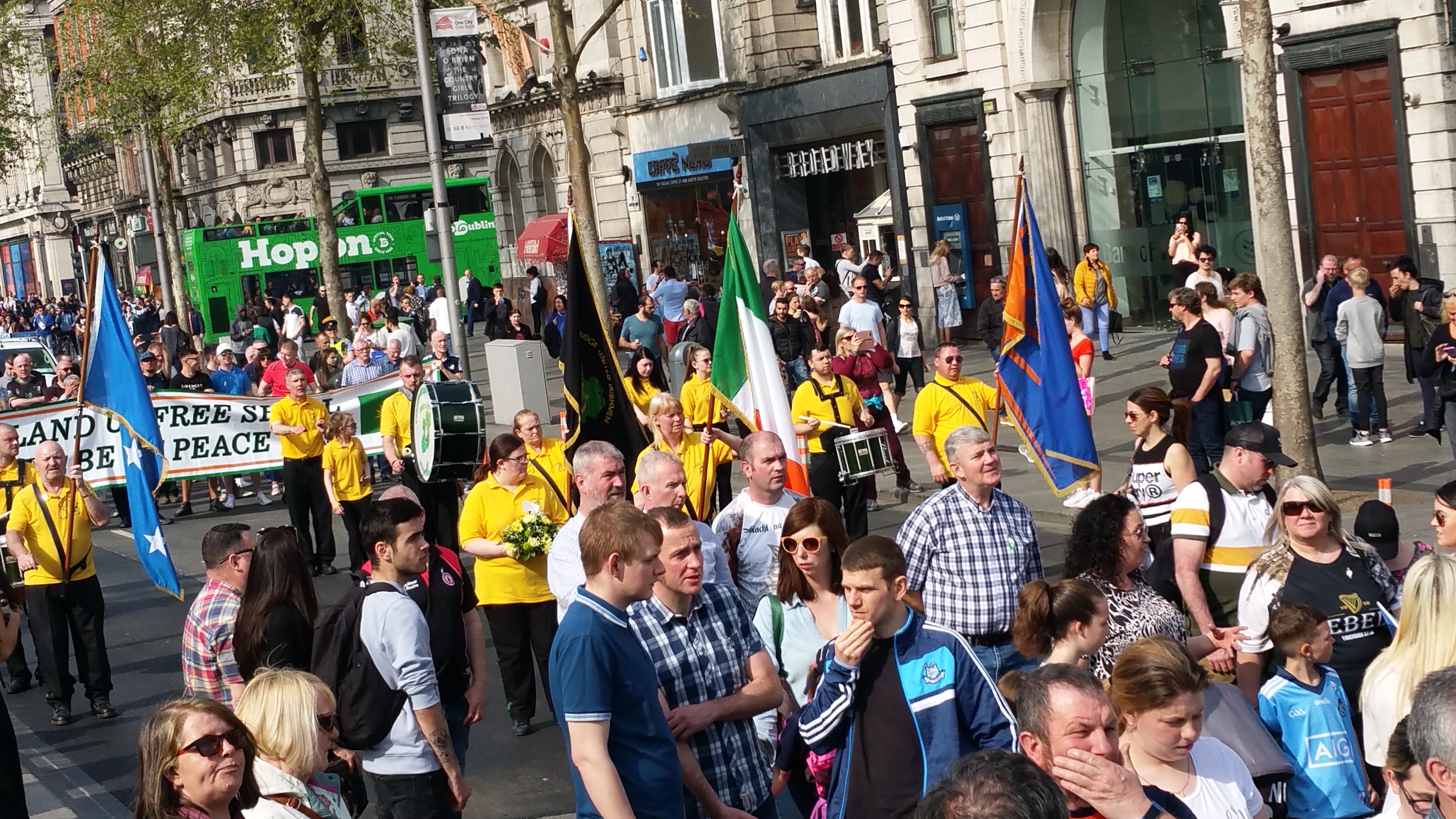
          The Irish Republican organisation Saoradh staged a large demonstration of its support on Dublin’s O’Connell Street on Saturday afternoon (20th April). Republican marching bands and hundreds of supporters followed the traditional ‘colour party’ flags and lines of men and some women dressed in green-brown military-style clothing, black berets and dark sunglasses.
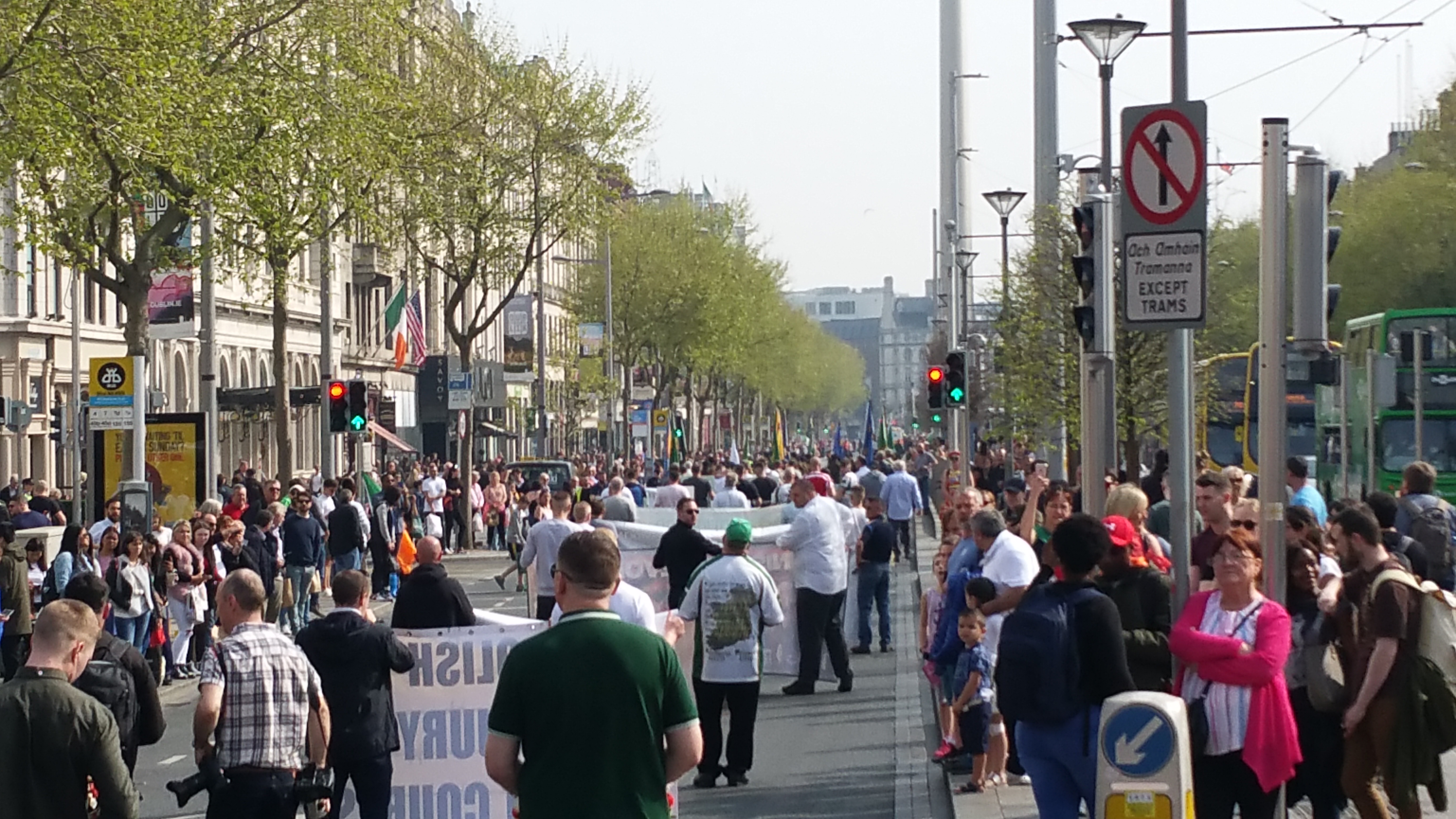
view section of parade proceeding south along east side of O’Connell St.

   Beginning at the Garden of Remembrance, the procession, carrying large portraits of the executed martyrs of the 1916 Rising, wound its way down the main street past thousands of viewers, many of those taking photos and filming, down to the wall of Trinity College and the Bank of Ireland building, then back up Westmoreland street and up the west side of O’Connell Street to the GPO building, the site of the HQ of the Rising in 1916, for speeches as the ceremony of the commemoration.
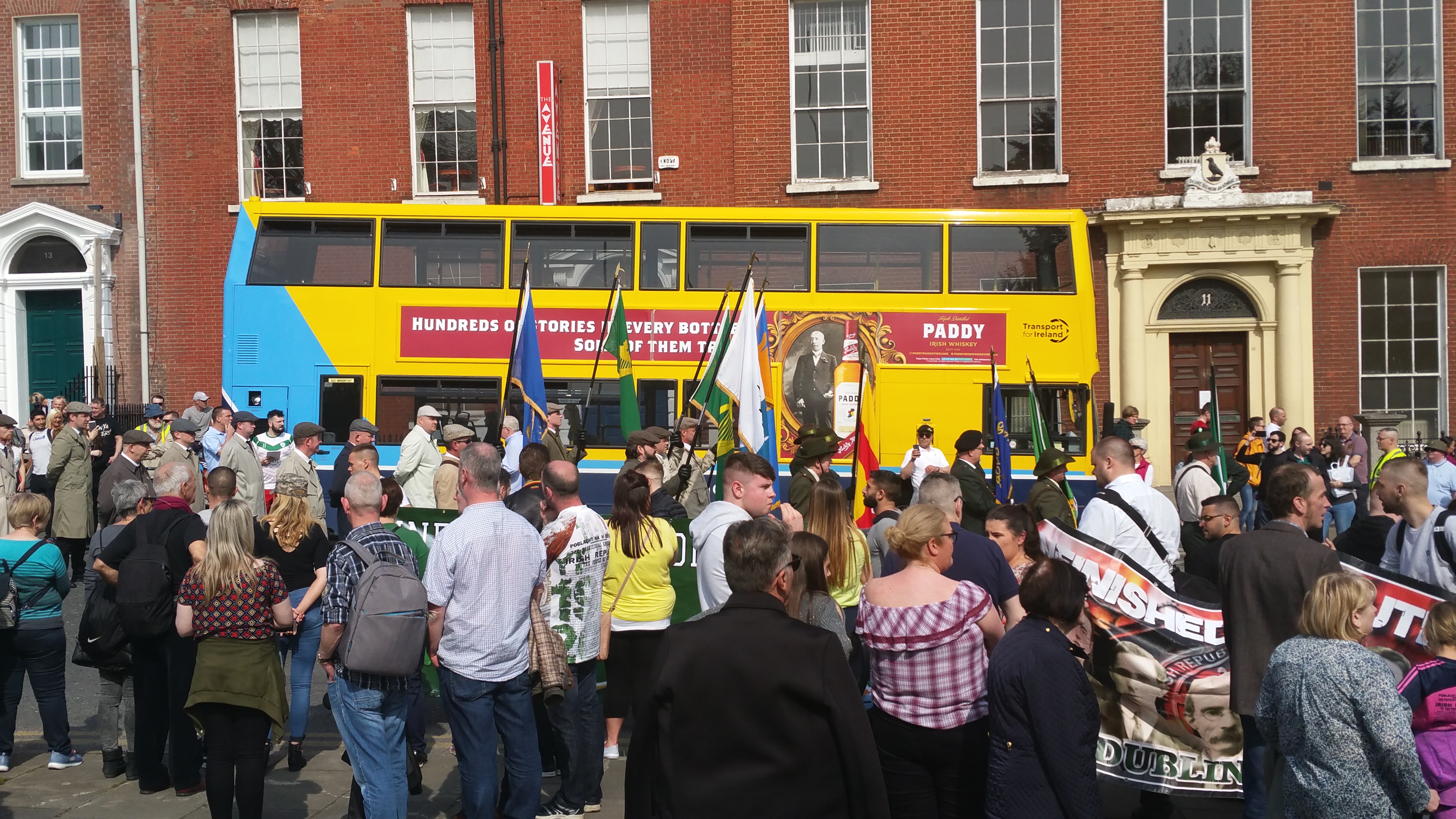
Parade forming up at Garden of Remembrance
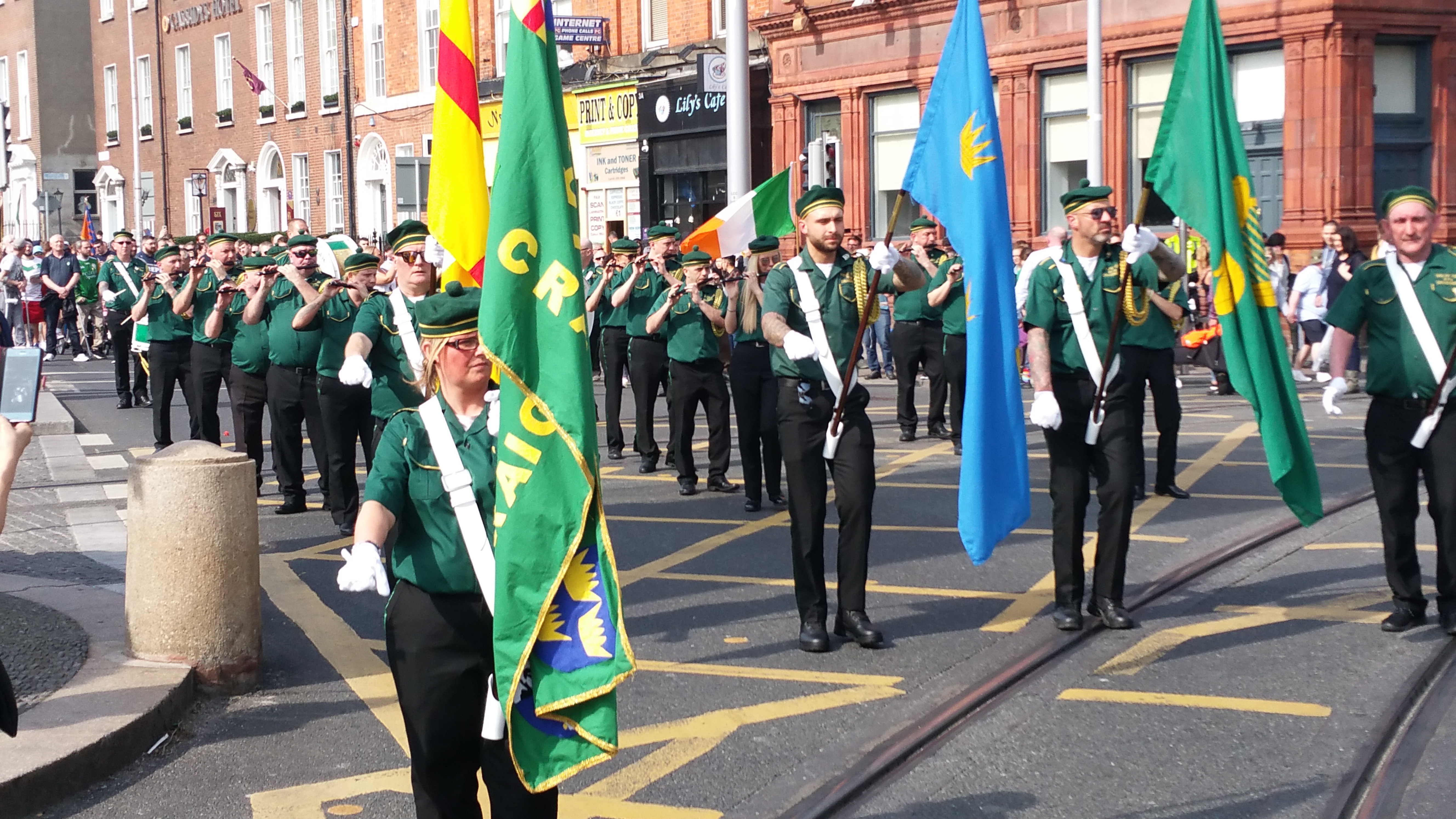
The Wolfe Tone RFB from Craigneuk, Glasgow, at the Parnell St/ O’Connell St. junction
Long view of section of the parade proceeding south along the east side of Parnell Square.


     The parade assembled at Dublin’s Garden of Remembrance and remained there for some time without the reason being clear, until the arrival of the participants dressed in green-brown military-style clothing, black berets and dark sunglasses, which many in the waiting crowd applauded. Presumably these were meant to represent the IRA but from the physical appearance of many it was clear that their active duty days, if they had them, were behind them. Presumably too, any organisation that did have an armed section would be reluctant to offer them up to the State for arrest on a parade and their all appearing at the last minute like that was also perhaps to reduce the opportunity for Garda harassment.

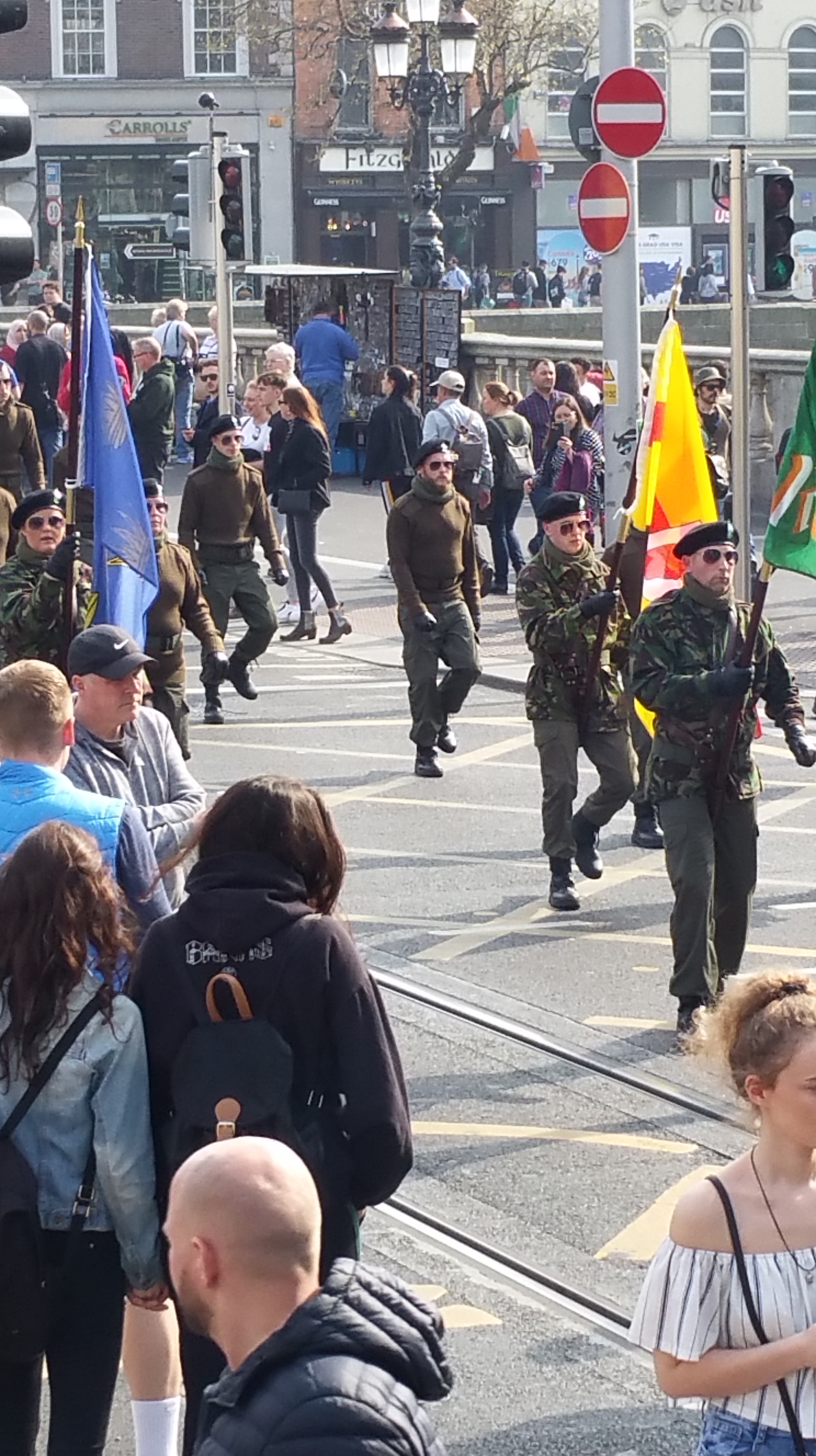
Another colur party but in War of Independence (1919-1921) period costume at the Garden of Remembrance, waiting to begin.

   However, the uniformed Garda presence was in low numbers and although the Special Branch had officers there, they did not appear to be harassing Republicans for their names and addresses, as is their usual wont.

The route of the parade had been prepared placards bearing the words “The Unfinished Revolution” and “Saoradh” with tricolour flags attached at intervals to traffic sign and street light posts, including also at least one Palestinian flag. As the colour party and people in uniform lined up with banners and a band behind them and set off down towards the city centre, people joined in behind the band, with another band bringing up the rear.

TRAGEDY AND CONDEMNATION

          The crowd appeared to contain many different elements, mostly men but quite a few women, some parents with small children and some teenagers, young men and older. Included among the attendance were a number of independent Republicans and socialists and a number expressed their decision to attend as having been influenced by the tragedy of the previous Thursday and the media campaign against ‘dissident’ Republicans, along with the apprehension that the Gardaí might take advantage of that to block or harass the paraders.

   A scheduled Easter commemoration by a committee including apparently members of Saoradh to be held in Derry on Easter Monday had been cancelled as a result of a tragic incident. The armed British colonial police force in the Six Counties, the PSNI, had been carrying out house searches in the Galiagh and Creggan areas of Derry, allegedly for arms, to which youth had responded with stones and petrol bombs. During that incident, a gun was fired from the direction of the youth towards the colonial police but struck Lyra McKee, a young female reporter standing near them instead. Tragically the wound was fatal.

Section of banners coming back across O’Connell Bridge towards the GPO

   Saoradh had issued a statement after the event expressing regret for the death and extending condolences to Lyra McKee’s family and friends but also putting the incident in the context of regular harassing raids by the PSNI on houses in ‘nationalist’ areas and the always likely result of resistance (see Links for full statement).

   Possibly in reference to that tragedy, a very tall long-haired man stepped in front of a section of marchers with his hands in the air. Stewards quickly blocked him peacefully and diverted participants around him.

   Past the objector and into O’Connell Street, both the east side pavement and the pedestrian middle reservation were thronged with people watching, photographing and filming. The parade passed on to O’Connell Bridge, into D’Olier Street, turned right towards the Bank of Ireland building and back up Westmoreland Street to the General Post Office, location of the HQ of the Rising in 1916, outside of which the 1916 Proclamation had been read on 24th April by Patrick Pearse with James Connolly by his side.

At the GPO, Saoradh party chairman Brian Kenna welcomed the participants.

Portraits of the executed 1916 martyrs being carried back across O’Connell Bridge


Section of the Coatbridge Unitedmen RFB, Glasgow, marching southward in O’Connell Street.

THE SPEECHES AND CEREMONY

          At the GPO, Saoradh party chairman Brian Kenna welcomed the participants. Republican Easter Rising commemorations tend to follow an established pattern, no matter which organisation is involved: the reading of the Proclamation; messages of solidarity from Republican prisoners; a speech by a representative of the organisation; the lowering of the flags to a drum roll and their raising again, in honour of the fallen; the singing of Amhrán na bhFiann, the Irish National Anthem. In the past, a statement from the IRA was also read but in recent years this have not been customary, for a number of reasons.
   The usual components of the ceremony were present on Saturday outside the GPO with a few variations: a poem by a supporter read out, “James Connolly, the Irish Rebel” sung by another and “Róisín Dubh” played on the uileann pipes. The James Connolly song, with some powerful imagery and an attractive slow air, gives no indication whatsoever of the man’s revolutionary socialism and seems to incorporate him into the IRA, instead of the Irish Citizen Army which he co-founded or even of the Irish Volunteers, with which he joined forces only weeks before the Rising.

In the distance at the GPO, Chairperson of Saoradh Brian Kenna, MC of the event

   The RFB (Republican Flute Band) marching bands were from Scotland: The Wolfe Tone RFB Craigneuk and the Coatbridge Unitedmen RFB. One of the bands played “Take It Down From the Mast, Irish Traitors”, the lyrics of which deny the Tricolour to the Free Staters who waged the Civil War against the Republicans, the legitimate bearers of the flag. A participant remarked that the song was sung first against Free Staters, later against Fianna Fáil, later still against the “Stickies” and more recently against Sinn Féin.

   In his speech on behalf of Saoradh, Dee Fennel from Belfast began by sending solidarity messages to Republican prisoners in Irish jails and to the relatives of all those who had fallen in the struggle against British imperialim. He said that the objectives set out in the 1916 Proclamation had not been achieved and referred to those participants in the struggle who had left it along the way, some to collude in upholding the two failed states of the divided nation.

(at right of photo) Dee Fennel of Saoradh delivering the main oration at the GPO

   Referring to his own activism, Fennel recollected how four years previously he had spoken at an Easter commemoration as an independent Republican, i.e not a member of any political party. He had spoken of the need for Republican activists to engage more with one another and also in the struggles of communities, women and trade unions. Fennel said that as a result of a discussion among Republicans, some had formed Saoradh, building on “maturity and commitment” while others “retreated to their flags” and went on to list the wide areas of struggle in which he said Saoradh activists could be found.

   Fennel also referred to the activity of the IRA and said that while British imperialism remains in possession of a part of Ireland and prevents the exercise of sovereignty of the nation, there will be some form of armed resistance and that this is borne out by history.

   Referring to the harassment and persecution to which Fennel said Saoradh activists were being subjected, including “tens of thousands of stop-and-searches, hundreds of house raids”, he linked that to the PSNI raids in the Creggan area of Derry earlier that week and the tragic accidental killing of Lyra McKee when “a Volunteer fired shots at PSNI forces”. Going on to say that the IRA do make mistakes from time to time, and referring to two women killed by the Provisional IRA in error years before, Fennel said that the IRA should admit and apologise for their mistakes (NB: The New IRA did later issue an apology and express condolences), though he also said that no words could compensate for the feeling of loss.

   In reference to Brexit, Fennel said that the discussion is being focused on what kind of Border is to be imposed, while Republicans object to any kind of Border whatsoever. He stated that as socialists they also object to “the increasingly neo-liberal EU” and concluded with a call for solidarity with Irish Republican prisoners “in Maghaberry, Portlaoise and Mountjoy” who “are in captivity for no other reason thantheir commitment to Republicanism and a 32-county, secular socialist Republic.”

Salute to the fallen as drums roll and flags are lowered slowly and then raised slowly.

TRADITION OF THE PAST AND CLAIM ON TOMORROW

          Republican organisations tend to commemorate the Easter Rising not only as a historic event but also to highlight that for which the Rising was fought has yet to be achieved. But they also do so to show that they are here, present, working for those objectives and often, to promote their organisation, to attract support.

   The display involved in this Easter commemoration was impressive (despite a media claim that the numbers were only “around two hundred”), particularly in view of the inevitable bad press following the death in Derry and the system politicians’ statements on what a social media poster dubbed “The Opportunist Condemnatory Bandwagon”. It also seemed to show an organisation not much harmed overall in Ireland by a recent split over an alleged lack of internal democracy.

end.
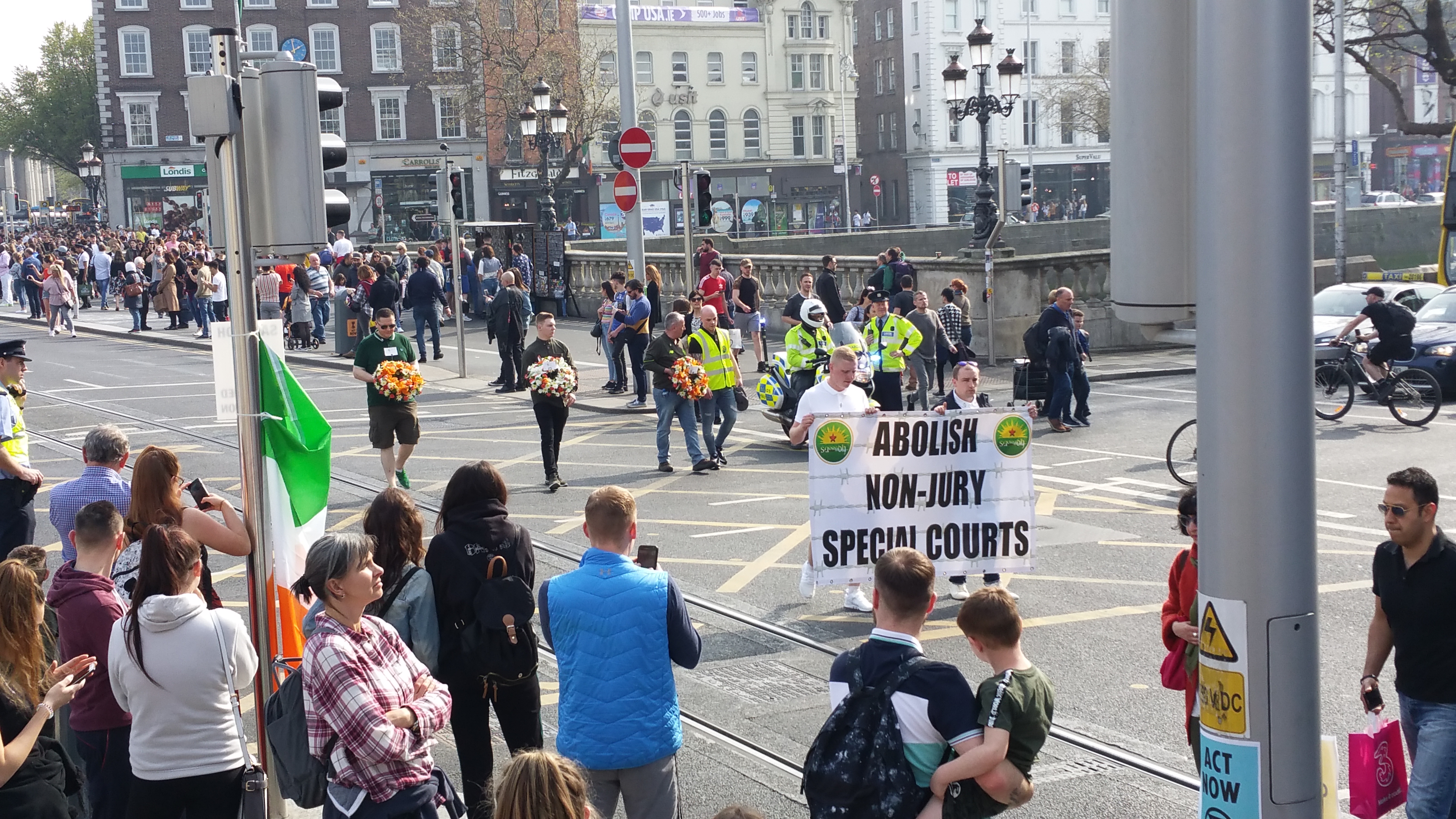
Floral wreath carriers re-crossing O’Connell Bridge in the parade on their way to the GPO

Floral wreath from the Information Group of Sweden
Floral wreaths deposited outside the GPO (at the window where the Cúchulainn sculpture symbolises the 1916 Rising.

LINKS

Saoradh statement on the killing of Lyra McKee: http://saoradh.ie/the-death-of-lyra-mckee-in-derry-saoradh-statement/?fbclid=IwAR2nH20ILtiGjgCyih2eo0HEpkK27_F89MRptEb_OIMfA0SbRz4YB8Fneiw

Media and politician reaction to “dissident” Easter Rising commemorations in Dublin (many other similar examples): https://www.independent.ie/irish-news/politics/video-an-insult-to-irish-people-republican-groups-march-48-hours-after-lyra-mckee-murder-dishonored-the-irish-flag-varadkar-38035393.html

Irish Times inaccurate reporting:

https://www.irishtimes.com/news/ireland/irish-news/revolutionary-party-saoradh-in-paramilitary-parade-through-dublin-1.3867379?fbclid=IwAR24E5sZ9iMfINxDcor0T9uRmF5-0yV9_bfWylcCfzC0rctjMaCfmFDfv6w

Continuing Internment Brought to Notice in Busy Dublin Shopping Street

(From FB page End Internment by kind permission)

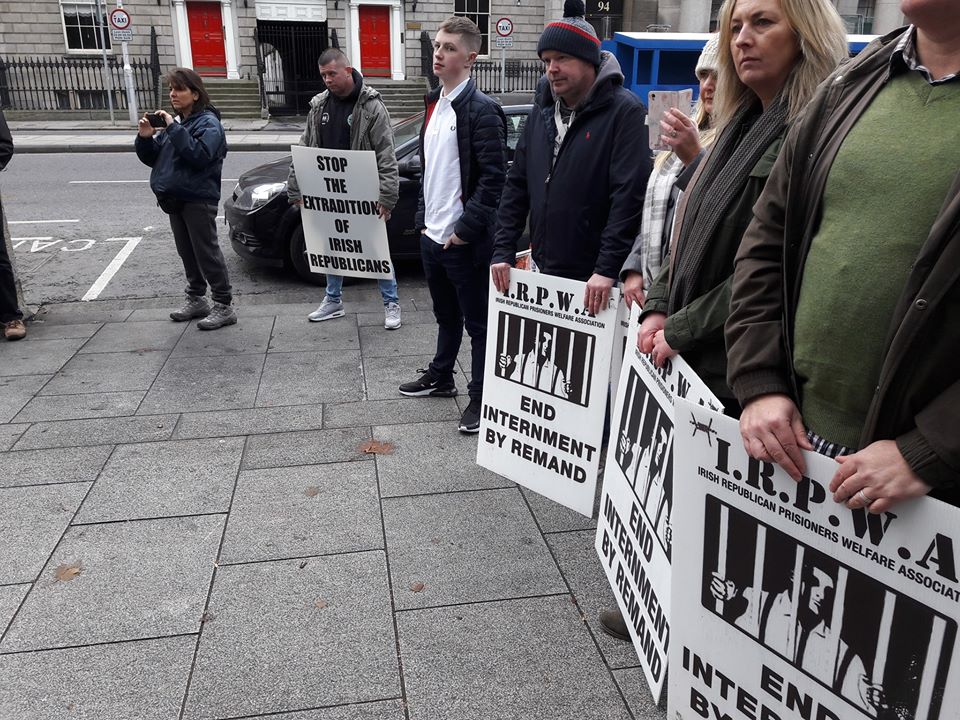
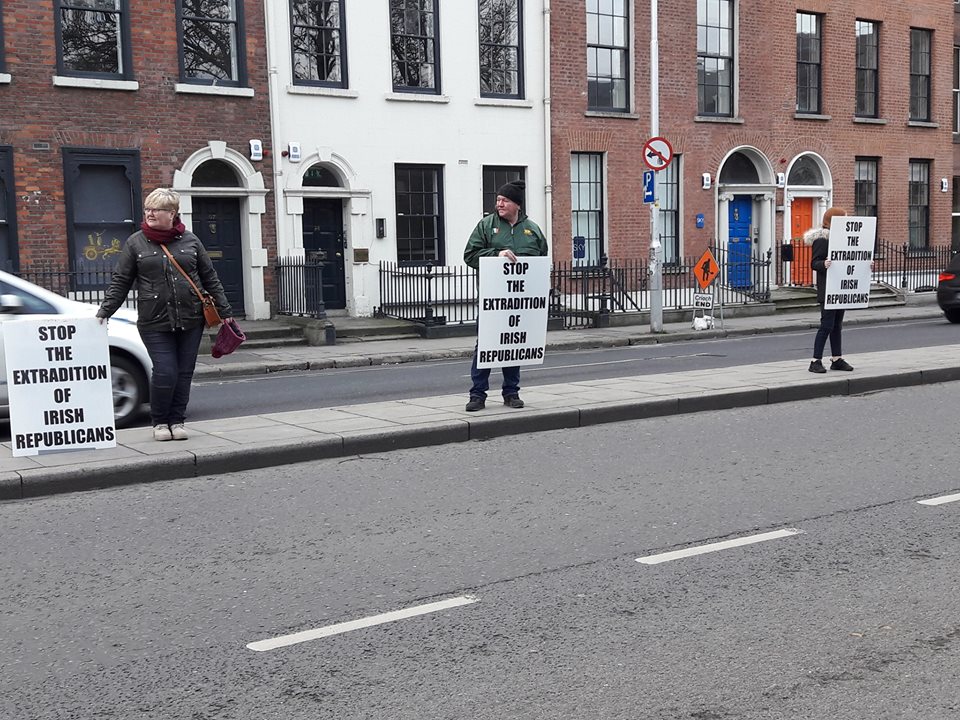
The campaign against continuing internment in Ireland had a visible presence in Dublin’s premier and busy shopping area, Henry Street on Saturday 6th April.

Photo: Dublin Anti-Internment Committee

          Republicans and socialists from a number of organisations — and none — supported the picket, called by Dublin Anti-Internment Committee as part of its ongoing campaign to raise awareness that internment without trial of political activists continues in Ireland, though on a much-smaller scale.

Hundreds of leaflets were distributed to shoppers and sightseers and only one complaint was received – that there wasn’t a petition to sign!

DAIC member handing out leaflets to passing members of the public (Photo: Dublin Anti-Internment Committee

If any reminder were needed that internment is continuing in Ireland, it was provided recently with the case of former Republican prisoner Alan Lundy, who was recently jailed without charge and released some weeks later, being yet again detained and put straight into jail, again without trial or even charge.

IF YOU WANT TO HELP

          If you live in Dublin and would like to help, why not join the DAIC at the next picket? These are roughly on a monthly basis. The DAIC is completely independent of any political party or organisation and organises itself in a democratic manner – however, it is a participative democracy, in that the people who attend public awareness-raising events are those who make the decisions at notified committee meetings.

If you don’t live in Dublin, you could share our posts from time to time ….

Photo: Dublin Anti-Internment Committee

HISTORICAL NOTES

          The Proclamation of Independence was signed in what was then an Irish foods and coffee shop, No.21 Henry Street, about a week before the Rising.

During the actual Rising, the street saw much firing from British troops closing in on the GPO from both directions, east and west. An advance of British soldiers from the west was halted by a Volunteers’ ambush somewhere near where this picket was.

end.

Photo: Dublin Anti-Internment Committee
The plaque commemorating the signing of the 1916 Proclamation of Independence at No.21 Henry Street.
(Photo: D.Breatnach)

“THE LAST COLONY IN AFRICA” — REPRESENTATIVES SPEAK IN DUBLIN

(Approx. reading time: report 10 mins; background 2 mins.)

Report by Diarmuid Breatnach

On Tuesday March 5th a meeting in the Teachers’ Club, Parnell Square, was addressed by representatives of the Western Sahara people and by experts in human rights matters.

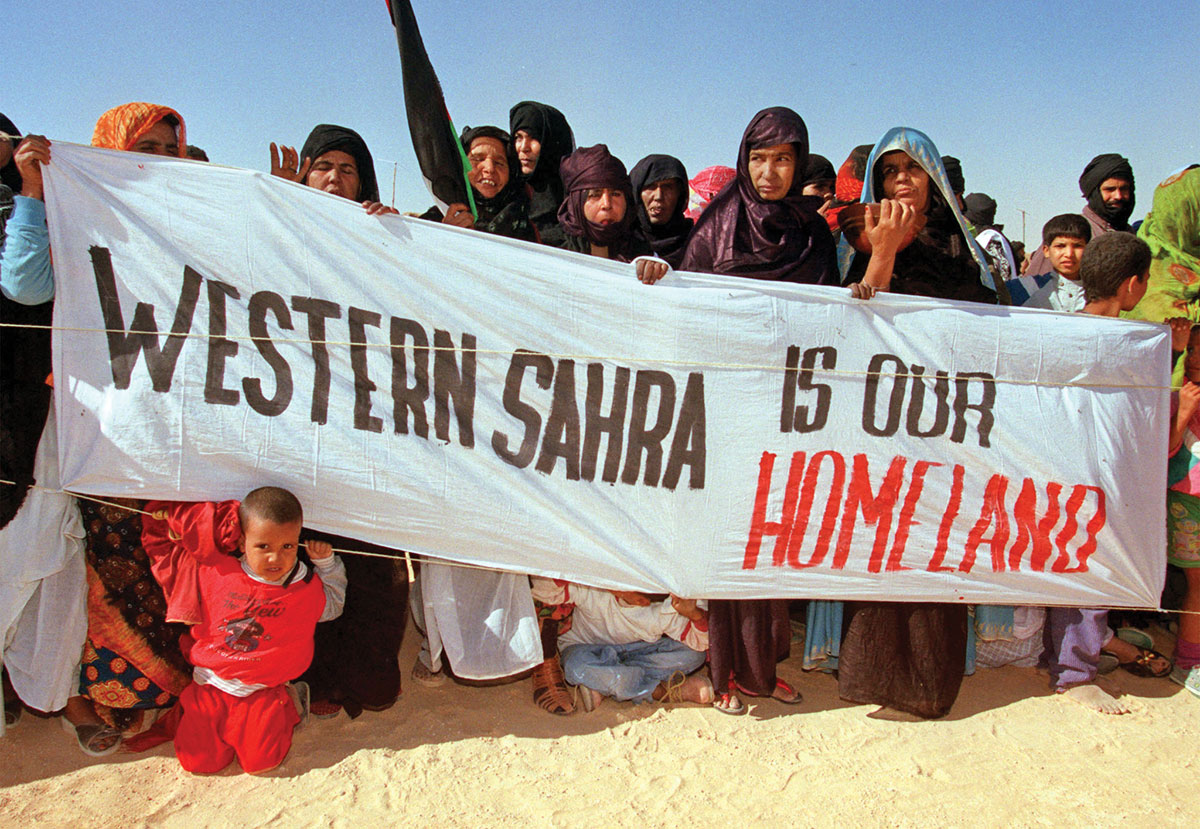
2015 protest by Saharawis, mostly women.
(Photo source: Internet)

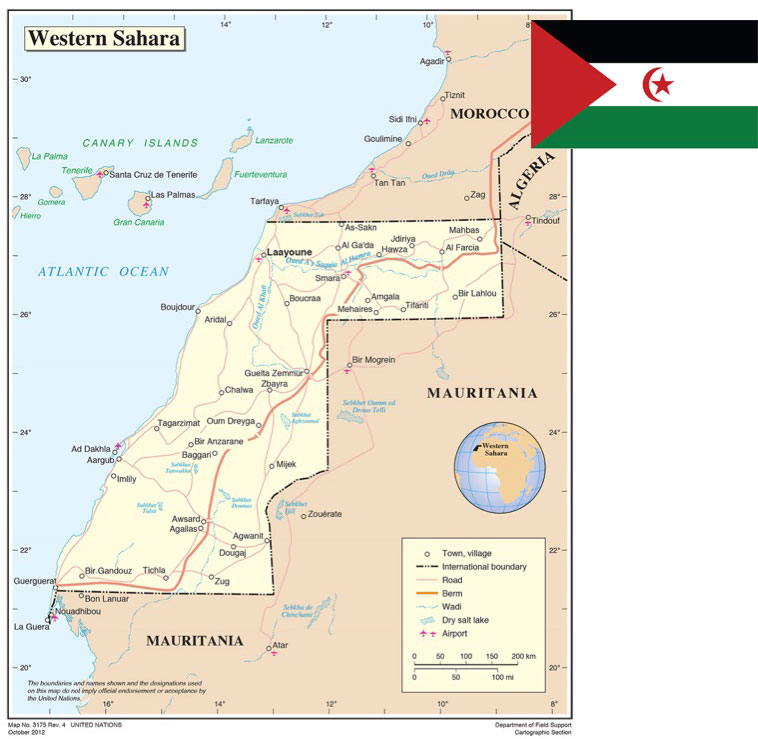
          Western Sahara, a territory of 266,000 square kilometers (103,000 sq. miles) in the Maghreb, was part of Europe’s carve-up of North Africa, when it was known among most states as Spanish Sahara, in acknowledgement of the European state that occupied it. Its people speak Arabic and Castillian (Spanish) and some also speak French, an influence from neighbouring French ex-colonies.  Few speak Berber.

Mohamed Belsat of the Polisario speaking at the event (Photo: D.Breatnach)

The UN General Assembly in 1964 called on Spain to hold a referendum there which the Franco fascist regime declined to do but in 1975, after the dictator’s death, the new regime pulled out of the territory, practically handing it over to Morocco and Mauritania. After a conflict between those two states, Morocco emerged as the sole occupier and the conflict since then has been between the Kingdom of Morocco and the Saharawi people, who seek independence.

Chaired by Mark McLoughlin, filmmaker, the Dublin meeting had been arranged at short notice and its advertising further hampered by cancellation of a booking at Trinity College.

TRACING THE PLUNDER OF SAHARAWI NATURAL RESOURCES

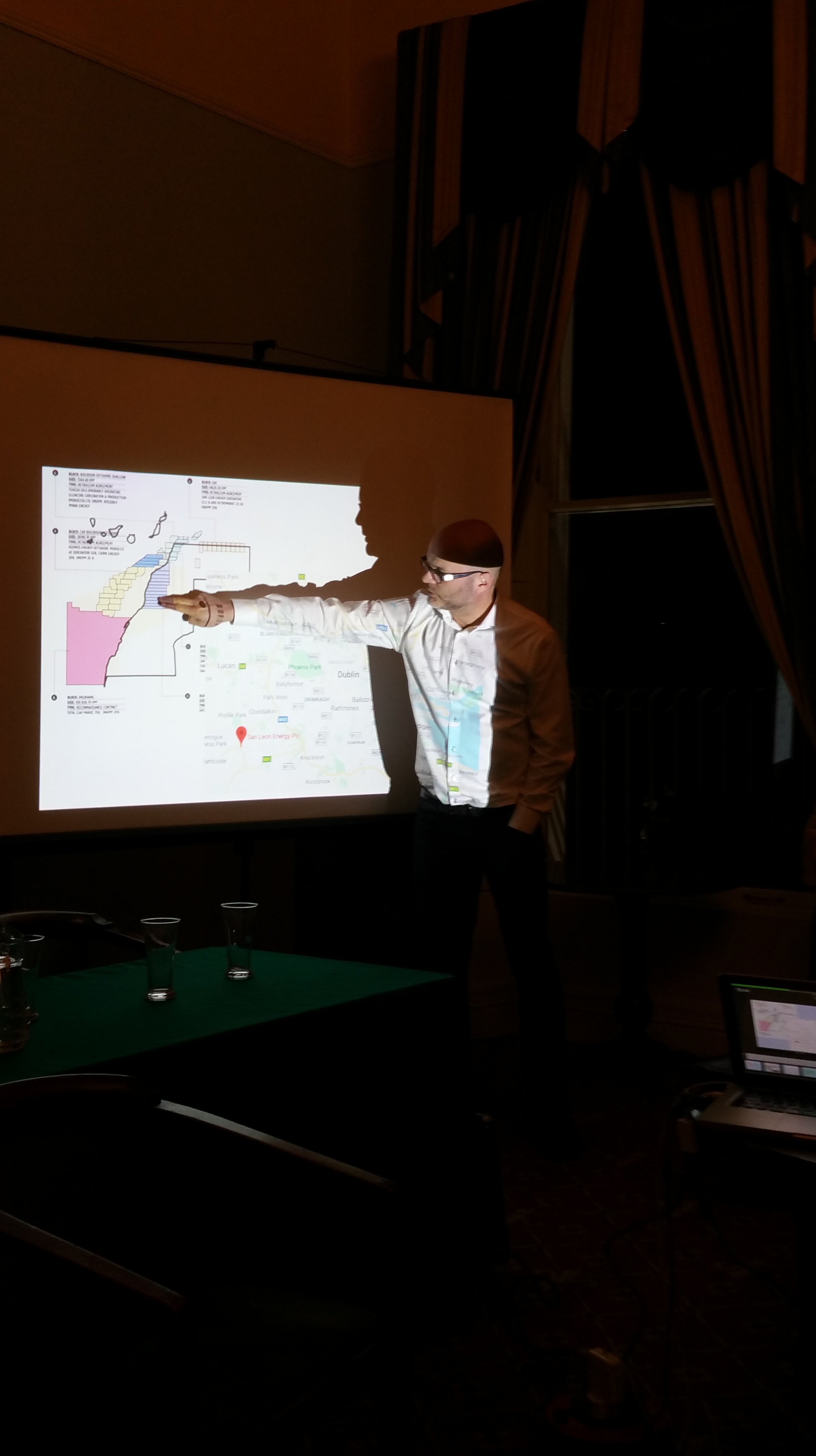
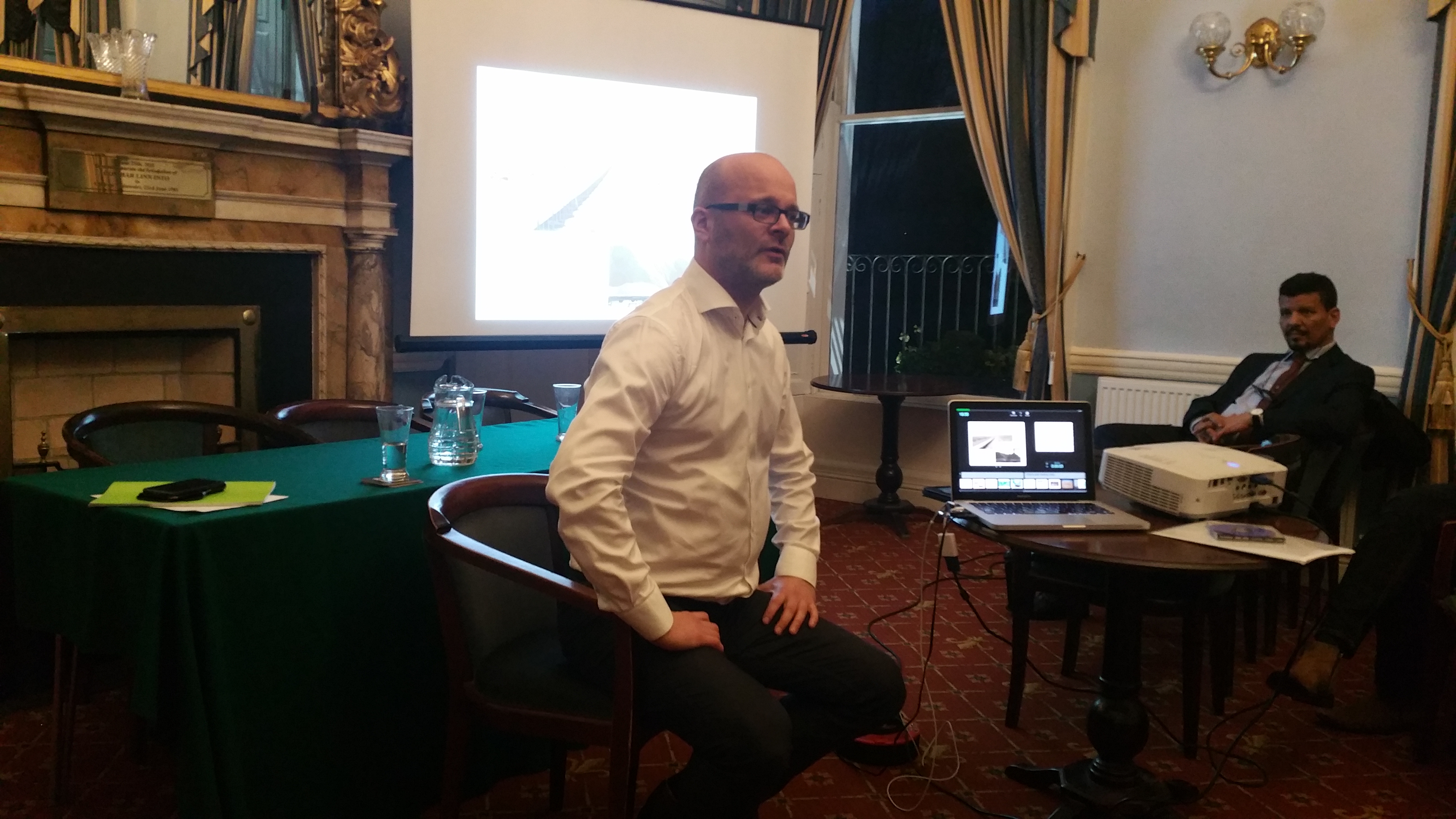
          Erik Hagen, of Western Sahara Resource Watch, with a display projected on a screen, showed how his organisation traces the ships arriving at the territory and departing with phosphates mined there to their destinations. From the registered tonnage of the ships, the amount of phosphates plundered can be calculated. The companies involved claim that they are doing no wrong, since they pay Morocco for the cargoes.

Mark Hagen illustrating a point with reference to the display. (Photo: D.Breatnach)

But according to the UN, no state may extract resources from a disputed territory without the consent of the people. Hagen talked about how EU had changed the wording to replace “consent of” with “being of benefit to” and then went on to effectively falsify agreement on benefit, using a document on consultation with huge majority – and a total of Saharawi organisations – voting against as evidence for.

The only company currently exploring for oil in Western Sahara is San Leon, an Irish company, although they failed to find any and are currently fighting in financial difficulties.

Clive Symmonds, expert in international law talked about the policy of isolating produce from occupied territories, by first compelling their labeling as such, which, although that would not ban the products, would facilitate a ban if such were decided. The Control of Economic Activity (Occupied Territories) Bill 2018 introduced to the Oireachtas (Irish legislature) and currently being processed with cross-house support despite Government opposition, is an example of how such a ban may be implemented (and Senator Black’s Bill will also be valid for Western Sahara). Of course, as Symmonds pointed out, such labeling is left to the exporter which in this case would be the Kingdom of Morocco.

Clive Symmonds speaking on human rights legislation and W. Sahara (Photo: D.Breatnach)

 Symmonds also referred to the EU Fisheries Agreement which, in permitting fishing within what Morocco claims as its territorial waters without reference to the Saharawi people, is permitting the plunder of the Saharawi people’s fish stocks – and the Irish State is a party to this, having signed the Agreement. Symmonds pointed out that the judgement of the European Court of Justice on 21st December 2016, stated that Western Sahara is a “separate and distinct” territory from Morocco and that trade agreements between the EU and Morocco do not apply to the occupied territory. The EU is in violation of this judgement.

A REFERENDUM IS THE ONLY DEMOCRATIC WAY”

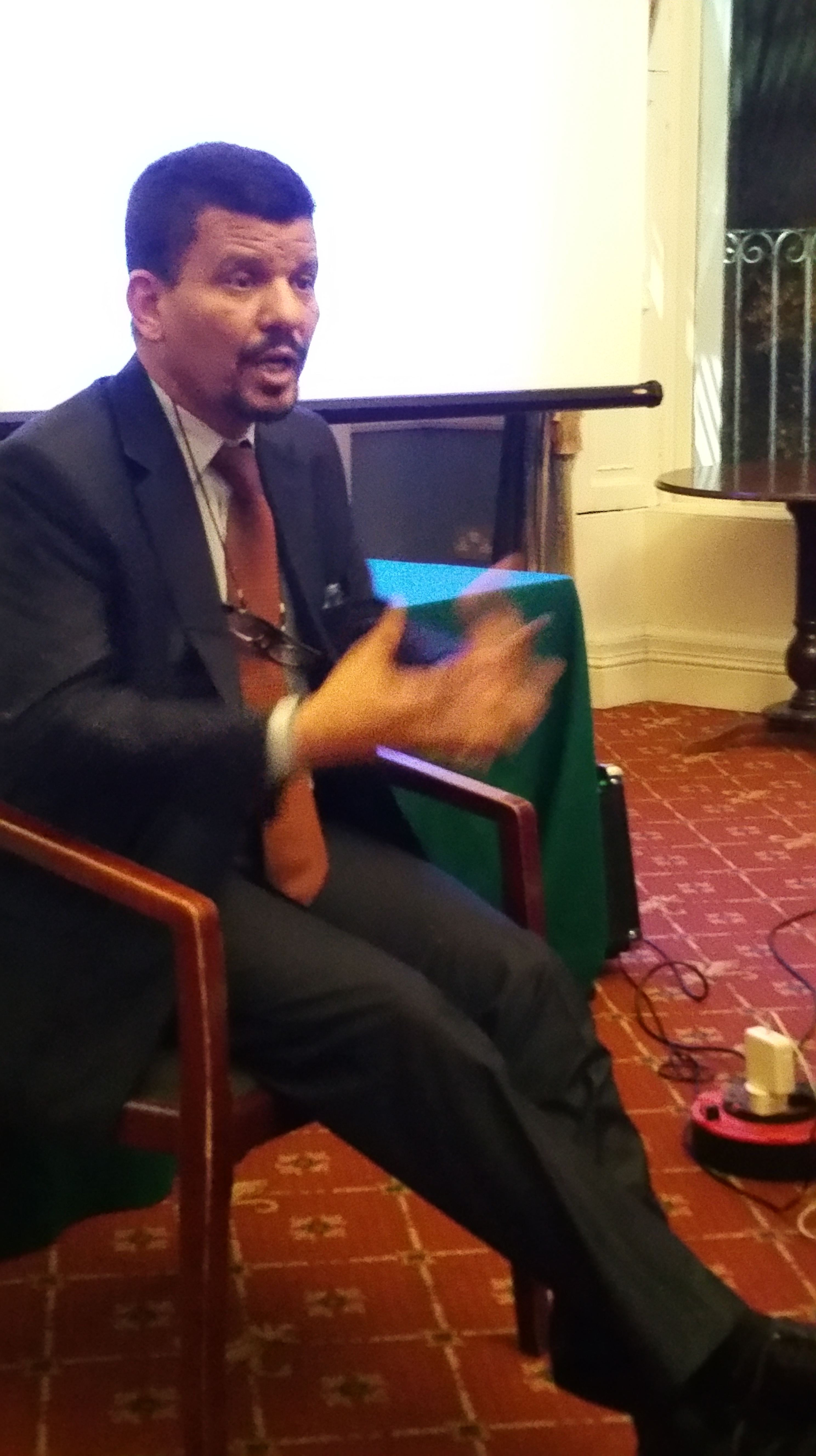
          Mohamed Belsat, Frente Polisario Ambassador to Europe, talked about the policies of the Irish state, the EU and, in particular, France. Belsat said that they were in collusion with the Kingdom of Morocco and that in particular, France often seemed to be the opponent of the Saharawi people even more than Morocco.

Referring to what he said was the only democratic of ascertaining the will of the Saharawi people, Belsat said that it was a referendum. Morocco had called for this since they had flooded Western Sahara with Moroccans but, since the process of registration of genuine and historical residents of the area had been completed by the UN, the Moroccan Kingdom had withdrawn all support for a referendum.

(Photo: D.Breatnach)

The cost of the occupation to the Moroccan kingdom is huge, in terms of military presence maintenance and so on,” Belsat said, adding that the cost of every litre of water supplied to the occupation forces was equal to four times the price of a litre of whiskey. Furthermore, the cost to the Kingdom exceeded the benefits it extracted from the colony. In January, Morocco had at last joined and signed up to the constitution of the African Union, the organisation of African states, of which Western Sahara is a founding member and which has a long-standing position on Western Sahara being an occupied colonyFor all these and other reasons, including dissatisfaction with the regime among the Moroccan general population, he felt that a campaign of pressure on Morocco and on the EU might well bear fruit in terms of the decolonisation of this “last colony in Africa”.

Later, Belsat’s response to a question from the audience amounted to an admission that there was no “peace process.” (sic) in operation (despite a reference to it by a number of speakers) and that as a result of this and the conditions under which they were kept by their oppressors, it was increasingly difficult to restrain the youth from resorting to armed resistance. At this a member of the audience commented that armed struggle against the army of the Moroccan Kingdom backed up by France would be “suicidal”.

57 POLITICAL PRISONERS BUT MANY MORE HAVE DISAPPEARED WITHOUT TRACE”

          ElGhalia Djimi, Vice-President of ASDH (Saharawi Association of Victims of grave violations of human rights by the Moroccan State), which cooperates with the League for the Protection of Western Sahara Political Prisoners in Moroccan Jails (LPPS), who had arrived in Ireland that day, made her presentation next.  Speaking in French through a translator, Djimi talked about the conditions of life under occupation for the Saharawi people. Djimi showed a compilation of clips of soldiers, police and people in civilian clothes physically assaulting protesting Saharawi women, pulling their hair, punching and kicking them and informed the meeting that those in plainclothes were Moroccan police.

ElGhalia Djimi speaking on Moroccan Kingdom repression of Saharawi people (Photo: D.Breatnach)

There are 57 Saharawi political prisoners in Moroccan jails,” ElGhalia Djimi said, “but many more that have disappeared without trace.”

Unemployment is high among the Western Sahara people and as a result of that and other deficiencies in their lives, a drug problem has arisen, she told her audience. There are no third-level education facilities in the territory, obliging them to go to institutions in Morocco. Although they can study to gain professional qualifications for civil employment, those available are not usually those required by the employers, which is not true for their equivalent in Morocco, with the result that often Moroccans fit into the administrative jobs better than do the Saharawi people. In terms of their treatment by the authorities, all Sahawaris carry a Moroccan ID card but letters on it indicate their ethnic origin (which Belsat likened to the Nazi State’s requirement that German Jews by identifiable in their national ID documentation).

Moroccan citizen settlement in Layoune, the capital of Western Sahara, had now placed the indigenous people, once the majority, in a minority.

Mark Hagen, of Western Sahara Resources Watch.
(Photo: D.Breatnach)

SOLIDARITY IN DUBLIN

          In conclusion of the speakers’ presentations, Mohamed Belsat asked for support from the Irish people with their “history of struggle for freedom and solidarity with other struggling nations”

A couple of members of the audience mentioned that there had been an active solidarity committee with Western Sahara in Dublin in the past and one wondered about the possibility of resuscitating it.

Comment: The solidarity Committee in Dublin was independent of any political party or organisation, its name was Western Sahara Action Ireland and its FB page is still in existence. Between 2011 and 2012, the group organised a number of public events, including: two protests about Moroccan repression of Saharawi protesters, one in Dame Street and another in O’Connell Street; a protest against the EU’s Fisheries Agreement outside the Dublin offices of the EU in Dawson Street; the construction and maintenance of a “Western Sahara Tent” at the Electric Picnic of 2012, along with an exhibition of photographs taken in the territory. The latter was visited by Michael O’Higgins who was then campaigning for the Presidency of Ireland (he also appeared in the film shown at the beginning of public meeting in Dublin).

On each of the Dublin street events, a small group of Moroccans had attended to harass and attempt to intimidate the protesters, almost certainly sent by the Moroccan Embassy but their efforts were to no avail.

Flag of the Western Sahara liberation movement.
(Photo source: Western Sahara Action Ireland)

BACKGROUND

          There had been many uprisings against colonial rule in the history of Western Sahara and the last Rif War, from 1920 to 1927, had cost the Spanish State military 23,000 casualties, of which 18,000 were fatalities. Only for the intervention of the French1, the forces led by Abd el Krim would have kicked the Spanish colonialists out of the footholds to which they were still clinging.2

Like the French in their North African colonies, the Spanish occupiers had suppressed risings not only by military force against insurgents and torture of captives, including electric shocks, but also by terror against the civilian population, including assassinations, massacres, rape and internment without trial.

Both European states also developed their own Foreign Legions. Forget about the 1924 Beau Geste novel by PC Wren and the various screenplays3 to which it gave rise; the Foreign Legions were tough terrorists in uniform, founded not to fight in open war but against resisting colonial peoples.

Since 1963, Western Sahara has been on the United Nations’ list of “non self-governing nations”.  In 1965, the UN General Assembly, in its first declaration on Western Sahara, called on the Spanish State to decolonise the territory and, in 1967, to hold a referendum on self-determination but Spain refused. From 1973 to 1975, the Frente Polisario fought an armed struggle for national liberation.

Western Sahara in context. (Source image: Internet)

After the Spanish State abruptly pulled out in 1975 (following the death of its fascist dictator General Franco) and – without allowing elections of an independent Saharawi government before doing so – it relinquished control to the Kingdom of Morocco (which had formally claimed the territory since 1957) and Mauritania and conflict broke out between those states. Mauritania in time abandoned its claim and Morocco moved in and seized Western Sahara.

The Saharawi people protested Morocco’s occupation of their land and were suppressed by military and police. The Frente Polisario fought the occupying Moroccan military from 1975 until a UN-brokered ceasefire in 1991, since which there has been no Saharawi armed struggle but plenty of Moroccan repression. One of the features of the struggle was the displacement of a large part of the Saharawi population as people fled the Moroccan military, many to Algeria (which had won independence from France in 1962 after a fierce and dirty war), where they remain in a refugee camp. The Moroccan Kingdom then built a wall to prevent Saharawis from returning, which it guards by troops and miles of landmines.

End.

FOOTNOTES

1The casualties of the French, according to Wikipedia, amounted to 10,000 with 2,500 killed in battle. The casualties of the insurgents and of the indigenous civilian population, as usual in these situations, is difficult to determine but, according to Wikipedia, came to 30,000, of which 10,000 were fatalities.

2For more on the Rif War 1920, read the article about it (see link in Resources and Useful Links).

3Including those of 1939 starring Gary Cooper and Ray Miland, 1966 with Telly Savalas and Doug McClure and the BBC serial of 1982.


REFERENCES AND USEFUL LINKS

Sahara Press Service: https://www.spsrasd.info/news/en

Western Sahara Resources Watch: https://www.wsrw.org/

Western Sahara Action Ireland facebook page (please bear in mind that at the time of writing this group is not active): https://www.facebook.com/groups/256377861125569/

Article on the Rif War 1920 by me: https://rebelbreeze.wordpress.com/2018/08/09/an-old-war-with-a-lesson-for-today/

Recent Amnesty International report on Western Sahara under Moroccan rule: https://www.refworld.org/docid/5a9938ac4.html


Dublin & 40 European cities protest Spanish political trials and Catalan political prisoners

Rebel Breeze reporter


Leading up to the start date of the trials in Madrid of 12 Catalan independence activists, nine of whom have been in jail for 15 months awaiting trial, 40 cities around Europe were to hold solidarity protests. Today, 9th February, was the turn of some, including Berlin, Germany and Dublin, Ireland.


(Photo source: Rebel Breeze)

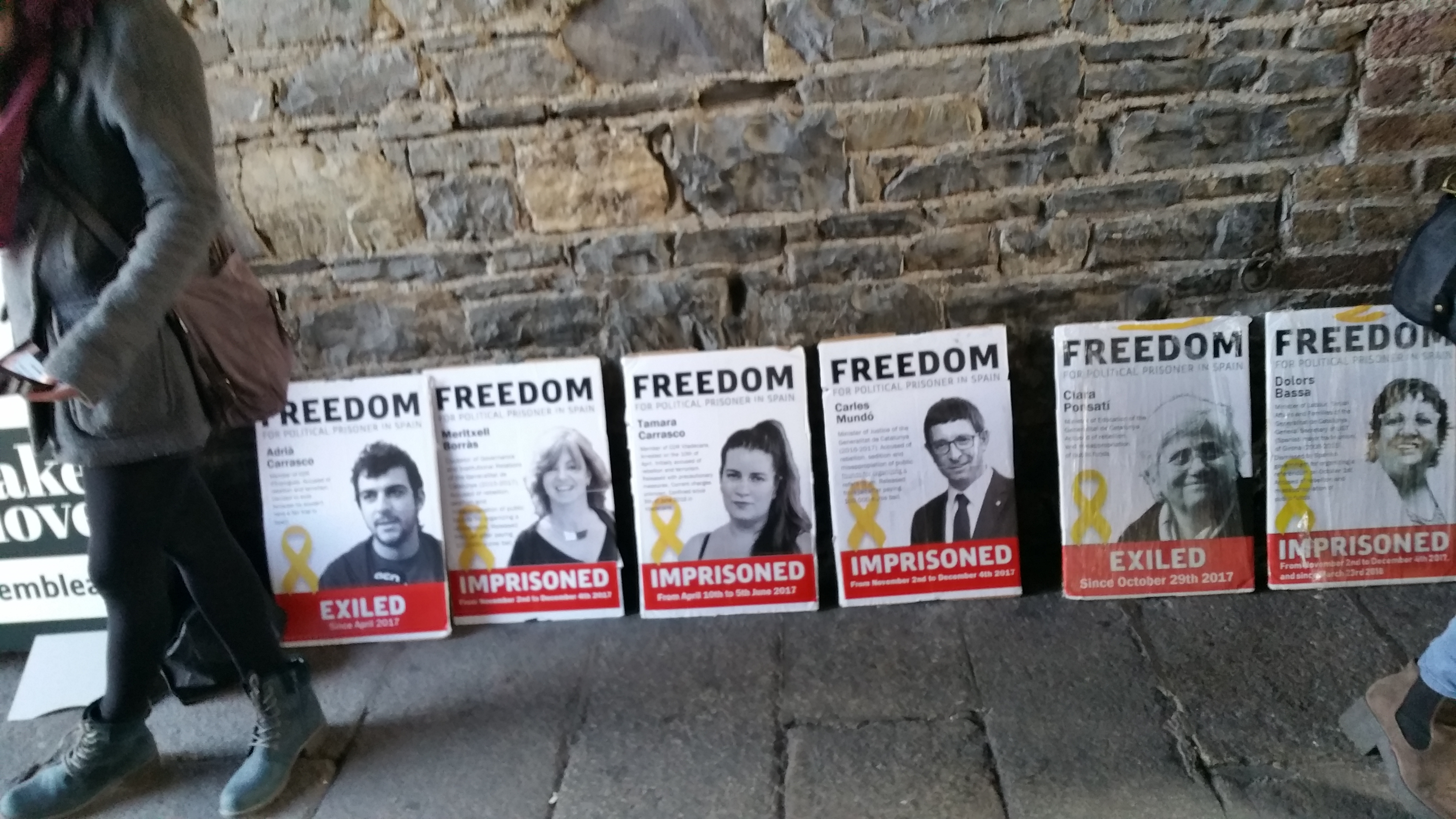
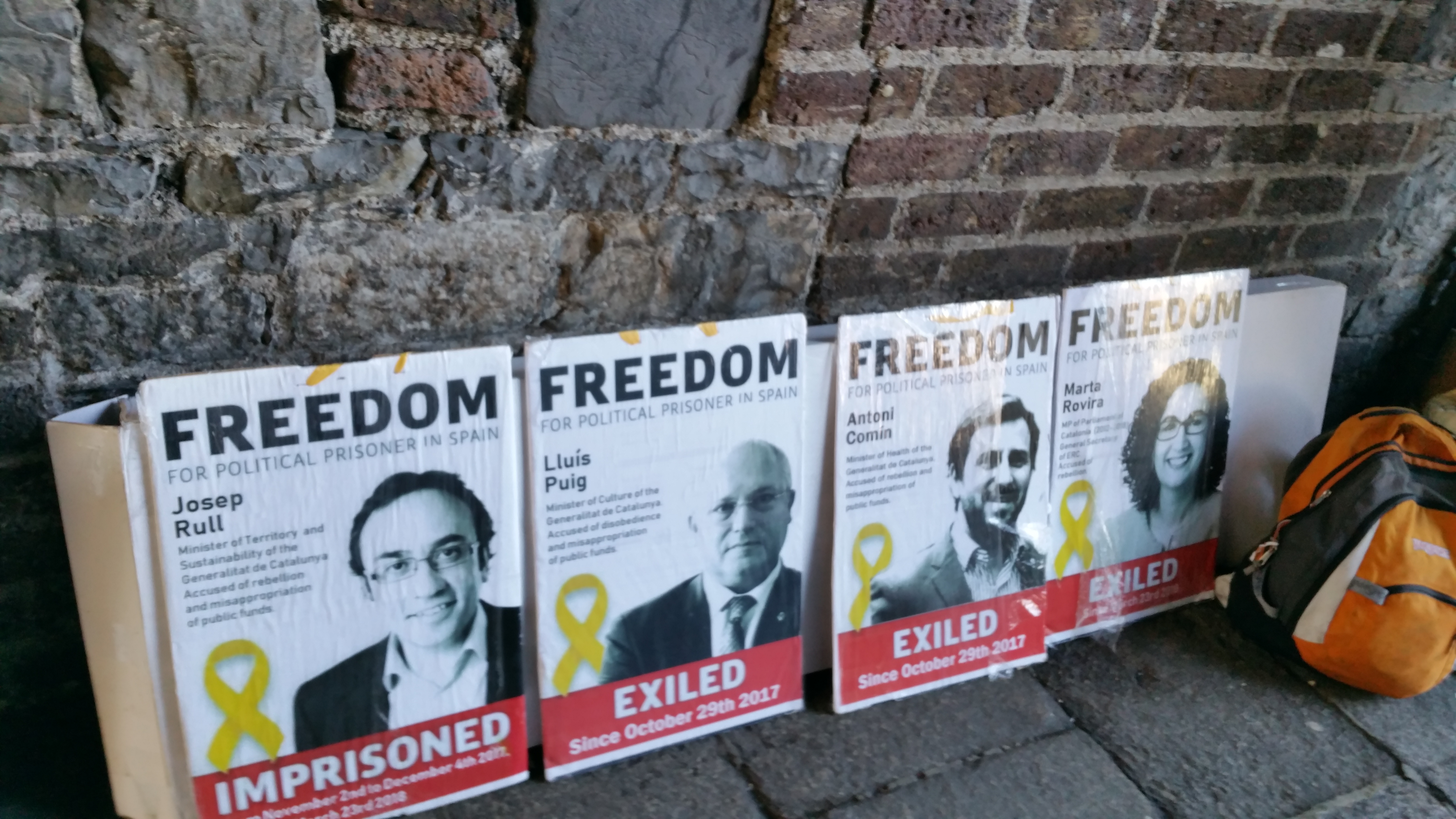
The defendants are charged with ‘rebellion’, ‘sedition’ and ‘misuse of public funds’ arising out of organising peaceful demonstrations and a referendum and later supporting a declaration of independence — and the Spanish State has refused to make provision for international observers.

Though the call for international actions came from the leadership of the grass-roots organisation ANC (Catalan National Assembly) in Catalonia, the action in Dublin was organised in cooperation by CDR (Comitè de defensa de la República) Dublin and With Catalonia/ Leis an Chatalóin. This followed very soon after organising to welcome Puigdemont to Dublin to take part in a debate at Trinity College and also to meet politicians at the Dáil (Irish Parliament).

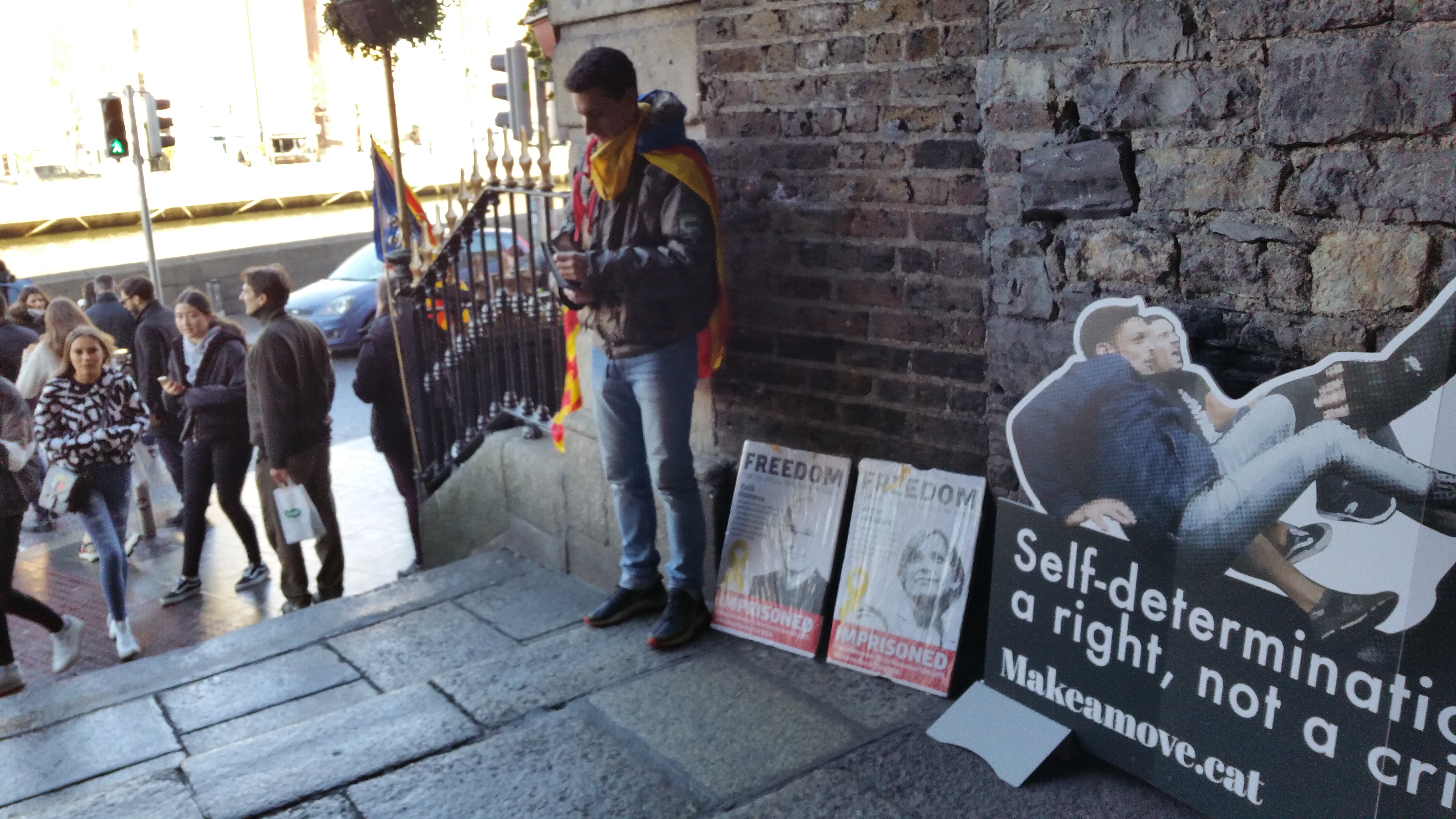
Placards displayed in Merchant’s Arch (Photo: Rebel Breeze)
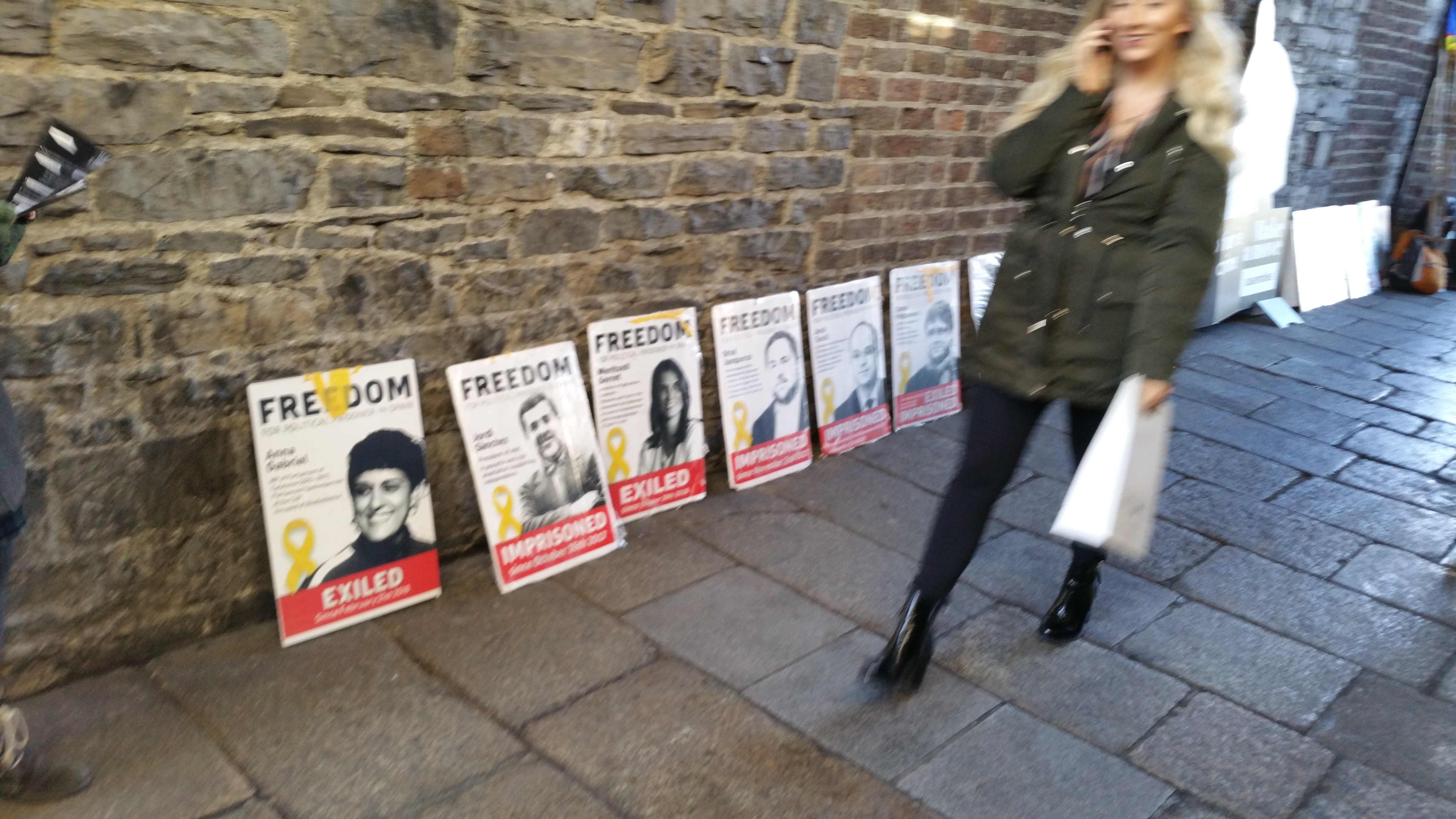
Placards with images of exiled (Photo: Rebel Breeze)

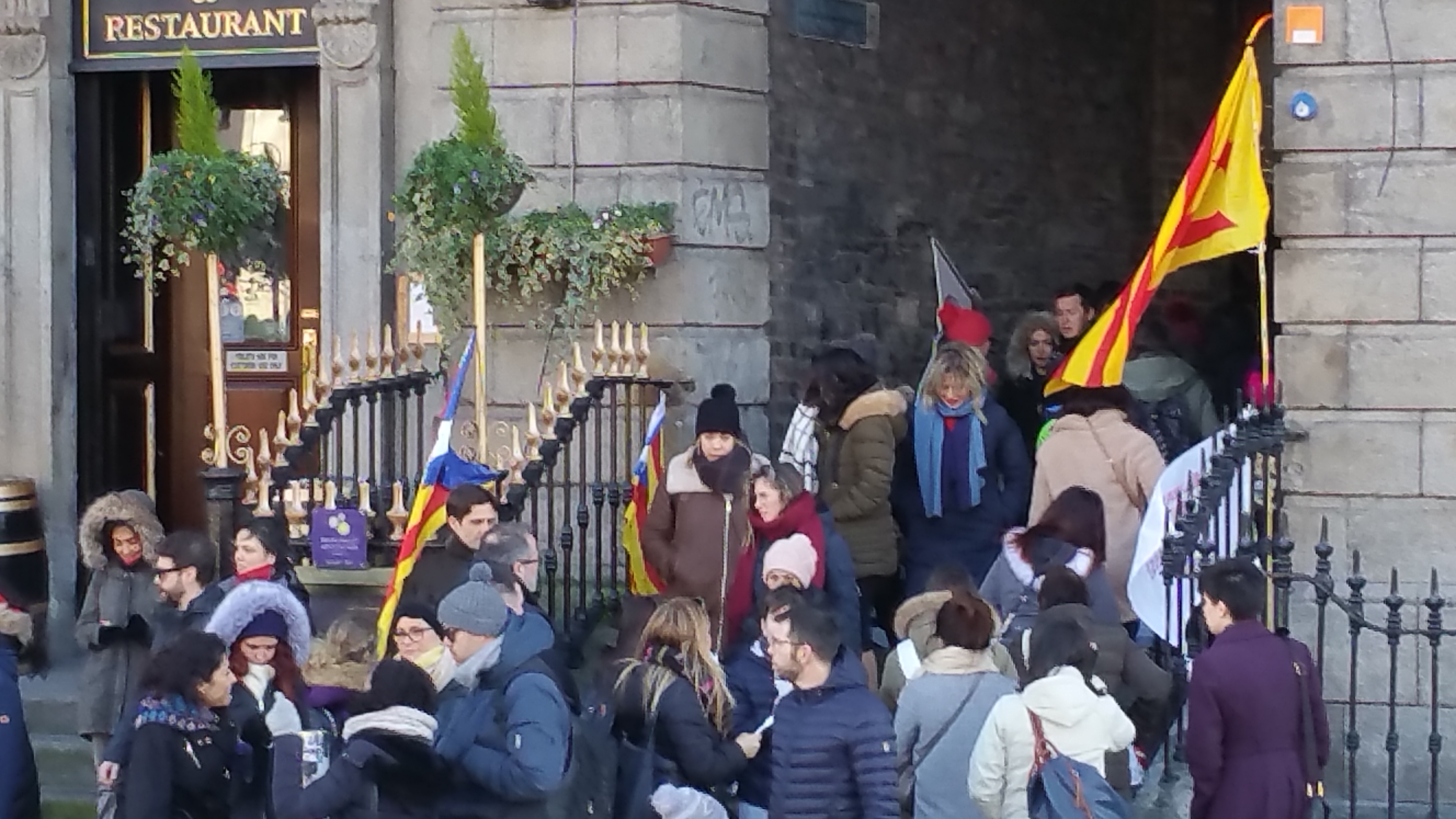
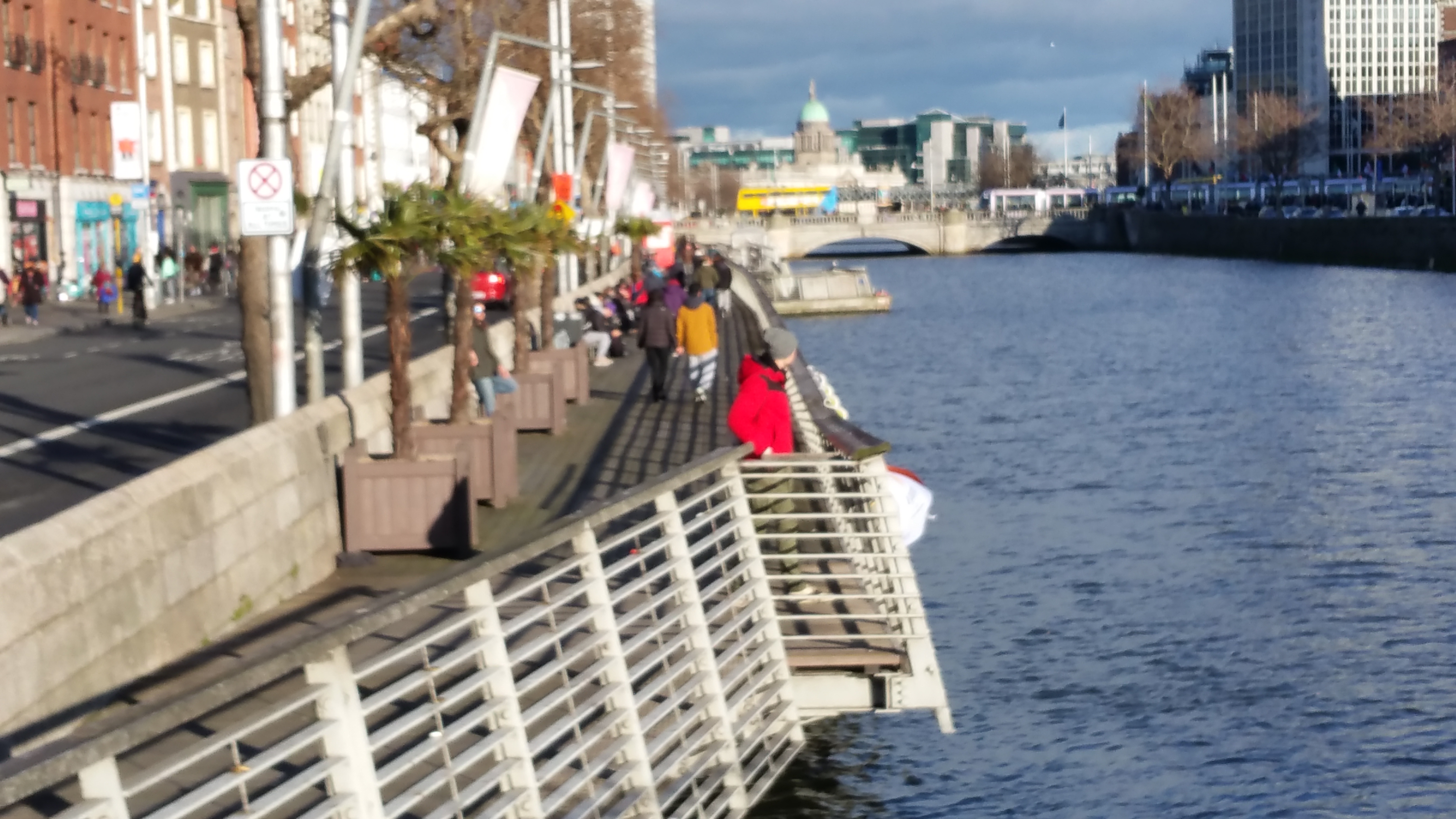
The solidarity protesters met in Merchant’s Arch, a well-known spot for people living in Dublin and well-trodden by tourists, leading from Temple Bar to the Ha’penny Bridge on the other side of the road. This iconic pedestrian bridge crosses the Liffey river from south to north in the heart of Dublin city.

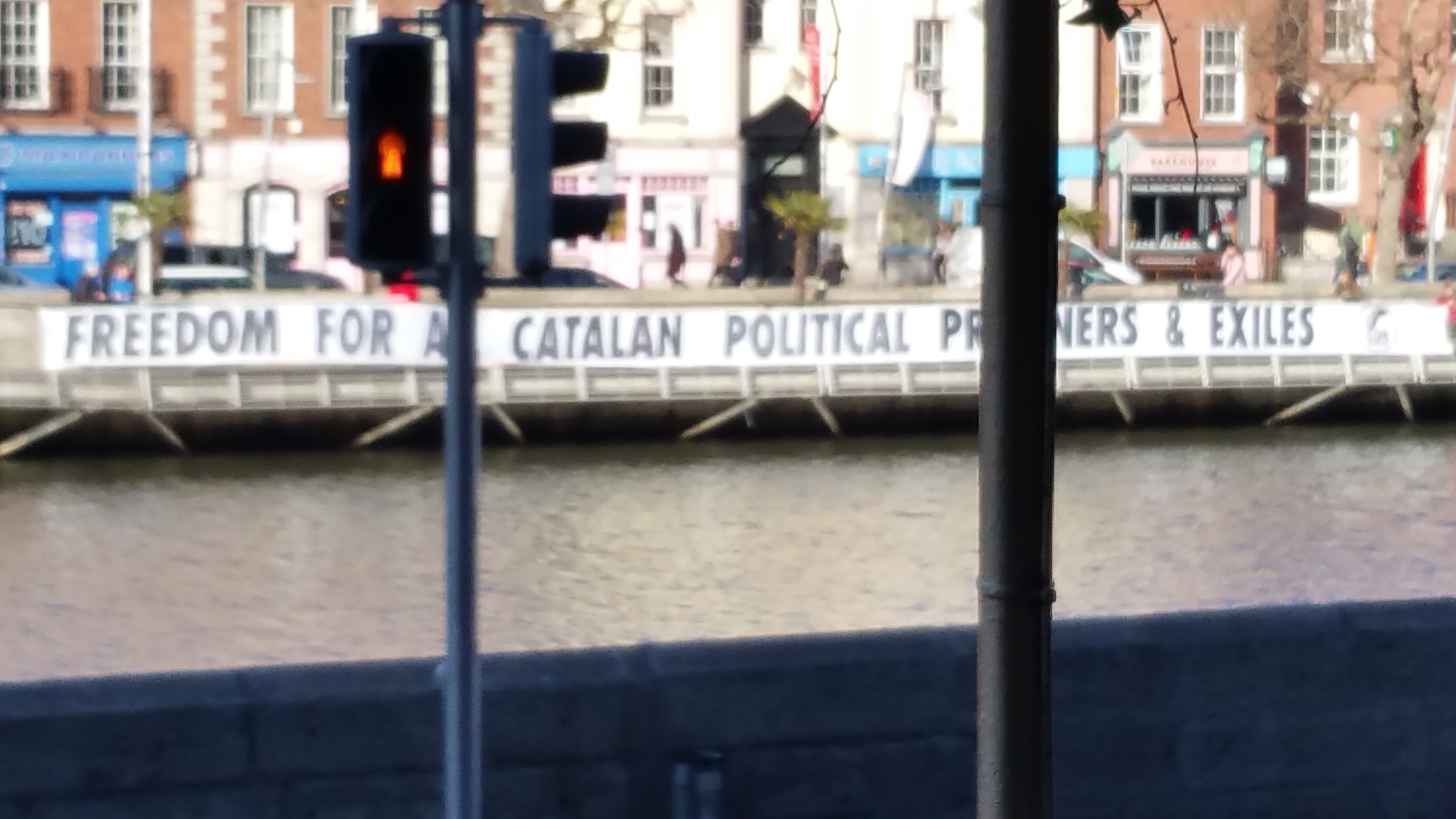
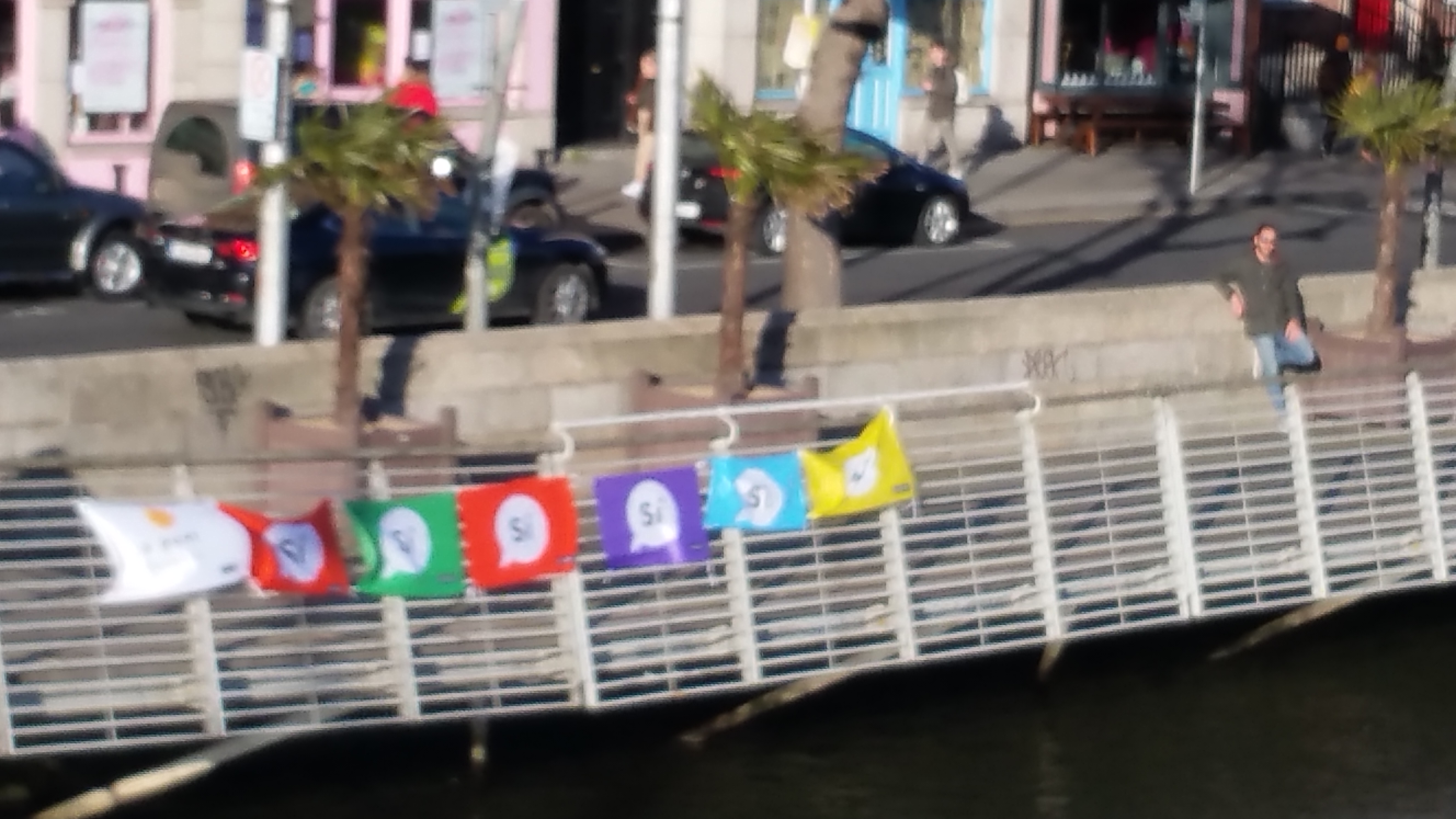
Some displays were set up inside the Arch by CDR, which also draped a huge banner over the railing of the boardwalk on the north side of the river, which read “Freedom for All Catalan Political Prisoners and Exiles!”. Over the same railing WCLC hung large bunting with the word “SÍ” on each flag, a reminder of the verdict for an independent republic in the referendum on 1st October 2017.

Catalan Estelades (pro-independence flags) were attached near the entrance to the Arch as was a small banner calling for freedom for political prisoners. Placards of the Catalan pro-independence activists on trial were also on display.

Supporters handed out informational leaflets and engaged members of the public in discussion before untying the banner and streamers from the riverside, packing up the displays and placards in Merchant’s Arch and heading off for warm food (and possibly drink).

“Si” bunting hung along north riverside
(Photo: Rebel Breeze)

The 12 go on trial in Madrid on 12th February, a day when further solidarity protest actions will take place in various European cities and a General Strike in Catalunya.

CDR Dublin and WCLC will continue to organise in Ireland, according to their spokespersons and welcome involvement from others of whatever ethnic background. “Contrary to what the Spanish State and its supporters claim, we are not anti-Spanish” their spokespersons said. “We are for the right of self-determination and as democrats must be against the repressive behaviour of the Spanish State, so reminiscent of its previous dictator General Franco.”

End.

Merchant’s Arch entrance seen from Ha’penny Bridge steps
(Photo: Rebel Breeze)
Setting up in Merchant’s Arch (Photo: Rebel Breeze)
Banner-minding duty
(Photo: Rebel Breeze)

PUIGDEMONT IN DUBLIN DEBATE: INDEPENDENCE, NATIONALISM AND DEMOCRACY

Diarmuid Breatnach

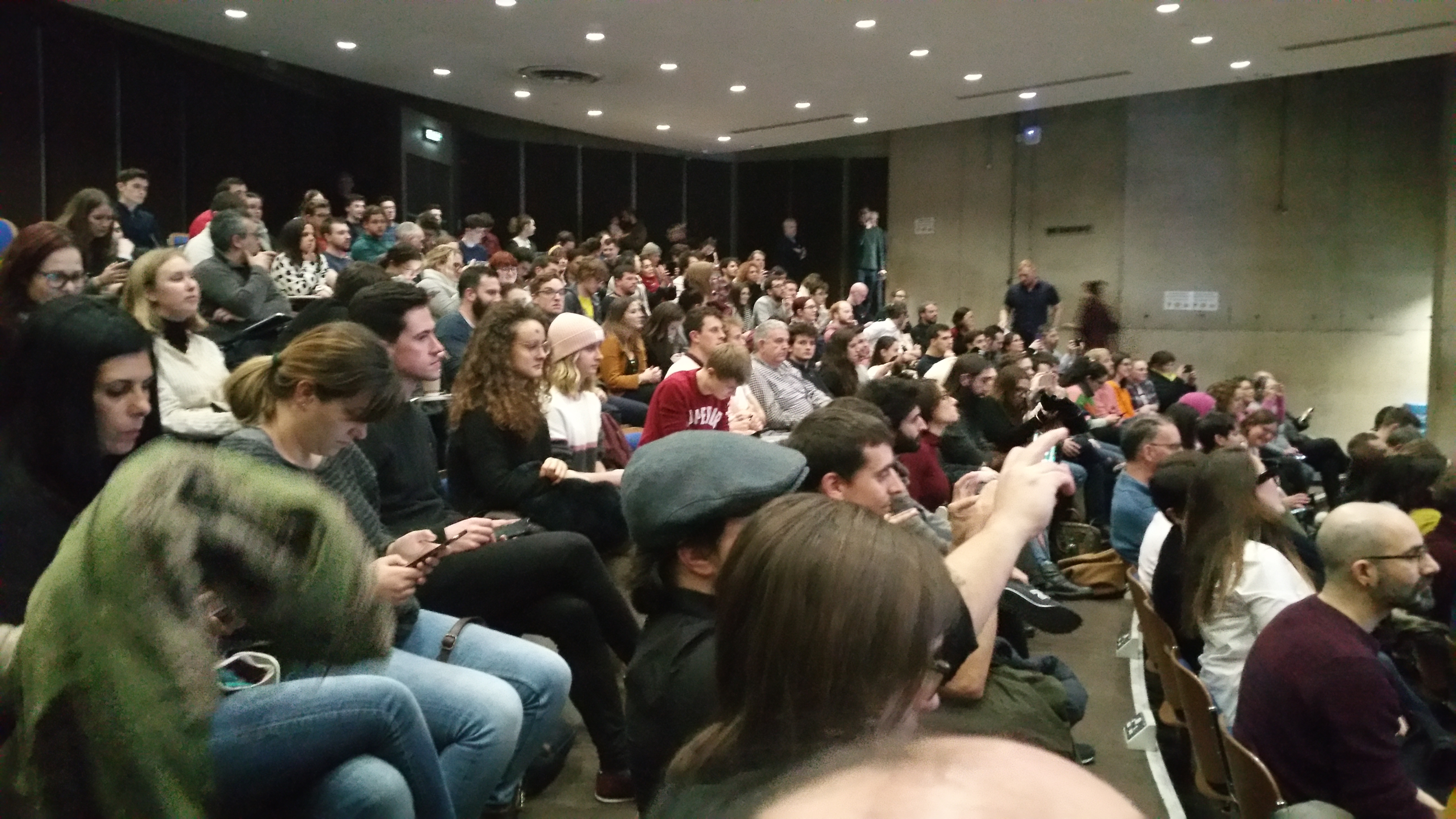
Section of audience queuing to enter the auditorium

A debate on the above theme was organised in Trinity College for the 29th January and advertised at less than a week’s notice, which however gave rise to such interest that the venue had to be changed from the 160-seat Robert Emmett Theatre to the Edmund Burke and people were turned away after the 406 seats had been filled.

          Trinity College is a prestige university in Dublin and in the world generally, though its history in Dublin was for centuries of a religious sectarian and colonialist nature, founded as it was by Elizabeth I to ensure the education of the male children of English colonists in what she considered the ‘true faith’ of Anglicanism (which was and is still the State religion of England and of which the English monarch is Head). Its location too is very central to the city, being just across the Liffey on the south side and in 1916 served as a Headquarters for the British suppression of the Rising.

Section of audience waiting to back left of the auditorium in Trinity College, Dublin (Photo: D.Breatnach)
View of audience to the left and front of the auditorium. 
(Photo: D.Breatnach)
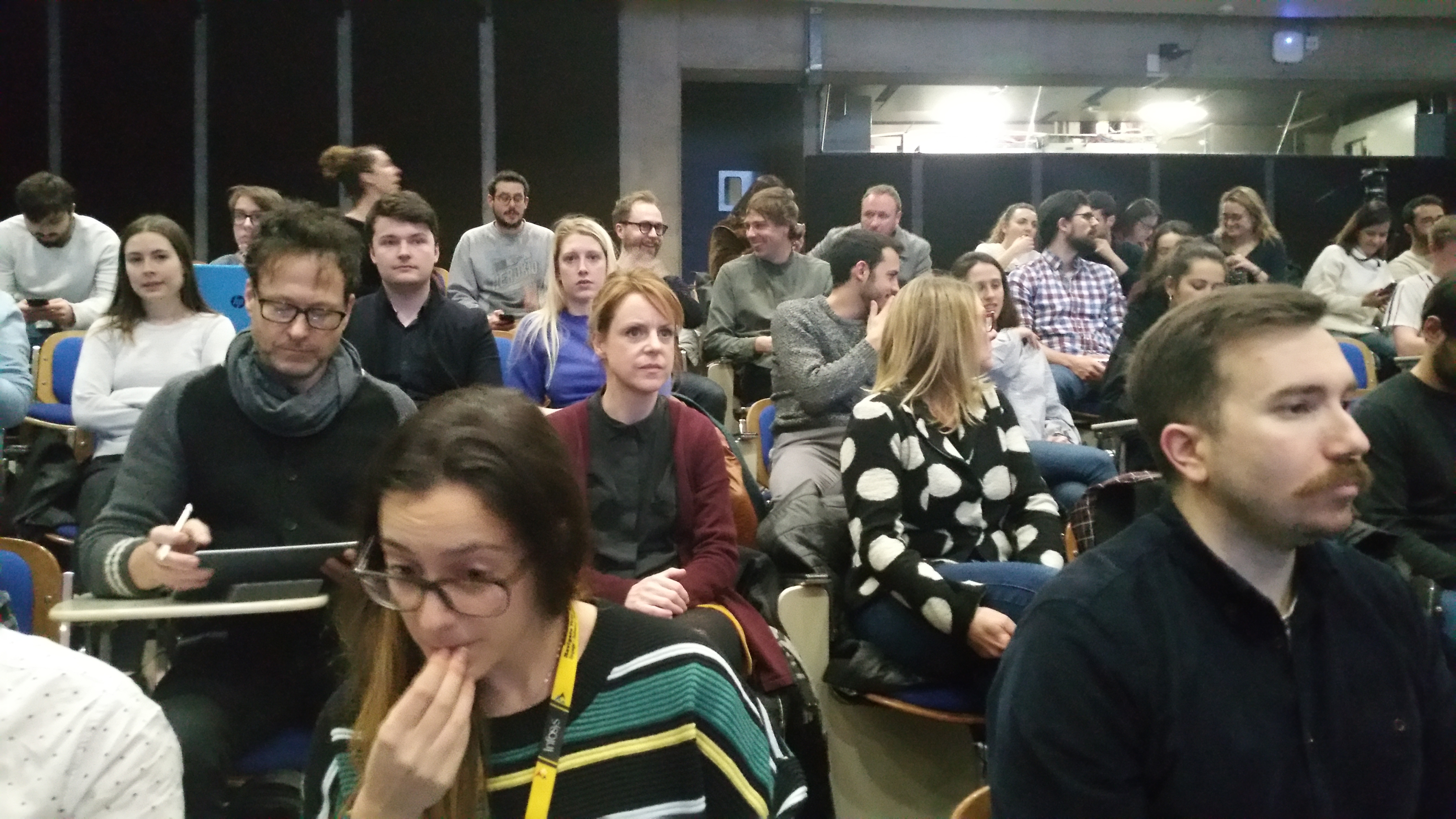
View of audience to the rear of the auditorium. 
(Photo: D.Breatnach)
View of section of audience to the right of the auditorium. 
(Photo: D.Breatnach)


Huge human rights solidarity banner unfurled in the auditorium for photo but not while the debate was in session. 
(Photo: D.Breatnach)

Puigdemont had been invited to take part in a debate on Independence, Nationalism and Democracy by TRISS, the Trinity Research in Social Sciences department, whose MC for the evening was clearly taken aback by the numbers who had pre-booked tickets and most of whom queued for half an hour outside the lecture theatre – and some for even longer waiting to get in.

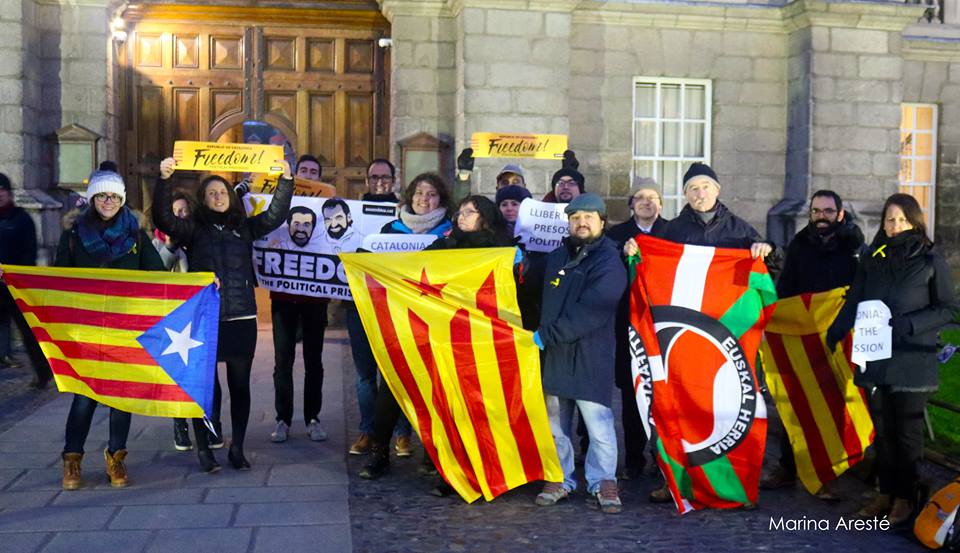
A quick photo opportunity for some supporters of Catalan (and Basque) independence outside the Trinity College’s main gate before entering to hear the debate on “Nationalism, Independence and Democracy”.
(Photo: Marina Dolcet)

Members and supporters of the campaign group With Catalonia/ Leis an Chatalóin, Comite de Defensa de la República and the cultural organisation Casal Catalá de Irlanda were there of course but so were a great many others; mostly Catalans with some Irish and people from other countries sprinkled among them and including some from elsewhere in the Spanish state. The overall feeling was clear when, as soon as Puigdemont was spotted entering the auditorium from a side entrance, along with other participants, he was applauded in what turned out to be a mostly standing ovation.

The MC or chairperson, Gail McElroy, Professor in Political Science and Head of the School of Social Sciences and Philosophy, made a special plea for good behaviour from the audience and also revealed that she had experienced some trepidation in preparation for the event. These expressions led to speculation among sections of the audience that the organisers of the debate had been subjected to a bombardment of hostile electronic communication. People in the Spanish state and sometimes abroad are familiar with this behaviour from right-wing Spanish nationalists, including outright fascists and even state-orchestrated trolls but for someone encountering it for the first time, no doubt it can be intimidating.

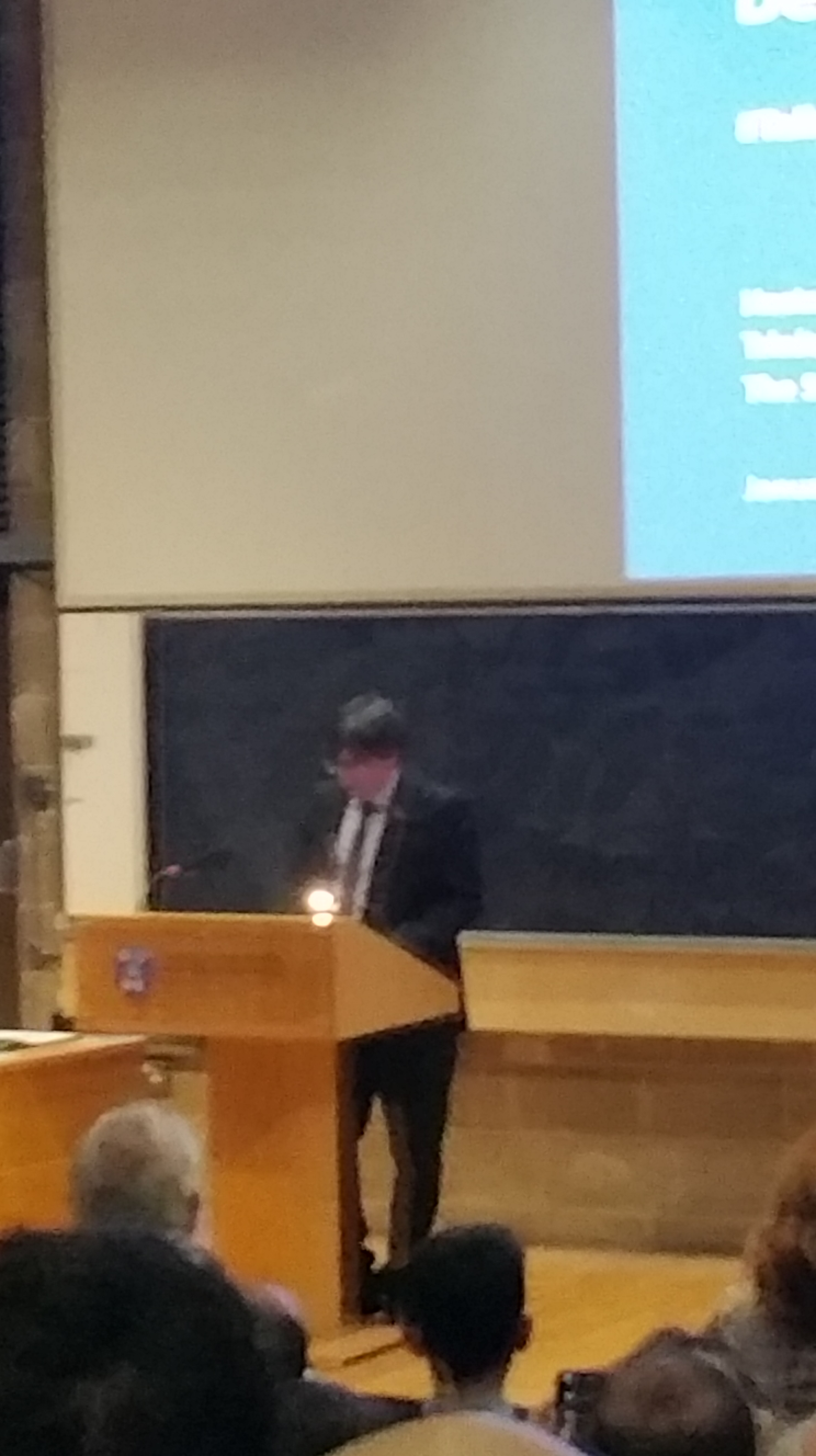
Puigdemont at lectern.

PUIGDEMONT: IT IS NOT ACCEPTABLE IN EUROPE

          Puigdemont began by saying that some of those present might want to know why Catalans do not want to be part of Spain. He could answer that question by recalling the history of Catalonia as a nation, its struggles, its language and its culture. That would be the discourse of 19th-20th Century nationalism, he said. However he preferred to outline it as modern process in the 21st Century, rooted in Europe and in democracy.

The President-in-exile surprised some of his listeners, no doubt, by pointing out that as recently as four years ago, the majority of the Catalan independentist parties had been asking only for greater autonomy from the Spanish State. The history of recent growth towards a majority demand for independence has been as a result of the refusal of the Spanish State to concede any greater autonomy and of the Spanish Court revoking laws passed by the Catalan Government.

But the Spanish response to Catalan demands has always been “no”, to everything”, said Puigdemont. “No” to dialogue. “No” to negotiation. “No” to reaching a democratic solution. Given the refusal, and obeying the mandate given to us by the majority of Catalan citizens, the Government of Catalonia, which it was my honour to preside, called a referendum on selfdetermination on 1 October 2017, with the legal backing of the Parliament of Catalonia. We did so while observing the basic principles of universal rights.”

And the world had seen the violence of the Spanish police inflicted upon people wishing peacefully to vote.

The aim was not just to confiscate ballot boxes and ballot slips”, Puigdemont maintained but instead “to make people give up their right to vote. But this ignominious act backfired on the politicians responsible for it. Over 2.4 million citizens overcame their fear and went out to vote. We do not know how many tried to do so unsuccessfully, but we do know the polling stations that were violently closed represented a further 770,000 voters.

Puigdemont continued: Today, democracy in Spain is at risk because basic rights have been de facto” suspended, and this represents a major threat to all Catalan and Spanish citizens, as well as to the European Union. Today, an EU member state cannot guarantee the judicial rights of its citizens, given that in recent months Spain has contravened international treaties ratified by the Spanish state itself, such as the International Covenant on Civil and Political Rights, the European Convention for the Protection of Human Rights and Fundamental Freedoms.

Referring to the Spanish State taking direct control of the Catalan government administration and preparing criminal charges against grass-roots organisation leaders and elected representatives, taking some as prisoners while others went into exile, Puigdemont said that this was not an internal Spanish problem but instead a Europan one. Seven hundred others, mostly town mayors, are under investigation too. Those independence activists, who have done nothing wrong and even according to Spanish law are innocent until proven guilty, have been kept in prison for over a year.

Concluding, Puigdemont said: “We will not falter. I have often said that what threatens democracy is not disagreement; indeed, democracy needs disagreements. What really threatens it is a lack of tools to solve disagreements democratically. We Catalans hope and trust that the political conflict over our selfdetermination can be resolved peacefully, without war, without violence, without winners and losers, without victims and thugs. We reject all the violence used in the last century in any part of the planet to resolve political conflict.

As Pau Casals, a well-known Catalan, reminded us in a memorable speech to the United Nations Assembly in 1971, Catalans in the eleventh century met ‘to talk about peace, because at that time, the Catalans were already against war’. Ten centuries later, we maintain these same values of peace and harmony.”

THE OTHER SPEAKERS IN THE DEBATE

          Located as the debate was in the capital city of Ireland and in the centenary of the founding of the first democratically-elected Irish Parliament, an Chéad Dáil, it was most noticeable that neither Puigdemont nor the other speakers referred to the experience of Ireland’s struggle for independence.

Dr Marvin Suesse – Assistant Professor in Economics, Trinity College Dublin spoke on The Economic Costs of Sovereignty”, from his research on the political economy of separatism and nationalism. He said that while the benefits of independence in terms of feelings of pride, promotion of culture etc. were difficult to measure, the economic benefits were not. Suesse went on to give examples which indicated that the costs of independence were greater than the benefits.

Dr Michelle D’Arcy – Assistant Professor in Political Science, Trinity College Dublin. spoke on “Secession and the Fiscal Contract: Reflections from the Post-Colonial World.”

D’Arcy teaches African politics and the political economy of development to undergraduate and postgraduate students and her research broadly focuses on understanding how politics and institutions enable and constrain human development and more specifically on democratization in Africa and state-building in Europe historically. Though she made some interesting points and believes that independence movements engage in a “fiscal contract”, it was difficult to see where she stood on the question under discussion.

Dr, Coman’s screen display
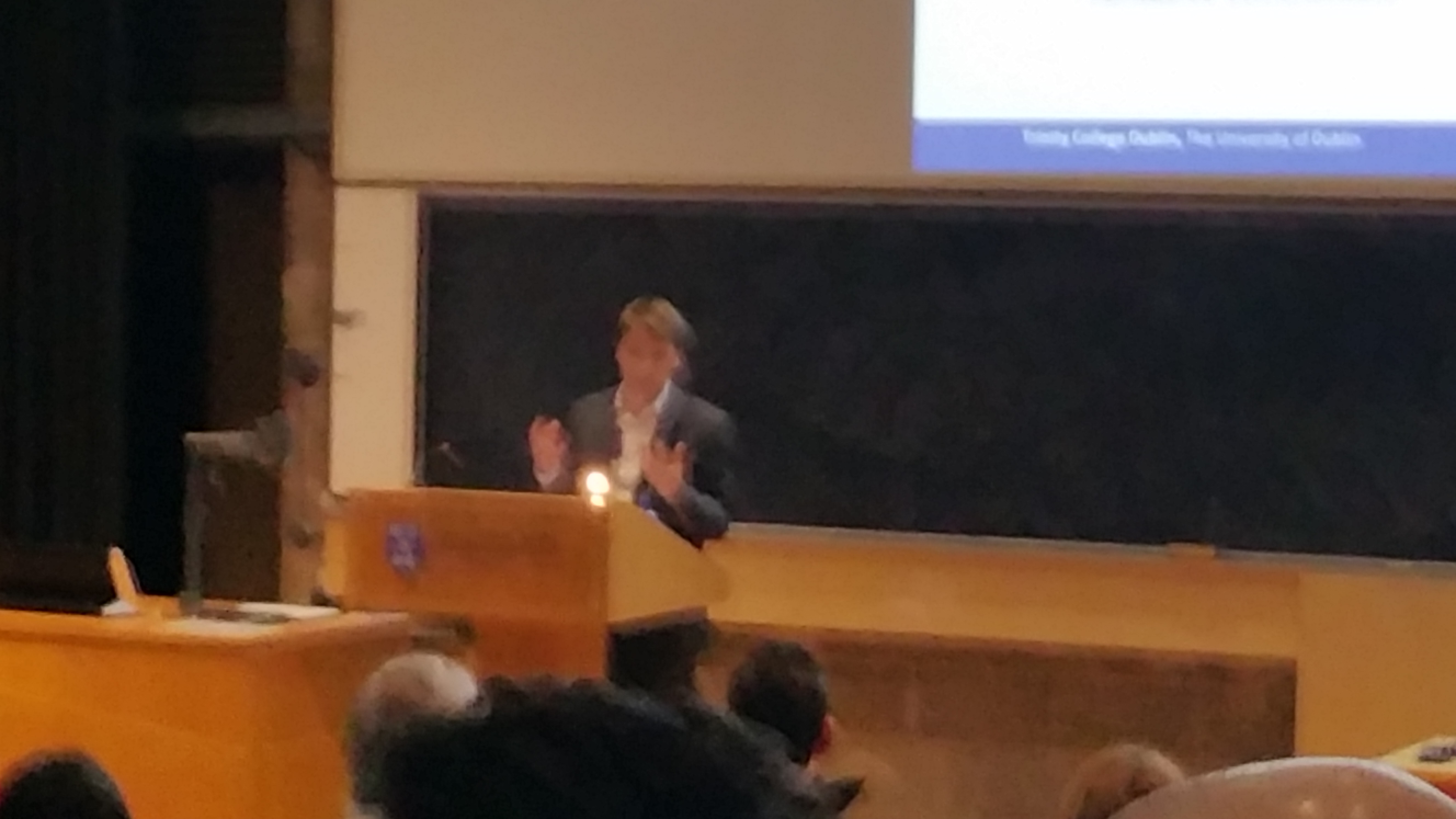
Dr. Coman at lectern.

Dr Emanuel Coman – Assistant Professor in Political Science, Trinity College Dublin spoke on “When does the Right to Self-Determination Actually Apply?”

Emanuel Coman is Assistant Professor in Political Science at Trinity College Dublin, teaching courses in comparative institutions and American Politics. His research is primarily in the fields of party politics and elections, with empirics driven primarily from Eastern Europe.

Coman, from Rumania as he told his audience, analysed the European nations that were successful in gaining independence after WWI. Most had been under the rule of the defeated belligerents. His thesis seemed to be that a nation’s bid for independence required the support of the big powers exerting influence in the area.

ONE MUST ALSO WEIGH THE COST OF NOT DECLARING INDEPENDENCE!”

          Commenting on the presentations of the other speakers and responding to questions after his presentation, Puigdemont was more lively than when reading his speech and at times showed some fire, particularly when he responded that as well as weighing the costs of independence, one must consider the costs of not becoming independent, which brought some applause from sections of the audience. Aside from anything else, he said, it is a question of dignity: the Catalans had the right to make their own decisions, whether they be correct ones or mistaken.

A much greater applause and cheers broke out when Puigdemont denied that the Spanish State could be described as “a democracy” and stated that this was not opinion but fact, given that the Monarch and Head of State (father of the current monarch) had been personally appointed as his successor by the fascist coupist General Franco, whose mausoleum is a national monument of the State.

Responding to a suggestion that the Catalan pro-independence movement might benefit from employing the tactics of the “Yellow Vests” of Paris, Puigdemont was most emphatic that his movement was peaceful and would never under any circumstances resort to violence.

One member of the audience criticised the panel (other than Puigdemont) for not addressing the actual issues in Catalan independence and the Spanish State’s opposition.

Asked by a member of the audience to describe his feelings of exile, Puigdemont replied that he could not indulge those feelings since he would be unable to continue the struggle if he did so. He revealed that his own grandfather, in a concentration camp in France after the fall of Barcelona to Franco’s military-fascist forces, had written to his family so that they were aware of the feelings of exile even though they never saw him again. His voice seemed to gain a heightened emotion when he remarked that when he compared his situation to that of refugees, like those from Syria, launching themselves on the hazardous journey to European shores, survivors arriving often to be badly treated, he felt he had little of which to complain.

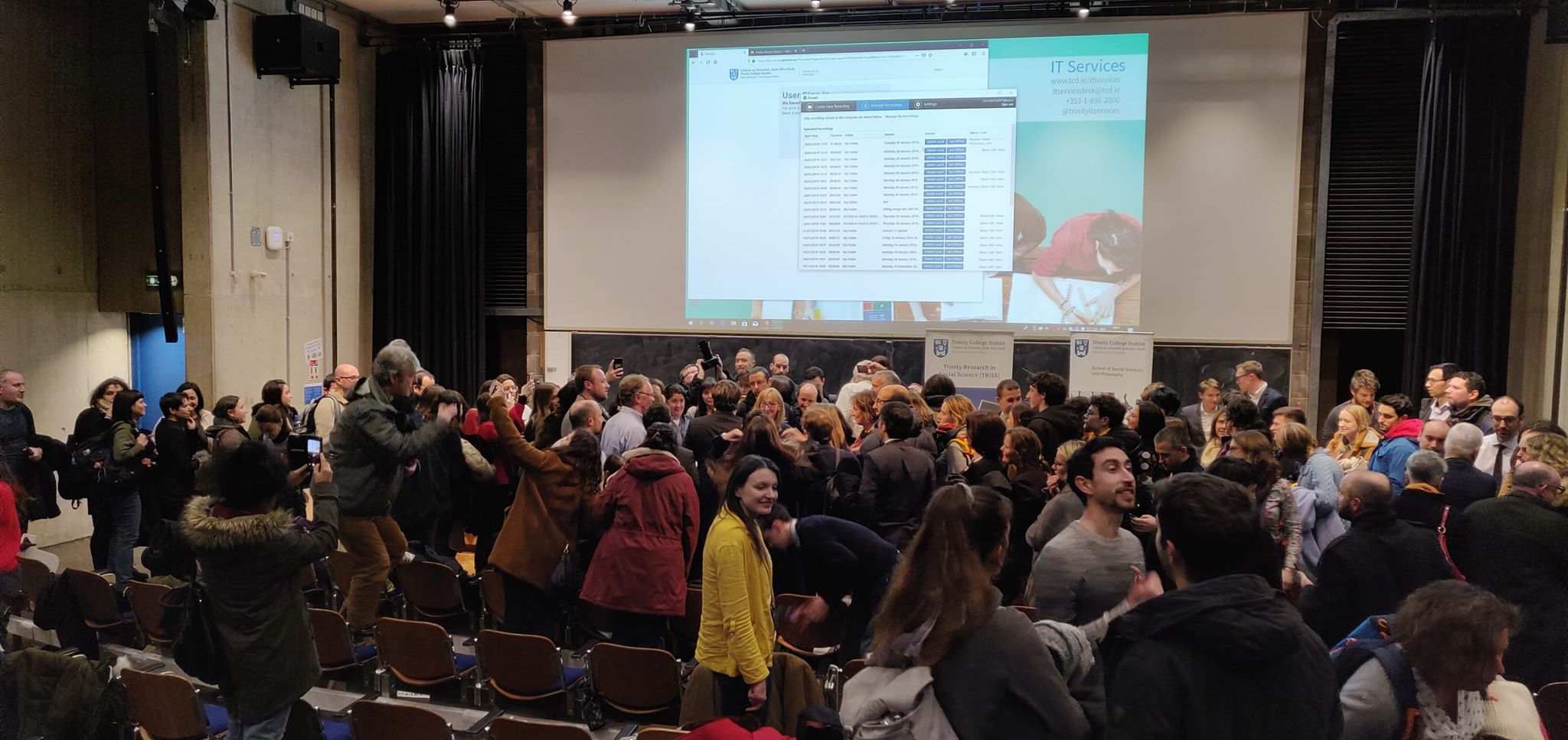
Puigdemont surrounded by well-wishers and the curious after the debate while others are in excited conversation.

AUDIENCE REACTION

          The audience gave Puigdemont and, one supposes, the other speakers and TRISS for having organised the debate, sustained applause and cheers, during which one could hear some pro-independence slogans in Catalan. Afterwards, many remained in the auditorium to speak to Puigdemont or to chat amongst themselves in a general buzz of excitement.

Views expressed by a number of listeners afterwards on the content of the debate were in general positive though these varied through a continuum from “excellent” to “all right but somewhat disappointing”. All feedback received agreed that on two points Puigdemont had been excellent: on the question of calculating the cost of NOT seceding from the Spanish state and also on the characterisation of the Spanish State as not being a democracy, as one that had failed to break properly with its Franco-fascist past.  Few gave positive feedback on the other debaters.

Crowds delayed leaving for around half an hour, gathering talking among themselves or queuing up to shake Puigdemont’s hand, talk to him etc. and Casals Catala presented him with some books on Irish history.

COMMENT:

          Puigdemont comes across as quite genuine in his convictions and as an able debater, even in a language which cannot be his first or second. His vision of Europe does not perhaps coincide with the views of some others and one may doubt the practicality of his commitment to non-violence. One may also question whether anyone has the right to commit the movement to peaceful resistance alone, even if it were to be attacked violently.

I did not hear him speak any words in Irish but the written text of Puigdemont’s speech did contain some. Although it was good to see some Irish there, for the few words he was going to speak in the language, Puigdemont (or his advisors) might have taken the trouble to formulate them correctly. Addressing “mná agus uasal” although addressing women first, suggests that the audience was an almost all-female one and who were not “uasal” (noble, important), but was surely unintended. And “dea-trathnóna leat (‘to you’, singular) go léir” (to all of you) is a conflation of singular and plural in the same address; likewise with the “go raibh maith agat” which thanks one person rather than the audience which was the intention and “go mór” which if not incorrect is clumsy and straight from Google Translate for “thanks a lot”.

Standing outside the auditorium with a placard announcing the Catalan solidarity demonstration on Saturday 9th April, at one point I noticed Puigdemont standing some metres away with some others. As he caught my eye, he stepped towards me, hand outstretched.

I gripped his hand and smiling, said: “Fáilte go Baile Átha Cliath!”

“Thank you,” he replied, smiling also and stepped back.

Whatever else he may be, I suspect he is what we in Dublin would call (with a meaning remote from any kind of subservience) “A gentleman.”

End.

BIOGRAPHICAL NOTES ON PUIGDEMONT:

          Born in Amer, a village in the province of Girona and fifty-seven years of age last December, Carles Puigedemont is a journalist by trade and ex-Mayor of Girona, a major Catalonian city of over 100,000, just under 100 kilometres (62 miles) north-east of Barcelona. In 2006, after a track record of activism in Catalan culture and nationalist activism, he was adopted as a political candidate by the CIU (Convergence and Union) political party and later to represent the reformation of that party in the Junts per Si (Together for Yes) coalition, composed of mostly nationalist capitalist elements. He has been successful in every election and currently heads the uneasy Junts per Cat (Together for Catalonia) coalition. The current Govern is made up of a coalition between JuntsXCat and ERC (Republican Left of Catalonia), with the other pro-independence party, CUP (Popular Unity Candidacy) in opposition, though not voting with the Spanish-unionist opposition.

In what seems an action contradictory to his political position, in January 2019 Puigdemont filed a constitutional application for amparo (remedy, to put right) directed against the President of the Catalan Parliament, Roger Torrent and the Board of the Chamber, to the Spanish Constitutional Court. The application argues Puigdemont had been denied the use of his political rights as Torrent did not allow him to delegate his vote from Belgium after Puigdemont’s criminal indictment and suspension of his parliamentary position by Supreme Court judge Pablo Llarena.

Despite constant Spanish-unionist claims from both Right and Left, the Catalan pro-independence movement has shown itself more tolerant of migrants and diversity than can be said in general of much of the rest of the Spanish State; one of the laws of the Govern sought to give migrants equal access to Catalan national health care but was twice squashed by the Spanish Supreme Court. Puigdemont is himself married to Romanian journalist (Marcela Topor in 2000) and they have two daughters, Magali and Maria, the family home in Girona. His children are multi-lingual and Puigdemont himself speaks Catalan and Castillian (Spanish), as do most Catalans but also English, French and Romanian.

LINKS AND FURTHER INFORMATION

Text of Puigdemont’s address in the debate in full attached at the end of the brief report in El Nacional: https://www.elnacional.cat/en/news/puigdemont-dublin-bertie-ahern-trinity-college-ireland_349173_102.html

Pre-event publicity from Trinity College: https://www.tcd.ie/ssp/events/lectures/2019-01-independence/

With Catalonia/ Leis an Chatalóin: https://www.facebook.com/WithCataloniaIreland/

CDR Dublin: https://www.facebook.com/CDRDublin/

Casal Catalá de Irlanda: https://www.facebook.com/casalcatalairlanda/

CATALAN PRESIDENT-IN-EXILE MEETS IRISH PARLIAMENTARIANS IN DUBLIN

Rebel Breeze Reporter

Puigdemont. President-in-exile of Catalonia, visited Dublin to take part in a debate in Trinity College on Tuesday 29th January and visited the Dáil and a number of Irish politicians on the same day.

Puigdemont and Puignól at the Barcelona-ireland friendship tree in Cow’s Lane, bracketed by activists of Casals Catalá de Irlanda, Catalan cultural organisation in Ireland on each side.
(Photo source: ACN, El Nacional).

          Carles Puigdemont was elected President of the pro-independence Catalan Government, declared an independent Catalan Republic but immediately suspended it; then had his Presidency abolished by the Spanish State, which took direct control of Catalonia for a period. He went into exile with a number of other Catalan Government ministers in order to avoid arrest; the Spanish State issued a European Arrest Warrant for him which was party unsuccessful and then withdrew it; however, he remains in exile in Brussels. Most pro-independence Catalans and even others consider him the legitimate President of Catalonia, though another had to be elected to fill his place; Quim Torra, who is currently the elected President, says that he considers himself only “the interim President”.

Carles Puigdemont was elected President of the Govern, the Catalan Government, in January 2016, in an agreement between pro-independence parties. On 27th October 2017, with a majority of October 1st Referendum votes salvaged and counted — after the Spanish police attacks on the voters – in favour of independence, he declared a Catalan Republic on behalf of the Govern. However, he almost immediately suspended it, to the dismay of many Catalans, including supporters of his own party. The Spanish State, the Constitution of which forbids any secession without the majority vote of the Parliament of the whole territory, was not mollified by the suspension and, as the Spanish State prepared criminal charges against him and Catalan Ministers, Puigdemont went into exile (as did another five Catalan ministers).

ARRESTS AND EXILE

          The Spanish State arrested a number of others, including seven ministers and two leaders of grass-roots movements and charged them with sedition, rebellion and misuse of public funds, carrying 30, 15 and six years in prison respectively and European Arrest Warrants were issued for Puigdemont and other ministers. On 25th March 2018, Puigdemont was detained on that warrant while passing through Germany on his way back to Brussels from a speaking engagement in Finland. A German judge decided the issue of the “rebellion” charge first, declaring that any such charge had to provide evidence of violence, of which there had been none by the detainee (there had been plenty of violence but all by the Spanish police) nor under his direction.

The German court decided in July that Puigdemont could be extradited to the Spanish State to be tried for misuse of public funds but the Spanish State, not wishing to have to try him and the other ministers only on those while the other ministers were being tried on the more serious charges, withdrew the arrest warrants. These charges can of course be renewed at any time and another warrant issued.

Since his return to Brussels after release by the German court, this Dublin visit has been Puigdemont’s first venture outside Belgium.

Accompanied by Jordi Puigneró, the current Minister of Digital Policies and administration of Catalonia, also visiting Ireland, Puigdemont paid a brief visit to an olive tree donated by Barcelona to Dublin in acknowledgement of the Irish who had fought for Catalonia in the War of the Spanish Succession. After a meeting with the Mayor of Dublin for the year, Niall Ring, Carles Puigdemont attended the Dáil (the Irish Parliament) for a private meeting with Bertie Ahearn, a Fianna Fáil party parliamentarian and ex-Taoiseach (Prime Minister).

Puignól attaches a yellow ribbon to the Barcelona-Ireland olive tree in solidarity with the Catalan political prisoners.
(Photo source: Casals Catalá de Irlanda)

MEETING IN THE DÁIL

          Afterwards Puigdemont addressed a meeting room of around 100, organised by the Dáil organisation Oireachtas Friends of Catalonia, with its chairperson Pat Gavan, Sinn Féin Senator, presiding.  Jordi Puigneró sat beside Puigdemont as did Lynn Boylan, Sinn Féin MEP.

Puigdemont in the packed Dáil meeting room, Leinster House, Dublin.  Others L-R: Minister Jordi Puignól, MEP Lynn Boylan, Sen. Paul Gavan.
(Photo source: Internet)

Fifty-seven years of age last December, Carles Puigedemont is a journalist by trade and ex-Mayor of Girona, a major Catalonian city of over 100,000, just under 100 kilometres (62 miles) north-east of Barcelona. In 2006, after a track record of activism in Catalan culture and nationalist activism, he was adopted as a political candidate by the CIU (Convergence and Union) political party and later to represent the reformation of that party in the Junts per Si (Together for Yes) coalition, composed of mostly nationalist capitalist elements. He has been successful in every election and currently heads the uneasy coalition platform Junts per Cat (Together for Catalonia). The current Govern is made up of a coalition between JuntsXCat and ERC (Republican Left of Catalonia), with the other pro-independence party, CUP (Popular Unity Candidacy) in opposition, though not voting with the Spanish-unionist opposition.

In what seems an action contradictory to his political position, in January 2019 Puigdemont filed a constitutional application for amparo (remedy, to put right) directed against the President of the Catalan Parliament, Roger Torrent and the Board of the Chamber, to the Spanish Constitutional Court. The application argues Puigdemont had been denied the use of his political rights as Torrent did not allow him to delegate his vote from Belgium after Puigdemont’s criminal indictment and suspension of his parliamentary position by Supreme Court judge Pablo Llarena.

Despite constant Spanish-unionist claims from both Right and Left, the Catalan pro-independence movement has shown itself more tolerant of migrants and diversity than can be said in general of much of the rest of the Spanish State and one of the laws of the Govern, twice squashed by the Spanish Supreme Court, sought to give migrants equal access to Catalan national health care. Puigdemont is himself married to Romanian journalist (Marcela Topor in 2000) and they have two daughters, Magali and Maria, the family home in Girona. His children are multi-lingual and Puigdemont himself speaks Catalan and Castillian (Spanish), as do most Catalans but also English, French and Romanian.

Addressing the full room, after thanking Gavin for presiding over the meeting and those assembled for their presence, Puigdemont presented his case that Catalonia had the right to secede, that holding a referendum was a democratic activity per excellance, that the arrest and trial of politicians for having promoted that referendum was undemocratic and that such activity was not within keeping of the EU ethos.

Replying to questions on what he would ask Irish politicians to do in order to help Catalonia’s struggle and on how he saw his nation’s struggle combining with other nations within the Spanish state, for example the Basque Country, Puigdemont said he did not wish to tell other countries what do and that the struggle of Catalonia stood on its own. He declined to relate the content of his discussions with Aherne, which he said were confidential. One member of the audience reminded Puigdemont that 100 years ago, the first democratically-elected Irish national parliament had met and that many of its delegates were also in jail or in exile.

To a question about alleged flight of business from Catalonia, Puigdemont said that one had to read alternate media to some of the dominant ones and make up one’s own mind, critically examining all sources – including himself! But he did say that although some addresses of head offices were transferred to the Spanish State in what he said was not legally right, not one factory, working office or member of staff had been transferred out of Catalonia. Also, the struggle with the Spanish State and some Spanish attempts at boycott had obliged Catalans to look outside the Spanish state for their markets and business links whereas previously, imports from and exports to the Spanish state had accounted for 90% and 80% respectively. Jordi Puigneró commented that he was in Ireland in part because of that, in particular to follow up on the Irish state’s success in attracting and developing information technology business.

After the Dáil meeting, Puigdemont and Puignól pose for photos with Catalan solidarity supporters.
(Photo source: Casals Catalá de Irelanda)

Outside in the icy cold after the fairly short meeting, Puigdemont lined up for a few photos surrounded by Catalan and other well-wishers and departed to the singing by them of Catalan’s national anthem, Els Segadors (The Reapers). He had a debate at which to speak in a few hours and most of the Catalans in attendance would be there too.


End.

OTHER MEDIA REPORTS:

https://www.independent.ie/irish-news/politics/well-continue-fighting-for-our-freedom-it-doesnt-matter-if-were-in-jail-excatalan-president-tells-tds-37763055.html

https://www.irishtimes.com/news/world/europe/carles-puigdemont-i-may-participate-in-the-european-elections-1.3776372


ABUSE OF POWER AND VIOLATION OF CIVIL RIGHTS IN IRELAND ARE NOT THINGS OF THE PAST

Diarmuid Breatnach

The violation of the civil rights of Osgur Breatnach (then a leading member of the IRSP) exposed in the program in the Finné series on TG4 (Irish language TV channel) shown recently and repeated a week later was set in the 1970s but the injustice did not end there.

Osgur Breatnach, photographed recently and still wanting his beating and framing investigated
(Source image: Dara Mac Dónaill, Irish Times).

          Even after a High Court admission that he and McNally had been subjected to “oppression” and his conviction thereby overturned 17 months after his jailing, the court still maintained he had beaten himself up – a fiction it maintains to this day.

Of course to say otherwise would have been to admit the Gardaí special unit that came to be known as “The Heavy Gang” were vicious thugs who fabricated “confessions”. And that the judiciary of the Special Criminal Court had, despite the medical evidence and signs of beating on all, including the three who had “confessed” and the repudiation of those statements in court, colluded with the beatings, accepted the statements as true confessions and convicted three of the men for up to 12 years’ jail. And to admit that the Court of Appeal and High Court had been complicit in accepting as a “finding of fact” which could not be overturned that they had beaten one another up (and done it to himself, in the case of Breatnach).

All of which meant that the Heavy Gang got more encouragement for their ‘work’ so that some of them were able to turn up on the scene of other scandals, including that of the false confessions of Joanna Hayes and her family (about which Gardaí nothing has been done either).

Even today, not one of those Gardaí has been even charged and the complicit judiciary and State Prosecution carried on in their jobs and in some cases rose higher.

The injustice did not stop there, for when Nicky Kelly, who had been on the run, gave himself up, even though exactly the same evidence had been used to convict him, he was told he had run over the timeframe in which he could appeal and it took four years of campaigning to get him out too. And then only for “humanitarian reasons,” so the “guilty of armed robbery” verdict still stood for his reputation, potential relationships, job prospects etc.

Another eight years later he received a Presidential “Pardon” from Uachtarán Mary Robinson.

Then the State fought the financial compensation case, taking it to the extreme of bringing Gay Byrne to court over an interview he had given Osgur Breatnach. At this point some wiser heads decided to limit the damage, pay up but with the condition that the three did not go after the police or proceed with any case about the beatings.

A facet of British and Irish civil law of which many are probably unaware is this: If the respondent (i.e the one against which you are taking the case) offers you a sum and you refuse it, and you later win the case but are awarded less than what you were offered earlier, you have to pay all the costs of the defence! You can actually end up owing money!

But back to ongoing injustice. Since not a single one of the Heavy Gang was ever even charged or disciplined over this and other similar behaviour and some were even promoted; since not a single member of the legal profession or judiciary was even reprimanded for their part in it; no warning about where the boundaries are has been given to the Gardaí much less to the judiciary. Which means that it can all easily happen again.

The defendants in the Jobstown case were not beaten up to force them to ‘confess’ but when we hear Garda after Garda, including a senior one, affirm under oath in court that one of the defendants said something which all the video evidence proves he did not, at what conclusion can we arrive other than that they were all lying? But not one of them has been charged or even disciplined either.

Conversely, the State has no problem with dragging anti-fascists to court recently and this to answer charges such as “violent disorder” arising out alleged actions preventing the European fascist organisation Pegida from launching a branch in Dublin.

12-hour protest at Department of Justice in January 2004 –Cormac Breatnach, musician and brother of heavy gang victim Osgur with other musicians including of the Ó Snodaigh family and TD Aongus, their brother.
(Photo source: Indymedia — see Links)

ARE THINGS TODAY IMPROVED?

          The Heavy Gang is not operating as such today (or at least not yet) but in some respects things are actually worse than they were back in the 1970s ad ’80s. There was one Special Criminal Court then – now there are two! The Public Order Act was brought into force in 1994 to give Gardaí great powers to repress public protests and the scheduled offence of Violent Disorder was included in that Act: three unconnected individuals at the scene of a “disorder” can be convicted under the latter provision and sentenced up to ten years in jail or fined an unlimited amount (or both)!

The non-jury Special Criminal Court on its last day in Green Street before it moved to its new location in Parkgate Street (Photo source: Internet)

Courts are imposing bail conditions preventing activists from continuing to be politically active, i.e from attending public meetings, rallies, demonstrations, pickets etc – for up to the two years it can take the case to come to trial.

And just as in the ‘bad old days’, the unsupported opinion of a Garda of Superintendent rank or over is sufficient to convict Republicans of “belonging to an illegal organisation” and visitors to the public gallery of the SCC have to give their names and addresses to the Gardaí before being admitted.

Special Branch officers still routinely and openly watch Republicans carrying out their peaceful political work and demand their names and addresses on pickets. But now not only is surveillance carried out on people’s electronic communication equipment, communication is also being blocked at times by special equipment of the Gardaí.

Sadly, as the struggle over social and political issues becomes more acute in this state, we will see more repression, as the State tries to force the whole of civil society into compliance, especially by concentrating that repression on society’s more politicised and active sectors. Already in Dublin we have seen masked bailiffs and masked police carrying out an eviction of a small token occupation group in an empty house and, a week later, armed police turning up to a dispute between a couple and their landlord.

Only by admission of wrongdoing followed by actions overturning the current impunity of the Gardaí and the judiciary can a worsening of the situation perhaps be averted. But there is no sign of that happening.

End.


LINKS FOR REFERENCE/ FURTHER INFORMATION

https://www.irishtimes.com/news/crime-and-law/wronged-man-still-seeking-answers-40-years-after-sallins-train-robbery-1.3673264

https://www.indymedia.ie/article/63140?userlanguage=ga&save_prefs=true

https://www.independent.ie/opinion/analysis/from-heavy-gang-to-bailey-case-how-gardai-havent-learnt-lessons-30201431.html


AGAINST INTERNMENT AND SPECIAL COURTS!

Clive Sulish


Tens of protesters against undemocratic state repression through internment and special courts gathered at the Wolfe Tone Monument in Dublin’s Stephen Green on Saturday before proceeding through the park to the Irish state’s Department of Justice building at 94 Stephen’s Green.


The sun shone weakly through at times on bare branches of deciduous trees and their autumn leaves, along with the dark green of the evergreen foliage of holly tree and invasive bay cherry.

Wolfe Tone Monument by Edward Delaney (d.2009) at an entrance to Stephen’s Green (image sourced: Internet)

The Wolfe Tone Monument stands in the approximate location of the Irish Citizen Army’s trenches in 1916, fired on by British soldiers with machine guns who had occupied the Shelbourne Hotel opposite, killing one of the Volunteers below. The statue had been blown up by British Loyalists in the 1970s and some of the surviving remnant had been added to in order to rebuild the statue (a fact generally not known or conveniently forgotten).

As is invariably the experience of Irish Republicans, they were under surveillance by some Gardaí in plain clothes and also from a marked police car. Some of the participants were also harassed by them and required to supply their names and addresses.

One of the placards held by protesters across the road from the Department of Justice. (Source image: Abolish the Special Courts campaign FB page)

The event, jointly organised by two fairly recent organisations on the Irish Republican scene, the Abolish the Special Courts campaign and the Irish Socialist Republicans organisation, was supported mostly by Irish Republicans, some independents and some belonging to a number of Irish Republican organisations other than the organisers: activists from the Irish Republican Prisoner and Welfare Association, Saoradh and the Dublin Anti-Internment Committee were also in attendance.

View of a section of the protesters in front of the Department of Justice with Stephen’s Green in the background (Source image: Abolish the Special Courts campaign FB page)

With their banners and placards the protesters stood on the median strip in the road opposite the Department of Justice, passing pedestrians and drivers slowing down to read the texts displayed, some drivers tooting their horns in support. Some, apparently visitors, took photos or video footage.

Later, supporters of the protest crossed the road to the pavement outside the Green to hear speakers. Ger Devereux of the Abolish the Special Courts thanked people for attending and introduced Brian Kenna from Saoradh to speak.


“NOT CONVICTED FOR ANY CRIME BUT FOR BEING …. IRISH REPUBLICANS”

Kenna gave a detailed and comprehensive account of how the Offences Against the State Act has facilitated the imprisoning of Irish Republicans not for any crime they have committed but for being just who they are – Irish Republicans. Observing that half those Republicans in jail in the Irish state are serving time on conviction of allegedly “being a member of an illegal organisation”, the speaker emphasised that the only ‘evidence’ necessary for the Department of Public Prosecutions to secure such a conviction under the Offences Against the State Act is the word of a Garda at the rank of Superintendent or above, along with some vague additional ‘evidence’ that could mean lots of different things.

Brian Kenna speaking to protesters on behalf of Saoradh organisation, across the road from the Department of Justice. (Source image: Abolish the Special Courts campaign FB page)

Brian Kenna warned that not only scheduled offences1 can be tried in the Special Criminal Courts as of now but should the DPP wish it, also other minor offences such as allegedly criminal damage or against public order and he believed that except for the existence of a few factors, including the presence of an MP among the accused, the Jobstown water-protesters would have been tried in the Special Courts, where convictions are the almost automatic result. Kenna called on all people to stand up against these undemocratic laws.

Devereaux then introduced Mandy Duffy, national Chairperson of the Irish Republican Prisoners Welfare Association.

One section of the protesters listening to speakers, Mandy Duffy, Chairperson of the IRPWA in the foreground. (Source image: Abolish the Special Courts campaign FB page)

“HUMILIATION, VIOLENCE AND ISOLATION”

Mandy Duffy spoke about the conditions under which Irish Republicans are being held in a number of prisons in Ireland on both sides of the Border. In Maghaberry in particular, which Duffy said was much more modern than Portlaoise (in the Irish state), Republican prisoners are guarded by a prison staff recruited from among Loyalists2, who hate Irish Republicans and are determined not only to keep them in jail but to make them suffer while they are there.

Duffy focused on the practice of continually strip-searching prisoners every time they are taken from the prison or returned as one of humiliation and of violence when the prisoner is non-compliant.3 The speaker also referred to unreasonable and additional punishments such as keeping prisoners in isolation.

A banner and two placards in front of the Department of Justice. (Source image: Abolish the Special Courts campaign FB page)

Mandy Duffy concluded by calling for solidarity with Irish Republican prisoners and in thanking those present for giving her their attention.

Devereux then called on Diarmuid Breatnach to speak on behalf of the Dublin Anti-Internment Committee.


“WE STAND TOGETHER OR WE GO TO JAIL SEPARATELY”

Diarmuid Breatnach addressing the protesters across from the Department of Justice, on behalf of the Dublin Anti-Internment Committee. (Image source: Abolish the Special Courts campaign FB page)

Diarmuid Breatnach began in Irish by thanking the organisers for the invitation to speak which he then repeated in English. Breatnach said that their Committee held pickets around Dublin mostly on a monthly basis and did so in order to raise awareness on the ground, among the public, that internment without trial continues in Ireland long after it was allegedly terminated by the British in the mid-1970s. He also reminded the protesters that people had resisted internment and protested it in Ireland and in many places around the world, including in Britain. In the Six Counties the Ballymurphy Massacre had been inflicted on people protesting internment in 1971 and again in 1972, the Bloody Sunday Massacre in Derry.

Stating that internment is essentially jailing people without a trial, Diarmuid Breatnach stated that returning a former Republican prisoner who is at liberty under licence to jail without any trial, as has happened for example to Tony Taylor, is effectively internment, albeit of a different kind. Refusing a Republican bail for no good reason when on a charge awaiting trial, which might take up to two years, is also internment of a different kind, the speaker said, stating that the only justifiable reasons for opposing bail are supposed to be a likelihood of the offence being repeated or the charged person absconding, for both of which credible evidence should be produced. Breatnach also drew attention to the recent decision of the European Court of Human Rights which castigated Turkey for their two years of preventive detention (or refusal of bail) of a Kurdish Member of the Turkish Parliament while awaiting trial, on the principle that the period of detention was unreasonably long and was being done deliberately for political reasons.

A small section of protesters across the road from the Department of Justice. (Source image: Abolish the Special Courts campaign FB page)

The speaker also referred to the unreasonable bail conditions when bail was granted, which included non-attendance at political demonstrations, pickets and meetings which, he said, made it clear what the whole intention of the repression was about.

Breatnach reiterated what an earlier speaker had said about the potential of these forms of repression being used against a wider section of opposition to the State and referred to recent arrests of Republicans who had allegedly mobilised against the launch of the fascist group Pegida in 2012. The speaker urged unity across the board against State repression because they either stood together now or later would “go to jail separately”.

Devereaux thanked the participants and encouraged them to keep in touch with the Abolish the Special Courts campaign and the street meeting broke up into informal groups as people began to collect placards, banners, etc getting ready to disperse.

End.

Another small section of the protesters with the Department of Justice in the background. (Source image: Abolish the Special Courts campaign FB page)


LINKS:

Dublin Anti-Internment Committee: https://www.facebook.com/End-Internment-581232915354743/

Abolish the Special Courts campaign: https://www.facebook.com/Abolish-The-Special-Courts-208341809705138/?

Socialist Republicans are a part of Anti-Imperialist Action Ireland:  https://www.facebook.com/AIAIreland2/

FOOTNOTES

1In Ireland this normally means ‘crimes’ which are associated by the State with subversive intent (source: http://www.citizensinformation.ie/en/justice/courts_system/special_criminal_court.html)

2The term “Loyalist” in an Irish context and especially in the occupied Six Counties means “British Loyalists” usually understood not only as those who support the Union with England but as those who do militantly and with bigoted hatred of Catholics (in particular Irish Catholics or people from that community who might well be atheists).

3There is a graphic and accurate depiction of this practice employed on non-compliant Irish Republicans on the “Dirty Protest” in the Steve McQueen film “Hunger” (2008). In the film, the prisoners were nearly naked already but in more ‘normal’ prison conditions, the practice also involved removing the prisoner’s clothes – by force if he or she is non-compliant.

STRASBOURG COURT JUDGEMENT AGAINST TURKISH STATE RAISES HOPES FOR POLITICAL PRISONERS ELSEWHERE IN EUROPE

Catalan press story translated and comment by Diarmuid Breatnach

The European Court of Human Rights (ECHR) condemned Turkey for keeping a Kurdish elected Deputy in preventive detention (i.e custody without bail — Translator) without “sufficient” reasons. The seven magistrates of Strasbourg who signed the judgment made public on Tuesday urged the Turkish state to release Selahattin Demirtas, who when he was arrested was co-president of the People’s Democratic Party (HDP).

http://m.xcatalunya.cat/noticies/detail.php?id=43441&fbclid=IwAR38KE6XQZ5Q0yF6Z45_paL9FaagxvUVKxDwac8nvTQNVInrQfb6Ga9t3O0

The court also considers that the inability of the former leader to participate in parliamentary activity despite being an elected Deputy constituted an “unjustified” interference with freedom of expression and the right to be elected and occupy a seat in Parliament. The left party HDP reacted by calling on the local courts of the country to implement the decision “immediately” and not only get Demirtas out of prison but also the rest of the Deputies in jail.

In a statement, the HDP recalls that Demirtas has been a “hostage” for two years and demands that he be released “without delay.” The party sees the decision as a “precedent” for all those elected and highlights the “determination” of those who “do not abandon the struggle for democracy and peace” in their country.

VIOLATION OF THE EUROPEAN CONVENTION ON HUMAN RIGHTS

The ECHR claims that several articles of the European Convention on Human Rights were violated, such as the right of all detainees to be taken “without delay” before a judge and to be judged within a “reasonable” period or be released during the proceedings (article 5.3) and the right to free elections (Additional Protocol, article 3).

“The Court concludes that the extension of the period of pretrial detention has been established beyond a reasonable doubt, especially during two crucial campaigns, the referendum and the presidential elections, with the ulterior purpose of stifling pluralism and limiting the freedom of a political debate”, the text sets out.

Overall, Strasbourg not only directs the Turkish state to release him but also to compensate Demirtas with 10,000 euros for non-financial damages, in addition to the 250,000 requested by the politician. “The court notes that the violation of the agreement has unquestionably caused substantial damage to the plaintiff,” said the ruling. In addition, it ordered the Turkish State to pay 15,000 euro in legal expenses.

REACTIONS TO THE JUDGEMENT

Amnesty International, an NGO for human rights where Demirtas, who is a lawyer, also collaborated, has released a communiqué in which he recalls that Turkey is one of the 49 member states of the Council of Europe and that, therefore, the decision of the ECHR It is “binding”.

The Director of Research and Strategy of AI forTurkey, Andrew Gardner, assures that the judgement with regard to the opposition leader “exposes” the Turkish judicial system and points out that “it should have great implications” in the country presided over by Recep Tayyip Erdoğan. “Civil society activists remain on a regular basis for long periods in pretrial detention under fabricated accusations,” he laments, highlighting the “influence” of the policy in Turkish courts. According to Gardner, in Ankara “peaceful” expressions of political dissidents are “punished” through the courts.

For his part, the ERC MEP Jordi Solé sees in the ruling a “precedent” for states that “abuse” preventive detention and “violate” political rights. In this regard, the parliamentarian believes that “it will have to be taken into account in the case of the Catalan independence leaders.”

“European justice does not allow prison to be abused as an instrument to restrict freedom and political pluralism or to violate the procedural, civil and political rights of citizens, and the Spanish state should take note,” he said in a statement.

COMMENT:

Though certainly the judgement is to be welcomed by all supporters of human and civil rights, observers and commentators would do well to exercise more caution with regard to the impact of this judgement. Certainly other political parties can quote it with regard to elected deputies detained while awaiting trial and may indeed succeed in their endeavour. But the judgement specifically mentioned an elected Deputy and electoral campaigns. Therefore there are a great number of political prisoners to whom this judgement does not necessarily apply and, in the Catalan case, one would be concerned for example about the cases of the jailed leaders of the grass-roots organisations Jordi Sanchez and Jordi Cuixart.

In addition, the judgement did not say how long would be a “justified” period to keep a prisoner in jail before bringing him to trial. This prisoner, according to his party the HDP, was kept in prison for two years but it does not automatically follow that a period of that length will always be considered “unreasonable”. Should it be so there are a great many prisoners who have waited that long for a sentence while in custody in Europe, including in Ireland and the Basque Country.

It is of course a welcome precedent of a kind, as the Catalan MEP said but whether it will have the effect he believes is something else.

What is particularly interesting in this case is the speed (for the ECHR) with which the case reached the Strasbourg Court for judgement and in which judgement was given, if indeed it all took place within a period of two years, since many cases have taken much longer. For example, Martxelo Otxamendi, Director of the Basque-language newspaper Egunkaria wrongfully banned by the Spanish State, who was tortured in 2003 during the five-day incomunicado period routinely applied to those accused of anything to do with “terrorism” (sic), took five years to exhaust his options in the courts of the Spanish State (usually a requirement before presenting the case in Strasbourg) but it took another four years before judgement was finally delivered by the ECHR in 2012 (and even then the Spanish State was only penalised for failure to investigate the allegation of torture, since the ECHR judged that the torture itself could not be proven).

End.

http://m.xcatalunya.cat/noticies/detail.php?id=43441&fbclid=IwAR38KE6XQZ5Q0yF6Z45_paL9FaagxvUVKxDwac8nvTQNVInrQfb6Ga9t3O0

SPANISH TV CHANNEL COMPARES CATALAN INDEPENDENCE MOVEMENT WITH NAZI POGROM

Diarmuid Breatnach


On the anniversary of Kristalnacht, the Spanish TV channel Telecinco showed a program about the Nazi attack on Jewish premises and people on 9-10 November 1938 which, because of the breaking of shop windows and looting, came to be be known by that name, which translates as Broken Glass Night. In showing the program, they inserted shots of Catalan independentist events, drawing a clear parallel between the two.


A journalist at a German television channel denounced the Spanish TV station for this and challenged them to explain their actions.

https://www.elnacional.cat/ca/politica/esbroncada-periodista-tele5-senyeres-nazis_323184_102.html

KRISTALLNACHT: NAZI ANTI-SEMITIC GENOCIDAL POGROM

Wikipedia: Estimates of the number of fatalities caused by the pogrom have varied. Early reports estimated that 91 Jews were murdered during the attacks. Modern analysis of German scholarly sources by historians …. puts the number much higher. When deaths from post-arrest maltreatment and subsequent suicides are included, the death toll climbs into the hundreds. Additionally, 30,000 Jewish men were arrested and incarcerated in concentration camps.

Jewish homes, hospitals, and schools were ransacked, as the attackers demolished buildings with sledgehammers. The rioters destroyed 267 synagogues throughout Germany, Austria, and the Sudetenland, and over 7,000 Jewish businesses were either destroyed or damaged.

SPANISH UNIONISTS CALLING CATALAN INDEPENDENTISTS “NAZIS”

Spanish unionists have often accused the Catalan independentist movement of being Nazi or Fascist. No evidence has ever emerged of the Catalan pro-independence movement being anti-semitic or even right wing. A few years ago the Catalan Parlament, with a pro-independence majority, passed a law to give migrants equal access to health care with Catalan nationals but the Spanish High Court ruled the law illegal. The Parlament passed the law again this year. Giving migrants equal rights in health services hardly sounds typical of fascists.

But logic has nothing to do with this. Nor has history.

In accusing the Catalan movement of being fascist in nature, Spanish unionists not only exhibit their ignorance of the nature of Catalan society and the independence movement, but also their ignorance of the history of the Spanish State.

It is in fact the Spanish unionist forces which have a very close connection with fascism.

It was the military coup and fascist forces in the Spanish Civil War (or more correctly, the Anti-Fascist War) which sought the overthrow of the democratically-elected Popular Front Government and which, in order to succeed, called in the German Nazis and Italian Fascists for military assistance. Catalonia ndependentists were a major component of the anti-fascist alliance but Barcelona eventually fell to the fascist forces and a fascist dictatorship under General Franco followed. After Franco died, the right-wing forces put together a political party to participate in forthcoming ‘democratic’ elections and named it the Partido Popular.

Franco & Hitler reviewing fascist troops in the northern Basque Country during the Iberian Antifascist War
(Image source: Internet)

This party gathered most of the old regime and die-hard fascists into it and is one of the two main political parties of the Spanish state. From December 2011 until it was unseated recently in a no-confidence vote due to corruption scandals, the PP was in Government of the Spanish state. It was that Government that sent Spanish police searching for referendum ballot boxes in September last year and on 1st August 2017 to attack voters with truncheons, boots, fists and rubber bullets. It was the PP Government which charged and jailed without bail Catalan independence activists and began proceedings against hundreds of others including a great many Catalan town mayors, which the current PSOE Government is processing.

The PP has been nearly eliminated electorally in Catalonia but another political party with similar ideology is strong there, also Spanish unionist, criticising the Catalan independence movement at every opportunity and supporting Spanish repression of the movement.

There are also actual openly-fascist organisations in the Spanish state which have representation inside the police and military and which regularly flaunt their banned fascist emblems, salutes and slogans with impunity. As well as being anti-semitic and otherwise racist, Spanish state unity is a central them with these too.

(Source of image: Internet)

All of these elements – along with many Spanish unionists of other political types, such as many in the PSOE – have denied the democratic right to self-determination of the Catalan people and supported fascist-type attacks on their activists and movement.

In summary then, although of course one may – as anywhere else – find some anti-semites and nazi types in Catalan society, even in the independence movement, the greatest number and natural home of this type is to be found in the Spanish unionist movement and its various political parties – the very ones who are accusing the Catalans of being fascists.

But drawing parallels, no matter how irrational, between the Nazi Kristalnacht and the democratic Catalan independence movement is a new low, even for them.

End


REFERENCES

https://en.wikipedia.org/wiki/Telecinco

Short news report on the issue: https://www.elnacional.cat/ca/politica/esbroncada-periodista-tele5-senyeres-nazis_323184_102.html