Clare Daly stood for election in the 2024 elections of the Irish State, in the Dublin Central parliamentary constituency, one with a tradition of independent representation going back to Maureen O’Sullivan and Tony Gregory before her.
Daly was standing as one of the loose Left coalition of Independents for Change in a heavy competition for the four-seat constituency.
Clare Daly has a track record as elected public representative and socialist political activist, also as a prominent Socialist Party activist, with which organisation she partedcompany in August 2012.
She was elected MEP for the Dublin constituency from July 2019 to July 2024, TD1 for Fingal from Feb. 2016-July 1999 and TD Dublin North Feb. 2011-2019; in recent years Daly has been better known outside Ireland due to her public interventions in the European Parliament.
Daly and her partner Wallace were both vilified by pro-imperialist liberals and ‘Left’ for publicly opposing US/NATO/ EU imperialist campaigns against Islamic regimes and the Russian Federation, being subjected to a host of unfounded allegations contrary to their actual record.
Tik Tok clips of Daly’s biting attacks on the EU’s complicity in the US-backed ‘Israeli’ genocide provided relief for many around the world from the Zionist sycophancy and insincere and ineffective concern for the victims of that daily genocide prevalent in the EU Parliament.
And who can forget Daly’s calling German politician and EU Commission President Ursula Van Der Leyen out as ‘Frau Genocide’ in the European Parliament in December last year!2
While an MEP, Daly also intervened in the discussion around the Irish Gombeen3 class’ attempt to push us towards NATO, further undermining a quite tattered Irish neutrality. And while a TD, she and her partner Mick Wallace TD were arrested protesting the foreign militarisation of Shannon.
To their credit both risked jail by refusing to pay the fines imposed but the Gombeen ruling class decided to restrict the damage of its exposure of collusion with US imperialism by also reducing the punishment of both to a few hours in captivity.
Daly has been one of the few TDs prepared to speak in public against the repression of Irish Republicans and to visit some of the consequent victims in jail.
In the EU Parliament, Daly also denounced the Spanish State’s police invasion of Barcelona and violence against voters there on 1st October 2017 during the referendum on Catalunya’s independence.
2024 Dublin Central election poster for Clare Daly.
In Ireland today
In her election flyer here Daly highlighted representation independent of political party for her electoral area, housing, health service, cost of living, Palestine, the endangered climate and Irish neutrality without any indication of how these issues might be effectively addressed.
Daly’s election flyer did not mention capitalism or imperialism, nor did she campaign on a platform of overthrowing the current neo-colonial and neo-liberal capitalist system in force, instead indicating her wish to “hold to account the people who’ve got us into this mess.”
“Holding to account” is something to which Daly is accustomed doing and does it well, eloquently, with passion and fluently, scarcely having to refer to her notes while doing so. But like ‘speaking truth to power’, it has little effect on those who are in control of the political-social system.
It can indeed have an effect on the victims of the system but we are left with the question of what to do about the situation. Refreshing as it may be to hear her again in Leinster House, neither voting Daly in — nor fifty Dalys — is going to change any of the conditions under which we suffer.
BY THE WAY,
in case anyone’s interested, I gave my first preference vote to Daly and hope she does get elected.
End.
1Teachta Dála, the title of a public representative elected to the parliament of the Irish State.
2Imperialist politician and proven plagiarist in her doctoral thesis.
3Vernacular term in Ireland for huckster, carpet-bagger-type capitalists, derived from the Irish language gaimbíneachas, profiteering, nowadays used to describe the neo-colonial Irish capitalist class.
Yahya Sinwar, head of the Palestinian resistance organisation Hamas, was killed in action by an Israeli Occupation Force in what was for them a routine operation in Gaza on 16th October, his last moments captured on video and broadcast widely.
From that event alone there is much for us to learn about Hamas and the Palestinian Resistance in general as well as about Sinwar himself — but also about the IOF, the way it fights and the extent of its self-discipline.
For the bare details as publicly shared, Sinwar was in military outfit, in tac vest, armed with a pistol and automatic rifle and accompanied by two local Hamas commanders in the Tal as-Sultan, Rafah area of Gaza patrolled by the IOF, very close to the semi-permanent IOF front lines.1
One may assume Sinwar was on a reconnaissance operation.
Sinwar with Hamas comrades in 2021 (photo cred: John Michillo)
Something gave away their position to a passing patrol in an area where, as far as the IOF were concerned, nothing should be alive except themselves. Pursued, they split up, local commanders in one building and Sinwar into another so the patrol called a tank to fire into each.
The patrol attempted to enter the building into which the individual fighter had gone but two grenades beat them back, injuring one soldier,2 so they retreated and called for a tank to put another shell in the building.
Still wary in the aftermath, they sent a surveillance drone into the building and the image it captured was what was seen in the widely-circulated video: a Palestinian fighter, apparently unarmed, right hand mangled. As they watched, he threw a stick at the drone with his left hand but missed.
So the IOF patrol had another tank round fired into the building and they went on their way.3
The last image of Hamas chief Yahya Sinwar alive. Right arm mangled he stares at the IOF drone videoing him in house ruined by IOF bombing in Tal Al-Sultan, Rafah, before throwing a stick at it. Moments later the IOF call a tank to put a shell in the building, collapsing it on top of him.
But unusually,4 they came back. Perhaps someone thought they recognised Sinwar in the camera video? It was then they discovered that one of the three fighters they had killed was Yaha Sinwar, confirmed by test results matching his DNA records they had from his years in captivity.
According to ‘Israeli’ postmortem, although he’d been hit by shrapnel and his right hand was mangled, what killed Sinwar was a bullet to the brain – which raises other questions.5
Whatever he was doing at that time, it was clear that he was there as a commander and Resistance fighter, armed and dressed for combat in a highly dangerous area, regularly patrolled by the IOF and only a short distance from their secured front lines.
That alone spoke of courage but also his and his comrades’ resistance in the face of superior numbers declared their courage and determination. But Sinwar’s continuing to resist while badly wounded and his comrades dead, spoke of heroism.
Although only weeks from his 62nd birthday and after 22 years in a Zionist jail, Sinwar seems to have been quite fit. However, according to the results of a postmortem examination carried out by the IOF, Yahya Sinwar had not eaten in 72 hours prior to his death – a period of three days.6
The event was revealing in outlining how the IOF infantry is accustomed to fighting. They are fine with killing civilians but when confronted with armed resistance fighters, they hold for a short while if at all before retreating and calling up artillery or air strikes.
Their dead and wounded are picked up by helicopter and rushed to undamaged ‘Israeli’ hospitals, well equipped and staffed less than an hour away, a journey that is never fired upon by the Palestinian Resistance.
The contrast could not be starker, as the IOF fire on Palestinian paramedics and their vehicles, blockade Palestinian hospitals from receiving fuel and other essential supplies, even bombing and occupying them, kidnapping and killing medical personnel.
What people saw in the video of Sinwar’s last moments exposed Israeli lying propaganda about Sinwar, accusing him of living safe and well inside the tunnels and never emerging or, if he does, going about in a burka, disguised as a woman, also of intending to flee to Egypt with ‘hostages’.7
Iconic photo of Yahya Sinwar in May 2021, sitting in an armchair outside his home in Gaza, ruined by IOF bombardment. He went there directly after concluding an interview with words to the effect that he did not fear assassination by the IOF, that they knew who he was and the route he would take and if they wanted to kill him “Be my guest … I won’t bat an eyelid.”
The quick circulation of the video by the IOF exposed also the renowned indiscipline of their military and their total lack of comprehension of the mental and emotional processes of the people they have been occupying and oppressing for seven decades.
Their indiscipline is attested to by the thousands of videos on social media posted by the IOF during their genocidal operations as, contrary to orders, they film themselves blowing up buildings including a university, humiliating and brutalising prisoners, even on occasion raping them.
The IOF are renowned too for leaving graffiti inside occupied houses and for prancing around houses they have destroyed, often wearing the intimate underclothing of Palestinian women, whom they have at least turned into refugees and may have killed.
In those circumstances their release of the video before discussing it with their intelligence and propaganda department is not surprising but doing so underlines their failure to understand their enemy. They thought that killing Sinwar would undermine Palestinian morale.
They, colonialists and other oppressors in general fail to take account of the human will to resist and the potency of the memory and example of martyrs. This is an aspect we understand well in Ireland.
The Zionist intelligence services would surely have preferred not to have Sinwar’s last moments shared publicly and possibly would have liked the opportunity to lie about them.
Yahya Sinwar gives the victory sign with both hands while speaking from a rally in Gaza.
Sinwar was clearly a remarkable individual, Palestinian Resistance fighter, thinker and leader but the IOF made him a martyr and in their arrogance showed his heroism not just to the Palestinians — nor to Arabs alone — but to the world.
Yahya Ibrahim Hassan Sinwar (Arabic: يحيى إبراهيم حسن السنوار, romanized: Yaḥyá Ibrāhīm Ḥasan al-Sinwār; 29 October 1962 – 16 October 2024) was a Palestinian resistance fighter, former political prisoner and subsequently politician who was killed in action.
Sinwar served as chairman of the Hamas Political Bureau from August 2024 and as the leader of Hamas in the Gaza Strip from February 2017, until his death in October 2024, succeeding Ismail Haniyeh (assassinated by Israeli strike while on a fraternal visit to Iran) in both roles.
He was born in the Khan Yunis refugee camp in Egypt-ruled Gaza in 1962 to a family who were refugees from Majdal (Hebrew: Ashkelon) during the 1948 Palestine War. He gained a bachelor’s degree in Arabic studies at the Islamic University of Gaza.8
Sinwar’s first arrest was in 1982 for ‘subversive activities’, serving several months in the Far’a prison where he met other Palestinian activists and dedicated himself to the Palestinian cause. Though arrested again in 1985, upon his release he continued his organising trajectory.
Israeli propaganda has claimed that during this period his work in internal security against Zionist agents and informers earned him the nickname “Butcher of Khan Younis” but no-one who knew him or seriously studied him even heard of that alleged nickname until after his death.9
Ismail Haniyeh, leader of the Hamas politburo, welcomes Sinwar with a kiss after the latter’s release from jail in the prisoner exchange of 21 October 2021 (Photo cred: Abed Rahim Khatib/ Flash 90)
Sentenced to four life sentences in 1989, Sinwar spent 22 years in prison until his release among 1,026 others in a 2011 prisoner exchange for Israeli soldier Gilad Shalit. According to John Elmer10 Sinwar wanted others released before him but the prisoners insisted he be one of those leaving.
The prisoners had elected Sinwar as their leader in the prison11 and he was known for encouraging prisoners to use their time productively and to study – in particular to study the enemy. He certainly practised what he preached, becoming fluent in Hebrew and studying IOF tactics.
And also, incredibly, in writing a political novel, The Thorn and the Carnation.12
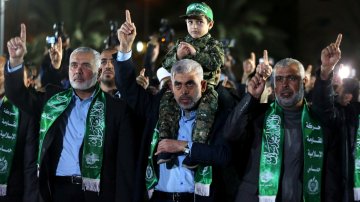
Sinwar (centre photo) photographed carrying the son of Mazen Faqha, a Hamas leader who was shot dead by unidentified gunmen in Gaza at martyrs’ memorial 27 March 2017. Another photo of Sinwar shows him carrying the child and an automatic rifle; yet another, carrying an automatic rifle and a child who might be a girl, perhaps the child of another martyred fighter. The child and the gun may be seen as symbolising the future through resistance.
On 21 November 2011, a month after his release, Sinwar married Samar Muhammad Abu Zamar and the couple had three children. Sinwar’s wife received a master’s degree in theology from the Islamic University of Gaza. His brother Mohamed remains active in the resistance and is being sought by the IOF.
Re-elected as Hamas leader in 2021, Sinwar survived an ‘Israeli’ assassination attempt that same year.
3All of this is according to the Israeli Occupation Force.
4 According to Jon Elmer, blogger and weekly podcast military analyst for the Electronic Intifada, also in discussion with Justin Podur https://www.youtube.com/watch?v=Dj43mbQ3AiE (at 1.23.3), that was so unusual because the IOF don’t usually go back to carry out battle analyses for intelligence.
11This seems not unusual among political prisoners:Irish Republican prisoners also elected their OC in the British Occupation jails: Mairead Farrell had been O/C in Armagh Jail and, before he entered his fatal hunger strike, Bobby Sands had been O/Cof the H-Blocks.
In the Basque Country the Day of the Patriot Soldier is commemorated on two different dates: by the Basque Nationalist Party on October 28th and by the Patriotic Left on September 27th. Each date marks different events but each is anti-fascist in character.
On October 28th one of the many atrocities of the Spanish Civil War/ Anti-Fascist War was enacted by the Spanish fascist military when they executed 42 captured Basque soldiers of the Eusko Gudarastea, a Basque antifascist militia opposing the military-fascist coup of Franco and another three generals.
Section of the crowd at the Gudari Eguna commemoration in Arrigorriaga, Bizkaia province, southern Basque Country. (Photo: D.Breatnach)
This atrocity occurred in 1937, when that war had another two years to run. The Basque Nationalist Party (PNV) was then the main political party in that part of the Basque Country1 and many of its politicians and administrative officials were executed by the Franco regime too.
Commemoration of the PNV´s Day of the Patriotic Soldier (Gudari Eguna) was carried out clandestinely during the four decades of the fascist Franco regime but was permitted in the post-Franco arrangement in the Spanish State, when the PNV were legalised.
The PNV became the dominant force politically in the two provinces that had declared for the Spanish Republic, which was the largest part of the Basque Autonomous Region. Nafarroa however was given a separate autonomous government which split the nation administratively in at least four.2
A DIFFERENT DATE TO COMMEMORATE
However in the 1960s a large part of the PNV´s youth wing had become disenchanted with the party and, entering into alliance with a Basque socialist movement, formed ETA, a mainly political organisation but, existing under a fascist-military regime, inclined also towards armed resistance.
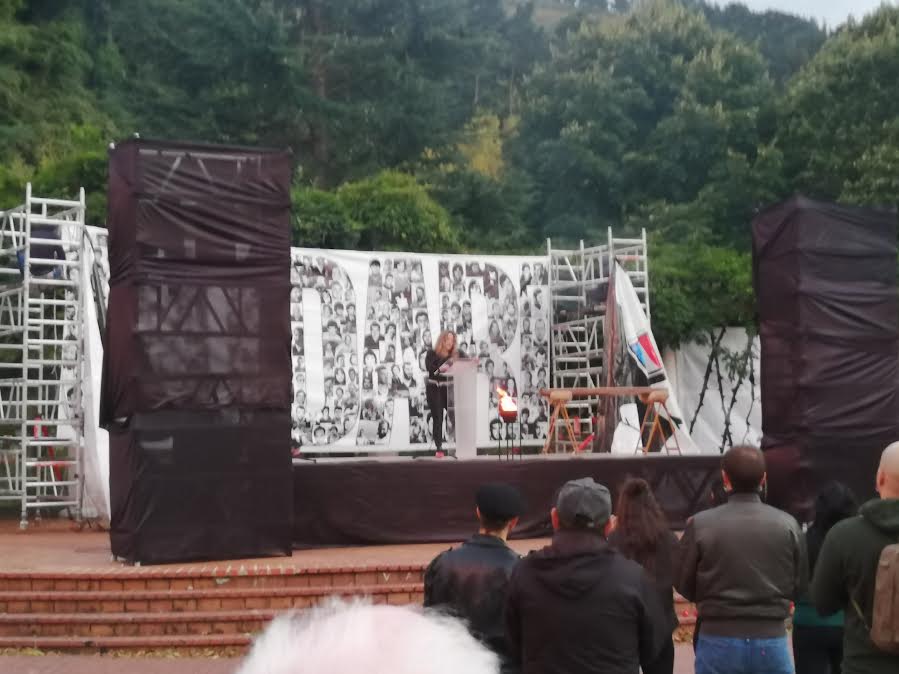
The platform at the Gudari Eguna commemoration organised by Jarki with the event’s speaker/ chairperson addressing the participants. (Photo: D.Breatnach)
ETA grew in support and in actions, military but not only, the Left Patriotic movement (Izquierda Abertzale) widening to fight on a number of fronts, linguistic, social, trade unionist and political with the armed section carrying out many actions.
The last political executions of the Franco regime were in 1975 of two members of ETA and three of FRAP3; the two Basques were Juan “Txiki” Paredes4 and Angel Otaegui. All five, despite huge international solidarity mobilisations and appeals for clemency, were shot by firing squads.
Today, the Patriotic Left´s Gudari Eguna is commemorated by different groups and not all together. As has occurred in Ireland, the accommodation of the leadership of the Basque Patriotic Left to the Spanish electoral system and abandonment of armed struggle has resulted in fragmentation.
A protest in Arrigorriaga I passed by on my way to the Gudari Eguna commemoration. I did not stop to enquire as to the purpose; I had made an error on the journey, was late and in a hurry. From the arrows design I understand these to be the Sare group doing their last Friday of the month picket in solidarity with the prisoners. ‘Giltzak’ means ‘keys’ as the graphic banner design shows and so the aim is probably to have them all leave jail. That is also the aim of the ‘dissident’ group Amnestia but they seek complete amnesty for the political prisoners whereas Etxerat, Sare and EH Bildu normally refrain from even calling them ‘political prisoners’since, according to the Spanish State, that amounts to ‘supporting terrorism.’ (Photo: D.Breatnach)
The political party EH Bildu commemorated the executions but so did the dissenting Jarki and Tinko/Amnistia and the historical memory organisation, Ahaztuak. They did not do so together nor, naturally with the PNV on the different date.
In Arrigorriaga Jarki organised their event in the birthplace and home of Argala, nom-de-guerre of José Miguel Beñaran Ordeñana, a theoretician and activist of great importance in the development of ETA and assassinated by the state-sponsored GAL terrorists.
The attendance at the event listened to the event’s MC addressing them, after which a group of youth carrying flaming torches came on stage. The MC ended her talk with calls for a free and socialist Basque Country, after each which the audience chanted “Gora!” (‘Up!’).
She then led them in singing the Eusko Gudariak with clenched fist in the air, followed by introducing the Internationale in Basque, the revolutionary socialist song that emerged from the Paris Commune of 1871, the audience joining in (though not everyone as well-versed as with the previous song).
I sang the chorus in French, the only language other than English in which I know the chorus, sadly.
HISTORICAL MEMORY & THE MARTYRS
The martyrs of the people´s struggles around the world are remembered organically and kept close to their hearts by the people from which they came, at least for a few generations. Initiatives of conserving and transmitting historical memory keep those commemorations going further.
Section of the crowd at the commemoration of Gudari Eguna, organised by the Jarki organisation. (Photo: D.Breatnach)
In Ireland we know that commemorating the risings of the United Irishmen (1798 and 1803) fed into the struggles of the Young Irelanders a half-century later, their memory in turn contributing to the Fenians which again became part of the history of future generations and of several armed struggles.
Counter-movements, recognising the potency of historical memory, try to appropriate it and adapt it to their political program or to diminish its importance and even deny it. Both those counter-currents can be seen in many parts of the world, including in Ireland and in the Basque Country
However, the ongoing revolutionary streams and their commemorations will always be closest to the real meaning of those events in the historical memory of the people, in the real social and political meaning of martyrdom.
Patrick Pearse remarked on this process in his famous oration over the grave of O´Donovan Rosa: Life springs from death and from the graves of patriot men and women spring living nations.
Footnotes:
1The Basque Country is composed of seven provinces, four on the Spanish state´s side of its northern border and three on the French state´s side. The Anti-Fascist War split the southern Basque Country with principally two provinces, Gipuzkoa and Bizkaia, taking the side of the Spanish Republic, which at the last minute granted them national autonomy. Nafarroa (Navarre) mostly took the fascist-military side and murdered around 3,000 antifascists and Alava province took that side too.
2Two separate autonomous regions in the Spanish state and the provinces on the French side in different French regional administrative areas.
3Frente Revolucionario Antifascista y Patriota (Revolutionary Anti-Fascist & Patriotic Front); the three were: José Luis Sánchez-Bravo Sollas, José Humberto Baena Alonso and Ramón García Sanz.
4According to his brother who, despite being misdirected arrived as Paredes was being shot by the Guardia Civil, who were shooting at different parts of his body, Txiki Paredes continued to sing Eusko Gudariak (‘Soldiers of the Basque Country’) until he finally died.
Not only our internationalist duty but also our longer-term practical interests are with supporting the Resistance. If so, then it is surely even more required of us that we condemn the collusion of the collaborators.
This is based on the fact of the Resistance opposing colonialism, occupation, imperialism, fascism, exploitation and so on. It is not based on whether the Resistance embraces all of our particular ideology or objectives. But that also means that we do not necessarily offer unconditional support.
Karl Marx, who from Britain not only went to some lengths to support the Irish Resistance to colonialism1 but advised the working class in Britain to do likewise,2 also remarked that it was not to be expected that British workers would support themselves being blown up for Irish freedom.3
I say that internationalist solidarity is not only a question of a kind of moral duty, but also a practical one. If we examine our own situation here in Ireland and our hopes for a united independent and socialist republic, we must also look to what happens when we achieve it.
The lessons of struggles in the world have surely taught us that we cannot hope that the imperialist countries around us will allow us to nationalise our resources and infrastructures which they’ve appropriated in full or in part, close their military bases and wish us good fortune!
Or that they will allow a positive example of the potential of socialist society to exist for the encouragement of their own working classes or for those they exploit elsewhere.
No, we will need movements of solidarity, especially in the states which will be the quickest to threaten us, i.e the western imperialist states. And, whether by coincidence or not, those are in great part the very states that are at this moment attacking Palestine and independence in the Middle East.
We think in that respect first of the United States, UK, Germany but also France, Italy, Spain, Netherlands, Sweden (even Switzerland4). Of course, we’ll be dealing with their interventions of various kinds before we even reach our independent, united socialist republic.
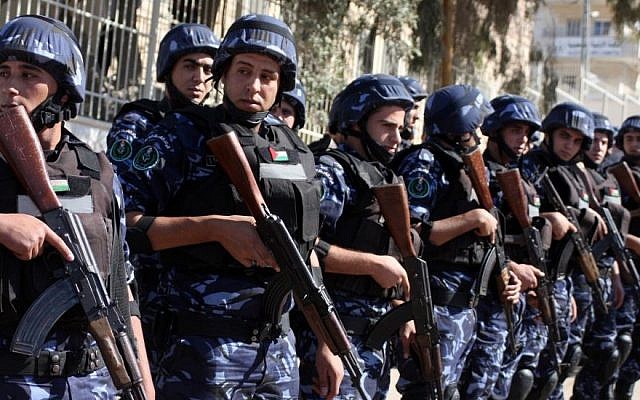
PA Security Forces attacking a demonstrator (Photo cred: Getty Images)
COLLABORATORS AND COLLUSION
Naturally, if we support the Resistance, we must have a corresponding attitude to those who collaborate and collude with colonialism, occupation, imperialism, fascism, exploitation and so on, not only in our own immediate struggle but also in those we support internationally.
The genocidal attacks of the ‘Israeli’ Zionist state could not last a week without the financial, military and material support in particular of the USA, but also without those from Germany, the UK and France, nor in turn without the collusion of many Arab states of the Middle East.
That is a collusion in many cases of the regimes and not supported by most of their own populations. Most dangerous of all of course are those agencies of collusion among the oppressed people themselves and we have experienced those throughout our history of anti-colonial struggle.
Our historical culture is full of contemptuous references to them, even to terms such as “Castle Catholics”; Marx too was scathing in reference to Daniel O’Connell, who sought only Irish autonomy within the British Empire, as did John Redmond, later rejected by the population.5
Many other struggles around the world have had such temporisers and actual collaborators in their midst. Indeed after liberation from fascism in countries in WWII, many of them were executed, some such as “Quisling” and “Vichy” becoming bywords in treachery and collusion.6
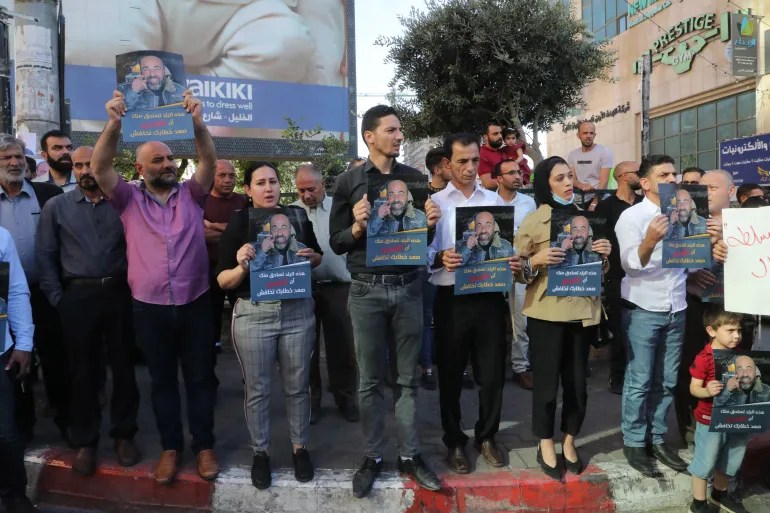
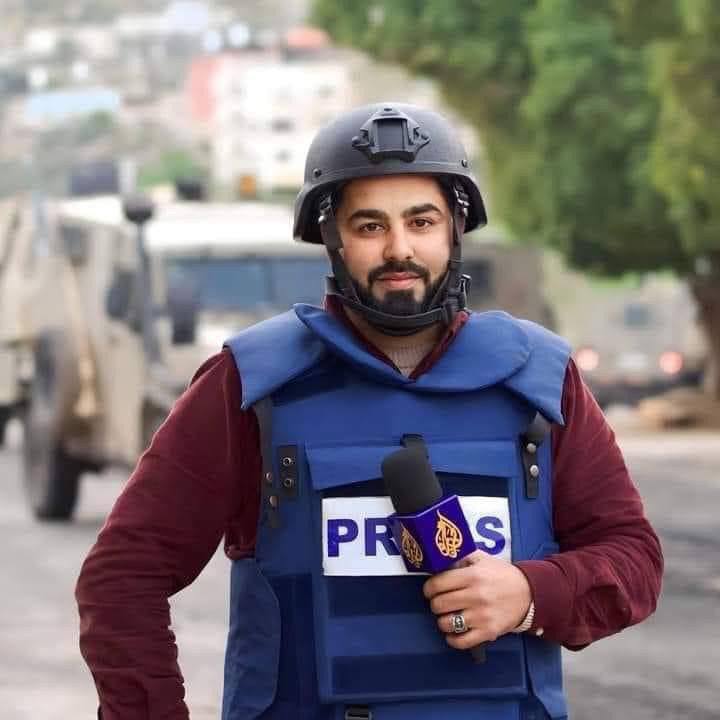
Palestinians hold posters depicting human rights activist Nizar Banat during a protest triggered by the violent arrest and death in custody of Banat, in his hometown of Hebron in the occupied West Bank, on June 27, 2021. [ Photo cred: Mosab Shawer/AFP]Al Jazeera correspondent Laith Jaar, beaten up by PA officer while covering the Tulkarem massacre by the IOF, then jailed when he complained to the PA. [Photo sourced: Internet]
Well then, how is that we tolerate the presentation of the ‘Palestine Authority’ as a representation of the Palestinian people? This corrupt agency with its ‘security force’ beating up and jailing critics and freedom fighters, some of which it also shoots? And dismantling defensive anti-IOF bombs?
This agency which in the Oslo Accords gave up the struggle in exchange for corrupt control of 20% of Palestinian land, which has held no elections since 2006 because the Palestinian people across the political and religious spectrum rejected the Fatah party then and elected Hamas instead.
It is no surprise then that the western imperialist countries claim the PA to be the legitimate representation of the Palestinian people and that some of them fund it, that Palestine ‘embassies’ are PA-run and that Palestine ‘Ambassadors’ are employed by the PA.7
But how is that the PA is not publicly denounced by the wide Palestine solidarity movements in the Western countries? Why this conspiracy of silence and spreading of ignorance?
It is not easy in on-line searches to find how many political prisoners the PA has in its jails or wounded or shot dead – and of course the amount of information about the Resistance passed on to the Zionists and the US awaits some historical investigations in a free Palestine of the future.
What we do know is that the PA holds over 100 political prisoners, that it arrests freedom fighters (even invading hospitals to arrest wounded fighters), that it tortures prisoners, beats up critics and demonstrators and clears the way of explosives for IOF invasion of West Bank communities.
Very recently, Palestinian journalist Laith Jaar, after reporting on the Palestinian Resistance in Tulkarem, was beaten up while covering the massacre there by Ahmed Ghassan Qawzah, an officer of the PA’s security force. When the journalist went to complain to the PA, they threw him in jail.
The Palestinian Resistance periodically denounces the PA, calling on it to support the people, threatens it when the PA’s actions are particularly egregious but refrains from using arms against it. I admit that I cannot understand that degree of forbearance, even for temporary tactical reasons.
But what about us? How is that only one protest against the PA’s Ambassador to Ireland took place and that the protesters were ejected by alleged Irish supporters of the Palestinian people? How is that only one small protest to date has taken place outside the PA’s Dublin Embassy?
How can we stomach this collusion in what is effectively a conspiracy of silence?
End.
Palestinian Police – their firearms are for opposing the Palestinian Resistance (Photo cred: Issame Ravi/ Flash90)
FOOTNOTES
1Marx and Engels had led the International Workingmen’s Association (later known as the “First International”) in not only supporting the Fenian movement but also accepting Fenians in Britain into the organisation.
2Not out of altruism but in their own interest! “As to the Irish question….The way I shall put forward the matter next Tuesday is this: that quite apart from all phrases about “international” and “humane” justice for Ireland – which are to be taken for granted in the International Council – it is in the direct and absolute interest of the English working class to get rid of their present connection with Ireland.And this is my most complete conviction, and for reasons which in part I cannot tell the English workers themselves. For a long time I believed that it would be possible to overthrow the Irish regime by English working class ascendancy. I always expressed this point of view in the New York Tribune.Deeper study has now convinced me of the opposite. The English working class will never accomplish anythingbefore it has got rid of Ireland. The lever must be applied in Ireland. That is why the Irish question is so important for the social movement in general.”
3Karl Marx, then living in London, observed: The London masses, who have shown great sympathy towards Ireland, will be made wild and driven into the arms of a reactionary government. One cannot expect the London proletarians to allow themselves to be blown up in honour of Fenian emissaries.Marx was commenting on the reaction to the disastrous explosion attempt to liberate Fenian prisoners from Clerkenwell Jail in London, on 13 December 1867, when 12 mostly working class people were unintentionally killed and around 120 injured.
5That was the essence of the O’Connell’s constitutional Repeal Movement objective of the 1840s and of the Home Rule promised by the UK ruling class to the Irish Parliamentary Party in 1914, against which the 1916 Rising took place. In the British General Election of 1918 in Ireland, Redmond’s party was all but annihilated.
6Nazi collaborator Prime Minister in occupied Norway and the French collaborator government under Petain and Lavalle.
7It should perhaps be a surprise that certain parties in Europe, including Ireland, also support the PA but then, perhaps not. Not a year has passed since a meeting hosting the ‘Palestine Ambassador’ for Ireland in Belfast was protested by Palestinians who were ejected among cheers by ‘Irish Republicans’.
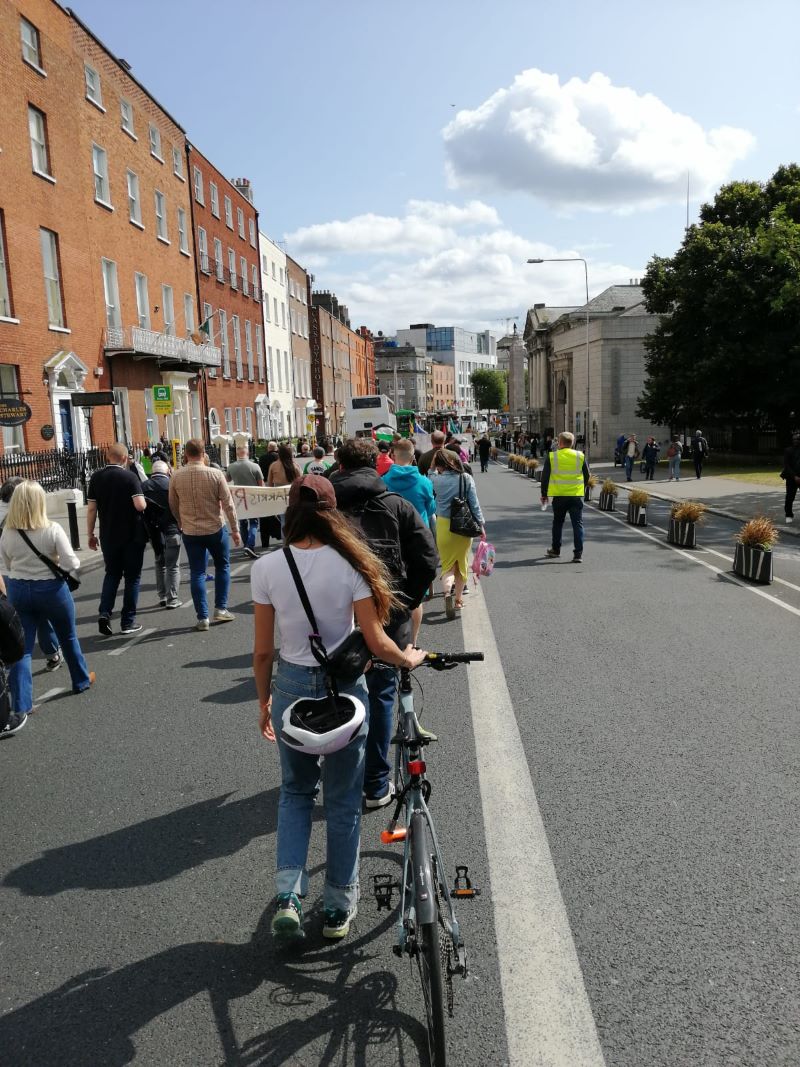
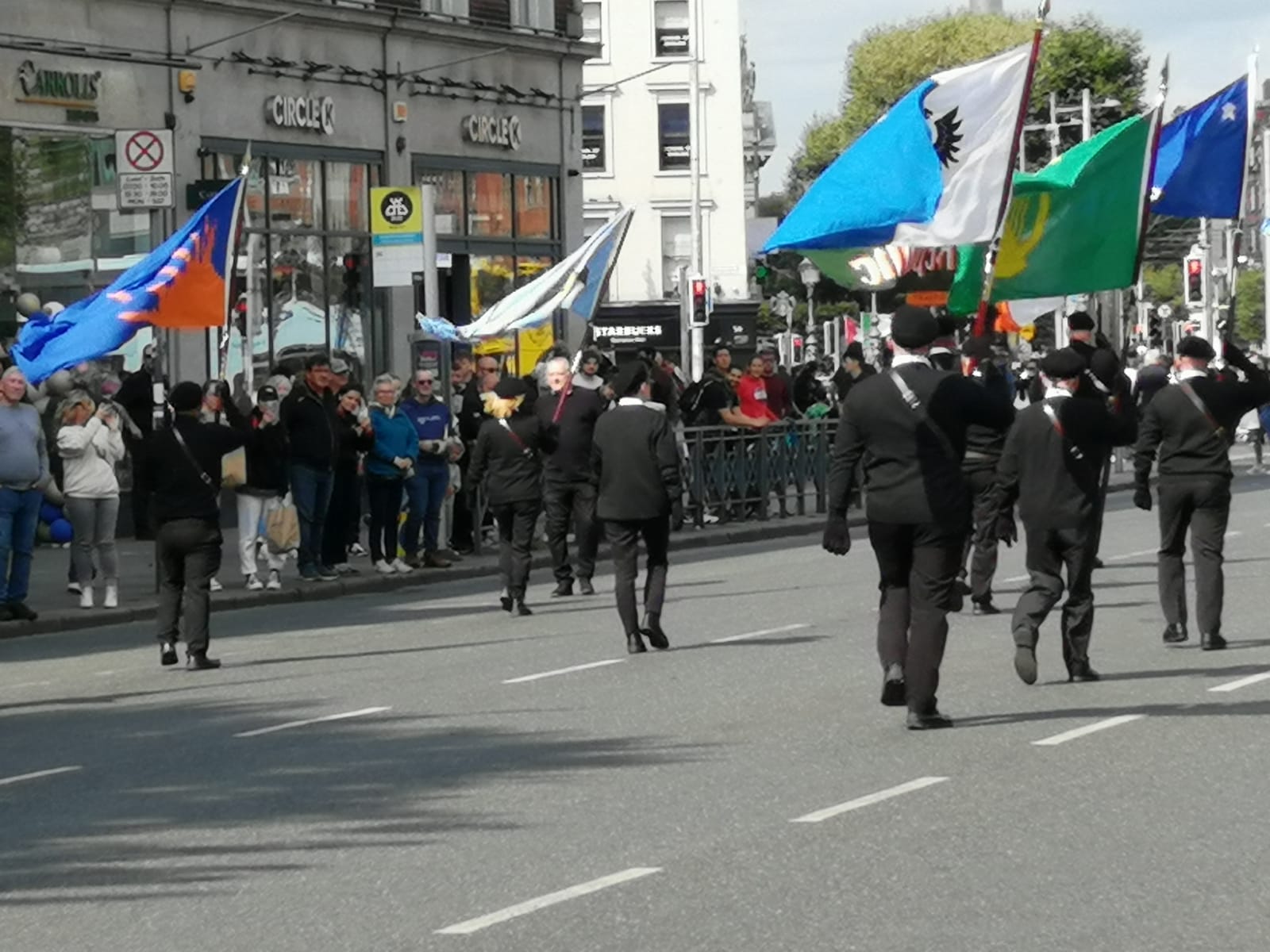
Irish Republican hunger strikers were commemorated in Dublin with a march and rally on 24th August. The event was organised by Dublin Independent Republicans and attracted representation from many groups in addition to independent activists.
Those ten Irish Republicans who died on hunger strike in 1981 are still remembered well in the general Irish population, most of all their leader Bobby Sands. However another twelve died on hunger strike in earlier days, going back to 1917, before the War of Independence (1919-’21).
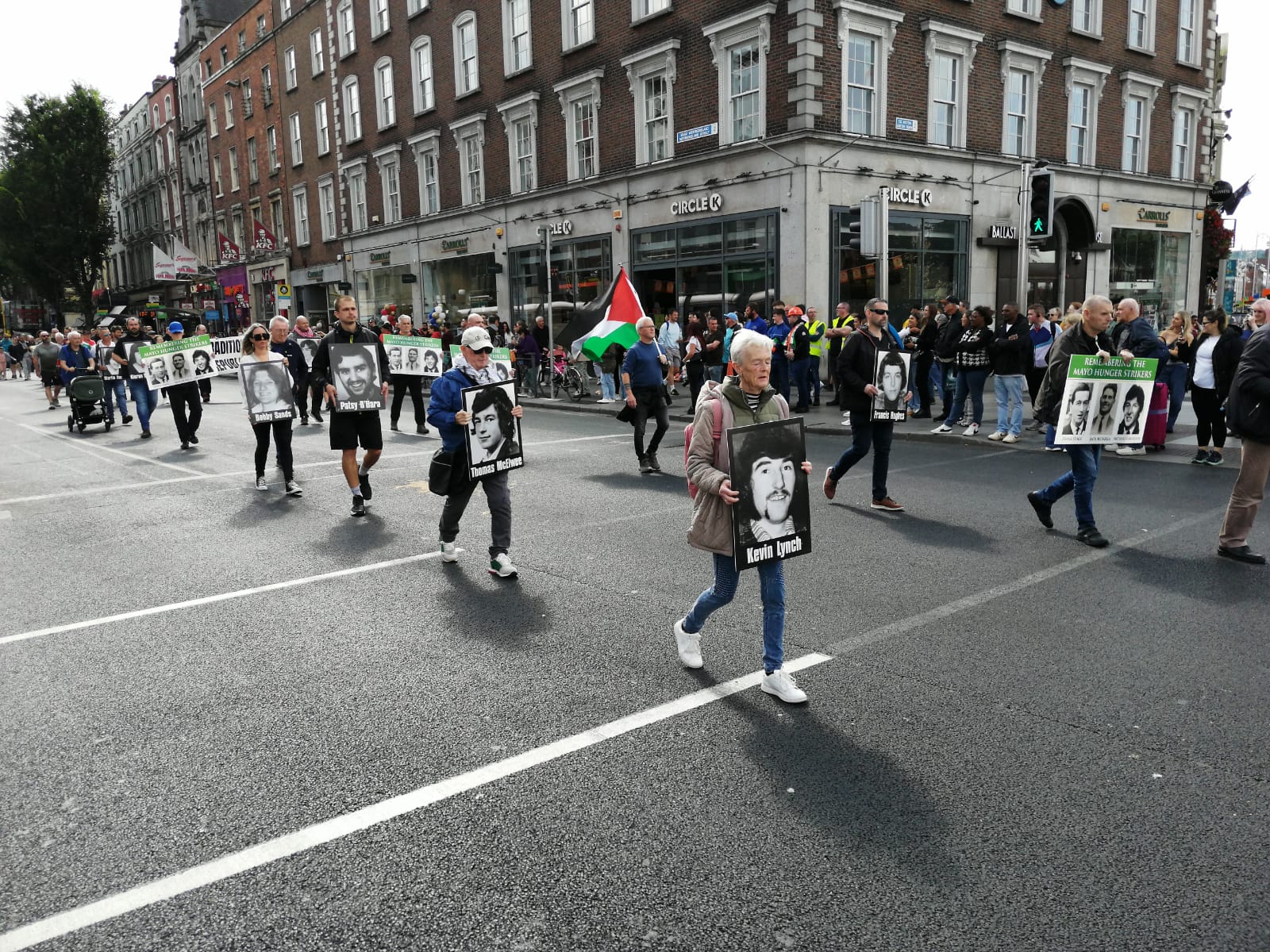
Marchers in Westmoreland Street carrying images of the hunger-strike martyrs on the return to the Garden of Remembrance. (Photo: D.Breatnach)
For over a century, hunger strikes have been one of the traditional methods of protest and struggle by Irish Republican prisoners in jails of the British and also of the Irish State.
Those Republican prisoners who died on hunger strike in 1981 did so from the effects of starvation but some died through force-feeding also, which was the case with Vols. Thomas Ashe (1917), Michael Gaughan (1974) and Frank Stagg (1976).1
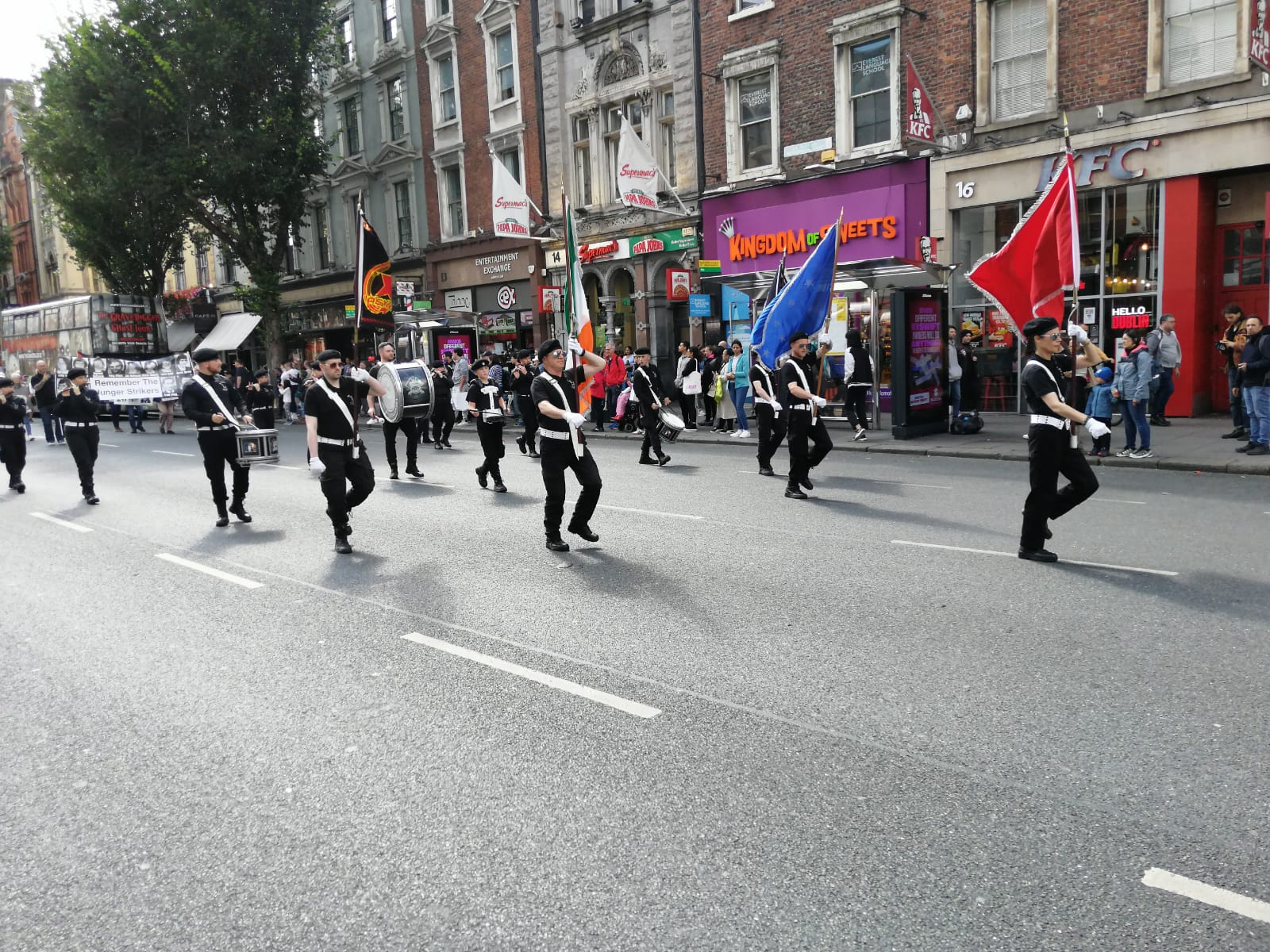
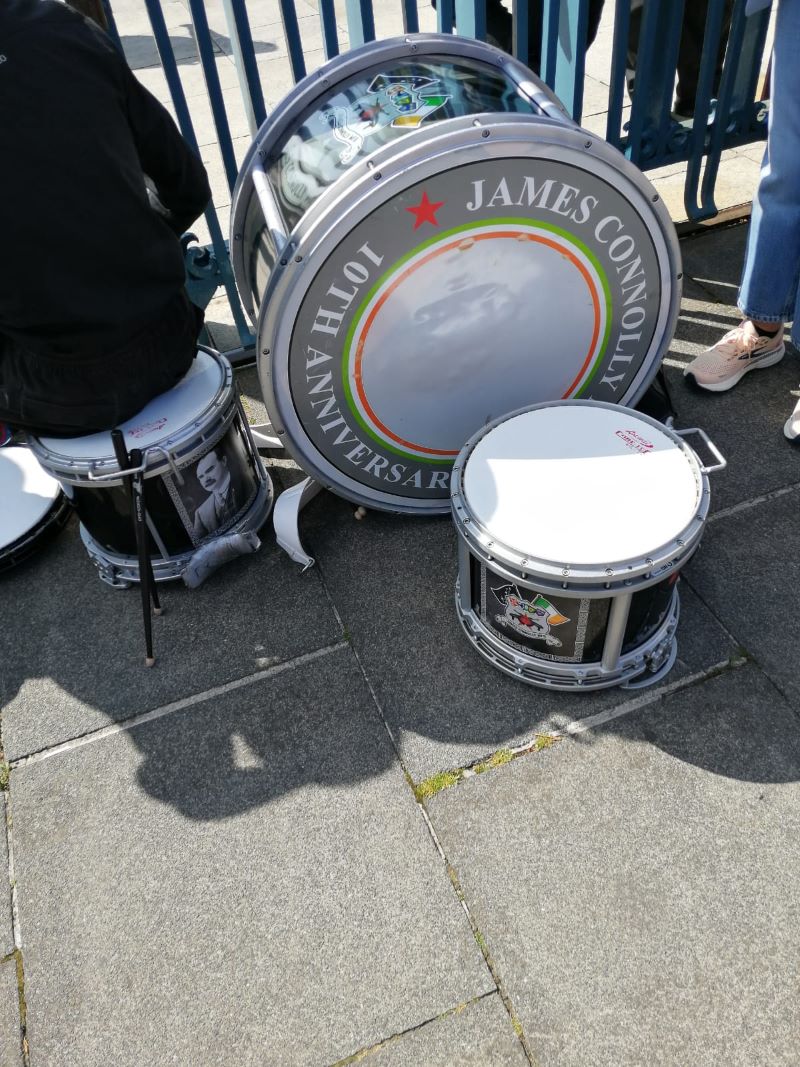
James Connolly Memorial Band with their own colour party in Westmoreland Street on the return to the Garden of Remembrance. (Photo: D.Breatnach)
PARADE THROUGH CITY CENTRE AND RALLY
Led by a colour party,2 the parade set off in two columns3 from the Garden of Remembrance in Parnell Square with the James Connolly Memorial Republican Flute Band leading and along the City’s main thoroughfare, O’Connell Street, crossed the Liffey to ‘touch’ Trinity College and back again.
Marchers setting off from the Garden of Remembrance in Parnell Square. (Photo: D.Breatnach)
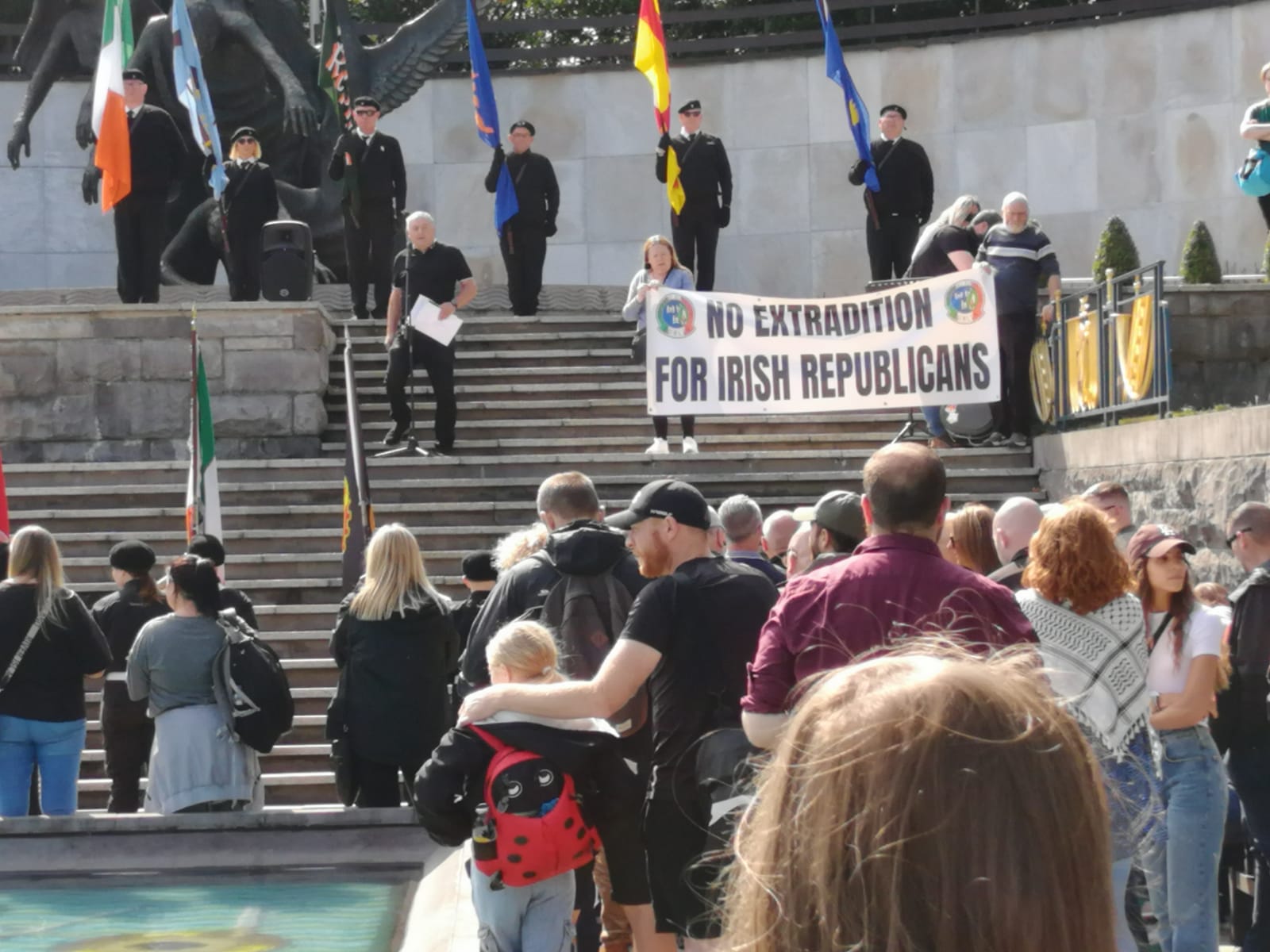
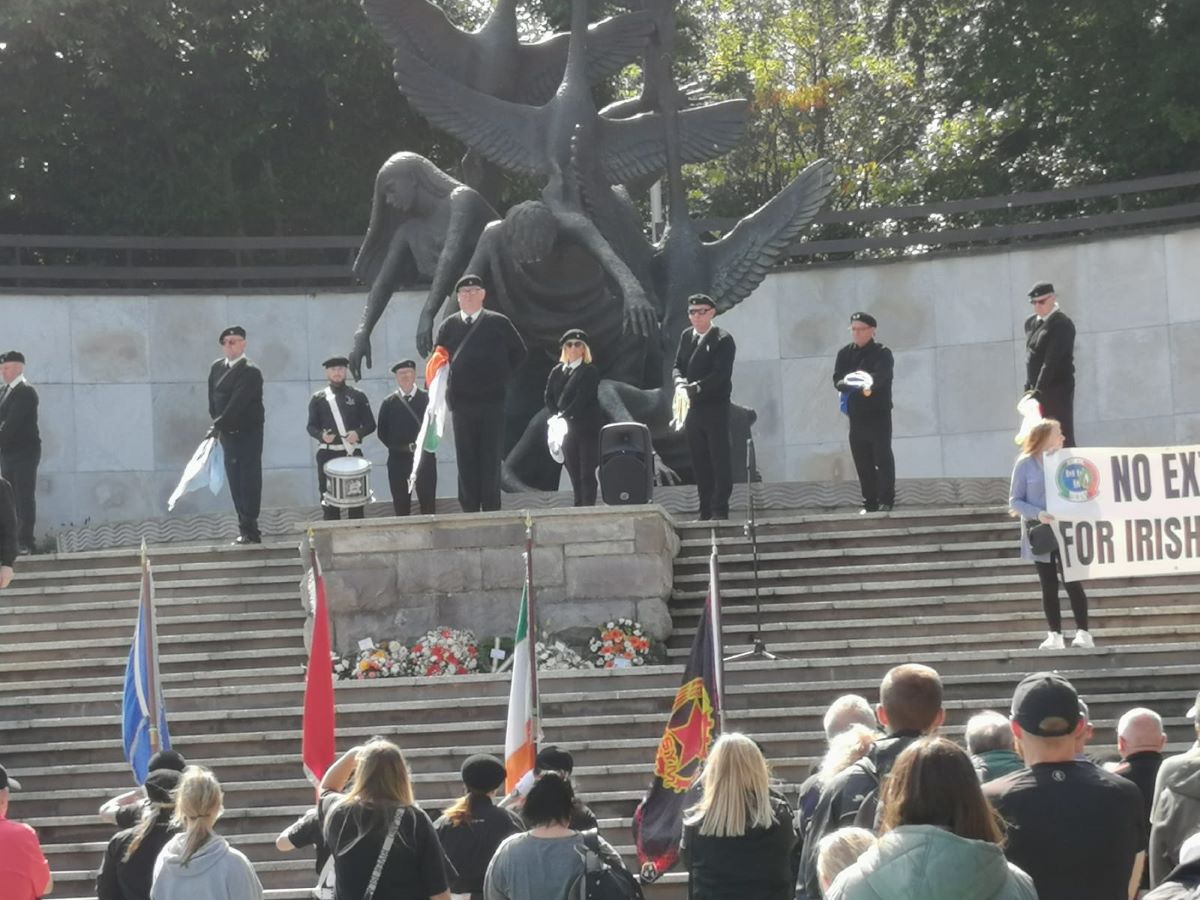
Upon returning to the Garden of Remembrance, the banners and band took up position in front of the memorial with the audience facing them, where Ado Perry as MC for the event welcomed all.
As well as recalling the struggles of Republican prisoners within the jails and deaths on hunger strike, Perry also took some time to denounce the Zionist genocide in Palestine and to express the Palestinian solidarity of Republicans (and of the majority of the Irish people).
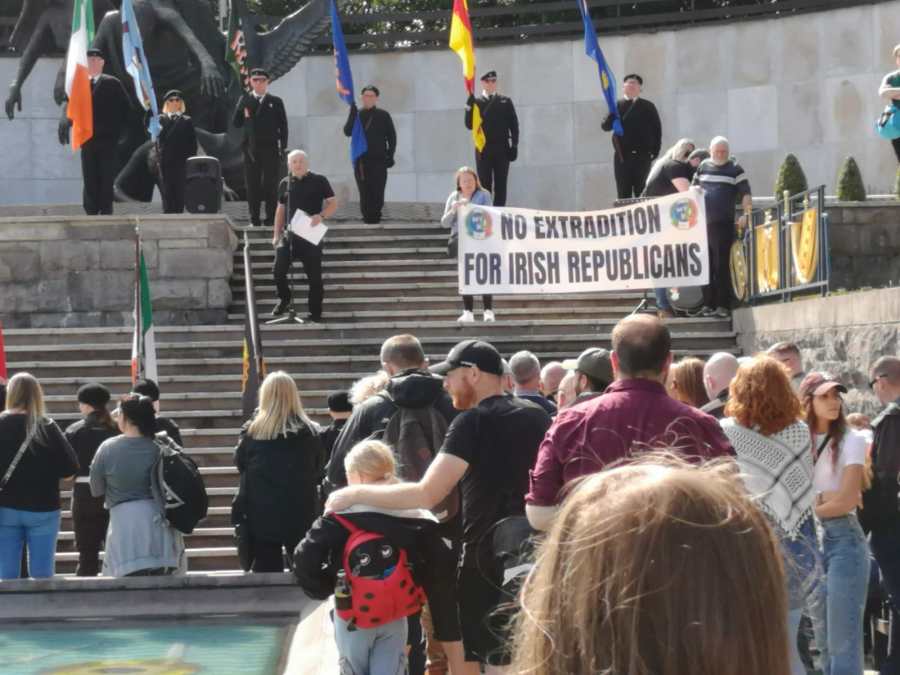
Ado Perry as MC of the rally in the Garden of Remembrance, flanked by the No Extraditions banner, the colour party behind and behind them, the Monument to those who fell in the struggle for Irish freedom. (Photo: D.Breatnach)
Perry also condemned the planned extradition of Irish Republican prisoners to British jurisdiction and called for Irish Republicans to unite in opposition, recalling the struggles against extradition over the years.
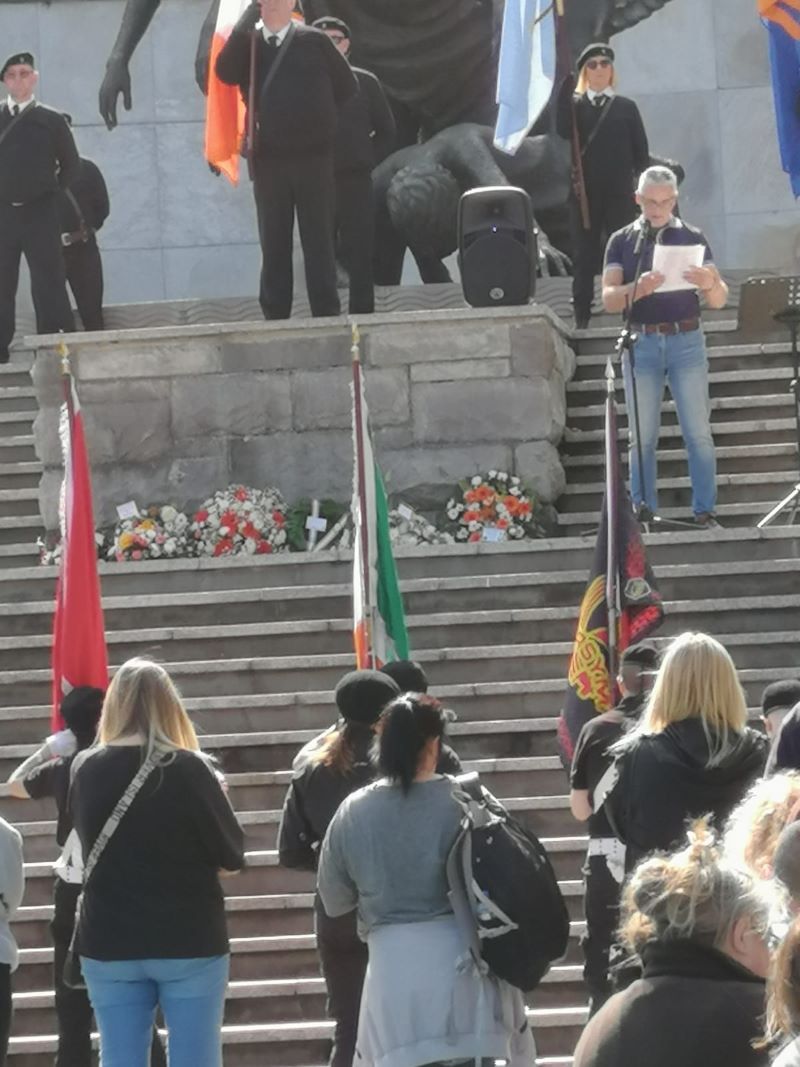
Floral tributes were laid at the Monument and Cáit Inglis read the names of the 22 who died on hunger strike, before the MC called on Cathal Graham for a song. Graham performed Wrap the Green Flag Around Me, a song that seems to have fallen somewhat in popularity in recent years.
Frankie Quinn giving his speech at the rally. (Photo: D.Breatnach)
The main speaker for the day was Frankie Quinn, a long-time Republican, community activist and ex-political prisoner who spoke first in Irish before turning to English. Quinn too condemned the genocide in Palestine and expressed solidarity with the Palestinian resistance.
In a reference to recent racist mobilisations in Ireland, Quinn made it clear that those people had nothing in common with Republicans or with the Irish national struggle for a socialist republic. (A known racist female activist had reportedly been encouraged to leave the scene a little earlier.)
The speaker was vigorously applauded and was followed by Gráinne Gibson who performed hunger strike martyr Bobby Sands’ poem The Rythm of Time.
(Photo: D.Breatnach)
Cathal Graham returned to perform The Time Has Come, a representation of hunger strike martyr Patsy O’Hara’s plea to his mother not to withdraw him from the fast when he lost consciousness, unless their demands were conceded. The colour party lowered their flags in respect to the martyrs.
Perry thanked all for their attendance in particular the marching band, colour party, performers and stewards, once again emphasising the need for united action to prevent the extradition of Irish Republicans to British jurisdiction, then called the band to perform Amhrán na bhFiann.4
The colour party leading the march out of Westmoreland to cross the river to the rally in the Garden of Remembrance. (Photo: D.Breatnach)
There was broad support for the event as shown by the participation of a number of different organisation and individual activists, which is a hopeful sign for the future. The real test however will be whether the disparate elements will act in unity as called for by Perry and Quinn.
End.
The lowering of the flags in honour of the martyrs in the struggle. (Photo: D.Breatnach)
Footnotes
1Their deaths under medically-supervised force-feeding caused the British Medical Association to oppose force-feeding of any hunger-striker in possession of normal cognition.
2The flag composition of Irish Republican colour parties varies but when flags and members are available traditionally are composed of the Irish Tricolour, the Starry Plough (blue or green version), the Sunburst and the flags of the Four Provinces. I have also seen on occasion the inclusion of a Scottish Saltere and on another, the Palestinian flag.
3More or less two columns – outside of the Six Counties marchers are unaccustomed to that formation and stewards were hard-pressed to ensure marchers kept to either one column or the other, a difficulty I remember well myself from my capacity as chief steward on a Dublin march against internment of Marion Price years ago.
4Irish language translation of The Soldiers’ Song by Peadar Kearney and Patrick Heeney, the air of the chorus which is the official National Anthem of the Irish State. At commemorations and such events it is usual for the air of both the verses and the chorus to played. In the 26 Counties it is common for people to sing along to the air played (or to a solo singer) but not in the 26 Counties. Unusually with cases of songs with versions in both langauges, it is the translated lyrics into Irish which most people know.
The Palestinian Authority had a small protest against it in Dublin on the afternoon of Friday 23rd August 2024. This seems to be the first protest that has taken place outside the Palestinian Embassy at 66 Lower Leeson Street.
It would perhaps have been the first protest against the PA in Ireland, were it not for the Palestinian solidarity activists who attempted to convey the Palestinian reality in contrast to the Ambassador’s speech at a public meeting in Belfast in February, before being evicted by Sinn Féin supporters.
Palestinian solidarity activists protesting the Palestinian Authority and Embassy?
At first sight that seems bizarre but as some solidarity activists and most people of Middle Eastern origin know, the PA is not only widely considered unrepresentative and corrupt – and in fact has not held elections since 2006 – but also represses protests in the West Bank against ‘Israel’.
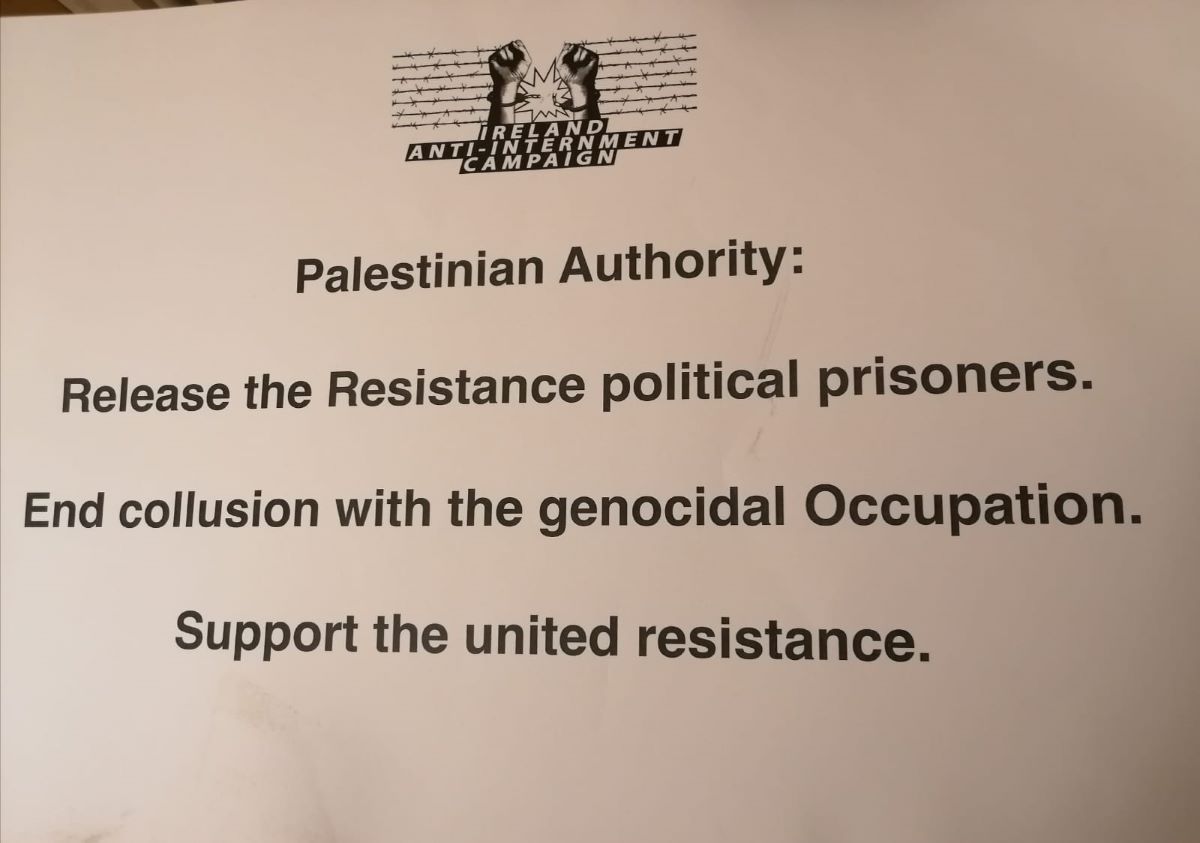
However, the Ireland Anti-Internment Campaign says that its main purpose in calling the protest was to raise awareness of the harm the PA is doing to the Palestinian Resistance, in arresting Resistance fighters and disrupting resistance defence against ‘Israeli’ army incursions.
Photo of placard being displayed outside the Palestine Embassy today. (Photo: R.Breeze)
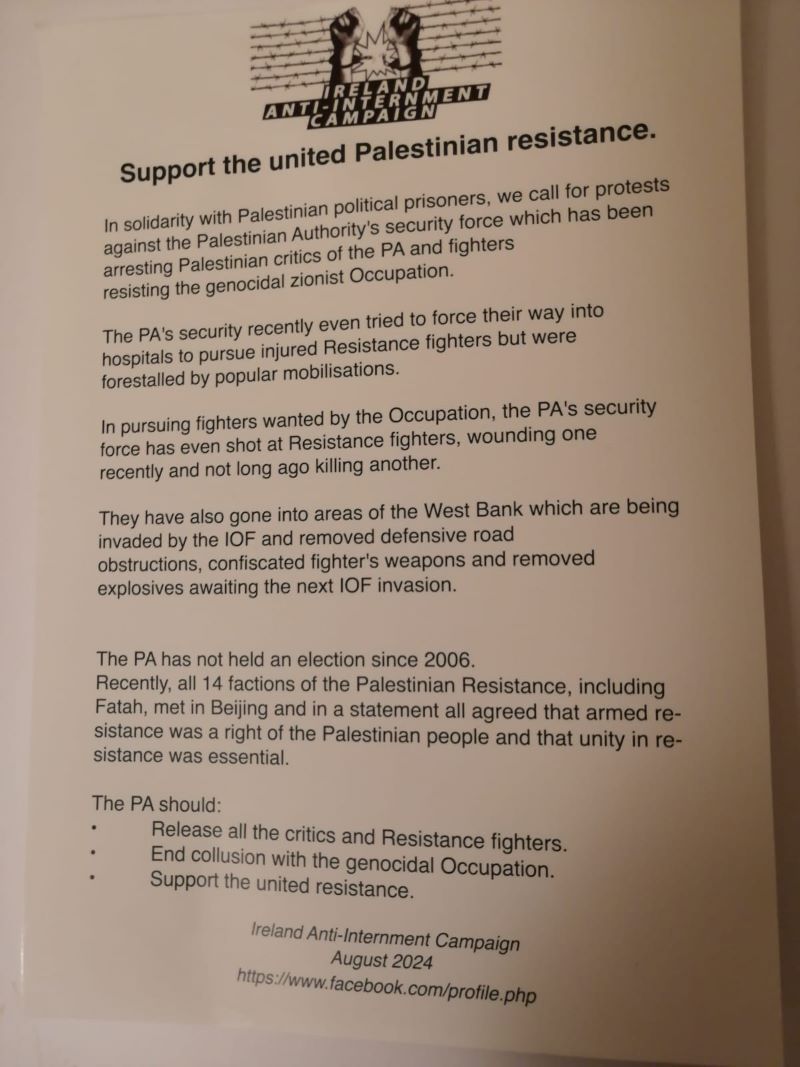
The IAIC’s leaflet handed out at the event points out that the PA’s security force shot and wounded and even killed Resistance fighters, also attempting to enter hospital in force to arrest fighters on two occasions recently, their attempts being frustrated by large mobilisations.
Could a picket on the Palestinian Authority and its Embassy be considered divisive? “Not with justification,” replied an IAIC spokesperson. “It’s the actions of the PA that are divisive. We are supporting the broad resistance there, not one faction or another.”
He points out – as did their leaflet – that 14 Resistance factions including Fatah met in Beijing recently and agreed that the Palestinians have a right to resist, including with weapons and called for unity of all the resistance organisations. “The PA is acting against that unity”, he said.
But why is it that the IAIC called this protest and not one of the Palestinian solidarity organisations? “You’d need to ask them that,” says the spokesperson. “We regularly fly a Palestinian flag on our anti-internment in Ireland pickets; the PA was overdue to be done but nobody else was doing it.”
(Photo: R.Breeze)
The IAIC was founded a decade ago to raise awareness about ongoing internment of Irish Republican activists by revoking ex-prisoners’ licence and through refusal of bail by special no-jury courts. In those cases it can take two years for a case to come to trial.
However the IAIC has organised or participated in other events also, such as those around framed prisoners like the Craigavon Two in the Six Counties and the Munir family in England. It has also called two of its pickets since October 2024 to specifically highlight Palestinian prisoners.
Will the group be regularly picketing the Palestinian Authority now? “Probably not. It’s not what we were set up for but we felt the ice needed breaking on this. Others need to step forward now,” replied their spokesperson, though signalling that they would support others in doing it.
Photo of copy of the leaflet being distributed outside the Palestine Embassy today. (Photo: R.Breeze)
It is probable that a representative of the PA will be welcomed soon by the Irish Government as part of its recognition of the ‘Palestinian State’. One wonders how this reception of a corrupt and Occupation-collusive organisation will be mediated in the Palestinian solidarity sector in Ireland.
The Governments of the EU, including Ireland’s, formally recognise the PA but not only that – so does Sinn Féin in Ireland, EH Bildu in the Basque Country and Esquerra Republicana in Catalonia. This corresponds across the board also to support for ‘the Two-State Solution’ (sic).
What that entails is allocating the Palestinians less than 20% of their homeland weaving around illegal zionist settlements, with least water and some of the worst land, under the permanent watchtowers and guns of their genocidal neighbour.
Organisations and individuals within the broad Palestinian solidarity movement will need to decide exactly what their solidarity with Palestine actually means, especially for the Palestinians themselves.
Conflict with security forces of the Palestinian Authority broke out in Tulkarm city in the West Bank today as they tried to seize Palestinian Resistance commander Abu Sujaa (Mohamed Jaber), who was receiving treatment in Thabet Thabet Hospital.
According to reports the PA fired tear gas and used pepper spray inside the Hospital grounds, also striking with batons at protesters including women. Shots were fired at the PA’s HQ and protesters are calling the PA “traitors” and “collaborators”.
After a tense stand-off the PA forces eventually had to leave empty-handed.
Abu Sujaa is a commander of the Tulkarm Brigade, Soraya Al-Quds (Islamic Jihad), one of the main organisations of the Resistance. It is reported that he was injured while handling explosives and taken to hospital; when the PA learned of his presence there they sent forces to capture him.
The arrest attempt by the PA and treatment of protesters has been condemned Soraya Al-Quds and by a number of other Palestinian Resistance organisations including the Al Aqsa Martyrs Brigade coalition, Mujahadeen Movement, PFLP, Hamas and Popular Resistance Committees.
A statement also condemning the PA’s action by students at Birzeit University was signed off by the student movements of Hamas, PFLP, DFLP, PPSF, and PPP.
The point was also made that Abdul Nasser, one of the own PA’s employees, a security officer in uniform, was filmed executed by the IOF recently in cold blood in front of their headquarters in Tubas “without any action, condemnation, or denunciation” by the PA’s leaders.
Abu Sujaa is far from being the first Palestinian Resistance fighter targeted by the PA which holds many prisoners but has also killed fighters, including Ahmed Abu Al-Ful in early May1 and Motasim Al-Arif a month later, on that occasion also while trying to capture Abu Shujaa.2
Two Palestinian civil society activists recently went on hunger strike in protest at their detention by the PA, Fakri Jaradat being released after a week of hunger strike (but 16 days detention) but Ghassan Al-Saadi was transferred to Al-Razi Hospital in Jenin in deteriorated health condition.
This evening, according to local sources quoted on Resistance News Network, PA Security Forces stormed the city of Tubas, apparently in order to assassinate the resistance fighter Omar Meselmani who is wanted by the Occupation, since they shot at him directly.
Palestinian unity?
The Palestinian representative bodies recognised internationally are the PA and the PLO,3 both dominated by the Fatah leadership. The latter were represented at the Beijing Palestinian Unity conference last weekend at which all 14 factions agreed on the need for a unity government.
The PLO excludes Islamist organisations from membership, though both the PFLP and the DFLP delegates stated at the conference that they wished to admit those resistance organisations to the PLO, no such decision was recorded (presumably blocked by Fatah) in the conference decisions.
One might have thought that in the circumstances of the Beijing Agreement, the PA would be keeping a low profile or at least certainly steering clear of conflict with Resistance organisations. On the contrary however, the PA seems to be intent on exacerbating divisions.
Islamic Jihad, possibly divining the PA’s intentions, has declared it will not be drawn into a civil war with the organisation, despite its actions and collusion with the Occupation. But can that posture be maintained if the PA continues persecuting and even shooting its fighters?
Perhaps the PA is doing its best, in order to avoid its being sidelined and as an aid to the beleaguered Israeli occupation, to ensure that civil war breaks out among the Palestinians.
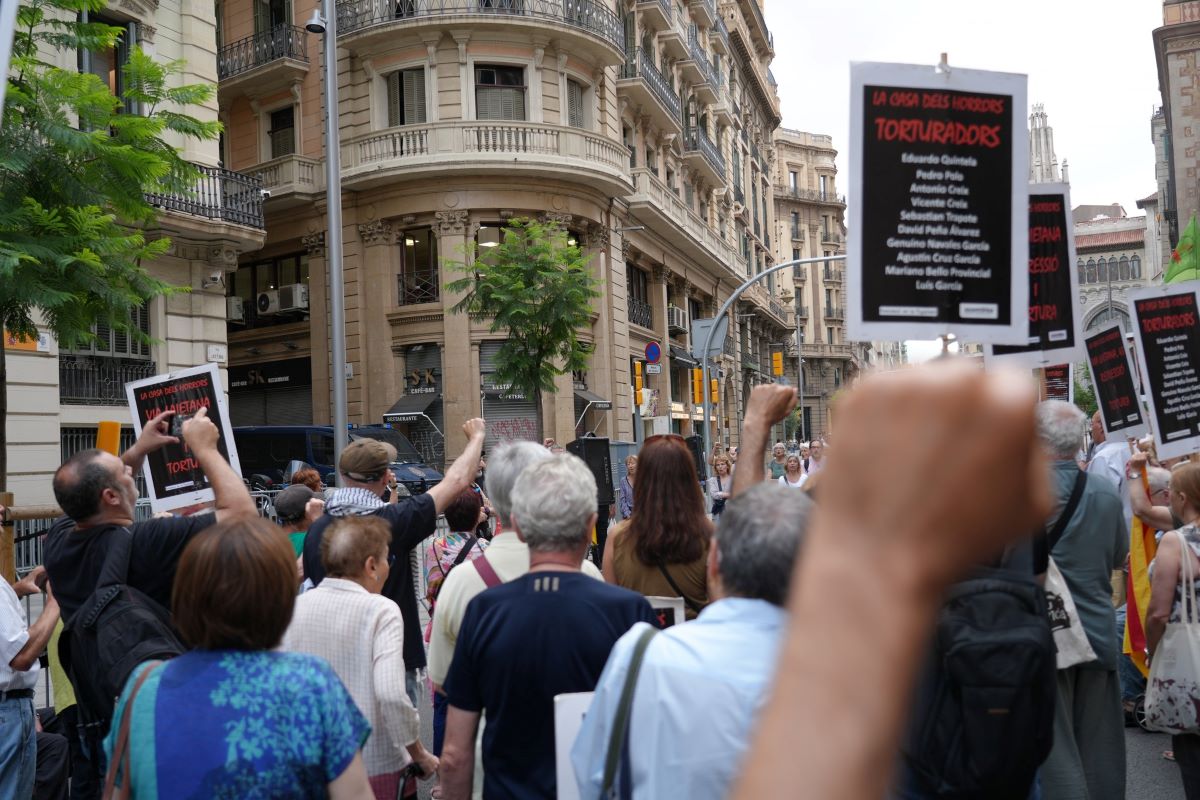
On July Tuesday evening, a number of uniformed police officers watch the people in the road outside their police station on Via Laietana in Barcelona, the Catalan capital, many in the crowd holding placards protesting torture and impunity and a number carrying a banner.
The MC, a slim elderly woman, approaches the microphone stand, her back to the police station. Speaking in Catalan she reviews the reason for their rally which is to renew the historical memory of the Spanish State’s repression of dissent through torture with impunity.
The MC at the event speaking briefly (Photo cred: D.Breatnach)
A number of torture survivors address the crowd, sometimes experiencing difficulty in reading some passages of their notes. The crowd, mostly middle-aged or elderly, listen in silence. Some of them were victims too, many knew victims personally, many of the latter now dead.
For the past three years, the campaigners have been coming here every two weeks, renewing the historical memory and campaigning for a change of use in this building on one of the main roads of their city.
One of the torture survivors displaying the Vermella, the socialist version of the Catalan independence flag. (Photo cred: Albert Bergadá Corso)Torture survivor speaking (Photo cred: Albert Bergadá Corso)Another torture survivor speaking, Catalan independence flag visible in the crowd. (Photo cred: D.Breatnach)
REPRESSION AND TORTURE HEADQUARTERS
During the Franco fascist Dictatorship (1936-1975), this police station was the Barcelona HQ of repression and torture, its victims ranging from democrats to anarchists, republicans and communists. The Resistance methods were also varied: unarmed, industrial or armed.
The crowd takes to the street in front of the police station
After Franco’s death, repression continued through the period known as the Transition with torture as a standard police practice continuing for decades afterwards. Claims of torture were routinely ignored by judges who sentenced activists on the basis of their retracted admissions.1
On the few occasions when torture claims were investigated, it was done cursorily and on the much rarer occasions of trial and conviction for torture, the perpetrators as a rule saw no jail time.
The police station with a history of torture on Via Laietana, Barcelona, as demonstrators begin to gather in front. (Photo cred: D.Breatnach)Commemorative plaque near the police station, regularly defaced and regularly repaired. (Photo cred: D.Breatnach)
The methods are known by police and military torturers across the world: punches, slaps and baton blows through towels (causing pain but leaving no marks), forced stress positions, electrical shocks of particularly sensitive areas, simulated asphyxiation through plastic bags, simulated drowning …
In the past these included suspending victims upside down by their ankles or upright balanced on toes. Of course all tortures are also accompanied by threats to the victims and their families, humiliation (including nakedness), sometimes sexual threats and even actual penetrations.2
Crowd gathering to begin their event. (Photo cred: D.Breatnach)
IRISH SONG IN THE STREET
The MC returns to the microphone at the conclusion of the witness testimonies and asks the crowd to welcome an activist, writer and singer from Ireland. The Irishman says he is honoured to speak at a location of struggle and even more so to bring solidarity from one nation’s struggle to another.
Though the fact is routinely overlooked or even denied, he says there are political prisoners in Ireland and because of the recent mistreatment of one of those in a prison in the British colony, all his comrades protested and were in turn supported by political prisoners in the Irish state jail.
Wearing a Palestinian scarf, speaking in Spanish, having apologised for his lack of anything but a few words in Catalan, the Irishman highlights the role of police stations as local centres of repression on behalf of the bourgeoisie, the repression all too often including torture.
The Irishman applauds the protesters’ upholding of historical memory and also their campaign to have the building reappointed as a social centre, before continuing to introduce his choice of two short songs of resistance from his homeland, one in English and the other in Irish.
The Irishman singing (Photo cred: Albert Bergadá Corso)
The first song he sings is Four Green Fields,3 which he has explained symbolises the four provinces of Ireland, the nation represented by an elderly woman. This is followed by Gráinne Mhaol,4 the nation again represented by a woman but younger, a warrior and pirate clan chieftain.
Following the applause, the MC returns and begins to read out a long list of known police and military individuals, after each one the crowd roaring “Torturadors!”
Crowd singing L’Estaca (Photo cred: Albert Bergadá Corso)
The event concludes with the singing of L’Estaca (The Stake – a song of resistance composed by Catalan Lluis Llach during the Franco dictatorship), many doing so with clenched fists raised. Soon afterwards, the crowd begins to break up, the road open to traffic once more, shoppers and tourists going by.
Section of the crowd at the anti-police-torture event with the Cathedral of Barcelona, destination of many tourists, visible in the background. (Photo cred: Albert Bergadá Corso)(Photo cred: Albert Bergadá Corso)
End.
FOOTNOTES 1A number of cases alleging torture found their way to the European Court of Human Rights but the Spanish State has never been found guilty of torture there (although in the case of one Basque woman, awarding her damages payment for failure of the State to investigate her allegations, the judges concluded almost in an aside that she had probably been tortured). It seems that the Strasbourg Court required the kind of evidence that could not reasonably be produced by the alleged victims. A number of judgements and payments have been recorded against the Spanish State on failure to investigate allegations of torture against political activists.
2 In the latter category two cases are well known, each suffered by Basques, one a woman and the other a man.
3 Composed by Tommy Makem who regularly performed with the Clancy Brothers folk group.
4 Composed by Pádraig Mac Piarais/ Patrick Pearse but structurally based on a much older Irish traditional song welcoming a bride to her new home. The heroine of his song is Gráinne Ní Mháille, a 17C clan chief in Co. Mayo.
SOURCES AND USEFUL LINKS
The campaigners may be followed on X (Twitter) @comissdignitat @p_represaliades
In an anti-imperialist struggle, if we don’t support the Resistance, what are we doing?
Among the Left – and even among many liberals — the importance of internationalist solidarity is generally accepted as taken for granted. However, as with many principles, it is in its application that we find substantial disparity.
After the October 7th breakout from the Zionist siege of Gaza the leading elements of the western world rushed to condemn the Palestinian resistance led by the Hamas group. Atrocity propaganda created by the Zionists abounded.1
Hamas2 and Islamic Jihad3 had planned and carried out the breakout operation in which they knocked out the Zionist surveillance and automatic firing defences, damaged communications, went through and over the apartheid wall and overran the Golani Brigade4 forces.5
The Resistance killed many of the IOF6 and captured others. In addition, the Resistance captured a number of civilians in order to exchange them for the huge number of Palestinian political prisoners held by the Zionist authorities.
Some Left groups joined the anti-Resistance chorus immediately while others took a little longer but then did so too. In Ireland, for example, leading figures in People Before Profit and the Socialist Party condemned Hamas, seen as the leading Palestinian element in the operation.
So too did the leadership of the formerly revolutionary Irish Republican political party Sinn Féin.7
Of the Left Zionists in ‘Israel’ (in so far as they can be called ‘Left’), they too joined the chorus. The Israeli state’s presidency has had representation from the Labour Party without interruption from 1948 to 1977 and most of the settlement expansions took place under a Labour government.8
Saoirse Don Phalaistín solidarity group banner (bearing logo of the People’s Front for the Liberation of Palestine on right of photo) after Palestine solidarity march in Dublin 27 January 2024. Also visible in addition to the Palestinian national flag perhaps are two versions of the Starry Plough flag of the Irish Citizen Army, the Republican Congress version at extreme left and the original version above the banner. (Photo: D.Breatnach)
CIVILIANS
Some of the western ‘Left’ organisations stated that it was not the armed breakout of the Palestinians to which they objected but instead the killing of civilians. The liberals and media also made much of the issue of ‘civilians’ – to an extent never accorded to Palestinian civilians.
It is important to note that the adult civilians in the ‘Israeli’ state are, apart from tourists, settlers. They are colonising land from which the indigenous Palestinians have been ethnically cleansed. In addition military service is required of all ‘citizens’9 and a great many are armed anyway.
This is similar to what the Indigenous people of the Americas and Antipodes faced from European settlers from the 18th to the 20th Centuries or the Irish during the various plantations from the 17th Century onwards and the Land War during the 19th.
One baby was killed on October 7th quite likely by excessive heat in a burning building and another 13 children were killed, according to ‘Israeli’ social services. But by whom? By Palestinians or by indiscriminate Hellfire missiles from IOF helicopters and at least one tank firing into a building?10
Civilians may have been deliberately killed knowing they were civilians or by crossfire or by Israeli counterattack. Certainly there was at least one teenager taken captive, the daughter of the Irishman settler who infamously said he would rather his daughter were dead than captured by Hamas.
We’d like to know, of course, which case and how many. But in terms of solidarity principle, it’s beside the point: While we are not required by internationalist solidarity basic principles to approve of every one of its actions, we ARE required to be in solidarity with the Resistance.
A number of Palestinian armed resistance groups displaying unity in the struggle (Photo sourced: Iran News)
BUT, ISLAMIST…!
Many in western society are secular in their politics, many of agnostic or atheist position. So, that is our choice. Others belong quite strongly to one religious belief or another. What is different about Islamists (or fundamentalist Christians) is that they aspire to a society run in accordance with their religious beliefs.
We may not agree with that objective. We should not agree with the subordinate social and political status accorded to women in some religious cultures nor to the outlawing of LGBT sexuality. But even so, we should support the Resistance, Islamist or otherwise, in resisting repression.
Basque society was largely conservative Catholic while resisting Spanish State fascism up to the 1970s; Welsh mining society was often conservative Methodist in the struggles of the miners in the 1930s. The Irish Republican movement was permeated by Catholic symbolism and ideology.
We could have been, should have been capable of supporting the resistance in each of those cases while not supporting the religious conservative, reactionary or fundamentalist beliefs or conduct of participants or leaders in those struggles.
For revolutionaries, the general principles or internationalist solidarity are not of the kind from which one can pick and choose, while rejecting others. We are however entitled to accord ‘favoured status’ to an organisation the ideology and practice of which we most approve.
We may for example prefer a secular or even socialist resistance organisation (e.g the People’s Front for the Liberation of Palestine). We may carry its flags, promote its statements, share its social media postings. But we do so while also expressing solidarity with the Resistance as a whole.
That is reasonable and honourable. It is neither to participate in attempts to break up whatever unity exists among the organisations of the resistance.
During the 30 Years War in Ireland, there were those in Britain who participated in those activities – people who colluded for example with SF refusing to share a platform with the IRSP11 on Hunger Strike commemorations, threatening refusal to attend if their wishes were not acceded to.
No doubt that seemed justified to the Provisionals in their promotion of their organisation above any other choice but that activity split commemoration committees, disheartened activists and killed some solidarity events on the annual calendar.12
HOW BEST TO DO IT … AND IN PUBLIC
We often hear people ask a speaker from the resistance movement what we should do in solidarity. This is in general incorrect behaviour because we have our own revolutionary program and we best know our own circumstances and capabilities.
It is a different thing to ask what are the things that the resistance movement needs: medicines, weapons, representation, contacts, publicity etc. But we still have to decide how well to fit the effort of obtaining those within our capabilities or even whether the objective is worth the energy expanded.13
The Resistance can tell us what they need but the decision on which solidarity actions to take is ours. However whether to express solidarity is not a choice for revolutionaries – it is an obligation.
As revolutionaries we have a public position and part of that should be public solidarity with the Resistance. It is not unknown for some to claim to support a resistance organisation but to decline to do so publicly.
An African National Congress speaker in London years ago told me privately that they supported the Palestinian and Irish resistance but would not do so publicly as it might undermine support they were receiving from UK and other western bourgeois organisations.
I argued with him against this.14 Relating the discussion to a senior SF activist later I was astounded at the response that they would do the same if required.
Solidarity with the Resistance means also solidarity with those incarcerated during the struggle, the resistance in the jails. Again, though an organisation may think differently, we are not required to support the specific organisation to which the prisoners owe allegiance.
Nor does any Resistance organisation have the right to dictate to us whether we may or may not express solidarity with political prisoners who are aligned with that organisation. Over the years, the Ireland Anti-Internment Campaign has faced down attempted coercion along those lines.
So also did the Irish Political Status Committee in London. And both groups remained independent. Unfortunately the Troops Out Movement of the day was unable to do so and after a brief period of asserting independence, eventually succumbed to domination by Provisional Sinn Féin.15
Supporting political prisoners is an act of necessary solidarity with the resistance and also one of self-defence in the longer term but it does not necessarily mean expressing support with the actions or organisation of the prisoners before or indeed after they were jailed.
Banners and flags presumably at Celtic FC home stadium during the current episode of the Zionist genocidal war. (Photo sourced: Internet).
SUMMARY
We are entitled if we wish to prioritise support for a specific organisation or its program but not obliged to do so, nor to accept their advice on how to conduct our solidarity work. Nor is it required of us to condone every action of the Resistance in general.
But we are required to publicly support the Resistance in general and not to join in public condemnations. And that’s the minimum to do if we are going to claim being in solidarity with a struggle.
For any revolutionary struggle, internationalist solidarity is an important factor, in encouragement to the Resistance, in de-legitimising the repression and in practical terms of supplies to the resistance, also in hampering the repression through blockades, boycotts or industrial action.
If we don’t support the Resistance, how can we claim to be in solidarity with Palestinians? Charity is not the same as solidarity. Pity is not the same as support. Outrage at the crimes of the oppressor is not the same as solidarity with the Resistance.
Furthermore, why should we expect solidarity with our struggles, now and in the future, if we cannot express that solidarity with the struggles of others?
End.
POSTCRIPT
Some will have searched in vain for a reference from Lenin, Mao, Trotsky, Luxemburg – or Connolly or even a famous Irish Republican leader – to justify the principles I have discussed here. At the end of the day, people should stand by principles because they have been tried and tested and are aligned with revolutionary experience but should also test them on their own experience in struggle.
In presenting some credentials towards giving these principles some consideration I can only say that I have thought about them and sought to practise them over decades of activism in Britain and Ireland.
Among the areas of Resistance and of political prisoners which have claimed my activity have been Ireland, Palestine, S. and SW Africa, Vietnam, Housing struggle, US Indigenous and African American people, organised Workers, Anti-Fascism & Anti-Racism, Kurdistan, the Basque Country, Syria, Haiti, Western Sahara, Catalunya, the Donbas …
FOOTNOTES
1All since thoroughly debunked though still repeated on occasion: “‘Israeli’ babies beheaded, torn from a womb and stabbed, women raped, people and houses burned.” These fake atrocity stories were repeated in the western media and by some politicians, including Biden and helped create an atmosphere assisting genocide by the ‘Israeli’state.
2Hamas began as an Islamist community organisation which then became a political party and developed an armed wing (like most Palestinian political groups, in response to the armed Zionist State and its settlers). In 2006 the party won the Palestinian legislative elections but the defeated Fatah (widely acknowledged as corrupt) administration in Gaza refused to give way and, in a short conflict, the Fatah armed group was defeated by that of Hamas. They chose not to do the same in the West Bank, presumably to avoid civil war from which the ‘Israeli’ state would benefit but from that moment onwards the Zionist State blockaded Gaza and the organisation was labelled a “terrorist” group in the west and financial support went instead to the Fatah-run Palestinian Authority in the West Bank (which has refused to run new elections in two decades).
3Palestinian Islamic Jihad was formed in 1981. The armed wing of PIJ is Al-Quds Brigades (also known as “Saraya”), also formed in 1981, which is active in the West Bank and the Gaza Strip, with its main strongholds in the West Bank being the cities of Hebron and Jenin. In addition to this organisation and Hamas there exist a number of other resistance factions, some of which are secular, all working together as a broad armed resistance front with organisational autonomy but ofen in joint operations also.
4The Golani Brigade of the Gaza Division is the most highly decorated IOF Brigade, having taken part in all of the state’s major ethnic cleansing and genocidal operations. On October 7th hey were overrun in minutes and 72 killed with an unknown number captured (‘unknown’ because many, along with their Palestinian fighter captors were burned to death in their cars by ‘Israeli’ Apache helicopter Hellfire missiles).
5 The Palestinian operation went deep, passing Golani’s 3rd defensive line.
6‘Israeli’ Occupation Forces, aka the official but misnomer IDF (“Israeli Defence Forces”).
7The current iteration of Sinn Féin abandoned its revolutionary anti-colonial and anti-imperialist path in embracing the pacification process in1999. It stood down its armed wing, the IRA and largely dissolved it, also having their weapons decommissioned, since when it has participated in the administration of the colony and in recruitment of the colonial police force.
8Yet for years the Socialist Party have opposed boycotting the Zionist State, calling instead for unity with the “Israeli Left”.
10Documented by military and survivor sources on ‘Israeli’ media.
11The Irish Republican Socialist Party with an armed wing up to the 1990s, the Irish National Liberation Army, which contributed three Volunteers to the 10 martyrs who died on hunger strike in 1981.
12And what, in the end, did the Provisionals achieve with the supremacy gained?
13The Resistance organisation may ask us to arrange meeting for them to address our state’s parliament, or for interviews with the media … Or even to restrict our propaganda from solidarity to self-interest for people, as Sinn Féin did in England in the 1980s when they were promoting Time To Go: “Push the issue of the expenditure on troops, better spent on the health and social services.@
14If to do so incurred a legal penalty would have been a different situation, of course.
15And from that moment onwards became a less broad and less effective, eventually ceasing to exist as a solidarity organisation.
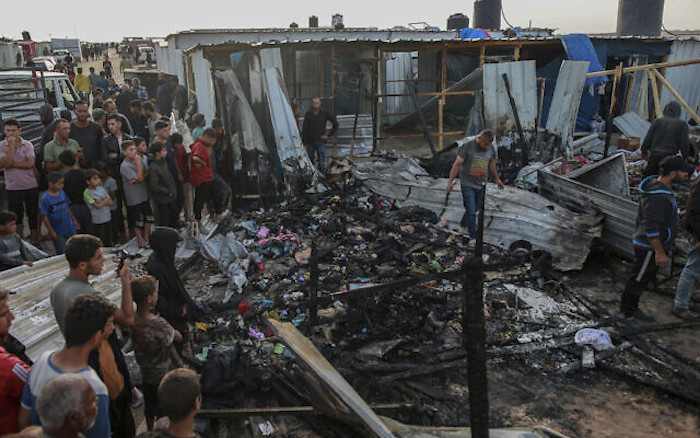
Responding to its latest genocidal atrocity which it claims was “a tragic error”,1 bombing a displaced person’s tent camp2, the zionist state offered some excuses for its general behaviour which are not only not acceptable but are not even true.
In fact the Israeli state does exactly the things of which it accuses its Palestinian resistance.
Palestinians look at the destruction after an Israeli strike on a camp for internally displaced people declared “safe area” by the Israeli military in Rafah, Gaza Strip, May 27, 2024 (Photo cred: AP Photo/Jehad Alshrafi)
Let’s examine one of its claims in the statement: “Israel says it does its best to adhere to the laws of war and says it faces an enemy that makes no such commitment, embeds itself in civilian areas and refuses to release Israeli hostages unconditionally.”3
Every phrase about its own conduct is the opposite of what the zionist state does. Every accusation directed at the ‘other’ is what it does itself.
The Israeli state embeds its armed forces in civilian areas by a) requiring military service of nearly every Israeli male and female and b) by providing military backing to its settlers, including those in areas of what international bodies recognise as ‘illegal occupation’.
The Israeli regime and its armed forces ignore the international rules of war with regard to attacks on (Palestinian and Arab) civilians, journalists, medical and aid personnel4 and civilian cultural, administrative, infrastructural, educational and religious locations and buildings.
It is the zionist state that refuses to release their captives unconditionally (even re-detaining those they’ve agreed to release under prisoner exchange deals). At the time of writing the zionist state has detained 8,875 Palestinians since 8th October last year, including about 295 women, 630 children, 76 journalists (49 still in detention) and has issued 5,210 “administrative detention orders” (i.e internment without trial).5
On the other hand, the resistance forces target mostly the Israeli armed forces but also settlers. They allow military helicopters to land and remove IOF dead and wounded but do not fire on them, unlike the IOF who fire on paramedics, doctors and hospitals, killing many medical personnel.
Of course the Resistance is embedded amongst the people because it is of it, born of the population’s will to resist and also fights to protect it, insofar as it can. Were this not so the Resistance would long ago have been expelled by the people or exposed to the occupying forces.
However, the Resistance does not base itself in hospitals, in mosques or in refugee centres, which the Occupation’s military does not hesitate to bomb or invade.
Two Medical Staff Kuwait Hospital Rafah, South Gaza, Killed by Israeli Missile 27 May 2024 (Photo sourced: Resistance News Network)
Recently, Netanyahu, Biden, Sunak and some others, in responding to the International Criminal Court’s statement that it was going to issue arrest warrants for Netanyahu and Gallant,6 along with three Hammas officials, exclaimed in rage that there is no equivalence between the two groups.
They are absolutely correct.
The Palestinian resistance has not stolen land, does not target Israeli women and children, hospitals, schools and universities nor are its members afraid to fight its enemies on the ground without armour or air cover.
Bodies of two workers of the Kuwait Hospital in Rafah killed by missile strike on othe gate of the hospital today. (Sourced at: Resistance News Network)
The symbolic decision of the Irish, Spanish and Norwegian states to recognise a Palestinian state drew the ire of the same parties as with the ICC statement, the Israeli Foreign Minister accusing the Irish State’s leaders in a racist video of having rewarded Palestinian “terrorism” with statehood.
This is yet another example of the zionists accusing others of what they themselves have done.
The zionist settlers waged a war against the English occupiers and the indigenous Palestinian people from the 1920s to the 1940s through the terrorist groups of the Irgun, Lehi, Haganah and Palmach, going on in 1948 to kill and rape Palestinians, burning villages and expelling 700,000 people.7
The Zionists declared their state in 1948 and demanded recognition, granted by the USSR and the USA, thereby rewarding their terrorism with recognition of their state, which was followed by other states later.
One of the terrorist groups, the Haganah, became the core of the army of the zionist state.
1At first they tried to justify it by saying that Resistance militants were gathered there, then remembered it was an area they had claimed safe from bombing and so changed their story to one of “tragic error”, blaming the chaos of war. But these bombings are ordered and directed far from any battle-chaos and with satellite and drone imagery to consult. Which means the area could not be confused with some other and the bombing was deliberate.
2On Sunday, 26th May 2024 killing 45 Palestinians and wounding 250 (at the time of writing), having also bombed a number of UNRWA displaced person centres.
4As recently as today the Occupation killed two medical workers as they shelled the doorway to Kuwait Hospital in southern Rafah, Gaza. There is not a medical centre in Gaza which the Occupation has not partially damaged or completely destroyed.
5Source: Adameer, Palestinian prisoner support organisation.
6Prime Minister and Minister for ‘Defence’ (sic) of ‘Israel’, respectively.














 rebelbreeze