Israel uses white phosphorus munitions in Gaza during Operation Cast Lead.
Norman Finkelstein published a book a number of years ago entitled Gaza: An Inquest Into Its Martyrdom.
In it he looked at various major episodes in the long bloody onslaught on the people of Gaza, amongst them Operation Cast Lead and also the attack on the boat Mavi Marmara and the Goldstone Report, amongst other issues.
He could have written it yesterday about the current genocidal plans of the Israeli state.
The current Israeli offensive is just one more in a long line of massacres. This is not a review of Finkelstein’s book, though any book by him is worth reading and should be read. Rather I just want to use the book to show that what is happening now is not new, it is just more intense.
Israel has murdered before, it has lied, it has committed war crimes and it has always received the support of western states.
Above all we should be clear that we are where we are partly due to the Oslo Accord and also the role played by the Palestinian Authority and the PLO. They cannot wash their hands of the affair.
“One of the meanings of Oslo,” former Israeli foreign minister Shlomo Ben-Ami observed, “was that the PLO was . . . Israel’s collaborator in the task of stifling the intifada and cutting short . . . an authentically democratic struggle for Palestinian independence.”
Rabin (left) and Arafat shake hands on the Oslo Accords under the management of then US President Clinton. (Photo sourced: Internet)
In particular, Israel contrived to reassign to Palestinian surrogates the sordid tasks of occupation. “The idea of Oslo,” former Israeli minister Natan Sharansky acknowledged, “was to find a strong dictator to . . . keep the Palestinians under control.”
“The Palestinians will be better at establishing internal security than we were,” Israeli prime minister Yitzhak Rabin told skeptics in his ranks, “because they will not allow appeals to the Supreme Court and will prevent the Association for Civil Rights in Israel from criticizing the conditions there. . .
They will rule by their own methods, freeing, and this is most important, the Israeli soldiers from having to do what they will do.”(1)
In other words, Gaza has bled under the passive gaze of the bureaucrats of the Palestinian authorities and of course of the reactionary Arab regimes that have never lifted a finger to help their Palestinian brothers and sisters.
They have not even threatened to cut off the supply of oil to the West, something they could do right now, but won’t. It has also happened under the gaze of those on the Left who run around shouting Implement Oslo! Two State Solution!
They ignore the fact that Oslo represented an ideological, political and military defeat for the Palestinians. The PLO accepted its role as puppet, administrator of a small urban city-like council and as chief repressor of those who continued to fight for Palestinian freedom.
A look at the Oslo II Accord, signed in September 1995 and spelling out in detail the mutual rights and duties of the contracting parties to the 1993 agreement, suggests what loomed largest in the minds of Palestinian negotiators.
Whereas four full pages are devoted to “Passage of [Palestinian] VIPs” (the section is subdivided into “Category 1 VIPs,” “Category 2 VIPs,” “Category 3 VIPs,” and “Secondary VIPs”), less than one page—the very last—is devoted to “Release of Palestinian Prisoners and Detainees,” who numbered in the many thousands…
The barely disguised purpose of Oslo’s protracted interim period was not confidence building to facilitate an Israeli-Palestinian peace but collaboration building to facilitate a burden-free Israeli occupation.(2)
However, Israel is now militarily weak. Finkelstein points to a number of attacks where it has shown its weakness. Its predilection is for attacks on the civilian population that can’t fight back.
In 2006, it opted to bomb civilians in Lebanon rather than engage in a proper fight with Hezbollah “terrorizing Lebanese civilians appeared to be a low-cost method of “education.”(3)
In Gaza in Operation Cast Lead in 2008/9, it followed a similar path of aerial bombardments of civilians rather than land invasions, that would see its troops face the wrath of Hamas and other armed organisations. So first they relentlessly bombed Gaza before any troops went in.
When the troops went in, the civilian population was their preferred target then as it is now. The murder of civilians is not new. It is part of an Israeli strategy of claiming easy victories.
An Israelicombatant remembered a meeting with his brigade commander and others where the “rules of engagement” were “essentially” conveyed as, “if you see any signs of movement at all you shoot.”
Other soldiers recalled, “If the deputyBattalionCommander thought a house looked suspect, we’d blow it away. If the infantrymen didn’t like the looks of that house—we’d shoot” (unidentified soldier); “If you face an area that is hidden by a building—you take down the building.”
Questions such as ‘who lives in that building[?]’ are not asked” (soldier recalling hisBrigadeCommander’s order);
“As for rules of engagement, the army’s working assumption was that the whole area would be devoid of civilians … Anyone there, as far as the army was concerned, was to be killed” (unidentified soldier);
“We were told: ‘any sign of danger, open up with massive fire” (member of a reconnaissance company); “We shot at anything that moved” (Golani Brigade fighter); “Despite the fact that no one fired on us, the firing and demolitions continued incessantly” (gunner in a tank crew).
“Essentially, a person only need[ed] to be in a ‘problematic’ location,” a Haaretz reporter found, “in circumstances that can broadly be seen as suspicious, for him to be ‘incriminated’ and in effect sentenced to death.”(4)
In all around 1,400 Palestinians were murdered in Operation Cast Lead, with 80% of them being civilians including 350 children. Israeli casualties were risible in comparison, just 10 combatants were killed, four of whom were killed by friendly fire.(5)
Then as now, Israel wheeled out the old trope of “human shields”. Amnesty International found no evidence of that,(6) in fact, it found evidence of Israel using children as human shields.(7)
It also found that Israel used then, as it does now, white phosphorous against schools, hospitals and even the UNRWA.(8) Furthermore, 99% of the air attacks were accurate.(9) If they murdered civilians, it is because the civilians were the target.
Following the operation, the Goldstone Report was published. It surprised no-one when it found evidence of Israeli war crimes and to a lesser extent of Hamas. It is a salutary lesson for those who now place their confidence in the International Criminal Court (ICC).
Goldstone made various recommendations.
Individual states in the international community were exhorted to “start criminal investigations in national courts, using universal jurisdiction, where there is sufficient evidence of the commission of grave breaches of the Geneva Conventions of 1949.
“Where so warranted following investigation, alleged perpetrators should be arrested and prosecuted in accordance with internationally recognized standards of justice.”(10)
We know that nothing of the sort happened. In fact, the western governments paid little heed to the report. Goldstone was forced to recant on the conclusions to his report.
Netanyahu for his part announced that he wanted to amend the rules of war leading to Israeli historian Zeev Sternhell asking “What is it that Israel wants … Permission to fearlessly attack defenseless population centers with planes, tanks and artillery?”(11)
Exactly.
And here we are today, with Israel unilaterally amending the rules of war, with the green light from the EU and the USA, amongst others. They murder civilians and no one proposes doing anything.
In Operation Cast Lead, the harshest sentence emitted by an Israeli court was seven and a half months to a soldier who had stolen a credit card!(12) Minor financial crimes are of greater concern than war crimes or crimes against humanity.
After this genocide in Gaza, we can’t expect much from the ICC.
Throughout its history the ICC has opened just 31 cases, including one for genocide. All of them against African leaders. This does not mean that those leaders did not deserve to be judged for their crimes, but that the ICC is just the legal arm of imperialism.
It has never attempted to put on trial the powerful in the West and despite everything even less so Israel. This year it issued a communiqué announcing that it would issue an arrest warrant for Vladimir Putin for war crimes and did so on its own initiative.(13)
In the case of Gaza, it will do nothing of the sort. Those who place their trust in the ICC or in the Palestinian Authority are fooling themselves. This situation is the result of turning a blind eye to Israel for many years whilst it commits all sorts of crimes.
It didn’t act before and it won’t do so now. Neither will the Arab regimes do much, unless their own populations force them. They fear the Palestinians and their own people as they know that the struggle against Zionism is also a struggle against them.
The more revolutionary Palestinian groups used to say that the path to Jerusalem went through Amman and Damascus. They were right, it does pass through those capital cities and also Beirut, Riyadh, Cairo and all the others and not through the ICC.
In fact, one day the judges and prosecutors of that body should be put on trial for their complicity in Israel’s war crimes and crimes against humanity through their inaction and omission.
It is beyond the scope of this article to deal with the role of Amnesty International in its own reports on Palestine.
They are what Finkelstein refers “as far from being the exception that proved the rule, Amnesty actually constituted a variant of the rule: instead of falling silent on Israeli crimes during Protective Edge, Amnesty whitewashed them.”(14)
I will leave it to the reader to look at the book for more information on that particular betrayal. Suffice to say, we can expect little from such organisations. At best they gather data we can sometimes use.
Notes
(1) Finkelstein, N. G. (2018) Gaza: An Inquest Into Its Martyrdom. California. California University Press. pp 6 & 7
November 17th is the anniversary of the date when a demonstration, mainly of Irish in solidarity with Fenian prisoners in British jails, saved the public Speakers’s Corner in Hyde Park from State control for everyone.
‘Frederick’ (Friedrich) Engels was there and reported on it (see below) with great admiration for the Irish diaspora. In his seminal The Condition of the Working Class in England (1845) he had not had that feeling for the Irish but had matured as a person and a revolutionary since.1
The Clerkenwell jail wall blown by Fenians (Photo sourced: Internet)
Frederick Engels and Karl Marx, both exiles from Germany, one by choice and the other as a refugee, came to form a strong corresponding, writing and organising partnership. Together they formed the International Working Men’s Association.
The First International, as it came to be called, took a position on many international questions but did not shirk the Irish one and indeed exposed and agitated about the terrible conditions under which Fenians were being held in British jails.
Jeremiah O’Donovan Rossa (1831-1915), a Fenian prisoner, wrote that he was for a period chained to the wall and had to eat his food from a bowl on the floor like a dog. It is also recorded that a third of the prisoners died in jail or went insane.
Frederick Engels as a young man (Photo sourced: Internet)
The Irish Republican Brotherhood had been founded in Dublin and in New York on St. Patrick’s Day, 1858 and in the USA quickly became better known as “the Fenian Brotherhood”. In Ireland they were frequently referred to as “the Fenians” or, by those on ‘the inside’ as ‘the IRB’.
Clearly from Engels’ description, “Fenians” was also the common description in Britain too. The Fenians took the war to Britain; the Crown responded by organising a specific police department, the Special Irish Branch of Scotland Yard, to spy on the Irish diaspora and to arrest suspects.
The “Special Branch” became known henceforth as the political department of the British police force but also of British colonial police forces in Ireland, Commonwealth countries such as Australia, and colonies such as Kenya, Uganda, Hong Kong …
We know that that the Fenian prisoners were not forgotten in Ireland, with campaigns for their freedom including articles, public events and even songs composed for them. But evidently they were not forgotten by the Irish diaspora in Britain nor by their socialist and democratic allies.
On November 17th 1872 the First International organised a march to Speakers’ Corner in London to protest the conditions under which those Fenian convicts were having to exist. Engels reported on the march and that he public speaking area was under threat of State control.
The Irish diaspora in Britain, the Irish-born migrants and descendants, contributed hugely to society and especially so to the working class in Britain, including presenting its anthem,2 its classic novel3 and two leaders4 of the Chartists, the working class’ first first genuinely mass movement.
In addition, members of the Irish diaspora helped build up the trade unions and were present in every movement against state repression, police violence, fascism, racism, colonialism and imperialism, fighting in organisations for housing, wages, free speech, political and civil rights.
Depiction of Speakers’ Corner meeting about the Fenian prisoners (Photo sourced: Internet)
Frederick Engels:
III Meeting in Hyde Park
London, November 14, 1872
The Liberal5English Government has at the moment no less than 42 Irish political prisoners in its prisons and treats them with quite exceptional cruelty, far worse than thieves and murderers.
In the good old days of King Bomba, the head of the present Liberal cabinet, Mr. Gladstone, travelled to Italy and visited political prisoners in Naples; on his return to England he published a pamphlet which disgraced the Neapolitan Government before Europe for its unworthy treatment of political prisoners.
This does not prevent this selfsame Mr. Gladstone from treating in the very same way the Irish political prisoners, whom he continues to keep under lock and key.
The Irish members of the International in London decided to organise a giant demonstration in Hyde Park (the largest public park in London, where all the big popular meetings take place during political campaigns) to demand a general amnesty.
They contacted all London’s democratic organisations and formed a committee which included MacDonnell (an Irishman), Murray (an Englishman) and Lessner (a German) — all members of the last General Council of the International.
A difficulty arose: at the last session of Parliament the government passed a law which gave it the right to regulate public meetings in London’s parks.
It made use of this and had the regulation posted up to warn those who wanted to hold such a public meeting that they must give a written notification to the police two days prior to calling it, indicating the names of the speakers.
This regulation carefully kept hidden from the London press destroyed with one stroke of the pen one of the most precious rights of London’s working people — the right to hold meetings in parks when and how they please.
To submit to this regulation would be to sacrifice one of the people’s rights.
The Irish, who represent the most revolutionary element of the population, were not men to display such weakness.
The committee unanimously decided to act as if it did not know of the existence of this regulation and to hold their meeting in defiance of the government’s decree.
Last Sunday at about three o’clock in the afternoon two enormous processions with bands and banners marched towards Hyde Park.
The bands played Irish songs and the Marseillaise6; almost all the banners were Irish (green with a gold harp in the middle) or red.
There were only a few police agents at the entrances to the park and the columns of demonstrators marched in without meeting with any resistance. They assembled at the appointed place and the speeches began.
The spectators numbered at least thirty thousand and at least half had a green ribbon or a green leaf in their buttonhole to show they were Irish; the rest were English, German and French.
The crowd was too large for all to be able to hear the speeches, and so a second meeting was organised nearby with other orators speaking on the same theme.
Forceful resolutions were adopted demanding a general amnesty and the repeal of the coercion laws which keep Ireland under a permanent state of siege.
At about five o’clock the demonstrators formed up into files again and left the park, thus having flouted the regulation of Gladstone’s Government.
This is the first time an Irish demonstration has been held in Hyde Park; it was very successful and even the London bourgeois press cannot deny this.
It is also the first time the English and Irish sections of our population have united in friendship.
These two elements of the working class, whose enmity towards each other was so much in the interests of the government and wealthy classes, are now offering one another the hand of friendship; this gratifying fact is due principally to the influence of the last General Council of the International,[307] which has always directed all its efforts to unite the workers of both peoples on a basis of complete equality.
This meeting, of the 3rd November, will usher in a new era in the history of London’s working-class movement.
You might ask: “What is the Government doing? Can it be that it is willing to reconcile itself to this slight? Will it allow its regulation to be flouted with impunity?”
Well, this is what it has done: it placed two police inspectors and two agents by the platforms in Hyde Park and they took down the names of the speakers.
On the following day, these two inspectors brought a suit against the speakers before the ustice of the Peace. The justice sent them a summons and they have to appear before him next Saturday.
This course of action makes it quite clear that they don’t intend to undertake extensive proceedings against them.
The government seems to have admitted that the Irish or, as they say here, the Fenians have beaten it and will be satisfied with a small fine. The debate in court will certainly be interesting and I shall inform you of it in my next letter.[308]
Of one thing there can be no doubt: the Irish, thanks to their energetic efforts, have saved the right of the people of London to hold meetings in parks when and how they please.
Notes
307 By the “last” General Council Engels means the London Council that existed before the Hague Congress of the International at which a decision was adopted to transfer the scat of the General Council to New York.
308 In the fourth article of the Letters from London series: “Meeting in Hyde Park. — The Position in Spain,” written on December 11, 1872, Engels reported that the Justice of the Peace could do no more than impose the smallest possible fine, and since his decision anyway ran contrary to the rules governing behaviour in Hyde Park the accused demanded that the case be brought before a court of appeal.
Engels’s Letters from Londonappeared in La Plebe, the newspaper of the International’s sections in Italy, early in April 1872, and continued throughout the year.
Early in 1873, Engels’s co-operation with La Plebewas temporarily interrupted due to government reprisals against the paper’s editors.
La Plebe was published under the editorship of E. Bignami in Lodi between 1868 and 1875, and in Milan between 1875 and 1883. Up to the early seventies the newspaper followed a bourgeois-democratic line, later it became socialist.
In 1872-73 La Plebeplayed an important role in the struggle against the anarchist influence in the Italian working-class movement. Engels’s contributions greatly promoted the paper’s success.
In 1882, the first independent party of the Italian proletariat the Workers’ Party — formed around La Plebe.
Source: Marx and Engels on Ireland, Progress Publishers, Moscow 1971; First Published: in Italian in La Plebe, November 17, 1872; Transcribed: by Andy Blunden.
1Aided by the Burns sisters Lizzie and Mary when he lived in Manchester, one of whom was his partner until she died and the other, subsequently his wife.
5The two main bourgeois political parties in Britain at the time were the Conservatives and Liberals; over time the latter declined and was replaced in its counterpoint to the Conservatives by the British Labour Party.
6French national anthem now but originally song of the French Republican uprising of 1789. In addition the air has been used for the lyrics other revolutionary songs.
Currently the Garda Representative Association is in a public struggle with the body’s most senior officer and nearly 99% in a high-participation poll of GRA members voted as having no confidence in Drew Harris, the Commissioner.1
The real issue for the GRA (Garda Representative Association) is that they enjoyed the rosters adopted by the Garda Síochána during the Covid pandemic and don’t want to abandon them. Of course not. Four days off after four days on shift must be nice and would we all had that.
But for that, the Gardaí would be required to work 12-hour shifts on their four days on and they are not complaining about that all – they are clamouring to do it. The workers’ movement fought hard for the 8-hours day and in in 1886 Anarchists in Chicago were martyred in that struggle.2
Not so long ago in the West, 12-hours was a usual shift for a worker thoughfor six days (“seventy hours was his weekly chore”).3 There is a well-known close association of fatigue with harmful incidents (as remarked upon by James Connolly)4 — and also with shoddy work.
Most Gardaí working 12-hour shifts will adapt themselves to the long hours by taking care to stretch themselves as little as possible but always being available for short energetic work, i.e evictions, intimidating industrial pickets, batoning protest marches and conducting raids.5
Justice Minister Helen McEntee says that she will not interfere in the dispute though at the same time expressed support for Harris and mildly criticised the threatened strike action by the GRA. Naturally the ruling class does not want to alienate their first line of physical defence.
But Sinn Fein TD Pearse Doherty last Thursday attacked the Government and Fine Gael in particular over what he called a “hands off” approach to the dispute by the Justice Minister. According to SF the Gardaí are a service valued and needed by communities.
This benevolent SF attitude to the Gardaí even extends to “specialist groups”.
Doherty and his party leaders now choose to forget that Irish Republicans, including thousands of their own supporters when it was a Republican party, have been spied upon, harassed, threatened, raided, beaten up, framed and perjured against in order to see them jailed.
Sinn Féin’s attitude to the Gardaí is a clear illustration of its change from revolutionary opposition to accommodation with the Gombeen capitalist system — and when in government they will use the Gardaí against any resistance to the system as currently they are using the PSNI.
GARDAI – A LONG REACTIONARY HISTORY
The Gardaí, as the first line of physical defence of the Irish Gombeen class has a long anti-working class, anti-Republican and anti-Left history. The intelligence branch CID worked with the National (sic) Army in identifying Republicans to kidnap, torture and murder.6
ANTI-REPUBLICAN
After the defeat of the Irish Republican Movement by the State forces armed and equipped by British imperialism, the Irish neo-colonial state used the Gardaí to harass Republicans.
Eoin O’Duffy, the second Garda Commissioner (1922-1933) of the Irish State, hounded Irish Republicans and socialists during the Civil War and after, one of the causes of political emigration from Ireland and in 1932 (still in his post) founded the Irish fascist Blueshirt organisation.7
Eoin O’Duffy reviewing his fascist “Blueshirts” in the 1930s – he founded them while still the second Garda Commissioner of the Irish State (1922-1933). (Photo sourced: Internet)
O’Duffy and his Blueshirts attempted to prepare a coup against the De Valera government of Fianna Fáil and after partial suppression by the government, went on to combine with another two reactionary political organisations to form the Fine Gael Party in 1933.8
Ned Broy, appointed third Garda Commissioner (1933-1938) created the Special Branch9 (nicknamed “Broy’s Harriers”10 after a Bray dog hunting pack) to repress the fascist movement. However, he filled the unit with ex-military who had been anti-Republican during the Civil War.
Subsequently, “Broy’s Harriers” also carried out repression against the Republican movement opposed to De Valera and Fianna Fáil.
In the long line of Garda Commissioners that followed, all have presided over repression of the Irish Republican and Left movements, as well as against Travellers and LGBT11 people and even in persecution of people providing contraception prevention.
Some Commissioners have resigned or retired in controversy: Patrick McLaughlin (1978-1983), retired in the wire-tapping scandal and Patrick Callinan (2010-2014`), over the phone-tapping GSOC and penalty points corruption scandal.
Noirin O’Sullivan (2014-’17) during the breath-testing corruption and persecution of Garda whistleblower controversy, resigned the post and disturbingly, walked into a job as Director of Strategic Partnerships for Europe at the International Association of Chiefs of Police.
Then Garda Commissioner Martin Callinan speaks privately to then Deputy Commissioner Noirin O’Sullivan; she succeed him when he resigned in controversy, herself resigning in a separate controversy not long afterwards (Photo cred: Eamonn Farrell in The Journal)
Republican prisoner solidarity pickets are frequently harassed and subject to attempted intimidation and individual activists are followed, stopped and questioned etc.
The no-jury political Special Criminal Court regularly jails Republicans on charges of “membership of an illegal organisation”, sending people to jail largely on the word of a Garda officer at the rank of Superintendent and above, who never reveal their alleged sources.
In 1976, the Irish State tried to smash the Irish Republican Socialist Party by pinning the Sallins Mail Train Robbery on them, though they knew the robbery wasn’t theirs. Forty homes were raided and false confessions beaten out of victims by the special Garda “Heavy Gang” unit.12
Three innocent activists were sentenced to 12 years in jail as a result and some of the special unit went on to frame others with false confessions also, including Joanna Hayes and family in the “Kerry Babies” case, as outlined in the Crimes and Confessions RTÉ series.
The last time the Gardai took unofficial industrial action by phoning in ‘sick’ was during the “blue flu” of 1998, when however their Special Branch remained very active indeed.
Foiling an attempted robbery by a Real IRA unit, the Special Branch Gardaí shot and killed Volunteer Ronan McLoughlin in the back while he was driving away from them. Despite the victim posing no threat to anyone when he was killed, the Gardaí were judged ‘innocent’.13
ANTI-PROGRESSIVE, ANTI-WORKING CLASS
The long-overdue second inquest into the fatalities of the 1981 Stardust Fire is underway as this piece is being written and in 1983, Garda Special Branch raided the launch of Christy Moore’s vinyl LP An Ordinary Man to seize the record after Stardust owners objected to a song in it.14
Over the years of the State the Gardaí have attacked protests and demonstrations, including with particular infamy those of the 1981 Hunger Strikes solidarity march15 and Regain the Streets in 200216 in Dublin and the Corrib Pipeline protests17 against British Petroleum in Mayo.
Gardaí also harassed and assaulted some of the since-famous Dunne’s Stores anti-apartheid strikers and again the more recent Debenhams sacked workers’ pickets.18
Video online of Gardaí using Covid restrictions to harass picketing sacked Debenhams workers. Later they used violence to remove picketers so Debenhams, defaulting on redundancy payments owed to workers, could remove stock from their closed stores.
The Gardaí have on numerous occasions displayed their tolerance of fascists, even to the extent of tolerating abuse from them and flagrant violation of Covid19 regulations.19 Conversely Gardaí have threatened and attacked antifascist counter demonstrators on many occasions.
In February 2016 a mass mobilisation of anti-fascists and anti-racists prevented the fascist islamophobic organisation Pegida from launching itself in Dublin. Gardaí attacked the antifascists and batoned an RTÉ cameraman in the face.
Gardaí threatening antifascists after the latter had been attacked by armed fascists on Custom House Quay and Gardaí had then attacked the antifascists, pushing and shoving them on to Butt Bridge. (Photo: Rebel Breeze)
On a number of occasions outside the GPO, Gardaí witnessed fascist assaults on opponents without even taking names of perpetrators but on 22nd August 2020 they went much further in showing their true colours as armed fascist thugs attacked a counter protest on Custom House Quay.
The Gardaí briefly separated the combatants and then the Public Order Unit attacked the unarmed antifascists, threatening them with raised batons and pushing and shoving them away on to Butt Bridge. Later they lied to the media, pretending that no serious violence had occurred.20
Three weeks later, on 12th September, an LGBT activist and a couple of friends were observing a rally of the fascist National Party when they were mobbed, threatened and shoved and one was struck on the head with a wooden club which had a Tricolour wrapped around it.
The Gardaí again lied to the media and said there had been no violent incidents. However video of the attack and of a Garda confronting the victim with blood streaming from her head and waving her away, circulated widely and the Gardaí had to change their story.
Ms Izzy Kamikaze being pushed by Gardaí down Kildare Street after being struck on the head with a club by a fascist (Photo sourced: Internet )
It took the victim to swear out a formal complaint and a month’s delay before the specific wooden club assailant was charged. Last year he pleaded guilty and was sentenced to three years prison.21
In the face of criticisms about their failure to prevent random violent assaults in Dublin’s city centre this year, the Gardaí claimed that they did not have enough personnel to prevent them. However it seems they can always find huge numbers to repress people’s resistance.
Early in June 2022, 100 Gardaí, including an armed unit and a helicopter, took part in the eviction of two activists of the Revolutionary Housing League, who had taken over for the homeless a large empty property on Eden Quay, Dublin. (That building remains empty at the time of writing).22
Garda vehicles in their eviction operation against a building occupied by the Revolutionary Housing League in Berkely Road 11 July this year (Source: RHL)
In early July this year, a similarly large number of Gardaí with a helicopter in attendance blocked two ends of Berkely Road in Dublin in order to evict four RHA activists holding a three-storey empty building in which they had recently housed some homeless people.23
Gardaí have acted against a number of housing campaign actions, in one documented case sending an armed response unit. While acting against housing activists, they have at the same time permitted illegal evictions without intervening (except against protesting housing activists).24
On yet others, masked Gardaí have colluded with masked thugs to evict housing activists.25
Masked Gardaí working with masked private thugs in carrying out an eviction in Dublin 2018. (Photo sourced: Internet)
Although Gardaí were nearly invisible on the huge anti-extra-water-tax demonstrations, they were present and active on many of the smaller and more local anti-water-privatisation protests opposing the water meter installations for Denis O’Brien’s Uisce Éireann, assaulting and arresting people.
During the long decades of church sexual predation and other abuse by members of (mostly) Catholic Church institutions, complaints to the Gardaí were routinely ignored. Indeed, the Gardaí often seized escaped victims in order to return them to the institutions.26
It is old news that the Gardaí have abused their power against members of the public but less known is that members have done so for sexual advantage or in the course of their personal domestic relationships. Of course this is not surprising since abuse of power reaches everywhere.27
Terence Wheelock’s28 relatives and their supporters are not the only ones accusing the Gardaí of having killed someone in their custody and Vicky Conway (recently deceased) quoted the figure of an annual average of 15 deaths around Garda custody from 2017 to 2021.29
Corruption in the Gardaí has come to light a number of times, including most recently the false reporting of drink-driving checks and the failure to charge a number of people who were actually found to be driving “under the influence”.
In the course of the above a number of whistleblowers within the Gardaí were intimidated, harassed and in one case an attempt was made to frame a prominent one for abuse of a child.30
CURRENT STRUGGLE BETWEEN THE GRA AND THE COMMISSIONER
Irish Republicans have long held a particular enmity towards Drew Harris, given his previous employment as Assistant Commissioner of the colonial gendarmerie in the Six Counties.31 They regularly refer to him as of MI5, the British Intelligence department operating in the UK.
This is understandable and, in fact, it is less natural that other sections of the Irish polity seem to have had no issue with Harris’ provenance. But in fact, the State’s own senior Gardaí have long been in service, and not always indirectly, to British imperialism, witness Edmund Garvey.32
Former Garda Commisioner Edmund Garvey outside the Four Courts 11/10/1978. (Part of the Independent Newspapers Ireland/NLI Collection). (Photo by Independent News and Media/Getty Images)
The revolutionary Left, socialist republican or just socialist, have no reason to side with the Garda Representative Association in their campaign for a different roster or against Drew Harris. Nor of course do we owe Harris any support either.
Unlike Sinn Féin, our position should be opposition to all of the State’s repressive institutions.
Chief among those institutions and regularly confronting us in repression or exercising its power against working class communities is the Gardaí Síochána, with its long anti-working class, anti-democratic, anti-Republican and anti-Socialist reactionary history.
4Competent investigators, for instance, have found that the greatest number of accidents occur at two specific periods of the working day – viz., in the early morning and just before stopping work at evening. In the early morning when the worker is still drowsy from being aroused too early from his slumbers, and has not had time to settle down properly to his routine of watchfulness and alertness, or, as the homely saying has it, “whilst the sleep is still in his bones”, the toll of accidents is always a heavy one.
After 9 a.m. they become less frequent and continue so until an hour after dinner. Then they commence again and go on increasing in frequency as the workers get tired and exhausted, until they rise to the highest number in the hour or half-hour immediately before ceasing work. How often do we hear the exclamation apropos of some accident involving the death of a worker: “He had only just started”, or “he had only ten minutes to go before stopping for the day”? And yet the significance of the fact is lost on most.
9Now known as the Special Detective Unit; however the “Special Branch” name had a history in Britain, where Scotland Yard formed its Special Irish Branch in 1833 to spy on the Fenian movement among the huge Irish diaspora in the cities of Victorian Britain – and several of its members were Irish. Police services in a number of British present and ex-colonies have also carried on the “Special Branch” name, as far apart as the Six Counties colony and the British Bahamas.
13And McLoughlin’s inquest was delayed for decades.
14 The LP included Moore’s They Never Came Home which alleged that fire exits were chained shut, a matter with which the current inquest is dealing and about which I do not wish to say more at this point. The following account discussing the banning does not mention the Branch raid but I know of it from people who were present: https://theblackpoolsentinel.com/2021/01/11/christy-moore-and-the-stardust-tragedy/
15The marchers were frustrated that they were being prevented from even reaching the British Embassy in Merrion Road, attempted to push through and a battle ensued. Many were injured on both sides but the police baton-charged the whole crowd and even threatened journalists, though most subsequent media reports were either supportive of the Gardaí or blaming both sides; this brief report and photo being the exception: https://www.reportdigital.co.uk/reportage-photo-garda-baton-charging-national-h-blocks-committee-protest—18-jul-image00138214.html
18Indeed in one afternoon, uniformed Gardaí hassled the Dunne Stores picketers in Henry Street under Covid19 pandemic regulations, although all were masked and maintaining social distancing, while around the corner the far-Right were demonstrating mask-less and packed together, without the least interference from the Gardaí. A 100 yards or so down the road, the plain-clothes Special Branch (SDU), the political police, were harassing an anti-internment and political prisoner solidarity picket.
19Occasionally Garda patience snapped and one can see the incredulity in the reaction of the Far-Rightists on those occasions, as they had become so used to doing nearly anything they wanted.
31Previously the Royal Ulster Constabulary (and RIC before that), the PSNI is the armed colonial (and sectarian) police force of the UK State.
32Ned Garvey was ‘outed’ as a British Intelligence ‘asset’ (code name ‘Badger’) by disaffected MI6 handler Fred Holroyd. Garvey denied he was an agent for the British but the Barron Report found that that Holroyd had visited Garvey in his office in 1975 and that he had not made his superiors aware of this. The incoming FF government in 1978 sacked Garvey as having no confidence in him but as a result of not following disciplinary procedures Garvey was able to sue the State and retain his pension. While Garvey was Assistant to Patrick Malone, Garda Commissioner during the British Intelligence/ Loyalist Dublin and Monaghan Bombing in 1974 bomb remains were sent to the Six Counties for forensic analysis. No-one was ever even arrested for the bombing, never mind convicted and the widely-suspected British proxy Glennane Gang went on to murder many more, mostly civilians (see Cadwaller, Lethal Allies).
“Six innocent men” … “Garda oppression and perjury’ … “Longest case in the history of the State”
Four leading human rights organisations this week delivered a petition to the Irish Government asking the Minister for Justice to establish an inquiry into the abuse suffered by six innocent men in the Sallins case almost half a century ago.
Not to do hold such an inquiry, maintained Liam Herrick of the Irish Council for Civil Liberties at a press conference on Tuesday, is to continue the abuse of the victims’ human rights and to fail to prevent such an abuse in the future.
Osgur Breatnach, Liam Herrick and Nicky Kelly at the petition launch press conference (Photo: Rebel Breeze)
Apart from the ICCL, the other three organisations pushing the petition are the Committee for the Administration of Justice (CAJ), the Pat Finucane Centre (PFC) and Fair Trials; the first three are Ireland-based organisations and Fair Trials is a global criminal justice watchdog.
The six innocent men were named as Osgur Breatnach, Michael Barrett, John Fitzpatrick, Nicky Kelly, Brian McNally and Michael Plunkett (deceased1).
At the time in 1976 all were members of a legal political party (the Irish Republican Socialist Party) but were tortured and some jailed in the Irish state.
In the longest series of trials in the history of the State, three of the men were sentenced at the end of 1978 to prison terms of between nine and twelve years each on the basis of no ‘evidence’ but their confessions obtained by torture and which in court they completely retracted.
Michael Plunkett, who had signed no confession walked free while Nicky Kelly absconded the day before the sentence, eventually reaching the USA where he remained until a strong campaign saw Breatnach and McNally freed, whereupon Kelly returned to Ireland and was immediately jailed.
Although the nature of the ‘evidence’ against Kelly was of the same kind as that which had been declared ‘unsafe’ for Breatnach and McNally, Kelly remained in jail forfour-and-a-half years, despite another strong campaign2 and was only freed eventually on ‘humanitarian grounds’3.
PRESS CONFERENCE
ICCL’s Liam Herrick chaired the conference in Buswell’s Hotel4 flanked by survivors Osgur Breatnach and Nicky Kelly, while Chris Stanley of KRW Law sat nearby, all facing the audience which included Sinn Féin’s Pa Daly TD5 and Fionna Crowley of Amnesty International.
Opening the proceedings, Herrick listed the four organisations backing the call for an inquiry and pointed out the present-day relevance of that call, both in terms of the survivors and their families and in terms of wider society.
Not to have that inquiry would be an ongoing violation of human rights, Herrick maintained and pointed out that the ICCL was founded arising out of concerns regarding the post-Sallins robbery arrests and the activities of the Garda CID unit colloquially known as the “Heavy Gang”.
The ICCL Director stated that they could not rest until the demand for an inquiry was met and referenced also “crucial legislation before the Oireachtas”6 and recognition of past injustices in a series of TV documentaries linking the cases, in particular through actual Garda individuals.
Introducing Osgur Breatnach, Herrick acknowledged the leading role he had played in keeping the demand for the inquiry going over the years.
Breatnach read from a prepared statement that there had been cases of torture, perjury and framing innocent people in England, Northern Ireland and the Republic.
It was wrong and hypocritical of the State raising concerns about cases elsewhere not to hold an inquiry into the Sallins case, of which there had been five trials, one the longest in the history of the State.
Breatnach said he went through the process expecting to be jailed but to expose the political nature of their persecution; his and McNally’s convictions were overturned, the ‘confessions’ having been obtained by oppression but despite that none were indicted for that oppression.
Breatnach concluded saying that the State’s refusal to hold an inquiry amounted to cruel and inhuman treatment of the victims and their families and that without the investigation of an inquiry a similar scenario could be repeated at some point ahead.
Nicky Kelly, introduced by Herrick thanked the ICCL for organising the events that day. Speaking apparently ex-tempore with perhaps reference to some bullet-points, he expressed the opinion that the State wanted the victims to die so that they had no need to hold an inquiry.
“Ireland has an impeccable reputation with regard to foreign relations,” Kelly said, but not so within the state. He believed that the Sallins case is “too big in its implications for politicians, judiciary and police force” and all attempts to investigate were obstructed by successive governments.
Liberal politicians in government have been “no different from the rest”, the Wicklow man said and referred to his own personal battle even to get out of jail after the ‘evidence’ to convict him had been discredited and how he had been obliged to undertake a hunger strike to be freed.
Now, rather than hold the inquiry into what went on, they were waiting for him “to be over and done with” Kelly said in conclusion.
Herrick introduced Chris Stanleyof KRW Law who said that cases such as the Birmingham pub bombings and the Dublin and Monaghan bombings, like the Sallins one, all related to the recent conflict and required investigation for the sake of the victims.
Chris Stanley of KRW Law speaking at the petition launch press conference (Photo: Rebel Breeze)
Stanley commented that perhaps the State had been too reliant on the Good Friday Agreement for resolution of these matters.
Commenting on the UK’s new legislation blocking much resolution of historic cases, all but become law, the solicitor regretted the UK had chosen to disengage from Europe but remarked that that they remained signed up to the European Commission of Human Rights.
From among the seated audience, Fionna Crowley of Amnesty International spoke to underline the importance of having an inquiry into the case and that her organisation had been in support of the victims’ campaigns and was fully in support of the current petition for an inquiry.
Breatnach acknowledged that within one week of the arrests, Amnesty had raised public concerns about them.
DELIVERY OF PETITION TO DEPARTMENT OF JUSTICE
After the conclusion of the press conference with Herrick’s summing-up and thanks to those in attendance, Herrick and ICCL staff along with Chris Stanley, Breatnach, Kelly and a couple of others walked to the Dept. of Justice’s offices on the south side of Stephens Green.
Delivering the petition to the Department of Justice: (from bottom up) Nicky Kelly, Osgur Breatnach, Chris Stanley, Liam Herrick. (Photo: Rebel Breeze)
Pausing for some photos to be taken, a delegation entered the building and presented the petition. Then some more photos were taken outside and Breatnach was interviewed by a TG4 reporter in Irish and Nicky Kelly in English while a light rain began to fall.
TG4 (Caoimhe Ní Laighin) interviews Osgur Breatnach outside the Department of Justice in Stephen’s Green (Diarmuid, brother of Osgur is centre photo and Nicky Kelly to the right). (Photo: Rebel Breeze)
The group split up into smaller groups then, the ICCL staff returning to their office to issue a press statement and others to hope, perhaps with further pushing, for positive developments further – but not too far – down the road. For all and for some much more than others, it’s been a long haul.
End.
Outside the Department of Justice with copies of the four-agency petition (right to left): Liam Herrick of ICCL, Chris Stanley of KRW Law, victims/ campaigners Osgur Breatnach and Nicky Kelly (Photo: Rebel Breeze)
APPENDIX (A): BACKGROUND
The IRSP was the result of a split from what had remained in Sinn Féin after an earlier split in 1969, the group leaving the party then calling themselves ‘Provisional Sinn Féin’.
Not all who had become unhappy with the direction of Sinn Féin departed into Provisional Sinn Féin because they perceived the new group as being much more nationalist than socialist and being also socially conservative.
After some internal struggle that section remaining within what became known as “Official Sinn Féin” left in 1974 under the leadership of Séamus Costello to form the IRSP.
The armed wing of the Republican movement had split along the same lines into Provisional IRA, Official IRA and the Irish National Liberation Army, the latter loyal to the perspective of the IRSP.7
Bernadette Devlin (now McAlliskey) and Tony Gregory (now deceased) were on the IRSP’s Executive but however departed soon afterwards from the party on what they perceived as the dominant relationship of the armed group INLA to the political party.
It appears that the Irish State at that time viewed the IRSP as more dangerous than the two Sinn Féin parties and determined to ensure its demise, framing them for the Sallins Mail Train Robbery in March 1976.8 And framing, rather than mistaking, it was.
The 40 arrested included IRSP members who, tortured by the SDU Garda unit known colloquially as the “Heavy Gang”, confessed to participating in the robbery but who could not possibly have been there. The State decided to put on trial those whose only alibis were with family.
The court chosen was the Special Criminal Court, set up under the Offences Against the State Act in the panic of the 1974 Loyalist and British Intelligence Bombing of Dublin and Monaghan which somehow got blamed on Irish Republicans. The SCC has three judges and no jury.
Until the SCC moved to the court building near the main gate to Phoenix Park, it was located in Green Street, in the very same building where Robert Emmet was tried in 1803 and sentenced to death, his sentence carried out in public in Thomas Street, in the Dublin Liberties area.
The Four IRSP eventually selected for the second of what became four trials included senior member of the party’s Executive and the Editor of its newspaper, The Starry Plough, Osgur Breatnach.9
In the second trial, one of the three judges hearing the case was regularly seen to be sleeping. Only after the judge died suddenly was there another retrial ordered.
In the fourth trial, Kelly being tried in his absence, the judges accepted as fact10 the Prosecution case that the injuries of the accused were due to beating one another up (in Breatnach’s case, that he’d beaten himself up) and that their withdrawn confessions were true.
Mick Plunkett, in the absence of a ‘confession’, was found not guilty but the other three were sentenced to 12 years in jail. In May 1980 Breatnach and McNally were freed by the Appeal Court on grounds that they had suffered ‘oppression’ and that their confessions could not be relied upon.
No investigation took place into who had carried out the ‘oppression’ or how the judiciary had jailed the victims purely on withdrawn confessions and Garda perjury or which political decisions by whom were behind it.
Nicky Kelly returned to Ireland in 1980 — but to jail.
He was only freed by a Minister of Justice on ‘humanitarian’ grounds after four-and-a-half years in jail, a strong campaign seeking his release and finally a hunger strike of 38 days which pushed the European Court of Human Rights to agree to hear his case.
He received a presidential pardon in 1992 from Mary Robinson and in 1993 Breatnach, McNally and Kelly were awarded compensation, allegedly a six-figure amount. But to get that, they had to forgo any litigation on torture or police brutality.
No official inquiry has ever been carried out in the whole set of State actions and in fact some of the Heavy Gang went on to force false confessions from others, most notably the Joanna Hayes and relatives case.11
APPENDIX (B): SUPPORTING STATEMENTS FROM OTHER ORGANISATIONS
Also speaking elsewhere on the day, Director Daniel Holder of the Campaign for the Administration of Justicesaid they support this call and that
“an inquiry into the case of the Sallins Men is long overdue.”
He went on to say that “Over the last few years inquests and other legacy mechanisms in the north have been finally delivering like never before for families who have had to wait decades.
“They are providing important historical clarification for victims and accountability for past human rights violations but now face being shut down by the notorious UK Legacy Bill.”
Pat Finucane Centre (PFC) Director Paul O’Connor said that
“PFC welcomes this demand to the Irish Government for a human rights compliant investigation into the miscarriage of justice that followed the Sallins Trains Robbery 1976.
For too long human rights violations that occurred in the Republic of Ireland during the Conflict have been at best marginalised or at worst ignored.
Successive Irish governments have either relied upon the British to address the investigatory deficit of the Conflict or deflected it as an inconvenient non-issue.
“Now the human rights deficit created by those successive Irish governments is clear – and will be clearer when the legislative effect of the British Legacy Act starts to bite.
The Irish Government was right to challenge the British about the use of torture suffered by the Hooded Men; now it must look to its own police and criminal justice system and acknowledge the torture suffered by the Sallins Men.”
Verónica Hinestroza, Senior Legal Advisor at Fair Trials said:
“According to international standards, States must investigate complaints and reports of torture or ill-treatment.
We call on the Minister for Justice to ensure that a prompt, impartial and independent investigation is conducted into the allegations made by Mr Osgur Breatnach, Mr Michael Barrett, Mr John Fitzpatrick, Mr Nicky Kelly, Mr Brian McNally and Mr Michael Plunkett (deceased), considering that torture and ill-treatment violations are not to be subject to any statutes of limitation.”
2 The campaign PRO was CaoilteBreatnach, a brother of Osgur’s and was supported by many people in the fields of politics and culture, including the band Moving Hearts who performed Christy Moore’s song about the Nicky Kelly case, The Wicklow Boy.
3 By Minister of Justice Michael Noonan after Kelly’s hunger strike of 36 days. According to law, Kelly had exceeded the time period after conviction permitted for registering an appeal and it was claimed that only a ‘pardon’ could set him free.
4 Buswell’s is across the road from Leinster House, the Irish Parliament building and is frequently host to political meetings and press conferences.
5 Recently appointed to Sinn Féin’s front bench as spokesperson on Justice, he is by profession a solicitor.
7 The history of the IRSP is a separate and contentious story but suffice it to say that of the ten hunger strike martyrs in 1981, three were INLA; at one point a number of INLA factions were feuding within it leading to a number of fraternal murders. After the Provisional prisoners embraced the Good Friday Agreement and left the jails renouncing armed resistance, the much smaller contingent of INLA prisoners did the same. The IRSP remains a legal though much reduced political party.
8 The robbery was carried out by a unit of the Provisional IRA which however did not acknowledge operations carried out within the Irish State, to which ion 27th April 1980 they made an exception in a public statement taking responsibility for the robbery. The Irish State chose to ignore their statement as had the British State when the Balcolme Street group ibn 1977 admitted in court their responsibility forthe Guildford Pub Bombingsfor which the UK had jailed the innocent Guildford Four and Maguire Seven.
9 Apart from anything else, the notion that prominent Executive members under constant police surveillance, including one regularly working on the newspaper in the Dublin office (in the days before this could be done from anywhere else), could carry out such an operation, was clearly ridiculous.
10 According to the Court of Criminal Appeal in the “Madden” Case in November 1976, Appeal Courts should usually accept as a finding of fact anything decided by the Special Criminal Court (SCC) to be a fact. Therefore although a court verdict of guilt or innocence can be overturned on appeal, a decision as to fact made in the non-jury Special Court cannot be overturned in any appeal court.
11 Three separate cases of false confessions obtained by Gardaí, including the Sallins and Joanna Hayes cases, were covered in the three-part documentary series Crimes and Confessions by the Irish TV channel RTÉ July 2022- January 2023: https://www.rte.ie/player/series/crimes-and-confessions/SI0000012595?
The Petro government has reached the end of its first year in which it promised a lot, came through on some things and changed a lot of other things, particularly its position on certain issues.
Before taking a look at it, it should be pointed out that the Historic Pact (PH) is not the first left-wing government in Colombia. The country is still waiting for that. It is a remould of liberalism in the style of Ernesto Samper.
Even so, it is worth looking at its proposals and what it did in this year, as unlike Samper, it did give a lot of hope to the people.
It is generally accepted that Petro would not have been elected President if it were not for the big popular revolt that began on April 28th 2021, an uprising that cost the life of over 80 youths.
We don’t know the exact number of dead and disappeared and less still of the number of young women who were raped and sexually abused by the Police as part of the repression. Even the number of political prisoners is a matter of dispute.
Not due to the absence of the number of people detained but because the amongst Prosecutor’s Office, the press and sections of the PH there are those who seek to divest the detained youths of any political motivations.
They simply paint them as criminals and vandals, the last of these words having been covered in glory during those protests.1
The heroic ‘vandals’:Demonstrators clash with riot police during a protest against a tax reform bill launched by Colombian President Ivan Duque, in Bogota, on April 28, 2021. (Photo cred: Juan Barreto/ AFP). (Photo choice and caption by Rebel Breeze)
So, it comes as no surprise that Petro, like Boric in Chile, did not free the political prisoners from the revolt. He made a few lukewarm attempts to get a handful of them out, but a long way from all of them.
They are still in prison, despite his electoral victory being thanks to their struggle and actions that led them to prison.
It is perhaps the most symbolic transgression as it says sacrifice yourselves but don’t expect anything from me, not even when I owe you everything. Petro has defended himself by saying that it is not his decision to free or imprison anyone.
Recently he stated:
There are still many youths in prison and I get blamed, as if it were up to me to imprison or free them. State bodies and people inside them have decided that these youths should not be freed.
Not because they are terrorists, who would think protesting is terrorism? If not a dictator or Fascist. No, but because they want to punish the youths who rebel.2
Some may feel that he is right in a technical sense, i.e. that it is the Prosecution and the judges who imprison them. But that is to ignore reality.
He himself denigrated them when he referred to them as ‘vandals’ during the protests and since taking office, neither Petro nor the PH have been the visible heads of any initiative to free the prisoners. They washed their hands of the issue.
He didn’t even disband the specialised riot squad, the ESMAD. Unlike other proposals he didn’t even try to.
He changed its name and promised a couple of human rights courses for its members, as if the problem was their lack of attendance at a course or two given by some NGO and not a deep-rooted problem. The ESMAD is a unit that murdered many youths.
It is a body whose name is synonymous with violence, torture, sexual abuse and murder. A name change won’t wash away the blood.
… the promise to put an end to the ESMD was just lip service during the presidential campaign.It wasn’t carried out and the government will fail to carry through on its commitment to the youths who brought the president to power, through the existence of a repressive violent force like this one.
The temptations to infiltrate the marches in order to justify confrontations with the kids will continue to be part of the landscape.3
Petro gives his voters a clenched fist on his inauguration as President in August last year but many remain in jail and the rest get little or nothing. (Photo sourced: Internet) (Photo choice and caption by Rebel Breeze)
In economic terms the government promised a lot during the campaign, but once in power, it quickly softened its proposals and in some other cases they didn’t get a majority of votes in Congress.
The lack of votes in Congress is not a simple one of not coming through, nor is it due to betrayals by the PH nor manoeuvres by other forces that Petro can’t control.
The PH is a coalition of sectors of the right with sectors of what passes for social democracy in Colombia. It was not inevitable, but rather Petro actively advocated that it be like that.
It is worth recalling that at first, he wasn’t going to choose Francia Márquez as his vice-president but rather a right winger like Roy Barreras.
However there are economic aspects that are under his control, but for the moment they remain as just proposals, rather than real policies that have gone through Congress. On the land question, Petro proposes monocultures and agribusiness.
This was clearly to be seen in the proposal to buy three million hectares from the cattle ranchers.
Petro’s vision of the countryside is one of it being at the service of big money and the promotion of cash crops, despite some references to the production of foodstuffs for internal consumption and the so-called bio-economy.
Something similar can be seen with his proposals for clean energy. He spoke a great deal about it during the electoral campaign and some of his proposals, or outlines as they stand, look good.
That Colombia no longer depend on oil and coal is not a bad idea and that it be replaced with alternative energy sources such as solar and wind power looks good, until we actually examine the details.
One of his first stumbles, in that sense, was with the Indigenous people, as La Guajira is a poor area that has suffered the consequences of coal mining.
He did not take them into account and they reminded him that what is proposed for their territory should have their support, though legally it is not quite the case, and that it should also benefit them.
He partially rectified the case, but the big question is, if he wants an energy transition why does he have to seek out French and other foreign capital to finance it. Does he want to hand over the wind and solar power as they are still doing with oil and coal?
It would seem so. According to Petro:
We need investments that help us carry this out: we would have a matrix of foreign investment centred on the construction of clean energies in South America, with a guaranteed market, if we have direct link to the United States and by sea with the rest of the world.4
If you substitute oil and coal for clean energy, you begin to see the problem: the resources of Colombia in the service of big money and the countries of the North.
If we are to have a real change and energy transition, we must end the idea of Northern energy consumption regardless of where it comes from as sustainable and that countries such as Colombia must supply energy for a planet-destroying consumption model.
Neither have there been great advances on the issue of peace. He did reactivate the dialogue with the ELN, but stumbled with something that is still an integral part of his policy, the so-called Total Peace.
In his proposal he compared the insurgent group, the ELN to the drug gangs and paramilitary groups such as the Clan de Golfo. It was not a mistake, Petro really does see the ELN as a criminal gang.
He made it clear in his speech to the military and he reaffirmed it when he named the blood thirsty Mafia boss and former Murderer-in-Chief of the paramilitaries, Salvatore Mancuso as a Peace Promoter.
With that he placed the ELN leadership on the same plane as the paramilitaries. And they have implicitly accepted it for the moment.
In Petro’s discourse Colombia is a violent country and there is no way to understand it and peace has to be made with everyone as they are all the same, the insurgency and the narcos. Not even Santos was that creative in delegitimising the guerrillas.
Mancuso took on his role and once again spoke of the land they had stolen, the disappeared etc. He has been telling us for two decades now that tomorrow he will reveal all, but tomorrow never comes.
When Uribe invited Mancuso to the Congress of the Republic, Petro had a different attitude.
His response was blunt and he described Uribe as a president that was captured by the paramilitaries and that Mancuso manipulated the Congress stating that “if under this flag of peace, dirtied by cocaine what is essentially being proposed is an alliance with genocidal drug traffickers and political leaders… then we are not contributing to any sort of peace.”5
And we end the year with a scandal. I have on many occasions compared Petro and the PH to Samper and the Liberal Party of the 90s. But not in my most fertile delirium could I imagine that Petro and his son would give us another Process 8000.
Samper managed to reinvent himself as a statesman and human rights defender, despite his government’s dreadful record, following the outcry over drug money in his election campaign. He has publicly supported Petro and the PH.
Now he can advise them on how to deny what is as plain as day. Illicit funds went into the PH’s campaign as has happened with all election campaigns.
Petro finds himself in the eye of the storm due to the manoeuvres of his son in asking for and receiving money. His ambassador in Caracas has boasted about obtaining 15,000 million pesos [3.3 million euros] that were not reported to the authorities.
Those on the “left” who gave Petro unconditional support defend him, saying that it all happened behind his back.
The only thing left to say about that is, a little bit of respect for Samper please! He established his copyright, authorship of that expression in relation to dirty money. They will have to come up with another one.
For the moment Petro says, I didn’t raise him, which is true. But his son is the beneficiary of a type of political nepotism. As was the case with Samper, the only doubt is whether Petro knew or not.
That a government which is supposedly progressive has found itself entangled in such a storm is revealing of a government in which politics is a family business.
Something similar happened to the FARC commander Iván Márquez with his nephew who turned out to be a DEA informant.
On the drugs issue it is clear that the discourse and reality do not match at any point. Petro went to the UN to announce a new drugs policy. He put forward various aims for his government and criticised the war on drugs.6
It seems like a bad joke that the said policy has not yet been published. What we have seen is that the fumigations continue, the Yanks smile on and occasionally there is talk of going after the big fish, without saying who they are.
We know that he is not talking about the banks, and less still of the European companies that supply the precursor chemicals. The big fish will turn out to be middle ranking thugs in the cities of Colombia, at best.
So, it has been a year that wasn’t that different to others. Yes, there were changes, some proposal or other that was half interesting, but even the right wing does that occasionally.
The vote of confidence cast in the ballot box is still waiting to see the promised changes. But we increasingly see a government without a clear aim and reinventing old policies as new ones, with the same results as before.
End.
FOOTNOTES
1 See Ó Loingsigh’s article Long Live the Vandals – R.B.
Socialist republicans and communists gathered on a traffic island in Dublin’s city centre to mark the International Day of the Prisoner. They flew flags to represent prisoners in Ireland (‘Starry Plough’), the Basque Country and Palestine.
They also displayed a number of placards.
(Photo: IAIC).
The choice of location, apart from being passed by road traffic in three directions, was because of the presence there of the Universal Links on Human Rights memorial sculpture with an eternal flame, commissioned by the Amnesty International organisation.
A plaque near the sculpture bears the following words: “The candle burns not for us but for all those whom we failed to rescue from prison. Who were tortured. Who were kidnapped. Who disappeared. That is what the candle is for.”
Plaque in the ground on the approach to the sculpture. (Photo: IAIC).
Somewhat ironically, one of the placards carried the words: “Amnesty International, do Irish Republican prisoners not have human rights too?” Irish Republicans have long complained that the organisation in question does not raise any issues with regard to Irish political prisoners.
Some have indicated as a possible reason or part-reason the location of the head office of Amnesty International being based in London, capital city of the occupying power. Its interventions on Ireland even during three decades of war in the colony have been very few indeed.
Other placards displayed referred to political prisoners from the liberation wars in India and in the Philippines, the innocent Craigavon Two still in jail and ongoing internment through refusal of bail to Republicansappearing before the no-jury special courts in both administrations.
Some leaflets were distributed about ongoing internment in Ireland through long remands in custody of Republican activists. Between convicted and awaiting trial there are close to 50 political prisoners in jails in Ireland between both administrations.
The Universal Links sculpture by Tony O’Malley (welding by Jim O’Connor) commissioned by Amnesty International. (Photo: IAIC)
The Zionist Israeli state holds 5,000 political prisoners (almost all Palestinian), of which over 1,132 are not even charged (‘administrative detention’). There are 33 female Palestinian political prisoners and 160 child prisoners. Philippines has 803 political prisoners.
The Spanish and French states hold between them around 170 Basque political prisoners.
The event to mark International Day of the Prisoner was organised by the Ireland Anti-Internment Campaign and a spokesperson gave a short explanation on video of the reason for the event with the human rights sculpture in the background.
End.
Some of the flags displayed (Photo: IAIC).Passer-by in conversation with a leafleter. (Photo: IAIC). (Photo: IAIC).
A heart-breaking story with courage and a heart-warming ending.
Report by Luciana Bertoia from Pagina 12 published through arrangement with Publico.es Translation by D.Breatnach
The last time Julio Santucho saw his wife, Cristina Navajas, was on June 14, 1976. Appointed as head of international policy for the Revolutionary Workers’ Party (Partido Revolucionario de los Trabajadores), he had to leave Argentina for six months.
They had been married for almost five years then and had two children: Camilo, three years old, and Miguel, who had not yet turned one. The three accompanied him to the Retiro terminal, where he took a bus to Sao Paulo and then arrived in Rome.
In the terminal, Cristina had Miguel in her arms and Camilo by the hand. When saying goodbye to him, she insisted on a promise:
– I only ask you one thing. If something happens to me, you have to take the boys with you. They shouldn’t stay with your mom, with my mom, or with other comrades. They have to stay with you.
– But, Cris, we’ve been living in hiding for a long time, and nothing has ever happened to us.
“Now it’s different,” she cut him off.
One day before a month had passed since Julio’s departure, Cristina was kidnapped by the Dictatorship. She was in the apartment at 735 Warnes Avenue, where her sister-in-law Manuela Santucho lived.
Another comrade from the PRT-ERP, Alicia D’Ambra, also lived with them. All three were kidnapped that day. The oppressors left Cristina’s two sons, Camilo and Miguel, and Manuela’s son, Diego, in the apartment.
Cristina managed to ask a neighbour to call her mother, Nélida Navajas. When the phone rang, Nélida had to ask where the boys were. For security reasons, she did not know their address.
When she arrived, she heard the screams of the two youngest, Miguel and Diego, from the street. Camilo was asleep.
Nélida found her daughter’s bag on the ground. Inside was a series of letters that she had written to Julio, waiting to receive an address to to which to send them. She had started writing the last one on Saturday, July 10, but had finished it the next day:
“Miguel is much better, he hardly coughs anymore, but he is more of a bandit and wilder every day. Cami is calmer and doesn’t give me work, the only thing is that he is getting clingy to me. He asked again which house we are going to, which house is this, etc.
Now the one who is not well is me, I do not know if I am pregnant,” she told her husband.
Julio found out about the kidnappings the next day, when he called to greet his brother-in-law on his birthday.
Refugee from Argentinian Dictatorship accompanied by a son as he attends a press conference about his reunion with another son, abducted by the regime, 43 years ago. (Photo: Enrique Garcia Medina/ EFE)
That day he spoke ten times with his mother-in-law. He would not hesitate to return to Buenos Aires to collect his children, but the PRT sent two comrades who, pretending to be a couple , took the children out and abroad to their father.
Forty-six years later, Julio managed to meet his third child, the baby that Cristina had while she was kidnapped in the Pozo de Banfield, after having gone through Coordinación Federal and Orletti Automotive (places of detention of the fascist regime – Trans.).
He is the 133rd grandchild found by the Grandmothers of the Plaza de Mayo (group of women who began the campaign to trace those made missing by the fascist regime – Trans.)
In an interview with Página 12, Julio Santucho relates how he was reunited with his youngest son, now a 47-year-old adult.
How was the search?
The main heroine in this story is Cristina, who for eight or nine months was pregnant in the most inhumane conditions: mistreatment, torture, bad food. She put up with all of this with willpower and finally gave birth to our son.
My son began to question his (new family – Trans.) relationship based on references from those close to the family. A sister who lived with him for 20 years told him “these are not your parents.”
From the way he was treated by the appropriator who raised him, he came to realise that he was not his father.
In 2019, he began to search, although stopped during the pandemic and then resumed. He had a birth certificate from another province. Finally this year he managed to have his DNA tested.
We searched but we had no approximation or probability of discovering my son. It was an exceptional case: he was born in the Pozo de Banfield, but police doctor Jorge Bergés did not sign the certificate. He surprised us.
What is it like to meet a son who is 46 years old?
It is good. The bad thing is that they took 46 years from us. It is a victory for the human rights organizations that have fought for this and it is a defeat for the dictatorship. They wanted to steal my son but I, later than ever, got him back.
My mother-in-law, Nélida Navajas, joined the Abuelas (Grandmothers’ group – Trans.) to look for her grandson. Abuelas is an irreplaceable institution, it is an enormous benefit to society because it is precisely the place where people who have doubts can recover their identity.
In July 1976, you lost much of your family and now, another July but 47 years later, you have your son back.
You strike a chord. On July 13, Cristina, Manuela and Alicia were kidnapped. She was a comrade that I also knew because she worked in the party schools.
On the 19th, six days later, they killed my brother “Roby” (Mario Roberto Santucho, leader of the PRT-ERP), and later my brother Carlos.
It was a tragic week for the family. We are not better-off than others. All the 30,000 disappeared were brave, generous and devoted themselves to a fight for the well-being of society and humanity.
What could he know about Cristina during her captivity?
There are testimonies like that of Adriana Calvo. The Santuchos were visited by all the mothers that were in the Pozo de Banfield. Adriana asked to spend a day with them.
She had her baby in her arms and so as not to worry her Cristina did not tell her that she had had a child and that it had been taken from her.
Adriana, afterwards, spoke at the trial of Cristina’s tremendous generosity in not telling her anything so she wouldn’t worry about her because they could take the baby away from her. Do you realise how far thinking about the welfare of others went?
They were screwed. But they told her: “We are Santucho, we don’t have any possibility of leaving, but they are going to release you.”
And then there is that scene that Adriana recounts: when the officers arrived, all the women made a human wall – led by Manuela, Cristina and Alicia – and the men had to leave without being able to take their baby from her.
They were in a concentration camp. They knew they could shoot them all at that moment.
And now how is the reunion going?
Some ask me about the appropriator of my son, all I say is that I hope that Justice intervenes. For now, this is all like walking on clouds. We talk to my son every day, we see each other often. Now we have the commitment to make a video call to my granddaughters. Let’s go little by little.
Joy is infinite. Besides, we have time. I am 78 years old. My father died at 89. I have a brother in Santiago del Estero who is 101, another who is 96. If they don’t kill us Santucho, we live a long time. So I look forward to enjoying my son for a few more years.
End.
ADDITIONAL NOTESby D. Breatnach
The Argentinian dictatorship lasted from 1976 to 1983 and apart from banning dissenting newspapers and organisations, detained, tortured and killed thousands.
But not only that, very young children and babies were abducted and given to couples who supported the regime to raise as their own. This was also done by other dictatorships, including the Spanish Franco regime of four decades.
In a time when a week-old military coup in Niger is threatened with invasion by France and by some western-allied African states, it is well to remember how other military dictatorships have been viewed by western states.
The lack of democratic elections and opposition parties did not matter to the western states who in fact fully supported the Argentinian and many other coups and dictatorships.
The military dictatorship of Argentina only became a problem to the UK’s ruling class when Argentina’s military invaded the British colony of the Malvinas/ Falkland Islands in 1982, the same year that the USA stopped supporting the junta for the first time.
Pat Reynolds gave this oration in East London Cemetery on Sunday 21st May 2023 for Michael Barrett, the last man publicly hanged in Britain
A cháirde agus a chomrádaíthe,
Tá fáilte go leor romhaibh chun chruinnithe i gcuimhne Michael Barrett inniu. Welcome friends and comrades to this commemoration today for Michael Barret and Patrick O’Donnell. I have been asked to speak of Michael Barret and the movement he represented.
Michael was born in Ederney in the Maguire County of Fermanagh in 1841 and was judicially hanged though innocent by the British Government in 1868 at Newgate Prison, where the Old Bailey now stands.
Newgate prison was closed in 1903 and his remains with others were interred here in this cemetery. He was the last person to be publicly hanged in Britain.
A Fenian bombing took place on 13th December 1867 to try and rescue O’Sullivan Burke the Fenian who planned the successful prison van escape in Manchester.
The bombing blew a huge hole in the wall and demolished nearby tenement buildings, killing 12 people and injuring many others. It led to a huge State-engineered backlash in Britain against the Fenians and put their cause back some 10 years.
Michael Barret, who had gone to Glasgow to work was an innocent man and was in Glasgow at the time of the incident.
False evidence given by a police informer Patrick Mullaly who was given a free passage to Australia implicated Barrett, but he had compelling evidence that he was in Glasgow at that time. After two hours the jury declared him guilty.
One of the trial lawyers Montagu Williams stated of Barrett:
‘On looking at the dock, one’s attention was attracted by the appearance of Barrett, for whom I must confess I felt great commiseration. He was a square built fellow, scarcely five feet eight in height and dressed like a well-to-do farmer.
This resemblance was increased by the frank, open, expression on his face. A less murderous countenance than Barrett’s I have not seen. Good humour was latent in his every feature and he took the greatest interest in the proceedings’.
Barrett ended his speech from the dock thus:
‘I am far from denying, nor will the force of circumstances compel me to deny my love of my native land. I love my country and if it is murderous to love Ireland dearer than I love my life, then it is true, I am a murderer.
If my life were ten times dearer than it is and if I could by any means, redress the wrongs of that persecuted land by the sacrifice of my life, I would willingly and gladly do so.’
The Daily Telegraph the next day stated that Barrett had:
‘Delivered a most remarkable speech, criticising with great acuteness evidence against him, protesting that he had been condemned on insufficient grounds, and eloquently asserting his innocence.’
Michael Barrett monument detail, Co. Fermanagh (Sourced: Internet)
In Fermanagh his aged mother had walked many miles to appeal to the local Tory MP Captain Archdale, a noted Orangemen, who rejected her. Barrett was hanged in front of 2,000 jeering people singing Rule Britannia. The following day Reynolds’ News recorded that;
‘Millions will continue to doubt that a guilty man had been hanged at all; and the future historian of the Fenian panic may declare that Michael Barrett was sacrificed to the exigencies of the police, and the vindication of the good Tory principle, that there is nothing like blood.’
His hangman was the notorious Calcraft who had botched the hanging of the Manchester Martyrs, Allen, Larkin and O’Brien.
There is a huge difference between an accident leading to deaths by patriots fighting tyranny and the deliberate actions of the imperialists, which is why patriots have to be always careful to avoid civilian deaths.
There are many similarities between the Clerkenwell bombing and the Birmingham bombing of 1974.
In both cases they set back the cause of Irish freedom for many years, deeply harmed the Irish community in Britain and was used by the State for repressive measures against the community and to divide off the Irish community from the English working classes.
Disraeli brought in the Habeas Corpus Act and created the Special Branch. Of interest is that their first definition of Irishness was ‘Persons who were born in Ireland or whose recent forebears came from Ireland.” Back in the 1980s the GLC adopted the same definition.
We also had the Birmingham Six case with the ‘appalling vista’ of Lord Denning the Appeal Judge, who later regretted that the six innocent men were not hanged. For Gladstone it set him on his mission ‘to pacify Ireland’.
I ask you two questions today, what kind of people and community gave rise to patriots like Michael Barrett and the Manchester Martyrs, and the second question, what kind of regime or government would hang knowingly innocent men.
To understand the Fenians we have to understand the colonisation of Ireland and in particular the Great Starvation of Ireland An Gorta Mór. Over one and a half million people were starved to death by British imperialism and another two million forced to emigrate to Britain and the USA.
There was no famine in Ireland at this time, and it is imperialistic propaganda to call it such. It was clearly genocide in a land overflowing with food.
The potato crop made up under 25% of the agricultural produce of Ireland, but at this time Ireland was part of the UK where the potato crop was about 5% of the total produce of the UK. I know of no country where there was famine because of a 5% failure of the crops.
Michael Davitt back in 1904 called the Great Starvation a ‘Holocaust’ as did others. Ken Livingstone drew some comparison between the Great Starvation and the experience of the Jewish community during the Second World War.
Hitler named his strategy ‘The Hunger Plan’ where he starved Poles and Jews and others groups of food, and these victims are included in the Holocaust figures including also his starvation of the Warsaw Ghetto.
The shipment of food grown by the people of Ireland to Britain during the Great Starvation was a clear decision by the British government to starve the Irish people.
The Nazi Governor in Poland Hans Frank wrote of the starvation of Jews ‘that we sentence 1.2 million Jews to die of hunger should be noted only marginally’.
The economic theory of laissez-faire is a total invention, within years they could spend millions in Crimea, a place most English had never heard of.
I recall the great Irish writer Frank O’Connor stating ‘Famine is a useful word when you do not wish to use words like ‘genocide’ or ‘extermination’, and again ‘It was not that the people were too simple to realise the Dachau-like nightmare of their circumstances’.
He goes on ‘The word famine itself is a question begging for its meaning ‘an extreme and general shortage of food’, and to use it of a country with a vast surplus of food, cows, sheep, pigs, poultry, eggs and corn, is simply to debase a language’.
O’Connor went further: ‘Irish historians who are firmly convinced that the Famine was all a mistake in the office, explain it in terms of an economic theory called laissez-faire. This is another cock that won’t fight.
Anyone who can believe that the British government maintained a garrison of 100,00 men in Ireland for the purpose of not interfering in trade and industrial affairs attaches some meaning to the word history that escapes me’.
The Great Starvation of the Irish people was a daily planned strategic intervention by the English government which is borne out by the evictions and forced migrations which followed and by the white supremacist and racist beliefs held in England at that time, which has largely been ignored by the historians.
The failure of the Young Ireland movement in the 1848 rebellion led to the deportation of their leaders and a flight of others to France and the USA. From this came the Fenian movement and the Irish Republican Brotherhood set up in the USA and Ireland in 1858.
There was of course also the French Revolution of 1848 which inspired people all over the world and which also inspired the Fenians.
The American Civil War of 1861-65 was to inspire the Irish in the USA. Over 30,000 Irishmen were to lose their lives in War the vast majority fighting for the Union and for the abolition of Slavery.
Revisionists question whether the Irish were really fighting for the abolition of Slavery, yet the same historians in hindsight claim that the British and Irish who fought in the 2nd World war were fighting against fascism and the Nazis.
The Irish men who died firing against slavery are entitled to the same respect from history.
The 1867 rebellion in Ireland did not really take off. Frantz Fanon stated: ‘Each generation must, out of relative obscurity, discover its mission, fulfil it, or betray it’. The Fenians took a more measured road and passed it on to the next generation, but not without a fight.
In the USA they invaded the British Canadian Dominion twice in 1867 with about 700 Fenian soldiers, veterans of the American Civil War. They held a convention in in 1867 with 6,000 armed men present.
In Britain the Fenians massed near Chester Castle in an attempt to seize the guns there and get them to Ireland via Holyhead for the Fenian Rising. As in the USA they were betrayed by spies and with Chester Castle reinforced by soldiers, the raid was called off in February 1967.
In September Colonel Kelly was arrested in Manchester and was released when Fenians attacked the prison coach which later led to the Manchester Martyrs, Allen Larkin and O’Brien who were innocent men framed up by the English government.
The impact of the Manchester Martyrs in Ireland was huge with some 17 monuments put up in their honour and with the Catholic Church forced to backtrack on their anti-Fenian stance and allow masses and commemorations to be widely held in Ireland.
Michael Barrett is part of this sacrifice of the Irish abroad to Irish freedom made within a year of each other. My call is for Michael Barrett to be included within the Manchester Martyrs’ history and commemoration.
By the 1870s the Irish had moved to parliamentary means to move their fight for liberation onwards. You will notice that the fight for Irish freedom goes in flows, a rebellion often followed by political and parliamentary activity along with agitation. Both means were effective for their times.
In Ireland we had Michael Davitt and the Land League, again we have the huge contribution from Britain to this effort from Davitt. We also had the bombing campaign in Britain by O’Donovan Rossa and Tom Clarke from 1880-87, the Invincibles in Dublin and the execution of Lord Cavendish in 1882.
We have the great Irish Literary and Gaelic revival. Again, the Irish Literary Society was founded in Southwark, SE London in the 1880s which spread to Dublin, Belfast and Cork.
We had the Gaelic League and the GAA as part of this revival which led on to the 1916 Rising and the founding of the nation.
What kind of regime or government could knowingly judicially murder innocent men like Michael Barrett and the Manchester Martyrs? We know the history of British colonisation of Ireland and British Imperialism.
This is the same British Imperialism which would in 1919 lead to the Amritsar massacre in India. But let us stay in 1860s iwith this colonial Empire.
In 1865 the Jamaican people rose up against British colonial rule in Jamaica which left 400 dead in a colonial reign of state terrorism. They hung the leader Paul Bogle and 14 others and executed seven women and prosecuted George William Gordon who had nothing to do with the Rebellion.
They executed him. The Fenians at the time raised funds to help the survivors bring action against the English government. You see here a long history of hanging both Irish and Black people across their colonies.
Today I salute the Irish in Britain who marched in the 1980’s against apartheid in South Africa and who today march with the Palestinian people following a noble Fenian internationalist tradition.
British rule in Ireland was based on Imperialism, White Supremacy and Racism. This was first formulated by Gerald of Wales in 1187 some 700 years before they hanged Barrett and the Manchester Martyrs.
Gerald in his books Topography of Ireland and Conquest of Ireland used racism to justify the conquest of Ireland and portrayed the Irish as inferior, backward, inhuman, uncivilised, feckless and lazy.
This was a litany of manufactured racist lies when Ireland had been the ‘Island of Saints and Scholars’ and the seat of learning in Western Europe bringing enlightenment to Europe during the Dark Ages.
Gerald’s views were published across Europe and held sway until around 1650 for about 500 years. This first racialisation of the Irish did not require any religious framework.
When Henry 8th split with Rome in 1534 the racist code used for conquest in Ireland was then overlaid with a state-sponsored sectarian religious code.
Irish scholars were driven out of Oxford where they were a dominant force and Henry sought to build up his fleet to destroy Irish fleets on the south coast to control trading in Irish sea ports and towns.
There followed the Plantation of Elizabeth 1st who knighted Gilbert the mass murderer of Munster who later founded a British colony in Newfoundland.
Later on, we had the Cromwellian conquest of Ireland with large-scale massacres at Drogheda and Wexford, widespread smaller massacres and the forced transporting of Irish slaves to the Caribbean.
Revisionists deny this history and seem to wrongly believe that these people were on some kind of ‘Cromwell Tours of the Caribbean’. For the record these forced transported people were not indentured people.
It is of interest that Gerald of Wales’ views on the Irish were not held of African people from 1200 onwards but were lifted from the Irish situation and applied to African people on the advent of enslavement to justify what the European colonial powers were doing.
So now Africans can be perceived in the same way as the Irish, as backward, inferior, childlike and have their freedoms taken away.
Let us now look at racism and the White Supremacist views of British Imperialism in the 1800s which gave rise to the great Starvation, the Manchester and London hangings of innocent men.
Robert Knox in The Races in 1850 described the Celts as an inferior race which became part of the ‘scientific’ racism of the day, with Knox updating Gerald of Wales.
Even Engels came out with his racist views of the Irish ‘The race that live in these ruinous cottages in measureless filth, and stuck in this atmosphere penned in, as if on purpose, this race must have reached the lowest stages of humanity’, instead of seeing what British imperialism and racism had done to the Irish people at home and abroad.
John Bedoe in his Races of Britain in 1862 views the Irish as Africanoid and having African roots, and again as ‘European Negroes’. Punch portrayed the Irish as apes and monsters, even Parnell, and the Irish as Aboriginals and on the same level as gorillas.
Charles Kingsley on visits to Ireland in the 1860’s states ‘I am haunted by the human chimpanzees I saw’ and ‘to see white chimpanzees is dreadful’. A new Gorilla at London Zoo is called ‘Paddy’ and the ‘Irish Yahoo’ is seen as the missing link between man and gorilla.
The Irish are described ‘as half naked savages who retain a vast amount of their primitive savagery to this day’.
We can see how scientific racism is now applied equally to Black and Irish for the purpose of colonisation and oppression.
In this context we can see the mindset of the British establishment who committed genocide against the Irish people, and who over centuries had murdered Irish people at random. We can see how the same regime of government can hang innocent people at home and abroad.
Michael Barrett, a self-educated man emerges from this dunghill of White Supremacy and pure racism as a heroic figure, like the Manchester Martyrs a true patriot as shown in his speech from the dock. He should be remembered with the Manchester Martyrs and not separated from their heroic end.
Barrett, a Christlike figure and a Cúchulainn who died on behalf of his people and for his political beliefs.
He was part of an Irish tradition in Britain of being in the forefront of democratic rights for liberty justice and freedom, not just for the Irish but also the British people.
We see in the Chartist movement of the 1840s being led by Irishmen Fergal O’Connor and Bronterre O’Brien that fight for liberty and the rights of man.
Also the leadership of Donegal man Doherty leading the workers of Lancashire and the ongoing links in the trade union movement to today from leaders like Mick Lynch inspired by James Connolly to Pat Cullen of the RCN.
We see it in the gift of The Red Flag song from a County Meath man and The Ragged Trousered Philanthropists novel by Noonan to the British working class.
In honouring Michael Barrett today, we stand full square for a United Ireland as proclaimed in the Fenian and 1916 Proclamations and for working class liberty in Britain.
I will finish today by reading the Fenian Proclamation of 10th February 1867 from the Irish People to the World. In it we can see what the 1916 Proclamation borrowed and built on. It is also what Michael Barrett lived and in the end died for.
Fenian Proclamation, 1867
Proclamation of the Irish Republic, issued February 10th, 1867, by the Irish Republican Brotherhood.
I.R. — PROCLAMATION! —
THE IRISH PEOPLE TO THE WORLD
We have suffered centuries ofoutrage, enforced poverty, and bitter misery. Our rights and liberties have been trampled on by an alien aristocracy, who, treating us as foes, usurped our lands and drew away from our unfortunate country all material riches.
The real owners of the soil were removed to make room for cattle, and driven across the ocean to seek the means of living, and the political rights denied to them at home, while our men of thought and action were condemned to loss of life and liberty.
But we never lost the memory and hope of a national existence. We appealed in vain to the reason and sense of justice of the dominant powers. Our mildest remonstrances were met with sneers and contempt. Our appeals to arms were always unsuccessful.
Today, having no honourable alternative left, we again appeal to force as our last resource. We accept the conditions of appeal, manfully deeming it better to die in the struggle for freedom than to continue an existence of utter serfdom.
All men are born with equal rights, and in associating together to protect one another and share public burthens, justice demands that such associations should rest upon a basis which maintains equality instead of destroying it.
We therefore declare that, unable longer to endure the curse of Monarchical Government, we aim at founding a Republic based on universal suffrage, which shall secure to all the intrinsic value of their labour.
The soil of Ireland, at present in the possession of an oligarchy, belongs to us, the Irish people, and to us it must be restored.
We declare also in favour of absolute liberty of conscience, and the complete separation of Church and State.
We appeal to the Highest Tribunal for evidence of the justice of our cause. History bears testimony to the intensity of our sufferings, and we declare, in the face of our brethren, that we intend no war against the people of England —
our war is against the aristocratic locusts, whether English or Irish, who have eaten the verdure of our fields — against the aristocratic leeches who drain alike our blood and theirs.
Republicans of the entire world, our cause is your cause. Our enemy is your enemy. Let your hearts be with us. As for you, workmen of England, it is not only your hearts we wish, but your arms. Remember the starvation and degradation brought to your firesides by the oppression of labour.
Remember the past, look well to the future, and avenge yourselves by giving liberty to your children in the coming struggle for human freedom.
A picket outside the Italian Embassy in Dublin on Thursday (23rd) was part of a day of action across Europe in solidarity with an Anarchist prisoner on hunger strike since October in a struggle for more humane prison conditions.
The picket, organised at short notice, included Irish Republicans, Anarchists and revolutionary Socialists. Banners and placards indicated the presence of Saoradh, Irish Anarchist Network and Ireland Anti-Internment Campaign.
At one point five uniformed Gardaí stood near the Embassy’s gate while three plain-clothes Special Branch (i.e. political police) watched from a car across the road. The police numbers may have been due to a request from the Embassy in the midst of attacks on some Italian Embassies in Europe.
Despite the presence of Gardaí, Embassy staff appeared nervous, meeting one visitor at the gate to check her reason for attendance after speaking to her on her mobile phone, rather than first allowing her to enter the garden and approach the main entrance.
Some of the uniformed Gardaí attending the solidarity picket and some of the protesters. (Photo: IAIC)
Three Special Branch Gardaí (political police) parked across from the picketers, surveilling them (Photo: IAIC)
THE HARSHEST ITALIAN PRISON CONDITIONS
Alfredo Cospito is an Italian political prisoner kept under the harshest Italian prison conditions, “41-bis”, which include solitary confinement for most of the day, family visit once a month through glass, no reading matter sent from outside and no phone calls in either direction or lawyer privacy.
According to information on the Internet, these inhumane conditions were developed for Mafiosa leaders, in order to prevent them running their organisations from inside jail and also to pressure them into breaking ranks and informing on their colleagues.
Whatever we may say about that, what can be the intention of subjecting a political prisoner to those conditions, except to break him or to destabilise him mentally? EU recommended rules on prisoner management don’t recommend more than three weeks in solitary confinement.
Lawyers for political prisoner Nadia Lioce, who has been living under the 41-bis regime for two decades, have said due to limited hours permitted contact, she has effectively only interacted with people for a total of 15 hours in the space of a year.
Italian media reported Lioce’s lawyers as saying she is now so “psychologically isolated” that, when her mother and sister visit, she is unable to speak to them for more than a few minutes.
Some of the picketers, the Italian Embassy in the background (Photo: IAIC)
Amnesty International and the European Court of Human Rights have both criticised several aspects of the 41-bis, and in 2007 a US court refused to extradite a convicted Mafia drug trafficker on the grounds that the 41-bis regime he would face in Italy would have “constituted torture”.
The Anti-Imperialist Front gave a call for an international solidarity day of action which found an active response in many countries.
Alfredo Cospito’s case is up for review by the Italian prison system this month and pickets and other actions have been organised around Europe to exert pressure on the Italian penal authorities to release Cospito into house arrest in his sister’s home.
The picket displayed not only internationalist solidarity but exemplary broad unity of disparate political forces in solidarity with an Anarchist political prisoner. Hopefully this unity will continue to be built upon as time goes on, for the unfolding struggles of class and nation demand it.
Hopefully the international actions will cause the Italian authorities to relax the inhumane conditions of Alfredo Cospito’s incarceration but now Italian authorities are claiming that Cospito is somehow coordinating violent actions from within his extreme isolation.
Another two of the picketers (Photo: IAIC)
A side trip into history
The Italian Embassy is in Northumberland Road, on the south side of the Grand Canal (near the Israeli and US Embassies).
As they were leaving, some of the picketers took time to look at a plaque and monument to the Mount Street Bridge Battle between Irish Volunteers and British soldiers in 1916. Four Volunteers were killed and between 26 and 30 Sherwood Foresters, with 134 more wounded.
Mount Street Battle Monument, on the Bridge over the Grand Canal itself. The English explanation is on the reverse. (Photo: IAIC)
A number of Volunteers were captured but a number got away also. Two of the buildings from which the Volunteers fought remain, bearing the marks of bullet strikes. The third, Clanwilliam House was set on fire by the British and was replaced by a 1960s-type office building later.
2022 was a busy year for the anti-internment campaign organisation, involving, along with its public awareness-rising events, a reorganisation with a new constitution, a new name and expansion of membership.
Origins
The formation of an anti-internment campaign was sparked by the revoking of the licence of ex-political prisoner Marian Price in May 2011 for the “crime” of steadying the written speech of an IRA speaker during a windy Easter Rising commemoration in Milltown Cemetery, Belfast.
In addition to revocation of the licence under which Republican prisoners were released under the Good Friday Agreement, other activists were also being charged under “anti-terrorist” legislation and routinely being refused bail, if not granted it under severe restrictions.
The wait for a trial is often two years and regardless of the eventual outcome, the individuals had already spent two years in jail or at home, barred from travel or political activity and harassed by police visits to their homes.
Early banner-placard protesting the internment of Marian Price (Image sourced: Libcom.org)Front section of Anti-Internment March, coming into top part of Parnell Square, Dublin 2013. (Image sourced: IAIC archives)
These conditions were considered to be in effect the same as internment without trial and the campaign against internment was founded as an independent one, a status it maintained despite a number of attempts to take it over or to intimidate with threats and State harassment.
Throughout its history the Anti-Internment Campaign has organised the annual Newry event (not since 2021 unfortunately), many pickets (including in protest against Amnesty Ireland) and a march in Dublin, spoken at or participated in public events in Belfast, Cork, Derry, Glasgow and Wexford.
It has also organised and hosted conferences and public meetings, for example with speakers from the campaigns for the Craigavon Two, Munir Farooqi and Tony Taylor and about the Right to Protest with a speaker from the Irish Council for Civil Liberties.
Section of the annual Anti-Internment white-line picket Newry, August 2016 (Image sourced: IAIC archives)
Annual Anti-Internment, Newry, rallying after white-line picket, August 2019 (Image sourced: IAIC archives)
A busy year
As stated in the introduction above, 2022 was a busy year for the anti-internment campaign group, involving, along with its public awareness-rising events a reorganisation with a new constitution and a new name. The campaign organised nine public events and participated in more.
Most of those public events were awareness-raising pickets with placards, banners, flags and leaflet distribution. Usually the pickets alternated between the Henry Street/ Liffey Street junction and at Crown Alley by the square in the Temple Bar area, both areas busy with shoppers and tourists.
Anti-Internment picket in Henry Street, November, Dublin 2022 (Photo: IAIC)
The campaign carried out pickets in Henry Street on 9th April, 6th August and 19th November and in Temple Bar on 5th March, 21st May, 2nd July and 27th August. On 22nd October, with a special focus on Palestinian prisoners, we were on the iconic Ha’penny Bridge.
It has always been of particular interest to the campaign group to reach working people and large numbers of that class of all ages pass through those areas. Of interest also are people from other lands and the Basque and Palestinian flags alongside the Irish ones often stimulate discussion.
In September the campaign attended the Peter Daly commemoration in Wexford and provided a speaker at the Dublin meeting to re-launch the End State Repression campaign which our group had supported in the past but which had waned over the Covid epidemic period since.
Our campaign group also took part in the planning of and participation in the joint prisoner’s solidarity picket in Dublin on 17th December 2022.
Reorganisation
It had been clear for some time that the organisation was in need of reorganisation to facilitate expansion but the process had been difficult.
Eventually in July the decision was taken to close down the Anti-Internment Group of Ireland and to reform under another name. This was done and, after democratic consultation process a new constitution was agreed, with the Ireland Anti-Internment Campaign as the new name.
According to agreed decisions, a new banner with the organisation’s new name was commissioned (though it would take some time to come to fruition). A new Facebook identity for the group was constructed with a statement explaining the development.
The new constitution, more explicitly democratically-based than had been previously the case, was published.
Anti-Internment picket in Temple Bar, Dublin, March 2022 (Photo: IAIC)
Year planning
In the reorganisation process, the IAIG lost one member but gained three new activists and the return of two lapsed members. With renewed energy, members began planning for the rest of the year, to conclude with participation in the annual Bloody Sunday March for Justice in Derry.
Issuing a statement to explain the reorganisation, commissioning a new banner, scheduling a number of pickets in Dublin and organising the annual Prisoners’ Solidarity Picket in Dublin December were part of the planning and most of the target actions were completed.
In December and in good time, the campaign’s members organised to purchase, sign and mail Christmas cards to all Irish Republican prisoners, also a number of non-complying Basque political prisoners and the Catalan jailed revolutionary Catalonian rapper Pablo Hasel.
The proposal to organise the annual Prisoners’ Solidarity picket in December jointly with the Irish Republican Prisoners’ Welfare Association and with Ireland Anti-Imperialist Action was agreed and the joint event went ahead on 17th December with around 40 participating.
Section of the joint AICI, AIA and IRPWA Republican Prisoners’ solidarity picket 17 December 2022, O’Connell Street, Dublin 2022 (Photo: IAIC)
The picket with placards and banners, including the illuminated words of the IAIC’s “SAOIRSE” (“Freedom”) attracted attention and passers-by, both Irish and from abroad engaged leafleters and other participants in discussion. A speaker from each group gave a short statement.
The year’s programming ended with the specific scheduling of participation with a new banner in the annual Bloody Sunday March for Justice in Derry.
New Banner Aired at Bloody Sunday March for Justice in Derry
The new banner got its first public airing at the annual march in Derry, commemorating the massacre of unarmed civilians by the British Army in Derry in January 1972 and was carried as part of the march from the Creggan, through a large part of Derry and down to Free Derry Corner.
The marchers in different political parties, campaign organisations and independent individuals marched trough cold rain and strong wind-gusts through the nearly 5-kilometre walk. The members of four Republican Flute Bands played bravely throughout.
The new banner of the Ireland Anti-Internment Committee carried in the Bloody Sunday March for Justice in Derry in January 2023. (Photo: IAIC archives)
The IAIC will shortly begin its year-planning for the rest of the year, its calendar again probably ending at 2024’s Bloody Sunday March for Justice and meanwhile organising events to publicise the on-going undemocratic jailing of activists without trial both sides of the British Border.
The IAIC considers that the jailing of people without trial by both administrations is, in addition to political repression, a significant assault on civil rights and a threat to all opposition groups and that it is in the interests of all to unite in opposing the practice.
The Campaign welcomes the active support of all democratically-minded individuals at its public events.


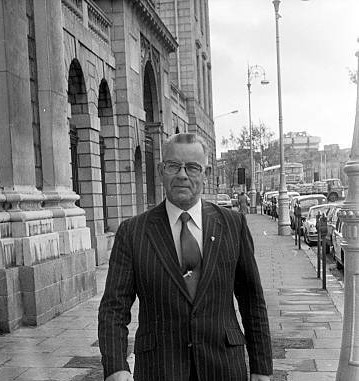


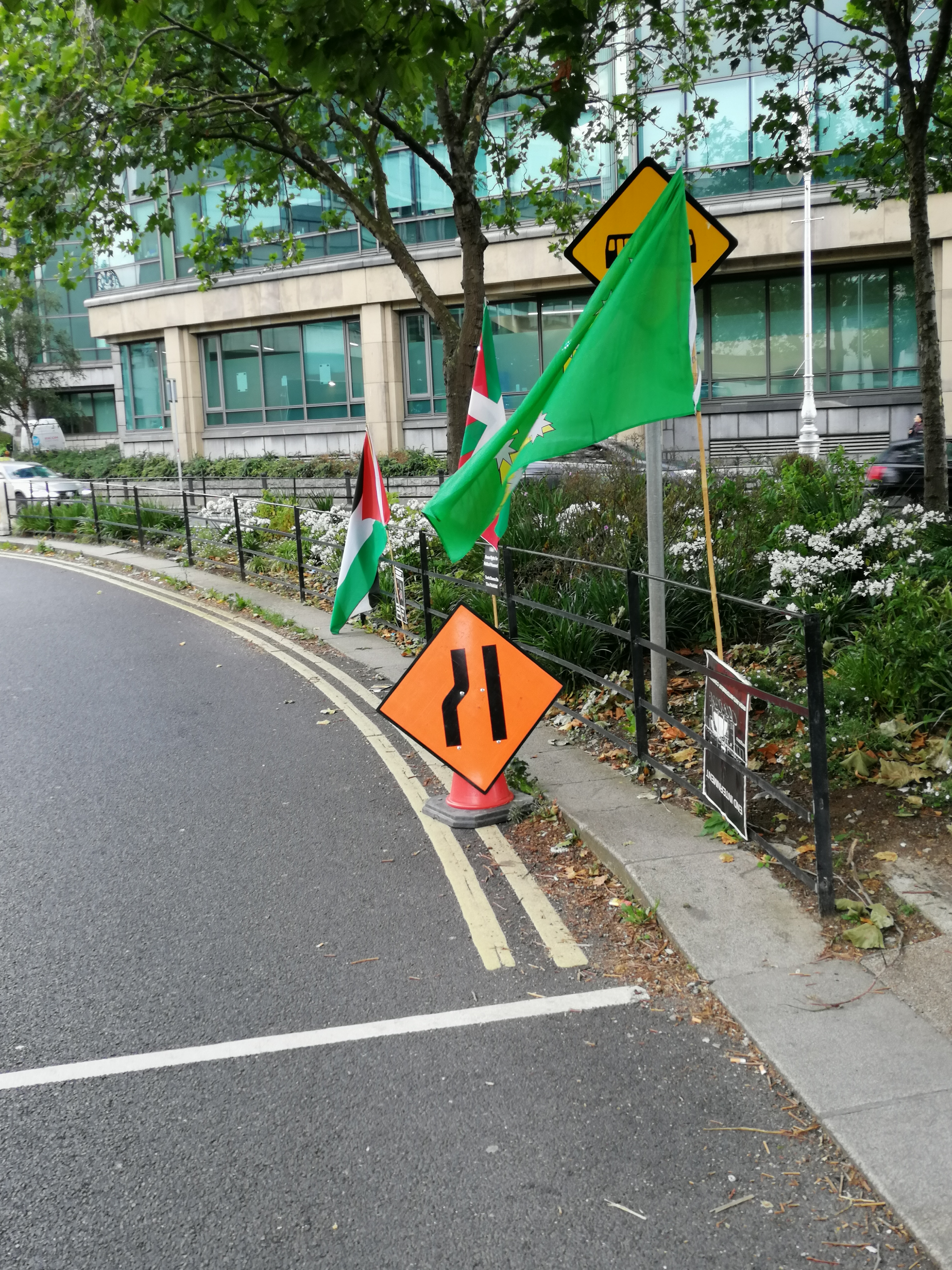


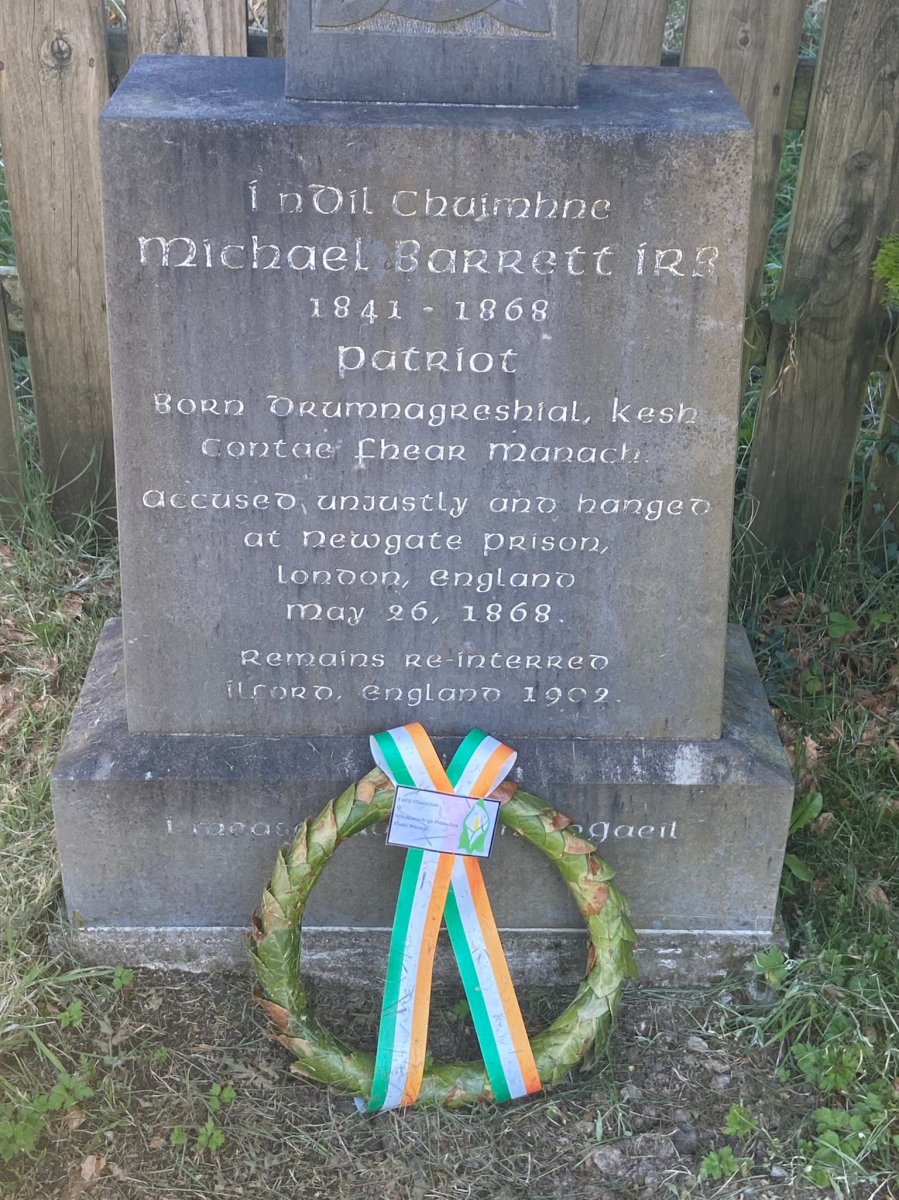
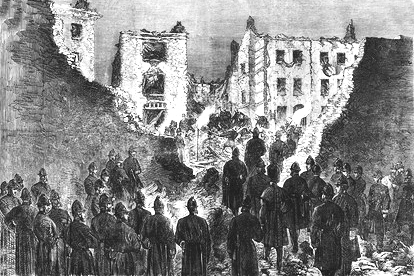
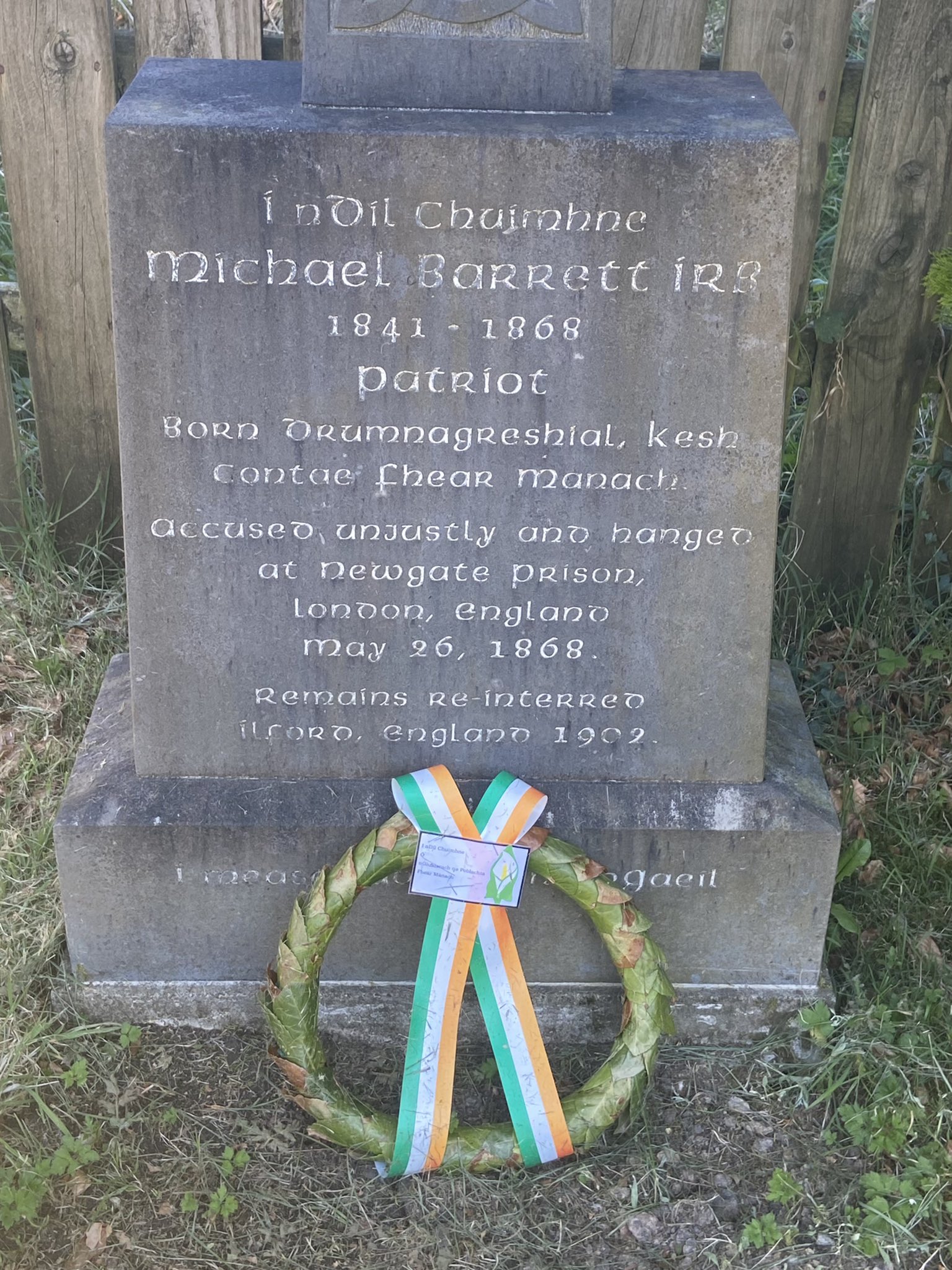




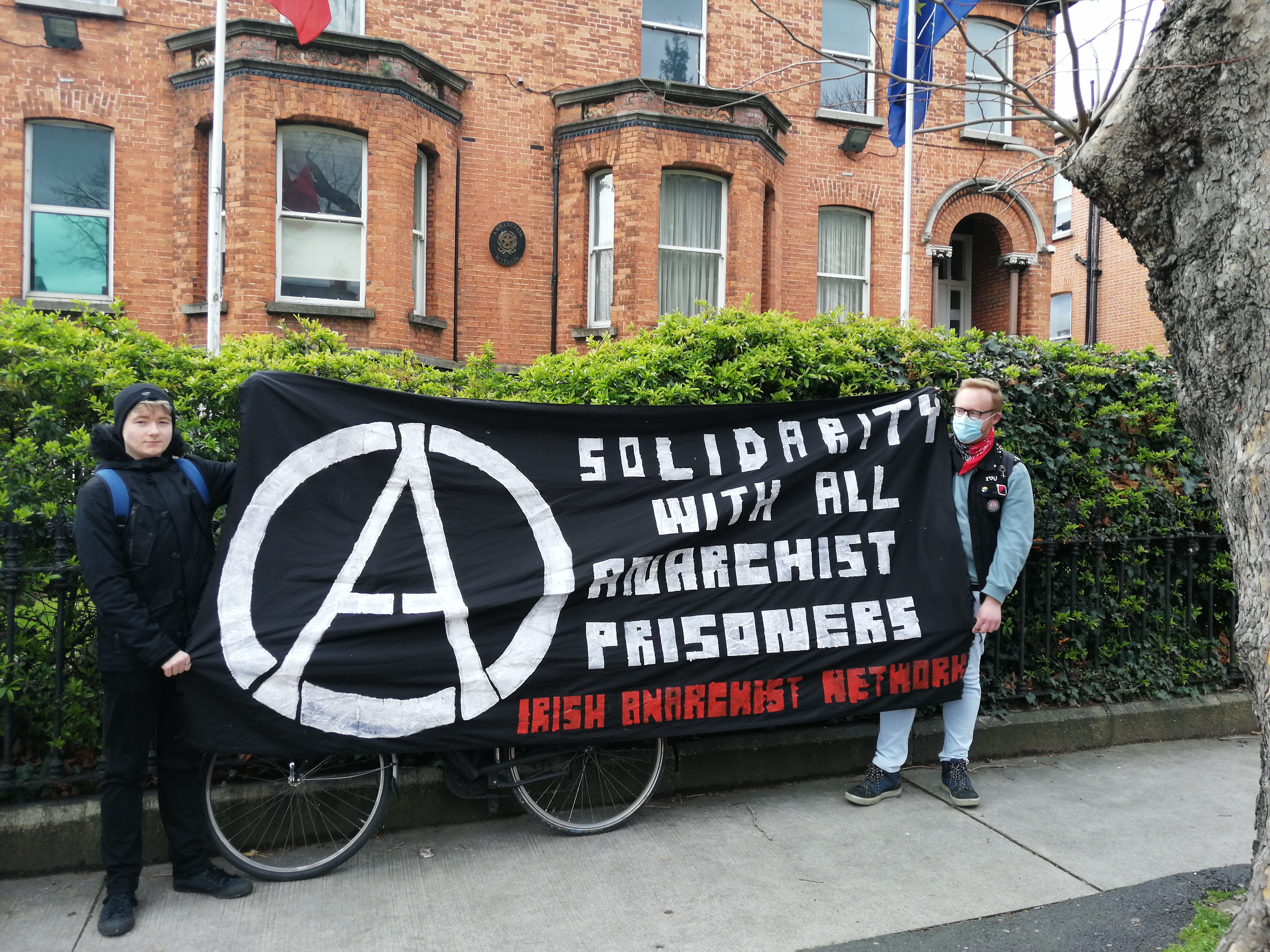


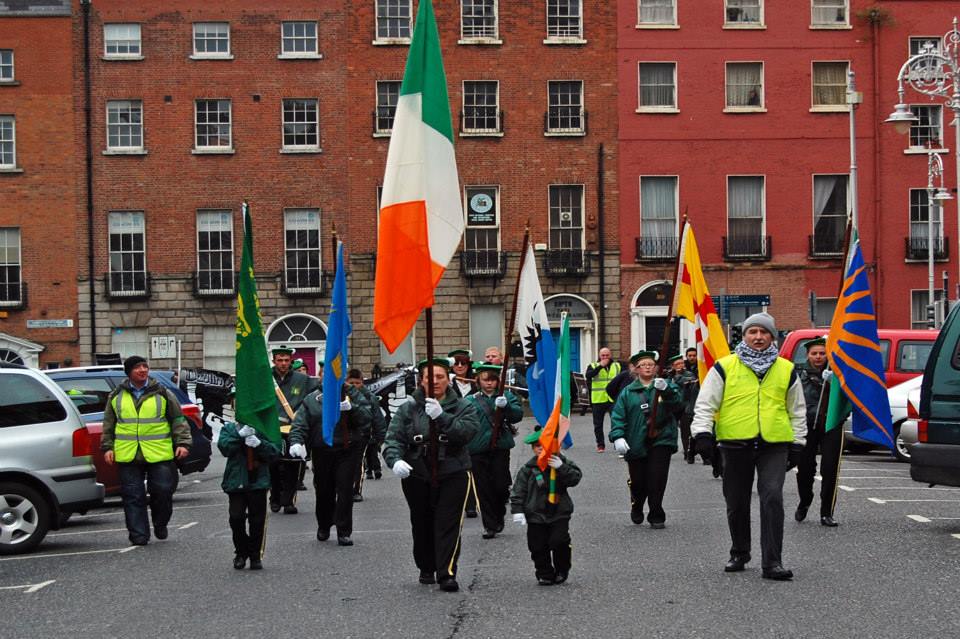
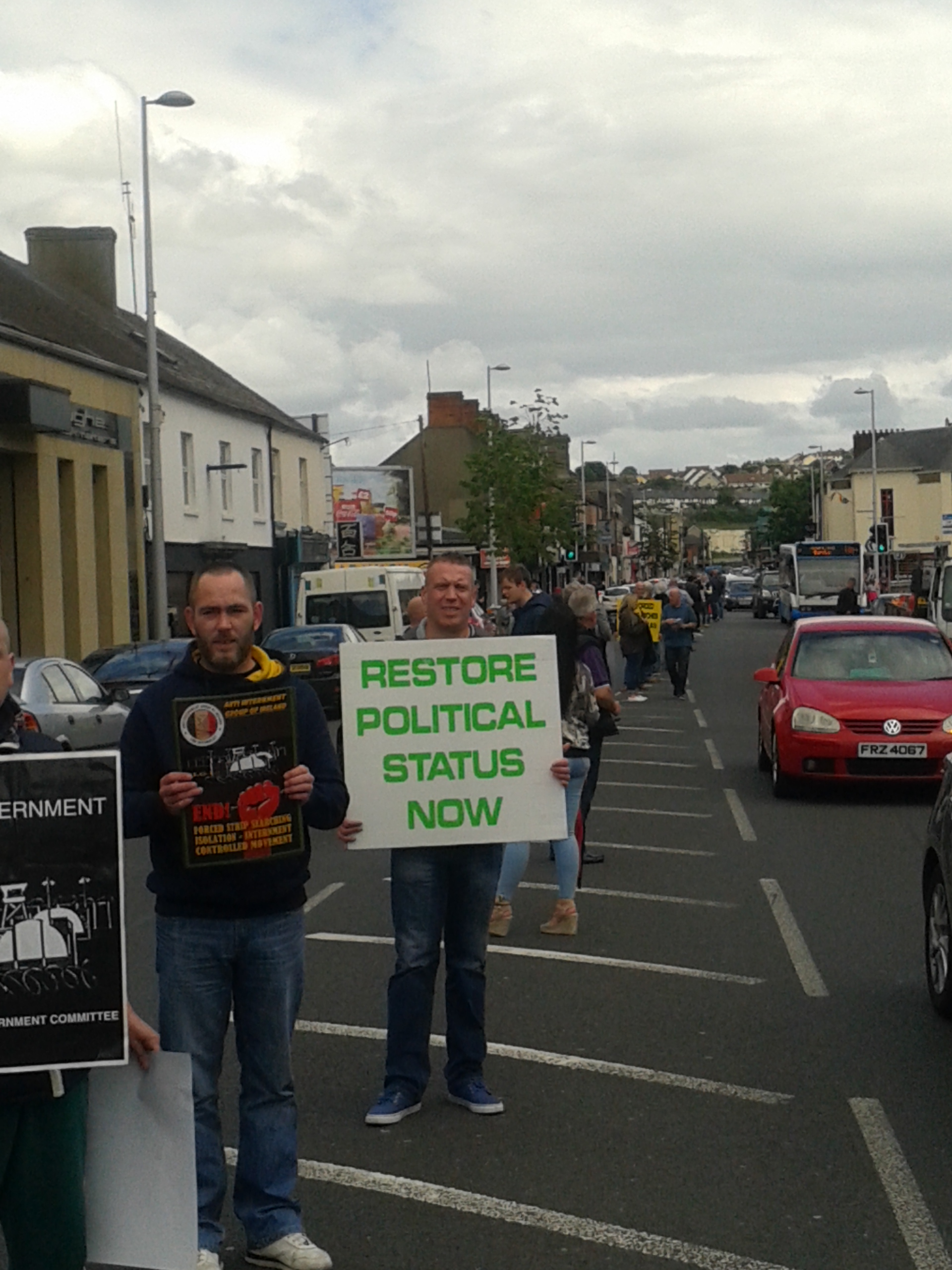
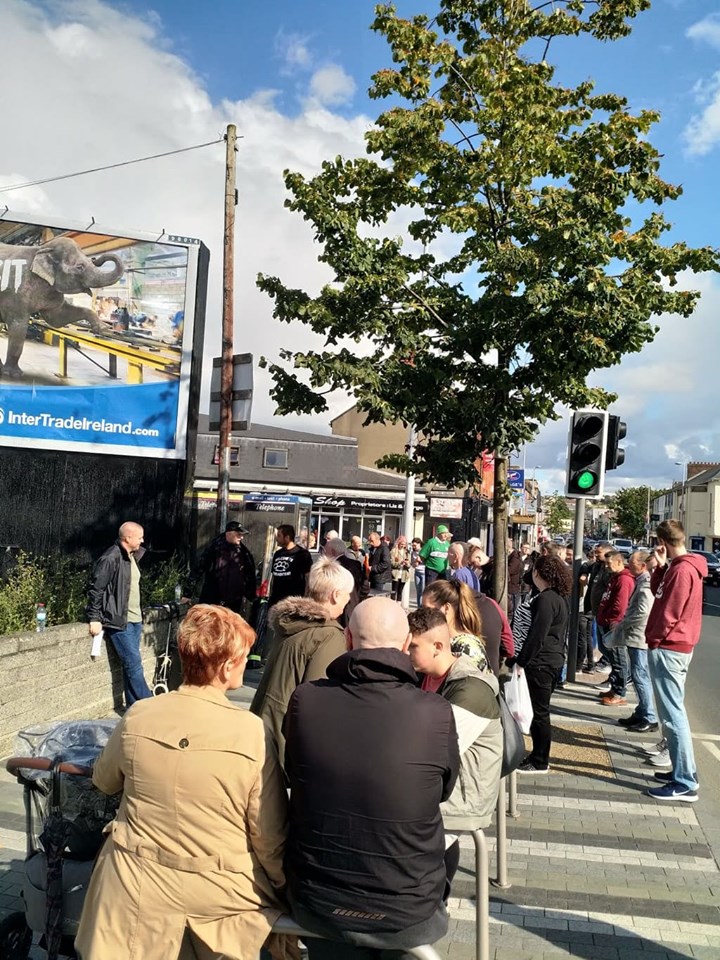
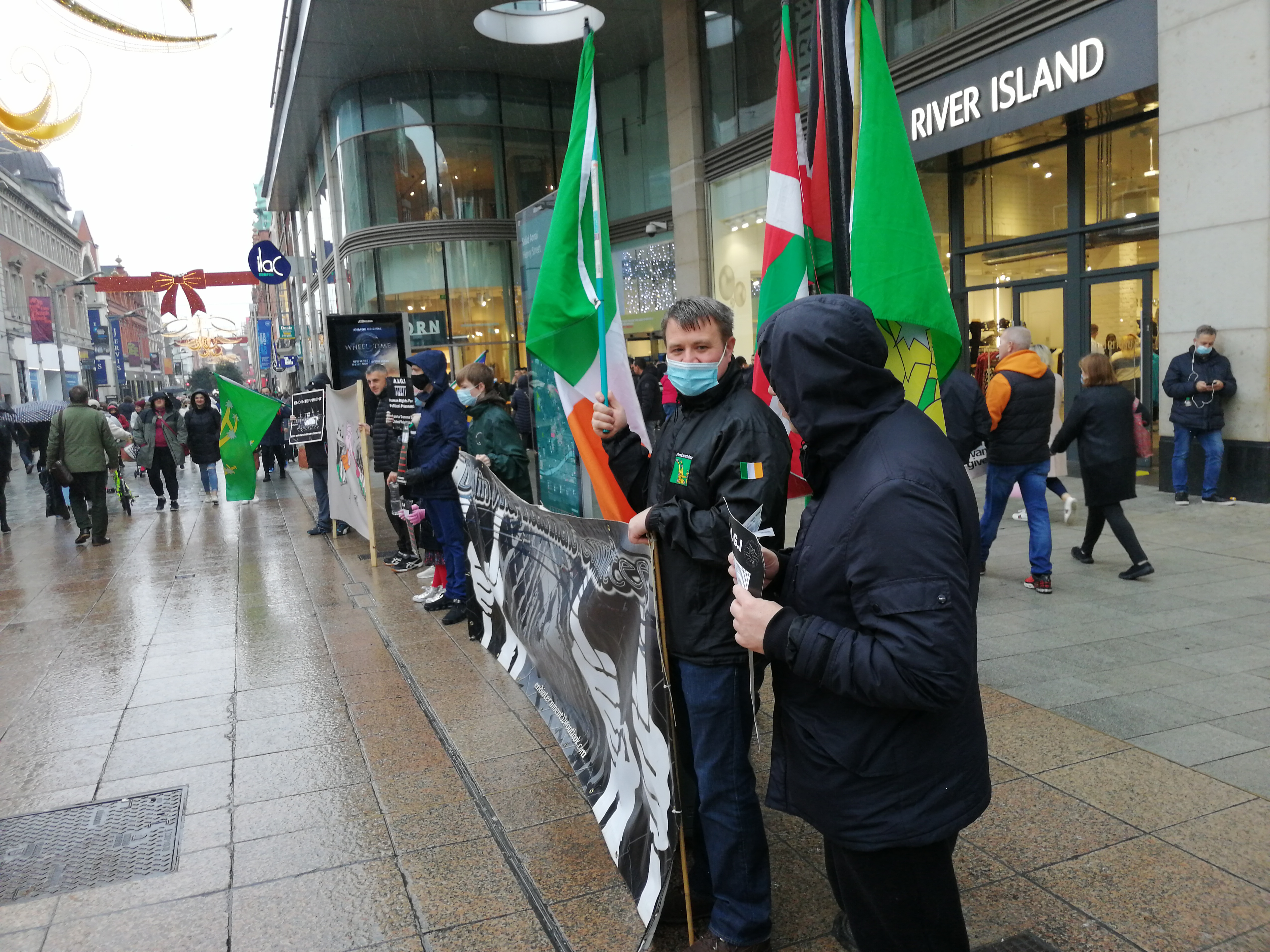


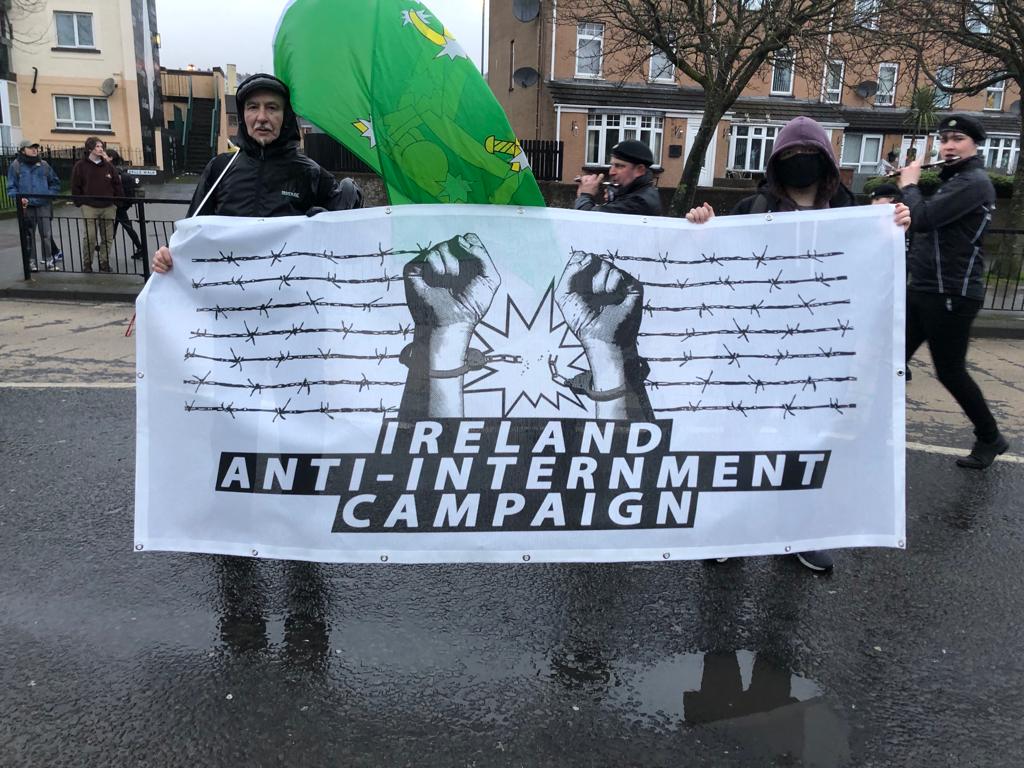
 rebelbreeze