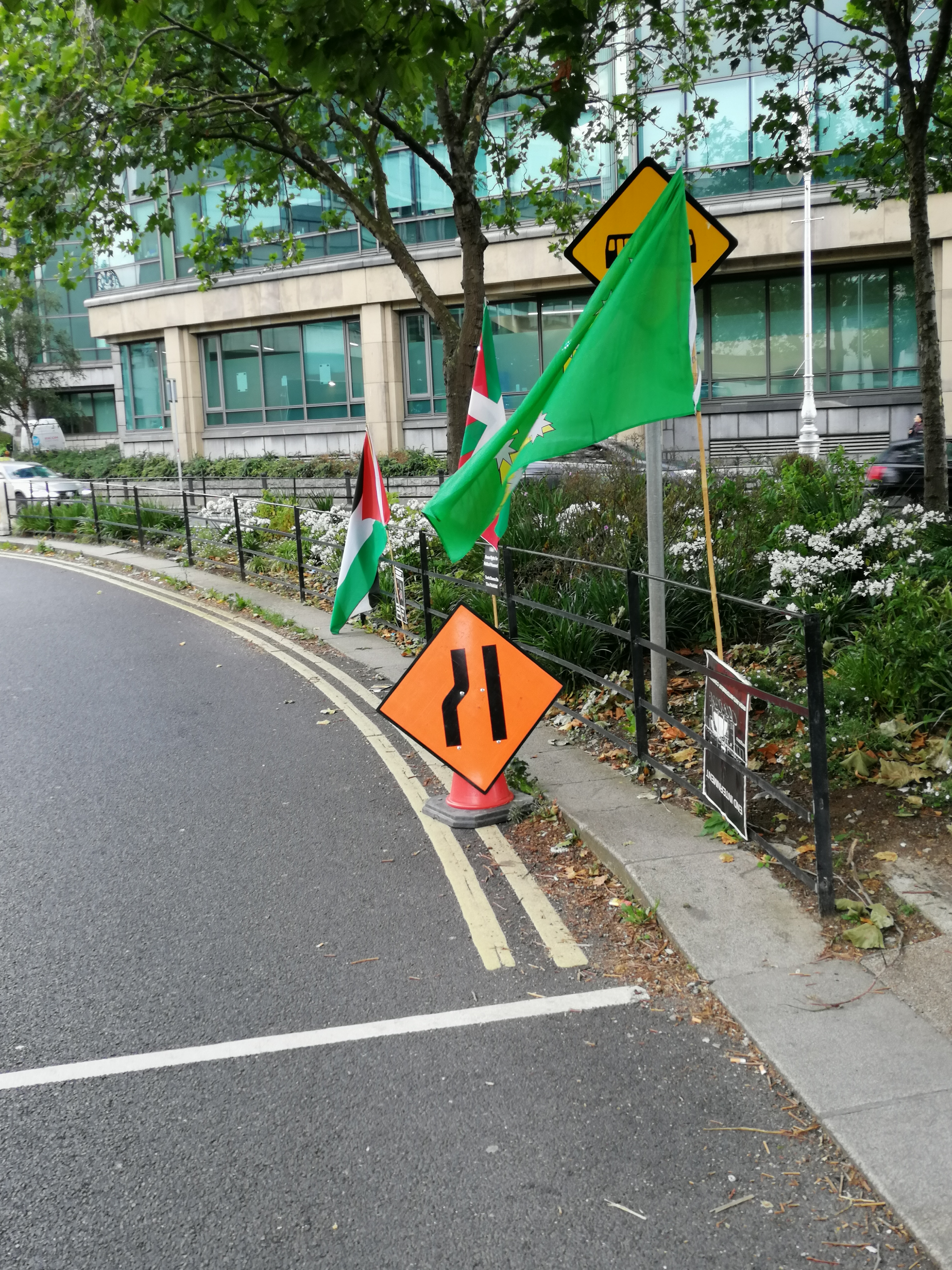
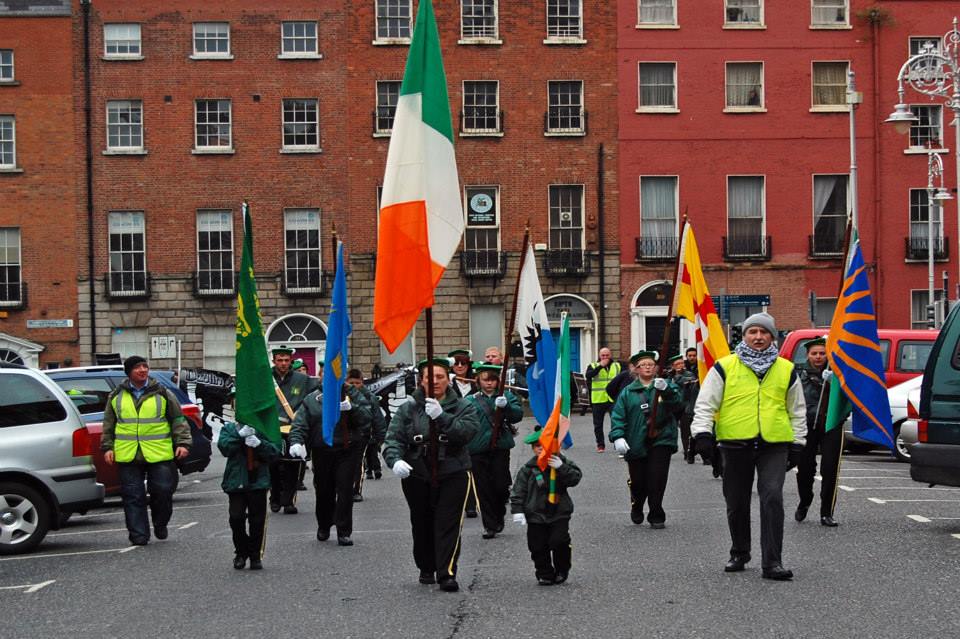
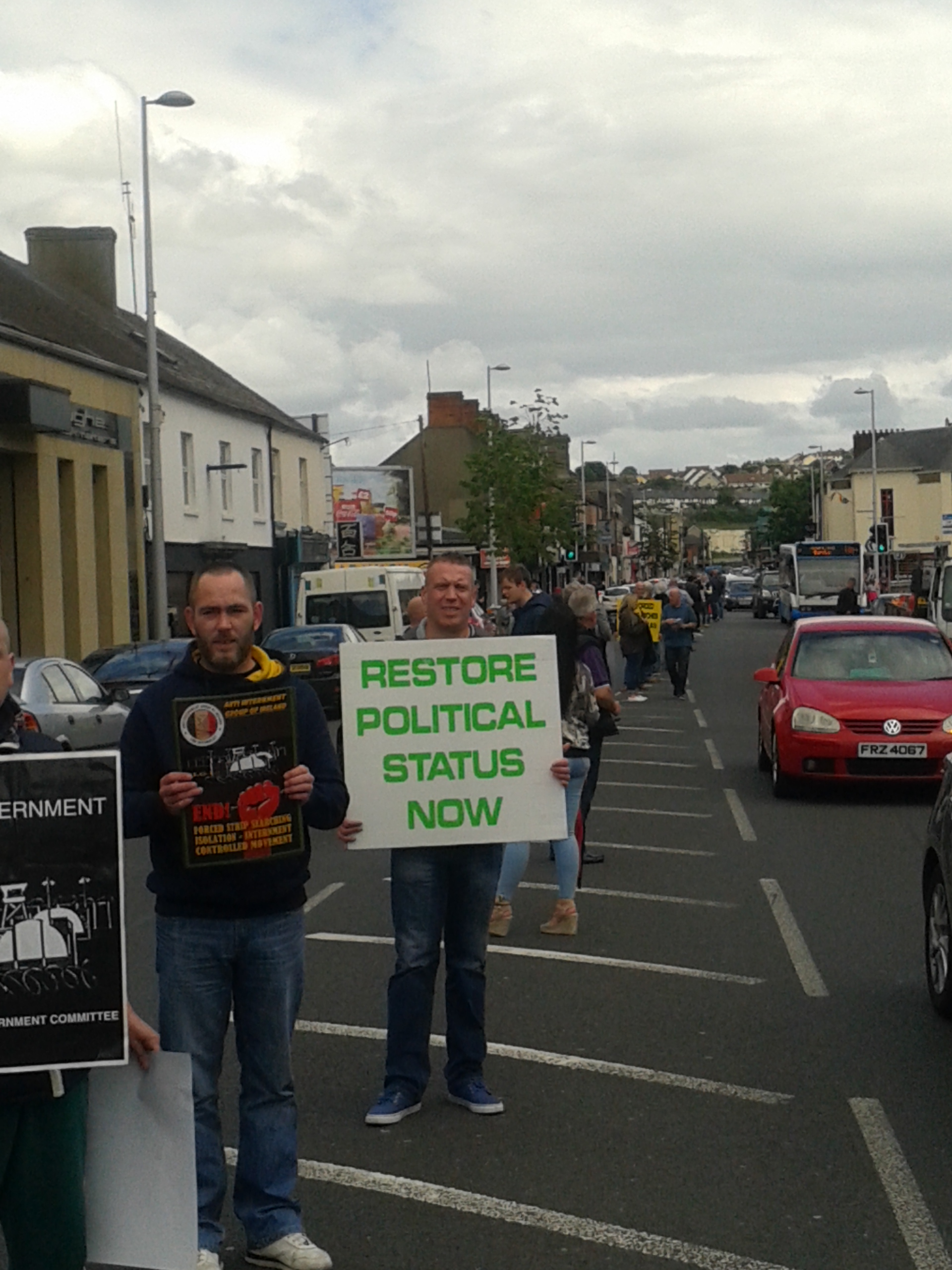
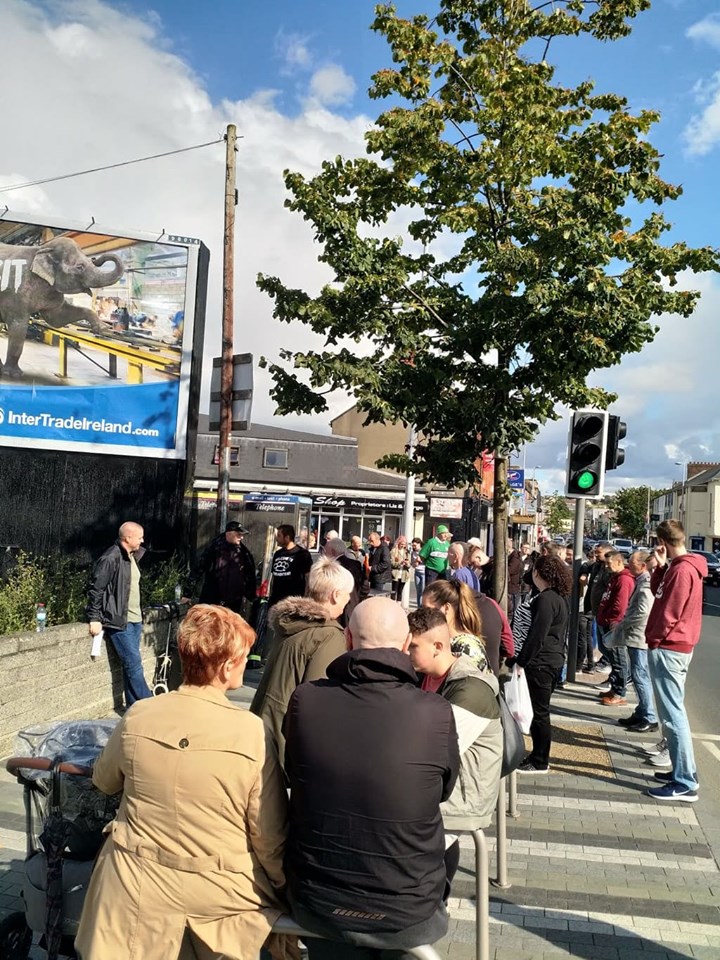
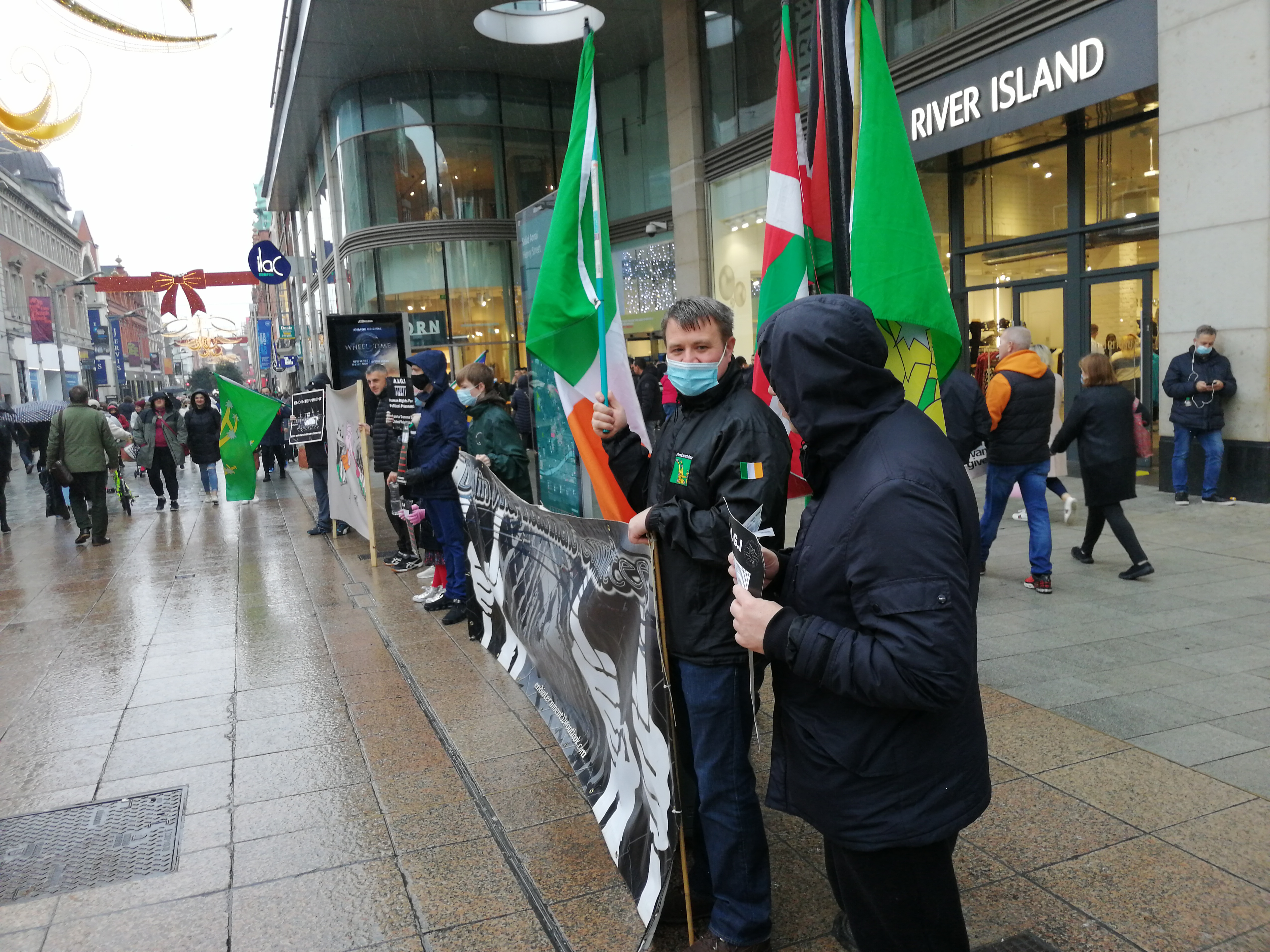
Socialist republicans and communists gathered on a traffic island in Dublin’s city centre to mark the International Day of the Prisoner. They flew flags to represent prisoners in Ireland (‘Starry Plough’), the Basque Country and Palestine.
They also displayed a number of placards.
(Photo: IAIC).
The choice of location, apart from being passed by road traffic in three directions, was because of the presence there of the Universal Links on Human Rights memorial sculpture with an eternal flame, commissioned by the Amnesty International organisation.
A plaque near the sculpture bears the following words: “The candle burns not for us but for all those whom we failed to rescue from prison. Who were tortured. Who were kidnapped. Who disappeared. That is what the candle is for.”
Plaque in the ground on the approach to the sculpture. (Photo: IAIC).
Somewhat ironically, one of the placards carried the words: “Amnesty International, do Irish Republican prisoners not have human rights too?” Irish Republicans have long complained that the organisation in question does not raise any issues with regard to Irish political prisoners.
Some have indicated as a possible reason or part-reason the location of the head office of Amnesty International being based in London, capital city of the occupying power. Its interventions on Ireland even during three decades of war in the colony have been very few indeed.
Other placards displayed referred to political prisoners from the liberation wars in India and in the Philippines, the innocent Craigavon Two still in jail and ongoing internment through refusal of bail to Republicansappearing before the no-jury special courts in both administrations.
Some leaflets were distributed about ongoing internment in Ireland through long remands in custody of Republican activists. Between convicted and awaiting trial there are close to 50 political prisoners in jails in Ireland between both administrations.
The Universal Links sculpture by Tony O’Malley (welding by Jim O’Connor) commissioned by Amnesty International. (Photo: IAIC)
The Zionist Israeli state holds 5,000 political prisoners (almost all Palestinian), of which over 1,132 are not even charged (‘administrative detention’). There are 33 female Palestinian political prisoners and 160 child prisoners. Philippines has 803 political prisoners.
The Spanish and French states hold between them around 170 Basque political prisoners.
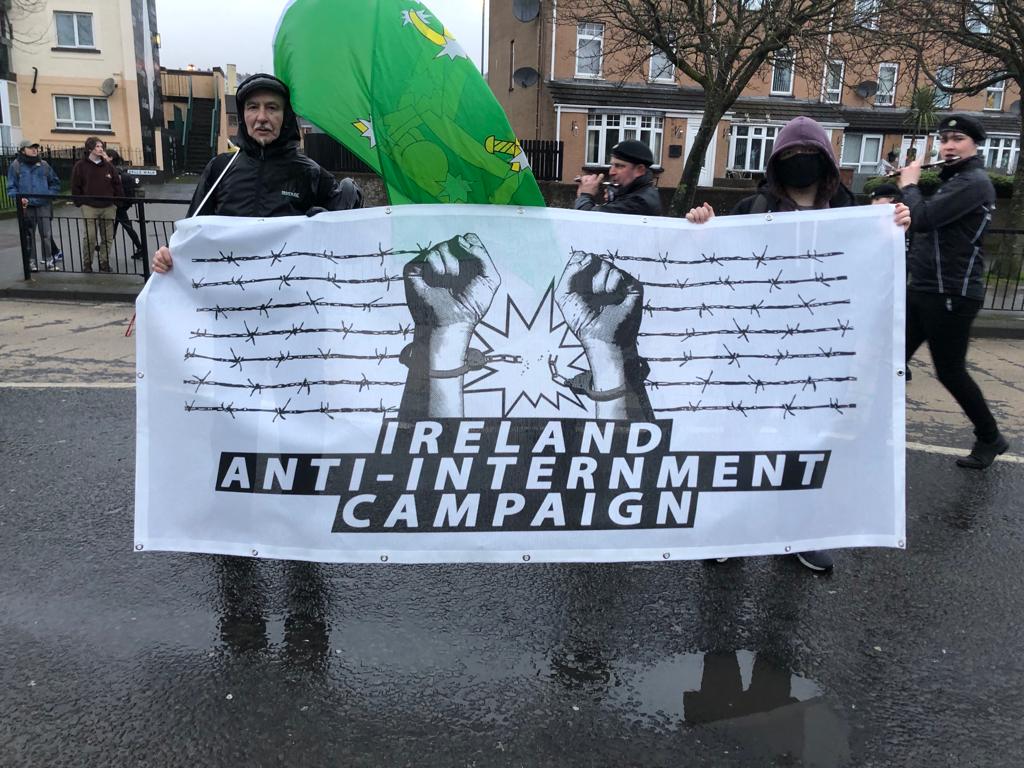
The event to mark International Day of the Prisoner was organised by the Ireland Anti-Internment Campaign and a spokesperson gave a short explanation on video of the reason for the event with the human rights sculpture in the background.
End.
Some of the flags displayed (Photo: IAIC).Passer-by in conversation with a leafleter. (Photo: IAIC). (Photo: IAIC).
A heart-breaking story with courage and a heart-warming ending.
Report by Luciana Bertoia from Pagina 12 published through arrangement with Publico.es Translation by D.Breatnach
The last time Julio Santucho saw his wife, Cristina Navajas, was on June 14, 1976. Appointed as head of international policy for the Revolutionary Workers’ Party (Partido Revolucionario de los Trabajadores), he had to leave Argentina for six months.
They had been married for almost five years then and had two children: Camilo, three years old, and Miguel, who had not yet turned one. The three accompanied him to the Retiro terminal, where he took a bus to Sao Paulo and then arrived in Rome.
In the terminal, Cristina had Miguel in her arms and Camilo by the hand. When saying goodbye to him, she insisted on a promise:
– I only ask you one thing. If something happens to me, you have to take the boys with you. They shouldn’t stay with your mom, with my mom, or with other comrades. They have to stay with you.
– But, Cris, we’ve been living in hiding for a long time, and nothing has ever happened to us.
“Now it’s different,” she cut him off.
One day before a month had passed since Julio’s departure, Cristina was kidnapped by the Dictatorship. She was in the apartment at 735 Warnes Avenue, where her sister-in-law Manuela Santucho lived.
Another comrade from the PRT-ERP, Alicia D’Ambra, also lived with them. All three were kidnapped that day. The oppressors left Cristina’s two sons, Camilo and Miguel, and Manuela’s son, Diego, in the apartment.
Cristina managed to ask a neighbour to call her mother, Nélida Navajas. When the phone rang, Nélida had to ask where the boys were. For security reasons, she did not know their address.
When she arrived, she heard the screams of the two youngest, Miguel and Diego, from the street. Camilo was asleep.
Nélida found her daughter’s bag on the ground. Inside was a series of letters that she had written to Julio, waiting to receive an address to to which to send them. She had started writing the last one on Saturday, July 10, but had finished it the next day:
“Miguel is much better, he hardly coughs anymore, but he is more of a bandit and wilder every day. Cami is calmer and doesn’t give me work, the only thing is that he is getting clingy to me. He asked again which house we are going to, which house is this, etc.
Now the one who is not well is me, I do not know if I am pregnant,” she told her husband.
Julio found out about the kidnappings the next day, when he called to greet his brother-in-law on his birthday.
Refugee from Argentinian Dictatorship accompanied by a son as he attends a press conference about his reunion with another son, abducted by the regime, 43 years ago. (Photo: Enrique Garcia Medina/ EFE)
That day he spoke ten times with his mother-in-law. He would not hesitate to return to Buenos Aires to collect his children, but the PRT sent two comrades who, pretending to be a couple , took the children out and abroad to their father.
Forty-six years later, Julio managed to meet his third child, the baby that Cristina had while she was kidnapped in the Pozo de Banfield, after having gone through Coordinación Federal and Orletti Automotive (places of detention of the fascist regime – Trans.).
He is the 133rd grandchild found by the Grandmothers of the Plaza de Mayo (group of women who began the campaign to trace those made missing by the fascist regime – Trans.)
In an interview with Página 12, Julio Santucho relates how he was reunited with his youngest son, now a 47-year-old adult.
How was the search?
The main heroine in this story is Cristina, who for eight or nine months was pregnant in the most inhumane conditions: mistreatment, torture, bad food. She put up with all of this with willpower and finally gave birth to our son.
My son began to question his (new family – Trans.) relationship based on references from those close to the family. A sister who lived with him for 20 years told him “these are not your parents.”
From the way he was treated by the appropriator who raised him, he came to realise that he was not his father.
In 2019, he began to search, although stopped during the pandemic and then resumed. He had a birth certificate from another province. Finally this year he managed to have his DNA tested.
We searched but we had no approximation or probability of discovering my son. It was an exceptional case: he was born in the Pozo de Banfield, but police doctor Jorge Bergés did not sign the certificate. He surprised us.
What is it like to meet a son who is 46 years old?
It is good. The bad thing is that they took 46 years from us. It is a victory for the human rights organizations that have fought for this and it is a defeat for the dictatorship. They wanted to steal my son but I, later than ever, got him back.
My mother-in-law, Nélida Navajas, joined the Abuelas (Grandmothers’ group – Trans.) to look for her grandson. Abuelas is an irreplaceable institution, it is an enormous benefit to society because it is precisely the place where people who have doubts can recover their identity.
In July 1976, you lost much of your family and now, another July but 47 years later, you have your son back.
You strike a chord. On July 13, Cristina, Manuela and Alicia were kidnapped. She was a comrade that I also knew because she worked in the party schools.
On the 19th, six days later, they killed my brother “Roby” (Mario Roberto Santucho, leader of the PRT-ERP), and later my brother Carlos.
It was a tragic week for the family. We are not better-off than others. All the 30,000 disappeared were brave, generous and devoted themselves to a fight for the well-being of society and humanity.
What could he know about Cristina during her captivity?
There are testimonies like that of Adriana Calvo. The Santuchos were visited by all the mothers that were in the Pozo de Banfield. Adriana asked to spend a day with them.
She had her baby in her arms and so as not to worry her Cristina did not tell her that she had had a child and that it had been taken from her.
Adriana, afterwards, spoke at the trial of Cristina’s tremendous generosity in not telling her anything so she wouldn’t worry about her because they could take the baby away from her. Do you realise how far thinking about the welfare of others went?
They were screwed. But they told her: “We are Santucho, we don’t have any possibility of leaving, but they are going to release you.”
And then there is that scene that Adriana recounts: when the officers arrived, all the women made a human wall – led by Manuela, Cristina and Alicia – and the men had to leave without being able to take their baby from her.
They were in a concentration camp. They knew they could shoot them all at that moment.
And now how is the reunion going?
Some ask me about the appropriator of my son, all I say is that I hope that Justice intervenes. For now, this is all like walking on clouds. We talk to my son every day, we see each other often. Now we have the commitment to make a video call to my granddaughters. Let’s go little by little.
Joy is infinite. Besides, we have time. I am 78 years old. My father died at 89. I have a brother in Santiago del Estero who is 101, another who is 96. If they don’t kill us Santucho, we live a long time. So I look forward to enjoying my son for a few more years.
End.
ADDITIONAL NOTESby D. Breatnach
The Argentinian dictatorship lasted from 1976 to 1983 and apart from banning dissenting newspapers and organisations, detained, tortured and killed thousands.
But not only that, very young children and babies were abducted and given to couples who supported the regime to raise as their own. This was also done by other dictatorships, including the Spanish Franco regime of four decades.
In a time when a week-old military coup in Niger is threatened with invasion by France and by some western-allied African states, it is well to remember how other military dictatorships have been viewed by western states.
The lack of democratic elections and opposition parties did not matter to the western states who in fact fully supported the Argentinian and many other coups and dictatorships.
The military dictatorship of Argentina only became a problem to the UK’s ruling class when Argentina’s military invaded the British colony of the Malvinas/ Falkland Islands in 1982, the same year that the USA stopped supporting the junta for the first time.
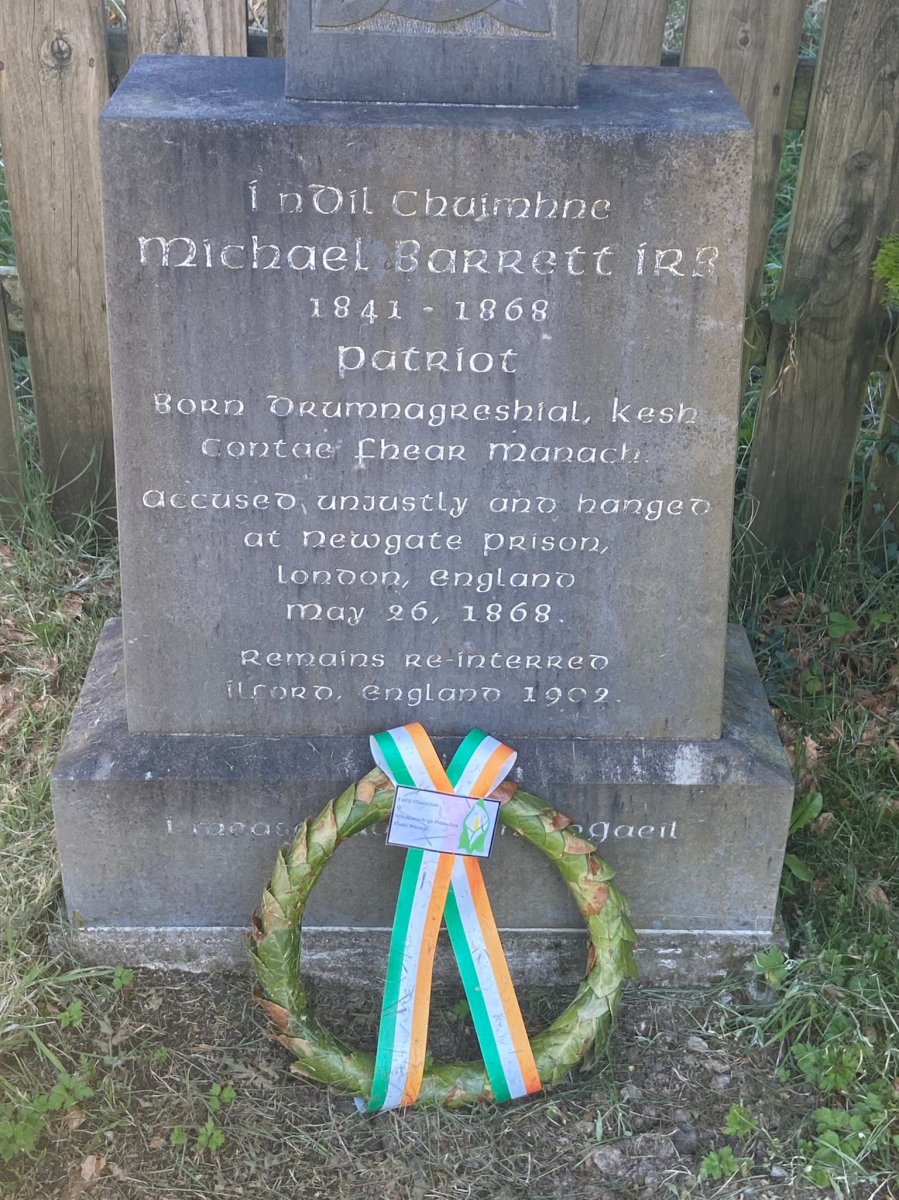
Pat Reynolds gave this oration in East London Cemetery on Sunday 21st May 2023 for Michael Barrett, the last man publicly hanged in Britain
A cháirde agus a chomrádaíthe,
Tá fáilte go leor romhaibh chun chruinnithe i gcuimhne Michael Barrett inniu. Welcome friends and comrades to this commemoration today for Michael Barret and Patrick O’Donnell. I have been asked to speak of Michael Barret and the movement he represented.
Michael was born in Ederney in the Maguire County of Fermanagh in 1841 and was judicially hanged though innocent by the British Government in 1868 at Newgate Prison, where the Old Bailey now stands.
Newgate prison was closed in 1903 and his remains with others were interred here in this cemetery. He was the last person to be publicly hanged in Britain.
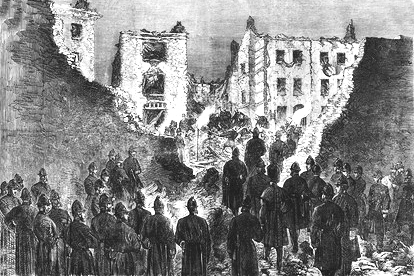
A Fenian bombing took place on 13th December 1867 to try and rescue O’Sullivan Burke the Fenian who planned the successful prison van escape in Manchester.
The bombing blew a huge hole in the wall and demolished nearby tenement buildings, killing 12 people and injuring many others. It led to a huge State-engineered backlash in Britain against the Fenians and put their cause back some 10 years.
Michael Barret, who had gone to Glasgow to work was an innocent man and was in Glasgow at the time of the incident.
False evidence given by a police informer Patrick Mullaly who was given a free passage to Australia implicated Barrett, but he had compelling evidence that he was in Glasgow at that time. After two hours the jury declared him guilty.
One of the trial lawyers Montagu Williams stated of Barrett:
‘On looking at the dock, one’s attention was attracted by the appearance of Barrett, for whom I must confess I felt great commiseration. He was a square built fellow, scarcely five feet eight in height and dressed like a well-to-do farmer.
This resemblance was increased by the frank, open, expression on his face. A less murderous countenance than Barrett’s I have not seen. Good humour was latent in his every feature and he took the greatest interest in the proceedings’.
Barrett ended his speech from the dock thus:
‘I am far from denying, nor will the force of circumstances compel me to deny my love of my native land. I love my country and if it is murderous to love Ireland dearer than I love my life, then it is true, I am a murderer.
If my life were ten times dearer than it is and if I could by any means, redress the wrongs of that persecuted land by the sacrifice of my life, I would willingly and gladly do so.’
The Daily Telegraph the next day stated that Barrett had:
‘Delivered a most remarkable speech, criticising with great acuteness evidence against him, protesting that he had been condemned on insufficient grounds, and eloquently asserting his innocence.’
Michael Barrett monument detail, Co. Fermanagh (Sourced: Internet)
In Fermanagh his aged mother had walked many miles to appeal to the local Tory MP Captain Archdale, a noted Orangemen, who rejected her. Barrett was hanged in front of 2,000 jeering people singing Rule Britannia. The following day Reynolds’ News recorded that;
‘Millions will continue to doubt that a guilty man had been hanged at all; and the future historian of the Fenian panic may declare that Michael Barrett was sacrificed to the exigencies of the police, and the vindication of the good Tory principle, that there is nothing like blood.’
His hangman was the notorious Calcraft who had botched the hanging of the Manchester Martyrs, Allen, Larkin and O’Brien.
There is a huge difference between an accident leading to deaths by patriots fighting tyranny and the deliberate actions of the imperialists, which is why patriots have to be always careful to avoid civilian deaths.
There are many similarities between the Clerkenwell bombing and the Birmingham bombing of 1974.
In both cases they set back the cause of Irish freedom for many years, deeply harmed the Irish community in Britain and was used by the State for repressive measures against the community and to divide off the Irish community from the English working classes.
Disraeli brought in the Habeas Corpus Act and created the Special Branch. Of interest is that their first definition of Irishness was ‘Persons who were born in Ireland or whose recent forebears came from Ireland.” Back in the 1980s the GLC adopted the same definition.
We also had the Birmingham Six case with the ‘appalling vista’ of Lord Denning the Appeal Judge, who later regretted that the six innocent men were not hanged. For Gladstone it set him on his mission ‘to pacify Ireland’.
I ask you two questions today, what kind of people and community gave rise to patriots like Michael Barrett and the Manchester Martyrs, and the second question, what kind of regime or government would hang knowingly innocent men.
To understand the Fenians we have to understand the colonisation of Ireland and in particular the Great Starvation of Ireland An Gorta Mór. Over one and a half million people were starved to death by British imperialism and another two million forced to emigrate to Britain and the USA.
There was no famine in Ireland at this time, and it is imperialistic propaganda to call it such. It was clearly genocide in a land overflowing with food.
The potato crop made up under 25% of the agricultural produce of Ireland, but at this time Ireland was part of the UK where the potato crop was about 5% of the total produce of the UK. I know of no country where there was famine because of a 5% failure of the crops.
Michael Davitt back in 1904 called the Great Starvation a ‘Holocaust’ as did others. Ken Livingstone drew some comparison between the Great Starvation and the experience of the Jewish community during the Second World War.
Hitler named his strategy ‘The Hunger Plan’ where he starved Poles and Jews and others groups of food, and these victims are included in the Holocaust figures including also his starvation of the Warsaw Ghetto.
The shipment of food grown by the people of Ireland to Britain during the Great Starvation was a clear decision by the British government to starve the Irish people.
The Nazi Governor in Poland Hans Frank wrote of the starvation of Jews ‘that we sentence 1.2 million Jews to die of hunger should be noted only marginally’.
The economic theory of laissez-faire is a total invention, within years they could spend millions in Crimea, a place most English had never heard of.
I recall the great Irish writer Frank O’Connor stating ‘Famine is a useful word when you do not wish to use words like ‘genocide’ or ‘extermination’, and again ‘It was not that the people were too simple to realise the Dachau-like nightmare of their circumstances’.
He goes on ‘The word famine itself is a question begging for its meaning ‘an extreme and general shortage of food’, and to use it of a country with a vast surplus of food, cows, sheep, pigs, poultry, eggs and corn, is simply to debase a language’.
O’Connor went further: ‘Irish historians who are firmly convinced that the Famine was all a mistake in the office, explain it in terms of an economic theory called laissez-faire. This is another cock that won’t fight.
Anyone who can believe that the British government maintained a garrison of 100,00 men in Ireland for the purpose of not interfering in trade and industrial affairs attaches some meaning to the word history that escapes me’.
The Great Starvation of the Irish people was a daily planned strategic intervention by the English government which is borne out by the evictions and forced migrations which followed and by the white supremacist and racist beliefs held in England at that time, which has largely been ignored by the historians.
The failure of the Young Ireland movement in the 1848 rebellion led to the deportation of their leaders and a flight of others to France and the USA. From this came the Fenian movement and the Irish Republican Brotherhood set up in the USA and Ireland in 1858.
There was of course also the French Revolution of 1848 which inspired people all over the world and which also inspired the Fenians.
The American Civil War of 1861-65 was to inspire the Irish in the USA. Over 30,000 Irishmen were to lose their lives in War the vast majority fighting for the Union and for the abolition of Slavery.
Revisionists question whether the Irish were really fighting for the abolition of Slavery, yet the same historians in hindsight claim that the British and Irish who fought in the 2nd World war were fighting against fascism and the Nazis.
The Irish men who died firing against slavery are entitled to the same respect from history.
The 1867 rebellion in Ireland did not really take off. Frantz Fanon stated: ‘Each generation must, out of relative obscurity, discover its mission, fulfil it, or betray it’. The Fenians took a more measured road and passed it on to the next generation, but not without a fight.
In the USA they invaded the British Canadian Dominion twice in 1867 with about 700 Fenian soldiers, veterans of the American Civil War. They held a convention in in 1867 with 6,000 armed men present.
In Britain the Fenians massed near Chester Castle in an attempt to seize the guns there and get them to Ireland via Holyhead for the Fenian Rising. As in the USA they were betrayed by spies and with Chester Castle reinforced by soldiers, the raid was called off in February 1967.
In September Colonel Kelly was arrested in Manchester and was released when Fenians attacked the prison coach which later led to the Manchester Martyrs, Allen Larkin and O’Brien who were innocent men framed up by the English government.
The impact of the Manchester Martyrs in Ireland was huge with some 17 monuments put up in their honour and with the Catholic Church forced to backtrack on their anti-Fenian stance and allow masses and commemorations to be widely held in Ireland.
Michael Barrett is part of this sacrifice of the Irish abroad to Irish freedom made within a year of each other. My call is for Michael Barrett to be included within the Manchester Martyrs’ history and commemoration.
By the 1870s the Irish had moved to parliamentary means to move their fight for liberation onwards. You will notice that the fight for Irish freedom goes in flows, a rebellion often followed by political and parliamentary activity along with agitation. Both means were effective for their times.
In Ireland we had Michael Davitt and the Land League, again we have the huge contribution from Britain to this effort from Davitt. We also had the bombing campaign in Britain by O’Donovan Rossa and Tom Clarke from 1880-87, the Invincibles in Dublin and the execution of Lord Cavendish in 1882.
We have the great Irish Literary and Gaelic revival. Again, the Irish Literary Society was founded in Southwark, SE London in the 1880s which spread to Dublin, Belfast and Cork.
We had the Gaelic League and the GAA as part of this revival which led on to the 1916 Rising and the founding of the nation.
What kind of regime or government could knowingly judicially murder innocent men like Michael Barrett and the Manchester Martyrs? We know the history of British colonisation of Ireland and British Imperialism.
This is the same British Imperialism which would in 1919 lead to the Amritsar massacre in India. But let us stay in 1860s iwith this colonial Empire.
In 1865 the Jamaican people rose up against British colonial rule in Jamaica which left 400 dead in a colonial reign of state terrorism. They hung the leader Paul Bogle and 14 others and executed seven women and prosecuted George William Gordon who had nothing to do with the Rebellion.
They executed him. The Fenians at the time raised funds to help the survivors bring action against the English government. You see here a long history of hanging both Irish and Black people across their colonies.
Today I salute the Irish in Britain who marched in the 1980’s against apartheid in South Africa and who today march with the Palestinian people following a noble Fenian internationalist tradition.
British rule in Ireland was based on Imperialism, White Supremacy and Racism. This was first formulated by Gerald of Wales in 1187 some 700 years before they hanged Barrett and the Manchester Martyrs.
Gerald in his books Topography of Ireland and Conquest of Ireland used racism to justify the conquest of Ireland and portrayed the Irish as inferior, backward, inhuman, uncivilised, feckless and lazy.
This was a litany of manufactured racist lies when Ireland had been the ‘Island of Saints and Scholars’ and the seat of learning in Western Europe bringing enlightenment to Europe during the Dark Ages.
Gerald’s views were published across Europe and held sway until around 1650 for about 500 years. This first racialisation of the Irish did not require any religious framework.
When Henry 8th split with Rome in 1534 the racist code used for conquest in Ireland was then overlaid with a state-sponsored sectarian religious code.
Irish scholars were driven out of Oxford where they were a dominant force and Henry sought to build up his fleet to destroy Irish fleets on the south coast to control trading in Irish sea ports and towns.
There followed the Plantation of Elizabeth 1st who knighted Gilbert the mass murderer of Munster who later founded a British colony in Newfoundland.
Later on, we had the Cromwellian conquest of Ireland with large-scale massacres at Drogheda and Wexford, widespread smaller massacres and the forced transporting of Irish slaves to the Caribbean.
Revisionists deny this history and seem to wrongly believe that these people were on some kind of ‘Cromwell Tours of the Caribbean’. For the record these forced transported people were not indentured people.
It is of interest that Gerald of Wales’ views on the Irish were not held of African people from 1200 onwards but were lifted from the Irish situation and applied to African people on the advent of enslavement to justify what the European colonial powers were doing.
So now Africans can be perceived in the same way as the Irish, as backward, inferior, childlike and have their freedoms taken away.
Let us now look at racism and the White Supremacist views of British Imperialism in the 1800s which gave rise to the great Starvation, the Manchester and London hangings of innocent men.
Robert Knox in The Races in 1850 described the Celts as an inferior race which became part of the ‘scientific’ racism of the day, with Knox updating Gerald of Wales.
Even Engels came out with his racist views of the Irish ‘The race that live in these ruinous cottages in measureless filth, and stuck in this atmosphere penned in, as if on purpose, this race must have reached the lowest stages of humanity’, instead of seeing what British imperialism and racism had done to the Irish people at home and abroad.
John Bedoe in his Races of Britain in 1862 views the Irish as Africanoid and having African roots, and again as ‘European Negroes’. Punch portrayed the Irish as apes and monsters, even Parnell, and the Irish as Aboriginals and on the same level as gorillas.
Charles Kingsley on visits to Ireland in the 1860’s states ‘I am haunted by the human chimpanzees I saw’ and ‘to see white chimpanzees is dreadful’. A new Gorilla at London Zoo is called ‘Paddy’ and the ‘Irish Yahoo’ is seen as the missing link between man and gorilla.
The Irish are described ‘as half naked savages who retain a vast amount of their primitive savagery to this day’.
We can see how scientific racism is now applied equally to Black and Irish for the purpose of colonisation and oppression.
In this context we can see the mindset of the British establishment who committed genocide against the Irish people, and who over centuries had murdered Irish people at random. We can see how the same regime of government can hang innocent people at home and abroad.
Michael Barrett, a self-educated man emerges from this dunghill of White Supremacy and pure racism as a heroic figure, like the Manchester Martyrs a true patriot as shown in his speech from the dock. He should be remembered with the Manchester Martyrs and not separated from their heroic end.
Barrett, a Christlike figure and a Cúchulainn who died on behalf of his people and for his political beliefs.
He was part of an Irish tradition in Britain of being in the forefront of democratic rights for liberty justice and freedom, not just for the Irish but also the British people.
We see in the Chartist movement of the 1840s being led by Irishmen Fergal O’Connor and Bronterre O’Brien that fight for liberty and the rights of man.
Also the leadership of Donegal man Doherty leading the workers of Lancashire and the ongoing links in the trade union movement to today from leaders like Mick Lynch inspired by James Connolly to Pat Cullen of the RCN.
We see it in the gift of The Red Flag song from a County Meath man and The Ragged Trousered Philanthropists novel by Noonan to the British working class.
In honouring Michael Barrett today, we stand full square for a United Ireland as proclaimed in the Fenian and 1916 Proclamations and for working class liberty in Britain.
I will finish today by reading the Fenian Proclamation of 10th February 1867 from the Irish People to the World. In it we can see what the 1916 Proclamation borrowed and built on. It is also what Michael Barrett lived and in the end died for.
Fenian Proclamation, 1867
Proclamation of the Irish Republic, issued February 10th, 1867, by the Irish Republican Brotherhood.
I.R. — PROCLAMATION! —
THE IRISH PEOPLE TO THE WORLD
We have suffered centuries ofoutrage, enforced poverty, and bitter misery. Our rights and liberties have been trampled on by an alien aristocracy, who, treating us as foes, usurped our lands and drew away from our unfortunate country all material riches.
The real owners of the soil were removed to make room for cattle, and driven across the ocean to seek the means of living, and the political rights denied to them at home, while our men of thought and action were condemned to loss of life and liberty.
But we never lost the memory and hope of a national existence. We appealed in vain to the reason and sense of justice of the dominant powers. Our mildest remonstrances were met with sneers and contempt. Our appeals to arms were always unsuccessful.
Today, having no honourable alternative left, we again appeal to force as our last resource. We accept the conditions of appeal, manfully deeming it better to die in the struggle for freedom than to continue an existence of utter serfdom.
All men are born with equal rights, and in associating together to protect one another and share public burthens, justice demands that such associations should rest upon a basis which maintains equality instead of destroying it.
We therefore declare that, unable longer to endure the curse of Monarchical Government, we aim at founding a Republic based on universal suffrage, which shall secure to all the intrinsic value of their labour.
The soil of Ireland, at present in the possession of an oligarchy, belongs to us, the Irish people, and to us it must be restored.
We declare also in favour of absolute liberty of conscience, and the complete separation of Church and State.
We appeal to the Highest Tribunal for evidence of the justice of our cause. History bears testimony to the intensity of our sufferings, and we declare, in the face of our brethren, that we intend no war against the people of England —
our war is against the aristocratic locusts, whether English or Irish, who have eaten the verdure of our fields — against the aristocratic leeches who drain alike our blood and theirs.
Republicans of the entire world, our cause is your cause. Our enemy is your enemy. Let your hearts be with us. As for you, workmen of England, it is not only your hearts we wish, but your arms. Remember the starvation and degradation brought to your firesides by the oppression of labour.
Remember the past, look well to the future, and avenge yourselves by giving liberty to your children in the coming struggle for human freedom.
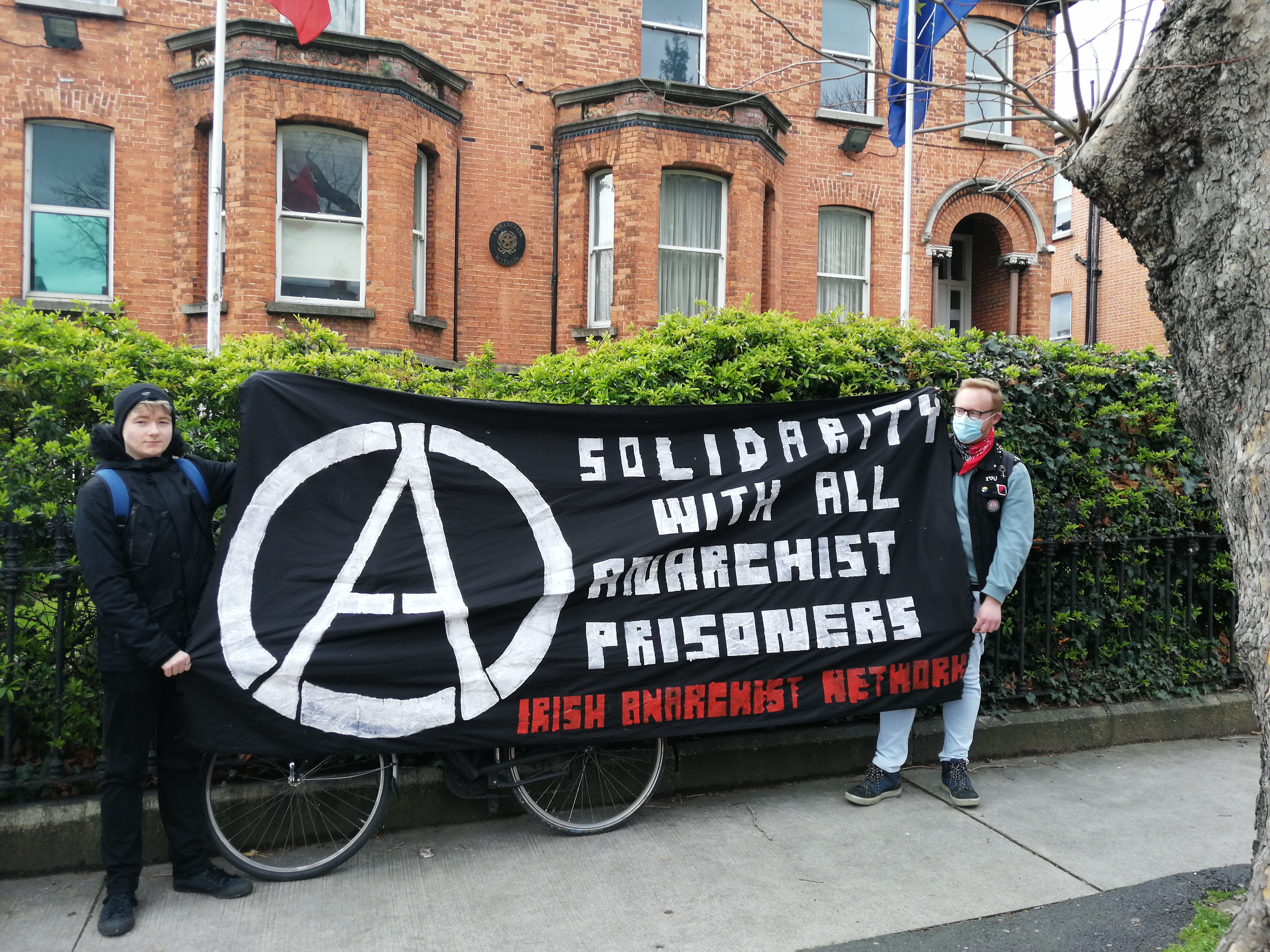
A picket outside the Italian Embassy in Dublin on Thursday (23rd) was part of a day of action across Europe in solidarity with an Anarchist prisoner on hunger strike since October in a struggle for more humane prison conditions.
The picket, organised at short notice, included Irish Republicans, Anarchists and revolutionary Socialists. Banners and placards indicated the presence of Saoradh, Irish Anarchist Network and Ireland Anti-Internment Campaign.
At one point five uniformed Gardaí stood near the Embassy’s gate while three plain-clothes Special Branch (i.e. political police) watched from a car across the road. The police numbers may have been due to a request from the Embassy in the midst of attacks on some Italian Embassies in Europe.
Despite the presence of Gardaí, Embassy staff appeared nervous, meeting one visitor at the gate to check her reason for attendance after speaking to her on her mobile phone, rather than first allowing her to enter the garden and approach the main entrance.
Some of the uniformed Gardaí attending the solidarity picket and some of the protesters. (Photo: IAIC)
Three Special Branch Gardaí (political police) parked across from the picketers, surveilling them (Photo: IAIC)
THE HARSHEST ITALIAN PRISON CONDITIONS
Alfredo Cospito is an Italian political prisoner kept under the harshest Italian prison conditions, “41-bis”, which include solitary confinement for most of the day, family visit once a month through glass, no reading matter sent from outside and no phone calls in either direction or lawyer privacy.
According to information on the Internet, these inhumane conditions were developed for Mafiosa leaders, in order to prevent them running their organisations from inside jail and also to pressure them into breaking ranks and informing on their colleagues.
Whatever we may say about that, what can be the intention of subjecting a political prisoner to those conditions, except to break him or to destabilise him mentally? EU recommended rules on prisoner management don’t recommend more than three weeks in solitary confinement.
Lawyers for political prisoner Nadia Lioce, who has been living under the 41-bis regime for two decades, have said due to limited hours permitted contact, she has effectively only interacted with people for a total of 15 hours in the space of a year.
Italian media reported Lioce’s lawyers as saying she is now so “psychologically isolated” that, when her mother and sister visit, she is unable to speak to them for more than a few minutes.
Some of the picketers, the Italian Embassy in the background (Photo: IAIC)
Amnesty International and the European Court of Human Rights have both criticised several aspects of the 41-bis, and in 2007 a US court refused to extradite a convicted Mafia drug trafficker on the grounds that the 41-bis regime he would face in Italy would have “constituted torture”.
The Anti-Imperialist Front gave a call for an international solidarity day of action which found an active response in many countries.
Alfredo Cospito’s case is up for review by the Italian prison system this month and pickets and other actions have been organised around Europe to exert pressure on the Italian penal authorities to release Cospito into house arrest in his sister’s home.
The picket displayed not only internationalist solidarity but exemplary broad unity of disparate political forces in solidarity with an Anarchist political prisoner. Hopefully this unity will continue to be built upon as time goes on, for the unfolding struggles of class and nation demand it.
Hopefully the international actions will cause the Italian authorities to relax the inhumane conditions of Alfredo Cospito’s incarceration but now Italian authorities are claiming that Cospito is somehow coordinating violent actions from within his extreme isolation.
Another two of the picketers (Photo: IAIC)
A side trip into history
The Italian Embassy is in Northumberland Road, on the south side of the Grand Canal (near the Israeli and US Embassies).
As they were leaving, some of the picketers took time to look at a plaque and monument to the Mount Street Bridge Battle between Irish Volunteers and British soldiers in 1916. Four Volunteers were killed and between 26 and 30 Sherwood Foresters, with 134 more wounded.
Mount Street Battle Monument, on the Bridge over the Grand Canal itself. The English explanation is on the reverse. (Photo: IAIC)
A number of Volunteers were captured but a number got away also. Two of the buildings from which the Volunteers fought remain, bearing the marks of bullet strikes. The third, Clanwilliam House was set on fire by the British and was replaced by a 1960s-type office building later.
2022 was a busy year for the anti-internment campaign organisation, involving, along with its public awareness-rising events, a reorganisation with a new constitution, a new name and expansion of membership.
Origins
The formation of an anti-internment campaign was sparked by the revoking of the licence of ex-political prisoner Marian Price in May 2011 for the “crime” of steadying the written speech of an IRA speaker during a windy Easter Rising commemoration in Milltown Cemetery, Belfast.
In addition to revocation of the licence under which Republican prisoners were released under the Good Friday Agreement, other activists were also being charged under “anti-terrorist” legislation and routinely being refused bail, if not granted it under severe restrictions.
The wait for a trial is often two years and regardless of the eventual outcome, the individuals had already spent two years in jail or at home, barred from travel or political activity and harassed by police visits to their homes.
Early banner-placard protesting the internment of Marian Price (Image sourced: Libcom.org)Front section of Anti-Internment March, coming into top part of Parnell Square, Dublin 2013. (Image sourced: IAIC archives)
These conditions were considered to be in effect the same as internment without trial and the campaign against internment was founded as an independent one, a status it maintained despite a number of attempts to take it over or to intimidate with threats and State harassment.
Throughout its history the Anti-Internment Campaign has organised the annual Newry event (not since 2021 unfortunately), many pickets (including in protest against Amnesty Ireland) and a march in Dublin, spoken at or participated in public events in Belfast, Cork, Derry, Glasgow and Wexford.
It has also organised and hosted conferences and public meetings, for example with speakers from the campaigns for the Craigavon Two, Munir Farooqi and Tony Taylor and about the Right to Protest with a speaker from the Irish Council for Civil Liberties.
Section of the annual Anti-Internment white-line picket Newry, August 2016 (Image sourced: IAIC archives)
Annual Anti-Internment, Newry, rallying after white-line picket, August 2019 (Image sourced: IAIC archives)
A busy year
As stated in the introduction above, 2022 was a busy year for the anti-internment campaign group, involving, along with its public awareness-rising events a reorganisation with a new constitution and a new name. The campaign organised nine public events and participated in more.
Most of those public events were awareness-raising pickets with placards, banners, flags and leaflet distribution. Usually the pickets alternated between the Henry Street/ Liffey Street junction and at Crown Alley by the square in the Temple Bar area, both areas busy with shoppers and tourists.
Anti-Internment picket in Henry Street, November, Dublin 2022 (Photo: IAIC)
The campaign carried out pickets in Henry Street on 9th April, 6th August and 19th November and in Temple Bar on 5th March, 21st May, 2nd July and 27th August. On 22nd October, with a special focus on Palestinian prisoners, we were on the iconic Ha’penny Bridge.
It has always been of particular interest to the campaign group to reach working people and large numbers of that class of all ages pass through those areas. Of interest also are people from other lands and the Basque and Palestinian flags alongside the Irish ones often stimulate discussion.
In September the campaign attended the Peter Daly commemoration in Wexford and provided a speaker at the Dublin meeting to re-launch the End State Repression campaign which our group had supported in the past but which had waned over the Covid epidemic period since.
Our campaign group also took part in the planning of and participation in the joint prisoner’s solidarity picket in Dublin on 17th December 2022.
Reorganisation
It had been clear for some time that the organisation was in need of reorganisation to facilitate expansion but the process had been difficult.
Eventually in July the decision was taken to close down the Anti-Internment Group of Ireland and to reform under another name. This was done and, after democratic consultation process a new constitution was agreed, with the Ireland Anti-Internment Campaign as the new name.
According to agreed decisions, a new banner with the organisation’s new name was commissioned (though it would take some time to come to fruition). A new Facebook identity for the group was constructed with a statement explaining the development.
The new constitution, more explicitly democratically-based than had been previously the case, was published.
Anti-Internment picket in Temple Bar, Dublin, March 2022 (Photo: IAIC)
Year planning
In the reorganisation process, the IAIG lost one member but gained three new activists and the return of two lapsed members. With renewed energy, members began planning for the rest of the year, to conclude with participation in the annual Bloody Sunday March for Justice in Derry.
Issuing a statement to explain the reorganisation, commissioning a new banner, scheduling a number of pickets in Dublin and organising the annual Prisoners’ Solidarity Picket in Dublin December were part of the planning and most of the target actions were completed.
In December and in good time, the campaign’s members organised to purchase, sign and mail Christmas cards to all Irish Republican prisoners, also a number of non-complying Basque political prisoners and the Catalan jailed revolutionary Catalonian rapper Pablo Hasel.
The proposal to organise the annual Prisoners’ Solidarity picket in December jointly with the Irish Republican Prisoners’ Welfare Association and with Ireland Anti-Imperialist Action was agreed and the joint event went ahead on 17th December with around 40 participating.
Section of the joint AICI, AIA and IRPWA Republican Prisoners’ solidarity picket 17 December 2022, O’Connell Street, Dublin 2022 (Photo: IAIC)
The picket with placards and banners, including the illuminated words of the IAIC’s “SAOIRSE” (“Freedom”) attracted attention and passers-by, both Irish and from abroad engaged leafleters and other participants in discussion. A speaker from each group gave a short statement.
The year’s programming ended with the specific scheduling of participation with a new banner in the annual Bloody Sunday March for Justice in Derry.
New Banner Aired at Bloody Sunday March for Justice in Derry
The new banner got its first public airing at the annual march in Derry, commemorating the massacre of unarmed civilians by the British Army in Derry in January 1972 and was carried as part of the march from the Creggan, through a large part of Derry and down to Free Derry Corner.
The marchers in different political parties, campaign organisations and independent individuals marched trough cold rain and strong wind-gusts through the nearly 5-kilometre walk. The members of four Republican Flute Bands played bravely throughout.
The new banner of the Ireland Anti-Internment Committee carried in the Bloody Sunday March for Justice in Derry in January 2023. (Photo: IAIC archives)
The IAIC will shortly begin its year-planning for the rest of the year, its calendar again probably ending at 2024’s Bloody Sunday March for Justice and meanwhile organising events to publicise the on-going undemocratic jailing of activists without trial both sides of the British Border.
The IAIC considers that the jailing of people without trial by both administrations is, in addition to political repression, a significant assault on civil rights and a threat to all opposition groups and that it is in the interests of all to unite in opposing the practice.
The Campaign welcomes the active support of all democratically-minded individuals at its public events.
Eamon McGrath (31 October 1955 – 11 January 1923) singer and song lyrics-writer, activist in areas of housing, water and national sovereignty, historical memory and anti-fascism.
He was getting buried on Saturday and I wasn’t able to be at the service nor at the celebration of his life with comrades afterwards.
I hope this eulogy, if that’s the right word for this, will make up for my absence to his family, comrades and friends and, of course, to me.
Eamon came into my life through the Moore Street occupation in January of 2016. The property speculator Joe O’Reilly (Chartered Land) and the State were about to collude in the demolition of three buildings in the 1916 Terrace.
The State had declared only four buildings in the 16-building terrace, after a long struggle, to be a historical monument and even later, purchased – but around 300 men and women hadn’t occupied just four buildings in 1916.
The Save Moore Street From Demolition campaign group had called emergency demonstrations on to the street following which the buildings had been occupied by protesting conservationists.
The weather was bitterly cold but the occupiers held firm for a week until a stay of demolition had been imposed by the High Court. Despite his health status and challenged mobility, Eamon was there throughout, with humour and song.
Eamon McGrath to far right of photo while Dave Swift (centre) in Irish Volunteer uniform reads a historical document April 2017 in Moore Street, during historical commemoration event (the hoarding behind is covering the extension of the ILAC further into Moore Street, killing the market appearance for that side of the street for the block).
Subsequently, to prevent internal damage by contractors, a six-weeks’ blockade was imposed on the building by conservationists from 6.30am to 4.30pm each weekday. Eamon was very much a part of that too, driving himself and his close comrade Sean Doyle up from Wicklow every day.
Eamon was intensely loyal to close friends and comrades. On occasion I found him prickly or grumpy (especially at 6.30 am) but throughout any disagreements he never lost sight of who were his comrades and other people he respected.
Though a proud man, when he recognised himself in error, he didn’t hesitate to apologise.
A new broader group came out of the occupation and blockade, called Save Moore Street 2016 and Eamon attended and contributed to internal organising meetings and events we called on to the street – re-enactments, fake funerals of history, pickets, demonstrations and rallies.
As others drifted or were called away from the group by other commitments, Eamon remained with the active core.
(L-R) Paddy Reilly and Eamon McGrath in period costumes having a conversation during a history education event and anniversary commemoration of the founding of the Save Moore Street From Demolition campaign group. (Photo from Save Moore Street From Demolition FB page)
Of course, Eamon had been active before 2016: certainly very much so in the general awareness-raising and mass campaign against planned privatisation of our water and the installation of water meters.
He was to continue that activism, which resulted in assaults by a water contractor on him and Seán Doyle, court appearances for both and in May 2016 both of them went to jail for a period but remained unbowed.
Eamon was one of the original occupiers of Apollo House in December 2016 in protest against homelessness and as a co-founder of the Anti Eviction Flying Column, Eamon was to the fore in resisting evictions across the country and also a co-founder of the Bring It to Their Doors campaign.
The State authorities were making things awkward for Eamon by then, both in terms of working as a taxi driver and claiming benefit when he was not. His ability to reach events in Dublin declined but he still got there often enough on public transport, while remaining active nearer to home.
As his physical mobility declined further, comrades in Carlow started an on-line collection to buy him an electric wheelchair. Even as I made enquiries to contribute, the fund had already reached its target, so quickly did people support it.
Later still, his family installed a new chairlift for his home so he could access the room where he recorded his songs with lyrics commenting on the ongoing political struggles, adapted to popular airs.
Though our voices didn’t go well together, we sang together a couple of times – outside the GPO and outside Dublin City Hall.
Eamon McGrath, centre right after April 2016 event in Moore Street after which we brought it to in front of the General Post Office in Moore Street for awhile. Myself near centre, Glenda further to the left of photo, Sean Doyle nearly out of shot.
He remained active on social media but in particular in keeping an eye on the activities of right-wing people, covid-deniers, racists, fascists …. Eamon was a handy source for a quick update on the status of many of them.
Eamon arranged an interview for us both with the Dublin Near FM radio station, the interviewer being then a former drug addict who sadly returned later to his addiction and died on the street. It was on the way back from the interview that Eamon told me a little about his earlier years.
He had a difficult time in his childhood, including institutional confinement and his formal education suffered as a result. However, he educated himself about many things by reading, listening, discussing and viewing on line.
I think the last time I saw Eamon was at a commemoration at the Peter Daly monument in Wexford inSeptember 2022, in his electric wheelchair and attached oxygen cylinder for his lung condition and all in good cheer, asking me for Moore Street campaign updates in detail.
Eamon McGrath, centre in wheelchair, at Peter Daly commemoration in Wexford, September 2022 (Photo from Peter Daly FB page)
His comrades in Anti-Imperialist Action Ireland, which he had joined at its foundation in 2017 correctly called him “one ot the most dedicated political activists of the last decade” and no-one who knew him could argue with that.
I knew little of Eamon’s family life but he often emphasised how important family was, not just to him but in general. Though I do not know them tá mé i gcomhbhrón leo, offering them my condolences along with the many they have received and are no doubt still arriving.
A partner, father, grandfather, great-grandfather, extended family member and friend to many.
Eamon McGrath of Kenmare Heights, Greystones & formerly Wolfe Tone Square, Bray, Co. Wicklow, was buried in Radford Cemetery, Greystones Saturday after a service in the Holy Rosary Church, Bray, attended by family, comrades and friends.
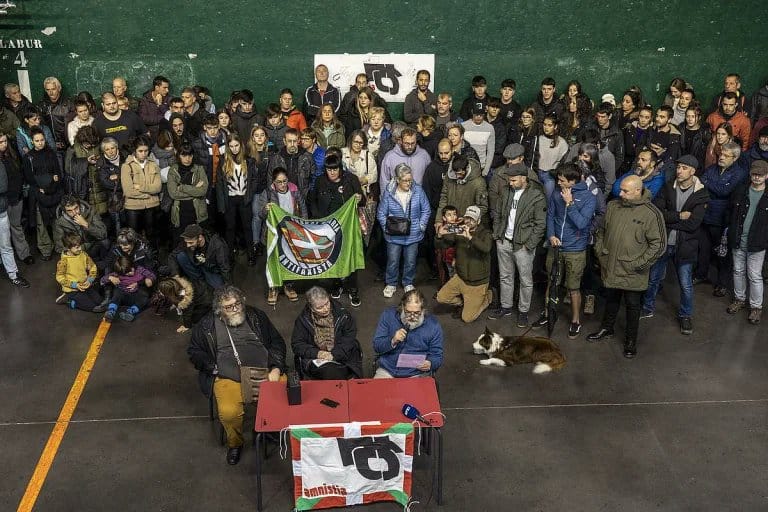
TINKO is an independent organization created to work for COMPLETE AMNESTY. As an amnesty organization, it intends to create the necessary means to fight against repression with its scope of work being the Basque Country.
As its name indicates2, it intends to reflect the attitude of determination and commitment of some political prisoners3 in these difficult times. Along with the dignity and toughness that is being maintained, there must be constant struggle in the streets.
It is our responsibility to keep the flame of the struggle burning; for this reason, we see it more necessary than ever to organise ourselves.
Drop-banners against repression in different locations in the southern Basque Country/ Spanish state (Photo: Tinko)
TINKO’s understanding of repression goes beyond reporting each case in isolation, since each of these cases responds to a general repressive situation.
The states are the ones that speak of the individualised treatment of prisoners, denying their political nature and hindering solidarity. Therefore, our duty in this regard is to promote unity and solidarity.
It is the slogan of COMPLETE AMNESTY that offers this overview of the aforementioned repression, as well as the political solution that opposes this repression.
Full amnesty includes freedom from all political repression without exclusion, as well as overcoming the underlying causes of repression, such as national and social oppression.
Therefore, TINKO is an organization made up of ideologically-conscious activists, who want to make their contribution in the field of anti-repression towards a Basque Socialist State.
If the intensity of the struggle is met with repression, it will be our task to counter that repression, to try to facilitate the conditions for the struggle.
It is necessary to take a broader reading of repression, paying attention to reality with the intention of joining our forces.
We aim to create a broad movement against the repression that upholds the interests of the political victims of the struggle cycles of yesterday, today and tomorrow, that will always be in accord with the declaration of complete amnesty and not establish differences according to the struggles carried out.
It is necessary to underline the enormous generosity of the militants who suffered the repression of the previous phase. They have been our compass even in the bleakest times and they continue to be so today.
Total amnesty is our strategic objective and we do not define it in a purely legal way but instead in a political way.
Amnesty includes the unconditional release and freedom of prisoners, fugitives, refugees and political deportees and also the resolution of the reasons that motivated these people to fight for their fundamental rights, in the case of the Basque Country, against national and social oppression by the Spanish and French states.
Only ending the denial of our rights can ensure that prisons do not fill up anew after they have been emptied. These are the other measures that a full amnesty should include, along with the aforementioned freedom from political repression:
The right to self-determination
Abolition of repressive laws against the working class. Repeal the labour reform laws, the muzzle law, the party law and the anti-terrorism law4.
Dismantle and expel the repressive and occupying forces from the Basque Country.
Press conference in November in solidarity with 18 people from Berango accused of “glorification of terrorism” (sic) for organising an “ongi etorri” (welcome) event for a released political prisoner. (Photo: Tinko)
ANTI-REPRESSION NETWORK
As we said at the beginning, TINKO intends to create the necessary means to combat repression.
We consider it necessary to create useful tools to organise in cases of repression, which allow the creation of effective solidarity networks for the protection of those who suffer repression for being active in different fields.
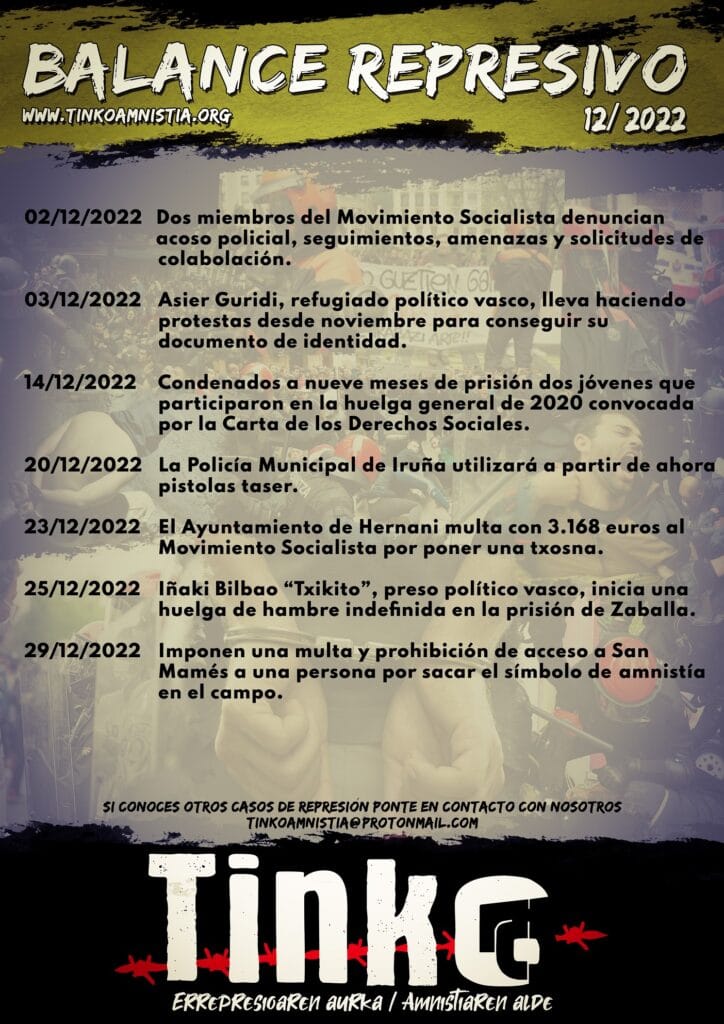
Monthly summary of repression (Castilian language version) December 2022, including: 9 months jail for two youth participants in the 2020 General Strike; municipal police in Irunea/ Pamplona are to get taser pistols; the municipal council in Hernani fine Socialist Movement 3,168 euro for running a street stall; Basque political prisoner initiates indefinite hunger strike in the Zabala prison. (Source: Tingo)
In addition to organising instruments for protection in the courts, insisting on repression as being general and calling for total amnesty. While the net would be politically wide, victims of repression would receive protection according to the following minimum essentials:
Joining the call for total amnesty.
Feeding the network itself, that is, strengthening the network against other cases of repression.
Putting the collective before the individual.
Not denying access to basic political rights in a possible trial: the right to political organization, the right to demonstrate, the right to assembly and the right to freedom of expression.5
End.
FOOTNOTES
1Tinko was founded some months after an internal dispute inside the Amnistia organisation in the autumn of 2020 about whether to support a demonstration in Madrid or not. Amnistia itself, as with Tinko, grew out of the perceived necessity to resist repression in order to move forward in struggle, while the official leadership of the left-nationalist movement was adapting itself to the requirements of the Spanish State.
2“Tinko” means ‘firmness’ in the sense of ‘resolved/ standing firm’.
3Note the qualification “some”: the leadership of the Basque prisoners’ organisation and of the relatives’ support group, Etxerat, followed the abandonment of the revolutionary path by the leadership of the Basque Izquierda Abertzale mass movement. Most of the prisoners followed the leaders’ line, which entailed prisoners not calling themselves “political” prisoners, not joining any protests and seeking parole as individuals, including apologising for their previous actions. The leadership dropped the call for Amnesty and confined their demands to an end to the dispersal of prisoners away from their home areas.
4In brief, laws restricting the right to strike and to record and disseminate police violence, along with laws permitting repression of political activists.
5There is a practical reason for the inclusion of this requirement: The Spanish State demands the political activists it arrests apologise for their resistance and undertake not to repeat it. Shamefully and to the shock of many, in September 2019, 47 activists in three organisations engaged in prisoner solidarity work, including officials of the Basque Left Movement, in exchange for non-custodial sentences on all but two (who received relatively light sentences) pleaded “guilty” to ‘anti-terrorism’ charges. Doing so endorsed the criminalisation by the Spanish State of prisoner solidarity work and was a great shock to many Basques, including the 50,000 who had demonstrated in Bilbao in solidarity with the accused only days before the trial and had been kept in ignorance of the deal. (SeeEuskal Herria. Iñaki Gil de San Vicente: “Es inadmisible engañar a 50.000 personas, pactando a sus espaldas” – Resumen Latinoamericano)
Christmas shoppers on Saturday 17th in Dublin’s O’Connell Street, the city’s main boulevard, were interested to see a long picket line displaying banners, flags and placards.
The event was a jointly-organised public reminder of the continuing existence of political prisoners in Ireland and as a gesture of solidarity to the prisoners too.
The joint organisers were the Ireland Anti-Internment Campaign, the Irish Republican Prisoners Welfare Association and the Anti-Imperialism Action organisation. The attendance were mostly Irish Republicans but there were also some from the socialist/ anarchist traditions present.
Long line looking southward of joint Republican prisoners’ solidarity event (Photo: Rebel Breeze)
There are currently 40 Irish Republican prisoners in jails in Ireland, on both sides of the British Border. As a speaker noted at the end, all had been sentenced or refused bail by no-jury special courts of the Irish and British states.
The Irish Tricolour and the Starry Plough were displayed of course but also a Palestinian flag and two Basque ones; the latter attracted the attention of a number of young people from the Spanish state who were pleased and approached the picketers for discussion.
Section of the joint Republican prisoners’ solidarity event showing the Latuff cartoon on a banner (Photo: Rebel Breeze)Section of the joint Republican prisoners’ solidarity event showing couple of Basque flags and Palestinian one in the middle distance (Photo: Rebel Breeze)
Two banners called for and end to the extradition of Irish Republicans and one figured cartoonist Carlos Latuff’s illustration of solidarity between Irish and Palestinian political prisoners.
Leaflets of the IRPWA and of the IAIC were distributed to passers-by.
Section of the joint Republican prisoners’ solidarity event (Photo: Rebel Breeze)
As the event came to an end a representative of each organising group read out a short statement; both the IAIC and the AIA emphasised the need for unity in resisting repression and each along with the IRPWA called for support for Irish Republican prisoners.
End.
Section of the joint Republican prisoners’ solidarity event (Photo: Rebel Breeze)Section of the joint Republican prisoners’ solidarity event (Photo: Rebel Breeze)
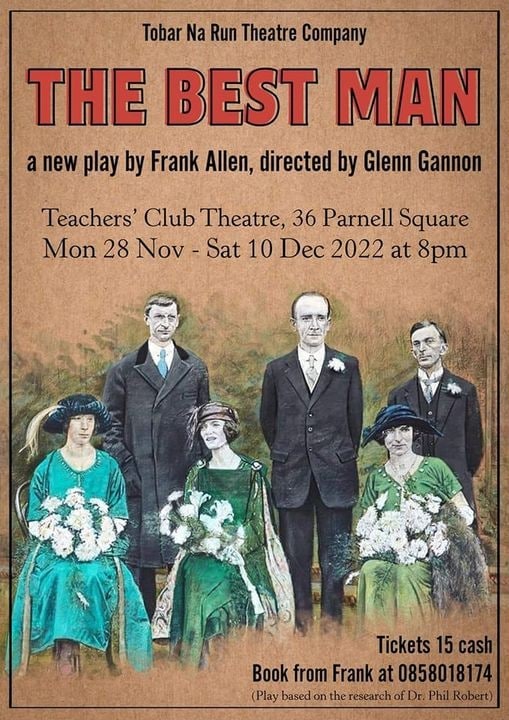
Kevin O’Higgins, Minister of the Free State, signed the execution order of his former close friend and the Best Man at his wedding, Rory O’Connor, who led Irish Republicans in the occupation of the Four Courts in 1922 in opposition to the Anglo-Irish Treaty.
The historical and ironical reality is the basis for Frank Allen’s play The Best Man, showing until the 10th in the theatre in the Teachers Club, Dublin.
BRENDAN AS BORSTAL BOY
Before the play begins the audience is treated to a short performance by Brendan O’Neill of his portrayal of Brendan Behan from Borstal Boy and the Republican’s return to Ireland after his release from jail. O’Neill has family connections to his subject and has researched him too.
It’s an enjoyable performance and an interesting peek into what is or will become a full play, set already to tour Canada. One wonders whether Canadian society, reputed to be somewhat staid, is ready for Behan on stage.
THE BEST MAN PLAY
Glen Gannon’s direction makes best use of the small stage, adapting it with minimal changes to serve different scenes, while a piano recording of two well-known airs are employed for the same purpose. Elaine sings verses of The Foggy Dew beautifully.
There are four characters who take to the stage: Rory O’Connor (Alan O’Brien), Kevin O’Higgins (Kevin Brennan), ‘Birdie’ (Elaine O’Dea) and Lady Lavery (Niamh Large).
All of the parts are well-written and acted. For dramatic impact however, it is those of Rory O’Connor and Lady Lavery which are the strongest and both O’Brien and Large make the most of them, each dominating their respective scenes.
Searching for information online about ‘Birdy’, O’Higgins’ wife, for this review has been frustrating, with numerous commentaries on O’Higgins not even mentioning her name.
From information supplied by Frank Allen, Birdie was called Brigid Cole and she was an English teacher who taught in Knockbeg College in Carlow. Gearóid O’Sullivan taught there too.
“Birdy”, is brought to life in this play and given expression in moments of humanitarian passion in conflict with her husband Kevin, whose own most powerful moments are expressed in anger and angst during the Civil War, though his interactions with Lavery display passion of a different kind.
HISTORY
In history, Lady Lavery has been associated with Irish cultural interests and romantically with Collins but letters to her from O’Higgins reveal that Michael was not the only Irish fish in her net. Her image, in an Irish shawl, was to grace the Irish Sterling pound note. Suspicions that she was an MI5 agent are unproven but remain..
There may be some legal argument about some of the execution orders of Republicans signed by O’Higgins, though all are regarded by Republicans today as judicial murder.
There can be no argument however about the criminal nature of the executions of O’Connor, McKelvey, Barrett and Mellowes, executed by cabinet executive order in reprisal for a killing that took place while they were in jail and in which they played no part.
It hardly seems possible to view the ideological conflict around the Anglo-Irish Treaty without thinking about another Agreement closer to us in time; as we come up to the 25th anniversary of the Good Friday Agreement we can reflect on the lack of closure of each.
I have no hesitation in recommending a viewing but haste – only three nights remain.
Gearóid Ó Loingsigh (republished from Socialist Democracy November 2022 with kind permission of the author)
(Reading time: 8 mins.)
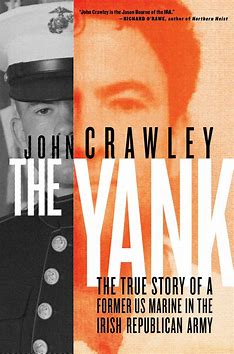
At first when I heard about this book, I thought it would be some spoof by a wannabe and wasn’t inclined to take it seriously. That was a mistake. The Yank is an entertaining and informative tale of the exploits of a Yank who joined the IRA.
That in itself would be a story worth telling, except John Crawley’s life in the IRA was no ordinary story. He comes across as a committed and dedicated Irish republican and even a veritable James Bond, though he might not like the comparison with the fictional agent of British imperialism and murder at her majesty’s request.
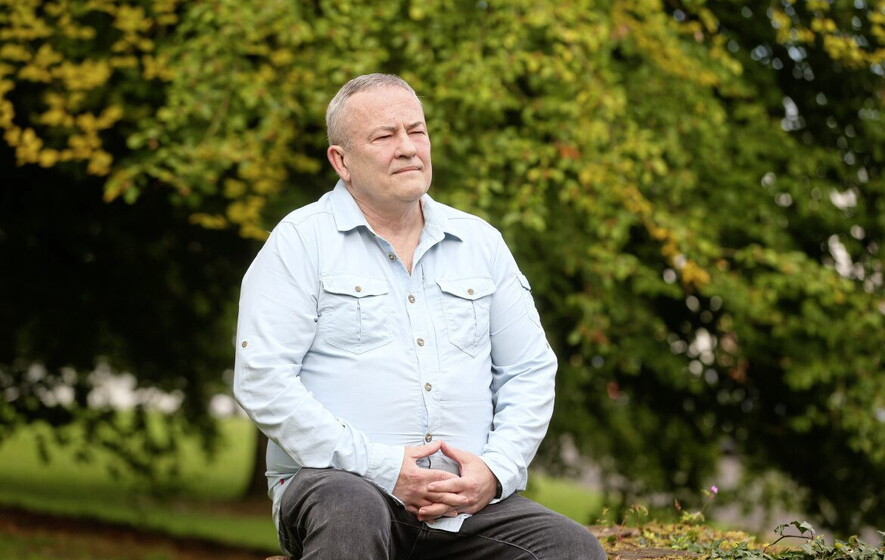
John Crawley, former US Marine and subsequently Provisional IRA Volunteer (Photo sourced: Irish News)
Crawley was a young man raised in the US, who when his family moved back to Ireland eventually decided to go back to the US and joined the Marines, with just one purpose in mind, to become a fighting and killing machine and return to Ireland to join the IRA.
By fighting and killing machine, I don’t mean some mindless grunt as the Yankee military might put it. He was determined and trained hard and excelled, to such a point that the US intelligence services wanted to recruit him and when he took the decision to come back to Ireland the US military were sorry to see him go.
He was one of their best, something they recognised and tried to take advantage of. Sadly, his undisputable abilities were not recognised by the IRA and Martin McGuinness in particular. They had apparently little use for his rather unique skill set, which would be considered to be invaluable in any armed organisation, except in the IRA under Adams and McGuinness.
Crawley tells his autobiographical story in a very readable fashion; at times you feel you are having a fireside chat with a rather likeable man. It is an easy read and worth it.
The book has received some criticism from bourgeois critics who would rather that he just told his story of a Yank in the IRA, much like Mark Twain’s A Connecticut Yankee in King Arthur’s Court.
But his tale is not one of fiction and the politics of Ireland are intimately bound up with his decision to join the IRA and remain in it, even after a lengthy prison sentence following his capture on the Marita Anne, when he and former Sinn Féin T.D. Martin Ferris tried to import arms to Ireland.
His politics are important to the story. He is at times quite blunt and even clumsy in how he states them, sounding very much like Ruari Ó Bradaigh at times, though in the last chapter his explanation of why he rejected the Good Friday Agreement is much better, sincere and at times hits the nail on the head.
He dedicated his life to an ideal and fought for it. He had never suffered at the hands of the Brits, nor does he seem to be caught up some dewy-eyed nationalist dream but rather he made an ideological decision to commit to something and stuck with it. This ideal was betrayed and part of how it was betrayed is shown in his story.
The late Martin McGuinness, Commander Derry’s IRA, one of SF’s main leaders and Deputy First Minister or Her Majesty’s Irish colony. Crawley found much to make him uneasy in McGuinness’ military leadership which also gave rise to other doubts. (Photo sourced: Internet)
He doesn’t set out to besmirch McGuinness and I have to admit that I never took seriously any of the conspiracy tales around McGuinness and Adams, but there are many details in the book that call into question what McGuinness was about and with whom in later years and I am now more sympathetic to some of these stories.
Crawley had a military expertise that few if anyone else in the IRA had and yet McGuinness the head honcho in the IRA whose later reputation as a military man would help sway the IRA towards the GFA and disarmament did not value his expertise or indeed listen to him.
He describes him as military illiterate, something I am inclined to agree with. But McGuinness could not only not be questioned politically, but militarily. He remarks at one point about IRA operations and weaponry that
Martin went silent. I could see he was seething, but he said no more about it. I shut my mouth. The last thing I wanted to do was alienate him. I wanted to help the IRA beat the Brits. I wasn’t there to criticise him personally, although I believe that’s how he interpreted it. My heart fell into my boots.
I had expected to be led by skilled professionals, men who were technically and tactically proficient. A true professional would value the correction and pass it on to the men on the ground but not this fellow. He took it as an insult.
Because of his status and prestige in the movement, I knew that if Martin McGuinness said the rocket didn’t explode then, as far as the IRA was concerned, it didn’t explode.
Nobody was going to listen to what I had to say about it. It didn’t matter to me personally whether or not I was believed, but the real damage was to volunteers’ confidence in the weapon.
He deals with the politics of betrayal in the GFA, and though he laments and rails against the lack of professionalism from the IRA leadership and the consequences of the illiteracy of McGuinness & Co.
Crawley doesn’t deal with the politics of a movement where McGuinness and others who were undoubtedly careerists from the beginning were able to hold sway.
How could a movement get away with sending out men and women to fight, die and kill and not try to do their best for them? This question goes beyond the individuals concerned, though they played a major role in it. This question is not answered.
But he gives us a lot of information, some of which should raise questions about the IRA leadership in the minds of the reader and indeed Crawley who also deals with the issue.
Crawley made many suggestions to the IRA and McGuinness in particular about things they could do. They ranged from simple stuff that every sniper have their own rifle adjusted for them, to other things.
His ideas were, and pardon the pun, shot down. Most of them were basic common-sense things, others were based on his extensive and intense experience in the US military.
Perhaps McGuinness and Adams watched the wrong documentaries and war films, but some of his suggestions were not a million miles from common sense, but yet the military expert of the IRA, McGuinness rejected them. Why? we do not know, though he does hint at it later in the book.
The politics aside, his book is a fascinating look at the life of an IRA volunteer, one who has not bowed down to the political correctness of the SF leadership. His description of his time in England would be riveting, except we obviously know the outcome. It is nevertheless interesting.
Crawley has a gift for writing, and he should not stop now. In all conflicts Historic Memory, as it is termed is important and just another battlefield. His is a voice that deserves to be heard and one which has to date been drowned out by Adams and McGuinness loyalists. He should write more about his experiences.
There has been a slew of publications and memoirs by IRA volunteers, many of them by Adams loyalists. This is not one of them. Prior to this, our only insight on the inner workings and politics of individual volunteers was through the Boston College.
At the time Sinn Féin described it as a “touts’ charter”, due to the criticism levelled, by those who gave their testimony, at Adams and co. Martin McGuinness is dead and there have been too many publications, sanctioned by the IRA, or at least not meeting with its disapproval for Crawley’s book to be placed in that category.
Instead, they have opted, unsuccessfully, to ignore it, hoping just like the IRA it will go away. That hasn’t happened and the book is doing well and deserves to be read.