SPEAKING TRUTH TO POWER – REALLY?

Diarmuid Breatnach

Again and again we come across activists, journalists, musicians and other artists who are lauded for “speaking truth to power”. They are often praised for that, even idolised. “Speaking truth to power” seems to be brave thing to do. And an important thing. But is it really?

First of all, let us think of who are those usually thought of as “Power”: governments, big companies, military dictators, church leaders, powerful individuals in the media or in the arts …..

Why is it considered a good thing to speak truth to them? It may well be brave to do so and often is. People who spoke the truth in certain situations throughout history and currently have had their careers destroyed, been the subject of all kinds of horrible allegations, been marginalised, lost their families and friends, been framed on charges, jailed as a result or just automatically, tortured, killed and “disappeared”. Yes, we could hardly deny the courage of many of those who chose to take that step. But whether it’s an important thing to do is another thing completely.

What? A courageous act against power not important? What can I be suggesting!

Let’s look at those in power again, taking for examples a government, a military dictatorship and the CEO of a powerful company. In our example, we set out to “speak truth” to them.

For the government, we send them an email, or a letter because there are too many Ministers and Secretaries to address verbally – unless of course we are in some kind of privileged position. They in turn ignore us or send us a dismissive reply (possibly tailored to be quoted) or they have us subjected to surveillance, just in case we should turn out to be a real problem in future. And any government in the world is capable of putting citizens under surveillance.

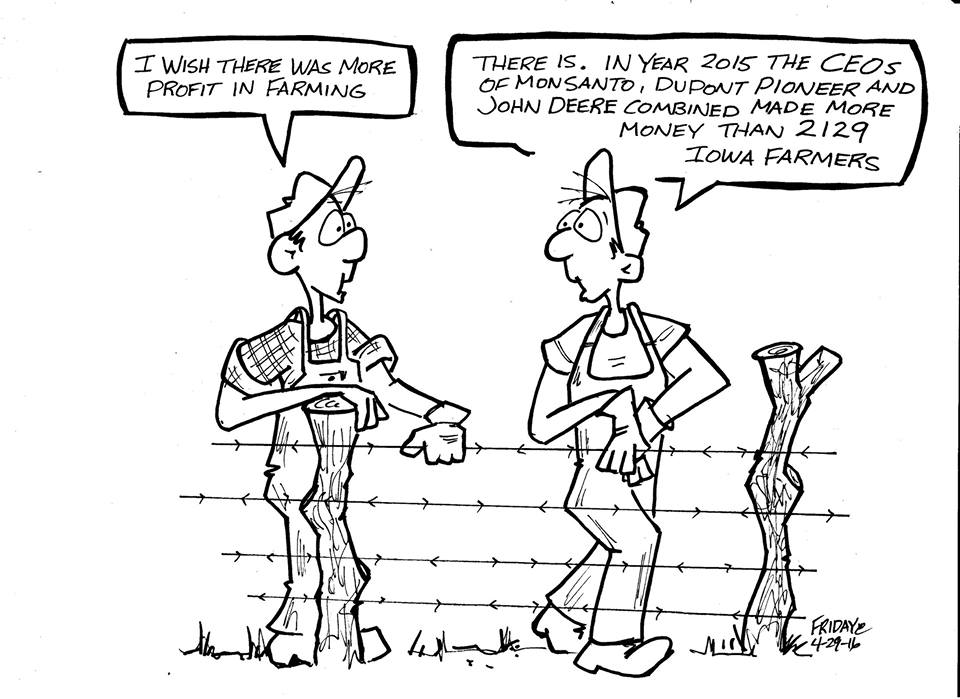
(Cartoon strip source: Internet)

We send the military dictator a letter and he has us arrested, detained for torture and questioning. Or we accost him when he is somewhere in public …. and his security guards shoot us dead. Or arrest us for torture and questioning.

With regard to the CEO, we send him an email. He ignores it but may have us put under surveillance – just in case. And he’ll have our employment and tax records, families and friends checked out too. Like governments, the CEOs of big companies can easily put people under surveillance and run background checks on them. And CEOs likely last longer in the power position than most governments. Or he might reply dismissively. Or he might have his legal services people threaten us with legal action which, as well as shutting us up, would cost us a lot of money we don’t have, probably bankrupting us.

This is the illusion of liberals and social-democrats but the reality is very different.
(Image sourced: Internet)
(image source: Internet)

In the military dictator’s case, we are out of the picture. In the case of the other two, nothing further may happen if we shut up now. But if not, well …. there’s that list of bad outcomes I listed above. Brave? Certainly – but to what effect? Have we changed anything?

Some people think we can change the essence of the way those in Power think by Speaking the Truth to them. If only we can say it powerfully enough. Nonsense. Those in the Power have already chosen who they want to be, what side they are on and understood the basic dynamics or been taught them along the way. Many choices made have confirmed them in their roles and ideology.  Furthermore they know that to break ranks with their own is a dangerous thing to do which can result in bad outcomes for them too and also expose them to painful and even fatal thrusts from their competitors or rivals. Remember the 1983 film Trading Places? Remember how the main hero falls at first, is shunned, loses his privileges, friends and associates? Unlike the film’s ending, there is no coming back from there.

If those CEOs and company owners ever took a progressive step it was because they were shown it would increase their profitability or at very least were shown it wouldn’t hurt it ….. or they were forced to do so by people’s resistance. Not ever by having “Truth Spoken” to them. Unless it was the truth of resistance (and we’ll come back to that).

I don’t see the point of Speaking Truth to Power … except in very exceptional situations. For example, if we are being sentenced in court, even if the public gallery has been cleared or packed with cops (which has happened even in this state on occasion), we might wish to raise a clenched fist and yell “Death to Fascism!” before the guards jump on us and bundle us to the cells, giving us a few punches on the way.

Or being tortured, if we are capable of it (and while we are still capable) we might want to shout something similar or just plain “Fuck you!” Or in front of a firing squad, to shout “Long live the revolution!” before the order comes to “Fire!”

Will it do any good, make any difference? Without an audience apart from those in Power, almost certainly not. It might affect some soldiers or police in the firing squad or some jailers but such results are usually negligible. But in doing so, we assert our humanity, our spirit against them and it is for ourselves alone, at that moment, that we Speak Truth to Power. Otherwise, there is no point, none at all.

I don’t want to Speak Truth to Power and what’s more, question why anyone else would. Is he or she suffering from some kind of liberal illusion that such words make a difference, can convert or subvert Power? Or from an inflated ego that convinces him or her that they have the gift, the eloquence, the importance to make Power change? Or that somehow, by force of their excellent will, they can overcome history and change reality?

Or even worse, are they signaling to the Power that they are articulate, eloquent even with “alternative” credentials and that they are worth recruiting by the Power?
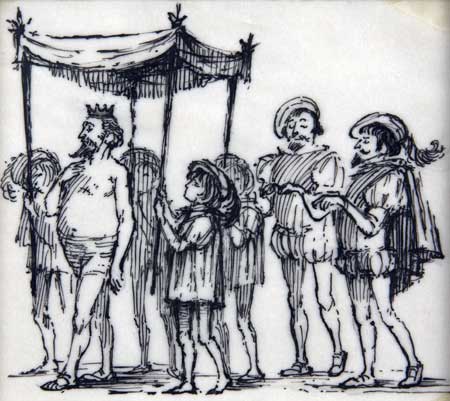
The Naked Emperor. In Hans Christian Andersen’s subversive tale, an undoctrinated child remarks that, contrary to royal propaganda, the Emperor is naked and the people can then admit this to themselves. The child spoke Truth — but to the People.
(image source: Internet)
Speaking truth among the people. (Cartoon source: Internet)

I repeat: I don’t want to Speak Truth to Power. I want to Speak Truth alright … but to the PowerLESS! I want to expose the Powerful to the people. I want to show them the long list of the crimes of the Power and that it is unreformable. But I don’t want to just read the people a horror story; I want to show them how I think the monster can be killed. I want to show the people that THEY CAN DO IT! The people can grasp power with which to overthrow the Power. I want to show the people what their forebears have done in rebellions, uprisings, revolution, creation of resistance organisations, art, discovery of science, production ….. I want to share what I think with them, argue with them, encourage them, criticise them. And the only time I want to Speak Truth to Power is when they, the People, are listening, or reading what I am saying. Because then, it’s not to Power, in reality, that I’ll be Speaking Truth; the important audience is not Power at all.

So, Speaking Truth to the People is the thing to do. And will those who do so be safe from painful outcomes, that list given earlier? Having careers destroyed, being the subject of all kinds of horrible allegations, being marginalised, losing families and friends, being framed on charges, jailed as a result or just automatically, tortured, killed and “disappeared”? Alas, no, each of those is a distinct possibility: all have happened even to the people of our small island and nearly all of them fairly recently. Some very recently and even ongoing.

There is no safe way to Speak Truth. But at least this way, there is a chance that Speaking Truth will have some effect, will make a difference. It might even make a big difference. We hope so.

And the final Truth is that words, for all their power on people’s minds, don’t change the real world. People do that, through action.

End
(image source: Internet)

DRUMMING SOLIDARITY FOR BASQUE POLITICAL PRISONERS

Diarmuid Breatnach


On July 7th (the San Fermin feast day) 1985 two Basque political prisoners escaped from the Spanish prison of Martutene during a concert. The escape was received joyfully in the Basque Country and in other places and celebrated also in song composed by the Basque ska-punk band Kortatu (1984-1988). The song is called Sarri, Sarri, a nickname made from Sarrionandia, the paternal surname of one of the escapees, who was serving 22 years form membership of ETA, the Basque left-independentist armed organisation.


The song is performed annually (see video) in the Orereta/ Errenteria area to the accompaniment of massed drummers, a denborrada or tamborrada(“a drumming”), in the province of Gipuzkoa, near the French State border and not very far from Donosti/ San Sebastian and was done as a gesture of solidarity with the Basque political prisoners. In its report on the first quarter of 2018, Etxerat, the association of political prisoners’ families and friends, recognised 287 prisoners but over the years a number of Basque prisoners have left the collective but are still serving time, a few doing so since the changes in policy of ETA and of the Abertzale Left leadership. Of the 287 recognised by Etxerat,twenty-two were terminally or seriously ill and should have been paroled under Spanish and French laws, only three were serving sentences in the Basque Country and four seriously-ill on parole, 280 being dispersed in jails throughout the French and Spanish states. Relatives and friends able for the long journeys have to travel distances of between 100 to 1,100 kilometers from the Basque Country and many traffic accidents, some fatal, have occurred on those journeys.

ETA (Euskadi1 Ta Askatasuna = Basque Nation and Freedom) was formed in the late 1960s and for almost a decade did not engage in armed activity, though its members and supporters were hounded, tortured and jailed by the Spanish State, after which it turned to armed actions. The organisation called a “permanent truce” some years ago and recently dissolved itself in what seems to have been a bid by the pro-independence left’s political leadership to enter some kind of peace process with the Spanish State, in which the latter is clearly uninterested or perhaps as a move to ease the conditions and possibly sentences of Basque political prisoners.

Amnistia Ta Askatasuna (“Amnesty & Freedom”), an organisation campaigning for prisoners which does not recognise the official movement’s leadership exists, and though small, is active in many parts of the nation.


THE ESCAPEES

Iñaki “Pitti” Pikabea continued active in ETA and was sadly recaptured in 1987; he was paroled in 2000. Joseba Sarrionandia Uribelarrea kept low and avoided the authorities, although publishing writings and earning awards, until he surfaced in Cuba, where he lives to this day, as a writer and also a lecturer at the University of Havana.

Joseba Sarrionandia through the ages (images sourced: Internet)

Among Sarrionandai’s many writings (articles, poems, novels), on 3rd October 2011, the Basque Government and Spanish State were embarrassed to learn that Sarrionada had received a prestigious literary awarded, the Euskadi Prize for Essay in Basque for his work Moroak gara behelaino artean? (Are we Moors in the fog?) on the miseries of colonialism.2

End.


LINKS:

Joseba Sarrionandia Uribelarrea: https://en.wikipedia.org/wiki/Joseba_Sarrionandia

Etxerat report January-March 2018: http://www.etxerat.eus/index.php/es/informes/mensual

Amnistia Ta Askatasuna: https://www.facebook.com/amnistiataaskatasuna/ and http://amnistiaaskatasuna.blogspot.com/

Video of this year’s Denborrada: https://www.facebook.com/KatiuskakArgazkiEstudioa/videos/1879014595499250/?t=6


FOOTNOTES

1“Euskadi” nowadays normally means three of the southern (i.e under Spanish rule) Basque provinces combined in the “Basque Autonomous (sic) Region” and therefore excludes the other southern province, Nafarroa and the three northern provinces (i.e under French rule); “Euskal Herria” (the H is silent), i.e “the land where the people speak Basque” is the widely-accepted name for the Basque nation now.

2From Wikipedia (see Links): “On 3rd October 2011, Sarrionandia was awarded the Euskadi Prize for Essay in Basque for his work Moroak gara behelaino artean? (Are we Moors in the fog?) on the miseries of colonialism; however, the Basque Government withheld the prize sum of 18,000 euros until the author’s status was resolved. On the same day, judges and lawyers interviewed by media confirmed that Sarrionandia could not be prosecuted by Spanish law, as more than 20 years had passed since his original prison sentence and his escape. While terrorist acts have no time limit, the provision applies only if there was at least one victim. After a month and a half, the Spanish High Court confirmed to the Basque government that Sarrionandia was ‘clean’, with no criminal or civil liability. The prize amount was handed over to his family”.

DUBLIN PROTESTS JAILING OF ALTSASU EIGHT

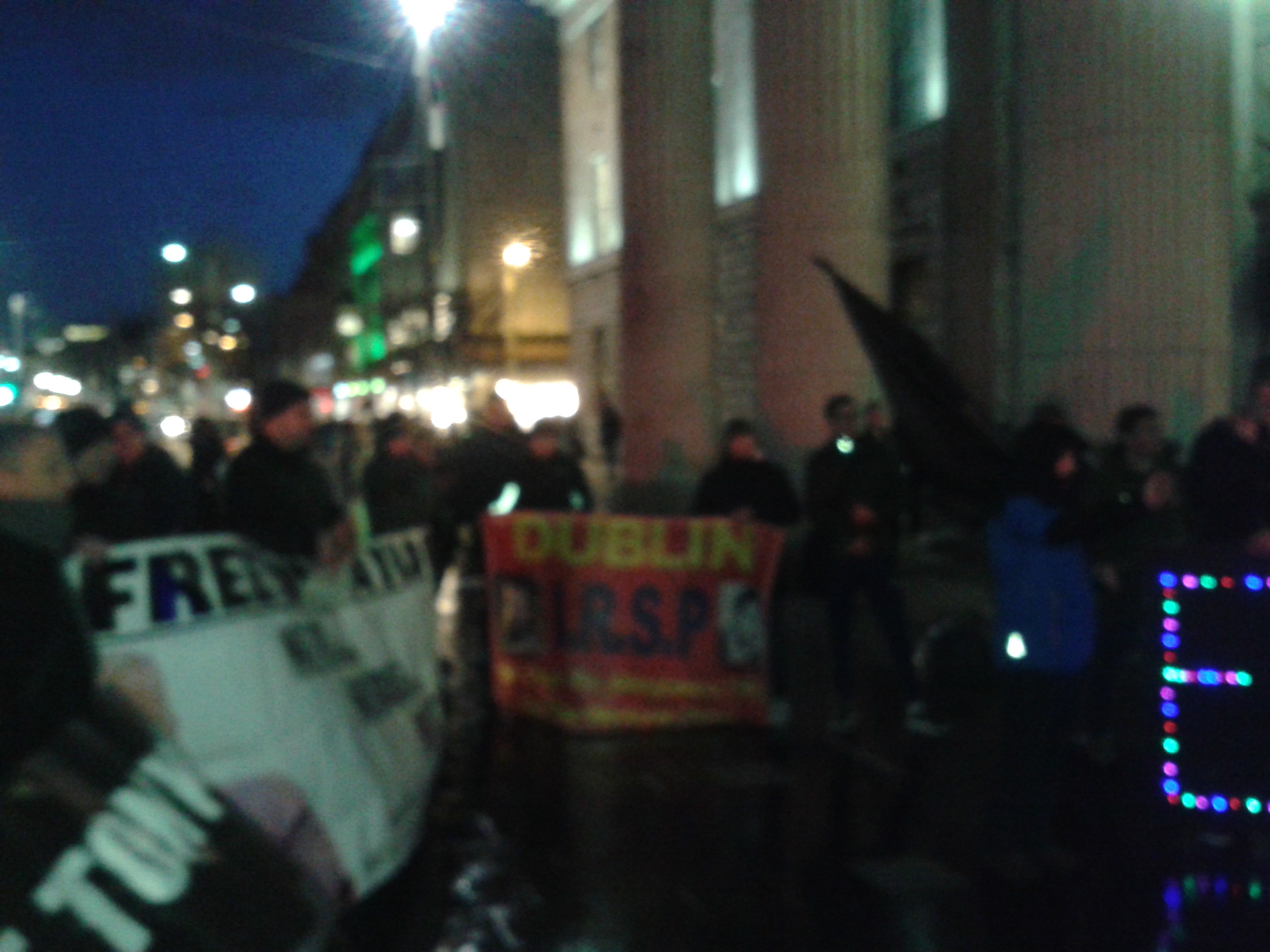
People gathered early evening Thurday (21st) on O’Connell Street, Dublin city’s main street, to protest the convictions and sentencing of the Altsasu Eight. They held Basque and Catalan flags and displayed placards demanding “Free the Altsasu Eight!” and another pointing out the severity of the sentences for what was a bar brawl with Spanish police.

Section of protest and conversation with passers-by
(Photo: D.Breatnach)

From the leaflet distributed: “In November 2016, during a festival in Altsasu, Nafarroa (Navarra) Province of the southern Basque Country, a lieutenant and sergeant in the Spanish Guardia Civil police force, both off-duty with their girlfriends, entered a late-night bar well-known as a place for pro-independence Basques to socialise. An altercation occurred in which the police said they were attacked by the Basque youth and claimed a fractured ankle suffered by one; others say it was just some shoving and pushing.

(Photo: D.Breatnach)

The Navarran regional police force, the Policía Foral, first on the scene, treated it as an alleged assault case which is how the local court wished to deal with the issue. However the Spanish state Prosecutor intervened and, transferring the case to Madrid, accused eight youth of “terrorism” for which they could face a total of 375 years in prison. He failed to prove that but on charges of public disturbance, assault and threats alone, on 1st this June the eight youth were variously sentenced to between 2.5 and 13 years in jail as well as fined thousands of euro.”

Leaflets were distributed to raise awareness of this injustice and many passers-by stopped to talk and ask questions. One group of interested youth was from Zaragoza, which is in Aragon province and not far from the Basque Country.

Protesters including musicians
(Photo: D.Breatnach)

Live music was provided for the participants and passers-by: two women sang Txoria Txori in harmonies and a Basque sang a new song that has been composed about the Altasasu 8, while another accompanied him on guitar (hope to post the lyrics and translation). Txoria Txori is a short simple allegorical song about a man who loves a bird and says that if he cuts its wings it would stay with him but he can’t do that because then no longer would it be a bird – and he loves the bird. This song is well-known and loved in the Basque Country.

The picket was an event of internationalist solidarity, not only because it was carried out in Ireland in support of victimised youth in the Basque Country, but also because the picket line included Irish, Basque, Catalan and Italian people.

(Photo: D.Breatnach)

Further information in the English language on this case (and other events in the Basque Country) will be posted from time to time on https://www.facebook.com/dublinbasque/

Trad for Catalonia Fundraiser in Dublin a Success

TRAD FOR CATALONIA SEES MIX OF INSTRUMENTS, LANGUAGE AND MUSIC STYLES

Clive Sulish

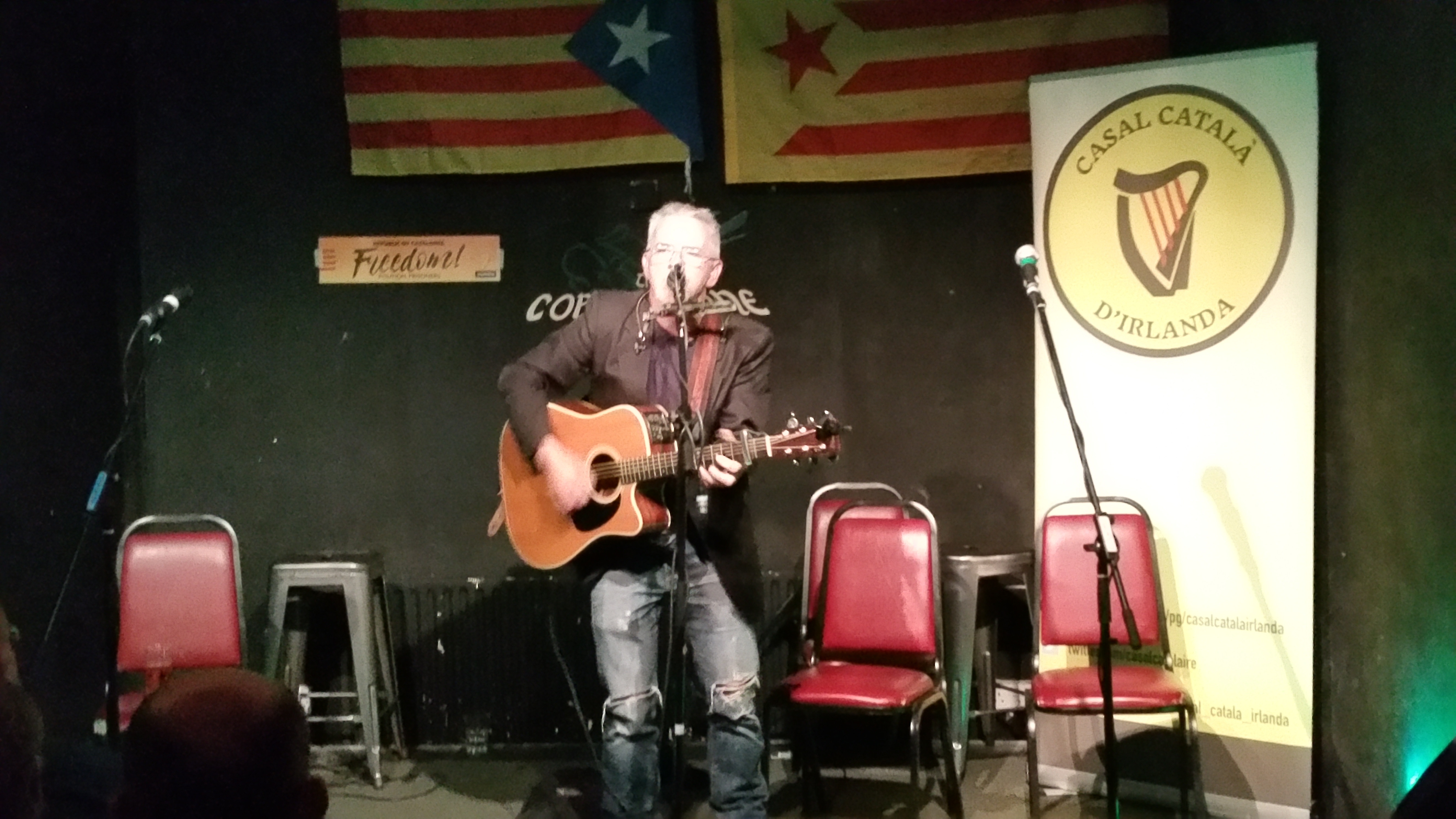
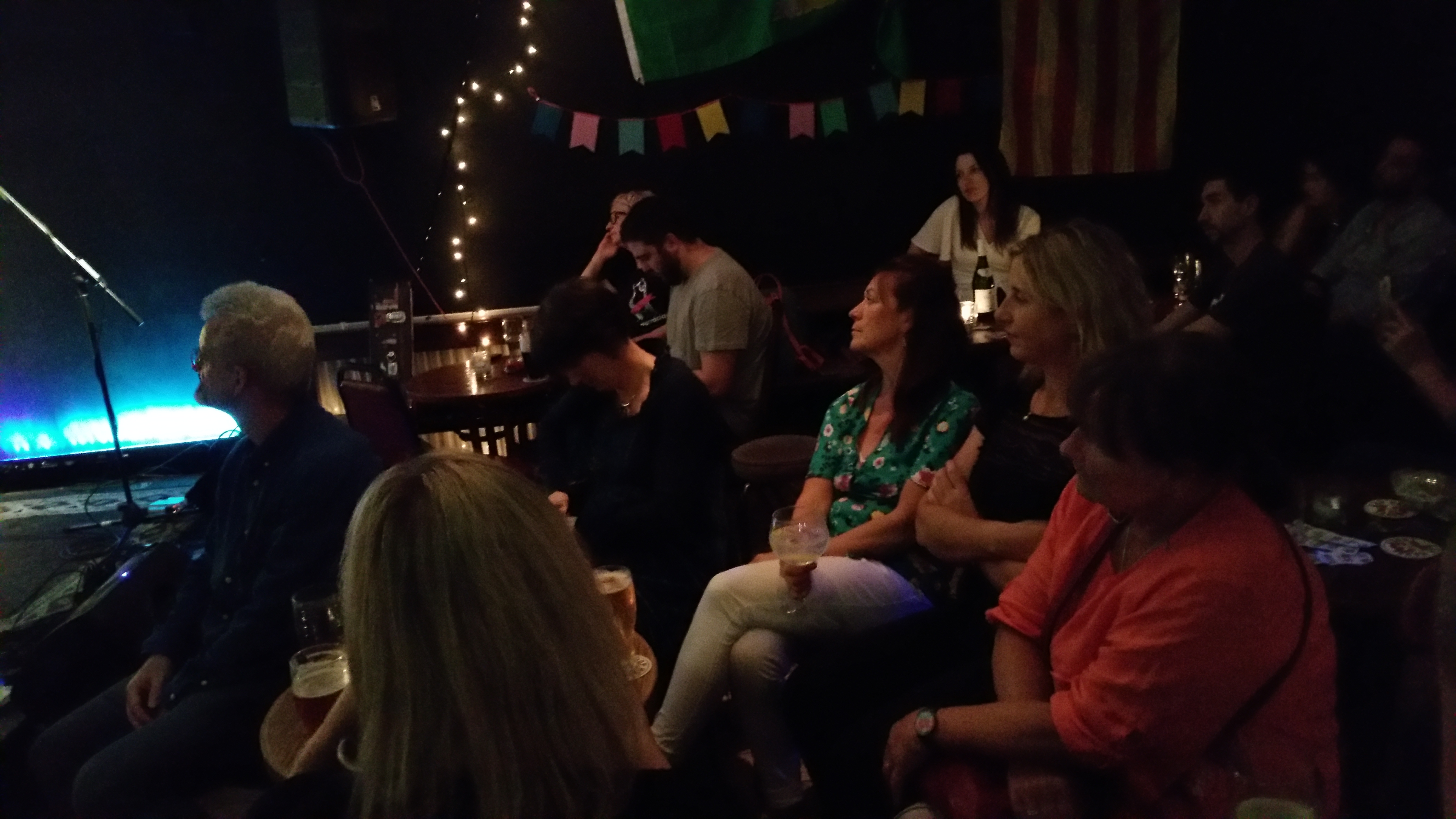
Ukelele, fiddle, guitars, cajón, gralla, flutes and uileann pipes, along with different voices in various styles filled performances at the Trad for Catalonia night in the Back Room, at the Cobblestone pub, Smithfield Dublin on 14th June (2018). Despite the wide variety, the quality of sound production was excellent and much appreciated by the audience.

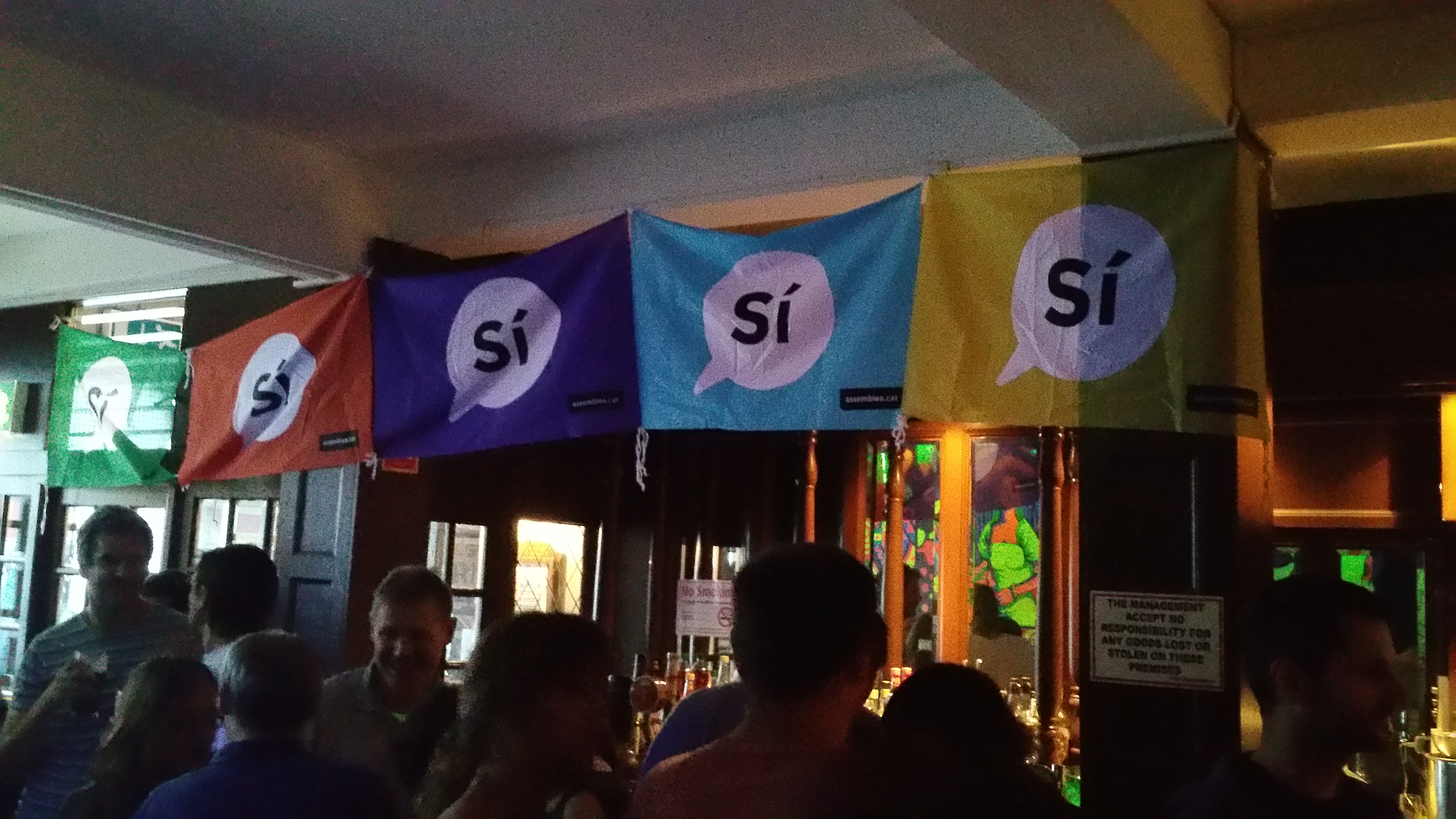
“Sí” bunting from the October Referendum on Catalan Independence (Photo: D.Breatnach)

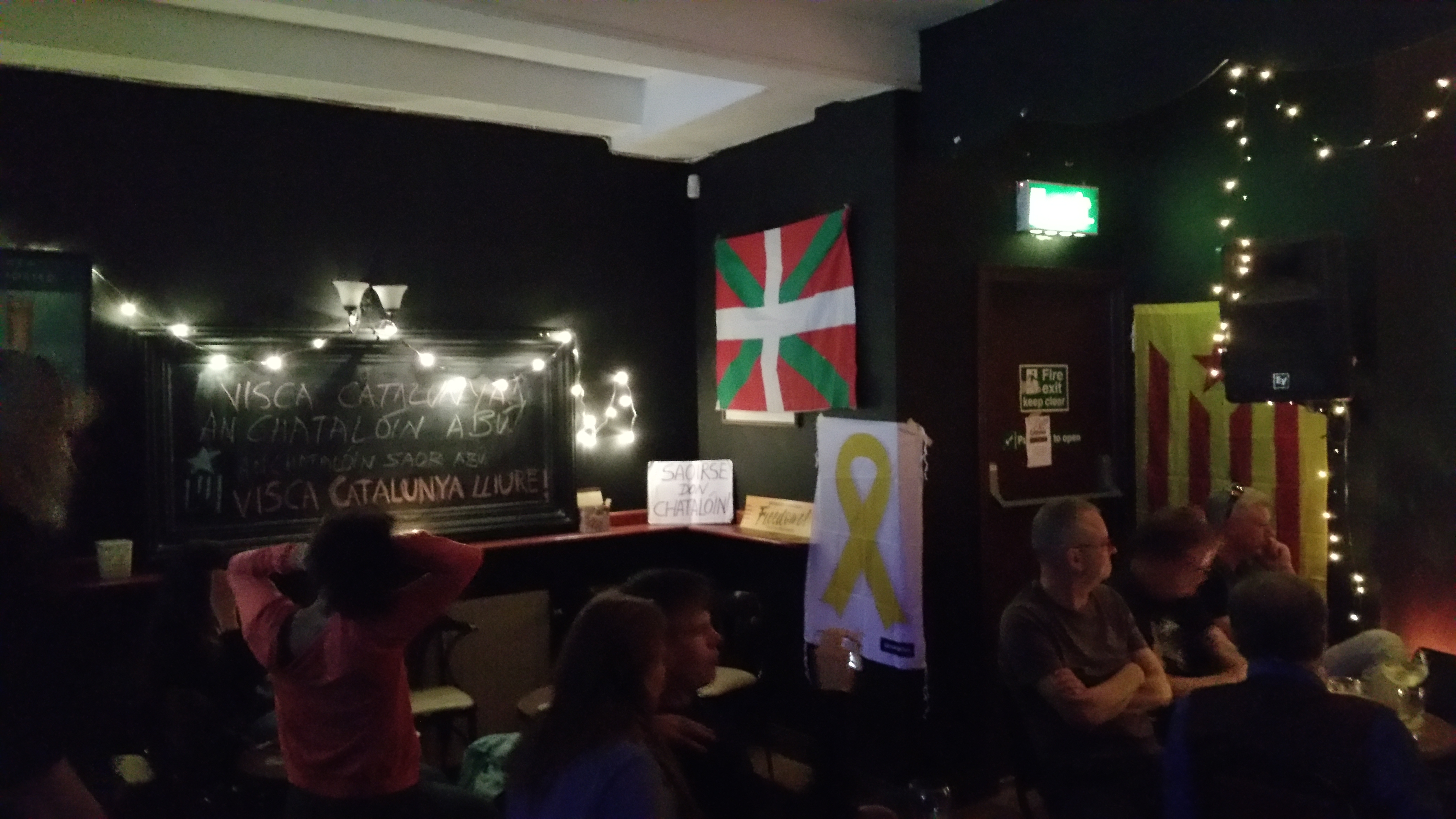
Eight different acts took to the stage in a crowded function room at the Cobblestone, which was decorated in the three varieties of the Catalan national flags (Senyera, Estelada and Vermella), and flags from the Referendum period declaring Sí, along with the Basque Ikurrina and the Irish Starry Plough.

The Basque Ikurrina, the Catalan Vermella and the Yellow Ribbon for the prisoners.
(Photo: D.Breatnach)

Diarmuid Breatnach, on behalf of With Catalonia/ Leis an Chatalóin welcomed the people attending in Irish and in English. A group called Whistle went first, playing lively Old-Time American songs, followed by Eoghan Ó Ceannabháin and John Flynn playing Irish tunes on flutes and also singing sean-nós songs in Irish, including Sadhbh Ní Bhruinneallaigh.

The band “Whistle” playing (Photo: D.Breatnach)

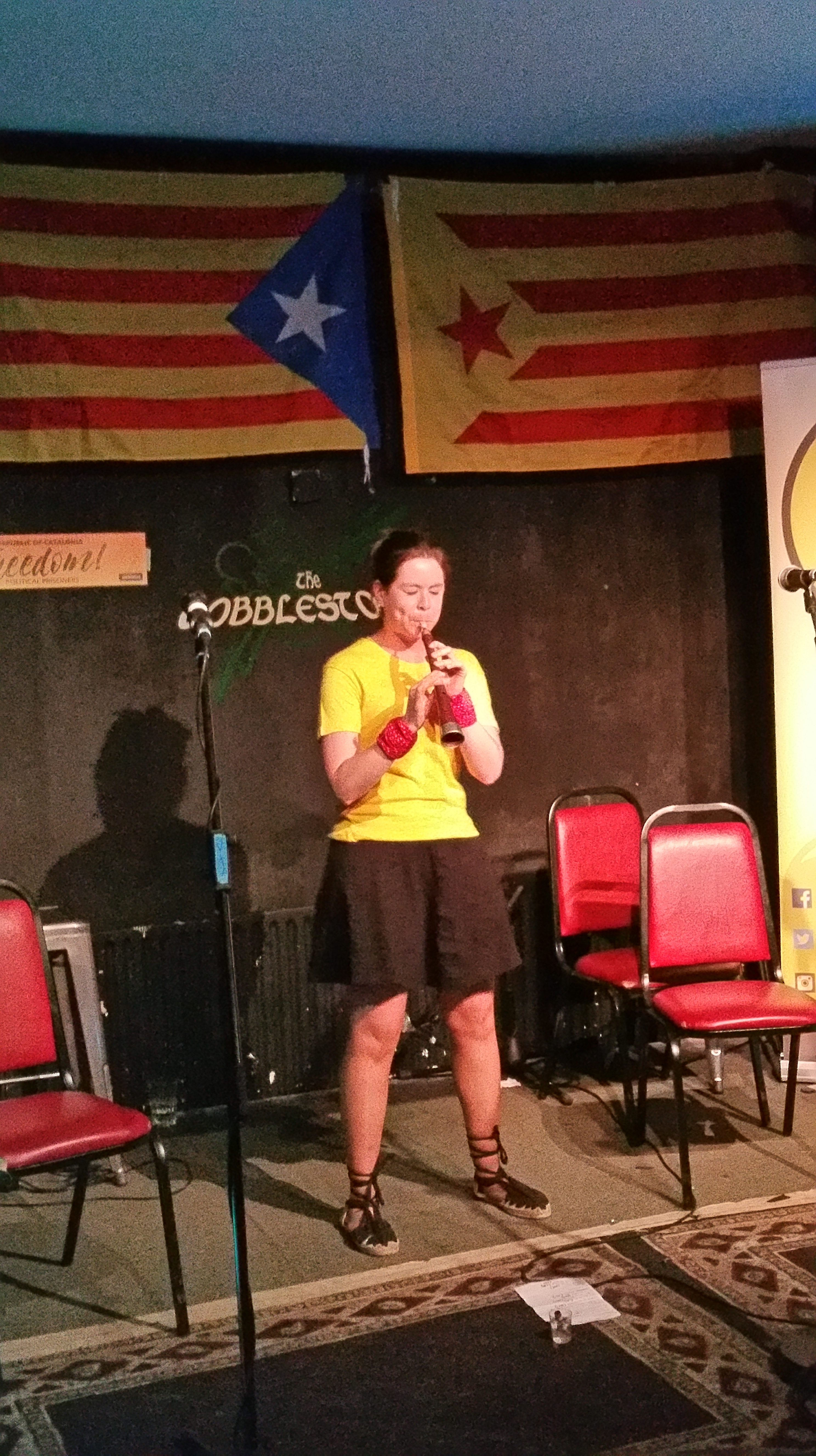
Ó Ceannabháin then introduced Berta Freixas Ylla-catalá, who played some Catalan tunes on the Gralla, a traditional Catalan instrument after which Paul O’Toole followed with some of his own songs, including the quasi-satirical “I Saw Jesus on a Bus”.

Breatnach, accompanied on guitar by O’Toole, sang two songs relating to prisoners, both from the latter half of the 19th Century, one from Ireland and another from the USA. The

John Flynn & Eoghan Ó Ceannabháin playing flutes (Photo: D.Breatnach)

Felons of Our Land was almost certainly written with regard to the suppression of the Fenians (Irish Republican Brotherhood) he said, while How Can I Keep from Singing began life as a Christian hymn but was worked over somewhat in the 1960s to make it a song of political resistance. The two emotions which the repressive forces seek to employ by taking political prisoners as hostages, said Breatnach, are shame and fear; these songs counter those with the emotions of pride and courage. Breatnach invited the attendance to support a picket in solidarity with Catalan political prisoners the following Thursday, 6pm at the GPO building in the city centre.

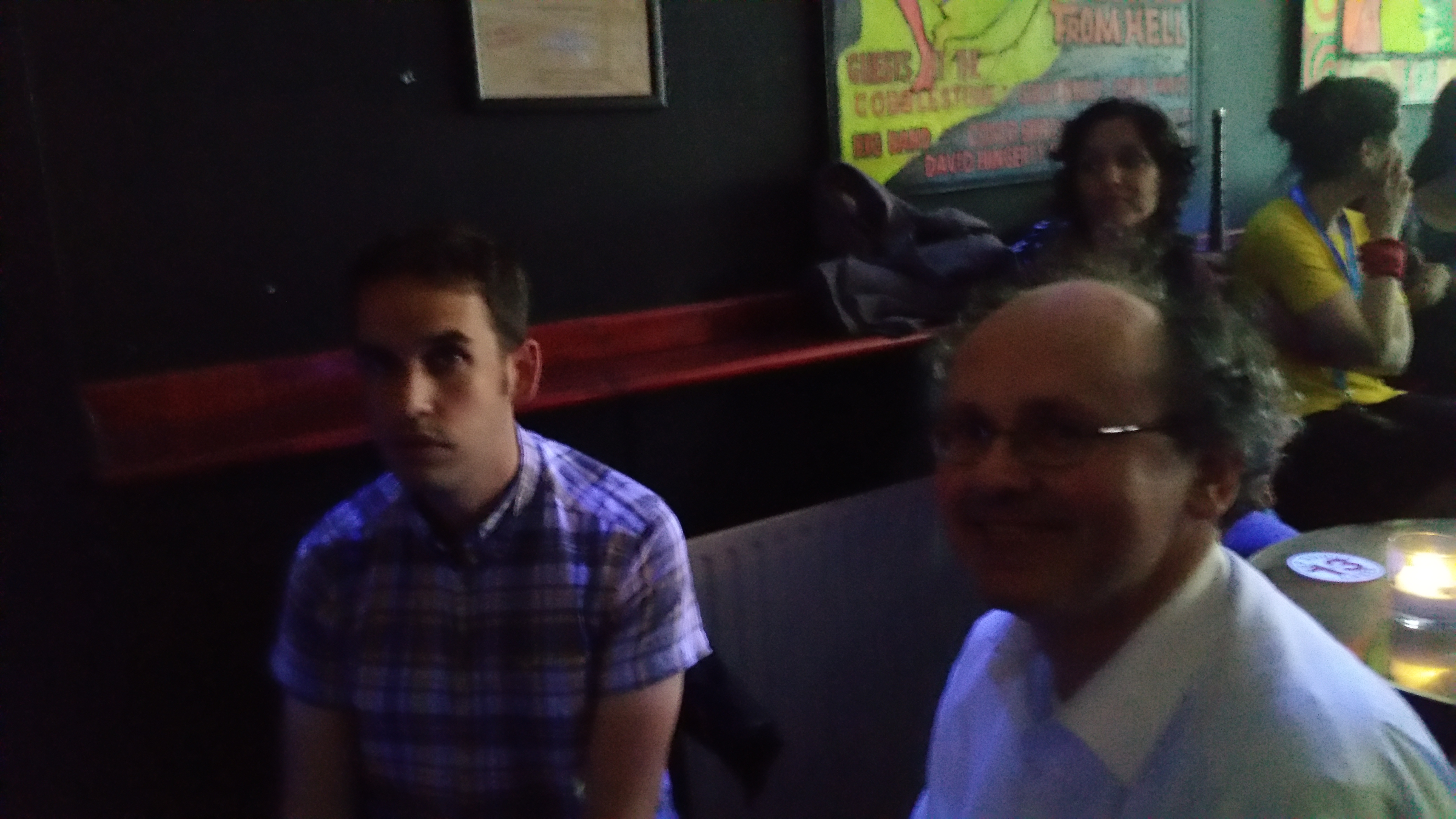
Visitors from the USA and Canada enjoying the evening
(Photo: D.Breatnach)
Paul O’Toole performing (Photo: D.Breatnach)

After the break and the holding of the raffle, which raised further funds in addition to the low entrance fee of 5 euro, Síomha Nic Aonghusa sang voice-only the sean-nós song Dónal Óg in Irish, then, all in English and accompanying herself on guitar, sang in turn an Irish Republican ballad and different songs, on themes of love, loss and addiction. Fionn Ó hAllmhain brought his uileann pipes on to the stage and, after explaining something of how they work, played a number of tunes, including a polka which had a couple up dancing set-dance polka moves. Ó hAllmhain also sang an Irish sean-nós song.

(Photo: D.Breatnach)
Síomha Nic Aonghusa performing (Photo: D.Breatnach)

Oncle Pau of Casal Catalan, accompanying himself on ukelele, performed some Catalan songs which had many Catalans in the audience singing along, finishing his set with Somewhere Over the Rainbow.

Oncle Pau performing (Photo: D.Breatnach)

Concluding the evening, Ó Ceannabháin thanked all for attending, also the singers and musicians who performed free of charge, the Cobblestone for providing the venue, Shane the sound engineer and Aoife behind the bar.

Aoife, Cobblestone staff and very helpful
(Photo: D.Breatnach)

The event was organised by With Catalonia/ Leis an Chatalóin, with strong support from the cultural Catalan organisation, Casal Catalana d’Irlanda and promoted also by CDR (Comité de Defensa de la República) Dublin.

Tina McVeigh, busy on the night (Photo: D.Breatnach)
Michael Grange, active during the night.
(Photo: D.Breatnach)
Berta Freixas playing the Gralla, traditional Cataln instrument.
(Photo: D.Breatnach)

With Catalonia/ Leis an Chatalóin 


Links

Catalan solidarity in Ireland:

https://www.facebook.com/WithCataloniaIreland/

Casal Catalan d’Irlanda https://www.facebook.com/casalcatalairlanda/

CDR Dublin https://www.facebook.com/CDRDublin/

Engish-language news and information pages:

Catalan News http://www.catalannews.com/

Support Catalonia https://www.facebook.com/groups/506863443039295/

FREE JULIAN ASSANGE PICKET AT BRITISH EMBASSY DUBLIN

CROWD AT BRITISH EMBASSY DUBLIN CALLS FOR RELEASE OF JULIAN ASSANGE

Diarmuid Breatnach

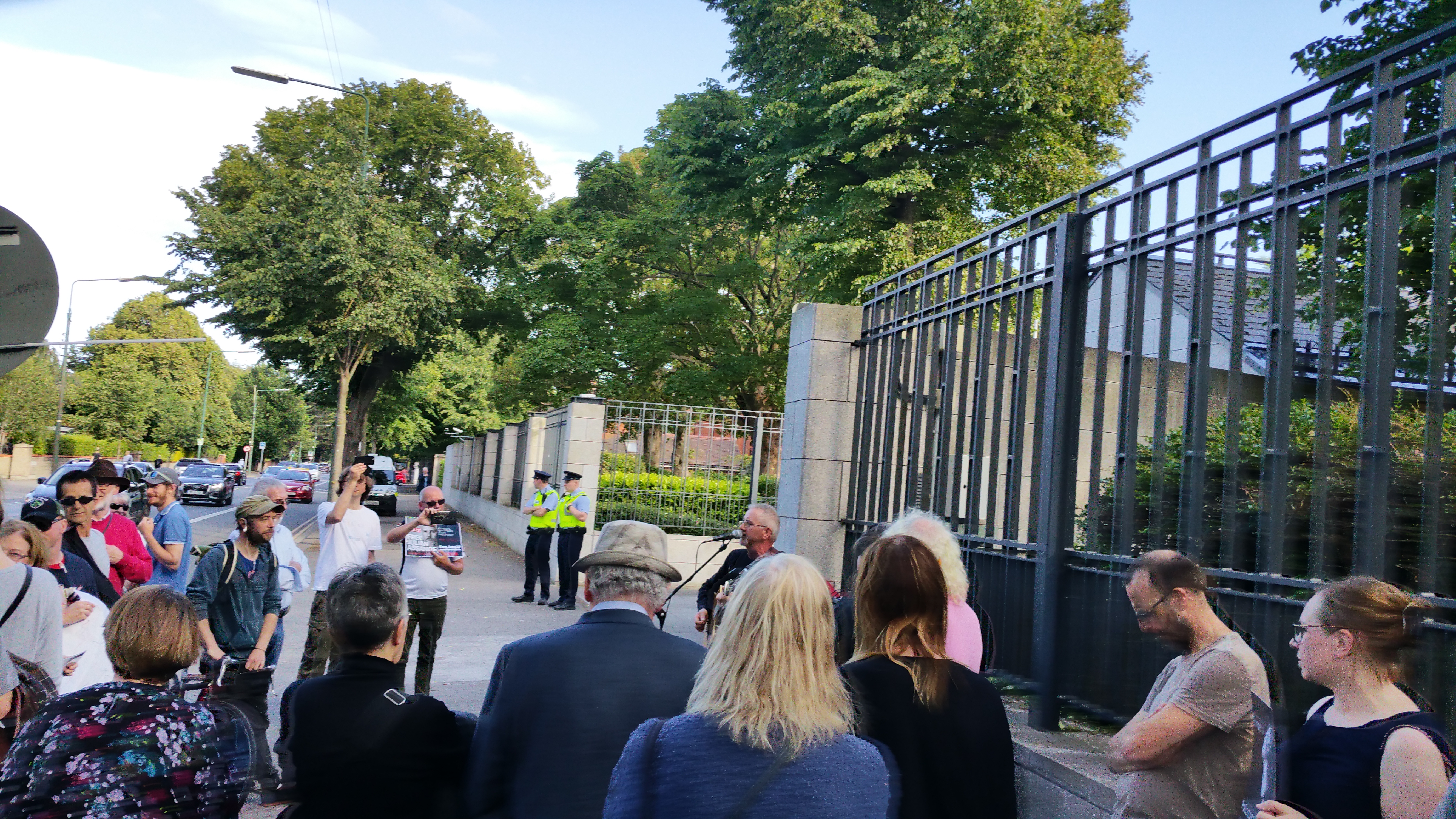
View of crowd at British Embassy from across the street (Photo: D.Breatnach)

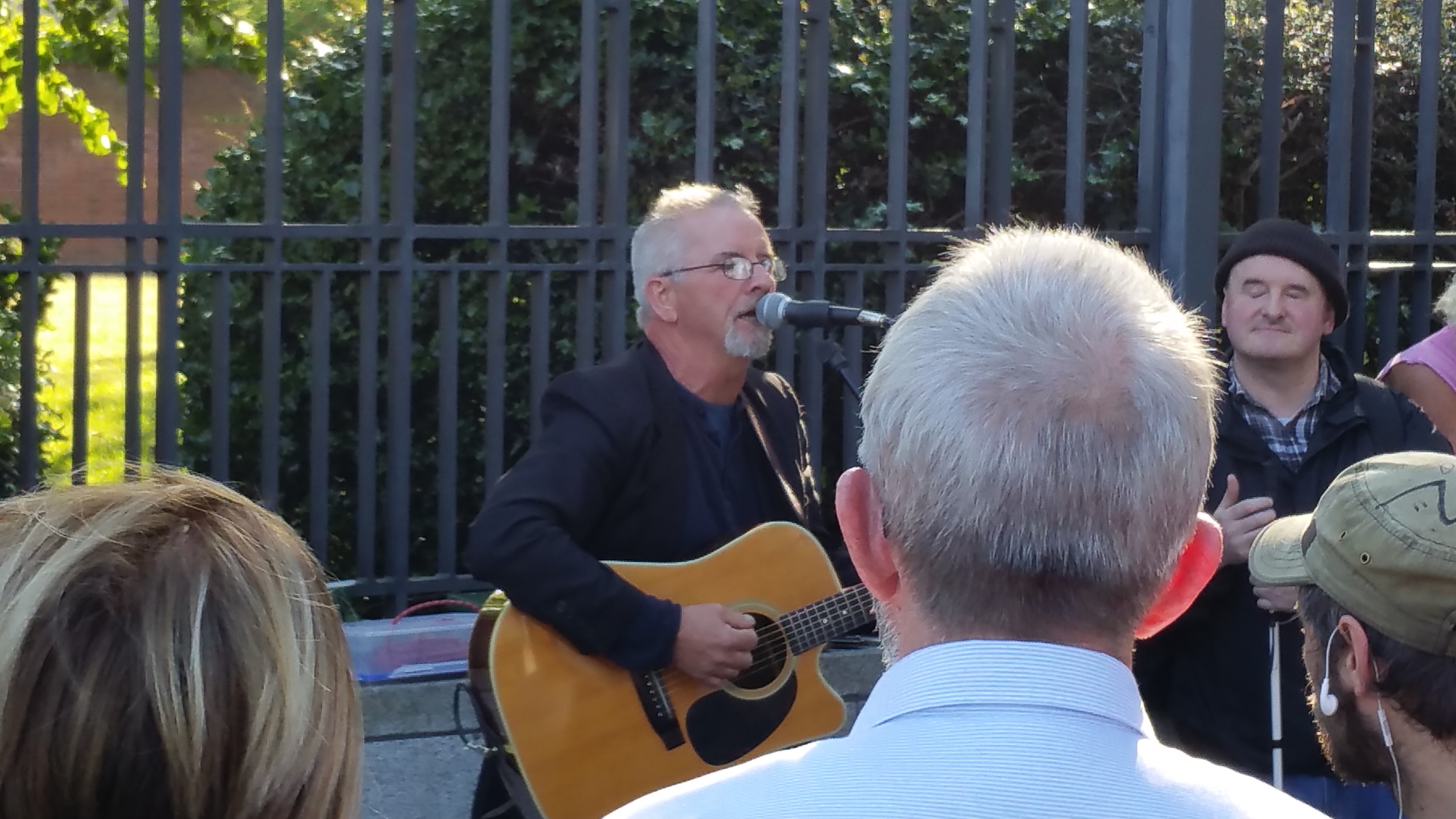
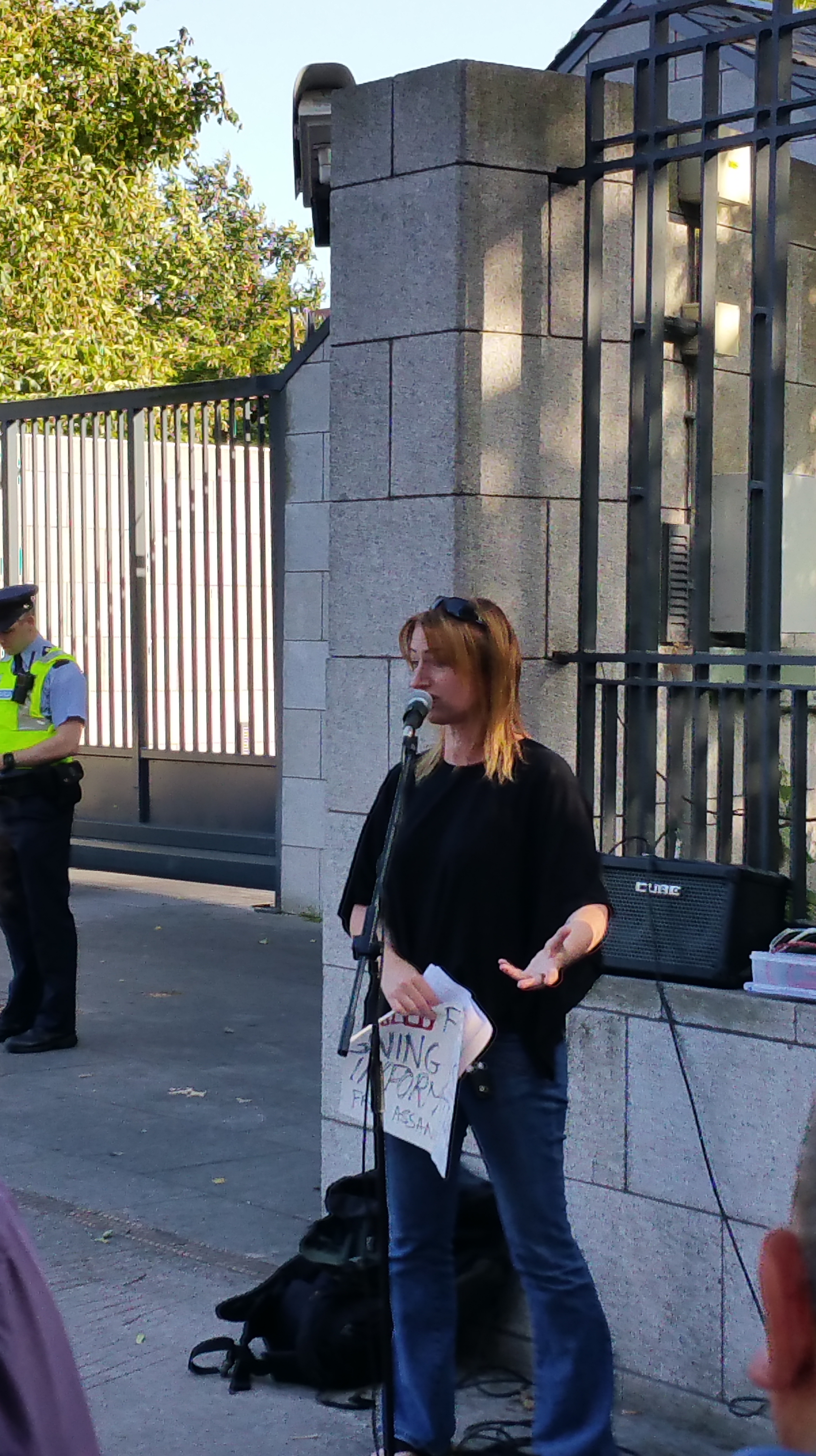
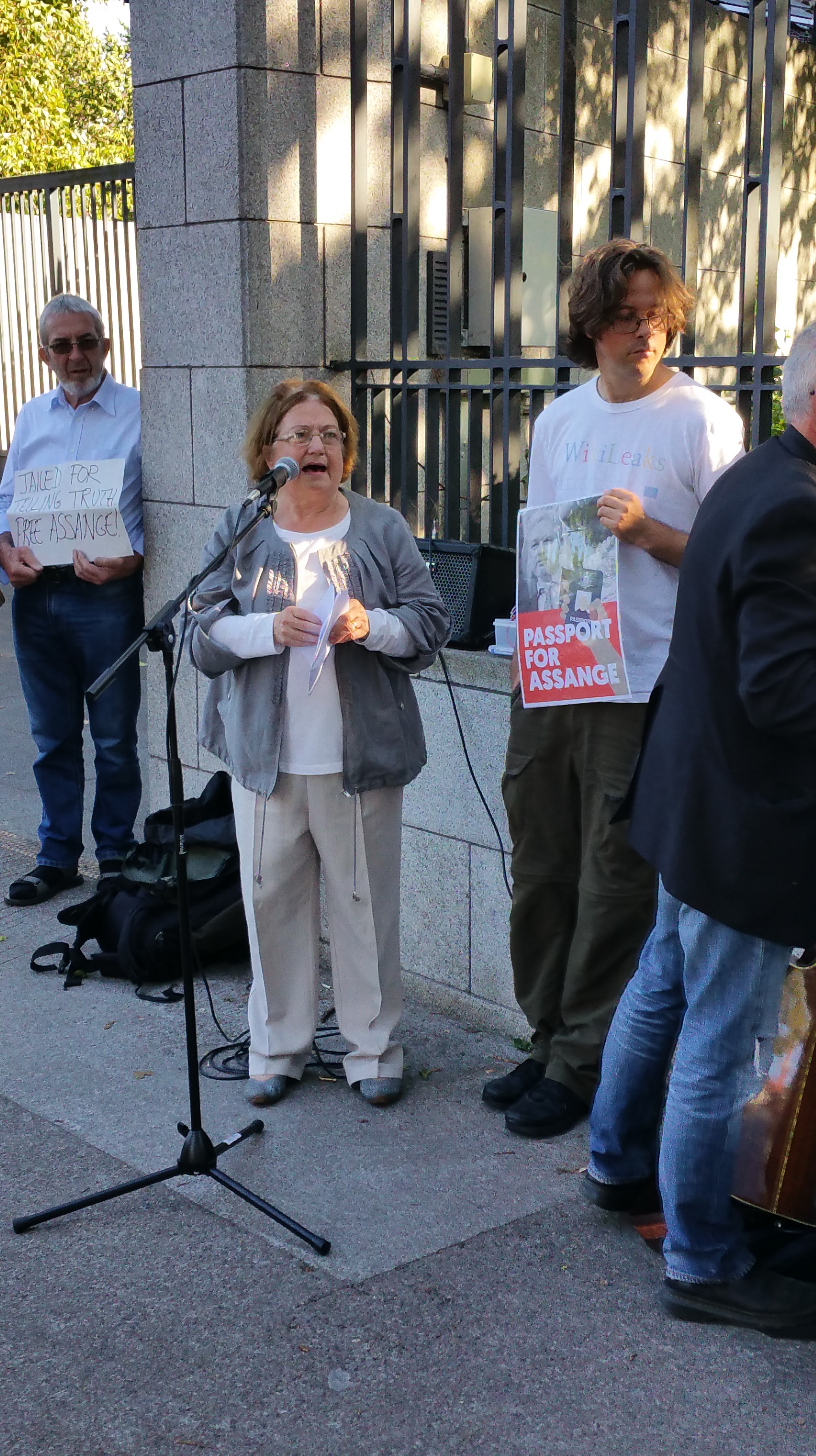
Today, June 19th, is the anniversary of the date when Julian Assange sought asylum in the Ecuadorian Embassy in London, which he was granted. That was 2012, since which he has been confined to a few rooms in that building, unable to leave for fear of British arrest and extradition to the US, where he is wanted for broadcasting their secrets on their murderous campaigns in Afghanistan and Iraq and other matters. A crowd gathered outside the British Embassy to demand Assange be set free – among them as speakers were TDs Clare Daly, Mick Wallace, along with Nobel Peace Laureate Mairéad Corrigan and musician Paul O’Toole (also another musician).

Paul O’Toole playing and singing
(Photo: D.Breatnach)

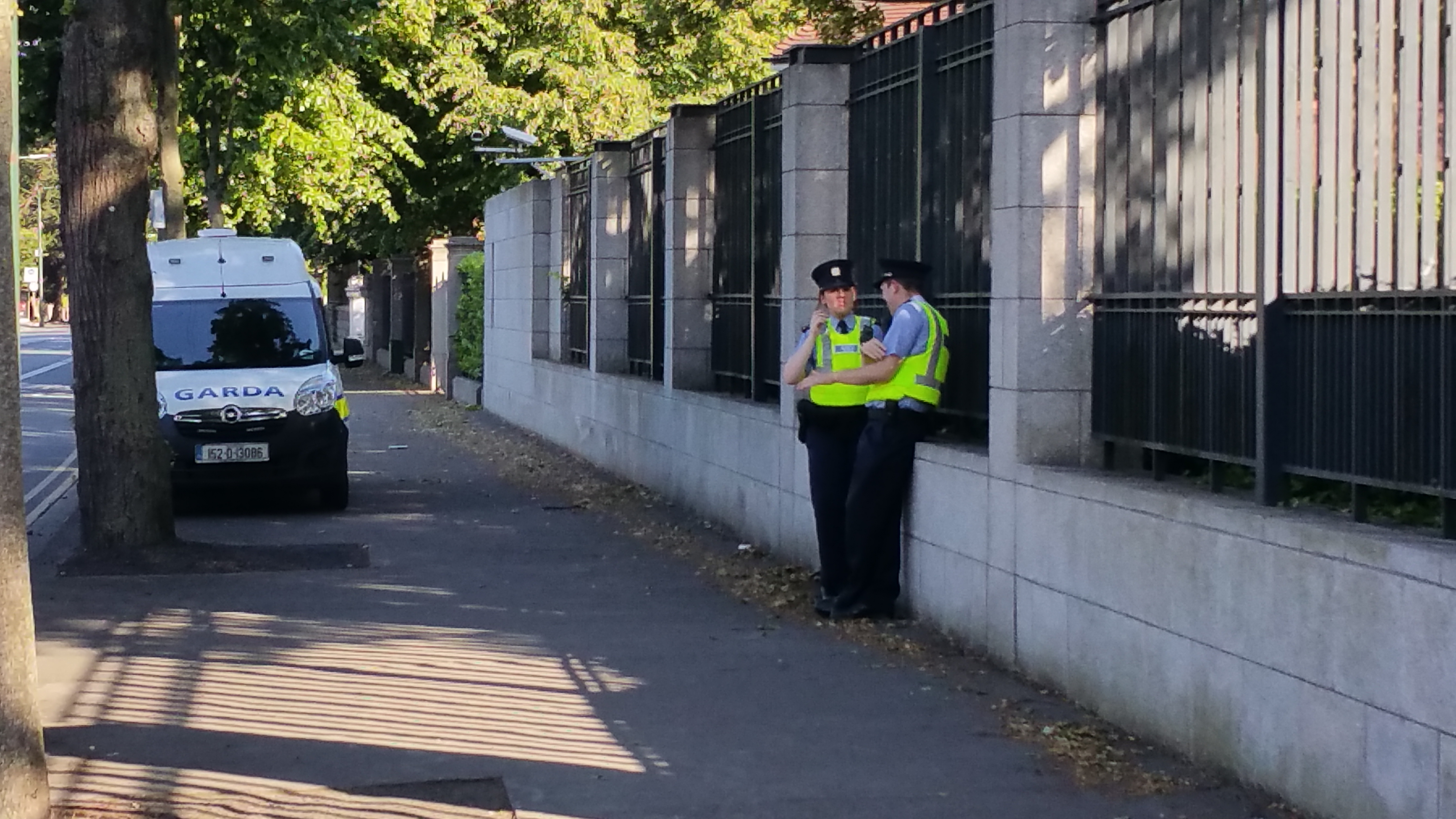
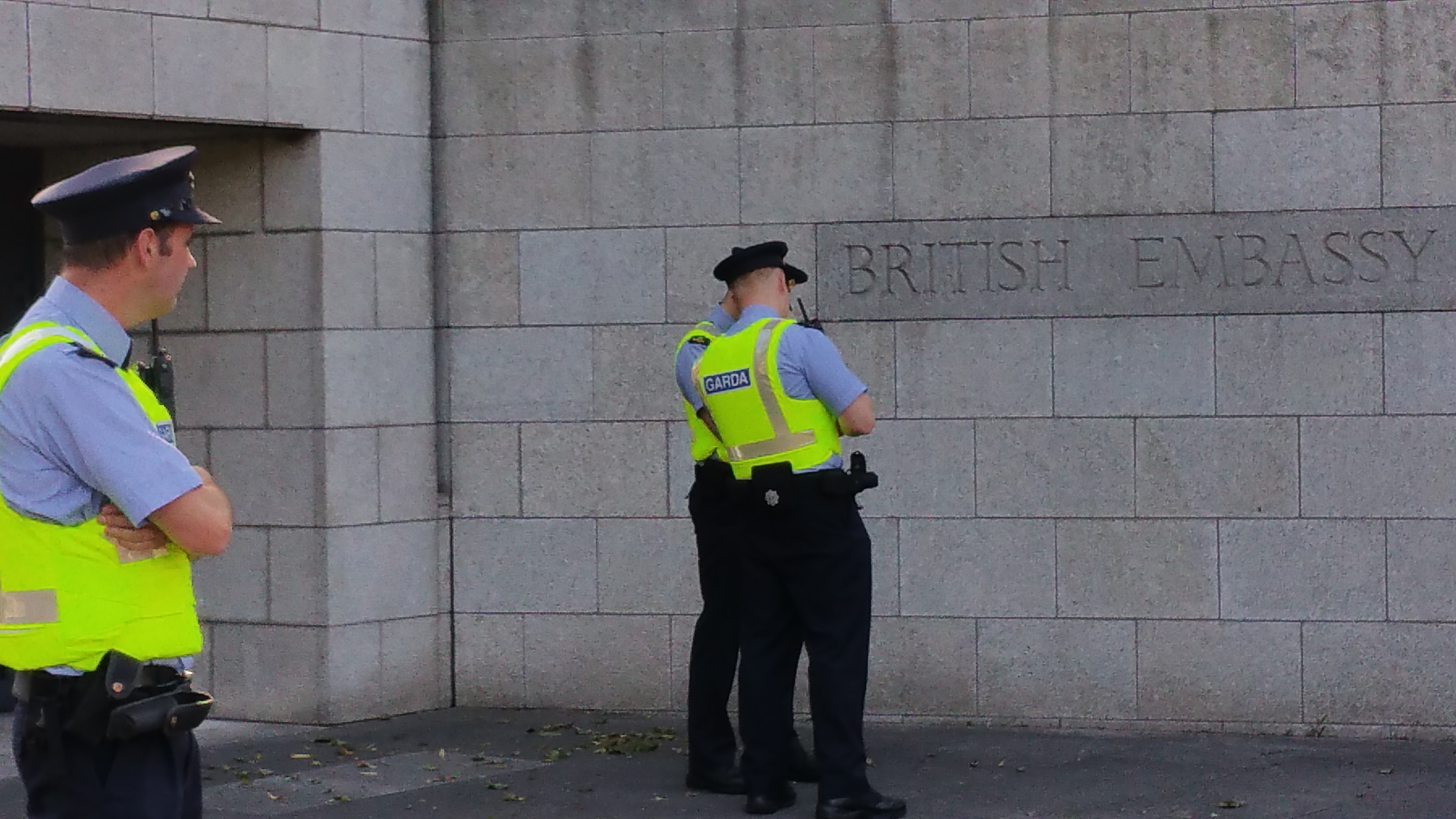
At least five Gardaí were in attendance, along with a police van.

From Wikipedia: Julian Paul Assange (born Hawkins; 3 July 1971) is an Australian computer programmer and the editor of WikiLeaks. Assange founded WikiLeaks in 2006, but came to international attention in 2010, when WikiLeaks published a series of leaks provided by Chelsea Manning. These leaks included the Collateral Murder video (April 2010), the Afghanistan war logs (July 2010), the Iraq war logs (October 2010), and CableGate (November 2010). Following the 2010 leaks, the federal government of the United States launched a criminal investigation into WikiLeaks and asked allied nations for assistance.

Poster of image of Julian Assange with the flag of the USA as a gag on him. (Image source: Internet)

All the speakers outside the British Embassy made the point that Assange’s only crime is to reveal some murderous secrets of the USA and other powers and that if he can be jailed then so can anyone for speaking or publishing the truth. Clare Daly said that his crime was to be a conscientious reporter.

Paul O’Toole played two songs, one of which was The Cry of the Morning, a song about internment. The other musician played some tunes and then led the crowd in singing “All we are saying, is free Julian Assange.”

Fintan thanked all for coming and the speakers and musicians and the event came to an end.

Mick Wallace TD speaking outside the British Embassy (Photo: D.Breatnach)
Another musician supporting the event (Photo: D.Breatnach)
Section of crowd, looking southward
(Photo: D.Breatnach).


Clare Daly TD speaking outside the British Embassy
(Photo: D.Breatnach)(Photo: D.Breatnach)
Nobel Peace Laureate Mairéad Corrigan speaking outside British Embassy (Photo: D.Breatnach)
Police van & 2 of the six Gardaí that were visible (Photo: D.Breatnach)


(Photo: D.Breatnach)


BACKGROUND

Assange went to Sweden to talk about Wikileaks and its revelations in August 2010. A woman in Sweden wanted Assange to have a HIV test after he had sex with her. Her friend, who had also had sex with Assange in the past, encouraged her to go to the police. Assange went voluntarily to the police station, was interviewed and told he could go, there was no charge and he went back to England. Afterwards, a Swedish Special Prosecutor charged him with sexual molestation and “lesser-degree rape” (a particular Swedish charge) although the original complainant did not accuse him of rape.

By then it was becoming clear that another agenda was behind the Swedish Special Prosecutor and the two women. Assange offered to be interviewed again by Skype or in person in London or, if necessary in Sweden but only if that country guaranteed not to extradite him to the USA. The Swedish authorities refused to give that guarantee. The Prosecutor said Swedish law did not permit an interview on foreign soil but this was publicly contradicted by Swedish legal experts and the Prosecutor eventually interviewed him in London but by this time it was November 2016, by which time the statute of limitations had run out on the less serious charges. In May 2017, the Swedish authorities dropped their investigation against Assange and Chief Prosecutor Marianne Ny officially revoked his arrest warrant.

However, as a result of Sweden’s attempt to extradite Assange, he had been brought to court in London and released on bail. Due to Sweden’s refusal to guarantee him no extradition to the USA, Assange jumped bail and sought asylum in the Ecuadorian Embassy on 19th June 2012 and has been there since. He cannot leave for fear of arrest by the British for breach of bail conditions and extradition to Sweden, from where he may be extradited to the US, where politicians and officials have said publicly that he should be jailed and some even wanted him executed under anti-espionage laws or assassinated.

End.

FOREIGNERS!

Diarmuid Breatnach

I’m sick of seeing foreigners everywhere. I mean, don’t get me wrong, I’m not racist or anything …. but they’re just everywhere. And as for Muslims building mosques! Here, in Ireland!

What’s wrong with that? We’ve got hundreds, maybe thousands of churches in Ireland.

Yeah, but we’re a Catholic country.

Do you object to Presbyterian, Anglican, Methodist and Unitarian churches too?

Er … no, they’re Christian religions. Muslim is completely different. We’re a Christian country – always have been.

Actually, no.

What do you mean?

We were pagans once. Before Christian missionaries came in.

OK, before St. Patrick. And yes, I do know he was a foreigner. But since then, we’ve been a Christian country, right?

Yes, I grant you that.

That’s what we need to go back to – Christian Gaelic Ireland.

An bhfuil Gaeilge agat?

No, I don’t speak it. No need to be smart. That’s another thing that was taken from us!

They teach it at school, though.

Not very well. And they force it, which turns people off.

They force maths on people too. And other subjects.

Yes …. well. Anyway, this is getting away from the subject. I was talking about … Getting back to the old Christian Ireland. The Ireland we fought against the British for. Which so many people died for.

James Connolly Monument, across from Liberty Hall, Beresford Place.
(Photo: D.Breatnach)

Like James Connolly, Patrick Pearse, Tom Clarke ….

Yes, exactly!

James Connolly was born in Scotland, Tom Clarke in England.

Well I knew about Connolly, but Clarke … are you sure?

Yep, Isle of Wight, SE England.

OK …. but …. they were still Irish, weren’t they …. like our soccer team?

Yes, I agree with you there.  And about Constance Markievicz ….

Listen, don’t try that one on me! She married a Polish count – but she was Irish.

She was born in England too.

Was she? Well ok, but of Irish stock too.

Gore-Booth – not exactly a Gaelic name, is it?

Look, let’s go back to Pearse – he was Irish through and through. He wrote in Irish – articles, stories and poems, didn’t he?

He most certainly did.

Well then!

His father was English, though.

What? You’re codding me!

No, seriously. James Pearse was English. And had married previously in England.

Now you’re telling me Patrick Pearse’s father was a BIGAMIST?

No, no, calm down. She died – he was a widower. Thomas Davis’ father was Welsh, by the way.

Thomas Davis Statue monument and fountain, Dame Street, Dublin, Irealand
(Photo: D.Breatnach)

Who wrote A Nation Once Again? That Thomas Davis?

Yes. And The West’s Awake.

OK, OK but Thomas himself was born in Ireland, wasn’t he?

Yes. Eamon Bulfin wasn’t though.

Bulfin? Who was he?

He hoisted the tricolour up on the GPO on Easter Monday 1916.

Did he? Was he born in England too?

No – in Argentina.

WHAT?

Yep. And De Valera’s da was apparently Cuban. Dev was born in the USA.

OK, OK, OK – but they were all part-Irish or wholly Irish …. in blood, I mean. Part of what they call the Irish diaspora.

True. But Erskine Childers wasn’t.  Totally English.

Ah now you’re trying to wind me up. He was President of Ireland – of course he was born here.

That Erskine Childers was but his Da wasn’t.

OK, so what?

Well, he’s the one who brought the Mausers into Howth. In his yacht. And he was murdered by the Free Staters in the Civil War.

That was him?

The Irish tricolour flag — presented to the ‘Young Irelanders’ by Parisian revolutionary women in 1848. (Image source: Internet)

Yeah, and part of the crew were two women – one born in England and one in the USA. By the way, the Tricolour that Bulfin hoisted on the GPO? You know what it signifies?

Yes. Peace between the original Irish, the Catholics and the descendants of the planters, the Protestants.

OK. Well, that’s not originally Irish either.

What? The Tricolour? Not Irish?

Not originally, no.

Where is it from then? Please don’t say England!

No – Paris. During the Paris uprising of 1848, French female revolutionaries presented it to an Irish Republican delegation.

So the Irish flag before that was …. just Green?

Well, Green yes, often with a harp in gold ….

Yes, Green, forever green, always the Irish colour …

Well, I hate to tell you this but …………..

End.


BLOOD ON THE STREETS OF GIBRALTAR

Diarmuid Breatnach

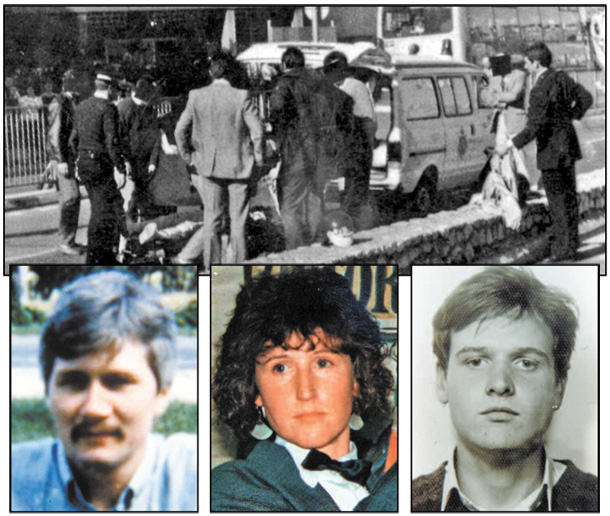
On the 6th of March 1988, an undercover unit of the IRA in the Spanish State was being tracked by Spanish police.  As the unit headed in to Gibraltar, their surveillance was taken over by a British Army unit of the Special Air Service.  Very soon afterwards, the SAS attacked the IRA unit and shot them down, shooting them again with execution shots on the street.  The IRA unit were unarmed and there was no attempt made to arrest them.  The SAS claimed that they had a bomb ready to detonate but no such bomb was ever found.  The three Volunteers were Mairéad Farrell, Seán Savage and Daniel McCann.

Above: Gibraltar 3 murder scene. Below: Daniel McCann, Mairéad Farrell, Sean Savage. (Source: Stair na hÉireann)

A Gibraltar woman, Carmen Proetta, who witnessed the murders from her flat and testified to what she had seen was villified and libelled in the British media (she successfully sued a number of them later).  A Gibraltar inquest judged the killings to have been unlawful.  Amnesty International in Britain denounced the killings — one of the few occasions in which Amnesty criticised the British Government with regard to its conduct in relation to the 30 Years’ War in Ireland.

Almost two months after the shootings Margaret Thatcher and her Foreign Secretary Geoffrey Howe tried to prevent an independent British TV company’s documentary on the killings, Death On the Rock and the career of the lead Editor, Roger Bolton,  suffered severely, although an independent investigation of the program vindicated the program.

Coffins of the Gibraltar Three being carried through West Belfast (Source image: The Irish News)

Streets of Gibraltar song

By The Irish Brigade (long version) + verse by DB*

Chorus

Oh, sad are three homes in Belfast Town,

all Ireland shares their sorrow;

as they walked in the sun, the Brits drew their guns

and they died on the streets of Gibraltar.

1

They flew out of Belfast with an ambitious plan

to carry the struggle to free Ireland –

Mairéad Farrell, Seán Savage and Daniel McCann –

and they died on the streets of Gibraltar.

Chorus

2

Hidden eyes had been watching, they followed each one
They knew they weren’t armed, that none had a gun
They
gave them no warning and no chance to run
For the three must die on Gibraltar.

3

Each of them unarmed, without mercy gunned down, *

shot again in the head as they lay on the ground

by the Special Air Service, assassins of the Crown –

they were murdered on the streets of Gibraltar.

(Chorus)

4

The SAS stood there, so proud of their deed –

three more freedom fighters shot down in the street:

Mairéad Farrell, Seán Savage and Daniel McCann –

they died on the streets of Gibraltar.

5

Mairéad, while in prison we watched you with pride;
True to all you believed in and for this you’ve died
With two fine volunteers Dan and Sean by your side —
A part of us died in Gibraltar.

(Chorus)

6

It happens each time that a Volunteer dies —
They screen out the truth with a cover of lies;
But we know what happened on that warm peaceful night
The Brits planned their deaths on Gibraltar.

(Chorus)

And their blood stained the streets of Gibraltar.

End.

The Lark

The Lark

Diarmuid Breatnach, London, May 1981.

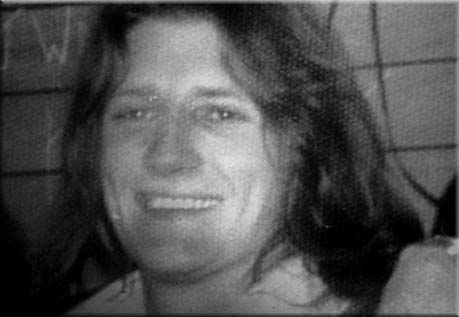
Bobby Sands, Officer Commanding Provisional IRA prisoners in H-Blocks before hunger-strike (Image source: Internet)

Last night, from afar, I watched the Lark die

and inside me, began to cry,

and outside, a little too.

There’s nothing more that can now be done,

to save the life of this toilers’ son;

another martyr – Bobby, adieu.

Imperialism takes once more its toll,

another name joins the martyrs’ roll

and a knife of sadness runs us through.

But sorrow we must watch,

for it can still,

yes, it can kill

the song that Bobby listened to.

And if his death be not in vain,

let’s fuel our anger with the pain

and raise the fallen sword anew;

and this sword to us bequeathed:

let its blade be never sheathed

’till all our foes be ground to dust

and their machines naught but rust ….

Then will the servant be the master

            and our widening horizons ever-vaster

                  and our debt

                       to Bobby

                            paid

                                 as due.


(Written in London as the death of Bobby Sands was imminent or had just occurred, after the author had attended pickets and demonstrations in solidarity with the hunger strikers in attempt to avert their deaths by pressurising the British Government to accede to their just demands. Bobby Sands died on 5th May 1981, to be followed by nine others in the weeks and months that followed. The struggle was one for the human dignity of Irish Republican political prisoners of Britain in the Six Counties British colony).

Senior Metropolitan Police officer accompanied by Constables harass Sands solidarity protesters in London
(Image source: Internet)
Skylark in Flight
(Image source: Internet)
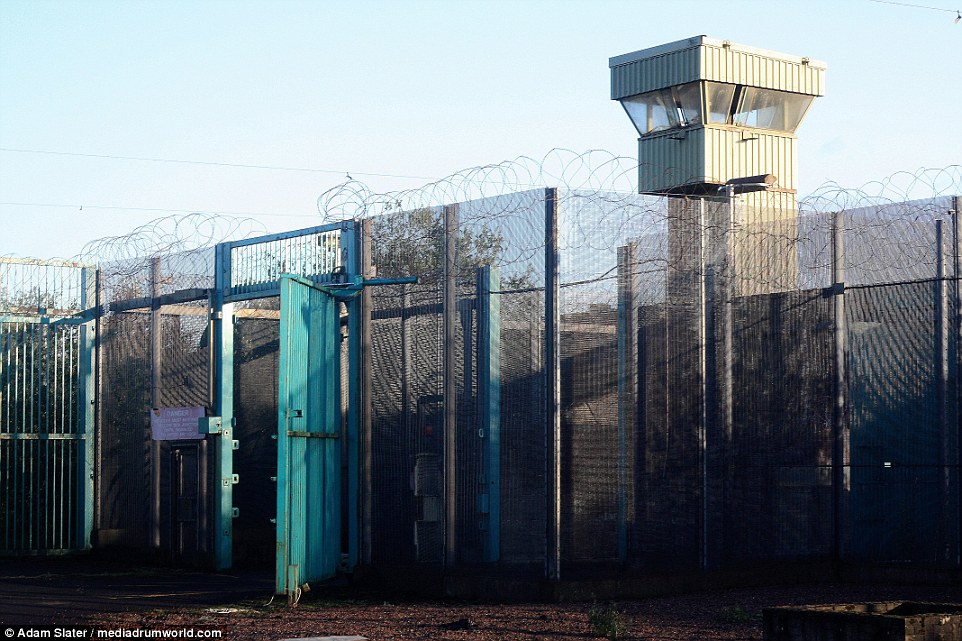
Gates Long Kesh
(Image source: Internet)


Glasgow & Dublin Joint GPO Protest Against Internment

End Internment FB page

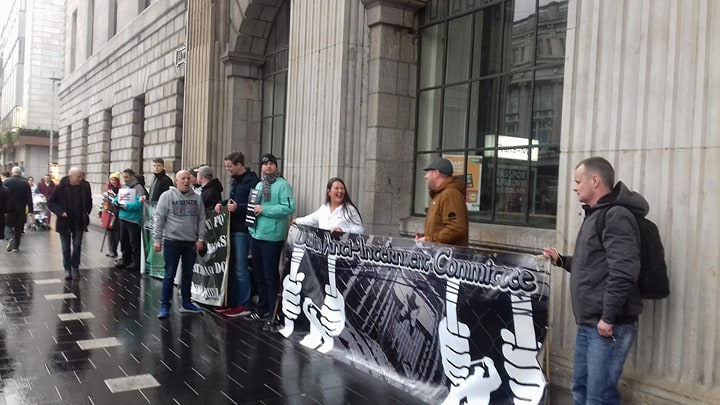
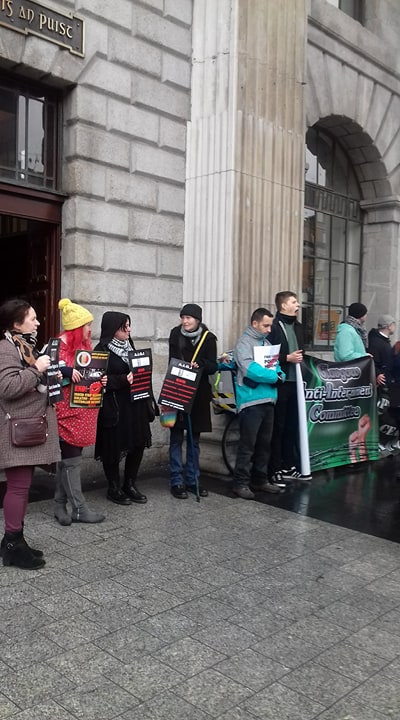
Glasgow and Dublin Anti-Internment Committees joined forces on 18th February in a protest against continuing internment without trial in Ireland. Around two score protesters gathered outside the iconic General Post Office building in Dublin city centre’s main thoroughfare, O’Connell Street. They displayed the anti-internment banners of the Dublin and Glasgow committees and placards against internment, including one against the jailing of Catalan political activists by the Spanish state (also refused bail).

Section of protesters outside the GPO building, O’Connell Street, Dublin (Photo source: End Internment FB page)
(Photo source: End Internment FB page)

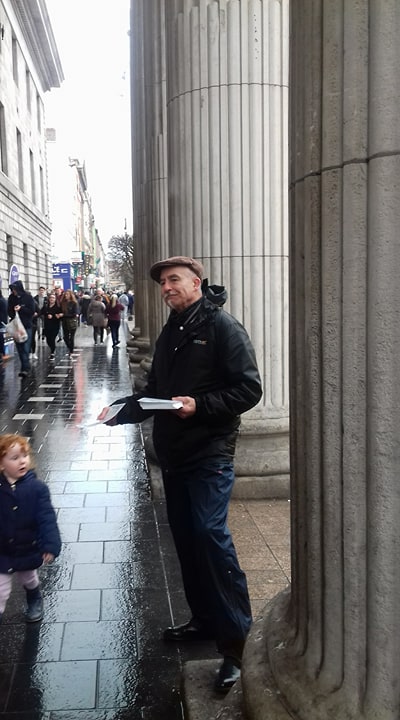
Leaflets of the Anti-Internment Group of Ireland were distributed to shoppers and visitors passing by, along with others about the conviction of Brendan McConville and John Paul Wooton (the Craigavon Two), framed and jailed in 2009 and still in jail, serving life sentences. Songs about internment and political prisoners were played on a sound system, as well as Labi Siffre’s Something Inside So Strong and Christy Moore’s Viva La Quinze Brigada.

Young passer-by accepts leaflet from Dublin Committee leafleter (Photo source: End Internment FB page)

Despite the official end of internment by the British in 19751 and by the Irish state in 19572, Republican activists continue to be jailed without trial in a number of ways: Licence revoked and bail refused or revoked.

(Photo source: End Internment FB page)

When a Republican leaves jail under license, she or he can be returned there without any court hearing or the presentation of any evidence against them; this is what has happened to Tony Taylor and Gerry Mackle, for example. Refusing bail for accused Republicans has become almost standard, despite the fact that this is supposed to be a last resort, for example when there is a serious risk of the accused fleeing the administration, or interfering with witnesses – which has rarely applied to Republicans refused bail. The real reason has usually been revealed when they have been granted bail: they are required not to attend protests, meetings or to associate with other active Republicans. In other words, they are being prevented from exercising their civil rights to express their opinions and to organise politically.

Welcoming the participation of the Glasgow Committee in Dublin, a spokesperson for the Dublin Committee stated that “members of the Dublin Committee have been proud to attend anti-internment protests in Glasgow in the past” and went on to say that “we look forward to future cooperation with the Irish diaspora and internationally against political repression, particularly of jailing without trial of political activists.”

Another Dublin Committee leafleter.
(Photo source: End Internment FB page)

The Dublin Anti-Internment Committee is entirely independent of any political party or organisation and holds regular awareness-raising protests at different locations. The Committee welcomes the participation of other organisations or individuals in their protests but asks them not to bring political party material etc to the anti-internment protests.

On its FB page the Committee also maintains a list of Republican prisoners in jails on both sides of the British Border, updating it from time to time.

FOOTNOTES

1 By then more than 1,900 people – only around 100 of them Loyalists – had been interned, many of them tortured; it was during protests against it in 1971 in Ballymurphy and 1972 in Derry that the Parachute Regiment killed 25 unarmed people.
2Introduced by De Valera’s government in July 1957 during the “Border Campaign” of the IRA.
(Photo source: End Internment FB page)

GEORGE GALLOWAY ADDRESSES ANTI-IMPERIALIST MARCH IN DUBLIN

Clive Sulish

A crowd gathered at the Dublin and Monaghan Bombing Monument in Talbot Street this evening for a short ceremony and the start of a march to rally at the General Post Office building in Dublin city’s main street. The event was organised by Anti-Imperialist Action Ireland “to highlight imperialist war-crimes around the world, from Ireland to Yemen and Syria.”

View of section of crowd before start of event with the Memorial in the background (Photo: D.Breatnach)

View of section of crowd near the Memorial before start of event
(Photo: D.Breatnach)
View of section of crowd near the Memorial before start of event
(Photo: D.Breatnach)
View of section of crowd near the Memorial before start of event
(Photo: D.Breatnach)

As people assembled, a crowd of European youngsters was noted passing by, no doubt part of some scheme to learn English and something of the culture outside their own country. Sadly their teacher passed by the Monument without calling their attention to it.

The bombings on 17 May 1974, killing 33 civilians and a full-term unborn child and injuring almost 300, claimed the highest toll of any event during the 30 Years War and was the deadliest attack in the history of the Irish State. The bombings were organised by British Intelligence agents with Loyalist participation and not one person was ever charged.

It was not a good day for the march and participants came prepared for the worst but the rain stopped just before the event and held off, apart from an occasional drizzle, until after the event, when it fairly lashed down.

George Galloway approaching the Monument to lay a floral (Photo: D.Breatnach)
George Galloway after laying wreath, hat removed for a moment in respect. (Photo: D.Breatnach)

Pádraig Ó Fearghaill spoke first in Irish welcoming all who had attended, outlined the order of events and then called on George Galloway, famous British anti-imperialist politician, writer and broadcaster, to lay a floral wreath at the monument, which he did. Ó Fearghaill then called on Diarmuid Breatnach to sing the Woody Guthrie song about the massacre of mineworkers in Colorado, USA, by capitalists including the imperialist John D.Rockefeller. Breatnach sang “The Ludlow Massacre”.

The march then formed up and, led by a floral wreath-holder and black flags, proceeded up Talbot Street, into North Earl Street and up to the GPO. Along the way they chanted “From Ireland to Palestine- Occupation is a Crime” and “Donald Trump/Theresa May- How many kids did you kill today?” The demonstration received a lot of support from passers by along the way and drivers of cars and buses who beeped to show support. The marchers, some of who were carrying candles or light up boards made there way to the GPO where a further crowd had already gathered.

Section of crowd at GPO (Photo: D.Breatnach)

From well-known activists participating and banners carried it was clear that the march had attracted wide support across sections of the Republican movement in parties and campaigns, with participation of independent activists of republican, anarchist and socialist background.

Section of crowd at GPO (Photo: D.Breatnach)

Outside the GPO building, Ó Fearghaill called on Máire Uí Mhaoileoin to lay a wreath in memory of those who have lost their lives as a result of imperialist war-crimes and then introduced George Galloway, who remarked that he was proud to speak outside the building that had played such a part in the first blow against the British Empire of the last century. Galloway went on to refer to continuing British occupation of the Six Counties of Ireland and imperialist interference in the Middle East and the occupation of some countries. In the latter category he praised the Palestinian Ehed Tamimi, whose 17th birthday was just that day and called her “a leader of the resistance for the whole Middle East”.

Section of crowd at GPO (Photo: D.Breatnach)

Reminding the attendance of the ongoing crime of internment, Ó Fearghaill announced a representative of a campaign around Tony Taylor, who announced he was reading a statement from Lorraine Taylor, Tony’s wife. Taylor, a Derry Republican, was detained in March 2016 and has been in jail since, without trial or even charge.

Section of crowd at GPO (Photo: D.Breatnach)

Presenting Diarmuid Breatnach again to sing the famous Eric Bogle anti-war song “The Band Played Waltzing Matilda” referencing the bush-ballad of “Waltzing Matilda”, the Australian unofficial national anthem. However, following

Section of crowd at GPO (Photo: D.Breatnach)

a suggestion from a participant, Breatnach led the crowd in singing “Happy Birthday” in English and in Irish to Palestinian child-prisoner Ehed Tamimi. After Breatnach’s rendition of Bogle’s song, Ó Fearghaill thanked all the the participants and promised that Anti-Imperialist Ireland would continue to build up resistance against imperialism in Ireland and in the world beyond.

End

Section of crowd at GPO (Photo: D.Breatnach)