Revolutionary socialist & anti-imperialist; Rebel Breeze publishes material within this spectrum and may or may not agree with all or part of any particular contribution. Writing English, Irish and Spanish, about politics, culture, nature.
British Embassy Dublin petrol bombed in rage at Bloody Sunday, Derry 1972Some of the wonderful children’s artistic impressions of the Rising on display at the launch of “Our Rising”.
The terrace of houses in Moore Street, No.s 10–25, in the Irish capital of Dublin, much in the news of late, is of great importance to the world and should be recognised as such by Irish people and internationally. The terrace is of great importance in terms of being
an urban WWI battlefield
of opposition to imperialist war
of the struggle of the working class
of women’s struggle for equality
of the struggle of the world’s people against colonialism and
a surviving centuries-old European street market.
In this article I intend to develop this argument and these points.
In the closing days of Easter Week, in the cancelled and hurriedly rescheduled Easter Rising in Dublin, after five days of fighting, siege and a number of days of artillery bombardment, the garrison of the General Post Office, the Headquarters of the Rising, evacuated their burning building and occupied a terrace of sixteen houses in Moore Street. They broke into No.10 and tunneled from house to house up to No.25, until the whole of the terrace and back yards had been occupied.
Meanwhile, a charge of a dozen Volunteers on the British Army barricade at the northern end of that street, at the junction with Parnell Street, had failed to reach its objective; machine-gun fire had injured some and killed others. The leader of that charge, mortally wounded in a side-street, wrote a note to his wife as he lay dying there (the words are reproduced on a plaque in the laneway named after him: O’Rahilly Parade).
That history, and of it as a market in childhood memory, is what engages many people — perhaps most – of those campaigning for the preservation of that terrace of houses and of the thousands who support their efforts. But there are aspects of international importance to that 1916 Rising not usually alluded to and which deserve to be noted, celebrated and commemorated.
A RISING AGAINST WORLD WAR
James Connolly, the revolutionary socialist or communist and trade union leader, had been calling for an uprising for years and his public exhortations intensified with the onset of WWI. A section of the Irish Republican Brotherhood was also anxious to engineer an uprising during that War — “England’s difficulty is Ireland’s opportunity” was a well-known saying among Irish nationalists. But for Connolly, the issue was much more than that – the dispute between some capitalists about which of them would control the Earth’s resources and markets was sending millions to die, workers fighting workers in battlefields in which the instigators of the slaughter would never set foot. While millions died, those big capitalists would continue to make great profits, supplying armies with weapons, transport and equipment, fuel, clothing, food …..
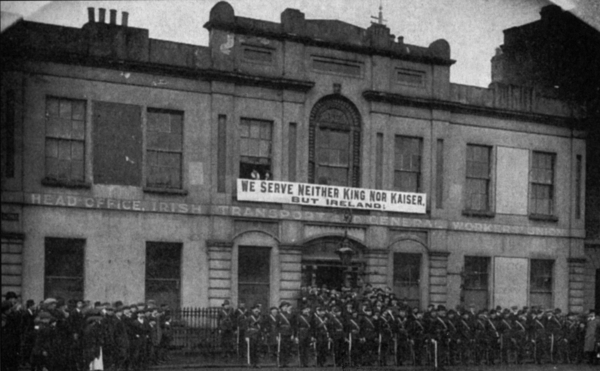
A declaration of war against war — banner on the old Liberty Hall, HQ of the Irish Transport & General Workers’ Union. A parade of a section of the Irish Citizen Army is drawn up in front of it. (Photo from Internet)
A few years earlier, an international socialist conference had threatened revolution on their capitalist masters should they dare to start a world war. Indeed, some revolutionary socialists saw war as anopportunity to instigate socialist revolution. Unfortunately they were outnumbered by social democrats who, despite their earlier militant words, when it came to the crunch, lined up the workers of each country behind their capitalist masters against their own class brothers in other countries.
There were few socialist parties and prominent socialists that took the opposite stand but one of those who did was James Connolly. Among the other things that characterised the 1916 Rising was that it was the first significant uprising of the 20th Century against World War. The next uprisings of that kind would be the 1917 Revolutions of February and October in Russia, with another in Germany in 1918.
“IRISHWOMEN”
The Proclamation of the insurgents in 1916 addressed itself to “Irishmen and Irishwomen”. Although not one of the seven signatories was a woman, there were a number of them prominent in the command structures of the Rising and in the preparations also. And also of course in the lower ranks during the Rising itself.
Constance Markievicz (nee Gore-Booth) of the ICA was, despite her planter family and quasi-aristocratic background, third-in-command of the Stephens Green/ College of Surgeons area. Kathleen Lynne, also of the ICA was Chief Medical Officer for the Dublin insurrectionary forces and third in command in the Dublin Castle/City Hall garrison. It was at the premises of Cumann na mBan founder member Jenny Wyse-Power, No.21 Henry Street, that the 1916 Proclamation was signed in secret a week before the Rising.
Constance Markievicz, Irish Citizen Army, second-in-command of the Stephen’s Green/ College of Surgeons garrison
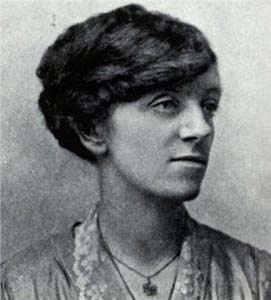
Kathleen Clarke was de facto a member of the IRB, work and powers delegated to her on the eve of the Rising by her husband, Tom Clarke, one of the architects of the Rising and first of the seven signatories. Elizabeth O’Farrell was one of the Cumann na mBan nurses accompanying the men in the GPO and one of three to proceed to occupy Moore Street; she carried the short truce communications to the British and back to the leaders on the Rising surrender day, accompanied Pearse to the surrender point in Parnell Street and then carried Pearse’s and Connolly’s surrender instructions to a number of garrisons in Dublin. And Winifred Carney, James Connolly’s secretary, was in the GPO and later Moore Street with her typewriter and a Webley revolver.
Winifred Carney was the first woman into the GPO, accompanying Connolly and carrying a typewriter and a Webley revolver
It is difficult for us today perhaps to realise how progressive it was for any general public document 16 years into the 20th Century to address itself specifically to “Irishwomen”. No country in the whole world had given all its women the right to vote by 1916 although the suffragette movement was in full flow throughout most of Europe and in the European colonies. While it is true that New Zealand gave European women the right to vote as far back as 1893, it was for European settlers only and also linked to a reform movement against the sale and consumption of alcohol. Elsewhere in the world outside the colonial Antipodes and the Scandinavian democracies, the extension of the franchise to women did not seem close in 1916. Nevertheless, in Canada, women got the vote in 1917 – but again, women of European descent only. In Britain, women did not receive full rights to vote until 1928. Yet in a large part of the United Kingdom, a cross-section of people making a bid for independent nationhood, were ostensibly recognising women as citizens with equal voting rights as early as 1916.
Given the preponderance of males in all organisations of all shades of Republican and Nationalist outlook, the inclusion of women in the address had to have been agreed by the men in the top leadership. No doubt women, through their agitation for full franchise as well as by their active participation in so many facets of the movement, helped to convince the men. Connolly is often credited with responsibility for this inclusion but there is no reason to believe others among the signatories would not have taken that position themselves (although Kathleen Clarke did allege that one of those would not). Patrick Pearse had previously supported the vote for women and a number of men in the leadership had female partners who were active on that issue, as for example was Grace Gifford, Joseph Plunkett’s fiancee. The 1916 Proclamation was the first insurrectionary proclamation of the 20th Century (and almost first ever) to specifically include women in its address on a basis of gender equality.
The participation of women in the Rising however had a much sharper illustration than their inclusion in the Proclamation – they were present in most of the fighting posts throughout the Rising, whether as members of Cumann na mBan or of the Irish Citizen Army – several were killed or injured, many were arrested and one was sentenced to death (though sentence was commuted later).
The participation of Cumann na mBan made the 1916 Rising the first uprising of the 20th Century (and probably prior to that) in which women participated in their own organisation, in their own uniform.
The participation of women in the Irish Citizen Army, where they shared equal status with men, made the 1916 Rising the first uprising of the 20th Century (and almost first ever) in which women participated in an armed and uniformed organisation, and in equal status with their male comrades.
HOPE AND ENCOURAGEMENT TO THE PEOPLE OF THE COLONIES
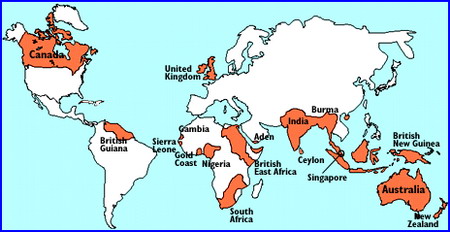
The British Empire in 1916 was huge – around 13 million square miles of territory in 1916, nearly a quarter of the world’s area. It was said that the “sun never set” upon the Empire because at any moment during 24 hours, some part of the Empire would be receiving light from the sun. Around 450 million people were under the Empire’s dominion.
Map of the British Empire in 1914 (of course the British ruling class had dominant influence over many other areas, for example over much of Latin America). (Image sourced from Internet)
And of course, there had been resistance. Even after resistance had been beaten, there had been further uprisings – in fact, some areas such as that of the present-day Afghanistan were in almost constant rebellion. But rebellions were mostly localised and even when they took on a more sweeping character, such as the Mahdist War of 1881-’89 in the Sudan or the Boxer Uprising in northern China in 1900, they had been crushed by British military might.
The news of the Easter Rebellion in Dublin ran around all parts of the British colonial world, from the nearer to the most remote. And some of the news was carried by the Irish in the British armed forces. Tom Barry, later to be undefeated guerrilla leader in the War of Independence in West Cork, read about the Rising while serving in the British Army in Mesopotamia (now Iraq). The Connaught Rangers, hundreds of which were to mutiny in India in 1920, were also in Mesopotamia in 1916. These Irish units of the British Army and Irish men in British units serving outside the United Kingdom, served not just next to English, Welsh and Scottish soldiers but also next to soldiers drawn from colonial peoples; they were often serviced too by colonial people in auxiliary roles and mixed to a degree with the colonial populations among which they were stationed, in markets, eating houses, bars and sex-houses. Just four years later, during the mutiny of the Connaught Rangers, it is recorded that Irish rebels in British Army uniforms had communicated their mutiny and their reasons to the Indian traders.
The 1916 Rising took place in what had been considered, the previous century, the second city of the British Empire. Now past those ‘glory days’, Dublin was still a city of the Empire’s “home base”, the United Kingdom. And the Empire’s Army had been obliged to shell one of the UK’s own cities in order to suppress that Rising! To many a colonial subject contemplating resistance or even outright revolt, it must have seemed like a signaling bonfire, one that proclaimed that the end of the Empire was nigh and called the peoples under subjugation to revolt, to finish it off. And, indeed during the War of Independence, the Nehru and Ghandi families were to make contact with Irish Republicans and Ho Chi Minh is reported to have been inspired by the Irish struggle.
Nor was it only those colonial people in the British Empire who were inspired but those in the French, Dutch, Belgian, Portuguese and Spanish colonies too. Ho Chi Minh, as a Vietnamese, was under the French empire and led his people in armed resistance to the Japanese and French occupation in 1941. Over the three decades following the Easter Rising, anti-colonial struggles around the world intensified and pushed the former colonial powers into “de-colonisation” — i.e. imperialism and neo-colonialism.
WORKERS OF THE WORLD
The Irish Citizen Army had been founded in 1913 as a workers’ armed organisation to defend against the attacks of the Dublin Metropolitan Police. The DMP carried no firearms then, though they were well able to kill and maim with their truncheons, a fact they demonstrated during the 1913 Lockout. But it was clear that Connolly at least knew that at some point the workers would come up against the full force of the State which, at that time, meant the British empire and the Colonial regime in Ireland. He called publicly for the ICA to train in and to carry firearms. The Royal Irish Constabulary, policing the rest of the colony outside Dublin, was indeed armed. And British Army units were stationed across the country, many of the garrisons in Dublin alone.
The ICA fell into a kind of disrepair after the workers’ defeat in the Lockout but was soon enough dusted off and reorganised. WWI began the same year the last striking workers of the Lockout, the Jacobs girls and women, marched back to work. It was certain that Connolly would try to stage a rising during the war and suspected that the Republicans, or “advanced nationalists” as they were called then, would do so too. As the war dragged on and the bodies heaped higher, Connolly grew increasingly impatient, contemptuous and even desperate, berating the “nationalists” for not rising and threatened to bring out the couple of hundred ICA on their own.
Irish Citizen Army on the roof of Liberty Hall during a flag-raising activity (Photo sourced from Internet)
But the Irish Republican Brotherhood had been planning to rise and in late January 1916, alarmed by Connolly’s threats, brought him into secret negotiations. When he emerged a few days later after what many thought had been his kidnapping, he had been sworn into the IRB and was part of the Military Council, planning the Rising for the Easter weekend. And that would mean that the ICA would also commit to the Rising.
On Easter Monday morning, around 220 men and women of the Irish Citizen Army marched out of Liberty Hall or mobilised elsewhere in Dublin. Two of the important fighting areas in Dublin were given over to their command, Dublin Castle and Stephens Green. ICA members fought elsewhere too, including the GPO. One account has them as the first to occupy the top of the GPO’s roof and another as hoisting the “Starry Plough” on top of William Martin Murphy’s Imperial Hotel in Clery’s building (the last flag of the Rising to remain flying). At least one was killed in the fighting evacuation of the GPO and a number took part in the occupation of the 1916 Terrace in Moore Street. The 1916 Rising was the first occasion of the 20th Century when a workers’ unit rose in their own units, in their own uniforms and under their own commanders.
SURVIVING STREET OF A CENTURIES-OLD MARKET QUARTER
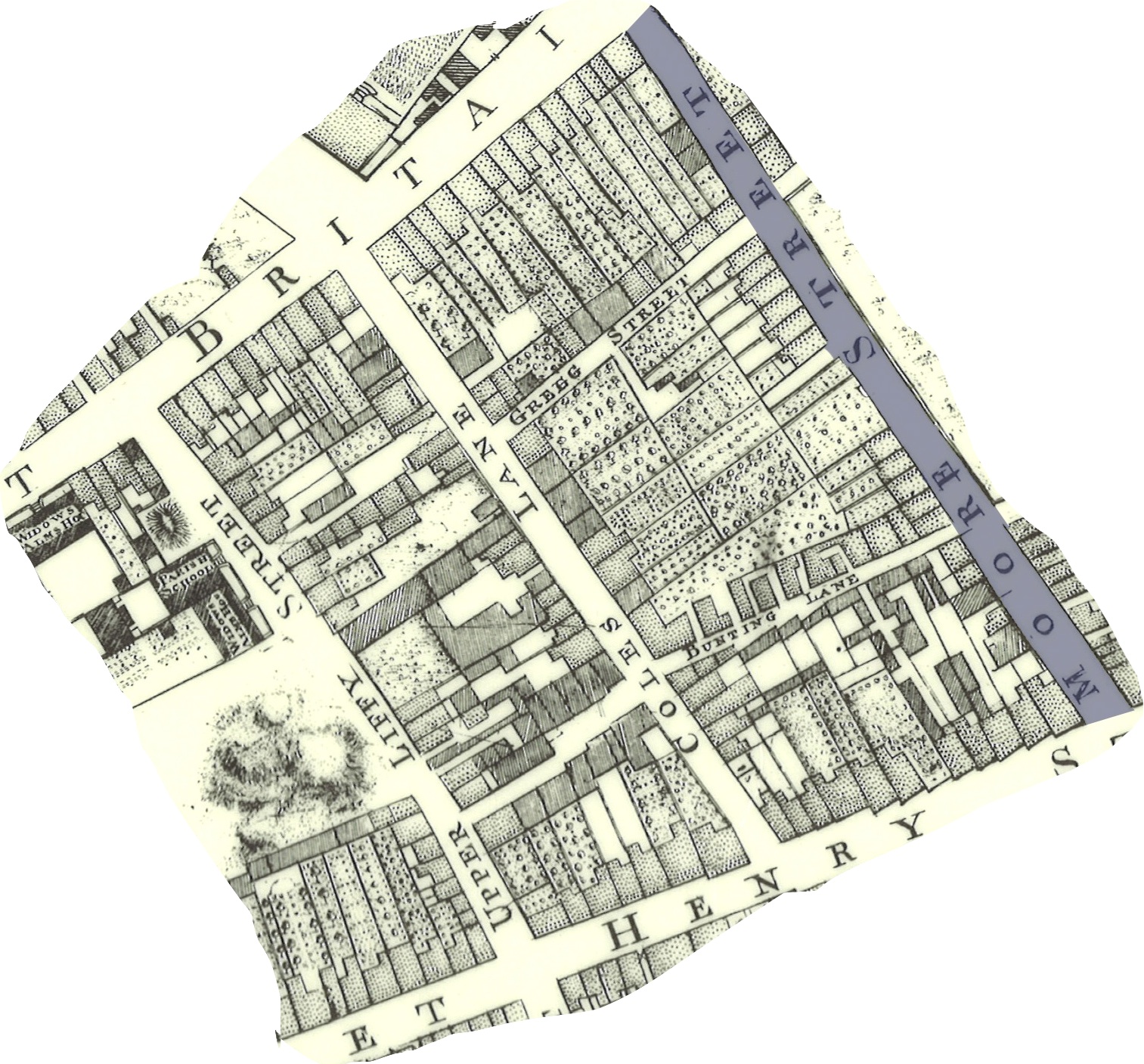
Authorisation was granted for the development of a market in the Moore Street area by the Dublin and General Markets Act of 1831. But the Act mentioned the location as being around “Coles Lane market”, which means there was already a street market in the area. It is probable that street trading had been going on in that area for centuries before that. Moore Street was something of a modern street of its time in the area, laid down around 1763 (and, it is worth noting, before the Great Hunger and earlier than the city’s main street, O’Connell Street), mainly as a residential street with some businesses. In following decades Moore Street would become the main street of a whole market area which included the aforementioned Coles Lane along with many other streets, laneways, cul-de-sacs (“turnings”) and mews.
The streets and lanes of the old street market quarter now buried under the ILAC (Image cropped by Save Moor Street From Demolition from J Roques Map 1754, sourced on Internet). In 1754 the street across the top was called “Great Britain Street” but by 1916 it had been renamed “Parnell Street”.
All of that was demolished and buried by the 1970s ILAC “development” of Irish Life ltd.(later joined by Chartered Land, which dispossessed the households, shops, stalls and workers for a paltry compensation, to the benefit not only of the ILAC partners but also of Dunne’s Stores and Debenhams. All that remains of that street market quarter is Moore Street, with street traders struggling in difficult circumstances to make a living, harassed by Dublin City Council officials, along with small shops, granted short leases or expensive longer ones by Chartered Land or the ILAC – and under constant threat of demolition or of ILAC expansion.
CONCLUSION
Since the 1916 Rising has all those aspects of international importance listed above, clearly the Moore Street terrace also embodies them all, being the last fighting place of the Rising’s HQ garrison and containing around 300 men of the Irish Citizen Army, the Irish Volunteers and three members of Cumann na mBan.
On the basis of those points alone, the site should be a recognised world heritage site. That the terrace and surrounding streets are, according to the National Museum of Ireland ‘the most important historic site in modern Irish history’and ‘a surviving urban WWI battleground … beyond price’ (as stated by the Imperial War Museum) and they include the last street of a centuries-old European street market adds icing to the cake – a cake that should be made available for the world to share.
End.
Documents consulted include
various accounts of the 1916 Rising,
including biographies and Witness Statements of participants (latter now available on line),
along with Moore Street – the story of Dublin’s market district (2012) by Barry Kennerc and
There are occasions in life when time that can never be retrieved is expended on something that is worthless. So far, three valuable hours of my life has been wasted on what RTE describes as a ‘commemorative drama’ to herald the beginning of the Centenary year of the 1916 revolution. Wasted, other than in terms of understanding the propaganda value to the political class even of badly constructed ‘historical’ costume drama – although describing ‘Rebellion’ as coherent drama is stretching it.
I quibbled after the first episode about the use of the term ‘Rebellion’ instead of the more accurate term ‘Revolution’, but it finally dawned on me with Episode 3 that what the writer, director and producers really mean is that this is about rebelliousness within the featured families, to which the 1916 Revolution is just a backdrop.
It would be a useful exercise after the series comes to an end to put a stopwatch to good use to work out the proportion of the five hours of screen-time that is devoted to an exceedingly poor and skewed telling of the story of the 1916 Revolution, and what proportion was used to tell the confusing, intertwined, and fairly inconsequential stories of domestic disagreement. There is of course a market for the latter, and for its setting in a sort of ‘upstairs-downstairs’ genre, but this series, more soap than serious drama, should not be its vehicle.
The 1916 Revolution – what was it really about, who made up the rank-and-file – essential to the creation of a revolution, what scale of operation was in play, what impediments to success existed? Nobody can be any the wiser by relying on this series.
The leaders – who were they, what were they like, what did they believe in, was there a plan, had they some endgame, some vision? Nobody can be any the wiser by relying on this series.
Where is Tom Clarke, or Seán MacDiarmada, or Joe Plunkett, three iconic signatories of the Proclamation, all present in the GPO – but not so far in this sorry series? No clue as to their characters, and precious little of James Connolly’s – relegated to a bit part, or of Patrick Pearse’s – other than his addiction to prayer, his deference to the clergy, his obsession with blood sacrifice, and a capacity for rhetorical exaggeration – as RTE would have us believe.
Where is the evidence of strong public support particularly in the impoverished inner city tenements, without which the revolution could not have lasted almost a week? We know it was there, we who have bothered to acquaint ourselves with the true narrative. Instead, that hoary old myth of widespread public disaffection with the revolution is hammered home at every opportunity.
Episode 3 begins with some bearded chap being put up against a wall and shot by firing squad. Who was he? We are none the wiser by the end of Episode 3. Why might it be important to know that he was Francis Sheehy-Skeffington, a journalist, an advanced-feminist, a pacifist who had played no part in the revolution itself? Because, perhaps, that it is true, and that he was murdered on the command of a crazed, out-of-control British army officer – an essential detail of the 1916 narrative – but not as the masses are supposed to know it since it would upset the entirely revisionist slant of this television disaster, a revisionism that is deliberately applied. And so it goes on.
Against fleeting scenes of chaos, created as we are led to believe by violent anti-democratic nutcases hell-bent on creating a Catholic state, we are encouraged to note the stabilising influence and the manners and the etiquette of both the Irish ‘Castle Catholics’ and their British masters in Dublin Castle. Fast-forward by 100 years and we see the same spurious choice being presented to the people by the political class – ‘stability’ or ‘chaos’, white or black, good or bad. No need to tease out what each side really stood for back then, or what each side stands for now.
There are those who ask ‘what matter – it is only TV drama?’. Propaganda is at its most effective when it is inserted subtly into the thought-processes of its target audience, and repeated through various forms from news and current affairs, commentary, and yes, entertainment. That works, as Joseph Goebbels knew all too well.
RTE claims an audience of 600,000 for its first episode of ‘Rebellion’. A large proportion of these will vote in the upcoming general election in which the main choice will be between, the political class tells us, stability or chaos. And that audience is also entering into the centenary year of the 1916 revolution with its competing interpretations, one of which champions the Redmondite parliamentarian Home Rule option over the other – the right of a people to self-determination and self-government, to be established through revolution where no other viable option was available. Presenting a partisan and therefore skewed version of the 1916 revolution primes at least a part of that audience to adopt a negative view of the legitimacy of that revolution and of its leaders, and that represents a highly political intervention in the popular history of 1916 on the part of the State broadcaster, RTE. It is not, presented in that way, just TV drama.
‘Rebellion’ looks like a cheap production, but cost as much as Ken Loach spent making The Wind That Shakes The Barley – an excellent production for the big screen, which grossed three times its production costs at the international box-office. Why wasn’t Loach asked to make this series? It is not as if he lacks experience. But then, he could be relied on to create a credible narrative around the main story of revolution and to consign the less consequential sub-plots to their rightful places. That would not suit the political class, including its RTE functionaries.
The 1916 revolution is an intriguing, exciting and rich human story, as rich in dramatic potential – characters, incidents and plot-lines – as was the highly successful and accurate 1913 Lockout TV drama ‘Strumpet City’, produced by RTE in 1980. ‘Rebellion’ on the other hand is dross. Some people, their names figuring prominently on the credits of each episode, opted for dross, and each received a considerable reward tor taking that option.
The foundational narrative of modern Ireland – in which the 1916 Revolution is the inciting incident – deserves to be treated with a modicum of respect. That is entirely absent in this spurious version.
There are times when we remark that ‘you couldn’t make it up’. The series writer did, with input from others.
And there are times when we remark that ‘it couldn’t get any worse’. Oh yes it can, and it will.
Three members of my family fought in the 1916 Rising and eleven “did their bit” in the War of Independence. So it‘s probably not that surprising that as a child, I grew up with stories, real, imagined, and embellished, of those ancestors and their times.
Of those three “1916 men” the one who most aroused my curiosity was my granny’s cousin, Desmond Ryan. “A bit of a consequence”, according to my great-aunt Polly, or “the son of the fellah who wrote the first Irish play that got him a medal from Yeats and Lady Gregory“ according to my uncle.
Desmond actually was “a bit of a consequence”; however his father, W.P. Ryan, while he did write a number of plays “i nGaeilge” didn’t quite write the first to be performed in Dublin and I’m not too sure about the medal either. W.P. was a journalist, editor, novelist, and socialist. His clash with Cardinal Logue, Archbishop of Armagh, while editor of The Irish Peasant, is chronicled in his “The Pope’s Green Island” and his novel “The Plough and the Cross”, both of which bear fruitful reading today. His 1913 book “The Labour Revolt and Larkinsim” together with his work as assistant editor of the London Daily Herald did much to explain and create sympathy among British socialists for the participants of Dublin’s Lockout in 1913.
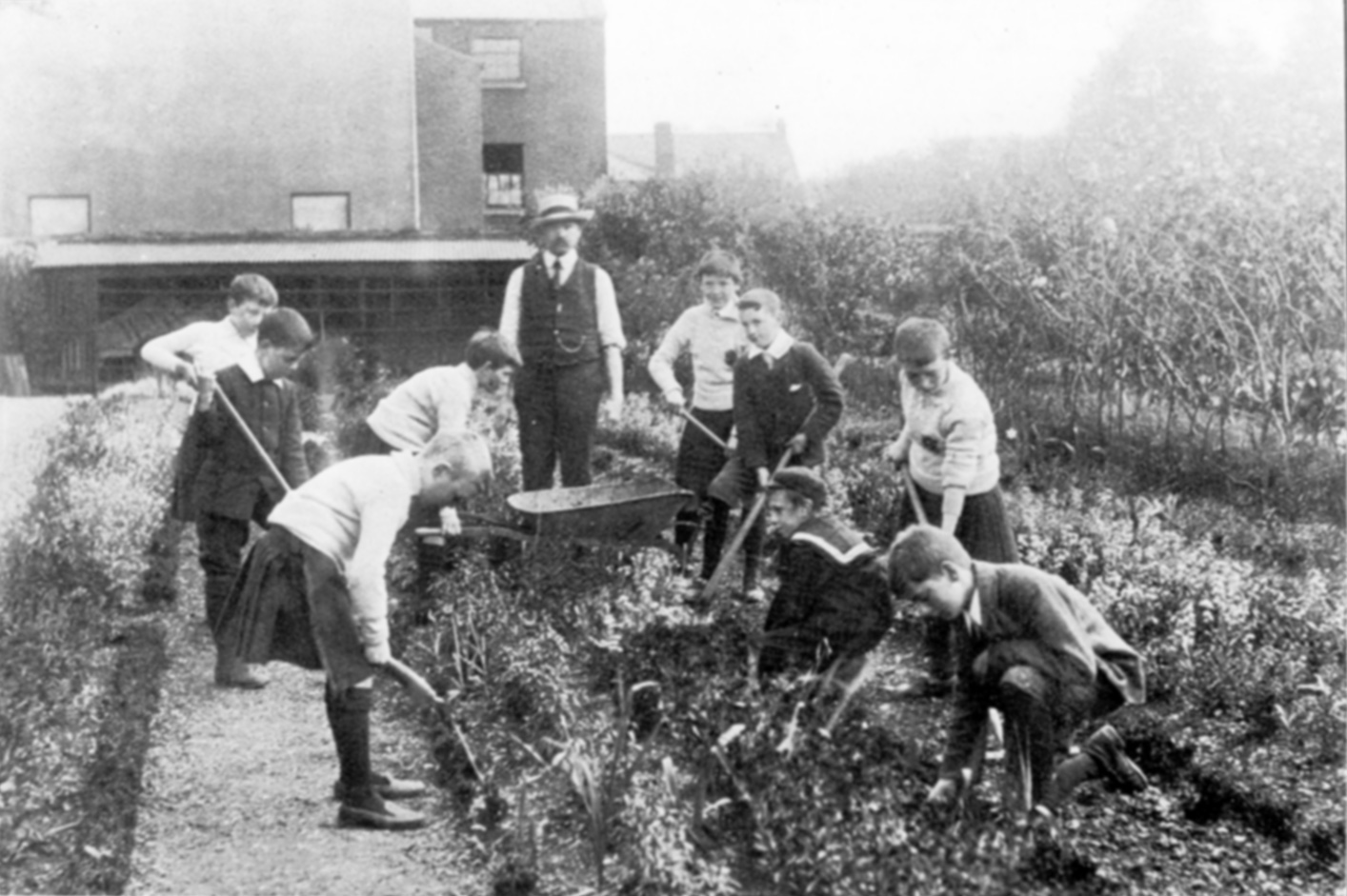
St. Enda’s boys at work — part of the school curriculum was gardening
W.P.’s inability to toe the line with the bishops saw him return to London, leaving Desmond, “the Consequence”, in the tender care of Patrick Pearse at Saint Enda’s School as a boarder. As most of his Ryan siblings were either in Tipperary or had emigrated, Desmond found himself a temporary orphan save for my great grandparents who promptly “adopted” him and welcomed him into their home.
Willie Moynihan, my great grandfather, was a not very successful publican, and politically, if he had any politics, followed his brother Michael’s line in the Irish Parliamentary Party. Michael was a very successful publican and over a number of decades served as a representative for a number of wards for the IPP on Kingstown (Dún Laoghaire) Borough Council. When the IPP took control of Dún Laoghaire, Michael – being their veteran campaigner in the borough – was given the honour of making the opening speech of that session in which he congratulated the Pope on his recent birthday. It caused a sensation at the time. Now while I realise this was far more politically loaded than it appears today, somehow it strikes me as petty compared with the many other problems Dún Laoghaire faced back then.
Despite his humble roots Michael Moynihan at that stage had a number of pubs, a big house on Haig Terrace, a mansion in Killiney, and was about to be made a Justice of the Peace despite a string of convictions for after-hours drinking and illegal gambling schools in his pubs. His gesture, despite the symbolism, always strikes me as just another example of the “re-branding process” which the IPP really stood for and intended to deliver with Home Rule. They might have cut the cake differently but basically it was to be business as usual – just a new name over the door and on the corporate notepaper.
Nobody ever told me how my great-grandparents reacted to having a socialist with a strong sense of Nationalism in their midst. However Desmond was a boy with a mission and felt it his duty to convert the family or at the very least his young cousins even if their parents were beyond redemption. His stories of St. Enda’s fired the children’s imagination, and I still smile as I remember my great-aunt Polly, throwing back her shoulders, raising herself beyond her full height, and summoning some of the worst traits of amateur dramatics, taking off Desmond, taking off Patrick Pearse, taking off Robert Emmet leading the 1803 Rebellion.
Desmond began leaving his copybooks from school in the house when he visited. These were filled with essays on Fionn MacCumhaill, the Red Branch Knights, Cú Chulainn, and other mythical heroes. The copious marginal notes and comments by Patrick Pearse drew my grandmother and her sister further into this world of Celtic heroics, standing in stark contrast to the stories of the famine during the previous century told by their parents. A generation later both my mother and uncle remember being equally moved by the same essays which were unfortunately lost during a house move in the 1940s.
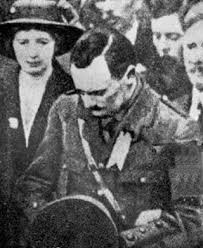
Patrick Pearse, at the 1st August 1915 interment in Glasnevin Cemetery of Diarmuid Ó Donnobháin Rosa, whose body had been sent from the USA for burial there.
As Desmond’s involvement with the revolution grew his visits to the house became less so there was some delight when he turned up in July 1915 with an invitation to go to the funeral of a Fenian from Cork called Jeremiah O’Donovan Rossa. Pearse, the fellah who wrote all those notes and comments in the margins of Desmond’s copy books was going to give a speech. Willie Moynihan didn’t approve of this fellah called Pearse but his wife relented understanding her children’s curiosity and she was fond of Desmond and didn’t want to let him down.
Desmond, not surprisingly, faded out of family stories after that, as Pearse’s exhortation to revolution was too much for a God-fearing, law abiding woman, like my great grandmother. He would go on to write biographies of Pearse, Connolly, Collins, and De Valera, as well as the first major account of 1916 by a participant. His pioneering journalism during the War of Independence did much to counteract the black propaganda of the State murder gangs who assassinated at will back then. However it was his invitation to a funeral which endured in family lore on a day that changed the family’s political axis forever.
Polly could “do” the speech, and recited it with all the subtlety of a Victorian melodrama well into her eighties. She would recall Pearse as “a bit of a fruitcake” or “sixpence short of a shilling”, but despite his questionable sanity would qualify this with “my God! But that fellah could talk!” Remarkably, with the emergence of the Pathé newsreel footage of the funeral in recent years (footnote to link?), she seemed to have taken all Pearse’s movements and gestures in, and even in old age could deliver it as if she had recently studied the film frame by frame. This delightful entertainment of my childhood had deeply affected her and despite occasionally lamenting how dull Dublin became once the British left, it had been a seminal moment at which she became and remained a republican right down to her bones.
On very rare occasions my granny would “do” the speech. But her version was different. She didn’t have her sister’s dramatic flair, but she too had been affected by Pearse that August day. With her a previously unseen veil of steel and determination seemed to come over her; probably that same steely veil that saw her defy her parents and join Cumann na mBan and which enabled her to carry cases of hand grenades and weapons across the city on numerous occasions. Her rendition suggested she had taken the words in and considered them rather than the exaggerated gestures of which her sister Polly was so fond. Significantly it was through this involvement that she met my grandfather, a member of H Company, 1st Battalion, the Dublin Brigade.
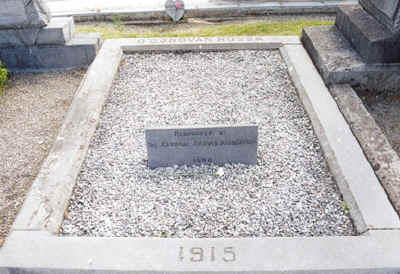
Ó Donnobháin Rosa’s grave, Glasnevin Cemetery, Dublin
As the decade of commemorations gathered momentum, last August saw the centenary of O’Donovan Rossa’s funeral. In many ways it started the countdown to the revolution of 1916-22. Earlier this year I found myself in Glasnevin Cemetery and wandering around came face to face with Rossa’s grave and all those childhood memories came flooding back. It’s difficult, even with all the photographs and the film footage, to really understand just how significant Pearse’s speech was.
Looking at the photographs I wonder just how many lives were changed that day. In its own small way my own family bears testimony to it. As historians and commentators continue to play “what if” in relation to events of that period I found myself doing the same at Rossa’s grave, making similar speculations with what potentially, for me anyway, might have been serious consequences. What if Desmond Ryan hadn’t fired my granny’s imagination so that she went to the funeral? What if she hadn’t been inspired by Pearse that day? Would she have joined Cumann na mBan? More importantly, without being in that circle would she have met my grandfather? The next question doesn’t bear thinking about, because, despite the occasional rocky road, I’ve rather enjoyed being alive, and without that chain of events unleashed by the combination of Rossa, Pearse and that Speech on that August day I might never have been born.
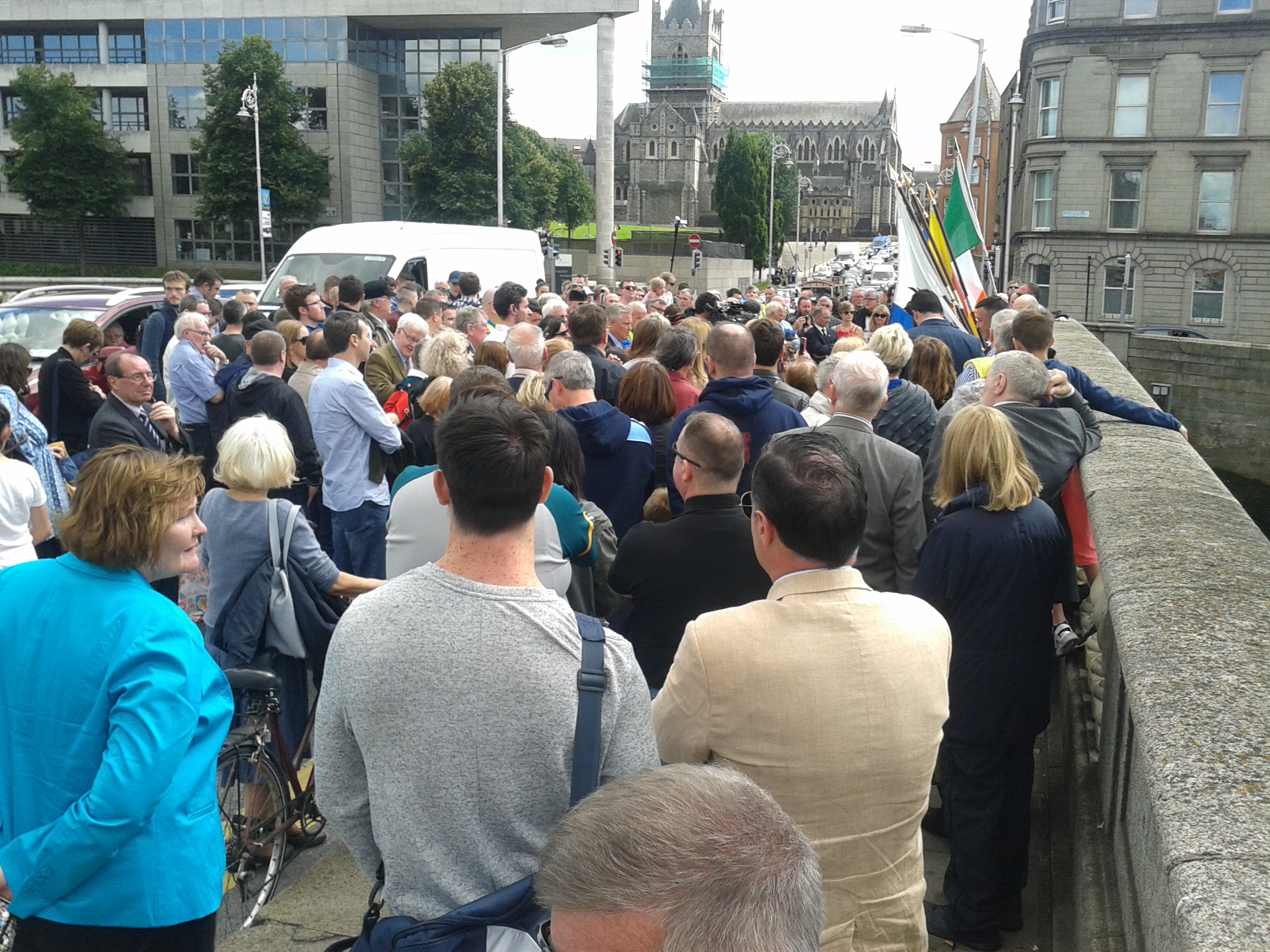
So on the 1st August 2015 I found myself in town at the O’Donovan Rossa Bridge to pay a personal tribute to Rossa, and Pearse, and that speech. In particular I was paying tribute to Desmond Ryan. Because somehow in that crazy way that small events ripple out to have more serious consequences I find myself thinking I owe them for my very existence.
End.
Crowd at erection of plaque to rename the former Richmond Bridge over the Liffey after O’Donnobháin Rosa on 2nd August 2015 (Christchurch is visible in the far background, after Dublin City Council’s offices building to the left).
Hugo McGuinness is a historian specialising in the period of history referred to above.
Izquierda Unida (United Left) did badly in the Spanish state’s general elections of 20th December 2014 but their trend has been a downward one for years, apparently due to its increasing friendship with one of the main political parties, the social democratic PSOE. After a short recovery in votes due the current crisis of Spanish capitalism, the rise of Podemos kicked the IU down the stairs again. And it turns out that Podemos is not as far from the IU as we might have been led to think.
The IU (Izquierda Unida) is a coalition of Trotskyist and radical-Left groupings and parties along with the PCE, the old Moscow-style Communist Party, which takes the leadership position in internal elections. The IU and the PCE also have a strong presence and influence in the leadership of both main trade unions in the Spanish state, Comissiones Obreras (in Spanish the acronym is “CCOO”) and Unión General de Trabajadores (UGT). The latter is affiliated to the PSOE but a people of other political affiliations are active within it, including the IU. The CCOO, the largest union, was founded by the PCE but since the late 1980s the party no longer controls it. The laws on industrial representation in the Spanish state favour union organisation but also favour the dominance of the CCOO and UGT. Overall, these two unions have no recent record of great militancy and are seen by many in the Spanish state as part of the status quo.
IU sticker; slogan reads “The power of the people”
Izquierda Unida was formed by the PCE in the mid-1980s at a time of the party’s waning influence in society and in the trade unions, when party leaders perceived the need to work with other left forces apart from the PSOE. For decades since, the IU has a history of internal dissension as well as one of general collusion with social democracy but may now be about to fade away. On the other hand, the political party that took a big bite out of its vote, Podemos, is not as far removed from the IU as its creators and leaders try to portray.
Historical background
In 1989 Julio Anguita, then General Secretary of the PCE, was elected General Coordinator of the IU which at that time had seven elected Deputies of the Spanish Parliament (el Congreso). The IU denounced without reservations the neoliberal economic politics of the PSOE in privatisation, “reforms” of labour legislation, etc. It stated that no unity of the Left with the PSOE was possible while it bowed before the economic and financial oligarchy and was rolling out the IFM’s program for Spain. Sounds familiar ….. almost recent, doesn’t it?
For unity of the Left, Anguita insisted on adherence to a Left program and developed an analysis of politics in the Spanish state in which he described both main parties, the PP and the PSOE, as being on the opposite bank of the river to the IU. The IU should therefore work to hegemonise the Left and displace the PSOE which they proceeded to attack not only for their policies but also for scandals of financial corruption which the Right was condemning.
Despite denunciations by the PSOE-friendly sections of the media that the IU was siding with the Right of the PP against the Left of the PSOE, in the elections of that same year of 1989, the IU’s share of parliamentary deputies climbed to 17. In 1993 they gained one more and in 1996 they reached 21, they highest they have ever done.
With the approach of the general elections of 2000, Anguita, due to stand for the IU again, suffered a heart attack but shortly before the elections his place was taken by Francisco Frutos (who had also replaced him as General Secretary of the PCE two years earlier). Under Frutos, Anguita’s path was abandoned and the IU entered into an electoral pact with the PSOE. The result? Electorally, a drop from their high of 21 to only eight parliamentary deputies; in public perception, the death of hopes of a Left coalition standing against the IMF.
Far from the results teaching the IU the value of militancy and drawing a line, they became even more timid and elected Gaspar Llamazares, also a PCE activist, who flirted with the PSOE inside and outside of the Cortes, claiming that the PSOE was “one of ours”, despite differences a “party of the Left” etc. The parliamentary downward slide continued with only three deputies from the 2004 elections and only one remaining – Llamazares himself – out of those in 2008.
2008 was also the year the economic crisis hit and the IU elected another PCE activist, Cayo Lara, as General Coordinator to manage the disastrous legacy of his predecessors Frutos and Llamazares.
Three years later, in 2011, the 15M movement put hundreds of thousands on to the streets shouting “They do not represent us”, tarring PP and PSOE with the same brush as bipartisan actors for an economic and financial oligarchy. Many of the slogans were also against the main trade unions, Comissiones Obreras and UGT. In the general elections of that year, the IU with Cayo Lara leading, climbed up again to 8 elected Deputies, against the 186 of the PP (absolute majority) and the 110 of a seriously-damaged PSOE.
Another three years later, in 2014, a split from the IU, the Izquierda Anticapitalista (Anti-Capitalist Left) and a group of Politics professors from the Universidad Complutense launch the Podemos movement. Some of these professors had advised governments of the 21st Century Latin American socialist trend and some were connected to the IU. Podemos identified the PP and PSOE as a political caste in the service of IFM and of the Troika in general, and of the markets. Podemos – like the Frente Cívico ‘Somos Mayoría’ (“Citizen’s Front ‘We Are the Majority’ ”) no longer speaks in terms of Left or Right but rather of parties, one of the Right and one supposedly of the Left governing for the oligarchy instead of for the majority of the population.
The new movement and Anguita (remember him, back at the start of this article?) express approval for each other’s political line. Podemos and its leader Pablo Iglesias, a young Politics professor who theorises about marxism on his television program La Tuerka and who in interviews and discussion programs on more general television lambasts the ‘caste’, proposes to the IU a joint platform for the European Parliamentary elections of 25th May. However, preparatory discussions fail to reach agreement and each goes ahead on its own. Podemos gets five MEPs and IU gets six and Podemos decides to become a political party.
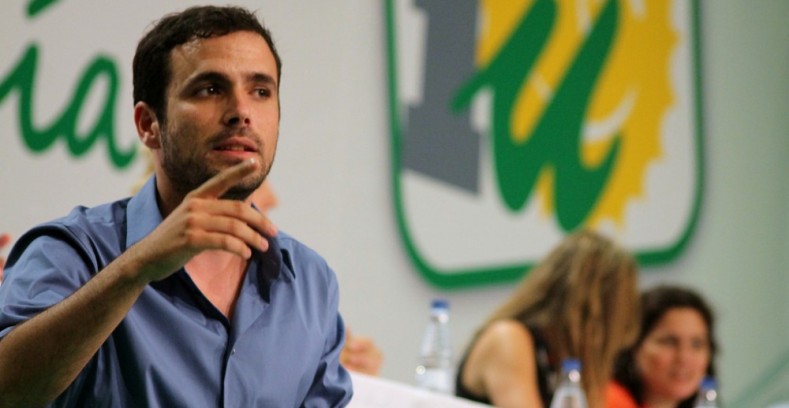
Cayo Lara declares that he will not stand for the IU in the 2015 general elections. In his place a young Deputy, Alberto Garzón is elected, also an activist of the PCE and linked to 15M, who is in favour of constructing an alliance with Podemos. Garzón is also praised by Anguita and is regarded favourably by José Luis Centella, the Secretary-General of PCE; he is the only member of the coalition to present himself in the primaries for selection as IU candidate and his selection is assured. In the General Elections of December 2015, the IU went down once more to two seats but one of the elected was Garzón.
Alberto Garzón, head of a depleted United Left and one of only two successful IU candidates in the recent General Elections
Although the crisis of the Spanish capitalist system has matured considerably since then, we have almost come full circle from what Anguita proposed in 1989: the Leftist opportunist approach of correctly drawing a line between the socialists and both capitalist parties, including the social-democratic one, combined with an incorrect ambition to supplant the latter within the system. It is a plan to “take over” the state through elections. However, the satchel in which the plan is carried seems to have been handed from IU to Podemos.
Tania Sanchez of IU and Pablo Iglesias of Podemos
The plan is ultimately doomed to fail, either because enough votes will not be gained or because the coalition will split before that can be achieved. In the event that it does ever actually succeed, the result will be that the State will take over the Left Coalition rather than the other way around.
In the very unlikely event that the leadership of that coalition should be unprepared to accede to the demands of the bourgeoisie, the latter have their armed forces, police, civil service and supporting media to teach the members of the Leftist Coalition the necessary lessons which many revolutionary theorists have expounded over the 20th Century and even earlier and which the Leftists have probably read but decided to forget. Or decided that they know better.
End.
NB: I have drawn very heavily on the following article in composing this article: m.eldiario.es/norte/cantabria/primerapagina/Syriza-espanola_6_355974415.html
The Spanish state’s General Election was held on 20th December, four years and one month since the previous one; although in some countries not such a long period, it was the longest between elections in the state since Franco’s dictatorship. A number of financial scandals affecting the ruling right-wing Partido Popular (PP) in recent years no doubt made their leaders reluctant to go to the polls but holding off longer might have resulted in even worse results.
On the other hand, their main parliamentary opposition, the social-democratic Partido Socialista Obrero Espaňol (PSOE) were also embroiled in some financial scandals during the same period, though not as many. (Please see summary of the main financial scandals in appendix).
Both political parties had something to fear in the growth of the new political party Podemos (“We Can”) but the PSOE much more than the PP, since the image projected by Podemos is generally one of the Left. As expected, Podemos took votes from the PSOE but unexpectedly came in as the third parliamentary party in strength overall.
Pablo Iglesias celebrating Podemos’ results in elections
The PP’s vote was under strong threat from the new right-wing party Ciudadanos (Citizens), which pre-elections polls predicted moving into third place in number of seats but instead came in a fourth and well below Podemos. Nevertheless, it did take votes from the PP.
On a state-wide turnout of over 70% of the electorate, the election resulted in the most politically-fragmented parliament since 1936. Although the PP remains the party with the highest vote overall and therefore the most seats, it gained only 123 out of 350, which does not allow it to form a government. Even a coalition with Ciudadanos would give the PP insufficient seats to form a majority unless they could rely on abstention by the PSOE not voting against them, a tactic which would leave the PSOE vulnerable to further gains from Podemos or others in future. A PP-PSOE coalition does not seem possible, both parties having much to lose from such a coalition in the future, not to mention the state itself, which functions under an illusion of political choice between “left” and “right”.
On the other hand, the number of seats held by PSOE (at 90, the lowest ever in its history) is even less than those of the PP and it would need to go into coalition with others in order to form an alternative government. With Podemos? Possibly … but the numbers would still be insufficient and would require others to come on board. It could function, of course, with the PP abstaining from voting against them but that in turn would probably cause further defections from the PP to Ciudadanos or a split. A PSOE-Podemos alliance would also harm the new Podemos party in the future, as it has based much of its propaganda to date on attacking “political bipartisanship” in the running of the state by the “oligarchy”. And on the 29th the party chief, Iglesias, ruled out a coalition with either of the main parties.
United Left also suffers
The Izquierda Unida bloc was also devastated, presumably by Podemos, losing six seats on previous showing and remaining with two. (For the trajectory and electoral performance of the “United Left” — Izquierda Unida – please see separate article).
Background of the Spanish state
The present form of the Spanish state emerged from a fascist dictatorship, in turn the victor of a vicious civil war. The dictatorship of 36 years came to an end without a revolution or bringing to trial of state torturers, mass murderers and robbers. The new form of the state developed a constitution insisting on the unity of the state with the explicit threat of army violence against any nation within its borders seeking independence.
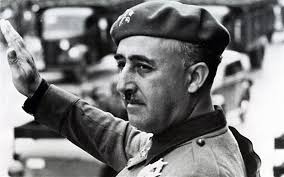
A younger General Franco giving a fascist salute
It was as though a coach with fascist emblems and full of fascists went into a paint-spraying garage, coming out a few minutes later a different colour but with all the original passengers on board. Of course, a few new passengers got in too, like the previously repressed PSOE and the CPE (Partido Comunista de Espaňa). And they also helped with the painting.
Alone among the state’s population, the majority in three of the Basque provinces voted against the 1978 Constitution (many also abstained). The more democratic articles of the Constitution never found expression in practice, especially with regard to democracy and civil rights in the Basque and Catalan countries. In the 1980s the social-democratic PSOE government was embroiled in the scandal of the GAL assassination squads operating against the Abertzale Left movement in the Basque Country, resulting in the jailing of the Minister of Internal Affairs of the Spanish state, the most senior Police Chief and a number of highly-placed officials.
The Spanish state includes within its borders as already noted most of the Basque Country and the Catalan Countries, which have their own cultures and languages. Also with a significantly different culture are Asturias and Galicia, both of them considering themselves Celtic rather than Latin-Hispanic and and having their own languages. There are in fact small movements seeking independence or greater autonomy in all other regions of the state, including in the political centre itself, Castille.
The Spanish state has long been the most unstable in the core European Union. Collusion between fascists, alleged social democrats and alleged communists internally, along with the support of the USA and the tolerance of its European partners has kept it afloat. Nevertheless, it represents the part of the EU most vulnerable to revolution, with immediate impact should that happen on the French and Portuguese states and further ripples throughout the EU. However the revolutionary and potentially revolutionary forces are currently weak, divided and riddled with opportunism.
End
APPENDIX
Some major recent corruption scandals
(From Wikipedia)
The political landscape of Spain was shaken in early 2013 by the “Bárcenas affair”. On 18 January 2013, Spanish daily El Mundo revealed that former PP treasurer Luis Bárcenas had, up until 2009, used a slush fund to pay out monthly amounts, ranging from 5,000 to 15,000 euros, to leading members of the party. On 31 January 2013, Spanish daily El País published what became known as “the Bárcenas’ papers”, facsimile excerpts from handwritten ledgers in Bárcenas’ hand. Among the recipients were incumbent party leader and Prime Minister Mariano Rajoy and Secretary-General María Dolores de Cospedal.
The PP took the position that these payments were in accordance with law. Further, on 14 July 2013, El Mundo published excerpts from several SMS between Bárcenas and Rajoy from 2011 through 2013 in which Rajoy promised help to Bárcenas and gave him encouragement. The most recent of these messages was in March 2013, when publicity on the Bárcenas affair had already broken out. Under pressure from international media and opposition parties threatening him with a motion of censure, Rajoy spoke out to Congress in an extraordinary plenary session on 1 August.
Rajoy denied any criminal responsibility, which he attributed solely to Bárcenas, but recognized “errors” and “having trusted the wrong person”. This did not prevent the opposition bloc from demanding Rajoy’s resignation, but with the PP commanding an absolute majority in Parliament and with no judicial proof on Rajoy’s direct involvement in the scandal, chances for a successful motion of censure were slim.
At the same time, a corruption scandal affecting the Duke of Palma Iñaki Urdangarín, “the Nóos case”, resulted in the charging of his spouse Cristina de Borbón, Infanta of Spain and daughter of King Juan Carlos I, for tax fraud and money laundering in April 2013. She was summoned to court in February 2014, and in November 2014, the High Court of Palma de Mallorca upheld charges against her, paving the way for her to face trial, though only on tax fraud charges.
In June 2015, King Felipe VI officially deprived his sister of her dukedom, privately announcing his intention beforehand. These corruption allegations severely eroded the Spanish Royal Family’s popularity within Spain; according to an opinion poll by the CIS, between 1995 and 2013 the Spanish monarchy’s approval rating had dropped from 7.5 to 3.68 on a scale of 10 amongst Spaniards.
In late 2014, the sudden emergence of several episodes of corruption that had taken place over the course of the past years and decades was compared to the Italian Tangentopoli episode in the 1990s. As a result, this episode has been dubbed by some media as ‘the Spanish Tangentopoli’ or ‘Black October’.
Starting on July 2014, former Catalonia President Jordi Pujol had come under investigation after he acknowledged possessing a large, undeclared, familiar fortune, with several of his sons being already under investigation on alleged tax offense charges. By October 2014, most of his family had already come under investigation under alleged money laundering, fraud, public contract kickbacks and other tax offenses.
In early October a massive expenses scandal was unconvered involving former Caja Madrid senior executives and advisers. At least 86 bankers, politicians, officers and trade union leaders were accused of using undeclared “black” credit cards between 2003 and 2012, spending over 15 million euros in private expenditures. Involved was former Caja Madrid chairman between 1996 and 2009, Miguel Blesa, but also notable members from the PP, PSOE and IU parties, such as former Deputy PM, IMF Managing Director and Caja Madrid/Bankia chairman Rodrigo Rato, as well as members from Spain’s main trade unions UGT and CCOO.
In late October, Judge Pablo Ruz charged former PP Secretary-General and several-times Minister during José María Aznar’s tenure, Ángel Acebes, with a possible misappropriation of public funds as a result of the Barcenas affair. A few days later, Ruz’ inquiry on a Treasury investigation unveiled that the People’s Party could have spent as much as 1.7 million euros of undeclared money on works of its national headquarters in Madrid between 2006 and 2008. On 27 October, a large anti-corruption operation, Operation Punica, resulted in 51 people arrested because of their involvement in a major scandal of public work contract kickbacks, amounting at least 250 million euros. Among those arrested were notable municipal and regional figures from both PSOE and PP, as well as a large number of politicians, councilors, officials and businessmen in the Madrid community, Murcia, Castile and León and Valencia.
On 26 November, Judge Ruz summoned Health Minister Ana Mato to court after concluding she could have benefited from several corruption crimes allegedly committed by her former husband Jesús Sepúlveda, charged in the Gürtel case. As a result, Ana Mato resigned from her office that same day, defending that she had not been charged with any penal crime, but declaring that she did not want to bring further harm to her party. A Congress plenary in which Rajoy was to announce legal reforms against corruption had been scheduled for 27 November several weeks previously; the media concluded that Rajoy had forced Mato’s resignation in order to prevent a complicated political situation on that day.
As the votes in the General Election in the Spanish state result in huge gains for the Podemos party and the most fragmented Parliament since before the Spanish Civil War, the Abertzale Left’s party in the elections also loses massively to the newcomer. This occurs in the context of wide discontent within the Abertzale Left, especially among the youth, with a potential split emerging around the issue of political prisoners.
The Spanish state includes within its borders most of the Basque Country and the Catalan Countries, which have their distinct cultures and languages. Also with a significantly different culture are Asturias and Galicia, both of them considering themselves Celtic rather than Latin-Hispanic and also having their own languages. There are in fact small movements seeking independence or greater autonomy in all other regions of the state, including in the political centre itself, Castille.
Four of the Basque Country’s seven provinces are currently inside the Spanish state and they were included in the Spanish state’s General Election on 20th December. A number of financial scandals affecting the ruling Spanish right-wing Partido Popular in recent years no doubt made their leaders reluctant to go to the polls but holding off longer might have resulted in even worse outcomes.
On the other hand, the PP’s main parliamentary opposition, the social-democratic Partido Socialista Obrero Espaňol (PSOE) were also embroiled in some financial scandals during the same period, though not as many.
In the event, both main parties achieved disastrous results and neither can form a majority government. The new party of the social-democratic Left, Podemos (“We Can”), which did not even exist two years ago, has leapt into third place and a new party of the Right, Ciudadanos (“Citizens”), is in a poor fourth place. No two of the aforementioned parties can form a coalition government except in the case of a PP-PSOE coalition; however that would cause massive problems for each party and also dispel the political myth of a democratic choice between “Left and Right” in the Spanish state.
The Spanish state has long been the most unstable in the core European Union. Collusion between fascists, alleged social democrats and alleged communists internally, along with the support of the USA and the tolerance of its European partners has kept it afloat. Nevertheless, it represents the part of the EU most vulnerable to revolution, with immediate impact should that happen on the French and Portuguese states and further ripples throughout the EU. However the revolutionary and potentially revolutionary forces are weak, divided and riddled with opportunism. (see separate article focussing on the elections and the Spanish state in )
Despite the weaknesses in the Spanish state, the Basque Abertzale Left has made little headway against it and has been slipping electorally badly this year.
Election Results in the Basque Country
EH Bildu, party of the Abertzale Left in coalition with social-democratic Basque parties, presenting their program in Nafarroa in 2012 and seeking broader alliances
EH Bildu (“Basque Country Unite”), the social-democratic coalition party under the direction of the Basque Abertzale (Patriotic) Left, came out of the Spanish state-wide elections badly (as it did in the regional elections earlier this year in the Basque Country also, with the exception of in Nafarroa). With a drop of nearly two-thirds of its previous percentage of the vote, it lost five seats and now has only two in the Spanish Parliament (the Cortes). The christian-democrat PNV (Basque Nationalist Party), traditionally the dominant in the three southern provinces of Euskadi (i.e. excluding Nafarroa, the fourth), also took a drop in its percentage but a much smaller one and despite that, increased its numbers of seats from five to six. The Basque nationalist coalition in Nafarroa, Geroa Bai (“Yes to the Future”), lost its only seat.
The winner that swept up the ‘missing’ votes in the Basque Country was Podemos, a party that did not even exist until last year. Although gaining one seat less than the PNV in the “Euskadi” or CAV (three provinces region), Podemos actually won more votes and its share was 25.97%, against the PNV’s 24.75%. Shockingly, at 15.72%, EH Bildu has now been reduced to fourth place after the other two and the PSOE, with only the PP worse off but with the same amount of seats. Even in Gipuzkoa, the province most loyal to the Abertzale Left, their share fell to 20.89% and their coalition party EH Bildu lost two seats. In the same province Podemos topped the poll in votes and gained two seats.In the fourth province, Nafarroa, EH Bildu lost their only seat and took a 9.90% share against UPN-PP’s 28.93%, Podemos’s 22.9%, and PSOE’s 15.53%.
Podemos leader Pablo Iglesias after results of Spanish Election results December 2015
It seems clear that in the Basque Country, Podemos took votes both from the PSOE and from the Abertzale Left’s coalition party, EH Bildu and even some from the PNV. For the PSOE, a party in Government in the past and implicated in the GAL murders, also involved in a number of recent financial scandals across the state, to lose votes in the Basque Country to a radical-left coalition, would have come as no surprise to most people. It is a different matter altogether for EH Bildu, with a strongly patriotic Left following, never tainted with a financial scandal and never yet in Government, to lose votes to a newcomer like Podemos — and that needs some explanation.
The fact is that the AL leadership flirted with Podemos – even proposing a joint electoral platform — and thereby sent the message that voting for them would not be such a bad thing. But there were sufficient reasons for the AL to have done otherwise, even without the objective of safeguarding their own vote. It has been clear for some time that the leadership of Podemos is hostile to aspirations towards independence of nations within the State. Their leader recently criticised the decision of a Catalan pro-independence coalition to use the regional elections as a quasi-referendum on Catalunya’s independence. Also one of their ideologues, in the midst of an intervention in discussions within Colombia, likened ETA to Columbia’s fascist assassination squads (who murder trade unionists, human rights workers, socialists, even street children). In addition, Podemos has never come out against the repression in the Basque Country.
There were enough reasons for the AL leadership to draw a deep line between themselves and Podemos. But they did the opposite. This contrasts with the left-republican Catalan nationalists (Esquerra Republicana de Catalunya-Catalunya Sí) who engaged in a public battle with Podemos’ leadership. Incidentally, they increased their share of the vote by 1.33% and their representation from three seats to nine.
Another vulnerability of the AL movement to a party like Podemos is precisely the road of conciliation with and concession to the Spanish state taken by the AL over the recent five years and longer. If that road is seen to be OK then, some might say, why not vote for a radical reformist left party and one which, crucially, has a large following throughout the State? Such thinking combines a perception that revolution is not possible, implicit in the approach of the AL leadership, with a view that a solution can only be found outside the Basque Country, which although contrary to most of AL’s propaganda, does seem in part to be the case, based on population statistics alone (see discussion on this further on).
This view was seemingly endorsed by the post-election statement of Barrena, spokesperson for the Abertzale Left’s party Sortu, who characterised the vote for Podemos as “the right to decide” and held out his hand for electoral coalitions with them in the future. The irony — that precisely Podemos does not support “the right to decide” of nations within the Spanish state – was apparently lost on Barrena.
Around September there were whispers of the intention to hold a review of their trajectory within the Abertzale Left. This seemed an acceptance that their chosen path had, if not failed completely, then certainly fallen far short of their own expectations. I wondered how they would contain severe criticisms within such a review, a much more difficult process now than some years ago, when confusion combined with illusions and the soothing words of long-standing leaders.
Further confirmation of this review has since come out: called ABIAN (“Launch”), it’s a debate being organised by Sortu (“Create”), a social-democratic party of the AL. A recent article in a Gipuzkoa news media stated clearly that the review was a response to criticisms of Sortu, “for the first time within the Abertzale Left” (i.e. not only outside of it). The article went on to list a number of organisations within the AL who had published criticisms, including “Boltxe” and the revived “Eusko Ekintza” (http://m.noticiasdegipuzkoa.com/2015/09/01/politica/las-duras-criticas-internas-empujan-a-sortu-a-revisar-su-estrategia-politica-y-organizativa). This contradicts Barrena’s public statement in September that those who criticise the current path of the Abertzale Left and their policy on the prisoners could no longer be counted as within the movement.
Given the electoral showing of the AL’s coalition party EH Bildu and other issues, such a review may be a way of “managing” the dissent but must also hold much danger for the leadership’s line, despite the party positions of the Otegi/ Permach/ Barrena leadership seeming reasonably secure at the moment (Otegi is due for release very soon).
Aside from all this and going back for a moment to Podemos, it does seem unlikely that this party has a long-term future but its development will be interesting to observe.
The political prisoners – a fracture point for the movement?
Annual Basque political prisoner demonstration January 2014 in Bilbao
Whereas the Provisional Republican movement suffered a number of small splits and some defections as a result of its embarkation on the pacification road, it is a fact that they had something pretty significant to deliver – the release of political prisoners affiliated to them. Nearly every single one walked out of jail and their release was not only a result to “sell” the GFA to the movement but some of the prisoners themselves were used as advocates of the process. Although it is true the prisoners were only released “on licence” and a that number were sent back to jail without a trial again later, including new prisoners, that only happened to “dissidents”. For the moment that could be seen as helping the continuation of the Good Friday Agreement and hampering the mobilisation of Republican opposition to Sinn Féin and their chosen path.
The Abertzale Left has had no such gain and a split in the movement seems to be forming precisely around that issue.
There are 410 Basque political prisoners officially recognised by the Abertzale Left (there are some dissidents too outside that, apparently) and they, like their counterparts in the Irish Republican movement, have always been an important element in the struggle. Political prisoners are dispersed all over the Spanish state and the Basques are by far the most numerous component of these. Some are also serving very long sentences, as are their comrades who are jailed by the French and also dispersed throughout their state.
Around a dozen are suffering with very serious illnesses and the Spanish prison administration has admitted that it does not have appropriate treatment facilities for a number of them. However, mostly there they remain and a number have died in captivity in recent years. Twelve people have also died in automobile crashes on the long journeys to visit prisoners dispersed to hundreds or even a thousand kilometres from their homes and an average of one serious traffic accident a month for visitors was recorded last year.
Dispersal is a serious issue and for many years has been one of those upon which the movement concentrated, in particular Etxerat, the prisoners’ relatives’ and friends’ group, and the short-lived Herrira, a prisoners’ political campaigning group banned by the Spanish state and their leading organisers arrested. But that demand also stood alongside the demand for amnesty, the freeing of the prisoners as part of a political settlement.
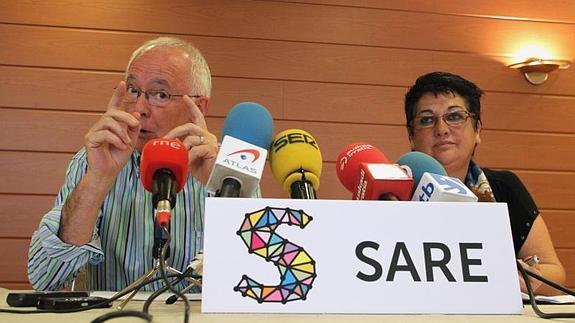
Joseba Azkarraga, spokesperson for Sare and lawyer Asun Landa, at a press conference
More recently, however, the Abertzale Left’s leadership has been placing the emphasis on combating the dispersal and, according to some of their critics within the movement, abandoning the demand for amnesty. Perhaps the leadership felt that dispersal was an issue they had the capacity to change (though it is difficult to see how), whereas without an armed struggle to use as a bargaining chip, a prisoners’ amnesty may have seemed out of reach.
Meanwhile, last year, Sare (“Network”) was created by the AL leadership to pick up the threads dropped by Herrira but little has been heard or seen of it. The organisation’s spokesperson is Joseba Azkarraga, who has a somewhat radically fragmented track record. During the 1960s and 1970s a member of ETA (a fact missing from his Wikipedia entry in Spanish), he left them and joined the christian democrat PNV (Basque Nationalist Party). Azkarra was elected to be member of the Alava province local government for the PNV in 1979, a role he fulfilled later for Bizkaia province 1982-1986 and in the latter year also for the province of Guipuzkoa — representing the PNV throughout.
In 1987 he was part of a split from the PNV that led to the formation of Eusko Alkartasuna (EA), for which party he was elected a member of local government for Bizkaia in 1989. He was a member of EA’s National Executive 1987-1993 and 1999-March 2009, in between which periods he had withdrawn to concentrate on his business in the banking sector. From September 2001 to May 2009, he had the responsibility of Councillor for Justice, Employment and Social Security for the Basque Government. He has been quoted as saying that the more prosecutions of Abertzale Left activists the better – this from a man with a law degree in a State where prosecutions of Basques are more often than not ensured by “confessions” extracted by torture and where the standard of “evidence” required to convict is derisory.
Grumbling, particularly among younger activists about the emphasis on the institutions and the “abandonment of the street”, has been growing over the years. “Our movement’s spokespersons no longer speak of ‘freedom’ and ‘socialism’ but use more ambiguous words like ‘right to decide’ and social justice’ ” is a growing complaint.
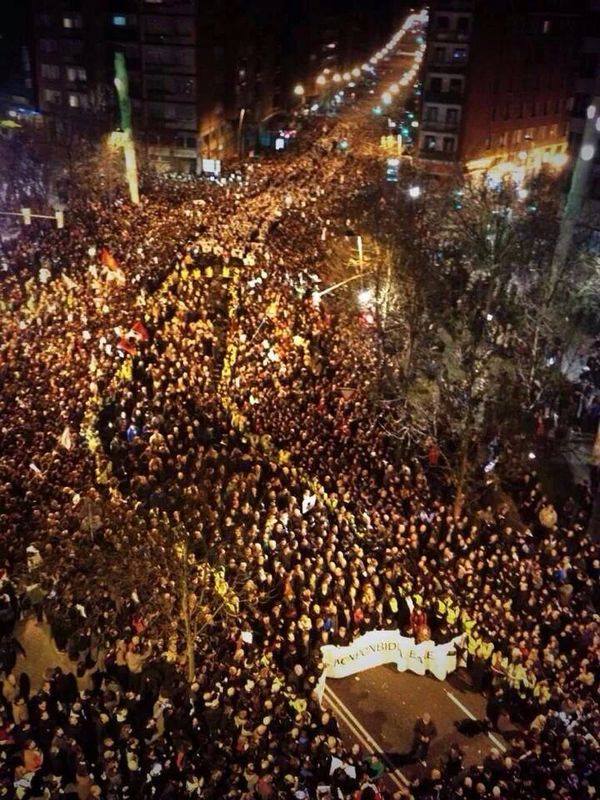
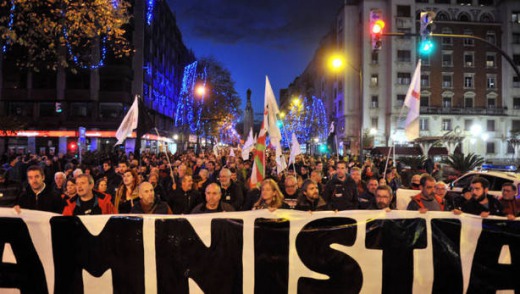
Recently an organisation called Amnistia Ta Askatasuna (“Amnesty and Freedom”) was launched to campaign not only against dispersal but for amnesty for the prisoners too. The movement also goes by the name of Amnistiaren Aldeko Mugimendua (“Amnesty Movement”). In August of this year ATA/AAM held a small but significant demonstration in Bilbao associated with the annual alternative festival there which is strongly patronised by youth. At the end of November they held another in the same city, this time attended by an estimated 9,000.
New solidarity campaign for for political prisoners raising demand of amnesty takes to the streets Bilbao 28 November 2015
In a Basque alternative radio station interview in August, some of ATA/AAM’s spokespersons complained of attempts to malign and isolate them but said they were overcoming these tactics and gaining support. The AL’s bilingual daily newspaper, GARA, did not publicise their demonstration in advance and their estimate of the attendance afterwards was about half of the real figure. The report also neglected to mention the messages of support from a number of political prisoners to the rally.
In December, the six alleged ETA prisoners awaiting trial in Paris on charges involving kidnapping, car and weapons theft and, for two of them, murder of a police officer, made a press statement denouncing the ATA/AAM group and claiming that they were using the prisoners as a Trojan horse in order to attack the whole recent direction of the Abertzale Left. They also accused them of trying to get Basque prisoners to leave the prisoners’ collective, the EEPK. No evidence was produced of this and the ATA/AAM were not asked to comment. GARA published the Paris statement under a headline containing the allegations without even putting them in quotation marks. It is rumoured that GARA lost many subscribers after that reporting.
It seems likely that this controversy will sharpen over the coming months with people, including prisoners, being obliged to take sides and it may be that it will be characterised by a similar bitterness to that which exists in the Republican movement in Ireland. But unlike the case of Ireland, the numbers of Basque prisoners in the jails remains very high. In addition, the Spanish state continues to jail people who are clearly political activists which adds to the political prisoner population. Without a change in that situation, the likelihood of very serious contention within the movement is high and on a much larger scale than has been the case in Ireland.
The recent dismal electoral showing of EH Bildu can only increase unhappiness within the movement and lead to judgements critical of the AL leadership and, inevitably, to one degree or another, of the path they openly set out upon a little over five years ago.
Background – the origins and trajectory of the Abertzale Left
Born during the Franco dictatorship, the Abertzale Left (Basque: Ezker Abertzalea; Spanish: Izquierda Abertzale) is a broad alliance of patriotic and Left elements with many aspects situated on the social, cultural-linguistic, trade union, media and of course political fronts. The movement was subject to heavy repression from the outset and after nearly a decade a section responded by taking up arms. The Basque Nationalists had done that against Franco in the Civil War – however, the Abertzale Left was doing so in a country occupied by the victors of that war.
Not many outside the Basque Country realise that ETA (“Basque Country and Freedom”) is more than “the armed wing of the Basque patriotic movement” — it is the origin of the Abertzale Left, operating solely politically and culturally (albeit clandestinely) for nine years, its activists spied upon, arrested, tortured, jailed. Eventually ETA took up the gun.
It was one of the main ideologues and organisers of ETA, José Miguel Beñaran Ordeñana (alias “Argala”, 1949 – murdered by GAL 21st December 1978) who pushed for the legal and semi-legal aspects of the work to form themselves into separate organisations from ETA while the parent organisation kept a relationship with them.
Although the old Basque Nationalist Party was legalised under the new form of the state after the death of Franco, repression of the Abertzale Left continued. Nevertheless the movement continued to grow, in particular its many non-military aspects, although they too were and are subjected to heavy repression.
Despite the adaptability of the movement and its significantly wide base (between 12%-20% on past electoral showings, despite banning and disqualifications of electoral platforms), it was difficult to see the validity of its strategy of combining armed struggle and popular political movement within the Basque Country, with regard to its long-term objectives of national independence and socialism.
The ruling classes of both the Spanish and French states have a long imperial history along with a strong traditional insistence on the unity of their “home” states, on which they have never shown a willingness to compromise. That is reflected not only within their main right-wing parties but also within the main social-democratic parties and the remains of the old Moscow-orientated Communist parties. In the Spanish state the situation is even more problematic, since the Basque Country and Catalunya are two of the most economically successful within the state, outperforming nearly every other region by a significant margin. Why would the Spanish ruling class wish to give those regions up?
The total Basque population is only around 3.5 million, some of which is within the borders of the French state. The Spanish state has a population of around 45 million outside the Basque Country and even with the subtraction of that of Catalunya (7.5 + million) and the Balearic Islands (just over one million), that still leaves a population of 36.5 million from which to draw soldiers and police.
According to Wikipedia, “the Spanish armed forces are a professional force with a strength in 2012 of 123,300 active personnel and 16,400 reserve personnel. The country also has the 80,000 strong Guardia Civil which falls under the control of the Ministry of Defence in times of a national emergency. The Spanish defence budget is 5.71 billion euros (7.2 Billion USD) a 1% increase for 2015.” The Wikipedia paragraph ends with the ominous sentence that “The increase comes due to security concerns in the country.”
Those figures of course do not include the other police forces, such as the National (Cuerpo de Policía Nacional or “los Grises”)), with a strength of nearly 88,000. This armed force, along with the Guardia Civíl (“los Verdes”), has been traditionally repressive of the Abertzale Left, a task now mostly left to their respective forces in the Basque Country, the Ertzaintza and Policía Forál, forces which, like their counterparts in Catalunya, the Mossos d’Escuadra, have been viciously engaged in repression of the patriotic movements. Then of course there are the municipal police forces inside the Basque Country and elsewhere which can be mobilised as backups to military operations.
Add to that the fact that Nafarroa (the fourth southern Basque province) contains significant Spanish unionist and right-wing elements (it has voted a PP majority for decades) and that much of the Basque Nationalist Party’s following is hostile to the Abertzale Left and it is difficult to see how the AL ever expected to win a straight contest of strength with either state.
Perhaps, like the Irish Republican Movement, with which it has traditionally had fraternal relations, the Abertzale Left thought to make itself such a nuisance to the power occupying it that the latter would get fed up and leave them to it. In both cases but even more obviously so in the case of the Basques, that would have been a serious misreading of the situation and an underestimation of the importance to the power in question of remaining in possession.
It seems clear that the only scenario in which the Basque Country could set up a truly independent state would be one in which the Spanish state at the very least (and probably the French one too) would be unable to send repressive forces in to deal with such an attempt. And what would be the nature of such a scenario? Why, nothing less than that the ruling class of the Spanish state (probably of the French state also) were facing a revolutionary situation across the rest of its territory. Not only would such a situation tie down much of its armed forces but it would have the potential for soldiers refusing to fire on workers, mutinies and defections to revolutionary forces.
Working from such an analysis, activists of the Abertzale Left, as well as organising their movement within the Basque Country, would have been busily building relationships with the revolutionary movements and organisations across the Spanish state. But apart from the electoral alliance for the European Parliamentary elections of 2009 (the creation of the Iniciativa Internacionalista platform, which was the victim of massive electoral fraud by the State), the Abertzale Left has never seriously set about such a project. On the other hand, the formerly-Moscow orientated communist party and left-social democrats across the state, as noted earlier, have also kept at a distance from the Abertzale Left and from their aims. The left coalition of mostly Trotskists, Communists and radical social democrats of Izquierda Unida has done likewise.
There are however small formations of revolutionary communists, anarchists and left-independentists, along with anti-centralist movements with revolutionary potential, as well as a number of anti-unionist and independent trade unions throughout the state. To be sure, the immediate prospects are not glowing – but what other option is there? And how else can one be placed to take advantage of a revolutionary upsurge across the state should one occur?
A significant deviation from the original route
During the 1980s, during an ETA truce, there were peace talks held between ETA and the Spanish Government which came to nothing. Similar overtures during the early 1990s had similar results.
It appears that at some point in the late 1990s, perhaps attracted by the development and apparent gains of the Irish pacification process, the leadership of the Abertzale Left began to look for a different way out of their difficulty. Arnaldo Otegi is widely seen as the architect of this trajectory.
Part of this new approach involved seeking alliances with the PNV and with social-democratic parties within the Basque Country. The PNV is the party of the Basque nationalist bourgeoisie, no longer prepared to fight the Spanish ruling class as it was in 1936. It has its capitalist interests and has a record of jobbery and corruption including its involvement in the TAV, the High-Speed Rail project. It even asked the Spanish state to make militant opposition to this project a terrorist offence. The PNV manages its police allocation, the Ertzaintza, a vicious force active against the Abertzale Left and against striking workers and responsible for the serious injury and death of several. The PNV also manages the Basque TV station EITB and therefore controls both the arms of repression and of propaganda. Although the AL criticises the PNV from time to time this is mostly for the lack of support for a broad front against the Spanish state – AL spokespersons rarely attack it for its capitalist exploitation or jobbery.
Otegi was apparently active with ETA in the French state for around ten years and served three years in a Spanish jail for an ETA kidnapping in 1987, after which he involved himself in political activism. Ten years later the jailing for seven years of senior members of Herri Batasuna left a vacuum in the leadership of the organisation which Otegi filled along with Joseba Permach (sentenced to three years jail in August 2014 – but halved on appeal — in the “social centres trial” which confiscated the assets of the centres) and Pernando Barrena.
Arnaldo Otegi, leading figure in the Abertzale Left and seen as architect of recent path of the movement, addressing a rally some years ago.Joseba Permach and Pernando Barrena giving the clenched fist salute at a political rally some years ago. Both have been close colleagues of Otegi’s in the Abertzale Left’s leadership and shift in strategy some years ago
Otegi led a number of initiatives for the Abertzale Left to embark on a different path, which combined ETA ceasefires, talks with other parties, and militant rhetoric. The latter landed him with a 15-month sentence of which he eventually served one year. Subsequently he has been arrested a number of times, convicted twice and exonerated twice. In 2011 he was charged with trying to rebuild Batasuna, the AL party banned by the Spanish state and was sentenced to ten years; this was reduced on appeal to 6.5 years so that he is due out soon. In 2013 he was elected General Secretary of the AL social-democratic political party Sortu.
Despite the relatively short prison sentence (compared to many other Basque prisoners) and the fact that he appears to be in good health, a campaign was started for Otegi’s release and a petition circulated around and outside the movement. This broke a long-standing rule in the movement that there would be no campaigning for individual Basque political prisoners, from which an exception was previously made only in the cases of seriously-ill prisoners. Nevertheless the campaign petition and Facebook page has been circulated through the movement without any official condemnation — or even distancing from — by the AL leadership. However the campaign has attracted some muted criticism across the movement.
The AL leadership proposed a “peace process” but the problem was that, unlike the case with the British, the Spanish ruling class had no interest in developing anything like that. Their aim was to crush the movement with an iron glove, not to “choke it with butter” as their British counterparts had done.
So the Abertzale Left took the road of unilateral ceasefire. This seemed to many of their friends a doomed tactic since it left the Basques with nothing to bargain. In September 2010, ETA announced a ceasefire, saying it wished to use “peaceful, democratic means” to realise the aspirations of the Basque people. The Spanish state’s reaction was not encouraging but nevertheless on 20th October the following year, the organisation announced a “cessation of armed activity”. This followed the conclusion of the “International Peace Conference” held in Donostia/San Sebastián.
The composition of the conference was clear indication of the AL leadership’s projected route and in particular the type of allies it sought internationally: former UN Secretary-General Kofi Annan, former Taoiseach of Ireland Bertie Ahern, former Prime Minister of Norway Gro Harlem Brundtland, former Interior Minister of France Pierre Joxe, President of Sinn Féin Gerry Adams and British diplomat Jonathan Powell, who had served as the first Downing Street Chief of Staff. To summarise, a collection of servants and executives of imperialism, colonialism, capitalism and even executives of repression and one exposed in a financial corruption scandal.
The declaration at the conclusion of the conference was also supported by former UK Prime Minister Tony Blair, former US President Jimmy Carter and the former US Senator and former US Special Envoy for Middle East Peace George J. Mitchell. In other words, former leaders of US and British Imperialism and one of their agents.
Despite the abandonment of armed struggle by the Abertzale Left leadership, the meeting did not include Spanish or French government representatives and the ruling classes of both states remained unreceptive to the overtures of the AL leadership. Not only that, but the Spanish state continues to arrest the movement’s activists, to torture and to jail them. No amount of criticism by committees for the prevention of torture working for the UN or for the EU, nor condemnation by Amnesty International and many human rights associations within the Spanish state, have had any visible impact on the operations of the Spanish state in recent years. And “confessions” obtained by torture continue to be used as admissible ‘evidence’ for the Prosecution even when withdrawn by the victim and the torturers denounced in court.
The ETA ceasefire continues to date and a number of other statements have been made by ETA including one in which they announced the destruction of a number of weapons, verified by a decommissioning expert. A number of “international conferences” have been held with further calls on the Spanish state to cooperate, also without significant result.
The new €2 coin design is now published and the coins will themselves be put into circulation in the New Year. Designs were submitted and the winning design for the ordinary currency coin is by Emmet Mullin, while the design for the gold and silver special editions is by Michael Guilfoyle. Both designs incorporate the statue of “Hibernia” and that name is prominently displayed on one of side of the coin and although Guilfoyle’s design incorporates some words from the 1916 Proclamation, they are in the background to the representation of “Hibernia”. The image is taken from a the centre one of a trio of statues erected on the GPO in 1814, while still under British occupation.
One side of the new Irish coin
“Hibernia” was regularly used as an image to represent Ireland by “Punch”, a satirical racist British publication and she was always
(British penny showing the image of “Britannia” — a martial female wearing a crested war helmet, carrying a shield and holding a trident (perhaps to indicate domination of the seas).
shown as a pretty younger sister of “Britannia”, in need of her older sister’s protection (usually from the rebellious Irish, the despair of poor “Hibernia”). She was never in martial garb, unlike Britannia herself who was usually represented as a majestic and martial figure, with a crested war-helmet and shield and sometimes carrying a trident (perhaps to indicate domination of the seas).
That representation of Britannia appeared not only in the cartoons of “Punch” and other publications but also in sculpture — for example at the top of Somerset House, in the Strand, London – and also on many mints of British penny coins.
Of course, in British history the most likely model for the representation of a female fighter was Boudicca (“Boudicea”) who, after her humiliation and the rape of her daughters by Roman Legionnaires, raised her formerly pacified tribe of the Icenii against the Roman occupation and came close to driving them out of Britain. The irony is that the whole of Britain at that time was Celtic, as were Boudicca and the Icenii. But the English ruling class appropriated Boudicca into their English iconography as they did also with King Arthur and the Round Table knights.
Romanised and civilised
Ireland had many names among the Gael but “Hibernia” was not one of them. “Hibernia” was a late Latin name for Ireland, which the Romans had previously called “Scotia” (yes, “Scotland” originally meant something like “the land the Gael have invaded and settled and defend”).
The Roman linguistic connection is interesting – Irish Anglophiles and some English lovers of Ireland have been wont to bemoan the fact that Ireland was never conquered by the Romans. These commentators have tended to see Romanisation as civilising, forgetting perhaps the words of Rome’s own greatest historian, Publius Tacitus (or Gaius Cornelius Tacitus; c. 56–after 117 AD) who said that “they have created a desert and call it peace.” Calling Ireland “Hibernia” might be a way to bring that Roman conquest belatedly to the unquiet isle, to make her more “civilized” — in fact more like her neighbour and therefore more accepting of her neighbour’s domination and of her ways.
When John Smyth designed the statues to go on top of the General Post Office building in Dublin’s main street, then Sackville (but now O’Connell) Street, Dublin was widely considered the second city of the British Empire, next to London. The building opened to the public in 1818 but Dublin’s slow decline in status had already begun. Since the abolition of the Irish Parliament by the Act of Union in 1801, following the suppression of the United Irish uprising three years earlier, the Irish Members of Parliament had to go to London to take their seats, taking a great deal of political, commercial and social life with them. Irish landlords deserted their Irish estates in greater numbers, leaving them in the hands of their often rack-renting agents as the owners demanded more and more rents to keep them in their homes in Britain and their lifestyle there and in Europe. Throughout the 19th Century the social focus slowly followed the political to England – except where a militant nationalist one arose.
Statue representing “Hibernia” on top of the GPO, a martial female wearing a crested helmet, holding a spear and a harp.Sculpture representing Britannia on top of Somerset House, The Strand, London city centre. She is a martial female wearing a crested war helmet, carrying a shield and holding a trident.
Submission or subversion?
Perhaps the representation of Hibernia by John Smyth, reflecting that of Britannia, was meant to show Ireland as equal in grandeur to her dominant neighbour. The Society of the United Irish had been part of a wider cultural movement that sought to explore and appropriate an older Gaelic culture for the colonists, many of them settled for generations on Irish land. Assertions of autonomy and complaints about English political and commercial restrictions had been part of that movement too and had found sharpest expression in the republican and separatist ideas of the United Irish. Some aspirations remained, severely modified. Perhaps it was John Smyth’s intention to show Hibernia as grand but there was no mistake about who was really in charge in Ireland, Hibernia or Britannia.
As if to underline the relationship, Smyth placed a statue representing “Fidelity” on Hibernia’s left on top of the GPO. What could that fidelity be, except to the Empire? Some suggest that because Fidelity holds the Key and is with the Dog, that she really represents Hecate. I know nothing about Smyth nor have I the time to research him at the moment but it is possible he was being somewhat subversive in that representation. Hecate had a number of earlier and later interpretations and the key seems to have appeared later – the key to the household perhaps but also to Hades, the Underworld.
On Hibernia’s right, John Smyth erected the statue of Hermes, known to us as the messenger of the gods but also representing commerce. Commerce, then as now, was the backer of military and political initiatives, indeed often the driver. Of course, many of the Irish bourgeoisie, both native and colonist in origin, wanted a successful commercial Ireland. But after 1798 and 1801, they were not going to get it. From then on, most progress for Irish finance would be made through investing in the Empire rather than in Irish industry and trade.
Whether the representation of Hibernia was intended as some kind of subject of Britannia with pretensions to something grander or was in fact just aping her better, dressing in her mistresses’ clothes when the lady was away, is a moot point. What is certain is that neither the image nor the name itself is of native origin.
The names for Ireland
As noted earlier, among the many names of the Gael for Ireland, “Hibernia” does not appear. The clan-based resistance had used Irish names to describe the land and this continued in the wars against Cromwell and William, with “Ireland” being the most common name when speaking in English by both sides of the wars.
The United Irishmen, a late 18th Century republican movement for independence led mostly by descendants of colonists and largely English-speaking, called the land “Ireland”1 or “Erin” (a phonetic representation of the Irish-language “Éirinn”, the dative case of “Éire”). These names, along with the genitive “Éireann” later, continued to be those most often used by nationalists of the 19th Century, the Young Irelanders, the Fenians, the Land League, as well as by the various advanced nationalist and revolutionary organisations in the early years of the 20th Century2.
“Ireland” is named in a banner of the Irish Transport & General Workers’ Union in October 1914, with the Irish Citizen Army parading outside.
This continued to be the case during the War of Independence and by both sides in the Civil War and was the case with the setting up of the 26-County state and with the various national resistance movements to that state of affairs since then. One finds “Hibernia” in the Ancient Order of Hibernians, of course and in the Hibernian Bank but they are exceptions – it is “Éire”, “Erin” or “Ireland” over all – and has been so for many centuries.
“Hibernia” is a foreign colonial import, both in terminology and in concept. She is poor image of her big sister on “the mainland”, the real boss. The use of her image and of her name is inappropriate to commemorate the 1916 Rising but their use may signify much more than an error – they may reveal a subliminal desire to return to the Empire, or at least the Commonwealth, in the psyche of those who were never all that sure they should have left it.
1“From my earliest youth I have regarded the connection between Ireland and Great Britain as the curse of the Irish nation …” Theobald Wolfe Tone
2Inghinidhe na hÉireann, Na Fianna Éireann, The Irish Citizen Army, The Irish Transport & General Worker’s Union, The Irish Volunteers, Óglaigh na hÉireann. Also, when the Abbey Theatre was founded by W.B. Yeats and Lady Gregory in 1904, they declared it was “to bring upon the stage the deeper emotions of Ireland”.
As we enter the New Year, be prepared for attempts to engage us with a whipped-up excitement of elections and “new” ways of doing things. A diversion — something like a cross between those periodic shows like the Eurovision Song Context and the Lottery. And like the lottery, there will be a winner but it won’t be us. Whichever party or combination of parties succeeds, it will be the ruling class that wins. A diversion in the other sense too, in that it seeks to divert us from our path.
There is no third way, there are no alternative routes, short cuts, slip roads. There is the revolutionary road and the other. The other leads to the continuation of capitalism. But the other road is often represented as a number of different roads, and the only difference between them is in the degrees of exploitation and repression it will deliver. The non-revolutionary road can NEVER lead to social justice.
To be sure, there are many slip roads and byways on the non-revolutionary road but none of them lead to revolution; therefore they do not lead to socialism and therefore nor do they lead to overcoming the capitalist attacks on the working people and the continuing penetration of imperialism into our way of governing ourselves and our social provision, into our natural resources and into our labour power.
Every now and again, a “new” road is proposed, in which “new alliances” are sought, projects to “build a broader front” away from “clichés” and “slogans of the past”. And it turns out that there is nothing new in these roads except the words being used and sometimes not even those. There is talk of accumulation or summation of forces, for which some objectives must be dropped, for which descriptions must be toned down, for which slogans that mean many different things to different people have to be adopted. Well, either they are heading (and wanting us to follow) for capitalism or they are heading for socialism – there are no other destinations. And if they are heading for socialism, why do they not say so? Why do they not reveal their full program?
There are those who say we can reach socialism by building this wide movement with deliberately unclear slogans and program, building on the hostility towards the present state of things and the dominant political parties. How can that be, if there are basically only two roads? How can this wide movement of discontent displace the ruling class and their system, if it is not consciously heading up the road of revolution? It seems that at some point the curtain will be whipped aside by the socialists in these wide movements and the masses will be shown the monster of capitalism and will realise it is so horrible that it must be killed. And of course they will do it. How? Ah, that’s a step too far, comrade, stick with us, trust us, we’ll tell you when the moment comes.
One can see the fates of Syriza in government in Greece and of Podemos in opposition in the Spanish state to see the enormous expectations that are raised and then cruelly dashed. We have seen the like before in our history in Ireland and we will see that again. As we go into 2016 we will have such illusions of a possible electoral socialist future dangled before us, though on a smaller scale.
Elect Sinn Féin and we’ll have a really different situation, a real change – or so we are told. Nonsense – a party that has never seriously confronted capitalism, a party in fact whose President says publicly (and without correction by his party) that it does not have a problem with Capitalism. A party tried in government of a kind already, albeit in a colonial statelet, that has demonstrated itself unwilling to make a determined stand for social justice in welfare and education and which has maintained a colonial repressive police force. This is also a party which has openly welcomed leaders of US and British imperialism and signaled its acceptance of the treason of the ANC leadership to the South African masses. In the 26-Counties this party showed its eagerness to impress the ruling class with how “responsible” and “law-abiding” it is, so much so that they are not even willing to endorse the civil disobedience tactics of refusal to register for the Water Charge and refusal to pay the charge.
Perhaps, once in the Dáil they might become a revolutionary socialist party? One can of course hope (or pray) for miracles but one has no right to expect them.
Another illusion being dangled before us is the election of some kind of “Left-wing coalition”, whether it would include SF or not. We have a Dáil of 166 seats so it would be necessary to elect no less than 84 to have an absolute majority – a coalition of 84 independents, TDs from small socialist parties and whoever! And what program will this “Left-wing coalition” have that all 84 can be expected to adhere to? We don’t know and we have no revolutionary mass movement which has put forward the demands to incorporate into such a program. There is no need to even consider what measures the ruling capitalist class would take should there ever be a Dáil majority with a revolutionary program – we are not within an ass’ bray of such a moment.
Yes, I said we have no revolutionary mass movement — but I was not dismissing (nor “dissing”) the movement of resistance. For two years we have had a wide and numerous movement of resistance to the Water Charge or Tax, carrying on from the previous movements against the Household Tax and the Property Charge. With regards to the latter two, the first was successful but the second was successfully bypassed by the State by changing the law, enabling the State to collect the charge directly from our income. Whether this was illegal or not is beside the point – they did it and anyway, to whom does the law belong if not to them? Certainly not to us!
With regard to the remaining one, the movement of popular resistance to the Water Charge continues, even without much central leadership, without the practical support of the trade union movement. Those absences may have prevented it being completely taken over by opportunists and careerists and state agents but it has also prevented it from waging a campaign of sustained resistance, of presenting an agreed slate of demands of sponsors and of candidates for election, of putting real pressure on the trade union leaderships and of regular mobilisation of numbers to defend resisters being hounded through the courts and threatened with imprisonment. Nevertheless, the resistance continues.
But we should not fool ourselves that the campaign is revolutionary – it does not have as an objective the overthrow of the capitalist system. To be sure, some and even many of its supporters may wish for that – but it is not an objective of the campaign. In fact, even the demand of the abolition of the Water Charge is not a revolutionary demand — that can be achieved without overthrowing the system.
For revolutionaries, reforms and partial gains are not things to be ignored. We take our stand on them with regard to a number of criteria. In the case of the Water Charge, the great thing is that it was and is being resisted by civil disobedience and if this tax should be eventually defeated through this tactic we should celebrate the victory. We should proclaim that resistance does work, that breaking the law of the State is necessary when it impedes our progress. And that the campaign has exposed the role of the State – legislature, police and courts in repression and service of capitalism. But we should be clear with the movement that it is, however great, a temporary victory – the system remains and while that is so we are open to many, many other attacks which we can safely predict will follow.
The victory of the movement of civil resistance can be put to use for revolution – in terms of tactical and strategic lessons learned by individuals, communities and organisations. The pool of revolutionary activists can be enlarged. This can best be done in the context of a revolutionary movement which is not something we have but which it is not beyond our capabilities to build. But it will not be built by elections nor by electoral campaigns.
As the elections approach we will be gabbled at from nearly every quarter: Vote for Us! Vote Against Them! Vote for Me! Then there will be the shrill “You Must Vote!” and “You Have No Right to Criticise If You Don’t Vote!” And even the fewer but also shrill voices that shout “Don’t Vote!” and “You’re Supporting the System If You Vote!” Really, what a lot of nonsense all of that is. The system will neither be changed by us voting in its elections nor will it overthrown by us not voting in them. Nor will voting in them strengthen it significantly, except in the case of a popular boycott which is not even on the political horizon.
There is an Irish Republican tradition of standing in elections and not taking seats in the Dáil and whether one is a genuine revolutionary or Republican (choose whichever label you prefer) is judged by whether one takes that seat or not if elected. This seems to me to be a false test. There have been revolutionaries who took seats in parliaments on the one hand and on the other, reformists within revolutionary and resistance movements who worked away without taking parliamentary seats. While it is true that opportunists and careerists often wish to enter parliaments in order to further their careers and to pay off their senior party supporters, there is no guarantee that not doing so will prevent activists from being corrupted and co-opted. There are so many other rewards the system has to offer – a secure job, seat on a company board, status and recognition, special awards, publication of writings, career advancement, jobs in various institutions and civil service, funding of one’s project as a non-government organisation, paid expenses, paid travel ….. along with safety from the danger of arrest, the dawn raid, the assassin’s bullet, torture, years in prison.
We can of course vote for individuals in order to keep other individuals out or to put someone we like in or to maintain a useful few voices in the Dáil. But let us not fool ourselves that is really making a difference to the system as such. Only revolution can do that. Of course the revolutionary road is not without its switchbacks, potholes and blind turnings. Nevertheless, it is the only viable road and if we are not heading up it then we are not going to bring about any real or lasting change.
Vote or don’t but the crucial thing is to organise resistance, to contribute to it practically and ideologically. And the latter does mean not spreading illusions.
This is a timely and interesting article by Liam Ó Ruairc about the significance of the Easter Rising beyond our little parish.
Apart from that, it would seem to suffer a little from a terminology problem with regard to “imperialism”. In the world today this is not an insignificant issue. At the time of the 1916 Rising it was common for commentators to conflate the words “colonialism” and “imperialism” — and why not, since we had the British Empire, the French Empire etc. However, that same year, VI Lenin completed his work “Imperialism — the final stage of capitalism” which he published the following year but exchanging, for the censor, the word “highest” for “final”. Lenin described imperialism as the merging of finance with industrial capital and its export to the underdeveloped world and also explained how its colonialism was undermining British industrial capacity and competitiveness by starving it of capital which was instead being invested in the colonies for quick return of superprofits.
He showed that imperialism could be practiced where the developed state did NOT have colonies but instead had influence.
Decolonisation was indeed one of the big processes of the early to mid-21st Century, as quoted in the article, but it was accompanied by an increase in imperialist expansion, with the USA becoming the world leader and displacing the former colonial powers of Britain and France. By and large this was achieved without occupying countries and setting up colonies of UStaters within them.
Lenin also showed that imperialism leads to war; colonialism did too but not on the scale that imperialism has. Colonial wars were largely limited by the amount of people available to occupy colonies whereas imperialism fights most of its wars through proxies (with some notable exceptions such as Vietnam, Ireland, Iraq and Afghanistan, involving large committal of its troops but even there, proxies have been/are also used).
Those regimes that imperialism cultivates were later classified by national liberationists as “comprador (buyer) capitalists” or “neo-colonials”. Such an analysis of Ireland today would have to conclude that the Six Counties are a remaining British colony and the Twenty-Six a neo-colony.
In the “comment” section of the article there is a reference to another article on the same theme of international importance which is also of interest.
In less than six months, the one hundredth anniversary of the 24-29 April 1916 Easter Rising will be commemorated throughout Ireland. What is striking about the so-called ‘Decade of Commemorations’ is how insular its outlook is: the 1912 Ulster Covenant, the 1916 Rising or the setting up of Northern Ireland are seen as a purely Irish phenomenon, divorced from global trends. As Edward W. Said once noted, while the Irish struggle was a ‘model of twentieth-century wars of liberation’, “it is an amazing thing that the problem of Irish liberation not only has continued longer than other comparable struggles, but is so often not regarded as being an imperial or nationalist issue; instead it is comprehended as aberration within the British dominions. Yet the facts conclusively reveal otherwise.”[1] This article will argue that the significance of the 1916 Easter Rising lies less in its