A campaign for conservation of the ancient Moore Street Dublin inner-city street market area and 1916 Battleground, in its 11th year of Saturdays on the actual street is seeking to reach 2000 on-line signatures for the group’s petition this year.
The site was formerly under threat of construction of a giant ‘shopping mall’ from the ILAC to O’Connell Street. However ‘shopping malls’ are not making so much money nowadays so the new plan is largely a ‘shopping area’ with an hotel and a new road from the ILAC to O’Connell Street.
Picket/ lobby of Dublin City Council in 2014, petition stretch and posters organised by the Save Moore Street From Demolition Group, founded a couple of months earlier to prevent Dublin City Council City Manager giving property speculator Joe O’Reilly Nos. 24-25 in exchange for Nos.14-17, which would have allowed him to demolish from No.25-No.18. The campaign was successful in preventing that as councillors voted against the swap. (Photo: SMSFD archives)
Moore Street is of course already ‘a shopping area’ but what that means to property speculators is a street of chain stores, something like the Grafton and Henry Streets. Such streets are busy during shopping hours but largely deserted at night and anathema to the living social city centre.
Independent small shops and street stalls characterise a street market, typically with some cafes, a bakery and restaurant. But the agent of Hammerson, the speculator company, has closed down a bakery and a number of successful restaurants and cafés on the street.
On the Friday of Easter Week, 300 or so of the GPO garrison evacuated the burning building and occupied the central terrace in Moore Street to gain a respite, setting up their new HQ there and a field hospital caring for their wounded and for a wounded soldier of the British Army.
The new intended street would cut right through the historic 1916 terrace, the footprint and path traversed by much of the 300 or so GPO Garrison in 1916 as they evacuated their burning former HQ and prepared to relocate to William & Woods site in nearby King’s Inn Street.
Moore Street, according to campaigners, is of great Irish cultural and historical importance but is also of international historical stature: surrender site of the first anti-colonial uprising of the 20th Century and of the first rising against World War and last location in freedom of five of its leaders.
Those five, Connolly, Pearse, Clarke, Mac Diarmada and Plunkett, were also five of the Seven Signatories of the 1916 Proclamation, a document of huge symbolic significance in history and still often referenced in contemporary discourse.
Campaigners point to the presence in the street of the Irish Citizen Army, which they claim as “the first workers’ army” and of its leader, Connolly along with three of the first women’s republican military organisation, Cumann na mBan: Elizabeth O’Farrell, Julia Grenan and Winifred Carney.
The Irish Citizen Army recruited women too, including appointing some of them as officers in command of male Volunteers, another first in world history.
Signed petition sheets sellotaped edge to edge in January 2016, stretched along Moore Street as the 6-day occupation of the endangered buildings came to an end and shortly before the 6-week blockade began. (Photo: SMSFD archive)
SUCCESSES AND DEFEATS
The campaign has had some previous successes, including four buildings being declared a historical monument in 2007, refusal of land-swap in 2014 (see photo), a six-week blockade of the site and a High Court declaration in 2016 of the whole area being a national historical monument.
However, the campaign insists the historical monument is all 16 buildings in the terrace, not just four. And the High Court decision was successfully appealed in February 2017 by the Minister of Heritage on the grounds that a Judge did not have the power to declare a national monument.
The campaigners, now in their 11th year of Saturdays on the street, say that they stopped counting hard copy petition signatures once they passed 380,000. But last year they started an electronic petition in which they aimed for 1,000 by year’s end — and exceeded their target.
Women Christmas shopping crowding around the petition table to sign hard copy and on-line petition last Saturday. (Photo from weekly SMSFDalbum 20 December 2025.)
This year they’ve aimed to reach 2,000 but, with nearly another 300 needed with a week to go before the end of 2025, reaching their target seems very unlikely.
The campaign group supporters say that they have held the line so long because of the support of hundreds of thousands, not only of indigenous Irish but also of settled migrants (the latter being the mainstay of the traditional fresh fruit and vegetable stalls) and want the signatures to reflect all that.
“At this stage, the strongest help we can get from ordinary people is to sign the on-line petition and to get their contacts to do so too,” said one of the campaigners on the street recently. “On-line signatures are identifiable to one person, verifiable and the total can be checked on line.”
“The authorities will remember that people took direct action in the past to halt demolition, as in the occupation and blockade of 2016 but thousands of online petition signatures are an indication that the activists represent much more than themselves alone”.
The Save Moore Street From Demolition campaigners are on the street every Saturday from 11.30am-1.30pm and their online petition is on https://my.uplift.ie/petitions/save-moore-street The group has Instagram and Facebook pages also.
end.
Note: If you found this article of interest, why not register with Rebel Breeze for free, so that you will be notified by email of subsequent articles. You can de-register any time you wish.
Last week saw the anniversary of the creation of the Irish Citizen Army, a militia formed initially to defend the workers from attacks of the Dublin Metropolitan Police on behalf of the Dublin capitalists but that went on to fight in the 1916 Rising.
The ICA was born in the struggle of the consortium of Dublin employers, led by big capitalist and Irish nationalist William Martin Murphy, to smash the militant and successful Irish Transport & General Workers Union in Dublin, where the union had its headquarters, in August 1913.
The workers were presented with a declaration to sign that they would not support the ITGWU but no union in Dublin at the time, whatever they thought of the targeted union and its founder,1 could sign such a declaration. As workers began to be sacked, others came out in solidarity strikes.
Dublin entered an extended struggle between the organised capitalists and the organised workers. In such a struggle of course, the organised capitalists had on their side the magistrates, the hierarchy of the various churches, the mass media2 – and the Dublin Metropolitan Police.
Anti-WW1 banner across Liberty Hall, HQ of the Irish Transport & General Workers’ Union in October 1914, with the Irish Citizen Army parading outside.
The DMP, a British colonial police force for Dublin would have needed no specific instructions to attack demonstrations of the ITGWU, their instincts as guardians of colonial ‘law and order’ sufficing but in addition, the attitude of the media would have outlined their ‘duty’.
And after representation from W.M. Murphy to Dublin Castle, the HQ of British control, the ‘duty’ of the DMP was outlined and they were reinforced by a number of the colonial gendarmerie,3 the Royal Irish Constabulary.4
On the evening of 30th August a mass meeting of the ITGWU in Beresford Place, outside the union’s headquarters, Liberty Hall, was attacked by a baton-wielding force of the DMP, leaving two workers mortally wounded5 with resulting running battles towards city working class areas.6
The following day, the DMP again viciously attacked crowds in O’Connell Street in front of Clery’s from which Larkin attempted to address the crowd in a meeting banned by the city magistrate.7
Not long after, a marching music band leading a strikers’ parade was also attacked by the DMP with musical instruments damaged and members injured and the leadership of the union decided that a counter-strategy was required for self-defence and possibly the very survival of the union.
The Lawrence O’Toole Pipe Band’s website lays claims to having been the victims of this attack while other history talks and articles have claimed that the ITGWU’s Fintan Lawlor Pipe Band was the one attacked. It is not impossible that the DMP attacked both.
On 19th November 1913 the Irish Citizen Army was born8 following a suggestion by Seán O’Casey and a call by Jim Larkin as a workers’ defence militia. After Larkin left Ireland for the USA in 1914, James Connolly took over leadership of the ICA and wielded it into a revolutionary force.
I recall attending a book launch or talk about the ICA in which it was described as “the first workers’ army in the world” but searching for that quotation I now find it refuted by AI online and replaced by “first working-class army”.9 I cannot agree with the latter.
Most armies, especially nowadays, are “working class” in that this most numerous social class will contribute the vast majority of its rank-and-file. In the past, the peasantry and landless labourers would have been the majority.
Despite the overwhelming worker membership of the ICA, its most important distinction was not in the social class of its membership. Nor was it totally working class, containing as it did some notable members of middle-commercial and one of a landowning classes.10
What made the Irish Citizen Army very different from other armies and qualified it, I maintain, for the title of “workers’ army” were the intentions and ideological perspective of its founders, the conditions of its birth, ethos of its members and – most of all – its declared purpose.
The ICA was founded with the express intention and necessity of defending a worker’s organisation which was resisting an attempt by the capitalist employers to break that organisation. The struggle was led by declared openly-socialist leaders who gave the call for the ICA’s founding.
In every respect, I maintain, even without a specifically socialist constitution, this was a workers’ army, formed by workers, in a workers’ struggle in defence of their organisation and of the right to organise, defending their previously-won improvements and their dignity.
And the lack of evidence of any such precursor qualifies the Irish Citizen Army as “the first workers’ army in the world.”
However, none of the preceding makes it a socialist organisation, in my opinion. A socialist organisation would have as one of its principal objectives the attainment (whether by reformist or revolutionary methods) of a socialist organisation of society.
As to Lenin having allegedly called the ICA “the first Red Army in the world”, I have searched for the original reference without success, finding only it quoted by speakers, writers, organisations and authors – but never with a reference of where and when Lenin supposedly said it.
I strongly suspect that Lenin never said that. But even if he had, the ICA’s constitution does not support it, being rather of a democratic nationalist and anti-colonial character.11
Socialist Republicans today approve of the Irish Citizen Army throughout the 1913-1916 period. But it is not unknown for them to go further and to characterise it as socialist republican in nature and orientation. I don’t see evidence of this in either the ICA’s constitution or in its membership.
Though certainly Irish nationalist in intention, the word ‘Republic’ is not mentioned anywhere in the constitution. One might argue that it was understood but I can’t see the evidence for that either. Some contemporary prominent Irish nationalists were not even wedded to the idea of a Republic.
The 1919-1921 IRA was not a socialist organisation. Nor was the monarchist Sinn Féin party, even after its founder Griffiths permitted its reformation as Republican in order for the disparate nationalist movement to contest the UK’s 1918 General Election on an abstentionist manifesto.
The political leadership of the Republican movement split over the British offer of dominion status with partition as against a unitary Republic. Churchill was quite adamant that the new Irish State could not be a Republic and it was not declared so until the 1937 Constitution.
Certainly the founders of the ICA were socialist Republicans but in the absence of its constitution being of a kind, for the organisation to qualify as such it must be shown to have been also the widely-embraced ethos of its membership.
Even if imagining that the membership of the ICA, like its founders and a number of its officers, were Irish Republicans, it is still a greater step to assert that they were socialist Republicans, in the sense of intending the socialist organisation of society and elimination of capitalism.12
Irish Citizen Army on the roof of Liberty Hall during a flag-raising activity. (Photo sourced from Internet)
TODAY AND TOMORROW
Whereas these historical questions may fuel debate, no debate should be needed regarding the right of workers to organise to defend and improve their conditions, nor to change the dominant political shape and allegiance of their country, nor to defend their organisation from the police.
Indeed, not only can we take those rights as legitimate and necessary to exercise but it also becomes clear that at some point we will, as workers, as socialists and/ or as Republicans, need such an army. The ruling class has its physical force organisations in the Gardaí and the Irish Army.
The history of ruling classes bears testament to the fact they never relinquish power without using violence against challenges from the rising social forces; even such social and political rights as we have were won through hard struggle, sacrifice and indeed martyrdom.
Commemorative postcard 1916, showing severe British shelling damage to the original Liberty Hall building, Beresford Place, Dublin.
The Far-Right has also given ample proof of their readiness to employ violence against the vulnerable sections of our class and against also those they consider opposed to them ideologically; the history of fascism too warns us of the need to organise our defence.
In that respect too let me briefly comment on the false “ICA” recently proclaimed in a video which, while claiming a 32-County outlook and repeating that Britain has no right in Ireland, filled the rest of their video with racist anti-migrant rhetoric, conspiracy theory and lies.
Of course they contain nothing of the workers’ solidarity ethos of the ranks of the real ICA, not to mention the anti-fascist, anti-racist internationalist and socialist outlook of the ICA’s leadership.
The ICA developed as a force for physical defence of workers’ rights on the streets, which is where the DMP and RIC attacked them. It was some years later, in the course of inter-imperialist World War I that the ICA fought in an armed rising alongside other democratic national forces.
Some, usually only among Irish Republicans, have striven also to organise a fighting force. Typically they concentrated on gaining arms and planning armed actions. Isolated from the masses, they were easily infiltrated by State agents, resulting in activists going to jail.
Captain White & Irish Citizen Army on parade on their grounds at Croydon House, Fairview, N. Dublin City. (Sourced: Internet)
While needed, I believe a workers’ defence force should, in current circumstances, concentrate on street defence-and-offence fighting tactics, also that it should be based on the broad democratic political front, on unity in action against imperialism, colonialism, fascism and Loyalism.
Defence on a broad front basis can and should educate the whole resistance movement, in its disparate ideological influences, as it may be that similar recruits in the Irish Citizen Army were educated and trained under the leadership of revolutionary socialists and republicans.
End.
Note: If you found this article of interest, why not register with Rebel Breeze for free, so that you will be notified by email of subsequent articles. You can de-register any time you wish.
1913 – A Policeman’s Lot and Murphy’s Law. Talk given at Garda Historical Society at Store Street Station, August 29th 2013 and Dublin Castle at Police Memorabilia Exhibition, November 16th, 2013 (speaker’s name not listed). https://1913committee.ie/blog/?p=1800
1Jim Larkin, a migrant and union organiser from Liverpool, had formed the ITGWU as a split from the British-based National Union of Dock Labourers after serious clashes with the latter’s General Secretary, ?????? Sexton (also an Irish nationalist). Larkin was very popular with the ITGWU’s members but much less so with other union leaders around Dublin.
2Not least the editorial and management boards of the Irish Independent, owned by William Martin Murphy, leader of the union-busting consortium.
3An armed police force under central State control, like the Guardia Civil (Spain), Carabinieri (Italy) and similar in France and Turkey.
5James Nolan and John Byrne, which Wikipedia has for years erroneously recorded as killed the subsequent day in another DMP riot in O’Connell Street, known as Bloody Sunday (1913).
6South-eastwards along Townsend Street towards Ringsend and Northwards towards Corporation Street in the Montgomery (Monto) Street area. There the residents defended the strikers and attacked the police, an example of class solidarity for which they paid soon afterwhen a DMP force paid them a visit, smashing household furniture and ornaments and beating John McDonagh. Paralysed from the waist down and in bed, McDonagh was unable to effectively defend himself and when his wife attempted to do so, she also was beaten and McDonagh died shortly afterwards in Jervis Street Hospital. (see Police Retaliation [sic] in APoliceman’s Lot and Murphy’s Lawhttps://1913committee.ie/blog/?p=1800)
7See a number of entries, including Wikipedia on Bloody Sunday Dublin 1913. Though some of those claim the deaths of James Nolan and Patrick Byrne were caused then, in fact it was the previous day that they received their fatal wounds from the police. Unmentioned in most is the case of Fianna Éireann youth Patsy O’Connor, knocked unconscious as he gave first aid to another victim of the police. Patsy O’Connor suffered repeated headaches thereafter and died on 15th June 1915 at the age of 18. https://1913committee.ie/blog/?p=2293
10I state this qualification despite Connolly’s remark in Workers’ Republic, 30 October 1915: Hitherto the workers of Ireland have fought as parts of the armies led by their masters, never as a member of any army officered, trained and inspired by men of their own class. Now, with arms in their hands, they propose to steer their own course, to carve their own future.
Constance Markievicz and Katherine Lynn were officers in the ICA but neither were born into the working class.
12I am not unaware that a significant number of individuals and organisations claiming to be Irish socialist Republicans currently spend hardly any time at all discussing the socialist organisation of society.
(Another one from the Rebel Breeze archives, this one from 2015)
I write to express my admiration for your work and my sympathies with regard to the criticisms with which you are currently being bombarded.
I hope you will forgive my ignorance of much of the work you have been doing in the area of Heritage, which is not really where my strengths lie. But I love the way you talk, the way you shoot down those critics, especially those TDs who ask those nasty questions.
And I’m sure you had something to do with removing Westport House from the NAMA sell-off, even if it is in Enda’s constituency. Such a fine example of our colonial architectural heritage!
Heather Humhpreys, Minister for Arts, Heritage and the Gaeltacht
But as we know, Minister, that wouldn’t be the kind of thing that would be appreciated by your critics. They’d rather you devoted your talents to a shabby row of Dublin houses of dubious architectural importance in a grubby street market.
A street which they say is “pre-Famine” — as if that were something to boast about! Laid down earlier than Sackville Street (now O’Connell Street) they say ….
Sure why would we want to keep a street that old …. or remember that embarrassing episode in our history either, when we lost a third of our population to over-reliance on one crop! We learned from that, though, didn’t we? Sure we grow hardly any crops at all now and get them all in from abroad.
And we live in cities now — who wants to be getting up at 6 a.m. in all kinds of weather and plodding through muck? If people like growing things that much, get a house with a garden, I say. And a gardener to do the donkey work.
Supporters at the symbolic Arms Around Moore Street event organised by the Save Moore Street From Demolition campaign in June 2016. This is the corner of Moore Lane and Henry Place, across which Volunteers had to run under machine-gun and rifle fire from Parnell Street (at the end of Moore Lane, to the right of the photo) and at least one Volunteer died here.
But I’m digressing, Minister, my apologies. Apparently the reason they want to save that shabby terrace, that “pre-Famine street” — and the backyards and surrounding lane-ways, if you please! — is for HISTORICAL reasons. Historical!
Sure have we not had enough of history – Brehon Laws, Golden Age, Clontarf, Normans, 800 years of British occupation, blah, blah, blah! Weren’t we sick of it at school?
I’ve never liked Labour too much (somehow even the word sounds sweaty) but I have to admire their Education Ministry’s efforts to remove history as a subject from the compulsory school curriculum.
I’m sure they’re doing it for their own reasons – after all, wasn’t their party founded by that communist James Connolly? Sorry, revealing my own knowledge of history there, ha, ha! But whatever their reasons, they are on the right track.
Who wants to know where we are coming from? It’s where we ARE and where we are GOING TO, that matters!
But some people just can’t let it go, can they? They trail history around like something unpleasant stuck to a shoe. So what if 300 of the GPO garrison occupied that terrace in 1916?
The Rising, if you ask me, was a big mistake and I know plenty of people agree with me, even if most don’t have the courage to say so. Wouldn’t we be much better off if we’d stayed in the UK? And kept the Sterling currency? And as for the War of Independence …. don’t get me started!
Aerial view Moore Street, looking northwards, 1960s, before the building of the ILAC and the running down of the street market.
And then there’s all that communist-sounding stuff about treating “all the children of the nation equally” — what kind of rubbish is that? Some are born to big houses with swimming pools and some are born to flats, or even rooms. That’s just the way of life.
And some will claw their way up to get to own big houses and if they are a bit uncouth, well that can’t be helped, they still deserve where they get to. And their children at least will be taught how to fit into their new station. That’s democracy! But everyone equal? Please!
Sorry, back to the Moore Street controversy. OK, after the mob pressured the Government, four houses in the street were made a national monument. But was that enough for the mob? Oh, no, not at all — eight years later the State had to buy the four houses to satisfy them.
Thankfully the specul ….. sorry, the developer, got back a good return on his investment – four million, wasn’t it? That’s the kind of thing that makes one proud to be Irish – buying run-down buildings and letting them run down more, then selling them for a million each.
That’s your entrepreneur! If only we had more like that, to lift this country up!
I must say I really liked that developer’s plan to build a big shopping centre from O’Connell Street into the ILAC, knocking those old houses in Moore Street down (although I know he had to leave those “national monument” four houses still standing in the plans).
I do hope whoever has bought the debt off NAMA and now owns those houses will carry on with that plan. Actually, I’d like the whole of O’Connell Street under glass if it were possible.
Wouldn’t it be great to do your shopping from the north end of the street to the south and from left to right, without ever having to come out into the weather? Of course, not much shopping there now, with Clery’s closed …. still ….
And then they’re going on about the market ….. traditional street market …. blah, blah. What’s wrong with getting your veg and fruit from the supermarket? Or getting them to deliver it your house, come to that? “Traditional street market” my ar….. excuse me, I got carried away there.
Those street markets are all very well for your Continentals, your Africans, Asians, Latin Americans and so on. Or for us to go wandering around in when we’re abroad on holiday, maybe. But back home? It’s the nice clean supermarkets for me any day.
Well now, if the mob insists on saving the street market, here’s an idea: why not provide a showcase stall or barrow, stacked with clean vegetables and polished fruit, right in the middle of the new shopping centre. After all, that’s heritage, isn’t it? And aren’t yourself the Minister for Heritage?
Most sincerely,
Phillis Tine-Fumblytil
Note: If you found this article of interest, why not register with Rebel Breeze for free, so that you will be notified by email of subsequent articles. You can de-register any time you wish.
In recent days we have seen the far-Right mobilise people to allegedly defend the GPO and protest homelessness, not against its causes but instead against migrants. In defence of ‘Irishness’ they also menaced an annual religious Muslim procession.
Participants in these and similar events wave the Irish Tricolour and Irish Republic flags and claim to be ‘Irish patriots’ standing up for ‘the Irish nation.’ However, it’s far from that they are in reality as we can see.
They
disgrace the Proclamation
The far-Right claim to honour our national history of resistance to colonialism and occupation and even display copies of the 1916 Proclamation of Independence.1
Yet they are often also seen and heard denouncing Muslims, in direct contravention of the Proclamation’s words: “The Republic guarantees religious and civil liberty … to all”; similarly they held protests when use of Croke Park was hired to celebrants of the Eid festival.
disgrace the GPO as HQ of the 1916 Rising
They have and do disgrace the very symbolic building they claim to be trying to protect.
They have often held racist gatherings outside it; one of their organisers2 (e.g. of weekly protests during the Covid crisis) leading a chant of support for British fascist Tommy Robinson, who defended the Paratroopers who carried out the 1972 Bloody Sunday massacre in Derry.
Their recent protest at the GPO featured as speaker a man known for his active membership of the sectarian UVF murder gang, who admitted working for British Intelligence and who called for the strengthening of the colonial British Border – and was cheered for saying so.
Cartoon by D.Breatnach
disgrace the flags
The far-Right disgrace and misuse the very flags they wave so keenly.
The Tricolour was presented to the revolutionary Young Irelander republicans3 by French revolutionary republican women in 1848. It signified peace and unity between the descendants of settlers and the indigenous Irish in revolutionary struggle against the British colonial occupation.
The flag with the words “Irish Republic” painted in white and gold on a green background was made on domestic material of socialist Republican Constance Markievicz (see next section) in her house and delivered by her to the GPO.
It was installed and flown on the roof at the Princes St. corner by Eamon Bulfin4 (see next section), a migrant from Argentina.
disown but also misappropriate real patriots
In dishonest manipulation, the far-Right claim to honour our patriots and even invoke them in their campaigns. In their agitation against migrants they hide the fact that Constance Markievicz, Thomas Clarke and James Connolly were all migrants (Connolly and Clarke no less than three times).5
Also a migrant was Eamon Bulfin (see previous section) along with many others who fought for Irish freedom and even sacrificed their lives (including Erskine Childers)6.
Placards on an anti-racist rally on Custom House Quay some years ago. The text placard quotes the 1916 Proclamation: “The Republic guarantees religious and civil liberty to all”. (Photo: D.Breatnach)
Of the Seven Signatories of the 1916 Proclamation (see earlier section), two – Pearse and McDonagh7 – were children of migrants and two were themselves migrants (Connolly and Clarke).
Among many such examples, the father of Young Irelander Republican patriot Thomas Davis (author of the song A Nation Once Again) was a migrant.
join with Loyalists and British fascists
A far-Right organiser calling for three cheers for British fascist Tommy Robinson was not the only such example and outside the GPO this week far-Right elements welcomed as speaker Mark Sinclair, a member of the UVF, a British colonial sectarian murder and terrorist squad.8
Prominent Irish leaders of fascist organisations have also shared a platform with Scottish fascist and Loyalist Jim Dowson.9 And of course how can we forget the desecration of the Tricolour unfurled among Union Jack and Loyalist flags in Belfast by some Dublin far-Right activists!10
Admitted UVF/ MI5 Sectarian Loyalist UVF murder gang member Mark Sinclair. (Photo sourced: Internet)
don’t act against British occupation
With all that background, it’s hardly surprising that the far-Right “patriots” don’t organise against the British occupation of the Six Counties or in support of Irish Republican political prisoners in jails on either side of the British Border.
burn buildings
Apart from misleading people and distracting them from the real sources of problems to Irish working people and seeking to intimidate refugees, what do the far-Right actually do? Ah, yes, they burn buildings that might be used as accommodation. A great help to the homeless indeed!
attack homeless refugee and migrant tents
But no, that’s not all. No, the brave ‘patriots’ slash tents and threaten migrants and refugees who are sleeping on the streets. They don’t take on the big landlords, bankers, property speculators and vulture funds – no, they strike down at people poorer and in worse conditions than themselves.
cover for the property speculators and vulture funds, big landlords, bankers
So with all this whipping up fear and hatred of migrants, the far-Right obscure the actual cause of the problems, which is not only Irish capitalism but its total subjection to foreign capitalism. The only ones to benefit from this activity are those who are the real causes of the problems.
are not patriots, nor nationalists
Despite their claims and flag-waving, the far-Right in Ireland are neither patriots nor true nationalists. They do not organise in defence of Irish sovereignty and against British occupation nor against foreign capitalist exploitation of Irish natural resources, labour or infrastructures.
Or the contrary, they work to distract attention away from these centrally-important issues for the Irish nation and raise false issues to divide the people. And usually their concept of ‘Ireland’ ends at the British border which the recent far-Right rally at the GPO called for strengthening!
are a sub-class of deprived individuals allowing themselves to be manipulated by fascists, MI5 and NATO
Many of those being mobilised against migrants come from parts of the cities neglected for generations, often associated with low educational level, substance misuse, unemployment and unresolved mental health issues.
The ideological fascists will recruit those elements to fight, not against the cause of their deprivation, the neo-colonial ruling class or the flooding of foreign capitalist companies into Ireland, assisted by banks and political decisions -but instead against migrant workers and refugees.
are filling a vacuum left by the Republican and Socialist movement
WILL WE LEARN FROM OUR FAILURES?
Many of those participating, while some are also unfortunate victims of Irish capitalism, will be recruited as the boot boys of fascism.
While it is true that historically capitalism in crisis turns to fostering fascism and that capitalism, including the neo-colonial variant in the Irish state is running out of other options, we must evaluate our own role in this development, examine our own failures, learn from and remedy them.
The ground was largely ceded to the Far-Right in the period of their initial growth during the Covid crisis. The socialist Left and Republican movement, in particular its organisations, had little response to the early FR mobilisations or to responding creatively to state-imposed restrictions.
Throughout that period and subsequently the socialist Left sector, despite its protestations of anti-imperialism and anti-colonialism, completely ceded the ground of Irish national sovereignty and its symbols to anyone who wished to occupy it.
They did not, for the most part, protest the use of State repression against Irish Republicans both sides of the British Border, whether through police harassment, special legislation and special no-jury courts, nor stand up for the human and civil rights of Republicans, including political prisoners.
Their distaste for the very issue of national sovereignty was reflected in their refusal to fly the Irish Tricolour, which, although now also the official flag of the Irish State, is originally and remains still a potent symbol of Irish Republican anti-colonial struggle over 170 years.
They might argue that they wished to be identified with the struggle of the working class rather than a nationalist one but they also chose not to fly the flag of the insurrectionary Irish working class, the Starry Plough, in among their internationally-recognised red flags.
The Irish Republican organisations in their fragmented movement, on the national question, failed to sustain unity even around opposition to repression of the states or even around solidarity with the movement’s political prisoners.
They also failed and, to an even greater extent, in fighting for universal affordable housing in a crisis which seems to offer no end and is seized upon by the Far-Right to target refugees and economic migrants, who of course have no responsibility whatsoever for the crisis.
This area too has been a notable failure of the socialist Left organisations which, although marching often enough in public demonstrations and participating in a couple of media-orientated occupations,11 failed to organise and lead a state-wide campaign of empty building occupations.
And so, here we are today, when the FR are able to bring Tricolour and Irish Republic flag-waving crowds on to the streets in false claims of patriotism, dividing and seeking to intimidate migrant workers and anti-racists, burning buildings and insisting on their definition of ‘Irish’ being correct.
Our omissions and failures, if we recognise and act to remedy them, also point the way forward.
End.
1In a travesty of frequent Irish Republican ceremonial occasions, it was even read out at the recent Far-Right gathering outside the GPO which was addressed by a known member of the UVF sectarian murder gang.
2Under the name Dee Wall (real name Dolores Webster).
3Including to Thomas Meagher ‘of the Sword’ who later recruited for, joined and fought in the Union Army in the US Civil War against slavery. Meagher unfurled the flag first in Wexford and later in Dublin, both acts in 1848.
4Bulfin came to Ireland around the age of ten with his family and later joined the IRB and the Irish Volunteers. After the surrender in Moore Street he was sentenced to death, later commuted to life sentence, then from Frongoch prison camp deported to Argentina from where he was the Latin American representative for the Movement.
5Clarke and Markievicz were both born in England. Clarke was first a migrant to Ireland, later to the US, then back again. Connolly was born in Edinburgh and a migrant to Ireland, then to England, then to the USA before his return to Ireland.
6Childers was born in England. He captained the yacht that brought the Mauser rifles and ammunition to Howth. Later he joined the IRA, took the anti-Treaty side and was executed by the Free State during the Civil War.
7The father of the Pearse brothers was English, as was McDonagh’s mother.
8During his trial for bank robbery for the UVF in Glasgow, Sinclair declared he had been working for MI5 which was well known to be steering Loyalist organisations. The UVF and British Intelligence bombed Dublin and Monaghan in 1974, causing the deaths of 34 people and a full-term baby, the highest death toll of one day during the recent 30 Years War.
9Rowan Croft, Herman Kelly (Irish Freedom Party) and Niall McConnell (Síol na hÉireann).
10A prominent group among the Dublin far-Right calling themselves Coolock Says No.
12For example, the 27-day occupation of Apollo House, Dublin, from 15 December 2016 by housing activists and homeless people, with speeches and performances by prominent musicians.
A large number of tenants organised by the Community Action Tenants’ Union (CATU) from a number of Dublin City Council housing estates gathered outside City Hall on Monday 12th May evening to lobby the monthly elected Councillor’s meeting.
Those attending for the most part came from public housing blocks and estates from Ballymun to the Liberties and Coolock to Pearse Street. They carried placards and demanded that Dublin City Council negotiate with them.
A section of the lobby outside City Hall facing Parliament Street (note on top extreme left of photo plaque commemorating two leaders of the Irish Citizen Army shot dead in 1916). (Photo: D.Breatnach)
The recently-appointed Assistant Chief Executive over housing and community came out to receive the Union’s demands and petitions from tenants organising within their complexes and areas andthe lobbyistsalso forced the issues onto the agenda of the council meeting that night.
The protest was organised by the Dublin city CATU branch with wide support from community organisers and was attended by a number of elected councillors from some political parties and independents.
(Photo: D.Breatnach)
The problems CATU representatives listed verbally and in writing included a general low level of maintenance and upkeep of their estates and blocs, of the actual dwellings, communal areas, playgrounds and rubbish chutes. Rat infestations were a problem in some.
Damp leading to mould, rainwater penetration, inadequate proofing, badly fitting windows and doors were also listed at a number of sites, as were inadequate insulation leading to high heating costs and a need for overhaul of the heating system itself.
Among the slogans chanted was: Dublin City Council – Negotiate!
(Photo: D.Breatnach)
Included in their demands was that DCC officials recognise the right of their tenants to be represented by CATU as their union, which they stated was not always respected and they sought formal meetings with named officials responsible for the areas in question within one month’s time.
Although apparently currently not members of CATU, the organisation had invited the Pearse House Residents’ Committee to attend and speak at the lobby. Their chairperson Neil Maloney did so, addressing the issue of the long overdue regeneration of their housing bloc.
(Photo: D.Breatnach)
Maloney described the “blow to the community” when funding for stage two of the regeneration project to eliminate overcrowding was withdrawn, after their hopes had been raised by presentation of a regeneration timescale and a physical design in August of the previous year.
Ironically, the housing crisis was implicated in the Government’s reason for refusing to support the regeneration going ahead, in that the increase in inner space of the dwellings would reduce the number of actual housing units.
(Photo: D.Breatnach)
The Pearse House chairperson commented that “the current bedsits are illegal” and that their homes currently don’t meet European standards, going on to state “a real need for bigger homes to address overcrowding and family needs.”
“This was always going to be a challenge for this protected structure, but in phases 2 and 3 of the regeneration plan, there would be 2 additional blocks built. The additionality that the Government is seeking would be gained through the social homes gained during the decanting process.”
Pearse House residents attended CATU’s protest “to highlight our anger and what we see as another block on this project,” Maloney said. And note that although DCC has committed to redesigning the project for submission to the Government there is no guarantee this will be successful either.
(Photo: D.Breatnach)
“Ireland is still in breach of the European Charter for social housing and our human rights. Our community has seen the redevelopment and construction of new buildings, offices etc. and Pearse House is the eyesore in the middle of our community.”
“We were the community before all this redevelopment, and we will be the community when it’s all over,” concluded Maloney, voicing a common complaint along the south Dublin dockside. 1
A section of the lobby outside City Hall viewed looking down Dame Street. (Neil Maloney is pictured after his speech). (Photo: D.Breatnach)
Public Housing Background
There was little public housing in Dublin under British rule and the big town houses of the rich had been sold and sub-divided for rent by private landlords (including some who were elected councillors (or aldermen).
The new State built “2,000 local authority homes by 1924, a feat all the more remarkable in the context of a shortage of State funds, and the need to rebuild much of the infrastructure damaged in the War of Independence.”2
But of course it was not keeping up with the existing need or population growth and 40% of the population were forced to emigrate in the first 50 years of the Irish State.3
However 1924 too was the introduction of legislation facilitating state money subsidising the building of private housing.4 “In the decade after 1932 some 82,000 homes were built, the vast majority (public and private) with State subsidies.”5
Prof. Kenna relates that by 1940, some 41% of the Irish housing stock had been built by local authorities, far higher than that in England and Wales (25%) and also comments on the effect this had on subsidiary employment not only in construction but in sourcing and supply of materials.6
Although by 1964, a further 74,000 private and 63,000 local authority homes were built with State support and that between the 1950s and 1960s a million people had left the country, there was still a housing shortage and rents on private properties dug deep into workers’ incomes.7
Prof. Kenna comments that little attention was paid to the need for housing estate management, amenities, shops and the social, educational or other needs of the new community established there. That this should coincide with a boom time for property developers should not surprise us.
(Photo: D.Breatnach)
Government schemes to facilitate the purchase of their local authority accommodation from the 1950s resulted in the disappearance of much public housing stock into the private sector.8 Theoretically they would be replaced by new public housing builds but that didn’t happen.
Public land and land held by NAMA9 has been increasingly sold or even given away to private developers on promises of provision of a low percentage of public housing and often those individuals or consortiums do not even keep their earlier promises.
The Report of the Commission on the Relief of the Sick and Destitute Poor in 1927, Prof. Kenna reminds us, found 3,257 homeless people including 901 children, while in January 2021 there were 5,987 homeless adults and 2,326 homeless children in Ireland.
The Far-Right has jumped on the opportunity of the current housing crisis to blame it – not upon lack of public housing construction, big landlords, property speculators and vulture funds – but on migrants.
The Left in Ireland has until now in practical terms left this ground for exploitation of racists.
One of a number of speakers, photographed from across the street as too crowded there. (Photo: D.Breatnach)One of a number of speakers, photographed from across the street as too crowded there. (Photo: D.Breatnach)One of a number of speakers, photographed from across the street as too crowded there. (Photo: D.Breatnach)
GOING FORWARD
CATU seemed pleased with the lobby turnout and announced their intention to organise a housing protest march on Saturday July 5th. In the meantime they will no doubt be following up on the meetings they requested with area housing managers and agreeing objectives and deadlines.
Hopefully, seeing the initial results in the attention of DCC housing and amenity officials, and reflecting on their numbers when they take joint action, tenants of DCC will take heart and grow in confidence in their ability to ensure provision of decent housing and services for their needs.
Of course, the Far-Right won’t like that as it distracts from their targets – but the extension of this campaign does provide some hope of something like a solution to the current terrible grinding crisis of both housed and homeless.
End.
One of a number of speakers, photographed from across the street as too crowded there. (Photo: D.Breatnach)
APPENDIX: I916 Battleground
It might or might not have been mentioned (I couldn’t hear much of the speeches) that City Hall, outside of which CATU were protesting, had been a 1916 resistance centre, occupied by a small force of the Irish Citizen Army, known in some circles as the first workers army in the world.
Unaware of the extremely low British garrison on the Castle that day, the ICA had failed to take the complex and retreated to City Hall and some outposts in Dame Street and Parliament Street where they resisted until overwhelmed by British Army reinforcements.
The symbolism of the Castle, the administrative seat of the British occupation in insurgent hands, resulted in a ferocious assault on the ICA garrison and it fell on the Monday/ Tuesday of that week. One of the statues inside bears what appears to be a bullet hole to this day.
A steel plaque on the right of the outside front of the building lists the names of the ICA garrison of the area, around 50% of which were women. An older cast plaque at the east corner lists the names of two of the five who were killed there, Sean Connolly (OC) and Sean O’Reilly (2i/c).
The 1916 Rising was followed by the election of the First Dáil in 1919 with its Democratic Program affirming that all right to private property must be subordinated to the public right and welfare, and that no child should suffer hunger or cold from lack of food, clothing, or shelter.10
That was followed by the War of Independence and the Anglo-Irish Agreement; and the new State that came into being had no intention of fulfilling the promise of the Democratic Program but rather a determination to suppress any who tried for that fulfilment.
Footnotes
1For example the construction plans for the Irish Bottle Glass site (sold by Nama to the Ronan consortium) contain no components of public housing and units at expected prices will not be affordable by most local people.
Myself and my sister, Brenda went on the Rebel Women’s Tour in the General Post Office on Saturday, 1st February 2025. Our Guide was Kim.
Two women’s groups were highlighted: Inghinidhe na hÉireann which was founded by Maud Gonne in 1900 and inspired Cumann na mBan. Inghinide na hÉireann is Irish for “Daughters of Ireland”. It was founded solely for women and adopted Saint Brigid as their patron saint.
Cumann na mBan:
In 1914, Inghinide (modern spelling ‘Iníní’) na hÉireann was merged with Cumann na mBan (abbreviated C na mBan, translated in English as the “Women’s League”). It was formed in Wynn’s Hotel on Lower Abbey Street on the 2nd of April 1914.
Brenda’s husband’s grandmother, Christina Caffrey, was a member. Our Grand Aunt, Theresa Rudkins nee Byrne was also a member as was also an old neighbour of our sister Eileen, Mary Breslin. Cumann na mBan was then led by Kathleen Lane O’Kelley.
One key member whom we are all familiar with is Countess Constance Markiewicz who took an active role in the 1916 Easter Rising which I will come to later.
Cumann na mBan uniform on display in the GPO Museum (Photo: O. Dunne)
1913 Lockout:
During the 1913 Lockout by an employers’ consortium, women including Dr Kathleen Lynn, Helena Moloney, Delia Larkin (sister of Jim Larkin) and Rosie Hackett opened soup kitchens at Liberty Hall to assist struggling workers and families.
The 1916 Easter Rising:
It is estimated that approximately 200 women took part in the Rising and 77 were imprisoned. The only woman sentenced to death was Countess Markiewicz who was second-in-command to Commandant Michael Mallin in St. Stephen’s Green.
Constance Markievicz (colourised) in ICA uniform (Source photo: Internet)
However due to her being female, it was then changed to life imprisonment. She subsequently served 13 months in prison in both Ireland and England. She was outraged that she would not be executed.
Winifred Carney:
Winifred Carney was named as the first woman to enter the GPO on Easter Monday 1916. It is thought that she entered the building wielding a typewriter and revolver.
Winifred Carney (Source photo: Internet)
Elizabeth O’Farrell:
Elizabeth O’Farrell was one of the last three women to remain with the GPO garrison along with Julia Grennan and Winifred Carney and all three spent their last days of freedom in Moore Street. Ms O’Farrell accompanied Patrick Pearse on his journey of surrender to the British forces.
Elizabeth O’Farrell(colourised) after release from jail (Source photo: Internet)
There is a photograph of this and all that can be seen of her are her feet and the end of her dress, as she stood at the far end of Pearse from the photographer.
Julia Grennan (Source photo: Internet)
WOMEN DURING THE WAR OF INDEPENDENCE:
Women also played a significant part during the War of Independence. Over 300 women are believed to have assisted by smuggling weapons and ammunition into Ireland and relaying messages from area to area.
WOMEN DURING THE IRISH CIVIL WAR:
The Irish Civil War lasted for almost one year from June 1922 to May 1923 and again women participated in the struggle, believed to have been mainly on the Anti-Treaty side. Female members of the Irish Citizen Army were armed.
Grace Gifford (colourised) with paintbrush and easel (Source photo: Internet)
One such example is Grace Gifford Plunkett who married her beloved fiance, Joseph Mary Plunkett in May 1916 just hours before his execution. She herself was incarcerated in February 1923 in Kilmainham Gaol for her part in the Civil War.
While there she painted a copy of Mary and Child on the wall of the cell.
Large numbers attending a rally Sunday afternoon were addressed by a number of speakers from a platform in the centre of the 1916 Terrace organised by the Moore Street Preservation Trust on part of the very site they wished to preserve.
Fintan Warfield, a Sinn Féin Senator (and cousin of Derek and Brian Warfield of the Wolfe Tones) came on stage to perform Come Out Yez Black ‘n Tans followed by Grace, about Grace Gifford’s wedding to Vol. Joseph Plunkett hours before his execution by British firing squad.
Fintan Warfield performing at the event, behind him the portraits of two of the Moore Street Garrison in 1916 may be seen. (Photo: R. Breeze)
Warfield performed in front of a number of large board posters bearing the images of a number of leaders of the 1916 Rising who had occupied Moore Street in 1916 and Vols. Elizabeth O’Farrell and Winifred Carney, two of the three women Volunteers who had been part of the garrison.
The start of the rally however was delayed, apparently awaiting the arrival of Mary Lou Mac Donald, billed as the principal speaker on the Moore Street Preservation Trust’s pre-rally publicity.
Eventually Mícheál Mac Donncha, Secretary of the Trust and a Sinn Féin Dublin City councillor came on the stage to promote some MSPT merchandise (some of it for free) and to introduce the MC for the event, Christina McLoughlin, a relative of Comdt. Seán McLoughlin.
Christina McLoughline, MC of the event. (Photo: R. Breeze)
Vol. Seán McLoughlin had been appointed Dublin Commandant General by James Connolly during the GPO evacuation and was about to lead a charge on the British Army barricade in Parnell Street when the decision was taken to cancel after which he organised the surrender.
He later became a communist and was never acknowledged at Commandant level by the War Pensions Dept. of the State under De Valera, despite his rank in Moore Street and later also in the Civil War in Cork.
Sean’s relative Christina McLoughlin welcomed Mary Lou Mac Donald on to the stage.
Mac Donald’s appearance on the stage received strong applause. In fairness, many present, if not most, were of the party faithful. Despite the presence of some younger people, the general age profile was decidedly from the 40s upwards, indeed many being clearly in the later third.
Mary Lou Mac Donald, President of the Sinn Fein party, speaking at the event. (Photo: R. Breeze)
Mac Donald, who is not an Irish speaker, read the beginning of the address well in Irish before going on to talk in English about the importance of Moore Street site in the history of the 1916 Rising and in Irish history generally and how her party in government would save it.
After the applause for Mac Donald, the MC called Proinnsias Ó Rathaille, a relative of Vol. Michael The O’Rahilly, who was mortally wounded leading a charge up Moore Street against a British Army barricade in Parnell Street and who died in the nearby lane that now bears his name.
Ó Rathaille’s address was heavy in the promotion of the Sinn Féin party and, in truth rather wandering so that he had to return to the microphone after he’d concluded, to announce Evelyn Campell to perform a song she had composed: The O’Rahilly Parade (the lane where he died).
Evelyn Campbell performing her composition O’Rahilly’s Parade at the event. (Photo: R. Breeze)
Campell is a singer-songwriter and has performed in Moore Street on previous occasions, the first being at the invitation of the Save Moore Street From Demolition group who were the only group to campaign to have the O’Rahilly monument finally signposted by Dublin City Council.
McLoughlin announced Deputy Mayor Donna Cooney to speak, a relative of Vol. Elizabeth O’Farrell, one of the three women who were part of the insurrectionary forces occupying Moore Street. Cooney is a Green Party Councillor and a long-standing campaigner for the conservation of Moore Street.
Deputy Dublin Lord Mayor and Green Party councillor Donna Cooney speaking at the event. (Photo: R. Breeze)
While speaking about the importance of Moore Street conservation for its history and street market, Cooney also alluded to its deserving UNESCO World Heritage status, adding that the approval of the Hammerson plan for the street was in violation of actual planning regulations.
Next to speak was Diarmuid Breatnach, also a long-time campaigner, representing the Save Moore Street From Demolition campaign group which, as he pointed out has been on the street every Saturday for over a ten years and is independent of any political party or organisation.
Diarmuid Breatnach speaking at event on behalf of the independent Save Moore Street From Demolition campaign group. (Photo: R. Breeze)
Breatnach also raised the UNESCO world heritage importance, as the SMSFD group were first to point out and have been doing for some years, based on a number of historical “firsts” in world history, including the 1916 Rising having been the first anti-colonial uprising of that century.
The Rising was also the first ever against world war, Breatnach said. He told his audience that the Irish State has applied for UNESCO heritage status for Dublin City, but only because of its Victorian architecture and that it had once been considered “the second city of the British Empire”.
Stephen Troy, a traditional family butcher on the street, was next to speak. He described the no-notice-for-termination arrangements which many phone shops in the street had from their landlord and how Dublin City Planning Department had ignored the many sub-divisions of those shops.
Stephen Troy, owner of family butcher shop on the street and campaigner, speaking at the rally. (Photo: R. Breeze)
Troy’s speech was probably the longest of all as he covered official attempts to bribe the street traders to vote in favour of the Hammerson plan and what he alleged was the subversion of the Moore Street Advisory Group which had been set up by the Minister for Heritage.
It began to rain as Troy was drawing to a close but fortunately did not last long.
Jim Connolly Heron, a descendant of James Connolly and also a long-time campaigner for Moore Street preservation was then called. Speaking on behalf of the Trust, Connolly began by reading out a list of people who had supported the conservation but had died along the way.
Connolly Heron went on to promote the Trust’s Plan for the street which had been promoted by a number of speakers and to announce the intention of the Trust to take a case to the High Court for a review of the process of An Bord Pleanála’s rejection of appeals against planning permission.
Jim Connolly Heron, great-grandson of James Connolly and prominent member of the Moore Street Preservation Trust, speaking at the event. (Photo: R. Breeze)
The MC acknowledged the presence in the crowd of SF Councillor Janice Boylan, with relatives among the street traders and standing for election as TD and Clare Daly, also standing for election but as an Independent TD in the Dublin Central electoral area.
MOORE STREET, PAST AND PRESENT
Moore Street is older than O’Connell Street and the market is the oldest open-air street market in Ireland (perhaps in Europe). It became a battleground in 1916 as the GPO Garrison occupied a 16-house terrace in the street after evacuating the burning General Post Office.
At one time there were around 70 street stalls in the Moore Street area selling fresh fruit, vegetables and fish and there were always butchers’ shops there too. But clothes, shoes, furniture, crockery and vinyl discs were sold there too, among pubs, bakeries and cafés.
Dublin City Planning Department permitted the development of the ILAC shopping centre on the western side of the street centre and the Lidl supermarket at the north-east end of the street, along with a Dealz as the ILAC extended to take over the space on its eastern side.
While many Irish families turned to supermarkets, people with backgrounds in other countries kept the remaining street traders in business; but the property speculators ran down the street in terms of closing down restaurants and neglecting the upkeep of buildings.
The authorities seem to have colluded in this as antisocial behaviour that would not be tolerated for a minute in nearby Henry Street is frequently seen in Moore Street.
The new craft and hot food stalls Monday-Saturday run counter to this but are managed by the private Temple Bar company which can pull out in a minute. On Sunday, the street is empty of stalls and hot food or drinks are only available in places that are part of the ILAC shopping centre.
The O’Reilly plan was for a giant ‘shopping mall’ extending to O’Connell Street and was paralysed by an objectors’ occupation of a week followed by a six-week blockade of the site, after which a High Court judgment in 2016 declared the whole area to be a National Historical Monument.
A judge’s power to make such a determination was successfully challenged by then-Minister of Heritage Heather Humphries in February of 2017. NAMA permitted O’Reilly to transfer his assets to Hammerson who abandoned the ‘shopping mall’ plan as not profitable enough.
The Hammerson plan, approved by DCC and by ABP is for a shopping district no doubt of chain stores like Henry Street or Grafton Street, also an hotel and a number of new streets, including one cutting through the 1916 central terrace out to O’Connell Street from the ILAC.
In the past dramatist Frank Allen organised human chains in at least three ‘Arms Around Moore Street’ events and the Save Moore Street 2016 coalition organised demonstrations, re-enactments, pickets and mock funerals of Irish history (i.e under Minister Humphries).
The preservation campaigning bodies still remaining in the field are the SF-backed Moore St. Preservation Trust and the independent Save Moore St. From Demolition group. The former is only a couple of years in existence and the latter longer than ten years.
However, both groups contain individuals who have been campaigning for years before that. The MSPT tends to hold large events sporadically; the SMSFD group has a campaign stall on the street every Saturday from 11.30am-1.30pm. Both have social media pages.
Fully in view, four prominent members of the Moore Street Garrison (L-R): Patrick Pearse, Commander-in-Chief; Vol. Elizabth O’Farrell, of Cumann na mBan; Vol. Joseph Plunkett, one of the planners of the insurrection; Vol. Willie Pearse, Adjutant to his brother Patrick. All but O’Farrell were tried by British court martial, sentenced to death and shot by British firing squad in Kilmainham Jail. (Photo: R. Breeze)
LEGISLATION & COURT CASES
2007 Nos. 14-17 Moore Street declared a National Historical Monument (but still owned by property developer Joe O’Reilly of Chartered Land)
2015 Darragh O’Brian TD (FF) – Bill Moore Street Area Development and Renewal Bill – Passed First Reading but failed Second in Seanad on 10th June 2015 by 22 votes against 16.
2015 – Colm Moore application — 18th March 2016: High Court judgement that the whole of the Moore Street area is a national historical monument.
2017 – February – Minister of Heritage application to Court of Appeal – judgement that High Court Judge cannot decide what is a national monument.
2021 — Aengus Ó Snodaigh TD (SF) – 1916 Cultural Quarter Bill – reached 3rd Stage of process; Government did not timetable its progress to Committee Stage and therefore no progress.
2024 – Property Developer Hammerson application to High Court Vs. Dublin City Council in objection to decision of elected Councillors that five buildings in the Moore Street area should receive Protected Structure status as of National Historical Heritage. Hammerson states that the decision is interfering with their Planning Permission. Case awaits hearing.
Five prominent members of the Moore Street Garrison (L-R): Vol. Winifred Carney of Irish Citizen Army and Cumann na mBan; Vol. Sean Mac Diarmada, one of the planners of the insurrection; Vol. Tom Clarke, one of the insurrection’s planners; revolutionary socialist James Connolly, Irish Citzen Army and Commandant General of the Rising (especially of Dublin); Patrick Pearse, Commander-in-Chie. All but Carney were tried by British court martial, sentenced to death and shot by British firing squad in Kilmainham Jail. (Photo: R. Breeze)
POSTSCRIPT
Someone commented later that in general the rally, from the content of most of the speeches, had been at least as much (if not more) of a Sinn Féin election rally as one for the conservation of Moore Street.
That should have been no surprise to anyone who knows that any position taken by Sinn Féin activists tends to be for the party first, second and third. And with the Irish general elections only weeks away, well …
And while Mac Donald spoke in Dublin of the importance of Ireland’s insurrectionary history and the need to conserve such sites, her second-in-command Michelle O’Neil was laying a wreath in Belfast in commemoration of the British who were killed in the First imperialist World War.
Although the 1916 Rising had been planned to take place on Easter Sunday, April 23rd, it was publicly cancelled by the titular head of the Irish Volunteers, Eoin Mac Néill and it went ahead instead on the 24th, the following day.
The 1916 Rising was unsuccessful but is considered the birth event of the Irish Republic and for some therefore Republic Day is on April 24th, the first day of that Rising and when Patrick Pearse, with James Connolly by his side, read out that remarkable Proclamation of Independence.
Banner of the Republic Day event organisers in Arbour Hill (Photo: R.Breeze)
Tom Stokes, an independent Irish Republican campaigned for some years for April 24th to be recognised as Ireland’s national day, replacing St. Patrick’s Day which is religious festival and now an excuse for excessive drinking and pseudo-Irishness.
Replacing too Easter Sunday and Monday, these being religious dates that move around on the calendar, never being on the same dates in any consecutive year.
Tom Stokes died in December 2018 and a small group of disparate independent Republicans have striven to keep his campaign going.
Stokes always held his Republic Day event at noon on the 24th in front of the GPO, the location of the first public reading of the Proclamation (as did also the Save Moore Street From Demolition one year) but this group carrying on his campaign have been holding their event in Arbour Hill.
This is the location of an old British prison containing the location of a mass grave into which had been put the bodies of 14 of those executed by British firing squads after the surrender of the leadership and majority of the fighters, their bodies covered in quicklime and earth.
The mass grave of 14 of the sixteen executed in 1916, with their names in Irish one side and in English on the other. (Photo: R.Breeze)
CEREMONY IN ‘ARBOUR HILL’
The name Arbour Hill is a corruption of the original Irish name for the location which meant something distinct from “arbour”: Cnoc (hill) an (of the) Arbhair (cereal crop). Today it is a quiet spot tastefully laid out, the names of the dead etched around the mass grave-site in both languages.
A little distance away is a tall flagpole bearing the Irish Tricolour in front of a high wall on which are chiselled the words of the Proclamation in their original English and also in Irish translation.
Dramatist Frank Allen welcomed those present, in particular members of Limerick Men’s Shed who had travelled a distance to be present at the event. He also referred to descendants who were present of martyrs of the struggle Cathal Brugha, Thomas McDonagh and Harry Boland.
Frank Allen as MC for the event (Photo: R.Breeze)
Allen also reviewed the history of Tom Stokes’ campaign for the marking of the date as Republic Day and a national holiday, outlining also the man’s background and his family connections to the struggle for Irish independence, along with his support for Palestine..
First to be called to perform was Pat Waters, professional musician and a regular contributor to the 1916 Performing Arts Club who accompanied himself singing his own composition Where Is Our Republic Day? composed at request from Tom Stokes.
Pat Waters performing his composition Where Is Our Republic? (Photo: R.Breeze)
Allen called on Glen Gannon also of the 1916 PAC to read the Proclamation and then on Shane Stokes to read one of his father’s articles which clearly outlined the man’s socialist Republican principles and their distance from the reality of the current national society and polity.
In succession Fergus Russell of the Goleen Singers organising committee was called to sing The Foggy Dew, a song about the 1916 Rising which he performs every year and Shannon Pritzel to read Patrick Pearse’s famous oration on the grave of Ó Donnabháin Rosa.
Aidan recited the eulogy poem to the 1916 fighters composed by an ex-British Army officer living in Ireland. Anne Waters of the 1916 PAC was asked to present red roses to a number of those present to lay on the named dead on the stonework surrounding the mass gravesite.
Larry Yorell (best known as a long-time activist of the National Graves Association)1, made an appeal for support for an initiative to build a monument to Patrick Pearse.
Aidan reciting a eulogy poem for the 1916 Rising fighters (Photo: R.Breeze)
Frank Allen declared total opposition to a trend seeking to eliminate Amhrán na bhFiann as the “National Anthem” for being thought too war-like.
The Anti-Imperialist Action group called a picket against imperialism to take place in the evening of the 24th outside the General Post Office, which had been the HQ of the Rising forces in 1916.
(Photo: R.Breeze)
While a number distributed leaflets, others lined out carrying a number of national flags of Palestine and one of the PFLP, in addition to a large Irish Tricolour, smaller Starry Plough and flags of the New Philippines Army.
Along with some of the standard Palestine solidarity slogans heard everywhere in Ireland on demonstrations, they called out “From Ireland to Palestine – Occupation is a crime!”; “There is only one solution – Intifada revolution!” and “Saoirse – don Phalaistín!”
Flag of the New People’s Army of the Phillippines displayed alongside other flags of anti-imperialist struggle. (Photo: R.Breeze)
A number of passers-by congratulated the picketers while some stopped to discuss. A representative of the organisers gave a short address regarding the background to Republic Day and the current situation in Ireland, commenting also on the zionist genocide in Palestine.
The event concluded with a youth reading the 1916 Proclamation out loud, followed by an acapella singer performing The Larkin Ballad which relates a compressed history of the 1913 Dublin Lockout but concludes with verses about the 1916 Rising.
A youth reads the text of the Proclamation of Independence near where Patrick Pearse read it out on 24th April 1916 (Photo: R.Breeze)
End.
Southward view of part of the group marking Republic Day with a statement against imperialism today. (Photo: R.Breeze)
FOOTNOTES
1The main organisation throughout Ireland maintaining and renovating and erecting monuments, graves, plaques in memory of Irish patriot men and women and battle sites; the NGA remains independent of political parties and declines to be in receipt of funding from government or political party.
2Kearney wrote the lyrics in 1907 in cooperation with musical composer Patrick Heeney. The music for the chorus was adopted by the Irish Free State as its national anthem. The lyrics were translated into Irish in the 1930s and unusually it is the Irish version that one most often hears, first verse and chorus. The opening sentence of the chorus “Sinne fianna fáil” (‘we are soldiers of destiny’) have been changed by some to “Sinne laochra fáil” (‘warriors of destiny) in order to avoid reference to a specific political party that called itself Fianna Fáil.
El Levantamiento de 1916 suele considerarse un levantamiento nacionalista de los republicanos irlandeses, quizás con alguna participación socialista.
Incluso Connolly suele ser retratado únicamente como un patriota (véase la canción James Connolly the Irish Rebel) con ideas socialistas.
De las seis organizaciones que participaron activamente en el Alzamiento de 1916 (1) sólo una de ellas pertenecía específicamente a la clase obrera irlandesa. Quizá por eso se suele pasar por alto la gran influencia de la clase obrera en el Alzamiento.
Como es bien sabido, James Connolly es uno de los Siete Firmantes (2) de ese maravilloso y progresista documento, la Proclamación de Independencia de 1916.
Sin embargo, Connolly sólo entró a formar parte del comité de planificación del Alzamiento muy poco antes de la fecha prevista (3) Siendo esto así, deberíamos preguntarnos por qué lo incluyeron.
Los Voluntarios Irlandeses tenían una organización a escala nacional con el movimiento -también nacional- Cumann na mBan como auxiliar, mientras que Connolly quizá podía movilizar quizás tres cientos de combatientes.
Monumento a James Connolly en Chicago, EEUU.
Se dice que lo incluyeron porque el IRB (“Irish Republican Brotherhood”, es decir, “Hermandad Republicana Irlandesa”) creía que su constante demanda de un Alzamiento durante la Primera Guerra Mundial y los ejercicios militares del Ejército Ciudadano Irlandés (ECI) indicaban que Connolly probablemente llevaría al ECI a levantarse por su cuenta y les arruinaría el calendario.
¿Qué probabilidades había de que lo hiciera? Es cierto que, como socialista, Connolly estaba horrorizado por la masacre de la guerra, en la que los trabajadores de un Estado son enviados a matar y ser asesinados por los trabajadores (4) de otro, y la lectura de sus escritos muestra que pensaba que era desesperadamente necesario un levantamiento para sabotear la guerra.
¿Habría seguido adelante sólo con los aproximadamente 300 hombres y mujeres del Ejército Ciudadano Irlandés, esperando quizás inspirar un levantamiento popular y animar a los Voluntarios Irlandeses a unirse a él, a pesar incluso de sus líderes (5)?
Es difícil creerlo pero, por supuesto, es posible.
Sin embargo, desde el momento en que los planificadores republicanos del Alzamiento aceptaron a Connolly, podemos ver un cambio organizativo significativo hacia la clase obrera en Dublín y especialmente alrededor del Liberty Hall, donde se izó la primera bandera para un levantamiento y se imprimió la Proclamación.
Liberty Hall era, por supuesto, la sede del sindicato Irish Transport & General Workers’ Union, del que James Connolly era líder en aquella época y también editor de su periódico, The Irish Worker.
Es asombroso que Connolly recibiera el rango de Comandante General siendo una persona incorporada tan recientemente a la organización.
Una responsabilidad que se tomó en serio, enviando mensajeros por todo el país e intentando dirigir los preparativos de defensa en torno a las distintas guarniciones de Dublín.
La Primera Bandera de Combate del Alzamiento
Una semana antes del Alzamiento, Connolly y el Ejército Ciudadano Irlandés habían izado una bandera republicana irlandesa sobre Liberty Hall como bandera de guerra y la elegida para izarla fue una chica de 16 años, Molly O’Reilly (6).
Merece la pena recordar las circunstancias asociadas, aunque sólo sea para ilustrar la diferencia entre el Liberty Hall de entonces y el de hoy.
Los adultos asistían allí a clases de lengua irlandesa y a actividades culturales, mientras sus hijos y los de los activistas sindicales esperaban a sus padres, asistían a clases de baile o jugaban.
Jugando, Molly O’Reilly rompió accidentalmente una ventana y, aterrorizada y avergonzada, corrió a casa.
Cuando Connolly le envió un mensaje a casa diciéndole que quería verla, ella fue al Liberty Hall esperando una severa reprimenda.
En lugar de eso, le dijo que no se preocupara, y le explicó lo que él esperaba de ella. Estaba orgullosa de hacerlo, pero era tan pequeña que tuvo que subirse a una silla para tirar de la cuerda que izaba la bandera.
Resto de la bandera izada en Liberty Hall (Imagen procedente de: Museo Nacional)Ceremonia de conmemoración “Mujeres de 1916” con familiares de Molly O’Reilly en lugar de honor (tenga en cuenta que los uniformes son de voluntarios irlandeses en lugar de ejército ciudadano irlandés). (Foto: D.Breatnach)
Por supuesto, sabemos que esa bandera no era la de los trabajadores revolucionarios, sino la del arpa sobre verde, que era la de los primeros fenianos y se parecía mucho a la de los United Irishmen, la primera organización republicana revolucionaria irlandesa (7).
Aquellos primeros fenianos estaban compuestos en su mayoría por miembros de la clase obrera y su proclama de 1867 al mundo tenía en gran medida una perspectiva proletaria.
En Gran Bretaña, los fenianos formaron parte de la Primera Asociación Internacional de Trabajadores, dirigida por Marx y Engels.
Su bandera ondeó al menos en una de las guarniciones del Alzamiento de 1916, creo recordar que en la destilería Jameson de Marrowbone Lane.
Bandera similar a la izada sobre Liberty Hall (Foto obtenida: Internet)
Las otras banderas del Alzamiento incluían la Tricolor, regalada a los republicanos de los “Jóvenes Irlandeses” por las mujeres del París revolucionario de 1848, que era una de las dos que ondeaban en el tejado del GPO (General Post Office, es decir, el edificio de Correos), cuartel general del Alzamiento.
Compartiendo el tejado de la GPO con la Tricolor estaba la bandera confeccionada pocos días antes del Alzamiento con material doméstico y pintada con las palabras “República Irlandesa” en casa de Constance Markievicz, oficial del Ejército Ciudadano Irlandés.
La bandera del Ejército Ciudadano Irlandés, el Starry Plough, ondeaba sobre el edificio de Clery’s, frente a la GPO.
Desgraciadamente, hoy en día la mayoría de los irlandeses no conocen esa bandera, aunque la conciencia sobre ella y sus antecedentes están aumentando entre los irlandeses autóctonos y la comunidad inmigrante.
El diseño del Starry Plough (El Arado de Estrellas), bandera del ICI tal como era en 1916 (Imagen obtenida: Internet)
El primer ejército obrero del mundo (8)
El Ejército Ciudadano Irlandés (ECI) se formó como milicia obrera durante el gran cierre patronal y la huelga de 1913-1914, para defenderse de los ataques de la policía, la primera línea física represiva de la clase capitalista; la bandera de la ECI se colocó sobre el Hotel Imperial de Murphy en Clery’s (9).
El Ejército Ciudadano Irlandés en ejercicios en sus terrenos cerca de lo que hoy es Fairview (Foto obtenida: Internet)
Aunque su constitución era más nacionalista que socialista, el ECI fue, por su composición y su finalidad, el primer ejército obrero del mundo y, cuando se reorganizó unos años más tarde, representó también el feminismo de la clase obrera, reclutando a mujeres, algunas de las cuales eran oficiales al mando de hombres.
Una vez que los preparativos para el Levantamiento se fueron a pique por la orden de anulación de MacNeil, ¿dónde se reunieron los organizadores para discutir qué hacer?
En Liberty Hall, el edificio del Sindicato Irlandés de Trabajadores Generales y del Transporte; fue allí donde se tomó la decisión de levantarse el lunes.
No es exagerado remarcar la importancia del hecho de que la decisión de seguir adelante con la insurrección se tomara en el edificio que se había convertido de facto en el cuartel general de la clase obrera revolucionaria de Dublín, con una bandera ilegal de rebelión ondeando y donde se iba a imprimir la Proclamación.
Redacción y texto de la Proclamación
Se cree que la redacción de la Proclamación fue hecha en gran parte por Pearse, pero influenciada por Connolly, incluyendo su destino a “los hombres y mujeres irlandeses” y quizás también “Declaramos el derecho del pueblo irlandés a la propiedad de Irlanda, y al control sin restricciones de los destinos irlandeses”.
Otro fragmento que podría llevar la huella de Connolly reza así: “La República garantiza la libertad religiosa y civil, la igualdad de derechos y la igualdad de oportunidades a todos sus ciudadanos, y declara su resolución de perseguir la felicidad y la prosperidad de toda la nación y de todas sus partes, apreciando por igual a todos los hijos de la nación.”
Copia de la Proclamación de Independencia de 1916 (Imagen procedente de Internet)
Pero, quienquiera que compusiera o influyera en el texto de la Proclamación, ésta fue impresa en Liberty Hall. Un miembro del Ejército Ciudadano Irlandés fue a Stafford Street (hoy Wolfe Tone St.) a pedir a un impresor de allí las letras de imprenta para llevarlas a Liberty Hall, que estaba bajo guardia armada las 24 horas del día.
Habiendo impreso la Proclamación en Liberty Hall bajo guardia armada y habiendo decidido allí sublevarse el Lunes de Pascua, ¿dónde se reunieron los grupos de asalto a Stephens Green, Castillo y la GPO (General Post Office, es decir, edificio de Correos)?
Incluido el Batallón del Cuartel General, la mañana del Alzamiento? …. De nuevo, en Liberty Hall.
Una de las primeras víctimas no combatientes del Alzamiento fue Ernest Kavanagh (10) que dibujaba caricaturas para el periódico del ITGWU, The Irish Worker.
Por alguna razón acudió el martes al Liberty Hall y fue asesinado a tiros en la escalinata del edificio del sindicato, presumiblemente por un francotirador del ejército británico.
La resistencia armada de la clase obrera:
Una vez puesto en marcha el Alzamiento, el Ejército Ciudadano Irlandés era el principal responsable de dos zonas, la guarnición de Stephens Green/Colegio de Cirujanos y la guarnición del Castillo de Dublín/Ayuntamiento, pero también luchó en otras zonas, por ejemplo en Annesley Bridge y en la zona de GPO/Moore Street.
Todos los que lucharon junto a ellos comentaron su valor y disciplina. Tras la rendición, muchos de ellos, junto con los Voluntarios Irlandeses, fueron condenados a muerte, la mayoría conmutada por cadena perpetua.
Pero dos líderes del Ejército Ciudadano Irlandés fueron fusilados.
Una de las zonas desde las que las fuerzas británicas fueron tiroteadas durante días después del Alzamiento fue la de los muelles del Liffey, entonces rodeada predominantemente por zonas residenciales de clase trabajadora.
Una pregunta que deberíamos hacernos es por qué las fuerzas procedentes de Gran Bretaña para reprimir el Alzamiento desembarcaron en Dún Laoghaire, desde donde tuvieron que marchar casi 12 km hasta el centro de Dublín, en lugar de hacerlo en los excelentes muelles dublineses del Liffey.
Hugo McGuinness, especializado en la historia de la zona del Muro Norte, cree que los británicos esperaban que Dublín estuviera en manos de la resistencia obrera y que, sencillamente, era demasiado peligroso desembarcar allí tropas británicas, aunque las cañoneras podían disparar desde el Liffey.
Ciertamente, los británicos creían que Liberty Hall y los edificios a lo largo de Eden Quay estaban ocupados como puestos de combate por el Ejército Ciudadano Irlandés y dispararon artillería contra el edificio del sindicato desde la calle Tara, como atestiguan las fotos de agujeros de proyectiles en ese edificio y en el siguiente.
Foto del Liberty Hall dañado por los proyectiles (primer edificio con la esquina hacia la cámara, visto hacia el norte desde Butt Bridge) como parte de un conjunto de postales conmemorativas. (Foto obtenida: Internet)Otra postal con un primer plano de los daños causados por los bombardeos al Liberty Hall y al edificio contiguo. Curiosamente, en este, Liberty Hall está etiquetado como “el Cuartel General Rebelde”. (Foto obtenida: Internet)
En algunos relatos históricos se habla mucho de la oposición al Alzamiento por parte de algunos sectores de la población de Dublín, durante e inmediatamente después del Alzamiento.
La ciudad era la capital de una colonia británica, y poco más de un siglo antes se hablaba de ella como “la segunda ciudad del Imperio Británico”.
Una parte sustancial de las clases media y acomodada era lealista, incluidos algunos católicos; incluso los sectores “nacionalistas” estaban comprometidos a apoyar al Reino Unido en la Primera Guerra Mundial y John Redmond, líder del partido político “nacionalista”, había reclutado abiertamente para el ejército británico.
Además, entre la clase obrera y el lumpenproletariado, muchos dependían de las “indemnizaciones por separación”, por los varones que servían en el ejército británico.
Es cierto que en algunos lugares los insurgentes tuvieron que amenazar, apalear o incluso disparar a algunos civiles que intentaron obstruir el Alzamiento (11).
Estos incidentes durante el Alzamiento no fueron muchos, pero posteriormente hubo insultos y se lanzaron objetos a los prisioneros que marchaban a la cárcel (o al pelotón de fusilamiento).
La ciudad estaba bajo la ley marcial, pero aun así un periodista canadiense informó de que los insurgentes eran vitoreados en los barrios obreros.
También hubo otros relatos de testigos individuales, como el de un hombre en un tranvía que saludó a los prisioneros en Parnell Street hasta que fue amenazado por los soldados de escolta, y el de un bombero en la GPO que hizo lo mismo.
Un año después, la mayor parte de la hostilidad anterior se había transformado en admiración y orgullo por los combatientes.
El liderazgo de la clase obrera:
James Connolly escribió y dijo muchas cosas de importancia, pero seguramente, con respecto a la lucha por la independencia nacional irlandesa, la más importante fue: “Sólo la clase obrera irlandesa permanece como heredera incorruptible de la lucha por la libertad en Irlanda”.
Con ello quería decir -y estoy de acuerdo- que todas las demás clases sociales pueden ganar algo vendiendo los intereses y recursos de la nación irlandesa, pero que la clase trabajadora no puede ganar nada con ello.
La clase obrera irlandesa se jugó la lucha por la independencia de Irlanda en 1916, pero no tuvo éxito en dirigirla y, por eso, esa lucha está aún por ganar.
Hoy en día, recordando esa larga lucha y a la clase cuyo liderazgo los socialistas revolucionarios pretenden representar y defender, declaramos la necesidad de ese liderazgo sobre un amplio frente de todos los que desean luchar para avanzar.
Al hacerlo, declaramos que lejos de que la clase obrera tenga que esperar al socialismo, en el curso de la lucha nacional también debe dar forma a sus propias reivindicaciones en torno a la economía, los recursos naturales, las infraestructuras, los servicios sociales, las cuestiones sociales, la cultura y, sobre todo, a los frutos de su trabajo.
FIN.
NOTAS A PIE DE PÁGINA:
Hermandad Republicana Irlandesa, Voluntarios Irlandeses, Ejército Ciudadano Irlandés, Cumann na mBan, Na Fianna Éireann, Hibernian Rifles.
Todos ellos fueron ejecutados por un pelotón de fusilamiento británico, junto con otros siete en Dublín y uno más en Cork. La decimosexta ejecución fue en la horca en Londres.
(Véase Fuentes: Cooption of James Connolly etc) Connolly fue un socialista de toda la vida y un revolucionario durante toda su vida adulta, autor, historiador, periodista, compositor de canciones, activista sindical; activo políticamente en Escocia, Irlanda, Nueva York y de vuelta en Irlanda.
El movimiento socialista internacional vio con horror la inclinación de los imperialistas hacia la guerra y en conferencias internacionales prometió oponerse a ella con todas sus fuerzas, incluso convirtiendo la resistencia a la guerra en revolución (“Guerra contra la guerra”). Sin embargo, una vez declarada la guerra imperialista, esa determinación se derrumbó en la mayoría de los Estados, siendo Rusia, Alemania e Irlanda notables excepciones, y en cada una de ellas se produjo un levantamiento contra la guerra, siendo el de Irlanda el primero.
Joseph E.A. O’Connell (Jnr.) sugiere una posible intención de azuzar al Estado para que le ataque a él y al ECI, lo que podría desencadenar el levantamiento general.
(Ver fuentes)
El arpa de la bandera de los Irlandeses Unidos estaba más adornada y llevaba inscritas las palabras “Está recién encordada y se oirá”
Tenía una buena ubicación, céntrica, pero más que eso: el hotel era uno de los negocios de William Martin Murphy, principal organizador del bloque patronal para romper el sindicato Irish Transport & General Workers’ Union.
Kavanagh era partidario de los trabajadores, del voto femenino y contrario a la participación en la guerra imperialista, contribuyendo también con caricaturas a las publicaciones Irish Citizen, Fianna e Irish Freedom, y acompañando poemas de su hermana, Maeve Cavanagh McDowell.
No incluyo en esto a los tres miembros de la Policía Metropolitana de Dublín, que eran una fuerza al servicio de la ocupación británica y también de los capitalistas dublineses. El Ejército Ciudadano Irlandés, en particular, tenía buenas razones para ajustar cuentas con ellos por los ataques que les habían infligido, entre ellos las heridas mortales causadas con porras a dos trabajadores durante una carga contra una reunión sindical el 30 de septiembre de 1913 en Eden Quay y las palizas y destrozos de mobiliario en domicilios en Corporation Street un poco más tarde.
FUENTES:
Cooptación de James Connolly al Consejo Militar que planeaba el Alzamiento:
On Sunday participants in a 1916 Rising Commemoration organised by the Irish organisation Anti-Imperialist Action were harassed by police as they gathered to march to the Irish Citizen Army Republican plot in Glasnevin Cemetery.
Six political police in plain clothes walked among those gathered beside Phibsborough shops demanding names and addresses of the participants, most of whom were fairly young. Four uniformed Gardaí also stood nearby and a Public Order Unit van parked at the cemetery entrance.
The participants declined to be intimidated and set off on their march, led by a lone piper playing Irish marching airs, followed by a colour party with different banners interspersed among the marchers, among which fluttered many flags.
Organisers had learned that the coach carrying members of the Republican Flute Band from Scotland that was to lead the parade had been prevented by police there from taking the ferry to Ireland.
Centre photo: Four of the six plainclothes political police violating the civil rights of the peaceful people commemorating the Easter Rising. (Photo: D.Breatnach)Centre photo, another two plainclothes political police. The bald man joked while he harassed people. (Photo: D.Breatnach) (Photo: D.Breatnach)
Historical background
In 1916 a broad alliance the Irish Volunteers, Irish Citizen Army, Cumann na mBan, na Fianna Éireann and Hibernian Rifles1 took part in a Rising organised by the Irish Republican Brotherhood against British rule in Ireland and against world war.
Due to a number of unfortunate circumstances, the leader of the Volunteers cancelled the Rising which however went ahead a day later than planned and was for the most part confined to Dublin, where a third of the numbers in the original plan took part and fought for a week.
The occupying British Army shelled the city centre from a gunship in the river Liffey and also from artillery on land. Explosions and resulting fires destroyed much of the city centre including the General Post Office in the main street, which had been the headquarters of the insurrection.2
After a week with the city centre including the GPO in flames, the rebel garrison evacuated to Moore Street where the following day, surrounded and vastly outnumbered, the decision was taken to surrender.3 A British military court passed death sentences on nearly a hundred prisoners.
All but fifteen of those sentences were commuted to long jail periods but the seven Signatories of the 1916 Proclamation4 and another seven were shot by British firing squad in Dublin, a fifteenth in Cork and after trial months later a sixteenth was hanged in Pentonville Jail, London.
At Easter 1917 Irish Republican and Socialist women commemorated the 1916 Rising; ever since then Irish Republicans and sometimes Socialists in Ireland and in many parts of the diaspora have commemorated the Rising, whether legally5 or otherwise, in jail or at liberty.
The War of Independence began in 1919 with many of the Rising’s survivors participating6.
(Photo: D.Breatnach)
(Photo: D.Breatnach)
(Photo: D.Breatnach)
The Parade on Sunday – local and national historical memory marked
At Cross Guns Bridge over the Royal Canal the parade halted and flares were lit in memory of events there in 1916.
Marching along the Cabra Road, the wall and a watchtower of the north side of Glasnevin Cemetery on the left of photo. (Photo: D.Breatnach)
On Easter Monday 1916 a small group of Irish Volunteers had marched from Maynooth along the canal bank to join the Rising in Dublin and found guarding the bridge two Irish Volunteers who advised them to wait until the following day to go into the city centre.
The Maynooth group spent the night in Glasnevin and the following day marched into the GPO, passing an empty Cross Guns Bridge on the way. Back towards Phibsborough, British artillery had blown a barricade and killed Seán Healy, a Fianna member at the Nth. Circular Road crossroads.
Later, the Dublin Fusiliers unit of the British Army blockaded the bridge, preventing people from crossing it in either direction. They shot dead a deaf local man who failed to heed their challenge because he did not hear it.
We Serve Neither King nor Kaiser but Ireland declared one banner carried last Sunday, Britain/NATO Out of Ireland another, This Is Our Mandate7, Our Republic and Collusion Is No Illusion, It Is State-Sponsored Murder were another two.
A large banner also declared alongside the image of James Connolly that Only Socialism Can Be the Solution for Ireland. Some organisations also carried their own banners, such as those of Dublin Independent Republicans, Ireland Anti-Internment Campaign and Irish Socialist Republicans.
Flags fluttering included those bearing the logo of the organising group Anti-Imperialist Action and others bearing the slogan “Always Anti-Fascist”, green-and-gold Starry Ploughs, a couple of Ikurrinak (Basque flags) and another two of Red with Hammer & Sickle in yellow.
Basque and antifascist flags (Photo: D.Breatnach)
At the Monument: speeches and songs
At the monument (Photo: D.Breatnach)
Glasnevin Cemetery (ReiligGhlas Naíonn) covers over 120 acres in North Dublin city and is in two parts, each with Republican Plots separated by the Cabra Road and contains the graves of both famous and ordinary people.
On the north side there is also access to the Botanic Gardens, both on the south banks of the Tolka river. The imposing Monument to numerous Republican uprisings and the Irish Citizen Army Republican plot is on the south side, across the pedestrian bridge over the railway line.
(Photo: D.Breatnach)
A man chaired the event for Anti-Imperialist Action and spoke briefly, introducing people for readings (all of which were from James Connolly) and for orations. The presentations of these were evenly divided between men and women, three of those being of young people.
Three songs were sung: a woman sang The Foggy Dew (by Charles O’Neill) and Erin Go Bragh (by Peadar Kearney), while a man sang Patrick Galvin’s Where Is Our James Connolly? Two women read out pieces by James Connolly and another read out the 1916 Proclamation.
Person chairing the event (Photo: D.Breatnach)
The words of the chairperson and of those giving orations were different but there were common themes: upholding the historic Irish spirit of resistance, the importance of the working class in history and the objective of a socialist Republic encompassing the whole of the Irish nation.
These words were balanced by denunciation of US and British imperialism and the colonial/ NATO occupation of the Six Counties by the latter; the Irish client regime; the special no-jury courts8 of both administrations in Ireland and repression by police forces and occupation army.
One of the singers (Photo: D.Breatnach)
One of the readers (Photo: D.Breatnach)
One of the readers (Photo: D.Breatnach)
Also denounced were those political parties that had abandoned the struggle for the Republic and instead had become part of the colonial and neo-colonial administrations or, in the latter case, were on their way to becoming so.9
Floral tributes were laid by representatives of a number of announced organisations and then others came forward to lay floral tributes also. The colour party lowered flags for a minute’s silence in homage and salute before slowly raising them again and the piper played Amhrán na bhFiann.
The other singer Lowering of the colour party flags in homage to the fallen in the struggle (Photo: D.Breatnach)Colour party raises flags again in symbolism of the struggle continuing (Photo: D.Breatnach)
The chairperson thanked all for attendance, listing organisations by name and cautioning all to stay close together as they left, due to the threatening presence of Gardaí and in particular the Public Order Unit. In the event, the celebrants exited the cemetery and dispersed without incident.
1A small unit, an armed wing of a split from the more socially conservative USA version of the Ancient Order of Hibernians, their participation in the Rising was notable.
2Photos of much of the destruction are available on the Internet and accessible by search browser.
3The terrace they occupied still stands and is the object of a historical memory and conservation struggle against property speculator plans approved by the municipal city managers and Government political parties (see smsfd.ie).
4A remarkable document, the text of which is available from many postings on the Internet.
5Irish women commemorated it in public in contravention of British WWI martial legislation in 1917 and 1918 and for decades the public commemoration of the 1916 Rising (and even the flying of the Irish Tricolour) was forbidden in the British colony of the Six Counties with attendant colonial police attacks on any attempt to do so.
6Sometimes inaccurately called “the Tan War” (reference to a special colonial police auxiliary force that became known as the “Black n’ Tans”), the war saw the birth of the IRA and lasted from 1919-1921. A British “peace” proposal opened deep divisions in the nationalist coalition and was followed by a Civil War 1922-1923, in which the pro-Treaty government and armed forces were armed and supplied by the British to defeat the Republicans in a campaign of repression and jailing, military actions, kidnapping and torture, murder of prisoners, assassinations and over 80 formal executions.
7Also displaying text referring to the First Dáil’s Democratic Program of 1919.
8The Diplock court in the colony and the Special Criminal Courts in the Irish State, political special courts in all but name, with low proof bar and abnormally high conviction rate and refusal of bail while awaiting trial.
9References to 1) the 1930s split from the Sinn Féin party, the Fianna Fáil political party that became a preferred Government party of the foreign-dependent Irish ruling bourgeoisie and 2) to the Provisional Sinn Féin party who endorsed the British pacification plan in 1998 and embarked on the road to becoming a party of reformist nationalism in the colony and is heading for neo-colonial (and neo liberal capitalist) coalition government at the moment.

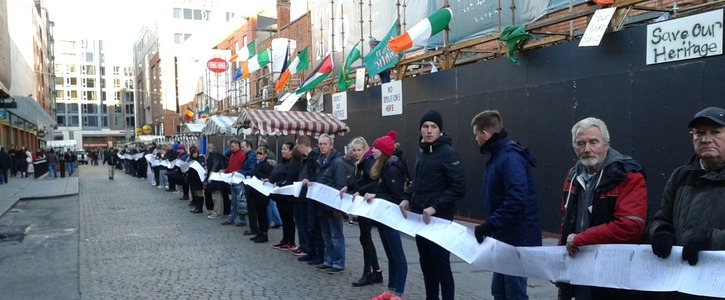
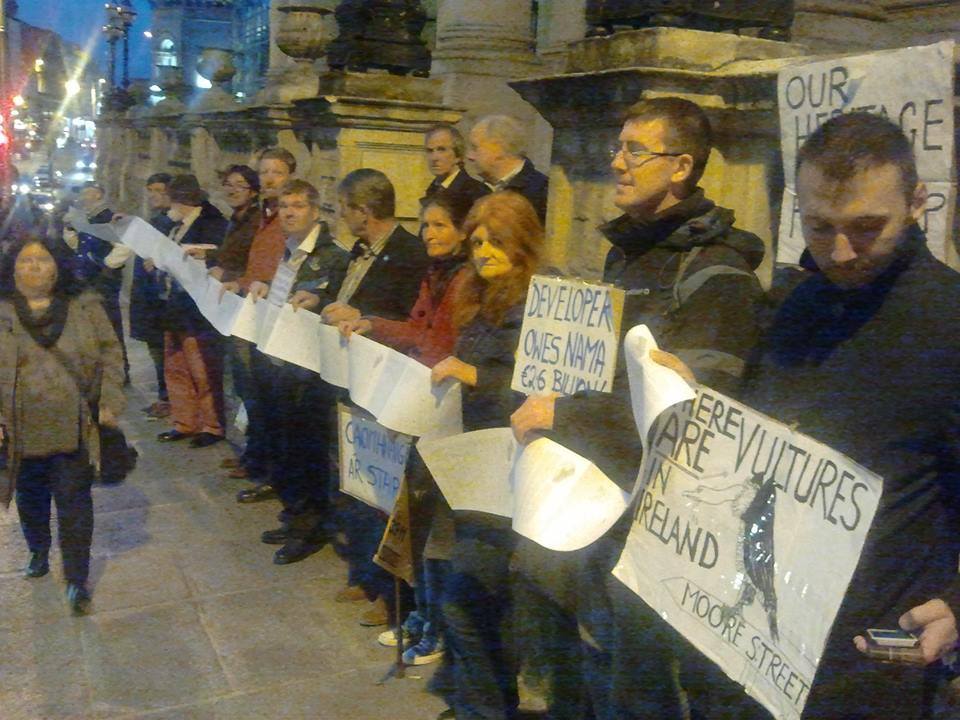
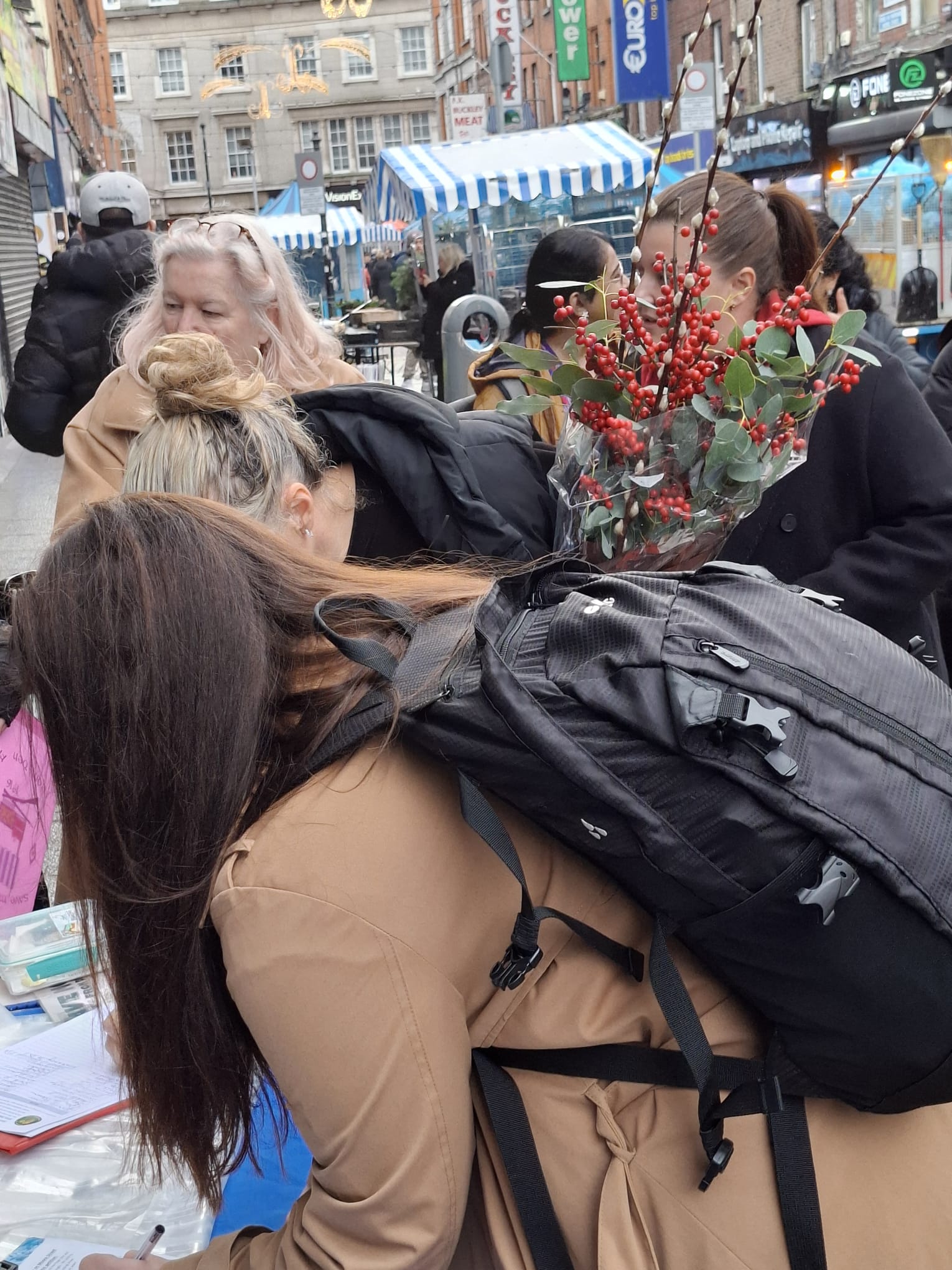


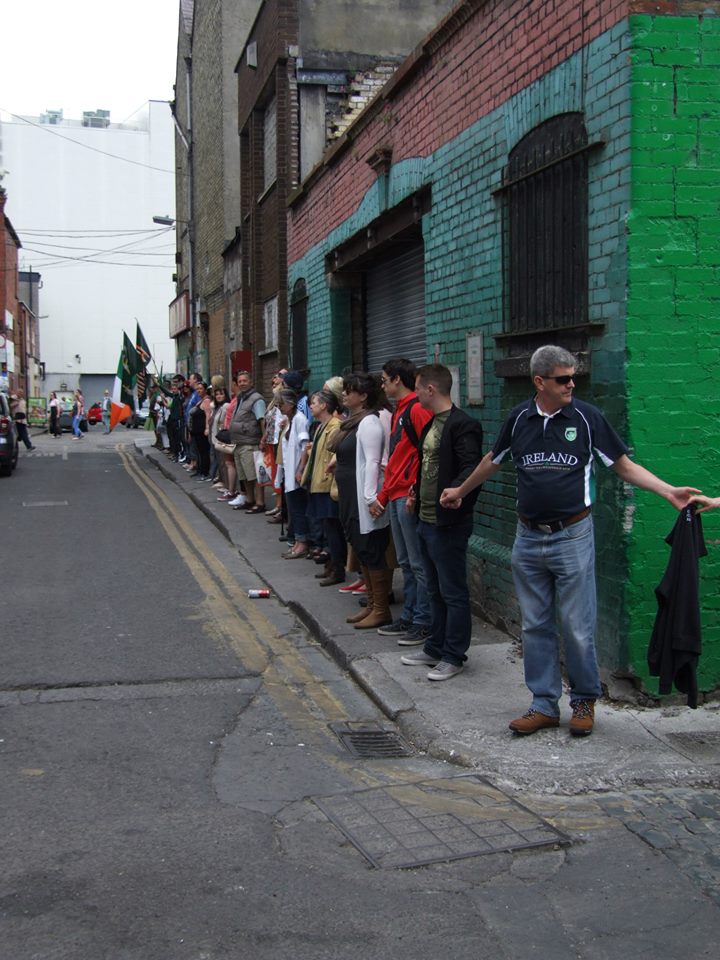
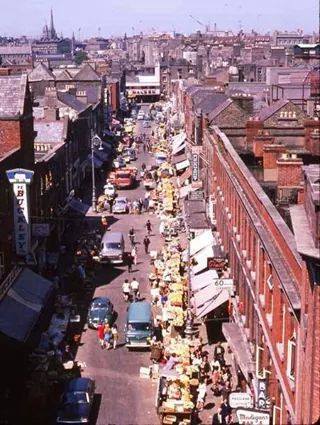
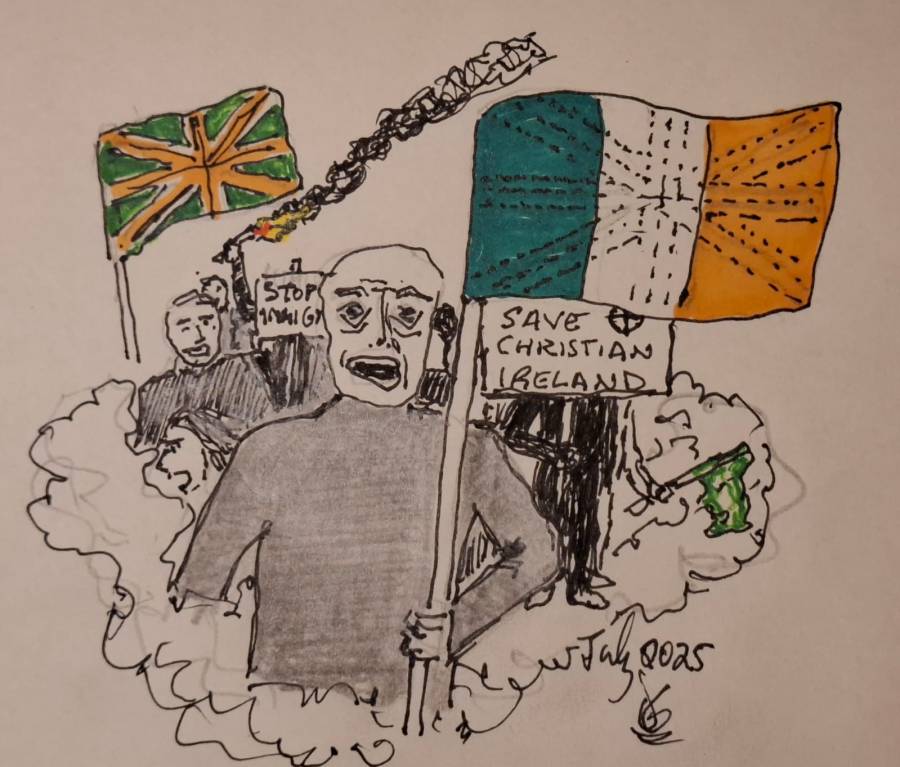


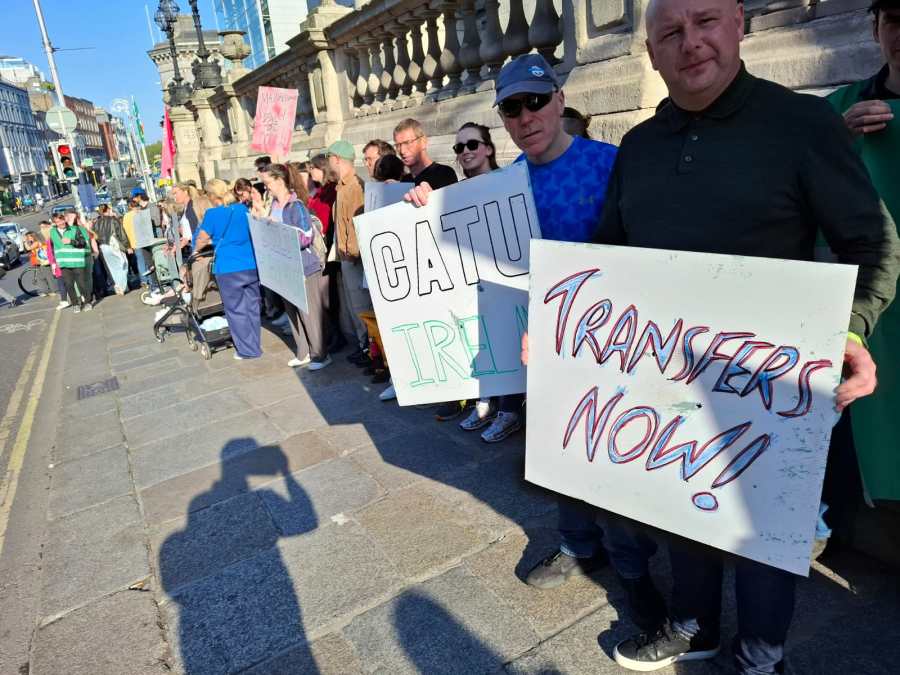

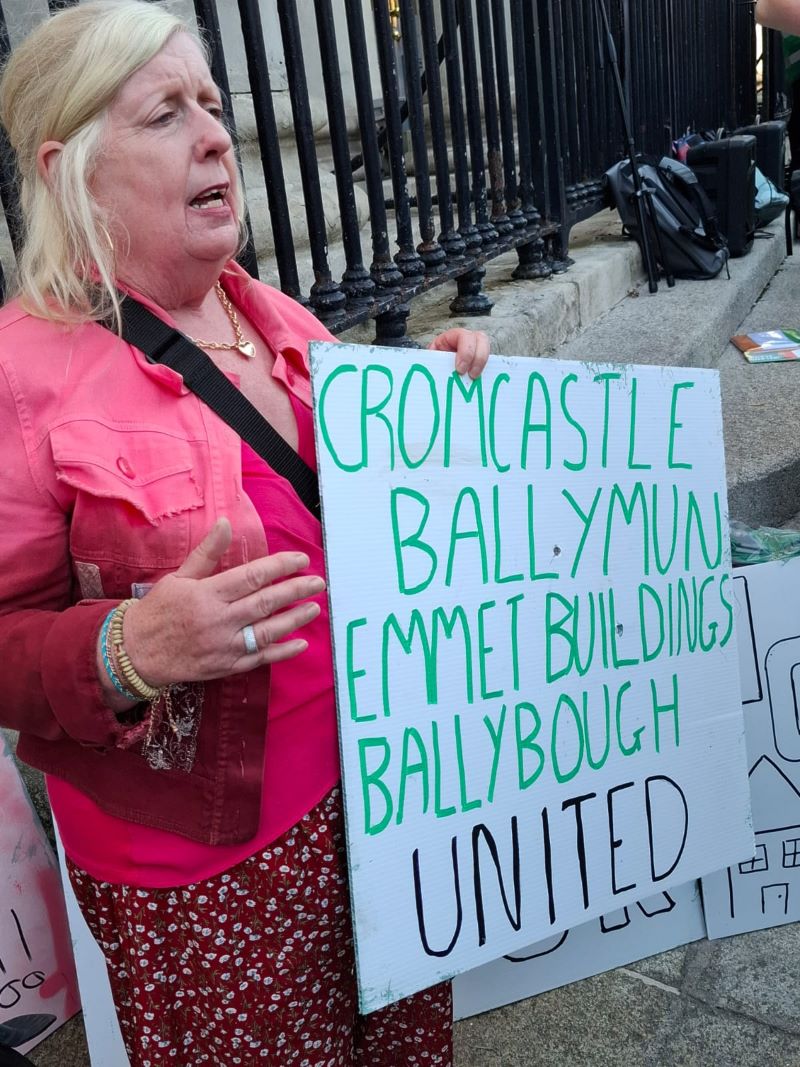


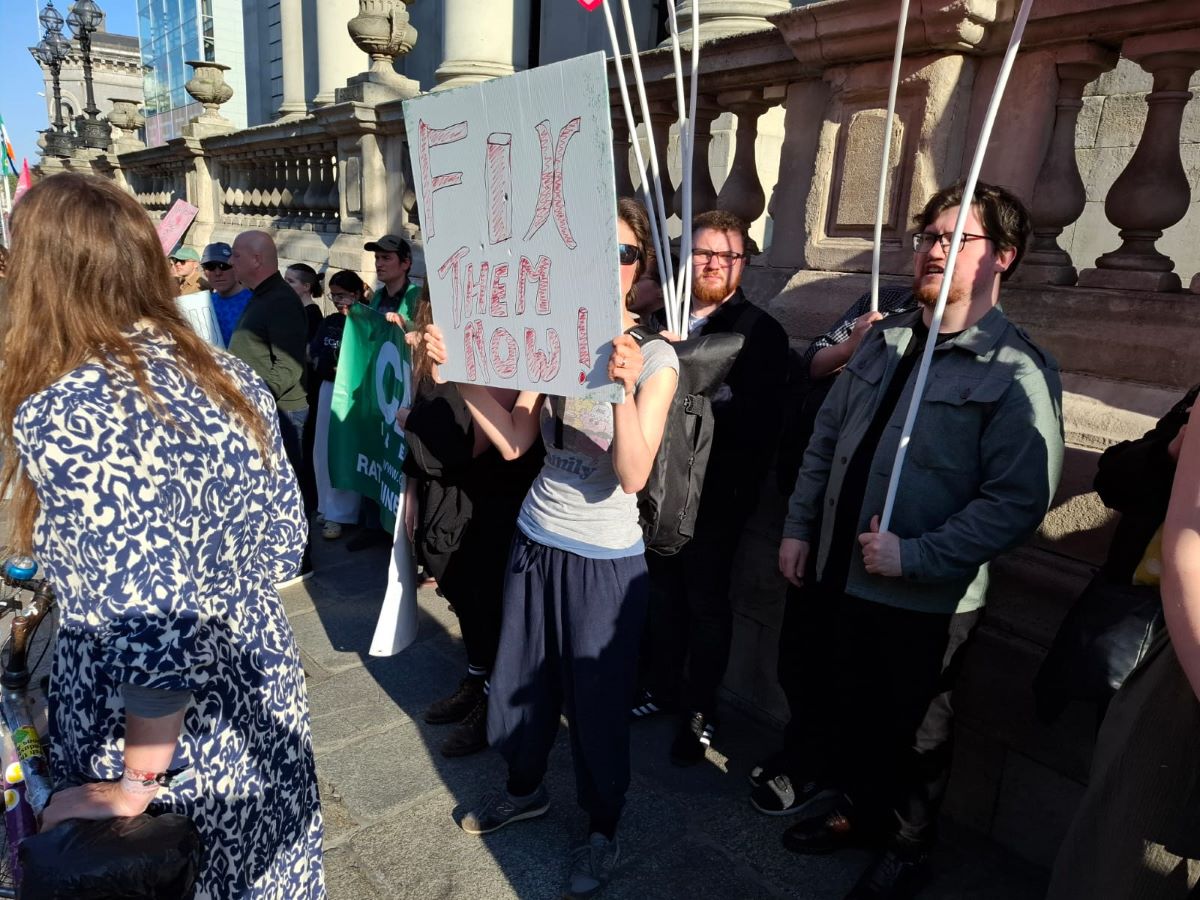

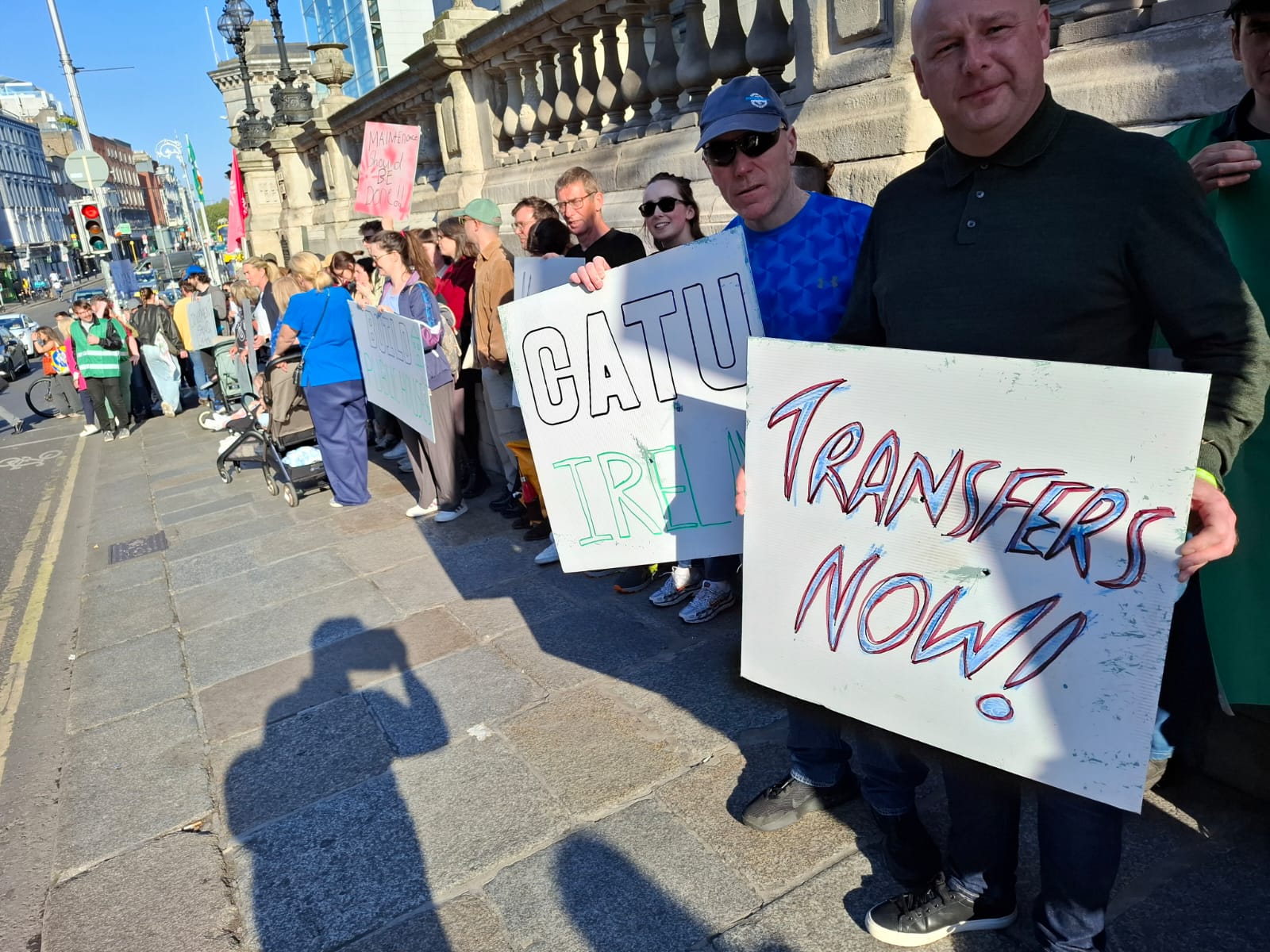

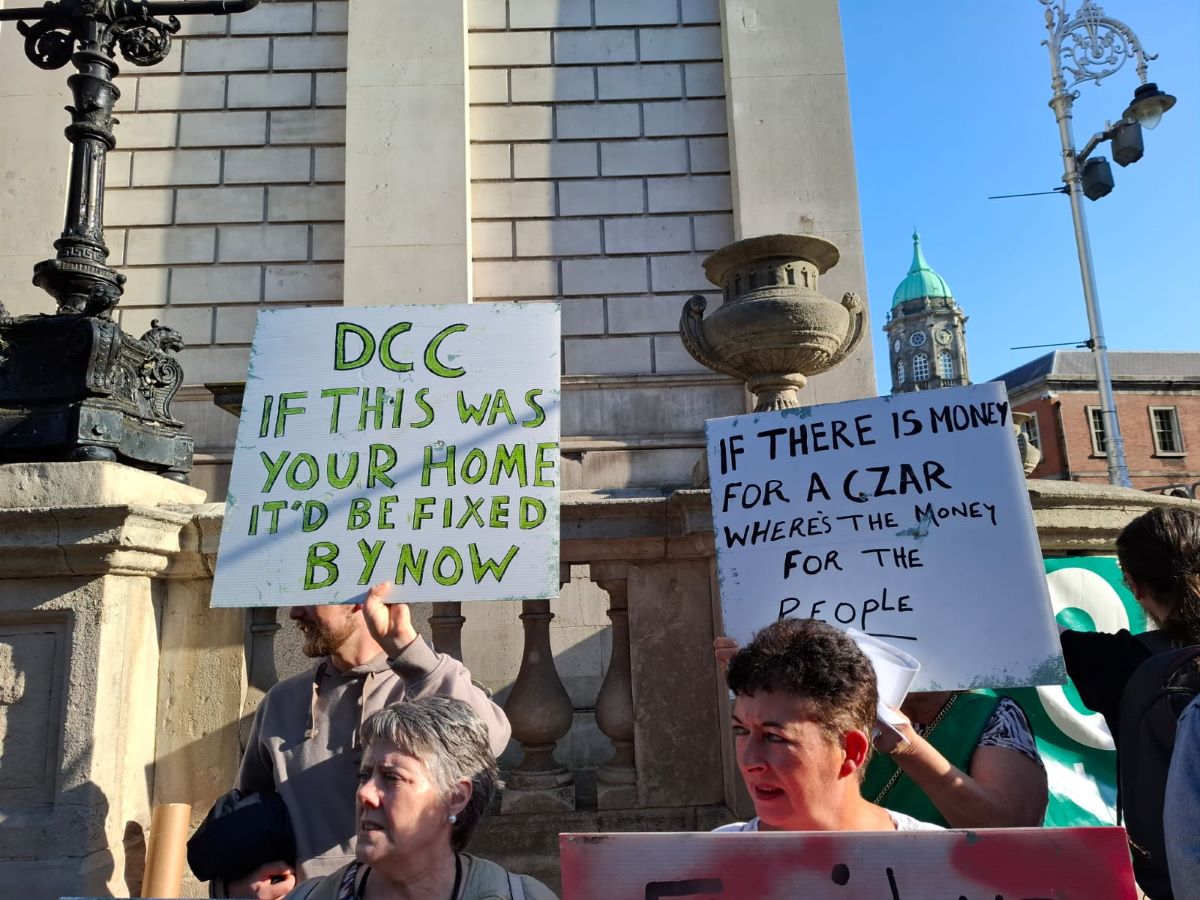


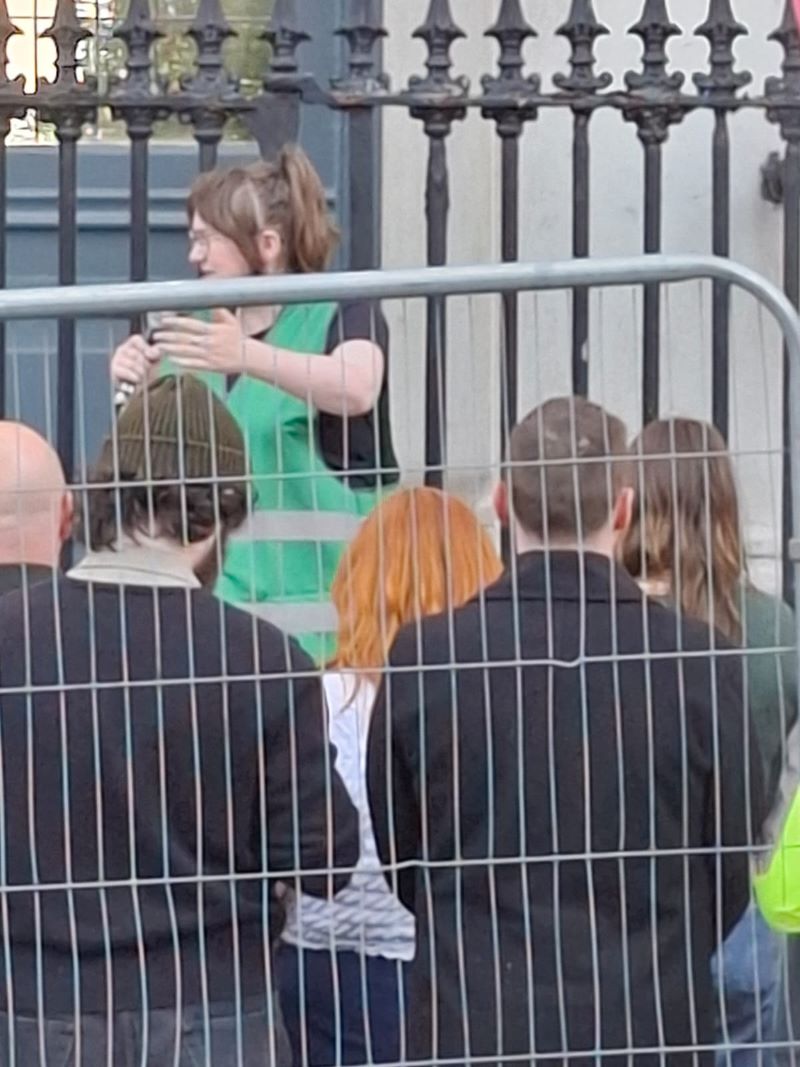
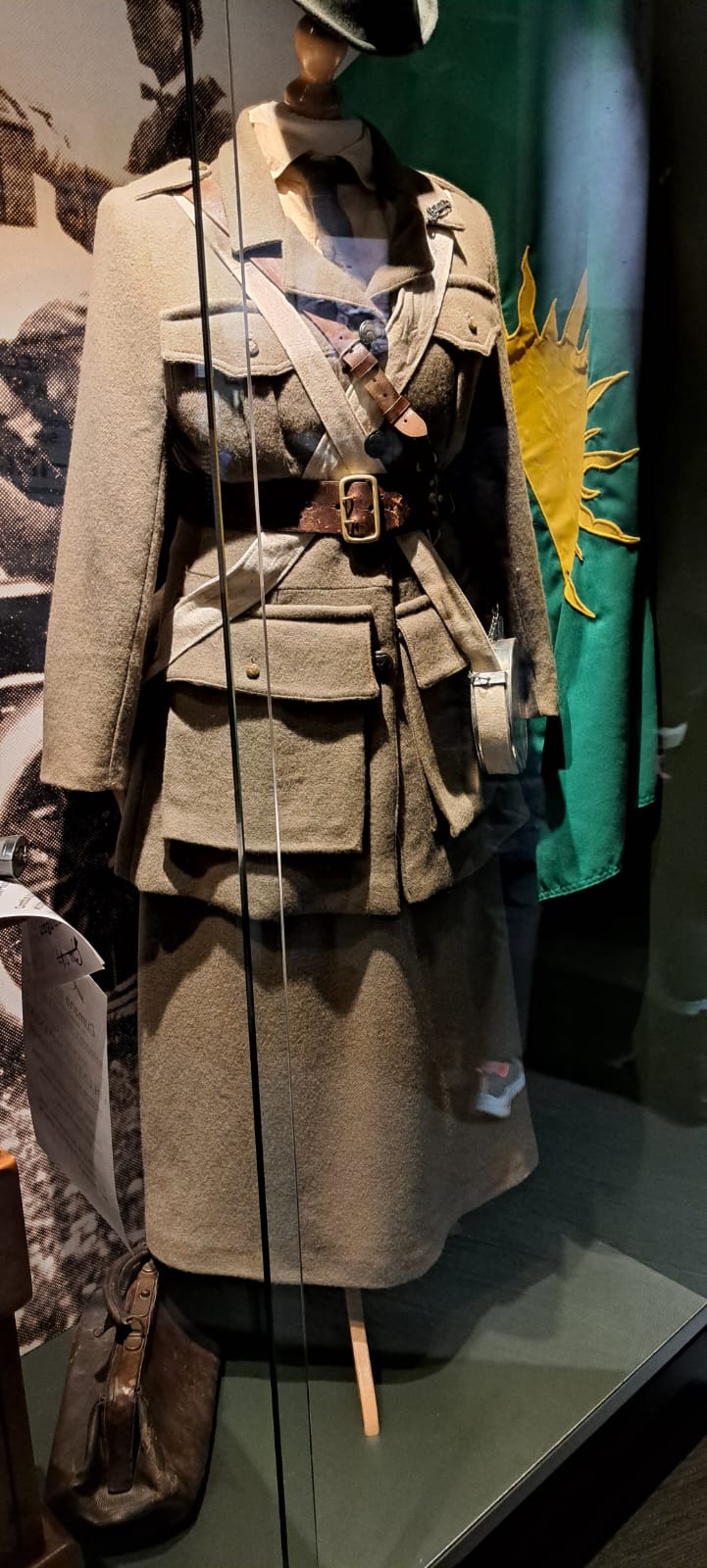


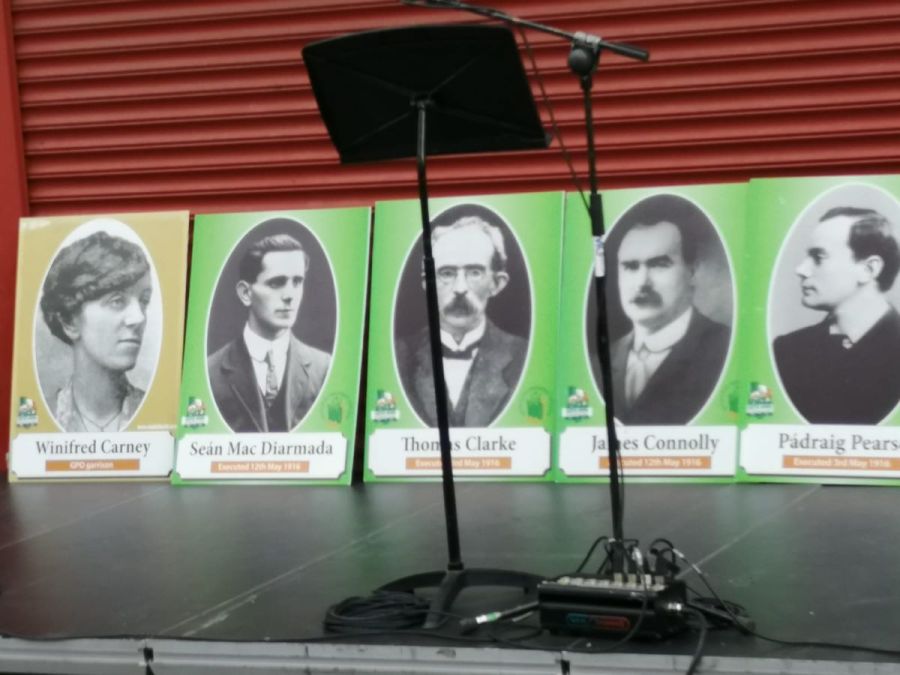


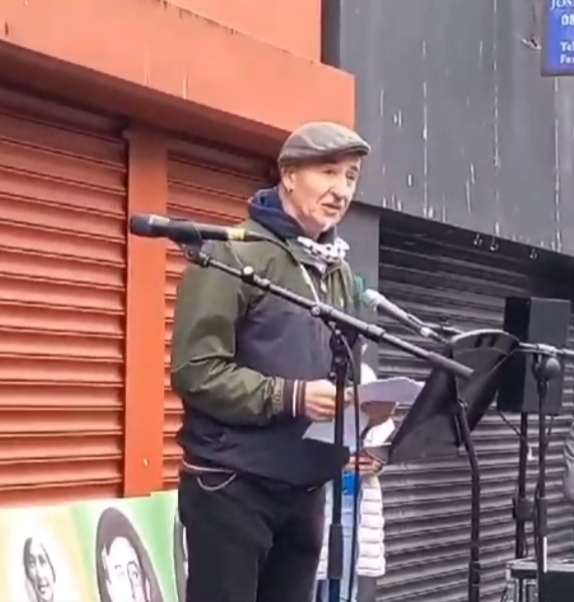


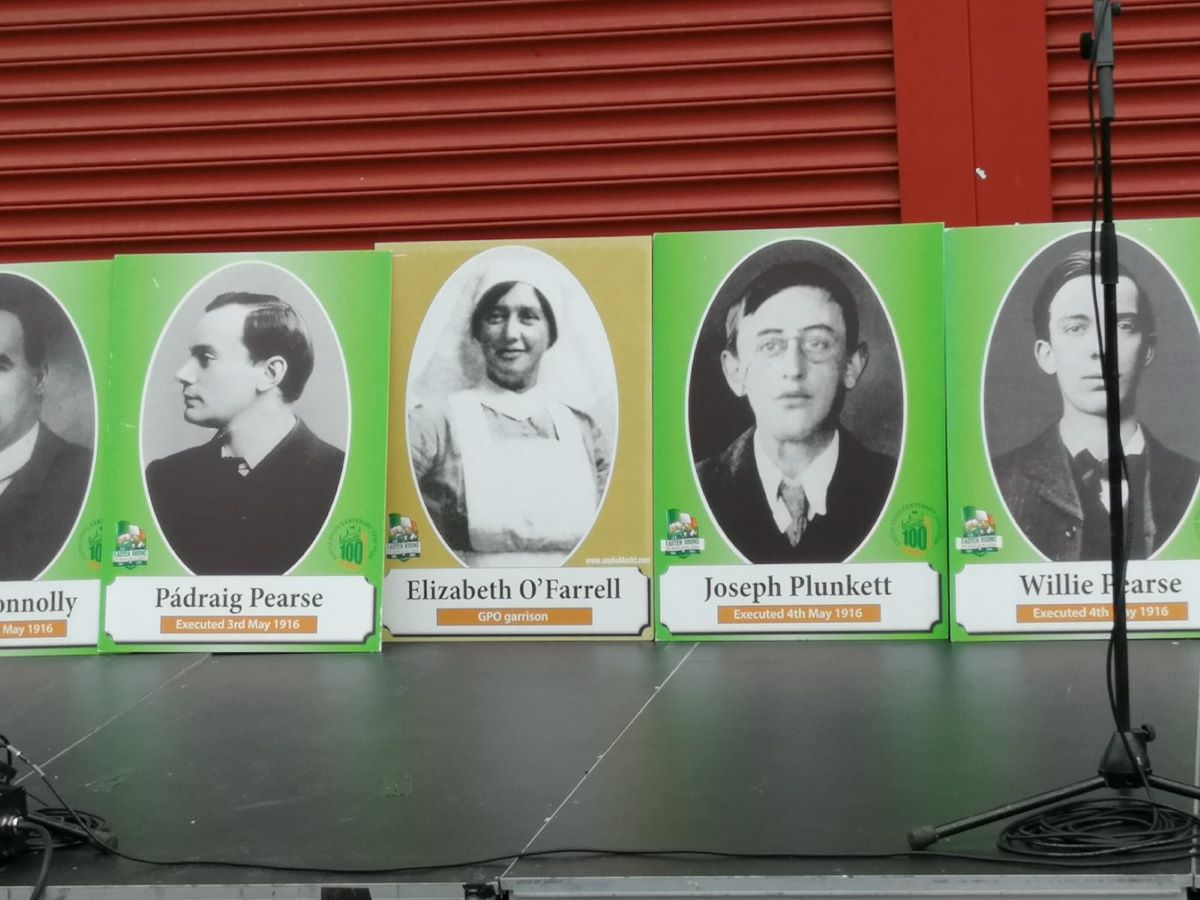


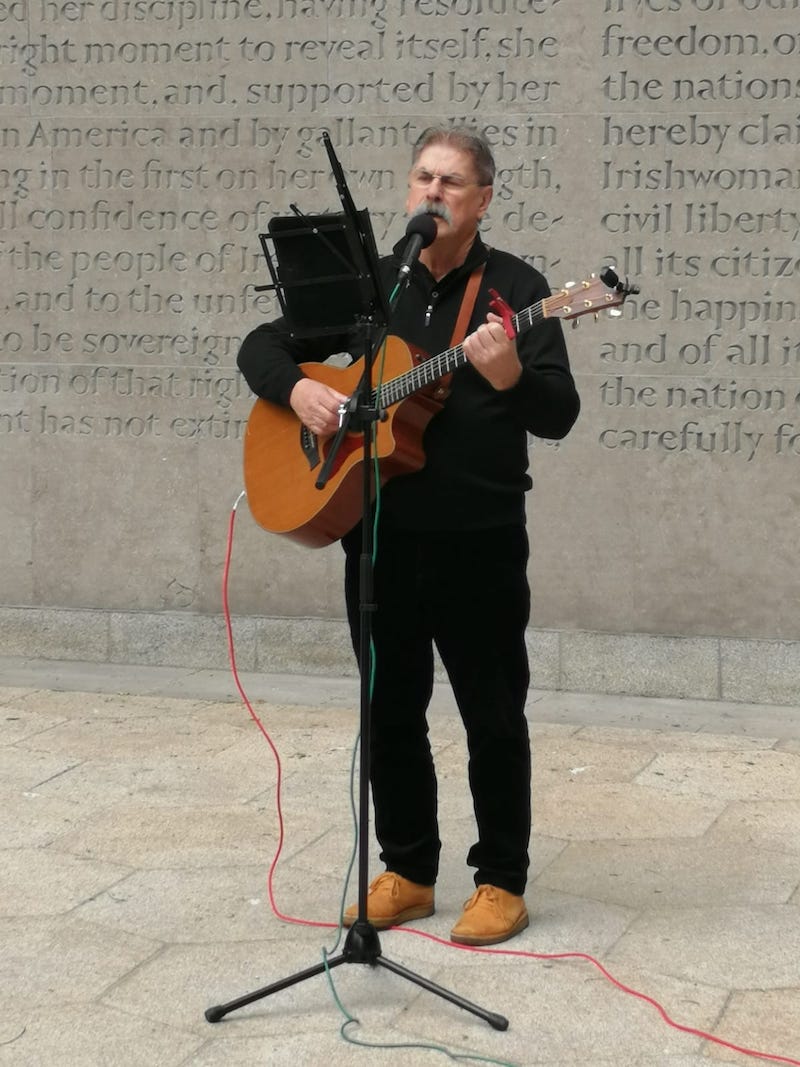
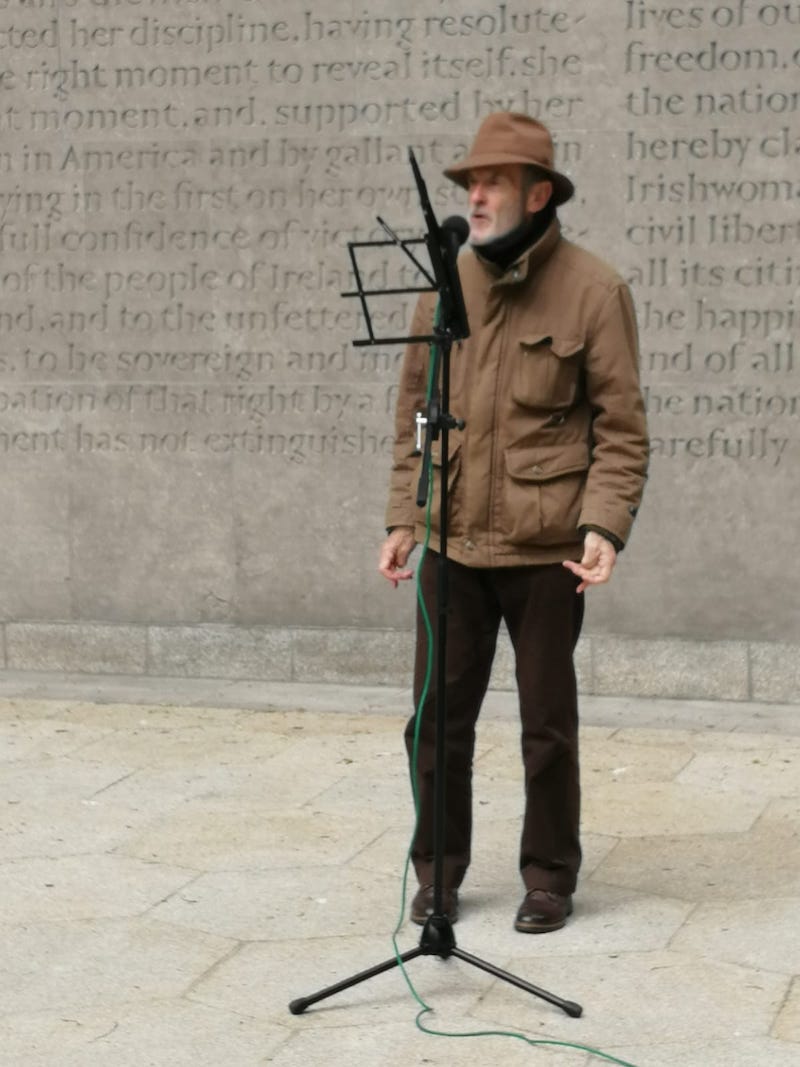


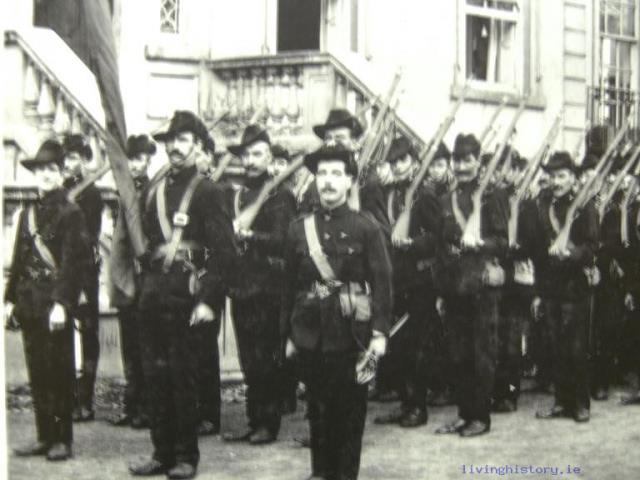


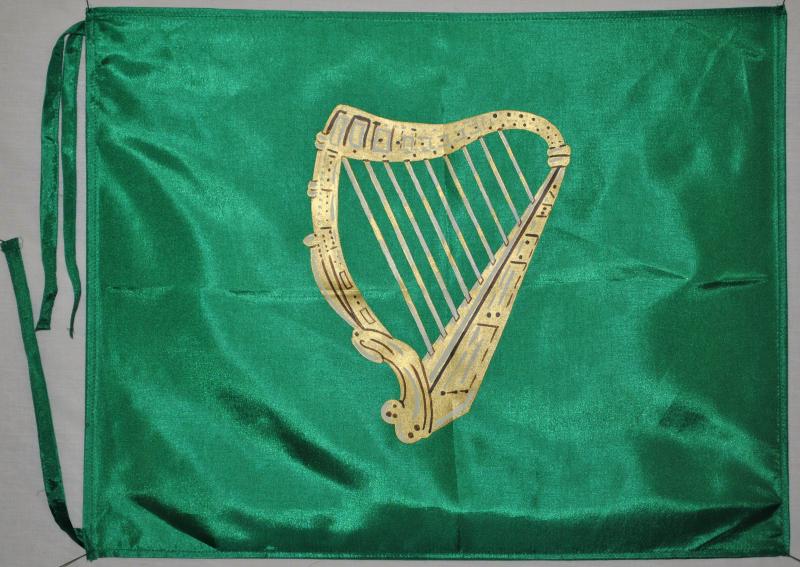

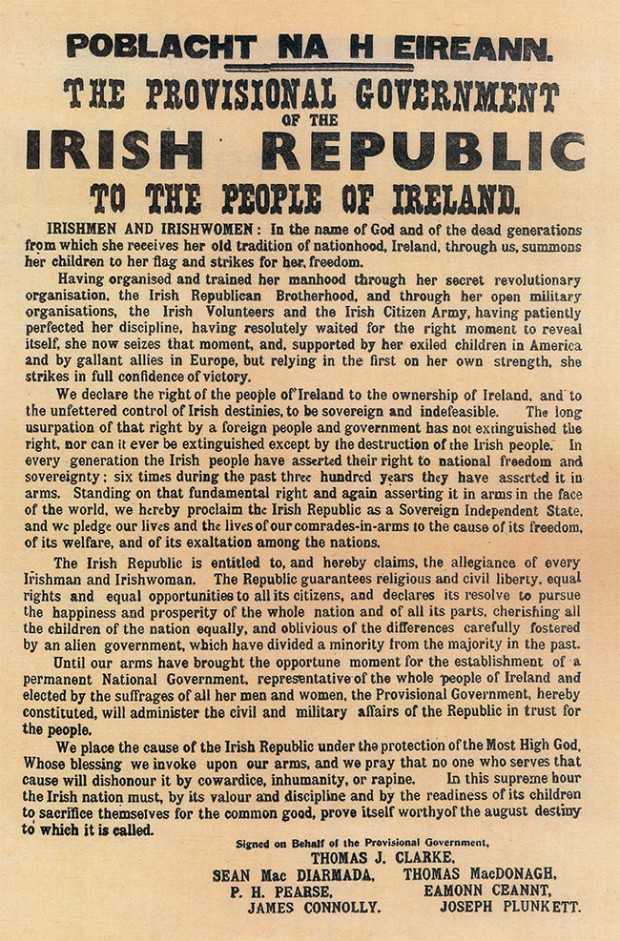
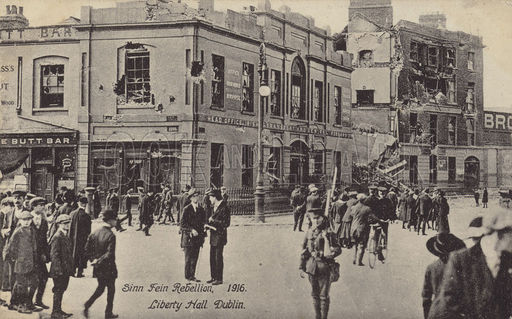
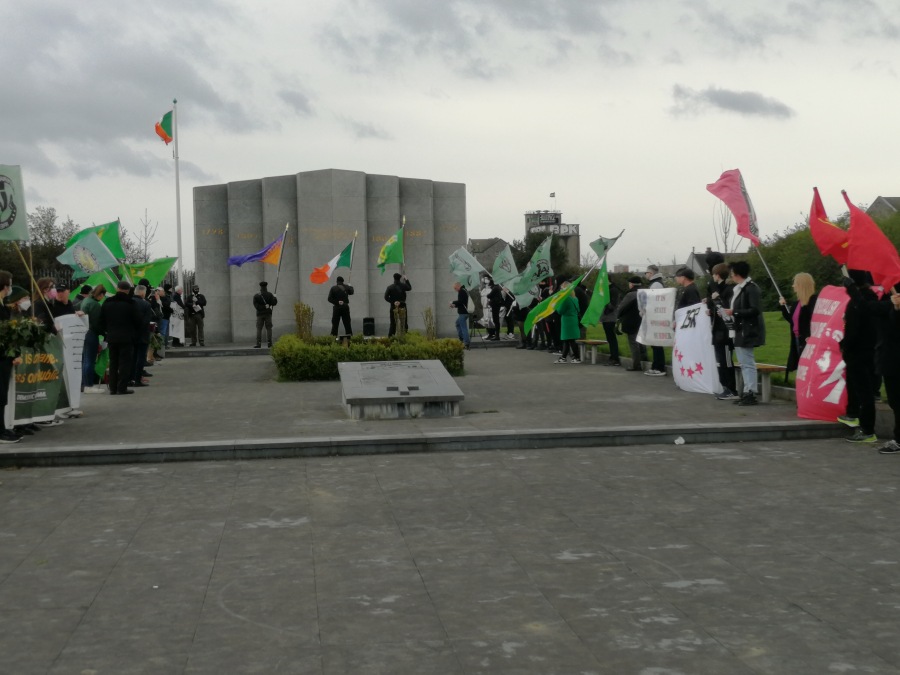
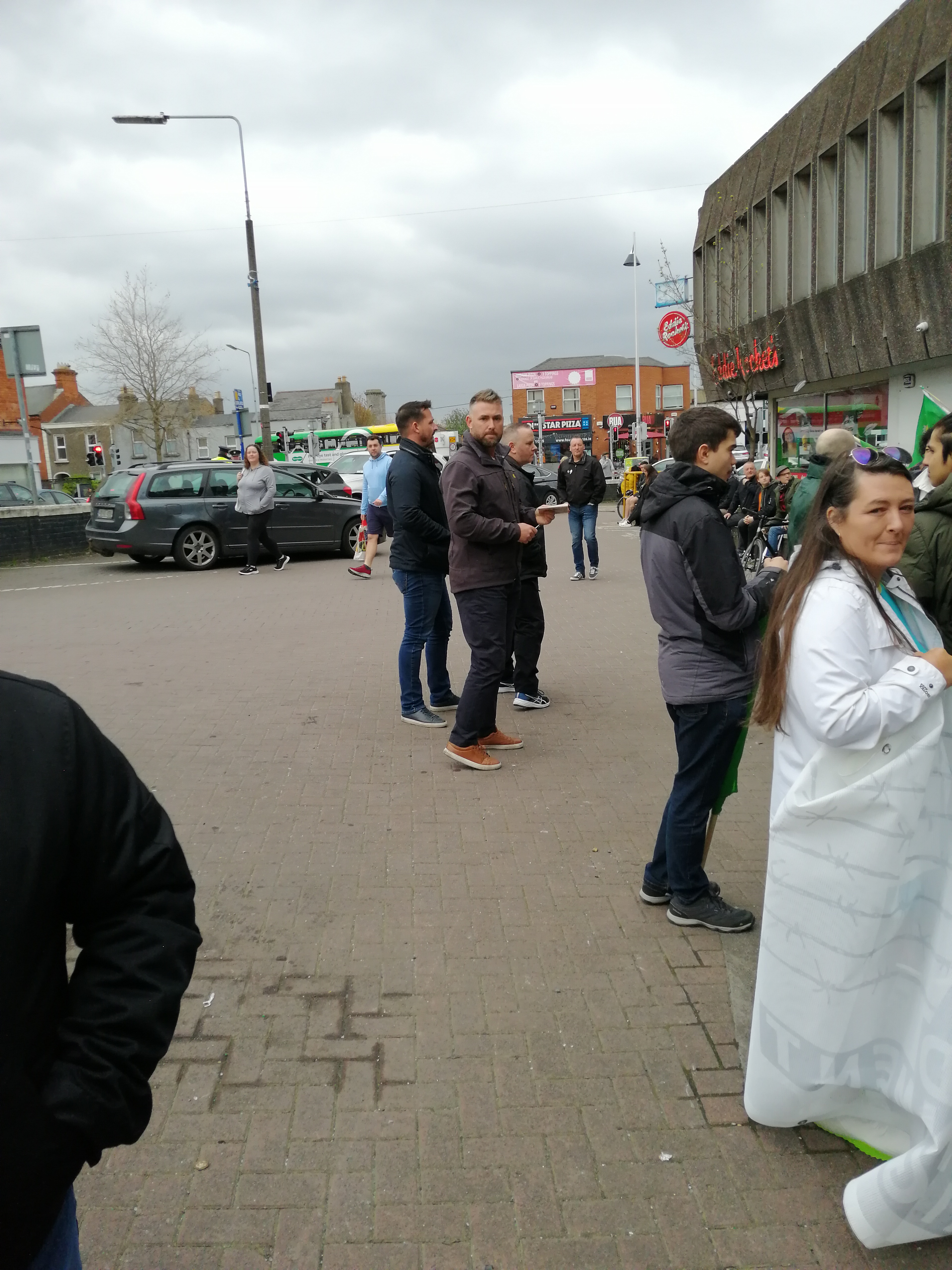
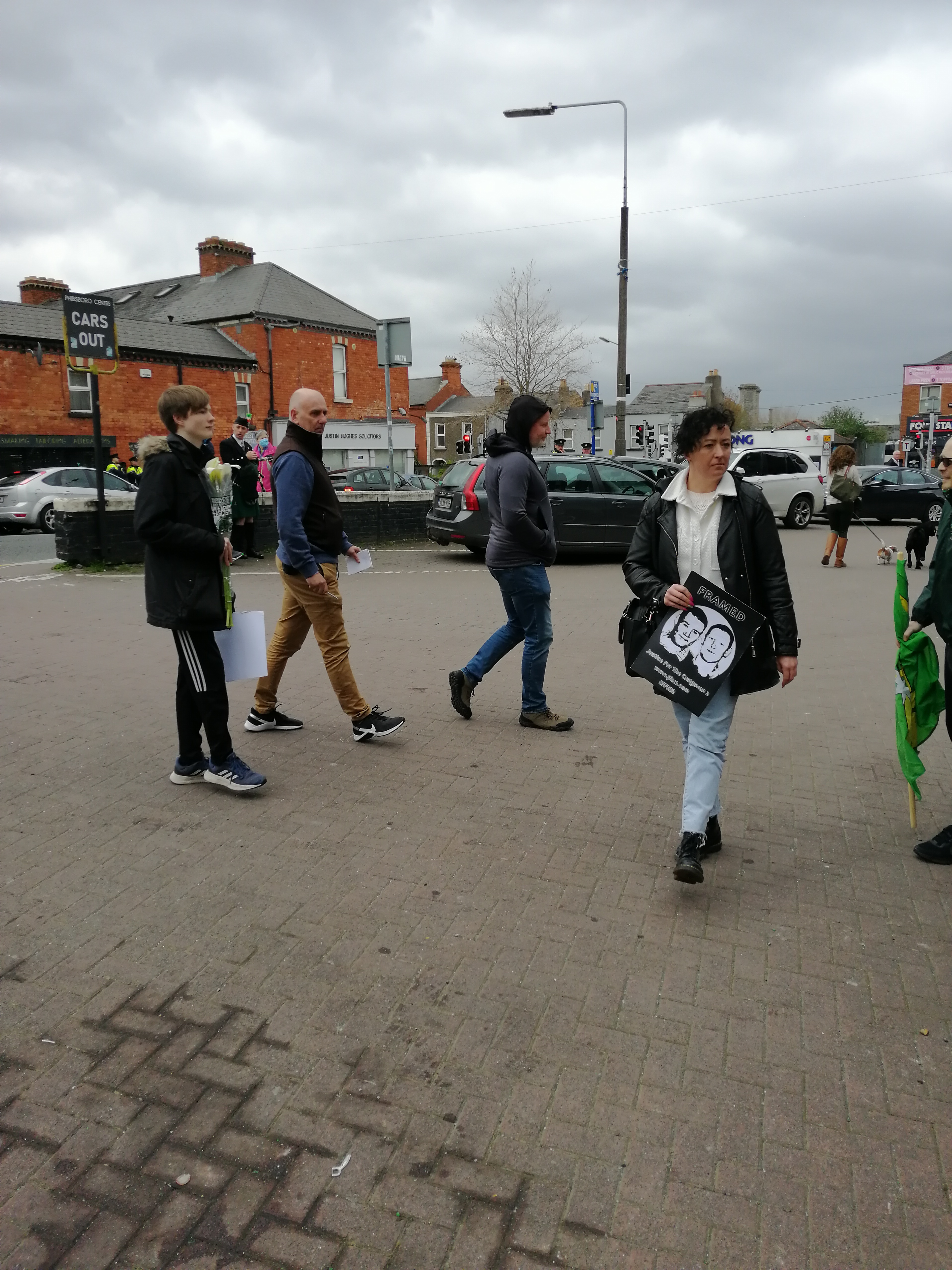
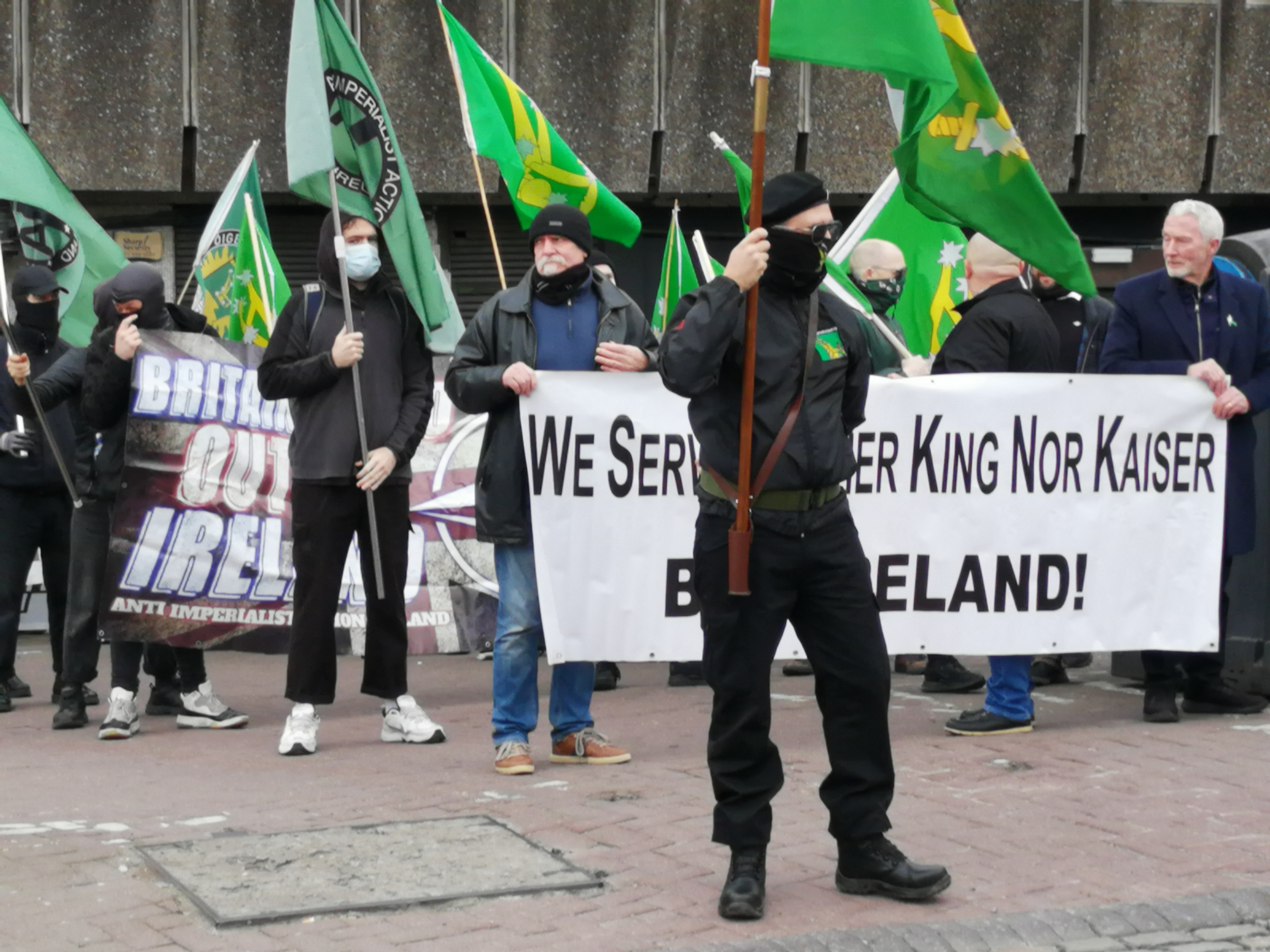
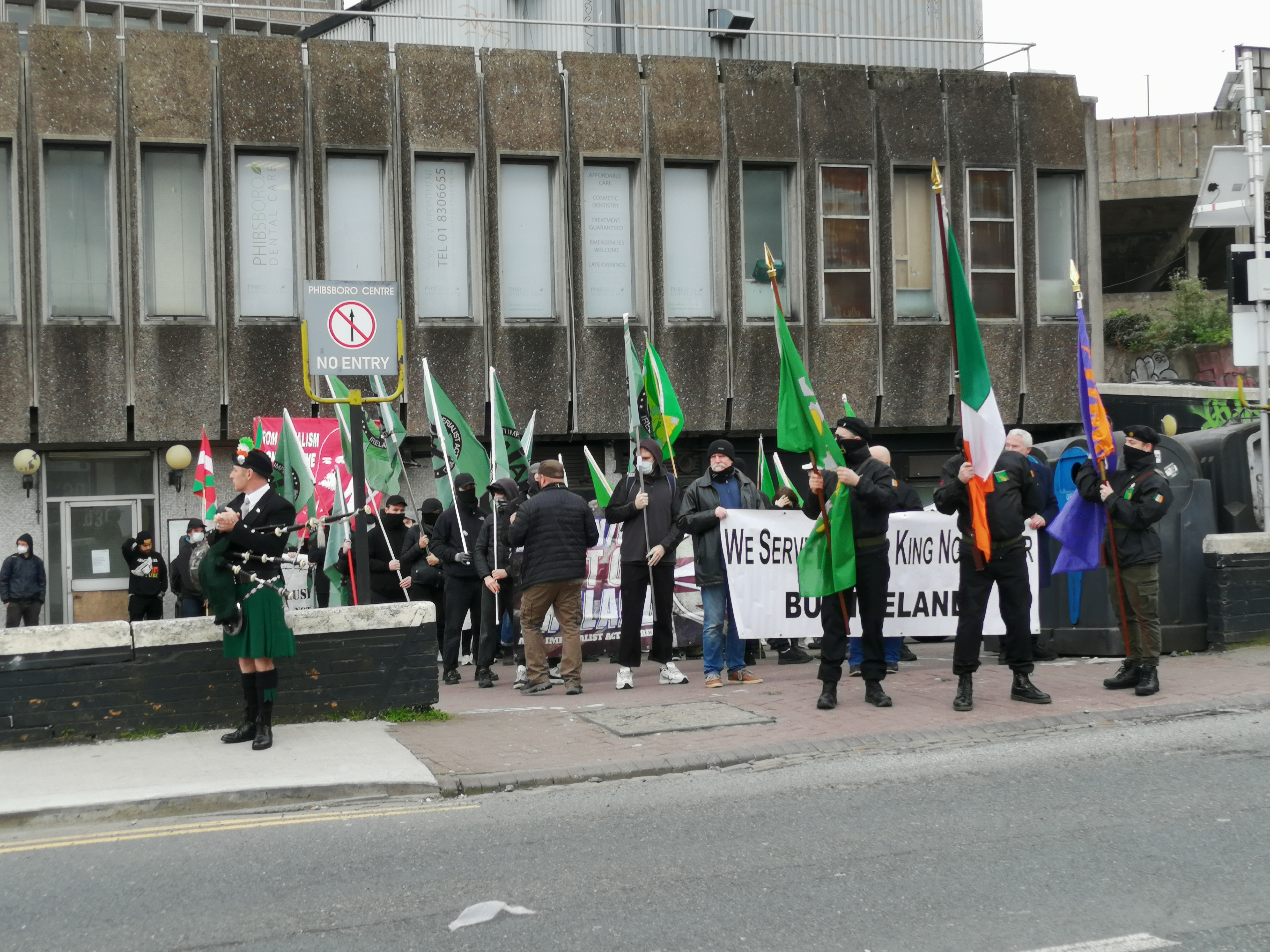
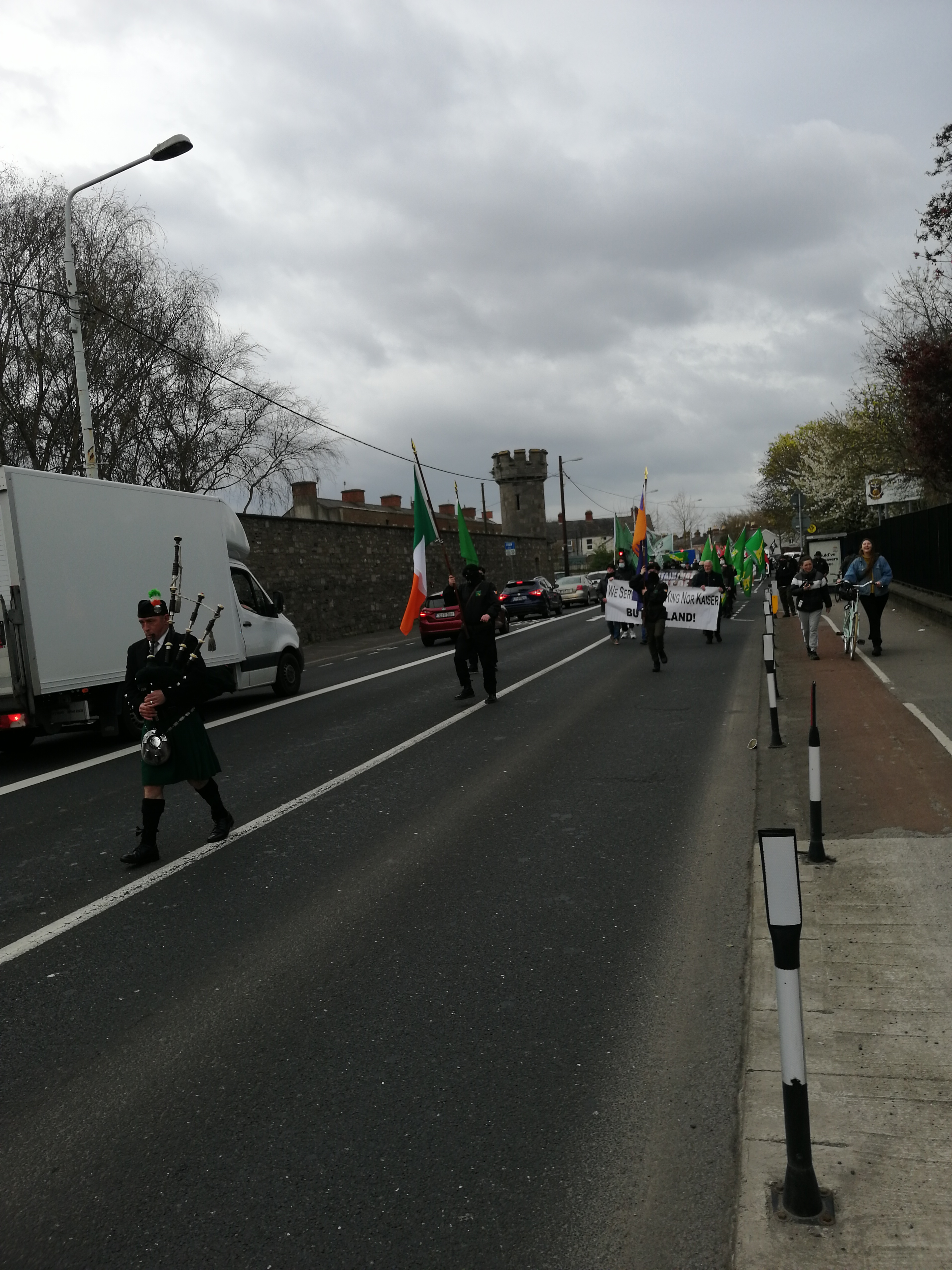
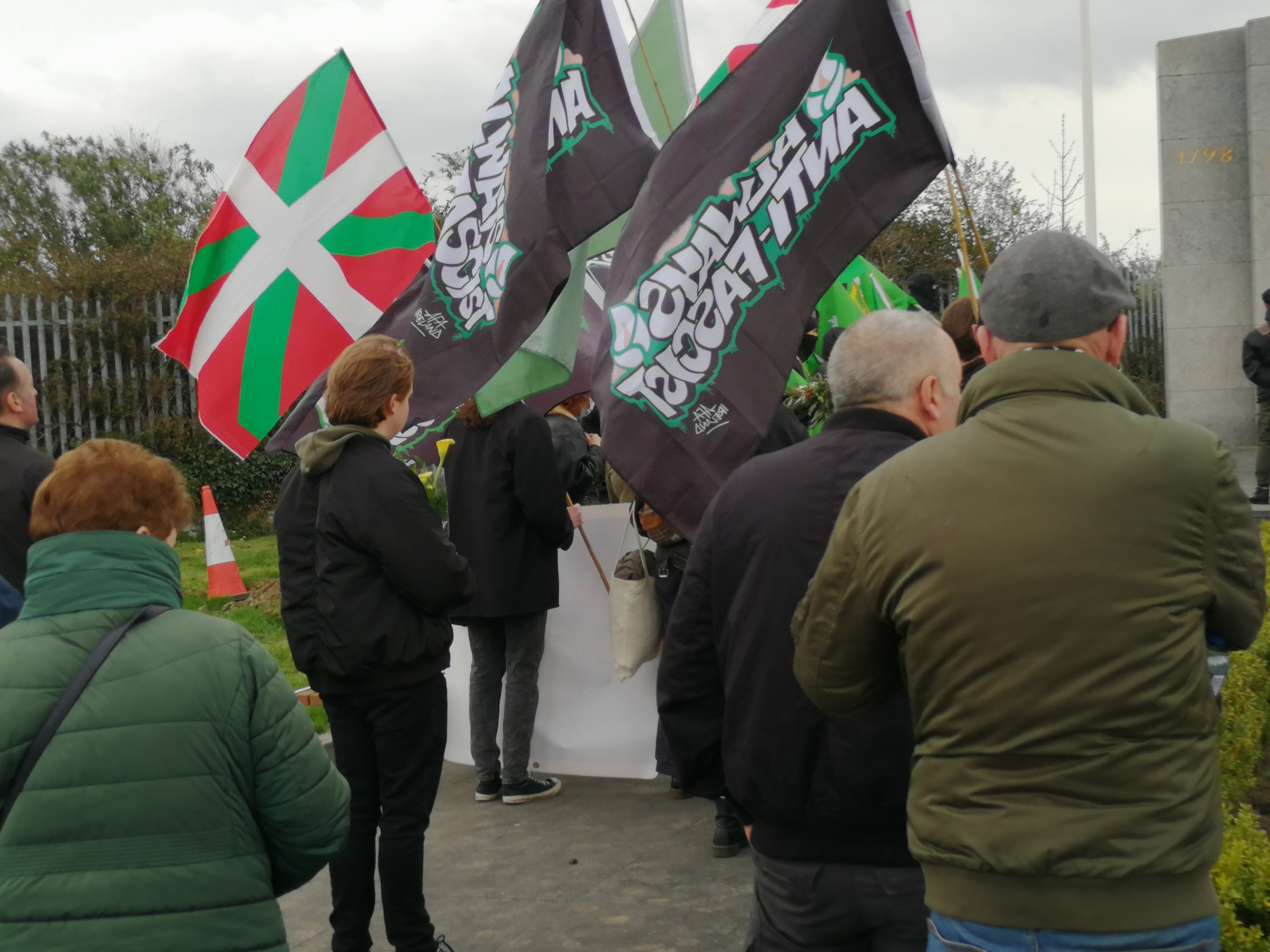
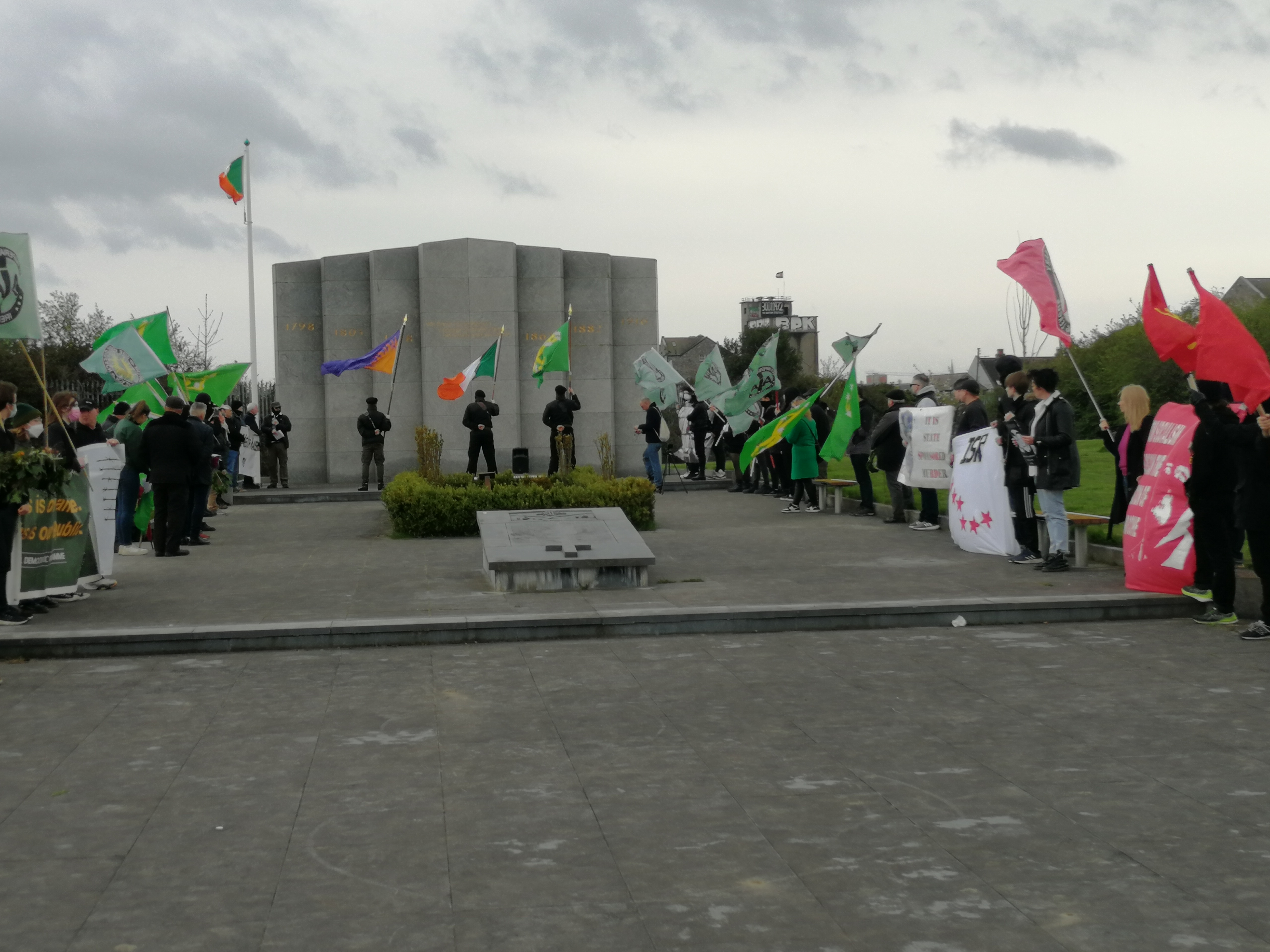
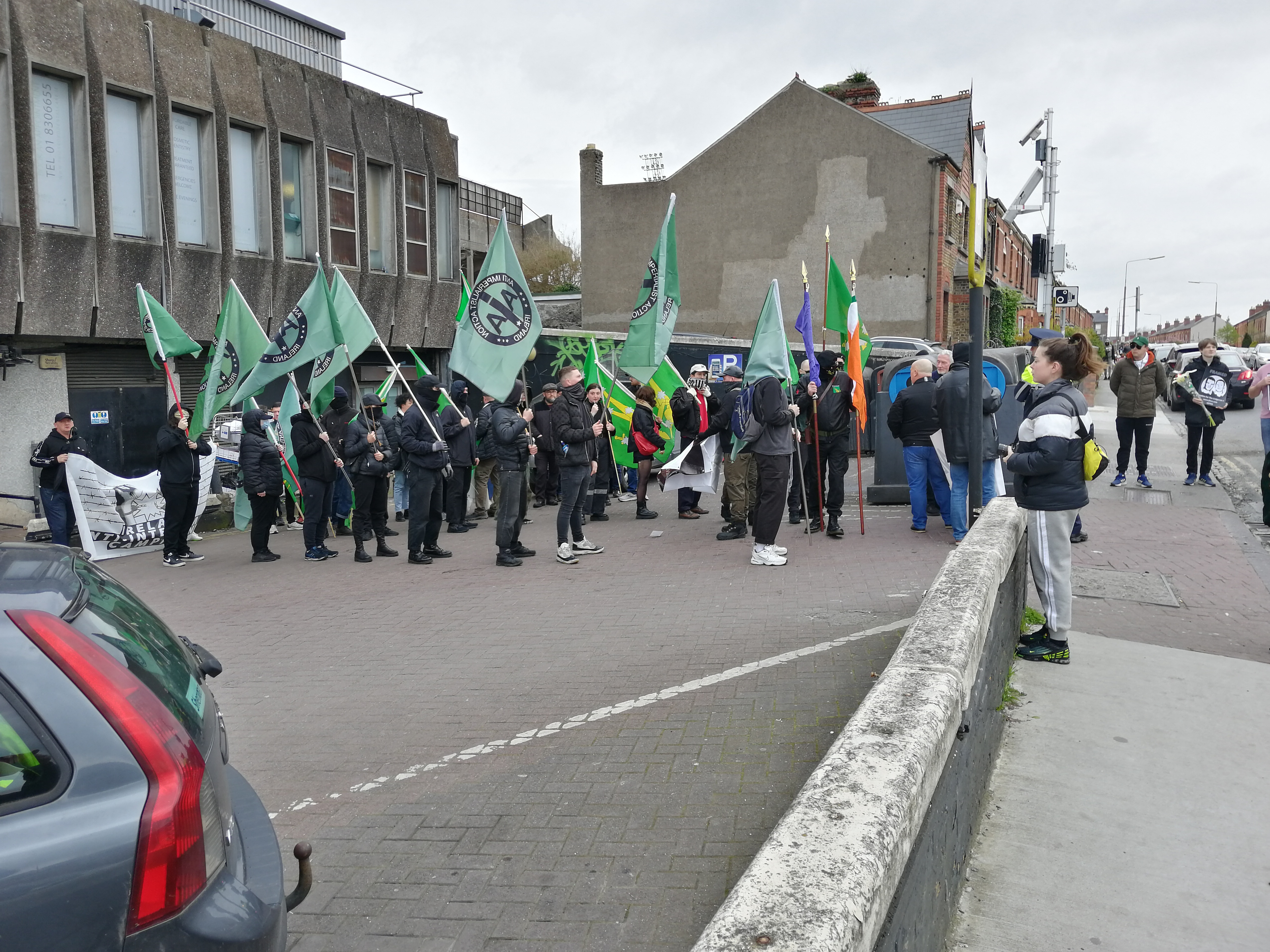
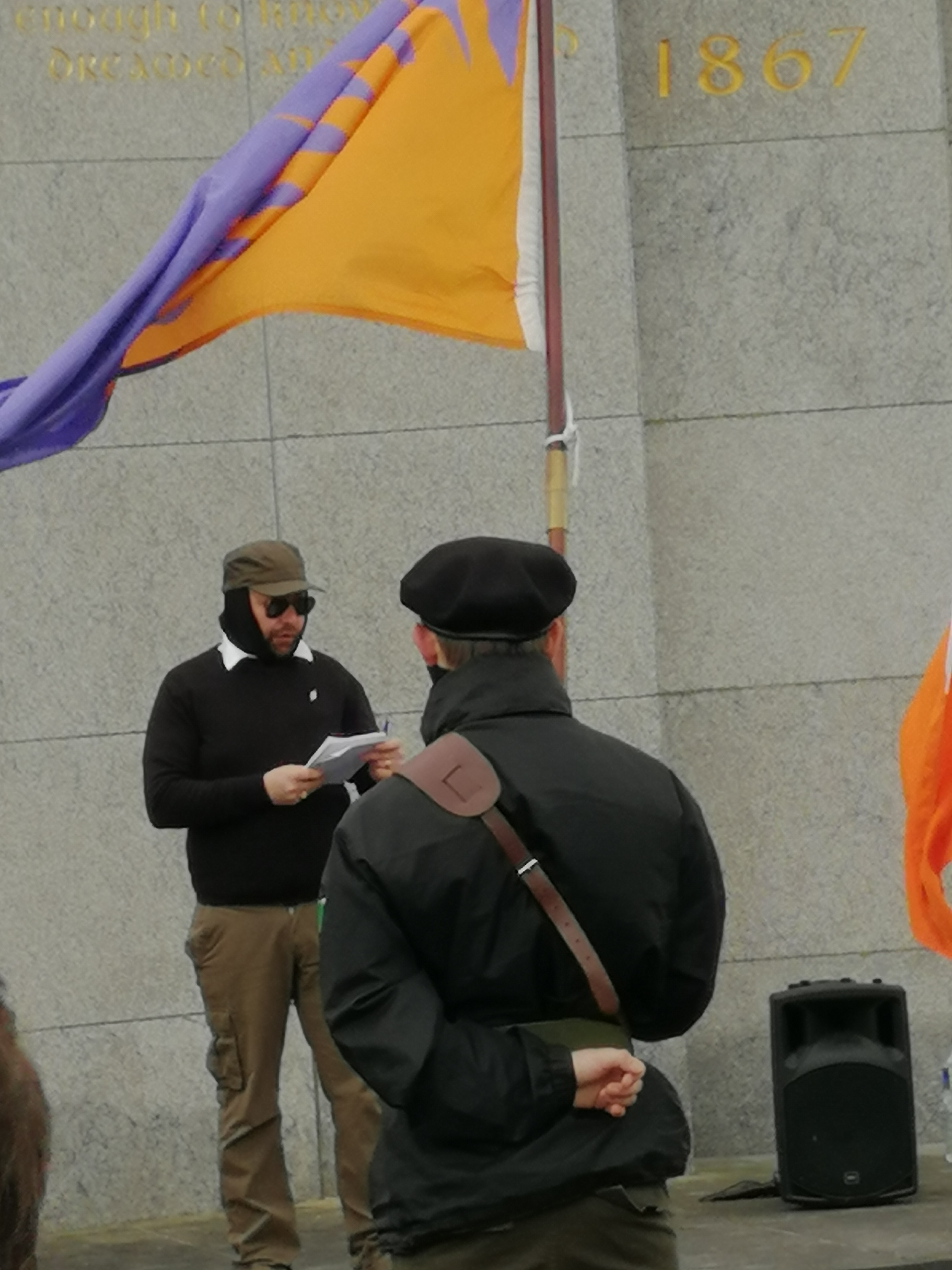
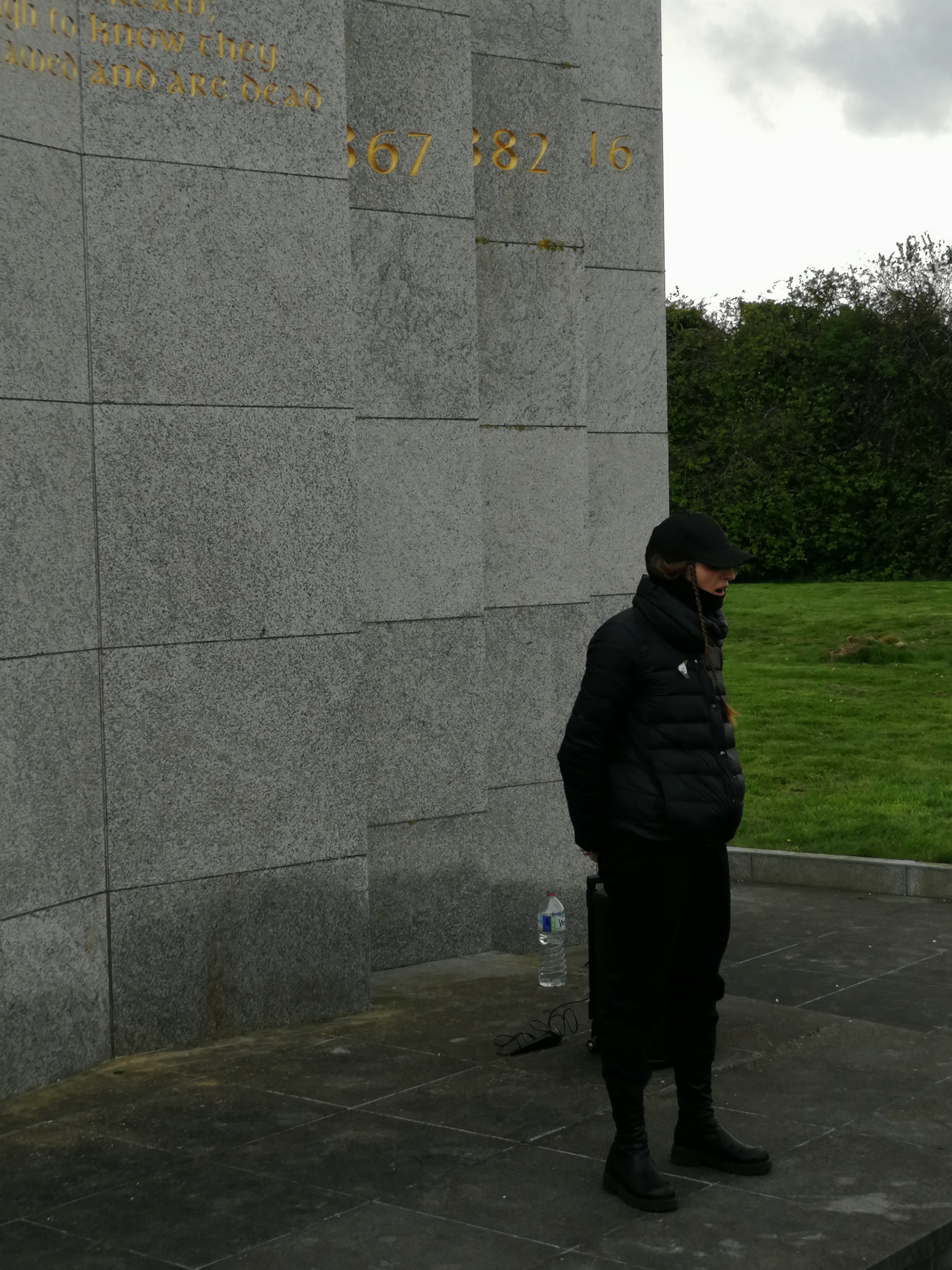
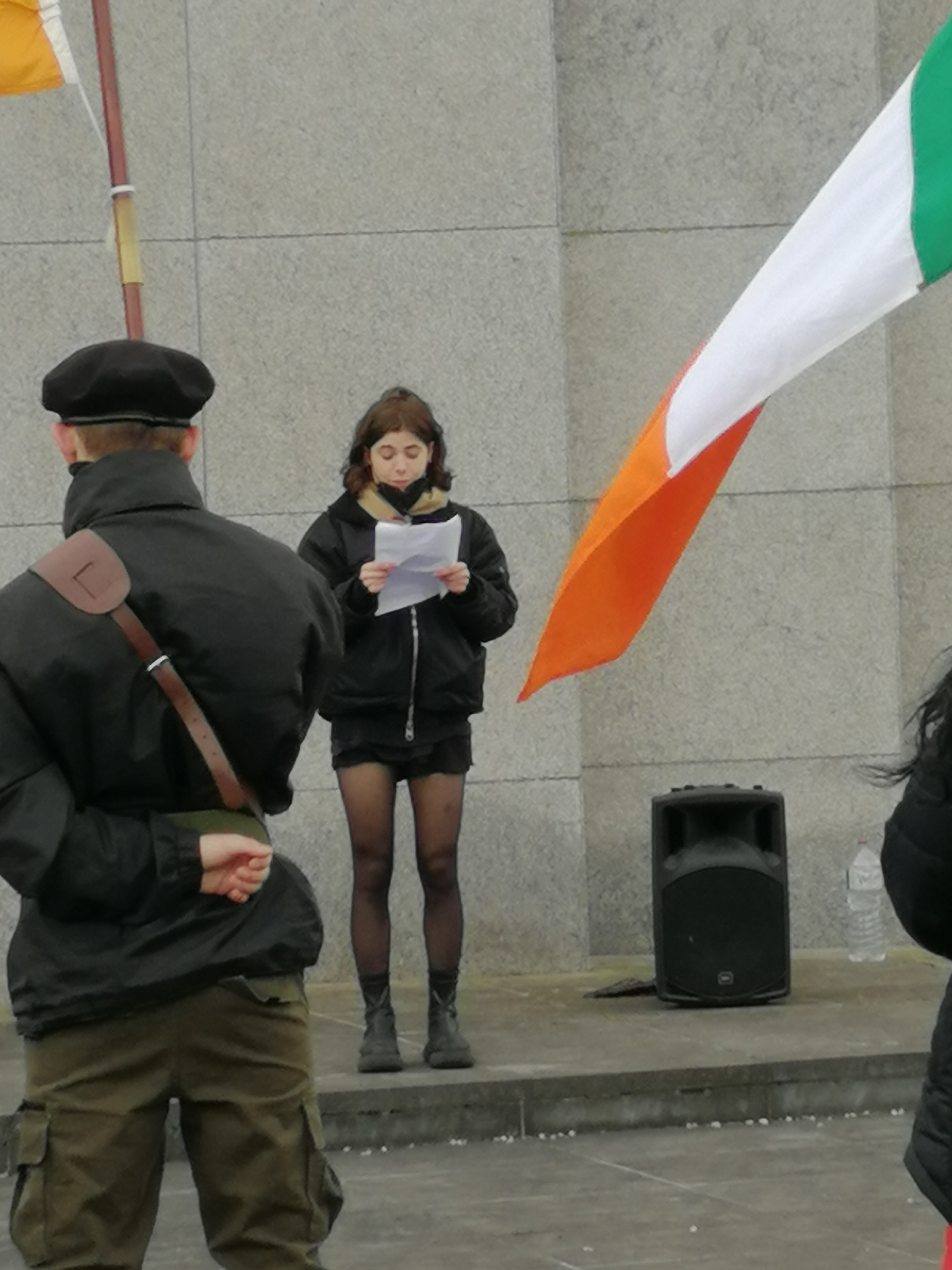
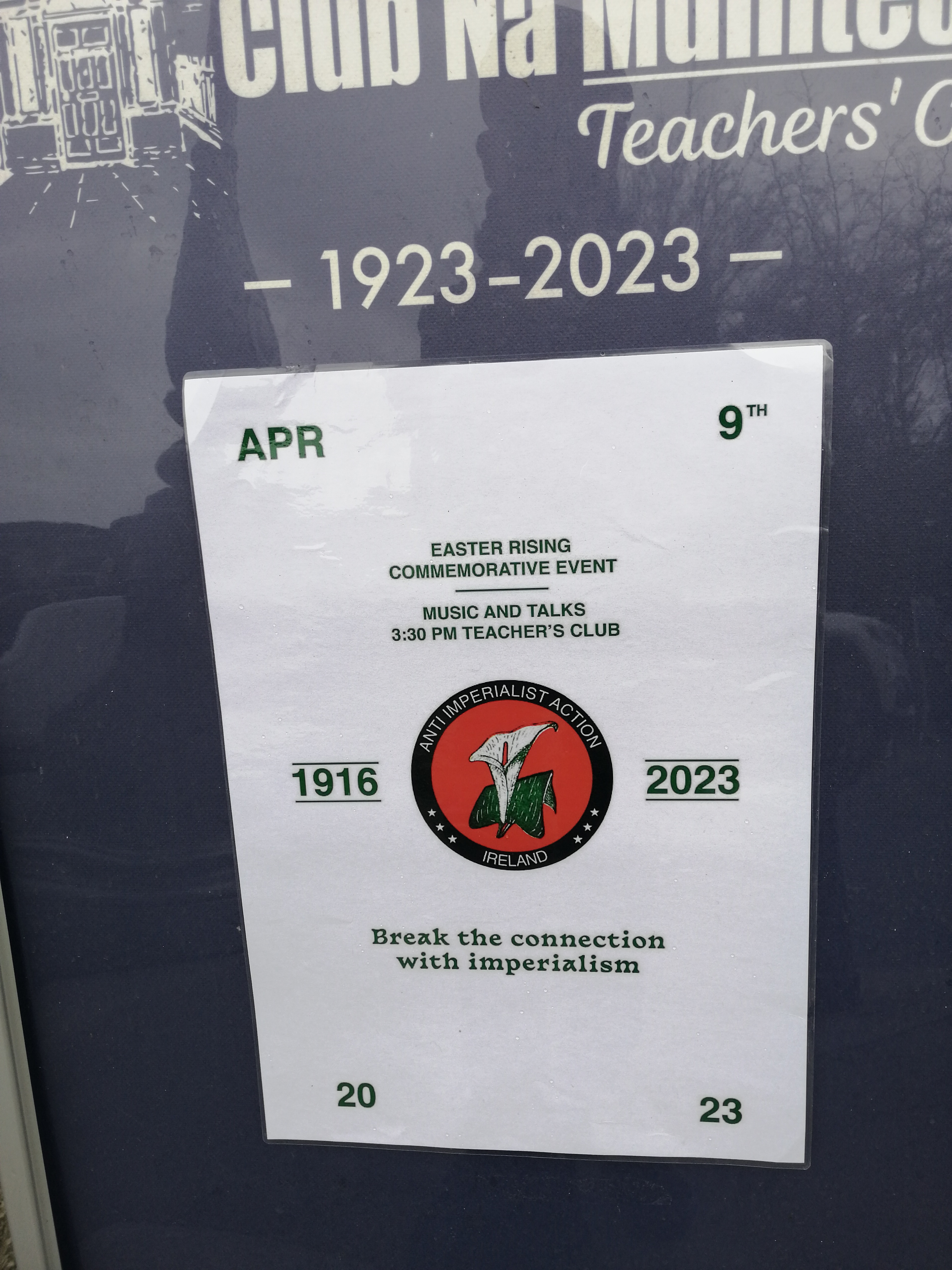
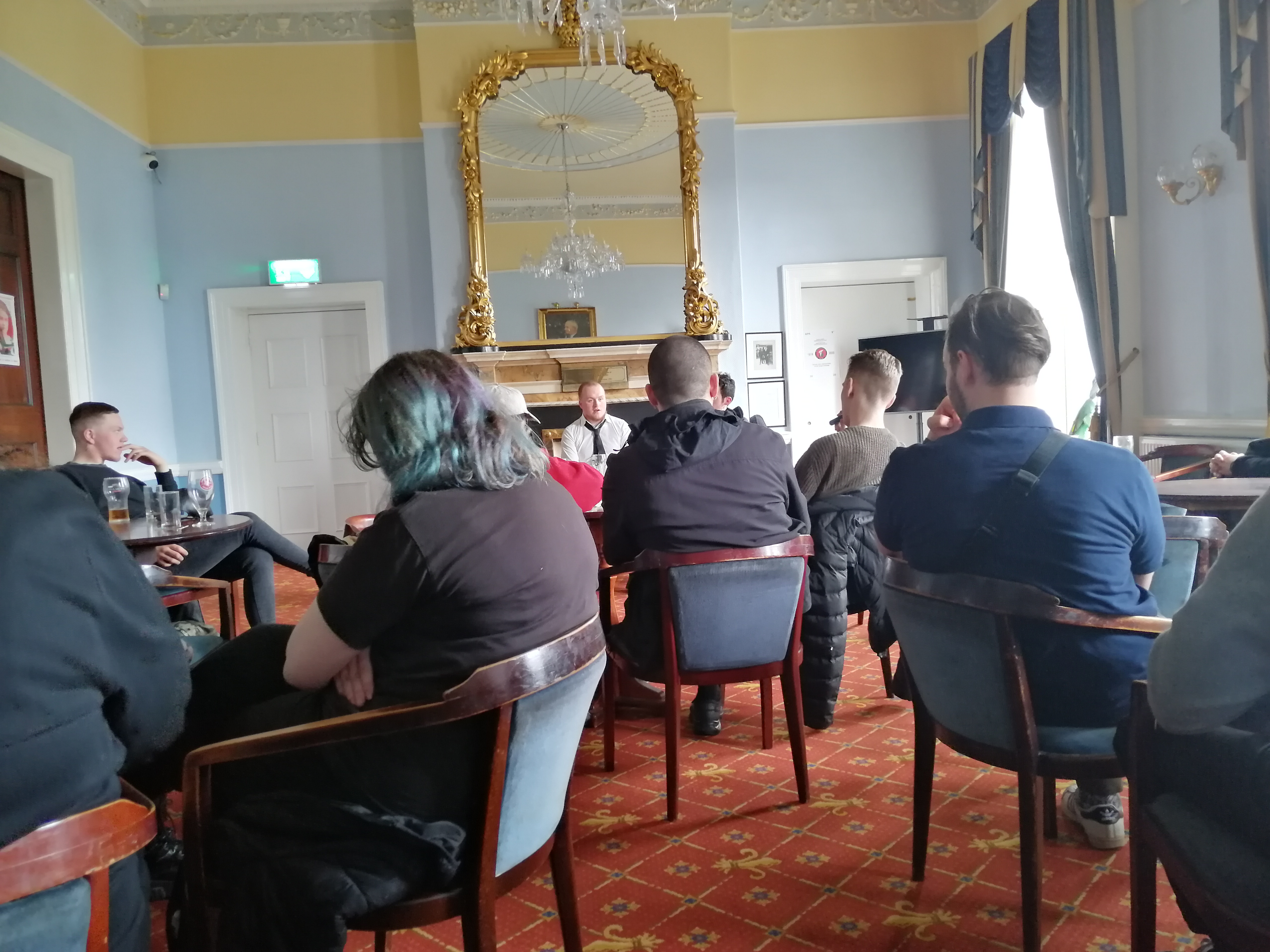
 rebelbreeze