(Reading time RB article: 5 mins; I.Times article: 3 mins)
In court on 6th March in Dublin, Garda Sean Lucey, who had struck an RTÉ cameraman with his baton in the groin, although his statement was “less than an apology”, received a suspended prison sentence. He had been found guilty by a jury in December but the Judge had postponed sentencing. Antifascists arrested on the same day as the assault by Garda Lucey, while preventing the proposed Dublin launch of the European islamophobic group Pegida, have been fined and three are still facing trial.
Garda Sean Lucey, leaving the court after his sentencing for assault on a journalist. (Source: Irish Times).
It was back on 6th February 2016, coincidentally the centenary of the 1916 Rising, when the islamophobic European organisation Pegida, announcing its intention to launch itself in a major city in every European state, planned a rally to launch an Irish branch in Dublin. The individuals and organisations supporting this initiative included racist, fascist and generally far-Right groups and individuals in Europe, including in Ireland.
Long before the planned Pegida rally, anti-racists and antifascists had occupied the intended space outside the GPO, while groups of anti-fascists mingled with curious bystanders on the other side of the street. Quite soon, some fascists of Eastern European background began to insult some women and also to threaten a filmmaker from Rabble, an independent alternative media organisation, calling him a “ fucking communist”.
Earlier that day, the anti-fascists and anti-racists had occupied the site of the planned Pegida rally. (Photo: D.Breatnach)Fascists of E. European origin make their presence known in North Earl Street through threats and insults. (Photo source: Antifascist photographer)
Having revealed themselves, the fascists quickly became the targets of antifascist hostility and scattered down North Earl Street. Some scuffles took place there and some of the fascists ran on down Talbot Street. Gardaí, including riot police (Public Order Unit) waded into the antifascists and also beat up a fascist, in an apparent case of mistaken identity. Subsequently the Gardaícordoned off that area with drawn batons and police dogs.
It was soon revealed that some other fascists were holed up ina bar in Cathedral Street and many antifascists made their way there, only to run into another confrontation with riot police who repeatedly struck anti-fascists in order to drive them out into O’Connell Street. It was there that the assault on the RTÉ journalist took place. It took until December 2020 for the case to come to court while, in the meantime, anti-fascists were charged, convicted and fined.
Gardaí wielding batons in Cathedral St. (Photo source: Antifascist photographer)
The report of the case in the Irish Times (see References, Sources) reveals three things, it seems:
The fact that his victim was a journalist of the State broadcaster and supported by his union and employers meant the Gardaí could not get away with the assault without some kind of punishment;
On the other hand the Judge was determined to treat the assault as leniently as possible under the circumstances;
The Garda’s whole attitude was in essence that he had done nothing really wrong.
Regarding Garda Lucey’s attitude, which even Judge Melinda Greally remarked upon (“his statement of regret falling short of an apology”), it suggested that he might well have assaulted or would in future assault some other member of the public – especially if he were not a journalist of a State broadcasting service. Perhaps an independent journalist …. or an anti-fascist demonstrator …. or even some member of the public who voiced some objection to his behaviour.
Furthermore, before Garda Lucey struck Mr. Colm Hand in the groin, he struck at his camera. What can that mean? Surely nothing less than that he did not wish his actions or those of his colleagues to be recorded! And perhaps a message to other potential journalists in future. Colm Hand declared that apart from the pain of the injury at the time (which could have caused permanent injury), “what happened on that day shattered my confidence and I have never fully recovered.” The five-day trial in December last year, necessary because Garda Lucey did not admit initially to the offence, was also stressful for Mr. Hand and that and the period leading up to it had caused him worry and sleeplessness.
The Judge must’ve been aware of all these possibilities in future and past Garda behaviour and yet, despite Garda Lucey’s attitude, decided to view his assault as “an aberration.”
This was because, she said, he had no previous blots on his career. But how would those blots have appeared if he had, indeed, behaved similarly in previous situations? Who would have recorded those incidents in his career? The only reason this occasion was noted was because he had struck a journalist of a state broadcasting service and neither the victim, his employers nor his union had been prepared to drop the matter so that, eventually, it had to come to court.
QUESTIONS NOT ASKED
The Irish mass media – including RTÉ itself — does not ask such questions. Nor speculate whether Garda violence was inflicted on others in that area on that day. It was and I myself witnessed it.
Part of the struggle in Cathedral Street. (Photo source: Internet)
After I moved forward to denounce one Garda who was beating the protectively-raised hands of a protester, one huge member of the POU struck at my fingers with his baton several times and when I evaded the blows, shoved the baton into my stomach, which caused me in reflex to grab it and engage in a short tugging battle, during which he grew increasingly irate and I increasingly worried for my personal safety.
During a sit-down protest outside the Dáil some years ago, Gardaí drew their batons and assaulted demonstrators peacefully sitting down, which was photographed in clear evidence. Not one Garda was charged with assault (nor likely reprimanded) arising out of that incident. And there have been many other such incidents.
No judge should quote an unblotted record of a Garda as any reason for leniency in sentencing. But of course, the judiciary realise that the Gardaí are the first physical line of defence of the system they uphold and for that reason they will always get special consideration. As Judge Greally was quoted as saying, “she has the highest regard for the work of the Gardaí.”
END AND AFTERMATH OF THE PEGIDA CONFLICT
The Pegida V Anti-racists conflict in which that assault on Colm Hand took place is only vaguely referred to in the Irish Times report – surely a deliberate occluding of context and of an event that would have been of interest to its readers.
After the various struggles in North Earl and Cathedral Streets, Gardaí pretended to arrest the fascists and brought them out in police vans to safety while decoy vans made their way into O’Connell Street, drawing large crowds of anti-fascists to block them and curious onlookers to view the event. Earlier, some Irish fascists coming in to town by LUAS had run into antifascists and never made it to the intended Pegida launch, one needing to go to A&E instead.
Subsequently, antifascists monitoring fascist communications reported that some Eastern European fascists complained of the lack of spine of their Irish counterparts and swore they would never again cooperate with them. Dublin may have been the only European capital where Pegida did not succeed in launching itself and subsequently the whole initiative faded from the news.
Launch of the Pegida ship in Dublin. (Cartoon D.Breatnach)
As noted earlier, a number of antifascists faced charges and were sentenced in court, including fined. Three Irish Republicans of different allegiances were charged and are currently awaiting trial; their charges are of “violent disorder” which on conviction carry a sentence of up to ten years imprisonment, an unspecified fine, or both. It is the first time this charge has been used by the Irish State against political activists.
The 5th of March is the anniversary of the naval Battle of Cape Machichaco (cabo matxitxakoko borroka, in Euskera/ Basque), which took place on 5 March 1937 off Bermeo (Bizkaia province, Basque Country), during the Spanish Anti-Fascist War, between the Spanish Military-Fascist heavy cruiser Canarias and four Basque Navy trawlers escorting a Republican convoy. The trawlers were protecting the transport ship Galdames, which was sailing to Bilbao with 173 passengers.
Looking from Cabo Matxitxako out to sea and to the French Border dividing the Basque Country. (Photo: D.Breatnach)
(The following account of the battle is from Wikipedia; the section titles and comment are mine)
On 4 March, four armed trawlers of the Basque Auxiliary Navy section of the Spanish Republican Navy, Bizcaia, Gipuzkoa, Donostia and Nabarra departed from Bayonne, France. Their intention was to defend Galdames‘s mail, passengers, machinery, weapons, supplies and 500 tons of nickel coins property of the Basque government.
The battlecruiser Canarias. (Photo source: Internet)
Canarias sailed from Ferrol with Salvador Moreno as the captain, with orders to stop the transport ship. Galdames, which was steaming up with the lights and the radio switched off, and was unknowingly left behind by Bizcaya and Gipuzkoa.
FOUR CONVERTED TRAWLERS AGAINST A BATTLE CRUISER
Next morning, while all the trawlers were watching for Canarias, Galdames rejoined them. Bizcaya‘s captain was Alejo Bilbao, Nabarra‘s Enrique Moreno Plaza from Murcia, and Gipuzkoa‘s Manuel Galdós. The trawlers had the intention of luring Canarias close to the Biscay coast to have the assistance of the coastal batteries.[
The first trawler to spot Canarias was Gipuzkoa, 30 kilometers (19 mi) north of Bilbao. The Basque trawler was hit on the bridge and the forward gun. Return fire from Gipuzkoa killed one Canarias seaman and wounded another. The armed trawler, with five fatalities and 20 injured aboard, managed to approach the coast, where the shore batteries forced Canarias to retreat.
Nabarra and Donostia tried to prevent Canarias from finding Galdames and engaged the cruiser.
The Nabarra during the Battle of Matxitxako, painting by David Cobb. (Photo source: Internet)
Donostia withdrew from the battle after being fired on by Canarias, but Nabarra faced the enemy for almost two hours. She was eventually hit in the boiler and came to a stop; 20 men abandoned the sinking trawler, while other 29 were lost with the ship, including her captain, Enrique Moreno Plaza.
The transport Galdames, which was hit by a salvo from Canarias and lost four passengers, was eventually captured by the military-fascist cruiser.
Gipuzkoa arrived at Portugalete seriously damaged and Bizcaia headed for Bermeo, where she assisted the Estonian merchantman Yorbrook with a load including ammunition and 42 Japanese Type 31 75 mm mountain guns, previously captured by Canarias and released.
Port town of Bermeo, seen from Cabo Matxitxako. (Photo: D.Breatnach)
Donostia sought shelter in a French port.
AFTERMATH
The 20 survivors from Nabarra were rescued by the military-fascists and taken aboard Canarias. Instead of the expected hostility and mistreatment, they were given medical assistance, and both the cruiser commander, future Francoist Admiral Salvador Moreno and Captain Manuel Calderón interceded with Franco when the Basque seamen were sentenced to death in retaliation for the shooting of two crewmembers of the armed trawler Virgen del Carmen, captured by Republican sympathizers and diverted to Bilbao in December 1936. The survivors were eventually acquitted and released in 1938.
In contrast, one of the passengers aboard Galdames, Christian Democrat politician Manuel Carrasco Formiguera, from Catalonia, was imprisoned and executed on 9 April 1938.
Map/ diagram of the Battle (Image source: Internet)
PERSONAL COMMENT
COURAGE, COWARDICE AND CRUELTY
The story is one of incredible bravery of a number of converted trawlers and their Basque crews, in particular that of the Nabarra and her Captain from Murcia. One account I read related that her Captain consulted his crew and they agreed to fight to the death or the sinking of their ship. Their valour and stubbornness (two qualities which commentators often associate with the Basques) was of such magnitude as to impress even their military-fascist opponents, to the extent of their interceding with Franco to save their lives.
It is also the story of the cowardice of at least the captain of the Donostia.
And of the bestiality of the military-fascists in the execution of a member of the Catalan Governmentreturning to his country with his family, guilty of no crime but to serve his the administration of his elected republican government (one of hundreds of thousands of such crimes of the miiltary-fascists coupists and their victorious regime).
VISIT TO CAPE MATXITXAKO
I visited the land part of the location on a number of occasions in recent years. Access by public transport is by a bus every hour but I was driven by friends.
Monument to the Battle of Matxitxako by sculptor Nestor Barrentxea, who is from the nearby port town of Bermeo. (Photo source: Internet)
On a windy promontory on private land I saw one of the shore artillery battery sites (which has had nothing done to conserve it) and, close enough, the monument to the battle. Not far from there is a local bar-restaurant which is popular and a short trip by car, the iconic hermitage of Gastelugatxe. Many tourists visit the area but I wonder how many get to hear of the story.
Thinking of the determination and courage of those crews, not even trained for war, in converted trawlers, facing a trained naval crew of a huge battle cruiser, I am not ashamed to say my eyes fill and my lip trembles.
Aerial view of the Matxitxako Cape. (I took my two photos from beside the building furthest to the right). (Photo source: Internet)
(Para el informe en castellano haz clic en el enlace)
(Translated from Castillian by D.Breatnach)
(Reading time: 3 minutes)
MADRID 02/15/2020 1:57 PM ALEJANDRO TORRÚS
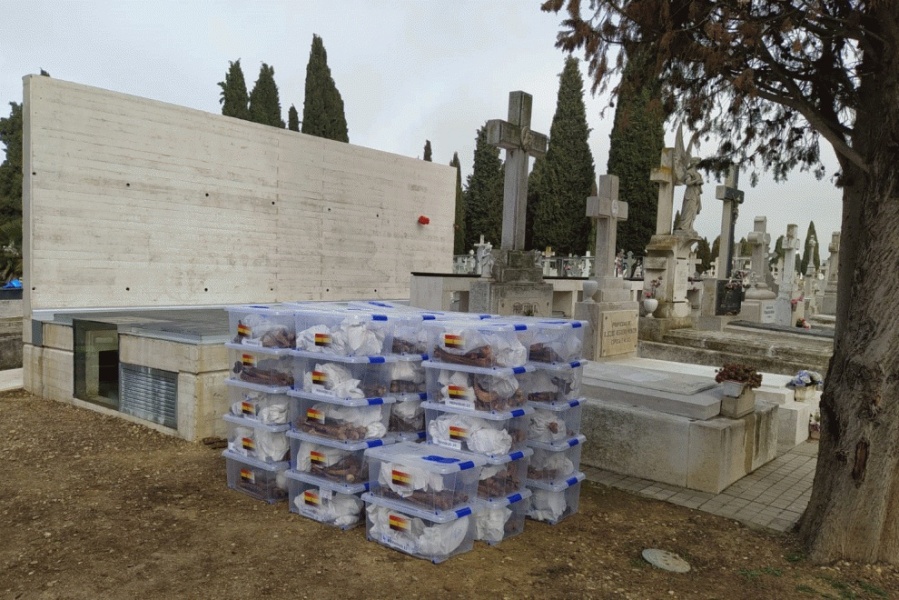
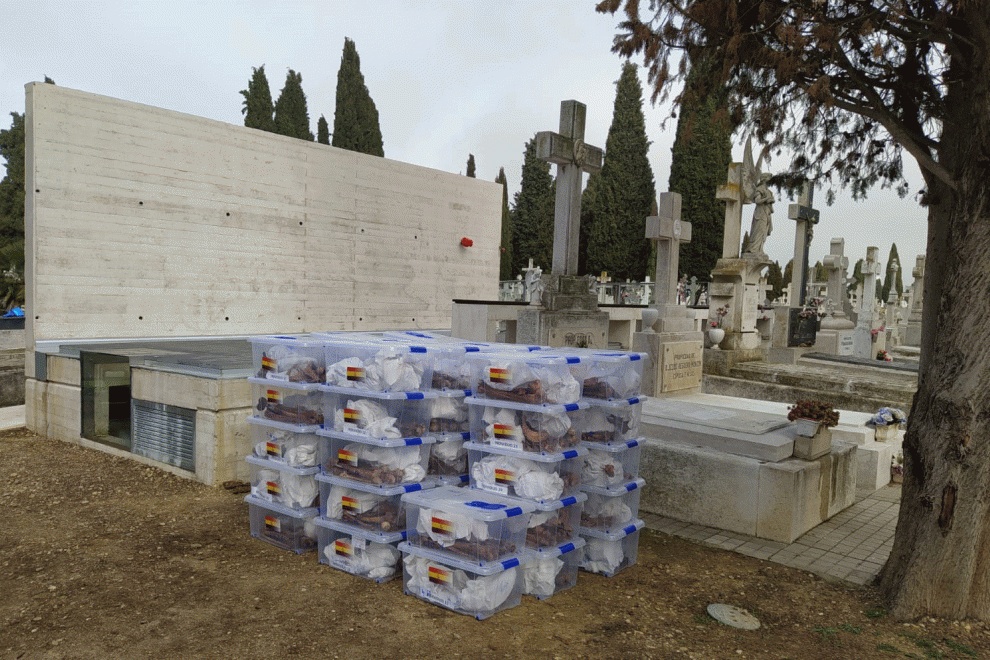
At last. The remains of 247 victims of Franco that have lain in a warehouse in Valladolid for over two years will be buried this Sunday in a memorial constructed within the Carmen cemetery. This will be the end of a long process that began in 2016 with the exhumations of communal graves in the cemetery itself, paralyzed since for a long time by the insistence of UGT to install a bust of Pablo Iglesias Posse. Finally, there will be a memorial, there will be the names of the more than 2,650 fatalities of the province, the 247 bodies recovered and there will be no bust of the founder of UGT and the PSOE.
(Trans: UGT is one of two main Spanish trade unions and is connected to the social democratic PSOE; both were banned — along with many other organisations — during the Franco Dictatorship but since then the PSOE has been in government more than any other party. Valladolid is about halfway between Madrid and the Bay of Biscay).
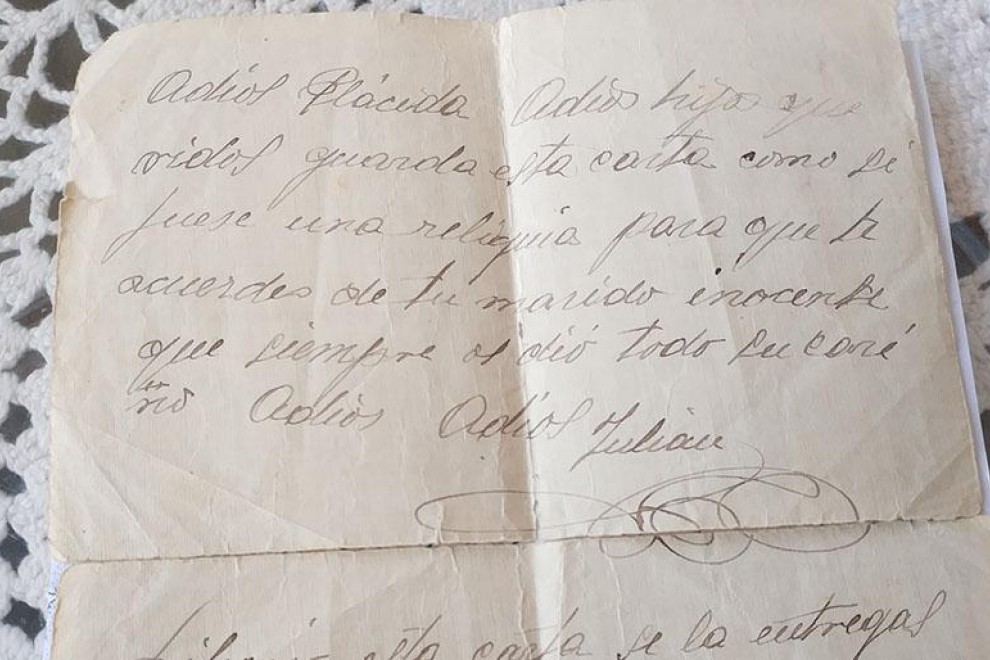
3) Letter sent by Julián Carlón to his wife and children from the Valladolid prison.- ALEJANDRO TORRÚS
“We want this tribute to be an act of democratic recognition and historical justice to all those who defended the Second Republic regardless of the party in which one was active,” explained Julio del Olmo, president of the Association for the Recovery of Historical Memory (ARMH) of Valladolid, responsible for the exhumation and custody of the bodies, to Público.
Memorial built in the Carmen cemetery, just a few meters from the location of the graves of the victims of the Dictatorship. (Photo: Valladolid ARMH)
The event will begin at 12.00 noon this Sunday and will include participation of relatives of the victims, the Valladolid writer Gustavo Martín Garzo, musical performances and the presence of the Mayor of Valladolid, Óscar Puente and the Secretary of State for Democratic Memory, Fernando Martínez.
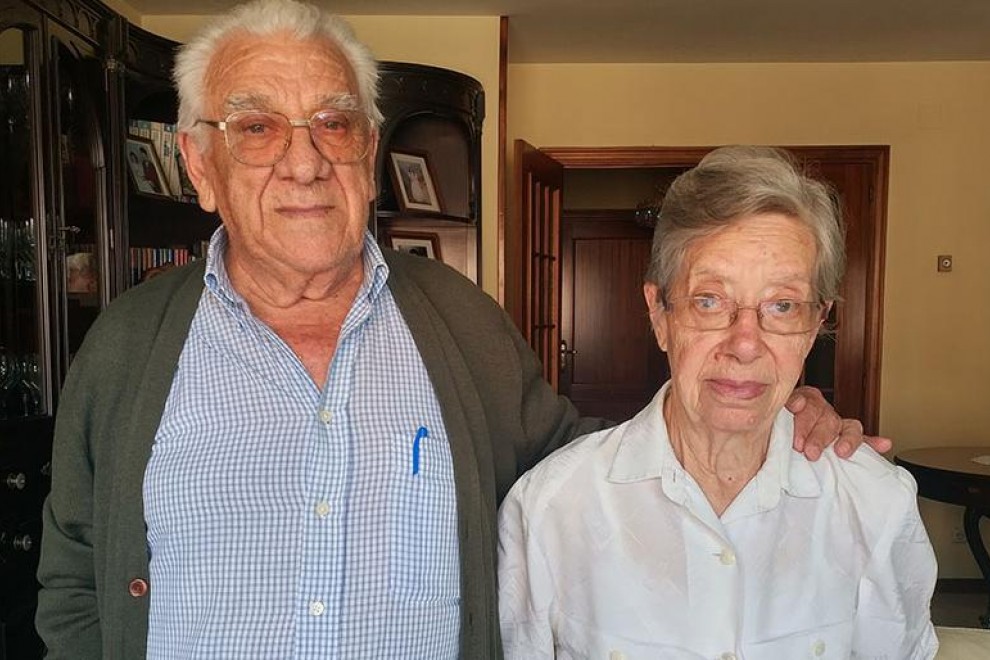
However, the tribute comes too late for many victims. For example, for Saturnina, who passed away a few weeks ago. Her perseverance and struggle and that of her husband facilitated the ARMH in identifying the place where the graves were in the cemetery and proceed to their exhumation. Saturnina was only a child when Franco’s forces shot her father, Julián Carlón, on October 1, 1936.
Saturnina, in fact, barely knew anything about her father. He was four years old when he was taken. “I only remember the day he was taken and the place where he was buried, which my uncle told me about,” she confessed tearfully to this newspaper in September 2019. “I don’t even know how he was killed. I just know he was taken away, that he never came back and that, from that day, there were only tears in my home. My mother never told me about my father because of fear,” she said. However, thanks to the indications of a relative, Saturnina kept a memory of the exact place where the bodies were buried after their execution.
Saturnina & Avilio at home September 2019. Saturnina was 4 years of age when the Francoist forces took her father away and shot him. (Photo: Torrus)
REMAINS OF THREE WOMEN AND TWO MEN IDENTIFIED
To date, the Valladolid ARMH has managed to identify “with total security” five of the 247 bodies recovered. These are of three women and two men: Lina Franco Meira; Republican Army sergeant Francisco González Mayoral; the Mayor of Casasola de Arión, Mateo Gómez Díez; and mother and daughter María Doyagüez and María Ruiz Doyagüez.
“Of the four graves with the 247 bodies that we have found, we have only been able to certify those five people to almost 100%. Of many others, we can be almost certain that they correspond to one group or another of those shot, but we cannot name each skeleton. We lack the means and it is a tremendously complicated process,” laments Del Olmo, who, however, points out that the remains of the victims will be well preserved so that, if possible, they continue working on identifications.
Letter from Julián Carlón in Valladolid Prison to his Wife & Children. (Photo: A. Torrús)
Cases such as that of Lina Franco Meira, which has been identified, are exceptional when 81 years have elapsed since the end of the Civil War. Her bones could be identified thanks to a DNA test sample of one of her daughters, 93 years old. An exceptional case of longevity that has allowed name and surname to be given to some bones and, in addition, allows us to believe that among the rest of those sharing her grave are her other 14 neighbors of the town of Castromocho (Palencia) that were taken along with Lina Franco to Valladolid to be executed and buried.
“SO THAT FRANCO AND AMNESIA DO NOT WIN”
Franco’s forces not only killed Lina Franco and more than 2,000 people in this province (Castille-Léon). They also tried to erase their names, their life stories and their struggles. Now, 84 years after the coup, a memorial will recover their names and try to spread their fight in defence of Republican values. The challenge, however, continues and consists in being able to identify as many of them as possible so that Franco and amnesia do not win the battle.
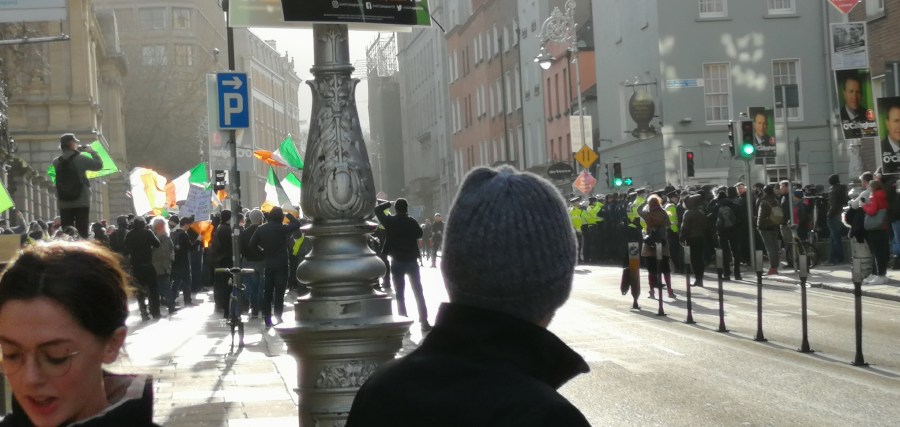
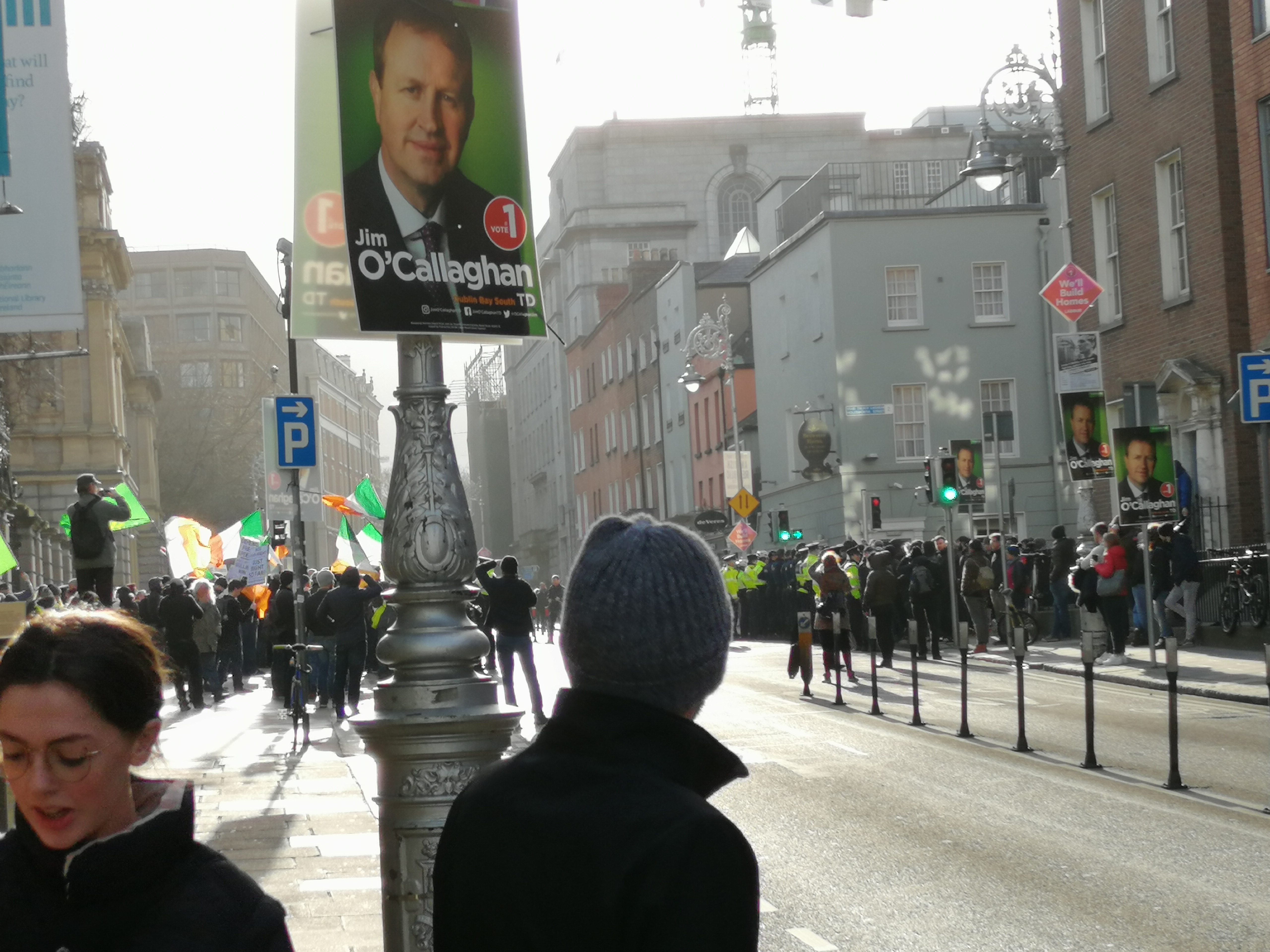
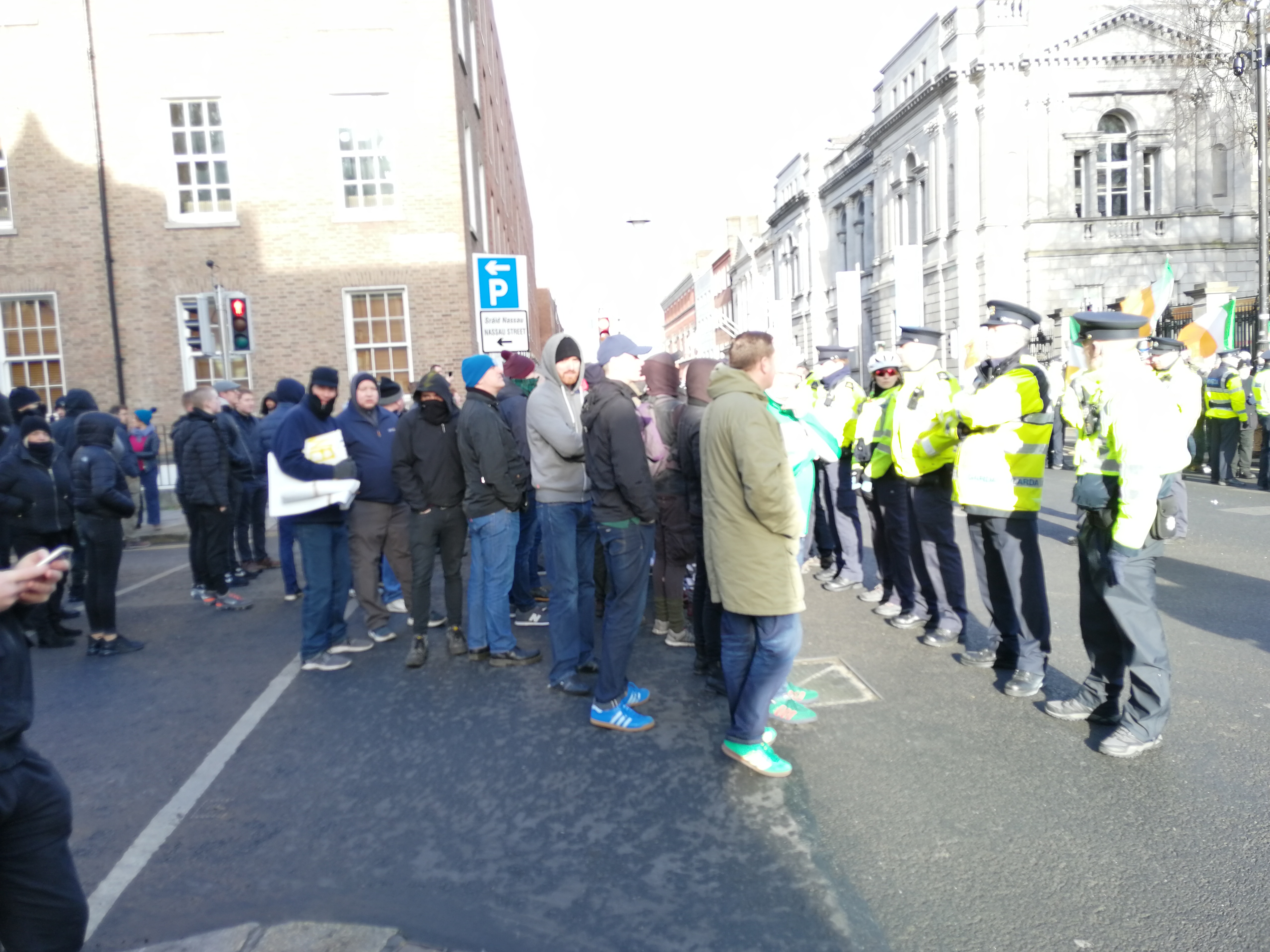
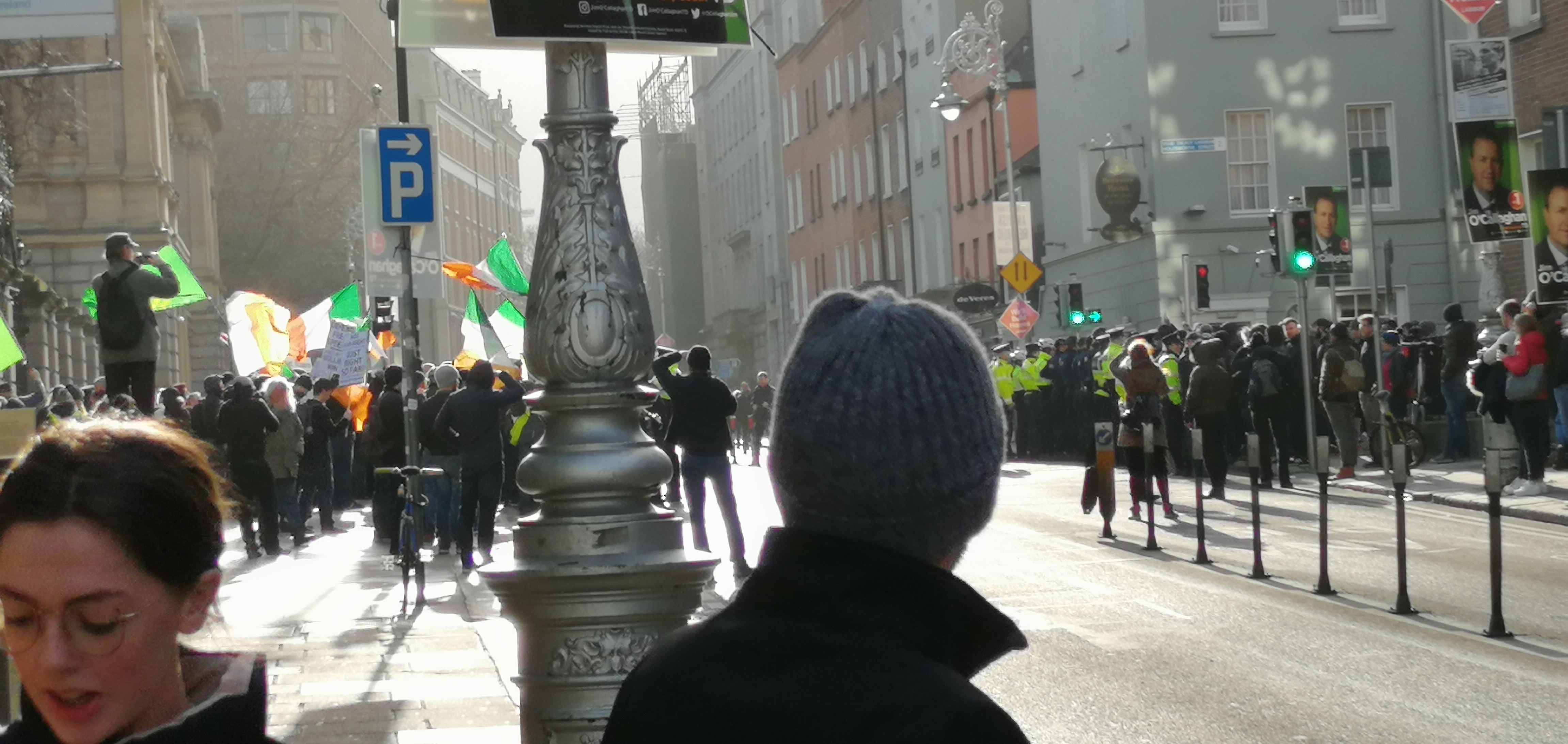
After weeks of propaganda and whipping up their support, a much-reduced turnout of the Irish far-Right lined up in front of Leinster House on Saturday 1st February and were confronted by an anti-fascist, anti-racist opposition a little smaller in size but which had been convened by word of mouth alone. There were some scuffles and a couple of arrests and the far-Rightists begged for a Garda escort to leave their protest after little more than one hour.
Confronting one another across Kildare St, far-Right and anti-fascists, seen from a little distance (Photo: D.Breatnach)
“FREE SPEECH”?
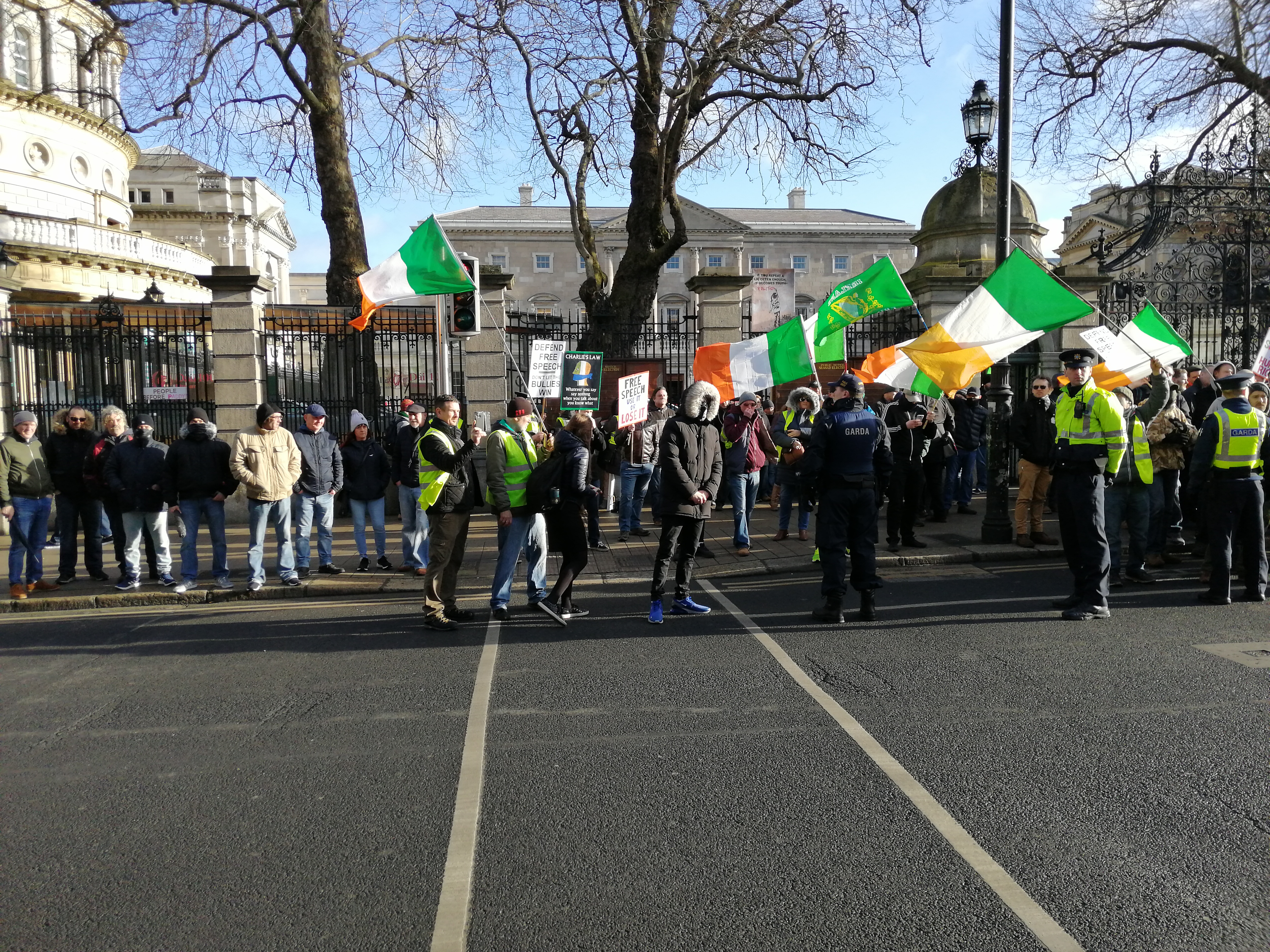
The far-Rightists had called the demonstration allegedly in defence of “free speech”, protesting legislation proposed recently by Fine Gael against “hate speech”. Apart from the fact that the detail of the legislation has not been published yet, most on the non-institutional Left in Ireland and perhaps especially Irish Republicans, would be extremely wary of such widely-framed legislation, known to have been used in other administrations primarily against people denouncing the police, political parties, politicians and even royalty.
However, most Republicans and the non-institutional Left would not agree with the “right to free speech” which the far-Right is seeking, which is the “right” to spout virulent and lying material in the course of their racism, islamophobia, LBGTphobia, attacks on women seeking pregnancy termination or campaigning for the right to choose. In fact, we can trace the public start of the far-Right concern with “free speech” in Ireland to July 2019 when Gemma O’Doherty had her Youtube account suspended and then closed by Google, due to complaints that her racist rants were violating Google’s own standards. A similar case occurred in January in Spain when the relatively new far-Right Spanish party Vox had their Twitter account suspended, after they had accused a municipal education program on equality of “using public funds to promote paedophilia”. (see also FAR RIGHT CHANTS OF “PAEDOS” below for more on this issue).
The far-Right demonstrators with Leinster House in the background. They fly a lot of Tricolour flags in an attempt to convey themselves as ‘patriotic’. (Photo: D.Breatnach)
Even thinking about the issue for a few seconds will make it clear that there is not and never has been an unfettered right to say whatever one wants in public. Long before there were modern laws against defamation of an individual based on lies, it was forbidden by the Brehon laws (the oldest surviving codified legal systemin Europe) which laid down punishment for the offence. Judaic and Christian traditions have it forbidden in the Ten Commandments as have those of many other cultures. The issue is not that all speech should be free but what kind of discourse should be permitted and which should not. And it is precisely that racist discourse, LBGTphobia, Islamophobia and attacks on the rights of women that the Republicans and non-institutional Left oppose, partly for its own sake and partly because it is along those lines that fascism seeks to build itself and split the working people in order to come to rule — in a dictatorship that will soon ban any criticism whatsoever of those in power.
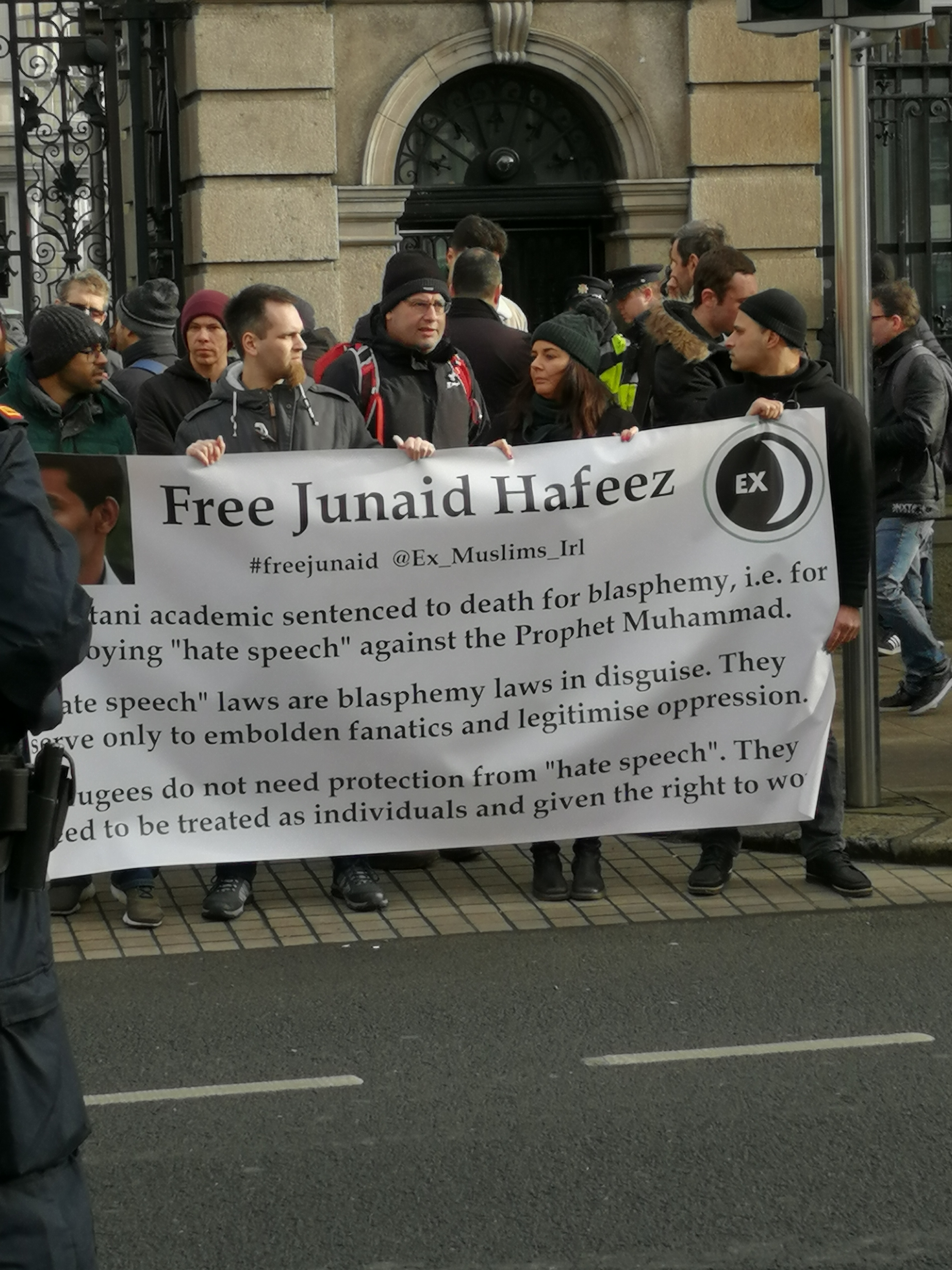
Some confused or misguided Asian anti-blasphemy laws protesters among the far-Rightists, despite the common anti-migration and racist discourse of the far-Right. (Photo: D.Breatnach)
FAR-RIGHT CHANTS OF “PAEDOS”
Among the exchange of insults between both sides, at one point the far-Rightists were heard to chant “paedos” at their opposition. The word is an abbreviation of the word “paedophiles”, which describes people who sexually abuse children for their own twisted gratification.
Imagine if some of these far-Rightists were in one’s neighbourhood and began to accuse an anti-fascist of being a paedophile! This is one of the ways in which they abuse any right to free speech.
But in any case, what is the basis for this chant? Do they really believe that their opponents are all paedophiles? No, like the Spanish far-Right party Vox referred to earlier, they count LGBT people as equal to paedophiles, i.e people who sexually abuse children. That is how sick their thinking is. Nor do they believe that all their opponents are LGBT themselves but according to the far-Right, the fact that we uphold the right of people to decide their own sexuality and for consenting adults to choose their relationships, makes us the equivalent of those who sexually abuse children!
View of the anti-fascist, anti-racist demonstrators, at the Molesworth St. intersection, viewed northward down Kildare St. (Photo: D.Breatnach)
SURGE, SCUFFLES AND ARRESTS
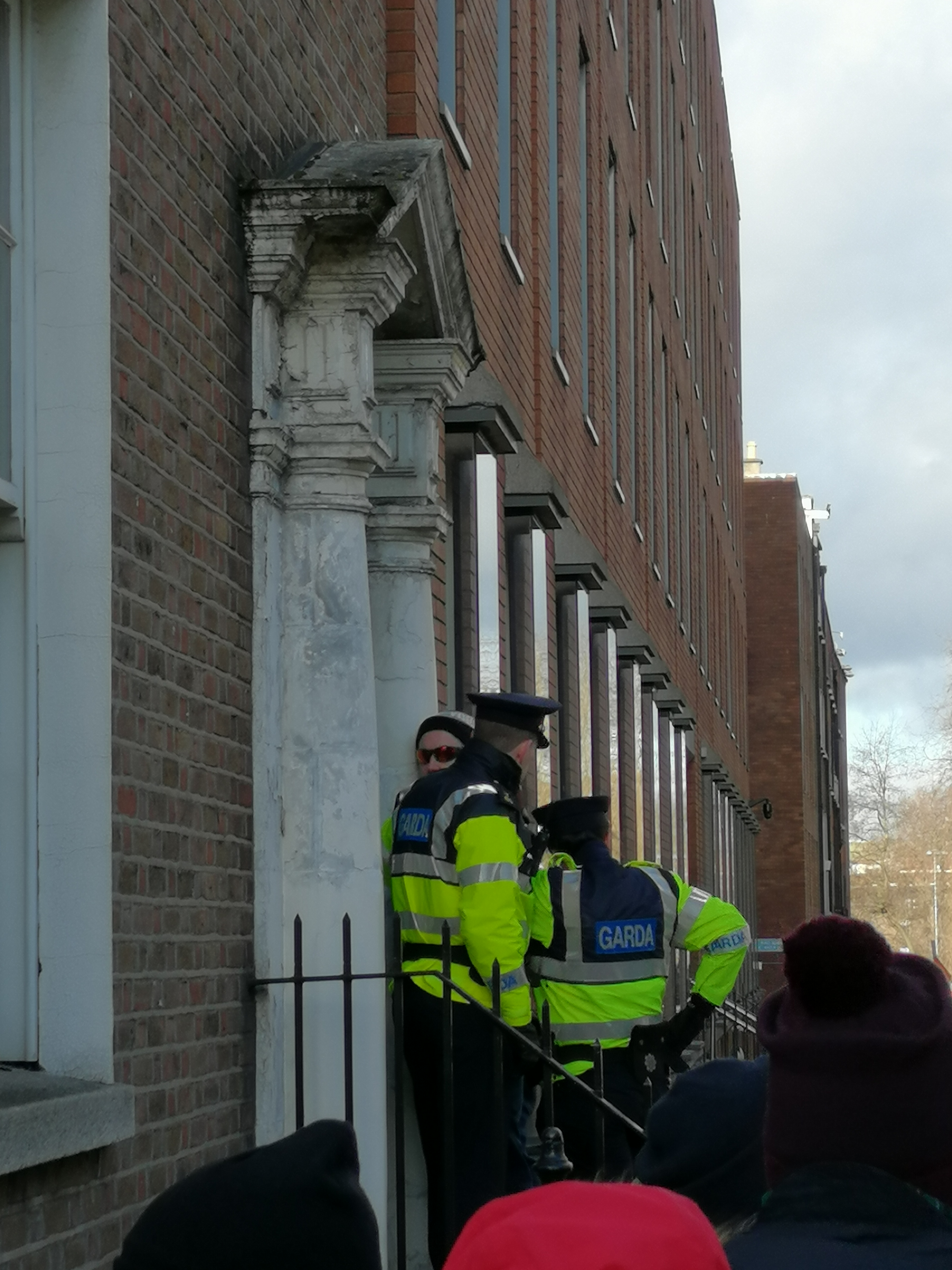
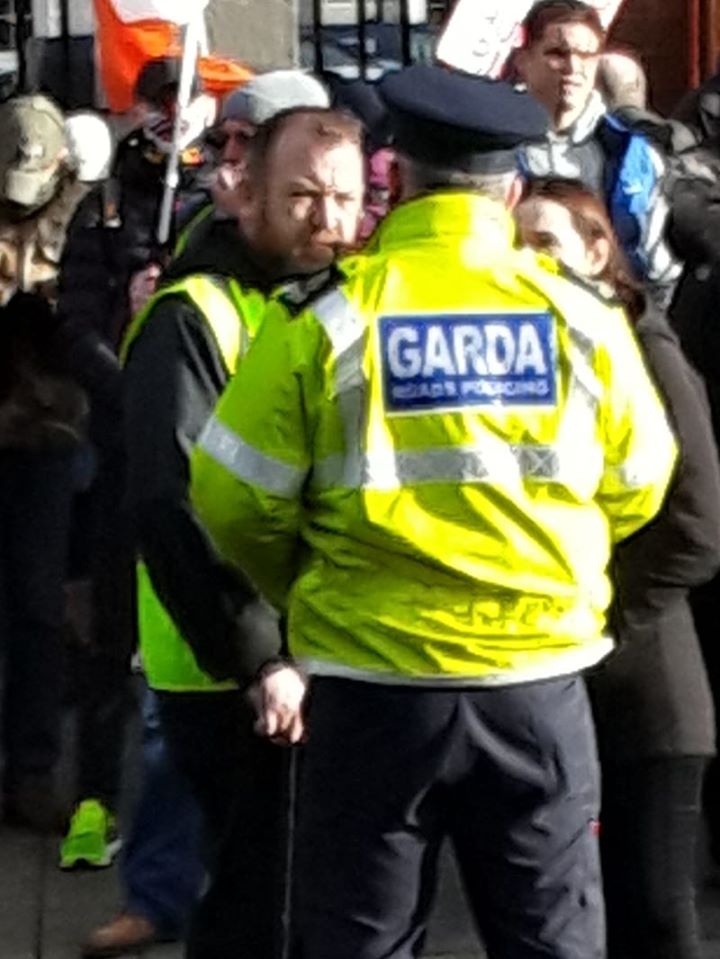
At one point, a surge developed among the anti-fascists towards the south of their numbers and the general Gardaí and Public Order unit (the Gardaí are the police force of the Irish state) charged the anti-fascists with batons drawn, with which they struck a number of antifascists. A man reported to be a fascist, on the steps outside a building on the same side of the street as the antifascists, was seen lashing out downwards, presumably at antifascists, with a pair of crutches. At that point the Gardaí restrained him and later it seems arrested him but apparently they had already arrested an anti-fascist. Most of the police dived at the anti-fascists during this brief episode and a few activists were rescued from police hands. However, a fascist who crossed the road from the Leinster House side with a stick, who took a number of swings at anti-fascists, was escorted back across the road by Gardaí, apparently without any attempt to arrest him.
The man seeing striking out at anti-fascists with crutches before being restrained by Gardaí. An antifascist was arrested during this incident. (Photo: D.Breatnach)
The far-Right rally had been scheduled for 1.00pm and at 2.15 pm they left, having begged the Gardaí for an escort, with which they were provided. Meanwhile, the riot police prevented the anti-fascists from following them.
However, a brief encounter on the quays a little later between small numbers of both groups necessitated the Gardaí once again to protect these “nationalist” warriors.
Yellow Vest Ireland fuhrer Glen Miller seeking escort from senior Garda officer. (Photo source: antifascist participant)
DIMINISHING AND DESERTED BY LEADERS?
Those who fancy themselves as the public leaders of the motley crew of the far-Rightists left their acolytes deserted, for apart from Yellow Vest leader and islamophobe Glen Miller, they did not attend. Neither Gemma O’Doherty nor Justin Barrett were to be seen there and the ex-British Army soldier Rowan Croft made only a brief appearance before vanishing.
As mentioned earlier, although extensively publicised in advance, the numbers of the far-Right were significantly down on previous events outside Leinster House, which may point to a limited reservoir of activists in the far-Right in Ireland, also to some inability to sustain an extended program of public events (after all, keyboard activism has been their main activity until recently).
On the other hand, their opponents, using personal contact only to mobilise from among Irish Republicans, Socialists, Anarchists and general Anti-Fascists of different organisations and none, were able to put together a counter-demonstration of a size approaching that of the far-Rightists.
However, it would be unwise to relax. The far-Right is on the rise across most of Europe; the capitalist system world-wide is heading for crisis and at such times turns to fascism to force the working people to pay for the crisis through austerity. In addition, in Ireland we are already in part of an austerity program with the bank bailout draining our taxes, our health service in crisis and no public housing program to counter spiraling homelessness and mortgage debt.
The Gombeens and foreign capitalists who feed on our sweat and blood will hesitate before taking on the working people in this country in an open fight. But with fascists and racists splitting the working people and diverting them from the cause of our woes, that would be a different matter. Continuing vigilance is required, along with mobilisation to counter their public events. But also, education of the people and giving genuine leadership in fighting for a decent life for working people of all ethnic backgrounds in Ireland.
Anti-Fascist Action Ireland (they published a report from which I took some of the information here, the rest being based on my observation): https://www.facebook.com/afaireland/?
Published first in Dublin Republicans Against Fascism, reprinted by kind permission.
(Reading time: 2 minutes)
Dublin Republicans Against Fascism commend the diverse Balbriggan community for coming together yesterday, Monday 27th, to confront and ward off a motley crew of sinister far-right agitators who arrived in the town late evening to hold a public meeting.
Dublin Republicans Against Fascism who were present relay the following description of events:
The public meeting was to be an election launch for the carpetbagger candidate Gemma O’ Doherty who traveled from her residence in leafy South County Dublin to attend, and her fellow ACI (Anti-Corruption Ireland) candidate John Waters. A special guest speaker for the evening was to be Justin Barrett, the leader of the far-right National Party, a party primarily made up of landowners, businessmen and wealthy middle class elites.
KEEP DUBLIN TIDY
As they announced their meeting publicly the community of Balbriggan were concerned at the presence of these well-established racists and bigots coming into the town and inciting hatred and division. In response the community of Balbriggan, and at very short notice, assembled at the town square and decided to go down and attend the meeting to confront these carpetbaggers in person. Up to a hundred people from the community marched down the main street of Balbriggan to attend only to find at the venue, a scruffy disused gym down a back lane, to be guarded by three of Gemma’s acolytes who prevented access. Inside the building, and already assembled, were two of the speakers, Gemma and John, and a bussed-in gang of a dozen supporters from across the country.
The Balbriggan community, having been denied access to the public meeting, decided to protest outside the gates. As the time of the start of the public meeting arrived, the Brit soldier Rowen ‘the rat’ Croft (a far Right Youtuber) and two of his Youtube army marched down, with his head held high as a compensatory measure, only to find the gate closed and locked. Rowen ‘the rat’ was left facing the anger of the Balbriggan community with no means of immediate escape. Beads of sweat percolated from his head as he tried to signal to those inside to open the gate.
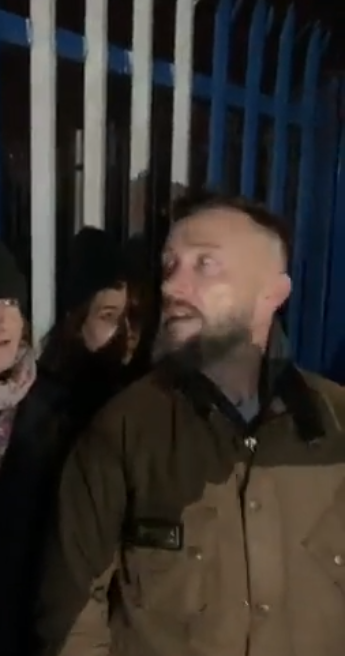
Ex-British soldier Rowen Croft, one of O’Doherty’s minions, desperately trying to get through protesters into her miniscule meeting (Photo source: Dublin Republicans Against Fascism)
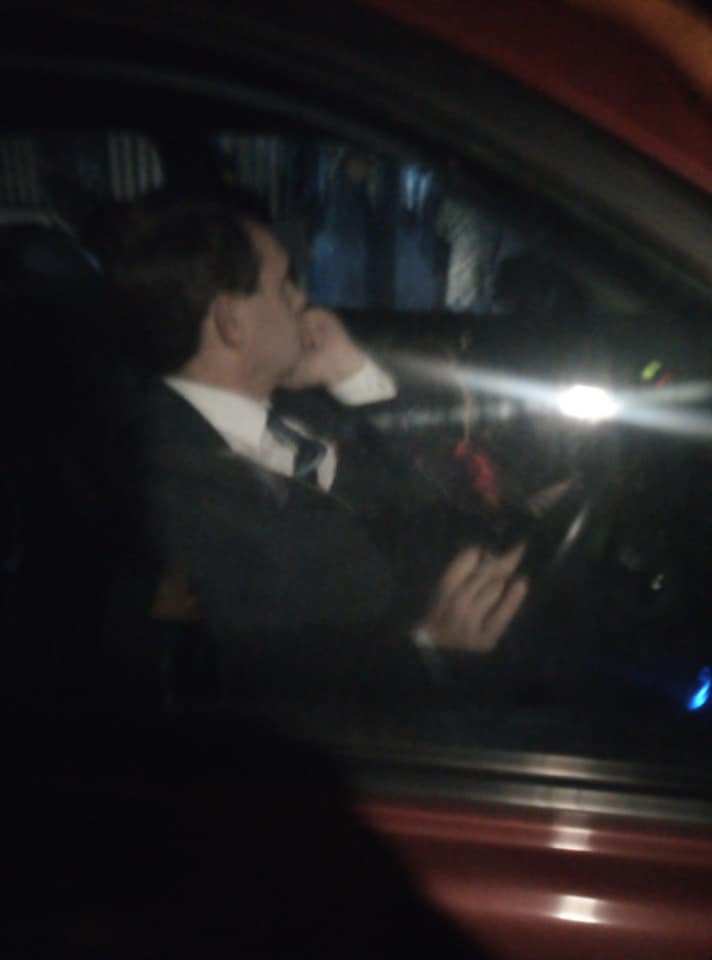
Shortly after this the Führer mobile of Justin Barrett of the National Party arrived. Despite the assembled protest occupying the road Justin arrogantly tried to ram through the crowd and into the gym. He was unsuccessful however as people blocked the front of his vehicle in scenes reminiscent of Joan Burton in Jobstown sitting in a fogged-up car surrounded by an angry community. Justin was seen frantically on the phone to the Gardai and the half-dozen far-right heavies assembled in the building to try and get him access, but to no avail. As it happens, the car Justin was driving was his girlfriend’s car, NP candidate Rebecca “Barrett”. The car had no valid NCT and the tax was out of date by a number of months. This was reported to Gardai but they did not act. Justin, causing tailbacks in traffic was eventually directed by Gardai to leave the area and he was not seen for the rest of the night.
Justin Barrett, Fuhrer of the National Party, prevented from entering by community protest. (Photo source: Dublin Republicans Against Fascism)
Despite the meeting being on lock down, one of Gemma’s supporters arrived in a 191 white Mercedes. Under heavy garda escort this supporter, who was wearing designer clothes, retrieved what looked like trays of foreign-grown food from the back her Merc and made her way into the building to supply the beleaguered Gemma and co with supplements.
As it became apparent that the meeting was locked down with no access for the Balbriggan community to attend, the protest continued for an hour before leaving the carpetbaggers to their meeting which turned out to be a demoralised echo chamber.
The Balbriggan community showed real unity yesterday. They showed that ethnic and religious differences will not divide them despite the best efforts of sectarian hate preachers like ACI and the NP. Dublin Republicans Against Fascism will continue to support the people of Dublin opposing this travelling carnival of hate wherever they go.
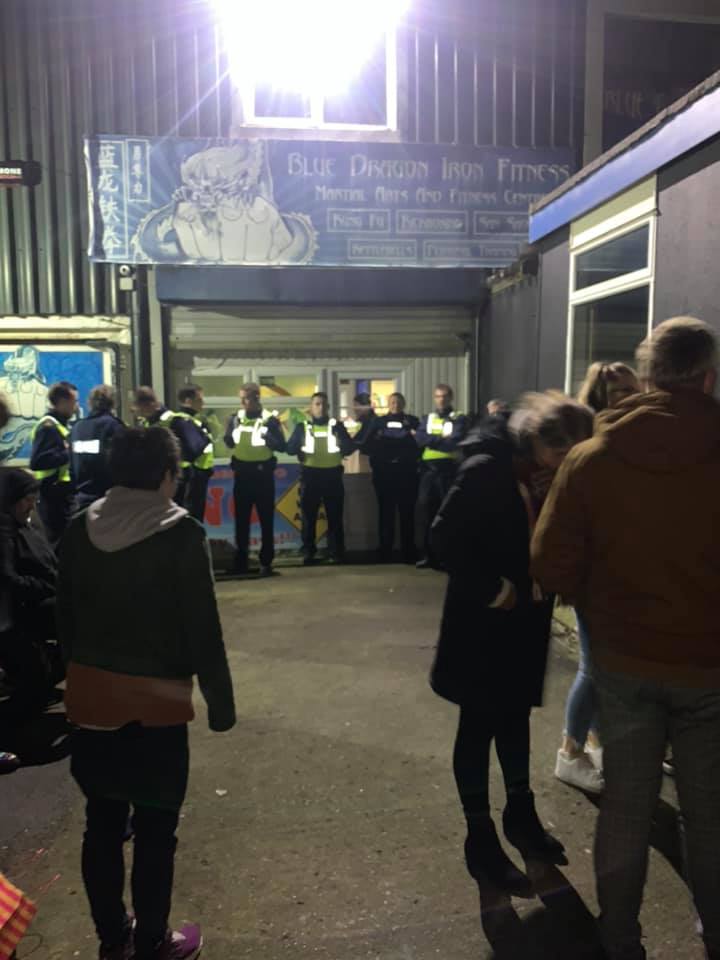
Gardaí protecting Gemma O’Doherty “public” meeting and helping prevent entrance from local community who disagree with her racist and islamophobic speeches. (Photo source: anti-racist protester)
“A man the ages will remember.” -Rev. Dr. Martin Luther King, Jr.
By Kevin Rooney (reprinted by kind permission of author).
Michael J. Quill and Martin Luther King at a trade union conference, USA, 1961, to which Quill had invited ML King. (Photo source: Internet)
Michael Joseph Quill was born in Gortloughera, near Kilgarvan Co. Kerry on 18 September, 1905. His parents were John Daniel Quill and Margaret (née Lynch). Fighting injustice seemed to be in his blood. He remembered: “My father knew where every fight against an eviction had taken place in all the parishes around”. His Irish-speaking family’s home served as headquarters for the No. 2 Kerry Brigade Of The Irish Republican Army during the War Of Independence Of 1919-1921. His uncle’s house was so well known for rebel activity, it is said that the Black and Tans in the area referred to the house as “Liberty Hall”; a reference to James Connolly’s ITGWU Union Headquarters in Dublin which was to prove prophetic.
IRISH REPUBLICAN ACTIVITY
While still a boy of 14, Michael was a dispatch rider for the IRA during the War of Independence. He served in 3rd Battalion of the No. 2 Kerry Brigade. Once on a scouting mission, he stumbled on a patrol of Black and tans asleep in a ditch. He stole all their ammunition without rousing them. He eventually graduated to carrying a rifle and organized a group of about thirty boys in the village into an IRA scout group, and drilled several times a week.
When the Civil War began in 1921, Quill joined the Republican side which opposed the Anglo-Irish Treaty that ended the War Of Independence. He took part in the re-capture of the town of Kenmare from The Free State Army in August of 1922, one of few Republican victories. He was said to have been involved in robbing a bank for the IRA during the war. He was much affected by the brutality and violence dished out by the Government Forces (Free Staters) to his Republican comrades in Kerry who were captured.
Michael J. Quill Centre, Kilgarvan, Co. Kerry, Ireland (Photo source: Internet)
The worst atrocity was the Ballyseedy massacre where eight Republican prisoners were killed by being tied to a landmine, which was then detonated. In March of 1923, at total of 23 Republican prisoners in Kerry were killed in similar manner, or summarily executed by shooting on different occasions. Another five were officially executed by firing squad. The most of any county.
His mother died in September 1923. The local priest refused to request a temporary amnesty so that Michael and his brother John could attend her funeral without risking arrest by National troops. It left a lasting bitterness in him toward the Catholic Church.
During the Wars, he met many prominent Republican leaders of the time who passed through his area; including Eamon de Valera, Liam Lynch, Tom Barry, Liam Deasy, Dan Breen, Erskine Childers among them. While still young, he conversed with these great minds.
EMIGRATION TO THE USA
After the war, Quill found opportunities limited for him as he had supported the losing side. He was also blacklisted after a sit-in strike with his brother John at a saw mill in Kenmare. He emigrated to the US, arriving on 16 March, 1926 in New York, where he stayed with an aunt on 104th Street in East Harlem (New York).
He hustled to make a living working a series of menial jobs which included what was called “bootlegging”: smuggling alcohol during Prohibition, during which time the sale of alcohol was illegal in the US. He worked passing coal and peddling roach powder and religious articles in Pennsylvania coal country. While there he wrote his father his observation that “the cows and pigs in Kerry were better housed and fed than were the miners’ children in America.”
Quill returned to New York and met a young Kerry woman named Maria Theresa O’Neill, known as Mollie who came from Cahersiveen. With the onset of the Great Depression she became unemployed and decided to return to Ireland. She and Quill maintained a patient long-distance courtship, keeping in touch with weekly letters.
Quill found employment with the IRT (Interborough Rapid Transit) railroad in 1929. He worked several jobs before becoming a ticket agent. The IRT, the largest transit company in New York attracted employment from many Irishmen; particularly Republican veterans of the Irish Civil War like Quill. There was a joke that IRT stood for “Irish Republican Transit”. Their advantage over other immigrant groups was that they already spoke English. Coming from mostly farm land, they were also able for the twelve to fourteen-hour days demanded of them seven days a week. About half of the employees were Irish.
Moving from station to station, he got to know many of the employees. Along with deplorable working conditions, Quill also observed discrimination based on racism and bigotry, which he hated. He said: “During those twelve hour nights we’d chat about the motormen, conductors, guards etc. whose conditions were even worse. They had to work a ‘spread’ of 16 hours each day in order to get 10 hours pay. Negro workers could get jobs only as porters. They were subjected to treatment that makes Little Rock (Arkansas) and Birmingham (Alabama) seem liberal and respectable by comparison. I also saw Catholic ticket agents fired by Catholic bosses for going to Mass early in the morning while the porter ‘covered’ the booth for half an hour. Protestant bosses fired Protestant workers for similar crimes, going to Church. The Jewish workers had no trouble with the subway bosses. Jews were denied employment in the transit lines”.
INFLUENCED BY CONNOLLY’S WRITINGS
While working a 12-hour overnight shift, Quill passed the time with reading to supplement his education, which had ended with National school. The main influence on his political thinking was James Connolly. Connolly had also organised unions in New York, where he lived for a few years before returning to Dublin where he was executed in 1916 for his part in the Easter Rising.
Michael J. Quill speaking at a conference with the image of James Connolly, whose writings he admired, on the wall behind him, uncomfortably perhaps next to the flag of the USA. (Photo source: Internet)
Quill’s second wife Shirley later wrote: “Connolly’s two basic theories were to guide Mike Quill’s thinking for the next three decades: that economic power precedes and conditions political power, and that the only satisfactory expression of the workers’ demands is to be found politically in a separate and independent labour party, and economically in the industrial union.” He then set about organizing a union. He stood on his soap box during lunch hour in power-houses and shops all over the city.
Quill recalled: “We were no experts in the field of labor organization, but we had something in common with our fellow workers; we were all poor, we were all overworked, we were all victims of the 84 hour week. In fact, we were all so low down on the economic and social ladder that we had nowhere to go but up.”
Quill and some of his fellow Irish immigrants became involved in Irish Worker’s Clubs that were established by James Gralton, and were affiliated with the American Communist Party. Gralton’s political views got him deported from Ireland in 1933 as an “undesirable alien”; even though he was born in Co. Leitrim because of pressure from the Catholic Church. This made him the only Irishman ever to be deported by the Irish government.
Quill didn’t find much difference in the attitude of Irish-American Organisations that were Catholic church-based. Quill recalled: “We went to the Friendly Sons of St. Patrick, but they would have nothing to do with the idea of organizing Irishmen into a legitimate union. We went to the Ancient Order of Hibernians, and they threw us out of their meeting hall. They wanted no part of Irish rebels or Irish rabble. That was the reception we got from those conservative descendants of Ireland’s revolutionists of a hundred years ago.”
Making no bones or apologies, he said “I worked with the Communists. In 1933 I would have made a pact with the Devil himself if he could have given us the money, the mimeograph machines and the manpower to launch the Transport Workers Union. The Communist Party needed me, and I needed them. I knew what the transit workers needed. The men craved dignity, longed to be treated like human beings. The time had come to get off our knees and fight back.”
FOUNDING A TRADE UNION
On 12 April 1934, Quill, along with six other Irishmen including Thomas H. O’Shea and Austin Hogan from Co. Cork, and Gerald O’Reilly from Co. Meath formed the Transport Workers Union of America (TWU). All seven including Quill were members of Clan na Gael, an Irish Republican organisation that succeeded the Fenian Brotherhood as the American branch of the Irish Republican Brotherhood (IRB). They were said to have initially applied the rules and practices of secrecy from that tradition. Quill was to remain a silent financial supporter of the Republican cause in Ireland his whole life.
Like Quill, they were all influenced by Connolly’s ideas and writings; in particular, Connolly’s 1910 pamphlet “The Axe To The Root” where he wrote specifically about a recent 1910 transit workers strike in New York that had failed, known as the New York Express Strike.
Connolly wrote: “It was not the scabs (strikebreakers, replacements) however, who turned the scale against the strikers in favour of the masters. That service to capital was performed by good union men with union cards in their pockets. These men were the engineers in their power-houses which supplied the electric power to run their cars, and without whom all the scabs combined could not have run a single trip.”
The very name of the union was a tip of the hat to James Larkin and James Connolly’s Irish Transport & General Workers Union (ITGWU). In fact the word “Transit” is more normally used than “Transport” regarding that industry in the US. Thomas H. O’Shea was the Union’s first president, followed by Quill, who would remain president for the remainder of his life.
The Union began with a membership of 400, then eventually represented all 14,000 IRT workers. An African-American porter named Clarence King was elected to the first TWU executive board. In 1937 there was a sit-down strike on the Brooklyn-Manhattan Transit (BMT); the second-largest Transit company in New York. Two BMT employees at the Kent Avenue Brooklyn station were fired for union activity. The 500 members of TWU in the company secured their re-instatement. It eventually represented all BMT employees as well.
Quill began to involve himself in city politics and was elected to the New York City Council in 1937 representing the American Labor Party. His whole career people loved or hated him, with no middle ground. He returned to Ireland to marry Mollie on 26 December 1937. They would return to New York to live, where she bore a son; John Daniel Quill, named after Michael’s father. Theirs proved to be an unhappy marriage of convenience. Quill filled this void first with drink, later with extramarital romance.
While in Ireland, he met with Michael O’Riordan from Co. Cork, who was headed to Spain to fight for the Spanish Republic in that country’s Civil War; which side Quill supported. Michael Lehane, the child of a neighbor from Kilgarvan, also went to Spain to fight fascism.
AGAINST ANTI-SEMITISM
In 1939, he organized a rally against anti-semitism in a heavily Irish neighborhood in The South Bronx attended by four thousand. This was in response to Father Charles Coughlin’s anti-semitic campaign preaching to New York’s Irish. Fr. Coughlin was born in Canada of Irish parents, but moved to the US. He began radio broadcasting in 1926 in response to a Ku Klux Klan anti-catholic attack on his church in Michigan, but moved into political commentary and also moved far to the political right. Fr. Coughlin’s sympathies to the fascism of Hitler and Mussolini got him removed from the air later in 1939.
Having little use for the church, this is how Quill summed up his personal philosophy: “I believe in the Corporal Works Of Mercy, the Ten Commandments, the American Declaration Of Independence and James Connolly’s outline of a socialist society. Most of my life I’ve been called a lunatic because I believe that I am my brother’s keeper. I organise poor and exploited workers, I fight for the civil rights of minorities, and I believe in peace. It appears to have become old-fashioned to make social commitments; to want a world free of war, poverty and disease. This is my religion.”
TESTIFYING AT MC CARTHY HEARINGS
In April of 1940, former TWU President and founder Thomas O’Shea; who had been earlier been ousted from the union testified against his former fellow union leaders including Quill. He alleged that the union was in complete control of the communist party and their goal was to promote revolution through strikes. Quill testified in the US House Of Representatives before the House Committee on Un-American Activities and denied these allegations, calling O’Shea a “stool pigeon.” He told Chairman Martin Dies: “You are afraid to hear the truth about our union. You can’t take it, but the American labour movement will live.”
Also in 1940, the city purchased the BMT and IRT. This put Quill in the path of every New York mayor from then on, beginning with Italian-American Republican Fiorello LaGuardia. Years ahead of his time, in 1944, Quill introduced a bill in the City Council to establish free childcare centers for working mothers. Also in 1944, he ended a TWU wildcat (unauthorised) strike in Philadelphia initiated by a racist reaction to a contract that secured promotions to conductor for eight black porters.
After World War II and the Holocaust, Quill said “We licked the race haters in Europe, but the millions of Jewish dead cannot be restored to life”. He was re-elected to the City Council also in 1945. His election campaign manager was Shirley Ukin, a fiery former communist born in Brooklyn Of Russian-Jewish parents with whom he began a longtime affair. She had worked with him in TWU from the beginning. In the late 40’s the union expanded to include airline workers, utility workers and railroad workers.
Also after the war, under pressure from the government on communists in the labor movement but mostly his own dissatisfaction and mistrust caused him to purge the communists out of the Union. In 1948 he secured a large increase for subway workers from Democratic Mayor William O’Dwyer, a native of Bohola, Co. Mayo.
In the 50’s he supported the candidacy of Democrat Robert F. Wagner for mayor. Wagner’s German-born father, a US Senator for New York (Democrat 1927-1949) had authored the Wagner Act Of 1935 that created the National Labor Relations Board (NLRB), which protected workers’ rights to organise and strike.
Quill’s past relationship with the communist party continued to be criticised. He was nicknamed “Red Mike”. Wagner was elected to three terms and his administration was able to come to collective bargaining agreements with the TWU.
IN THE US TRADE UNION MOVEMENT AGAINST RACISM
Mollie died August 16, 1959. In 1961 he married Shirley; his longtime girlfriend who had previously been married and divorced twice. She would later carry on his union work and write his biography. Also in 1961, Quill received a letter from twenty-five TWU members in Tennessee protesting the Union’s support for Civil Rights and de-segregation. He responded by inviting a prominent black Civil Rights leader to address the Union Convention, the Rev. Dr. Martin Luther King, Jr., whom he admired.
He introduced Dr. King as “The man who is entrusted with the banner of American liberty that was taken from Lincoln when he was shot 95 years ago.” This was indeed high praise as the only two pictures in Quill’s office were of President Abraham Lincoln and James Connolly. The two became friends. As far back as 1938, Quill made a statement much like Dr. King’s famous speeches: “If we, black and white, Catholic and non-Catholic, Jew and gentile, are good enough to slave and sweat together, then we are good enough to unite and fight together”.
In November 1965, John Lindsay was elected Mayor. The aristocratic Protestant Republican whose name he intentionally mispronounced as “Linsley” immediately rubbed Quill the wrong way. Quill quipped: “we explored his mind (Lindsay) yesterday and found nothing there.” This was amid the union negotiating a raise for its members due to inflation caused by the War in Vietnam, of which Quill was typically an early critic.
STRIKE!
The TWU had always threatened a strike that could cripple the city of New York, the largest in the US; a city of 8 million where many people’s commutes involve travel across rivers. Manhattan, the center of commerce is an island. Quill knew and stated that this was from where came the union’s power. Quill had seen many Mayors come and go and such a situation had always been averted.
Before he took office, Lindsay felt empowered and entitled to “call their bluff”. He felt such a strike was illegal as it would endanger public safety as transportation is a public utility. He also seemed to feel the union was incapable of pulling it off as history had shown. Irish-American newspaper journalist Jimmy Breslin observed: “[Lindsay] was talking down to old Mike Quill, and when Mike Quill looked up at John Lindsay he saw the Church of England. Within an hour, we had one hell of a transit strike.”
Lindsay was sworn in on 1 January 1966. The same day, 33,000 members of the TWU announced a strike and 2,000 members of the Amalgamated Transit Union (ATU) also joined them. This demonstrated James Connolly’s lesson from “Axe To The Root” put into action.
(Photo source: Internet)
A legal injunction was issued to stop the strike along with an order for the arrest of Quill and eight others: Matthew Guinan, Frank Sheehan, Daniel Gilmartin, Ellis Van Riper, and Mark Kavanagh of the TWU and John Rowland, William Mangus, and Frank Kleess of the ATU) effective at 1am January 4th.
Quill tore up the injunction and famously said in his thick Kerry accent: “The judge can drop dead in his black robes. I don’t care if I rot in jail. I will not call off the strike.” Only two hours after being imprisoned; Quill who was sixty years old and had health issues with his heart, suffered a heart attack and was sent to Bellevue Hospital. He had ignored all medical advice from his doctors and the strain of the battle was taking its toll. Ironically, he had to wait two hours for an ambulance because the strike had indeed brought the city to a grinding halt.
Right-wing newspaper Daily News headline and photo showing Mike Quill tearing up a court order. (Photo source: Internet)
15,000 workers picketed City Hall on 10 January. The strike ended on 13 January with a huge victory. The TWU had secured the workers a package worth $60 million. Hourly wages rose from $3.18 to $4.14 per hour. Quill seemed to be on the mend and was released from the hospital on 25 January. Quill died in his sleep of congestive heart failure on 28 January. Like ancient Irish High King Brian Boru, he had won his greatest victory at the cost of his own life. His coffin was draped in the Irish
Pickets during the January 1961 strike of the TWU. (Photo source: Internet)
tricolour.
Scene from TWU strike Jan 1966. Pickets during the January 1961 strike of the TWU. (Photo source: Internet)Pickets during the January 1966 strike of the TWU. (Photo source: Internet)
Upon his death, the TWU Express newspaper reported: “Mike Quill did not hesitate or equivocate. He died as he lived fighting the good fight for the TWU and its members.” His friend Rev. Dr. Martin Luther King said of him: “Mike Quill was a fighter for decent things all his life: Irish independence, labor organization, and racial equality. He spent his life ripping the chains of bondage off his fellow man. When the totality of a man’s life is consumed with enriching the lives of others, this is a man the ages will remember. This is a man who has passed on but who has not died.”
Aerial view of Michael J Quill cultural & sports centre in East Durham, NY, USA. (Photo source: Internet)
In 1987, The Michael J. Quill Cultural & Sports Centre was opened in the predominantly Irish-American hamlet of East Durham, NY featuring an authentic Irish cottage and the largest scale map of Ireland in the world. There is also a Michael J. Quill centre in Kilgarvan, Co. Kerry. In 1999, the MTA named the West Side bus garage the Michael J. Quill Depot. The TWU today has a diverse membership of over 100,000.
*Originally posted by K. Rooney September 23, 2018
POSTSCRIPT
by Diarmuid Breatnach
In 1964 the TWU offered the Irish Government to carefully remove Nelson’s Column in O’Connell Street. Quill wrote that the scale of the statue and its location would give the impression to visitors that the Irish looked up to Nelson and that it meant to them what the Statue of Liberty meant to US citizens. The TWU volunteered to pay for its removal and its replacement with a more appropriate one among which they included Pearse, Connolly or Larkin.
A British soldier stands guard over the shell of the GPO after the 1916 Rising behind him. Nelson’s Pillar is to the right of the photo. In 1966 a Republican explosion left only the stump, later removed by the State. (Photo source: Dublin Libraries)
The Irish Government passed the letter to Dublin Corporation (now DCC) who claimed that since the column was managed by a Trust, the Corporation had no power to remove it.
Two years later, the 50th anniversary year of the Easter Rising, a ‘dissident’ group of the IRA, Saor Éire, took matters into their own hands and demolished the structure, commonly known as Nelson’t Pillar.
End.
Plaque on the Manhattan depot named in honour of Michael J. Quill. Pickets during the January 1961 strike of the TWU. (Photo source: Internet)
(A talk given at a recent session of the monthly 1916 Performing Arts Club, published by permission of the author)
I want to say a few words on the subject of ‘Equality’ in particular as it pertains to racism. It is a word that is bandied about quite a bit lately and it is in danger of being misappropriated by some factions with their own agenda.
Now when we speak of equality, one of the most important points to remember is that true equality recognises difference but it apportions an equal value to all difference. Understanding equality therefore is an acceptance that we are not homogenous or in other words we are not all the same.
Also, Equality is not finite so granting rights to one group does not erode the rights of another or reduce their entitlements.
To achieve an egalitarian society is most likely a myth, as society itself, applies a hierarchy to almost every facet of our lives. However, it is the struggle for equality that is important. That struggle has enabled conditions to be put in place that level the playing field and assist the least advantaged to achieve better outcomes.
The introduction of relatively free access to education and the introduction of employment regulations and human rights laws are but some changes that have lessened disadvantage. By striving for equality, and there is a long way to go, we are creating an active democracy by attempting to give equal voice to those from all walks of life regardless of colour, class or creed.
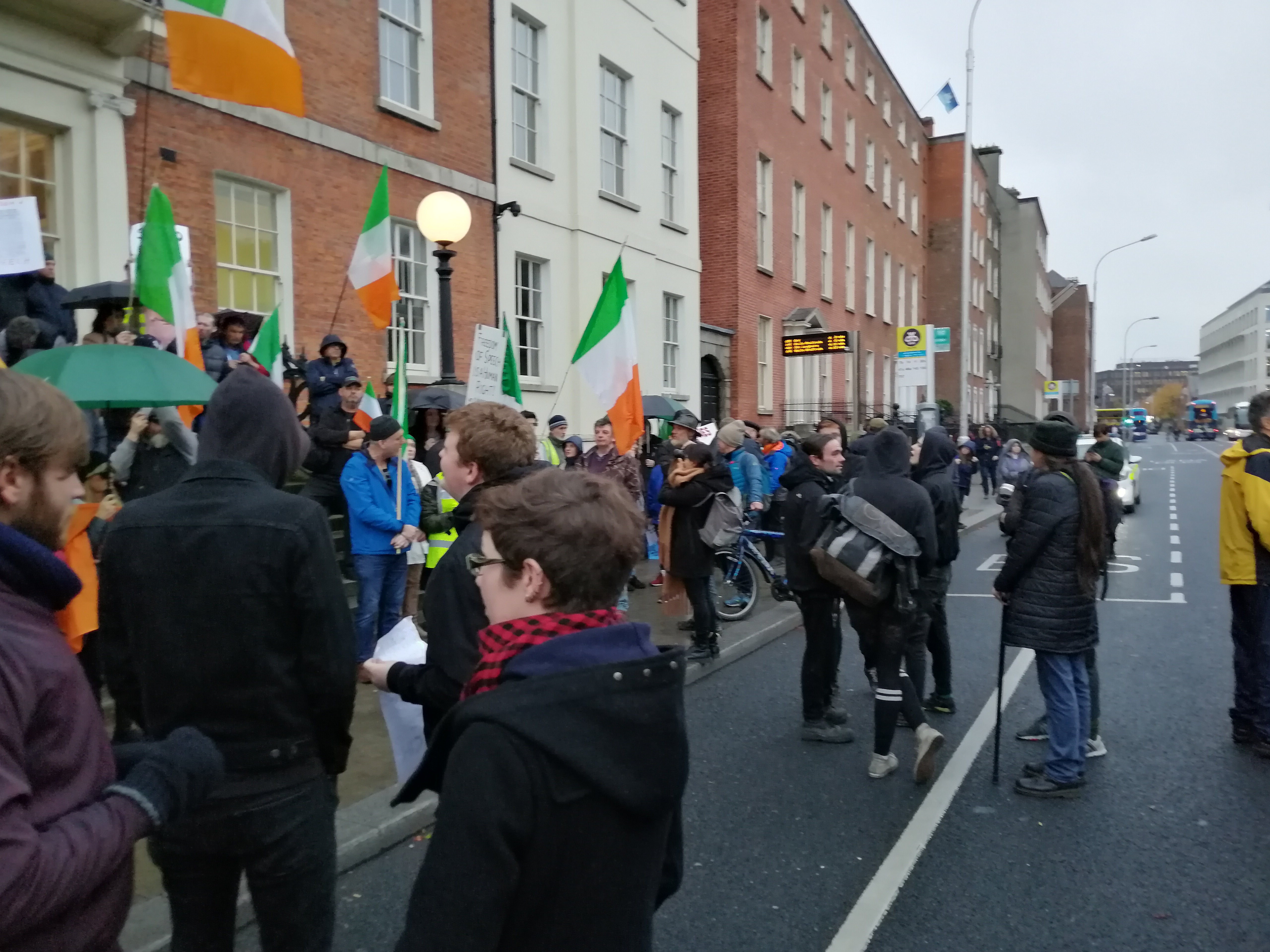
Left photo background: Mixed far-right demonstration outside Dept. Justice, Dublin, early Nov. 2019 — note presence of Irish Tricolour flags to indicate exclusive ‘Irish nationalism’. Left foreground and right of photo: counter-demonstrators. (Source photo: D.Breatnach)
The antithesis of Republicanism
Now the last number of years has seen a rise in a type of neo- nationalism across the West and Ireland is not immune. This type of nationalism is the antithesis of Republicanism as it seeks to exclude. Republicanism on the other hand seeks to embrace and is inclusive regardless of colour or class.
Far right extremists attempts to engender a sense of unity and nationhood through demonising the ‘other’ and are utilising equality as a weapon.
They ignore the part the West played and continues to play in the perpetuation of poverty and war in Africa, Asia etc and how the consequences of their actions have a direct link to the numbers of refugees seeking asylum.
Instead they purport to speak for the disenfranchised ‘true national’ implying that their taxes are paying for the less deserving and they are ending up with an unequal share as a consequence.
There is a new narrative that promotes the idea that ‘equality and charity begins at home’ and ‘let’s look after our own first’. It hijacks the word ‘equality’ to engender a belief that the rights of the stereotypical national are being diminished.
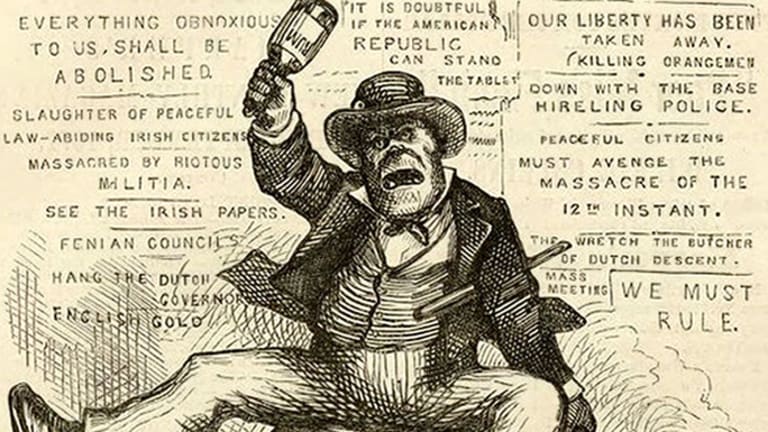
Anti-Irish migrants racist cartoon, USA, 19th Century. (Source image: Internet)
Think of our recent presidential election. Peter Casey was trailing in the polls until his vitriolic tirade against Travellers. His support swelled, because he appealed to those who believe they are paying more than their fair share of tax but are still receiving less than, in their minds, an undeserving group such as Travellers. The implication being that there is an inequitable division and they have to wait longer for what is rightly their due.
Brexit is similar in that it developed a narrative around who is the true British person. Why should they allow ‘others’ into their country and use British taxes to house and feed the stranger resulting in longer waiting lists for housing, health etc for the indigenous population. And I emphasise again, the part the West has played in ravaging the countries from which many people now flee is ignored.
I just ask that when someone comes looking for your vote and is spouting the word ‘equality’, just pause a moment and consider how they are using that word. Instead of seeing the richness that our interaction with people of all shades of colour has given to our society, that was once so insular, are some candidates utilising the word equality as a form of discrimination and exclusion?
Fascism and ‘free speech’
The right to free speech is not without restraint and carries a duty of care. Implicit in any egalitarian society, which gives voice to diverse groups, is respect and tolerance. Fascism and racism therefore have no place in any society struggling for equality as their invective generates hate and creates division and discrimination. Unfortunately the rise in authoritarian leaders such as Trump, Bolsonaro, Orban has given licence (under the guise of freedom) to those who only spout hate.
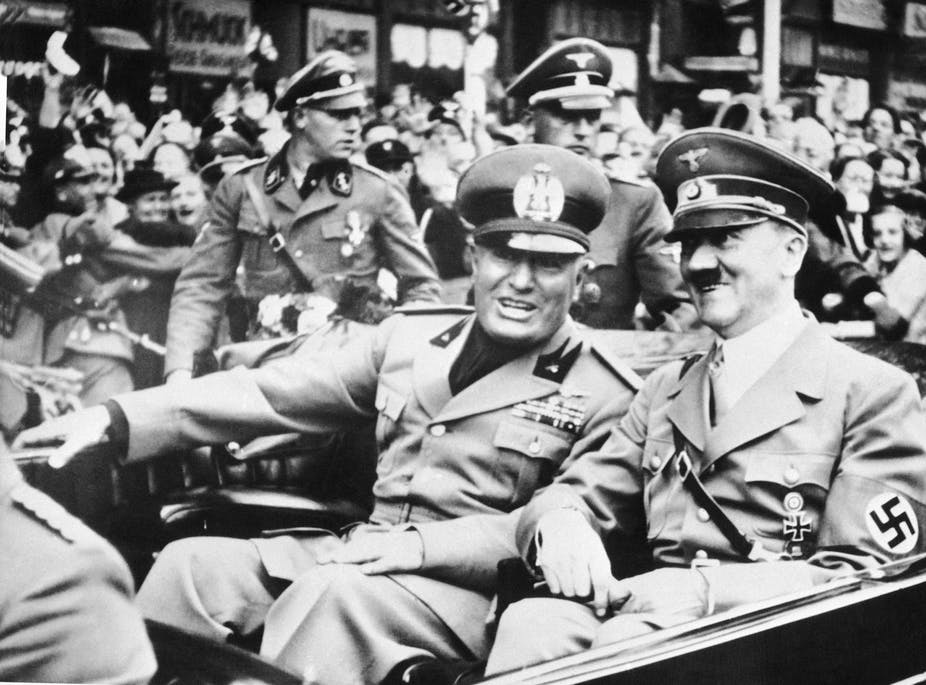
Leaders of Italian and German fascism in the 1930s — their parties insisted on the right to free speech for them but once in power, imprisoned, tortured and killed their political opponents. (Source photo: Internet)
Racism
A comment I have often heard, by mainly white people, is that they never see colour, only the person. This is supposedly well meaning and a display of openness. However, the question has to be asked that if they don’t see black what do they see? In a perverse way they are actually racist as our colour is a signifier of who we are. To refuse to see a person’s colour be it black or any shade is a denial of a fundamental part of identity. Black people are some of the most disadvantaged carrying centuries of oppression and discrimination. If we refuse to see ‘black’ then how can we put conditions in place to alleviate the disadvantage that has accompanied colour?
“THERE ARE MORE OF US THAN THERE ARE OF THE BULLIES”
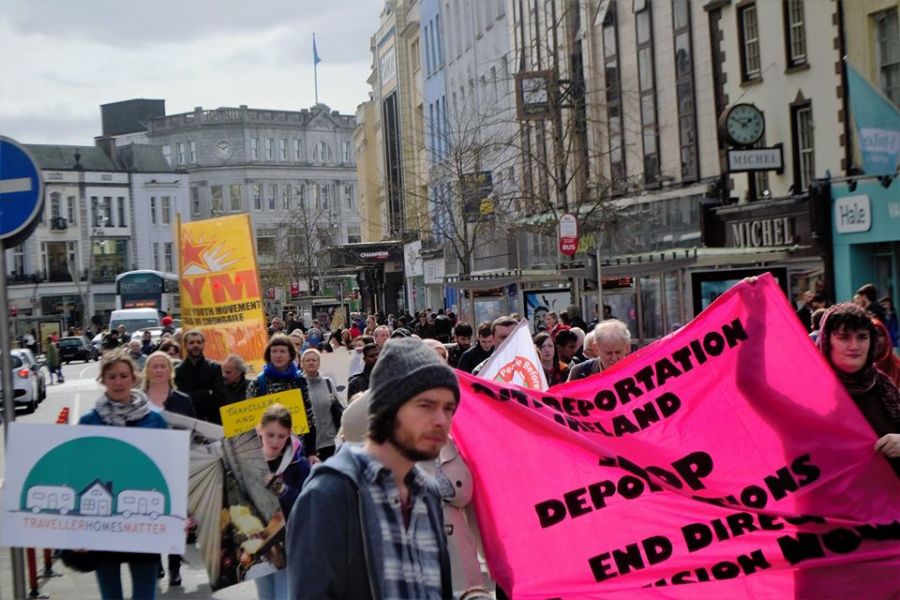
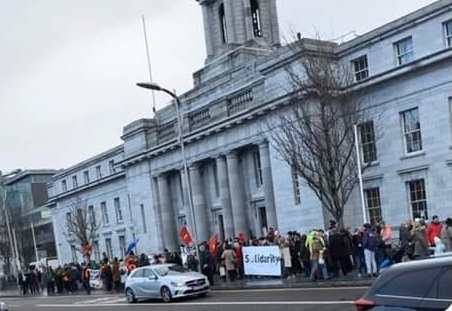
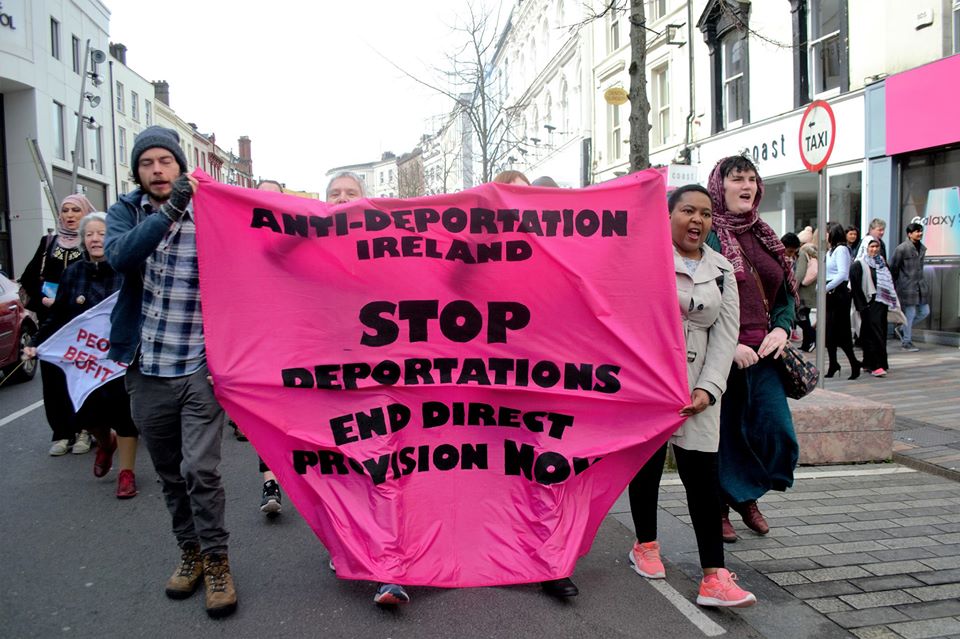
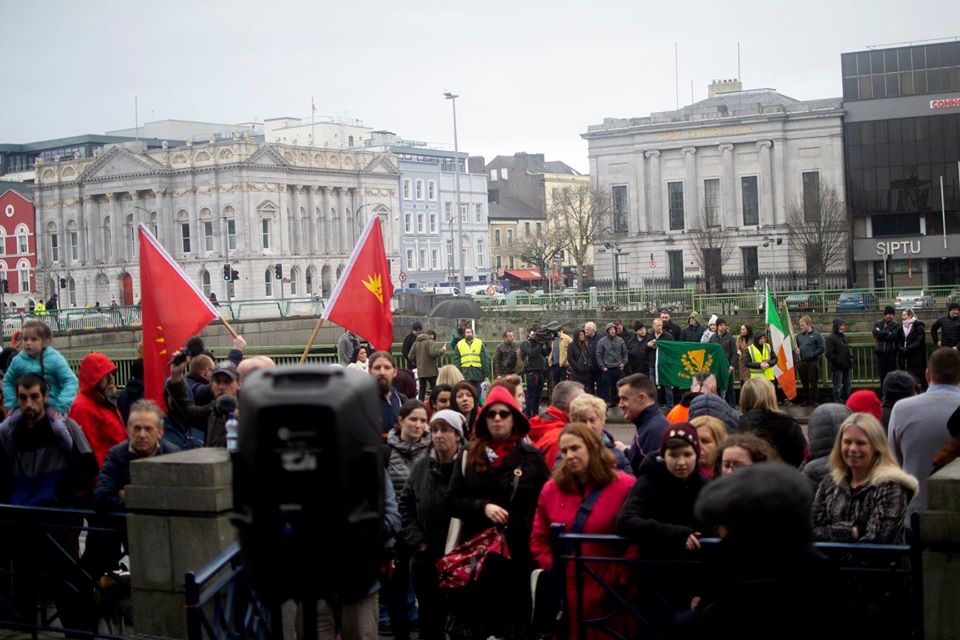
Learning of the intention of a far-Right coalition to hold a rally at Cork Town Hall on 4th December, a coalition of anti-racists and anti-fascists containing a range of Left and Irish Republican organisations, community and anti-deportation groups organised a counter-rally which dwarfed the numbers of the racists and fascists, who object to migrants, asylum seekers and LBGT people. Two TDs and a number of councillors also attended.
One of the organisers, Tracy Ryan, said that she had her two sons with her at the rally. “I’ve brought up my children to believe that everyone is equal and everyone deserves the same opportunities and chances in life,” she said.
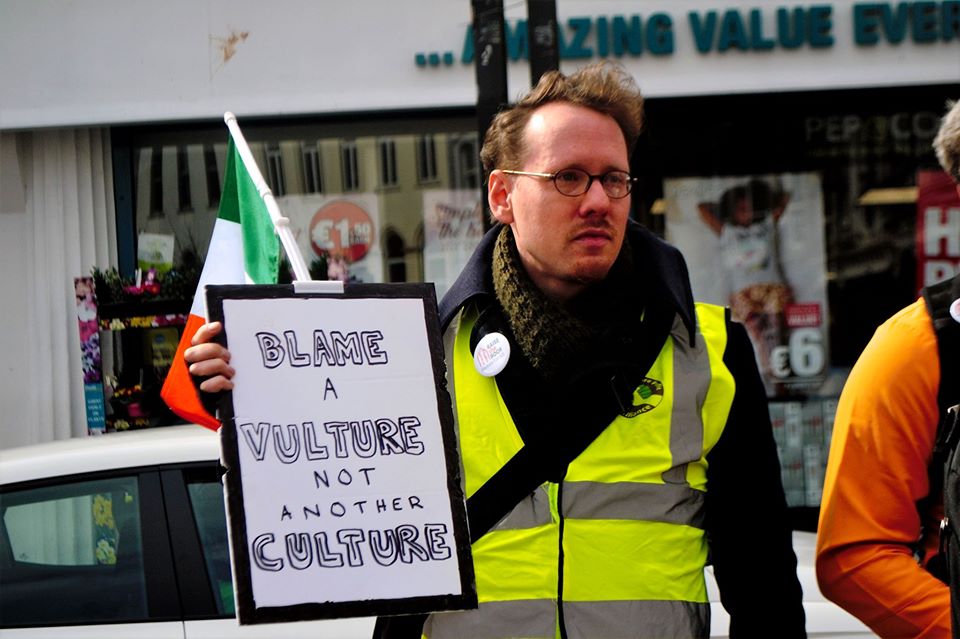
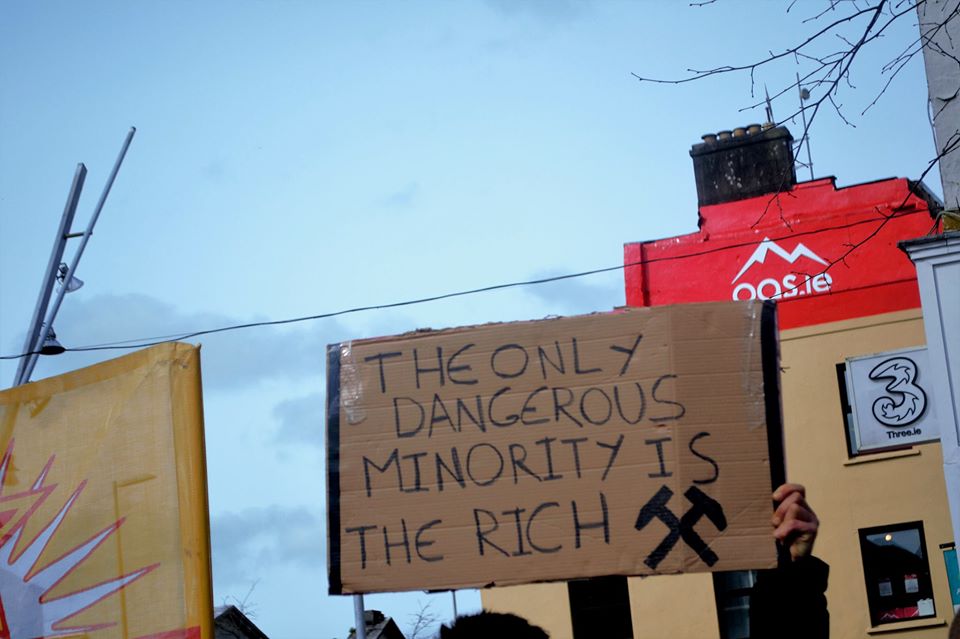
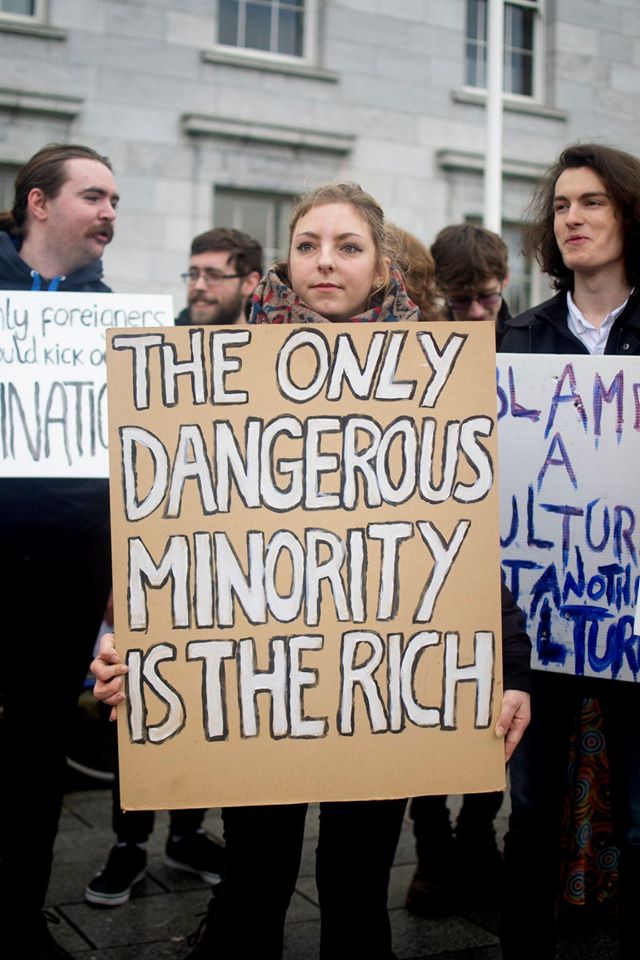
View of counter rally half hour before due to start (Photo: Students Against Racism)Placard displayed at counter-rally (Photo: Shamim Melekian)Anti-racist football club supporters at the counter-rally. (Photo: Shamim Melekian)
FREE SPEECH?
The specific rallying issue for the far-Right on this occasion, as it was in Dublin on 14th December last year (see https://rebelbreeze.wordpress.com/2019/12/15/dublin-counter-rally-outnumbers-racists-and-fascists/), was the legislation proposed by the Fine Gael Government against “hate speech”. The mixture of social conservatives, racists and fascists that make up the far-Right in Ireland have been complaining for some time that they are being denied freedom of speech, in particular since the most prominent member of their ranks, ex-journalist Gemma O’Doherty, had her two Youtube channels shut down by Google in 2019 after, according to Google, she broadcast racist statements and continued to do so after one of the channels was suspended for a week.
There is a wide variety of views on the proposed legislation outside of the far-Right, some socialists and Republicans remarking that “hate speech” is too wide a label and that they have seen such legislation used against themselves when they denounce prominent politicians or businessmen, the police or Loyalists. What unites all these groups demonstrating against the far-Right is not a defence of the Government’s proposed legislation but a determined opposition to allowing the far-Right to gain a foothold in Ireland, from which it may expand to introduce a fascist regime, reversing gains in social legislation, banning oppositional groups, terrorising minorities and restricting further the rights of unionised workers.
One of the groups on the counter-rally (Photo: Shamim Melekian)One of the many pointed placards on the counter-rally held by a supporter. (Photo: Shamim Melekian)
Opponents of the far-Right point out that they begin by seeking freedom of speech to attack minority groups and their political opponents but once they have established a base, move to physically removing their opposition and banning freedom of speech of anyone who disagrees with them.
“There are more of us than there are of the bullies”, said one of the organising group, speaking to news media the day before the counter-rally. Poet and community worker Kathy D’Arcy added: “We are one people, one human race, one unified city whose people are known throughout the world for kindness, friendliness, good humour and inclusiveness.”
Declan Power of Waterford, organiser of a much smaller rally of the far-Right over the same weekend, rejected the accusation that they were racists or had any other agenda than freedom of speech. However at the event Diarmuid Ó Cadhla, of a group called The People’s Convention, revealed that he wanted to limit migration and was against the Government’s policies which, he alleged, are for “globalisation and open borders”. Presumably this was a reference to one of the conspiracy theories of the far-Right, viz. that the EU allegedly has a policy of opening all borders to mass immigration and replacing the Irish with foreigners. Laughable as this may seem to some and flying against all the evidence as it does, it is believed by some on the far-Right and used to whip up fears and hatred of migrants.
View of far-Right rally over section of counter-rally. (Photo: Shamim MelekianCloseup of some of the far-Right group in Cork (Photo: Shamim Melekian)Woman on counter-rally holds up a placard addressing the far-Right (Photo: Shamim Melekian)
HISTORY OF ANTI-RACIST MARCHES IN CORK
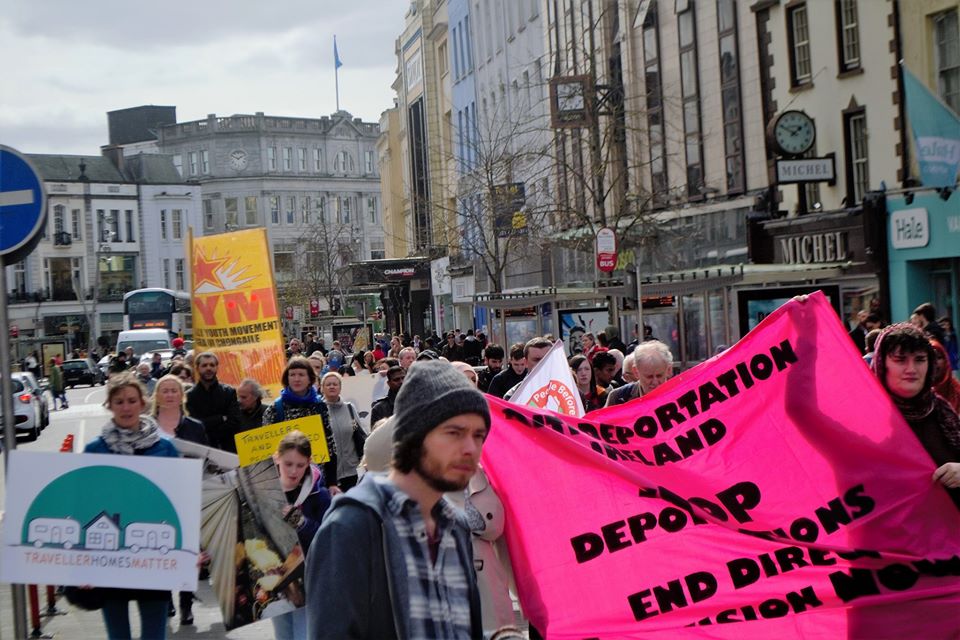
The rally on 4th January this year was far from being the first anti-racist demonstration in Cork: an anti-racist march took place in March last year and or five years before that, there had been an anti-racist march in Cork every year.
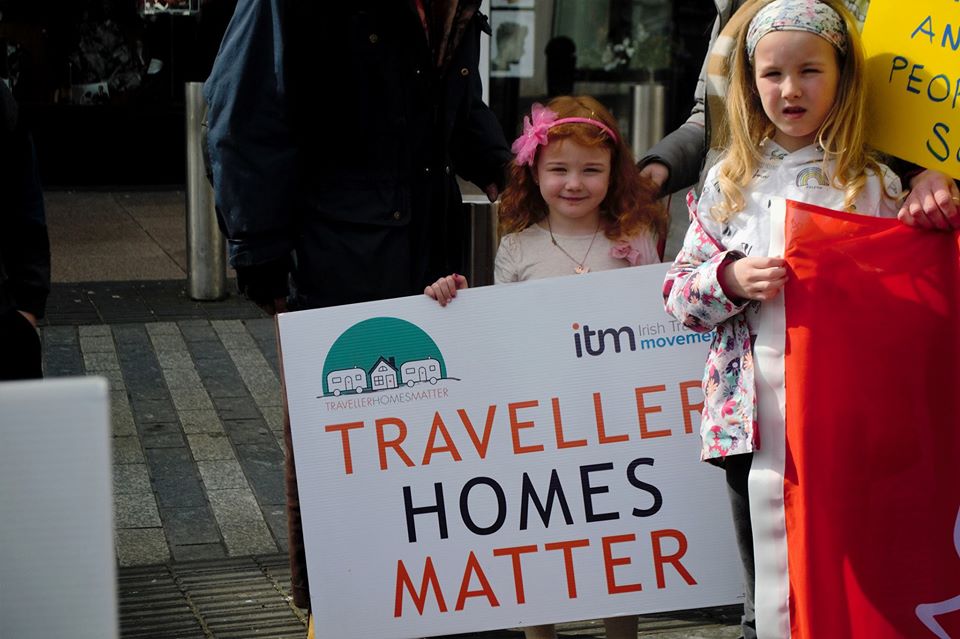
Speaking in advance of the anti-racist march last year, Joe Moore of Cork Says No to Racism pointed out that while racism still exists in Cork, it is “a small number of people who have racist views towards minority religions, asylum seekers Travellers and the Roma community.”
Mr. Moore also pointed out some gaps in State provision, stating that the school books for children contain no mention of the Traveller community in Ireland, which itself has housing and education issues.
There is also a history of fascism in 1930s Cork when the Blueshirt fascist movement was opposed by anti-fascists and socialists inside and outside the IRA. Ironically, while opposition to the Fine Gael Government’s proposed legislation is the purported rallying point for the far-Right, the Blueshirts were one of the three groups that joined to form the Fine Gael party (which is why many opponents of the party call them “Blueshirts” to this day).
Fascist salutes at a Blueshirt rally in 1934 in Charleville, Cork. (Photo source: History Ireland).
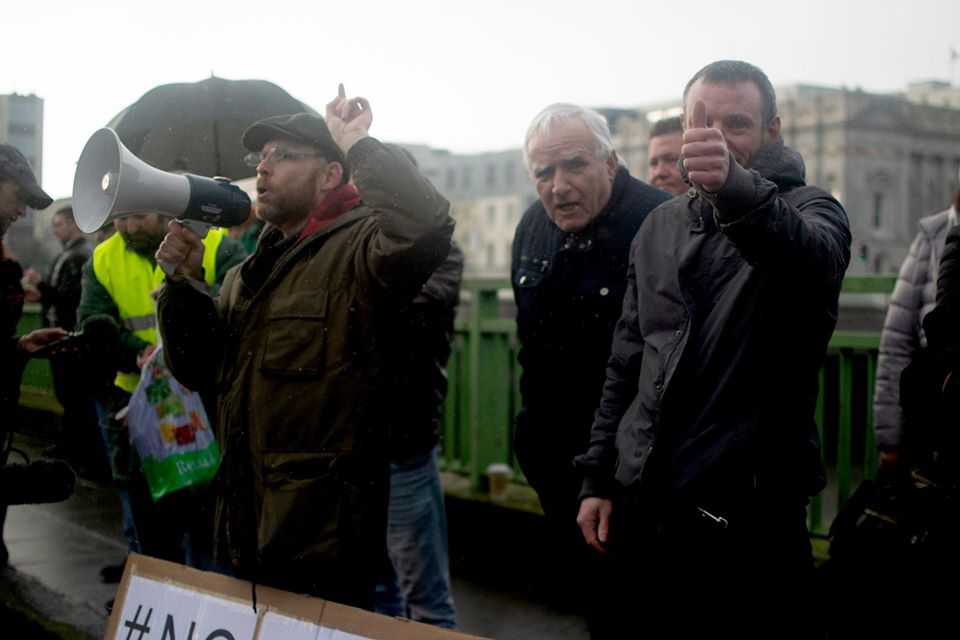
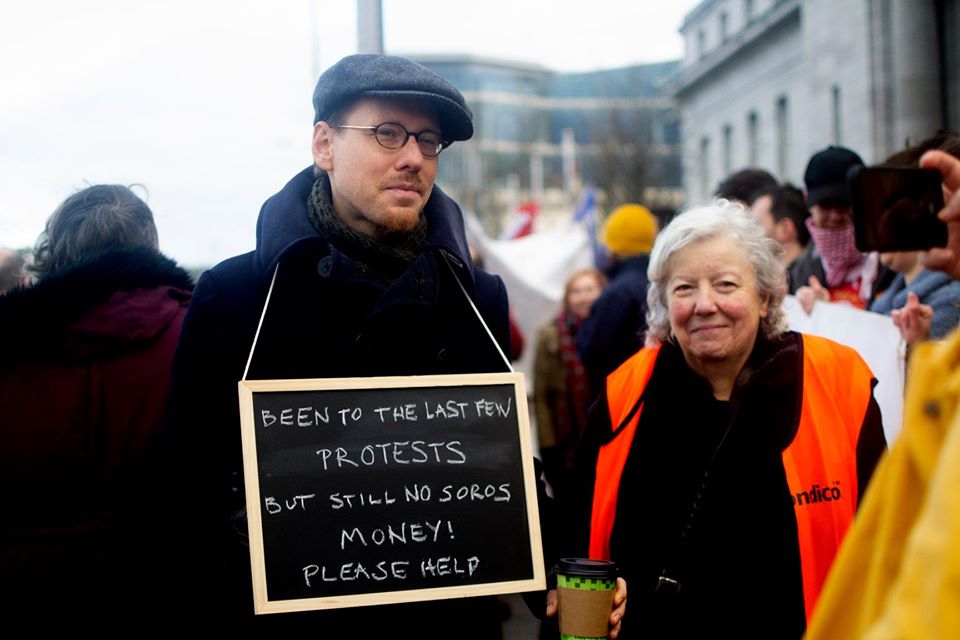
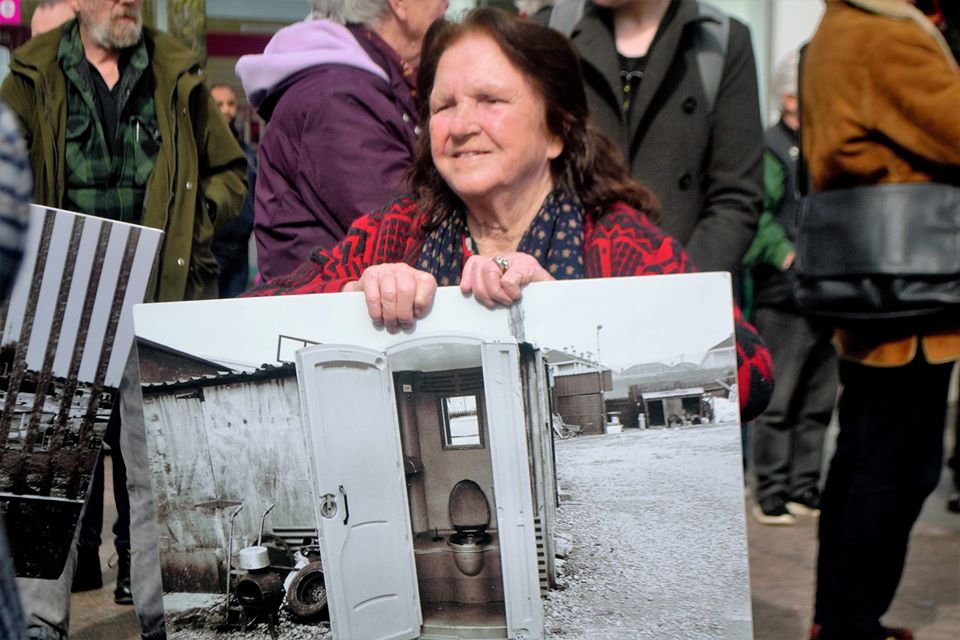
Counter-rally supporter mocks conspiracy theory that Soros Foundation is funding all the anti-racist and anti-fascist activists. (Photo: Shamim Melekian)(Photo: Shamim Melekian)Another pointed placard message on the counter-rally. (Photo: Shamim Melekian)Woman on counter-rally displaying presumably dire conditions on halting sites for Travellers. (Photo: Shamim Melekian)
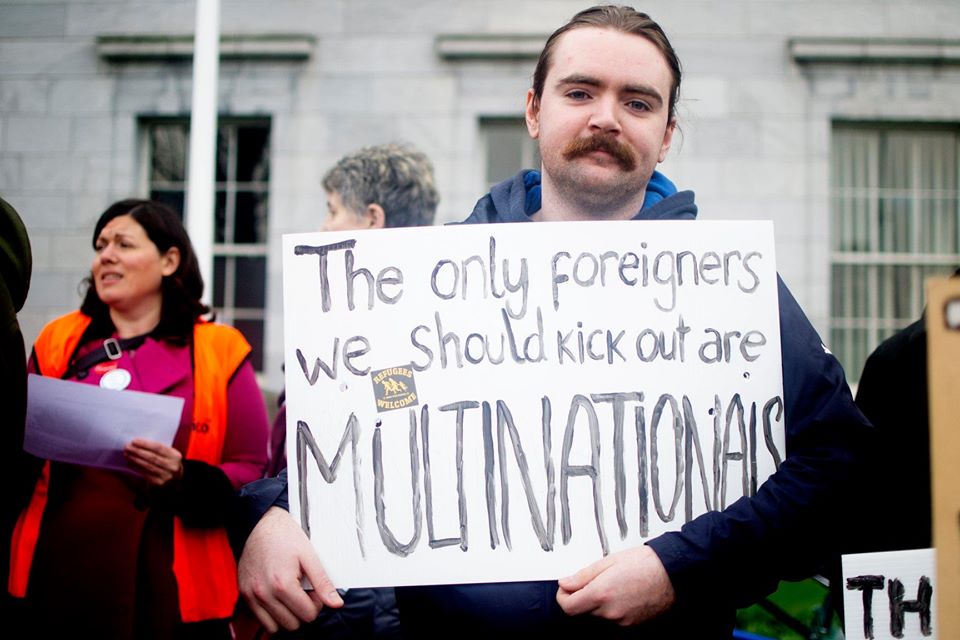
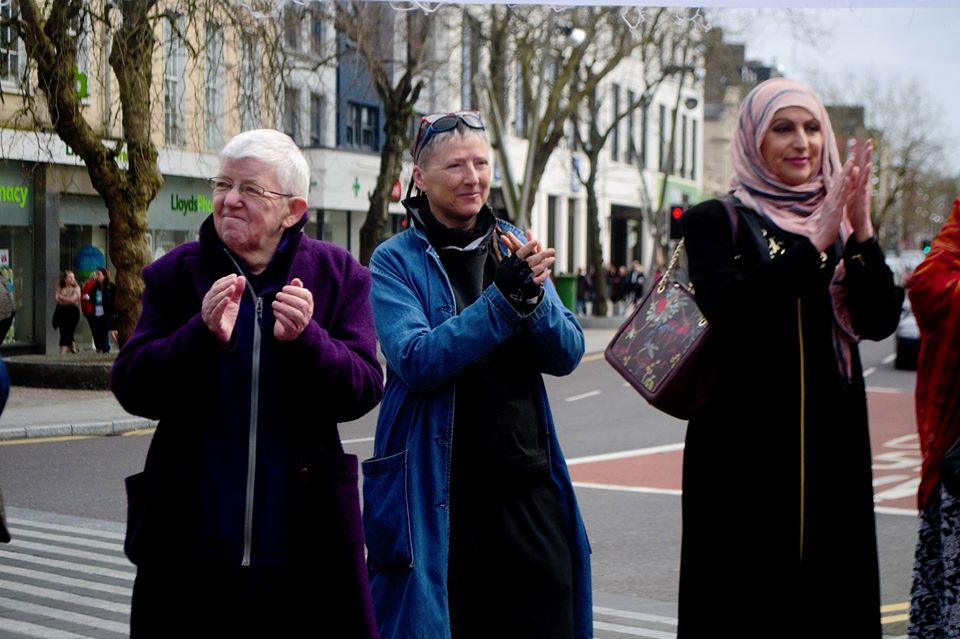
Women of varied ages and backgrounds applauding speaker at counter rally. (Photo: Shamim Melekian)Counter rally supporter sends pointed message on placard (Photo: Shamim Melekian)Young supporter of counter rally sports a T-Shirt display which might become very popular. (Photo: Shamim Melekian)Section of counter rally on the march through Cork city centre. (Photo: Shamim Melekian)
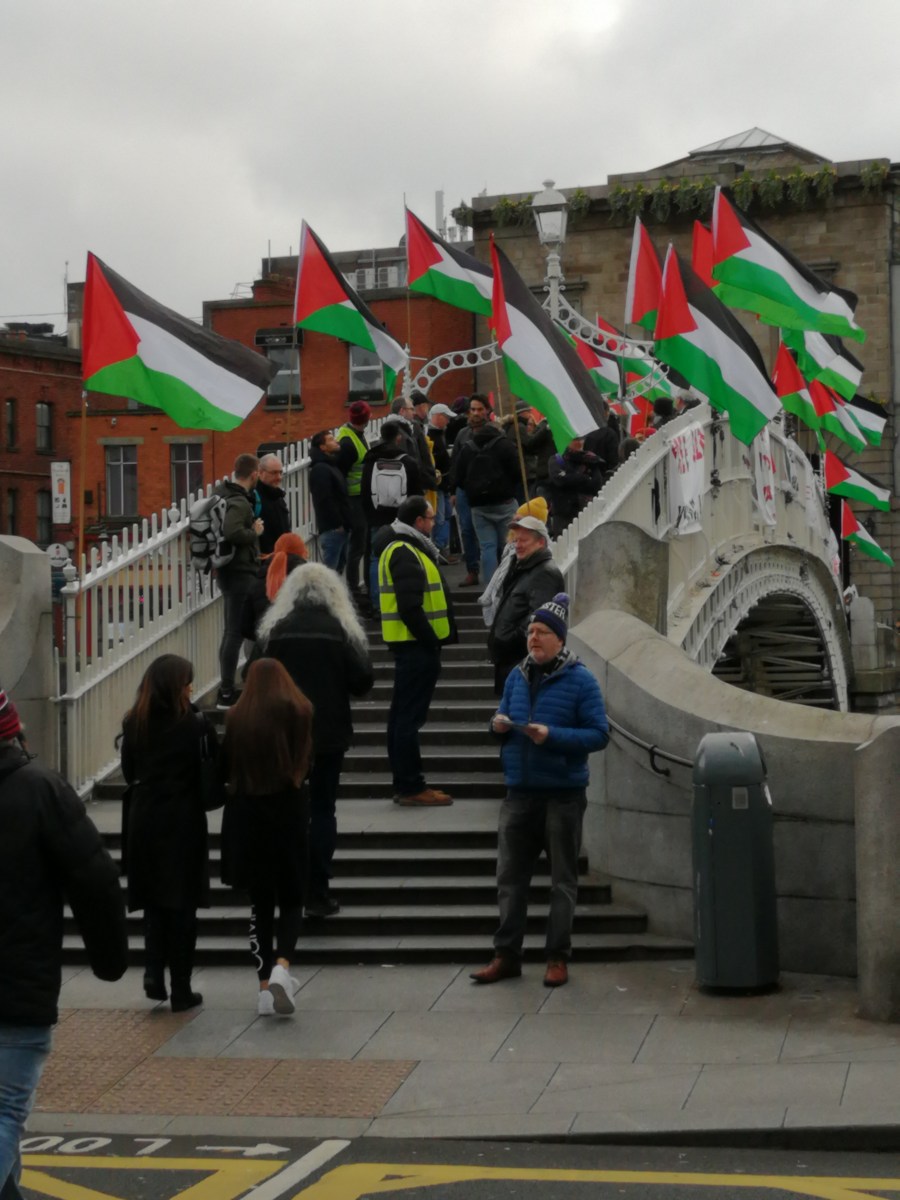
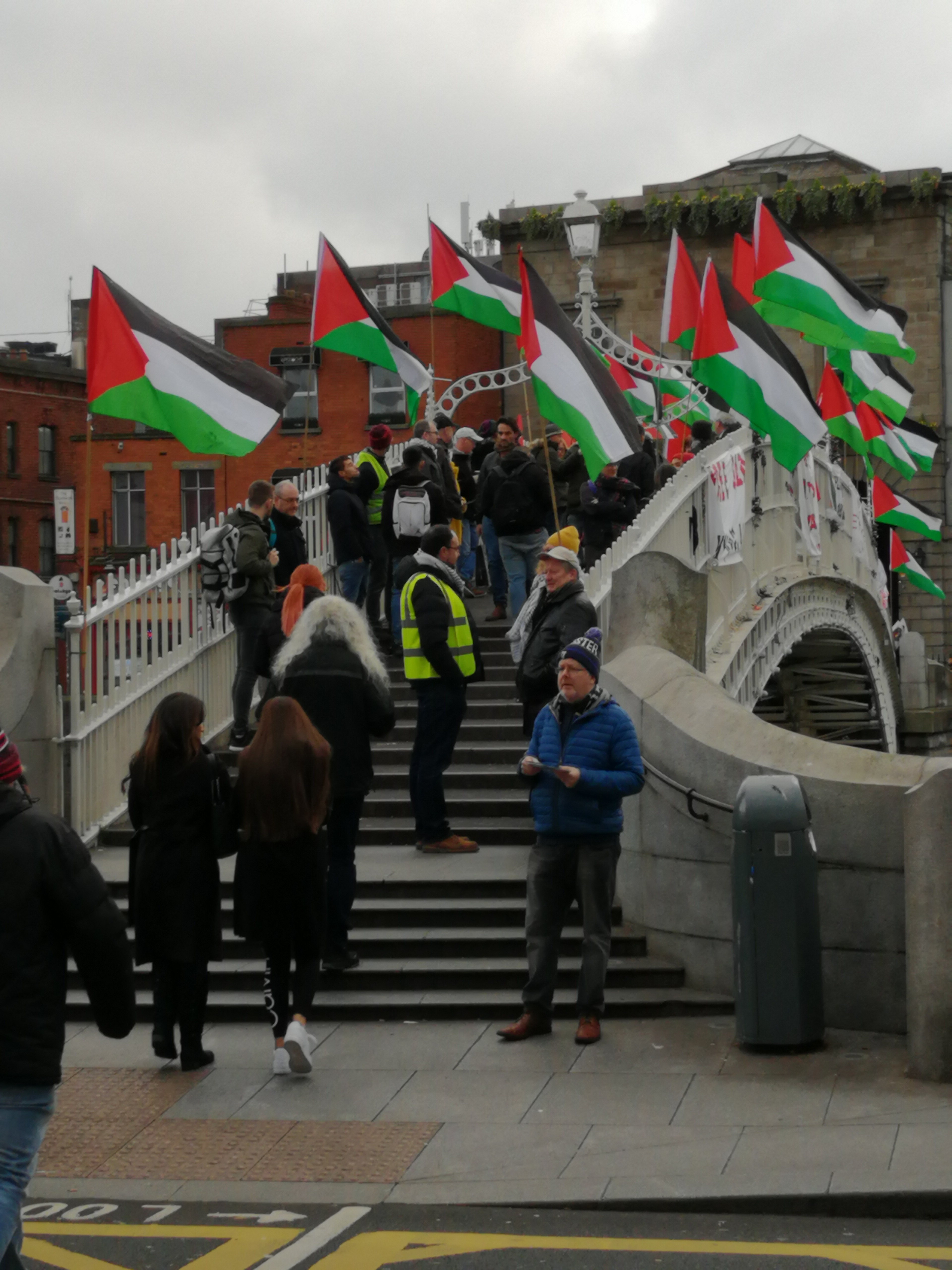
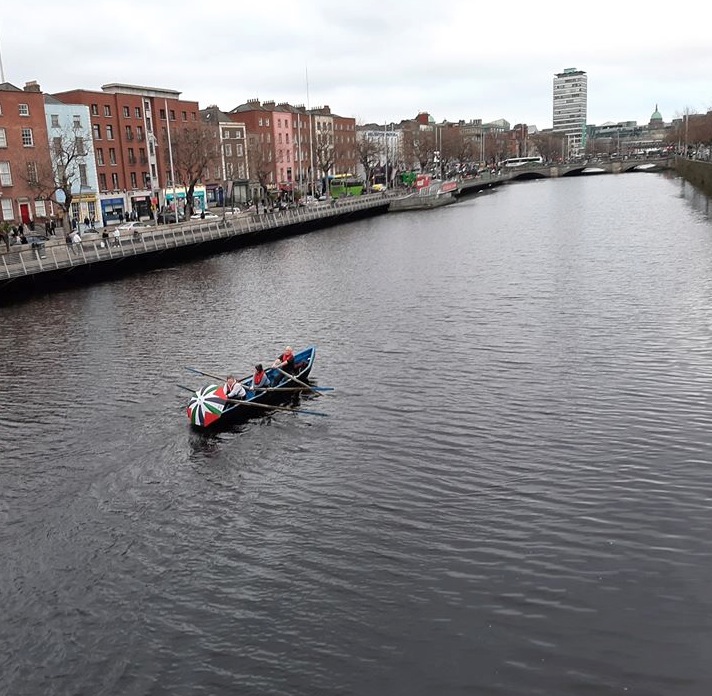
The iconic Halfpenny Bridge over the river Liffey in Dublin seemed to be flying on Palestinian flags on New Years’ Eve. The annual event organised by the Ireland Palestine Solidarity campaign was favoured with not only a dry but also mild day this year and supporters and passers-by clicked their cameras to capture the scene, in the midst of which an Irish currach showing Palestinian colours was rowed up and down the river nearby by three women.
Currach (traditional light Irish rowing boat) rowed downriver by three women in solidarity with the Palestinian people (Photo: D.Breatnach)
Communists, Socialists. Irish Republicans (both pro and anti-Good Friday Agreement) and generally democratic people lined both sides of the Bridge itself and spilled out at each end, which the IPSC had a busy stall on the south side, next to the Merchants’ Arch.
Yesterday brought to an end a year that was far from the worst in the long history of the bloody Zionist occupation of Palestine and the oppression of the Arab-Palistinian population. Even so, 149 Palestinians were killed during 2019 according to a statistical collection agency and 35 of those were children. During the same period 10 Israelis were killed, including two children. However, in December alone, nearly 45 Palestinians were killed by Israeli Zionists against no Israelis. The hugely disproportionate balance of death and injury in favour of Israeli Zionism has been a consistent pattern since the the beginning of the Occupation and makes any notion of there being a “war between two sides” deemed nonsense by many commentators who instead, see the conflict as vicious repression by the Israeli State and largely ineffective resistance by what is now a minority Palestinian population, controlled to a prison-like degree by a highly-militarised state.
A bridge of flags. (Photo: D.Breatnach)
USA SUPPORTING A RACIST STATE AND ILLEGAL OCCUPATION
2019 was also the year in which the USA Administration for the first time pronounced the Israeli settlements in what are termed “the occupied territories” to be no longer illegal, flying in the face of world opinion and many declarations of the United Nations. This comes after the introduction of the new Israeli citizenship law last year, pushed through by the right-wing and religious coalition with 62 votes against 55, which defines Israel as the nation-state of the Jewish people, completing the process of making it officially a racist and religious state, downgrading the political, civil and cultural rights of all other ethnic and religious communities within the territory it controls. The measure was widely criticised by human rights groups around the world and within Israel itself, as also by much of the Jewish world population.
Part of the Ha’Penny Bridge yesterday (Photo: D.Breatnach)
Solidarity with Palestinians is traditionally demonstrated in other places in Ireland too on New Year’s Eve as well as at various other times during the year: between yesterday and today, eight Irish cities and towns demonstrated publicly in support of the Palestinians. Some years ago the Israeli Ambassador to Ireland described Ireland as “the most anti-Semitic country in Europe”. Since what he really meant was “the most anti-ZIONIST country in Europe”, most Irish people took that comment as a compliment. It is the Zionists who try to equate Jewishness with Zionism and the Israeli State in order to further their ideological indoctrination and intimidate democratic opposition; in doing so, the put all Jewish people in danger of the backlash against the crimes of the Israeli State. Fortunately there have been – and continue to be – Jewish people, some of them quite prominent, who speak out against the crimes of Zionism but these are dubbed “self-hating Jews” by the Zionists, who heap insults upon them.
The IPSC continues to organise a number of Palestine solidarity events every year and welcomes wide participation.
end.
The Palestinian solidarity currach going upriver. (Photo: Mel Mac Giobúin) [cropped]
(Reading time: 1 minute; watching time: 3 minutes per video)
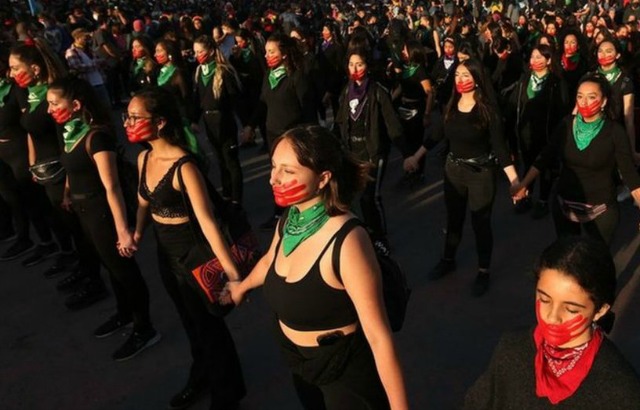
A choreographed protest against violence against women is sweeping the world. It was first seen on International Day Against Violence Against Women, 27th November in the centre of Santiago, the capital city of Chile. Organised by feminist group La Tesis, it formed part of the popular resistance to the the Sebastián Piñera regime and its repression, since accusations of rape and other sexual violence against the repressive forces have, according to a number of human rights agencies, amounted to 15% of the total (at least 70 separate cases in the first month of protests).
Source: Internet
The lyrics chanted were, in translation: Patriarchy is a judge who judges us for being born
and our punishment is the violence that you don’t see.
It’s femicide, impunity for my murderer,
it’s disappearance, it’s rape.
And it wasn’t my fault, where I was or how I was dressed.
The rapist is you. The rapist is you.
It’s the police, the judges, the State, the President.
The oppressive State is a macho rapist.
This was an extremely powerful and effective protest and caught the imagination of others, with videos spread by social media and also appeals across borders by feminist networks.
No doubt the continuation of the protest will take place in other contexts but it remain a powerful and innovative call.
As with other protests in Chile, those congregating in the area were attacked by forces of the State soon afterwards — the same forces against which the protest had been organised.










 rebelbreeze