ORATION at GRAVESIDE of INNOCENT MAN PUBLICLY HANGED IN BRITAIN

(Reading time: 14 mins.)

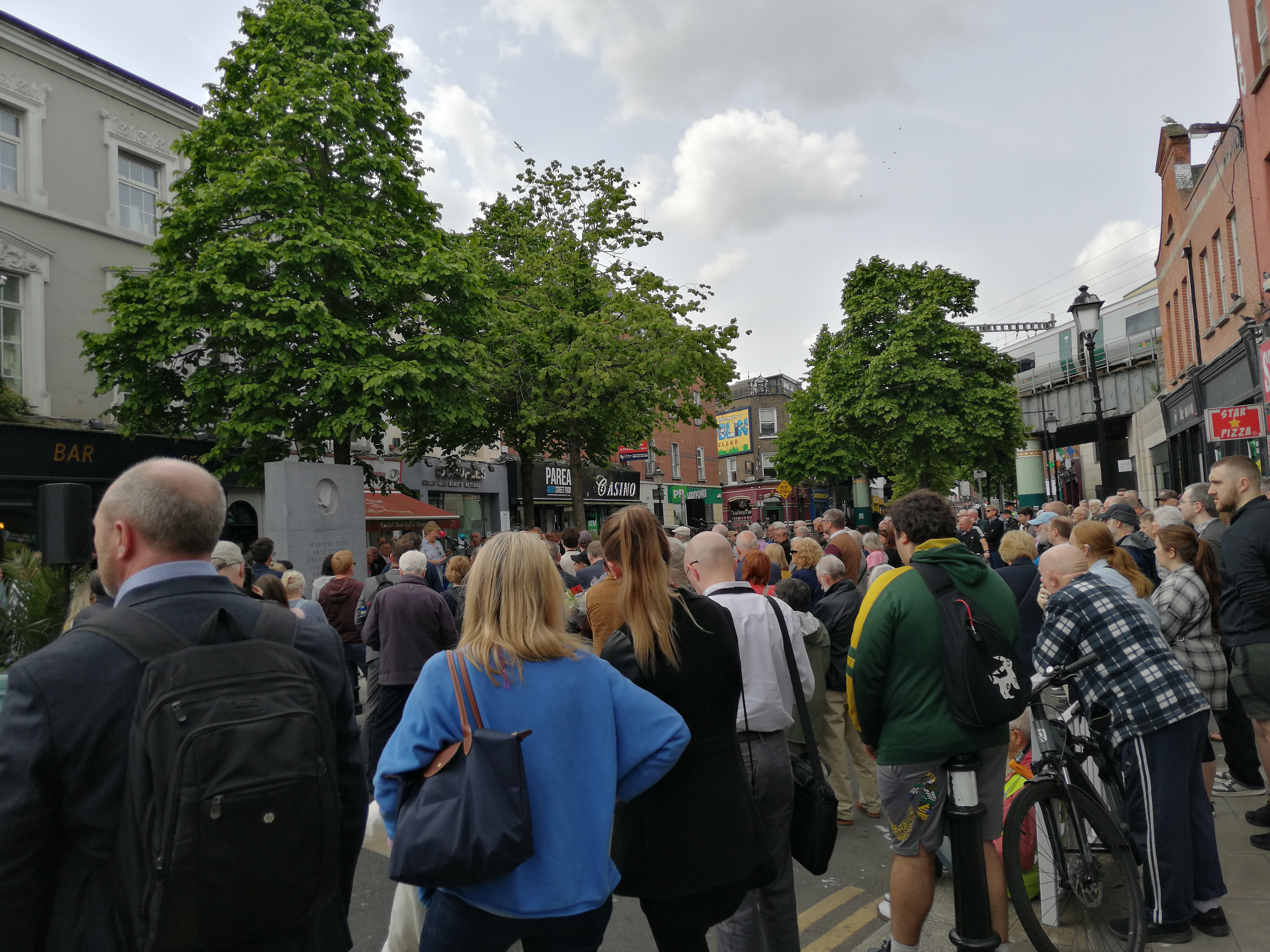
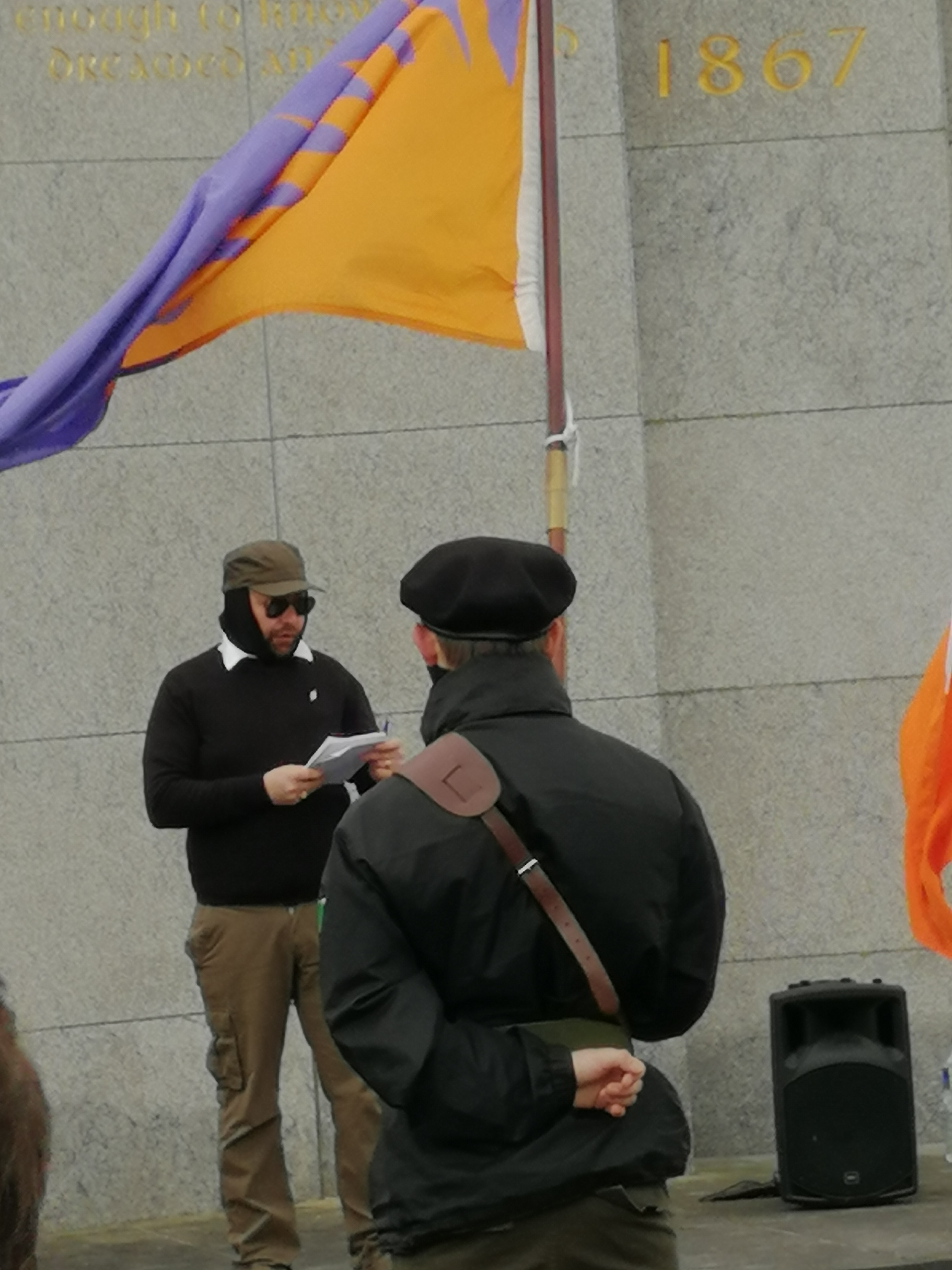
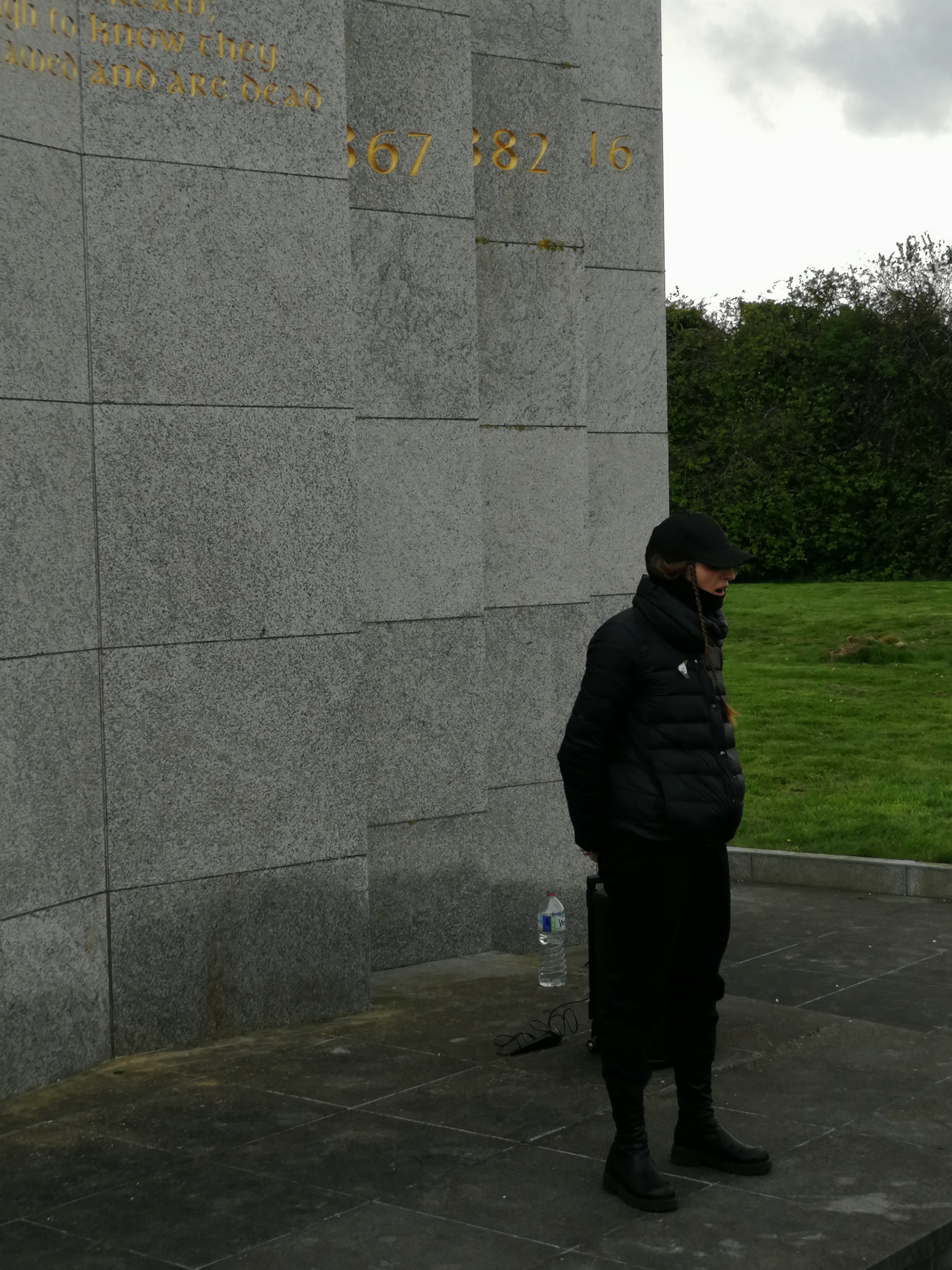
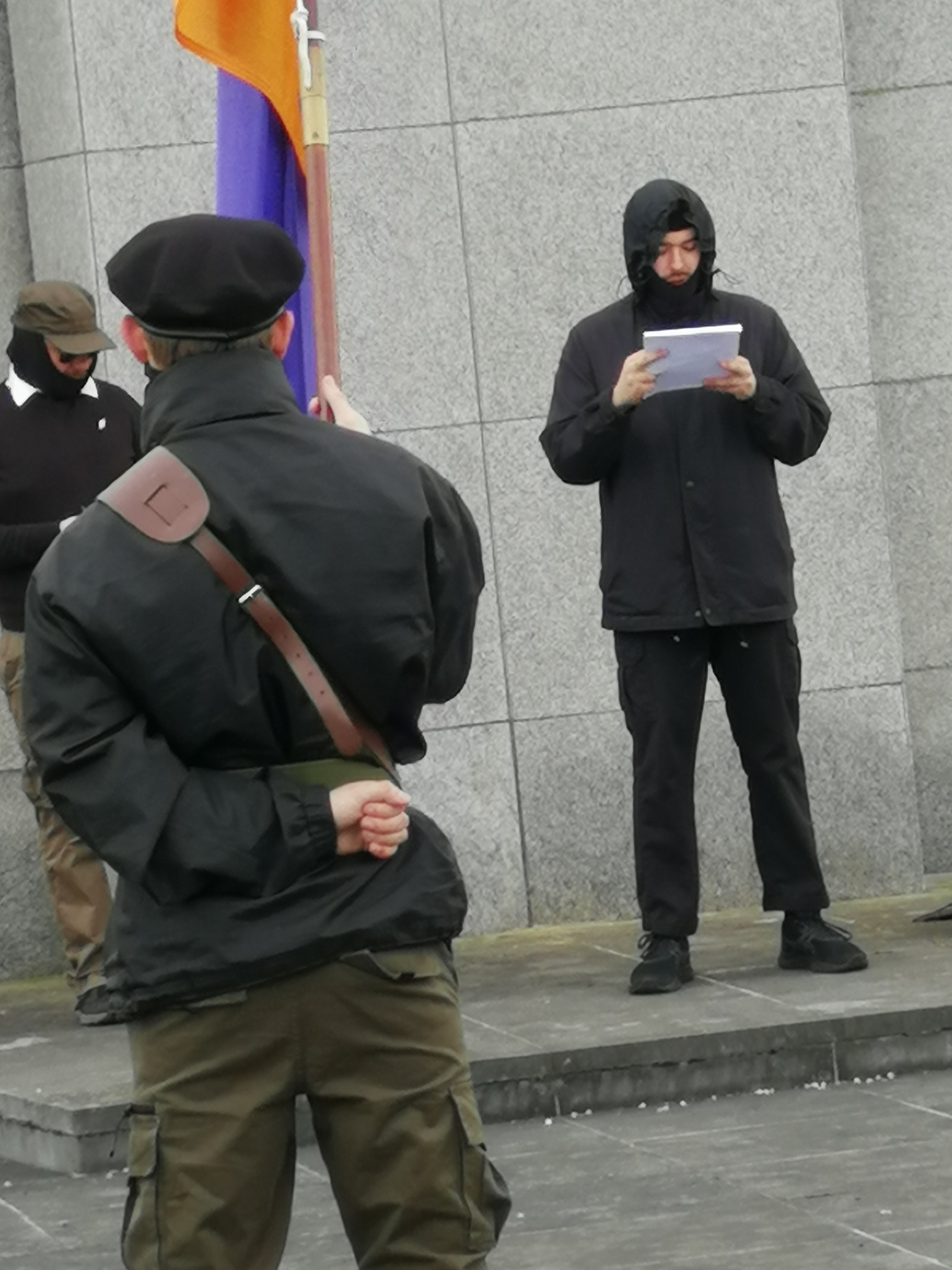
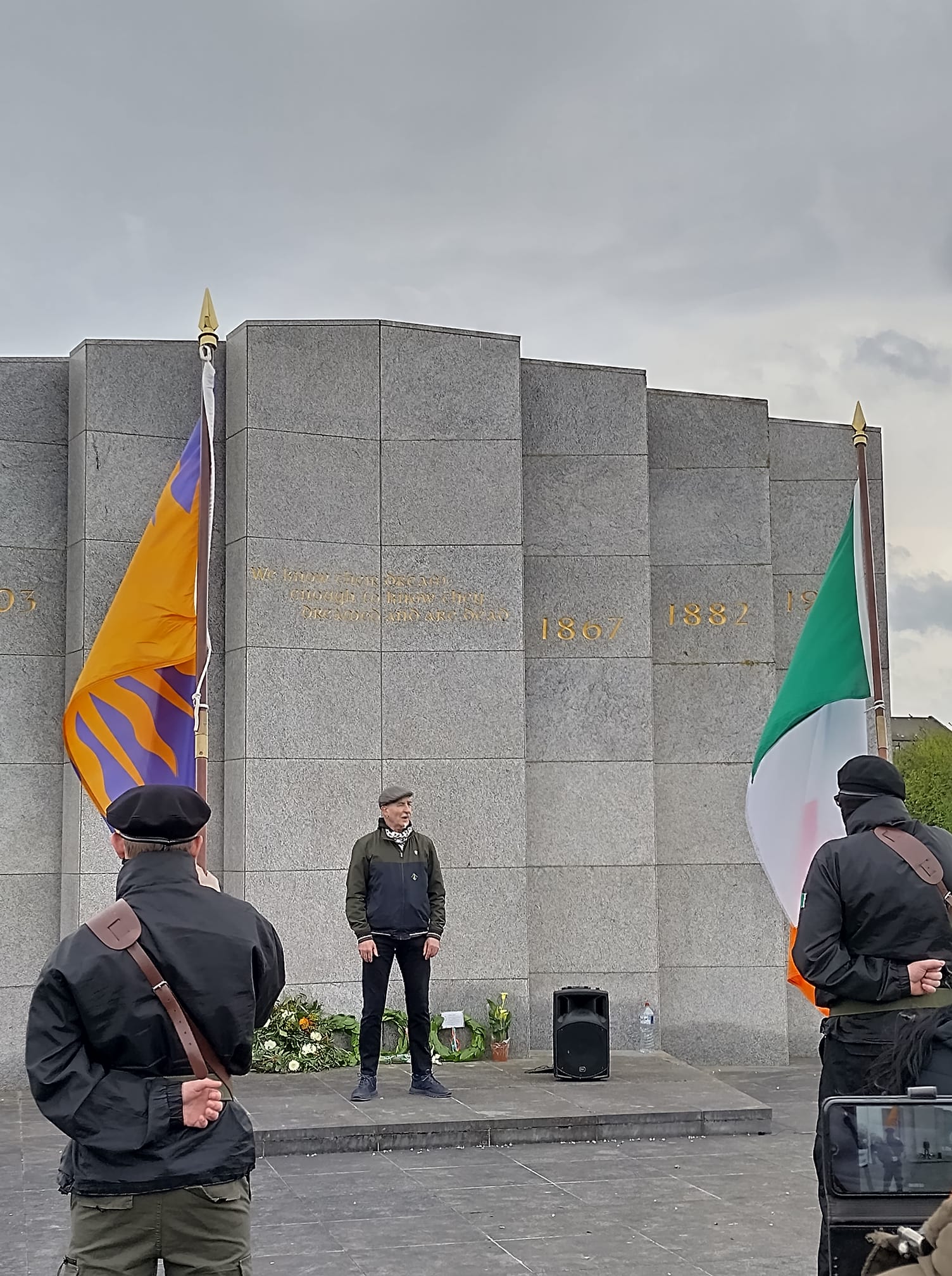
Pat Reynolds gave this oration in East London Cemetery on Sunday 21st May 2023 for Michael Barrett, the last man publicly hanged in Britain

A cháirde agus a chomrádaíthe,

Tá fáilte go leor romhaibh chun chruinnithe i gcuimhne Michael Barrett inniu. Welcome friends and comrades to this commemoration today for Michael Barret and Patrick O’Donnell. I have been asked to speak of Michael Barret and the movement he represented.

Michael was born in Ederney in the Maguire County of Fermanagh in 1841 and was judicially hanged though innocent by the British Government in 1868 at Newgate Prison, where the Old Bailey now stands.

Newgate prison was closed in 1903 and his remains with others were interred here in this cemetery. He was the last person to be publicly hanged in Britain.

A Fenian bombing took place on 13th December 1867 to try and rescue O’Sullivan Burke the Fenian who planned the successful prison van escape in Manchester.
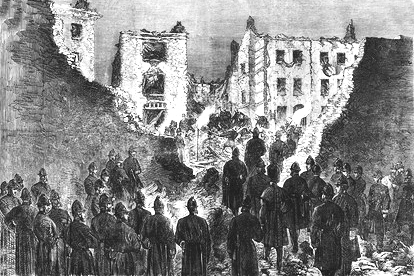
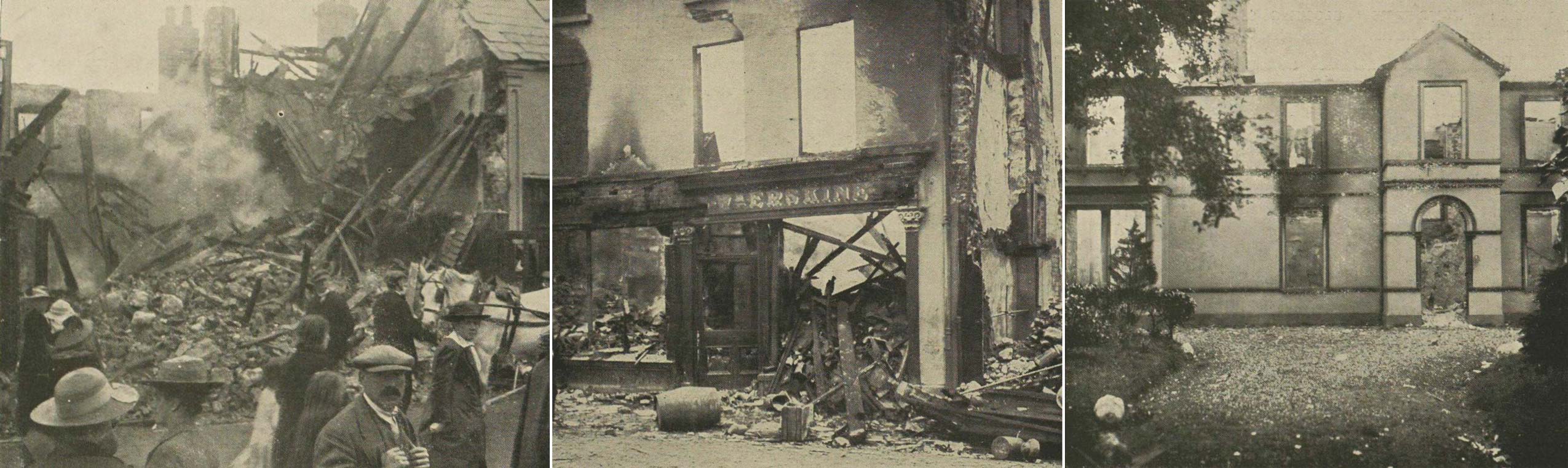
Contemporary newspaper drawing (Sourced: Wikipedia)

The bombing blew a huge hole in the wall and demolished nearby tenement buildings, killing 12 people and injuring many others. It led to a huge State-engineered backlash in Britain against the Fenians and put their cause back some 10 years.

Michael Barret, who had gone to Glasgow to work was an innocent man and was in Glasgow at the time of the incident.

False evidence given by a police informer Patrick Mullaly who was given a free passage to Australia implicated Barrett, but he had compelling evidence that he was in Glasgow at that time. After two hours the jury declared him guilty.

One of the trial lawyers Montagu Williams stated of Barrett:

On looking at the dock, one’s attention was attracted by the appearance of Barrett, for whom I must confess I felt great commiseration. He was a square built fellow, scarcely five feet eight in height and dressed like a well-to-do farmer.

This resemblance was increased by the frank, open, expression on his face. A less murderous countenance than Barrett’s I have not seen. Good humour was latent in his every feature and he took the greatest interest in the proceedings’.

Barrett ended his speech from the dock thus:

I am far from denying, nor will the force of circumstances compel me to deny my love of my native land. I love my country and if it is murderous to love Ireland dearer than I love my life, then it is true, I am a murderer.

If my life were ten times dearer than it is and if I could by any means, redress the wrongs of that persecuted land by the sacrifice of my life, I would willingly and gladly do so.’

The Daily Telegraph the next day stated that Barrett had:

Delivered a most remarkable speech, criticising with great acuteness evidence against him, protesting that he had been condemned on insufficient grounds, and eloquently asserting his innocence.’
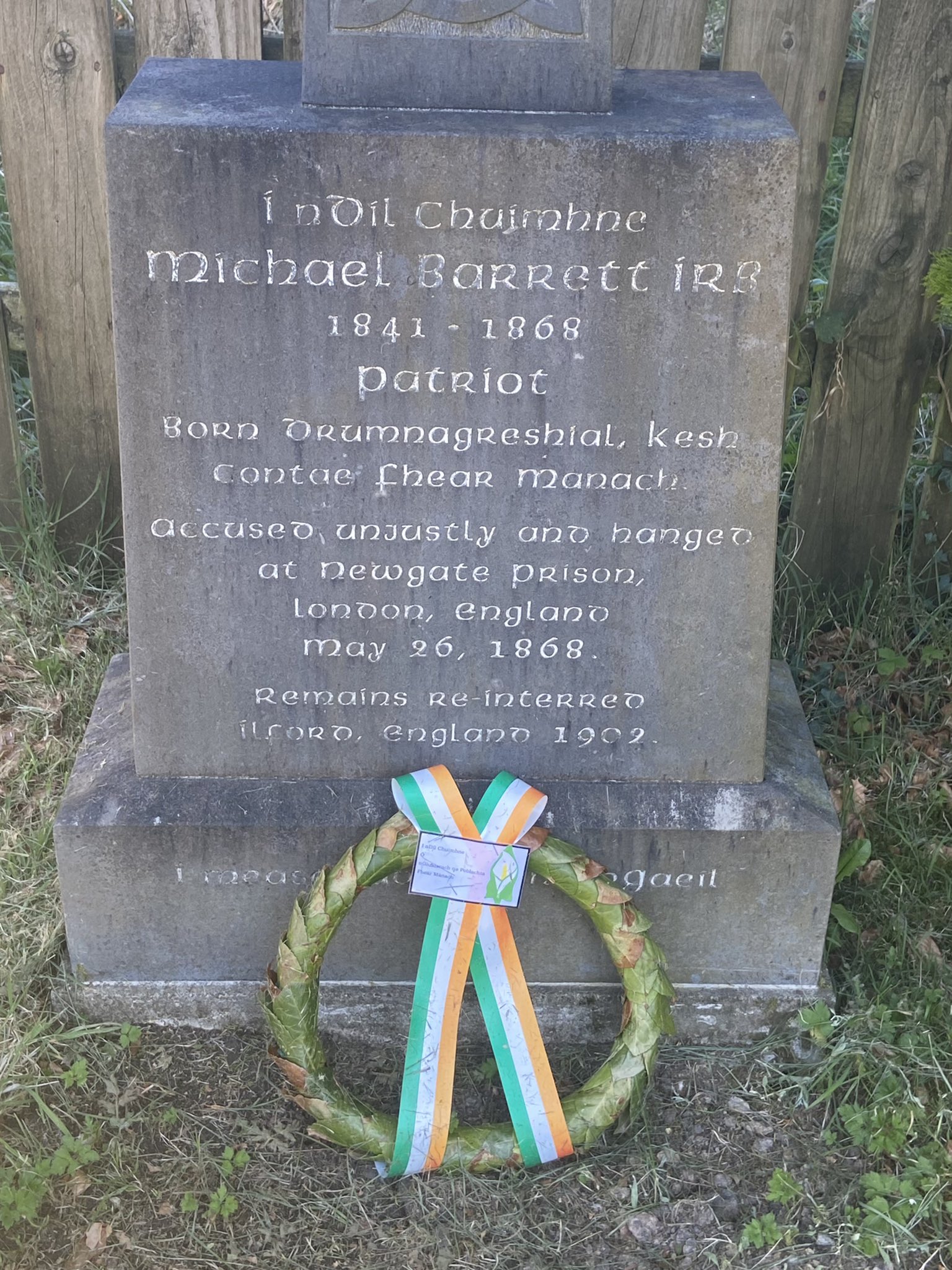
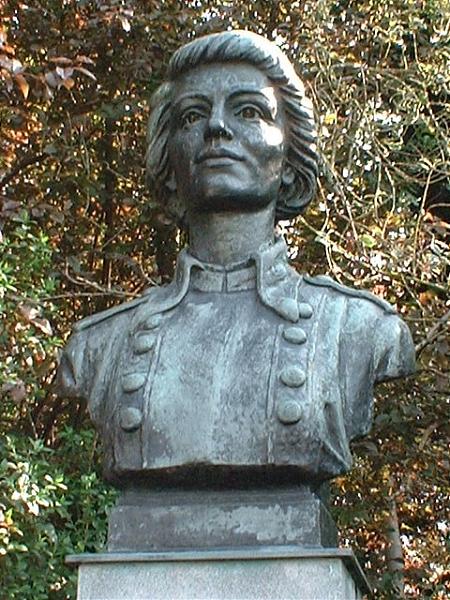
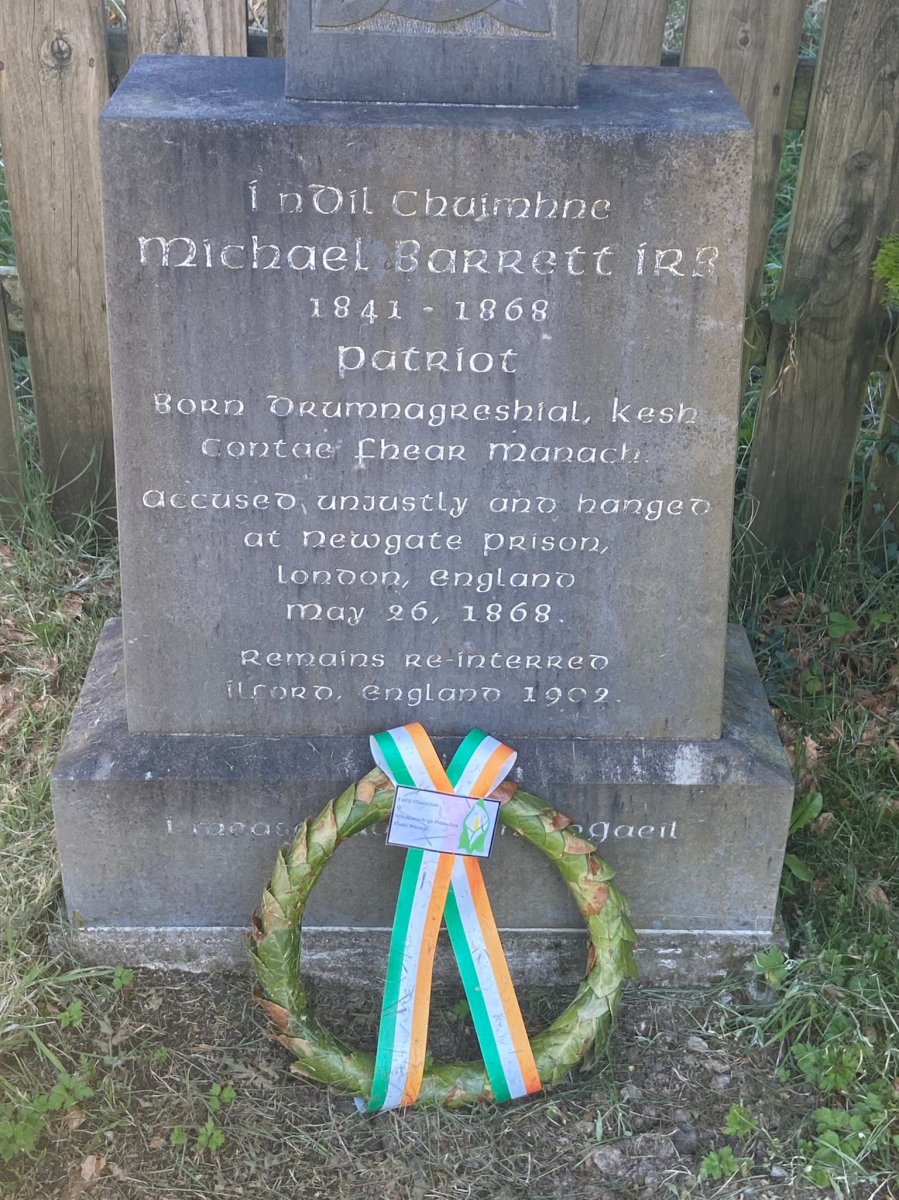
Michael Barrett monument detail, Co. Fermanagh (Sourced: Internet)

In Fermanagh his aged mother had walked many miles to appeal to the local Tory MP Captain Archdale, a noted Orangemen, who rejected her. Barrett was hanged in front of 2,000 jeering people singing Rule Britannia. The following day Reynolds’ News recorded that;

Millions will continue to doubt that a guilty man had been hanged at all; and the future historian of the Fenian panic may declare that Michael Barrett was sacrificed to the exigencies of the police, and the vindication of the good Tory principle, that there is nothing like blood.’

His hangman was the notorious Calcraft who had botched the hanging of the Manchester Martyrs, Allen, Larkin and O’Brien.

There is a huge difference between an accident leading to deaths by patriots fighting tyranny and the deliberate actions of the imperialists, which is why patriots have to be always careful to avoid civilian deaths.

There are many similarities between the Clerkenwell bombing and the Birmingham bombing of 1974.

In both cases they set back the cause of Irish freedom for many years, deeply harmed the Irish community in Britain and was used by the State for repressive measures against the community and to divide off the Irish community from the English working classes.

Disraeli brought in the Habeas Corpus Act and created the Special Branch. Of interest is that their first definition of Irishness was ‘Persons who were born in Ireland or whose recent forebears came from Ireland.” Back in the 1980s the GLC adopted the same definition.

We also had the Birmingham Six case with the ‘appalling vista’ of Lord Denning the Appeal Judge, who later regretted that the six innocent men were not hanged. For Gladstone it set him on his mission ‘to pacify Ireland’.

I ask you two questions today, what kind of people and community gave rise to patriots like Michael Barrett and the Manchester Martyrs, and the second question, what kind of regime or government would hang knowingly innocent men.

To understand the Fenians we have to understand the colonisation of Ireland and in particular the Great Starvation of Ireland An Gorta Mór. Over one and a half million people were starved to death by British imperialism and another two million forced to emigrate to Britain and the USA.

There was no famine in Ireland at this time, and it is imperialistic propaganda to call it such. It was clearly genocide in a land overflowing with food.

The potato crop made up under 25% of the agricultural produce of Ireland, but at this time Ireland was part of the UK where the potato crop was about 5% of the total produce of the UK. I know of no country where there was famine because of a 5% failure of the crops.

Michael Davitt back in 1904 called the Great Starvation a ‘Holocaust’ as did others. Ken Livingstone drew some comparison between the Great Starvation and the experience of the Jewish community during the Second World War.

Hitler named his strategy ‘The Hunger Plan’ where he starved Poles and Jews and others groups of food, and these victims are included in the Holocaust figures including also his starvation of the Warsaw Ghetto.

The shipment of food grown by the people of Ireland to Britain during the Great Starvation was a clear decision by the British government to starve the Irish people.

The Nazi Governor in Poland Hans Frank wrote of the starvation of Jews ‘that we sentence 1.2 million Jews to die of hunger should be noted only marginally’.

The economic theory of laissez-faire is a total invention, within years they could spend millions in Crimea, a place most English had never heard of.

I recall the great Irish writer Frank O’Connor stating ‘Famine is a useful word when you do not wish to use words like ‘genocide’ or ‘extermination’, and again ‘It was not that the people were too simple to realise the Dachau-like nightmare of their circumstances’.

He goes on ‘The word famine itself is a question begging for its meaning ‘an extreme and general shortage of food’, and to use it of a country with a vast surplus of food, cows, sheep, pigs, poultry, eggs and corn, is simply to debase a language’.

O’Connor went further: ‘Irish historians who are firmly convinced that the Famine was all a mistake in the office, explain it in terms of an economic theory called laissez-faire. This is another cock that won’t fight.

Anyone who can believe that the British government maintained a garrison of 100,00 men in Ireland for the purpose of not interfering in trade and industrial affairs attaches some meaning to the word history that escapes me’.

The Great Starvation of the Irish people was a daily planned strategic intervention by the English government which is borne out by the evictions and forced migrations which followed and by the white supremacist and racist beliefs held in England at that time, which has largely been ignored by the historians.

The failure of the Young Ireland movement in the 1848 rebellion led to the deportation of their leaders and a flight of others to France and the USA. From this came the Fenian movement and the Irish Republican Brotherhood set up in the USA and Ireland in 1858.

There was of course also the French Revolution of 1848 which inspired people all over the world and which also inspired the Fenians.

The American Civil War of 1861-65 was to inspire the Irish in the USA. Over 30,000 Irishmen were to lose their lives in War the vast majority fighting for the Union and for the abolition of Slavery.

Revisionists question whether the Irish were really fighting for the abolition of Slavery, yet the same historians in hindsight claim that the British and Irish who fought in the 2nd World war were fighting against fascism and the Nazis.

The Irish men who died firing against slavery are entitled to the same respect from history.

The 1867 rebellion in Ireland did not really take off. Frantz Fanon stated: ‘Each generation must, out of relative obscurity, discover its mission, fulfil it, or betray it’. The Fenians took a more measured road and passed it on to the next generation, but not without a fight.

In the USA they invaded the British Canadian Dominion twice in 1867 with about 700 Fenian soldiers, veterans of the American Civil War. They held a convention in in 1867 with 6,000 armed men present.

In Britain the Fenians massed near Chester Castle in an attempt to seize the guns there and get them to Ireland via Holyhead for the Fenian Rising. As in the USA they were betrayed by spies and with Chester Castle reinforced by soldiers, the raid was called off in February 1967.

In September Colonel Kelly was arrested in Manchester and was released when Fenians attacked the prison coach which later led to the Manchester Martyrs, Allen Larkin and O’Brien who were innocent men framed up by the English government.

The impact of the Manchester Martyrs in Ireland was huge with some 17 monuments put up in their honour and with the Catholic Church forced to backtrack on their anti-Fenian stance and allow masses and commemorations to be widely held in Ireland.

Michael Barrett is part of this sacrifice of the Irish abroad to Irish freedom made within a year of each other. My call is for Michael Barrett to be included within the Manchester Martyrs’ history and commemoration.

By the 1870s the Irish had moved to parliamentary means to move their fight for liberation onwards. You will notice that the fight for Irish freedom goes in flows, a rebellion often followed by political and parliamentary activity along with agitation. Both means were effective for their times.

In Ireland we had Michael Davitt and the Land League, again we have the huge contribution from Britain to this effort from Davitt. We also had the bombing campaign in Britain by O’Donovan Rossa and Tom Clarke from 1880-87, the Invincibles in Dublin and the execution of Lord Cavendish in 1882.

We have the great Irish Literary and Gaelic revival. Again, the Irish Literary Society was founded in Southwark, SE London in the 1880s which spread to Dublin, Belfast and Cork.

We had the Gaelic League and the GAA as part of this revival which led on to the 1916 Rising and the founding of the nation.

What kind of regime or government could knowingly judicially murder innocent men like Michael Barrett and the Manchester Martyrs? We know the history of British colonisation of Ireland and British Imperialism.

This is the same British Imperialism which would in 1919 lead to the Amritsar massacre in India. But let us stay in 1860s iwith this colonial Empire.

In 1865 the Jamaican people rose up against British colonial rule in Jamaica which left 400 dead in a colonial reign of state terrorism. They hung the leader Paul Bogle and 14 others and executed seven women and prosecuted George William Gordon who had nothing to do with the Rebellion.

They executed him. The Fenians at the time raised funds to help the survivors bring action against the English government. You see here a long history of hanging both Irish and Black people across their colonies.

Today I salute the Irish in Britain who marched in the 1980’s against apartheid in South Africa and who today march with the Palestinian people following a noble Fenian internationalist tradition.

British rule in Ireland was based on Imperialism, White Supremacy and Racism. This was first formulated by Gerald of Wales in 1187 some 700 years before they hanged Barrett and the Manchester Martyrs.

Gerald in his books Topography of Ireland and Conquest of Ireland used racism to justify the conquest of Ireland and portrayed the Irish as inferior, backward, inhuman, uncivilised, feckless and lazy.

This was a litany of manufactured racist lies when Ireland had been the ‘Island of Saints and Scholars’ and the seat of learning in Western Europe bringing enlightenment to Europe during the Dark Ages.

Gerald’s views were published across Europe and held sway until around 1650 for about 500 years. This first racialisation of the Irish did not require any religious framework.

When Henry 8th split with Rome in 1534 the racist code used for conquest in Ireland was then overlaid with a state-sponsored sectarian religious code.

Irish scholars were driven out of Oxford where they were a dominant force and Henry sought to build up his fleet to destroy Irish fleets on the south coast to control trading in Irish sea ports and towns.

There followed the Plantation of Elizabeth 1st who knighted Gilbert the mass murderer of Munster who later founded a British colony in Newfoundland.

Later on, we had the Cromwellian conquest of Ireland with large-scale massacres at Drogheda and Wexford, widespread smaller massacres and the forced transporting of Irish slaves to the Caribbean.

Revisionists deny this history and seem to wrongly believe that these people were on some kind of ‘Cromwell Tours of the Caribbean’. For the record these forced transported people were not indentured people.

It is of interest that Gerald of Wales’ views on the Irish were not held of African people from 1200 onwards but were lifted from the Irish situation and applied to African people on the advent of enslavement to justify what the European colonial powers were doing.

So now Africans can be perceived in the same way as the Irish, as backward, inferior, childlike and have their freedoms taken away.

Let us now look at racism and the White Supremacist views of British Imperialism in the 1800s which gave rise to the great Starvation, the Manchester and London hangings of innocent men.

Robert Knox in The Races in 1850 described the Celts as an inferior race which became part of the ‘scientific’ racism of the day, with Knox updating Gerald of Wales.

Even Engels came out with his racist views of the Irish ‘The race that live in these ruinous cottages in measureless filth, and stuck in this atmosphere penned in, as if on purpose, this race must have reached the lowest stages of humanity’, instead of seeing what British imperialism and racism had done to the Irish people at home and abroad.

John Bedoe in his Races of Britain in 1862 views the Irish as Africanoid and having African roots, and again as ‘European Negroes’. Punch portrayed the Irish as apes and monsters, even Parnell, and the Irish as Aboriginals and on the same level as gorillas.

Charles Kingsley on visits to Ireland in the 1860’s states ‘I am haunted by the human chimpanzees I saw’ and ‘to see white chimpanzees is dreadful’. A new Gorilla at London Zoo is called ‘Paddy’ and the ‘Irish Yahoo’ is seen as the missing link between man and gorilla.

The Irish are described ‘as half naked savages who retain a vast amount of their primitive savagery to this day’.

We can see how scientific racism is now applied equally to Black and Irish for the purpose of colonisation and oppression.

In this context we can see the mindset of the British establishment who committed genocide against the Irish people, and who over centuries had murdered Irish people at random. We can see how the same regime of government can hang innocent people at home and abroad.

Michael Barrett, a self-educated man emerges from this dunghill of White Supremacy and pure racism as a heroic figure, like the Manchester Martyrs a true patriot as shown in his speech from the dock. He should be remembered with the Manchester Martyrs and not separated from their heroic end.

Barrett, a Christlike figure and a Cúchulainn who died on behalf of his people and for his political beliefs.

He was part of an Irish tradition in Britain of being in the forefront of democratic rights for liberty justice and freedom, not just for the Irish but also the British people.

We see in the Chartist movement of the 1840s being led by Irishmen Fergal O’Connor and Bronterre O’Brien that fight for liberty and the rights of man.

Also the leadership of Donegal man Doherty leading the workers of Lancashire and the ongoing links in the trade union movement to today from leaders like Mick Lynch inspired by James Connolly to Pat Cullen of the RCN.

We see it in the gift of The Red Flag song from a County Meath man and The Ragged Trousered Philanthropists novel by Noonan to the British working class.

In honouring Michael Barrett today, we stand full square for a United Ireland as proclaimed in the Fenian and 1916 Proclamations and for working class liberty in Britain.

I will finish today by reading the Fenian Proclamation of 10th February 1867 from the Irish People to the World. In it we can see what the 1916 Proclamation borrowed and built on. It is also what Michael Barrett lived and in the end died for.

  1. Fenian Proclamation, 1867

Proclamation of the Irish Republic, issued February 10th, 1867, by the Irish Republican Brotherhood.

  1. I.R.
    — PROCLAMATION! —

THE IRISH PEOPLE TO THE WORLD

We have suffered centuries of outrage, enforced poverty, and bitter misery. Our rights and liberties have been trampled on by an alien aristocracy, who, treating us as foes, usurped our lands and drew away from our unfortunate country all material riches.

The real owners of the soil were removed to make room for cattle, and driven across the ocean to seek the means of living, and the political rights denied to them at home, while our men of thought and action were condemned to loss of life and liberty.

But we never lost the memory and hope of a national existence. We appealed in vain to the reason and sense of justice of the dominant powers. Our mildest remonstrances were met with sneers and contempt. Our appeals to arms were always unsuccessful.

Today, having no honourable alternative left, we again appeal to force as our last resource. We accept the conditions of appeal, manfully deeming it better to die in the struggle for freedom than to continue an existence of utter serfdom.

All men are born with equal rights, and in associating together to protect one another and share public burthens, justice demands that such associations should rest upon a basis which maintains equality instead of destroying it.

We therefore declare that, unable longer to endure the curse of Monarchical Government, we aim at founding a Republic based on universal suffrage, which shall secure to all the intrinsic value of their labour.

The soil of Ireland, at present in the possession of an oligarchy, belongs to us, the Irish people, and to us it must be restored.

We declare also in favour of absolute liberty of conscience, and the complete separation of Church and State.

We appeal to the Highest Tribunal for evidence of the justice of our cause. History bears testimony to the intensity of our sufferings, and we declare, in the face of our brethren, that we intend no war against the people of England —

our war is against the aristocratic locusts, whether English or Irish, who have eaten the verdure of our fields — against the aristocratic leeches who drain alike our blood and theirs.

Republicans of the entire world, our cause is your cause. Our enemy is your enemy. Let your hearts be with us. As for you, workmen of England, it is not only your hearts we wish, but your arms. Remember the starvation and degradation brought to your firesides by the oppression of labour.

Remember the past, look well to the future, and avenge yourselves by giving liberty to your children in the coming struggle for human freedom.

Herewith we proclaim the Irish Republic.

THE PROVISIONAL GOVERNMENT
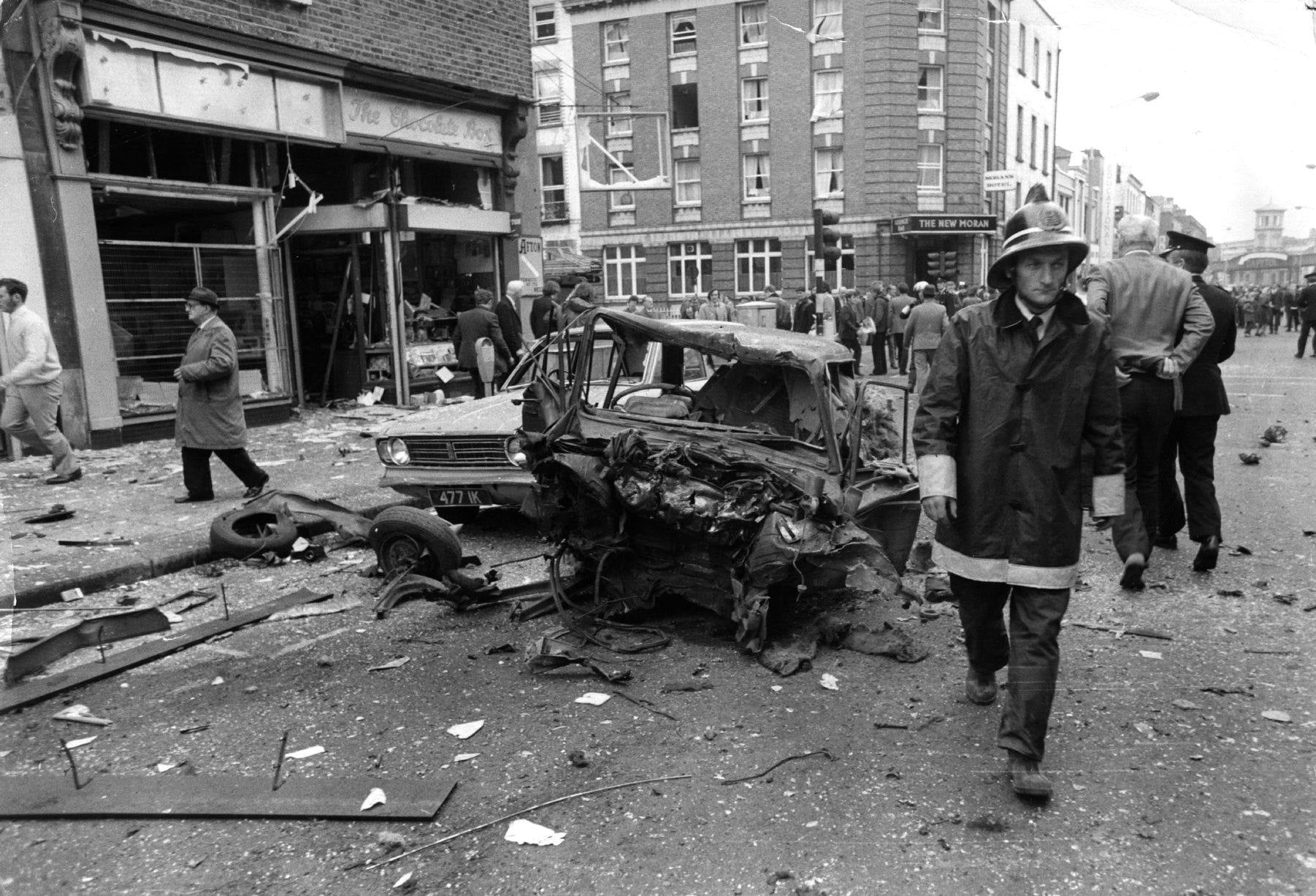
IRISH STATE COLLUDED IN COVER-UP OF BRITISH INTELLIGENCE-ASSISTED DUBLIN BOMBING

Diarmuid Breatnach

(Reading time: 8 mins.)

On the 49th anniversary of the Dublin and Monaghan Bombings a number of speakers criticised the Garda closure of its investigation a mere four months after the bombing with the highest number killed in any one day of the 30 years war.

The criticisms were made on 17th May at the annual commemoration of the atrocity in Talbot Street, Dublin, organised by the Justice For the Forgotten campaign, held at the location of the memorial on the site of one of the bombings of that day.

The annual commemoration has been organised for many years by the Justice For the Forgotten campaigning group at the Talbot Street monument to the bombing1. It usually comprises reminiscences, poetry and music and a call for the British State to release its secret papers.

As of rote, an Irish Government Minister is invited to speak who routinely says how hard the Irish Government has been trying to get the British State to release the secret papers revealing the latter’s connection to those who carried out the bombing.

Years after the bombings, a British TV company (!) pointed the finger at the Ulster Volunteer Force, a British Loyalist paramilitary group but believed acting under British Intelligence agency direction, named some of those involved and a week later the UVF claimed responsibility.

In addition to British Intelligence, the British colonial police2 and British Army3 had been widely known to be working in collusion with Loyalists.

But few would have suspected Irish State collusion.

THE BOMBINGS AND AFTERMATH

On 17th May 1974 three car bombs exploded without warning in crowded Dublin city centre streets and another in Monaghan town centre. Thirty-three people were killed along with a full-term baby and a miscarriage with around 300injured. No-one was ever even charged in relation to the atrocity.

Scene post-bombing in Talbot Street, the site where the Monument was erected later is out of shot to the right. (Photo sourced: Internet)

The intention, unlike that of many other city car-bombings in the Six Counties and in England, was clearly to cause maximum death and injury to civilians. The areas chosen in Dublin were full of shops with bus stops and 5.30pm was going home time from shopping and work.

And no warning was given.

In the course of the short Garda4 investigation, in macabre irony the remains of the exploded cars were sent for forensic examination to their very source: the Six Counties, i.e to the colonial police force (at the time, the RUC5). Unsurprisingly, nothing useful came back.

In a war that was already five years old (six years, if the civil rights marches are included) the collusion between the British colonial police and Loyalist paramilitary murder gangs was well known and collusion with the British Army widely suspected.

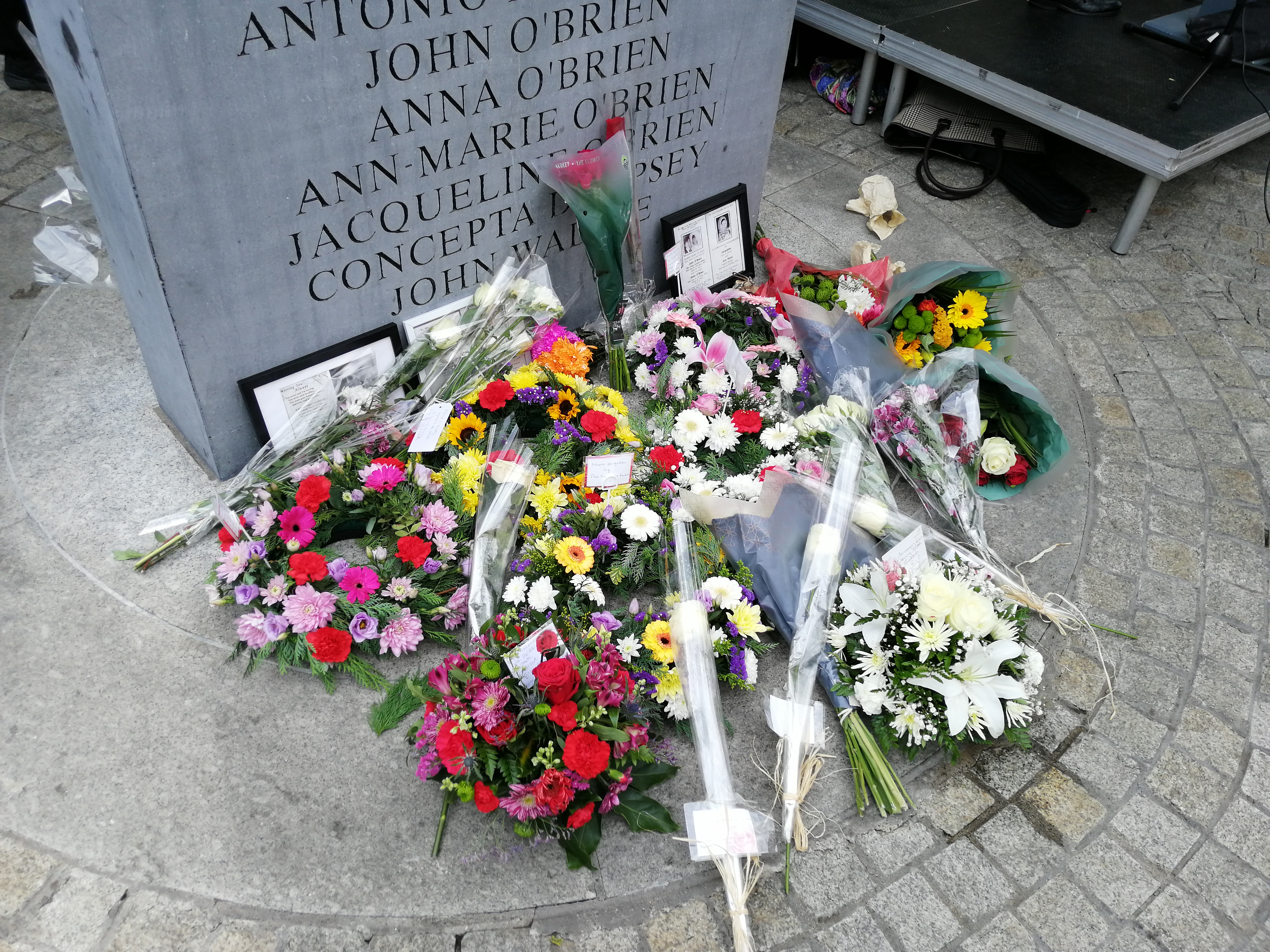
Floral tributes on the north face of the monument in Talbot Street. (Photo: D.Breatnach)
Floral tributes on the south face of the monument in Talbot Street. (Photo: D.Breatnach)

CAMPAIGN OF BOMBING DUBLIN

The Loyalist bombing of two cities in the Irish state in 1974, although by far the worst of the whole period, were not the first in Ireland, not even the first fatal ones.

In 1973 a Loyalist bomb in Dublin city killed Tommy Douglas and the year before that another killed George Bradshaw and Tommy Duffy – all were employees of Irish public transport state company CIE.

Even after the horror of 1974, on 29th November 1975, another a bomb at Dublin Airport killed John Hayes, a worker there.

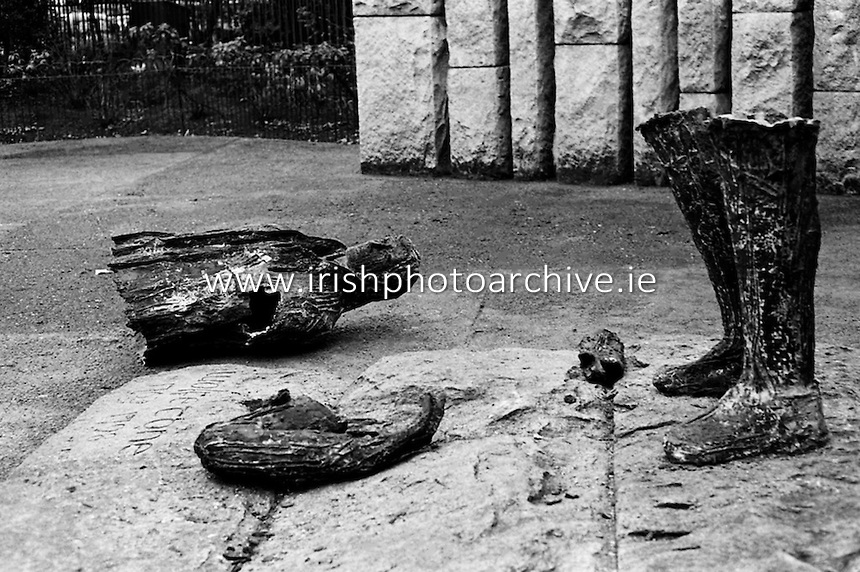
And there were other earlier ones where no-one was injured, such as the blowing up of the Wolfe Tone monument just outside Stephens Green on 8th February 19716 and the Daniel O’Connell Monument in Glasnevin Cemetery (the round tower) in December 1971.

Pieces of the statue of Theobald Wolfe Tone on St Stephen’s Green. The statue was blown up by a loyalist bomb. A report at the time noted that ‘Huge slabs of the bronze sculpture were hurled 20 feet in the air’. 08/02/1971 (Photo sourced: Internet)
The O’Connell Monument in Glasnevin (round tower) seen here at sunset from the Botanic Gardens was a target of Loyalist bombing in 1971. (Photo: D.Breatnach)

If the Irish State had pursued investigations and cross-Border links after the earliest of those bombings, they might have headed off the carnage that followed later.

Not only did they not do so but in fact used the 1972 bombing to blame Irish Republicans so as to get an unpopular piece of repressive legislation through parliament, the Amendment to the Offences Against the State Act, along with the establishment of the no-jury Special Criminal Court7.

The Garda Commissioner at the time of the 1974 bombings was Patrick Malone and Ed Garvey, his Assistant Commissioner, was later exposed as a British Secret Service asset run by Fred Holroyd, a disenchanted British agent who revealed he had visited the policeman in his Dublin HQ.

Garvey, by then Commissioner, denied being a British agent and claimed no memory of the visit.

The Barron Report (2003) concluded that visit had undoubtedly occurred and that he had not informed his superiors, contrary to all rules regarding contact with agents working for a foreign government.8 When Fianna Fáil came into Government again, they sacked Garvey.

Since FF had not subjected him to a regular disciplinary process, probably in order to avoid the sordid story going public, Garvey was able to sue the Irish Government, win damages and ensure he received his former pension entitlements.

THE COMMEMORATION EVENT

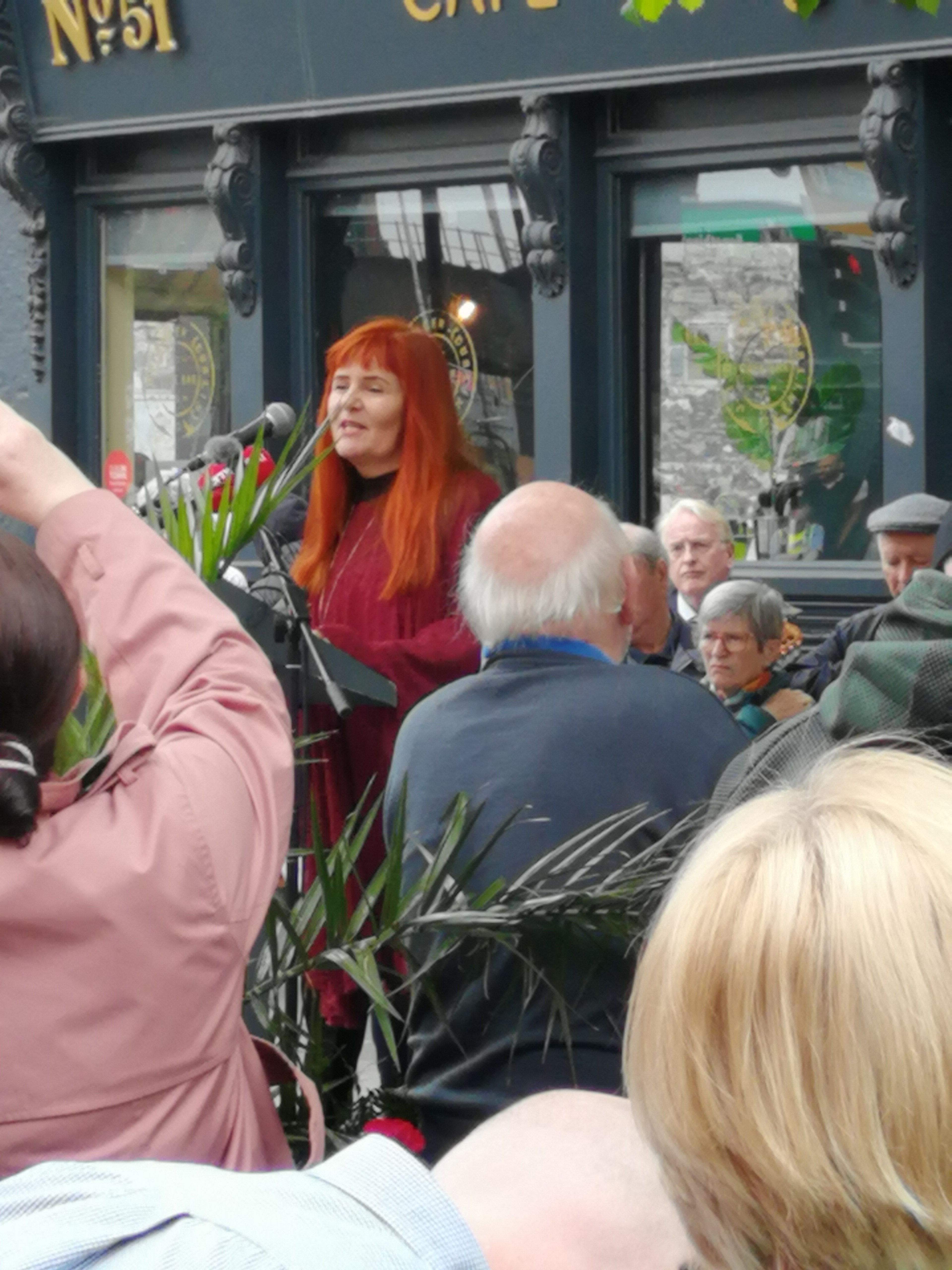
Aidan Shields, who lost his sister Maureen in the bombing, chaired the event for Justice for the Forgotten and introduced its Secretary Margaret Unwin who, as all speaking or performing at the event seemed conscious that next year would be the 50th anniversary of the atrocity.

(Photo: D.Breatnach)

The regular Government slot was occupied by the current Tánaiste (Dep. Prime Minister) Mícheál Martin who, as has every Government representative since the JFTF commemorations began, claimed energetic diplomatic discussions for release of the papers with their British counterparts.

Martin also criticised the British Government’s widely-criticised intended legislation to prevent official investigations and trials regarding past crimes committed by British forces, while he simultaneously praised the British pacification process.

A young Italian woman played the theme from the Schindler’s List film and another air on violin. A visiting Italian couple had been killed in the bombing also but that was not mentioned when she was introduced.

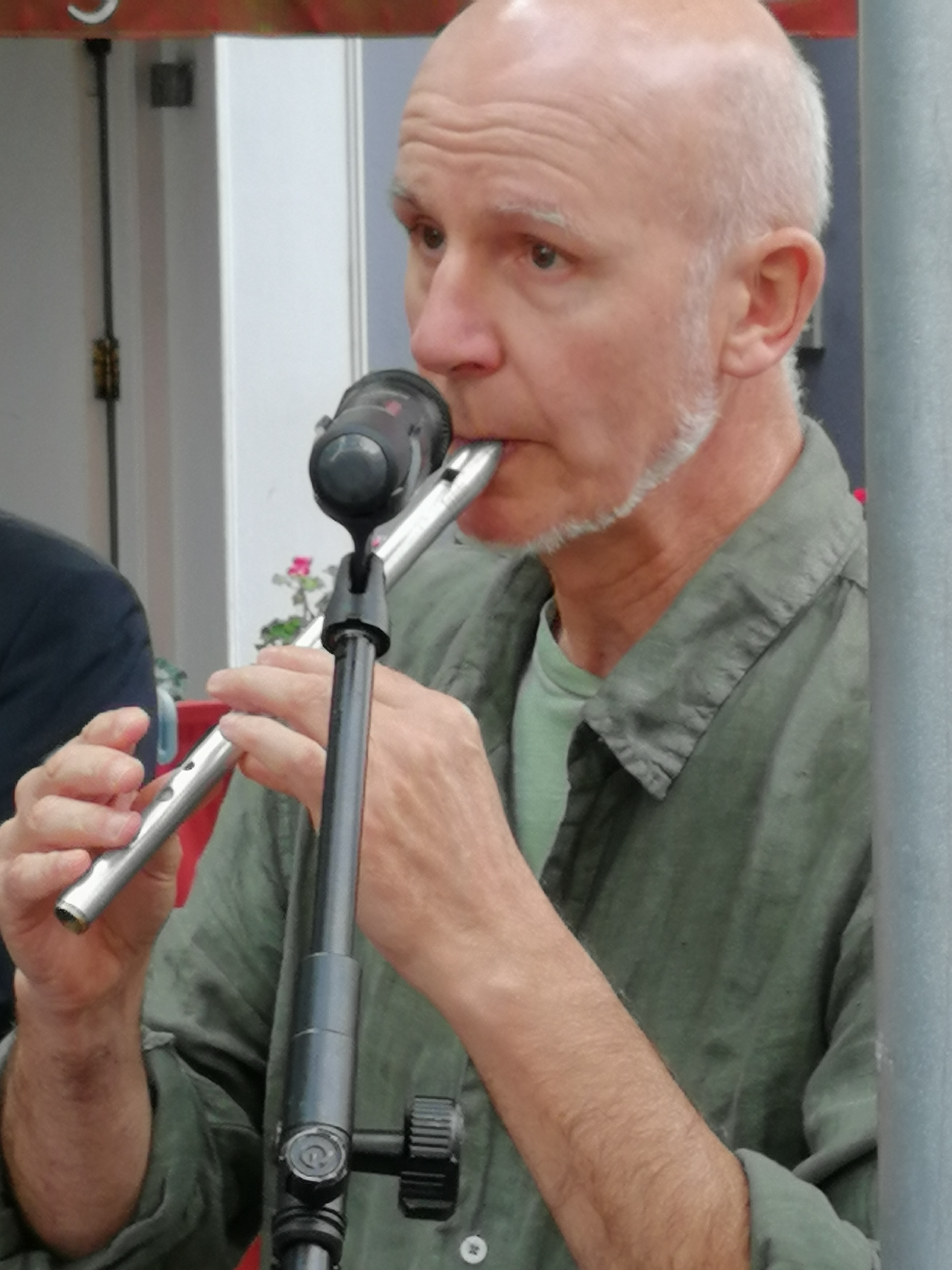
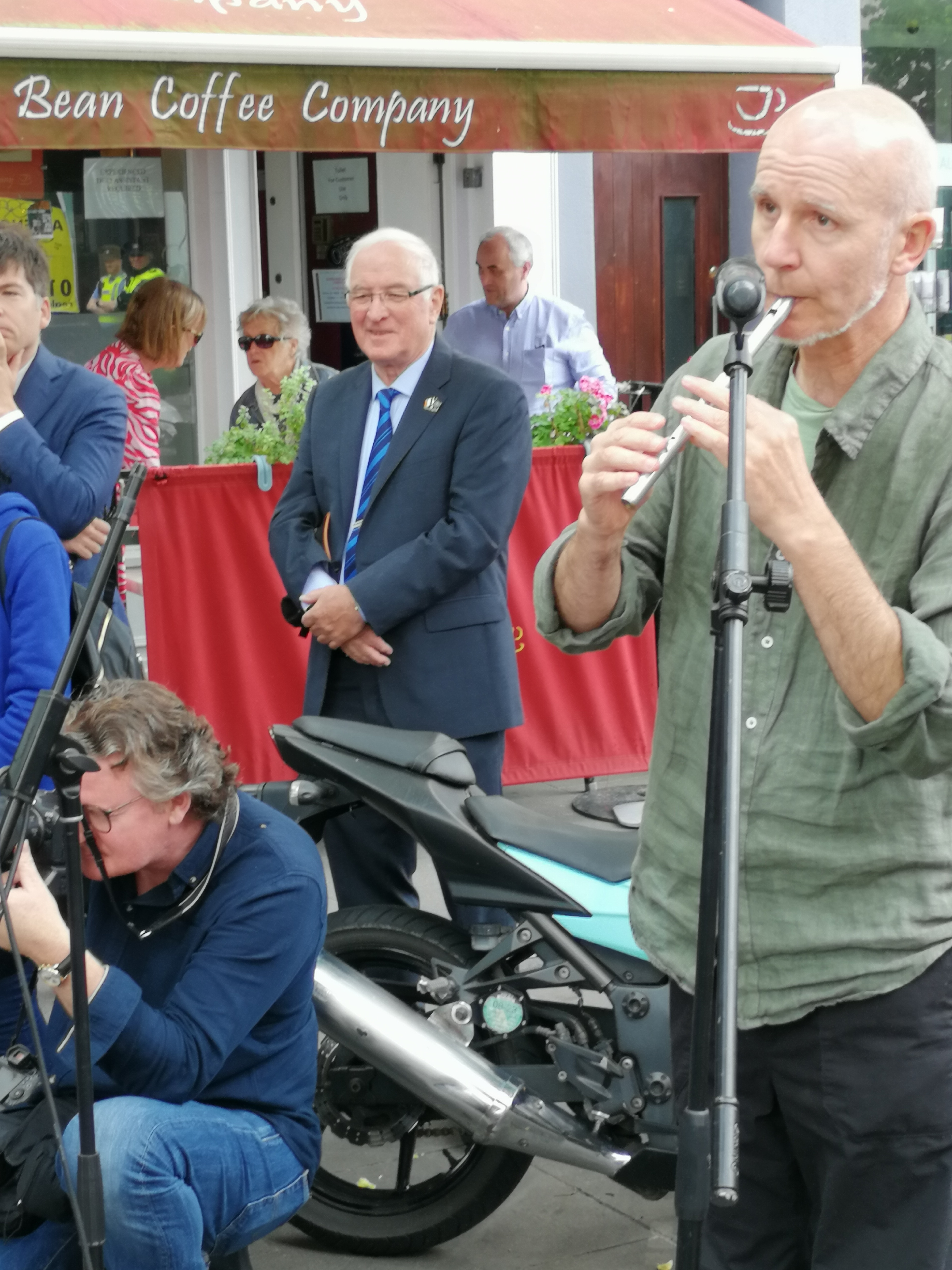
Rachel Hegarty read from her poetry compilation about the victims, based on testimonies by surviving relatives and friends. Cormac Breatnach on high D whistle and Eoin Dillon on uileann pipes played the Irish air Tabhair Dom Do Lámh (“Give Me Your Hand”).

Poet Rachel Hegarty reciting from her work on the bombing. (Photo: D.Breatnach)
Closeup of Cormac Breatnach on high whistle playing at event. (Photo: D.Breatnach)
Eoin Dillon playing uileann pipes at event. (Photo: D.Breatnach)
Fuller shot of Cormac Breatnach playing at event with Eoin Dillon out of shot to the left. (Photo: D.Breatnach)

The Shillelagh North Ukulele Group played and sang The Sound of Silence and Things (we used to do), both appropriate in metaphorical context, the first for the official silence about the perpetrators and their British intelligence organisation, the second about the loss of the victims and to their loved ones.

Dublin City Lord Mayor Caroline Conroy, of the Green Party, spoke about the atrocity and criticised the closing of the Garda investigation a mere four months after the bombing.9

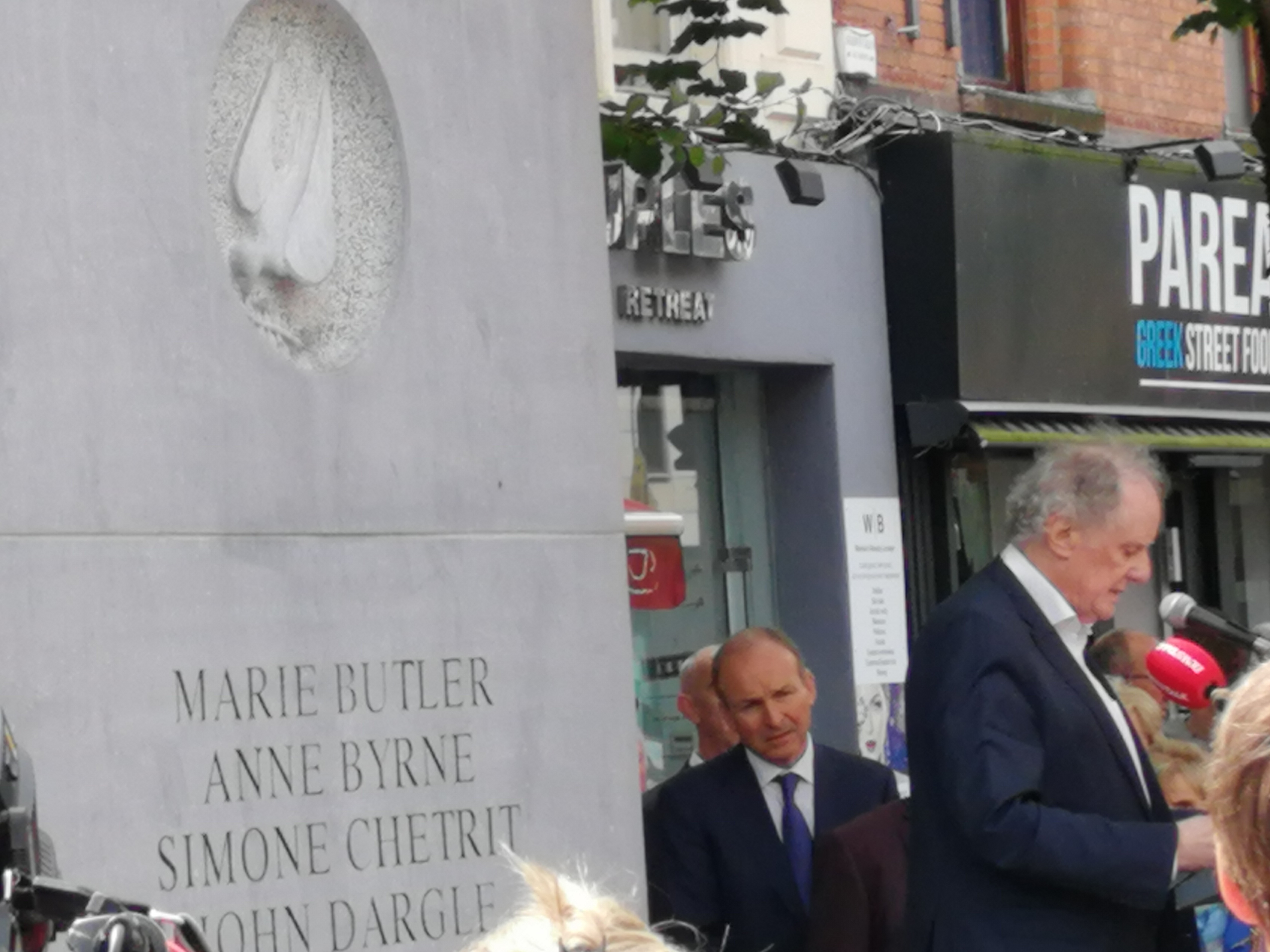
Vincent Browne giving his oration. (Photo: D.Breatnach)

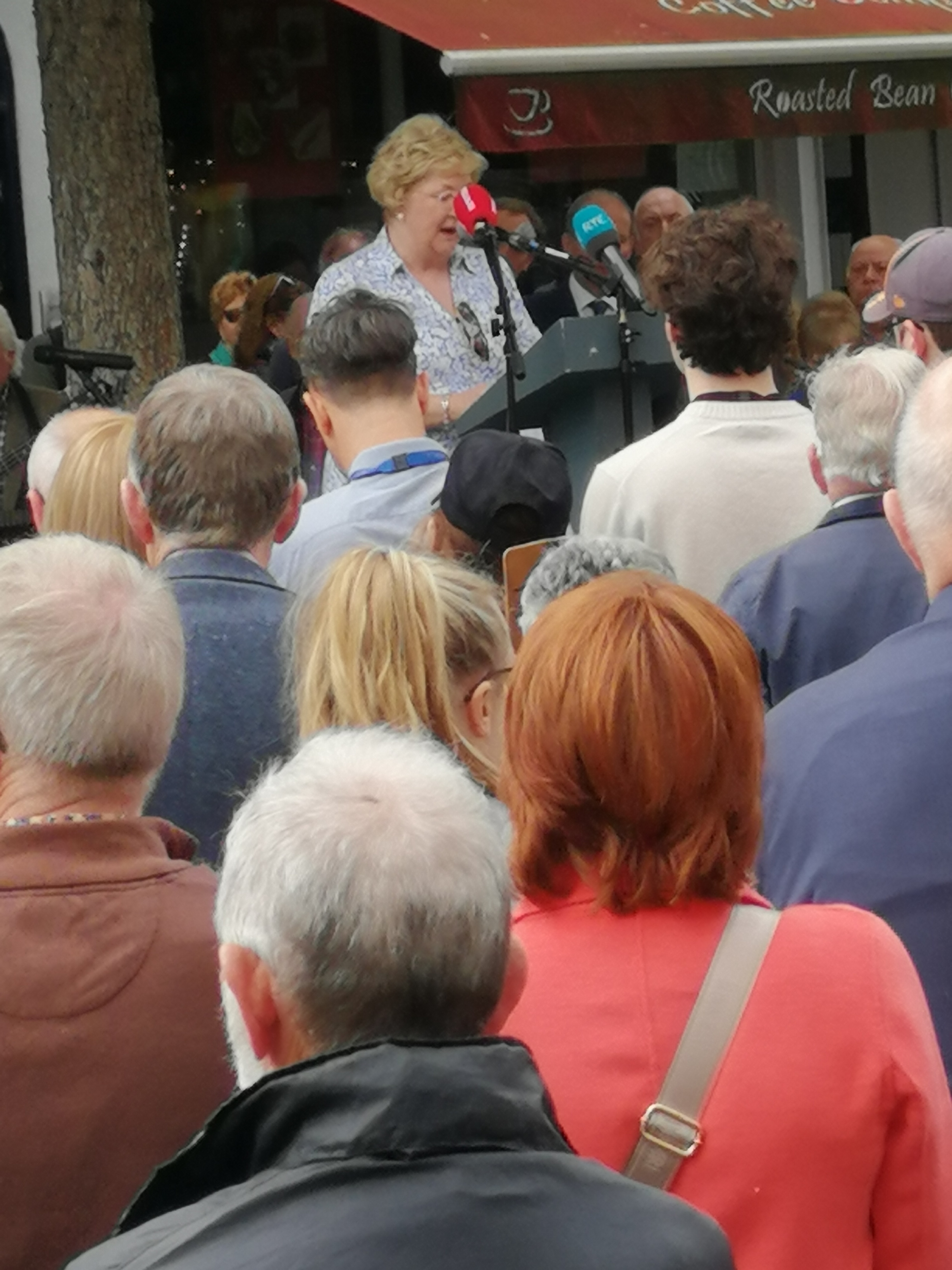
Well-known journalist and former TV presenter Vincent Browne gave the oration at the event and went into horrific detail on some of the injuries he had witnessed as a journalist at the scene with his doctor brother as they struggled to help the victims still alive.

Browne departed from the subject of the bombing, as a few had done to speak of the long war and the Good Friday Agreement but in his case also to accuse the Provisional IRA of having killed most of the people during the 30 Years War which seemed not appropriate on this occasion.

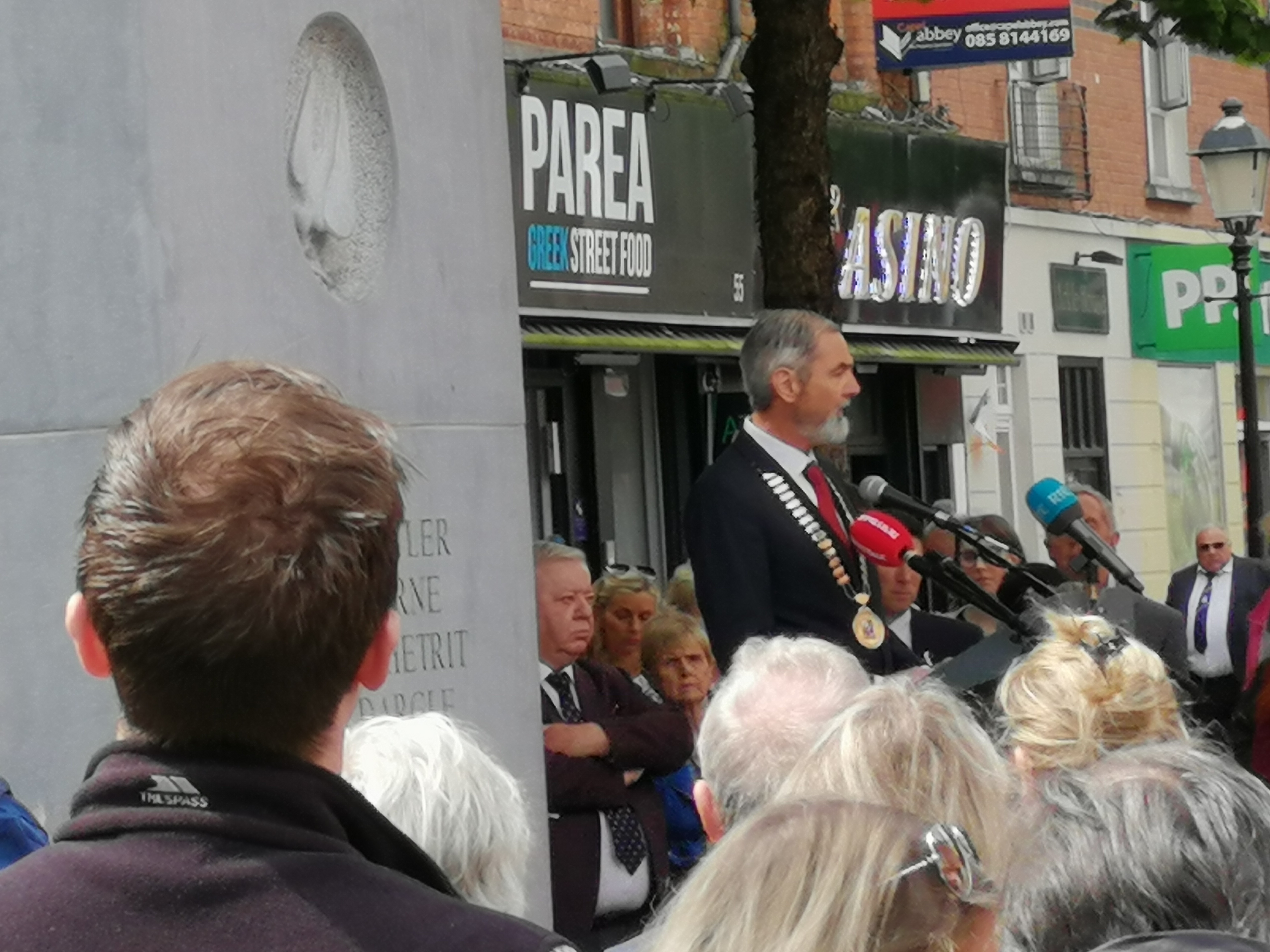
Seán Conlon, Cathaoirleach (Chair) of Monaghan Council10 spoke of the bombing and focused on the effect on his town. He also condemned the early closing of the Garda investigation and the failure to pressurise the British State into releasing security papers relevant to the bombing.11

Seán Conlon, Cathaoirleach of Monaghan Council, speaking with part of monument visible to his left. Aidan Shields is standing right next to the Monument. (Photo: D.Breatnach)

A number of speakers referred optimistically to the investigation into the Glenanne Gang by former English police chief Jon Boucher, who was present in the crowd at the commemoration. Boucher is heading a number of other historical investigations, including that of Stakeknife.12

The older age profile of the attendance was noticeable with only two teenagers visible and this in itself must be of concern.

FATAL CONSEQUENCES OF STATE COLLUSION AND COVER-UP

The failure to investigate the earlier Loyalist bombings and apprehend the perpetrators made the planning and execution of the Dublin and Monaghan bombings much easier. The early closing of the Garda investigation of the 1974 bombings ensured the perpetrators would run free.

As well as failing relatives and friends of those murdered and injured in Dublin on the 17th May 1974, the lack of pursuit had repercussions for many other victims of Loyalist murder squads, in particular the over 120 victims of the Glenanne Gang, including the Miami Band Massacre in 1975.

An aspect not normally commented upon was the choice of predominantly working class areas for Dublin massacre victims. It was not the high-end Henry or Grafton Streets that were chosen but the more working-class shopping areas of Talbot Street and Parnell Street.

The fatal Dublin bombings of 1972 and 1973 had also been directed at workers by location: three public transport workers and an airport worker.

Section of the Shillelagh North Ukulele Group playing and singing at the event (Photo: D.Breatnach)

THE GOMBEENS: A CRAVEN CLIENT RULING CLASS

The whole chain of events from the first Loyalist bombing of Dublin points quite clearly to the client nature of the Irish national bourgeoisie, the ruling class of the Irish State. Even if it wanted to, it is too weak to make strong demands of the British State.

What self-respecting national ruling class would allow a foreign power to send terrorists to bomb its capital city? And then collude with that power in drawing silence and secrecy over the atrocity?

None, of course. But the Irish bourgeoisie came into being in a truncated client state and, armed and equipped by its master, went to war for two years (1922-1923) against the very national liberation forces that had brought the British State with offered concessions to the negotiation table.13

To talk of uniting Ireland under such a class, apart from being impractical nonsense, is a travesty. To expect any real change by electing a party or combination of parties to government in such a situation is a pipe-dream.

The 1974 bombing, the subsequent investigation and the record of Irish governments since in relation to the bombing are together a stark illustration of the spineless nature of the Irish bourgeoisie when dealing with their masters.

A client ruling class yes but more accurately, a servant.14

End.

Section of the crowd in attendance viewed from the north-east of the location. (Photo: D.Breatnach)
Section of the crowd with the tower of Connolly (formerly Amiens Street) Station in the background. During the British suppression of the 1916 Rising, British Army machine-gun fire was directed from there along Talbot Street towards the General Post Office garrison and North Earl and Henry Streets. (Photo: D.Breatnach)

FOOTNOTES

1There was originally a plaque at the Garden of Remembrance and the Talbot Street monument was erected in 1977 after campaigning by relatives and victims. There is also a monument in Monaghan Town. In Dublin there is also a plaque at the site of another explosion that killed people that day in Parnell Street.

2Now the Police Service of Northern Ireland, formerly the Royal Ulster Constabulary (and before that, up until 1921, the Royal Irish Constabulary, when the whole of Ireland was under direct British rule).

3In particular the Ulster Defence Regiment, which had recruited from the part-time RUC B-Specials when the latter were disbanded but also special units such as the MRF in special operations and more generally across the whole of the occupation forces.

4Irish State police force.

5When the Irish State and colony statelet were created in 1921, the colonial gendarmerie of the Royal Irish Constabulary in the colony became the Royal Ulster Constabulary. In more recent years the force has change its name to the Police Force of Northern Ireland.

6The body of the monument to the Anglican leader of the United Irishmen was destroyed but the head was salvageable and rests on the re-cast body of the monument today.

7The Irish Council for Civil Liberties has dubbed that Court “a sentencing tribunal” but every party in government since has upheld those repressive provisions and Sinn Féin has abandoned its decades of opposition to them as it prepares to enter government in coalition with one party or another.

8Having a Garda Commissioner who was or became a British Intelligence agent might be shocking until we remind ourselves that the current Garda Commissioner, Drew Harris, coming from being Assistant Commissioner of the PSNI, was at least formerly part of MI5 operations in the colony and that must have been known to those who appointed him!

9Mayors of Dublin City are selected for one year from among the elected councillors. It is more of a ceremonial role than an executive one and the choice is usually negotiated in turn from among the represented political parties.

10As above with Cathaoirligh of Monaghan Council.

11A number commented that his contribution was so much better in every way than that of last year’s Monaghan Cathaoirleach. Conlon is a member of the Sinn Féin party and some may say his posture would therefore be expected. However, given changes in the party’s public position on many questions in recent years, a hard stand against the British administration no longer seems natural for this party’s public representatives.

12Operation Kenova.

13Irish Civil War (or as some see it, the Irish Counterrevolution) 1922-1923.

14It should be noted that the Gombeen class has also been a client in turn of US Imperialism and of EU Imperialism, with all of which it aligns itself on most questions of international policy and to which it opens up its markets, natural resources and infrastructure networks.

REFERENCES

Justice For the Forgotten: https://www.facebook.com/Justice4theForgotten1974
https://www.patfinucanecentre.org/projects/justice-forgotten#:~:text=Justice%20for%20the%20Forgotten%20was,single%20day%20of%20the%20Troubles.

The anniversary event: https://www.thejournal.ie/dublin-monaghan-bombings-anniversary-2-6069847-May2023
https://www.98fm.com/news/commemoration-dublin-monaghan-bombings-1466373
https://www.dfa.ie/news-and-media/press-releases/press-release-archive/2023/may/remarks-on-the-commemoration-of-the-49th-anniversary-of-the-dublin-monaghan-bombings.php

https://en.wikipedia.org/wiki/Dublin_and_Monaghan_bombings

https://www.garda.ie/en/about-us/our-history/garda-commissioners-since-1922/
Ed Garvey, former Chief Commissioner of the Garda and British Intelligence asset (interestingly there is no Wikipedia page on this man, nor is his creation of the infamous Garda ‘Heavy Gang’ or his British Intelligence work mentioned by Ferriter): https://www.dib.ie/biography/garvey-edmund-a342

Earlier Loyalist bombings in the Irish State: https://en.wikipedia.org/wiki/1972_and_1973_Dublin_bombings

Lethal AlliesBritish collusion in Ireland (2015), Ann Cadwaller: https://www.irishtimes.com/culture/books/lethal-allies-british-collusion-in-ireland-a-shameful-part-of-our-troubled-history-1.1578119

The Glenanne Gang: https://en.wikipedia.org/wiki/Glenanne_gang

Barron Report: https://www.irishtimes.com/news/barron-report-conclusions-1.398978

Jon Boucher investigation: https://www.irishnews.com/news/northernirelandnews/2019/11/30/news/jon-boucher-to-take-on-investigation-of-glenanne-gang-1778903/

https://www.opkenova.co.uk/

FOR A SOCIALIST REPUBLIC, AGAINST THE FREE STATE, ENGLAND AND NATO

Diarmuid Breatnach

(Reading time main text: 6 mins.)

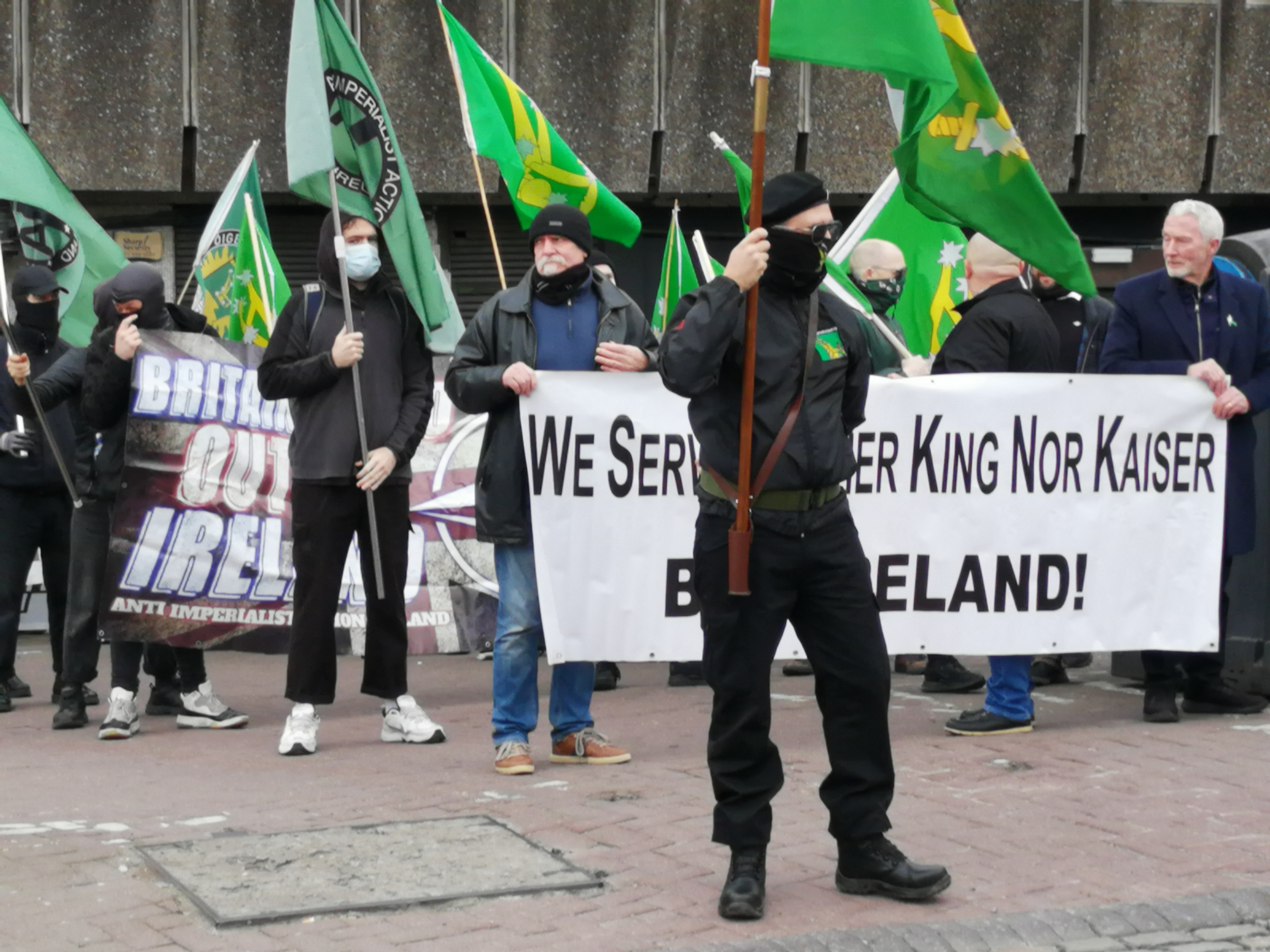
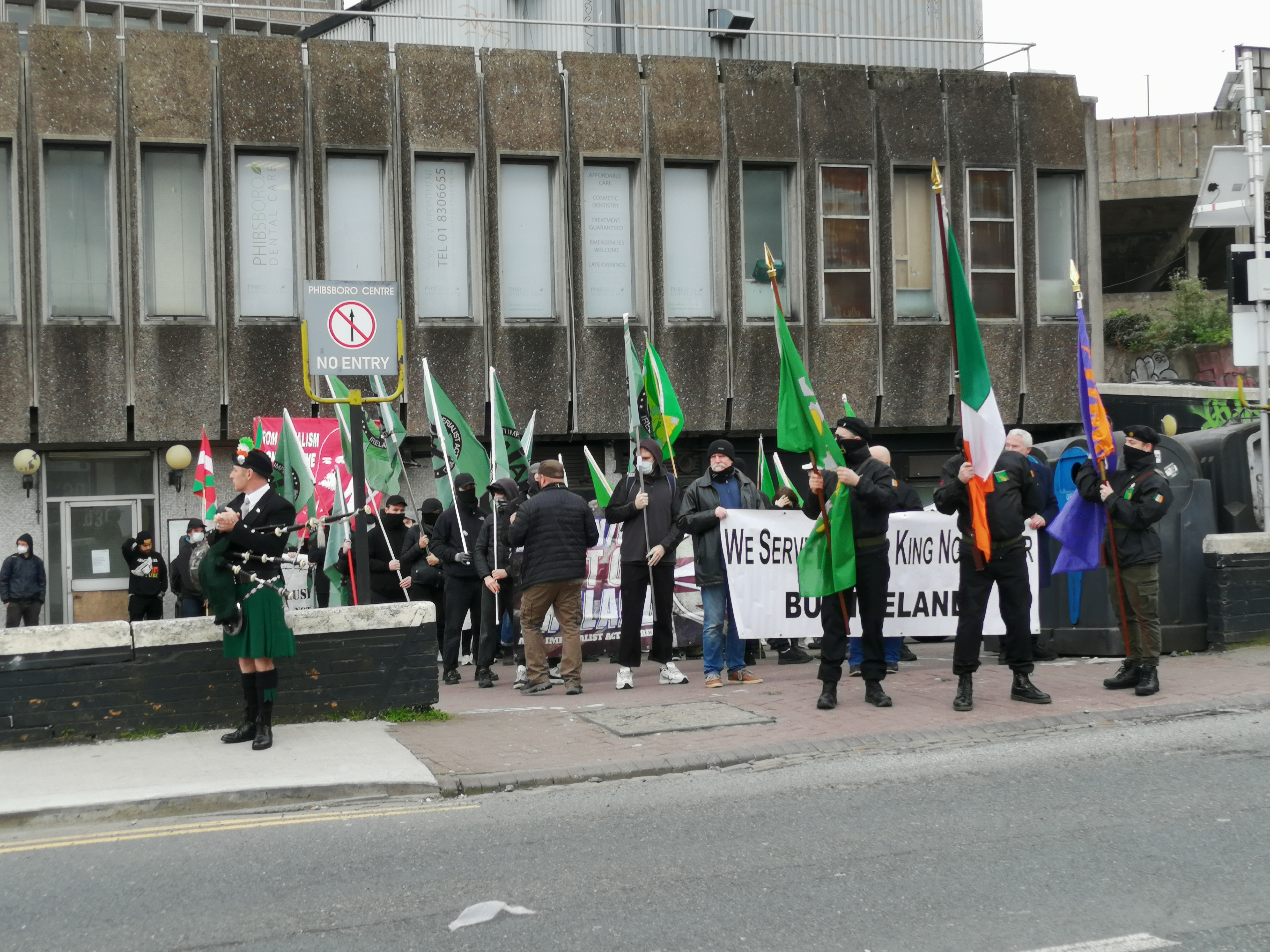
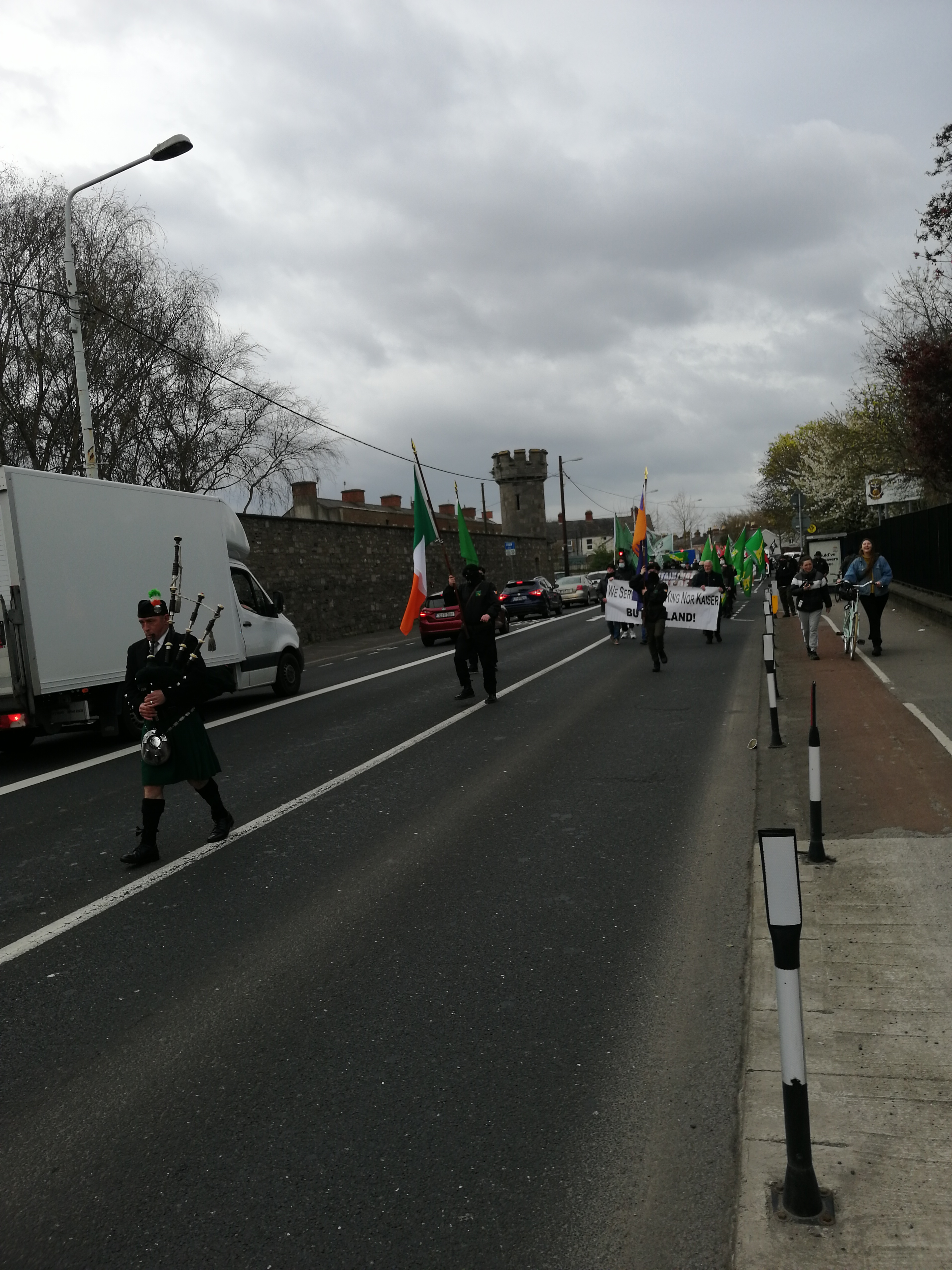
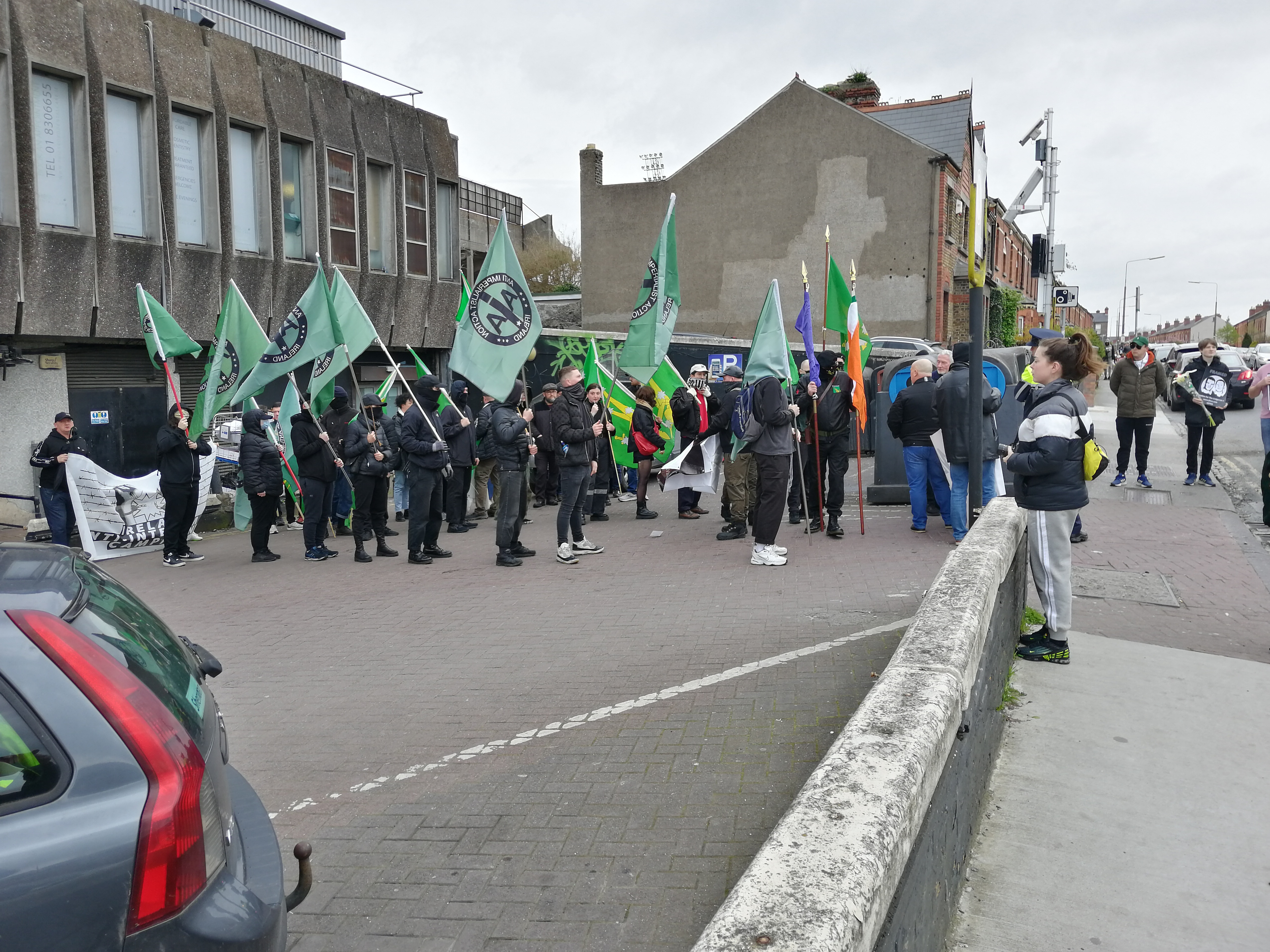
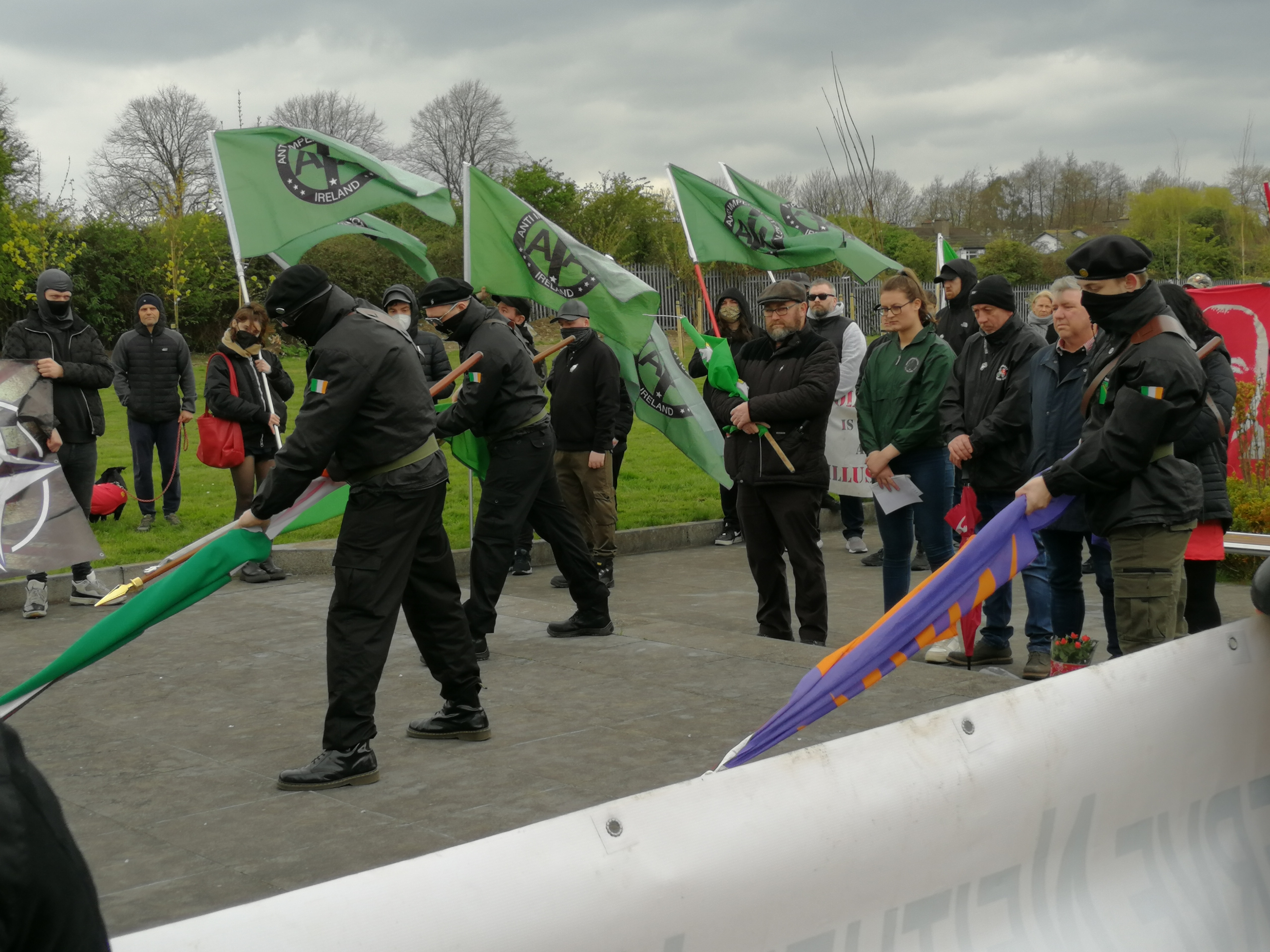
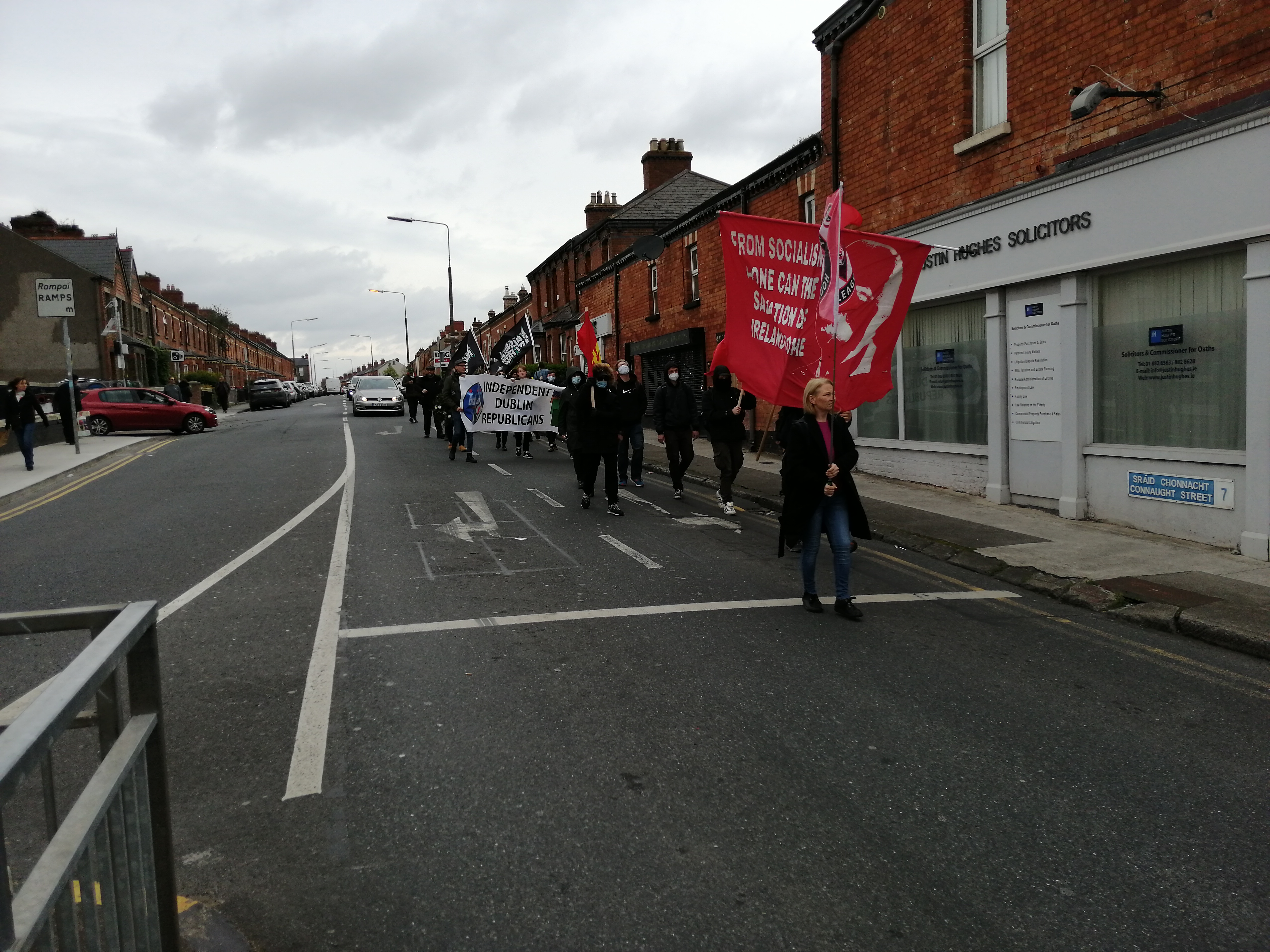
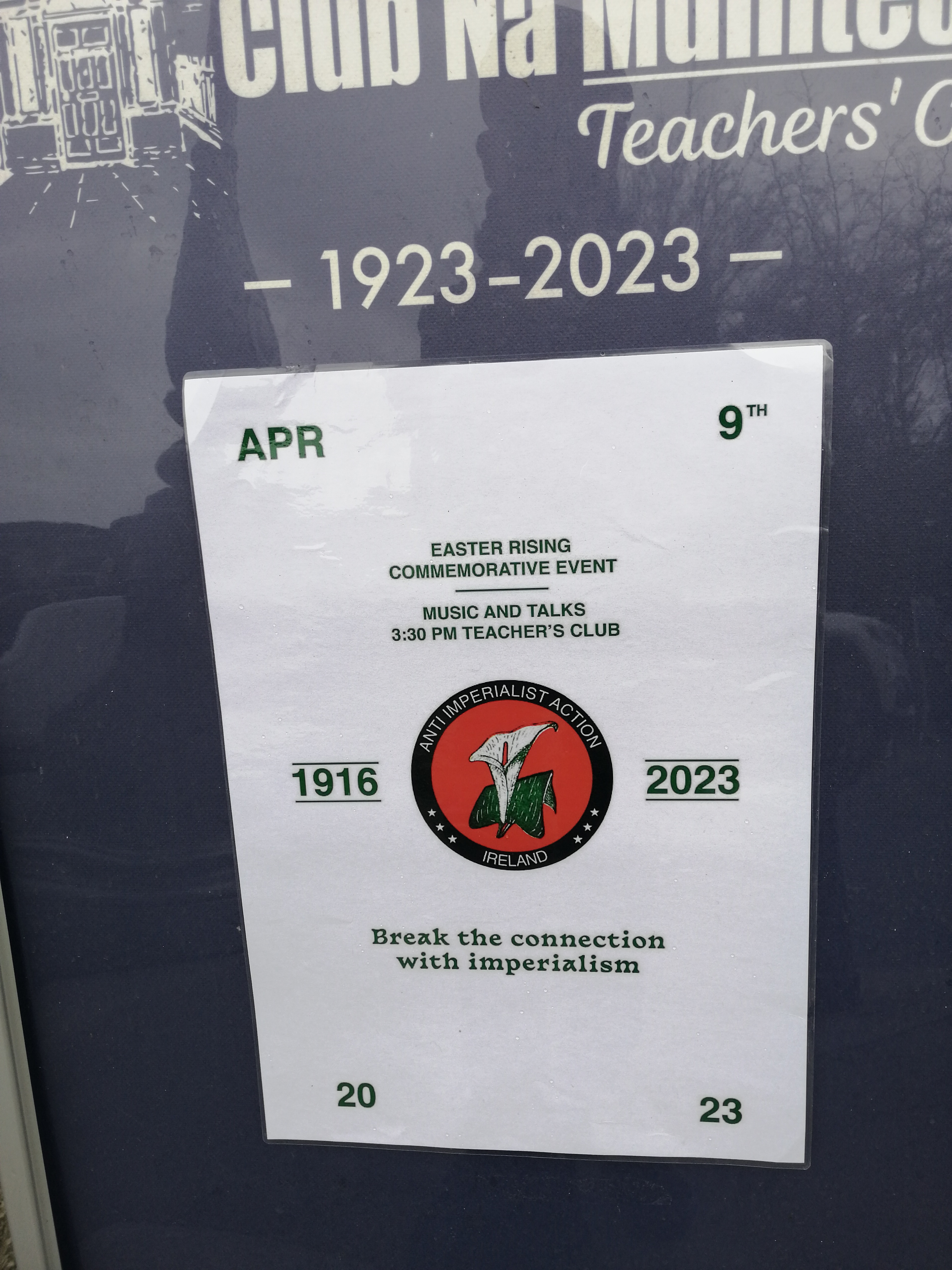
On Sunday participants in a 1916 Rising Commemoration organised by the Irish organisation Anti-Imperialist Action were harassed by police as they gathered to march to the Irish Citizen Army Republican plot in Glasnevin Cemetery.

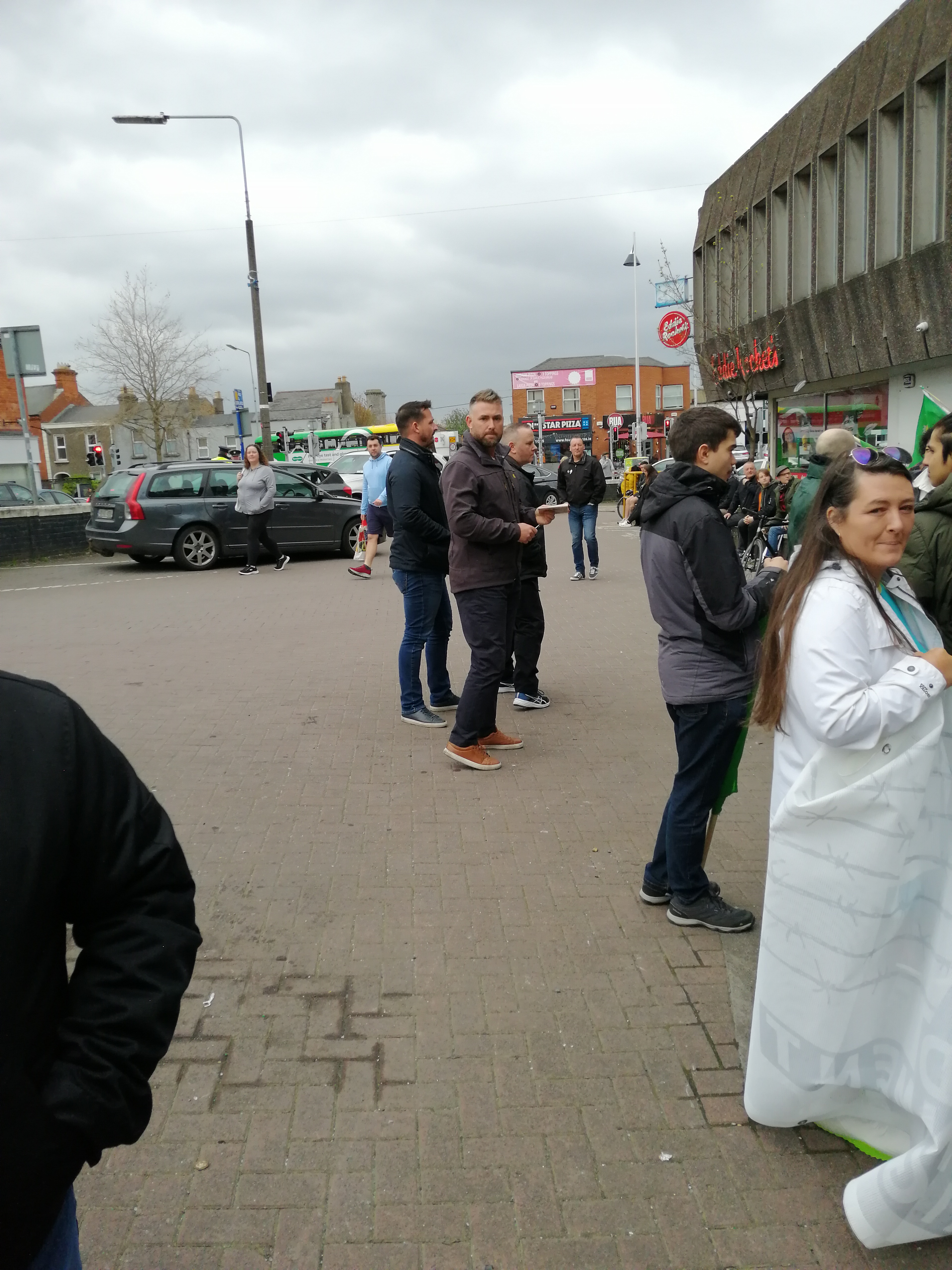
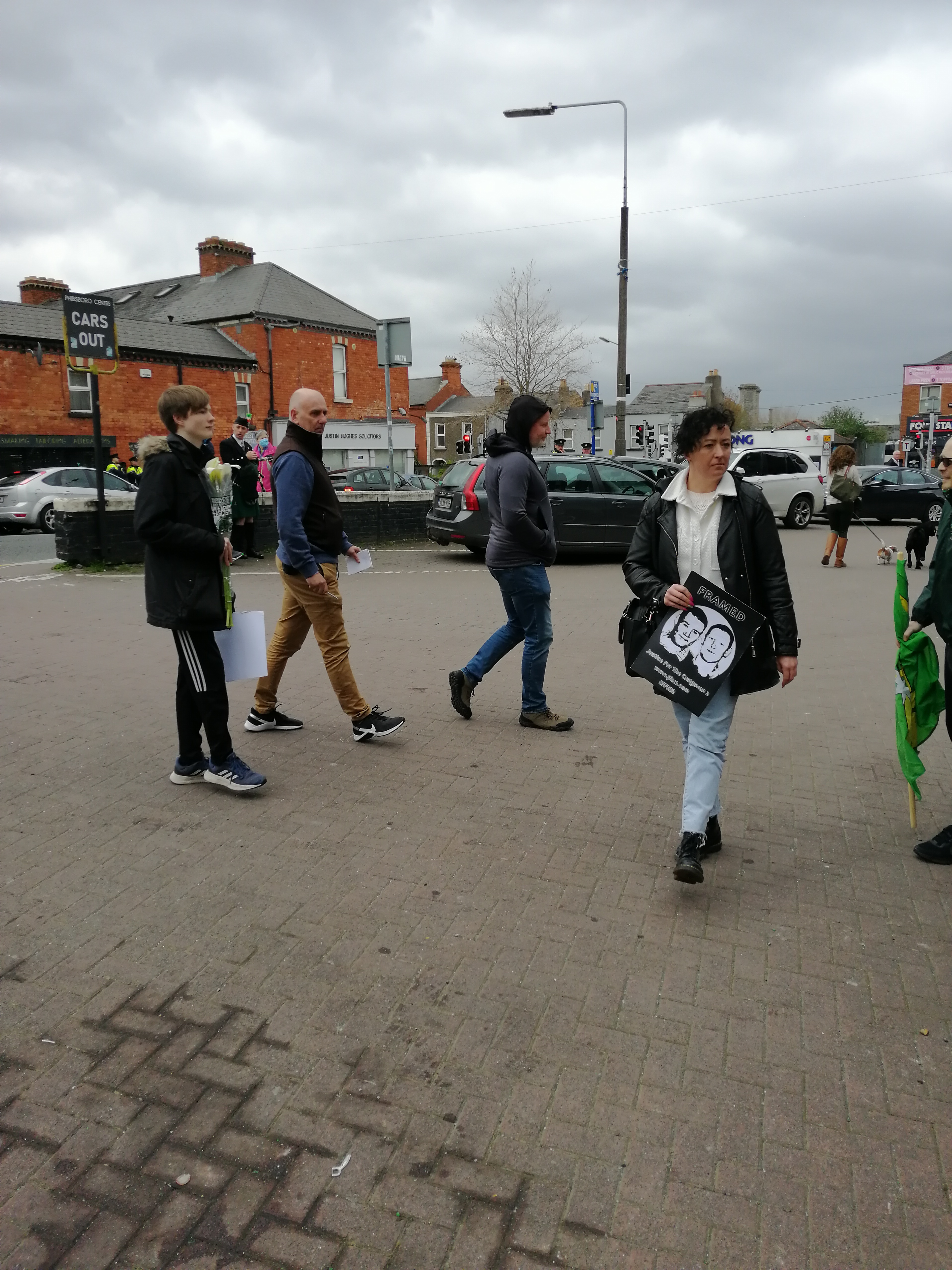
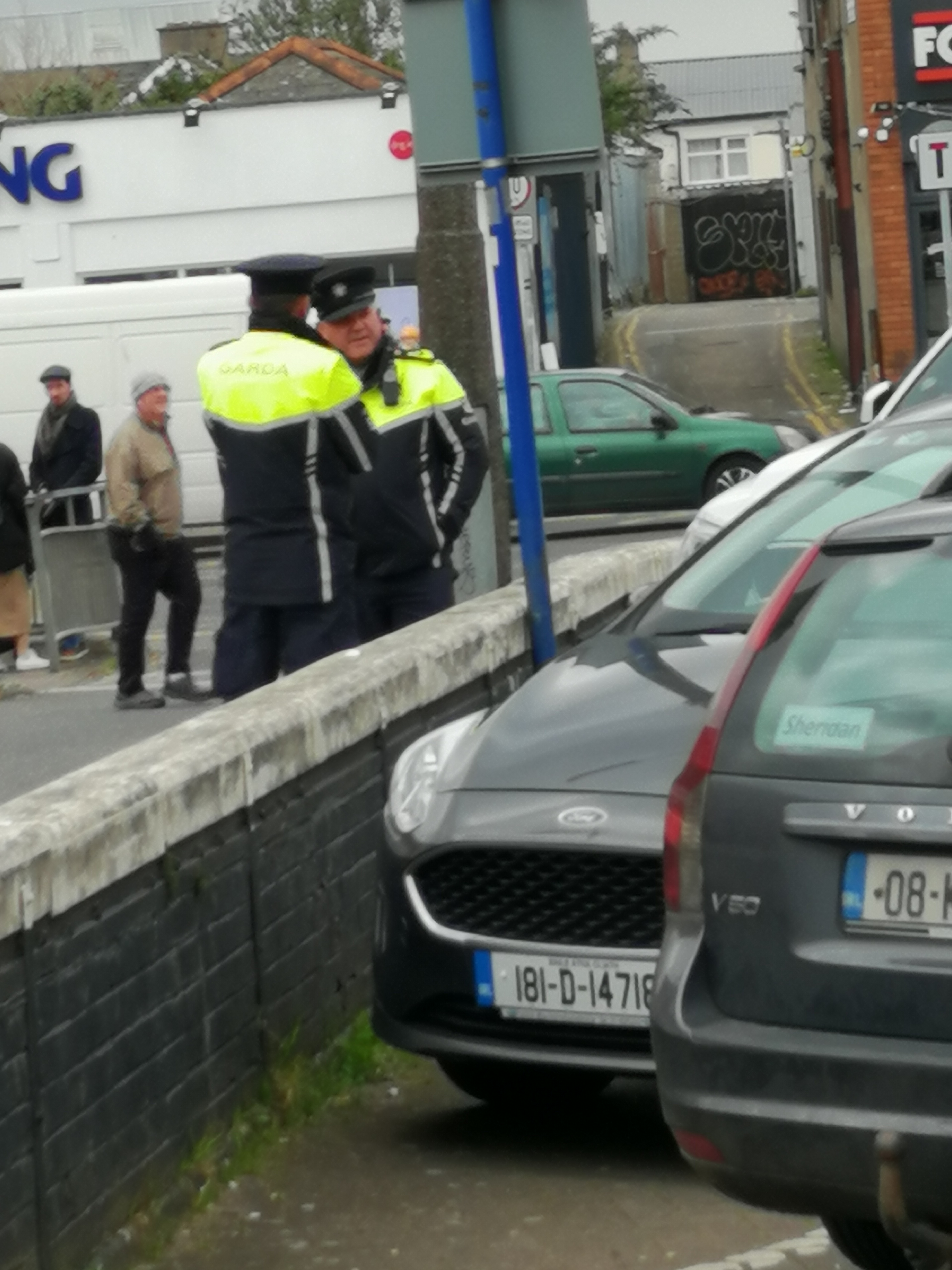
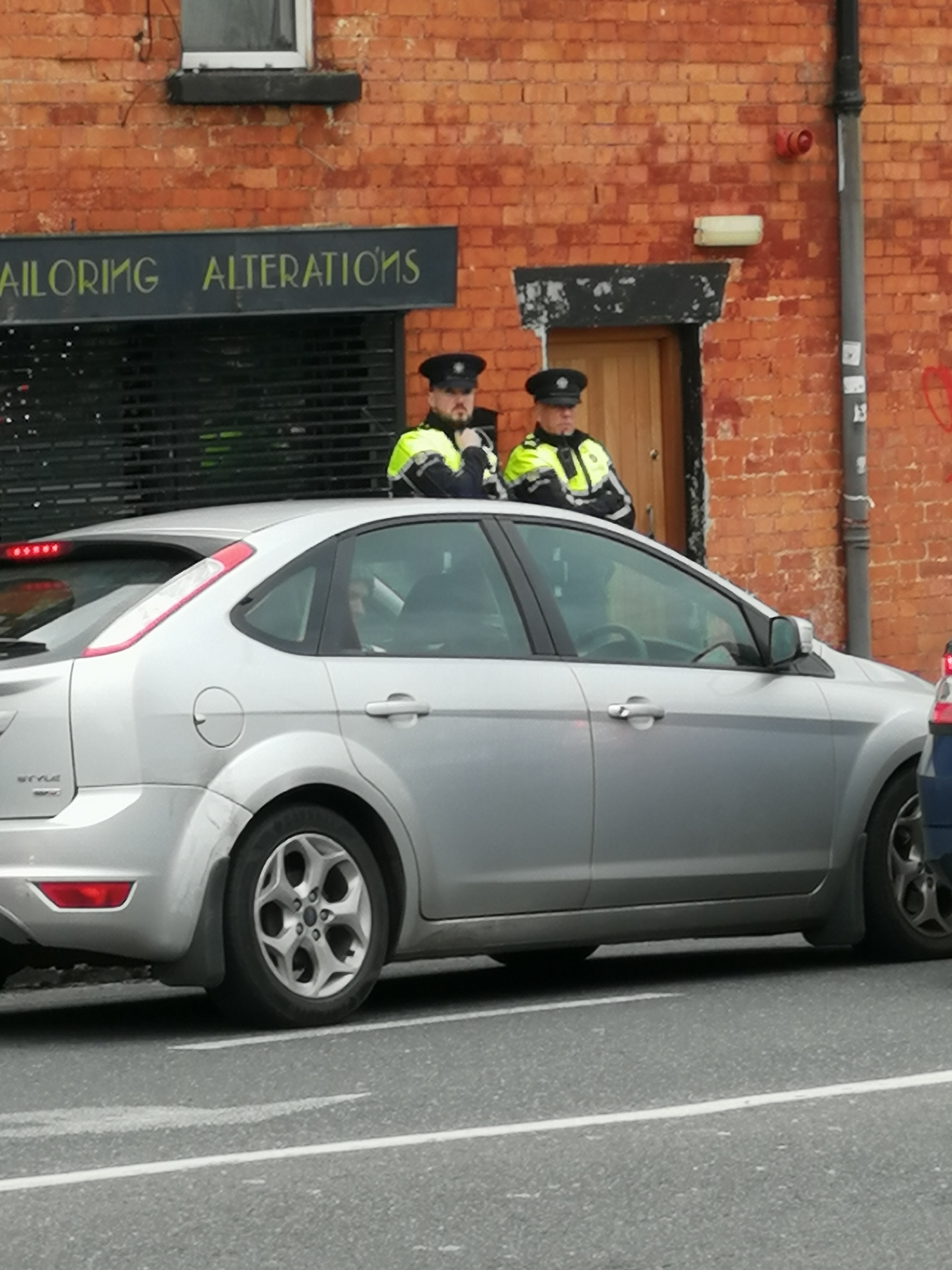
Six political police in plain clothes walked among those gathered beside Phibsborough shops demanding names and addresses of the participants, most of whom were fairly young. Four uniformed Gardaí also stood nearby and a Public Order Unit van parked at the cemetery entrance.

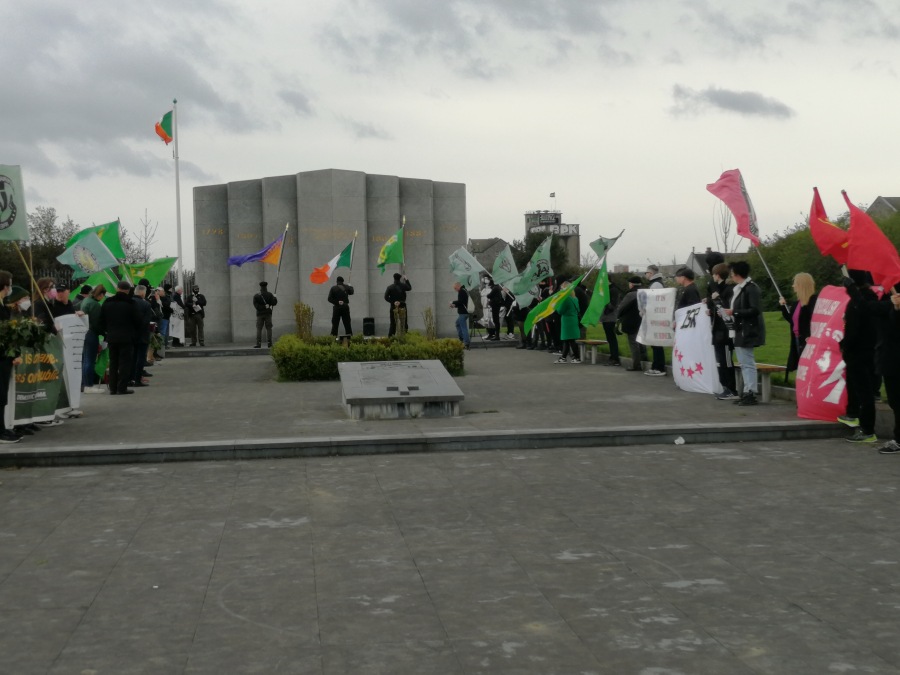
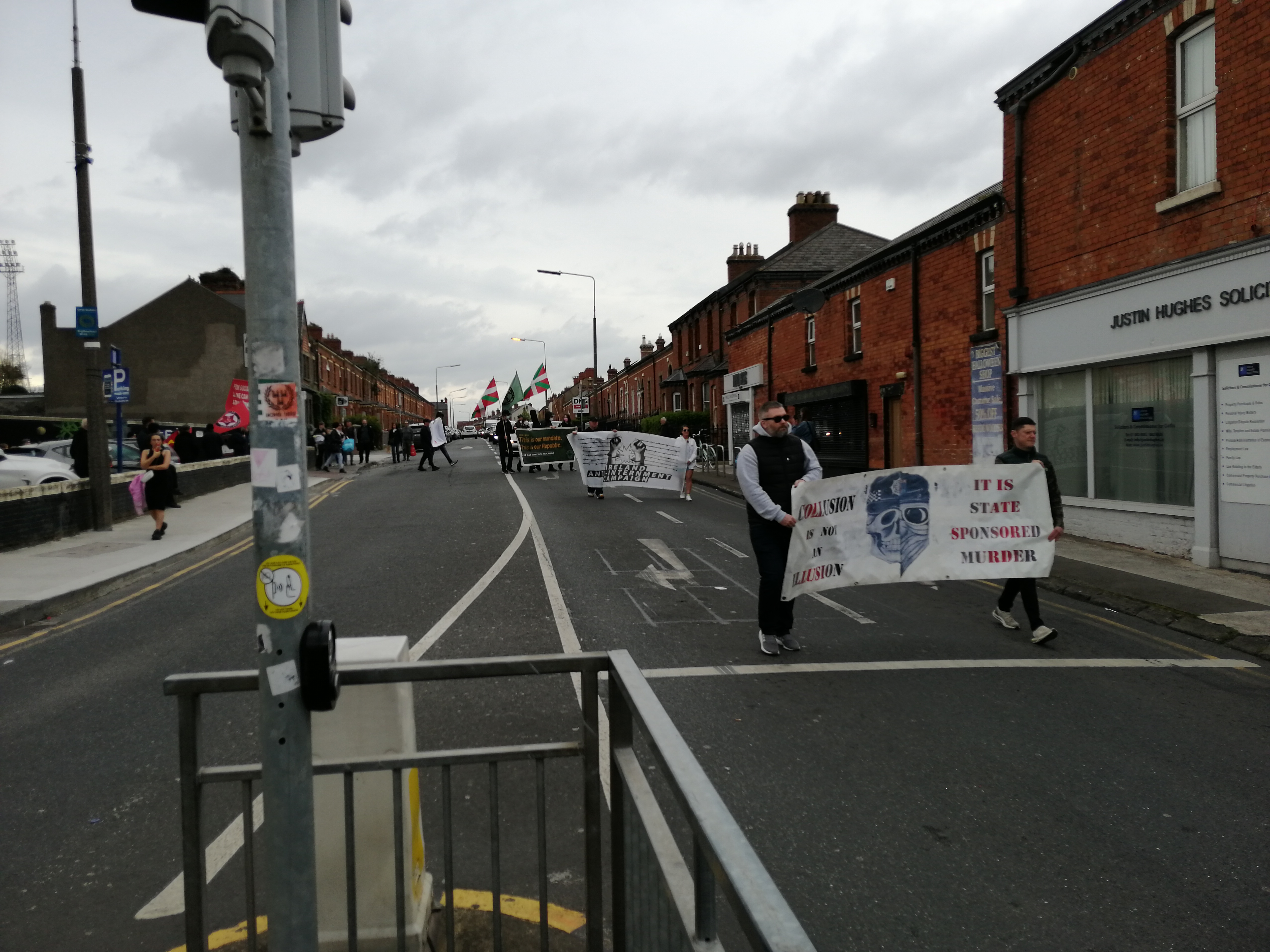
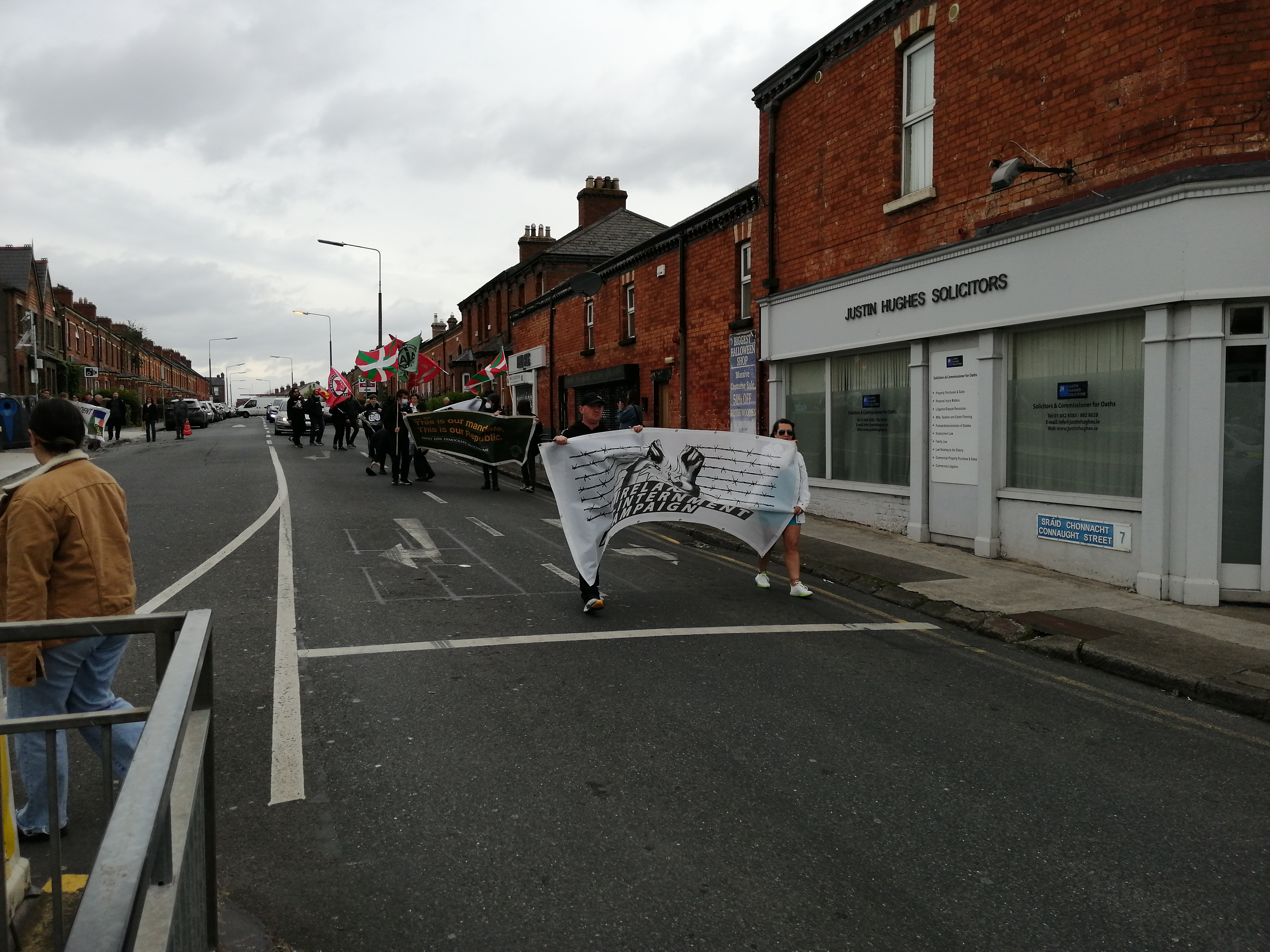
The participants declined to be intimidated and set off on their march, led by a lone piper playing Irish marching airs, followed by a colour party with different banners interspersed among the marchers, among which fluttered many flags.

Organisers had learned that the coach carrying members of the Republican Flute Band from Scotland that was to lead the parade had been prevented by police there from taking the ferry to Ireland.

Centre photo: Four of the six plainclothes political police violating the civil rights of the peaceful people commemorating the Easter Rising. (Photo: D.Breatnach)
Centre photo, another two plainclothes political police. The bald man joked while he harassed people. (Photo: D.Breatnach)
(Photo: D.Breatnach)

Historical background

In 1916 a broad alliance the Irish Volunteers, Irish Citizen Army, Cumann na mBan, na Fianna Éireann and Hibernian Rifles1 took part in a Rising organised by the Irish Republican Brotherhood against British rule in Ireland and against world war.

Due to a number of unfortunate circumstances, the leader of the Volunteers cancelled the Rising which however went ahead a day later than planned and was for the most part confined to Dublin, where a third of the numbers in the original plan took part and fought for a week.

The occupying British Army shelled the city centre from a gunship in the river Liffey and also from artillery on land. Explosions and resulting fires destroyed much of the city centre including the General Post Office in the main street, which had been the headquarters of the insurrection.2

After a week with the city centre including the GPO in flames, the rebel garrison evacuated to Moore Street where the following day, surrounded and vastly outnumbered, the decision was taken to surrender.3 A British military court passed death sentences on nearly a hundred prisoners.

All but fifteen of those sentences were commuted to long jail periods but the seven Signatories of the 1916 Proclamation4 and another seven were shot by British firing squad in Dublin, a fifteenth in Cork and after trial months later a sixteenth was hanged in Pentonville Jail, London.

At Easter 1917 Irish Republican and Socialist women commemorated the 1916 Rising; ever since then Irish Republicans and sometimes Socialists in Ireland and in many parts of the diaspora have commemorated the Rising, whether legally5 or otherwise, in jail or at liberty.

The War of Independence began in 1919 with many of the Rising’s survivors participating6.

(Photo: D.Breatnach)

The Parade on Sunday – local and national historical memory marked

At Cross Guns Bridge over the Royal Canal the parade halted and flares were lit in memory of events there in 1916.

Marching along the Cabra Road, the wall and a watchtower of the north side of Glasnevin Cemetery on the left of photo. (Photo: D.Breatnach)

On Easter Monday 1916 a small group of Irish Volunteers had marched from Maynooth along the canal bank to join the Rising in Dublin and found guarding the bridge two Irish Volunteers who advised them to wait until the following day to go into the city centre.

The Maynooth group spent the night in Glasnevin and the following day marched into the GPO, passing an empty Cross Guns Bridge on the way. Back towards Phibsborough, British artillery had blown a barricade and killed Seán Healy, a Fianna member at the Nth. Circular Road crossroads.

Later, the Dublin Fusiliers unit of the British Army blockaded the bridge, preventing people from crossing it in either direction. They shot dead a deaf local man who failed to heed their challenge because he did not hear it.

We Serve Neither King nor Kaiser but Ireland declared one banner carried last Sunday, Britain/NATO Out of Ireland another, This Is Our Mandate7, Our Republic and Collusion Is No Illusion, It Is State-Sponsored Murder were another two.

A large banner also declared alongside the image of James Connolly that Only Socialism Can Be the Solution for Ireland. Some organisations also carried their own banners, such as those of Dublin Independent Republicans, Ireland Anti-Internment Campaign and Irish Socialist Republicans.

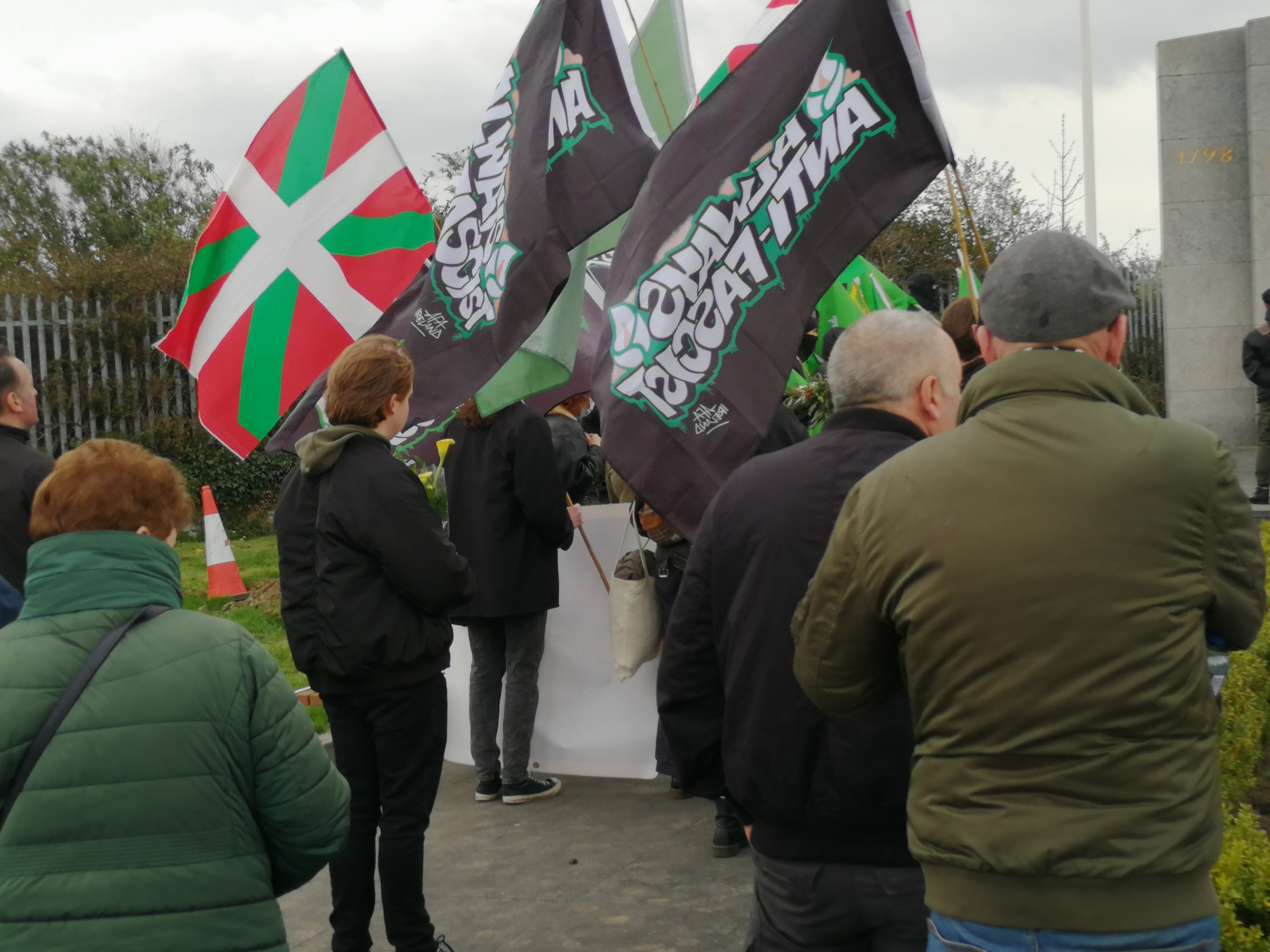
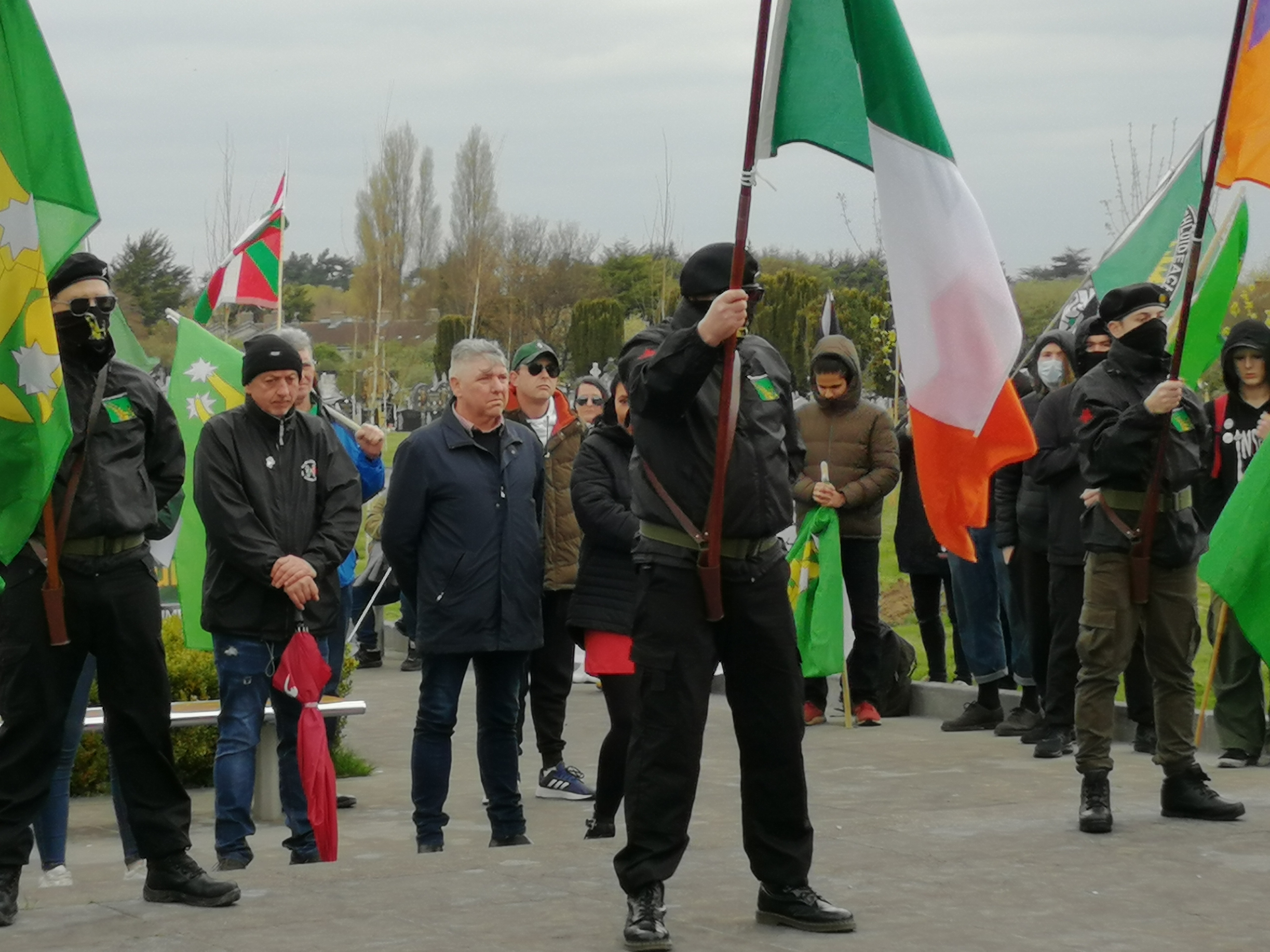
Flags fluttering included those bearing the logo of the organising group Anti-Imperialist Action and others bearing the slogan “Always Anti-Fascist”, green-and-gold Starry Ploughs, a couple of Ikurrinak (Basque flags) and another two of Red with Hammer & Sickle in yellow.

Basque and antifascist flags (Photo: D.Breatnach)

At the Monument: speeches and songs

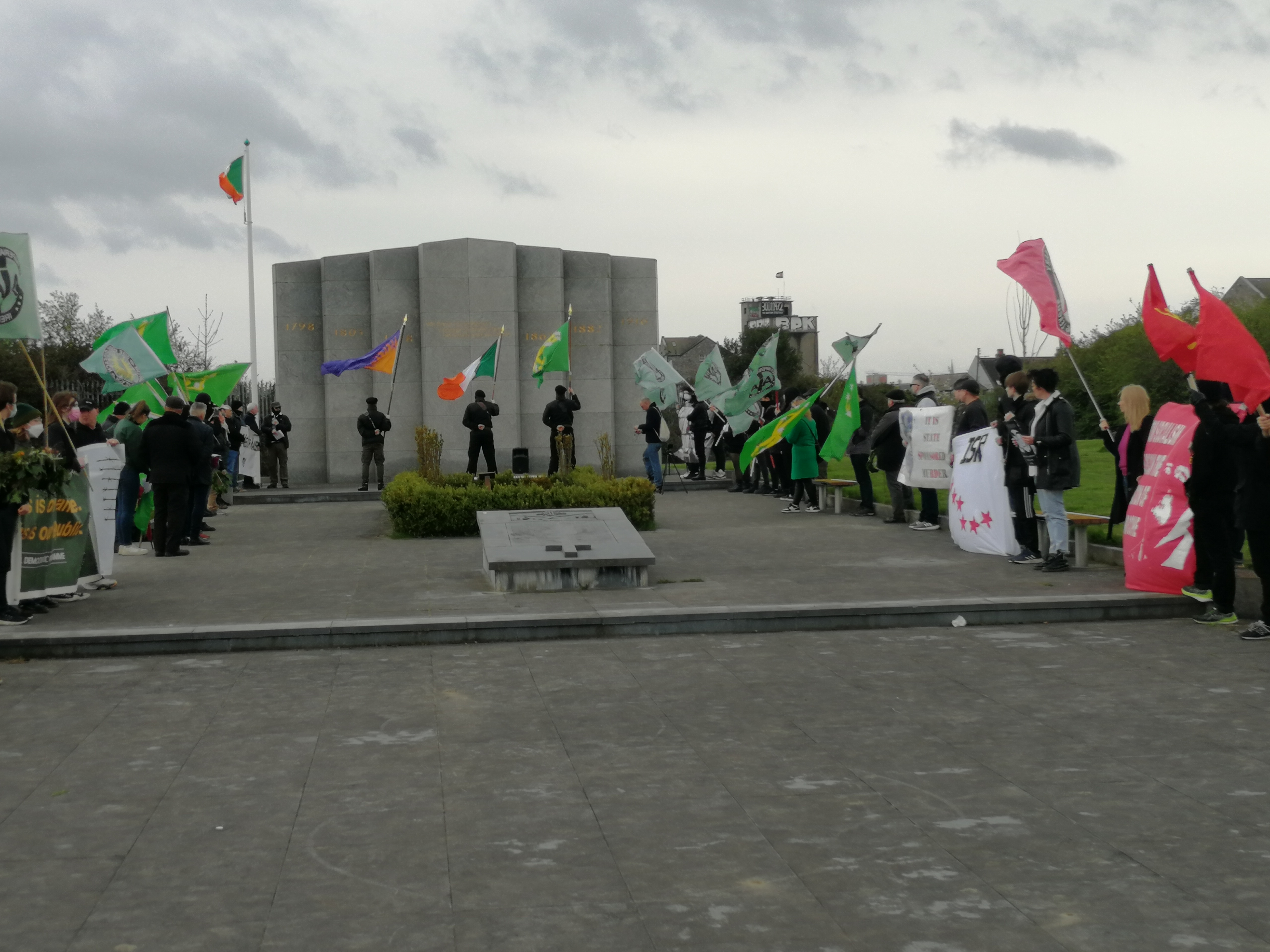
At the monument (Photo: D.Breatnach)

Glasnevin Cemetery (Reilig Ghlas Naíonn) covers over 120 acres in North Dublin city and is in two parts, each with Republican Plots separated by the Cabra Road and contains the graves of both famous and ordinary people.

On the north side there is also access to the Botanic Gardens, both on the south banks of the Tolka river. The imposing Monument to numerous Republican uprisings and the Irish Citizen Army Republican plot is on the south side, across the pedestrian bridge over the railway line.

(Photo: D.Breatnach)

A man chaired the event for Anti-Imperialist Action and spoke briefly, introducing people for readings (all of which were from James Connolly) and for orations. The presentations of these were evenly divided between men and women, three of those being of young people.

Three songs were sung: a woman sang The Foggy Dew (by Charles O’Neill) and Erin Go Bragh (by Peadar Kearney), while a man sang Patrick Galvin’s Where Is Our James Connolly? Two women read out pieces by James Connolly and another read out the 1916 Proclamation.

Person chairing the event (Photo: D.Breatnach)

The words of the chairperson and of those giving orations were different but there were common themes: upholding the historic Irish spirit of resistance, the importance of the working class in history and the objective of a socialist Republic encompassing the whole of the Irish nation.

These words were balanced by denunciation of US and British imperialism and the colonial/ NATO occupation of the Six Counties by the latter; the Irish client regime; the special no-jury courts8 of both administrations in Ireland and repression by police forces and occupation army.

One of the singers (Photo: D.Breatnach)
One of the readers (Photo: D.Breatnach)

Also denounced were those political parties that had abandoned the struggle for the Republic and instead had become part of the colonial and neo-colonial administrations or, in the latter case, were on their way to becoming so.9

Floral tributes were laid by representatives of a number of announced organisations and then others came forward to lay floral tributes also. The colour party lowered flags for a minute’s silence in homage and salute before slowly raising them again and the piper played Amhrán na bhFiann.

The other singer
Lowering of the colour party flags in homage to the fallen in the struggle (Photo: D.Breatnach)
Colour party raises flags again in symbolism of the struggle continuing (Photo: D.Breatnach)

The chairperson thanked all for attendance, listing organisations by name and cautioning all to stay close together as they left, due to the threatening presence of Gardaí and in particular the Public Order Unit. In the event, the celebrants exited the cemetery and dispersed without incident.

End.

(Photo: D.Breatnach)

FOOTNOTES

1A small unit, an armed wing of a split from the more socially conservative USA version of the Ancient Order of Hibernians, their participation in the Rising was notable.

2Photos of much of the destruction are available on the Internet and accessible by search browser.

3The terrace they occupied still stands and is the object of a historical memory and conservation struggle against property speculator plans approved by the municipal city managers and Government political parties (see smsfd.ie).

4A remarkable document, the text of which is available from many postings on the Internet.

5Irish women commemorated it in public in contravention of British WWI martial legislation in 1917 and 1918 and for decades the public commemoration of the 1916 Rising (and even the flying of the Irish Tricolour) was forbidden in the British colony of the Six Counties with attendant colonial police attacks on any attempt to do so.

6Sometimes inaccurately called “the Tan War” (reference to a special colonial police auxiliary force that became known as the “Black n’ Tans”), the war saw the birth of the IRA and lasted from 1919-1921. A British “peace” proposal opened deep divisions in the nationalist coalition and was followed by a Civil War 1922-1923, in which the pro-Treaty government and armed forces were armed and supplied by the British to defeat the Republicans in a campaign of repression and jailing, military actions, kidnapping and torture, murder of prisoners, assassinations and over 80 formal executions.

7Also displaying text referring to the First Dáil’s Democratic Program of 1919.

8The Diplock court in the colony and the Special Criminal Courts in the Irish State, political special courts in all but name, with low proof bar and abnormally high conviction rate and refusal of bail while awaiting trial.

9References to 1) the 1930s split from the Sinn Féin party, the Fianna Fáil political party that became a preferred Government party of the foreign-dependent Irish ruling bourgeoisie and 2) to the Provisional Sinn Féin party who endorsed the British pacification plan in 1998 and embarked on the road to becoming a party of reformist nationalism in the colony and is heading for neo-colonial (and neo liberal capitalist) coalition government at the moment.

(Photo: D.Breatnach)

IRISH GOVERNMENT COMPLICIT IN FOREIGN MILITARY VIOLATIONS OF IRISH SOVEREIGNTY
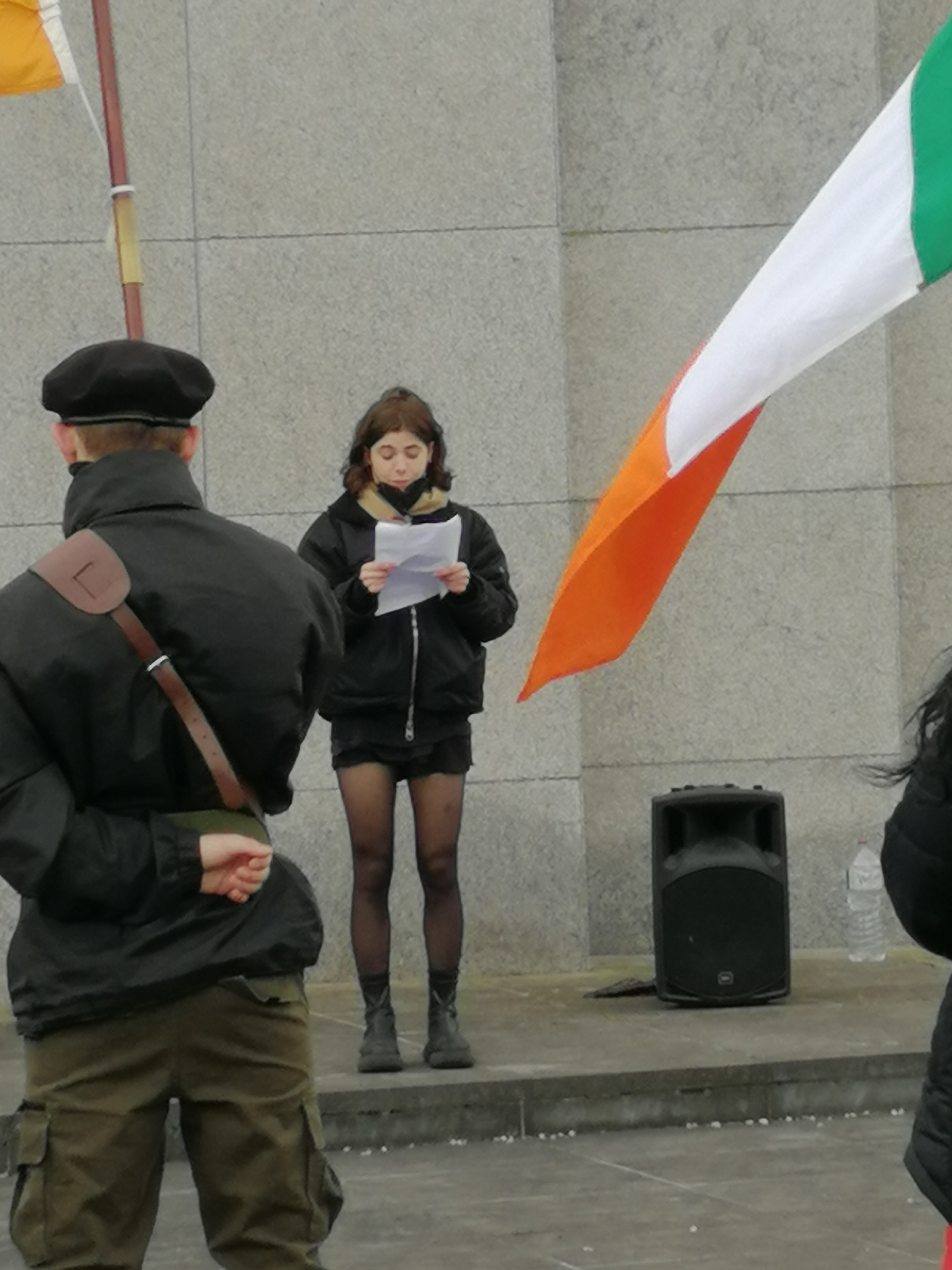
Diarmuid Breatnach

(Reading time: 6mins.)

The Irish State nominally rules over the 26-Counties land territory and its corresponding sea and airspace. Yet these have been and are repeatedly violated by the US and UK military with Irish ruling class secret collusion.

Now a Senator in Leinster House is seeking a hearing in the High Court to have the behaviour of successive Irish Governments in allowing UK military overflights declared unconstitutional.

The Sea, oh the sea … and the air!

As stipulated by international law, a sovereign state’s area includes the sea up to 12-miles from its border1 and therefore Ireland has a 12 mile territorial sea, a 200 mile exclusive economic zone before any additional claims are made to the continental shelf including the Rockall Bank.2

According to media report, a comprehensive survey of the Irish State’s territorial waters was not undertaken until 2014, i.e nearly a century after its foundation, which in itself is an indictment of an allegedly independent island state.

According to The Geological Survey of Ireland (GSI) says potential territorial waters stretch to 898,442km sq – an area bigger than the oil rich North Sea.3

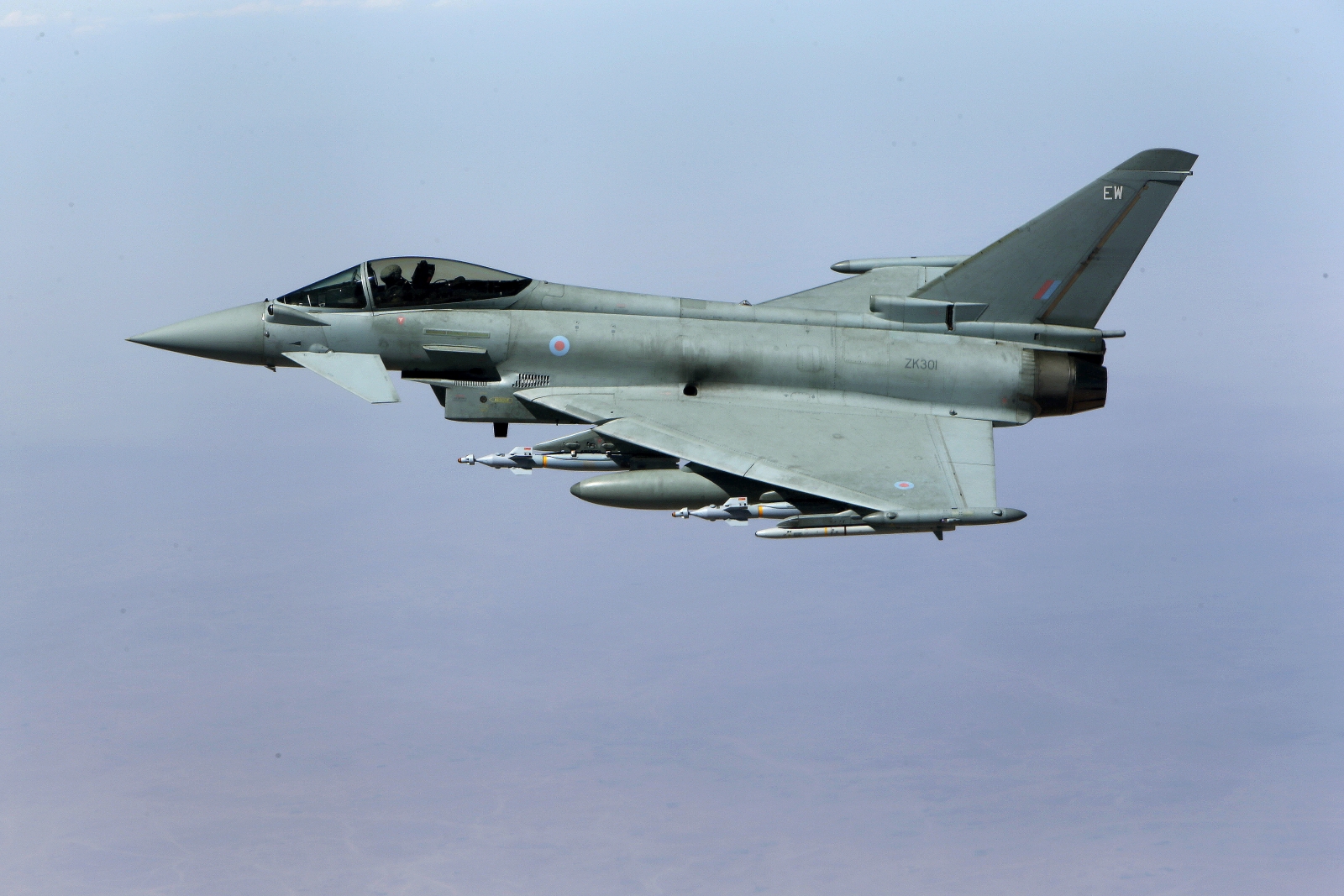
Royal Air Force fighter jet – the Irish State is reported to have secretly agreed to allow these to overfly Irish airspace (Photo sourced: Internet)

Through the decades when Ireland was a fishing nation and fresh fish was eaten weekly in most homes, Irish fishing boats had to compete with those from many other states fishing illegally inside Irish sea limits.

The Irish Navy was the only policing enforcement agency and through much of that time it had only three corvettes to patrol 12 miles out from the whole coastline of the Irish state. Subsequent EU legislation then left Irish seas more open to foreign-based fishing than it did to Irish boats.

The sovereign air space of a state corresponds to that over its land and 12-miles out to sea from its coastline.4

The use of Shannon airport by the US military in transit of troops, weapons and prisoners has long been known and protested.

Shannon Airport protests

Over the years there have been many highly-publicised protests over the US military use of Shannon, ranging from mass protests outside the airport buildings to deliberate trespass and even damage to a US warplane.

https://www.rte.ie/archives/2022/1220/1342962-shannon-stopovers-protest/

The response from the Government Minister to questions in Leinster House is always that the US is not violating Irish sovereignty, arms, military and prisoners are not being transported through there – because the US authorities have assured the Irish Government that they are not.

In February 2003 five members of the Catholic Workers’ Movement under the name Pitstop Ploughshares gained access to a hanger in Shannon Airport and damaged a USAF warplane there. They were Deirdre Clancy, Nuin Dunlop, Karen Fallon, Ciaron O’Reilly and Damien Moran.

They were jailed for up to 11 weeks awaiting committal for trial to which they were finally sent in Dublin Circuit Court in March and October 2005 on two counts of criminal damage, €100 and US $2.5 million. The faced a maximum 10 years if convicted.

Two aborted trials followed as one judge after another revealed their bias and partiality. In July 2006 after twelve days a mixed male and female jury acquitted the accused on all charges on the grounds that they had taken the action to save lives in Iraq and were justified in doing so.

In October 2012 dramatist, writer, former Republican prisoners and veteran activist Margaretta D’Arcy was arrested with Niall Farrell for scaling the fence and entering the grounds of Shannon Airport.

Four convicted Shannon Airport protestors, L-R Mick Wallace, Margarett D’Arcy, Niall Farrell, Clare Daly. (Photo sourced: The Journal.ie)

In June 2014 at the age of 80 and suffering from Parkinson’s disease D’Arcy was jailed for two weeks in Limerick Prison for refusal to pay the fine and remained defiant.

In July 2014 then members of the Irish Parliament Clare Daly and Mick Wallace5 used a rope ladder to climb over a perimeter fence and enter the grounds of Shannon Airport and made no attempt to avoid arrest.

They were both fined by a court for trespass in February 2015 and refused to pay the fine, eventually being taken to Limerick jail by Gardaí in December 2015 and released less than two hours later.

On 25 April 2017 anti-war activists Edward Horgan, a retired Irish soldier of 78, and civil servant Dan Dowling, 39, were arrested in the airport grounds and charged with criminal trespass and malicious damage (felt-tip graffiti slogan on a warplane).

In a very low-level publicity case in January this year (2023), a jury in Dublin found both guilty of trespass but not of criminal damage at the airport and were ordered to pay €5,000 each to a women’s refuge in Co Clare.

On St. Patrick’s Day 2019 two ex-USA military Ken Mayers and Tarak Kauff, now anti-war campaigners of the US chapter of Veterans for Peace, cut a hole in the airport’s perimeter fence, entered Shannon airfield with a banner and were arrested.

In May last year, a majority jury verdict found Mayers (85) and Kauff (80) guilty of interfering with the running of the airport but unanimously not of criminal damage to an airport perimeter fence and of trespassing the airport with the intent to commit an offence or interfere with property.

Ex-USA military Kauf and Mayers of Veterans for Peace (US) protesting US military use of Shannon Airport (Photo sourced: Internet)

The judge fined the anti-war activists 5,000 euro each. Both had spent 11 weeks in prison and had been required to spend nine months in Ireland awaiting trial, despite clear indications that they had no intention of absconding and indeed were looking forward to the trial to publicise the issue.

Senator Craughwell’s case to the High Court.

Less well-known is that successive Irish governments have for decades by secret agreement permitted permitted UK air force planes to fly over Irish airspace and to interdict, i.e. force or shoot down other aircraft. This is what has led to Senator Craughwell’s taking a case to the High Court.

The Independent Senator maintains that although not the case of a formal military alliance, granting permission to fly over Irish State airspace, unless validated by referendum, is a violation of Ireland’s neutrality and sovereignty and is seeking a number of declarations from the Court.

Craughwell, who is a former member of the Irish Defence Forces and the British Army, as well as being an ex-President of the Teachers Union of Ireland, said that his belief in the existence of a secret agreement is based on a reply from then Taoiseach Brian Cowen to Enda Kenny in 2005.

The Senator seeks High Court declarations including that the agreement between Ireland and the UK allowing armed British military aircraft to intercept aircraft over Irish airspace amounts to an impermissible dilution and breach of Articles 1, 5, 6, 13, 15, and 28 of the Irish Constitution.

He also seeks a declaration that the Government’s failure to exercise control over Ireland’s territorial waters, airspace and exclusive economic zone breaches Article 5 of the Constitution which declares that Ireland is a sovereign independent democratic state.

Craughwell further seeks an order restraining the government from bringing in legislation to give effect to the agreement, unless it has been passed by a referendum.

Aerial view of Ireland (Image sourced: Internet)

Irish State Neutral?

Most Irish people mistakenly believe that Ireland’s military neutrality is specifically enshrined in Bunreacht na hÉireann, the Irish Constitution. However Article 29, section 4, subsection 9° underlines the neutrality of the Irish State in respect of a military force of the EU:

The State shall not adopt a decision taken by the European Council to establish a common defence pursuant to Article 42 of the Treaty on European Union where that common defence would include the State.6

“This was originally inserted by the 2002 amendment ratifying the Treaty of Nice and updated by the 2009 amendment ratifying the Treaty of Lisbon. An earlier bill intended to ratify the Treaty of Nice did not include a common defence opt-out, and was rejected in the first Nice referendum, in 2001.”7

It is fairly clear that the citizens of the Irish state are generally in favour of retaining Irish neutrality but there are elements within the state frequently trying to undermine that policy, chiefly the native Gombeen ruling class.

The Irish State has never been truly independent; it came into existence agreeing to the partition of the nation and in waging war against the forces of national liberation, during which it executed more Irish Republicans than the British had during the War of Independence.

Subsequently, the Irish State has been characterised as neo-colonialist, dominated firstly by British capital, then by the US and finally by the EU.

There are elements within Irish upper circles who long to join the EU military and political club while some others share a nostalgia for the British Empire and Commonwealth and the kind of supporting and sharing role to which John Redmond and his Irish Nationalist Party aspired.

Finally, there are of course elements in the Irish armed forces that are attracted by career advancement through joint military operations with other armed forces along with greater weaponry, such as would be available in a joint European armed force or as part of NATO.

Worryingly, Mícheál Martin during questions in Leinster House some months ago denied that the population would have to be consulted in referendum before the State could join some military alliance.

What now?

Whatever formal position the State may take on neutrality in future, it has been undermining it for decades and doing so in secret.

Why the secrecy? Presumably because the ruling class is aware that most Irish people want to remain militarily neutral and would wish to get rid of a government that was trying to ditch the neutrality policy.

Ireland needs to be independent of all imperialist alliances. Should the Gombeen ruling class succeed in committing the State’s armed forces to some military alliance, the choice is certain to be either imperialist NATO or imperialist EU.

In the latter case, it is entirely possible that Irish troops would be sent to suppress social or national risings in Europe – for example in Catalunya or the Basque Country, with Spanish troops being sent to quell mass protests in Ireland.

Or in either case, that Irish troops would become part of some joint imperialist force in Latin America, Africa or Asia.

Meanwhile the Gombeens, because of the State’s allowing US and UK military aircraft over Irish skies and in Shannon airport, are potentially painting a target for retribution on to the Irish population.

End.

FOOTNOTES

1Except obviously where it intersects with another state’s borders (see Airspace – Wikipedia)

2Ireland’s territorial waters to be remeasured down to the centimetre – Irish Mirror Online

3Ibid.

4Airspace – Wikipedia and obviously this currently ends at the borders of the Six County colony, whose own 12-mile UK zone also ends where it meets the Irish borders on land, sea and air.

5Now both Members of the European Parliament.

6Irish neutrality – Wikipedia

7Ibid.

REFERENCES

Irish State’s territorial waters: Ireland’s territorial waters to be remeasured down to the centimetre – Irish Mirror Online

Irish State’s territorial airspace: Airspace – Wikipedia

Issue publicised in 2021 with reference back to document in 2016: https://www.independent.ie/irish-news/secret-defence-pact-allowing-raf-jets-inirish-airspace-undermines-our-neutrality-says-td-berry-40526069.html

Current High Court challenge: https://www.breakingnews.ie/ireland/senator-seeks-challenge-over-british-military-being-able-to-intercept-aircraft-in-irish-airspace-1438222.html

Irish neutrality – Wikipedia

BRITISH STATE MURDER OF IRISH CIVILIANS COMMEMORATED IN DERRY

Clive Sulish

(Reading time main text: 6mins.)

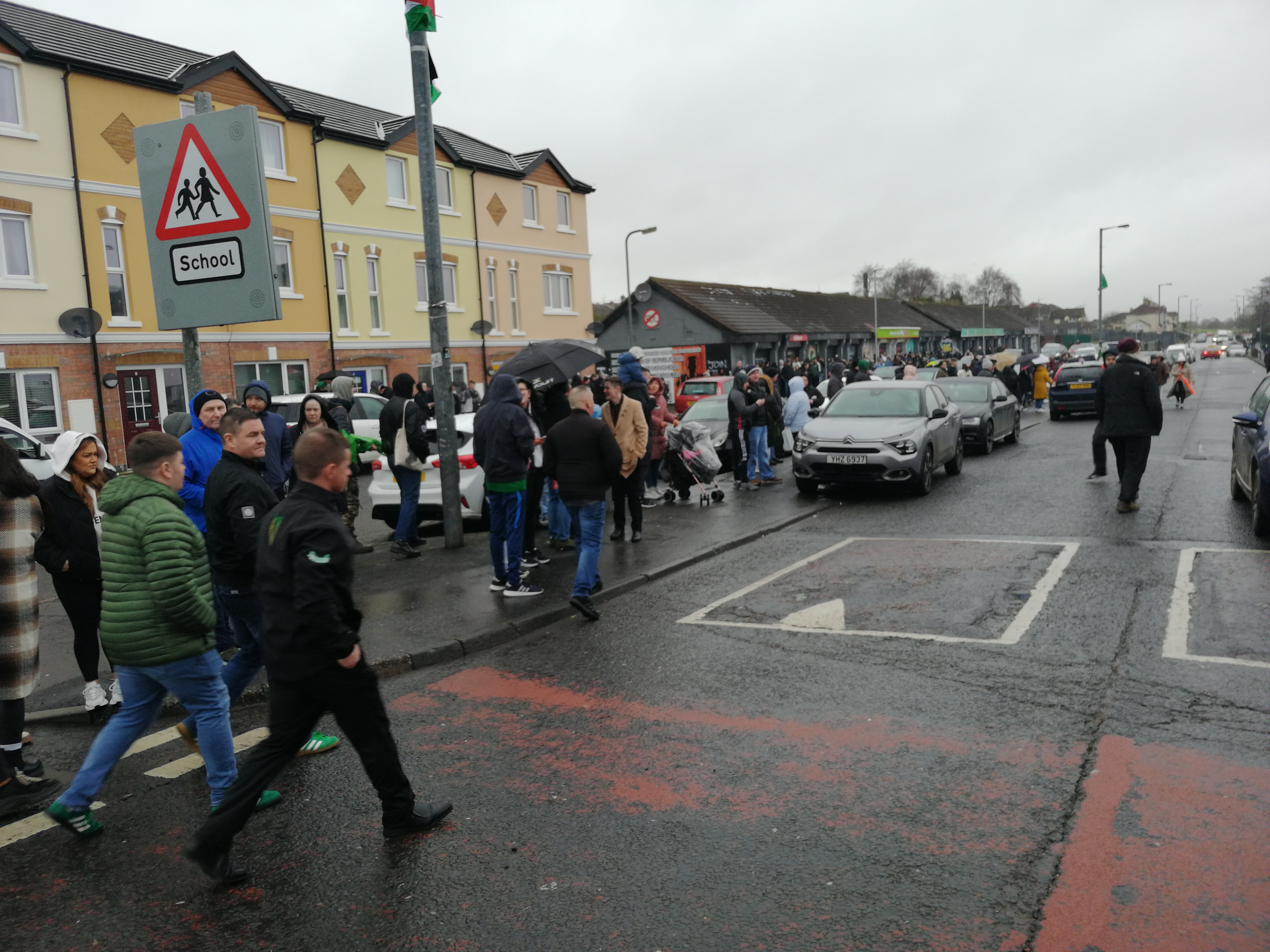
Thousands of people gathered on Sunday 29th January in Derry City’s Creggan area and marched through rain and gusts of strong wind in the annual Bloody Sunday March for Justice to Free Derry Corner.

The march commemorates the Derry Bloody Sunday Massacre of the last Sunday in January 1972, when the Parachute Regiment opened fire on unarmed Civil Rights marchers, killing 14 and injuring a great many, claiming the soldiers had only returned fire on paramilitaries.

By the Creggan shops, people still arriving, others waiting to march (Photo: D.Breatnach
Other side of the road. (Photo: D.Breatnach)

British Governments for decades stood by those claims, refuted by many hundreds of witnesses to the actual shootings and though the city’s coroner called it “sheer unadulterated murder”, the inquiry under Lord Chief Justice Widgery declared in favour of the Paras’ version.

The 1972 march organised by the Northern Ireland Civil Rights Association had been protesting the introduction of internment without trial in August 19711 and the Paras had already killed 11 unarmed protesting people that month in the Ballymurphy housing estate, Belfast.2

Among the scheduled speakers and organisers in Derry in 1972 had been leading activists of the time, Bernadette Devlin (now McAlliskey) of People’s Democracy3 and Eamon McCann of the Socialist Worker’s Party (now People Before Profit).

The Commemoration this year

Participating organisations this year included Anti-Imperialist Action Ireland, Communist Party Ireland, Éirigí, Irish Republican Socialist Party, Irish Republican Welfare Association, Lasair Dhearg, People Before Profit, Republican Network for Unity, Saoradh, 1916 Societies.

Also marching were an IWW/ Anarchist contingent and a number of campaign groups: Ireland Anti-Internment Campaign, Ballymurphy Justice, Justice for the Craigavon Two, Justice for Manus Deery, with a number of environmental groups were represented also.

Derry Trades Council and IWW seemed to have the only trade union banner present or flags present.

A broad domestic and internationalist solidarity sweep was evidenced by the poster for the event with the slogan: “An injury to one is an injury to all” and also by the banner of the Derry branch of the Ireland Palestine Solidarity Campaign.

Poster for the 2023 march (Sourced: Internet)

Public support from Britain came with a banner of the Fight Racism/Fight Imperialism periodical and leaflets from Republican Socialist Platform4 were distributed among the marchers also.

Some years can reveal the misfortunes of particular organisations with a much smaller contingent than previously due to drop outs, defections and splits. Equally it has not been unknown for an organisation to draft in people to inflate its numbers specifically for the annual march.

The annual march takes the twisting route of the original one in 1972, covering much of the Derry nationalist housing areas.

Marchers rally at the Creggan heights and march down to the bottom of the hill, then along and up another steep hill, turning right at its top, along and then right down again and, at the bottom, turning right and along to the Free Derry Corner5 monument where speakers address the crowd.

Kate Nash chaired the rally there and Liam Wray, relative of murdered James Ray spoke as did also Ria, niece of John Paul Wooton who, with Brendan, are the Craigavon Two, framed for the killing of a colonial policeman.

The numbers this year were a huge drop from the previous year’s but 2022 was the 50th anniversary of the massacre and the participants are estimated to have numbered well over 10,000, including maybe 10 marching Republican Flute Bands6 from Ireland and Scotland.

Nevertheless the mass media’s coverage of last year’s march varied from minimal to nil.7

Probably4,000 actually marched this year, but perhaps nearly another 1,000 gathered on the roadsides to watch the marchers, greet people they know and so on. Many children are brought by their parents to watch while their older siblings gather and sometimes accompany marchers too.

The day had begun sunny and crisp but by march time the weather had deteriorated to constant rain and gusts of wind and, as the march reached the Lecky Road, to a heavy downpour. It was bad but veteran marchers have experienced worse in previous years, including snow and sleet.

Waiting to begin the march (Photo: D.Breatnach)

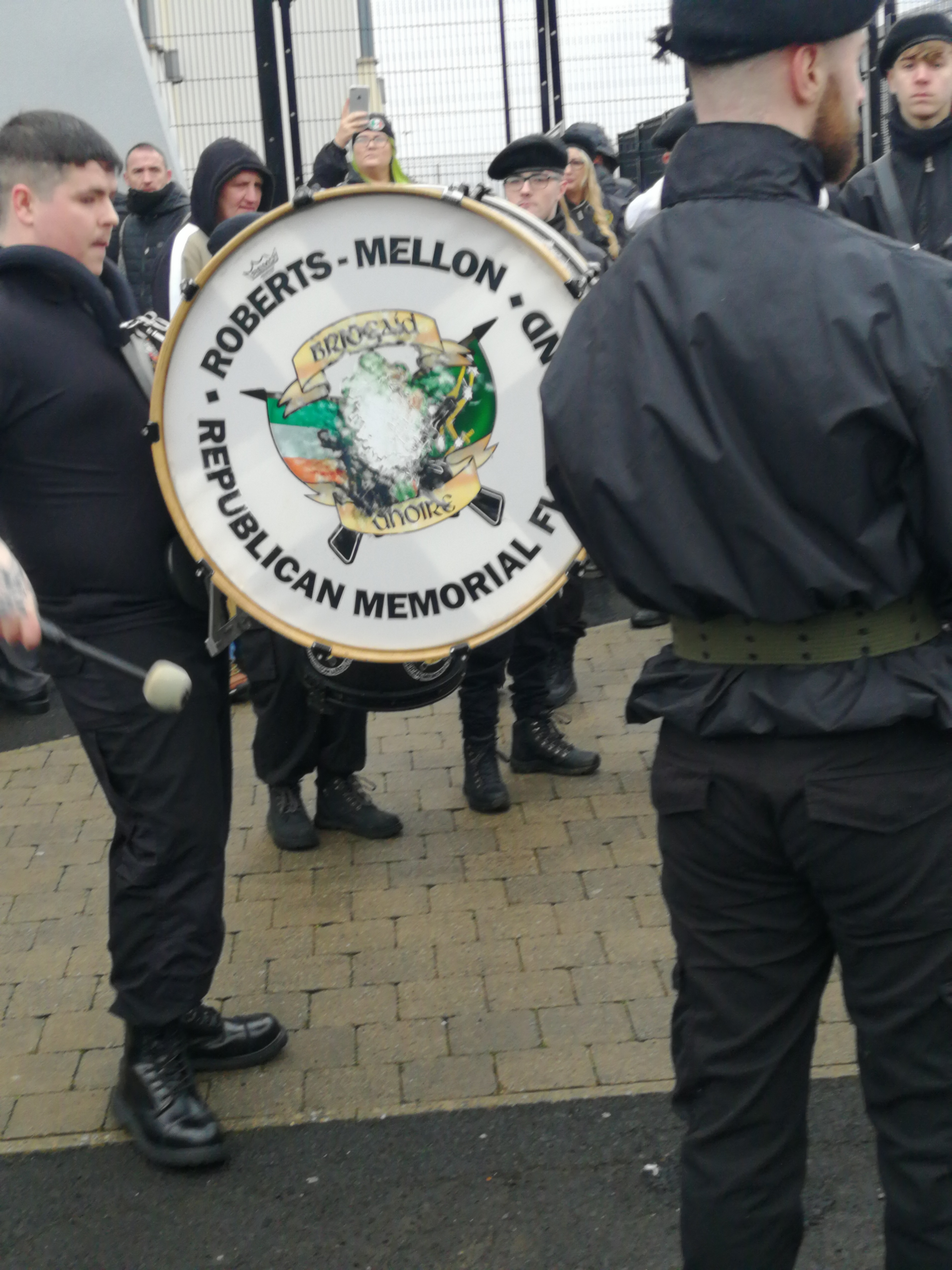
Three Derry-based Republican Flute Bands formed part of the march: James Connolly RFB, Kevin Lynch RFB and Tommy Roberts Stevie Mellon RFB, along with the Banna Cuimhneachán Thomáis Uí Chléirigh (Thomas Clarke Memorial RF Band) from Dungannon.

Although in recent years members wear more weather-appropriate uniforms, they still do an amazing job marching and playing in bad and sometimes atrocious weather.

A Deal with the Devil

The Sinn Féin political party, once prominent among the march organisers and speakers at the rally, sought to end the annual march in 2011 and have not supported the event since.8 This was after the British Government publicly apologised for the massacre that same year.

Part of the process leading to that Governmental apology was the setting up of the Saville Tribunal in London in 1998, although it took unexpectedly long to deliver its verdict.9 The Good Friday Agreement was also concluded in 1998, giving the Tribunal the appearance of a concession.

Indeed, the whole has the marks of a deal with the Provisional IRA’s leadership, with the British side saying: “You give up the armed struggle and control your people. We’ll make it easier for you by releasing your prisoners on licence10 and admitting we were wrong in Derry in 1972.

Whether ceasing the annual commemoration was part of the deal or whether that was Sinn Féin’s own leadership’s decision is difficult to guess. It may have suited SF to scale a colonial reminder event down or simply to scratch one big annual event from their organisational calendar.

On the other hand, it has lost Sinn Féin all control of an important historical commemorative event on the Irish Republican calendar and their abstention again at the 50th anniversary march was a massive exposure of their collaborationist position.

The Bloody Sunday Trust also boycotts the march, in the sense that it does not promote it nor record its annual march or other events opposed by Sinn Féin. It does organise and promote its own events during every anniversary but that seems to be as a counter to the march organisers.

The BST of course receives funding and employs a Director and staff for its museum. Nobody pays Kate Nash or other members of the Bloody Sunday Commemoration committee; they rely on public donations and sale of items such as commemorative T-shirts to fund the march11.

A number of relatives of the murdered and injured civilians continue to support the march and are counterered among its organisers, for example Kate Nash, sister of murdered William murdered on Bloody Sunday and daughter of Alex Nash seriously injured by the troops the same day.

The Derry Trades Council and two of the original organisers and speakers support the continuation of the commemorative march as do most Irish Republican and Socialist organisations.

In formation ready to march. Note the presence of female members in the prestigious and ceremonial colour (flags) party, more commonly seen in recent years. (Photo: D.Breatnach)

Derrylondon12 and annual commemorations

Most Irish people call the city “Derry13” from the ancient monastic settlement located there, “Doire Cholmcille”14 but most Unionists and the British officially call it “Londonderry”. Many think the latter do that to annoy but there is a historical basis for it.

Large parcels of land in the city and surrounds were the payoff to the City of London for bankrolling Cromwell and the English Parliament’s campaign in Ireland to crush support for King Charles and the resistance of the Irish clans and Norman-Irish magnates.

Commemoration of the crimes of the oppressor forms an important part of the resistance of the oppressed around the world. Such events say “Our oppressors committed this atrocity here and we remember, will always remember and constantly deny them any legitimacy in occupation.”

If that is so, what gives any liberation organisation the right to call an end to such commemorations? Yet that is what the formerly liberation Sinn Féin did in 2011 after a British Prime Minister apologised in public for the massacre (but as some kind of serious ‘error’).

Some of the guilty – poster for the 2020 march. (Image sourced: Internet)

Not a single Minister or civil servant who organised the Derry or Ballymurphy massacres, nor judge who condoned them, nor officers who ordered them, nor soldiers who carried them out have been even tried, never mind convicted or jailed in the thirteen years elapsed since that ‘apology’.

Derry’s Bloody Sunday will continue to be commemorated at least until British colonialism has left Ireland and probably as long as imperialism continues to exist.

Remembering is part of resistance; commemoration makes it collective.

End.

A plethora of flags in what seems to be the Anarchist and IWW section. (Photo: D.Breatnach)

Head of the march reaches the bottom from Creggan and turns into the Bogside (Photo: George Sweeney in Derry Journal)

FOOTNOTES

1Abandoned on 5 December 1975. During this time a total of 1,981 people were interned for a period without trial, many of them physically assaulted, some grossly beaten and a small number tortured (the “hooded men” whose campaign for justice is yet another example of courage and determination against British State lies, prevarication and delays). 1,874 were from an Irish nationalist background, while 107 were from a unionist background.

2A similar British Army story, “returning fire” and again witnesses’ accounts ignored. The British State has yet to admit the gross inaccuracy of the official account.

3The party grew out of the Civil Rights movement of which it represented a more radical section. It ceased to exist after a few years.

4Previously unknown in Ireland, the RSP claims members in Derry and Belfast and the leaflet states it is part of the Radical Independence Campaign in Scotland.

5The monument in the shape of a gable end of a two-storey house mimics its original inspiration on the blank gable end of a row of houses in 1968 when John Caker Casey or Liam Hillen painted upon it YOU ARE NOW ENTERING FREE DERRY. The Bogside enclave had been barricaded in 1968 to deny the sectarian and brutal colonial police entry and continued to exist as an area from which the police were barred and British troops, even after the official removal of the barricades, entered only in force and at their peril for years afterwards.

6Typically flute players, side and bass drums, led by a colour (flags) party, all in the band uniform.

7Instead the media concentrated on the presence of a small group of Irish Government Minister and politicians of main parties at an earlier event at the monument to the massacre and a cultural event in the Guildhall.

8No doubt some of SF’s supporters in Derry and many more of its voters ignore the party ban and attend nevertheless.

9An almost unbelievable 8 years after a delay of two years before hearings began and £400 million in costs (mostly in fees to law practitioners) even through years when no hearings were being conducted.

10Release on licence meant they could be returned to jail to complete their original sentence at the discretion of the Minister of State for Northern Ireland, without a hearing or entitlement to know the specific reason for that decision. At first only the Provisional’s prisoners signed up to it but were followed by those with allegiance to other Republican groups, along with Loyalist paramilitaries. As they were leaving the jails, a new crop was entering due to new or alleged acts of resistance, rising to 70 between jails in both states and never falling much below 50.

11See Useful Links and References at end.

12Popular Irish balladeer Christy Moore, on a British tour in the 1980s, greeted his London audience by calling the city “Derrylondon” to wild cheering. Shortly afterwards an Irish activist produced Christmas cards displaying London sights in snow, titled “Christmas greetings from Derrylondon”.

13Derry City FC is also the name of the local soccer club which enjoys cross-community support.

14Colmcille’s (“Dove of the Church”, real name possibly Crimthann of the Cenel Connail) Oakwood”.

USEFUL LINKS & REFERENCES

Bloody Sunday Campaign for Justice: (10) Bloody Sunday March | Facebook

Bloody Sunday (1972) – Wikipedia

T-Shirts, free delivery, all proceeds to fund March: Bloody Sunday Derry Campaign (teemill.com)

Craigavon Two Campaign: https://www.facebook.com/mrsmcconville

Justice for Manus Deery: https://www.facebook.com/profile.php?

SHE SHOULD KNOW ALL ABOUT INVASIONS

Diarmuid Breatnach

(Reading time: 4 mins.)

In late November last year the UK’s Home Secretary1 referred to refugees and migrants entering Britain as “an invasion”, for which a Hollocaust survivor, 83-year-old Joan Salter, challenged her, likening her speech to that of the Nazis.

An NGO working with refugees, Freedom From Torture, posted some of the exchange on Twitter. In turn, the NGO came under pressure from the Home Office to retract the video.

This month, not only did the charity refuse but did so publicly, fully endorsing the content of the video.

Anyone would well understand the difference between invading a country and entering it as a refugee, asylum seeker or even economic migrant. Those come unarmed, fleeing to safety or trying to make a living for themselves and their family.

A minister of a British Government should be extremely well-placed to understand the distinction. After all, there is no continent and very few countries, including its near neighbours, which the British ruling class has not caused to be invaded at some time or other.2

Map of areas of the world ‘owned’ by Britain or the UK at one time (Source: Internet)

From the time the descendants of the Anglo-Saxon invaders of Celtic England merged with the descendants of the later Norman invaders, England has gone from being a major invading and colonising military and naval power to being a major imperialist one.

Imperialist action did not always end in invasion; pressure could be applied in other ways, through bribery — or open threat. The term “gunboat diplomacy” was coined to describe imperialist actions short of actual invasion and Britain was renowned for actions of that type.

The ruling class of Britain has waged war against people to take over trade routes, to colonise land and extract resources, in competition with other colonial powers, to quash resistance and even for the right to sell opium in China.

In the course of those colonial and imperialist activities, Britain has carried out many invasions. In fact, Suella’s parents themselves come from former colonies.

Braverman is a child of migrants

Suella Braverman is the daughter of parents of Indian origin who emigrated to Britain in the 1960s: Uma (née Mootien-Pillay) from Mauritius and Christie Fernandes, from Kenya. Both those countries have indeed been invaded by Britain.

Kenya in particular from 1952-1960 had one of the worst experiences of colonial treatment by the British military, including wide-scale murder, torture and rape. India and Pakistan had their infrastructure and manufacture undermined by Britain leading to regular country-wide famines.

Suella Braverman, MP, currently UK Home Secretary. (Sourced: Internet)

Suella should know about invasions, refugees and migrants but is on record as saying that the British Empire was on the whole a beneficial experience for its conquered. This is a prime example of the “slave mind” that apes the invader and wants to collaborate with it.3

Such “slave-minded” people can be even more vicious and callous in their attitudes than the conquerors themselves and Braverman certainly fills that bill. And it’s not just in occasional choice of words that Braverman nears Nazi appearance.

During Braverman’s unsuccessful campaign for selection as leader of the Conservative Party last July, she said her priorities would have included to “solve the problem of boats crossing the Channel” and “to withdraw the UK from the European Convention of Human Rights.”

In October 2022, Braverman said that she would love to see a front page of The Daily Telegraph sending asylum seekers to Rwanda4 and described it as her “dream” and “obsession.” No doubt she includes human rights and legality concerns as “all of this woke rubbish.5

A courageous NGO

Holocaust survivor Joan Salter, the woman who accused Braverman of Nazi-like speech, is the daughter of refugees from Nazi persecution who survived but endured imprisonment and hazardous journeys. She has an MBE for her work on Holocaust education.

Joan Salter, Holocaust survivor who challenged the Home Secretary. (Sourced: Internet)

In response to a Home Office accusation that the clip is only partial and therefore misleading, the NGO’s CEO Sonya Sceats pointed out the full exchange is available in video on its website and said the charity will not remove the Twitter clip.

“As an organisation providing therapy to torture survivors who feel targeted by her language and who know first-hand where such dehumanising language can lead, we will not do so. She has used language she should be ashamed of, and we won’t be pressured into helping her hide it.”

Non-Governmental Organisations nearly always rely on government funding, whether directly or indirectly and as a result tend not to rock the boat too much, in case they find their boat getting smaller or their team even being tossed overboard.

Sony Sceats, CEO of Freedom From Torture charity who stood up to the Home Secretary.

As a result, in public the CEOs of those organisations tend to vary from generally totally compliant6 to cautiously critical on certain occasions. In that context, the actions of Salter in the initial video and of the Freedom From Torture NGO in militantly backing her can only be admired.

End.

Footnotes

References

Charity refuses to delete clip of Holocaust survivor confronting UK politician (thejournal.ie)

Suella Braverman – Wikipedia

Britain Has Invaded All but 22 Countries (kottke.org)

https://www.holocaust.org.uk/joan-salter-profile

1This is the UK’s equivalent to Minister for Home Affairs, these days normally restricted to Britain (i.e excluding the colony in Ireland) and in particular England and Wales (i.e often excluding even Scotland).

2Britain Has Invaded All but 22 Countries (kottke.org)

3The concept of the ‘slave mind’ or ‘colonised mind’ has been addressed by a number of writers on national liberation, notably Patrick Pearse (1879-1916) from Ireland and Franz Fanon (1925-1961) from Martinique.

4That plan has been condemned by many human and civil rights organisations and also denounced as illegal.

5A quote dating from her attempt at Leader of the Conservative Party.

6Or actually collusive.

TWO IRISH CIVIL WARS

Speech by Pat Reynolds2 in Commemoration of Irish Civil Wars 1920-1923 on a sub-zero evening outside Camden Irish Centre, London on 8th Dec 2022

(Reading time: 15 mins.)

A Chairde Ghaeil agus a Chomrádaithe, tonight we are gathered here to remember and celebrate the lives of Liam Mellows, Rory O’Connor, Dick Barrett and Joe McKelvey, four great Irish patriots.

We also call out the neo-colonial Irish Free State for those unlawful murders and all other executions carried out by this British Imperialism-backed Dublin regime, acting on orders to attack the Irish Republic and its army and people.

In remembering this time and the setting up of the Irish Free State and the Northern Ireland government 1920 -1923 we take the Republican view of history in an All-Ireland context and avoid the narrow structures of the Free State 26-County centenaries.

These ignore the Six Counties and the heroic role played by the people there in defence of the Republic and a United Ireland.

In looking at this time in history we consider the two proxy wars waged in Ireland by British guns and on behalf of imperialistic interest to put down the Republican fight for a 32-county Irish Republic declared in Dublin at Easter 1916.

That was voted by a very large majority in 1918 for the same All-Ireland Republic, fought for in a war of independence from 1919 -1920 by an undefeated IRA.

The revisionists try to partition the Irish struggle to backdate some kind of imaginary Loyalist/Unionist state which never existed, was never fought for or voted on to create a colonial divide-and-rule in what was always even — under colonial rule — one country.

As Republicans we reject the 1948 Republic declared by the Blueshirts3 and fascist Franco ally Costello.

Those who want to read about this heroic struggle by the Irish people should read the two books by Ernie O’Malley The Singing Flame on the War of Independence and On Another’s Man’s Wound on the Civil War.

In looking at the history of this time we see two wars being fought against the Republic, the first in what became Northern Ireland from June 1920 to June 1922, a two-year war to put down the Republican people in the North East of Ireland.

The second war was within the newly created 26 Counties Free State from November 1922 to May 1923, a nine-month war by British guns against the Republic.

It is sad to state here tonight that the only war ever fought by the Free State Army was to put down the Irish Republic and its own people.

James Joyce in the Dubliners short story collection has this wonderful story The Dead where at the end he looks out the window and sees it is snowing, in his words “it is snowing all over Ireland, snowing, on the living and the dead.”

At that time in history, we see British guns firing down all over Ireland, leaving us the heroic dead and the living nightmare that became the Irish Free State and the Six Counties, seen years earlier by James Connolly as “a carnival of reaction”.

What we see happening at this time of history is that Imperialism tried and won by negotiation what they had failed to do in war, to defeat the undefeatable IRA and the undefeated people.

The imposition of Partition upon the Irish people required the breaking up of the Republic declared in 1916 in rebellion, by democratic vote in 1918, and fought for in the War of Independence from 1919-1921.

The Imperialists moved first to break the Republicans and Nationalists in the North East of Ireland.

We see from Churchill’s father playing “the Orange card”4 to benefit the Tory party in the late 1800 to the Curragh Mutiny in 1913, and the arming of the Unionists their intentions on retaining the wealthiest part of Ireland and the Belfast manufacturing base of shipbuilding.

We see the hand of Sir Henry Wilson at play from the aftermath of the Curragh Mutiny, where he protected senior army officers, to his role in being political and military advisor to the emerging Northern Ireland government, and the arming of the new Unionist state.

We see his hand in diverting the body of Terence MacSwiney from Holyhead to Cork, the hanging of young Kevin Barry and the Orange led anti-Catholic pogroms of Belfast and Banbridge.

We see it in other links too with the Orange murder gangs which, led by Orangemen were involved in murders in Cork, and in the murder of Thomas MacCurtain Lord Major of Cork.

District Inspector Swanzy5 was believed to be responsible for the gang who murdered Thomas MacCurtain who was then moved to Lisburn, Co. Antrim. He was tracked there and executed by the IRA.

Sir Edward Carson in the House of Commons supported the Amritsar Massacre6 as did Churchill who falsely claimed that the protesters were armed and stated, ‘Men who take up arms against the State must expect at any moment to be fired on.

Men who take up arms unlawfully cannot expect that troops will wait until they are quite ready to begin the conflict. When asked What about Ireland?, Churchill stated, I agree and it is in regard to Ireland that I am specially making this remark.

We can see this in the murder of Thomas Mac Curtain7 and other Republicans

Also when another Orangeman from Banbridge, Colonel Smyth stated this policy that suspects could be shot on sight if the RUC had good reason to believe they might be carrying weapons or did not put up their hands.

Smyth’s new shoot-to-kill policy was published and he was recalled to London to meet Lloyd George. Michael Collins ordered that Smyth be executed before he could implement his shoot to kill policy.

Later on, Smyth’s brother,8 also in special forces was shot dead in a shoot-out with Dan Breen in Dublin. After Smyth’s funeral in Banbridge there was organised large scale anti-Catholic attacks on businesses and houses.

The anti-Catholic pogroms lasted for two years from June 1920-June 1922 in the North-East of Ireland in Belfast, Banbridge and other areas. There were over 500 deaths in these pogroms but only 13% (65) were army/police or IRA while the other 87% were civilians.

Here civilians are the main targets, with 58% of these being Catholic and 42% being Protestant. But based on the population of Belfast at the time, 76% Protestant and 24% Catholic, Catholics were four times more likely to be killed than Protestants.

The British government stood largely idly by while these pogroms went on and did absolutely nothing about it.

We see this clearly in how Catholic workers and Protestant socialists were driven out of the shipyards, some ten thousand Catholic workers driven out of their jobs for being Irish and Catholic and we see one thousand homes and business burned out.

Damaged buildings in Lisburn due to sectarian riots. Note parochial hall gutted on far right.

Some 80%of the places burned out were Catholic-occupied or owned and 80% of the refugees were Catholic. Considering Catholics only made up one quarter of the Belfast population we can see what happened here.

This was the putting down of the Republican nationalist community to enforce the partition in Ireland and to prepare for a one-party neo-fascist apartheid Protestant statelet.

The impact of the ten thousand job losses and the burning of houses and businesses led to large scale migration of Catholics from the North east to Britain and to Dublin.

We also see at this time the use of British death squads to murder Catholic as they did in Cork City with McCurtain and now in Belfast with the McMahon family and others. These death squads were operating within the RUC9.

In the 1970-1995 period we see the emergence again of these British death squads in Northern Ireland linked to British intelligence, army and police with often open collusion and sharing of agents and information.

Collins had asked a Catholic priest and a university professor to record and write up each of the deaths during the pogroms, but when it was at the printers the Free State government after Collins death decided to pulp the whole print run.

This was in order to cover up what had happened to the Republican/nationalist community around Belfast in the pogroms, probably because of their own shame with the own war crimes of executions of prisoners and atrocities during the war.

It was to add to their shameful record. The story of the Orange pogrom was not published until the 1990s. Those who want to can read it under the title Orange Terror. Equally The Orange State or Arming the Protestants by Michael Farrell cover this time.

The execution of Sir Henry Wilson in London in June 1922 put an end to these pogroms against Catholics in that the head of the serpent, the rabid anti-Catholic Orange Bigot was gone.

He was a political and military advisor to the new Northern Ireland government and was largely responsible for the arming of the new Protestant state, including the B Specials10.

Tonight, we honour those brave Irish volunteers and community activists who tried to stop the pogroms and defend isolated Catholic areas in Belfast where most of the killings took place, those who stood for an All-Ireland Republic and against the imposition of Partition.

We must never separate their fight from the fight in the rest of Ireland to defend the Republic. The partitionist mind has no place in Republican history.

The war in Ireland to smash the Republic now turned to the rest of Ireland when under Churchill’s orders and Churchill-supplied weapons, Collins attacked the Republican army in the Four Courts starting a second proxy war on behalf of British imperialism in Ireland.

The Truce between the undefeated IRA and the British government started on 6th July 1921 and ended with the Treaty of 5/6 December 1921. The Treaty was signed under threats by Lloyd George of immediate and terrible war.

The Treaty today would be seen as unconstitutional under international law given the violent threats made by Lloyd George. The Treaty was for the Partition of Ireland with a British Governor General in Dublin and an oath of loyalty to the English King.

Two of the big lies around the Treaty were when Collins stated it was a stepping stone towards a united Ireland, in fact it was a millstone around the necks of the Irish people since then.

The second lie to justify this surrender was that the IRA was weak and low in arms. This was nonsense as evidenced by the Civil war fight.

The Dáil on 7th January 1922 voted 64-57 in favour of the Treaty, once again the Dáil11 voted under the duress of immediate and terrible war.

All the women deputies voted against it, as did the female relatives of the 1916 leaders Pearse, Connolly, the MacSwineys and Cumann na mBan

The Catholic Bishops fully supported the Treaty as they did with the Act of Union in 1800, and every priest in Maynooth took an oath of loyalty to the English Crown on ordination.

The Press in Dublin, The Irish Times, Independent and The Freema ns Journal all supported the Treaty as did big businesses, big farmers and the Unionist community which included four Unionist TDs.

From January to May 1922 Collins rebuilt the new Irish army up to some 58,000 men. These included some 30,000 ex-British Army men, some 3,000 deserters from the IRA and some 25,000 new recruits.

The British Army allowed any serving Irishman to transfer into the new Irish army without any loss of pay or rank.

Collins was running to London on a regular basis to see Churchill who wanted to see the new army attack the IRA. In May 1922 Churchill stated that ‘there is a general reluctance to kill each other’.

There was a General Election on 16th June 1922 when Pro-Treaty group won 58 seats with 35 going to anti-Treaty, four to Unionists, 17 Labour, seven to a Farmers’ party and 17 others.

Collins broke the Pact with De Valera under orders from Britain and by June 1922 there were two armies in Ireland, the IRA and the new army set up by Collins and Mulcahy.

The IRA held an Army Convention in Dublin with over 200 delegates representing about 75% of the IRA and they voted to stand by the Republic.

They took over the Four Courts under the leadership of Rory O’Connor and Liam Mellows with Liam Lynch as Chief of Staff.

After the execution of Sir Henry Wilson on Collins’ command, the British government blamed the Four Courts garrison and Lloyd George openly called for the Four Courts to be attacked or the Treaty would be declared void.

On 28th June 1922 Collins ordered the Four Courts to be attacked using borrowed British big guns, but even the uniforms boots and the Lee Enfield rifles had been supplied by Churchill.

A big explosion of ammunition inside the Four Courts led to their surrender, while fighting continued around O’Connell Stree and Cathal Burgha died emerging from one building. The IRA retreated from Dublin towards their new Munster Republic.

Griffiths and Collins were to die in August 1922 and the war against the Republic entered a new and ugly phase. Mulcahy set up a semi-dictatorship, fascist in outlook and in practise. On 15th October he introduced the new Bill labelled “the Murder Bill” into Dáil Éireann.

The new government’s links with fascists can be clearly seen later on in the 1930s with their linking up with Blueshirts, their support for Franco and we saw against in the 1970s, with their police Heavy Gangs, press censorship and emergency courts12.

The Emergency Powers Act aka the Murder Bill is a shameful chapter of history which that party and the people involved including the church by its silence needs to be held accountable.

In November 1922 Ernie O Malley was arrested lucky for him he was badly wounded so escaped being executed, but on 17th November 1922 four young Republicans were executed by their State to get the public ready for bigger executions.

The Mountjoy Four executions by the Irish Free State in 1922 of one IRA Volunteer from each province.

The later execution of Erskine Childers a patriotic Irish man was most shameful. Griffiths’ mocking of Childers was racist and shocking as all the Irish abroad and at home would be offended by Griffiths. Childers with an Irish mother was as Irish as De Valera, Pearse, Cathal Brugha or Terence MacSwiney.

The Free state was formally up on 6th December 1922, on 7th Sean Hayes TD was shot dead by the IRA and the following morning the Free state executed Rory O’Connor, Liam Mellows Dick Barrett and Joe McKelvey from Belfast one from each province.

While the Free State made a big issue of a TD being killed, they themselves killed in cold blood Cathal Brugha, Harry Boland and Liam Mellows, all TDs.

The song composed after the executions,

Take it down from the mast Irish traitors,
It’s the flag we Republicans claim.
You murdered brave Liam and Rory
You have taken young Richard and Joe.13

The Free State went on to commit further war crimes against the Republic and Republicans; in all they murdered over 80 men without proper trial and in cold blood.

They executed four young IRA men in Donegal and Sean McKeown was responsible for the cold-blooded murder of the Noble Six Republican prisoners in Sligo.

Co Kerry was the worst for Free State atrocities, in one case nine IRA prisoners were tied to a land mine and blown to pieces, along with four more executed in Kerry and more again executed by land mine in Cahirciveen.

In total 17 were murdered in cold blood by the Free State army in Kerry. There had been over 400 sentenced to death over 80 state executions, but we must also add in the number of surrendered prisoners who were executed.

Tod Andrews in his Book Dublin Made Me suggested the total figure of State and army executions during this time to be 153.

After the death of Liam Lynch, the IRA decided to dump arms at the end of April 1922.

In a general election in August 1922 the Free State got 63 seats with Sinn Féin getting 44 despite the loss of the Civil War. In 1926 DeValera14 broke with Sinn Féin and in 1927 won 44 seats with Fianna Fáil, thus taking the Sinn Féin vote.

In 1932 De Valera came to power and he in turn after using the IRA in the 1930s to defeat the Blueshirts turned against them and was cruel in his jailing and treatment of Republicans.

To finish, we are here tonight in Camden to honour all those who stood with the Republic in the War of Independence and in the battle to prevent the Partition of Ireland.

Those who died in the pogroms in the North East as much as the young soldiers who died defending the Republic in the Civil War.

In the Republic too the Free State used the same tool as the Unionists in using a form of ethnic cleansing to push out their opponents out by emigration.

Just as the Catholics in the North East were driven out of Harland and Wolf and driven abroad, so too were the defeated Republicans in the rest of Ireland who could not get a job in the army, police or civil service, in teaching or in any other public service.

We see in Sean Sexton’s book of Irish Photos15 whole IRA battalions in New York and in Chicago at their annual dinner dances driven out of |Ireland by the new Free state.

By 1923 the Irish Republican Army had been defeated in the battle for the Republic but their spirit was still alive among the Irish people. In every generation the Republican movement would attempt to fight on towards that original dream of a United Irish republic.

More so the Spirit of the Republic came alive in the 30-year war in Northern Ireland from 1969 -1998, and it came alive in the 1981 Hunger strike of Bobby Sands MP and his nine comrades.

As we approach another crucial stage in Irish history, we need to be wary of the dying embers of British imperialism, they will again try and dilute that Republican dream with offers of NATO, Commonwealth, and a role for British monarchy.

We can see the Tory Right again use the Orange card with the Protocol where they are prepared to break an international agreement.

And we see in the Legacy Bill how the Tory Party has contempt for all the people of Northern Ireland, Unionist and Nationalist, when it comes to protecting British imperial interest there.

We see it in unionist Keir Starmer16 when he stated that he would campaign for Northern Ireland to stay in the Union, contrary to another agreed international treaty to remain neutral on this issue. Let us as Republicans remain eternally vigilant against British deceit.

Pat Reynolds (extreme left of photo) speaking outside the Camden Irish Centre on the Free State executions.

Tonight, as we honour the men and women who stood by the Republic and against the Partition of Ireland, we should stand by the same Republic declared by the 1916 Proclamation free from any British interference and the pledge to treat all our children equally17.

We stand here too in the spirit of Tone and Connolly.

We stand proudly in honour of four brave Irish patriots here tonight, in honour of the workers driven from the shipyards of Belfast, the people who perished in the pogroms, the men and women in the North East and in the whole of Ireland who stood with the Republic, all those who gave their lives for the Republic, and those who down the long years have fought and kept that flame alive.

The view of Joyce that it is snowing all over Ireland stays with me on this cold night, but it moves on to a vision of Ireland of Easter lilies growing in freedom all over Ireland and dancing freely in the breeze.

It is there in the struggle of those who fought and died for the Republic. That we remember tonight. It is there in the words of Bobby Sands in his Rhythm of Time18 when he shouts that they, the Republicans, were Right.

End.

FOOTNOTES

1The title was chosen be Rebel Breeze as this take on the Irish Civil War consisting of two wars (or campaigns?) is unusual and worthy of consideration. The editing for publication and footnotes are Rebel Breeze’s also. The text was supplied thanks to Pat Reynolds.

2Pat Reynolds, from Longford, is a long-time Irish community activist settled in London. He was co-founder of the campaigning Irish in Britain Representation Group and is co-founder of the Terence McSwiney Commemoration Committee.

3Irish fascist organisation of the 1930s led by former Free State Commissioner of Police and former IRA officer Eoin O’Duffy.

4A reference to the 1886 quotation of the senior Churchill with regard to whipping up members of the unionist Orange Order in Ireland to defeat British Government proposals on Ireland.

5Of the Royal Irish Constabulary, the British colonial gendarmerie in Ireland.

6In India, 1919 when over 1,000 unarmed people were shot dead by British Army soldiers.

7IRA Volunteer and elected Lord Mayor of Cork in January 1920, murdered by Royal Irish Constabulary in March 1920.

8Major George Osbert Smyth, one of the British Army killed during an escape from a raid on a house in Drumcondra, Dublin of IRA Volunteers Dan Breen and Sean Tracy during raid to capture them.

9Royal Ulster Constabulary, British colonial gendarmerie, currently renamed Police Service of Northern Ireland.

10A part-time reserve of the RUC which had weapons at home or at work, greatly detested and feared among the nationalist community. The reserve was disbanded in May 1970 with many members incorporated into the Ulster Defence Regiment of the British Army.

11Dáil Éireann, an all-Ireland Parliament prior to Partition, now of the Irish State and excluding the six counties of the British colony.

12Reference to a special political police force tasked with repression of Republicans and gaining confessions under torture (see for example framing of The Sallins accused and Joanne Hayes case), the censorship under Section 31 of the Broadcasting Act and the Special no-jury Courts set up under the Amendment to the Offences Against the State Act.

13Two couplets from different verses of the Soldiers of Twenty-Two Irish Republican song.

14Éamonn De Valera, a 1916 commandant, later anti-Treaty leader, later still founder of the Fianna Fáil party after splitting from Sinn Féin, Taoiseach (Prime Minister) and later President of the Irish State.

15Irish Photography 1840-1930

16Leader of the British Labour Party at the time of writing.

17A reference to a seminal document issued by the insurgents in 1916, the Proclamation of the Irish Republic.

18A poem by IRA Volunteers and later MP Bobby Sands who was first of ten Republican hunger-strikers to die in 1981.

FOUNDING OF FIRST WORKERS’ ARMY IN THE WORLD COMMEMORATED IN DUBLIN

Clive Sulish

(Reading time: 8 mins.)

The founding of the Irish Citizen Army, the first workers’ army in the world1, was commemorated in Dublin at the site of Wolfe Tone monument in Stephens Greeen, in song and speech on 23rd November 2022.

Organised by the Connolly Youth Movement, the other participating organisations represented were the Irish Communist Party, Independent Workers Union, Lasair Dhearg2 and Welsh Socialist Republican Solidarity (Ireland) – the Irish branch of the Welsh Underground Network.

In addition, a number of independent activists were also present.

CYM speaker beside the Wolf Tone Monument (by Edward Delaney) which was blown up by Loyalists in 1969; it was recast and the surviving head incorporated. (Photo: Rebel Breeze)

THE IRISH CITIZEN ARMY

The Irish Citizen Army was founded on 23rd November 1913 on a call from Jim Larkin and James Connolly, both leading the Irish Transport and General Workers’ Union in its titanic struggle against the federation of Dublin Employers’ plan to break and disperse the union.

The call for the formation of the ICA arose due to the attacks of the Dublin Metropolitan Police on the workers and their supporters; already in August 1913 the DMP had killed two workers by truncheon blows and injured many, including a youth who would die later as a result.

The ICA’s initial organiser was the writer and dramatist Seán O’Casey, later succeeded by Boer War veteran Jack White.3 In addition to requiring its recruits to be union members, the ICA enrolled women as well as men and some of the former were officers commanding both genders4.

While the ITGWU was defeated in the eight months of the Lockout, it was not smashed and came back stronger in a relatively short period. The ICA faded away then but was reorganised over following years and approximately 120 took part as a unit in the 1916 Rising, alongside other units.5

SPEECHES AND SONG

A small crowd had gathered at the advertised location, the Wolfe Tone Monument in Stephen’s Green and the chairperson of the event called people to order.

Diarmuid Breatnach, an independent activist, was asked to sing one of Connolly’s compositions, ironically titled Be Moderate, often referred to instead by its refrain, “We only Want the Earth”.

An older man with a Dublin accent, Breatnach told his audience that Connolly published the lyrics in New York in 1907, going on to sing the five verses to the air of Thomas Davis’ A Nation Once Again6, using the chorus part to repeat the refrain that “ … we only want the Earth!”7

A representative of the Independent Workers’ Union, a young man with an Ulster accent, spoke about the need for workers to have a trade union and for that union not to align itself with employers or with the State.

In order to truly represent the interests of the workers, the union needs to be independent, he maintained and also democratic in its decision-making.

In conclusion, the speaker said that the IWU is the union that is needed and called on people present to join it and to support it.

“MAKE THE VISION A REALITY”

Amy Margaret, a young woman, also with an Ulster accent, delivered a speech on behalf of the organisers of the event, the Connolly Youth Movement.

“The Citizen Army was a direct response to the brutality carried out by the RIC and Dublin Metropolitan Police during the Dublin Lockout” she said; “the police killed two workers, injured hundreds more with baton charges, and frequently ransacked the tenements where strikers lived.”

“The Citizen Army fought back with some succes” she continued “and as one pointed out, a hurley has a longer reach than a baton. It was in the Citizen Army that the working-class stood up to the RIC and employers,” she continued.

“The same RIC that torched farmer’s homes during the Land war, the same employers who often owned the slums where workers lived; it was here at Stephen’s Green (and elsewhere in the city) that the Citizen Army stood up to the British Empire, alongside comrades in the Irish Volunteers.”

She told her audience that when, during a dockers’ strike in 1915, scabs were imported and police harassed picketers, Connolly sent a squad of the ICA with fixed bayonets to the scene, resulting in the dispute’s resolution with “a considerable increase in wages to the dockers concerned”.

“The Citizen Army was not simply workers armed with guns,” the speaker said, “but also armed with culture” and referred to weekly concerts in Liberty Hall (the ITGWU’s HQ) and to the dramatic acting history of Seán Connolly and whistle-playing of Michael Malin, both 1916 martyrs

“What the ICA stood and fought for in their own words, “… is but one ideal – an Ireland ruled and owned by Irish men and women, sovereign and independent, from the centre to the sea.”

“Connolly was clear however that such a Republic would have no place for the “rack-renting, slum-owning landlord” or the “profit-grinding capitalist”, but should rather be a “beacon-light to the oppressed of every land”.

“The most fitting tribute for the ICA then is to make that Republic a reality. To do so we must learn from the past and their examples. We can learn from them to never be cowed by the odds against us, we can learn from their comradeship to each other.

We can learn from how they combined political, economic and cultural methods to advance the cause of a worker’s republic. But more importantly we must be able to learn from their shortcomings.

After the Rising and the loss of its leadership the ICA began to devolve into a social club and whilst some members played an important role during the Tan War, the ICA was not the revolutionary workers’ army it once was.

Therefore we must build a truly mass movement – not just a committed core of activists, and we must build a movement not reliant upon key personalities so that it can function no matter what.

We all know that things must change in Ireland, and so we reaffirm the principle that the Citizen Army stood by; only the Irish working class is capable of waging the revolutionary struggle necessary to change things; not capitalists and landlords.

Helena Molony of the ICA, said, “We saw a vision of Ireland, free, pure and happy. We did not realise that vision. But we saw it.”

As the socialist-republican youth of today, we commit ourselves to make that vision a reality and to build a Republic that the men and women of the Citizen Army would gladly call their own.”

Some of the gathering at the Wolfe Tone Monument (out of shot to the right) to commemorate the creation of Irish Citizen Army (Photo: Rebel Breeze)


MARKIEVICZ: “RESOLUTION, COURAGE AND COMMITMENT
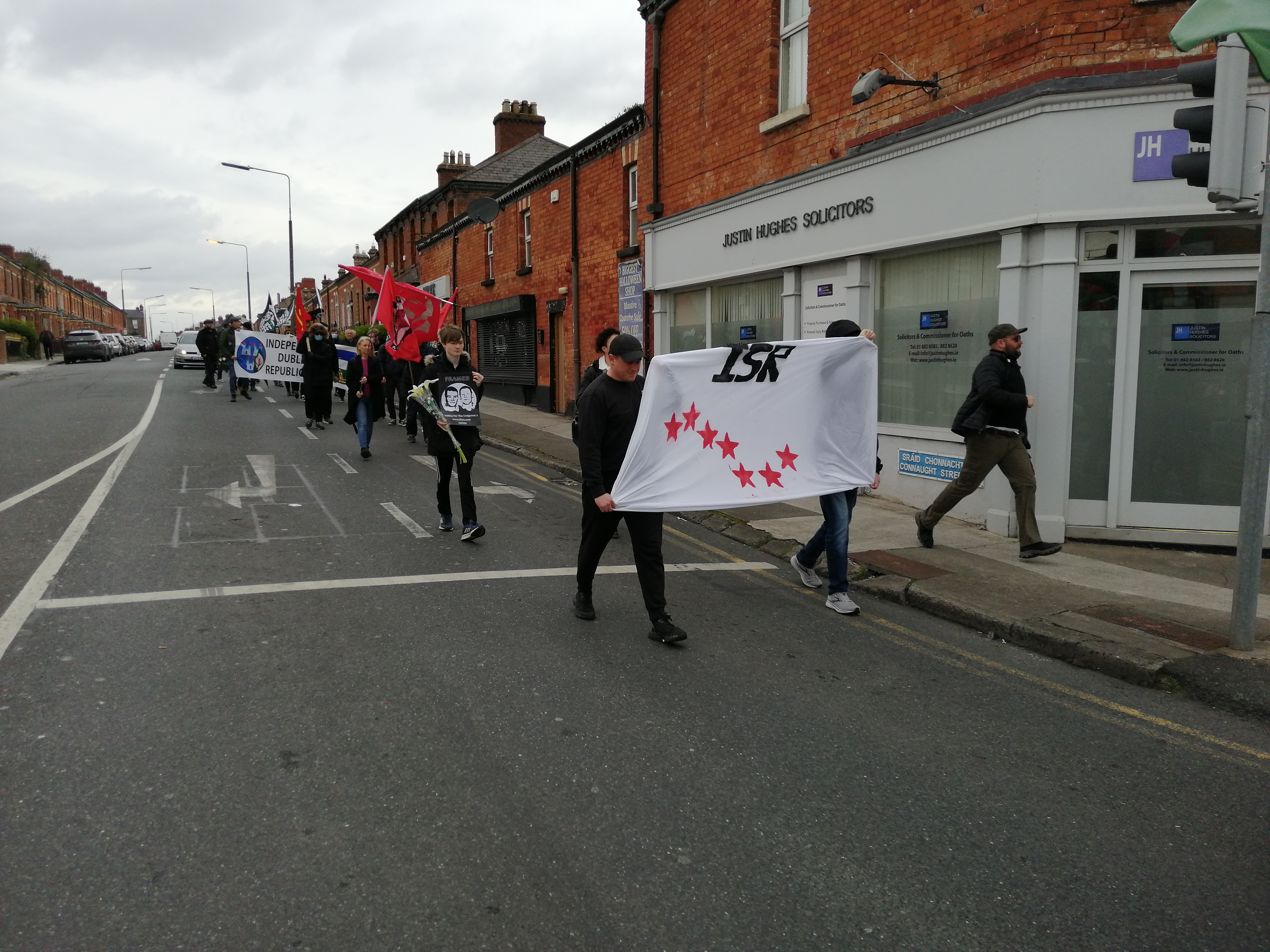
Breatnach was called back to the microphone and talked about the lessons to be learned from Constance Markievicz, co-founder of Na Fianna Éireann, the Irish Citizen Army and of Cumann na mBan, born in Britain “as were a number of our national and class heroes”, he said.

“Constance was born into a settler landlord family, the Gore-Booths”, he told the audience and her experience of witnessing deprivation, along with her sister Eva, during the Great Hunger, had a strong effect on both, inclining them to social reform and they became also suffragettes.

The speaker said that in that latter aspect and as a poet Eva became well-known particularly in England but Constance was better known as a revolutionary and for her allegiance to the working class and to the Irish nation.

He reminded his listeners that Markievicz was artistic and apt to strike poses; O’Casey, founder of the ICA had been hostile to her and co-founder of Cumann na mBan and wife of Tom Clarke of the IRB, Kathleen Clarke, had found her irritating.

Breatnach said that Markievicz was 3rd in 1916 garrison command at Stephen Green and had been accused not only shooting dead there a member of the DMP but of exulting in it; however according to witness accounts she had not even been present when the officer was killed.8

Bust of Volunteer Markievicz in Stephen’s Green (Photo: Rebel Breeze).

A British officer at her court-martial after the surrender of the 1916 Rising had claimed that she begged for her life at the court-martial but the official British records published later gave the lie to that and her own account that she demanded equal treatment with the executed leaders rings true.

“Her life as an example,” Breatnach continued, “teaches us not to judge people only by their background or indeed by their idiosyncrasies but primarily by their resolution, courage and commitment, all of which Constance Markievicz had by the bucket-load.”

The speaker also reminded those present that the very Wolfe Tone monument beside which he stood had been blown up in a number of British Loyalist bombings of the city during the 1970s, a number of which would soon be commemorated on the December anniversary of one of them.

The Irish State had prosecuted not a single one of the perpetrators, not even for the Dublin and Monaghan bombings, with the highest death toll9 of any one day during the recent 30 Years War. Instead, they had used the 1972 bombing to pass emergency legislation to attack Irish Republicans!10

Speaking briefly as a historical memory conservation activist, primarily active in the campaign to save the Moore Street market and 1916 battleground from speculators, Breatnach remarked that it was fortunate that the area behind him was a public park.

Otherwise it would all have been a prime target for property speculators. People sometimes express surprise that Irish governments do so little to protect areas of insurrectionary history. He stated however that this was natural since it was not their history but that of the struggling people.

“The history of the Irish ruling class is of a foreign-dependent one”, Breatnach stated, “rather than that of a national bourgeoisie willing to fight for independence. The last time Ireland had such a bourgeoisie was in 1798, mostly led by descendants of settlers and planters.”

“This is why Connolly pointed out that the Irish working class are the true inheritors of the Irish struggle for freedom. National independence and socialism are two different objectives but interdependent in Ireland and for the struggles to succeed they must be led by the working class.”

CONCLUDING

Wreaths were laid on behalf of a number of organisations, including Lasair Dhearg and the chairperson thanked all for their attendance, leaving people to their various ways into the mild autumn-like afternoon.

End.

(Cropped photo: Rebel Breeze)

(Photo: Rebel Breeze)

FOOTNOTES

SOURCES

1Clearly not the first army composed of workers, since these are the members of most armies; nor the first to fight for the workers, as did some for the Paris Commune in 18th March-28th May1871. However, the ICA was founded specifically for the defence of workers, the first in the world to be so, though its constitution was largely Irish nationalist.

2Socialist and anti-fascist Irish Republican organisation mostly represented in Belfast. The name means “Red Flame”.

3A number of Irish were veterans of the Boer War, the British against Dutch colonists in South Africa, most like White were on the British side but some fought for the Boers, to the extent of forming an Irish Brigade for the purpose. Later, a number from both groups ended up fighting alongside one another in the 1916 Rising (and no doubt against others who remained in the British Army).

4This too was a ‘first’ to the credit of the ICA.

5The Irish Volunteers, Cumann na mBan, Na Fianna Éireann, the Hibernian Rifles and of course the Irish Republican Brotherhood, the chief architects of the Rising, its members fighting as members of other units, chiefly the Volunteers and the Fianna (the membership of both those organisations was exclusively male though its couriers were often female but Tom Clarke’s wife, Kathleen Clarke, was the IRB’s liaison from Dublin with the sister organisation in the USA.

6James Connolly (1868-1916) did not prescribe any air for the lyrics and they have been sung to several. A Nation Once Again was composed by leading member of the Young Irelanders, Thomas Davis (1814–1845) and published in 1844, for many years considered a candidate for Irish national anthem.

7“For our demands most moderate are: we only want the Earth!”

8Breatnach also said that least two and probably three members of the DMP were killed during the Rising, each one in an area under the control of the ICA, who no doubt remembered well the force’s actions during the 1913 Lockout.

91974: 33 male and female civilians and a full-term unborn baby.

10The Amendment to the Offences Against the State Act, including the introduction of the no-jury Special Courts, essentially for trying Irish Republicans with a much lower quality of evidence required to convict, including the unsupported word of a senior Garda officer.

THE BEST MAN – A PLAY BY FRANK ALLEN
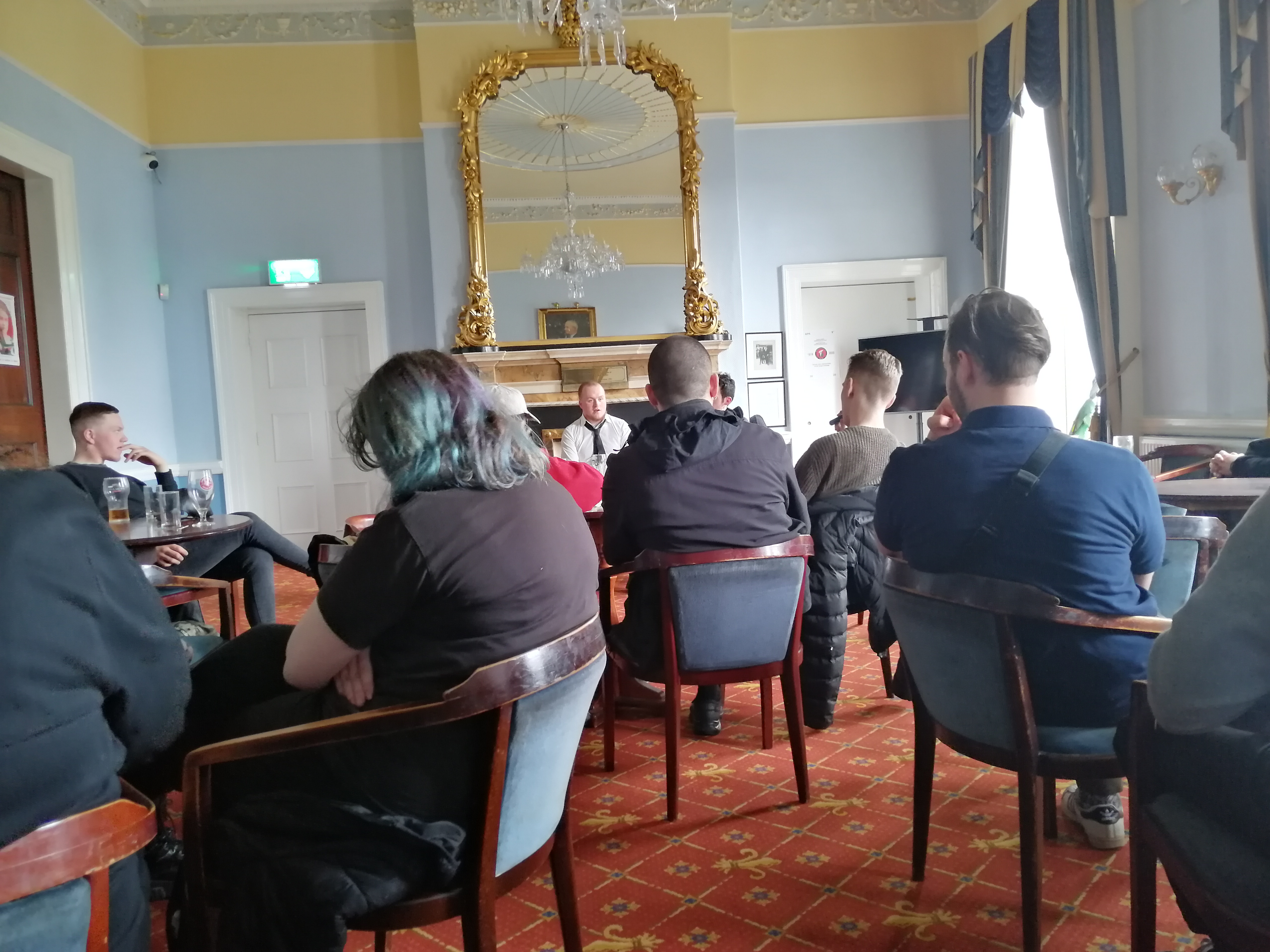
A review

Diarmuid Breatnach

(Reading time: 2 mins.)

Kevin O’Higgins, Minister of the Free State, signed the execution order of his former close friend and the Best Man at his wedding, Rory O’Connor, who led Irish Republicans in the occupation of the Four Courts in 1922 in opposition to the Anglo-Irish Treaty.

The historical and ironical reality is the basis for Frank Allen’s play The Best Man, showing until the 10th in the theatre in the Teachers Club, Dublin.

BRENDAN AS BORSTAL BOY

Before the play begins the audience is treated to a short performance by Brendan O’Neill of his portrayal of Brendan Behan from Borstal Boy and the Republican’s return to Ireland after his release from jail. O’Neill has family connections to his subject and has researched him too.

It’s an enjoyable performance and an interesting peek into what is or will become a full play, set already to tour Canada. One wonders whether Canadian society, reputed to be somewhat staid, is ready for Behan on stage.

THE BEST MAN PLAY

Glen Gannon’s direction makes best use of the small stage, adapting it with minimal changes to serve different scenes, while a piano recording of two well-known airs are employed for the same purpose. Elaine sings verses of The Foggy Dew beautifully.

There are four characters who take to the stage: Rory O’Connor (Alan O’Brien), Kevin O’Higgins (Kevin Brennan), ‘Birdie’ (Elaine O’Dea) and Lady Lavery (Niamh Large).

All of the parts are well-written and acted. For dramatic impact however, it is those of Rory O’Connor and Lady Lavery which are the strongest and both O’Brien and Large make the most of them, each dominating their respective scenes.

Searching for information online about ‘Birdy’, O’Higgins’ wife, for this review has been frustrating, with numerous commentaries on O’Higgins not even mentioning her name.

From information supplied by Frank Allen, Birdie was called Brigid Cole and she was an English teacher who taught in Knockbeg College in Carlow. Gearóid O’Sullivan taught there too.

“Birdy”, is brought to life in this play and given expression in moments of humanitarian passion in conflict with her husband Kevin, whose own most powerful moments are expressed in anger and angst during the Civil War, though his interactions with Lavery display passion of a different kind.

HISTORY

In history, Lady Lavery has been associated with Irish cultural interests and romantically with Collins but letters to her from O’Higgins reveal that Michael was not the only Irish fish in her net. Her image, in an Irish shawl, was to grace the Irish Sterling pound note. Suspicions that she was an MI5 agent are unproven but remain..

There may be some legal argument about some of the execution orders of Republicans signed by O’Higgins, though all are regarded by Republicans today as judicial murder.

There can be no argument however about the criminal nature of the executions of O’Connor, McKelvey, Barrett and Mellowes, executed by cabinet executive order in reprisal for a killing that took place while they were in jail and in which they played no part.

It hardly seems possible to view the ideological conflict around the Anglo-Irish Treaty without thinking about another Agreement closer to us in time; as we come up to the 25th anniversary of the Good Friday Agreement we can reflect on the lack of closure of each.

I have no hesitation in recommending a viewing but haste – only three nights remain.

Reference

O’Higgins, Kevin Christopher | Dictionary of Irish Biography (dib.ie)

JUSTICE FOR THE IGNORED?

Clive Sulish

(Reading time: 6 mins. main text, total 9 mins)

At noon on Thursday 1st December around a hundred people gathered in a side street off Dublin city’s main street to commemorate the killing of three public transport workers1 by British Loyalist bombs in 1972 and 1973.

The event was organised by the Justice for the Forgotten group that grew out of relatives seeking accountability for the Dublin and Monaghan bombings in 1974. However, the campaign group might well consider replacing the word “Forgotten” with “Ignored”.

In the early 1970s, as people – mostly but not all of of nationalist background – were marching for equal civil rights in the British colony of the Six Counties, British Loyalists began exploding bombs, not all but mostly in Dublin.

Some were aimed at symbolic Irish monuments such as the O’Connell Tower in Glasnevin cemetery (17 January 1971)and the Wolfe Tone monument in Stephens Greeen (8th February)2but the bombings of 1972, ‘73, ‘74 and ‘75 were clearly intended to kill civilians.

British Intelligence Services have been implicated in collusion with Loyalists and, along with agents within the Irish State3 have been implicated at least with regard to the 1974 bombing of Dublin and Monaghan, resulting in the largest loss of life in any one day during the 30 Years War.4

Posters of the names of three public transport workers killed in two bombings by British Loyalists (Photo: Rebel Breeze)
Wreaths and the plaque commemorating the atrocity (Photo: Rebel Breeze)

THE COMMEMORATION PROCEEDINGS

A temporary canopy had been erected with a lectern and amplification in Sackville Lane, between busy O’Connell and Marlborough Streets, next to a plaque set in the pavement commemorating the bombing and its victims there. More than a hundred had gathered around to witness the event.

Tom Duffy, son of Tommy Duffy, one of the victims of the 1972 bombs chaired the event. He is also the designer of the commemorative sculpture ‘A Fallen Bouquet’, inlaid into the pavement which was unveiled in 20045.

Chairing the event, Tom Duffy, son of the murdered Tommy Duffy (Photo: Rebel Breeze)

Tom never met his father; Tom had four months to go before birth in his mother’s womb when his father was killed; his sister does not remember her father either.

Margaret Urwin, of Justice for the Forgotten campaigning group, read out biographies of Bradshaw, Tommy Duffy and Tom Douglas (see Appendix), detailing their origins and recollections of their bereaved loved ones.

Margaret Urwin of Justice for the Forgotten campaign, organisers of the commemoration event (Photo: Rebel Breeze)

The origins of the victims and partners showed that as well as being a tragedy for Dublin the bombings were also that for other parts of the country and the diaspora, in particular Achill (Mayo), Belfast, Castlebar (Mayo), Fethard (Tipperary), Kilkenny and Stirling in Scotland.

Urwin said they also wished to remember John Hayes, whose 47th anniversary had occurred two days previously and she read a short biography of him too. John was employed at Dublin Airport and was killed by a bomb placed in a toilet on the Arrivals floor on 29 November 1975.

Current Lord Mayor of Dublin (Photo: Rebel Breeze)

The Lord Mayor of Dublin6 gave a short speech in which she underlined the need for remembrance while also decrying that the guilty had escaped so far and that proposed legislation, currently going through the Westminster Parliament, sought to prevent such perpetrators being brought to book.

Finance Manager of Dublin Bus (Photo: Rebel Breeze)

The Finance Manager of Dublin Bus spoke also, saying among other things that the company would never forget and that it was like one big family. However the absence of employees of the company present in uniform and the lack of awareness of many gave the lie to her words (workers tell us that the event had not been advertised internally by the company).

The Education Minister Norma Foley, TD spoke at length about the atrocity and need for all actions to take place within “the rule of law”, in the context of which she went on to castigate the British Government for its proposed 30 Years War legacy legislation to limit inquests and litigation.

Foley went on to state the opposition of the Irish Government’s to the proposed legislation, along with that of the opposition parties, with united faith leaders, all parties in the British colony and the US Government.

Somehow she and other speakers however managed to avoid mentioning the British Loyalist origin of the bombers or that these were chronologically leading up to the 1974 Dublin and Monaghan bombings, with a death-toll of 33 in one day.

Minister of Education (Photo: Rebel Breeze)

Or of the fact that the 1973 bombings had been used to push repressive legislation through Leinster House, including the founding of a no-jury Special Criminal Court, targeted not at British Loyalists but instead specifically at Irish Republicans!7

The omission of this important and relevant information, referred to in Ronan McGreevy’s report for the Irish Times (see link in Sources), though not unexpected on past Government performance, was indeed ironic coming from the Minister with responsibility for education.

Wreaths were laid, including some by relatives of the murdered. A priest also recited a prayer.

MUSIC AND POETRY

Poet Rachael Hegarty, who has also composed and performed a longer poem about the Dublin & Monaghan bombing, performed her composition for this event about the loss of husbands and fathers in the killing of public transport workers.

In between some of the speeches, musicians from the Shillelagh Northside Ukelele Group8 performed Simon & Garfunkle’s The Sound of Silence and Bobby Darin’s Things (including the lines “memories are all I have to cling to”).

During another speeches interval, Cormac Breatnach on high whistle & Eoin Dillon on uileann pipes performed Táimse I Mo Chodhladh and later to conclude the event, The Lark in the Morning. The first piece, no doubt chosen for its lament nature, would do well also as political commentary9.

Large group of Northside ukulele players in foreground (Photo: Rebel Breeze)

IGNORING AND FORGETTING

The age profile of the vast majority of those present meant that the atrocities had occurred within their lifetimes, which is natural; however the near absence of representation of the following two or three generations is not.

It might be observed that this absence is a natural part of passing time but one could also comment that the ignoring of this atrocity is causing an unnatural fracture in the historical memory of a people and a workforce, a result of a conscious decision to prevent the transmission of that memory.

The titles of three of the musical pieces may be seen as comment on that.

Cormac Breatnach playing low whistle (Photo: Rebel Breeze)
Eoin Dillon playing the uilleann pipes (Photo: Rebel Breeze)

Yes, the JFTF organisation continues to hold events to mark the bombings and the Lord Mayor and a Government Minister attend. But not only will nothing serious be done to bring the perpetrators to light – never mind justice – but the memory will be allowed to die out among the living.

The Clery’s building site near the commemoration was at work throughout the event with noise of drilling, banging and shouting, the workers no doubt in ignorance of the event or of its significance. Workers in Dublin Bus uniform passed by regularly from their nearby canteen building.

Two of the latter who stopped in curiosity on the outskirts of the crowd and were engaged in conversation, stated that they had no knowledge of the commemoration or of the atrocity. They opined that their union should have informed and mobilised them to attend.

TARGETING WORKING-CLASS PEOPLE

The bus workers’ canteen is in Sackville Street and it is noticeable that other fatal bombings were targeted at areas more associated with working-class shopping and away from the more affluent ones such as the Grafton or Henry streets. That could be have been due to class prejudice but also to hurt those with less political power.

This made it all the more important for the organisations and parties that have been built by the working class to respond to them. The Labour party, founded by James Connolly, is complicit with the Irish Government in this forgetting and ignoring.

The trade unions, even those of the specifically targeted public transport workers are also colluding with this silencing and forgetting.

From a ‘national’ perspective, the Irish State has permitted a foreign (and occupying) power and its proxies to bomb its capital city on a number of occasions, including the massacre of its civilians. Nothing could more clearly point to the neo-colonial foreign-dependent nature of the Irish elite.

Back in the 1960s and ‘70s, when the Irish trade unions were less compromised than they have allowed themselves to become, perhaps it would have been possible to shut down the building site near to the commemoration for the duration of the ceremony.

Perhaps city bus drivers could at least have stopped everywhere at a given time for an announced minute of silence. Ranks of bus workers could have attended the commemoration event in uniform, supported perhaps by the city’s municipal workers.

Are such gestures still possible? Can we make them so? The working class, far from tolerating this occlusion and deletion of historical memory, needs to mark the atrocity and to mark it strongly, in solidarity and for its own dignity as a class.

End.

Section of the crowd in attendance (Marlborough Street in the distance) (Photo: Rebel Breeze)

APPENDIX – THE BRIEF BIOGRAPHIES OF FOUR VICTIMS

GEORGE BRADSHAW

George, a native of Fethard, Co. Tipperary, was a young man of 30 when he was so brutally murdered in this street 50 years ago. He had married Kathleen, a nurse from Belfast and they had two small children, Lynn and Rory. He had met Kathleen when she was visiting relatives in Fethard and she was the light of his life.

George was employed as a bus driver with CIE and the family had moved from Tipperary to Dublin less than two years before tragedy struck on 1 st December 1972. He had worked previously in South Tipperary Farmers’ Co-op for 10 years.

George had big plans for the future – he was an ambitious man and was attending night-classes in business studies at the time of his death. His favourite hobby was dancing and he also loved to play darts. He was cheerful, fun-loving and an extrovert and is greatly missed by all his family.

TOMMY DUFFY

Tommy, a native of Castlebar, Co. Mayo was almost 24 years old when he was killed on 1 st December 1972. He was married to Monica, who was pregnant with their second child, Tom. They already had a small daughter, Caroline. They had met on the 29A bus when Monica was 17 and Tommy 19. Monica quickly fell in love with this witty young man so full of life and mischief.

Tommy worked as a bus conductor and had several hobbies. He loved to play traditional Irish music on the mouth-organ and spent lots of his free time tinkering with cars. He would buy old wrecks, repair them and re-sell them to make some extra money. He had a Yamaha motor-bike which he loved and also had a flair for carpentry. During the summer months, he liked nothing better than to return home to Mayo to help on the farm, especially with saving the hay.

On the day he died, he was due to work an early shift but had changed to facilitate a co-worker. Monica remembers him as a generous, kind and hard-working young man. She is pleased that their son, Tom, was the designer of the commemorative sculpture ‘A Fallen Bouquet’, which was unveiled in 2004.

TOMMY DOUGLAS

Tommy, a native of Stirling in Scotland was only 21 when his life was so cruelly taken from him in this street on 20 th January 1973. He, along with his brothers and sister, was raised in a Scottish mining community. He was an intelligent, fun-loving, outgoing person with a positive outlook on life. He liked swimming and was a fervent supporter of Celtic soccer team. He had a love of nature and enjoyed hill-walking. He also loved music and attending live concerts.

The family had strong leanings towards Ireland and had spent their childhood summers in Achill Island, the native place of their mother. Tommy loved all things Irish and most of the songs he knew were Irish songs.

When he left school, he served his apprenticeship as an electrician and, after he qualified, decided to move to Dublin. He had been living in Dublin only a few short months and had taken a job as a bus conductor while he hoped eventually to find work as an electrician. His fiancée had joined him a very short time before his death.

After his death, his family learned of his many acts of kindness to those less fortunate than himself. He was a devout Catholic but had many Protestant friends, indeed his fiancée was of the Presbyterian faith. His siblings are proud of him as a brother and thank God they had the pleasure of having him with them for 21 years. They only wish he was with them still.

JOHN HAYES

John Hayes’ 47th anniversary occurred two days ago. John was employed at Dublin Airport and was killed by a bomb placed in a toilet on the Arrivals floor on 29 November 1975. John was a hard-working family man with a wife and three children – twins Brian and Karen (aged 11) and Brendan (aged 3). In his free time he enjoyed a pint of Smithwick’s and was an avid Kilkenny fan. He was an ordinary man, devoted to his family.

The gathering breaking up at end of event, with portrait of famed uilleann pipes player Séamus Ennis in the background above the Pipers Corner pub at the end of Sackville Place and glimpse of LUAS tram to the left. (Photo: Rebel Breeze)

FOOTNOTES

1The State public transport system was called CIE (Córas Iompair Éireann) prior to breaking up into sections for easy privatisation in the ruling neo-liberalism of the 1980s onwards. The Dublin Bus company is one of the carved-up parts, competing with other privately-owned bus companies around Dublin.

2While the targeting of a monument to Daniel O’Connell “The Liberator” (his monument in O’Connell Street was also bombed), a campaigner for the repeal of the anti-Catholic Penal Laws might seem as an act of pure religious sectarianism by Protestant bigots, the blowing up of the Wolfe Tone monument was essentially political. Theobald Wolfe Tone was a leader of the revolutionary United Irishmen, a Protestant as were most of his leadership colleagues and is often described as “The Father of Irish Republicanism”. Only the head survived the explosion but it was attached to the recasting of the statue.

3See the Wikipedia entries on the 1972, ‘73 and ‘74 Dublin bombings.

433 people and a full-term unborn child were killed in that day’s bombings.

5See Sources.

6 Caroline Conroy of the Green Party holds the position in annual rotation this year.

7The proposed Amendment to the Offences Against the State Act in 1973 was heading for trouble in Leinster House until the bombings apparently stampeded some of its opposition into supporting it. As a result the no-jury Special Criminal Court was established which until very recently, with one exception, tried exclusively Irish Republicans, able to jail them mostly on the word of a senior Garda officer. This undemocratic piece of legislation has been thoroughly condemned by the Irish Council for Civil Liberties; Sinn Féin regularly opposed its renewal until a few years ago when it began abstaining and this year at its congress voted that such legislation is required “in some circumstances”.

8The name of the group was collected from participants but searching on FB and Google has failed to find a link for them.

9“I am asleep and do not wake me”, an Aisling poem/ music in Irish, origin contested between Ireland and Scotland, played in the 18th Century but date of composition unknown.

REFERENCES

‘It’s like yesterday’: Dublin city centre bombings remembered 50 years on – The Irish Times

‘A Fallen Bouquet’ — Thomas Duffy Art

Justice for the Forgotten campaign group: Justice for the Forgotten | The Pat Finucane Centre

The fatal Dublin bombings:

1972 and ‘73: 1972 and 1973 Dublin bombings – Wikipedia

1974 Dublin and Monaghan: Dublin and Monaghan bombings – Wikipedia

Other Dublin bombings: Incidents in Dublin during the Troubles (1969-1994) | Come Here To Me!

British legacy plan for Northern Ireland is wrong, Taoiseach says – The Irish Times