I am rubbish at predicting broad election results. But the mass media is predicting, on early returns, a huge electoral swing in Ireland towards the Green Party — at least in the municipal elections.
(image source: Internet)
As I type these words the other candidates who failed to get elected as municipal councillors in the Irish state — or barely scraped through — will be licking their wounds. The Greens will be celebrating, of course, spouting their analysis of what this means, of a huge change in the Irish people, of climate change awareness ….
And the media will be parroting them.
MORE OF THE SAME
I don’t believe the voting results are because of any great change in the consciousness of the Irish electorate — in fact I think it’s basically more of the same.
Why then the electoral surge towards the Greens? I don’t think that climate change issues — or more accurately the public perception of them — are enough to explain it, though it will no doubt have influenced some voters. I think the fundamental reason is that the Greens are not Fianna Fáil, Fine Gael, Labour or Sinn Féin. True, they are tainted from partnership with FF in the past but that was only a couple of them and a lot of water has gone under the bridges of Irish rivers since then.
I wouldn’t trust the Greens in power as far as I could throw an iceberg but I think what I’ve said above is the reality.
The 26-County electorate has traditionally voted either FF or FG into power. The latter normally needed another partner to form a majority, which Labour opportunistically gave them and later the party always paid the price, while a few of its leaders got fat pensions out of it.
Apparently every Irish government since the intervention of Hunger Strike candidates in 1981 has been a coalition, which testifies to an electorate generally unconvinced by either main party. But since the bank bailout, the electorate seems to have been even more disenchanted, voting for outsiders in the race and hedging their bets between parties, like spreading the risk in investments.
In the 2011 General Election, the voters kicked out FF to the lowest vote in the party’s history along with wiping out its Green party partners and, apart from voting in a lot of independents (mostly left-wing ones), they gave most votes to the party most likely to dislodge FF, which of course was FG. And they spread the risk by giving Labour a lot of votes. Despite the hopes of the electorate this coalition basically gave us more of the same — privatisation of lucrative state services, mismanagement of others, expanding housing crisis and austerity measures.
So they put in a lot of SF in another year and what do they get? A party that votes in Dublin to hand over Council land to speculators because SOME ‘social housing’ will be built on it. Resignations of elected representatives through alleged internal party shenanigans. A party that has long ago lost interest in organising a base for anything except voting — a mirror, in fact, of FF in the past. And which, while playing sectarian politics in the Six Counties has supported — and implemented — austerity measures of the British State.
Media commentators will search for many reasons for this change — youth vote, middle-class vote, climate change consciousness and general environmental awareness. I think there is a more fundamental reason which the commentators would probably rather not acknowledge, since it questions, not the viability of this or that party, but the whole system.
I don’t believe the people have any great faith in the Green Party and this elections seems more of the same behaviour of the electorate. Change the faces every so often — and spread the risk.
Nor do I blame the electorate — for what visible and realistic alternative has presented itself?
AN GORTA MÓR COMMEMORATED IN SLIGO, DUBLIN AND CELTIC PARK
(Reading time of article text: 5 minutes)
Clive Sulish
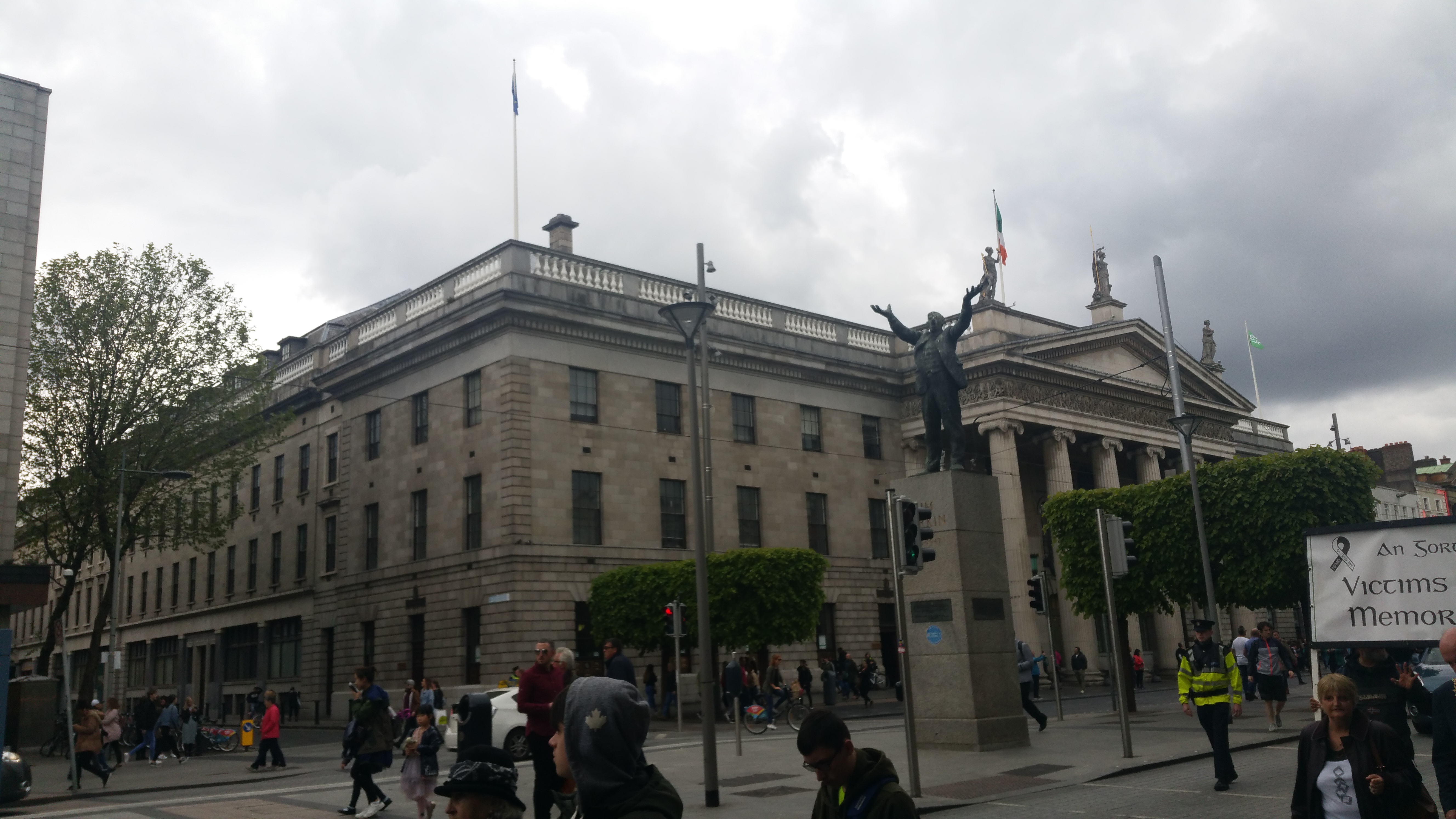
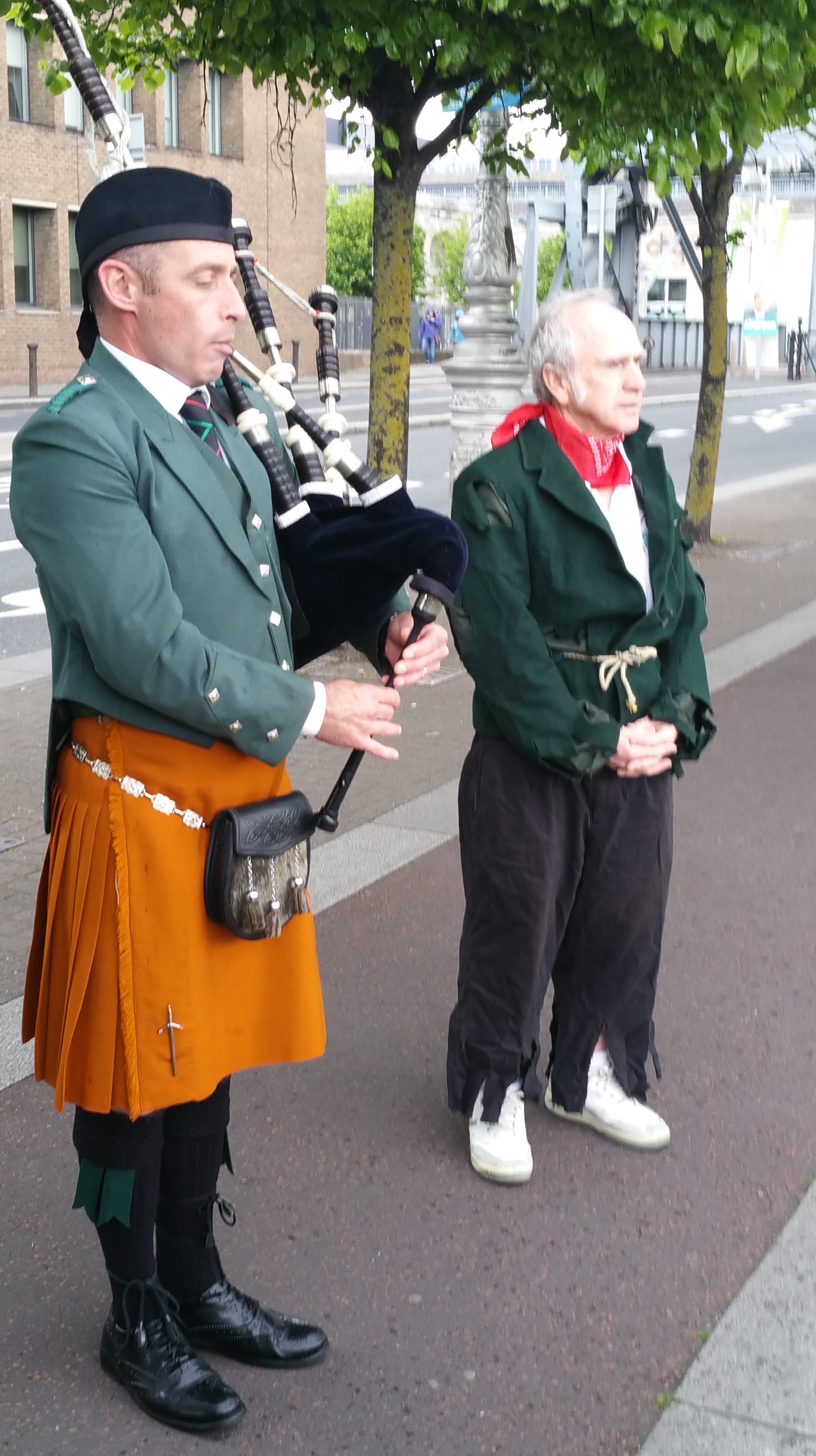
Michael and Olivia Blanch and piper halt the procession for a moment’s reflection outside the GPO building, HQ of the Easter Rising in 1916.
A small crowd gathered at the Garden of Remembrance, Dublin on Sunday afternoon to commemorate the Great Hunger, an Gorta Mór on National Famine Day. Led by a lone piper, they marched through O’Connell St., the city’s main street, some of them in period costume, to the Great Hunger Memorial on the Custom House Quay, North Dock and later on to the iconic sailing ship, the Jeannie Johnson.
Participants proceed after a moment’s reflection at the GPO building, HQ of the Easter Rising 1916 and pass by Jim Larkin’s monument, “who also agitated for the poor of Dublin”.
With some adults and children dressed in period clothes, some of them tattered to represent the destitution of the starving poor, they marched down O’Connell Street led by the lone piper and turned left at the Bridge, proceeding along to Custom Quay’s North Dock and the Great Hunger memorial. There they were addressed by Michael Blanch of the organising committee and by Niall Ring, Lord Mayor (coming to the end of his year in that role), who had accompanied them from the Garden of Remembrance.
Lord Mayor Niall Ring speaking at the Famine Memorial.
Some sentences in Irish were spoken by the MC of the event and by the Lord Mayor, while Michael Blanch referenced the deadly impact the Great Hunger had on the Irish language (i.e with the depopulation of the main Irish-speaking areas of the western seaboard). The Irish Tricolour came in for a mention in the Dublin commemoration also; it had been presented to William Smith O’Brien by women in Paris during the revolution there of 1848 and the Young Irelanders had staged their own uprising that year also, small and certainly too late, easily crushed by the British colonial forces. The huge Irish diaspora was also mostly a result of the Great Hunger and had contributed significantly to the formation and membership of the Irish Republican Brotherhood, also known as the Fenians, founded simultaneously in 1858 on St. Patrick’s Day in Dublin and in New York. The IRB, in turn, had been the main driving force behind the 1916 Rising.
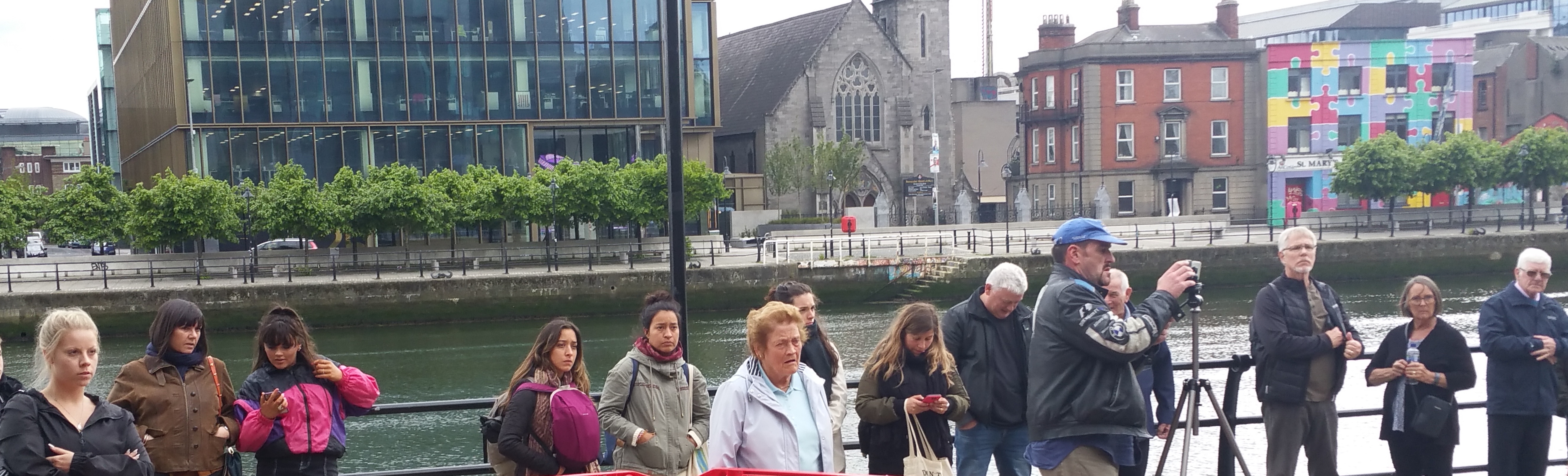
Section of crowd at Famine Memorial (and unintentional illustration of clashing architectural styles and building heights on the south quays opposite).Piper playing lament and Michael Blanch at the Famine Memorial.Michael Balanch and MC of proceedings at the Famine Memorial and banner of the Committee.
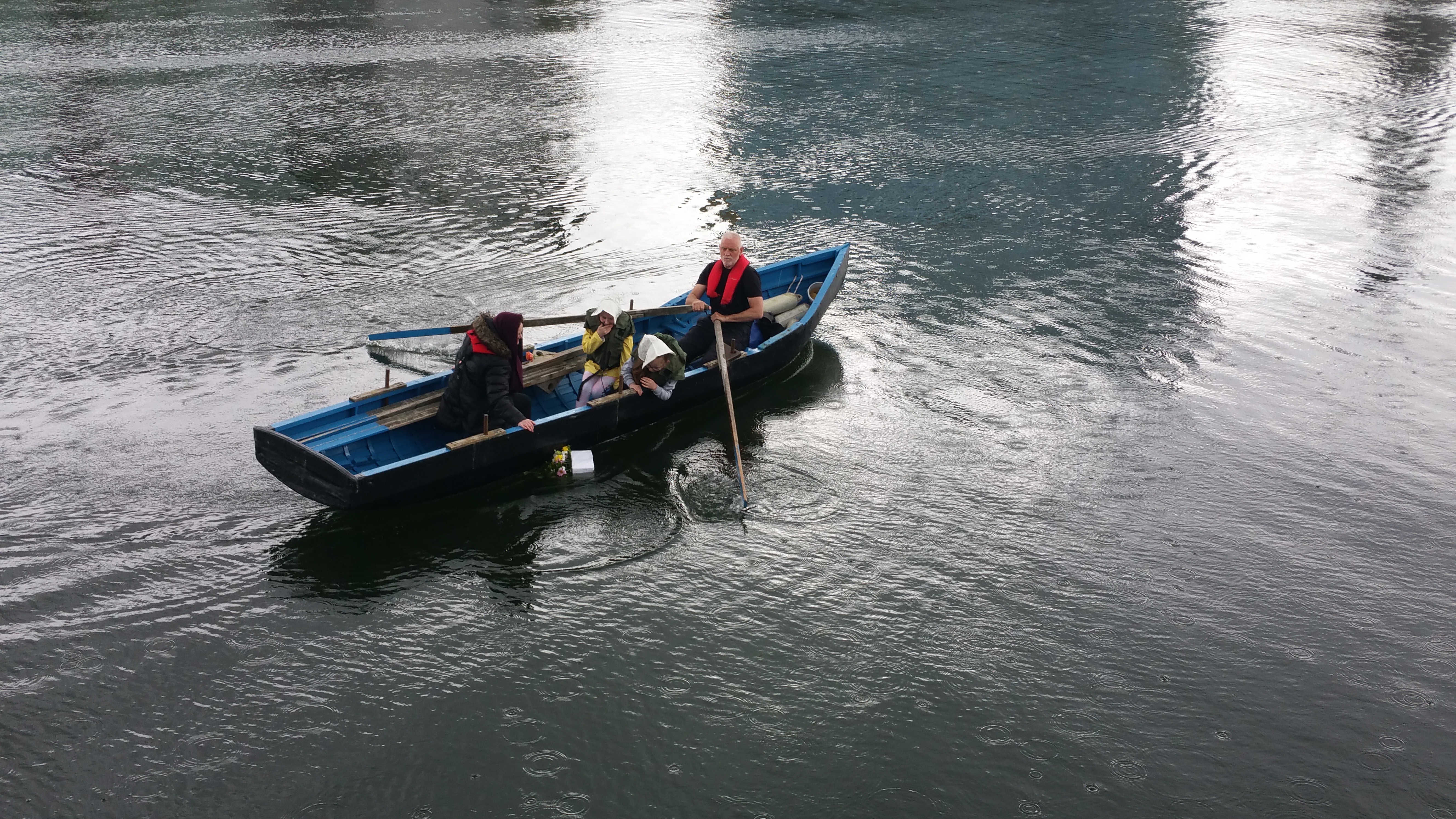
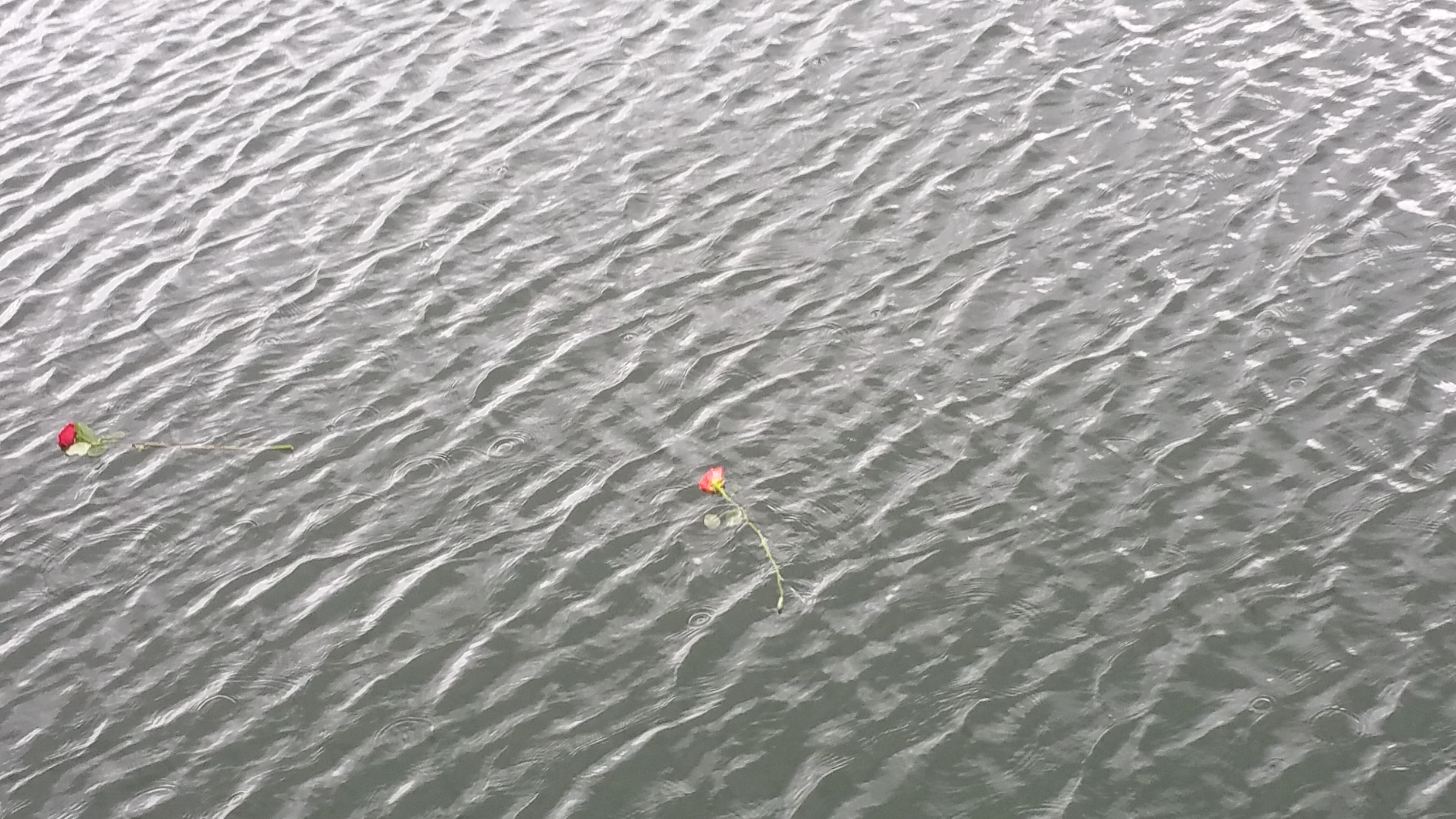
Tourists and other passers-by stopped to watch as wreaths were laid on on the statues of the monument and an Irish-language version of Amazing Grace was sung by a young girl in period costume. A currach (small traditional Irish sea-craft), containing a woman and two young girls in period costume and rowed by a man, pulled into place on the Liffey across from the group; one of the girls placed a wreath in a cardboard box into the river, to commemorate the Irish diaspora and those who had perished during their journeys. Participants then threw single red roses bouquets into the river also and floral wreaths were deposited around the statues of the 1977 memorial by sculptor Rowan Gillespie. And the piper played a lament, Hector the Hero.
Girl singing “Amazing Grace” in Irish.
The gathering moved on then to the sailing ship the Jeannie Johnson, to hear Evelyn Campbell sing her Famine Song and Diarmuid Breatnach sing Skibereen and Fields of Athenry. After that, some repaired to the Teachers’ Club, where tea, sandwiches, gur cake and biscuits were on offer. By coincidence, a Musical Society were relaxing there too and it was not long before songs from different parts of the world were being exchanged from different parts of the room.
Somewhat incongruous, the top floors of the International Finance Services Centre, which looms over the Famine Memorial, commissioned by Nora Smurfit of the Irish capitalist family.
Evelyn Campbell on board the Jeannie Johnson, accompanying herself on guitar while she sings her Famine Song.
THE CAMPAIGN FOR A NATIONAL IRISH FAMINE DAY
The currach on the Liffey near the Famine Memorial on the quay.
The commemorative wreath is lowered into the Liffey from the currach.Participants prepare to throw stem roses into the Liffey to commemorate those who died during emigration and the diaspora that survived.Some of the stem roses floating in the Liffey.
The Great Hunger is the preferred term in English by many for the terrible disaster that struck Ireland in the mid-19th Century, for people starved alongside what was for a while at least, an abundance of food.
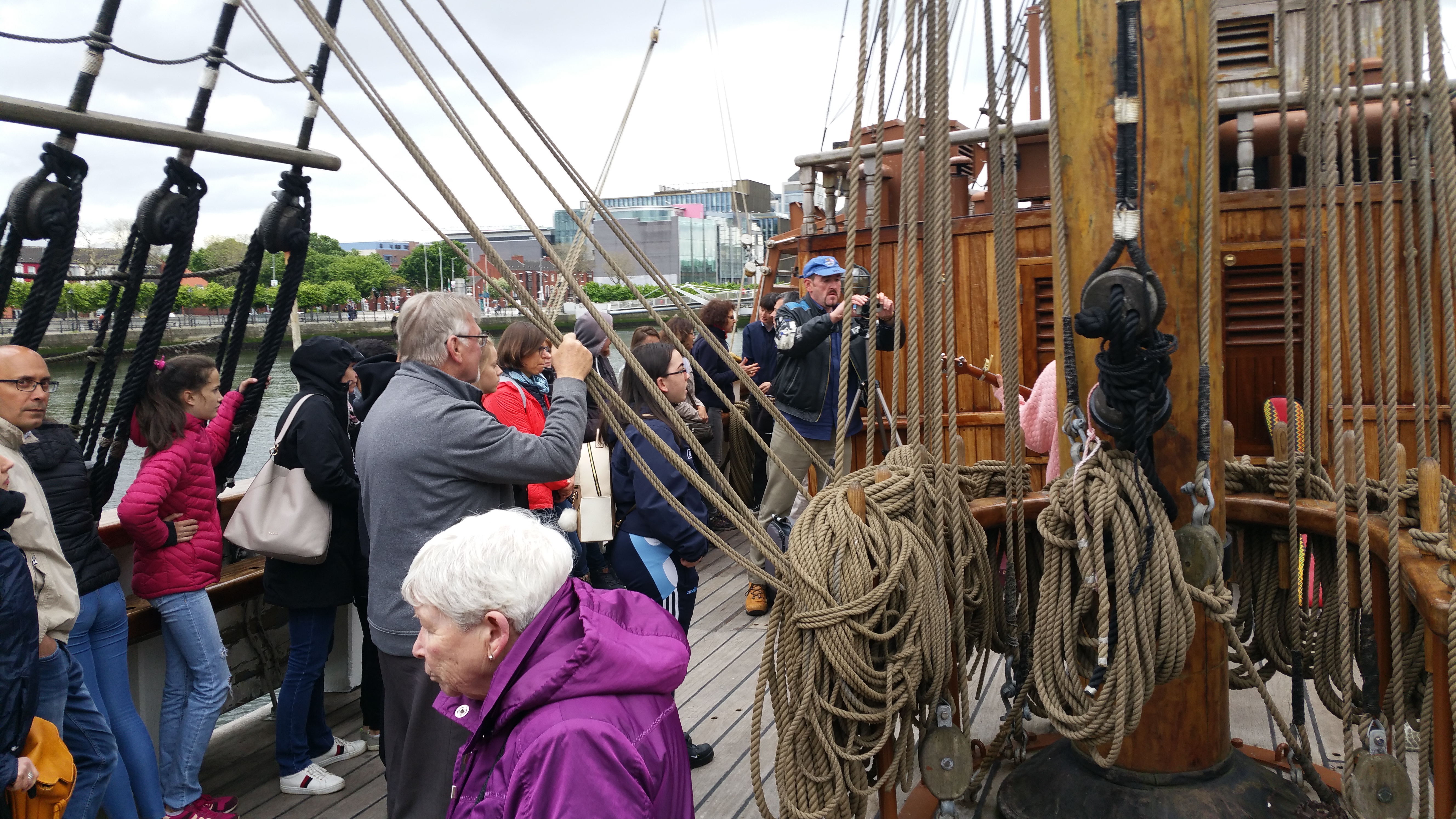
Mast and some of the rope work of the Jeannie Johnson sailing ship.
For three successive years, a fungus-like oomycete infested the potato crop, staple diet of most of the population. AlthoughPhytophthora infestanshad attacked the potato crops on the European mainland and in Britain also, nowhere was the disaster of the dimensions it grew to in Ireland: nowhere else were the the majority of the population obliged to sustain themselves on the potato while yielding up every other edible product (except perhaps milk) to pay the landlord’s rent on land conquered from the ancestors of the starving, thousands of soldiers and police being on hand to ensure the hungry paid up. “The Almighty indeed sent the potato blight”, wrote Young Irelander journalist John Mitchell, “but the English created the Famine.”
Well over one million Irish starved or died of attendant diseases in less than five years during the reign of Queen Victoria, while ships left Irish ports laden with food and grain was fermented to make lucrative whiskey and beer. Another million emigrated and it is estimated that about one third of those also died – of drowning, of disease aboard ship or of the various dangers migrants faced. Five years after the potato crop failed, estimates put the population of Ireland at around six million, from the over 8 million of before. Over the next decade, another million would leave, paid to go, lied to go, forced to go, or gone out of desperation and loss of faith in any future in the country of their birth under foreign domination.
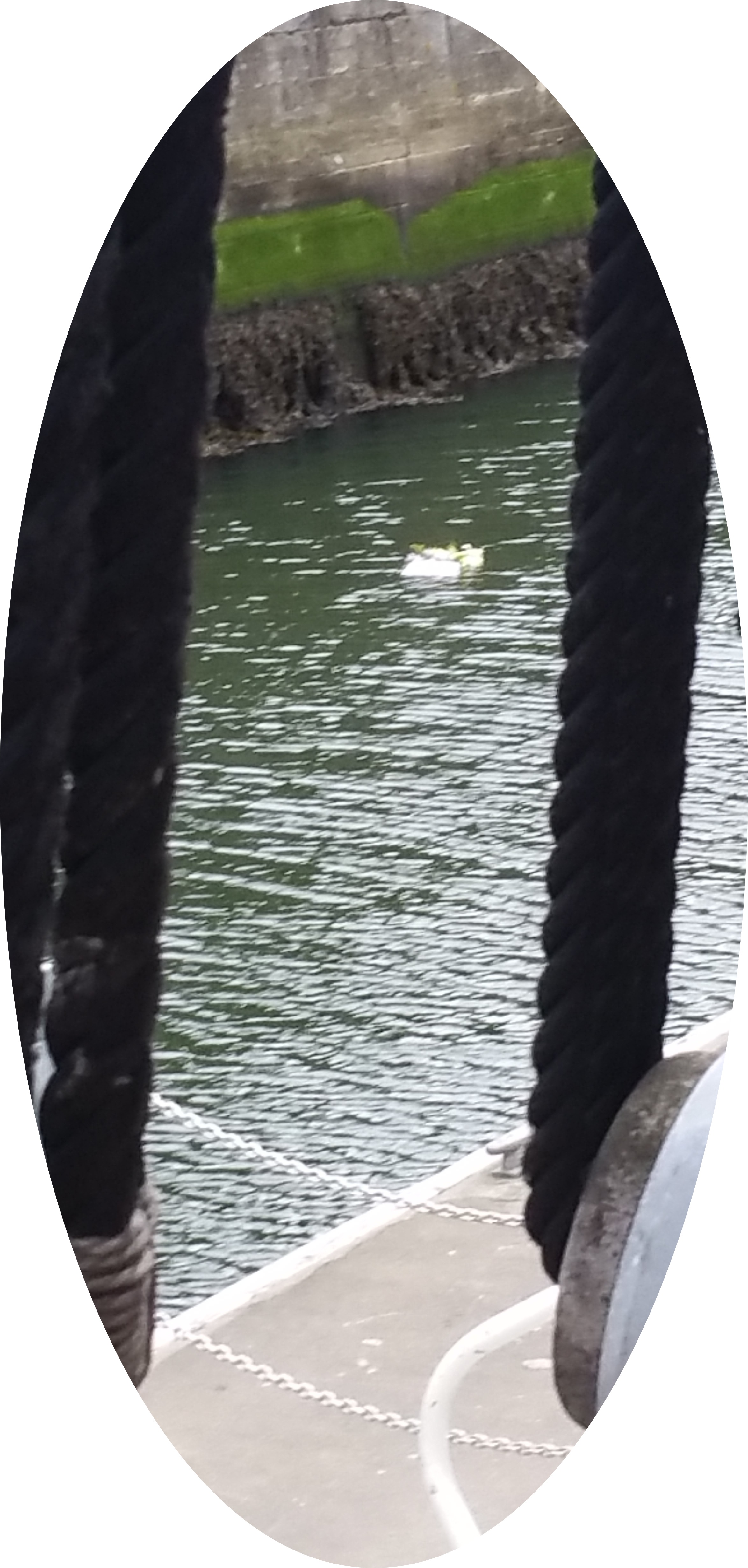
The floral wreath deposited from the currach earlier floats past the Jeannie Johnson.
In 2008 it was agreed by the Irish Government that there would be a national Famine Day in the Irish calendar of national events and it would take place on the third Sunday in May. The State commemoration this year was held in Sligo, attended by Leo Varadkar (who was met by a protest of the Sligo Women’s Cervical Smear Action Group). The ceremony was covered in the RTÉ news which was shown on TV in the Teacher’s Club. Michael Blanch told those present that the campaign he and his wife had started in 2004 through the Committee for the Commemoration of Irish Famine Victims, had resulted in this national event and that it was also being commemorated by the Glasgow Celtic team in the special jerseys they wore that day (in their Scottish Premiership win 2-1 against Hearts). The symbol is black and white which are the colours of the Commemoration and he had also wanted GAA teams playing on this day to wear it on their jerseys (the Munster Hurling Championship match between Limerick and Cork was also being shown that afternoon on the TV screen in the Teachers’ Club).
End.
People commemorating stand among the ghosts of the victims who, as a result of the Great Hunger, died in Ireland or in emigration.
Two quite different celebrations of International Workers’ Day took place in Dublin on the afternoon of the appropriate date, 1st of May. One was small and of a decidely revolutionary flavour while the other, much larger, was of a more mixed nature and tending towards the reformist. In addition, a workers’ solidarity picket was mounted on a Dublin city centre eatery.
NOTHING TO LOSE BUT OUR CHAINS
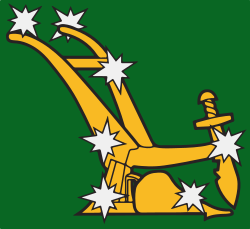
The first of the celebrations was organised by theAnti-Imperialist Action Ireland organisation and took place at the James Connolly Monument in Dublin’s Beresford Place. There a statue of James Connolly stands upon a plinth, behind the the design of the Irish Citizen Army flag, based upon the constellation that in Ireland is called the Starry Plough but in the USA is known as the Big Dipper. James Connolly was a revolutionary socialist and trade union organiser, historian, journalist and songwriter who was Commander of the Dublin insurrectionary forces in the 1916 Rising. The Irish Citizen Army, possibly the first formaly-organised army for and of the workers, had been formed during the Dublin Lockout as a defence force against the attacks of the Dublin Metropolitan Police.
The ICA took part in the 1916 Rising in Dublin and after the surrender of the insurrectionary forces, 16 participants, including two of the ICA, were executed by British firing squad: Michael Mallin on 8th May and James Connoly on 12th May.
In the here and now, on their way to the Connolly Monument, a number of participants were stopped by a man in plain clothes identifying himself as a police officer, i.e a member of the Garda Special Branch. He wished to know their names, which they declined to give them.
At the Monument, both speakers for the Anti-Imperialist Action Ireland organisation were youths.
The first to speak gave his oration in Irish on behalf of Macra – Irish Socialist Republican Youth and said that they were there to celebrate socialism, trade unionism and workers oppressed throughout the world and, that although James Connolly had been murdered in Kilmainham Jail, his work was ongoing.
Stating that James Connolly and the Irish Citizen Army had gone out in 1916 to break with imperialism and found a socialist society, the youth went on to say that “Macra is a revolutionary organisation with socialism as one of our objectives and we also believe in the words of Pearse: ‘Ireland not only free but Gaelic, not only Gaelic but free.’ Free from the bankers, free from landlords, free from poverty.”
The speaker concluded in Irish and in English with the renowned sentence from the Communist Manifesto.: “Bíodh critheagla ar aicmí cheannais roimh réabhlóid Chumannach. Níl tada le cailiúint ag na Prólatáirigh ach a slabhraí. Tá saol mór le gnóthú acu. Oibrithe an tSaoil Mhóir, cuirigí le chéile!”
“Let the ruling classes tremble before a communist revolution. The Proletariat have nothing to lose but their chains, they have the whole world to gain. Workers of the world unite!”
The second speaker delivered his speech in English and linked the liberation of Ireland with the liberation of the working class and went on to praise Séamus Costello (1939-1977), which he said had embodied that aspiration. The youth praised the creation of the Irish Republican Socialist Party by Costello as well as the creation of the Irish National Liberation Army and Costello’s participation and membership in a number of democratic organisations — including his election to Bray District Council.
Condemning “the bankers and politicians” who bring deprivation to the workers, the speaker said that they try to point the finger instead at Muslims and migrants but it is not migrants who cause job losses, create homelessness etc but “the elite”. The speaker ended by saying he wished to remember all those who had given their lives for Irish freedom.
Assembled at the Connolly Monument, Beresford Place, Dublin (Photo: Anti-Imperialist Action Ireland)
WE WANT THE EARTH
Diarmuid Breatnach was then introduced to sing Be Moderate, a song with an ironic title by James Connolly. “The Irish working class does not have a huge history in Ireland, apart from a short period in the early decades of the last century,” Breatnach said, giving as reasons the forced underdevelopment of Irish industry, the British-fostered sectarianism in the most industrialised north-east and the focus on the national struggle as a competing pole of attraction.
“The Irish abroad, however, have made a huge contribution to the workers’ movement,” Breatnach said. “And in 1889, Jim Connell from near Cill Scíre in Co. Meath, composed lyrics of The Red Flag to the air of the White Cockade, starting it on the train to his home in South London from a demonstration in central London and apparently completing it in the home of another Irish man.
The song was later adopted by the International Workers of the World, a syndicalist organisation mostly active in the USA, Breatnach said and reminded them that James Connolly joined the IWW when he migrated to the USA. “In 1907, James Connolly published a songbook, Songs of Freedom, in which he included the lyrics of Be Moderate,” Breatnach stated and went on to say that no air had been published to which the words should be sung. As a result Be Moderate has been sung to a number of airs but in London Breatnach heard it sung by an avant-garde musical composer and Marxist-Leninist, Cornelius Cardew, to the air of A Nation Once Again. In Breatnach’s opinion the lyrics fit well to this air and it also provides a chorus, which he encouraged the participants to sing.
James Connolly’s lyrics were sung by Breatnach then, competing with sounds of passing traffic on the ground and the occasional trains rumbling by on the bridge overhead, participants joining in on the chorus:
We only want the Earth,
We only want the Earth
And our demands most moderate are:
We only want the Earth!
and the last line of the last verse “We want the Earth!” echoing across Beresford Place.
TRADE UNION AND POLITICAL ORGANISATION BANNERS
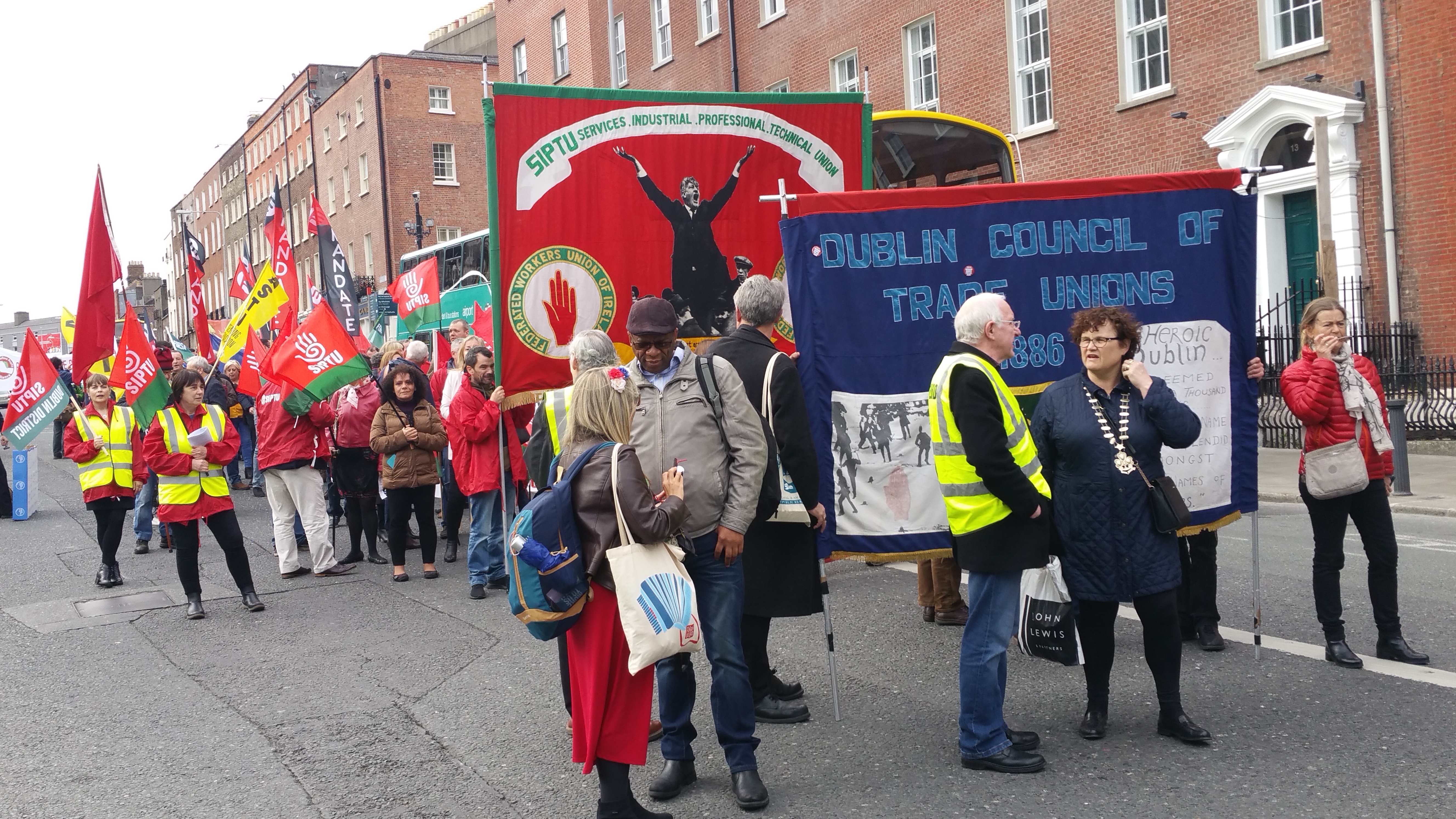
Section of the 1st May parade about to move off from outside the Garden of Remembrance, Parnell Square. (Photo: D.Breatnach)
Across the road, a stage and crowd barriers were being set up outside Liberty Hall, the multi-storeyed headquarters of SIPTU, the largest union in Ireland and which, by amalgamations, had grown from the Irish Transport & General Workers’ Union, originally formed early in the 20th Century by Jim Larkin, James Connolly and others (and the destruction of which had been the object of the 1913 Lockout). The stage was being prepared for speakers to address a rally which would follow a Mayday parade from Dublin’s Garden of Remembrance (a small park dedicated “to those who gave their lives for Irish freedom”).
Even the larger Mayday demonstrations in Dublin, although organised through the Dublin Council of Trade Unions, i.e with affiliation from most trade unions in the city, do not tend to be very big by comparison with other cities in many other parts of the world.
Anti-Pesco banner on 1st May parade (Photo: D.Breatnach)
Banners of some unions mixed with those of political organisations and campaign groups, including the Ireland Palestine Solidarity Campaign and another against Irish state participation in PESCO, which is seen by many as an embryonic EU Army and undermining the Irish state’s neutrality.
Section of the 1st May on the move down Parnell Square. (Photo: D.Breatnach)
Led by a lone piper, the parade made its way past crowds of onlookers down Dublin city’s main thoroughfare, O’Connell Street, then left along Eden Quay to Liberty Hall where they were to be addressed by speakers on the temporary stage in Beresford Place, across from the Connolly Monument.
Anti-Pesco banner on 1st May parade (Photo: D.Breatnach)
Meanwhile, a small group had left, to form a picket line outside the Ivy Dawson Street restaurant, in solidarity with staff and in opposition to the management appropriating a portion of the tips left for staff, with more to join them there later from the Mayday parade.
(see https://rebelbreeze.wordpress.com/2019/05/02/tipping-the-bosses/).
A NOTE ON THE HISTORICAL ORIGIN OF INTERNATIONAL WORKERS’ DAY
The First of May has been celebrated as the international day for workers since 1892, to call for the 8-hour maximum working day, socialism and universal peace. Its inspiration was a train of events that began with a workers’ strike and demonstrations on May 1st 1886 in many parts of the USA but in Chicago ended in the State execution of four anarchists, with police and state militia massacres of workers along the way as well as with acts of workers’ resistance. The celebration and commemoration throughout the world was formally agreed at the Second Congress of the Second International Workers’ Association in Brussels in 1892 and at its Sixth Congress (Amsterdam, 1904) declared it mandatory for the proletarian organisations of all countries to stop work on that day, wherever that could be done without injury to the workers(bearing in mind violently repressive regimes).
Artwork depicting police attacking striking workers at McCormick’s factory who were agitating for the 8-hour working day. (Image source: Internet)
In many states around the world now, the 1st of May is a public and bank holiday and has been so in Ireland since 1994. Its public celebration was banned under the fascist regimes in Spain and Portugal but is legal in both those states now; however it is still banned in some other states while in some areas, though not banned, may be subject to attack by police, army, state agents or by fascist elements.
Protesters calling for the urgent construction of public housing marched through Dublin today. Various organisations and many independent activists took part in the protest with a broad range of people took pat, from socialist to republican-orientated, some with their children. The event was organised by the National Homeless and Housing Coalition.
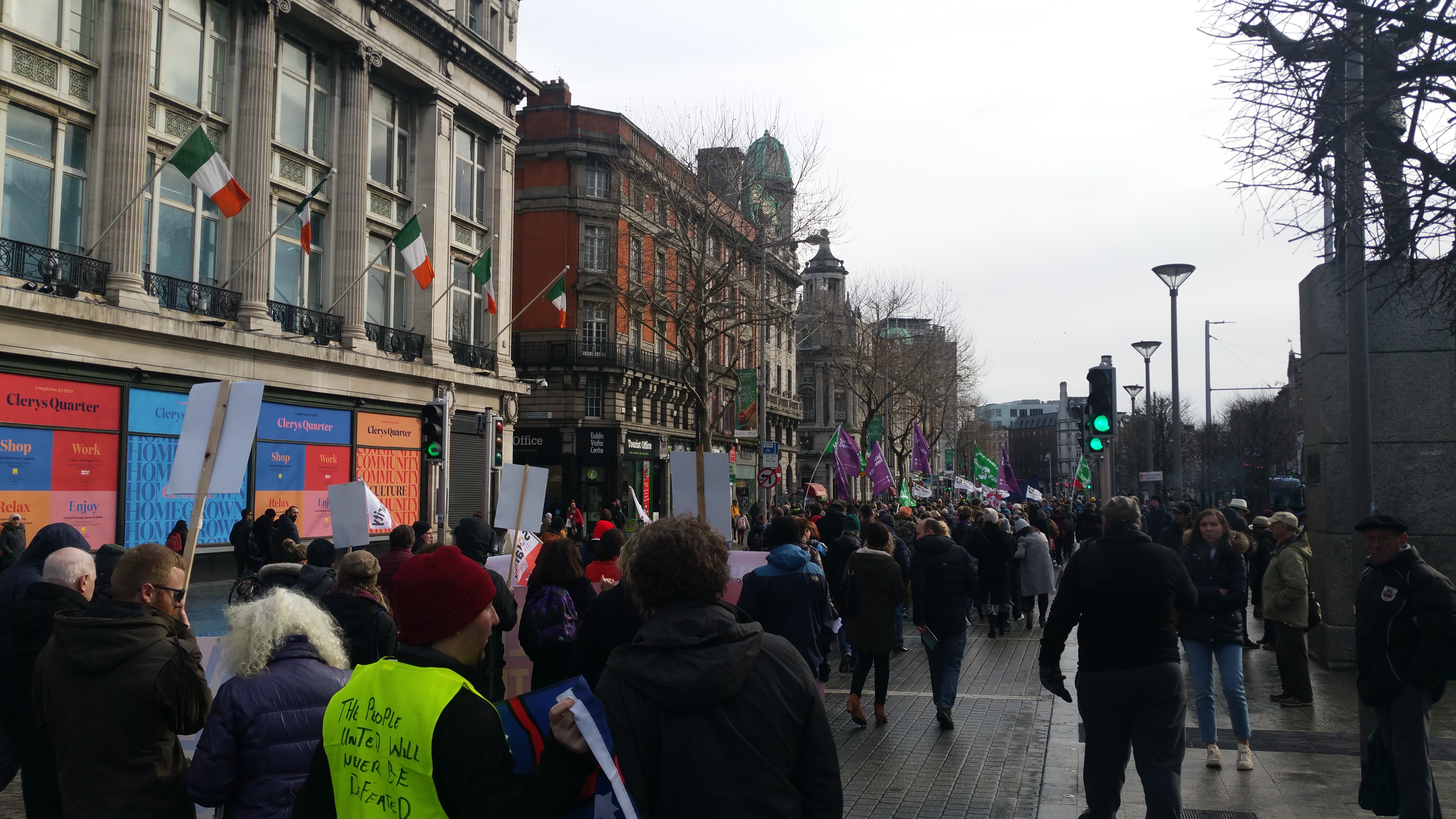
Early part of the march detachment starting from the GPO, here proceeding south along O’Connell St, the long-closed Clery’s department store on the left and the Larkin Monument on the right. (Photo: D.Breatnach)
On their Facebook page, the NHHC had issued a statement, part of which read:
“Rebuild Ireland has been an unmitigated disaster yet the cross party motion that was passed in the Dail in October that called for practical actions that would end the emergency, including making it illegal to evict someone into homelessness, were ignored by the government even though it was supported by all parties except Fine Gael. We are demanding action on the motion.
“We also learned that 15 Dublin hotels received over €1m each in 2018 for accommodating homeless families which further illustrates the reliance on the private sector. These families need public housing built on public lands, they need proper homes. Last year there were 842 cases of children being discharged from the Temple Street Emergency Department back into homeless emergency accommodation. The majority of these cases were a direct result of the fact that these children are living in completely unsuitable and cramped emergency accommodation.”
The march, though far from small, seemed somewhat smaller than expected which may have been due to a cold windy day with lashing rain a little earlier in the day but may also have had another cause. The Coalition of groups has split with ICTU (Irish Council of Trade Unions) and a number of NGOs pulling out to form a different campaign on housing, apparently declining to support the demand for public housing on public land.
Front of the march pausing on Custom House Quay (Photo: D.Breatnach)
The organisers of today’s march published a list of demands:
• Declare the housing and homelessness crisis an emergency. • Provide a minimum of 10,000 public house a year. No to privatization: build public houses on public land. • Make housing a constitutional right. • End evictions, bank repossessions and sell-offs to vulture funds. • Create a national Traveller accommodation agency to oversee and deliver Traveller Accommodation. • Legislate for real security of tenure, real rent control and affordable rents. • End the use of B&B’s and hotels for emergency accommodation. Improve emergency accommodation facilities and provide security for all in need. • Create rent pressure zones for Purpose-Built Student Accommodation (PBSA). Ensure tenant’s rights for students in PBSA and digs-style accommodation.
One group set off from the GPO and after making a circuit on O’Connell Bridge, marched along the north quays, meeting up with another group coming across Butt Bridge to join them from the Housing Agency HQ; apparently another group had marched from City Hall. The march continued on to Samuel Becket Bridge, to the bemusement of some participants, where the participants halted and were addressed by a number of speakers.
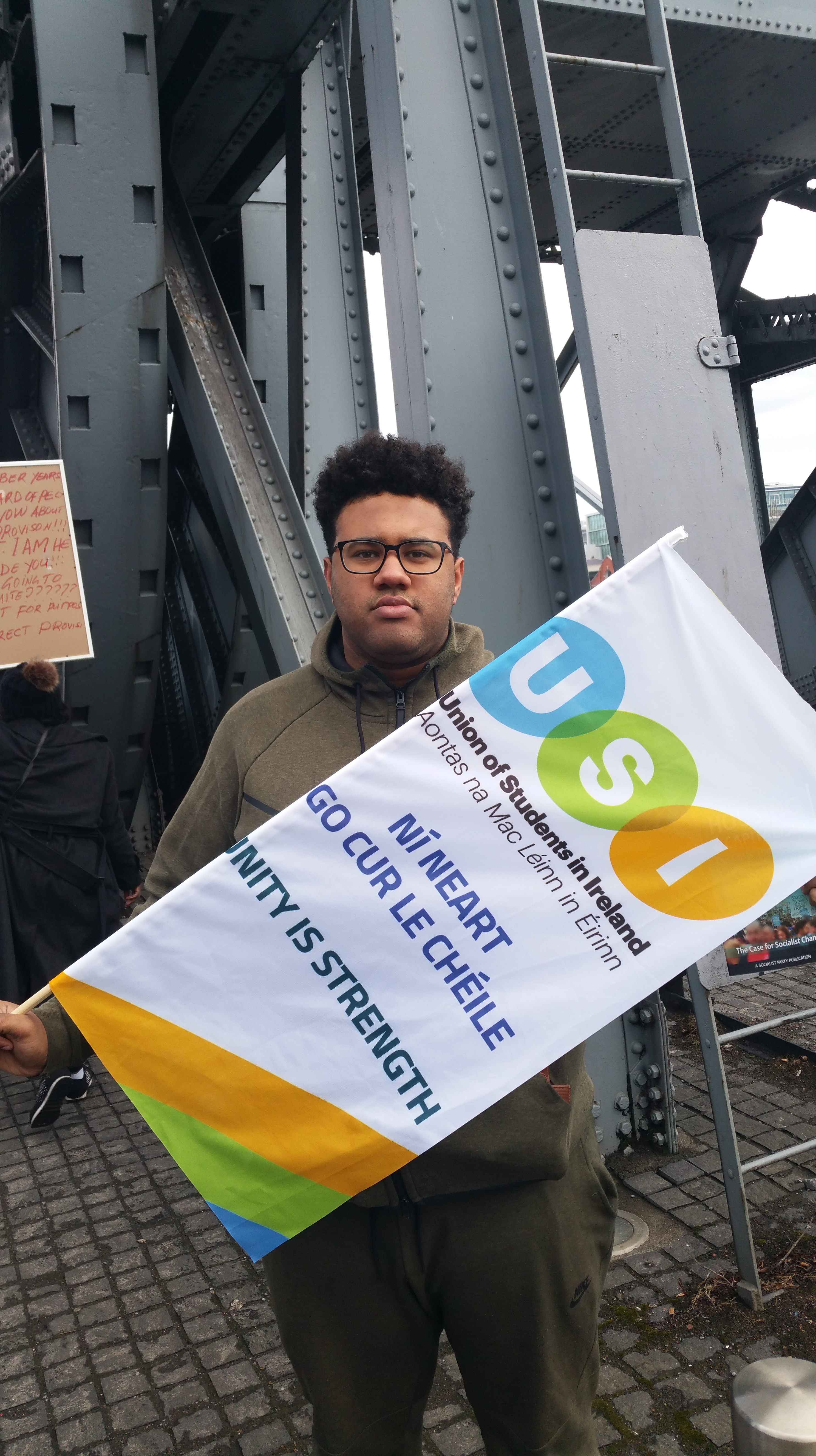
Student on the march displaying flag of Union of Students in Ireland (Photo: D.Breatnach)
Along the route of the march, slogans were shouted, among which were:
“Raise the roof, not the rents!” and “Housing is a human right!”
Section of the march stretching out along the north quays. (Photo: D.Breatnach)One of the organisers speaking at the rally at the end of the march: Tina McVeigh, of PBP. (Photo: D.Breatnach)
As well as Socialists, a number of Republicans were in evidence, marching without party banners. Sinn Féin supporters had a banner and party flags, as did People Before Profit and the Workers’ Party. Some Union of Students in Ireland flags were in evidence too. A Travellers’ group and some community groups also carried banners identifying their group with the march and its cause.
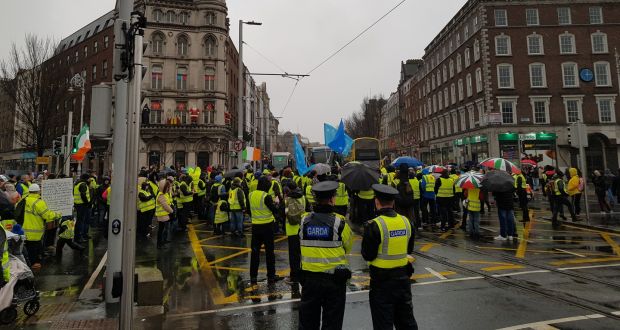
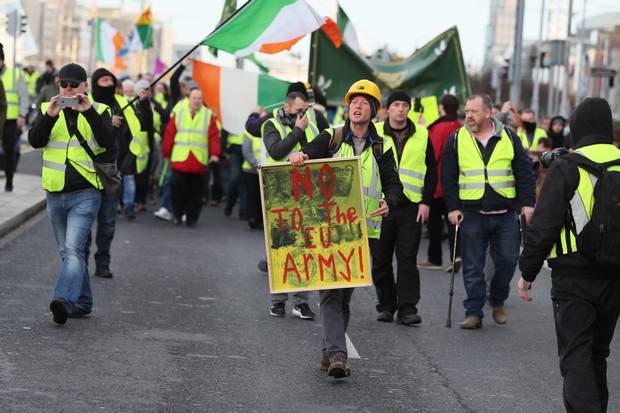
Recently a number of people have been marching in Dublin, saying that they are the Yellow Vests of Ireland. This is obviously inspired by the Gilets Jaunes (“Yellow Vests”) whose protests against the French Government began in November last year and swelled to huge numbers in Paris demonstrations and riots. Some smaller groups have announced their formation in different parts of Ireland too. But there are questions concerning them.
Irish Yellow Vest protest crossing O’Connell Bridge 15 December 2019. (Photo source: Internet)
The Yellow Vests in Dublin have been meeting on Saturday afternoons at the Custom House and marching from there. I am busy on Saturdays and on the one day I made the time to join them, I did not find them and learned later from their posts that on that occasion they had gone to Dublin Port and apparently blocked the approach road for a period.
Originally the organisers stated that there would be no leaders but then two emerged, Glen Miller and Ben Gilroy. Until last week Gilroy was serving three months for contempt of court, a sentence imposed by a judge when he learned that Gilroy had not completed the community service sentence imposed for a previous contempt of court. Held in contempt of court a number of times Gilroy has always apologised afterwards and had his contempt considered “purged”, i.e cleared. It seems that the judge in this case decided that Gilroy was playing games with the court around the issue of contempt, which is probably a fair assumption (which is not at all to say that such actions are wrong).
Gilroy took a case to the High Court alleging failure to comply with certain legal requirement and on February 4th the Judge granted him liberty on bail in his own recognisance (i.e his own financial bond) while is case was discussed and decided. However this week the Judge ruled that his imprisonment was not unlawful and revoked Gilroy’s bail, which meant he had to return to jail.
In recent years a number of groups have sprung up which oppose a number of unpopular legal procedures, for example evictions, by a mixture of physical obstruction (by numbers of people) to bailiffs but also by appealing to what they claim are laws that take precedence over the legal procedures they are confronting. The “Land League” is one of these (no organic relationship to the 19th Century Irish organisation of Davitt and Parnell) and, not unrelated to the “League” in its reliance on arcane laws and procedures, real or imagined, is the Sovereign Movement, the “Irish Republican Brotherhood” (again, despite their claim of “inheritance”, no organic relationship to the 19th and 20th Century organisation) and the Fremen.
While some people are impressed by these arcane legalisms others are bewildered by or scornful of them and, despite their claims, these organisations seem unable to point to where their legalisms have actually been ultimately successful. They have certainly succeeded in slowing down such actions as repossessions and evictions by taking up court time and numbers turning up to block an eviction will often succeed in delaying the process, without any need to appeal to any kind of legalistic underpinning. Property rights reign supreme under capitalism and certainly the Irish state is no exception to that rule; on the other hand the authorities in the Irish state tend to prefer to carry out the normal business of capitalism with as little confrontation as possible.
Summoning numbers to block or delay an eviction and to support a victim of the system in court are of course tactics of struggle honoured by time and usage in Ireland, whether against the British administration or that of the Irish State. Such reliance on mobilisation of numbers can sometimes produce small or partial victories but they hint at something else – the mass mobilisation of insurrection and revolution. And that is part of the appeal of groups such as the “Land League” and probably in part of the Yellow Vests.
Section of Irish Vest protest Dublin 22 December 2019. (Photo source: Internet)
But if insurrection and revolution are hinted at, we need to know whether the hints are in earnest. Calling for a general election, one of the demands of the Yellow Vests, hardly seems insurrectionary. How would that change anything? Calling for an end to a number of attacks on working people including evictions is good but how is it to be achieved? Is there an objective of overthrowing capitalism and imperialism in Ireland? We do not hear so if there is. If an insurrection is hinted at, by whom is it to be and for whom?
RACISM
It is here that we run into a disturbing problem: racism, of which Gilroy and Miller have both been accused. Any movement or organisation led by racists is not going to be one for progressive change in society, let alone a socialist insurrection but worse – it is likely to be a breeding ground for fascism. And of late, fascist forces are gathering throughout most of the world and certainly in Europe. Capitalism is struggling and the workers must be made to pay the cost through keeping wages and social expenditure down and profits high. When persuasion and collaborationist workers’ leaderships are no longer effective, capitalism must fall back on naked force. Fascist movements are the frontline of that force, its leading edge and racism (or religious sectarianism, with which we in Ireland have more experience) is used to divide the lower classes, the ones that will be made to pay.
Of course not all the people supporting the Yellow Vests are racist but when an anti-immigration banner is tolerated on a march1 then it would be remarkable if racism were not being tolerated as well. And with regard to the leadership, Glen Miller’s racism is well established from his posts on social media. He has posted material against immigration, against Muslims, against Travellers and against lesbian, gay and transgender people – classical minority targets of fascism to split the working people. He also shares racist material by others including Tommy Robinson, a fascist public figure operating in England.
Gilroy is not usually so glaringly racist but he has certainly posted an islamophobic rant on social media.
One might argue that Islam is a religion and that being against it is not racism. Perhaps not, if one were against all religion, for example. But ethnicity and religious belief or organisation are often interconnected, at least in particular periods and societies. Most muslims are not white European. And the Irish certainly know from their own experience how easily anti-Catholicism became conflated with anti-Irishness, in Britain for example, in the USA (think of WASPS and the ‘Nativists’) and in Ireland under colonial rule.
Islamophobes fantasise about Moslems taking over the country, anti-immigrationists fantasise about immigrants taking over the country, racists fantasise about non-Europeans taking over the country. There are nuances between them but in the end do they matter that much? The effect is the same: society is portrayed as divided by ethnic origin rather than by class and the focus is diverted from the bankers, gombeen capitalists and their political servants an on to migrants instead.
It might be argued that “looking after our own first” is a natural outlook and not racist. But we need to look at where that comes from and where it leads. It starts from the false premise that there is a great shortage and that we should divide those scarce resources first among the Irish. But in fact there is sufficient wealth produced in Ireland to fund all the education, housing and healthcare needs of all the people, immigrants included. And this is because the wealth is produced by working people – including migrants. The problem for us all is that that huge portions of that wealth is being diverted to fund the market gambling, lifestyles and financial empires of Gombeen (Irish capitalists) and foreign capitalists and bankers. Those are the people who would be rubbing their hands with glee or happily exchanging bribes and payoffs if, instead of uniting to confront them, the workers began to fight amongst themselves, divided by race or religion.
When the 1916 Proclamation declared the objective of the insurgents to “pursue the happiness and prosperity of the whole nation ….oblivious of the differences carefully fostered by an alien government, which have divided the minority from the majority in the past”, it was addressing in part that religious sectarianism by which England had restrained the descendants of its colonists from overthrowing its colonial rule and also the pitting of Protestant against Catholic workers, a division which had been played out before 1916 and was to be enacted to even worse degree later. The “Protestants” were the “immigrants” of those years, along with their descendants2, albeit a privileged minority which migrants rarely are.
In making that statement, the insurgents of 1916 were drawing on an Irish revolutionary tradition stretching back to the United Irish of the 1790s and early 1800s, of the likes of Wolfe Tone, Henry Joy McCracken and Robert Emmett. It was a tradition that ran through every revolutionary movement in Ireland since that time, through the Young Irelanders, the Fenians, the Volunteers and the Irish Citizen Army, a tradition that called for overcoming differences to build unity against the common enemy. That is the unity that fascists and racists seek to shatter.
Fascists may and often do verbally castigate capitalist governments, politicians, industrialists and bankers. But they end up serving them. They split the mass of the working and lower middle classes on the basis of race, they attack the defence organisations of the working class, they target other groups such as gay and lesbians, push women into the most subservient roles possible. The Nazis were “National Socialists” and part of their movement talked about nationalising industry under workers’ control. But they were backed by big capitalists such as Thyssen, Krupp and IG Farben and many others in Germany. In the USA and in Britain they were backed by Henry Ford and promoted by Viscounts Northcliffe and Rothermere, owners of the Daily Mail (until England declared war on Germany and the US entered WWII on the Allied side). The Nazis in Germany took over the trade union offices on Mayday and closed them down, forcing workers instead to join fascist unions controlled from the top, part of the State.
WHAT KIND OF UNITY?
It is interesting that while fascists divide the working people in order to facilitate their control and undermine the struggles against the capitalist class, they often cry for unity. German unity. Aryan unity. White unity. Spanish unity. British unity. Irish unity. And when people have criticised individual leading figures in these groups, in particular recently of the Yellow Vests in Ireland, they have been accused of dividing, of undermining the struggle and calls for “unity” have been raised.
Whether it is right that the court should consider it criminal for someone to hold it up to disrepute, as Gilroy and some others have done on occasion, is another question and whether three months is a reasonable punishment for “contempt of court” in another. The courts are instruments of the State which in turn is an instrument of the ruling class and as such all revolutionaries must perforce hold them in disrepute and, in my opinion, three months in jail is excessive by normal standards in this state. But cries raised by the Irish Yellow Vests against this seek to glorify Gilroy as some kind of “people’s leader” and in turn to promote the ‘Vests’ as a viable resistance movement.
Workers know that unity in struggle is necessary but have also learned over the years that calls for unity may also be used to allow collaborationist trade union leaders and politicians to continue misleading the workers. Such calls can be employed to silence questions about where the movement is going. And now they are being used, unwittingly by some no doubt, to the effect of trying to silence the challenges to such as Gilroy and Miller about their racism and where they are trying to lead the Yellow Vests.
Such calls are being used not only to stifle the criticism of the leaders’ racism but to undermine the criticism of racism itself, as though racism were some kind of Leftie concept or diversion from the real issues. In a post in defence of Gilroy on 18th January, Miller posted a long ‘plain folksy’ discourse in which he said that Gilroy and he have “no time for political correctness and the posh talk”. So according to that discourse we should ignore the accusations of racism, action is needed, and for that we need unity – we should stop bleating on about racism. But the action is often dubious, the destination vague, the unity based on lack of analysis and stifling of criticism and – ultimately – on the opposite of unity, the division of the working people and the undermining of their resistance to those who are the real source of their misery and discontent.
It is not because of the anti-racist or politically-correct posturing of anyone, whether middle class or not, that socialists stand against racism: it is not just because it is inhumane, either; it is primarily because it splits and weakens the working class and diverts anger and resentment from the real enemy.
The Yellow Vests in Ireland are by no means a fascist or even racist movement. But they tolerate racists, are led by racists and could provide a breeding ground for fascists – something for which fascists are always on the lookout.
WHAT TO DO?
So what should be our response, as socialists of various kinds?
First, I think we need to step back and examine the situation a little. The Yellow Vests here copy the Yellow Vests in Paris. Awhile back, the Socialist parties (I do not count the Labour Party in this) wanted us to copy the Greek uprising and Syriza’s electoral success. Earlier than that, some people wanted us to emulate the Indignados of Spain. And further back still, others sought to copy the Occupation movement of the USA.
It seems to me that all that striving speaks of a desperate need felt by some elements in our society, a need that cries out that something must be done; something to cure the mess that our Gombeen system has made of our health and welfare systems, of the housing crisis, of cuts to other services; that some stand should be made against paying off the bankers’ gambling debts with our hard-earned money and trying to get us to pay a third tax on our water supply when the money collected already has not been used as it should. A feeling that something should be done about the corruption of that give-away of our natural resources, about the selling of our transport, postal, telecommunications systems, about the funding of private landlords, about renewed emigration of our young. About increased hours and travel time spent just trying to stay still economically but nevertheless slipping slowly back. About evictions of people who have paid the actual building cost of their homes a number of times over. About governments that oversee this rotten system, worrying chiefly about staying in government and pleasing native and foreign capitalists; about a police force in which we find an average of a scandal per year with no end in sight and yet happy to repress people’s resistance …. and with their Armed Response Unit cars to be seen everywhere around the city centre.
Those people are right, of course. Something should be done. Something must be done. But what? There’s the rub, as they say. The working class should rise and take power, is the classic revolutionary socialist answer; also of the socialist Republicans, who tie the question to getting rid of British colonialism. Whether our revolutionary socialists in Ireland are actually revolutionary is a good question however, and in any case they are small parties. Whether our socialist Republicans are actually socialists or Republicans first is another interesting question and in any case they are splintered in groups and independents.
All those movements abroad that various people tried to emulate or reproduce here in Ireland did not succeed in changing the situation in their own lands. The USA, the country with the most billionaires in the world (and in politics!), continues to slide towards eventual downfall, in huge debt as a result of funding its military-industrial-financial system, for which billions around the world and millions inside its own borders pay with misery ….. and still the debt cannot be paid. But a huge sub-class exists, often living in city wastelands of run-down housing estates.
The Spanish state continues to squeeze its citizens, prepares to go to war against a nation seeking independence and fascist groups organise openly. Suicides prior to, during or after evictions are no longer startling news.
The Greek Left-coalition government of Syriza collapsed and prostrated itself to the EU and the IMF and schools had to close in winter for lack of heating fuel.
The French Government has alternated repression with some concessions but ultimately nothing has changed.
The growing vacuum of resistance in Ireland will be filled by a revolutionary movement based on working people in militant resistance to – and directed at – the capitalist system. Or it will be filled by fascism.
To build a revolutionary resistance movement, unity in struggle is needed and for that unity, racism must be driven out of the people’s movements. That will not be done by condemnation of racists alone. It will not be achieved only by calling for unity against capitalism. The revolutionary movement must be built and it is by action that it will distinguish itself and attract support from the militant sections of the people.
It is by its revolutionary critical discussion on politics, history, science and culture that it will inform the mass of its potential and necessary objectives.
It will not be built by theoretical declarations or arguments alone, nor by actions that are either timid or cannot be maintained, or by actions of only a few far in advance of the mass. Some of the actions will, perforce be risky and the State will exert a price.
But it is either that or – fascism awaits.
End.
FOOTNOTES
1Reported on at least one of the marches and I have seen a photograph of it
2Some Protestants were descendants of Catholics who had changed their religion to avoid persecution or land confiscation and some Catholics were descendants of Protestants who had converted or who had married a Catholic who raised their children in that faith. But largely, Anglicans, Presbyterians and other Protestant sects in Ireland were descendants of waves of colonists in particular from the 15th Century onwards, while Catholics were largely descendants of the indigenous Irish and of the Norman invaders.
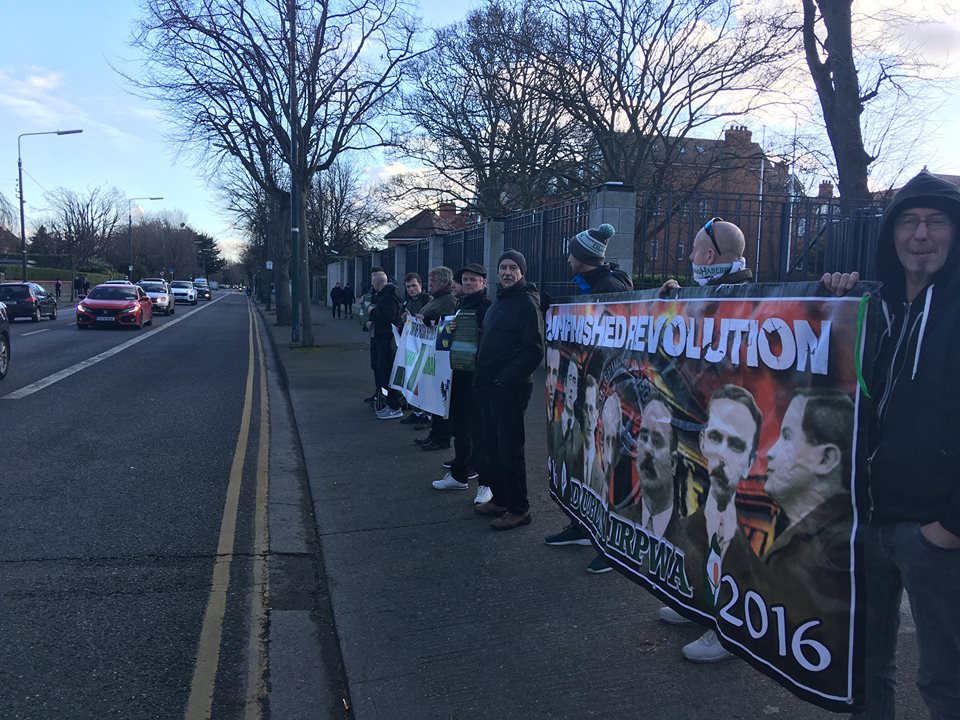
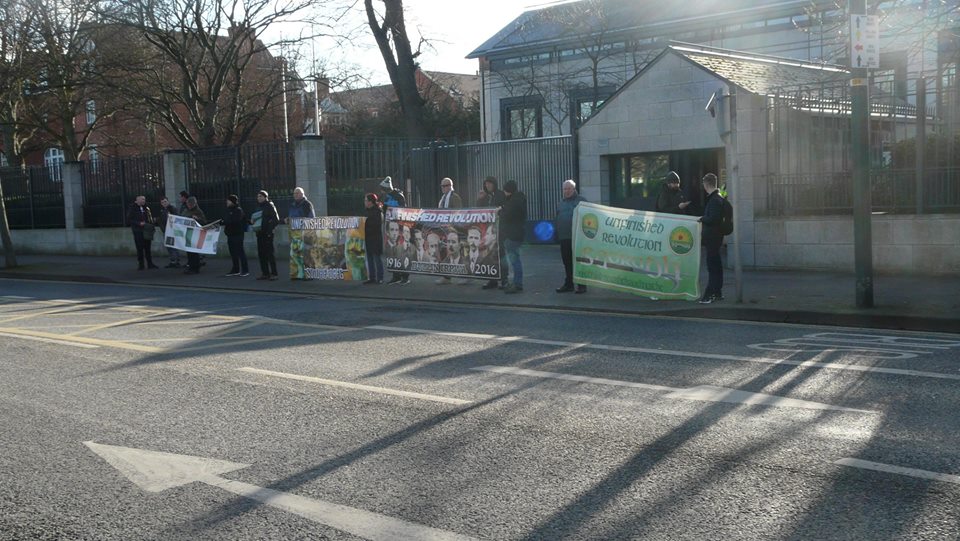
A picket called on the British Embassy to protest against continuing internment and special courts was harassed and kept under heavy surveillance by Irish police, both in uniform and in plainclothes, with marked and unmarked vehicles.
One view of part of the protest (the main entrance to the British Embassy is behind the picketers). (Source photo: Participant in the protest)
The protest was called by Irish Socialist Republicans, Anti-Imperialist Action Ireland, Dublin Anti-Internment Committee and Abolish the Special Courts campaign, was supported by members of a number of Republican and socialist organisations and independent activists.
Another view of the picket with the entrance to the British Embassy behind them (Photo source: Picket participant)
The objective of the protest was to highlight that the undemocratic practices of using the courts to remove the political opponents of those in power continues – the use of the courts”as a propaganda cover … to remove unwanted members of the public”, in the words of Brigadier Frank Kitson (British Army). These abuses of civil rights continue through a number of methods: revoking of ex-prisoners’ licences; refusal of bail; granting of bail under conditions preventing political activity; convictions in special no-jury courts. And they continue in both administrations: the Six-County British colony and the 26-County Irish state.
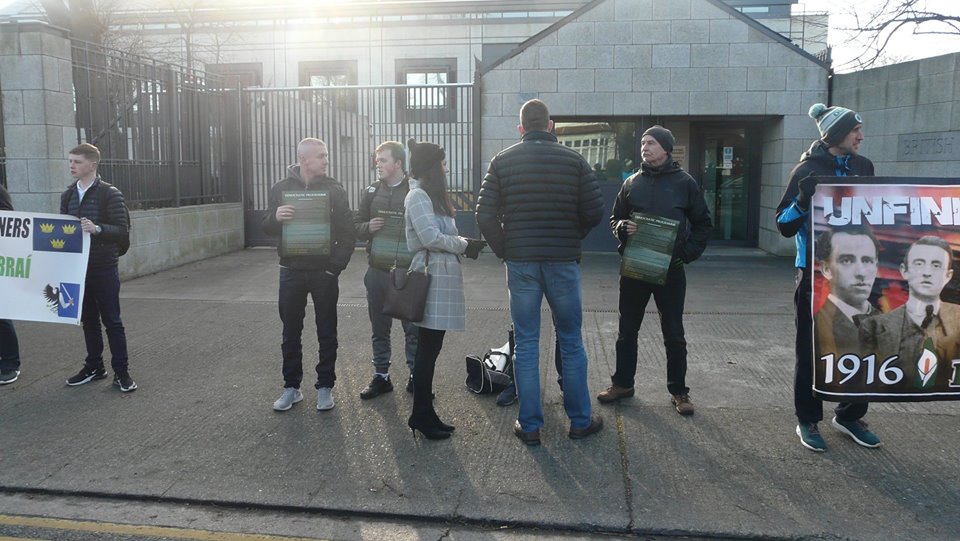
A Garda Special Branch (political police) male officer, accompanied by a female officer, requiring participants to give their names and addresses. (Photo source: Picket participant)
The harassment of the protesters outside the British Embassy was at a level to which Irish Republicans have become unfortunately accustomed: a Garda officer in plain clothes identifying himself as a member of the Special Branch and displaying his Garda identification request, accompanied by another, approached those in the picket line and required them to give their names and addresses, quoting Section 30 of the Offences Against the State Act1.
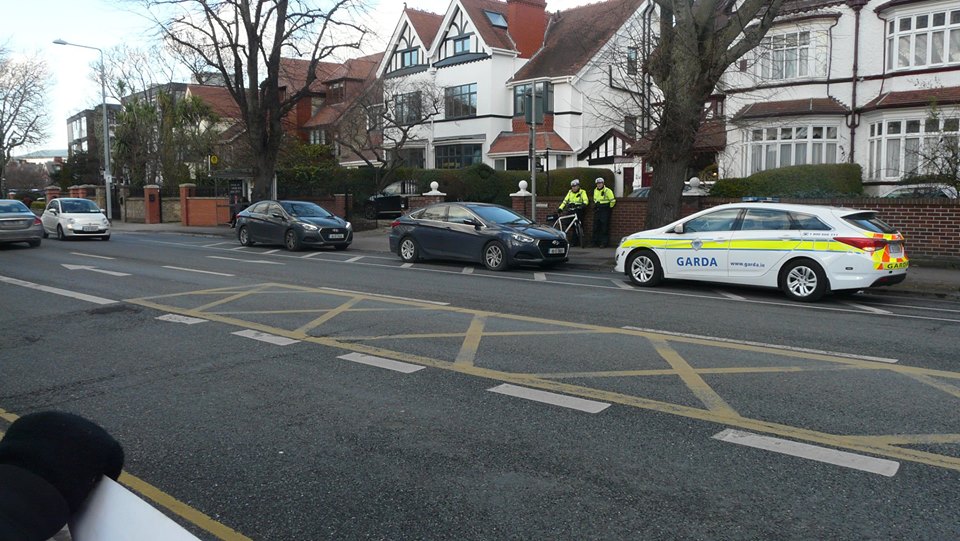
This practice of taking people’s names and addresses is one of intimidation which does restrain some new people from joining such pickets. The surveillance has the same intent, being visible; highly visible on this occasion with three unmarked SB cars, two Garda cyclists and one marked patrol car (in addition to the Garda officer permanently on duty outside the Embassy). “Remember this the next time you hear or read that the Gardaí were unable to respond to a domestic violence call for a number of hours because they were “short on resources’ “, commented one of the protesters. “Or unable to refer young offenders into the Diversion Program2” added another.
Intimidatory police surveillance on the other side of the road from the protest: two unmarked Special Branch cars, two bicycle police and one patrol car. Another SB car was parked on the pavement on the same side as the Embassy, which has a Garda officer on permanent duty also. (Photo source: Picket participant)
The drivers of a number of vehicles, especially taxis, tooted their horns in solidarity as they passed. Although the cold was penetrating through footwear to feet, the protest ended a little after an hour.
FOOTNOTES:
1The section authorises those questions by a Garda officer who has reasonable grounds for suspecting the interrogated may be committing or about to commit a crime – clearly inapplicable in most cases where this is used.
There are many misconceptions about Irish politics and history and the centenary of the inauguration of the First Dáil and of the first shots fired in the War of Independence (one of several of our “wars of independence”) seems like an appropriate occasion to try to tease some of them out.
The Irish Tricolour — national flag of the State but also quintessentially of Irish Republicans.The “Starry Plough”, flag of the Irish Citizen Army. Today it is held to belong variously to socialist Republicans, Revolutionary Socialists and even sometimes social democrats.The Red Flag, flown by Communists, Revolutionary Socialists and even sometimes by Social Democrats.Flag colours of the Anarcho-Syndicalists.A different version of the Starry Plough, usually but not only flown by social democrats. However, it was the flag of the Republican Congress in the 1930s.
For sure, many of those misconceptions belong to those viewing us from outside but here I’d like to deal with those from among our own. These misconceptions are spread equally among the Irish Republicans, Irish Socialists, Irish social-democrats and liberals – but each group believes different ones.
REPUBLICANS
To Irish Republicans (and I think I am objectively correct in not applying that to all who claim the title), the War in the Six Counties was lost because their political and military leadership, or most of it, abandoned the struggle or betrayed it. I think that is a fundamental misconception which leads to further misconceptions about what might be the way forward.
Please do not think for one minute that I am excusing the conduct of that leadership – I am not. Anybody is entitled to abandon the struggle but they are not entitled to claim their departure as a new way forward and to call on others to do the same – that is if they do not wish to be called “traitors”. Nor is anyone, least of all, entitled to take part in the colonial administration and if they do so, they have earned the titles not only of “traitors” but also of “collaborators”.
That judgement has nothing to do with peaceful versus armed struggle, parliamentary participation versus abstentionism or any such debate but is simply this: anyone who participates in colonial government is colluding with the colonist power, the invader, the appropriator. That is a truth understood by most people throughout the world.
It is a different point I am making entirely: the 30 Years War was lost because it could never have been won. To see this written or to hear it said will shock many Republicans and be seen as a kind of heresy – but that does not stop it from being true. Think about it: how could an armed struggle fought in one sixth of the country alone against a modern imperial army, possibly succeed? And that one-sixth further divided with at most 30% (and in reality a lot less) possibly sympathetic to the fighters? Who could sit down to ponder this and believe that struggle had a chance? The remarkable thing is not that it was lost or given up – but that it lasted as long as it did.
The only way that struggle could possibly win would be with the support of the 26-County State and it may well be that those who embarked upon it thought that at some point the Irish bourgeoisie would intervene in some way. They did — but to increase repression of Republicans.
A war might have been won if it had been extended across the whole state. Not necessarily an armed struggle across the whole country but certainly a social, economic, political one. It is not reasonable to expect the mass of people in the 26 Counties to fight year after year for those in only one part of the country, be it a colony or not, and have their own needs ignored. The people in the Six Counties would not do that either if the situation were reversed.
Certainly there was no shortage of issues going begging, from gender and sexuality-related civil rights, housing, unemployment, censorship, clerical domination, bleeding of the national language, sell-out to foreign capital, emigration, absentee landlords, private ownership of natural resources, sexual and other abuse by institutions. However, to take on the spread of issues oppressing or of concern to the people in Twenty-Six Counties would have meant taking on the Irish Gombeen class, its State and its supporting Church. Whether because they still had hopes of the Irish State or did not want to clash with the Church which had the religious allegiance of the majority of their followers – or because they themselves did not want to challenge some or all of those institutions,It is clear that the leadership of the Republican movement then could not bring themselves to that confrontation.
If only a struggle across the whole “island of Ireland” (sic) could possibly have won then it seems logical that only such a struggle has a hope of winning today.
Some of the Republican groups perhaps have this awareness and certainly they have been seen in water and housing protests in the 26 Counties. But they are small groups, their activity patchy, lacking collaboration with one another (even in resisting State repression). More fundamentally there is no strategic plan for organising the working class. In a way, they can’t be blamed for that: they are not communists or anarchists; no matter how revolutionary or left-wing, they are primarily and always Irish Republicans.
REVOLUTIONARY SOCIALISTS
There is another sector whose members might well be nodding their heads in agreement with the above criticism but they too are beset by an important misconception – albeit a different one. They are the communists, socialists and anarchists who would consider themselves revolutionary, i.e who claim to believe in a revolutionary transformation of society. A general disdain of the Republicans runs through this sector, considering Irish Republicans to be simple militarists, adventurist and even sectarian.
Their disdain – or perhaps their fear of being tarred by association – is such that they cheerfully allow all kinds of abuses against Republicans by the Irish State and the colonist statelet. By “allow” I mean that they do not protest against the abuses. Ethically, this is reprehensible but functionally it is dangerous. And in a country where the most numerous section ready to take on the State happens to be Irish Republican of one kind or another, such an attitude by the “revolutionary” Left is nothing short of counter-revolutionary.
This is, in a way, the sector to which I most belong but without that disdain or political apartheid.
Nor do our tiny cliques and small parties exhibit revolutionary spirit even in straight socialist issues, being in general concerned more with peaceful mobilisations and speeches or elections to public office than direct action.
One would think that trade unions would be of particular interest to the revolutionary Left – certainly the Republican movement has paid them little attention. However one finds only small struggles to appoint some Left-winger, usually not even a revolutionary, to the heights of union bureaucracy. When issues of industrial conflict arise, one does find revolutionary socialist shop stewards pushing for militant action.
But where is the education of workers? Where is the mobilisation of revolutionaries of different parties and none to support workers in industrial action? There is in fact no such “Broad Left” organisation in Ireland (not that its example in Britain is anything to emulate) and generally strike support is used for party building. When that particular conflict is over, nothing remains that was not there already.
SOCIAL DEMOCRATS AND LIBERALS
The third sector, shaking their heads at the “militarism” of the Republicans and the “impracticality” of the revolutionary socialists, are the social democrats and liberals. Their misconception is that capitalism and imperialism can be reformed so that they no longer be rapacious.
Maybe there was a time when such a belief was reasonable (though I find it hard to imagine it) but certainly that was long ago. Sincere reformers, benevolent capitalists and aristocrats and scheming reformists have all failed to reform the system of exploitation. Indeed, what historical experience has shown is that even if a capitalist or imperialist wished to subscribe to ownership in common, his or her class colleagues would not permit it.
The electoral path, so detested by some communists and many republicans, is where social democrats and liberals most place their hope and faith. And yet, despite an occasional individual exception, what has the history of those experiments shown us? Corruption of individual activists, wholesale corruption of party leaderships; diversion from the struggles on the ground to bureaucratic struggles in parliaments; careerist trade union leaders and bureaucratic officials; disempowerment of the working people; weakening of organs of real struggle; respect for the capitalists’ laws …..
Not one government of a socialist revolutionary kind has emerged by this process and, whenever it seemed to come close, it was overthrown by military coup or foreign imperialist intervention.
But still, it might work next time, eh? To the advocates of this ideology, of these methods, history does not matter – it can be ignored, denied or expected to cease its operation.
MOVING FORWARD
So where does all this leave us? Yes, I know, in the proverbial cac — but how can we move forward?
This is what I think:
The Revolutionary Left needs to a) organise in a revolutionary manner among the working class and b) to defend the civil right of Republicans;
The Republicans need to unite at least against State repression and take up social and economic issues of working people;
the Social-democrats and liberals should unite with the others on issues of civil rights and social issues;
but ultimately the Republicans and Socialists should ignore reformist illusions.
And what about me?
I do what I can where I think I can have a positive effect – criticise but participate; participate but criticise. And hope to learn not only from the mistakes of others but also from my own.
(click on the link above to find the whole article)
“During this past week, near Strokestown, County Roscommon, a usually tranquil corner of rural Ireland, events have unfolded that exhibit undeniable echoes of the Land War of 1879-82. On 11December, three siblings in their fifties and sixties were brutally evicted from their homestead and family farm by private security goons backed by An Garda Síochána (the ‘Guardians of Peace’, aka the police) at the behest of KBC Bank, or by a receiver acting on behalf of the bank.”
The area in 1879: “Evictions of tenant farmers by bailiffs, agents, and sheriffs, with the backing of the Royal Irish Constabulary, were commonplace during this period. As were organized blockades, rent strikes, social ostracism, and other forms of civil disobedience to resist them.”
We often hear stupid statements. I know I’ve made some myself. I suppose the only way to be absolutely sure of not making a stupid statement is to say nothing – not even thinking carefully before speaking is probably going to be enough protection for the length of one’s whole life. Besides, thinking carefully beforehand is not always appropriate. But we can — and should — avoid repeating the stupid statements of others and making them often.
It’s no surprise that a recent statement by a Government Minister got me thinking along these lines – politicians as a group are particularly prone to making stupid statements. By “stupid’ in this case I mean contradicting logic or common sense, although the intended effect may be carefully considered and cunning.
The Minister in question, Charlie Flanagan, was quoted in a number of newspaper reports as having said, in reference to a recent eviction case in Roscommon, that “violence is never justified”. Nothing unusual in that, you might think and that does show how inoculated we have become by stupid statements.
Charlie Flanagan, Minister for Justice of the Irish Government (Source image: Internet)
Charlie Flanagan is Minister for Justice of the Irish Government. As such, the courts, police and prison service come under his oversight. The police force of the Irish State contains, according to the appropriate Wikipedia entry, 10,459 Garda officers. All of these officers are, it is reasonable to assume, trained in the use of their batons, pepper-spray, handcuffs and physical restraint. Some – and it does seem to be more and more of them – are also carrying firearms. In other words, Charlie Flanagan oversees a force of nearly 10,460 people who are trained to use violence and on many occasions expected to use it – and yet he says that “violence is never justified.”
Yes, I know – he didn’t mean the Gardaí in general, or the prison officers who are also trained to use force, or the judiciary who send people to be incarcerated. He didn’t mean the thugs who were using violence to evict people either. Or the specific Gardaí who supervised the violence being used on the evicted and by their presence prevented defence or retaliation.
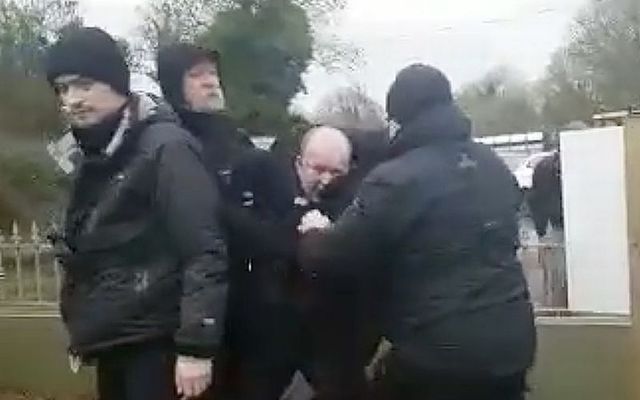
Bailiffs working for KBC Banks evicting elderly people from their home in Roscommon (Source image: Irish Central.com cropped from video)
In system-politician-speak, “violence” is never what the State does and hardly ever what the capitalists do, it is invariably what the victims of the system do to protect themselves or in retaliation. And true to form, Flanagan was referring to the punishment meted out to those eviction gang thugs. So, a statement with cunning intent, to make one action, the violent eviction of people from their home an alright one, and another, the retaliation towards the thugs and repossession of the home, the only one that is “violent”. It makes perfect sense in the way that those who run the system see it and in the way, by perversion of the meaning of words, they want us to see it too.
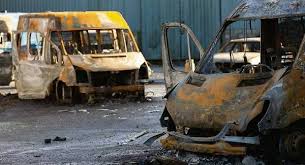
Burned-out vans of KBC Bank bailiffs outside the house from which they had earlier evicted the residents. (Source image: Internet)
But in strictly logical terms, what Flanagan said was nonsense. Unfortunately, it’s the kind of nonsense we hear repeated again and again.
And something like it, through constant repetition, becomes almost common sense. Look at the statement that “Violence never solved anything”: another stupid statement which gets a lot of airtime and mass media repetition with a lot of currency – particularly but not exclusively among the liberal sections of the middle class.
If someone other than a teacher decides to bully you in school and you decide to make it hard for him or her, by responding to violence with violence, in most cases the bully will leave you alone and probably go looking for an easier pick-upon. In that case violence has indeed solved something – at least for you. Of course, it is possible (though not usual) that the situation will escalate from there and the liberal middle class person will tell you that you should report it to the teachers, your parents, etc. What they are expecting is that pressure will be brought upon the bully either directly or indirectly by heavier forces than yours alone. And what lies behind those heavier forces? Ultimately? Violence. It may be the best way to go at times but ultimately it is not non-violent – it is relying for effectiveness on the capacity for violence of others.
Of course, it is possible that the bully may be dissuaded through logic and therapy but that is not often going to happen in our society for a number of reasons.
OK, so you grow up and somebody one night comes to beat you up and take your wallet or purse but you put up a good resistance and either stretch him out on the ground or he runs off. Seems to me that violence did solve that situation.
Taking a more macro look at situations of violence, most people would agree that nations have a right to self-determination. Yet that right has been obstructed and repressed many, many times in history. To take Europe alone, the current nation-states of Poland, Hungary, Czech, Slovakia, Croatia, Austria, Switzerland, Holland, Denmark, Norway and Finland have all been faced with violence and had to respond with violence in order to achieve their independence. Ireland had to do similarly and was partially successful, while a number of other nations remain suppressed despite upheavals and stirrings.
While it may be true that some of those conflicts had questionable results it does not refute the general rule that nations under domination of another state are ultimately controlled by violence and that violence has had to be used many times in response. Nor is the case refuted by territorial share-outs among powers, such as some of the treaties between big powers – the Treaty of Versailles at the end of WWI, for example, authorised the English and French to plunder the Ruhr Valley and was one of the German grievances that helped the Nazis to gain control and begin world expansion. Other treaties have regularly led to violence too, either in states or peoples trying to re-negotiate or negate them, or in suppression of those rebellious forces by the states benefiting from the treaties.
Let us suppose that we are subject to an invasion by a foreign state – that is not too difficult for the Irish to imagine and most European countries experienced it during WWII as did, earlier and later, most of the nations of Latin America, Africa and Asia. The invading force uses violence, of course and they use it more effectively than our defence forces do. Violence worked – in this case for the invading forces. It solved the issue for them – how to overcome our defence forces and occupy our territory for whatever reason they set out to do so.
If we want to resolve the issue to our advantage – to end the invasion and occupation – we would not be able to do so peacefully. That is not a choice the invader will permit us. Our resistance would sooner or later be met with violence by the occupier, whether wholesale in massacres, internment, bans, ’emergency’ laws, curfews etc — or by more selective violence, arrests of leaders and activists, torture, jailing or even executions. And often by a combination of the wholesale and the selective repression.
To rid ourselves of the invader we would have to employ violence too, violence in resistance. It would of course be necessary to combine it with many other tactics – sabotage (violence against things), insurgent propaganda, cartoons, graffiti, song, humour, sarcasm and irony, boycott, demonstrations, pickets, subversion of the enemy’s forces ….. but violence would have to be part of it. There is no nation that freed itself from the domination of a state which was at the time capable of violently suppressing it, without the insurgent nation having had to resort to revolutionary violence.
Returning for a moment to our middle-class liberals, let us imagine the home or business of one is subject to an attempted burglary or robbery. The victim will feel justified in the use of violence in defence of his or her property or home. He or she may choose not to employ that violence themselves – or be unable to — but in that case will certainly turn to the police to employ it on their behalves: “Use cunning to find them and violence to subdue them, bring them to trial by force and punish them by jail. And keep them there for a long time, using violence if necessary.” The middle-class liberal whose business has been robbed or home violated will in most cases not hesitate to, if not use those actual words, to fully imply them by calling for “justice”. However, commenting on the course of a worker’s strike or protest demonstration, he or she will undoubtedly lecture the perceived offenders that “Violence solves nothing.”
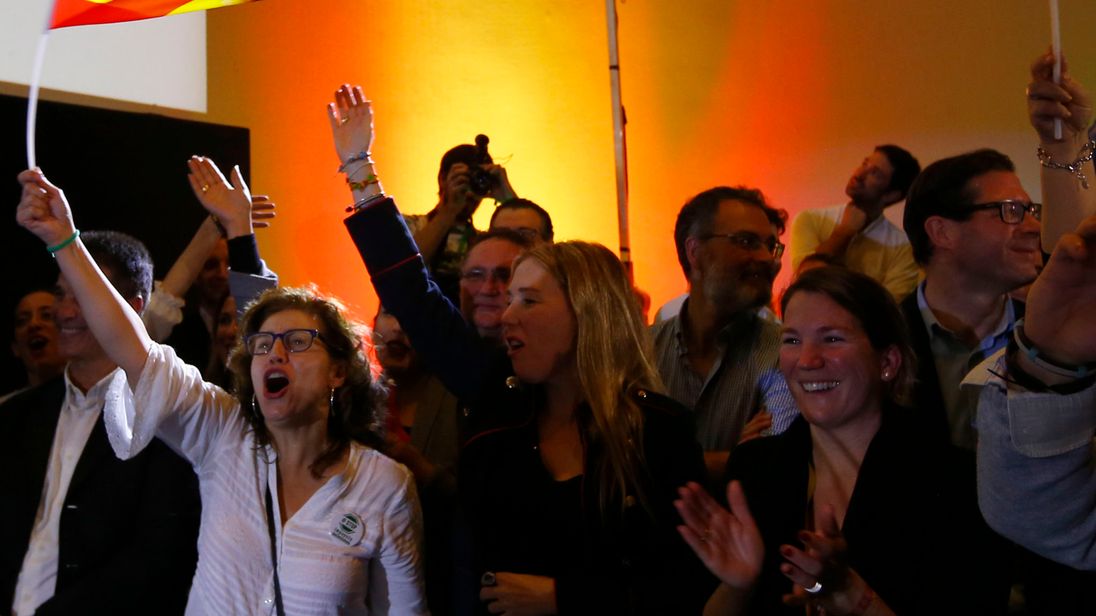
Summary: Alarm is being expressed in a number of quarters, especially within the Spanish state’s territory, at the gains made by the hard right in the regional elections in the southern Spanish province of Andalucia. Held on 2nd December this year, a fairly new party, hard-right Vox won seats for the first time – 12 of them. Ciudadanos, another hard-right party which has been around longer, increased their share of the seats by twelve to 21. Should we be afraid? I think not …. we should certainly be alert – but for other reasons.
Vox supporters celebrate their party’s results in Andalusian elections (Photo source: Internet)
NB: This is not a deep analysis but rather a look at some of the circumstances in Andalusia in relation to those of the Spanish state as a whole and in the context of its history and current situation.
On 2nd December, elections were held in the Andalusian region, one of the 17 ‘autonomous communities’ of the Spanish state. At the time, the social-democratic PSOE controlled the regional government but only with the ‘confidence and supply’ support of the very right-wing party Ciudadanos; the latter withdrew their support and the PSOE called a snap election. The extremely right-wing (to use the most neutral description applicable) political party Vox for the first time had some electoral success and took 12 seats.
Vox is opposed to the right to choose abortion and also to equal same-sex marriage, proposing instead a different “civil union” for gay and lesbian couples. Like all the main Spanish political parties (and many smaller ones), Vox upholds the territorial integrity of the Spanish state but unlike most others opposes also the Statute of Autonomy which created regions with a degree of autonomy (which was part of the deal of ‘Transition’ from the Franco dictatorship, mainly to placate the nations within the state’s territory). The party is critical of multi-culturalism and immigration policies in general and regarding Islam in particular.
The election of those 12 Deputies has caused a wave of panic across many left-wing and democratic sectors across the Spanish state and one hears and reads comments that “this is the first time a party of the extreme right has gained seats in the Spanish state since the end of the Franco Dictatorship.” If that is true, it is so only in the perception of those commentators.
NOT ONLY FASCIST DEPUTIES HAVE BEEN ELECTED SINCE FRANCO BUT FASCIST GOVERNMENTS TOO
The fact is that fascism was never defeated in the Spanish state after the Popular Front Government was overthrown by Spanish military-fascist coup, aided by Nazi Germany and Fascist Italy, in 1938. For four subsequent decades, there was a fascist dictatorship. After that, there was a fake “Transition”1 in which political groupings directly related to the dictatorship formed political parties and the first two governments (September 1975-July 1976) were of unashamed fascist background followed by two of the UCD (July 1976-December 1982), also of fascist background but wearing the veneer of being ‘centre-right’. One of UCD’s most important movers and shakers was Manuel Fraga, the director of murderous State repression of all antifascist, anti-monarchical and independentist resistance during the “Transition”, his slogan being “The streets are mine”.
The next Government was of the social-democratic PSOE, which swept the board, assisted by a panic about the restoration of a fascist dictatorship, aroused by a somewhat farcical very minor attempt at a military coup, the supporters of which entered the Parliament while it was in session and took it over for a while before they surrendered when it was clear they were out on their own.
The PSOE and its associated trade union, the UGT, had been illegal under Franco. The attempt to rebrand the Spanish State as a “democracy” required a bipartisan social democratic party and also a restraining hand on the illegal trade unions (i.e all that were not fascist). But legalising the PSOE and the UGT would be insufficient if the Communist Party of Spain and its allied trade union, the Comisiones Obreras (CCOO) were left out in the cold, where they would certainly cause a lot of trouble. Both parties were anti-monarchist — would they agree to to monarchy being foisted on the public after more than four decades without one? Could they guarantee not to go after any fascists for crimes of torture and murder? Would they support a unionist constitution? Would they control their unions? They could, would and did, even putting up with the murder of union lawyers (PCE/CCOO) and bombing of the UGT headquarters during the ‘Transition’.
The PSOE was in government from December 1982 to May 1986, during which time it ran assassination and terror squads (GAL 1983-1987) against the Basque left-wing pro-independence movement with the aid of high-ranking Spanish military and police officers directing Spanish and foreign fascist mercenaries.
A number of scandals including the one about GAL helped push the social democrats out of government and next in was a new party of the ‘centre-right’. Well, a new name anyway: Partido Popular — its founder was “The-streets-are-mine” Manuel Fraga, leading a split from the UCD. The PP has been consistently alternating in government of the Spanish State with the PSOE ever since: 1996-2004; 2011-2018.
The PSOE got into government of the state again in 2004-2011 and is in once more at the moment, in a minority government, having unseated the PP on a vote of no confidence on a corruption scandal.
THE 2018 ELECTIONS IN ANDALUCIA
The first thing to note perhaps is that the total turnout was under 57% which indicates a high level of disenchantment with the electoral and political system. The PSOE had been in government there for thirty-six years, i.e since the incorporation of the regional government in 1982. What had it delivered for the people in those years? One need only look at the region’s place in the Spanish state’s economic tables – second from bottom.
The election results gave the the PSOE a drop of 7.4% in votes on their last performance and they lost 14 seats. However, with 33 seats they remain the party with the most deputies in the regional Government, with a seven-seat majority over their nearest rival, the Partido Popular and its 26 seats.
Diaz with PSOE party faithful after making statement on the party’s results in Andalusian elections (Photo source: Internet)
The other social-democratic party, a coalition around Podemos, also took a drop: 5.57% in votes and lost three seats.
The combined or total loss of seats to parties of social-democracy was 17 and the sum of their loss of votes was 12.61%.
As it happens, the right-wing Partido Popular also dropped votes and seats, -5.99% and seven respectively.
Ciudadanos, a newer party than the PP but just as hard right, benefitted with 12 additional seats and 8.99% increase in their votes. And then Vox took the remaining 12 seats from a previous zero on only a 10.51 % increase in their percentage of votes (they had stood before but got no deputies elected).
Where did the other votes go? Apart from the 1.8% invalid votes (exactly the percentage drop of voters on the last turnout, curiously), they were spread between 22 other parties or platforms, of which no less than 15 were totally new in elections. Some of those are right-wing but most, going by their titles, seem to represent a band varying from soft to hard Left to Independentist or regional.
In conclusion, the election results show no sudden far-right advance in reality but a newish party of the far right, competing with other far-right parties, took 22 seats it had not had before, while the social democrats, though losing votes, remain in government for the moment.
Some commentators, including many on the Left, have sought to ascribe the rise in the support for Vox as a reaction to insecurity around the fear of the secession of Catalonia from the Spanish state. This is bit rich from often the very commentators who have tried to portray the popular Catalan movement for independence as an elitist movement, motivated by selfishness to keep their wealth and not share it with poor regions like Andalusia.
So we can all relax, we needn’t worry? No, we DO need to worry but not so much for the reason of these election results. We need to worry because of the fascist nature and history of the Spanish ruling class and its State; because fascist groups are on the rise in the Spanish territory; because the Left has real problems in countering fascism and because fascism is on the rise in Europe in general.
The fact is that most of the Spanish Left, from social-democracy to ‘revolutionary’ socialists, are also totally committed to Spanish territorial integrity. That, and their reluctance to mobilise the masses to take decisive firm action against fascist mobilisations and provocations, makes it very hard for the Left to build a mass and effective anti-fascist movement.
ANDALUCIA
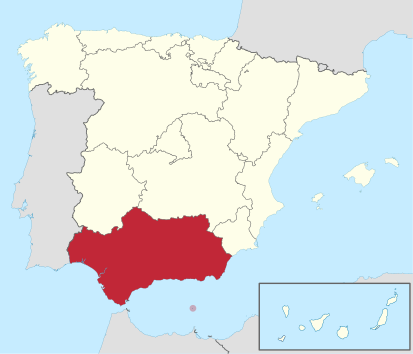
Map of Spanish state (yellow) including Canary Islands with Andalusia in red. (Source image: Wikipedia)
The southernmost part of the Spanish state is where to find Andalucia, sharing a land strip with the Rock of Gibraltar; it is the most populous and the second largest in area of the autonomous communities in the state and its capital is Sevilla (Seville). It is the only European region with coastline on both the Atlantic and the Mediterranean. Parts of the province record the highest temperatures of the state but other parts see quite high rainfall.
The earliest known paintings of humanity have been found in the Caves of Nerja, Málaga.2.The region has been under Phoenician, then Carthagenian control, later under the Visigoths, followed by the Romans and even by the Eastern Roman Empire. For three-and-a-half centuries Andalusia became a Moorish domain from which comes the name (Al Andalus) the region bears today. It was an area of great culture and learning and Christians and Jews were tolerated and protected. The Spanish Christian conquest employed divisions among the Moors, conquered Al Andalus and eventually forced all Muslims and Jews to convert to Christianity or suffer expulsion, allowed only to take the clothes on their backs.
Andalucia in the early-to-mid 20th Century was ruled by a landed aristocracy in a semi-feudal relationship with the mainly rural working population. The region got an early visit from Franco’s military invasion in 1936 and, although there was little armed resistance apart from Malaga and that ill-equipped, an estimated 55,000 were killed deliberately, in executions of thousands of workers and activists of the leftist parties during Franco’s repression.3
The region is characterised by a variety of climatic conditions and topography, inhabited by a great biodiversity of flora and fauna, although some of the latter are quite threatened, such as the Iberian Wolf, Iberian Lynx and the Ibex.
Agriculture and husbandry have traditionally been the main products, with olives, citrus fruits, stone fruits, nuts, alongside some other produce in lower percentages; there is also a depleted but active fishing industry. Andalucia is the single largest producer of olive oil with about 40% of the world market. “One-third of Andalucía’s agricultural land is planted with olive trees, and sales of Andalucian olive oil grew a staggering 56 per cent between 2011 and 2015, to a million tonnes, worth 2,000 million euros. Nearly 500 companies export their olive oil from Andalucía, with Britain the fifth-largest market at nearly 100 million euros.
“Another world-renowned product from Andalucía which is exported all over the world is jamón ibérico de bellota, gourmet air-cured ham made from Iberian acorn-fed pigs, nothing less than a religion for Andalucians, while sustainably-caught bluefin tuna caught off the coast is frozen and sent to Japan to be served as delectably tender sushi.
“In total, one-fifth of all Spanish food and drink exports originate in Andalucía, where the number one area is fruit and vegetables – and tomatoes are the top product”.4
What cause would people in that province have for dissatisfaction that right-wing parties could then exploit? Well, there are no shortage of reasons.
Andalucia is the second-poorest administrative region in the Spanish state. Although unemployment has taken nearly a 4% drop over the previous year, it still stands at an average of 24.4%. Averages conceal other realities and though average male unemployment is almost 3% lower, the female average share is higher than the average by 3.5%. As they age profile drops below twenty-five, the unemployment figures soar to almost 50%.
Table unemployment statistics in Andalucia
Unemployment rate (LFS)
24.4%
28.3%
Male unemployment rate (LFS)
21.6%
25.7%
Female unemployment rate (LFS)
27.9%
31.4%
Unemployment rate less than 25 years
47.9%
57.8%
Unemployment male less than 25 years
48.9%
55.0%
Unemployment rate female less than 25 years
46.6%
61.3%
Unemployed rate over 24 years
22.7%
26.2%
Male unemployment rate over 24 years
19.6%
23.6%
Female unemployment rate over 24 years
26.5%
29.3%
Unemployment rate less than 20 years
66.4%
78.2%
Male unemployment rate less than 20 years
66.8%
76.4%
Female unemployment rate less than 20 years
65.7%
80.5%
(Source: see link for “Unemployment statistics Andalucia)
The situation then in Andalusia may be characterised as one where about every fourth person is unemployed as is every second one under the age of twenty-five. Where paid employment is hard to find, wages are likely to be low, trade union victories harder to achieve and conditions therefore far from the optimum obtainable from the system.
“Between 2000–2006 economic growth per annum was 3.72%, one of the highest in the country. Still, according to the Spanish Instituto Nacional de Estadística (INE), the GDP per capita of Andalusia (€17,401; 2006) remains the second lowest in Spain, with only Extremadura lagging behind.” (Wiki)
Traditionally a region known for agriculture and husbandry, these sectors are now the lowest contributors to GDP in Andalusia. Construction for the tourist industry siphoned off many workers but the collapse of the construction boom left most of those workers with nowhere to go, much of their old agricultural employment mechanised or replaced with migrant labour. Despite agriculture’s very low position in GDP, 45.74 percent of the Andalusian territory is cultivated. That does not mean that those areas are efficiently5 cultivated however and one of the activities for which one Andalusian trade union movement6 has become known is the occupation of agricultural land which is not being adequately or at all maintained, due to absentee owners or land held by banks but not in production.
“The large landowner past of Andalusia has not changed substantially although the banks and some companies now own much of what belonged to semi-feudal aristocrats. “The agrarian census of 1982 found that 50.9 percent of the country’s farmland was held in properties of 200 or more hectares, although farms of this size made up only 1.1 percent of the country’s 2.3 million farms. At the other end of the scale, the census showed that 61.8 percent of Spain’s farms had fewer than 5 hectares of land. These farms accounted for 5.2 percent of the country’s farmland.”7
In May of this year the trade union SAT (Andalusian Union of Workers) published a denunciation of a new Land Law proposed by the PSOE in which they also pointed to some structural problems and their impact on the working people of the region8.
“The most recent act of savagery is the new Land Law that they (PSOE) intend to approve, to finish hanging any dream of Agrarian Reform for our working people of Andalusia. Andalusia is not understood without the struggle for land, and this is more recent than it seems, much more real and topical than we would like.
“The concentration of land ownership is a problem that annihilates our people, currently in Andalusia, 2% of the owners have more than 50% of the arable land, and the worst is that this figure is increasing.
“If we go to Jaén, this figure is even more scandalous, because 4% have 66%, and much of it without giving a job, as is the case of Cortijo del Aguardentero, our Cerro Libertad, one of more than 150 farms, the majority underutilized by the BBVA9 in the Jaén de Piedras Lunares and Olivares de Miguel Hernández areas.
“These figures contrast with the alarming fact that in Andalusia every three days a worker dies, or that more than 60% of Andalusian employees earn less than € 1,000 per month. Also alarming are the number of marginalizations, risk of poverty and lack of school resources, all at more than 40%.
“There are laws that can put an end to all this, but there is no political will in a government that is more a plug-in factory than a socialist party, which only seeks to perpetuate itself in power, being supporters of corrupt banks, all at the cost of death of our land.
“There are alternatives:
1 ° Repeal of this Land Law proposal.
2 ° Implementation of Law 8/1984 of Agrarian Reform of the Statute of Autonomy of the Junta de Andalucía on farms that can be clearly improved.
3 ° The land has to fulfill a social function, for the human and sustainable development of Andalusia.
4th Comprehensive Agrarian Reform, which allows the Usufruct and Land work in Andalusia. Work in the labor force, in the sowing and harvesting, in the primary sector. We do not want property, which must be of a public entity, we want to work and live in peace.
5th Creation of productive, industrial and agro-sustainable Andalusian fabric, generating employment in the transformation and packaging of the product collected.
6 ° Domestic consumption and export of the sown, harvested and agro-transformed product, giving employment and work in the tertiary sector, services.
“This would suppose a Revolution of our earth, a valorization of what we were, of what we are and what we want to be: A FREE PEOPLE WITH FREE PEOPLE.
“This is possible, but political will is needed, and for that, and more importantly, we need the human will to mobilize, as we are defending with our sweat and our lives El Humoso in Marinaleda, Somonte in Córdoba and Cerro Libertad in Jaén10.
“Challenge to the Andalusian society to face with arguments and mobilization the nonsense and unreason of the government of the PSOE of the Junta de Andalucía.
“We announce mobilizations this summer for this, and we call for you to join.
“Andalusians and Andalusians, get up, ask for land and freedom.”
And then, on top of capitalist exploitation and mismanagement, there is corruption. “A recent probe revealed the extent to which PSOE officials exploited their power in the region of Andalusia, where the party has governed without interruption since the return to democracy. Two former regional presidents, Manuel Chaves and José Antonio Griñán, are currently on trial for their alleged part in a scam that included fraudulent early retirement packages, company subsidies and commissions handed out to the tune of €136 million”.11
A recent corruption table based on individual cases puts Andalucia way over all other regions and the PSOE in about 25% of the corruption cases by party (see References for the link to the report).
CONCLUSION
There was no huge swing to the hard right although considering how the social-democrats had abused the votes the people gave them, it would not have surprising if there had been (and there still might be).
Despite their appalling record, the PSOE got 33 seats, the party with the most in the regional Government. That is worth thinking about – despite the crap the working people of Andalusia have had to put up with from the PSOE, they still gave most of their votes to the social democrats. Since this cannot logically — on the performance of the party for the people – be as a result of great affection for thePSOE, it seems likely to indicate at least a dislike or fear of the right-wing parties.
What actually happened is that in a regional election in an impoverished region, on a low turnout and with many candidates; within a state where fascism was never overthrown, with huge legal and illegal repression, with the Partido Popular — a part of the Franco heritage — regularly in government and other right-wing parties snapping at its heels, where social democracy and the established communist party colluded most shamefully with fascism and an imposed monarchy, where the history of the Anti-Fascist War is not taught: a new version of the bedrock Right in Spanish politics won seats in a regional government which it had never won before.
That is what happened. But that is far from being the first time the hard Right won seats in the Spanish state – it has done so regularly in all elections outside parts of the Basque and Catalan countries and has regularly been in government.
Those on the Left who are now wailing about Vox’s success have been and are upholding the myth of Spanish democratic politics since the Transition. They are colluding in the decades of suppression of the Basque and Catalan national movements and the propaganda against them. And many of them have marched with the Right – including fascists – in demonstrations in support of permanent Spanish union, against ‘terrorism’, etc.
Those on the Right who are complaining about Vox are being disingenuous too: they marched with Vox and other fascists for a ‘stronger Spain’ and against the independence of the nations; they saw the fascist salutes and emblems and heard the fascist slogans (whether they joined in with those or not). They were happy to have Vox take out prosecutions against Catalan independence activists and politicians.
NEVERTHELESS, WE SHOULD BE WORRIED. Because generally throughout the Spanish state, the fascists are mobilising on the streets. The fascists are particularly worried by the independentist movements in Catalonia and in the southern Basque Country as well as by proposals to demolish the shrine to Franco and Riveras12 and to remove their remains to a common graveyard. The fascists have strong links with the Spanish police and armed forces and the latter have shown themselves particularly tolerant of the behaviour of fascists on the streets. And in preparation for the repression of the working class in economically austere times to come, fascists have been mobilising throughout Europe with state laws and procedures becoming more repressive. Migrants are being targeted both for extra exploitation and for attack by word and action. We need to do more than worry – we need to mobilise and find ways to unite in effective action.
1All the fascist police commanders, senior armed forces officers, judiciary, lawyers, clergy, senior civil service administrators and academics retained their positions. All the business men and media barons continued and kept whatever plunder they had managed to appropriate during the war and after.
3Executions: “ …. in the city of Cordoba 4,000;in the city of Granada 5,000;in the city of Seville 3,028;and in the city of Huelva 2,000 killed and 2,500 disappeared. The city of Málaga, occupied by the Nationalists in February 1937 following the Battle of Málaga experienced one of the harshest repressions following Francoist victory with an estimated total of 17,000 people summarily executed” (Wiki).
5To be confused with “intensively” which usually implies large-scale monoculture, chemical fertilizers and chemical sprays of fungicides, pesticides and insecticides, along with very advanced mechanisation.
6Sindicato Andaluz de Trabajadores (SAT, ‘Andalusian Union of Workers).
12Valle de los Caídos, a park built in part by political prisoner labour, containing a mausoleum for Franco and Rivera’s remains, a site of frequent fascist demonstrations in homage to the memory of both men.