(Reading time: Introduction, one minute; Part One: 5 mins; Part Two 2 mins: Part Three: 3 mins; Part Four: 2 mins; Total: 13 mins.)
Diarmuid Breatnach
INTRODUCTION:
Although I often think about the big questions – and am generally guided by my philosophy on them, my mind and energy are usually too occupied with specific struggles to focus on them for long. Recently however I had the opportunity and the need to think about the war, the one we have yet to win.
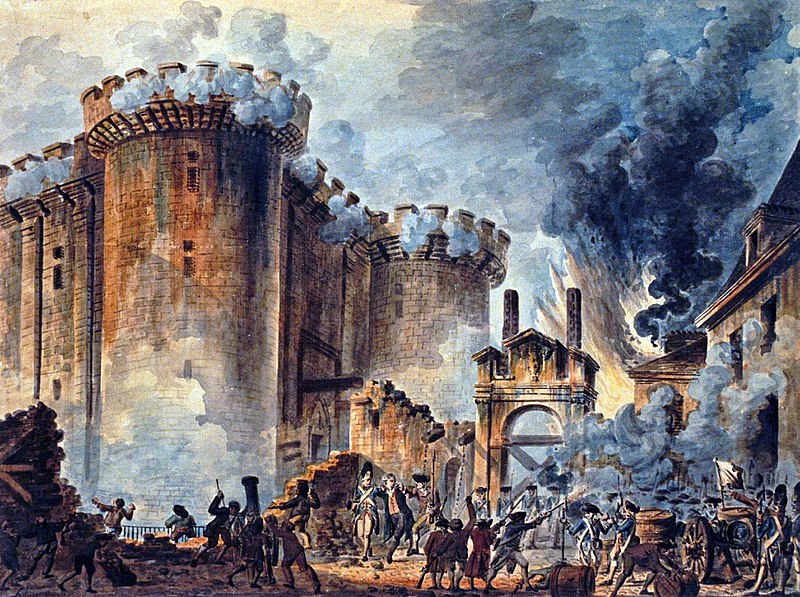
The Storming of the Bastille (translation), French Revolution, 1789 by Jean-Pierre Houel. (Image sourced: Internet)
But to which war am I referring? The Irish war of national liberation that has been flaring up for centuries, being lost each time before flaring up again? Or the class war, which has had a few sharp Irish episodes but has been, for the most part in Ireland, in abeyance? The answer is BOTH, though it may seem that my emphasis in the discussion, certainly in the early part, is on the national liberation war.
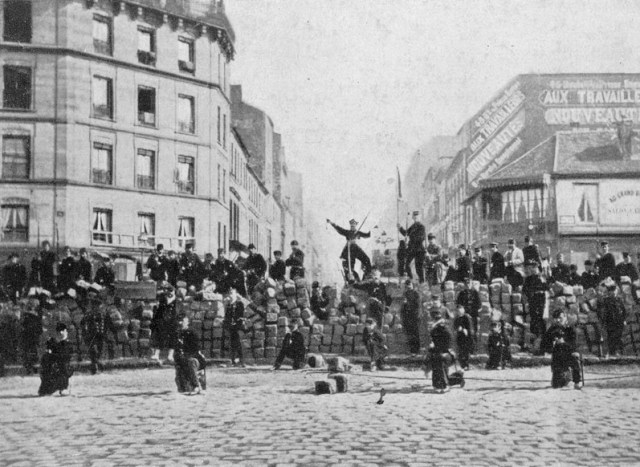
Communards at barricade, Paris Commune 1871. (Image source: Internet)
In order to imagine how we might win, it is helpful to examine past struggles and analyse what went wrong with them. Pessimists love to focus on those things I know – but in order to push us towards reformism or just surrender; my approach instead is from a revolutionary perspective.
Generally, Socialists analysing the class struggle don’t even ask themselves why we have not had a revolution yet.
From week to week, month to month, they tend to focus on this or that particular trade union or social struggle but without going into the big picture. It seems as though they can’t even imagine a socialist uprising in Ireland, it’s just too far away to think about, apparently. But if one can’t even imagine such a revolution, how could one consider the necessary steps to get there?
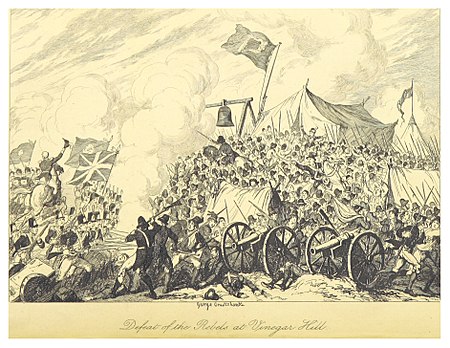
“Defeat of the Rebels at Vinegar Hill” by George Cruikshanks, i.e United Irishmen last major position in Wexdord overrun, 1798.
Irish Republicans on the other hand are often thinking in terms of revolutionary struggle, usually including armed struggle. However it seems to me that Irish Republicans don’t like analysing past failures of the movement but when they do, their verdicts tend to be that the leaders betrayed the struggle or that taking part in public elections corrupted the movement; or that infiltration, spies and informers was the problem. And some other reasons. The thing is, although all those things played a particular part, they are not the fundamental reason.
Sections to follow:
PART ONE: THE THIRTY-YEARS’ WAR – DOOMED TO LOSE
PART TWO: COLLECTING THE FORCES FOR REVOLUTION
PART THREE: THE ABSOLUTE NEED FOR UNITY – BUT HOW AND WHAT KIND? WITH WHOM?
PART FOUR: UNITY AGAINST REPRESSION
Diarmuid Breatnach is a veteran independent revolutionary activist, currently particularly active in committees against repression, in some areas of internationalist solidarity and in defence of historical memory.
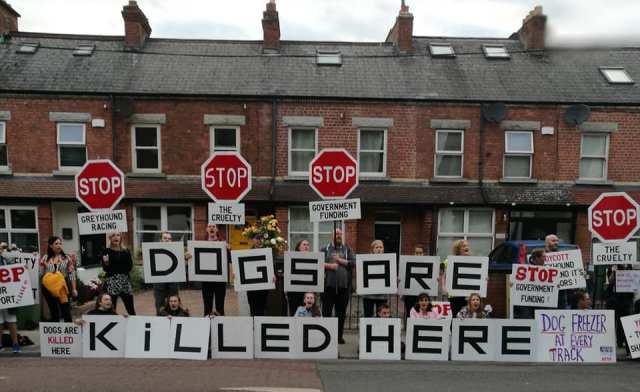
People attending Shelbourne Park Greyhound Stadium on Saturday last (20th July) were booed, a number of passing cars and vans blew their horns in support of protesters but one dog racing supporter assaulted a protester. The picketers quoted an RTÉ television documentary that the industry is killing large numbers of dogs annually; they want an end to Irish Government funding for the industry and dog racing banned.
Section of the protesters on one side of the street outside Shelbourne Racing Stadium on Saturday 20th July.
A quick trawl through Google reveals greyhound track or stadium protests at a number of venues in Ireland as well as Dublin, including Cork, Limerick and Newbridge and there are campaigns to ban greyhound racing in a number of other countries (although apparently dog racing only exists in another eight countries world-wide).
The protesters on Saturday chanted a number of slogans, including “You bet, they die!”, a reference to people betting on the outcome of the races and to the high death-toll of dogs bred for activity. Greyhound bitches are bred to what are considered successful dogs and breeders will choose pups to raise from the litters, killing the rest. Only some dogs are considered suitable for racing and after trial, some more will be killed (or perhaps sold abroad, which may even be worse). Finally, when their racing life is over, most will be killed also. The industry says it finds homes for old or worn-out greyhounds but there are not enough homes to take them all in.
The Irish Government funds the industry to the tune 16M euro and campaigners say this is not justifiable to fund an industry killing dogs for profit-making. In addition, according to the RTÉ documentary 7,000 dogs are exported to Britain, effectively sustaining their industry – on Irish tax-payers’ money. Some of these dogs are transported from Ireland in unhygienic conditions, even by people who are banned from the greyhound industry in Britain for doping or keeping dogs in bad conditions, since their bans are only effective in Britain itself.
Doping of dogs has increased enormously in Ireland and Britain, according to people inside the industry but very few have been charged or the kennel breeders sanctioned by the industry’s regulating body. The RTÉ team found that 80% of animal doping chemicals seized over the years have come from greyhound kennels, but more than 50% seized in a three-year period came from one dog trainer, Mr. Gerry Holian in Athenry.
The film also showed dogs being badly treated abroad and produced evidence to show that restrictions on their export from Ireland and Britain are routinely evaded.
Line of protesters facing the entrance to the dog racing stadium last Saturday (another longer line on the opposite side). Two Gardaí of the Public Order Unit are visible too. (Photo: D.Breatnach)
VIOLENCE TOWARDS PROTESTERS
Early during the protest last Saturday, a man physically attacked a woman protester outside the Shelbourne Stadium. Witnesses gave evidence to Gardaí who advised them to go to a Garda station and make a complaint, without explaining why they themselves would not act upon the reported crime. Some Public Order Unit Gardaí arrived soon afterwards and some of the protesters, including the assaulted woman, did go to the station and made a complaint.
Four days after the Dublin protest and the attack on a protester, the Irish Greyhound Board posted the following statement:
The IGB would request, and based on the strong advice from An Garda Siochana, that the greyhound community would not engage in any form of ‘counter protest’ at greyhound tracks and stadia as such activity is likely to enflame an already volatile situation and result in an unsafe environment for all. Such outcomes do not reflect well on anybody, including the greyhound community.
A Bus Átha Cliath public transport vehicle carries the message. (Photo source: Bart Hoppenbrouwers)
A SOCIAL AND CULTURAL ACTIVITY?
Of course for many people attending dog racing, who will be unaware of the high death-toll endemic to the industry, it seems a harmless night out. Even many who do not attend dog racing will be unaware of the cost to the dogs. The RTÉ Investigates TV documentary Racing for Their Lives quoted figures from a commissioned report that 6,000 greyhounds are killed every year. That report was kept secret by the Irish Greyhound Board until the RTÉ Investigates team revealed they had a copy of the Report and then the IGP released sections of it. As the protests continue, even those who have not seen the program will become increasingly aware.
(Photo: D.Breatnach)(Photo: D.Breatnach)
In many working-class communities greyhound racing has been a participative activity for individuals owning one or two dogs, as outlined in “The Town I Love So Well”:
In the early morning the shirt-factory horn Called women from Creggan, the Moor and the Bog
While the man on the dole played the mother’s role,
Fed the children and then trained the dogs.
This activity is not comparable in scale, turnover or treatment with the dog-racing industry of greyhound breeding and training establishments and racing stadia and, in any case, is much reduced as a passtime now.
There are 16 dog-racing stadia within the Irish state and two in the Six Counties. Currently protests are organised outside Shelbourne Stadium for two evenings a week, Tuesdays and Saturdays, while protesters at other stadia have their own arrangements.
End.
View facing north (the Stadium is to the left of photo, the entrance just by the visible column). (Photo: D.Breatnach)
Published by kind permission of Dublin Anti-Internment Committee from their Facebook page End Internment
INTERNATIONAL FLAVOUR ON IRISH ANTI-INTERNMENT PICKET
Clive Sulish
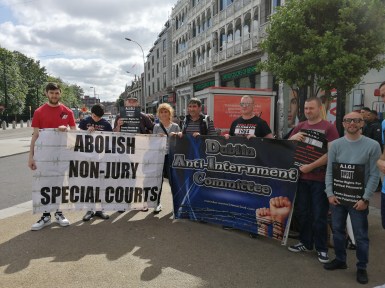
The Dublin Anti-Internment Committee was out again on Saturday 13 July (the day before Bastille Day, which marks the French Revolution, the taking of the Bastille prison in Paris in 1789 and the freeing of political prisoners by revolutionary forces).
The campaigners were out on their monthly picket to raise awareness that, as their leaflet headline says: INTERNMENT CONTINUES IN IRELAND BUT BY OTHER NAMES. When political activists (at the moment Irish Republicans) are arrested and refused bail, that is effectively internment without trial. When political ex-prisoners released under the Good Friday Agreement have their licenses revoked and are taken to jail without charge or hearing, that is also effectively internment.
The picketers lined up with their banners and some placards outside the St. Stephen’s Green Shopping Centre which is at the top of Grafton Street and facing the main entrance arch to the Stephen’s Green park. The official name of this monument is Fusiliers’ Arch as it carries the names of many of the Dublin Fusiliers who were killed in the Second Boer War fighting for the British; for the same reason it also widely known as Traitors’ Arch.
Stephen’s Green Shopping Centre in backgrounBasque couple joins the protestCatalan supporter inlcuded in photo with west side of Stephen’s Green Park in the backgroundDAIC supporter hands out leaflets to passers-by (part of Fusiliers’/ Traitors’ Arch in background)
Stephen’s Green also contains monuments to people who were political prisoners in their time: Ó Donnobháin Rosa, a Fenian who survived where many died as a result of the conditions of their long imprisonment; United Irishmen Emmet and Tone, both before execution and ICA officer Markievicz, who was an officer in the 1916 Rising Garrison here (and whose death sentence was commuted).
Just over a hundred years ago, this whole area was a battleground under the command of the Irish Citizen Army, the workers’ army created in 1913 to defend striking workers from the Dublin Metropolitan Police. Some of the structures here carry the marks of many bullet impacts.
The area chosen for the picket on Saturday is a very busy one with a constant flow of pedestrians shopping in Grafton Street and Stephen’s Green Centre, tourists and people relaxing walking through, going to and coming from the Green. Many leaflets were distributed.
The protester were joined today by the Abolish the Special Courts campaign and appropriately so, since many Republican activists are charged and taken before these courts where they may be denied bail and kept in jail until their trial so that in the unlikely event of their being found not guilty by these no-jury political courts a couple of years later, they will already have spent that time in jail anyway. The Special “Criminal” Courts are the Irish state’s equivalent of the Diplock Court in the Six County colony.
There was something of an international flavour to the picket on Saturday, with a Catalan comrade supporting the picket and distributing leaflets and briefly a Basque couple supporting it too.
The Dublin Anti-Internment Committee expects to be at another location in Dublin town in some weeks’ time and welcomes support from across the democratic spectrum.
(Translation from article in Castillian by Diarmuid Breatnach)
The Andalusian Union of Workers (SAT) has accused CCOO (Comisiones Obreras,major Spanish trade union – Translator) of “betraying” agricultural workers with the signing of an agreement with the Asaja employers — the signing took place last Thursday in Seville — where hard-won rights have been surrendered, including the 15-minute sandwich break. Accordingly, it will propose a common front to all trade unions to promote the fight for an (alternative) Andalusian agreement.
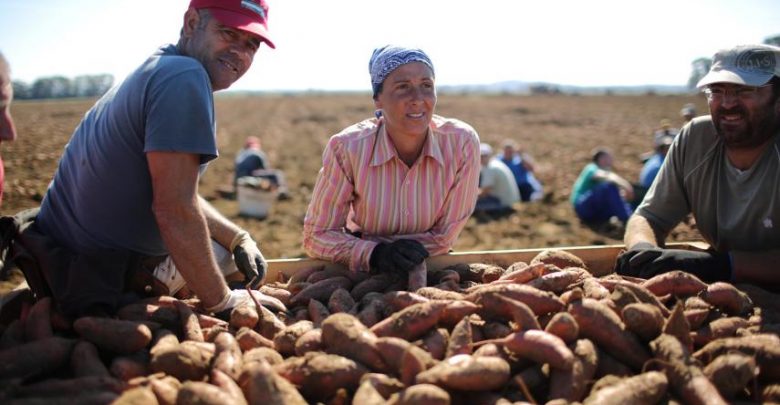
Migrant workers in a sweet potato plantation in Jerez, Andalusia. (Source photo: Juan Carlos Toro, La Voz del Sur)
The SAT “cannot endorse an agreement where you give up the 15 minutes sandwich break, a workers’ victory from a long time back, which has been respected for generations, even during the Franco regime. An achievement that the employer, Asaja, has always wanted to eliminate and has succeeded now thanks to the betrayal of bureaucrats who never got their hands dirty or set foot on the field in their life”.
To this, adds the union, “you cannot endorse a de facto wage loss since the Pyrrhic rise of 1.25% per year does not compensate for the loss of the 15-minute sandwich break, which amounts to 3.8%. In other words, in reality, what CCOO has signed is a salary reduction of two and a half points” (per cent). “This is an outrage and a complete betrayal. There is no other name for it. We would like to say something very different, but above all our duty is to the workers who have been sold and betrayed once more”, they added.
The situation in the Andalusian countryside and the province of Seville, in particular, where some 120,000 people work in the sector, is very precarious. The economic crisis has hit the countryside and its workers hard. The working conditions implemented in the Andalusian countryside, according to the SAT, “seem from other times, thankfully now past.” Breach of agreements is the rule, piece-work predominates, which sometimes means that after a long day of work you only take 20 euros home, well below the salary established in the agreements.
Map showing Andalucia region (in red), Spanish State (in cream) also Canaries and part of coast of North Africa. (Source image: Internet)
There are situations, they add, where fraud is evident by not declaring the workers employed. A fraud that can make a millionaire, since it can mean millions of undeclared euros that put health, pensions and our social protection system at risk. In addition to situations of genuine exploitation of workers — which in many cases border on pure slavery — there continues to be a significant reduction in income to Social Security, as well as a smaller amount of peonages that subsequently give the right to recognition of the subsidy and other benefits (? — Trans).
The reality that is being imposed not only affects labour rights, it is also “strategic suicide”. “The reality,” explains SAT, “is that with these mafia practices they are dropping the market price, so the product loses added value and undermines the market. The final result is to depreciate the product having a direct impact on the living conditions of day-labourers and on the economy of the towns. There have been innumerable complaints filed in the Labour Inspectorate, some of which have led to criminal proceedings being taken for crimes against the rights of workers.”
Accordingly, an Andalusian agreement that puts in place a minimum is necessary and urgent: six hours of work (sandwich break included); 60 euros for the normal working day; 84 on Sundays and holidays; effective ban on piece-work; wage of 69 euros for work with machinery; 96, on Sundays and holidays; on rainy days (when work is not possible) 50% will be paid for showing up at work, and the full wage from two hours of work; 0.27 euros mileage.
It is fundamental, they state in concluding their communiqué, to establish “a common front to fight for an Andalusian agreement with these minimums. It is also necessary and urgent to change the system of union elections in the field, a measure approved in the Congress of Deputies, and grant voting rights to non-permanent workers who represent more than 95% of the workforce in the Andalusian countryside.”
COMMENT:
Diarmuid Breatnach
The CCOO, Comisiones Obreras is one of the two mega-unions in the Spanish State, the other being the UGT. The CCOO was controlled by the Communist Party of Spain (PCE) and the UGT by the social-democratic PSOE; both parties and their affiliated unions were outlawed during Franco’s time. When the Transition to “democracy” was being engineered after Franco’s death, it was considered necessary to legalise the PSOE in order to have a two-party system and therefore necessary to legalise the UGT. However, it was the other way around for the CCOO and the CP. The Comisiones Obreras were by far the largest and most militant trade union and, though illegal, had built up a substantial following among the workers of the Spanish State. To effect as smooth a Transition as possible, it was crucial to legalise the CCOO and therefore to bring the Communist Party on board. Both political parties agreed to a deal, including recognising a monarchy with a King chosen by Franco and publicly supporting a forced union of all nations within the state by a new constitution.
The southern Basque Country and Galicia have a majority of unions of their own nation but everywhere else within the state, the CCOO and the UGT have the majority of workers as members and the majority of elected representatives. Although the CP’s control of CCOO has slipped over the years, the UGT is still strongly associated with the PSOE. There are also some independent trade unions, like the SAT above and also some others based on specific work locations.
SAT has a history of militancy, fighting for its mainly agricultural work force in which, as it states above, the vast majority are migrant workers. The union also campaigns for efficient and socialised use of Andalusian land, much of which is owned by banks and left empty; in addition its spokesperson was arrested last year for “insulting the Monarchy”. It is worth remembering that Andalusia was in medieval times the famed Moorish caliphate of Al Andalus, in many ways the jewel of the Iberian peninsula.
When Franco’s troops were ferried to Andalusia from the Canaries by German Nazi transport, largely without armed opposition in 1936, they butchered 55,000 republicans, socialists, communists, communists, trade unionists and anti-fascists.
As soon as the “Transition” went through after the death of Franco, the PSOE was voted into power in the Andalusian regional government, where it has held the absolute majority ever since – until the regional elections this year. Years of corruption and complacency saw its voting base diminish and, though it still holds the most seats, a right-wing coalition of the Partido Popular, Ciudadanos and Vox, all of which can trace their origins to Franco, has taken over. Many observers think is therefore all the stranger that the CCOO should bring in this agreement at this time.
Report by RAÚL BOCANEGRA in Publico.es (translation and comment by Diarmuid Breatnach).
Mass grave of victims of Francoist repression, Burgos. (Photo source: Internet)
“The City Council of Seville has guaranteed on its own to provide the necessary funding — 1.2 million euros — to exhume the Pico Reja pit, in which historians believe that there are at least 1,103 bodies of of victims of the repression, led by the General Queipo de Llano, following the military coup of July 18, 1936.
This exhumation will be the largest ever to be undertaken in Spain, following that which that was carried out in Malaga, in the San Rafael Trench, between 2006 and 2009, and may indicate the path to take for the other capitals (of Spanish state regions – Trans).
The Mayor of Seville, Juan Espadas (PSOE), guaranteed that the grave will be exhumed throughout the mandate of the current Council. “It is a truly historic step in Seville and one of national importance, since it is perhaps the biggest mass grave that [at this moment] has a definite project for its exhumation,” the Councilor said at a press conference.
“And, therefore, it is also one of the most important projects in terms of Historical Memory to be undertaken in our land, due to the importance and volume of the Pico Reja mass grave. It was a commitment that this Government (i.e of the Andalusian region) gave during the past mandate to relatives and memorial groupsand today it is made a reality with this tender,” added Espadas.
“Next Friday the City Council of Seville, through the Governing Board will approve the specifications and, therefore, the public tender for a technical service for the exhumation and genetic identification of the bodies of the Pico Reja mass grave, in the Cemetery of San Fernando,” reads a statement issued by the City Council. “The ultimate goal [of the exhumation] is to dignify the memory of the people who were thrown there, give them a dignified burial and attend to the requests of their families,” adds the Council (statement – Trans).”
Militia Women of the Anarchist FAI -CNT in Catalonia, early years of the Spanish Anti-Fascist War. Women in areas captured by the Franco forces were exposed to endemic rape and many female prisoners were shot after being raped. (Photo source: Internet).
BEGINNING AND COMPLETION OF WORK
“Accordingly, Espadas will not wait for the Council of Andalucía or the Regional Government to sign the agreement, to which they had committed themselves. Confirming now, at the start of the mandate, the works, the Mayor ensures that the exhumation will not be delayed and will be carried out throughout this term. Municipal sources assured Público of their belief that both the Council and the Andalusian Government will collaborate with the exhumation, the Andalusian Council not before September.
Should they contribute money, the amount would be deducted from the 1.2 million that the Council calculates as necessary to carry out the works. Espadas recalled that the signing of an agreement in this regard with the Board and the County Council to finance these works is still outstanding. “And let’s hope that it is signed as soon as possible.”
“This contract guarantees the beginning of the work and its conclusion, without waiting for the remaining public administrations –- provincial, Andalusian and national — to finalise their contributions,” reads the Council’s note.
Espadas and the Delegate for the Department for Equality, Education, Citizen Participation and District Coordination, Adela Castaño, related the details of this contract to relatives of the victims and to the different organisations involved in the area of Historical Memory in Seville. “Do not fear, the exhumation and the identification of bodies will be done,” the Mayor assured them.
THE DETAILS
The company that gains the contract must include at least one historian, five professionals in Forensic and Physical Anthropology, five in Archeology and 10 auxiliary support workers. “With the maximum guarantees of scientific rigor, a survey will be performed, material collected on the surface, excavations made in the pit, exhumations and recovering of bodies and remains,” says the City Council in the note. “Likewise, it must preserve and safeguard, also with all scientific guarantees, the samples of bone remains and biological samples taken from the family members until delivery to the University of Granada for genetic identification,” the City Council insists.
The project will be be completed in three phases, explained the Council. The first concerns the exhumation itself and the identification of the bodies, along with works including: the archaeological excavation; dealing with the remains found (the excavation and the direct and individualized identification of these bodies will determine whether or not they are relatives); exhumation (identification, recording of traces of violence and individual extraction of each body or remains); forensic anthropology (that is, determining sex, age, pathologies or anomalies); anthropological analysis in a laboratory manner; and conservation and protection to preserve these skeletal remains and DNA analysis.
The second phase will consist of the presentation of a final report as a logical contribution to the history of Franco’s repression. And the last phase will be the final destination of the remains.
The City Council will respect at all times the wishes of relations about the identified remains. The unidentified remains and those which the relatives wish to remain in the same place, “will be buried in an authorised space with appropriate technical indications for future identification”.
After finishing the works, “the area will be restored as an expository and explanatory site of the historical significance of the Pico Reja pit”. The successful bidder must submit a proposal for reconstruction of the current site that includes a columned monument to honor the victims.
Exhumation work on mass grave of Franco’s victims in Burgos. (Photo source: Unai Aranzadi)
COMMENT:
(Diarmuid Breatnach)
According to official figures, 120,000 victims have been identified (not exhumed) from 2,591 unmarked graves around the Spanish state. The areas with the largest number of graves are Andalusia in the south and the northern regions of Aragón and Asturias – in Andalusia alone, 55,000.
Map of grave sites of victims of Francoist repression in Andalucia (Photo source: Internet)
A mapping work undertaken by the Council of Andalusia region, which was presented publicly in the regional capital in 2011, illustrates 614 mass graves in 359 Andalusian municipalities. Only around half of the 47,000 bodies that were discovered have been identified due to there being no relatives available for DNA tracing or because calcium oxide (quicklime) had been thrown over the bodies.1
“In Malaga province alone there are 76 mass graves in 52 towns, containing the remains of 7,471 people who were killed by General Franco’s forces. The largest of these mass graves was discovered in Malaga city’s San Rafael cemetery. 2,840 bodies were exhumed in early 2010, although more than 4,500 are registered as having been buried there”.2
The usual figure given for the total of non-combat killing by Franco’s forces is 150,000 and which does not include those who died of malnutrition and lack of adequate medical care in prisons and “penal battalions” or through confiscations, or economic and financial sanctions in areas occupied by his forces. Nor does it include the civilian victims of bombing by military-fascist air force, whether of cities or of refugee columns.
Against that, the total figure for non-combat killings by the forces against Franco are estimated at around 50,000. Also, while the latter killings for the most part took place in the early months of the military uprisings, before Republican Government control could be established, most of the non-combat killings by Franco’s forces were carried out after they had beaten the resistance and occupied the area and much of it also after the war was over. Typically too, according to Paul Preston (The Spanish Holocaust (2012), Harper Press), women were routinely raped before they were shot.3
The issue of the executed after a cursory military trial or simply taken out and murdered by Franco’s forces is a live one in the Spanish state today. Before Franco’s death it was not even possible to discuss it publicly and bereaved relatives were not permitted to mourn publicly – to hold a funeral or to have a mass said for their souls according to Catholic custom or even to mark their graves.
The Transition process to convert Franco’s Spain into a “democracy” accorded legal impunity to the perpetrators of even the worst atrocities during the Civil War but unofficially extended beyond, to the years afterwards and even to murders carried out during the “Transición” itself. And why not, when all the upper echelons of police, army, judiciary, civil service, Church, media and business were and are for the most part the same people as before — or their sons and daughters? When the Head of State and of the Armed Forces, the King Juan Carlos, was specifically chosen by Franco to be his successor and even after the Dictator’s death glorified him and his political trajectory.
‘LET THE DEAD STAY BURIED’
The fascists and their descendants want the dead and their stories to stay buried and even when a very senior judge like Baltasar Garsón, who presided over the repression and torture of many Basque and Catalan political detainees (but is incredibly lauded as “a foremost human rights defender” by liberals!) decided to play a power and publicity game and and became a problem by authorising the opening of some mass graves in 2012, he was slapped with legal appeals, charges of wire-tapping and disbarred from office for 11 years.
The other graves they don’t want opened are the mausoleum of Franco himself and of Rivera, founder of the Spanish fascist Falange, who lie in the memorial park built by political prisoner slave labour to honour Dictatorship and Fascism, a shrine for fascists today. The order of the PSOE Government to exhume and transfer them to a family graveyard has been paralysed by the Spanish Supreme Court after protests by Franco’s descendants.
If the Pico Reja exhumation in Seville goes ahead and is properly documented, it will be as the PSOE-controlled Seville City Council says, of huge historical — but also of huge political – importance. Can this happen in the same region where the corrupt PSOE administration has lost power after decades without se
The “Valle de Los Caidos” memorial park, constructed by slave prisoner labour, which contains the mausoleum containing the bodies of Franco and Rivera (Photo: Paul Hanna, Reuters)
rious challenge and is now ruled by a de facto coalition of all the main parties descended from Franco, the Partido Popular, Ciudadanos and Vox? The Seville City Council says it can and that if necessary they will fund it all themselves. We can hope.
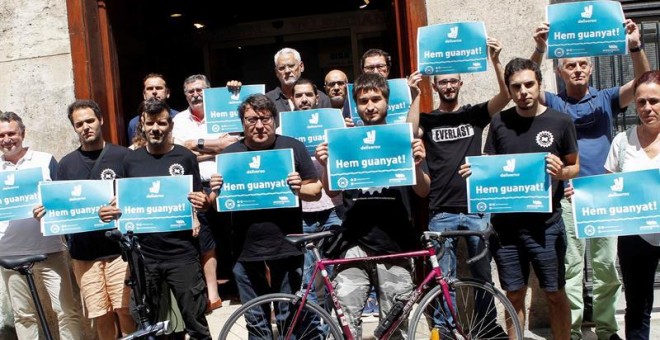
The first great collective victory of the ‘riders’ against Deliveroo.
A judgment of the Social Court No. 5 of Valencia recognizes the existing contractual relationship between Roodfoods Spain S.L.U., parent company of the British multinational, and 97 delivery riders of València.
(Valencia is in the Paisos Catalans region but not part of the Catalonia region — Translator(
Translated from article in Castillian of PILAR ARAQUE CONDE @ pilarac4 in the on-line newspaper Publico by Diarmuid Breatnach.
The complaints presented by Social Security’s General Finance in different courts against the Deliveroo labour model begin to be resolved. A judgment from Social court No.5 of Valencia ruled that 97 riders of the delivery company are employees and not self-employed, this being the first great collective victory of the workers of the platform Riders x Drets (Riders for Rights) and Intersindical Valenciana, according to the collective’s statement on Thursday.
Some of the Riders for Rights, now recognised as employees of Deliveroo, pose for a photo. (Source: Publico)
Last year, Víctor Sánchez became the first worker in Spain to obtain a final judgment against Deliveroo, after Social court Number 6 of València declared his dismissal “unfair”. Deliveroo then accepted the ruling that for the first time questioned the legality of the business model of the distribution firm, maintaing that the riders are falsely self-employed.
The titular magistrate of Social Court No. 5 of València now recognises the existing contractual relationship between Roodfoods Spain S.L.U., the company that owns Deliveroo, and the 97 workers in Turia city. The ruling states that the workers “provide their personal services, inserted in the business organization to which the means of production belong – Deliveroo’s digital platform – according to the criteria and distributions that it establishes and assigns, receiving remuneration, which also establishes the company “, according to the text accessed by eldiario.es.
The judge adds that “the real means of production in this activity are not the bicycle and the mobile phone that the rider uses, but the digital platform of matching supply to demand owned by the company and without which which the provision service is not feasible”. In this way, Deliveroo is the one who determines the orders and schedules of the workers, and not the employees themselves, despite being categorised and taxed as self-employed.
“It is intended that the rider is free or not to accept an order without unfavorable consequences, but it was proved that the service of the rider is valued at different grades, which obviously will be taken into consideration by the order allocation algorithms” explains the judge. And she refutes the argument used by Deliveroo: “The fact of being able to reject orders does not constitute a capability or power that can condition the business activity,” he stresses.
SEVERAL PENDING LAWSUITS
The ruling, made public this Thursday, responded to the lawsuit filed in April 2018 by Social Security against Deliveroo, following a notification from the Labour Inspectorate. The state agency claimed more than 160,000 euros for Social Security contributions that were not paid by the company. Later, the Labour Inspectorate offices in Madrid, Barcelona, Alicante and Zaragoza, among other cities, did the same in the various courts.
Social Court No. 29 of Madrid will be the next to rule on whether these workers should be considered salaried employees of the British multinational and not self-employed, since the trial, which affects more than 500 delivery people in the region, was held for sentencing on May 31st.
GLOVO’S LABOUR MODEL, ALSO CHALLENGED
Glovo’s labour model has also been challenged before the courts. In this case, several judgments have determined that the company’s distributors had an “employment relationship” with the company and ordered their reinstatement.
This digital platform is also involved in the controversy after a worker died when being run over by a garbage truck while delivering. The young man, 23 years old, “was not a collaborator” of Glovo, although he carried its backpack. His death sparked protests about the precariousness of the sector.
And the fact is that Glovo, Deliveroo and Uber Eats continue to operate without a regulation that guarantees the rights of their workers. Also, taking into account that the number of employees in the sector is around 17,000, UGT (one of the major trade unions in the Spanish state – Translator) estimates that Social Security loses a potential 93 million per year due to this situation, figures that it estimates will be three times greater in 2020.
Around 60 people viewed the film “My Land” on Sunday morning (23/ 06/ 2019) in the Irish Film Institute in Dublin, scheduled at the decidedly un-prime time of 11.30 am on a Sunday morning. “In this revealing documentary, Anthony Monaghan, an Irish filmmaker now living in the United States, takes a hard look at economic migration, mass evictions, and the growing homeless crisis that plague Ireland today. In search of answers, he travels the nation and interviews Irish people from all walks of life” (the description on the FB page for the event).
One of a number of versions of title photos for the film (Photo source: advertisement for the film)
The film opens focused on heavily-built man in shorts with a broad somewhat weathered face, wearing a straw stetson-type hat, brim turned up both sides and overall looking quite like a middle-aged man of the American Indigenous people. The rhythms of his speech and accent soon however reveal a mixture of western Irish and USA. The man parks his construction company pickup truck, gets out and we watch him walk on to a bridge, to look down upon a river, possibly the Missouri, where he stands looking for awhile before turning to the camera and beginning to speak.
Monaghan photo?
DEVASTATION OF RURAL AREAS
Anthony Monaghan is from Erris, County Mayo and went to work in England when he was 15 years of age as many others around his age did too, especially in that area with an absence of industries and therefore of employment. Later, he emigrated to the USA. Later still, he returned and took out a mortgage on a house but, as we learn later, the bank took it from him and he has now returned to Missouri USA, where he decided to make the documentary.
We hear the sound-track of Lovely Blacksod Bay, a song about the ‘return’ of the son of an emigrant to Mayo.
View of Termon, Blacksod Bay. The English version of the place-name comes from the irish original “An Tearmann”, meaning “the sanctuary” (several place-names of this kind in Ireland). (Photo: Internet).
Interspersed with beautiful scenery shots, interviewees talk about the problems of the Belmullet area, principally of lack of employment and consequent emigration. Included among those interviewed are Rose Conway-Walsh, Sinn Féin Senator from Bellmullet, Mayo, whose grown-up children had to move away. Another a former male emigrant who returned to the area in the early 1980s now sees his children moved away to work in England, his grandchildren there, returning twice a year, which brings excitement as they arrive and sadness as they leave. Another ‘returned’ migrant, a writer, came to the area from the Irish diaspora in London, brought as a child by his parents. He too had to emigrate for a while – now, back again, he expects his daughters to leave also.
As we accompany Monaghan to the local graveyard overlooking the sea, he points to the name of a brother on a headstone, a sibling who did not return alive from emigration.
The film shifts to a young woman, possibly Irish-UStater, accompanying herself on auto-harp while singing Noreen Bawn (Nóirín Bán), a sentimental song about tragedy in emigration.
John McGuinness, TD for Kilkenny-Carlow area, is also interviewed as is a FG member of the legal profession. Peter McVerry, of an NGO working with the homeless, also speaks, as does a local businessman.
The talk is of the devastation suffered by rural communities by unemployment and emigration, then the cutbacks on services to the areas, the closing of post offices, the isolation and vulnerability of the elderly, the long journeys to medical services ….
At a harbour, Monaghan talks to a man who fishes from a boat for a living, who says that kind of livelihood is gone, with big boats competing with the smaller ones. He sees no future for the younger generation making a living from the sea as he has done.
DUBLIN AND HOMELESSNESS
A homeless couple sleeping rough
The film shots switch to Dublin streets and homeless people sleeping rough or begging. Among the interviewed now are the same people as before but more are added, including actor-author and former homeless person Glen Gannon and radio broadcaster Marion Shanley who, with three children, had faced eviction from her home. Tony Walsh, former homeless man and organiser of a food-serving service to homeless and other persons in need was also interviewed, as was bankrupt property developer Tom Hardy, author of “Waiting for the Sheriff”. Along with those was a young Dubliner, currently homeless.
A number of people, including the young Dublin homeless man, point out the profits that are being made by landlords. Tom Hardy reels off statistics in the profits being made there and also by the vulture funds in “buying” mortgage debts from banks at knockdown prices which the banks would not offer their debtors. A woman talks about the horror of having to raise one’s children in the hotel rooms in which homeless services place them, where they are cramped and cannot cook food. She talks about what this is doing to the children and wonders psychological problems are in store for them in future. “Why don’t the Government declare a housing emergency?” she almost wails. Clearly it is a housing emergency but as Gannon points out, they won’t declare it. It is not in their interests to do so. And according to the woman quoted earlier, a tsunami of evictions is on the way.
McVerry commented that there is a section of the population in Ireland who are doing quite well and who have no stake in any radical change in society. A number of the interviewees made reference to the wealth of the country, including several who said it was the fifth wealthiest state in the EU. I failed to find confirmation of that particular statistic and istead found a wide variety of rankings. Of course, the wealth of a state is not necessarily reflected in its people or, to be more exact, among the majority. While the problems of lack of affordable decent housing and employment, along with emigration cause suffering among a large section of people, revealed in rising rates of suicide, the number of wealthy are rising fast, with 83,000 people in Ireland whose income exceeds more than one million dollars per year (see References at end of review). It’s hard to believe that the misery of the struggling does not have some relationship to the soaring wealth of a tiny minority.
“Homes not hostels” banner on the side of Apollo House, a protest occupation of some weeks in December 2016 which attracted much support and media attention. But the homeless crisis has got much worse since. (Photo: D.Breatnach)
SOLUTIONS
All the interviewees, to one degree or another, placed the blame for the situation on the Government. Most of them also blamed the banks and the vulture funds. Some pointed to vested interests of TDs who are rental landlords while other went as far as to allege corruption and in effect an integrated system of banks-landlords-vulture funds-district courts-TDs- Government.
Some of the interviewees alleged that the Irish are too accepting, too meek. One who did so was a Ginley (or McGinley), who said that the Irish had fought for the British and for the USA but had never fought for themselves. He seemed either ignorant or dismissive of the long Irish history of resistance and also of the fact that not only the Irish who fought in the British and US armies were not “fighting for themselves” but neither were the British and US working people alongside them!
Marion Shanley was one who upheld the Irish history of resistance and pointed out that in war, to which she hoped it would not come, incidents of suicide tended to almost disappear.
Given the size of the problems and the combination of political and financial interests, it was going to be interesting to see what solutions were advocated.
Anthony Monaghan wished to see some kind of combination of workers and business people to sort out the problems and hoped “the fighting Irish” would come to the fore.
TD McGuinness stated it was important for the politicians to come closer to the people and asked for greater leniency from the district courts in house repossession cases. Senator Conway-Walsh also wanted to see greater leniency from the courts but tighter legislation against vulture funds too. The homeless young Dubliner put forward the radical solution of having members of the Government spend a week in the conditions of homeless people.
Only Glen Gannon baldly put forward the clear solution, the only one possible, given the interlinking of financial and political interests: Revolution.
DANGERS
There is a vacuum of leadership, as a couple of interviewees remarked.
During his interview, the man I remembered as Ginley (or McGinley), referred to Ben Gilroy as a champion “of our own”, an electoral candidate who had been failed by the electorate and whose “vote was derisory” in the recent elections. However Gilroy (who was present at the screening, as were a number of interviewees), had in the past posted an islamophobic rant on social media and had shared leadership of the recently-defunct Irish Yellow Vests with a racist, anti-emigration, anti-gay and lesbian islamophobe.
This points to a possible danger, not only that we might continue to be driven downwards but that in desperation, we might turn to fascism and racism, as other people have done in difficult times. And in precisely those kinds of times, the ruling capitalist class has not usually been shy of finding their champions to push those kinds of ‘solutions’, splitting the working class and diverting attention from the real problems.
And one form of fascism has been indeed to seek the unity of workers and businessmen sought by Monaghan (though that should not of course be taken as a suggestion that he is himself a fascist). In such “unities” there is no question of which sector will be in command.
In a film about the Ireland of today, it was interesting to see no images or hear any reference to immigration other than that of the Irish diaspora. It could have been that the makers wanted to keep the narrative simple …. or there could have been another reason for it.
Anthony Monaghan said at one point that although he knew that was not possible, he’d like to go back 20 years. At the turn of the century, i.e twenty years ago, the false Irish economy bubble was about to burst.
SPIRITUALITY IN RESISTANCE
In one scene, the camera follows Anthony Monaghan going down into a holy well (St. Dervla’s) near his original home and blessing himself with some of the water there. Remarking that although he does not condone the scandals that have come out of the church in recent decades, he regrets the Irish turning away from the Catholic faith, which he feels sustained us in years past and bound us together.
One of Monaghan’s interviewees points out that the worst thing about the scandals in the Church was not the abuses themselves but the cynical covering them up by those in authority, exposing more people still to abuse and suffering.
Talking about Catholicism as a binding agent of the Irish while almost in the next breath about our martyrs and heroes of the past, ignores a very important part of that very history of resistance which Monaghan upholds. The Catholic Church, from the moment Penal Laws began to be lifted, worked might and main against that Irish resistance. Its leadership condemned the United Irishmen (in particular the few priests who joined them), the Land League actions, the Fenians and the IRA in nearly every period and in all of its manifestations. In addition, the founders of the United Irishmen were Protestants, as were nearly all the prominent people of the Young Irelanders; Protestants were to be found too among the founders of the Volunteers, the Fianna, Ininí na hÉireann and the Irish Citizen Army.
In fact, history was sorely missing in all the analyses, since no-one pointed out that the State had been set up in a counterrevolution, an alliance of Catholic Church and Gombeen capitalist class under the old master’s tutelage. There seemed to be no acknowledgement that the Irish state is a neo-colony, run by a Gombeen capitalist and political class, its natural resources to be plundered by foreign multinationals, its services to be sold to the same, its own natural industries to be run down.
Human beings do have a spiritual sense, whatever anyone may say against that – but that is not necessarily about religion, contrary though that statement may seem. A sense of who we are as Irish people, as workers, as human beings, as part of life on earth, can be both practical and spiritual. It can be conveyed in language, song, poetry, visual art …. and in a knowledge of living history.
In that respect, it was strange that in a film about Ireland made by a man from Erris, by the Belmullet Peninsula and a large part of which figures in the narrative and images, there were only five words in Irish to be heard. For Béal Muirthead is a Gaeltacht, an Irish-speaking area, though shrinking under pressure from English-speaking monoglots.
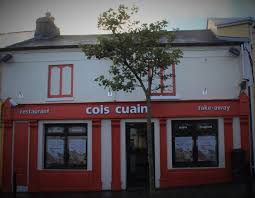
Pub in Erris with name (“Harbourside”) in Irish (Photo sourced: Internet)
IN CONCLUSION,
it was an interesting film from the point of view of presenting the issues and gathering some opinions about them.
But as well as who were interviewed, it was interesting to note who were not. No active revolutionaries — socialist, communist, republican …. no activists in recent or current movements of resistance. And no reference to the mass mobilisations against the water charges and the local battles resisting meter installation. Nor of the demonstrations protesting homelessness. Not even a mention of the titanic (or biblical Davidian) struggle in Rossport, Mayo, against Shell BP.
The last song I remember hearing on the film’s soundtrack was James Connolly, not the song about the revolutionary socialist and trade union organiser he was (see below) but instead one which portrays him as an “Irish rebel” out of context, without mention of class or of the Irish Citizen Army, of which he was the leader.
On 24th June 1885 the UK Parliament passed a number of laws, allegedly for purposes of religious compliance but which impacted almost uniquely on the working and lower middle classes. On 24th June the workers mobilised to protest these laws, congregating in Hyde Park, where the aristocracy and their admirers in the capitalist class paraded. Karl Marx was there — click on this link for his report: Workers’ demonstration 24 June 1855 in Hyde Park
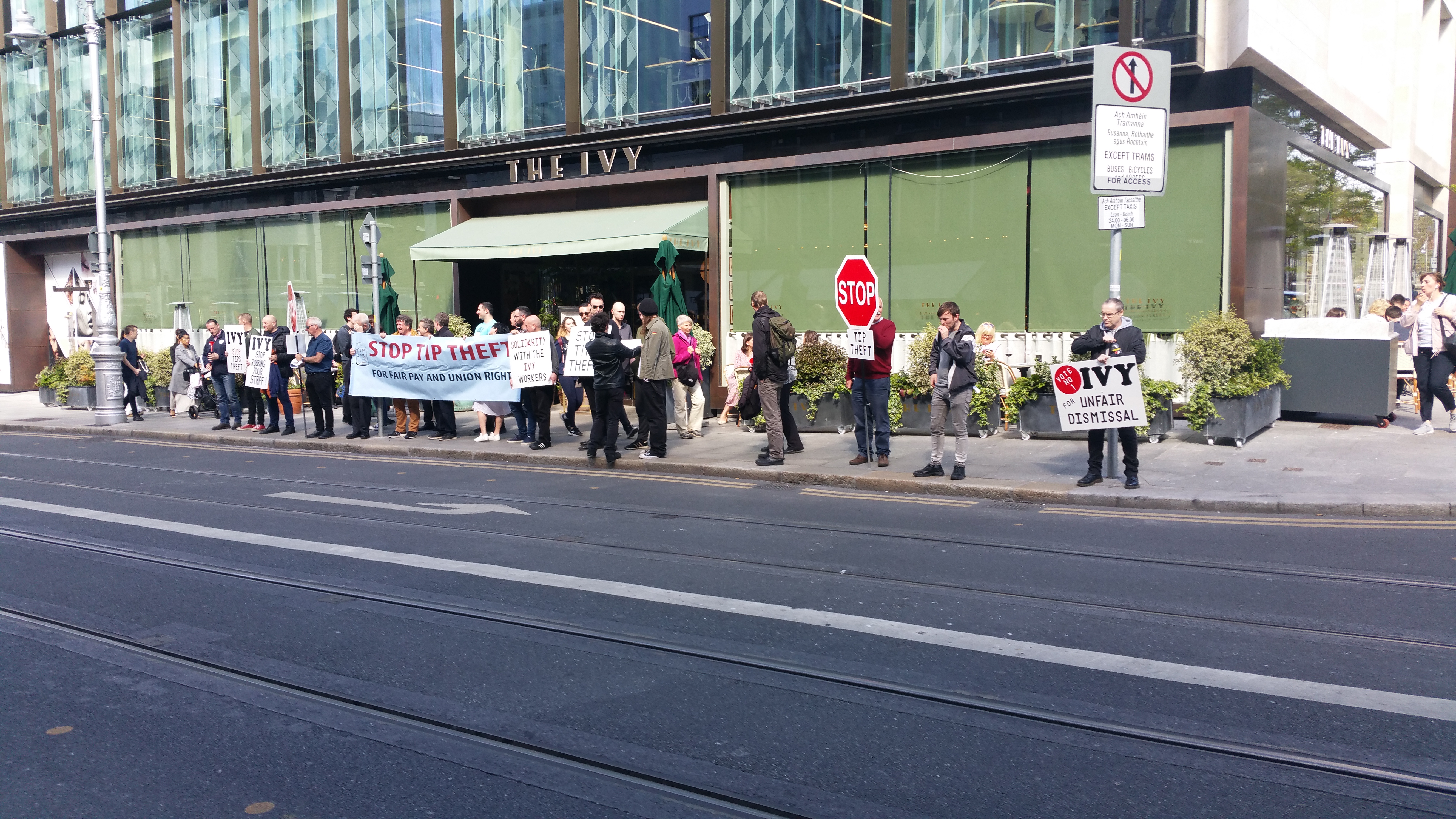
Solidarity protest picket lines up outside the The Ivy restaurant in Dublin city centre’s Dawson Street and, as management draw the blinds to hide the event from their customers, passers-by take photos and passing traffic sound horns in solidarity.
Solidarity protester with placard outside the Ivy Restaurant on Saturday. (Photo image: protester)
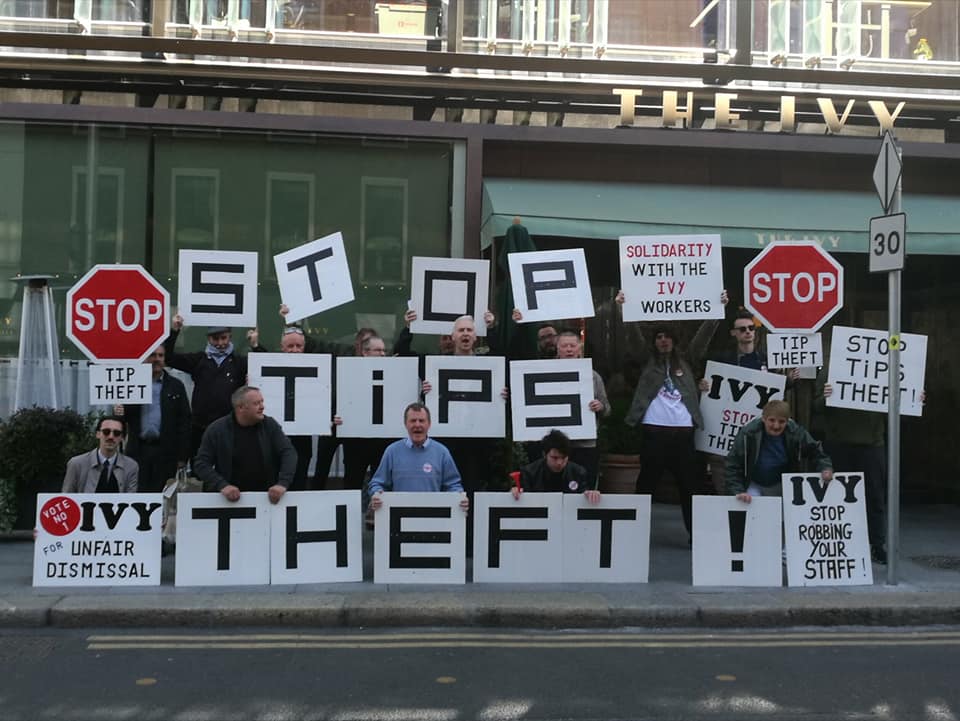
On Saturday afternoon (8th June) round a score of men and women participated in a picket outside the The Ivy restaurant in protest against management deducting a percentage of the waiting staff’s tips. The management are able to take this action when customers pay by bank card for their meals as well as the service charge. The protesters were also in solidarity with two sacked workers who protested the practice.
The business pays minimum wage every day except Sunday and staff expect to make a decent wage up from tips ….. but, much of the tips money is being taken by the management.
Picket line outside The Ivy restaurant on Saturday afternoon. (Photo: D.Breatnach)
The protesters held up large placards bearing the slogans: “Ivy: stop robbing your staff!”, “Vote Ivy No.1 for unfair dismissal”; “Ivy, stop tip theft!”; “Solidarity with sacked workers” and also displayed a banner which, as well as reading “Stop tip theft” also called for “fair pay and union rights”. The picketers later also held up large letters to display the message STOP TIPS THEFT.
Dawson Street, in which the Ivy Restaurant is located, is an upper-class southside city centre street of mostly old architecture, filled with eateries, art galleries and bookshops and also containing the Mansion House, a historic building and the Lord Mayor’s business residence. It is one of two public bus routes from the south-east into the city centre and also contains a LUAS (tramline) stop.
Section of picket seen closer and front door of The Ivy (note the blinds!) (Photo: D.Breatnach)
Drivers of a number of passing private and public transport vehicles sounded their horns in solidarity while passing the picket while tourists and others took photos and promised to post them on social media. A number of tourists from the Spanish state asked about the protest and I when I explained, were fully supportive.
Since I participated in this protest myself, I was able to identify participants from a range of political allegiances and independents and they included a number of recently-elected Dublin City Councillors (a previous picket I wrote about included a TD – member of the Irish Parliament).
ONGOING STRUGGLE
This controversy has been going on for some time and has been reported in the Irish Times (see Links and References). Since the protests began, management of the once-highly-patronised restaurant had blinds installed so that they could shield their customers from the sight of the picketers but even so, they could not avoid hearing the bullhorns and the chanting outside.
Chants included “Shame, shame, shame on you; pay the workers what they’re due!”
Reports indicate that business at the restaurant in fashionable Dawson Street is down by as much as 40% on many days which bodes ill not only for the restaurant at present but also if the owners try to sell it, since the reputation associated with the business will be of a negative kind.
Catering workers through much of the world are typically unorganised into trade unions, have insecure employment, are often immigrants to the country and are particularly vulnerable to extra exploitation. Ireland is no exception to this rule and there are many examples of it in Dublin. Campaigners for better conditions of employment and pay for catering workers are aware that the Ivy is one among many but hope that breaking the tip-deducting practice at this high-visibility eatery will spread a beneficial effect around the rest of the industry.
Meanwhile the two workers sacked by The Ivy are awaiting their day in the Labour Court.
The European Parliament this afternoon prevented former Catalan President Carles Puigdemont and former Minister Toni Comín from collecting their credentials as MEPs after Sunday’s election.
On Twitter, Puigdemont wrote: “The European Parliament’s Secretary General has given instructions that neither Toni Comín, Oriol Junqueras nor myself can go through any formalities as MEPs. No legal reason. Pure discrimination. All the other MEPs-elect have been able to do the processes they’ve blocked us from. Disgraceful!”.
“El secretari general del Parlament Europeu ha donat instruccions que ni @toni_comin, ni @junqueras ni jo puguem fer cap tràmit com a eurodiputats. Cap raó legal. Discriminació pura. Tots els altres electes han pogut fer els tràmits que a nosaltres ens han impedit. Vergonya!” pic.twitter.com/xqwNWe2K0O — Carles Puigdemont (@KRLS) 29 de maig de 2019
Spain has not yet officially provided the Parliament with the names of the MEPs elected on Sunday. The successful candidates have, however, been called to appear in Spain’s Congress on 17th June to swear loyalty to the Spanish Constitution.
Speaking to media outside the Parliament, Puigdemont said they were told the reason they couldn’t complete the formalities was that Spain hadn’t yet furnished this list. Spain’s other MEPs-elect, however, did manage to do what they needed to today, for example Diana Riba, second behind Junqueras on ERC’s list, partner of prisoner Raül Romeva.
Also able to collect their credentials were Ciudadanos’ new MEPs, for example former president of the Balearic Islands José Ramón Bauzà: “Very happy after my first day in the European Parliament as an MEP,” he wrote on Twitter.
“Contentísimo después de mi primer día en el Parlamento Europeo como Eurodiputado. @ALDEParty ya está en pleno funcionamiento y @CiudadanosCs será la clave para construir la mejor Europa que hayamos conocido nunca!” ?゚ヌᄌ?゚ヌᄎpic.twitter.com/mThaEjlegG
— José Ramón Bauzá ?゚ヌᄌ?゚ヌᄎ(@JRBauza) 29 de maig de 2019
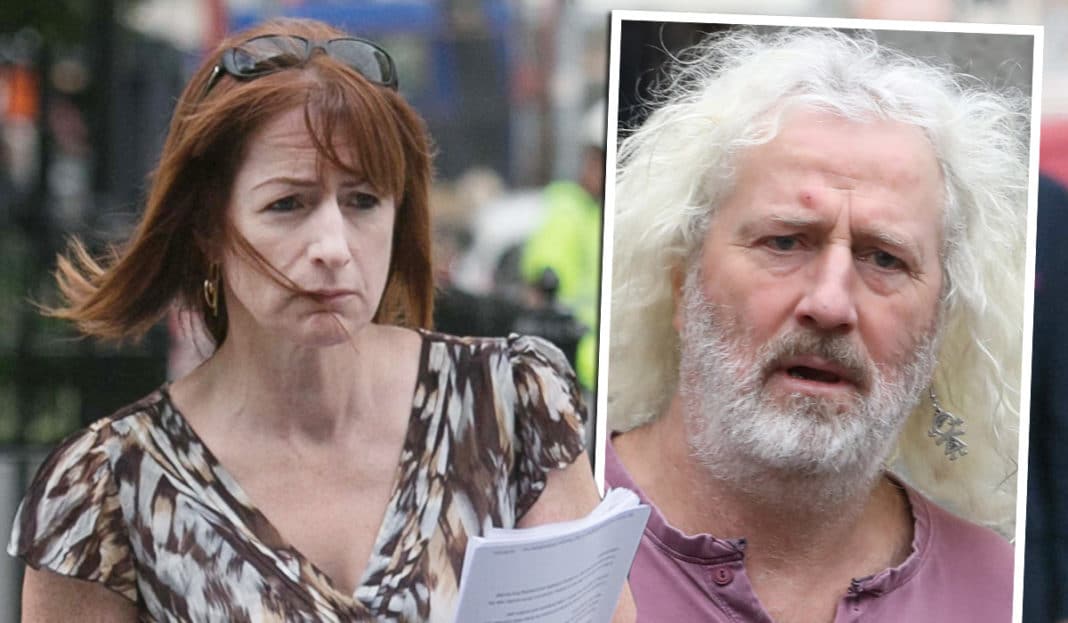
Clare Daly and Mick Wallace campaigning for election as MEPs (image sourced: Internet)
COMMENT:
The MEPs who were prevented by the Secretary General, Klaus Welle, from collecting their credentials at the EU Parliament, have three things in common (apart from being elected by hundreds of thousands of citizens of an EU member state):
§ They are Catalan
§ They are national independentists
§ They are or have been sought by the Spanish State in politically-inspired criminal proceedings
But other Catalan MEPs have been able to proceed without problems. That they are independentists, then? Well, no, because for example Diana Riba (partner of political detainee Raül Romeva), who came second behind Junqueras on ERC’s list, collected her credentials without difficulty. It seems to me that the last one of the three characteristics is the relevant one. Klaus Welle wants to prevent having MEPs in the EU Parliament who are being sought by their state for politically-inspired criminal proceedings.
It is extremely doubtful that Welle has taken this step without the ruling interests of the EU being in agreement – or at least, without him believing he was acting in accordance with their wishes. If he does not have their agreement or has misjudged it, he will soon be given cause to regret it. But if we assume for the moment that he is ‘on the same page’ as the EU leadership, we must ask ourselves: what does this barring of elected MEPs to the EU Parliament mean?
Some may see it as the President of the EU respecting the wishes of the government of a member state (in this case, of the Spanish state). But with regard to MEPs elected by hundreds of thousands of votes of citizens of an EU member state? Besides, since when have the EU rulers been so considerate of the wishes of a member state? Have they not time and time againpbut the interests of the collective, which is to say in effect of the EU ruling states, above those of an individual state?
It seems to me that the significance of this action is that the rulers of the EU do not want political prisoners or political “fugitives” elected as MEPs. Since they cannot at the moment prevent their election, they are blocking their access to the body to which they were elected.
They are looking ahead, to days when they may have to take similar action in other cases: MEPs elected by independentists from Sardinia, Corsica, Brittany, the Basque Country (either side of the Pyrenees), Galicia, Andalucia, Flemish Belgium, Scotland, Ireland – in cases where they are jailed or sought by their state’s government. After all, as EU President Jean-Claude Junker inferred, if Catalonia is allowed to secede against the wishes of the Spanish state, those in other European states might do the same. And as he actually said, he did not want “an EU of a hundred states”.
So much for independentist MEPs but the implication here goes much further with special dangers for socialists and all democrats. I take just one Irish example. Clare Daly is a left-wing member or Deputy (in Ireland called TD, “Teachta Dála”) of the Irish Parliament (the “Dáil”) and was successful in the EU elections in May, so that she is now an MEP.
Clare Daly, TD, shown in front of the Dáil — could Left-wing MEPs be barred also if avoiding detention of their Government? (image sourced: Internet)
In 2014, Daly and her partner Mick Wallace (also by the way a TD and close to be elected MEP in a recount), carried out a protest trespass on to Shannon Airport land to call for the Irish State to take action in accordance with Irish constitutional neutrality and prevent use of the airport by the US military for refueling to transport soldiers, munitions, equipment and political prisoners.
Both Tds were tried and, in 2015, convicted and fined. They refused to pay the fines and after also declining to surrender to the court, were detained by police to be brought to jail (in the end, they were merely shunted around the country in police custody for a day).
Let us suppose that Daly, instead of allowing herself to be detained by the Gardaí (police of the Irish state) decided to take refuge in some European state and that the Irish State failed in extraditing her. And supposing further, that Daly were elected as MEP while this situation continued. Then the EU Secretary General could take exactly the same action with Daly as he has with the Catalan MEPs in question.
All genuinely socialist and/or democratic people should vigorously protest this barring of the Catalan MEPs.