Writing about Christmas and war tends to focus on Christmas celebration as a counter to war,1 or alternatively on how hard it is to be celebrating Christmas in the midst of war. However, in much of West Asia, Christmas is now very much apartof the war.
This is certainly the case in Lebanon, Syria, Gaza and the West Bank and even inside ‘Israel’.
Among the peoples of this majority Muslim region the festivities are primarily those of Christian communities. Yet the broad Muslim population has no issue with the religious aspect of the festival, nor even with the iconic symbolism of the Holy Family and the birth in a manger of Jesus Christ.
The latter, among Christians believed a human incarnation of God, is also revered among Muslims but as a prophet, though of course lower in ranking than their highest-ranking prophet, Mohammed (c. 570 – 8 June 632 CE), allegedly of the Banu Hashim clan of the Quaraysh Arab tribe.
Among the Judaic religion, Jesus Christ is also believed a prophet.
It is important – and not just for historical reasons – to note that the major perpetrator of religious persecution from the Middle Ages on has been Christianity, led by European Christian elites persecuting followers of Judaic and Islamic religions and employing the Inquisition2 against them.
Earlier of course Christianity had its internal divisions resulting in one part of Christianity persecuting another (the East-West schism) and then later the split of the Reformation, with religious and temporal powers in war and in persecution of one another and of subject populations.3
The chief object of Christian religious persecution overall was the Jews and the objects of that persecution found sanctuary in many Muslim countries and, in general, within the Austro-Hungarian Ottoman Empire.
Leaders of a number of Muslim states today are traditionally at pains to demonstrate their acceptance of Christian communities and this Christmas both Mohammed Shia al-Sudani, Prime Minister of Iraq and President Masoud Pezeshkian of Iran once more did so publicly.
Mohammed al-Sudani attended a Christian service and Masoud Pezeshkian visited a Christian family.4
Of course, Christmas as celebrated generally across the West is more – and one might say also much less – than a Christian or even a religious festival, with emphasis on feasting, alcoholic consumption and expenditure on presents.
Much of the symbolism too owes more to pagan religion than to Christianity.5
With a number of those aspects, including consumption of alcohol (traditionally forbidden by and to Muslims), pagan symbolism and more than a nod to western imperialist culture, many Muslims may take exception but even then not at all to celebration of the alleged birth of Jesus Christ.
However, for those wishing to cause divisions in predominantly Islamic societies, or in imposing their sectarian absolutist rule on society, the celebration of Christmas has become a hostile target in Lebanon, Syria, Gaza, the West Bank and even inside ‘Israel’.
LEBANON
Lebanon is the most ethnically-diverse of the West Asian states, approximately one-third Christian, one-third Shia Muslim and a third Sunni Muslim. For years, Christmas has been celebrated not only by the Christian community but also, to varying degrees, by the other ethnic groups also.
It is extremely worrying therefore when a primary schoolteacher taught her girl pupils and filmed them not only renouncing Christmas as ‘non-Muslim’ but calling its celebrants the equivalent of heretics. There was widespread shock when she uploaded the video she had made of the girls.
Not surprisingly, the teacher was sacked but this too was orchestrated into a controversy with extreme religious sectarians coming on to the streets to protest, including former sectarian terrorist and ex-convict for bombing a church Samir Geagea of the sectarian Lebanese Forces militia).6
SYRIA
Under the new regime in Syria, celebrating Christmas can get people killed.The celebration was not controversial in the majority Islamic but secular state of Syria under al-Assad but that changed following that regime’s overthrow by western-supported Islamic fundamentalist jihadists.
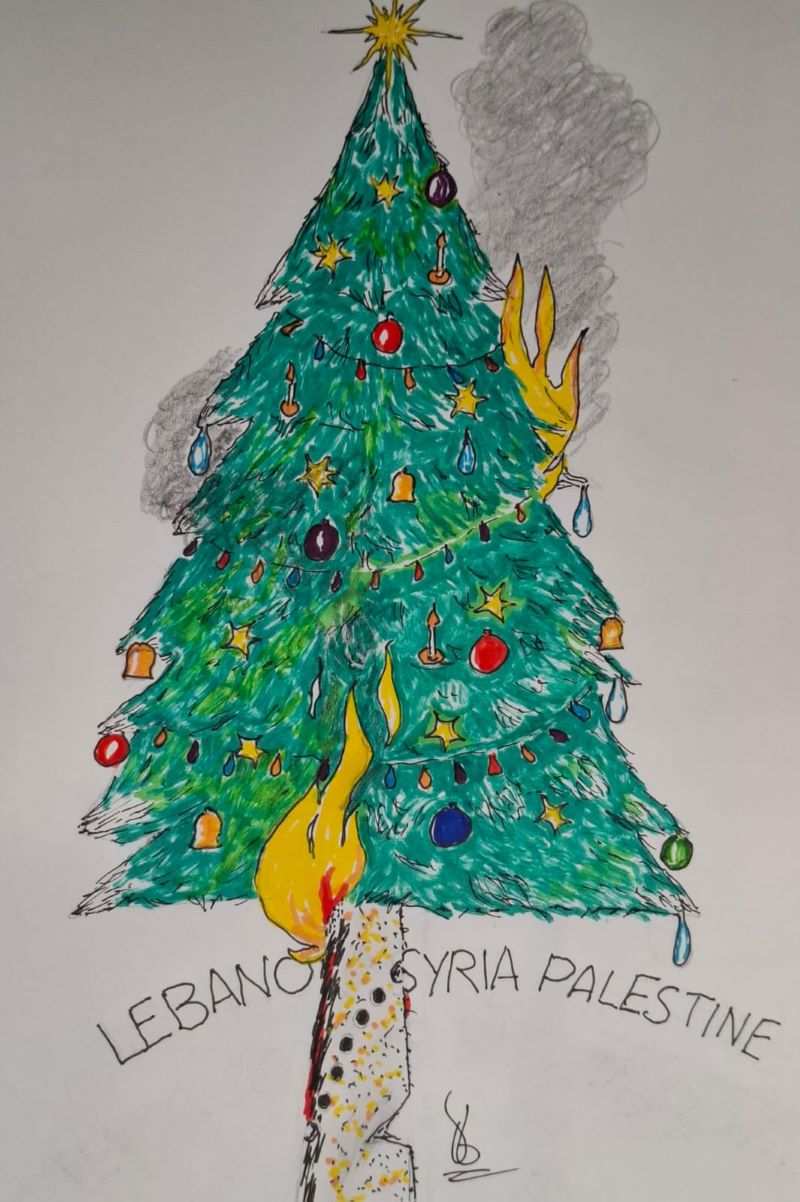
During Christmas 2024 units of the fundamentalist jihadist coalition under self-appointed al-Julani (formerly Ahmed al-Sharaa of the Syrian chapter of ISIS) led attacks on Christians, forbade the erection of Christmas trees and knocked down and burned some that had been erected.7
Earlier this year Sayara Ahl Al-Sunnah, a Syrian terrorist organization split from the ruling Hay’at Tahrir Al-Sham (HTS) of al-Julani in February carried out a suicide attack on the Mar Elias Greek Orthodox church in Damascus, killing 30 Christian worshippers.8
Not just Christian communities are targeted in this ‘new democratic Syria’ so beloved of the Western powers but primarily really the Shia Muslim offshoots of Alawites9 and Druze10 communities. Both these communities are now mobilising in self-defence against the new rulers.
PALESTINE
In Gaza, blockaded and besieged, starving, flooded, homeless, cold, bombarded, even thinking of a festive celebration seems a crazy idea yet some have attempted to celebrate Christmas this year11 although any gathering of Palestinians seems an invitation to an IOF raid or even bombing.
In the West Bank, the Christian pastor12 in Ramallah, Isaac Munther, faced with the accelerating genocide in Gaza in 2023 declared there would be religious observation only and no Christmas celebrations of lights etc … but his sermon and Christ-nativity-in-rubble scene went ‘viral.’
Munther did the same during Christmas 2024 but this year the West Bank faces its own escalation of Palestinian home demolitions, army invasions, settler attacks on homes, livestock, farmland. However the IOF attacked some Palestinians who did try to celebrate a western-style Christmas.
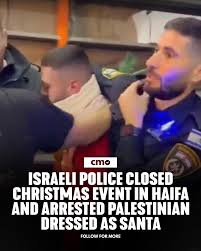
Palestinians of other Christian denominations also tried to celebrate Christmas but met with repression and in Bethlehem there were clashes with Palestinians in Santa costume assaulted and arrested by ‘Israeli’ Occupation Forces.13
Occupied Palestine (‘Israel’ sic) also saw a Palestinian ‘Santa Claus’ being arrested by the IOF and Palestinian celebrants assaulted in Haifa.
As the supposed Holy Land where Jesus Christ was allegedly born, Christian tourism makes a significant contribution to the income of the Zionist state.14 But even so, Palestinian Christians and even tourists have complained of being menaced and spat at by militant Zionist settler youths.15
The Israeli Zionist state likes to promote itself as culturally representing the West much more than the East – which it certainly does – but seeing this repression of Christians even celebrating Christmas, one has to wonder what kind of ‘western society’ is this?
Meanwhile, in Rome …
Discussion of Christmas entails a mention of the majority sect of western Christianity, the Catholic faith and of its leader, the Pope. And the relatively new Pontiff – and first USA-born one – did in fact refer to Gaza in the traditional Papacy Christmas message from the Vatican.
Leo XIV’s message has been lauded by some in apparent ignorance of the political position of the Vatican and of its Papacy, which has been always to support western imperialism, or in his advocacy of Zionist colonisation in the western support for a two-State solution (sic) in Palestine.16
But for democracy and anti-imperialist unity …
Republicans reject any religious role in the management of the state or of its institutions – including education17 – but should also protect the freedom to worship or celebration of festive period of any personal or organised religion — and indeed also the right to promote atheism or agnosticism.18
Anti-imperialist revolutionaries whether secular or not need to oppose religious sectarianism and promote unity in the face of imperialism. It is imperialism and colonialism that promotes inter-religious conflict and fosters fundamentalist sectarians in order to undermine anti-imperialist resistance.
End.
Note: If you found this article of interest, why not register with Rebel Breeze for free, so that you will be notified by email of subsequent articles. You can de-register any time you wish.
2Although it later became an instrument of Rome to ensure orthodoxy in religion, literature and science, the Inquisition was originally instituted in Iberia as a controlling agent over the forced conversions of Jews and Muslims to Christianity and later also operated as an instrument in control of the Spanish colonies.
3Of which we in Ireland have centuries of experience.
5The ‘old man of the woods’ Santa Claus or God of thunder and lightning in a sky-chariot pulled by horned beasts (two of which are also allegedly named Thunder (Donner) and Lightning (Blitzen) and the Christmas Tree and/ or Yule Log, pagan symbols of a festival signalling the turn of the seasons.
14“While there is no precise figure for how much Israel earns specifically from religious tourism, estimates suggest that Christian holy sites alone generate around $3 billion each year to the Israeli economy under normal circumstances — with over half of all tourist arrivals coming from Christians — and a quarter of those visitors going to Christian holy sites.” https://religionunplugged.com/news/war-in-gaza-and-the-disruption-of-pilgrimages-to-jerusalem
17This is an issue in many lands including Ireland where the Irish State and the colony’s both pay the salaries of teachers employed in religious-ethos schools. People have a right to religious education for their children should they wish it but in no way should the State facilitate such and, on the other hand, all children are required to attend formal education supplied by the State.
18The 1916 Rising Proclamation: “The Republic guarantees religious and civil iberty to all …”
Diarmuid Breatnach (Reading time main text: 11 mins.)
LANGUAGE IS A TREASURE CHEST – 2
I observed in Language Is a Treasure Chest 1 that while language is full of wonders, it has some horrors in it too. And I found that to be true again.
I was reading a novel in which the word “Cimarron” appeared and, doing some quick research on the word, I came across a 2004 query in an email website or page called Word Wizard:
What is the etymology of the word cimarron? I’ve always been told that it means “runaway slave” in Mexican Spanish. Can anyone verify this?
The reply is dated the same day:
From Greek. It refers to people who live in perpetual mist and darkness, akin to the ‘land of the dead’. Latin ‘Cimmerius’, Greek ‘Kimmerios’, Assyrian ‘Gimirri’ even the bible ‘Gomer’ Gen.10:2 and Esk. 38:6.
In Western United States it refers to a stretch of land that gets rainfall when other near by areas are desert year round.
Apart from the topographical reference, I thought the expert’s explanation highly dubious. And in fact I happen to know something about the Spanish-language origins of the word.
The searcher replied:
Thanks, Jim. I just wonder what connection this word has to Hispanics of Mexican origin because it shows up in their surnames (although not as common as Lopez or Vargas or Garcia).
Is it just Mexican in origin or did that also come from Spain? So the “runaway slave” theory has no foundation then?
The expert’s reply did come back with a Spanish-language connection and he may be on to something with the topography, though I think he has it the wrong way around (as we shall see).
The “runaway slave” theory is not so obsolete. Mexico did not have slaves (outlawed in 1810) but American slaves who fled to Mexico had to pass through lands with water, or else parish (sic).
When relating their tales of woe to the locals the word ‘cimmaron’ arose to describe their flight through the South West desert.
Very curiously, there was no further contribution to the discussion. I tried to leave one of my own but was required to register, which I did (though wondering if worth the trouble) and never received confirmation1.
“A view of the Cimarron National Grassland, the largest piece of public land in Kansas, a 108,175-acre property in the southwestern part of the state. It was recovered from the Dustbowl ecological devastation by soil recovery and management practices.” (Photo source: The Armchair Explorer – Kansas)
THE FOLK MEMORY WAS TRUE
Continuing with a little light online research I found that the Castilian-language (Spanish) origin is the explanation most often given, with rarely a reference to Greek or other classical or archaic languages. For example, in yourdictionary.com:
American Spanish cimarrón, wild, unruly (from Old Spanish cimarra, thicket): probably origin, originally referring to the wild sheep (bighorn) found along its banks.
(Latin America, of animals) feral (having returned to the wild)
Synonyms: alzado, bagual, feral
(Latin America, of people) rural; campestral
(Latin America, of plants) of a wild cultivar.
But …. what about the “runaway slaves”? Under the title Cimarron People, Wikipedia has this to say: The Cimarrons in Panama were enslaved Africans who had escaped from their Spanish masters and lived together as outlaws.
In the 1570s, they allied with Francis Drake of England to defeat the Spanish conquest.
In Sir Francis Drake Revived (1572), Drake describes the Cimarrons as “a black people which about eighty years past fled from the Spaniards their masters, by reason of their cruelty, and are since grown to a nation, under two kings of their own.
The one inhabiteth to the west, the other to the east of the way from Nombre de Dios”. (location in Panama — DB)
We may indulge ourselves in a sardonic smile at commissioned pirate Francis Drake talking about the cruelty of others, or about slave-owning by a country other than England in 1570.
But we remember also that at the time Spain was the main competitor with England in the rush to plunder the Americas – and had got there well before them.2 Both colonial powers were already plundering Africa for raw materials and slaves.
The meanings of animals having gone “feral” or “returned to the wild” would easily have been applied by the society of the time to escaped African slaves.
A European society which, despite evidence to the contrary including agriculture in Africa, would have considered indigenous inhabitants of Africa as people living in the “wild”. Once escaped and no longer under European control, they would be seen as “returning to the wild”.
So what happened to the Cimarron People? Their settlements were subject to punitive raids by the Spanish, killing people and burning crops, so that in the end they came to a treaty with their old enemy.
The Wikipedia entry says no more except that the “Cimarrons” and the English quarrelled (not surprising, given that they were of no further use to the latter).
I believe some of their settlements in Florida were raided and burned by US “pioneers” and soldiers, the remainder becoming part of the Seminoles, a native American tribe that resisted the USA in the longest and most costly of the USA’s wars against the indigenous people.
The Seminole had many tribe members of part-African origin in their midst.
And here – a surprise: The word “Seminole” is derived from the Muscogee word simanó-li, which may itself be derived from the Spanish word cimarrón, meaning “runaway” or “wild one”!
So, in line with what that on-line searcher back in 2004 had heard, no doubt a folk belief, the word cimarronis, in Mexico (and in the USA), of Castillian (Spanish) language origin and is connected to escaped slaves of African origin.
Some of the sources for “cimarron” also give us “marron” or “marrón” which is also related to escaped slaves and, in English, became “Maroons”. These were escaped slaves inhabiting mountainous regions of Jamaica and elsewhere and became a great problem to English settlers.
The latter had taken the island from the Spanish but they failed totally to quell the Maroons, these emerging victorious in many military engagements.
In the Cockpits area of Jamaica, I have read, there is a place called Nanny Town, which is believed to be one of the settlements of the Maroons; their chief was said to be a woman called “Granny Nanny”3, whether because of her former slave occupation or for other reason4.
In the end, like the Spanish with the Cimarron People, the English had to treat with them. Sadly the treaty required the Maroons to return newly-escaped slaves, which they did and for which they received payment.
Maroons in treaty with the British, shown here in a reversal of the actual power relations in the “Pacification with Maroons on the Island of Jamaica”, by Agostino Runias (1728-96). (Source image: Internet)
However if instead of being a voluntary escapee to go to a wild place, you were forced by people or circumstance, well then, like Alexander Selkirk’s “Crusoe”, you’d be “marooned”!
Well then, what about the “cimarron strips” in the southwest of the USA? Could the word refer to strips of land “gone wild”? Or could the expert replying to the question in 2004 have been on to something?
If the slaves escaping through the desert from the USA to Mexico did indeed make their way through strips of watered land (not just for the water, as the expert speculates but for vegetation to conceal them), then there is a connection between escaped slaves and these strips of land.
But not as the expert sees it, rather the other way around: since the escaped slaves, the “cimarrones” were travelling the strips, they would be called by those who knew about it (escapee hunters, escapee helpers and just observers), “cimarron strips”.
Or in other words, “those strips through which the runaway slaves travel.”
2. CHRISTIAN ETHNIC PREJUDICE
However, if the word comes from Castilian (Spanish) what were the origins of the word in that language?
Perhaps a year before this word-quest, I was reading a book that described the Spanish State as having been characterised, contrary to many other European states, by mass expulsions and exiles on a number of occasions throughout its history5.
First on the list of expulsions was the well-known example of the Moors and the Jews.
Those who were not slaughtered by the forces of the “Christian Monarchs” of Ferdinand and Isabella in the “reconquest” were obliged to convert to Christianity or to leave “with only the clothes on their backs”. This also occurred in Portugal.
Those Jews who left were the Sephardim or Sephardic Jews, who spoke Ladino, an archaic kind of Iberian Romance6 language with Aramaic and Hebrew words, along with the Moors, who spoke an Iberian-Arabic mixture or Arabic.
The key of their houses or gates have been handed down to this day in families of both groups.7
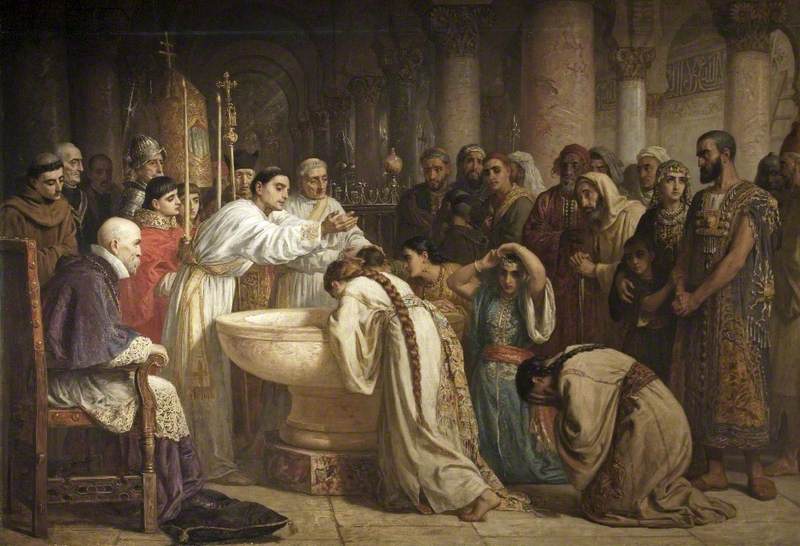
Many converted, often referred to by Christians as “conversos” (Jews) or “moriscos” (Muslims) but were constantly under suspicion of reverting to their old religion even with the threat and constant trials and torture of the Spanish Inquisition.
According to what I have read the latter too were sometimes called “marronos”, i.e in the eyes of the Spanish Christian ruling class, those who had been “domesticated” (Christianised) but had “returned to the their wild way” (Moslem), i.e “gone feral”.
Forcedconversionsthat had to appear genuine: “The Moorish Proselytes of Archbishop Ximenes”, Granada, 1500 by Edwin Long (1829–1891). (Image source: Internet)
Wikipedia on Marrones in Iberia confirms: The (Spanish) Inquisition was aimed mostly at Jews and Muslims who had overtly converted to Christianity but were thought to be practicing their faiths secretly. They were respectively called marranos and moriscos.
However, in 1567 King Phillip II directed Moriscos to give up their Arabic names and traditional dress, and prohibited the use of Arabic. In reaction, there was a Morisco uprising in the Alpujarras from 1568 to 1571. In the years from 1609 to 1614, the government expelled Moriscos.
3. THE BUSH FROM THE NUT?
And is “ci” or “cy” in “cimarron” then merely a prefix? The word “marrón” exists as a colour in Castilian and a number of Romance languages and came into English as the colour “maroon”.
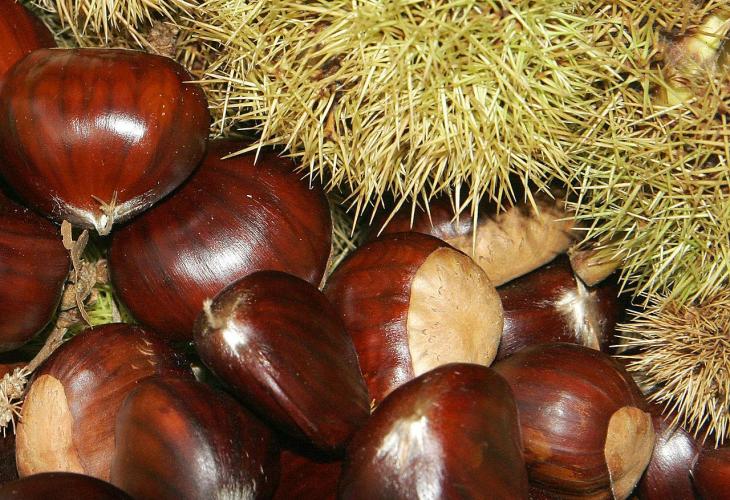
Its development is taken as originating from the colour of the large ripe edible chestnut, rather than given to it later. Of course there are a number of words for colours or tints which have a botanical origin, “orange” being an obvious one.
Castanea Silva, the edible or Sweet Chestnut in Mallora. (Image source: Internet)
Alright, then the nut and tree might have been associated with uncultivated or “wild” areas, similar to those to which the “cimarrons” would escape.
But where did the “ci” suffix come from? Somewhere in the midst of what I have been researching I came across an explanation, derived from Latin, meaning “towering”, “high” etc. But can I find it now? No.
The online sources are telling me that the relevant pages are up for deletion and I can join the discussion. No thanks, I do not have anything like sufficient knowledge to enter a debate on that, nor the patience of an academic to research it thoroughly.
But “high” and “wild” could easily correspond, given that valleys and plains lend themselves more easily to cultivation, as a rule, than mountainy areas, which might remain wooded or with with thick undergrowth.
And that might also give us the “bush” or “thicket” referred to in a number of references for “cimarron”, which in turn might describe the “cimarron strips”. In parts of Latin America such as Chile (and for all I know, in all of them), a “cimarra” is also a thicket or densely-grown area.
The article in the Language Journal (see reference) comments that the “arra” cannot be a Romance language word-ending.
But even if true it seems to me that the author (or authors) quoted might be unaware that among those from Iberia who colonised or settled in the Americas, Romance language speakers were not alone. There were also Basques who spoke Euskera/ Euskara.
And for evidence, they applied a number of toponyms and left family names from the Basque Country (Basque descendants make up to 10% of the population of some Latin American countries). And “-arra” would be a common enough suffix or word-ending in Euskera.8
Opening title for the weekly TV Western series ‘Cimarron Strip’, starring Stuart Whitman, Judy Gleeson, Percy Herbert and Randy Boone. Though popular, only a years’ worth of episodes were screened. (Image source: Internet)
OKLAHOMA PANHANDLE AND THE CIMARRON STRIP
In the 19th Century wars between the Mexican Republic, the USA and the Native Americans in the area, the area was carved up with less and less left to the Native Americans.
Prior to the American Civil War, white Texas wanted to join the Union as a slave state and due to a US federal law prohibiting slavery north of 36°30′ parallel north, white Texas surrendered a strip of land north of that latitude.
The settlement (temporary of course), left a strip as “Neutral Territory” (one can only imagine the temptation for African slaves in Texas to make for there). After the Civil War big cattle ranchers moved in, disregarding treaties and named the area the Cimarron Strip.
Map of Oklahoma territory and “Neutral Strip” before the American Civil War. (Image source: Wikipedia, Texas Panhandle)
But that was because the word ‘Cimarron’ was already in the area, from the “Cimarron Cutoff” leading to a crossing of the ‘Cimarron’ river.
And yes, there was a popular 1967-1968 TV series called “Cimarron Strip”, starring Stuart Whitman. But, though I have watched it, that is only faintly related to the story of the word that set me out on this quest.
End.
FOOTNOTES
1Which days later had still not arrived – perhaps the site is no longer in operation, which would explain the silence after those two posters.
2Columbus voyage to America 1641 and Spain’s first colonial settlement 1565 (now Florida); Mayflower expedition to America with English settlers 1587 (now Virginia). However, Europeans had founded settlements much earlier, as with the Norse in the 10th Century and very likely Irish monks in the 6th Century. But it was the English and Spanish who conquered most, the Dutch, French and Portuguese less. The descendants of the English settlers after gaining independence from England completed the seizure and colonisation of most of the North American continent, while English colonists remaining loyal to the English Crown seized land to form what is now Canada.
4All the folk tradition, albeit conflicting on some points, declares that she had not been a slave which leaves one to wonder how she might have reached Jamaica from Africa without having been enslaved.
5I borrowed the book from the public library and cannot remember its title at the moment. Interestingly it mentioned Ireland as having the only comparable history (though of course there the ‘expulsions’ were due to colonial occupation rather than actions of the indigenous state.
6“Romance languages” is a name given to the group of Indo-European languages including Castilian (Spanish), Catalan, Galician, Portuguese, Romanian, Italian and French. They are sometimes called “Latin-based” or “Latin Languages” but there is some dispute about the origins and developments of these languages.
7Ironically, the door or gate “key” is also a symbol of return for Palestinian refugees driven from their homes by Zionist massacres, threats and fear during the founding of the State of Israel.
8Among toponyms of North America’s southwest, Durango (Colorado and Mexico), Navarro and Zavala Counties (Texas) are perhaps the best known; while Aguirre, Arana, Bolívar (Bolibar), Cortazar (Kortazar), Duhalde, Echevarria (Etxebarria), García, Guevara (Gebarra), Ibarra, Larrazábal, Mendiata, Muzika, Ortiz, Salazar, Ugarte, Urribe and Zabala are but some among a host of family names of Basque origin from the American south-west in Latin America. And of course the country of Bolivia, from Simon Bolívar, a Basque surname from a Basque toponym.
Excerpt on-line from Language journal, Linguistic Society of America, Leo Spitzer, Vol. 14, No. 2 (Apr. – Jun., 1938), pp. 145-147: https://www.jstor.org/stable/408879?seq=1
26 July 2023 (First published in Socialist Democracy, reprinted by kind permission of author)
Sinéad O’Connor has died. Her death at the age of 56 was announced on RTÉ.
The evening news programmes went into overdrive to pay tribute to an incredibly talented musician. As with all such tributes, the great and good were asked for their opinions or they offered them in any case and they were carried uncritically.
Sinéad O’Conner and daughter Roisín on anti-racist demonstration, Dublin, 2000. (Photo sourced: Internet)
You are not supposed to speak ill of the dead in Ireland, but more than that, you shouldn’t speak ill of those who seek to praise the dead, no matter how hypocritical they are.
There were many milestones in her musical career, not least her rendition of Nothing Compares 2 U. The media highlighted her musical talent, her voice, sometimes describing her as controversial and outspoken and much loved by the public.
Yes, she was loved by the public, to a point, and also by other musicians around the world. However, she was also despised by many, written off and derided by commentators. As with many artists when they die, there is a tendency to rewrite history.
Her politics were sometimes erratic and lurched from one thing to another, though she was always honest and forthright when she did so, unlike many a coward. As erratic as some of her opinions could be, there were no smug self-serving platitudes to fall from her lips. She was no Bono.
She was honest, frequently angry and went after the powerful at times.
The famous incident where she tore up a photo of then Polish Pope, Wojtla in protest at his covering up and enabling of child sexual abuse, a topic she was painfully personally aware of in her own personal life did not go down well with some of those now praising and lamenting her passing.
Bono doesn’t do tearing up photos of popes, he sups with George Bush, the late senator McCain, toured Africa with the head of the World Bank, to name just a few of the scumbags he was not only too happy to rub shoulders with but positively revelled in.
Fianna Fáil and Fine Gael leaders have expressed their sorrow at her death.
They weren’t expressing any support when she denounced child sexual abuse, the entire Irish political establishment were busy helping the Catholic Church cover it up, and later facilitated the institution to evade its legal, financial and moral responsibility.
Their attitude is best summarised in a typical hypocritical Irish attitude when dealing with those who make us uncomfortable that goes through phases of saying, “She’s mad, isn’t she great gas altogether, she may have a point but…, fair play to her, didn’t she speak up at the time”.
All of this without ever examining their own role in it all. The fact that, as we speak, reports of the sexual trafficking of children in care are being ignored by the government, says all you really need to know about their attitude.
If a new musician of her talent and courage were to speak out now, she would be cancelled and silenced by many of those now praising her, including some of those on the left, who have grown quite fond of not breaking ranks and clamping down on those who did.
She always spoke about mental health issues, though she became much more public about her own issues as she got older. She even broke down on a video about it, locked away in a hotel, crying. The video led to many expressing their concern, but also a bit of “there goes that one again”.
We will no doubt get many commentaries on air and in print about her struggles with her mental health, many expressing concern and sympathy with her plight. Many of them will be hypocritical.
It is true that Irish society is more open now about people who have mental health problems, though there is still a stigma attached to it.
Sinéad O’Connor (Photo sourced: Internet)
Ironically RTE followed up the news of her death with another story on the shambolic, criminal (my word, not the words of the media cowards) state of the child mental health services in Ireland (CAMHS).
Micheál Martin and Leo Varadkar may even refer to her troubles in their tributes, but they never cared about them then, they don’t care now and the proof is not only the state of CAMHS, but mental health facilities in general, with long waiting lists, a rush to medication and forgetting about the patient model of care.
Her politics were erratic in many ways, though in fairness they weren’t much more erratic than others who are not judged as quickly. She flirted with republicanism, then broke with them, even applied to join the more recent incarnation of Sinn Féin in 2014, before withdrawing it.
It may be hard to take that seriously, but it was no less ridiculous than Bono condemning the IRA and then spluttering out nonsense about how he admired Bobby Sands. He didn’t, never, ever, when it mattered.
Sineád for all her failings took positions that were unpopular unlike some of the vomit inducing smug types that populate the modern music industry.
For my own part, her politics on racism were without fault. Her song Black Boys on Mopeds is excellent. It points out the hypocrisy of Thatcher criticising China whilst British Police like James Bond had a licence to kill.
“Margaret Thatcher on TV Shocked by the deaths that took place in Beijing It seems strange that she should be offended The same orders are given by her”
The song goes on to say something truer today than before.
“These are dangerous days To say what you feel is to dig your own grave”
And then a description of England, that the great and good would run a mile from.
“England’s not the mythical land of Madame George and roses It’s the home of police who kill black boys on mopeds.”
Now she will be lionised in death, praised, described as troubled, talented, controversial and much loved. We should ignore the sanitised version we will be given and remember the Sineád O Connor who was treated with contempt and disdain at times.
Aside from her incredible musical talent, that is the version that is worth remembering and celebrating, the version they weren’t too happy to celebrate when she was alive.
In Ireland we like to celebrate talented uncomfortable artists and writers in death in a manner we don’t do when alive. She deserves some coherence from us on this.
The Irish State recently commemorated the end of the Irish Civil War but what it was really doing was celebrating its victory over the democratic national liberation forces.
The Irish national bourgeoisie, the Gombeen ruling class, armed and supplied by British Imperialism and colonialism, in 1922 launched a war against the forces that had brought the British Occupiers to the negotiation table.
In that short war or counterrevolution, the Irish State formally executed over 80 Irish Republican Volunteers – many more than had the British during the War of Independence 1919-1921. It also shot dead and blew up surrendered Volunteers and kidnapped, tortured and murdered others.
The Irish government of the day put the financial cost of the Civil War at 50 million sterling which today would be near to 3 billion euro.
A curtain of repression settled over Ireland, in the Irish state and in the colony in the Six Counties (in particular from the RIC re-baptised as RUC and the State-armed Loyalists of the B-Specials). Many Republicans were in jail and if not, could not find work and so emigrated.
The political party allegedly representing the Republicans, Fianna Fáil, led by a former leader of the forces attacked by the State, joined the Gombeen system and became in fact the preferred party of the Irish ruling class.
Though the Republican forces recovered and returned to the struggle in the 1930s (with the Communists against the fascist Blackshirts), again in the 1940s and onwards, they never again came close to winning control over the State.
What the Irish State has given us since its inception, even after the Civil War, has been generations of underdevelopment; unemployment and emigration; a huge decline in the Irish-speaking areas; inequality and social repression of women and LGBT people.
The latter was due to Catholic Church domination in every sphere of life, resulting in institutional physical, mental and sexual abuse, along with censorship in printed, audio and visual media and in banning of contraception.
The ruling class of the Irish State, the Gombeens, tolerated the foreign occupation and control of more than one-fifth of the island’s land mass and abandoned the large Catholic minority in the colony to discrimination and pogroms.
It tolerated also institutional and media racism against the Irish diaspora in Britain, the repressive legislation of the Prevention of Terrorism Act and the jailing for long sentences of a score of innocent Irish people in five different cases in the 1970s.
The Irish State tolerated Loyalist/ British Intelligence bombing inside its territory, failed to protect its citizens from terrorist bombing in the 1970s and covered up its complicity, for example with regard to the Dublin and Monaghan Bombings.
In addition, it used a Loyalist bombing to disarm the opposition to repressive legislation, not against Loyalists but against Irish Republicans, sending Republican activists to jail on the unsupported word of a senior police officer.
More recently this Irish State that we inherited has given us a housing crisis while it makes the territory a rich hunting ground for property speculators, bankers, landlords and vulture funds and also sells off/ gives away our natural resources, public transport and other infrastructures.
The selling-off includes our health service which is also in crisis while the private companies chop off parts of it and sell service back to the State at a profit. And a country that was able to feed 8.5 million prior to 1845 (and export foodstuffs) cannot now feed 5 million without huge imports.
They have given us nothing to celebrate but as always, there is a choice. We can bemoan the situation or we can “take back the nation they’ve sold” (Soldiers of Twenty-Two). And that cannot be done through electing any party or parties into the system.
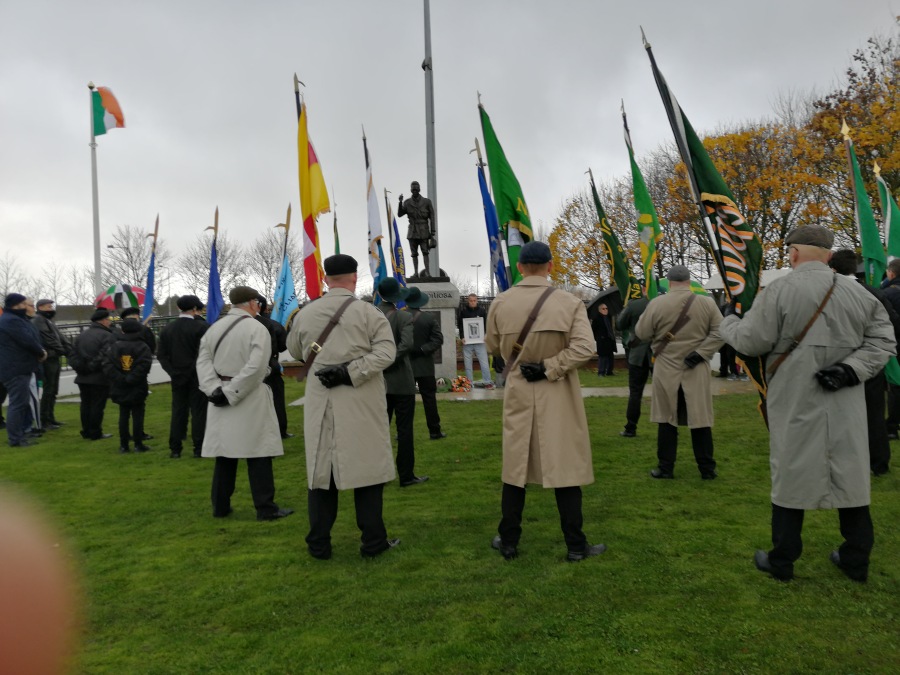
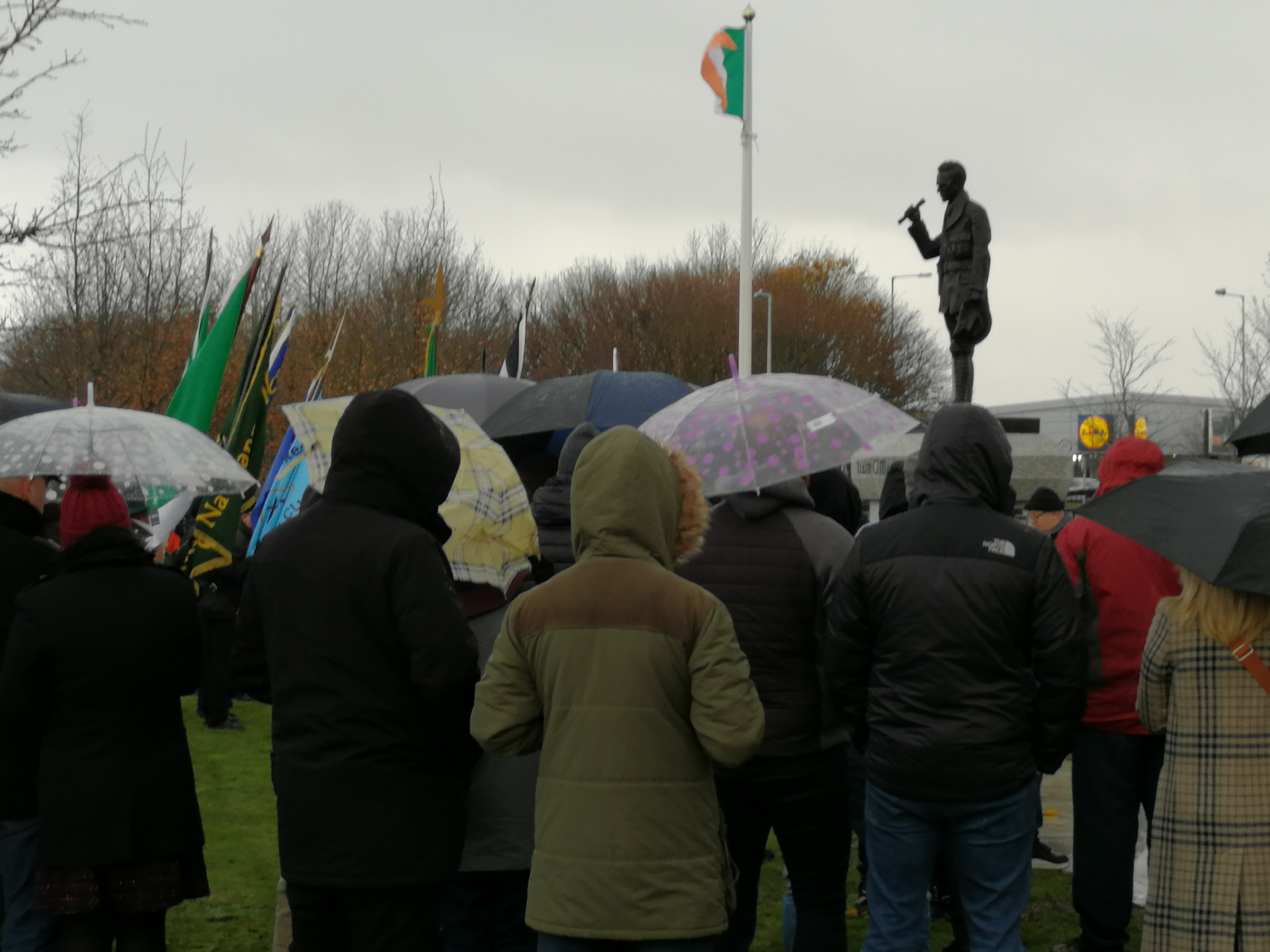
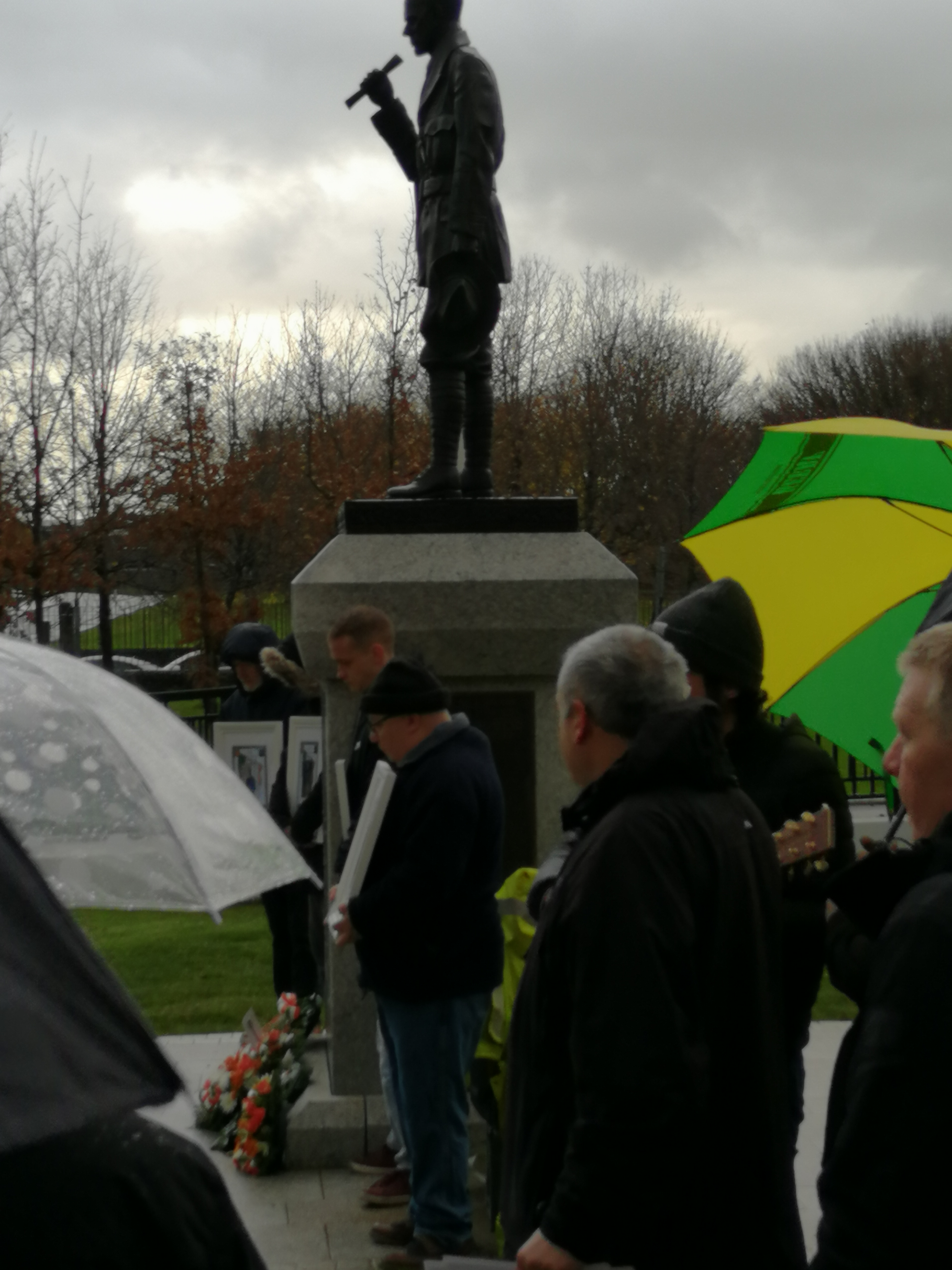
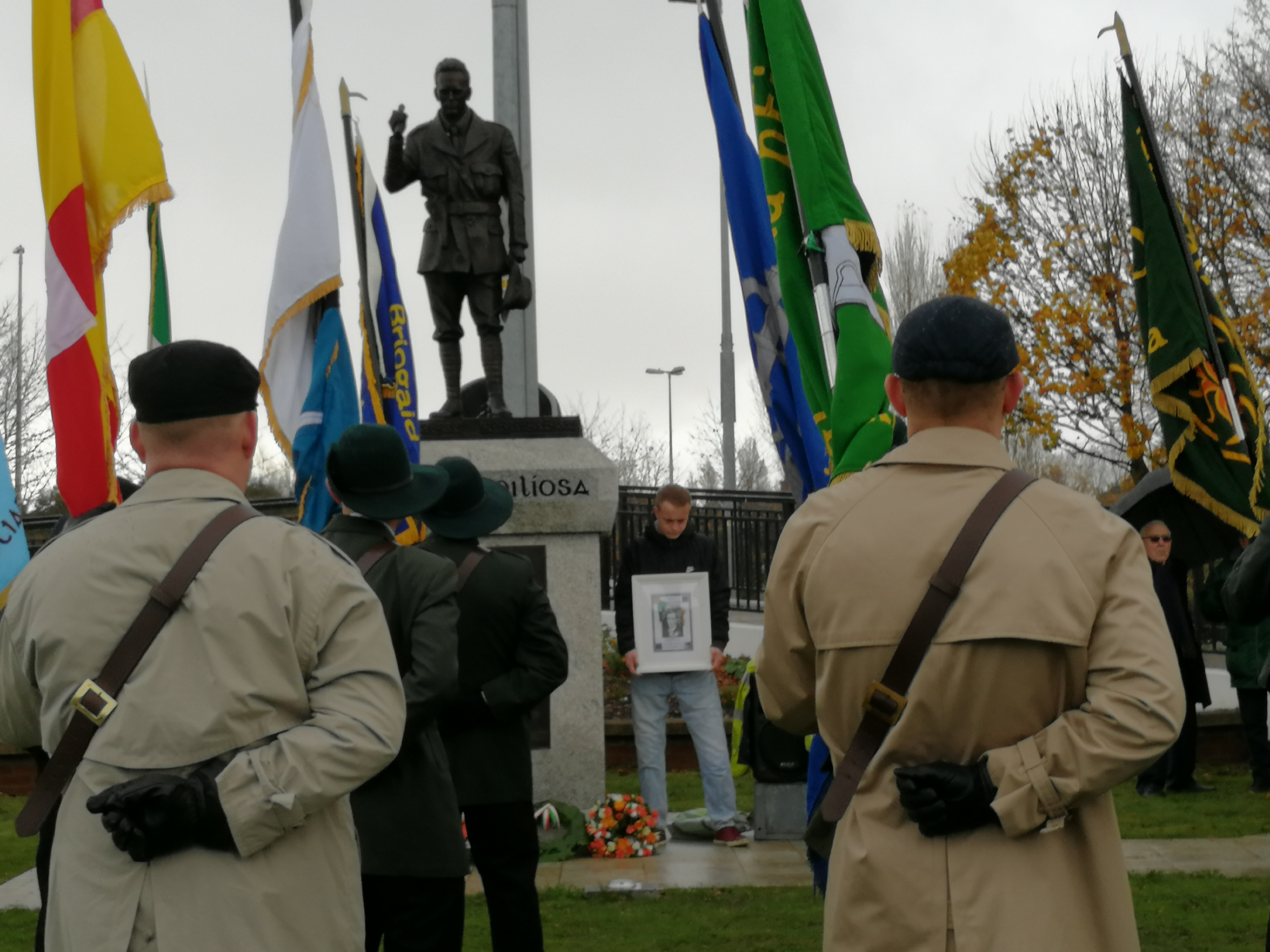
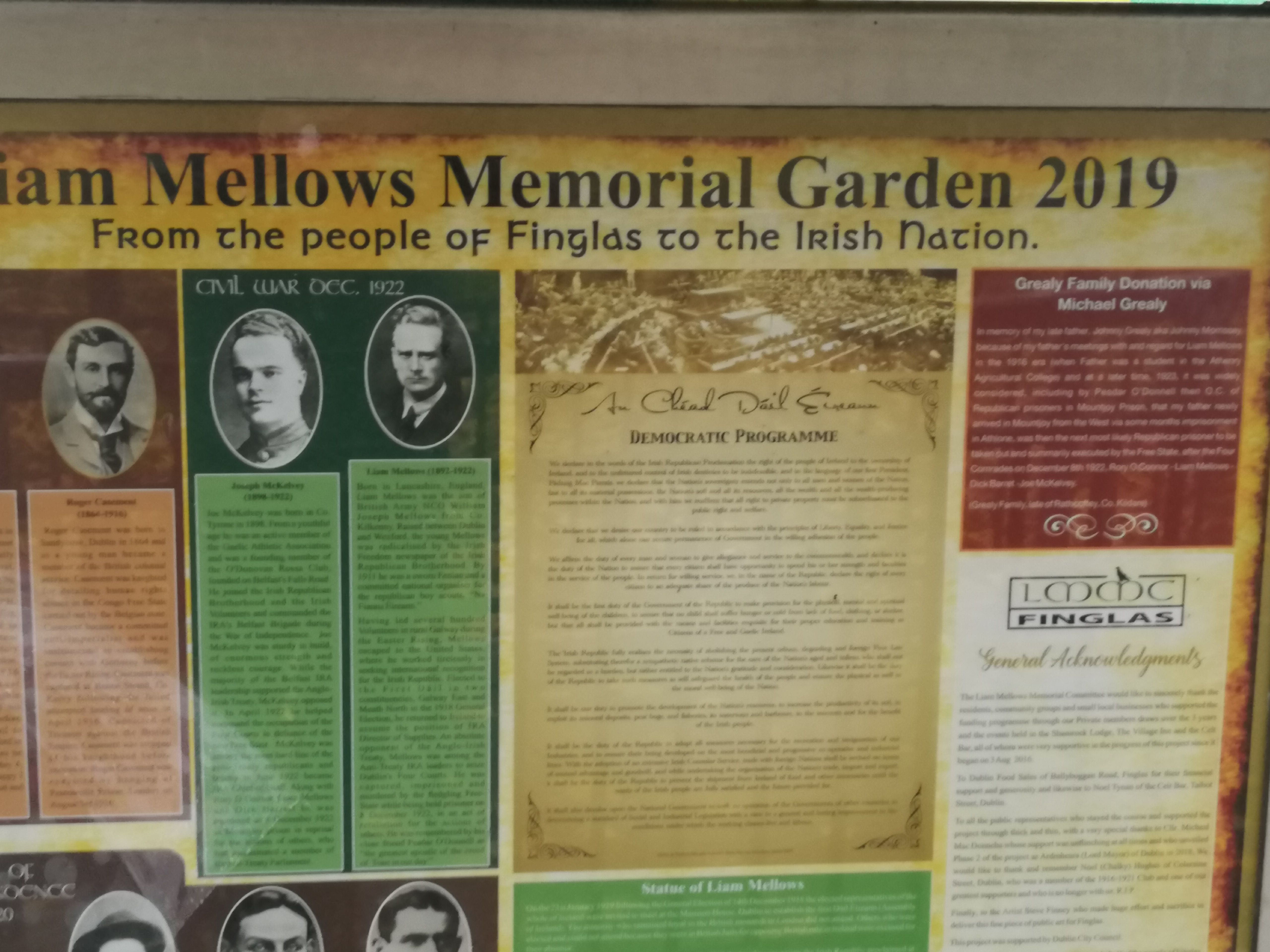
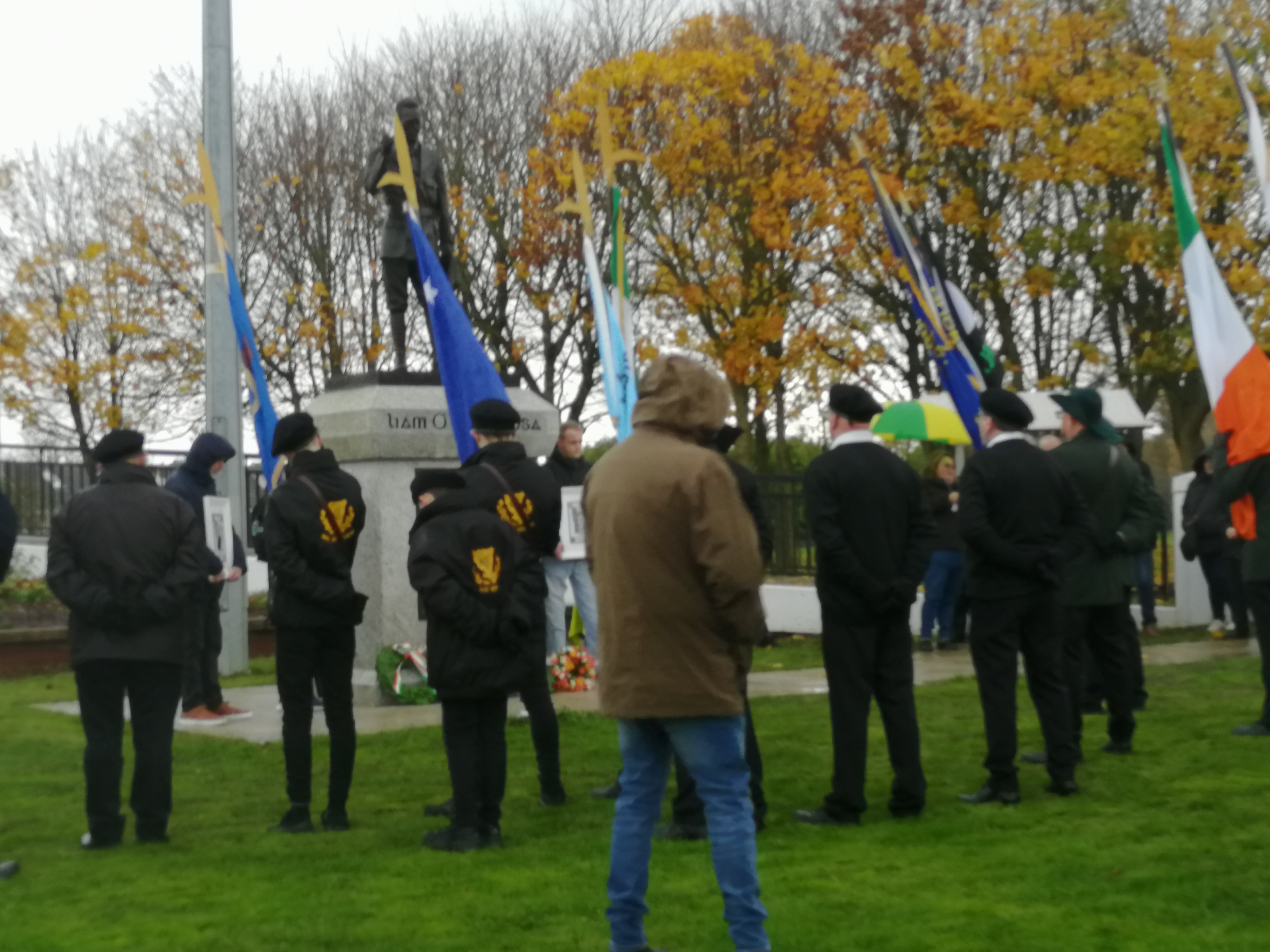
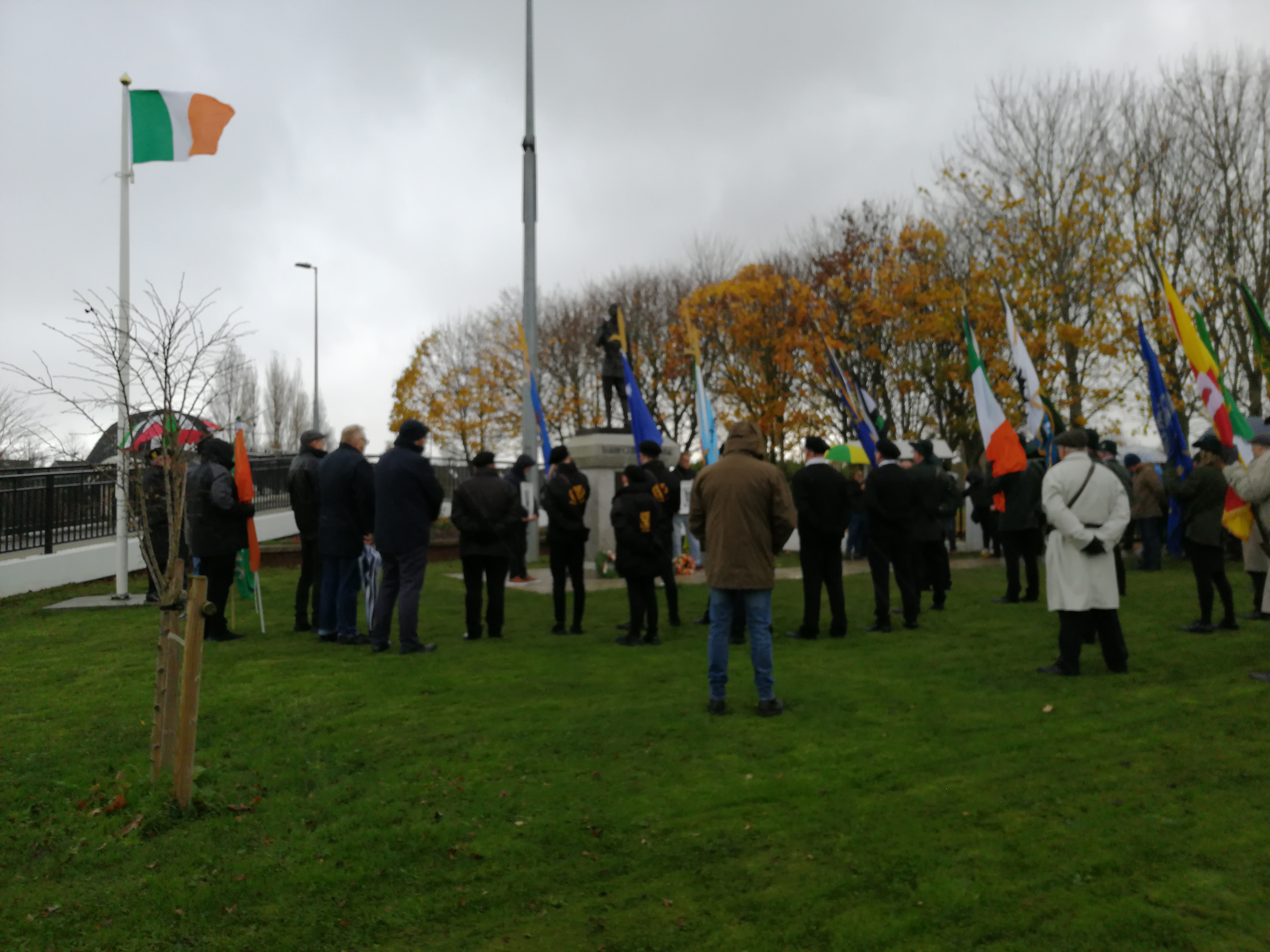
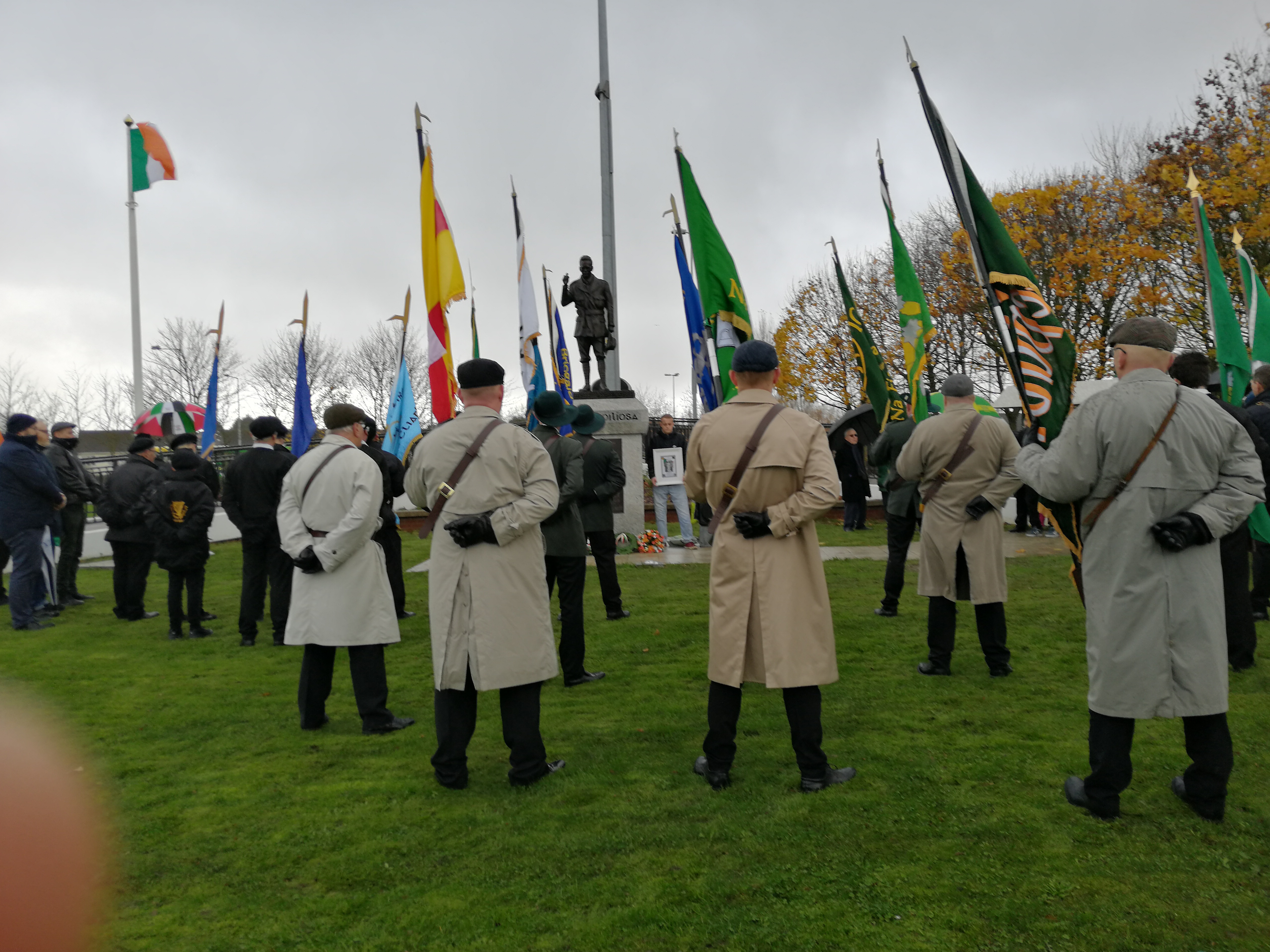
In atrocious weather conditions, Irish Republicans of a number of organisations and of none gathered at the Liam Mellows monument in Finglas today (Sunday 4 December 2022) to honour four Republicans executed by the Irish State in 1922.
Liam Mellows, Rory O’Conor, Joe McKelvey and Richard Barrett were all prominent IRA Volunteers during the War of Independence and rejected the Anglo-Irish Agreement to create a subservient state in a partitioned country.
The Irish State chose the four prisoners in retaliation for the assassination of Seán Hales TD, himself shot in retaliation for Free State executions of Republican prisoners. By coincidence or intent, each one of the four had been born in a different one of Ireland’s four provinces.
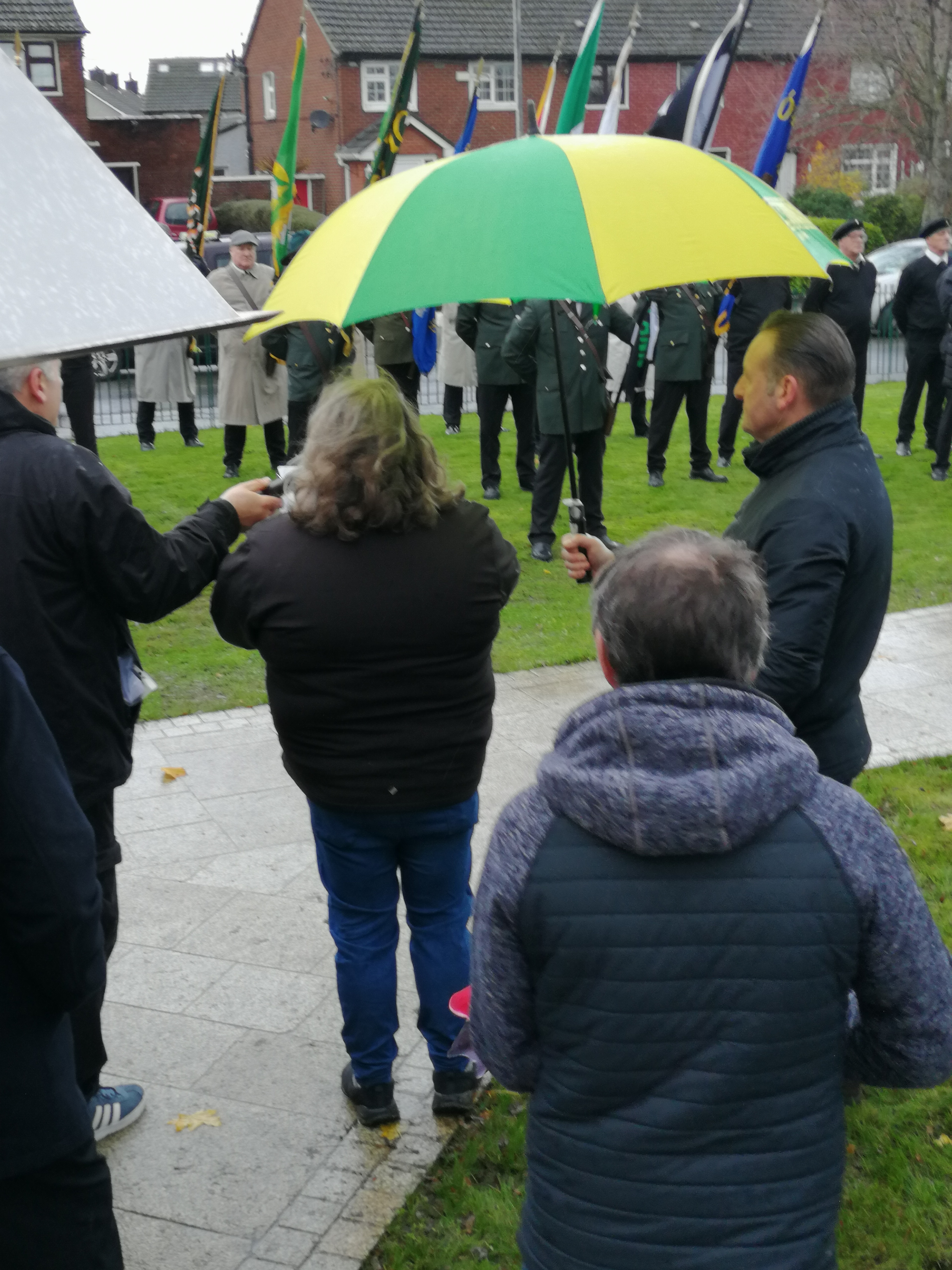
Section of the crowd seen from behind, the monument ahead in background and the flags of the colour parties visible to the left. (Photo: D.Breatnach)
THE COMMEMORATION EVENT
A part of the commemoration marched with colour parties, led by lone piper, from Finglas village to the Mellows Monument.
Ado Perry chaired the event, one of a series of Irish Civil War commemorations in Dublin organised by Independent Republicans, which group also erected commemorative panels in various locations around the city, often marking the location where Free State troops killed an IRA Volunteer.
Three colour parties attended the event and a list of all the known Republican victims of the Free State was read out.
Seán Óg performing with Ado Perry in the foreground. (Photo: D.Breatnach)
Sean Óg, accompanying himself on guitar, sang Brian Ó hUigínn’s Soldiers of ‘22 and James Ryan’s Take It Down From the Mast, two of the best-known of a very limited number of songs about the Irish Civil War. A number present joined in on the chorus of the second song:
Take it down from the mast, Irish Traitors,
It’s the flag we Republicans claim;
It can never belong to Free Staters,
For you’ve brought on it nothing but shame.
(Photo: D.Breatnach)
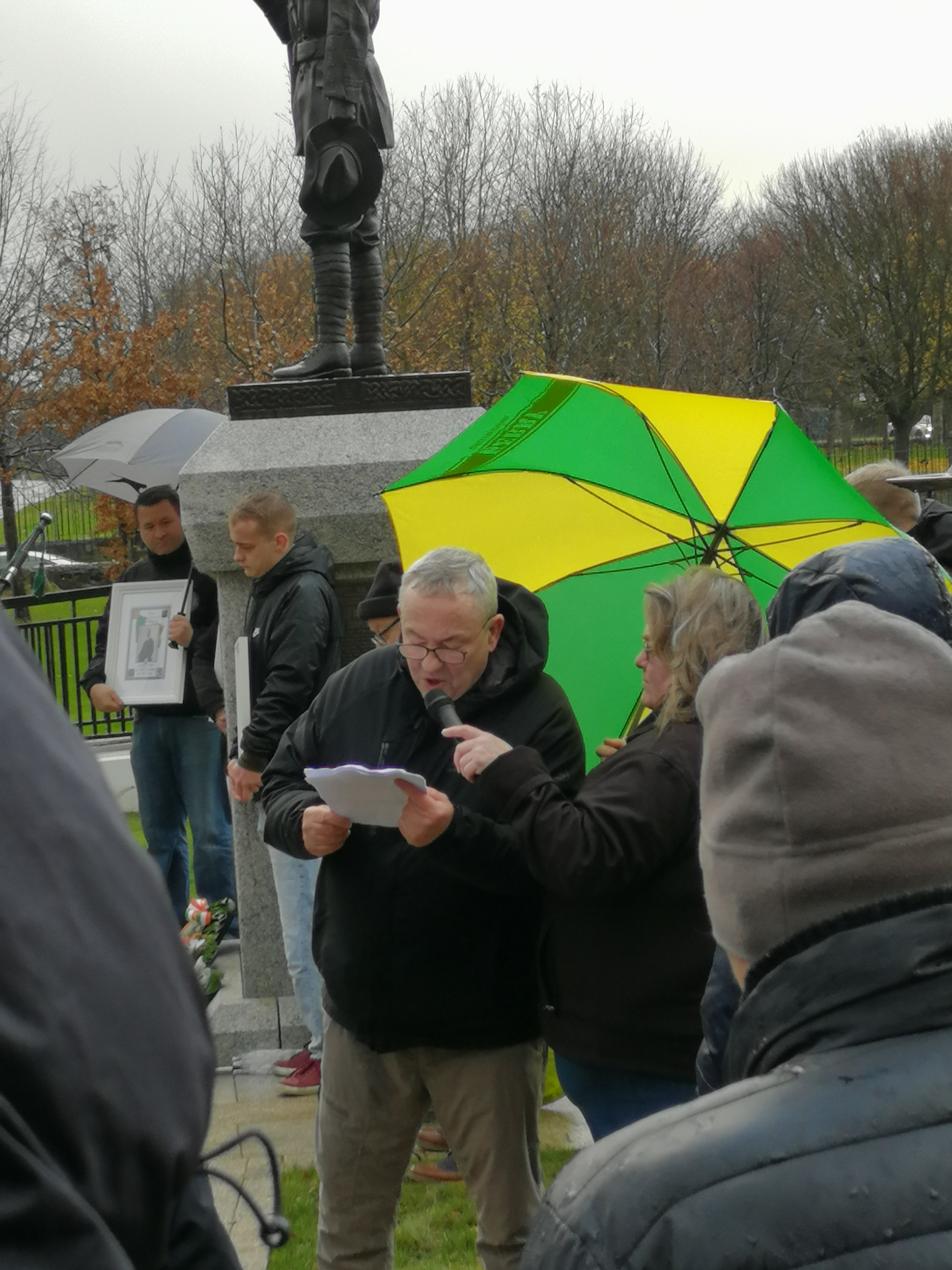
Mags Glennon gave a speech on behalf of the organisers but it was difficult to make out its content (kindly supplied since and given in full in Appendix.
The main speaker advertised for the event was John Crawley, who has found recent fame in Republican circles with the publication of his biographical book The Yank, about his enlisting with the US Marine Corps and attempting to pass on his military skills to the Provisional IRA.
John Crawley speaking (Photo: D.Breatnach)
It was a shame that the volume of the PA was only turned up at around the last quarter or so of his speech. Despite the limited audibility of most of it, the attendance endured the rain and stood there in good order1.
Ado Perry thanked speakers and musicians for participation and all for attendance, making special mention of the colour parties. He announced that the event commemorative event would be at Kilmainham Jail early in January.
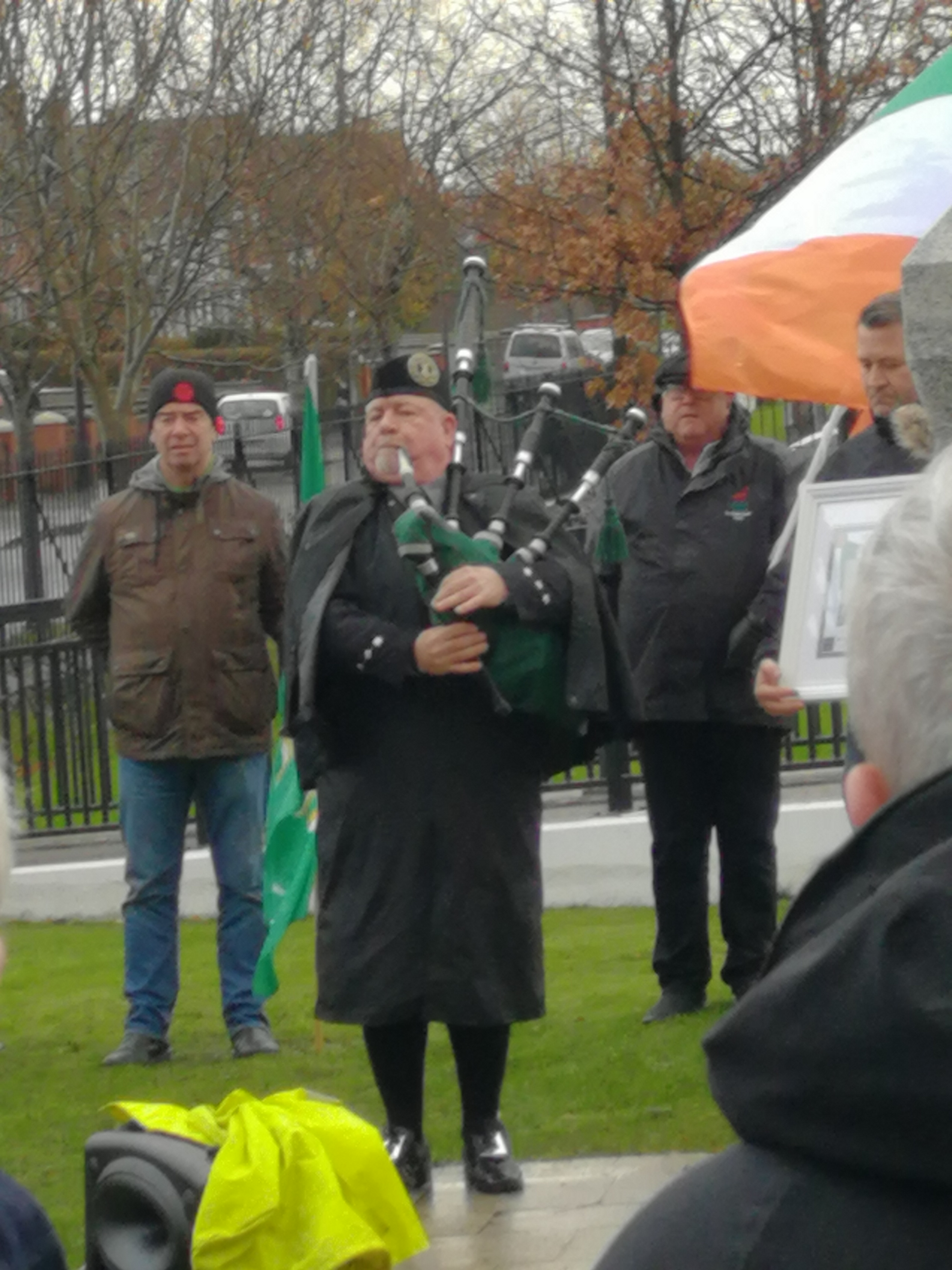
A lone piper played a lament and swung into the national anthem, Amhrán na bhFiann. Representatives of the National Graves Association addressed the crowd briefly before the event finally concluded and the wet and the weary headed home or to a warm pub or restaurant.
(Photo: D.Breatnach)
A local resident assured us that the sun does sometimes shine in Finglas. I assured him I believed him as I had seen some photographs to verify it.
The weather really was atrocious, raining almost non-stop and on one occasion during the event, lashing down heavily upon the gathering. One had to feel sympathy for the men and women of the three colour parties, who had to endure the downpour without the shelter of even an umbrella.
Indeed this reporter felt the need to break his bicycle journey away from the event for a bowl of hot soup in a nice eatery across the motorway bridge in Finglas village, before pushing on to my destination in the Glasnevin area.
(Photo: D.Breatnach)
BACKGROUND: THE FREE STATE
The State that came into existence in 1922 was a creation of those forces that accepted Dominion status within the British Commonwealth instead of an Irish Republic, accepting also the partition of Ireland for the first time with six counties becoming a British colony.
While the pro-Treaty position had a majority of votes in the Irish parliament, a large part of the civilian population and the vast majority of the fighters (Irish Volunteers, Cumann na mBan, Na Fianna) rejected the Treaty and their representation left the Government in protest.
Although Anti-Treaty forces had occupied the Four Courts in Dublin, the Civil War was started by the Free State military, shelling the Republican occupants with artillery on loan from the British military and going on to use British transport and weapons to defeat the Republicans.
Rory O’Connor, Joe McKelvey, Richard Barrett and Liam Mellows were already in jail when Seán Hales was killed and could not be considered guilty by any stretch of causality; nevertheless they were executed on 9th December 1922.
oznor
From Century Ireland:
In a statement issued by the National Army’s General Headquarters, the latest round of executions are explained as a ‘reprisal for the assassination…. of Brigadier Sean Hales, TD, and as a solemn warning to those associated with them who are engaged in a conspiracy of assassination against the representatives of the Irish people.’
The executions took place at 9.20 am. The prisoners were marched blindfolded to the rear of the Mountjoy Prison buildings with three clergymen in attendance. They were shot by firing squad and their bodies were subsequently interred within the grounds of the prison.
Commenting on these developments, the Irish Times has editorialised that the ‘Free State Government has committed itself to an act of ‘reprisal’ which eclipses in sudden and tragic severity the sternest measures of the British Crown during the conflict with Sinn Féin.’
The first executions carried out by the Free State took place on 17 November 1922, and then continued a week later with that of Erskine Childers.
On the last day of November, the number of those executed increased to eight when three Dubliners – Joseph Spooner (21), Patrick Farrelly (21), John Murphy (19) – were killed at Beggars Bush Barracks.
The three men were captured on 30 October after an attempt was made to blow up Oriel House, the headquarters of the Criminal Investigation Department (CID)2.
Following the deaths of Spooner, Farrelly and Murphy, the leader of the Labour Party, Thomas Johnston, called for an end to executions as a method of punishment. Mr Johnston, speaking in the Dáil on 30 November, stated:
‘We have been told pretty frequently during the last few weeks that it is the intention of the ministry to re-establish the reign of law, and we were told yesterday, as we have been told frequently, that unless this kind of thing is done anarchy will prevail. I want to make the charge that this kind of trial, this kind of sentence, is, in fact, anarchy. It is not law. It is anarchy- lynch law once removed.’
Colour Parties at the event (Photo: D.Breatnach)
By the time the Civil War ended, the Free State had formally executed around 80 Irish Republicans (many more than had the British occupation 1916-1921) and at least another 20 killed as surrendered fighters or kidnapped, sometimes tortured, then taken somewhere and shot.
Post-Civil War, the class nature of the State became even clearer: led by a foreign-dependent capitalist class, handing over healthcare and education to the Catholic Church, upon the institutions of which it leaned heavily for social control of the masses.
The foreign dependency was at first on the British who helped create the State but subsequently first the USA and then the EU have been added to the list of economic masters. This is the inheritance of the Anglo-Irish Agreement and of the victory of the Free State in the Civil War.
end.
(Photo: D.Breatnach)(Photo: D.Breatnach)
APPENDIX (reading time approx 11 minutes):
SPEECH BY MAGS GLENNON FOR INDEPENDENT REPUBLICANS GROUP
Today we gather to remember and honour Liam Mellows, Rory O’Connor, Joe McKelvey and Dick Barrett, four dedicated volunteers who were executed without even the pretence of a trial by a Free State regime bent on revenge and determined to use any methods to defeat the principles and spirit of Irish Republicanism.
In this case the brutal elimination not just of key IRA military leaders but also the articulate political voices who could expose the betrayal of the revolutionary republican ideals by the Free State.
As the Civil War grew increasingly bitter in the autumn of 1922 the Free State implemented the Public Order Act, allowing for summary execution from anyone caught in possession of weapons. Kevin O Higgins stated that “what was needed to put down the Irregulars were more local executions, and we should just kill them anyway”.
It is important to recognize the context in which these four brave men met their deaths. They were murdered to ensure the supremacy of the Free State elite who felt it was their right to betray the principles of the 1916 Rising and the Democratic Programme of the 1st Dail.
The prosperous catholic and moderate nationalist class had seen their Home Rule party practically eliminated in the 1919 election. Mass campaigns against conscription, transport strikes against British militarism as well as sporadic strikes and workers Soviet revolts worried what Mellows called ‘the state in the country people’.
The political interests of the prosperous middle class catholic merchants, professionals and big farmers were well served by acceptance of the British Treaty, which would ensure they held social, economic and political power in the new Free State. They cared not for partition or royal oaths as they had achieved their Home Rule.
The Free State elite saw the role of working people, many of whom had been at the forefront of the war, was to retreat once more to the slums and to obey their masters.
The democratic and egalitarian basis of a Republicanism expressed in the founding documents of the struggle promised a radical and democratic future, appealing in particular to working people in Dublin who had been fighting since the Lockout of 1913.
WT Cosgrave famously described the urban and rural poor as the ‘sweepings of the workhouses’ and desired that they emigrate as quickly as possible. The original Sinn Fein of Arthur Griffith had supported the employers in 1913 but piggy backed to prominence on the back of the 1916 Rising.
The elimination of men like Mellows – Brugha and Childers were already dead – was to ensure the political head was cut off the Republican movement.
The execution of military commanders like O Connor, Barrett and McKelvey was to send a message to all provinces that the IRA rank and file would suffer similar deaths to their commanding officers.
The terror Dublin had suffered in 1922 was intensified across the south in 1923 with dozens of young volunteers (many just boys) disappeared, tortured, shot at roadsides and dumped behind ditches. Yet Fine Gael still today parrots rubbish about republican ‘violence’, to cover up the savage war crimes on which they built their Free State.
We must all openly question the narrative being put forward by the Free State establishment today, completely ignoring the centenary of the Civil War. Remembering the deaths and honouring the lives of the republican volunteers has been carried out by their families and small local Commemoration groups.
Any further publicity would reveal the betrayal of the democratic and revolutionary principles of Republicanism which the Free State attempted to wipe out in the Civil War. We must rededicate ourselves to the revolutionary, internationalist and anti-imperialist traditions of Irish Republicanism.
As we work to advance these ideas in our communities, we must reject the conservative and xenophobic brands of nationalism, whether orange or green, that seek to deflect the blame for our social and economic problems away from the establishment figures benefiting from and promoting such conflict.
We remember today the sacrifice made 100 years ago by Liam Mellows, Rory O Connor, Joe McKelvey and Dick Barrett. May they rest in peace and their ideas and example form the basis of a strong, principled and united Irish Republicanism into the future. Beir Bua!
SPEECH BY JOHN CRAWLEY, MAIN SPEAKER AT EVENT
At 3:30 am on Friday, the 8th of December 1922, IRA volunteers Liam Mellows, Rory O’Connor, Dick Barrett, and Joe McKelvey were informed they were to be summarily executed by the Free State government in retaliation for the killing of Sean Hales, the previous day.
Hales had voted for the ‘Murder Bill’ permitting the execution of those bearing arms in defence of the Irish Republic.
The Free State made great play of the fact Hales was a T.D. even though the first T.D. slain in the Civil War had been shot by Free Staters when they killed Cathal Brugha, who presided over the first meeting of Dáil hÉireann in January 1919 and had served as Minister for Defence. Free Staters had murdered Harry Boland T.D. in August, and of course, Liam Mellows was a T.D.
Captured as part of the Four Courts garrison the previous June, these four IRA volunteers had been in prison since then. They held no responsibility for IRA operations on the outside.
Those Free Staters who hadn’t the resolve to stand by the Republic demonstrated vicious zeal in proving to the British they had the cruelty to murder those who did.
They attempted to justify these killings by claiming they were implementing the will of the Irish people who approved the Anglo-Irish Treaty under Britain’s threat of immediate and terrible war if it were not ratified.
But it was not the will of the Irish people that led to the bombardment of the Four Courts the previous June with artillery provided by the British army. It was the will of British Prime Minister Lloyd George and Winston Churchill.
The firing squad that shot Rory, Liam, Dick, and Joe that cold December morning was manned by Irishmen who had all served in the British army. They carried rifles and wore uniforms supplied by the British government.
The Free State government called its armed wing the National Army, but it was no national army.
It was an exclusively 26-County force set up under Article 8 of the Anglo-Irish Treaty to fight the only war they ever engaged in – the war to overthrow the Irish Republic. Had it been a national army, the British government would never have permitted it to exist.
Bernard Law Montgomery, who became a Field Marshall during the Second World War and had commanded British forces in Cork during the Irish civil war, wrote in 1923:
‘We [the British Army] could probably have squashed the [IRA 1919-21] rebellion as a temporary measure, but it would have broken out again like an ulcer the moment we removed the troops…
The only way, therefore, was to give them [the Irish] some form of self-government and let them squash the rebellion themselves; they are the only people who could really stamp it out, and they are still trying to do so and as far as one can tell they seem to be having a fair amount of success.’
By May 1923, the Free State Army would have 58,000 men who were armed, equipped, and uniformed by the British government.
Of this number, more than 30,000 were Irishmen who were former British soldiers, approximately 3,000 were IRA deserters who had defected from the Republic, and the remaining 25,000 had no prior experience on either side.
James Connolly had written in 1915, ‘When a foreign invader plants himself in a country which he holds by military force his only hope of retaining his grasp is either that he wins the loyalty of the natives, or if he fails to do so that he corrupts enough of them to enable him to disorganise and dishearten the remainder…The chief method of corruption is by an appeal to self-interest.
The self-interest of the Free Staters lay in the opportunity to achieve managerial control of a state with the pay, pensions, patronage, and prestige that went with it. A state whose parameters had been determined by a Tory-dominated cabinet committee that consulted nobody in Ireland except unionists.
Contrary to what partitionist propagandists would have us believe, the Treaty was not the result of a decision that had to be taken for pragmatic reasons in the face of overwhelming odds that any rational person in Ireland could recognise and accept.
Nor was the Dáil split down the middle. The Treaty passed by only seven votes in January 1922. Had the vote been taken before the Christmas recess, as many had expected, the Treaty would almost certainly have been rejected.
Unfortunately, the Christmas break gave powerful pro-Treaty interests like the Catholic Church, big farmers, big business, and an assortment of gombeen men the opportunity to wear down the resolve of a number of T.D.s.
Liam Mellows presided over an IRA convention held in the Mansion House in Dublin in March 1922. The IRA voted more than 80% against the Treaty and passed a resolution declaring, ‘That the Army reaffirms its allegiance to the Irish Republic…’
Cumann na mBan voted overwhelmingly against the Treaty by 419 votes to 63, and the vast majority of the active IRA units in the field also rejected it.
In a letter to his mother written shortly before his execution, Liam Mellows declared, ‘I die for the truth.
That truth was spoken by James Connolly at his court martial in 1916 when he said, ‘The British Government has no right in Ireland, never had any right in Ireland, and never can have any right in Ireland . . .’
That truth was also spoken by Pádraig Pearse while inspecting Irish Volunteers at Vinegar Hill in Wexford in the early autumn of 1915 when he said, ‘We, the Volunteers, are formed here not for half of Ireland, not to give the British Garrison control of part of Ireland. No! We are here for the whole of Ireland.’
As has been shown so many times in Irish history and is being demonstrated today in a different context, in a revolutionary struggle, the choice one often confronts is whether to do what counts or to make what you can do count.
To do what mattered proved too daunting for many Free Staters, so they made the Treaty count, saved their skins, opened career paths, and shifted the goalposts from the 32-County Irish Republic to a 26-County Dominion of the British Empire moulded by British strategic interests.
In 1948 Fine Gael Taoiseach John A. Costello declared that the Irish Free State would become the Republic of Ireland – a republic that would tell the world Ireland is Ireland without the Six Counties.
In the future, when any Dublin politician would proudly assert, ‘I stand by the Republic,’ they were referring exclusively to the twenty-six-county Republic of Ireland announced by this former Blueshirt in 1948, not the thirty-two-county Irish Republic proclaimed in 1916 and ratified by the First Dáil in 1919.
Again today, Britain is attempting to shape the political environment to suit its strategic interests. Just as in Liam Mellows day, former comrades who swore they would lead us to the Republic are leading us in the opposite direction.
All talk of the Republic is now gone because the Republic was never on the negotiating table in 1998. We no longer hear Ireland referred to as our country but as this island. Our country is one nation. This island has two.
Great play is made about the potential of a united Ireland as outlined in the Good Friday Agreement. We had a united Ireland during the Famine. We had a united Ireland when the Republic was proclaimed in 1916. We had a united Ireland when the United Irishmen was formed in 1791.
So what did the 28 Protestants who founded the Irish republican movement mean by a United Ireland? Not territorial unity, which already existed, but the only unity that matters and the unity the British would never countenance – a unity of Irish citizens across the sectarian divide.
The united Ireland defined by the Good Friday Agreement is not a republic. It envisions a polity where the sectarian dynamic remains intact and the cleavage in national loyalties between Ireland and Britain is constitutionally enshrined.
Consequently, many supporters of this strategy propose a continuing and symbolic role for the British royal family as an institutional point of reference for the loyalties of those who would prefer to see themselves as a civic outpost of Britain rather than as equal citizens of a national democracy within an all-Ireland republic.
Debates and discussions are taking place on changing the Irish national flag, discarding the Irish national anthem, and re-joining the British Commonwealth. Instead of breaking the connection with England, we are being relentlessly conditioned into becoming more closely incorporated into a British sphere of influence on a national level.
When former comrades meet and greet British royalty in Ireland, they are sending out an unambiguous message that Ireland is not one nation but two. That Britain has legitimacy in Ireland and a role to play in influencing the political trajectory of our country.
Our goal as IRA volunteers was to break the connection with England. Not to convince the rest of Ireland to re-join the British Commonwealth.
There are many happy clappy euphemisms being employed to describe the Ireland of the future. A shared island, an agreed Ireland, and a new Ireland. Who in their right mind could be against the concept of sharing and new and agreed arrangements?
When we drill down into it, however, we see the trap being laid for us by the British government. A shared island means we share in Britain’s analysis of the nature of the conflict, we share in the colonial legacy of sectarian apartheid, and we share in the imperial project of divide and rule.
We do this by recognising Ulster unionists as the British presence in Ireland with the right to have their Britishness enshrined in law. Republicans know that unionists are pro-British, but we do not accept they are the British presence.
The British presence is the presence of Britain’s jurisdictional claim to Ireland and the civil and military apparatus that gives that effect. England invaded Ireland hundreds of years before the plantation of Ulster. They claimed sovereignty here long before a single unionist set foot on Irish soil. What was their excuse, then?
An agreed Ireland has come to mean the two traditions agreeing to disagree in peace and harmony about the constitutional source of Irish sovereignty and the legitimacy and extent of British influence in constraining Irish democracy.
A muddled and subversive belief that the conquest and colonisation of Ireland share reciprocal legitimacy with its struggle for independence.
The new Ireland we are being asked to work towards is not new. It is predicated on all the old divisions. Divisions that Britain nurtured to retain the sectarian dynamic and resultant cleavage in national loyalties as this policy of divide and rule is the key to their control in Ireland.
It is designed to prevent us from developing the national cohesion required to achieve a 32-County republic. To make us permanently susceptible to British influence and manipulation.
During the Dáil debates on the Anglo-Irish Treaty, a persistent theme was that a pro-treaty vote was a vote for peace, with the resulting implication that those who stood firmly for the Republic were out for war. Liam Mellows replied:
‘If peace was the only object, why, I say, was this fight ever started? Why did we ever negotiate for what we are now told is impossible?
Why should men have ever been led on the road they travelled if peace was the only object? We could have had peace and could have been peaceful in Ireland a long time ago if we were prepared to give up the ideal for which we fought…’
Today those who stand resolutely for the Republic are accused of being against the peace process. Few republicans are against peace, but many are rightly critical of a process that cannot lead to the republican goals for which countless patriots sacrificed their lives.
A united Ireland rooted in British/Irish identity politics cannot be a republic. That is why the British government is all over this. It is their best opportunity to retain maximum influence in Ireland with a minimum footprint when the demographics eventually prove incontestable.
No one has been preparing more diligently to shape the strategic architecture of a future united Ireland than the British government.
One hundred years ago this week, Liam Mellows, Rory O’Connor, Dick Barrett, and Joe McKelvey were dragged from their cells and murdered in cold blood because they stood for what weaker and more personally ambitious Irishmen could not summon the courage to defend any longer.
We honour them today. We remember with pride all Ireland’s patriots from their day to this who never forgot who they were or what they represented.
Long Live the Irish Republic!
FOOTNOTES
1Thanks to Independent Republicans for posting a copy of his speech and that by Mags Glennon on their behalves.
Historians and political activists gave talks in Dublin presenting a review of the conduct of what is more usually called the Irish Civil and its effect since on life in Ireland. All the speakers described that conflict as “a counterrevolution”, to overturn many of the gains made in the period of struggle immediately before it and to head off any possibility of yet further gains in Irish political, economical and social life, having a braking effect on such progress up to this very moment.
Liz Gillis speaking (Photo: D.Breatnach)
L-R: Fearghal Mac Bloscaidh, Mags Glennon, Ciaran Perry (Photo: D.Breatnach)
BACKGROUND
The event on 26th June, held in the function room of The Cobblestone, was organised by the Peadar O’Donnell Socialist Republican Forum, itself established in early 2013, the result of a number of meetings and seminars organised over the course of 2012. It combined communists and socialist Republicans to organise discussions on a number of issues, such as Irish state neutrality, Irish national independence, working-class programs in struggle etc.
(Photo: D.Breatnach)
SPEAKERS
Ciaran Perry, a socialist Republican and Independent Dublin City Councillor, also a local history activist, introduced the event. He talked about the importance of history and in particular local history, the traditions of struggle and how some of those had been weakened in the trade unions and communities over the years.
Reading the account of the Ballysheedy Massacre (Photo: D.Breatnach)
Perry introduced the MC for the meeting, Mags Glennon who is also a socialist Republican activist and history enthusiast.
Glennon introduced historian Fearghal MacBhloscaidh from Tyrone who began in Irish and then continued in English, his presentation laying out clearly his position that the Civil War was a planned counterrevolution, quoting Cabinet papers and correspondence and supplying figures on the arms and equipment supplied to the Free State ruling elite by the British. MacBhloscaidh also maintained that the De Valera Government, though supported by the wider Republican movement at the time, was also a counterrevolutionary measure when subjected to a class analysis.
Sorry, slightly out of focus Jimmy Doran (Photo: D.Breatnach)
A woman (whose name I did not catch) was called to stage. In a clear voice she read an account of of the horrific Ballyseedy Massacre. Free State soldiers, after torturing their Republican prisoners, brought nine of them out to a road barricade, in which they had placed a landmine which they exploded. One survived by some miracle but spent the rest of his life needing frequent medical intervention.
At intervals between speakers, Pól MacAdaim performed his music, singing accompanied by guitar. Among the songs he sang were Tipperary So Far Away and Take It Down From the Mast (in the chorus of which some members of the audience could be heard joining).
Pól Mac Adaim performing at the event (Photo: D.Breatnach)
Mags Glennon then introduced historian Liz Gillis from Dublin who talked about the reaction of women to the Treaty and to the Civil War. The vast majority of Cumann na mBan members rejected the Treaty and many actively supported the Republicans in the following conflict. Gillis also spoke about how the women, who had been active in the struggle in 1916 and briefly to the fore in public life with the elections of 1918 and the War of Independence, were driven back to almost invisibility by the Free State Government and also the De Valera government and the 1937 Constitution. Gillis lauded Kathleen Clarke whom she said continued to fight the struggle for the rights of women in representational politics and criticised the De Valera Constitution of 1937.
Mags next introduced Jimmy Doran, a communist and long-time trade union activist, who talked about the contribution of the organised Irish workers to the struggle against British colonialism and for the advance of the working class. Doran went on to comment on the trade unions’ history and current situation in the Irish state. I had to go to the toilet and when I returned stayed near the entrance so as not to distract the audience by retaking my seat near the front and unfortunately, due to the lack of a PA system and the acoustics of that location, I was unable to hear the rest of his presentation.
Poster for the event.Supporters and organisers (Photo: D.Breatnach)
Although the meeting was thrown open to questions or contributions, little was forthcoming although there was a short debate on whether the Irish bourgeoisie prepare well into the future and whether they prepare better than their opponents in the Republican movement.
The proceedings ended with announcements of forthcoming events, thanks from Mags to the speakers, audience and to Pol Mac Adaim who ended the day on a musical note.
Paris: Ah, si. Hello? Buena tarde, your Holiness. Thank you for ….
Now former Archbishop of Paris Aupetit
Vatican: Bona sera, your Eminence. Or bonne après-midi, if you prefer. His Holiness regrets he cannot come to the telephone at this moment. He asked me to attend to you personally.
Paris: Oh. I see. The thing is …. I need to speak to His Holiness privately. The matter is …. personal … and private.
Vatican: I am aware of your situation, your Eminence. It is hardly private anymore, is it?
(strangled sound).
Vatican: Are you alright, your Eminence?
Paris: (Sigh) Yes. Please excuse me. It’s true, the matter is all over the French media.
Vatican: And no doubt on its way around the world by now.
Paris: Oui, je suis desolé. So ashamed.
Vatican: You wished to discuss the matter with his Holiness? He has been made aware of it even before he received your letter, offering your resignation. His Holiness has empowered me to respond to you – in confidence, of course.
Paris: Yes, I was wondering ….. whether a confession … public apology …. without needing to resign …
Vatican: I don’t think that would work, your Eminence.
Paris: Why not? Isn’t our faith centred on forgiveness?
Vatican: Well, forgive me, your Eminence but in your decades of service to the Church ..
Paris: Yes, decades! And this is in the past – nine years ago!
Vatican: As I was saying, your Eminence, in your decades of service to the Church …. how many public transgressions of a moral nature have you forgiven?
Paris: Is not the flesh weak? Am I to be punished for experiencing love? Is our faith not about love?
Vatican: Please, your eminence. We have all taken a vow of chastity, of celibacy. We can leave the Church anytime we wish if we feel that is too much. And besides, a great many of your priests have hardly been restraining themselves …..
Paris: My sin was not like theirs, this was a woman, adult and willing and not in an institution!
Vatican: Quite. But for all those clerics and religious orders to have got away with it for so long? Over 200,000 victims of 3,000 priests over the last 70 years in France, according to an investigation. They must have had some help at the top, don’t you think, your Eminence? I am sure the French public at least will be asking themselves that question. And last year His Holiness accepted the resignation of a French Cardinal! No, no, your Eminence. His Holiness accepts your resignation. And wishes you well, of course.
Paris: I …. all because I fell in love, like a human being.
Vatican: No, pardon me, your Eminence. Because you got caught.
(Click! – but somehow the connection remains unbroken. The ex-Archbishop hears, in Italian which he knows reasonably well: “Well, Aupetit’s appetite …..”
and several sniggers. Then the line finally does go dead.)







 rebelbreeze

