A number of people have commented on Nature proceeding unaffected by the crisis of humans faced with the current Coronavirus pandemic. Although not entirely unaffected, it certainly seems that is so but it is a reflection of our generally subjective view of the natural world around us that we should be surprised at all.
The grass does not grow for us though we may have sown some of it, the leaves do not open nor flowers bloom to please our eyes, the birds do not sing to bring us pleasure through our ears, nor do blossoms and flowers pump out fragrances to please our nostrils. They are engaged in the deadly serious business of alimentation and procreation.
Here in early April the leaves unfurling and already unfurled from their winter sleep inside their branches of willow, sycamore, birch, rowan, elder, lime, alder, oak and chestnut will not notice much difference this year as they spread their catchers to collect the rays of the sun, the chlorophyll working to feed a new year’s growth. The ash is a little behind, its hard black protective bud-covers about to break open. Flower racemes are already well advanced on the invasive and poisonous cherry laurel and making a good start on the horse chestnut tree. If they are aware of anything, it is probably that suddenly the air has become much cleaner, as the volume of industrial and vehicle air-pollutants has suddenly dropped dramatically.
Weeping willows (saileach shilte) along the Tulcadh (Tolka), Griffith Park, Dublin. early April. (Photo source: D.Breatnach)
Not that it’s all peaceful out there – they all have their own struggles, competing for light and moisture, resisting attacks by insects, fungi and even other plants like ivy.
The robin (spideog), blackbird (londubh) and finch (glasán) are not singing for us nor even “merrily”, as the poets would have it – it’s a serious business, attracting a mate, fighting off competitors, then building a nest and raising young in safety from predators. The lowering of the air pollution level might bring a bloom in some invertebrate populations, animals without backbones like insects and snails, which would be welcomed to feed the birds’ young.
Birds (éanlaith) that will probably miss our usual level of activity will be those heavily dependent on human activity and some of its waste products, i.e the city pigeons (colúir) and seagulls (faoileáin), while the latter at sea might well do well from less commercial fishing and pollution. The fish will certainly benefit from a reduction in human activity.
In the streams and rivers the finger-length three-spined stickleback male will soon be establishing and defending his territory, where he will build a nest into which to entice an egg-filled female, there to lay her many eggs for him to fertilise. She’ll be off then, thank you ma’am and dad will raise the young until they are capable of free-swimming and feeding themselves, though still tiny. These are those that in parts of Ireland are called “pinkeens”, an interesting combination of two languages: the English “pink” and the diminutive ending “ín” in Irish (however the Irish name is completely different: “garmachán”). Look at the female and you’ll see no hint of the “pink” but the male in full breeding colour is something to see alright: throat and chest in bright red, an almost luminous green upper body and head with bright blue eyes.
Male Three-spined Stickleback in mating colours showing bright red belly and blue eyes. This is a sub-species from British Columbia — the Irish version has a green head and body. (Source photo: Internet)
In the city, with less waste on the street, the population of rats (francaigh) and mice (lucha) might be in for some tougher times, as might the foxes (sionnaigh). Developing a life-style as a scavenger on the refuse of other life-forms can be very beneficial but such populations are vulnerable to the fate of their unconscious benefactors.
Much animal and plant life benefits from the activity of humans, it is true – but a lot more suffers from it and would not be harmed at all by our disappearance.
A stand of different species of trees with cherry in blossom, Griffith Park, early April. (Photo source: D.Breatnach)
One of the consumables most regularly needed in households is bread. In the present circumstances it may not be so easy to purchase some and also going to shops and bakers entails a certain amount of health risk. However, we can make soda bread at home easily enough and have fresh, healthy bread daily.
Soda bread, brown, white, with and without dried fruit, is a traditional Irish bread and for decades was the daily bread in the rural areas. This is not a traditional recipe.
Apart from a source of sufficient heat, we will need
flour,
bicarbonate of soda,
a little salt,
milk
and a little edible acid like lemon juice or vinegar.
Source image: Internet
And since milk is another consumable that needs replenishing regularly, we can use it when it is ‘going off’ or dried milk powder instead.
We will need also some kind of mixing bowl, a strong metal fork and a heat-resistant receptacle.
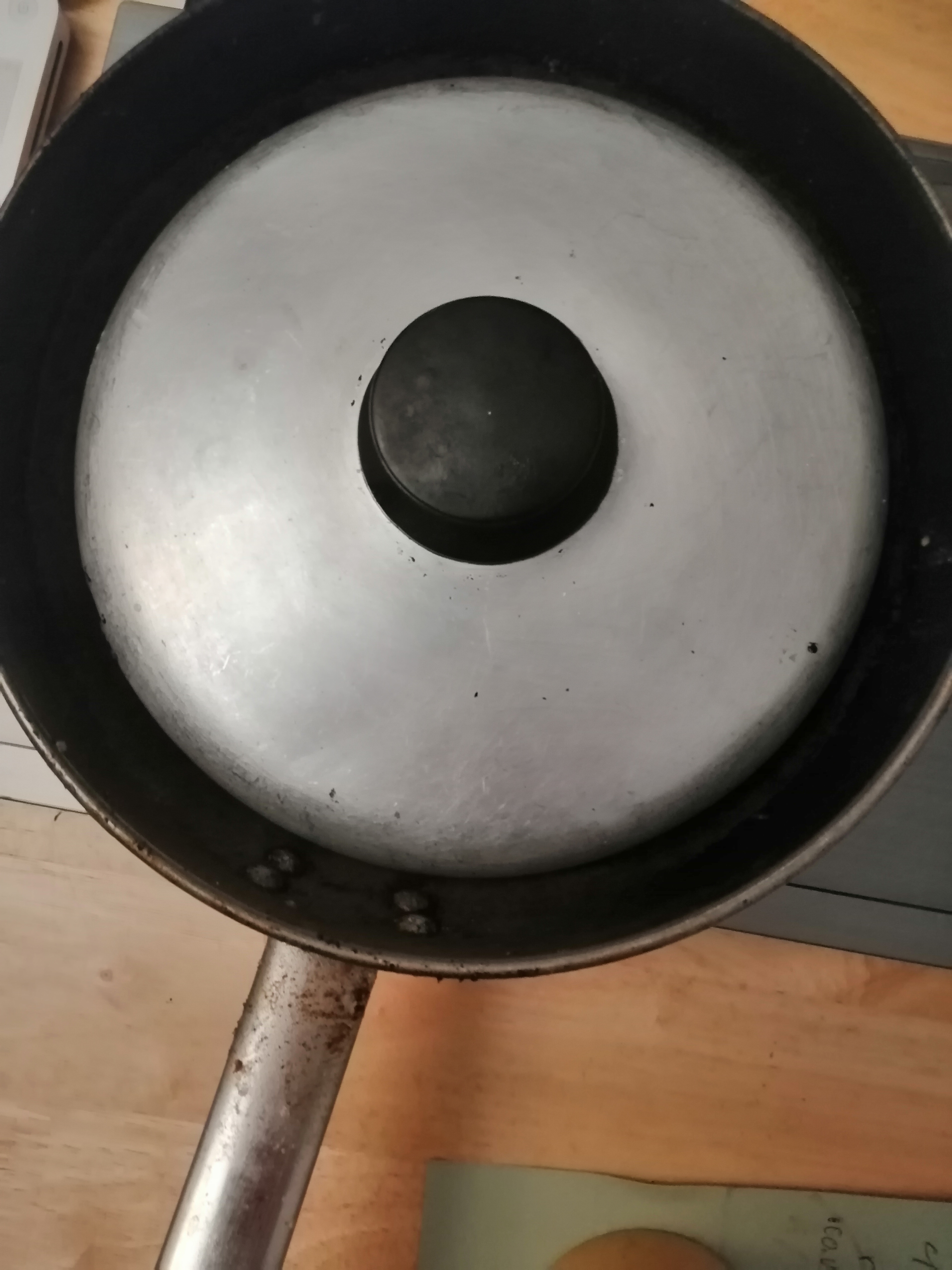
The following directions are for making small amounts of bread at a time, not in ovens but on top of hot plates or gas rings. The heat-resistant receptacle will be a frying pan or wok. In order to contain the heat sufficiently for long enough, we will also need something like a curved lid (the dough will rise or expand).
Frying pan for baking bread with a curved lid from a pan to contain heat and allow bread expansion. (Photo: D.Breatnach)
I am going to describe two variations in preparing the dough, one needing a board to work it on and another straight from the mixing bowl to the heat.
Both variations:
In the mixing-bowl
pour the flour (for quantities and recommendations see further below)
a level teaspoonful of bicarbonate of soda
a few pinches of salt
soured milk (either gone sour already or soured with a squirt of lemon juice, a few drops of vinegar etc.)
Mix with fork, not only round and round but folding over and over
Put frying pan or wok on to heat high with little oil or butter (to prevent the dough sticking)
Drop the dough into the pan or wok, turning it often
Turn the heat down low within a minute of turning the dough
Cover with a curved lid in which you have sprinkled some water (for steam for the bread)
It is useful to turn the dough a few times while baking to prevent a very hard crust forming
After about five minutes, take the bread out and tap it sharply with your fingers
When the bread gives a hollow sound on both sides when tapped, it is ready
Leave out to cool
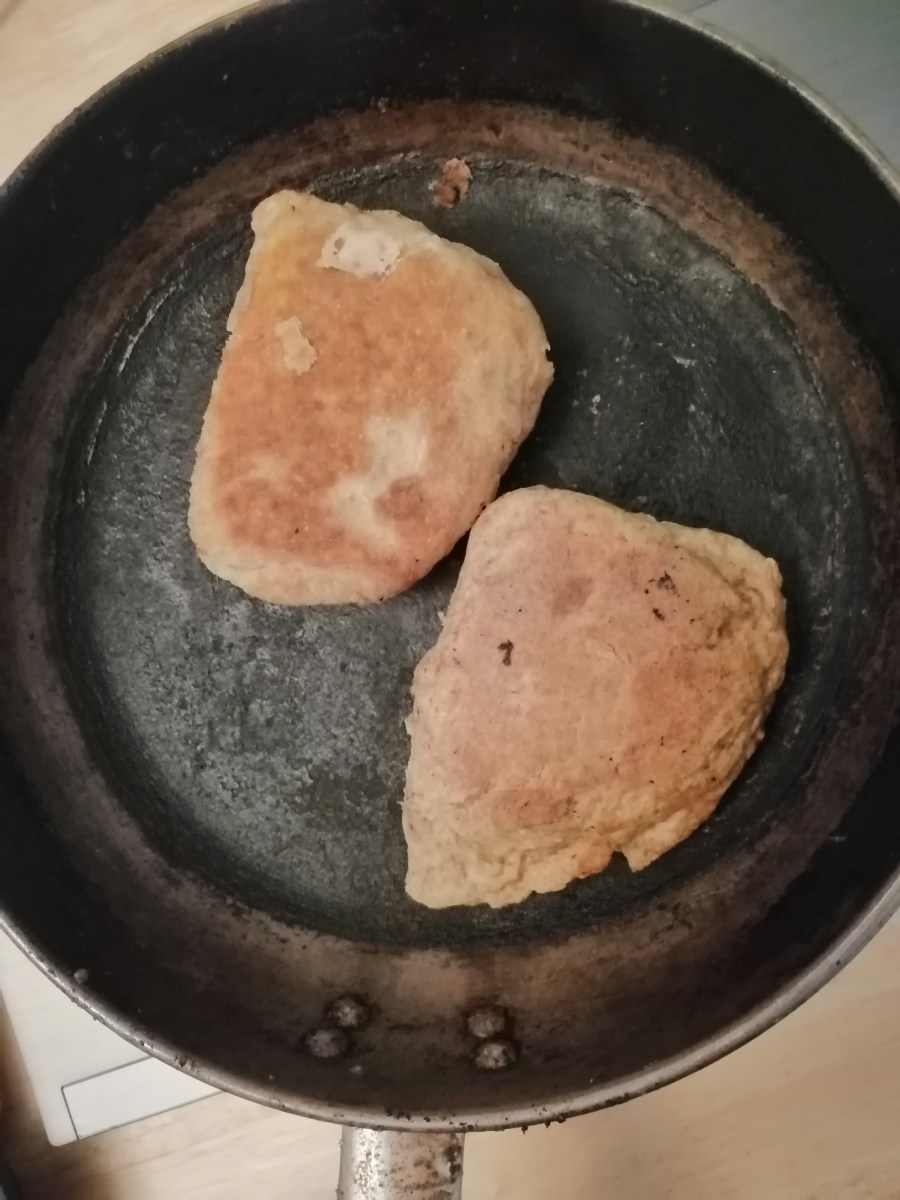
Bread “rolls” baked in frying pan (Photo: D.Breatnach)
1. Type without working the dough:
Mix it quite wet, adding a little water from time to time if necessary
Divide the mix into two or three lumps
Drop into the heated receptacle
You may want to smooth it with a damp spatula, back of a spoon, etc
Turn not only front to back but on all sides too
Lower heat, cover etc.
This will tend to produce round or oval shapes of bread
2. Type working the dough:
Mix it as dry as you can (but still mixed thoroughly into one mass)
Lay out your board, lightly sprinkled with flour
Tip the dough onto the board
Dip your hands in nearby flour, getting it all over palms and fingers
Sprinkle a little flour on top of the dough mass
Press down on the mass, flattening it
Turn it and press down again
Keep dusting your hands with flour as often as necessary (and the board, if the dough sticks)
When the mixture is totally flat, fold it half over and press down again
Continue doing this a number of times (you may notice a tendency for the shape to become triangular or even square through the folding)
Place on the heated receptacle (or, before doing so, press down the edges particularly all around the mass and cut in half)
Turn a few times while lowering the heat
Cover and test in about five minutes, etc.
FLOUR TYPES AND APPROXIMATE QUANTITIES
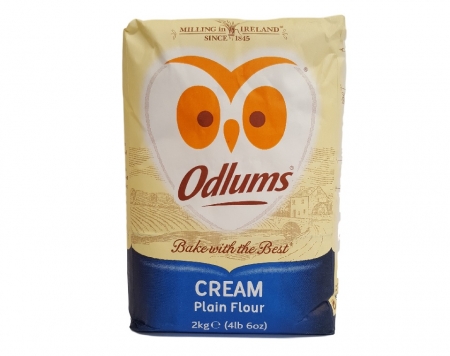
Wholemeal flour and oatmeal (as for porridge) are healthier than white flour (which should be plain, not self-raising) but white gives a lighter bread and is cheaper than wholemeal, because it is easier to keep. I mix one half mug of wholemeal to one mug-and-one-half of white plain, with a quarter of oatmeal.
Source image: Internet
Add a little milk at a time as necessary until you get used to knowing how much is needed. When using dried milk, we can mix it in the flour dry and add water as we mix or mix it in advance to make liquid milk; in this case every single ingredient can be a dry food with a preserve (if using vinegar).
Source image: Internet
ADDITIONAL NOTES
In Ireland, I prefer to use established brands like Odlums or Flavahan’s, rather than supermarket brands, even though the latter are usually cheaper.
The bread tastes better if made daily but to keep fresh, place inside a paper bag inside another of polythene and slice as needed. Making smaller amounts at a time, it is easier to judge the heat and time, otherwise one may find that the bread sounds hollow when tapped, as though cooked through, but at the centre there is still a mushy part.
The most taxing part of the process is the mixing the dough which is wearing on the wrists and men, known to generally have stronger wrists (no bawdy comments please) can at least carry out this part of the process and, having done so, sure might as well see the whole thing through.
From Workers’ Republic, 18 March 1916.
Transcribed by The James Connolly Society in 1997.
Proofread by Chris Clayton, August 2007.
James Connolly poster by Jim Fitzpatrick. (Image sourced: Internet)
The question often arises: Why do Irishmen celebrate the festival of their national saint, in view of the recently re-discovered truth that he was by no means the first missionary to preach Christianity to the people of Ireland? It is known now beyond the shadow of a doubt that the Christian religion had been preached and practised in Ireland long before St. Patrick, that Christian churches had been established, and it is probable that the legend about the shamrock was invented in some later generation than that of the saint. Certainly the shamrock bears no place of any importance in early Celtic literature, and the first time we read of it as having any reference to or bearing on religion in Ireland occurs in the work of a foreigner – an English monk.
But all that notwithstanding there is good reason why Irish men and women should celebrate St. Patrick’s Day. They should celebrate it for the same reason as they should honour the green flag of Ireland, despite the fact that there is no historical proof that the Irish, in the days of Ireland’s freedom from foreign rule, ever had a green flag as a national standard, or indeed ever had a national flag at all
Shamrock for sale in Moore Street last year, one of the few times in the year they are permitted to sell something outside the vegetable-fruit permit. They were not finding many buyers during the past week. Photo: D.Breatnach
The claim of the 17th of March to be Ireland’s national festival, the claim of St. Patrick to be Ireland’s national saint, the claim of the shamrock to be Ireland’s national plant, the claim of the green flag to be Ireland’s national flag rests not on the musty pages of half-forgotten history but on the affections and will of the Irish people.
Sentiment it may be. But the man or woman who scoffs at sentiment is a fool. We on this paper respect facts, and have a holy hatred of all movements and causes not built upon truth. But sentiment is often greater than facts, because it is an idealised expression of fact – a mind picture of truth as it is seen by the soul, unhampered by the grosser dirt of the world and the flesh.
The Irish people, denied comfort in the present, seek solace in the past of their country; the Irish mind, unable because of the serfdom or bondage of the Irish race to give body and material existence to its noblest thoughts, creates an emblem to typify that spiritual conception for which the Irish race laboured in vain. If that spiritual conception of religion, of freedom, of nationality exists or existed nowhere save in the Irish mind, it is nevertheless as much a great historical reality as if it were embodied in a statute book, or had a material existence vouched for by all the pages of history.
It is not the will of the majority which ultimately prevails; that which ultimately prevails is the ideal of the noblest of each generation. Happy indeed that race and generation in which the ideal of the noblest and the will of the majority unite.
In this hour of her trial Ireland cannot afford to sacrifice any one of the things the world has accepted as peculiarly Irish. She must hold to her highest thoughts, and cleave to her noblest sentiments. Her sons and daughters must hold life itself as of little value when weighed against the preservation of even the least important work of her separate individuality as a nation.
Therefore we honour St. Patrick’s Day (and its allied legend of the shamrock) because in it we see the spiritual conception of the separate identity of the Irish race – an ideal of unity in diversity, of diversity not conflicting with unity.
Magnificent must have been the intellect that conceived such a thought; great must have been the genius of the people that received such a conception and made it their own.
On this Festival then our prayer is: Honour to St. Patrick the Irish Apostle, and Freedom to his people.
James Connolly monument, Beresford Place, Dublin.
COMMENT:
I seem to recall that Connolly wrote something else about celebrating St. Patrick’s Day, perhaps when he was living and working in the USA but can’t find it now. For similar reasons to what he lays out here, I supported and indeed organised public celebration of the feast day in London.
And I might have agreed with Connolly in the case of Ireland at the time he wrote it: the whole country under British occupation, in the middle of the First World War with thousands of Irish casualties in the British armed forces and coming up to the 1916 Rising.
But now? I don’t think so, neither with what it celebrates nor how it is celebrated, which always makes me want to get out of Dublin. Republic Day, which Connolly was party to creating but could perhaps not have anticipated being a national festival day, is what we should be focusing on now, I think.
No, that title is not a cryptic clue for a crossword but instead refers to a very common and much-despised plant with a truly remarkable story. A plant that has found amazing ways of propagation and distribution.
The week before last I saw my first dandelion of this year in bloom in Dublin. On a cold, dark and wet day, it had its sunny bloom shining on a bit of waste ground. And not far from it, a coltsfoot (Tussilago farfara)in bloom too, a relative in the same genus sometimes confused with the dandelion, also in bloom. But this is the story of the ubiquitous dandelion, which we knew as “Piss (or Wet) the Bed”, from a mistaken belief that keeping the blooms in one’s bedroom would make one void one’s bladder while sleeping.
We have two common species of dandelion in Ireland, T. vulgaris and T. officinalis, Caisearbhán and Caisearbhán Caol Dearg (?) respectively in Irish. They belong to the genus or larger family of Asteraceae, one of the two largest genera of the flower family, including so many species, from the diminutive daisy to the giant sunflower.
It is an important early source of pollen and nectar for insects in this latitude, when not many other blooms are about.
The name “dandelion” is a rendition of the pronunciation in French of “dents de lion”, i.e “lion’s teeth”, said to refer to the serration of the leaves reminding people of lion’s teeth. Well, perhaps of a cartoon or heraldic lion, or one as imagined by Europeans who had never seen the animal.
As the season progresses, soon those cheerful yellow blooms will be seen everywhere, on roadside verges and waste ground, in gardens and fields, in woodlands, on hillsides ….. Except in bogs and strangely in some parts of the Burren1, there is hardly a place where it cannot be found, which makes us see it as common and perhaps view it with disdain.
But it is far from being an everyday plant.
PUFF CLOCK AND PARACHUTE BABIES
As children, we thought to tell the time by blowing on the fluffy balls that develop from the bloom in late Summer or Autumn, each puff being an hour and the correct time being the number of puffs to blow the last seed parachute away. It seems unlikely such an impractical idea would have occurred to us and we only did so because we had been told about it by adults.
But there is some wonder in those fluffy balls, full of separate parachutes, each bearing one seed. This is possible because what I have been deliberately calling a “bloom” rather than a “flower” is, properly speaking, a capitulum, a head actually containing many, many little flowers, or florets – and each one of those will bear a seed. It is a wonderful arrangement capable of producing a multiplicity of seeds even if parts of the bloom are damaged.
Each floret grows a silky “parachute”, the plant not only using the wind for seed dispersal (as do grasses with pollen) but developing such a means of delivery to cover great distance.
Seed-bearing puff-ball or “clock” of the dandelion (Source photo: Wikipedia)
Upon hitting disturbed ground or even a crevice with soil, the seed takes quickly – the dandelion’s children are great opportunists — and sends down a long taproot, while above ground, leaves grow in a rosette shape upon rosette, later sending out hollow stalks that will bear the bloom of florets. Each bloom “responds to changes in light, in fine weather stretching the florets to the sun and following its course across the sky, or closing the head up as soon as rain threatens, opening also for sunrise and closing at evening.”1 As the florets die, their bracts close and the seeds and parachutes develop inside; then their surrounding bracts drop, allowing the expansion of the full ball of silky parachutes – i.e the maximum possible number of seed-carriers.
When the seeds have gone with the wind, the hollow stem dries up and falls away. The tap-root regularly shrinks and pulls the rosette of leaves tight to the ground: maximum absorption of sun and moisture but also maximum possible cover on ground, making it difficult for other plants to compete close to it.
Unless I dreamed it, somewhere I came across a phrase and image that I considered very democratic but have not been able to find it since. I had thought it spoken by a Shakespearian character but no search has turned it up. As I recall it, a worker or person of “low” social status says that his blood is as good as any royal person’s, for “a king on the march scatters his seed like a dandelion”!
Stages of flowering dandelion from bud to puff-ball, showing also leaves and root. (Photo sourced: Internet)
To the average flower or vegetable gardener, the dandelion is an invasive noxious weed, rapidly colonising newly-dug, hoed or even raked soil and competing with what it is desired to grow. And the fact that hoeing the leaves off even a couple of times will not kill the plant, the root sending out new shoots, makes it worse. Using a rotavator chops up the tap root but many of the resulting sections can regenerate and start a new plant.
All this is amazing enough, were it not for the plant’s sex life – or absence of it!
SEEDS WITHOUT SEX
Most flowers, blossoms and blooms exchange pollen, usually with the assistance of pollinators – generally insects and in particular, bees. This fertilises the plants and causes the production of seeds, whether in the form of fruit or nuts or just plain “seeds”. The shape and colour of the bloom attracts the pollinator, knowing that inside there is nectar and pollen to be eaten (or collected, in the case of bees).
Well, dandelion blooms contain nectar and are visited by many insects, including bees – but the plants don’t exchange pollen in order to produce seeds. They produce the seeds alright, as we have seen – but asexually. Without sex. So why produce blooms and nectar at all?
Each new plant is a copy of the parent but no breeding occurs. Another mystery: there are a huge number of different microspecies of dandelion, differing in sometimes minute ways from one another and living and seeding in the same general area (more than 70 in Co. Dublin alone3). ‘In the British Isles alone, 234 microspecies are recognised in nine loosely defined sections, of which 40 are “probably endemic.”4
Let’s imagine an ancestral dandelion plant – how did it come to produce all these micro-species, seeding true but each separate and without cross-breeding? Botanists don’t seem to know: ‘the humble dandelion is, indeed, as the new Webb’s An Irish Flora confirms, “a very difficult genus”, its flowers not always to be told apart, even in the hand. The American ecologist Paul Ehrlich once described the reproductive policy of dandelions as “perhaps the greatest mystery in the world of plant sex”.‘5
FOOD, DRINK, DYE …. AND RUBBER?
All over Europe and Asia the plant has been known for culinary and/ or medicinal qualities but rather than just quote hearsay and unverified publications, I prefer to pass over most of the detail of these alleged qualities as the subject requires more research than I am prepared to undertake at this time.
All of the dandelion plant is edible1, except perhaps the bloom-stem: root, leaves, buds and blooms. Which is probably how this native Eurasian plant came to colonise America (though North America does have its own native species too) – brought there as a culinary plant by European colonists. The green leaves are likely to be too bitter for many tastes unless blanched first – i.e covered to deny them sun for a week or so, when they will turn yellow and lose much of their bitterness but still remain crisp.
The typical rosette growth-pattern of the dandelion leaves. (Photo sourced: Internet)
Dandelion wine has been made from the flowers (a gallon of flowers for a gallon of wine7, but some other ingredients must be added, as with all European plants with the exception of the grape or the gooseberry). A mildly-fermented drink, dandelion and burdock8, has also been made from a combination of the dandelion flowers and burdock roots.
Dandelion wine (Photo sourced: Internet)
The flowers have also been dried, then ground into a powder to make a light yellow dye but I lack information on its colourfastness.
The white sticky liquid (latex) in the stems and along the main rib of the larger leaves has been said to remove warts but having tried it myself without success I doubt this claim. Furthermore, I believe the remedy may be confused with a similar-looking white sap from a completely different plant, the petty spurge (also known as “milkweed” and other common names), Euphorbia peplus, which I have found efficacious. However, the white sap in the dandelion has been developed by selective cultivation in one species to replicate the latex of the rubber tree9 and dandelion rubber may one day become a familiar product.
Soon, this seemingly ubiquitous flower of many “cousins” and many uses, an opportunist colonist with thousands of daughters sailing the wind, will be brightening our ways everywhere. Once we know even some of its qualities, can we ever again look at the dandelion with disdain?
End.
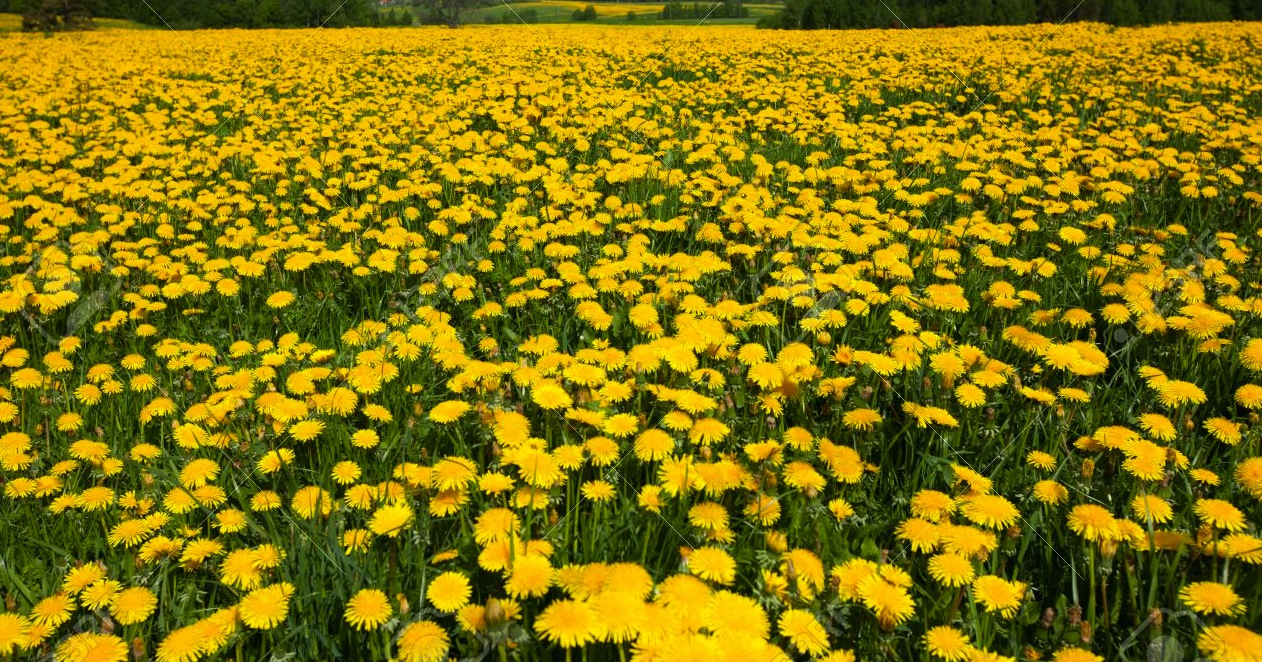
A field of dandelions. (Photo sourced: Internet)
FOOTNOTES
1In New Atlas of British Irish Flora, quoted by Michael Viney, “Pissey beds lion’s tooth” etc (see Sources, References)
2Ibid, also Taraxacum – ‘A very difficult genus of a multitude forms, which set seed without pollinating, and never, therefore, interbreed.’ An Irish Flora by D A Webb, Sc.D. 1977, quoted in Wildflowers of Ireland (References, Sources).
A legal offensive by the management of the Shelbourne Greyhound Racing stadium failed to prevent protesters picketing the venue but did succeed in splitting their alliance. The Irish Council for Civil Rights voiced its concern over the implications of the legal case.
Advertisement on the side of a Dublin public transport bus. (Source photo: Internet)
This happened back in January and sorry I didn’t get to it then. However, the campaign is ongoing and lessons of the case are still relevant.
Six protesters, who became known as the “The Greyhound Six”, were named in application for an injunction by the Greyhound Stadium, along with “persons unknown”. The legal case followed on local residents receiving a letter threatening them for allegedly supporting the Stadium, a letter which the campaigners deny sending and which looks more like dirty tricks by Greyhound racing supporters.
However, when the case came to court it transpired that four of them, without consulting the other two, had agreed to do a deal with the Stadium. This resulted in all six being banned from protesting within 50 metres of the entrance to the Stadium.
The two who had not agreed to the deal, Laura Broxson and Tawnie Ocampo, appealed the judgement to the High Court and won, Shelbourne Park also having to pay the court costs.
The Four Courts complex, Dublin, containing the High Court, viewed from Ó Donabháin Rosa Bridge. (Photo source: Wikipedia)
What does all this mean in effect?
It is clearly undemocratic and unwise for defendants to decide on a course of action without consulting their co-defendants; they don’t have to agree with them but they should at least consult with them
The likelihood is that had all the Six stood together against the injunction, they would all have won
Had they done so, future targets of protests would have thought twice before seeking an injunction against protestors on a public highway
The unilateral action of the Four not only restricted their own protesting but potentially endangered the rights of other protesters in similar circumstances, a point taken up by the Irish Council of Civil Liberties, which had themselves joined to the High Court appeal and had this to say:
ICCL welcomes the settlement today in the High Court in the case of Shelbourne Greyhound Stadium v Broxson and Others.
ICCL became aware of the case in December and sought to become joined in the case, as we believed that nature of the injunctions being sought in the case gave rise to serious issues concerning the right to peaceful protest. In particular we were concerned at the nature and extent of the injunctions being sought, and the fact that injunctions were being sought not only against named defendants but also against “persons unknown”.
The High Court joined ICCL as an amicus curiae (friend of the court) in January, recognising that ICCL is an expert body with regard to civil liberties and human rights, and that important issues concerning the right to protest arose in the case.
ICCL was represented in the case by Sheehan and Company Solicitors and by Conor Dignam SC and Mark William Murphy BL. This legal representation was on a pro bono basis supported by the Voluntary Assistance Scheme of the Bar of Ireland.
Image sourced: Internet
GREYHOUND RACING IS CRUEL
Many, perhaps most people will be under the impression that greyhound racing is a harmless sport. However the campaigners say that quite apart from injuries suffered by dogs on the tracks, the number of dogs bred for this activity means that a huge number of dogs are killed because of being considered not up to competition standard, whether as young dogs or those too old to race. Campaigners claim that over 6,000 dogs are killed annually and some animal welfare organisations believe the figure may be as high as 10,000. “Surplus” dogs have been proven to be sold abroad for meat and dogs of racing or stud standard have also been exported for racing, though both are illegal.
In addition, the demand means that greyhound bitches may be fertilised more often than healthy, constantly churning out pups for the industry.
It is the commercial drive that brings these results and the support of the betting public that sustains it – but not that alone, since the Irish State supports the industry with an annual grant of 16.8 million euro. Recently in the Dáil an attempt to remove this state subsidy failed as most TDs voted in favour of continuing it. Few countries apart from Britain and Ireland have greyhound racings stadia – and none in Europe.
Should you wish to support the campaign against greyhound racing and live in Dublin, you may wish to attend the protests on Saturday evenings and, when Tuesday evening racing resumes, on that day too.
end.
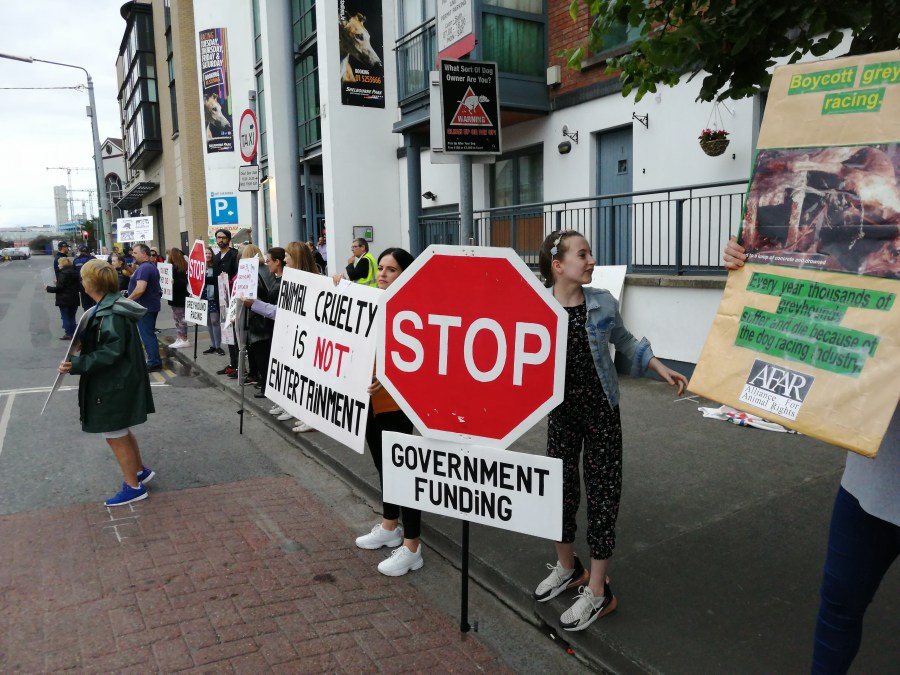
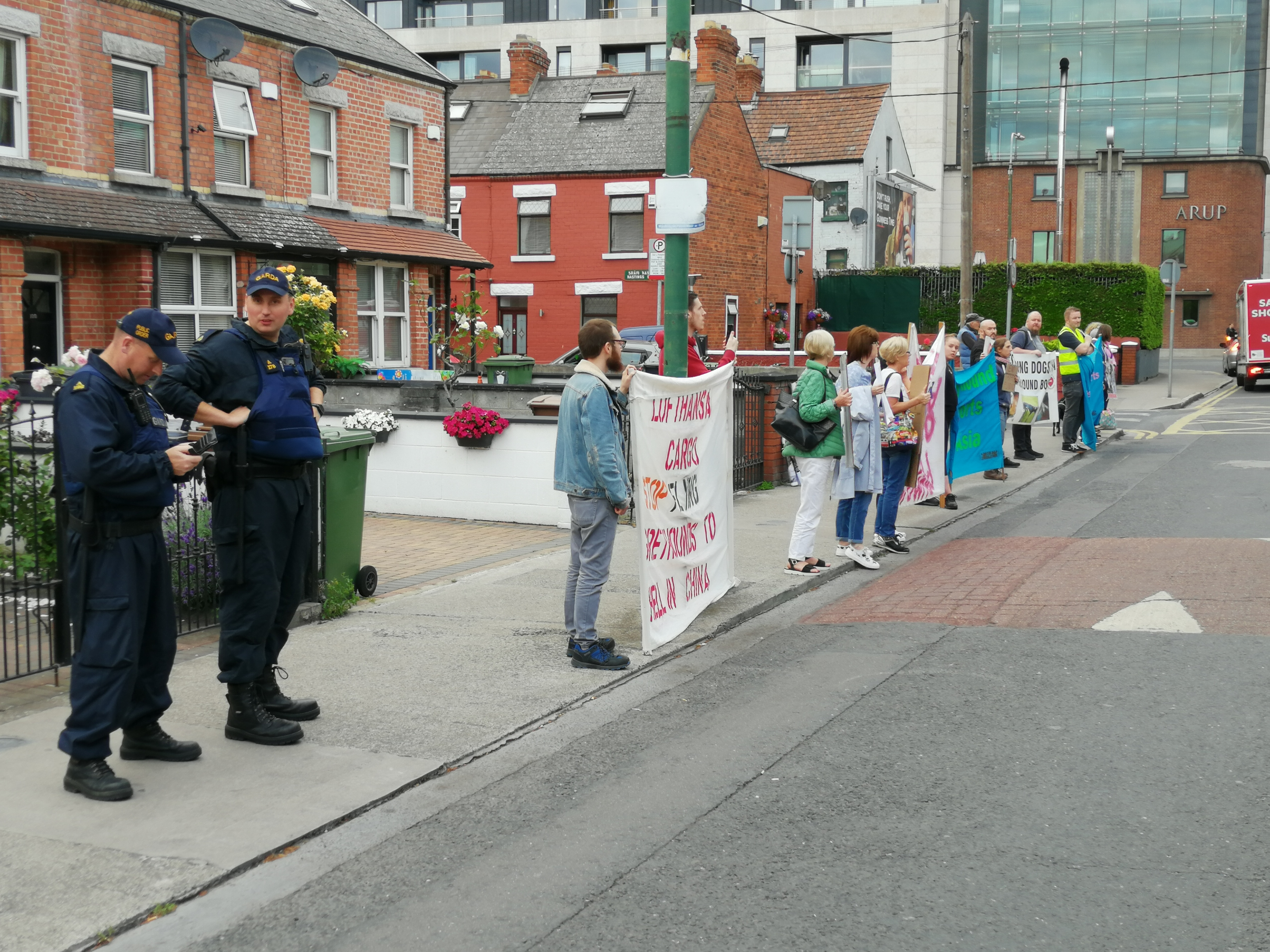
Photo: D.BreatnachLine of protesters facing Shelbourne Greyhound Racing Stadium July 2019 (there was another line on the opposite side too) (Photo: D.Breatnach)
REFERENCES AND FURTHER INFORMATION
Organisations: OPAGE (Ordinary People Against Greyhound Exploitation) and ARA (Animal Rights Alliance).
Sir, – Gerard Murphy (Letters, February 27th) and some others doubt the existence of anti-Irish racism in Britain prior to the Brexit debates, claiming never to have experienced or witnessed it themselves.
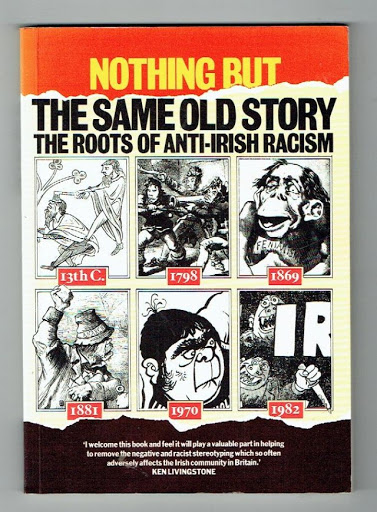
After the Race Relations Act (1976) drove the blatant discrimination of notices in lodging-house windows and “help wanted” advertisements into concealment, in 1984 the Greater London Council published Liz Curtis’s booklet Nothing But the Same Old Story, full of public examples of anti-Irish racism in print and in drawings over centuries, including cartoons in the Evening Standard during the 1970s.
In the mid-1970s nearly a score of innocent people in five different cases were taken from the Irish community and convicted of murder or in assisting murder while Irish people were being regularly stopped at airports and embarkation points, as well as having their houses raided and being taken into Paddington Green police station, for example, to spend days in underground cells without daylight or access to solicitor, to be eventually released without charge. In the 1970s Granada TV series The Comedians, stand-up performers told sexist and racist jokes, with the Irish often being the butt of the latter. In the 1980s the Irish in Britain Representation Group picketed WH Smith shops until they removed from sale their “Irish mugs”, which had the handle on the inside.
Letters in Irish community newspapers in Britain like the Irish Post and the Irish World regularly complained of anti-Irish racism in print, on TV, on radio and in public places. Anti-Irish racism has a history of centuries but it was all around Britain in the 1970s, 1980s and even the 1990s. – Yours, etc,
Scene outside the Court of Appeal’s 1984 quashing of the convictions of the Guildford Four and Maguire Seven. Gerry Conlon, one of the Four, seen here shouting his anger to the crowd at his unjustly serving 10 years in jail and his father having died in jail. The Birmingham Six were not released until 1991 and Judith Ward in 1992! (Source photo: Internet)
By Liz Curtis. First published 1984 by the Greater London Council. (Image source: Johnsbookshop.org)A dungeon cell in Paddington Green Metropolitan Police Station. Under the provisions of the “Prevention of Terrorism Act” (sic), Irish people were kept in cells like this for up to five days (sometimes longer) without access to solicitor, family or friends, interrogated and often brutalised. (Photo source: Protesters who occupied the empty building recently — go raibh maith agaibh!)
I observed in Language Is a Treasure Chest 1 that it is full of wonders but that it has some horrors in it too. And I found it to be so again.
I was reading a novel in which the word “Cimarron” appeared and, doing some quick research on the word, I came across a 2004 query in an email website or page called Word Wizard:
What is the etymology of the word cimarron? I’ve always been told that it means “runaway slave” in Mexican Spanish. Can anyone verify this?
The reply is dated the same day:
From Greek. It refers to people who live in perpetual mist and darkness, akin to the ‘land of the dead’. Latin ‘Cimmerius’, Greek ‘Kimmerios’, Assyrian ‘Gimirri’ even the bible ‘Gomer’ Gen.10:2 and Esk. 38:6. In Western United States it refers to a stretch of land that gets rainfall when other near by areas are desert year round.
Apart from the topographical reference, I thought the expert’s explanation highly dubious. And in fact I happen to know something about the Spanish-language origins of the word.
The searcher replied:
Thanks, Jim. I just wonder what connection this word has to Hispanics of Mexican origin because it shows up in their surnames (although not as common as Lopez or Vargas or Garcia). Is it just Mexican in origin or did that also come from Spain? So the “runaway slave” theory has no foundation then?
The expert’s reply did come back with a Spanish-language connection and he may be on to something with the topography, though I think he has it the wrong way around (as we shall see).
The “runaway slave” theory is not so obsolete.
Mexico did not have slaves (Outlawed in 1810)but
American slaves who fled to Mexico had to pass
through lands with water, or else parish (sic).
When relating their tales of woe to the locals
the word ‘cimmaron’ arose to describe their flight
through the South West desert.
Very curiously, there was no further contribution to the discussion. I tried to leave my own but had to register, which I have done (though wondering if worth the trouble) and am now awaiting confirmation1.
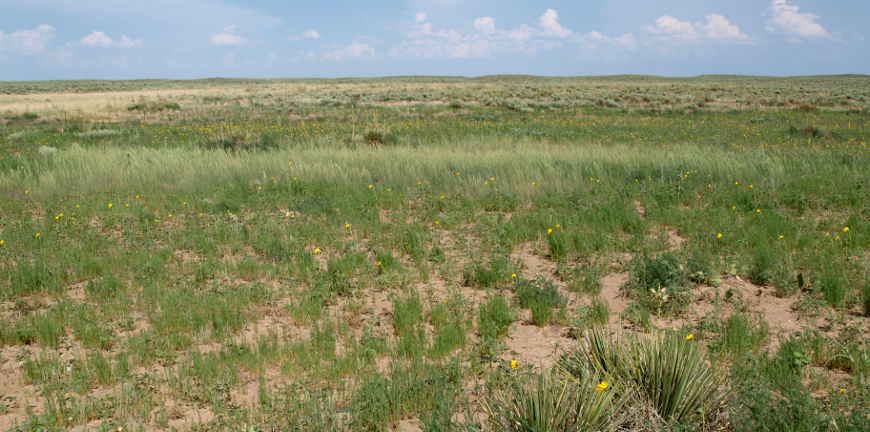
A view of the Cimarron National Grassland, the largest piece of public land in Kansas, a 108,175-acre property in the southwestern part of the state. It was recovered from the Dustbowl ecological devastation by soil recovery and management practices. (Photo source: The Armchair Explorer – Kansas)
THE FOLK MEMORY WAS TRUE
Continuing with a little light online research I find that the Castillian-language (Spanish) origin is the explanation most often given, with rarely a reference to Greek or other classical or archaic languages. For example, in yourdictionary.com:
American Spanish cimarrón, wild, unruly ( from Old Spanish cimarra, thicket): probably origin, originally referring to the wild sheep (bighorn) found along its banks
(Latin America, of animals) feral (having returned to the wild)
Synonyms: alzado, bagual, feral
(Latin America, of people) rural; campestral
(Latin America, of plants) of a wild cultivar.
But …. what about the “runaway slaves”? Under the title Cimarron People, Wikipedia has this to say: The Cimarrons in Panama were enslaved Africans who had escaped from their Spanish masters and lived together as outlaws. In the 1570s, they allied with Francis Drake of England to defeat the Spanish conquest. In Sir Francis Drake Revived (1572), Drake describes the Cimarrons as “a black people which about eighty years past fled from the Spaniards their masters, by reason of their cruelty, and are since grown to a nation, under two kings of their own. The one inhabiteth to the west, the other to the east of the way from Nombre de Dios”. (location in Panama — DB)
While we may indulge ourselves in a sardonic smile at commissioned pirate Francis Drake talking about the cruelty of others, or about slave-owning by a country other than England in 1570, we remember also that at the time Spain was the main competitor with England in the rush to plunder the Americas – and had got there well before them.2 Both colonial powers were already plundering Africa for raw materials and slaves.
The meanings of animals having gone “feral” or “returned to the wild” would easily have been applied by the society of the time to escaped African slaves, a society which, despite evidence to the contrary including agriculture in Africa, would have considered indigenous inhabitants of Africa as people living in the “wild”. Once escaped and no longer under European control, they would be seen as “returning to the wild”.
So what happened to the Cimarron People? Their settlements were subject to punitive raids by the Spanish, killing people and burning crops, so that in the end they came to a treaty with their old enemy. The Wikipedia entry says no more except that the “Cimarrons” and the English quarreled (not surprising, given that they were of no further use to the latter). I believe some of their settlements in Florida were raided and burned by US “pioneers” and soldiers and that the remainder became part of the Seminoles, a native American tribe that resisted the USA in the longest and most costly of the USA’s wars against the indigenous people, the Native (North) Americans. The Seminole had many tribe members of part-African origin in their midst.
And here – a surprise: The word “Seminole” is derived from the Muscogee word simanó-li, which may itself be derived from the Spanish word cimarrón, meaning “runaway” or “wild one”!
So, in line with what that on-line searcher back in 2004 had heard, no doubt a folk belief, the word cimarronis, in Mexico (and in the USA), of Castillian (Spanish) language origin and is connected to escaped slaves of African origin.
Some of the sources for “cimarron” also give us “marron” or “marrón” which is also related to escaped slaves and, in English, became “Maroons”. The Maroons, escaped slaves who inhabited mountainous regions of Jamaica and elsewhere became a great problem to the English settlers (after they took the island from the Spanish) which they failed totally to quell, the Maroons emerging victorious in many military engagements. In the Cockpits area of Jamaica, I have read, there is a place called Nanny Town, which is believed to be one of the settlements of the Maroons; their chief was said to be a woman called “Granny Nanny”3, whether because of her former slave occupation or for other reason4. In the end, like the Spanish with the Cimarron People, the English had to treat with them. Sadly the treaty required the Maroons to return newly-escaped slaves, which they did and for which they received payment.
Marroons in treaty with the British, shown here in a reversal of the actual power relations in the “Pacification with Maroons on the Island of Jamaica, by Agostino Runias (1728-96). (Source image: Internet)
However if instead of being a voluntary escapee to go to a wild place you were forced by people or circumstance, well then, like Alexander Selkirk’s “Crusoe”, you’d be “marooned”!
Well then, what about the “cimarron strips” in the southwest of the USA? Could the word refer to strips of land “gone wild”? Or could the expert replying to the question in 2004 have been on to something?
If the slaves escaping through the desert from the USA to Mexico did indeed make their way through strips of watered land (not just for the water, as the expert speculates but for vegetation to conceal them), then there is a connection between escaped slaves and these strips of land. But not as the expert sees it, rather the other way around: since the escaped slaves, the “cimarrones” were travelling the strips, they would be called by those who knew about it (escapee hunters, escapee helpers and just observers), “cimarron strips”, i.e “those strips through which the runaway slaves travel.”
CHRISTIAN ETHNIC PREJUDICE
However, if the word comes from Castillian (Spanish) what were the origins of the word in that language?
Perhaps a year ago, I was reading a book that described the Spanish State as having been characterised, contrary to many other European states, by mass expulsions and exiles on a number of occasions throughout its history5. Naturally enough, first on the list of expulsions was the well-known example of the Moors and the Jews. Those who were not slaughtered by the forces of the “Christian Monarchs” of Ferdinand and Isabella in the “reconquest” were obliged to convert to Christianity or to leave “with only the clothes on their backs”. This also occurred in Portugal.
Those Jews who left were the Sephardim or Sephardic Jews, who spoke Ladino, an archaic kind of Iberian Romance6language with Aramaic and Hebrew words, along with the Moors, who spoke an Iberian-Arabic mixture or Arabic. The key of their houses or gates have been handed down to this day in families of both groups.7
Many converted, often referred to by Christians as “conversos” (Jews) or “moriscos” (Arabs) but were constantly under suspicion of reverting to their old religion even with the threat and constant trials and torture of the Spanish Inquisition. According to what I have read they too were sometimes called “marronos”, i.e in the eyes of the Spanish Christian ruling class, those who had been “domesticated” (Christianised) but had “returned to the their wild way”, (Moslem) i.e “gone feral”.
Forced conversions that had to appear genuine: “The Moorish Proselytes of Archbishop Ximenes”, Granada, 1500 by Edwin Long (1829–1891). (Image source: Internet)
Wikipedia on Marrones in Iberia confirms:The (Spanish) Inquisition was aimed mostly at Jews and Muslims who had overtly converted to Christianity but were thought to be practicing their faiths secretly. They were respectively called marranos and moriscos. However, in 1567 King Phillip II directed Moriscos to give up their Arabic names and traditional dress, and prohibited the use of Arabic. In reaction, there was a Morisco uprising in the Alpujarras from 1568 to 1571. In the years from 1609 to 1614, the government expelled Moriscos.
THE BUSH FROM THE NUT?
And is “ci” or “cy” in “cimarron” then merely a prefix? The word “marrón” exists as a colour in Castilian and a number of Romance languages and came into English as the colour “maroon”. Its development is taken as originating from the colour of the large ripe chestnut, rather than given to it later. Of course there are a number of words for colours or tints which have a botanical origin, “orange” being an obvious one.
Castanea Silva, the edible or Sweet Chestnut. (Image source: Internet)
Alright, then the nut and tree might have been associated with uncultivated or “wild” areas, similar to those to which the “cimarrons” would escape. But where did the “ci” suffix come from? Somewhere in the midst of what I have been researching I came across an explanation, derived from Latin, meaning “towering”, “high” etc. But can I find it now?
The online sources are telling me that the relevant pages are up for deletion and I can join the discussion. No thanks, I do not have anything like sufficient knowledge to enter a debate on that, nor the patience of an academic to research it thoroughly.
But “high” and “wild” could easily correspond, given that valleys and plains lend themselves more easily to cultivation, as a rule, than mountainy areas, which might remain wooded or with with thick undergrowth. And that might also give us the “bush” or “thicket” referred to in a number of references for “cimarron”, which in turn might describe the “cimarron strips”. In parts of Latin America (and for all I know, in all of them) such as Chile, a “cimarra” is also a thicket or densely-grown area. The article in the Language Journal (see reference) comments that the “arra” cannot be a Romance language word-ending but even if true it seems to me that the author (or authors quoted) might be unaware that among those from Iberia who colonised or settled in the Americas, Romance language speakers were not alone. There were also Basques who spoke Euskera/ Euskara and for evidence, they applied a number of toponomics and left family names from the Basque Country (Basque descendants make up to 10% of the population of some Latin American countries). And “-arra” would be a common enough suffix or word-ending in Euskera.8
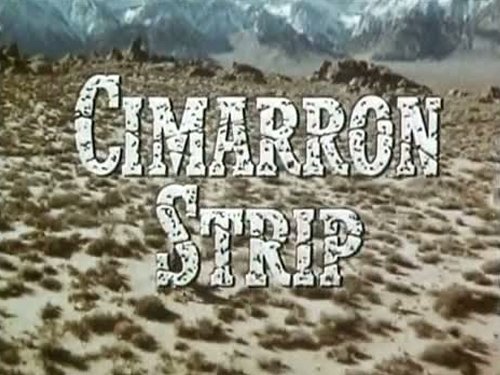
Opening title for the weekly TV Western series Cimarron Strip, starring Stuart Whitman, Judy Gleeson, Percy Herbert and Randy Boone. Though popular, only a years’ worth of episodes were screened. (Image source: Internet)
OKLAHOMA PANHANDLE AND THE CIMARRON STRIP
In the 19th Century wars between the Mexican Republic, the USA and the Native Americans in the area, it was carved up with less and less left to the Native Americans. Prior to the American Civil War, white Texas wanted to join the Union as a slave state and due to a US federal law prohibiting slavery north of 36°30′ parallel north, white Texas surrendered a strip of land north of that latitude. The settlement (temporary of course), left a strip as “Neutral Territory” (one can only imagine the temptation for African slaves in Texas to make for there). After the Civil War big cattle ranchers moved in, disregarding treaties and named the area the Cimarron Strip.
Map of Oklahoma territory and “Neutral Strip” before the American Civil War. Image source: Wikipedia, Texas Panhandle.
But that was because the word Cimarron was already in the area, from the “Cimarron Cutoff” leading to a crossing of the Cimarron river. And yes, there was a popular 1967-1968 TV series called “Cimarron Strip”, starring Stuart Whitman. But, though I used to watch it, that is only faintly related to the story of the word that set me out on this journey.
End.
FOOTNOTES
1Which days later had still not arrived – perhaps the site is no longer in operation, which would explain the silence after those two posters.
2Columbus voyage to America 1641 and Spain’s first colonial settlement 1565 (now Florida); Mayflower expedition to America with English settlers 1587 (now Virginia). However, Europeans had founded settlements much earlier, as with the Norse in the 10th Century and very likely Irish monks in the 6th Century. But it was the English and Spanish who conquered most, the Dutch, French and Portuguese less. The descendants of the English settlers after gaining independence from England completed the seizure and colonisation of most of the North American continent, while English colonists remaining loyal to the English Crown seized land to form what is now Canada.
4All the folk tradition, albeit conflicting on some points, declares that she had not been a slave which leaves one to wonder how she might have reached Jamaica from Africa without having been enslaved.
5 I borrowed the book from the public library and cannot remember its title at the moment.
6“Romance languages” is the name give to the group on Indo-European languages such as Castillian (Spanish), Catalan, Galician, Portuguese, Romanian, Italian and French. They are sometimes called “Latin-based” or “Latin Languages” but there is some dispute about the origins and developments of these languages.
7 Ironically, the door or gate “key” is also a symbol of return for Palestinian refugees driven from their homes by Zionist massacres, threats and fear during the founding of the State of Israel.
8 Among toponomics of North America’s southwest Durango (Colorado and Mexico), Navarro and Zavala Counties (Texas) are perhaps the best known; while Aguirre, Arana, Bolívar (Bolibar), Cortazar (Kortazar), Duhalde, Echevarria (Etxebarria), García, Guevara (Gebarra), Ibarra, Larrazábal, Mendiata, Muzika, Ortiz, Salazar, Ugarte, Urribe and Zabala are but some among a host of family names of Basque origin from the American south-west to Latin America. And of course the country of Bolivia, from Simon Bolívar, a Basque surname from a Basque toponomic.
Excerpt on-line from Language journal, Linguistic Society of America, Leo Spitzer, Vol. 14, No. 2 (Apr. – Jun., 1938), pp. 145-147: https://www.jstor.org/stable/408879?seq=1
The Save Moore Street From Demolition group runs a campaign stall every Saturday on Moore Street; it was founded in September 2014 and is independent of any political party or organisation. In addition to the banner announcing its nature and purpose, the group displays four flags every week. Three of those are copies of flags that were flown during the 1916 Rising and all them in locations close by Moore Street, each also with a very strong migrant connection – all three also survived the conflagration resulting from British artillery bombardment.
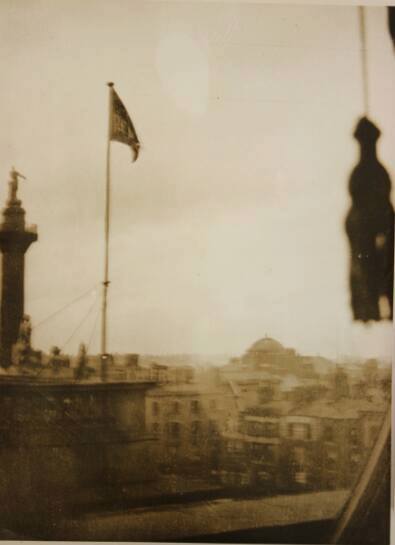
The Irish Republic flag, made by Constance Markievicz (born in England), flew at the Princes Street front corner of the GPO, 1916. (Photo source: Internet)
1) The “Irish Republic” flag was made from drape material by Constance Markievicz (born in England) and was flown on top of the GPO at the Princes Street corner. She was a member of the Irish Citizen Army (see (3)) and third-in-command at the Stephens Green/ College of Surgeons garrison during the Rising.
Volunteer Markievicz was sentenced to death after the Surrender but her sentence was commuted to imprisonment. In the UK General Election of 1918, Markievicz was elected as a part of the Sinn Féin coalition on an abstentionist policy and became the first woman elected to Westminster, though she did not take her seat. In the later banned First Dáil of 1919, Markievicz was elected the first Minister of Labour in world history and one of very few female cabinet ministers of her time.
2) The Tricolour was also hoisted on the GPO but at the Henry Street corner by Eamon Bulfin, born and raised in Argentina. In addition, the Tricolour, based on the pattern of the French Republican Tricolour but signifying unity for Irish freedom between descendants of the native Irish on the one hand with descendants of English and Scottish colonists on the other, had been presented to the Young Irelanders by French revolutionary women in Paris, in 1848.
The Irish tricolour flag, granted to Irish revolutionaries by women in revolutionary Paris, 1848. The Irish Republic flag at the Princes Street front corner of the GPO, 1916. It was raised by Eamon Bulfin from Argentina and flew on the front Henry Street corner of the GPO. (Photo source: Internet)
Volunteer Bulfin was part of the Moore Street/ GPO Garrison surrender, was taken prisoner and later deported by the British back to Argentina. While there, Bulfin became the Latin American publicity correspondent for the Irish Republican movement, later returning to Ireland to participate in the War of Independence (1919-1921).
3) James Connolly, born and raised in Edinburgh but Commandant of the 1916 Rising, sent ICA men to hoist the Starry Plough, flag of the Irish Citizen Army, on top of Clery’s building, across from the GPO. The design is based on the star constellation of Ursa Mayor, the Great Bear, which in Ireland is known as “The Plough” and therefore an instrument or tool of labour. The original design in gold on a green background, with the seven stars in silver, includes the cutting tool, the share, in the shape of a sword; this is apparently an anti-war message, evoking the King James Bible passage in Isaiah II: “They shall beat their swords into ploughshares, and their spears into pruning-hooks; nation shall not lift up sword against nation, neither shall they learn war any more.” The 1916 Rising was the first rising against the imperialist First World War, preceding the next (in Russia) by nearly a year.
Design of the Starry Plough flag of the Irish Citizen Army, erected on top of Clery’s during the 1916 Rising on the orders of James Connolly, born and raised in Edinburgh and Commander-in-Chief of the Rising. The Irish Republic flag at the Princes Street front corner of the GPO, 1916. (Photo source: Internet)
The Irish Citizen Army included women in its membership and they fought alongside male members during the Rising, some of them as officers; Volunteer Winifred Carney entered the GPO with a Webley pistol in one hand and an Olivetti typewriter in the other and was in Moore Street at the surrender. A number of male ICA members fought in Moore Street and at least one was killed there.
During the Surrender, James Connolly, with a shattered ankle and gangrene, was carried from Moore Street to Dublin Castle where he received medical treatment, was tried by court martial and sentenced to death. Connolly was one of the last of the 14 executed in Dublin, shot in Kilmainham Jail while strapped to a chair on 12th May 1916.
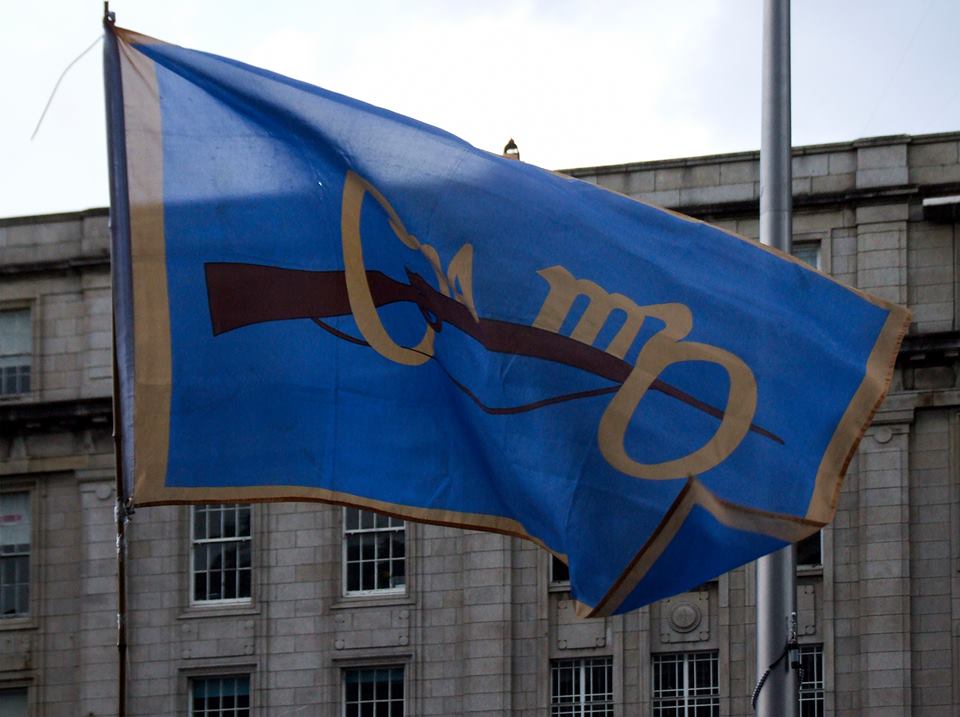
4) The Cumann na mBan flag with its lovely colours and design was not seen during the Rising, although many of that organisation participated in the Rising, two of them in Moore Street to the end: Volunteers Elizabeth O’Farrell and Julia Grennan. Cumann na mBan was the first revolutionary female organisation in world history to have its own uniform, under its own officers, while participating in an uprising.
As always you can support the campaign by sharing their Facebook posts from time to time.
The Cumann na mBan flag was not flown during the 1916 Rising, though many of the organisation participated in it. (Photo source: Internet)People signing petition and talking to some of the activists at the SMSFD stall in January this year. The Cumann na mBan flag is draped over the table. (Photo source: Bart Hoppenbrouwers, SMSFD)
Language is a treasure chest, full of jewels: history, philosophy, humour, politics, sex, literature, natural history ….. It is a chest full of wonders but it has some horrors in it too. I want now just to run my fingers through a few of those jewels, letsome of those wonders trickle through my fingers and before your eyes.
Image source: Internet
Language is composed of symbols – spoken words, then squiggles to represent those words on stone, wood, paper and electronic screens. In visual interaction, those symbols are accompanied by other symbols such as facial expression, hand gestures, bodily posture, tone, pitch, volume, emphasis …. yes, and chemical emissions. Different languages — sophisticated whole systems of symbols – have been developed for communication of information and recording but not only for those: for expression of emotion too. And each carries the history, philosophy etc of the particular culture that gave rise to that language and often many other cultures too. In turn, language comes to leave its imprint on the speakers of the language, to mold their very minds to some extent, shaping their culture. So when a language dies, much more dies than just a system of recording and communication.
We can see residues of Irish and the Gaelic culture in the way Irish people speak English, even those who have not been Irish-speaking in generations. We go to see a filum, sweep with a floor brush instead of “a broom”, reply to a question with a positive or negative of the same verb (will you go? I will/ I will not). Or we might have a thirst on us and go to a pub if the humour was on us. That pronunciation of an imaginary vowel between the ‘L’ and the ‘M’ is a residue of the Irish language and having physical and emotional feelings being on us, instead of having them, as in standard English, are the ghosts of expression in Irish. When other cultures are happy to thank us a thousand we say thanks a million, not because we are a thousand times more thankful than every other culture but probably because a million sounds like the Irish word for thousand, míle, from Go raibh míle maith agat.
* * *
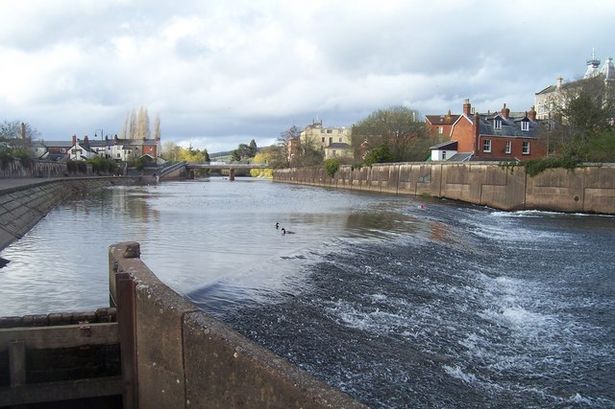
Recently I was reading a novel, mostly based in Exeter, a city in Devon, SW England and I learned that the city’s name is derived primarily from the river Exe, with the ‘ter‘ being part of the noun ‘ceaster’ which meant first a Roman military camp (caster) and later, a town. Many place-names in England contain that ‘ceaster’, ‘caster’ or its variant ‘chester, for example “Lancaster” and “Manchester”.
View of the River Exe, Devon (Image source: Internet)
Of course, with regard to the ‘Exe’, I could not help but think of ‘uisce’, the Irish word for “water”. And I’ve known for some time that Devon and Somerset have a great many megalithic monuments (more than Ireland even I read somewhere) and that nearby Cornwall has a surviving Celtic tongue (though spoken by few today). Anyway, I did a little digging with the help of the Oracle of Delphi, which today goes by the name of Google (which by the way in a short space of time has become an internationally-recognised noun and verb!).
The Wikipedia entry for Exeter tells us that the river Exe in the name of the city is from Old Brittonic, a Celtic language and means “ ‘water’ or more exactly ‘full of fish’”. Well that sounds pretty much like the meaning of the word “uisce” in Irish, which is also a Celtic language. But the Wikipedia entry for the river itself, as distinct from the town, says that the word “comes from the Common Brittonic word ‘iska’” meaning ‘water’ etc. But then the entry goes on to make the extraordinary claim that the word is unrelated to the word “whisky” while at the same time stating the latter word comes from classical Irish/Gaelic “uisce beatha” (‘water of life’). But since the Brittonic word for the river means ‘water’ and the Irish ‘uisce beatha’ (which became ‘whisky’) means ‘water of life’, then the words iska/ exe and uisce are obviously not only closely related but almost exactly the same!
Perhaps the entry meant something else and merely expressed it badly.
However, I am grateful to Wikipedia for drawing my attention to the connection between the Celtic words for ‘water’, ‘river’ and ‘fish’. Because the word for ‘fish’ in Irish is of course ‘iasc‘ which is not a million miles away in sound from ‘exe’ or even ‘uisce’. And if we were to stick the letter ‘P’ before the word ‘iasc‘, which the Gaels would never do, given that they avoided that letter and sound whenever they could, we would get the word ‘piasc‘, quite like the plural word for fish in Welsh, ‘pysg‘. And of course sisters of this word can be seen through some of the Romance languages, which in many ways are close to the Celtic: pez in Castillian, peixos in Catalan, peixe in Portuguese, pesce in Italian. And of course, for the astrologers, Pisces (Pis-kays) from the Latin, the star sign of the fish.
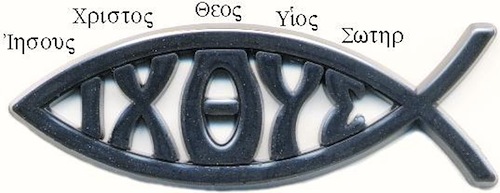
Now, the Greek word for ‘fish’ is psari, not all that similar (although it begins with the letter P too) but here’s a weird coincidence: the Greek name for the fish symbol used by early Christians, which is supposedly based on the first letters of the Greek words for Jesus, anointed, son, God and saviour ….. is the ‘ichtus‘. And the sound of ichtus is not a million miles away from the sound of iasc!
The early Christian symbol, based on Greek words (Image source: Internet)
Anyway, back to Exeter, probably a Celtic settlement in a Celtic land by a river with a Celtic name, in a Celtic language, later a Roman town (perhaps preceded by a Roman military camp) with the word for ‘town’ coming from Latin, then overlaid by Saxon language.
“Old Brittonic” is the name given by philologists to the Celtic language once spoken all over Britain and of which the remaining survivors are Welsh and Cornish and, on the European mainland, Breton in Brittany and some words in Gallego in Galicia. Philologists call that branch of the Celtic languages ‘P-Celtic‘ because of its many old words beginning with the letter “P” which in Irish and other Goidelic or Q-Celtic languages (Manx and Scots Gaedhlig) begin with the letter “C”.
Exeter is an old place name in Devon and old place-names – as distinct from new ones like “Sea-View” used by property merchants to sell housing estates – tell us a lot about the history and culture of the people who named them and, often, something about their past in nature (for example all the places named after trees in this now-deforested Ireland).
Twenty-six, more than half the names of the 50 states that form the USA, are formed from Native American words or phrases. The original Americans, dispossessed, so many of them wiped out and a very small minority remaining in their ancestral lands, must find it hard to insist on the usage of their own place-names. Yet many of those have survived – European colonisers learned the names from the natives and for convenience continued to use them in their European languages so that they have now become US English words.
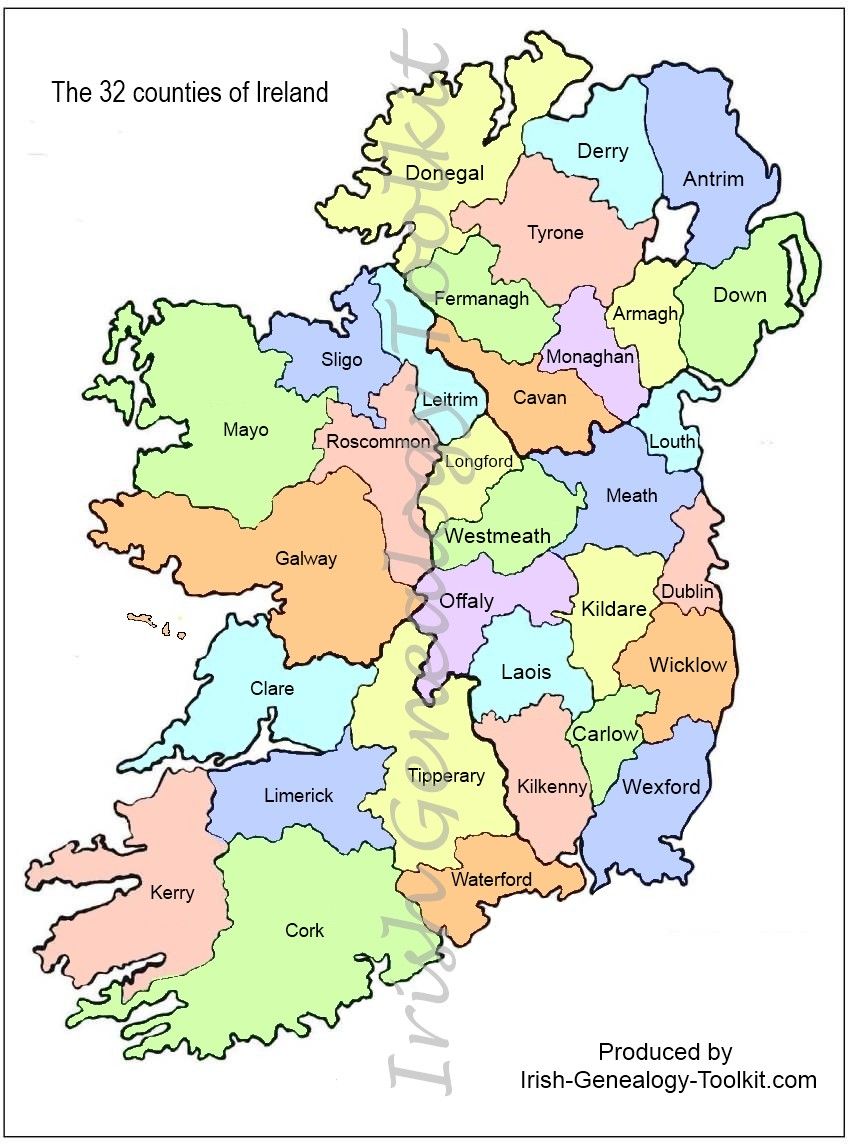
Of the Anglicised names of the 32 Counties of Ireland, only three are not of Irish origin – and the “English” names of those three were given to them by the Vikings. We are surrounded by the signs of our native language and culture but, for most of us, also cut off from them. This is hard to justify since unlike the Native Americans, for the most part, we have absorbed the invaders and we remain the majority on our land.
The 32 Counties of ireland — only three of the ‘English’ versions are not of irish language origin. (Image source: Internet)
And yes, “Britain” and “Britons” were words associated with Celtic culture, derived from Praetani or Pretani, meaning “the people of Britain” and perhaps once a dominant Celtic tribe. Yes, and “Scotland”, it turns out, referred to a land in the north of Britain colonised by the Irish, to which they brought their language which has now developed into Scots Gaedhlig. And in the Middle Ages, a “Scotus” (Scot) was more likely to be an Irishman than what we today call a “Scotsman”.
And the “Scots” language of the poetry of Robbie Burns, including its practically extinct variant “Ulster Scots”, is actually based on German from Saxony and, except for some words, not Celtic at all!
Yes, it can all be a bit confusing. But interesting too.
We now approach the festival called Christmas. A Christian festival, apparently, celebrating the birth of Christ, the baby Jesus.
Away in a manger
No crib for His bed
The little Lord Jesus
Lay down His sweet head
The stars in the sky
Look down where He lay
The little Lord Jesus
Asleep on the hay
Such a sweet, holy image.
But actually, when we look around us, it seems more like a festival of the pagan gods: Bacchus, the god of alcohol and of Mammon, the god of wealth. Bacchus, because in non-Moslem countries, drinking of alcohol will be for most a big component of the festival. Whiskey, brandy, wine and beer will be bought to stock up the house. Alcohol will be drunk at Christmas parties (including office parties, where for months afterwards some people will regret what they did or said – or even what they didn’t do or say).
Alcohol will be not just drunk but also put into some of the traditional food and even poured over it.
Then Mammon. Well, you can see the retail businesses stocking up for weeks or even months ahead of the festival which, after all, was only supposed to be a one or at most a two-day event. Giving and receiving gifts has now become part of the festival and in most cases, gifts have to be bought. Which is a really big gift to the retail businesses and thence, really a sacrifice to Mammon.
In the Christian gospels of both Matthew and Luke, it is written that one “cannot serve both Mammon and God” — which goes to show how little they understood capitalism, where Mammon IS God. A theologian of the Fourth Century saw Mammon as a personification of Beelzebub, which in his time was another name for Satan or the Devil.
Interestingly, Protestant Christianity, which some credit as having invented capitalism, at the same time regarded Mammon, or said they did, as “one of the Seven Princes of Hell”.
Cartoon depiction of Mammon, God of Wealth (Image sourced: Internet)Sculpture representation of Bacchus, God of Alcohol, in California winery, USA (Image sourced: Internet)
SANTA
Now, Santa Claus is also a big part of the Christmas festival, especially in western countries, a much more acceptable face than that of greedy Mammon and alcoholic Bacchus, right?
But originally, the Christians saw him a representation of St. Nicholas, 4th Century Bishop of the Greek city of Myra, a location now in Turkey. He was he patron saint of archers, repentant thieves, sailors and prostitutes. The prostitutes probably had to be repentant ones, of course! The sailors, who probably had at least as much recourse to prostitutes as had any other calling, were apparently not required to be repentant – to be in danger on the sea was enough.
But St. Nicholas was also the patron saint of children, pawnbrokers and brewers, so we can see how close he was getting there to the modern spirit of Christmas.
GERMAN TRAPPINGS
Now, the Christmas Tree, der tannenbaum, so much a part of the symbolism of modern western Christmas, came to us from Germany, as did the sled and the reindeer. The reindeer are not autochthonous or endemic in historic times to Germany, so they must have been brought in their myths from Scandinavia from where originally, the Germanic tribes came from. In turn, the Christmas Tree, Yule Log, reindeer and sled were exported from Germany to England in the reign of Queen Victoria, by her consort Prince Albert, who was German. And since the English ruled all of us in Victoria and Albert’s time, the Christmas Tree came to us too, to the cities first and then slowly spreading through the rural areas.
A representation of St. Nicholas (before he got the red suit makeover) looking more like a pagan god of the woods. (Image sourced: Internet)
***
When you think about it, this German-English worship of the tree was a bit ironic, since the English had wiped out most of our forests already and were still cutting down our remaining trees in Queen Victoria’s time.
***
And Victoria, through Albert, gave us the Santa Clause we know and love today. A jolly man, well fed, white beard, twinkly eyes, dressed all in red with white trim ….
IN RED?
Now, wait a minute! It turns out he wasn’t always dressed in red. Originally, he was dressed in a brown, or green cloak. He was, originally among the Germanic people, a god of the forests – hence the evergreen Christmas tree. And like any sensible woodsman, he dressed in appropriate colours, brown or green. Neither Albert nor Victoria ever represented him as dressed in red. So how did it become so that we are incapable of seeing him today in any other colour than red? Well, it turns out that Coca Cola is the responsible party.
Yes, although it was the cartoonist Thomas Nast in 1870s United States who first portrayed Santa in a red suit with a belt but it was Coca Cola, in their advertising campaign of 1931 and onwards who made his clothes red world-wide. Coca Cola is a drink served cold and almost undrinkable when warm and who needs a cold drink in cold weather? I guess Coca Cola needed a warm image to make it still attractive in winter. So therefore the warm, jolly man dressed in red, with a bottle of Coca Cola in his hand.
1931, Santa Clause first appears in red, in Coca Cola advertisement, USA. (Image source: Internet)
Coca Cola brand is worth about $74 billion dollars today, far ahead of any other cold drinks product. Which I guess brings us back to …. yes, Mammon.
You can mix the drink with a number of alcoholic beverages too, so tipping a nod – and a glass – to Bacchus.
Now, the German Santa Claus, this originally woodland god, is also thought to have been something like Thor, a god of fire and lightning. So can it be any coincidence that two of his reindeer are called Donner and Blitzen, i.e “Thunder” and “Lightning”? Of course not!
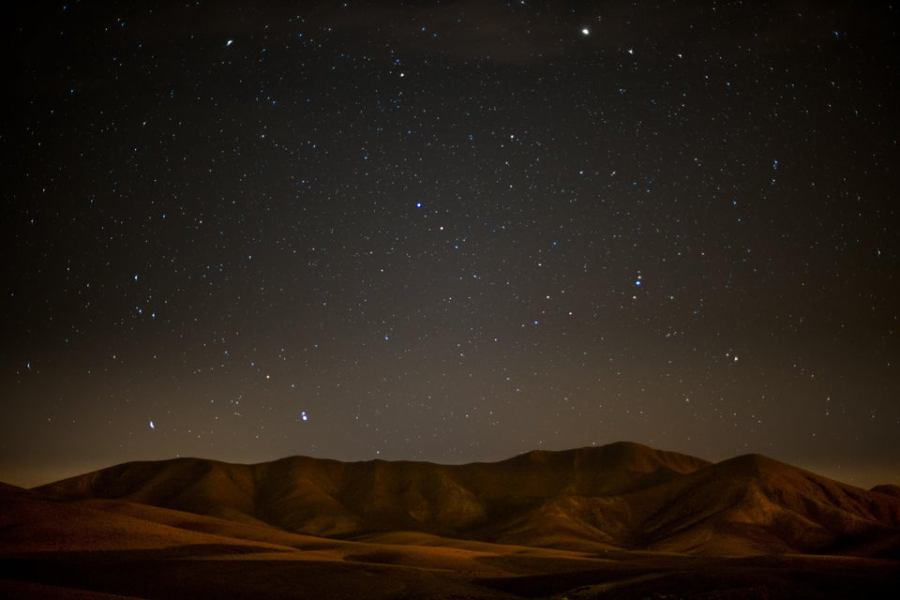
A starry night over desert hills, like the Nativity scene but without the Guiding Star. (Photo source: Internet)
INVISIBLE
Although we see the image of Santa Claus everywhere and even pretend Santa Clauses all over our city streets, everyone knows that nobody sees the real Santa Claus. Children have to be asleep when he arrives to distribute his presents and somehow adults don’t see him either.
Which I suppose is a good thing …. I mean if you found an intruder in your house at night, not to mention near your children, you’d be liable to whack him with a hurley (that’s an Irish cultural reference) …. or a baseball bat (that’s a U S cultural reference) …. or stab him with a sharp kitchen knife (that’s an international cultural reference).
It was bad enough when somehow that portly – not to say fat – man could somehow come down your chimney and go up again, without waking anyone … but now he can get in your house or flat even when you don’t have a chimney.
Which is at least creepy, if not downright scary.
Let’s lighten the mood and sing together:
You better watch out You better not cry You better not pout I’m telling you why
Santa Claus is comin’ to town
Santa Claus is comin’ to town
He’s making a list
He’s checking it twice
He’s gonna find out
Who’s naughty or nice
Santa Claus is comin’ to town
Santa Claus is comin’ to town
He sees you when you’re sleeping
He knows when you’re awake
He knows if you’ve been bad or good
So be good for goodness sake
Yes, lovely, lovely.
“You better be good, you better be nice, I’m not telling you twice” — Is it just me, or is that not downright threatening? And he knows when we’re sleeping or awake? He has our children under surveillance? In some kind of list?
HO! HO! HO! IN MORALITY PLAYS
Morality Plays were a genre of theatrical performances of the medieval and Tudor eras in which a character was tempted by a personification of Vice. Now Vice (not unlike a lot of police Vice Squads), was often seen as the epitome of evil, corruption and greed – in other words, the Devil. The playwrights tended to portray the Devil as somewhat of a comical character, perhaps to keep their audiences entertained (or to disarm them). So the character who played the Devil would announce his arrival with a stage laugh: “Ho, Ho, Ho!”
You can probably see where I’m going with this.
Nowadays, we tend to see the Devil portrayed in black but in earlier times, he was more often seen as coloured in red. The colour in which Coca Cola just happens to have dressed Santa too.
The German or Nordic Santa was originally a god of fire also, while even the modern Santa drives a magical chariot pulled by horned beasts and he is portrayed all in red. Traditionally, the Devil is seen as residing in Hell, a supposed place of eternal flames below ground. What does Santa Claus give to children who have not been good? A lump of coal! In other words, a mineral from underground that can burn to make fire.
NICHOLAS
Santa Claus is supposed to be modeled on St. Nicholas …. and what is the popular abbreviated version of Nicholas, i.e the nickname? Yes, Nick.
And the common name for the Devil, Mammon, Beelzebub, Satan ….. Old Nick!