PUIGDEMONT IN DUBLIN DEBATE: INDEPENDENCE, NATIONALISM AND DEMOCRACY

Diarmuid Breatnach

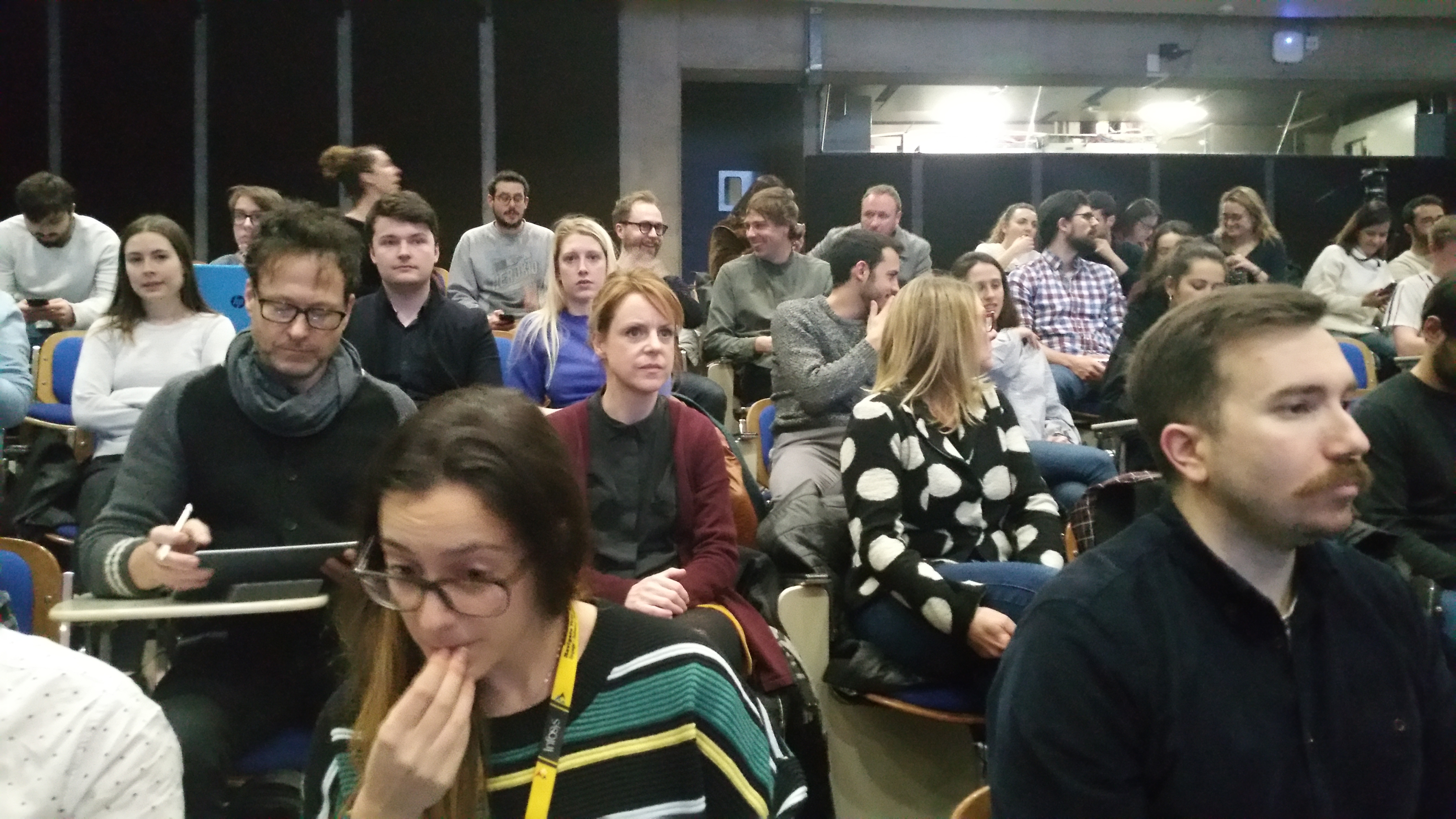
Section of audience queuing to enter the auditorium

A debate on the above theme was organised in Trinity College for the 29th January and advertised at less than a week’s notice, which however gave rise to such interest that the venue had to be changed from the 160-seat Robert Emmett Theatre to the Edmund Burke and people were turned away after the 406 seats had been filled.

          Trinity College is a prestige university in Dublin and in the world generally, though its history in Dublin was for centuries of a religious sectarian and colonialist nature, founded as it was by Elizabeth I to ensure the education of the male children of English colonists in what she considered the ‘true faith’ of Anglicanism (which was and is still the State religion of England and of which the English monarch is Head). Its location too is very central to the city, being just across the Liffey on the south side and in 1916 served as a Headquarters for the British suppression of the Rising.
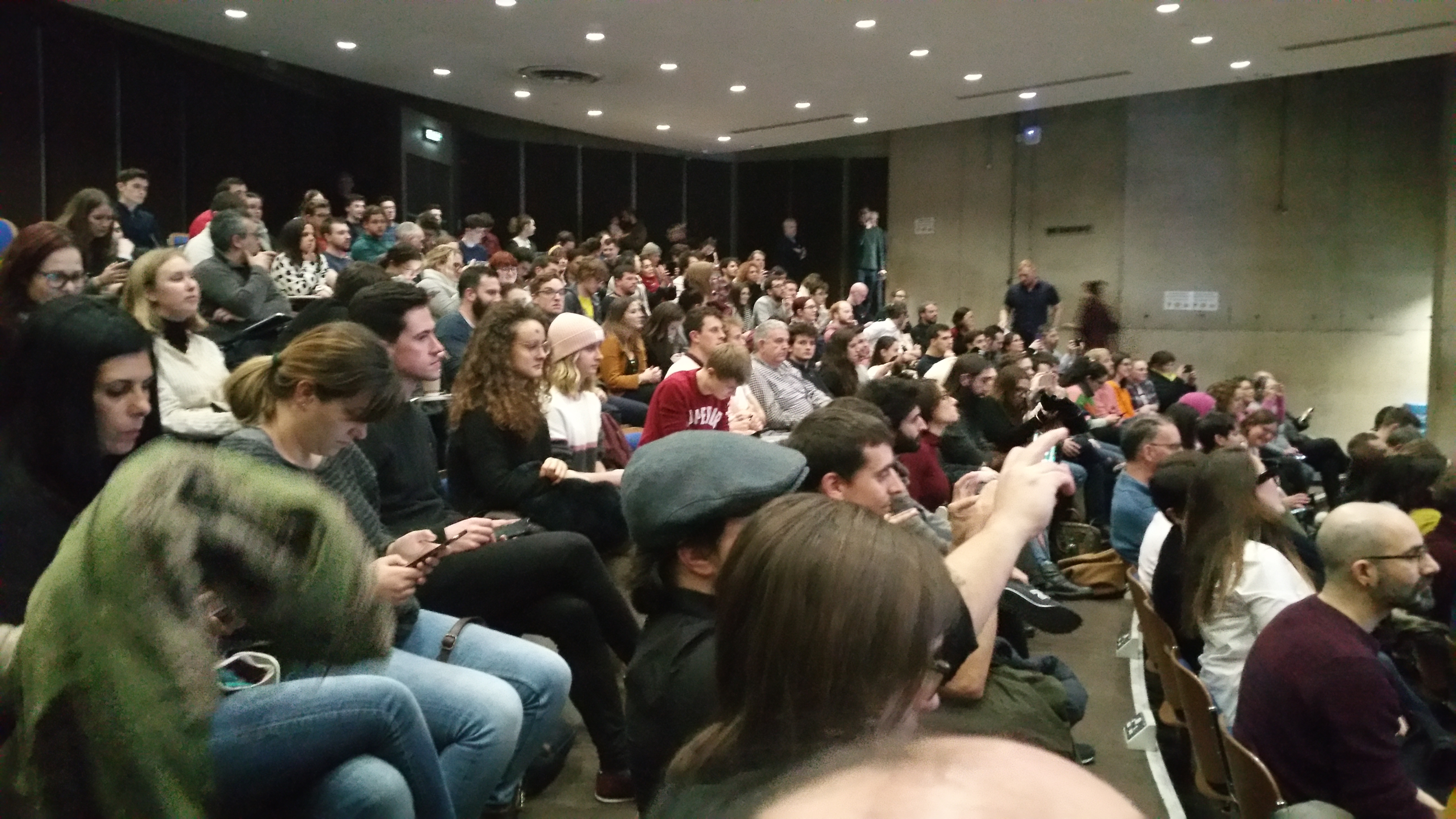
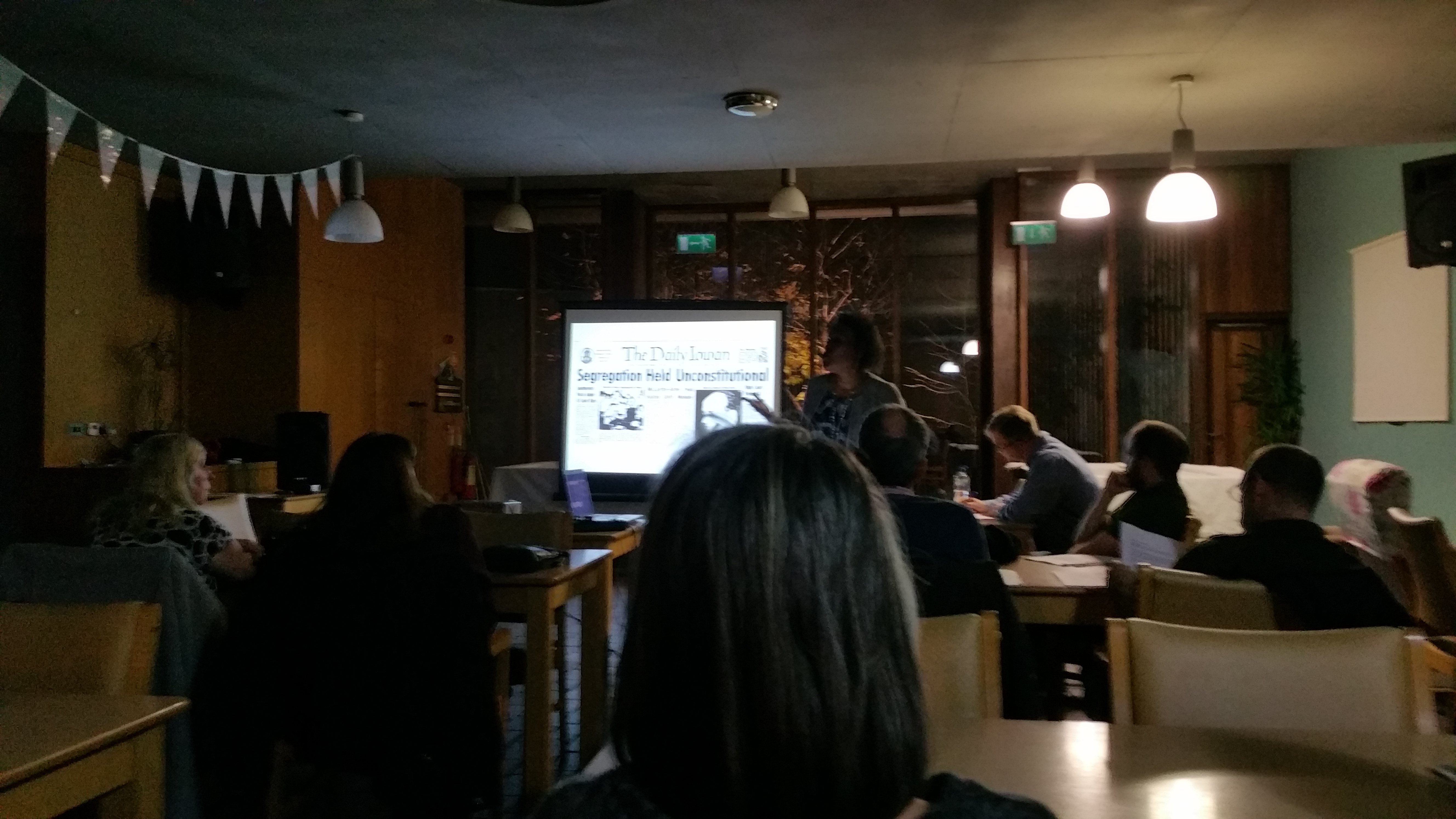
Section of audience waiting to back left of the auditorium in Trinity College, Dublin (Photo: D.Breatnach)
View of audience to the left and front of the auditorium. 
(Photo: D.Breatnach)
View of audience to the rear of the auditorium. 
(Photo: D.Breatnach)
View of section of audience to the right of the auditorium. 
(Photo: D.Breatnach)


Huge human rights solidarity banner unfurled in the auditorium for photo but not while the debate was in session. 
(Photo: D.Breatnach)

Puigdemont had been invited to take part in a debate on Independence, Nationalism and Democracy by TRISS, the Trinity Research in Social Sciences department, whose MC for the evening was clearly taken aback by the numbers who had pre-booked tickets and most of whom queued for half an hour outside the lecture theatre – and some for even longer waiting to get in.
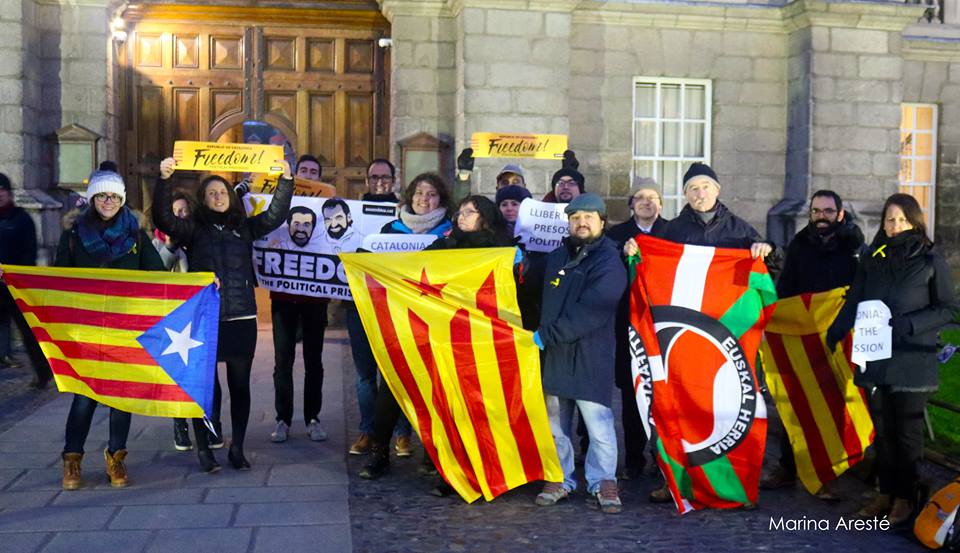
A quick photo opportunity for some supporters of Catalan (and Basque) independence outside the Trinity College’s main gate before entering to hear the debate on “Nationalism, Independence and Democracy”.
(Photo: Marina Dolcet)

Members and supporters of the campaign group With Catalonia/ Leis an Chatalóin, Comite de Defensa de la República and the cultural organisation Casal Catalá de Irlanda were there of course but so were a great many others; mostly Catalans with some Irish and people from other countries sprinkled among them and including some from elsewhere in the Spanish state. The overall feeling was clear when, as soon as Puigdemont was spotted entering the auditorium from a side entrance, along with other participants, he was applauded in what turned out to be a mostly standing ovation.

The MC or chairperson, Gail McElroy, Professor in Political Science and Head of the School of Social Sciences and Philosophy, made a special plea for good behaviour from the audience and also revealed that she had experienced some trepidation in preparation for the event. These expressions led to speculation among sections of the audience that the organisers of the debate had been subjected to a bombardment of hostile electronic communication. People in the Spanish state and sometimes abroad are familiar with this behaviour from right-wing Spanish nationalists, including outright fascists and even state-orchestrated trolls but for someone encountering it for the first time, no doubt it can be intimidating.
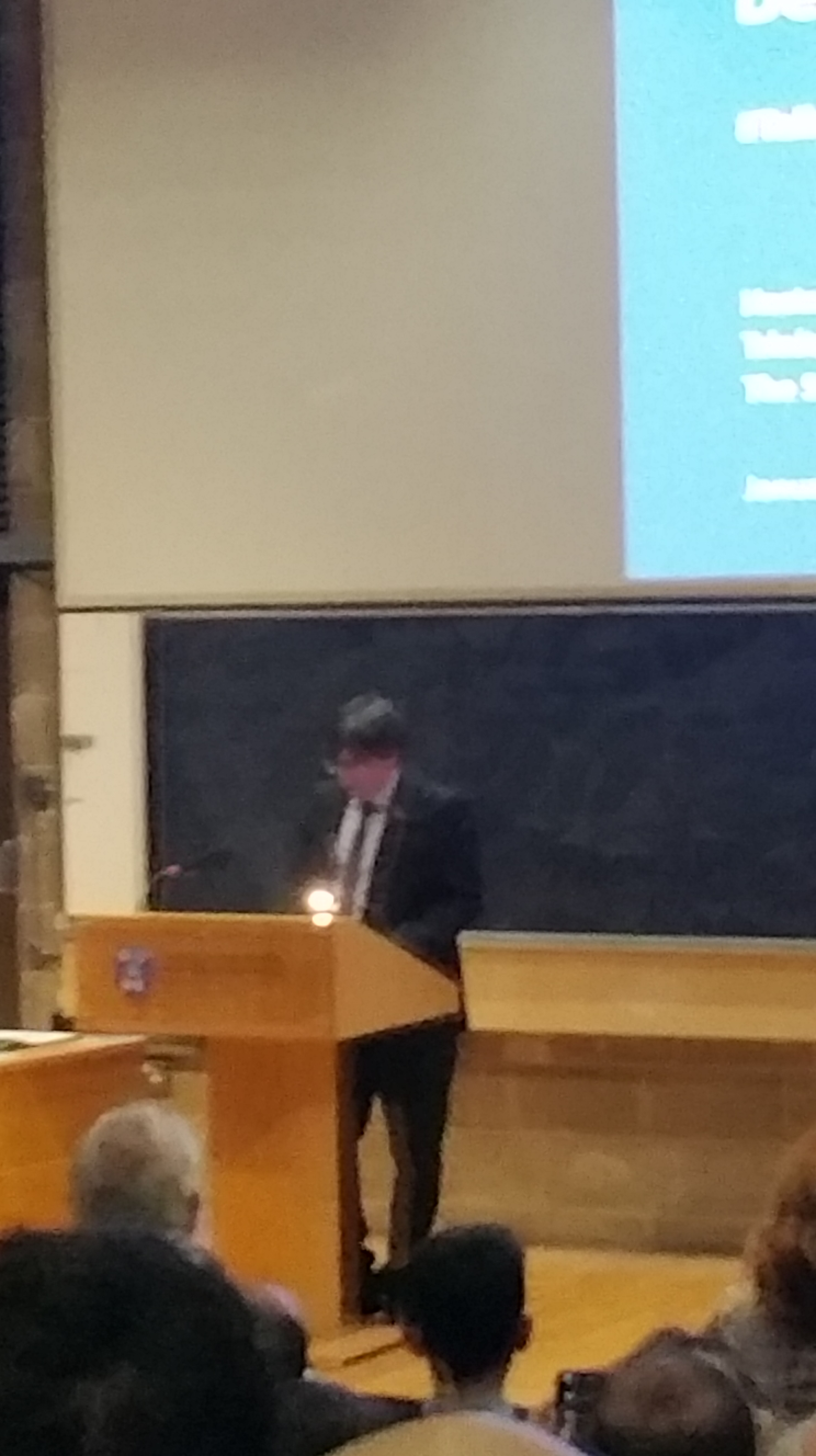
Puigdemont at lectern.

PUIGDEMONT: IT IS NOT ACCEPTABLE IN EUROPE

          Puigdemont began by saying that some of those present might want to know why Catalans do not want to be part of Spain. He could answer that question by recalling the history of Catalonia as a nation, its struggles, its language and its culture. That would be the discourse of 19th-20th Century nationalism, he said. However he preferred to outline it as modern process in the 21st Century, rooted in Europe and in democracy.

The President-in-exile surprised some of his listeners, no doubt, by pointing out that as recently as four years ago, the majority of the Catalan independentist parties had been asking only for greater autonomy from the Spanish State. The history of recent growth towards a majority demand for independence has been as a result of the refusal of the Spanish State to concede any greater autonomy and of the Spanish Court revoking laws passed by the Catalan Government.

But the Spanish response to Catalan demands has always been “no”, to everything”, said Puigdemont. “No” to dialogue. “No” to negotiation. “No” to reaching a democratic solution. Given the refusal, and obeying the mandate given to us by the majority of Catalan citizens, the Government of Catalonia, which it was my honour to preside, called a referendum on selfdetermination on 1 October 2017, with the legal backing of the Parliament of Catalonia. We did so while observing the basic principles of universal rights.”

And the world had seen the violence of the Spanish police inflicted upon people wishing peacefully to vote.

The aim was not just to confiscate ballot boxes and ballot slips”, Puigdemont maintained but instead “to make people give up their right to vote. But this ignominious act backfired on the politicians responsible for it. Over 2.4 million citizens overcame their fear and went out to vote. We do not know how many tried to do so unsuccessfully, but we do know the polling stations that were violently closed represented a further 770,000 voters.

Puigdemont continued: Today, democracy in Spain is at risk because basic rights have been de facto” suspended, and this represents a major threat to all Catalan and Spanish citizens, as well as to the European Union. Today, an EU member state cannot guarantee the judicial rights of its citizens, given that in recent months Spain has contravened international treaties ratified by the Spanish state itself, such as the International Covenant on Civil and Political Rights, the European Convention for the Protection of Human Rights and Fundamental Freedoms.

Referring to the Spanish State taking direct control of the Catalan government administration and preparing criminal charges against grass-roots organisation leaders and elected representatives, taking some as prisoners while others went into exile, Puigdemont said that this was not an internal Spanish problem but instead a Europan one. Seven hundred others, mostly town mayors, are under investigation too. Those independence activists, who have done nothing wrong and even according to Spanish law are innocent until proven guilty, have been kept in prison for over a year.

Concluding, Puigdemont said: “We will not falter. I have often said that what threatens democracy is not disagreement; indeed, democracy needs disagreements. What really threatens it is a lack of tools to solve disagreements democratically. We Catalans hope and trust that the political conflict over our selfdetermination can be resolved peacefully, without war, without violence, without winners and losers, without victims and thugs. We reject all the violence used in the last century in any part of the planet to resolve political conflict.

As Pau Casals, a well-known Catalan, reminded us in a memorable speech to the United Nations Assembly in 1971, Catalans in the eleventh century met ‘to talk about peace, because at that time, the Catalans were already against war’. Ten centuries later, we maintain these same values of peace and harmony.”

THE OTHER SPEAKERS IN THE DEBATE

          Located as the debate was in the capital city of Ireland and in the centenary of the founding of the first democratically-elected Irish Parliament, an Chéad Dáil, it was most noticeable that neither Puigdemont nor the other speakers referred to the experience of Ireland’s struggle for independence.

Dr Marvin Suesse – Assistant Professor in Economics, Trinity College Dublin spoke on The Economic Costs of Sovereignty”, from his research on the political economy of separatism and nationalism. He said that while the benefits of independence in terms of feelings of pride, promotion of culture etc. were difficult to measure, the economic benefits were not. Suesse went on to give examples which indicated that the costs of independence were greater than the benefits.

Dr Michelle D’Arcy – Assistant Professor in Political Science, Trinity College Dublin. spoke on “Secession and the Fiscal Contract: Reflections from the Post-Colonial World.”

D’Arcy teaches African politics and the political economy of development to undergraduate and postgraduate students and her research broadly focuses on understanding how politics and institutions enable and constrain human development and more specifically on democratization in Africa and state-building in Europe historically. Though she made some interesting points and believes that independence movements engage in a “fiscal contract”, it was difficult to see where she stood on the question under discussion.

Dr, Coman’s screen display
Dr. Coman at lectern.

Dr Emanuel Coman – Assistant Professor in Political Science, Trinity College Dublin spoke on “When does the Right to Self-Determination Actually Apply?”

Emanuel Coman is Assistant Professor in Political Science at Trinity College Dublin, teaching courses in comparative institutions and American Politics. His research is primarily in the fields of party politics and elections, with empirics driven primarily from Eastern Europe.

Coman, from Rumania as he told his audience, analysed the European nations that were successful in gaining independence after WWI. Most had been under the rule of the defeated belligerents. His thesis seemed to be that a nation’s bid for independence required the support of the big powers exerting influence in the area.

ONE MUST ALSO WEIGH THE COST OF NOT DECLARING INDEPENDENCE!”

          Commenting on the presentations of the other speakers and responding to questions after his presentation, Puigdemont was more lively than when reading his speech and at times showed some fire, particularly when he responded that as well as weighing the costs of independence, one must consider the costs of not becoming independent, which brought some applause from sections of the audience. Aside from anything else, he said, it is a question of dignity: the Catalans had the right to make their own decisions, whether they be correct ones or mistaken.

A much greater applause and cheers broke out when Puigdemont denied that the Spanish State could be described as “a democracy” and stated that this was not opinion but fact, given that the Monarch and Head of State (father of the current monarch) had been personally appointed as his successor by the fascist coupist General Franco, whose mausoleum is a national monument of the State.

Responding to a suggestion that the Catalan pro-independence movement might benefit from employing the tactics of the “Yellow Vests” of Paris, Puigdemont was most emphatic that his movement was peaceful and would never under any circumstances resort to violence.

One member of the audience criticised the panel (other than Puigdemont) for not addressing the actual issues in Catalan independence and the Spanish State’s opposition.

Asked by a member of the audience to describe his feelings of exile, Puigdemont replied that he could not indulge those feelings since he would be unable to continue the struggle if he did so. He revealed that his own grandfather, in a concentration camp in France after the fall of Barcelona to Franco’s military-fascist forces, had written to his family so that they were aware of the feelings of exile even though they never saw him again. His voice seemed to gain a heightened emotion when he remarked that when he compared his situation to that of refugees, like those from Syria, launching themselves on the hazardous journey to European shores, survivors arriving often to be badly treated, he felt he had little of which to complain.
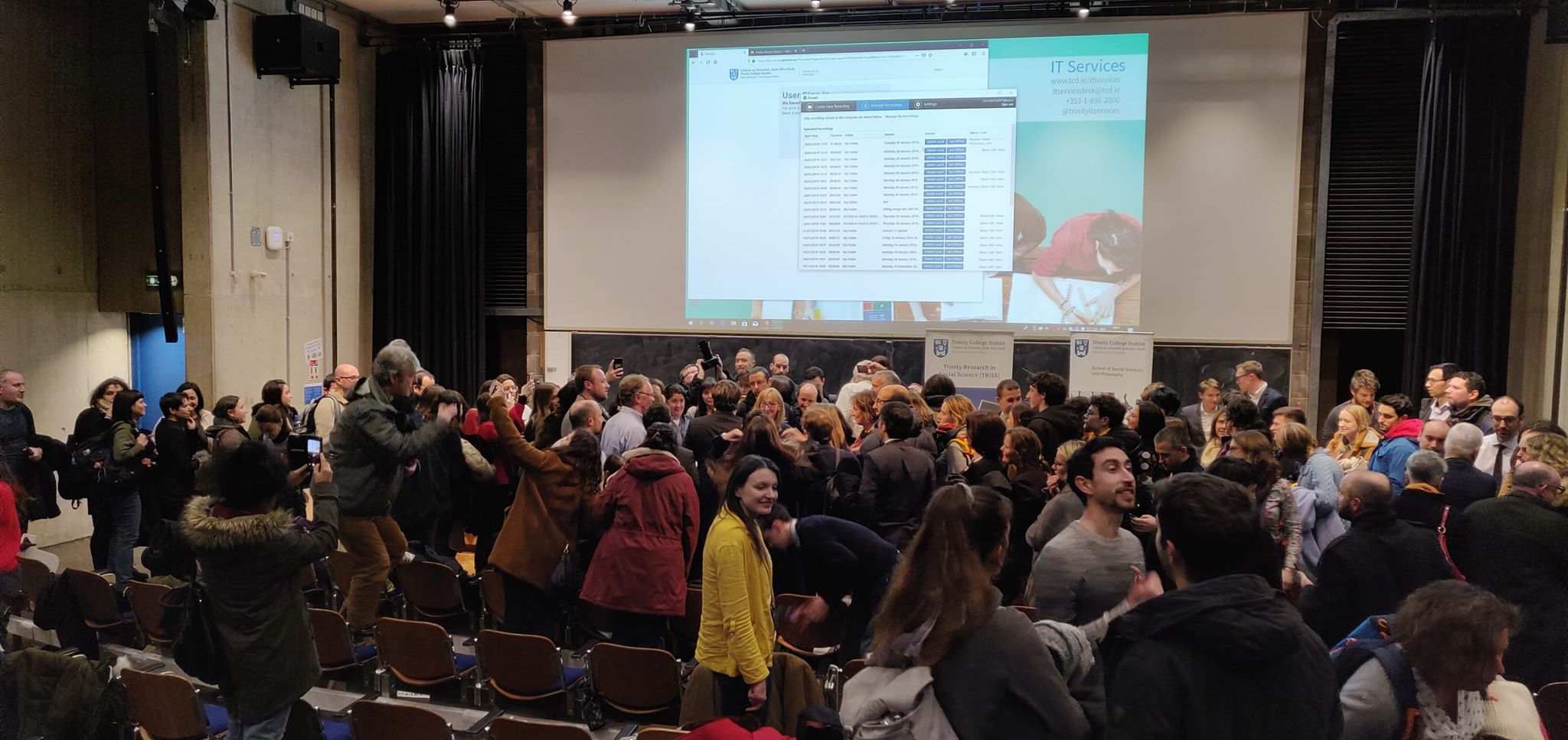
Puigdemont surrounded by well-wishers and the curious after the debate while others are in excited conversation.

AUDIENCE REACTION

          The audience gave Puigdemont and, one supposes, the other speakers and TRISS for having organised the debate, sustained applause and cheers, during which one could hear some pro-independence slogans in Catalan. Afterwards, many remained in the auditorium to speak to Puigdemont or to chat amongst themselves in a general buzz of excitement.

Views expressed by a number of listeners afterwards on the content of the debate were in general positive though these varied through a continuum from “excellent” to “all right but somewhat disappointing”. All feedback received agreed that on two points Puigdemont had been excellent: on the question of calculating the cost of NOT seceding from the Spanish state and also on the characterisation of the Spanish State as not being a democracy, as one that had failed to break properly with its Franco-fascist past.  Few gave positive feedback on the other debaters.

Crowds delayed leaving for around half an hour, gathering talking among themselves or queuing up to shake Puigdemont’s hand, talk to him etc. and Casals Catala presented him with some books on Irish history.

COMMENT:

          Puigdemont comes across as quite genuine in his convictions and as an able debater, even in a language which cannot be his first or second. His vision of Europe does not perhaps coincide with the views of some others and one may doubt the practicality of his commitment to non-violence. One may also question whether anyone has the right to commit the movement to peaceful resistance alone, even if it were to be attacked violently.

I did not hear him speak any words in Irish but the written text of Puigdemont’s speech did contain some. Although it was good to see some Irish there, for the few words he was going to speak in the language, Puigdemont (or his advisors) might have taken the trouble to formulate them correctly. Addressing “mná agus uasal” although addressing women first, suggests that the audience was an almost all-female one and who were not “uasal” (noble, important), but was surely unintended. And “dea-trathnóna leat (‘to you’, singular) go léir” (to all of you) is a conflation of singular and plural in the same address; likewise with the “go raibh maith agat” which thanks one person rather than the audience which was the intention and “go mór” which if not incorrect is clumsy and straight from Google Translate for “thanks a lot”.

Standing outside the auditorium with a placard announcing the Catalan solidarity demonstration on Saturday 9th April, at one point I noticed Puigdemont standing some metres away with some others. As he caught my eye, he stepped towards me, hand outstretched.

I gripped his hand and smiling, said: “Fáilte go Baile Átha Cliath!”

“Thank you,” he replied, smiling also and stepped back.

Whatever else he may be, I suspect he is what we in Dublin would call (with a meaning remote from any kind of subservience) “A gentleman.”

End.

BIOGRAPHICAL NOTES ON PUIGDEMONT:

          Born in Amer, a village in the province of Girona and fifty-seven years of age last December, Carles Puigedemont is a journalist by trade and ex-Mayor of Girona, a major Catalonian city of over 100,000, just under 100 kilometres (62 miles) north-east of Barcelona. In 2006, after a track record of activism in Catalan culture and nationalist activism, he was adopted as a political candidate by the CIU (Convergence and Union) political party and later to represent the reformation of that party in the Junts per Si (Together for Yes) coalition, composed of mostly nationalist capitalist elements. He has been successful in every election and currently heads the uneasy Junts per Cat (Together for Catalonia) coalition. The current Govern is made up of a coalition between JuntsXCat and ERC (Republican Left of Catalonia), with the other pro-independence party, CUP (Popular Unity Candidacy) in opposition, though not voting with the Spanish-unionist opposition.

In what seems an action contradictory to his political position, in January 2019 Puigdemont filed a constitutional application for amparo (remedy, to put right) directed against the President of the Catalan Parliament, Roger Torrent and the Board of the Chamber, to the Spanish Constitutional Court. The application argues Puigdemont had been denied the use of his political rights as Torrent did not allow him to delegate his vote from Belgium after Puigdemont’s criminal indictment and suspension of his parliamentary position by Supreme Court judge Pablo Llarena.

Despite constant Spanish-unionist claims from both Right and Left, the Catalan pro-independence movement has shown itself more tolerant of migrants and diversity than can be said in general of much of the rest of the Spanish State; one of the laws of the Govern sought to give migrants equal access to Catalan national health care but was twice squashed by the Spanish Supreme Court. Puigdemont is himself married to Romanian journalist (Marcela Topor in 2000) and they have two daughters, Magali and Maria, the family home in Girona. His children are multi-lingual and Puigdemont himself speaks Catalan and Castillian (Spanish), as do most Catalans but also English, French and Romanian.

LINKS AND FURTHER INFORMATION

Text of Puigdemont’s address in the debate in full attached at the end of the brief report in El Nacional: https://www.elnacional.cat/en/news/puigdemont-dublin-bertie-ahern-trinity-college-ireland_349173_102.html

Pre-event publicity from Trinity College: https://www.tcd.ie/ssp/events/lectures/2019-01-independence/

With Catalonia/ Leis an Chatalóin: https://www.facebook.com/WithCataloniaIreland/

CDR Dublin: https://www.facebook.com/CDRDublin/

Casal Catalá de Irlanda: https://www.facebook.com/casalcatalairlanda/

CATALAN PRESIDENT-IN-EXILE MEETS IRISH PARLIAMENTARIANS IN DUBLIN

Rebel Breeze Reporter

Puigdemont. President-in-exile of Catalonia, visited Dublin to take part in a debate in Trinity College on Tuesday 29th January and visited the Dáil and a number of Irish politicians on the same day.

Puigdemont and Puignól at the Barcelona-ireland friendship tree in Cow’s Lane, bracketed by activists of Casals Catalá de Irlanda, Catalan cultural organisation in Ireland on each side.
(Photo source: ACN, El Nacional).

          Carles Puigdemont was elected President of the pro-independence Catalan Government, declared an independent Catalan Republic but immediately suspended it; then had his Presidency abolished by the Spanish State, which took direct control of Catalonia for a period. He went into exile with a number of other Catalan Government ministers in order to avoid arrest; the Spanish State issued a European Arrest Warrant for him which was party unsuccessful and then withdrew it; however, he remains in exile in Brussels. Most pro-independence Catalans and even others consider him the legitimate President of Catalonia, though another had to be elected to fill his place; Quim Torra, who is currently the elected President, says that he considers himself only “the interim President”.

Carles Puigdemont was elected President of the Govern, the Catalan Government, in January 2016, in an agreement between pro-independence parties. On 27th October 2017, with a majority of October 1st Referendum votes salvaged and counted — after the Spanish police attacks on the voters – in favour of independence, he declared a Catalan Republic on behalf of the Govern. However, he almost immediately suspended it, to the dismay of many Catalans, including supporters of his own party. The Spanish State, the Constitution of which forbids any secession without the majority vote of the Parliament of the whole territory, was not mollified by the suspension and, as the Spanish State prepared criminal charges against him and Catalan Ministers, Puigdemont went into exile (as did another five Catalan ministers).

ARRESTS AND EXILE

          The Spanish State arrested a number of others, including seven ministers and two leaders of grass-roots movements and charged them with sedition, rebellion and misuse of public funds, carrying 30, 15 and six years in prison respectively and European Arrest Warrants were issued for Puigdemont and other ministers. On 25th March 2018, Puigdemont was detained on that warrant while passing through Germany on his way back to Brussels from a speaking engagement in Finland. A German judge decided the issue of the “rebellion” charge first, declaring that any such charge had to provide evidence of violence, of which there had been none by the detainee (there had been plenty of violence but all by the Spanish police) nor under his direction.

The German court decided in July that Puigdemont could be extradited to the Spanish State to be tried for misuse of public funds but the Spanish State, not wishing to have to try him and the other ministers only on those while the other ministers were being tried on the more serious charges, withdrew the arrest warrants. These charges can of course be renewed at any time and another warrant issued.

Since his return to Brussels after release by the German court, this Dublin visit has been Puigdemont’s first venture outside Belgium.

Accompanied by Jordi Puigneró, the current Minister of Digital Policies and administration of Catalonia, also visiting Ireland, Puigdemont paid a brief visit to an olive tree donated by Barcelona to Dublin in acknowledgement of the Irish who had fought for Catalonia in the War of the Spanish Succession. After a meeting with the Mayor of Dublin for the year, Niall Ring, Carles Puigdemont attended the Dáil (the Irish Parliament) for a private meeting with Bertie Ahearn, a Fianna Fáil party parliamentarian and ex-Taoiseach (Prime Minister).

Puignól attaches a yellow ribbon to the Barcelona-Ireland olive tree in solidarity with the Catalan political prisoners.
(Photo source: Casals Catalá de Irlanda)

MEETING IN THE DÁIL

          Afterwards Puigdemont addressed a meeting room of around 100, organised by the Dáil organisation Oireachtas Friends of Catalonia, with its chairperson Pat Gavan, Sinn Féin Senator, presiding.  Jordi Puigneró sat beside Puigdemont as did Lynn Boylan, Sinn Féin MEP.

Puigdemont in the packed Dáil meeting room, Leinster House, Dublin.  Others L-R: Minister Jordi Puignól, MEP Lynn Boylan, Sen. Paul Gavan.
(Photo source: Internet)

Fifty-seven years of age last December, Carles Puigedemont is a journalist by trade and ex-Mayor of Girona, a major Catalonian city of over 100,000, just under 100 kilometres (62 miles) north-east of Barcelona. In 2006, after a track record of activism in Catalan culture and nationalist activism, he was adopted as a political candidate by the CIU (Convergence and Union) political party and later to represent the reformation of that party in the Junts per Si (Together for Yes) coalition, composed of mostly nationalist capitalist elements. He has been successful in every election and currently heads the uneasy coalition platform Junts per Cat (Together for Catalonia). The current Govern is made up of a coalition between JuntsXCat and ERC (Republican Left of Catalonia), with the other pro-independence party, CUP (Popular Unity Candidacy) in opposition, though not voting with the Spanish-unionist opposition.

In what seems an action contradictory to his political position, in January 2019 Puigdemont filed a constitutional application for amparo (remedy, to put right) directed against the President of the Catalan Parliament, Roger Torrent and the Board of the Chamber, to the Spanish Constitutional Court. The application argues Puigdemont had been denied the use of his political rights as Torrent did not allow him to delegate his vote from Belgium after Puigdemont’s criminal indictment and suspension of his parliamentary position by Supreme Court judge Pablo Llarena.

Despite constant Spanish-unionist claims from both Right and Left, the Catalan pro-independence movement has shown itself more tolerant of migrants and diversity than can be said in general of much of the rest of the Spanish State and one of the laws of the Govern, twice squashed by the Spanish Supreme Court, sought to give migrants equal access to Catalan national health care. Puigdemont is himself married to Romanian journalist (Marcela Topor in 2000) and they have two daughters, Magali and Maria, the family home in Girona. His children are multi-lingual and Puigdemont himself speaks Catalan and Castillian (Spanish), as do most Catalans but also English, French and Romanian.

Addressing the full room, after thanking Gavin for presiding over the meeting and those assembled for their presence, Puigdemont presented his case that Catalonia had the right to secede, that holding a referendum was a democratic activity per excellance, that the arrest and trial of politicians for having promoted that referendum was undemocratic and that such activity was not within keeping of the EU ethos.

Replying to questions on what he would ask Irish politicians to do in order to help Catalonia’s struggle and on how he saw his nation’s struggle combining with other nations within the Spanish state, for example the Basque Country, Puigdemont said he did not wish to tell other countries what do and that the struggle of Catalonia stood on its own. He declined to relate the content of his discussions with Aherne, which he said were confidential. One member of the audience reminded Puigdemont that 100 years ago, the first democratically-elected Irish national parliament had met and that many of its delegates were also in jail or in exile.

To a question about alleged flight of business from Catalonia, Puigdemont said that one had to read alternate media to some of the dominant ones and make up one’s own mind, critically examining all sources – including himself! But he did say that although some addresses of head offices were transferred to the Spanish State in what he said was not legally right, not one factory, working office or member of staff had been transferred out of Catalonia. Also, the struggle with the Spanish State and some Spanish attempts at boycott had obliged Catalans to look outside the Spanish state for their markets and business links whereas previously, imports from and exports to the Spanish state had accounted for 90% and 80% respectively. Jordi Puigneró commented that he was in Ireland in part because of that, in particular to follow up on the Irish state’s success in attracting and developing information technology business.

After the Dáil meeting, Puigdemont and Puignól pose for photos with Catalan solidarity supporters.
(Photo source: Casals Catalá de Irelanda)

Outside in the icy cold after the fairly short meeting, Puigdemont lined up for a few photos surrounded by Catalan and other well-wishers and departed to the singing by them of Catalan’s national anthem, Els Segadors (The Reapers). He had a debate at which to speak in a few hours and most of the Catalans in attendance would be there too.


End.

OTHER MEDIA REPORTS:

https://www.independent.ie/irish-news/politics/well-continue-fighting-for-our-freedom-it-doesnt-matter-if-were-in-jail-excatalan-president-tells-tds-37763055.html

https://www.irishtimes.com/news/world/europe/carles-puigdemont-i-may-participate-in-the-european-elections-1.3776372


DUBLIN PICKET AGAINST INTERNMENT AND SPECIAL COURTS HARASSED BY POLICE

Clive Sulish


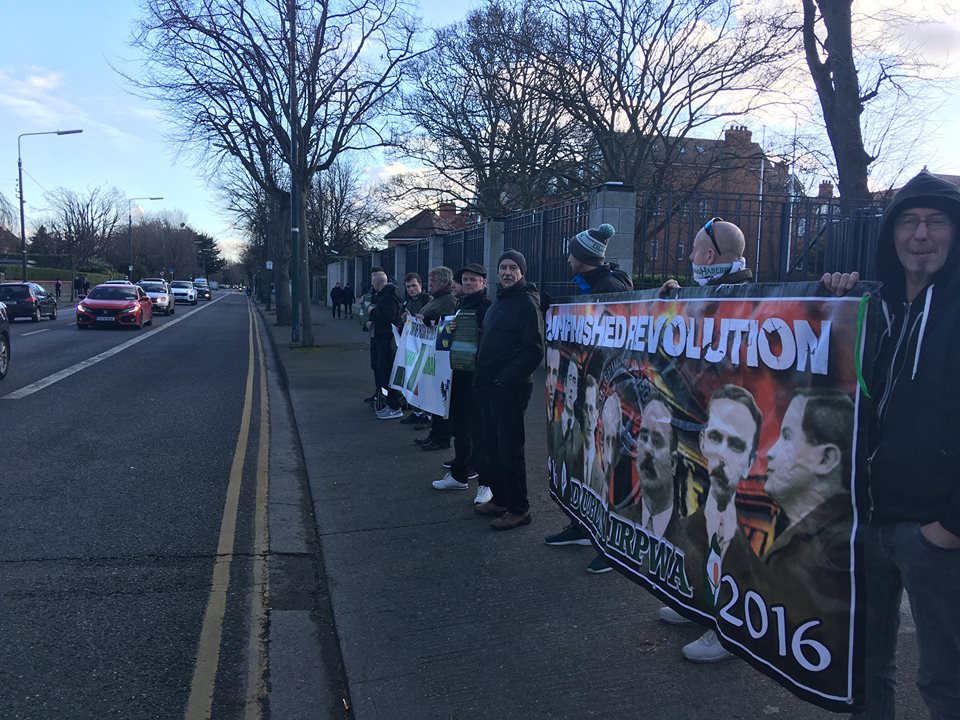
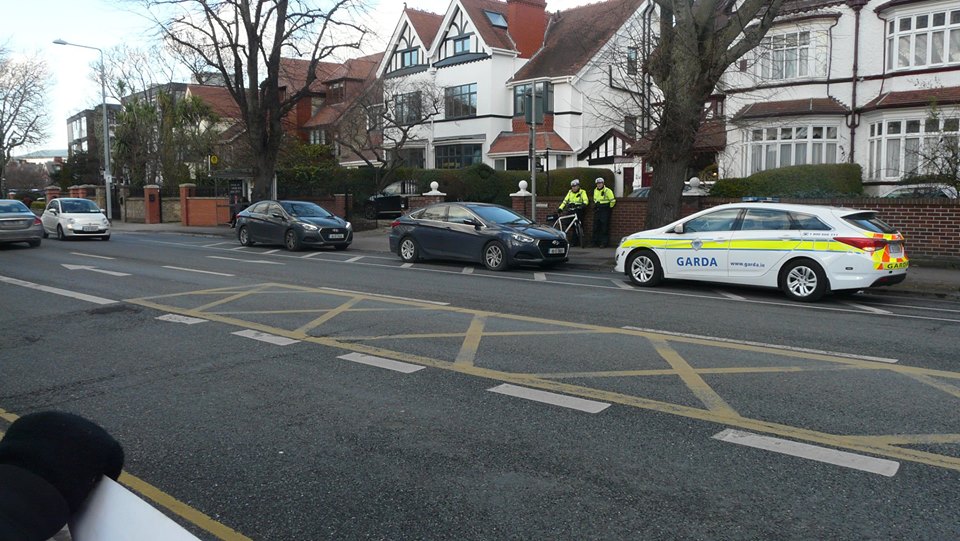
A picket called on the British Embassy to protest against continuing internment and special courts was harassed and kept under heavy surveillance by Irish police, both in uniform and in plainclothes, with marked and unmarked vehicles.

One view of part of the protest (the main entrance to the British Embassy is behind the picketers). (Source photo: Participant in the protest)

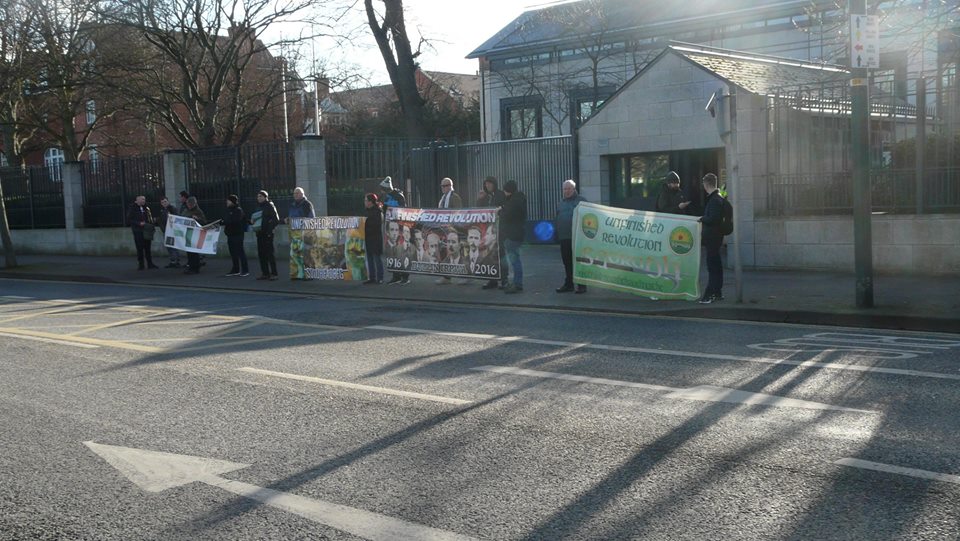
The protest was called by Irish Socialist Republicans, Anti-Imperialist Action Ireland, Dublin Anti-Internment Committee and Abolish the Special Courts campaign, was supported by members of a number of Republican and socialist organisations and independent activists.

Another view of the picket with the entrance to the British Embassy behind them (Photo source: Picket participant)

The objective of the protest was to highlight that the undemocratic practices of using the courts to remove the political opponents of those in power continues – the use of the courts”as a propaganda cover … to remove unwanted members of the public”, in the words of Brigadier Frank Kitson (British Army). These abuses of civil rights continue through a number of methods: revoking of ex-prisoners’ licences; refusal of bail; granting of bail under conditions preventing political activity; convictions in special no-jury courts. And they continue in both administrations: the Six-County British colony and the 26-County Irish state.

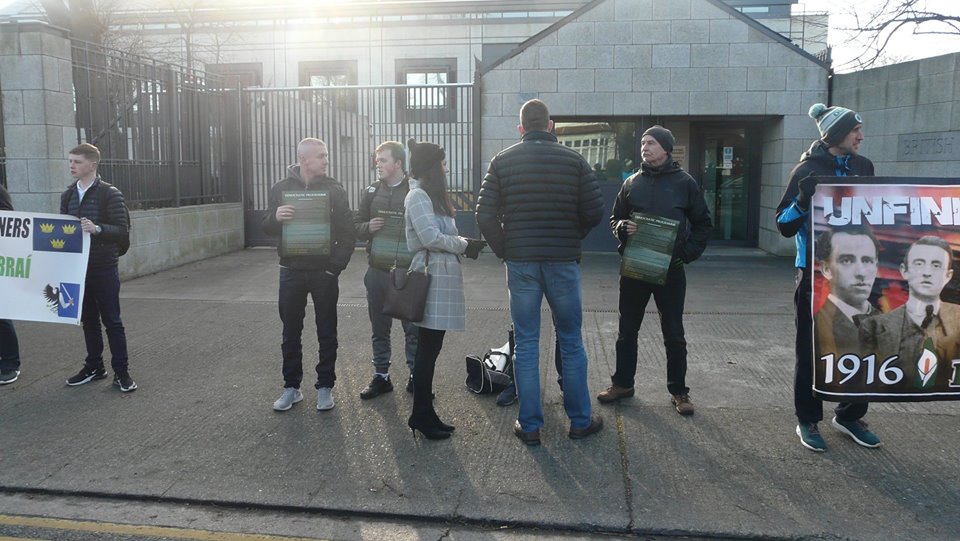
A Garda Special Branch (political police) male officer, accompanied by a female officer, requiring participants to give their names and addresses.
(Photo source: Picket participant)

The harassment of the protesters outside the British Embassy was at a level to which Irish Republicans have become unfortunately accustomed: a Garda officer in plain clothes identifying himself as a member of the Special Branch and displaying his Garda identification request, accompanied by another, approached those in the picket line and required them to give their names and addresses, quoting Section 30 of the Offences Against the State Act1.

This practice of taking people’s names and addresses is one of intimidation which does restrain some new people from joining such pickets. The surveillance has the same intent, being visible; highly visible on this occasion with three unmarked SB cars, two Garda cyclists and one marked patrol car (in addition to the Garda officer permanently on duty outside the Embassy). “Remember this the next time you hear or read that the Gardaí were unable to respond to a domestic violence call for a number of hours because they were “short on resources’ “, commented one of the protesters. “Or unable to refer young offenders into the Diversion Program2” added another.

Intimidatory police surveillance on the other side of the road from the protest: two unmarked Special Branch cars, two bicycle police and one patrol car. Another SB car was parked on the pavement on the same side as the Embassy, which has a Garda officer on permanent duty also.
(Photo source: Picket participant)

The drivers of a number of vehicles, especially taxis, tooted their horns in solidarity as they passed. Although the cold was penetrating through footwear to feet, the protest ended a little after an hour.


FOOTNOTES:

1The section authorises those questions by a Garda officer who has reasonable grounds for suspecting the interrogated may be committing or about to commit a crime – clearly inapplicable in most cases where this is used.

2https://www.irishexaminer.com/breakingnews/ireland/garda-report-shows-3500-children-escaped-prosecution-for-crimes-898197.html Although this report highlights the victims of the crimes, the youth themselves became victims of a life of mostly low-level crime and associated lifestyles of early substance use, early parenthood and, later jail and, in many cases, early death.

Priceless Solidarity on the Ha’penny Bridge

Diarmuid Breatnach


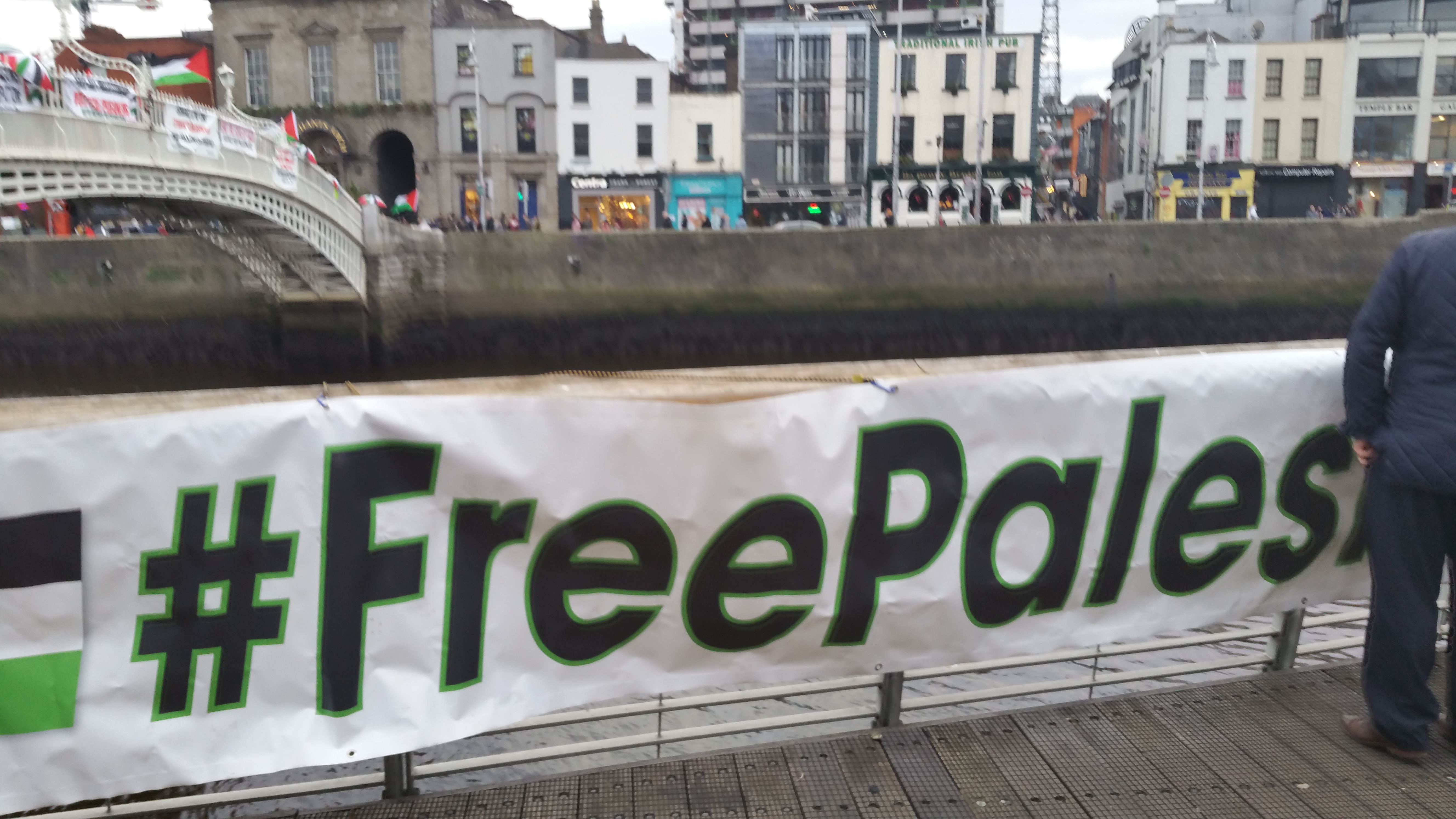
Palestinian flags and solidarity banners decorated each side of Dublin’s iconic Ha’penny Bridge on Sunday 31st December as people crossing towards both sides of the river passed between people holding flags, wearing kifiyehs or standing under umbrellas in the Palestinian colours. The overwhelming majority of the supporters seemed Irish and could be identified as from a range of socialist and republican backgrounds, whether independent or not.

A bridge of Solidarity (Photo: D.Breatnach)

This is an annual New Year’s Eve event, organised by the Ireland Palestine Solidarity Campaign, whose stall had been set up on the south side, near Merchant’s Arch.

On the Boardwalk
(Photo: D.Breatnach)

Two versions of leaflets were being distributed; one which called for an end to the siege of Gaza pointed out that in 1017 a UN report stated that “the unliveability threshold has already been passed there.” Among other recommended actions the leaflet asked people to contact their TDs (Irish parliamentary representatives) and urge them to support Senator Frances Black’s Bill this year which will ban trade with Israeli illegal settlements in Palestine. Those settlements seize Palestinian land and water resources and are illegal by UN declaration.

The west side of the bridge, from the northern side of the river (Photo: D.Breatnach)

According to a report “Between July 2016 and June 2017, Israeli authorities authorized construction work on more than 2,000 new housing units for settlers in the West Bank, excluding East Jerusalem”, another area of Zionist expansion.

The Bridge was busy (Photo: D.Breatnach)

During the same period, “Israeli authorities destroyed 381 homes and other property, forcibly displacing 588 people as of November 6, in the West Bank, including East Jerusalem, as part of discriminatory practices that reject almost all building permit applications submitted by Palestinians.”

A closeup on some of the banners on the east side of the bridge.
(Photo: D.Breatnach)

During the Great March of Return protests on Gaza’s border which began in May, Israeli Occupation Force snipers shot dead or caused death by gassing of 168 Palestinians and injured 17,259 people, including women, children, medical workers and journalists. During the same period one Jewish Israeli was killed 11 and injured, six of which were soldiers.

A great many passers-by expressed their approval of the demonstration, some stopping a while to talk with the demonstrators.

It was a child-friendly affair (Photo: D.Breatnach)

Some chanting of Palestinian supporters could be heard as well as occasional passing drivers tooting their horns in solidarity, occasionally with a clenched fist also raised outside the window. A counter-protest planned by the zionist Irish Friends of Israel on Essex Bridge however failed to materialise.

End.

LINKS FOR REFERENCES & FURTHER INFORMATION:

IPSC (an organisation independent of all political parties): www.ipsc.ie

Information and statistics: https://www.hrw.org/world-report/2018/country-chapters/israel/palestine

Biased Wikipedia entry which however could not disguise the casualty statistics: https://en.wikipedia.org/wiki/2018_Gaza_border_protests


Packed Concert Commemorates Return of the Irish Brigadista Volunteers

Diarmuid Breatnach

A mixed audience of anti-fascists were entertained on 23rd November by a range of artists from the Irish trad-folk scene and a Spanish band performing to commemorate on its 80th anniversary the return of the Irish survivors of the International Brigades to Ireland. The event, “The Return of the Connolly Column” was organised by the Friends of the International Brigades in Ireland (FIBI) and the venue, the Workman’s Club on Wellington Quay of the Dublin City Centre, was packed.

The event began with Dougie Dalby introducing Harry Owens, a Spanish Civil War historian and founder member of the FIBI. Owens gave a speech, recalling how the social-democratic PSOE Government in the Spanish State in the 1980s had not wished to support the marking and conservation of graves of International Brigaders who had fallen in battle but had been convinced to do so by Edward Heath, British Prime Minister and by the leader of the Irish Labour Party at the time, Dick Spring. FIBI had become part of that commemoration effort in visiting some of the sites but also in erecting monuments and plaques in various parts of Ireland.

Colm Morgan from Co. Louth followed, with guitar and voice, with some of his own compositions, including one about Frank Ryan – excellent material in my opinion – to be followed by Mick Hanley (guitar and voice again) accompanied by Donal Lunny. Hanley and Lunny have history, of course, not least in that great band of the past, Moving Hearts; both belong to that honourable class of Irish musicians who have not been afraid to support progressive causes including some in their own country – and who have never performed for “any English King or Queen”.

(L-R) Dónal Lunny and Mick Hanley performing at the FIBI event.
(Photo source: FIBI)

Lunny accompanied various artists at different times during the evening, sometimes on keyboard and sometimes with guitar, as well as adding vocals once also. After his pairing with Hanley, he accompanied Tony Sweeney’s excellent lively accordion-playing which drew more than one whoop from the audience. All however quietened down for Justin McCarthy reading “The Tolerance of Crows” by Charlie Donnelly, Irish poet, member of Republican Congress and Field Commander of a unit of the International Brigades and who fell at the Battle of Jarama on 27th February 1937.

Muireann Ní Amhlaoibh on whistle accompanied by Dónal Lunny
(Photo source: FIBI)

After the break excellent singer Muireann Ní Amhlaoibh sang (accompanied by Lunny) and her rendition of Sliabh Geal gCua na Féile, a song composed by an Irish emigrant working in a Welsh coalmine in the late 19th Century, was particularly beautiful. It is a lament for home and language by Pádraig Ó Míléadha, from the Déise (‘Deci’) area of Wateford.

John Faulkner, virtuoso composer and singer-songwriter, raised in London of Irish background and for many years a resident of Kinvara, Co. Galway (but almost Co.Clare) accompanied himself singing a number of songs, including Patrick Galvin’s great composition Where Oh Where Is Our James Connolly? He performed an anti-war song by Eric Bogle also, All the Fine Young Men, which he introduced saying that some wars need to be fought.

Andy Irvine playing and singing at the concert (Photo source: FIBI)

Andy Irvine took the stage second-to-last of the acts for the evening, another London import to Ireland for which Irish folk and traditional music is very grateful, a composer, singer-songwriter and player of a number of instruments, accompanied once again by Lunny, who shares a history with him in Moving Hearts and Planxty. Irvine performed a number of songs, including Woody Guthrie’s All You Fascists Bound to Lose which, though not very creative in lyrics has a chorus with which the audience joined enthusiastically.

Gallo Rojo performing at the event (Photo source: FIBI)

Last on for the evening was Edinburgh-based Gallo Rojo1, anti-fascist musical collective, opening with a reading in the original Castillian of La Pasionara’s farewell speech to the International Brigaders at their demobilisation parade in Barcelona (see Links). It seemed to me that this would have worked better for an Irish audience with a simultaneous or interspersed reading in English but it received strong applause from the audience. This was followed by Ay Carmela!, then Lorca’s Anda Jaleo! I had to leave after that but I could hear the band starting on Bella Ciao, the song of Italian anti-fascist resistance of the 1940s but based on an older song of oppressed women agricultural workers.

It did occur to me at that point that among all the great material of the evening, I had heard no song to represent the International Brigaders of nations other than Ireland which is often the case at such events. More unusually, no reference I could recall was made to growing fascism in Europe and especially in the Spanish State (it never went away there), nor to antifascists facing trial arising out of mobilisation against the attempted Dublin launch of the fascist organisation Pegida in February 2012.

Immediately outside the concert hall, the bar area held a large number of people, perhaps as many as a quarter again of the audience inside. The performances inside were being conveyed by electronic speakers to them too but I am unsure how many were listening. There was a FIBI stall there too selling antifascist material.

Overall, the audience appeared to be mostly Irish with some foreign nationals and from a broad range of political backgrounds: Communist Party of Ireland, Sinn Féin, Anarchists and independent supporters and activists of mainly socialist and/or Republican ideology.

I am informed that FIBI are currently finalising the editing of a video of the concert and this will be available as soon as possible.

HISTORICAL BACKGROUND:

1. THE INTERNATIONAL BRIGADES

The International Brigades were raised through Communist parties around the world to assist in the defence of the republican Popular Front Government of the Spanish State against a military coup with Spanish fascist (and Basque Carlist) support, aided by Nazi Germany and Fascist Italy. The Brigades consisted of volunteers from at least 65 nations2 and included Jews from a number. Early Irish volunteers enlisted chiefly in units of British and USA organisation but were present in groups from Australia and Canada too but later some made their way directly from Ireland; later too some of the Irish came to be known as the Connolly Column. The English-speaking units and some others were formed3 into the 15th International Brigade (originally the Fifth, but when added to the ten indigenous brigades of the Spanish Republic – Spanish, Catalan and Basque – became the Fifteenth). Not all foreign anti-fascist volunteers enlisted through the International Brigades, some joined Anarchist or Trotkyist militias4 and at least one, an Irishman, joined a Basque unit.

The Republican Government of the Spanish state disbanded the International Brigades on 23rd September 1938 in an unsuccessful bid to have the non-fascist European powers5 pressure their German and Italian fascist counterparts to withdraw their logistics, soldiers and airforce support from the Spanish military-fascist forces. By that time many of the “Brigadistas” were dead or captured as they had borne some of the heaviest prolonged fighting at Madrid (1936); Jarama, Brunete and Belchite (all 1937); Fuentes del Ebro and the Ebro itself (1938).

Famous photo by Robert Capa, war reporter from Hungary, showing emotional face of Brigadistas saluting (and perhaps singing the Internationale) at their demobilisation parade in Barcelona.
(Photo source: Internet)

Their formal demobilisation parade with their auxiliary recruits (including women) was held in Barcelona on 28th October, where they received the famous oration from the Basque Dolores Ibárruri, “La Pasionara”, prominent anti-fascist and activist of the Communist Party of Spain (see Links). It is notable that she addressed her oration to “communists, socialists, republicans, anarchists” as not only communists fought and died in the ranks of the Brigadistas.

Section of survivors of the International Brigades at their demobilisation parade in Barcelona.  (Photo source: Internet)
Another close-up from the demobilisation parade in Barcelona
(Photo source: Internet)


2. A DIFFERENT IRELAND

The Irish Brigadistas returning to Ireland found a society very different from that of today. Anti-communist hysteria was prevalent, whipped up in particular by the Catholic Church and supported in particular – but not exclusively – by Fine Gael (which formed in part from Blueshirts6). The Fianna Fáil Government was not fascist but was of the Irish capitalist class relying heavily on Catholic Church support and so contributed to anti-communism; all of the main media was anti-communist and finally the IRA, as well as having forbidden any of its Volunteers to fight for any other cause than Ireland’s, had expelled communists from the IRA in 1934. As with the time of repression of Republicans by the Free State, the USA seemed a good option for some of the Irish Brigadistas (some had enlisted there anyway) but there too, many antifascist war veterans found themselves subject to anti-communist hysteria and even later, when the USA was fighting fascist powers, labelled as “premature antifascists”!

Today here in Ireland the general attitude is one of respect or even pride in that part of our history, when Irish Volunteers went abroad to fight in defence of democracy and socialism against fascism7. The best-known song to date about the Irish Brigadistas is undoubtedly Viva La Quinze Brigada8 by Ireland’s best-known folk singer-songwriter, Christy Moore. Published accounts by Irish participants include The Connolly Column by Michael O’Riordan (1979) and Brigadista (2006) by Bob Doyle. Moore’s song is very popular in Ireland (and among the Irish diaspora in Britain) and a plaque listing some of the Irish martyrs is fixed to the wall by the entrance to the Theatre building of the major Irish trade union, SIPTU.

Funeral in May 1983 of Michael O’Riordan, survivor Irish Brigadista and General Secretary of the Communist Party of Ireland (among other positions and activities).
(Photo source: Indymedia)

Michael O’Riordan survived the War and was prominent in the Communist Party of Ireland, dying in Dublin in 1983. Bob Doyle was the last surviving known Brigadista from Ireland; on 22nd January 2009 he died in England, where he had been living and had raised a family. On February 14th that year his ashes were carried by relatives and admirers in a march from the Garden of Remembrance in Dublin city centre to Liberty Hall, where a reception was held. An optimistic photographer with the byline of “anarchaeologist” reported the following day in Indymedia: “…. in a display of left unity and solidarity we will doubtless see more of on the streets of Dublin over the coming months ….. Groups attending the celebration included the main unions, Éirigí, the WSM, the IRSP and Dublin Sinn Féin. Banners were also carried by the International Brigades Memorial Trust and the Inistiogue George Brown Memorial Committee. Supporters of the Dublin branch of the Irish Basque Solidarity Campaign demonstrating outside the GPO dipped their flags as a mark of respect as the crowd passed by”. The DIBSC actually wheeled in behind the march as the tail end passed, though the reporter seems not to have noticed that.9

Supporters of the Dublin Basque Solidarity Committee lower Basque flags in honour as ashes of last Irish Brigadista to die are carried down O’Connell Street in procession.
(Photo source: Indymedia)
Relatives and friends leading procession with Bob Doyle’s ashes give clenched fist salute to Basque solidarity demonstrators they are passing (see other photo with Basque flags).
(Photo source: Indymedia)

FRIENDS OF THE INTERNATIONAL BRIGADES IN IRELAND


The aim of the concert was to honour the enduring legacy of the 15th International Brigade and its ongoing contribution in the war against fascism”, a spokesperson for FIBI said in a statement. “As such, it was both a commemoration of the 80th anniversary of the disbandment of the Brigade and the subsequent return of the survivors to Ireland but it was also a celebration of their spirit in choosing to sacrifice everything for working-class principles.”

FIBI is an entirely voluntary organisation but does incur costs in erecting memorials, research, promotion etc. “This concert was designed to raise a modest amount to ensure the continuation of this work without having to resort to piecemeal fundraising over the next year or two. We are delighted to say we met our twin objectives of hosting a fitting occasion to coincide with the 80th anniversary of what became known as The Connolly Column and raising funds to help us continue with our efforts to ensure those who went are never forgotten.”

With its work of commemoration ceremonies and erection of plaques and monuments around the country, a work which not only reminds us of the Irish contribution in general but also links it to specific individuals from specific areas, the Friends of the International Brigades in Ireland has been deepening the wider attitude of respect for the International Brigades and pride in the Irish volunteers which has been growing steadily.

Hopefully all of this will combine with and inform any action necessary to halt the rise of fascism throughout the world and of course to prevent it taking hold in Ireland.

End.

REFERENCES AND USEFUL LINKS

Friends of the International Brigades in Ireland:

http://fibi-ireland.com/site/

States from which volunteers went to fight against Spanish fascism:

http://www.international-brigades.org.uk/content/volunteers-63-countries

English translation of La Passionara’s speech read by Maxine Peake: https://www.youtube.com/watch?v=0Xfm3o45iIE

La Passionara’s speech read in the original Castillian in front of an audience by Esperanza Alonso:

https://www.youtube.com/watch?v=H3HtLLelVeo

Brief account of some anti-communist violence in 1930s Ireland: https://comeheretome.com/2012/07/19/anti-communism-animal-gangs-and-april-days-of-violence-in-1936/

IRA expulsion of communists:

https://en.wikipedia.org/wiki/Republican_Congress

Video compilation of concert:

FOOTNOTES

1Not to be confused with the Mexico-based rock-ska-Latin band of the same name.

2“63 countries” are listed in one reference and I have added two, Scotland and Wales, on the assumption that they are unlisted but included under “Britain” or “UK”: http://www.international-brigades.org.uk/content/volunteers-63-countries

3 The Balkan Dimitrov Battalion and the Franco-Belgian Sixth February Battallion.

4George Orwell, who wrote Homage to Catalonia, probably the most famous English-language account of the war by a participant, enlisted in the militia of the POUM (Partido Obrero de Unifacción Marxista), a coalition of Trotskyis organisations (but whose alliance with the Right Opposition was renounced by Trotsky himself). The much larger anarcho-syndicalist trade union and movement Confederación Nacional del Trabajo (CNT), closely associated with the Federación Anarquista Ibérica (FAI), also had militias, of which the Durruti Collumn was the largest and is the best known today. Some foreigners also enlisted in those militias.

5These powers, such as France and the UK, were following an allegedly “non-interventionist” policy but effectively forming part of the blockade preventing the Republican Government from receiving aid. Later the governments of those two states in particular tried a policy of appeasement of Nazi Germany and Fascist Italy which was unsuccessful (except in encouraging further aggression) and they ended up going to war.

6Former IRA leader Eoin O’Duffy had, with Irish Catholic Church endorsement, recruited many more Irishmen to fight alongside the Spanish military-fascist forces but they acquired a reputation for ill-discipline and in one of their only two brief military engagement mistakenly fired on fascists; they went home in disgrace in late June 1937 (a year before the International Brigades were demobilised and the surviving, non-prisoner Irish were able to return home.

7Republicans and Communists had fought the fascist Blueshirts in Ireland too and the significant contribution of participants from the Irish diaspora to the famous antifascist victory of the Battle of Cable Street (and following guerrilla attacks on fascists at Hyde Park) in London has more recently been recognised (though not yet on the main relevant Wikipedia entry).

8Originally written as Viva La Quinta Brigada (i.e “the Fifth”); however that is the name of a song in Castillian contemporary with the War and later versions of Moore’s song include a line acclaiming “the Fifteenth International Brigade” which would be “la Decimiquinta” which has three syllables too many and so “Quinze”, i.e ‘Fifteen’.

9The DIBSC had already scheduled and advertised a picket to take place on the same day in Dublin’s main street, protesting against Spanish State repression of the Basque independence movement and treatment of prisoners. Upon learning of the planned march to honour Bob Doyle’s memory, I suggested holding our Basque solidarity event earlier, lowering the flags in respect when the march approached and then following it as the tail end passed us. I was unsure of what the reaction of Doyle’s relatives and supporters might be but as soon as those at the front saw what we were doing, a number of them raised clenched fists. It was an emotional moment for me, certainly.

AGAINST INTERNMENT AND SPECIAL COURTS!

Clive Sulish


Tens of protesters against undemocratic state repression through internment and special courts gathered at the Wolfe Tone Monument in Dublin’s Stephen Green on Saturday before proceeding through the park to the Irish state’s Department of Justice building at 94 Stephen’s Green.


The sun shone weakly through at times on bare branches of deciduous trees and their autumn leaves, along with the dark green of the evergreen foliage of holly tree and invasive bay cherry.

Wolfe Tone Monument by Edward Delaney (d.2009) at an entrance to Stephen’s Green (image sourced: Internet)

The Wolfe Tone Monument stands in the approximate location of the Irish Citizen Army’s trenches in 1916, fired on by British soldiers with machine guns who had occupied the Shelbourne Hotel opposite, killing one of the Volunteers below. The statue had been blown up by British Loyalists in the 1970s and some of the surviving remnant had been added to in order to rebuild the statue (a fact generally not known or conveniently forgotten).

As is invariably the experience of Irish Republicans, they were under surveillance by some Gardaí in plain clothes and also from a marked police car. Some of the participants were also harassed by them and required to supply their names and addresses.

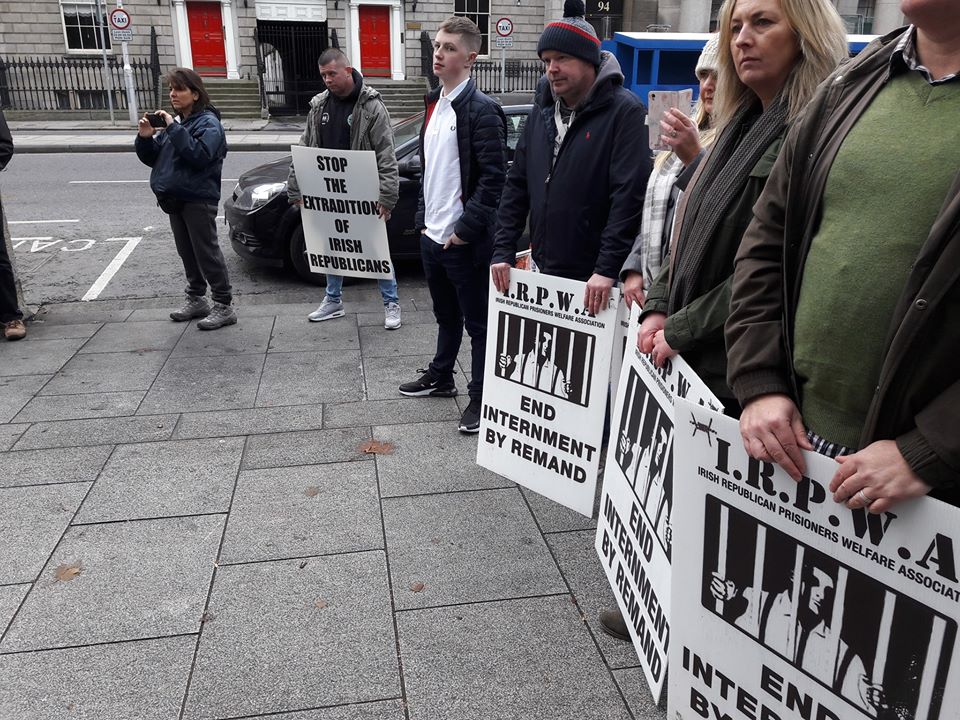
One of the placards held by protesters across the road from the Department of Justice. (Source image: Abolish the Special Courts campaign FB page)

The event, jointly organised by two fairly recent organisations on the Irish Republican scene, the Abolish the Special Courts campaign and the Irish Socialist Republicans organisation, was supported mostly by Irish Republicans, some independents and some belonging to a number of Irish Republican organisations other than the organisers: activists from the Irish Republican Prisoner and Welfare Association, Saoradh and the Dublin Anti-Internment Committee were also in attendance.

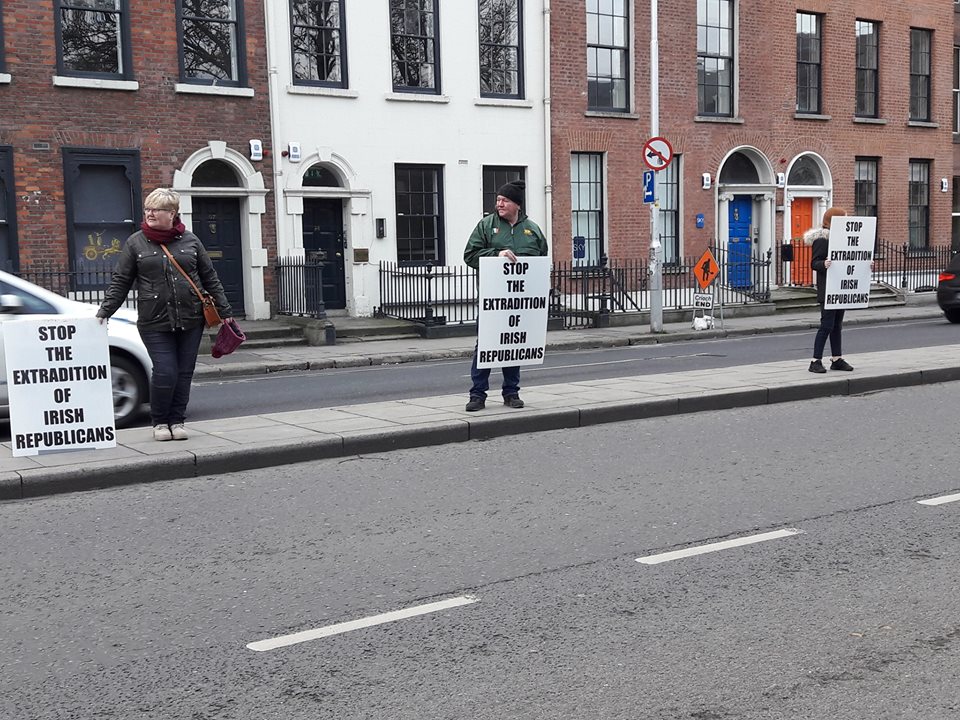
View of a section of the protesters in front of the Department of Justice with Stephen’s Green in the background (Source image: Abolish the Special Courts campaign FB page)

With their banners and placards the protesters stood on the median strip in the road opposite the Department of Justice, passing pedestrians and drivers slowing down to read the texts displayed, some drivers tooting their horns in support. Some, apparently visitors, took photos or video footage.

Later, supporters of the protest crossed the road to the pavement outside the Green to hear speakers. Ger Devereux of the Abolish the Special Courts thanked people for attending and introduced Brian Kenna from Saoradh to speak.


“NOT CONVICTED FOR ANY CRIME BUT FOR BEING …. IRISH REPUBLICANS”

Kenna gave a detailed and comprehensive account of how the Offences Against the State Act has facilitated the imprisoning of Irish Republicans not for any crime they have committed but for being just who they are – Irish Republicans. Observing that half those Republicans in jail in the Irish state are serving time on conviction of allegedly “being a member of an illegal organisation”, the speaker emphasised that the only ‘evidence’ necessary for the Department of Public Prosecutions to secure such a conviction under the Offences Against the State Act is the word of a Garda at the rank of Superintendent or above, along with some vague additional ‘evidence’ that could mean lots of different things.

Brian Kenna speaking to protesters on behalf of Saoradh organisation, across the road from the Department of Justice. (Source image: Abolish the Special Courts campaign FB page)

Brian Kenna warned that not only scheduled offences1 can be tried in the Special Criminal Courts as of now but should the DPP wish it, also other minor offences such as allegedly criminal damage or against public order and he believed that except for the existence of a few factors, including the presence of an MP among the accused, the Jobstown water-protesters would have been tried in the Special Courts, where convictions are the almost automatic result. Kenna called on all people to stand up against these undemocratic laws.

Devereaux then introduced Mandy Duffy, national Chairperson of the Irish Republican Prisoners Welfare Association.

One section of the protesters listening to speakers, Mandy Duffy, Chairperson of the IRPWA in the foreground. (Source image: Abolish the Special Courts campaign FB page)

“HUMILIATION, VIOLENCE AND ISOLATION”

Mandy Duffy spoke about the conditions under which Irish Republicans are being held in a number of prisons in Ireland on both sides of the Border. In Maghaberry in particular, which Duffy said was much more modern than Portlaoise (in the Irish state), Republican prisoners are guarded by a prison staff recruited from among Loyalists2, who hate Irish Republicans and are determined not only to keep them in jail but to make them suffer while they are there.

Duffy focused on the practice of continually strip-searching prisoners every time they are taken from the prison or returned as one of humiliation and of violence when the prisoner is non-compliant.3 The speaker also referred to unreasonable and additional punishments such as keeping prisoners in isolation.

A banner and two placards in front of the Department of Justice. (Source image: Abolish the Special Courts campaign FB page)

Mandy Duffy concluded by calling for solidarity with Irish Republican prisoners and in thanking those present for giving her their attention.

Devereux then called on Diarmuid Breatnach to speak on behalf of the Dublin Anti-Internment Committee.


“WE STAND TOGETHER OR WE GO TO JAIL SEPARATELY”

Diarmuid Breatnach addressing the protesters across from the Department of Justice, on behalf of the Dublin Anti-Internment Committee. (Image source: Abolish the Special Courts campaign FB page)

Diarmuid Breatnach began in Irish by thanking the organisers for the invitation to speak which he then repeated in English. Breatnach said that their Committee held pickets around Dublin mostly on a monthly basis and did so in order to raise awareness on the ground, among the public, that internment without trial continues in Ireland long after it was allegedly terminated by the British in the mid-1970s. He also reminded the protesters that people had resisted internment and protested it in Ireland and in many places around the world, including in Britain. In the Six Counties the Ballymurphy Massacre had been inflicted on people protesting internment in 1971 and again in 1972, the Bloody Sunday Massacre in Derry.

Stating that internment is essentially jailing people without a trial, Diarmuid Breatnach stated that returning a former Republican prisoner who is at liberty under licence to jail without any trial, as has happened for example to Tony Taylor, is effectively internment, albeit of a different kind. Refusing a Republican bail for no good reason when on a charge awaiting trial, which might take up to two years, is also internment of a different kind, the speaker said, stating that the only justifiable reasons for opposing bail are supposed to be a likelihood of the offence being repeated or the charged person absconding, for both of which credible evidence should be produced. Breatnach also drew attention to the recent decision of the European Court of Human Rights which castigated Turkey for their two years of preventive detention (or refusal of bail) of a Kurdish Member of the Turkish Parliament while awaiting trial, on the principle that the period of detention was unreasonably long and was being done deliberately for political reasons.

A small section of protesters across the road from the Department of Justice. (Source image: Abolish the Special Courts campaign FB page)

The speaker also referred to the unreasonable bail conditions when bail was granted, which included non-attendance at political demonstrations, pickets and meetings which, he said, made it clear what the whole intention of the repression was about.

Breatnach reiterated what an earlier speaker had said about the potential of these forms of repression being used against a wider section of opposition to the State and referred to recent arrests of Republicans who had allegedly mobilised against the launch of the fascist group Pegida in 2012. The speaker urged unity across the board against State repression because they either stood together now or later would “go to jail separately”.

Devereaux thanked the participants and encouraged them to keep in touch with the Abolish the Special Courts campaign and the street meeting broke up into informal groups as people began to collect placards, banners, etc getting ready to disperse.

End.

Another small section of the protesters with the Department of Justice in the background. (Source image: Abolish the Special Courts campaign FB page)


LINKS:

Dublin Anti-Internment Committee: https://www.facebook.com/End-Internment-581232915354743/

Abolish the Special Courts campaign: https://www.facebook.com/Abolish-The-Special-Courts-208341809705138/?

Socialist Republicans are a part of Anti-Imperialist Action Ireland:  https://www.facebook.com/AIAIreland2/

FOOTNOTES

1In Ireland this normally means ‘crimes’ which are associated by the State with subversive intent (source: http://www.citizensinformation.ie/en/justice/courts_system/special_criminal_court.html)

2The term “Loyalist” in an Irish context and especially in the occupied Six Counties means “British Loyalists” usually understood not only as those who support the Union with England but as those who do militantly and with bigoted hatred of Catholics (in particular Irish Catholics or people from that community who might well be atheists).

3There is a graphic and accurate depiction of this practice employed on non-compliant Irish Republicans on the “Dirty Protest” in the Steve McQueen film “Hunger” (2008). In the film, the prisoners were nearly naked already but in more ‘normal’ prison conditions, the practice also involved removing the prisoner’s clothes – by force if he or she is non-compliant.

STRASBOURG COURT JUDGEMENT AGAINST TURKISH STATE RAISES HOPES FOR POLITICAL PRISONERS ELSEWHERE IN EUROPE

Catalan press story translated and comment by Diarmuid Breatnach

The European Court of Human Rights (ECHR) condemned Turkey for keeping a Kurdish elected Deputy in preventive detention (i.e custody without bail — Translator) without “sufficient” reasons. The seven magistrates of Strasbourg who signed the judgment made public on Tuesday urged the Turkish state to release Selahattin Demirtas, who when he was arrested was co-president of the People’s Democratic Party (HDP).

http://m.xcatalunya.cat/noticies/detail.php?id=43441&fbclid=IwAR38KE6XQZ5Q0yF6Z45_paL9FaagxvUVKxDwac8nvTQNVInrQfb6Ga9t3O0

The court also considers that the inability of the former leader to participate in parliamentary activity despite being an elected Deputy constituted an “unjustified” interference with freedom of expression and the right to be elected and occupy a seat in Parliament. The left party HDP reacted by calling on the local courts of the country to implement the decision “immediately” and not only get Demirtas out of prison but also the rest of the Deputies in jail.

In a statement, the HDP recalls that Demirtas has been a “hostage” for two years and demands that he be released “without delay.” The party sees the decision as a “precedent” for all those elected and highlights the “determination” of those who “do not abandon the struggle for democracy and peace” in their country.

VIOLATION OF THE EUROPEAN CONVENTION ON HUMAN RIGHTS

The ECHR claims that several articles of the European Convention on Human Rights were violated, such as the right of all detainees to be taken “without delay” before a judge and to be judged within a “reasonable” period or be released during the proceedings (article 5.3) and the right to free elections (Additional Protocol, article 3).

“The Court concludes that the extension of the period of pretrial detention has been established beyond a reasonable doubt, especially during two crucial campaigns, the referendum and the presidential elections, with the ulterior purpose of stifling pluralism and limiting the freedom of a political debate”, the text sets out.

Overall, Strasbourg not only directs the Turkish state to release him but also to compensate Demirtas with 10,000 euros for non-financial damages, in addition to the 250,000 requested by the politician. “The court notes that the violation of the agreement has unquestionably caused substantial damage to the plaintiff,” said the ruling. In addition, it ordered the Turkish State to pay 15,000 euro in legal expenses.

REACTIONS TO THE JUDGEMENT

Amnesty International, an NGO for human rights where Demirtas, who is a lawyer, also collaborated, has released a communiqué in which he recalls that Turkey is one of the 49 member states of the Council of Europe and that, therefore, the decision of the ECHR It is “binding”.

The Director of Research and Strategy of AI forTurkey, Andrew Gardner, assures that the judgement with regard to the opposition leader “exposes” the Turkish judicial system and points out that “it should have great implications” in the country presided over by Recep Tayyip Erdoğan. “Civil society activists remain on a regular basis for long periods in pretrial detention under fabricated accusations,” he laments, highlighting the “influence” of the policy in Turkish courts. According to Gardner, in Ankara “peaceful” expressions of political dissidents are “punished” through the courts.

For his part, the ERC MEP Jordi Solé sees in the ruling a “precedent” for states that “abuse” preventive detention and “violate” political rights. In this regard, the parliamentarian believes that “it will have to be taken into account in the case of the Catalan independence leaders.”

“European justice does not allow prison to be abused as an instrument to restrict freedom and political pluralism or to violate the procedural, civil and political rights of citizens, and the Spanish state should take note,” he said in a statement.

COMMENT:

Though certainly the judgement is to be welcomed by all supporters of human and civil rights, observers and commentators would do well to exercise more caution with regard to the impact of this judgement. Certainly other political parties can quote it with regard to elected deputies detained while awaiting trial and may indeed succeed in their endeavour. But the judgement specifically mentioned an elected Deputy and electoral campaigns. Therefore there are a great number of political prisoners to whom this judgement does not necessarily apply and, in the Catalan case, one would be concerned for example about the cases of the jailed leaders of the grass-roots organisations Jordi Sanchez and Jordi Cuixart.

In addition, the judgement did not say how long would be a “justified” period to keep a prisoner in jail before bringing him to trial. This prisoner, according to his party the HDP, was kept in prison for two years but it does not automatically follow that a period of that length will always be considered “unreasonable”. Should it be so there are a great many prisoners who have waited that long for a sentence while in custody in Europe, including in Ireland and the Basque Country.

It is of course a welcome precedent of a kind, as the Catalan MEP said but whether it will have the effect he believes is something else.

What is particularly interesting in this case is the speed (for the ECHR) with which the case reached the Strasbourg Court for judgement and in which judgement was given, if indeed it all took place within a period of two years, since many cases have taken much longer. For example, Martxelo Otxamendi, Director of the Basque-language newspaper Egunkaria wrongfully banned by the Spanish State, who was tortured in 2003 during the five-day incomunicado period routinely applied to those accused of anything to do with “terrorism” (sic), took five years to exhaust his options in the courts of the Spanish State (usually a requirement before presenting the case in Strasbourg) but it took another four years before judgement was finally delivered by the ECHR in 2012 (and even then the Spanish State was only penalised for failure to investigate the allegation of torture, since the ECHR judged that the torture itself could not be proven).

End.

http://m.xcatalunya.cat/noticies/detail.php?id=43441&fbclid=IwAR38KE6XQZ5Q0yF6Z45_paL9FaagxvUVKxDwac8nvTQNVInrQfb6Ga9t3O0

SPANISH FASCISM EXTENDS ITS CLAWS

Diarmuid Breatnach

This weekend fascist activities took place across the Spanish state with some more to follow next week. In Madrid fascists demonstrated on two different occasions, i.e to commemorate the dictator Franco and the founder of the fascist Falange, Primo Rivera. They also demonstrated for the unity of the current Spanish state territory and against any interference in General Franco’s shrine. These demonstrators flew Spanish fascist flags, gave fascist salutes and shouted fascist slogans – all illegal under Spanish law — but the Spanish police stood quietly by. Wait! They did intervene — to remove antifascist Femen demonstrators (see El Nacional photo and NBC video link)!

          The weekend included anti-fascist events also. On Saturday afternoon there was a march organised by Dignidad Antifascista (‘Antifascist Dignity’), with a rally on Sunday at the entrance to the fascist shrine, the Valley of the Fallen, called by the campaign #NiValleNiAlmudena (‘Neither Valley nor Almudena’, i.e that Franco be buried neither in the Valley nor in the Almudena, the largest cemetery in Madrid).

Fascist Spanish-nationalist regalia and fascist salutes during the Primo Rivera homage on Friday evening in Madrid. Much of this is illegal according to Spanish law but, as usual, the police take no action. (Photo source: Internet)

The specific occasion for the fascist (and hence, the anti-fascist) events are the anniversaries of the deaths on 20th November of the dictator Franco (1975) and of Primo Rivera (1936), the founder of the Spanish fascist organisation, the Falange.

The Falange began with their traditional march of homage to Rivera (yes, the fascist Falange have “traditional” public events in the Spanish state), leaving Madrid around 9pm on Friday night to arrive at the Valley on Saturday morning.

Fascist women in the uniform of the Falange during the Primo Rivera homage on Friday evening in Madrid.
(Photo source: Internet)

“The Falange returns to the streets to show that the flag of the Homeland and Social Justice is upheld and is more necessary than ever,” they declared in a statement.

On Saturday, the Madrid Antifascist Coordination held its own anti-fascist traditional march under the slogan of Dignidad Antifascista, changing their route to start from Plaza del Sol to arrive at Plaza de España, apparently because of the location of the neo-Nazi group Hogar Social Madrid (Social Home Madrid) in the former HQ of the Comisiones Obreras trade union (see History of the Spanish State Appendix), Plaza de España (see video in media link).

Illegal fascist salutes but as usual no action from Spanish police on Friday evening in Madrid.
(Photo source: Internet)

On Sunday a number of groups gathered at the entrance to the Valley of the Fallen to call for “the removal of the tombs of Francisco Franco and José Antonio Primo de Rivera, the withdrawal of fascist symbols from the Sierra de Madrid, the converting of the site into an anti-fascist memorial and the dismantling of the Cross of the Valley,” according to a statement by the Forum for the Memory (historical) of the Madrid Region in a statement. This action is part of the campaign #NiValleNiAlmudena and it was the thirteenth time that the Forum for (historical) Memory and the Social Forum of the Sierra have demonstrated against the graves of Franco and Primo de Rivera in the Valley of the Fallen.

On the other hand, the Abbey of the Valley of the Fallen organised a praying of the holy rosary also on Sunday, at 10.30a.m in the basilica, “for the hope of youth and family in Spain,” as they do every Sunday (this might seem harmless but these are specifically traditional concerns of fascists, the traditional patriarchal family and a fascist youth movement). Also, the (fascist) Association for the Repeal of the Historical Memory (Law) convened a demonstration at 11.30a.m on Sunday to take place between Callao and the Plaza de Oriente, to hold their traditional act of Franco homage. A Femen group who tried to disrupt this demonstration, stripped to the waist and with anti-fascist statements painted on their upper bodies were violently thrown to the ground by fascists in the crowd and repeatedly kicked and punched while the women shouted defiance. Spanish police removed the anti-fascist Femen demonstrators and took no action against the fascists.

Masses will be celebrated throughout Spain for the soul of the dictator and, in Madrid, a “Legionary Mass” (i.e for a fascist organisation descended from the Spanish Foreign Legion) is scheduled to take place in the church of Santiago on Tuesday the 20th and the same day at 8:00 pm in the parish of San Francisco de Borja on Serrano Street, as reported by the Francisco Franco Foundation on its website, in which they also announced an annual dinner on November 30th somewhere in El Pardo.

WHAT DOES IT ALL MEAN?

          Is all this just the strutting of some crackpots we don’t need to worry about, as some liberals and social-democrats think? Or the last gasps of a dying creed as some others believe?

Some of the participants may be crackpots and the creed may be expiring but that does not make it less dangerous – the lashings of a dying monster’s tail are capable of killing and maiming many people. And it may not be dying.

Fascism has been part of the Spanish State since the 1930s (see following section) and only underwent an essentially cosmetic transformation (or “Transition”) in the 1970s but now it feels itself threatened by important counter-trends within the state. Chief among these in practical content is undoubtedly the strong grassroots Catalan independentist movement but in symbolic content, the democratic demand that Franco’s tomb be removed and his current resting place ended as a rallying shrine for Spanish fascists (hence the events that took place around it this weekend) is huge.

Symbols are important for all peoples and movements and Franco’s mausoleum at the Valle de Los Caidos is one very important for Spanish fascists. For anti-fascists, it is an abomination, built through the sweat of half-starved and abused political prisoners to the glory of their oppressor, an unknown number of which died doing so.

The bunch of arrows and that double-headed eagle on their version of the Spanish flag are also symbols of Spanish fascism, as is the straight-arm salute. Accordingly, these were made illegal in the Spanish state, not without some resistance but everyone knowing that no action was going to be taken against the actual fascists. And so it has proven. The Spanish fascists march, display their fascists symbols, give their fascist salutes, shout fascist slogans and they are never arrested for doing so.

On the other hand anti-fascists, revolutionaries, independentists are constantly under surveillance, often detained and tortured and from time to time jailed for long sentences, often for comparatively minor offences or actions or words that would not be classed as a criminal act anywhere else in Europe.

But of course, Europe is growing more fascist too, in governments in the East and in the rise of fascist movements across most of Europe. And Spanish fascism will inevitably give encouragement to those movements as well as drawing encouragement from them.

Across the Spanish state there are streets named after fascists and monuments to them and some of the regular events glorifying fascism there were listed earlier. Add to that a section of the national media that is very right-wing and legal organisations that are fascist in all but name and most of the support structures for a fascist state are in place. All, if one adds the military and police.

The main Spanish police forces, the Guardia Civil and the Policía Nacional, have a history of brutality on the street and torture in their police stations. The GC is actually a militarised police force. The military itself has a history of violent suppression of colonial resistance and, according to the Constitution, is the guarantor of the territorial integrity of the State. And that integrity is threatened by the pro-independence movements of Catalonia and of the southern Basque Country.

“Long live the Unity of Spain” slogan on Spanish flag colours at the Primo Rivera homage on Friday evening in Madrid. The Spanish Right and much of the Left share this objective which is opposed by some of the Left and the Catalan and Basque independence movements.
(Photo source: Internet)

The Spanish fascists are not just defending their symbols and history but also the integrity of the State of the whole Spanish ruling class. And fear, dislike or even hate the fascists as they may, many on the Spanish Left find themselves here on the same side as the fascists. Neither the PSOE, nor Podemos, nor the CPE, nor many sections of Izquierda Unida (the misnamed “United Left”) support the independentist movements, whether from “the good of the economy” or from the credo of “the unity of the working class”. And many of them go further, accusing the independentists of being “nazis”, an accusation which is also thrown, hilariously, by the Spanish Right.

This of course makes any genuine resistance to the fascist movement very complicated for large sections of the Spanish Left, i.e those that actually agree with them on one central plank of Spanish fascism – the territorial unity of the Spanish state.

End.

APPENDIX: SHORT HISTORY OF THE MODERN SPANISH STATE

          Like within a number of European states, fascism was the chosen way to go of the majority of the Spanish bourgeoisie, the ruling class, in the 1920s and 1930s. At first this involved military coups and dictatorships but in 1936, a full-blown military-fascist uprising against the elected Government of the state took place, with sections of the Basque and Catalan middle and ruling classes in support. Other sections of Catalan and southern Basque Country society stood by the Republican elected government and fought hard against the military-fascist coup. And the anti-fascists would have won but for the assistance of transport, bombers, weapons and men from Nazi Germany and Fascist Italy, while the other European states (apart from the USSR) enforced a “non-interventionist” blockade of the fighting Republic.

The Republic overthrown, there followed a period of intense repression of any form of leftist or democratic ideology as well as of the Basque and Catalan languages and national aspirations and, though the intensity faded in time, the repression was always very much there during the 40 years of the Franco dictatorship (and increased in the Basque Country).

The Franco-fascist repression was not only physical, with imprisonment, torture and executions; was not only against national cultures but also moral and political, intensely patriarchal and pro-fascist and with the very enthusiastic support and at times leadership of the Spanish Catholic Church hierarchy and most of its clergy, monks and nuns, imposed through school and church. And of course the judicial and legal system.

As Franco’s life-term was clearly drawing towards its end, concern began to be raised about his successor and how Spain would be ruled afterwards. These concerns were expressed not only internally but also from abroad, especially by the USA which was building military bases across the state and by the EU, which was concerned to have an ultimately unstable state on its southern flank. Franco had designated Admiral Carrero Blanco as his successor and Juan Carlos, of the Bourbon royal dynasty, to be King. In 1973 ETA, the Basque armed leftist national liberation organisation, assassinated Carrero Blanco in Madrid and a few years later, in 1975, Franco died.

The rush was on now by modernist elements of the Spanish ruling class, in particular advised internally by Opus Dei, to carry the State through this crisis. This was achieved by the legalisation of the banned political parties, the social-democratic PSOE and the Communist Party, which was absolutely necessary for the project since they controlled the two biggest trade unions, the Unión General de Trabajadores and the Comisiones Obreras (these were being legalised too). And Juan Carlos was made king of a country that had been without one for over four decades with the agreement of both those formerly republican parties.

The Basque and Catalan nationalist parties were also legalised but, although the new Constitution being pressed on the people was accepted overall, it was rejected by majority in the Basque Country. The Constitution made secession illegal without a majority in the Spanish Parliament in favour.

And this “Transition” was also accompanied by repression, including even the murder of its union lawyers which the CPE tolerated.

Subsequently the PSOE got elected into Government, replacing the Francoist party but showed itself fit to govern an essentially unreconstructed fascist state by running assassinations squads (“GAL, BVE”) against the Basque independence movement. And of course implementing whatever economic measures required by the Spanish ruling class.

The UGT and Comisiones Obreras are the main trade unions in the Spanish State, the largest in membership everywhere but in Galicia and the Basque Country, with their leaderships generally following the social-democratic lead, colluding with the ruling class, mounting mostly show strikes from time to time but no real resistance. One can expect somewhat more resistance from them when the other main political party, the formerly Francoist Partido Popular, is in government, but as soon as the PSOE is back in, even that dies down.

SOURCES AND REFERENCES

https://www.infolibre.es/noticias/politica/2018/11/16/manifestaciones_muy_distinto_signo_discurriran_por_madrid_este_fin_semana_por_20n_88913_1012.html

https://www.elnacional.cat/es/politica/incidentes-manifestacion-fascista-madrid_325803_102.html

Video of fascist demonstration and disruption by anti-fascists (including violence towards them by fascists and no police action against them): https://www.facebook.com/NBCNews/videos/517780425363019/

Short media report which includes video of anti-fascist demonstration on Saturday in downtown Madrid: https://www.presstv.com/Detail/2018/11/18/580334/Spain-Antifa-march-on-Madrid-ahead-of-anniversary-of-Francos-death

UNION SPOKESPERSON ARRESTED FOR INSULTING THE MONARCH

Diarmuid Breatnach

According to his trade union and other sources, Oscar Reina, spokesperson for SAT (Sindicato Andaluz de la Tierra — Andalucian Workers’ Union) was arrested at midday in Granada today while lunching with some of his colleagues, taking a break from preparations for the big demonstration on December 4th, the National Day of Andalucía as well as postering for a festival against repression planned for December 8th in Marinaleda, at which the band Ska-P will launch their most recent CD.

Oscar Reina, spokesperson for SAT, who was arrested today on a charge of “disrespect for the Monarchy” (the union flag seen nearby bears the traditional colours of Andalucia).
(Image sourced: Internet)

Reina has been required to attend court since being ordered to do so to answer charges of sending a “disrespectful to the Monarchy” tweet in 2016. H

According to trade union colleague José Caballero, communicated to the newspaper El Salto, he had not presented himself voluntarily to answer the charges in line with his union’s policy of disobedience for the leadership, adopted unanimously some years ago against the rising repression suffered by SAT, with a million in government fines and demands for imprisonment of more than 300 years with nearly 500 trade unionists charged.

The tweet for which the trade union leader is to be tried: “You must feel little shame Felipe de Borbón; you are a disgrace. Your position which nobody has voted for is inherited from an institution that was maintained as a result of a Francoist and terrorist coup.

I would award you the Prize for Lack of Decency and Hypocrisy, with a trip into exile.”

The SAT (Andalusian Worker’s Union) is a trade union operating within the Andalusian autonomous region within the Spanish state and claims a membership of 20,000. It was founded in 2007 and describes itself as: a trade union of class, alternative, anti-capitalist, assemblyist, of solidarity, internationalist, pluralist, anti-patriarchal, confederal, republican, Andalusian nationalist, of the Left and communist. Its General Secretary is Diego Canamero. The union is known for actions such as occupations of unused land and a 2013 raid on a supermarket to distribute school materials on families in need.

A recent protest of the union has been against the proposed Lands Law which they say will “sink forever the dream of our Andalusian working population for Agrarian Reform. One cannot understand Andalusia with the struggle for the land and that is more recent than might appear ….”

Andalusia has an unemployment rate of 24.4% (2017 official figures), with male unemployment at 21.6% and female unemployment reaching 27.9%. According to SAT’s figures, 50% of the land is in the hands of 2% of the population and that concentration is increasing. That is an average and in some areas the situation is much worse. One worker a day dies on the land, according to the union and 60% of Andalusians earn less than 1,000 euro a month. Around 40% are so poor they cannot afford educational materials.

The union spokesperson denounced the PSOE (which has the majority in the autonomous government) and put forward a six-point program of reforms demanded by the union which they say will address all these issues.

Reina ended the communiqué by calling on the working population of Andalusia to mobilise militantly and to demand “Tierra y Libertad!” (Land and Liberty).

LINKS:

News story: https://www.elsaltodiario.com/injurias-a-la-corona/detienen-granada-oscar-reina-miserable-a-felipe-vi?fbclid=IwAR1J9olUJkF1X9SLVGDBVTO6iTuzyqMlH7M1uh_harxL9zmHb433_DYDKHw#

S.A.T. Site: http://sindicatoandaluz.info/

S.A.T Sevilla (lots of union struggles, marches): https://www.satsevilla.org/

Video discussing unused land occupation in Andalusia and collaboration with the Red de Semillas (Seed Network), promoting older seed types more in keeping with the local environment, not relying on chemicals, etc: http://sindicatoandaluz.info/2016/12/19/somonte-vs-monsanto-semillas-de-dignidad-por-la-soberania-alimentaria/


RECENT HISTORY: DEEP SOUTH & DEEP NORTH

Report by Diarmuid Breatnach

Two very interesting talks were given last night as part of a series of history talks at the Sean O’Casey Community Centre in East Wall, Dublin. The theme was black civil rights in the USA and Catholic civil rights in the Six Counties of Ireland (‘Northern Ireland’ according to some).

Joe Mooney of the East Wall History Society introduced the speakers and chaired the question-and-answer session afterwards.

The session opened at 8pm and Cecilia Hartsell had a lot of ground to cover. She spoke on the history of the Civil Rights movement of blacks in the USA, going through the history of seminal events, illustrated with Powerpoint slides and recordings of two White House phone calls between President JF Kennedy and Ross Barnett, Governor of Mississippi and key figure trying to prevent the historic enrollment of James Meredith, a black man, into the University of Mississippi.

Cecilia Hartsell delivering her talk on the black civil rights movement in the USA

Recalling that in the first two years of his term, JF Kennedy had little to say about black civil rights but was focusing on other issues,Cecilia Hartsell somewhat undermined the (incorrect) image we tend to have in Ireland of Kennedy as an ardent civil rights fighter. In fact he was enforcing Federal legislation on equality and trying to go slowly, while the black campaigners were pushing the agenda along and white racist reaction was holding the USA up to international ridicule and opprobrium during the Cold War with the Soviet Union.

When Brian Hanley took the floor for his talk he fairly zipped along, which he does very well. Hanley undermined some myths or wrong impressions too. Early organisers of the civil rights marches and other events such as the Dungannon house occupation were Irish Republicans; Loyalists had killed four people before the first Civil Rights march. The rhetoric of SDLP and Labour Party notables was much more militant in the early years and Fine Gael was agitating more about issues of discrimination in the Six Counties than was Fianna Fáil, the party in government. And FF had been pushing a referendum to do away with the proportional representation electoral system at the same time that the PR system was among the demands of civil rights campaigners in the Six Counties.

Brian Hanley delivering his talk on the civil rights movement in the Six Counties.

In the session for questions, answers and contributions later, Hanley pointed out that the Southern Democratic Party was the pro-slavery party historically and, after the Civil War, anti-integration and civil rights, whereas the Republican Party was anti-slavery (debunking another false image we tend to have in Ireland).

Both historians made the point that a hundred years is not as long as some might think (this is especially true in ‘historical memory’).  The 1940s, when some historians would say, as Hartsell told us, is the date from which to date the renewed fight for black equality in the USA, as surviving black soldiers returned from WWII, was only 80 years from when Federal troops were withdrawn from the former Confederate states.  The partitioning of Ireland had been carried out less than 50 years before the Civil Rights protests broke out in the Six Counties, Hanley reminded his audience and many Catholics still lived who remembered vividly the fierce repression that had accompanied it.

It also emerged that albeit there were many similarities, there were also profound differences between the two movements. The black campaigners in the USA were saying that they were citizens of the USA State and demanding the same rights as other citizens, they often marched with the Stars and Stripes flag and even called for the intervention of US troops to defend their rights. The Catholics marching for civil rights in the Six Counties mostly saw themselves as Irish citizens and would never march with the Union Jack. Some did call for the intervention of British troops but many did not; it was mostly Irish troops they hoped would intervene.

The importance of the presence of news photographers at events and their covering in newspaper reports and on television broadcasts was an important factor in both struggles.

USA soldiers facing unarmed marchers for black civil rights.  (Source: Internet).

Cecilia Hartsell did not feel that the Black Power movement could have survived Southern racist repression in the 1940s, ’50s and early ’60s and most of the big gains on desegregation of education, public transport, eateries and voter registration and effective right to vote in the Southern States were won during those years with peaceful marches and pickets and legislation (which however were met by much racist violence, including a number of murders). By the time the Black Power movement was coming on to the political stage, so was the Vietnam War and huge changes were taking place in the US, including many mass violent struggles on race and other issues.

Section of march for civil rights in the Six Counties (Source: Internet).

TERMINOLOGY AND DEEPER MEANING

Wikipedia: “Though often used in history books to refer to the seven states that originally formed the Confederacy, the term “Deep South” did not come into general usage until long after the Civil War ended. Up until that time, “Lower South” was the primary designation for those states. When “Deep South” first began to gain mainstream currency in print in the middle of the 20th century, it applied to the states and areas of Georgia, southern Alabama, Florida, Mississippi, north Louisiana, and East Texas, all historic areas of cotton plantations and slavery. This was the part of the South many considered the “most Southern”.”

Later, the general definition expanded to include all of South Carolina, Georgia, Alabama, Mississippi, and Louisiana, and often taking in bordering areas of East Texas and North Florida. In its broadest application today, the Deep South is considered to be “an area roughly coextensive with the old cotton belt from eastern North Carolina through South Carolina west into East Texas, with extensions north and south along the Mississippi”.

Lower South” probably originally referred to its location on the typical north-orientated map of the USA. But I speculate that “Deep” has another meaning – a deeper psychological one, in fact. It suggests that this is a place difficult to understand for people not from there, which means most people. Different rules apply there, we might believe.

I speculate further that after the initial first years of the Civil Rights movement in the Six Counties, that area and the people living in it came to be seen as “different” too. Of course, it was different in that it was a colony (as had the whole country been only 50 years earlier) and that it was run along blatantly sectarian lines, the Catholics a minority there, unlike in the rest of Ireland. And of course, people in a different environment respond differently. But they were still people and the substantial Catholic minority were so clearly oppressed in a statelet into which the Irish ruling class had delivered them. For many people in the 26 Counties it became easier to think of them as somehow foreign in a foreign kind of land, hence my description as “Deep North”.

Cecilia Hartsell and Brian Hanley during the question-and-answer session.

THE SPEAKERS (as posted by EWHG)

Cecelia Hartsell is a researcher of American history. She has been a contributor to the RTE History Show and Radio Kerry on topics in U.S. history and frequently gives U.S. history talks for the Dublin Festival of History and in the Dublin Public Libraries. Cecelia has a Masters degree in U.S. history from Fordham University and a Masters degree in History from UCD.

Brian Hanley is an historian and author. He is currently a Research Fellow at the School of Classics, History and Archaeology, University of Edinburgh . He has lectured at a number of major Irish universities and was Historian in Residence at Dublin City Library and Archives . His books include “A Documentary History of the IRA, 1916-2005” (Dublin, Gill and MacMillan, 2010) with his most recent being “The impact of the Troubles on the Republic of Ireland, 1968-79: boiling volcano?” (Manchester University Press, 2018).

NEXT HISTORY TALK

There will be another talk in the series next week when Dr. Mary Muldowney will present a talk on “The 1918 Election – the Woman Who Stood for a Worker’s Republic.”