An Irish punk rock band, Mongolian throat-singers, a poet and Irish folk singers all performed at Solidarity Sessions No.2 to a good crowd in the International Bar, in in Dublin City centre Wicklow Street on Wednesday 17th..
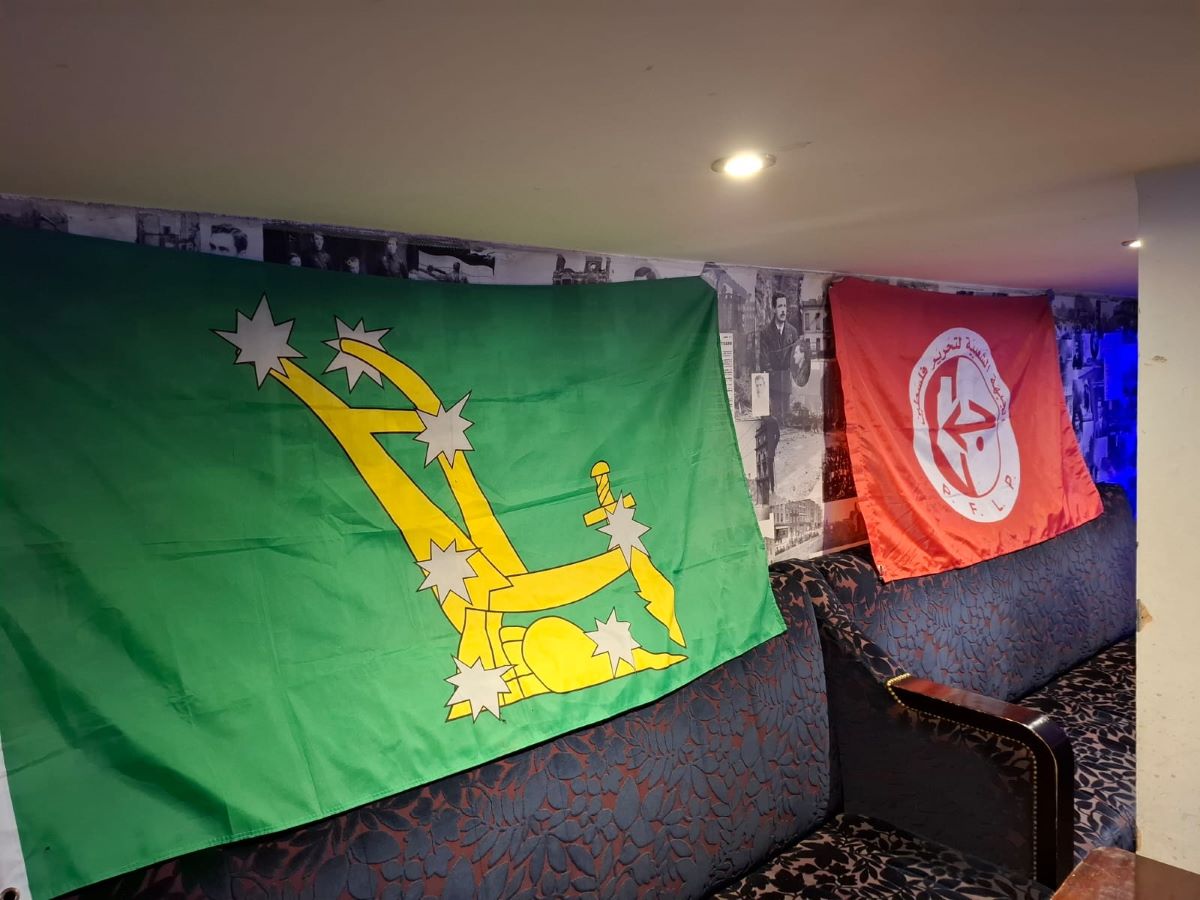
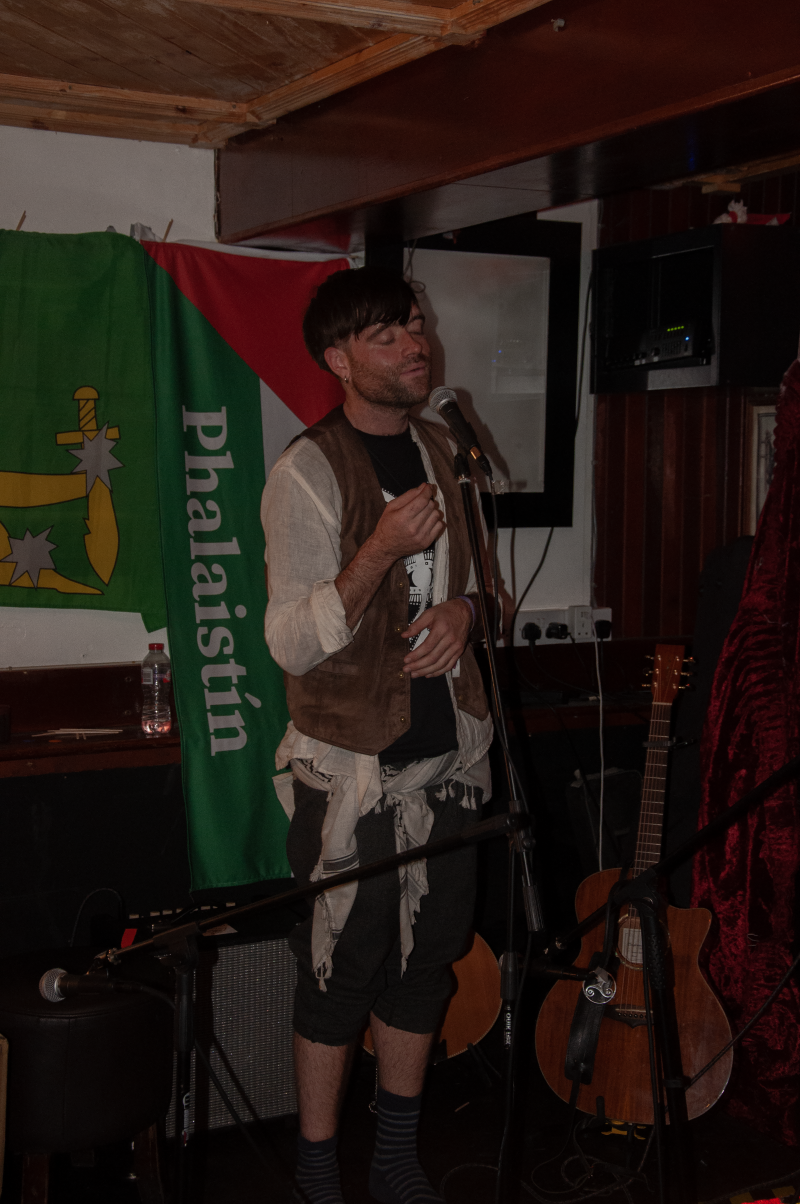
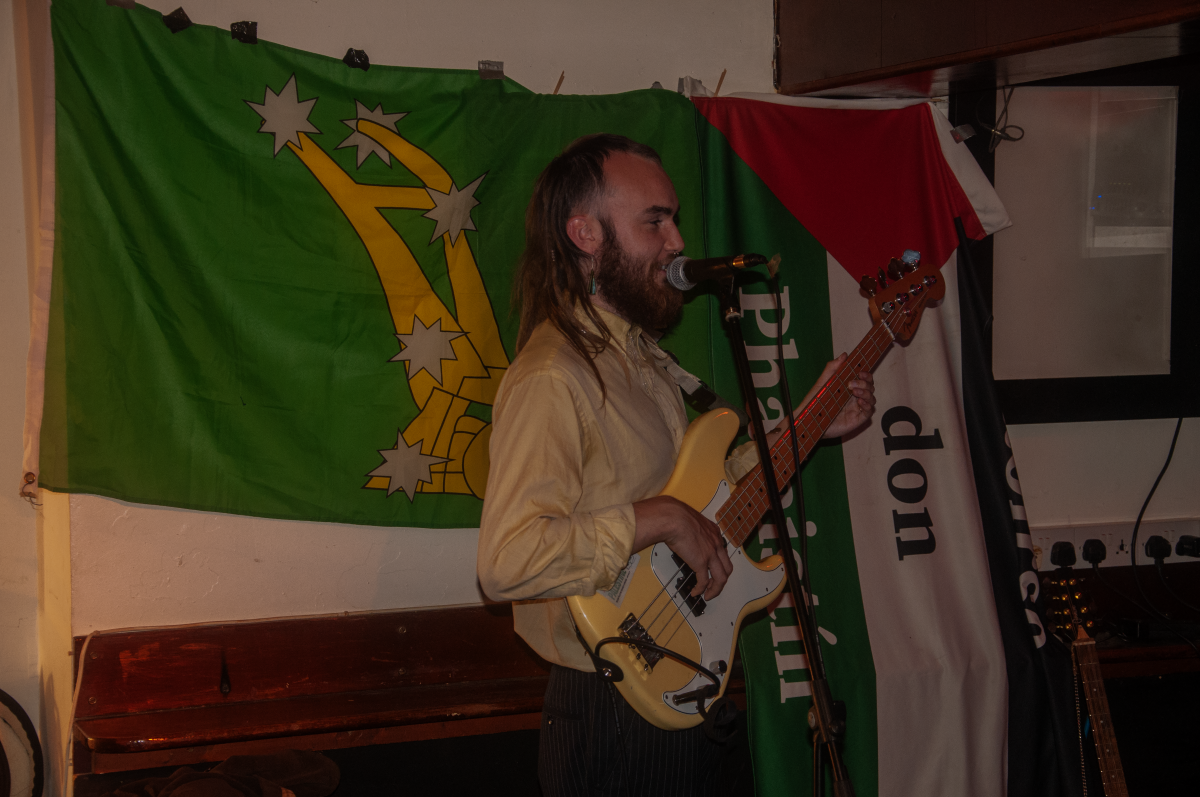
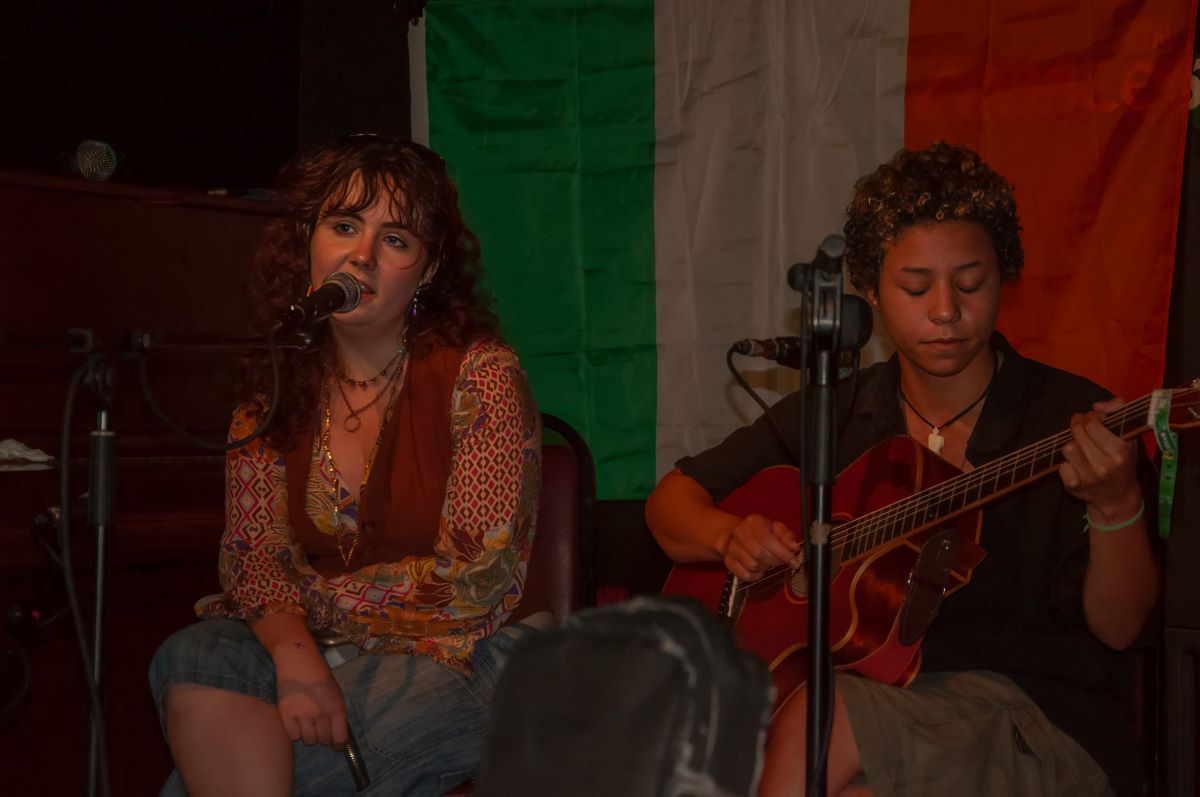
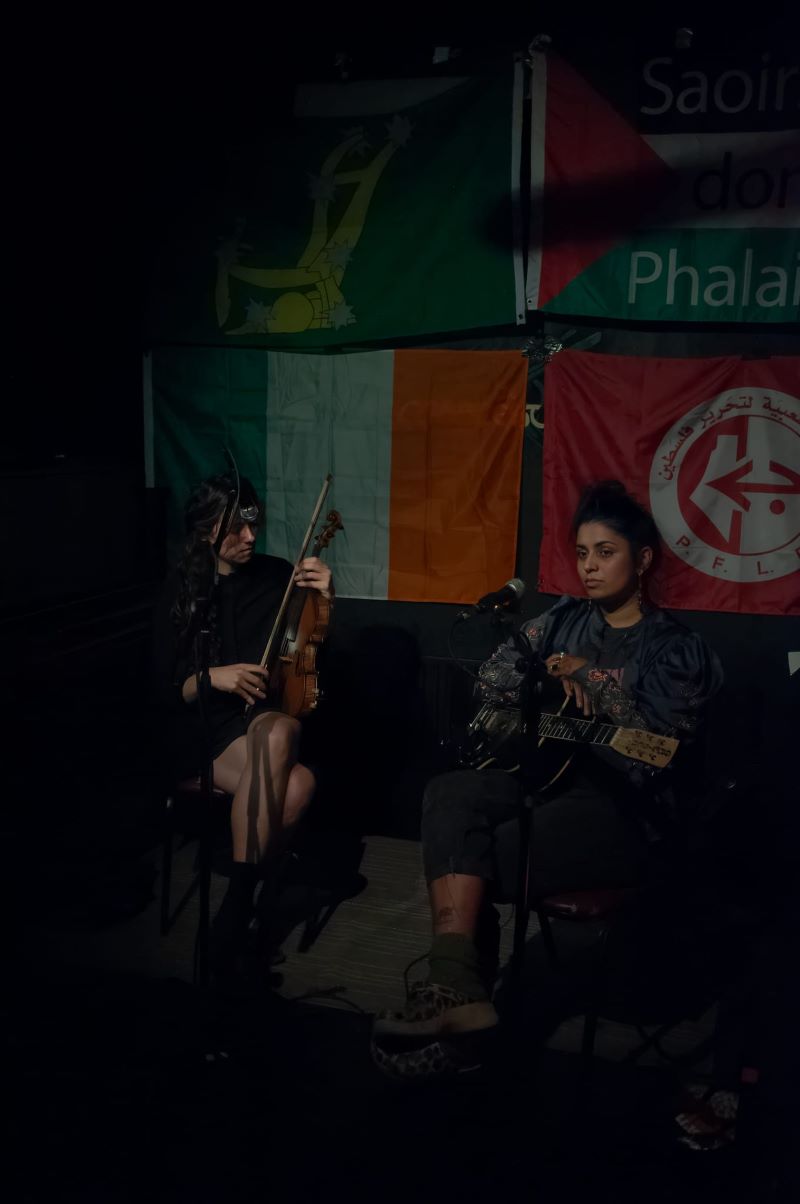
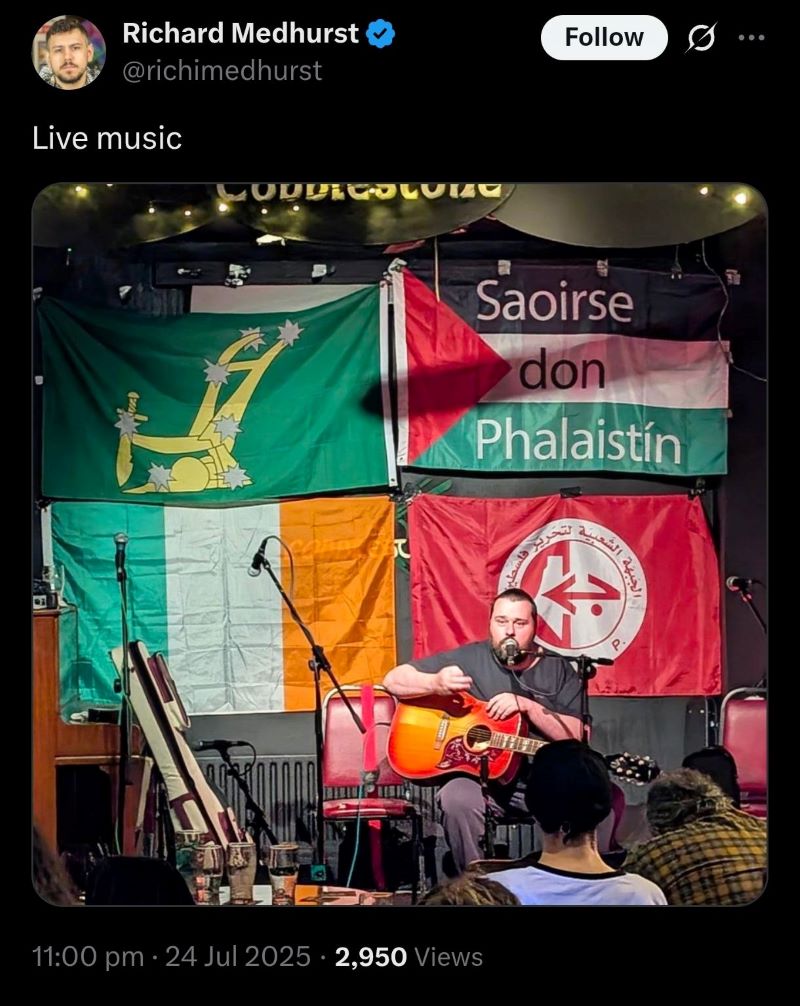
An Irish and international resistance theme in decor was presented by flags of the Starry Plough and Palestine with Saoirse don Phalaistín as stage backdrop, while flags respectively of Cumann na mBan and Basque Antifa concealed the original decor’s ubiquitous photos of Michael Collins.
Flesh B. Bugged performing (Photo: Dermo Photography)
A PFLP1 flag was also taped to a wall. Hand-written signs on the stairs leading to the basement venue, alternatively in Irish and in English, asked for quiet/ ciúnas for the performance/ racaireacht. The Irish language was present too in some of the performances to follow.
MC for the night, Jimi Cullen, himself a singer-songwriter activist told the crowd the purpose of the organising collective was “to build a community of resistance and solidarity with our struggles and with struggles around the world” through culture in a social atmosphere.
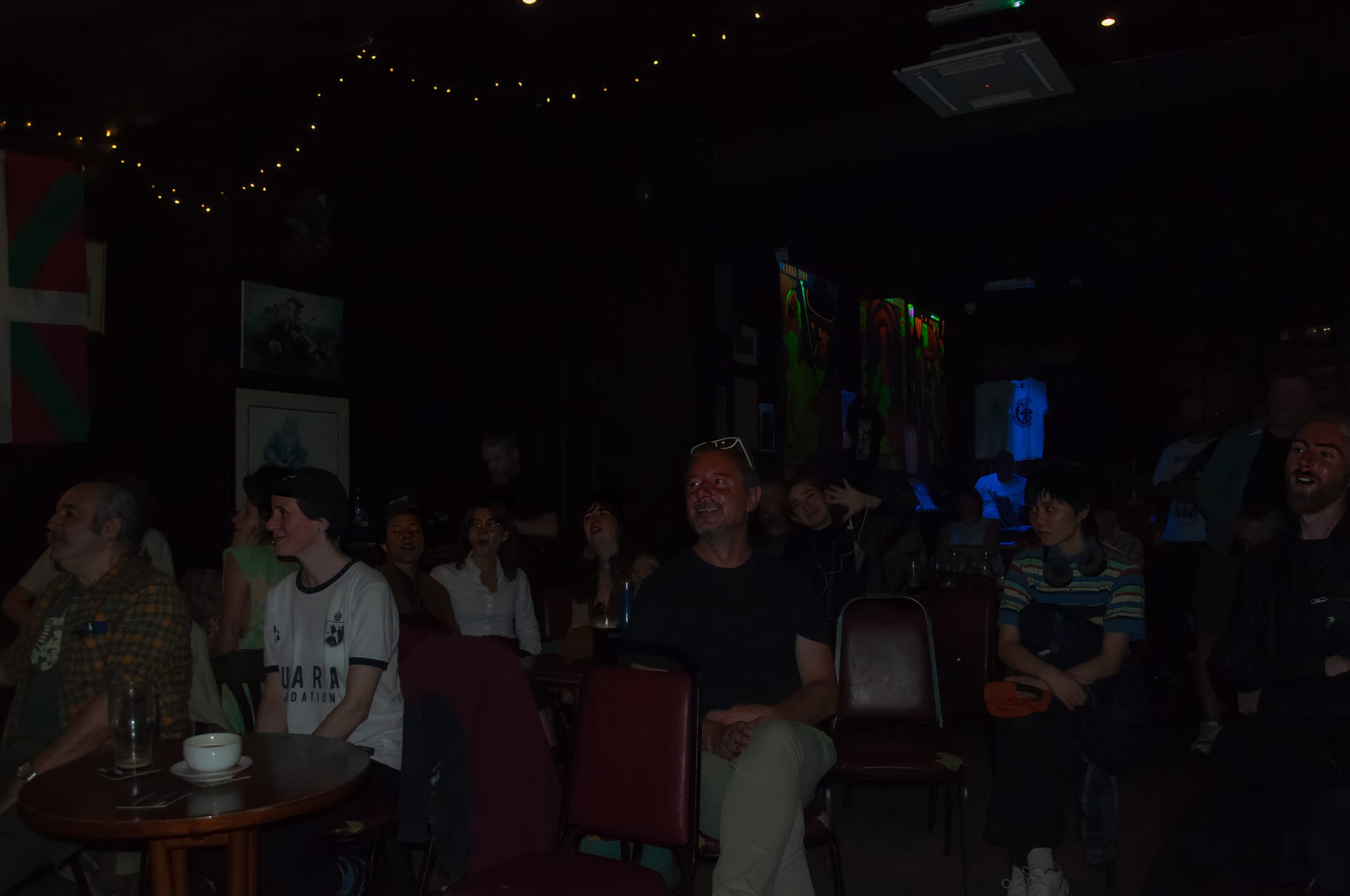
Before the crowd — a flag temporarily changing the decor. (Photo: R. Breeze)
Themes of love, nature and emigration were covered in song; however the dominant theme was resistance – to prison regimes, foreign occupation, fascism, class oppression, racial discrimination – and solidarity with the struggles of others, near and far.
Diarmuid Breatnach, singing acapella kicked off the night with a selection of songs from the Irish resistance tradition and a couple of short ones from the USA civil rights movement. Some of the melodies however, of particular interest perhaps to Back Home in Derry2, were his own originals.
Eoghan Ó Loingsigh, accompanying himself on guitar followed with more material from the same tradition, dedicating one to his late IRA father. A folk song Ó Loingsigh announced as ‘non-political’ performed acapella turned out to be very much political but on the issue of social class.
Áine Hayden followed with poems on a range of topics, from swimming in the Royal Canal during the Covid shut-down, deleting a personal relationship to a dedication to comedian and activist Mahmoud Sharab murdered with family in a “safe zone” tent by the Israeli Occupation Force.
Eoghan Ó Loingsigh performing (Photo: Dermo Photography)
The three performers were all introduced as activists as well as artists and the mostly-young crowd, apparently containing a strong representation of political and social activists, responded well to the performers with applause, yells of encouragement and often joining in on choruses.
More people arrived before, during and even after the break – including an elderly couple who had just arrived from the USA and could only pay in dollars but were admitted for free. Leaving later with thanks they promised a contribution to Palestine solidarity when they got home.
Before the crowd — a Cumann na mBan flag temporarily changing the decor. (Photo: Dermo Photography)
Also an activist, Ru O’Shea sang an Irish, Scottish, French and Italian selection, accompanied by bouzouki and guitar and performed a spoken word piece with a refrain of ‘Éire under attack’ before schooling the audience to sing the chorus of Robbie Burns’ Green Grow the Rushes Oh!
Áine Hayden performing (Photo: Dermo Photography)
Nomads were the next act. Composed of two Mongolian musicians playing violins in the style of the viola and a Dubliner modulating on a sound deck they were unusual enough but it was the amazing throat-singing of one of the Mongolians that had the audience enthralled.
It was amazing to learn that there are three different kinds of Mongolian throat-singing and then to hear them performed, one of which was a kind of whistling with a vibrating bass undertone wavering through it. The applause, particularly when they concluded, was rapturous and sustained.
Before the crowd — flags temporarily changing the decor. (Photo: R. Breeze)Ru O’Shea performing (Photo: Dermo Photography)
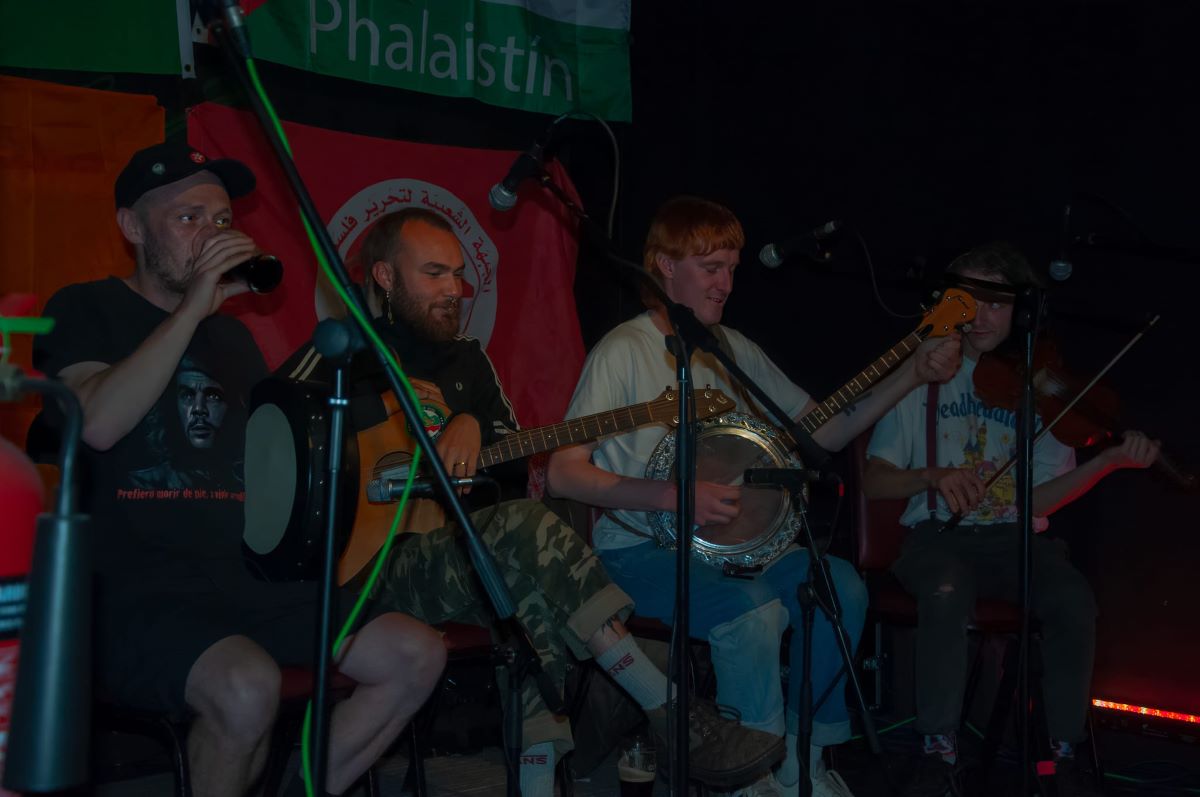
The evening’s entertainment concluded with Flesh B. Bugged, a punk rock Irish duo of bass guitar and drums with spoken voice pieces in Irish from the bass guitar player. Their volume and beat got some of the crowd up and dancing and the wider crowd responded well to them too.
MC Jimi Cullen went up on stage for the last time to thank venue, performers, audience, doorkeepers, poster designers Ríona and Azzy O’Connor, also Diarmuid for original artwork. At a prompt from the crowd Cullen also got a round of applause from the audience for his MCing.
The Mongolian musicians of Nomads performing (Photo: D.Breatnach)
Remarking they’d “had a great night” and encouraging his listeners to follow the organising collective on its Instagram page, Cullen told them that details of Solidarity Sessions No.3 and the collective’s decisions on recipients of donations from money raised would be posted on there.
Diarmuid Breatnach told the audience that each individual could help build a community of resistance through attending the Solidarity Sessions and encouraging others to attend. He welcomed any ‘competion’ from solidarity sessions around the country.
Bass guitarist of Flesh B. Bugged (Photo: Dermo Photography)
The downstairs area of the International Bar is not perhaps the best layout for this kind of event but it worked out well enough for the collective, audience and performers on the night. Their next event will be back at their launch venue,The Cobblestone, Smithfield on Thursday 30th October.
End.
Note: If you found this article of interest, why not register with Rebel Breeze for free, so that you will be notified by email of subsequent articles. You can de-register any time you wish.
The Mongolian throat-singer in Nomads (Photo: Dermo Photography)
FOOTNOTES
1People’s Front for the Liberation of Palestine, one of two specifically secular armed resistance organisations in Palestine.
2Irish mega folk singer Christy Moore had organised Bobby Sands’ poem into song to the melody of The Wreck of the Edmund Fitzgerald by Gordon Lightfoot.
Around 80 people attended a concert in the back room of Dublin’s Cobblestone pub launching an initiative to “build a community of solidarity and resistance through culture”. Flags of Irish and other struggles around the world decorated the venue.
The evening’s entertainment consisted of five musical acts and one of poetry. The MC for the evening, Diarmuid Breatnach, told the audience that Irish struggles had always found an expression in culture and that culture itself encouraged further resistance.
He gave the example of Thomas Davis who founded with others the patriotic newspaper The Nation in the mid-1800s, publishing contributed songs and poems and his own, including The West’s Awake and A Nation Once Again, songs still sung in Ireland nearly two centuries later.
The first act of the evening was the folk duo The Yearners, specialising in harmonies around renditions of song covers and their own song about the Mary of the New Testament, as a woman pressured to bear a child because “How can you say no to God?
The audience joining in on Pearse’s Gráinne Mhaol was followed by some songs with hard satirical edges like the Kinky Boots song from the Irish Republican repertoire and their own Save A Landlord.
The Yearners during their performance. (Photo credit with thanks: Dermo Photography)Dúlamban during their performance. (Photo credit with thanks: Dermo Photography)
The MC introduced another all-female duo, Dúlamban, recently formed from two individual singer-musicians. Among their material, Sinéad on violin played two compositions of her own while Aisling sang her adaptation and translation of the Rising of the Moon: Ar Éirí na Geallaigh.
The one poet of the evening, Barry Currivan, performed a number of shorter and longer pieces of his repertoire. He was particularly applauded for his “anti-othering” piece Those People and his humorous concluding piece comparing himself to a good cup of tea or coffee.
After the break, the MC spent a few minutes outlining the Solidarity Sessions collective’s project and encouraging the audience to take part in it by spreading word of its events and supporting them in person, in addition to stepping forward to assist in organisation and in poster design.
Barry Currivan during his poetry performance at the Solidarity Sessions launch. (Photo credit with thanks: Dermo Photography)Section of the audience presumably during Currivan’s performance. (Photo credit with thanks: Dermo Photography)
Another female duo took the stage, Sage Against the Machine on guitar accompanied by Ríona on violin, performing a number of love pop covers and SAM’s own song against patriarchy.
Some remarks about Bob Dylan’s Zionism followed in Sage’s introduction of the former’s Masters of War which she performed with great feeling and followed with El Gallo Rojo, an anti-fascist song from the Spanish ‘Civil War’.
Sage Against the Marchine (right) and Ríona during their performance. (Photo credit with thanks: Dermo Photography)Jimi Cullen during his performance at the Solidarity Sessions launch. (Photo credit with thanks: Dermo Photography)
Breatnach then introduced Jimi Cullen who he said has been hosting a weekly musical protest picket for an hour on Wednesdays (2-3 pm) outside the US Embassy for a great many weeks, in which the MC had sometimes accompanied him amidst the solidarity beeping of passing traffic.
Jimi accompanied himself singing his Housing for All and Guthrie’s You Fascists Bound to Lose, then commenting on Bob Marley’s Zionism while introducing the latter’s One Love song, saying that love above all is what binds humanity together, a theme also of his We Are All Palestinians.
His monologue The Genocide Will Be Televised was much sharper and renewed an earlier Death, death to the IDF!1 chant from the audience.
Trad Sabbath during their performance. (Photo credit with thanks: Dermo Photography)
There was much irreverent comment about the name of the band to conclude the evening, Trad Sabbath, a four-piece band of guitars, banjo, bodhrán and fiddle, apparently in the context of the very recent death of the Black Sabbath band’s lead vocalist, Ozzie Osbourne.
Sardonic cries about “his poor widow”, Sharon Osbourne2 were also heard, a Zionist personality star in a ‘reality’ TV show about the late Ozzie’s family. To fill in the delay in their setting up with the sound engineer, Breatnach sang Kearney’s Down by the Glenside ballad.
The band concluded the evening with traditional melodies and some songs from Eoghan and Hat with others backing on choruses.
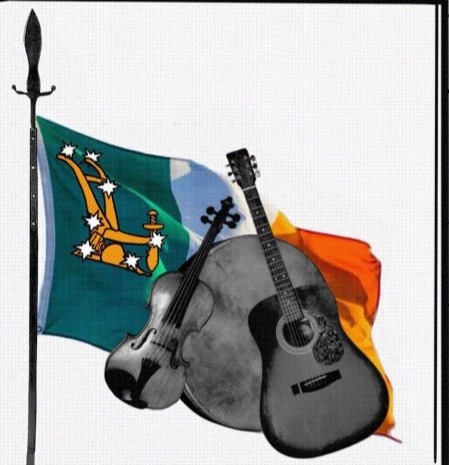
Poster advertising the event (Design: Ríona and D.Breatnach)
The MC thanked all for their attendance, performances and technical support before reiterating the Solidarity Sessions’ objective and encouraging participation. His comment that “Repression is here and more is coming down the road” was underlined by the presence there of a prominent victim.
In the audience was Richard Medhurst, the Britain-based journalist specialising in Middle Eastern coverage who was recently detained under anti-terror (sic) legislation and charged by British police as he returned from abroad and again later detained though not actually charged by Austrian police.
Richard Medhurst’s tweet during the evening at the event.
End.
FOOTNOTES
1Made famous by the Bob Vylan duo at Glastonbuy getting the audience chanting the slogan. The IDF is what the Israeli Occupation Forces call themselves.
2Who had called for the banning of the the Irish rap group Kneecap.
Diarmuid Breatnach – Talk given at 1916 Performing Arts Club, May 2024.
(Reading time: 6 mins.)
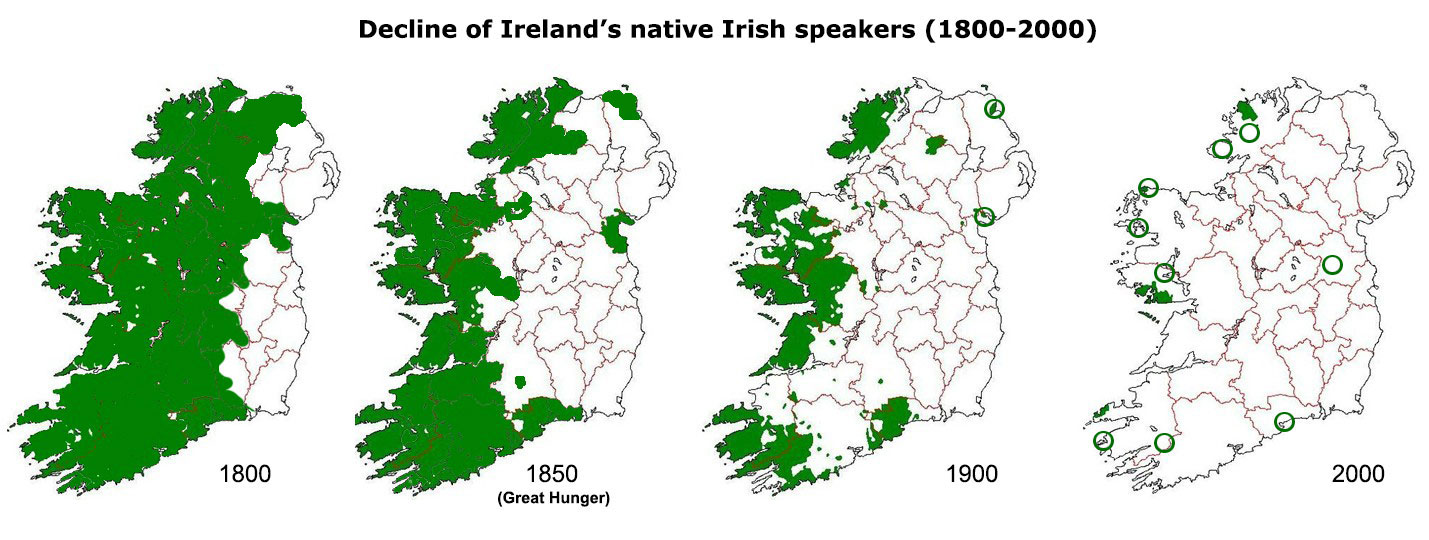
There was a time when from Dublin to Galway, from Kerry to Donegal, the dominant language was Irish. There was a time too when it was widespread in Scotland, in parts of Wales and the main language on the Isle of Man.
Now however one can travel through all of those places and not hear it.
Irish was the first vernacular language to be written down in Europe and though island people, its speakers were not “insular”. The educated spoke Greek and Latin too and when the Dark Ages fell upon Europe it was the Irish intellectuals, the monks who revived and spread literacy there.
But here we are, you and I, speaking English – which did not even exist until at least the 12th Century.
She (I say ‘she’ because language in Irish is a feminine noun and in many other languages too) – she is all around us in place names, though we may know them only through their corrupted forms into English.
Árd/ Ard, a height; Baile/ Bally, a town or village; Béal/ Bel, the mouth of; Bun, the bottom of; Carraig/ Carrig, a rock; Cnoc/ Knock, a hill; Cluain/ Clon, a meadow; Dún/ Dun, a fort or castle; Inis/ Inis or Ennis, an island or a raised mound surrounded by flat land; Loch/ a lake …
The English-language names of twenty-nine of our counties are corruptions of words in Irish: from Ciarraí to Dún na nGall, from Átha Cliath Duibhlinne to Gaillimh. This includes all six counties in the colony: Aontroim, Árd Mhacha, Doire Cholmcille, An Dún, Tír Eoghain, Fear Manach.
Just over half the States of Stáit Aontaithe Meiriceá on Turtle Island have names in the indigenous native languages, so we’re doing well with placenames and also of course have survived the colonial genocidal campaigns and wars much better.
By the way we also have Irish names for some places in Britain: Glaschú, Dún Éidin, Manchuin, Leabharpholl, Brom agus Lúndain. In fact probably none of the names of those cities are originally English anyway.
Irish has left only a small imprint on the general English language for example with “a pair of brogues, whiskey and slogan” (from slua-ghairm, a call to or by a multitude), banshee, carn and smithereeens. And shebeen, in parts of the USA, the Caribbean and in South Africa.
But its influence on the way we speak English in Ireland is clear.
We might say, instead of complaining that we are thirsty, that we have a thirst on us – a direct translation from Tá tart orainn. Or that the humour is on us – Tá fonn orainn. We might “have a head on us”, as in a headache. “The day that’s in it” – an lá atá ann.
We pronounce “film” with a vowel between the L and the M, as it would be in Irish – take the name for a dove and also a personal male name, Colm. We get that with R and M and R and N too, in some areas “a carun of stones” or “down at the farrum”.
We often indicate the absence of ‘Yes’ or ‘No’ in Irish by replying in English to the verb in the question: ‘Will you be there?’ ‘I will surely’ (Beidh, cinnte). ‘Will you do it?’ ‘I will not’ (Ní dhéanfad).
We have an extra tense in Irish, the very recent past tense, which we translate into English as spoken in Ireland: ‘I’m just after cleaning that floor!’ Táim díreach thréis an urlár sin a ghlanadh!
Renaissance of language and culture has often preceded periods of heightened national struggle: the Harp Festival of 1792 was followed soon by the uprising of the United Irish; the cultural work of The Nation newspaper was followed by the rising of the Young Irelanders.
The Nation newspaper of the Young Irelanders sought to create and encourage a nationalist republican culture and was followed by an unsuccessful rising in 1848, during the Great Hunger. (Source image: Internet)
LANGUAGE AND NATIONAL STRUGGLE
The Fenians too had their cultural precursors and the great revivals of the Irish language, Irish sport, speaking and writing in Irish and Irish theatre were not long in finding expression of another kind in the 1916 Rising and the War of Independence.
And campaigns of civil disobedience in the 1960s secured for us Irish-language broadcasting in Radió na Gaeltachta and TG4. Not to mention motor insurance documentation in Irish which Deasún Breatnach won only after going to jail for refusing to display the documentation in English.
Though we can hear the influence of the indigenous language upon our speaking Sacs-Bhéarla, or English, the Irish language itself at this point is in retreat. In fact some might say that it’s in a rout.
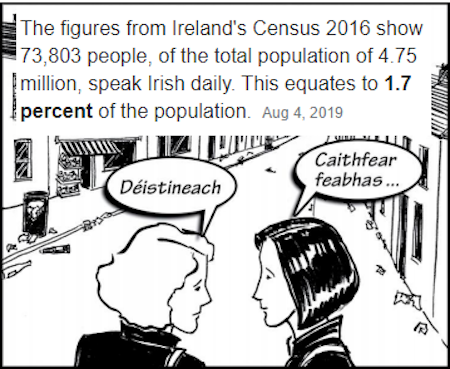
Yes, the Gaelscoil movement is broader and deeper than ever before but outside the schools? The Gaeltacht areas are receding, receding … and where can the language be heard outside of those?
Though the Great Hunger caused the most impressive loss of Irish-speaking modern Ireland on the map, the percentage lost during the period of the Irish State is greater. (Image source: Internet)
I had an experience recently that illustrates the problem. In a pub with some friends, I observed a man wearing a silver fáinne, the ring that many people wore to show a proficiency in Irish. It identified the wearer to other Irish-language speakers (my father wore a gold one).
The man had overheard me bidding farewell to friends in Irish and asked me: “Are you an Irishman?” I thought the question strange and said so. Then he asked me was I an Irish speaker, to which I replied in Irish language.
Eventually he came over and said that he didn’t speak Irish himself.
The fáinne was a family heirloom and he had been wearing it, he said, for six months in Dublin, wanting to come across an Irish speaker to whom he would give the ring. Since I had been somewhat abrupt with him, he gave the ring to one in the company who can speak Irish.
Badge inviting people to speak Irish to the wearer (Image sourced: Internet)
LABHAIR Í
Six months in Dublin without hearing Irish spoken or recognition of the fáinne! That illustrates one aspect of the linguistic problem in Ireland. But it is one that we can resolve, fairly easily too. And that brings me to the kernel, the poinnte or point of this talk here today.
I am asking you to speak a cúpla focal, regularly, go rialta, so that she may be heard. Labhair í ionnas go gcloisfear í. Imagine if everywhere in Dublin, on every side, one heard just a few words in Irish – imagine the social and psychological effect over time!
Those who know some Irish would speak her more often. Many who don’t, would feel it worthwhile to learn at least some phrases and some responses. Some might take it further and learn Irish well. Public services might regularly facilitate services through Irish.
Dia dhuit. Dia’s Muire dhuit. Or the non-religious form: Sé do bheatha. Go mba hé duit.
Má sé do thoill é or le do thoill.
Go raibh maith agat in many situations, including to the driver of the bus.
Tá fáilte romhat.
Gabh mo leithscéil.
Would you like a bag? Ní bheidh, go raibh maith agat.
Cash or card? Íoch le cárta, le do thoill as you wave your bank card. Or Airgead thirm, as you take out your wallet or purse.
Go léir, as you indicate that you wish to pay the full amount.
Isteach, le do thoill, when returning a book to the library. Amach, le do thoill, when borrowing one.
Slán, as you leave.
Easy enough, yes? Yes? But though a part of the mind is willing, another part is afraid.
“What if I get a big load of Irish in response and not even understand it? Won’t I look like a right eejit!” Well, there are risks in anything worth doing as was demonstrated in a short play here some time back when two fellas were debating whether and when to chat up a certain woman.
She was not uninterested but they took so long about it she walked out and left them, like fish brought up by fishing line, gasping on the dry quay.
So you could prepare a small survival kit: “Gabh mo leithscéil. I only have a few words/ níl agam ach cúpla focal.”
“Níl agam ach beagán ach tá mé ag iarraidh í a úsáid/ I only have a little but I want to use it. Is foghlaimeor mé/ I am a learner.”
I am not asking for any of us to campaign, to agitate for services to be provided through Irish though that is certainly a linguistic civil right and, as far as state or semi-state services go, a constitutional one.
I am only asking that you contribute to the audibility of the language, to use a few standard greetings and responses and to use them not only to people you know to be Irish speakers, not only to friends and relations … but everywhere in public.
Everywhere
in public.
Go ye out among the people and spread the word – or rather the few words. Scapaigí an cúpla focal.
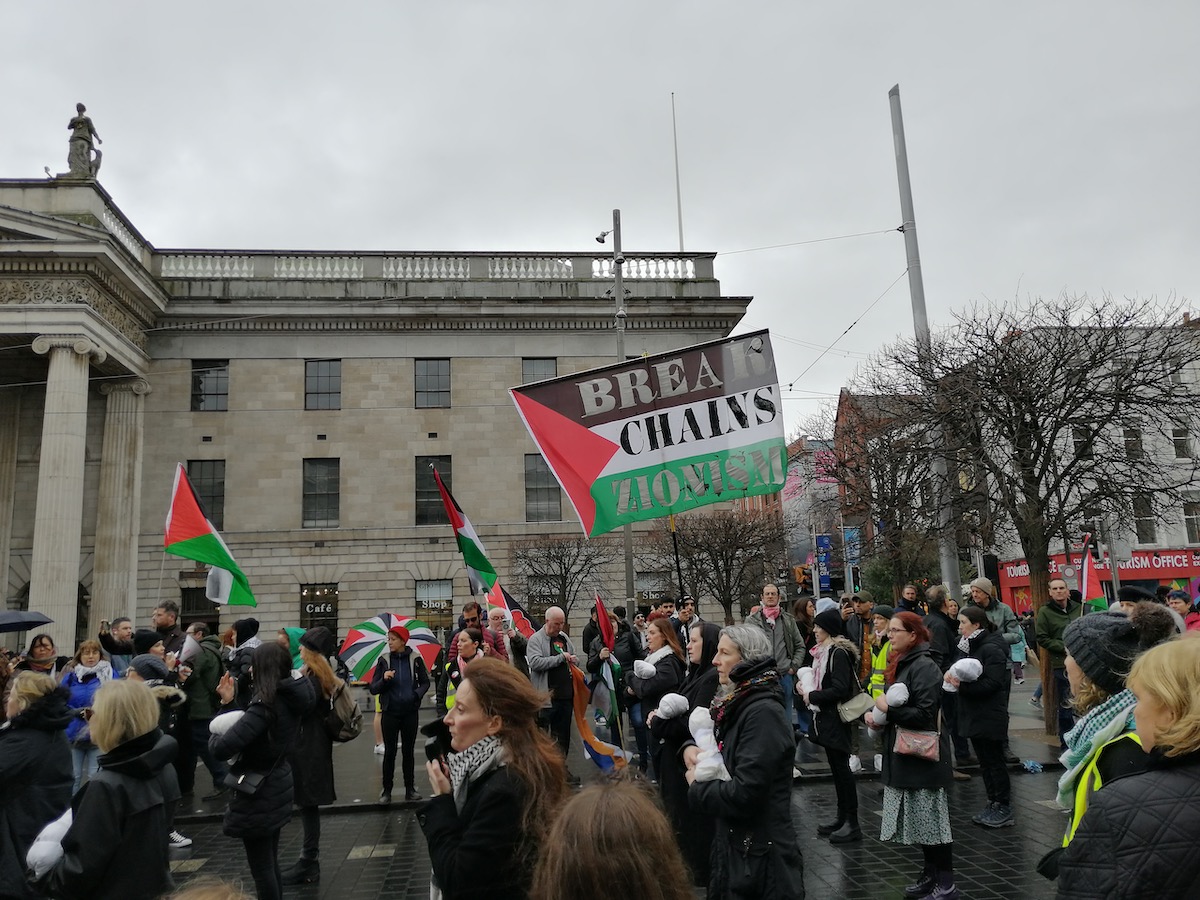
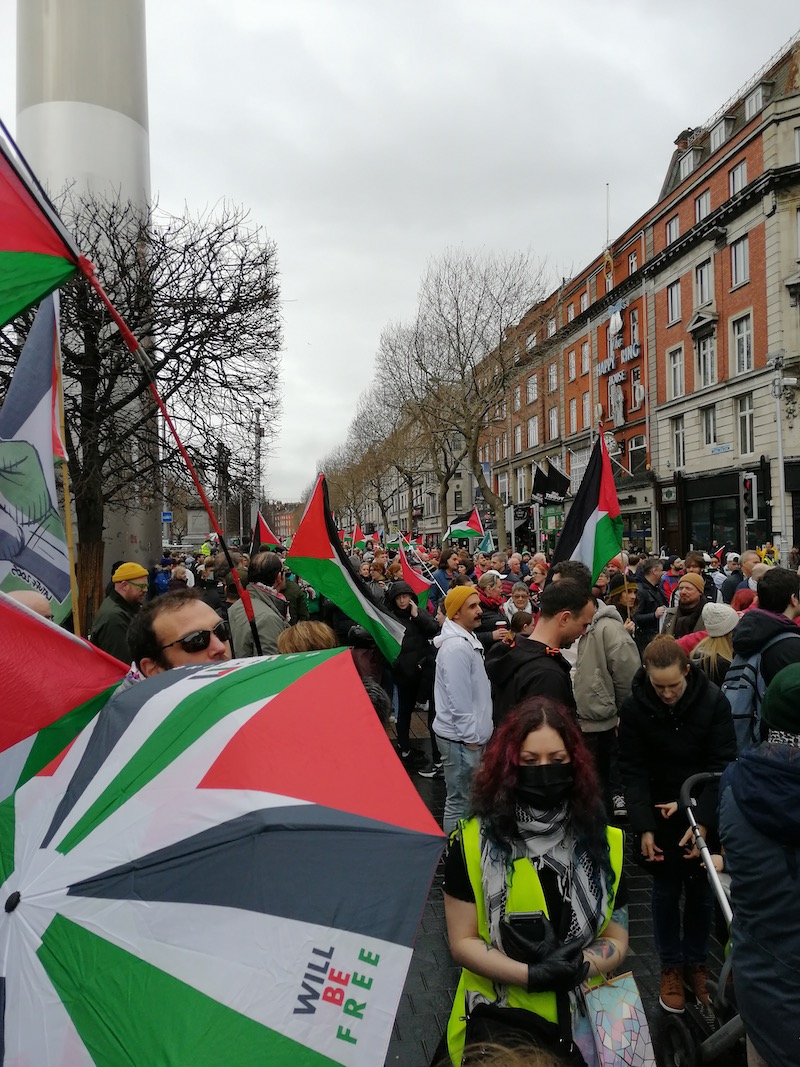
Numbers approaching 100 thousand marched in Palestine solidarity in Dublin on Saturday as the Ireland Palestine Solidarity Campaign held its 5th national march since October, attended by people from Donegal to Cork and from the 6-County British colony.
It took place in a week in which the genocidal zionist settler state exercised its “right to defence” by its fourth attack on the Al-Shifa Hospital, massacring over 170 unarmed civilians including women and children and using others as human shields.
(Photo: D.Breatnach)(Photo: D.Breatnach)
In addition the zionists executed the Chief of the Gaza police and a Deputy (along with the latter’s family), claiming them to be guerrillas but apparently in retaliation for their successful organisation of a recent flour delivery without riots or any civilians murdered by the Occupation Forces.
Meanwhile, the response of the colonial and zionist collaborator, the Palestine Authority, was to continue its repression of Palestinians in parts of the West Bank and to open fire on the funeral of three martyrs1 of the heroic latest battle of Jenin, a scene of many past battles.
The front of the march begins to enter Dublin’s main street, O’Connell Street (Photo:D.Breatnach)
The official figure for Palestinians killed in this latest genocide on screens and before the eyes of the world is now nearing 33,000 dead with well over 74,000 injured and an estimated 8,000 buried under rubble from Israeli bombing in the zionist state’s “right to defence”.
None of the leaders of the Western imperialist states seem to ask themselves whether, if this is truly the necessary cost to Israel’s ‘defence’, does that state deserve to exist at all?
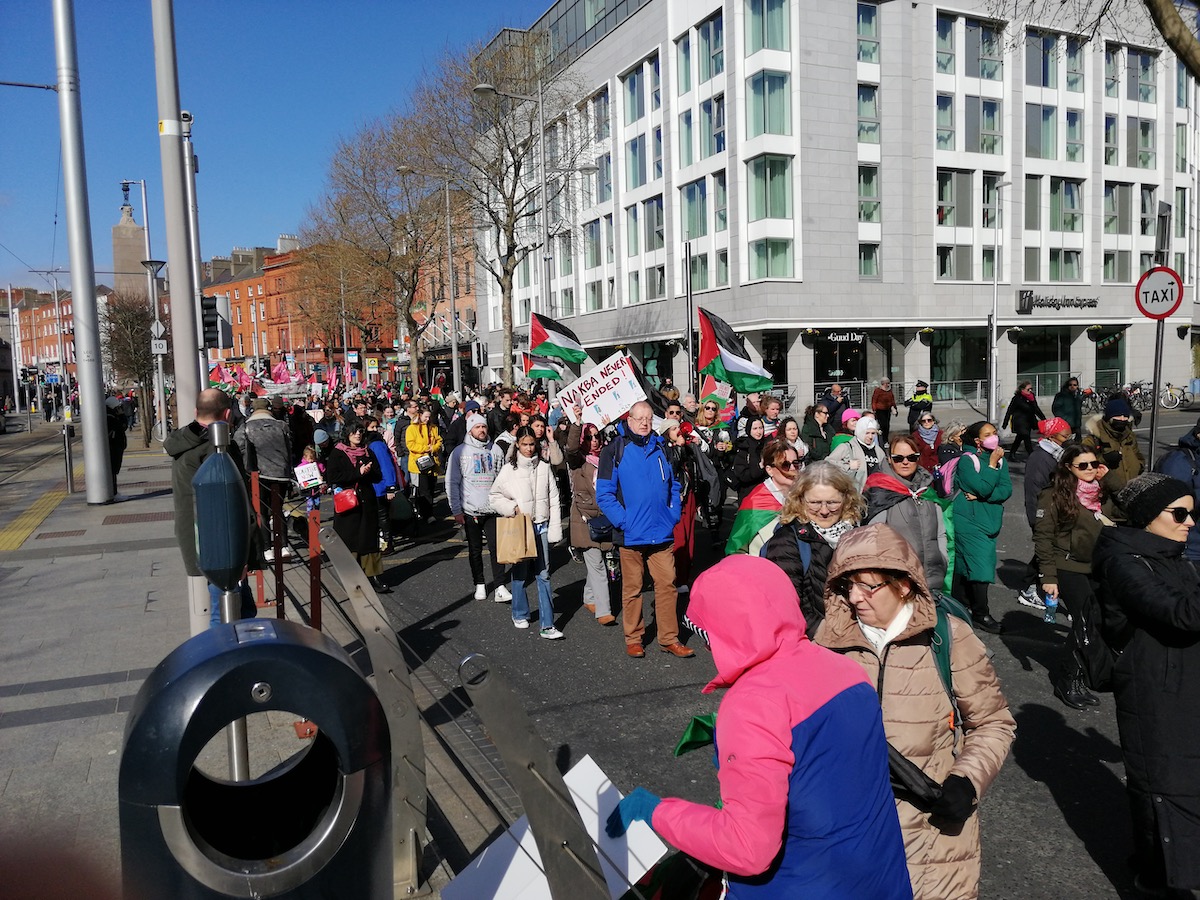
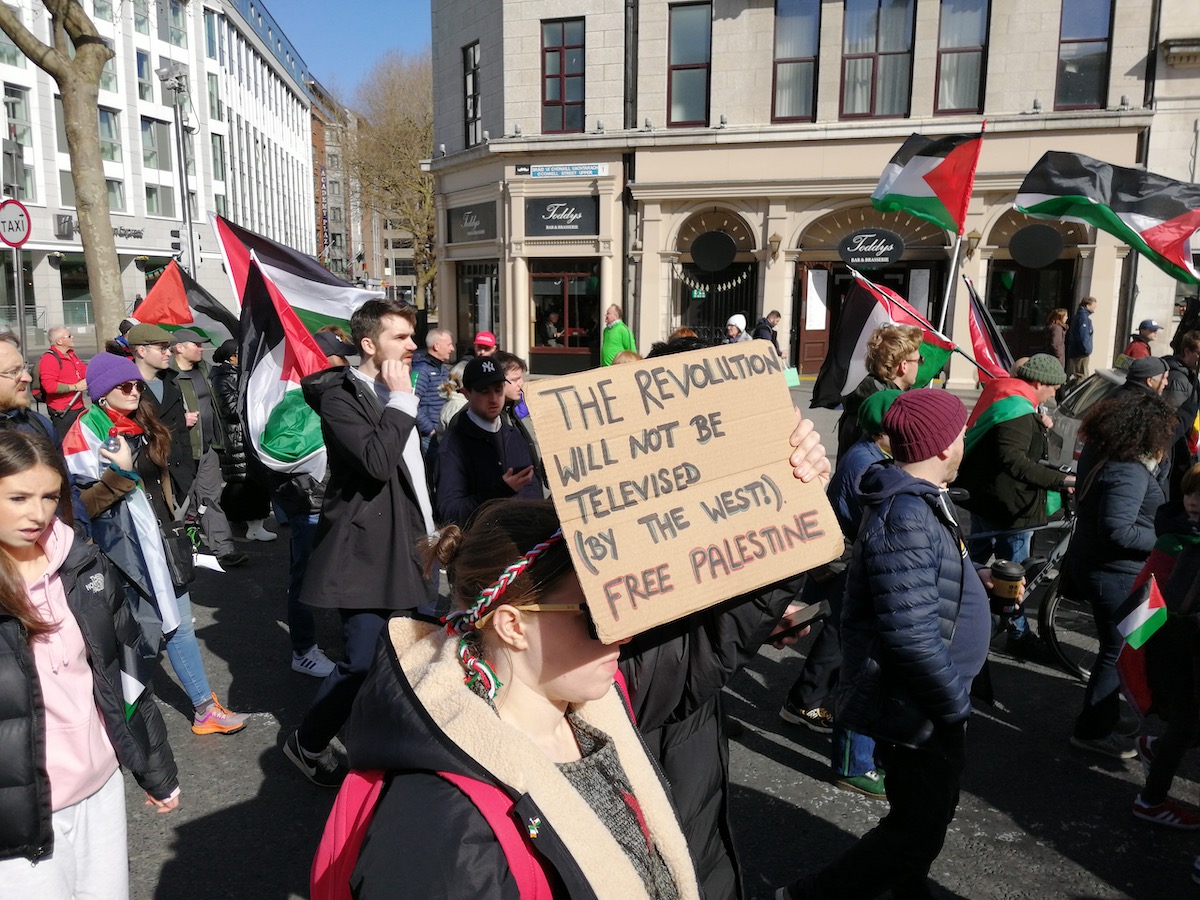
“Nakba never ended” placard seen in this section of the march in O’Connell Street (Photo: D.Breatnach)
MARCH AND ZIONIST PROVOCATION
The march began as has become customary at the Garden of Remembrance2 in the north side of the capital city from where it eventually began to make its way down through the city’s main street, its end taking nearly half an hour to pass through and to cross the river to the south side.
From there, chanting slogans that have since become well-known in solidarity of the Palestinians and their right to self-determination, in outrage at the actions of the zionist state and its imperialist supporters, the marchers made their way to rally outside the Department of Foreign Affairs.
(Photo: D.Breatnach)
Here many listened to speeches and performances but significant numbers shortly peeled away to make their ways back home or to relax in the city’s cafes and restaurants (after all, what were they going to hear that they had not heard and read before?).
Irish Republican organisations were not noticeably present, even those few that had been visibly present on recent demonstrations; difficult to guess at the reason, even with preparations for 1916 commemorations no doubt being undergone for next weekend and afterwards.
As usual on large demonstrations, the marchers had not experienced the insults and bizarre shouts of “Traitors!”3 by far-Rightists and racists to which smaller solidarity pickets are often subjected but, as part of the march neared Cuffe Street, a man with a large Israeli flag passed them.
From near me shouts of “Zionist! Baby-killers!” arose but he passed. Later he was seen being escorted by a Garda from the rally with his Zionist flag but also a Palestinian flag which people speculated he had taken from a demonstrator.4 Some more Gardaí gathered around the Zionist.
Shortly thereafter, he was permitted/ encouraged to leave the area with at least his flag pole5. Many commented that the outcome would have been very different if it had been a case of a Palestinian supporter provoking a Zionist rally and, indeed, I have witnessed such some years ago.
(Photo: D.Breatnach)
When I lived in London I regularly saw Zionists provoking Palestinian supporters and dancing Israeli dances near them. Whenever outraged demonstrators drew near to challenge them, the Palestine supporters were attacked by the London Metropolitan Police.
At a parallel Palestine solidarity march on Saturday in London, a small group of Zionists waved Israeli and Union Jack flags but were soon swamped by Palestinian and Irish – yes Irish! – flags. In London at least there have been Irish flags on every Palestinian solidarity march since October 8th.
(Photo: D.Breatnach)
TRADE UNIONS
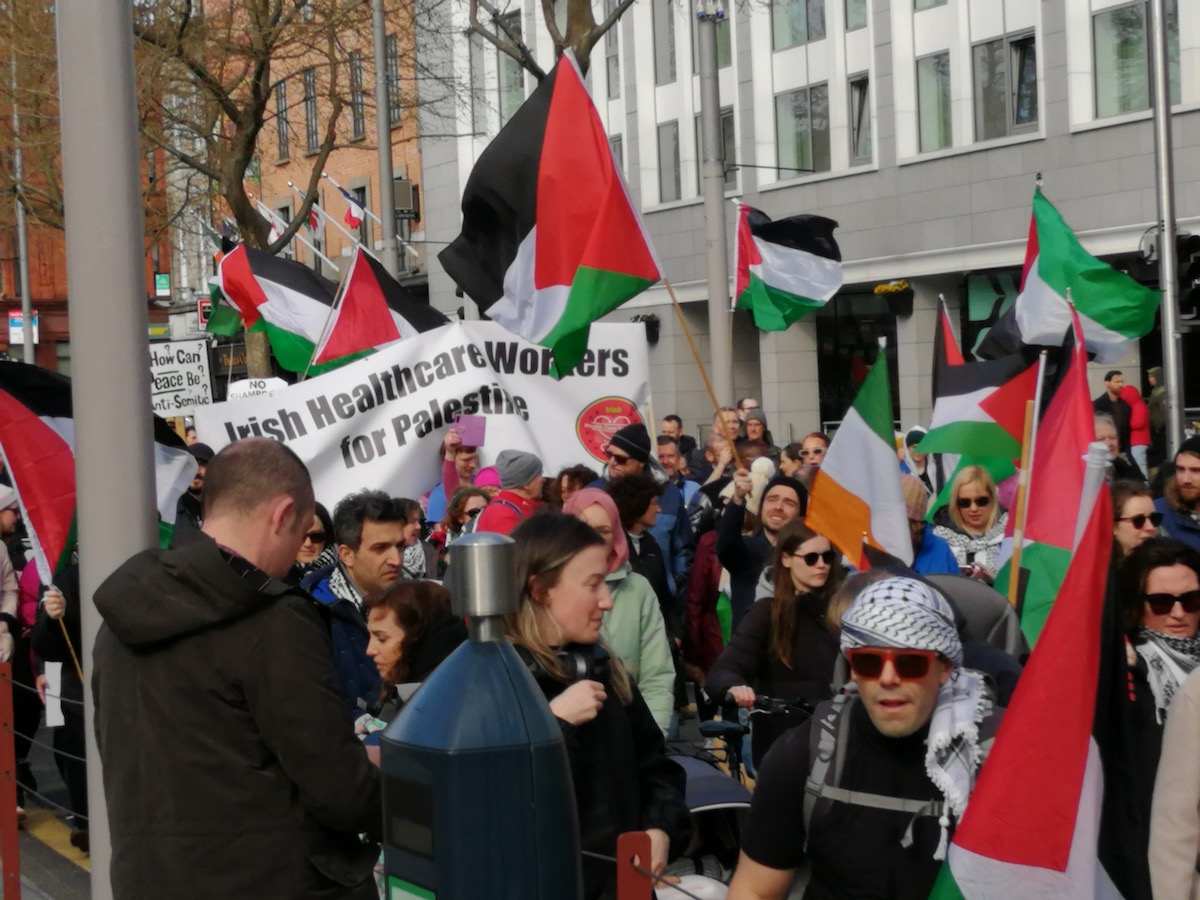
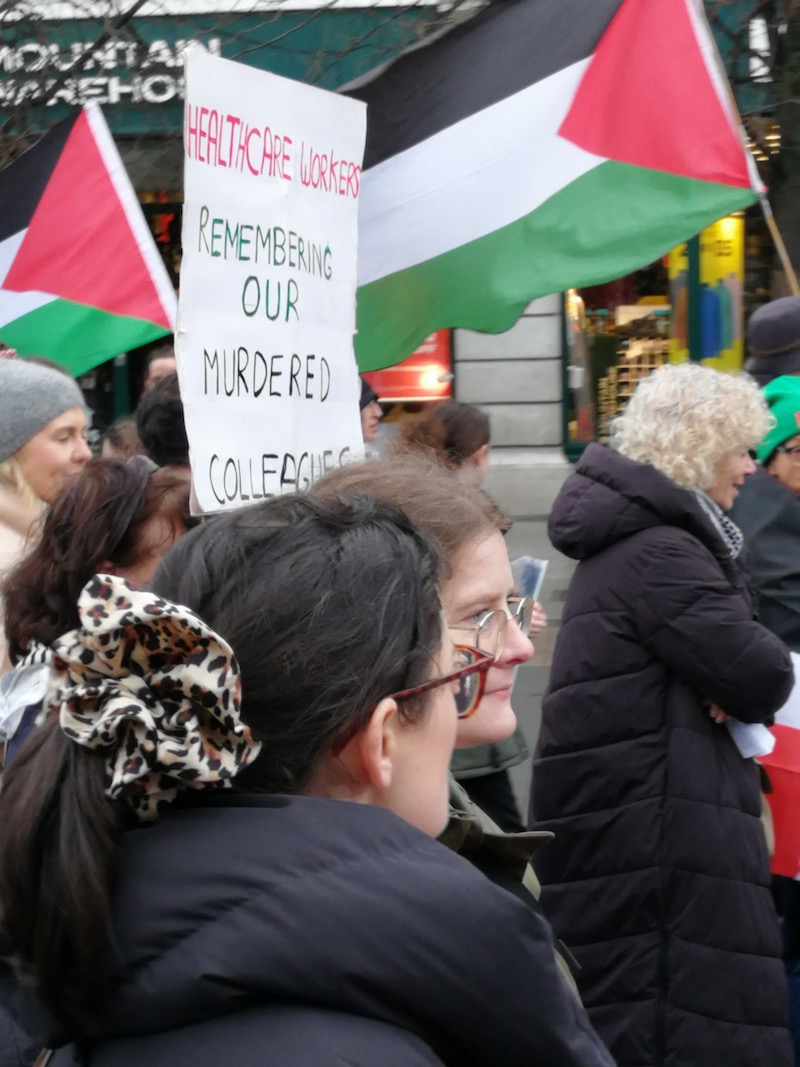
Banners and flags of Irish-based trade unions were well-represented on the march but with at most a couple of dozen marching behind them. Specific worker groups such as “Health Workers for Palestine” replied to my enquiry that they had organised the group without support from their unions.
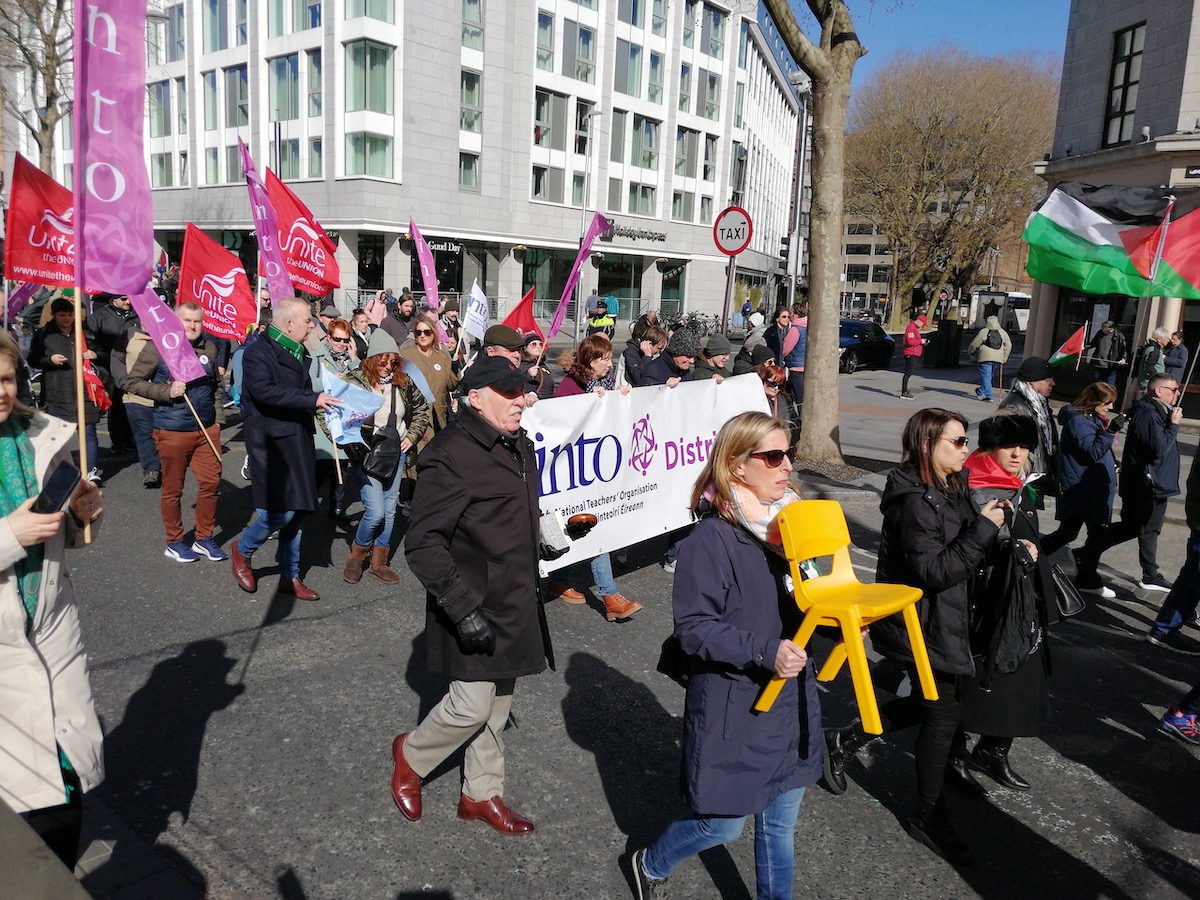
Banners of INTO, the largest teaching union in Ireland (primary level in the state and primary and post levels in the colony) precedes some flags of the UNITE union. (Photo: D.Breatnach)(Photo: D.Breatnach)
Where are the militant actions by the trade union brothers and sisters of murdered Palestinian medical staff including paramedics, journalists (for which job Palestine is the most dangerous place in the world), food distribution workers, poets and writers?
It is well past the time when it was sufficient for Irish trade unions to bring banners and flags on to the street every couple of weeks with a dozen members or so marching behind them. In October they should have been leading their members to the marches in at least their hundreds.
By November last year at least, the trade unions should have been planning actions to take in physical solidarity, moving beyond marches and pickets to sit-downs and other kinds of solidarity action. How do Israeli goods come into Ireland and how are they sold?
(Photo: D.Breatnach)(Photo: D.Breatnach)
Clearly they are handled and administered by workers and some of those at least6 are unionised. Union-backed boycott actions would put pressure not only on the Israeli economy but also on other companies colluding with them, as with the supermarkets who stock their products.
Pressure on the latter would translate into pressure not only on the Israeli state but on the political management of the economic bases of states and also on the political management of the countries where they are operating, for example in Ireland.
Who knows, the unions might even boost their recruitment with such action, in a country where once most would not dream of crossing a picket line but where now many youth do not even comprehend the nature or purpose of a trade union.
(Photo: D.Breatnach)
REPRESSION
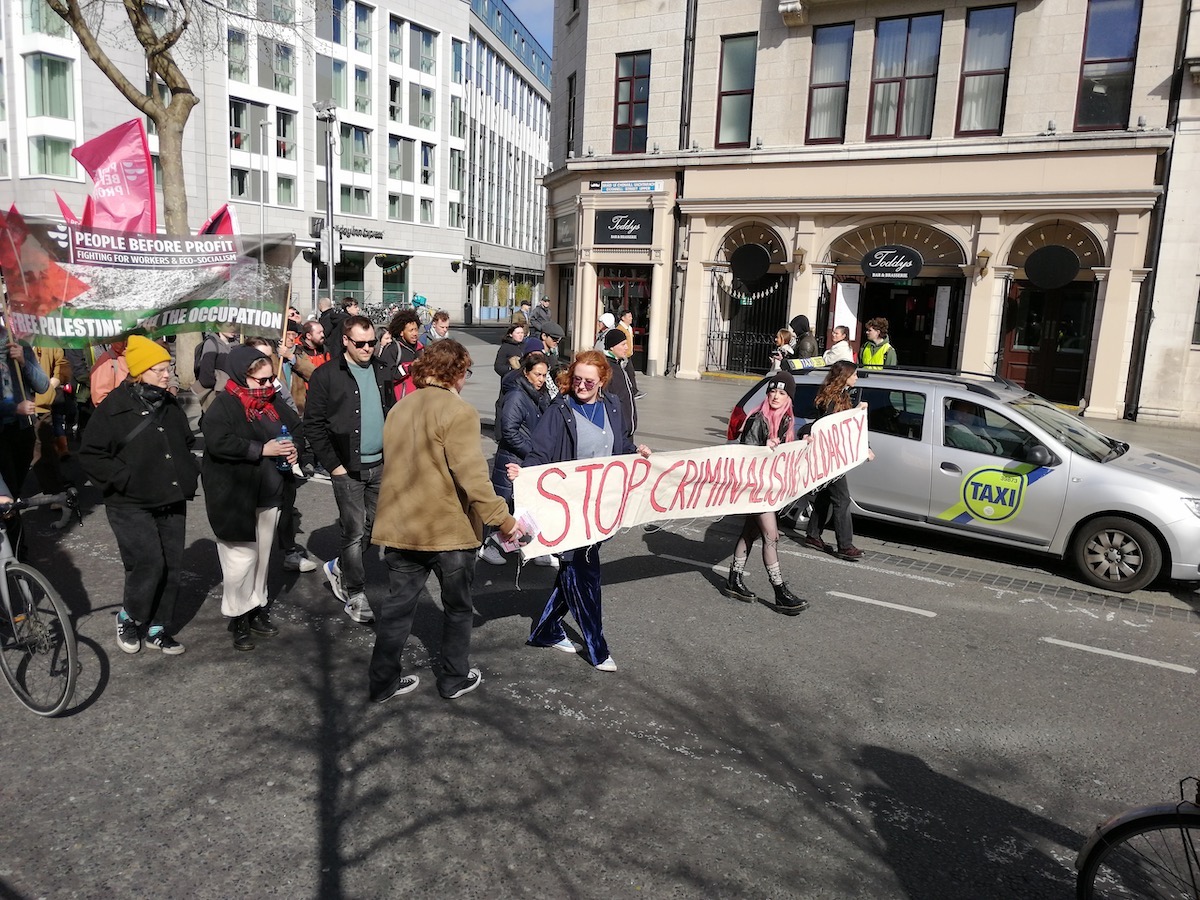
Meanwhile, those who ARE taking action in solidarity with Palestine are experiencing repression, not yet to the extent that is occurring in the French and German states, but repression nevertheless. Some marchers on Saturday carried a banner protesting the criminalisation of solidarity.
(Photo: D.Breatnach)
In recent months a number of people have experienced dawn house raids by the police, in addition to arrests in the course of demonstrations or pickets. Defence of people victimised for solidarity actions has always been an important part of solidarity movements.
Most of the political parties nor the IPSC will be organising or even calling for such defence and it is up to the ordinary people in the solidarity movement to mobilise to attend and protest the court cases and attend pickets in solidarity with victimised activists.
(Photo: D.Breatnach)
In the months ahead, those victimised up to now and quite possibly more still will be attending court on separate dates as their cases are scheduled to be heard. It is also important as a general principle that activists refuse to agree to refrain from solidarity actions as a condition of bail.
A number of Palestine solidarity activists recently had a private meeting with officials of the Irish Council for Civil Liberties and the organisation also held a recent day of sessions and workshops on civil rights for protesters.
Campaigning organisation for housing and against evictions (Photo: D.Breatnach)
SHAMEFUL SHAMROCKS
Saturday’s march took place a week after St. Patrick’s Day when to the disgust of many people in Ireland, representatives of the Irish Government and even of a number of Opposition political parties attended in Washington to celebrate the day with President Biden and others.
As a result, no doubt, the presence of the Sinn Féin party on the march was small and muted and the flags of the Social Democrats absent, a party recently prominent in pressure on the Irish Government to join the ICJ case against the Israeli State and even to expel their Ambassador.
One supposes that those who are in a queue to manage the Gombeen state have to show their fitness for doing so by bowing before the leader of western imperialism; whatever their private feelings may be, they need to show that they have the stomach to do what the system requires of its servants.
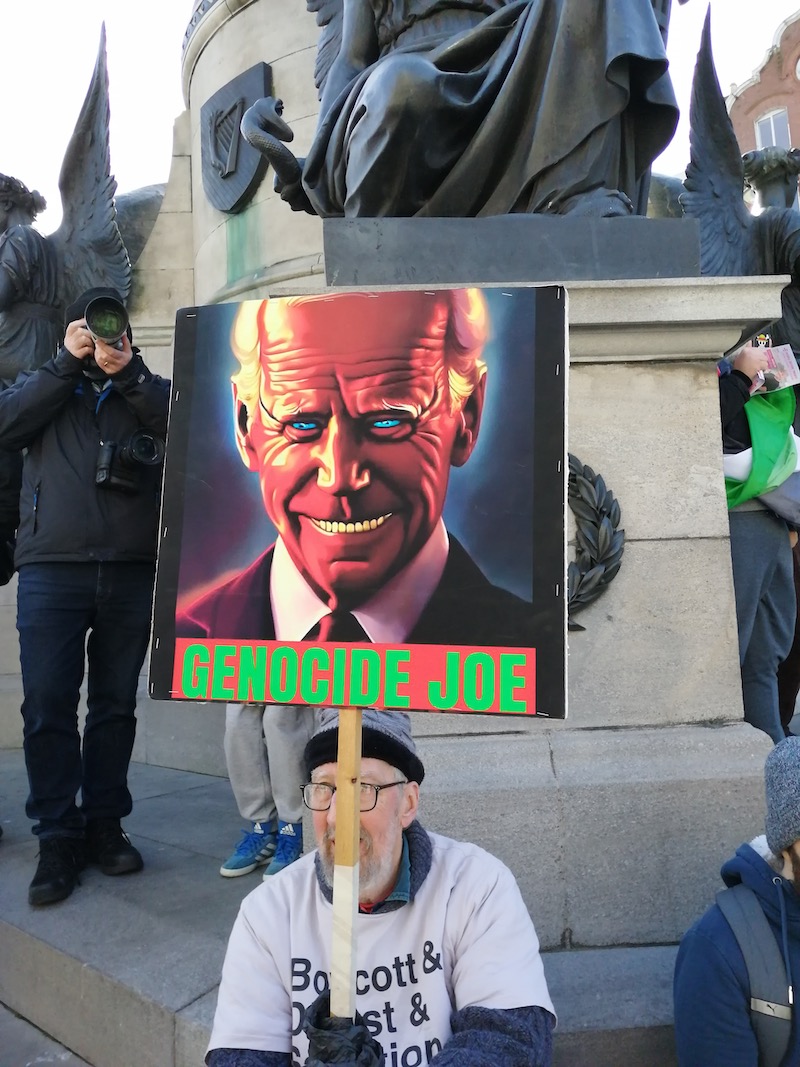
“No shamrocks for Genocide Joe” placard in this section of the march (Photo: D.Breatnach)
LESS SLOGANS and LESS IRISH?
It seemed to me that there were in general less slogans being chanted on this demonstration and that that their range was less than usual. Possibly this reflects a feeling that the demonstrations are becoming more routine and less capable of stirring emotion.
Possibly too, the sheer daily weight of zionist atrocities is oppressing people and wearing down their capacity for outrage. In either case it would seem that in addition to giant demonstrations, other actions are needed to release the latent emotional energy of the people.
(Photo: D.Breatnach)
On this demonstration there was much less Irish language seen in placards, flags or banners than has been the case recently and which had been growing over the months, as I’ve been commenting upon in previous reports. This is regrettable and hopefully will be remedied.
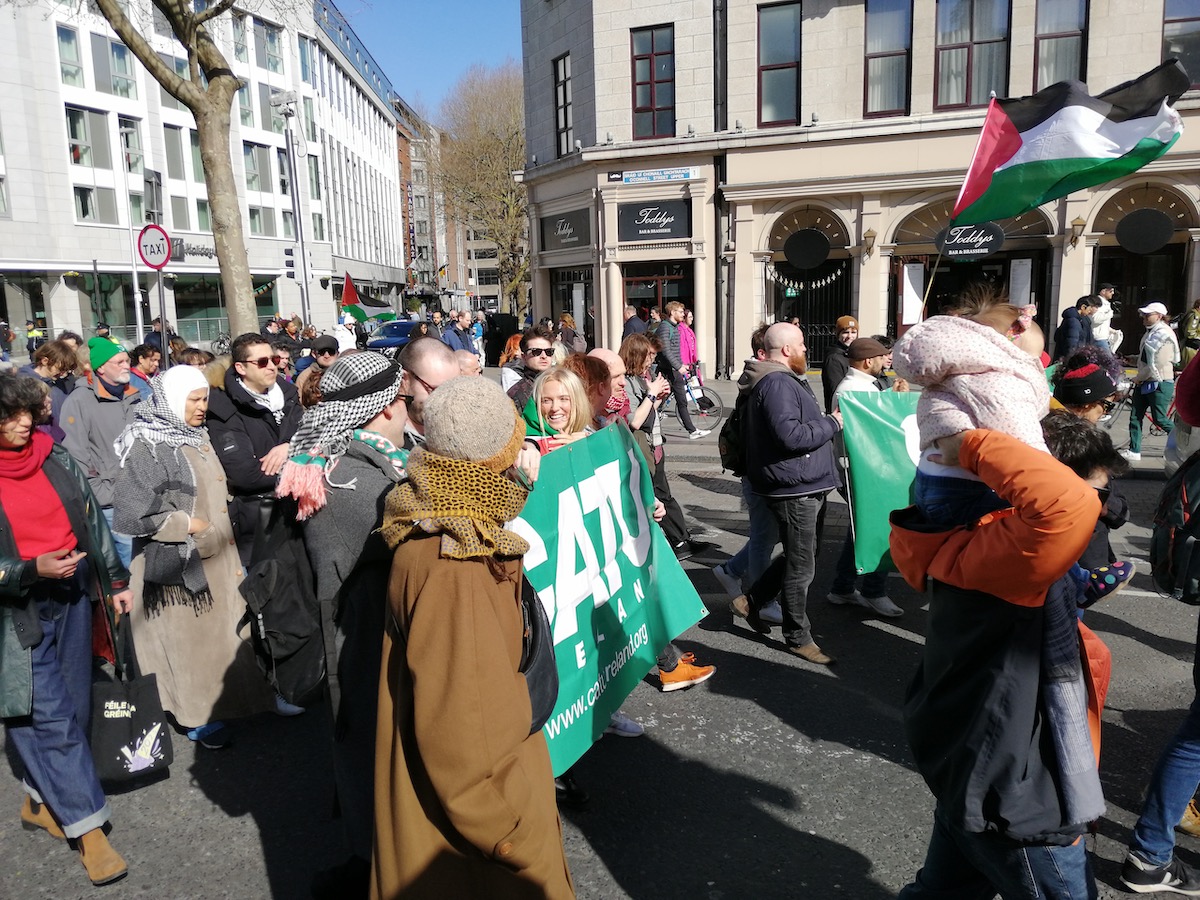
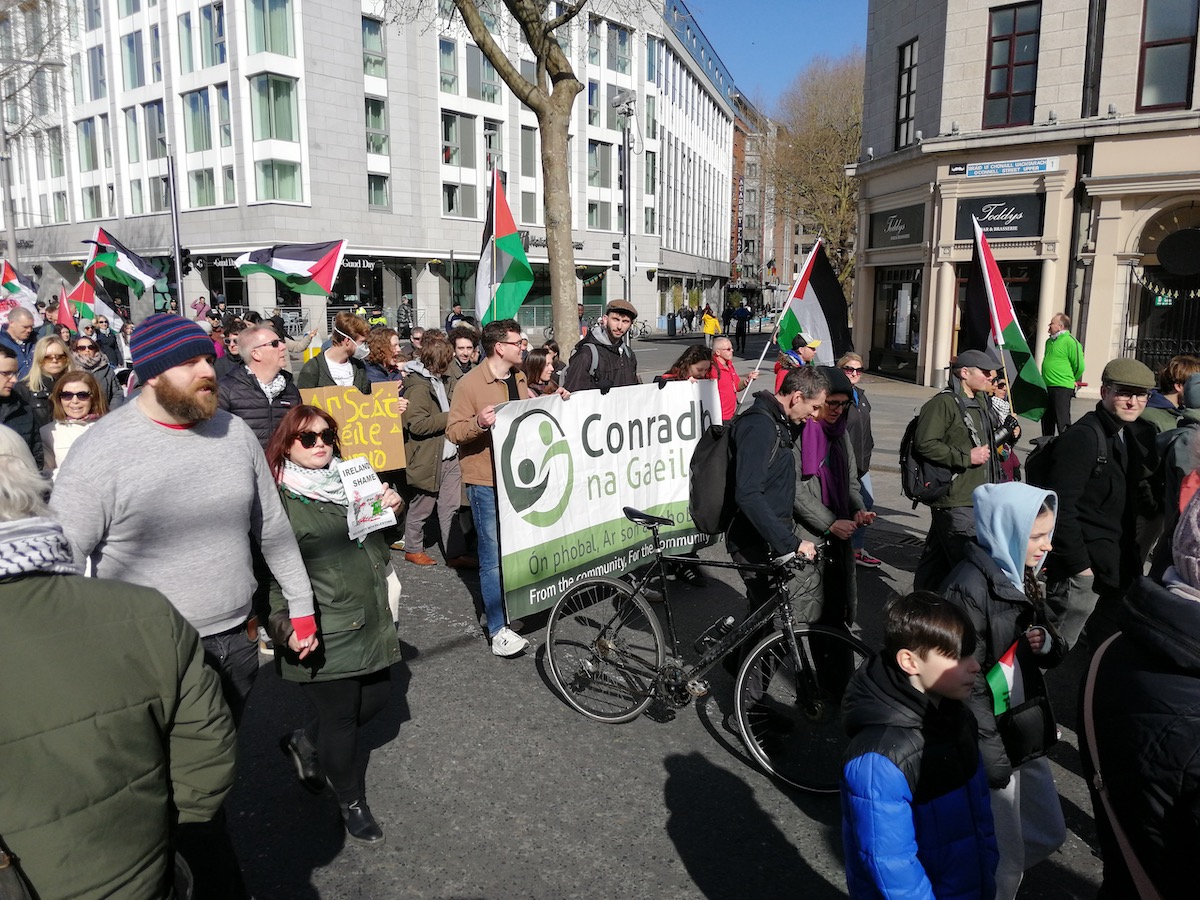
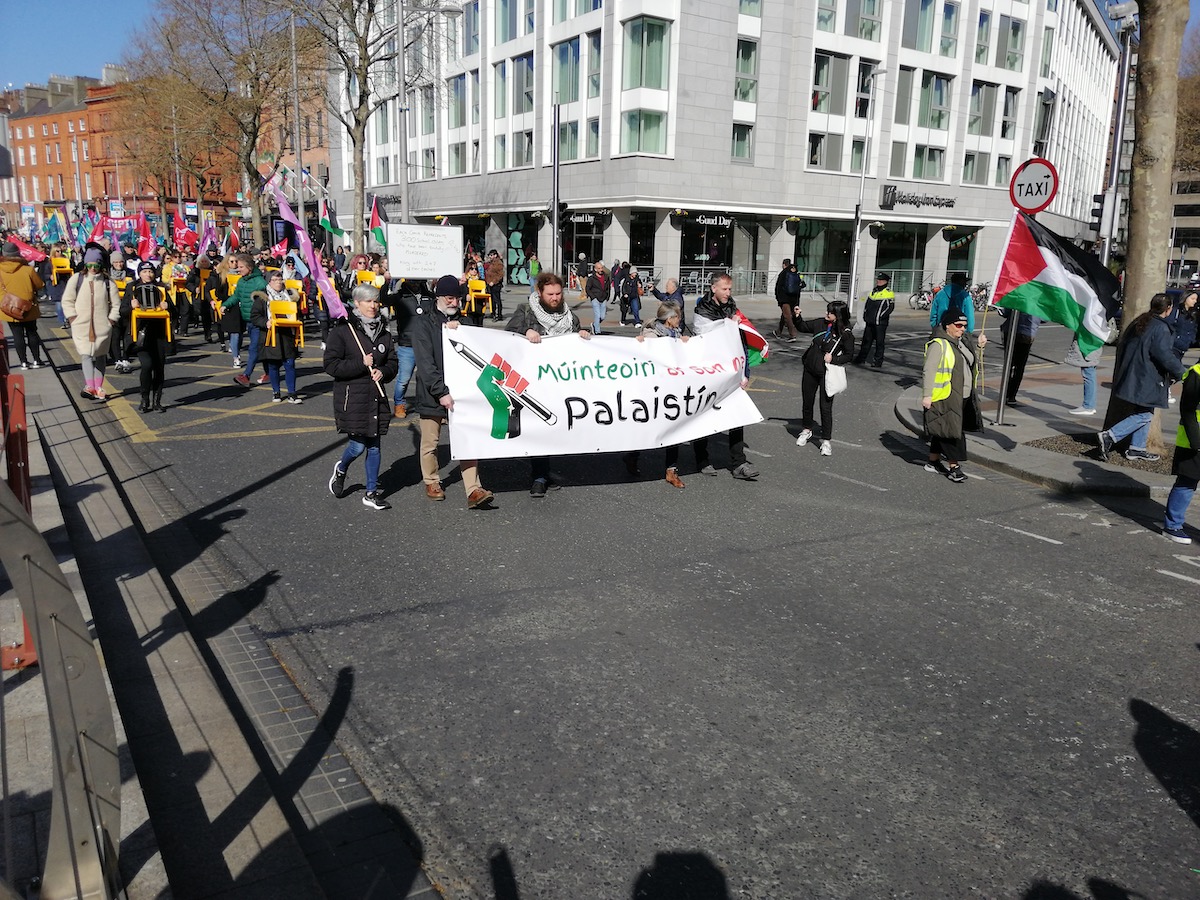
The Irish language NGO Connradh na Gaeilge had a group and banner on the march as has been the case for months, shouting among other slogans “Saoirse don Phalaistín!” A small group also had a banner in Irish declaring that they were Múinteoirí (teachers) ar son na Palestíne.
(Photo: D.Breatnach)
ART AGAINST GENOCIDE
(Photo: D.Breatnach)
The lines of baby romper suits or baby-grows made their appearance on the march again as did the bloody butcher image of Prime Minister Netanyahu, with a diabolical Biden on the reverse of the placard. A large ‘puppet’ of Biden with bloody hands was carried riding above the march.
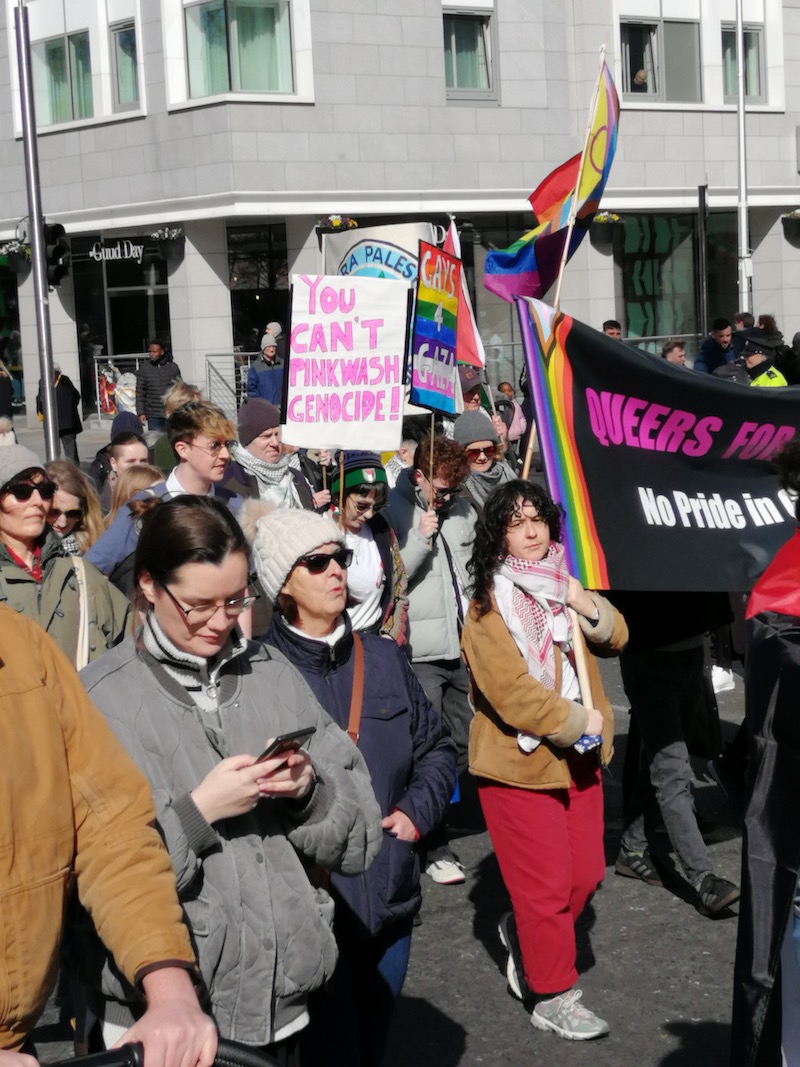
Tail end of Mothers Against Genocide followed by puppet of bloody-hands US President Joe Biden (Photo: D.Breatnach)LGBT section denounces Israeli state’s attempt to paint itself as liberal through decriminalising the LGBT community (Photo: D.Breatnach)
The A2-size beautiful coloured image of Palestinian resistance solidarity was seen again but however overall the variety and ingenuity of home-made placards seen previously had diminished.
The Mothers Against Genocide group carried their white bundles depicting the slaughter of Palestinian children and sang sentences in Arabic and Irish from Róisín Elsafty and Sharon Shannon’s song “An Phalaistín”, effectively interspersed with slogans.
(Photo: D.Breatnach)
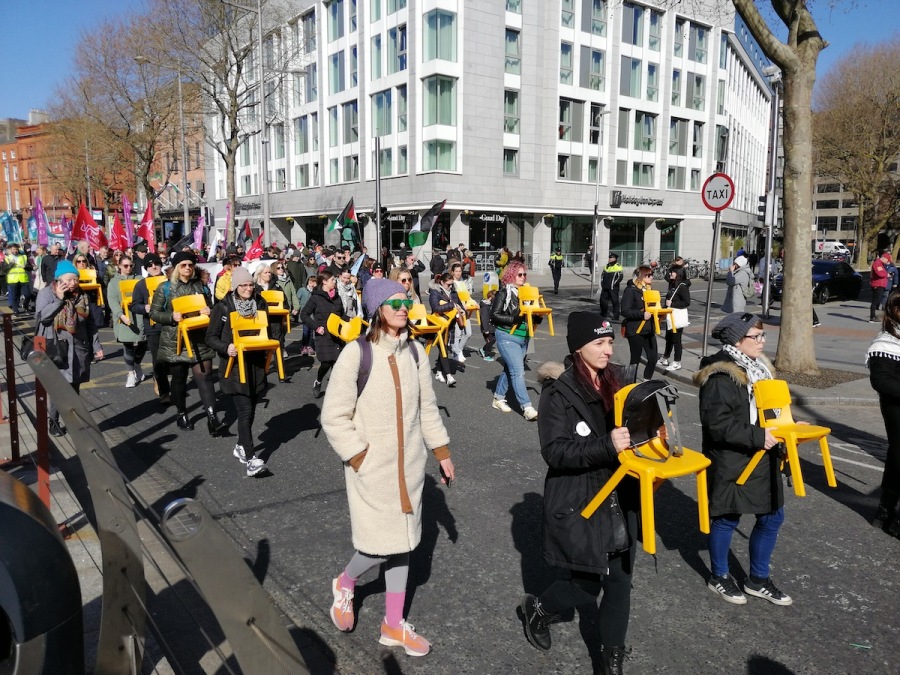
The sight that brought a hush over all witnessing it was the section carrying many yellow infant school chairs, a grim reminder of the huge daily ongoing Zionist genocide inflicted on the Palestinian children in Gaza.
End.
FOOTNOTES
1Mohammed Al-Fayed, Ahmed Barakat, Mahmoud Al-Fayeed (Resistance News Network on Telegram, 20/3/’24)
2Originally dedicated to those who fought for Irish freedom since the first Republican uprising in 1798 it has since been recognised as commemorating all those who gave their lives in the nation’s struggle for self-determination (though certainly officialdom would disagree with honouring those who fought that struggle since the founding of the current Irish state in 1921).
3These elements claim it is ‘treason’ for Irish people to support any other struggle than the Irish national one, which they conceive of as attacking immigrants and LBGT people. Their concept of “national struggle” has never included struggling against foreign occupation, supporting Republican prisoners, opposing multinationals’ exploitation of national resources and infrastructure or fighting for universal affordable housing.
4He might also have carried it concealed all along, with the intention of destroying it in front of the marchers; how it came into his possession is unknown to me at this point. He may have departed carrying both flags in his coat etc.
5It did not seem from a distance that the Gardaí had confiscated his Israeli flag but more likely he had been told to remove it from the pole while leaving the area.
6Despite the huge drop in the percentage of unionised workers in Ireland over recent decades.
On a day when the Irish Attorney General repeated Israeli Zionist lying propaganda in the ICJ and the Irish State’s expenditure of at least €8.5 million on Israeli military equipment was reported, people protested the Irish Dept. of Transport’s complicity at Shannon.
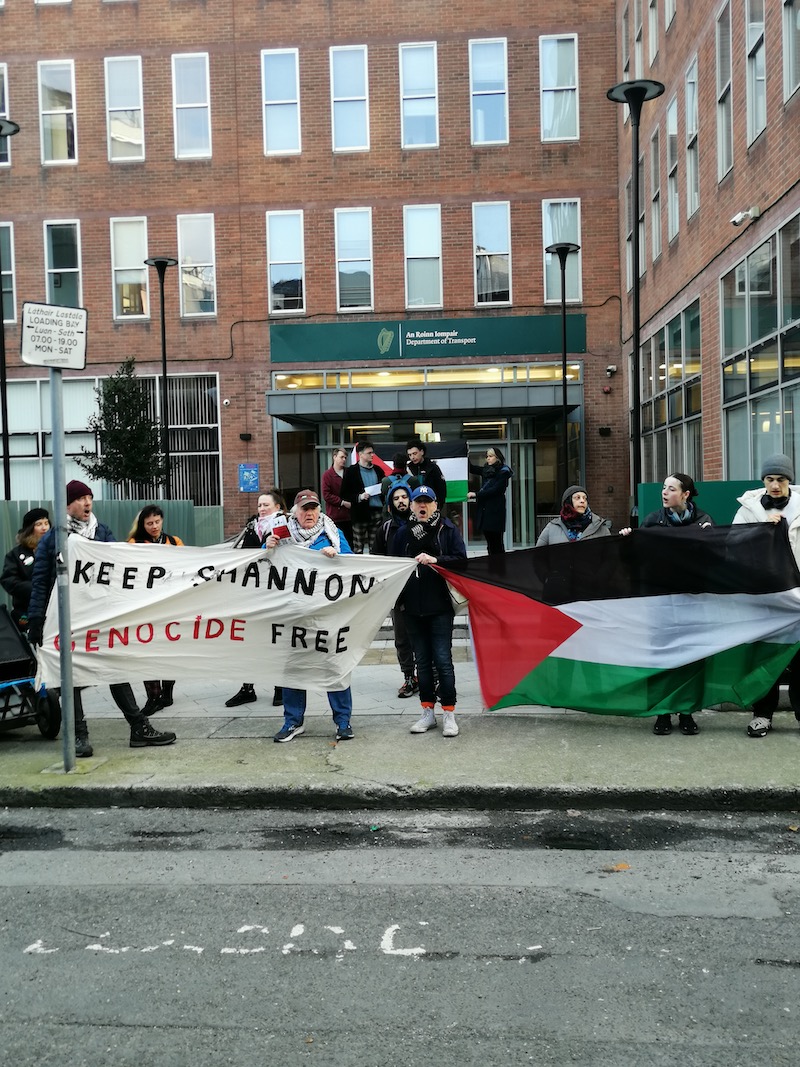
Around 30 protesters gathered with flags, banner and placards at short notice this afternoon outside the Irish Dept. of Transport’s office in Leeson Lane, Dublin 2 (very close to Stephen’s Green). They chanted: Irish Government you can’t hide – You’re supporting genocide!
View of some of the Palestine solidarity demonstrators outside the Dept. of Transport Thursday afternoon. (Photo: D.Breatnach)
Slogan chanting specific to the Dept. of Transport and to Ireland generally included: US warplanes – Out of Shannon! US Military – Out of Shannon! From Ireland to Palestine — Occupation is a crime! No peace – On stolen land! No justice – No peace! Resistance is an obligation – In the face of occupation!
Other chants included the now-familiar: 1, 2, 3, 4 – Occupation no more! 5, 6, 7, 8 – Israel is a terrorist state!1 From the River to the Sea – Palestine will be free! Free, free – Palestine! Boycott – Israel! Sanction – Israel! Saoirse don – Phalaistín! In our thousands and our millions – We are all Palestinians!
The Irish Department of Transport has Government oversight on the safe and appropriate use of airports within the Irish state. USA military use of Shannon airport in violation of Irish neutrality has repeatedly been witnessed and reported for decades.
(Photo: D.Breatnach)
The position of Irish Governments has been, without proof and in the face of collected evidence, that the US are not flying military material through the international airport. However, The Village magazine reported a significant increase in exemptions on such US traffic during the current war.
The Irish state, its deference to the world’s major superpower (as repeatedly shown by Government and even Opposition parties), declines to board the planes for inspection, though it is entirely legally entitled to do so and, in defence of neutrality, obliged, declines to do so.
Three people took turns to read out a short letter the organisers, Dublin For Gaza, had delivered to the Department of Transport, calling attention to the increased military flight exemptions through Ireland granted and on it to prevent military air traffic through Irish airports and Irish airspace.
Another view of some of the Palestine solidarity demonstrators outside the Dept. of Transport Thursday afternoon. (Photo: D.Breatnach)
Irish Attorney-General repeats Israeli lies in the ICJ
While many will be glad that the Attorney-General of the Irish State was in the International Court of Justice presenting a case that the Israeli State was colonising Palestinian land, unfortunately he repeated zionist propaganda against the Palestinian resistance.
Israeli accusations of rape against the Palestinian resistance fighters on October 7th, among other items of Israeli propaganda, have been thoroughly debunked but Fanning, the Irish Attorney-General repeated them as allegedly established fact in his presentation of the Irish case in the ICJ.2
He repeated the false accusation of rape against the resistance but also included others which ignore the effect of Israeli military bombardment, tank shells and Hellfire missiles fired from Israeli helicopters on October 7th against fleeing and captive Israelis.
As usual, he also ignored the thousands of Palestinian civilian hostages held and tortured by the zionist authorities, to exchange for which was the main reason for taking Israeli prisoners.
View of some of the Palestine solidarity demonstrators with the Dept. of Transport in the background Thursday afternoon. (Photo: D.Breatnach)
ELSEWHERE
UN: “… a UN report released on Monday by a group of UN experts expressed alarm over “credible allegations” of Palestinian women and girls being subjected to “multiple forms of sexual assault … by male Israeli army officers”.
The allegations include rape and detention of Palestinian women in cages, in addition to “photos of female detainees in degrading circumstances … reportedly taken by the Israeli army and uploaded online”
USA/ UN: The exposure of Israeli lies and western government acceptance of them continued with a US Intelligence briefing that the Israeli claims of UN refugee aid agency (UNRWA) workers participating in the Hamas operation “could not be independently verified.”
Let us recall that Israel, which hates UNRWA for providing aid to Palestinians in need and from time to time criticising Israeli abuses of Palestinian human rights, claimed to have intelligence confirming the participation of 12 UNRWA workers in the Palestinian operation on October 7th.
Without even seeing the Israeli ‘intelligence’, the UNWRA bosses sacked 10 workers3 and 10 western states, including the US and most of the EU, suspended their contributions to the agency’s funding, in other words cutting off food, heating and shelter to the Palestinians under Israeli attack.
UK: The negative impact on democratic norms by Israeli allegiance of the western powers was demonstrate by subversion of Parliamentary procedures in London yesterday in response to a scheduled motion from the Scottish National Party calling for an immediate ceasefire in Gaza.
The norms laid down are that the proposer of the motion speaks first and, if not carried by the required majority, amended versions proposed will be discussed and voted upon. The British Labour Party proposed an amendment calling for the ceasefire requiring the surrender of Israeli “hostages”.
If the SNP’s motion had gone forward, the indications were that many Labour MPs would vote for it against the instructions of the party’s ‘whips’ (party discipline enforcers). The Speaker of the House however allowed the Labour motion/ amendment to go to vote before the SNP’s!
The result was uproar in the UK Parliament and that Labour’s motion, more hostile to the Palestinian resistance, was voted and accepted and the SNP’s was never discussed.
Since then 60 MP’s have signed a petition demanding the resignation of the Speaker, a previous Labour Party member who, in order to demonstrate the Speaker’s political independence, had to resign from Party when he took up the post.
Frances Black speaking at the rally prior to the vote in the Seanad, Wednesday. (Photo: D.Breatnach)
Ireland: Though receiving little coverage in the mass media, a motion proposed by Civic Engagement Group members of the Irish Senate calling for an end to the Israeli genocide in Palestine and concrete Irish Government measure in support was passed without opposition.
Unreported by the media, a few hundred gathered outside Leinster House in a Palestinian solidarity rally and were addressed by two of the proposers, Frances Black and Alice Mary Higgins.4 A speaker for Healthworkers for Gaza, occasionally overcome by emotion, was given rapt attention.
A few minutes earlier, a colleague in blue surgical overalls was also applauded as she announced the group’s presentation of a petition signed by their colleagues. This action of support for their colleagues in Gaza however also underlined the abysmal failure of the relevant Irish trade unions.
The motion passed in the Senate has no enforcing effect on the Irish Government but adds its weight to that of a number of Opposition motions calling for the Government to support the genocide charge by South Africa in the ICJ and to expel the Israeli Ambassador.
Speaker for Health Workers for Palestine at the Palestine solidarity rally outside Leinster House prior to the Seanad vote Wednesday . (Photo: D.Breatnach)
It adds too the more widely demonstrated and visible solidarity with Palestine of the vast majority of the Irish population expressed in marches, pickets, demonstrations, opinion surveys and in beeps of support from passing vehicle traffic, from drivers of private, company and public transport.
The Irish state and government, like many throughout the world, continues in its failure to reflect the will of its people in this matter.
End.
Music piece composed for Gaza played at solidarity gig in the Olympic Theatre, Dublin, last November:
FOOTNOTES
1Though “fascist state” seems closer to the truth.
4Of the other two proposing Senators, Eileen Flynn was present outside Leinster House but did not speak and apologies were given for the absence of Lynne Ruane.
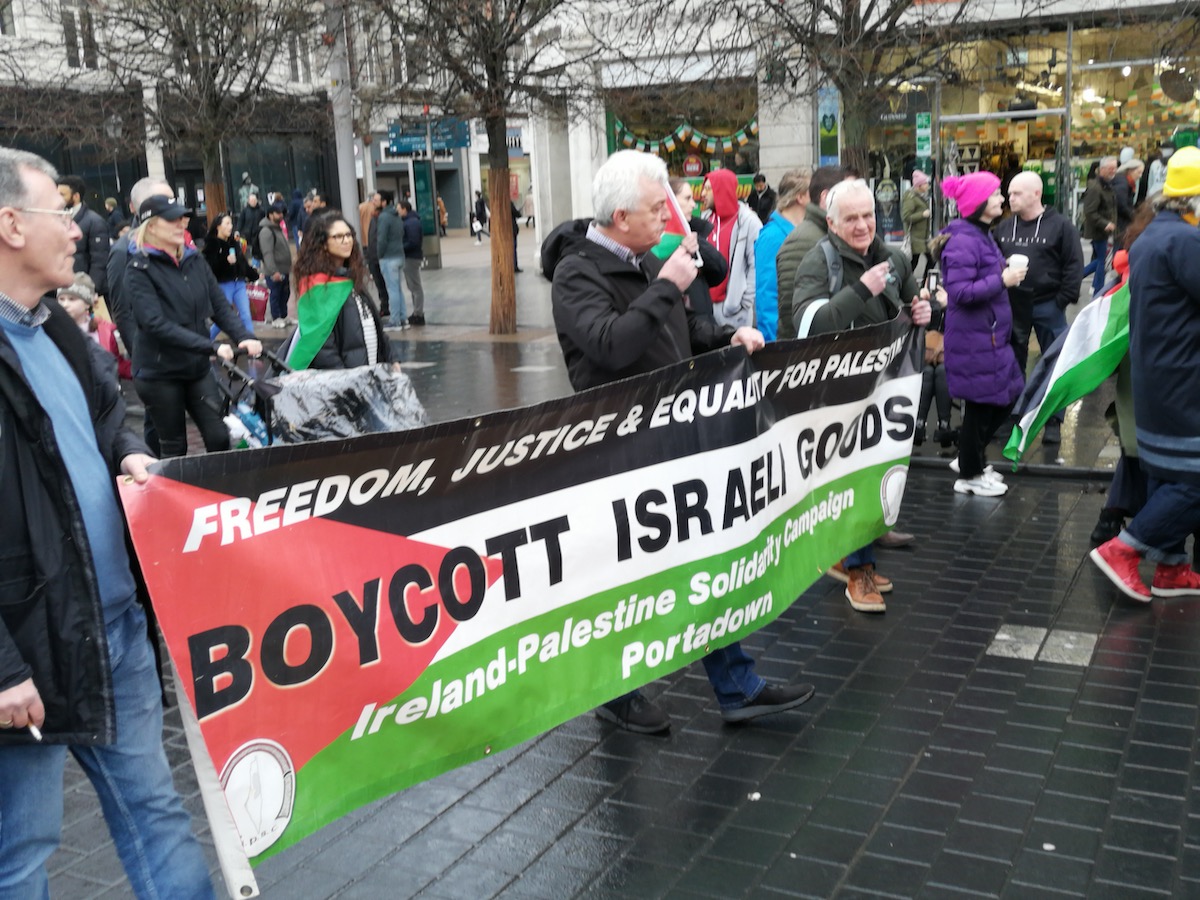
On a day when the Israeli military killed another 83 Palestinians, to bring the state’s death-tally since October 8th to almost 29,0001 known dead and thousands injured and missing,2over 50,000 people marched in solidarity through Dublin city centre.
The Israeli military is killing, on average, a Palestinian child every ten minutes.
Section of Mothers Against Genocide Ireland marching with bundles simulating children killed by Israel (Photo: D.Breatnach)
The national demonstration was convened by the Ireland Palestine Solidarity campaign and, though people came from all over the country and from many organisations, the numbers did not seem to quite match their last national demonstration, believed attended by 100,000.
As they marched from the Garden of Remembrance, the usual slogans were prompted and taken up in chanting responses: 1, 2, 3, 4 – Occupation no more! 5, 6, 7, 8 – Israel is a terrorist state!3 Gaza, Gaza, don’t you cry – Palestine will never die! Free, free – Palestine!
(Photo: D.Breatnach)
Taking over 20 minutes to pass through the north city centre’s O’Connell Street, they marched over O’Connell Bridge into D’Olier Street, through College Green and right into Dame Street, constantly chanting out the slogans4 of solidarity to which, by now, thousands have become accustomed.
From the River to the Sea – Palestine will be free! In our thousands and our millions – we are all Palestinians! Netanyahu (also Joe Biden, Western Powers etc) what do you say? – How many kids did you kill today? Zionist Ambassador – Out, out, out!
In some sections could also be heard: There is only one solution – Intifada revolution! Irish Government (also Western powers, USA), you can’t hide – You’re supporting genocide!
Section of the march about half-way through O’Connell Street, looking northwards. (Photo: D.Breatnach)Section of the march about half-way through O’Connell Street, viewing southward. (Photo: D.Breatnach)
The Irish Government, the EU and the Genocidal Israeli State
Among EU states, the leaders of the Irish Government have been the most pressing on the EU to call for a ceasefire and have now teamed up with the Spanish state’s current government leadership to press the EU to revise its preferential trade agreement with the Israeli State.
They are not likely to succeed since Germany and France have led the strident pro-Israel position of the EU, rejecting even a call for a humanitarian pause to deliver food, fuel and shelter to starving Palestinian refugees or any attempt to restrain the Zionists’ leaders from their genocidal bombing.
But in addition the main concern of the Irish Government ministers (probably Spain’s also) is that the whole situation is going to escalate further in Palestine and further, across the Middle East; in other words they are offering ‘good advice’ and concerned that it’s being ignored by Israel.
Children on the march – a reminder that the Israeli state kills a Palestinian child on average every ten minutes. Also Irish language flag and placard in this photo employing the “Saoirse don Phalaistín” slogan. (Photo: D.Breatnach)
In any case, although the USA is the main supplier of finance and arms to Israeli Zionism, the EU is by far the Zionist state’s largest export market and could stop the genocide tomorrow with an ultimatum to stop bombing or face an embargo on Israeli products.
The International Court of Justice determined that the Israeli State is plausibly guilty of genocide but declined to order a ceasefire and again during the week rejected a South African application to order a cessation of genocidal actions though it did warn the zionists not to commit genocidal acts.5
Meanwhile the UN court is to begin hearings on Monday to determine whether the Israeli occupation is guilty of practising apartheid but the verdict is months away and the Israeli State continues its genocide unabatedly.
Palestinian solidarity in the Irish language
Small banner, group unknown with what has become a common slogan in Irish. (Photo: D.Breatnach)
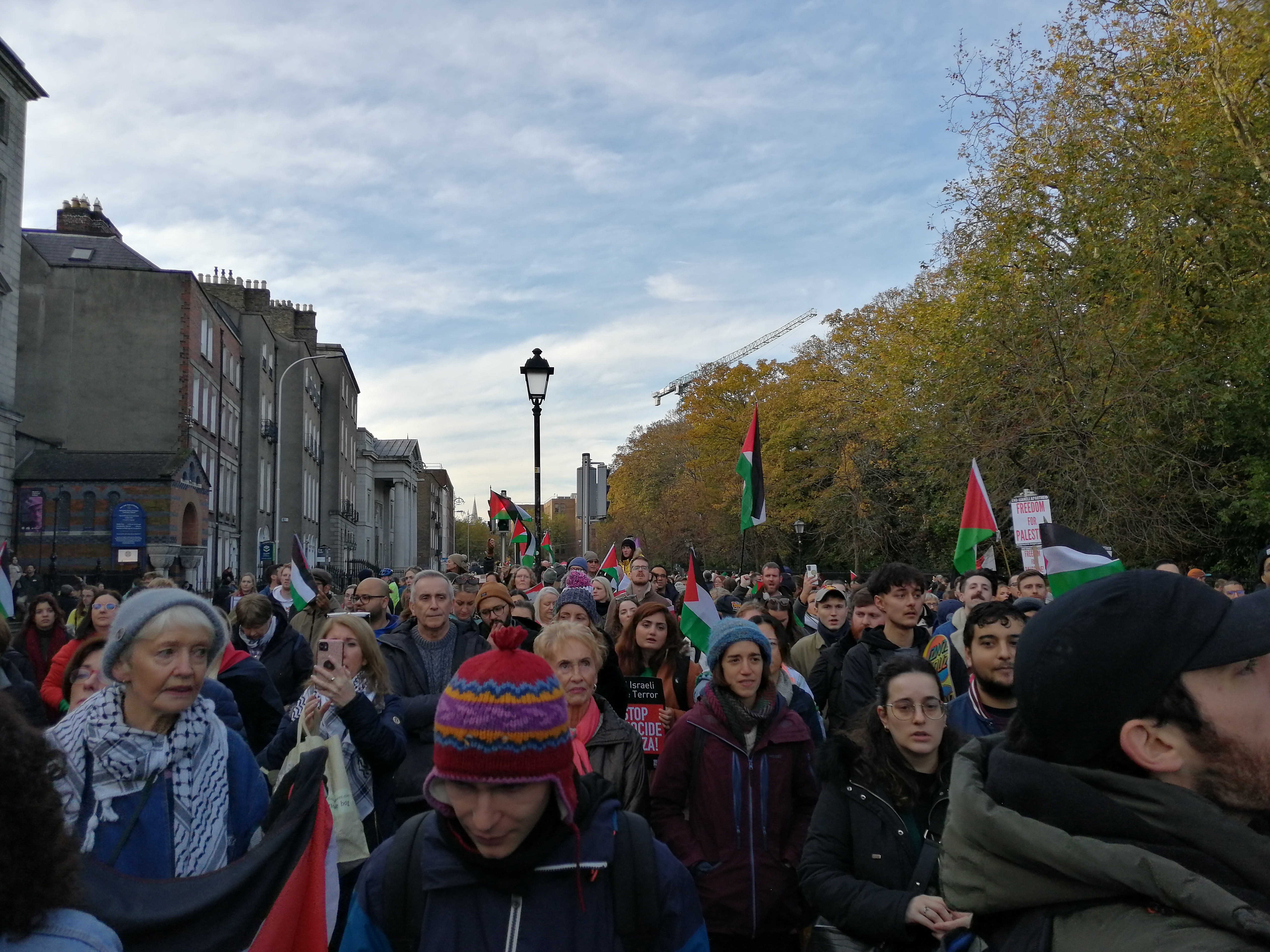
At the junction with South Great George’s Street the marchers turned left and continued up into Aungier Street and then left again into Cuffe Street with people gathered on the pavements and at junctions, sometimes applauding but never expressing hostility.
A number of slogans and messages of solidarity in the Irish language could be seen on placards, flags and banners; two of the latter calling for Saoirse don Phalaistín. One of the banners had a large group behind it which included marchers calling out slogans in Irish.
Ón dtalamh go dtí an spéir – Beidh an Phalaistín saor! Stad an slad!
The Mothers Against Genocide group used Irish too, singing the chorus from Róisín Elsafty’s song and video with Irish and Arabic: A Phalaistín, a Phalaistín, hosni alaikum ya falastin. (Good luck to you, Palestine) and mixed the singing with chants of solidarity.
(Photo: D.Breatnach)
Once reaching the south side of Stephens’ Green,6 where the IPSC stage was set up near the Department of Foreign Affairs’ building,7 many marchers just stopped, began socialising, folding up banners or just going off for coffee etc (some also had long journeys ahead to return home).
Of course some stayed to hear speakers and performances but I didn’t.
Once again the thought struck me that this period could be used to advantage in small public meetings on the street but removed from the central stage; different currents in the solidarity movement could be discussed, along with basic principles and demands in our solidarity.
(Photo: D.Breatnach)
Collusion and Repression
As a Sinn Féin contingent self-identified by banners and placards marched in, some greeted them with Oh hey, oho! — No shamrocks for Genocide Joe! in a clear rebuke to the party’s leader’s intention to celebrate St. Patrick’s Day with the US President at the White House.8
Passing through the southside’s city centre afterwards, people were frequently seen wearing Palestinian keffiyehs in various colours (black and white, red and white, green and white and the Irish green, white and orange version) as were people walking with furled Palestinian flags.
Indeed, action the health worker unions could have taken but failed to do so (Photo: D.Breatnach)
At least two people were arrested by Public Order Gardaí for demonstrating in the city centre outside Israeli-colluding businesses, to be bailed until their case in March, amid reports9 that activists have been threatened with charges and court for December’s Israeli Embassy occupation.
Although people came from many parts of Ireland, there were smaller solidarity demonstrations in many of those too.
2Another 7,000 are believed buried under rubble of buildings bombed by the Israeli military. Palestinians had very little undamaged digging and earth-moving equipment and the pieces of masonry are often massive but they do try and dig through it, often with their bare hands.
3I think “israel is a fascist state!” would be entirely appropriate.
4“slogan” in English is of Irish-language origin, perhaps via Scottish Gaedhlig, from ‘slua/ slóga’ = “a host/ large gathering, troop” and ‘gairm’ to “call, address”. The original root is of Indo-European origin.
5Which the Israeli State has continued to do every single day since the ICJ initial judgement, killing thousands of civilians since then and bombing and invading hospitals.
6As in most parts of Dublin city the Green has been the scene of important historical events but this one perhaps more than most: it was a 1916 battleground, the location of a force of mostly Irish Citizen Army during the 1916 Rising before they were forced to relocate to the Royal College of Surgeons, where the garrison remained until the surrender. The Commandant Michael Malin and another senior officer, Constance Markievicz, were both sentenced to death by British Army military court. Michael Malin was shot dead by firing squad but Markivicz’s sentence was commuted to life imprisonment.
7A Palestine solidarity activist accused of ‘decorating’ the building with red paint in protest at the Government’s collusion with Israeli zionism was in court last week, having been raided at 7am, arrested and charged. The case has been deferred until next month.
8In a Belfast meeting organised by the party in Palestine solidarity recently a small group of Palestinians were ejected for pointing out that one of the speakers, the Palestine Ambassador is “a mouthpiece of the Palestine Authority” which is an undemocratic organisation working in collusion with the zionist occupation and has not held an election since 2006 (though supposed to do so every five years).
Members and management of the Dublin Ladies Senior Football Team (Gaelic Athletic sport) made a courageous public stand in solidarity with Palestine on Saturday and called for a ceasefire.1 However, the call is misguided.
Their motivation and courage is admirable and they are not to be blamed for the error. On an IPSC Palestinian solidarity protest through Dublin’s Henry Street yesterday which spent some time outside Axa Insurance protesting, the ceasefire call was also being chanted.
Destruction of entire neighbourhoods in Gaza in October 2023 (Photo cred: Wafa)
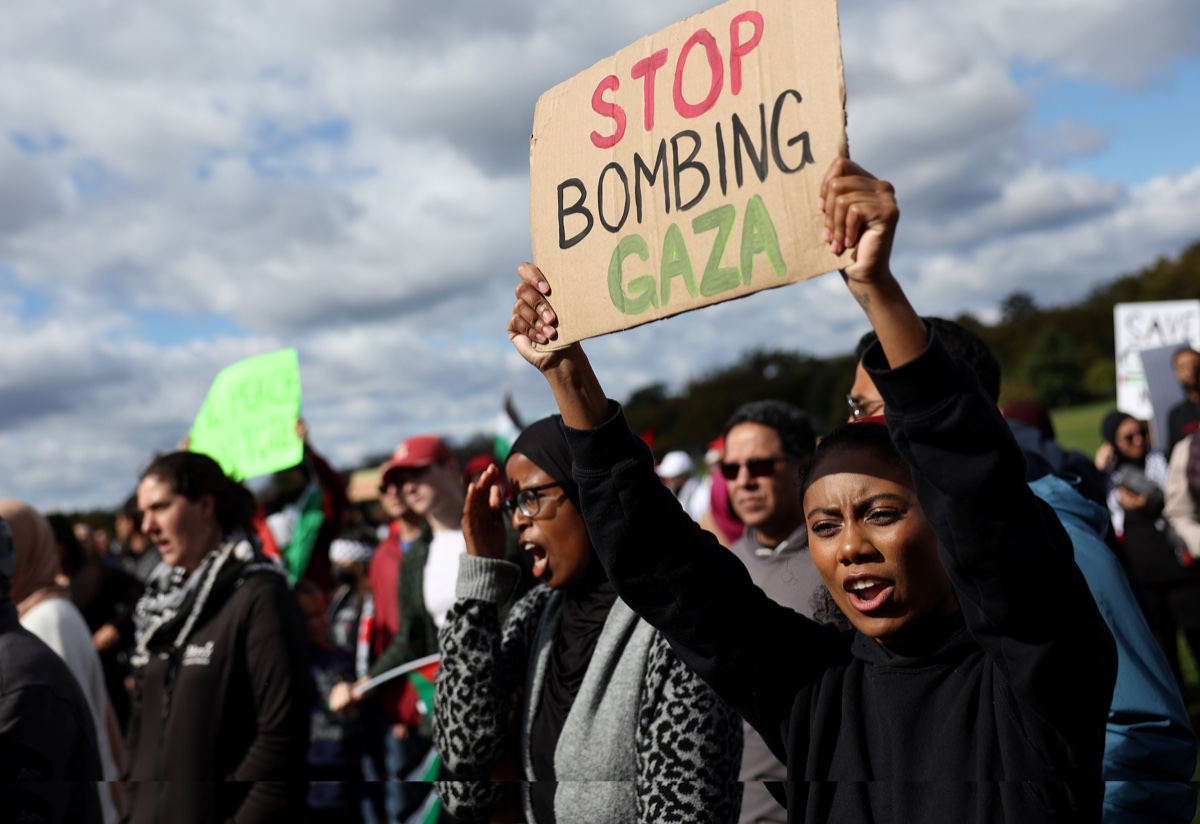
When those who have leadership positions in the solidarity movement make incorrect calls many will follow. I have heard activists of a number of Left political parties making the same call on Palestine solidarity demonstrations and, before I thought about it, joined in myself.
WHY IT’S WRONG
What most people making the call want is probably to save the lives of the remaining Palestinians being subjected to genocide by the Israeli state but a ceasefire, by definition, is a temporary measure only. Even without the usual Israeli violations during it, they return to the bombing afterwards.
That is not, I believe, what most people want. So why not call for what we do really want, such as “Stop the bombing! Stop it now!” Or better still: “End the bombing – end it now!” We could follow that up with a longer-term slogan like “End the occupation – end it now!”
The other thing about a “ceasefire” call is that it ties in to imperialist and colonialist propaganda that this is a war “between two sides”, in which “the legitimate State of Israel” is one side and the “Hamas terrorists” are the other, instead of between a Zionist colony and the Palestinian people.
Along with that, the ceasefire call conveys the impression of two equal sides. The Zionist state is one of the most advanced military states in the world whereas the Palestinian guerrilla resistance has no air force, no navy, no artillery and no armoured war machines.
And “a ceasefire” is imposed on both antagonists. Are we really calling for restrictions to be imposed on whether or when the Palestinian resistance can decide to strike at their racist occupiers?That’s what makes the call for a “permanent ceasefire” worst of all.
Palestine solidarity demonstration in the USA in October 2023 (Photo: Justin Sullivan via Getty Images)
The Palestinian resistance may indeed agree to a ceasefire, as it did previously, for the exchange of prisoners and/or the allowing of safe passage of humanitarian supplies (the reason humanitarian agencies are calling for it); that is a tactical decision, as indeed it is also for the zionist State.
While we would not ordinarily oppose that kind of ceasefire that is up to the Palestinians to call for. For our part we should be calling not for Ceasefire Now, much less for Permanent Ceasefire Now but instead for End the Bombing Now and for an end to the Occupation.
End.
Footnote:
1Before their match they displayed a placard or banner calling for “Sos comhraic sa Phalaistín”, literally ‘a break or rest during conflict’ or, in other words, a ceasefire (not ‘a truce’, as translated by one of the tabloids, which is a related but separate concept). Their full statement (see Balls report) is well worth reading and though non-political, certainly puts our Government and the EU to shame.
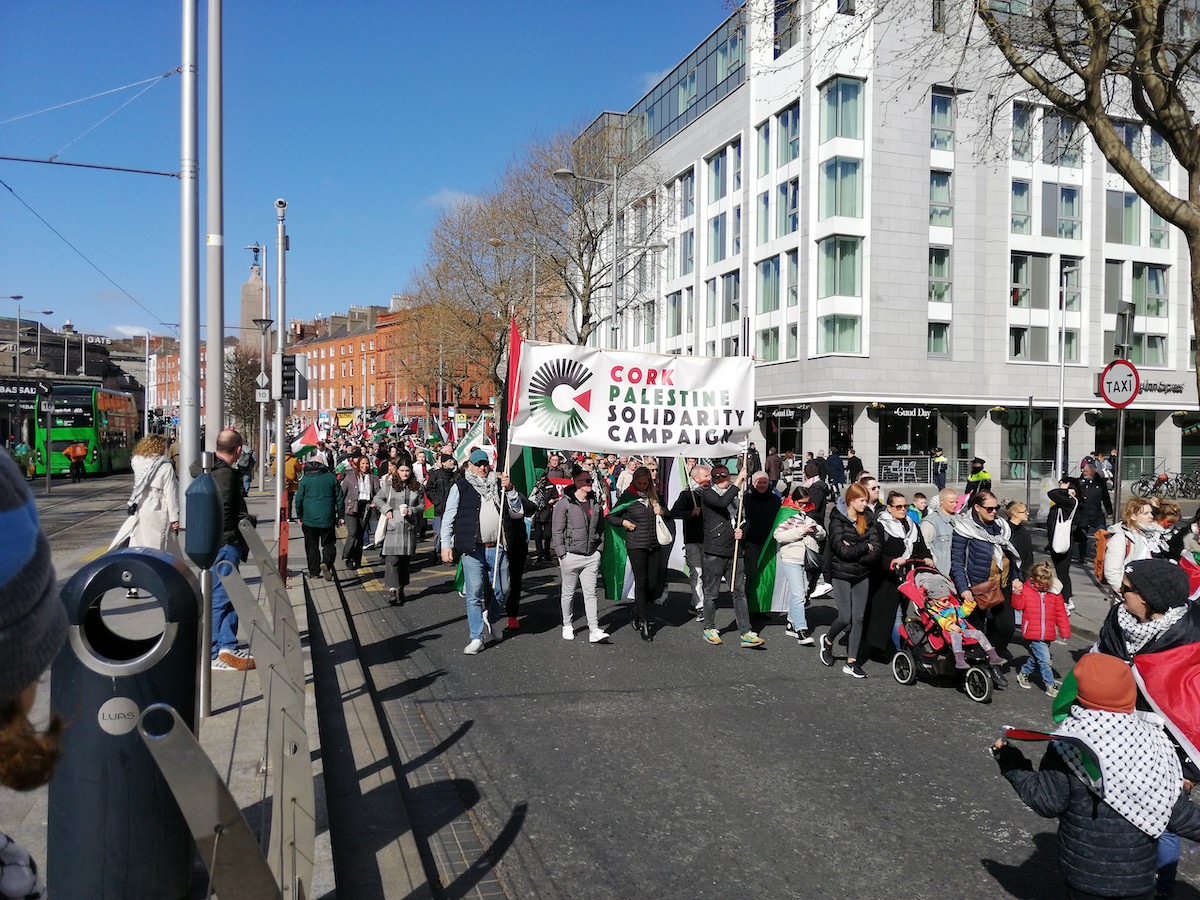
A Palestine solidarity demonstration of around 10,000 in Dublin on Saturday the 11th included a bloc marching behind a banner bearing the legend Saoirse Don Phalaistín and another demanding the expulsion of the Israeli Ambassador.
Since the beginning of Israel’s bombardment of Gaza, Dublin has seen at least two large solidarity events every week, one mid-week and another on Saturdays, marching to the Israeli and USA Embassies or, like this one, to the Irish State’s Department of Foreign Affairs.
(Photo: Rebel Breeze)(Photo: Rebel Breeze)
In addition, there have been smaller more radical events, such as the 2-hour occupation of the offices of Qanta Capital, the landlord of the Israeli Embassy, also another of the Clarence Hotel, recently bought by an Irish company with a loan from an Israeli bank.1
Also the occupations of offices of the Irish Dept. of Transport and of the European Commission2 and a weekday evening rush-hour protest on the forecourt of Dublin’s Connolly Train Station, which hosts major east coast commuting and northern city destination lines.
Section of the march in Cuffe Street, many still behind in Aungier Street (Photo: Rebel Breeze)
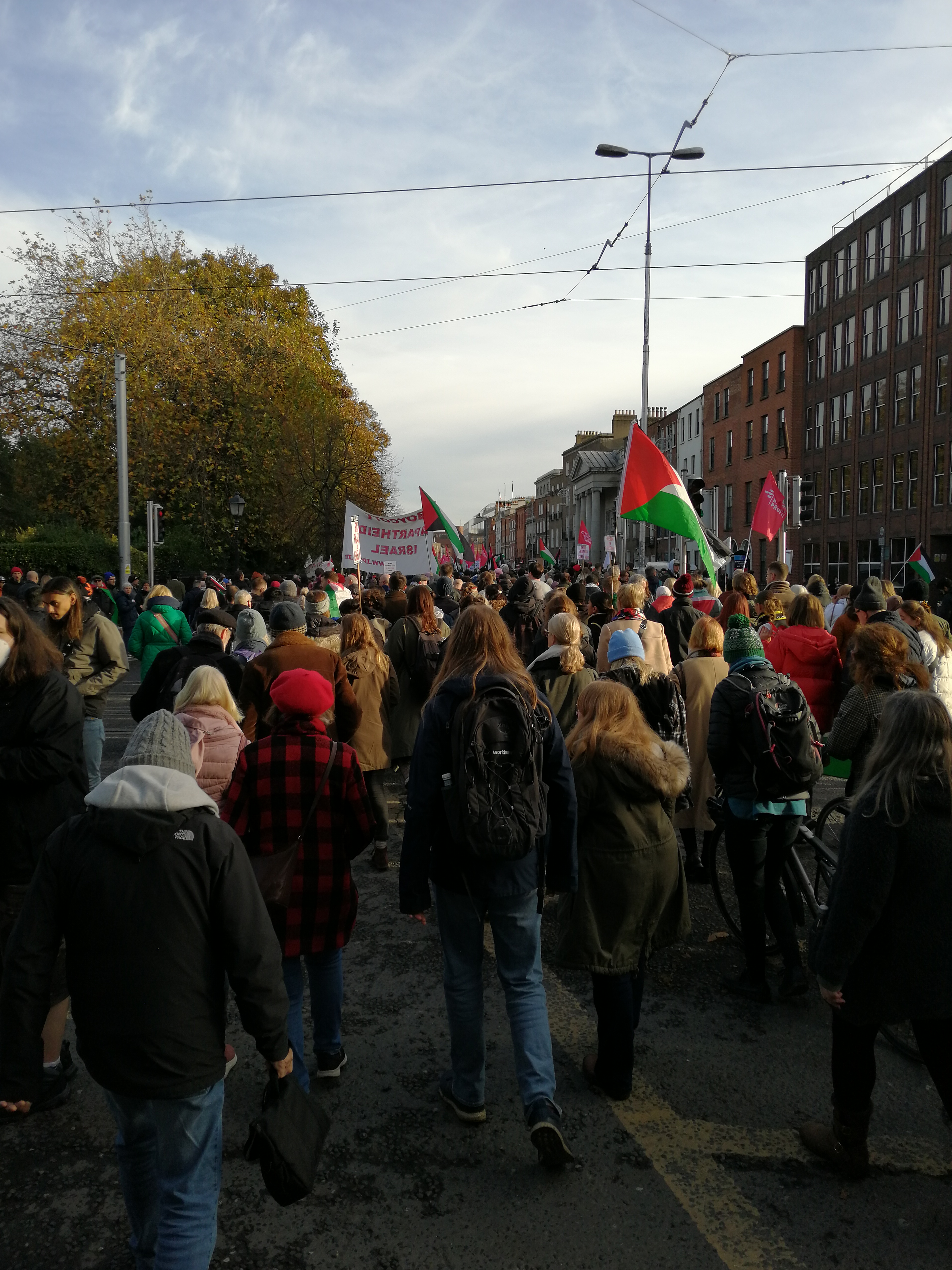
On Saturday the march began as usual with a 1.00pm gathering in the city centre, the rear of the densely-packed marchers still in O’Connell Street as the rest had crossed the river into Westmoreland Street, swung into College Green and Dame Street underway to George’s Street.
At one point the march called by the IPSC3 stretched from George’s Street all along Aungier Street, the front had turned into Cuffe Street and was already marching towards Stephen’s Green. The Department of Foreign Affairs is located on the east side of the famous inner-city park.4
The front of the march marching along Stephen’s Green East while the rest is still in Cuffe Street and Aungier Street (Photo: Rebel Breeze)
The bloc marched along gathering people behind as it did so, shouting among others the slogan “Saoirse – don Phalaistín!” and “Zionist Ambassador – Out, out, out!” which was taken up by many, including those who seemed to be Palestinian or at least from the Middle East.
At a separate point, a few professionally-printed placards in Irish could be seen too, e.g “Stad an Slad” and a flag in Palestinian colours with “Saoirse don Phalaistín” printed upon it.
(Photo: Rebel Breeze)
The other slogans that have become standard were shouted also, including the one claimed to be ‘anti-semitic’, ‘terrorist’ and ‘against the law’ by the recently sacked UK Minister of Home Affairs, claimed to be “anti-semitic” and ‘against the law’: “From the river to sea, Palestine will be free!”
Mobbing and threats by British fascists to Palestine supporters5 on the gigantic solidarity march in London on Saturday6 that ended in scuffles with the police were linked by a number of senior politicians to Braverman’s extraordinary claims of police partiality to the demonstrators.
Braverman alleged that London Met police went softly on Palestinian solidarity demonstrations in allowing them to take place while some extreme right-wing mobilisations in the past had been sternly treated – a fantastic claim as any antifascist activist in London knows well.
Section of the crowd standing behind the Saoirse don Phalaistín banner (Photo: Rebel Breeze)
In Dublin on Saturday, upon reaching Stephens Green, the bloc stopped short of the rally outside the Dept. of Foreign Affairs where in any case the crowd was so large that the PA system of the organisers was of insufficient strength to convey to all the words of the scheduled speakers.
A large section of the march stopped behind them and a space cleared in front, at the fringes of which the people turned and joined in the bloc’s almost incessant slogans, at times applauding them. To the solidarity slogans that have become universal, those in the bloc added another two.
Section of the crowd who have turned to face the Saoirse don Phalaistín banner, many joining in the slogans. The speakers’ platform is further beyond outside the Dept. of Foreign Affairs building. (Photo: Rebel Breeze)
These were “There is only one solution – Intifada revolution!” and “Zionist Ambassador – Out, out, out!” Those slogans draw a line away from the liberal demands of “peace” and “negotiations” since the only “peace” that can exist in Israel is a pause before the next bombings.
(Photo: Rebel Breeze)
“Saoirse – Don Phalaistín” was repeated and “Stop the bombing – Now!” seemed at one point to be offered as an alternative to “Ceasefire Now!”7
They also called for serious political repercussions for Israel in the expulsion of its representative in the Irish state, its Ambassador. Currently seven states have expelled Israel’s ambassadors or recalled their own – but none of them are members of the European Union.
Section of the crowd outside the Department of Foreign Affairs (Photo: Rebel Breeze)
The Irish State IS a member of the EU and a symbolic act such as the expulsion of the representative of the Zionist state would have huge reverberations. On Wednesday motions on expulsion of the Ambassador will be debated in the parliament of the Irish State.8
Also, the Sinn Féin party, whose leadership recently reversed their opposition to the expulsion of the Zionist representative, will be calling on the Government to refer Israel to the International Criminal Court for investigation of war crimes.
While this might be of some use as a propaganda move, that Institution has never judged a state nor indeed anyone for war crimes who is part of the western imperialist coalition – which Israel most evidently is.9 The proceedings also tend to be very slow.
All in all, not only will such an action not be effective even if agreed, it will likely serve as a distraction from actions much more likely to be effective, such as expulsion of the Zionist Ambassador, along with arms and other trade sanctions.
(Photo: Rebel Breeze)
A rally has been called to take place outside the home of the Irish parliament, Leinster House, Kildare Street at 6pm on Wednesday10 and a national demonstration on Saturday, starting at 1pm from the Garden of Remembrance.
End.
Some demonstrators walk through Stephens Green after the march. (Photo: Rebel Breeze)
FOOTNOTES
1By activists of the Irish Anti-Imperialist Action group.
3The Ireland Palestine Solidarity Campaign, for decades the main Palestine solidarity organisation in Ireland.
4Which is coincidentally, a 1916 Rising battleground.
5One of the irritants to British fascist mentality was that the Palestine solidarity march was taking place on Armistice Weekend, an annual event including ceremonies commemorating the dead in battles of the UK’s armed forces, one major period which was ironically as part of the Allied forces in the War Against Fascism 1939-’45.
7A ceasefire usually means everyone stops firing where they are, which could be interpreted as binding the Palestinian resistance to leave the Israeli military in occupation of Gaza without retaliation, which some have criticised as favouring the Israeli Zionists.
8The Social Democrats party have tabled the motion, which will be supported by the Sinn Féin party and by People Before Profit party, along with a number of Independents. The Coalition Government of Fianna Fáil, Fine Gael and the Green Party have stated they will oppose it. At this moment the leadership of the IPSC continues to abstain from making such a call


































 rebelbreeze