USA DEMOCRATS AND COLOMBIA: BUSINESS AS USUAL

By GEARÓID Ó LOINGSIGH

(Reading time: 8 mins.)

— BOGOTA — The recent election of Joe Biden as president of the U.S. has been met with a round of applause from left reformist currents in Colombia, some even eager to claim Biden as one of their own. Underlying such praise is the notion that the Democrats are more progressive and will treat Colombia fairly, or at least better than the Republicans. There is no evidence on which to base such a claim.

Historically, some of the greatest blows to Colombia have come from Democratic administrations, starting with the smiling, handsome, charismatic JFK, whose policies left few smiling in the country. It was under JFK that two U.S military delegations visited the country and made recommendations that the Colombian state set up armed civilian groups, which are now commonly referred to as paramilitaries. By 1965, Colombia introduced legislation to give effect to those proposals and thus began a long sordid history of the state setting up death squads and providing them with legal status.

Of course, JFK was a long time ago, some would argue, though obviously no Democrat would countenance publicly criticizing him on such matters. Many of those who rushed to endorse Biden are unaware of this aspect of their history, but not so, the leading politicians such as Senator Gustavo Petro, a former mayor of Bogotá and the most successful left-wing candidate for the presidency ever. They are only too aware of the history of paramilitary violence in the country, yet prefer to ignore it on the altar of realpolitik.

The most recent embodiments of charming, handsome U.S. presidents also get a free pass now, just as they did when they were in power. Bill Clinton is perhaps the most notorious of recent U.S. presidents whose policies can be measured in bodies, forced displacement, and the mass destruction of the environment through the aerial fumigation of coca crops. Clinton was the architect of Plan Colombia, a massive supposed anti-drugs policy, which strengthened the Colombian military and under the guise of a concern for public health helped the Colombian military gain the technical and logistical capacity to wage war, including the expansion of paramilitary units throughout the country.

“Handsome US Presidents”, in particular Democratic ones, have helped Columbian ruling circles carry out a murderous reign of terror against social activists. (Photo source: Internet)

Plan Colombia was of course, implemented by George W. Bush as Clinton finished his second term shortly after concluding the agreement, a sign that policy on Colombia has always been bipartisan. When Clinton announced the initiative he lied. He stated that the motives were public health ones and that cocaine was killing 50,000 people per year in the U.S., when at the time the CDC put the figure for all deaths from all drug abuse, excluding alcohol and tobacco, but including legal pharmaceuticals at just over 15,000. Alcohol alone doubled that figure.  The ruse worked and Congress passed Plan Colombia, thanks in part to Biden, who fought for the plan in the Senate Foreign Relations Committee. Clinton finished his term with controversial presidential pardons, including Marc Rich, but in Colombia, he is remembered for his clemency deal with Harvey Weinig, a U.S. lawyer convicted of laundering $19 million for the Cali Cartel.[1]  Whilst attacking impoverished farmers, he indulged the wealthy individuals higher up the chain.

Thanks to the Plan, paramilitaries swept through the country taking over, not only rural areas, but some major urban centers. The Colombian military was in a position to aid them in that and also hold on to those areas, once the dirty work had been done. Their first targets were areas of military and economic strategic importance, with gold and oil deposits and also areas that were earmarked for major transformations in the rural economy. As part of this drugs initiative, peasants were “encouraged” to switch crops. Plan Colombia financed major agribusiness projects, particularly African Palm, and in preparation for the Free Trade Agreement that would be signed under Bush but come into effect under Obama, the country geared its agricultural production toward export markets and opted for importing basic food staples such as rice, beans, and cereals. For example, corn imports from the U.S. began to decline notably from 2008 onwards, but once the FTA came into force in 2012 under the Obama administration, the year of the lowest amount of corn imports in a long time, they quickly increased and by 2016 almost doubled the figure for 2008. By 2018, 80% of all corn consumed in Colombia was imported and barely 20% was produced nationally.

Thanks to Bill Clinton and Obama, Colombia is now one of the major recipients of military aid. Between 2001 and 2019, it received $9 billion in aid, just over 66% of it under the guise of anti-narcotics aid.[1] All anti-narcotics operations in Colombia involve the deployment of ground troops following the strafing of farms by helicopters, displacement of peasant farmers, threats and not infrequently the murder of leaders in the areas. Furthermore, many of these soldiers involved in operations were trained by the U.S. In the same period, 107,486 Colombian military personnel received training from the U.S., making it the largest recipient of such training followed by Afghanistan.[2]Both the aid and training reached their peak under Bush, as part of Clinton’s Plan Colombia, but continued steadily under Obama, though government to government and private arms sales peaked under Obama.

Barak Obama when he was US President with Vice-President, now President Joe Biden. Obama’s presidency was a disaster for the Colombian people and his running mate then, now President too, looks set to follow in his footsteps. (Photo source: Internet)

Nothing could stop Biden and Obama from backing their murderous ally to the south, not even the False Positive scandal. The so called False Positives entailed the luring of young men to rural areas with the promise of work, who were then dressed up in military uniform and executed and presented to the media as guerrillas killed in combat. Amongst the victims were impoverished working-class men, children with cognitive impairments, and even included the kidnapping and murder of professional soldiers recovering from wounds received in combat. The scandal broke in 2008, following the murder of 22 young men from the city of Soacha.

In his preliminary report the UN Special Rapporteur Phillip Alston stated: “But there are two problems with the narrative focused on falsos positivos and Soacha. The first is that the term provides a sort of technical aura to describe a practice which is better characterized as cold-blooded, premeditated murder of innocent civilians for profit. The second is that the focus on Soacha encourages the perception that the phenomenon was limited both geographically and temporally. But while the Soacha killings were undeniably blatant and obscene, my investigations show that they were but the tip of the iceberg.”[3]

He did say they were widespread but not official state policy. However, every soldier who killed one of these young men was paid a bonus by the then Minister of Defense, Juan Manuel Santos, who would become president in 2010. Santos enjoyed the support of Biden and Obama during his tenure and although he began peace talks with the FARC guerrillas in 2012, his regime never stopped murdering social leaders. From 2012 to 2018, 606 social leaders were murdered; there were a further 3371 other acts committed against these leaders, including threats, displacements, and prosecutions. None of this caused Biden or Obama to express their concern. It was business as usual for them. The total number of False Positives is now calculated to be in the region of 10,000 youths, and despite Alston’s diplomatic statement that it was not official policy, no one buys that. We are not even sure whether Alston himself could stand by that statement, outside of his role as a UN diplomat.

It is true that the current regime in Colombia, under Duque, is but a mere remold of the Uribe governments (2002-2010), and the situation has deteriorated in the country. Duque openly backed Trump, and Colombian government officials illegally intervened in the U.S. elections, calling for votes for Trump in Florida. So brazen was their involvement, the U.S. ambassador to Colombia, Phillip S. Goldberg, publicly warned them against campaigning.[5] There may well be a reckoning of some sort with Duque on this point, but it is unlikely that there will be any major change in policy towards the country.

President Iv√°n Duque (L) of Colombia speaks during a meeting with US President Donald Trump at the United Nations in New York September 25, 2018. (Photo by Nicholas Kamm / AFP) (Photo credit should read NICHOLAS KAMM/AFP/Getty Images)

Duque may well be publicly chastised by Biden and given a few well-placed mediatic slaps across the face. It will be mere window dressing. Prior to the implementation of Plan Colombia, Clinton sought and obtained the disbandment of the Colombia’s notorious XX Brigade; charged with intelligence and counterintelligence, it was an exercise in public relations. It did not affect intelligence agencies’ role in the murders, torture, forced displacement, and disappearances, nor the spying on left-wing politicians and human rights organizations, which continues unabated to the present day. On Colombia, the Democrats are very media friendly and good at dressing things up.

The war on drugs is likely to continue in one form or another, and though some left reformists hope that Biden will pressure Duque to restart the stalled peace process with the ELN guerrillas, it is unlikely. During the talks with the FARC, Biden and Obama wouldn’t release from a U.S. jail the FARC commander Simon Trinidad, in jail for his supposed role in the capture and imprisonment of three U.S. Dyncorp mercenaries. The ELN do not represent the same military threat that the FARC did. They are less militarist and much more political, and any threat they may represent is in the political arena. But they have long attacked U.S. companies and oil pipelines, and such attacks may be used as an excuse for further increases in military aid and greater involvement in the conflict. U.S. troops are already involved in the protection of the Caño Limón-Coveñas pipeline as it passes through the ELN stronghold of the department of Arauca. It will be very much business as usual under Biden.

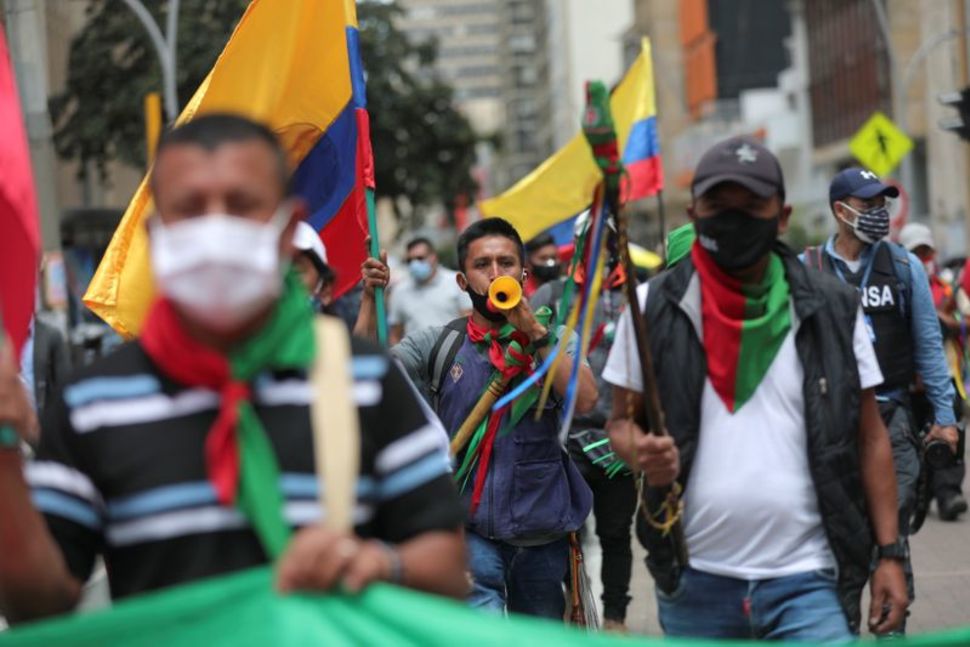
Top photo: Protesters march against President Iván Duque’s policies, including police brutality and disappearances of political activists, in October 2020 in Bogotá. (Louisa Gonzalez / Reuters)

Sources:


[1] The New York Times (04/14/2001) SPECIAL PLEADING; A Felon’s Well-Connected Path to Clemencyhttps://www.nytimes.com/2001/04/14/nyregion/special-pleading-a-felon-s-well-connected-path-to-clemency.html

[2] Statistics taken from https://securityassistance.org/

[3] Ibíd.,

[4] Alston, P. (2009) Statement by Professor Philip Alston, UN Special Rapporteur on extrajudicial executions – Mission to Colombia 8-18 June 2009.https://newsarchive.ohchr.org/EN/NewsEvents/Pages/DisplayNews.aspx?NewsID=9219&LangID=E

[5] The Guardian (27/10/2020) US embassy warns Colombian politicians not to get involvd in US electionshttps://www.theguardian.com/world/2020/oct/27/embassy-warns-colombian-politicians-us-elections

SHOT A FEW HOURS BEFORE THE POET GARCIA LORCA – GALLICIAN PATRIOT ALEXANDRE BÓVEDA

(Translated from the article in Castillian by Alejandro Torrús [Publico 01/24/2021] by Diarmuid Breatnach)

(Reading time text: 7 mins.)

The descendants of Alexandre Bóveda join the ‘Argentine complaint’ together with the grandchildren of Amancio Caamaño, president of the Pontevedra County Council; and Ramiro Paz, editor. The three were murdered in 1936 in Galicia by Franco’s forces. Around 5,000 Galicians were shot by the Franco regime.

– Provided by the family

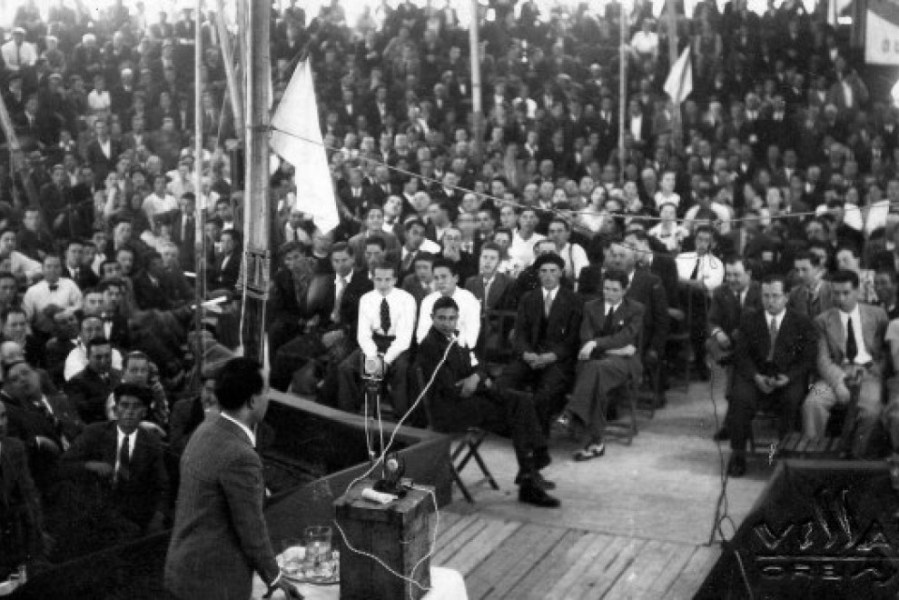
Alexandre Bóveda in a conferenece in Vigo (Photo supplied by the family)

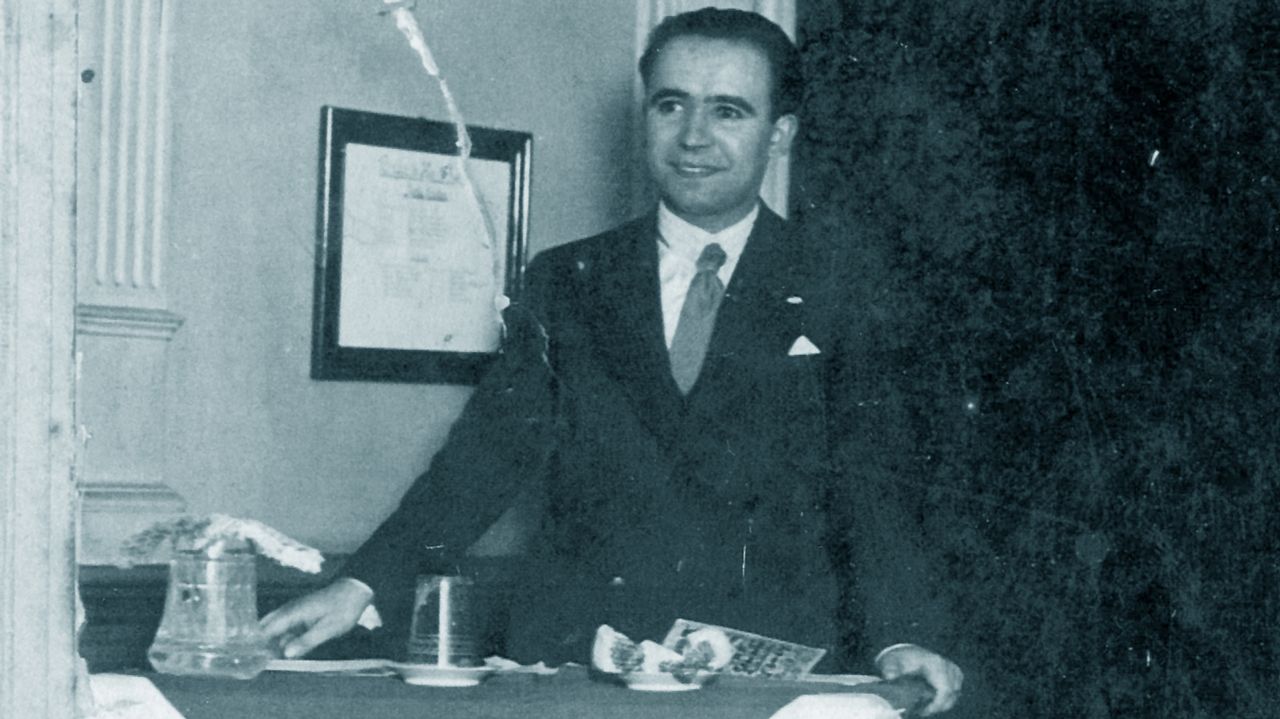
They say that after the body of Alexandre Bóveda fell to the ground, shot by firing squad, one of his friends approached and placed a small Galician flag in his jacket pocket, near a heart that no longer beat. Thus was the last will fulfilled of the man that Castelao himself had described as the engine of Galicianism. It was August 17, 1936 and Bóveda was murdered after a farce of a trial that sentenced him to die for treason. Just a few hours later, at dawn on August 18, 1936, at the other end of the peninsula, the poet García Lorca was also murdered by the Francoists. In just a few hours, in two of the most remote territories of the country, two elevated minds of the country were murdered. Point blank. One after a sham called a trial. Another, after being arrested as a criminal. Two elevated brains, two unique sensibilities, and two ways of fighting, fighting for a freer, more democratic and more plural country fell by force of arms. The country was entering the long Francoist night.

The figure of Alexandre Bóveda is so spectacular that it is difficult to summarize in just a few paragraphs. He was one of the drafters of the Statute of Galicia of the Second Republic (which would never come into force due to the Civil War); he was the soul and “motor” of the Galician Party; and, furthermore, he had participated in the founding of the first savings bank in Galicia. The list, in a telephone conversation with his grandson, Valentín García Bóveda, is practically endless. To the political successes must be added a good number of professional successes, which led him to participate in the founding of Campsa, the Hacienda de Pontevedra or to expand the funds of the Pontevedra Council using only the existing law. He was only 33 years old.

The focus of his political struggle, however, was Galicia. He was convinced that the economic and social backwardness of the country was due to the centralism of a State that squeezed every last drop of sweat from the workers of the periphery. His love for the land, in fact, was taken to its ultimate consequences and in front of the same court that sentenced him to death he declared: “My natural homeland is Galicia. I love it fervently, I would never betray it. If the court believes that for this love the heavy death penalty must be applied to mey, I will receive it as one more sacrifice for her. “

So it was. Bóveda stood in the February 1936 elections to Parliament in the Ourense constituency, competing against Calvo Sotelo, who would be finally elected. Months later, Calvo Sotelo would be murdered in Madrid, while, just a few weeks later, Bóveda would be murdered in Galicia. He face it tied to a pine tree, in the mount of A Caeira, in Pontevedra, some bark of which is still kept by the family.

Pieces of bark from the pine tree against which Bóveda was executed (Photo supplied by the family)

His grandson says that he could have escaped, that he was warned on several occasions of the danger he was running, but that Bóveda answered all those warnings with the words he recited in front of the court. “I wanted to do good, I worked for Pontevedra, for Galicia and for the Republic and the confused judgment of men (which I forgive and all of you must forgive) condemns me,” he wrote in a letter to his brother hours before being shot.

“My grandfather was a marvel of the economy and aa elevated brain. Everything he achieved within only 33 years is impressive, which was at the age at which he was killed. I have always wondered what would have happened to this country if people so important such as Bóveda, like Lorca and like so many others who were shot or had to go into exile by Francoism could have lived another 30 years … Surely now we would live in a different country”, explains Valentín García Bóveda, grandson of the political victim and Vice-President of the foundation that bears his name.

Now, almost 85 years after this murder, Valentín takes over the family struggle to reestablish the memory of Alexandre Bóveda and has filed a complaint with the Argentine Judicial system. In doing so, he joins the nearly 1,000 legal actions that the victims of the Franco regime have presented in the last ten years before Judge María Servini de Cubria in Federal Court No.1 of Argentina.

“I go to the Department of Justice of Argentina with several objectives. On the one hand, to reestablish the memory of my grandfather. I do it for him, but also for my grandmother, who had to die seeing how, legally, her husband was listed as being shot for treason to the homeland. I want that sentence to be judicially annulled. On the other hand, I also go to Argentina to fight against this amnesiac democracy that was based on the foundations of oblivion and injustice,” explains García Bóveda, who hopes that Argentina can declare the crimes of the Franco regime to be crimes against humanity.

The case of Alexandre Bóveda is not the only one to reach the Servini court recently. The descendants of the Republican doctor and politician, president of the Pontevedra County Council in May 1931, Amancio Caamaño, and of the printer and political leader Ramiro Paz, have also filed a complaint. Begoña Caamaño, Amancio’s granddaughter, explained to Público that her grandfather was arrested a week after the Francoist coup and shot on November 12, 1936.

“I could never agree with the Amnesty Law or with the Historical Memory Law. In this country the wounds were never closed even though others accuse us of wanting to open them. The Francoist hierarchy passed to democracy without being held accountable. The Police that were torturing was the new democratic police. And for this reason neither my family nor I have been able to sue in Spain about the execution of my grandfather and we have decided to go to Argentina. All I am looking for is justice and for the sentence against my grandfather to be annulled “, Begoña Caamaño explains.

That fateful November 12, 1936, the Francoist forces executed Caamano and Paz in A Caeria, but also doctors Telmo Bernárdez Santomé and Luis Poza Pastrana; the teachers Paulo Novás Souto, Germán Adrio Mañá and Benigno Rey Pavón; the lawyer José Adrio Barreiro; journalist Víctor Casas Rey; and Captain Juan Rico González. Their murders, however, were only a few more drops of pain in the midst of the slaughter that Franco’s forces were carrying out. The repression ended in just a few years with the lives of 4,699 Galician citizens. Seven out of ten (3,233) were executed in the so-called Francoist “strolls”1. The rest, 1,466, were killed by the carrying out of a death sentence, according to data from the Nomes e Voces (Names and Voices) project. A veritable extermination in an area where the war lasted no more than a few days. In the first months of the Civil War alone, the four civil Governors, the Mayors of five of the seven Galician cities and of the 26 most important towns and the highest Galician military authorities who opposed the coup were all murdered in Galicia.

However, selective or indiscriminate murder was not the only means of repression. With the aim of destroying a civil, plural and organized society, 1,597 citizens were sentenced to life imprisonment and 1,981 were sentenced to various shorter prison terms. In total, 28,234 Galician victims suffered some type of judicial persecution by the new military authorities.

The lawsuits of Bóveda, Caamaño and Paz are not the only ones that have reached Argentina for Francoist crimes perpetrated in Galicia. The “Argentine complaint” was born, in fact, after the complaint filed by a Galician citizen, Darío Rivas, for the murder of his father, Severino, Republican mayor of Castro de Rei and the first of the executed exhumed in Galicia.

Doctor and Politician Santiago Caamaño

Likewise, in 2014, Público reported on a good number of complaints filed about crimes committed in Galicia. Among them was the case of the murders of Manuel Díaz González, a doctor from O Incio (Lugo) and the first Mayor of the Republic in that town, and his brother José Díaz, elected in the last elections as the new Mayor of the municipality. His granddaughter Esther García then explained how her grandfather had been dragged for several kilometers tied by the tail of a horse to the municipality to be murdered where he had been Mayor.

The repression in Galicia also led to a long exile to Latin American countries. In 1942 Galician exiles in Argentina established August 17, the day of the assassination of Alexandre Bóveda, as ‘Día da Galiza Mártir’ (Galician Martyr Day) to commemorate a unique generation that was wiped out by the weapons of Francoism.

Descendants of victims at the Argentine Consulate in Vigo (Photo supplied by the Pontevedra Council)

COMMENT:

The dictator and leader of the coup General Franco was himself a Gallego, a Galician. So was Manuel Fraga Ibibarne (despite the Basque second surname), Minister of propaganda during the Franco Dictatorship and director of repression during the Transition years after Franco’s death (“The streets are mine” — yet claimed by some as steering the ‘democratic transition”) and founder of the Alianza Popular/ Partido Popular party. The claim of fascists to uphold and defend nationalism was exposed as a lie in so many examples in history but very starkly indeed in the Celtic nation of Galicia. The foremost national intelligentsia of Galicia, political, cultural and law-making – those that did not flee — was wiped out by the Franco military and the fascist Falange.

Also a Gallician — an elderly Franco on a Spanish State occasion (Photo sourced: Internet)
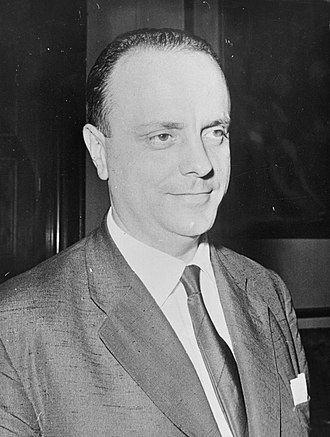
Also a Gallician, fascist Manuel Fraga, propaganda Minister and director of repression. (Photo sourced: Wikipedia)

The supporters of the military-fascist coup against the democratically-elected Popular Front Government of the Spanish State called themselves “Nationalists” and the media in much of the rest of the world did them the favour of referring to them likewise.

But it was the Spanish imperialist “nationalism” that was upheld by the coupists, one which denied the social aspirations of the population of the central “Spain” and denied the cultural, social and political aspirations of the Basque, Catalan, Galician and Asturian nations within the State and those of its colonies outside, for example the people of Western Sahara.

Today that false nationalism remains in power in the Spanish State, whether the social-democratic PSOE or the right-wing conservative PP are in government. It is supported in effect by sections of the Left as represented by the (old) CPE/ Izquierda Unida/ Podemos and by the extreme right-wing of Ciudadanos and Vox. The struggle between progressive national independentism and that centralist-imperialist bloc continues.

Diarmuid Breatnach

End.

Alexandre Bóveda addressing a mass meeting in Vigo (Photo supplied by the family)

ORIGINAL IN CASTILLIAN

https://www.publico.es/politica/batalla-alexandre-boveda-martir-galleguismo-fusilado-horas-poeta-garcia-lorca.html

FOOTNOTES

1Translator: Many of those murdered by the Francoist repression were not as a result of firing squad ordered by military tribunal but, in particular by the fascist Falange, by unofficial execution which the perpetrators called “paseos” (strolls). They would collect the victims from places of detention or their homes, telling them that “We are going for a walk”.

A CONTROVERSY OVER A 1916 RISING COMMEMORATION IN SOUTH LONDON

Diarmuid Breatnach

(Reading time text: 12 mins.)


As we in the SE London, Lewisham branch of the Irish in Britain Representation Group began to plan our Easter Rising commemoration locally in 2000, we could not have imagined the drama it would bring. It resulted in calls for the event’s cancellation, for the Lewisham Irish Community Centre to revoke our hire of the hall and even for the withdrawal of the Centre’s meagre funding from the local authority. And shortly afterwards an attempt was made to burn down the Centre.

Even in the general atmosphere of anti-Irish racism in Britain and context of the 30 Years’ War in Ireland, we could not have expected these developments. The Lewisham Branch of the IBRG, founded towards the end of 19861, had been hosting this annual event locally long before the Irish Centre had opened in 1992 and in fact the branch was instrumental in getting the disused building, which had belonged to the Cooperative Society, handed over to the Irish community and refurbished by the local authority. Furthermore, the 1916 Rising had been commemorated at the Lewisham Irish Centre by the local IBRG branch for a number of years running without any fuss.

As usual, whenever the event was to take place we naturally hoped others would promote it. In the days before Facebook and Twitter etc, email would would reach some contacts, a poster in the centre would be seen by users, some illegal street postering might be done and the Irish Post or Irish World might publicise the event. The rest would be by word of mouth.

“Beginning of the siege”, one of the GPO 1916 Rising series of ten paintings by Norman Teeling. (Image sourced: Internet)

It happened that in the week preceding the 1998 event, an activist of the 32 County Sovereignty Movement in London was in touch with the branch and he posted the event on the 32CSM site, intending it as a supportive advertisement. However, someone who hated that organisation took it to be an event of the 32 CSM themselves.

Victor Barker’s son James had been killed in the Omagh car bombing of 15th August 1998, carried out by the “Real IRA”, a group opposed to the Provisional IRA’s signup to the Good Friday Agreement and to the British colonial occupation of Ireland. Although the organisation responsible has always stated that it intended to kill no civilians2, with 29 fatalities the bombing took the highest death toll of a single incident (but not of a single day, which was the British intelligence bombing of Dublin and Monaghan in May 1974) during the 30 Years War.

Understandably Victor Barker had pursued a vendetta against the Real IRA since and, less understandably perhaps, against anything connected with it, including the 32CSM and even, in this case, the right of an unrelated Irish community organisation to commemorate its national history.

Barker contacted the Lewisham Irish Centre and expressed his outrage, demanding the event be cancelled. A nonplussed Brendan O’Rourke, Manager of the Centre, explained that the event was an annual one and booked by a local comunity organisation and affiliate of the Centre. Not in the least mollified, Barker then got to the local authority, an official of which rang Brendan, he repeated the explanation and the official seemed satisfied.

Logo of the Lár-Ionad na nGael/ Lewisham Irish Community Centre. (Design by D.Breatnach)
Program leaflet for the Lewisham Irish Festival (1998), founded by the Lewisham irish Centre with support from Lewisham IBRG. It ran for a few years before funding became unavailable. (Photo source: Internet)

But Brendan was getting a bit worried and phoned me at work – I had been Chair of the Management Committee since the Centre opened and was at the same time Secretary of the local IBRG branch. We discussed the matter and agreed to cary on but his next phone call was to alert me that the matter was now national or at least London-wide news, with a report in an early edition of the Evening Standard headlining that we were running a “London fundraiser for the Omagh bombers3. Furthermore, the cowardly local authority official was now saying – and quoted — that while they had no power to cancel the booking, they would be looking at the Irish Centre’s funding.

I hurried home to Lewisham as fast as I could – the SE London borough is about 90 minutes’ journey by underground line and overground train from King’s Cross, where I worked. With no time for a meal, I got some things ready and got down to the Centre, about 15 minutes’ walk from my flat.

By virtue of being Chairperson of the Irish Centre’s management committee, I had a key, opened the door, turned off the burglar alarm and locked the door again, then began to get things ready. The part-time Caretaker would lay out tables and chairs for events but I generally liked to change it to a less formal arrangement for our events and so I set to that. There was also “decoration” to be done: some posters and portraits of 1916 martyrs to put up in places, flags to hang etc.

Photo taken earlier this year showing the front of the irish Centre in Davenport Road, London SE6, more or less unchanged. The gathering in front is part of a Lockdown bicycle meals delivery service introduced by the Centre and facilitated by Inclusive Cycling volunteers. (Photo source: Lewisham Irish Centre website)

In the lobby I placed a chair by a table there and also some hidden short stout lengths of wood. This was a provision inherited from earlier days when Irish or British left-wing meetings might be attacked by fascists of the National Front or the British Movement but we hadn’t felt the need at the Irish Centre for some years now. However, with the current hysteria being whipped up by Barker and the Evening Standard and assisted by the wriggling of the Council officer, fascists might well decide the conditions favoured an attack.

Another possibility was a police raid. The “Prevention of Terrorism Act” in force since 1974 in Britain specifically targeted the Irish community and gave the police the power to detain someone for up to five days without access even to a lawyer.4

Early arrivals started to knock at the door and I was in a quandary – until I had some reliable able-bodied people to staff the door, I didn’t want to start letting people in. On the other hand if we were going to be attacked, I couldn’t leave them outside either. So it was open, let them in, lock the door again, open, let some more in …. until the arrival of some I could ask to mind the door (after I’d told them about the “extras” in case they were needed).

Then there were sound amplification checks and gradually the hall was filling up. I was to be MC and so on duty inside the hall but kept checking the lobby to see everything was ok. And of course people wanted to chat about the news so would stop me and ask me about it …

For the evening’s program, the MC was to welcome people, introduce the Irish ballad band and have them play for an hour. Then intermission, MC on again with a few words on behalf of the local organisation, introduce the featured speaker, get the band on again for an hour or so to finish. So, some time to kill, to worry before the hour for which the band was booked.

The time came but the band didn’t. At half an hour late I started to worry and the supporter who had booked the band on behalf of the branch couldn’t get any reply from them by phone. As MC I apologised to the attendance and asked for their patience. Over an hour late, the band’s manager finally phoned to say they would not be coming. Because of worry arising out of the media reporting.

A few of us in the organising group held a quick conference. Nothing for it but to face the music – or rather its absence – and so I got on the stage and told the audience that the band had pulled out and everyone was entitled to a refund of their ticket price without any hard feelings whatsoever or …

Before I could lay out the alternative, a guy sitting near the stage jumped up and shouted “We will NOT accept our money back!” to the applause of some others. A little taken aback, I thanked him for his spirit but said people should have the choice and laid out the alternative, which would be to hear the speaker and just socialise for the rest of the evening. Nobody made a move to get up and approach the door so ….. I introduced the speaker, who that year might have been from the IRSP (a previous speaker had been Michelle Gildernew, then representing Sinn Féin in Britain). He did his bit, I did mine, much of that not surprisingly being devoted to censorship, intimidation and repression of the Irish community as well as the commemoration of our history.

Then a guy approached and said he’d play guitar and sing, so he went up on stage, I followed with a few songs acapella, someone else sang a few …. Everyone seemed to be enjoying the evening, there was no trouble at the door …. and because there was no band to pay, we made more money than we had ever done for function organised by the local IBRG branch!

But there were to be two dramatic sequels to this controversy. And tensions between myself and the Centre Manager would follow.

THE “MAC CHICKEN BROTHERS”

The professional name of the Irish ballad band was The Mac Namara Brothers but Brian, a resilient Dublin comrade from a deprived background, that night baptised them the Mac Chicken Brothers (a play on the Mac Donald chain’s naming of items and a reference to the band members’ cowardice.

Our event had been on a Friday night and they were due to play Sunday afternoon at an Irish bar a five minutes’ drive from the Lewisham Irish Centre. We didn’t see how we could let them do that without confronting them. In discussion I suggested we present them with some white feathers and denounce them and Brian was all up for that; he was taking the kids to the seaside and would pick up some white feathers around the beach. But, unbelievably, he could find none. Nor could I in a local park. In the end, I opened a pillow and took out handfuls but they were all small.

The next day, we declined to invite anyone who might get hurt without being accustomed to defending themselves or who might not be sufficiently disciplined in behaviour and of the remainder, only myself and Brian were available. The pub, The Graduate, was under new management, one of three sisters from the Six Counties (perhaps Armagh), who lived in South-East London. I knew her from when she had been barmaid and perhaps manager at the Woodman, another Irish pub in the general area, where I attended Irish traditional music sessions (and sometimes a lock-in for an extra hour or so).

On Sunday we were a bit late in getting going but Brian drove us there and we entered the crowded area that would have been the public bar before the lounge and that area were combined. I bought us a round and we tried to act as relaxed and natural as possible, nodded to people we knew … It was certain that many of those present already knew what had happened but no-one came to ask us about it.

The “Mac Chicken Brothers” were playing and I was unsure whether we had perhaps missed their break. I got another round in but that was going to be my limit. To our relief, the band took a break but now my tension racked higher as I positioned myself nonchalantly near the stage and waited for the band to get ready for the second half of their act.

Finally, I saw them coming and with a small plastic bag in my hand I jumped up on to the low stage, Brian ready to handle any trouble from the floor.

“Ladies and gentlemen!” I called out loudly and got instant attention. “A few nights ago the British press ran a scare story about a 1916 Rising commemoration in Lewisham,” I continued. “This band here was booked to attend but didn’t turn up, leaving a couple of hundred people waiting. This is what we think of you,” I said, turning to the band members and threw a handful of the feathers from the bag in their direction.

“Hear, hear!” shouted someone in the crowd and I got down from the stage, glanced at Brian and made for the door, with him following closely behind. Incredibly I heard one of the band members say to me: “You might have told us you were going to do that!”

As we walked away outside, my heart thumping, the manager came rushing out.

“You had no right to do that,” she said, her eyes flashing fire. “Not in my pub!”

“Sorry, Bridget,” (not her real name), I replied, “It had to be done!”

“Not in my pub!”

“But that’s where the band was! It just had to be done.”

Now a customer came haring out looking for us and, from the look on his face, it wasn’t to offer congratulations. I felt Brian beside me change his stance to take him on but the manager took the guy by the arm and talked him back inside and we got in Brian’s van and car and drove off. “Bridge” wouldn’t talk to me for some years afterwards, though one of her sisters would.

The following day, I wrote a letter about the matter to the Irish Post5, attacking the Labour Council for its cowardice, the band for failing to comply with their booking and the Evening Standard for its felon-setting. Since I was Chairperson of the Management Committee of the Centre, which was already under some pressure, I wrote it under a pseudonym. The letter was published.

I felt that not only our branch of the IBRG but the Irish community had been attacked and we had responded appropriately and publicly, both locally and in the wider context. We would now face the next move, if one was to come, from the Council, as an Irish community with pride.

Part of IBRG Ard-Choiste delegation after lobbying Mo Mowlam in Westminster, London, 15 February 1995: (r-l) Laura Sullivan, Diarmuid Breatnach, Virginia Moyles, Pat Reynolds. (Photo source: Irish Post).

But at the next monthly meeting Management Committee, I was surprised to find that Brendan, the Centre Manager, believed that either Lewisham IBRG had organised the event jointly with 32CSM or that I had placed the advertisement. But worse, I was genuinely shocked to see that he believed my use of a pseudonym for the Irish Post letter was an attempt to distance the IBRG and myself from the controversy and leave him to face it alone. Brendan and I disagreed politically (he was a Sinn Féin supporter and I was by this time hostile to the party’s new trajectory with respect to the conflict in Ireland) but I supported him as Manager of the Centre while as Irishmen we stood together against oppression. But no matter what I said now, I seemed unable to convince him that the use of a pseudonym, far from being a device to have a say and protect myself at the same time, was to protect the Centre and himself as its Manager.

We got through the meeting and the Council officials seemed happy to let the matter rest, since the Standard lost interest and moved on to the next sensation.

But a more direct attack than that of Barker and the media was being planned somewhere.

Ard-Choiste meeting of the IBRG at the Working Class Library & Museum, Salford, 1992. (Photo source: Bernadette Hyland)

ARSON ATTACK ON THE CENTRE

In the early hours of one morning a couple of weeks later, I received a phone call from the Fire Brigade, attending at the Lewisham Irish Centre. I was one of the emergency nominees. When I got down there, Pat Baczor6, another member of the Management Committee and also an emergency nominee, was there already. So were the Fire Brigade and the police.

There had been an arson attempt and a hole was burned in the wood of the front door. We opened up and let the Fire Brigade in, who came out a few minutes later, pronouncing the building safe. A container with some inflammable liquid had been set by the door and had burned a hole about the size of my fist but the floor inside was tile and had not caught.

In response to the police, I said while we had received no threats, there had been some controversy in the media about a history commemoration and though I would suspect local fascists, I had no specific individuals in mind.

If we hadn’t wire screens on all the external windows, it would have been easy to smash a glass pane and to throw in the container with a lit fuse. The flooring of the whole hall was wooden and the result would have been quite different. I was very glad that during discussion on the refurbishment of the Coop Hall for use as an Irish Centre more than many years earlier, as Chair of the Steering Group, I had made a point of insisting on the wire screens. An Irish Centre in Britain could expect to be the target of an attack some day.

Christmas lunch in the hall of the Lewisham Irish Community Centre, 2014. The photo is taken with back to the stage, facing the door to the lobby on the way to the front door of the Centre. (Photo source: Lewisham Irish Centre website)

AFTER ALL THAT


We weathered that storm and the following year’s 1916 Rising commemoration took place without incident.

The next crisis for the Irish Centre came some two years later when the Council’s Labour Party Leadership, which had been “Blairite before Blair” as one local Leftie commented, listed the Centre for cuts to our total staffing: one (underpaid) Manager and one part-time caretaker-handyman. There were heavy cuts planned to the whole Council-funded service sector across the Borough of Lewisham so, although in our case the cuts would have meant wiping out our entire staffing, it was difficult to say whether the controversy some years earlier had played a role or not.

But that was another day’s battle.

End.

Publication of the IBRG (Intended to be quarterly, it ran to perhaps four editions more widely spaced apart before it ceased publication. (Photo source: Internet)

FOOTNOTES

1The wider IBRG had been founded in 1981 and consolidated in 1982. The Lewisham branch was founded from an initiative by a core of people who had taken over organising the 1985-1986 Irish Aspects course at Goldsmiths (then) Community College from its original organiser, Derry-born Peter Moloney, who was stepping down and invited them to run it in his place or that the course would come to an end. Peter was one of founding members of the branch and active within it for a few years.

2The intentions of this bombing are still the subject of dispute. The killing of civilians would have been against the interests of the organisation and in the event were strongly so; it strengthened the hands of the authorities in enacting further repressive legislation and also ideologically for the authorities and the Provisionals in gathering support for the Good Friday Agreement and in neutralising its opponents within the Irish Republican movement. Over the years the Wikipedia page on the bombing has changed substantially as cases against accused collapsed, including one in which the Gardaí were found to have concocted notes of an interview and revelation has followed revelation of intelligence services awareness of elements of the plans and failure to alert the RUC (colonial police) on the ground. Four defendants were found responsible in a controversial civil case and it seems clear that that Mickey Kevitt’s criminal conviction on questionable evidence in another case in 2003 was related to his believed involvement as was the refusal to apply all possible reductions which would have seen him released in 2016. McKevitt died of cancer on 2nd January 2021, still serving his sentence of 20 years. The full truth may never be known.

3Pat Reynolds, PRO of the IBRG throughout most of its existence, in his year-by-year review of the IBRG commented: “The London Evening Standard with a long history of anti-Irish racism came out with the headline London fundraiser for the Omagh Bombers alleging that the event was organised by supporters of the real IRA. The IBRG were seeking legal advice on the article as the event was organised by Lewisham IBRG.” Busy with more practical organising and without perhaps the right contacts, Lewisham IBRG never did take up the misreporting legally or with the Press Council.

4As Irish community activists warned the British public, it would lead to wider repressive legislation if permitted to stand, which it did. The 2006 Act allows for detention up to 28 days without charge.

5The Irish Post was founded in 1971 as a newspaper aimed at the Irish community in Britain and played a generally progressive role until its editor-owner, Brendan Mac Lua and Thomas Beattie sold the title and company to Thomas Crosbie Holdings (TCH) in 2003. In 1981 the founding of the Irish in Britain Representation Group was in part inspired by comment in the paper’s “Dolan” column (a pen-name of Mac Lua’s). In later years the newspaper suffered competition from other titles aiming at the same community, The Irish World and The London Irish News(?). More about the Post’s later history (but next to nothing about it earlier work including promoting the cases of the Birmingham Six, Guildford Four, Maguire Seven etc and also covering protests against anti-Irish racism and promoting new Irish writing) here https://en.wikipedia.org/wiki/The_Irish_Post

6Patricia Ellen Baczor owed her surname to having married a Polish man. There were many such marriages between Polish refugees and servicemen who met young Irish women at Catholic parish social events in Britain during WW2. Pat was a strong widow and supporter of the rights of the Irish community, progressive in her thinking, anti-racist but not one to push herself forward. She was generally very supportive of me as Chair of the Management Committee and appreciative of the other hat I wore in the local and ‘national’ IBRG and the tensions thereby I sometimes had to negotiate.

BASQUES MARK THE 50th ANNIVERSARY OF THE BURGOS MILITARY TRIALS

Diarmuid Breatnach

(Reading time: 8 mins.)

Basques marked the 50th anniversary of the Burgos military trials by the Franco dictatorship of 16 members of ETA, the armed Basque socialist independentist organisation. A few days ago a group went to the town of Burgos itself and posted slogans on the wall of the Spanish Ministry of Defence building there declaring that the Spanish State had not succeeded in its repression in 1970 and would not do so in future. In the Basque Country itself events were also held in commemoration.

The military trials of 16 members of ETA took place between 3rd and 9th December 1970 in the Spanish city of Burgos in Castille (north-central Spain). The trial concluded on the 28th with sentences of death on six and sentences up to 70 years on the remaining ten. Intended to be a mortal blow to ETA and to Basque resistance the trials instead inspired greater and more united resistance in the Basque Country and became an international publicity debacle for the Franco dictatorship.

Within the Basque Country, demonstrations and pickets took place and a general strike saw 100,000 workers there out on strike. ETA distributed pamphlets and leaflets among the people and in its repressive measures the Spanish police beat many workers and killed a number, as in Etxarri in Nafarroa (Navarra) province.

Internationally, protest demonstrations took place across Europe and other parts of the world, particularly outside Spanish Embassies, often leading to battles with the police of the host country. Pope Paul VI appealed for the death sentences to be commuted and Jean-Paul Sartre, a leading intellectual of the French Left and with an international literary reputation congratulated the defendants on having brought the situation of the Basque Country under Franco to international attention.

ETA hired prominent lawyers of Left and Human Rights reputation to defend the sixteen. The organisation also kidnapped the German honorary Consul as a hostage (and later released him unharmed). The defendants themselves used the trial politically, turning it into an exposure of the Franco regime and its repression. A number described the tortures to which they had been subjected, all of them declared their commitment to socialist freedom and some even stated that they were fighting for the rights of all working people.

Protest demonstration in front of Spanish Embassy, Caracas, Venezuela in December 1970 (Photo sourced: Internet)

The military judges, aware that the publicity of the trial was going against the Dictatorship, began to clamp down and restrict the defendants from saying anything that was not directly, as they saw it, pertinent to the charges, after which the defendants refused to speak at all. At one point during the trial the defendants all stood and sang the battle-song and national anthem of the Basque nation, Eusko Gudariak1. An even greater sensation occurred in a brief incident when the final defendant to speak, Mario Onaindia, attempted to attack the judges with an axe.2

Demonstration in Barceloneta, Catalonia in solidarity with Burgos defendants, December 1970
(Photo sourced: Internet)

BACKGROUND

A military-fascist uprising against the elected Popular Front government of Spain took place in 1936 and in the Spanish Antifascist War that followed, the Spanish Republic was defeated by the military with substantial assistance from Nazi Germany and Fascist Italy, while the UK and France blockaded the Republican forces.

Hitler and Franco reviewing invader Nazi troops in Hendaye, French Basque Country. (Photo source: Internet)

A military-fascist dictatorship with the strong assistance of the Spanish Catholic Church followed amongst huge repression, making Spain the state with the most mass graves in Europe and second only to Cambodia in the world.

The Popular Front Government had granted autonomy to the Basque Nation (and to Catalonia) for the first time in centuries of the Spanish State, although Nafarroa province had sided with the military-fascist forces. Any notion of autonomy was withdrawn under the Dictatorship and even use of the Basque and Catalan languages in public or in education was forbidden.

Some guerrilla resistance continued for a period in the mountains of the Basque Country, Catalonia and other parts of the Spanish state territory but the fighters were hunted down or fled the Spanish state. The Communist Party and some socialist organisations continued an underground existence and built illegal trade unions but the CP of Spain did not support independence for the Basque Country or for Catalonia, on the theory that this would “break up the Spanish working class” (however later they all mobilised against the Franco Dictatorship and in solidarity with the Burgos defendants).

Euskadi3 Ta Asakatasuna (Basque Land and Freedom) was formed in 1959 out of a coalition between a left-wing Basque youth group and the youth wing of the Basque Nationalist Party (PNV) who were discontented with the lack of action of their elders. In June 1968 ETA carried out its first armed action against Spanish police when killing a police officer asking for their identification papers at a checkpoint and shortly afterwards one of the ETA pair was gunned down by police. Two months later the organisation carried out its first planned attack when they killed Melitón Manzanas, Commander the Political Police Brigade in Alava Province. Manzanas was a notorious fascist and torturer who had hunted down Jewish refugees to turn them over to the Nazis during WWII.

The Burgos trials was intended to smash ETA completely but as outlined above, had an entirely opposite effect. The death sentences were commuted in an attempt to reduce the damage the trials had caused the international reputation of the Spanish State.4

Solidarity with Burgos Defendants in Paris, Dec. 3rd 1970 (Photo sourced: Internet)
Angry Brigade Communique on machine-gunning of Spanish Embassy, London on 3rd December 1970. (Photo sourced: Internet)

AFTER BURGOS AND TODAY

ETA continued its armed and non-military actions and other revolutionary armed communist resistance began to take shape elsewhere in the Spanish territory.

Despite the huge success of the Basque solidarity mobilisations to prevent the executions in 1970, five years later a similar wave failed to prevent the executions of another two ETA members and three FRAP (Revolutionary Anti-Fascist Patriotic Front) members: Ángel Otaegui Etxeberria; Juan “Txiki” Paredes Manot; José Humberto Baena; Ramón García Sanz; and José Luis Sánchez Bravo.

French solidarity with ETA defendants 1975. This time the international campaign was unsuccessful and the Spanish State executed the two ETA and three FRAP activists (Photo sourced: Internet)

ETA counted some actions notable for the harmful effect on them but also some spectacular successes in its armed campaign. Included in the latter were the assassination in Madrid in 1973 of Admiral Carrillo Blanco, Franco’s appointed successor and the abandonment of the nuclear reactor project in Lemoiz5 in Bizkaia in 1983. Blanco’s assassination and the death of the Dictator Franco in 1975 hastened the Transition of the Spanish State to an alleged democracy and a monarchical and unitary state constitution in 1978.

The Basque resistance constructed a network which beyond the armed group consisted of trade unions, youth organisation, social centres, daily bilingual newspaper and political parties. The Spanish State waged war against that movement with repressive laws, arrests, torture, jailings, closure of organisations and media, along with armed action against ETA. In addition, it organised and funded a terror and assassination campaign over a period of 26 years6.

In the late 1990s the Basque Left-Independentist movement began a process of unilateral disarmament and change in political direction which led first to an indefinite ETA truce in 2010, then to decommissioning of arms and finally to the dissolution of ETA in 2018. However around 250 Basque political prisoners remain in jail, a tiny group of which have declared their dissidence from the leadership’s path and are supported outside the jails by a growing movement which has a very different line to that of the “official” leadership.

The Spanish State insists that the only possible relaxation of prison conditions, end of dispersal7 or granting of parole for the prisoners is “if they recant their beliefs and apologise to the victims.”

Political repression continues at some level within the Basque Country. There is no indication that there is any intention in Spanish ruling circles to grant independence to the southern Basque Country – quite the contrary (as seen also in Catalonia).

THE 50th ANNIVERSARY

A group of activists from the official Abertzale Left carried out a publicity commando raid in Burgos recently (see video below) and attached a banner poster to the Spanish Ministry of Defence building which read: “NEITHER WERE YOU ABLE to repress the struggle of the people NOR WILL YOU BE ABLE” and LONG LIVE THE REPUBLIC!

A number of public meeting and on-line events were also held this month, including the commemoration in Etxarri of two Basques who were killed by Spanish police during the Burgos Trials protests.

In Eibar city in Gipuzkoa province around 100 people assembled despite Covid19 restrictions in the open air to mark the anniversary and included one of the Burgos trial defendants who, along with another woman, read out a manifesto which has been signed by many in the Basque independentist movement.

Burgos Trials 50th Anniversary Commemoration in Eibar, Gipuzkoa, Dec.2020. (Photo source: Naiz.eu)

“The Franco regime wanted to prosecute, punish and subdue again a people that in the darkness of the dictatorship had dared to rise from the ashes of war,” they read, introducing the manifesto.

Recalling the moment when the defendants rose in court and with upraised clenched fists sang the Eusko Gudariak, the manifesto commented: “With their courage, that handful of young militants taught us to stand up even when it seems impossible, and their example lives on today in us and in the future in the actions and dreams of the new generations.”8

The manifesto also states that the Burgos Trials were “a milestone” for the survival of Euskal Herria. However today, 50 years later, the substantive process has not concluded, since “they continue to take Basque youth to court, thinking that by disciplining them they will quench the desire for freedom of this people, and the states that surround us have not abandoned their strategy against the independence movement.”

The anniversaries of milestones in the struggle, of successes and failures, of martyrs, continue to be marked. And the journey is far from finished.

End.

FOOTNOTES

1“Soldiers of the Basque Country”, very similar in title and theme to the Irish national anthem, Amhrán na bhFiann/ The Soldiers’ Song.

2How Onaindia managed to get his hands on an axe in court is one question but the significance of the axe cannot be underestimated – it was a traditional tool of foresters but also of ancient Basques in war and formed one part of ETA’s emblem, the other being the snake, representing wisdom.

3Formerly used to describe the whole Basque nation, “Euskadi” nowadays mainly describes the Basque Autonomous Region of the provinces of Bizkaia, Alaba and Gipuzkoa. “Euskal Herria” (The Country of Basque Language”) is more commonly used today to describe the whole seven provinces of the Basque nation, four currently within the Spanish and three within the French states.

4It also increased the pressure on the Spanish ruling class from the USA and European states to become more moderate politically and less vulnerable to revolution.

5This was in addition to frequent large protest mobilisations.

6Much more than the notorious GAL – see for example https://rebelbreeze.com/2020/12/23/november-month-of-murders-of-basque-activists/

7The vast majority of the prisoners are in jails dispersed throughout the Spanish and French states, between hundreds and even a thousand kilometres from their homes, placing a huge burden on their families and friends in visiting them.

8Comment: One wonders whether they felt any sense of irony in reading that out, considering that only in September last year 47 Basque prisoner solidarity activists pleaded guilty in a plea deal that ended their trial in 25 minutes with suspended sentences for all except for a few months’ jail for a couple of them. The deal came as a total shock to the estimated 50,000 people who had, only two days earlier, marched in solidarity with the accused, defending their right to do solidarity work without being persecuted or prosecuted.

SOURCES

https://www.naiz.eus/eu/info/noticia/20201228/ni-pudieron-ni-podreis-mensaje-en-la-an-y-el-gobierno-militar-de-burgos-50-anos-despues

https://en.wikipedia.org/wiki/Burgos_trials

https://www.naiz.eus/en/info/noticia/20201129/personalidades-del-ambito-independentista-recuerdan-el-50-aniversario-del-proceso-de-burgos

Irish painter of Native Americans

Few people know the pain of being dispossessed of their land better than the Irish, but tragically in the 1870s, thousands of impoverished Irish immigrants ended up enlisting in American armies that were fighting to push Native Americans off their land.

Irishmen fought and died in the most iconic conflict between Native Americans and the United States Army at the Battle of the Little Bighorn in Montana. The defeat of the General Custer’s 7th Cavalry by Native Americans on June 25, 1876 has become legendary. Many people know the story of Custer’s defeat, but few are aware of the role the Irish played in fighting the battle, and in creating the most famous painting of it.

One hundred and three Irish soldiers perished on that fateful day, and yet another Irishman, John Mulvany, realizing the popularity a canvas of the battle would create, painted his iconic “Custer’s Last Rally,” which remains today one of the most celebrated paintings of the American West.

Custer’s Last Rally, painted by John Mulvaney (Photo sourced: Internet)

In the 1870s, the hard and dangerous life of an American cavalry trooper was still the best option for many poor, newly arrived Irish immigrants. In 1875, Custer’s 7th Cavalry was full of Irish-born recruits when gold was discovered in the Black Hills of South Dakota, the sacred ground to the Lakota. These soldiers must have known the danger they faced when the United States claimed the land and invaded it, despite treaties the American government had signed with the Lakota, guaranteeing them its ownership. The military’s armed incursion into the area led many Sioux and Cheyenne tribesmen to leave their reservations, joining the rebel leaders, Sitting Bull and Crazy Horse, in Montana. By the spring of 1876, more than 10,000 Native Americans were camped along the Little Bighorn River – defying a War Department order to return to their reservations and setting the stage for the famous battle.

The charismatic General George Armstrong Custer and almost 600 troops of the 7th Cavalry rode into the Little Bighorn Valley, determined to attack the native encampments. Riding with Custer were over 100 Irishmen, ranging in rank from newly recruited troopers, many of whom could barely control their mounts, to Captain Myles Keogh, a heroic veteran of the Civil War from County Carlow. There were 15 Irish sergeants and three Irish corporals in Custer’s command, the backbone of his noncommissioned officers.

Today, we imagine Custer wearing his trademark buckskin jacket – it was sewn by an Irishman, Sergeant Jeremiah Finley from Tipperary, the regiment’s tailor. The song of the 7th Cavalry was another Irish influence. Just prior to Custer’s arrival in Fort Riley, Kansas, where he took command of the 7th Cavalry, Custer ran into an Irish trooper who, “under the influence of spirits,” was singing “Garryowen,” an Irish song. Custer loved the melody and began to hum the catchy tune to himself. Custer made it the official song of the 7th Cavalry and it was the last song played before Custer and his men separated from General Terry’s column at the Powder River and rode off into history.

Centre section of The Battle of Aughrim, by John Mulvany. (Photo sourced: internet

John Mulvany, who is known for his paintings of the American West and in particular “Custer’s Last Rally,” also painted “The Battle of Aughrim,” in 1885, which was exhibited in Dublin in 2010.
The battle, fought between the Jacobite and the Williamites forces in Aughrim, County Galway on July 12, 1699, it was one of the bloodiest battles in Ireland’s history, over 7,000 killed. 
The battle marked the end of Jacobitism in Ireland, a movement that aimed to restore the Roman Catholic Stuart King James II of England and Ireland (as James VII in Scotland) to the throne

Before the battle, the legendary Lakota chief Sitting Bull had a vision in which he saw many soldiers, “as thick as grasshoppers,” falling upside down into the Lakota camp, which his people saw as a foreshadowing of a major victory in which a large number of soldiers would be killed. Custer, however, blinded by ego and visions of glory, made a reckless decision to attack the huge gathering of Native Americans head on, saying, ironically, “Boys, hold your horses, there are plenty down there for us all.”

Foolishly splitting his command into three units, Custer tried in vain to attack and envelop the largest concentration of Native American fighters ever to face the American Army. The first assault against the Native American encampment was launched shortly after noon by three companies – 140 officers and men – led by Major Marcus Reno, whose men attacked along the valley floor towards the far end of the camp. Thrown back with many casualties, the survivors scrambled meekly for their lives to the top of a hill. Custer, with five companies totaling more than 200 men, advanced along the ridgeline, commanding the river valley on its eastern side. He further divided this force into two groups, one of them led by Captain Keogh.

There is debate about what occurred when Custer engaged the Native American forces just after 3 p.m. because the General and all his men were killed, so no one from Custer’s command could tell their tragic tale. Archaeological evidence suggests that Keogh and his men fought bravely, being killed while trying to reach Custer’s final position after the right wing collapsed.

On June 27, 1876, members of Gen. Terry’s column reached the Little Bighorn battlefield and began identifying bodies. Keogh was found with a small group of his men and his was one of the few bodies that had not been mutilated, apparently owing to a papal or religious medal that he wore about his neck (Keogh had once served in the in the Battalion of St. Patrick, Papal Army). Although Captain Keogh did not survive the battle, his horse, Comanche, did. The horse, spared by the Native American fighters for its heroism, recovered from its serious wounds and was falsely honored as the lone survivor of the battle (many other U.S. Army horses also survived). Comanche was retired with honors by the United States Army and lived on another 15 years. When Comanche died he was stuffed, and to this day remains in a glass case at the University of Kansas.

Comanche, Keogh’s horse, which survived his master who died at the battle. (Sourced: Internet)

White Americans, shocked and angered by the defeat of Custer and his men, demanded retaliation. And they got it. Soon after, over 1,000 U.S. troops under the leadership of General Ranald Mackenzie opened fire on a sleeping village of Cheyenne, killing many in the first few minutes. They burned all the Cheyenne’s winter food and slit the throats of their horses. The survivors, half naked, faced an 11-day walk north to Crazy Horse’s camp of Oglalas.

The victory at Little Big Horn marked the beginning of the end of the Native Americans’ ability to resist the U.S. government, but 37-year-old John Mulvany from County Meath saw opportunity in the tragedy.

John Mulvaney, photo by Anne Webber (Sourced: Internet)

12 YEARS OLD IN THE USA

Mulvany arrived in America as a 12-year-old. He went to art school in New York City and became an assistant of famed Civil War photographer Mathew Brady. He later covered the Civil War as a sketch artist for a Chicago newspaper, developing an amazing ability to capture battlefields on canvas.

Mulvany knew that a painting of the fight would be a sensation. He visited the battlefield twice and also found Sitting Bull in Canada so that his painting could capture even minute details of the battle and its combatants. Mulvany finished the epic 11 ft. x 20 ft. canvas in 1881, which was hailed as a masterpiece, and began a 17-year tour of the United States. The canvas made Mulvany the toast of Chicago, but his good fortune would not last.

Sitting Bull of the Lakota, photo by William Notman. John Mulvany sought him out to consult him about the Battle of the Little Big Horn. (Image sourced: Internet)

Mulvany eventually sold his painting and ended up destitute in Brooklyn, where he drowned in the East River in 1909 in what many labeled a suicide. Mulvany quickly became forgotten, but not the fame of his great canvas, which recently sold for $25 million. Mulvany painted many great works, but they are lost and there is a concerted effort to find these missing canvases. Perhaps we will soon find more works of this great, tragic Irish painter.

end.

SMASHING THE MYTH – THE KILMICHAEL AMBUSH

Diarmuid Breatnach

(Reading time text: 15 mins.)

Forget not the boys of Kilmichael,

those brave lads both gallant and true;

They fought ‘neath the green flag of Erin

and conquered the red, white and blue.

INTRODUCTION

In Irish history, which arquably is full of such wars, what is generally termed “The War of Independence” began with the Soloheadbeg Ambush on 21st January 1919 and ended with the Anglo-Irish Treaty on 11th July 1921 (which however, because of its limited measure of Irish independence led shortly afterwards to the Civil War 1922-1923). That ambush was one of many during the war by Irish guerrillas on the Royal Irish Constabulary, the British colonial police force and these attacks continued with a three-fold aim: to capture arms for the guerrillas, to eliminate much of the intelligence source for the Crown from rural districts and to open up areas of relative safety in the Irish countryside for the forces of independence.

In 1920 two different constabulary forces were recruited in Britain to bolster the Royal Irish Constabulary: the “normal” recruits in January and the Auxiliary Division RIC in July1. There were insufficient police uniforms for the “normal” constable recruits at first, leading to their being issued a mix of dark green RIC and khaki Army uniforms (usually Army trousers and RIC tunics) and Christopher O’Sullivan wrote in the Limerick Echo that they reminded him of the “Black and Tans”, from a well-known pack of Kerry beagles in the Scarteen Hunt. The nickname spread quickly and soon they were almost universally known (and thereafter in Irish history and folklore) by that name or shortened to “the ‘Tans”. The Irish translation is “na Dubhchrónaí” but it is likely that even in the Gaeltachtaí, the Irish-speaking areas, they were also known as “na ‘Tans”.

WW1 had ended in November 1918 and many of the ‘Tans were ex-British Army soldiers. Some were perhaps even demobbed (discharged) specifically in order to enlist in the new force. At the time there was ongoing agitation for discharge from the armed forces and even riots among thousands of British soldiers, many of whom had been conscripted but whom the British High Command was reluctant to allow to leave, knowing that many would be needed to suppress resistance to British colonial rule across the Empire, on the Indian sub-continent, in the Middle East, Africa and China.

The Tans quickly gained a reputation for brutality towards prisoners and the general civilian populace when conducting personal and home searches. They were also considered generally indisciplined, liable to intoxication on duty and to carrying out theft and harassment of women. Their behaviour towards civilians was so bad that even some British Army officers and loyalists in Ireland complained of it. The fighters of the Irish Republican Army, the new name for the reorganised Irish Volunteers, though they might fear being captured by the Tans, quickly enough gained their measure and were soon engaging them with arms.

The Auxiliaries, or “Auxies” as they became known, were a different matter. Their role was a rapid response motorised strike force and every single member was a War veteran and ex-officer, some indeed having been awarded battle decorations. Just as inclined to brutality and indiscipline in some respects, they gained a fearful reputation for their counter-guerrilla aptitude; though their commanding officer, Frank Crozier, sacked 21 of them in January 1921 because of their brutal raids in Trim, Co. Meath and murder of two Republicans in Drumcondra, Dublin, Chief of Police Henry Hugh Tudor reinstated them, so that Crozier resigned. One IRA officer commented that if the Tans were ambushed they would hide behind cover to return fire, whereas the Auxies would quickly be seeking to outflank their opposition and counter-attack.

The relaxed but warlike attitude of the Auxies is evident in this photograph of two of them with a Dublin Metropolitan Police officer (not sure what unit the fourth man represents). (Source photo: Internet)

The Auxies could carry out operations against the IRA and the civilian population with impunity, it seemed. The Kilmichael Ambush was planned specifically to take on the Auxiliaries and smash the myth of their invincibility.

THE LEADER AND THE COLUMN

The operation was led by a 23 year-old ex-British soldier: Tom Barry, Commandant of the West Cork Flying Brigade was at the time only 23 years of age and only a little over three months active in the IRA. When news of the 1916 Easter Rising reached him and other British troops fighting the Ottoman Empire in Mesopotamia (now Iraq), he “had not a nationalist thought in my head”, he confessed in his book Guerrilla Days in Ireland (1949). Barry was discharged at the end of the War but did not join the IRA until the capture and torture of Republicans Tom Hales and Pat Harte by Arthur Percival of the Essex Rifles in July 19202 so appalled him that he joined the IRA’s 3rd Cork Brigade, operating in the West Cork area. Barry’s highest rank in the British Army had been Corporal, in which role the limit of his command would usually have been of seven to 14 men. By the end of 1920, Barry had quickly risen to command 310 men in the IRA, operating over large areas of West Cork and occasionally further afield.

Early print of Tom Barry’s memoir by Anvil in pulp fiction paperback cover style. (Image sourced: Internet)
Later reprint copy of Barry’s memoir showing Tom Barry at the age of 23 when he commanded the Flying Column (Image sourced: Internet)

One of the many innovations of the IRA at that time was the flying column, designed to maximise the effective striking force of a guerrilla army in rural Ireland. This had been advocated by Seán McLoughlin while organising in South Tipperary. McLoughlin had been a member of the Irish Volunteers during the 1916 Rising, employed on reconnaisance and communication work by Commandant James Connolly in Dublin. He was only 20 years of age when, impressed by his conduct up to that point and during the evacuation from the GPO to Moore Street, James Connolly3 promoted him to Dublin Commander. Later, McLoughlin had proposed the flying column tactic in discussion with guerrilla leaders from Tipperary, Limerick and North Cork4 and recommended it to IRA HQ in Dublin, where the idea found favour and was soon disseminated. In West Cork the flying column organisation reached perhaps its apogee.

Younger and mature men in a rural community are likely to be engaged in agriculture or servicing that economy. In the first they are needed intensively at particular times of the year and families may depend on their work. Servicing work is usually more evened out throughout the year but is also less likely to have long periods when those employed in it are not needed. This is one reason why maintaining a medium-sized permanent guerrilla force in the field was difficult.

Another restricting factor was the shortage of armament – the guerrilla movement was dependent on firearms and ammunition captured from the opposing armed forces, confiscated from loyalists or purchased in small amounts at home or abroad. Some explosive material could be home-made but was sometimes of unreliable effectiveness, especially so in the case of hand-grenades.

Supposing sufficient armament could be found, a force of around 50 fit men could be maintained in a flying column, trained in the field, flexible, able to travel fairly long distances, carry out an attack and then travel far enough out of the area to avoid enemy encirclement. They had to carry their equipment and their own food or be fed by civilians in the localities through which they passed.

But this arrangement left a larger potential force of men mostly untrained and inactive. Barry solved that problem by the rotation of men to the flying column in his brigade area. For a period of a number of weeks, a force of perhaps up to 100, fully armed, would be engaged in a training program in the field, in the course of which at least one attack operation would be planned and carried out. A small core of permanent officers and guards would be maintained to ensure continuity of command, intelligence, armament supply and security. After their training period, the majority of the column would be demobilised, leaving the command core and at some point a new batch taken on. The arms carried by the previous trainees would be distributed to the next batch. Smaller groups could be rotated in and out of the column too.

The highest number fielded by Barry at any one time was a little over 100 when, on the 19th March 1921, four motorised columns totaling 1,200 British Army and Auxiliaries, supported by spotter planes, set out to encircle the column at Crossbarry5, Co.Cork. In a fighting retreat, the column killed at least ten of the enemy but lost only two men (a third, senior officer Charlie Hurley, had been surprised by the encircling British just prior to the engagement at a local house some distance from the main body and shot dead).

Charlie Hurley, Adjutant to Tom Barry, was the first casualty of the Crossbarry Battle and his monument lies a little distance from the centre of the main fighting. (Photo sourced: Internet)

This development of the flying column proved effective and made the West Cork area a particular problem to the British occupation forces and it was not long before Cork was declared a “martial law area”, along with Limerick, Kerry and Tipperary (December 6th 1920). The military in these areas were empowered to execute anyone found carrying arms or ammunition and intern people without trial, also to carry hostages on their trucks to discourage attacks.

Auxies with prisoner explains the caption on this photo but the unfortunate passenger may have been a hostage against attack. (Image source: National Library Ireland)

In November 1920 local IRA intelligence had noted the regular travelling on Sundays of two British Army lorries, Crossley Tenders, from the Auxies’ base at Macroom Castle to Dunmanway and it was decided to attack them. The Crossleys normally carried up to three men in front and eight in the rear so the maximum force with which the IRA would need to contend would be 22, well-trained and armed. The flying column had only recently been given permanent status and three days’ training with only three rounds for firing practice (due to shortage of ammunition). Barry mobilised a force of 37 for the operation, barely sufficient to take on two lorries, no more.

On the 28th Day of November,
 the Auxies came out of Macroom;
 They were seated in two Crossley Tenders
 that were taking them straight to their doom.
 They were on the road to Kilmichael  
 and never intending to stop ..... 

The spot chosen for the ambush was at Dus a’Bharraigh, on a stretch of the road between the village of Kilmichael and Gleann but it was remarkable in IRA ambush sites in having no obvious escape route for the attackers to use in case the operation were unsuccessful or only partially so.

The start of the ambush is fairly well represented in a scene from the Ken Loach-directed film The Wind That Shakes the Barley (2006). Barry, dressed in Irish Volunteer uniform on the assumption that most British soldiers had never seen one and would take it as being of an officer in some branch of their own armed services, flagged down the leading lorry, threw one of two Mills grenades at the driver, fired a pistol and the attack began (Loach has the ambush organiser in British officer uniform, standing by an apparently malfunctioning motorbike and shooting the driver when he slowed down).

Still from the film The Wind that Shakes the Barley, depicting Auxies approaching an ambush site. (Image sourced: Internet)

The earliest full account of the ambush is Tom Barry’s (in Guerrilla Days etc) and that should be read but Conor Kostik put together an even fuller account, drawing on material that would not have been available to Barry in 1949.6

Those Auxies not killed outright quickly took cover and fought back. They were pinned down and surrounded and their position was hopeless without reinforcements, of which there was no reason to expect any soon. The Auxies called out they wanted to surrender and two IRA men stood up, whereupon the Auxies immediately shot them dead. Barry had signalled to cease firing but had also issued orders that none of the ambushing party were to reveal themselves until he gave the order to do so but the two Volunteers, flushed with the battle and success, had forgotten the order and left their cover.

Raging at the treachery of the Auxies and at the unnecessary loss of two of his men, Barry ordered the battle to continue, ignoring all further cries of “we surrender” until every single Auxie appeared dead or seriously injured. The ambush party then, with the exception of the lookouts, came down into the road, collected the enemy’s arms and, removing the bodies from the vicinity of the Crossley tenders, set fire to the vehicles. Two men of the Flying Column were dead and a third was seriously wounded: Vice-Commandant Michael McCarthy in the fighting and Volunteer James O’Sullivan and 15-years-old Signals Lieutenant Pat Deasy7 by the false surrender, the former dead and the teenager dying.

Then Barry did a truly remarkable thing. Amidst the bodies of the Auxies, near the burning lorries, he took his men suffering from reaction through parade drill, then in front of the rock where the bodies of Michael McCarthy and Jim O’Sullivan lay, they presented arms as a tribute to the dead Volunteers. It was half an hour after the opening of the ambush when Barry called down the lookouts and the column moved away southwards, intending to cross the Bandon River upstream from the British-held Manch Bridge. Eighteen men carried the captured enemy rifles8 slung across their backs. It started to rain again and the men were soon drenched. The rain continued as the IRA marched through Shanacashel, Coolnagow, Balteenbrack and arrived in the vicinity of dangerous Manch Bridge. The Bandon River was crossed without incident and Granure, eight miles south of Kilmichael, was reached by 11pm.

One severely wounded Auxie had survived and was rescued when the British arrived at the scene. The driver of the second lorry somehow got away and made it to a house when two local IRA sympathisers took him prisoner — he was executed the next day and his corpse hidden.

The lorries were ours before twilight
And high over Dunmanway town
Our banner in triumph was waving
For the Auxies were beaten right down.
So we gathered our rifles and bayonets
And soon left the glen so secure
And we never drew rein till we halted
At the faraway camp at Granure

In the first planned attack on the Auxiliaries, the IRA had defeated a platoon of 18 (the lorries were not travelling full to capacity), of which they had killed 16. The guerrillas’ casualties were two dead, one of whom had been victim of the false surrender and the second victim severely wounded; these were removed to safe houses by horse and cart. The column had all the weapons and remaining ammunition of the Auxies and had burned the two lorries. It was a hard slog after the battle and carrying all that equipment to their billet in an empty house at Granure, eight miles away, which they reached at eleven. There the wounded were treated, they were fed by local people and the Column’s support structure, with men and Cumann na mBan standing guard over them while they slept.

Pat Deasy died during the night and temporary graves had to be found for his and the other two bodies until the area had calmed down.and high over Dunmanway town

Pat Deasy died during the night and temporary graves had to be found for his and the other two bodies until the area had calmed down.

BATTLE TACTICS

BATTLE TACTICS

The topography along the Auxies’ route had made the choice of a good ambush site far enough away from quick enemy reinforcements impossible, which was what dictated the eventual choice of the site by Barry and Vice-Commandant McCarthy. Available cover for the ambush was in short supply and even more so along any possible route of evacuation; which would mean heavy casualties for the guerrillas in any retreat from an undefeated enemy at that site. This in turn meant that the battle had to be fought to a successful conclusion – the complete defeat of the Auxie column. In this respect the planning of the engagement violated the general practice of the IRA at that time as well as the general rules of guerrilla warfare, which are of heavily outnumbering the enemy at the point of attack9 and at least being able to withdraw quickly and safely from enemy reaction. Barry and McCarthy no doubt knew this and were opting for daring rather than caution, taking a calculated risk (which is not the same as being reckless).

Old but post-ambush photo showing the ambush location. (Image sourced: Internet)

For a maximum enemy number of 22, Barry had mobilised a force of 37 but three of those and perhaps more would have to be scouts, to alert of the approaching Auxie lorries and to guard against being surprised by British reinforcements. Eventually, 34 including Barry were appointed to the actual fighting, his command post with three riflemen, another two sections of ten and a third section of twelve — but six of those would have to be prepared to hold off a third lorry if one appeared. The ratio of attackers to the target force was therefore just under two to one, which is far from ideal for an attacking force and less so when taking the topography into account. It would indeed have been wonderful for the Column had they the 100 in the ambush party group later claimed by the British!

The enemy could be expected to have the latest in Lee Enfield rifles, firing two clips of five bullets before needing to reload and also quickly re-loadable. In addition, they carried holstered revolvers. They would probably have some grenades and might well have at least one Lewis machine gun. Against that impressive potential and even certain firepower, the IRA column had a mix of rifles, shotguns, a few revolvers and two grenades10.

These considerations dictated the order of battle for the guerrilla force and plan of action: the battle could not be a long one and many of the enemy had to be eliminated at short range and in the first few minutes of the battle. This meant that after throwing one of their two British Army-issue Mills grenades, to disable the first lorry and front occupants, the attack on those in the rear of the lorry would have to be savage and almost hand-to-hand after discharge of shotguns at close range, followed by bayonet and rifle-butt.

Apart from Barry who had experience of combat in the British Army, few of the guerrillas had any military experience other than guerrilla training periods during earlier months and most had no combat experience whatsoever. The force they were intending to attack however were all ex-military, probably every single one with combat experience at least in WW1, which had ended only two years previously.

In terms of leadership, all of the Auxies had held officer rank and, if in the field, had commanded a minimum of 30 soldiers if at the rank of lieutenant and 120 if a captain. Barry would hardly have commanded more than 14 at a stretch and no more than seven normally. All the British officers other than those who had been appointed in the field during wartime perhaps, would have received training in officer school whereas Barry had had to train himself while also training their fighting force.

One hundred years ago this force of guerrillas in West Cork carried out a courageous and successful attack on a merciless enemy, in conditions both physically and emotionally difficult. The result was a huge boost in morale for the forces of Irish resistance at a time when it was needed, in particular in rural Ireland, while other responses were being developed to meet the changing tactics of the enemy in the cities, for example seven days earlier in Dublin with the wiping out of the “Cairo Gang” of British Intelligence. Both events shook the British occupation authorities but did not deter them and the war thereafter intensified further.

AFTERMATH

As was becoming standard behaviour of the British armed forces after an attack on them, they retaliated against the civilian population. All the houses near the ambush site were burned but they also went on to burn houses, shops and barns in Kilmichael, Johnstown and Inchigeelagh. And four days later, on 3rd December, three IRA Volunteers were arrested in Bandon, Cork County by soldiers of the Essex Rifles; after beating them, their dead bodies were dumped on the roadside.11

Barry wrote that some of the British media printed lies about the Kilmichael ambush, claiming that the dead Auxies had been mutilated but of course that could have been on the basis of information supplied by the British occupation forces; certainly there had been close quarter fighting which included bayonets and rifle-butts. He also recorded that after that War, the British State had written to him asking him to confirm details of the Auxies’ deaths for the sake of pensions to relatives and that he had declined to reply. However the body of Gutteridge, the driver of the second lorry, who had been killed after escaping the ambush site, was disinterred in 1926 by the IRA at the request of relations and buried in the Church of Ireland graveyard in Macroom.

The false surrender of the Auxies was an important issue to explain the wiping out of the column which otherwise might have been seen as execution of prisoners after the battle. The incident was described in a number of recorded accounts, of which the earliest was in 1937 by participant Stephen O’Neill. Tom Barry’s, although years later (1949), remains the fullest published account of the battle by a participant. The false surrender was mentioned in a number of British sources, including by the Auxies’ former commander, Crozier, who quoted an unnamed source in the area in his Ireland Forever (1932).

In The IRA And Its Enemies Professor Peter Hart (1963–22 July 2010) took issue with the false surrender account, focussing on Tom Barry’s recall in his book. Mistakenly believing Crozier’s to have been the first published account (and a concoction), Hart asserted that the false surrender claim was invented to conceal the killing of surviving Auxiliary officers after surrendering.

Most of Hart’s claimed sources in interviews in 1988 have been disproved in research by a number of historians, including Meda Ryan, Brian Murphy and Niall Meehan, among others (including by some of his supporters): one participant was already dead when supposedly interviewed by Hart, another was considered by his son incapable due to ravages of age and a stroke (he would have been 97 years of age) and some utterances quoted were matched to recorded interviews, including Fr. John Chisholm’s in 1970, taken long before Hart’s alleged interviews (and to which only Hart had been given access for over a decade).

It would seem that the issue has been long settled but the controversy continues albeit without any real substance. Hart was one of those people active around Irish history who have been called “revisionists” which, in the Irish context, means historians who wish to present an alternative discourse to the popular one of anti-colonialist Irish forces fighting a courageous war of resistance against a powerful and ruthless military occupying power.12 History is not just about the past but also about the present and the future, in which we all have a stake, which no doubt influences what some historians would like to believe (and to make others believe). Understandable though all that may be, to plagiarise and to falsify in order to achieve the desired result is inexcusable.

The Kilmichael Ambush modern monument (Image sourced: Independent Left)
Information text and diagram display at the ambush site (Image sourced: Internet)

TOM BARRY

After the 28th of November 1920 the myth of Auxiliary invincibility had been well and truly shattered and there would be many further engagements between the IRA and the Auxies, with varying results. A figure of 12,500 British Army troops stationed in County Cork during the conflict has been quoted but it is not clear whether this includes the ‘Tans, Auxies and the regular RIC. The war would continue with assassinations by both sides, ambushes and attacks on barracks by the guerrillas, burning of homesteads and towns by Crown forces along with raids including murders, detentions, torture and executions. Barry stated that the West Cork Flying Column had suffered 34 fatalities but that his 310 men had killed over 100 enemy combatants and wounded another 93 during that conflict.

The Truce of 11th July 1921 was followed by the Anglo-Irish Agreement, signed in London by Michael Collins and the Irish negotiating party against the advice of their English adviser Erskine Childers13 and ratifed by a slim enough majority in the First Dáil, the separatist Irish Parliament. Its limited provisions would lead to a vicious Civil War in which the majority of the guerrilla fighters and their close support structures were opposed to the new Free State Government; the latter however had the support of British armament and transport and a hastily-recruited regular army of native personnel.

During the Truce, Tom Barry married Lesley Mary Price, a 1916 Rising veteran (and later Director of Cumann na mBan, the Republican women’s auxiliary military organisation) and survived the War of Independence. He took the Anti-Treaty side and was appointed to the IRA Executive (although he later wrote that the considered the struggle unwinnable once Dublin was lost to the Free State forces – he believed a decisive blow should have been struck at the outset against the Free State and to challenge the British). Barry was taken prisoner with most of the Republican garrison of the Four Courts in the Battle for Dublin in July 1922 and imprisoned in Mountjoy Jail, later transferred to the internment concentration camp at Gormanstown in Co. Meath.

In September Barry escaped from the concentration camp and headed south, where he was appointed to command the Southern Division of the Republican forces, which eventually defeated, ended their resistance in May 1923. However, Republicans continued to be liable to arrest (and murder) by Free State forces and had to remain on the run (or emigrate) at least until the Amnesty of November 1924.

Narrowly outnumbered in a leadership vote on whether to end the Civil War, Barry had resigned from the IRA leadership as the Republican resistance limped on for a short period before the order to cease hostilities. However he returned to the leadership in 1927 and during the 1930s, like Republicans elsewhere in the territory of the State and the Republican Congress in Dublin, he was engaged in fighting the “Blueshirts”, the Irish fascist movement led by former IRA officer and comrade Eoin O’Duffy.14 And in May 1934, under the De Valera government, Barry was convicted of arms possession and jailed until December of that year. In March 1936 Vice-Admiral Henry Somerville was shot dead in his home in Castletownshend, Cork for attempting to recruit men to join the Royal Navy and Barry, though not tried for the act was believed to have been involved. When Sean McBride resigned as IRA Chief of Staff, Barry was elected to the position but resigned in 1938 over a tactical dispute.

Otherwise Barry settled down to a civilian post as Superintendent of Cork Harbour Commission from 1927-1965, during which he published his book but was much in demand for interviews and led Cork Republicans in commemorations of the War of Independence and of the Civil War. In the 1970s he publicly declared his support for the Provisional IRA (while disagreeing with some of their actions).

Tom Barry in 1966 addressing a meeting at the site of the Kilmichael Ambush at the age of 69 (Image sourced: Internet)

Tom Barry died on 2nd July 1980 — despite a number of questions regarding his political trajectory,15 perhaps Ireland’s foremost guerrilla leader, certainly in modern times. He had led many engagements against the British enemy and had lost not one; although in those engagements his force suffered some casualties they were always relatively very low. There are monuments to two of those battles at the site of the initial engagements, the Kilmichael Ambush and the Crossbarry Retreat, and to him personally at Fitzgerald Park in Cork City, near the bank of the river Lee (which also holds a monument to fellow Corkman and Barry’s opponent during the Civil War, Michael Collins).

Tom Barry bust in park in Cork City, where there is also the bust of an urban guerrilla who became an adversary of his but who died long before Tom Barry.

THE BALLAD

In admittedly light research, I have been unable to find the date of the composition or publication of the Boys of Kilmichael ballad (which I presume to have been around the mid-1960s) and only a little about the author? (listed on a couple of sites), Declan Hunt himself, who played with groups Battering Ram and Marks Men. The musicians received enthusiastic reviews for the quality of their singing and playing, as well as for commitment impact of their lyrics.

From a historical point of view the Kilmichael song contained a surprisingly inaccurate theme in its depiction of the ‘Tans as being the targets of the ambush and perhaps this is a reflection of the also inaccurate description of that conflict as “the Tan War”. I amended the lyrics to figure the Auxies instead of the Tans and, in order to maintain the rhythm, had to change one line completely (see footnotes to lyrics).

The song has a number of slightly different versions both published and in the vernacular16 and has been recorded by a number of artists. The structure and even some of the lyrics are strongly based on an earlier song, Men of the West, by Michael Rooney (1873-1901)) and the air to which it is sung is the same as the other’s. Men of the West is about the 1798 United Irishmen rising in Mayo with some French military assistance and Conchúr Mag Uidhir won a prize for the translation of the lyrics into Irish as Fir and Iarthair at the 1903 Feis Ceoil (a traditional music convention held in different areas annually) in Mayo.

The video below (reproduced with kind permission of Anti-Imperialist Action) includes near the beginning a clip of the ballad being sung in Glasnevin Cemetery, Dublin at the end of last month. There are of course better renditions musically but this is the only one publicly available to date in which the lyrics record that it was the Auxiliaries who were defeated there.

LYRICS OF THE BALLAD (amended by me for historical accuracy)

BOYS OF KILMICHAEL

By Declan Hunt?

I

While we honor in song and story
The memory of Pearse and McBride17
Whose names are illumined in glory
With martyrs who long have since died;
Forget not the boys of Kilmichael
Who feared not the might of the foe:
The day that they marched into battle
They laid the Auxilliaries low.

Chorus

So here’s to the boys of Kilmichael
Those brave lads so gallant and true —
They fought ‘neath the green flag of Erin
And conquered the red white and blue.18

II

On the 28th day of November
The Auxies came out of Macroom;
They were seated in two Crossley Tenders
That were bringing them straight to their doom.
They were all on the road to Kilmichael
And never expecting to stop,
They there met the boys from the Column
Who made a clean sweep of the lot.

(chorus)

So here’s to the boys of Kilmichael …

III

The sun in the west it was sinking
‘Twas the eve of a cold winter’s day
When the Auxies we were eagerly waiting
Sailed into the spot where we lay
And over the hill came the echo
The peal of the rifle and gun
And the flames from the lorries brought tidings
That the boys of Kilmichael had won.

(chorus)

So here’s to the boys of Kilmichael …

IV

The lorries were ours before twilight
And high over Dunmanway town
Our banners in triumph were waving
For the Auxies were beaten right down19.
So we gathered our rifles and bayonets
And soon left the glen so secure
And we never drew rein till we halted
At the faraway camp at Granure.20

(chorus)

So here’s to the boys of Kilmichael …

End.

FOOTNOTES

1At its height the Auxiliary Division RIC numbered 1,900.

2For whose capture Percival was awarded the Order of the British Empire.

3James Connolly, born to Irish migrants and reared in Edinburgh, developed into a revolutionary socialist and was Dublin Commandant of the Easter Rising but could not have known that McLoughlin would later himself become a communist.

4McLoughlin proposed the formation of bands of around 40 in which those for whom there were not enough firearms would be employed in roles such as first aid and demolition (scouting would have been another obvious role). Of course, as arms were seized those men could be armed. Interestingly, Liam Lynch had proposed the inclusion of Cumann na mBan and McLoughin had agreed; given the attitudes of the time one assumes their role would have been in an auxiliary one to that of the fighters.

5The location’s name is not directly related to Tom Barry but rather to the Norman family De Barry or, in Irish, De Barra; or possibly in West Cork of Ó Báire, an ancient Irish family name.

6I came across that account while searching for images for this article which by then was nearly completely written; had I come across it much earlier I doubt I would have written on the event at all but I hope I have added an additional something to the account, even if no more than about the ballad and about Barry himself.

7He had not been enlisted for the ambush party but followed them at a distance, his presence being discovered when nearing the site. He had begged to be allowed to stay and, unfortunately for him, had convinced them to do so.

8The Auxie who ran away had left his rifle behind so the Column had gained 18 modern rifles.

9Obviously this does not include the sniper or bomb attack.

10A number of accounts state that each of the attacking party had a rifle with 35 rounds which, if accurate, since accounts agree that shotguns were used, must mean some men carried a rifle in addition to a shotgun, which hardly makes sense. It is more likely that there were insufficient rifles for all and that some had shotguns, those in particular being assigned close-quarter fighting.

11Barry wrote that apart from the Auxies and Tans, who soon gained no mercy from the IRA, generally those who surrendered to the IRA were deprived of their weapons, told not to take up arms against the Irish people again and set free. Because of their treatment of civilians on raids and prisoners, an exception was made of soldiers of the Essex Regiment – but not until a note from Barry to their Commanding Officer warning him to have his men – and in particular his Intelligence Officer Arthur Percival — desist from torture and murder, was ignored. During WW2, to the disgust of many British, Dominion and Empire troops under his command, and civilians on the island, Lieut-General Percival surrendered Singapore to the Japanese Imperial Army along with 80,000 of his command, most of whom had not fired a shot. More than half of those POWs never returned home.

12Peter Hart rejected the term “revisionist historian”, saying it was pejorative, which in terms of Irish history it generally has been. In some other historical contexts however, for example the USA, revisionist historians have gone against the historical canon and have been concerned to tell the stories of the working class, women, indigenous people, slaves and ethnic minorities. Something similar has occurred in Britain. In Europe some revisionist historians have questioned the dominance of the post-Nazi discourse of a generally resisting population and researched the degree of collaboration among the occupied populations.

13Erskine Childers was an English sailor and author of the best-seller The Riddle of the Sands. He had brought his yacht The Aud, crewed by his wife and others, to Howth in 1914 to deliver Mauser rifles for the Irish Volunteers; these were in particular use during the 1916 Rising. He enlisted in the British Army for the duration of WW1 but, returning to Ireland, joined the reorganised Volunteers/ IRA, where he directed the insurrectionary war’s publicity department. Siding with the majority of the resistance military against the Anglo-Irish Treaty, he was captured during the Civil War, condemned to death by Free State military tribunal and executed. His son became fourth President of the Irish State.

14These were later incorporated into the Fine Gael political party, for generations one of the two main political parties in Governmentwhich, at the time of writing, is in coalition government with the Fianna Fáil and Green parties.

15He had advocated joining forces with Fianna Fáil during the 1930s and had also opened relations with Nazi Germany which he maintained up to 1939 while during WW2 he worked for the Irish State’s Army intelligence for the Southern Command with the rank of Commander and even wrote for its publication An Cosantóir.

16As for example in the lines
"For the boys of the Column were waiting
With hand grenades primed on the spot
And the Irish Republican Army
Made shit of the whole bloody lot."

17Two of the 14 executed by the British in Dublin after the 1916 Rising; Patrick Pearse was Commander-in-Chief and stationed at HQ (GPO and Moore Street) while Major John McBride joined the garrison at Jacobs at the last minute (he had his rank from the Irish Transvaal Brigade, in which he had fought the British in the 2nd Boer War).

18The Tricolour, not the green flag was the generally-accepted national flag at this time. The “red, white and blue” are the colours of the “Union Jack” the flag of the United Kingdom. The name of Ireland is “Éire” and “Erin”, although often used, does not exist (probably originally taken in error from the Genitive “na h-Éireann” or the dative, “in Éirinn”).

19My substituted line for “to show that the Tans had gone down”.

20The song lyrics I saw list “Glenure”; there are two places listed as “Glenure” in Cork County, both a long distance from Kilmichael, even without having fought a battle and being loaded down with captured equipment. However, in the military pension statement of Stephen O’Neill, one of the participants, I found the place listed as Granure which, at just over 8 miles away from the ambush site, was more reasonable, though still a heavy slog. They reached it about an hour before midnight.

SOURCES

The flying column:

On Another Man’s Wound (1936), Ernie O’Malley

Guerrilla Days in Ireland (1949), Tom Barry

Raids and Rallies (1985), Ernie O’Malley

McLoughlin’s development of the flying column formation in Killing At Its Very Extreme (2020), by Derek Molyneux and Darren Kelly and read out by the former in Moore Street: https://www.facebook.com/879326262086966/videos/335616977683240

Very full account and assessment by Conor Kostik: https://independentleft.ie/kilmichael-ambush/

For the post-ambush flying column actions from Saoirse 92 blog: http://www.kilmichael.org/hisambush.htm

Two Deaths: Just One Loss

Gearóid Ó Loingsigh

(01/11/2020)

(Reading time: 2 mins.)

On October 31st two people died, one known around the world for his cinema roles, Seán Connery, who played James Bond and many better and less well known roles. The other death was that of the Colombian liberal politician Horacio Serpa. No sooner had he died the liberals and NGOs and all the former revolutionaries began to write and comment on the life of Serpa with a script that not even Connery could convincingly play.

So, just who was Horacio Serpa and what was his role in Colombian politics? His body hadn’t time to go cold and they were already rewriting the history of the country. The headline on El Espectador said it all, Remembering an Authentic Liberal. i Of course part of the problem depends on what you understand as a liberal, as in the current times when they talk of liberals and the Liberal Party one can barely recognise that it is and always has been the party of a sector of the Colombian oligarchy, that it is the party that gave us legalised paramilitaries, it is the party of massacre after massacre and of course they talk about it as if it wasn’t Liberal Party that gave us the health reform Law 100 (the liberal senator Uribe was the the speaker to the motion on the law, but the law was a proposal from the entire Liberal Party), nor that it was the party that gave us the infamous economic aperture of 1990.

So, for starts, Horacio Serpa who was the Minister of the Interior, under Samper, a government which deepened the aperture, was a neoliberal politician. In the midst of the political poverty of the current Colombian left, such as statement comes across like a grenade thrown or a burst of gunfire against Serpa’s good name. But, how are we to describe a minister in a neoliberal government as anything else? They say we shouldn’t and part of the problem is there are those who forget who President Samper was and what his government’s policies were. Worse still, they forget their own criticisms of that government. So let’s remind ourselves. Serpa was a neoliberal. Of course, he was a neoliberal speaking out both sides of his mouth, capable of calming the angels whilst defended the devils tooth and nail. A man of the right wing at the service of the oligarchy who with his populist discourse made himself out to be a progressive. Once again, some will say he wasn’t right wing. Is there another type of Minister of the Interior? Not only was he Minister of the Interior under Samper and champion in defending him against accusations of links to drug traffickers, but also he would later be Uribe’s ambassador to the Organisation of American States.

As we are in Colombia and politicians like Serpa are very deft, there is no lack of supposed lefties who will talk about how Serpa helped them. So in order to see what he was really like we should deal with some examples when Serpa did the exact opposite. In his passage through the Procurator General’s office he did nothing for the disappeared from the Palace of Justice. It was not at all surprising given his own role in that. The then Procurator Carlos Jiménez Gómez drew up a report and formerly denounced to

… the House Commission of Accusations President Belisario Betancur and his Minister of Defence, Miguel Vega Uribe for violating the Constitution and the Law of Nations now known as International Humanitarian Law.

The Procurator Jiménez’s denunciation with precise hard-hitting proof in hand was shelved through a motion presented by the representatives Carlos Mauro Hoyos, Horacio Serpa and Darío Alberto Ordoñez, arguing that “it was a typical act of government in the most important area under the remit of the President of the Republic namely to uphold public order and re-establish it wherever it has broken down”.ii

That is Horacio Serpa, the man who ensured that there would be no investigation of the events. A friend and accessory after the fact of criminals. It is worth pointing out that two of those who suppressed the accusation would later hold the office of procurator, Hoyos was the successor to the whistleblower Jiménez Gómez and Serpa then replaced Hoyos and thus the truth was buried underneath the ruins of the palace and the manoeuvres of Serpa and company.

But some claim he was a friend of the workers and an enemy of paramilitaries. Leave aside that he served in governments that actively promoted paramilitaries, those of Samper and Uribe and lets look at when workers reached out to his office to seek protection. After the 1995 massacre of palm workers in San Alberto, Cesar, the workers met with Horacio Serpa who was the Minister of the Interior at the time. In their oral history published in 2018, the workers narrate how Serpa told them “there was nothing that could be done as the paramilitary project was very big, and upon finishing the meeting and when we were heading towards the door he said ‘lads it is best that you be careful, because in this country if you stick your head above the parapet it will get knocked off.”iii Of course, he didn’t want to do anything to protect the workers of the palm company Indupalma, whilst at that exact time both he and his government maintained a military base within the plantation to protect the company’s assets. That is Horacio Serpa, loyal friend of the oligarchy, traitor speaking out both sides of his mouth to the workers, a defender of criminals such as the murderers behind the events of the Palace of Justice and a man capable of placing an entire battalion at the disposition of a company in order to protect it and not lift a finger to protect the workers in that company.

So, on October 31st, one of the greats died who we will remember fondly, with admiration, someone who contributed positively to our lives. Rest in Peace, Seán Connery.

End.

i El Espectador (31/10/2020) Remembranza de un liberal auténtico https://www.elespectador.com/noticias/politica/muerte-de-horacio-serpa-un-liberal-autentico/

ii Llano, H (16/11/2015) Palacio de justicia: mentiras públicas y verdades desaparecidas https://razonpublica.com/palacio-de-justicia-mentiras-publicas-y-verdades-desaparecidas/

iii Centro Nacional de Memoria Histórica (2018) Y A La Vida Por Fin Daremos Todo… Bogotá: CNMHp. 242

Terence MacSwiney – Heroism, Pacificism, Internationalist Solidarity

Diarmuid Breatnach

(Note: It was intended to post this on the anniversary of MacSwiney’s death but technical problems prevented that.)

(Reading time text: 15 mins.)

Terence MacSwiney, Lord Mayor of Cork died in Brixton Prison, London, on October 25th 1920: it was the 74th day of his hunger strike. His struggle brought international attention not only to his sacrifice but also to an Ireland in the second year of its War of Independence, a political and guerrilla war against the occupying power, the British State.

Between 1917 and 1981, twenty-two Irish people died on hunger strike against the injustice of British occupation of Ireland.1

HEROISM AND SELF-SACRIFICE

MacSwiney exhibited heroism and self-sacrifice in a number of steps he took before he embarked on his fatal hunger-strike. He did so first of all in putting his liberty and very life in jeopardy in opposing the colonial occupation and domination of his land. He took a second step towards endangering his liberty and life by joining the Irish Republican Brotherhood, an organisation dedicated at the time to the overthrow of British rule in Ireland.

Thirdly, he took the trend further still by not only joining the Irish Volunteers in 1913 but by being one of the founders of the Cork Brigade. Fourthly, MacSwiney opposed Redmond’s offer of the Volunteers to the British imperialist Army and stood with the dedicated minority in the subsequent split.

Fifthly, he joined the IRA after the 1916 Rising.

His sixth step was to take the Lord Mayor position in which his predecessor, Tomás Mac Curtain, had recently been murdered by Crown forces. Seventh, he embarked on his hunger-strike to the end.

Tomás Mac Curtain and family; he was murdered by British agents two months after his election to Lord Mayor of Cork City. (Photo sourced: Internet)

That trajectory reminds us all that the path of revolution is a dangerous one, requiring courage and sacrifice, though not necessarily always to that same degree.

PACIFICISM

Because he chose in the end to offer up his life in a hunger-strike to the death, Terence MacSwiney is often held up as the ideal example of pacifism and especially so when a particular phrase of his is quoted: It is not those who can inflict the most but those who can endure the most who will conquer.

Of course, the reality is that both are absolutely necessary. No struggle can be won by endurance alone, no more than a struggle can be won merely by inflicting damage upon the enemy.

There are genuine pacifists and fake ones. I don’t agree with either but I have some respect for those who put their liberty and even their lives at risk in a pacifist struggle. For the others, the social democrats and liberals who enjoin us to have all our resistance be peaceful, while they support the violence of the ruling class and their states at home and abroad, we should have nothing but contempt. It would indeed suit our enemies if we set out to endure every attack and made them pay nothing in return!

Those who remind us only of that quotation from MacSwiney, or of the one from that other hunger-striker and poet Bobby Sands, that “Our revenge will be the laughter of our children”, choose to forget – and try to make us forget – a very important fact about Sands and MacSwiney: each was a revolutionary soldier. Each was arrested because he was known to be a member of an armed force of resistance – the IRA.

INTERNATIONALIST SOLIDARITY

For some people, internationalist solidarity is almost all, ensuring that they don’t become any danger to the State in which they live or to its ruling class.

For some others, internationalist solidarity is something kind of extra, to be indulged in now and again.

I think both those tendencies are wrong. We need to confront our own ruling class and State, not only for the benefit of our own working class but also as a contribution to the world. But at the same time we need to pay attention to questions of solidarity with other struggles around the world.

And that can serve as a barometer too – for I have noticed in a number of organisations that when the leadership was heading towards giving up on revolution, inconvenient internationalist solidarity was one of the first things they threw out the window.

MacSwiney’s hunger strike drew the eyes of much of the world to his struggle and to that of his people. In India, the Nehru and Gandhi families made contact with MacSwineys and those connections were maintained for decades afterwards. It is said that Ho Chi Minh was working in a hotel in London when he heard of MacSwiney’s death and remarked that with such people as that, Ireland would surely win her freedom. In Catalonia, people fought daily battles with the Spanish police outside the British Legation in Barcelona. The story reached the Basque Country too and the example of Cumann na mBan was taken a little later to create the female section of the Basque Nationalist Party.

Photo Ho Chi Minh

A young Ho Chi Minh (not his name then) at Marseilles conference in 1919 (Sourced on Internet)
Some of AIA front Hunger Strike Memorial Glasnevin MacSwiney Commemoration Oct 2020
Spanish police fought Catalans sometimes daily outside the British Consulate there during MacSwiney’s hunger strike as they protested in solidarity with the Irish patriot. (Photo sourced: Internet)
Photo shows the Emakume Abertzale Batza, the women’s section of the Basque Nationalist Party, parading in celebration of Aberri Eguna, Basque national day, in 1932. Their formation was inspired by learning of Cumann na mBan. (Photo sourced: Internet)

In Britain too, there was great solidarity, a fact not often spoken about; 30,000 people walked in his funeral procession from the jail to St. George’s Cathedral in Southwark. Who were these people? Certainly many were of the Irish diaspora, the longest-established and largest ethnic minority throughout most of Britain’s history. But there were English socialists too.

At that time, the London Borough of Poplar – not far from the area where the anti-fascist Battle of Cable Street was fought, the anniversary of which we celebrated recently — was in dispute with the Government, who were expecting the rates to be collected there to be on the rental value, which meant the poor East London borough had to pay more than rich boroughs of West London.

The Councillors were planning to refuse to set the expected rates and were threatened with jail, whereupon their leader, George Lansbury said they would be proud to go to the same jail where MacSwiney was being kept. British socialists of that kind marched in the funeral procession (besides, at least two of the Poplar Councillors bore Irish surnames: Kelly and O’Callaghan).

In my opinion, it is a great pity that the leaders of the Irish struggle for independence did not work on building links with the British working class. In 1920 the British ruling class was in serious trouble – it had thousands of military conscripts wanting demobilisation after WWI but the British didn’t want to let them go as they felt they would need them to suppress risings in many parts of the British Empire. The working class in industry was building a strike movement and in 1919 the Government had sent soldiers to shoot strikers in Liverpool and to threaten strikers in Glasgow. The great coal strike of 1925 was not far off, nor was the General Strike of 1926.

If the leaders of the Irish independence struggle had made those connections, not only might the history of Ireland have turned out differently but that of the very world.

The preceding is a very close approximation to the speech I gave on the 25th October 2020 by the Hunger Strike Memorial in Glasnevin Cemetery at the Terence MacSwiney commemoration organised by Anti-Imperialism Action Ireland.

Hunger Strike Martyrs’ Memorial, Republican Plot, Glasnevin Cemetery. (Photo D.Breatnach)
Some of Anti-Imperialist Action in front of the Hunger Strike Memorial, Glasnevin Cemetery, after their MacSwiney Commemoration Oct 2020 (Photo: D.Breatnach).

FUNERALS AND FUNERAL PROCESSIONS IN DIFFERENT COUNTRIES

The working class Irish, who had had some scuffles with the police during vigils at the jail, were there in their thousands at the funeral procession in London in their Sunday best, with the middle class represented too. Some of the Irish women could be identified at a distance, wearing their traditional shawls of Irish city and countryside. The Mayor of Poplar was not the only town mayor to walk in the procession. British socialists took part as did visitors from abroad and the world media was well represented. Aside from the procession, huge crowds lined the South London streets as the cortege passed.

World media interest was intense. The funeral procession, the vast majority walking, travelled the 3.5 miles (nearly 6 kilometres) from Brixton jail northwards to the cathedral where McSwiney’s body was to be received for requiem service the following day.

London Funeral Terence MacSwiney St.George’s Cathedral, Painting by John Lavery

The church where Terence Mc Swiney’s body was laid out under IRA guard of honour, with 30,000 filing past was St. George’s, on the south side of the river, near Southwark Bridge. It had been formally opened in 1848, known as “the year of revolution” in Europe and Ireland had its own contribution with the Young Irelanders’ brief rising. St. George’s was the first Catholic Cathedral of London until the Catholic Westminster Cathedral opened up in 1903. The English Catholics, who were a very small minority in their country had not dared challenge the anti-Catholic restrictions for generations but under the influence of large Irish Catholic congregations became more assertive; however that did not mean that the mostly aristocratic English Catholics were eager to rub shoulders with their largely plebeian Irish brethren and also, north of the river were the main desirable areas. So in 1903 they built the Catholic Cathedral in Westminster and left St. George’s to the Irish plebs on the south side of the Thames.

The Bishop of Westminster in 1920, Cardinal Francis Bourne, head of the Catholic Church of England and Wales, did not comment publicly on the hunger-strike but let it be known in private that he considered it suicide. The London inquest however, at the insistence of his widow Muriel and the evidence of the Governor of Brixton Jail, had recorded the cause of death as heart failure. A week after MacSwiney’s funeral mass in Southwark, Bourne conducted a mass in Westminster for Catholic British Army officers killed in Ireland.

Front view Westminster Catholic Cathedral (Photo sourced: Internet)
Muriel McSwiney before here widowhood (Photo sourced: Internet)

The next day after the removal of the body from Brixton Jail, Bishop William Cotter of Portsmouth gave the Solemn Requiem with Bishop Amigo, Archbishop Daniel Mannix of Melbourne, and Archbishop Anselm Kennealy of Simla, India, in attendanc. It was a ticket-only even; six of those who had tickets were a close group of men, all wearing long coats – once inside they stripped these off and revealed their IRA uniforms. After the previous Republican guardians departed, McSwiney’s body was guarded by six men in the uniform of the army to which he had belonged and of which he had co-founded its Cork element. The Bishop of Southwark might or might not have been pleased but it would not be for long.2 Certainly Peter Emmanuel Amigo, originally from Gibraltar, Bishop of Southwark from 1904 to 1949, had pleaded publicly for MacSwiney’s release before he should die, writing to politicians at Westminster petitioning his release. In a telegram to prime minister David Lloyd George on September 5th, Bishop Amigo warned: “Resentment will be very bitter if he is allowed to die.”

After the service a large entourage accompanied the body in its coffin to Euston Station for the train journey to Hollyhead. From there it was to go on to Dublin, to be received by the people of the Irish capital and then onwards to his home city and final resting place. But it was not to be.

The train left Euston station early with many police on board. At Hollyhead the grieving relatives and friends were informed that the boat they had engaged would take them and the body instead to Cork. The funeral party protested, produced their contract of shipment — to no avail. Porters were called to remove the coffin but were resisted and left. The police were summoned and, manhandling the protesting mourners, seized the coffin (sadly it was not the only kidnapping of an Irish rebel’s body in history, one of the other occasions being by the Irish State with Vol. Michael Gaughan’s body in 1974).

The British authorities feared fueling the fire of patriotic fervour already burning in Dublin at the news of MacSwiney’s death and the impending execution by hanging of Volunteer Kevin Barry. The funeral party were determined to travel to Dublin as arranged and had to engage another ship, which they finally succeeded in doing. While McSwiney’s body travelled on to Cork, the reception was held in Dublin, a city in official mourning declared by the First Dáil and in the midst of an urban guerrilla war against a foreign military occupation.

Mourners in Boston, Chicago, Melbourne, Newcastle upon Tyne, and Manchester held symbolic funerals with empty caskets.

When the Rathmore dropped anchor in Cobh harbour, the coffin containing MacSwiney’s body was transferred to the Mary Tave tug to travel on to Cork to deliver the body to a waiting funeral party. The deck was packed with Auxies, murderers of his predecessor, the final indignity.

Arrival MacSwiney’s Coffin tug surrounded by Auxies Custom House Quay Cork. (Photo sourced: Internet)

A special meeting of Cork Corporation was convened where councillors (those not “on the run”) expressed their condolences and raw emotion at losing the City’s Lord Mayor.

The Deputy Lord Mayor Councillor Donal Óg O’Callaghan, revealing that he had received death threats, issue a defiant statement, decrying that despite Terence’s death, the merit of Republicanism would still linger and pass on:

The only message that I on behalf of the Republicans of Cork give today over the corpse of the late Lord Mayor is that Cork has definitely yielded its allegiance to the Republic, that the people of Cork will continue that allegiance unswervingly and that those of us who man the Municipal Council will attempt as far as in us lies to follow the noble and glorious lead of the two martyred Republican Magistrates.

The Republican hold on the Municipal Chair of Cork ceases only when the last Republican in Cork has followed Tomás MacCurtain and Terence MacSwiney into the Grave. Death will not terrorise us”.

After a funeral service in Cork Cathedral a massive crowd accompanied his coffin to the cemetery, with Republican organisations and ordinary citizens in the procession. The occupation authorities had banned marching in uniform or even in military fashion, or display of flags.

Nationalists under colonial occupation of European powers (including nations within Europe) would be taking inspiration from the Irish struggle for decades. The war of resistance in Ireland would continue, with Cork County and City seeing more than its share. The special terrorist units of the British and their regular army would burn the City on the night of 11th-12th December of that same year. Irish Republicans in Britain would concentrate on supplying intelligence and arms to the struggle at home, in addition to organising some prison escapes. Some British socialists would continue solidarity activities on a publicity level and liberals and social democrats would protest the British reprisals on the Irish civilian population.

But the body of Terence McSwiney had come home.

End.

MacSwiney’s Free, composed and performed by Pat Waters, with video footage:

Footage London & Cork funeral processions Terence MacSwiney:

Terence MacSwiney Cork funeral only footage:

FOOTNOTES

1Some, like MacSwiney and the ten in 1981, died of the depletion of the body through the hunger-strike while some were killed by force-feeding, like Thomas Ashe in 1917, Michael Gaughan in 1974 and Frank Stagg in 1976. Others survived hunger strike and force-feeding but their bodies (and sometime their minds) suffered for the rest of their lives, such as the Price sisters (1973-1974).

2Part of that journey was marked in reverse by the Terence MacSwiney Commemoration Committee with a march in 1989. The idea as far as I can recall had been Brendan O’Rourke’s, an Irish solidarity activist and at that time Manager of the Lewisham Irish Community Centre, the Management Committee of which I was Chairperson and with a few others, Brendan and I led that Commemoration Committee.

The march, supported by Irish Republicans and some English socialists, rallied at Kennington Park, on the lookout for National Front or police attack but knowing that in Brixton itself, an area of high Afro-Caribbean settlement, both those misfortunes were unlikely. We were led by a Republican Flute Band from Scotland and applauded by people as we marched past the police station (the State garrison of the area) and through the centre of Brixton. The march proceeded without incident up Brixton Hill to the entrance of the road leading in to the Jail, held a moment’s silence there and marched down to the centre of Brixton Town, ending there for people to proceed to a reception at Fr. Matthew Hall.

It was the last such march as we could not get another band from Scotland to lead us. We were independent of Provisional Sinn Féin and Scottish RFB members told us that the bands had been told, unofficially of course, that participating in our events would adversely affect their chances of being invited to play at annual events in the Six Counties, which for those bands was the high point of their annual calendar.

SOURCES:

https://www.irishtimes.com/culture/heritage/the-three-funerals-of-terence-macswiney-1.4387267

https://www.stgeorgescathedral.org.uk/about/history/

https://www.irishexaminer.com/news/spotlight/arid-40070420.html

“THOUSANDS OF RUSSIAN SOLDIERS TO HELP CATALONIA WIN INDEPENDENCE FROM SPAIN”

Diarmuid Breatnach

(Reading time: 5 mins.)

In the midst of an arrest operation on Wednesday of 21 people for alleged misuse of public funds to assist the Catalan independence movement, the Spanish State issued a statement alleging that Russia had offered the movement 10,000 Russian soldiers to aid their struggle. It wasn’t the only Russian connection to the Spanish police operation, which they had named Operación Volkhov.

The arrests this week form part of measures by the State against Catalan independence activists since 2017. That year, a coalition of pro-independence political parties and a huge grassroots movement in Catalonia pushed for a referendum to vote for or against an independent Catalan republic, which the pro-Spanish union opposition called on people to boycott. The Spanish State sent its police to raid Catalan regional government offices, confiscate ballot papers, search for ballot boxes (unsuccessfully) and, on the day of the Referendum itself on October 1st, to storm polling stations and beat up voters.

Since then, the Spanish State has jailed seven Catalan politicians and two leaders of grassroots movements on charges of sedition, charged senior Catalan police officers with disobedience (recently acquitted), charged activists with possession of explosives (turned out to be fireworks), other Catalan politicians – including the former President — are in exile, the current President of the regional government has been banned from holding office, 700 local town mayors are under investigation and others are facing charges arising out of strikes and acts of civil disobedience such as blocking streets and a motorway (for which one activist was charged with terrorism). The raid this week comes in addition to all those legal processes.

Members of the Guardia Civil (spanish militarized police) arrested pro Catalonia independence activists. (Photo source: Internet)

There is something of an irony in charging Catalan activists with misuse of public funds in pursuance of independence, given that independence is what many of the Catalan public desire but even more ironic considering the rampant corruption endemic in Spanish political circles and the Monarchy itself, the former King Juan Carlos resigning amidst allegations of financial corruption and being allowed to flee the country ahead of an investigation.

Whatever about the charges of misuse of public funds it is unlikely that most political observers will take the allegations of an offer of Russian military intervention seriously and not only because it comes from Guardia Civil intelligence, a police force maintaining the fascist Franco dictatorship for four decades and, according to many, especially Basques and Catalans, not much changed since. The notion that Russia would risk a war with the EU and the US-dominated NATO, in order to help free a nation of 7.5 million people nowhere near its own territory, must be laughable.

For those facing charges, under investigation, in exile or already in jail, the situation is not humorous. And then there is the sinister name of the police operation. During WW2, General Franco, dictator of a neutral Spain sent fascist volunteers to aid the Axis in Europe, many of them fighting on the Russian front. Franco had quite recently led a successful military-fascist uprising against the Spanish left-wing Popular Front Government, for which he had been aided by Nazi German and Fascist Italian armament and men. His victory was followed by a repression that left Spain with more mass graves than anywhere else other than Cambodia. The Spanish volunteers to fight Soviet communism formed the Blue Division – blue, from the colour of the Falangist shirts and uniforms.

SPANISH FASCISTS ON THE VOLKHOV FRONT

Among the Nazi German forces in the Volkhov region were the men of the Blue Division and it seems they carried out a successful night crossing of the Volkhov River on 18th October 1941. A subsequent Red Army advance in January 1942 failed ultimately because not all the components of the operation had advanced according to plan. In August 1942 the Blue Division was transferred north to take part in the Siege of Leningrad, on the south-eastern flank of the German Army.

However in February of that 1943, operations on the Volkhov Front formed Part of the Red Army plan to first break the siege of Leningrad and then trap Nazi forces in encirclement. According to what seems a Spanish-sympathetic Wikipedia account of the battle at Krasny Bor, in the vicinity of Volkov, the Blue Division fought stubbornly from 10-13 February 1943. On February 15, the Blue Division reported casualties of 3,645 killed or wounded and 300 missing or taken prisoner, which amounted to a 70–75% casualty rate of the troops engaged in the battle. The remnants were relieved and moved back towards the rear.

Red Army casualties were much higher and, although forces attacking well-fortified positions backed by good artillery and tanks, all of which the Nazis had, can expect to lose three attackers for every one defender, Russian analysis later blamed bad leadership, ineffective use of artillery and clumsy use of tanks for their losses.

A Spanish police force evoking today the memory of Spain’s fascist troops in WW2 might seem ominous but to those who believe that the Spanish ruling class and their police force have never ceased to be fascist, the only surprise will be its effrontery. To the Guardia Civil, the fighting in the vicinity of Volkhov in October 1941 might seem the finest hour of the Blue Division but they might do well to remember that effectively it also met its end there in 1943: the Division ceased to exist and was reformed as the Blue Legion, soon afterwards to be disbanded, some soldiers absorbed into the Waffen SS and others withdrawn home.

RUSSIAN TROOPS FOR CATALONIA?

Fast forwarding to the present, the Russians, at least in their Embassy in Madrid, treated the allegation of their offering troops to support Catalan independence as a joke. The following post in Spanish appeared on their electronic notice and comment board (translated):

Note: The information that appeared in the Spanish media about the arrival of 10,000 Russian soldiers in Catalonia is incomplete. It is necessary to add a further two zeros to the number of soldiers and the most shocking thing of all this conspiracy: the troops were to be transported by “Mosca” and “Chato” planes assembled in Catalonia during the Civil War and hidden in a safe place in the Catalan Sierra (mountain range) until they received the encrypted order to act through these publications.

Russian Embassy Madrid, Main entrance (Photo source: Internet)

End.

SOURCES:

Police operation name, raid and arrests: https://english.vilaweb.cat/noticies/spains-paramilitary-police-names-newest-raid-after-ww2-fascist-victory/

https://english.vilaweb.cat/noticies/new-police-raid-against-pro-independence-activists-and-business-people/

History of the Volkhov Front, WW2: https://en.wikipedia.org/wiki/Volkhov_Front

Battle of Krasny Bor: https://en.wikipedia.org/wiki/Battle_of_Krasny_Bor#Soviet_Union_–_Leningrad_Front

Russian Embassy humorous comment: https://spain.mid.ru/es_ES/-/replica-de-la-embajada-sobre-la-informacion-aparecida-en-los-medios-espanoles-sobre-la-llegada-de-10-mil-soldados-rusos-a-cataluna?redirect=https%3A//spain.mid.ru/

CORRECT ANALYSIS, SHAMEFUL CONCLUSION

Diarmuid Breatnach

(Reading time: 5 mins)

A leaflet from the Socialist Party of Ireland distributed at the antifascist rally in Dublin on Saturday 12th made a correct analysis of the source of the problems in Irish society of which the Far-Right are taking advantage in order to mislead people but also grow. But the leaflet text failed shamefully when it came to outlining the next steps to take.

          Titled “OPPOSE RACIST DIVISION — Organise to stop the far right”, the leaflet correctly identified the haphazard Government restrictions as the cause of insecurity and confusion about the Covid19 virus, which fed the negationist movement. It also stated that the Far-Right was manipulating these people and working to infect them with racism and homophobia.

It was correct also to point to the need for socialists to expose the real issues and organise to resolve them.

However, the leaflet text went on to state: “Recent experiences have shown that small counter demonstrations with confrontational tactics have jeopardised the safety of anti-fascist protestors and can drive some some people further into the arms of the far right.”

Perhaps the Socialist Party can tell us what kind of counter demonstration would not be seen as having “confrontational tactics”. In fact since to their credit for the first time some of their comrades actually took part in one such counter-protest, on Custom House Quay on the 22nd August, they could inform their party that the counter-protesters were attacked almost as soon as they stepped on to the Quay, before anything at all was said by them. Also, the Far-Right have been staging regular street protests since last year, many of them centred around the racist and conspiracy theorist Gemma O’Doherty, who recently unfurled a banner calling to “Make Ireland Catholic Again”. Should the Far-Right have been permitted to continue without public opposition?

Some of the armed fascists that attacked a counter-protest on Custom House Quay on 22 August 2020.
(Source Image: Internet, then cropped)

The counter-protests were small because the majority of the antifascist movement did not participate in them. It was independent anarchists, socialists and Irish Republicans who first took up that task and at that time the Far-Right protests were quite small. When the Far-Right called a larger one for Leinster House, in a coalition of fascist parties and organisations, a fairly large force of Irish Republicans and independent antifascists confronted them and a number of the Republicans were arrested. Following that event, on 14th December 2019 a larger combined force of antifascists including Irish Republicans, Antifascist Action and socialist parties occupied the protest ground planned by the Far-Right outside Leinster House and outnumbered the latter by about ten to one.

The small ad-hoc antifascist coalition of various political and social threads has been left to confront all the other fascist gatherings on their own. A Far-Right group called QAnon occupied the GPO forecourt for Saturday rallies as soon as the Covid19 restrictions were introduced and were left largely unmolested by antifascists to establish themselves as a weekly event, supported by fascist activists who travelled from different parts of the country to attend it. They were left unmolested by the Gardaí too, who nevertheless used Covid19 powers to harass Debenhams picketers around the corner in Henry Street and also by the Special Branch, Ireland’s political police, who harassed pickets held in solidarity with Irish Republican and Basque political prisoners, demanding the names and addresses of the picketers.

All subsequent rallies, pickets and meetings of the Far-Right were left entirely to the small aforementioned coalitions to oppose but when the Debenhams workers staged their march and rally on 8th August, the QAnon group abandoned their Saturday spot and took to Phoenix Park instead, showing the antifascist potential of a large gathering of the Left.

HISTORY OF ANTIFASCIST STRUGGLE IN IRELAND

          The rise of the fascist movement in Ireland in the 1930s was defeated by Irish Republicans, who confronted them physically on the streets to the extent that the ruling class feared revolution and mostly acquiesced with De Valera’s government banning a Blueshirt march, after which the Blueshirts became integrated into the Fine Gael party and ceased to have a separate existence.

Eoin O’Duffy exchanges fascist salute with Blueshirt rally in 1930s Ireland.
(Photo source: Internet)

Every attempt to establish a fascist party since then has been promptly squashed by antifascists. In 2016 the European islamophobic fascist organisation Pegida tried to launch itself in Dublin and was driven off the street by massive mobilisation of both those advocating peaceful opposition as well as those favouring physical confrontation (by the way four Republicans still face serious charges arising out of those events). The tiny group of native Irish fascists was attacked on its way into the city centre and the East European contingent had to run or be brought to safety in Garda vans.

Attempted Pegida launch February 2016.  After some short battles between antifascists and fascists with Gardaí moving in to protect the latter, they spirit them away in police vans while staging a diversion in O’Connell St.
(Photo: D.Breatnach)

IN BRITAIN

           The fascist movement of Sir Oswald Moseley’s Blackshirts was physically opposed in numerous battles on the streets of British cities throughout the 1930s and after WW2, Moseley himself being knocked to the ground in Manchester and hit by a flying brick in Liverpool. Numerous battles took place in London too of course, the most famous being at Cable Street, where a coalition of Irish and Jewish antifascists, along with local Communist Party activists, fought a battle of several hours on 4th October 1936, principally with 7,000 London Metropolitan Police and all the mounted police of the city. The police got through the first barricade but failed to penetrate the second and the Blackshirts had to turn away, many being ambushed at other points such as at Hyde Park Corner.

Scene from the antifascist Battle of Cable Street 1936, fought mainly against the police who were trying to clear the way through the Jewish migrant area for the fascists.
(Source photo: Internet)

Section of mural near the scene presenting an artist’s impression of the Battle of Cable Street, East London 1936.  (Photo source: Internet).

After WW2 all attempts of Moseley and other fascists to organise were suppressed by robust action on the streets, the most serious being in 1958 in London’s Notting Hill area. Many of the post-war migration of Afro-Caribbean people to London lived in that area. Moseley’s Union of Fascists and the White Defence League organised and whipped up gangs of white youths to attack first migrant Caribbean males, then the white wife of a Caribbean man and finally Caribbean families. The Caribbean migrants and Irish and British antifascists organised defence and battles went on for two weeks. According to Wikipedia: The riots caused tension between the Metropolitan Police and the British African-Caribbean community, which claimed that the police had not taken their reports of racial attacks seriously. In 2002, files were released that revealed that senior police officers at the time had assured the Home Secretary, Rab Butler, that there was little or no racial motivation behind the disturbance, despite testimony from individual police officers to the contrary.” (That pattern of police denial of racism and neglect of targeted communities became a repeated pattern and has also been seen in many other countries).

When fascists began to organise again in Britain at the end of the 1960s, the parties of the Left first advocated ignoring them and when they did eventually mobilise counter-demonstrations, marched them away from confrontation with the fascists. Meanwhile fascists were attacking sellers of socialist papers, socialist meetings, migrants and ethnic minorities. Some elements of the Left after a while adopted the slogan of “no platform for fascists” which became popularised among students and some staff in institutions of third-level education, eventually becoming policy of the National Union of Students.

A coalition of antifascists of various political backgrounds, including some acting unofficially outside their party discipline, mainly in AFA (Anti-Fascist Action) and small groups of revolutionary communists, anarchists, Irish Republicans and antifascists expelled from their parties (e.g. Red Action) took on the National Front, the League of St. George and the British National Party in numerous battles and smashed the ability of the fascists to take possession of any significant physical space in order to organise.  On September 13th we passed by the anniversary of one of those battles in Lewisham, SE London in 1977 and we are nearly at the the anniversary of another, on the 18th in 1992 at Waterloo (the London Underground and train station, not the site of the 1815 battle in Belgium).

Scene from the antifascist Battle of Lewisham 1977. Left groups and Afro-Caribbean youth successfully battled mainly against police to prevent the fascist National Front marching through the borough’s centre.
(Photo source: Internet)

Throughout that period the main parties of the left (with the exception for a period of the SWP and the IMG) refused to confront the fascists physically and instead concentrated on organising events to attract youth away from fascism, principally through the Anti-Nazi League. It was however clearly the physical confrontations by antifascists on the streets, as had been the case in the 1930s that again defeated the rising fascist threat in Britain – for a time. Clearing the fascists from the street not only prevented the intimidation of Left activists and ethnic minorities and prevented the creation of fascist areas but also made it much more difficult for fascists to recruit and marshall forces.

LEARNING THE LESSONS?

          Rather than draw on the lessons of those struggles in Ireland and in Britain, the leaflet text advocates repeating the mistakes. In effect, the leaflet advocates leaving the antifascist mobilisations for the moment and concentrating on the class struggle against the system. That strategy entails allowing the fascists to become established and grow unhindered, making it much harder to root them out later. But not only that – the Left in Ireland has a pretty poor record of taking on the capitalist system and is particularly weak at the moment, with the trade union movement largely supine. The leaflet points to the just struggle of the Debenhams workers, with which the SP is particularly closely connected, at least in Dublin; however it is well to note that those workers have been sacked, their workplaces closed and the struggle is a last-ditch defensive one for redundancy pay. In other words, we are nowhere near a situation where the overall struggle against the capitalist system is such as to cut the ground from under the Far-Right.

Because those loose antifascist networks currently active are not under the control of the SP and are hardly likely to heed their call, the effect of the leaflet text is to advocate a continuation of the current situation, where counter-protests will be outnumbered by mobilisations of the Far-Right, despite the fact that the fascist parties actually have tiny support, bussing in people to swell the numbers. Fascist attacks will continue and may well even escalate. Fascists will continue to arm with Garda impunity for their attacks but it is certain that when the antifascists arm likewise, they will be arrested for “possession of offensive weapons” and even jailed.

Finally, the leaflet failed to give any specific indication of a short or medium-term way forward except to “join the socialists”, i.e the Socialist Party. The leaflet could have advocated building a broad antifascist front and called on people to help in that work, to bring in people not currently active, to ensure large turnouts to counter mobilisations of the Far-Right. But it didn’t.

End.