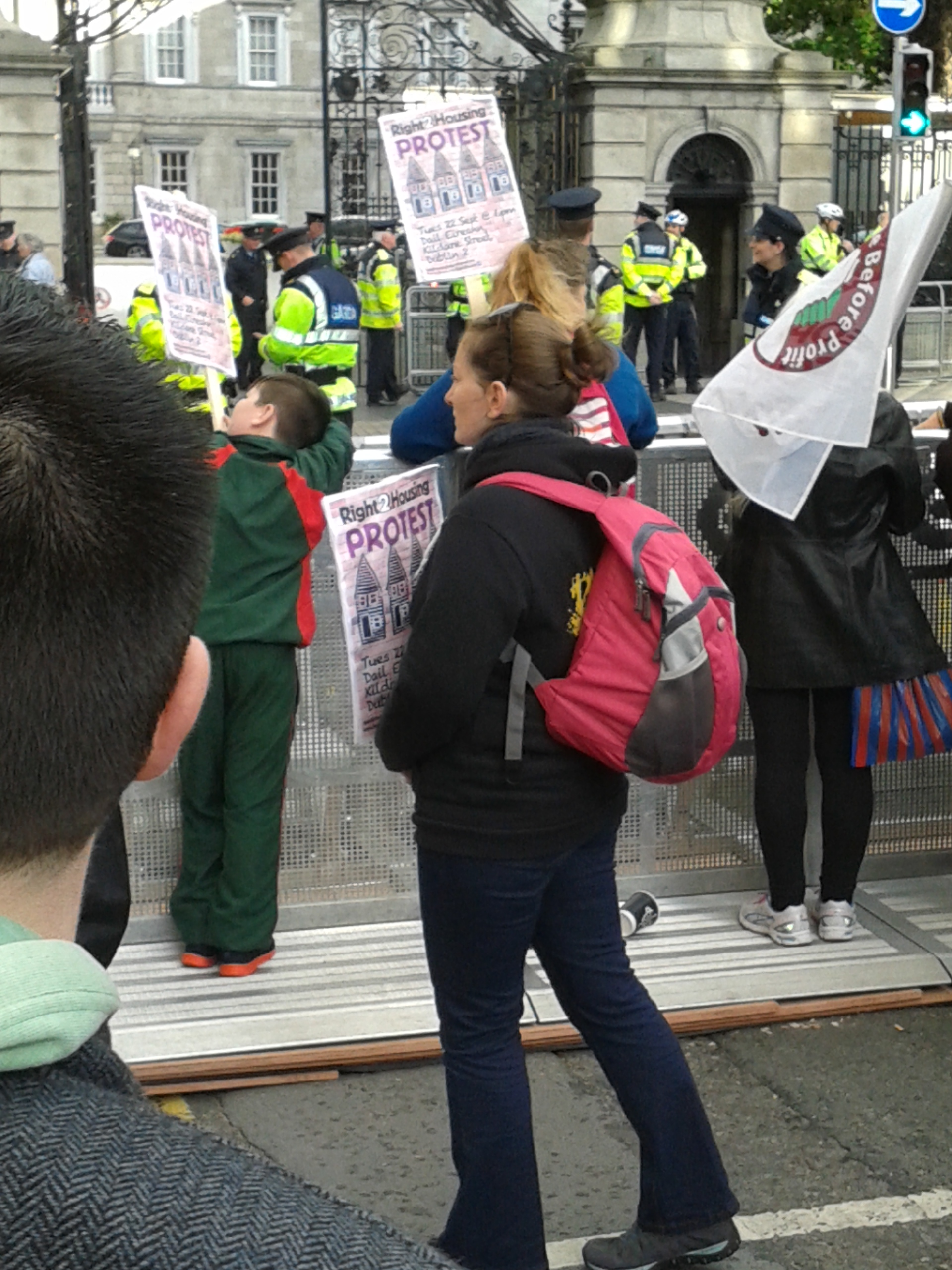
A few hundred people turned out to “welcome” the Irish Government Ministers and supporting TDs (elected members) back to the Dáil after the summer recess of the Irish parliament. The protesters were not allowed within fifty yards of the main gates, with lines of Gardaí, the Irish national police force, standing behind the special new double barriers which they now employ here. Kildare Street, the address of the Dáil, was closed by Gardaí to pedestrian and motor traffic and public transport buses using that street as part of their regular routes had to be re-routed.
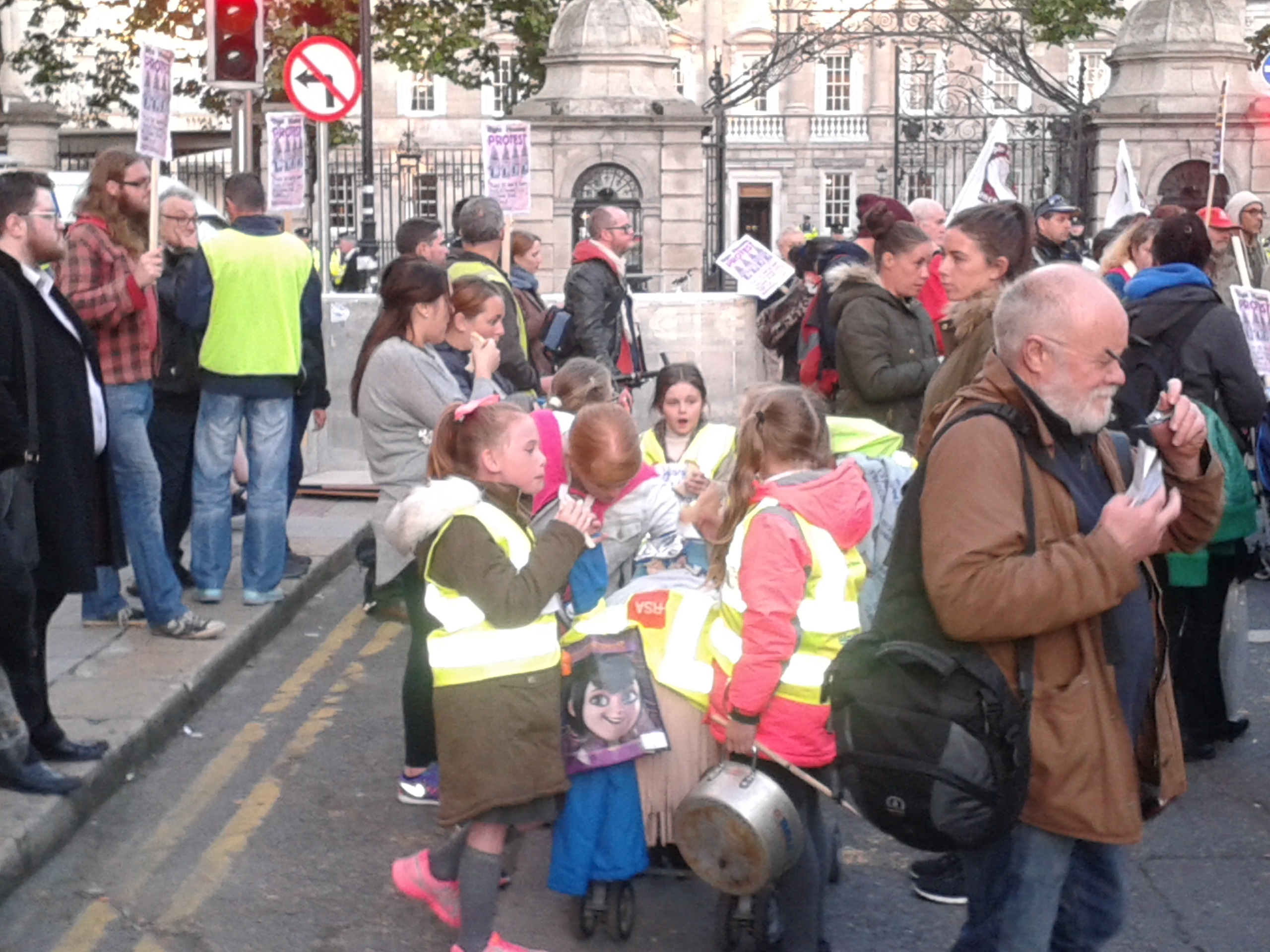
There was a special focus among many of the protesters on the housing crisis in Dublin with a number of organisations working with or campaigning for the homeless present and a number of placards drawing attention to the issue.
Some protesters had met at 4pm at the GPO in Dublin’s O’Connell Street and had marched to the Dáil from there, while others had arrived at the Dáil itself from 5pm onwards. There were others demonstrating too in Merrion Street, on the other side of the Dáil complex.
Around the other side, in Merrion Street, I met some protesters coming away from the protest there and stopped to talk to them. They informed me that it was ending there and I returned along Nasseau Street to Molesworth Street.
Among others, schoolchildren lean on the barrier which facing the Dáil, the Irish Parlia
When I started up Dawson Street I saw a small march coming down towards me. These were clearly the remainder of those who had been in Merrion Street earlier. Among this section were young mothers and some of their children had notes attached to their chests, for example “I am five and I am homeless”. I joined this group for the short walk remaining in Dawson Street and into Molesworth Street.
Speeches were still going on there and it seemed a musician or singer would have made a nice change – or even a comedian, or a juggler. After a short while the speeches ended and the crowd began to disperse, at which point I approached the women I had been told were homeless and spoke to one. Shortly after, I left to buy a cup of coffee and start an article about that homeless woman and her children.
The French Government deny rumours of a relaxation in their policy of dispersal. The Spanish Government confirms it is business as before for Basque political prisoners.
On 3rd September French diplomatic sources refuted interpretations in some media that it had changed its position with regard to Basque political prisoners. The media interpretations had been built upon a statement by the Abertzale (Basque Patriotic) Left party Sortu, that it had met on July 8th with the French Minister of Justice. The diplomatic sources downplayed the significance of the meeting and denied bringing Basque political prisoners closer to the Basque Country. Etxerat, the organisation for relatives and friends of the prisoners, confirmed that there had been no move to moderate the dispersal.
The day previous to the release of information from French diplomatic sources, on Wednesday, French Justice Minister Christiane Taubira had met with her Spanish counterpart, Rafael Catala. The following day, Taubira said her Government’s approach is to analyse requests for transfer based on the length of the sentence and relocation near their family. Meanwhile, the Spanish Minister of Justice and the Interior reiterated his Government’s position that any individual prisoners’ transfer to a jail in the Basque Country required the prisoners to renounce their organisation and to accept responsibility for the damage caused by their action.
The French approach contrasts with the requirements of the Spanish Government, although Catalá reiterated yesterday that both states were acting in a “coordinated” manner and that the French Government “has not moved its policy by one iota .”
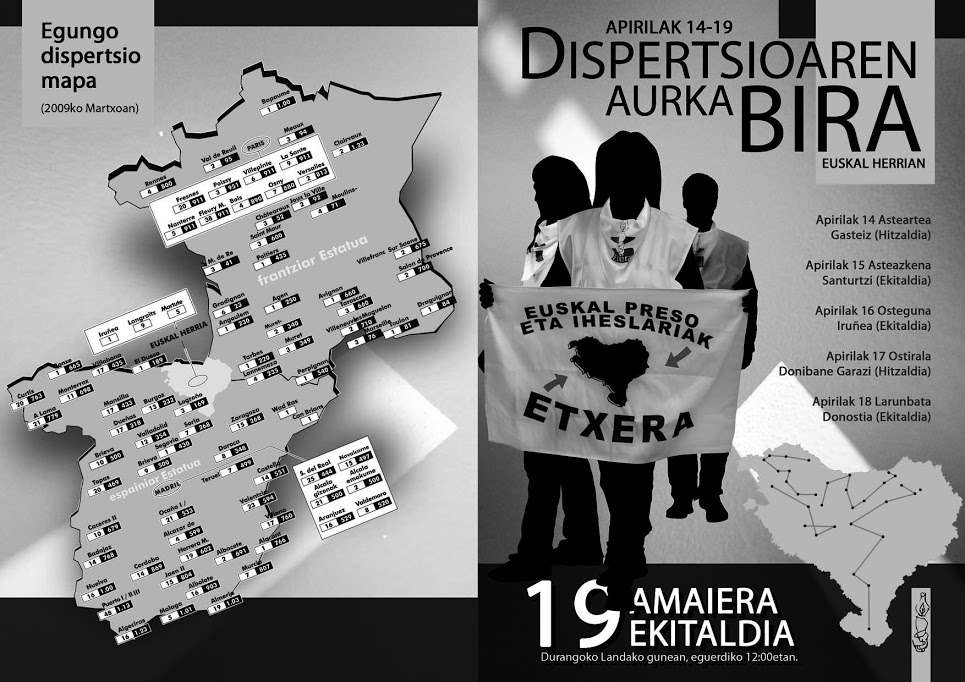
According to Etxerat on Thursday, of the nearly 100 Basque political prisoners in French prisons, only two are in Mont de Marsans prison (152 kilometers from the Basque city of Donosti), while six prisoners are in Lannemezen (231 kilometers). The rest are serving out their sentences at a greater distance from home, the vast majority at more than 600 kilometers. Although the support organisation viewed the French Minister’s statement positively, it was also at pains to disabuse people of any belief in a change in the French dispersal of prisoners and stated that any prisoners brought nearer were merely as a result of movement to which the relatives and friends have become accustomed, “bringing them close” before “bringing them far away again.”
Map of the dispersal of Basque political prisoners across both states and Etxerat flag in a poster calling for a protest and solidarity demonstration some years ago
The organisation of relatives and friends of Basque political prisoners stated that neither they nor any prisoners’ relatives participated in any meeting with the French Ministry of Justice – any meeting was with several members of Sortu only.
Spokespersons for the party of the Patriotic Left, Sortu, indicated that at their July meeting the French Ministry had been represented by Alain Christnach, Taubira’s Chief of Staff. Meanwhile the French, through diplomatic sources, asked observers not to “over-interpret” this meeting and indicated that participation in the meeting does not mean accepting Sortu’s proposals.
Another issue discussed by the Spanish and French Ministers was the possible transfer of prisoners under the law of mutual recognition of penal sentences in the EU, in force since January. This legislation provides the possibility for prisoners serving sentences in any EU Member state to be transferred to a Spanish prison; however, most Basque prisoners are unlikely to avail of this provision due to harder treatment in the Spanish prison system and the fact that dispersal throughout the state continues.
In a different aspect of the same legislation, the MEP of the Basque Nationalist Party (PNV), Izaskun Bilbao, asked the European Commission whether it will take Spain before the European Court of Justice for failure to take account of sentences served in French prisons by Basque political prisoners. This is because of the fact that the Spanish state often waits until a prisoner has served his sentence in France before extraditing him on a Spanish charge to face a further sentence in Spanish prisons.
Policy of dispersal of political prisoners — an abuse of human rights
There are many issues raised with regard to Basque political prisoners but the most universal one is the simple fact of dispersal. Relatives and friends face journeys of hundreds or even thousands of kilometers to visit their loved ones and the same distance back again. Many of these journeys are impossible without overnight stays. The expense drains financial resources while the long journeys themselves drain energy and, for elderly or unwell relatives, are an impossibility. An average of one serious accident a month occurs on these journeys for Basque political prisoners’ visitors and twelve have died in crashes over the years. Nor is it unknown for the relatives to be harassed by police on their journey or attacked by Spanish civilian fascists. As Etxerat has stated in its monthly reports and in a number of other statements: “The sentence was supposed to be on the prisoner but in actual fact was served on us as well, although we have been accused of nothing.”
It is a well-established principle of human rights that prisoners should, as far as possible, serve their sentences in a prison close to their families and relatives. This is in recognition of the rights of families as well as the desirability of easing the reintegration of prisoners as much as possible into society. The principle is covered in a number of United Nations policy paragraphs and also within the EU’s model rules for prisoners adopted in 2006 (https://wcd.coe.int/ViewDoc.jsp?id=955747).
Since both the French and Spanish states’ policy of dispersal appears to be in clear violation of the prisoners’ and relatives’ human rights and indeed of the EU’s own model rules for prisoners, some observers find it somewhat perplexing that the relatives’ organisation does not take a case against the states to the Court of Human Rights in Strasbourg. Granted, Strasbourg’s controversial decision on the Spanish State’s banning of the Herri Batasuna political party did not go in the Basques’ favour and the Court, albeit instructing the Spanish state to pay compensation to Basques for not investigating their claims of torture, continues to show a reluctance to find the Spanish State guilty of actual torture. But the dispersal of prisoners is an observable and undeniable fact and, furthermore, one which has been confirmed in public statements by Government ministers of both states.
End item
(Main source on the various statements: Deia, 4th September 2015)
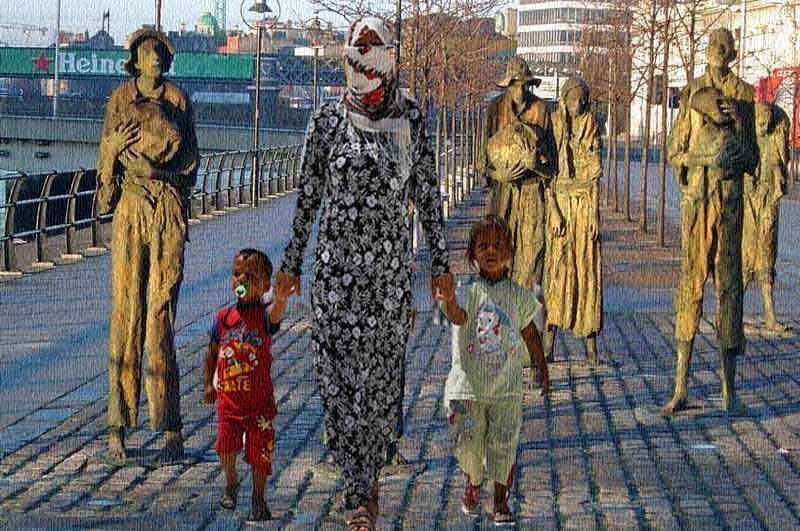
The Great Hunger (1845-1849) emigrants’ monument on the north quays of the river Liffey, Dublin, with superimposed image of African woman and children (image from Memet Uludag on Facebook).
Any hope that the Irish capitalist ruling class and their current government had that people had given up — or even had just got tired of marching — were dashed on Sunday 29th August 2015.
Hundreds of thousands gathered again from far and near; banners were on display from the West, South, North-East and North-West, Midlands, and of course many parts of Dublin and the East coast.
The main march columns started off from two train stations: Connolly Station, to the east of the city and Heuston, to the west. The latter contingent crossed the river at the station then marched eastward towards the city centre along the southern quays while the other marched westward along the northern quays and then crossed the river to the north side further upriver (Essex Bridge) and turned towards the city centre. Both columns had contingents and individuals joining them en route while others went straight towards O’Connell Street, they were greeted by a musical performance from the main stage by Don Baker and other musicians, also a performance by a rapper.
Aerial shot of rally in O’Connell Street (photo: Communities Against the Water Charge)
STATE REPRESSION
State repression was focused on at times: the Jobstown 23 banner got strong applause from bystanders at various points along the route, another banner denounced Garda violence including pepper-spraying and a number of speakers spoke about Garda repression, including one who talked about the Special Branch opening files on anti-water tax resisters.
This banner got strong applause from bystanders at various points along the route
As usual on large demonstrations of this kind, the Gardai refrained from violence or bullying and in fact were in very low profile, in stark contrast to their behaviour and numbers when dealing with smaller numbers in local resistance to water tax and the installation of water meters.
ELECTIONS, TRADE UNIONS
Among the speakers there was of course much mention of elections and getting rid of the current capiltalist government and also statements about the fight for the Republic in history, compared bleakly to the situation in Ireland today with unemployement, emigration, cuts to services, homelessness, privatisation. John Douglas, Gen. Secretary of Mandate and President of Mandate covered many of those issues, including the Dunne’s Stores dispute and the sudden closure of Clery’s in a rousing speech. However, those two are cases in point illustrating the weakness of the Irish trade union movement today: Mandate had one day’s strike in Dunnes’ many weeks ago and have won no gains as yet, while Clery’s managed to sack their workers without the union leading even a sit-in to hold the building and stock as a bargaining chip
Belfast Trades Council banner on the demonstration — they also had a speaker on the platform
A new presence on this demonstration was Belfast Trade Council, who were made very welcome and who had a speaker on the platform. He said that there was no EU directive to tax the water and that in the Six Counties they had defeated the water tax. He was not long speaking when the heavens opened and rain poured down on demonstrators and bystanders alike.
SUMMARY
What today showed is a strong will to resist across the country and across a great age spread, but with noticeably lower numbers across the teenage and young adult band, as well as a relatively weak leadership of the movement.
It remains to be seen whether RTÉ and newspapers will give a reasonable estimate of the numbers and coverage or instead do the usual of quoting ridiculously low figures or remain vague about them while giving minimal space to what was a large event, with participation from around the nation, as part of the biggest civil disobedience campaign in the history of this State.
End
Video of unaccompanied rapper Stephen Murphy at rally
At the Mayo v. Dublin GAA football game in Croke Park the following day, on Hill 16 (Photo from Right to Water FB page)
(Postcript: In their on-line report, RTÉ showed a photo of a packed O’Connell St. and said the organisers were claiming around 80,000. Also, at the Dublin GAA football match of Mayo v. Dublin the following day in Croke Park, attended by Enda Kenny, whose seat is in that county, Dublin supporters unfurled a giant banner of Right to Water).
The historic ruins of Hasankeyf, which may have been settled more than two thousand years BCE, are threatened by a Turkish dam along with the homes of Kurdish, Armenian and Arab people. A number of archaeologists and historians believe that the fortified town was referred to in inscriptions on the Mari tablets (1,800-1,750 BCE). The rocky outcrop also contains many human-made caves.
Some of the caves at the Hasankeyf site
As well as being the site of an ancient town, it is also an urban and outer settled district located along the Tigris River in the Batman Province in southeastern Turkey, with a recent combined population approaching 70,000.
The project that threatens to submerge much of Hasankeyf is the Isilu Dam being built by Turkey. Despite the foundation stone being laid as late as 2006, in 1971it was already being actively considered as one of the sites for a number of dam projects for hydro-electric generation and number of other purposes. A study by an international team between 1980 and 1982 recommended the building of the Isilu dam despite the 1981 declaration by the Turkish Government itself of Hasankeyf as a natural conservation area.
Opposition to the dam
The project had run into funding difficulties over the years. Due to international protests on environmental, archaeological and human rights grounds, and also protests within Turkey and from inside Hasankeyf, a number of international funders backed off. The British Government refused $236 million in funding in 2000 and in 2009, a consortium of Austrian, Swiss and German credit agencies withdrew their offer of $610 million.
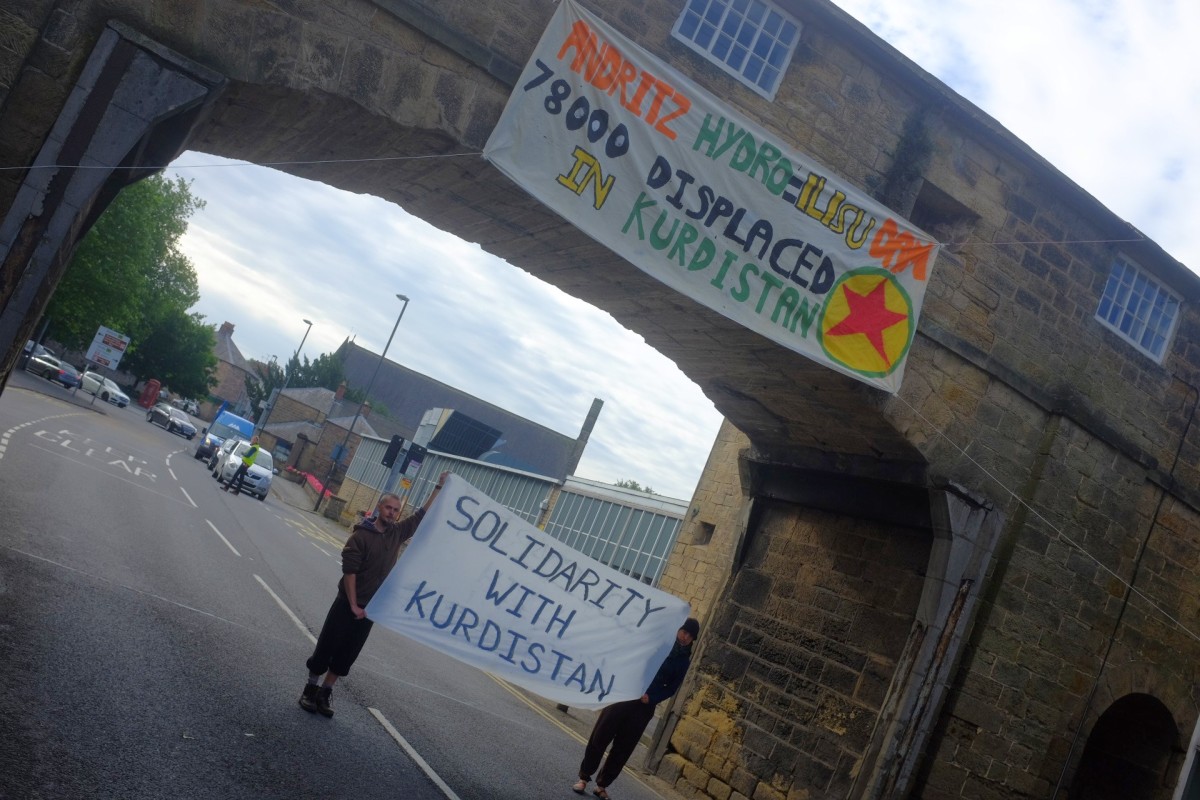
Solidarity picket outside the Andritz company plant in England
The consortium had suspended the loan in 2008 and had given the Turkish Government 6 months to comply with international standards, which they had failed to do. However in July 2010 the Austrian firm Andritz Hydro announced it was lifting its suspension and would provide the six huge turbines specified for the power plant.
Excavations for the main body of the dam began in May 2011 and the Turkish Government projected that all works would be completed this year. A 250m (820ft) permanent steel-girder bridge with concrete supports has been constructed just downstream of the dam andconstruction of new villages is currently underway. The diversion of the Tigris River began during August 2012. According to Government figures, by April 2014 the project was 60% completed while 73% of the Hasankeyf population had been resettled.
Protests continue within the area, peaceful and not. According to the Government, in January 2015 Kurdistan Workers’ Party (PKK) threatened the lives of workers and anti-Government sources confirmed that a number of workers left the site. On 3 February 2015 a convoy of supplies for the dam was attacked, injuring three persons and several days later a worker was killed in his home, according to the Government by suspected PKK militants. Peaceful protests have included pickets and demonstrations (see photos) and some of these have also taken place abroad, including recent ones in England (see photos).
Locals, probably mostly if not all Kurds, protest at the Hasankeyf site
The completion of the Ilısu Dam will cause the flooding of the ancient city of Hasankeyfand about 185 villages and hamlets will be fully or partially affected by flooding, according to the Kurdish Human Rights Project. From 55,000–65,000 people will be forcibly resettled, says the KHRP, while even the Turkish Government estimates 40,000. According to a statement released on the 24th August by a solidarity group protesting outside the Austrian Andritz company’s facility in England, the completed project will reduce water flow to Syria by 40% and Iraq by 80% and the dam also provides the facility for political control of those areas through further restriction of water supplies.
Turkey is a member ofNATO and extremely important strategically to the the military alliance, as well as having some significant natural resources. However its regularly-renewed applications to join the EU have always been turned down because of its human rights record, both in the course of recent wars with its ethnic Kurds as well as with regard to protest movements among ethnic Turks. Recently Turkey came in for adverse international publicity again as it was seen to be blocking Kurds trying to get through the Turkish border with Syria in order to defend areas under attack by ISIS (Islamic State), while Turkey has also been accused of more directly assisting ISIS in its attacks. Although the state has Moslem fundamentalist political parties which occasionally come into government, Turkey itself has been secular since it became a republic in 1922.
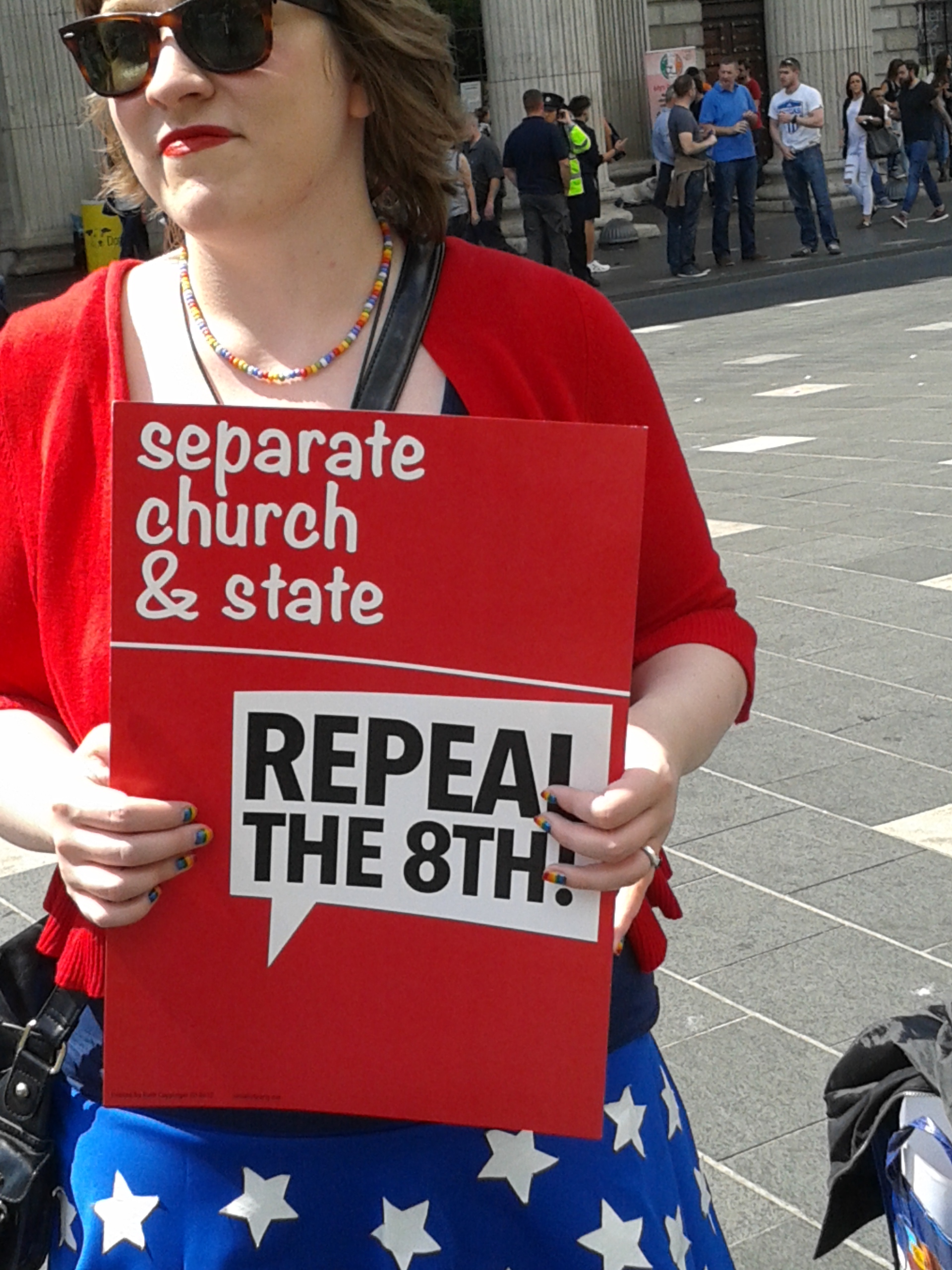
Anti-Water Tax protester leaves Dublin court today at liberty after two months but Gardaí arrest three Pro-Choice campaigners this evening, pepper-spraying at least one of them while held immobile on the ground.
Arrested impeding Irish Water vehicles
Stephen Bennet was brought from Mountjoy Prison this morning to Dublin Criminal Court to face “Public Order” charges relating to “obstructing” Irish Water vehicles in Dún Laoghaire and Dalkey and refusing to comply with Gárda instructions to desist. The Dún Laoghaire court had imposed conditions for releasing Bennet on bail which included a curfew, staying away from Irish Water vehicles and a large financial surety. Declaring the conditions unreasonable and a restriction on his civil rights to protest, Bennet had refused to agree to the conditions and the judge had taken to jail.
Some of the crowd of supporters welcome Bennet as he emerges into the court ground floor lobby. His daughter Saoirse can be seen to the left holding Bennet’s grandson. Unfortunately, Bennet is hidden as he moved forward as photo was taken.
Up to 30 supporters crowded into the court this morning to hear Bennet’s case being tried. There was also a large number of Special Branch Gardaí (political police in plain clothes) and a smaller number of uniformed police. A Garda Sergeant Gilmore from Dun Laoghaire station gave evidence of having confronted Bennet at York Road in Dún Laoghaire, where the accused had been sitting in the road and at Dalkey, where he had been “marching extremely slowly”. Sgt. Gilmore quoted the Public Order Act to Bennet and ordered him to desist but Bennet had declined to comply. Defence Counsel maintained that there was “a reasonable doubt” as to whether Bennet had been in violation of laws initially which would have rendered his subsequent refusal to comply with Garda instructions not an offence. Since there was no question of accusation of breaches of the peace, assault or criminal damage, the point at issue was whether the Public Order Act was applicable. State Prosecution Counsel argued that blocking or slowing traffic was creating “a nuisance”, to which Defence Counsel replied that causing a nuisance was part of the purpose of a protest, in order to make it effective. Sit-down and marching slowly protests had not been tested in Irish law, said Defence Counsel but quoted a number of cases from the European Court of Human Rights at Strasbourg where the Court had ruled in favour of applicants’ rights to protest even when the applicants’ states had found them in violation of their laws and penalised them.
Some of the supporters outside the Dublin Court today
The Judge retired to consider the case and when he returned he found Bennet guilty on all charges and sentenced him to a total of around €800 in fines, in default of which a total of 11 days in jail. One one charge, he sentence Bennet to two months’ imprisonment but, since that was time already served awaiting trial, Bennet was freed to cheers from his supporters, including his daughter Saoirse and his grandson, who had been born while he was in jail.
Belfast mother charged with giving her daughter an abortion-inducing pill
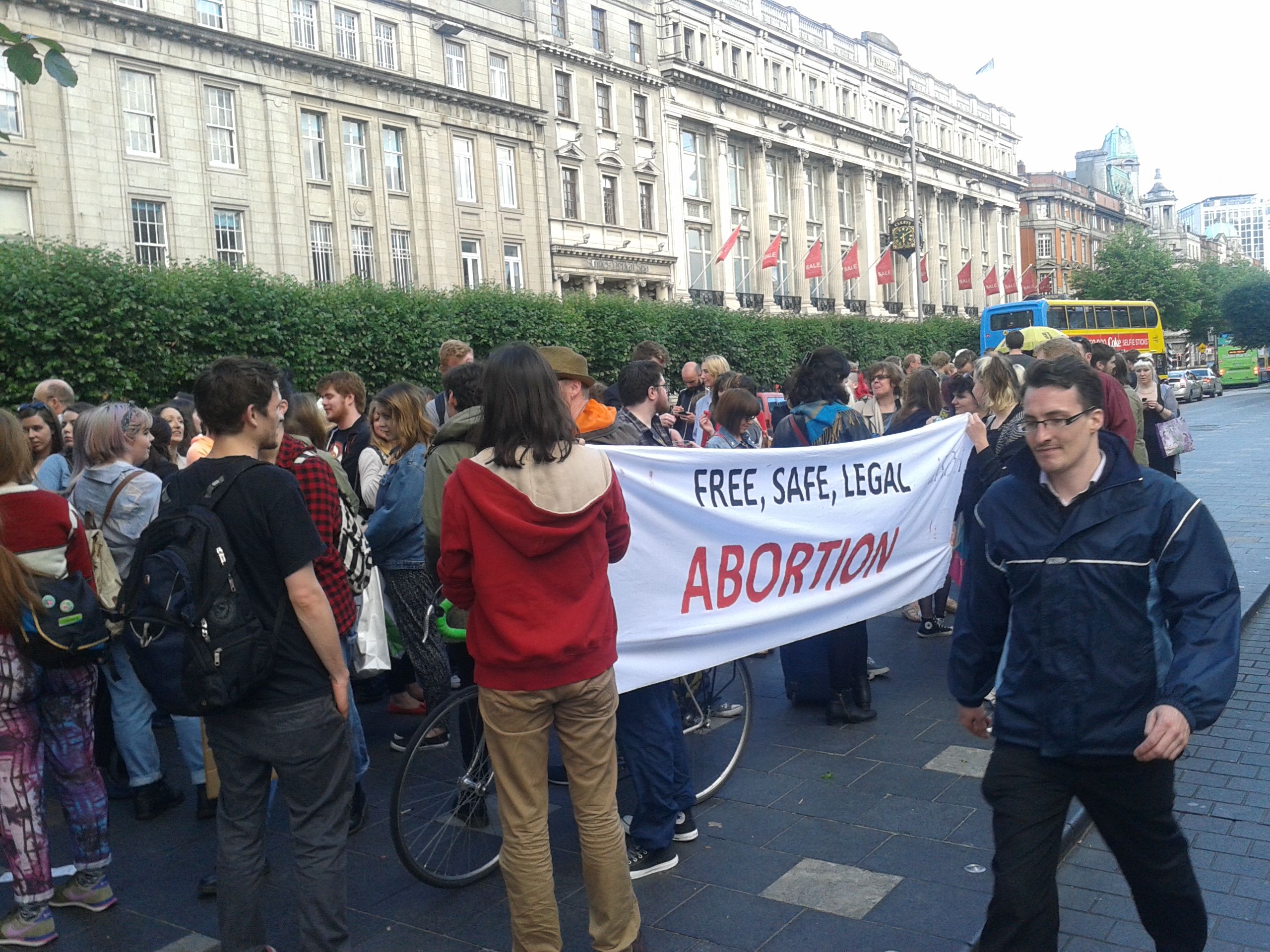
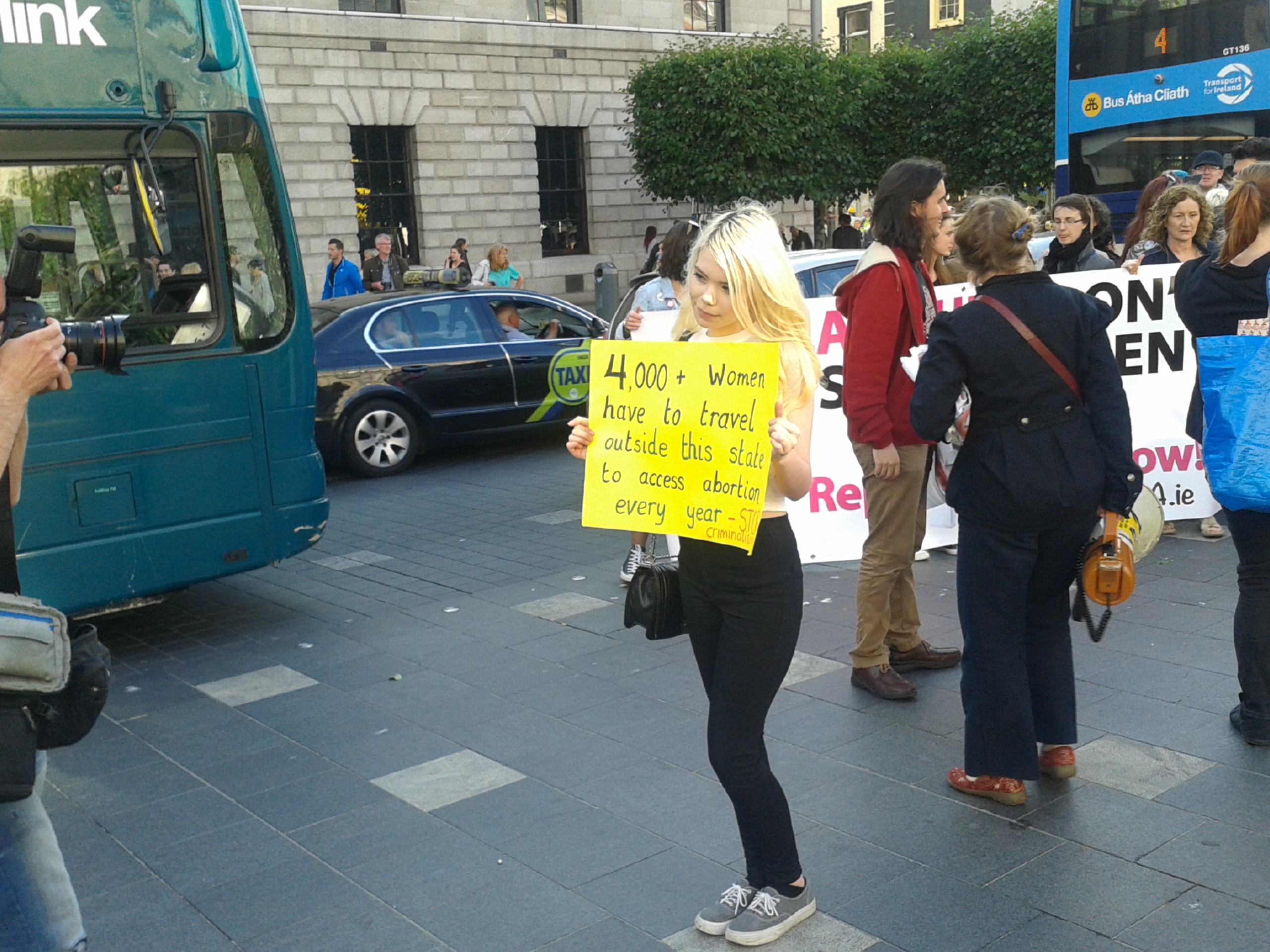
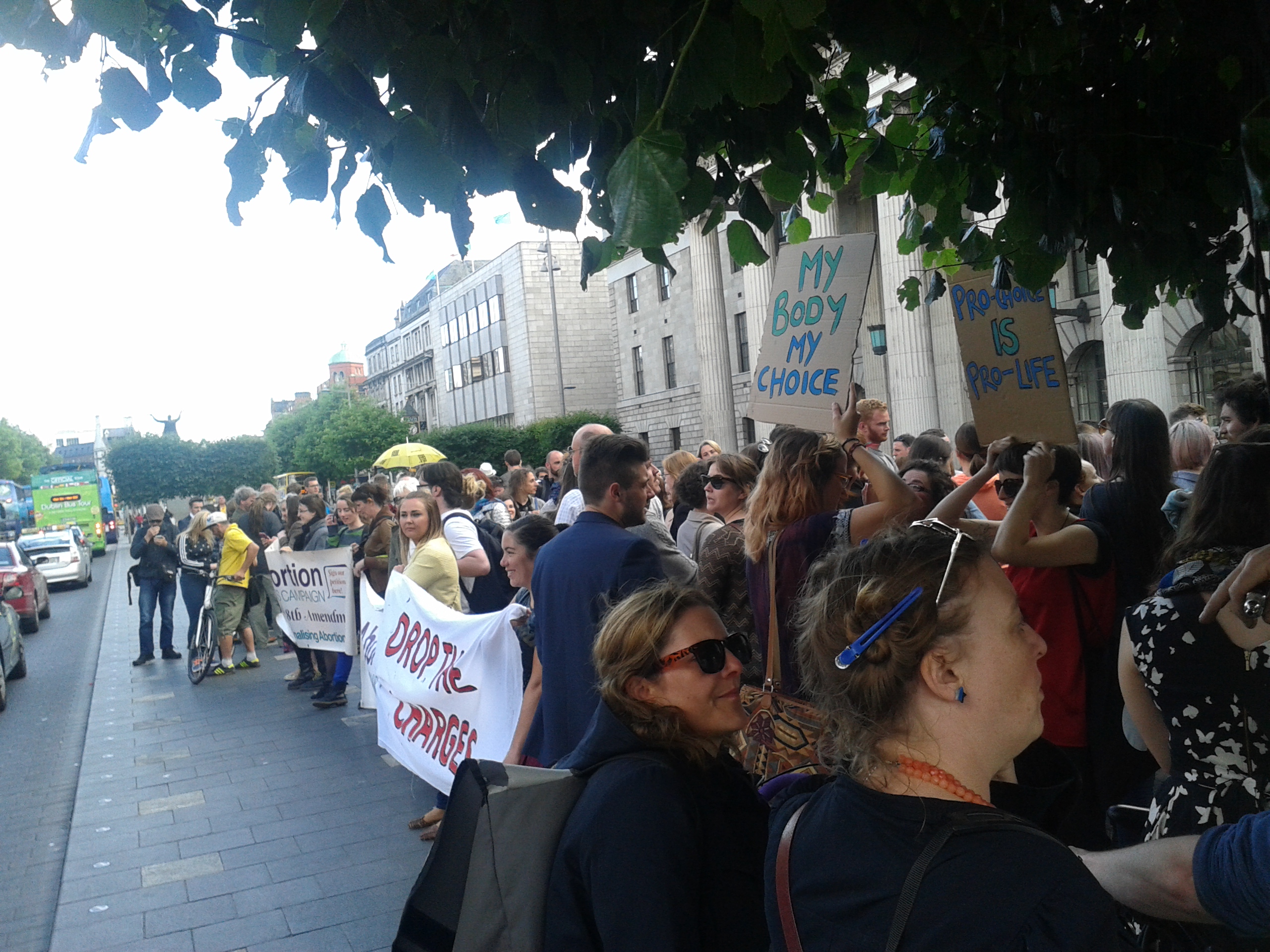
At 6pm this evening a protest took place at the Spire in Dublin in solidarity with a Belfast mother who facing criminal charged for having given her daughter a pill which induces abortion in very early pregnancies. The pill is freely available in Britain and legal there but the 1967 Act which legalised abortion in Britain has not been enacted in the Six Counties.
West side, O’Connell Street central pedestrian reservation, Dublin, just near Spire
The event had been organised by the Workers’ Solidarity Movement and Real Productive Health organisation in order to express solidarity with the mother and also to link the struggle of women in the 26 Counties with those in the Six, women in both parts of Ireland having to travel to another country, Britain, to avail of abortions and similar protests took place in Belfast and in Galway.
East side O’Connell Street, Dublin, just near the Spire
A number of people spoke and soon afterwards some excitement stirred through the crowd and they began to examine the roof of the GPO where something was going on. Very shortly after that a Garda squad car with siren blaring and blue lights flashing tore along O’Connell Street and turned into Henry Street.
Another group at the protestSitters and Standers mid-way through the demonstration
Violent Garda arrest scenes
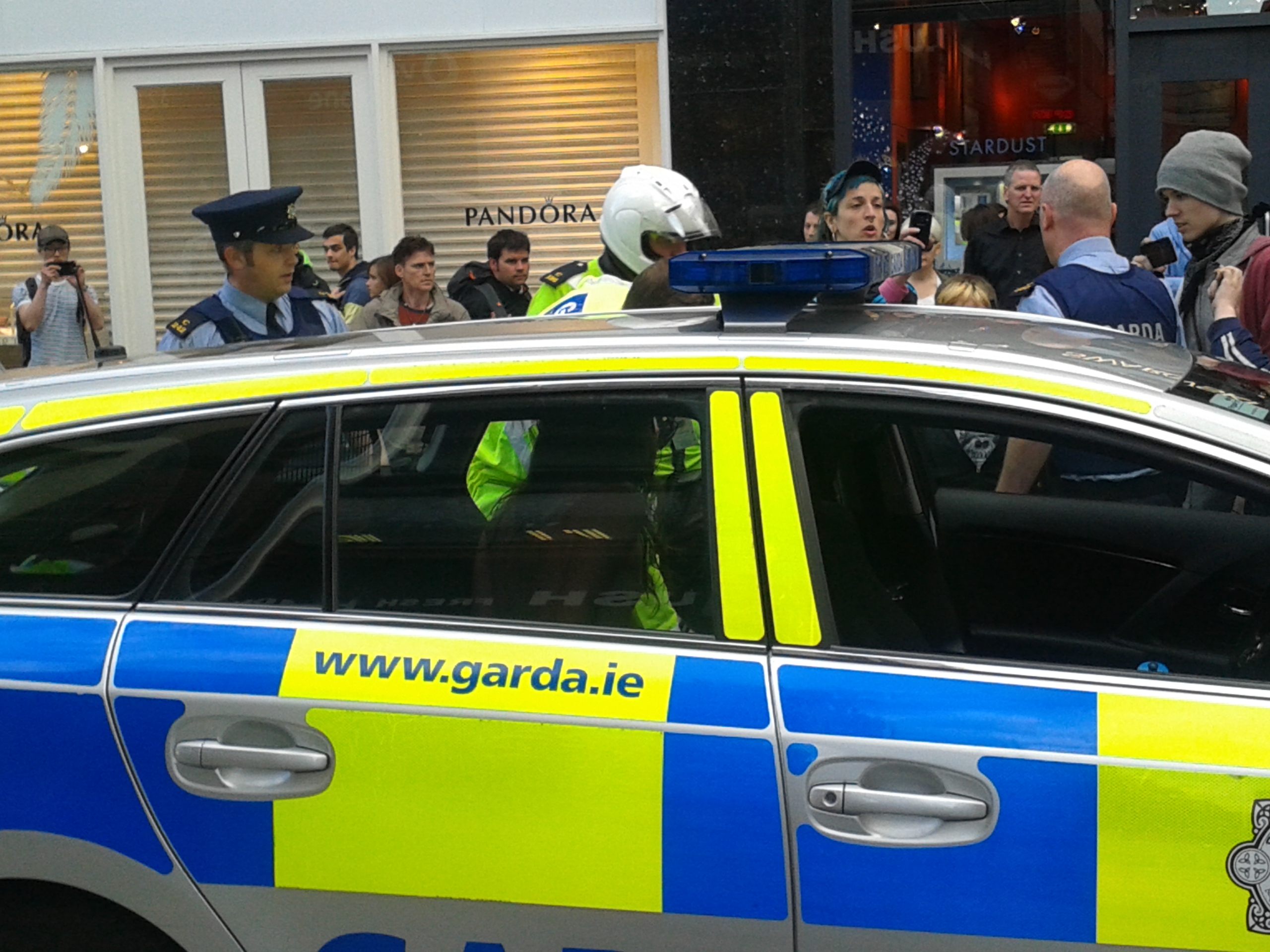
People broke away from the pro-choice demonstration and gathered in Henry Street as other Garda squad cars, a motorbike, a cycle Garda and a number uniformed and Special Branch Gardaí on foot poured into the street. The scene was was somewhat confusing for many but what was clear was that the Gardaí had torn the shirt off one one young man, handcuffed him and put him, stripped to the waist, in a squad car. Another young man was also handcuffed and ended up on the ground with a number of police on top, one of whom pepper-sprayed him while in that position. This action provoked shouts from onlookers and uncertain physical intervention. As a third was arrested and bundled into a police car, the word went around that these were pro-choice demonstrators who had got on to the GPO roof (presumably using the scaffolding to the side of the building) and that they had attempted to display a banner up there.
Man arrested after shirt torn off in squad car in Henry Street can just be discerned in the back seat of the squad carAnother of those arrested in Henry Street; he ended up on the ground with a number of police on top before being put in the car.
People gathered around the Gardaí, some of whom threatened to arrest those arguing with them. The Gardaí were then seen to be picking up a banner to put in the back of one of their vehicles when a woman cried sarcastically: “A banner! Oh, thank you for saving us from a banner!” Others joined in shouting: “Bad banner! Bad banner!” amidst other calls from protesters and passers-by generally expressing an opinion that the police action had been unnecessary, repressive and over the top in violence and in numbers. Indeed, the numbers of Gardaí present who had suddenly appeared did suggest to many that they had been kept in readiness to move on the pro-choice demonstration at some point or were aware that some publicity action had been planned. Protesters who attended Store Street Garda station soon afterwards were told that the accused would be charged and released on bail “in a couple of hours”. The wording on the banner apparently had been “ABORTION CHARGES ARE BOLLIX”.
WSM video of scenes at the arrests: https://www.youtube.com/watch?v=iPwZlWYW3kE
WSM Video of the rally just prior to the arrests: https://www.youtube.com/watch?v=cFp_AzsFIa0
Workers’ Solidarity Movement statement on the arrests http://www.wsm.ie/c/wsm-statement-garda-arrest-pro-choice-campaigners-july2015
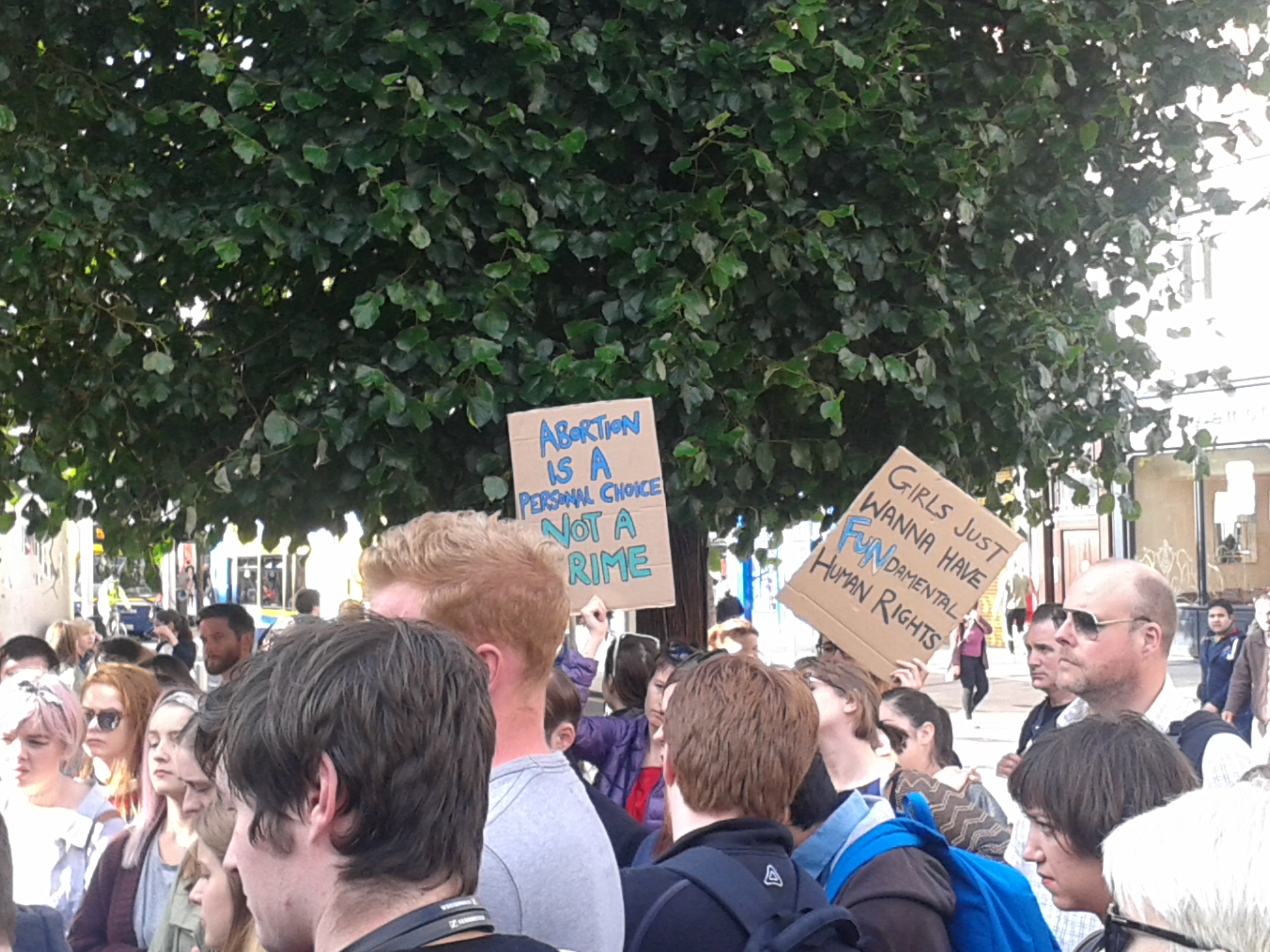
Some in crowd beginning to argue with Gardaí as others look on amazedTwo placards in the crowd earlier, a reminder of what it was about
COURT HEARS OF INTIMIDATION OF FAMILIES OF ACTIVISTS BY GARDAÍ AND SHELL SECURITY MEN WEARING BALACLAVAS
By Pat Cannon
I was present in Castlebar court house for most of the ten-days of the trial of Gerry Bourke and Liam Heffernan who are Shell To Sea supporters and activists. I witnessed at firsthand how tax-payers’ money can be wasted at will by the agents of the state i.e. Gárdaí (the Irish police), State solicitors, the Dept. Of Public Prosecution, the Judge, court officials, State barristers and other hangers-on.
Numbers involved:
( 1 ) Judge ( 1 ) courtroom user ( 2 ) Stenographers ( 1 ) Prison officer; ( 1 ) Gárda on video evidence ( 2 ) State Solicitors ( 1 ) Senior Counsel for the State ( 1 ) Junior Counsel for the State; ( 2 ) Solicitors for the Defence ( 2 ) Senior Counsel for the Defense ( 2 ) Junior Counsel for the Defence; ( 12 ) Jurors ( 12 ) witnesses at least. Also the secretarial staff of all parties, including the DPP Office staff working on the case, also the cleaners and the other Court staff.
First of all if the State and the oil companies had initially negotiated with the locals, probably there would have been no need for these quiet citizens to have to rise up in protest against this project. A much safer and easier route for the pipe line would have been found as the locals have an extensive knowledge of this area. If the state (and its Government) had negotiated a reasonable deal with oil companies then there would be much less protestors. If proper health and safety regulations backed up by staff and equipment were in place from the start, people would feel much safer and secure in their homes. BUT NO! THE SHARKS DON’T NEGOTIATE — there is no room for compromise in a shark’s make-up.
SHARKS
Right from the start, the Government, the oil companies, the Environmental Protection Agency, County Council, media, Judiciary, Gárdaí and every other arm of the State treated the local people with disregard, contempt and as a complete irrelevance. As far as all the above-mentioned were concerned there was big money to be had and no small fry was going to get in the way. THERE WAS BLOOD IN THE WATER AND THE SHARKS WERE IN FOR THE KILL.
Thankfully there were 2,500 years of tradition and history still alive and well in this area, there was a quiet shy population but of people with a strong backbone that were well hardened into hardship, neglect and resistance to outside dictatorship and who were not going to be bullied or pushed about by anybody.
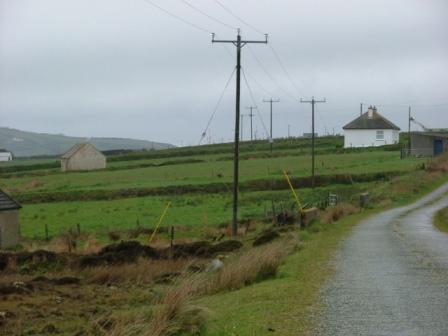
The rural area chosen by Shell for the pipe-laying (planned to run between shed on the left of photo and house on the right)
It was this stern backbone that caused a middle-aged primary school Principal teacher and her two daughters, backed up by less than a half-dozen other locals to take a stand and start protesting against the potential desecration of this EU Environmentally Protected Area and their local pristine environment. Of course they were ignored, the media never mentioned them; the oil company’s employees and officials looked the other way and probably had a good laugh as they passed, the Council and all the other arms of the State treated them as non-entities. As far as all these groups were concerned the local people were of no significance.
However, the time came when these officials had to get into closer proximity with the local people; they had to enter the local people’s land and they thought they could do this without permission, by bullying and using threats but soon discovered how mistaken they were. They learned that they were not just dealing with a few individuals or a few head cases but instead that there was a whole community in this locality and that this community was close-knit and resolute in their opposition to outside intimidation and coercion.
With little or no advance warning the oil companies’ employees entered the farmland of six local farmers without the owners’ consent and proceeded to dig trial holes, knock down boundary fences and block access to and from the land in question. Naturally enough the farmers contacted their legal advocates and very quickly they were in court for the first time in their lives.
Of course the Courts and Judiciary are also an arm of the State and are also commercial enterprises just like the oil companyies and they ruled in favour of the foreign multi-national companies. After all small local marshland farmers can’t afford to give big financial enticements to Court judges, politicians and Government officials but on the other hand the oil company will be very generous as has transpired since.
JAILING OF THE ROSSPORT FIVE
The six farmers, five men and one woman were found in “contempt of court” and the five men were jailed until they “purged their contempt”. This lead to an outcry all over the country and hundreds of thousands of people came to the assistance of what became known as “the Rossport Five”. Ninety-four days later the Courts had to capitulate and release all of the five innocent men.
However the scene was set for what would become a marathon David and Goliath battle between a small close-knit indigenous rural Irish community and three foreign multinational oil companies, one of which had a larger turnover than that of the whole Irish State even though the latter was experiencing an unprecedented economic boom.
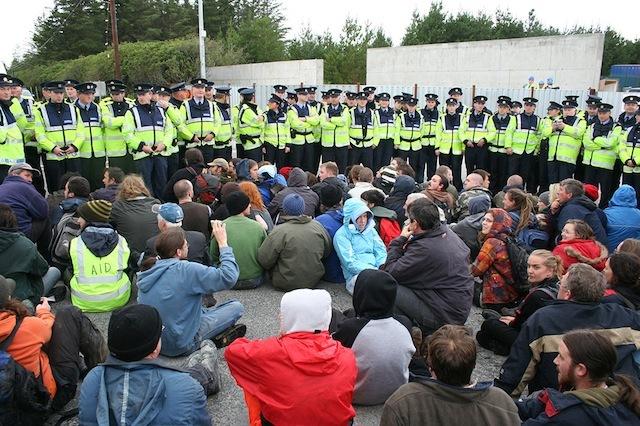
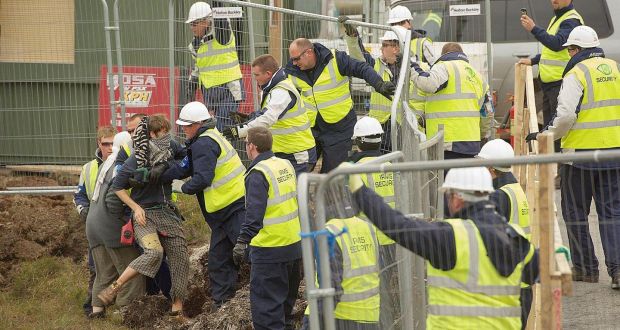
Gardai defending Shell confront protesters
Thirteen years after the middle-aged school teacher and a handful of supporters stood outside the local council offices in protest the struggle is still going on and the oil companies and Irish Government are still trying to bully their way through the Irish people.
However, the Government’s economic boom has disappeared and the people now realize that if they still had their oil and gas that was fraudulently misappropriated by the Irish Government and the oil companies, we would have NO EVICTIONS, NO CENTENARIANS ON HOSPITAL TROLLIES, NO EMIGRATION, NO UNEMPLOYMENT AND NO STEALTH TAXES.
IN THE COURT RECENTLY
So in these last two weeks I witnessed the State trying to criminalise two more supporters of the struggle; we saw video evidence showing that the men had to use considerable force to gain entry to Shell’s site and when confronted by Shell’s private army (security force) the protestors had to stand firm and use a variety of tactics to get past them. We heard State witness after State witness tell lie after lie or refuse to answer or evade answering questions when they were put in the witness box, then the Defence were not allowed show their video evidence and some of their witness were not allowed on the stand.
Shell security team manhandle a protester.
I heard how Shell’s private army drive around the villages at night in two jeeps with blacked-out windows and shine their lights through the windows of activists’ homes, whilst if anybody comes out of the houses then four men wearing balaclavas step out of each jeep in an act of intimidation. We heard how the Gárdaí constantly drive past the people’s homes very slowly and then turn around a mile or two up the road just to drive past again five minutes later and hjow each time they pass, they stare into activists’ homes.
I heard how the Gárdaí punched, pushed, kicked and beat with steel batons men, women and children, how many activists spent long terms in prison on trumped-up charges while Shell plied the Gárdaí with over €35,000 worth of alcohol. I also heard how a Gárda made derogatory remarks of a sexual nature about a protestor’s wife to the protestor and how five Gárda were unwittingly recorded on a female prisoner’s video camera planning how they would interrogate her when they got her to the Garda station by threatening to rape her and laughing at the different ways they would word the threat. ALL of them got away with ALL these misconduct events.
Gardai caught on camera in action at Rossport
I heard how while car tyre contains on average 2 bars of air pressure per square inch, that this gas pipe had 345 bars of highly inflammable gas pressure per square inch, that the seas and sea bed are highly vulnerable to currents (the second most volatile currents in the World).
I also heard the accused man’s wife state how for 13 years while she was rearing her family she could think of nothing from once she got up in the morning till she fell asleep at night but this dangerous gas pipe line that would be practically going by their front door and over which she had to take her children to school every day.
In a statement to the Court, one of the Rossport 5 gave evidence that Michael D. Higgins (now Uachtarán of the Irish state) had been on the protest and had addressed the other protesters, also participated had the father of the State Solicitor prosecuting this case. He also said that Enda Kenny had visited the Five in prison and had told them that life was “very cheap in Ireland now” and that “you can get a man in Dublin to do a ‘hit’ on someone for €500.”
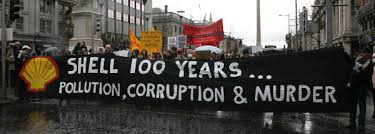
Protesters against Shell in Dublin
In his summing–up the Defence counsel stated that the State agencies had rubbished themselves in the eyes of the world in their dealing with the situation, that the terms that our oil was given away were the second best in the world for the oil companies, that they stated that there were no emergency plan in place if an accident or act of terror did happen and that the protestors had rendered a magnificent service to their fellow citizens at much expense and hardship to themselves by standing up for what is right and correct.
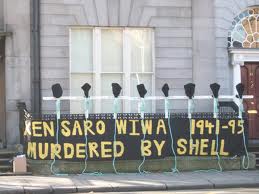
Protest at Shell HQ in Leeson St, Dublin in solidarity with Ogoni people in Nigeria and people at Rossport. The Nigerian Government, to protect Shell’s profits although the company was causing great environmental damage, hanged the nine leaders of the peaceful environmental movement
The Jury of eight women and four men was out for just about one hour when they returned with a unanimous verdict of “NOT GUILTY of violent disorder” on both Liam Heffernan and Gerry Bourke. A further malicious charge of “criminal damage” was dropped by the State because despite there having been 28 cameras on site and up to 30 security men and later a number of Gárdaí, there was no evidence to support the charge.
Just more waste of tax-payers’ money. I have reckoned the tab that the tax-payer will pick up will be in the region of €150,000 and Shell won’t be paying a penny of it.
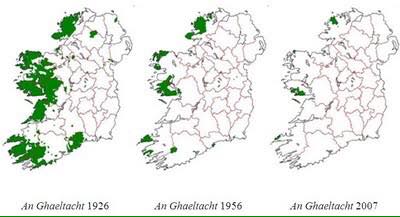
Maps showing the decline in the Irish-speaking areas, the Gaeltacht, during the life of the Irish state
“Irish is nearly dead as a spoken language.” A shock ran through the Irish-speaking community at the news…. but although the after-shocks reached linguists afar …. the news caused but a small ripple in Irish society at large.
It should have been big news. In only nine decades of the existence of the Irish state, the Irish-speaking areas had shrunk by 90%. This seemed to herald the imminent death of Irish as a spoken language – a language that, albeit shrunk to being the mother-tongue of small minority of the Irish population, had survived almost a millennium of colonial occupation and a consistent policy to replace it with English.
The loss would be greater than Ireland’s alone – this is an early Indo-European Celtic language of more than four thousand years of development, the language of the earliest vernacular literature of Western Europe, an extremely rich literature of pagan mythology and folklore containing epics which did not suffer the extent of moralistic destruction which either the Reformation or the Inquisition visited upon so many others across Europe. The language is probably unique on the Continent in being that of a state and which is also that of the first recorded settlers of the land. It was (perhaps still is) the Celtic language with the largest number of speakers. It is the mother of Scots Gaelic and Manx Gaelic too.
It seemed almost too difficult to grasp that this had occurred in a state that claims to be independent, which also claimed the language as the first in status in the State, according to its Constitution. And this has, seemingly contradictorily, occurred at a time when there are more Irish-medium schools, Gaelscoileanna, than ever before in the history of the State.
How did it come to pass? Emigration, some might say. Certainly emigration on a large scale has been a feature of Ireland’s demographics since at least the Great Hunger (although it was in the years after that disaster that the outlying western areas began to hemorrhage). Even so, although emigration has been a constant, so also has been the population – in other words, the birth-and-survival-rate kept up with the emigration. Did the Gaeltacht areas experience higher emigration rates than elsewhere then? Certainly – not just to go overseas but also to Irish cities, especially to Dublin. Industry was scarce in the Irish-speaking areas, despite the efforts of cooperatives and Gael-Linn and the land in most places is rocky and poor.
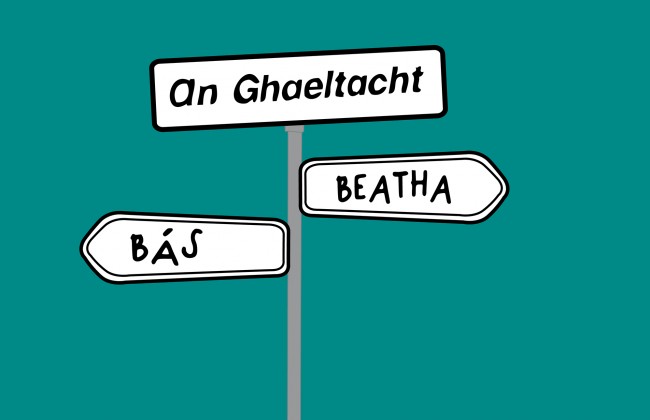
The Gaeltacht Death or Life (image downloaded from the Internet)
Yet, the reality appears to be that the Gaeltacht population reached a level at which it stayed – so how can there be a continual reduction reaching 90% in the Irish-speaking areas? If the population has not decreased, certainly not to that extent – then the Irish-speakers must have. Have many ceased to speak the language then, losing it over a generation, or two, or three? Or has an inward migration of English-language-only speakers replaced Irish-speakers? Yes to the first and yes, to an extent, to the second.
The Basques have a saying: “No language was ever lost because people didn’t learn it but rather because those who had it, stopped speaking it.” (As an aside, I find myself wanting to say “her”, because in Irish the word “language” is of feminine gender: “Beatha teanga í a labhairt” — literally “the life of a language is to speak her”). Observers speak of children raised in Irish-speaking families, or in a mixed-language household, even in the Gaeltacht, speaking English with their peers as they leave the primary school where the subjects are taught through Irish.
So, the people make a choice and some people of other mother-tongues move in – that’s democracy, isn’t it? Freedom to move, freedom to speak the language you want. But is it really so? Certainly one can assume that the people moving in are making a free choice (unless one takes into account dearer house prices in the cities). But are the ones moving out making a free choice? If the absence of industry and therefore employment is a constant in the Gaeltacht then it is not an entirely free choice to leave. If the work were there, one can assume many of the people would stay.
Ok, but the ones who stop speaking Irish – surely that is a free choice? One suspects cultural factors at play there. The attractive world for pre-teenager – which is what most childhood years have become — and teenager, is a world dominated by and represented through the English language. It is transmitted in English through so many media …. all with very little competition in Irish. The Irish-language TV channel, TG4 is in practice a bilingual one. Publishers find only a small market for books aimed at children and young adults in Irish, whereas the English-language market stretches not only throughout Ireland but abroad — Britain, the USA, Canada, Australia, New Zealand … All of this without mentioning TV, pop-song lyrics, video games, Internet, films ….
But one must also take into account the fact that when those Gaeltacht children visit their nearby towns and cities – Letterkenny, Dublin, Waterford, Cork, Tralee, Galway, Ballina – they hear English all around them. Worse … they hear only English around them – unless they hear other languages from tourists or perhaps an Eastern European language from migrants. What they are practically guaranteed NOT to hear is Irish.
So, hardly anyone speaks her – sorry, it – and it’s not cool and most people of your age around the country don’t speak the language and what do you need it for anyway? It’s not surprising Irish-speaking is in decline.
“You can’t blame the State – they tried their best, didn’t they? Sure Irish is still a compulsory subject in the schools.” “The national broadcaster has provided a radio station and TV channel for Irish-language use, too! And they give some grants to families speaking Irish in the Gaeltacht, right?”
Ní mar a shíltear a bhítear (loosely translated as “not all is as it seems”. Yes, Irish is taught in the schools but no attempt has ever been made to make it a language of daily use – for work, public transport, banking, shopping, post office, health service, education … Radió na Gaeltachta was won through a civil rights campaign – Feachtas Cearta Sibhialta Muintir na Gaeltachta – and people refused to pay their radio and TV licenses, were dragged to court, fined, refused and some even went to jail before TG4’s precursor, Teilifís na Gaeilge, was supplied. The Irish-speaking grants were a help to households but were not properly administered so that houses that were not Irish-speaking, or had lapsed, continued to receive them. This gave rise to false statistics that helped to conceal the decline in the Irish-speaking areas.
The Gaelscoileanna outside the Gaeltacht, at 143 in the 26 Counties, though an impressive success story, are not State initiatives — they were started by local groups who then battled for state support. Many are still in temporary buildings or in need of repair while others are awaiting the funding that will allow them to employ teachers. As for the other services – nothing. Oh, yes, some of them are supposed to have one designated member of staff who can provide a service in Irish – you can avail of him or her if she or he is not off sick, on holiday, on training or relocated. And if you can wait ….. and put up with the embarrassment while you hold up the queue. Even having one’s address used in the Irish form requires a battle, sometimes drawn out and one still finds one’s letters, from time to time, forwarded from someone else’s address or disappearing somewhere forever. Or discovering that one’s address, which one gave in Irish, has been converted back to English in some office.
A couple of years ago a Dublin court ruled that a man did not have a right to have the case against him heard through Irish. Gardaí are not subject to even the notional obligations to carry out their tasks through Irish or answerable to the Language Ombudsman and, although citizens have a right to have any legally-required procedure in Irish, cases regularly arise of people detained and threatened for insisting on being dealt with through Irish by the Gardaí (police).
Ó Glíosáin showed in research published in the 1980s the decline in Irish-speaking competency among people who had learned Irish at school and who had considered themselves competent speakers upon leaving secondary education. The rate of decline was in the order of a third for every decade passing since they left school. For all its faults, the blame cannot be placed on the educational system, the usual scapegoat. Ó Glíosáin spoke about the absence of “domains of language” for Irish outside the Gaeltacht. In Dublin, with a population of over a million, there is only one social space where everything should happen through Irish. One social space, in the capital of the State, to serve a population of over a million, more than one-fifth of the entire population of the State!
The lack of Irish services obtains even in the Gaeltacht, believe it or not. A man wrote recently of a bank branch in Connemara unable to deal with him making a withdrawal through Irish that asked him to make an appointment. Some years ago, I went to an AIB branch in the Donegal Gaeltacht area and, among a staff of five who were serving customers, could find not one able to give me a service in Irish. People in the Gaeltacht cannot get a decent service in Irish from their local authority, their health service nor, in many cases, their GP. This was so even when, decades ago, many Gaeltacht people hardly knew English.
Anyway, it’s all over now ….
So beat the drum slowly and play the fife lowly ….
Cnag go mall ar an druma is séid ar an fhíf go híseal …
Or is it? Irish has been in difficult situations before and still managed to survive. But this may be its greatest emergency. Can Irish-speaking survive if the Gaeltacht dies? Some say not, some say yes. But it will be without a doubt another great blow to the language and a great fall in its status. We should say NO — we will not suffer that to happen! We will not bequeath a headstone to future generations.
But what can we do?
What can be done – what must be done – must be done by us, each an every one of us, and also by the State. We must accustom the public to hear Irish spoken. Some will respond and some will not. Some will be hostile. But it must be done and WE must do it. And the more it is heard, the more it will be acknowledged, the more people will think it worthwhile to speak what they know, to learn more, to demand services through Irish, to keep speaking the Irish they know. Spreagan Gaeilge Gaeilge – “Irish inspires/ generates Irish”.
We can greet the bus or taxi driver or shop assistant or post office official in Irish and thank them, saying goodbye in the same language. In pubs and cafes we can ask for our drinks, tea, coffee in Irish (we can repeat the request in English if the response seems uncertain; our purpose here is not to embarrass or shame or be superior, only to have the language heard). I know all of this can be done because a few people have been doing it for years. We can ensure our greetings are always in Irish – “the first word in Irish” is a transposition of a slogan from the Basque Country. We can ensure wherever signs, slogans and banners may be, that we provide these in Irish too. Sure, this is the cúpla focal, tokenistic …. but tokens are not to be disparaged; we do not disparage tokens of love and affection. Of course the tokens must be followed by the real practice, just as needs be the case with tokens of love.
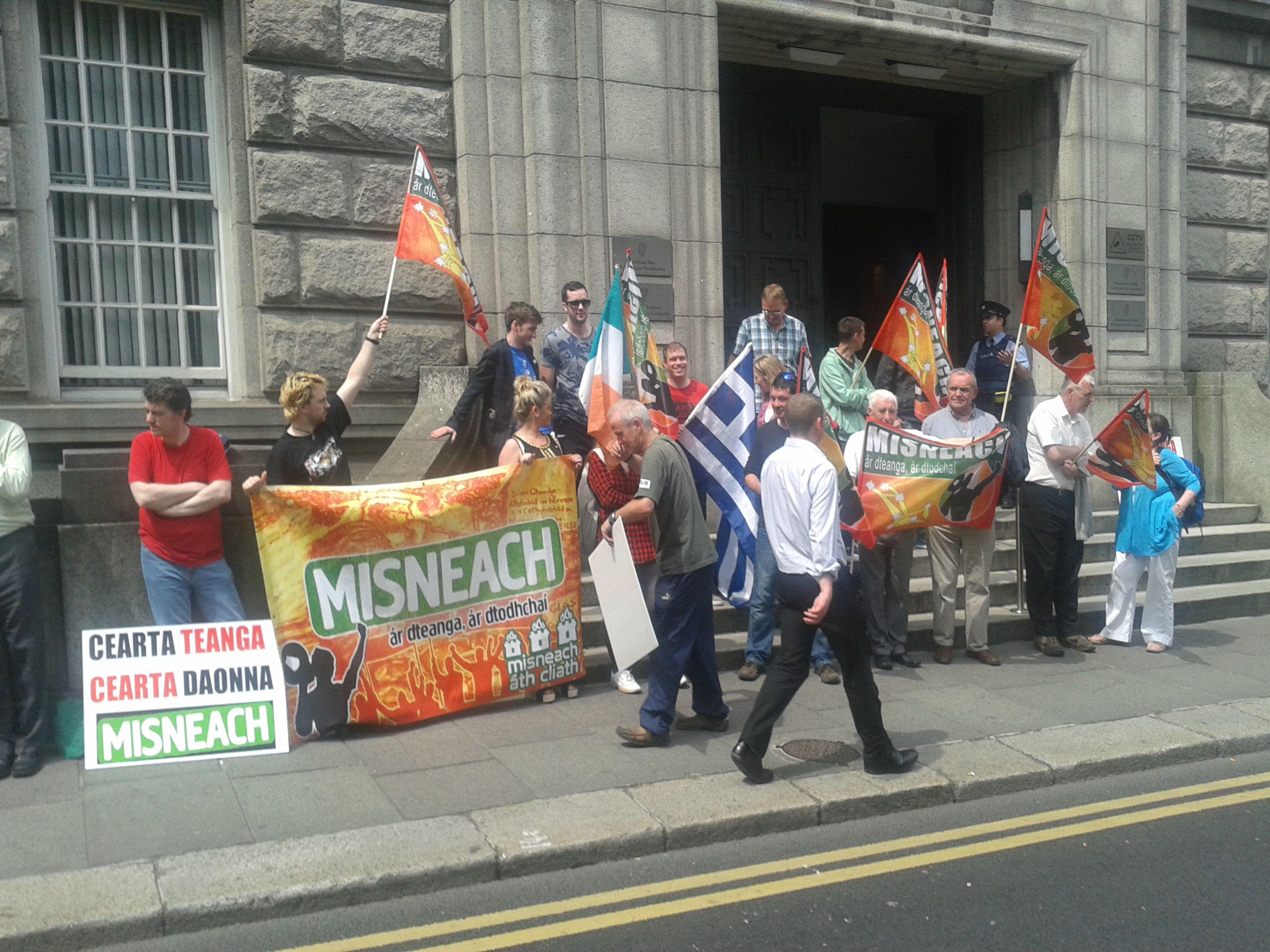
Part of a recent lunchtime demonstration outside the office of the Department responsible for the Gaeltacht. It was called by a new incarnation of Misneach, an organisation active in the mid-1960s. (Photo D. Breatnach)
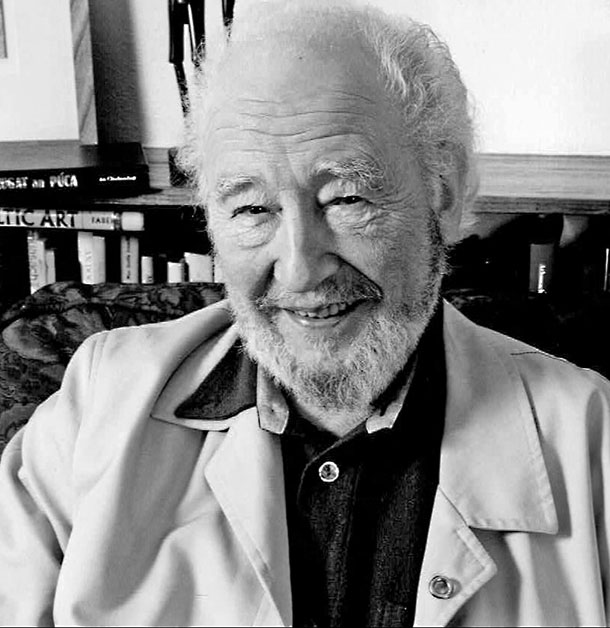
Deasún Breatnach (1921-2007), a founder member of the language-campaigning organisation Misneach, who went to jail in the 1960s to win the right to have his car insurance documentation in Irish or bilingual.
And there are battles that must be fought with the State, with local authorities, with utilities and service providers including private companies. Both logic and history make it clear that this is so. I have already alluded to the civil rights campaign in the Gaeltacht areas and the refusals to pay radio and TV licenses. In the 1960s a Dublin man asked Norwich Union to supply him a bilingual vehicle insurance document or one in Irish. The company declined. The man bought the insurance but refused to display an English-only document on his car. The State’s laws require that every driver display a document showing that they had insurance but no law required a private company to provide that documentation in Irish. The Gardaí regularly stopped the man who explained his stance and they noted his details and allowed him to proceed. For about a year nothing else happened until one day he was summoned to go to court and, despite his explanation and his reference to his right under the Constitution, he was fined. He refused to pay the fine and went to prison. Demonstrations followed with a friend of his playing the bagpipes outside Mountjoy Jail. In less than a fortnight, “an anonymous cleric paid the fine” and subsequently the law was changed. Every vehicle insurance company wishing to practice in Ireland subsequently has to provide Irish documentation or a bilingual version.
Some policies will have to be put in place in the Gaeltacht and closely followed. Policies relating to housing, employment and service delivery will be among them. Some will be welcome and some controversial … but needs must.
The State has already shown by its attitude and by the sad statistics that it does not wish to save Irish as a spoken language. Nor is it only the record of the Gaeltacht decline which speaks volumes. Recently this Government showcased in a video its plan for the centenary commemoration of the 1916 Rising. Among the many criticisms the video attracted was that the Irish in it was of a terrible quality – the Government had employed a translator who had used Google Translate. The video was withdrawn.
Small section of crowd in large “Dearg le Fearg” (Red with Rage) demonstration March 2014 about lack of support for the irish language. (image downloaded from the Internet)
Towards the end of 2013, the Irish Language Commissioner, a public servant, accusing the State of “lip-service” towards Irish and actual obstruction, announced that he would not seek reappointment at the end of his term – an announcement that led to a number of big demonstrations in 2014 under the slogan “Dearg le Fearg” (Red with Rage). In July 2014, the Government appointed a Minister for the Department of Arts, Heritage and Gaeltacht who does not speak Irish – Heather Humphreys. She has, in turn, a Minister of State with specific responsibility for the Gaeltacht, Joe McHugh, appointed in the same month … and, although apparently he is learning it, he does not speak Irish either. And note that responsibility for “Culture” is longer in the same Department as Irish – it has been moved to the much more prestigious Department of Tourism, Culture and Sport.
The State is being challenged from many diverse directions – on issues of services, state finances, centennial commemoration of the fight for independence, conservation, social housing, social welfare, employment and employment rights, health service, gender and sexuality equality, natural resources, Traveller rights, migrant rights … Irish must be seen and heard in these battles and the civil rights of Irish speakers inside and outside the Gaeltacht must also be presented separately, as an issue in itself. These are battles to be fought in campaigns to be planned and time is short. But we can start today, with ourselves. Beatha teanga í a labhairt.
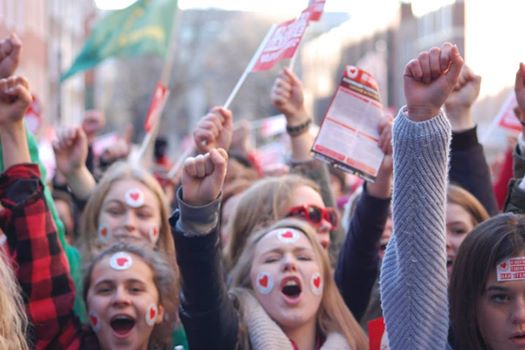
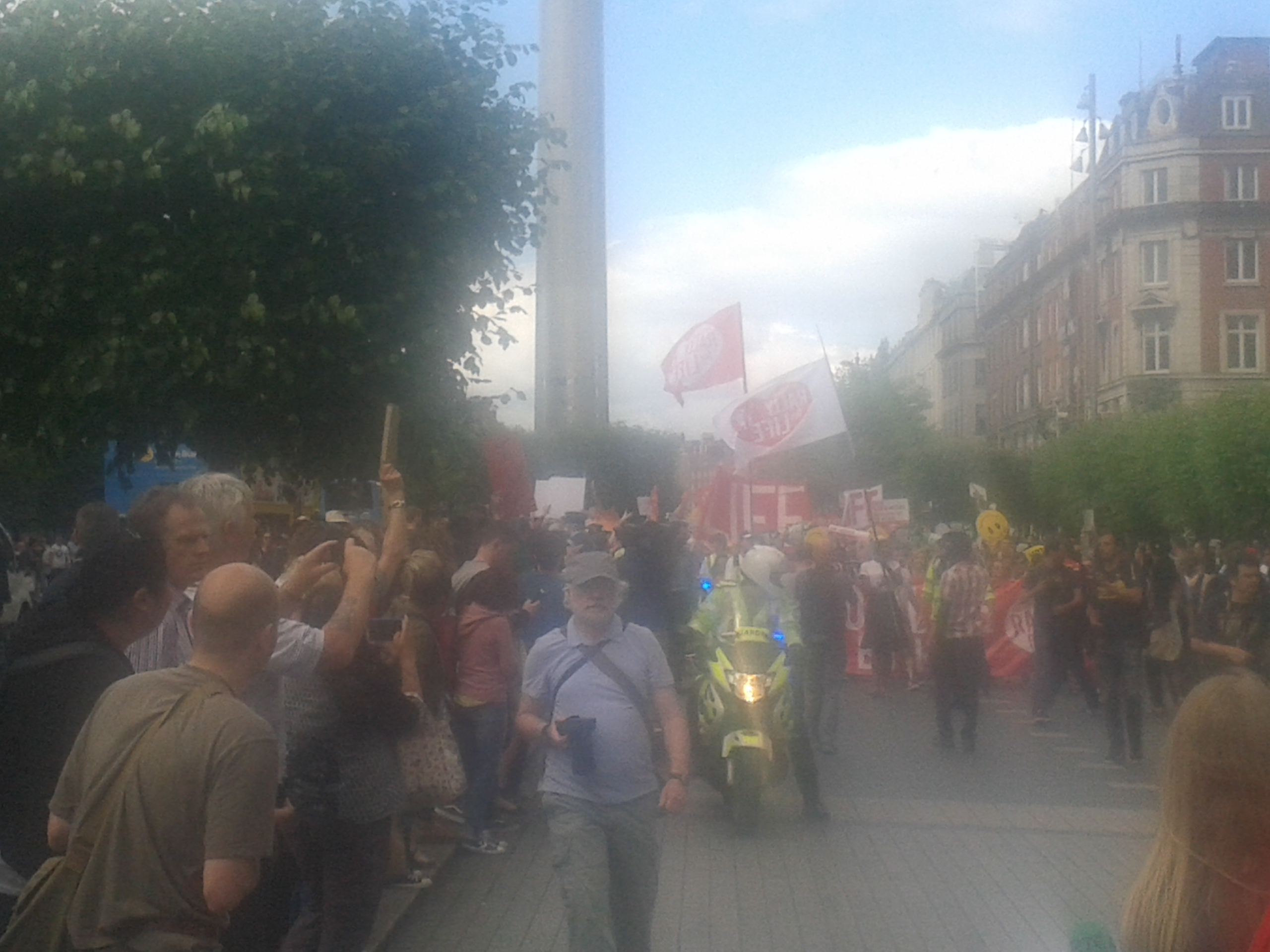
They came down O’Connell Street in their tens of thousands – colourful banners and heart-shaped balloons, music in sections, black, brown and white faces and if many were old, many were also young – and not just the children brought by a parent. “Right to life” was the most common chant, obviously tailored to undermine their opposition’s “Right to choose”, from those who favour the unfettered right to abortion. And LIFE is the name of the organisation that brought these marchers together on their annual march through Dublin city centre.
Bad photo of approach of anti-abortion march in O’Connell Street
“Nobody has a right to kill!” was the last line in another chant. So with that, the name of their organisation and “Right to life”, we have what they are about, right? They are for life and are upholding, apparently, the Christian Commandment “Thou shalt not kill”. Yes, it was there on the tablets of stone Moses brought down the mountain, Number Six – wayyy down the list. Actually, apparently in Hebrew it translates as “Though shalt not murder”. And defining “murder” is not so simple either. But anyway, the Jewish faith has the same prohibition. In fact, there is hardly a religion that does not. Of course, the Old Testament also calls for “an eye for an eye” and says that “you shall not suffer a witch to live”. But anyway ….
Interestingly, the highest leaders of organised religions across the world have blessed their soldiers as they went off to kill soldiers and civilians in other lands. Sometimes their victims were infidels according to the ones who were killing them but often they didn’t even have that excuse, as when the first Crusade attacked the overwhelmingly Christian city of Damascus, or when Catholic Spain fought Catholic France, or when Protestant England fought Protestant Germany, or Catholic Italy invaded Catholic Spain, Catalonia and the Basque Country. But presumably, those pastors, bishops, pontiffs, cardinals and mullahs can fall back on the dispute about the meaning – it wasn’t “murder”, it was legal killing.
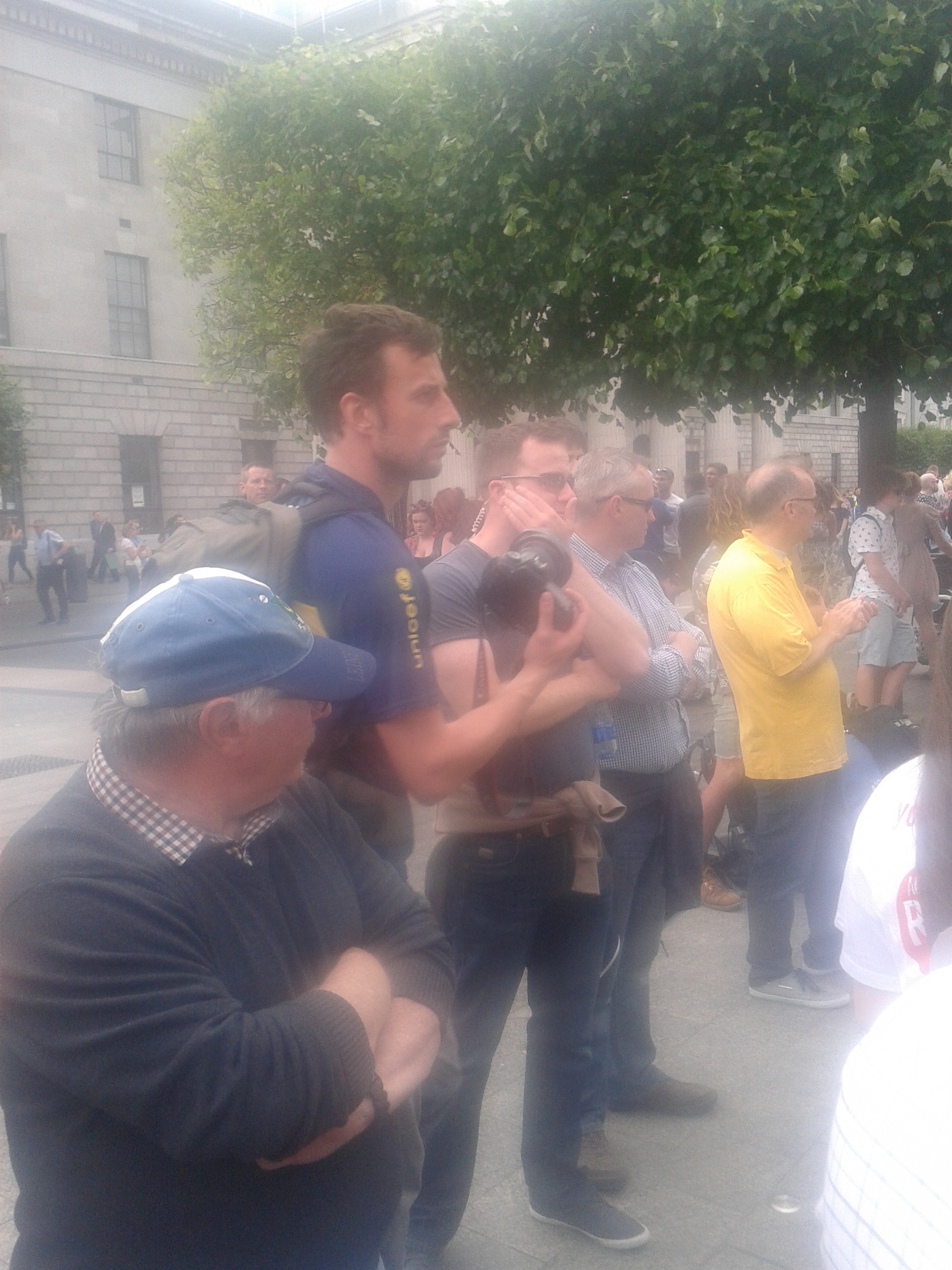
Two Special Branch officers (political police) centre photo in sunglasses — blue pattern shirt and brown T-shirt top next to him. There were eight SB identified, all watching the counter-protesters. The blue-patterned shirt individual threatened a counter-protester without identifying himself.
The wiping out of the Guanches of the Canaries was not murder, the genocide of the indigenous American “Indians”, the enslavement and consequent killing of hundreds of thousands of Africans – they were not murder either. Nor the wiping out of every single Tasmanian and most of the Australian Aborigines. The West was exploring and, by the way, bringing Christianity and civilization to those poor benighted people.
I’d hazard a guess that compiling a list of Christian bishops in most denominations who condemned the wars in Malaya, Korea and Vietnam would a short one. Cardinal Spellman, notorious as anti-communist and anti-militant organized labour, a supporter of McCarthy’s witch-hunts, had the words “Kill a Commie for Christ” put into his mouth due to his enthusiastic support for the US waging the Vietnam War. Leaving out the maimed in mind and body, even in the wombs of their mothers, somewhere between 1.5 and 3.6 million were killed in that war – but presumably they weren’t murdered.
Billions of people are killed by unsafe working conditions, uncontrolled pollution, police and army repression, crime in slums, famine, alcohol and drug addiction, curable disease – almost all conditions that can be avoided except that doing so would cut into profits of local capitalists and/or foreign “multinationals” (read, monopoly capitalists/ imperialists). Those “entrepreneurs” aren’t murdering anyone either, even when their practices are illegal (even by their own laws) …. The ways of God are indeed mysterious, certainly so if the ways of his representatives on Earth are anything to go by.
Some suggested actions for lowering the abortion rate which involve caring for people instead of just foetuses
I have digressed, mea culpa. I have gone down a well-worn philosophical and logical path to ask a particular question: Are those tens of thousands marching down O’Connell Street really for Life and against killing human beings? I doubt it and I have not seen among their number most people I see against the bombardment of Gaza or the invasion of Iraq and Afghanistan, nor vice versa. A few, certainly, but not many. So I have to assume that it is not life that they value so much, except the life of a foetus. And once born, it is pretty much up to luck what happens to that foetus, as far as most of these ardent defenders of life are concerned.
As I said, that philosophical and logical path of discussion has been well trodden before me and no doubt to better effect than mine here. But I wish now to take another path of discussion – I wish now not to criticise the opposition, the anti-abortion brigade, but rather ours, the pro-choice movement of which loosely I am a member.
All Irish surveys and opinion polls published show a rising trend of support for the unfettered right to abortion, even if that section is still a minority. The majority of those polled have been for a greater access to abortion than is currently available in this state. Furthermore, some scandals involving refused abortions, refused permission to travel and the death of a woman who needed an abortion have mobilised considerable passion which the pro-choice movement could enlist in its favour.
Yet, despite what the polls tell us, and despite those high-profile cases, the anti-abortioners succeed in mobilising much larger numbers in opposition to abortion than do those who are in favour of permitting it. Putting this conundrum to some pro-choice campaigners, they have all answered to the effect that the anti-abortioners receive huge funding from reactionary political and religious foundations, especially in the USA. They spend millions on advertising and propaganda, I am told.
I’m sorry, I don’t accept that reply. Because despite their well-funded advertising and propaganda, the opinion polls show a climbing majority for some access to abortion and a climbing minority in favour of unfettered access.
The Riot Squad were also there for the counter-demonstrators. Some may be seen in this misty image of them at the Princes Street end of the GPO.
The Antis just seem to be better at mobilising their supporters – why is that? Well, the funding again, I’m told. They hire coaches and bus people in. So why can’t we do that? Are we incapable of raising money to hire coaches? Obviously not in the case of the Water Tax, for example. Republican groups hire coaches traveling to other parts of the country and pay their share as individuals; they often fund their posters, placards, banners public meeting-room hires, for example through fund-raising events. We don’t see many fund-raising events in support of the right to abortion. In fact, the public doesn’t see much evidence of the movement as a rule except when we come out to protest about a high-profile case or to oppose the march of the anti-abortioners. And our movement doesn’t seem to do much mobilising for the latter, either. And this march happens every year so it can easily be planned for.
Yet how many were there to show their opposition to these tens of thousands of anti-abortion campaigners? Maybe six hundred …. at a very long stretch, a thousand. Going by the opinion polls, in Dublin alone there are a great many more people who support unfettered access to abortion than appear on that counter-demonstration.
Nor did we even distribute our meagre forces in the most effective way.
Each year, it is the same. The anti-abortion people march down from the Garden of Remembrance, and the pro-choice people wait for them at the Spire. Most on the island, some on the east side pavement. The heaviest concentration of people is on the island (or pedestrian reservation), between the Spire and for about 20 or so yards heading north. Then the line starts to straggle. We didn’t even stretch quite to Larkin’s statue. Even those low numbers, properly distributed, could reach from the Spire down to O’Connell Bridge. But we don’t do that. We bunch up in a short concentration so that every section of their march is quickly past us and, what’s more, it allows them to focus their loudhailers and PA systems on our heaviest concentration in order to drown us out, as they were doing on Saturday.
The section containing most of the counter-demonstrators, from left photo to the Spire. The anti-abortioners were able to park two mobile PAs in front of them there to drown out their opposition as the march went by.
Broadly speaking, we outnumber them but on most mobilisations, they outnumber us hugely. They appear more broadly militant and organise better. And they learn. I didn’t see anything like as many people in religious robes this year, which suggests to me that they are tailoring their presentation to avoid an over-identification in popular perception with religion. They can’t keep all their religious nutcases under wraps but I saw much less crosses or rosary-waving this year. They have adapted their slogans and chosen what seems the hardest argument to oppose, that which appears to be for “life”, and they ensure that they are all on message, chanting the same lines, again and again.
They are the reactionaries – how is that they seem better able to learn than us? Should it not be the other way around?
When the votes are counted after today, we will either have a new clause inserted into our Bunreacht (Constitution) or we will not. If we do not, many of the “Vote Yes” campaign and opinion will be despondent. The revolutionaries among them should not be so but should instead reflect on their weakness as a force and on how to make that force stronger.
Should the vote result in a change in the Constitution, it will be probably the biggest blow so far to the power of the Catholic Church in lay society, a power it has enjoyed and abused even before 1921 but certainly since. Some, on both sides of the question, will see it as a blow against the Catholic religion itself but that is not necessarily so. Christianity and its Catholic variant survived and even thrived without State support in the past – indeed when its followers were discriminated against in every conceivable way by State power, a situation its faithful endured for centuries in Ireland as a whole and continue to do today, to a lesser extent, in the Six Counties.
What is the issue upon which we were being called to vote today? Although the NO campaign has tried to make us think it is, it is clearly not about whether two-gender households are better for raising children, whether surrogate birthing is right or wrong. It is not about whether we approve or homosexuality or not – although I suspect that is the real issue at base with many of the NO campaigners. In fact, it seems to me that it would be quite possible to disapprove of homosexuality and still to vote “Tá”, a question I will return to later. This might seem illogical, until we examine the actual issue upon which we are voting: do we agree with inserting a clause into the Bunreacht (Constitution) which states that a couple has a right to marryregardless of gender.
Presented with this question, which is a legal and Constitutional one, a number of issues arise, I think.
What does the Bunreacht say at the moment about this question?
What right has the State to define anything about sexual relationships?
Are we in favour of equal civil rights for people?
1. It may come as a surprise to people that our Bunreacht, our Constitution, currently says nothing about the gender issue in marriage. There is nothing actually in our Bunreacht to prevent same-sex marriage. But the prohibition does exist in law. In other words, legislators at some point decided to propose and pass a law which confined the right (and rite) of marriage to heterosexual couples alone. Why did they do so if it was not an issue at that time? It seems to me that they were aware that same sex relationships did exist and strove to exclude those people from the rights enjoyed by others. This was the point of a number of other pieces of legislation against homosexuality which were not finally overturned until 1993 in this State (1982 in the Six Counties, 1980 in Scotland, 1967 in England and Wales) – five years after the European Court of Human Rights ruled that this state’s laws against male homosexual acts violated human rights.
According to the Catholic Church (and most other churches), despite the current legal situation with regard to homosexuality at the moment, it is still wrong. Well, the Catholic Church – and before them the established Anglican Church of Ireland – can have their views but they are not entitled, nor is any other church, to impose those on lay society, neither by legislation nor by other means. They are, of course, entitled to express their opinion – just like any other organisation.
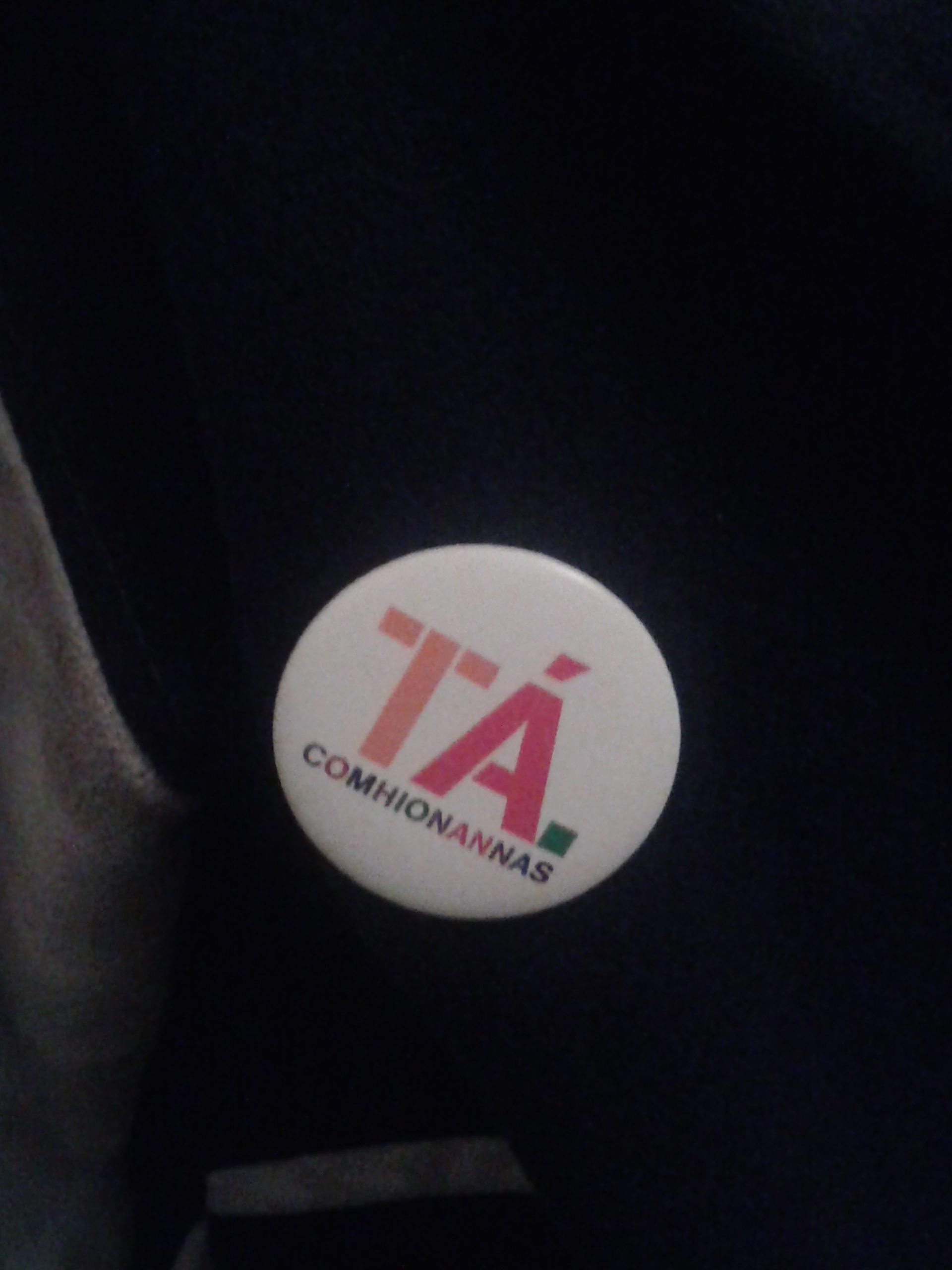
“God and Nature say NO” was the caption on this placard paraded in O’Connell St. near the Spire, some weeks prior to the Referendum. Some young people are arguing with the placard-holder.One of the many badges worn in support of a vote to insert the clause into the Irish Constitution. There was also an English-language one and each were to be seen nearly everywhere in public in the weeks prior to the Referendum.
So, going back to the beginning of the legal status of heterosexual marriage within our current legal system, it was introduced as an excluding measure, at a time when male homosexuality was illegal and subject to heavy punishment and when lesbianism was frowned upon (though not actually illegal for complicated reasons). In other words, a law excluding a group of people was passed at a time when any man who declared himself to be one of those people was subject to prison sentence and any woman who did so was subject to extreme opprobrium in society. What chance was there for their point of view to be represented? In the absence of such representation and informed opinion-making, how can any democrat defend the laws passed at that time?
2. Turning now to the question of what right the State has to make a ruling of any kind upon a sexual relationship between any two people, of either gender, it must be difficult indeed for anyone to justify that without recourse to church canon or prejudice. Those who do so tend to bring up questions of childcare, inheritance and taxation – in fact just about the same questions that were brought up in the Irish referendum on divorce in 1995. But childcare, or at least the financial aspect of it, can be regulated by the State without any interference whatsoever in the sexual relationship between the parents. Whether it does so fairly at the moment is another question which has no bearing on the concept. And inheritance – ignoring for a moment whether we agree with a political economy where land and other wealth may be appropriated by individuals or families and then legally handed on through their following generations — can also be managed without recourse to State regulation of marriage. Taxation, similarly. Were we to have a socialist society, one based on other principles than that which we now have, even those current excuses for state interference should no longer be even a consideration. In fact, it is difficult to see any reason why even now the State continues to have a role in the formalisation of a sexual contract between two individuals or, indeed, in its dissolution, except perhaps in ensuring fair divisions of belongings.
3. Those opposed to insertion of the new clause into the Bunreacht have done so from a number of perspectives of opposition: to lesbianism and homosexuality on religious or other grounds; to formalising same sex relationships; to the alleged undermining of the “sanctity of marriage” or of “romance”; in opposition to surrogate child-bearing and raising of children by gay and lesbian parents ….
Those supporting the new clause have defended the naturally-occurring continuum of sexual preference; maintained that the “sanctity of marriage” will be the same between same-sex couples, as will “romance”; denied that it opens the way to or encourages surrogate child-bearing and raising of children within a gay or lesbian household ….
Who is right and who is wrong? There is no doubt that as long as cultural beliefs and practices have been recorded, homosexuality and lesbianism have existed within societies — sometimes tolerated, often repressed, on rare occasions celebrated. We see homosexuality occurring too among animals. If there is such a thing as “sanctity of marriage” and “romance”, why should same-sex couples have any less of it than heterosexuals? Surrogate child-bearing is already possible and the hugely unequal distribution of wealth in our society – and between even our society and many others – ensures it can and will continue while the rewards are financial. Raising of children within a same-sex household is already happening, even without surrogacy. It is more difficult for gay men at present, but in the case of a gay man having custody of his children through widowhood (yes, some gay men do marry women), or the mother deserting the children or being deemed unfit by a court to have custody, a gay man may bring up his children within a homosexual parent household.
But will this change in the Constitution (and therefore also in the law) make surrogacy and child-rearing by gay couples more likely to happen? Will it increase the frequency of its occurrence? I think the answer to that, logically, must be yes – despite all the denials of the “Vote Yes” camp. And I think some of them must know that. Slowly perhaps and who knows by how much – but logically it must tend to increase the chances. But is that so awful? I find the idea of surrogacy in general distasteful but isn’t that just a prejudiced reaction? Probably. Will children reared by same-sex parents experience uncertainty about their own sexuality? Some will probably and some won’t. And if they do, why should they not be able to resolve that in time – as children reared in heterosexual relationships also find themselves having to do? Is uncertainty about sexuality such a terrible thing? In a judgmental, prohibitive and penalising society, it can be – so let’s create a society that is the opposite.
However, I have to say that I think all those questions and considerations are beside the point. If marriage is to be a legal status, then it is a civil right for everyone who is at the age of consent (and of sufficient mental ability to know to what they are consenting — in so much as any one of us was or does!). The right to same-sex marriage, as a civil right, should be supported even by people who do not approve of homosexuality, or marriage, or surrogacy, of child-rearing in a homosexual household. As for myself, someone who seeks revolutionary social, economic and political change, who wishes to see the overthrow of this State, a revolutionary as opposed to a reformist, I must nevertheless support reforms that extend civil rights, even when not led from below …. and so I voted “TÁ”.














 rebelbreeze