Dublin City Council Threatens Charity Food Tables

Diarmuid Mac Dubhghlais

(Reading time: 5 mins.)

DRHE threaten to clamp down on food tables feeding the homeless

Diarmuid Mac Dubhghlais

(Reading time: mins.)

Rebel Breeze editorial introduction: Through its agency Dublin Regional Homeless Executive, Dublin City Council recently threatened to close down the charity services delivering food and bottled water to homeless and hungry people. On the back of scandal about the alleged sexual predation of the deceased founder of the Inner City Homeless organisation, the Council issued a press statement which implied the threat, supported also by indications of Garda cooperation. Diarmuid Mac Dubhghlais, founder and organiser of the Éire Nua Food Initiative, one of the many charity services engaged in the work, has responded in a detailed article, reprinted here with the author’s permission.

THE 26-County State released figures on September 24 showing that there are currently 8,212 people accessing emergency accommodation in the State, a total of 6,023 adults and 2,189 children who are homeless.

A homeless person’s bed outdoors, cardboard as insulation underneath sleeping bag, this one located under the arch of the GPO (the building that was the HQ of the 1916 Rising). (Photo: Éire Nua Initiative)

These figures of homelessness have long been disputed by many others who work within the homeless sector as the State refuses to count those who are couch-surfing, or otherwise sharing accommodation with friends/family. The vast majority of the nation’s homeless are in the capital with 4,220 people accessing accommodation. 953 families are homeless in Ireland, according to the report.

Homelessness charities have warned that more families face losing their homes in the coming months due to private rental market constricts and evictions rise. This has already been borne out with reports of new faces showing up at the many soup runs/food tables that are in the city centre.
Pat Doyle, CEO of Peter McVerry Trust, said “Any increase is disappointing because it means more people impacted by homelessness. However, we are now at the busiest time of year for social housing delivery and we would hope that the number of people getting access to housing will significantly increase in the coming months.”

Dublin Simon CEO Sam McGuiness cited the toll on the physical and mental health of people trapped in long-term homelessness. He said: “This population is desperate to exit homelessness and yet they are spending longer than ever before in emergency accommodation. This group deserves far better lives than the ones they are currently living. We see first-hand the toll this is taking in the increased demands for our treatment services, counselling services and the increase in crisis counselling interventions. Outcomes for people in emergency accommodation will not improve until they have a secure home of their own. Until this happens there is scant hope of a better future for this vulnerable group.”

MANY CHILDREN NOW SPEND THEIR FORMATIVE YEARS IN HOMELESSNESS”

Éire Nua food initiative founder Diarmuid Mac Dubhghlais pointed out at a homelessness protest that many children now spend their formative years in homelessness and have no real idea of what it is like to have a traditional “Sunday dinner” or their own bedroom/play area. This will severely impact their personalities far into the future.

A report published on September 14 by the Irish Human Rights and Equality Commission and the Economic and Social Research Institute (ESRI) found that lone parents and their children account for 53% of all homeless families. The report said that lone parents and their children are much more likely to experience poor housing than other household types. The report also highlights the disadvantages experienced by young people, migrants, people with disabilities and Travellers in the Irish housing system. Researchers looked at six dimensions of housing adequacy – accessibility, affordability, security of tenure, cultural adequacy, quality, and location. They found that less than 25% of lone parents reported home-ownership, compared with 70% of the total population.
Lone parents had higher rates of affordability issues (19%) when compared to the general population (5%) and were particularly vulnerable to housing quality problems such as damp and lack of central heating (32% compared to 22%).

Ethnic minority groups had a significantly higher risk of over-crowding, the research found. Over 35% of Asian/Asian Irish people, 39% of Travellers and over 40% of Black/Black Irish people live in over-crowded accommodation, compared to 6% of the total population. Almost half of all migrants in Ireland live in the private rental sector, compared to 9% of those born in Ireland. Migrants, specifically those from Eastern Europe (28%) and non-EU countries (27%), are more likely to live in over-crowded conditions.

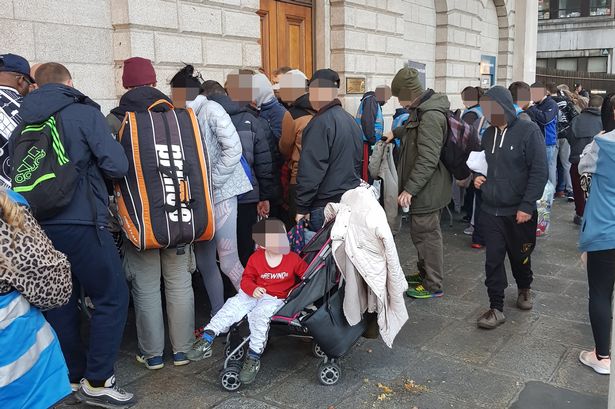
One of the queues for free food and water at a charity food table outside the GPO building. (Photo: Éire Nua Initiative)

The research found that almost one third of persons living with a disability experience housing quality issues, compared to 21% of those without a disability. Researchers said there remains a real risk that levels of homelessness will worsen after the pandemic restrictions are lifted and they raised concern about rents increasing faster than mean earnings in Dublin and elsewhere. In 2020, mean monthly rent in Ireland was estimated to be 31% of mean monthly earnings. “Adequate housing allows people to not only survive but thrive and achieve their full potential, whilst leading to a more just, inclusive and sustainable society.”

Meanwhile, the Dublin Regional Homeless Executive (DRHE) said on September 28 that it is to seek greater regulation of organisations providing services for homeless people in the capital as soon as possible in the wake of the Inner City Helping Homeless (ICHH) controversy. Dublin City Council’s deputy chief executive Brendan Kenny, who has responsibility for the Dublin Regional Homeless Executive (DRHE) in his role, said that due to the high number of informal homeless organisations set up in recent years there is “currently no vetting, no controls, on many people who are actually interacting directly with homeless people”. Kenny said he doesn’t want “over-regulation” to lead to certain groups disbanding but added: “At the moment there’s nothing and that’s not good enough.”

In a statement, the DRHE said it is “strongly of the view that greater regulation, vetting, and scrutiny is required for organisations/charities that set themselves up as service providers for homeless persons, including the provision of on-street food services”. “Several such organisations not funded by the DRHE have come into existence in recent years and the DRHE and our partner agencies will be endeavouring in the coming months to bring the necessary expanded scrutiny and regulation to all such organisations.”

Garda Commissioner Drew Harris said there will be a review of Garda vetting procedures for the homelessness sector. Kenny said a report commissioned by Dublin City Council into the impact of unvetted charities is near completion and will provide further insight on the matter.
It has been pointed out several times over the past four months that the DRHE, DCC and others have long tried to close the soup runs/food tables in the city centre and many now fear that what has been revealed through the ICHH debacle will be used to close many of these down. The DRHE are ignoring the fact that it is their rules and the oversight bodies recognised by them that has let the homeless down, not the food tables. Much of the work done by the food tables is done in the open and in full public view.

The issues highlighted through the ongoing ICHH investigation show it is what went on behind closed doors that is the problem. Those in oversight positions didn’t do their jobs; people were put in positions of authority without relevant qualifications. The DRHE, DCC and the police should look to how they can improve safety within their “regulated” organisations before seeking to regulate the volunteers who serve a need without any remuneration.

Many of the volunteers at food tables would have difficulty meeting the requirements of police vetting as some would be former addicts, and many others have no desire to become registered charities.

Again, it was pointed out by Diarmuid that many of these “regulated” charities will have high overheads such as transport insurance, maintenance and fuel costs. Some will have CEO wages and petty cash expenses to cover before any donations can be spent on the service user, whereas the Éire Nua food initiative and some others do not seek cash donations. All is done voluntarily and any costs are borne by the volunteers themselves. He cited that many registered charities are little more than businesses operating within the homelessness sector.

Diarmuid has been quoted in the past citing that “there are now many businesses making huge money out of those who are in homelessness” and “that the volunteer ethos that surround many food tables is not to be found within some charities”.

IMPROVE THE STANDARD OF REGISTERED ACCOMMODATION, NOT SHUT DOWN THE VOLUNTARY ORGANISATIONS”

Kenny said the large number of pop-up soup runs mean some people are less likely to engage with the larger charities funded by the DRHE and in turn, less likely to engage with their support services. The DRHE views sleeping in a homeless hostel, rather than on the street, as a “much safer” option. However, he acknowledged that some homeless people don’t want to stay in a hostel, for a variety of reasons.

“We fully understand that but we’re strongly of the view that a hostel bed is absolutely safer and more hygienic than sleeping in a sleeping bag on the side or a street or in a tent. We know there are some people that just won’t go to a hostel – it may be that they have mental health issues.
“We are also aware that some people would prefer to stay in a tent in order to stay involved in drugs and be taking drugs because they may not be able to do it in the hostel.” Kenny added that while hostels provide shelter and food, they “wouldn’t be the nicest place to sleep” but are still “far safer” than being on the street.

He totally ignores the many testimonies from residents, former residents and former workers within these hostels of the theft of personal property, the numerous assaults on residents by other residents, the bullying of residents by some staff members, low hygiene standards, open drug and alcohol abuse and the arbitrary nature operating within some hostels where a resident can be denied access on the whim of staff.

It is incumbent of the State, DRHE and the various councils to bring the standard of these types of accommodation up to a better standard and NOT try to shut those organisations who look after the many who fear staying within State accommodation.

Kenny also noted that sometimes tourists or those who are not homeless queue up to get food from the soup runs. He said fights also break out sometimes. “We’ve come across situations of tourists maybe going up to a food van and getting food, and maybe other people that are not in need of services. And the reality is that anybody that’s sleeping in a hostel, food is provided for them so there is not a shortage of food in the hostel services.

“[Soup runs] do attract a lot of people. I know there are times when large numbers of vulnerable people congregate and you end up with disputes and fights as well.”

Éire Nua free food service workers with table, outside the GPO. (Photo: Éire Nua Initiative)

On the issue of tourists queuing for food, he may well be right, but as the Éire Nua group has pointed out, “we feed the homeless AND hungry, we will not discriminate or question anyone who stands waiting for some food”.

Also pointed out by many residents of various hostels is the small proportions of meals given; while enough to sustain it is often not enough to keep that empty stomach feeling at bay.
And for the five to six years that Diarmuid has volunteered alone, with the Éire Nua group or on another soup run, he or other volunteers have never had to call the police. On the few occasions where trouble has occurred, it is often rectified within seconds as the majority of people awaiting food know that: (1) the volunteers are their friends and out there to help them and (2) causing disruption to the smooth running of the tables can result in being denied food.
The final word to Kenny from the Éire Nua food initiative: “Let the DRHE look to itself and those under its umbrella before looking to those outside their group; let them ensure the regulations in force within are enforced. Do not blame those who volunteer out of the goodness of their hearts for the sins of those who worked for them.”

End.

EDITORIAL COMMENT:

It may be that the primary concerns of the Dublin municipal authorities and the Gardaí are to remove the visible signs of poverty and homelessness, rather than protection of the vulnerable among these. DCC Brendan Kenny’s comments in mid-August against the proliferation of homeless people living in tents may be seen as a concern that the charity food services constitute an unwelcome reflection on the performance of the Irish State and the municipal authorities of its capital city, visible not only to the city’s inhabitants — at all levels of society — but also to its visitors.

USEFUL LINKS

https://www.thejournal.ie/drhe-call-for-more-regulation-of-homeless-organisations-5560886-Sep2021/

Kenny previous comments against homeless in tents: https://www.joe.ie/news/dublin-city-council-ceo-criticised-following-comments-homeless-tents-dublin-728819

The Inner City Homeless scandal: https://www.irishtimes.com/news/ireland/irish-news/homeless-charity-faces-uncertain-future-following-death-of-co-founder-1.4688838

FEATURES OF IRISH TRADITIONAL INSTRUMENTAL MUSIC AND SONG

Diarmuid Breatnach

(Reading time text: 4 mins)

Replying to a query on Quora on the above question, I spent some time thinking and typing the reply and then thought I might as well make that effort available to a wider audience. I have participated in many Irish instrumental music and singing sessions over decades, mostly in London and Dublin and I have two brothers who are musicians and another who is a singer. I am myself a singer, not an instrument player, nor an academic but will attempt an answer. I would recommend consulting the Irish Traditional Music Archive and reading books on the subject such as Ó Súilleabháin’s and Ó Lochlainn.

Traditional Irish music has had many external influences and among the main forms of its dance expression, jigs, hornpipes and reels, only the latter is considered originally Irish. Polkas are particularly popular in Kerry and, I suppose, built around reels. There are also slip-jigs.

The best way to experience these is probably is probably at or viewing a set-dancing session. These are based in form on the “quadrilles” of the Napoleonic period (which can be found as far away as Latin America and Cuba) and are similar to English and US Old Timey square dancing. Probably all the variants of the Irish instrumental dance music will be heard performed among the various set-dances — virtually all sequentially in the deceptively-named “Plain Set”.

Note a number of features in this good exhibition of a part of a set: hard shoes, not trainers (one exception there) to give good floor contact and sound); also some individual flourishes in footwork and body movement etc but still remaining within the music. (Source: The Harp Irish Set Dancers)

The form of dance called “sean-nós” (see description of the singing form by the same name further down) is individual expression, fast footwork with what one might also call “ornamentations”, similar to tap-dancing. The arms are held loosely down to the side or elbows to the side, slightly extended but also loosely. The overall posture may be erect or slightly stooped.

In terms of instruments used today, not one is believed to be originally Irish except the harp (which incidentally is the symbol of the Irish state, the only state in the world to feature a musical instrument in that capacity though we are far from being the only nation with a harp tradition).

The harp is an ancient Irish instrument but also symbol and was re-used by the revolutionary and republican United Irishmen, who rose in insurrection in 1798 and 1803. The later Fenians too used the symbol in less stylised form. (Image sourced: Internet)
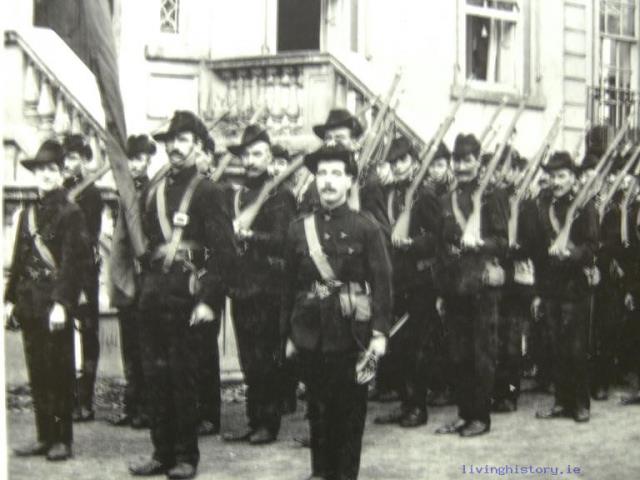
The harp (there two main kinds, the smaller knee-standing and the larger resting on the floor between the knees) was described by Norman travellers (spies) prior to their invasion of Ireland but were known also in Wales (observers remarked not only on the aesthetic quality of the performances but also on their speed). A kind of drum was referred to by the travellers and some kind of flute but without any detail on either. The proliferation of instruments in a traditional Irish session are therefore far from being originally Irish: fiddle (violin), uilleann pipe, flute, whistle, accordion (piano or more likely button), concertina, melodeon, bazouki, mandolin, banjo and …. guitar. This last is mostly performed as an underlying rhythm instrument, a function also of the bodhrán (a kind of one-sided drum) and one may also hear a pair of spoons or sections of rib bones played for percussion. The guitar-player is often also the singer and given space to do so accompanied by his guitar, presumably in recompense for his restriction to rhythm performance the rest of the time. In many sessions there has grown sadly a tendency to restrict the performance of song to this individual or some other in the circle of musicians whereas in the past a member of the audience would perform the song; this restriction has led to the growth of song and even voice-only sessions (such as the Góilín in Dublin).

We owe the typical instruments in traditional Irish music to northern and central Europe, the Middle and Far East and to Africa. Many other instruments have been brought into use in performing Irish traditional music (including, famously, the Australian didgeridoo) but, apart from the proliferation of variations on the whistle, they have as yet failed to win popularity among musicians.

(Image sourced: Internet)

Traditional march airs also exist and, to my ear, have a tendency to be fast for the purpose. I have speculated that these represented trotting horses of the elites or warrior-caste with lower-ranking fighters running alongside — but that is pure speculation.

There are many slow airs and waltzes, definitely an import, have been composed and are also played.

TRADITIONAL, ETHNIC

With regard to the ethnicity of the performers this is not of great relevance and Irish traditional music on instruments and in voice is being played well in many different parts of the world or in Ireland by musicians with a non-Irish ethnic background. Naturally too the Irish diaspora has spawned many excellent traditional Irish musicians (and, we can remark in passing, in many other genres too: rock, pop, blues, jazz, classical).

The term “traditional” itself can open up a debate but with regard to song, I was offered this interesting definition some years ago: “author unknown, performed over three generations.” Authorship is therefore an issue as is permanency (or at least persistency). One feature of traditional music throughout the world, according to Ó Súilleabháin is never to end in a crescendo (although occasionally one may hear a traditional song or ballad treated in this way, it is rare).

However, as with “tunes” or “airs” in instrumental music, songs are being composed all along within the traditional or folk form, sometimes re-using known airs, sometimes adapting them and on occasion composing new ones.

It is important to note that ballads are not considered a “traditional” form, having entered Ireland in the 18th and 19th centuries but they are accepted in traditional singing circles.

Ballads and traditional songs were on many themes of course but given Ireland’s history, the national struggle was bound to feature often. (Image sourced: Internet)

THE SINGER AND THE SONG

Traditional-style singers not only eschew crescendos but also, in general, bodily gestures or dramatic pauses or changes of volume. There are emphases rendered on occasion but these tend to be subtle.

A form of singing known as “sean-nós” (literally ‘old style’) exists with regional variations. From experience and perception (but without formal study) I would say that the main distinguishing feature of this form is in the ornamentation of notes, viz. drawing some out to briefly twist around them (interestingly, one verb in Irish for “play” as in instrument or “sing” is “cas”, literally “twist/ turn/ weave”) and the ending of a line may have an additional note added. The Qawwali religious music of Pakistan and Indian shares many features as does parts of the Flamenco singing, albeit the latter is loudly expressive.

In terms of the great themes of Irish song (and at times of instrumental pieces) these are overwhelmingly love, patriotic struggle and emigration, with sub-categories, including some that merge two or even three of the main themes (hear for example “Skibereen” or the waltz-air “Slieve na mBan”.

PLEASE DON’T CLAP ….

A very important element of Irish traditional and folk singing is not only the performance but also the audience. The tradition is not for choral or duet etc singing with harmonies, though these exist but rather for the single voice. In this we differ from other Celtic nations such as the Welsh and Bretons but parallel the Scottish tradition as well as some other folk traditions, including some English and USA Old Timey expressions.

The tradition has been that a singer will be heard through to the end with perhaps some sounds of encouragement at various junctures (on occasion I have observed a noisy Irish pub become suddenly silent as the customers become aware that a song is being sung, remaining totally silent until the end of the song). Should there be a chorus, listeners may join in and a well-known and appreciated line may get listeners joining in too (think for example of the last line in the non-traditional form — but often sung in sean-nós style — ballad about the Great Hunger: “… revenge for Skibereen!”).

I should mention here that accompanying the beat in traditional music by clapping is certainly not “cool”, although traditional musicians performing on stage have been seen to encourage it (presumably in order to reduce the isolation feeling of the performers and to increase the enjoyment of non-perceptive listeners). In fact clapping overcomes the nuances of the performance as well as the concentration of the listener, therefore limiting the depth of the experience. “Tap feet by all means and clap at the end if you please” is the general rule.

I must note also in conclusion that Irish/ Scottish traditional music with some English folk contribution are the main influences in not only Old Timey USA music but also bluegrass and country & western, with spillover into some other forms. As such, this fount of music is responsible for the creation of the “white” or “European-origin” popular music of the USA, ie around half of the entire body. The other half is of African origin, in blues and jazz (in so far as these are not the same thing), giving rise to rock n’roll, swing etc. But both these “halves” have naturally had an influence on the other and in Ireland, traditional music is also influenced by — and contributes to — “crossover” variations of music.

I would comment also that socially and politically Irish musicians have tended to identify to one degree or another with the people and their resistance and were often persecuted for doing so. This was natural, given that they mostly came from the Irish population and that was where they found their audience. In that regard it is sad to note that some, including the Chieftains musician group and singer Imelda May, performed at a state banquet in Dublin a few years ago for the English Queen, who is head of the UK state and of the British Armed Forces, currently occupying one-sixth of our small national territory and also invading other parts of the world.

End.

USEFUL LINKS

Irish Traditional Music Archive: https://www.itma.ie/

Set-dancing: http://www.harpirishsetdancers.com/

Singing: https://www.facebook.com/AnGoilin/https://en.

Colm Ó Lochlainn: https://en.wikipedia.org/wiki/Colm_%C3%93_Lochlainn

FUNERAL OF PROMINENT DUBLIN SOCIALIST MANUS O’RIORDAN

Diarmuid Breatnach

(Reading time main text: 4 mins.)

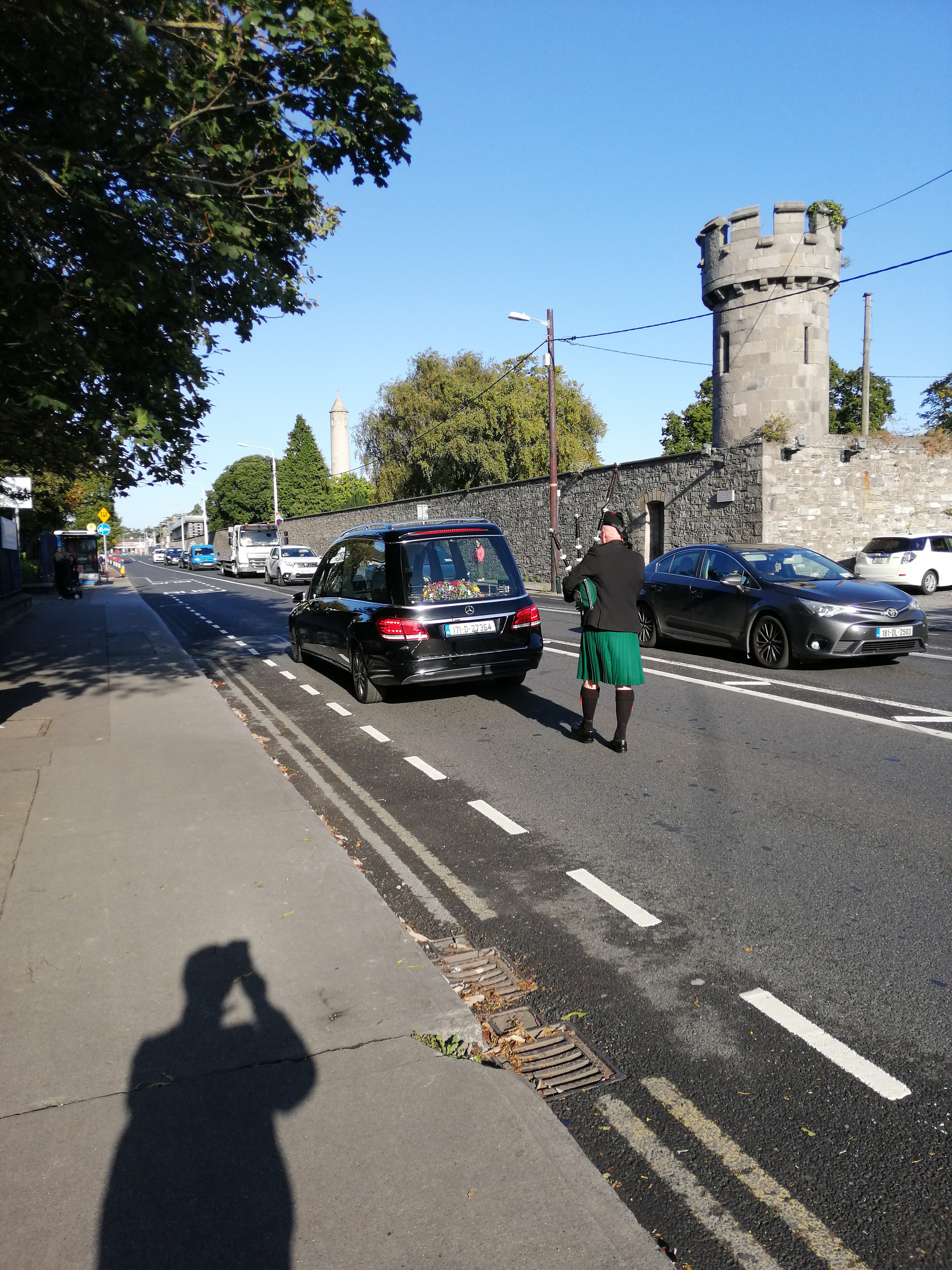
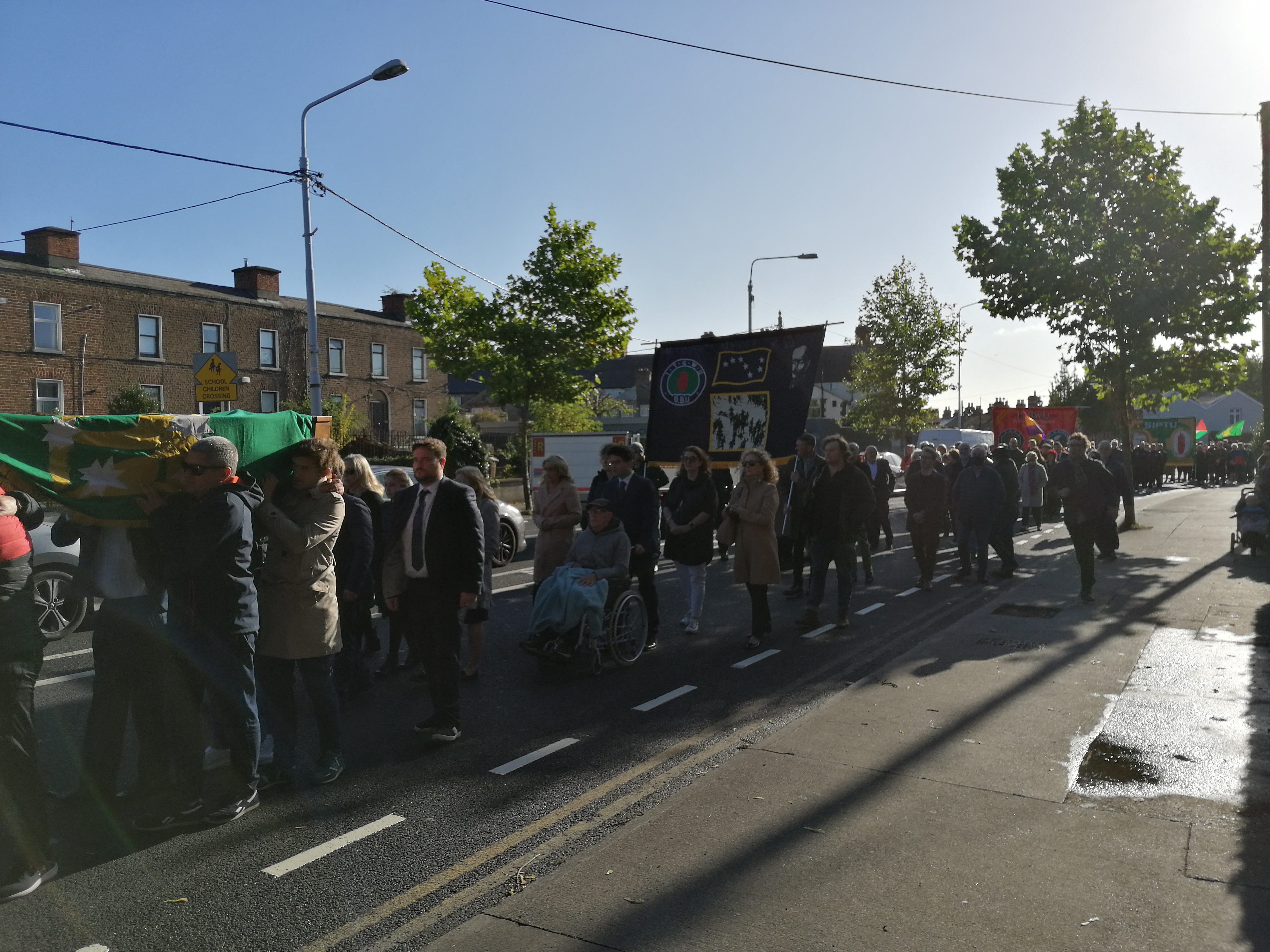
On Friday morning passing pedestrians, public and private transport drivers and passengers on Dublin’s Finglas Road witnessed a funeral cortege in which trade union banners and flags were carried by some of the mourners. The hearse leading the procession, followed by a lone piper did not bear the Starry Plough-draped coffin which instead was carried on the shoulders of a rota of family, comrades and friends on the approximately one-kilometre walk from the home of Manus O’Riordan to service at the famous Glasnevin Cemetery.

A large crowd participated in the funeral procession composed of a wide cross-section of the Irish Left, from revolutionaries to radical reformers to sedate social democrats. Manus was well known in Irish left-wing circles for a number of reasons. At various times he had been an active socialist, a member of the very small but influential and very controversial B&ICO, a senior official in the major trade union SIPTU and an active senior member of the Friends of the International Brigades Ireland. This last owed much to the fact that Manus’ father had fought in Spain and the veneration in the Irish Left and much of the Irish Republican movement for the Irish volunteers who fought to defend the Spanish Republic against the fascist-military uprising led by General Franco and aided by Nazi German and Fascist Italy. Mick O’Riordan survived the Spanish Antifascist War and was General Secretary of the Communist Party of Ireland and the last time some of the mourners had walked this route was in the elder O’Riordan’s funeral in 2006.

One of a number of combined Spanish Republic and Starry Plough flags attached to lampposts along the funeral route (Photo: D.Breatnach)

The trade union banners marked Manus’ trade union work while another signalled his support for the Cuban Republic against the blockade imposed upon it by the USA. Two large flags in the red, gold and purple of the Spanish Republic of 1936-1939 were carried too, bearing the legend “Connolly Column” (in Irish and in English) to represent the Irish volunteers who fought against the military-fascist coup. Along the route, copies of a combined Spanish Republic and Starry Plough, attached high upon lampposts, fluttered or strained outwards in the breeze. Among the procession a number of Starry Plough flags flew also, the green and gold version of the Irish Citizen Army, along with a Basque and a Palestinian flag, the latter recalling the stand of the Basque country against Franco and the former, Manus’ solidarity with the struggle of the Palestinian people. At one point, the Catalan Senyera (flag) was also displayed, recalling that in the Ebro Offensive, Michael O’Riordan had been chosen to carry the Catalan flag across the Ebro river. A number of people also wore scarves of the Bohemian Football Club, with supporters among Manus’ family and friends.

Banner of SIPTU, the largest trade union in Ireland (Photo: D.Breatnach)
Banner of the Irish Transport & General Workers’ Union, precursor of SIPTU (Photo: D.Breatnach)

Though cold, the day remained sunny and most thankfully of all, rain-free. Upon reaching the cemetery, the coffin was taken into the chapel near the entrance at which non-religious or religious services may be chosen. Due to Covid19 restrictions, the service was reserved for family and close relatives only.

The rest of the crowd gathered outside and perhaps before 11 am a burst of applause heralded the approach of the President of the Irish State, Michael D. Higgins, accompanied by a senior member of the Irish armed forces in ceremonial uniform. The applause was no doubt in appreciation for Higgins’ appearance and due to his office but also certainly in approval of his decision not to attend a forthcoming British colonial state function to celebrate the centenary of the partition of Ireland in 1921. And also no doubt in sympathy to the controversy regarding his decision whipped up by sections of the British and Irish media and a handful of politicians, not only British and Unionist.

Another IT&GWU banner bearing a scene from Bloody Sunday 1913 (Photo: D.Breatnach)

There was an ex-president of a different kind present too, Jack O’Connor, who was elected General President of the SIPTU (trade union) in 2003 for three terms and in 2009, President of the Irish Congress of Trade Unions. O’Connor took a stint sharing the weight of the coffin and though no doubt he had his supporters in the crowd he had a substantial number of enemies in the trade union movement too, though this is not the place to speak of the reasons.

Among others who attended to pay their sympathies to the O’Riordan family and Manus’ partner Nancy Wallach were Minister for Finance Paschal Donohoe, Sinn Féin president Mary Lou McDonald and Sinn Féin TDs Louise O’Reilly and Sean Crowe.

Former Labour Party leader Ruairí Quinn, former Press Ombudsman and Labour TD John Horgan, Communist Party of Ireland Gen. Sec. Eugene McCartan and retired trade union leader Mick O’Reilly of Unite were also there.

(Photo: D.Breatnach)

After the service, some of the attendance repaired to the not very distant Maples Hotel in Iona Road, where food had been prepared and refreshments could be purchased. Even with the crowd by then much diminished, they were spread over two reception rooms and had to be fed in shifts.

Manus’ sister Brenda playing a piece on the harp by medieval Irish musician Turlough O’Carolan while his daughter, Jess read a poem by Charlie Donnelly, who died fighting fascism in Spain, “The Tolerance of Crows” and his son, Luke sang the “Roll Away The Stone” song celebrating workers’ leader Jim Larkin (a song often sung by Manus himself in the past.

Manus was a regular participant in the singing session of the Góilín where he sang songs, in some of which the lyrics were his translations into Spanish, Irish or English and some were of his own composition. He composed poetry too. Accordingly, a significant section of the attendance at his funeral was composed of singers and participants of the Góilín and it was strange to hear no song sung during the procession or among the crowd outside; however folk singer Radie Peat of Lankum sang Liam Weldon’s song Via Extasia and Gerry O’Reilly sang The Parting Glass before Francis Devin sang the socialist anthem The Internationale before Manus O’Riordan’s coffin draped in The Starry Plough was removed for cremation.. At least one occasion to pay respect to Manus’ memory is promised in the future and no doubt song will play an important part of the proceeding then.

Manus O’Riordan wrote and lectured copiously over the years on a number of topics and over time revised some of his opinions, never shrinking from doing so publicly and renouncing a previous position strongly held. All his assertions were backed by arguments in favour and never merely by assertion.

(Photo: D.Breatnach)
Approaching the corner of the cemetery (guarded by a watchtower), with the coffin and procession just out of shot. (Photo: D.Breatnach)

Despite the numerous verbal battles in which Manus took part in speech and print, a number of them quite heated, he managed to remain on speaking terms with most people including his political enemies and had a wide range of friends and of people with whom he was on good terms. He lived an active and useful life but one cut short too soon at the age of 72.

There will be a number of groups and occasions where his absence will be keenly felt and of course by his family and his partner Nancy Wallach.


Manus O’Riordan/ Manus Ó Ríordáin, (1949- 2021)

https://www.irishtimes.com/news/ireland/irish-news/funeral-of-manus-o-riordan-told-he-protected-legacy-of-those-who-fought-fascism-1.4688834

End.

(Photo: D.Breatnach)
Flags of Palestine, Starry Plough (Irish workers) and the Basque Ikurrina among the mourners (Photo: D.Breatnach)

CLIMBING EVERY TREE IN KIMMAGE

Artist Eoin Mac Lochlainn goes looking of oak galls (“oak apples”) to make the brown ink used by the Irish monastic scribes.

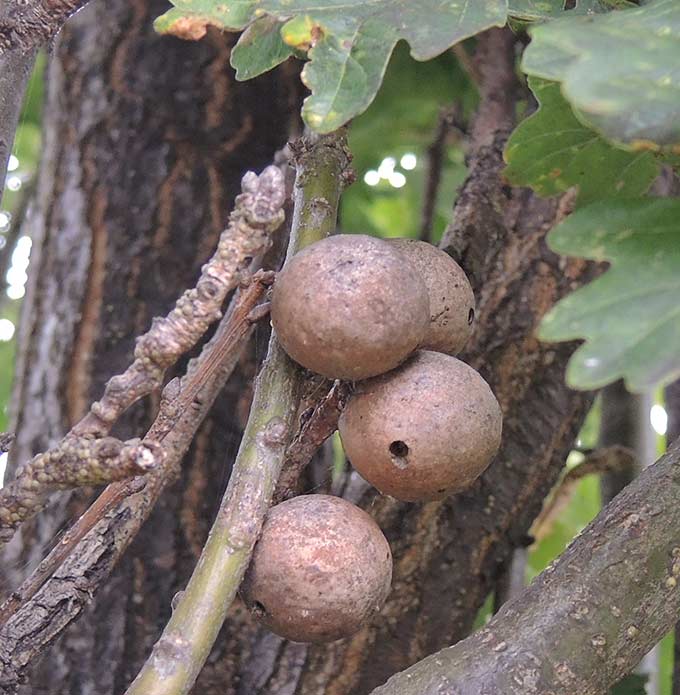
photo by eoin mac lochlainn of oak galls in harold's cross

Sometimes it’s right there under you nose but you don’t see it.  I’ve been looking all over for oak galls this last while, oak galls for making ink but no, any oak tree that I checked, I couldn’t find a single one. Until yesterday – and believe it or not, I found them here on the street where I live.

The dark brown ink used in the Book of Kells was made from oak galls. The monks used this ink in the 9th Century and it is still as clear and dark today as it ever was – so I thought to myself:  I could use some of that!

Page from Book of Kells showing brown ink.

These galls form on the branches of oak trees when a Cynipid wasp lays its eggs there.  The tree responds by forming a woody shell around the egg but inside, the larva continues to develop. If you see a little hole in the gall (like in the one above), you know that by now, the occupant has grown up and flown away – leaving the little gall behind for scribes (and artists like me) to collect and use to make pigment.

One recipe I found says that, along with the oak galls, you need rainwater, gum Arabic, some vitriol and 3 table-spoons of red wine.  I’m not sure about the vitriol, I try to avoid the internet trolls but everything else seems manageable.  I’ll let you know how I get on.

PS:  someone suggested since that ‘vitriol’ might be the medieval term for iron sulphate

Dear Auntie Masker

Thank you so much for taking the time to explain to me how I am being manipulated and why I should not wear a mask. It is true as you said that fearful people are controlled more easily and what is more fearful than an invisible danger, an alleged virus?

But the thing is always of course: controlled by whom and what for?

When you explained that I was going to be controlled by Jews that was worrying but the lizards who were going to control me (as well or instead of?) were really scary. Then the Chinese Communists, with one of the permanent seats on the UN Security Council taking over those of the other four powers – that was terrifying. And then controlling the whole EU!

It’s amazing that the secret manipulators have managed to frighten or fool nearly every doctor, nurse and medical expert in the world – must be millions of them — into supporting the hoax and masking and vaccines. Thank God we have a handful of medical people spilling the beans. Still, it’s all quite terrifying.

And the plan to replace all white people through contraception, abortion, LGBT rights is frightening too – well, I’m white of course and I don’t want to be replaced. I’ve already been replaced by a machine at the checkout desk where I worked, which was easily done since most people during the pandemic – sorry, the hoax – preferred to use the machines and pay by bank card. Of course the bosses took advantage of the situation to replace some of us but nobody warned us about that.

Like you advised, I have refused to have the vaccine because I don’t want nanobots injected into me so They can control me and see where I go and what I do – even when I’m in the toilet or the shower. I can’t understand how all those controlled people are still managing to hold protests – like about housing, or people killed by police, or for the Palestinians. It’s very confusing so you’ll have to explain that to me again.

I told Brigid (remember, next door but one) about all the antifascists being pedophiles and she said does that mean all the people who fought against Hitler and Mussolini were pedophiles too? Then she said some disrespectful things like if you’re really concerned about pedophilia how come yous are always defending the Catholic Church? When I told her about Hillary Clinton running a pedophile ring from above a pizza restaurant, Brigid just burst out laughing so hard she said she’d have to go to the toilet. When she came back, she asked if John Kennedy and Bill Clinton couldn’t even keep their affairs secret from the public, how would Hillary Clinton manage to run a whole pedophile ring and keep it quiet? I didn’t know what to say and felt quite stupid. I wish you’d been there to answer her.

Brigid’s nephew has been wearing a mask in public since the authorities advised it. He got 99% in one of his exams and mostly around 90s, so I was wondering about that Dolores Cahill saying our children would end up stupid through inhaling carbon dioxide. Then I was wondering whether Brigid was lying or being manipulated. Or her brother, the boy’s father, was. Or the school, faking the results. Or the Government forcing the school to fake the results and fool the father and the son.

So anyway I’m confused and frightened. Tell me what to do, please.

Signature redacted.

Accessed by: Diarmuid Breatnach 17 September 2021

WELCOME TO REFUGEES ON SANDYMOUNT STRAND

WELCOME TO REFUGEES” EVENT SANDYMOUNT 3 SEPTEMBER 2015

Diarmuid Breatnach

(Reading time: 3 mins.)

On 13 September 2015, six years ago a remarkable event took place on the strand in Sandymount (Dumhach Trá) in Dublin (Baile Átha Cliath), of which I have been reminded by the Facebook anniversaries function. I wrote a short report with photos for a FB album at the time but it deserves a more easily accessible record on Rebel Breeze. Text from the album follows:

WELL OVER A THOUSAND PEOPLE (that will be just “several people” for RTÉ1), gathered at Sandymount strand today to spell out the message “Refugees Welcome” on the sand.

The day looked bad earlier with rain and, at the original time set, was still raining. But due to tide conditions, the start time had been set back an hour and the rain had stopped and there was even some intermittent sunshine as the crowds assembled.

I had to strip off rainproof clothes under which I was already sweating. Starting was slow and some singers tried to keep us entertained as we waited. We were also led in shouting some slogans — all in English (would using the word “Fáilte” have hurt?). We were each assigned to a column behind the letter we were going to spell out.

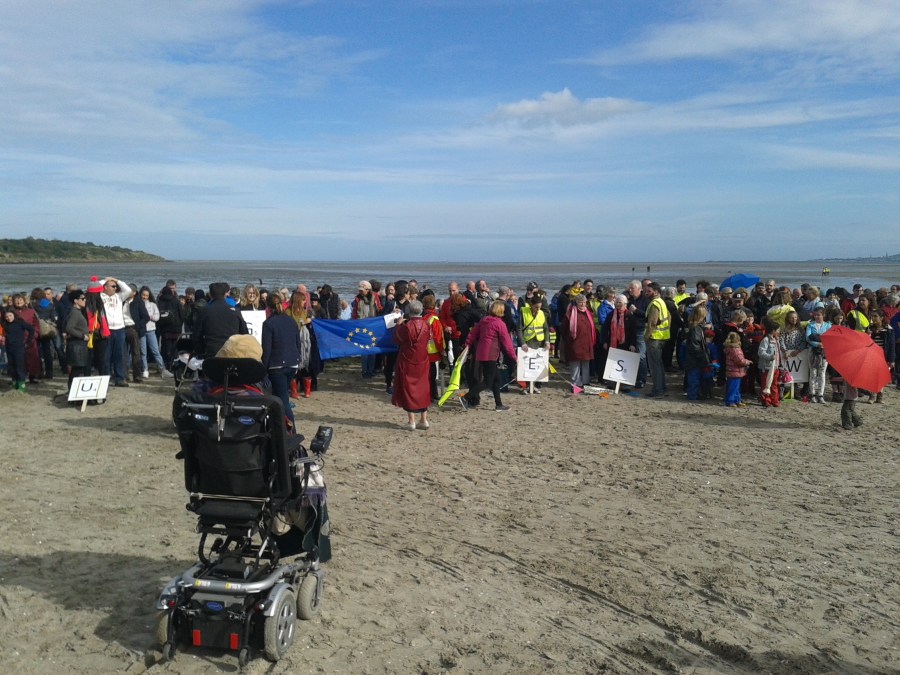
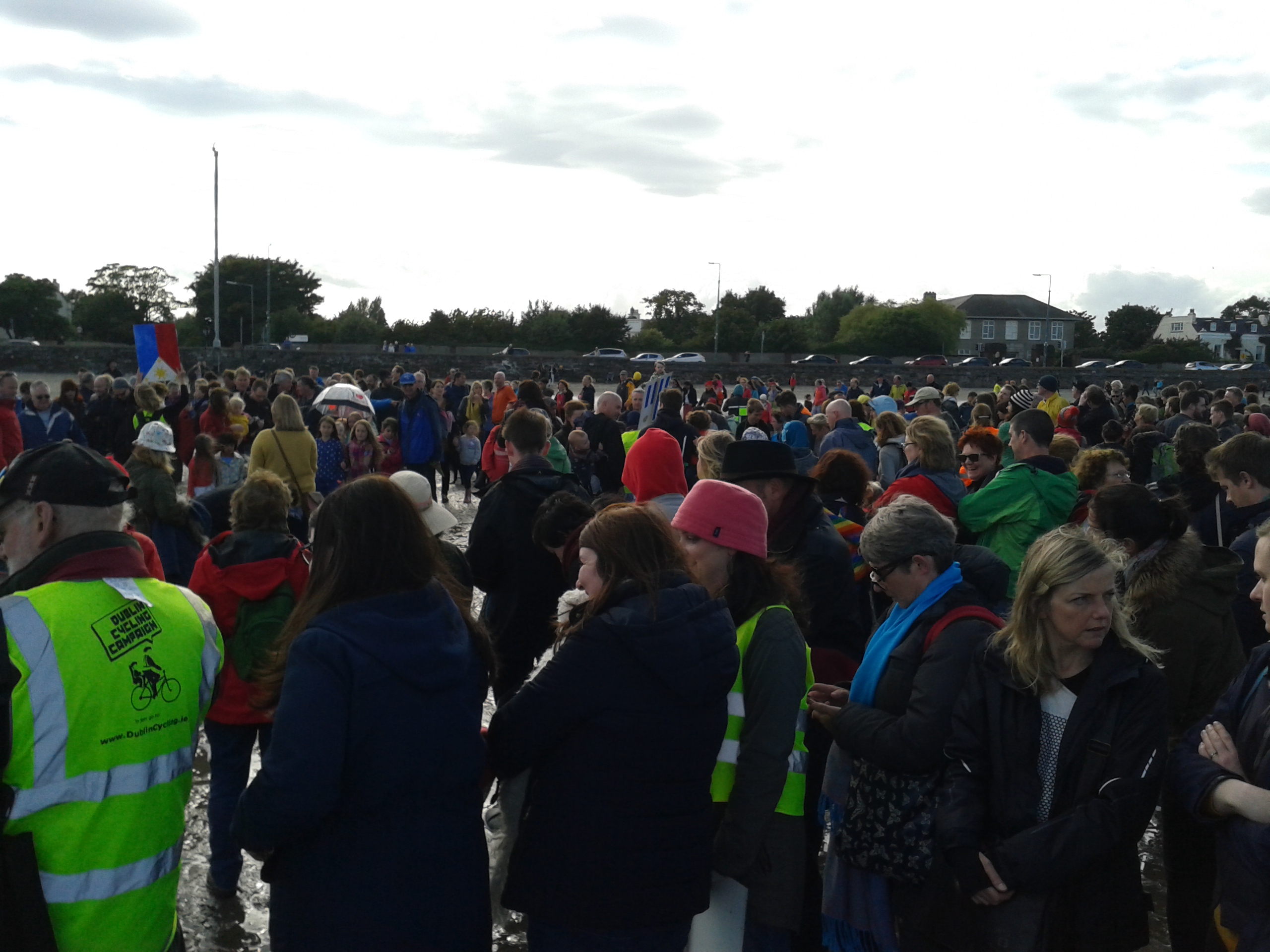
Section of the crowd standing on the wet beach, formed up in their letters. (Photo: D.Breatnach)

Eventually we were led off by our letter-leader to a spot marked out in the shape of the letters by string tied to pegs stuck in the sand. We shuffled into shape obediently.

A drone flew over us filming (I had unpleasant associations with the word, especially in a US-Syria context) and then we all had to be reformed, as according to the drone operator, the letters didn’t look right. So yes, we all became reformists .

Drone in the sky — refugee-friendly one for a change (top right). (Photo: D.Breatnach)

Then it was finally right, the “heart” had to be reformed too — it was bleeding people out at the edges. Finally, we were judged to be right, waved to the drone, film was taken.

Then the organisers thought it would be good for us to “scatter” for the film effect. We did, kind of, a half-hearted scatter …. nothing like we would have done from incoming ordinance. And then we went home.

After standing in the wet sand I discovered that dubbin did not keep the water out of my boots and, no matter how much knocking of boots together, I still had some sand on them when I got home. Remember how you always managed to bring some sand home from the beach, no matter how hard you tried not to?

The event followed on the more than two thousand (“hundred” according to RTÉ) who gathered at the Spire yesterday to extend the hand of welcome to refugees fleeing murder and even sexual slavery (by ISIS); a counter to the xenophobia and especially Islamophobia which had awoken echoes of the anti-Irish Catholic rantings of Cromwell and his kind in the 15th Century. Well done to the organisers and those who turned up to support the event.

Wide view of Sandymount beach as the “letters” break up (Photo credit: uncertain)

POSTCRIPT:

A lot of organisations had put their name to the event but effectively it had been organised by a coalition of ENAR Ireland (now Ireland Network Against Racism), Migrant Resource Centre Ireland and Irish Refugee Council — maith iad in conception, planning and execution.

Section of crowd forming up on their letter-group prior to going out to form up on the wet sand for the aerial photos. (Photo: D.Breatnach)

As though their traumal from the cause of leaving and its own pain were not enough, many die in the attempt. Thousands of refugees have died trying to reach Europe, most of them in the Mediterranean. Those who survive face racism and ghettoisation.

“From January to June 2021, it was estimated that 827 migrants died while crossing the Mediterranean Sea. In 2020, the number of deaths amounted to 1.4 thousand. However, the accurate number of deaths recorded in the Mediterranean Sea cannot ascertained. Between 2014 and 2018, for instance, about 12,000 people who drowned were never found”.2

Casualties and missing people

“Worldwide, it was estimated that eight thousand people died in the attempt of fleeing their country. According to estimations, over five thousand refugees lost their lives in the attempt to reach the European shores in 2016. Therefore, the Mediterranean Sea was the deadliest migration route. Indeed, over the last couple of years, the Mediterranean Sea held the largest number of casualties and missing people”.3

Western, Central, and Eastern route

“According to migration studies, the Mediterranean Sea is crossed by a Western, a Central, and an Eastern route. Out of these routes, the Central Mediterranean route was the deadliest. In 2016, roughly 4,6 thousand people lost their lives while pursuing this route. Sadly, the identification of bodies is challenging due to the sea. In 2019 for instance, the vast majority of refugees who drowned in the Mediterranean were not identified and their country of origin was untraceable.”4

Aerial view of the letter-volunteers on the sand photographed from the drone (Photo credit: Stephen Kingston)

REMEMBER

Remember? Remember when we were migrants?

Remember when we fled murder and rapine

and many another terrible scene

When death and torture were at hand

and we sought succour in other lands?

Remember?

Remember when our little nation

was devastated by starvation.

disease and desolation,

our hope in emigration ….

Remember?

Remember when we died by

mountain, valley and sea

or we braved

the rolling waves

to go where we might be free?

Remember, oh do you remember?

Escape, the vote,

in leaky boats

in anything to float,

fear in throat,

today they launch

for our shores.

Remember?

We must remember!

Diarmuid Breatnach

End.

Side view of the crowd that formed the “heart” on the sand (Photo: D.Breatnach)

FOOTNOTES

1Radió Teilifís Éireann, the state broadcasting service.

2https://www.statista.com/statistics/1082077/deaths-of-migrants-in-the-mediterranean-sea/

3Ibid.

4Ibid.

LINKS

Migrants Rights Centre Ireland: https://www.mrci.ie/

Ireland Network Against Racism: https://inar.ie/

Irish Refugee Council: https://www.irishrefugeecouncil.ie/

A FUNDRAISER IN HENRY STREET AND A CONNECTION TO MY FAMILY

Diarmuid Breatnach

(Reading time: 1 min.)

In Henry Street on Saturday I stopped to contribute to a fund-raising event for a child to have an operation in the United States. I was partly motivated by remembering when a granddaughter of mine, Caitlin Rose, needed to go to the US also for a special operation. I remembered too how generous people had been to my fund-raising for that objective. I had no idea when I stopped in Henry Street that the girl, Sienna, was heading for the same surgeon who had operated on my granddaughter Caitlin Rose some years ago.

Dublin Fire Brigade truck parked at Henry Street/ Liffey Street junction for the fund-raising event. (Photo: D.Breatnach)
Sienna in June (Source photo: Sienna’s family)

Men from Dublin Fire Brigade were doing the fund-raising, their fire truck carrying big posters advertising the campaign. One of them told me that he does a number of charity fund-raisers a year, always in Henry Street, where he finds the response of the people supportive. They don’t get time off from work for this activity and he would be heading into his Blanchardstown Fire Station that evening for a 12-hour shift.

One of the Dublin Fire Brigade firefighters fund-raising in Dublin’s Henry Street for Sienna’s operation on Saturday 11th (Photo: D.Breatnach)
Another of the firefighters taking part in the fund-raising for Sienna on Saturday in Henry Street. (Photo: D.Breatnach)

As I stopped to take some photos, I noticed a woman wearing a fire-fighter jacket and went to talk to her, asking how many women were now in the Dublin Fire Brigade. But she wasn’t a firefighter — she was the girl’s mother and only wearing the jacket on loan for the occasion. Chatting to her I discovered that her daughter Sienna is heading to Louisville, USA, to be operated on by Dr. Park, just as was my granddaughter some years ago. When Dr. Park first pioneered it, the operation was a startling new one and, though it is now available through the NHS (Caitlin Rose lives in London) and the HSE, for some reason the recovery time is much slower than under Dr. Park’s treatment.

In the most crude and simplified explanation, in SDR operation the surgeon opens the patient’s back to test which of the sensory nerves are pulling limbs taught and — cuts them! It sounds scary and crazy even but when one sees the results ….!

Dr. Park, a US-based surgeon from Korea, perfected this operation which he carries out in Louisville, Kentucky. Of course, lots of other work is required, including physiotherapy, exercising and often, orthopaedic surgery to correct bone deformity, etc. On 15th November 2018, Dr. Park performed his 4,000th SDR operation.

Lesley Ann, Sienna’s mother, taking part in the fund-raising in Henry Street on Saturday (Photo: D.Breatnach)

The cost of the operation, for the flights and the accommodation for the parents while the child is in treatment, time off work – all this is piles up frighteningly high. My daughter, my son-in-law and my son all organised fund-raising events and I was lucky that singers and musicians here supported two fund-raising events I organised, with support from Club na Múinteoirí here in Dublin — and that so many bought tickets. Before the operation, Caitlin Rose could barely walk; now she can even run and dance a bit, ride a bike, etc, and go to school on her own.

I hope at least as much for Sienna.

And that the same operation at the same level of effectiveness be available to all people in Ireland without having to fundraise or leave the country to access it.

End.

The firefighter team fund-raising for Sienna on Saturday. (Photo source: https://www.facebook.com/siennassteps)

Further reading:

https://www.stlouischildrens.org/conditions-treatments/center-for-cerebral-palsy-spasticity/about-selective-dorsal-rhizotomy

https://www.facebook.com/siennassteps

POLICE RIOTS — THE BIRTH OF THE IRISH CITIZEN ARMY

Diarmuid Breatnach

(Reading time main text: 2 mins.)

The Dublin police played a fundamental role in the creation of the first workers’ army in the world, the Irish Citizen Army.

The Dublin employer syndicate’s offensive against the working-class “syndicalism” of the Irish Transport & General Worker’s Union1 began with the 1913 Lockout, in turn triggering strikes on August 26th, when workers were presented with a document they were to sign declaring that they would leave the ITG&WU or, if not a member, would refuse to support it in any action2. Most workers of any union and none refused to sign and 20,000 workers were confronted by 400 employers.

However, the employers’ numbers were added to by the Dublin Metropolitan Police and the Royal Irish Constabulary, backed up by the judiciary. Morally and ideologically the Irish Times and Irish Independent (the latter owned by W.M. Murphy, leader of the employers) backed the employers as, to a large extent, did the Irish Catholic Church hierarchy3.

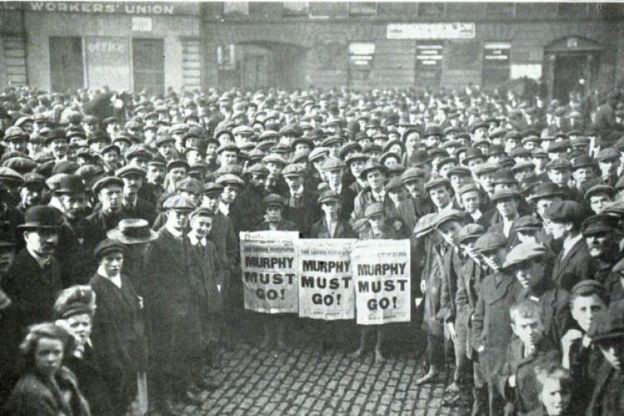
Workers’ demonstration with newsboys (WM Murphy owned the Irish Independent newspaper). (Source image: Internet)

The national (non-workers’) movement was divided in its opinion: many of Redmond’s Irish Parliamentary Party representatives were employers or landlords and their sympathies were naturally not with the workers. But for example Seán Mac Diarmada, a republican and national revolutionary, organiser for the secret Irish Republican Brotherhood4, opposed the strike on the basis that foreign business interests would profit by the paralysing of Irish business concerns5. On the other hand, Mac Diarmada’s mentor and head of the IRB in Ireland, Tom Clarke, was sympathetic to the strikers.

POLICE RIOTS

Unlike the gendarmerie6 British police force throughout Ireland of the Royal Irish Constabulary, at this time the constables of the DMP were unarmed except with truncheons but even with those they managed to kill people. On 30th August 1913 the DMP baton-charged a crowd in a street meeting on Eden Quay, outside Liberty Hall, HQ of the union7. Among the many injured were James Nolan and John Byrne who died 31st August and 4th September respectively, both in Jervis St. Hospital. (see also other riots and police attacks in Sources & Further Reading below).

On the 31st Jim Larkin went in disguise to address an advertised public meeting, banned by a magistrate, in Sackville (now O’Connell) St., Dublin. In view of the behaviour of the police, most of the IT&GWU activists went instead to their rented facilities at Fairview but a large enough crowd of the committed and the curious were assembled in O’Connell Street, along with large force of the DMP. Larkin, disguised as an elderly Protestant minister arrived by horse-drawn carriage and, as befitted a man made infirm by age, was assisted by Nellie Gifford8 into the Clery’s building which housed the Imperial Hotel restaurant, which belonged to W.M. Murphy (as did the Dublin Tram Co.). In order that Larkin’s strong Liverpool accent should not give him away, Nellie Gifford did all the talking to the staff inside. Shortly afterwards Larkin appeared at a restaurant window on the first floor and, top hat removed, spoke briefly to the crowd below but, as DMP rushed into the building, tried to make his getaway.

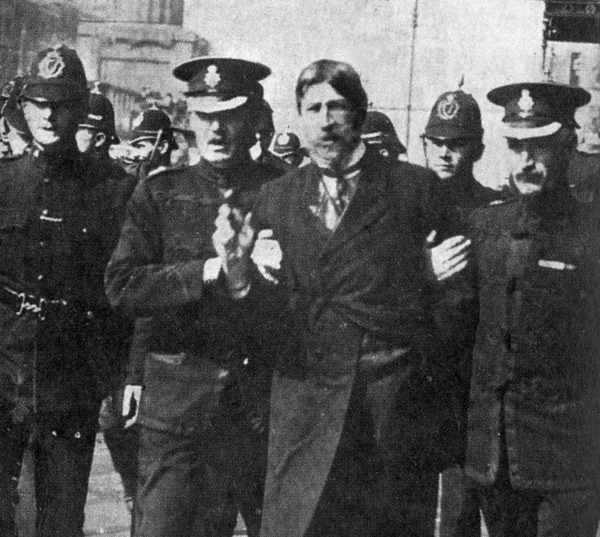
The arrest of Jim Larkin on 31st August 1913, being removed from the Clery’s building (see plinth of the Nelson Pillar behind and to the left) in O’Connell Street, just before the Dublin Metropolitan Police attack on the crowd. (Source image: Internet)

The DMP arrested Larkin and when the crowd cheered him (led by Constance Markievicz), the DMP baton-charged the crowd, striking out indiscriminately, including knocking unconscious a Fianna (Republican youth organisation) boy Patsy O’Connor who was giving First Aid to a man the police had already knocked to the ground. Between 400 and 600 were injured and Patsy suffered from headaches thereafter; though active in the Republican movement (he was prominent in the 1914 Howth guns collection9) he died in 1915, the year before the Rising. Among those beaten were journalists and casual passers-by. Those caught in Princes Street10 between DMP already in that street and the police charging across the main street were beaten particularly savagely.

The police attack became known as “Bloody Sunday 1913” (though two workers had been fatally injured on Eden Quay the day before and are often wrongly listed as having been killed on that day).

A photo of the police riot taking place on 31st August 1913 in O’Connell St; police can be seen striking with their truncheons even those on the ground. (Source image: Internet)

Also on that day the DMP attacked the poor working-class dwellings of Corporation Buildings (in “the Monto”, off Talbot St11), beat the residents and smashed their paltry furniture. The raid was a revenge attack for the reception of bottles and stones they had received on the 30th, when they were chasing fleeing workers from Liberty Hall (others crossed Butt Bridge to the south side and a running battle took place along Townsend Street and almost to Ringsend.

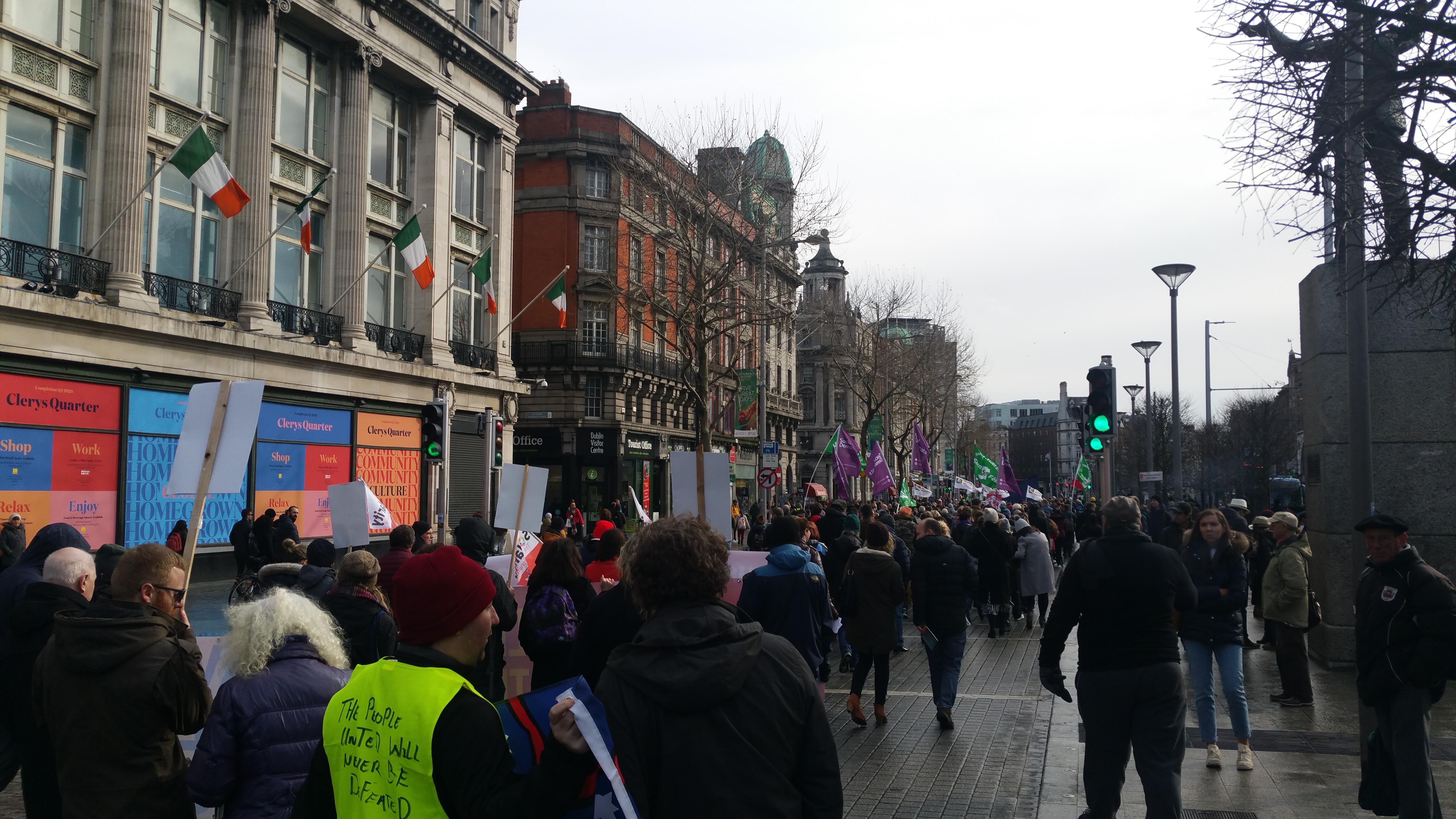
Protest march goes past closed-down Clery’s to the left in 2016 while Larkin looks down from his pedestal to the right. (Photo: D.Breatnach)

THE IRISH CITIZEN ARMY 1913 AND 1916

Very soon after those attacks, Larkin and Connolly each called publicly for the formation of a workers’ defence force, which became the Irish Citizen Army. Around 120 ICA, including female members fought with distinction in the 1916 Rising and raised their flag, the Starry Plough on the roof of WM Murphy’s Imperial Hotel on the upper floors of Clery’s building, opposite the GPO13. A number of its Volunteers were killed or wounded in action and two of the ICA’s leaders, Connolly and Mallin, were executed afterwards; another, Constance Markievicz, had her sentence of death commuted.

Irish Citizen Army on parade at their facility in Fairview. (Source image: Internet)

A much-diminished ICA took part in the War of Independence.

The end of August 1913 on Eden Quay and in O’Connell Street may be seen as the period and birthplaces of the ICA, the “first workers’ army in the world” and the first also to recruit women, some of whom were officers.

The Jim Larkin monument stands opposite the Clery’s building, which is now under renovation but without a mention on the monument or on the building of Bloody Sunday 1913 or its background and result. Sic transit gloria proletariis

end.

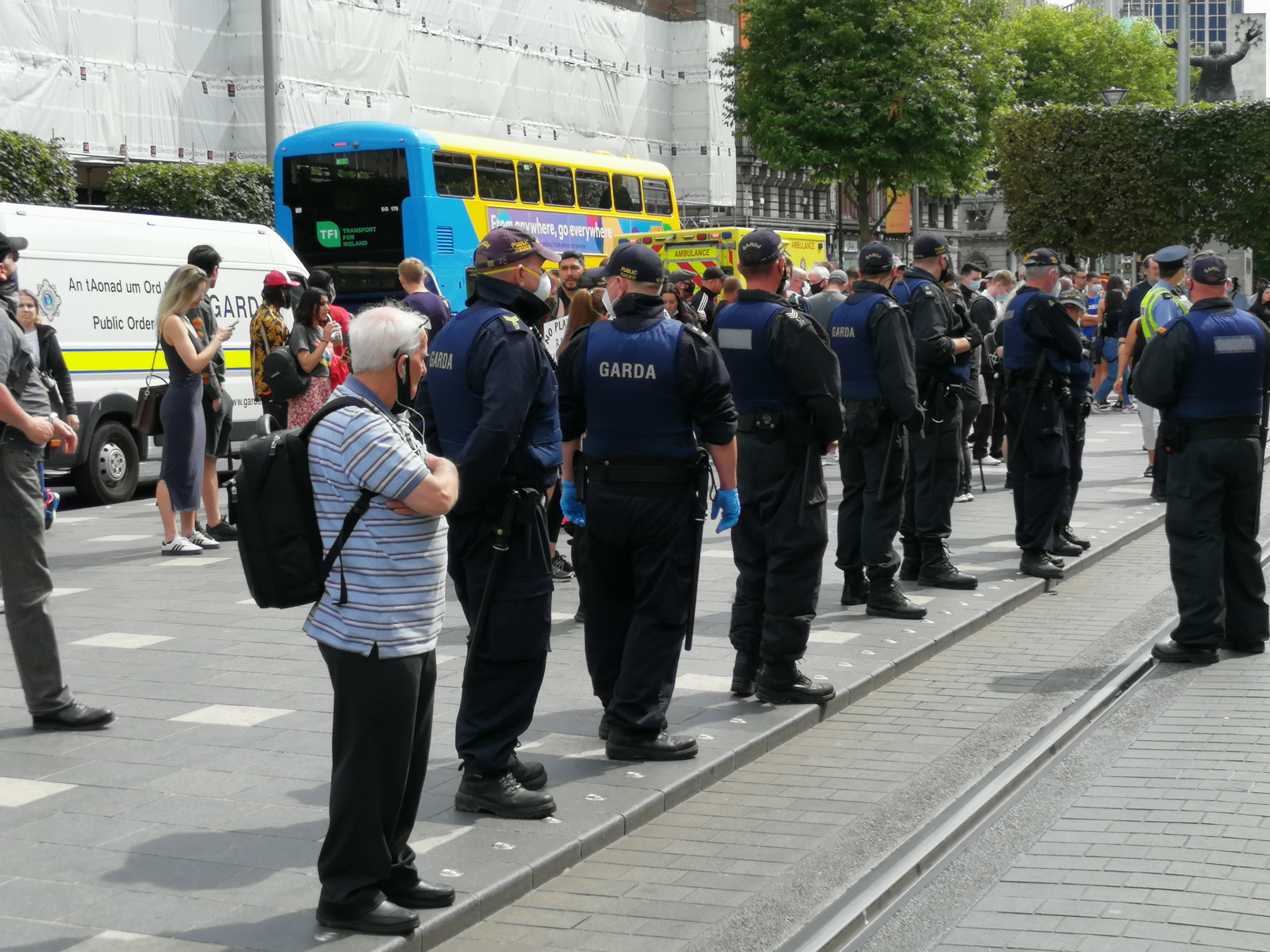
Today’s DMP, Garda Public Order Unit guarding far-Right gathering in O’Connell Street in 2020 (facing them, out of photo view). The Larkin monument can be seen in part at the top right-hand corner. (Photo: D.Breatnach)

FOOTNOTES

1The ITGWU was formed in 1909 by James Larkin, former organiser for the National Union of Dock Labourers after his bitter departure from that union. Most of the members Larkin had recruited for the NUDL, with the exception of the Belfast Protestant membership, left the NUDL and joined the IT&GWU.

2The provision in the declaration for members of unions other than the iT&GWU was necessary for the employers because of the general credo in Irish trade unionism that one did not cross a picket line, whether of one’s own union or of another, a credo that persisted in Ireland until the 1980s when the Irish Trade Union Council joined the “Social Partnership” of the State and the employers’ Federation. In addition, Larkin had added the principle that goods from a workplace on strike, even if strike-breakers could be got to bring them out, were “tainted goods” and would not be handled by members of the IT&GWU, nor should they be by any other union either.

3 Apart from any statements by bishops and priests, the religious charity organisation, the St. Vincent de Paul, refused assistance to families of strikers.

4 The IRB was founded simultaneously in Dublin and New York on 17th March 1858 and became known as “the Fenians”. In 1913 the movement had declined but was being rebuilt under the leadership of Tom Clarke, who went on to become one of the Seven Signatories of the 1916 Proclamation of Independence, all of which were executed b y firing squad after surrendering, along with another nine. Both were signatories of the Proclamation of Independence.

5It is one of the many ironies that on May 12th 1916, the last of the of the 14 surrendered leadership executed in Dublin (another two were executed elsewhere, one in Cork and the last in London) were Mac Diarmada and James Connolly, shot by British firing squads in Kilmainham Jail; the one an opponent of the workers’ action and the other one of its leadership.

6The gendarmerie is a particular militarised type of police force, armed and often operating out of barracks, like the Carabinieri of Italy, Gendarmerie of Turkey and Guardia Civil of the Spanish State. It is an armed force of state repression designed to control wide areas of potentially rebellious populations and it is notable that the parallel of the RIC did not exist in Britain, where the police force was mostly unarmed except by truncheon.

7Liberty Hall is still there today but a very different building (the original was shelled by the British in 1916) and SIPTU is a very different union too.

8Nellie was one of 12 children of a mixed religion marriage and was, like all her sisters (unlike the six unionist boys), a nationalist and supporter of women’s suffrage. Her sister Grace married Volunteer Joseph Plunkett hours before his execution and is, with Plunkett, the subject of the plaintive ballad “Grace” and Muriel married Thomas McDonagh, one of the Seven Signatories of the Proclamation, all of whom were among the 16 executed after surrendering in 1916. Nellie Gifford was the only one who participated in the Rising; she was a member of the Irish Citizen Army and was active in the Stephen’s Green/ College of Surgeons garrison, jailed and continued to be active after her release.

926th July 1914, when the yacht Asgard, captained by the Englishman Erskine Childrers, delivered a consignment of Mauser rifles and ammunition to the Irish Volunteers.

10Those may have been heading for Williams Lane which even today leads out from Princes Street to Middle Abbey Street (the junction of which is where James Connolly received the impact to his ankle in 1916).

11Corporation Buildings as one might expect housed working class people and the “Monto” (Montgomery Street) was a notorious red light district.

12The police station is still there, staffed by the Garda Síochána but in 1913 it housed also a British Army garrison.

13This flag, one of at least four different flags flown during the Rising, is now in the Irish National Museum at Collins Barrack. Shortly after the Rising it was noted by a British Army officer still in place upon the gutted Clery’s building and taken by him as a trophy to England. In 1966, the 50th anniversary of the Rising, the officer’s family returned the flag to the Irish people.

SOURCES AND FURTHER READING

Nellie Gifford: https://en.wikipedia.org/wiki/Nellie_Gifford

The Fianna boy who suffered a head injury: https://fiannaeireannhistory.wordpress.com/2014/12/

http://multitext.ucc.ie/…/Report_of_the_Dublin

1913 Ringsend Riot: http://comeheretome.com/…/04/07/1913-the-riot-in-ringsend/

IN DUBLIN, WORKING ON THE SOUP RUN

Diarmuid Breatnach

(Reading time: 5 mins.)

Go to Dublin city centre any evening and you will see people queuing up for food and water, being dispensed by teams of volunteers. There are at least 16 different organisations carrying out this work in the city centre, mostly outside the General Post Office, an imposing building and historical icon, the location of the HQ of the 1916 Rising from Easter Monday to Friday1. These are mostly community initiatives or if not, religious organisations (Christian, Muslim, Sikh), their staff volunteers, their efforts supported by donations. I arranged to speak to one of those volunteers.

DB: Orla, thank you for talking to me. You help with one of the soup-run-type initiatives? In Dublin City Centre?

Orla: That’s ok. Yes. Ours is one of the ones that sets up in front of the GPO, under the arch. We take over after another group has already been there.

And there are still people to feed? Even though a group has been feeding people before you?

Oh, yes. Sometimes the queue is already stretching to the corner of the GPO when I get there.

How long have you been doing it?

Since September last year with this group and a few stints with another group before that.

What made you take it up?

Over the years, like I suppose lots of other people, I’ve been seeing the rich get richer, the poor poorer. It’s made me more sympathetic to people in difficult situations. I don’t think people get where they are just by entitlement. It’s given me different perspectives. One Christmas Night … it was 2016 …. I got to go with a homeless outreach team, supporting people sleeping on the street …. It really opened my eyes. So I got to know a few of the volunteers, started off donating to their teams. Then one day I joined the volunteers.

What is it like to do that?

It can be challenging. We need to wear masks and gloves. Some of the people have mental health issues. You might get someone trying to take more than their share – well, if you see they have kids, that’s OK, or you really know they are taking one for someone else …. but you have to explain that the food is being shared, it’s for all and has to last. The queue has to form up at one end and has to keep moving …. Most are grateful and cooperate.

So, what do you and the other organisations provide?

Mostly food and bottled water.

You spoke earlier about donations. I have heard some volunteers say they don’t want money, also claims that some organisations asking for money have been scams. Would you like to talk a little about all that?

It is an issue. Most of the organisations are not registered charities that have audited accounts ….

Some registered charities have been found to be crooked too …

Yes, some certainly have. There was concern about a particular organisation that was collecting in front of the GPO. A reliable person who knew the score challenged them and warned others about them and we haven’t seen them since.

But getting back to donations to the teams feeding people …. are they in money or in food and water?

Mostly they are in water food and – bread, cakes, chocolates. There’s some shops, including convenience stores, that donate us bottled water and also food. Some of the food is prepared elsewhere and then brought down to the teams, already packed into single containers – because of the danger of infection. And we provide plastic forks and spoons. And there’s hot water containers for hot drinks. There’s one group of people who make sandwiches to bring down – they’re very popular. Some people help in preparing stuff but don’t work on the table handing it out.

But money?

Occasionally, but we usually ask people to buy food with the money and donate it. Occasionally a money donation might be accepted and a receipt would be given. But what can you do when someone just walks up to us when we’re busy, hands over a ten-euro note and walks away? Oh by the way, we don’t do a clothes service but if we know someone in particular needs clothes or shoes, we might bring them in. Or pass them on to the Lighthouse or Inner City Homeless.2 Sometimes outreach teams from registered services will come along to us too, so they can get someone into a hostel.

I have heard of some groups of far-Right or fascist orientation saying we should only be looking after the Irish. What would you say about that?

Well, I don’t agree. We feed people of whatever nationality, so long as they’re not scamming. Sometimes we get some Irish people in the queue making remarks like that and we have to be careful not to rise to it, to get in big arguments with them — but we don’t agree. They shouldn’t be judging. We don’t get people from Direct Provision but I’ve heard those are certainly not holiday camps. Racists say foreigners get things for free but any accommodation they get, they pay rent for. People might be here from abroad, working, paying rent, then they lose their job, things go wrong for them …. could happen to anyone.

Then, you might be from one county and be refused help in another. I remember a program on TV early in the year about a young person left on the street because he was from another county …. shocked a lot of people.

Has there been any trouble from racist organisations?

I remember that just before Christmas there were some threats made on social media from some far-Right people to some of the volunteers.

I heard about those threats too. Did anything happen?

No …. supporters turned up to defend them and stayed near for the whole shift.

So, is it tiring, after a day’s work, helping on the soup run line for two hours,?

Yes, after work I get something to eat, then head over there.

Well, thank you Orla for taking the time for the interview and for your work.

Thank you.

List of groups organising and serving the soup-runs (may not be complete)

  • Ocras Éire
  • Éire Nua Food Initiative
  • Grubs Up Homeless Services
  • Caring Is Sharing
  • Muslim Sisters of Éire
  • Gurdwara Nanak Darbar
  • Snowball Church
  • Church of God
  • Hope In The Darkness
  • Lámh Fáilte
  • Lending Hand
  • Streetlink Homeless Services
  • Liberty Soup Run
  • Ballymun Soup Run
  • Everyone Matters
  • Kilkenny group on Grafton Street

Go raibh maith agaibh go léir and to those who supply them with donations of food and bottled water.

Queuing for food from one of the voluntary services outside the GPO, Dublin 2020. (Photo sourced: Internet)

Comment

Thankfully these organisations are providing services but it is a sad comment on any society that they are needed, let alone in a State that claims it won independence a century ago. The GPO is a central location in the city centre and is obviously convenient for the operation of the services. Nevertheless the fact the building housed the headquarters of the 1916 Rising for nearly five days is a poignant counterpoint to the aspirations of those who fought for independence and a better life for the people.

That some far-Right and outright fascist organisations such as the National Party are using the issue of poverty and homelessmess to point the finger not at the system but at migrants, is disgusting. Preying on the vulnerable, poisoning their minds and using them as a front to pretend that they are actually doing charitable work, filming their occasional propaganda forays into the city.

Meanwhile, there are real people of many different ethnic backgrounds actually out there week after week, doing the real work, whether by religious or communal solidarity. Some of the latter are also, at other times, political activists and to learn that they have been threatened by fascists makes one’s blood boil.

Fair play to those who are doing the real work. But it shouldn’t be necessary. The system is sick. It needs a fundamental change or at least a sharp shock.

…. charging ….. step back ….. JOLT!

…. charging ….. step back ….. JOLT!

End.

FOOTNOTES:

1On that afternoon some of the garrison left to take wounded to Jervis Street Hospital and the major part, to head for the north-east of the city to continue the resistance but having to stop in Moore Street.

2Registered NGO services working with the homeless in Dublin.

DUBLIN PICKET AGAINST ONGOING INTERNMENT MARKS 50th ANNIVERSARY OF BRITISH INTERNMENT IN THE SIX COUNTIES

Clive Sulish

(Reading time: 5 mins.)

As Limerick and Waterford county teams prepared to face one another in the GAA hurling semi-final at Croke Park stadium, anti-internment protesters and campaigners lined up outside Dublin’s General Post Office, in the city centre, to mark the 50th Anniversary on the introduction of internment without trial in the British colony of the Six Counties. Their placards, leaflets and speakers denounced the continuing practice of interning political activists in Ireland today.

Seen at the anti-internment event in Dublin today (Photo crdt: Sean Hogan)

The event was organised by the Anti-Internment Group of Ireland, an independent and non-affiliated campaigning organisation and the supporters included a mixture of socialist Irish Republicans and anarchists. The heavy and persistent rain of the morning held off and Dublin city centre was thronged as GAA hurling supporters added to the usual shoppers. The banners and placards of the picketers drew considerable interest from those passing and here and there people stopped to discuss with them.

Some young Basque girls were curious but also delighted to see their nation’s flag, the ikurrina, being flown at the event and stopped to engage one of the picketers in discussion. Also in evidence was the flag of Amnistia, Basque organisation around solidarity with its political prisoners and against repression, along with the flag of Palestine.

Flag of the Amnistia organisation (solidarity with their political prisoners) in the Basque Country seen on the anti-internment event in Dublin today (Photo crdt: Sean Hogan)

Around 200 leaflets were distributed to passers-by, discussions were held and contacts were made with people interested in supporting the work of the Anti-Internment Group Ireland.

After some time in a picket line and distributing leaflets, a representative of the organisers, speaking in Irish and in English, welcomed the attendance and introduced a speaker from the Anti-Imperialist Action organisation.

One of the leafleters outside the GPO at the anti-internment event in Dublin today (Photo: C.Sulish)

SPEAKERS

Speaking in Irish as some passers-by stopped to listen, the young man said they were there to commemorate the introduction of internment and mindful of the existence of political prisoners all over the world. The were also protesting the extradition to Lithuania of Liam Campbell to face trial in a country in which he had never previously set foot.

The organisers’ representative then spoke in English about the history of repression in the Six Counties colony, how from the moment the nationalist community there stood up to demand equal rights and justice the State had responded with violence. Since the people raised the level of their resistance in response, the State in turn raised the level of its violence higher again, in a rising spiral of violence.

The nationalist community in the Six Counties had marched for civil rights and had been met with the violence of the colonial police and of the Loyalists — the speaker said — but they had continued to resist. Internment without trial was introduced to break that resistance but, knowing that would also lead to increased resistance, the State had prepared the Paratroopers to shoot unarmed civilians dead. They had done that in Ballymurphy on the very day that internment had been introduced1, he reminded his audience and later had shot dead two unarmed Cumann na mBan Volunteers (Republican women’s organisation) who were alerting people to the raiding parties of the British Army. At the start of the following year, the British Army murdered unarmed civilians again, this time in Derry2.

That year 1972, the speaker stated, had the highest death toll of any year during the three decades of the war3 and Loyalists were also bombing streets nearby in Dublin, again in 1973, killing workers. In 1974 Loyalists and British intelligence bombed the Dublin city centre again and Monaghan, killing the highest number of people killed in one day during the war4. That year too, the IRA bombed pubs in England and killed people and the State brought in the repressive Prevention of Terrorism Act against the Irish community. They jailed a score of innocent people on extremely serious charges5 and one of them, Giuseppe Conlon, died in jail6.

The speaker went on to say that although there had been hard repression before, the introduction of internment without trial and the follow-up massacres by the British Army had lit a fuse to a chain-reaction of violence for decades to follow.

Pointing out that internment consists of jailing people without trial, the speaker stated that the practice continues today, by refusing bail to political activists awaiting trial in the non-jury courts on both sides of the British Border. The Anti-Internment Group of Ireland will continue striving to expose this reality and he called on people to support the monthly pickets in the city centre and to follow the End Internment page on Facebook.

ONGOING AGITATING AGAINST INTERNMENT

As the applause died down people began to pack away flags, banners, placards and leaflets and to catch up socially among themselves or to engage with passers-by who had stopped to listen and/ or to ask questions.

Organisers of the event said they hope to hold another picket at some venue in the city centre in a month’s time – when scheduled, the event will be announced on the End Internment FB page.

End.

Leafleter right foreground, person reading leaflet left foreground, picket line of the anti-internment event in Dublin today. ( Photo: C.Sulish)
(Photo: S.Hogan)


(Photo: S.Hogan)
View of the picket with a passer-by expressing solidarity with the picketers (far right of photo). (Photo: C.Sulish)

FOOTNOTES

1Between 9-11 August, British paratroopers caused the deaths of 11 unarmed civilians in Ballymurphy.

213 people were shot dead by British paratroopers on Bloody Sunday in Derry as they protested against internment and a 14th died later of his wounds.

3The period from August 1971 to the end of the year saw a huge jump to 136 violent deaths (including British and colonial armed forces) and the following year, 1972 is counted the most violent year of the conflict overall with 479 people killed (including 130 British soldiers) and 4,876 injured.

434 people were killed that day, all civilians.

5The Birmingham Six, Guildford Four, Maguire Seven, Giuseppe Conlon and Judith Ward. All were eventually cleared after long years of campaigning around them and failed court appeals.

6Giuseppe Conlon, hearing that his son Gerry had been arrested for the Guildford Pub Bombings, came to London to help him in 1974 and was swept up into the police net to become one of the innocent framed victims. Giuseppe Conlon was not a healthy man and died in his 7th year in jail, before the verdicts on the other framed prisoners were finally overturned. His son Gerry, also an innocent man in jail, was not permitted to attend his father’s funeral.