Historians and political activists gave talks in Dublin presenting a review of the conduct of what is more usually called the Irish Civil and its effect since on life in Ireland. All the speakers described that conflict as “a counterrevolution”, to overturn many of the gains made in the period of struggle immediately before it and to head off any possibility of yet further gains in Irish political, economical and social life, having a braking effect on such progress up to this very moment.
Liz Gillis speaking (Photo: D.Breatnach)
L-R: Fearghal Mac Bloscaidh, Mags Glennon, Ciaran Perry (Photo: D.Breatnach)
BACKGROUND
The event on 26th June, held in the function room of The Cobblestone, was organised by the Peadar O’Donnell Socialist Republican Forum, itself established in early 2013, the result of a number of meetings and seminars organised over the course of 2012. It combined communists and socialist Republicans to organise discussions on a number of issues, such as Irish state neutrality, Irish national independence, working-class programs in struggle etc.
(Photo: D.Breatnach)
SPEAKERS
Ciaran Perry, a socialist Republican and Independent Dublin City Councillor, also a local history activist, introduced the event. He talked about the importance of history and in particular local history, the traditions of struggle and how some of those had been weakened in the trade unions and communities over the years.
Reading the account of the Ballysheedy Massacre (Photo: D.Breatnach)
Perry introduced the MC for the meeting, Mags Glennon who is also a socialist Republican activist and history enthusiast.
Glennon introduced historian Fearghal MacBhloscaidh from Tyrone who began in Irish and then continued in English, his presentation laying out clearly his position that the Civil War was a planned counterrevolution, quoting Cabinet papers and correspondence and supplying figures on the arms and equipment supplied to the Free State ruling elite by the British. MacBhloscaidh also maintained that the De Valera Government, though supported by the wider Republican movement at the time, was also a counterrevolutionary measure when subjected to a class analysis.
Sorry, slightly out of focus Jimmy Doran (Photo: D.Breatnach)
A woman (whose name I did not catch) was called to stage. In a clear voice she read an account of of the horrific Ballyseedy Massacre. Free State soldiers, after torturing their Republican prisoners, brought nine of them out to a road barricade, in which they had placed a landmine which they exploded. One survived by some miracle but spent the rest of his life needing frequent medical intervention.
At intervals between speakers, Pól MacAdaim performed his music, singing accompanied by guitar. Among the songs he sang were Tipperary So Far Away and Take It Down From the Mast (in the chorus of which some members of the audience could be heard joining).
Pól Mac Adaim performing at the event (Photo: D.Breatnach)
Mags Glennon then introduced historian Liz Gillis from Dublin who talked about the reaction of women to the Treaty and to the Civil War. The vast majority of Cumann na mBan members rejected the Treaty and many actively supported the Republicans in the following conflict. Gillis also spoke about how the women, who had been active in the struggle in 1916 and briefly to the fore in public life with the elections of 1918 and the War of Independence, were driven back to almost invisibility by the Free State Government and also the De Valera government and the 1937 Constitution. Gillis lauded Kathleen Clarke whom she said continued to fight the struggle for the rights of women in representational politics and criticised the De Valera Constitution of 1937.
Mags next introduced Jimmy Doran, a communist and long-time trade union activist, who talked about the contribution of the organised Irish workers to the struggle against British colonialism and for the advance of the working class. Doran went on to comment on the trade unions’ history and current situation in the Irish state. I had to go to the toilet and when I returned stayed near the entrance so as not to distract the audience by retaking my seat near the front and unfortunately, due to the lack of a PA system and the acoustics of that location, I was unable to hear the rest of his presentation.
Poster for the event.Supporters and organisers (Photo: D.Breatnach)
Although the meeting was thrown open to questions or contributions, little was forthcoming although there was a short debate on whether the Irish bourgeoisie prepare well into the future and whether they prepare better than their opponents in the Republican movement.
The proceedings ended with announcements of forthcoming events, thanks from Mags to the speakers, audience and to Pol Mac Adaim who ended the day on a musical note.
A crowd gathered in Dublin today to commemorate the Free State opening fire on the Four Courts on 28th June 1922, an event that began what is usually called “the Civil War” which lasted until 1923 (with State assassinations until 1924). The UK supplied the cannons and shells used by the Free State’s “National Army” along with munitions, including small arms and ammunition, armoured cars, army lorries and even coastal naval vessels. The conflict has also been called a “counterrevolution” and “the UK’s proxy war” with more Republicans executed by the new Irish State1 in that conflict than had been by the British State over the whole 1916-1921 period.
Section of NGA march outside Croppies’ Acre (Photo sourced: Internet)
One hundred years ago this month, the IRA under the command of Rory O’Connor occupied and fortified the Four Courts complex, last occupied as a fighting post during the 1916 Rising. The Anglo-Irish Treaty partitioning the country and giving the Free State the status of a Dominion country had been narrowly accepted by the delegates to the First Dáil, the Irish Parliament previously banned by the UK State. However by far the majority of the military part of the Irish resistance – the IRA, Cumann na mBan and na Fianna, along with the remnants of the Irish Citizen Army – were opposed to the Treaty. The occupation of the Four Courts was seen by the Free State government as a challenge to its authority and by the British Government as a threat of anti-colonial struggle being renewed. Both parties were hostile to any radical republican, socialist or socialist-republican program.
Free State Army attacking the Republican garrison of the Four Courts with artillery, rifle and machine-gun fire. (Photo sourced: Internet)
On 28th June the Free State opened fire from British cannon on the Four Courts from Bridge Street on the south side of the river and the Civil War – or Counterrevolution – had begun. By the time the Republicans conceded defeat (and some assassinations continued even after it officially ended) perhaps around 1,300 had been killed. From January 1922 to April 1924, according to the Republican Roll of Honour, 426 anti-Treaty Volunteers had been killed, some 25 of these died fighting British and Northern Irish forces. Most anti-Treaty dead were IRA Volunteers, but some were Na Fianna members and four were women of Cumann na mBan2.
Poster commemorating one of the Republicans killed by the Free State (Photo: D.Breatnach)
One of the commemorative posters attached to lampposts (Photo: D.Breatnach)
On the Free State side just under 800 died, of whom 488 fell in enemy action, others due to accidents or illness, while seven were executed having deserted to the Republican side. “To this total should be added a small number of police, including four from the Civic Guard (later renamed Garda Síochána), four from the Criminal Investigation Department and two from the Citizens’ Defence Force, who were killed from 1922-19243.”
The NGA rally, the MC (Photo: D.Breatnach)View of the crowd at the rally outside the Four Courts (Photo: D.Breatnach)
Dorney remarks on omissions in the Last Post record and concludes: “Even allowing for this, though, the total of anti-Treaty IRA dead in the Civil War is not likely to be much more than about 500, of whom 81 died before Free State firing squads and more than 100 were summarily executed in reprisals.”
(Photo: D.Breatnach)
Many Irish Republicans also emigrated to avoid repression or because they were being denied employment.
The Irish State today is a direct descendant, legally and in other ways, of the Free State of 1922 and all periods since.
Senior Garda officer taking notes while speakers are addressing the crowd (Photo: D.Breatnach)
The commemorative event in Dublin today was organised by the National Graves Association (Cumann Uaigheanna na Laochra Gael), an organisation which since its founding in 1926 has been maintaining the graves of Irish patriots, arranging for the installation of gravestones, plaques and monuments and also organising commemorative events.
Before marching to the Four Courts, participants formed up in groups in the road outside Croppies’ Acre, a public park over a mass grave of victims of the English state’s repression of the United Irishmen and their supporters in 1798, now across the road from the Collins Barracks National Museum. They were led by a lone piper and colour party, followed by people in double ranks flying Starry Plough flags and carrying banners of history and conservation groups, along with some other flags, including that of Cumann na mBan.
Section of the lineup waiting to start, outside Croppies’ Acre (Photo: D.Breatnach)
At the rally outside the Liffeyside of the Four Courts, the organisers had an MC with number of speakers to read out the 1922 Proclamation, the lyrics of The Soldiers of Twenty-Two4 and Tim Horgan to give a keynote oration. At least one floral wreath was laid in honour of those who fought there and a number of posters attached to lampposts commemorated the three Volunteers who were fatally wounded there: Thomas Wall, Joe Considine and Sean Cusack.
Reading the lyrics of Soldiers of Twenty-Two (Photo sourced: D.Breatnach)
It is almost certainly the case that it is the NGA which has erected the majority of patriotic struggle commemorative plaques around the country, with most of the remainder being organised by local authorities, local history groups and old comrades’ associations – a very small proportion being the work of the State. As stated on its website, the objectives of the Association have always been: to restore, where necessary, and maintain fittingly the graves and memorials of our patriot dead from every generation; to commemorate those who died in the cause of Irish freedom; to compile a record of such graves and memorials.
The NGA’s general alignment is unequivocal: “Only a 32 County Irish Republic represents the true aspiration of those who gave their lives for Irish freedom.5“
Reading the 1922 Proclamation (Photo: D.Breatnach)
One might assume that every participant at the event today was of a definite political bent, yet not a single party or political organisation banner was to be seen on the march or at the rally. This is because participants were asked in advance not to bring any banners or placards of political organisational allegiance. As the Chairperson of the rally informed the audience, the NGA is not affiliated to any political party or organisation and furthermore does not accept contributions from any such nor from the State – in order to continue to guarantee the NGA’s independence. In fact, members of its governing body are not even permitted to belong to a political party. A senior Garda officer however, of least at Inspector rank, took down details in his notebook as the rally was addressed by speakers.
Main speaker, Tim Horgan (Photo: D.Breatnach)
Patriots of the United Irishmen, the Young Irelanders, the Fenians, the Land League, na Fianna Éireann, Irish Volunteers, Cumann na mBan, IRA, Official and Provisional IRA, the Irish National Liberation Army etc have all been commemorated by the NGA. According to Wikipedia, since its founding, the NGA has erected, or accepted into its care, over 500 monuments and memorials throughout Ireland.
One of the participants takes a rest
Banner of one of the groups attending (Photo: D.Breatnach)
Some of those in attendance (Photo: D.Breatnach)
A number of other Civil War/ Counterrevolution commemorative and discussion events will be taking place at least during this year, two of which will take place next week (see photos of leaflet).
The Gardaí remained at the scene as people dispersed. Passing by again shortly afterwards, we found the floral wreath had been removed.
End.
Lowering of the flags in honour of the martyrs (Photo: D.Breatnach)
Civil War/ Counterrevolution commemoration (image: photograph of flyer)
Forthcoming talk (image: photograph of flyer)
FOOTNOTES
1Official executions are usually listed as 81 or 83, these having been subjected to some kind of military judicial process (but without any jury). However, apart from IRA fighters killed in battle, a number of captured combatants were murdered (such as those of the Ballyseedy Massacre on March 7th 1923) while known activists were assassinated by Garda-Army squads operating from Oriel House. Often, the murdered had been tortured first.
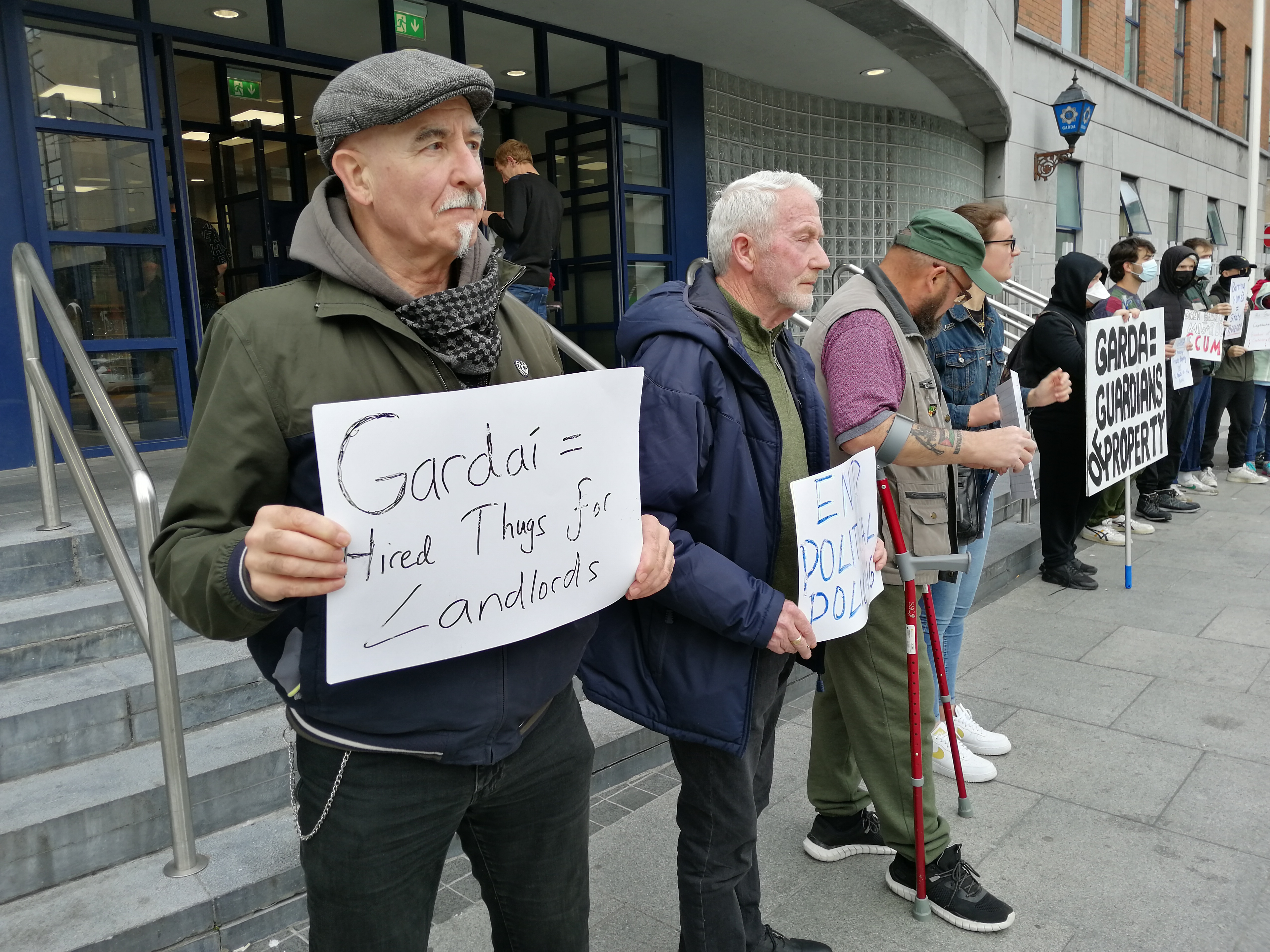
Passers-by on foot and on the Luas tram lines watched curiously as housing activists and others held a picket outside Store Street Garda station in Dublin on the evening of 13th June 2022. The picket was called for by the Revolutionary Workers Union, protesting the taking by over 80 Gardaí of a house on Eden Quay and arresting of two occupants, followed by the arrest of another two activists near another address.
Poster advertising the event on social media. (Image sourced: Internet)
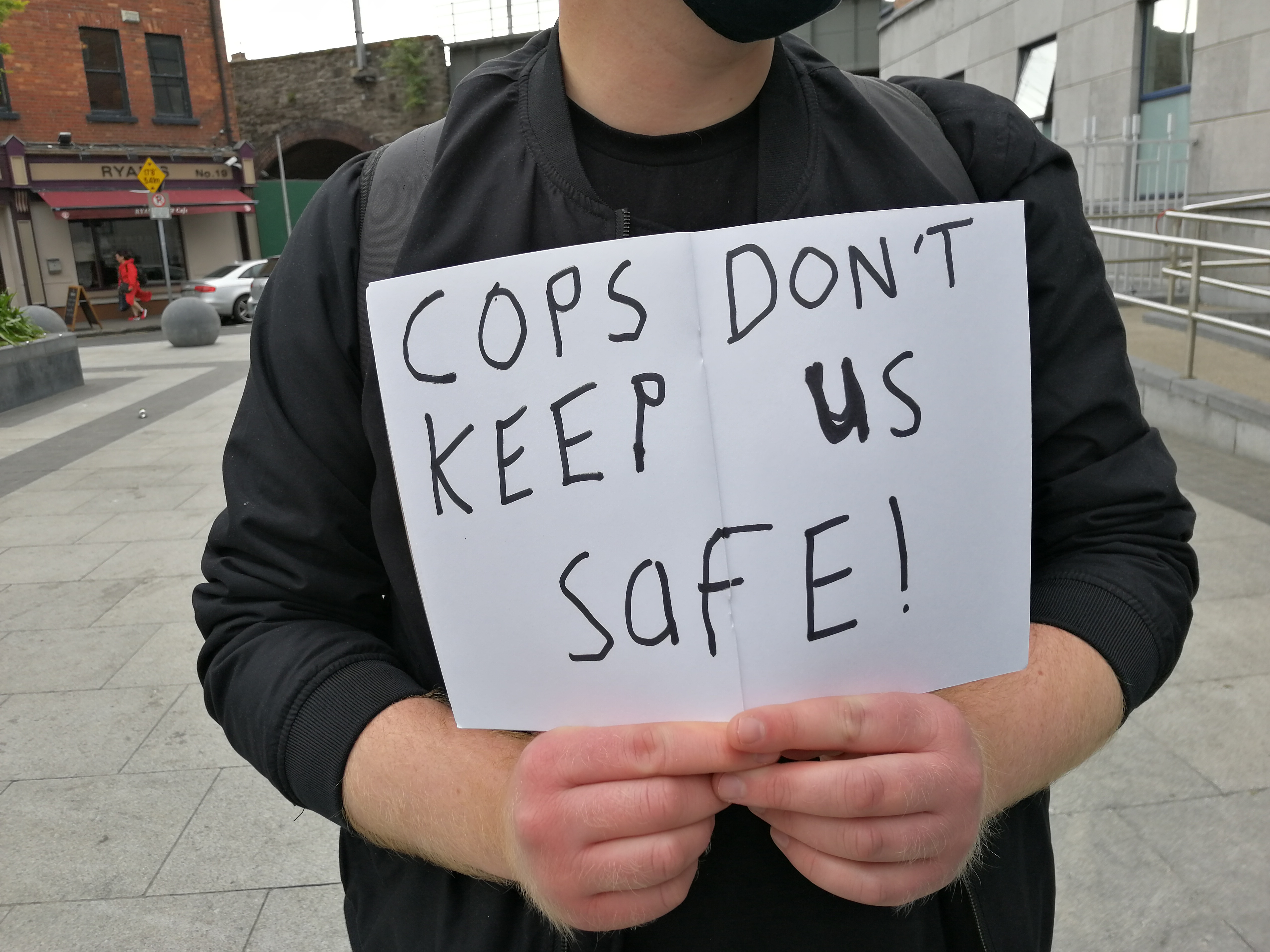
The picket was called at fairly short notice and supported by people from a variety of political backgrounds, all with what were clearly home-made placards. Picketing a police station is somewhat counter-intuitive, given that’s to where the police take their prisoners and most people want to stay away from those places, with good reason. However, the station is the location of the police symbolically and in reality and Store Street is one of the main ones in Dublin so, when one wants to protest about the police …… Once having protested at a police station, the apprehension is never quite the same again.
Some passers-by stopped to ask what the protest was about, some of whom expressed anger at the actions of the Gardaí and a reporter from an independent media interviewed some of the participants.
Picketers outside Store Street Garda Station, Dublin City centre on Monday. (Photo: Rebel Breeze)
Some time later the picketers were addressed by Seán Doyle of the RWU who spoke about the morality of the landlords and speculators and the Gardaí who work for them. Doyle contrasted that morality with the one that saw provision for need instead of profit. During the course of his address, Doyle pointed out that the RWU knows people who work in emergency interventions such as with people attempting suicide, who are then brought to agencies to help them but who are soon out again and homeless. “This is not ‘ethnic cleansing’,” the activist said, “it’s class cleansing.”
(Photo: Rebel Breeze)
The RWU spokesperson at the picket remarked on the use of the law and the Gardaí against housing activists while speculators and landlords make big profits out of the misery of homelessness. A law that upholds and defends that kind of practice must be defied, he stated as he drew to a close.
Some of the picketers on Monday (Sean Doyle is second to the right). (Photo: Rebel Breeze)
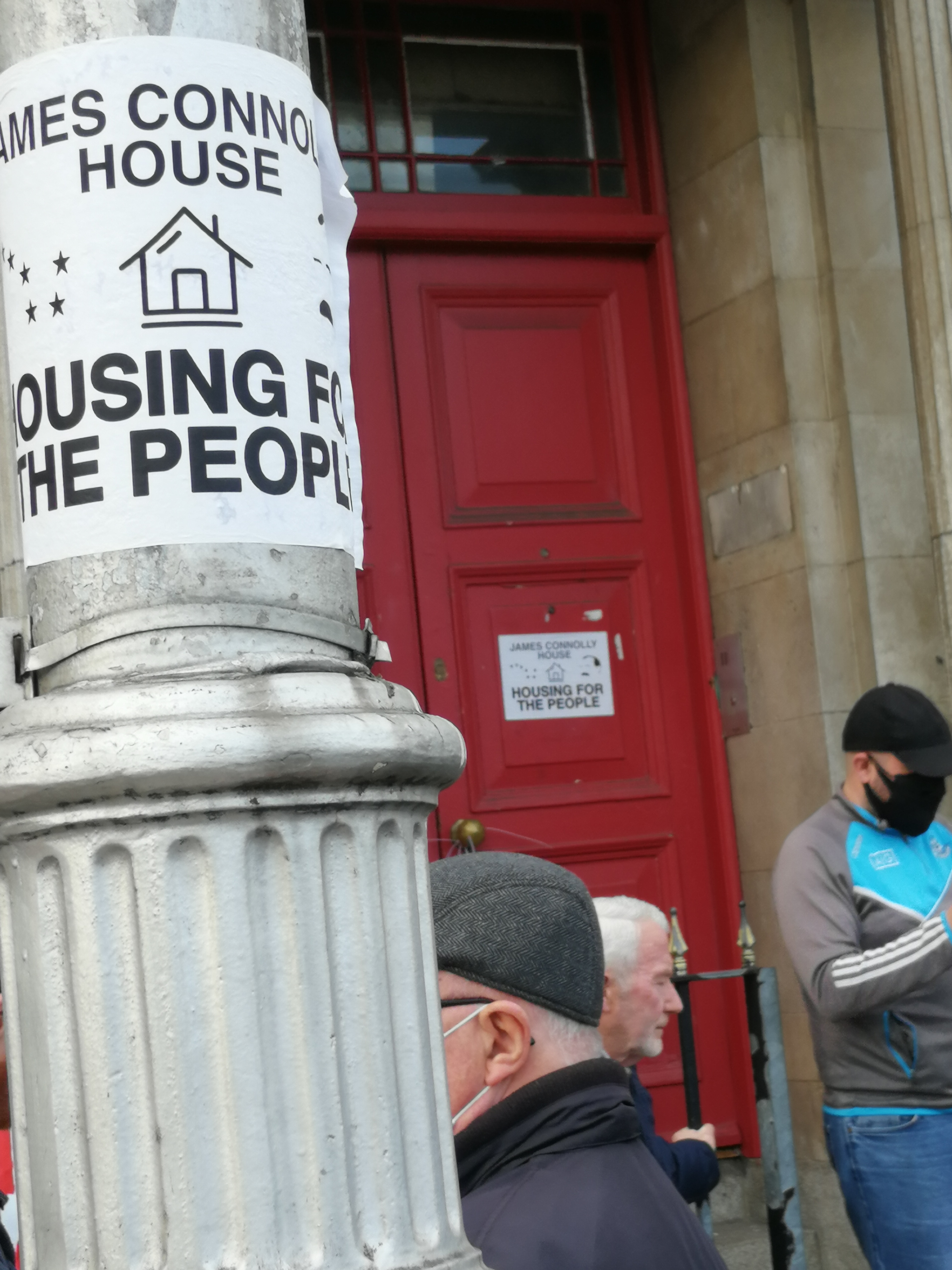
Seán Doyle was one of two activists that were removed recently by over 80 Gardaí from a one-and-a-half years empty homeless hostel which the RWU had “acquisitioned” and renamed “James Connolly House”. Another premises subsequently acquisitioned, also empty for a long period, the RWU renamed “Liam Mellowes House” and the Gardaí arrested two activists near there also, despite any occupation of the building being a civil law matter and outside the remit of the Gardaí.
The RWU on a number of occasions have called on people to “take back empty buildings” and have declared that they will not be intimidated by arrests but will continue to fight for the right of people to a secure home.
Another view of part of the picket on Monday (Photo: Rebel Breeze)
One of the home-made placards at the event. (Photo: Rebel Breeze)
End.
A placard denounces the recent 80+ Garda eviction of “James Connolly House” and arrest of two occupants (Photo: Rebel Breeze)
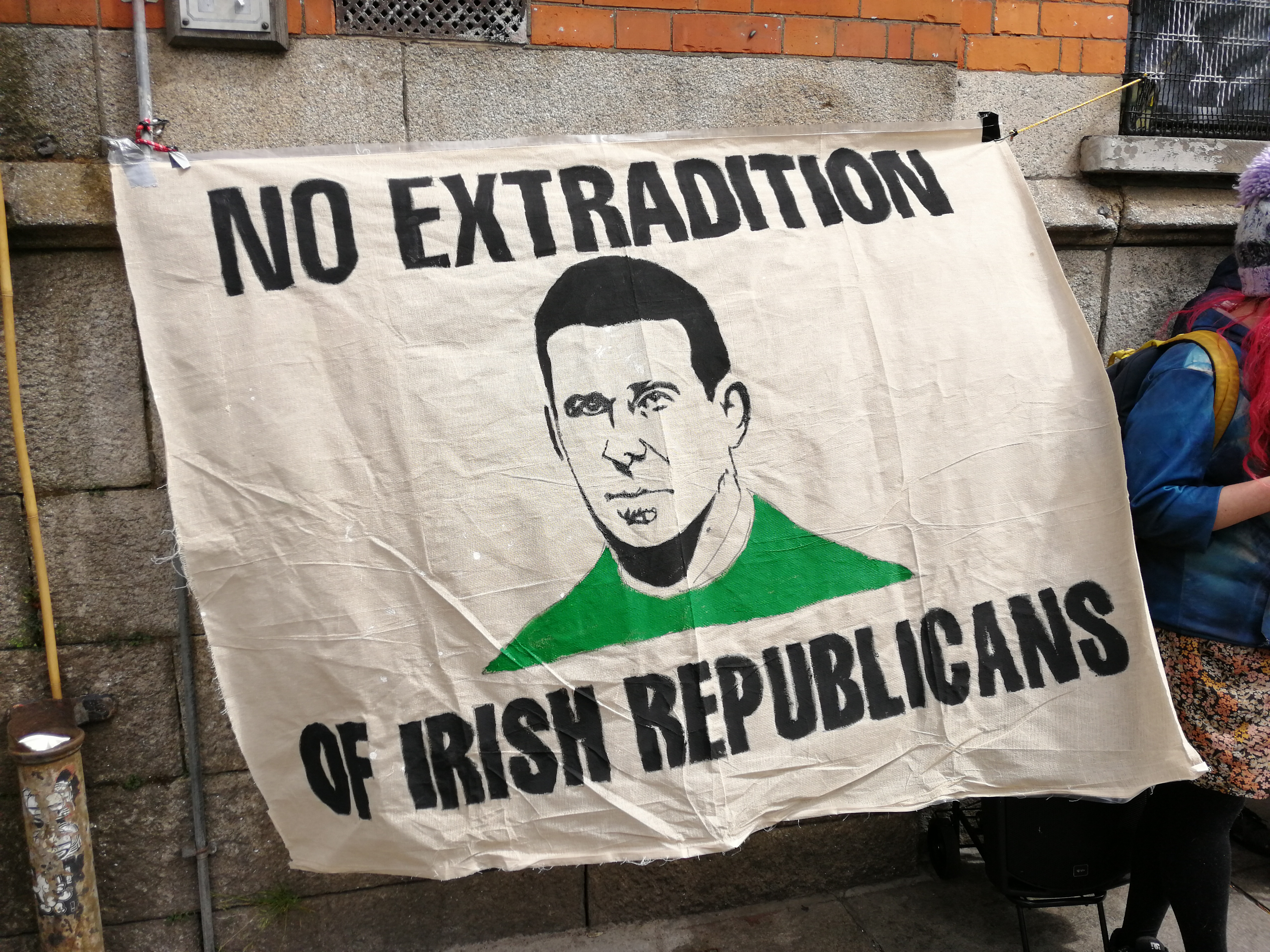
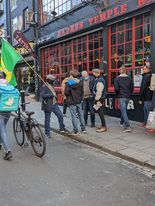
The Dublin Committee of the Anti-Internment Group of Ireland held a picket yesterday to highlight the ongoing internment without trial of Irish Republicans and to protest the recent extradition of Liam Campbell to Lithuania, a country to which he has never been. The picket was held in Temple Bar, a tourist quarter of the Dublin’s south city centre.
(Photo source: Anti-Internment Group of Ireland)
(Photo source: Anti-Internment Group of Ireland)
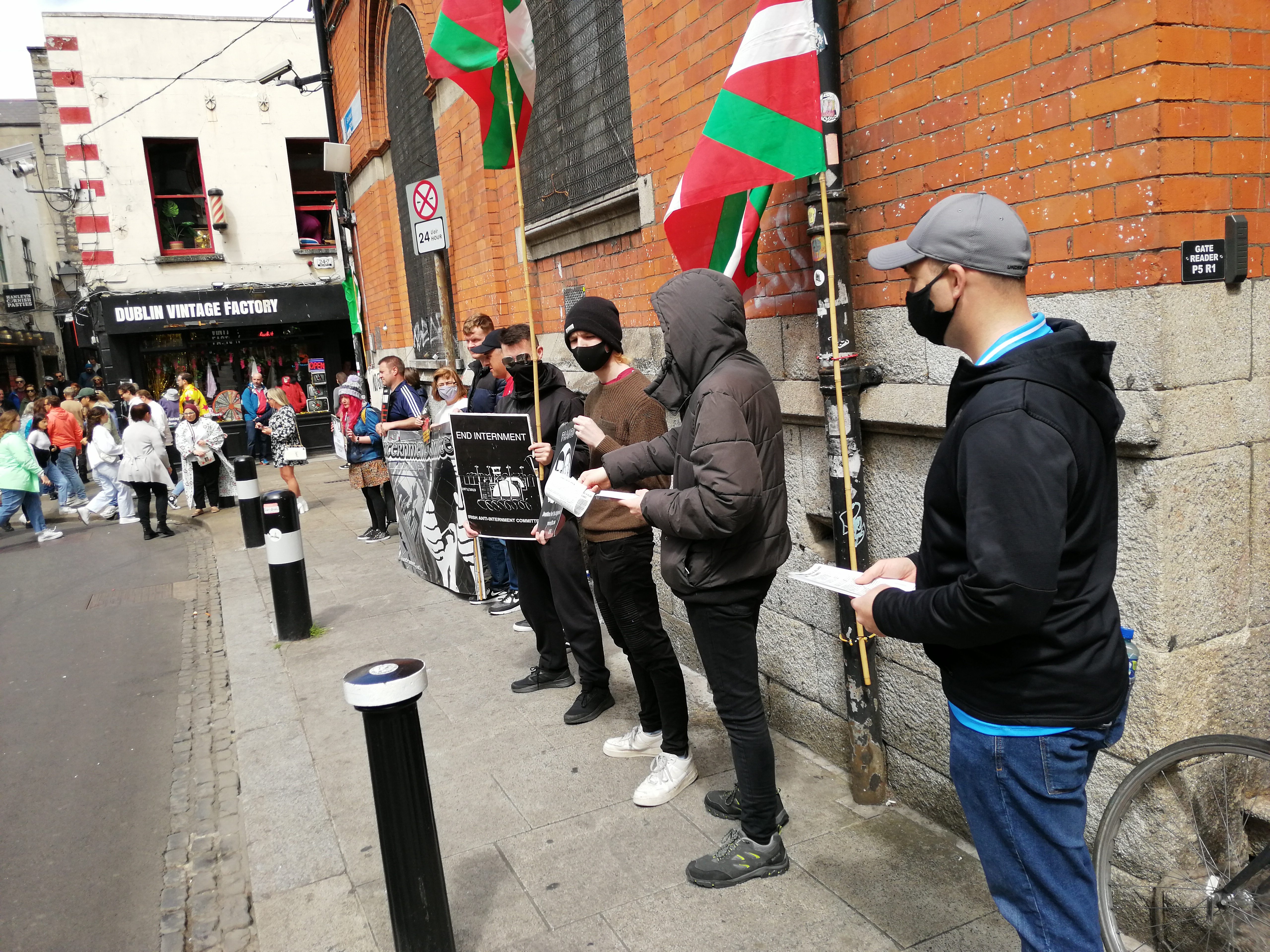
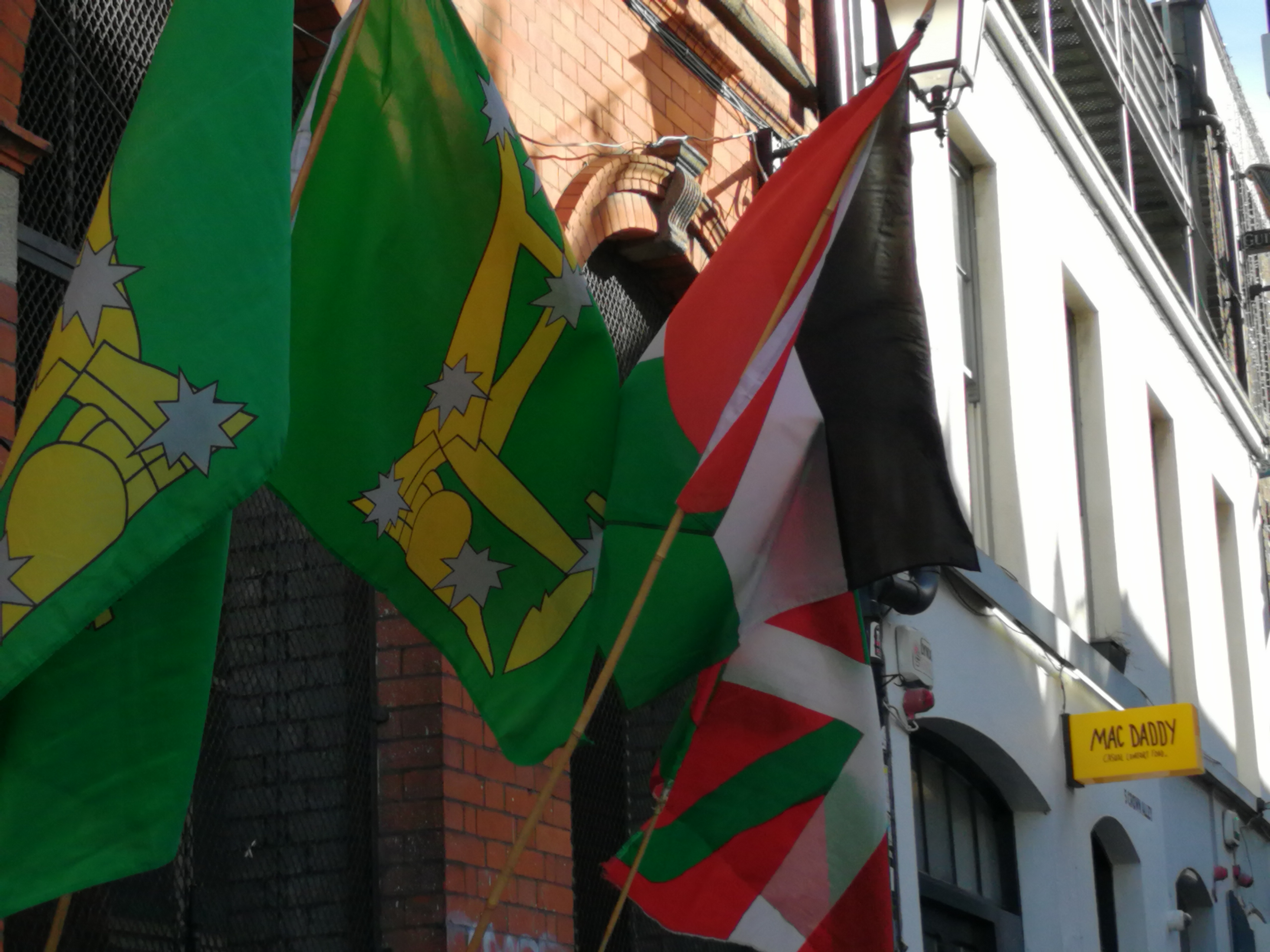
Afterwards, the AIGI issued the following report (reposted with kind permission): “Tourists, Irish shoppers and young people socialising in Dublin city centre were interested to see the banners and placards against internment in Ireland, along with a banner against extradition of Irish Republicans. They also noted the various placards of the Anti-Internment Group of Ireland and the flags of Palestine and the Basque Country, in addition to the Starry Plough flag of the Irish Citizen Army, representing three of the many nations holding political prisoners.
(Photo source: Anti-Internment Group of Ireland)
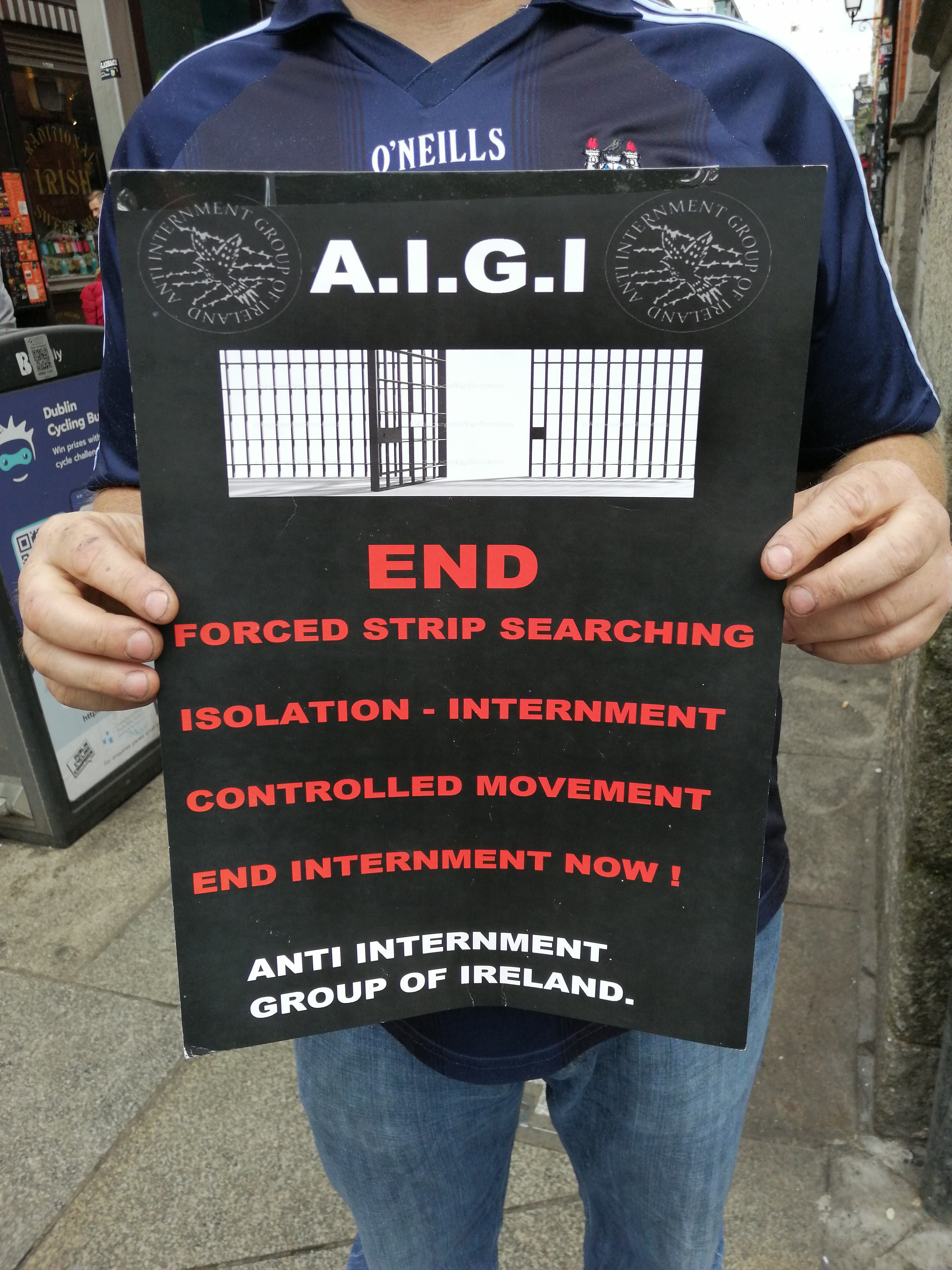
Supporters distributed up to 200 leaflets and had a number of engagements with people wanting to know more. People were surprised and angry to learn that internment under another name continues in Ireland on both sides of the British Border.
A portable PA machine played resistance music and an AIGI speech from a previous public event which attracted some interest.“
(Photo source: Anti-Internment Group of Ireland)
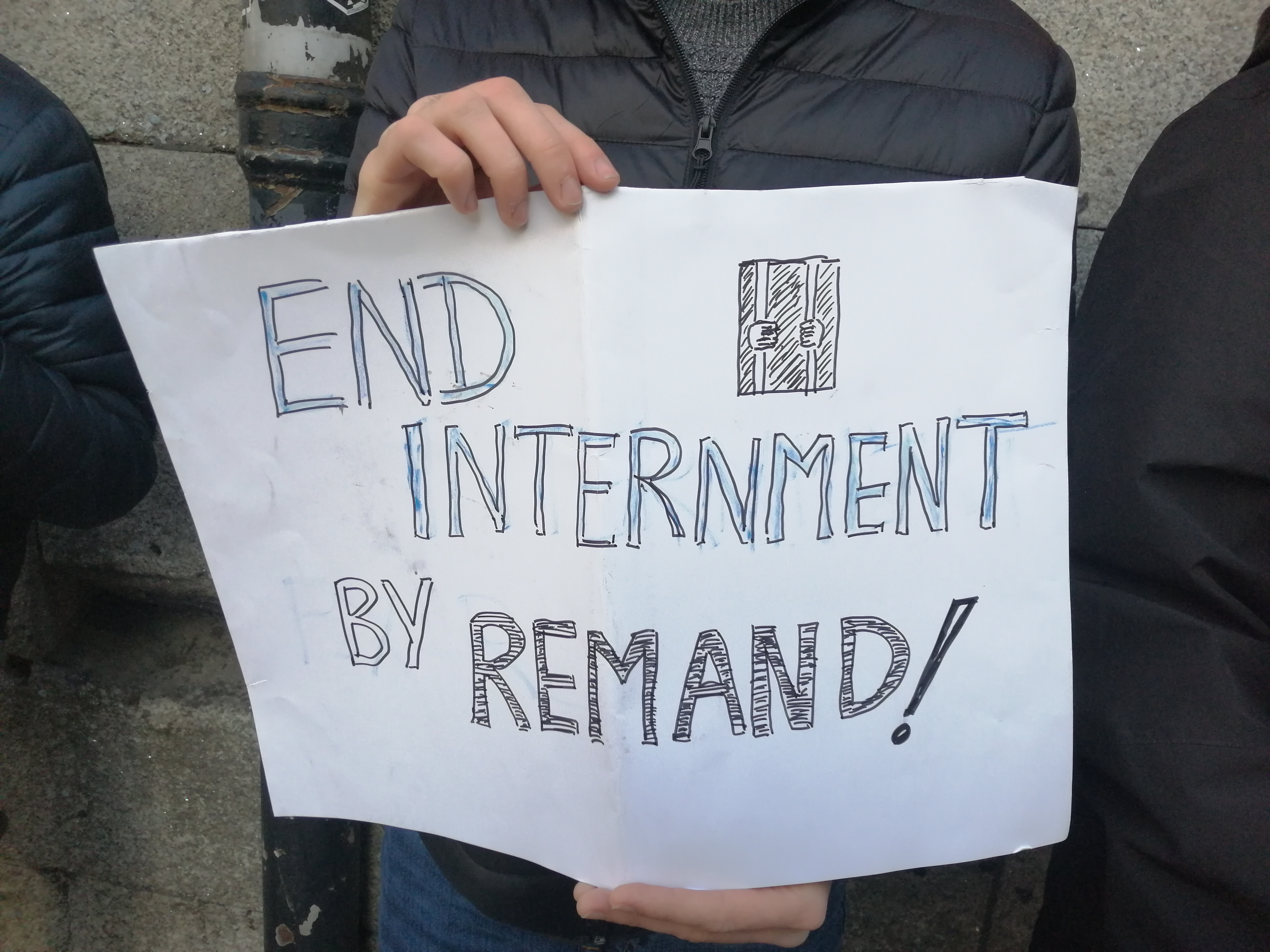
The AIGI’s Facebook page lists approximately 60 political prisoners held in Ireland, mostly in Portlaoise Prison in the Irish state and Maghaberry Jail in the British colony in the north-east of the country. All of those were convicted in special no-jury courts created for the purpose of sentencing political prisoners — i.e nearly always exclusively Irish Republicans. Frequently some charged and facing trial in those special courts are denied bail and are held in custody until their trial comes up, two or three years later and if then chance to be found ‘not guilty’, they will still have spent that time in jail. When granted bail on the other hand it is always under restrictive conditions that prevent them continuing their political activity: e.g night curfew, wearing an electronic tag, banned from attending political activities, etc.
Liam Campbell, an Irish Republican from Dundalk, Co. Louth, was extradited to Lithuania last week to face charges relating to trying to obtain arms in that country. Campbell says that he has never been in that country, which Lithuania and the Irish State both seem to accept yet, after a legal battle of almost 12 years up to the Irish Supreme Court, the Irish Republican was extradited. According to unconfirmed reports Campbell has been granted bail in Lithuania but under what conditions is currently unknown.
The group campaigning against what it sees as ongoing “internment by different names” developed from the campaign to free Marian Price around six years ago and, apart from monthly pickets, has also organised conferences and concerts and representatives have travelled to Belfast, Cork, Derry, Newry and Glasgow. The group has sent messages of solidarity to a Basque liberation group which was read out at the latter’s public event and also to the Mumia Al Jamal and Leonard Peltier campaigns in the USA, Munir Farooghi campaign in England (for which AIGI spoke at public meetings in Ireland), to prisoners in Turkey, Palestine and Latin America. Its street pickets, though legal, have frequently been subject to police harassment on both sides of the British Border — in the Irish state nearly exclusively by the plain-clothes political police, the Special Branch.
The picket yesterday in Temple Bar, view southward towards the Liffey River. (Photo source: Anti-Internment Group of Ireland)
The AIGI report concluded: The Anti-Internment Group of Ireland is a democratic group independent of any political party or organisation that holds monthly awareness-raising pickets, as well as a few special public events every year. It is organised by a democratic committee composed of people who attend our pickets and who would like to become involved in running the group.
NÍ NEART GO CUR LE CHÉILE. AN INJURY TO ONE IS AN INJURY TO ALL.
The Salvation Army went to court yesterday to obtain a court order against the Revolutionary Workers’ Union, the latter currently occupying a building on Dublin’s Eden Quay since earlier this month. The RWU occupied the building — which had been empty last year — in order to house the homeless and as a public protest against continuing homelessness in the city, property speculation and high rents. The RWU were not represented in court, which granted the Salvation Army the order they sought, but some RWU supporters held a protest picket outside the court and held a rally outside the Eden Quay building a few hours later, their speakers and songs expressing determination to continue the struggle and defiance of the authorities.
(Photo: Rebel Breeze)
The occupied building formerly known as Lefroy House and now renamed James Connolly House by the occupiers, in honour of the celebrated revolutionary socialist James Connolly executed in 1916, was constructed on the site in 1925 (all the terraces along Eden Quay had been demolished by British artillery and fire during the suppression of the 1916 Rising). Extended in 1948, the legend “Seamen’s Institute” suggests it served for a time as a seamen’s hostel but in more recent times served as hostel for young people run by the Salvation Army1 organisation, which closed the facility last year when their government funding was cut.
The Salvation Army organisation hold a long lease on the building and claimed in court that they had been renovating the building to house Ukrainian refugees, for which one assumes they have funding. However, a quick independent inspection of the building’s interior found it in good repair but with no sign of ongoing renovation work of any kind. Their claim was repeated in media reports without any attempt to check its veracity. The RWU in a statement date the 17th and of which copies were handed out supporters attending the rally yesterday headed off any attempt to use racism in their support, stating that: “The Revolutionary Workers’ Union is a pro-refugee and migrant organisation” and went on to call for housing for all residents, regardless of nationality and “an end to the shameful prison system of direct provision”.
In common with previous statements, it went on to call on people across the country, all 32 counties, to take similar action. This seems a new departure from housing occupation actions in recent years, of which the most famous was that of the large formerly NAMA building Apollo House in December of 2016. That occupation received a lot of activist support and media attention, the latter due at least in part to the participation of celebrity personalities such as the musicians Glen Hansard and Damien Dempsey and support from actress Saoirse Ronan and film-maker and author Jim Sheridan. After the building was abandoned to its owners for demolition however no similar action followed – except for a protest concert outside Leinster House the following year — and the housing crisis continued to intensify. Some minor occupations have occurred without usually any follow-up action after the occupants were evicted and protest marches have taken place – but the crisis continues to worsen.
Section of the crowd at the rally (Photo: Rebel Breeze)
A wide public housing program is urgently needed to address the crisis but, although by no means a revolutionary solution, has the support of not one of the major political parties, in or out of government. Not only should the sale of any public land to private concerns by declared illegal but other facilities and empty buildings need to be seized for conversion into public housing to rent according to means. Those rents would not only fund repairs and maintenance but new building also.
But any local authority wishing to carry out this program is starved of the necessary funding from the State, which feeds it instead into private landlords and speculators, who then use it to further deepen their grip on the housing market. Not only is the problem not resolved but it gets worse.
According to Department of Housing, there were more than 9,800 people experiencing homelessness in Ireland at the end of March, representing an increase of 3.5% in one month and a 23% increase compared to the same time last year.
Of the 9,825 homeless people, 2,811 were children and there were 5,143 single adults and 1,238 families in emergency accommodation. Youth homelessness is more than double other categories as there was a 58% increase in the number of homeless people aged between 18 and 24 (1,230) when compared to last year.
The Simon Communities of Ireland said it was “the highest level of adult homelessness and young person homelessness ever recorded” by the Department of Housing.2
In addition, the number of homeless people dying is sharply increasing: a total of 115 homeless people died in Dublin last year, more than double the number who died in 2019. In 2020, there were 76 deaths recorded while in 2019 and 2018, the number was under 50.3
Part of the building under occupation on Eden Quay (Photo: Rebel Breeze)
RALLY ON THE QUAY – SPEECHES AND SONG
The rally yesterday evening outside “Connolly House”, which had been called at fairly short notice, started a little late but was fairly short, concluding even as people were still arriving. The average age profile was noticeably young and a number of political tendencies seemed to be represented.
A man chairing the rally apologised for the lack of a PA system and asked people go gather closer. He informed the audience that the Revolutionary Workers’ Group has occupied “a second long-term vacant property in Dublin City, naming it Liam Mellows House, “the great socialist Republican executed by the Free State counterrevolution in 1922 …. which we continue to live with the consequences of and continue to fight to this day.”
A speaker addressing the rally (Photo: Rebel Breeze)
Apart from the man chairing the event, there were two speakers from the RWU, one of whom gave his entire speech in fluent Irish. The message in summary from all was that the housing crisis is artificially created for the benefit of landlords and property “vulture” speculators, that the buildings belong by right to all of us, that housing is a human need that requires fighting for and the time for fighting – “to shake off the paralysis” — is now. All the speeches were cheered.
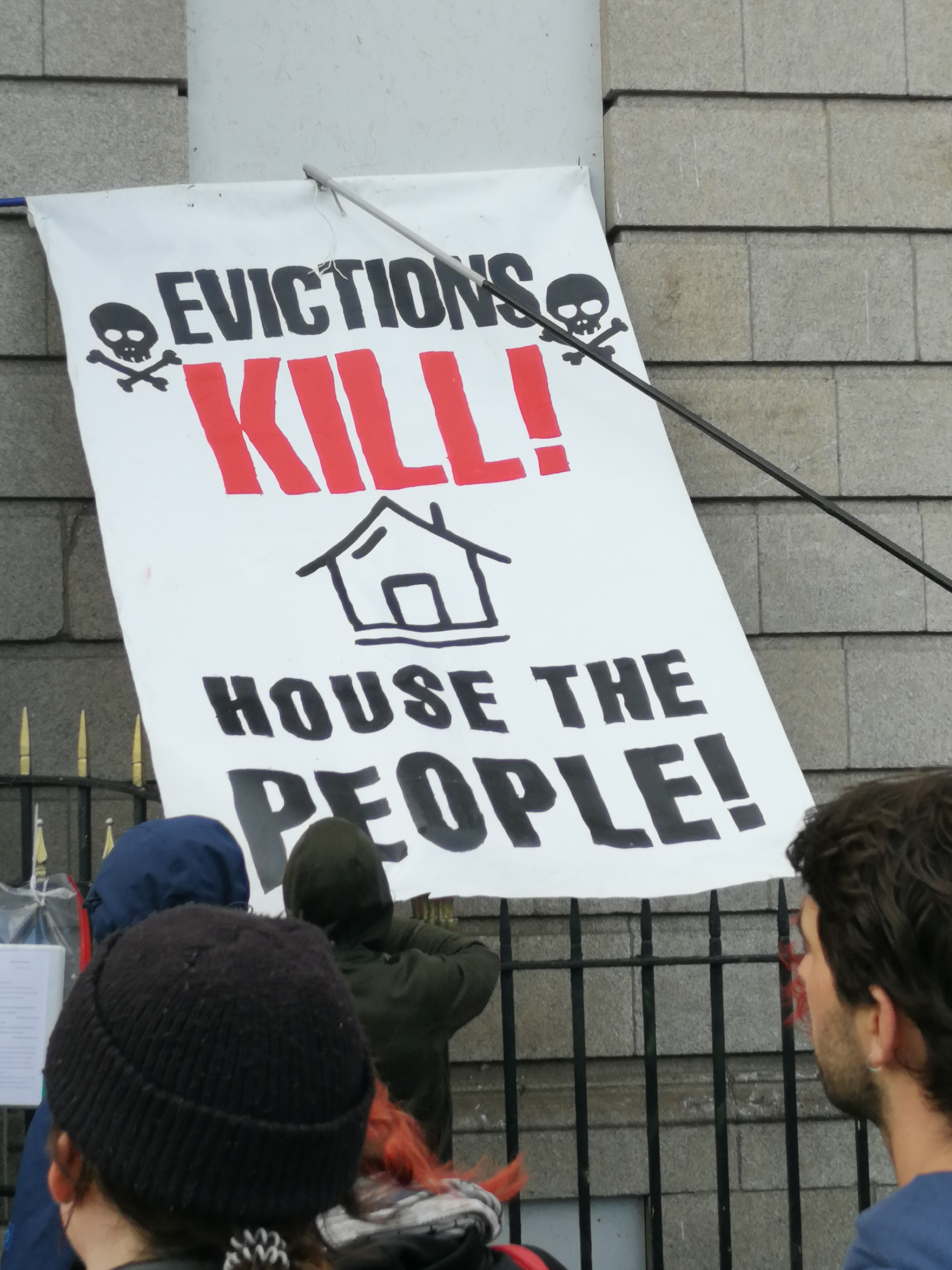
A performer accompanying himself by guitar sang a new resistance song while a giant banner was waved, reading “EVICTIONS KILL — HOUSE THE PEOPLE ”.
Musician performing for the rally (Photo: Rebel Breeze)
The event concluded with a man singing a cappella The Larkin Ballad4 (also known as the Lockout Song). He introduced his performance by saying that on that very Quay in August 1913 the police had killed two workers and that the Irish Citizen Army had been formed as a result, which had gone on to participate in the 1916 Rising — with the lyrics referencing both periods.
Following that, the chairperson invited those who wished to do so to enter the building but to treat it with respect in general and to abide by the rules of the occupiers of which he mentioned in particular that there were to be no photographs taken. A long queue formed for admittance even as some latecomers still arrived to join it.
End.
(Photo: Rebel Breeze)
FOOTNOTES
1The Salvation Army is a Protestant religious charity and temperance organisation and its funding by the State to address homelessness is another example of the ubiquitous private status of social services in Ireland whether through different faith organisations or other NGOs.
4“In Dublin City in 1913, the Boss was rich and the workers slaves ….” The original lyrics were composed by Donagh McDonagh, son of Thomas McDonagh, Signatory of the Proclamation of Independence and executed by British firing squad in 1916, with some further lyrics by his own son.
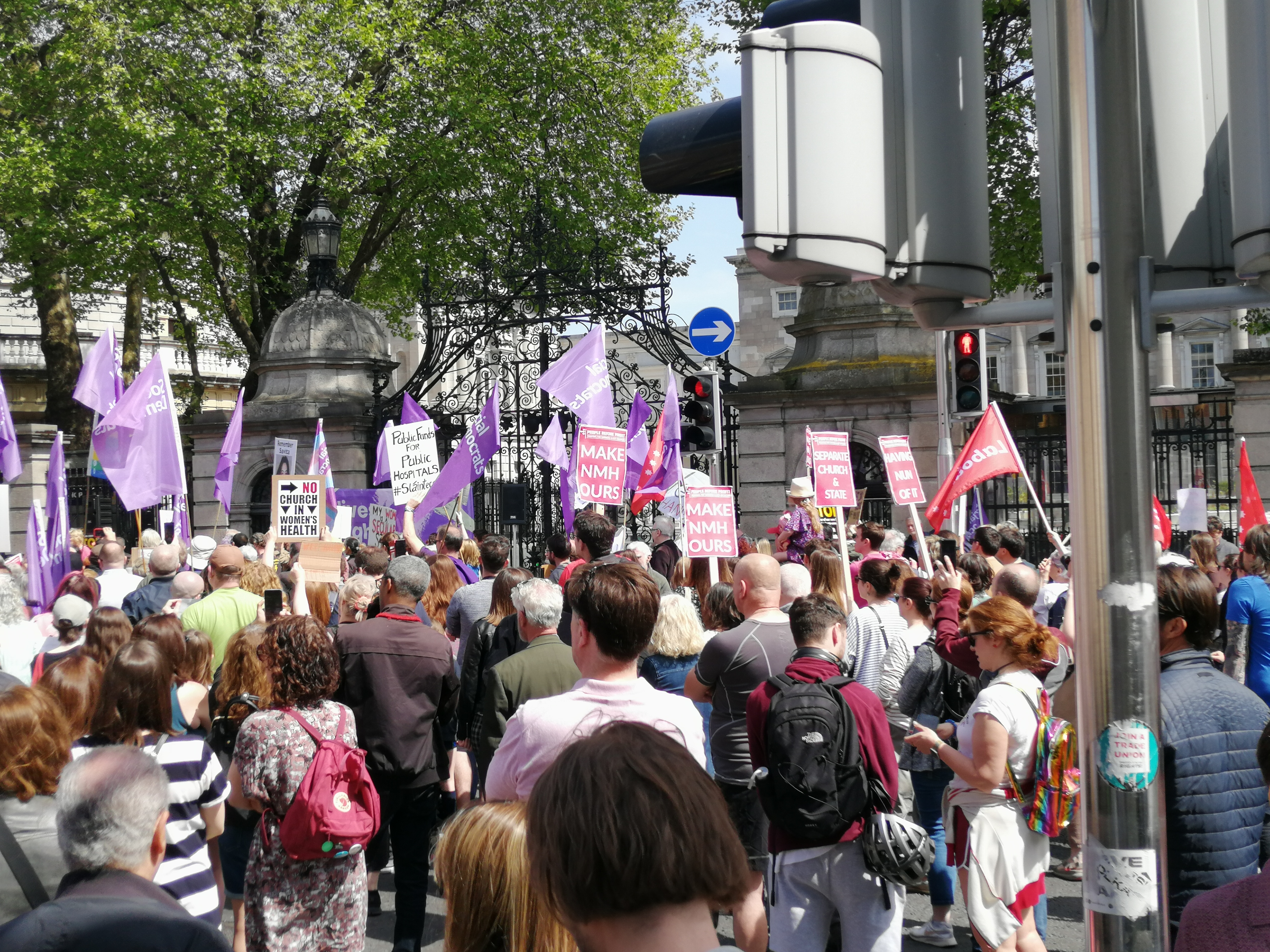
View of section of the crowd from Molesworth Street (Photo: Rebel Breeze)
Around two thousand demonstrators, including a high proportion of women, held a rally on Saturday afternoon outside Leinster House, the building housing the Irish Parliament. They were protesting the lack of clarity around whether the new maternity hospital will carry out pregnancy terminations on demand — with the suspicion that it will not.
View of section of the crowd in Molesworth Street (Photo: Rebel Breeze)
But speaker after speaker went further still and demanded the secularisation of the Irish health service and of society in general.
The issue arises in the first place due to the necessity to relocate the Dublin maternity services currently based at Holles Street due to the inability of the latter to meet the demand. However, the Government decided to relocate the facility to land near St. Vincent’s Hospital, owned by a Catholic Church organisation, which in turn formed a company to buy the land and lease it to the State at a nominal annual rate. It is the perceived Church veto on some procedures that has raised so much concern.
View of section of the crowd in Kildare Street looking northwards (Photo: Rebel Breeze)
A SECULAR SOCIETY – A REPUBLICAN DEMAND
A secular society is a fundamentally republican demand, up there with opposition to monarchy. English Republicanism failed to achieve1 it even after the execution by Parliament of Charles I in 1649 but the French revolution did not, which was one of the reasons why the Irish Catholic Church hierarchy was against La Republique and against the United Irishmen too.
View of centre section of the crowd in Kildare Street (Photo: Rebel Breeze)
Irish Republicans after the United Irishmen have had at best an ambivalent attitude to the Catholic Church – although the Young Irelanders and even more so the Fenians were decidedly anti-clerical, the Republicans in the first two decades of the last century were not so in general and many actually courted the support of the Church. The fact that the Irish Republican movement during the rest of the century failed to lead social struggles is adequate testimony to its leadership at the very least not wishing to earn the hostility of the Catholic hierarchy. That in turn was one of the factors ensuring that the Republican movement failed to broaden its struggle to encompass the majority of the nation … a factor sufficient on its own to ensure its defeat.
On the whole it has been left to writers, revolutionary socialists, social democrats and liberals to fight the secularisation battles – but above all, left to women. Control of fertility, access to contraceptives, personal sexual freedom, gender equality in law, equal pay, and termination of pregnancy were all hard battles won over decades by women. And often at huge personal cost. Most of those battles confronted the authority of the Church Hierarchy and even when some did not so directly, they did so by implication, undermining its basic judgement that the role of a woman is as wife to husband and mother to children.
Section of the southern end of the protest crowd in Kildare Street (Photo: Rebel Breeze)
The position of the Church hierarchy in Irish society was one of moral judge, jury and practical punisher and when punishment failed to correct, the State took over. In fact, we can view the Irish State in social and political terms as a partnership of native capitalist class – the Gombeens – and the Church hierarchy. In return for its role in social control, the State permitted the education, health and social care systems to be run by the Church either wholly or in part. Which in turn increased the power and authority of the Church hierarchy further. And it was that unquestioned (and unquestionable) authority that fostered the decades of physical, mental and sexual abuse carried out by so many clergy, in particular on women and children.
Women are still to the forefront of the struggle for the secularisation of the State and they are too in this struggle over an important branch of the health service. The people need a well-resourced national health service, with free access – but it needs to be secular also. Irish Republicans who do not actively support this struggle are failing not only the society they hope one day to lead but, in secularisation, failing also a fundamental principle of republicanism. That one of the issues with regard to Church influence on the maternity hospital is a suspicion that it will not carry out elective pregnancy termination should not prevent even those Irish Republicans opposed to elective termination from supporting its secularisation.
Quite simply, one is either a Republican and therefore in favour of a secular health service — or one is not a Republican.
End.
FOOTNOTES
Since 1524, not only is the UK a monarchy but the monarch, the Head of State, is also the head of the (Anglican) Church of England.
In mid-April (2022) Gardaí, the police force of the Irish State, broke down the door of Mick Plunkett’s home. They would not have been able to claim he resisted their entry or arrest (the usual explanation for injuries on the detained individual) – he was already dead.
To be fair to them, this time they were forcing entry in response to concerns from people that Plunkett had not been seen and wasn’t answering calls.
Still, Mick Plunkett’s door had been forced by police a number of times before – by the Special Branch, at least once by the Garda ‘Heavy Gang’ and another time by the special ‘anti-terrorist’ Paris police.
Mick was born into a working class family of ten siblings in Dún Laoghaire, in Kelly’s Avenue in the small area of council houses built for rent to the seaward side of the town’s main road.
These however did not overlook the sea itself, a view reserved for the big houses and hotels, later somewhat ruined by the DART wires and towers).
Dún Laoghaire1, long-imagined as a area in which only the affluent or at least comfortably-off lived, nevertheless contained such council (formerly ‘Corporation”) houses in the nearby bottom of York Road, also Cross Avenue, Glasthule, Carriglee Gardens, Monkstown Farm and Sallynoggin areas.
As many of that era, especially among manual workers, Mick’s father died relatively young which left his widow Lilly to care for ten children with all siblings able to work and find employment contributing to the care of the rest.
Mick followed his father Oliver into a skilled manual worker trade, trained and qualified as a gas fitter-plumber and, by reputation, a good one; later he would often carry out repair jobs for neighbours free of charge or in exchange for fish caught nearby or by trawlers that docked in the harbour.
“We saw and ate fish that many other people never saw,” said one of his sisters at his funeral reception in the evening.
Amidst the student and youth upsurge of the 1960s around the world, of which Ireland was also a part, many Irish youth of the time became rapidly politicised.
The Vietnam War, Black struggles in the USA and South Africa, Civil Rights in the British colony, lack of sufficient housing in the Irish state (just as today!) were issues that engaged lively interest and which to people like Plunkett, called for solidarity and, in Ireland, direct action.
At his funeral, Niall Leonach2, formerly of the IRSP, related how Plunkett, at the age of 17, had resisted the neglect of the young apprentices by his union and won improvements by organising a sit-in at the union’s office.
April 1991 article Evening Mail on conditions in the Glasthule Housing Estate (Source image: CATU)
HOUSING AND HISTORY
The Dublin and Bray Housing Action Committees were campaigning for an end to slums and for affordable rental housing around the city and Dún Laoghaire soon had its own Housing Action Committee too.
Nial Leonach, former comrade of Plunkett’s told the mourners at Mount Jerome that a large public housing building program was initiated as a result of this campaigning, a program that not only replaced derelict inner city tenements but created large new housing areas such as that in Ballybrack in south county Dublin.
The Housing Action campaigns not only squatted homeless families, they also fought evictions, held marches and public meetings. And in at least one case, became involved in a struggle for historical building conservation.
A Dún Laoghaire IRSP public agitation and information post pictured in the IRSP’S Newspaper (Source image: CATU).
The Dún Laoghaire group joined with conservationists wishing to save Frescati House, a large derelict building on acreage of the property planned by Roches Stores to demolish and convert into a shopping centre.
The original building dated from 1739 but had been purchased by the largest landowning family in Ireland at the time, the Fitzgeralds and had wings added and the grounds planted with exotic shrubs.
The house had been the childhood residence and favoured retreat of Edward Fitzgerald3, a much-loved leader of the first Irish Republican revolutionary movement, the United Irishmen, as late as 1797, the year before their Rising.
The figures heading the campaign were not only conservationists but fairly conservative too (Desmond Fitzgerald, son of a father of the same name who was Minister in a number of Fine Gael governments, was its chairperson).
But it was of course the activist supporters of the DHAC who occupied the building in protest at plans for demolition and were subjected to a baton-wielding police attack to evict them.4
Niall Leonach told the crowd in the Mount Jerome chapel that the criminal charges against the arrested were serious but that Plunkett’s stratagem of issuing a subpoena for Liam Cosgrave5 to appear as witness for their defence got the charges lowered.
The politician had been part of the conservation campaign, the more serious charges were dropped and, on the lesser ones, the penalties were lower-scale fines.
Much of DHAC soon became the Markievicz Cumann of Sinn Féin6, then a very socialist Irish Republican party, particularly in Dublin.
The Civil Rights campaign in the British colony of the Six Counties became a focus for activity and Leonach told his audience that Plunkett had been particularly affected by the colonial police killing of a child by indiscriminate fire from machine-guns at a nationalist housing estate, the Divis Flats.
In 1969 the IRA, the military wing of Sinn Féin, was caught unprepared and largely unarmed to face the pogroms in the British colony, which was one of the reasons for the 1970 split in the party, out of which emerged the Provisional IRA and Provisional Sinn Féin.
Plunkett and others in the Markievicz Cumann, the three Breatnach brothers for example7, viewing the Provos as socially conservative, remained in what was now known as “Official Sinn Féin” but tried to change their party’s direction.
Failing in that, they split, along with others such as the charismatic Séamus Costello8 and formed the Irish Republican Socialist Party in 1974.
It seems clear that the ruling elite of the Irish State viewed the IRSP and the associated INLA as a threat and decided to go beyond the standard and regular harassment, intimidation and petty and medium arrests9 with which they had been treating all Irish Republicans and some socialist activists.
FRAMED IN DUBLIN AND IN PARIS
On 31st March 1976 the Cork-Dublin mail train was stopped near Sallins, Co. Kildare by armed men who netted around £200,000.10 The State decided to believe, at least officially that the operation had been carried out by the INLA.
As a result armed police raided the homes of 40 members of the IRSP and their families. The Gardaí beat up their victims and obtained “confessions” from a number of them – however, some who gave self-incriminating statements could not have been present and their prosecutions were dropped.11
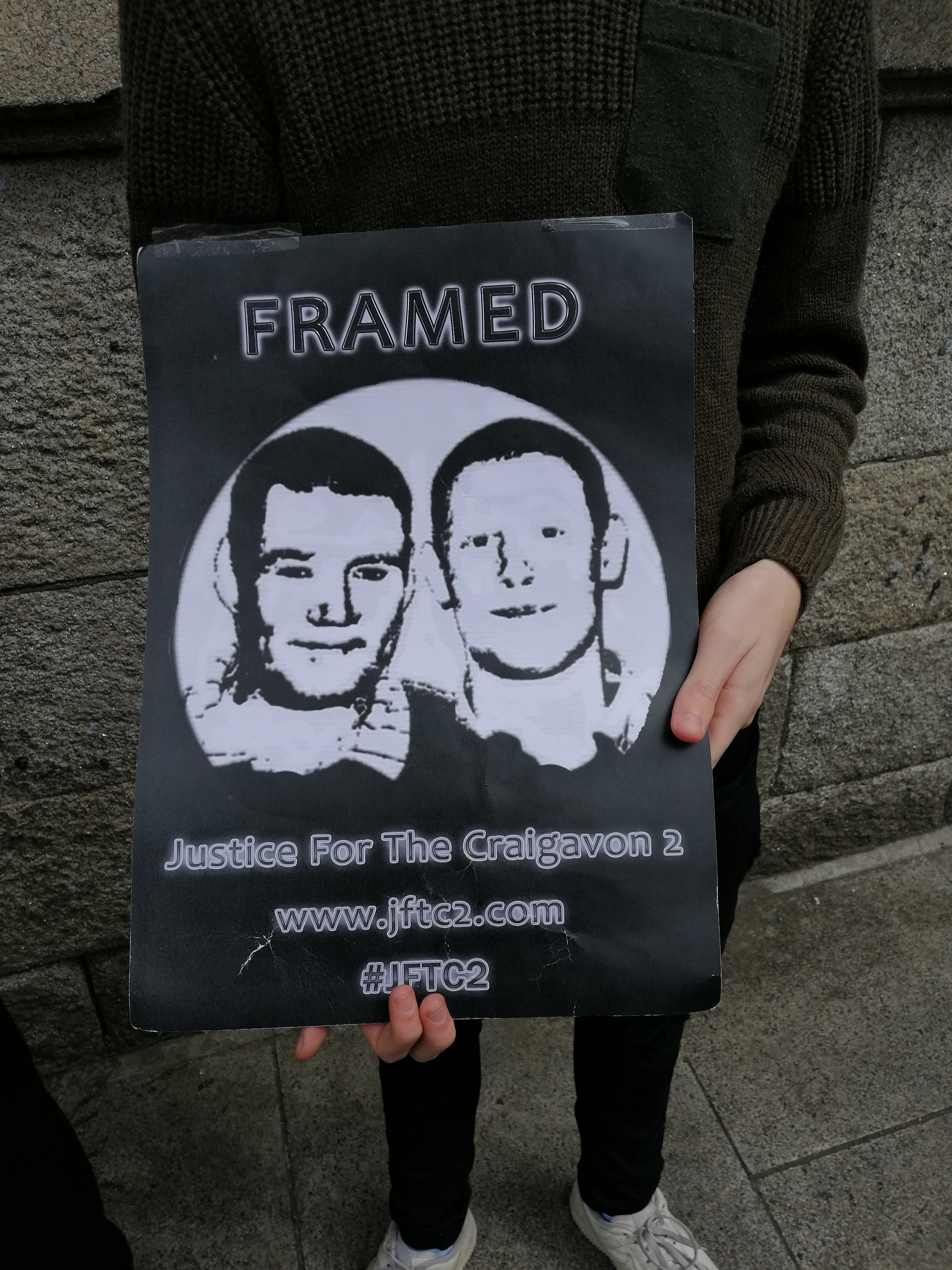
Eventually, a trial in the political Special Criminal Court proceeded against Plunkett and another three IRSP members: Osgur Breatnach, Nicky Kelly and Brian McNally.
Poster supporting the four framed and on trial for the Sallins Mail Train Robbery, depicting Mick Plunkett on far right of images. (Source image: Internet)
After many abuses of the legal system and the longest judicial procedure in the State, three of the four were convicted on the basis of their tortured “confessions” which they had denied.
Forensic “evidence” was provided against the only one who had refused to sign a “confession” – an alleged lock of Plunkett’s hair12 was claimed to have been found at the scene of the robbery; that was insufficient and Plunkett was finally discharged.
The others were released after years of campaigning13 and were paid a financial compensation but an official enquiry into the arrests, trials and convictions was never held and currently a campaign for such is underway.14.
Mick Plunkett remained politically active but after his arrest in the vicinity of an armed training camp was charged with “membership” and scheduled to appear before the Special Criminal Court.
Plunkett, knowing the chances of acquittal in no-jury “the Special” were next to nil, decamped to France.
In Paris he and Mary Reid, a poet-activist and also formerly of the IRSP, shared accommodation. In the summer of 1982, their door was kicked down by armed police of the new special “anti-terrorist” French unit.
Both were arrested, along with another Irishman Stephen King and charged with possession of automatic weapons and explosives. This followed the bombing of a delicatessen in the Jewish quarter of the city which was later revealed to have had police complicity.
Plunkett, Reid and King were accused of being part of an Irish-Palestinian cell, a figment of the special unit’s imagination.
All three denied the charges, the accusation and the existence of such a cell, insisting that if any weapons and explosives had been found in their accommodation, it had been planted there by the police.
Niall Leonach commented to the mourners in Mount Jerome that Plunkett had gone from being involved in the greatest miscarriage of justice in the Irish state to being accused in the greatest miscarriage of justice in the French State’s modern history.
Fortunately for the Irish accused, the special police unit was in serious conflict with the main police force and that helped bring to public view the fact that the armaments had, indeed, been planted on the accused by the “anti-terrorist” police unit.
All three were released after nine months in jail and Mary Reid’s nine-year-old son Cathal had been taken into care.
The whole case was by then such as to convince the Irish State authorities to refrain from severely embarrassing their French counterparts by requesting Plunkett’s extradition to face his charges in the Special Criminal Court.
FRANCE – OCTOBER 05: Michael Plunkett, Mary Reid, Stephen King in Vincennes, France on October 05th , 1983. (Photo by Eric BOUVET/Gamma-Rapho via Getty Images). Note poster of the Sallins Trial behind them.
Working in London at the time, I read the news about the arrests of Irish political activists in Paris and was shocked to see names I recognised.
I remembered the last time I had seen Mick; I had been back in Dún Laoghaire on holiday and with four of my brothers we set off in Mick’s brother Jimmy’s rowing boat from a pier, Mick himself in it too. We had fishing rods and lines and began to fish as we cleared the harbour.
Hours later as the sun dropped to the west, we turned back with our varied catch. Once inside between the piers it was quite dark; a large ship entering the harbour appeared to be bearing down on us and we couldn’t find our flashlight.
The incident provided more excitement than we had wished for but seemed to give extra taste to the pints in the local pub afterwards.
Mick found happiness for a time with Tracy out of which union came their daughter Natacha. After the Good Friday Agreement Mick felt safe to return to Ireland but Tracy remained in Paris with their daughter, Natascha visiting him and his extended family by arrangement on occasion.
Plunkett seemed to have retired from political activity and had also withdrawn from social contact with many of his former contacts. His health deteriorated significantly but nevertheless his death came as something of a shock to many.
Mick Plunkett’s coffin at the funeral parlour, officiated by his daughter Natacha. (Photo: D.Breatnach)
Many came to pay their respects at the funeral parlour where his coffin lay and to watch the wonderful collection of photos collected by his ex-partner, Tracy.
His daughter Natacha was there to receive condolences and to offer shots of Irish whisky over the coffin (where tobacco roll-ups were also placed irreverently on the crucifix attached to the woodwork – Mick was reportedly an atheist).
Natacha was also at the cremation service in Mount Jerome cemetery with her mother Tracy, where Plunkett’s coffin was covered in the blue version of the Starry Plough flag15 before being removed from the hearse, carried by relations.
The Seamus Costello Memorial Committee, in uniform and white gloves, providing a small ceremonial guard of honour.
Mick’s nephew Karl chaired the event and in turn called Jennifer Holland to give a short talk on Mick and his times followed by Niall Leonach, former General Secretary of the IRSP and close comrade of Plunkett’s, for a longer oration on Mick’s background and activism.
Karl provided many personal anecdotes from his association with his uncle and from within family stories, many of them amusing and some hilarious.
He did not however avoid the political and recounted that many of them were kept unaware of the reasons for Mick’s absence and his apparent inability to travel back to Ireland even to visit.
It was by going through some papers in his mother’s room that he came across the IRSP pamphlet on the Sallins case and was shocked; confronting his mother, the story began to be told.16
Recollecting the family’s trip to Paris to present two children for baptism in Notre Dame Cathedral which Mick attended, Karl spoke about their warm reception there and being touur-guided around by Plunkett, who had acquainted himself with much of the city’s history.
One wonders whether that included the “Wall of the Communards” where in 1871, revolutionaries of the Paris Commune were summarily executed by French firing squads under the command of Marshall Patrice McMahon.
The Marshall was a descendant of Irish “Wild Geese” refugees from Williamite-controlled Ireland. Plunkett would hardly have been unaware of that history and its irony for the Irish.
The hearse carrying Mick Plunkett’s coffin arrives at Mt. Jerome cemetery, escorted by guard of honour supplied by the Seamus Costello Memorial Committee (the photo is from their FB page).
SOCIAL, SONG AND FLAG
Later that evening in a large reserved section of the Rochestown Lodge Hotel (formerly the Victor Hotel) just above the large Sallynoggin housing estate, mourners and celebrants gathered to eat, drink and talk.
Some had not seen one another for decades.
Among the many reminiscences of the social and music scene in Dún Laoghaire in the later decades of the last century, including the remark that “our harbour is a marina now”, one of Mick’s sisters spoke of raids by the Special Branch on their family home.
Children would be ordered or pulled out of bed and the mattresses and beds tipped over, allegedly searching for weapons.
Strangely perhaps, there was no performance of musicians or singers or even sing-alongs at the event, though the traditional song The Parting Glass was sung to Plunkett’s daughter Natacha and a small unexpecting audience on the covered patio outside.
Later inside, by which time some had left and following a query about a ceramic badge of the Starry Plough worn by one those remaining, a whole length of the original green-and-gold version of the flag was unfurled, causing much interest and queues forming asking to be photographed behind it.
And a little later, a man sang Patrick Galvin’s Where Is Our James Connolly? to much applause.
Securing the Starry Plough flag to the coffin on the shoulders of relatives of Mick Plunkett, about to be carried into Mt. Jerome’s chapel for a non-religious remembrance event. (Photo: D.Breatnach)
This was fitting for as the mourners had been reminded in Mount Jerome, Connolly17 had been a great inspiration to Mick Plunkett’s political activism and to the IRSP too.
But not only that: a hostel in Dublin city centre empty for many years and very recently occupied by socialist Republicans had been named Connolly House and had that very day witnessed a rally held outside it to resist a threatened Garda operation to evict the occupants.
It seemed to me that something other than the remembrance of a retired fighter alone had happened at the Plunkett memorial events, something more than the appropriate marker of a past and finished period in Irish history, as had been suggested by Holland in her oration.
It seemed to me that the history of struggle in Ireland for national self-determination and social justice had to an extent been re-invoked, that it appeared to some extent as the ghost of struggles past but also as the gaining substance of struggles present and, in particular, yet to come.
I think Mick would have been pleased and, in any case, in defiance of the declarations of Fukuyama and such idealogues, history is nowhere near finished or dead. As some have commented, it is not even past.
End.
FOOTNOTES
1A harbour town seven miles south of Dublin city centre, in Dublin County but administered by DL-Rathdown Council for some years now.
3He is more usually referred to as “Lord Edward Fitzgerald” which, apart from being somewhat historically inaccurate, does him a service. He was a republican, renounced his title and his sister Lucy said of him some years after his death in prison that “He was a paddy and no more; he desired no other title than this.”
4The Wikipedia entry on Frescati House and the campaign makes no mention at all of this sit-in, Garda attack or the subsequent court cases, of which there is ample documentary evidence. Hopefully someone will undertake its appropriate updating.
5Liam Cosgrave was a Fine Gael politician, son of the Leader of the Irish parliamentary Opposition from 1965 to 19873 and Taoiseach (Prime Minister) from 1973 to 1977, W.T Cosgrave.
6The Sinn Féin party has gone through many metamorphises, from being a reformist dual-monarchy party, to revolutionary republican to constitutionalist. Constance Markievicz was a socialist Republican who took part in the 1916 Rising as an officer in the Irish Citizen Army – the name of a socialist revolutionary woman chosen for the cumann (‘association’, a branch of the SF party at the time) indicated an inclination towards revolution, feminism and socialism.
8Séamus Costello (b. 1939) was murdered by the Official IRA in Dublin on 5th October 1977.
9An example of the medium-seriousness was the charge of “membership of an illegal organisation” under the Amendment to the Offences Against the State Act, introduced in 1972 which required only the unsupported word of a Garda officer at rank of superintendent or above for conviction and a virtually automatic jail sentence of one to two years.
10€237,389.81 –without taking into account inflation — for today’s value
11Notably John Fitzpatrick, who years later publicly challenged the State to charge him with the offence to which he had “confessed” – there was no response.
12If it had been Plunkett’s hair, it had to have been planted by the Heavy Gang, since Mick had been nowhere near that scene and, in fact, the robbery had been carried out by the Provisional IRA. In addition, without the later development of DNA testing, all a sample of hair could tell, apart from its natural colour, was the blood-type of its owner and millions may share that.
13Some of those involved at the time, whether as victims or as campaigners, were present at some of the funeral events too, including Osgur Breatnach, Nicky Kelly, Caoilte and Peetera Schilders-Bhreatnach.
15The flag with a design in the shape of the constellation known as Ursa Mayor was of the Irish Citizen Army, formed to defend the workers during the strike and 8-month lockout of 1913 and later fought in the 1916 Rising. Originally the design was of the constellation in white or silver overlaid by the depiction of a plough in gold, with sword as the plough-share and all on a green background. A later version was the plain blue one with Ursa Mayor outlined in white stars. That version was the one in use by the short-lived Republican Congress of the 1930s and was for many years later, probably up to the end of the century, the main one displayed and therefore familiar to Republicans and socialists (even for years flown by the Irish Labour Party) but has now been largely supplanted by the original green version.
16This is not at all an unusual experience in Ireland and, whether by desire to protect the young, pain of reminiscence or even disapproval, much of our history has been concealed from generations for a time or even completely lost.
17James Connolly, revolutionary socialist, trade union organiser, historian, journalist, song-writer and one of the Seven Signatories of the 1916 Proclamation of Independence, was tried by British military court for his leading role in the Rising and executed by firing squad.
He planned the spectacular helicopter escape from Dublin’s Mountjoy Jail and, a year later, planned another escape from there, blasting their way out with smuggled-in explosives. Before he began planning escapes, he operated early in his IRA career as commander of an armed robbery unit, ‘fund-raising’ for the Movement. But when he began robbing banks for himself and his family, the Movement sent assassins to kill him. Up Like a Bird is the story of that man, Brendan Hughes, nowhere near as celebrated as his other IRA namesake but certainly deserving of much more fame than he has received to date.
Brendan Hughes with his book outside Mountjoy Jail (Image sourced: Phoenix Magazine)
Douglas Dalby’s handling of Hughes’ reminiscences, told in Hughes’ voice, is masterly. The book reads like a thriller, hard to put down; we are driven to turn the next page to see what will happen – even when, through history, we know the eventual outcome. We know, for example, that the helicopter escape was carried out and yet, as readers, we tense as Hughes does his investigations, tense tighter as he identifies the components of the plan, moan with frustration at a delay or last-minute hitch, hold our breaths as the action takes place.
The helicopter escape was carried out on 31st October 1973 and from the prison exercise yard three high-level IRA officers were flown to freedom: Chief of Staff Séamus Twomey and senior Volunteers JB O’Hagan and Kevin Mallon. The following year, on 18th August 1974, 19 prisoners escaped, blasting their way through a gate with a small amount of smuggled gelignite. Not only had Hughes planned that operation – he himself was leading the escapers.
INSIGHTS
Apart from the excitement in reading, the book gives us an insight into the world of IRA volunteers active in Dublin and surrounding areas in the 1970s – the ‘safe-houses’ and network of active supporters, the ‘fund-raising’, stolen getaway cars, false identification documents, high-level awareness of the hunted, carrying concealed weapons, the even better-armed police ….
The Mountjoy helicopter escape revealed something even more important and enduring – the cultural bedrock within the Irish state, the sharp division between the elite and the mass. Although the majority of politicians had voted in 1972 for repressive legislation against Republicans and special no-jury courts to sentence them, a song celebrating the escape reached No.1 in the Irish singles disc charts, selling 12,000 copies in the first week despite being banned by the national broadcaster, RTÉ! Composed by Sean McGinley from Castlefin, Co. Donegal and performed by the folk and ‘rebel song’ band The Wolfe Tones1, Up and Away (the Helicopter Song) became the most-played and most-purchased disc for four weeks until nudged out by Slade’s Merry Christmas Everybody. It is tempting to think that if the escape had taken place a longer period before the approach of the festive season, that the recording might have remained at the top of the charts for months on end. The counterposing of the anger and embarrassment in elite circles, reflected in ranting of politicians, Garda sweeps and raids and media outrage on the one hand, with the delight and empathy at the lower levels revealed much of the tensions in Irish society and the opposing sympathies of different social classes.
The single that sold 12,000 copies in its first week, containing a jocular song celebrating the helicopter escape. (Image sourced: Internet)
Hughes was a maverick, revelling in the description and though for much of his career that was of value to the Provos, there came a time when it ceased to be so. A guerrilla army must have discipline, of course but it also needs volunteers who can quickly assess a situation and seize the initiative, without referring back to the command structure. The balance between both requirements must be very hard to strike — for individuals as well as for the organisation.
When he and other such activists fell out with their leaderships or “went solo”, they were shunned or worse. In Hughes’ final spell in Mountjoy jail, he was on the “non-aligned” wing of the jail, a Republican prisoner but not under Republican leadership control.
ISOLATION
Hughes says that assassins were sent to kill him – he stayed low and carried a loaded .44 Magnum. The leadership of the Republican movement does not always shoot or beat up its dissidents – more usually, it seeks to isolate them. Friends, neighbours, former comrades and even relatives will be advised to shun those no longer welcome, they and their families.
The family feeling, the communal solidarity in the movement becomes its opposite when the leadership brands its pariahs.
Cover of the book (Image credit: Siopa Gaeilge)
Hughes feels he was betrayed to the political police, the Special Branch of the Irish State. But what he says he felt the worst was the treatment of his family while he was in jail. No space on a Republican prison visitor communal transport was made available to his wife and children and cars containing former friends and acquaintances would pass them at the side of the road, even in the rain.
It seems Hughes finds that unforgivable — and no wonder.
As a postscript, Hughes surprisingly declares his support for the Good Friday Agreement, the pacification process. He had been a man of action and, as he said himself, not one for thinking through ideology or politics. But it doesn’t take any great grasp of ideology or politics to see that today it’s more or less business as before in a partitioned Ireland occupied by a foreign power.
End.
UP LIKE A BIRD, Hughes, Brendan; Dalby, Douglas (2022)
FOOTNOTES
1Named after Theobald Wolfe Tone, a leader of Irish republican revolutionary organisation the United Irishmen, died in prison in 1798.
On 9th April, the Dublin Anti-Internment Committee held another of its regular awareness-rising events in the city, this time on on the northside, at the junction of the busy shopping Henry Street and Liffey Street.
Section of the anti-internment picket in Dublin last week (Photo: Rebel Breeze)
Supporters lined up with the Anti-Internment Committee of Ireland banner and placards. In addition to the Starry Plough of the Irish working class, the Palestinian and the Basque flags were flown in symbols of solidarity and also as a demonstration that political prisoners are held in many countries around the world.
Going on for 200 of the AIGI’s leaflets were distributed, explaining that Irish Republicans continue to be held in custody without trial through the practice of refusal of bail and through revocation of licence. This practice by administrations on both sides of the British Border are anti-democratic suppression of the right to hold political opinions and to organise in their furtherance.
Plainclothes political policeman (in blue top, far left of photo) stood a little distance away facing the picketers but they were not intimidated (Photo: Rebel Breeze)
Recordings of relevant songs were played on a portable PA, such as The Roll of Honour, Viva la Quinze Brigada and Something Inside So Strong. Throughout the period of the event, two Special Branch (plainclothes political police) kept up an obvious surveillance which however did not deter the picketers.
The Anti-Internment Committee of Ireland is an independent broad and democratic committee, endeavouring to hold regular awareness-raising events and all democratic people are welcome to attend its public events, always advertised in advance on its Facebook page.
The Dublin Anti-Internment Committee held a well-attended picket on Saturday (5th March) against the continuing practice of interning Irish Republicans without trial and also in support of human rights for political prisoners. At one point the picket was subjected to the unwelcome attention of the Irish political police.
(Photo: C.Sulish)
The event was in furtherance of the Committee’s advertised intention to hold monthly public events to highlight the deprivation of civil rights from Irish Republicans — on both sides of the British border — through the operation of special legislation and in particular of the no-jury political courts (Special Criminal Courts in the Irish state and Diplock Court in the British colony). The Committee has admitted that it does not always succeed in holding a public event every month and in fact its most recent public appearance was during the December festive season, in solidarity with Irish Republican prisoners, when it was supported by a number of organisations and independent activists.
(Photo: C.Sulish)
WHY THESE PUBLIC EVENTS?
The Dublin Committee holds these public events because it believes that most people are unaware of the abuse of civil rights in Ireland, the civil right to belong to an organisation that criticises the State and seeks profound change. The reaction of people receiving a leaflet at their public events would seem to bear this out.
(Photo: C.Sulish)
Choosing a couple of extracts from their current leaflet: ‘At various times in Ireland’s history, people have been rounded up and jailed without bothering with a trial – people whom the government found troublesome and wished removed. Today the same process carries on although they don’t call it “internment” now – other names such as “due process”, “remanded in custody” are used ….”
‘Even when Republican activists are granted bail, it is on outrageous conditions such as not being permitted to reside in their own home, having to observe a curfew and wear an electronic tag, not being permitted to attend meetings and demonstrations …..’
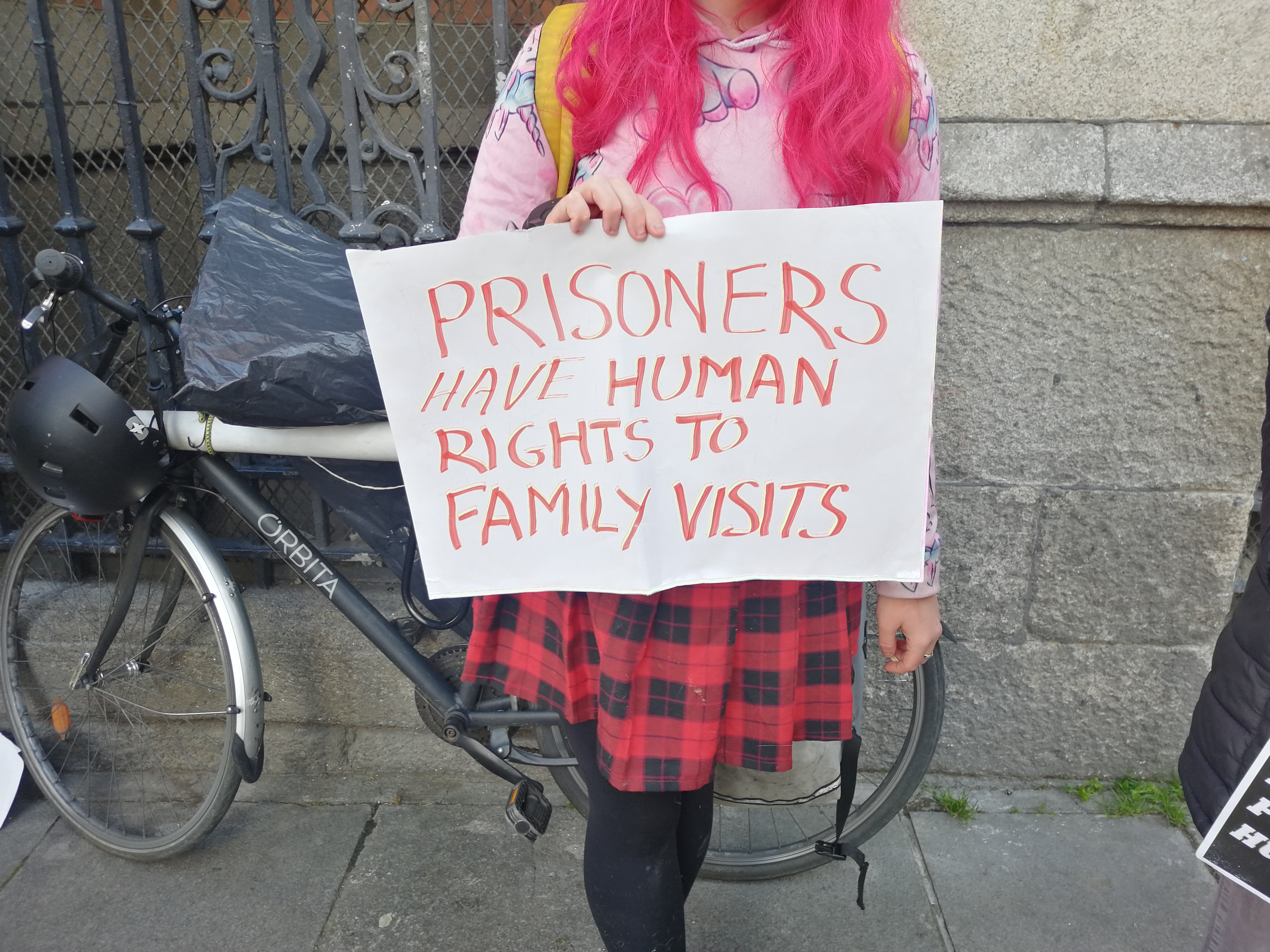
The leaflet text makes the point that one doesn’t have to agree with the politics of Irish Republicans to see that these injustices are profoundly undemocratic abuses of civil rights — and “are ultimately a danger to all oppositional movements, whether Republican or not”. One aspect of their protest was against the denial of open family visits to Republican prisoners in the jails of the British colony in the north-east of Ireland — a violation of human rights.
The surprise in learning the facts is not confined to Irish people because often it is expressed by tourists or migrants, even if they have encountered such practices in their own countries of origin.
INTERNATIONALIST DIMENSION
An example of the interest from abroad on Saturday was of a Basque man and, separately, of two young Basque women, reacting warmly to seeing the Basque flag among the picketers. The Dublin Committee objects not only to the incarceration of Irish Republicans but also of people seeking freedom in many other parts of the world, for which reason the Palestinian and Basque flags are frequently flown on their pickets, next to the revolutionary Irish workers’ flag of the Starry Plough.
A person who expressed support for the right to campaign without state repression was, interestingly, from Barcelona. However he did not wish for Catalan independence, wanting instead a unitary but democratic Spanish state – a position held by some communists and the main socia-democratic parties there. Although his position did not concur with that of the picketers, who tend to support the struggles for self-determination, the conversation was conducted without hostility.
Not so with another individual, who approached some picketers to argue for their support for the Ukrainian state in the current armed conflict there, a question that has deeply divided the Irish Left and Republican movements. He went further and announced his support for the Azov Battalion, an East European fascist organisation integrated into the Ukrainian state’s military, at which point the tolerance of the picketers for his intervention ended and he was urged to depart.
Starry Plough flags next to Palestinian and Basque Ikurrina flags at the picket in Temple Bar. (Photo: C.Sulish)
POLITICAL POLICE INTIMIDATION
Another temporary presence unwelcome to the picketers was of three members of the Irish State’s political police. These are members of what used to be called the Special Branch but are now officially called the Special Detective Unit, formerly C3 and successor to the CID when the Irish State was created. This type of political police force is modelled on the Irish Special Branch of Scotland Yard, the HQ of the British police, founded to spy on the influence and activities of the “Fenians” (i.e the Irish Republican Brotherhood) in the cities of Victorian-era Britain. However, in Dublin under British occupation, their parallel force was the G Division of the Dublin Metropolitan Police, known as “G-men”; it was they who identified many Republican and other prisoners of the British military after the 1916 Rising, ensuring death sentences for many (though most commuted to life imprisonment) and jail sentence for many others. During the War of Independence (1919-1921 they were identified as the intelligence service of the British occupation and many were selectively assassinated by the IRA of the time.
The Garda “Branch” (as they are known colloquially) of the Irish State have a long history of harassment of and spying on Irish Republicans, sometimes associated with violence and often with perjury in court. Their unsupported observations through the mouth of a Garda officer at the rank of Superintendent has been enough “evidence”, in the no-jury Special Criminal Court, to send many Irish Republicans to jail on a charge of “membership of an illegal organisation.”
Two picketers confront the plainclothes political police officer harassing a young leafletter on Saturday (Photo: C.Sulish)
One of these gentlemen on Saturday approached the youngest supporter of the picket, who was distributing leaflets to passers-by, identified himself as a Gárda officer in plain-clothes and demanded the young activist’s name. His accosting of the leafletter attracted the attention of others on the picket and two went quickly to support the subject of State harassment. The Branchman demanded no further information and sone moved away. However, when he had reached about half-way along the picketters, he stopped and began filming them.
At that point one of the picketers began to call out to passers-by, many of whom were tourists, that this man was a member of the secret political police, who was filming and attempting to intimidate people on a legal political protest, that this is the kind of ‘democracy’ that exists in the Irish state, etc, etc. Shortly thereafter, the Branchman departed, along with another two of his colleagues that had been observed further down towards Temple Bar.
A picketer loudly denounces the political policeman’s filming of the picketers. (Photo: C.Sulish)
According to picket participants this intervention of the political police represented an escalation of their attentions in recent times, though not in the least unusual in the past, when every picketer might have their name (and even their address) demanded and jotted down.
A spokesperson of the Dublin Anti-Internment Committee stated that it is independent of any political party or organisation and that it welcomes the participation at its public events of democratic individuals, whether independent activists or members of organisations and had distributed many of its leaflets. It regrets that a number of political activists — who should have an interest, even if only in self-preservation – in defending the democratic rights to organise and to protest, decline to support their events.





















 rebelbreeze