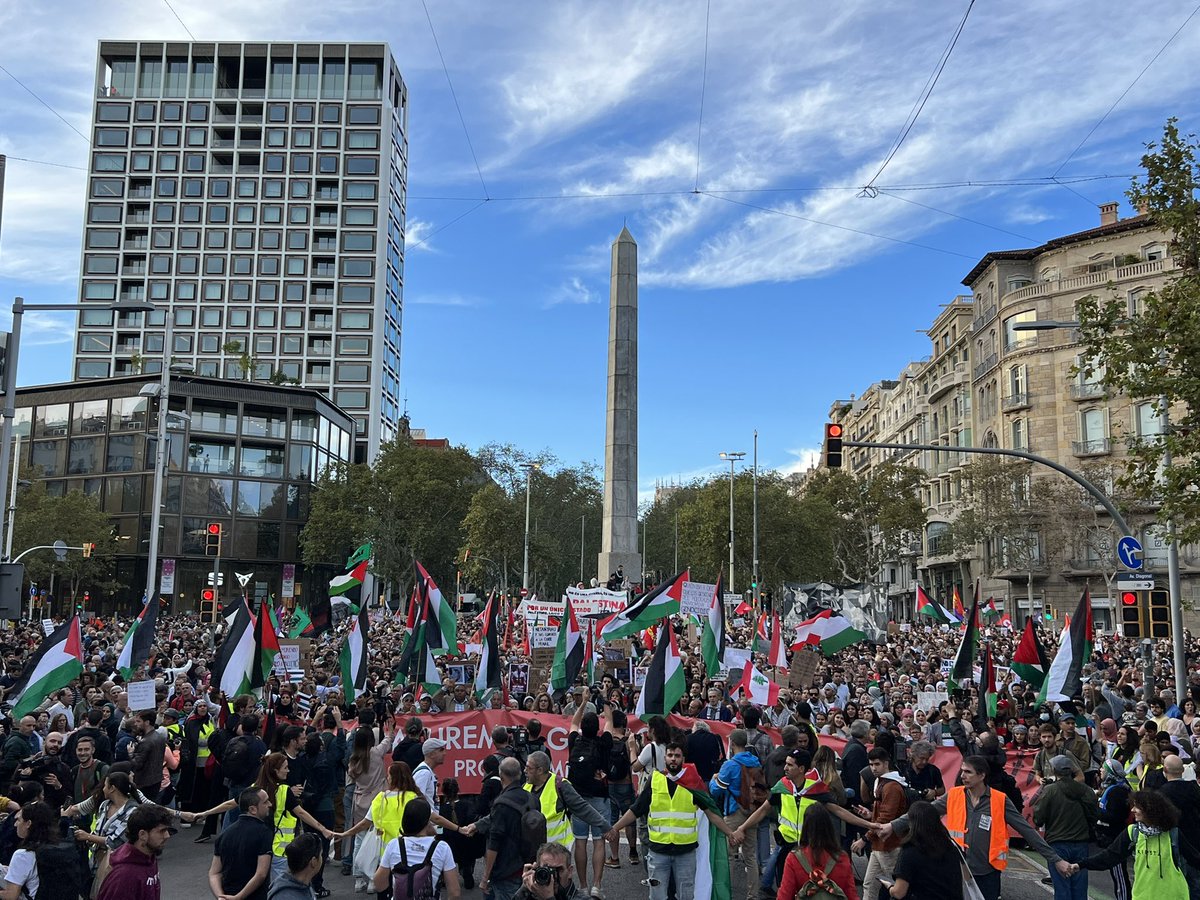
Thousands of people gathered this Saturday in Barcelona to defend the rights of the Palestinian people and to condemn the bombings and attacks by the State of Israel in the Gaza Strip.
The demonstration was sponsored by the Palestinian Community of Catalonia and the Prou Complicitat amb Israel (Enough of Complicity with Israel – trans.) coalition and supported by more than 100 entities and social movements in Catalonia.
The event began at six in the afternoon at the crossroads between Avinguda Diagonal and Passeig de Gràcia of the Catalan capital.
Demonstration in support of Palestine in Barcelona, October 21, 2023. — Lorena Sopêna / EUROPA PRESS
All organisations signed the manifesto “Let’s stop the genocide in Palestine. Stop the arms trade with Israel” with a clear desire to condemn the historical repression of the Palestinian people and calling on governments “to stop being complicit in this televised massacre.”
The participating entities declare what is being done is “not in our name.”
The call brought together a cross-section in attendance, from young people to seniors and entire families.
Shouting “Long live the Palestinian struggle” or “Israel murders, Europe sponsors”, the protesters proceeded to Plaça de Catalunya, waving Palestinian flags and posters with slogans in Catalan, Spanish, English and Arabic and images of the crimes committed in Gaza by the Israeli army.
Explanatory leaflets were also distributed directing use of correct terminology when talking about Palestine, encouraging protesters to change expressions such as “conflict between Israel and Palestine” to “Israeli colonisation of Palestine” or “IDF (Israel Defense Forces)” by “FOI (Israel Occupation Forces).
In this same vein, banners could be read expressing “if you are the occupying force, you are not defending yourself”, “Collective punishment is a war crime. Stop the genocide in Palestine” or “Apartheid was wrong in South Africa and is wrong in Palestine.”
EUROPE AND USA DENOUNCED
Given the latest visits by the President of the United States, Joe Biden, and of the European Commission, Ursula von der Leyen, to Israeli President Benjamin Netanyahu, the protesters also accused the European and American institutions of “complicity” and ” sponsorship of genocide.”
The manifesto signed by the more than 100 entities stated: “The EU continues to consider Israel, despite being an extremely racist and far-right government, as a strategic partner, and the United States provides $1 billion in military aid.”
The Spanish Government is not free from reproach either, since, as the manifesto describes, “they have authorised the export of weapons to Israel worth 137 million euros since 2000.”
Faced with the recent Israeli forces’ attacks on Gaza, protesters demanded that the Spanish Government and the EU force Israel to declare an immediate ceasefire and the establishment of humanitarian corridors.
They also called for the suspension of the arms trade and the sanctioning of Israel to end the “occupation, colonialism and apartheid of the Palestinian people” and to “allow the return of the eight million Palestinian refugees.”
(Photo sourced: Prou Complicitat amb Israel)
Finally, they also demanded that the Generalitat of Catalonia “stop considering Israel as a strategic region in the Agency for Business Competitiveness” and have required the breaking of the friendship association between Barcelona and Tel Aviv.
The current Mayor, Jaume Collboni, reinstated that relationship after taking office, overturning its suspension by the former mayor Ada Colau.
COMMENTby D.Breatnach
Despite the overall majority for Catalan independence in Catalonia, there are sharp divisions within the movement on how to proceed and respond to Spanish State repression and these differences find expression also in attitudes to the Israeli State.
In the Basque Country too there have been demonstrations in towns across the southern country (i.e in the Spanish state) by different organisations which have been very clear in their condemnation of the current Israeli bombing but also of the entire Zionist project and Israel’s history.
On the other hand, the only demonstration organised by the “officialistas” of EH Bildu and social democratic allies, which took place in Donosti/ San Sebastian on 20th September confined itself to calls for “peace”, “negotiation” and equal treatment by the Israeli state.
Publicity poster for Palestine solidarity and defending the right to resistance demonstration scheduled for Saturday 28th in Bilbao.
This sharp divergence in what might be called “the Palestinian solidarity movement” has been observed in other parts of Europe too, including Ireland as some elements seek not to stray too far from their state’s consensus while others are determined to break from it.
The roar of Palestinian solidarity slogans outside the Irish Parliament, Leinster House on Wednesday night must surely have reached the ears of the elected representatives as they debated a motion that “Israel has a right to defend itself”.
The motion is widely seen as part of a narrative, under the cover of self-defence, endorsing the Israeli State in its decades of racism, apartheid, genocide and war crimes and takes place during the Zionist state’s genocidal bombardment of Gaza.
Solidarity colours in the rain (Photo: D.Breatnach)
The rally, the third since last Saturday week1 organised by the Ireland Palestine Solidarity Campaign, attracted many hundreds willing to stand in persistent rain, listen to contributions from speakers and chant slogans, these led by voices in both Irish and Middle Eastern accents.
In fact, a strong trend increasing over recent years has been the presence of Palestinian voices at such rallies, both in speaking and in leading slogan chants, which the rally organisers have not hesitated to facilitate.
View late in the rally (Photo: D.Breatnach)
SLOGANS, SONG AND POEM
On Wednesday evening, some slogans were in Arabic also, such as I think “Tahya Filistina!” (long live Palestine) but sadly not the equivalent in Irish, such as “An Phalaistín abú!” or an alternative, for example: “Saoirse don Phalaistín!” However, one placard in Irish was present (see photos).
(Photo: D.Breatnach)
The slogans in English ran the usual range of call and answer: “Free, free – Palestine! From the river to the sea – Palestine will be free! One, two, three, four – occupation no more; five, six, seven, eight – Israel is a terrorist state! (I prefer “Israel is a fascist state!” myself).
In our thousands, in our millions – we are ALL Palestinians! Boycott — Israel! Irish Government – shame on you!
In 2009, as yet another Gaza bombardment came to an end, I had composed a poem I called The New Wailing Wall. On Wednesday I got it printed in a photocopying shop on my way to the event, by which time it was raining fairly heavily but I was glad to be permitted to read it out at the rally.2
A Palestinian woman sang in Arabic a “song of sadness”, i.e a lament the rhythm of which a lot of people got into, clapping in time. In Irish singing we often don’t like this, as it tends to drown out the words and the musical detail but it seemed to work well enough there.
Later she told me that she very rarely sings but felt she had to give voice to her feelings – and I know some of what she means.
Seen from behind, Palestinian woman singing a lament in Arabic at the rally (Photo: D.Breatnach)
MOTION DEBATED
Inside the home of the Irish Parliament,“the Dáil”3 a motion of support for the Zionist state proposed by the Government had run into problems even before Israel’s bombing of the hospital in Gaza, after which they intensified; the Government insists it will not condemn Israel to any degree.
It is likely that a majority-agreed motion amendment will pass but however will neither assert the right of the Palestinians to their land nor to resistance, nor to the return of refugees, much less condemn Zionism; it should be a cause of shame to all parties and individuals who support it.4
Section of the rally crowed after an hour (some had gone home) in front of the gates of Leinster House (Photo: D.Breatnach)
“Expel the Israeli Ambassador!”
In the street outside Leinster House, there were many calls for the expulsion of the Israeli Ambassador (Out! Out! Out!)
Truly that seems the most effective solidarity move of which we are capable currently.5 Sadly there seems no chance that the Government would even consider doing so.
Even among the Opposition, Sinn Féin these days looks unlikely to support such a move. This is so even though the party’s President, Mary Lou called for the expulsion of the Russian Ambassador in April last year6 and a decade ago, Gerry Adams, for the expulsion of the Israeli Ambassador.7
Some solidarity demonstrators as far back as Molesworth Street while most are in front of Leinster House (Photo: D.Breatnach)Rally supporters refuse to be squashed up on the pavements and spill over into the road. Once again the Gardaí have failed to close a road to avoid accidents and Dublin Bus has failed to instruct drivers to take alternate routes; the roof of a trapped bus may be seen in the far background. (Photo: D.Breatnach)
Colombia threatened to expel8 the Israeli Ambassador but the leaderships of the EU and the UK are securely tied to the war-chariot of the USA and there’s never any doubt about what the US wants, which is total support for its safe9 Middle Eastern foothold – Israel.
Colombia told the ambassador to behave himself or leave, after the Zionist publicly criticised Colombia’s President comparing the Israeli state’s discourse about and treatment of the Palestinians to that of the Nazis towards the Jews10 (but Israel is Colombia’s main weapons supplier).
A sentiment increasingly finding favour (Photo: D.Breatnach)
OUTLOOK FOR THE FUTURE
In the immediate future, the Zionist authorities have said they intend to invade Gaza to clear out “Hamas”, in which they will of course include all Palestinian armed resistance. Of course, solidarity demonstrations will continue or even intensify.
If Israel invades, it is difficult to imagine that the Palestinian guerrilla resistance movement, including Hamas, Islamic Jihad and PFLP11, will allow that without putting up a fierce struggle.
(Photo: D.Breatnach)
Israel has the tanks and planes but fighting on the ground in ruined urban landscapes, when every pile of rubble may hide a tunnel, a bomb or a rocket-launcher, is a different game.The 5-months-long Battle of Stalingrad comes to mind and an Al Jazeera contributor came to the same conclusion.12
Also, other elements such a Hizbollah may open up new fronts, in particular in the Golan Heights and Lebannon, as the PFLP has urged. Imperialism and complicit Arab regimes are extremely worried about a flame reaching their combustible possessions in the region.
Massive solidarity demonstrations marched through Yemen, Lebanon and Jordan and even the collaborator military regime in Egypt was obliged to open the Rafah crossing gates for humanitarian aid to reach Gaza (with which the Zionists and the US had to reluctantly agree).
Huge solidarity and protest demonstrations have also taken place in Athens, London and other European cities, while the French government banned any such demonstrations. Texas in the USA also saw a huge demonstration and 500 Israeli protesters were arrested demonstrating in Israel.
However the regimes have weathered such storms before and may do so this time again.
Possibly the West Bank will rise up too, although Al Fatah still has a lot of influence there, despite its discrediting by corruption, nepotism and signing the Oslo Accords and with its leadership deeply compromised as a result.13
The Palestinian Authority goons (there are 80,000 of them) fired on demonstrations demanding action in solidarity with Gaza, and in Jenin killed a 12-year-old girl and seriously wounded a first-year university student. 14
The military command of Al Fatah told collaborator Abbas to step down15 but their objective is still the discredited and impossible two-state “solution”.
The 2-State idea was bad in 1993 but …
… even worse in 2019 (Source image: Carnegie Council)
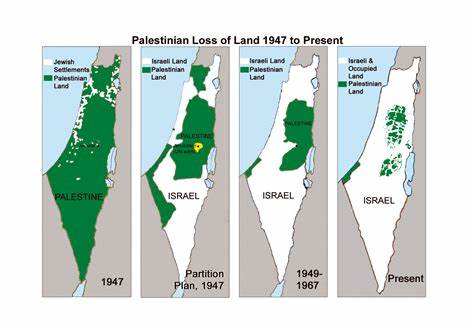
This “solution”, which the US and the rest of the Western states support, proposed to give the Palestinians less than 40% of their territory, the worst and least-watered, chopped into sections with narrow corridors through the Israeli lands and always under the guns of Israel.16
A Palestinian state would have neither true environmental, population, political nor civil control. Never a good choice instead of a secular state of Palestine for all, even this colonial option is clearly unworkable, sabotaged by the Zionists themselves with their settlements dotted all over it.
It is shameful to even propose it as any kind of solution.17
In the longer term, Israel’s consolidation of partnerships with a number of Arab states may have been harmed by the Zionists’ savagery and racist discourse towards the Palestinians but how deeply is difficult to predict.
Whether the Palestinian resistance and particularly Hamas is strengthened or weakened in the eyes of the Palestinian mass likewise remains to be seen.
The mostly imperialist western states of Europe and America show no sign of weakening their allegiance to the world imperialist leader, the USA and therefore, once they get over their weak criticisms of Israel’s genocide, will continue to support the Zionist state into the future.
Like many other problems on this Earth, workable solutions depend on changing some fundamental features in the world order.
end.
A historical reference to the Balfour Declaration of the Imperial Conference of British Empire leaders in 1926 giving European Jews rights to the British Mandate territory of Palestine, where approximately 10% of the population were Middle Eastern Jews at the time, the rest being Palestinian Muslims and Christians. (Photo: D.Breatnach)The rally, though thinning, is still ongoing behind photographer after perhaps two hours. Gardaí have FINALLY closed Kildare Street and a Dublin Bus has managed to turn around and exit. This has been the pattern in a number of Palestine solidarity rallies so far, when the Gardaí must have known the attendance would be large and the street should be closed for safety and traveler convenience sake. (Photo: D.Breatnach)
FOOTNOTES
1Another, last Monday week, had been organised by the Irish Anti-War Movement (effectively the People Before Profit political party).
3That is its name but there are those who refuse to call it that, saying that only an all-Ireland parliament deserves that title, such as the one founded during the War of Independence 1919-1921.
8It was reported that Colombia HAD expelled him and that was repeated at the rally but according to reports from there reaching now, he was only threatened with expulsion if he didn’t shut up.
9Probably the only state in the Middle East, because of its colonialist nature, that is safe from either national liberation uprising or Muslim fundamentalist revolution.
10This is a parallel so obvious that it occurs to a great many people across the globe but it is one that the Israeli authorities rejects and which it condemns as “anti-semitic” with the backing of many different authorities in the West.
17And the history of the Zionist colonisers shows that even with that, they would be forever pushing further, grabbing more land, killing more Palestinians in flare-ups (think the history of the European colonisation of the indigenous Americans in what is now the USA).
Dublin city centre saw the second rally in one week in solidarity with Palestine on Wednesday evening. Unlike Monday’s outside Leinster House, this one was on the central pedestrian reservation on Dublin’s main O’Connell Street.
Thursday’s was organised by the Ireland Palestine Solidarity Campaign whereas Monday’s, outside the home of the Irish State’s parliament, had been organised by the Irish Anti-War Movement (more or less really the People Before Profit party).1
(Photo: D.Breatnach)
After Monday’s rally, a substantial number had spontaneously marched to the Israeli Embassy where an Anti-Imperialist Action supporter had painted their door in red to symbolise blood before Gardaí knocked him to the ground and kept him lying handcuffed before arresting him.
The crowd had objected to this treatment whereupon the Garda attacked and arrested more demonstrators. The AIA supporter was later charged with “criminal damage” which is ironic considering the criminal and murderous damage by Zionist bombs and missiles on Gaza.
A rather blurry view of section of the rally from the west side. (Photo: D.Breatnach)
BOMBING GAZA
For the sixth consecutive day Israeli air strikes are pounding the Gaza Strip, Israel on Thursday boasting it has dropped 6,000 bombs weighing 4,000 tonnes on Gaza during the period, according to Palestinian sources killing more than 1,400 people and destroying huge amounts of housing.
At least 140 of those Palestinians killed are children.
There’s nowhere safe in Gaza (Photo cred: Edel Hana/ AP)
This is the fifth siege and bombing of Gaza by Israel in the last 15years, each time destroying what the Palestinians rebuild or patch and repair, such as their sewage treatment plant. Palestinian casualties overall during the period have been 6,407 Palestinians as against 308 Israelis.2
One siege lasted 51 days! Factories and apartment blocks, flower and vegetable production glasshouses and sewage treatment plants have all been destroyed and the coastal waters are polluted, while the Israeli Navy attacks fishing boats that dare go further out to sea.
Gaza was already a severely-deprived area occupied by 2.2 millions with 59% below the poverty level, 46% unemployment but youth unemployment at 63%. Since Hamas won the elections the Israeli state permits no-one to leave or enter Gaza except by special arrangement.
One of the most advanced military states in the world is attacking a people that has no navy, no airforce, no anti-aircraft defences and no standing army. The Zionists say they will soon send in a ground attack also, tanks grinding over the rubble to kill and maim more Palestinians.
Imagine you went into Sousi Mosque to pray for your family and neighbours to be kept safe, or just because the Israelis wouldn’t bomb it, would they? This is what’s left of it now. (Photo cred: Mahmoud Hams/ AFP)
Meanwhile the Zionist state is permitting no water, electricity, fuel, food, medicine, building materials or equipment to enter Gaza through the gate they control and, shamefully, the Egyptian regime in step with the Zionists is doing the same at the other gate, which the Arab state controls.
War crimes? We hear a lot about them in the war in Ukraine, right? The Israeli state is committing them daily now and has been doing so yearly, often monthly since 1948. But the USA backs Israel and so the western states do so too, supporting the war criminals and complicit in their crimes.
The IPSC rally was advertised for 5.30pm but people had begun to gather a half hour earlier, with more continuing to arrive until after 6pm. From physical appearance it seemed that people from the Middle East, presumably Palestinian, at least equalled those Irish present.
Rally supporters very tightly packed and before Gardaí move patrol cars in keeping them hemmed in (Photo: D.Breatnach)Gardaí beginning to move patrol cars in to keep rally packed in the central reservation (Palestine supporters also visible to left of photo, i.e on eastern pavement. (Photo: D.Breatnach)Gardaí place patrol car to keep the Palestine supporters (or this particular section?) off the road. (Photo: D.Breatnach)
The chanting of solidarity slogans was almost continuous, with short breaks for speakers, most of whom were introduced as Palestinians. These were the usual chants but often led in non-Irish as well as native accents: From the river to the sea – Palestine will be free!
Also: In our hundreds, in our millions – we are all Palestinians! One, two, three, four – occupation no more! Five, six, seven, eight – Israel is a terrorist state! But there were also new ones from a section: Long live the Resistance! And: Only one solution – intifada revolution!
(Photo: D.Breatnach)
That was taken up by many whereas Saoirse don Phailistín! And: You’ve got tanks, we’ve got hang-gliders – glory to the freedom fighters! were chanted by a small section. Four Palestinians were briefly heard trying without success to get the Alah’ akbar!3 chant going.
From Irish backgrounds, Senator Frances Black, Richard Boyd Barret TD, Chris Andrews TD and Cnlr. Daithí Doolan spoke. Senator Black sponsored the Occupied Territories Bill4 which was approved by all sides of the Oireachtas but held back by the Government from becoming law.
Richard Boyd Barret of PBP spoke with passion as he usually does and was applauded. Some of his observations, though more liberal than socialist, unequivocally however put the blame on the Israeli state and castigated also the western states’ support of the Zionists.
(Photo: D.Breatnach)
Many of the Palestinian speakers were very complimentary to the Irish people present at the rally but also to the Irish population overall for their generally supportive attitude towards the Palestinians and their struggle.
Andrews and Doolan are both prominent members of the Sinn Féin party and, as a result of their President’s recent condemnation of Hamas (a change in position for the party), came in for some heckling.
They may be genuinely supportive of the Palestinian resistance as individuals but if they tolerate their party’s leader lining up with the Zionists and imperialists in condemnation of the resistance of the oppressed, they must accept the criticism thrown at them.
(Photo: D.Breatnach)
THEY SAID
The leaders of Sinn Féin and of the DUP both separately and recently claimed that the pacification negotiations in Ireland can be used to assist in resolving the conflict in Palestine.5
Really? It was precisely following a similar road that led to the corruption and fall from position of Palestinian leadership of Al Fatah and Yasser Arafat, eruption of the Second Intifada and the generally secular-voting Palestinians electing Muslim fundamentalist Hamas in 2007.
(Photo: D.Breatnach)
On Thursday the Prime Minister of the Irish State said that Israel was inflicting collective punishment on Gaza by cutting off water and electricity but no mention of the bombing, which he seemed to endorse.
Collective punishment is a war crime in international law so what is Varadkar saying the Irish Government will do? Demand action by the EU and UN? Expel the Israeli Ambassador? Demand sanctions against Israel? No – request a humanitarian corridor for food and medicine.
Photo taken from west side, with LUAS tram rails showing and northward bus stopped at traffic lights. (Photo: D.Breatnach)
At the rally there was generally little denunciation of the Irish Government.
From Palestinians possibly because they felt they were guests in the country but one would have expected much harder criticism by the native speakers of the Government’s condemnation of the Palestinian resistance.
View of section from western side (Photo: D.Breatnach)
INTO THE STREET, ON TO THE BRIDGE
Over a thousand Palestine supporters were mostly crammed into a short section of the central pedestrian reservation on O’Connell Street, boxed in by police vehicles and the northward and southward traffic lanes on one side and the LUAS tram line on the other.
Rally participants have taken the initiative to relieve the crush in the central section by moving on to the road (Photo: D.Breatnach)
There was also an overspill on to the western and eastern pavements but at an initiative from within the crowd, demonstrators spilled from the east pavement and the central reservation on to the southward traffic lane, bringing traffic to a halt there.
After some time, one of the IPSC’s leaders approached the demonstrators in the road and asked them to allow the trapped cars and buses to continue southward, with which request the demonstrators complied – but the police had made this a dangerous exercise.
With the rally supporters now in the road, southbound traffic is unable to go forward and also unable to turn back. Senior IPSC activist (in green T-shirt) may be contemplating how he get the traffic through for awhile. (Photo: D.Breatnach)
A Garda patrol car was parked in the road next to the central reservation, obliging buses moving southward to manoeuvre around it, bringing them very close to the thickly-crowded eastern pavement. Some shouts of “Move the cop car!” were ignored by the Gardaí.
When the trapped vehicles worked their way past the rally, the supporters returned to the road, remaining there until the conclusion of the rally. Clearly the road should have been closed earlier and traffic diverted but the authorities prefer to have people complain about protesters.
With the road temporarily cleared willingly by Palestine supporters, the trapped traffic can move forward. But the placing of the Garda patrol car obliges the driver to swing over to their left bringing the bus dangerously close to the crowded eastern pavement, instead of staying in the middle of the street. (Photo: D.Breatnach)
Subsequently that evening, by which time the rally had been continuing for getting near to three hours, many of the attendance followed a banner of the Anti-Imperialist Action group to occupy O’Connell Bridge for a period and light flares there, after which they dispersed.
This is the southbound lane, so no traffic will approaching the rally on the road from this side. So why all those Gardaí there? Perhaps intending to prevent an impromptu southward march, perhaps to the Israeli Embassy (as occurred on Monday). In any case, they did not managed a march to O’Connell Bridge to occupy that traffic junction for a while. (Photo: D.Breatnach)
Rallies in solidarity with Palestine have been held and new ones are being organised across Ireland, including Belfast, Cork, Derry, Galway, Limerick, Naas, Sligo and the IPSC has called another one for this Saturday for Dublin 1pm in O’Connell Street.
The people in Ireland will continue to express their solidarity with Palestine but the main political parties and Government …!
End.
“The root of violence is oppression”. (Photo: D.Breatnach)
4 The bill would ban any goods or services produced, even partially, in the territories occupied by Israel after 1967 and ruled ‘illegal’ by the UN —including the Golan Heights.
5Presumably she means the process that her party embraced which entailed colluding with a colonial occupying power, a sectarian armed colonial gendarmerie and aspiring to manage a neo-colonial, neo-liberal state.
News & Views No.9: Chile Coup – Twin Towers – the Legacy Bill
Diarmuid Breatnach (Reading time: 5 mins.)
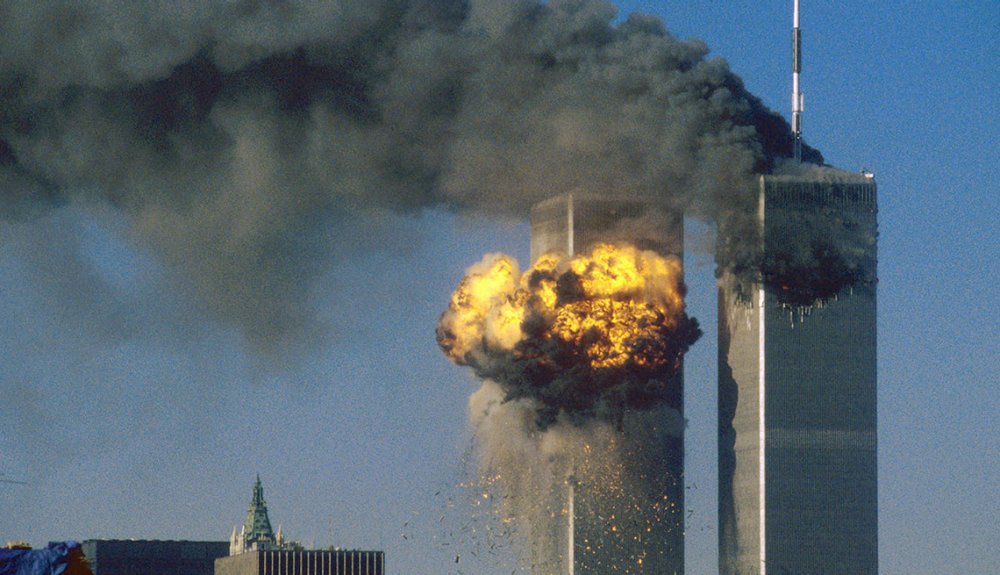
September 11th is the anniversary of the al Qaeda attack on the new World Trade Center in the USA known as “the Twin Towers” and also of the Pinochet Coup in Chile. The former caused the deaths of 2,996 people and the latter of over 40,000.
These are not happy anniversaries and US Imperialism bears a major portion of the blame for both events.
How so, one might ask? The coup in Chile, probably with CIA help, sure. But the Twin Towers? That was a Muslim jihadist attack AGAINST the USA! Surely we’re not expected to believe that stupid conspiracy theory that the USA ruling class actually staged the attack?
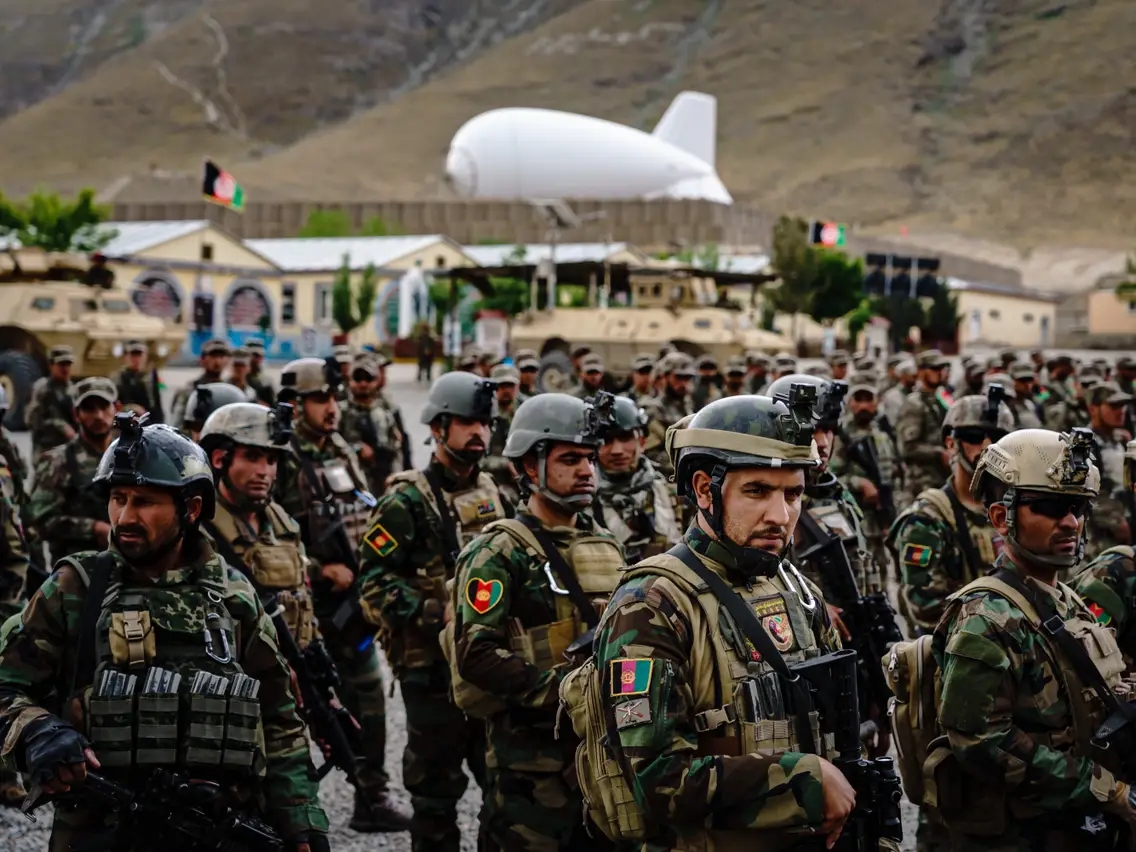
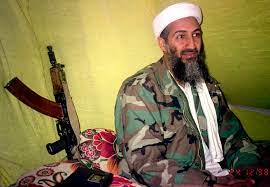
US proxy soldiers, Special forces Afghan National Army, 2021 (Photo sourced: Internet)Osama Bin Laden (10 March 1957 – 2 May 2011), Saudi-born founder and first general emir of Al Qaeda from 1988 until his assassination. (Photo sourced: Internet)
That is truly a crazy conspiracy theory but the historical truth does indeed involve a conspiracy. In 1997 the government of Afghanistan was socialist which was worrying for the USA, so in partnership with Saudi elements, they funded and even founded Muslim jihadist groups there.
These groups were to be encouraged to overthrow the socialist regime and when the USSR sent troops to support the government, to defeat the Russians too. Which they did.
But forget about fantasy stories of traditional tribesmen with ancient muskets fighting a world power’s army – these were jihadists, fundamentalists, armed with modern automatic weapons and mobile missile launchers including SAMs (Surface to Air Missiles).
Forget too about Rambo-led simple hill people – since the US achieved the overthrow of the socialist regime and invaded Afghanistan alongside their British allies, those jihadist groups have been squabbling over their share of the spoils, often murderously.
In fact, US imperialism is largely responsible for the world pestilence of not only jihadism of the Al Qaeda type, but the even more virulent Islamic State variety (which indicates Mary Wollstonecraft’s story of Frankenstein’s monster to be more prediction than fiction).
Explosion in one of the Twin Towers on 11th September 2001 in Al Qaeda attack. (Photo: Sean Adair/ Reuters)Frankenstein’s monster in Mary Wollstonecraft’s famous story; he returns to attack his creator (Image sourced: Internet)
Although US Imperialism had created Al Qaeda and although Saddam Hussein’s regime in Iraq was totally opposed to the jihadist group (and vice versa), US politicians used the attack on the Twin Towers to ‘justify’ the US military invasion of Iraq.
“Sweet are the uses of adversity” indeed when manipulated by US Imperialism for domestic consumption and for world public opinion, also when assisted by British Imperialism’s Labour Government, in particular by lying-through-his-teeth Tony Blair.
The US-led campaign against Iraq resulted in about 1.5 million deaths through economic sanctions alone followed by over 300,000 civilians in the Western military campaign. These figures do not include deaths and injuries of Iraqi military and of the invading allies under the USA and UK.
Nor do those figures include the many deaths, military and civilian, in internal conflicts since the invasion of Iraq which continue to mount.
The deaths resulting from the coup in Chile were overwhelmingly of civilians as the coup was carried out by the Army with little opposition within the military and the civilian population were mostly unarmed.
Most of the deaths occurred in succeeding days and years as the regime rounded up communists, trade union militants and others suspected of having supported Allende’s party, to torture and execute them, including most famously the renowned musician and singer-songwriter Victor Jara.
The anniversaries of both the Pinochet coup and the Twin Towers have been commemorated in various parts of the world with, it appears, the coup being remembered in most of them, not only in Latin America but also in many countries in Europe where Chilean political exiles found refuge.
In the USA, of course, the attack on the Twin Towers was officially commemorated and probably communally too much more so than the coup in Chile.
Another imperialist-generated disaster, the anniversary of which falls only a couple of days after those two, is that of the Oslo Accords, signed on 13th September 1993 and often also known as a stage in “the Palestinian Peace Process”.
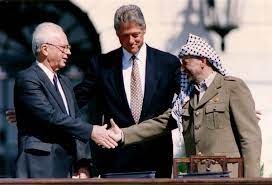
At the White House, supervised by Bill Clinton, elected chief of US Imperialism at the time, Yitzak Rabin for the Israeli Zionist state and Yasser Arafat, for the Palestine Liberation Organisation, signed an agreement, as a result of which the PLO would be permitted to run their own statelet.
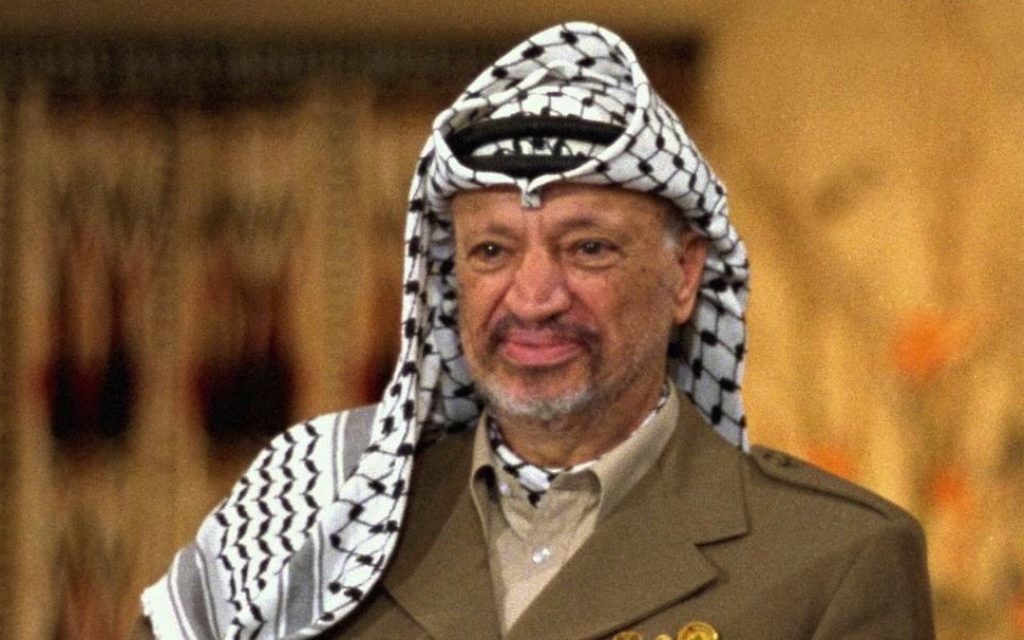
Oslo Accords, 13 September 1993, Washington: Yasser Arafat of the PLO shakes hands with Yitzak Rabin of the Zionist State under the stewardship of (then) US President Bill Clinton, representing US Imperialism. (Photo: Gary Hershom/ Reuters)
Hailed as a great breakthrough by most media at the time, the PLO, dominated by Arafat’s Al Fatah, got to have limited self-government within the Zionist State, with the borders of any future Palestinian state undefined and no mention of the millions of Palestinian exiles around the world.
Although the increasing encroachment on Palestinian lands by Zionist settlers was temporarily halted, the land already taken and built upon remained in Zionist hands, that issue and others ‘to be discussed later’ but the Palestinians were to give up the armed resistance immediately.
The South African pacification process had begun earlier and, though enfranchisement of non-white South Africans was not to come until 1994, it was clearly on the way. The ANC promoted pacification processes to Al Fatah and both parties promoted them to Provisional Sinn Féin.1
The Palestinian ‘Process’ was controversial among their people from the start and grew more so as it became clear how little the Palestinian cause had gained and how much had been set aside, along with the growing official corruption and nepotism growing among the Al Fatah organisation.
Though the pacification process was widely rejected in Palestine and failed to install a widely-recognised ‘official’ collusive leadership, it did achieve the fragmentation of the Palestinian leadership and helped to ‘justify’ the demonisation of Hamas, winner of the 2006 elections.
ALTERNATIVES
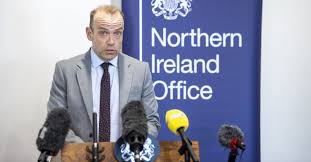
The Secretary of State for Northern Ireland (sic) is quoted in the media as saying that there is no alternative to the UK’s legacy legislation, which proposes to prevent recourse in law for any crimes committed by its soldiers, colonial police, proxies or Government Ministers.
Secretary of State for the Northern Ireland (sic) colony, Chris Heaton Harris (Photo cred: PA)
The legislation in question is titled The Troubles (Legacy and Reconciliation) Bill.
All political parties in Ireland on both sides of the British Border have vigorously opposed this legislation and THERE CLEARLY IS AN ALTERNATIVE, which is to abandon it. What the UK’s ‘colonial governor’ of the Six Counties means is: no alternative acceptable to the ruling class.
While we’re on alternatives, all liberation movements had and have the alternatives to embracing pacification processes, which is to maintain the path of resistance upon which they embarked until the day they win that for which their people and fighters have sacrificed their liberty and lives.
Allende and the communists in Chile had the alternative of arming the people and purging the Army but instead chose to put their faith in the ‘loyalty’ of Pinochet, ‘democracy’ and the opinion of the Western powers.
“The people armed cannot be harmed”, perhaps, rather than “The people united can never be defeated”.2 Allende’s error cost him his life but also the lives of hundreds of thousands of others.
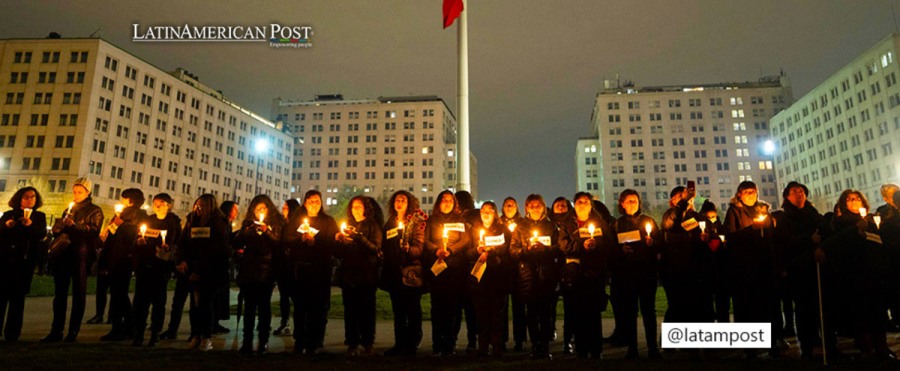
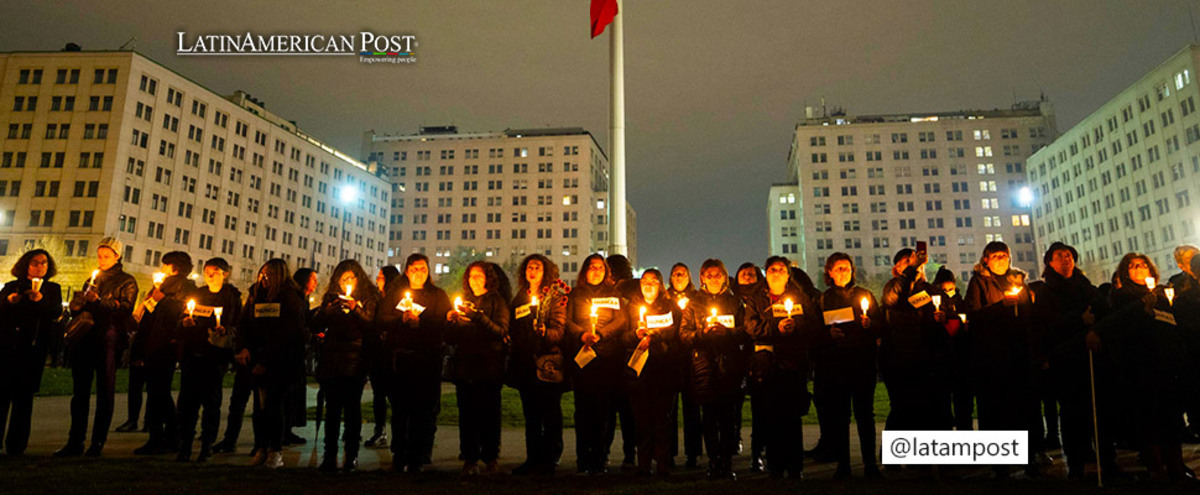
Women on 11th September hold a candlelit commemoration at La Moneda, Santiago, Chile for the victims – in particular of sexual violence – of the Pinochet coup and dictatorship. (Photo: Adriana Thomasa / EFE)
Imperialists have the alternative of respecting the right to self-determination of the peoples of the world and to cease from exploiting, oppressing and repressing them.
But if they did that, they wouldn’t be imperialists, would they? And since they cannot change their nature, they have to be overthrown.
End.
FOOTNOTES
1Provisional Sinn Féin signed up to the Irish Pacification Process in 1998 and they and the ANC then moved on to promote a pacification process to the leadership of the Basque movement for independence, which also finally signed up to it without even obtaining release of the political prisoners. By that time the Palestinian Process had shown its empty promise and the Second Intifada (2000-2005) demonstrated its rejection by most Palestinian youth and the elections to the 2006 Palestinian Legislative Council were won convincingly by Hamas.
2An alternative slogan to “El pueblo unido jamás será vencido” was even then being promoted by a smaller communist group: “El pueblo armado jamás será aplastado!”, i.e ‘The armed people will never be crushed’.
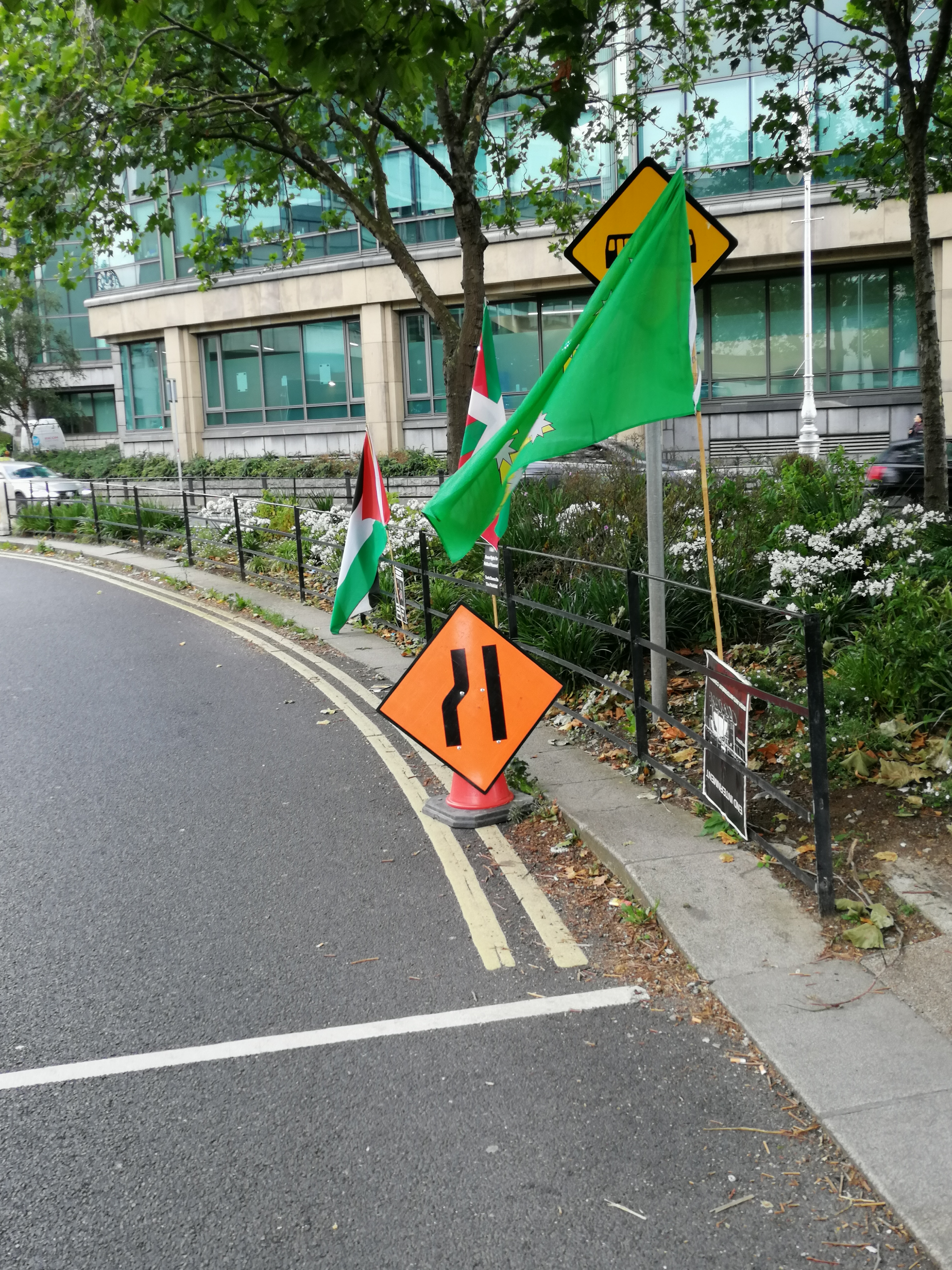
Socialist republicans and communists gathered on a traffic island in Dublin’s city centre to mark the International Day of the Prisoner. They flew flags to represent prisoners in Ireland (‘Starry Plough’), the Basque Country and Palestine.
They also displayed a number of placards.
(Photo: IAIC).
The choice of location, apart from being passed by road traffic in three directions, was because of the presence there of the Universal Links on Human Rights memorial sculpture with an eternal flame, commissioned by the Amnesty International organisation.
A plaque near the sculpture bears the following words: “The candle burns not for us but for all those whom we failed to rescue from prison. Who were tortured. Who were kidnapped. Who disappeared. That is what the candle is for.”
Plaque in the ground on the approach to the sculpture. (Photo: IAIC).
Somewhat ironically, one of the placards carried the words: “Amnesty International, do Irish Republican prisoners not have human rights too?” Irish Republicans have long complained that the organisation in question does not raise any issues with regard to Irish political prisoners.
Some have indicated as a possible reason or part-reason the location of the head office of Amnesty International being based in London, capital city of the occupying power. Its interventions on Ireland even during three decades of war in the colony have been very few indeed.
Other placards displayed referred to political prisoners from the liberation wars in India and in the Philippines, the innocent Craigavon Two still in jail and ongoing internment through refusal of bail to Republicansappearing before the no-jury special courts in both administrations.
Some leaflets were distributed about ongoing internment in Ireland through long remands in custody of Republican activists. Between convicted and awaiting trial there are close to 50 political prisoners in jails in Ireland between both administrations.
The Universal Links sculpture by Tony O’Malley (welding by Jim O’Connor) commissioned by Amnesty International. (Photo: IAIC)
The Zionist Israeli state holds 5,000 political prisoners (almost all Palestinian), of which over 1,132 are not even charged (‘administrative detention’). There are 33 female Palestinian political prisoners and 160 child prisoners. Philippines has 803 political prisoners.
The Spanish and French states hold between them around 170 Basque political prisoners.
The event to mark International Day of the Prisoner was organised by the Ireland Anti-Internment Campaign and a spokesperson gave a short explanation on video of the reason for the event with the human rights sculpture in the background.
End.
Some of the flags displayed (Photo: IAIC).Passer-by in conversation with a leafleter. (Photo: IAIC). (Photo: IAIC).
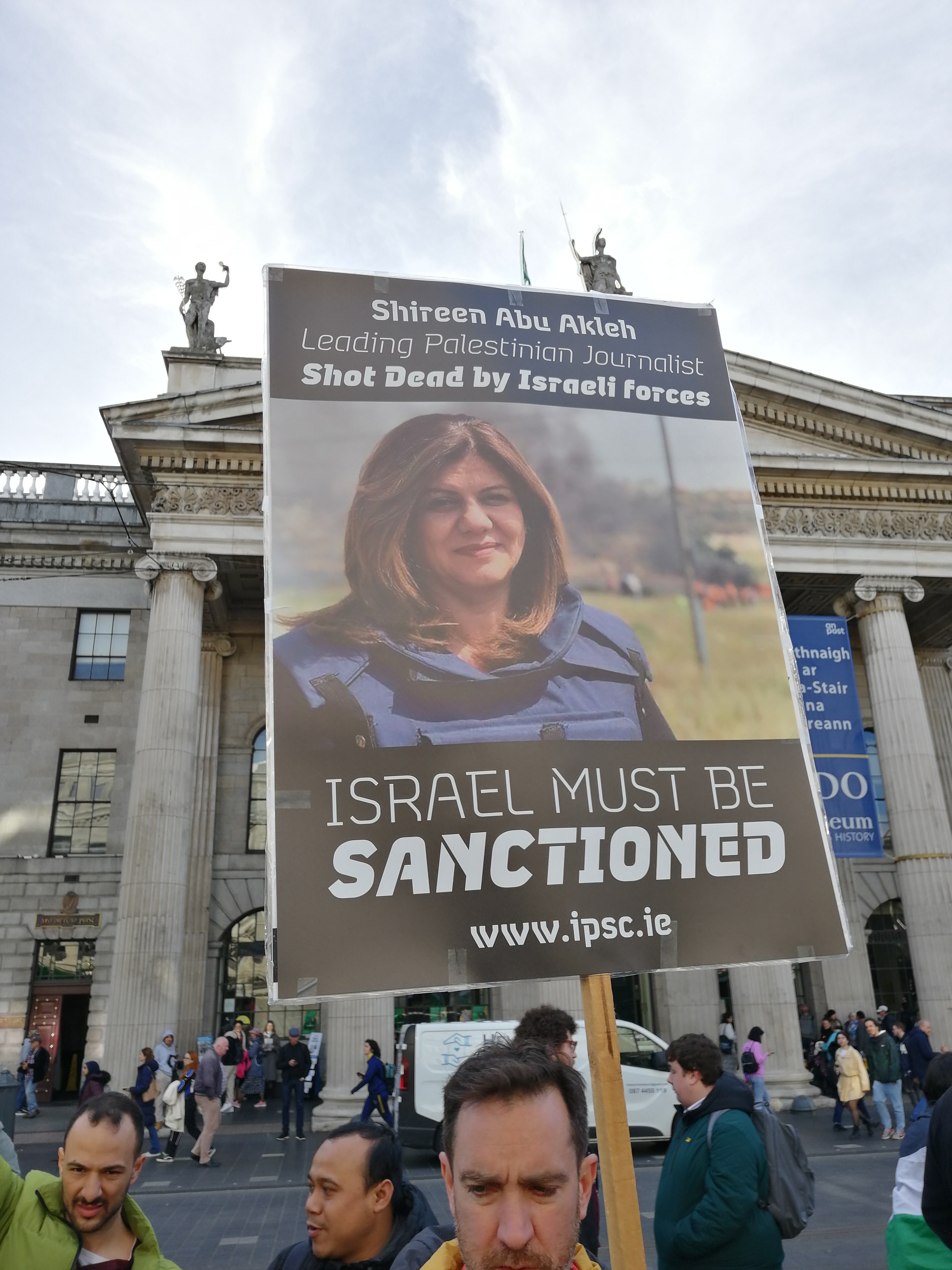
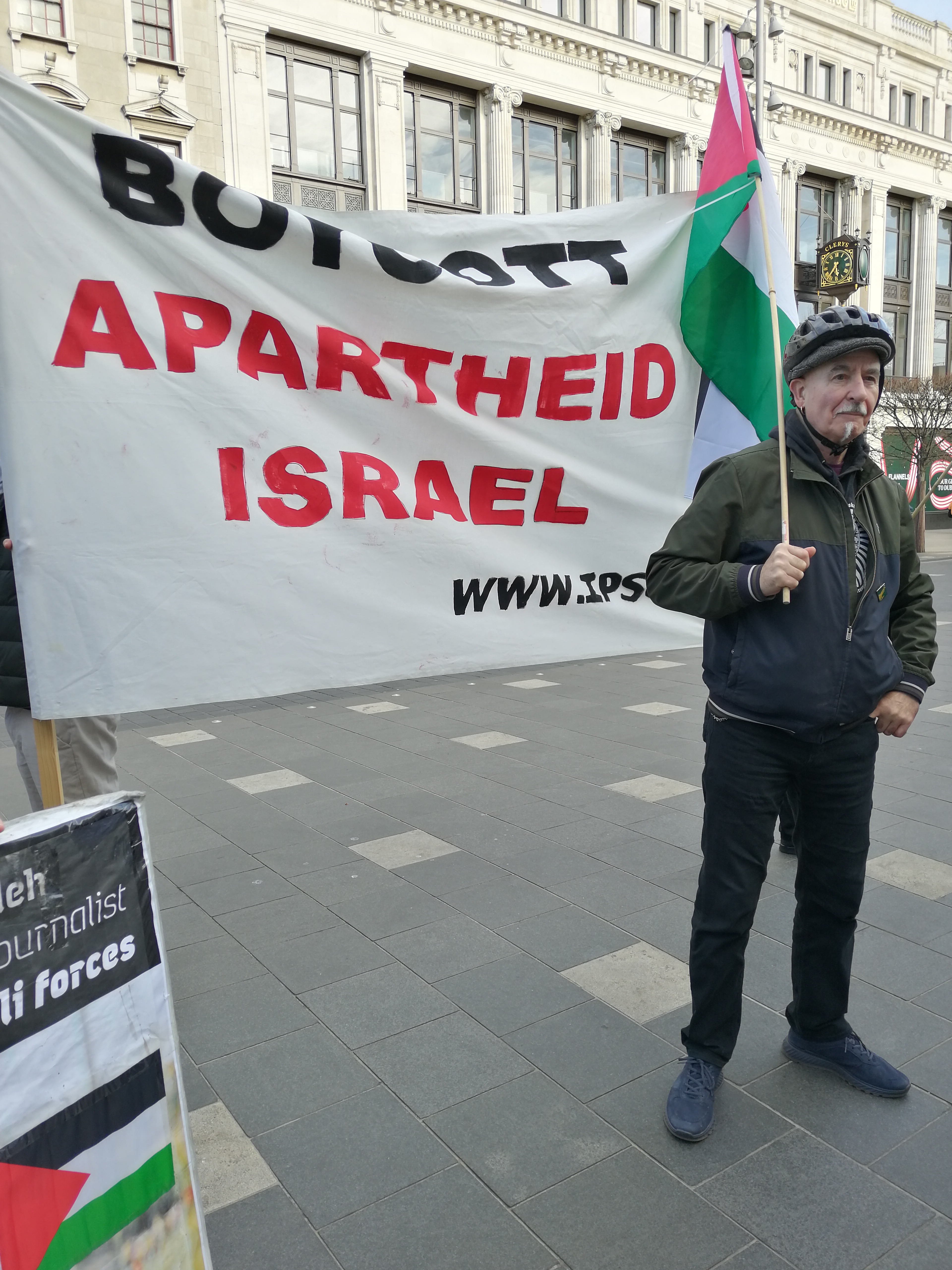
Palestinian flags waved as people gathered on the pedestrian reservation in Dublin’s main thoroughfare, O’Connell Street, to mark Palestinian Land Day March 30th, anniversary of the 1976 confiscation of Palestinian land by the Israeli Zionist State.
Naturally, the event also addresses the continual threat to additional Palestinian land by Zionist settler occupation, Israeli judicial and army demolition of Palestinian housing and intimidation, harassment and terrorism against Palestinians in Jerusalem.
Palestine supporters gathering for Land Day (Photo: D.Breatnach)
The Dublin event was organised by the Ireland Palestine Solidarity Campaign, a broad organisation that receives broad support not only across the Irish Left and Republican spectrum but also from a great many non-aligned Irish people and even many among voters for mainstream political parties.
This support was emphasised by frequent drivers in passing traffic, both public, taxis and entirely private, blowing their horns in approval of the rally. The population of the Irish state has gone from being in general support of the Israeli State to being generally hostile to its behaviour.1
Zionists tend to depict anti-Israeli Zionism as being anti-Jewish and therefore, according to them, “anti-semitic”2. Quite apart from the wide inapplicability of the term and some isolated historical examples dredged up3, it fails to account for the change in public attitudes over recent decades.
The iconic GPO in the background (Photo: D.Breatnach)
It has been years of viewing even media-sanitised coverage of massacres of Palestinians by the Israeli armed forces with international impunity that has radically altered the opinion of the public in Ireland, in all probability drawing on their own historical experience of foreign occupation.
An elderly Irishman voicing anti-Jewish views did in fact approach the rally but was confronted by other Irish people who emphasised that they were against the Zionist state and not against Jews, soon causing the first man to depart unhappily.
The continual occupation of Palestinian land by Zionist settlers has invalidated even the “two-state solution” (sic) beloved of liberals, making it a practical impossibility, undermining the main ‘concession’ of the supposed solution of the USA-mediated “Palestinian peace process” of 1991.
(Photo: D.Breatnach)
The refusal of the Israeli authorities to permit the return of Palestinian exiles while welcoming Jewish settlers, most of whom had no even ancestral connection to Palestine, means that the future for Palestinians in the Israeli state can be at best as an oppressed minority.4
(Photo: D.Breatnach)
Other Palestine news
Even as preparations for the Dublin rally took place, Israeli police shot dead a Palestinian they claimed had tried to wrest a gun from them at the Al Haq Mosque but whom Palestinian eye-witnesses said had merely been protesting the police harassment of a woman.
Since the rally, another two Palestinians have been killed in an by Israeli armed forces raid on Nablus. This brings the total number of Palestinians killed by Israeli forces this year alone to over 90, with a high proportion of them children.
Mass protests and even mini-riots by Israeli Jews are currently expressing opposition to the current government’s plans to ‘reform’ the judiciary, to bring it under the greater control of the Executive.
While Israeli Jews are deeply divided on this question the vast majority are agreed on the need to suppress Palestinians, to enforce apartheid and to keep the State as ‘Jewish’ one.
Meanwhile an April 1st Fool’s Day hoax depicting an executive of the sports shoe manufacturer company Puma declaring a boycott of the Zionist state was widely shared on the Twitter social media to overwhelmingly welcoming comment.
Exposure of the hoax received mixed responses, with wide condemnation from pro-Israeli and even some pro-Palestinian sources but others claiming it helped to widely publicise the manufacturer Puma’s close links to the Zionist State and that would enhance its boycott by many.
End.
(Image accessed: Internet)
Footnotes
1Dublin City has had Jewish municipal Councillors and the sixth President of Israel, Chaim Herzog (Hebrew: חיים הרצוג; 17 September 1918 – 17 April 1997) was an Irish-born Israeli politician, general, lawyer and author who served as the 6th President of Israel between 1983 and 1993. He was born in Belfast and raised primarily in Dublin; his father was Ireland’s Chief rabbi Yitzhak HaLevi Herzog, who immigrated to the British protectorate of Palestine in 1935 and served in the Haganah Zionist paramilitary group, later the Israeli Army where he reached the rank of Major-General. As recently as 1967 the prevailing Irish public opinion seemed sympathetic to the Israeli State and the fictional propaganda and wildly inaccurate historical Hollywood films Exodus (1960) and Cast a Giant Shadow (1966) were widely viewed sympathetically in Ireland.
2The term originally included hatred or fear of all Semitic people, including Arabs and Jews but has come to be understood as exclusively meaning a racist attitudes towards Jews. By no means all Jews are Zionist though Zionists have worked long and hard to make both descriptions interchangeable with a great deal of success among the world Jewish population with possible unfortunate consequences for Jewish populations outside Israel. However many Jews have criticised the behaviour of the Zionist State towards Palestinians, earning the hatred of the Zionists, who cannot label them as anti-semitic and therefore call them “self-hating Jews”.
Working people have experienced many betrayals in history and the struggle for self-determination of the Irish nation has been – and is being – betrayed also.
When such betrayals occur, a range of common reactions is evoked; thinking about those responses may help the betrayed at least to moderate the harm and turn the experience to some benefit.
Equally, some ways of handling the experience can magnify and deepen the harm already caused.
Betrayal is a difficult experience for the betrayed certainly but not without some cost to the betrayer too and each has a number of common responses. This applies to the personal as well as to the political but there are some differences.
The betrayers have their followers to different degrees and these too have psychological reactions to the betrayal — and to criticism of the betrayal. We can observe these reactions in a number of recent historical cases of high levels of resistance subsequently betrayed.
The most recent phase of high degree resistance in Ireland took place largely in the British colony of the Six Counties, beginning with mass struggles for civil rights before passing through protracted guerrilla war and intense struggles of political prisoners in the jails.
In the Basque Country, the corresponding phase began with ideological-cultural struggle and mass industrial actions against the Franco dictatorship, quickly developing into a guerrilla campaign combined with street battles, resistance to conscription and struggles around prisoners in the jails.
The leadership of the Irish struggle came to political agreement with the colonial occupier, disbanded and decommissioned its guerrilla forces and acceding to its right of conquest, joined the occupier’s colonial administration, concentrating thereafter on building up its electoral base.
A similar process took place in the Basque Country but with important differences: the imprisoned activists were not released and the movement’s political leadership was not even admitted into joint management of the colonial administration.
Each nation witnessed splits, recrimination, dissidence, repression on groups continuing resistance but also a range of psychological responses which at best did not assist recuperation and in fact often deepened the harm of betrayal by the leadership.
STANDARD RESPONSES BY THE BETRAYED
DISMAY is a common reaction: How could he/ she/ they? I never thought they would. We’re finished now.
BLAME is another also common response: It was that leader’s or leadership’s fault. We didn’t fight hard enough. Those comrades criticised too much.
SELF-CENSORSHIP And EXCESSIVE CAUTION: We can see the harm in some of the leadership’s actions but we must be careful not to step too far out of the movement, where we will be marginalised and unable to have an effect1.
DESPAIR: That’s the end of everything. There’s no way out of this. It was all for nothing – all those sacrifices, all that pain.I’ll never trust people or get involved again.
APATHY: So I/ we might as well forget about it all. Just think about ourselves/ myself/ family. Drop out. Drink. Take drugs.
DENIAL: We’ve not really been betrayed. It’s just another way to go for the same thing. This is the only reasonable choice. We couldn’t keep on that way any longer, this is just a change of method. We’re just having a pause. The leadership is clever and has tricks up their sleeves. This is just to fool the authorities. It’s just going to take a little longer to win than we thought.
Those are defensive constructions in emotion and, in so far as that takes place, in thinking. But defensiveness can turn to aggression – and frequently does. The betrayers – and often the duped also – resent being reminded of what and where they are. It makes them uncomfortable.
HOSTILITY: How dare those people criticise us/ the leadership? They don’t understand and just want continual conflict. They’re endangering our secret plan. Who do they think they are? They’re just wrecking everything, undermining our new plans. They need to be taught a lesson.
PERSONAL ATTACKS: That critic is no great activist. S/he hasn’t suffered as some of us have. They were always troublemakers. Jealous, that’s what they are. They’re not very bright; no idea about real politics. They are in fact traitors, helping our enemies.
MARGINALISATION: We are not going to listen to those critics. We will not allow them space on our media. We’ll try to make sure they don’t get venues in which to spread their poison. If people are friends with them they can’t be our friends too. Such people will not enjoy our hospitality or invitations to our events. People should not even talk to them. If the authorities attack those dissidents, we are not going to trouble ourselves about them – it’s their own look out.
MANAGING THE BETRAYAL
PROMOTING LEADER ADULATION is a useful tool in shutting down the opportunities for criticism and in repressing them when they arise. “Who are we to criticise this great comrade’s thinking or actions?” becomes an implicit question, clearing the way for betrayal.
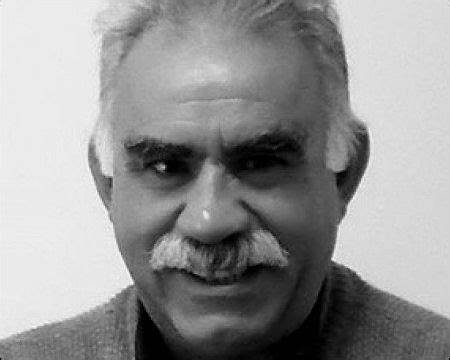
Leaders who have surrendered or compromised the struggle, L-R: Gerry Adams and Martin McGuinness of the Provisionals, Arnaldo Otegi of the Basque Patriotic Left, Abdullah Ocalan of the PKK and Yasser Arafat of Al Fatah. The latter seemed to be attempting to to turn back from the path of betrayal when he became very ill (quite probably poisoned) and died.
SEEKING COUNTER-REVOLUTIONARY ALLIANCES is engaged upon so as to appear to its members to make the organisation’s influence greater, or to outflank and isolate more revolutionary tendencies and often ultimately to make the leadership acceptable to the ruling circles.
BEGGING FOR CONCESSIONS when the revolutionary path has been abandoned can often be observed, as in “we’ve abandoned our militant struggle, please stop repressing us”, for example, a frequent response to repression of the Basque leadership once it abandoned the revolutionary path.
COLLUDING WITH THE OCCUPIER becomes a new second nature to a leadership abandoning revolution, not only in abandoning armed struggle, for example but in destroying weapons and suppressing elements still in resistance.
PROVING THEIR READINESS TO COLLUDE FURTHER, revolutionaries turned collaborators denounce continued resistance, try to convince revolutionaries to desist (or threaten or physically attack them), promote the repressive arms of the State such as the police and so on.
INTOLERANCE OF CRITICISM becomes default position; such criticism tends to expose the contradiction between the original purpose of the organisation and its concrete actions in the present. Censorship, expulsion and misrepresentation become common.
MARGINALISATION OF CRITICS follows from intolerance of criticism – the individuals or groups must be made pariahs so as to nullify or at least reduce their influence. Association with them, socially or politically – even in agitating around civil rights – must be discouraged.
REPRESSION OF DISSIDENTS finally becomes necessary, whether by threats or by actual violence or, when admitted to governing circles, by use of repressive state machinery.
DEALING WITH BETRAYAL RATIONALLY
The first necessary step is to analyse how the betrayal came about: how was it organised? What were the conditions that made it possible? What were the early signs?
Then, proceed to: what could we have done differently? What WILL we do differently in future?
Electoral work
One common assumption here in Ireland, especially in Irish Republican circles, is that the rot began with standing in elections. This is not logical and it is in effect making a negative fetish of electoral work, a taboo to be avoided.
It is often useful to the revolution in many ways to have representation in the parliament and local authorities, for example in promoting or blocking practical or legislative measures, getting media air time, visiting prisons — all without ever promoting reformism as a way forward.
Certainly the prioritisation of electoral work over other aspects is a sign that something has gone wrong: the strength of the popular revolutionary movement is on the street, in workplaces, communities, places of education, rather than in parliaments and local authorities.
The drive towards electoral representation can encourage bland slogans of the soap powder kind (“new improved” or “washes even better”) rather than those with revolutionary content and also the promotion of more bourgeois individuals in preference to grass-roots organisers.
Anodyne election slogan in both languages for Sinn Féin.
But none of that means that representation in those bodies cannot be used to further the popular struggles or that such aberrations cannot be avoided. And in fact, the concentration on criticism on the electoral factor served to distract from a more fundamental error.
Of course, electoral work should never, for revolutionaries, be about entering government under the current socio-economic system, i.e sharing in the administration of the State.
Leader adulation & intolerance of criticism
If criticism is not tolerated when errors are committed, they can hardly be corrected. Again and again it has been observed that the party/ organisation faithful refuse to accept external criticism from non-enemies. Internally the leadership inhibits criticism by the members.
The cult of the leader also inhibits criticism and therefore correction of errors. And behind this image others can hide and also commit errors. Problematic as dead icons may be, living ones are many times more dangerous – deceased ones at least do not change their trajectories.
Such created living icons have been Mandela in South Africa, Yasser Arafat among Palestinians, Gerry Adams and Martin McGuinness in Ireland, Arnaldo Otegi in the Basque Country and Abdullah Ocalan among Kurds (particularly in the Turkish and Syrian states).
Nobody knows everything or is always right. Bothersome as being criticised may be, its total absence is worse, allowing us no opportunity to question ourselves as activists and in particular as revolutionary organisations.
The revolutionary leadership, party or organisation is not the people
The revolutionary leadership, party or organisation does not have all the answers and is not the people. This might seem obvious but from the behaviour of such leaderships and their followers in the past it is clear that the opposite philosophy has been dominant.
Confusing the organisation with the people or with revolution itself, we assume that what is good for the organisation is also good for the people and the revolution. This however is not always so and leads to placing the perceived well-being of the organisation above the needs of the revolution.
Indulging this confusion leads to political opportunism and sectarianism, bad relations with other revolutionaries, ignoring all external criticism and placing the needs of the leadership higher than those of the membership and of the membership higher than those of the mass movement.
Internationalist solidarity
In internationalist solidarity work we build the unity of the people across borders and against the same or different enemies than those against which we are struggling.
One feature observed in a number of organisations where the leadership is moving towards betrayal is a reduction or elimination of such work.
To those in our ranks seeking an accommodation with imperialism and capitalism, those internationalist solidarity alliances are either a) unimportant or b) a hindrance to the alternative reactionary alliances to which they aspire.
The latter was very much the case with the Provisionals’ attitude to US imperialism. For decades, their leadership maintained apparently mutually-contradictory positions on what is the biggest imperialist superpower in the world.
On the one hand, for example, there could be involvement in solidarity with Cuba against the US economic blockade and, in the past, against US sabotage and terrorism against the Sandinista regime in Nicaragua.
On the other hand, the leadership sought the support of the US elite against British colonialism, which is occupying a part of Ireland and against which the movement was waging, in that colony, an armed and popular struggle.
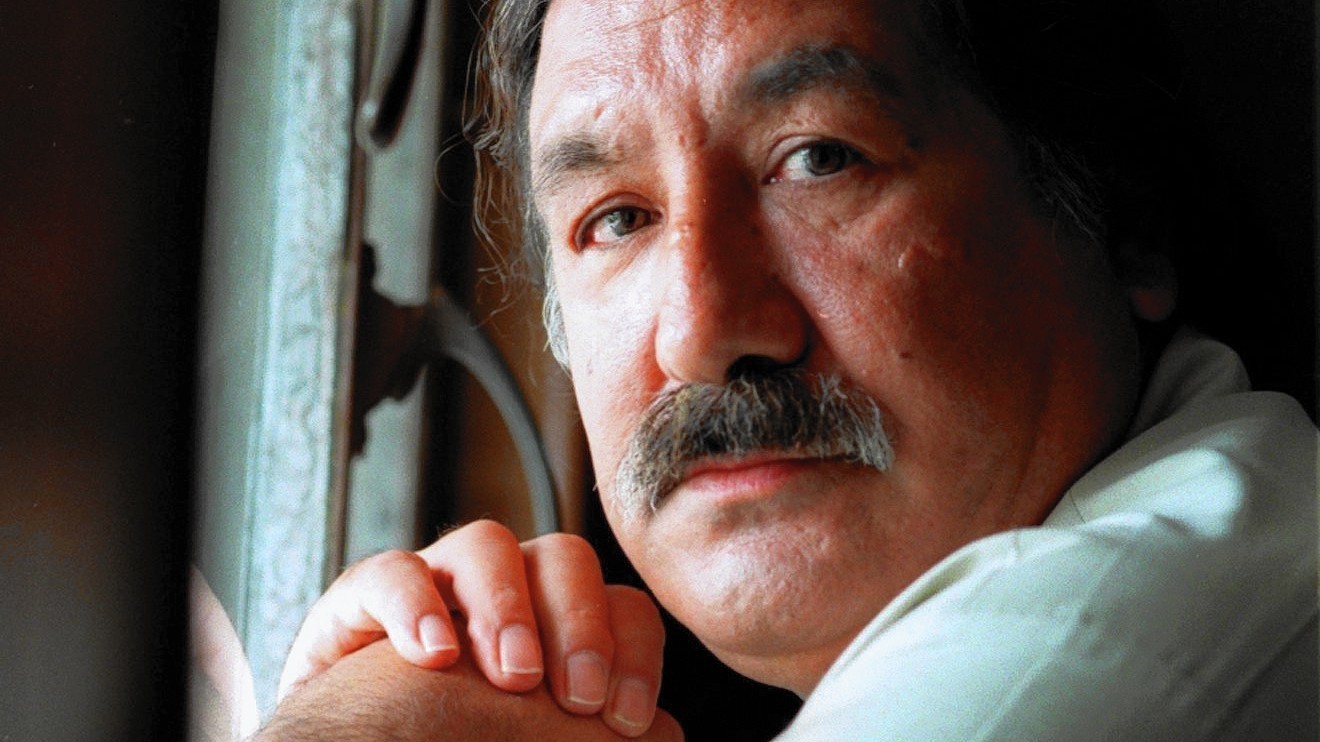
Seeking support from the US imperialist elite entailed distancing from left-wing Irish USA and dropping support for even long-term inmates of US jails, such as American Indian Leonard Peltier and Black American Mumia Abu Jamal, arising out of popular struggles inside the US.2
Leonard Peltier, Native American convicted in 1977 in deeply flawed trial for murder of two FBI agents in 1975 shootout on Pine Ridge Reservation. Nearly 80 years of age now and with multiple health issues, even release on clemency grounds is constantly blocked. His is one of many campaigns in the USA which SF cannot support as they seek to remain friends with the Democratic Party elite there.
Black American journalist and activist, framed for the murder of a corrupt Philadelphia policeman in 1981 and sentenced to death in 1982, sentence commuted to imprisonment for life without parole in 2011. Mumia is nearly 70 years of age now with a number of health issues. Another of the type of injustice in the USA about which SF cannot campaign as they seek to stay close to the Democratic Party elite. Anecdotally, a SF Councillor who was regularly writing to him was obliged to desist on instruction from her party leadership.
Unprincipled alliances
Another warning sign is the founding of unprincipled alliances with other organisations in struggle. For example, although it is correct to have a position of support for the Palestinian people, that should not necessarily bind us to exclusively support the fighters of one organisation only.
The Provisionals made their alliance with the Al Fatah organisation to the exclusion of all others in Palestine but worse was to come, for Al Fatah shoved aside the idea of a free Palestine and the right of return in exchange for administrative partial autonomy and funding.3
From there, Al Fatah became so corrupt that the Palestinian people, that had long supported a secular leadership, voted overwhelmingly for an islamic fundamentalist party, Hamas4. The unprincipled alliance with Al Fatah and the ANC was used to ‘sell’ the GFA to Irish Republicans.5
In the Basque Country, the mass movement’s leadership developed close links with the leadership of the Provisionals and refused links with Irish Republican organisations that dissented from the Provisionals’ position or with Republican prisoners after the Good Friday Agreement.
That should have sounded alarm trumpets in the Basque movement but if it did, it remained largely without practical effect. Askapena, the Basque internationalist solidarity organisation did split from the main movement but did not go so far as to support ‘dissident’ Irish Republican prisoners.
LESSONS
On the basis of the preceding I think we can draw a number of primary lessons.
LESSON ONE: ANALYSE THE MISTAKES OF THE PAST AND SEEK TO AVOID REPLICATING THEM
The type of struggle, location, timing, peripheral situation, long, medium and short-term objectives, experience and expertise of personnel, resources … all need to be analysed, in conjunction with the strengths and weaknesses of the enemy.
In carrying out this kind of analysis on the Irish struggle, we see that we faced one of the military superpowers, also well linked into the western imperialist world. The Republican movement’s battle area was in total one-sixth of the nation’s territory and the location deeply divided.
The rest of the nation was ruled by a weak foreign-dependent ruling class.
Map of Ireland showing the British colony of the Six Counties. The Provisionals took on the British state, mostly confining their struggle in that deeply divided politically and culturally region shown in yellow.
A movement cannot choose when it has to step forward in defence but it can choose how it develops the struggle afterwards. It seems obvious that in order to be victorious, at the very least the struggle would have to be spread throughout the nation.
That in turn would entail putting forward social and economic objectives to attract wider support which, in turn, would mean taking on the Catholic Church hierarchy.
In addition, the question of effective external allies was relevant here but even more so in the Basque Country, located across the borders of two powerful European states.
The total population of the portion of the Basque nation within the Spanish state is far short of three million, that of the rest of the state over 44 million.
Clearly allies external to the Basque nation would be essential for victory and these would have to come from across most of the Spanish state at least.
Map showing the ‘autonomous’ regions of the Spanish State; the southern Basque Country is shown in pink at the top, including ‘Navarre’ shown in yellow next to it. Essentially, the Basque Patriotic Left without allies confronted the Spanish state from there.
Such an assumption would entail, in turn, outlining objectives to attract considerable numbers from across the Spanish state which in turn would mean creating alliances with revolutionary and other progressive forces across the state.
LESSON TWO: REFRAIN FROM PERSONALISING THE ISSUES
When criticism of the counter-revolutionary line put forward by individual leaders becomes personalised, the political essence of the criticism becomes lost or at least obscured. It can seem as though the critics have personal reasons for their hostility or even jealousy of the individuals.
Much of what one sees publicly posted by opponents of pacification programs in Ireland and the Basque Country often seems more about hostility to the personalities of MaryLou MacDonald, Gerry Adams, Martin McGuinness or Arnaldo Otegi than about specific policies and actions.6
Crucially, focusing criticism on individual leaders serves to conceal other underlying causes of failure and betrayal that are usually more fundamental: problems in objectives, errors of strategy, in particular and also of tactics along with unhealthy organisational dynamics.
LESSON THREE: DEVELOP INTERNATIONALISM AND AVOID UNPRINCIPLED ALLIANCES
In the face of imperialist and other reactionary alliances, revolutionaries need internationalist solidarity, the basis for which should be revolutionary positions and action. Exclusive alliances are generally to be avoided as is uncritical support or unquestioning approval of all actions.
LESSON FOUR: CONTRIBUTE TO BROAD FRONTS WITHOUT SURRENDERING THE REVOLUTIONARY LINE
A broad front is essential not only for successful revolution but also often for defence against repression. Such fronts should be built on a principled basis with respect for the participating groups and individuals but without surrendering the revolutionary line.
At the same time, the possibility of betrayal, opportunism or sabotage and marginalisation by partners in broad fronts need to be guarded against and, if occurring, to be responded to in a principled and measured manner.
Broad fronts not only increase the numbers in resistance in a unified manner but also expose the activities of the constituent groups to the members of other parts of the broad front. Activists can then evaluate organisations and one another on the basis of experience rather than of reputation.
The revolutionary line should not be abandoned or concealed when in a broad front with organisations and individuals who have varying lines. At the same time, it is not necessary to be pushing the revolutionary line every minute.
LESSON FIVE: DON’T GIVE UNCONDITIONAL TRUST TO LEADERS
Of course, our leaders and activists must be trusted – but always in the knowledge that no-one is perfect or above the possibility of error. The shutting down of opportunity to voice criticism should sound alarm bells in any revolutionary movement.
There are of course “time and place” considerations in criticism; for example, the capitalist mass media, police interrogation or trial in court are hardly appropriate places to criticise a revolutionary movement’s leadership.
LESSON SIX: TOLERATE INTERNAL CRITICISM AND CAUCUSES IN BALANCE WITH COLLECTIVE RESPONSIBILITY
The above touches upon this area too. People who follow us without question may equally do so with another.
The right to caucus, i.e to collect around a particular revolutionary trend or focus needs to be acknowledged and formalised. Like-minded people will naturally associate and it is far healthier to have this occur in the open rather than in secret.
At the same time, when a discussion reaches democratic decision, the minority whose positions were rejected need to present a common front with the rest of the organisation or movement.
Similarly, political and organisation criticism needs to be welcomed or at least tolerated within the organisation or movement because it may be correct and point an alternative way forward and even if it isn’t, the discussion around the criticism will help to clarify matters.
Such openess to criticism and discussion encourages a conscious and thinking membership which by that measure alone and organisationally makes it more difficult for some individual or clique to manipulate the membership.
1“Outside the broad movement it is very cold”, said a Basque to me once. He was a member of a small Left group critical of the leadership’s approach but unwilling to completely rupture with them.
3With the Camp David (1978) and Oslo Accords (1993 & 1995).
4In 2006 (the most recent) Palestinian parliamentary elections, Change and Reform (Hamas) won 74 seats and Al Fatah 45. In Gaza Al Fatah rejected the result and tried to seize power but were defeated in a short battle, though Hamas did not battle their assumption of power in the West Bank. All dates for elections to Palestinian Parliament since have passed without polling.
5And since then, unprincipled alliances with Provisional Sinn Féin have been used by the main Basque organisation leadership and ditto with Colombia to ‘sell’ pacification processes in those countries (which have been even worse for them than has the GFA been in Ireland).
6As a historical note, it is said that some of the delegates who voted for the Anglo-Irish Treaty in January 1922 were moved to do so by the nature of the attacks of Cathal Brugha, for the anti-Treaty side on Michael Collins, leader of those for the Treaty. The majority of delegates voting in favour was only seven.
“Palestinian gunman wounds two Israelis in Jerusalem shooting” proclaims the headline. We don’t have to worry trying to figure out whose side we’re expected to be on, who’s in the wrong and who in the right. It’s right there in the headline.
“Gunman” is a heavy clue and the fact that the two he wounded are just “Israelis” – we are led to believe just ordinary civilians – does the rest of the job. That is, if indeed we are not somehow already prejudiced against Palestinians and in favour of Israelis.
However, should we bother to read further, we find that two of the wounded were far from being harmless civilians but in fact an Israeli soldier and a security guard, certainly armed for their job (even Israeli Jewish civilians are routinely permitted to carry firearms).1
The2 report tells us that the soldier was a woman. Why is this relevant? Like male soldiers, she was a serving member of the Israeli Zionist occupation armed forces, misleadingly named “Defence Forces”. Zionist female soldiers are present at all levels and all theatres of war.3
It is difficult to avoid the suspicion that this is being inserted in order to mitigate the impact of revelation that it was a soldier who was shot, which might possibly lessen sympathy for the victims on that score.
Perhaps the fact that the Palestinian in question appears to have initiated the incident justifies the appellation of “gunman”? OK, when Israeli armed forces initiate an action, do we ever see “Israeli gunmen open fire on Palestinians”?
Scene of shooting of two Israeli Zionist armed forces on Saturday in Jerusalem, one fatally (Photo credit: PA Images)
Certainly not in mainstream western media. And not just because of bias towards state armed forces, because even when the shooters are Israeli Zionist civilians, they are never called “gunmen”. And such incidents occurred on a monthly basis recently.4
MOTIVE, BACKGROUND, CONTEXT
Moving away from the actual incident, what about the background and context? “Israel already has been carrying out daily arrest raids in the occupied West Bank since a series of Palestinian attacks last spring killed 19 Israelis” the report informs us.
So the Palestinian “gunman” could have had an understandable motive in responding to Israeli Zionist oppression and repression but in case we should sympathise with him, we are reminded that “Palestinian attacks last spring killed 19 Israelis.”
After conditioning with that paragraph, the report gives us more recent possible motivation for the attack (even then, note the attempted justification for actions of “Israeli forces” fighting “gunmen” and “militants”).
“Earlier on Saturday, the Israeli military shot and killed two Palestinian teenagers during an arrest raid in the Jenin refugee camp, the site of repeated clashes between Israeli forces and local gunmen and residents. The camp is known as a stronghold of Palestinian militants.”
Body of 16-year-old Palestinian Ahmad Daraghmeh killed by Zionist Israeli soldiers carried in protest mourning. Also killed with him were Mahmoud as-Sous, 18. (Photo credit: Agence France Press)
“Palestinian officials said soldiers entered the camp early on Saturday and surrounded a house. In videos circulated on social media, exchanges of fire could be heard. The Palestinian Health Ministry reported two dead and 11 wounded, three of them critically.”
And let’s put that “killing of 19 Israelis” last spring in context too: Last year, “as a result of the violence, at least 256 Palestinians, including 66 children, were killed … In Israel, at least 13 people were killed, including two children”5. A search of any year will find a similar or worse story.
SOME OF THE TRUTH
Occasionally, we are supplied with truth, as when the report informs us that “Israel captured east Jerusalem in the 1967 Middle East war and annexed the area in a move that is not recognised internationally.”
“It considers the entire city, including east Jerusalem, home to the city’s most important holy sites, to be its capital. The Palestinians claim east Jerusalem as the capital of a future state.” Nor is East Jerusalem the only area occupied by Israel judged illegally by “international law”.6
But even this is partial truth because, whether “recognised internationally” or not, the whole territory of the state of Israel is an occupation by force of Palestinian land by European settlers in 1948, backed by some world superpowers and a constant source of conflict there ever since.
MAKING SENSE OF CONFLICTS
Context is crucial to understanding events but justification is a moral and practical judgement7 according to the standpoint of those doing the judging and evaluation. Clearly the standpoint of an occupier and a person displaced — an occupier and the oppressor – can never be the same.
It follows that those who support the occupier and more certainly invest in its support, are going to be biased against the displaced, the oppressed and repressed. The world’s biggest superpower, the USA, supports Israel hugely militarily, financially and politically.
The states of the world and their controlling elites are well aware of the balance of power and, for the moment, most support the superpower. This is even more so in the case of the geo-political area designated “the West”, location of most mainstream media agencies’ headquarters.
The bias is clear if we take the trouble to analyse and we’ll find it not only in the reporting on the Israeli Zionist state and the Palestinians but on all other conflicts, to greater or lesser degree. What stand we take depends on whether we align ourselves with the oppressor or the oppressed.
End.
FOOTNOTES
1See “Gun-carrying for Israeli citizens” in Sources.
2She has since died and headlines are now including her gender.
3“ … today women make up only about 40% of conscript soldiers and 25% of the office (sic officer?) corps.” This despite Orthodox Jewish men objecting to serve in the company of female soldiers https://jwa.org/encyclopedia/article/israel-defense-forces
4See “Absence of “gunman” when an Israeli Zionist civilian is the shooter” in Sources. Note that all these reports were taken from media sources one might suppose not sympathetic to Israeli Zionism; a quick search of Reuters only brought up a 2012 reference to such an incident and of Associated Press, not even one on the first search page.
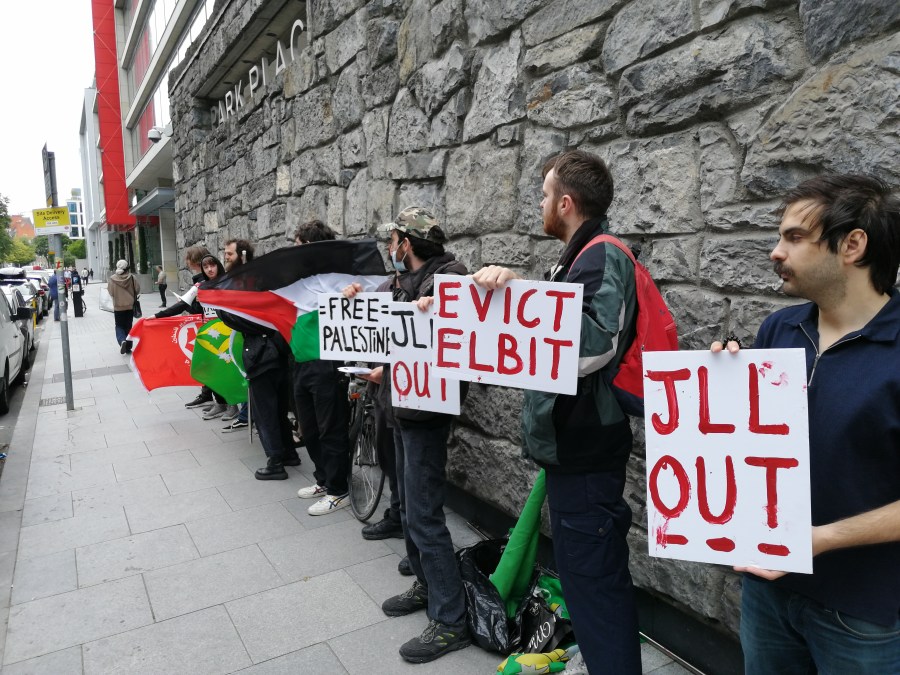
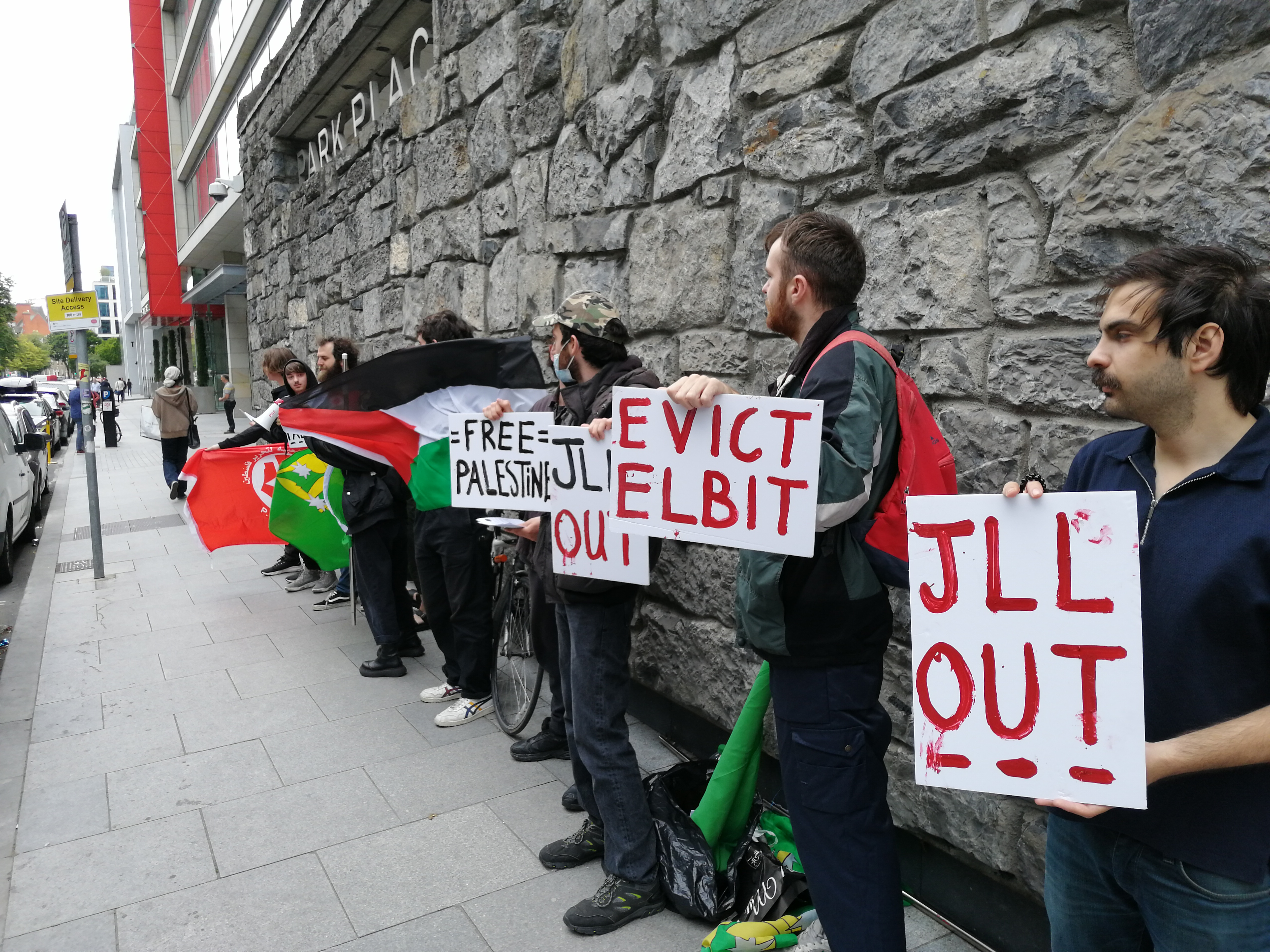
Hatch street in Dublin is an unusual venue to hear the sounds of a political protest but that was where a protest took place Friday, outside the headquarters of Jones Lang LaSalle, an Anglo-US real estate and investment multinational.
Section of the protesters. (Photo: D.Breatnach)
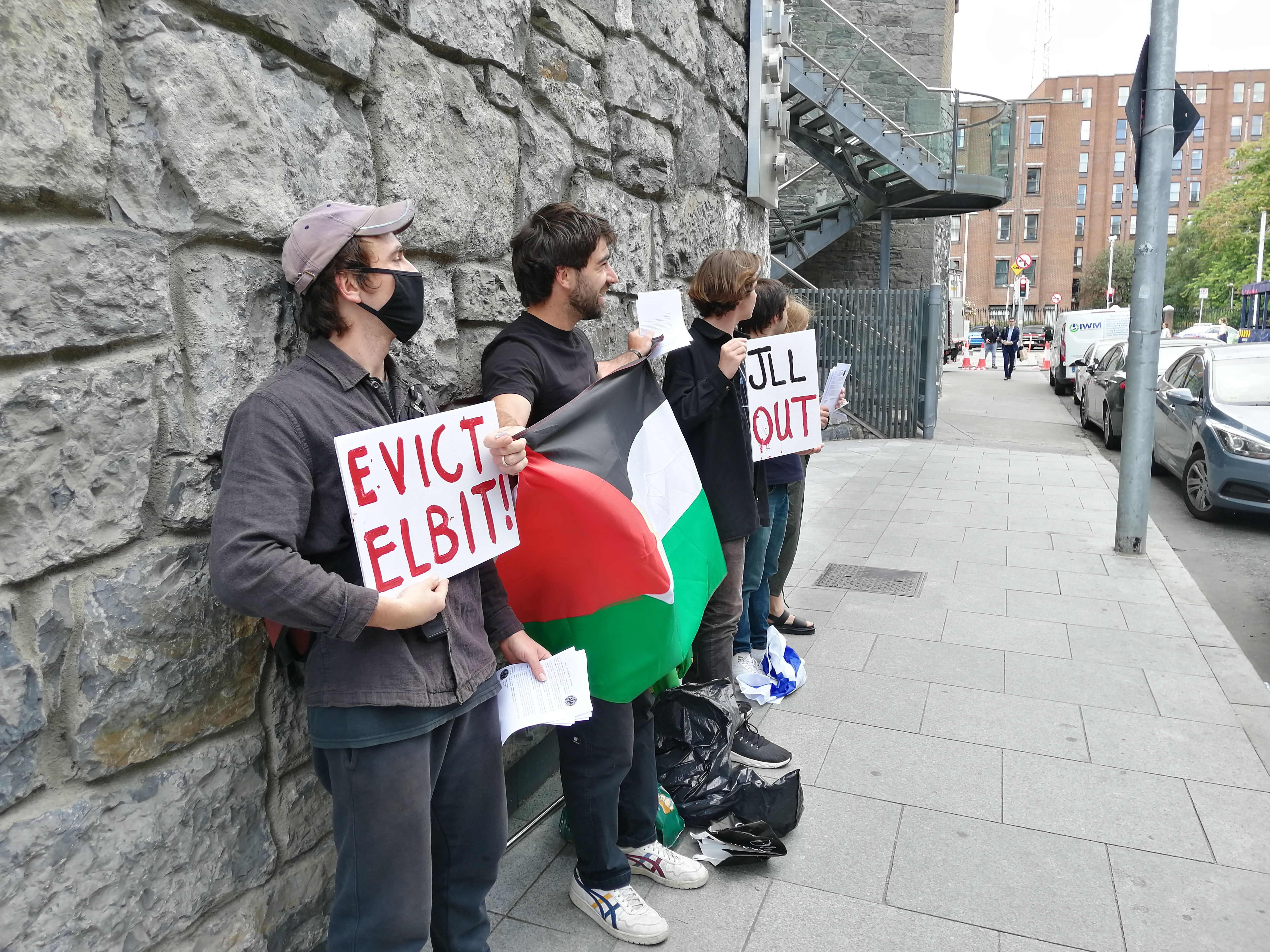
The lunchtime protest was organised by the Anti-Imperialist Action organisation in protest at JLL’s complicity in what they called “the occupation and genocide in Palestine.”
In a leaflet handed out to construction workers, office workers and passers-by, AIA stated that JLL “work with Elbit Systems, the largest private arms supplier for the occupation” and that last year “their CEO boasted about ‘a significant increase in (its) activity in Israel’ “.
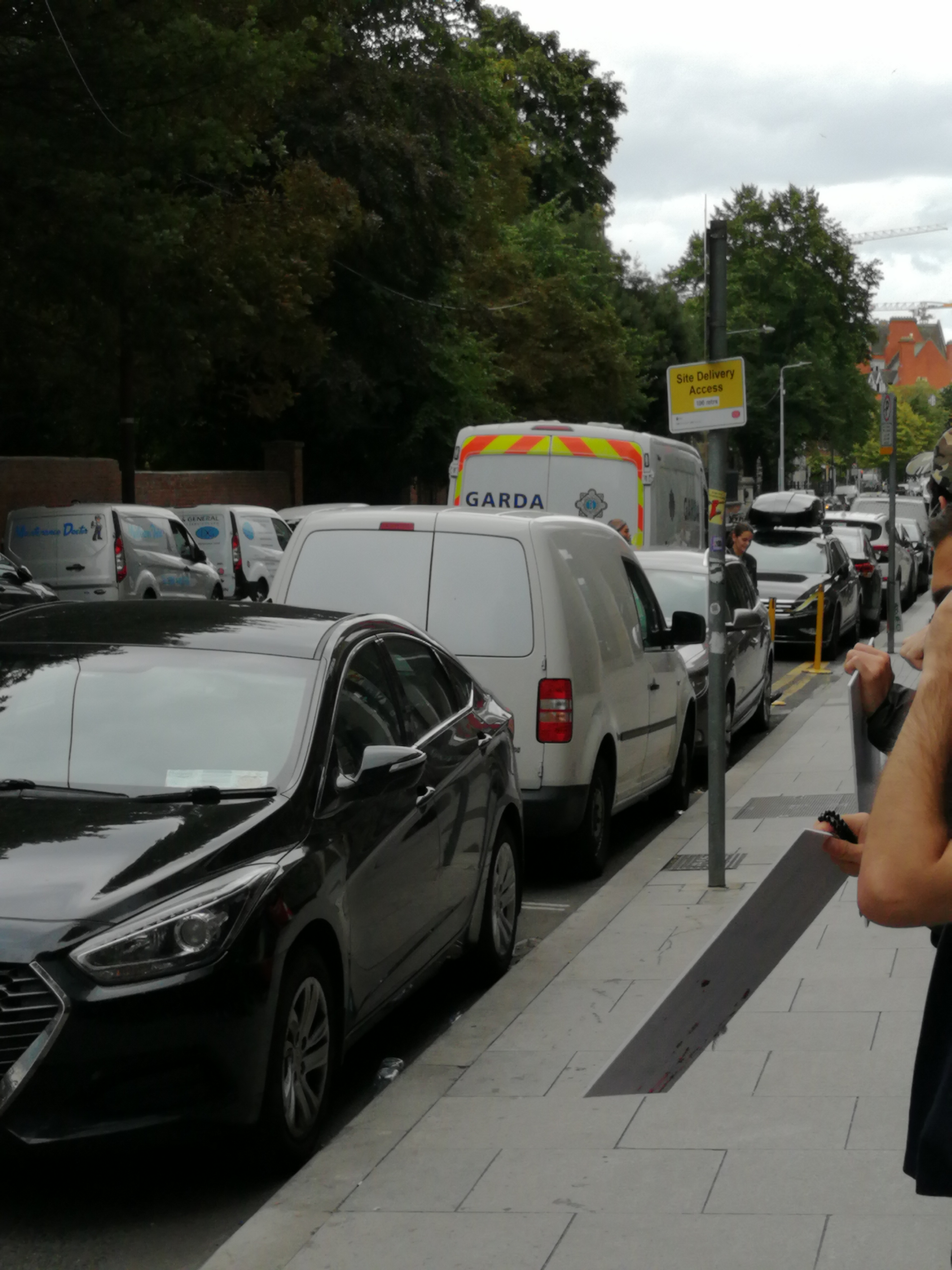
The Garda van as part of the State’s protection for the JLL building (Photo: D.Breatnach)
The leaflet also pointed out that “Palestine Action, a group in England and Scotland, have successfully shut down two of Elbit’s sites through … direct action” against the companies.
Also pointed out in the leaflet was the result of property management companies in stoking the housing crisis and also commented on the colonial history of Ireland and its solidarity with the Palestinian people.
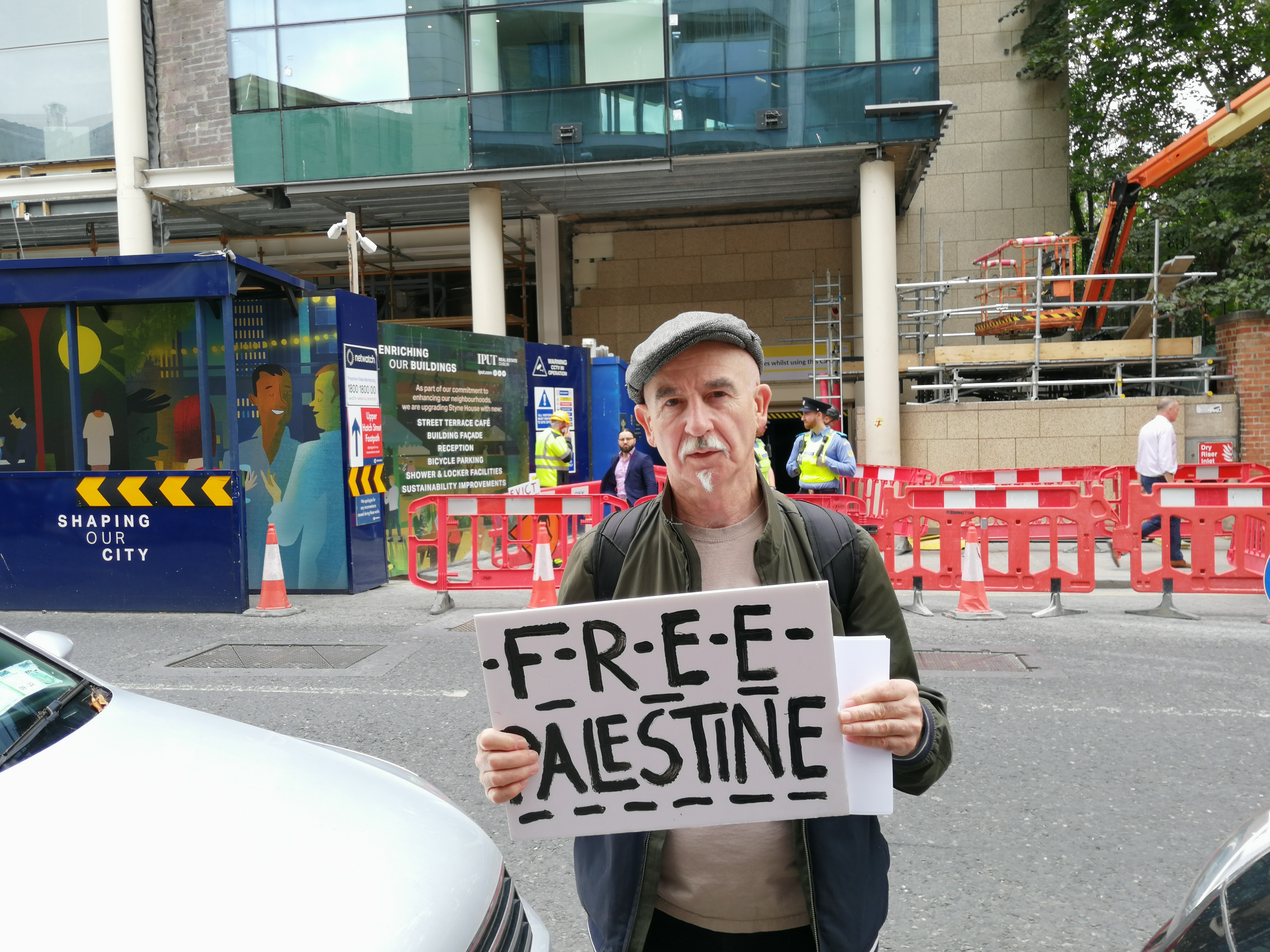
The protest photographer, JLL building and some Garda protection in the background.
The picketers displayed placards along with flags: the Starry Plough, Palestinian national flag and another of the PFLP, one of the Palestinian liberation organisations. They regularly shouted slogans against the Israeli occupation, in solidarity with Palestine and against the JLL organisation.
Gardaí (Irish police) arrived to protect the JLL building but there were no incidents. The reaction of those who accepted a leaflet varied from non-committal, through curious to supportive.
















 rebelbreeze