“A GREAT NIGHT” AT SECOND SOLIDARITY SESSIONS

Clive Sulish

(Reading time: 3 mins.)

An Irish punk rock band, Mongolian throat-singers, a poet and Irish folk singers all performed at Solidarity Sessions No.2 to a good crowd in the International Bar, in in Dublin City centre Wicklow Street on Wednesday 17th..

An Irish and international resistance theme in decor was presented by flags of the Starry Plough and Palestine with Saoirse don Phalaistín as stage backdrop, while flags respectively of Cumann na mBan and Basque Antifa concealed the original decor’s ubiquitous photos of Michael Collins.

Flesh B. Bugged performing (Photo: Dermo Photography)

A PFLP1 flag was also taped to a wall. Hand-written signs on the stairs leading to the basement venue, alternatively in Irish and in English, asked for quiet/ ciúnas for the performance/ racaireacht. The Irish language was present too in some of the performances to follow.

MC for the night, Jimi Cullen, himself a singer-songwriter activist told the crowd the purpose of the organising collective was “to build a community of resistance and solidarity with our struggles and with struggles around the world” through culture in a social atmosphere.

Before the crowd — a flag temporarily changing the decor. (Photo: R. Breeze)

Themes of love, nature and emigration were covered in song; however the dominant theme was resistance – to prison regimes, foreign occupation, fascism, class oppression, racial discrimination – and solidarity with the struggles of others, near and far.

Diarmuid Breatnach, singing acapella kicked off the night with a selection of songs from the Irish resistance tradition and a couple of short ones from the USA civil rights movement. Some of the melodies however, of particular interest perhaps to Back Home in Derry2, were his own originals.

Diarmuid Breatnach performing (Photo: Dermo Photography)

Eoghan Ó Loingsigh, accompanying himself on guitar followed with more material from the same tradition, dedicating one to his late IRA father. A folk song Ó Loingsigh announced as ‘non-political’ performed acapella turned out to be very much political but on the issue of social class.

Áine Hayden followed with poems on a range of topics, from swimming in the Royal Canal during the Covid shut-down, deleting a personal relationship to a dedication to comedian and activist Mahmoud Sharab murdered with family in a “safe zone” tent by the Israeli Occupation Force.

Eoghan Ó Loingsigh performing (Photo: Dermo Photography)

The three performers were all introduced as activists as well as artists and the mostly-young crowd, apparently containing a strong representation of political and social activists, responded well to the performers with applause, yells of encouragement and often joining in on choruses.

More people arrived before, during and even after the break – including an elderly couple who had just arrived from the USA and could only pay in dollars but were admitted for free. Leaving later with thanks they promised a contribution to Palestine solidarity when they got home.

Before the crowd — a Cumann na mBan flag temporarily changing the decor. (Photo: Dermo Photography)

Also an activist, Ru O’Shea sang an Irish, Scottish, French and Italian selection, accompanied by bouzouki and guitar and performed a spoken word piece with a refrain of ‘Éire under attack’ before schooling the audience to sing the chorus of Robbie Burns’ Green Grow the Rushes Oh!

Áine Hayden performing (Photo: Dermo Photography)

Nomads were the next act. Composed of two Mongolian musicians playing violins in the style of the viola and a Dubliner modulating on a sound deck they were unusual enough but it was the amazing throat-singing of one of the Mongolians that had the audience enthralled.

It was amazing to learn that there are three different kinds of Mongolian throat-singing and then to hear them performed, one of which was a kind of whistling with a vibrating bass undertone wavering through it. The applause, particularly when they concluded, was rapturous and sustained.
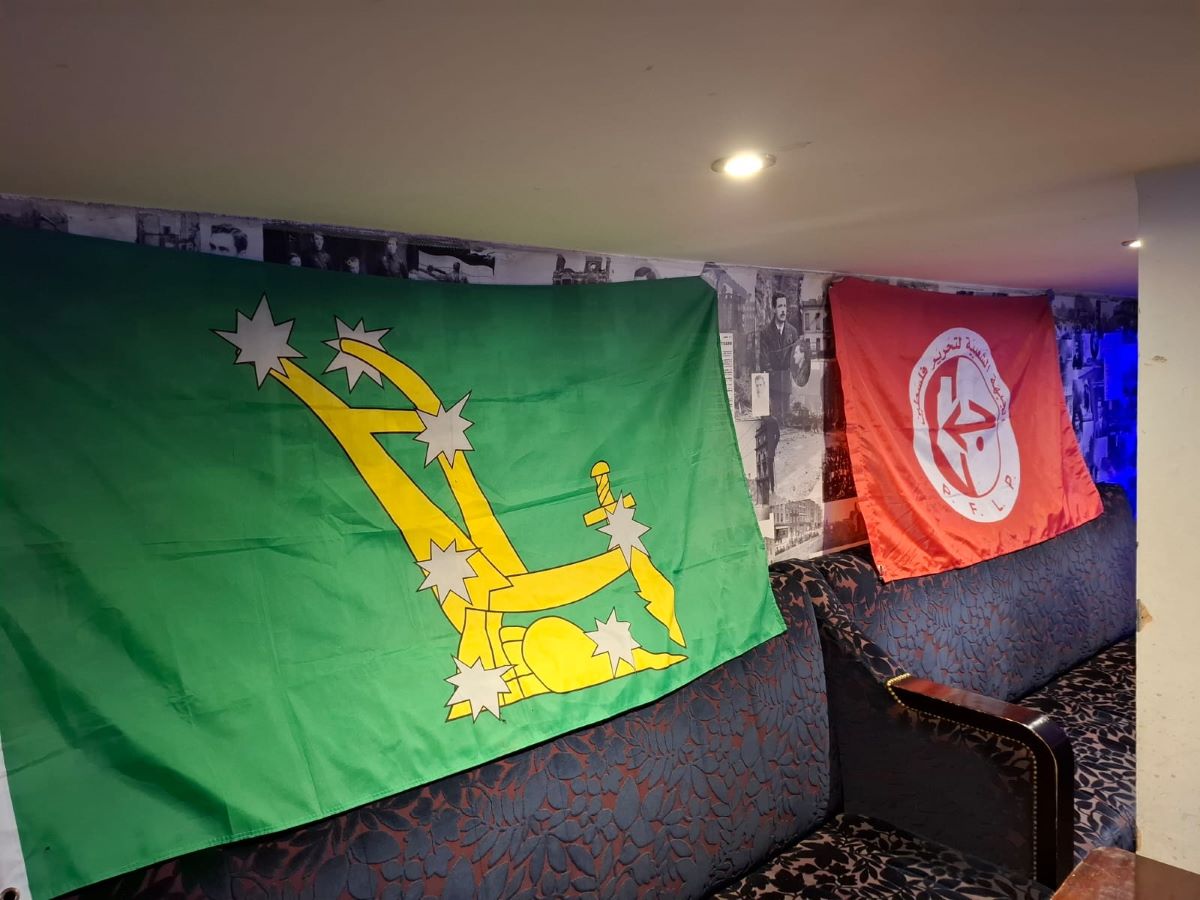
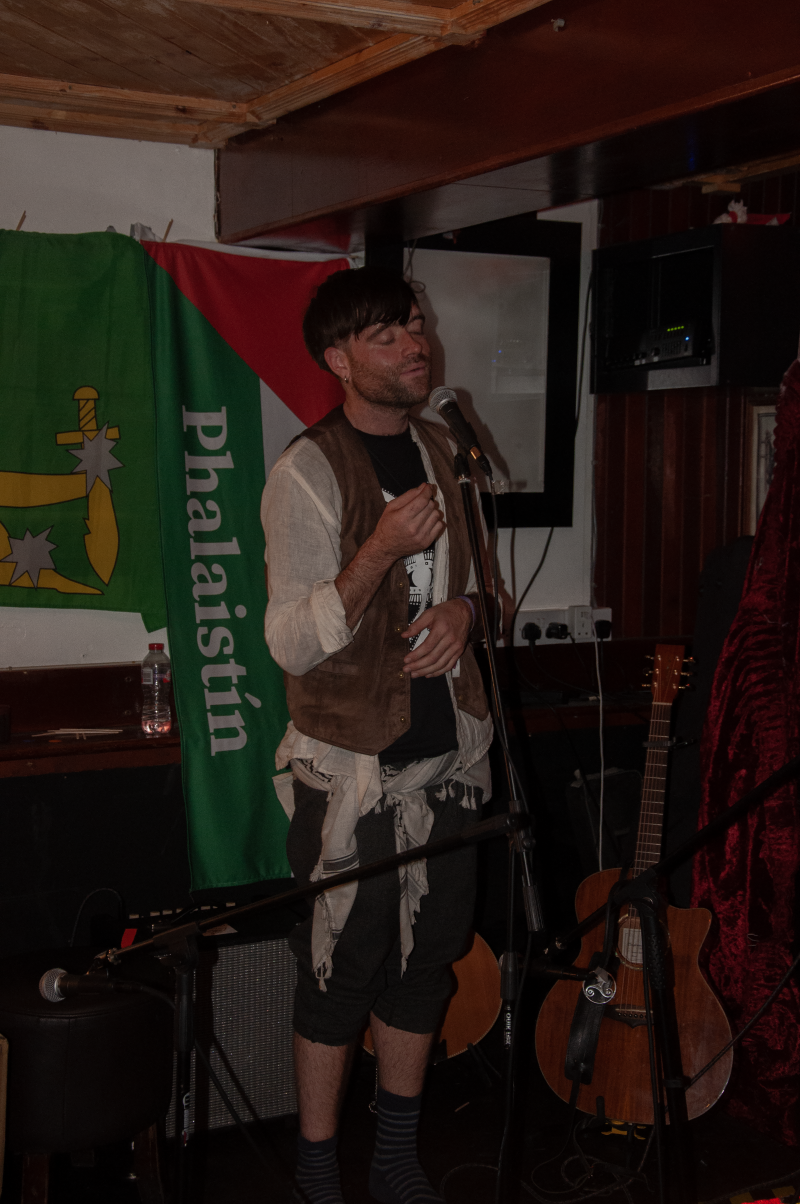
Before the crowd — flags temporarily changing the decor. (Photo: R. Breeze)
Ru O’Shea performing (Photo: Dermo Photography)

The evening’s entertainment concluded with Flesh B. Bugged, a punk rock Irish duo of bass guitar and drums with spoken voice pieces in Irish from the bass guitar player. Their volume and beat got some of the crowd up and dancing and the wider crowd responded well to them too.

MC Jimi Cullen went up on stage for the last time to thank venue, performers, audience, doorkeepers, poster designers Ríona and Azzy O’Connor, also Diarmuid for original artwork. At a prompt from the crowd Cullen also got a round of applause from the audience for his MCing.

The Mongolian musicians of Nomads performing (Photo: D.Breatnach)

Remarking they’d “had a great night” and encouraging his listeners to follow the organising collective on its Instagram page, Cullen told them that details of Solidarity Sessions No.3 and the collective’s decisions on recipients of donations from money raised would be posted on there.

Diarmuid Breatnach told the audience that each individual could help build a community of resistance through attending the Solidarity Sessions and encouraging others to attend. He welcomed any ‘competion’ from solidarity sessions around the country.
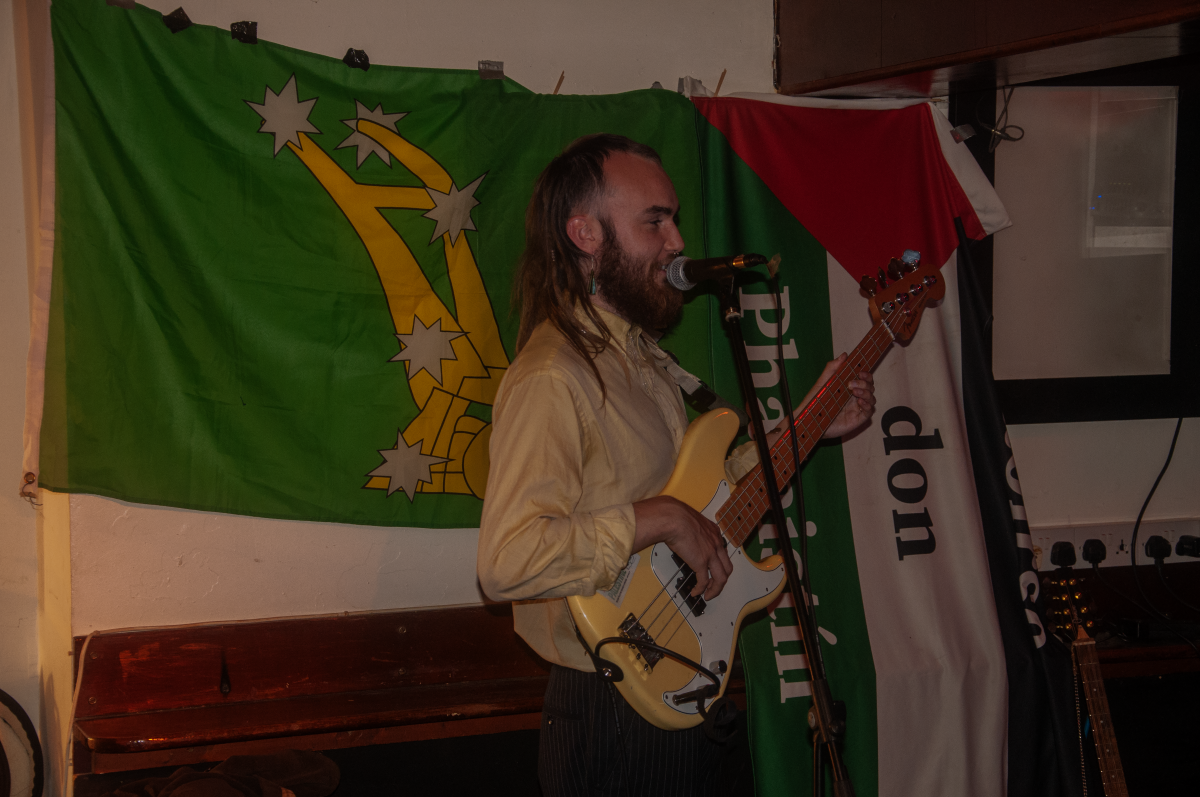
Bass guitarist of Flesh B. Bugged (Photo: Dermo Photography)

The downstairs area of the International Bar is not perhaps the best layout for this kind of event but it worked out well enough for the collective, audience and performers on the night. Their next event will be back at their launch venue,The Cobblestone, Smithfield on Thursday 30th October.

End.

Note: If you found this article of interest, why not register with Rebel Breeze for free, so that you will be notified by email of subsequent articles. You can de-register any time you wish.

The Mongolian throat-singer in Nomads (Photo: Dermo Photography)

FOOTNOTES

1People’s Front for the Liberation of Palestine, one of two specifically secular armed resistance organisations in Palestine.

2Irish mega folk singer Christy Moore had organised Bobby Sands’ poem into song to the melody of The Wreck of the Edmund Fitzgerald by Gordon Lightfoot.

USEFUL LINKS
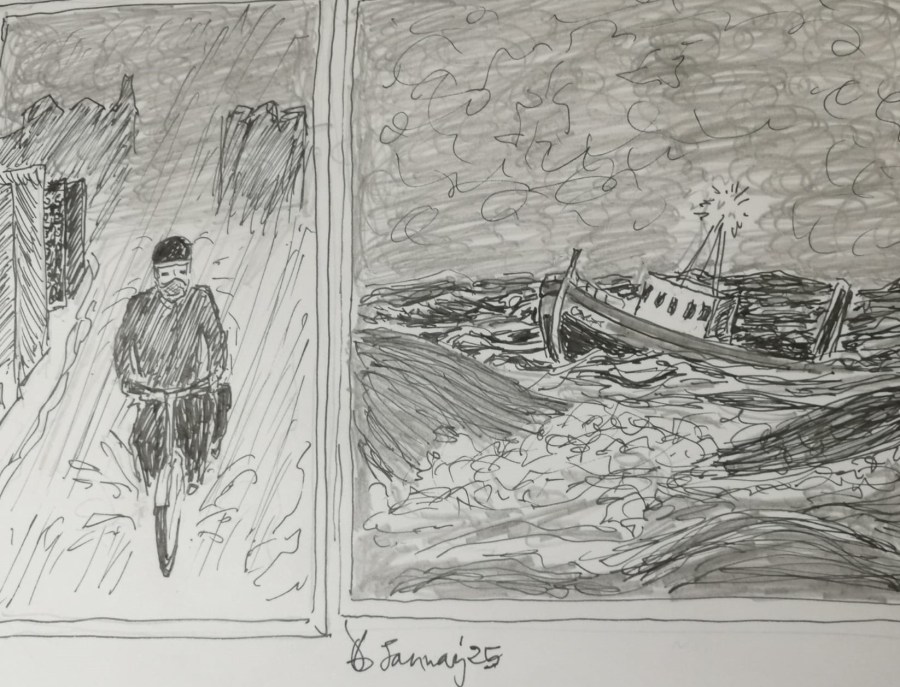
@solidaritysessionseire

WHY BOMB DUBLIN AND MONAGHAN?

Diarmuid Breatnach

(Reading time: 9 mins.)

Thirty-five people were killed by bombings on 17th May 1974, the most in one day during the recent 30 Years War but outside of Ireland and even within it, most people are unaware of that fact. That’s because the perpetrators were not the IRA.

And probably also because the victims were killed not just in Ireland but within the Irish state. Also no doubt because the perpetrators were Loyalists led by British Intelligence.

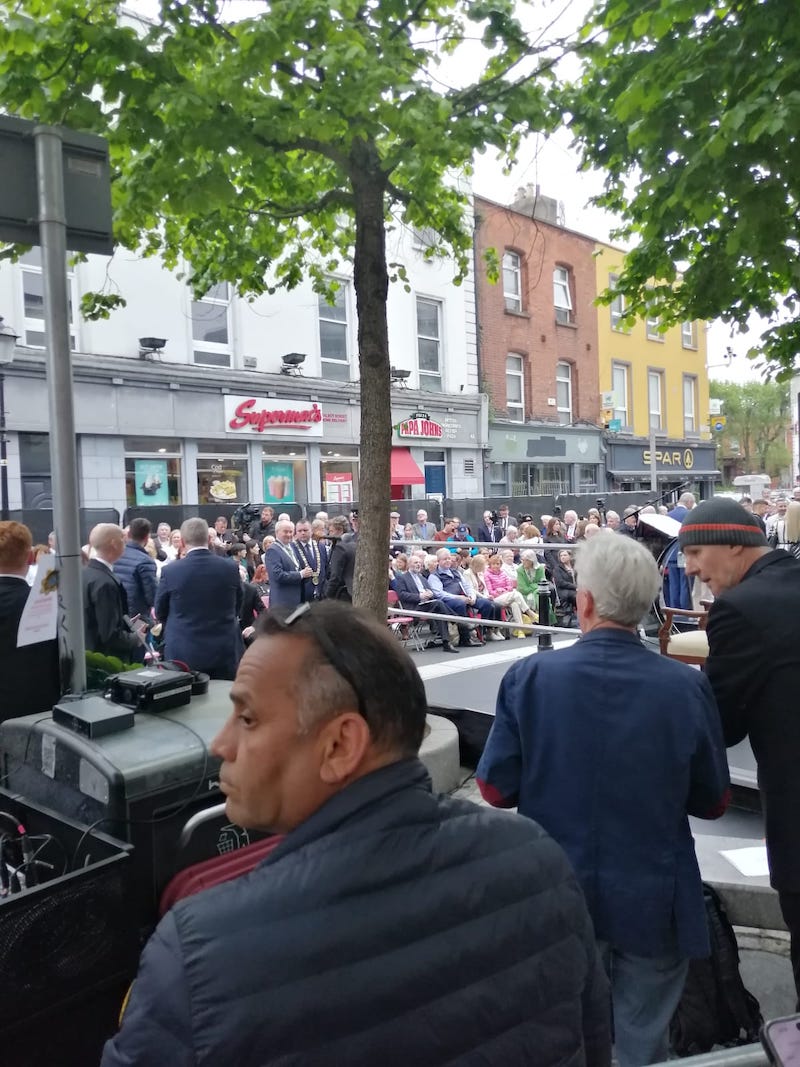
Section of westward end of attendance at event as President Michael D Higgins approaches (just out of view)(Photo: D.Breatnach)

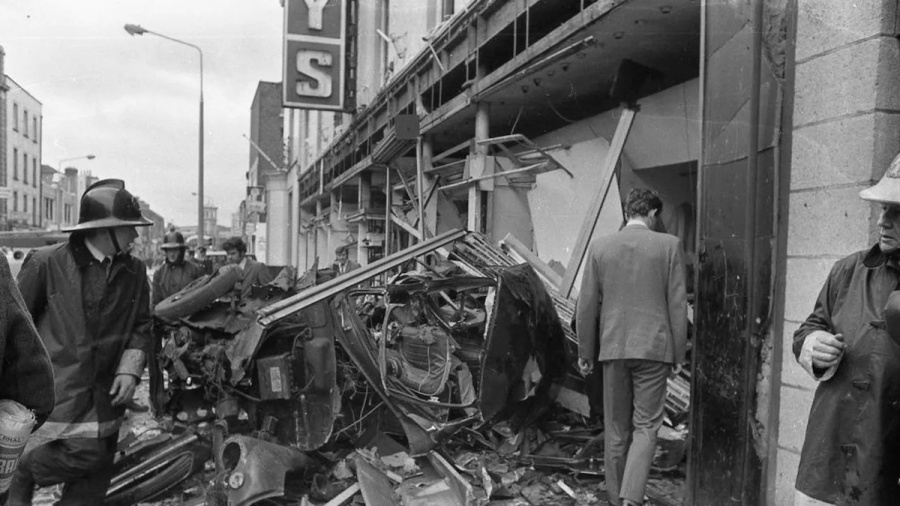
Three bombs exploded on that day in the middle of a rush hour in Dublin City Centre: Talbot Street, Parnell Street and South Leinster Street. Somewhat later, a bomb exploded also in Monaghan Town. Altogether 35 were killed1 and “about 300”2 injured, some permanently.

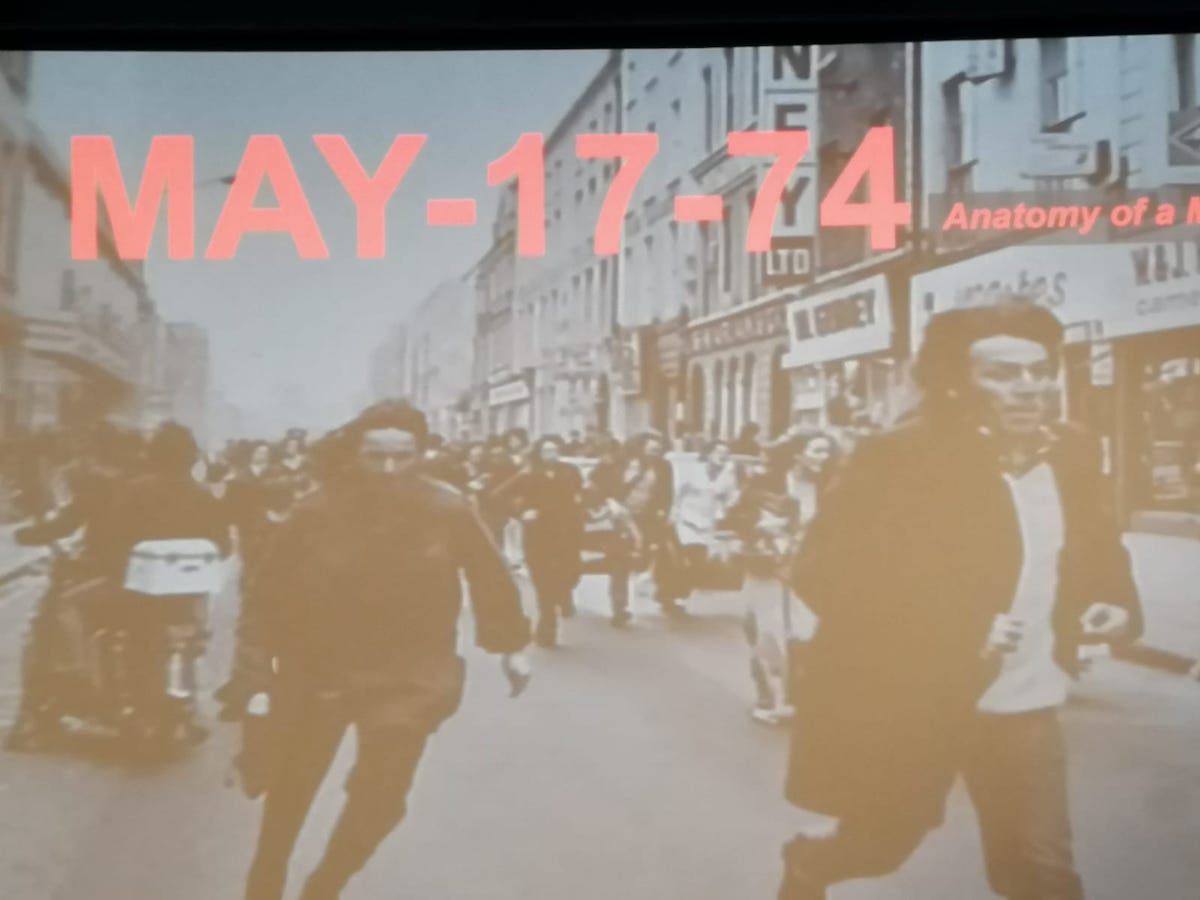
The names of some of the victims being displayed at the premiere of the Anatomy of a Massacre documentary. (Photo: D.Breatnach)

Within days and perhaps hours a number of suspects among Loyalist murder gangs had been identified but they were not arrested or even questioned about the atrocity – no-one ever was. Despite that, the Gardaí closed the case investigation seven months afterwards that same year.

A new documentary on the atrocities by Fergus Dowd was premiered in Dublin on Friday to two full screen auditoria in the Lighthouse Cinema, Smithfield, featuring interviews with witnesses, victims and relatives of victims, a former Taoiseach and a former State forensic scientist.

May-17-74 Anatomy of a Massacre is directed by Joe Lee and produced by Fergus Dowd.

The forensic expert had been given very little of the remains of cars containing the bombs since most had been sent to the RUC (colonial police) for their analysis (!) from which nothing useful emerged but he was able to determine that a high amount of amatol had been used.

At that time only the IRA among “paramilitary organisations” had the expertise to develop that explosive material which leads commentators to believe that the Loyalists received the necessary quantities from those seized from the IRA and held by the British armed forces.3

Given that many of the Loyalists involved were members of the Ulster Defence Regiment, a British Army unit, on the face of it the explosives could have been directly supplied by the British Army or indirectly obtained through the UDR as members of the British Army.

Nothing adverse is known about the Garda Commissioner who sent the exploded car remains to the colonial police but his Deputy and successor was Ned Garvey and whistle-blowing British spook Fred Holroyd claimed Garvey was a British Intelligence “asset” and to have met him in Dublin.

Confronted with this exposé years later Garvey admitted having met Holroyd but not to being a British spy – though he had not informed his superiors of his meeting with a foreign secret service agent. 4 Sadly this is not alluded to in the documentary.

As documented in Anatomy there had been a Loyalist bombing campaign of Dublin since 1969,5 with those in 1972 and 1973 killing between them three transport workers and no-one had been arrested by Gardaí or extradition sought in connection with even those fatal explosions.

No documentary about the bombing was made by RTÉ, the Irish broadcaster until 2004, thirty years after the atrocity.

However a much earlier documentary was by British company Yorkshire Television on ITV in 19936. RTÉ had declined the offer of joint screening and many people in Ireland who did not have access to ITV at the time missed it or had to go to a friend or relative to view it.

The British documentary was mentioned only in passing by one of the interviewees in Anatomy but without reference to RTÉ’s declining of the offer of joint screening.

British spook whistleblower Colin Wallace states that he was obliged to report on every meeting he had with Loyalists or others and his erstwhile bosses would have kept those papers, as they would have for the MI5 operatives who steered the bombing gang for Dublin and Monaghan.

The existence of MI5 documents that would throw much light on the bombings was referred to a number of times in Anatomy and the Justice for the Forgotten campaign keeps seeking them. Irish Government ministers regularly state that they have requested them but are always refused.

Missing from the documentary was what is now known of the secret contemporary memos of Arthur Galsworthy, British Ambassador to the Irish state: It is only now that the South has experienced violence that they are reacting in the way that the North has sought for so long …

… I think the Irish have taken the point.

Galsworthy also noted that the Irish Foreign Affairs Minister Garret FitzGerald told him that “the government’s view was that popular hostility appeared to be directed more against the IRA“.

In the immediate aftermath of the bombing, both Liam Cosgrave for the Government and Jack Lynch for the Opposition sought to widen the blame to include Irish Republicans.7

VIEWING THE DOCUMENTARY

Two screens at the Lighthouse cinema were fully booked to view the premiere.

The documentary is fascinating and some of the witnesses and relatives really excellent in their descriptions and commentary. Others interviewed pulled no punches in castigating successive Irish governments for closing the investigation and allowing it to remain closed.

Some, too, alleged a conjunction of interests between the Irish and UK states in ensuring the truth about the perpetrators and the Irish State’s reaction never surfaced.

Many people prominent in Irish political circles at different ends were present to see the premiere and after a few words from Margaret Unwin, Coordinator of the Justice for the Forgotten campaign, along with filmaker Dowd, the Resistance Choir sang their song composed about the bombing.

The Resistance Choir performing their song about the bombing massacre (Photo: D.Breatnach)
Section of crowd from the Monument eastward (Photo: D.Breatnach)

Justice for the Forgotten organise a commemoration of the atrocity every year at which some music and poetry is performed, along with speeches by politicians representing the Irish State, and the local authority Councils of Dublin City and Monaghan and another individual or two.

Some of what is said there I have welcomed and some disliked but most of all I detest Ministers in the Irish Government coming there to tell us how they want the British State to release their secret documents regarding the event but never have any action to pressurise its Ministers in mind.

Cormac Breatnach playing low whistle at event (Photo: D.Breatnach)

This year, the 50th anniversary, the event took place after noon on Friday 17th May with a large crowd but only one speaker listed, President of the Irish State Michael D. Higgins, with traditional Irish music from Cormac Breatnach and Eoin Ó Dillon, a duo performing at the event for years.

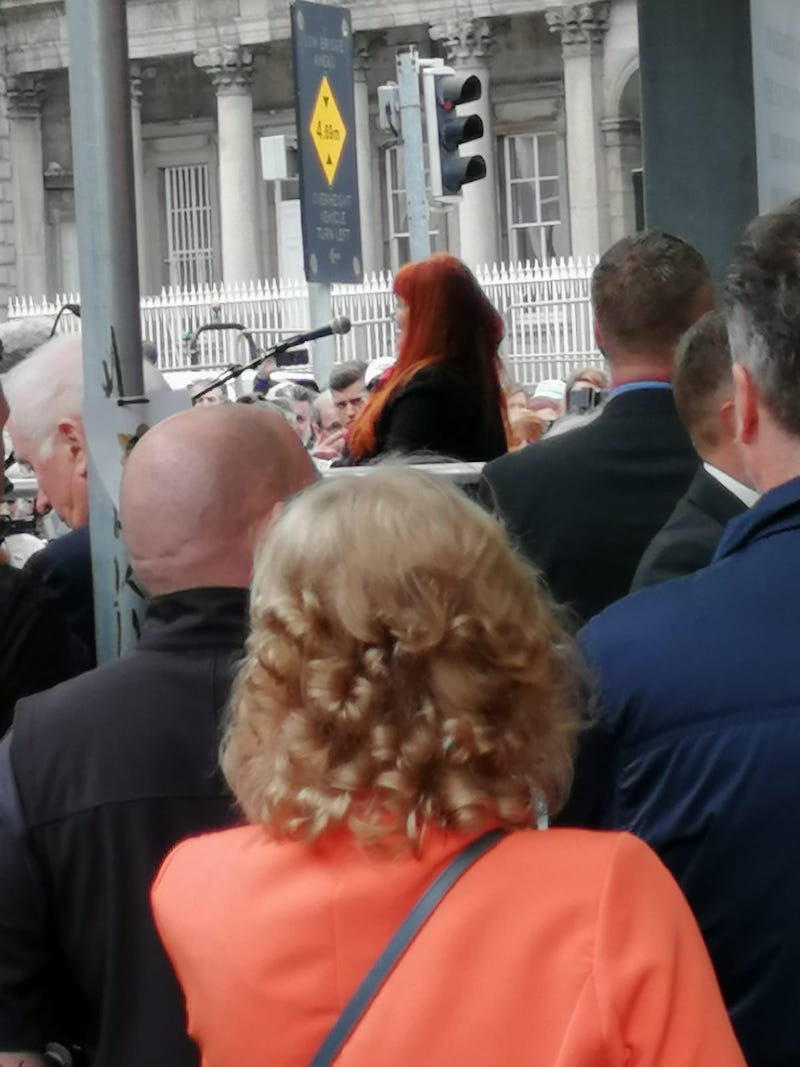
Eoin Ó Ceannabháin sang The Parting Glass and poet Rachel Hegarty performed her poem about the bombing. But there was a surprise speaker also, an Italian from Breschia who also referred to state collusion in a bombing against an anti-fascist rally in his home town the same year, a few weeks later.

Poet Rachel Hegarty performing her poem about the event (Photo: D.Breatnach)

The MC of the event, Aidan Shields, son of fatal victim Maureen, told the audience to applause that Justice for the Forgotten would be sending a delegation to Breschia for the 50th commemoration of the atrocity in their town.

At left, Aidan Shields, son of fatal victim and MC at event, with Monument to the victims centre (Photo: D.Breatnach)

WHY THE BOMBING?

Trainee journalists are told to answer the ‘Five Ws’ in their reports: who, what, where, when and why.

The answers to four of those questions have been known for decades: Dublin and Monaghan is where; 17 May 1974 was the when; the bombing atrocity was the what. The who were the Loyalists and British Intelligence. But nobody seems to attempt to answer the why – or even to ask that question.

For the earlier 1972 bombing, the “why” is clear: to get the Irish parliament to vote for the Amendment to the Offences Against the State Act.

And they were successful in that since, all logic to the contrary, some of the Opposition decided to believe that the bombing was the work of Irish Republicans. So we now have that no-jury political court and senior Gardaí can give ‘evidence’ unseen by the accused from Garda “secret files”.

Apart from the guidelines of journalism, there are also those with regard to criminal investigations, which outline the importance of motive and opportunity. The British secret service certainly had opportunity – but what was their motive?

A bombing such as that in Dublin on 1974, in the Irish State’s capital city, is a message to the Irish ruling class (though the victims be different) were the. And from the British state through their intelligence service, which would hardly dare to carry out such an attack without at least the endorsement of their masters.

So the message was … what? “We will bomb your capital city if you don’t do what we want or if you do what we don’t want”? But the Irish ruling class was already cooperating about as fully as possible with the occupation in the Six Counties and repressing resistance in the Twenty-Six.

A similar campaign occurred in the 1980s, in the Basque Country within the French state (mostly). The Spanish Government waged a terrorist campaign8 of bombings, kidnappings and assassinations against suspected activists of the armed Basque liberation group ETA.

It seemed that what the Spanish authorities wanted was for the French to turn over Basque activists who were on the “French” side of the Border to the Spanish authorities, something the French had been unhappy to do, the Guardia Civil believed to be torturers even after Franco’s death.

After some of those bombings, the social-democratic French Government led by Mitterand began to hand over Basque activists to the authorities across the border, sometimes without even going through the official extradition procedures.

The Irish State did also permit extradition of Irish Republicans to the Six Counties (and later to Britain too) after the Dublin and Monaghan bombings, but not until ten years later, with Dominic McGlinchy, which hardly looks like the effect following its cause.

The Sunningdale Agreement had been signed in December 1973 which proposed some kind of power-sharing between nationalists and unionists with a role for the Government of the Irish state against which the Loyalists of the Ulster Workers’ Council had organised a general strike.

A British whistleblower, Colin Wallace claims that the bombing was a warning to the Irish ruling class to keep their fingers out of the colony.

VICTIMS AND RULING CLASS

Apart from not answering or even seeking the motivation for MI5 to arrange and oversee the bombing, I have not seen any discussion of the class nature of the locations. The bombings of 1972 and 1973 targeted transport workers.

But the bombings on the north side of the river in areas to the east of O’Connell Street also took place in areas where working and lower middle-class people worked, shopped and got on to the public transport buses. This hardly seems accidental.

Aftermath in Talbot Street facing westward with Connolly Station tower in far background (Photo: PA)

A part of MI5’s message could have been: “This time it was mostly the kind of people nobody (who are in power) cares about, so be thankful. Next time we might hit the north-east centre around Henry Street, or areas around Trinity College, Dame Street and Grafton Street on the south side.”

One other point that is rarely made is that the bombing and the State’s reaction to it showed the totally craven and foreign-dependent nature of the Irish ruling class, to allow their capital city to be bombed by another state without seeking revenge or even restitution.

The French state made a deal with the Spanish after some bombs exploded in territory to which it laid claim but does anyone believe the result would have been the same if the Spanish terrorist groups had bombed Paris?

End.

FOOTNOTES

1 Some accounts give a total of 34 or 35 dead from the four bombings: 34 by including the full-term unborn child of victim Colette Doherty, who was nine months pregnant; and 35 by including the later still-born child of Edward and Martha O’Neill. Edward was killed outright in Parnell Street.

2 https://en.wikipedia.org/wiki/Dublin_and_Monaghan_bombings

3 Whether as a gift or stolen from the stores.

4 When Fianna Fáil came into government, they sacked Garvey but presumably not wanting to expose British Intelligence penetration of the Irish State’s management upper echelons, gave as a reason only that they had no confidence in him. This opened the way for Garvey to claim wrongful dismissal and win, giving him a payout and retaining his pension. Garvey was also important in running the notorious “Heavy Gang” within the Special Branch.

5 The Wolfe Tone Monument in Stephens Green had been blown up and the O’Connell monument, the Glasnevin ‘Round Tower’ had also been bombed.

6 “Yorkshire Television broadcast a documentary entitled ‘Hidden Hand – the Forgotten Massacre‘ made as part of its ‘First Tuesday‘ series. The programme dealt with the Dublin and Monaghan bombings of 17 May 1974. [The programme came to the conclusion that the Ulster Volunteer Force (UVF) would have required assistance to carry out the bomb attacks. There was speculation as to where such assistance might have come from. While no firm conclusions were reached, it was suggested that the security forces in Northern Ireland were the most likely source of help. Allegations concerning the existence of a covert British Army unit based at Castledillon were considered; as well as alleged links between that unit and Loyalist paramilitaries. It was shown that Merlyn Rees, the former Secretary of Sate, had known of the unit’s existence. On 15 July 1993 the UVF issued a statement in which it claimed sole responsibility for the Dublin and Monaghan Bombings.]” https://cain.ulster.ac.uk/events/dublin/chron.htm

7https://en.wikipedia.org/wiki/Dublin_and_Monaghan_bombings (The Aftermath)

8 Mostly using the GAL (Grupos Antiterroristas de Liberación [sic]) cover name.

SOURCES& USEFUL LINKS

Justice for the Forgotten campaign: https://www.patfinucanecentre.org/projects/justice-forgotten

https://en.wikipedia.org/wiki/Dublin_and_Monaghan_bombings

https://cain.ulster.ac.uk/events/dublin/chron.htm

Breschia fascist bombing: https://en.wikipedia.org/wiki/Piazza_della_Loggia_bombing

BOBBY SANDS – FREEDOM FIGHTER AND BEACON FOR THE DIASPORA
Diarmuid Breatnach

(Reading time: 6 mins.)

The anniversary on Sunday of the death on hunger strike of IRA Volunteer Bobby Sands was marked with a number of posts on social media. I would like to add an Irish migrant’s1 perspective and some analysis of his legacy.

The Irish diaspora was a powerful sector in solidarity for the Irish struggle not only because of their cultural background but also because of their numbers. Some British cities had an estimated diaspora population of 10% (Irish-born and 1st and 2nd generations).

Furthermore, the higher proportion of those in turn was of the working class, a section of society which, although they in no way had their hands on the standard levers of power, certainly had a strong potential of the kind the British ruling class had learned to fear.

Irish Republicans of course formed part of that sector and organised within it but on the other hand the IRA’s bombing campaign in Britain was of no help at all. The popular fear of being caught in an explosion greatly enabled the Government to tighten the screws under the guise of “security”.

Karl Marx, a strong supporter of Irish freedom had commented after the Clerkenwell prison bombing of 18672 that “One cannot expect the London proletarians to allow themselves to be blown up in honour of the Fenian emissaries” (i.e who they were trying to free from the jail).

In 1974 the Labour Government had repressive legislation ready and on 29 November, using hysteria arising from the Birmingham and Guildford pub-bombings they rushed through the Prevention of Terrorism Act (1974) which permitted the holding of suspects for two days without charge.

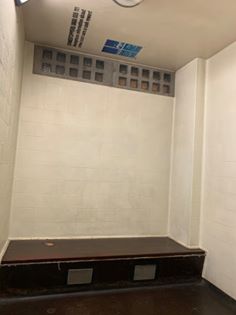
An underground cell in London’s Paddington Green police station – this is where Irish detainees under the Prevention of Terrorism Act might be kept and interrogated for seven days without visitors or access to solicitor. “The old cells were 12-foot square, contained no windows and were reportedly too hot in the summer and too cold in winter(Wikipedia).(Photo: Posted in 2020 on Internet by Green Anti-Capitalist Front who occupied the empty building intending to turn it into community centre.)

That could be extended for another five days – and often enough was — by application to the Home Secretary. Access to solicitor was usually denied and though not lawful, the fact of the detention itself was often denied to concerned people making enquiries of the police station.

The prospect of disappearing for seven days into police custody somewhere was naturally terrifying and a ‘suspect’ could also be deported without trial to Ireland – even to the British colony of the Six Counties, which amounted according to their law to “internal exile”.

Snapshot of London police harassment and intimidation of Irish solidarity activists in 1981. (Photo sourced: Internet)

The framing of a score of innocent Irish people3 in five different trials4 with very heavy sentences added to the intended terrorising of the Irish community in Britain, the “suspect community”5, many of whom believed the victims to be not only innocent but most not even politically active.6

Irish solidarity activity in Britain diminished greatly after 1974 as state repression impacted across the Irish community. But the hunger strikes and concerns to save the lives of the strikers in 1981 broke the hold of state terror as people took to the streets in their thousands once again.

They were unsuccessful but never returned to that state of immobilising fear that had settled over the community.

The Irish in Britain Representation Group got its initial start in 1981 which happened as follows: the bourgeois Federation of Irish Societies had its AGM in May 1981 and one of the members proposed that a motion of sympathy to the Sands family be recorded when he died.

IBRG and Irish Republican POW Support Committee banners on march Birmingham 1984 (Source: Mullarkey Archive)

The meeting’s Chairperson ruled the proposal out of order and ‘the Fed’ continued with their ordinary business. The then Editor of the Irish Post7, writing in his “Dolan” column, found this disturbing and suggested there might be a need for a new type of Irish community association.

A number of individuals wrote in and the ball got rolling, though it took until 1983 to set up the branch-based organisation with a constitution and democratic safeguards in operational rules. The IBRG soon had a number of branches in London and others in the North and Midlands.

For the next two decades the organisation campaigned for the release of the framed prisoners, against the Prevention of Terrorism Act, strip-searching, all racism but in particular the anti-Irish and anti-Traveller varieties, for Irish representation in education, services, Census category, etc.

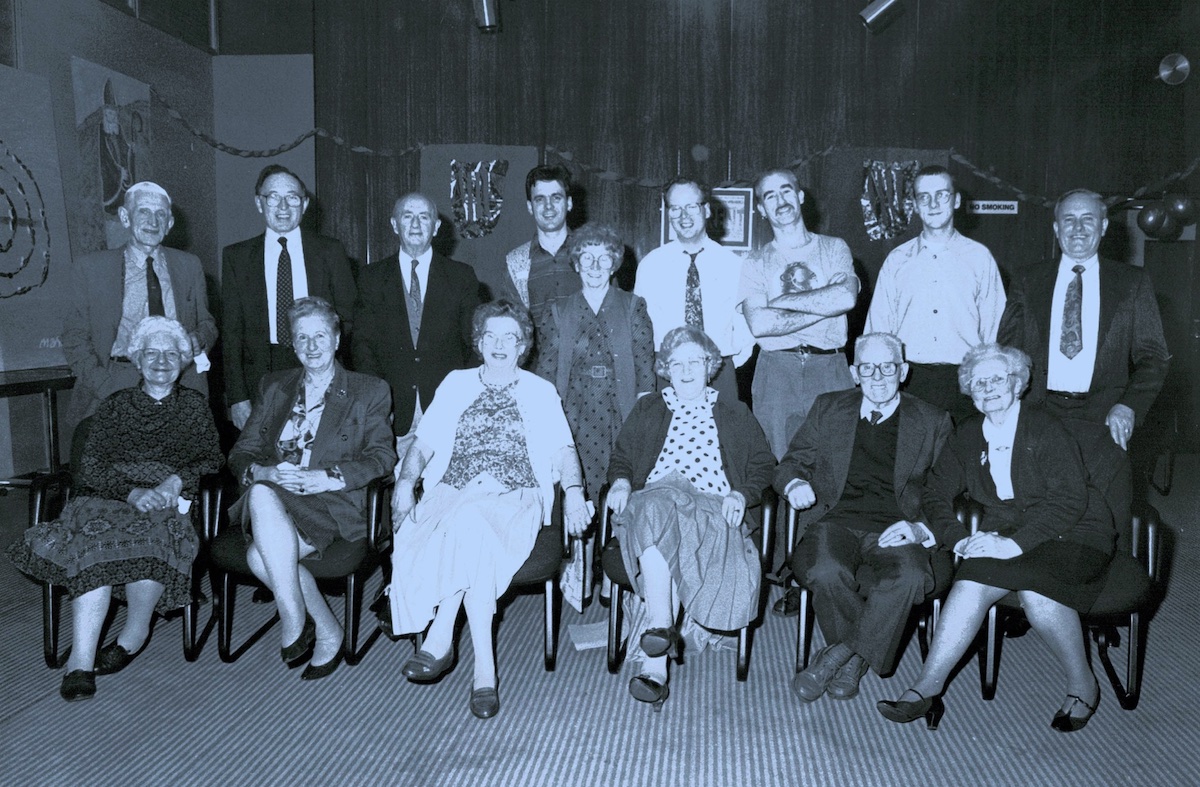
Lewisham Irish Centre Management Committee and Staff, possibly 1994. The Centre was campaigned for and won by the Lewisham Branch of the IRBG in conjunction with the Lewisham Irish Pensioners’ Association (which the IBRG had also founded).

The IBRG also called for British departure from Ireland and collaborated with other organisations in marches, demonstration, pickets, conferences, producing also a number of important report documents. The organisation’s officers were drawn from migrant Irish and those born in Britain.

THE LARK8 – a poem

Last night, from afar, I watched the Lark die

and inside me, began to cry,

and outside, a little too.

There’s nothing more that can now be done,

to save the life of this toilers’ son;

another martyr – Bobby, adieu.

Imperialism takes once more its toll,

another name joins the martyrs’ roll

and a knife of sadness runs us through.

But sorrow we must watch,

for it can still,

yes, it can kill

the song that Bobby listened to.

And if his death be not in vain,

let’s fuel our anger with the pain

and raise the fallen sword anew;

and this sword to us bequeathed:

let its blade be never sheathed

’till all our foes be ground to dust

and their machines naught but rust ….

Then will the servant be the master

and our widening horizons ever-vaster

and our debt

to Bobby

paid

as due.

(D.Breatnach, May 1981, London)

Bobby Sands Mural on gable end of a house in Belfast (Photo cred: Brooklyn Street Art)

REPRESENTATION OF BOBBY SANDS

Bobby Sands was a man of great courage whose leadership qualities were recognised by his fellow political prisoners when they elected him as their Officer Commanding in the H-Blocks. He was also an accomplished writer and poet.

When the British reneged on the agreement that ended the 1980 hunger strike and a new one was planned, Sands insisted on being first on the list, which also meant that in the event of resulting deaths, his would be the earliest.

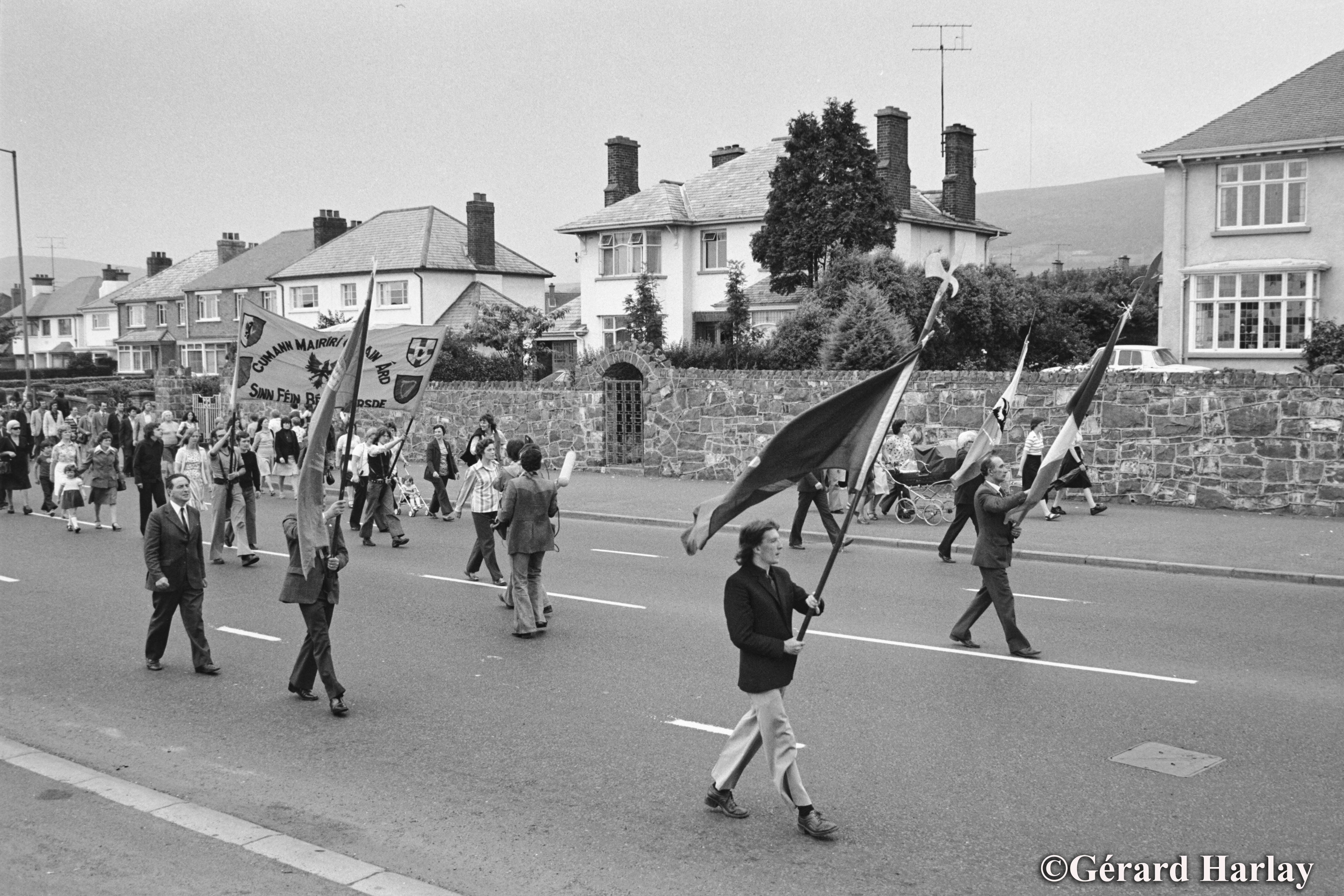
Bobby Sands (front left, colour party), Andersonstown Road,1976. (Photo: Gérard Harlay Archive)

Most people will agree easily with all the above evaluation of the man but from that point onwards, his representation is manipulated to suit different agendas, in particular those of pacifists, social democrats, liberals and a variety of opportunists.

Some of them love above all his quotation that “Our revenge shall be the laughter of our children”. They forget many other things he wrote and seek to turn him into an angel or saint of pacifism.

Since they embraced the pacification process, Sinn Féin try to represent Sands as an advocate for and proof of the effectiveness of participating in the parliamentary electoral system, based on his success in a 1981 Westminster by-election with 30,492 votes, 51.2% of the total of valid votes.

What both these groups fail to recognise is that Sands was an IRA volunteer and was sentenced for possession of handguns in 1972 and again in 1976. If he was an angel, it was of the Archangel type, fighting against what he considered evil.

He was proposed in the Fermanagh-South Tyrone by-election mainly in order to support the campaign of the prisoners against criminalisation and for the political status recognition that they had previously. Saving the lives of the hunger strikers was of course part of the plan too.

Nine protesting Republican prisoners contested the general election in the Irish State in June. Kieran Doherty and Paddy Agnew (who was not on hunger strike) were elected in Cavan-Monaghan and Louth respectively, and Joe McDonnell narrowly missed election in Sligo-Leitrim.

But that is a long way from proving that the electoral process is a viable way of dislodging the ruling class and their system and, in fact, history has proven the opposite.

Nobody knows what position Sands and the other nine would have taken on the electoral process had they lived. Possibly some would have gone along with the SF leadership on that and some others would now be reviled as “dissidents” (as are indeed some H-Block survivors).

All we can say for certain is that they were men of courage in that all of them had joined the armed struggle for Irish national liberation. They had even higher courage of a level hard to imagine, to risk and then experience slow physical disintegration and death by the day and by the hour.

Long after their erstwhile prominent enemies are forgotten, their names will shine in our history and Bobby Sands’s, the brightest of them all.

End.

FOOTNOTES

1At the time I was living and working in England.

2A bomb was planted against the prison wall to free a member of their group who was being held on remand awaiting trial at Clerkenwell Prison, London. The explosion damaged nearby houses, killed 12 civilians and wounded 120; no prisoners escaped and the attack was a failure. Michael Barrett was found guilty of the bombing despite his claim supported by witness testimony of having been in Glasgow during the bombing and was hanged on Tuesday 26 May 1868 outside Newgate Prison, the last man to be publicly hanged in England (the practice was ended from 29 May 1868 by the Capital Punishment Amendment Act 1868). https://en.wikipedia.org/wiki/Clerkenwell_explosion.

3Carole Richardson of the Guildford Four was not Irish but she was the girlfriend of one of three Irishmen.

4Birmingham Six, Guidford Four, Giuseppe Conlon, Maguire Seven and Judith Ward. They were not acquitted and released until decades later, by which time Giuseppe Conlon had died in jail.

5Suspect Community by Paddy Hillyard, Pluto Press (1993)

6Believing them innocent and not active worked even better to terrorise because if the likes of those could be framed and jailed, no-one was safe. But perhaps safest was to do absolutely nothing to draw the attention of the State.

7Brendán Mac Lua, co-founder of the Irish community newspaper in 1970 which is now a very different periodical.

8The lark is associated with Sands because he wrote a story about a man who had captured a skylark, a bird that unusually sings in flight. In the cage the bird would not sing so the man draped the cage with cloth and still the bird would not sing, nor would it do so when he refused it food and water until eventually, it died in the dark, silent to the last.

REFERENCES

Powers under the Prevention of Terrorism Act: https://cain.ulster.ac.uk/hmso/pta1974.htm

HERE, BUT THERE

Diarmuid Breatnach

(Ireland, Palestine)

Here, the leaves are dying,

There, the people are dying;

Here, the leaves are falling,

There, the bombs are falling.

Here it is the turn of season,

There, genocide’s the only reason.

The tree seems as though it died

It is not dead but now asleep;

Retreated to its living roots

Underground stretched down deep.

In the Spring new buds we’ll see;

It is not easy to kill a tree.

Hard to kill a people too

As they rise up to resist anew.

November 2023

Centre: Birch tree, Dublin City North, November 2021 (Photo: D.Breatnach)

WHO KILLED GRENFELL?

Tim Evans

The blackened shell of the Grenfell Tower being hosed by fire fighters in 2017 (Photo sourced: Internet)
(Photo credit: Yui Mok/ PA)

Who killed Grenfell? Who was it killed the people of Grenfell?

Who put their lives at deadly peril?

Very well, I’ll resign, said Paget-Brown

But it wasn’t me who put them down.

I didn’t give them the runaround.

I didn’t want them out of town.

Their deaths aren’t down to my account.

No, I didn’t kill the people of Grenfell.

Who was it killed the people of Grenfell? Who put their lives at deadly peril?

Not us, said the leaders of the TMO

It shouldn’t be us that have to go.

We listened, we really listened, you know.

We dealt with their complaints like the seasoned pros

We are, and that our salaries show.

No, we didn’t kill the people of Grenfell.

Who was it killed the people of Grenfell? Who put their lives at deadly peril?

Not me, said Housing Minister Barwell.

I was always a hundred per cent impartial.

My door was always open wide, as normal.

We had endless meetings, minuted and formal.

My interests were in no way commercial.

No, I didn’t kill the people of Grenfell.

Who was it killed the people of Grenfell? Who put their lives at deadly peril?

Not us, said the 72 Tory MPs.

We never voted down that amendment, you see,

To make rented properties safe and clean.

And while we’re all landlords, as it seems,

We didn’t kill the people of Grenfell.

Who was it killed the people of Grenfell? Who put their lives at deadly peril?

It wasn’t me, said Boris Johnson.

I closed 10 fire stations? That’s just nonsense.

The Knightsbridge one was of special importance.

Just next to Grenfell, by all the evidence.

Thank God I don’t have that on my conscience.

No, I didn’t kill the people of Grenfell.

Who was it killed the people of Grenfell? Who put their lives at deadly peril?

Not us, said the British Government.

You can’t threaten any of us with imprisonment.

A bonfire of regulations, that was our sentiment.

Health and safety just filled us with merriment.

For business and profits, there must be no impediment.

We didn’t kill the people of Grenfell

We didn’t kill the people of Grenfell

We didn’t kill the people of Grenfell

We didn’t kill the people of Grenfell.

(Photo credit AP)

NOTE

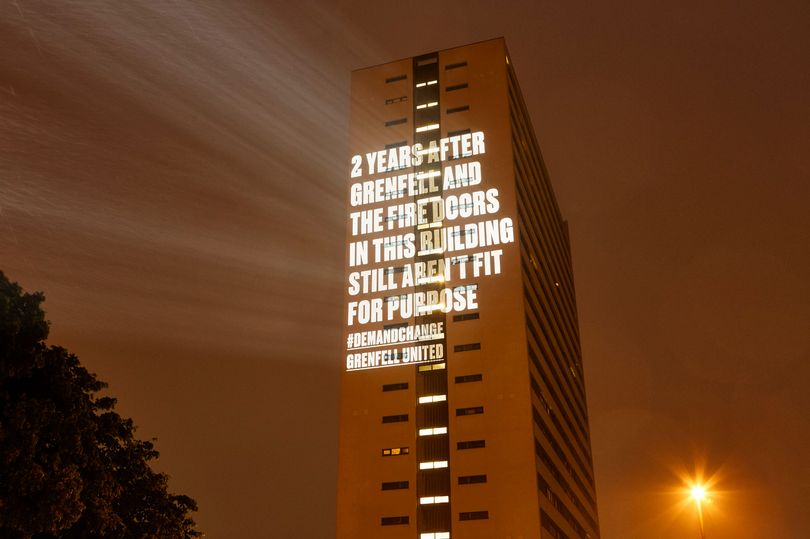
On 14 June 2017 a catastrophic fire in the Grenfell tower block in West London caused 72 deaths and 70 injuries and made hundreds homeless. Four years later and nobody has been held to account for what the then Shadow Chancellor, John McDonnell, called ‘social murder’ – criminal irresponsibility, cowardice and racism by the Tory Government. We will not rest until the guilty are brought to book. No justice – no peace.

The poem will appear in my next collection, ‘Bones of the Apocalypse’, published by Frequency Press. Tim Evans

(Photo credit: DailyTelegraph)
(Photo credit: Guardian)

ATHLETE, REPORTER, FEMINIST, ANTIFASCIST — Anna María Martínez Sagi

MARCEL BELTRAN@@BELTRAN_MARCEL

(Translated by Diarmuid Breatnach from Castillian [Spanish] in Publico)

(Reading time: 4 mins.)

At the end of the 1970s, an elderly woman came to to live alone in the town of Moià, 50 kilometers from Barcelona. Nobody knows anything about her. No neighbour knew her or knew anything of her past. The only thing that is becoming apparent, little by little, is her unfriendly character. The old woman doesn’t communicate much but when she does she is dry and sharp. Like a knife just sharpened. She has a reputation for being elusive and sullen. Some people joke that not even dogs dare to bark at her. She will live twenty years in the village, the last of her life. And it will only be after her departure that the mystery that surrounds her will begin to fade. Under so much loneliness and silence a secret could only throb. When they find out, those who crossed paths with her in that last bitter stage of her life will be shocked.

The first time he came across the name Anna Maria Martínez Sagi (1907-2000), Juan Manuel de Prada was reading a González-Ruano interview book. The author, in the same volume in which he conversed with Unamuno or Blasco Ibáñez, referred to that woman as “a poet, trade unionist and virgin of the stadium.” It was these last three words that triggered De Prada’s curiosity, that he began to follow the trail of that person of which he had strangely never heard. He asked colleagues, academics, and historians, but they could not help him much. He searched archives and newspaper back-issues without luck. And, when he was about to give up, a friend who worked in the Treasury found the address of his missing woman, which confirmed that she was still alive. The novelist sent her a letter so they could meet and chat about her story.

“Why do you want to resurrect a dead woman?” was the answer that came from Moià. Martínez Sagi, at age 90, had resigned herself to anonymity — or more, to oblivion. Because someone who has been famous at some point is no longer anonymous, no matter how much they disappear from the conversations or stop being mentioned in the newspaper. Rather she fades from memory. And that is what she found when she returned home from the long exile to which the conclusion of the Civil War condemned her; she had been wiped off the map. Her vibrant reports had been of no use (she had become one of the most influential journalists of the Second Republic), her penetrating verses (the poet Cansinos Assens saw in her “the heiress of Rosalía de Castro”) or her milestones as a pioneer of feminism in Spain (she founded the first women workers’ literacy club in Barcelona) during the 1930s. Her interesting and unusual life had been reduced to zero.

That enormous and valuable legacy had been buried under the mantle of the dictatorship, first, and later by the passage of time. And now it seemed that Martínez Sagi did not exist. Or, worse, that she hadn’t existed. Something that De Prada remedied when, respecting the pact they had reached, he published her unpublished work two decades after the death of the author. That volume that was released in 2019, La Voz Sola (The Lone Voice), served to begin to repair the injustice of this inexplicable ignorance.

Anna Maria Martínez Sagi became the first woman member of the board of a soccer club

But where did that “virgin of the stadium” reference come from that had piqued De Prada’s interest? Anna Maria was born into a family of the Catalan gentry. Her father was in the textile industry and her mother was a conservative woman who wanted her daughters to study in Spanish and French and not in Catalan, which she considered “a peasant language.” That child would not have mastered the language with which she would later write so many journalistic texts if it weren’t for the help of her nanny Soledad, who would also open the doors to the world of the popular masses who got on the trams, populated the bars and walked through the streets of the city centre.

In any case, Martínez Sagi’s life would not change completely until, having hormonal problems, the doctors recommended that she play sports. She felt the benefits of physical exercise. And not only that, but she was especially good at it. Skiing, tennis, swimming. There was no discipline in which that girl with agile and resolute movement did not stand out among the young men. Neither in soccer, which she practiced assiduously with her cousins ​​and her brother. Or the javelin throw, in which she would later become the national champion. Precisely as a result of her other vocation, that of a reporter, she began to collaborate with the sports weekly La Rambla, where she met its founder, Josep Sunyol, a member of Esquerra Republicana1 party and president of FC Barcelona,2 ​​who was later shot by the Francoists. In 1934, when the writer had just turned 27, Sunyol would even give her a position in the Barça organization to create a women’s section. In this way, Anna Maria Martínez Sagi became the first woman to be a member of a football club board.

Anna Maria Martínez Sagi about the throw the javelin 1931

She would last a year in office, from which she escaped as soon as she realized that those men in suits with cigar stink in their mouths didn’t really want to change anything. “The environment at that time was one of very densemasculinity,” says De Prada. “And they saw her as a threat, because she was not only a woman with her own ideas, but she also fought them to the end.” She understood sport as a necessary vehicle to lead women to modernity. She dressed in the latest fashion, she attended the demonstrations of the progressives and did not allow herself to be stepped on by anyone. In the newspapers, she interviewed from beggars and prostitutes to politicians, and she also made a name for herself writing reports in defense of women’s suffrage, which at that time was not even supported by some sectors of the Left. She also aligned herself with the proclamations of Buenaventua Durruti, who dazzled her in a speech the anarchist gave at the Palau de Pedralbes. In 1936, when the war broke out, she asked permission to accompany the antifascists to Aragon and report from the front.

Those who saw her write in the conflict say that when she heard the whistle of bullets she did not crouch low. Perhaps that reckless bravery is nothing more than a legend, but it helps to focus Martínez Sagi in the time, a person who defied roles and stereotypes. With the arrival of Franco’s troops in Barcelona, ​​she was left with no choice but to flee to France. That circumstance would initiate the process of her loss. And would forever mark the exile, whose life continued to follow the dips of a roller coaster.

She first settled in Paris and then she went to Châtres, where she slept on the park benches and ended up working as a clerk in a fishmonger’s shop. She later joined the Resistance. “All my life I have fought against injustice, dictatorship, oppression, so I decided to join and saved many Jews and many French fleeing the Nazi advance,” she said. “It was always voluntary. I always did it because I wanted to.” In 1942 she herself was on the verge of being caught by the Gestapo, who appeared by surprise at her apartment. She escaped through a window and by miracle was saved. On French soil she also became a street painter, selling patterned scarves to passersby, and thus she met the Aga Khan’s wife in Cannes, who hired her to decorate their house for them. When she had some more money, she retired to a town in Provence to dedicate herself to the cultivation of aromatic flowers, and later she moved to the United States, where she taught language classes at the prestigious University of Illinois.

While her story jumped and changed landscapes, Martínez Sagi did not abandon poetry either, which was perhaps of all her passions that to which she gave herself most vehemently. Her poems were a mark of her existence, the sentimental record of what was happening to her. And for a long time they rested in the shadow of another woman, Elisabeth Mulder. Martínez Sagi met Mulder when the latter reviewed one of her first collections of poems and praised her, defining her as “a woman who sings among so many screaming women.” Martinez fell madly in love with her, despite the fact that Mulder was a widow and had a seven-year-old son. They came to spend a vacation together in Mallorca during Easter 1932, but the idyll was unexpectedly broken. The pressures of the young poet’s family and distancing by her lover, who never wanted the relationship to develop, ended the relationship and opened a wound that Martínez Sagi took many years to heal. “I found myself in front of you. You looked at me. / I was still able to stammer a banal phrase. / It was your livid smile … Later you walked away. / Then nothing … Life … Everything has remained the same”.

Anna Maria Martínez Sagi

This frustrated love, conditioned by the rejection that the writer received for wanting to live freely in homosexuality, may be one of the causes that explain why the flame of her memory was allowed to go out so abruptly. Also the distancing by exile, the story of politics, inclement weather, the cruelty of memory. Faults that portray a country with very poor retention that always forgets those who matter most. Among many other reasons, that is why it was necessary for someone to renovate the name of Anna Maria Martínez Sagi and make an effort to rescue her from oblivion.To do justice.

End.

SOURCES & FURTHER INFORMATION:

https://www.publico.es/sociedad/periodista-frente-guerra-poeta-atleta.html

https://www.ccma.cat/tv3/alacarta/sense-ficcio/la-sagi-una-pionera-del-barca/video/5829196/

1Republican social democratic pro-Catalan independence party that had many members killed in battle, executed or tortured and jailed during the Spanish Antifascist War and the following Franco dictatorship. Currently the party has a couple of leaders in Spanish jail, including elected members of the Catalan autonomous Government and Members of the European Parliament. The party is currently negotiating coalition government with other Catalan pro-independence parties; ERC has one seat less than Junts per Catalonia, another independentist party (D.B)

2Famous Catalan and international soccer club (D.B).

“DON’T CLAP FOR US”

(PLEA FROM A HEALTH WORKER)

Don’t clap for us

None of us heroes, or don’t you see

A rampant infection, as vile as can be

A clap from your door, won’t be enough

As we fight for survival, it’s brutal and tough

Explain to the patient, gasping for air

They hear your clapping, while alone in despair

To the nurse who’s exhausted, stressed and so scared

As they grieved for a colleague, and yet still they cared.

(Image sourced: Internet)

What good is your clapping, or ringing your bell

When all around us, is Lucifer’s hell?

Close up your doorways, stay safe inside

Choke this oblivion, force it to hide

No time for mixing, do the right thing

Hope for salvation, the vaccine might bring

Until this horizon comes into view

The change that can happen, is all down to you

The time to say thank you, will be at the end

When together we fought this, and broke this trend.

(Image sourced: Internet)

The tunnel light flickers, we can see it in sight

But now it’s not daylight, it’s still a dark night

Help us to help you, with rules to obey

Hope for a future, when this goes away

This is a journey, we all must take

Don’t listen to theories, who say it’s all fake

Look into my tears, the fear I can’t hide

Every day a tsunami, that will not subside

I thank you for reading, please keep safe and well

Please do the right thing, I beg you all to compel.

Written by Mark Dawn 6th January 2021

(Image sourced: Internet)

FURTHER READING:

https://www.psypost.org/2020/04/frontline-covid-19-healthcare-workers-suffer-increased-risk-of-depression-anxiety-and-insomnia-56449

Childcare needed for healthcare workers as usual one shut down: https://www.inmo.ie/Home/Index/217/13576

What Nurses and GPs face and how they feel: https://www.thejournal.ie/healthcare-workers-experiences-covid-19-5316572-Jan2021/

LEFT IN THE LURCH BUT SINGING

“Mo Ghile Mear”, lyrics composed later in the the 18th Century lamenting the failing of an earlier Rising, a traditional Irish air at least generations old, combined in the 1970s, sung today in great style.

I have not researched the origins of this myself but the theme is well-known, so from relying on Wikipedia, the free encyclopedia: “Mo Ghile Mear” (translated “My Gallant Darling”, “My Spirited Lad” and variants) is an Irish song. The modern form of the song was composed in the early 1970s by Dónal Ó Liatháin (1934–2008), using a traditional air collected in Cúil Aodha, County Cork, and lyrics selected from Irish-language poems by Seán “Clárach” Mac Domhnaill (1691–1754).


The lyrics are partially based on Bímse Buan ar Buairt Gach Ló (“My Heart is Sore with Sorrow Deep” (but “Gach Ló” means “every day” and there is no mention of “My Heart” in the title – D. Breatnach), c. 1746), a lament of the failure of the Jacobite rising of 1745.[1][2] The original poem is in the voice of the personification of Ireland, Éire, lamenting the exile of Bonnie Prince Charlie.[3] Mo ghile mear is a term applied to the Pretender in numerous Jacobite songs of the period. O’Daly (1866) reports that many of the Irish Jacobite songs were set to the tune The White Cockade. This is in origin a love song of the 17th century, the “White Cockade” (cnotadh bán) being an ornament of ribbons worn by young women, but the term was re-interpreted to mean a military cockade in the Jacobite context.[4]

Jacobite musketeers, reenactment.
(Source: Internet)

Another part of the lyrics is based in an earlier Jacobite poem by Mac Domhnaill. This was published in Edward Walsh‘s Irish Popular Songs (Dublin, 1847) under the title of “Air Bharr na gCnoc ‘san Ime gCéin — Over the Hills and Far Away”. Walsh notes that this poem was “said to be the first Jacobite effort” by Mac Domhnaill, written during the Jacobite rising of 1715, so that here the exiled hero is the “Old Pretender”, James Francis Edward Stuart.

The composition of the modern song is associated with composer Seán Ó Riada, who established an Irish-language choir inCúil Aodha, County Cork, in the 1960s. The tune to which it is now set was collected by Ó Riada from an elderly resident of Cúil Aodha called Domhnall Ó Buachalla. Ó Riada died prematurely in 1971, and the song was composed about a year after his death, in c. 1972, with Ó Riada himself now becoming the departed hero lamented in the text. The point of departure for the song was the tape recording of Domhnall Ó Buachalla singing the tune. Ó Riada’s son Peadar suggested to Dónal Ó Liatháin that he should make a song from this melody.[5]

Ó Liatháin decided to select verses from Mac Domhnaill’s poem and set them to the tune. He chose those that were the most “universal”, so that the modern song is no longer an explicit reference to the Jacobite rising but in its origin a lament for the death of Seán Ó Riada.[6]

THIS RENDITION is to my mind and ear an excellent one in traditional-type arrangement and voices (not to mention looks of certain of the singers) and all involved are to be commended. I have not always liked the group’s rendition but this is just wonderful.

In history, we fought in Ireland for two foreign royals at two different times and on each occasion they left us in the lurch.

end.

A COWARD’S CURSE

A poem by Scarecrow.

“No need for a blood sacrifice”, I hear you say…

“Unnecessary violence. Dead innocent children of

a badly thought-out revolution.

Home rule was on the way.” Really?

Defeated three times by those who made the promises …

What trust you must have in our oppressor!

An Englishman’s empty hollow word, and his deeds … full,

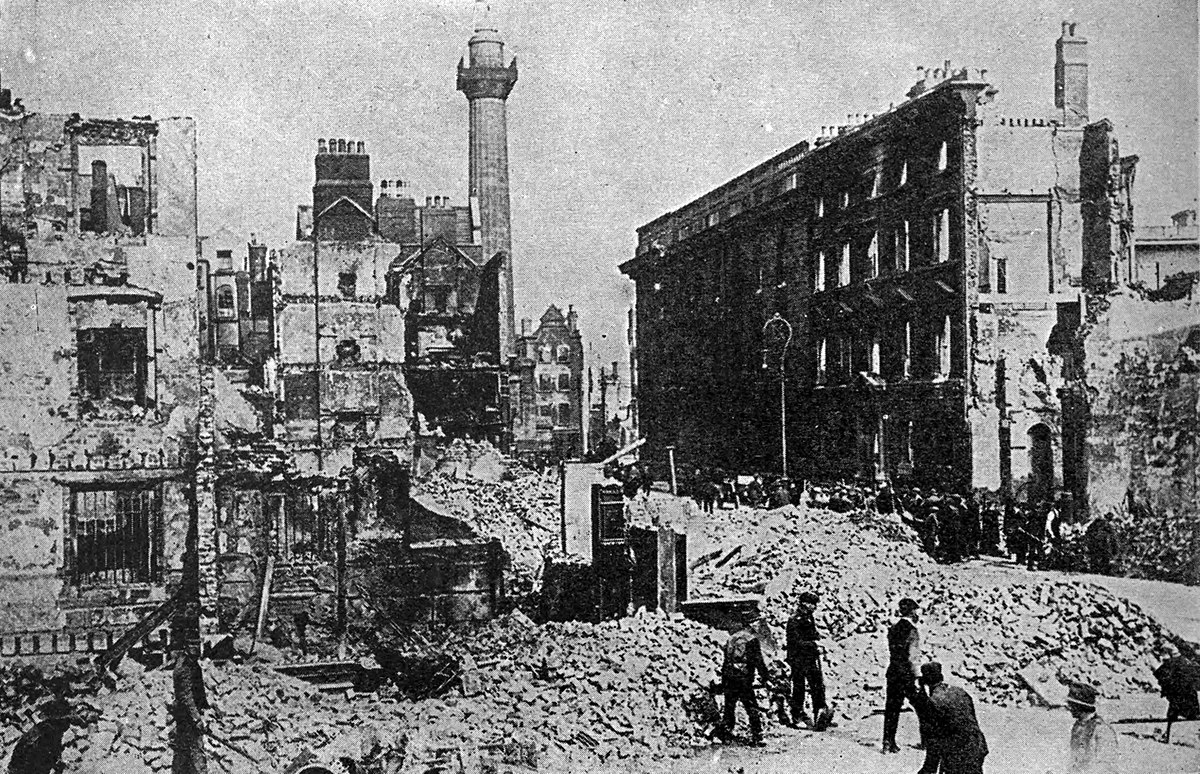
Dublin’s main street, then Sackville, now O’Connell, showing British artillery and fire damage 1916.
(Image sourced: Internet)

Ripe with Irish blood and you trust them.

As still, to-day, our North, a thousand years, lies wrapped in chains.


You, in your suit — and your middle class condescending education.

may sound profound in your leafy suburban period home:

Well fed, well watered, well waxed and shod.


You dare to preach: “No mandate”. For a revolution?

Plauseless re-writing of history

To suit an establishment bent on bending

To the power that was, and still does.

When did power ever concede willingly?

When did power ever concede to power?

When did power ever concede without blood?

Never, is the answer.


Yet pundits heap plaudits upon our enemy.

Praise at every turn. Entertain us with lies. Re-write history.

Ensure the next generations forget, and fall into

a slumber of cheap aristocratic swaddling.

Devoid of meaning, soothing unsettled questioning minds.

Endless obfuscation with mirrors and smoke to thwart newcomers

to this one truly remarkable moment of Irish life.

It was “doomed to fail”…. Did I hear you right?

So, don’t even try? Sit and wait, for the greediest hand

To throw crumbs at you? Give up, let the rot eat

Deeper into the psyche, burn into the soul.


Easy …. condemning, from your comfort, fools for company ….

Sweeping, arrogant, baseless statements …

by fat, lazy, unburdened donkeys …

Always the carrot, never the stick … and preach.

Fat, and warm, surrounded with servant-jesters,

Condemn those who have provided the foundation to build this new Nation.

From which you stand today and look, mealy-mouthed … across the water.

at the old empire for guidance on how to think.


Inhabitants of Dublin tenement house
(Image sourced: Internet)

Not a word from you about starvation. The death toll.

The mortality rate. The worst poverty on all this planet,

in this falling squalid Empire you speak of so lovingly.

Never the smell of fetid flesh, falling, rotting and falling

from living children even before they die … for want of a piece

of bread, from your mouth.

The squalid rancid overcrowding in crumbling Dublin.

As the poorest and lowest, coughing themselves to death.

100 souls in a single house, a toilet, a tap, no furniture, sleep on the floor.

Enough straw for only a cat …. in England’s ‘Second City’…

is four-star accommodation, by your records.


Festering dysentery, cholera, typhus and tuberculosis, every dying breath laboured.

The endless hungry crying of little children…the eternal ‘slumber song’ of the slum.

… And worse again, how horrible that sound, in the silence …. when even they give up…


”It’s safer in Flanders Fields, than in Dublin’s slums”

was your recruitment cry …

Where the strongest Irishmen bartered themselves to

serve their enemy, for a meal, and committed murder for the Crown.

Won your war for you….Won all your bloody wars for you…

Cost them their souls,

their dignity, sanity, their families, their heritage… Hunger, hunger, hunger…

Died in thousands .. Two of every Three Irishmen, in the English Army …

No condemnation from you for the sea of Irish blood spilt by the Crown?

For the Crown?

Soldiers of British Army, WW1, blinded by gas.
(Colour-enhanced image sourced: Internet)


“No need for blood sacrifice”?

What fool today preaches such compliance,

Washing centuries of Irish blood from England’s hands?

Blood: Imperial currency.

What ignorance today speaks such nonsense?

Those who condemn the oppressed. And exaltation for the oppressor?

The agitator, dictator, the sadist, savage, the sick cruel impostor.

Clothed in Ermine and Fur … Dripping in stolen gold and poached Diamonds.

Ignore the strains of ‘Our nearest neighbour’ to

strip all wealth, dignity, labour, song, dreams and aspiration,

from every beating Irish heart, no matter the cost, no matter the pain,

no matter the suffering. Empty the fields. Steal the food from the mouth

Of a hungry nation. Watch as millions starve, while you

… dine on our bounty.


It’s easy, stand back and act like you slew a giant —

when that giant is already dead

which took an empire to bring down.


What callous fool will today condemn those who sought to better their lot:

to stand tall, bear arms against their barbaric persecutors.?

To bring an end to their own subjugation and slavery.

End their tormentor’s grip. Their torturer’s whip.

End the deliberate impoverishment of their own lives ..

What fool would dare condemn any man or woman this right?

What person would judge guilty, this father, mother son or daughter …

who sought a better life for all, at the risk of losing his own?


I’ll tell you:

A coward.

The kind of man who licks the boot that kicks him.

Kisses the foot on his neck.

A man with no blood in his veins, or heart beating in his chest.

A man who thinks that power comes from the Throne and not his own people.

A man who would sacrifice all for a clap on the back from a gloved hand.

Or kiss, on bended knee, a stolen ring.

A compromised man, a weak crawling man.

A man without empathy for his own people.

A man who would see his own suffer, if he would gain

just a little affection from his oppressor ….

A traitor.


Scarecrow May/2016.