THE CAULDRON CALLING THE KETTLE BLACK

Diarmuid Breatnach

(Total reading time: 5 mins.)

It is reported in the news today that Trump has ordered the deregistration on the Stock Exchange of three China companies in the belief that they are basically fronts for the Chinese military. It is reported also that the incumbent, Joe Biden, is unlikely to take a different line and that “US officials have complained that China’s ruling Communist Party takes advantage of access to American technology and investment to expand its military, already one of the world’s biggest and most heavily armed.”

China’s military may indeed be one of the world’s biggest and most heavily armed but there is no question of which power is the most heavily-armed, far above all others: the USA. According to statistics supplied by an EU armed forces comparison site (see SOURCES below), China spends $288 billion on its military, which is much more than doubled by the USA’s $610 billions. And the USA’s military share of its GDP (Gross Domestic Production), at %3.1 is way ahead that of China’s 1.9%.

One of the few areas in which China’s military outstrips the USA’s is in active personnel, at 2,300,000 against 1,281,900. Which is hardly surprising, as China’s population is more than four times that of the USA’s (1.43 billion, compared with 329 million). And that too would account for its reservist imbalance, 8,000,000 versus the USA’s 811,000.

China Type99 Tank. Armoured vehicles and numbers of personnel are the few areas in which China outstrips the USA. (Photo source: Internet)

Another area in which the Chinese military outstrips the USA’s is in tanks, armoured vehicles, artillery, self-propelled artillery and rocket artillery (that last by not so large a margin). But the USA has three times the total military aircraft of China, twice the number of attack aircraft, nearly four times the number of multirole aircraft and over four times the number of helicopters. Only in fighter aircraft does China outnumber the US’s and that by a significant amount: 1,150 against 587 – but multirole aircraft, of which the USA has 2,192, are designed for air-to-air combat as well as missile launching against ground targets.

In naval power, although China’s total of 780 looks impressive next to the USA’s 437, the USA has 20 aircraft carriers while China has …. two. The USA is not bothered with frigates or corvettes, of which China has respectively 54 and 42 but the USA’s 85 destroyers are more than double China’s 36. In submarines they are not far off level pegging, with China’s 76 against the USA’s 71.

The USA has 20 aircraft carriers while China has just two. This hi-tech US carrier cost $13 Billion. (Photo source: Internet)

These figures tell us that the USA far outranks China in military hardware and also that its military production per head of population is vastly greater than China’s. But when we look at the type of weapons in which one predominates over another (without regard to quality or modernity), it tells us something else: the USA is far better fitted for long-range warfare than is China. No state is safe from long-range attack by the USA military but many parts of the world are relatively secure from such an attack by China’s current military capability.

Furthermore, in a war between both powers, the USA would rely on hitting China from afar with bombing raids from air bases in countries with US-friendly regimes (e.g Pakistan, Indonesia, Australia, Thailand, Philippines, South Korea, Japan) and from its fleet of aircraft carriers.

China could perhaps overrun the USA’s defences on the ground but how could their troops and vehicles reach America?

Of course, the USA vastly outnumbers China in nuclear warheads too: 6,500 against 280.

MILITARISATION OF THE ECONOMY

Lenin and others wrote that increasingly in the capitalist countries, finance capital had become merged with industrial and whereas finance had earlier fed industrial development, it was towards the end of the 19th Century deserting industry at home to invest in super-profits available through exploitation of natural resources and labour power in the developing world. Countries that had large colonial territories and foreign investment preferments or monopolies were neglecting their industries in the time of imperialism while capitalist countries without the same outlets were concentrating their capital on modernising their production models and methods.

In the USA, finance capital merged long ago with industrial but, since WW2, with military expenditure also. But not only merged — the military side has come to dominate. Not necessarily in actual production statistics, though these are pretty high – according to industrial analyst Louise Echitelle writing in 2017, Roughly 10% of the $2.2 trillion in factory output in the United States goes into the production of weapons sold mainly to the Defense Department for use by the armed forces. But in addition, over half the World’s arms sales in 2013, according to a SIPRI (Stockholm International Peace Research Institute) pie chart quoted by Wikipedia, were by the USA and this share is likely to have increased since.

USA’s multirole fighters far outnumber China’s. This is the F-15E Strike Eagle. (Photo source: Internet)

Military production is publicly funded in Government purchasing and also in allocation of production sites – Echitelle wrote three years ago that the bidding to get a major company to locate in a municipality

“can sometimes top $100 million per factory location. A manufacturer who finally accepts a municipality’s bid collects tax breaks, a gift of land on which to put a factory and sometimes the cost of building and equipping the factory itself at taxpayers’ expense.”

Share of arms sales by state in 2013: chart by the Stockholm International Peace Research Institute (Photo source: Wikipedia)

Incidentally, that level of reliance on military production also makes for a militarisation of the labour force, a binding of workers and trade unions to military production. This will be reflected also in cultural products such as war films (documentaries of US Wars, fictional or semi-fictional war films, Sci-Fi with US military in the future), war games and novels, USA Armed Forces Day barbecues and street parties on the third Saturday of each May, all together resulting in social support for war, invasion of other countries and …. further military expenditure.

Although the figures here have concentrated on military production and its public funding in the USA, one has to take into account many other aspects, such as that expended on raising and educating a child to military age and all that is involved in that huge investment over a period of 18 years or so.

Another factor in the calculation is what is not being produced because of the concentration on military production and its secure source of public funding. Or no longer being produced. Echitelle points out that at the end of WW2, US industry produced cars and appliances, clothing, shoes, houses and furnishings for the home market and exported many of them too. The reliance on military spending in production facility and its public funding has seen the US give way to foreign competitors in those consumer goods not only abroad but in its domestic economy too. On the other hand, China is increasingly producing such goods for its huge home market and even exporting some, for example in communication technology products.

One does not need to be a supporter of the Chinese regime to burst out laughing at the irony when a US President or US officials accuse the Chinese of militarising their economy.

End.

SOURCES

https://www.breakingnews.ie/world/new-york-stock-exchange-to-delist-three-chinese-companies-under-trump-order-1058223.html

https://armedforces.eu/compare/country_China_vs_USA

TRAINING HUMANS

Diarmuid Breatnach

(Reading time: 7 mins.)

‘Today’, she said, ‘we will discuss the training of dogs’.

The class looked at her face to see whether she was joking. She looked back at them patiently.

‘But Teacher,’ ventured one braver student. ‘We are here to learn how to control humans.’

‘That is correct,’ replied the Teacher. ‘This is a sociology class. But there is much to learn from the training of dogs. In many ways, it is the same thing.’

(Image sourced: Internet)

So, to begin: Where do dogs come from to us? Where did they originate?’

‘Are they not descended from wolves, Teacher? I think I read that somewhere.’

‘Yes, I did too. And dogs and wolves can interbreed, so they would have to be closely related.’

‘That is correct, they are closely related,’ replied the Teacher approvingly. ‘There is only 0.1% of a DNA difference between them and they can interbreed quite easily. The wolf is classified as Canis lupus and the dog as Canis familiaris. It is not strange to find dogs that are part wolf. The assumption is therefore that the common dog is descended from the wolf. And in some parts of the world, for example in South Africa and in Australia, there are wild dogs, dogs that live like wolves. We presume these were domesticated wolves that became dogs, that later again returned to the ways of wolves. So our question for discussion today is: How did wolves become dogs in the first place?’

‘But Teacher, if this occurred it must have done so in prehistory, surely?’

‘I think I read that it was in the Paleolithic Era.’

‘Well, then surely nobody knows, Teacher? No-one would have written to describe it as humans did not develop writing until much later.’

‘You are all correct, yes. But we can speculate. We can extrapolate from what we know. Now, when we have a dog as a pet – or as a working animal – it is in a social relationship with us, right?’

‘Well, yes. Some people see their dog as part of the family – you even hear them say that. But working dogs?’

‘Working dogs too, I suppose. A shepherd would have a close relationship with his dog … and so would a hunter. Even if the bond was primarily between the one person and the dog, it would have to recognise those close to the owner as ok, as safe, not to be attacked or growled at.’

(Image sourced: Internet)

‘Good, yes, we are getting there. The guard dog needs to know its owner or owners and who is acceptable. Sled dogs the same, even though they are a group, like a hunting pack. The hunter, the shepherd, the truffle-searcher, the seeing-eye guide dog – they are all in a social relationship with humans. We could, in fact, describe a dog as “a wolf-descendant in social relationship with humans.” But what is the normal social group of the wolf?’

‘It is the pack, isn’t it?’

‘Yes, that’s what I have read too. A hunting pack.’

‘Yes but not just a hunting pack. They have to raise pups, don’t they?’

‘Oh, and don’t they have an accepted leader?’

‘Yes, very good. The social organisation of the wolf is the pack. And they have leadership – a male and a female. They are called Alphas, Alpha Male and Alpha Female. They lead the pack – the other wolves obey them. So, how is it decided, do you think?’

‘They must have elections, Teacher.’

‘Very amusing. It is a serious question however, part of our discussion today.’

‘Maybe …. they fight over it? The strongest wins?’

‘Yes, correct, that is part of it. The male fights other males and the female fights other females.’

‘How civilised of them!’

‘You all laugh but you don’t realise how true that comment is. Now, let’s tease the process of leadership selection out a bit. Let’s concentrate on the males, for simplicity. Male A wants to be leader, so does male B and they fight. Male A is successful and wins. But he will be wounded, right? Right?’

‘Well, yes he would be. Bite marks, bleeding ….’

‘So up comes Male C now and he is not wounded. He fights Male A and beats him, so now he is top dog, or wolf, the leader of the pack, right? Right?’

‘Yes, it must be like that.’

‘Then we have at last an accepted leader of the pack. But in what state are the males? And if the females went through the same process, what state are they in and what are the consequences?’

‘They’d be walking wounded.’

‘A wounded pack can’t hunt well.’

‘Some might die of their wounds. Some would die of hunger.’

‘It’s not like that, is it Teacher? There has to be another way.’

‘Another process, yes. They must have a system, right Teacher?’

‘Yes. Very good. Exactly. They do have another system. Firstly, they very rarely fight a full fight to the end. And if there is a challenger, it is usually only one. Not all wolves want to lead. Maybe not all wolves think they can. So if there is to be a leadership conflict, Male A and Male B, for example, they will fight but usually to the point where one recognises the other is tougher or wants to be leader more, or has more to lose — say Male A. Then Male B gives up. And if Male A has to remind him or any of the other males at any point, he only has to threaten and they give up. They lie on their back or show their submission in some other way. The pack stays healthy and the Alpha Male and the Alpha Female are in charge. The rest of the pack accept them. And if they are good at what they do, the pack does well. If not, well, maybe another leadership contest. Or the pack breaks up.’

Wolf pack.(Image sourced: Internet)

‘Teacher? When pups are born, I presume they accept the hierarchy of the pack. But when the Alphas get old, or killed or injured in the hunt – or by hunters, humans – the process must start all over again?’

‘Yes and no, not completely. I didn’t tell you earlier but only the alpha females in the pack mate. The Alpha Female chases away other females if they come into heat and the Alpha Male may accept some males mating with her or may threaten other males so only he will mate with the Alpha Female, when she is in season. So the pups are all from the alpha female and from the alpha male or a few others. The next leaders will likely come from those pups – but not certainly. There are possible variations. They might all be killed or injured. An alpha descendant might take a different mate and that one will be alpha too. And so on. Now, let’s think about dogs. How did dogs come to be human-bonded?’

‘Hmmm. Maybe hunters killed the parents, took the cubs and raised them?’

‘Or found the cubs ….’

‘Yes, that is the common scenario. But after generations of the pack, how does a pup come to bond with humans? More to the point, how does it come to obey a human or a family?

‘Hmmm. Does it see the family as the pack, Teacher?’

‘Yes, and its master or mistress as the Alpha or Alphas?’

‘Very good. Yes, now you have it. I must be that way. But …. pups in a pack grow up and may want to become leaders themselves. We don’t hear of dogs deciding they want to run the human family, do we? What would we do if our dog decided it wanted to be boss and was prepared to fight?’

‘We’d have to shoot it.’

‘Yes, we couldn’t allow that.’

‘Wait a minute. Teacher, has that happened?’

‘Probably, in the early days. A domesticated wolf that would not accept the human as the Alpha was killed. Or ran away, maybe. Perhaps joined a wild pack, if it survived …. was accepted …. But in any case, the pups being raised by humans would not be descended from that disobedient wolf.’

‘So …. over generations, wolves …. were bred into dogs. Obedient individuals chosen …. disobedient ones killed …. or run off …. so only obedient dogs mate ….’

‘Yes … and every now and again you hear of a dog being “put down” because it attacked a human being …. especially a child …’

‘Wait! Are you saying humans have been bred to accept a hierarchy? And that the hierarchy is hereditary?’

‘Well, now – I hope I am not being accused of advocating monarchy … or feudalism?”

‘No, Miss …. of course not …. but …..’

‘Slow down, now. Don’t jump too far ahead to conclusions. Stay with the discussion a little longer, ok?’

‘Yes, Teacher. Sorry.’

‘That’s alright. Now, let’s unpick this a bit more. Is the non-Alpha wolf in the pack governed by fear alone? Does he or she have nothing to gain from its position in the pack?’

‘The pack hunts together, doesn’t it? So I suppose …. a pack can kill a bigger animal …. by working together?’

‘Yes, of course. A deer …. or antelope …. or bovine …. and then the whole pack will have enough to eat. Any other benefits?’

‘Defence? Lots of teeth, many individuals.’

‘Vigilance …. warning? Lots of eyes to keep lookout.’

‘Maybe warmth, huddling together against the cold?’

‘Yes, all those are true. And emotional warmth too, the solidarity of the group. The pack looks after the cubs also, as soon as they start to run around. This benefits the future of the whole pack as well as relieving the Alphas of their childcare from time to time. And the pack seems to get an emotional reward from looking after the cubs.’

‘Being a dog is quite a change then, Teacher. From being a wolf.’

‘Yes. But what are the advantages and disadvantages for the dog who is no longer a wolf? And there must be disadvantages, for some dogs have returned to the wild and the pack. As those I mentioned in South Africa and Australia. Advantages, first.’

‘The dog gets regular guaranteed food, doesn’t depend on the hunt for it.’

‘And the dog gets protection …. humans have weapons.’

‘And the dog gets …. gets …. medical care?’

‘Yes, all those things. But one very important thing dogs get that very few in the wolf pack get.’

‘They get to mate.’

‘Yes, exactly. No alpha telling them they can’t. Well, humans lock a bitch in heat up sometimes or we sterilise a male or female but otherwise, they mate. And a bitch gets to have her own cubs.’

‘Teacher …. are you implying that dogs chose not to be wolves?’

‘Well, it’s certainly an interesting question. If some dogs go feral, if some dogs form packs, and other dogs don’t, there would seem to be a choice involved, hmmm? And perhaps the ancestors of the dog did choose to leave the pack, rather than just being socialised and conditioned as captured pups. Some wolves may have hung around human encampments, getting scraps, warning humans of the approach of dangerous beasts …. other humans …. They may have been renegades from the pack …. dissidents …. The first domesticated wolf may have been an illicitly pregnant bitch, knowing that in the pack, her pups would get killed by the alpha female …. Her pups, socialised to humans as soon as they were born. Then, selection by the humans for non-aggression … obedience …. culling the ones that didn’t fit …”

‘Wow!’

‘So now we come to extrapolating what we can from managing wolves and dogs to managing humans. Postulate, please.’

‘The pack is a metaphor for our society.’

‘We generally accept our leaders, so long as they are effective.’

‘Sir, we train humans from childhood. Like pups in the pack’

‘And we give them some benefits so they choose to be in our pack’.

‘Yes, very good. And what about those who choose not to be in our pack?’

‘We eliminate them.’

‘Cull them.’

‘Isolate them.’

‘Marginalise them’.

‘Very good. For your written assignment, summarise in around a thousand words to be handed in next Monday.’

end.

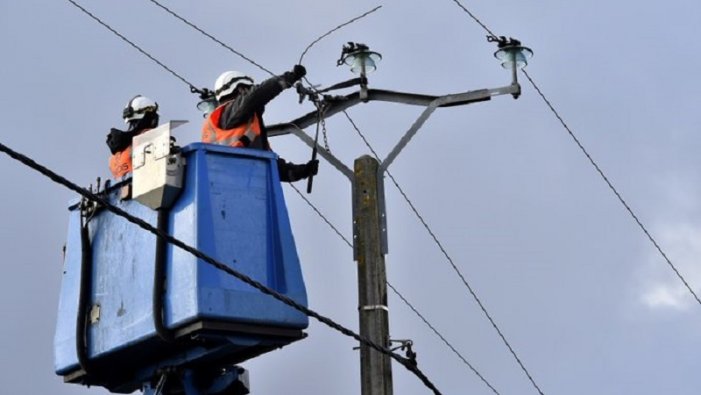
POWER REDISTRIBUTION — French electricity workers redirect power away from the rich to workers’ homes

Click on link to read the article in English or in Spanish: https://thefreeonline.wordpress.com/2019/12/26/electricity-strikers-in-france-light-up-poor-homes-this-christmas-cut-power-and-gas-to-bosses-and-police/

French electricity workers switching low-cost electricity to workers’ homes (Photo source: The Free)
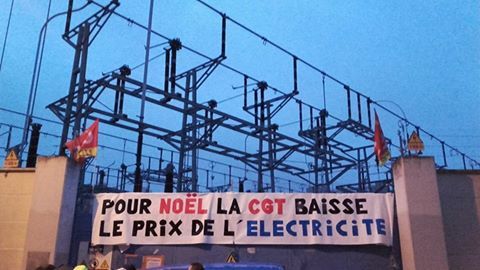
“For Christmas, the CGT lowers the price of electricity”: words on banner on French electricity generating station or routing installation (Photo source: The Free)

Un año sin Dilan Cruz

Gearóid Ó Loingsigh

(Tiempo leyendo: 2 minutos)

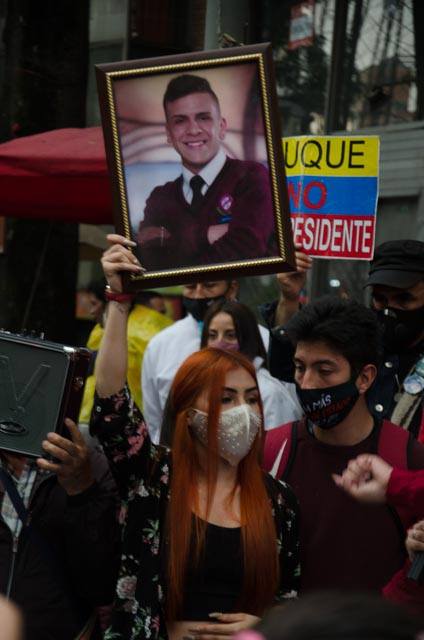
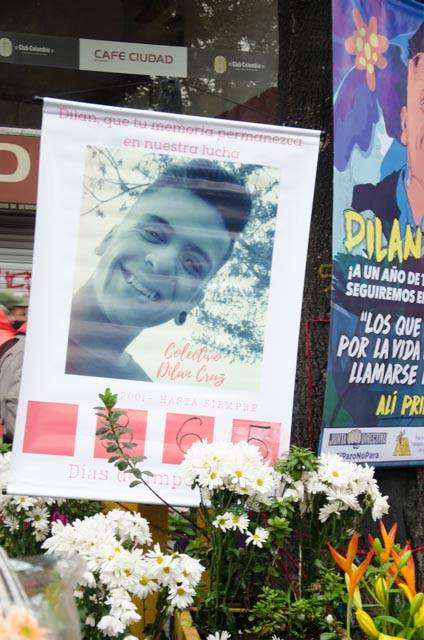
Hoy, hace un año Dilan Cruz cayó bajo los disparos de la Policía.  Un bean bag incrustado en su cráneo, acabó con la vida de este joven.  Conocimos luego de los hechos, las fotos sonrientes del fue que buen estudiante, buen muchacho y muy querido por sus compañeros.

Nada en la vida de Dilan fue fácil, nació y se crío en un barrio popular, dejó sus estudios para luego retomarlos y soñaba con entrar a la universidad.  Como a muchos colombianos le negaron esa posibilidad, primero por la pobreza y luego por un disparo a su cabeza.

Ni siquiera su muerte fue fácil.  No murió en el instante, luchaba contra la muerte varias horas, y luego murió en el Hospital San Ignacio de Bogotá.  Ahora muerto, las cosas siguen igual de difíciles para este joven.  Todos sabemos el nombre y rango de sus asesino.  El verdugo se llama capitán Manuel Cubillos del ESMAD y sigue vinculado a la Policía de Colombia.  El anda tranquilo y la familia de Dilan anda angustiada.  Hoy en la protesta organizada en el sitio del crimen, la calle 19 con carrera 4ª en Bogotá, la mamá del joven fue clara.  “No estamos buscando indemnizaciones sino judicializaciones de los responsables.”  Y está claro la responsabilidad no cae únicamente sobre los hombros del ogro Manuel Cubillos, sino sobre el entonces alcalde de Bogotá Peñalosa y el rey de los payasos, el sub presidente Iván Duque.

Pero Colombia está gobernado por un rey de payasos donde la impunidad es reinante y pavonea por las calles armada hasta los dientes, asesinando a diestra y siniestra.  El monstruo Manuel Cubillos es apenas uno de los miles de asesinos a sueldo en Bogotá.

Hoy lloramos por Dilan Cruz, y no podemos equipararlo a sus verdugos.  Cuando nos pidan llorar por algún policía muerto, recordemos a Dilan y lloremos por él y los 13 jóvenes asesinados luego de la tortura y asesinato de Javier Ordóñez y no por ellos, jamás.  Que no nos caiga ni una sola lágrima por ellos, son ellos quienes cada año nos arrancan ríos de sangre y lágrimas.

En honor a Dilan Cruz y todas las víctimas de terrorismo de Estado en Colombia.

KILMICHAEL — FASCISTS’ “PATRIOTISM” EXPOSED

Diarmuid Breatnach

(Reading time text: 7 mins.)

Last Saturday (November 28th) saw the centenary of the Kilmichael Ambush, when a column of the West Cork IRA commanded by Tom Barry ambushed two lorry-loads of Auxiliaries and fought them to a finish, losing three of their own in the fight. It was a battle of tremendous importance in rural Ireland during the War of Independence, when the forces of British occupation of the nation turned to undisguised terrorism and employed the Auxiliaries as the knife edge of that terror. Despite the Covid19 pandemic restrictions, the 100th centenary was marked by physical commemorations in addition to on-line talks and articles. However, it appears that the “patriots” of the Far Right and fascists1 in Ireland failed to commemorate this important event – why might this be?

The Auxiliary Division were all ex-British Army officers but were recruited in July 1920 as a mobile strike force to bolster the British colonial police, the paramilitary Royal Irish Constabulary. This was in addition to another police support group which became known as the “Black and Tans”. The massive swelling of the ranks of the police was because the British rulers wanted to deny that they were fighting a liberation war and instead to present it as a policing problem (though they were obliged to use 20,000 British Army nevertheless)2. Both the ‘Tans and the Auxies gained a reputation for rough and arrogant treatment of civilians, torture of captives, theft, drunkenness and general indiscipline. However, a fear of the the “Auxies” had also grown, a feeling that they could not be beaten. The Kilmichael Ambush smashed that myth and was as important in the rural areas as the wiping out of much of the British intelligence network in Dublin was for the city.

Auxies raiding the James Connolly College and Irish Socialist Party at 42 North Gt. Georges Street, November 1920 (they raided the building twice that month, along with many other organisations considered subversive by the colonial authorities).

However although they have been posing as Irish patriots, we saw no sign of the commemorative celebration of the Kilmichael Ambush from the Irish Far-Right and fascists. They have played patriotic ballads and anthems often at events and strutted around under — and sometimes wrapped in — Irish flags. They have tried to appropriate Irish patriot heroes and martyrs including Wolfe Tone, James Connolly and Terence MacSwiney. But they left Tom Barry untouched.

Niall McConnell, head of the fascist organisation (registered as a business) Síol na hÉireann, posted about James Connolly as though Connolly would have supported McConnell’s type of people and claimed Connolly was born in Ireland. Laughable though it may be to think that revolutionary socialist and anti-sectarian, anti-imperialist Connolly would ever have supported a little Ireland religious sectarian and fascist like McConnell, the latter did try to appropriate him. And although Connolly was born to Irish parents in Edinburgh, where he grew up, that was not enough for McConnell, who had to claim he’d been born in Ireland.

Wolfe Tone, a revolutionary patriotic democrat who strove to unite the mass of people in Ireland of different religions and who fought for a secular independent state, would have crossed the street to avoid the likes of McConnell – but that didn’t prevent McConnell from trying to appropriate him.

Recently we passed through the 100th anniversary of the death on hunger strike of Terence MacSwiney – and they tried to appropriate him too. MacSwiney was a devout Catholic but the IRA, of which he was a prominent officer in Cork, was a non-sectarian body. Presumably MacSwiney, like his IRA comrades, fought under the principles of the 1916 Proclamation, part of which read: “The Republic guarantees civil and religious liberty to all ….” Nevertheless, got up somewhat reminiscently of the Ku Klux Klan, McConnell led a small torchlit group allegedly to MacSwiney’s grave and had himself videoed making a speech there.

Dee Wall (real name Dolores Webster), whose Saturday afternoon screeching on behalf of the QAnon negationists and conspiracy theorists assails the ears of people passing the GPO in Dublin and whose social media tries to reach those who avoided that experience, tried to claim MacSwiney too, only she pronounced the surname as rhyming with “tiny” instead of like “sweeney” (as one who had never heard the name before might from the spelling alone).

Jim Dowson, a British fascist and sectarian Loyalist, who has shared a platform with fascists Rowan Croft (aka “Tan” Torino) and Herman Kelly of the Irish Freedom Party (but formerly of UKIP), has cheered the armed fascists of the National Party in attacking unarmed counter-protesters, calling them “my Fenians”. Yes, bizarre to call his fascist comrades anything to do with the revolutionary Irish Republican Brotherhood but even more so when “Fenians” is one of the hate-names of Dowson’s Loyalist brethren for Irish Republicans.

Another centenary we passed by very recently with a number of commemorations held outside the stadium was that of the Bloody Sunday Massacre in Croke Park by Auxiliaries, ‘Tans and RIC. Apparently the fascist National Party sneaked in an early videoed commemoration of their own before anyone else on the day and left a wreath among other floral tributes there.

Yet, despite this focus on recent centenaries in the Irish struggle for independence, the “patriots” of the Far Right and fascists in Ireland seem to have let that great event of the Kilmichael Ambush slip them by without a commemoration of any kind. Not a murmur, not a video, not a post, not a photo, not even a tweet from these publicity-obsessed types.

The start of the action in the Kilmichael Ambush as depicted in a scene from Loach’s film The Wind that Shakes the Barley. (Image sourced: Internet)

THEIR PROBLEM WITH KILMICHAEL AND TOM BARRY

What possible reason could there be for this omission by the fascists and Far Right?

Was it because Tom Barry, who led that ambush was anti-sectarian and proved it by publicly punishing two men who had robbed from a Protestant chapel in West Cork? Doubtful, because that did not stop the fascists trying to appropriate Wolfe Tone, whose main effort was precisely to end sectarianism.

Photo of a young Tom Barry, guerrilla leader, on the cover of a reprint copy of his memoir (Image sourced; Internet)

Or was it because following the Kilmichael Ambush, the IRA were condemned by the Bishop of Cork, Daniel Colohan? We might be on to something there. “Demented” Dee Wall, Niall McConnell and National Party representatives all attended the anti-Muslim protest earlier this year, organised by Gemma O’Doherty, who unfurled a banner bearing the slogan “Make Ireland Catholic Again”, where they prayed the rosary through amplification. The new fascist parties, far-right organisations and the anti-mask people are building on the remaining fundamentalist hard-right reactionary core of the Catholic Church in Ireland who have seen its grip on the social and political life of society slipping over the years, due to its scandals and people’s democratic desire for equality.

By the way, Barry commented in his memoir that, although practicing Catholics, the threat of excommunication deterred the patriots of West Cork not in the least, as they were able to separate their religious from their patriotic views.

It may be that the false patriots have another problem with Barry: he fought against the Free State at least twice. Tom Barry, like the overwhelming majority of the military part of the resistance movement, rejected the terms of the Anglo-Irish Agreement of 1921 and refused allegiance to the 26-County Free State. The latter, in 1922 under Michael Collins, opened artillery fire upon the Republicans, launching a civil war which persisted until 1923 and during which the State, apart from those killed in battle, killed at least another 120, either through shooting prisoners, martial court executions or covert assassinations. Barry was part of the IRA’s leadership in the Civil War.

Bombardment of Republican-held Four Courts in Dublin by Free State forces from the bottom of Winetavern Street (with British artillery on loan) starts the Civil War on 28 June 1922 (Source Internet)

Although because he felt the war could no longer be won and was narrowly outvoted on ending it, Barry had resigned his leadership position shortly before the end of the Civil War, he rejoined the IRA leadership in 1927 and was jailed by the DeValera Government in 1934 for seven months on a charge of illegal possession of firearms.

In March 1936 Barry was suspected — but never charged — of involvement in the assassination of retired Vice-Admiral Henry Somerville at his home in Cork, because he was attempting to recruit people into the British Naval forces3. In 1937 Tom Barry was elected Chief of Staff of the IRA after the resignation of Seán McBride but resigned the position himself in 1938 over a tactical dispute.

Yet another problem for the Far Right and the fascists is that from the 1970s onward, though he publicly disagreed with some of their actions, Tom Barry stated he supported the Provisionals and later, Republican prisoners in the H-Blocks. At a commemoration at Crossbarry in 1980, the scene of another of Barry’s famous battles, shortly before his death, he was quoted as saying:

‘I don’t want you to fall out4 until the same prayers are said for men who are being crucified in H-block, Long Kesh. I want you to say prayers for them to show our unity with these men, many of whom are completely innocent and are railroaded by the same British that killed these men whom we are commemorating.’

The Far Right and fascist “patriots” have a big problem with the Provisionals5 and others who were, during the recent war of three decades, at the time fighting against British occupation for a united, independent Ireland.

IN CONCLUSION

Of course, given their flexibility with history, logic and integrity6, there is no guarantee that at some time in the future the Far Right and fascists will not try to appropriate the Kilmichael Ambush. However, their present difficulty with commemorating the event and celebrating the memory of a true patriot, Tom Barry, exposed the false patriotism of the Far Right and fascists in Ireland. But it did more: it gave a clear indication of what they do support.

The Far Right and fascists in Ireland support:

  • the 26-County neo-colonial State
  • the continuation of British colonial occupation and division of Ireland
  • a Catholic Church dictating in political and social affairs to the population within the Irish state

The Far Right and fascists, for all their slogans about “freedom”, “free speech” and posturing as “patriots”, are in opposition to freedom, both national, social and individual. There is nothing patriotic about them.

End.

FOOTNOTES:

1 Though the dividing line in Ireland between most of of the Far Right and committed fascists is a thin one, it nevertheless exists but it is important to note their past cooperation in staging public events and the continued presence of fascists within the Far Right.

2 Wikipedia gives the following figures: British Army 20,000; Royal Irish Constabulary 9,700; Black and Tans 7,000; Auxiliary Division 1,400; Ulster Special Constabulary 4,000 (i.e a total of 42,000 combatants). These were opposed in fighting by little more than 15,000 IRA and about 250 ICA (although those were supported by a large network of formal and informal non-combatants).

3 With the signing of the Anglo-Irish Agreement of 1921, the British had retained the three deepwater “Treaty Ports” of Lough Swilly in Donegal, Berehaven and “Queenstown” (Cóbh) in Cork. The Irish State took these ports over with British agreement in 1938. De Valera’s refusal to allow the UK to use these ports during WW2 led to a threat of invasion by Churchill and the resultant declaration of an “Emergency” by the Irish Government and recruitment into its armed forces; the threat was unfulfilled and the Irish State remained neutral through the war though generally friendly to the Allies.

4 A military parade command: “Fall out” indicates that the parade is formally over and soldiers may disperse for recreation or take up other duties.

5 However the history-illiterate Dee Wall of the QAnon group, protesting outside Maghaberry Jail in solidarity with an anti-masker jailed for a few days in Maghaberry for refusing to give his name, stated that Bobby Sands had died there. Bobby Sands, the first of ten hunger strikers of the Provisional IRA and of the INLA, died on hunger strike in the H-Blocks of the Maze prison, which was closed 20 years ago.

6 Along with their willingness to libel with the most vile and outlandish personal accusations individuals who oppose them

SOURCES:

Condemnation of the IRA by the Bishop of Cork: https://www.rte.ie/centuryireland/index.php/articles/bishop-of-cork-condemns-recent-violence-threatens-ex-communication

Barry’s partial support for the Provisionals (and his IRA involvement from 1922): https://www.historyireland.com/20th-century-contemporary-history/tom-barry-2/

For those who wish to read about the Kilmichael Ambush itself: https://rebelbreeze.com/2020/11/26/smashing-the-myth-the-kilmichael-ambush/

Two Deaths: Just One Loss

Gearóid Ó Loingsigh

(01/11/2020)

(Reading time: 2 mins.)

On October 31st two people died, one known around the world for his cinema roles, Seán Connery, who played James Bond and many better and less well known roles. The other death was that of the Colombian liberal politician Horacio Serpa. No sooner had he died the liberals and NGOs and all the former revolutionaries began to write and comment on the life of Serpa with a script that not even Connery could convincingly play.

So, just who was Horacio Serpa and what was his role in Colombian politics? His body hadn’t time to go cold and they were already rewriting the history of the country. The headline on El Espectador said it all, Remembering an Authentic Liberal. i Of course part of the problem depends on what you understand as a liberal, as in the current times when they talk of liberals and the Liberal Party one can barely recognise that it is and always has been the party of a sector of the Colombian oligarchy, that it is the party that gave us legalised paramilitaries, it is the party of massacre after massacre and of course they talk about it as if it wasn’t Liberal Party that gave us the health reform Law 100 (the liberal senator Uribe was the the speaker to the motion on the law, but the law was a proposal from the entire Liberal Party), nor that it was the party that gave us the infamous economic aperture of 1990.

So, for starts, Horacio Serpa who was the Minister of the Interior, under Samper, a government which deepened the aperture, was a neoliberal politician. In the midst of the political poverty of the current Colombian left, such as statement comes across like a grenade thrown or a burst of gunfire against Serpa’s good name. But, how are we to describe a minister in a neoliberal government as anything else? They say we shouldn’t and part of the problem is there are those who forget who President Samper was and what his government’s policies were. Worse still, they forget their own criticisms of that government. So let’s remind ourselves. Serpa was a neoliberal. Of course, he was a neoliberal speaking out both sides of his mouth, capable of calming the angels whilst defended the devils tooth and nail. A man of the right wing at the service of the oligarchy who with his populist discourse made himself out to be a progressive. Once again, some will say he wasn’t right wing. Is there another type of Minister of the Interior? Not only was he Minister of the Interior under Samper and champion in defending him against accusations of links to drug traffickers, but also he would later be Uribe’s ambassador to the Organisation of American States.

As we are in Colombia and politicians like Serpa are very deft, there is no lack of supposed lefties who will talk about how Serpa helped them. So in order to see what he was really like we should deal with some examples when Serpa did the exact opposite. In his passage through the Procurator General’s office he did nothing for the disappeared from the Palace of Justice. It was not at all surprising given his own role in that. The then Procurator Carlos Jiménez Gómez drew up a report and formerly denounced to

… the House Commission of Accusations President Belisario Betancur and his Minister of Defence, Miguel Vega Uribe for violating the Constitution and the Law of Nations now known as International Humanitarian Law.

The Procurator Jiménez’s denunciation with precise hard-hitting proof in hand was shelved through a motion presented by the representatives Carlos Mauro Hoyos, Horacio Serpa and Darío Alberto Ordoñez, arguing that “it was a typical act of government in the most important area under the remit of the President of the Republic namely to uphold public order and re-establish it wherever it has broken down”.ii

That is Horacio Serpa, the man who ensured that there would be no investigation of the events. A friend and accessory after the fact of criminals. It is worth pointing out that two of those who suppressed the accusation would later hold the office of procurator, Hoyos was the successor to the whistleblower Jiménez Gómez and Serpa then replaced Hoyos and thus the truth was buried underneath the ruins of the palace and the manoeuvres of Serpa and company.

But some claim he was a friend of the workers and an enemy of paramilitaries. Leave aside that he served in governments that actively promoted paramilitaries, those of Samper and Uribe and lets look at when workers reached out to his office to seek protection. After the 1995 massacre of palm workers in San Alberto, Cesar, the workers met with Horacio Serpa who was the Minister of the Interior at the time. In their oral history published in 2018, the workers narrate how Serpa told them “there was nothing that could be done as the paramilitary project was very big, and upon finishing the meeting and when we were heading towards the door he said ‘lads it is best that you be careful, because in this country if you stick your head above the parapet it will get knocked off.”iii Of course, he didn’t want to do anything to protect the workers of the palm company Indupalma, whilst at that exact time both he and his government maintained a military base within the plantation to protect the company’s assets. That is Horacio Serpa, loyal friend of the oligarchy, traitor speaking out both sides of his mouth to the workers, a defender of criminals such as the murderers behind the events of the Palace of Justice and a man capable of placing an entire battalion at the disposition of a company in order to protect it and not lift a finger to protect the workers in that company.

So, on October 31st, one of the greats died who we will remember fondly, with admiration, someone who contributed positively to our lives. Rest in Peace, Seán Connery.

End.

i El Espectador (31/10/2020) Remembranza de un liberal auténtico https://www.elespectador.com/noticias/politica/muerte-de-horacio-serpa-un-liberal-autentico/

ii Llano, H (16/11/2015) Palacio de justicia: mentiras públicas y verdades desaparecidas https://razonpublica.com/palacio-de-justicia-mentiras-publicas-y-verdades-desaparecidas/

iii Centro Nacional de Memoria Histórica (2018) Y A La Vida Por Fin Daremos Todo… Bogotá: CNMHp. 242

The Defiant Sprit of the Lakota Nation

Geoffrey Cobb

(Reading time: 8 mins.)

If people know anything about the Lakota nation, known to Americans as the Sioux, then it is the 1876 Battle of the Little Bighorn, in which the Lakota dealt the United States Army a humiliating defeat, completely destroying the Seventh Cavalry of General George Custer. This battle, however, was merely one chapter in the continuing struggle of the Lakota people against the ongoing colonialism practiced by the United States government.

Lakota houses on reservation land. (Photo: Larry Towell/ Magnum Photos New York Times)

The Lakota, a semi-autonomous people whose reservations occupy huge Areas of North and South Dakota have defined themselves over generations by stubbornly clinging to their culture, language and values against the forces of cultural assimilation wielded against them by the United States government.

In the 1860s, conflict arose as settlers entered the Lakota homeland, which covered a huge swath of the American Great Plains. A nomadic people, the Lakota lifestyle centered around hunting the massive herds of bison. The Lakota signed treaties protecting their homeland in 1851 and 1868, but the United States government broke them before the ink was even dry. After the disaster at Little Big Horn, the American army hungered for revenge and it responded with a campaign of terror, beginning with the Wounded Knee massacre, in which soldiers slaughtered hundreds of Native people, including women and children.

American bison — main resource of the nomadic plains tribes for food, clothing, tools and weapons (Photo source: Wikipedia)

The sovereignty of the Lakotas depended on bison, and the American government embarked on a program of systematic extermination of these herds, In a three-year period, hunters butchered more than three million bison, close to 3,000 animals a day. Their food source gone, the Lakota were forced to end their armed struggle and live on reservations, which was often the poorest and most desiccated land.

The genocide of the Lakota through the extermination of the American Bison — a mountain of bison skulls. (Photo source: Wikipedia)

The Lakota were to experience even worse horrors than the destruction of their traditional way of life. Their very culture was targeted for extermination. The American government mounted a nearly 100 year-long calculated assault on the Lakota as the state tried to force them to assimilate. The government banned the Sundance, the Lakota’s most sacred ceremony, with its days of fasting and ritual bloodletting and they were forbidden to openly practice their religion. However, perhaps most devastating to the Lakota psyche were the boarding schools, in which generations of Indians were forced to assimilate into white culture. Lakota children were severely beaten for even speaking their native tongue. As a result, many Lakota began to doubt the worth of their indigenous culture and lack of cultural pride still is an issue haunting many Lakota today.

The Lakota still struggle to cope with the attempts to destroy their culture. Their reservations are the scenes of grinding poverty. The Lakota have tragically high rates of unemployment, alcoholism, drug addiction, family abuse and suicide. There is a severe housing shortage on the reservations, which has magnified the effects of the covid pandemic on the Lakota.

Lakota culture, though, proved difficult to exterminate and their faith survived. Central to that faith is the belief that nature is our mother and that humans should live in harmony with nature. This belief manifested itself in 2014 when the Dakota access pipeline was announced. The 3.78 billion dollar underground oil pipeline was intended to run for 1,172-mile-long (1,886 km) across Lakota lands. The Lakota immediately objected to the project because it not only threatened the Missouri River, their water supply, but also would destroy sites of cultural, historic and religious significance to the Lakota.

A dead car carries a live message on Lakota land. (Photo: Larry Towell/ Magnum Photos New York Times)

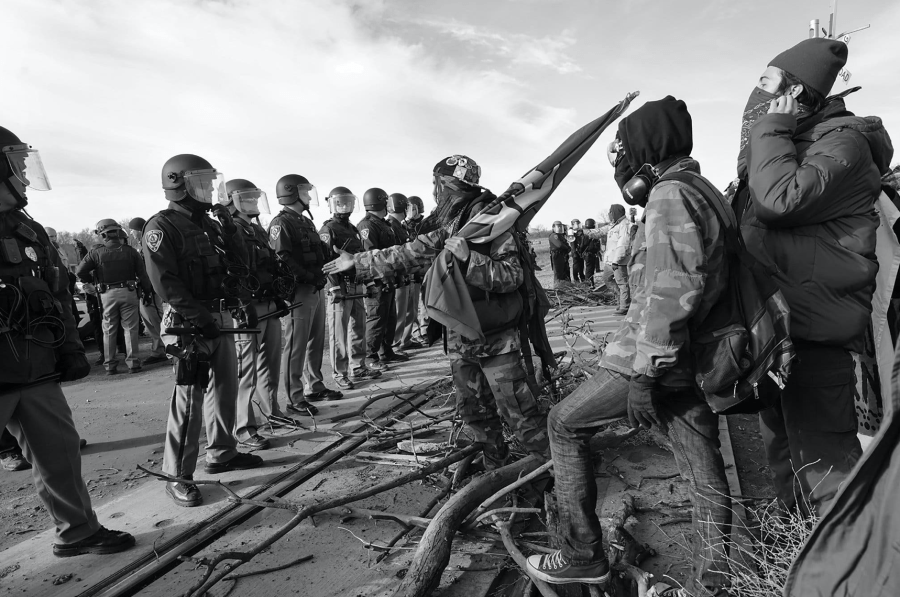
In the Spring of 2016, The Lakota mobilized to protest the pipeline, but it seemed like David fighting Goliath. The protests, which lasted months through sub-zero winter temperatures, were organized by Lakota teenagers on the Standing Rock Reservation. In the vanguard of the protesters were women who defied mace attacks, arrests and strip searches. The police used teargas, bulldozers and “military-style counterterrorism measures” to suppress the protesters, but the Standing Rock protests attracted tens of thousands of Native Americans from across the continent, becoming the largest Native American demonstration against the government in over a century. The rallying cry of the protestors in Lakota was “Mni wichoni! Water is life!” The protests became a cause célèbre, drawing media attention from around the world, as international environmentalists supported the Lakota defiance.

President Donald Trump supported construction of the pipeline and spoke out in favor of crushing the Native American protestors, but in a shocking decision on August 5, 2020, a district court ruled in favor of the Lakota. ” Mike Faith, the chairman of the Standing Rock Sioux Tribe, expressed delight at the verdict, “Today is a historic day for the Standing Rock Sioux Tribe and the many people who have supported us in the fight against the pipeline.”

Trump, though, was not finished in his battle with the Lakota and would continue disrespecting them. Trump deliberately chose to target the Lakota by celebrating the July 4th holiday of American Independence at an inflammatory site: Mt. Rushmore, where massive heads of American presidents were carved into mountains the Lakota hold sacred. “Wherever you go to connect to God, that’s what the Black Hills are to the Lakota,” said Nick Tilsen, a member of the Oglala Lakota tribe and the president of NDN Collective, an Indigenous activist group. Prospectors seized the land during a gold rush in the 1870s, violating the Fort Laramie Treaty of 1868, which recognized the Black Hills as Lakota property. In 1980, A Federal Judge sided with the Native Americans in a suit to reclaim the Black Hills but awarded them a monetary settlement in lieu of the land. The Lakota, offended by the decision, have never touched the money.

(Photo: Larry Towell/ Magnum Photos New York Times)

The statues were carved by a white supremacist with strong ties to the Ku Klux Klan. Harold Frazier, the chairman of the Cheyenne River Sioux Tribe, called the monument a “brand on our flesh” that needed to be removed. He said,” Visitors look upon the faces of those presidents and extol the virtues that they believe make America the country it is today. Lakota see the faces of the men who lied, cheated and murdered innocent people whose only crime was living on the land they wanted to steal.” Washington and Jefferson were both slave owners, and Lincoln ordered the hanging of 38 Lakota men in Minnesota after an uprising of 1862. Theodore Roosevelt once said, “I don’t go so far as to think that the only good Indians are dead Indians, but I believe nine out of every ten are.”

Trump’s arrival again spurred Lakota protests and at least fifteen activists were arrested for blocking the highway leading to Mount Rushmore. One of the activists, Michael Patrick O’Connor, said he came because he wanted to express his outrage at the desecration of his people’s sacred lands and his frustration at a president who has failed the people of America. “I couldn’t find any reason not to be up here,” he said. “I felt like I owed it to the grandmas and grandpas, owed it to the people who suffered before us to do something and to come here because our people were gathering.”

Campaign banner during the struggle (Photo sourced: Wikipedia)

Good Voice Elk, a spiritual advisor for the Lakota, was among the older protestors. He said this was by no means his first protest. “I grew up in protests,” he said. “The seventies were really bad, and those kids, now they are the leaders.” Protesters ranged in age from senior citizens to children as young as 10. One girl was brought by her father from the Ute Mountain tribe in Colorado so she could experience Indigenous communities coming together.

Nick, Tilsen, the leader of the non-violent protest, has been singled out for retribution by local officials. He is facing felony charges that bring his potential prison sentence to 17 years. Tilsen is just the latest victim in the American government’s attempt to crush Lakota resistance. Despite the heavy-handed response to the protests, it’s hard to imagine the tenacious Lakota giving up anytime soon.

End.

USEFUL LINKS

Defend, Develop, Decolonise collective: https://ndncollective.org/

Terence MacSwiney – Heroism, Pacificism, Internationalist Solidarity

Diarmuid Breatnach

(Note: It was intended to post this on the anniversary of MacSwiney’s death but technical problems prevented that.)

(Reading time text: 15 mins.)

Terence MacSwiney, Lord Mayor of Cork died in Brixton Prison, London, on October 25th 1920: it was the 74th day of his hunger strike. His struggle brought international attention not only to his sacrifice but also to an Ireland in the second year of its War of Independence, a political and guerrilla war against the occupying power, the British State.

Between 1917 and 1981, twenty-two Irish people died on hunger strike against the injustice of British occupation of Ireland.1

HEROISM AND SELF-SACRIFICE

MacSwiney exhibited heroism and self-sacrifice in a number of steps he took before he embarked on his fatal hunger-strike. He did so first of all in putting his liberty and very life in jeopardy in opposing the colonial occupation and domination of his land. He took a second step towards endangering his liberty and life by joining the Irish Republican Brotherhood, an organisation dedicated at the time to the overthrow of British rule in Ireland.

Thirdly, he took the trend further still by not only joining the Irish Volunteers in 1913 but by being one of the founders of the Cork Brigade. Fourthly, MacSwiney opposed Redmond’s offer of the Volunteers to the British imperialist Army and stood with the dedicated minority in the subsequent split.

Fifthly, he joined the IRA after the 1916 Rising.

His sixth step was to take the Lord Mayor position in which his predecessor, Tomás Mac Curtain, had recently been murdered by Crown forces. Seventh, he embarked on his hunger-strike to the end.

Tomás Mac Curtain and family; he was murdered by British agents two months after his election to Lord Mayor of Cork City. (Photo sourced: Internet)

That trajectory reminds us all that the path of revolution is a dangerous one, requiring courage and sacrifice, though not necessarily always to that same degree.

PACIFICISM

Because he chose in the end to offer up his life in a hunger-strike to the death, Terence MacSwiney is often held up as the ideal example of pacifism and especially so when a particular phrase of his is quoted: It is not those who can inflict the most but those who can endure the most who will conquer.

Of course, the reality is that both are absolutely necessary. No struggle can be won by endurance alone, no more than a struggle can be won merely by inflicting damage upon the enemy.

There are genuine pacifists and fake ones. I don’t agree with either but I have some respect for those who put their liberty and even their lives at risk in a pacifist struggle. For the others, the social democrats and liberals who enjoin us to have all our resistance be peaceful, while they support the violence of the ruling class and their states at home and abroad, we should have nothing but contempt. It would indeed suit our enemies if we set out to endure every attack and made them pay nothing in return!

Those who remind us only of that quotation from MacSwiney, or of the one from that other hunger-striker and poet Bobby Sands, that “Our revenge will be the laughter of our children”, choose to forget – and try to make us forget – a very important fact about Sands and MacSwiney: each was a revolutionary soldier. Each was arrested because he was known to be a member of an armed force of resistance – the IRA.

INTERNATIONALIST SOLIDARITY

For some people, internationalist solidarity is almost all, ensuring that they don’t become any danger to the State in which they live or to its ruling class.

For some others, internationalist solidarity is something kind of extra, to be indulged in now and again.

I think both those tendencies are wrong. We need to confront our own ruling class and State, not only for the benefit of our own working class but also as a contribution to the world. But at the same time we need to pay attention to questions of solidarity with other struggles around the world.

And that can serve as a barometer too – for I have noticed in a number of organisations that when the leadership was heading towards giving up on revolution, inconvenient internationalist solidarity was one of the first things they threw out the window.

MacSwiney’s hunger strike drew the eyes of much of the world to his struggle and to that of his people. In India, the Nehru and Gandhi families made contact with MacSwineys and those connections were maintained for decades afterwards. It is said that Ho Chi Minh was working in a hotel in London when he heard of MacSwiney’s death and remarked that with such people as that, Ireland would surely win her freedom. In Catalonia, people fought daily battles with the Spanish police outside the British Legation in Barcelona. The story reached the Basque Country too and the example of Cumann na mBan was taken a little later to create the female section of the Basque Nationalist Party.

Photo Ho Chi Minh

A young Ho Chi Minh (not his name then) at Marseilles conference in 1919 (Sourced on Internet)
Some of AIA front Hunger Strike Memorial Glasnevin MacSwiney Commemoration Oct 2020
Spanish police fought Catalans sometimes daily outside the British Consulate there during MacSwiney’s hunger strike as they protested in solidarity with the Irish patriot. (Photo sourced: Internet)
Photo shows the Emakume Abertzale Batza, the women’s section of the Basque Nationalist Party, parading in celebration of Aberri Eguna, Basque national day, in 1932. Their formation was inspired by learning of Cumann na mBan. (Photo sourced: Internet)

In Britain too, there was great solidarity, a fact not often spoken about; 30,000 people walked in his funeral procession from the jail to St. George’s Cathedral in Southwark. Who were these people? Certainly many were of the Irish diaspora, the longest-established and largest ethnic minority throughout most of Britain’s history. But there were English socialists too.

At that time, the London Borough of Poplar – not far from the area where the anti-fascist Battle of Cable Street was fought, the anniversary of which we celebrated recently — was in dispute with the Government, who were expecting the rates to be collected there to be on the rental value, which meant the poor East London borough had to pay more than rich boroughs of West London.

The Councillors were planning to refuse to set the expected rates and were threatened with jail, whereupon their leader, George Lansbury said they would be proud to go to the same jail where MacSwiney was being kept. British socialists of that kind marched in the funeral procession (besides, at least two of the Poplar Councillors bore Irish surnames: Kelly and O’Callaghan).

In my opinion, it is a great pity that the leaders of the Irish struggle for independence did not work on building links with the British working class. In 1920 the British ruling class was in serious trouble – it had thousands of military conscripts wanting demobilisation after WWI but the British didn’t want to let them go as they felt they would need them to suppress risings in many parts of the British Empire. The working class in industry was building a strike movement and in 1919 the Government had sent soldiers to shoot strikers in Liverpool and to threaten strikers in Glasgow. The great coal strike of 1925 was not far off, nor was the General Strike of 1926.

If the leaders of the Irish independence struggle had made those connections, not only might the history of Ireland have turned out differently but that of the very world.

The preceding is a very close approximation to the speech I gave on the 25th October 2020 by the Hunger Strike Memorial in Glasnevin Cemetery at the Terence MacSwiney commemoration organised by Anti-Imperialism Action Ireland.

Hunger Strike Martyrs’ Memorial, Republican Plot, Glasnevin Cemetery. (Photo D.Breatnach)
Some of Anti-Imperialist Action in front of the Hunger Strike Memorial, Glasnevin Cemetery, after their MacSwiney Commemoration Oct 2020 (Photo: D.Breatnach).

FUNERALS AND FUNERAL PROCESSIONS IN DIFFERENT COUNTRIES

The working class Irish, who had had some scuffles with the police during vigils at the jail, were there in their thousands at the funeral procession in London in their Sunday best, with the middle class represented too. Some of the Irish women could be identified at a distance, wearing their traditional shawls of Irish city and countryside. The Mayor of Poplar was not the only town mayor to walk in the procession. British socialists took part as did visitors from abroad and the world media was well represented. Aside from the procession, huge crowds lined the South London streets as the cortege passed.

World media interest was intense. The funeral procession, the vast majority walking, travelled the 3.5 miles (nearly 6 kilometres) from Brixton jail northwards to the cathedral where McSwiney’s body was to be received for requiem service the following day.

London Funeral Terence MacSwiney St.George’s Cathedral, Painting by John Lavery

The church where Terence Mc Swiney’s body was laid out under IRA guard of honour, with 30,000 filing past was St. George’s, on the south side of the river, near Southwark Bridge. It had been formally opened in 1848, known as “the year of revolution” in Europe and Ireland had its own contribution with the Young Irelanders’ brief rising. St. George’s was the first Catholic Cathedral of London until the Catholic Westminster Cathedral opened up in 1903. The English Catholics, who were a very small minority in their country had not dared challenge the anti-Catholic restrictions for generations but under the influence of large Irish Catholic congregations became more assertive; however that did not mean that the mostly aristocratic English Catholics were eager to rub shoulders with their largely plebeian Irish brethren and also, north of the river were the main desirable areas. So in 1903 they built the Catholic Cathedral in Westminster and left St. George’s to the Irish plebs on the south side of the Thames.

The Bishop of Westminster in 1920, Cardinal Francis Bourne, head of the Catholic Church of England and Wales, did not comment publicly on the hunger-strike but let it be known in private that he considered it suicide. The London inquest however, at the insistence of his widow Muriel and the evidence of the Governor of Brixton Jail, had recorded the cause of death as heart failure. A week after MacSwiney’s funeral mass in Southwark, Bourne conducted a mass in Westminster for Catholic British Army officers killed in Ireland.

Front view Westminster Catholic Cathedral (Photo sourced: Internet)
Muriel McSwiney before here widowhood (Photo sourced: Internet)

The next day after the removal of the body from Brixton Jail, Bishop William Cotter of Portsmouth gave the Solemn Requiem with Bishop Amigo, Archbishop Daniel Mannix of Melbourne, and Archbishop Anselm Kennealy of Simla, India, in attendanc. It was a ticket-only even; six of those who had tickets were a close group of men, all wearing long coats – once inside they stripped these off and revealed their IRA uniforms. After the previous Republican guardians departed, McSwiney’s body was guarded by six men in the uniform of the army to which he had belonged and of which he had co-founded its Cork element. The Bishop of Southwark might or might not have been pleased but it would not be for long.2 Certainly Peter Emmanuel Amigo, originally from Gibraltar, Bishop of Southwark from 1904 to 1949, had pleaded publicly for MacSwiney’s release before he should die, writing to politicians at Westminster petitioning his release. In a telegram to prime minister David Lloyd George on September 5th, Bishop Amigo warned: “Resentment will be very bitter if he is allowed to die.”

After the service a large entourage accompanied the body in its coffin to Euston Station for the train journey to Hollyhead. From there it was to go on to Dublin, to be received by the people of the Irish capital and then onwards to his home city and final resting place. But it was not to be.

The train left Euston station early with many police on board. At Hollyhead the grieving relatives and friends were informed that the boat they had engaged would take them and the body instead to Cork. The funeral party protested, produced their contract of shipment — to no avail. Porters were called to remove the coffin but were resisted and left. The police were summoned and, manhandling the protesting mourners, seized the coffin (sadly it was not the only kidnapping of an Irish rebel’s body in history, one of the other occasions being by the Irish State with Vol. Michael Gaughan’s body in 1974).

The British authorities feared fueling the fire of patriotic fervour already burning in Dublin at the news of MacSwiney’s death and the impending execution by hanging of Volunteer Kevin Barry. The funeral party were determined to travel to Dublin as arranged and had to engage another ship, which they finally succeeded in doing. While McSwiney’s body travelled on to Cork, the reception was held in Dublin, a city in official mourning declared by the First Dáil and in the midst of an urban guerrilla war against a foreign military occupation.

Mourners in Boston, Chicago, Melbourne, Newcastle upon Tyne, and Manchester held symbolic funerals with empty caskets.

When the Rathmore dropped anchor in Cobh harbour, the coffin containing MacSwiney’s body was transferred to the Mary Tave tug to travel on to Cork to deliver the body to a waiting funeral party. The deck was packed with Auxies, murderers of his predecessor, the final indignity.

Arrival MacSwiney’s Coffin tug surrounded by Auxies Custom House Quay Cork. (Photo sourced: Internet)

A special meeting of Cork Corporation was convened where councillors (those not “on the run”) expressed their condolences and raw emotion at losing the City’s Lord Mayor.

The Deputy Lord Mayor Councillor Donal Óg O’Callaghan, revealing that he had received death threats, issue a defiant statement, decrying that despite Terence’s death, the merit of Republicanism would still linger and pass on:

The only message that I on behalf of the Republicans of Cork give today over the corpse of the late Lord Mayor is that Cork has definitely yielded its allegiance to the Republic, that the people of Cork will continue that allegiance unswervingly and that those of us who man the Municipal Council will attempt as far as in us lies to follow the noble and glorious lead of the two martyred Republican Magistrates.

The Republican hold on the Municipal Chair of Cork ceases only when the last Republican in Cork has followed Tomás MacCurtain and Terence MacSwiney into the Grave. Death will not terrorise us”.

After a funeral service in Cork Cathedral a massive crowd accompanied his coffin to the cemetery, with Republican organisations and ordinary citizens in the procession. The occupation authorities had banned marching in uniform or even in military fashion, or display of flags.

Nationalists under colonial occupation of European powers (including nations within Europe) would be taking inspiration from the Irish struggle for decades. The war of resistance in Ireland would continue, with Cork County and City seeing more than its share. The special terrorist units of the British and their regular army would burn the City on the night of 11th-12th December of that same year. Irish Republicans in Britain would concentrate on supplying intelligence and arms to the struggle at home, in addition to organising some prison escapes. Some British socialists would continue solidarity activities on a publicity level and liberals and social democrats would protest the British reprisals on the Irish civilian population.

But the body of Terence McSwiney had come home.

End.

MacSwiney’s Free, composed and performed by Pat Waters, with video footage:

Footage London & Cork funeral processions Terence MacSwiney:

Terence MacSwiney Cork funeral only footage:

FOOTNOTES
1Some, like MacSwiney and the ten in 1981, died of the depletion of the body through the hunger-strike while some were killed by force-feeding, like Thomas Ashe in 1917, Michael Gaughan in 1974 and Frank Stagg in 1976. Others survived hunger strike and force-feeding but their bodies (and sometime their minds) suffered for the rest of their lives, such as the Price sisters (1973-1974).

2Part of that journey was marked in reverse by the Terence MacSwiney Commemoration Committee with a march in 1989. The idea as far as I can recall had been Brendan O’Rourke’s, an Irish solidarity activist and at that time Manager of the Lewisham Irish Community Centre, the Management Committee of which I was Chairperson and with a few others, Brendan and I led that Commemoration Committee.

The march, supported by Irish Republicans and some English socialists, rallied at Kennington Park, on the lookout for National Front or police attack but knowing that in Brixton itself, an area of high Afro-Caribbean settlement, both those misfortunes were unlikely. We were led by a Republican Flute Band from Scotland and applauded by people as we marched past the police station (the State garrison of the area) and through the centre of Brixton. The march proceeded without incident up Brixton Hill to the entrance of the road leading in to the Jail, held a moment’s silence there and marched down to the centre of Brixton Town, ending there for people to proceed to a reception at Fr. Matthew Hall.

It was the last such march as we could not get another band from Scotland to lead us. We were independent of Provisional Sinn Féin and Scottish RFB members told us that the bands had been told, unofficially of course, that participating in our events would adversely affect their chances of being invited to play at annual events in the Six Counties, which for those bands was the high point of their annual calendar.

SOURCES:

https://www.irishtimes.com/culture/heritage/the-three-funerals-of-terence-macswiney-1.4387267

https://www.stgeorgescathedral.org.uk/about/history/

https://www.irishexaminer.com/news/spotlight/arid-40070420.html

“THOUSANDS OF RUSSIAN SOLDIERS TO HELP CATALONIA WIN INDEPENDENCE FROM SPAIN”

Diarmuid Breatnach

(Reading time: 5 mins.)

In the midst of an arrest operation on Wednesday of 21 people for alleged misuse of public funds to assist the Catalan independence movement, the Spanish State issued a statement alleging that Russia had offered the movement 10,000 Russian soldiers to aid their struggle. It wasn’t the only Russian connection to the Spanish police operation, which they had named Operación Volkhov.

The arrests this week form part of measures by the State against Catalan independence activists since 2017. That year, a coalition of pro-independence political parties and a huge grassroots movement in Catalonia pushed for a referendum to vote for or against an independent Catalan republic, which the pro-Spanish union opposition called on people to boycott. The Spanish State sent its police to raid Catalan regional government offices, confiscate ballot papers, search for ballot boxes (unsuccessfully) and, on the day of the Referendum itself on October 1st, to storm polling stations and beat up voters.

Since then, the Spanish State has jailed seven Catalan politicians and two leaders of grassroots movements on charges of sedition, charged senior Catalan police officers with disobedience (recently acquitted), charged activists with possession of explosives (turned out to be fireworks), other Catalan politicians – including the former President — are in exile, the current President of the regional government has been banned from holding office, 700 local town mayors are under investigation and others are facing charges arising out of strikes and acts of civil disobedience such as blocking streets and a motorway (for which one activist was charged with terrorism). The raid this week comes in addition to all those legal processes.

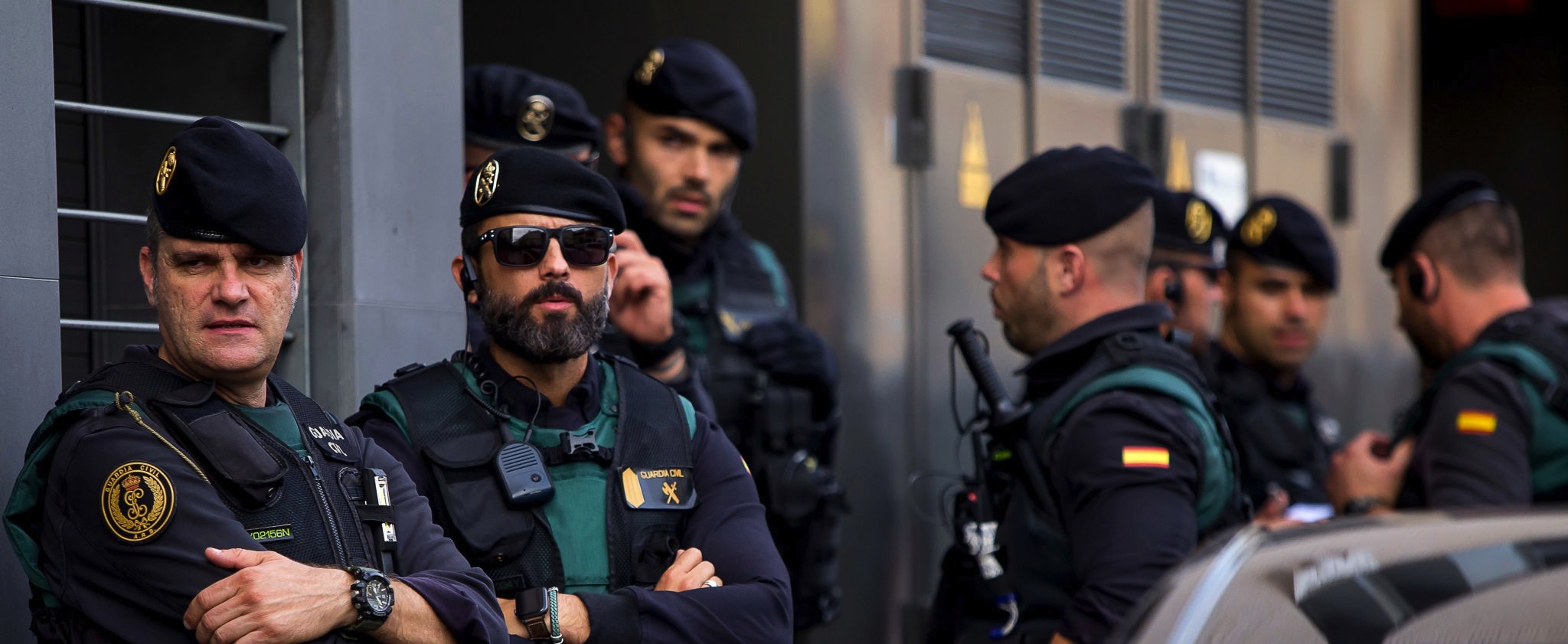
Members of the Guardia Civil (spanish militarized police) arrested pro Catalonia independence activists. (Photo source: Internet)

There is something of an irony in charging Catalan activists with misuse of public funds in pursuance of independence, given that independence is what many of the Catalan public desire but even more ironic considering the rampant corruption endemic in Spanish political circles and the Monarchy itself, the former King Juan Carlos resigning amidst allegations of financial corruption and being allowed to flee the country ahead of an investigation.

Whatever about the charges of misuse of public funds it is unlikely that most political observers will take the allegations of an offer of Russian military intervention seriously and not only because it comes from Guardia Civil intelligence, a police force maintaining the fascist Franco dictatorship for four decades and, according to many, especially Basques and Catalans, not much changed since. The notion that Russia would risk a war with the EU and the US-dominated NATO, in order to help free a nation of 7.5 million people nowhere near its own territory, must be laughable.

For those facing charges, under investigation, in exile or already in jail, the situation is not humorous. And then there is the sinister name of the police operation. During WW2, General Franco, dictator of a neutral Spain sent fascist volunteers to aid the Axis in Europe, many of them fighting on the Russian front. Franco had quite recently led a successful military-fascist uprising against the Spanish left-wing Popular Front Government, for which he had been aided by Nazi German and Fascist Italian armament and men. His victory was followed by a repression that left Spain with more mass graves than anywhere else other than Cambodia. The Spanish volunteers to fight Soviet communism formed the Blue Division – blue, from the colour of the Falangist shirts and uniforms.

SPANISH FASCISTS ON THE VOLKHOV FRONT

Among the Nazi German forces in the Volkhov region were the men of the Blue Division and it seems they carried out a successful night crossing of the Volkhov River on 18th October 1941. A subsequent Red Army advance in January 1942 failed ultimately because not all the components of the operation had advanced according to plan. In August 1942 the Blue Division was transferred north to take part in the Siege of Leningrad, on the south-eastern flank of the German Army.

However in February of that 1943, operations on the Volkhov Front formed Part of the Red Army plan to first break the siege of Leningrad and then trap Nazi forces in encirclement. According to what seems a Spanish-sympathetic Wikipedia account of the battle at Krasny Bor, in the vicinity of Volkov, the Blue Division fought stubbornly from 10-13 February 1943. On February 15, the Blue Division reported casualties of 3,645 killed or wounded and 300 missing or taken prisoner, which amounted to a 70–75% casualty rate of the troops engaged in the battle. The remnants were relieved and moved back towards the rear.

Red Army casualties were much higher and, although forces attacking well-fortified positions backed by good artillery and tanks, all of which the Nazis had, can expect to lose three attackers for every one defender, Russian analysis later blamed bad leadership, ineffective use of artillery and clumsy use of tanks for their losses.

A Spanish police force evoking today the memory of Spain’s fascist troops in WW2 might seem ominous but to those who believe that the Spanish ruling class and their police force have never ceased to be fascist, the only surprise will be its effrontery. To the Guardia Civil, the fighting in the vicinity of Volkhov in October 1941 might seem the finest hour of the Blue Division but they might do well to remember that effectively it also met its end there in 1943: the Division ceased to exist and was reformed as the Blue Legion, soon afterwards to be disbanded, some soldiers absorbed into the Waffen SS and others withdrawn home.

RUSSIAN TROOPS FOR CATALONIA?

Fast forwarding to the present, the Russians, at least in their Embassy in Madrid, treated the allegation of their offering troops to support Catalan independence as a joke. The following post in Spanish appeared on their electronic notice and comment board (translated):

Note: The information that appeared in the Spanish media about the arrival of 10,000 Russian soldiers in Catalonia is incomplete. It is necessary to add a further two zeros to the number of soldiers and the most shocking thing of all this conspiracy: the troops were to be transported by “Mosca” and “Chato” planes assembled in Catalonia during the Civil War and hidden in a safe place in the Catalan Sierra (mountain range) until they received the encrypted order to act through these publications.

Russian Embassy Madrid, Main entrance (Photo source: Internet)

End.

SOURCES:

Police operation name, raid and arrests: https://english.vilaweb.cat/noticies/spains-paramilitary-police-names-newest-raid-after-ww2-fascist-victory/

https://english.vilaweb.cat/noticies/new-police-raid-against-pro-independence-activists-and-business-people/

History of the Volkhov Front, WW2: https://en.wikipedia.org/wiki/Volkhov_Front

Battle of Krasny Bor: https://en.wikipedia.org/wiki/Battle_of_Krasny_Bor#Soviet_Union_–_Leningrad_Front

Russian Embassy humorous comment: https://spain.mid.ru/es_ES/-/replica-de-la-embajada-sobre-la-informacion-aparecida-en-los-medios-espanoles-sobre-la-llegada-de-10-mil-soldados-rusos-a-cataluna?redirect=https%3A//spain.mid.ru/

CORRECT ANALYSIS, SHAMEFUL CONCLUSION

Diarmuid Breatnach

(Reading time: 5 mins)

A leaflet from the Socialist Party of Ireland distributed at the antifascist rally in Dublin on Saturday 12th made a correct analysis of the source of the problems in Irish society of which the Far-Right are taking advantage in order to mislead people but also grow. But the leaflet text failed shamefully when it came to outlining the next steps to take.

          Titled “OPPOSE RACIST DIVISION — Organise to stop the far right”, the leaflet correctly identified the haphazard Government restrictions as the cause of insecurity and confusion about the Covid19 virus, which fed the negationist movement. It also stated that the Far-Right was manipulating these people and working to infect them with racism and homophobia.

It was correct also to point to the need for socialists to expose the real issues and organise to resolve them.

However, the leaflet text went on to state: “Recent experiences have shown that small counter demonstrations with confrontational tactics have jeopardised the safety of anti-fascist protestors and can drive some some people further into the arms of the far right.”

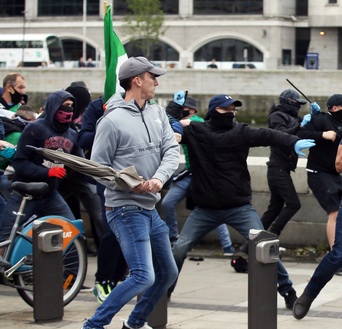
Perhaps the Socialist Party can tell us what kind of counter demonstration would not be seen as having “confrontational tactics”. In fact since to their credit for the first time some of their comrades actually took part in one such counter-protest, on Custom House Quay on the 22nd August, they could inform their party that the counter-protesters were attacked almost as soon as they stepped on to the Quay, before anything at all was said by them. Also, the Far-Right have been staging regular street protests since last year, many of them centred around the racist and conspiracy theorist Gemma O’Doherty, who recently unfurled a banner calling to “Make Ireland Catholic Again”. Should the Far-Right have been permitted to continue without public opposition?

Some of the armed fascists that attacked a counter-protest on Custom House Quay on 22 August 2020.
(Source Image: Internet, then cropped)

The counter-protests were small because the majority of the antifascist movement did not participate in them. It was independent anarchists, socialists and Irish Republicans who first took up that task and at that time the Far-Right protests were quite small. When the Far-Right called a larger one for Leinster House, in a coalition of fascist parties and organisations, a fairly large force of Irish Republicans and independent antifascists confronted them and a number of the Republicans were arrested. Following that event, on 14th December 2019 a larger combined force of antifascists including Irish Republicans, Antifascist Action and socialist parties occupied the protest ground planned by the Far-Right outside Leinster House and outnumbered the latter by about ten to one.

The small ad-hoc antifascist coalition of various political and social threads has been left to confront all the other fascist gatherings on their own. A Far-Right group called QAnon occupied the GPO forecourt for Saturday rallies as soon as the Covid19 restrictions were introduced and were left largely unmolested by antifascists to establish themselves as a weekly event, supported by fascist activists who travelled from different parts of the country to attend it. They were left unmolested by the Gardaí too, who nevertheless used Covid19 powers to harass Debenhams picketers around the corner in Henry Street and also by the Special Branch, Ireland’s political police, who harassed pickets held in solidarity with Irish Republican and Basque political prisoners, demanding the names and addresses of the picketers.

All subsequent rallies, pickets and meetings of the Far-Right were left entirely to the small aforementioned coalitions to oppose but when the Debenhams workers staged their march and rally on 8th August, the QAnon group abandoned their Saturday spot and took to Phoenix Park instead, showing the antifascist potential of a large gathering of the Left.

HISTORY OF ANTIFASCIST STRUGGLE IN IRELAND

          The rise of the fascist movement in Ireland in the 1930s was defeated by Irish Republicans, who confronted them physically on the streets to the extent that the ruling class feared revolution and mostly acquiesced with De Valera’s government banning a Blueshirt march, after which the Blueshirts became integrated into the Fine Gael party and ceased to have a separate existence.

Eoin O’Duffy exchanges fascist salute with Blueshirt rally in 1930s Ireland.
(Photo source: Internet)

Every attempt to establish a fascist party since then has been promptly squashed by antifascists. In 2016 the European islamophobic fascist organisation Pegida tried to launch itself in Dublin and was driven off the street by massive mobilisation of both those advocating peaceful opposition as well as those favouring physical confrontation (by the way four Republicans still face serious charges arising out of those events). The tiny group of native Irish fascists was attacked on its way into the city centre and the East European contingent had to run or be brought to safety in Garda vans.

Attempted Pegida launch February 2016.  After some short battles between antifascists and fascists with Gardaí moving in to protect the latter, they spirit them away in police vans while staging a diversion in O’Connell St.
(Photo: D.Breatnach)

IN BRITAIN

           The fascist movement of Sir Oswald Moseley’s Blackshirts was physically opposed in numerous battles on the streets of British cities throughout the 1930s and after WW2, Moseley himself being knocked to the ground in Manchester and hit by a flying brick in Liverpool. Numerous battles took place in London too of course, the most famous being at Cable Street, where a coalition of Irish and Jewish antifascists, along with local Communist Party activists, fought a battle of several hours on 4th October 1936, principally with 7,000 London Metropolitan Police and all the mounted police of the city. The police got through the first barricade but failed to penetrate the second and the Blackshirts had to turn away, many being ambushed at other points such as at Hyde Park Corner.

Scene from the antifascist Battle of Cable Street 1936, fought mainly against the police who were trying to clear the way through the Jewish migrant area for the fascists.
(Source photo: Internet)

Section of mural near the scene presenting an artist’s impression of the Battle of Cable Street, East London 1936.  (Photo source: Internet).

After WW2 all attempts of Moseley and other fascists to organise were suppressed by robust action on the streets, the most serious being in 1958 in London’s Notting Hill area. Many of the post-war migration of Afro-Caribbean people to London lived in that area. Moseley’s Union of Fascists and the White Defence League organised and whipped up gangs of white youths to attack first migrant Caribbean males, then the white wife of a Caribbean man and finally Caribbean families. The Caribbean migrants and Irish and British antifascists organised defence and battles went on for two weeks. According to Wikipedia: The riots caused tension between the Metropolitan Police and the British African-Caribbean community, which claimed that the police had not taken their reports of racial attacks seriously. In 2002, files were released that revealed that senior police officers at the time had assured the Home Secretary, Rab Butler, that there was little or no racial motivation behind the disturbance, despite testimony from individual police officers to the contrary.” (That pattern of police denial of racism and neglect of targeted communities became a repeated pattern and has also been seen in many other countries).

When fascists began to organise again in Britain at the end of the 1960s, the parties of the Left first advocated ignoring them and when they did eventually mobilise counter-demonstrations, marched them away from confrontation with the fascists. Meanwhile fascists were attacking sellers of socialist papers, socialist meetings, migrants and ethnic minorities. Some elements of the Left after a while adopted the slogan of “no platform for fascists” which became popularised among students and some staff in institutions of third-level education, eventually becoming policy of the National Union of Students.

A coalition of antifascists of various political backgrounds, including some acting unofficially outside their party discipline, mainly in AFA (Anti-Fascist Action) and small groups of revolutionary communists, anarchists, Irish Republicans and antifascists expelled from their parties (e.g. Red Action) took on the National Front, the League of St. George and the British National Party in numerous battles and smashed the ability of the fascists to take possession of any significant physical space in order to organise.  On September 13th we passed by the anniversary of one of those battles in Lewisham, SE London in 1977 and we are nearly at the the anniversary of another, on the 18th in 1992 at Waterloo (the London Underground and train station, not the site of the 1815 battle in Belgium).

Scene from the antifascist Battle of Lewisham 1977. Left groups and Afro-Caribbean youth successfully battled mainly against police to prevent the fascist National Front marching through the borough’s centre.
(Photo source: Internet)

Throughout that period the main parties of the left (with the exception for a period of the SWP and the IMG) refused to confront the fascists physically and instead concentrated on organising events to attract youth away from fascism, principally through the Anti-Nazi League. It was however clearly the physical confrontations by antifascists on the streets, as had been the case in the 1930s that again defeated the rising fascist threat in Britain – for a time. Clearing the fascists from the street not only prevented the intimidation of Left activists and ethnic minorities and prevented the creation of fascist areas but also made it much more difficult for fascists to recruit and marshall forces.

LEARNING THE LESSONS?

          Rather than draw on the lessons of those struggles in Ireland and in Britain, the leaflet text advocates repeating the mistakes. In effect, the leaflet advocates leaving the antifascist mobilisations for the moment and concentrating on the class struggle against the system. That strategy entails allowing the fascists to become established and grow unhindered, making it much harder to root them out later. But not only that – the Left in Ireland has a pretty poor record of taking on the capitalist system and is particularly weak at the moment, with the trade union movement largely supine. The leaflet points to the just struggle of the Debenhams workers, with which the SP is particularly closely connected, at least in Dublin; however it is well to note that those workers have been sacked, their workplaces closed and the struggle is a last-ditch defensive one for redundancy pay. In other words, we are nowhere near a situation where the overall struggle against the capitalist system is such as to cut the ground from under the Far-Right.

Because those loose antifascist networks currently active are not under the control of the SP and are hardly likely to heed their call, the effect of the leaflet text is to advocate a continuation of the current situation, where counter-protests will be outnumbered by mobilisations of the Far-Right, despite the fact that the fascist parties actually have tiny support, bussing in people to swell the numbers. Fascist attacks will continue and may well even escalate. Fascists will continue to arm with Garda impunity for their attacks but it is certain that when the antifascists arm likewise, they will be arrested for “possession of offensive weapons” and even jailed.

Finally, the leaflet failed to give any specific indication of a short or medium-term way forward except to “join the socialists”, i.e the Socialist Party. The leaflet could have advocated building a broad antifascist front and called on people to help in that work, to bring in people not currently active, to ensure large turnouts to counter mobilisations of the Far-Right. But it didn’t.

End.