As the northern hemisphere turned eastwards and the majority western calendar turned to a new year, it has been customary for people to wish one another a ‘Happy New Year’, not just for the first day of January but for the twelve months to come.
Although the Celtic New Year will not begin until the first of February, and the new year begins with “teacht an Earraigh … tar éis na Féile Brighde”, I have done likewise but with deep feelings of ambivalence.
Because facing us as 2026 progresses is genocide in some parts of the world, growing fascism in some other parts, tighter squeezes on working people, smaller proxy wars and, almost certainly, a larger war, with desperate migrations of people, if surviving death to find racism and exploitation.
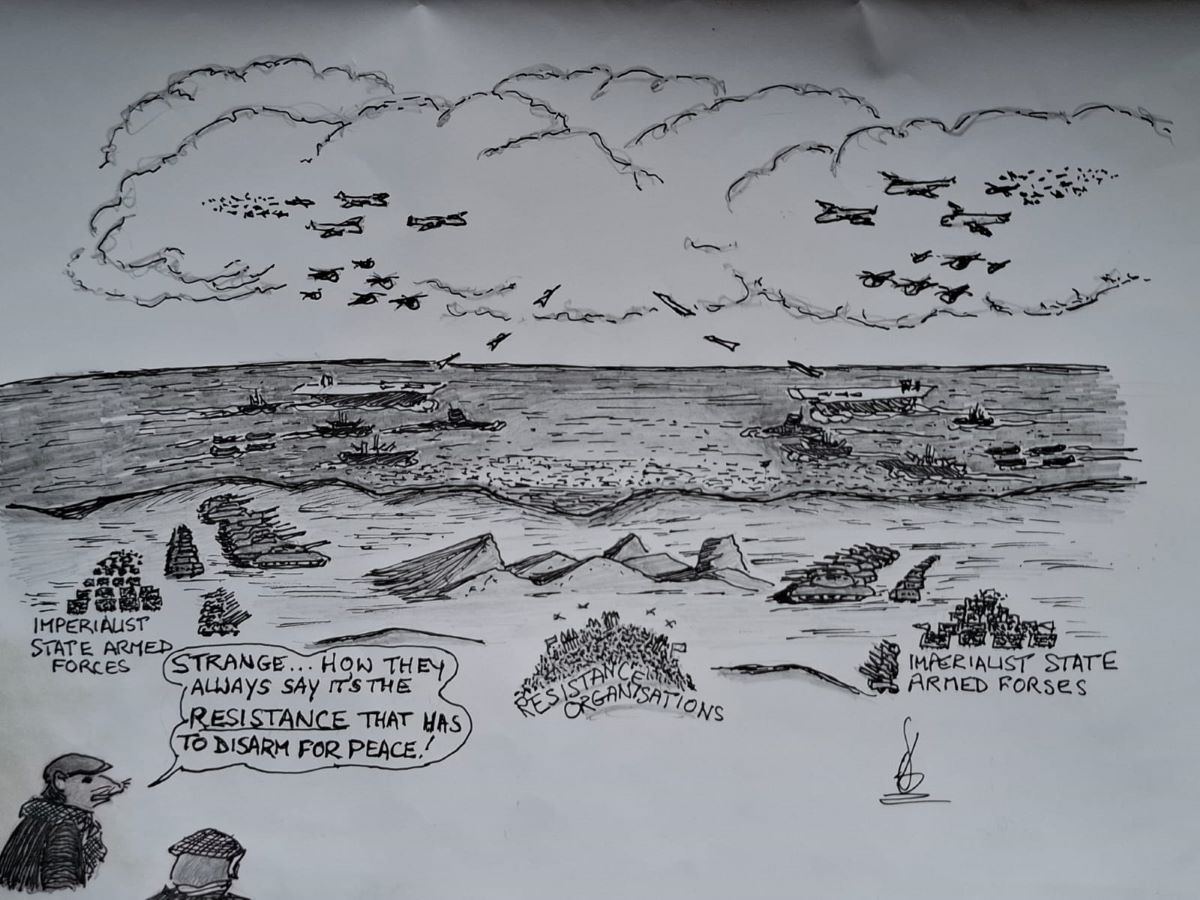
Faced with armed occupation and genocide, armed resistance is justified and arguably necessary, even were it not established as a right within the Geneva Convention. But even unarmed and peaceful resistance is being penalised and repressed, including in the ‘Western democracies.’
Support and solidarity organisations are being outlawed, people expressing legitimate opinions against genocide, racism, ethnic cleansing and armed occupation supported by those ‘democracies’ are being hounded in their jobs and private lives, beaten and arrested by police and even shot dead.
But where there is oppression there is also resistance. The struggles against the racist and genocidal entity, though supported in arms, finance and politically by the Western ‘democracies’ have awoken people in those countries to solidarity action in the face of their governments’ opposition.
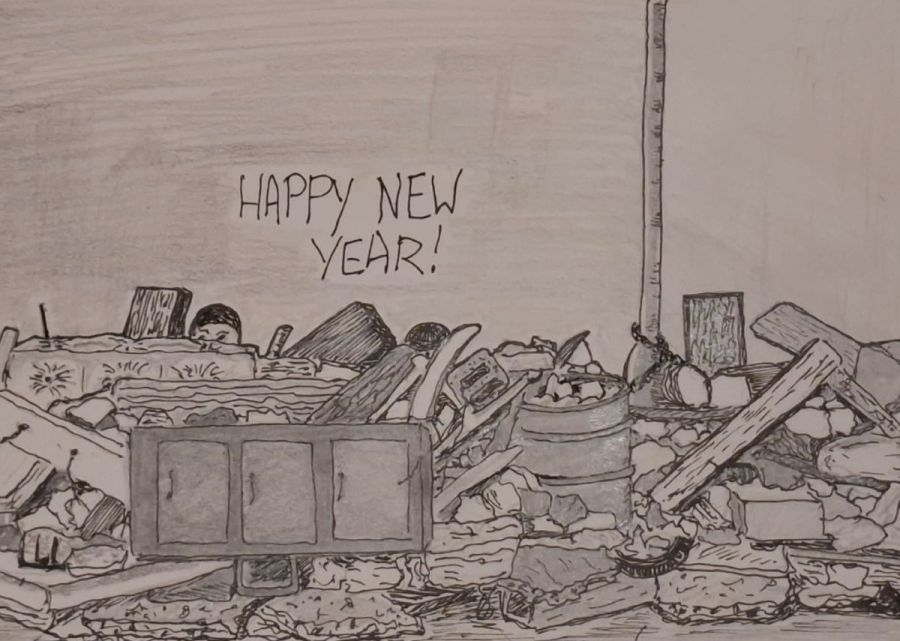
(Cartoon by D.Breatnach)
Hugely important lessons have been learned: about the nature of the Zionist state, about the collusion of the ‘democracies’ in colonial occupation and genocide, about ‘the independence of the judiciary’ and the ‘free press’, along with the partiality and ineffectiveness of ‘international law’.
And also about the ineffectiveness of liberal opinion and organisations, even in their heartlands of the ‘democracies’, to achieve meaningful change or even stop the repression. And about how the State knows this and reacts most violently against direct solidarity action.
Organic links have become clear between war in Yemen and Somalia, the spread of Islamist jihadism and imperialism, between prison struggles in Palestine, Britain and Ireland, between the troubles of the world and much of their origins among the colonial and imperial powers.
Yes, where there is repression, there is also resistance and our duty lies in feeding that resistance in all the ways that we can, including being visible in protests at their trials and supporting them in jail. And impeding our ruling class’ attempts to tie us to NATO or other military alliance.
So what I wish for is an increase in the militant resistance of the masses and greater unity in struggle, simultaneously with greater disunity among the imperialist states and ruling classes, bringing us closer to the kind of world we need.
I wish that for us all throughout 2026.
End.
Note: If you found this article of interest, why not register with Rebel Breeze for free, so that you will be notified by email of subsequent articles. You can de-register any time you wish.
Thousands of ex-ISIL (ISIS) fighters and their families have been freed during the Syrian government forces assault on the SDF-guarded Al-Shaddadi jail. Both sides blame the other for the release although the Government forces admit their assault.
The SDF, mainly Kurdish forces supported by the US/ NATO coalition to oust the former Assad regime, have been guarding an estimated 10,000 prisoners in the jail since the collapse of the ISIS offensive in the region.1
Observers have feared the release of the ISIS fighters and their ‘radicalised’ families since the December 2024 collapse of the Assad regime in a Turkey-supported offensive.
That attack was led by Ahmed Hussein al-Sharaa, former Al Qaeda fighter and second-in-command of the ISIS-supported al-Nusra forces in Syria, a coalition of fundamental Islamist jihadists fighting under ISIS leadership though their leader claims to have fundamentally changed.
Ahmed Hussein al-Sharaa changed his name to al-Jolani and claims to have renounced ISIS, proclaimed himself President of Syria and filled his cabinet with ‘former’ ISIS commanders, since which Western imperialist leaders have accepted him and Trump praised him greatly.
Cartoon by Carlos Latuf depicting the Western imperialist makeover of the ISIS Ahmed al-Sharaa to al-Jolani, self-appointed President of Syria (Sourced: Internet)
The western powers cancelled his designation of ‘terrorist’, presented their compliments at his throne, some, including French and German envoys, travelling to meet him2 (even before the $10m bounty on his head3 had been removed). Or invited him to call, as Macron did for France.4
Al-Jolani offered friendship to ‘Israel’ even as the IOF occupied additional parts of Syria and bombed any remaining military installations of the Assad regime.5
THE KURDISH-LED SDF, TURKEY AND AL-JOLANI
The objective of the SDF had been to overthrow Assad so as to form a Kurdish state within Syria in order to link up with other Kurdish regions to create a federal Kurdish state. Turkey feared this project, having fought decades of bloody war against the PKK in its own Kurdish region.
Apologies for use of CIA map but difficult to get publishable image showing Kurdish-controlled areas within Syria. (Image sourced: Internet)
Consequently Turkey was at odds with US/NATO forces and the participation of the SDF within it, although Trump, as his previous Presidency drew to an end, publicly withdrew support for the Kurdish coalition. Turkey has welcomed the Damascus forces defeat of the SDF.
Since al-Jolani and his own coalition came to power, he attempted to integrate the SDF fighters within his own forces. The Kurds reluctantly agreed but insisted they be incorporated as a unit and not dispersed among al-Jolani’s forces, a proposal declined by the new President.
Since then there have been numerous clashes between the different forces, with the SDF holding their own, until the recent few days when they lost a number of strongholds, including that guarding the Al-Shaddadi prison, leading to thousands of former ISIS fighters being freed.
This prison breach, welcomed by Turkey,6 must be viewed with horror by many Syrians, in particular by the Yazidi, Alawite, Druze and Christian communities who have been subjected to home invasions, humiliation and massacres, along with rape and kidnapping of women.7
Neighbouring Iraq, Lebanon and even Jordan have cause to worry too.
Again, difficulty in getting publishable map showing Syria with its neighbours but also Iran. (Image sourced: Internet)
In sifting through the disputing claims, it is worth noting that the SDF claimed that the International Coalition base, only two kilometres away from the jail in Syria’s Hasakah province, did not respond to calls for assistance8 and the SDF denounced the failure of the USA’s forces to support them.9
It is relevant too that the SDF are not Islamist Jihadists and fought them many times in Syria, although it is true that the Western powers, while supporting the SDF, also supported and instigated ISIS to overthrow Assad, although bombing them too in periodic control operations.10
Events from the coming to power of Al-Jolani to the freeing of the Al-Shaddadi Prison may hold lessons of importance too for some strains of the Western Left and Liberals who supported the insurgent opposition to Assad in favour of ‘democracy’ while parroting mass media propaganda.11
It may also add a cautionary example to the dictum that ‘the enemy of my enemy is my friend’, often quoted by otherwise anti-imperialists who supported the IDF’s alliance with the US/NATO to overthrow the Assad regime.12
CUI BONO? WHO GAINS?
What now? (Cartoon by D.Breatnach)
One might think that the Western Powers, who have been in coalitions fighting ISIS and have suffered some attacks on themselves, including the Al Qaeda attack on New York’s Twin Towers, would be strongly opposed to this liberation of thousands of experienced Islamist jihadist fighters.
But if so, how are we to understand the refusal of the Coalition forces to intervene during the attack on the SDF forces guarding the jail? Or the Western Powers legitimising of the Al-Jolani regime running Syria, despite the al-Nusra background and religious sectarian massacres since?
It is difficult to avoid the conclusion that the imperialist powers wish to see those Islamic fundamentalist ex-fighters freed — but what could be their purpose? To instigate an internal conflict in Lebanon, perhaps, occupying Hezbollah away from ‘Israel’ and excusing foreign intervention?
Or keeping the Iraqi Government busy and deepening its reliance on US forces just as it seems to be asserting some independence. Or to sent north-eastwards against Iran. One thing is clear, the Western Powers allowed it and the reason nothing to do with concern about jail conditions.
End.
Note: If you found this article of interest, why not register with Rebel Breeze for free, so that you will be notified by email of subsequent articles. You can de-register any time you wish.
FOOTNOTES
1At the end of 2020, the U.S.-backed militia in northeast Syria held at least 10,000 ISIS prisoners, one of the largest populations of detained Islamists in the Middle East. Thousands of ISIS fighters were captured as the Islamic State collapsed in early 2019. The fighters were held in approximately 14 detention centers operated by the Syrian Democratic Forces (SDF), the U.S.-trained Kurdish and Arab militia that fought ISIS in Syria.https://www.wilsoncenter.org/article/islamists-imprisoned-across-middle-east
6From The Cradle, on Telegram: Omer Celik, spokesman for Turkish President Recep Tayyip Erdogan’s ruling AK Party, said that recent gains by Syrian government forces had “thwarted” attempts by Kurdish groups to obstruct Turkiye’s peace process. Feti Yildiz, deputy leader of the government-aligned Turkish nationalist MHP party, described Sunday’s agreement in Syria as having “a favorable impact.” “Things will become easier,” Yildiz told reporters in the Turkish parliament when asked how the Syrian deal affects the PKK process. “It had been standing like an obstacle, and for now it looks as though that obstacle has been removed.” Turkish security sources, speaking to Reuters on condition of anonymity, called the deal a historic turning point.
10The SDF contains female Kurdish and Yazidi fighters too which would be anathema to Islamist fundamentalists.
11It should not be understood from this that I was a supporter of the Assad regime; I attended demonstrations against imperialist invasion and regime change while also refusing to support the regime itself. I had arranged with Eva Bartlett, a much-publicised critic of the regime-change operations of the US/NATO forces, to organise a Dublin public meeting for her to address and had her stay at my home. After learning that I was also going to criticise the regime position against the Kurds she left without explanation and I had to cancel the meeting venue booking.
12In discussions with Anarchists of the WSM (organisation no longer in existence) and Irish Republicans of (Éirigí organisation much diminished since and now in coalition with another group) I refuted the correctness of application of this principle to the major imperialist power in the world, the USA. At a conference of the Éirigí group I spoke from the floor in criticism of that and some other aspects of the SDF and was heavily criticised from the floor also while the Chairperson reiterated support for the SDF. Though no-one spoke in my support, at least three Irish Republican activists approached me afterwards to express their support for my statements.
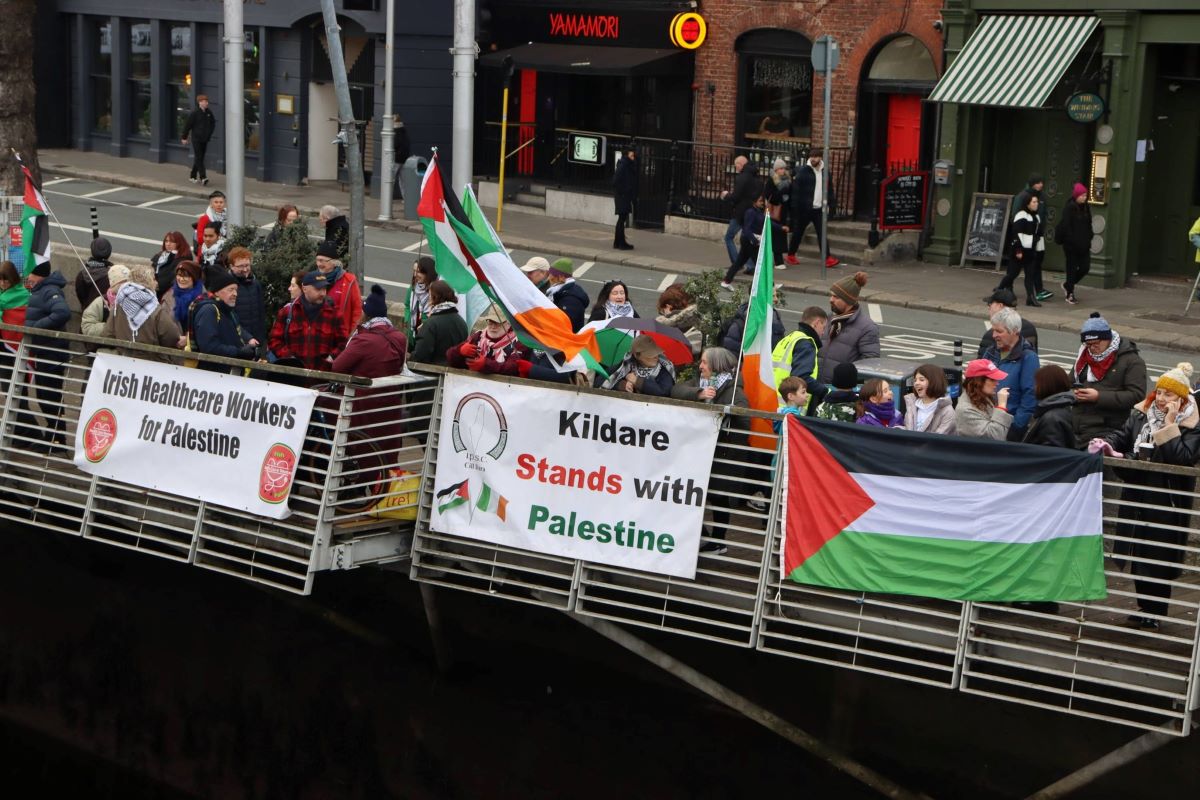
Through three events on Saturday, New Year’s Eve in the city centre, Dublin sent a solidarity message to the Palestinian people and also to the solidarity activists on hunger strike in British jails, referencing also those of the Irish Resistance in 1981.
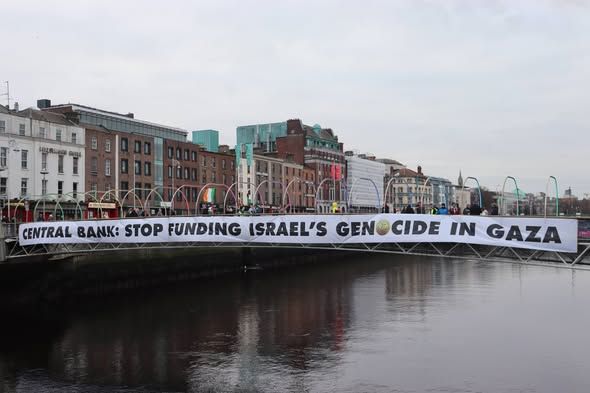
The Millennium Bridge on New Year’s Eve. (Photo: IPSC)
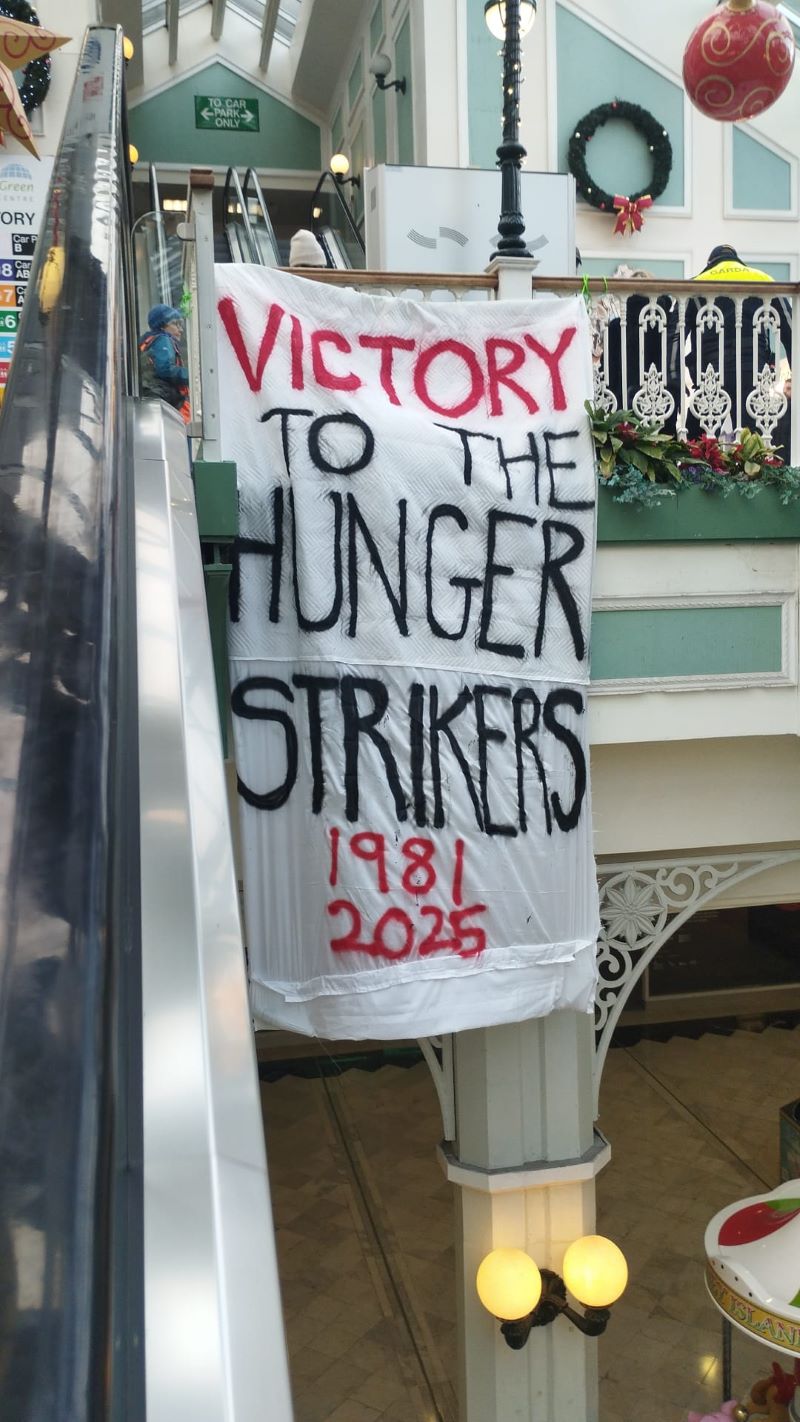
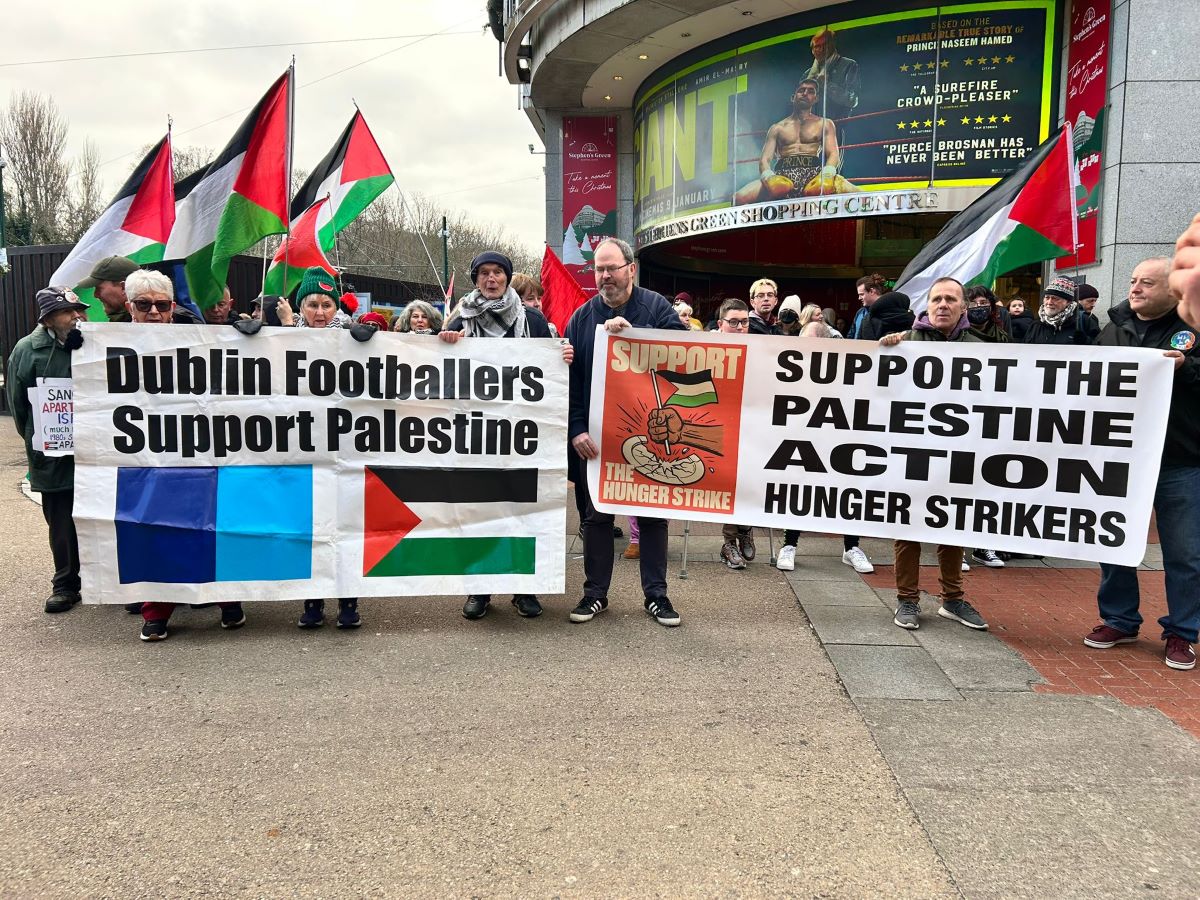
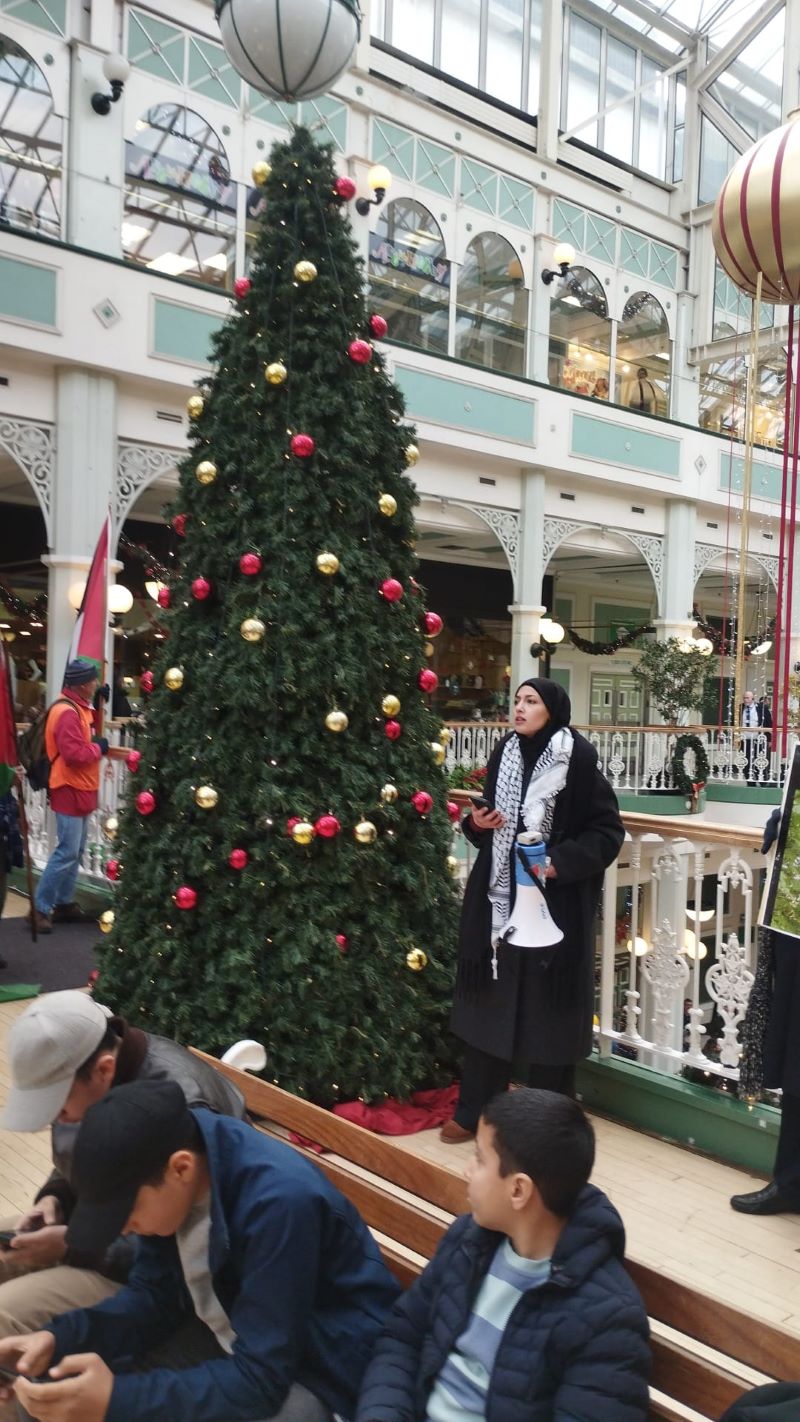
Chronologically first was a protest in the Starbucks café1 in Stephen’s Green Shopping Centre obliging the management to close for hours and a balcony walkway banner drop calling for solidarity with the Elbit accused on hunger strike, referencing also the Irish hunger-strikes of 1981.2
I had not read the poster carefully and arrived at the Starbucks at the north end of Grafton Street, where there were a few other confused people also. By the time I made my way up to the southern end of Grafton Street, the protest there was about to leave and I was about to head elsewhere.
Two main banners present at protest outside the Stephen’s Green Centre on New Year’s Eve, after closing down the Starbucks café inside. (Photo: Bas)
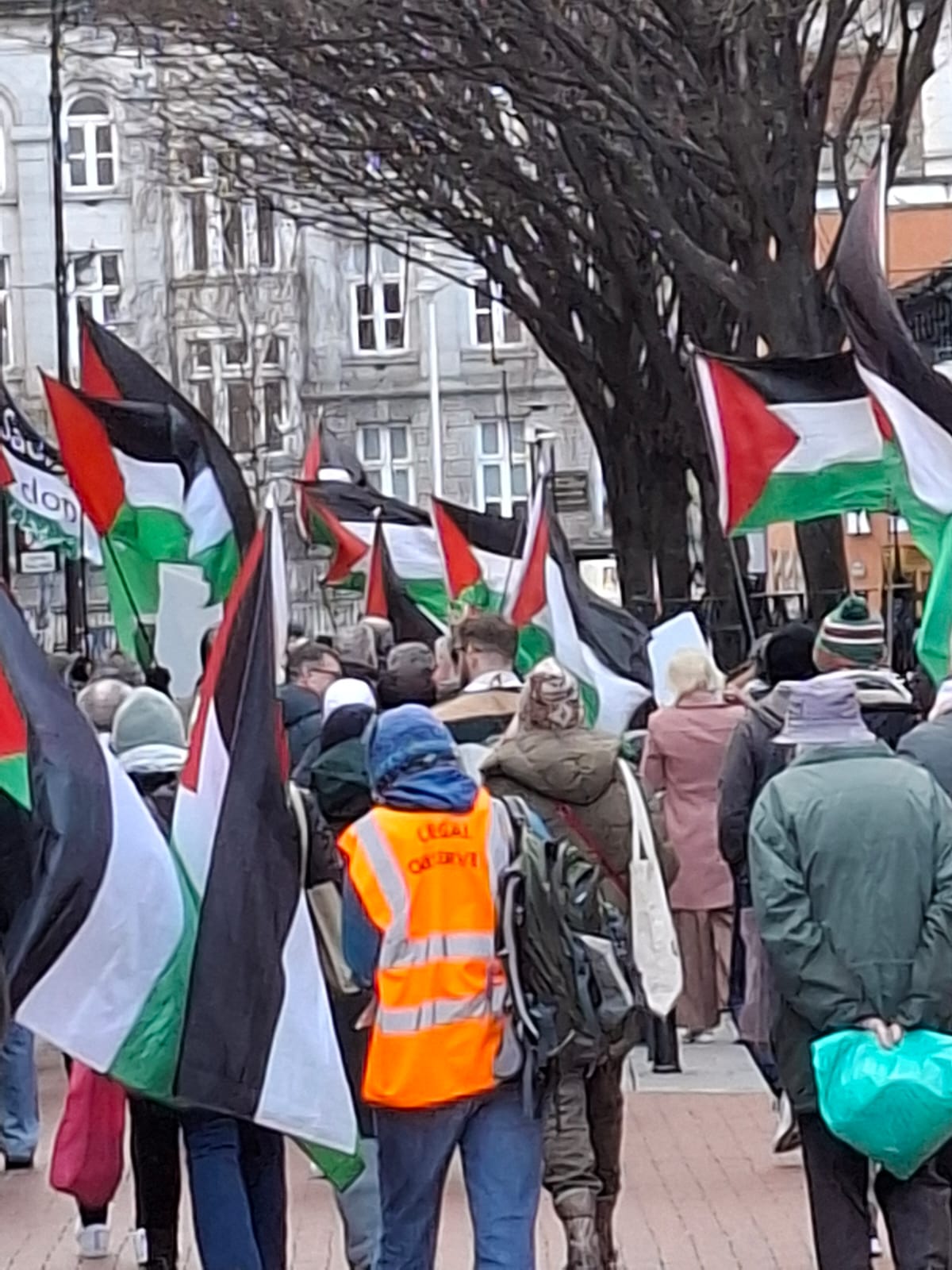
The solidarity crowd continued to demonstrate in the shopping centre’s main doorway before marching away, then went into the Zara3 big shop and demonstrated there awhile before heading on to MacDonald’s in Grafton Street where the Gardaí began to let their nasty side show a little.
Palestine solidarity protesters leaving the Stephen’s Green Centre on New Year’s Eve, heading down to Zara to protest there (Photo: D.Breatnach)
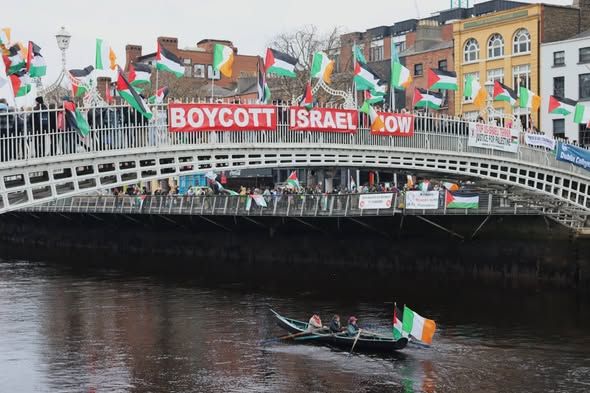
Then another Starbucks, this one on Dame Street got a Palestine solidarity visit before the demonstrators went on to the iconic pedestrian Ha’penny Bridge, where the Ireland Palestine Solidarity Campaign holds a Palestine solidarity protest every New Year’s Eve.
Closeup of banner-drop inside the Stephen’s Green Centre on New Year’s Eve, during protest after closing down the Starbucks café inside. (Photo: G.O.L)
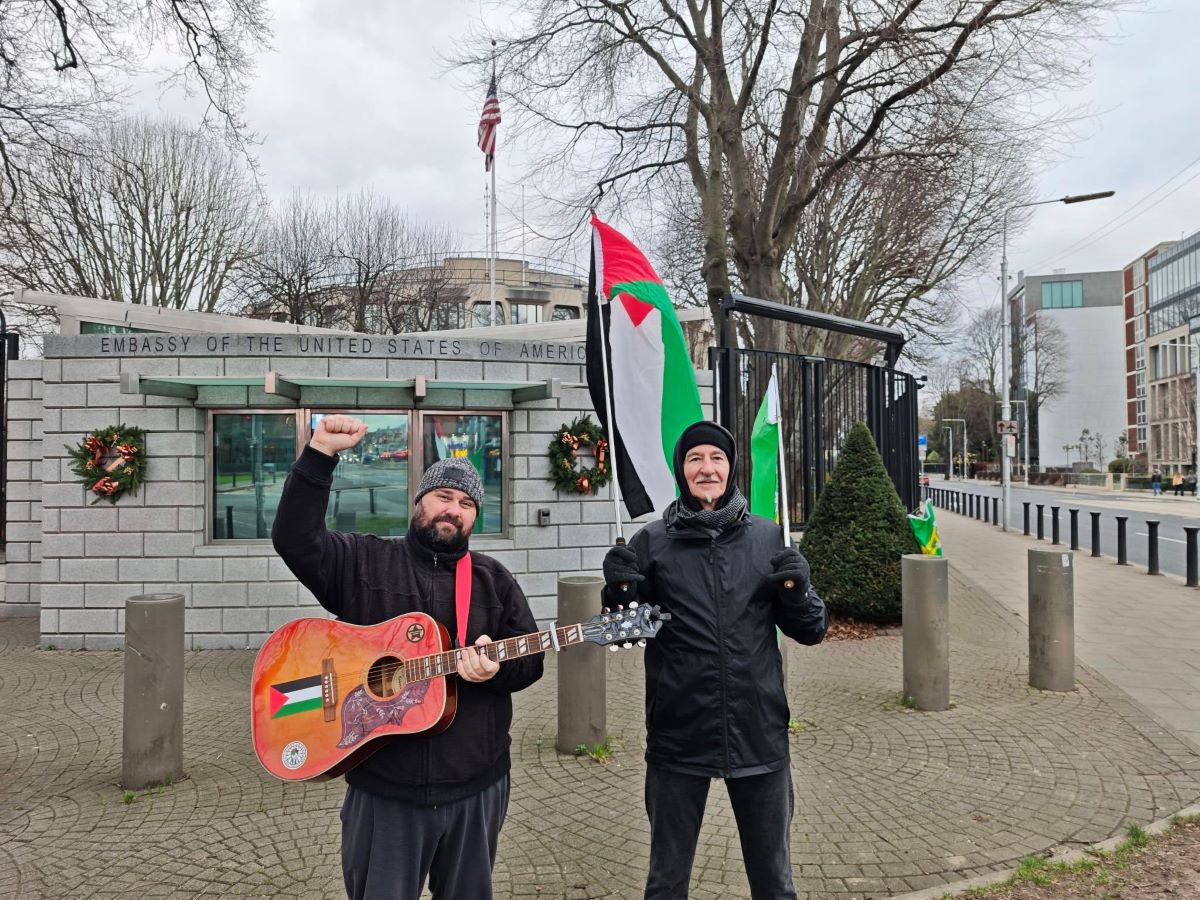
There the demonstrators thronged the Ha’penny and Millennium Bridges and spilled out along the quays. I was elsewherefor the first time in years as it was a Wednesday and therefore Jimi Cullen’s weekly protest with songs at the US Embassy in Ballsbridge, this one to be his 97th straight.
As usual there were police on guard there and one in uniform approached myself and Jimi as we were talking and asked Jimi how long the event would be, how many attending etc. Then she suggested I removed my bike which was leaning against a bollard.
Conducting the protest inside the Stephen’s Green Centre on New Year’s Eve which obliged management to close down for some hours the Starbucks café inside. (Photo: G.O.L)
I told her I was happy with where it was, thank you. Then she said that it might fall on someone (but not, of course, if across the road!), then that someone might steal it, all of which was nonsense of course then said: ‘I am asking you to remove it’ to which I replied ‘And I am declining.’
She was getting quite angry but decided to walk it off. I have attended supporting Jimi’s protest perhaps a score of times and in the early days had a similar approach from a Special Branch4 officer who accused me of causing ‘a security risk’ to the Embassy’s ‘curtilage’ (on a public footpath)!
The Ha’penny Bridge on New Year’s Eve. (Photo: IPSC)
Some police just like to throw their weight around even with regard to things that have nothing to do with the law or causing harm to anyone and over which they have no legal power.
Anyway we unfurled the flags, Jimi had a placard displayed, got out his guitar and we sang through week 97 to frequent waves, clapping, thumbs up, clenched fists, shouts and horn blowing of appreciation and solidarity from passing motorists, pedestrians and cyclists.
Section of northern quays/ Boardwalk on New Year’s Eve, during protest after closing down the Starbucks café inside. (Photo: IPSC)
Jimi began this weekly protest outside the Israeli Embassy but when they left Ireland he moved up the road to the nearby US Embassy, representative of the world leader in terrorism and biggest supporter, politically, financially and militarily of the world’s leading genocider entity.
Usually there are more supporters present. Jimi has a fine stock of protest and solidarity songs, some of which he composed himself and performs them well. Today we did mostly Irish songs of struggle but also one from the black civil rights struggle and Jimi’s own about Palestine.
Jimi Cullen and myself at Jimi’s weekly event outside the US Embassy on New Year’s Eve. (Photo: J.Cullen)
We had a number of Palestinian flags there but also two Starry Plough flags and there were some Irish Tricolours to be seen on the other protests among the many Palestinian ones. It is from our own struggle that we stand in solidarity with Palestine.
End.
Note: If you found this article of interest, why not register with Rebel Breeze for free, so that you will be notified by email of subsequent articles. You can de-register any time you wish.
2Ten Irish Republican prisoners, seven IRA and three INLA died on hunger-strike in a British jail in 1981 in a struggle against criminalisation and for political status
There were lively scenes today outside Dublin’s British Embassy in solidarity with the hunger strikers in British jails awaiting trial on charges arising out of Palestine Action’s operations against the Israeli arms company, Elbit Systems UK.
Two of the six hunger strikers are in their 50th days without food and approaching the point where fatal seizures are possible or suffering irreversible damage to body systems. Their demands are release on bail, a fair trial, de-proscription of Palestine Action and the closure of Elbit Systems.
Early shot of hunger-striker solidarity protesters outside the British Embassy compound today. (Photo: R.Breeze)
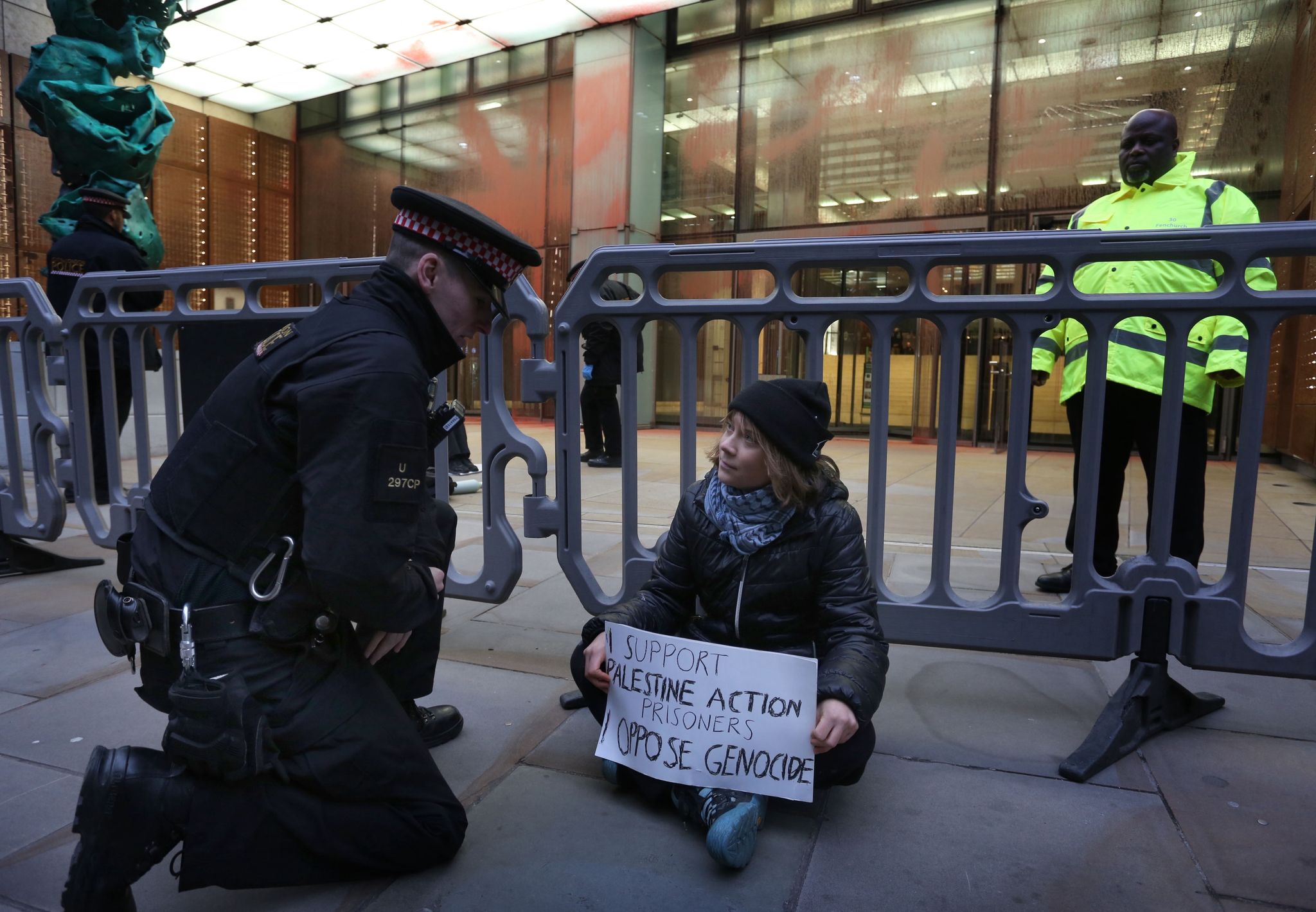
There have been daily solidarity protests in Britain, including those led by the Irish Brigade1 in London amid general mass media silence but the arrest of Greta Thurnberg today on ‘terrorism’ charges may bring a focus on the hunger-strikes for a change.
Today also The National newspaper revealed that Barclay’s had asked the British Government to ban Palestine Action and already the question is being asked: How is it that was not admitted by the Government when Huda Ammori took the Palestine Action banning to judicial review?
(Greta Thurnberg about to be arrested earlier in Central London). Photo source: Internet)
The rally today, like that outside the British Embassy last week, was organised by the Peadar O’Donnell Socialist Republican Forum, while another solidarity rally in Dublin last week but on College Green, in the City Centre, was organised Communities for Palestine.
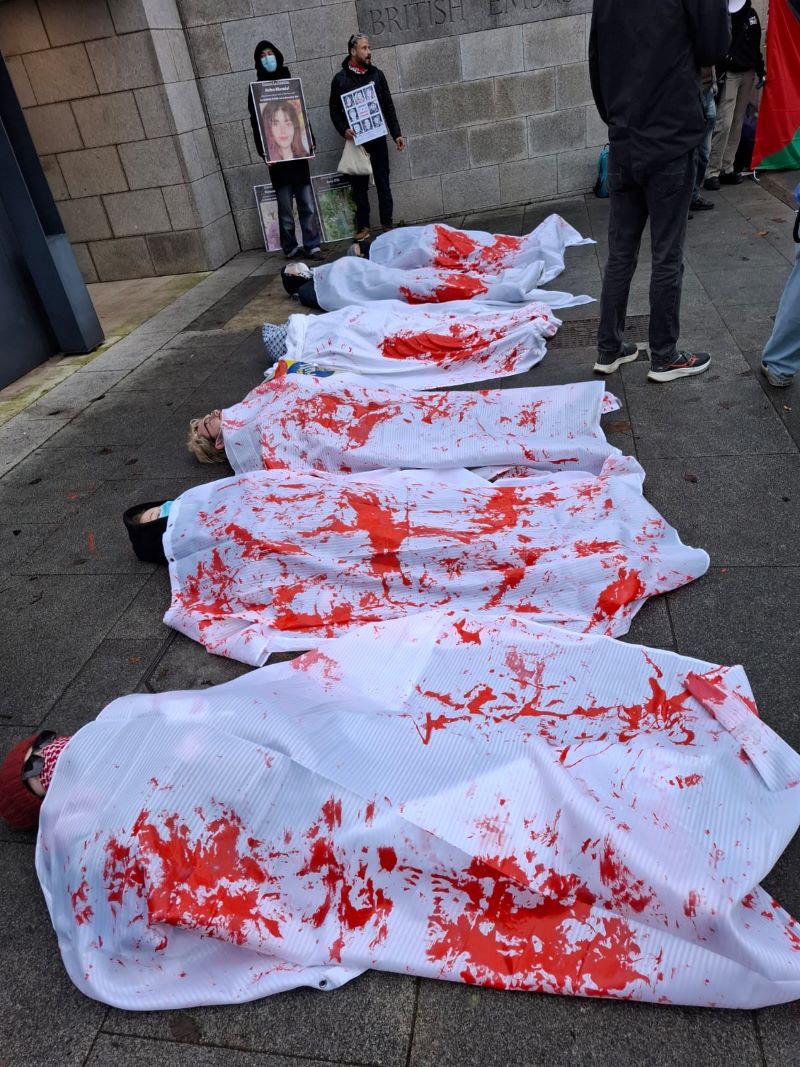
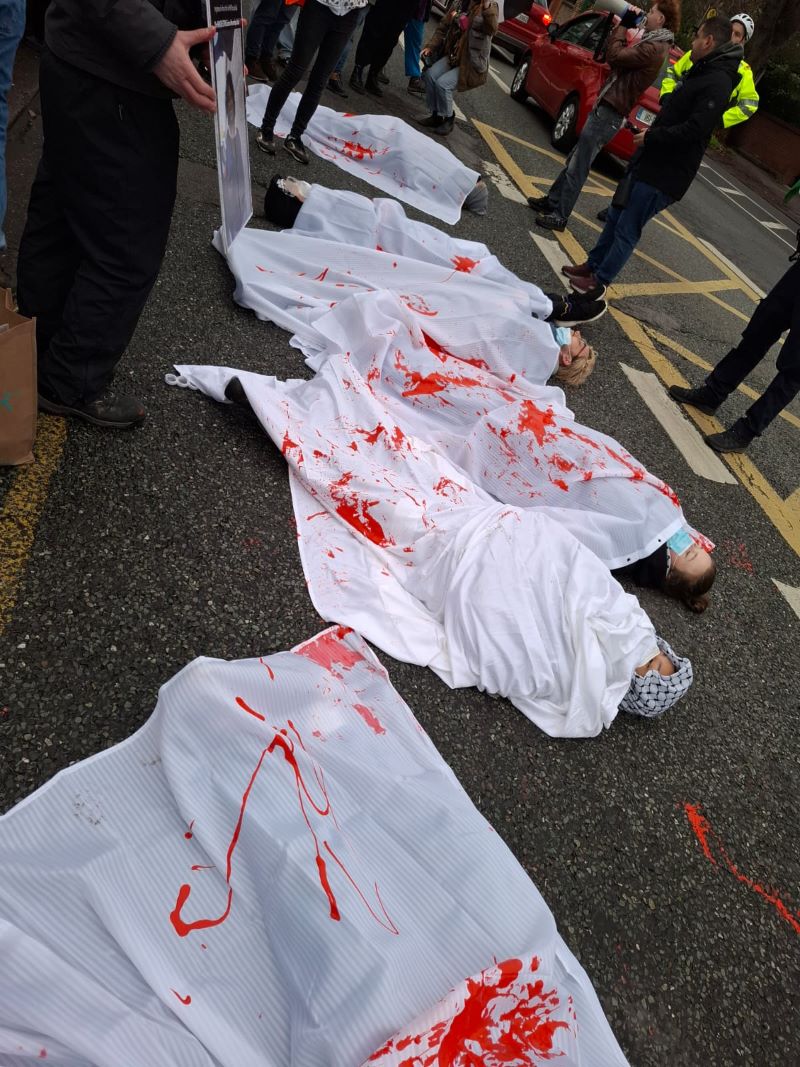
The ‘corpses’ in the road outside the British Embassy compound today. (Photo: R.Breeze)
The chants led outside the Embassy today included the usual ones heard on Palestine solidarity marches, including those referencing the Intifada, the occupation of Ireland and the Irish-language Saoirse don Phalaistín! But there were also new ones and additions to older slogans.
A new Four, Five and Six was added to a previous only One, Two and Three: One – We are the people; Two – We won’t be silenced; Three – Stop the bombing now, now, now! Four – Free our people; Five – Free our land; Six – Kick Zionism out, out, out!
Some other changed and new chants included: One, Two, Three, Four– Support the Filton 24! Five, Six, Seven, Eight – Israel is a terrorist state. We are all Palestine Action! Victory to the hunger-strikers! Brick by brick, wall by wall – all the colonies will fall!
Slogans also castigated British Government collusion in the Israeli genocide, Irish state collusion through militarisation of Shannon Airport and Gardaí collusion through their defence of the British Embassy.
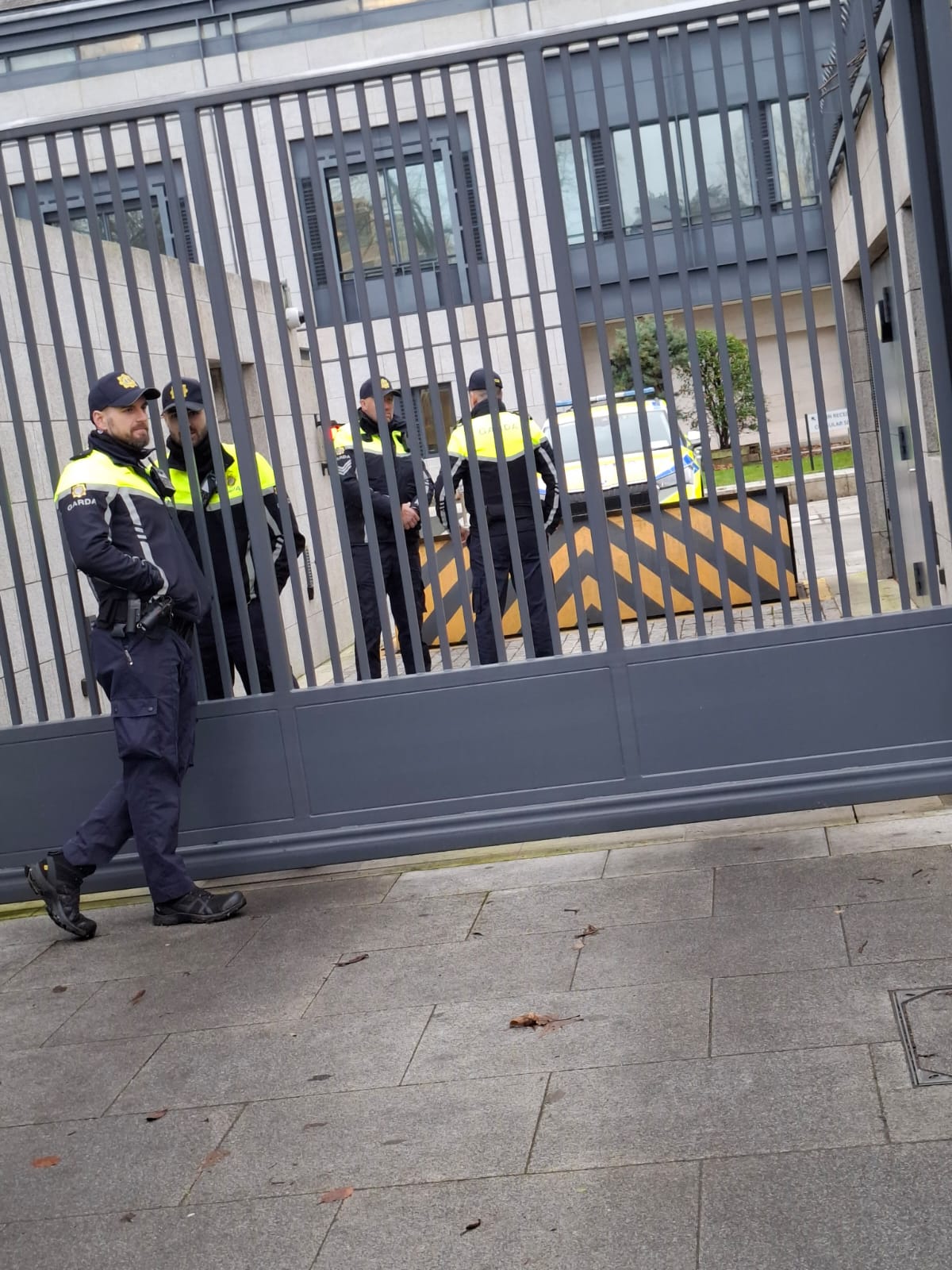
Numbers of Gardaí and one of their vehicles actually inside the British Embassy compound today. (Photo: R.Breeze)
On two occasions the MC asked demonstrators to line both sides of the road outside the Embassy, which is one of the main Dublin routes from and towards the South. Passing traffic frequently sounded their horns in solidarity, passengers often signing thumbs-up or with clenched fist.
But at one point, most of the demonstrators occupied the road, blocking traffic in each direction. The Gardaí moved quickly to break this up and were soon violently shoving demonstrators off the road, one in particular screaming with wild eyes so that he was twice seen restrained by colleagues.2
However part of the northbound road remained occupied in front of the Embassy entrance and at this point a new group of protesters arrived and, unpacking white curtain material, began to squirt red paint on it, then to lie down in the road under the material like massacre victims.
A number of speeches were made during the event and later a man called the crowd to remember also the 1981 hunger strikes in Ireland, for which he sang the Joe McDonnell3 Ballad, with its wonderful chorus lines: You dare to call me a ‘terrorist,’ while you look down your guns!4
Another man recounted the story told by Bobby Sands5 of the caged lark which would not sing for its captor and how that bird came to represent Sands himself, before reciting a poem of an Irish migrant in London in anguish as Bobby Sands lay dying.
The ‘corpses’ were moved from the road to immediately in front of the British Embassy compound today. (Photo: R.Breeze)
The current hunger-strikes are sometimes referenced as “the first coordinated hunger strikes in Britain” since those of the Irish Republicans in 1981. Of course, those strikes were not in Britain but in occupied Ireland and therefore currently part of the United Kingdom.
There are important differences of course. The Irish Republican hunger strikers were convicted, albeit by special non-jury courts, of armed resistance to British occupation; the current hunger strikers have not yet even been tried and none of the charges against them include armed action.
And the motivation of the Palestine Action accused is purely internationalist solidarity against a regime committing daily massacres in a programmed genocide.
Nevertheless, the British ruling class may yet come to regret the day they permitted anti-Zionism to become so strongly linked to anti-British colonialism, and anti-genocide internationalism so closely linked to the memory of Irish colonial resistance.
End.
Note: If you found this article of interest, why not register with Rebel Breeze for free, so that you will be notified by email of subsequent articles. You can de-register any time you wish.
FOOTNOTES
1An ad-hoc broad Palestine solidarity organisation composed of Irish migrants and diaspora in London.
2This may possibly be the same Garda who was seen wildly striking with his baton and pepper-spraying peaceful participants at a Palestine solidarity march to Dublin Port some weeks ago.
4And you dare to call me a terrorist, while you look down your guns! When I think of all the things that you have done: You have plundered many nations, divided many lands, You have terrorised their people, ruled with an iron hand – And you brought the stain of terror, to my land.
5Bobby Sands relinquished his elected post of Officer Commanding the Republican male prisoners in Long Kesh in order to lead the hunger strikes of 1981. On 5th May he was the first of the Ten to die.
Recently an Irish Palestine solidarity organisation posted a report that 20,000 Palestinian children have been killed in 23 months, an average higher than one child per hour.1 “Have been killed”? Traffic accidents? Unknown causes?
They were killed by Israel, isn’t that the case? Then why not bloody say so! They were murdered by a genocidal European Zionist settler colony called Israel and itcontinues to murder them, along with their older siblings, parents, extended families and neighbours.
We can find different ways to present the facts of the ongoing genocide in order to try to shock but it does not alter the fundamental and well-known truth that a genocide is being committed before our eyes. Why is this continuing despite what everyone knows? Well, because it can!
Israel will continue to do what it does because it can and the cost of doing it is not high enough, as Ali Abunimah said three months ago.2 Or to turn that a little, the Irish Government will continue doing what it does in collusion with the genocide because the cost of doing so is not high enough.
The EU is the biggest importer of Israeli goods and the Irish state is the highest importer in the EU, also the 2nd single biggest Israeli goods importer in the world. And still the weapons of genocide fly through our skies. The Irish Government continues collusion because the cost to them is low.
Marches and pickets show solidarity towards a beleaguered people suffering genocide and in that they are very important. They also show us our strength in numbers. But they do not cost our government much. Not even enough to really stop the Central Bank assisting genocide.
In England, Palestine Action raised the cost of collusion in genocide by targeting the Israeli weapons manufacturer Elbit Systems in Bristol. Activists were arrested but they kept doing it. This Zionist death company has now closed its targeted Bristol factory.
While this was happening, the British Government, in support of Elbit and others and in collusion with the genocide of Palestinians, not only arrested and charged Palestine Action people but designated the organisation as ‘terrorist’ and any supporters as people supporting ‘terrorism’.
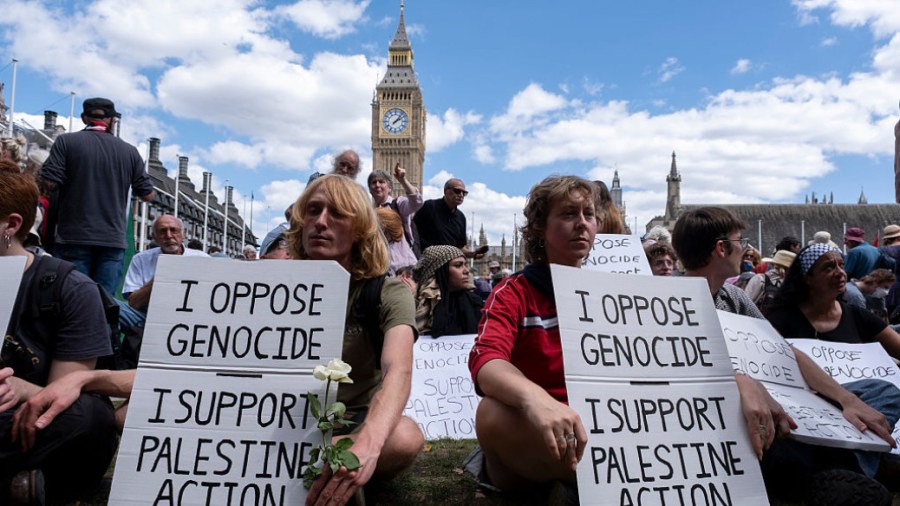
People defied that designation and were arrested for holding a placard saying they were opposed to genocide and supported Palestine Action.
Placards in Westminster August 2025 (Photo credit: Mike Kemp In Pictures/ Getty Images)
Following that action and repression, 1,500 gathered in London on Saturday 6th September 2025 to continue that solidarity and to defeat the attack on civil liberties. By midnight, the last arrest recorded by the police for the day, they had arrested nearly 390 people.
The ‘crime’ of nearly all was to display placards stating “I am opposed to genocide. I support Palestine Action.” The police were unable to arrest them all as it took them 11 hours to arrest the 390. The organisers continued the action in London and other parts of the UK.3
More recently there have been other such acts of public defiance, organised by the Save Our Juries campaigning group and the numbers now arrested on charges of “assisting terrorism” (sic) have reached at least 2,269.
In addition, eighteen arrested Palestine Action activists were jailed, refused bail with some embarking on hunger strike4 of whom two were recently admitted to hospital.
The closure of Elbit Systems, the mass defiance of the terrorist categorisation of Palestine Action and the prison hunger strikes are raising the cost of supporting genocide of Palestinians and criminalising Palestine solidarity action, hitting collusion where it hurts, politically and practically.
We in Ireland are the most-pro-Palestine country in Europe … but we are not doing that.
We are not raising the cost high and despite that being clear to us and to our political and solidarity organisations and trade unions, made clear well over a year ago, we are still not doing it. Until we raise the cost high enough to make them stop, our government will continue its collusion.
And until the external cost is raised high enough to make them stop, Israel will continue its ethnic cleansing and genocide. But marchers attempting to blockade Dublin Port in early October were pepper-sprayed without warning and savagely batoned, with some arrested.
Gathering outside Dublin courthouse in solidarity with two Palestine solidarity activists assaulted and charged by Gardaí during early October attempt to blockade Dublin Port (Photo: R. Breeze).
A trio of activists were arrested in May for invading Shannon Airport to protest the ‘neutral’ Irish State’s collusion with US military flights through there4 and last weekend another three young people were arrested for a similar action.
Activists in Ireland are slowly starting to raise the cost of collusion for the State. However, they are not supported by the leadership of the mass movement which, while aware its tactics are not forcing the Government to end its collusion, nevertheless persists solely in repeating them.
End. Note: If you found this article of interest, why not register with Rebel Breeze for free, so that you will be notified by email of subsequent articles. You can de-register any time you wish.
2Director of the Electronic Intifada, speaking on 29 August at a public meeting organised by the Ireland Palestine Solidarity Campaign in Dublin and hosted by the FÓRSA trade union. The other guest speaker was Abubaker Abed from Gaza, now studying in Ireland after being a journalist for the EI and threatened with assassination by Zionists.
3The Six Counties are at the moment in the UK but the British colonial gendarmerie went very lightly there in dealing with Palestine Action supporters – the rulers do not wish do have Palestine activists as political prisoners while they contain also Irish Republican prisoners.
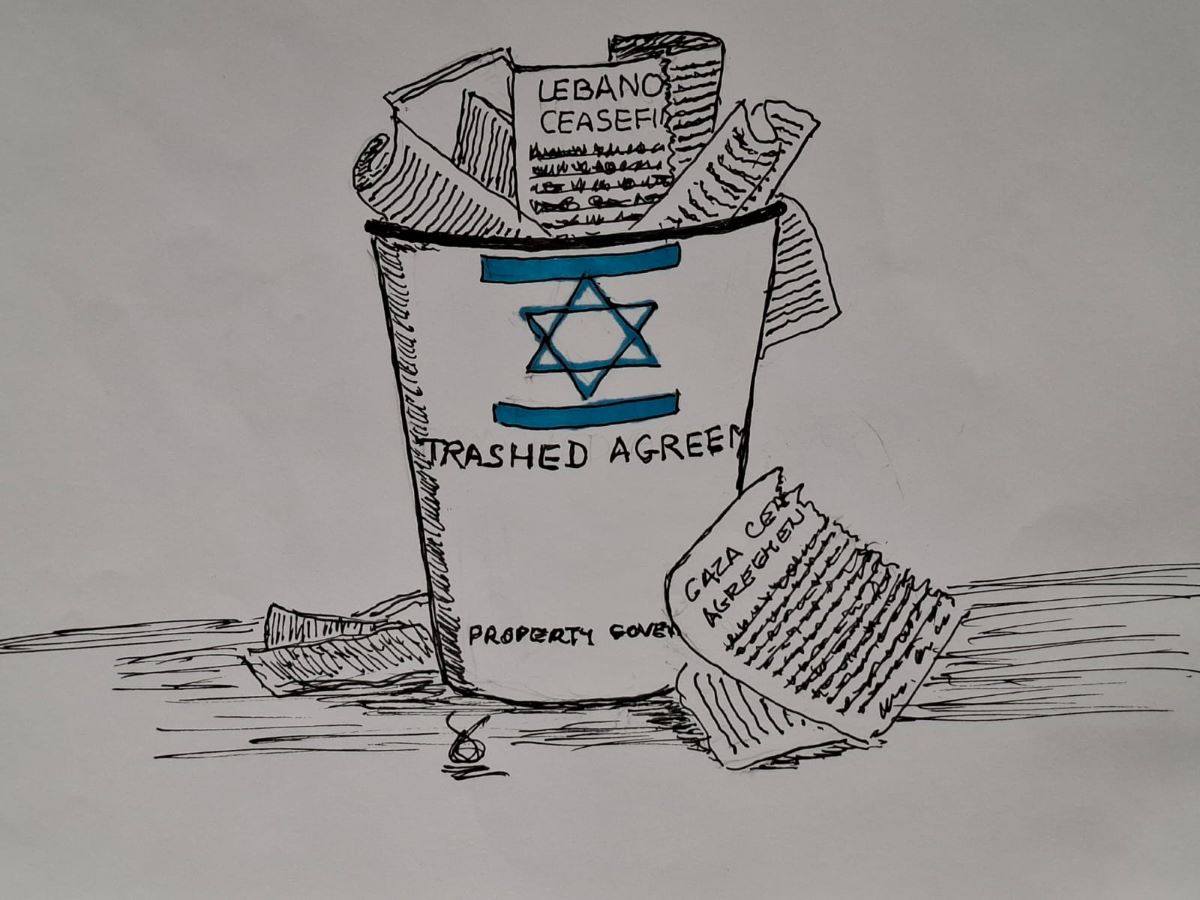
It’s a legitimate question in view of the Zionist state’s actions preventing aid entry and killing Palestinians every day since it signed a ceasefire agreement — but also from historical,1 cultural and perhaps even psychological standpoints.
Cartoon by D.Breatnach
Since 11 October the Israeli Occupation Force has killed 46 Palestinians Palestinians, including 11-year-old Mohammed Bajhat Al-Hallaql and injured 132 others since the ceasefire took effect. Half of the victims were children, women, and elderly people.2
Among the dead was the Abu Shaban family, completely wiped out, seven children and two women.3
As winter looms, tents and construction materials are blocked. And as sowing time for next year’s crops is here, Israel has blocked agricultural materials, including seeds, fertilizers, and solar panels from entering4 to replace the IOF-destroyed crops and greenhouses.
The IOF has also greatly restricted the number of aid trucks it allows entry, from 700 to 450 daily, which is another kind of ceasefire violation and banned key food items like meat, poultry, and livestock. And allowed just 7% of the agreed quota of 50 gas and oil trucks daily in nine days.
The latest large scale violation, as I was writing this, was its killing of more than 30 Palestinians after one of the IOF’s bulldozers ran over Israeli unexploded ordinance in Rafah, which they decided to frame on the Resistance and use as an excuse for more murder and Rafah gate closure.5
Reports have now emerged of IOF recently burning and otherwise destroying urgently-needed food aid. Which of the ceasefire negotiators or guarantors has called the IOF or the Zionist State’s leadership out over this? None, of course.
And of course too, that’s one important reason why it keeps doing it – because it can. And because none of its allies will call it to account. But perhaps also there is some kind of deep Zionist bias against sticking to agreements made.
Last Autumn, in the midst of its unsuccessful attack on South Lebanon, the IOF asked its allies to seek a ceasefire and truce with Hezbollah. Weakened by exploding pagers6 and assassination of their renowned leader Nasrallah, Hezbollah agreed to the ceasefire.
Cartoon by D.Breatnach
That was on 27 November 2024. Of course, true to form, the IOF violated the ceasefire daily, though Hezbollah kept to the terms. Not dozens or scores of violations, not hundreds … No, the IOF has committed approaching 3,000 separate violations by April this year.7
The brass neck of the Zionists sometimes exceeds belief. In the midst of their daily ceasefire violations, they are now threatening to again prevent food and medical aid entering until the Resistance complies with the ceasefire agreement.
Hamas has not delivered all the prisoner bodies, it says. But Hamas replies that it delivered all those it could access, others lying under tons of rubble, remains of buildings collapsed by IOF bombing, which is what killed the Israeli prisoners of the Resistance (probably along with their guards).
But somehow this is a reason to abandon the ceasefire! Locating the dead prisoners requires rubble-moving machinery and expert forensic help. The IOF long ago bombed all such Palestinian machinery to scrap and are not permitting its entry from any others at the moment either.
Cartoon by D.Breatnach
At the same time, the Zionists rejected two of their own forces’ bodies. One was a non-Israeli who worked for them and another a Palestinian in Israeli uniform, possibly a human shield employed or coerced by the IOF, sent into a tunnel and killed by the Resistance.8
Meanwhile, what of the estimated 2,000 Palestinian bodies held by the Zionists? As a Hamas statement said, their return is a question of human rights and law, not for negotiation. But when the few have been delivered as part of this ceasefire agreement, some have shocked their receivers.
Bodies showing hands tied behind backs and with bullet wounds … or a rope around the neck … signs of blindfolding over eyes, signs of torture … Some with tank-tread marks; all without identification, leaving a grotesque task for the Gaza administration and possible relatives.
Cartoon by D.Breatnach
And still … and still … the Zionists scream about the Resistance not fulfilling the terms of the ceasefire. I would think them to be totally beyond shame, were it not for the lies and excuses for their behaviour that they spew out into the world, which indicates a certain feeling of guilt.
Well, that is the Enemy. Not just of the Palestinians, or the Lebanese, or Syrians, or Yemenis, Iranians, Iraqis … No, they are the enemies of humanity, just as the Nazis were enemies of more than their victims and the countries they attacked.
And this Enemy is ready to resume the genocide at any time.
End.
Note: If you found this article of interest, why not register with Rebel Breeze for free, so that you will be notified by email of subsequent articles. You can de-register any time you wish.
We’ve recently passed by the date of the start of a monumental prison resistance struggle when IRA prisoner Kiaran Nugent refused on 14 September 1976 to wear prison uniform.
The Hunger Strike of 1981 tends to be remembered as an isolated event in the history of the Irish Republican prisoners’ opposition to criminalisation. But it was five years of struggle through stages that ended eventually in the martyrdom of ten Republicans.
Irish Republicans had been in imprisoned in British jails since the late 18th Century.1 After the Irish national bourgeoisie accepted the British partition of Ireland, Republican prisoners were held in prisons in the Irish State and in the British colony of the Six Counties and at times in Britain too.
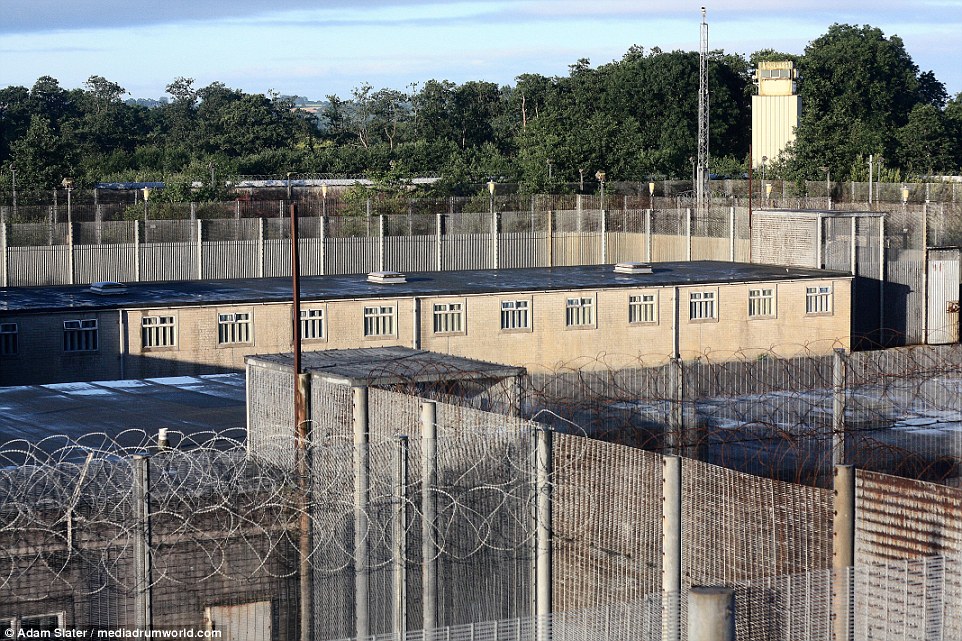
Long Kesh/ the Maze Prison, in the occupied 6 Counties.
This situation continued on low but constant level with higher points during the Civil War (1922-1923), the pogroms in the Six Counties, the 1930s,2 the 1940s, the Border Campaign (1958-1962) and the Civil Rights campaign from the mid-1960s onwards.
The Wikipedia section on Special Category Status states that it was introduced for Republican prisoners serving sentences in the Six Counties in 19723 but neglects to mention that it was already widespread among nationalist prisoners due to internment without trial a year earlier.
The British introduced internment without trial in their Irish colony in 1971 and one of the effects of that measure was to put a huge number of mostly nationalists from the Six County colony into jail. These prisoners were all accorded Special Category Status and wore their own clothes.
British soldiers capturing and taking away a civilian in the Occupied Six Counties of Ireland (Photo sourced: Internet)
Over the life of the measure, 1,981 people were interned without trial in the Six Counties (British Army’s Operation Demetrius). Of those detained 1,874 were from a Catholic/Republican background while, towards the end, 107 were from a Protestant/Loyalist background.
Special Category Status distinguished the internees from other political prisoners which were few in number at the time but its major impact was to distinguish them visibly from social prisoners or what are commonly called ‘criminals’ and was often called PoliticalPrisoner Status.
In June 1972 other nationalists/ Irish Republicans4 charged and convicted were also accorded Special Category Status,5 which came to be seen as prisoner of war status for opponents of the British colonial occupation, despite Britain’s claims that the prisoners were just criminals.
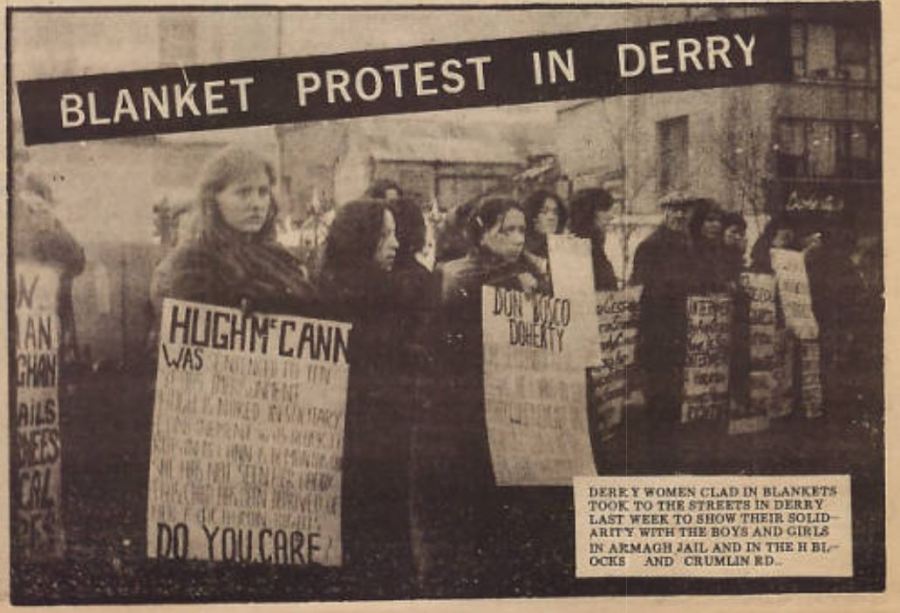
Early protests in support of the prisoners ‘on the blanket’ in 1976. It was mostly women relatives, partners and their friends who launched the Republican prisoner solidarity movement. As the photo legend also illustrates, there was still another male political prison, Crumlin Road (‘the Crum’) and Armagh Jail for female Republican prisoners.(Photo sourced: Internet)
Internment without trial in the Six Counties, generally recognised as a failure from both political and military points of view, was formally ended after four-and-a half years on 5 December 19756. As resistance continued, including now an armed aspect, more prisoners saw the inside of jails.
But they were still under Special Category regime and wearing their own clothes. The following year on 5 March 1976, Merlyn Rees as Secretary of State implemented the Labour Government’s7 decision to remove Special Category Status from any subsequently-convicted prisoners.
MERL
Merlyn Rees, British Labour Home Secretary who removed the Special Status from the Irish Republican prisoners, which precipitated the struggle that ended in the prison hunger strikes of 1981. He died at 85 years of age, having lived much longer than many of his victims. (Photo sourced: Internet)
The first Irish Republican prisoner to be informed he would have to wear prison uniform under the new rules was Kiaran Nugent. His reply, though pithy has gone down in the records of Irish resistance statements: “You’ll have to nail it to my back.”
Stripped naked, Vol. Nugent was put in a cell, from which he found a blanket and wrapped it around himself. It was a natural act to cover his nakedness but he may also have known that Irish Republican prisoners of the Irish State in the 1940s had done the same.
The Blanket Protest had begun and spread as more prisoners coming into the prison system took the same stand. There it might have stayed were it not for the violence and cruelty of HM Prison regime by its warders regularly assaulting prisoners on their way to and back from the showers and toilets.
In 1978 the Irish Republican prisoners in the Maze H-Blocks8 resolved to remain in their cells, emptying their excreta out the window and their urine under their cell doors into the passageway. So the prison authorities blocked up their windows and warders pushed urine back under their doors.
The Irish prisoners then had nowhere to put their excreta so they smeared it on the walls. They built a dam of bread fragments around their door to prevent their urine being pushed back in. These conditions they endured until the prison riot squad beat them out of their cells for power-hosing.
Those who watched the film Hunger (2008) directed by Steve McQueen will have seen some of that and how they treated the naked prisoners too, beaten to the ground, anus probed for contraband messages or materials, the same gloved hand often opening their mouths to look inside also.
Their flesh was forcibly abraded with scrubbing brushes and they were often inserted into cells still wet from the hosing.Once back inside cells, they continued the protest.
On 27 October 1980 seven Republican prisoners, against the orders of IRA GHQ, embarked on a hunger strike included the Five Demands to break the system, which they terminated after 53 days on receiving promises from the authorities which were then reneged upon.
The 5 Demands:
The right not to wear a prison uniform;
The right not to do prison work;
The right of free association with other Republican prisoners, and to organise educational and recreational pursuits;
The right to one visit, one letter and one parcel per week;
Full restoration of remission lost through the protests.9
Outraged at the reneging, Republicans renewed the hunger strike with their previous Provisionals’ jail Commanding Officer10 insisting he be first. So was Bobby Sands the first to die and another nine martyrs behind, seven Provisional IRA and 3 INLA as they came on to the strike in sequence.
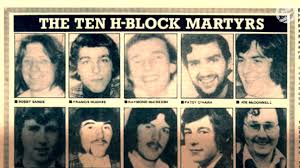
Photograph images with names of the ten Hunger Strike Martyrs of 1981 in the sequence of their death: Vols. Bobby Sands (IRA), Francis Hughes (IRA), Ray McCreech (IRA), Patsy O’Hara (INLA), Joe McDonnell (IRA), Martin Hurson(IRA), Kevin Lynch (INLA), Kieran Doherty (IRA), Thomas McElwee (IRA), Mickey Devine (INLA). (Photo sourced: Internet)
The effect of the hunger strikes of 1981 was huge in Ireland, Britain and further abroad. IRA Vol. Kieran Nugent had an important hand in pushing the process but so did Mervyn Rees, William Whitelaw, Brian Faulker and Edward Heath,11 in a long process of repression and resistance.
Today the struggle continues with approximately 20 Irish Republican prisoners, male and female in prisons between the neo-colonial Irish state and the British colony of the Six Counties. They have essentially won the five demands, though official harassment in the colony’s jails is endemic.
End. NB: If you found this article interesting you may wish to subscribe to the blog free of charge, after which you would receive a notification in your email every time an article was published. You can unsubscribe any time you wish.
APPENDIX: Brief biography of Kieran Nugent (12th September 1958 – 3rd May 2000).
Volunteer Kieran Nugent began his short life presumably in the occupied Six Counties of Ireland but all the references I have found so far begin with him at the age of 15 years of age, standing at a corner with a friend on the corner of Merrion Street and Grosvenor Road, West Belfast.
It was 20th March 1973.12 A car pulled up beside them asking for directions but an occupant of the vehicle then opened fire with a submachine gun. Nugent was seriously wounded, shot eight times in the chest, arms and back. His friend, Bernard McErlean, aged 16, was killed.
Kieran Nugent, first of the Republican prisoners ‘on the Blanket’ (Photo sourced:Internet)
Another youth was seriously injured also.13 Local people reported that a British Army Saracen armoured car had crashed through a nearby barricade and that was what had allowed entry for the murder gang, later claimed by the UDA, a British proxy Loyalist militia.
“At some point afterwards, Nugent joined the IRA.”14 The youngest age for IRA membership was 17 and Nugent aged 16 was arrested by the British Army, automatically refused bail, and at trial, after five months on remand in Crumlin Road Prison, Belfast, case withdrawn, he was released.
Kieran became an active volunteer until his arrest and internment without trial, on 9 February 1975. He served nine months in Cage 4 of Long Kesh Detention Centre (later renamed The Maze) in the Six Counties, until 12 November 1975. But was arrested and imprisoned again on 12 May 1976.
Vol. Nugent was charged with hijacking of a bus, a frequent Republican resistance activity in Belfast where the vehicle would then be utilised as a barricade. His sentence was three years in jail which he was commencing when he began the blanket protest.
The cause of death for Kieran Nugent was given as heart attack. A number of his acquaintances remarked that he had sunk into alcoholism with some adding that the movement had given him no support. Whether true or not, many former Republican prisoners of the period had shortened lives.
1Republican prisoners were held in British jails in Ireland, Britain and Australia – and for centuries before that Irish clan members had been incarcerated in Britain and Ireland.
2When the anti-fascist struggles also contributed to prisoner of the states.
4I am using the term “nationalists” as a broad and not strictly accurate term to describe the people of the Catholic ghettoes and areas of the British colony; of course many of them could have been also or instead mainly democrats, socialists. The term “Irish Republicans” I am using to describe those belonging to organisations nominally of Irish Republican kind but again how much each was truly Republican in ideology varied, for example in their opinion of the appropriate role of the Catholic Church in Irish society.
5Sentenced and remanded in custody Irish Republicans in jails went ona hunger strike for ‘political status’ in 1972 and the Provisional IRA during the Truce negotiations of June that year asked for political status for them which William Whitelaw conceded.
6https://cain.ulster.ac.uk/events/intern/chron.htm However internment without trial in fact continued by charged Republicans being refused bail and remaining in jail for two years or more awaiting trial. Bail decision and trial would be in the special no-jury Diplock Courts.
7It is difficult to understand any Irish person or indeed any anti-imperialist putting any faith in a British Labour government. Apart from its long imperialist history, it formed part of the national government that executed leaders of the 1916 Rising, sent troops to the Six Counties to quell the civil rights struggle in 1969, introduced the Prevention of Terrorism Act in Britain in 1974 and framed a score of Irish people for bombings, removed Special Category Status in 1976 …
8A special male political prison containing panopticon-designed blocks in Lisburn, Co. Antrim, built in 1971 and closed in 2000, the future of the empty buildings uncertain. Female Republican political prisoners were kept in Armagh Jail and fought with different tactics, including taking the Prison Governor hostage at one point.
9Prisoners disobeying prison rules are punished in a number of ways, one of which is loss of the remission off sentence normally expected.
10In a long tradition the prisoners of each political group in jail elect their leader and previous ranks are abandoned for the duration of the incarceration.
11In sequence: Labour Party Secretary of State; Conservative party Cabinet Minister; Unionist Prime Minister of the colony; Conservative Prime Minister of the UK.
Dublin Political History Tours Facebook page reminds us of the 20th September anniversary of the public execution on of “Bold Robert Emmet, the darling of Erin”, leader of the unsuccessful Republican insurrection in Dublin on 23rd July 1803.
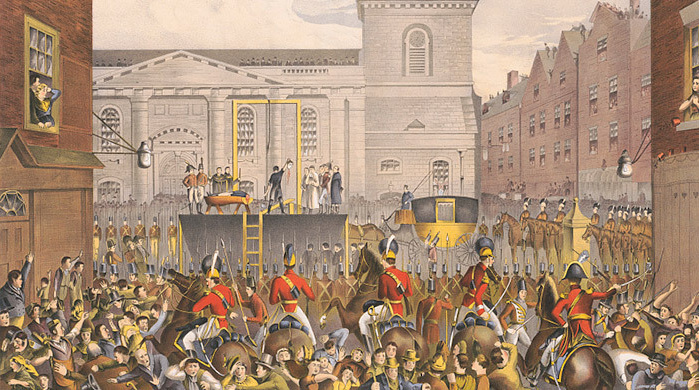
Coloured drawing: The executioner holds up Robert Emmet’s head to the crowd, sections of which demonstrate their repugnance of the act and are repressed English soldiers on horseback. (Sourced: Internet)
I reproduce the Dublin Political History Tours text (reformatted for R. Breeze):
On Saturday we passed by the anniversary of the execution by the English occupation forces of Robert Emmet, United Irishman. Emmet had been condemned to death for planning an insurrection for Irish self-determination which the English Occupation called ‘treason’.
Leaving behind in Kilmainham Gaol his comrade Anne Devlin, who had endured torture and death of family members without giving the authorities any information, Emmet was taken to the front of St. Catherine’s Church.2
(This building is) on Thomas Street in Dublin’s Liberties area on the west side of the city centre. The site chosen was sending a message to the populace of the area that had nationalist and republican sympathies.
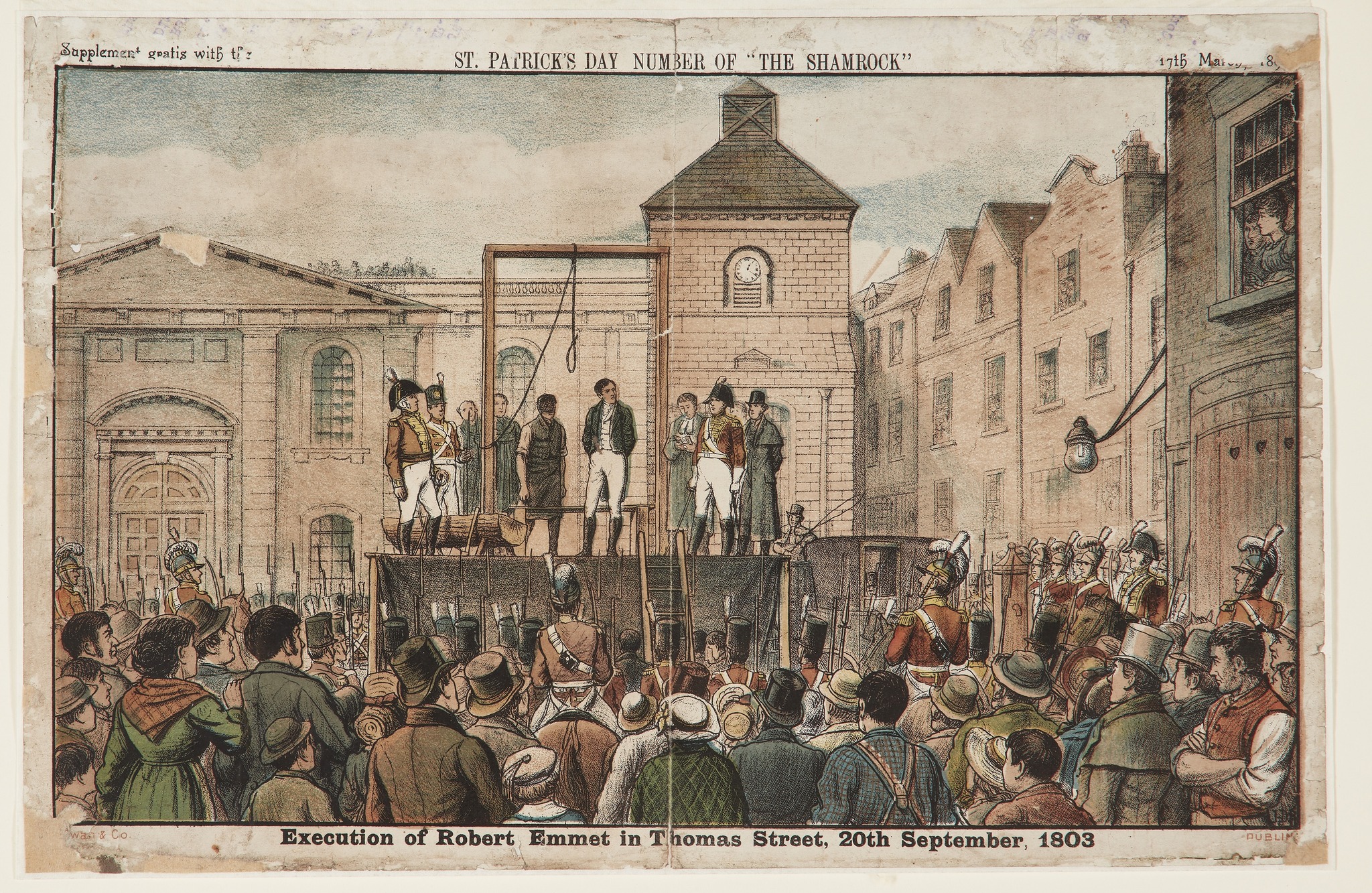
There, in front of a huge crowd and many soldiers, Emmet was hanged and then beheaded, the executioner holding up the dripping head to the crowd. His body was later returned to the Gaol before being later buried in Bully’s Acres in the grounds of the Royal Hospital Kilmainham.
Emmet’s corpse was later disinterred in secret and reburied elsewhere by friends or family and, despite a number of sites being speculated, its current location is unknown.
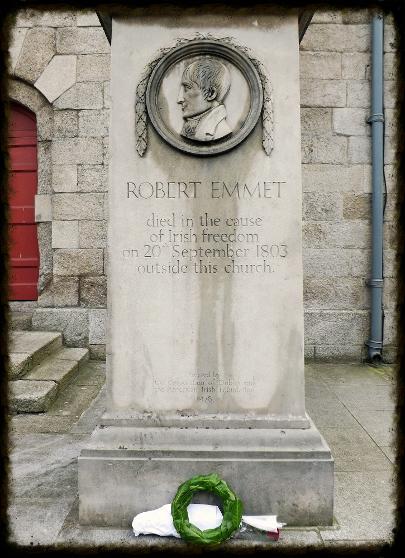
There is a monument to the execution inside the grounds of the St. Catherine’s building and a stone plaque on the wall outside it.
The monument inside the ground at the front of St. Catherine’s Church, Thomas Street, Dublin. (Source: Kilmainham Tales)
Robert Emmet was very popular in Ireland at the time and his memory is still. A statue in his honour stands in Dublin’s Stephens Green, a replica of another two at locations in the United States.
Anne Devlin endured three years in Kilmainham Gaol and according to Richard Madden (1798 – 5 February 1886), chronicler of the United Irishmen who sought her out, was followed everywhere in public by police.
(who were) observing anyone who she spoke to, as a result of which many were afraid to speak to her. Her body lies in Glasnevin Cemetery.
“Bold Robert Emmet” is a traditional ballad in the martyr’s honour and “Anne Devlin” also has a much more recent song in hers by Pete St.John.
(quoted passages end)
In the 1916 Proclamation of Independence, “the right of the people of Ireland to the ownership of Ireland” is proclaimed and that “six times in the past 300 years they have asserted it in arms”, probably referring to insurrections of 1641, 1689, 1798, 1803, 1848 and 1867.3
Historians have mostly dismissed the 1803 uprising as never likely to succeed but a minority have rated the preparations highly, including the innovations of signal rockets and folding pike handle for concealed personal carrying.
RH Madden, the first historian of the United Irishmen was of the opinion that the insurrection attempt was engineered by the English Occupation’s administration in Dublin Castle in order to justify continued repression of Irish republicanism and to eliminate some leaders.
Generally historians have tended not to give much credence to Madden on that issue but it is certain that the Occupation had a network of spies in operation in Ireland and that some had penetrated Emmet’s conspiracy.
Emmet on the scaffold with St. Catherine’s Church behind, the executioner beside him, the crowd in the street and many English soldiers, on foot and on horseback. The illustration was employed by Dublin Political History Tours but easily sourced on the Internet.
However it is not for the manner of the 1803 insurrection that Emmett has been fondly remembered in Ireland to this day 123 years later – and abroad for decades after his death4 – but for the calm manner in which he faced his enemies, including his executioner and for his eloquence at his trial.
Past insurrections contain lessons for us today and a serious evaluation should be attempted, perhaps with a number of submissions from historians of different opinions on the matter, to deal with questions around Emmet’s return from France and the planning of the insurrection in Ireland,.
For us today however, whether Republicans or more generally anti-colonialists and anti-imperialists, it is also necessary to revere the memory of revolutionary action for a democratic Irish Republican and to uphold his and Anne Devlin’s spirit of defiance in resistance.
End.
Note: If you found this article of interest, why not register with Rebel Breeze for free, so that you will be notified by email of subsequent articles. You can de-register any time you wish.
Statue monument of Robert Emmet in Washington DC, a copy of which stands in St. Stephens Green, looking across the road to his erstwhile homeand other copies stand in Emmetsburg, Iowa and Golden Gate Park, San Francisco, California.Those in the USA were all cast by the artist Jerome Connor between 1916 and 1919. (Photo sourced: Internet)Statue monument in Rathfarnham dedicated to Anne Devlin from Wicklow, a member of the United Irishmen conspiracy, tortured and jailed but never gave her captors any information. Sculptor: Clodagh Emoe(Gracies, Maria, for bringing this to my attention).
FOOTNOTES
1From Emmet’s famous speech from the dock of the courthouse in Green Street that not until then should his epitaph be written. I have no doubt that Emmet meant “nation-states of the world” because Ireland was in his time more than what we would understand today from the vague term of “country” – it was clearly, though under foreign occupation, already a nation with its own unique culture and a long history. She has yet to take that place to which Emmet referred and aspired for her.
2Note that was the Anglican St. Catherine’s Church, as a Catholic St. Catherine’s is also located not far away on Meath St. The Anglican church was closed in the 1960s but later reopened and reconsecrated as an Anglican Church. The interior seems very untypical of Anglican churches. Emmet was raised in the Anglican faith.
3Believed to refer to, in sequence: the Irish and Norman Irish clans in the Confederation’s uprising, the Williamite War’s, United Irishmen’s, Robert Emmets’, Young Irelanders’, the Fenians’. Coincidentally, the large monument to uprisings in Ireland erected by the National Graves Association in the St. Paul’s section of Glasnevin Cemetery also includes only six dates but they are of Republican risings only, beginning with 1798 and ending with 1916.
4I read somewhere that even in England Radicals would read Emmet’s speech as a high point of their events including formal dinners.
An Irish punk rock band, Mongolian throat-singers, a poet and Irish folk singers all performed at Solidarity Sessions No.2 to a good crowd in the International Bar, in in Dublin City centre Wicklow Street on Wednesday 17th..
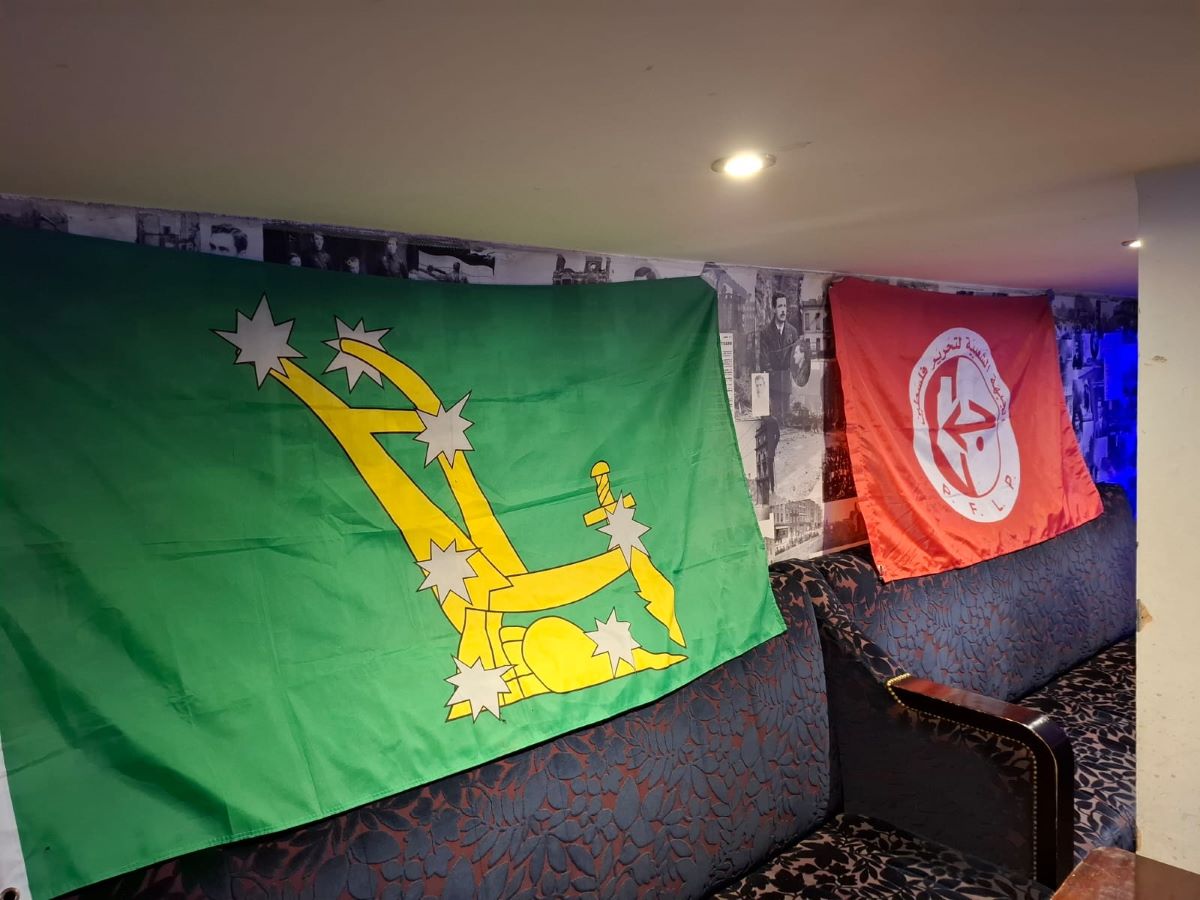
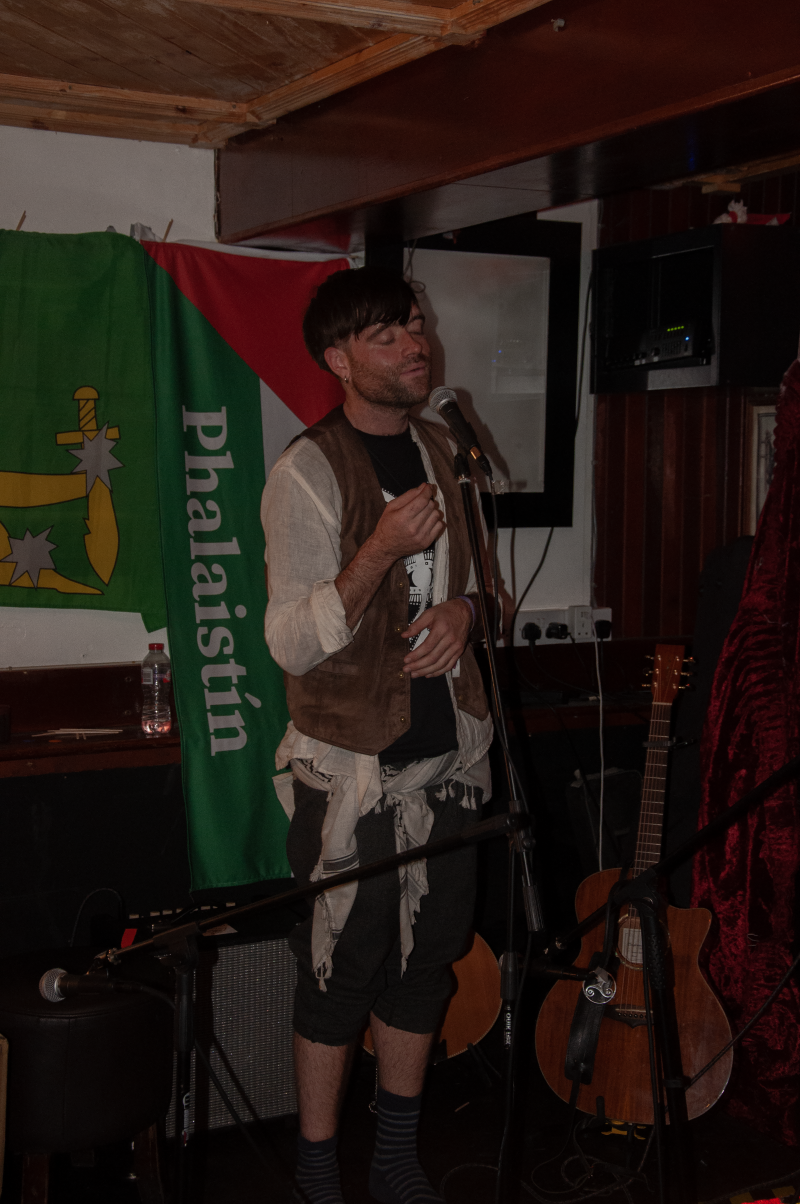
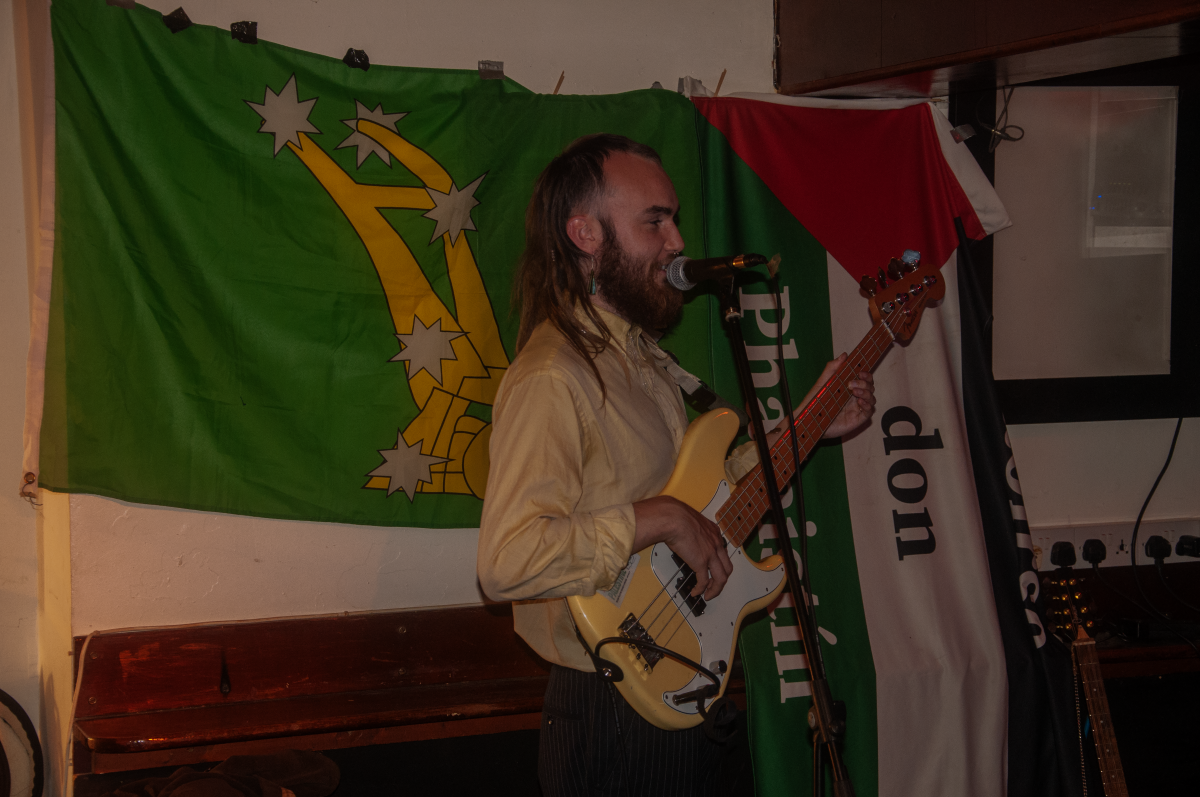
An Irish and international resistance theme in decor was presented by flags of the Starry Plough and Palestine with Saoirse don Phalaistín as stage backdrop, while flags respectively of Cumann na mBan and Basque Antifa concealed the original decor’s ubiquitous photos of Michael Collins.
Flesh B. Bugged performing (Photo: Dermo Photography)
A PFLP1 flag was also taped to a wall. Hand-written signs on the stairs leading to the basement venue, alternatively in Irish and in English, asked for quiet/ ciúnas for the performance/ racaireacht. The Irish language was present too in some of the performances to follow.
MC for the night, Jimi Cullen, himself a singer-songwriter activist told the crowd the purpose of the organising collective was “to build a community of resistance and solidarity with our struggles and with struggles around the world” through culture in a social atmosphere.
Before the crowd — a flag temporarily changing the decor. (Photo: R. Breeze)
Themes of love, nature and emigration were covered in song; however the dominant theme was resistance – to prison regimes, foreign occupation, fascism, class oppression, racial discrimination – and solidarity with the struggles of others, near and far.
Diarmuid Breatnach, singing acapella kicked off the night with a selection of songs from the Irish resistance tradition and a couple of short ones from the USA civil rights movement. Some of the melodies however, of particular interest perhaps to Back Home in Derry2, were his own originals.
Eoghan Ó Loingsigh, accompanying himself on guitar followed with more material from the same tradition, dedicating one to his late IRA father. A folk song Ó Loingsigh announced as ‘non-political’ performed acapella turned out to be very much political but on the issue of social class.
Áine Hayden followed with poems on a range of topics, from swimming in the Royal Canal during the Covid shut-down, deleting a personal relationship to a dedication to comedian and activist Mahmoud Sharab murdered with family in a “safe zone” tent by the Israeli Occupation Force.
Eoghan Ó Loingsigh performing (Photo: Dermo Photography)
The three performers were all introduced as activists as well as artists and the mostly-young crowd, apparently containing a strong representation of political and social activists, responded well to the performers with applause, yells of encouragement and often joining in on choruses.
More people arrived before, during and even after the break – including an elderly couple who had just arrived from the USA and could only pay in dollars but were admitted for free. Leaving later with thanks they promised a contribution to Palestine solidarity when they got home.
Before the crowd — a Cumann na mBan flag temporarily changing the decor. (Photo: Dermo Photography)
Also an activist, Ru O’Shea sang an Irish, Scottish, French and Italian selection, accompanied by bouzouki and guitar and performed a spoken word piece with a refrain of ‘Éire under attack’ before schooling the audience to sing the chorus of Robbie Burns’ Green Grow the Rushes Oh!
Áine Hayden performing (Photo: Dermo Photography)
Nomads were the next act. Composed of two Mongolian musicians playing violins in the style of the viola and a Dubliner modulating on a sound deck they were unusual enough but it was the amazing throat-singing of one of the Mongolians that had the audience enthralled.
It was amazing to learn that there are three different kinds of Mongolian throat-singing and then to hear them performed, one of which was a kind of whistling with a vibrating bass undertone wavering through it. The applause, particularly when they concluded, was rapturous and sustained.
Before the crowd — flags temporarily changing the decor. (Photo: R. Breeze)Ru O’Shea performing (Photo: Dermo Photography)
The evening’s entertainment concluded with Flesh B. Bugged, a punk rock Irish duo of bass guitar and drums with spoken voice pieces in Irish from the bass guitar player. Their volume and beat got some of the crowd up and dancing and the wider crowd responded well to them too.
MC Jimi Cullen went up on stage for the last time to thank venue, performers, audience, doorkeepers, poster designers Ríona and Azzy O’Connor, also Diarmuid for original artwork. At a prompt from the crowd Cullen also got a round of applause from the audience for his MCing.
The Mongolian musicians of Nomads performing (Photo: D.Breatnach)
Remarking they’d “had a great night” and encouraging his listeners to follow the organising collective on its Instagram page, Cullen told them that details of Solidarity Sessions No.3 and the collective’s decisions on recipients of donations from money raised would be posted on there.
Diarmuid Breatnach told the audience that each individual could help build a community of resistance through attending the Solidarity Sessions and encouraging others to attend. He welcomed any ‘competion’ from solidarity sessions around the country.
Bass guitarist of Flesh B. Bugged (Photo: Dermo Photography)
The downstairs area of the International Bar is not perhaps the best layout for this kind of event but it worked out well enough for the collective, audience and performers on the night. Their next event will be back at their launch venue,The Cobblestone, Smithfield on Thursday 30th October.
End.
Note: If you found this article of interest, why not register with Rebel Breeze for free, so that you will be notified by email of subsequent articles. You can de-register any time you wish.
The Mongolian throat-singer in Nomads (Photo: Dermo Photography)
FOOTNOTES
1People’s Front for the Liberation of Palestine, one of two specifically secular armed resistance organisations in Palestine.
2Irish mega folk singer Christy Moore had organised Bobby Sands’ poem into song to the melody of The Wreck of the Edmund Fitzgerald by Gordon Lightfoot.
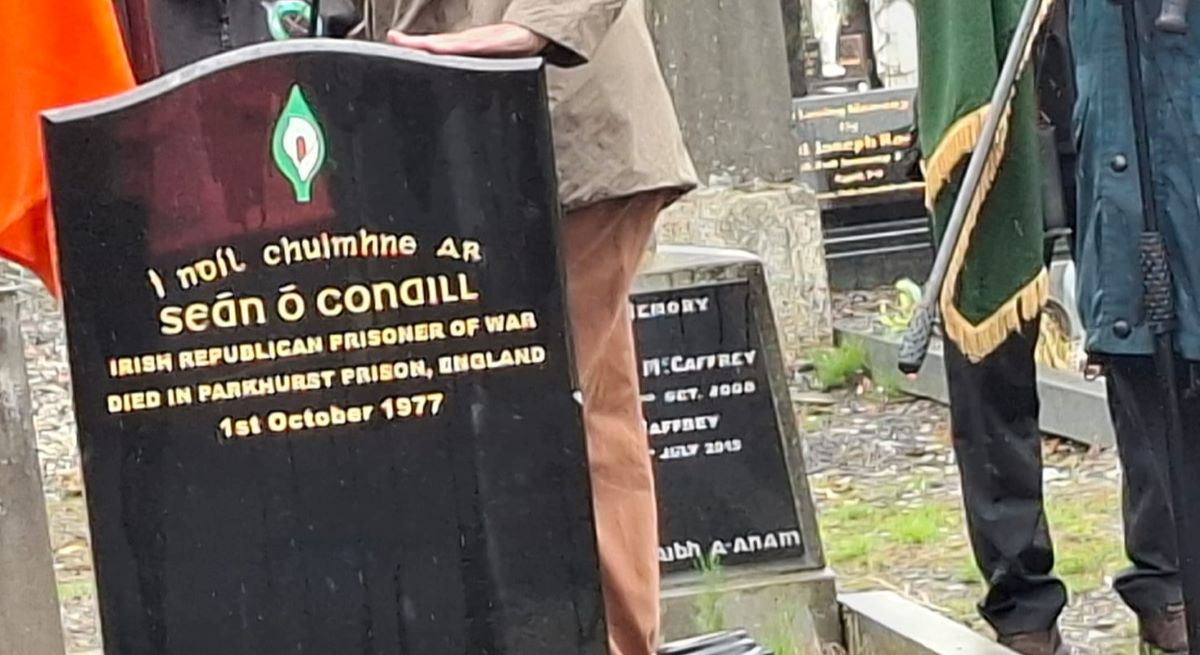
The grave of Irish Republican political prisoner Vol. Seán Ó Conaill received a headstone on Sunday (7th August) due to the efforts of the National Graves Association – nearly 50 years after his death in British custody.
Seán was born and brought up of Irish background in Birmingham and became interested in Irish history. After Bloody Sunday (1972) he tried to join the IRA but was not accepted and subsequently acted independently, assassinating a British Army Lieut. Colonel.
Tracked by British police, he wounded two of the group sent to arrest him, was captured and beaten up. His treatment in jail was bad also but after sentencing was accepted by the Irish Republican prisoners in British jails and, in time, sworn into the Provisional Irish Republican Army.
After his death his body was transferred for burial in Glasnevin. It seems that the NGA understood that his family wished to erect a headstone but for whatever reason the grave lay without one until last week.
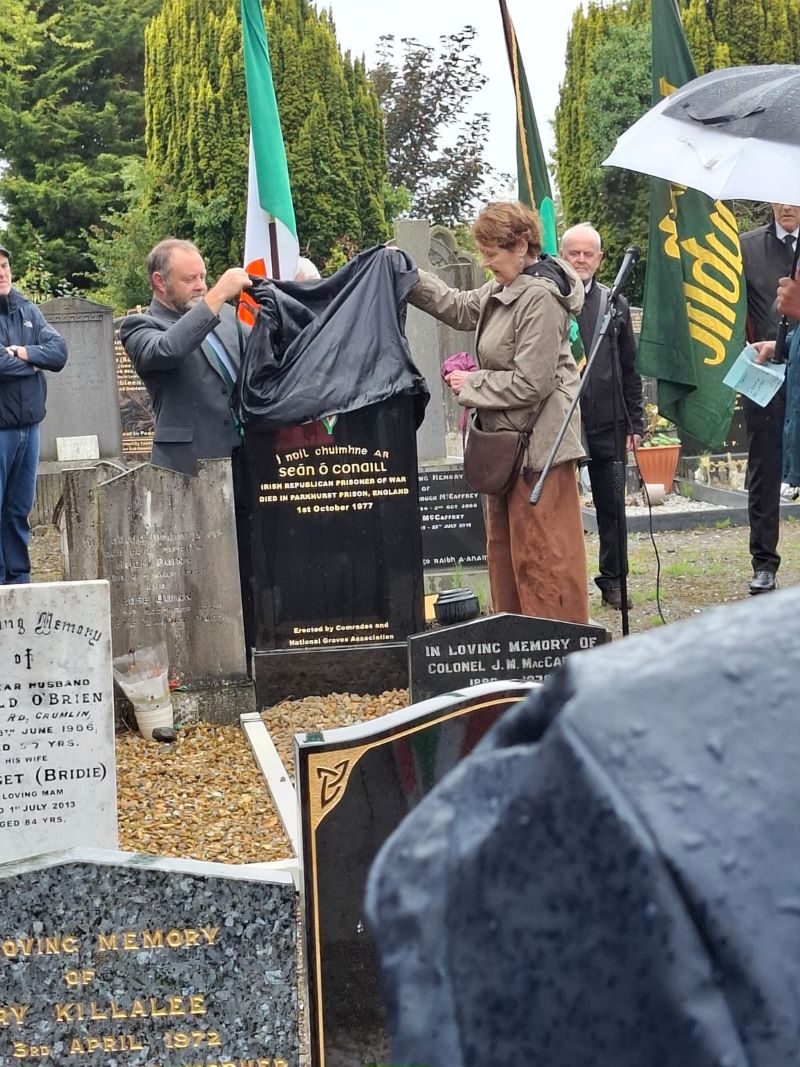
The National Graves Association went ahead with commissioning a gravestone which they unveiled on Sunday in the St. Paul’s section of Glasnevin Cemetery1 with a colour party, speakers, music and a goodly attendance, though drenched during the ceremony.
The occasion was supported by members of Sinn Féin and Republican organisations in addition to independent Republicans and anti-imperialists. Seán Whelan, Chairperson of the NGA chaired the event and after some opening remarks introduced the speakers.
Section of the attendance at the event. (Photo: D. Breatnach)
SPEAKERS
Jacqui Kaye of the former Prisoners’ Aid Committee2 was introduced to speak and told her audience that Ó Conaill was diagnosed with terminal cancer and requested a visit from Kaye, permission for which was initially refused by the Home Office3 but granted after intervention by Lord Longford.
The visit was permitted for 10 minutes only for Parkhurst Jail but then changed to a hospice though when Kaye arrived it was to be told that he had just died there, leaving her with the suspicion that he had actually died in Parkhurst but that the Home Office did not wish that on their record.4
Jacqui Kaye, formerly of the Prisoners Aid Committee (no longer in existence), speaking at the event during a particularly heavy shower. (Photo: D. Breatnach)
Former Republican prisoner (21 years in British jails) Noel Gibson laid a wreath on behalf of the NGA and Paddy Lennon read The Rhythm of Time by hunger strike martyr Vol. Bobby Sands, after which a recording of uileann pipes filled the cemetery air with its haunting lament.
Liam Ó Culbáird of the NGA presented the main oration of the event, recounting details of Ó Conaill’s life and time in jail, information gathered from a number of sources, including that despite complaining of chest and stomach pains he did not receive medical investigation in jail.
It was only after coughing up blood that Ó Conaill received a medical visit, after which he was diagnosed with terminal cancer. His marriage had become estranged possibly as a result of his incarceration but official interference in personal relations of political prisoners was also known.5
Liam Ó Culbáird, giving the oration at the unveiling on Sunday. (Photo: D. Breatnach)
The speaker alluded to the practice of “ghosting” political prisoners, i.e. moving them to a different jail without notice, often as a scheduled visit by a family member was imminent, which occurred to Ó Conaill’s mother arriving at Wakefield Prison to be told he had been moved to Parkhurst Jail.6
Such practices imposed an additional punishment not only on the prisoner but in particular on family members7 who had often travelled long distances into sometimes hostile territory and had also the additional expense of paying for overnight accommodation.
The media at the time of his arrest had portrayed Ó Conaill as of unbalanced mind but his comrades in jail found him completely rational and dedicated to the cause. He began to learn Irish and encouraged the other Republican prisoners to expand their use of the language.
Liam Ó Cúlbáird and Jacqui Kay unveil the headstone to Vol. Seán Ó Conaill on Sunday. (Photo: D. Breatnach)
Commenting on Ó Conaill’s failure to be recruited by the IRA prior to his armed action, Ó Culbáird commented that disagreements between General Headquarters of the IRA and Volunteers were not unknown and related a GHQ approach to Brendan Behan after his release from jail.
Behan was informed that he had been been found guilty by GHQ court-martial8 in his absence and sentenced to be shot. Behan replied that since his court-martial had been in his absence, so equally could his execution and promptly departed!
Ó Culbáird commented also on the number of groups that had operated independently of the IRA’s GHQ and remarked upon the number of different groups that had participated in the 1916 Rising,9 all with their reasons for separate existence but all united in the struggle for independence.
The speaker ended his oration by pointing out in Irish and in English that Ó Conaill was an Irish Republican soldier who gave his life in the struggle for Irish freedom.
CONCLUDING
Bringing the ceremony to an end, Seán Whelan thanked the speakers for their contribution and audience for their attendance and added some words about the NGA, pointing out its political independence and refusal to accept donation from any governmental or other organisation.
Chairperson of the NGA, Seán Whelan, presiding over the unveiling on Sunday. (Photo: D. Breatnach)
Whelan also added that whereas the NGA acknowledges the right of anyone to commemorate their dead, their organisation prioritises the dead who participated in the Irish struggle for independence but also cannot agree to share their commemoration with those who fought against them.
He remarked that he did not know of any other country where that would be done. Whelan then called for attention to the playing of a recording of the the National Anthem.
End.
(Photo: D. Breatnach)
FOOTNOTES
1i.e the large section on the opposite side of the road from the main Glasnevin gates, also where stands the NGA memorial to the six uprisings mentioned in Pearse’s famous speech.
2The PAC was initially formed by Official Sinn Féin but within two years had left the Officials and operated independently.
3Irish Republican prisoners in British jails were listed as high-security Category A and were not permitted visitors other than immediate family.
7Though not mentioned in the oration, this was also a practice of the Spanish prison system against Basque political prisoners, in which case letters and parcels arriving for the prisoner, rather than be forwarded to the prisoner’s new location, would be returned to sender with a note that the prisoner was no longer at the posted address.
8Presumably for his solo unauthorised action in carrying a bomb to England.
9Irish Republican Brotherhood, Irish Volunteers, Cumann na nBan, Irish Citizen Army, Na Fianna Éireann, Hibernian Rifles. Some individuals not a member of any of those organisation also participated.















 rebelbreeze