A MOTHER’S HEART – A Review.

Diarmuid Breatnach

(Reading time:4 mins.)

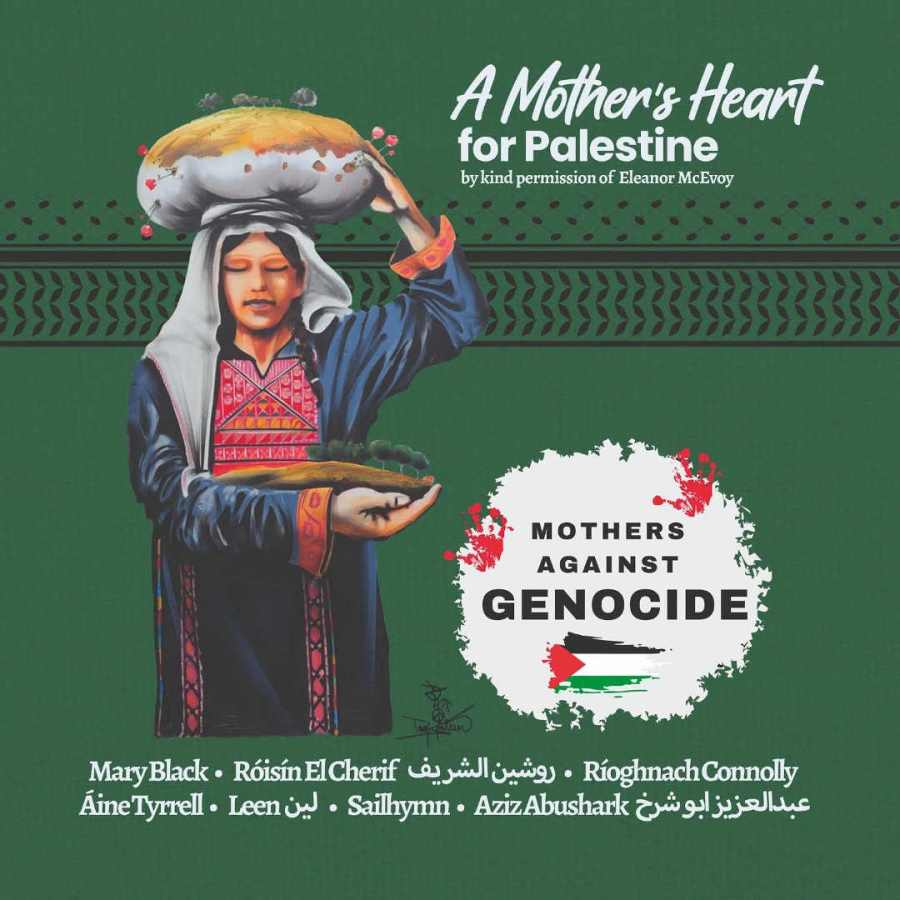
On August 1st singer Mary Black released A Mother’s Heart for Palestine, a soundtrack and video.1 The title and music built on the 1992 track by Mary Black and Eleanor McEvoy, A Woman’s Heart (title of album also).2

The voices are beautiful and the adaptations of the Arab women particularly so. Or at least, they affected me even more deeply.

Like actions by Mothers Against Genocide,3 the recording seeks to transverse borders in the mind, to represent Palestinians as humans, as human as ourselves, through the image of the mother, which almost all of us have had and which many women are or have been.

It is worth thinking about this a bit further. The image of the mother is a powerful one in all cultures for at least biological evolutionary reasons. The future of the human species depends on productive motherhood and in all cultures, in that capacity at least, pregnant women are protected.

The image is also overlain by personal affect, of ourselves nurtured (in most cases) by a mother or ourselves as a mother, nurturing in turn.

The image of the mother is also manipulated by all degrees of the Right, whether to uphold clerical control, to counter assertion of reproductive rights, or to deny the right of lesbian (and gay) sexuality. And ‘to protect ‘our women’’ from imagined migrant assault (or indeed intermarriage).

In Christian religious iconography, the Mother as Madonna is particularly prevalent and she is always passive, whether depicted serene or suffering.
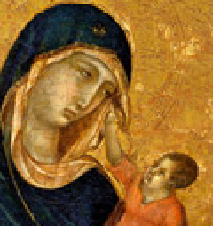
A detail from the Madonna and child painting by Duccio, late 13th Century (Image sourced: on line)

The mother image is also employed by imperialists to send us to war and was crudely used for example in the UK (of which Ireland was then a part) in a WWI poster depicting a mother and child telling the man to go and fight (for them, of course – not for the imperialists, mar dhea!).
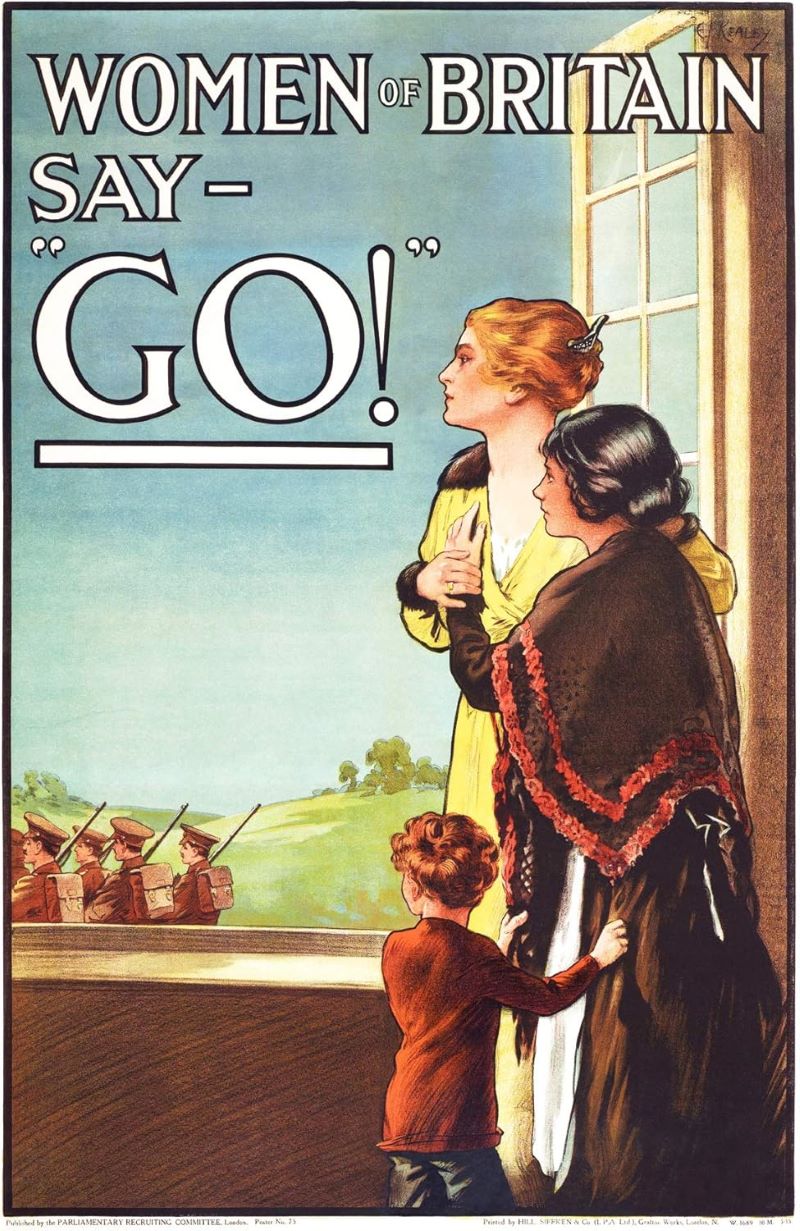
WW1 recruitment poster for Britain (Image sourced: on line)
A particularly offensive recruitment poster for the British Army in WW1 given that Ireland was under British occupation and only six decades after a British genocide of Irish people through starvation. (Image sourced: on line)

But in nearly all cases it is a passive representation of womanhood and is combined in the Mothers Heart video with images of sorrow – naturally, about all the children killed or starving, soon to die — which is also a passive emotion.

Many of the visual representations of Palestinian women are in domestic roles assigned to women around the world: food preparation, washing and drying clothes and of course child care.

Mothers are uniquely women but women are also more than mothers. Slightly more than one-half the human race, they are also workers,4 cultural producers, thinkers, leaders — and fighters. Even in revolutionary iconography we rarely see the woman, never mind mother, represented armed.

This is despite the 1970s images of a Mozambican or Vietnamese woman carrying a gun and a child. Or the famous staged INLA photo of a skirted woman in the Six Counties aiming an automatic rifle. Such images are very much exceptions to the rule.5

Poster promoting the Mozambique People’s Liberation Army. (Image sourced: on line)
Poster from the Vietnam War. (Image sourced: on line)

The music video shows Palestinian women, among their domestic roles, lamenting, speaking on mobile phones, presumably worried about relatives, carrying belongings, on the move, displaced. The lyrics also are of lament.

As complete counterpoint in the Arab world we have only one image that I know of, which is Leila Khaled with an automatic rifle, because her society too insists on a largely passive role for women, even though their position in that society otherwise seems very influential.

The women shown in the video accompanying the music and lyrics are apparently Arab, Arab-Irish and mostly Irish. On the Palestine solidarity marches here my impression is that born women are the majority over born males and many have taken militant action, for which some are facing prosecution.

Women, in particular Arab women, often lead these marches, calling out the chants for others to respond.

Newsreels show Palestinian and other Arab women abroad marching, shouting slogans, clenched fists in the air. I have seen them denouncing ‘Israeli’ soldiers for invasion and occupation, for mistreatment of children, for demolition of houses, one slapping an armed Israeli soldier in the face.

In our own history (as distinct from mythology and legend) we had few female figures of armed action and Pearse mythologised Gráinne Ní Mháille6 in song to epitomise resistance when he had her represent the nation. But compare that to his poem The Mother!

In recent years Markievicz, Skinnider7 and to a degree Farrell8 have part-emerged from history’s shadows bearing weapons but there is still a long way to go in changing the image of women (through all their biological phases) in the struggle.

This song for all that it affects me emotionally does not do that nor is it expected to and, more to the point, I fear will be used to reinforce passivity in the assigned role of women in struggles — fortitude and solidarity in suffering no doubt, but passivity none the less.

It seems to me that social democrats and liberals perpetuate the mother aspect of the woman manipulatively in order to promote pacifism and much as I appreciate this cultural production, it will be used in that way.

While enjoying cultural productions visually, in sound or in print, we need also to be aware of the social packages they carry and their effects upon us, intended or otherwise.

End.
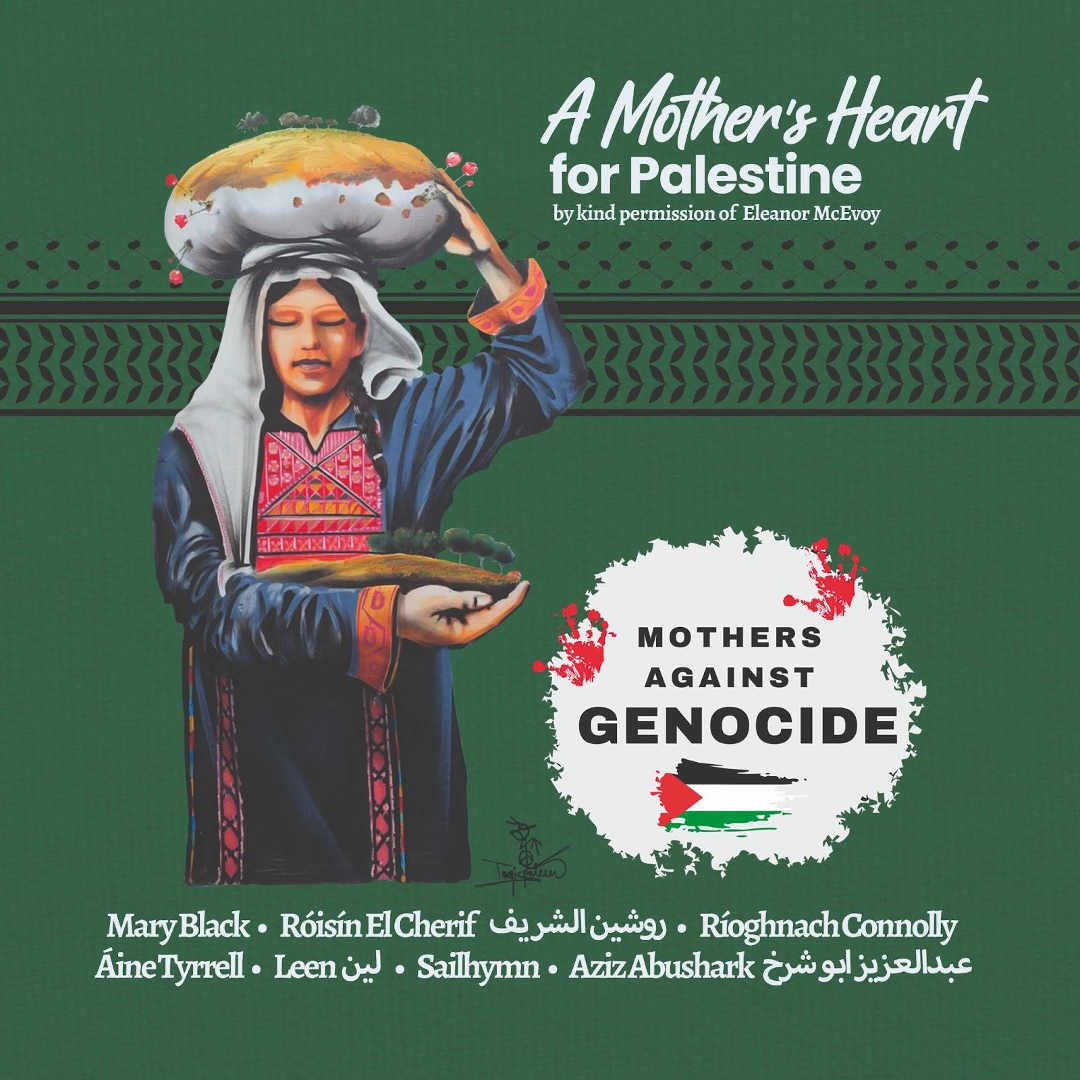
(Image sourced: The Beat.ie)

FOOTNOTES

1https://www.mary-black.net/

2https://en.wikipedia.org/wiki/A_Woman%27s_Heart_(compilation_album)

3Whose official stamp is also on the video.

4Industrial, agricultural, municipal, health services, technical and scientific services.

5There was some coverage of armed Kurdish women in Syria fighting ISIS (I wrote about some myself) but it is now clear that was in the context of NATO coordination in the war to overthrow the non-western aligned regime.

6A 17th Century female chief of the Uí Máille clan in Mayo who led attacks on her enemies by land and sea. Pearse adapted the ancient bride-welcoming song to bid her welcome with armed warriors to reclaim her land and disperse the English occupiers.

7Both Markievicz (nee Gore-Booth) and Skinnider were members of the Irish Citizen Army and both carried and fired weapons in the 1916 Rising.

8Though unarmed, she was part of an Active Service Unit of the IRA when she and her two comrades were gunned down in the British colony of Gibraltar on 6th March 1988.
SOURCE

https://www.mary-black.net/

1https://www.mary-black.net/

2https://en.wikipedia.org/wiki/A_Woman%27s_Heart_(compilation_album)

3Whose official stamp is also on the video.

4Industrial, agricultural, municipal, health services, technical and scientific services.

5There was some coverage of armed Kurdish women in Syria fighting ISIS (I wrote about some myself) but it is now clear that was in the context of NATO coordination in the war to overthrow the non-western aligned regime.

6A 17th Century female chief of the Uí Máille clan in Mayo who led attacks on her enemies by land and sea. Pearse adapted the ancient bride-welcoming song to bid her welcome with armed warriors to reclaim her land and disperse the English occupiers.

7Both Markievicz (nee Gore-Booth) and Skinnider were members of the Irish Citizen Army and both carried and fired weapons in the 1916 Rising.

8Though unarmed, she was part of an Active Service Unit of the IRA when she and her two comrades were gunned down in the British colony of Gibraltar on 6th March 1988.

“Building resistance through culture”: successful Solidarity Sessions launch in Dublin

Clive Sulish

(Reading time: 3 mins.)

Around 80 people attended a concert in the back room of Dublin’s Cobblestone pub launching an initiative to “build a community of solidarity and resistance through culture”. Flags of Irish and other struggles around the world decorated the venue.

The evening’s entertainment consisted of five musical acts and one of poetry. The MC for the evening, Diarmuid Breatnach, told the audience that Irish struggles had always found an expression in culture and that culture itself encouraged further resistance.

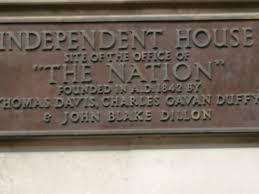
He gave the example of Thomas Davis who founded with others the patriotic newspaper The Nation in the mid-1800s, publishing contributed songs and poems and his own, including The West’s Awake and A Nation Once Again, songs still sung in Ireland nearly two centuries later.

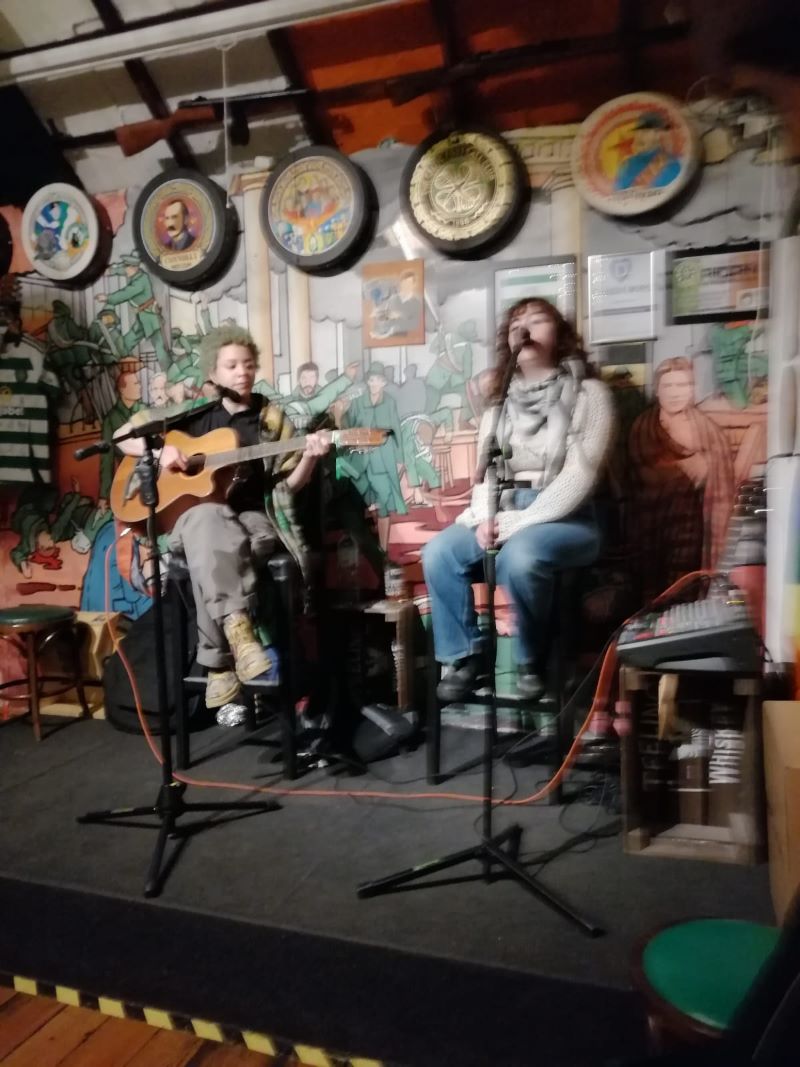
The first act of the evening was the folk duo The Yearners, specialising in harmonies around renditions of song covers and their own song about the Mary of the New Testament, as a woman pressured to bear a child because “How can you say no to God?

The audience joining in on Pearse’s Gráinne Mhaol was followed by some songs with hard satirical edges like the Kinky Boots song from the Irish Republican repertoire and their own Save A Landlord.

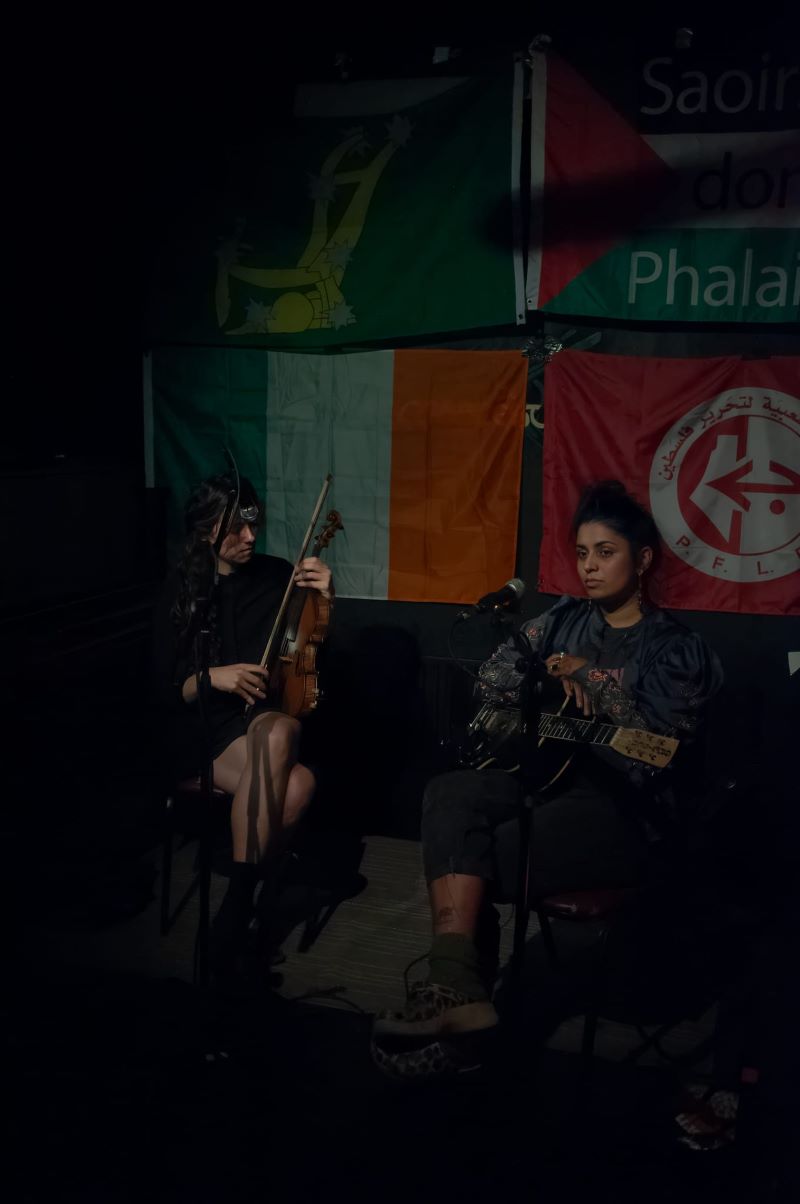
The Yearners during their performance. (Photo credit with thanks: Dermo Photography)
Dúlamban during their performance. (Photo credit with thanks: Dermo Photography)

The MC introduced another all-female duo, Dúlamban, recently formed from two individual singer-musicians. Among their material, Sinéad on violin played two compositions of her own while Aisling sang her adaptation and translation of the Rising of the Moon: Ar Éirí na Geallaigh.

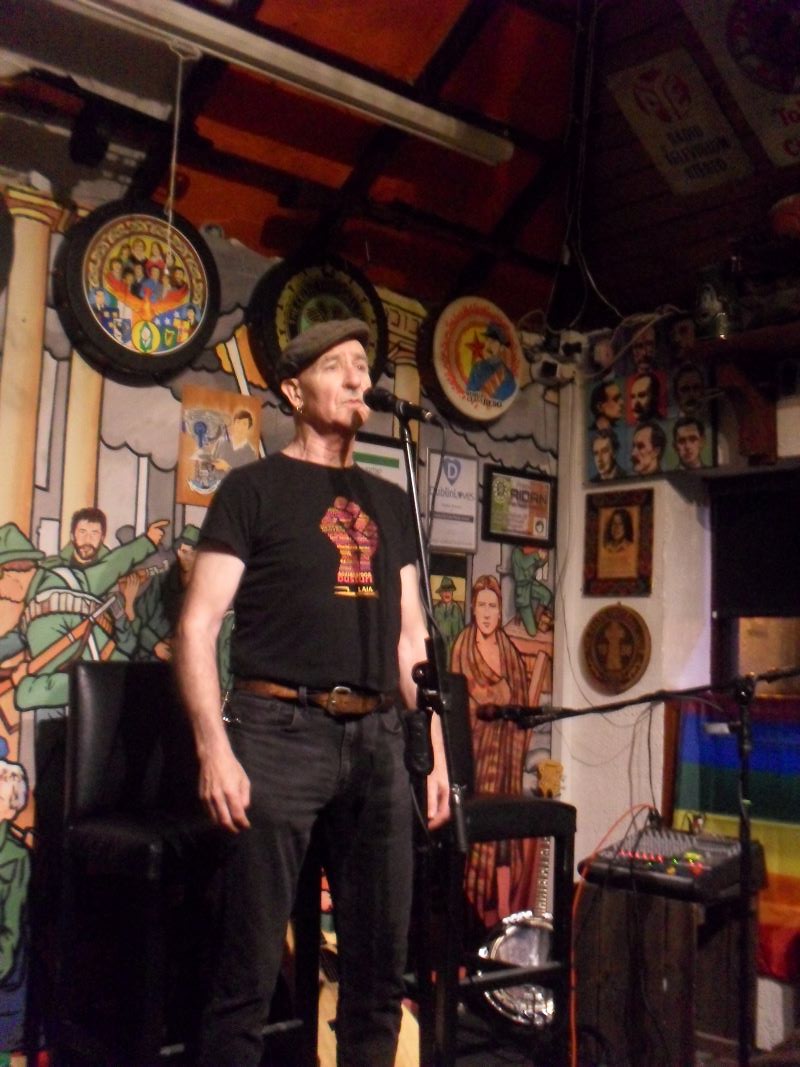
The one poet of the evening, Barry Currivan, performed a number of shorter and longer pieces of his repertoire. He was particularly applauded for his “anti-othering” piece Those People and his humorous concluding piece comparing himself to a good cup of tea or coffee.

After the break, the MC spent a few minutes outlining the Solidarity Sessions collective’s project and encouraging the audience to take part in it by spreading word of its events and supporting them in person, in addition to stepping forward to assist in organisation and in poster design.

Barry Currivan during his poetry performance at the Solidarity Sessions launch. (Photo credit with thanks: Dermo Photography)
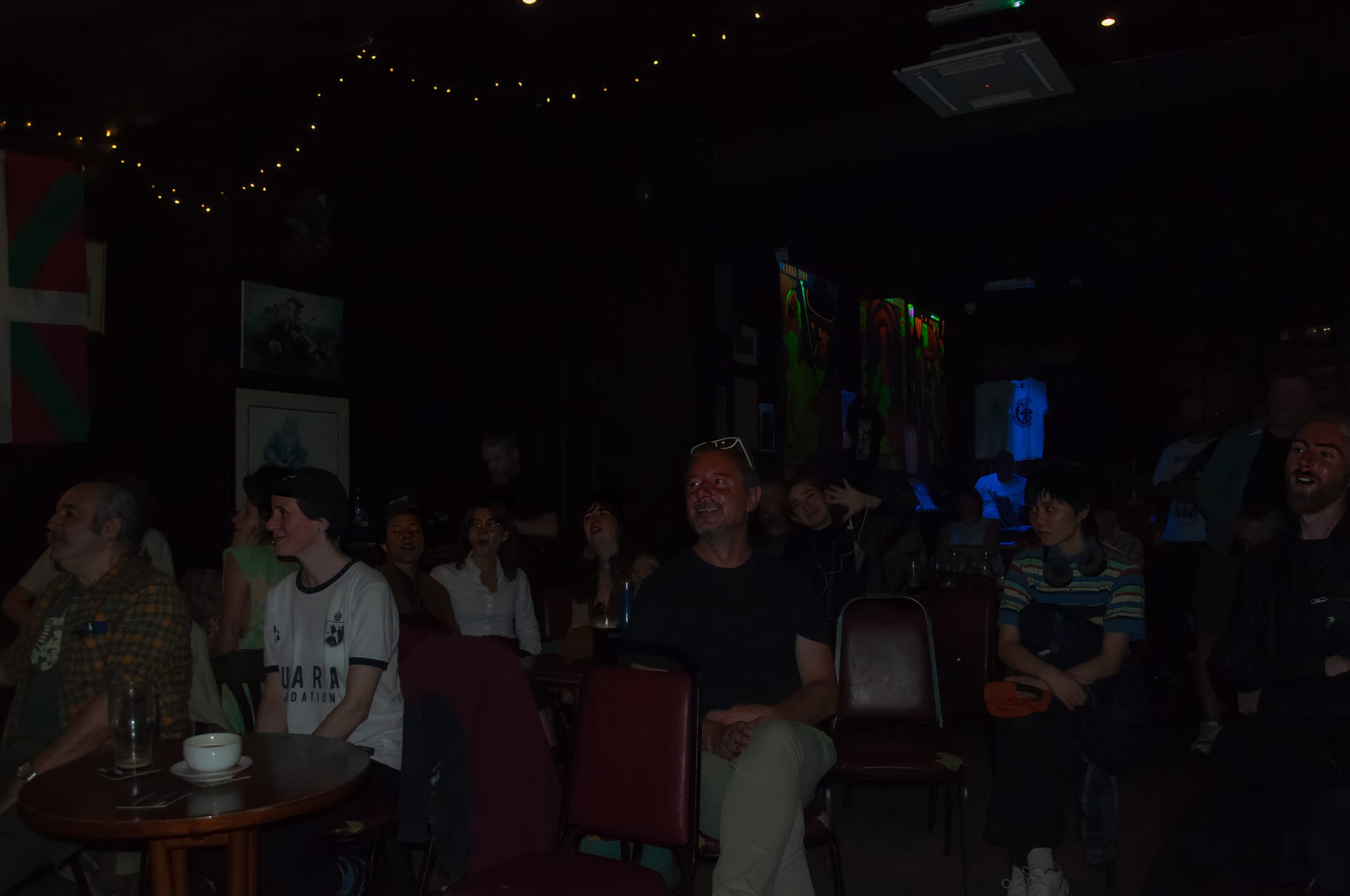
Section of the audience presumably during Currivan’s performance. (Photo credit with thanks: Dermo Photography)

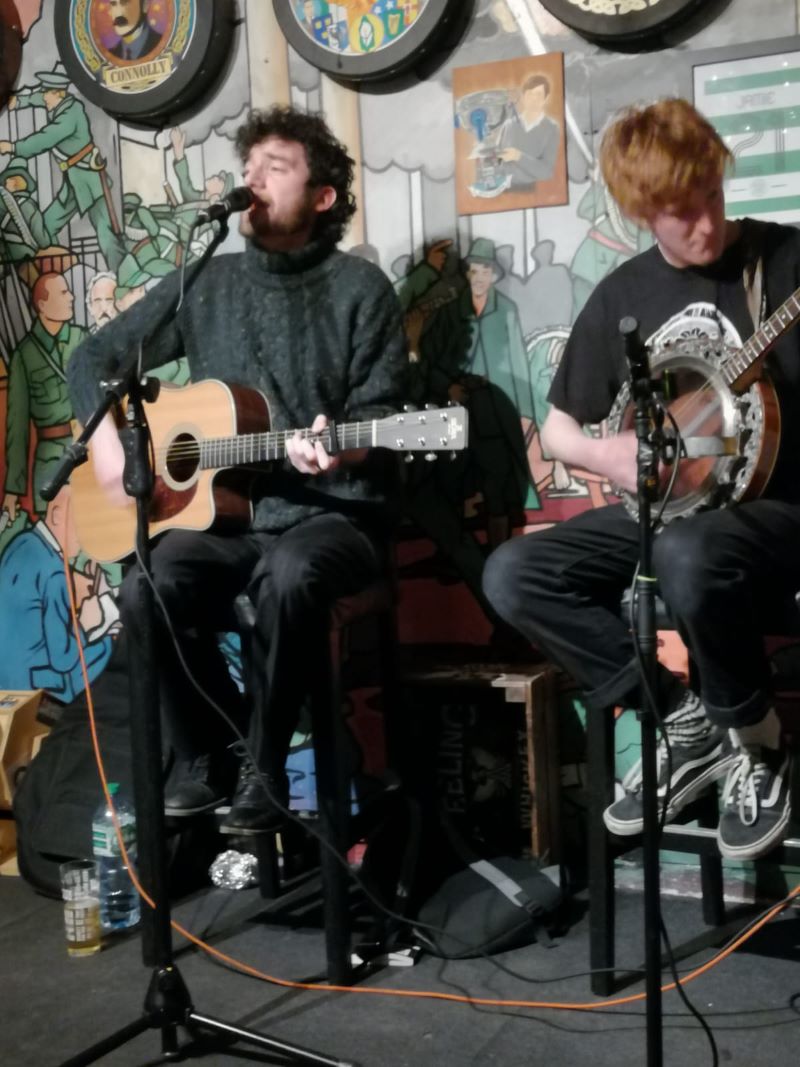
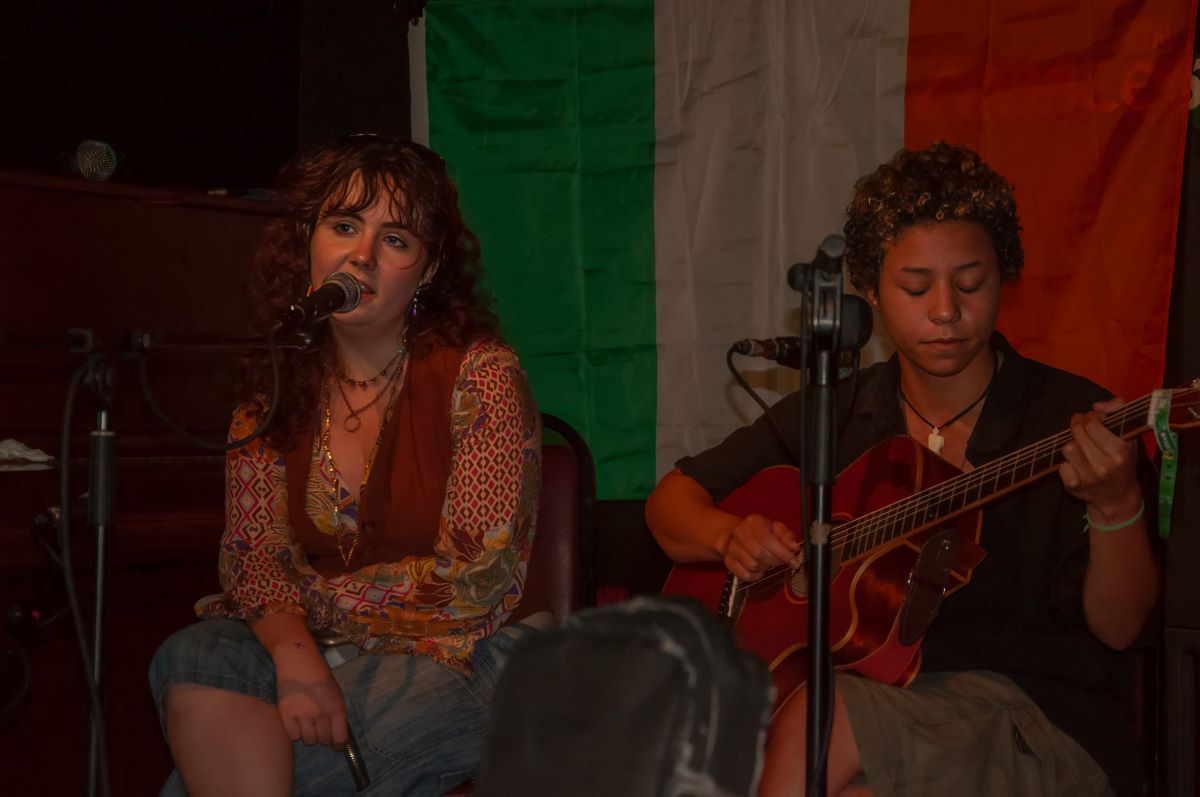
Another female duo took the stage, Sage Against the Machine on guitar accompanied by Ríona on violin, performing a number of love pop covers and SAM’s own song against patriarchy.

Some remarks about Bob Dylan’s Zionism followed in Sage’s introduction of the former’s Masters of War which she performed with great feeling and followed with El Gallo Rojo, an anti-fascist song from the Spanish ‘Civil War’.

Sage Against the Marchine (right) and Ríona during their performance. (Photo credit with thanks: Dermo Photography)
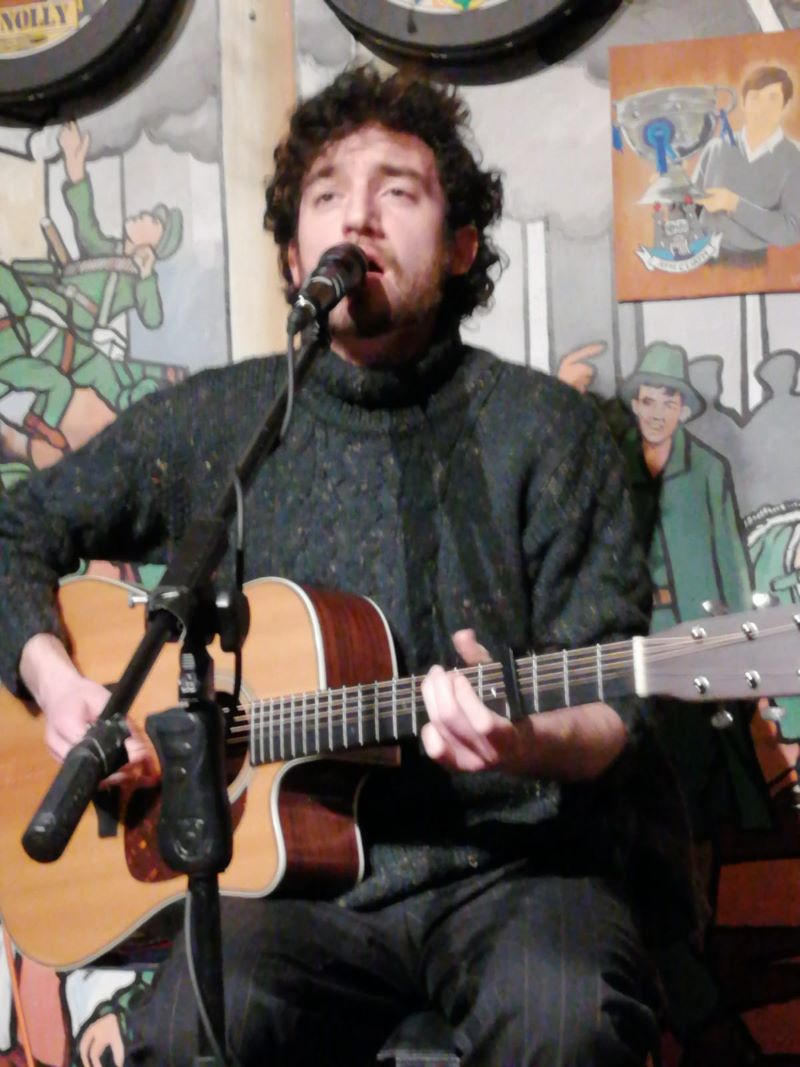
Jimi Cullen during his performance at the Solidarity Sessions launch. (Photo credit with thanks: Dermo Photography)

Breatnach then introduced Jimi Cullen who he said has been hosting a weekly musical protest picket for an hour on Wednesdays (2-3 pm) outside the US Embassy for a great many weeks, in which the MC had sometimes accompanied him amidst the solidarity beeping of passing traffic.

Jimi accompanied himself singing his Housing for All and Guthrie’s You Fascists Bound to Lose, then commenting on Bob Marley’s Zionism while introducing the latter’s One Love song, saying that love above all is what binds humanity together, a theme also of his We Are All Palestinians.

His monologue The Genocide Will Be Televised was much sharper and renewed an earlier Death, death to the IDF!1 chant from the audience.

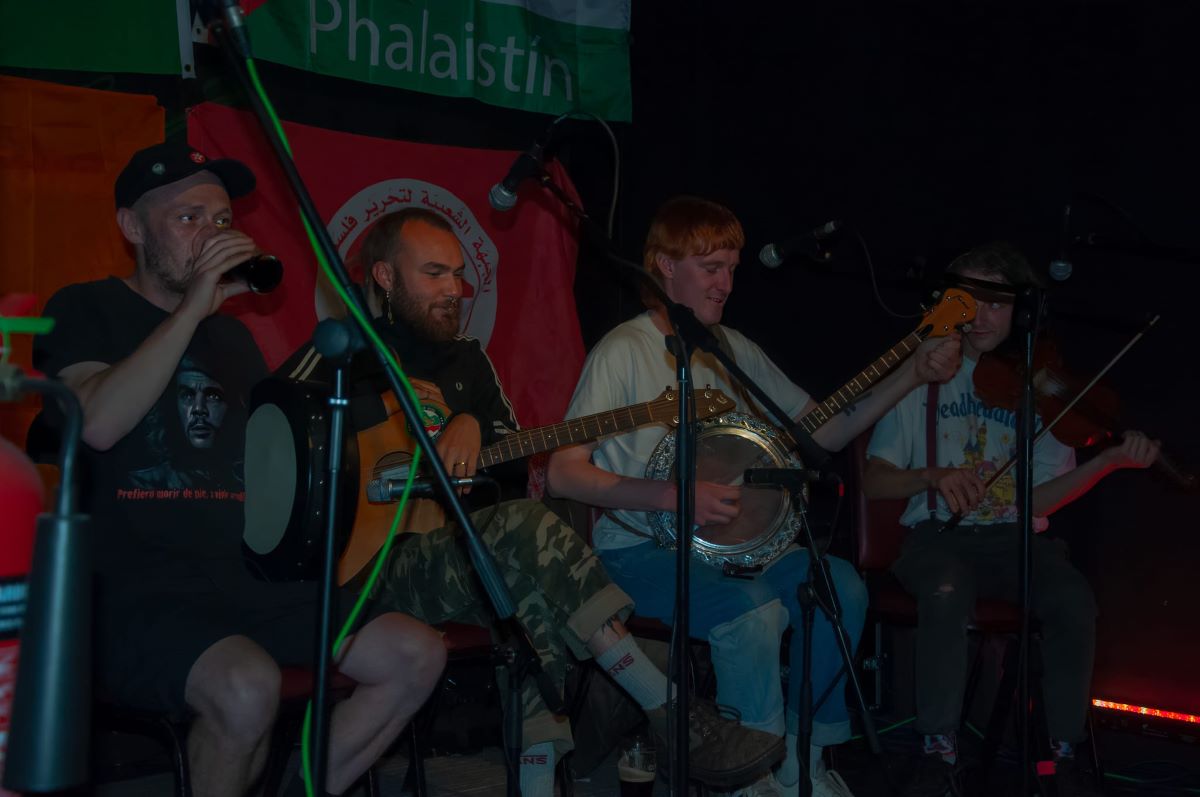
Trad Sabbath during their performance. (Photo credit with thanks: Dermo Photography)

There was much irreverent comment about the name of the band to conclude the evening, Trad Sabbath, a four-piece band of guitars, banjo, bodhrán and fiddle, apparently in the context of the very recent death of the Black Sabbath band’s lead vocalist, Ozzie Osbourne.

Sardonic cries about “his poor widow”, Sharon Osbourne2 were also heard, a Zionist personality star in a ‘reality’ TV show about the late Ozzie’s family. To fill in the delay in their setting up with the sound engineer, Breatnach sang Kearney’s Down by the Glenside ballad.

The band concluded the evening with traditional melodies and some songs from Eoghan and Hat with others backing on choruses.

Poster advertising the event (Design: Ríona and D.Breatnach)

The MC thanked all for their attendance, performances and technical support before reiterating the Solidarity Sessions’ objective and encouraging participation. His comment that “Repression is here and more is coming down the road” was underlined by the presence there of a prominent victim.

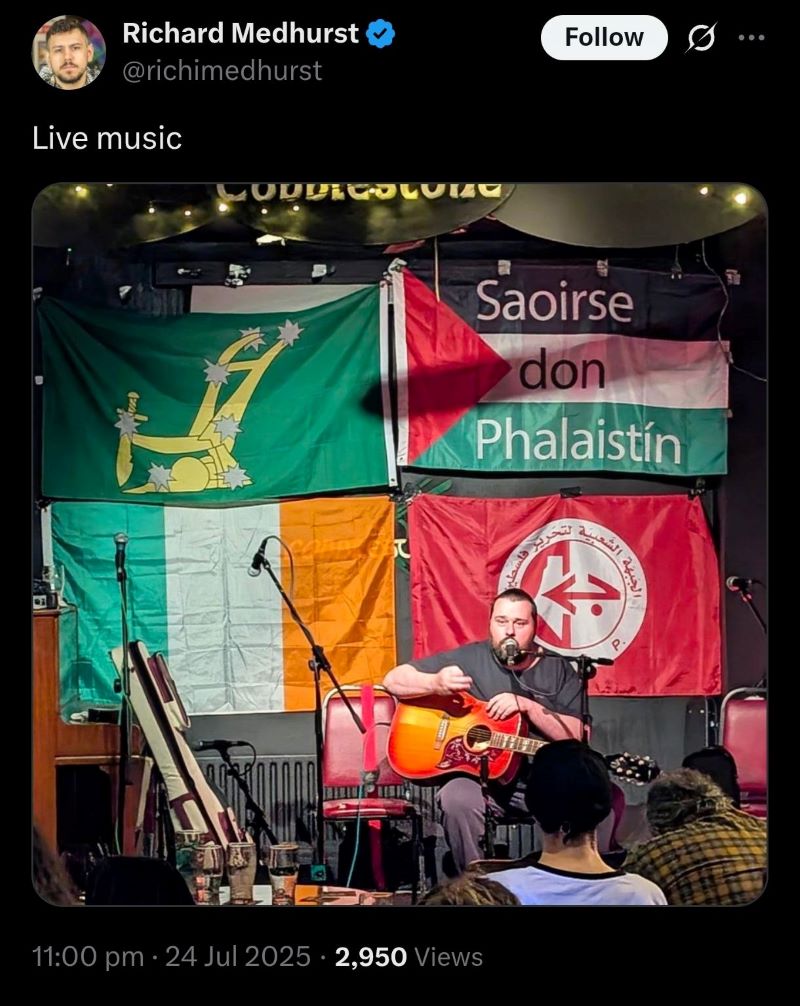
In the audience was Richard Medhurst, the Britain-based journalist specialising in Middle Eastern coverage who was recently detained under anti-terror (sic) legislation and charged by British police as he returned from abroad and again later detained though not actually charged by Austrian police.

Richard Medhurst’s tweet during the evening at the event.

End.

FOOTNOTES

1Made famous by the Bob Vylan duo at Glastonbuy getting the audience chanting the slogan. The IDF is what the Israeli Occupation Forces call themselves.

2Who had called for the banning of the the Irish rap group Kneecap.

BBC, Kneecap and the long history of censorship

Gearóid Ó Loingsigh June 2015

(Reformatted entire for publishing in Rebel Breeze from article of same title in his Substack)

(Reading time: 8 mins.)

Kneecap’s music is not really my thing. I am perhaps too old, or maybe my musical tastes are more conservative. But I do love their politics and their stance on Palestine.

I don’t think much of Hezbollah, but I do think waving their flag is not a criminal offence.

The BBC think otherwise as evidenced by their decision to not broadcast Kneecaps’s performance at the Glastonbury festival. The only reason for this was their support for Palestine. There was no other reason.

Though, it didn’t work out well for the BBC as Bob Vylan who was broadcast live got the crowd to chant Death to the IDF!, one of the noblest of chants ever to be heard at Glastonbury.

But there is a long history to the BBC and other British media censoring musicians. The BBC in its statement said:

Whilst the BBC doesn’t ban artists, our plans ensure that our programming meets our editorial guidelines.

We don’t always livestream every act from the main stages and look to make an on-demand version of Kneecap’s performance available on our digital platforms, alongside more than 90 other sets.[1]

In other words, the BBC does ban artists.

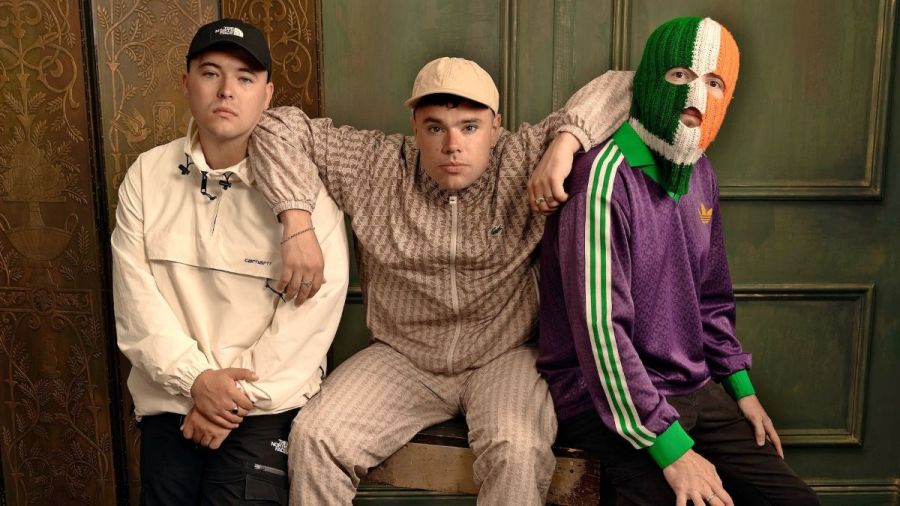
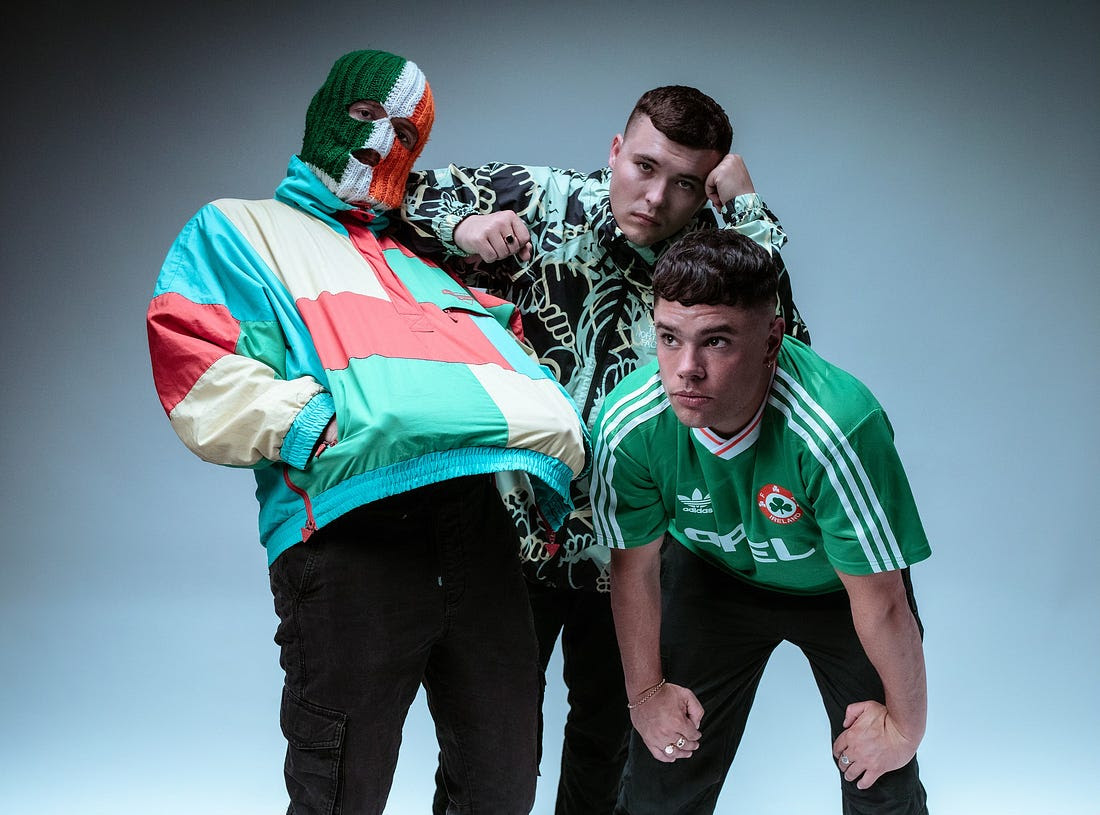
The rapper trio under the band name of Kneecap (Image sourced: on line)

It is not like this is the first time they have banned some of them. Following the Bloody Sunday massacre by the British Army in Derry in 1972, Paul McCartney, penned a song titled Give Ireland Back to the Irish.[2] It was the debut single of Wings.

It was instantly banned in Britain by the BBC but managed to get to No. 16 in the British charts nonetheless and got to No. 1 in Ireland.

They banned songs that mentioned sex, even Shirley Bassie’s Burn My Candle[3] and they banned songs that were considered more political such as The Sex Pistols’ Anarchy in the UK,[4] a song that wasn’t really political at all.

Not surprisingly they banned the then relatively unknown Heaven 17’s debut (We Don’t Need This) Fascist Groove Thang,[5] over concerns it might upset the then recently-elected US president Ronald Reagan.

This was a man whose government through the CIA went on to support deaths squads in Latin America and set up cocaine smuggling networks to finance them through his loyal servant Oliver North.[6] Reagan of course is referred to in the song.

Democrats are out of power
Across that great wide ocean
Reagan’s president elect
Fascist god in motion

That wasn’t the last of it either. The BBC went on to ban a song by The Police, Invisible Sun[7] because of a possible slight on the British Army contained in the lyrics and of course the official video to the song.

I don’t want to spend the rest of my life
Looking at the barrel of an Armalite
I don’t want to spend the rest of my days
Keeping out of trouble like the soldiers say

I don’t want to spend my time in hell
Looking at the walls of a prison cell
I don’t ever want to play the part
Of a statistic on a government chart

The BBC would, during the 1st Gulf War ban a total of 67 songs for the duration of the war, amongst them songs by such establishment figures as Elton John whose song Act of War [8] recorded in 1985 with Millie Jackson was put on the list.

As was Pat Benatar’s Love is a Battlefield,[9] recorded even earlier in 1983. It takes little to upset the BBC it would seem.

The former Irish Taoiseach (Prime Minister) Leo Varadkar criticised Keir Starmer’s call for Kneecap to be not allowed play at Glastonbury stating that

It’s not great for politicians to get into deciding which artists should be allowed to perform where or not.

To me, that’s illiberalism. Part of the whole point of art and music and literature is to be inappropriate, is to be challenging, is often to be anti-establishment,” he said.

We’ve had a situation now for quite some time in Ireland and in Europe and Britain, where politicians didn’t get into the space of saying who should be allowed to perform, who shouldn’t, what books you should be allowed to read, and I hope we don’t slip back into doing that under the guise of national security and anti-terrorism when it isn’t really about that.[10]

Varadkar tut tuts the BBC and Starmer. Sounds great, except his party and the Irish state in general does not have a great record in the matter.

The state broadcaster took an insidious approach to censorship with songs rarely being banned outright. Rather they were just not simply played on the radio station. Hint hint, nudge nudge. A very Irish way of doing things.

The Irish group The Wolfe Tones released many songs over the years about the conflict in the north of Ireland and got little to no airtime. Such was the situation that they even recorded a song about it, called Radio Toor I Li Ay (sometimes called They Don’t Play Our Songs on the Radio[11].

The lyrics are pertinent to Kneecap and Starmer and sum up exactly what the Establishment are about.

You don’t play our songs on radio
You say they’re too political!
Who controls the mind, where’s the mind’s control?
For the music on the airwaves
Follows empty minds, those empty heads
Play songs of sex and drugs instead
Don’t tell them how it really is

Won’t MI5 look after you, control your thoughts
Feed information to your hearts and minds
To save you all from thinkin’, thinkin’, thinkin’, thinkin’

It is a fact that RTE didn’t give them much airtime and still don’t. So much so that in 2024, Derek Warfield the lead singer with the group said it was time to end the ban on them.[12] It still hasn’t happened, nor will it.

In fact, the Irish women’s football team got into trouble for singing one of their songs, Celtic Melody,[13] and were excoriated by British sports journalists, who are not renowned for their knowledge of music, politics, history or much else aside from who ran how fast and where.

Not exactly intellectual heavyweights. Nonetheless these idiots led to the Irish women’s team being eventually fined €20,000 for singing the song.[14]

The Irish singer Christy Moore found himself on the wrong end of state repression in Ireland on many occasions and his songs, like those of The Wolfe Tones were not banned per se, but they never received much airplay.

Except those that were considered to be humorous and non-political, such as Don’t Forget Your Shovel.[15] 

But other songs of his were censored on the radio without the need for an official ban, such as Ninety Miles From Dublin,[16] which was about the IRA and INLA prisoners on the Blanket and Dirty Protests in the H-Blocks of Long Kesh.

Likewise, other songs he recorded about the prisoners and later on about the Hunger Strikers equally received no airplay. There was one brief exception to this.

Patsy O’ Hara (INLA) died on hunger strike on May 21st 1981 after 61 days. His mother Peggy O’Hara was initially adamant that she would not let her son die and that when he lapsed into a coma she would intervene and give the doctors the order to break his strike with an intravenous drip.

However, in her last conversation with her son, he said to her that he was sorry they had not won and asked her to let the fight go on, before lapsing back into unconsciousness. Christy Moore wrote a song about that exchange called The Time Has Come.[17] 

It was well received and got airplay and praise. Then someone informed the ignorant and arrogant mandarins at RTE what the song was about and suddenly it got no more airplay. Listening to the song, it is obvious what it is about.

The gentle clasp that holds my hand
Must loosen and let go
Please help me through the door
Though instinct tells you no

Our vow it is eternal
And will bring you dreadful pain
But if our demands aren’t recognized
Don’t call me back again

Ironically Christy Moore would record another song that got no airplay. It was called Section 31,[18] a reference to the article of the Broadcasting Authority Act (1960) that gave the minister power to ban interviews with members of Sinn Féin and proscribed organisations such as the IRA.

But in effect it led to RTE’s scant reporting of or carrying out of few interviews that were critical of state policy on the conflict. The song explained exactly why some issues are censored.

Who are they to decide what we should hear?
Who are they to decide what we should see?
What do they think we can’t comprehend here?
What do they fear that our reaction might be, might be?

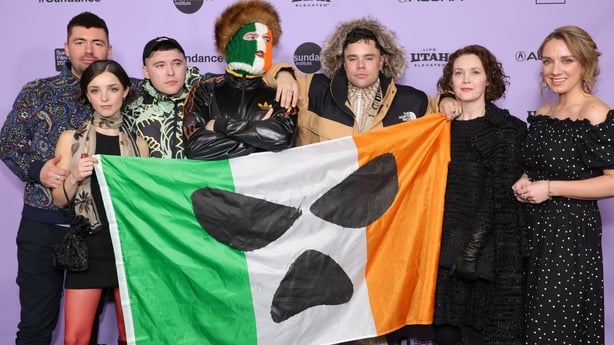
The Kneecap trio with friends at the Sundance Festival in January. (Photo sourced: RTÉ)

It is always about silencing the opposition and preventing a reaction to their repression and in this case genocide.

So back to Kneecap. They stand in a long line of artists who have put their money where their mouths are. They stand side by side with giants from other musical genres such as Woody Guthrie and Pete Seeger who were repressed by the McCarthyite wave in the US in the 1950s.

The BBC for its part continues to be the propaganda arm of the British Empire, or what is left of it, covering up, lying about or justifying murder, massacre, torture and plunder from India to Kenya, Ireland and now Palestine.

Woody Guthrie had the words This Machine Kills Fascists carved into his guitar, a slogan that might earn him a jail sentence nowadays.

It was meant more in the sense that his music was part of the struggle against fascism, carrying political messages to workers, Dustbowl refugees and migrants.

It didn’t literally kill anyone, though in his song Ludlow Massacre,[19] Guthrie celebrated the workers taking up arms to kill the scab thugs that came to shoot them.

Scabs at the behest of the Colorado Fuel and Iron Company, owned by the infamous Rockefeller family murdered 26 people, mainly the wives and children of the striking miners.

However, the massacre was just one large incident, the Baldwin-Felts Detective Agency had harried and harassed the striking miners, murdering them in ones and twos.

The detective agencies celebrated in comics and films were what would later become known in Latin America and elsewhere as death squads. The miners fought back and Guthrie celebrated this in his song. Resistance, including armed resistance was legitimate.

The state soldiers jumped us in a wire fence corners,
They did not know we had these guns,
And the Red-neck Miners mowed down these troopers,
You should have seen those poor boys run.

The press, at the time, described the striking miners as savages.

Any similarity to the current media onslaught on Palestine is not a coincidence, it shows the class interests of the media moguls and the western states. Working class people, foreign resistance movements will always be savages to the media.

And the use of armed masked thugs by the state is not new either. Before ICE, there were the detective agencies. Most of the dead at Ludlow were migrant workers. The final death toll according to Howard Zinn’s People’s History of the US was sixty six men women and children.

Kneecap have contributed to the fight against fascism and Bob Vylan’s chant Death to the IDF! should be on everyone’s lips. There is no reforming the IDF, just like there was no reforming Hitler’s SS. Only the complete destruction of the IDF will bring any change.

Can their music, like Guthrie’s be said to kill fascists? I don’t know, time will tell, but from the reception they got at Glastonbury it is looking good.[20] What I do know is Keir Starmer and Trump finance fascists.

Starmer like a fascist wants to ban Palestine Action. The BBC covers up for fascists, praises them and censors those who stand up to fascists. I know who is on the right side of history.

End.

NB: For more articles by Gearóid see https://gearoidloingsigh.substack.com

NOTES

[1] The Guardian (28/06/2025) Kneecap’s Glastonbury set Will not be broadcast live, BBC confirms. https://www.theguardian.com/music/2025/jun/28/kneecap-glastonbury-set-will-not-be-broadcast-live-bbc-confirms

[2] See Wings: Wild Life – Give Ireland Back To The Irish

[3] See

[4] See https://www.youtube.com/watch?v=q31WY0Aobro&list=RDq31WY0Aobro&start_radio=1

[5] See https://www.youtube.com/watch?v=lV5dbcOmw6I&list=RDlV5dbcOmw6I&start_radio=1

[6] Jacobin (12/11/2021) What We Really Know About the CIA and Crack. Daniel Finn. https://jacobin.com/2021/11/what-we-really-know-about-the-cia-and-crack

[7] See https://www.youtube.com/watch?v=1VuDjJ9KIxM&list=RD1VuDjJ9KIxM&start_radio=1

[8] See https://www.youtube.com/watch?v=vKbuDkueGek&list=RDvKbuDkueGek&start_radio=1

[9] See https://www.youtube.com/watch?v=IGVZOLV9SPo&list=RDIGVZOLV9SPo&start_radio=1

[10] The Journal (27/06/2025) Varadkar on Kneecap row: Terrorism is bombs and guns, not music. https://www.thejournal.ie/varadkar-on-kneecap-row-terrorism-is-bombs-and-guns-not-music-6745000-Jun2025/

[11] See https://www.youtube.com/watch?v=jtsxQaXdflU&list=RDjtsxQaXdflU&start_radio=1

[12] Newstalk (11/09/2024) ‘Systemic ban’ on The Wolfe Tones should be lifted – Warfield. Jack Quann. https://www.newstalk.com/news/systemic-ban-on-the-wolfe-tones-should-be-lifted-warfield-1764007

[13] See https://www.youtube.com/watch?v=rgWeD7tHhaE

[14] Sky News (08/12/2022) Ireland women footballers fined €20,000 for singing song referencing IRA in World Cup celebration. https://news.sky.com/story/ireland-women-footballers-fined-20-000-for-singing-song-referencing-ira-in-world-cup-celebration-12764012

[15] See https://www.youtube.com/watch?v=rV9c0OnekvM&list=RDrV9c0OnekvM&start_radio=

[16] See https://www.youtube.com/watch?v=Q98EcxrOr6w&list=RDQ98EcxrOr6w&start_radio=1

[17] See https://www.youtube.com/watch?v=6E7wJsDx2qg&list=RD6E7wJsDx2qg&start_radio=1

[18] See https://www.youtube.com/watch?v=m19Pc-b7EBc

[19] See https://www.youtube.com/watch?v=XDd64suDz1A&list=RDXDd64suDz1A&start_radio=1

[20] See https://www.instagram.com/reel/DLdeW1sI2A-/?igsh=YnJqeDd0bm1obzdi

TO BE LIKE BONO OR KNEECAP?

Gearóid Ó Loingsigh

NB: Edited by Rebel Breeze for formatting purposes

(Reading time: 6 mins.)

Kneecap, the Belfast Irish language rap group, have found themselves at the centre of what is an artificially contrived furore dreamt up by people with little sense of real moral outrage.

The basics of the story are well known. They finished off their act at the Coachella event projecting pro-Palestinian statements. Given the band’s history and well-known politics, it could hardly have come as a surprise. Perhaps it was more that the fans welcomed it that upset some.

They were denounced by the non-entity known as Sharon Osbourne, a reality star famous for being the wife of Black Sabbath lead singer Ozzy Osbourne and also the mother of another reality star, her daughter Kelly Osbourne.

Kelly to her credit did carve out a brief musical career on the back of her reality tv exposure.

Sharon as part of the wider Zionist attempt to silence all those who criticise the genocide called for their visas to be cancelled, which in effect happened following the decision by their promoter and sponsor to drop them.

She also called for them to be more like Bono. Kneecap responded with a humorously devastating comeback that they would rather be Rangers fans than emulate Bono.

Bono still has some credibility in certain parts, mainly where they haven’t a clue about the man’s actual politics and obviously amongst the clueless, witless, gutless glitterati like Sharon Osbourne. But what would it mean to be like Bono?

Is he actually some sort of reasonable counterweight to Kneecap?

Well, first of all, in relation to Palestine, Bono is a Zionist, so even before the genocide began, he, unlike them, was already on the wrong side of history. Not for the first time, mind you. Bono has a habit of cropping up where he is not wanted like an ugly cold sore (my apologies to the virus).

He has, as Harry Browne, the author of The Frontman: Bono in the name of powerpointed out dedicated a lifetime to the service of imperialism and was rewarded with a Presidential Medal of Freedom from Genocide Joe.[1] 

I am sure it will go well on his mantle piece alongside his KBE (Knight Commander of the Most Excellent Order of the British Empire), for which he was fulsome in his praise of Her Majesty’s Ambassador, as he put it, and grinned like a cheshire cat during the ceremony.[2] 

The claims made by Blair and others about Bono’s achievements were exaggerated, of course. But he is, if nothing, an equal opportunities imperialist and will get around to doing his bit for the others.

The idea that Kneecap would prostrate themselves before the British king is laughable and they wouldn’t be the first artists to reject one, were the Brits ever to mistakenly consider them for it.

The late black poet Benjamin Zephaniah was offered the lesser award of OBE (Order of the British Empire) by the same Tony Blair. He turned it down stating:

I get angry when I hear that word “empire”; it reminds me of slavery, it reminds of thousands of years of brutality, it reminds me of how my foremothers were raped and my forefathers brutalised…

Benjamin Zephaniah OBE – no way Mr Blair, no way Mrs Queen. I am profoundly anti-empire…

If they want to give me one of these empire things, why can’t they give me one for my work in animal rights? Why can’t they give me one for my struggle against racism? What about giving me one for all the letters I write to innocent people in prisons who have been framed? I may just consider accepting some kind of award for my services on behalf of the millions of people who have stood up against the war in Iraq. It’s such hard work – much harder than writing poems.[3]

He also referred to his brother’s death in police custody and to Lizzie II as Mrs Queen, not Her Majesty. A display of dignity.

He pointed out that those who accept such awards, the Queen’s Shilling, though he didn’t use that archaic military expression for those who enlist in the British armed forces to put down uppity types in the colonies, always sell out.

However, calling Bono a sell-out, presumes he was ever anything other than a fan of empire. He tied his mast to the pro-British politics of the Irish chattering classes in the 1980s.

His song Sunday Bloody Sunday was always introduced with the line This is not a rebel song, lest someone think Bono actually had something interesting to say.

The song is quite vacuous though clear in saying he “won’t join the battle cry,” i.e. denounce those who had massacred 14 people on the streets of Derry. The British army is not mentioned once in the song.

You wouldn’t know who had done what, but you know not to point the finger “Cause tonight we can be as one”. John Lennon on the other hand, shortly after the massacre did not hold back.

Is there any one among you
Dare to blame it on the kids?
Not a soldier boy was bleeding
When they nailed the coffin lids!
[4]

Bono couldn’t bring himself to condemn the British army for a televised massacre, so it comes as no surprise that he has little to say about a live-streamed genocide.

He hobknobbed with neoliberals such as Jeffrey Sachs, various presidents of the World Bank, promoted pharmaceutical companies in Africa and of course was on the side of Bush in the Iraq War, at least in practice and helped whitewash the reputations of many of those involved.

He hedged his bets a bit on Iraq, not wanting to seem too hawkish, saying the war was justified but the US should get UN backing for it. He then went on to endorse Clinton and Blair time and again. Jim Kerr from the Scottish band Simple Minds put it succinctly at the time.

How can Bono, having graced concert stages for over two decades, draped in the white flag of peace and screaming ‘No More War’ [sic] at the top of his lungs contemplate praising and back slapping Tony Blair? … I can’t believe that anyone could fail to identify that no matter what gesture Blair may make towards African debt relief, his slippery hands are currently dripping in the fresh warm blood of Iraqi men, women and children.[5]

Bono of course, could and did, and wined and dined with such hawks as Senator McCain. There were no depths to which he would not plummet, which brings us to Palestine.

Shortly after October 7th he endorsed the Zionist genocide by changing the lyrics of his song about Martin Luther King, Pride (In the name of love)[6]to “Early morning, Oct 7, the sun is rising in the desert sky… Stars of David, they took your life but they could not take your pride.[7] 

As part of the introduction to the reworked song he state “our prayers have always been for peace and for non-violence… But our hearts and our anger, you know where that’s pointed.” Not at the Zionist occupiers was the answer. Roger Waters lambasted him for it.[8]

Not only that, he was criticised by Irish singer Mary Coughlan for his links to Israeli companies.[9] He did not fly out to Gaza as he had done in Ukraine, nor did he have much to say.

When he eventually did mention Gaza, he was always careful to lay the blame on Hamas for starting it all, ignoring history since the Nakba in 1948.

A good example of that is his piece in The Atlantic after receiving his Medal of Freedom from Genocide Joe.[10] An exercise in saying nothing, whilst attempting to sound profound, something Ireland’s most famous poisonous dwarf never pulls off.

Kneecap on the other hand have been clear from the word go about their support for the Palestinian cause. It didn’t take a genocide for them to take note. They have consistently been on the side of the oppressed, in this case the Palestinians, against the oppressor the Zionists.

So, Sharon Osbourne should probably stick to what she knows best, which is precious little.

As for Bono, as Harry Browne points out, perhaps nothing sums him up quite so succinctly as a piece of graffiti in Dublin that appeared following the scandal when they moved one of their companies to the Netherlands for tax purposes, “Bono is a poxbottle”.

We need more like Kneecap who stand with the oppressed, and a lot less of Bono and the likes who can’t condemn the powerful ever.

At best you can expect some “We are all guilty type” of fudge, which was the preferred slogan of the Irish trade union bureaucracy when the British or their proxies in the UVF or UDA ever did anything, coming as no surprise that they have also done next to nothing on Palestine other than issue the occasional banal statements.

I fully expect them to turn up with Bono somewhere to chastise Kneecap.

End.

NB: For more articles by Gearóid see https://gearoidloingsigh.substack.com

NOTES

[1] Rebel News (07/01/2025) This Song is not a Rebel Song. Harry Browne. https://rebelnews.ie/2025/01/07/bono-this-song-is-not-a-rebel-song/

[2] U2 (29/03/2007) A Knighthood for Bonohttps://www.u2.com/news/title/a_knighthood_for_bono_2110/

[3] The Guardian (27/11/2023) ‘Me? I thought, OBE me? Up yours, I thought’. Benjamin Zephaniah. https://www.theguardian.com/books/2003/nov/27/poetry.monarchy

[4] See https://link.sbstck.com/redirect/de82dedc-5090-458f-9212-e894fa53ed21

[5] Browne, H. (2013) Bono The Frontman: In the name of power. London. Verso. Para 8.116

[6] See https://link.sbstck.com/redirect/9b7d1452-8d25-4992-8f18-9e29589b6ce4

[8] The Independent (21/02/2024) Roger Waters brands Bono ‘disgusting’ over Israel speech. Kevin E G Perry. https://www.independent.co.uk/arts-entertainment/music/news/roger-waters-bono-israel-gaza-b2498979.html

[9] The Sunday World (13/05/2024) Mary Coughlan ‘lost all respect’ for Bono over alleged links to Israeli companies. Eugene Masterson. https://www.sundayworld.com/showbiz/irish-showbiz/mary-coughlan-lost-all-respect-for-bono-over-alleged-links-to-israeli-companies/a2101784646.html

[10] The Atlantic (04/01/2025) The Gorgeous Unglamorous Work of Freedom. Bono. https://www.theatlantic.com/ideas/archive/2025/01/the-gorgeous-unglamorous-work-of-freedom/681212/

[7] See https://www.youtube.com/watch?v=P6sD5Lnh4YY

[8] The Independent (21/02/2024) Roger Waters brands Bono ‘disgusting’ over Israel speech. Kevin E G Perry. https://www.independent.co.uk/arts-entertainment/music/news/roger-waters-bono-israel-gaza-b2498979.html

[9] The Sunday World (13/05/2024) Mary Coughlan ‘lost all respect’ for Bono over alleged links to Israeli companies. Eugene Masterson. https://www.sundayworld.com/showbiz/irish-showbiz/mary-coughlan-lost-all-respect-for-bono-over-alleged-links-to-israeli-companies/a2101784646.html

[10] The Atlantic (04/01/2025) The Gorgeous Unglamorous Work of Freedom. Bono. https://www.theatlantic.com/ideas/archive/2025/01/the-gorgeous-unglamorous-work-of-freedom/681212/

1916 Rising Commemoration in Glasnevin: James Connolly, the Citizen Army and Palestinian Resistance

Clive Sulish

(Reading time: 4 mins.)

An Irish Republican Easter Rising commemoration conducted on Sunday 20th April followed tradition in some aspects but departed in others. The event in Glasnevin Cemetery was organised by the Anti-Imperialist Action group.

As the 1916 Rising commenced on Easter Monday it is traditionally commemorated on various days around the Easter weekend. The actual date however was 24th April which a now-deceased socialist Republican activist publicly celebrated every year as Republic Day in front of the GPO.1

Taken from near rear of the marching columns approaching Cross Guns Bridge. (Photo: R.Breeze)

Among the commemorations organised by Irish Republicans around the past weekend was that by the AIA group on Sunday, rallying by the Phibsboro shopping parade for 1pm, before marching out to Glasnevin cemetry along the Phibsboro Road in two parallel separate lines.

This gathering in the past has been marred by the Special Branch, the political plainclothes police, harassing and attempting to intimidate those present, demanding their names and addresses under anti-terrorist (sic) special legislation. This time they were there but did not approach.2

Just after passing Crossguns Bridge over the Royal Canal, a flare was lit and the march stopped in the street.3

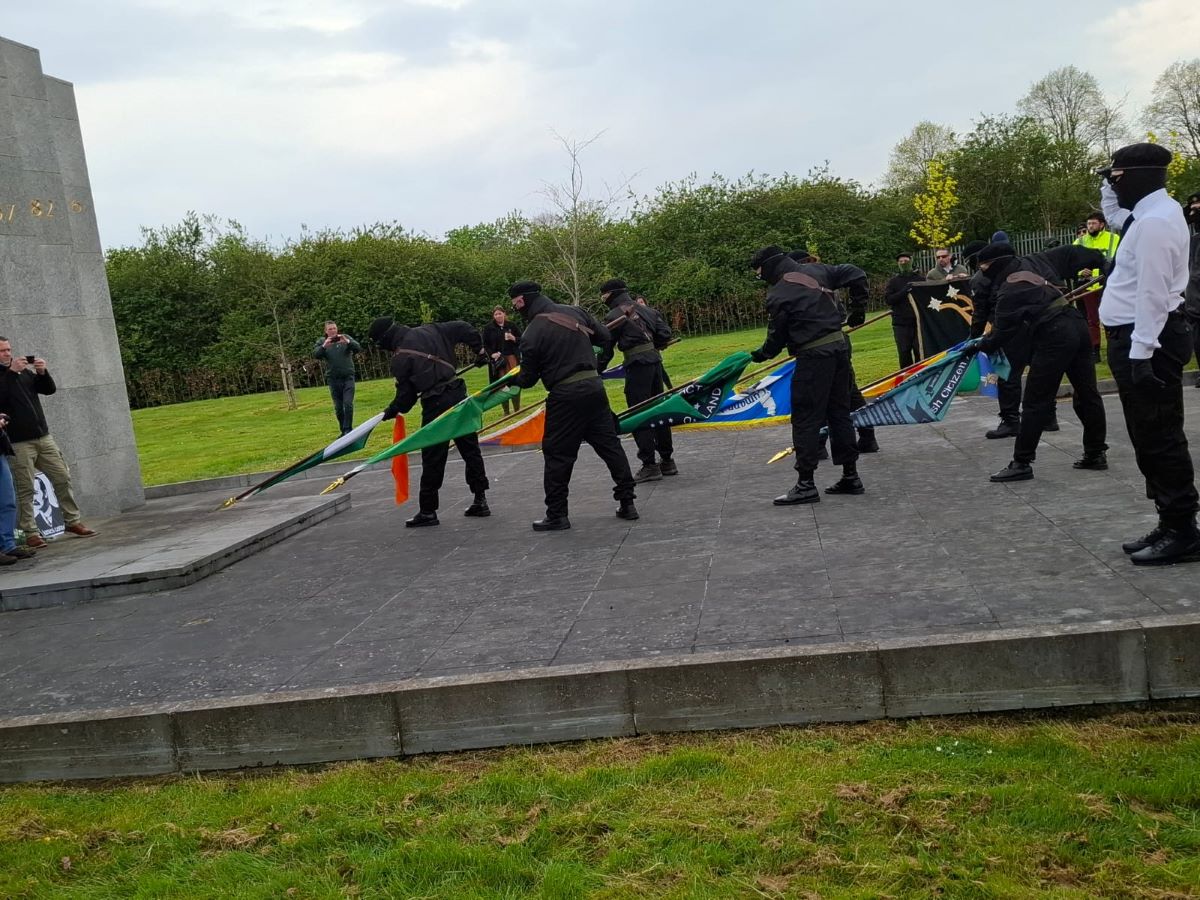
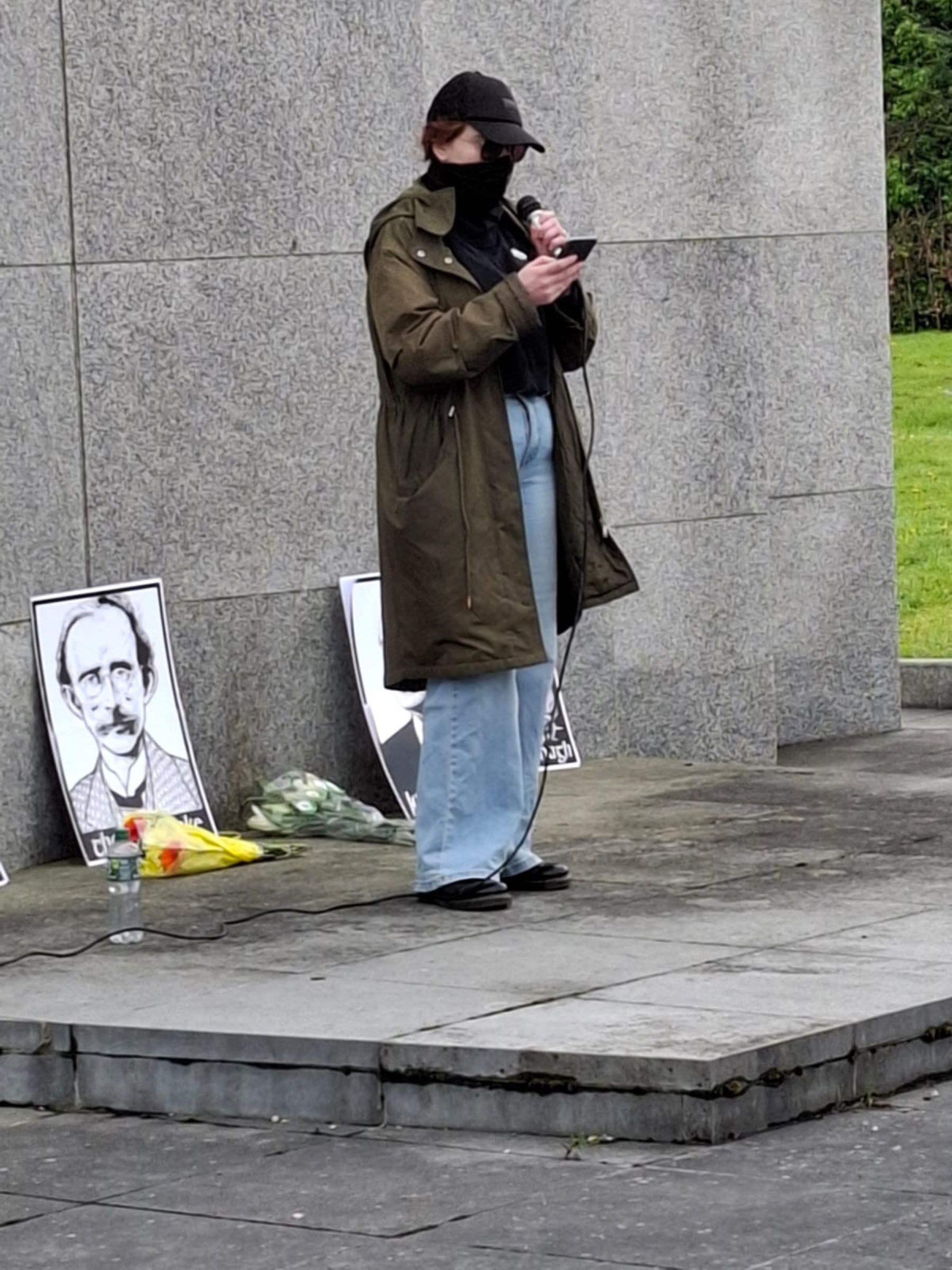
After a short pause the march resumed, led by the colour party,4 six men and women, each carrying a different flag with the Tricolour and Starry Plough in the lead, all dressed in black trousers, white shirts, black berets, sunglasses and lower face masked.

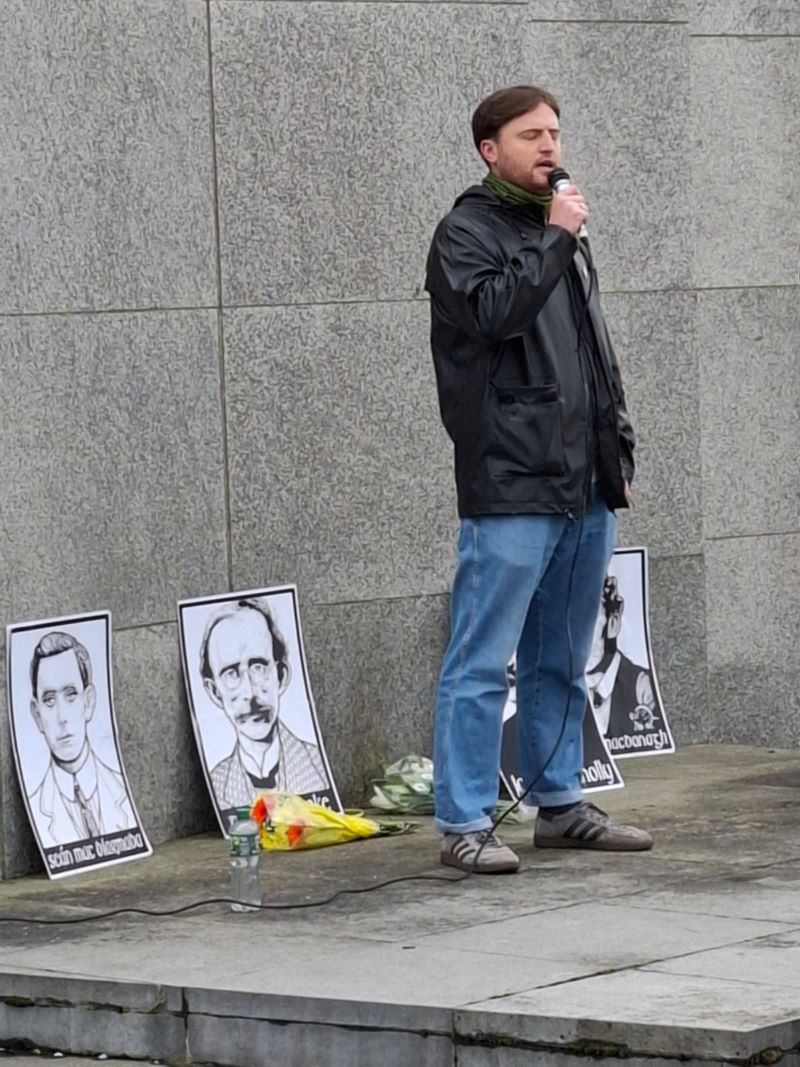
The images of each of the Seven Signatories of the 1916 Proclamation, all shot by British firing squads were on large placards were carried among the marchers: Tom Clarke, James Connolly, Patrick Pearse, Seán Mac Diarmada, Joseph Plunkett, Thomas McDonagh, Eamonn Ceannt.

(Photo: R.Breeze)

A variety of flags were also flown among the marchers, including the green and gold Starry Plough,5 Palestinian flag, Basque Ikurrina and red flags (with gold hammer and sickle emblem on at least one).6 The AIA banner carried at the front bore a quotation from Bobby Sands in Irish.

The march soon passed the main gates of Glasnevin Cemetery to their right but continued before turning leftward to then cross over the pedestrian railway bridge to the newer part of Glasnevin Cemetery and up to the monument to the Six armed struggles referred to in the Proclamation.7

Formed in two lines the attendance was welcomed in Irish and English by the event’s MC, calling also for the reading of the Proclamation of Independence, which a man stepped forward to do. The MC recommended a careful reading of the still-relevant document to attendees from abroad.

Section on the left of the attendance at the commemoration rally with another section to the right out of shot. (Photo: R.Breeze)

Following the reading, the MC commented on the important role of culture in the 1916 Rising8and called on an activist who he said has done much to promote traditional and folk Irish song, who proceed to sing Patrick Galvin’s Where Oh Where Is Our James Connolly? “with some changes”.

Next the call was given for those who wished to lay floral tributes while the colour party lowered their flags in homage to the fallen to commands in Irish, then slowly raised them again before responding to the command in Irish to stand ‘at ease’.

(Photo: R.Breeze)

Another activist was called to read the 1915 statement on the Irish Citizen Army by James Connolly in which the revolutionary leader outlined the police violence during the 1913 Lockout that created the need for the ICA and how it had gone beyond defence in assertiveness.

The statement declared its class allegiance and origins “Hitherto the workers of Ireland have fought as parts of the armies led by their masters, never as members of an army officered, trained, and inspired by men of their own class.”

Reading Connolly’s “To the Irish Citizen Army” (Photo: R.Breeze)

The PA amplification failed on the reader but she carried on in a strong voice reading Connolly’s words that the ICA sought alliance with all progressive forces but remained independent, not to be bound by the limits others set themselves and going further on their own if necessary.9

Another singer was called to perform Erin Go Bragh10 specifically about the 1916 Rising (by Dominic Behan, originally called A Row in the Town).

Singing Erin Go Bragh at the Monument (Photo: R.Breeze)

It is traditional for organisations to deliver a keynote message or statement of aims at 1916 commemorations and a statement was read on behalf of the Irish Socialist Republican Movement (of which the AIA is a part) restating the objectives of national independence and socialism.

In that context the struggles against the Irish ruling class putting the State into imperialist alliance and against the British occupation of the nation, also a NATO member, were greatly important and the Gardaí had broken a comrade’s foot in that struggle.

(Photo: R.Breeze)

Referring to the international context of the 1916 Rising and the international connections of the revolutionary movement in 1916, the MC read out a fraternal message to AIA from the People’s Front for the Liberation of Palestine,11 declaring that the struggles of both peoples are one.

The event concluded at around 2.45pm with a singer performing Amhrán na bhFiann12 (first verse and chorus) followed by an announcement or reminder of a public meeting organised by the AIA titled Rebuilding the Republic to take place at 4pm at a venue not very far distant.

End.
Footnotes

1Easter is a religious festival and its date varies from year to year according to computations based on the lunar and solar calendars and cannot fall on the same date annually in the Gregorian calendar (or the Julian one). After the insurrectionary forces had taken possession of the building, Patrick Pearse with James Connolly by his side read the Proclamation outside the General Post Office (GPO) building on the first day of the Rising (after its rescheduling from the previous day, Sunday): 24 April 1916. Tom Stokes tried for years to have the date adopted as Republic Day and annually organised an event outside the GPO on that date. After his death others carried on commemorating the date but rather than outside the GPO, at Arbour Hill. The Republican movement continues to hold its 1916 commemoration events over the Easter weekend.

2Possibly because the dust has not yet settled on the Gardaí’s recent violent arrests on 23 peaceful activists in three different events over four days (See Rebel Breeze’s Irish State Ramps Up Repression) recently.

3This spot has a 1916 history: A group of Irish Volunteers walked from Maynooth on Easter Monday along the banks of the Royal Canal, meeting two Irish Volunteers guarding the bridge and that night slept in Glasnevin Cemetery. The following morning they continued their journey to the city centre. Later, as the Rising was being suppressed, the British soldiers placed a barrier on the Bridge and prevented most people from passing through. A local man who had been deaf from birth failed to heed the soldiers’ challenge and they shot him dead.

4The ‘colour party’ carries the ‘colours’, i.e the flags and usually marches at the front. The number and type of flags varies but Irish Republican colour parties always carry the Tricolour among them, usually followed by the Starry Plough of which for many years the white stars on a blue background version was the most common. Often a flag of each of the four provinces would also carried and the Gal Gréine (or Sunburst) of the Fianna and of the Fenians would be carried too. The Harp on a Green background was another flag that was often carried by Colour Parties.

5The original design of the flag of the first workers’ army in the world, the Irish Citizen Army, created in 1914. It is a plough following the form of the Ursa Mayor constellation with a sword replacing the ploughshare.

6This is usually considered a symbol inherited from the Bolsheviks, the sickle representing the agricultural workers and the hammer, the industrial workers, their conjunction symbolising unity of peasants and industrial proletariat.

71798 and 1803 (United Irishmen), 1848 (Young Irelanders), 1867 (Fenians), 1882 (Invincibles group within the Fenians), 1916 (IRB, Irish Volunteers, Irish Citizen Army, Cumann na mBan, Fianna Éireann)

8Irish language revival, national theatre groups, national sports, poetry, music and song all contributed to an atmosphere conducive to resistance and uprising.

9However it may be for others, for us of the Citizen Army there is but one ideal – an Ireland ruled, and owned, by Irish men and women, sovereign and independent from the centre to the sea, and flying its own flag outward over all the oceans. We cannot be swerved from our course by honeyed words, lulled into carelessness by freedom to parade and strut in uniforms, nor betrayed by high-sounding phrases.

The Irish Citizen Army will only co-operate in a forward movement. The moment that forward movement ceases it reserves to itself the right to step out of the alignment, and advance by itself if needs be, in an effort to plant the banner of freedom one reach further towards its goal. https://www.marxists.org/archive/connolly/1915/10/forca.htm

10The slogan Éirinn (or Éire) go brách (“Ireland for ever”) was rendered in English spelling as Erin go bragh.

11 A socialist and secular resistance Palestinian resistance organisation; its armed wing is Brigades of the Martyr Abu Ali Mustafa which has been part of the armed resistance throughout the period, often in coordination with other groups.

12In a reversal of the usual sequence, the lyrics of this song by Peadar Kearney and Patrick Heeney were first composed in English but later translated to Irish, that being the most popular version of the chorus today.

Further information

https://www.marxists.org/archive/connolly/1915/10/forca.htm

isrmedia@protonmail.com

PALESTINIAN POLITICAL PRISONERS’ DAY IN DUBLIN

Diarmuid Breatnach

(Reading time: 4 mins.)

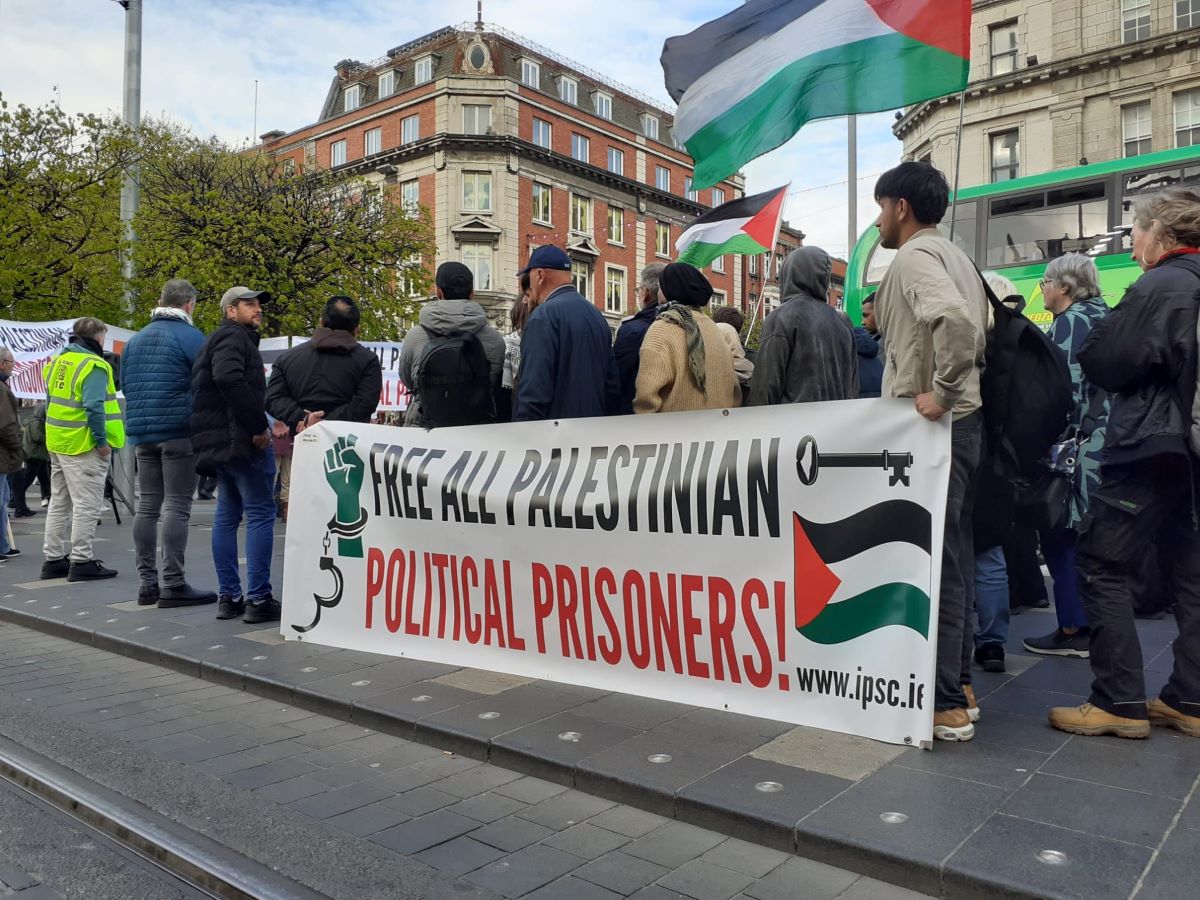
April 17th is the annual Palestinian political Prisoners’ Day and it was marked in O’Connell Street, the main street of Dublin’s city centre, by an event with speeches, banners and chants organised by the Ireland Palestine Solidarity Campaign.

Palestine national flags fluttered about the crowd being addressed by a number of speakers with occasional toots of solidarity from passing traffic – a common occurrence at Palestine solidarity events in most of Ireland.

View of eastward of section of the crowd at the event (Photo sourced: IPSC)

Dáithí Doolan was one of the speakers and though saying some progressive things about solidarity with Palestine and the terrible situation in which the occupiers have them, soon revealed the political poverty and lack of solidarity with resistance of his Sinn Féin party.

Doolan reminded his audience of when there were political prisoners in Ireland, as though this was no longer the case, presumably because the prisoners now are not of his party. Nor did he mention the current attempts to extradite Irish Republicans to British administrations.

The SF speaker went on to extol the South African process, perhaps not caring about the betrayal of the struggle and sacrifice of the masses there, the deepening grip of imperialism on the rich natural resources, the corruption and repression of the ANC regime and the massacre at Marikana.1

If Doolan thought about it he must have hoped that his audience did not remember that the South African process had a twin, the Palestinian one at Oslo which sabotaged the Palestinian struggle and brought into being the corrupt Palestinian Authority2, the Israeli proxy in the West Bank.

Sinn Féin has achieved a somewhat similar position in the Six Counties colony and has been working hard to reach a corresponding role in the Irish state. And why not, when it endorses the “Two State solution” giving the Palestinians 20% of their land under Zionist eyes and guns.

The very least, Doolan said, that the Irish Government could do to help the Palestinians, would be to enact the Occupied Territories Bill but he proposed nothing further, not even the ban on US military flights through Shannon Airport or on Israeli arms flights through Irish airspace.

Darragh Adelaide from the People Before Profit party spoke too about Palestine and solidarity but also about the Palestine refugees that have had to sleep in tents on Irish streets and the attacks on them both by the authorities and by fascists and other racists.

Palestinian prisoner conditions

A woman gave a detailed list of statistics relating to Palestinian political prisoners but also went through the tortures and terrible conditions in which they are kept. She concluded reminding her audience that each prisoner is a human being, a parent, a child, a sibling and not a number.

View of the crowd southward from behind a speaker (Photo sourced: IPSC)

In a year and a half, more than 15,800 Palestinians have been arrested, including 500 women, 1200 children, and thousands of detainees who were placed under arbitrary administrative detention.  64 Palestinians have died in prison since October 2024, including a child.3

The prison administration’s special units have carried out violent raids on prisoners’ cells, administering severe beatings, torture, and ill-treatment.4

Prisoners have suffered power and water cuts, and all of their belongings—including clothes, electrical appliances, and hygiene items—have been confiscated.5

They have been placed under complete isolation, family visits have been completely banned, and the International Committee of the Red Cross has been prevented from visiting them inside prisons. 

Additionally, a policy of starvation has been implemented against thousands of prisoners, who are being provided with only two extremely poor-quality and quantity meals a day.6

The MC of the event led chants in which he called out Palestinian political prisoners! and the audience responded with Free them all! Similarly with Free the children prisoners — Free them all! and Free the women prisoners! — Free them all!

Symbolising the Palestinian political prisoners (Photo sourced: IPSC)

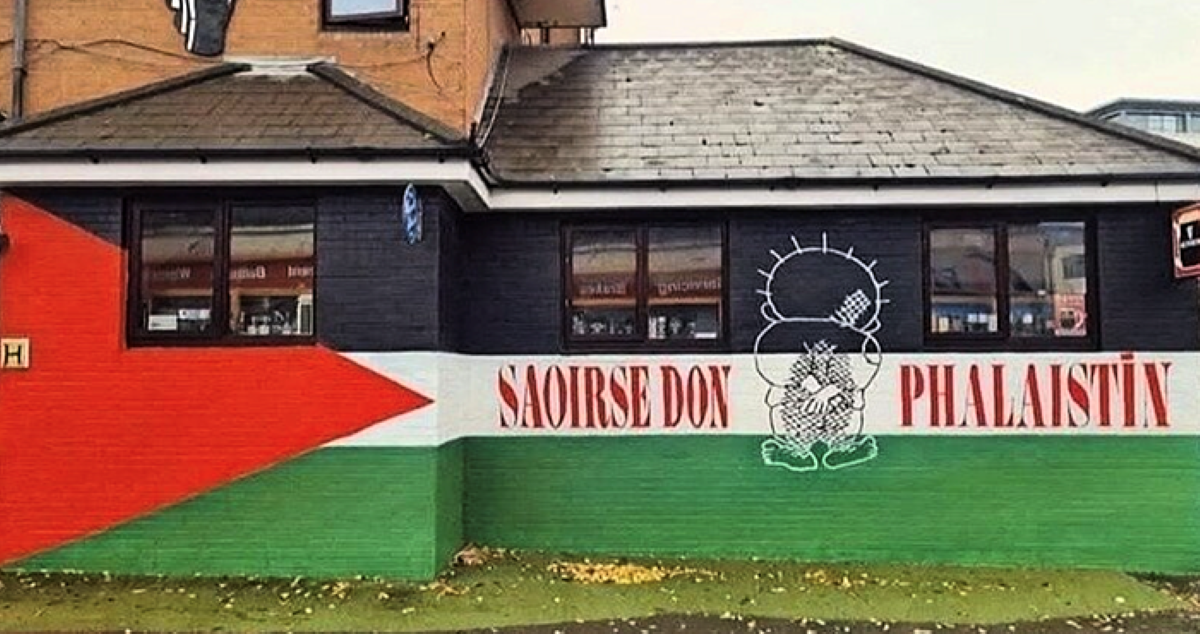
He also referred to the woman arrested outside the Irish Embassy in Berlin for speaking in Irish and, in defiance, led the audience in a chant in Irish expressing solidarity with the Palestinian people: Saoirse don Phalaistín! (Freedom for Palestine!)7

What was notable in its total absence from all the speeches was any call to step beyond the marches and similar measures which have been supported by thousands in Ireland over more than 18 months but which have not succeeded in moving the Government even to enforcing its formal neutrality.

This is replicated in most solidarity events across the state, leaving those few who take action to increase greater pressure on the ruling class to face the repression of the Irish State, as with 23 men and women in three different events over a four-day period in Dublin recently.8

Political prisoners from the armed resistance

The Joe McDonnell Ballad9 would have been most appropriately performed at this event, in particular the chorus line: You dare to call me a terrorist, while you look down your guns … But the IPSC would hardly endorse the singing of that song nor wish to be associated with it in public.

There were two large prisoners’ solidarity banners of the IPSC at this event but it is remarkable how rarely one sees them on the IPSC’s national marches. The problem with the prisoners for liberal organisations is that some of them, at least, have been armed fighters of the Resistance.

This, combined with ignorance perhaps, accounts for the comparatively low numbers at this event. However, it has to be said that known revolutionary organisations were also visibly absent.

View south-westwards with the iconic GPO (General Post Office) building in the background. (Photo sourced: IPSC)

Doolan’s party was a problem for liberals when many of the political prisoners here had been armed Irish Republican resistance fighters; it’s still a problem for them today — but also for Doolan and his party now that the current Irish political prisoners are no longer associated with them.

If solidarity does not embrace resistance then it’s charity, not solidarity. And if resistance is to be embraced then it should be so for all its expressions, artistic, cultural, mass mobilisations, strikes, boycotts … and armed. Including solidarity with those who, because of resistance, end up in jails.

Free them all!

End.

NOTES

1Culminating on 16th August 2012 (while Mandela still lived) the police of the ANC Government carried out a massacre of over 40 striking miners over a period of three days. The massacre was to suppress a strike in a platinum mine of the Canadian Lonmin company, repressing also a breakaway union from theANC-allied National Union of Mineworkers. The massacre is widely believed to have been organised by Cyril Ramaphosa, then a millionaire and vice-President of the ANC Government and recent leader of the NUM, now President of South Africa.

2Which also beats and incarcerates Palestinians resisting the Occupation (exact figures are difficult to obtain) and has murdered some.

3https://www.addameer.org/news/5549

4Ibid.

5Ibid.

6Ibid.

7This slogan has now become well known in Ireland in voice but also in writing, appearing on flags, banners and placards. It represents a partial success for those of us who have tried to insert a measure of the Irish language into Palestine solidarity, in the belief that it is important for the Irish language to be present in progressive movements.

8See https://rebelbreeze.com/2025/04/06/irish-state-ramps-up-repression/

9By Brian Warfield of the Wolfe Tones band in honour of Volunteer Joe McDonnell of the Provisional IRA who died on hunger strike in 1981; the song also names other hunger strike martyrs of the Provisionals Vols. Bobby Sands, Francis Hughes, McCreesh but adds Vol. Patsy O’Hara of the Irish National Liberation Army. In total, seven of the Provisionals and three of INLA died on hunger strike in 1981.

USEFUL LINKS

IPSC:https://www.ipsc.ie

Adameer – Prisoner Support and Human Rights Organisation: https://www.addameer.org/

Adameer Statement on Prisoners’ Day: https://www.addameer.org/news/5549

PACKED PICKET PROTESTS IRISH GOVERNMENT MILITARY ALLIANCE AGENDA

Diarmuid Breatnach

(Reading time: 7 mins.)

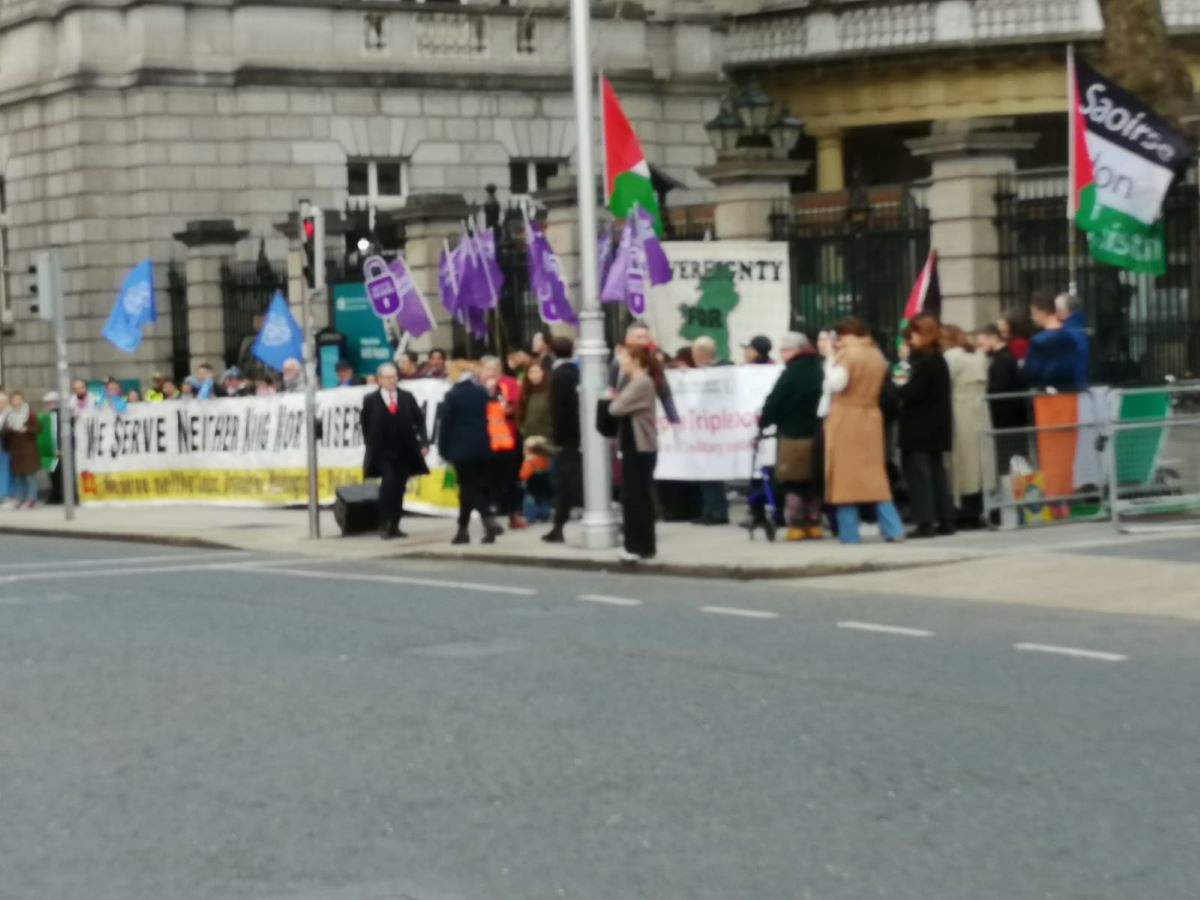
A packed picket yesterday evening protested plans of the Irish Government to sidestep the “Triple Lock” in the Irish State’s Constitutionin order to proceed to committing the State’s armed forces to a western imperialist military alliance.

Contrary to the belief of many, the Irish State is not constitutionally bound to neutrality but there is a constitutional defence against a Government making an executive decision to send its armed forces into a foreign conflict and it is this that is known as the “Triple Lock”.1

As things stand at present, in order to send more than 12 Irish armed forces on a military mission abroad (e.g. as peacekeepers), the conflict response would need to be approved

  • not only by the Irish Government but
  • also by the Oireachtas (the Irish Parliament)
  • and by the United Nations.

However legislation of the Cabinet is being drafted to change the number from 12 to 50 which many see as the thin edge of a wedge to gradually widen the gap through which the Armed Forces can be employed in conflicts abroad alongside imperialist forces of NATO or the EU.

I joined the protest yesterday evening for a little over an hour. Most of the participants were packed behind banners on the southern side of the main gates of Leinster House so that photos don’t perhaps give a true impression of the numbers.

The main and very long banner bore the slogan We serve neither King nor Kaiser, recalling the words on a banner displayed on the Irish Transport and General Workers’ HQ, Liberty Hall, in 19142. More problematic were the United Nation flags waved by a few, some also wearing blue berets.3

In addition there were a number of Palestinian flags and, indeed, the politicisation and drive to activity of the Palestine solidarity movement does seem to be having a spill over into other issues in Ireland. Surprising perhaps was the number of flags of the Social Democrats party.

Another banner called for “Peace keepers, not military groups”. “Peace-keeping” in UN deployment can often mean stabilising the imperialist status quo in regions and the inaction of the UN leadership in response to the genocide in Palestine by some of its members has been shocking.

On the northern side of the gates there were two protesters in hospital scrubs, displaying a Palestine national flag and a large placard bearing the image of Dr. Abu Safiya, Director of Kamala Adwan Hospital in Gaza who was taken from there on 27 and January and disappeared for a time.

Dr. Abu Safiya was later traced to the notorious Sde Teiman Detention Centre in Israeli custody, then Ofer Prison where his lawyer finally gained access to him and reported recently that the Doctor has a number of broken ribs and was being refused treatment for his heart condition.4

On 25th March Dr. Abu Safiya’s sentence of six months administrative detention, effectively internment without trial, was confirmed by an Israeli Court on the basis of alleged documentation that, as is the rule in such cases, neither Dr. Abu Safiy nor his lawyer were permitted to see.5

On 25th October Dr. Abu Safiya’s 15-year-old son Ibrahim was killed by an Israeli drone strike on the hospital’s entrance.

One can only imagine the furore to which such a case would give rise if the detaining authority were one of which the Western Powers did not approve: A Doctor? Head of a Hospital arrested? Broke his ribs? Sent him to jail without a trial or allowed to see the evidence? Murdered his son?!

Vigil in hospital scrubs presumably for Dr. Abu Safiya’s safety and release. Also numbers of Gardaí in response to the main demonstration. (Photo: D.Breatnach)

No doubt many who would have joined the health workers in solidarity protest were in the other group protesting an attempt to have the Irish state join imperialist war ventures.

JOINING NATO

The crowd were kept lively with songs, speeches and a series of caller-and-response chants of which I can only recall the following:

Caller: From Letterkenny to Killarney —
Crowd: We don’t want your EU army!
Caller: From Dublin, Cork or Donegal —
Crowd: No to NATO, No to War!

Caller: You can’t fool us with your lies —
Crowd: We won’t send our kids to die!

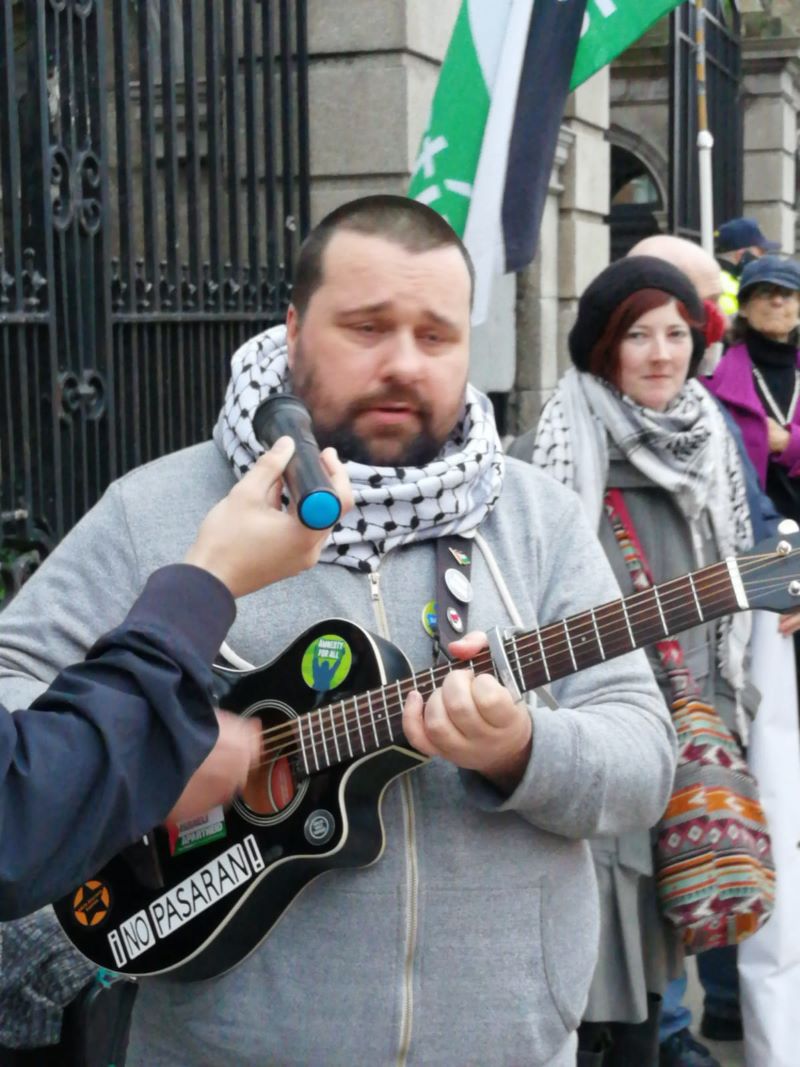
TD6 Paul Murphy of the People Before Profit – Solidarity party addressed the crowd at one point. Among the songs performed by Jimi Cullen were You Fascists Bound to Lose and his own We Are All Palestinians and I sang Pearse’s verses of Gráinne Mhaol, the crowd joining the chorus.

Jimi Cullen performing his We Are All Palestinians; in the background Fae Clarke who also sang. (Photo: D.Breatnach)

The Government, some other politicians and the media have for some time been building up a propaganda picture depicting Ireland as vulnerable to invasion by the Russian Federation and this has intensified with the USA’s Trump Administration’s comments about its contribution to NATO.

Even the blowing up of the Russian Nord Stream gas pipeline to Germany7 – clearly an action that most benefited the USA, which also had the most opportunity and means to achieve — was used by the media to whip up fears of Russian (!) attacks on subsea cables to and from Ireland.

The war in the Ukraine was also used not only to drum up support for the US/NATO proxy Kyiv regime but to whip up fear of the Russian Federation and to suggest that rather than defending itself against US/NATO encirclement, the aim was to gradually invade all of western Europe.

The presence of a Russian Trawler in the Irish sea was also used in this regard with the assumption that it was spying on Ireland. If indeed spying, why could it not have been on the UK? Anyway, we are being intensely spied upon daily by at least the UK and USA as it is.

The irony of seeking to join the Irish State with NATO, of which the UK is a prominent member, seems to have escaped the intelligence of the Irish elite: a state which has been at war with the Irish people for 800 years and is currently in armed occupation of one-sixth of its territory.

The only Starry Plough flag I observed, here held by myself. ((Photo taken by a participant)

Indeed it may occasionally occur to some that Ireland could easily be thought of as Ironyland as on-line Irish-based media The Ditch not long ago revealed that the Irish Government secretly agreed to have the UK’s Royal Air Force patrol Irish skies for the State’s protection.

The Government refused to confirm or deny this even to an FOI request by a Senator Craughwell, who sought and was granted leave on 18 March to challenge that refusal in the High Court, despite an Irish Government defence that boiled down to: We don’t have to tell if we don’t want to.

More will come to light on this as time goes on and perhaps also about another Ditch revelation, i.e about arms for the genocidal Zionist state being flown through Irish airspace. And of course there is the open secret scandal of US military flights being refuelled at Shannon International Airport.

Another view of a section of the protest showing how closely they were packed. (Photo: D.Breatnach)

EU INSTEAD OF NATO?

The softer option to NATO might seem to join some European joint military organisation but the EU is dominated by imperialist states such as Germany — which is second supplier in quantity of arms to ‘Israeli’ Zionism’s genocide in Palestine — and France has colonies in parts of the world.

In addition, France, Spain, Italy and the UK contain other conquered nations which have at various times agitated for greater or total independence and it is standard practice since Imperial Roman times to send troops from different areas to quell unrest in regions.

Irish troops in an EU joint force could be sent to put down uprisings in Catalonia, the Basque Country or Sardinia, while Spanish, French or Italian troops might be deployed on our streets in protests upon which Irish soldiers might be reluctant to fire.

Or all could be happily deployed together against the oppressed people of the Middle East, Africa or Asia, in all of which most EU states, if not all, have economic, political and strategic stakes.

This struggle against the incorporation of the Irish State into western imperialist armed forces has been going on for years, alternating between greater and lesser periods of intensity but it may that for reasons in the international arena it is once again entering an intense phase.

At last week’s Wednesday evening’s protest there were less than 20 participating throughout; last night there were a couple of hundred present, some at quite short notice. The organisers announced tthat they intend these protests to take place daily for the near future.

End.

View northward close along the protest. (Photo: D.Breatnach)

FOOTNOTES

FURTHER INFORMATION

1Article 29, section 4, subsection 9° of the Irish constitution:

The State shall not adopt a decision taken by the European Council to establish a common defence pursuant to Article 42 of the Treaty on European Union where that common defence would include the State.

While Article 29.4.9° does not explicitly mention a referendum, the constitutional framework as a whole ensures that the government cannot join a common defence system without the consent of the Irish people, as expressed through a referendum.

This was originally inserted by the 2002 amendment ratifying the Treaty of Nice, updated by the 2009 amendment ratifying the Treaty of Lisbon. An earlier bill intended to ratify the Treaty of Nice did not include a common defence opt-out, and was rejected in the first Nice referendum, in 2001. (Wikipedia)

2The Irish Citizen Army was photographed in 1914 drawn up in front of Liberty Hall beneath the banner reading: We serve neither King nor Kaiser but Ireland.

3The United Nations is a profoundly undemocratic and imperialist-dominated institution. Its only enforceable decisions are those made by five Permanent Members of the Security Council: the UK, France, United States, Russian Federation and China, each of which can nullify a decision by use of its veto. Its failure to act to prevent the genocide in Palestine, in which two of its members, the UK and USA are directly assisting, has been a disappointment to many.

4On 11 February 2025, Abu Safiya was allowed to meet his lawyer in Ofer Prison, located in the occupied West Bank. During their meeting, he reported being subjected to various forms of torture and abuse, including being forcibly stripped, tightly shackled, and forced to sit on sharp gravel for hours. He also endured violent physical assaults, such as beatings with batons and electric shock sticks. Abu Safiya described being held in solitary confinement for 25 days, during which he was subjected to nearly constant interrogation for 10 days. Despite multiple requests for medical care, Israeli authorities denied him treatment for his heart condition.[12][13]

5https://www.middleeastmonitor.com/20250326-israeli-court-upholds-6-month-detention-of-dr-abu-safiya/

6Teachta Dála, elected public representative to the Irish Parliament.

726 September 2022.

DUBLIN SEES LARGE PALESTINE SOLIDARITY MARCH ALSO FASCIST PROVOCATION AND GARDA REPRESSION

Clive Sulish

(Reading time: 5 mins.)

Dublin city centre on Saturday witnessed another giant Palestine solidarity march with a breakaway group; also a picket against internment of Irish Republicans; fascist provocations and Gárda repression resulting in the arrest of a demonstrator.

The national demonstration march had been called by the Ireland Palestine Solidarity Campaign as part of a solidarity and protest pattern that included fortnightly Dublin marches last year but is now generally monthly and at times with other events in addition.

One of the banners just having crossed O’Connell Bridge on the IPSC-organised march (Sourced: IPSC Facebook)

Numbers on these marches in a city of only around 1.5 million population are impressive, though they draw on some participation from outside Dublin but there also regular local pickets and demonstrations of much smaller numbers at locations of high visibility or of specific significance.1

The march set off from the Garden of Remembrance in the north city centre proceeding towards Leinster House, seat of the parliament of the Irish State, near O’Connell Bridge passing a picket with an anti-Internment banner organised by the Anti-Imperialism Action organisation.

Anti Imperialist Action displaying a banner against extradition to the passing Palestine solidarity march. (Photo sourced: Anti Imperialism Action Leinster FB page)

As the march reached the non-pedestrianised stretch of Grafton Street a half-dozen fascists made their presence felt on the sidelines by throwing insults at a section of the marchers, who responded with louder From Ireland to Palestine – Occupation is a crime! and antifascist slogans.

Not just the Irish state but fascists and other far-Right elements in Ireland have a real problem with Palestine solidarity, claiming that’s because the protesters should be marching for Ireland. However those elements for the most part have zero track record in marching for Irish independence.

No, for them ‘Irish nationalism’ consists of demonstrating against immigration and burning buildings intended – or which they believe intended – for housing refugees. Clearly as fascists and far-Right what they detest about marches such as these is internationalist solidarity itself.

Placard calling for what is surely the minimum we have the right to expect from the Irish Government, followed by some of the placards of Mothers Against Genocide. (Photo sourced: IPSC FB page)

Incongruously for those who want only internal causes upheld, the fascists of the Loyalist variety in the occupied Six Counties uphold the Zionist state of ‘Israel’ and those inside the Irish state, as was seen in Dublin on Saturday too, laud and uphold as an example Donald Trump!

BREAKAWAY2

Mock Icon of Irish Central Bank carried against processing Israeli Bonds (Source photo: IPSC FB page).

Very shortly after the verbal exchange with the fascists, a section of the march diverted to walk up the pedestrianised section of Grafton Street. A couple of Gardaí, reinforced by the fascists, attempted to prevent this but the marchers flowed around the obstruction to continue up the street.

On Wednesday evening, some of those present had marched down that very street on their way to occupy O’Connell Bridge, bringing traffic in both directions to a halt for half an hour.3

Further along the pedestrianised street the breakaway, including Ireland Action for Palestine and Saoirse Don Phalaistín groups, joined with another section of marchers who had earlier broken away from the IPSC march, this one led by the Mothers Against Genocide banner.

The shouted slogans from what were broadly two differing sections tended to merge with regard to calls to stop the bombing, opposition to genocide and broad support for Palestine but differed in that one section was also calling for support for the Palestinian Resistance and resistance generally.4

Content of slogans from the groups differed less markedly in calling for Irish Government intervention in support of Palestine, with the ‘Mothers’ mostly demanding the enactment of the Occupied Territories Bill5 and others condemning Government collusion in Shannon Airport.

The whole breakaway mass marched along South Stephens Green and turned north into Dawson Street, to pause inside the junction with Molesworth Street, where the tail of the main march, was already beginning to reduce although speakers and artists were performing on the IPSC platform.

Molesworth Street facing Dawson Street after the breakaway sections arrived and before the later incidents. (Source: R. Breeze)
View of the IPSC-organised march at its destination, the Garda barriers in Molesworth Street across the road from the entrance to Leinster House. (Photo: R. Breeze)

On Dawson Street, across from the junction, the fascists had installed themselves, including a man in a red ‘Trump’ hat waving a “Make America great again” flag.

Two known fascists from the group trying to harass Palestine solidarity marches from Grafton Street to Dawson Street. (Photo sourced: AFA https://www.facebook.com/afaireland)

The Palestine solidarity protesters here – some distance from the diminishing main march crowd,6 with some IPSC stewards standing watching nearby, responded to the fascists’ jeers and Trump fan with jeers of their own, slogans and some bursts of song.7

According to a report form Anti-Fascist Action observers nearby and posted later that day, a senior Garda officer approached one of the fascists and had a quiet word with them, after which the fascists packed their banner and went away quietly smiling while the Public Order Unit arrived.

Soldiers of the master race (ehem) packing up after notification from their friend in the Gardaí that the POU would soon be deployed against some of the Palestine solidarity demonstrators. (Photo sourced: AFA Ireland)

These then began to aggressively push the demonstrators back towards Molesworth Street and as a demonstrator remarked it was the POU that were now blocking Dawson Street to traffic.

Soon the Gardaí seemed to decide to arrest one of the Palestine solidarity demonstrators and charged into the crowd, shoving, knocking down and even punching people who resisted strongly or just held on to the intended victim as long as they were able to.

A woman struck back at a POU man who had seized her by the throat but even so it took the intervention of one of his unit to get him to release his hold. The marks of his hand on her throat could be seen afterwards. Interestingly a press report later stated the Gardaí denied there was any incident.

( https://www.standard.co.uk/news/uk/cofounder-irish-government-dublin-ireland-international-holocaust-remembrance-alliance-b1218253.html)

Eventually the Gardaí succeeded in their intent and the protester was taken away to chants of Let him go! Numbers of the main march were dwindling greatly by this point but so were those of the breakaway section and people there were concerned to support their arrested comrade.

One of three police stations was the likely destination: Store Street, Pearse Street or Kevin Street. It was established that he was held at the latter station and was later released, given a few days to decide, under the Public Order Act whether to accept a caution or to be charged and face trial.

More confrontations of various sorts are likely as the Zionist genocide in Palestine ratchets even higher and frustration mounts at the Irish Government’s persistent refusal to end their collusion with the Zionist state and with its main supplier, US imperialism.

End.

FOOTNOTES

1Mostly by organisations not part of the IPSC.

2Breakaway actions by groups often take place when they seek another target to that of the march organisers or to spread the visual and auditory impact of the demonstration or to break the ‘normalisation’ pattern, as when protesters feel the IPSC leadership is organising set marches of minimum disruption, on routes agreed with the Gardaí (which is not legal requirement in the Irish state).

3See https://rebelbreeze.com/2025/03/21/dublin-traffic-clogged-up-as-palestine-solidarity-protesters-march-around-city-centre

4There is only one solution – Intifada revolution! From Ireland to Palestine – Occupation is a crime!

5 Agreed years ago in the Irish Parliament before but prevented from enactment by successive coalition Governments.

6As soon as the IPSC march arrives numbers always begin to leave, either to commence return home journeys or because they feel they are not going to hear anything new and their contribution was to be part of a visible mass, which they have now done.

7The Irish-language Gráinne Mhaol and English-language Come Out Ye Black n’ Tans.

RAISING DEFENCE FUNDS FOR RADICAL IRISH PALESTINE SOLIDARITY MOVEMENT

Clive Sulish

(Reading time: 4 mins.)

A night of resistance and other songs on Friday night in Peadar Browne’s Dublin pub raised funds to assist in fighting state repression of Palestine solidarity activists in Ireland, as Palestine solidarity activists face persecution across the Western world.

The evening’s performance consisted of a mix of political and other songs, a number of which were original material. However it was the political material that most drew interest, ranging from international struggles to the rich Irish Republican tradition.

Olive and Fynn in performance at the fund-raising event (Photo: R.Breeze)

To begin the event Diarmuid Breatnach explained the need to support Palestine solidarity activists against the repression of the Irish authorities, hence the fundraising event and announced that in addition to performing he would be standing in for the event’s MC who had been unable to attend.

Breatnach began his set combining two songs from the German antifascist tradition, three verses of Peat Bog Soldiers and three from the Hans Beimler ballad.1 Then from the Spanish Anti-Fascist War he sang Ay Carmela!, the air of which he said was from an anti-French occupation folk song.

Next the MC announced a performance by two performers, half of the four-strong Croí Óg ballad band. During their performance with voice, guitar and banjo there was an incident from a couple of unruly elements nearby who had substantial drink taken and had been very loud throughout.

Two members of the Croí Óg band performing at the fundraising event (Photo: R.Breeze)

A man who had been refused permission to sing solo began shouting that the songs were not Republican, ironically interrupting Grand Old Country, a song about the Fenian tradition. It became clear that what he wished was to perform the Grace ballad, which he began to sing loudly.

A male confronted the interrupter; the latter’s friend, a big elderly Glaswegian protested; others took to the floor … but the incident wound down, the interrupters and audience resuming their seats. However, the putative Grace singer threw threats at his earlier confronter across the room.

The big Glaswegian then crossed the room to confront the audience member, a female audience member intervened, he brushed her aside and the audience section erupted, only the quick arrival of the pub’s landlady preventing a fight … And the musicians resumed their performance.

Among the songs performed by Croí Óg were Crossmaglen and British Soldier Go on Home. The MC called for appreciation applause for them, made some barbed comments about the recent anti-social behaviour and welcomed the song-and-guitar duo Olive and Fyn to the stage.

Sage Against the Machine performing at the fundraiser event (Photo: R.Breeze)

The duo performed their own material in lovely harmonies, mostly non-political, also including their ironically titled Save the Landlord! After they had left the stage to applause Breatnach got up on stage again to announce a short break and to remind the audience to contribute to the funds.

His additional comment: “Remember when someone sang in a Dublin pub and everyone went quiet? Remember those days? Remember?” was followed by loud applause throughout the pub.

Breatnach restarted the second half, singing a capella again two songs celebrating Irish women’s resistance,2 ending with songs in Irish including the ballad of Rodaí Mac Corlaí. After concluding he introduced Sage Against the Machine to take to the stage, singing solo with guitar.

Sage’s material was mostly original, sung in English but went on to Masters of War in a spirited concluding verse, followed by Gallo Rojo, Gallo Negro3 in Spanish from the anti-fascist tradition in Spain. The MC then presented Eoin Ó Loingsigh, also with voice and guitar.

Eoghan Ó Loingsigh performing at the event (Photo: R.Breeze)

Although no further incidents occurred, the volume of ‘conversation’ between a number of people not far from the stage was high. Loingsigh’s material included Only Our Rivers Run Free, Viva La Quince Brigada4 and a satirical song contrasting the fates of the rich and the poor after death.

The evening’s scheduled performances concluded with Seán Óg, also solo with voice and guitar, his selection including Ho Chi Minh, republican ballads Boys of the Old Brigade, The Patriot Game, Boolavogue and his own composition Boys of Gaza to air and structure of The Boys of Kilmichael.5

Breatnach thanked the attendance for their support, restating the context of the event and asked for another round of applause for all the performers, who gave their time and creativity for free, then called for people to stand for the Irish national anthem6 which he led with the first verse in Irish.

Diarmuid Breatnach in performance at the fundraiser event (Photo: R.Breeze)

At the concluding line of “seo libh, canaig …” the audience exploded to complete the words “Amhrán na bhFiann!” followed by launching into the chorus, also in Irish.

The event had been organised by two broad Palestine solidarity organisations, Saoirse Don Phalaistín and Palestine Action Ireland and among the attendance were a number of their activists, including some victims of state repression.

Most of the charges to date have been under the Public Order Act but also some around ‘criminal damage’ and the potential is there for more serious charges and possible jail sentences, as have been the case in some other European administrations.

In addition to actions of their own, including occupying and picketing the Israeli Embassy, Axa Insurance and picketing the Palestine Authority, Saoirse don Phalaistín and Palestine Solidarity Action organised Resistance Blocs to participate in mass demonstrations organised by the IPSC.

Seán Óg performing at the fundraiser event (Photo: R.Breeze)

Peadar Browns pub has become increasingly known as an Irish Republican tavern on the south side of Dublin city. Its small stage area is decorated with Republican artwork on the walls and on many of the bodhráns7 hanging there, along with some Glasgow Celtic celebratory material.

The side of the pub, on a minor street, carries a large mural representation of the Palestinian national flag, along with the slogan SAOIRSE DON PHALAISTÍN. However Dublin City Council have directed that it must be removed, to the anger of a great many people.

Mural on the side of the Peadar Brown pub (Photo sourced: Internet)

Historically cultural events of this type have a function other than to raise defence funds and to promote the cause: they are also occasions for replication of the cultural face of resistance and for expression of new cultural compositions but additionally for the creation of a community of resistance.

End.

Footnotes

1Both translated to English from German.

2White, Orange and Green (War of Independence) and Anne Devlin (United Irishmen, Emmet’s insurrection).

3Red Cockerel, Black Cockerel.

4About the Irish who went to fight against fascism in 1930s Spain.

5Also known as The Kilmichael Ambush, celebrating a famous event in West Cork during the War of Independence (1919-1921). However, the air of both songs is that of an older ballad about the 1798 Rising called Men of the West.

6The lyrics were originally written in English and later translated to Irish in which language it most usually sung today.

7A shallow one-sided Irish drum, same shape as a tambourine but much larger, played with a wooden striker on the outside with variation in tension achieved by hand pressure on the inside.

Useful Links

Saoirse don Phalaistín: isrmedia@protonmail.com

Action for Palestine Ireland:
actionforpalireland@gmail.com

NO NATIONS, NO BORDERS?

Diarmuid Breatnach

(Reading time main text: 4 mins.)

No Nations No Borders was the title of a meeting I saw advertised recently and also a slogan I had heard chanted some years ago1 on a counter protest to fascists and other racists. I wondered then and wonder now: Have they thought this through?

Clearly the utterers and followers of such a slogan see many negative things emanating from nations, probably war, oppression, repression, racism, even genocide. But are those things fundamentally attributes of nations – or even of states that are founded upon nations?

The definition of a nation is not universally shared among historians, philosophers and sociologists but they are generally agreed that it is applied to a people who share a territory and common history, along with a language and culture, incorporating customs and law.

Some argue that nations only came into existence historically in the 18th century, others maintain that they existed long before that, in the Middle Ages and even further back. In Ireland, Thomas Davis published the lyrics of A Nation Once Again in 1844, nearly half-way into the 19th Century.2

Davis, whose father was Welsh, drew on the classical Romano-Greek education of the British ruling class as inspiring his awakening nationalism:

When boyhood’s fire was in my blood/ I read of ancient freemen/ Of Greece and Rome who bravely stood/ Three hundred men and three men3/ And then I hoped I yet might see/ Her fetters rent in twain/ And Ireland long a province be/ A nation once again!

Plaque in Middle Abbey Street to mark the site of The Nation, a patriotic newspaper founded in Dublin in 1842 by leaders of a group that became known as The Young Irelanders. (Photo sourced: Internet)

However, the United Irishmen who rose in revolt in 1798,4 the first Republican uprising in Ireland, certainly conceived of their nation, the French too in their 17895 revolution and the 13 Colonies, the precursor of the United States of America, in the American Revolution 1765–1783.6

The leaders of the United Irishmen were mostly English-speaking while the majority of the population, indigenous clans and Gaelicised descendants of Normans and Vikings, were all Irish-speaking and they had earlier appealed to Rome in terms of an oppressed nation.7

It can be argued that in passing the Statutes of Kilkenny in 13668 the English occupation recognised Irish nationhood, albeit in the form of a malignant influence upon the Norman invaders who were ‘going native’, “the degenerate English” having become “more Irish than the Irish themselves”.

An Irish nation-building process may be perceived over three centuries earlier, with Brian Boróimhe trying to unify Ireland under his kingship and defeat the Dublin Viking colony. As Brian was killed9 at the Battle of Clontarf (sic),10 this remains unproven.

All the attempts to achieve national independence starting with the United Irishmen until at least 1923 were built upon democratic formulations according to their time and – in the case of the 1916 Proclamation – in actual advance of it in terms equality of women and of civil and religious liberty.

Monument to Thomas Davis (1814-1845), writer, publisher (founder of The Nation newspaper) and composer, erected in Dublin’s Dame Street 1966. (Photo sourced: Internet)

NO NATIONS?

If nations are to be abolished, how might this be achieved? Presumably their languages, cultures and customs would need to be eradicated … and replaced with what? Actually, there have been ongoing attempts at that eradication for centuries – by colonialism and imperialism!

In those cases, the conquering power would seek to replace the language, culture and history of the conquered with their own – or with an allegedly ‘cosmopolitan’ culture (i.e allegedly independent of any national culture). It might be unpleasant for the “no nations” people to reflect upon that.

It was fashionable in the 1980s among certain intellectuals to claim that nationalism was moribund (and history too), quickly refuted even in Europe by the Balkan wars, not to mention by the Irish and Basque anti-colonial struggles.

A German movement among the Left known as anti-nationalismus in opposition to the nationalism of the German State, because of fears of return to nazism, extended its application of that to opposing national liberation struggles (e.g in Ireland, Basque, Palestine) and to support for Zionism.

I have heard John Hume quoted as saying that “We are all Europeans now”, understood to indicate the end of the various national entities in Europe – or at least their importance as nations.

I failed to find that quotation but he said something similar in his acceptance speech for the 1998 Nobel Peace Prize (shared with Loyalist leader Trimble)11 — a speech either hugely naive or reflective of imperialism at a time of its rampant reign and proxy wars across the world.

The eradication of nationalism, even were it possible, would entail the elimination of a huge reservoir of different languages and cultures around the world, the different ways of expressing being human as we understand that concept.

The replacement, if achievable, would be a sterile mono-culture. Or possibly even that culture might fragment over time into different forms of expression in parts of the world.

NO BORDERS?

Let us suppose that the people of a nation are not to be removed nor their culture eliminated but that it’s merely proposed that its borders be removed. If we do not agree – or it should prove impossible to – eliminate the nation as a political-cultural construct, what about just removing borders?

It would be wonderful to be able to travel around the world without ever encountering customs posts or border guards – wouldn’t it?

The monument to Charles Stewart Parnell (184 -1891), political party and Land League campaign leader, erected in Dublin at the junction of Sackville (now O’Connell) and Parnell Street in 1911. An inscription on the monument opposes borders or boundaries but in another sense, as a limit to the nation’s independence: “No man has a right to fix the boundary to the march of a nation. No man has a right to say to his country thus far shalt thou go and no further.” (Source photo: Wikipedia)

Of course it would and hopefully one day that will be a reality, without having eliminated nations. But in the era of imperialism and colonialism, nations that free themselves will need to maintain borders as part of the defences against their invasion by their former masters or prospective ones.

During that period, those borders will need to be defended and monitored in terms of financial, scientific and commercial exchanges, imports and exports and – yes — passport control. Not very libertarian, for sure but some idea of entrances and exits will be needed for a number of reasons.

This is the era of imperialism and colonialism on the one hand and national liberation on the other. To attack the idea of the nation at this time is to objectively side with the projects of those reactionary forces and progressive forces need to oppose projects against nationalism.

However, inside the nations, there are also necessary struggles to be fought: of class, of democratic rights and freedoms and these can and should be fought, while at the same time defending the rights of nations to exist and develop.

End.

FOOTNOTES

1This was by a small politically sectarian group which seems to have left the active stage for some years now.

2https://en.wikipedia.org/wiki/A_Nation_Once_Again

3The ‘three hundred men’ men refers to the Spartans (who actually had other allies there too) led by Leonidas I at the battle at the Pass of Thermopylae to delay the Persian army’s invasion of Greece led by Xerxes I in 480 BCE; the “three men” is a reference to Horatio’s stand with two comrades on the bridge in 509 BCE in an attempt to deny an invading Etruscan army access to the city of Rome. Coincidentally or not, the story was published in McCauley Lays of Ancient Rome in1842, two years before the publication of Davis’ A Nation Once Again.

4Although the leadership was nearly all descended from settlers, they did seek a democracy enfranchising the indigenous Irish.

5The French Republic could justifiably claim to represent the French nation but what of the Breton and Corsican nations, along with parts of the Basque and Catalan nations over which La Republique claimed domination? Or the French colonies in Africa, Asia, America and the Caribbean?

6This is a most problematic concept of a nation, being entirely constructed of a minority of settlers imposed on the Indigenous population and the imported slave population, both of which were totally excluded from the polity.

7I have seen a copy of the appeal but now cannot find it, however at the time of post-WWI Paris Peace Conference Seán T. Ó Ceallaigh seeking Vatican support for Irish independence declared: Ireland’s righteous and time-honoured claims have been frequently recognised by Your Holiness’s Predecessors and even actively assisted by them as far back as the sixteenth century. https://www.difp.ie/volume-1/1920/appeal-to-vatican/35/#section-document page.

8Quotations from the preamble to The Statutes of Kilkenny 1366 legislation: “In essence its purpose was to codify laws passed over the previous decades which had sought to halt and reverse the Gaelicisation of English settlers in Ireland. For instance the use of Irish language, dress, and customs by all English and Irish subjects who had sworn loyalty to the king was forbidden.” https://cain.ulster.ac.uk/othelem/chron/ch1169-1799.htm

9Along with all commanders of both sides.

101014, the Battle lasting around 12 hours could not have been fought at present-day Clontarf, which did not exist then and that site is not mentioned in any of the early accounts of the Battle. The site has never been indentified but was likely around the Glasnevin/Drumcondra area.

11Awarded for his work in helping to create the imperialist pacification process in Britain’s colonial conflict in Ireland: If I had stood on this bridge 30 years ago after the end of the second world war when 25 million people lay dead across our continent for the second time in this century and if I had said: “Don’t worry. In 30 years’ time we will all be together in a new Europe, our conflicts and wars will be ended and we will be working together in our common interests”, I would have been sent to a psychiatrist. But it has happened and it is now clear that European Union is the best example in the history of the world of conflict resolution and it is the duty of everyone, particularly those who live in areas of conflict to study how it was done and to apply its principles to their own conflict resolution. https://www.nobelprize.org/prizes/peace/1998/hume/lecture/

FURTHER READING

A discussion on the composition of nations and nationalism: https://en.wikipedia.org/wiki/Nation