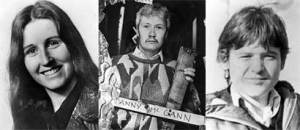
Three unarmed Irish Republican Army (IRA) Volunteers were shot dead by undercover members of the Special Air Service (SAS) in Gibraltar. The three were Mairéad Farrell, Sean Savage and Daniel Mc Cann.
The episode sparked intense controversy and began a chain of events that lead to a series of deaths in the Six Counties.
The British government claimed that the SAS shot the IRA members because they thought a bomb was about to be detonated. Eyewitnesses said that those shot were given no warning.British Intelligence and some media tried to discredit one of the witnesses, Carmen Proeta, whose flat overlooked the murder scene and who came forward to say what she had seen. A British newspaper claimed that she was a prostitute running an escort agency and later had to pay her damages in a libel case.
There’s a new Wailing Wall:
It’s in Gaza, and here mothers and fathers wail
at the bloody bodies of their children;
children wail at the bloody bodies of parents;
all wail over the bodies of friends and neighbours;
the wailing rises and the tears fall.
At this Wailing Wall,
we wail the mendacity of Israel and the West,
we wail the complicity of the media in the West;
while rockets, shells and bombs rained down upon us
the lies fell faster and thicker than rain,
a torrent of lies that never stopped.
To surge in flood over the bodies of our slain.
You come now with your flag of peace
tramping along the bloodstained road
and up the mountain of our bones
and the rubble of our homes
and offer us business as before
or – bombardment once more.
Now that the bombs have stopped,
we too stop and look around us:
our schools gutted and bloodstained,
mosques and hospitals in ruins,
so many of our buildings rubble,
or with gaping shell-holes,
in the hell-hole
you have made of Gaza.
We had so little and you destroyed so much.
In the days to come, more will sicken and die,
of wounds on flesh and wounds on soul,
of lack of medicine, fuel or food
as even in pause you take your toll.
Many are numb, some try to forget,
some try to live without forgetting,
but there is a begetting,
for in many hearts too,
your phosphorus flakes are snowing,
the embers of hate are glowing,
their machine guns and bombs are mowing
you and your children for generations to come.
Against your Goliath
our slingshots were of no use;
yes, God was with you –
he’s no longer Hebrew or English –
He’s American now;
you shot us down like fish
in the shooting barrel
you made of Gaza.
You wish us to recognise you?
Of course we recognise you –
the imprint of your boots are upon our necks;
we carry them from cradle to the grave.
But we will never agree to accept
or agree that you should keep
what you have stolen and plundered
the land you have sundered
or that you can make us second-class
citizens in our own land.
While we struggle to endure
and to ensure
that you never defeat us
let it be that we do not learn to treat others
as you now treat us.
What did you learn from your oppressors?
If all you learned was how to also
do so much of what they did,
then truly have the six million died in vain
and you mock their memory by invoking them.
Diarmuid, Feabhra 2009
I began to write this just as the December 2008- January 2009 bombardment of Gaza by Israel was coming to an end and rounded it off in February. That was the one they called “Operation Cast Lead”, which killed over 1,400 Palestinians, mostly non-combatants, including 400 children and injured over 5,300 — again, mostly non-combatants. I little thought that so few years later Israel would unleash an even worse bombardment upon the beleaguered Palestinians in Gaza, as it did in July last year, during which it killed over 2,300, again mostly non-combatants and this time nearly 500 children. The damage to infrastructure is colossal and the Israeli-Egyptian blockade makes significant repair impossible.
I noted recently that I had published this on Facebook only so published it here on the “Rebel Breeze” blog also.
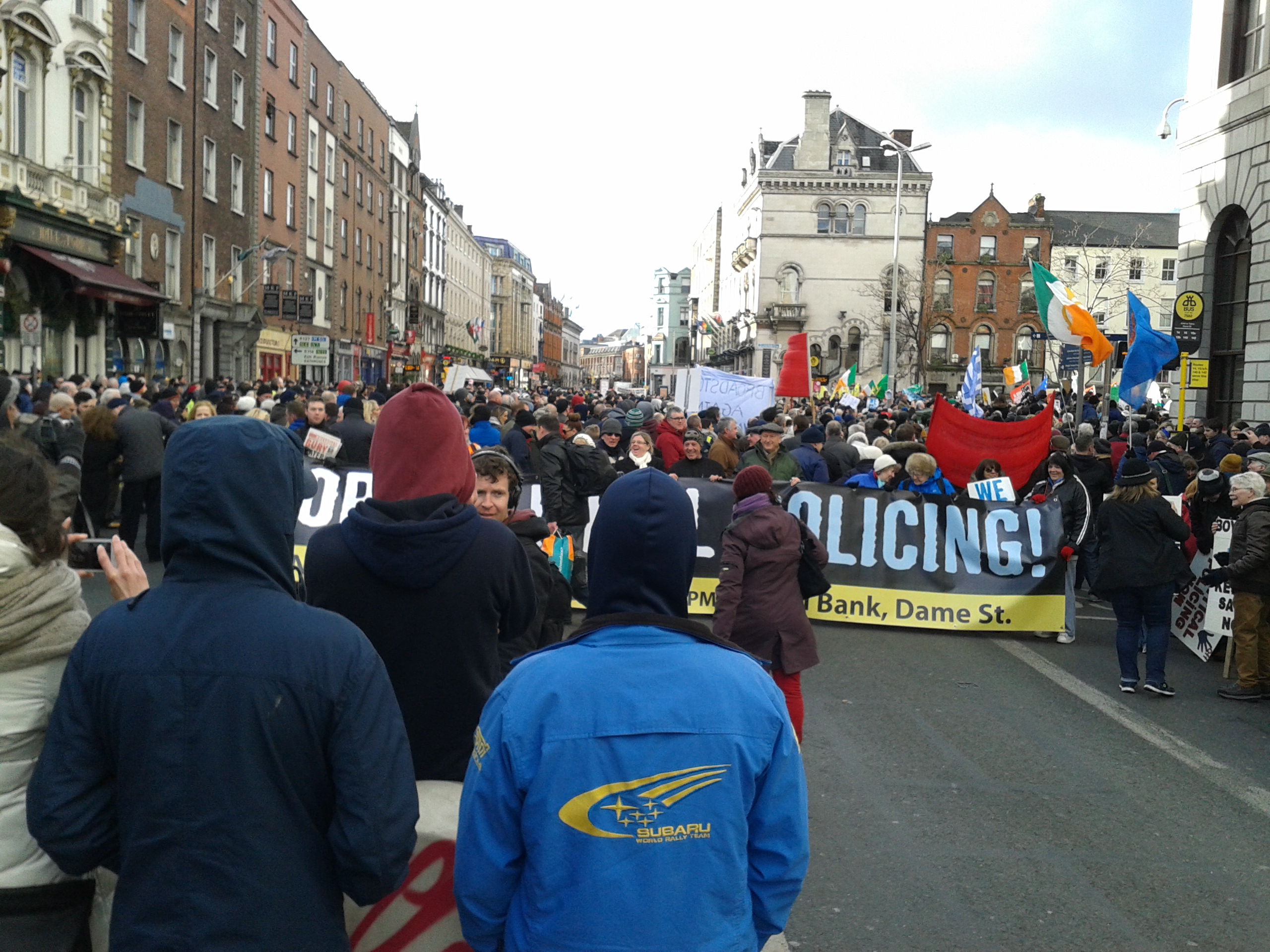
Start of the march in Dame Street after rally in Central Plaza
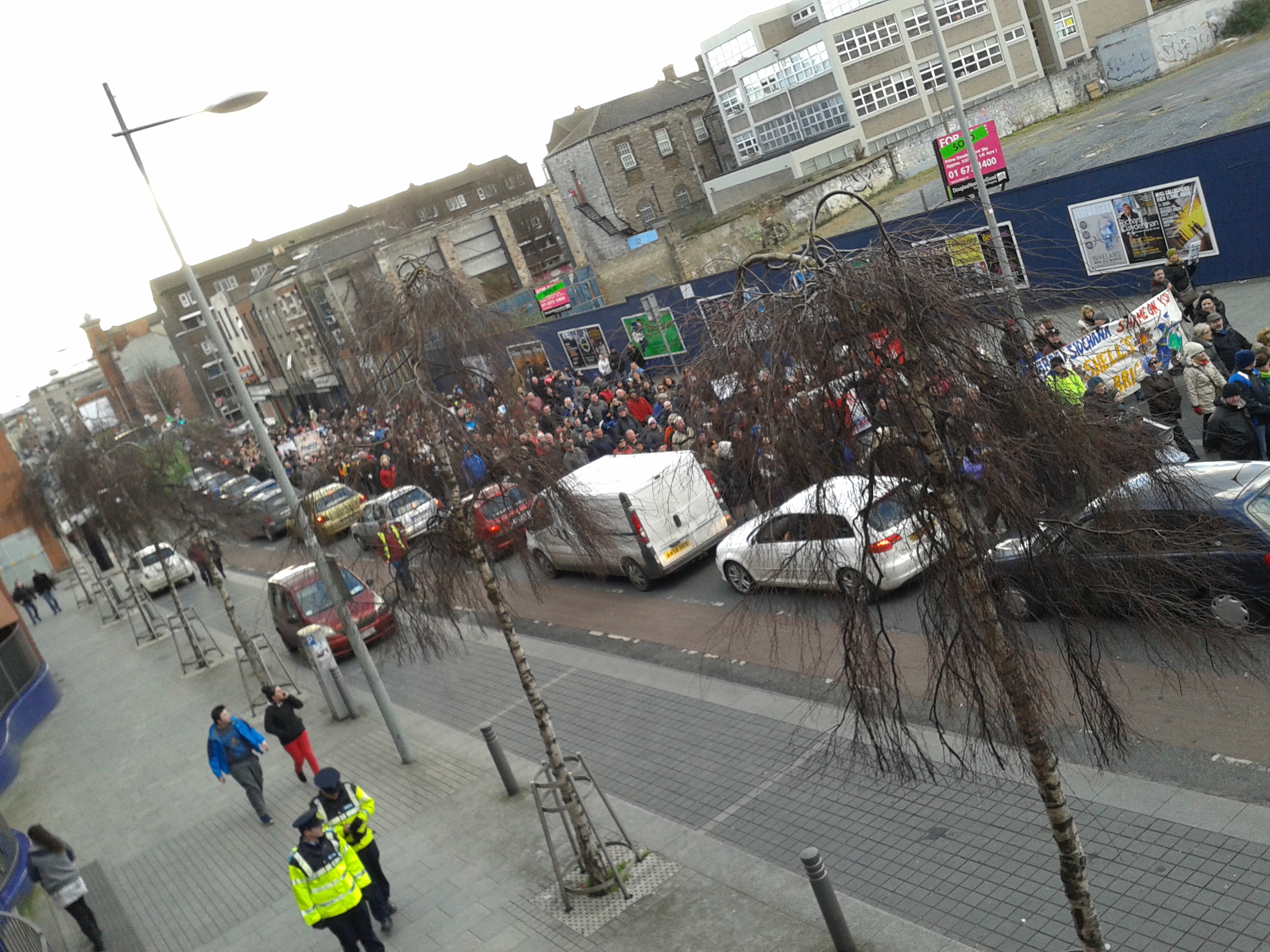
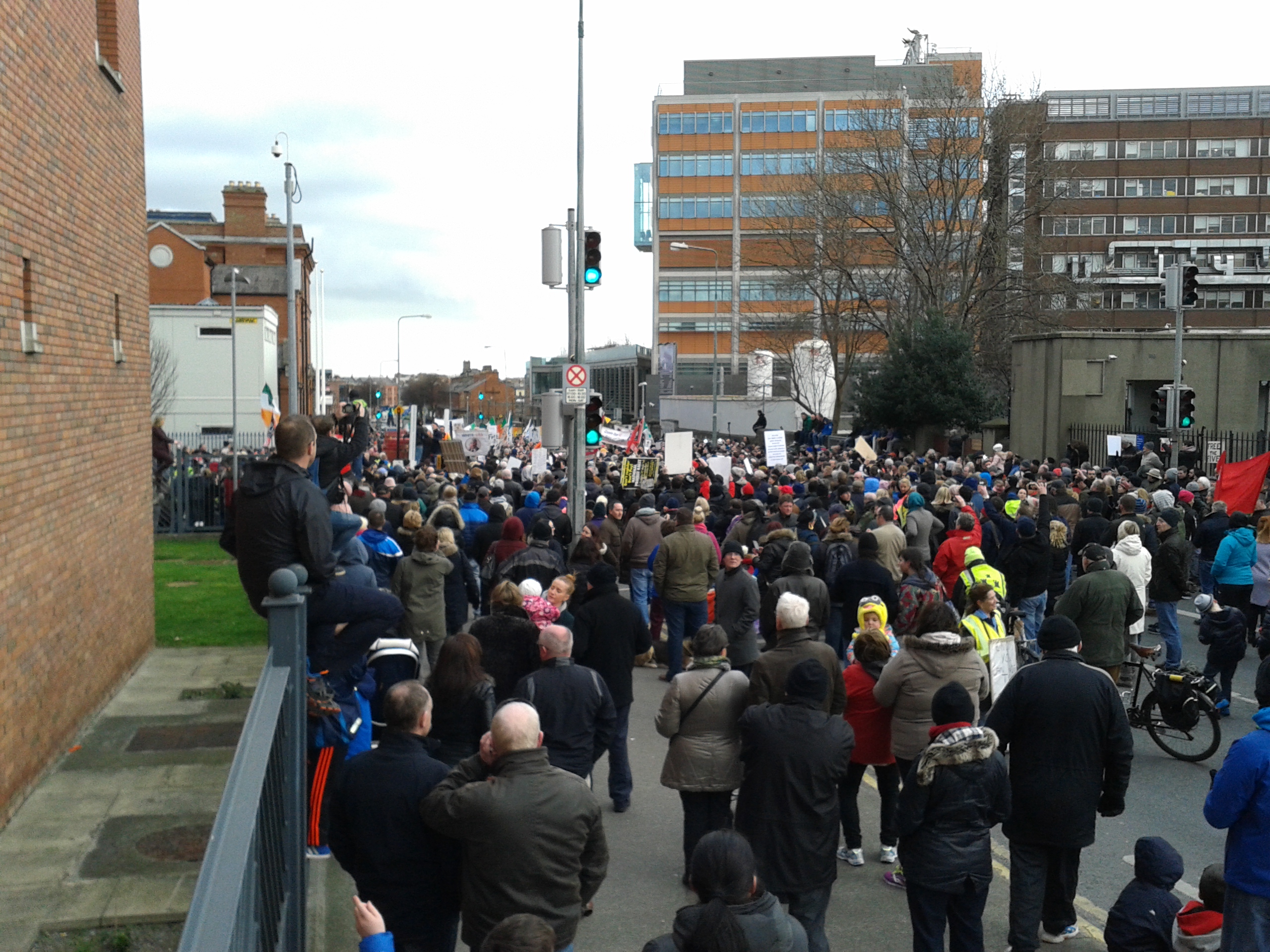
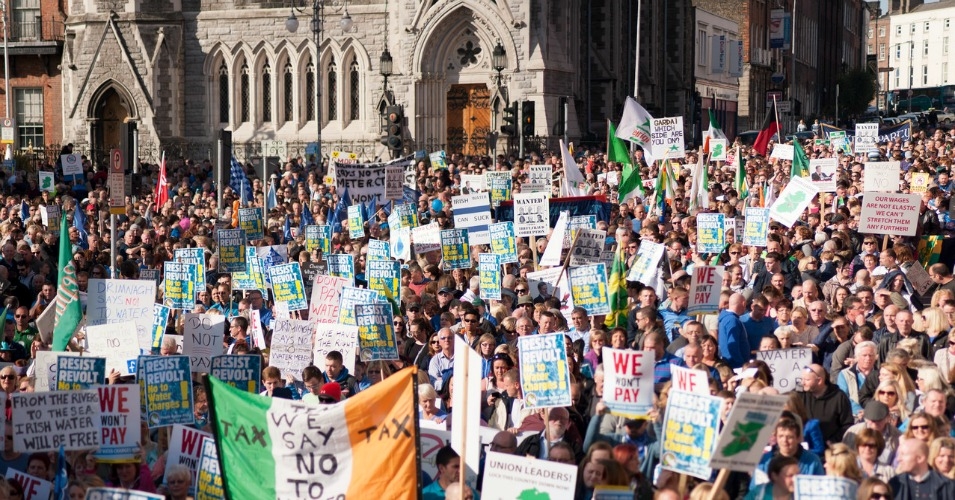
On Saturday 21 February, at two days’ notice, somewhere between eight and ten thousand people gathered in Dublin in solidarity with those water tax protesters jailed by the State and those recently arrested. They marched to Mountjoy Prison and packed the road outside it and in front of the local Garda (police station).
The march gets going in Dame Street. Photo shows only the front of the march.
Parnell Square West from Granby Place. The front of the march has turned into Dorset Street and is marching there but the end has yet to come around the corner into the square from Parnell Street
The crowd were addressed by relatives and friends of the jailed, anti-Water Tax campaigners as well as by Paul Murphy, Joan Collins and Clare Daly (both TDs of the United Left) and Dessie Ellis (TD of Sinn Fein).
All of the speakers denounced the politicians and the State for the jailing of the protesters while the bankers and politicians who created the crisis and colluded in the bank bailout went free. Most speakers called on the crowd not to pay the water tax and to build resistance on the streets. Dessie Ellis, in keeping with his party’s position, did not call for non-payment, though he did call for “unity of the Left”. The march was notable for the absence of SF banners and placards — apparerently they were having their own protest at Leinster House.
One of the protesters made an emotional appeal on behalf of two of the five who received jail sentences, who have gone on hunger strike, and on behalf of another, Derek Byrne, also on hunger strike, but who has declared his intention of refusing to take fluids from Monday if he is not released. (NB: Since posting that paragraph it has emerged that the demand of all three hunger-strikers is a return to Mountjoy [they had been separated and sent off to a prison facility near Clondalkin] and an end to 23-hour lockup in their cells. These are basic human rights.)
Large sections of the crowd seemed taken aback by this information and unsure how to react.
Paul Murphy pointed out that this use of the police to attack people protesting injustice has been a feature of the State since its creation and mentioned the threats of jail to striking workers, the jailing of the Rossport Five and of Margaretta D’Arcy. Clare Daly asked the Gardaí which side they were on, that of the polticians and bankers or of the people, saying that if they chose the former it is they who would become isolated, not the protesters. Joan Collins, Murphy and Daly all pointed to the need to create a socialist society. They also, along with most other speakers, called for a build up and huge turn out of support for the demonstration scheduled for March. Many speakers declared that the increased repression is a sign of the Government’s or the system’s weakness, not of their strength and called on the movement not to falter now.
Robert Ballagh, who also spoke, called for the release of the five and pointed out that the class of people who rule and profit out of this society are not those who find themselves in jails.
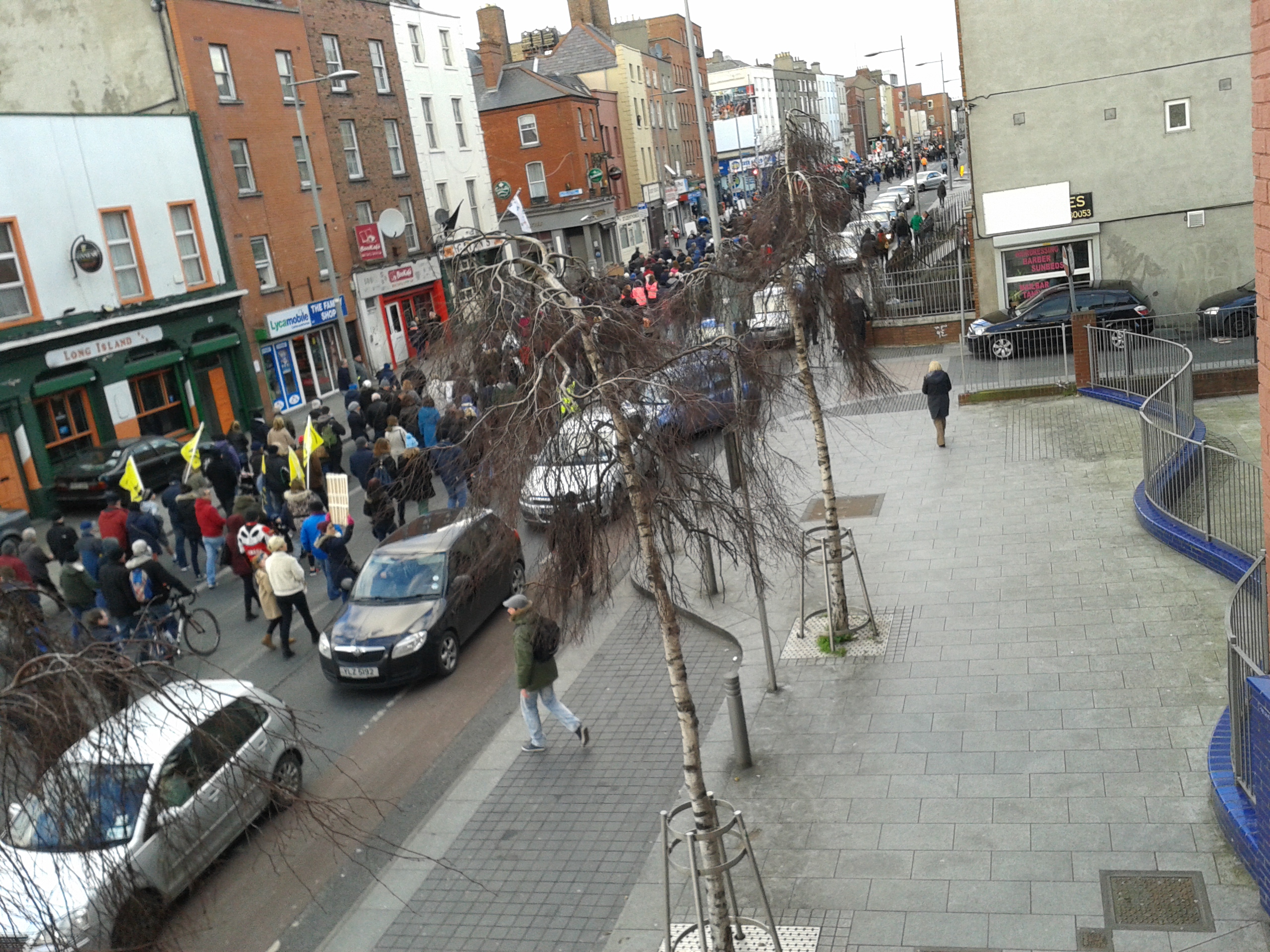
Section of the march in Dorset Street, looking west (another section is behind the camera — see next photo — but a large section of the march has yet to come around the corner from Parnell Square.)
The same road, photo taken a few seconds later but looking east.
The mood of the crowd in general was of good-humoured determination. The composition seemed to cross social groupings, ages and genders and a number had brought their children along. Some had come from other parts of the country.
Crowd outside Mountjoy. some have left and many are still further down the north Circular Road (the Mater Hospital is to the right of photo).
CATHERINE BYRNE, DUBLIN TD, SAID “WE SHOULD TAKE BACK OUR FLAG”. MAYBE SHE’S RIGHT ….
Dublin South-Central TD Catherine Byrne was warmly applauded when she said that they should ”take back our flag” from people who have been using it in protests against water charges and other issues. She made the statement at the Fine Gael political party’s two-day conference in Castlebar, Co. Mayo, held under strict security.
Arts Minister Heather Humphreys supported that view and told delegates in a secret session on the 1916 commemorations (a session which exposed divisions in the party): ”Some have used our flag to portray a different message – it’s time to reclaim our flag.”
“What should I do?” The anguish reached out to me; I felt it empathically. The cry of a person who is prepared to act and wants to change things for the better, to resist what is wrong around us on so many fronts – and that’s the problem.
There so many issues: the Water Tax, the persecution of Republican activists including framing and jailing them, the harassment and torture of Republican prisoners, the threat of fracking, privatisation of resources and services, cuts in services, cuts in salaries, high cost of private accommodation and low social housing provision causing homelessness, the decline of the Irish language and of the Gaeltacht …. and others. And that’s without mentioning international solidarity – and not because I don’t consider that essential, either.
Of course, we can put all these problems down to capitalism and, in the case of repression of Republicans (and with regard to international solidarity), to imperialism …. so let’s just overthrow those systems and then we can sort out those problems! But that leads to the question of “How” which in turn brings one back again to that anguished question, or to its variant “Which problem should I prioritise?”
Indeed, it is a question that cuts to the heart of the matter. For the issues call to us to act and since we can’t be everywhere at once we have to make choices. It is a question as old as class society and speeches are always being made recommending this choice or that while books have been written attempting to answer it. Lenin wrote a series of articles in the revolutionary newspaper Iskra (“Spark”) and published later as a booklet under a title that echoes that very cry above: What Is to Be Done? It had a subtitle too: “Burning questions of our movement” (by which he meant the socialist movement in Russia at the time).
Whether we choose to believe that work was absolutely correct, partly correct or completely wrong is in some ways irrelevant, for it was written for the movement in Russia in 1902 and published in 1905. I happen to think that it contains many useful ideas, although I am aware that there is a view that it has been mistranslated but, even so, in many ways, all that is beside the point. The fact is that today we have no blueprint and nothing more than perhaps the equivalent of a trouble-shooting manual: “for this problem, try this; if that doesn’t work, try that; while doing so beware of that other.” And that manual is cobbled together from older and more recent history of struggles, of analyses of the capitalist system and of how it behaves.
Scary, surely, to go up against a system that has ruled for around four centuries, that has spread across the world, that controls education, mass media, the State with its police, judges, prison and armed forces – and all without us having a blueprint. Well, if it’s any consolation, the capitalists don’t have a blueprint either … or if they do, they keep having to ignore it and react to events which they have not been able to predict, as well as to the extent of resistance for which they were unprepared. And they clearly make mistakes. Still, 400 years is a long time … a long time for them to learn tactics and strategy and to get comfortable in control and a long time to make us think that we can’t defeat them.
We can defeat them, of course and the indications from history and the internal workings of capitalism — and of its offshoot imperialism — are that we will. But what to do to make that happen? Yes, back to that question. And to the one that logically follows it: which issue to prioritise? For none of us is capable of being everywhere at once and even stretching over a few issues at a time begins to tear at our fabric.
The Marxist-Leninist approach argues for the creation of a revolutionary party that will make decisions on prioritisation and allocate resources to those struggles it chooses as it does so. Of course, the party will make mistakes from time to time and it will learn from those, getting better as it goes along. That’s the theory anyway. In application, or in alleged application, the results have not vindicated the theory – not in the long run, or even in the medium-term. Sure, we have been at it for less than 200 years: the first time workers captured a city was in 1871 and the first successful overthrow of the State was in Russia in 1917, very nearly a century ago. Much less time to learn, to make mistakes and to correct them but still ….
Of course, the alternative method of organising has even less to recommend it on results: amorphous, disparate collectives have not ever successfully overthrown a State and even their success in capturing a city (Barcelona, 1936) is debatable.
So, what is to be done? How to decide which struggle to prioritise? This is not a question I think can be answered by pointing and saying “That one and no other” or even, except at rare junctures, “That one and no other for the moment”. Individuals, collectives and parties will need to choose from the selection as a painter chooses from a palette: “this colour now, then that, no, scrub that one, now mix this with that, no, a bit more light …” and so on, always working towards the desired result which, although in the head, is also taking place on the canvas and making its own demands as it does so.
The truth is that all of those issues I mentioned in passing at the start of this piece, all of those, need addressing. All of them need people to fight in them. That is because they are all part of the same problem and also because we can’t just allow a cancer to grow unchecked in one part of the body while we address the tumours in another. Some individuals and perhaps even collectives are better suited to fight on some issues than on others: for example, a factory shop committee is probably not best placed to lead the struggle against fracking in a rural area, while a rural environmental collective is probably not in the best position to lead the struggle against the Water Tax. Individuals will need to pick and choose according to their own situation, their locality, their own knowledge.
And that would be fine, if the resistance movement as a whole were integrated enough to make creative use of that disparity – for particular struggles to be able to call for temporary additional resources and to be heard by the whole resistance movement, so that it could try to allocate those resources to one or other sector as seemed appropriate. But the resistance movement is far from integrated – it is fragmented and, even worse, it suffers from something akin to schizophrenia.
There a number of ways to imagine schizophrenia and the most popular is to see it as the development of two or more personalities in the one individual. But another is to see it as a disintegration of the personality – where the various aspects in our minds break free and appear as distinct personalities in themselves. The voices that speak in our heads to say things like “You shouldn’t have done that” or “Please make that happen” break free and seem to become different personalities. At times they conflict with one another while the central core personality tries to make sense of what is going on. Something like that, anyway. It is in that sense that I think the resistance movement in Ireland suffers from schizophrenia.
The splitting off of aspects of the revolutionary movement in Ireland has been towards two major poles of attraction: the Socialist one and the Republican. Of course there are some elements who incorporate both to one degree or another but I think examining them as distant poles of attraction is useful and much closer to their concrete manifestation within the revolutionary movement. In order to examine them as opposite poles I think it is also useful to imagine a stereotype individual inhabiting each pole. Let us then imagine a stereotypical Irish Republican and a stereotypical Irish Socialist.
The Irish Republican is probably working class or maybe lower middle class; he may or may not have done well at secondary education but in any case he is unlikely to have gone to university. He sees himself in a tradition of resistance to British Colonialism and Imperialism stretching back at least to the United Irishmen and perhaps even back to the Norman conquest which began in 1169. His priority is the removal of the British from Ireland. He experiences “political policing” (of which some socialists are now complaining) practically from the moment he becomes publicly active – he has had his name and address taken by Special Branch and/or RUC/PSNI and they have opened a file on him. The Republican’s recent predecessors have been jailed (as are some of his contemporaries now), beaten or even shot dead; they were engaged in armed struggle against the colonial and imperial armed forces in the Six Counties for 30 years and perhaps he looks forward to take the gun up again some day, to strike back at the colonial overlord. He will turn out on demonstrations and pickets against repression of Republican activists, in support of Republican prisoners, including framed ones. He will almost certainly attend mass demonstrations against the Water Tax and may participate in local direct action against it. The Republican’s idealogues are Wolf Tone, Patrick Pearse and Bobby Sands.
The Irish socialist is probably medium or lower middle class and has finished secondary education; she has almost certainly gone on to university. She sees herself as belonging to a tradition of only a couple of centuries, with an Irish tradition going back to the early part of the 20th Century, in particular to the 1913 Lockout and the Limerick Soviet of 1919. She may or may not give a high place in her history to the Irish Citizen Army in the 1916 Rising. Her priority is the defeat of the capitalist class, probably in Ireland first but will turn out in demonstrations against racism, gender discrimination and homophobia in Ireland. The Irish Socialist aspires to a general strike giving rise to a revolutionary take over of the State; in the interim she may or may not think electing left-wing TDs or trade union officials an important activity. She probably can’t conceive of taking up a gun. The Irish Socialist has never had her name taken by the Special Branch or been framed by the RUC/PSNI and may never even have been detained by the police, though she has probably been pushed around by them. She will almost certainly attend mass demonstrations against the Water Tax and may participate in local direct action against this Tax. Her idealogues are Karl Marx, Lenin, possibly Trotsky and James Connolly.
Granted these are stereotypes but they are not so far from reality as to be unhelpful in describing in turn many and perhaps most Irish Republicans and Socialists and therefore in identifying one of the principal fracture lines in the Irish movement of resistance.
If the Republican and the Socialist parts of the Irish resistance movement were to be combined, or at the very least to work on a more collaborative basis, the “What should I do?” question would be easier to answer. It would be simpler to be on a picket for prisoners one week and resisting water meters the next, even if one’s main sphere of activity were among Republicans. The socialist could attend a picket against cuts one week and one for the human rights of Republican prisoners on another, even if her main sphere of activity was among Socialists. But that is not the situation that exists at the moment and, though a number of attempts have been made to combine the two trends in one organisation, they have not met with any great success to date.
So, I have not yet answered the question, have I? Am I saying that what we should be doing is creating some kind of synthesis or at least a collaborative alliance between the the socialist and republican parts of the resistance movement? Well, yes, certainly. But also, and as a contribution to that, as individuals we should try and spread our activity between the areas of greatest concern of each of those sections of the resistance movement. We should, I think, take some time to support resistance to the water tax, demonstrations against cuts etc. in their own right but also find some time to support resistance to British colonialism and its repression of Republican political activists. “If we are not part of the solution, then we are part of the problem” may be a glib truism but it is particularly applicable in this case.
So, how will we find the time to spread ourselves around? How do we ever? We balance and juggle priorities between our politically active and our social lives, with employment thrown in when we have a job. Or upskilling or studying. And possibly cultural or sporting or other activities. But how to choose, how to prioritise? Each of us has to make those decisions herself and himself. Not a very helpful answer? Well, I did state earlier on that there wasn’t a blueprint, so I couldn’t have one myself, could I? This however I feel fairly confident in predicting: if we don’t find a way to support both those parts of the resistance movement to some degree, it will always be fractured. And while it is so, it cannot be successful in either ridding Ireland of our capitalist classes or in finally throwing off the colonial yoke.
British colonial police in Ireland, Auxilliaries and RIC in Dublin raid during War of Independence 1920 or 1921.Drawing depicting Cromwellian troops massacre at Drogheda 1649
A little bit rough in places but think I should get it out now and hopefully get people singing it ASAP. I am surprised no-one seems to have used this tune, The Sea Around Us, and the mention of “water”, already. Thanks to Ruairi O’Broin at the February session of Song Central for suggesting the “bank guarantee” line in the chorus, much better than what I had there originally.
Amended a little again since I wrote the above but still not sat down and really consistently worked at it. Amended yet again slightly in 2020.
THEY’RE STEALING OUR WATER
Diarmuid Breatnach (To the air of “The Sea Around Us”, also known as “The sea, Oh the sea”)
Chorus:
The sea, oh the sea, a ghrá gheal mo chroí,
‘though long it may roll between England and me,
We’ve still got our gombeens* with a bank guarantee
and they’re trying to steal our own water!
(The chorus can go in after each verse, or each second, as people prefer).
1.
The Norse came to Ireland right outa’ the blue,
took us as slaves and plundered and slew;
But their days were all numbered from Clontarf they knew
— they never troubled us much for the after.
2.
Then the English came over our patience to try,
our land for to steal and our culture deny
And they took all that we had … I tell you no lie —
but at least they left us our water!
3.
‘Twas many a hard battle with the English we fought,
as used be our wont and indeed so we ought;
but as time went by, it all came to naught
and they put poor aul’ Éire in a halter.
4.
But we rose up once more and again and again —
we had stalwart youth and women and men;
We fought them in city and mountain and glen
and forced them their plans for to alter.
5.
Then those who at our struggle took fright
stepped in and took over the fruits of our fight;
The Gombeens and Church turned our dawn into night
and in a wink we were back under the halter!
6.
The parasites live off our sweat and our blood —
they’d tax the very air that we breathe if they could;
But our media says to resist is not good …
and compliance would get us much further.
7.
Our resources are for the people to share in —
is linne ar fad é, uisce na hÉireann;
and it’s now the baton and prison we’re darin’ —
they’ll not steal from our sons and our daughters!
8.
The people are standing firm and steady —
they know that we’ve paid for the water already!
Our banners unfurled and more things ready:
You can be sure this time we won’t falter!
February 2015.
Denis O’Brien, a billionaire widely believed to have plans to buy Irish Water if/when it becomes privatised. He is a major shareholder in Sierra Construction, the company installing water meters and also in Independent Newspapers. The Moriarty Tribunal found that he had benefited from information from the Irish Minister for telecommunications whom O’Brien had paid €50,000 through circuitous channels. The information had assisted him in bidding for the mobile phone contract, which he later sold at a personal profit of €317 a few years later.Brian Cowen, former Taoiseach (equivalent to Prime Minister) in the Fianna Fáil-Green Party coalition Government 2011, which began the bank bailout.Joan Burton (Labour), Minister for Social Protection in the Labour-Fine Gael coalition Government at time of writing
Enda Kenny (Fine Gael), Taoiseach (equivalent to Prime Minister) in the Labour-Fine Gael coalition Government at time of writing
!
* “Gombeen”, from the Irish “Gaimbíneach” is a profiteer, a venal person, a moneylender, a capitalist.
I often see things the artist has hidden inside his work that maybe others don’t see. Especially in abstract work. My favourite is Rorscharch; in his work of black ink on a white background I see things I think sometimes even the artist himself did not see.
Tribute by David Rovics in 2015, the anniversary year of the execution of Joel Haglund, alias Josef Hilstrom a.k.a. Joe Hill)
David Rovics is a socialist troubadour from and in the USA of many years’ standing and has composed many songs about many issues. He also regularly tours and this year plans to go on a tour of Joe Hill’s homeland to celebrate this worker organizer, singer, song and other text writer and martyr. You can look him up on
davidrovics.com
(The punctuation arrangement below is mine — there was none in the text I received).
1.
Joel Haglund came from Sweden
Which was very far from Eden:
By the time he left most of his family died;
His sisters and his mother,
His father and his brothers
So with one remaining sibling at his side,
He got a notion
To sail across the ocean
Where he heard the streets were paved with gold;
Not long after his arrival
As he toiled for survival
He realized the bill of goods that he’d been sold.
(Primero publicado (y editado por el editor, gracias) en el blog nortedeirlanda.blogspot.ie el martes, 20 de enero de 2015).
Diarmuid Breatnach
El callejero mercado de Moore Street en mejores anos, mirando des de la calle Henry Street hacia el norte y la calle Parnell. El hilero ocupado en 1916 comienza justo después del primer callejón a la derecha.
Actualmente se está haciendo una fuerte campaňa para defender Moore Street (Sráid an Mhúraigh), el mercado callejero bien conocido de Dublín. No es solamente que esa calle es la única que sobrevive de un casco de mercado callejero con existencia desde el Siglo XVI y que hasta la mitad del siglo pasado consistía de tres calles paralelas conectadas por callejuelas. Es más que eso, pues una hilera de casas fue ocupada por entre 200 y 300 insurrectos durante el Alzamiento de Pascua en 1916 y fue desde ahí que se hizo la rendición. La hilera y el mercado callejero están amenazados por un plan del especulador Joe O’Reilly de construir otro centro comercial desde la Calle O’Connell a Moore Street.
Breve resumen de la historia de Dublín
Los vikingos construyeron la ciudad de Dublín alrededor del 841 en el lugar Dubh Linn (el Pozo Negro), al lado sur del río, antes ocupado por una colonia cristiana y ahí construyeron su puerto fortificado, sobre todo como base para su comercio de esclavos. El lugar del Pozo Negro se cree que estaba en una parte del Castillo de Dublin, pero con el río que lo alimentaba ahora bajo la tierra. Los indígenas tenían un pueblo ya cerca donde las grandes vías al oeste y al sureste cruzaban el rio por un vado, su nombre era Baile Átha Cliath.
En el 1014, en una gran batalla por las orillas del rio Tulcha, al norte de la ciudad de entonces y ahora dentro de ella, el rey indígena Brian Boróimhe (Brian Boru en inglés) venció a una fuerza militar mixta de Vikingos de Dublín, de la Isla Man, de las Islas Orca y del rey indígena de Laighean (“Leinster” en el inglés). Dublín permanecería después bajo mando vikingo pero el peligro de la dominación vikinga de Irlanda no surgió nunca mas.
Los Normandos, que ya habían vencido a los Vikingos y a los Sajones en 1066 en los reinos donde actualmente está Inglaterra, invadieron Irlanda en 1169, vencieron la resistencia indígena y se apropiaron de mucha parte del país. Estos vencieron a los vikingos de Dublín en 1170 y les expulsaron a las afueras, a un lugar que hoy en día es un distrito en el norte de la ciudad. En el mismo lugar del Pozo Negro, los Normandos construyeron su fortaleza, rodeada de su terreno con muro y empalizada y desde entonces hasta la creación del Estado Irlandés en 1922, el castillo en ese sitio ha sido el cuartel general de la ocupación británica en Irlanda. El este y sur de Bretaňa, bajo dominación Normanda pero mas tarde con alianzas con jefes sajones, se convirtió en el poder inglés que unos siglos después se puede conocer como el de Gran Bretaña y por eso se cuenta la ocupación británica de Irlanda desde el aňo 1169.
El Alzamiento de Pascua de 1916 y Moore Street
Un mapa del centro de Dublín entre el GPO y el Rotunda, con edificios ocupados por los insurrectos (y otros relevantes edificios) en el 1916 marcados en rojo.
Pues aunque la ciudad de Dublín era una creación extraňa y permanecía bajo mando ocupante, y pese a que a veces se les prohibió entrada a indígenas bajo pena de muerte, y pese también a que en el siglo XIX se pensaba en la ciudad como la segunda del Imperio, a través de los aňos la resistencia a la ocupación contaba con apoyo en muchas partes de Dublín. Y en 1916, durante la Primera Guerra Mundial, 1,200 hombres y mujeres salieron a la calle en alzamiento contra el poder imperialista y colonial mas grande del mundo, con “un imperio donde el sol nunca se pone”.
La mayor parte de la insurrección fue llevada por la organización republicana y nacionalista The Irish Volunteers (Voluntarios de Irlanda), además de su grupo auxiliar femenino Cumann na mBan y el grupo juvenil Na Fianna Éireann. La fuerza era la tercera parte de lo que habían contado los líderes del alzamiento, por razón del sabotaje por una parte del liderazgo de los Voluntarios.
Una parte de la fuerza militar insurrecta con orígenes diferentes era el Irish Citizen Army (el Ejercito Ciudadano), milicia sindical formada para defender a los sindicalistas contra ataques policiales durante el Cierre Patronal de 1913.
Por razón del sabotaje, la insurrección no comenzó el Domingo Santo, pues el jefe de los Voluntarios lo había cancelado, pero comenzó el día siguiente, el Lunes. Duró seis días y fue derrotada a través del bombardeo de la artillería británica que destruyó la mayor parte del centro de Dublín.
Destrucción por bombardeo británico en el 1916 a la calle Henry y la esquina del Moore Street. La columna es la de Nelson (ahora reemplazado por el “Spire”) en la calle O’Connell. La ruina del GPO está a la derecha, cerca a la columna.
Los insurrectos construyeron barricadas en calles y trincheras en Stephens Green pero los mayores lugares de resistencia fueron varios edificios ocupados y fortificados a los dos lados del rio Life (Liffey) y el cuartel general de la insurrección estaba localizado en el GPO (Sala Principal de Correos) en O’Connell Street (la calle principal de la ciudad).
Por razón del bombardeo y quizás del saqueo, ya el jueves, edificios en O’Connell Street estaban en llamas y por viernes el techo del GPO estaba en peligro de caer y con el plomo derritiendose. Los ocupantes lo evacuaron, llevando al herido James Connolly en camilla, con Elizabeth O’Farrell interponiendo su cuerpo entre él y la dirección de las balas que silbaban por la calle.
Los insurrectos en Moore Street
Cruzando Henry Street, entraron en el callejón Henry Lane y entraron en la primera casa de una hilera en Moore Street. De ahí hicieron un túnel de casa a casa, hasta ocupar la hilera entera. Lo hicieron así porque del extremo norte de Moore Street, conjunto con la calle Parnell, ya tenían los británicos una barricada con ametralladoras y habían ya rechazado un asalto irlandés, matando a media docena.
El líder de ese asalto era Michael O’Rahilly. O’Rahilly era uno de los que cancelaron el Alzamiento para el domingo pero sin embargo al ver que procedió, se presentó para luchar. Fue gravemente herido por un balazo y cayó en el callejón que actualmente lleva su nombre, O’Rahilly Parade, y ahí escribió una nota a su mujer: “Escribo después de que me dispararon. Querida Nancy, recibí un disparo mientras encabezaba una carga en Moore Street y tomé refugió en un portal. Mientras estuve allí, oí los hombres señalando dónde estaba e hice un perno para la calleja donde ahora estoy. He recibido más que una bala, pienso. Toneladas y toneladas de amor querida, para ti, los chicos y Nell y Anna. Fue una buena lucha de todos modos”.
“Por favor entregar esto a Nancy O ‘ Rahilly , 40 Herbert Park, Dublín.
“Adiós querida.”
Ese viernes, en la hilera en Moore Street, con una fuerza británica a un extremo de la calle y con otras apretando cada hora mas a la linea insurrecta, y con algunos de sus edificios ya aislados, el liderazgo de la guarnición del GPO, que incluía al comandante general Patrick Pearse, debatieron que pasos futuros tomar. Los proyectiles de artillería seguían cayendo y las explosiones de materiales quemandose en tiendas y en fabricas se oían en una sinfonía con disparos de ametralladoras (los insurrectos no tenían ni una), y fusiles. De vez en cuando parte de un edificio colapsaba. Aún los insurrectos en la hilera en Moore Street habían preparado una diversión con posterior asalto (suicida, casi seguro) a la barricada al extremo de la calle, con la mayor parte escapando por el callejón de Sampson Lane (ahora bloqueada, no lo estaba entonces).
Otra foto de la destrucción del centro de Dublín por el bombardeo británico en 1916.
Por fin, se dice que debido a la enorme cantidad de víctimas civiles, Patrick Pearse decidió no seguir con ese plan y en vez de ello, procedió a rendirse. Llevando bandera blanca, la enfermera y miembro de Cumann na mBan, Elizabeth O’Farrell, salió a negociar con el comandante de los británicos, lo cual era acto de gran coraje, pues los británicos ya habían matado cerca a una pareja civil con su niňo, pese a estar bajo bandera blanca. El General Lowe se negó a llevar a cabo negociaciones y demandó un rendimiento total, dandoles solamente una hora para decidir. Una hora después de volver con su ultimatum, Elizabeth O’Farrell salió por segunda vez bajo bandera blanca, acompañando esta vez a Patrick Pearse.
En la calle Parnell, cerca de Moore Street, Pearse rindió formalmente sus fuerzas insurrectas y firmó las órdenes para los Voluntarios en otros edificios para rendirse también. James Connolly firmó ordenes iguales al Ejercito Ciudadano. La desafortunada Elizabeth O’Farrell tuvo el amargo y peligroso deber de entregar esas ordenes a los varios edificios todavía ocupados por los insurrectos en una ciudad todavía en guerra.
Elizabeth O’Farrell, republicana irlandesa, fue una de los ocupantes de la hilera de Moore Street en los últimos días del Alzamiento y salió bajo bandera blanca dos veces para negociar con los militares británicos.
Los ocupantes revolucionarios de la hilera en Moore Street cumplieron parte de sus instrucciones de rendimiento pero no con otras. En vez de dejar sus armas en las casas, salieron con ellas al hombro, en marcha militar, en conjunto con Henry Street y ahí dieron vuelta a la izquierda hasta llegar a O’Connell Street. Ignoraron los gritos de los oficiales británicos y la furia del General Lowe. De ahí, a la izquierda otra vez, se fueron en marcha por O’Connell Street hasta llegar a la columna de Parnell, unos cien metros de distancia del extremo norte de Moore Street, y ahí depositaron sus armas.
Al otro lado de la misma columna existe un lugar que lleva el nombre en inglés “The Rotunda”. Por ironía, fue ahí donde se fundaron los Voluntarios originalmente en 1913, como respuesta a los “Voluntarios de Ulster”, lealistas Británicos que se movilizaban contra autonomía para Irlanda dentro del Imperio. En el jardín del Rotunda les mantuvieron bajo guardia a la mayoría de la guarnición del GPO/ Moore Street, menos los heridos que fueron llevaron al hospital, así estuvieron el resto del sábado y la mayor parte del domingo sin comida ni agua. A las mujeres que trataron de llevarles agua las arrestaron.
En los juicios militares siguientes, se condenó a pena de muerte a un centenar de hombres (Constance Markievicz, al enterarse de que ella no había recibido pena de muerte, supuestamente por ser mujer, demandó que la tratasen igualmente que a los hombres). Mas tarde, las sentencias de todos fueron conmutadas menos a trece a los cuales les fusilaron y a uno mas al cual le condenaron mas tarde en juicio en Londres a muerte por la horca. A los firmantes de la Proclamación de la Independencia (imprimido en la sala del sindicato ITGWU, “La Sala de la Libertad”, pero firmado en una tienda y café alternativo en Henry Street) les fusilaron. De los siete firmantes, cinco habían sido ocupantes de la hilera en Moore Street – Thomas Clarke, Patrick Pearse, Joseph Plunkett, Seán Mac Diarmada, y James Connolly. El hermano de Patrick, Willie Pearse, estuvo en Moore Street y a el le fusilaron también.
El patio de la Cárcel de Kilmainham (ahora un museo) donde fusilaron a los siete firmantes de la Proclamación de la Independencia y además a otros siete.
Diferente a los otros, James Connolly era socialista revolucionario, organizador del sindicato ITGWU, comandante del Ejercito Ciudadano y de la guarnición del GPO. Además era teórico, periodista, historiador, escritor de libros, artículos y de canciones. Igual que Thomas Clarke y Éamonn De Valera, Connolly no había nacido en Irlanda, y pese a pertenecer a la diáspora irlandesa en Edimburgo, de hecho su primera visita a Irlanda ocurrió cuando estaba en las filas del Ejercito Británico. Pronto salió del Ejercito y se casó con una irlandesa. Llevaron a Connolly del hospital a la Cárcel de Kilmainham y ahí, el 12 de Mayo, el último de los 12 ejecutados en 1916, fue atado a una silla por no poder ponerse de pie por razón de la gangrena en su tobillo, y le fusilaron.
La memoria histórica y la campaňa para conservar Moore Street
Muchos irlandeses y muchos turistas de otros países opinan que en cualquier otro país en Europa se hubiera hecho un monumento de la hilera y hasta distrito histórico de los alrededores. Sin embargo la mayoría de la población ni sabían hasta hace pocos años que la guarnición del GPO terminó la resistencia en Moore Street (y en la película Michael Collins, se le ve rindiendo desde el GPO, contrario a la historia de la guarnición y de Michael Collins mismo). En 2002 la National Graves Association (Asociación para las Tumbas Nacionales), una organización voluntaria e independiente de partido, empezó a hacer campaňa para guardar parte de la calle y en 2007 se hizo monumento nacional de las casas 14-17 Moore Street.
Poco después, familiares de los que lucharon en el Alzamiento y, especialmente, de los ejecutados empezaron a hacer campaňa para guardar la hilera entera. Mientras tanto en una historia complicada y sucia, el especulador Joe O’Reilly con su empresa CChartered Land, había comprado la mayor parte de las casas en Moore Street. Además, el centro comercial ILAC se había construido para 1981 encima del resto del casco del mercado callejero y perteneciente a Chartered Land y a Irish Life (compañía de seguros). Las cuatro casas del “monumento nacional” también le pertenecían a Chartered Land y por reglas del estado la compañía tenía obligación y responsabilidad de mantener los edificios en buen estado.
El número 16 Moore Street, uno de las solamente cuatro casas de la hilera hecho monumento nacional por el Estado.La placa en número 16, lo único que indica la historia de la hilera en Moore Street
A los que entienden las costumbres y trucos de los especuladores no les sorprenderá nada que Chartered Land no mantuviera en buen estado los cuatro edificios ni nada parecido y como evidencia existen fotos que demuestran agujeros en el techo, pinturas en las paredes, etc. Hace unos años, Chartered Land propuso un plan de construcción de un centro comercial enorme, con entrada en O’Connell Street y pasando por Moore Street. El plan preveía un Parking subterráneo, y un jardín en el techo. Por no poder demoler las cuatro casas del “monumento”, se proponía incorporarlas dentro del centro comercial, poniendo café, servicios y un pequeño museo.
El plan del Parking atraería más trafico a la ciudad y no se aceptó pero mucho de lo otro si lo aceptó el Estado, pero bajo cierta condiciones. Aunque el especulador ya le debía €2.8 billones al Estado, le prometieron un subvención de €5 millones para renovar las cuatro casas. Pero aparte de dinero, otro problema al que se enfrentaba a Chartered Land era que no todas las casas en la hilera le pertenecían a él. Dos a la esquina con O’Rahilly Parade le pertenecen al municipio de Dublín.
Aunque el especulador dice que los puestos de mercado no van a estar afectados, y llevó a varios comerciantes de los puestos a los EEUU para enseñarles un centro comercial ahí, poca gente le cree. Los comerciantes no están seguros — la caída del mercado debido a la incertidumbre que pesa sobre la calle les hace parecer a algunos que mejor que se construya el centro. Sin embargo, varios también han firmado la petición (abajo).
En el otoño de 2014, el Chartered Land les ofreció al Municipio tres casas en el sur de Moore Street a cambio de sus dos casas en la hilera. Esa oferta fue recomendada por el Director del Municipio y, sorprendiendo a muchos, por el director de la comisión consultiva sobre Moore Street, el concejal Niall Ring.
Concentración en el octubre 2014 presionando al Ayuntamiento de Dublín no acordar con el plan del especulador. Estrechan los participantes paginas de la petición para guardar la memoria histórica del Moore Street.
La campaňa para guardar Moore Street lo resistió y surgió una nueva iniciativa, Save Moore Street from Demolition (Guardar la Calle Moore de la Demolición), pasando unas horas cada sábado con mesa de información en la calle, pidiendo firmas con petición a los concejales del Municipio y distribuyendo panfletos. La mesa rápidamente ganó mucho interés y apoyo con gente haciendo compras en la calle y con algunos turistas que pasaban por ahí. Actualmente, después de 15 sábados, tienen 3,500 firmas en papel. Es indudable que la campaňa cuenta con muchísimo mas apoyo de que lo tiene el plan de Chartered Land.
El voto fue reprogramado y Chartered Land entonces ofrecía cuatro casas a cambio frente a las dos pero por fin hicieron el voto y el intercambio fue derrotado. Al mismo tiempo se empezó una campaňa de “urgencia”, diciendo que “es muy importante tener esto arreglado para el centenario del Alzamiento”. También hicieron unas concentraciones frente a la sala del municipio. Cuando ya no se podía retrasarlo, se votó. Los concejales del Fianna Fáil votaron en contra, igual que los del Sinn Féin y algunos del Partido Laborista, además de muchos independientes socialistas y republicanos. Los concejales a favor fueron los del partido conservador de derechas Fine Gael (ahora en el gobierno en coalición con el Partido Laborista), algunos del Laborista y algunos independientes – pero estaban en minoría.
Aunque era una victoria temporal para la campaňa, fue muy importante. Si lo hubiera ganado Chartered Land, hubiera inmediatamente demolido las dos casas y la destrucción de la hilera hubiera comenzado. Además del resto de su historia, la última de esas casas, número 18, había tenido la primera clínica de la piel del Reino Unido (en el cual estaba Irlanda en ese aňo).
Gente firmando la petición presentado cada sábado por el grupo Save Moore Street from Demolition


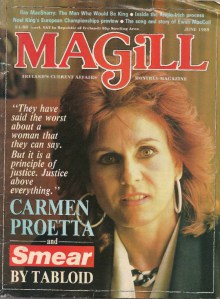 British Intelligence and some media tried to discredit one of the witnesses, Carmen Proeta, whose flat overlooked the murder scene and who came forward to say what she had seen. A British newspaper claimed that she was a prostitute running an escort agency and later had to pay her damages in a libel case.
 British Intelligence and some media tried to discredit one of the witnesses, Carmen Proeta, whose flat overlooked the murder scene and who came forward to say what she had seen. A British newspaper claimed that she was a prostitute running an escort agency and later had to pay her damages in a libel case.