“THE LAST COLONY IN AFRICA” — REPRESENTATIVES SPEAK IN DUBLIN

(Approx. reading time: report 10 mins; background 2 mins.)

Report by Diarmuid Breatnach

On Tuesday March 5th a meeting in the Teachers’ Club, Parnell Square, was addressed by representatives of the Western Sahara people and by experts in human rights matters.
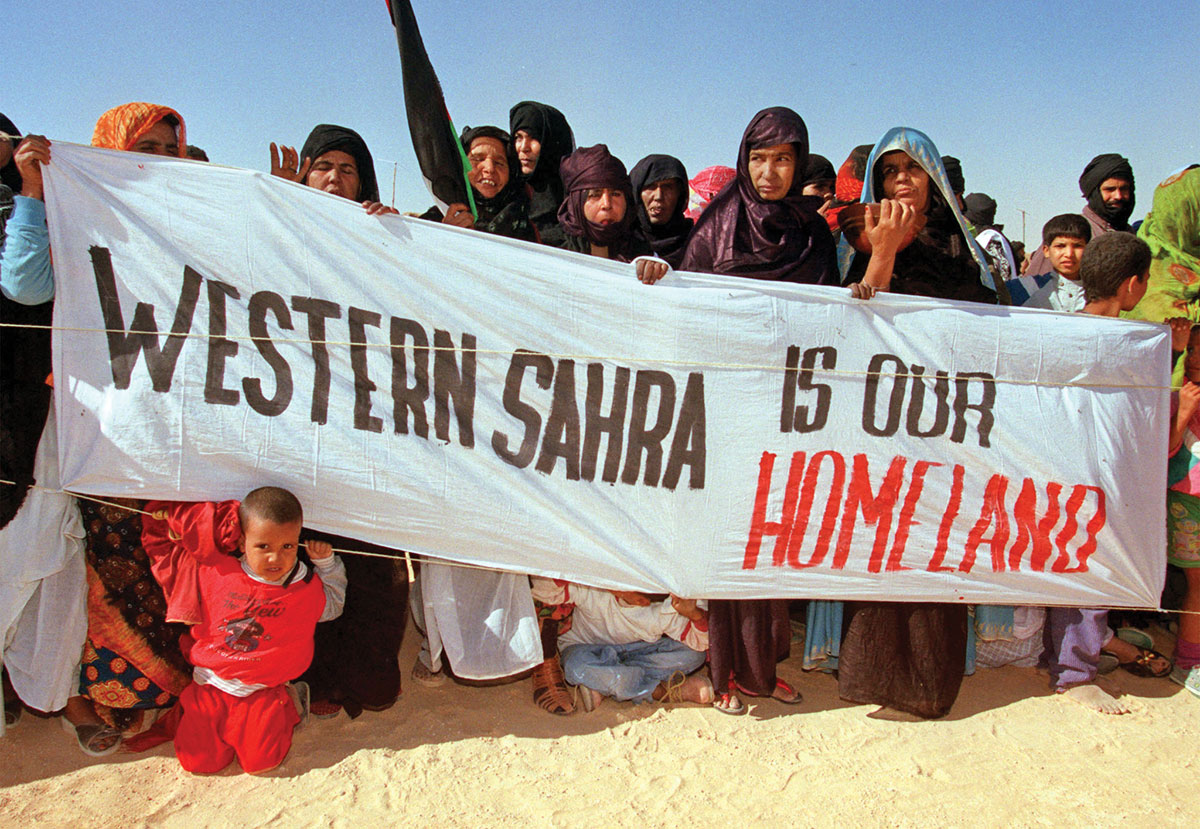
2015 protest by Saharawis, mostly women.
(Photo source: Internet)

          Western Sahara, a territory of 266,000 square kilometers (103,000 sq. miles) in the Maghreb, was part of Europe’s carve-up of North Africa, when it was known among most states as Spanish Sahara, in acknowledgement of the European state that occupied it. Its people speak Arabic and Castillian (Spanish) and some also speak French, an influence from neighbouring French ex-colonies.  Few speak Berber.

Mohamed Belsat of the Polisario speaking at the event (Photo: D.Breatnach)

The UN General Assembly in 1964 called on Spain to hold a referendum there which the Franco fascist regime declined to do but in 1975, after the dictator’s death, the new regime pulled out of the territory, practically handing it over to Morocco and Mauritania. After a conflict between those two states, Morocco emerged as the sole occupier and the conflict since then has been between the Kingdom of Morocco and the Saharawi people, who seek independence.

Chaired by Mark McLoughlin, filmmaker, the Dublin meeting had been arranged at short notice and its advertising further hampered by cancellation of a booking at Trinity College.

TRACING THE PLUNDER OF SAHARAWI NATURAL RESOURCES

          Erik Hagen, of Western Sahara Resource Watch, with a display projected on a screen, showed how his organisation traces the ships arriving at the territory and departing with phosphates mined there to their destinations. From the registered tonnage of the ships, the amount of phosphates plundered can be calculated. The companies involved claim that they are doing no wrong, since they pay Morocco for the cargoes.
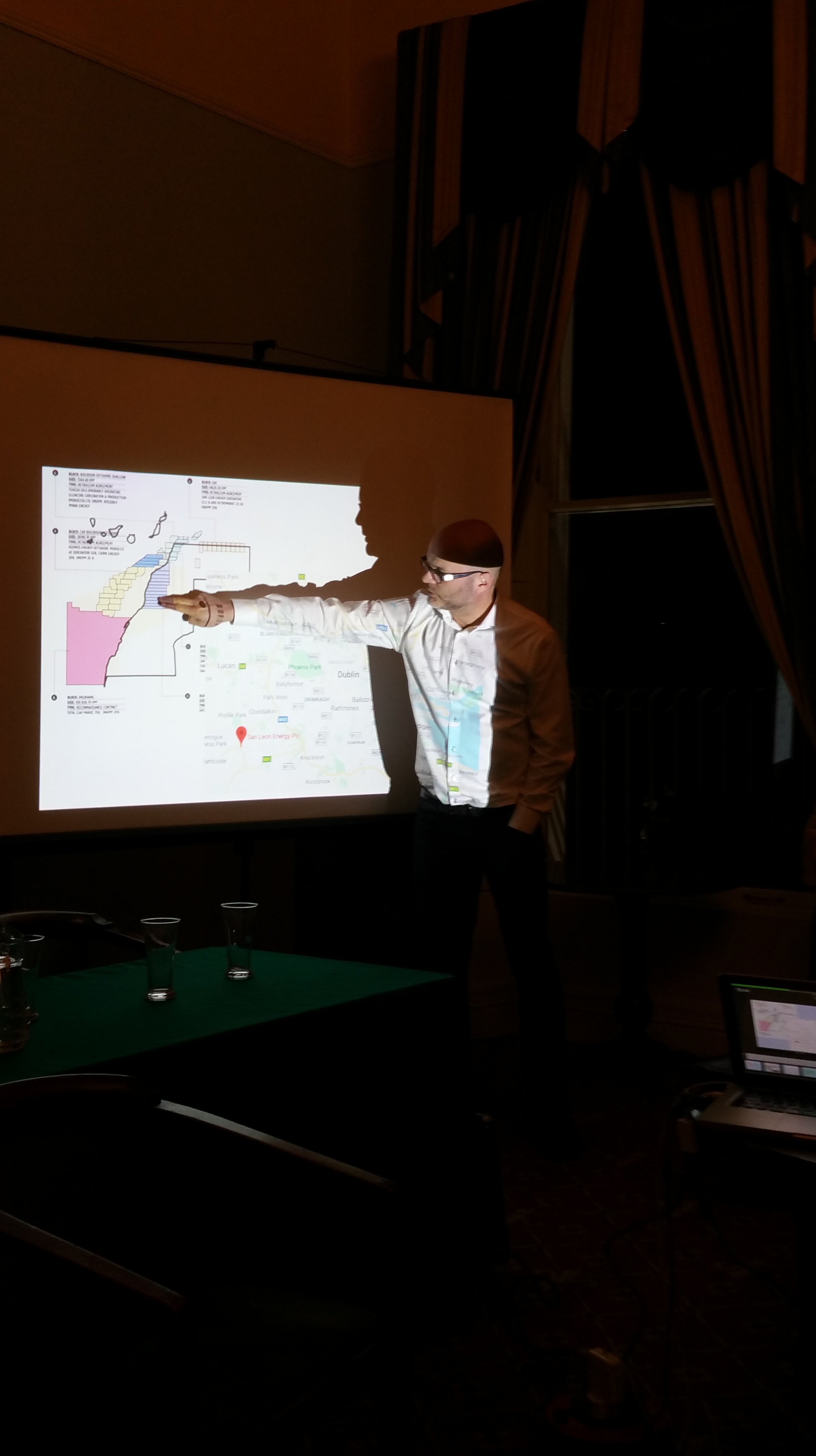
Mark Hagen illustrating a point with reference to the display. (Photo: D.Breatnach)

But according to the UN, no state may extract resources from a disputed territory without the consent of the people. Hagen talked about how EU had changed the wording to replace “consent of” with “being of benefit to” and then went on to effectively falsify agreement on benefit, using a document on consultation with huge majority – and a total of Saharawi organisations – voting against as evidence for.

The only company currently exploring for oil in Western Sahara is San Leon, an Irish company, although they failed to find any and are currently fighting in financial difficulties.

Clive Symmonds, expert in international law talked about the policy of isolating produce from occupied territories, by first compelling their labeling as such, which, although that would not ban the products, would facilitate a ban if such were decided. The Control of Economic Activity (Occupied Territories) Bill 2018 introduced to the Oireachtas (Irish legislature) and currently being processed with cross-house support despite Government opposition, is an example of how such a ban may be implemented (and Senator Black’s Bill will also be valid for Western Sahara). Of course, as Symmonds pointed out, such labeling is left to the exporter which in this case would be the Kingdom of Morocco.

Clive Symmonds speaking on human rights legislation and W. Sahara (Photo: D.Breatnach)

 Symmonds also referred to the EU Fisheries Agreement which, in permitting fishing within what Morocco claims as its territorial waters without reference to the Saharawi people, is permitting the plunder of the Saharawi people’s fish stocks – and the Irish State is a party to this, having signed the Agreement. Symmonds pointed out that the judgement of the European Court of Justice on 21st December 2016, stated that Western Sahara is a “separate and distinct” territory from Morocco and that trade agreements between the EU and Morocco do not apply to the occupied territory. The EU is in violation of this judgement.

A REFERENDUM IS THE ONLY DEMOCRATIC WAY”

          Mohamed Belsat, Frente Polisario Ambassador to Europe, talked about the policies of the Irish state, the EU and, in particular, France. Belsat said that they were in collusion with the Kingdom of Morocco and that in particular, France often seemed to be the opponent of the Saharawi people even more than Morocco.

Referring to what he said was the only democratic of ascertaining the will of the Saharawi people, Belsat said that it was a referendum. Morocco had called for this since they had flooded Western Sahara with Moroccans but, since the process of registration of genuine and historical residents of the area had been completed by the UN, the Moroccan Kingdom had withdrawn all support for a referendum.
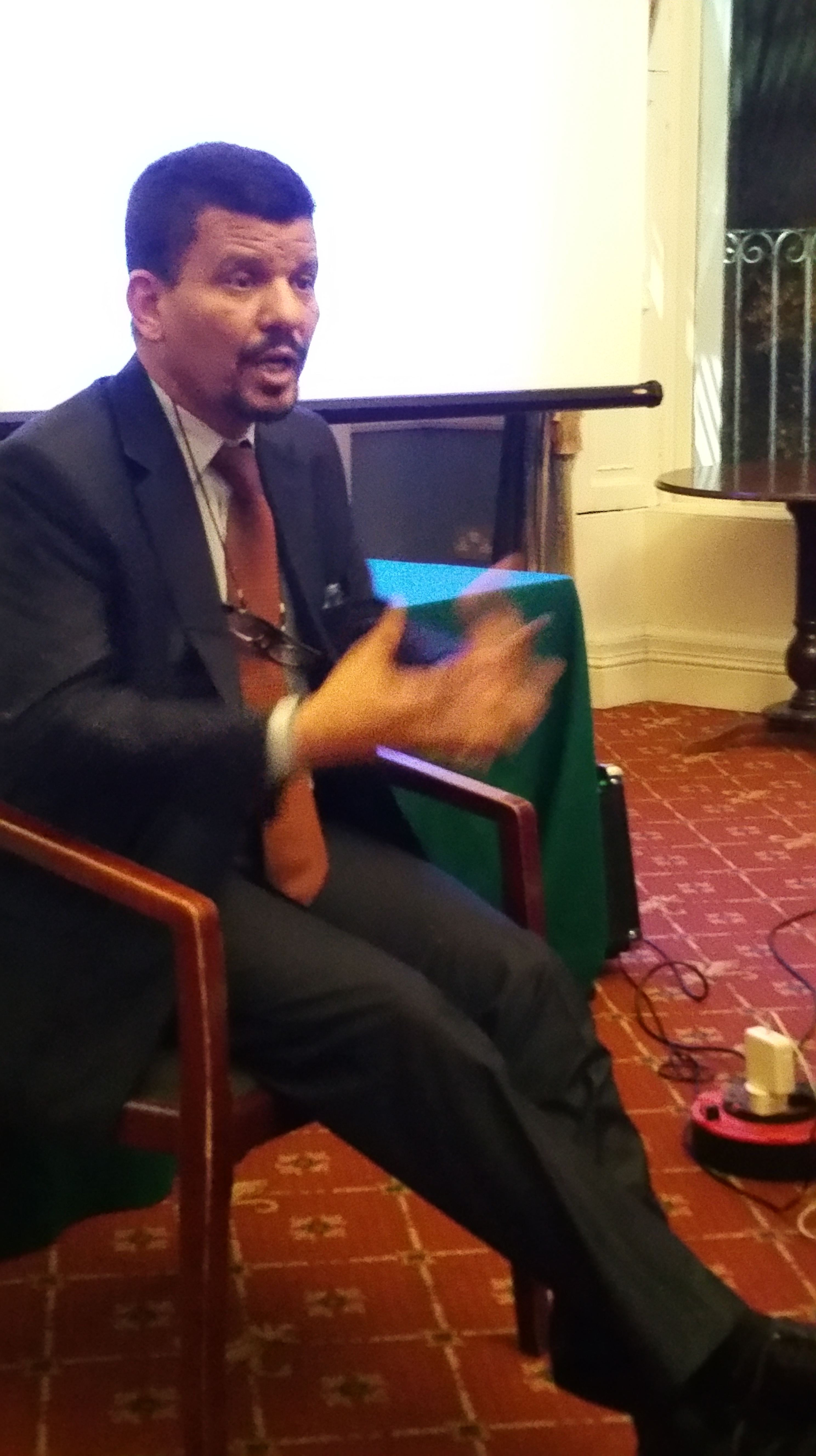
(Photo: D.Breatnach)

The cost of the occupation to the Moroccan kingdom is huge, in terms of military presence maintenance and so on,” Belsat said, adding that the cost of every litre of water supplied to the occupation forces was equal to four times the price of a litre of whiskey. Furthermore, the cost to the Kingdom exceeded the benefits it extracted from the colony. In January, Morocco had at last joined and signed up to the constitution of the African Union, the organisation of African states, of which Western Sahara is a founding member and which has a long-standing position on Western Sahara being an occupied colonyFor all these and other reasons, including dissatisfaction with the regime among the Moroccan general population, he felt that a campaign of pressure on Morocco and on the EU might well bear fruit in terms of the decolonisation of this “last colony in Africa”.

Later, Belsat’s response to a question from the audience amounted to an admission that there was no “peace process.” (sic) in operation (despite a reference to it by a number of speakers) and that as a result of this and the conditions under which they were kept by their oppressors, it was increasingly difficult to restrain the youth from resorting to armed resistance. At this a member of the audience commented that armed struggle against the army of the Moroccan Kingdom backed up by France would be “suicidal”.

57 POLITICAL PRISONERS BUT MANY MORE HAVE DISAPPEARED WITHOUT TRACE”

          ElGhalia Djimi, Vice-President of ASDH (Saharawi Association of Victims of grave violations of human rights by the Moroccan State), which cooperates with the League for the Protection of Western Sahara Political Prisoners in Moroccan Jails (LPPS), who had arrived in Ireland that day, made her presentation next.  Speaking in French through a translator, Djimi talked about the conditions of life under occupation for the Saharawi people. Djimi showed a compilation of clips of soldiers, police and people in civilian clothes physically assaulting protesting Saharawi women, pulling their hair, punching and kicking them and informed the meeting that those in plainclothes were Moroccan police.

ElGhalia Djimi speaking on Moroccan Kingdom repression of Saharawi people (Photo: D.Breatnach)

There are 57 Saharawi political prisoners in Moroccan jails,” ElGhalia Djimi said, “but many more that have disappeared without trace.”

Unemployment is high among the Western Sahara people and as a result of that and other deficiencies in their lives, a drug problem has arisen, she told her audience. There are no third-level education facilities in the territory, obliging them to go to institutions in Morocco. Although they can study to gain professional qualifications for civil employment, those available are not usually those required by the employers, which is not true for their equivalent in Morocco, with the result that often Moroccans fit into the administrative jobs better than do the Saharawi people. In terms of their treatment by the authorities, all Sahawaris carry a Moroccan ID card but letters on it indicate their ethnic origin (which Belsat likened to the Nazi State’s requirement that German Jews by identifiable in their national ID documentation).

Moroccan citizen settlement in Layoune, the capital of Western Sahara, had now placed the indigenous people, once the majority, in a minority.
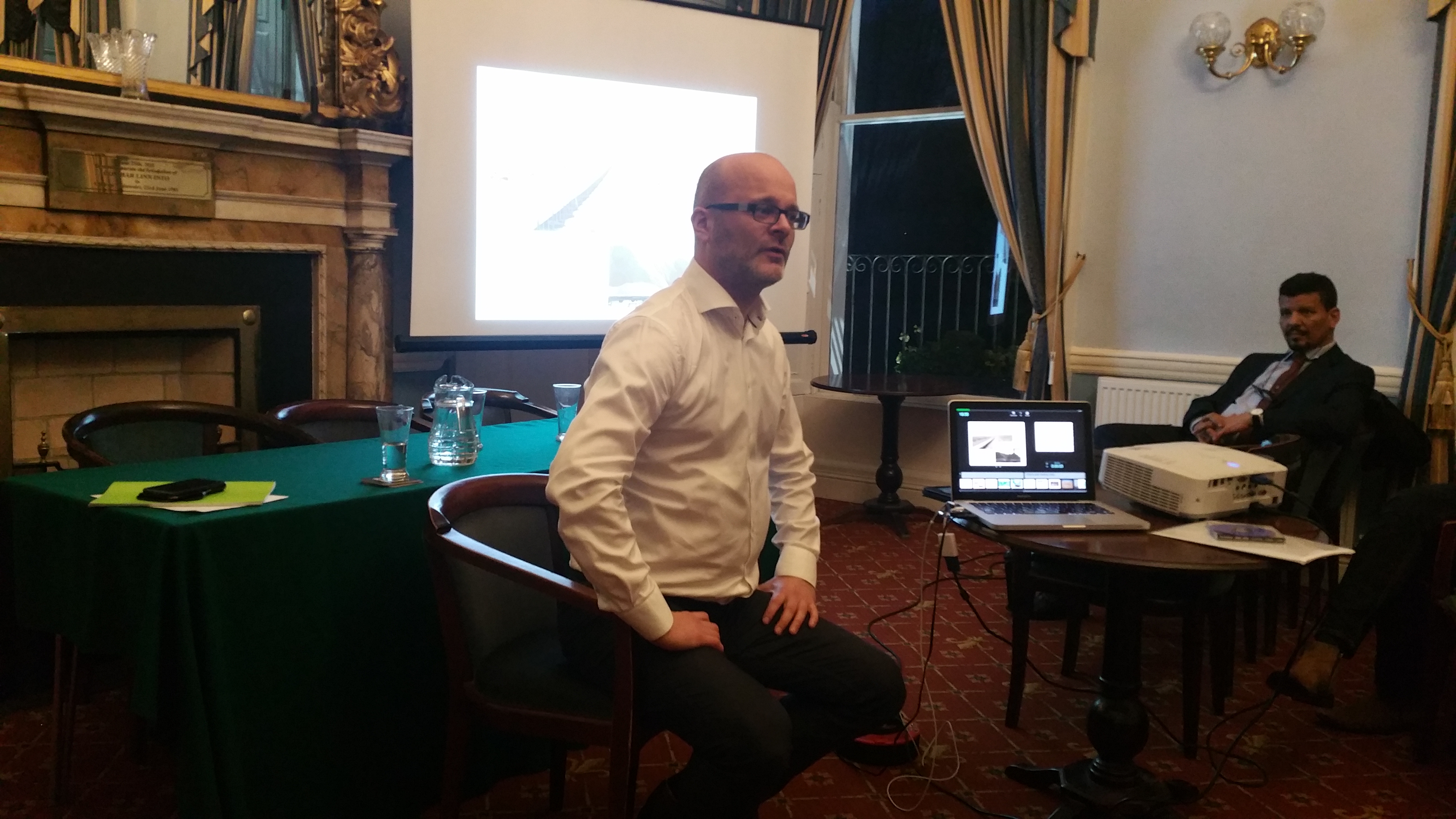
Mark Hagen, of Western Sahara Resources Watch.
(Photo: D.Breatnach)

SOLIDARITY IN DUBLIN

          In conclusion of the speakers’ presentations, Mohamed Belsat asked for support from the Irish people with their “history of struggle for freedom and solidarity with other struggling nations”

A couple of members of the audience mentioned that there had been an active solidarity committee with Western Sahara in Dublin in the past and one wondered about the possibility of resuscitating it.

Comment: The solidarity Committee in Dublin was independent of any political party or organisation, its name was Western Sahara Action Ireland and its FB page is still in existence. Between 2011 and 2012, the group organised a number of public events, including: two protests about Moroccan repression of Saharawi protesters, one in Dame Street and another in O’Connell Street; a protest against the EU’s Fisheries Agreement outside the Dublin offices of the EU in Dawson Street; the construction and maintenance of a “Western Sahara Tent” at the Electric Picnic of 2012, along with an exhibition of photographs taken in the territory. The latter was visited by Michael O’Higgins who was then campaigning for the Presidency of Ireland (he also appeared in the film shown at the beginning of public meeting in Dublin).

On each of the Dublin street events, a small group of Moroccans had attended to harass and attempt to intimidate the protesters, almost certainly sent by the Moroccan Embassy but their efforts were to no avail.

Flag of the Western Sahara liberation movement.
(Photo source: Western Sahara Action Ireland)

BACKGROUND

          There had been many uprisings against colonial rule in the history of Western Sahara and the last Rif War, from 1920 to 1927, had cost the Spanish State military 23,000 casualties, of which 18,000 were fatalities. Only for the intervention of the French1, the forces led by Abd el Krim would have kicked the Spanish colonialists out of the footholds to which they were still clinging.2

Like the French in their North African colonies, the Spanish occupiers had suppressed risings not only by military force against insurgents and torture of captives, including electric shocks, but also by terror against the civilian population, including assassinations, massacres, rape and internment without trial.

Both European states also developed their own Foreign Legions. Forget about the 1924 Beau Geste novel by PC Wren and the various screenplays3 to which it gave rise; the Foreign Legions were tough terrorists in uniform, founded not to fight in open war but against resisting colonial peoples.

Since 1963, Western Sahara has been on the United Nations’ list of “non self-governing nations”.  In 1965, the UN General Assembly, in its first declaration on Western Sahara, called on the Spanish State to decolonise the territory and, in 1967, to hold a referendum on self-determination but Spain refused. From 1973 to 1975, the Frente Polisario fought an armed struggle for national liberation.
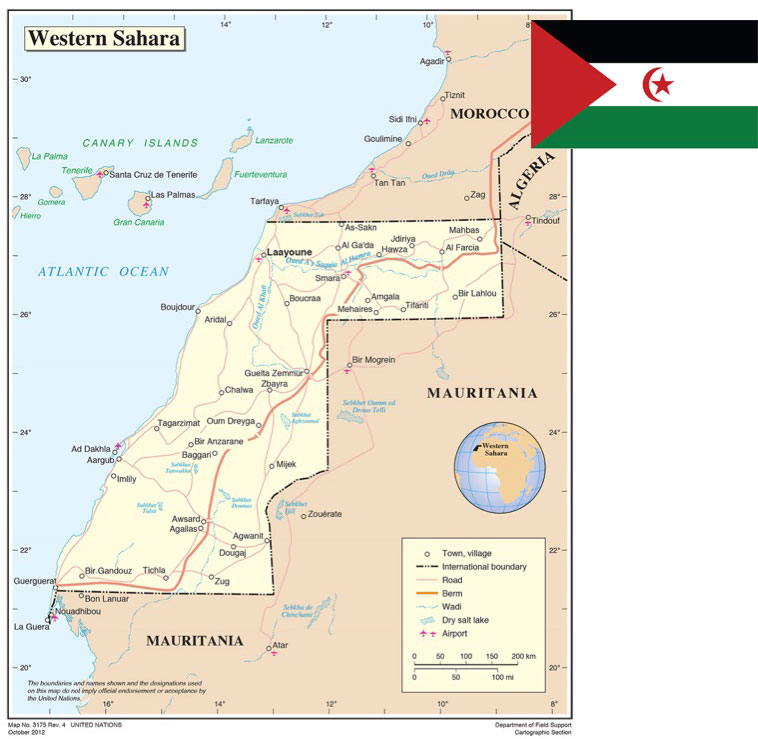
Western Sahara in context. (Source image: Internet)

After the Spanish State abruptly pulled out in 1975 (following the death of its fascist dictator General Franco) and – without allowing elections of an independent Saharawi government before doing so – it relinquished control to the Kingdom of Morocco (which had formally claimed the territory since 1957) and Mauritania and conflict broke out between those states. Mauritania in time abandoned its claim and Morocco moved in and seized Western Sahara.

The Saharawi people protested Morocco’s occupation of their land and were suppressed by military and police. The Frente Polisario fought the occupying Moroccan military from 1975 until a UN-brokered ceasefire in 1991, since which there has been no Saharawi armed struggle but plenty of Moroccan repression. One of the features of the struggle was the displacement of a large part of the Saharawi population as people fled the Moroccan military, many to Algeria (which had won independence from France in 1962 after a fierce and dirty war), where they remain in a refugee camp. The Moroccan Kingdom then built a wall to prevent Saharawis from returning, which it guards by troops and miles of landmines.

End.

FOOTNOTES

1The casualties of the French, according to Wikipedia, amounted to 10,000 with 2,500 killed in battle. The casualties of the insurgents and of the indigenous civilian population, as usual in these situations, is difficult to determine but, according to Wikipedia, came to 30,000, of which 10,000 were fatalities.

2For more on the Rif War 1920, read the article about it (see link in Resources and Useful Links).

3Including those of 1939 starring Gary Cooper and Ray Miland, 1966 with Telly Savalas and Doug McClure and the BBC serial of 1982.


REFERENCES AND USEFUL LINKS

Sahara Press Service: https://www.spsrasd.info/news/en

Western Sahara Resources Watch: https://www.wsrw.org/

Western Sahara Action Ireland facebook page (please bear in mind that at the time of writing this group is not active): https://www.facebook.com/groups/256377861125569/

Article on the Rif War 1920 by me: https://rebelbreeze.wordpress.com/2018/08/09/an-old-war-with-a-lesson-for-today/

Recent Amnesty International report on Western Sahara under Moroccan rule: https://www.refworld.org/docid/5a9938ac4.html
 

DUBLIN PICKET AGAINST INTERNMENT COMMEMORATES HUNGER STRIKERS

With thanks from Dublin Anti-Internment Committee’s FB page End Internment

DUBLIN PICKET PROTESTS CONTINUING INTERNMENT IN IRELAND WHILE EXPRESSING INTERNATIONALIST SOLIDARITY WITH PALESTINIAN PRISONERS.

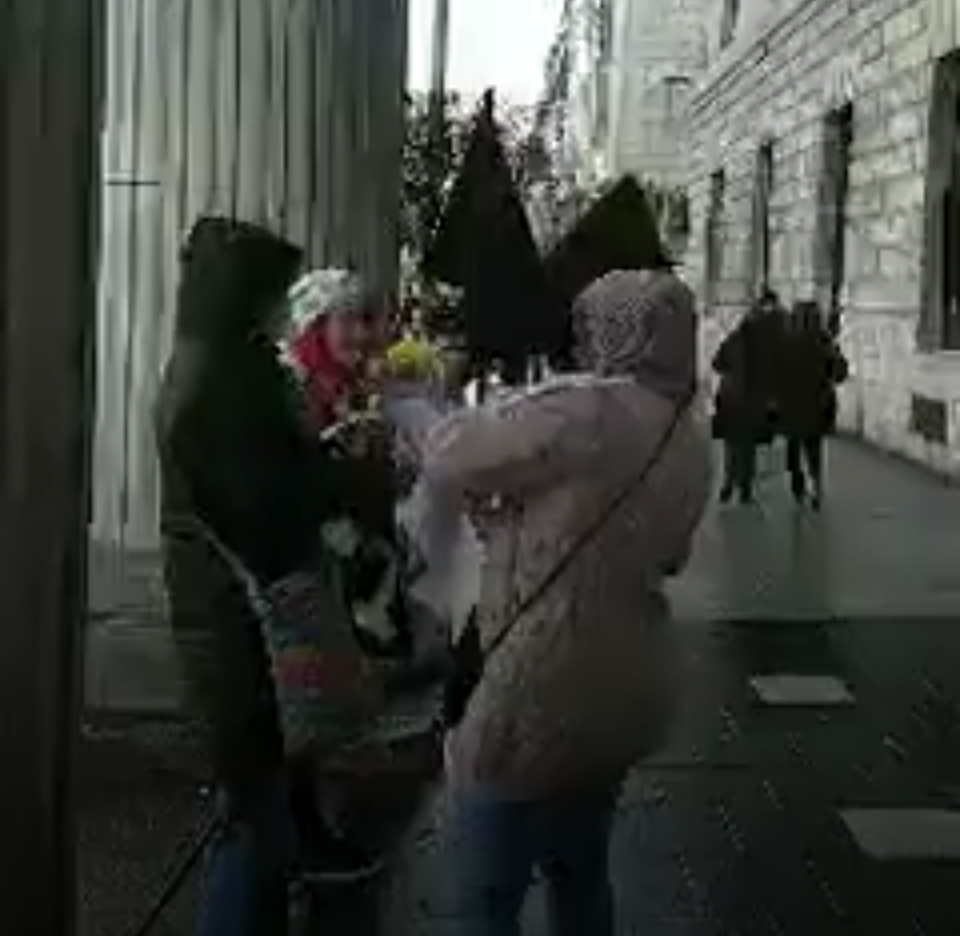
PALESTINIAN Y0UNG WOMAN PRESENTS PICKETERS WITH BUQUET OF FLOWERS.

HUNGER STRIKER MARTYRS OF 1981 REMEMBERED.

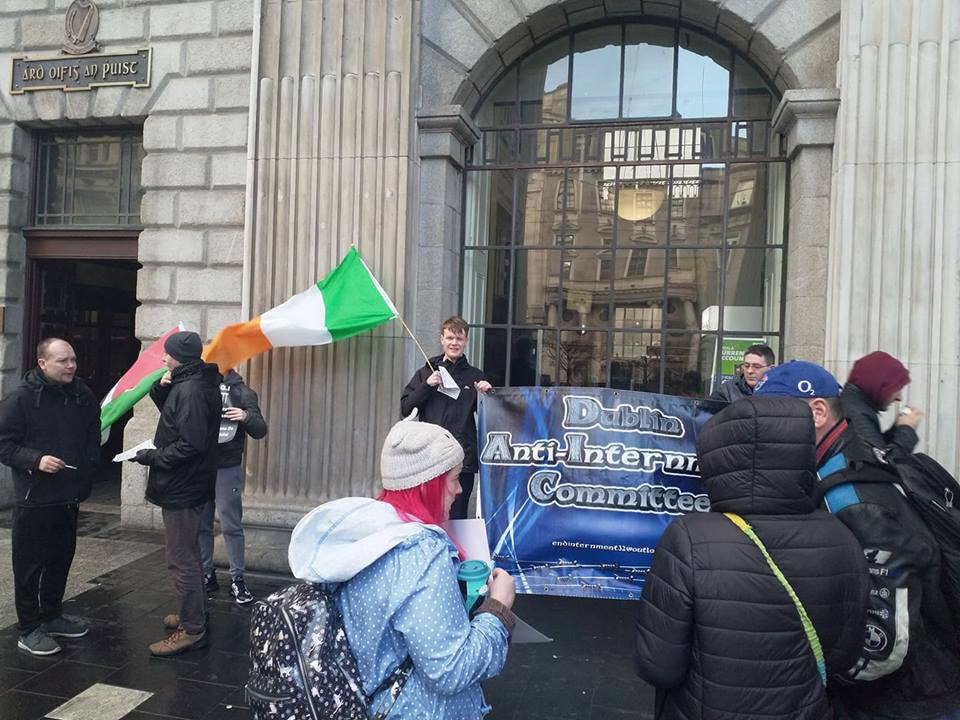
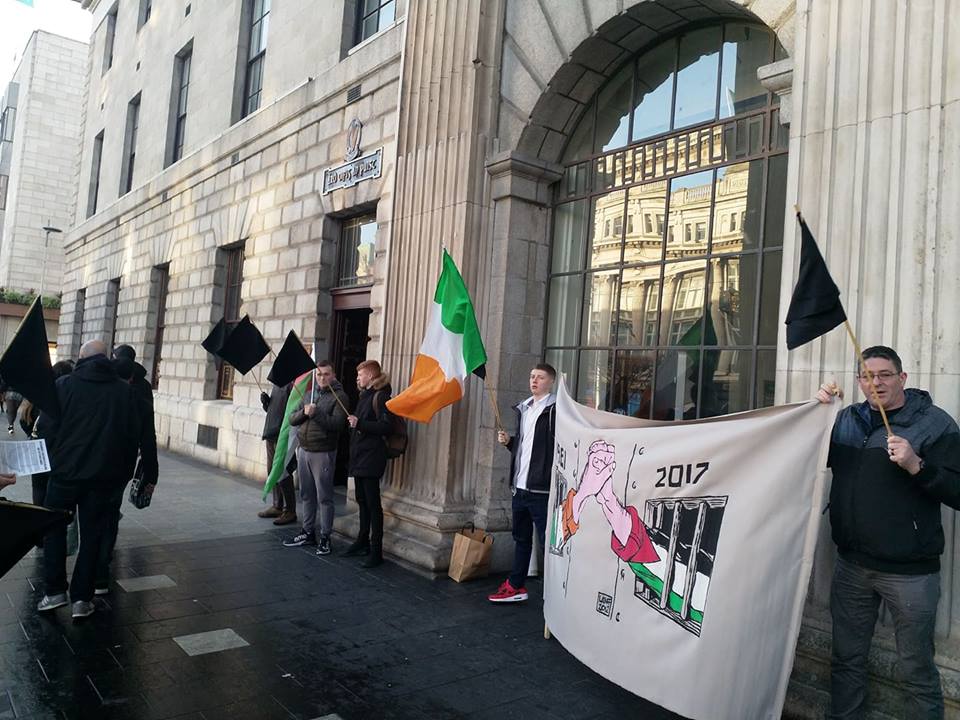
Section of the protest outside the GPO building (photo: Dublin Anti-Internment Committee)

On a cold and wet late Saturday afternoon (2/03/2019) in Dublin city’s main thoroughfare, O’Connel Street, hurrying shoppers and tourists were treated to the sight of protesters outside the General Post Office. One group was flying small flags of a green, white and orange tricolour but not the Irish one – the colour bands were horizontal.

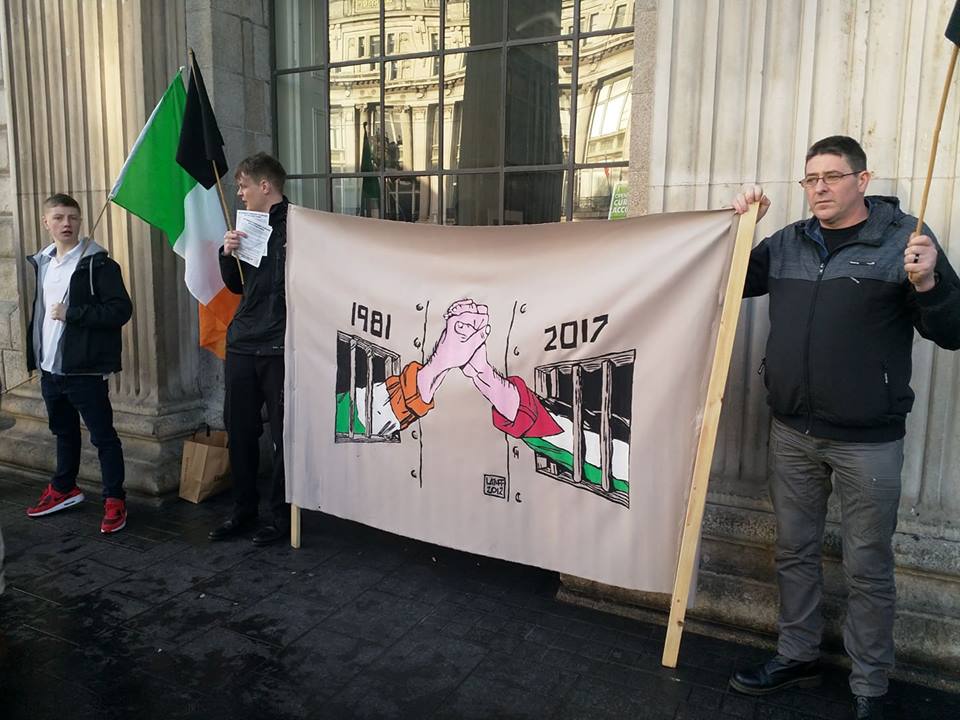
The other group flew a larger tricolour, the Irish national flag, the colours horizontal – and also a Palestinian flag. One of their banners was an enlargement of the cartoon by Brazilian graphic artist Carlos Latuff , showing an Irish hand reaching through prison bars to clasp that of a Palestinian, also emerging through bars.

The first group was of Indians in a protest related to the current tensions between the states of Pakistan and India, while the other had been organised by the Dublin Anti-Internment Committee and was supported by other Republicans and unaligned socialists. The presence of both outside the GPO was a coincidence and they were separated by a little distance.


INTERNMENT WITHOUT TRIAL CONTINUES IN IRELAND

One of the monthly pickets of the DAI Committee to raise awareness of the ongoing internment in Ireland, the picketers combined their action with expressing solidarity with Palestinian political prisoners of which many are held without charge, in “administrative detention”.

The banner depicting Irish and Palestinian political prisoner solidarity, from a cartoon by Latuff.
(photo: Dublin Anti-Internment Committee)

In Ireland, there are other kinds of “administrative detention” but they are not called that; instead they go under the names of “revoking of licence” and “refusal of bail”.

The first category relates only to the occupied Six Counties, where those political prisoners were released under the terms of the Good Friday Agreement; however their licence may be revoked at any time in which case the unfortunate person will be brought straight to jail without trial and held there indefinitely. This has been the fate of a number of former prisoners who remain Republican activists. One of those, Tony Taylor, was released without charge at the end of November last year, having spent nearly a thousand days in custody.

The second category and by far the most common, both in the British colony and the Irish state, is that of refusing bail to Irish Republicans while they await trial on as yet unproven charges. In these circumstances the accused, if judged “not guilty” at their trial, may have spent more than two years in prison by that time. A recent example of refusal of bail was that of Republican activist Alan Lundy arrested for alleged armed burglary on 18th February, despite an alibi apparently confirmed by CCTV footage placing him 40 miles away at the time and highly contradictory evidence from the alleged victims.

The intention of these totally undemocratic measures is an attack on the basic civil rights of Republicans to peacefully organise and to assemble in protest. When bail is granted, the intention is made clear since regularly the conditions attached are that the accused wear an electronic tag, may not participate in political meetings or demonstrations and must observe a curfew. Furthermore, the accused are brought before the no-jury Special Courts of both administrations, where special rules of “evidence” apply.

The Dublin Anti-Internment Committee maintains that these measures amount to internment without trial, a continuation of the policy in which courts are used, as Brigadier Kitson of the British Army proudly declared, as “a propaganda cover for the removal of unwanted members of the public”.

The Dublin Committee has also repeatedly pointed out that these measures are a danger to the civil rights of any and all movements of opposition to the State or its policies and should therefore be opposed by all democratic people, whatever their particular political alignment might be.

The solidarity bouquet (photo: Dublin Anti-Internment Committee)

FLOWERS PRESENTED FOR SOLIDARITY

The picketers distributed leaflets to passers-by, some of which took photographs. Two young women who had taken photographs returned a second time, one of them presenting a bouquet of flowers to the surprised protesters. She said that she was doing so in gratitude for she was of Palestinian backround.

Palestinian young woman presenting the flowers to picketers.
(photo: Dublin Anti-Internment Committee)

There are approaching 5,000 Palestinian political prisoners in Israeli jails, of which around 170 are held without trial, in “administrative detention”.

REMEMBERING THE HUNGER STRIKES

At a certain point during the event, the picketers took up black flags and displayed them until the end of the event in remembrance of the ten dead hunger-strikers of 1981 (seven Provisional IRA and three INLA). March 1st was the anniversary of the first day of the hunger strikes of that year fighting British attempts to paint them as criminals, when Bobby Sands embarked on his 66 days of hunger, the first of ten Republican political prisoners to give their lives. Bobby Sands, revolutionary and poet, died on May 5th and over 100,000 people lined the route of his funeral in Belfast, protests took place throughout much of the world and official marks of respect were given, including a statement of solidarity by Palestinian prisoners of the Israeli State. During his hunger strike Bobby Sands had been elected an MP to the British Parliament and two more, Kieran Doherty and Paddy Agnew, were elected members of the Dáil (Irish Parliament) in Cavan-Monaghan, while Joe McDonnell was narrowly defeated in the Sligo-Leitrim constituency.

These events had long term effects even in electoral politics. The British changed electoral law to prevent prisoners ever being elected again (Representation of the People Act 1981), Sinn Féin became a predominantly constitutional party and every Irish Government since 1981 has been a coalition of some kind.

A chríoch.

Another view of a section of the picketers.
(photo: Dublin Anti-Internment Committee)


Short video clip here:https://www.facebook.com/581232915354743/videos/319325982052745/

THE FIRST AND LAST WORDS

View Post

Diarmuid Breatnach

(Reading time: 5 mins)

The Basques have a saying in their language which means “The first and last words in Euskera” (Basque language: “Lehen eta azken hitzak euskeraz”). The Irish would do well to adopt the slogan or dictum for their own: “Na céad focail agus na focail deiridh i nGaeilge”.

The Basques developed their slogan (the word is from the Irish, slua-ghairm: to call the crowd/ multitude/ troop) in their movement to conserve their native language and spread it among those who had lost it. The Basque homeland (certainly once larger than it is now) is today situated on the north-west of the Spanish state and the south-west of the French one. Their language is considered an older arrival than all other languages extant upon the continent, to be not of Indo-European origin and so not of the same family group as any of the nearby Romance languages: Galician, Asturian, Castillian, Languedoc (Occitan), French, Catalan.

Within the territories they control, Spanish and French state administrations have dominated and suppressed all the languages other than respectively Castillian and French; they have done so through official disregard, censure, shaming, even physical punishment and jail. But the Basques have struggled to keep their language alive and to spread it among those who have lost it. And they have been much more successful at doing so than we Irish have at doing the same thing with an Ghaeilge. The Catalans have done even better yet, certainly in Catalunya itself1.

So, why the slogan of “first and last words in Euskera” and what happens in-between? Is it intended like the “cúpla focal” (“couple of words”) of Irish politicians (and increasingly, not even that many), a kind of mini-lip-service? Not at all, its intention is restorative towards the language and is a practical measure which anyone can adopt — indeed we in Ireland should embrace it for our own language.

Dia dhuit

When we meet someone, we greet them and, in Ireland, the majority of us do so in English. Having done so, the rest of the conversation is likely to continue in English too. Taking our leave of them, naturally, we tend to do so in English also.

The impression on anyone within hearing of this exchange and so many like it is that Irish does not exist or, if it does, hardly anyone in Ireland knows it or, if they do, don’t use it in their daily life. Not far from the truth, one might comment. Indeed but the reality is that a lot more know the language (or some of it at least) than one might think.

Let’s return to that interaction touched upon earlier, when one person meets another. It could be a customer in a bar, restaurant or shop. One of them says “Hello”, the other replies likewise and from there onwards the verbal communication is all in English. Or another scenario, a friend or acquaintance of one, introduces another in English and both who are strangers proceed in English also.

Introductions (Source photo: Internet)

Perhaps the customer and the shop assistant, waiter or bartender in the first example were fluent Irish-speakers or at least competent – none knows this about the other and they continue in the dominant language, English; each may return home later without having spoken a word of Irish that day. The strangers being introduced to one another by a mutual acquaintance, perhaps at work on in a social setting, may have a similar experience.

THE FIRST WORDS

Suppose that instead the customer or person being introduced had greeted in Irish? The recipient of the greeting now has the choice, assuming some knowledge of the language, to respond likewise. Should this occur, they can now proceed to the limits of their knowledge of the language or of the situation in which they find themselves. Other factors govern the choice being made but we can discuss those later.

What of the impression on those others within hearing? They might be surprised or even astonished, impressed or embarrassed; however everyone is reminded that Irish exists, that it is a medium of verbal communication and that some people in Ireland use it, even outside the shrinking Irish-language reserves.

Gloine, le do thoill (Source photo: Internet)

Of course, that was perhaps only two people heard speaking it in a whole month or even a year. But what if more people did the same? Why, some of those who overhear might even adopt the same habit, na céad focail in nGaeilge! Gradually at first and then suddenly, everybody would seem to be greeting in Irish! Why, it might even be worth learning a little oneself! At least enough to reply and take the conversation a sentence or two forward ….

In addition, sometimes the experience flushes out other Irish speakers too. On the top deck of a bus heading into the city centre one day, I could hear some young lads at the back of the bus (where else!) speaking in Irish. I could tell that they were not fluent but one at least was doing reasonably well. As they passed me to get off in Sráid Uí Chonaill, I remarked in Irish to them that it was great to hear the language being spoken in public. While they stumbled over a reply to me, the man across the aisle from me addressed them also, in fluent Ulster Irish. What an experience that must have been for the young lads but certainly for us, two Irish speakers a few feet away from one another and totally unaware, until that moment, of the other’s existence.

On another occasion at a demonstration in Dublin, I and another holding a banner between us were conversing in Irish – loudly as of necessity. Ahead of us, another group began to call back in Irish too. Spreagann Gaeilge Gaeilge, commented the comrade on the other end of our banner (“Irish [language] inspires Irish”).

AND THE LAST WORDS

What about the last words being in Irish – just a courtesy or a whim of some kind? Well, imagine one greeted the stranger, shop assistant, waiter or bartender in Irish and the reply came in English (which at the moment would probably be the case)? Thereafter the conversation flows in English but, as the Irish speaker is leaving, she says “Slán”. By now, the other has recovered a little from being somewhat wrong-footed by being addressed in Irish and furthermore, since the customer is leaving, is not worried about exposing what he considers to be his shamefully little knowledge of the language, so he replies also in Irish, “Slán”.

Slán!

Of course, that situation was not momentous for the survival of the language but neither was it totally negative. The Irish speaker draws a little comfort from it. The other feels perhaps a little pride, is maybe even encouraged to respond in Irish should he see that person again or if some other addresses him in Irish. How hard can that be? He’d do it in Greek in Crete, in Spanish in Torremolinos or in Cancun, even though all he has is a few phrases from the tourist guidebook.

SHAME

Of course, it is not the same. In the first place, the linguistic environment in Greece is Greek, in Torremolinos and Cancun, Spanish. Even migrant workers there will have learned the language. Not everyone around one in Ireland is speaking Irish in public, in fact, in most places, almost no-one is.

Secondly, there is no expectation of the English-speaker to be fluent in Greek or in Spanish. No expectation that the Irish person can speak Irish either, one might think. But actually, there kind of is. Inside the head of every Irish person there is the knowledge that this is their language and a feeling, buried deeply or lightly, that perhaps they should be able to speak it.

This feeling or knowledge can manifest itself in a reluctance to expose one’s limited knowledge of Irish to the perverse but understandable extent of refusing to speak it at all. Or of responding aggressively. Those are possible outcomes but so are more positive ones.

A person who has very little Irish may think: “But if I reply ‘Dia’s Muire dhuit’ and she lets loose with a flood of Irish, I won’t know what she’s saying and I’ll be mortified! Better to say nothing at all and not be so ashamed.” Of course, that is one choice. But it is not the only possible one. He could, instead, after she spoke to him some sentences in Irish he did not understand, reply in a sentence learned off by heart: “Gabh mo leithscéil ach níl ach cúpla focal agam” (“Excuse me, I have but a few words”). She might in turn reply: “Go raibh maith agat, úsáid a bhfuil agat” (“Thanks, use what you have”).

And why should the initiative be only with the person fluent in Irish? The person who knows only a few words is just as capable of making greetings and farewells in Irish — in fact I would go further and say that the language needs them to do that, to make that the norm.

In those kinds of exchanges, there will be a positive outcome for each participant. Not a huge step forward for the language in general but for anyone overhearing, a reminder that the Irish language does exist and perhaps that in this case, a person who did not seem know it well, still chose to learn a few words and use them. All of that goes to the credit side of the ledger in the psychological struggle for the maintenance and restoration of Irish.

IMPOLITE

An issue that is often raised with regard to speaking in Irish in the company of non-speakers, is one of politeness. It is generally considered rude to speak in a language that other people in the company do not understand. Strangely enough, people tend to think that more about people speaking Irish in Ireland than they do about people speaking French, German or Spanish among themselves here.

The issue must be faced. Neither of those languages is in any danger but Irish is – and in serious danger. Despite the growth of nurseries, primary and some secondary schools teaching through Irish, the actual daily use of the language is in decline. And the Gaeltachtanna — those areas where the language of the home has always been Irish – are shrinking at an alarming rate.

We need to find social strategies for linguistically-mixed company, whether it be occasional translation for the non-Irish speakers, or the tolerance of the latter – or conversing parts in Irish and parts in English. For the sake of the language we cannot allow the rules of politeness to deprive us of every social occasion to speak in the language other than some tiny domains hidden away somewhere, small groups of us meeting like conspirators in places where we are unlikely to meet anyone we know.

Another issue often raised is related to foreigners, whether they be migrants or visitors. I would say that the same rules apply. Most of those have their own language as well and speak it among themselves, in public too. And they must surely wonder why we don’t speak our own. The children of migrants are learning Irish at school and many are competent, some fluent in it. Some of their parents know a few words too: a Nepalese in a bar serves me through Irish and a Pakistani in a shop thanks me or tells me I am welcome, in Irish also.

SMALL STEPS

In the public library, you may wish to greet in Irish and hand the returned books towards them saying: “Isteach”; the likelihood of you being misunderstood is minimal. Then, with the books you are borrowing, “Amach”. In the Post Office, you can ask for “Stampa i gcóir Sasana, le do thoill” or “Stampa i gcóir na hEorpa”. To the question “Payment by cash or card?” when you present your utility bill, you may wish to show notes and reply “Le h-airgead” or, displaying your card, “Le cárta”. “Do you want a bag?” “Níl, go raibh maith agat”, with a shake of the head. Leaving the bus or the taxi, you could say: “Go raibh maith agat, slán”. Sometimes, you will hear a reply in Irish and it will probably lift your heart a little. And the world around you will hear a little too …. and wonder.

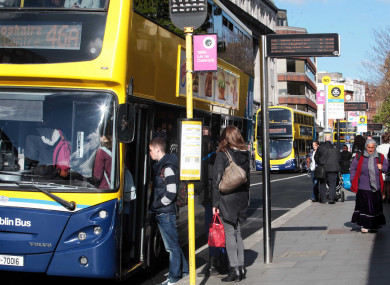
“Dia duit/ Sé do bheatha” — Passengers getting on a bus in Dublin (Photo credit: Leah Farrell, Rolling News)

None of that on its own, of course, will save the Irish language. But I think it will help. And now, on the crest of a small wave, might be a good time to do it: when the number and percentage of students attending all-Irish language schools is at an all-time high; when a survey of third-level students, whatever their feelings about how it was taught, show a majority supporting the retention of Irish as a compulsory subject on the curriculum. However, studies in the 1980s revealed a pattern of fall-off in Irish competency outside the Gaeltachts as the years went by; they need an environment encouraging the regular use of the language – use it or lose it.

The pro-independence political parties in the southern Basque Country make their public speeches either totally in Euskera or bilingually, in Euskera and Castillian. It is the same with the majority Basque trade unions. Also with the feminist and environmental movements, those against repression, against animal abuse, etc. In their public discourse, all organisations and parties in Catalunya that are not specifically Spanish-unionist (and even some of those), use Catalan first in public and Castillian secondly, if at all.

None of Ireland’s political parties (mainstream or oppositional), trade unions or campaigns (other than those specifically for the language) does anything much to promote the Irish language and some are hostile to it. That means it is up to us as individuals – everything we do for it can help at least a little.

So, as the Basques say, the first and last words in the language.

Do ye likewise; go out and multiply.

End.

FOOTNOTES:

1Catalan is spoken elsewhere than in Catalunya, for example in the Paisos Catalans (“Catalan Countries”) such as Valencia and the Balearic Islands, where it is not as strong as it is currently in Catalunya, also in part of Sardinia.

SOURCES AND REFERENCES:

Statistics on Irish-immersion education as of 2018: https://en.wikipedia.org/wiki/Gaelscoil

2019: https://www.irishtimes.com/news/education/number-of-primary-school-pupils-taught-through-irish-at-record-level-1.4011570

Plans to double number of Gaelscoileanna in the state: https://www.irishtimes.com/news/education/plan-to-double-number-of-pupils-in-irish-speaking-schools-1.4127379

Majority second-level students support retention of compulsory Irish on curriculum (but will they use it outside school?): https://www.breakingnews.ie/ireland/majority-of-third-level-students-support-irish-remaining-a-compulsory-subject-1096298.html

IRISH YELLOW VESTS AND QUESTIONS

Diarmuid Breatnach

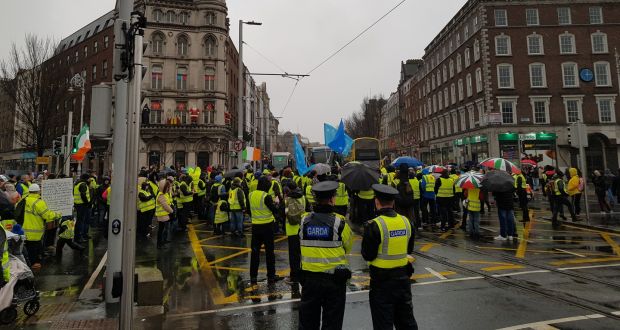
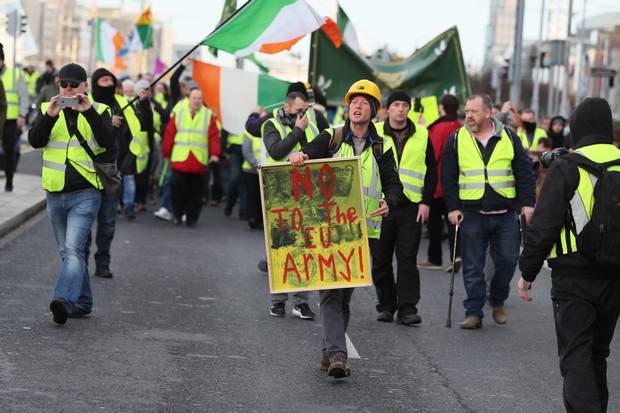
Recently a number of people have been marching in Dublin, saying that they are the Yellow Vests of Ireland. This is obviously inspired by the Gilets Jaunes (“Yellow Vests”) whose protests against the French Government began in November last year and swelled to huge numbers in Paris demonstrations and riots. Some smaller groups have announced their formation in different parts of Ireland too.  But there are questions concerning them.

Irish Yellow Vest protest crossing O’Connell Bridge 15 December 2019.
(Photo source: Internet)

          The Yellow Vests in Dublin have been meeting on Saturday afternoons at the Custom House and marching from there. I am busy on Saturdays and on the one day I made the time to join them, I did not find them and learned later from their posts that on that occasion they had gone to Dublin Port and apparently blocked the approach road for a period.

Originally the organisers stated that there would be no leaders but then two emerged, Glen Miller and Ben Gilroy. Until last week Gilroy was serving three months for contempt of court, a sentence imposed by a judge when he learned that Gilroy had not completed the community service sentence imposed for a previous contempt of court. Held in contempt of court a number of times Gilroy has always apologised afterwards and had his contempt considered “purged”, i.e cleared. It seems that the judge in this case decided that Gilroy was playing games with the court around the issue of contempt, which is probably a fair assumption (which is not at all to say that such actions are wrong).

Gilroy took a case to the High Court alleging failure to comply with certain legal requirement and on February 4th the Judge granted him liberty on bail in his own recognisance (i.e his own financial bond) while is case was discussed and decided. However this week the Judge ruled that his imprisonment was not unlawful and revoked Gilroy’s bail, which meant he had to return to jail.

In recent years a number of groups have sprung up which oppose a number of unpopular legal procedures, for example evictions, by a mixture of physical obstruction (by numbers of people) to bailiffs but also by appealing to what they claim are laws that take precedence over the legal procedures they are confronting. The “Land League” is one of these (no organic relationship to the 19th Century Irish organisation of Davitt and Parnell) and, not unrelated to the “League” in its reliance on arcane laws and procedures, real or imagined, is the Sovereign Movement, the “Irish Republican Brotherhood” (again, despite their claim of “inheritance”, no organic relationship to the 19th and 20th Century organisation) and the Fremen.

While some people are impressed by these arcane legalisms others are bewildered by or scornful of them and, despite their claims, these organisations seem unable to point to where their legalisms have actually been ultimately successful. They have certainly succeeded in slowing down such actions as repossessions and evictions by taking up court time and numbers turning up to block an eviction will often succeed in delaying the process, without any need to appeal to any kind of legalistic underpinning. Property rights reign supreme under capitalism and certainly the Irish state is no exception to that rule; on the other hand the authorities in the Irish state tend to prefer to carry out the normal business of capitalism with as little confrontation as possible.

Summoning numbers to block or delay an eviction and to support a victim of the system in court are of course tactics of struggle honoured by time and usage in Ireland, whether against the British administration or that of the Irish State. Such reliance on mobilisation of numbers can sometimes produce small or partial victories but they hint at something else – the mass mobilisation of insurrection and revolution. And that is part of the appeal of groups such as the “Land League” and probably in part of the Yellow Vests.

Section of Irish Vest protest Dublin 22 December 2019.
(Photo source: Internet)

But if insurrection and revolution are hinted at, we need to know whether the hints are in earnest. Calling for a general election, one of the demands of the Yellow Vests, hardly seems insurrectionary. How would that change anything? Calling for an end to a number of attacks on working people including evictions is good but how is it to be achieved? Is there an objective of overthrowing capitalism and imperialism in Ireland? We do not hear so if there is. If an insurrection is hinted at, by whom is it to be and for whom?

RACISM

          It is here that we run into a disturbing problem: racism, of which Gilroy and Miller have both been accused. Any movement or organisation led by racists is not going to be one for progressive change in society, let alone a socialist insurrection but worse – it is likely to be a breeding ground for fascism. And of late, fascist forces are gathering throughout most of the world and certainly in Europe. Capitalism is struggling and the workers must be made to pay the cost through keeping wages and social expenditure down and profits high. When persuasion and collaborationist workers’ leaderships are no longer effective, capitalism must fall back on naked force. Fascist movements are the frontline of that force, its leading edge and racism (or religious sectarianism, with which we in Ireland have more experience) is used to divide the lower classes, the ones that will be made to pay.

Of course not all the people supporting the Yellow Vests are racist but when an anti-immigration banner is tolerated on a march1 then it would be remarkable if racism were not being tolerated as well. And with regard to the leadership, Glen Miller’s racism is well established from his posts on social media. He has posted material against immigration, against Muslims, against Travellers and against lesbian, gay and transgender people – classical minority targets of fascism to split the working people. He also shares racist material by others including Tommy Robinson, a fascist public figure operating in England.

Gilroy is not usually so glaringly racist but he has certainly posted an islamophobic rant on social media.

One might argue that Islam is a religion and that being against it is not racism. Perhaps not, if one were against all religion, for example. But ethnicity and religious belief or organisation are often interconnected, at least in particular periods and societies. Most muslims are not white European. And the Irish certainly know from their own experience how easily anti-Catholicism became conflated with anti-Irishness, in Britain for example, in the USA (think of WASPS and the ‘Nativists’) and in Ireland under colonial rule.

Islamophobes fantasise about Moslems taking over the country, anti-immigrationists fantasise about immigrants taking over the country, racists fantasise about non-Europeans taking over the country. There are nuances between them but in the end do they matter that much? The effect is the same: society is portrayed as divided by ethnic origin rather than by class and the focus is diverted from the bankers, gombeen capitalists and their political servants an on to migrants instead.

It might be argued that “looking after our own first” is a natural outlook and not racist. But we need to look at where that comes from and where it leads. It starts from the false premise that there is a great shortage and that we should divide those scarce resources first among the Irish. But in fact there is sufficient wealth produced in Ireland to fund all the education, housing and healthcare needs of all the people, immigrants included. And this is because the wealth is produced by working people – including migrants. The problem for us all is that that huge portions of that wealth is being diverted to fund the market gambling, lifestyles and financial empires of Gombeen (Irish capitalists) and foreign capitalists and bankers. Those are the people who would be rubbing their hands with glee or happily exchanging bribes and payoffs if, instead of uniting to confront them, the workers began to fight amongst themselves, divided by race or religion.

When the 1916 Proclamation declared the objective of the insurgents to “pursue the happiness and prosperity of the whole nation ….oblivious of the differences carefully fostered by an alien government, which have divided the minority from the majority in the past”, it was addressing in part that religious sectarianism by which England had restrained the descendants of its colonists from overthrowing its colonial rule and also the pitting of Protestant against Catholic workers, a division which had been played out before 1916 and was to be enacted to even worse degree later. The “Protestants” were the “immigrants” of those years, along with their descendants2, albeit a privileged minority which migrants rarely are.

In making that statement, the insurgents of 1916 were drawing on an Irish revolutionary tradition stretching back to the United Irish of the 1790s and early 1800s, of the likes of Wolfe Tone, Henry Joy McCracken and Robert Emmett. It was a tradition that ran through every revolutionary movement in Ireland since that time, through the Young Irelanders, the Fenians, the Volunteers and the Irish Citizen Army, a tradition that called for overcoming differences to build unity against the common enemy. That is the unity that fascists and racists seek to shatter.

Fascists may and often do verbally castigate capitalist governments, politicians, industrialists and bankers. But they end up serving them. They split the mass of the working and lower middle classes on the basis of race, they attack the defence organisations of the working class, they target other groups such as gay and lesbians, push women into the most subservient roles possible. The Nazis were “National Socialists” and part of their movement talked about nationalising industry under workers’ control. But they were backed by big capitalists such as Thyssen, Krupp and IG Farben and many others in Germany. In the USA and in Britain they were backed by Henry Ford and promoted by Viscounts Northcliffe and Rothermere, owners of the Daily Mail (until England declared war on Germany and the US entered WWII on the Allied side). The Nazis in Germany took over the trade union offices on Mayday and closed them down, forcing workers instead to join fascist unions controlled from the top, part of the State.

WHAT KIND OF UNITY?

          It is interesting that while fascists divide the working people in order to facilitate their control and undermine the struggles against the capitalist class, they often cry for unity. German unity. Aryan unity. White unity. Spanish unity. British unity. Irish unity. And when people have criticised individual leading figures in these groups, in particular recently of the Yellow Vests in Ireland, they have been accused of dividing, of undermining the struggle and calls for “unity” have been raised.

Whether it is right that the court should consider it criminal for someone to hold it up to disrepute, as Gilroy and some others have done on occasion, is another question and whether three months is a reasonable punishment for “contempt of court” in another. The courts are instruments of the State which in turn is an instrument of the ruling class and as such all revolutionaries must perforce hold them in disrepute and, in my opinion, three months in jail is excessive by normal standards in this state. But cries raised by the Irish Yellow Vests against this seek to glorify Gilroy as some kind of “people’s leader” and in turn to promote the ‘Vests’ as a viable resistance movement.

Workers know that unity in struggle is necessary but have also learned over the years that calls for unity may also be used to allow collaborationist trade union leaders and politicians to continue misleading the workers. Such calls can be employed to silence questions about where the movement is going. And now they are being used, unwittingly by some no doubt, to the effect of trying to silence the challenges to such as Gilroy and Miller about their racism and where they are trying to lead the Yellow Vests.

Such calls are being used not only to stifle the criticism of the leaders’ racism but to undermine the criticism of racism itself, as though racism were some kind of Leftie concept or diversion from the real issues. In a post in defence of Gilroy on 18th January, Miller posted a long ‘plain folksy’ discourse in which he said that Gilroy and he have “no time for political correctness and the posh talk”. So according to that discourse we should ignore the accusations of racism, action is needed, and for that we need unity – we should stop bleating on about racism. But the action is often dubious, the destination vague, the unity based on lack of analysis and stifling of criticism and – ultimately – on the opposite of unity, the division of the working people and the undermining of their resistance to those who are the real source of their misery and discontent.

It is not because of the anti-racist or politically-correct posturing of anyone, whether middle class or not, that socialists stand against racism: it is not just because it is inhumane, either; it is primarily because it splits and weakens the working class and diverts anger and resentment from the real enemy.

The Yellow Vests in Ireland are by no means a fascist or even racist movement. But they tolerate racists, are led by racists and could provide a breeding ground for fascists – something for which fascists are always on the lookout.

WHAT TO DO?

          So what should be our response, as socialists of various kinds?

First, I think we need to step back and examine the situation a little. The Yellow Vests here copy the Yellow Vests in Paris. Awhile back, the Socialist parties (I do not count the Labour Party in this) wanted us to copy the Greek uprising and Syriza’s electoral success. Earlier than that, some people wanted us to emulate the Indignados of Spain. And further back still, others sought to copy the Occupation movement of the USA.

It seems to me that all that striving speaks of a desperate need felt by some elements in our society, a need that cries out that something must be done; something to cure the mess that our Gombeen system has made of our health and welfare systems, of the housing crisis, of cuts to other services; that some stand should be made against paying off the bankers’ gambling debts with our hard-earned money and trying to get us to pay a third tax on our water supply when the money collected already has not been used as it should. A feeling that something should be done about the corruption of that give-away of our natural resources, about the selling of our transport, postal, telecommunications systems, about the funding of private landlords, about renewed emigration of our young. About increased hours and travel time spent just trying to stay still economically but nevertheless slipping slowly back. About evictions of people who have paid the actual building cost of their homes a number of times over. About governments that oversee this rotten system, worrying chiefly about staying in government and pleasing native and foreign capitalists; about a police force in which we find an average of a scandal per year with no end in sight and yet happy to repress people’s resistance …. and with their Armed Response Unit cars to be seen everywhere around the city centre.

Those people are right, of course. Something should be done. Something must be done. But what? There’s the rub, as they say. The working class should rise and take power, is the classic revolutionary socialist answer; also of the socialist Republicans, who tie the question to getting rid of British colonialism. Whether our revolutionary socialists in Ireland are actually revolutionary is a good question however, and in any case they are small parties. Whether our socialist Republicans are actually socialists or Republicans first is another interesting question and in any case they are splintered in groups and independents.

All those movements abroad that various people tried to emulate or reproduce here in Ireland did not succeed in changing the situation in their own lands. The USA, the country with the most billionaires in the world (and in politics!), continues to slide towards eventual downfall, in huge debt as a result of funding its military-industrial-financial system, for which billions around the world and millions inside its own borders pay with misery ….. and still the debt cannot be paid. But a huge sub-class exists, often living in city wastelands of run-down housing estates.

The Spanish state continues to squeeze its citizens, prepares to go to war against a nation seeking independence and fascist groups organise openly. Suicides prior to, during or after evictions are no longer startling news.

The Greek Left-coalition government of Syriza collapsed and prostrated itself to the EU and the IMF and schools had to close in winter for lack of heating fuel.

The French Government has alternated repression with some concessions but ultimately nothing has changed.

The growing vacuum of resistance in Ireland will be filled by a revolutionary movement based on working people in militant resistance to – and directed at – the capitalist system. Or it will be filled by fascism.

To build a revolutionary resistance movement, unity in struggle is needed and for that unity, racism must be driven out of the people’s movements. That will not be done by condemnation of racists alone. It will not be achieved only by calling for unity against capitalism. The revolutionary movement must be built and it is by action that it will distinguish itself and attract support from the militant sections of the people.

It is by its revolutionary critical discussion on politics, history, science and culture that it will inform the mass of its potential and necessary objectives.

It will not be built by theoretical declarations or arguments alone, nor by actions that are either timid or cannot be maintained, or by actions of only a few far in advance of the mass. Some of the actions will, perforce be risky and the State will exert a price.

But it is either that or – fascism awaits.

End.

FOOTNOTES

1Reported on at least one of the marches and I have seen a photograph of it

2Some Protestants were descendants of Catholics who had changed their religion to avoid persecution or land confiscation and some Catholics were descendants of Protestants who had converted or who had married a Catholic who raised their children in that faith. But largely, Anglicans, Presbyterians and other Protestant sects in Ireland were descendants of waves of colonists in particular from the 15th Century onwards, while Catholics were largely descendants of the indigenous Irish and of the Norman invaders.

CATALONIA — WHO BEST TO EXPLAIN? QUI ES MEJOR PER EXPLICAR?

Diarmuid Breatnach


Outside of Catalonia or the Paisos Catalans (“Catalan Countries”, which includes the Balearic Islands and Valencia), who best to explain the realities and the controversies concerning the current independence bid of Catalonia? (Version in Castillian follows this one)

There are of course many unionist Spanish commentators but for the most part they rely on denunciation rather than explanation. When they do supply some explanation it either relies on a legalistic explanation of the Spanish State Constitution of 1978 or of a misreading of Catalan society (or both together).

Inside the Spanish State there are other groups which may well provide an adequate explanation, such as for example the Basques, the Galicians and small groups in other parts.

Outside the Spanish State, there are those struggling for the national liberation of other small nations in Europe who may well have studied the Spain-Catalonia question or have quickly informed themselves and, along with them, anti-fascists and revolutionary communists or socialists.

Catalan independence solidarity groups can of course collect accurate information and disseminate it but they are comparatively small and with little influence in the societies around them.

Undoubtedly, the largest and generally best-informed group of people are the Catalan diaspora – Catalans living in other states.

Of course, these Catalans may have a wide range of views among themselves on whether Catalonia would best be independent of the Spanish State, in a federal arrangement or totally independent. They may disagree on which political party is best – or on whether any should be supported. Socialism or not might be issues for discussion, as might whether to get independence first and resolve those other questions later. Even on the issue of whether armed resistance is justified or viable, there might be considerable variation in opinion.

But anyone from Catalonia can give the lie to the Spanish unionist propaganda that the Spanish language and those who use it are under attack in Catalonia, and also to the lie that the Catalan independence movement is of a racist-nationalist kind. Anyone from Catalonia who is being honest will say that the violence of the Spanish police on the day of the Referendum, 1st October 2017, was inexcusable and a crime against civil rights (indeed some Catalans who wanted to vote ‘No’ to independence would now vote ‘Yes’ as a result of that attack). Catalans for ‘Si’ or for ‘No’ can explain many things that are not available to most people outside Catalonia.

Man and child, faces painted in the colours and symbols of the estelada, a pro-Catalan independence flag. (Image source: Internet)

This reservoir of information about the struggle around Catalan independence is the largest outside Catalonia – but is it being used? These Catalans living abroad have partners, children, workmates, fellow-students, neighbours and friends they have met in the country in which they are living. In many states of Europe these Catalans are free from the fear of deportation and therefore free to speak out to those around them about what is happening in Catalonia and in the Spanish state.


AN EXAMPLE

It might be instructive to examine a historical example with some parallels.

In 1968 a struggle broke out in the British colony in Ireland, the Six Counties, as a struggle for civil rights for the Catholic community (mostly descendants of the pre-colonial inhabitants). The British colonial statelet responded with great violence from its armed force, backed up by the British Army and was responded to with armed guerrilla resistance.

It may surprise many to realise that initially, the civil rights struggle often received truthful and even sympathetic coverage in the British media. Once the British army went in, this began to change noticeably and with the first British Army casualties there was no longer any real pretence of unbiassed reporting.

British media reporting then wished not only to justify the actions of the British State to the world but also to its own population. But in the latter case, it faced a serious obstacle – the Irish community in Britain.

As well as being the longest-establish migrant community in Britain, it was by far the largest. Many of these people knew their history and also at least something about conditions in the Six Counties. It was less than 50 years since the creation of the Irish State after a guerrilla war of national liberation following 800 years with many armed uprisings and cruel English repression. And these Irish – including first-generation born in Britain and even second-generation – were capable of undermining the effect of the colonial discourse on partners, friends, work-mates, neighbours and trade-union members.

Old anti-Irish racism embedded in British culture could disturb the Irish diaspora’s counter-discourse but not, it seemed, sufficiently. The Irish not only undermined the State discourse by speaking what they knew to those around them, they also organised solidarity campaigns, held pickets and demonstrations – sometimes huge ones.

The IRA’s bombing campaign in Britain could have weakened the reception for the Irish voice but, though it certainly did it no good, it did not weaken it sufficiently. The British State decided to gag that voice with state terror and prepared legislation, waiting for the appropriate moment to introduce it, which they received with the 1974 massacre resulting from an IRA bomb in a Birmingham pub and problems in communicating a warning.

The Prevention of Terrorism Act was introduced under a Labour Government and passed in a few hours, allegedly as a only a temporary measure but was renewed every year under different party governments until 1989. The Act permitted banning of Irish Republican organisations; 5-day detention without charge (which could also be extended); search without warrant; detention for questioning at airports and ports under which many thousands were interrogated, often missing their flight or boat as a result; deportation; exclusion to the Six Counties (amounting to internal exile). And of course, not officially permitted but tolerated, frame-ups, threats, beatings and torture.

Nearly 20 innocent members of the community and their friends were arrested and framed on bombing-related charges in five different cases and all convicted of murder and terrorism, to spend long years trying to establish their innocence, most of their marriages destroyed, their mental health severely injured, one to die in jail. That, and the ongoing repression of arrests-and-release, raids etc, was enough to silence, for the most part, the Irish community.

Until the Hunger Strikers of 1981 brought them out in mass again.


THE REASON

Why am I telling you this history? To frighten you? To make you feel sorry for the Irish in Britain in those years? No, I am retelling this history to illustrate the potential power of the diaspora to tell the truth about what is happening in its country of origin. That power was so great against the British propaganda machine that the State felt obliged to weaken it, to terrorise the Irish community, to take hostages from it.

Women with faces painted in Catalan national colours, one with the estelada design and the other with the ensenyera
(Photo credit: JOSEP LAGO/AFP/Getty Images)

Today, the Catalan diaspora outside the Spanish state has a similar power but it is not “in the belly of the beast” as the Irish in Britain were nor in most cases is it subject to threat of imprisonment or other state terror.

To have that power implies a responsibility to use it, to explain things to those around them in whichever country they find themselves.


End

(VERSION IN CASTILLIAN FOLLOWS)


Fuera de Cataluña o de los Paisos Catalans (lo cual incluye a las Islas Baleares y Valencia), ¿quiénes son los mejores para explicar las realidades y las controversias sobre la actual candidatura de independencia de Cataluña?

Por supuesto, hay muchos comentaristas españoles unionistas, pero en su mayor parte se basan en la denuncia más que en la explicación. Cuando ofrecen alguna explicación, se basa en una explicación legalista de la Constitución del Estado español de 1978 o en una mala interpretación de la sociedad catalana (o ambas juntas).

Dentro del Estado español hay otros grupos que pueden proporcionar una explicación adecuada, como por ejemplo los vascos, los gallegos y grupos pequeños en otras partes.

Fuera del Estado español, hay quienes luchan por la liberación nacional de otras naciones pequeñas en Europa que bien pudieron haber estudiado la cuestión España-Cataluña o se han informado rápidamente y, junto con ellos, antifascistas y comunistas o socialistas revolucionarios.

Los grupos de solidaridad con la independencia catalana, por supuesto, pueden recopilar información precisa y difundirla, pero son comparativamente pequeños y con poca influencia en las sociedades que los rodean.

Sin lugar a dudas, el grupo de personas más grande y generalmente mejor informado es la diáspora catalana: los catalanes que viven en otros estados.

Some european cities where Catalans may be found
(map source: Internet)

Por supuesto, est@s catalan@s pueden tener una amplia gama de puntos de vista sobre si Cataluña sería mejor independiente del Estado español, en un acuerdo federal o totalmente independiente. Pueden estar en desacuerdo sobre cuál es el mejor partido político, o si se debe apoyar a alguno. El socialismo o no puede ser un tema de discusión, ya sea si obtener la independencia primero y resolver esas otras preguntas más adelante. Incluso en la cuestión de si la resistencia armada es justificada o viable, puede haber una variación considerable en la opinión.

Pero cualquiera de Cataluña puede desmentir a la propaganda sindicalista española de que el idioma español y los que la usan están bajo ataque en Cataluña, y también a la mentira de que el movimiento independentista catalán es de tipo racista-nacionalista. Cualquier persona de Cataluña que sea honesta dirá que la violencia de la policía española el día del Referéndum, el 1 de octubre de 2017, fue inexcusable y un crimen contra los derechos civiles (de hecho, algunos catalanes que querían votar “No” a la independencia ahora votarían “Sí” como resultado de ese ataque). Los catalanes para ‘Si’ o para ‘No’ pueden explicar muchas cosas que no están disponibles para la mayoría de las personas fuera de Cataluña.

Esta reserva de información sobre la lucha en torno a la independencia catalana es la más grande fuera de Cataluña, pero ¿se está utilizando? Est@s catalan@s que viven en el extranjero tienen compañer@s, hij@s, compañer@s de trabajo, compañer@s de estudios, vecin@s y amig@s que han conocido en el país en el que viven. En muchos estados de Europa, est@s catalan@s están libres del temor a la deportación y, por lo tanto, pueden hablar libremente con quienes les rodean sobre lo que está sucediendo en Cataluña y en el Estado español.

UN EJEMPLO

Podría ser instructivo examinar un ejemplo histórico con algunos paralelos.

En 1968 estalló una lucha en la colonia británica en Irlanda, los Seis Condados, como una lucha por los derechos civiles de la comunidad católica (en su mayoría descendientes de los habitantes ante coloniales). El estadito colonial británico respondió con gran violencia de su fuerza armada, respaldado por el ejército británico y fue respondido con la resistencia guerrillera armada.

Puede sorprender a muchos darse cuenta de que inicialmente, la lucha por los derechos civiles a menudo recibió una cobertura sincera e incluso simpática en los medios británicos. Una vez que entró el ejército británico, esto comenzó a cambiar notablemente y con las primeras bajas del ejército británico ya no hubo ninguna pretensión real de informar sin sesgos.

Los medios de comunicación británicos entonces deseaban no solo justificar las acciones del Estado británico ante el mundo, sino también ante su propia población. Pero en este último caso, se enfrentó a un serio obstáculo: la comunidad irlandesa en Gran Bretaña.

Además de ser la comunidad de migrantes más antigua en Gran Bretaña, fue, con mucho, la más grande. Muchas de estas personas conocían su historia y también al menos algo sobre las condiciones en los Seis Condados. Pasaron menos de 50 años desde la creación del Estado irlandés después de una guerra guerrillera de liberación nacional, después de 800 años con muchos levantamientos armados y la cruel represión inglesa. Y estos irlandeses, incluyendo la primera generación nacida en Gran Bretaña e incluso la segunda generación, fueron capaces de socavar el efecto del discurso colonial en los socios, amigos, compañer@s de trabajo, vecin@s y miembros de sindicatos.

El viejo racismo antiirlandés incrustado en la cultura británica podría perturbar el discurso en contra de la diáspora irlandesa, pero no, al parecer, lo suficiente. L@s irlandes@s no solo socavaron el discurso del Estado al decir lo que sabían a quienes los rodeaban, sino que también organizaron campañas de solidaridad, celebraron piquetes y manifestaciones, a veces enormes.

La campaña de bombardeos del IRA en Gran Bretaña podría haber debilitado la recepción de la voz irlandesa pero, aunque ciertamente no le sirvió, no la debilitó lo suficiente. El Estado británico decidió amordazar esa voz con terror estatal y preparó una legislación, esperando el momento adecuado para introducirla, que recibió con la masacre de 1974 que resultó de una bomba del IRA en un pub de Birmingham y problemas para comunicar una advertencia.

La Ley de Prevención del Terrorismo se introdujo bajo un gobierno social demócrata y se aprobó en unas pocas horas, supuestamente como una medida temporal, pero se renovó cada año bajo gobiernos de diferentes partidos hasta 1989. La Ley permitió la prohibición de organizaciones republicanas irlandesas; 5 días de detención sin cargos (que también podría ampliarse); búsqueda sin orden judicial; detención por interrogatorio en aeropuertos y puertos en los que se interrogó a miles de personas, por lo que a menudo perdieron su vuelo o bote; deportación; exclusión a los Seis Condados (equivalente al exilio interno). Y, por supuesto, no está permitido oficialmente, pero se tolera, enmarañamientos, amenazas, golpizas y torturas.

Cerca de 20 miembros inocentes de la comunidad y sus amigas fueron arrestados y acusados ​​de atentados con bombas en cinco casos diferentes y tod@s condenad@s por asesinato y terrorismo, por largos años tratando de establecer su inocencia, la mayoría de sus matrimonios destruidos, su salud mental gravemente herido, uno para morir en la cárcel. Eso, y la continua represión de detenciones y liberaciones, redadas, etc., fue suficiente para silenciar, en su mayor parte, a la comunidad irlandesa.

Hasta que los huelguistas del hambre del 1981 los sacaron a la calle de nuevo en masas.

LA RAZÓN

          ¿Por qué les estoy contando esta historia? ¿Para asustar les? ¿Para hacer les sentir mal por los irlandeses en Gran Bretaña en esos años? No, estoy contando esta historia para ilustrar el poder potencial de la diáspora para contar la verdad sobre lo que está sucediendo en su país de origen. Ese poder era tan grande contra la maquinaria de propaganda británica que el Estado se sintió obligado a debilitarlo, a aterrorizar a la comunidad irlandesa, a tomar rehenes de él.

Hoy en día, la diáspora catalana fuera del Estado español tiene un poder similar, pero no está “en el vientre de la bestia” como estaban l@s irlandes@s en Gran Bretaña ni en la mayoría de los casos está sujeta a amenazas de encarcelamiento u otro terror estatal.

Tener ese poder implica la responsabilidad de usarlo, de explicar las cosas a quienes los rodean en cualquier país en el que se encuentren.

Dublin & 40 European cities protest Spanish political trials and Catalan political prisoners

Rebel Breeze reporter


Leading up to the start date of the trials in Madrid of 12 Catalan independence activists, nine of whom have been in jail for 15 months awaiting trial, 40 cities around Europe were to hold solidarity protests. Today, 9th February, was the turn of some, including Berlin, Germany and Dublin, Ireland.


(Photo source: Rebel Breeze)

The defendants are charged with ‘rebellion’, ‘sedition’ and ‘misuse of public funds’ arising out of organising peaceful demonstrations and a referendum and later supporting a declaration of independence — and the Spanish State has refused to make provision for international observers.

Though the call for international actions came from the leadership of the grass-roots organisation ANC (Catalan National Assembly) in Catalonia, the action in Dublin was organised in cooperation by CDR (Comitè de defensa de la República) Dublin and With Catalonia/ Leis an Chatalóin. This followed very soon after organising to welcome Puigdemont to Dublin to take part in a debate at Trinity College and also to meet politicians at the Dáil (Irish Parliament).

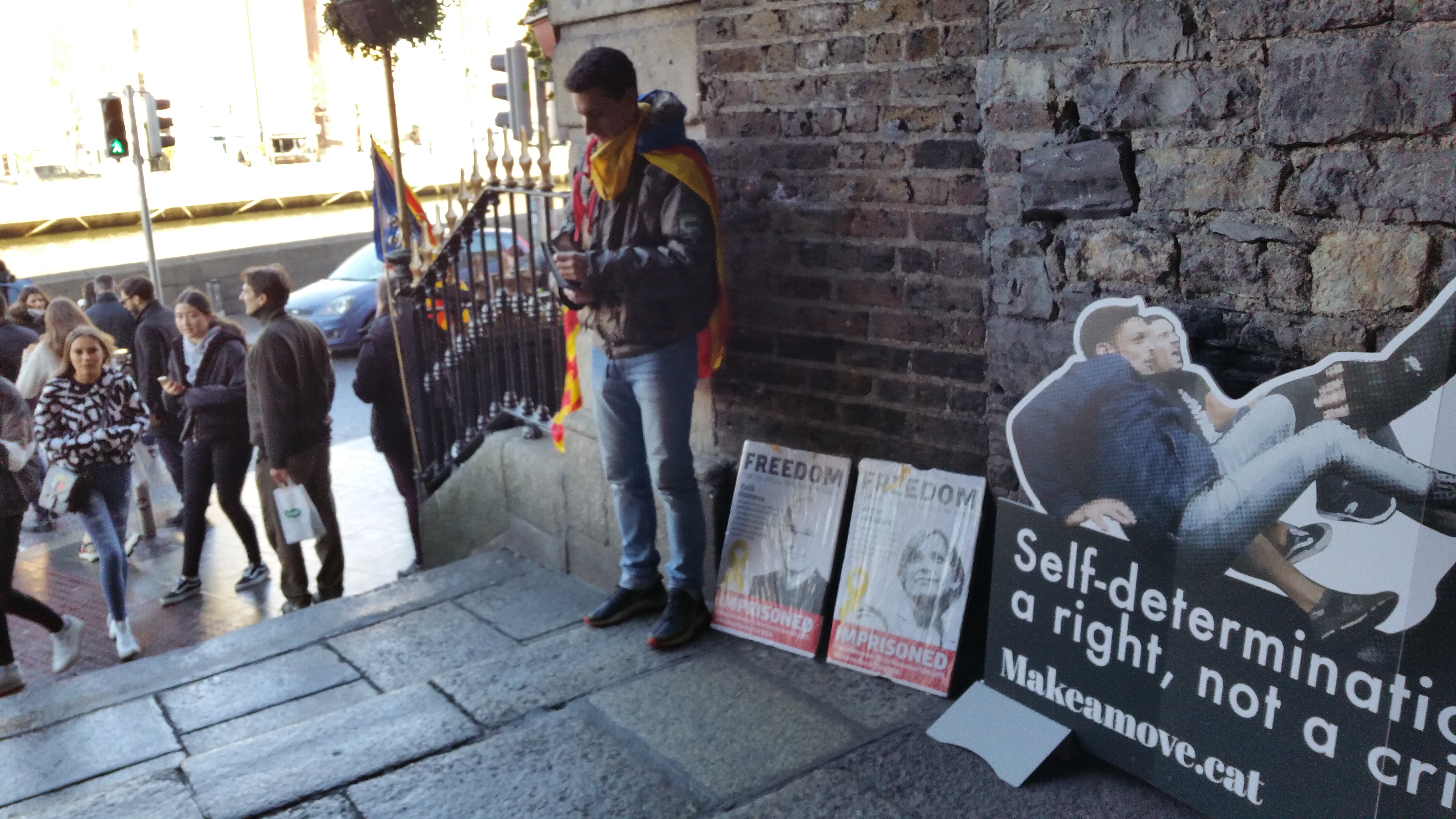
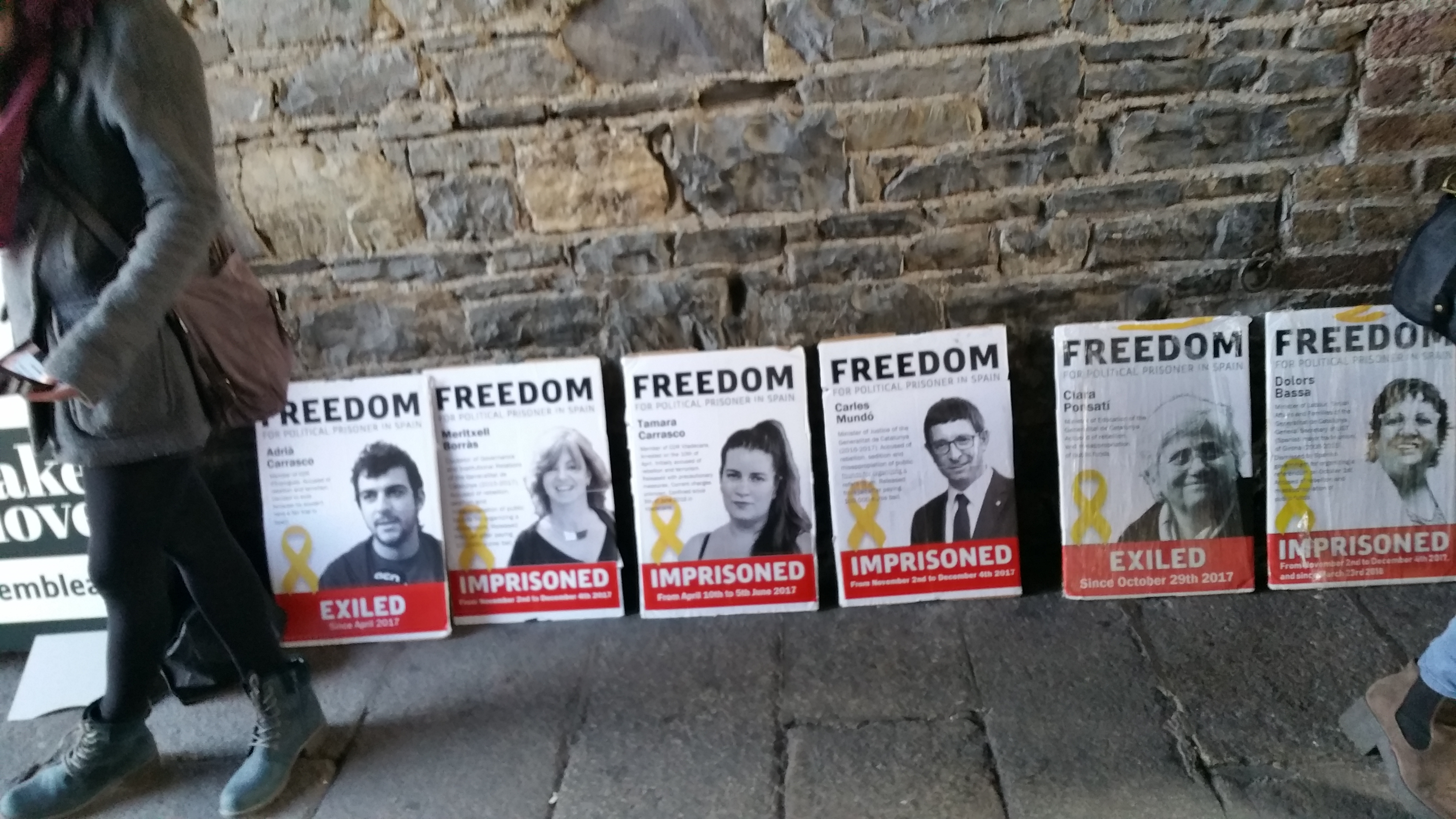
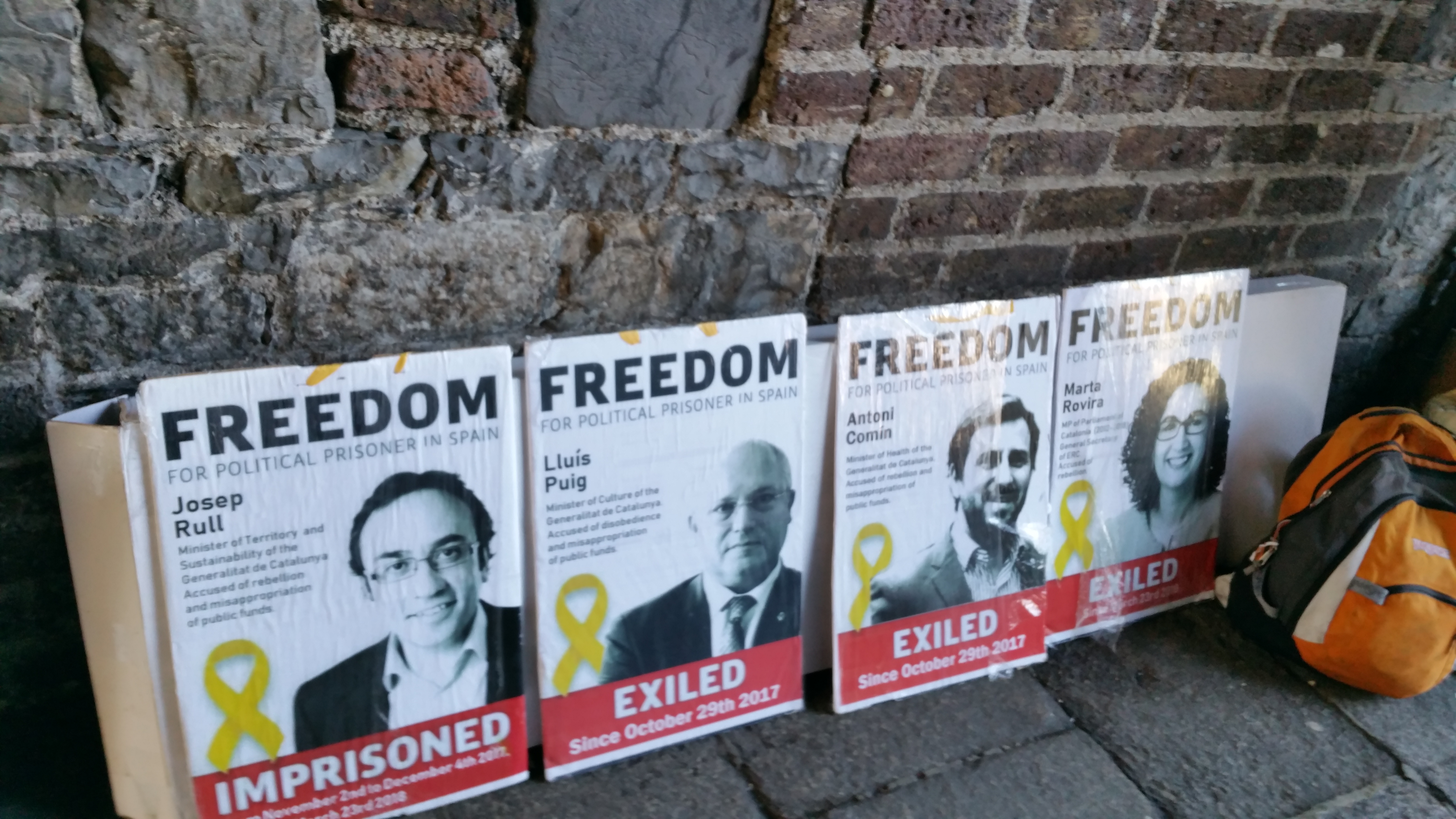
Placards displayed in Merchant’s Arch (Photo: Rebel Breeze)

Placards displayed in Merchant’s Arch (Photo: Rebel Breeze)

Placards displayed in Merchant’s Arch (Photo: Rebel Breeze)

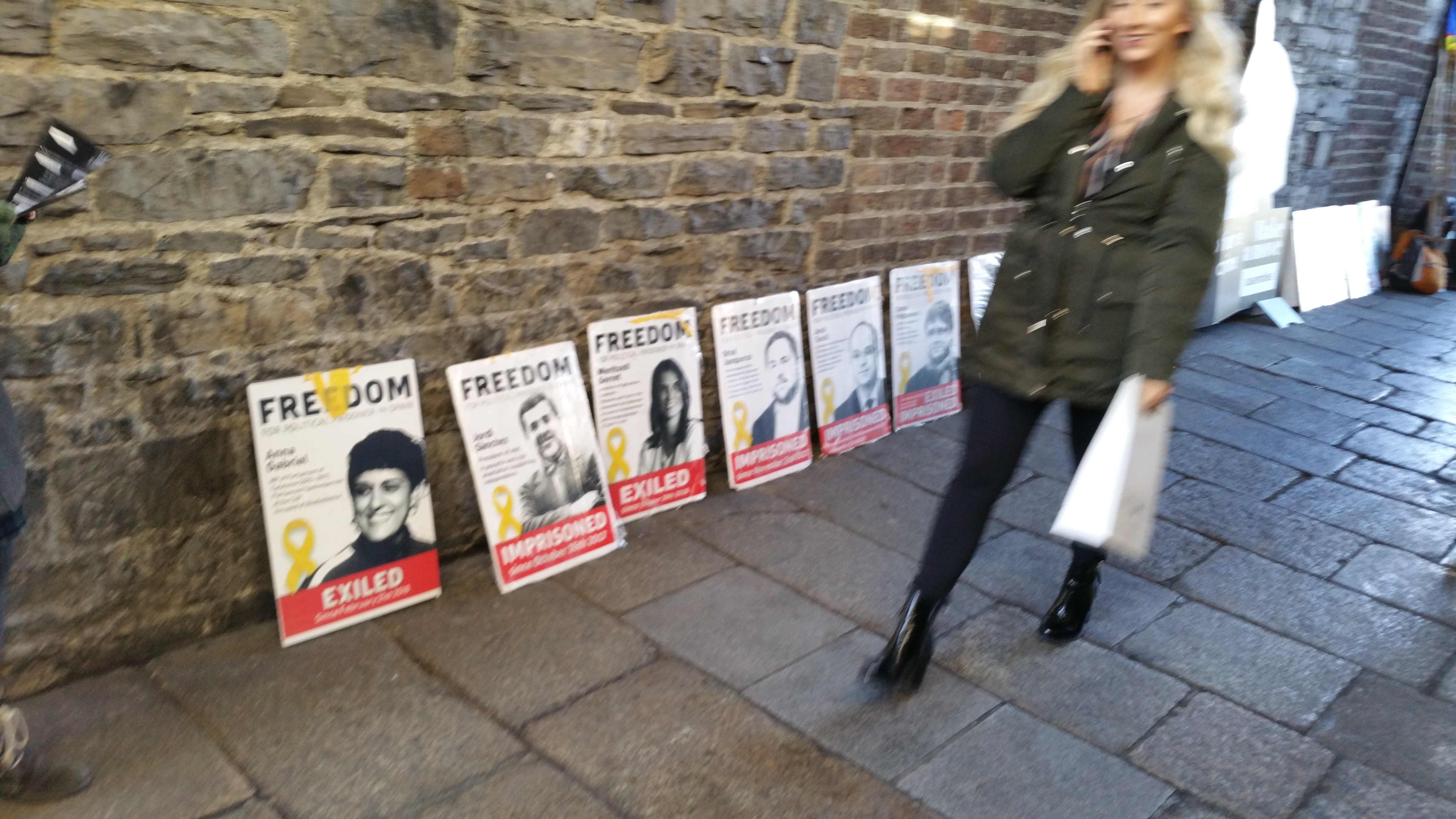
Placards with images of exiled (Photo: Rebel Breeze)

The solidarity protesters met in Merchant’s Arch, a well-known spot for people living in Dublin and well-trodden by tourists, leading from Temple Bar to the Ha’penny Bridge on the other side of the road. This iconic pedestrian bridge crosses the Liffey river from south to north in the heart of Dublin city.

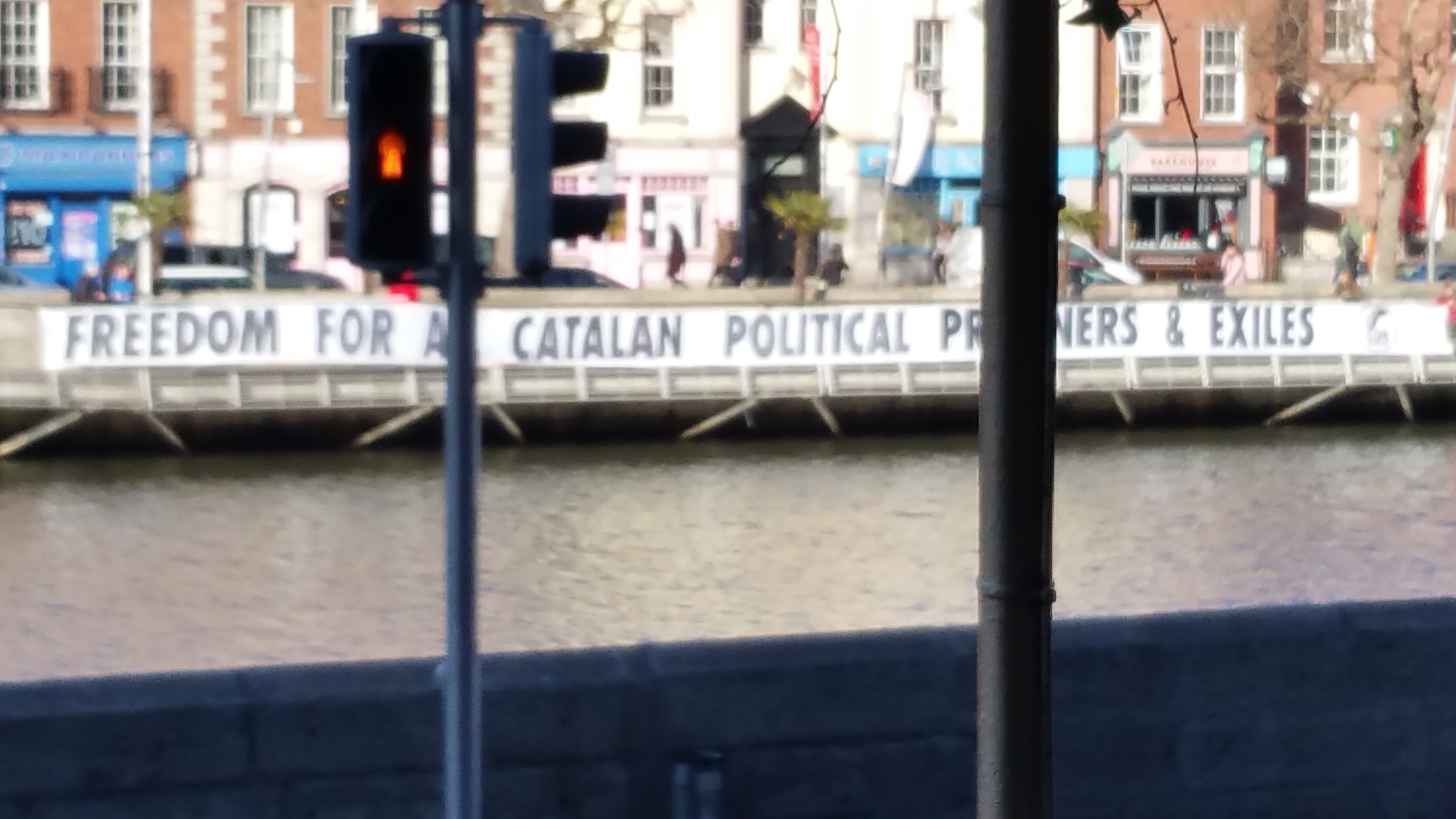
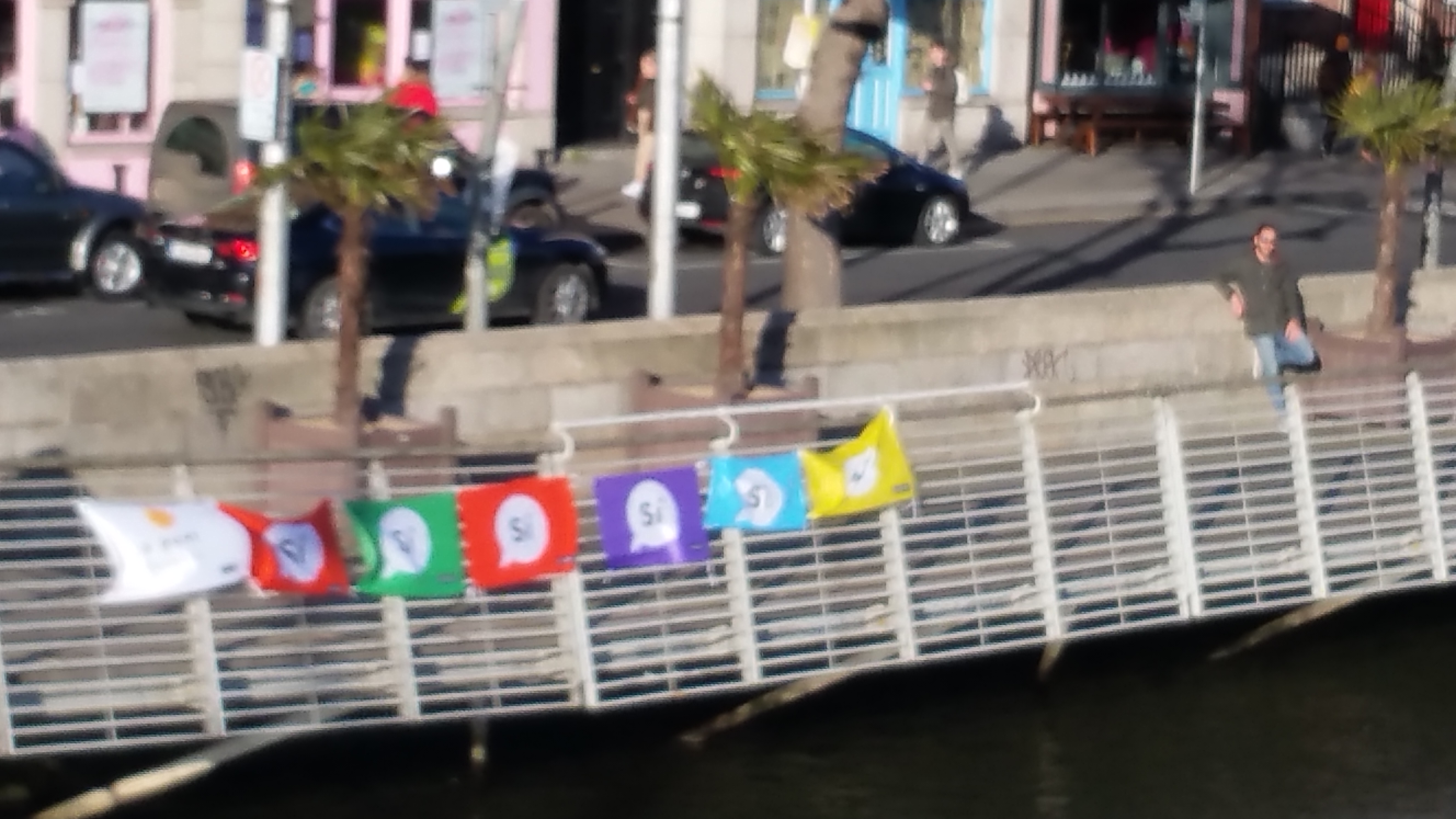
Some displays were set up inside the Arch by CDR, which also draped a huge banner over the railing of the boardwalk on the north side of the river, which read “Freedom for All Catalan Political Prisoners and Exiles!”. Over the same railing WCLC hung large bunting with the word “SÍ” on each flag, a reminder of the verdict for an independent republic in the referendum on 1st October 2017.

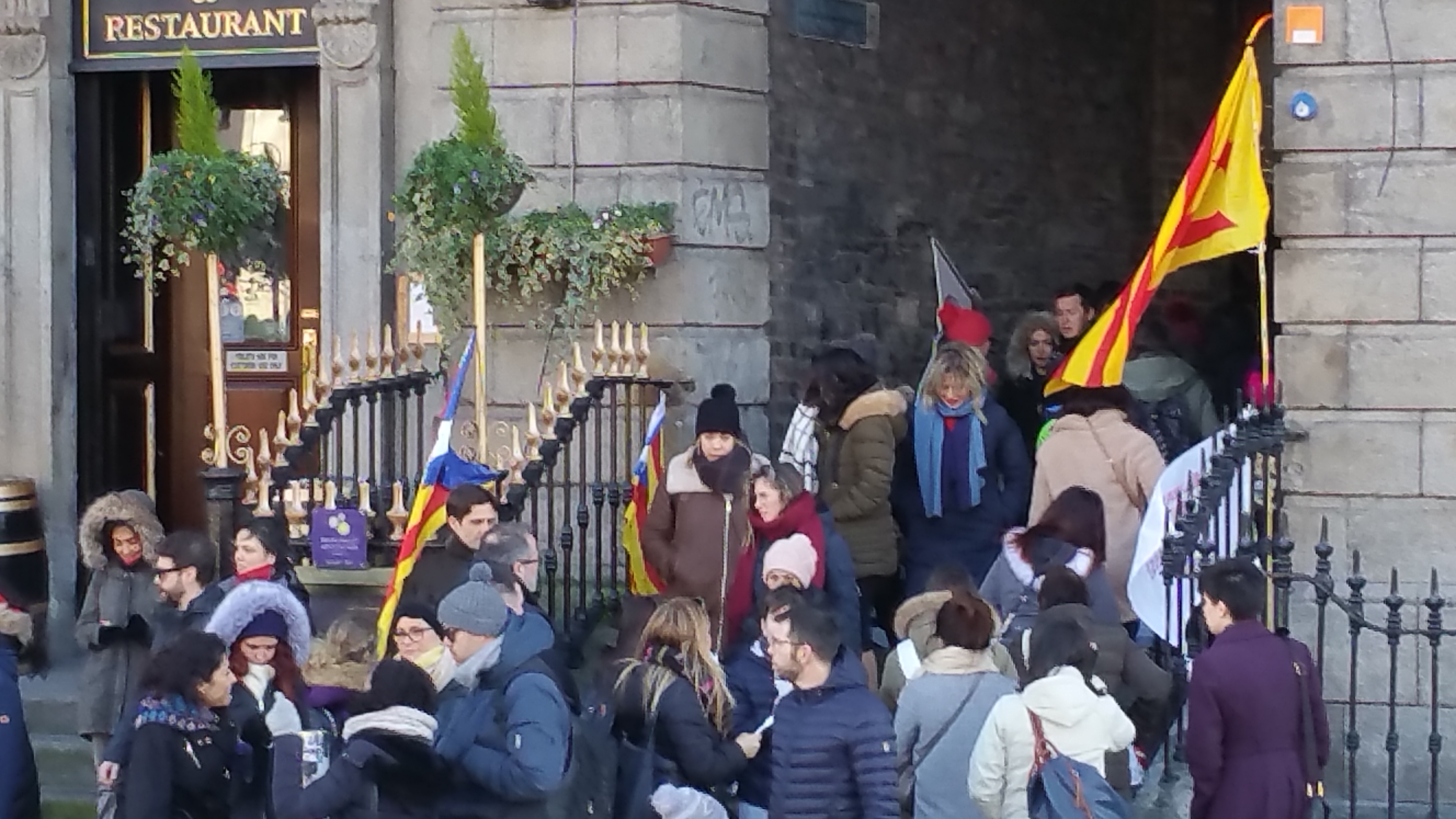
Catalan Estelades (pro-independence flags) were attached near the entrance to the Arch as was a small banner calling for freedom for political prisoners. Placards of the Catalan pro-independence activists on trial were also on display.

Supporters handed out informational leaflets and engaged members of the public in discussion before untying the banner and streamers from the riverside, packing up the displays and placards in Merchant’s Arch and heading off for warm food (and possibly drink).

“Si” bunting hung along north riverside
(Photo: Rebel Breeze)

The 12 go on trial in Madrid on 12th February, a day when further solidarity protest actions will take place in various European cities and a General Strike in Catalunya.

CDR Dublin and WCLC will continue to organise in Ireland, according to their spokespersons and welcome involvement from others of whatever ethnic background. “Contrary to what the Spanish State and its supporters claim, we are not anti-Spanish” their spokespersons said. “We are for the right of self-determination and as democrats must be against the repressive behaviour of the Spanish State, so reminiscent of its previous dictator General Franco.”

End.

Merchant’s Arch entrance seen from Ha’penny Bridge steps
(Photo: Rebel Breeze)

Setting up in Merchant’s Arch (Photo: Rebel Breeze)

Banner-minding duty
(Photo: Rebel Breeze)

On a day like today — in Moore Street

Diarmuid Breatnach

(Posted on 31st January, a very cold day in Dublin with hailstones and some rain).

Photo of section of Moore Street facing northwards (the 16 buildings of ‘the 1916 Terrace’ to the right) taken on a considerably warmer day. Most of the apparent brightness is an effect of the reflection from the wet street.  (Photo: D.Breatnach)


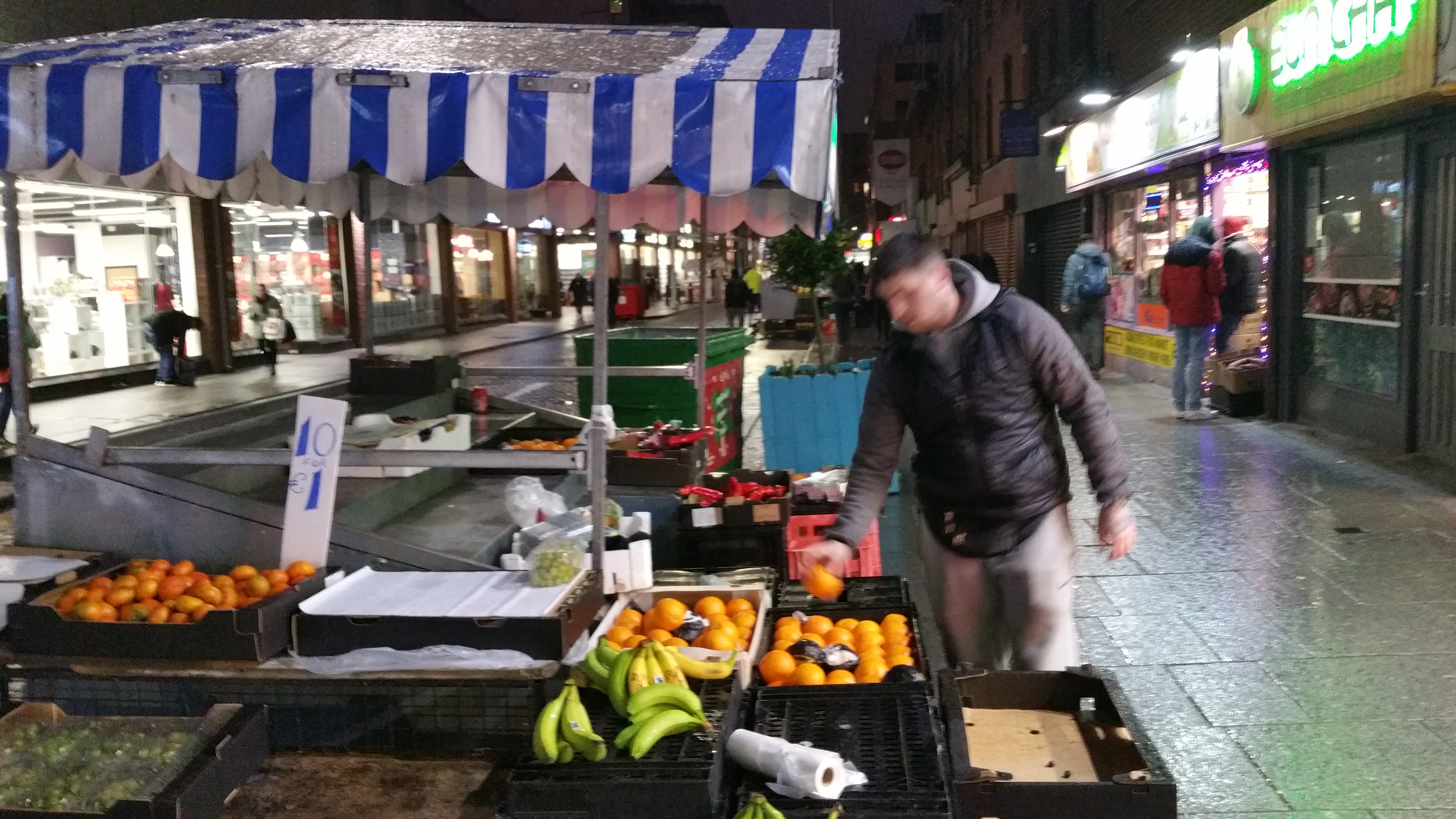
ON A DAY LIKE TODAY, it would be instructive to spend some time around Moore Street. In waterproof and warm clothes, wearing two pairs of socks, the street traders were out there today, under the scantiest of shelters over their stalls but having to step outside to serve customers. Their fingers frozen but some not wearing gloves because of the difficulty of tying knots in bags and handling change with fingers in gloves.

All braved the elements until two o’clock, at which point the flower-sellers gave up but the rest were still there, including the fish-sellers. By five o’clock there were still seven stalls in operation when the hailstones started and a couple gave up then but the others kept going.

The lighting was pretty dim too.

This is how Dublin City Council managers treat the oldest outdoor fresh food market in Dublin, a tourist attraction promoted by the city’s tourist information, the last remaining street market of what was a whole souk now buried under the ILAC shopping centre — a big-chain preserve also facilitated by Dublin City Council with broken promises to street traders.

Photo of fruit stall at the intersection of Moore Street and Henry Place (start of the 16 buildings of ‘the 1916 Terrace’) taken on a considerably warmer day. Most of the lighting is from the nearby Asian buffet restaurant.
(Photo: D. Breatnach)

And Hammerson property speculators, who now own half the ILAC shopping centre, still hold the planning permission for the construction of a giant ‘shopping mall’ from Moore St. to O’Connell St., on the 1916 Battlefield, which should be a National and International Monument.

end.

Another view of the street on the same day as the other photos, looking deceptively bright from the reflection of surrounding lights from the wet cobbles. (Photo: D. Breatnach)

(I had posted this on Facebook ‘off the top of my head’, as they say but a lot of people liked it so posting it here too).


PUIGDEMONT IN DUBLIN DEBATE: INDEPENDENCE, NATIONALISM AND DEMOCRACY

Diarmuid Breatnach

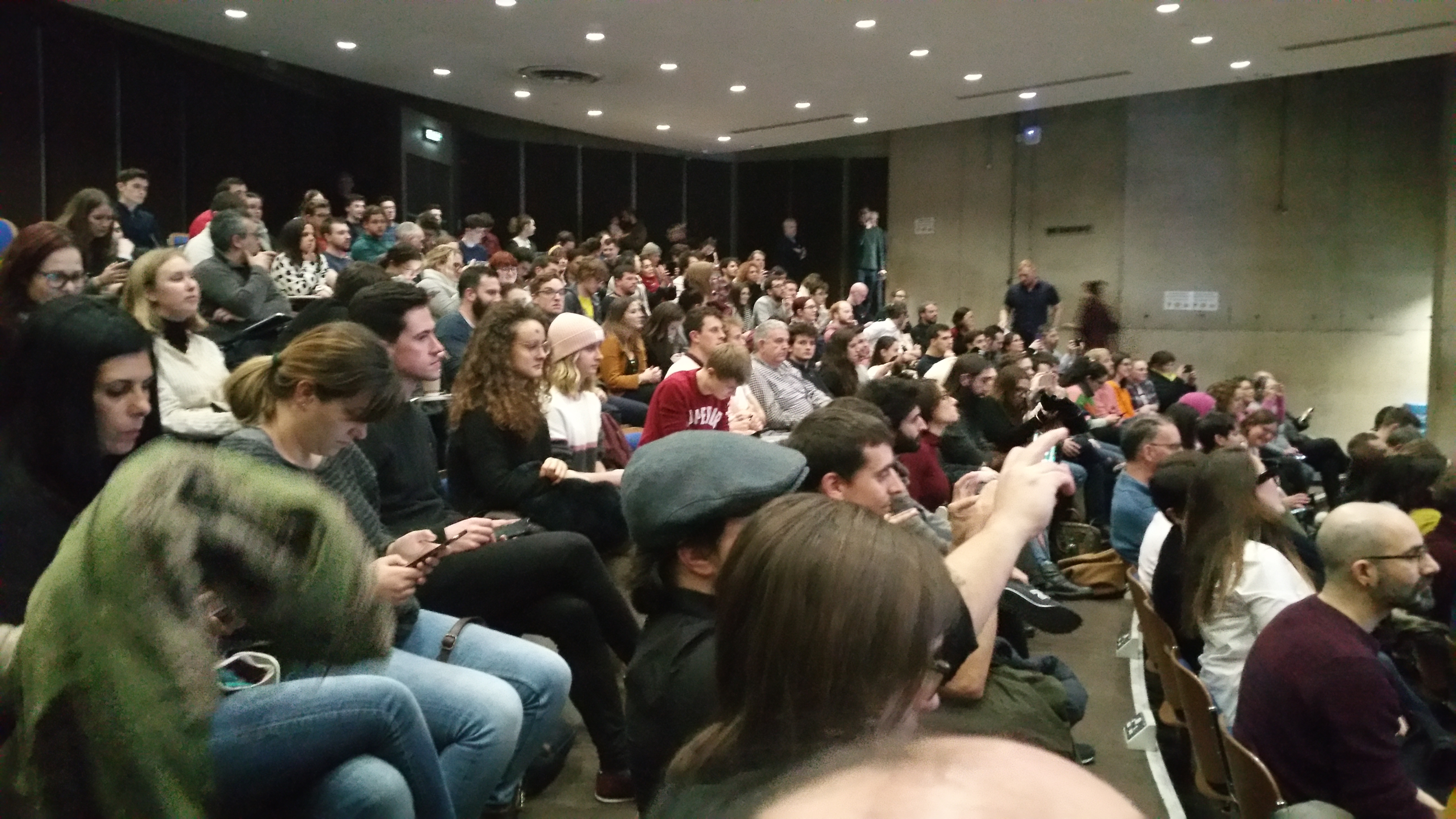
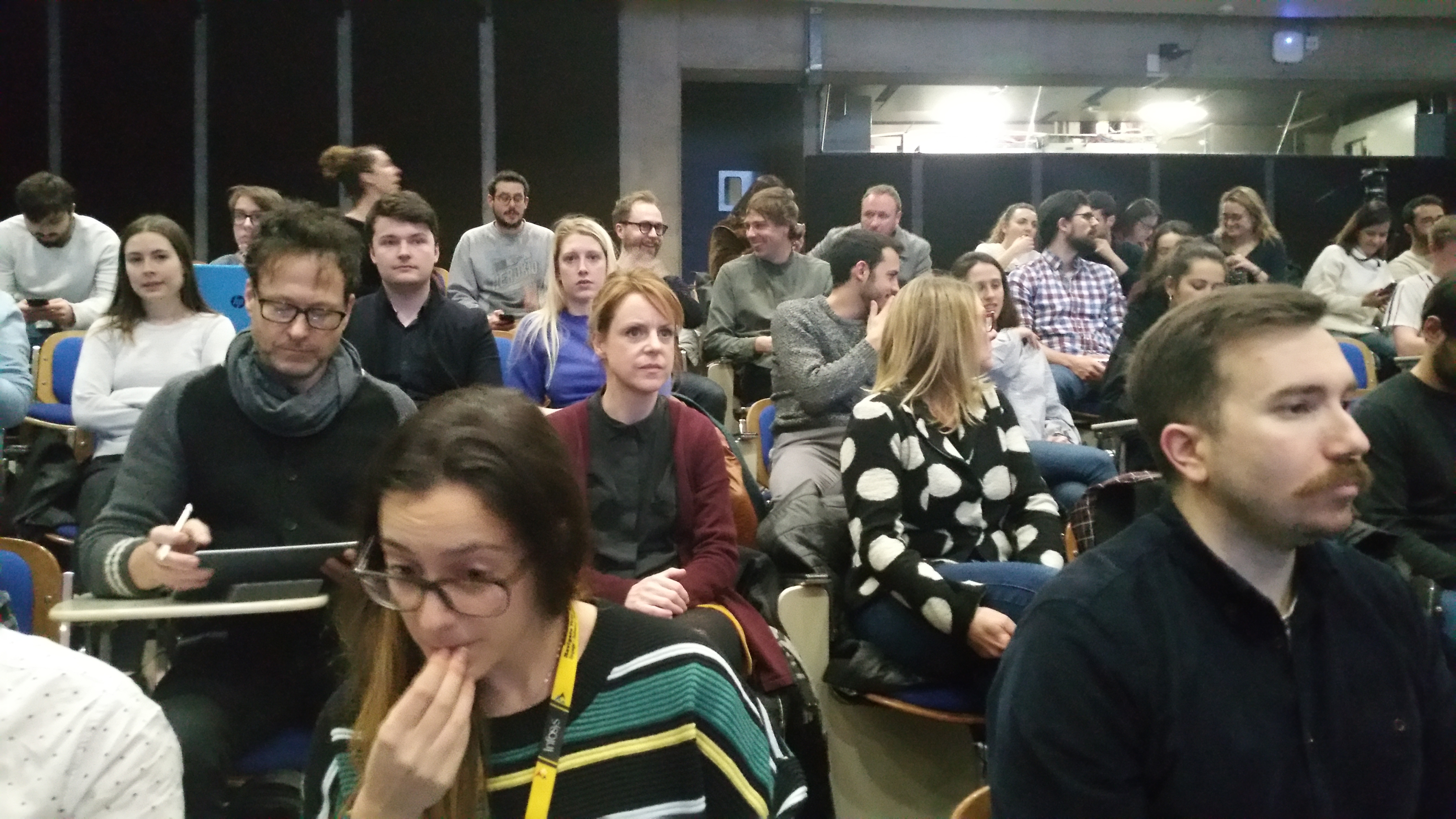
Section of audience queuing to enter the auditorium

A debate on the above theme was organised in Trinity College for the 29th January and advertised at less than a week’s notice, which however gave rise to such interest that the venue had to be changed from the 160-seat Robert Emmett Theatre to the Edmund Burke and people were turned away after the 406 seats had been filled.

          Trinity College is a prestige university in Dublin and in the world generally, though its history in Dublin was for centuries of a religious sectarian and colonialist nature, founded as it was by Elizabeth I to ensure the education of the male children of English colonists in what she considered the ‘true faith’ of Anglicanism (which was and is still the State religion of England and of which the English monarch is Head). Its location too is very central to the city, being just across the Liffey on the south side and in 1916 served as a Headquarters for the British suppression of the Rising.

Section of audience waiting to back left of the auditorium in Trinity College, Dublin (Photo: D.Breatnach)

View of audience to the left and front of the auditorium. 
(Photo: D.Breatnach)

View of audience to the rear of the auditorium. 
(Photo: D.Breatnach)

View of section of audience to the right of the auditorium. 
(Photo: D.Breatnach)


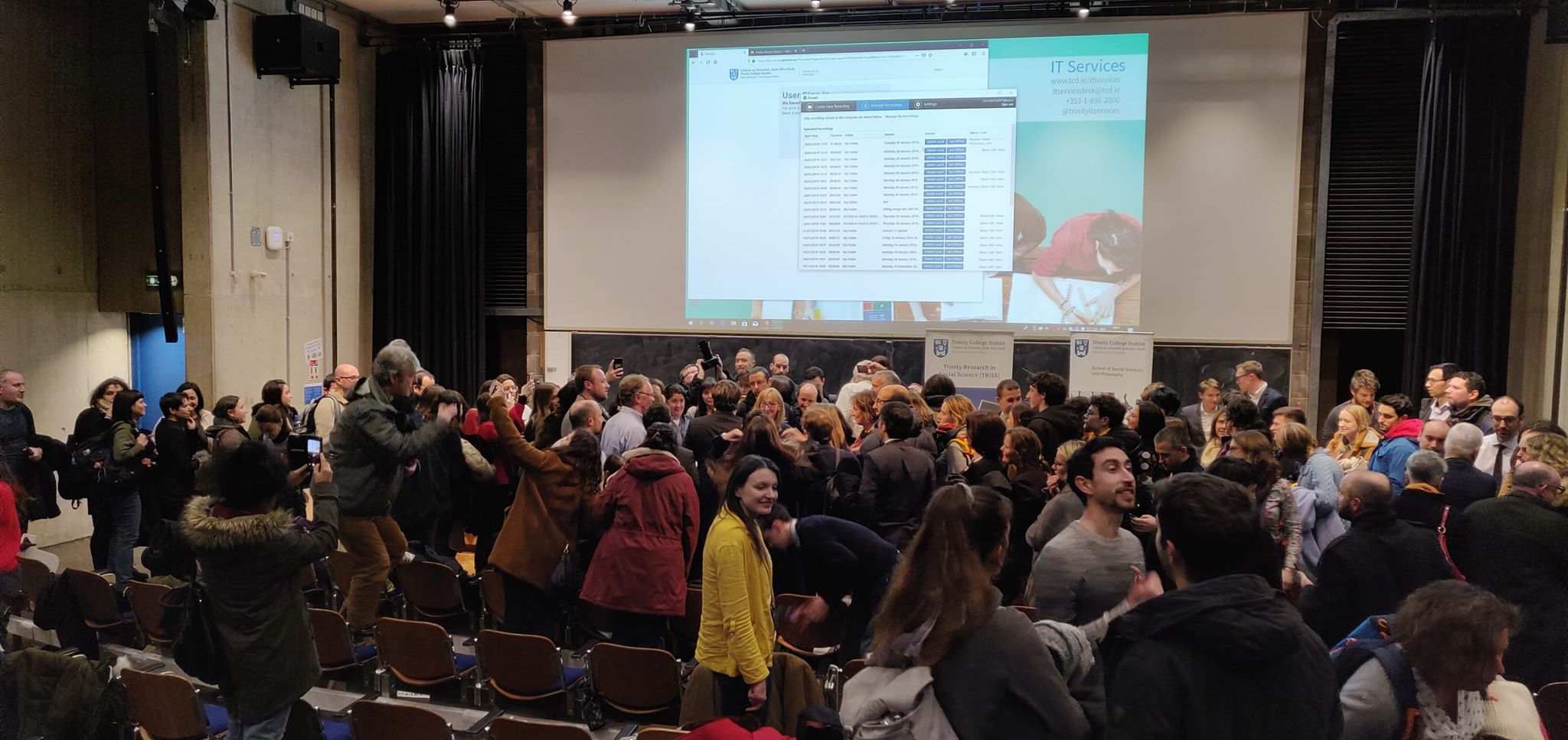
Huge human rights solidarity banner unfurled in the auditorium for photo but not while the debate was in session. 
(Photo: D.Breatnach)

Puigdemont had been invited to take part in a debate on Independence, Nationalism and Democracy by TRISS, the Trinity Research in Social Sciences department, whose MC for the evening was clearly taken aback by the numbers who had pre-booked tickets and most of whom queued for half an hour outside the lecture theatre – and some for even longer waiting to get in.

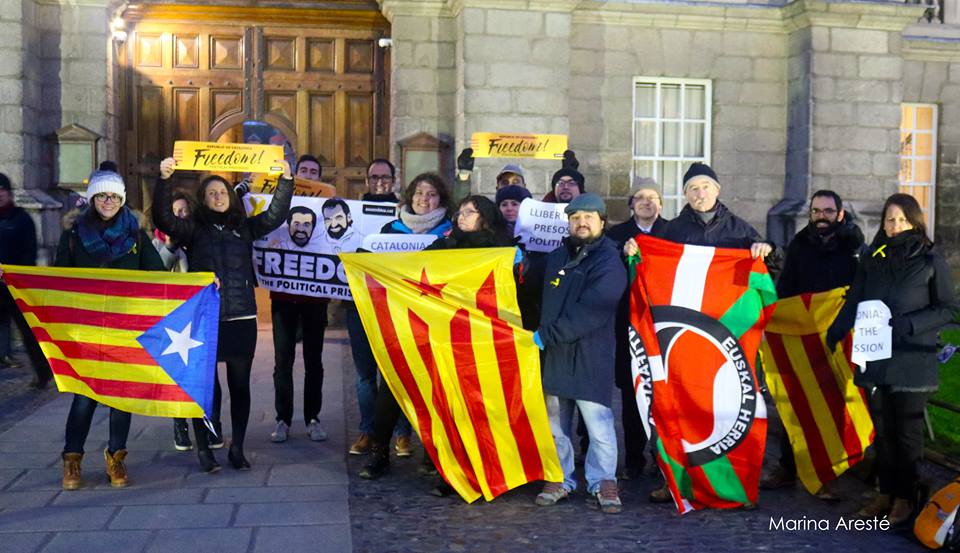
A quick photo opportunity for some supporters of Catalan (and Basque) independence outside the Trinity College’s main gate before entering to hear the debate on “Nationalism, Independence and Democracy”.
(Photo: Marina Dolcet)

Members and supporters of the campaign group With Catalonia/ Leis an Chatalóin, Comite de Defensa de la República and the cultural organisation Casal Catalá de Irlanda were there of course but so were a great many others; mostly Catalans with some Irish and people from other countries sprinkled among them and including some from elsewhere in the Spanish state. The overall feeling was clear when, as soon as Puigdemont was spotted entering the auditorium from a side entrance, along with other participants, he was applauded in what turned out to be a mostly standing ovation.

The MC or chairperson, Gail McElroy, Professor in Political Science and Head of the School of Social Sciences and Philosophy, made a special plea for good behaviour from the audience and also revealed that she had experienced some trepidation in preparation for the event. These expressions led to speculation among sections of the audience that the organisers of the debate had been subjected to a bombardment of hostile electronic communication. People in the Spanish state and sometimes abroad are familiar with this behaviour from right-wing Spanish nationalists, including outright fascists and even state-orchestrated trolls but for someone encountering it for the first time, no doubt it can be intimidating.

Puigdemont at lectern.

PUIGDEMONT: IT IS NOT ACCEPTABLE IN EUROPE

          Puigdemont began by saying that some of those present might want to know why Catalans do not want to be part of Spain. He could answer that question by recalling the history of Catalonia as a nation, its struggles, its language and its culture. That would be the discourse of 19th-20th Century nationalism, he said. However he preferred to outline it as modern process in the 21st Century, rooted in Europe and in democracy.

The President-in-exile surprised some of his listeners, no doubt, by pointing out that as recently as four years ago, the majority of the Catalan independentist parties had been asking only for greater autonomy from the Spanish State. The history of recent growth towards a majority demand for independence has been as a result of the refusal of the Spanish State to concede any greater autonomy and of the Spanish Court revoking laws passed by the Catalan Government.

But the Spanish response to Catalan demands has always been “no”, to everything”, said Puigdemont. “No” to dialogue. “No” to negotiation. “No” to reaching a democratic solution. Given the refusal, and obeying the mandate given to us by the majority of Catalan citizens, the Government of Catalonia, which it was my honour to preside, called a referendum on selfdetermination on 1 October 2017, with the legal backing of the Parliament of Catalonia. We did so while observing the basic principles of universal rights.”

And the world had seen the violence of the Spanish police inflicted upon people wishing peacefully to vote.

The aim was not just to confiscate ballot boxes and ballot slips”, Puigdemont maintained but instead “to make people give up their right to vote. But this ignominious act backfired on the politicians responsible for it. Over 2.4 million citizens overcame their fear and went out to vote. We do not know how many tried to do so unsuccessfully, but we do know the polling stations that were violently closed represented a further 770,000 voters.

Puigdemont continued: Today, democracy in Spain is at risk because basic rights have been de facto” suspended, and this represents a major threat to all Catalan and Spanish citizens, as well as to the European Union. Today, an EU member state cannot guarantee the judicial rights of its citizens, given that in recent months Spain has contravened international treaties ratified by the Spanish state itself, such as the International Covenant on Civil and Political Rights, the European Convention for the Protection of Human Rights and Fundamental Freedoms.

Referring to the Spanish State taking direct control of the Catalan government administration and preparing criminal charges against grass-roots organisation leaders and elected representatives, taking some as prisoners while others went into exile, Puigdemont said that this was not an internal Spanish problem but instead a Europan one. Seven hundred others, mostly town mayors, are under investigation too. Those independence activists, who have done nothing wrong and even according to Spanish law are innocent until proven guilty, have been kept in prison for over a year.

Concluding, Puigdemont said: “We will not falter. I have often said that what threatens democracy is not disagreement; indeed, democracy needs disagreements. What really threatens it is a lack of tools to solve disagreements democratically. We Catalans hope and trust that the political conflict over our selfdetermination can be resolved peacefully, without war, without violence, without winners and losers, without victims and thugs. We reject all the violence used in the last century in any part of the planet to resolve political conflict.

As Pau Casals, a well-known Catalan, reminded us in a memorable speech to the United Nations Assembly in 1971, Catalans in the eleventh century met ‘to talk about peace, because at that time, the Catalans were already against war’. Ten centuries later, we maintain these same values of peace and harmony.”

THE OTHER SPEAKERS IN THE DEBATE

          Located as the debate was in the capital city of Ireland and in the centenary of the founding of the first democratically-elected Irish Parliament, an Chéad Dáil, it was most noticeable that neither Puigdemont nor the other speakers referred to the experience of Ireland’s struggle for independence.

Dr Marvin Suesse – Assistant Professor in Economics, Trinity College Dublin spoke on The Economic Costs of Sovereignty”, from his research on the political economy of separatism and nationalism. He said that while the benefits of independence in terms of feelings of pride, promotion of culture etc. were difficult to measure, the economic benefits were not. Suesse went on to give examples which indicated that the costs of independence were greater than the benefits.

Dr Michelle D’Arcy – Assistant Professor in Political Science, Trinity College Dublin. spoke on “Secession and the Fiscal Contract: Reflections from the Post-Colonial World.”

D’Arcy teaches African politics and the political economy of development to undergraduate and postgraduate students and her research broadly focuses on understanding how politics and institutions enable and constrain human development and more specifically on democratization in Africa and state-building in Europe historically. Though she made some interesting points and believes that independence movements engage in a “fiscal contract”, it was difficult to see where she stood on the question under discussion.

Dr, Coman’s screen display

Dr. Coman at lectern.

Dr Emanuel Coman – Assistant Professor in Political Science, Trinity College Dublin spoke on “When does the Right to Self-Determination Actually Apply?”

Emanuel Coman is Assistant Professor in Political Science at Trinity College Dublin, teaching courses in comparative institutions and American Politics. His research is primarily in the fields of party politics and elections, with empirics driven primarily from Eastern Europe.

Coman, from Rumania as he told his audience, analysed the European nations that were successful in gaining independence after WWI. Most had been under the rule of the defeated belligerents. His thesis seemed to be that a nation’s bid for independence required the support of the big powers exerting influence in the area.

ONE MUST ALSO WEIGH THE COST OF NOT DECLARING INDEPENDENCE!”

          Commenting on the presentations of the other speakers and responding to questions after his presentation, Puigdemont was more lively than when reading his speech and at times showed some fire, particularly when he responded that as well as weighing the costs of independence, one must consider the costs of not becoming independent, which brought some applause from sections of the audience. Aside from anything else, he said, it is a question of dignity: the Catalans had the right to make their own decisions, whether they be correct ones or mistaken.

A much greater applause and cheers broke out when Puigdemont denied that the Spanish State could be described as “a democracy” and stated that this was not opinion but fact, given that the Monarch and Head of State (father of the current monarch) had been personally appointed as his successor by the fascist coupist General Franco, whose mausoleum is a national monument of the State.

Responding to a suggestion that the Catalan pro-independence movement might benefit from employing the tactics of the “Yellow Vests” of Paris, Puigdemont was most emphatic that his movement was peaceful and would never under any circumstances resort to violence.

One member of the audience criticised the panel (other than Puigdemont) for not addressing the actual issues in Catalan independence and the Spanish State’s opposition.

Asked by a member of the audience to describe his feelings of exile, Puigdemont replied that he could not indulge those feelings since he would be unable to continue the struggle if he did so. He revealed that his own grandfather, in a concentration camp in France after the fall of Barcelona to Franco’s military-fascist forces, had written to his family so that they were aware of the feelings of exile even though they never saw him again. His voice seemed to gain a heightened emotion when he remarked that when he compared his situation to that of refugees, like those from Syria, launching themselves on the hazardous journey to European shores, survivors arriving often to be badly treated, he felt he had little of which to complain.

Puigdemont surrounded by well-wishers and the curious after the debate while others are in excited conversation.

AUDIENCE REACTION

          The audience gave Puigdemont and, one supposes, the other speakers and TRISS for having organised the debate, sustained applause and cheers, during which one could hear some pro-independence slogans in Catalan. Afterwards, many remained in the auditorium to speak to Puigdemont or to chat amongst themselves in a general buzz of excitement.

Views expressed by a number of listeners afterwards on the content of the debate were in general positive though these varied through a continuum from “excellent” to “all right but somewhat disappointing”. All feedback received agreed that on two points Puigdemont had been excellent: on the question of calculating the cost of NOT seceding from the Spanish state and also on the characterisation of the Spanish State as not being a democracy, as one that had failed to break properly with its Franco-fascist past.  Few gave positive feedback on the other debaters.

Crowds delayed leaving for around half an hour, gathering talking among themselves or queuing up to shake Puigdemont’s hand, talk to him etc. and Casals Catala presented him with some books on Irish history.

COMMENT:

          Puigdemont comes across as quite genuine in his convictions and as an able debater, even in a language which cannot be his first or second. His vision of Europe does not perhaps coincide with the views of some others and one may doubt the practicality of his commitment to non-violence. One may also question whether anyone has the right to commit the movement to peaceful resistance alone, even if it were to be attacked violently.

I did not hear him speak any words in Irish but the written text of Puigdemont’s speech did contain some. Although it was good to see some Irish there, for the few words he was going to speak in the language, Puigdemont (or his advisors) might have taken the trouble to formulate them correctly. Addressing “mná agus uasal” although addressing women first, suggests that the audience was an almost all-female one and who were not “uasal” (noble, important), but was surely unintended. And “dea-trathnóna leat (‘to you’, singular) go léir” (to all of you) is a conflation of singular and plural in the same address; likewise with the “go raibh maith agat” which thanks one person rather than the audience which was the intention and “go mór” which if not incorrect is clumsy and straight from Google Translate for “thanks a lot”.

Standing outside the auditorium with a placard announcing the Catalan solidarity demonstration on Saturday 9th April, at one point I noticed Puigdemont standing some metres away with some others. As he caught my eye, he stepped towards me, hand outstretched.

I gripped his hand and smiling, said: “Fáilte go Baile Átha Cliath!”

“Thank you,” he replied, smiling also and stepped back.

Whatever else he may be, I suspect he is what we in Dublin would call (with a meaning remote from any kind of subservience) “A gentleman.”

End.

BIOGRAPHICAL NOTES ON PUIGDEMONT:

          Born in Amer, a village in the province of Girona and fifty-seven years of age last December, Carles Puigedemont is a journalist by trade and ex-Mayor of Girona, a major Catalonian city of over 100,000, just under 100 kilometres (62 miles) north-east of Barcelona. In 2006, after a track record of activism in Catalan culture and nationalist activism, he was adopted as a political candidate by the CIU (Convergence and Union) political party and later to represent the reformation of that party in the Junts per Si (Together for Yes) coalition, composed of mostly nationalist capitalist elements. He has been successful in every election and currently heads the uneasy Junts per Cat (Together for Catalonia) coalition. The current Govern is made up of a coalition between JuntsXCat and ERC (Republican Left of Catalonia), with the other pro-independence party, CUP (Popular Unity Candidacy) in opposition, though not voting with the Spanish-unionist opposition.

In what seems an action contradictory to his political position, in January 2019 Puigdemont filed a constitutional application for amparo (remedy, to put right) directed against the President of the Catalan Parliament, Roger Torrent and the Board of the Chamber, to the Spanish Constitutional Court. The application argues Puigdemont had been denied the use of his political rights as Torrent did not allow him to delegate his vote from Belgium after Puigdemont’s criminal indictment and suspension of his parliamentary position by Supreme Court judge Pablo Llarena.

Despite constant Spanish-unionist claims from both Right and Left, the Catalan pro-independence movement has shown itself more tolerant of migrants and diversity than can be said in general of much of the rest of the Spanish State; one of the laws of the Govern sought to give migrants equal access to Catalan national health care but was twice squashed by the Spanish Supreme Court. Puigdemont is himself married to Romanian journalist (Marcela Topor in 2000) and they have two daughters, Magali and Maria, the family home in Girona. His children are multi-lingual and Puigdemont himself speaks Catalan and Castillian (Spanish), as do most Catalans but also English, French and Romanian.

LINKS AND FURTHER INFORMATION

Text of Puigdemont’s address in the debate in full attached at the end of the brief report in El Nacional: https://www.elnacional.cat/en/news/puigdemont-dublin-bertie-ahern-trinity-college-ireland_349173_102.html
Pre-event publicity from Trinity College: https://www.tcd.ie/ssp/events/lectures/2019-01-independence/

With Catalonia/ Leis an Chatalóin: https://www.facebook.com/WithCataloniaIreland/

CDR Dublin: https://www.facebook.com/CDRDublin/

Casal Catalá de Irlanda: https://www.facebook.com/casalcatalairlanda/

CATALAN PRESIDENT-IN-EXILE MEETS IRISH PARLIAMENTARIANS IN DUBLIN

Rebel Breeze Reporter

Puigdemont. President-in-exile of Catalonia, visited Dublin to take part in a debate in Trinity College on Tuesday 29th January and visited the Dáil and a number of Irish politicians on the same day.

Puigdemont and Puignól at the Barcelona-ireland friendship tree in Cow’s Lane, bracketed by activists of Casals Catalá de Irlanda, Catalan cultural organisation in Ireland on each side.
(Photo source: ACN, El Nacional).

          Carles Puigdemont was elected President of the pro-independence Catalan Government, declared an independent Catalan Republic but immediately suspended it; then had his Presidency abolished by the Spanish State, which took direct control of Catalonia for a period. He went into exile with a number of other Catalan Government ministers in order to avoid arrest; the Spanish State issued a European Arrest Warrant for him which was party unsuccessful and then withdrew it; however, he remains in exile in Brussels. Most pro-independence Catalans and even others consider him the legitimate President of Catalonia, though another had to be elected to fill his place; Quim Torra, who is currently the elected President, says that he considers himself only “the interim President”.

Carles Puigdemont was elected President of the Govern, the Catalan Government, in January 2016, in an agreement between pro-independence parties. On 27th October 2017, with a majority of October 1st Referendum votes salvaged and counted — after the Spanish police attacks on the voters – in favour of independence, he declared a Catalan Republic on behalf of the Govern. However, he almost immediately suspended it, to the dismay of many Catalans, including supporters of his own party. The Spanish State, the Constitution of which forbids any secession without the majority vote of the Parliament of the whole territory, was not mollified by the suspension and, as the Spanish State prepared criminal charges against him and Catalan Ministers, Puigdemont went into exile (as did another five Catalan ministers).

ARRESTS AND EXILE

          The Spanish State arrested a number of others, including seven ministers and two leaders of grass-roots movements and charged them with sedition, rebellion and misuse of public funds, carrying 30, 15 and six years in prison respectively and European Arrest Warrants were issued for Puigdemont and other ministers. On 25th March 2018, Puigdemont was detained on that warrant while passing through Germany on his way back to Brussels from a speaking engagement in Finland. A German judge decided the issue of the “rebellion” charge first, declaring that any such charge had to provide evidence of violence, of which there had been none by the detainee (there had been plenty of violence but all by the Spanish police) nor under his direction.

The German court decided in July that Puigdemont could be extradited to the Spanish State to be tried for misuse of public funds but the Spanish State, not wishing to have to try him and the other ministers only on those while the other ministers were being tried on the more serious charges, withdrew the arrest warrants. These charges can of course be renewed at any time and another warrant issued.

Since his return to Brussels after release by the German court, this Dublin visit has been Puigdemont’s first venture outside Belgium.

Accompanied by Jordi Puigneró, the current Minister of Digital Policies and administration of Catalonia, also visiting Ireland, Puigdemont paid a brief visit to an olive tree donated by Barcelona to Dublin in acknowledgement of the Irish who had fought for Catalonia in the War of the Spanish Succession. After a meeting with the Mayor of Dublin for the year, Niall Ring, Carles Puigdemont attended the Dáil (the Irish Parliament) for a private meeting with Bertie Ahearn, a Fianna Fáil party parliamentarian and ex-Taoiseach (Prime Minister).

Puignól attaches a yellow ribbon to the Barcelona-Ireland olive tree in solidarity with the Catalan political prisoners.
(Photo source: Casals Catalá de Irlanda)

MEETING IN THE DÁIL

          Afterwards Puigdemont addressed a meeting room of around 100, organised by the Dáil organisation Oireachtas Friends of Catalonia, with its chairperson Pat Gavan, Sinn Féin Senator, presiding.  Jordi Puigneró sat beside Puigdemont as did Lynn Boylan, Sinn Féin MEP.

Puigdemont in the packed Dáil meeting room, Leinster House, Dublin.  Others L-R: Minister Jordi Puignól, MEP Lynn Boylan, Sen. Paul Gavan.
(Photo source: Internet)

Fifty-seven years of age last December, Carles Puigedemont is a journalist by trade and ex-Mayor of Girona, a major Catalonian city of over 100,000, just under 100 kilometres (62 miles) north-east of Barcelona. In 2006, after a track record of activism in Catalan culture and nationalist activism, he was adopted as a political candidate by the CIU (Convergence and Union) political party and later to represent the reformation of that party in the Junts per Si (Together for Yes) coalition, composed of mostly nationalist capitalist elements. He has been successful in every election and currently heads the uneasy coalition platform Junts per Cat (Together for Catalonia). The current Govern is made up of a coalition between JuntsXCat and ERC (Republican Left of Catalonia), with the other pro-independence party, CUP (Popular Unity Candidacy) in opposition, though not voting with the Spanish-unionist opposition.

In what seems an action contradictory to his political position, in January 2019 Puigdemont filed a constitutional application for amparo (remedy, to put right) directed against the President of the Catalan Parliament, Roger Torrent and the Board of the Chamber, to the Spanish Constitutional Court. The application argues Puigdemont had been denied the use of his political rights as Torrent did not allow him to delegate his vote from Belgium after Puigdemont’s criminal indictment and suspension of his parliamentary position by Supreme Court judge Pablo Llarena.

Despite constant Spanish-unionist claims from both Right and Left, the Catalan pro-independence movement has shown itself more tolerant of migrants and diversity than can be said in general of much of the rest of the Spanish State and one of the laws of the Govern, twice squashed by the Spanish Supreme Court, sought to give migrants equal access to Catalan national health care. Puigdemont is himself married to Romanian journalist (Marcela Topor in 2000) and they have two daughters, Magali and Maria, the family home in Girona. His children are multi-lingual and Puigdemont himself speaks Catalan and Castillian (Spanish), as do most Catalans but also English, French and Romanian.

Addressing the full room, after thanking Gavin for presiding over the meeting and those assembled for their presence, Puigdemont presented his case that Catalonia had the right to secede, that holding a referendum was a democratic activity per excellance, that the arrest and trial of politicians for having promoted that referendum was undemocratic and that such activity was not within keeping of the EU ethos.

Replying to questions on what he would ask Irish politicians to do in order to help Catalonia’s struggle and on how he saw his nation’s struggle combining with other nations within the Spanish state, for example the Basque Country, Puigdemont said he did not wish to tell other countries what do and that the struggle of Catalonia stood on its own. He declined to relate the content of his discussions with Aherne, which he said were confidential. One member of the audience reminded Puigdemont that 100 years ago, the first democratically-elected Irish national parliament had met and that many of its delegates were also in jail or in exile.

To a question about alleged flight of business from Catalonia, Puigdemont said that one had to read alternate media to some of the dominant ones and make up one’s own mind, critically examining all sources – including himself! But he did say that although some addresses of head offices were transferred to the Spanish State in what he said was not legally right, not one factory, working office or member of staff had been transferred out of Catalonia. Also, the struggle with the Spanish State and some Spanish attempts at boycott had obliged Catalans to look outside the Spanish state for their markets and business links whereas previously, imports from and exports to the Spanish state had accounted for 90% and 80% respectively. Jordi Puigneró commented that he was in Ireland in part because of that, in particular to follow up on the Irish state’s success in attracting and developing information technology business.

After the Dáil meeting, Puigdemont and Puignól pose for photos with Catalan solidarity supporters.
(Photo source: Casals Catalá de Irelanda)

Outside in the icy cold after the fairly short meeting, Puigdemont lined up for a few photos surrounded by Catalan and other well-wishers and departed to the singing by them of Catalan’s national anthem, Els Segadors (The Reapers). He had a debate at which to speak in a few hours and most of the Catalans in attendance would be there too.


End.

OTHER MEDIA REPORTS:

https://www.independent.ie/irish-news/politics/well-continue-fighting-for-our-freedom-it-doesnt-matter-if-were-in-jail-excatalan-president-tells-tds-37763055.html

https://www.irishtimes.com/news/world/europe/carles-puigdemont-i-may-participate-in-the-european-elections-1.3776372


DUBLIN PICKET AGAINST INTERNMENT AND SPECIAL COURTS HARASSED BY POLICE

Clive Sulish


A picket called on the British Embassy to protest against continuing internment and special courts was harassed and kept under heavy surveillance by Irish police, both in uniform and in plainclothes, with marked and unmarked vehicles.

One view of part of the protest (the main entrance to the British Embassy is behind the picketers). (Source photo: Participant in the protest)

The protest was called by Irish Socialist Republicans, Anti-Imperialist Action Ireland, Dublin Anti-Internment Committee and Abolish the Special Courts campaign, was supported by members of a number of Republican and socialist organisations and independent activists.

Another view of the picket with the entrance to the British Embassy behind them (Photo source: Picket participant)

The objective of the protest was to highlight that the undemocratic practices of using the courts to remove the political opponents of those in power continues – the use of the courts”as a propaganda cover … to remove unwanted members of the public”, in the words of Brigadier Frank Kitson (British Army). These abuses of civil rights continue through a number of methods: revoking of ex-prisoners’ licences; refusal of bail; granting of bail under conditions preventing political activity; convictions in special no-jury courts. And they continue in both administrations: the Six-County British colony and the 26-County Irish state.

A Garda Special Branch (political police) male officer, accompanied by a female officer, requiring participants to give their names and addresses.
(Photo source: Picket participant)

The harassment of the protesters outside the British Embassy was at a level to which Irish Republicans have become unfortunately accustomed: a Garda officer in plain clothes identifying himself as a member of the Special Branch and displaying his Garda identification request, accompanied by another, approached those in the picket line and required them to give their names and addresses, quoting Section 30 of the Offences Against the State Act1.

This practice of taking people’s names and addresses is one of intimidation which does restrain some new people from joining such pickets. The surveillance has the same intent, being visible; highly visible on this occasion with three unmarked SB cars, two Garda cyclists and one marked patrol car (in addition to the Garda officer permanently on duty outside the Embassy). “Remember this the next time you hear or read that the Gardaí were unable to respond to a domestic violence call for a number of hours because they were “short on resources’ “, commented one of the protesters. “Or unable to refer young offenders into the Diversion Program2” added another.

Intimidatory police surveillance on the other side of the road from the protest: two unmarked Special Branch cars, two bicycle police and one patrol car. Another SB car was parked on the pavement on the same side as the Embassy, which has a Garda officer on permanent duty also.
(Photo source: Picket participant)

The drivers of a number of vehicles, especially taxis, tooted their horns in solidarity as they passed. Although the cold was penetrating through footwear to feet, the protest ended a little after an hour.


FOOTNOTES:

1The section authorises those questions by a Garda officer who has reasonable grounds for suspecting the interrogated may be committing or about to commit a crime – clearly inapplicable in most cases where this is used.

2https://www.irishexaminer.com/breakingnews/ireland/garda-report-shows-3500-children-escaped-prosecution-for-crimes-898197.html Although this report highlights the victims of the crimes, the youth themselves became victims of a life of mostly low-level crime and associated lifestyles of early substance use, early parenthood and, later jail and, in many cases, early death.