BLESSINGS, CURSES, OATHS, THE FENIANS AND POPE PIUS IX

Diarmuid Breatnach

(Reading time: under 10 minutes)

This is an article about grammar, religion and politics. While the last two are often discussed in the same conversation, grammar is usually absent as a subject. But it has its place here.


SWEARING AND CURSING

          “Don’t curse!” or “Don’t swear!” a parent or an elder might have said to us when we were children or teenagers. And particularly when we were teenagers we did exactly what we had been told not to, certainly the boys, in a mistaken sign of manhood. As a verse in the English folk song The Shoals of Herring has it, in fact:

Well you’re up on deck, you’re a fisherman,

You can swear and show a manly bearing,

Take a turn on deck with the other fellows

As you hunt the bonny shoals of herring.”

A related admonition was against “taking the Lord’s name in vain”, which was a prohibition of blasphemy, the misuse of Yahweh’s name, taken from Exodus 20.7: “Thou shalt not take the name of the Lord they God in vain; for the Lord will not hold him guiltless that takes his name in vain.” 1

So most of us grew up thinking that swearing and cursing were the same thing and more or less careful about which company in which to use those words – or not. But we were mistaken, cursing and swearing are not the same thing at all.

We are familiar with swearing in some formal settings, such as courts of law, for example: “I swear by almighty God that the evidence I give shall be the truth, the whole truth ….”2 and also with swearing for entry into some organisations (frequently the armed forces).

Bejaysus”, common in Dublin, is from “by Jesus” and “bedad” is probably a disguised “by God”. The Cockney’s “Blimey” was originally “May God blind me” (e.g “if I am not telling the truth”).

The use of “Bloody” in informal society was often a swearing upon the “blood of Christ” or, strangely sometimes, the blood of “Mary”, the mother of Christ in the religions of “the Book” (Bible, Talmud or Koran). Of course “bloody” could be used pejoratively in the sense of “blood-stained”3, in which case it was not swearing but might still raise objections in some quarters of society, or descriptive of a massacre as in “Bloody Sunday”4.

In fact, swearing is to call a divine Power to witness the truth of what we are saying (in courts of law, for example) and that we intend to carry out the expectations of the organisation (e.g in the armed forces). In swearing, we utter an “oath”. Nowadays, most people who are not highly religious probably attach little importance to the form of words, though some institutions persevere with them. But in older times and not even so long ago, most people viewed an oath as a very important thing.

To break an oath of allegiance in some countries and in some periods incurred severe penalties, including death. “Oath-breaker” was an epithet that might be attached to the name of an “outlaw”, one who had broken his oath of service to a Saxon, Norman or English Lord in the Middle Ages.

The required Oath of Allegiance to the British Crown, simultaneously to the Head of the Anglican Church, prevented many Catholics for centuries from entry into many professions and from being elected as a public representative. And the British Crown was itself particularly worried for centuries by alternative “oath-bound societies” that were seeking united workers’ actions, such as agrarian defence organisations and trade unions, or equality and improvement in social conditions, for example political organisations. Laws were passed against the dispensing and swearing of such oaths.

Representation of the three witches in Shakespeare’s “Macbeth”. throwing a curse.
(Image sourced: Internet)

Cursing, although it may sometimes “take the Lord’s name in vain”, is something else completely. We know in Ireland of the “Curse of Cromwell” but more frequent probably was Mallacht na bPréacháin “the Curse of the crows”, which wished upon the victim a childless land, to be inherited only by the crows. Scread mhaidne was another ill-wish to lay upon someone, that he or she may die in agony, screaming into the morning. Ná feice tú Dia sounded less terrifying but might have been more frightening for a very religious person: “May you (never) see God!”.
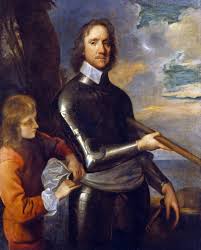
Painting of Oliver Cromwell, an English Republican whose name became part of a curse in Ireland (including for Irish Republicans!).
(Image sourced: Internet)


Damn” and “Goddamn” are abbreviations of “May God damn …” (“you, her, it, them” etc) and to utter them in many circles in the USA is considered evidence of bad rearing. They are curses which are also oaths, in calling upon the Devine being to add power to the curse.

Typically, curses and oath-curses use the subjunctive in grammar and, although seemingly strange, this connects them to blessings and greetings. Go raibh maith agat (may you have good”) is the Irish for “thank you” and Go mba hé duit (“may it be [the same] for you”) is the reply to the Irish greetings Sé do bheatha or Móra duit. Slán abhaile (“Safe home”) is an abbreviation of Go dtéigh tú slán etc (“May you go safely home”). All of these are in the subjunctive form of speech.  Vaya con Dios (“May you go with God”) is a castillian-language (Spanish) farewell wish we might come across in tales set in the south-west USA or in Latin America; that is also in the subjunctive. In fact “farewell” was “fare thee well” and probably originally, “May thee fare well”. Instead of the “Go to Hell” or “I hope you break your neck” one might hear today, centuries ago one would have heard “May you go to Hell” or “May you break your neck”.

This constant use of the subjunctive to wish well or ill upon others suggests to me that it was widely believed, at some stage in society, at least in most European societies, that one could make something happen by using a certain form of words. That form was the subjunctive; however, according to many who study language, the subjunctive is disappearing in European language and remains most in use preserved in everyday greetings and well-wishes – and the occasional curse.

It seems to me that the reason for this gradual disappearance is that we no longer believe we can make things happen by the way that we say them. We may wish them – and show the object person that we wish them – but we can’t make them happen. Nor can we expect a thing to happen with anything like a confidence that invoking a God will bring the wish, for good or ill, to fruition.

FENIANS

          Earlier in this discussion I touched on oath-bound societies and the apprehension with which they were often regarded by those in power. Well, the Fenians were such an organisation. Formed on St. Patrick’s Day 1858, in Ireland as the Irish Republican Brotherhood and in the USA as the Irish Fenian Brotherhood, it was a popular movement until the Irish Civil War (1919-1922). Because of their revolutionary credentials and democratic program, they were accepted into the International Workingmen’s Association (the First Socialist International 1864-1889). As a true Republican organisation, they sought the separation of Church and State5 and in that, apparently incurred the wrath of Pope Pius IX (Giovanni Maria Mastai-Feretti, ruled from 1846 to his death in 1878). He excommunicated the Fenians.

Pope Pius IX
(Photo source: Internet)

Although a significant number of Fenians (particularly in the leadership) were of Protestant background (Presbyterian, Anglican, Methodist, Unitarian), most of the Fenians had been brought up in the religious faith of the majority in Ireland, Catholicism. Not only would excommunication be painful to Catholic Fenians but could also lead to their being shunned by other Catholics who might otherwise have supported them. In the end this did not occur to anything like the extent that would have pleased the Catholic Church hierarchy or the British rulers of Ireland, as Irish Catholics have historically shown an ability to set to one side the teachings of the Church when they appear in contradiction to their struggle for national self-determination.

But obviously the public excommunication did the movement some harm and hurt many Fenians who were also strongly Catholic, such as John O’Mahony, co-founder in the USA, who left the Fenians as he approached his death so that he might be administered the last rites of the Church6.

John O’Mayony, c.1867, a Catholic Fenian, excommunicated by Pius IX (Source photo: Internet)

SCHOOL SOPHISTRY

          In an Irish secondary school run by the Christian Brothers, we were taught that the opposition of the Catholic Church to the Fenians (and presumably to the subsequent Republican military organisations), rather than being due to their struggle for Irish independence, was the secret organisation’s dispensing and repetition of an oath of allegiance. Perhaps we were too ill-informed (I know that I was) to bring up the question of oaths given in other circumstances, such as in giving evidence in court or in military service, circumstances with which the Church appeared to have no problem.

Had one of us done so, our Christian Brother teachers might have replied that what was wrong was “taking the Lord’s name in vain” and explained that “in vain” did not, in the English at the time of translation of Bible texts, mean only “for no important purpose” but also “for no good purpose” and that would of course have included “for an evil purpose”.

Had we questioned what the “evil purpose” might have been in the case of the Fenians, we would have put our teachers in some difficulty.

What for example in the two versions of the Fenian Oath recorded, might be considered “evil”?

I, A.B., do solemnly swear, in the presence of Almighty God, that I will do my utmost, at every risk, while life lasts, to make Ireland an independent democratic republic; that I will yield implicit obedience, in all things not contrary to the law of God, to the commands of my superior officers; and that I shall preserve inviolable secrecy regarding all the transactions of this secret society that may be confided to me. So help me God! Amen.”

I, A.B., in the presence of Almighty God, do solemnly swear allegiance to the Irish Republic, now virtually established; and that I will do my very utmost, at every risk, while life lasts, to defend its independence and integrity; and, finally, that I will yield implicit obedience in all things, not contrary to the laws of God, to the commands of my superior officers. So help me God! Amen.

Would a Christian brother have admitted opposition, not only by himself but by the Catholic Church, the dogma of which he was explaining, to the establishment of an “Irish Republic”, or even to “an independent democratic republic”? And if not, what then? The use of armed force, i.e violence? Since when has the Catholic Church hierarchy been against violence in or of itself? Did it not support some side in most inter-European wars and Spanish, French and Portuguese colonial wars? In fact, did the Catholic hierarchy not itself initiate some wars and did the Vatican not have its own army, as pointed out by Fr. Sean McManus in the USA7?

If the objection were not to “a democratic Republic”, against which Pius IX was definitely set, in that he opposed the separation of Church and State, then surely the only honest reply could have been: “The Catholic Church hierarchy in Ireland made a deal first with the British occupation that if they gave Catholics equal rights and let us build up our power here, we would not support their overthrow. Since then we made a similar deal with the Irish State and its rulers. And we intend to honour that deal.”

End.

FOOTNOTES:

2In the courts of many countries one is now permitted to use the words “I affirm that the evidence I shall give …” and one may sometimes be asked by the presiding judge whether one is an atheist, or agnostic – presumably as otherwise the failure to “swear by Almighty God” might be regarded as suspect.

3“Bloody Queen Mary” was an example, Mary Tudor, Mary I Queen of England (1560-1558; ruled ’53-’58), who had nearly 300 Protestants burned at the stake for “heresy”. )

4In Irish history, three are generally recognised: Dublin 1913, Dublin 1920 and Derry 1972.

5Not all organisations dubbing themselves “Republican” do in fact uphold this principle and in fact it could be said that the Irish Republican movement from the early 20th Century until its end did not generally do so, in that it rarely confronted the Church on its social policies or interference in lay matters, except when the Church condemned Republican actions. Also a great many Republican commemorations included the officiating of a member of the Catholic clergy.

6See the Irish Echo article in Links & References.

7Ibid.


LINKS AND REFERENCES

https://www.google.com/search?q=Dictionary#dobs=excommunication

https://www.irishecho.com/2011/02/unholy-row-brews-over-anti-fenian-pope-pius-ix-2/

https://en.wikipedia.org/wiki/Syllabus_of_Errors

https://en.wikipedia.org/wiki/List_of_people_excommunicated_by_the_Catholic_Church

https://www.encyclopedia.com/international/encyclopedias-almanacs-transcripts-and-maps/two-fenian-oaths

CELEBRATED PALESTINIAN CARTOONIST EXHIBITS IN IRISH CITIES

(Lots of images but text reading time less than 5 minutes)

Diarmuid Breatnach

As Palestinians and their supporters around the world mark anniversaries of the Return to Palestine demonstrations and Land Day, Israeli snipers kill Palestinian children.  Dublin marks the day with a solidarity rally and exhibitions and talks by internationally-recognised Palestinian cartoonist Mohammad Saba’aneh.

          The Ireland-Palestine Solidarity Campaign organised a rally to mark the anniversary of the start of the Return to Palestine demonstrations last year and also Land Day. Sadly, marking a Palestinian anniversary usually involves marking the deaths of martyrs and this was no exception, as Israeli Occupation Force snipers killed four demonstrators, three of them 17 years of age.

Section of the Palestine solidarity rally at the Spire in O’Connell Street, as it was ending.

After the rally, of which I just caught the tail end because of the weekly Save Moore Street From Demolition campaign duty, I managed to catch the exhibition of noted Palestinian political cartoonist Mohammad Saba’aneh and to buy his book PALESTINE in black and white. Sadly, a prior appointment meant I had to miss his talk, which I would have loved to attend, especially as I dabble a little in cartoon-drawing myself.

The World (or its governments, including the Arab countries) ignores the oppression of Palestinians by the Israeli Zionists. Artist: Mohammad Saba’aneh.

Fortunately, Mohammad Saba’aneh was still there and was kind enough to autograph his book for me. When I took a photo of him with Fatin Al Tamimi, photographer and Chairperson of the IPSC, she insisted on taking a photo of me with him too – shukran.

Artist: Mohammad Saba’aneh and myself. (Photo: Fatin Al Tamimi with my camera phone)
Photographer and Chairperson IPSC with Artist Mohammad Saba’aneh.

On Thursday, Saba’aneh had also given a talk at the National College of Art & Design, along with Tuqa Al Saraj, also a Palestinian artist but today based in Dublin.

Mohammad Saba’aneh was born in 1978 in Ramallah in occupied Palestine, where he still lives. He is a Palestinian painter and caricaturist who has been imprisoned by Israel because of his art. He has a daily cartoon in the Palestinian newspaper al-Hayat al-Jadida and his work features in publications across the Arab world.

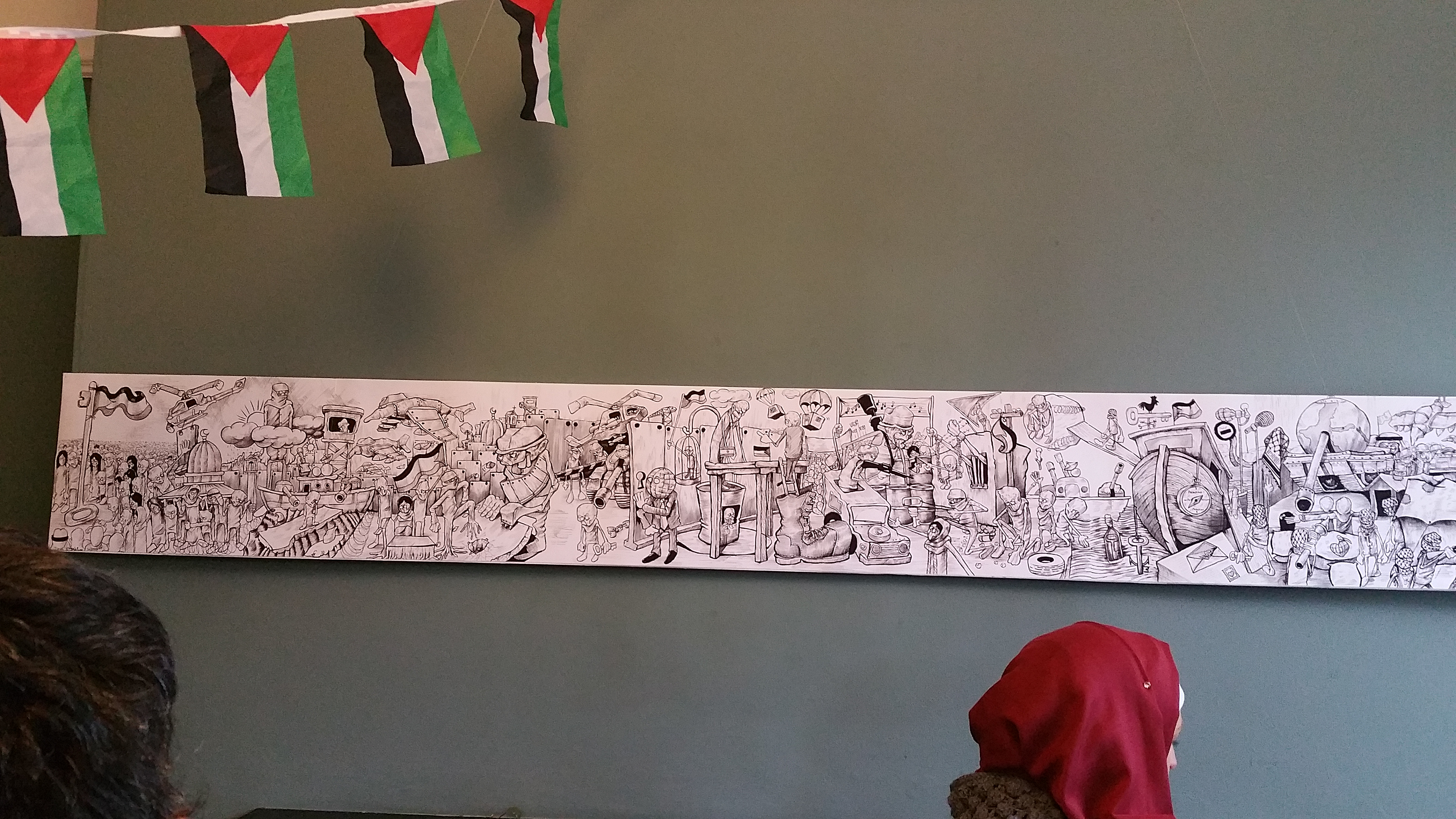
A veritable cartoon strip. Artist: Mohammad Saba’aneh.

HELPING THE DEAF AND THE TRAUMATISED WITH CARTOONS

          Saba’aneh used caricature with deaf students to help them adopt another language to express their feelings and with children who witnessed an Israeli assault to help them psychologically. He took part in many workshops designed for children to develop critical thinking. Saba’aneh was responsible for organizing an international fair at Mahmoud Darwish museum in 2014 in which more than 100 international artists participated. Freedom House chose one of his works in 2016 as one of the year’s most important photos. His first book was published in the US in April 2017.

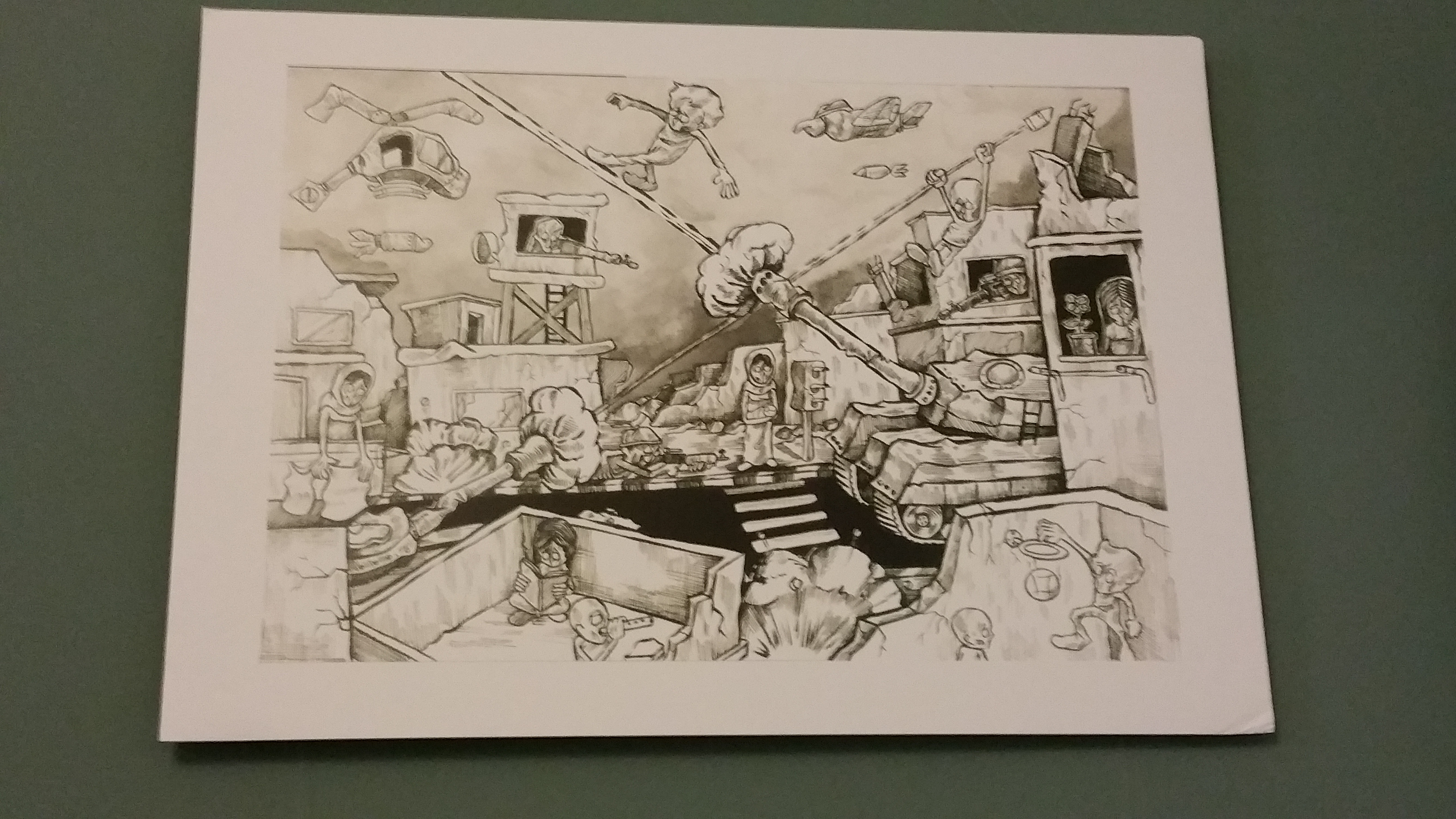
Children in Israeli Zionist jails — one of my favourites. Artist: Mohammad Saba’aneh.

INTERNATIONAL WORK AND RECOGNITION

          Saba’aneh is the Middle East representative for Cartoonist Rights Network International and the Palestinian ambassador for United Sketches, an international association for freedom of expression and cartoonists in exile and participated in many international publications such as The truth has more than one face in Europe and Sketch of Freedom in the US. He. He is the recipient of numerous awards, including the 2017 Marseille International Cartoon Festival Prix d’Or. Pulitzerwinning cartoonist Matt Wuerker described him as “an inspiration for cartoonists around the world.” Noted graphic journalist Joe Sacco has said of this work that it is a “gut punch that gets straight to the essence of the stark reality of Palestinian life under Israeli occupation.”

Life for children in Palestine under the Israeli Zionists. Artist: Mohammad Saba’aneh.

PROGRAM DATES:

Thursday 28th March – NCAD (Dublin), 7pm, Harry Clarke Lecture Theatre
Friday 29th March – TCD (Dublin), 3pm, Room LTEE1, Hamilton Building
Saturday 30th March – Dublin, 2.30pm, The Pearse Centre, 27 Pearse St

All of the above now over.


Monday 1st April – Waterford, 7.30pm, The Tower Hotel
Tuesday 2nd April – Limerick, 8pm, Perys Hotel
Wednesday 3rd April – Galway, 7pm, Black Gate Cultural Centre
Thursday 4th April – Maynooth University, 4pm, Venue TBC (Afternoon)
Thursday 4th April – Celbridge, 8pm, Celbridge Manor Hotel

End.

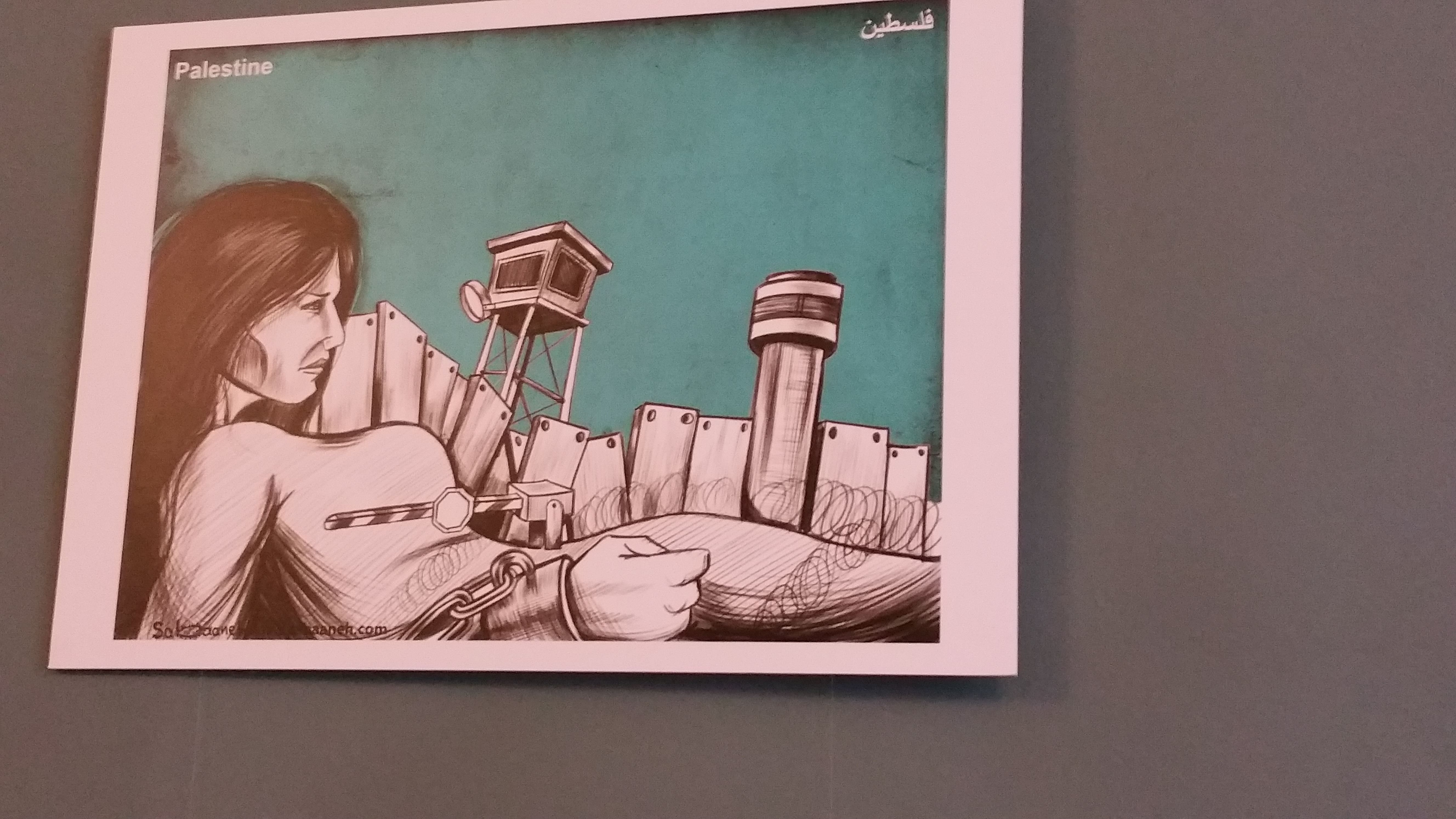
Judicial Justice under the Israeli Zionists. Artist: Mohammad Saba’aneh.

SOURCES:

Background information: Wikipedia and IPSC FB page

Photos (unless otherwise indicated): D.Breatnach

LINKS:

IPSC: https://www.facebook.com/groups/20826333992/

Artist: Mohammad Saba’aneh.
A nod to Michaelangelo’s the “Birth of Adam”. Artist: Mohammad Saba’aneh.


The cost of NOT boycotting Israeli products. Artist: Mohammad Saba’aneh.
Posters on railings outside Pearse House.
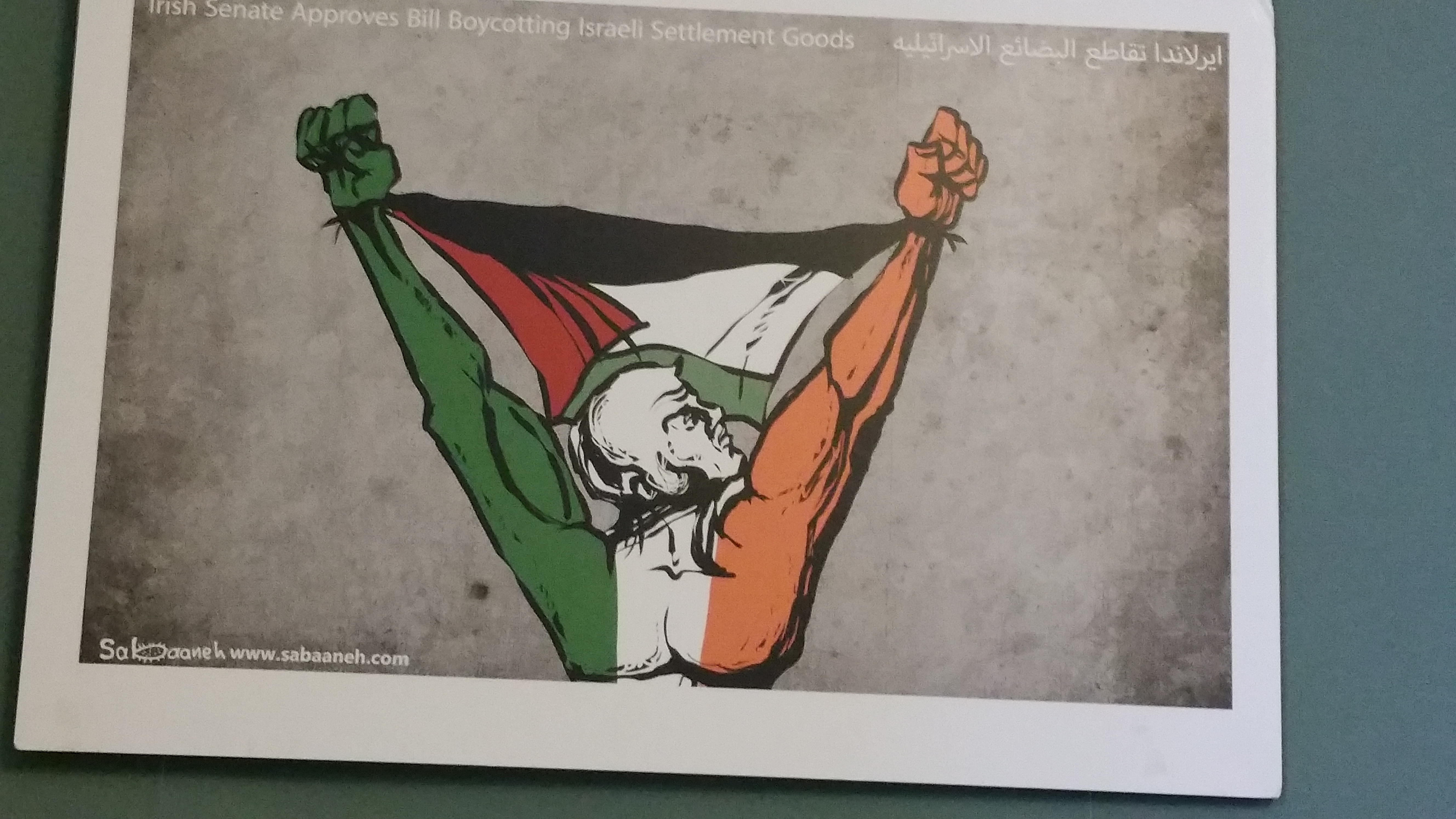
Praise for Sen. Frances Black’s Bill to ban imports from the “Occupied Territories”. Artist: Mohammad Saba’aneh.


Artist: Mohammad Saba’aneh.
Symbols in Palestinian cartoons. The Key for the right to return is somewhat of an irony, as when the Christian Spanish Monarchs expelled the Sephardic Jews from Al Andalus, many of them also took the key to their house with them.


HORROR FASCISTA EN VILLORUELA — BORRADO?

Una historia de crímenes del fascismo espanol, si nos hacia falta recordarnos de nunca jamás dar les la oportunidad de alcanzar el poder de nuevo.  Y nos demuestra además que el fascismo nunca fue vencido en el Estado espanol, sin hablar de haberlo despedido.  Sin entender esa verdad no es posible arreglar las problemas del ahí.

He traducido este relato al inglés y subido separadamente. 

Diarmuid Breatnach

El miedo asoló Cantalpino, donde las hordas falangistas mataron a una mujer y a 22 hombres; donde se robó y violó. La señora Alejandra cuenta la historia y sus ojos parecen mirar hacia dentro de si misma: “ Aquí asesinaron a muchos y a la Eladia Pérez, la Jaboneta, también. Fueron a buscar a su hijoGuillermo, a quien «pasearon» más tarde, y ella no quiso abrirles; así que el Cagalubias le disparó y la mató; luego la llevaron al cementerio y su cuerpo no cabía en la hoya y el Cagalubias le cortó la cabeza con la pala…los asesinos fueron gente del pueblo y forasteros, falangistas, curas, frailes y hostias. El cura, era de lo peor, daba la bendición a los «paseos»..También les cortaron el pelo al cero a unas cien mujeres y, lloviendo y todo, las sacaron en procesión, la música tocando y los falangistas gritando arribaespaña y vivafranco y… ¡me cago en la madre que los parió!..”

Alejandra sigue con su relato: “..A mi me hicieron muchas, a otras las violaron..A mi me violaron 5 falangistas, sacaron de la cama a mi marido, que en paz descanse, el pobre, y le plantaron una pistola en el pecho, y allí, delante de él, me violaron. Unos me tenían cogida por los brazos y otros, por las piernas, y aquí Santa Inés, a lo que quieran hacer, y las pistolas encima de la cama en presencia de mi Desiderio ¡El pobre Desiderio! Además nos robaron todo lo que pudieron..Si, si, eran de aquí, de Cantalpino. Por desgracia, esta violación no fue un hecho aislado. En Poveda de las Cintas, a pocos kilómetros de Cantalpino, la historia se repitió, esta vez con la mujer del secretario del ayuntamiento..”

El 24 de agosto de 1936 la sangre no paró en Cantalpino, la impunidad de los asesinatos animó a los franquistas. Esa misma tarde se presentaron en Villoruela, a menos de 10 kilómetros de Cantalpino, 3 falangistas acompañados por fascistas vecinos del pueblo: Detuvieron a las siguientes personas: Eustasio Ramos (51 años), Elías Rivas (43), los hermanos Leonardo (43), y Leoncio Cortés(41), Daniel Sánchez (35), Esteban Hernández (29) Francisco García (25) y Benigno Hidalgo (18).

Los fascistas dieron contestaciones de carácter criminal a los familiares de los detenidos cuando iban a buscarles a sus casas: A la mujer de Leonardo Cortés le preguntaron que dónde estaba su marido; ella respondió que no sabía y le contestaron: “No se preocupe, que aunque esté bajo tierra le encontraremos”. Daniel Sánchez había estado jugándose la vida para salvar la de otras personas con sus mulas y su carro para cruzar la riada de la era, sin tener en cuenta de qué color ni de qué partido eran. Cuando le fueron a buscar a casa les dijo la mujer: “Esperen ustedes, que se está quitando la ropa, está todo calado”; la contestación fue: “No se preocupe usted, que lo mismo le va a dar”. Cuando fueron a la casa de Esteban Hernández, les dijo su madre: “esperen, que no tiene calcetines”; la contestación fue: “no se preocupe, que no le van a hacer falta”. Cuando fueron a buscar a Benigno Hidalgo, les dijo su madre: “le tengo que poner una inyección”; “no se preocupe usted, se la vamos a poner nosotros”, le contestaron.

Una vez capturados, quedaron arrestados en el Ayuntamiento atados de pies y manos con cuerdas. Los componentes del Ayuntamiento convocaron una reunión y decidieron que los 8 detenidos debían ser fusilados. Así amarrados, los hicieron subir a un camión en Villoruela, ya pasada la medianoche, y los trasladaron al término de Salvadiós, un pueblo de la provincia de Ávila. Allí, en un cruce de caminos, los fusilaron y los dejaros tirados en una cuneta. Allí mismo los enterraron unos vecinos de Salvadiós. Los asesinos fueron 7 del pueblo, el que llevaba el camión y los 3 falangistas forasteros.

Dos de las mujeres de los detenidas, María Engracia Cortés y Angeles del Pozo, se fueron a pedir ayuda a las monjas del convento. Contaron a las monjas lo que estaba pasando y ellas contestaron que aquello era una cruzada, y que si no habían hecho nada por qué habían estado huyendo, a lo que muy acertadamente las vecinas citadas contestaron: “A Jesucristo también lo persiguieron y por nada lo crucificaron”.

Jaime Cortés, hijo de uno de los fusilados contaba que “..después del sufrimiento que causaron, los fascistas nombraron entre los vecinos del pueblo una guardia llamada cívica para controlar nuestras salidas de casa, las demostraciones de sufrimiento. Nos pasábamos las noches enteras llorando con mi madre y mis abuelos en la cocina..hace falta tener mucha paciencia y resignación para convivir toda una vida con los criminales que fusilaron a tu padre..tuvimos que pasar por calamidades y sufrimientos..he tenido siempre muy presente una frase que mi madre nos decía con mucha frecuencia: “Hijos, no quiero veros nunca con las manos manchadas de sangre”…los únicos motivos por los que los fusilaron tuvieron fueron la forma de pensar diferente al franquismo, es decir, por defender la libertad, los derechos de los trabajadores, la seguridad social y la educación..los fusilaron por defender el derecho más grande de toda persona: la libertad..”

Desde la fecha 15 de agosto de 1936 al 16 de junio de 1939 no existe ningún documento, ni libro de actas de los archivos de Villoruela ¿Quiénes fueron los que hicieron desaparecer dicha documentación? En el libro de actas de defunciones aparecen con fecha 13 de marzo de 1937 inscritos por el juez Iñigo de la Torre estos 8 fusilados como personas como desaparecidas.


Originales de Ángel Montoro en Jiminiegos36 y Foro por la memoria (Intervíu nº 177, 4-10 octubre 1979). Foto de Xavier Miserachs

Documento original:

https://documentalismomemorialistayrepublicano.wordpress.com/2019/01/27/el-inmenso-rompecabezas-del-horror-fascista-entre-cantalpino-y-villoruela-salamanca/?fbclid=IwAR2Ha_X552tk86E3B4b5WVoA9m1_1gMZc8xnaThBs__Dv2N7eUZ31wr6KUI

FASCIST HORROR IN WESTERN SPAIN

A brief account of the fascist horror between Cantalpino and Villoruela (Salamanca) during the Spanish War, forwarded to me for translation from Castillian (Spanish).  I will post the original separately.  

Diarmuid Breatnach

Comment: If another reason were ever needed to ensure we crush fascism before it gets strong!  Stories like this illustrate how fascism was not defeated, much less rooted out in the Spanish State and remains at its heart to this day.  No progress can be made towards democracy in that state without taking that fact into account.  DB.

(Translator’s note: Villoruela is a municipality located in the province of Salamanca, Castille and León, in western Spain).

Alejandra, the interviewee, who was raped in front of her husband, next to her while a gun was held to his chest.

Fear ravaged Cantalpino, where the Falangist hordes killed a woman and 22 men; where they robbed and raped. Mrs. Alejandra tells the story and her eyes seem to look inside herself: “They murdered many here and Eladia Pérez, the Jaboneta, too. They went looking for her son Guillermo, whom they “took for a walk” later, and she did not want to open for them; so the bastards shot and killed her; then they took her to the cemetery and her body did not fit in the hole and the bastards cut off her head with the shovel … the murderers were people from the town and strangers, Falangists, priests, friars and that kind. The priest was the worst, he gave his blessing to the “walks” .. They also cut the hair of about a hundred women to the scalp and, in the rain and everything, they took them in procession, the music playing and the Falangists shouting “Up Spain!” and “Long live Franco!” and … I shit on the mother who gave birth to them! “

Alejandra continues with her story: “… they did a lot to me, they raped others. Five Falangists raped me. They took my husband out of bed, may the poor man rest in peace, and they pushed a pistol against him, in the chest, and there, in front of him, they raped me. Some had me by the arms and others, by the legs, and here, Saint Ines, to what they wanted to do, and the guns on the bed in the presence of my Desiderio. Poor Desiderio! They also stole everything they could. Yes, yes, they were from here, from Cantalpino. Unfortunately, this violation was not an isolated incident. In Poveda de las Cintas, a few kilometers from Cantalpino, the story was repeated, this time with the wife of the secretary of the town hall .. “

On August 24, 1936 the blood did not stop in Cantalpino, the impunity of the murders encouraged the Francoists. That same afternoon they appeared in Villoruela, less than 10 kilometers from Cantalpino, 3 Falangists accompanied by fascist neighbors of the town: They arrested the following people: Eustasio Ramos (51 years old), Elías Rivas (43), the brothers Leonardo (43) , and Leoncio Cortés (41), Daniel Sánchez (35), Esteban Hernández (29) Francisco García (25) and Benigno Hidalgo (18).

The fascists gave criminal replies to the families of the detainees when they went to look for them at home: Leonardo Cortés’ wife was asked where her husband was; she replied that she did not know and they answered: “Do not worry, even though he were underground, we will find him”. Daniel Sanchez had been risking his life to save the lives of other people with his mules and his cart to cross the flood, regardless of what color or what party they were. When they went to look for him at home, the woman said to them: “Wait, he is taking off his clothes, he is all wet”; the answer was: “Do not worry, he will get it all the same”. When they went to Esteban Hernández’s house, his mother told them: “wait, he does not have socks”; the answer was: “Do not worry, he will not need them”. When they went to look for Benigno Hidalgo, his mother told them: “I have to give him an injection”; “Do not worry, we’re going to give it to him,” they replied.

Once captured, they were arrested at the City Hall tied hand and foot with ropes. The members of the City Council called a meeting and decided that the 8 detainees should be shot. So bound, they were put on a truck in Villoruela, after midnight, and they were moved to the end of Salvadiós, a town in the province of Ávila. There, at a crossroads, they were shot and left lying in a ditch. Right there they were buried by neighbors from Salvadiós. The murderers were 7 from the town, the one that drove the truck and the 3 outsider Falangists.

Two of the detainees’ wives, María Engracia Cortés and Angeles del Pozo, went to ask for help from the nuns of the convent. They told the nuns what was happening and the nuns answered that this was a crusade, and that if they had not done anything why had they had been fleeing, to which the neighbors correctly answered: “Jesus Christ was also persecuted and though had done nothing, was crucified. “

Jaime Cortés, the son of one of those shot, said that “after the suffering they caused, the fascists appointed among the townspeople a policeman, allegedly civic, to control our movements from home, the demonstrations of suffering. We spent the whole night crying with my mother and my grandparents in the kitchen .. it takes a lot of patience and resignation to live a lifetime with the criminals who shot your father .. We had to go through calamities and sufferings … I always remembered very well a phrase that my mother told us very often: “Children, I never want to see you with blood on your hands” … the only reasons for which they were shot were their way of thinking differently from the Franco regime, that is, to defend freedom, the rights of workers, social security and education … they were shot for defending the largest right of all person: freedom .. “

From the date August 15, 1936 to June 16, 1939, there is no document or record book of the Villoruela archives. Who were the ones who made that documentation disappear? In the book of death certificates for March 13, 1937 the entry inscribed by the judge Iñigo de la Torre these 8 people shot dead are listed as missing.

Originals by Ángel Montoro in Jiminiegos36 and Foro por la memoria (Intervíu nº 177, 4-10 October 1979). Photo by Xavier Miserachs

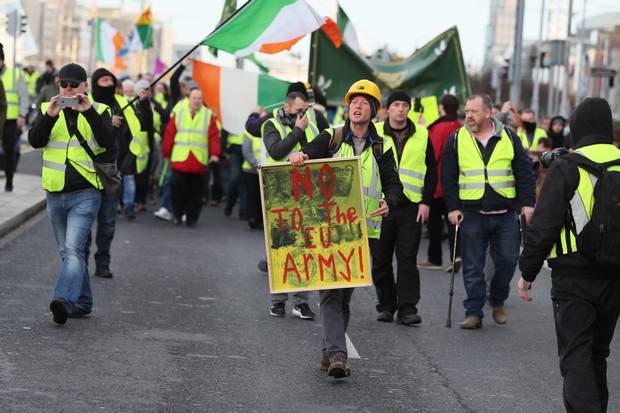
NO TO A EUROPEAN ARMY – PROTEST PESCO!

(Reading time: 4 minutes)

Diarmuid Breatnach

In March this year, the Irish State signed up to join PESCO, the EU’s Permanent Structured Cooperation military force. The Irish State’s armed forces are a now a part of it and, in a sense, so is every person in Ireland. It is a military alliance with other states and that changes our neutrality stance to which we have held since the creation of the State.

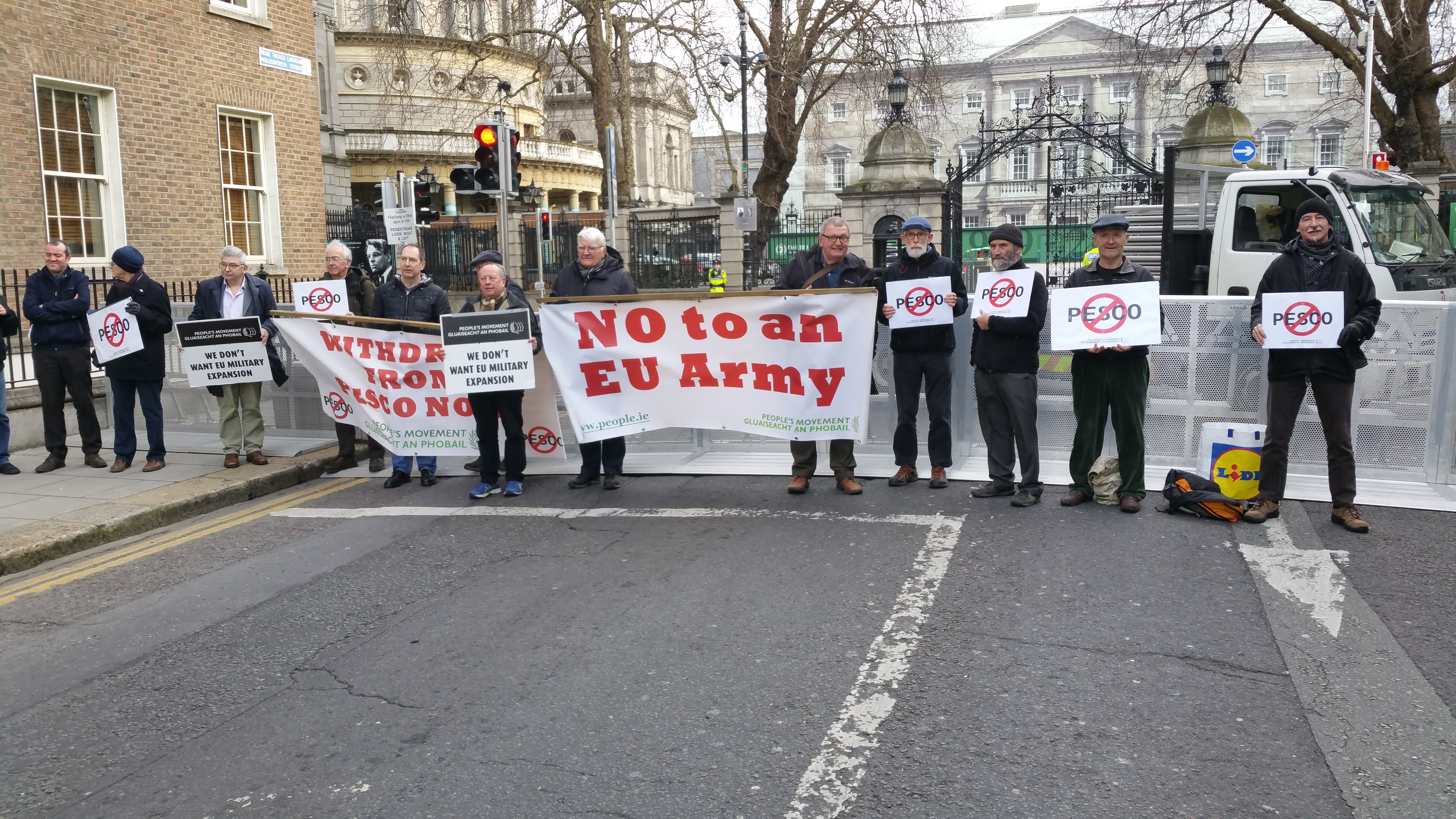
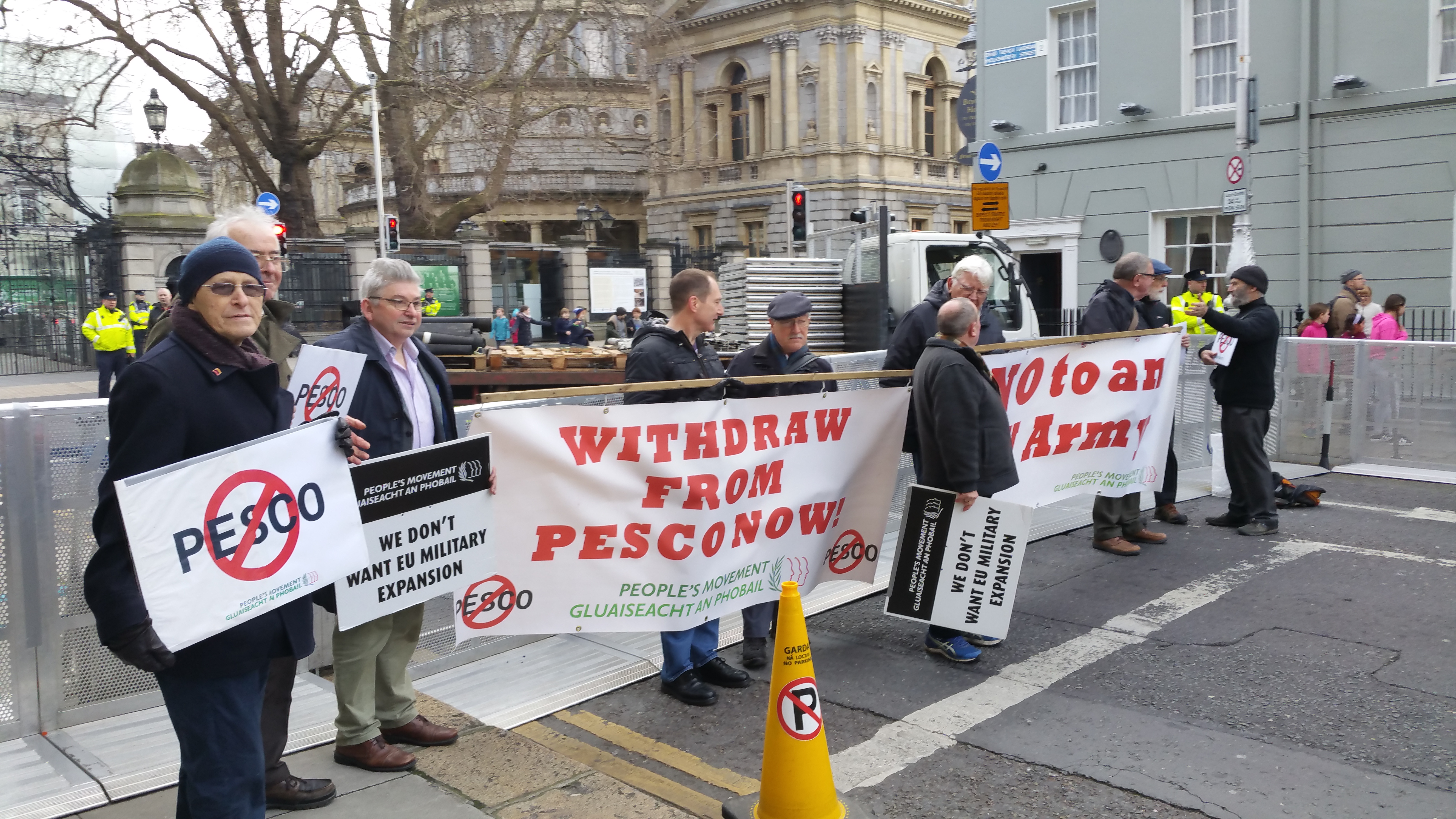
Protesters with the Dáil in the background (Photo: photographer on my phone)

          On the afternoon of 15th January this year, I attended a protest against PESCO in front of the Dáil, feeling a little guilty because it was the first such I had supported. We were few in number and, among the protesters, though I recognised some of them from other events, there were none I would associate with Irish Republican or Socialist groups – perhaps a few associated with the Communist Party.

My neglect and that of others is a pity. They may feel that other issues are more pressing but that surely does not prevent an occasional attendance. They may feel that there is nothing to be done – the decision was made by the Government a year ago, with the support of Fianna Fáil. But if something is wrong and we can’t for the moment end it, we should never acquiesce to it, by agreement or by silence.

FIRST STEP TOWARDS A SINGLE EUROPEAN ARMY?

          PESCO is an EU agreement on military cooperation. It is not a European Army, according to its supporters in public. Not yet, according to its opponents – but it is a big step on the way there. The European Commission has committed €1.5bn to ­PESCO projects by 2020, and Ireland will be obliged to boost its spending on personnel and weaponry. With such a budget in its early stages this is clearly no small project.

Jean-Claude Juncker, President of the EU Commission and the man who favours an EU army, was rejoicing at the sign-up to PESCO and was quoted as saying of it: “She is awake, the Sleeping Beauty of the Lisbon Treaty.” Yes, we remember the Lisbon Treaty don’t we? ‘Just keep voting until you vote the way we want you to’!1

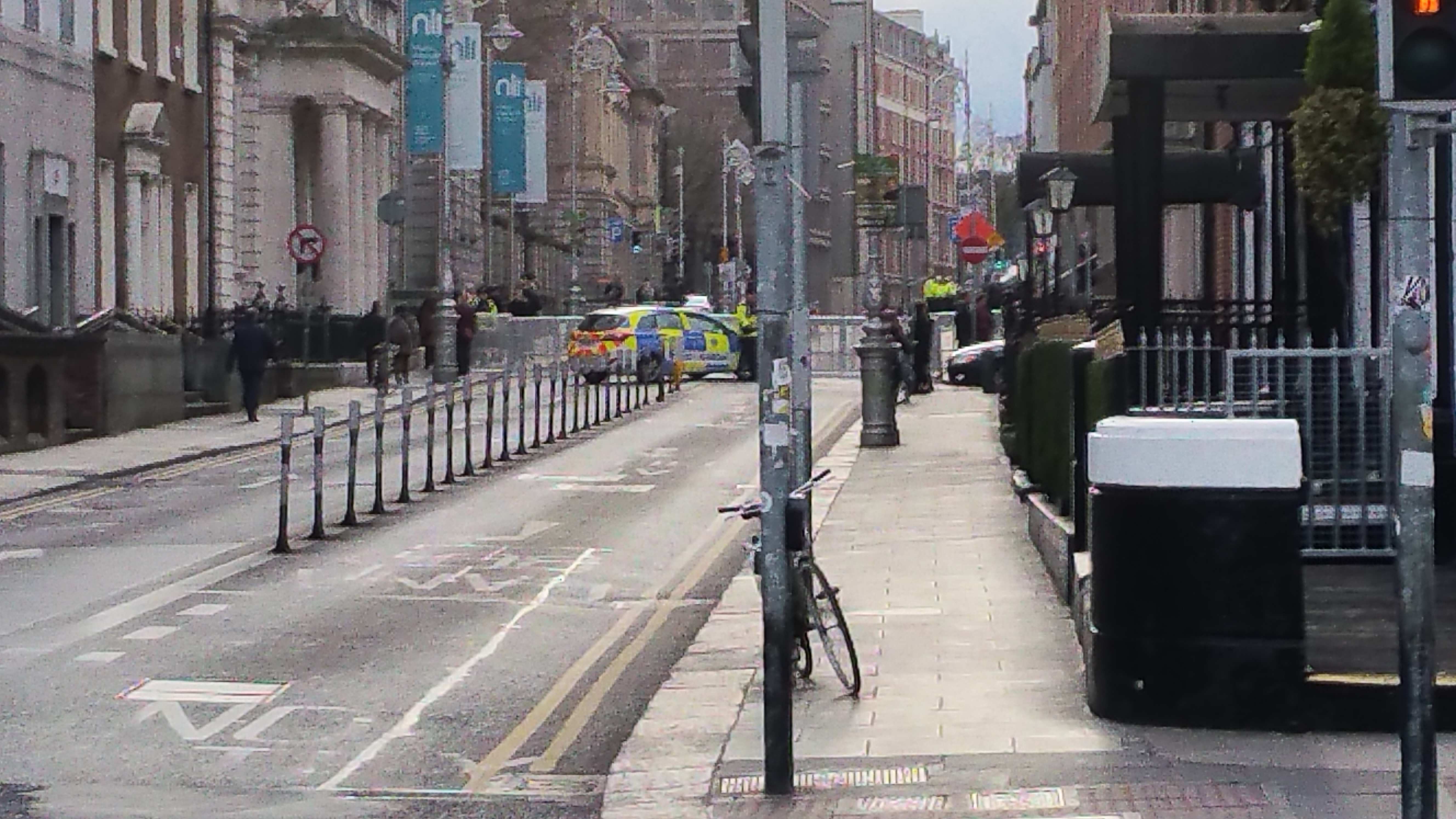
When I cycled near to Kildare Street on Dawson, I found the south end blocked by Gardaí. I turned back pushing the bike and went up Frederick St. South, left into Setanta Place and found myself blocked by Gardaí again. I had to turn back and work my way into Molesworth Street, which runs from Dawson Street to the Dáil, facing the main entrance. There were Gardaí here too but at least they were only turning away vehicular traffic. The small group of protesters were gathered by the metal barriers at the east end of Molesworth Street and I joined them there.

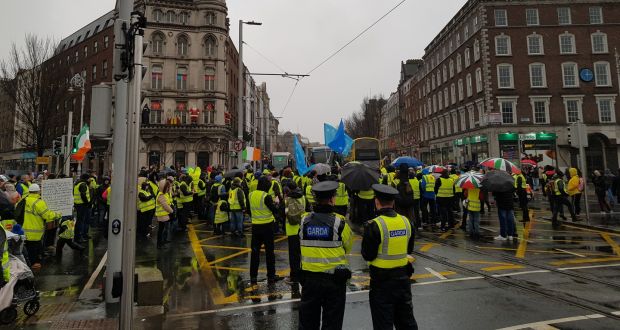
All these ‘security’ operations for the anti-PESCO protesters? No, of course not but there was a bigger demonstration expected later, protesting about a range of injustices (I didn’t stay for it).

Gardaí preventing pedestrian access to Kildare St., main access route to Irish Parliament and, coincidentally, to Buswell’s Hotel
(Photo: D.Breatnach)

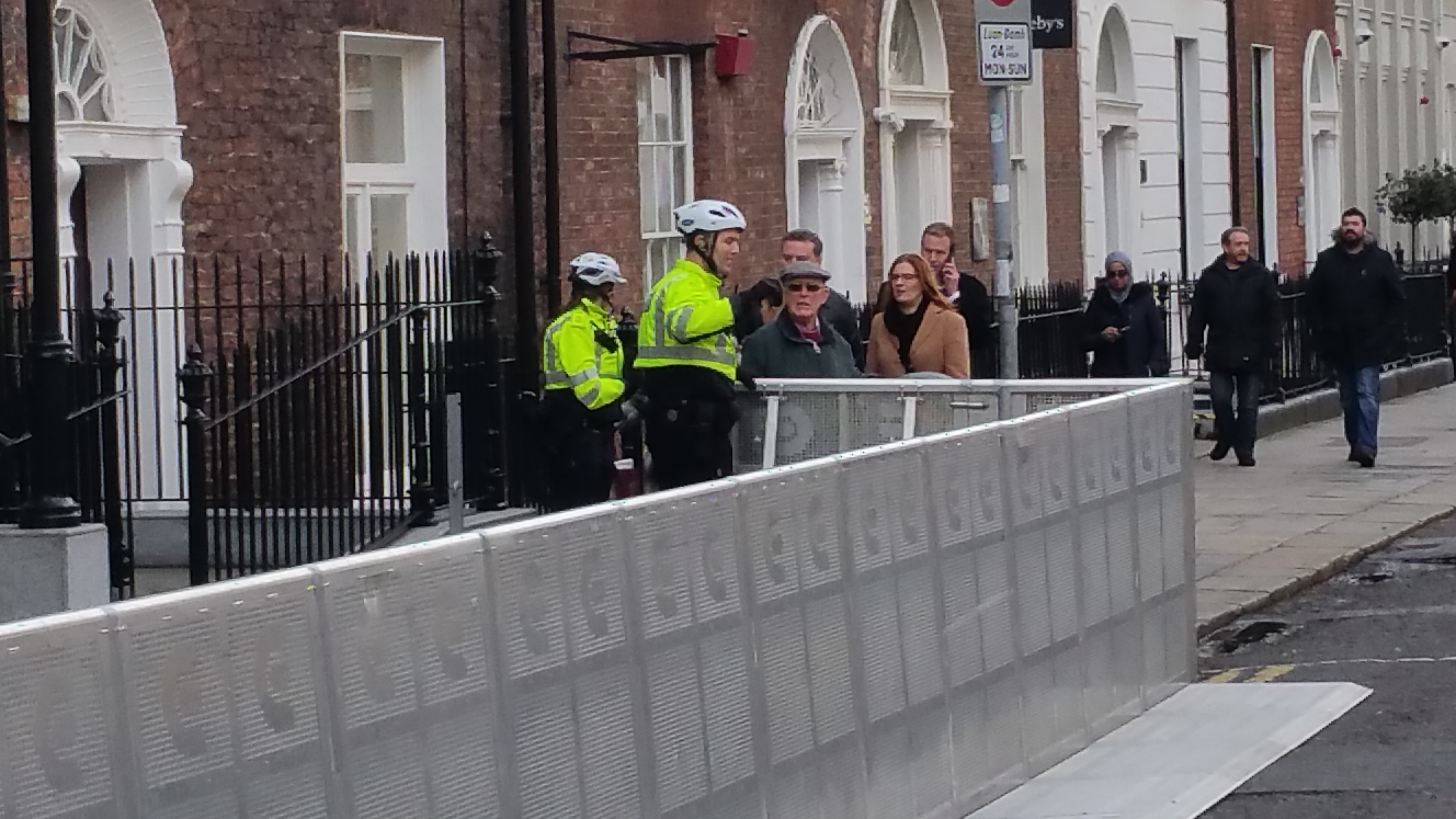
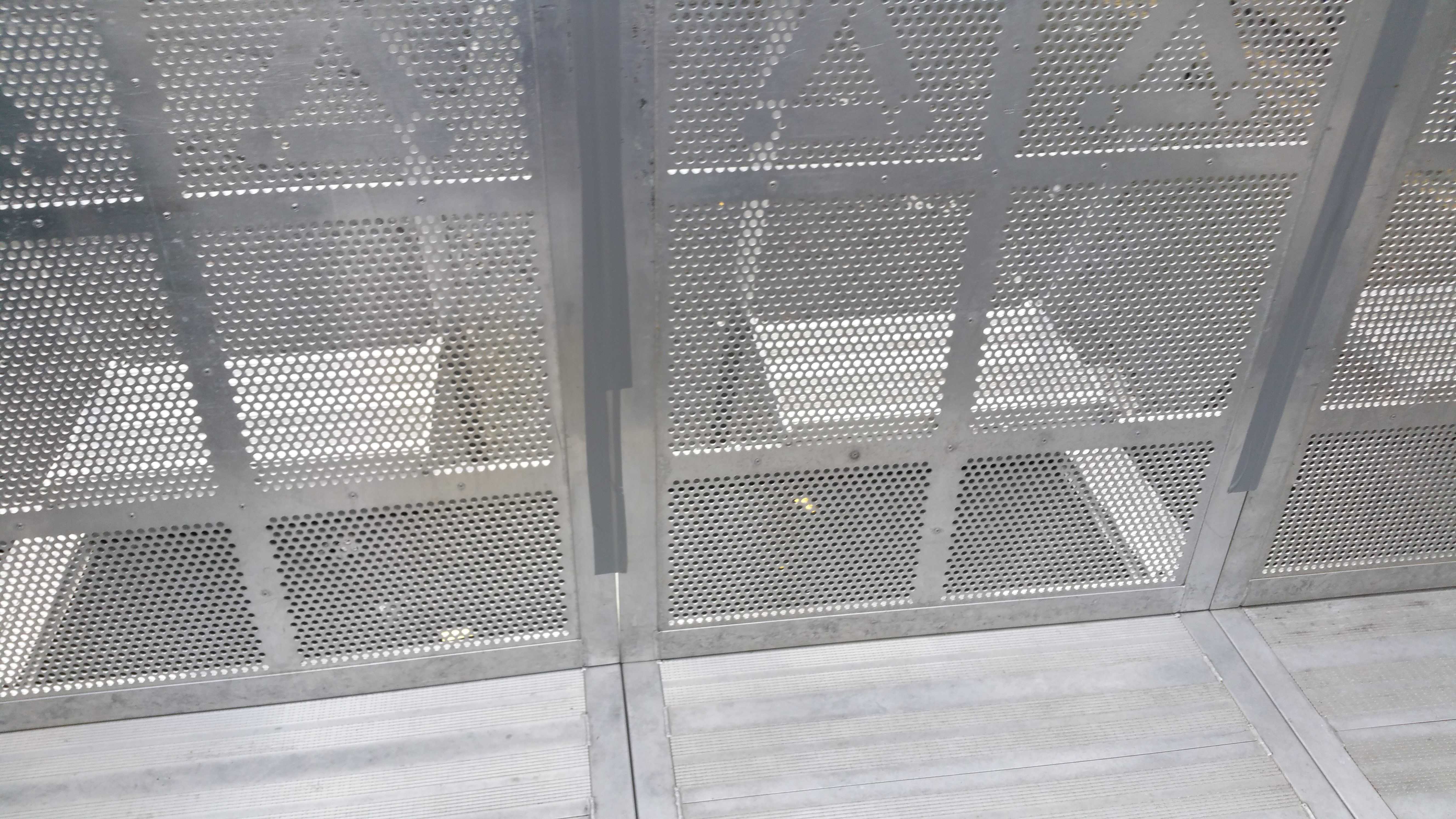
Protests at the Dáil have become so frequent in recent years that a new type of barrier has been employed. These cannot be easily separated or unhooked and the have steps built into them at regular intervals – on the Garda side. “They’re so the bastards can stand on them and baton protesters”, explained one of the demonstrators. Indeed.

Those who support our participation in PESCO justify it on the grounds of defending Europe and that, if we are a part of it, we should help defend it. No doubt a number of Army professionals relish the thought of playing with big weapons and the big boys.

People in opposition to our involvement say if Europe should be attacked then we have a choice of whether to join in its defence and that should be made democratically, whereas PESCO brings us in by stealth.

DEFENCE – OR AGGRESSION?

          Of course, states always claim that their armies are for defence. The USA, currently and for some time the most aggressively military state in the world, calls its ministry for military affairs the “US Defence Department” and its protege, probably the most aggressive state after the USA, calls its army the “Israeli Defence Forces”2.

Regarding a ‘defence’ of Europe, we might ask: against whom? Possibly against Russia, it is sometimes said. Russia has imperialist ambitions, of course but is that any different from France or Germany? Or the UK? Even the USA is hinted at as an enemy of the EU and it certainly a competitor.

Irish Army soldiers are ideal for sending into conflict areas, as the UN has found because, apart from military considerations, it has no imperialist past, ostensibly no axe to grind. Which of course is not strictly true, since the Irish State has traditionally sided with the USA on many issues and with the EU on others. But not militarily, at least not yet (apart from the Congo, that is, in the 1960s)3.

Contributing to a European Army however puts Irish soldiers in the field under EU direction and the EU is certainly a capitalist and imperialist mutual alliance, under the control essentially of Germany and France. The Spanish State faces possible future military conflicts with some nations within the state as does the French State, which also has involvement in a number of African states. Italy too may face such conflicts in future. A number of other European states also have economic interests in states in Africa and even some of the seemingly cleanest are major arms exporters.

Special steel barricades now used by the police at the Dáil. Note the step provided on the police side! (Photo: D.Breatnach)

CONCLUSION

          PESCO is of course an EU military alliance and a first step towards an EU army and Ireland joining it is undermining its traditional neutrality. Irish soldiers will be mobilised in EU military offensives against regimes the EU finds awkward, whether in support of the USA for example, as many EU states did in Afghanistan, Iraq, Libya and Syria, or possibly against former colonies of France and Spain, with new governments, taking measures to safeguard their natural resources. Our country’s involvement in such operations will of course render us a possible target for terrorist action here in Ireland.

I think more people should protest against PESCO, even if occasionally. I will make sure I do.


Protesters with Dáil (Irish Parliament) in the background, Buswell’s Hotel to the right and also the Irish National Archaeological Museum entrance visible in right background, access to all blocked by Gardaí. (Photo: D.Breatnach)

End.

FOOTNOTES:

1The Irish State signed up to the Lisbon Treaty of the EU in October 2009, following a referendum majority vote earlier that year in favour of the necessary amendment to the Irish Constitution. However, a majority vote in an earlier referendum in 2008 had voted to reject that amendment. A ‘no’ vote in Ireland could have finished the Lisbon Treaty for the whole EU and Ireland was the only state to hold a referendum on the question. After the first referendum, a campaign of State and media propaganda had pushed for a second referendum and achieved a 20% swing in favour in the 2009 vote, reversing the previous popular verdict.

2Apart from its attacks on Palestinians, Israel has attacked Egypt (with France and the UK, over control of the Suez Canal), Jordan, Lebanon and Syria and has carried out assassinations in and bombings of a number of other states; it is also constantly rattling its sabre at Iran.

3The Belgian state engineered a breakaway of Katanga Province from the new Republic of the Congo which, led by Patrice Lumumba, had declared independence in 1960 and was intending to protect the state’s natural resources. Katanga had copper mines. The Belgian state armed a rebel army run by a warlord and also supplied military expertise in the form of European mercenaries and seconded officers. The USA supported the breakaway (as did France) and the UN brokered a very imperfect ceasefire which the rebel army and the Belgian state had no interest in observing. The Irish Army were deployed there as part of the UN peacekeeping force, undermined and badly supported. Nine Irish soldiers were killed in ambush by tribesmen who did not support the secessionists and had seen their villages burned by European mercenaries as a result. More about it here: http://www.theirishstory.com/2016/10/07/the-irish-army-the-un-jadotville-and-the-congo/#.XIZa1SOLRsM


LINKS FOR REFERENCE AND FURTHER INFORMATION

https://www.independent.ie/irish-news/explainer-ireland-joins-pesco-is-it-the-start-of-an-eu-army-36409443.html

Good overall summary here: https://www.rte.ie/news/politics/2018/1230/1019537-pesco-ireland/

PANA (Peace And Neutrality Alliance — organises some protests against Ireland joining PESCO): https://www.pana.ie/

HOUSING DEMONSTRATIONS MARCH THROUGH DUBLIN

Diarmuid Breatnach

Protesters calling for the urgent construction of public housing marched through Dublin today. Various organisations and many independent activists took part in the protest with a broad range of people took pat, from socialist to republican-orientated, some with their children. The event was organised by the National Homeless and Housing Coalition.

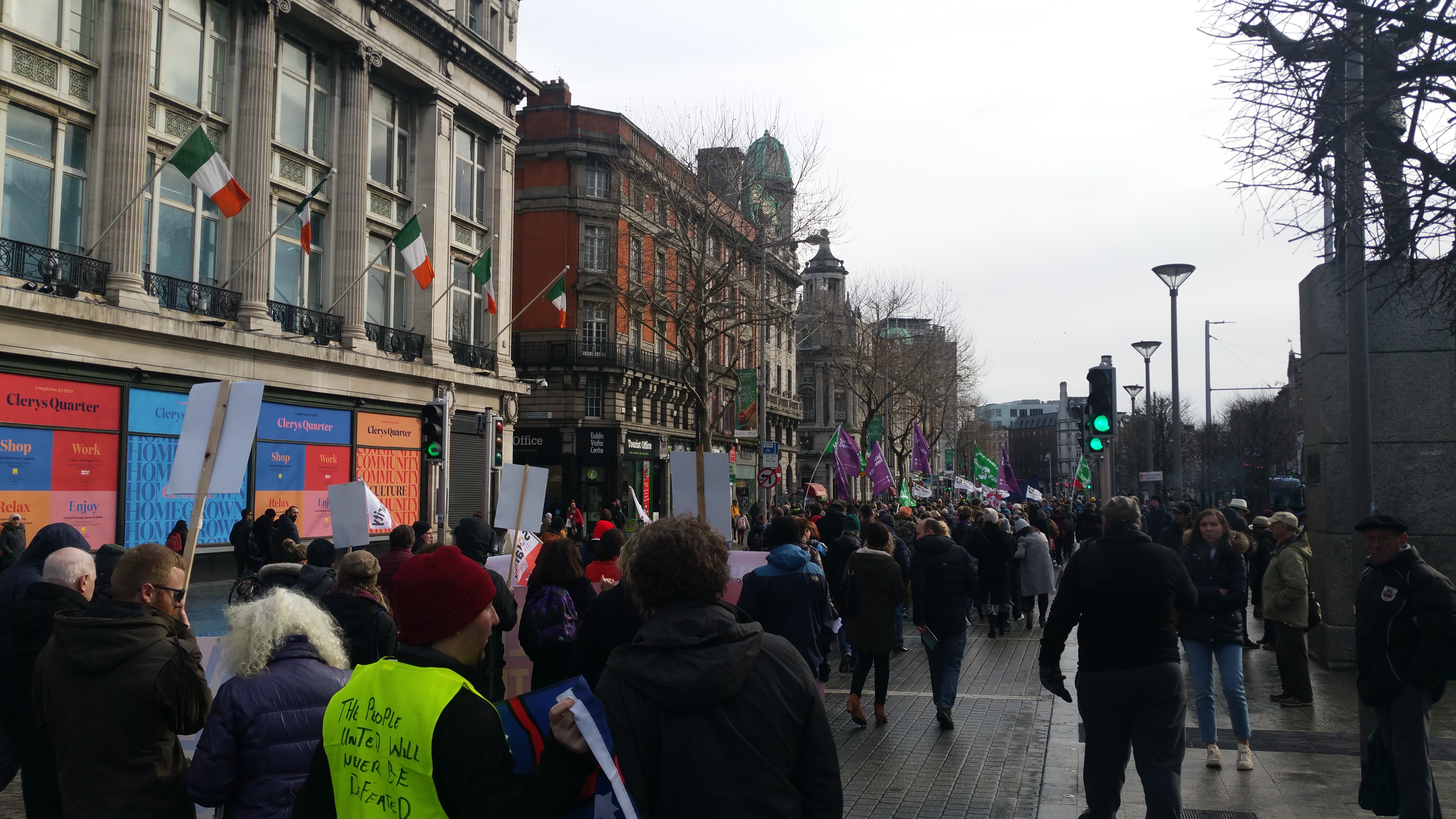
Early part of the march detachment starting from the GPO, here proceeding south along O’Connell St, the long-closed Clery’s department store on the left and the Larkin Monument on the right. (Photo: D.Breatnach)

          On their Facebook page, the NHHC had issued a statement, part of which read:

Rebuild Ireland has been an unmitigated disaster yet the cross party motion that was passed in the Dail in October that called for practical actions that would end the emergency, including making it illegal to evict someone into homelessness, were ignored by the government even though it was supported by all parties except Fine Gael. We are demanding action on the motion.

We also learned that 15 Dublin hotels received over €1m each in 2018 for accommodating homeless families which further illustrates the reliance on the private sector. These families need public housing built on public lands, they need proper homes. Last year there were 842 cases of children being discharged from the Temple Street Emergency Department back into homeless emergency accommodation. The majority of these cases were a direct result of the fact that these children are living in completely unsuitable and cramped emergency accommodation.”

The march, though far from small, seemed somewhat smaller than expected which may have been due to a cold windy day with lashing rain a little earlier in the day but may also have had another cause. The Coalition of groups has split with ICTU (Irish Council of Trade Unions) and a number of NGOs pulling out to form a different campaign on housing, apparently declining to support the demand for public housing on public land.

Front of the march pausing on Custom House Quay (Photo: D.Breatnach)

The organisers of today’s march published a list of demands:

Declare the housing and homelessness crisis an emergency.
Provide a minimum of 10,000 public house a year. No to privatization: build public houses on public land.
Make housing a constitutional right.
End evictions, bank repossessions and sell-offs to vulture funds.
Create a national Traveller accommodation agency to oversee and deliver Traveller Accommodation.
Legislate for real security of tenure, real rent control and affordable rents.
End the use of B&B’s and hotels for emergency accommodation. Improve emergency accommodation facilities and provide security for all in need.
Create rent pressure zones for Purpose-Built Student Accommodation (PBSA). Ensure tenant’s rights for students in PBSA and digs-style accommodation.

One group set off from the GPO and after making a circuit on O’Connell Bridge, marched along the north quays, meeting up with another group coming across Butt Bridge to join them from the Housing Agency HQ; apparently another group had marched from City Hall. The march continued on to Samuel Becket Bridge, to the bemusement of some participants, where the participants halted and were addressed by a number of speakers.

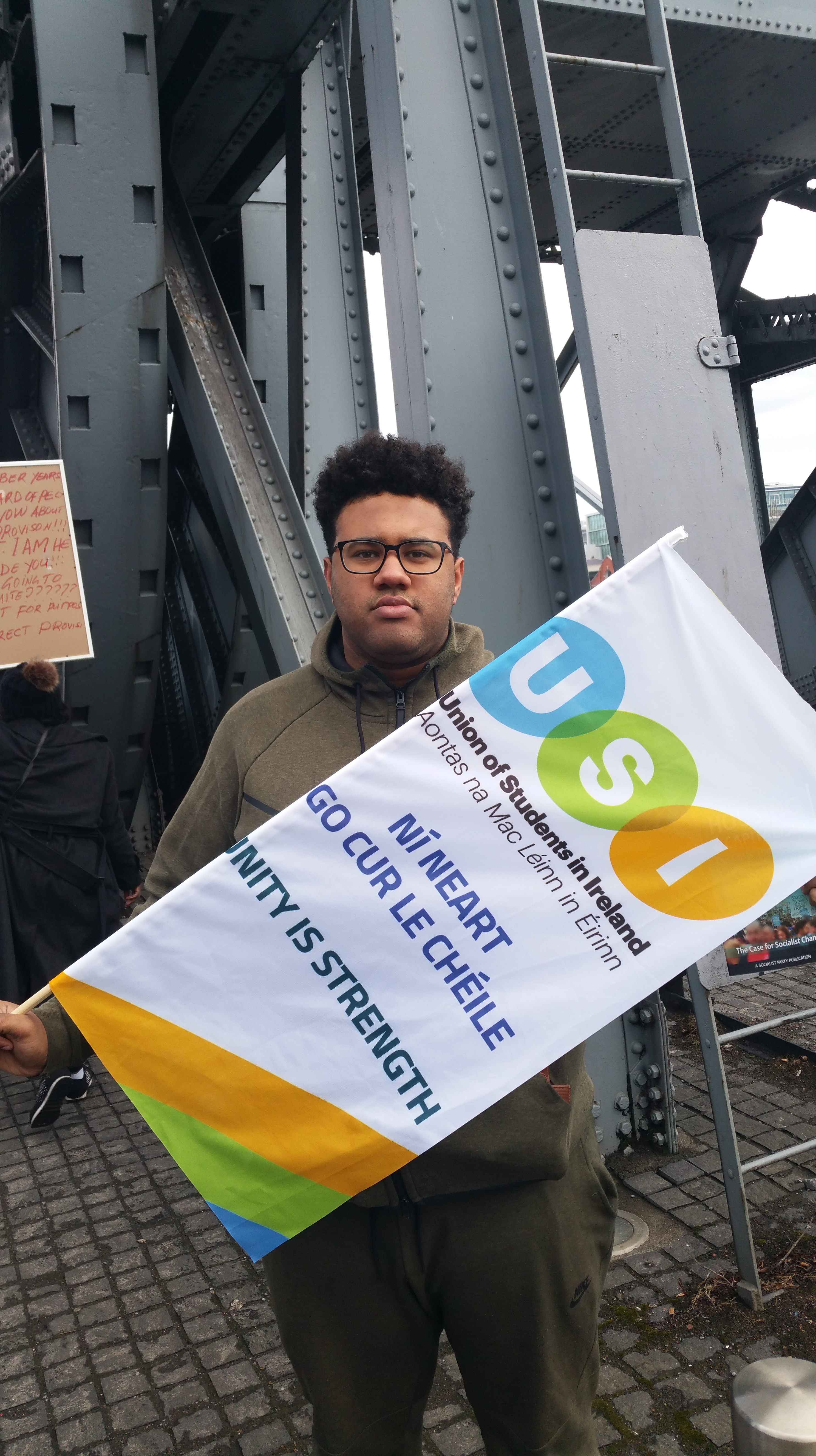
Student on the march displaying flag of Union of Students in Ireland (Photo: D.Breatnach)

Along the route of the march, slogans were shouted, among which were:

“Raise the roof, not the rents!” and “Housing is a human right!”

Section of the march stretching out along the north quays. (Photo: D.Breatnach)
One of the organisers speaking at the rally at the end of the march: Tina McVeigh, of PBP. (Photo: D.Breatnach)

As well as Socialists, a number of Republicans were in evidence, marching without party banners. Sinn Féin supporters had a banner and party flags, as did People Before Profit and the Workers’ Party. Some Union of Students in Ireland flags were in evidence too. A Travellers’ group and some community groups also carried banners identifying their group with the march and its cause.


Report by Irish Times, with video including interviews with participants: http://https://www.irishtimes.com/news/social-affairs/thousands-march-in-support-of-homeless-in-dublin-1.3820626?fbclid=IwAR2aW9yLVjHbTrJ9kbb21MEHOl3R8llbRhy3GFeX8NvkGLtdjH69TF9fQxc&mode=amp


End.

“THE LAST COLONY IN AFRICA” — REPRESENTATIVES SPEAK IN DUBLIN

(Approx. reading time: report 10 mins; background 2 mins.)

Report by Diarmuid Breatnach

On Tuesday March 5th a meeting in the Teachers’ Club, Parnell Square, was addressed by representatives of the Western Sahara people and by experts in human rights matters.

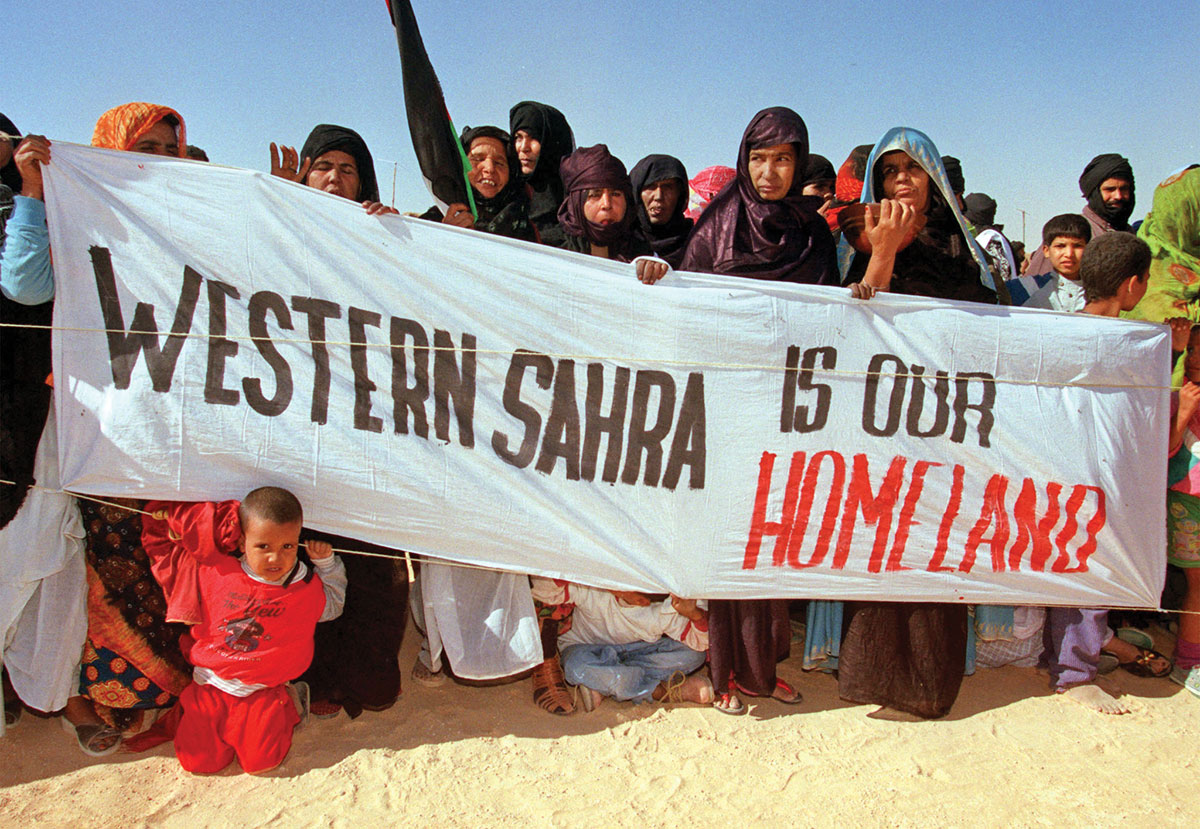
2015 protest by Saharawis, mostly women.
(Photo source: Internet)

          Western Sahara, a territory of 266,000 square kilometers (103,000 sq. miles) in the Maghreb, was part of Europe’s carve-up of North Africa, when it was known among most states as Spanish Sahara, in acknowledgement of the European state that occupied it. Its people speak Arabic and Castillian (Spanish) and some also speak French, an influence from neighbouring French ex-colonies.  Few speak Berber.

Mohamed Belsat of the Polisario speaking at the event (Photo: D.Breatnach)

The UN General Assembly in 1964 called on Spain to hold a referendum there which the Franco fascist regime declined to do but in 1975, after the dictator’s death, the new regime pulled out of the territory, practically handing it over to Morocco and Mauritania. After a conflict between those two states, Morocco emerged as the sole occupier and the conflict since then has been between the Kingdom of Morocco and the Saharawi people, who seek independence.

Chaired by Mark McLoughlin, filmmaker, the Dublin meeting had been arranged at short notice and its advertising further hampered by cancellation of a booking at Trinity College.

TRACING THE PLUNDER OF SAHARAWI NATURAL RESOURCES

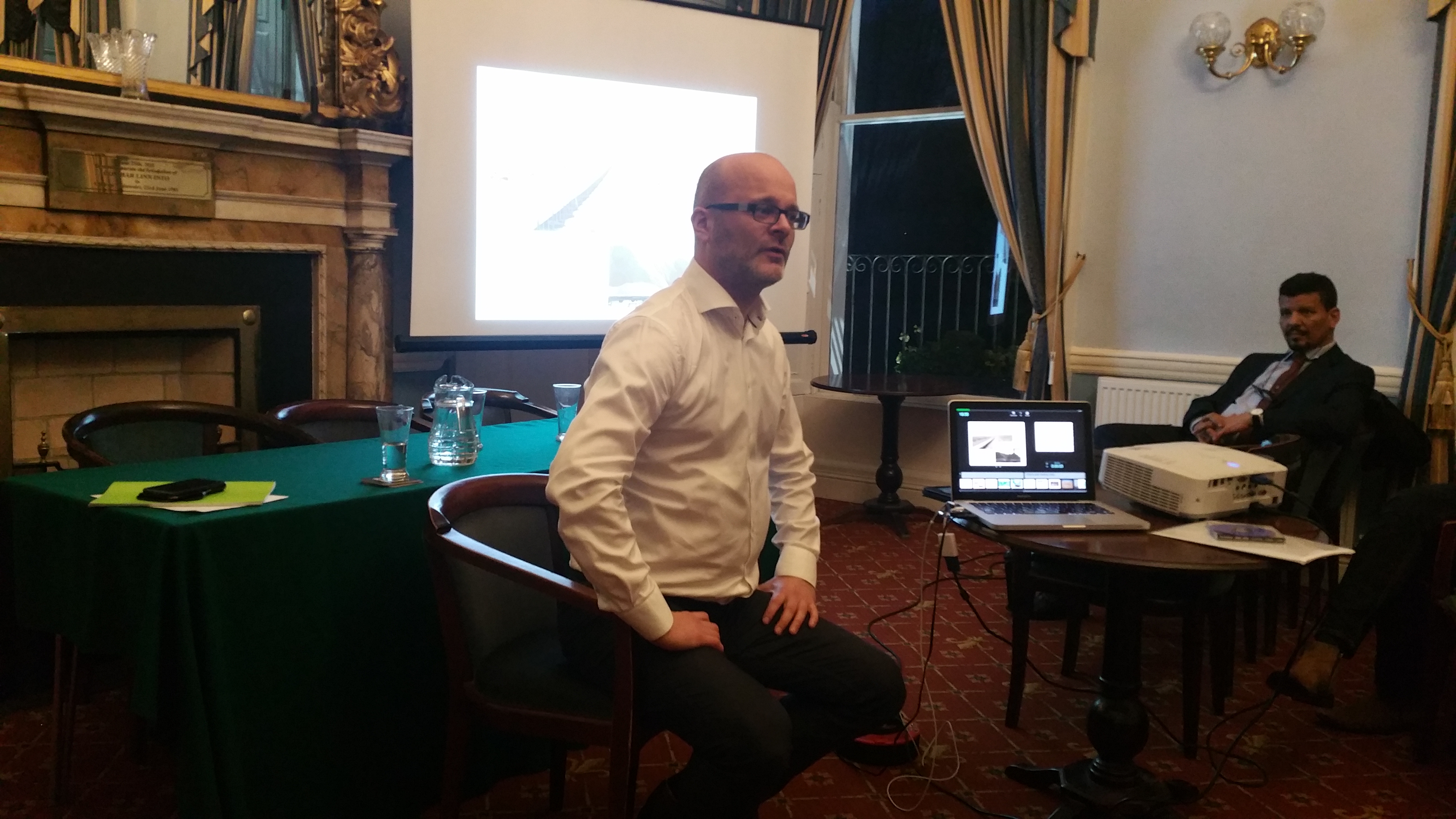
          Erik Hagen, of Western Sahara Resource Watch, with a display projected on a screen, showed how his organisation traces the ships arriving at the territory and departing with phosphates mined there to their destinations. From the registered tonnage of the ships, the amount of phosphates plundered can be calculated. The companies involved claim that they are doing no wrong, since they pay Morocco for the cargoes.

Mark Hagen illustrating a point with reference to the display. (Photo: D.Breatnach)

But according to the UN, no state may extract resources from a disputed territory without the consent of the people. Hagen talked about how EU had changed the wording to replace “consent of” with “being of benefit to” and then went on to effectively falsify agreement on benefit, using a document on consultation with huge majority – and a total of Saharawi organisations – voting against as evidence for.

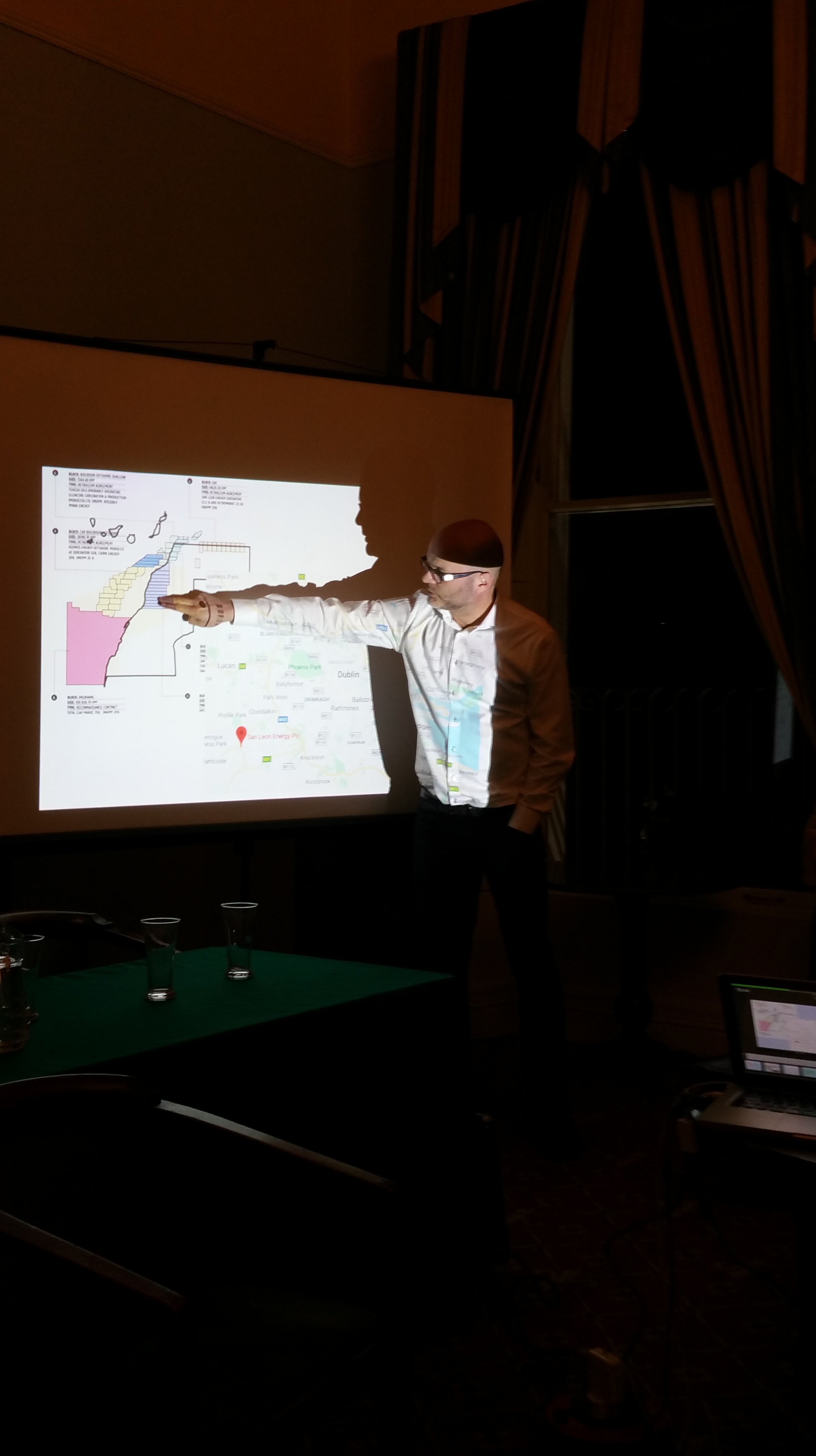
The only company currently exploring for oil in Western Sahara is San Leon, an Irish company, although they failed to find any and are currently fighting in financial difficulties.

Clive Symmonds, expert in international law talked about the policy of isolating produce from occupied territories, by first compelling their labeling as such, which, although that would not ban the products, would facilitate a ban if such were decided. The Control of Economic Activity (Occupied Territories) Bill 2018 introduced to the Oireachtas (Irish legislature) and currently being processed with cross-house support despite Government opposition, is an example of how such a ban may be implemented (and Senator Black’s Bill will also be valid for Western Sahara). Of course, as Symmonds pointed out, such labeling is left to the exporter which in this case would be the Kingdom of Morocco.

Clive Symmonds speaking on human rights legislation and W. Sahara (Photo: D.Breatnach)

 Symmonds also referred to the EU Fisheries Agreement which, in permitting fishing within what Morocco claims as its territorial waters without reference to the Saharawi people, is permitting the plunder of the Saharawi people’s fish stocks – and the Irish State is a party to this, having signed the Agreement. Symmonds pointed out that the judgement of the European Court of Justice on 21st December 2016, stated that Western Sahara is a “separate and distinct” territory from Morocco and that trade agreements between the EU and Morocco do not apply to the occupied territory. The EU is in violation of this judgement.

A REFERENDUM IS THE ONLY DEMOCRATIC WAY”

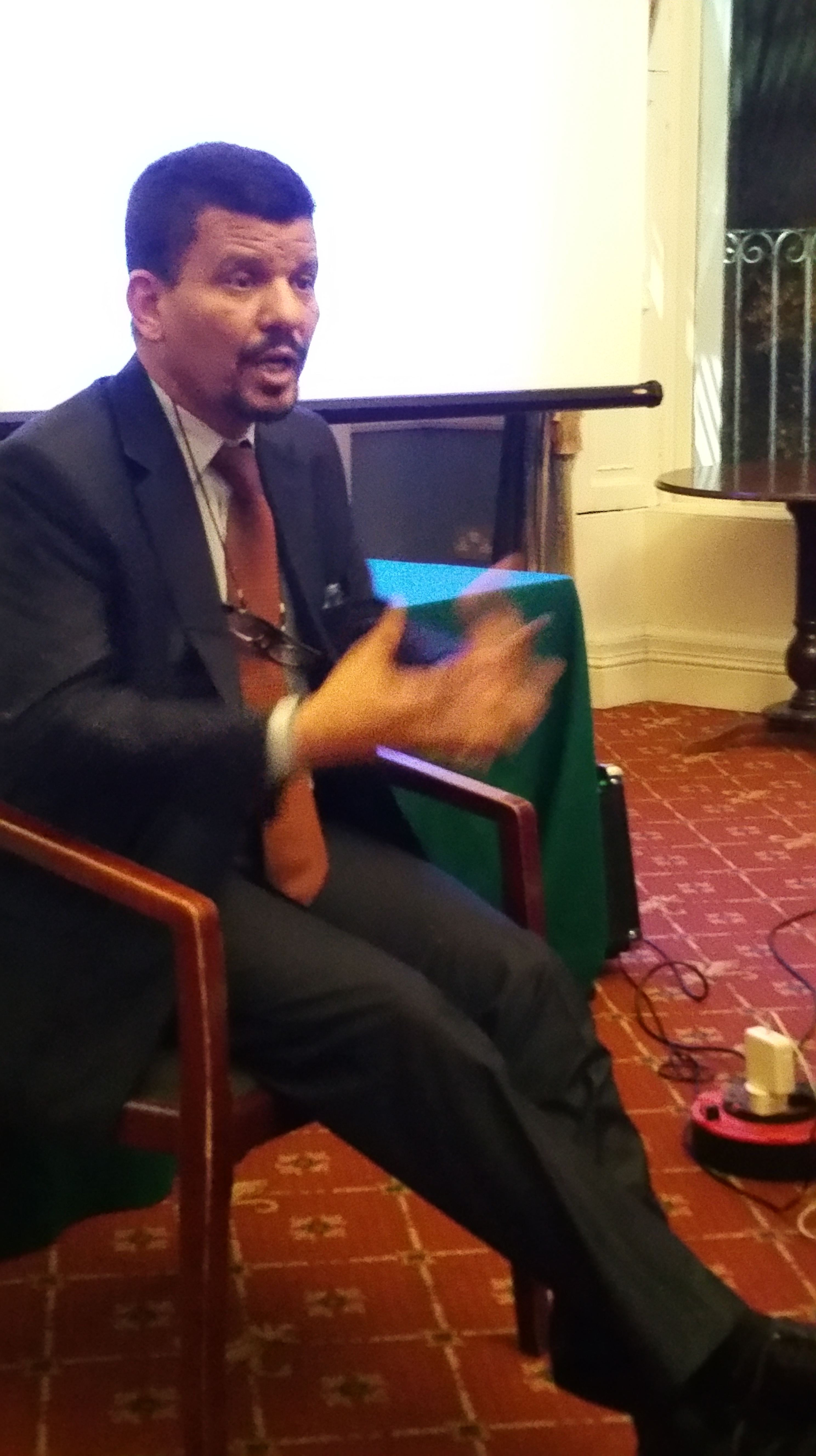
          Mohamed Belsat, Frente Polisario Ambassador to Europe, talked about the policies of the Irish state, the EU and, in particular, France. Belsat said that they were in collusion with the Kingdom of Morocco and that in particular, France often seemed to be the opponent of the Saharawi people even more than Morocco.

Referring to what he said was the only democratic of ascertaining the will of the Saharawi people, Belsat said that it was a referendum. Morocco had called for this since they had flooded Western Sahara with Moroccans but, since the process of registration of genuine and historical residents of the area had been completed by the UN, the Moroccan Kingdom had withdrawn all support for a referendum.

(Photo: D.Breatnach)

The cost of the occupation to the Moroccan kingdom is huge, in terms of military presence maintenance and so on,” Belsat said, adding that the cost of every litre of water supplied to the occupation forces was equal to four times the price of a litre of whiskey. Furthermore, the cost to the Kingdom exceeded the benefits it extracted from the colony. In January, Morocco had at last joined and signed up to the constitution of the African Union, the organisation of African states, of which Western Sahara is a founding member and which has a long-standing position on Western Sahara being an occupied colonyFor all these and other reasons, including dissatisfaction with the regime among the Moroccan general population, he felt that a campaign of pressure on Morocco and on the EU might well bear fruit in terms of the decolonisation of this “last colony in Africa”.

Later, Belsat’s response to a question from the audience amounted to an admission that there was no “peace process.” (sic) in operation (despite a reference to it by a number of speakers) and that as a result of this and the conditions under which they were kept by their oppressors, it was increasingly difficult to restrain the youth from resorting to armed resistance. At this a member of the audience commented that armed struggle against the army of the Moroccan Kingdom backed up by France would be “suicidal”.

57 POLITICAL PRISONERS BUT MANY MORE HAVE DISAPPEARED WITHOUT TRACE”

          ElGhalia Djimi, Vice-President of ASDH (Saharawi Association of Victims of grave violations of human rights by the Moroccan State), which cooperates with the League for the Protection of Western Sahara Political Prisoners in Moroccan Jails (LPPS), who had arrived in Ireland that day, made her presentation next.  Speaking in French through a translator, Djimi talked about the conditions of life under occupation for the Saharawi people. Djimi showed a compilation of clips of soldiers, police and people in civilian clothes physically assaulting protesting Saharawi women, pulling their hair, punching and kicking them and informed the meeting that those in plainclothes were Moroccan police.

ElGhalia Djimi speaking on Moroccan Kingdom repression of Saharawi people (Photo: D.Breatnach)

There are 57 Saharawi political prisoners in Moroccan jails,” ElGhalia Djimi said, “but many more that have disappeared without trace.”

Unemployment is high among the Western Sahara people and as a result of that and other deficiencies in their lives, a drug problem has arisen, she told her audience. There are no third-level education facilities in the territory, obliging them to go to institutions in Morocco. Although they can study to gain professional qualifications for civil employment, those available are not usually those required by the employers, which is not true for their equivalent in Morocco, with the result that often Moroccans fit into the administrative jobs better than do the Saharawi people. In terms of their treatment by the authorities, all Sahawaris carry a Moroccan ID card but letters on it indicate their ethnic origin (which Belsat likened to the Nazi State’s requirement that German Jews by identifiable in their national ID documentation).

Moroccan citizen settlement in Layoune, the capital of Western Sahara, had now placed the indigenous people, once the majority, in a minority.

Mark Hagen, of Western Sahara Resources Watch.
(Photo: D.Breatnach)

SOLIDARITY IN DUBLIN

          In conclusion of the speakers’ presentations, Mohamed Belsat asked for support from the Irish people with their “history of struggle for freedom and solidarity with other struggling nations”

A couple of members of the audience mentioned that there had been an active solidarity committee with Western Sahara in Dublin in the past and one wondered about the possibility of resuscitating it.

Comment: The solidarity Committee in Dublin was independent of any political party or organisation, its name was Western Sahara Action Ireland and its FB page is still in existence. Between 2011 and 2012, the group organised a number of public events, including: two protests about Moroccan repression of Saharawi protesters, one in Dame Street and another in O’Connell Street; a protest against the EU’s Fisheries Agreement outside the Dublin offices of the EU in Dawson Street; the construction and maintenance of a “Western Sahara Tent” at the Electric Picnic of 2012, along with an exhibition of photographs taken in the territory. The latter was visited by Michael O’Higgins who was then campaigning for the Presidency of Ireland (he also appeared in the film shown at the beginning of public meeting in Dublin).

On each of the Dublin street events, a small group of Moroccans had attended to harass and attempt to intimidate the protesters, almost certainly sent by the Moroccan Embassy but their efforts were to no avail.

Flag of the Western Sahara liberation movement.
(Photo source: Western Sahara Action Ireland)

BACKGROUND

          There had been many uprisings against colonial rule in the history of Western Sahara and the last Rif War, from 1920 to 1927, had cost the Spanish State military 23,000 casualties, of which 18,000 were fatalities. Only for the intervention of the French1, the forces led by Abd el Krim would have kicked the Spanish colonialists out of the footholds to which they were still clinging.2

Like the French in their North African colonies, the Spanish occupiers had suppressed risings not only by military force against insurgents and torture of captives, including electric shocks, but also by terror against the civilian population, including assassinations, massacres, rape and internment without trial.

Both European states also developed their own Foreign Legions. Forget about the 1924 Beau Geste novel by PC Wren and the various screenplays3 to which it gave rise; the Foreign Legions were tough terrorists in uniform, founded not to fight in open war but against resisting colonial peoples.

Since 1963, Western Sahara has been on the United Nations’ list of “non self-governing nations”.  In 1965, the UN General Assembly, in its first declaration on Western Sahara, called on the Spanish State to decolonise the territory and, in 1967, to hold a referendum on self-determination but Spain refused. From 1973 to 1975, the Frente Polisario fought an armed struggle for national liberation.

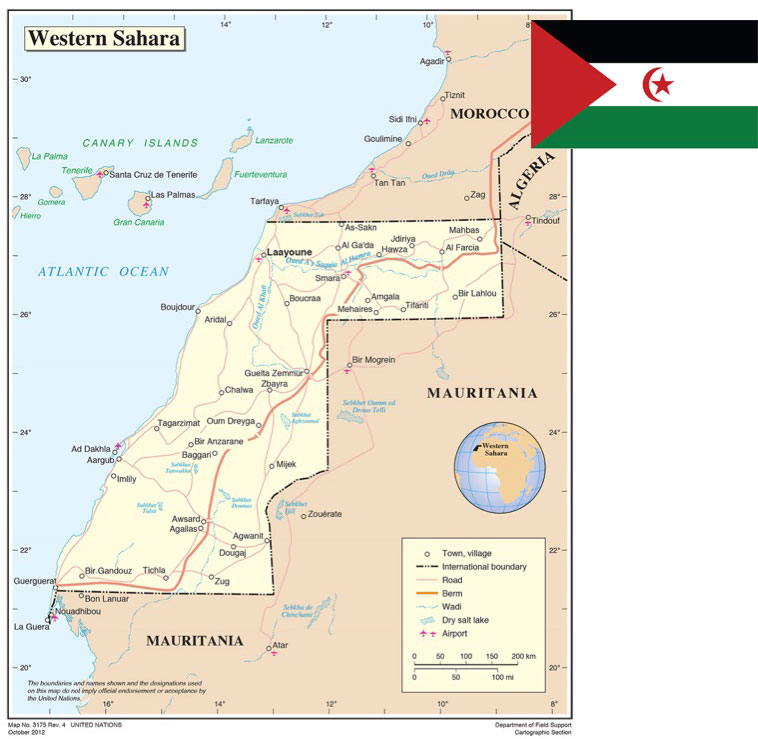
Western Sahara in context. (Source image: Internet)

After the Spanish State abruptly pulled out in 1975 (following the death of its fascist dictator General Franco) and – without allowing elections of an independent Saharawi government before doing so – it relinquished control to the Kingdom of Morocco (which had formally claimed the territory since 1957) and Mauritania and conflict broke out between those states. Mauritania in time abandoned its claim and Morocco moved in and seized Western Sahara.

The Saharawi people protested Morocco’s occupation of their land and were suppressed by military and police. The Frente Polisario fought the occupying Moroccan military from 1975 until a UN-brokered ceasefire in 1991, since which there has been no Saharawi armed struggle but plenty of Moroccan repression. One of the features of the struggle was the displacement of a large part of the Saharawi population as people fled the Moroccan military, many to Algeria (which had won independence from France in 1962 after a fierce and dirty war), where they remain in a refugee camp. The Moroccan Kingdom then built a wall to prevent Saharawis from returning, which it guards by troops and miles of landmines.

End.

FOOTNOTES

1The casualties of the French, according to Wikipedia, amounted to 10,000 with 2,500 killed in battle. The casualties of the insurgents and of the indigenous civilian population, as usual in these situations, is difficult to determine but, according to Wikipedia, came to 30,000, of which 10,000 were fatalities.

2For more on the Rif War 1920, read the article about it (see link in Resources and Useful Links).

3Including those of 1939 starring Gary Cooper and Ray Miland, 1966 with Telly Savalas and Doug McClure and the BBC serial of 1982.


REFERENCES AND USEFUL LINKS

Sahara Press Service: https://www.spsrasd.info/news/en

Western Sahara Resources Watch: https://www.wsrw.org/

Western Sahara Action Ireland facebook page (please bear in mind that at the time of writing this group is not active): https://www.facebook.com/groups/256377861125569/

Article on the Rif War 1920 by me: https://rebelbreeze.wordpress.com/2018/08/09/an-old-war-with-a-lesson-for-today/

Recent Amnesty International report on Western Sahara under Moroccan rule: https://www.refworld.org/docid/5a9938ac4.html


DUBLIN PICKET AGAINST INTERNMENT COMMEMORATES HUNGER STRIKERS

With thanks from Dublin Anti-Internment Committee’s FB page End Internment

DUBLIN PICKET PROTESTS CONTINUING INTERNMENT IN IRELAND WHILE EXPRESSING INTERNATIONALIST SOLIDARITY WITH PALESTINIAN PRISONERS.

PALESTINIAN Y0UNG WOMAN PRESENTS PICKETERS WITH BUQUET OF FLOWERS.

HUNGER STRIKER MARTYRS OF 1981 REMEMBERED.

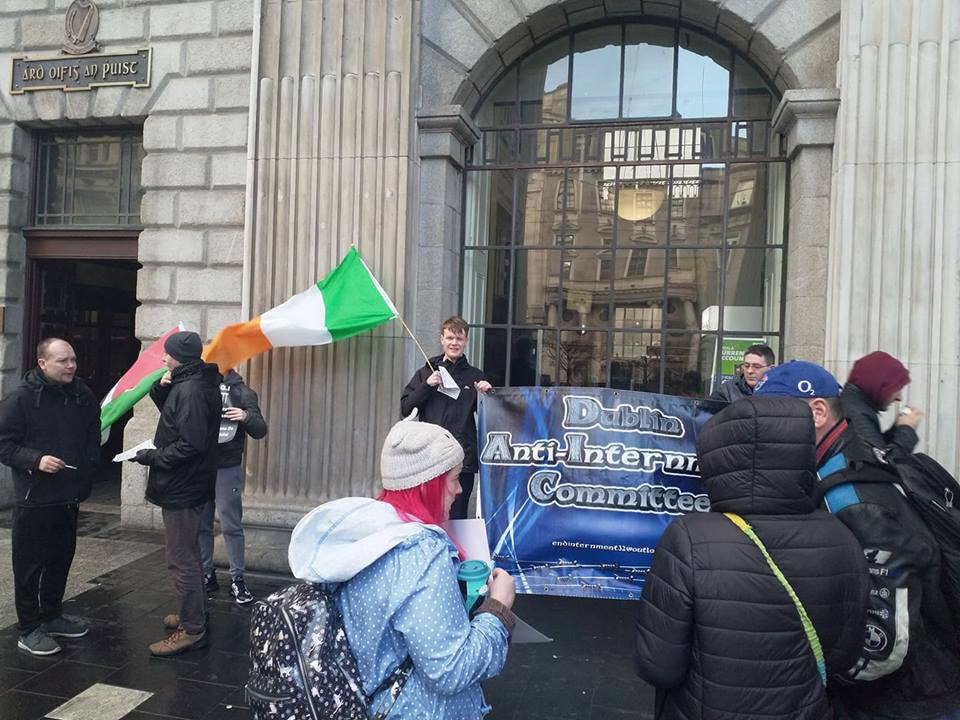
Section of the protest outside the GPO building (photo: Dublin Anti-Internment Committee)

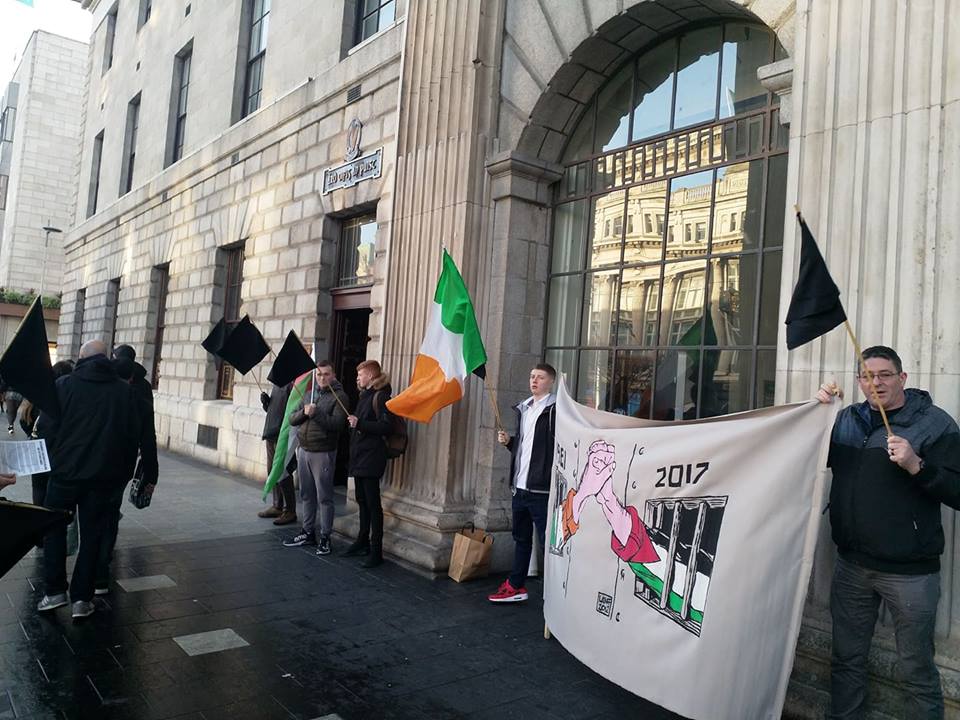
On a cold and wet late Saturday afternoon (2/03/2019) in Dublin city’s main thoroughfare, O’Connel Street, hurrying shoppers and tourists were treated to the sight of protesters outside the General Post Office. One group was flying small flags of a green, white and orange tricolour but not the Irish one – the colour bands were horizontal.

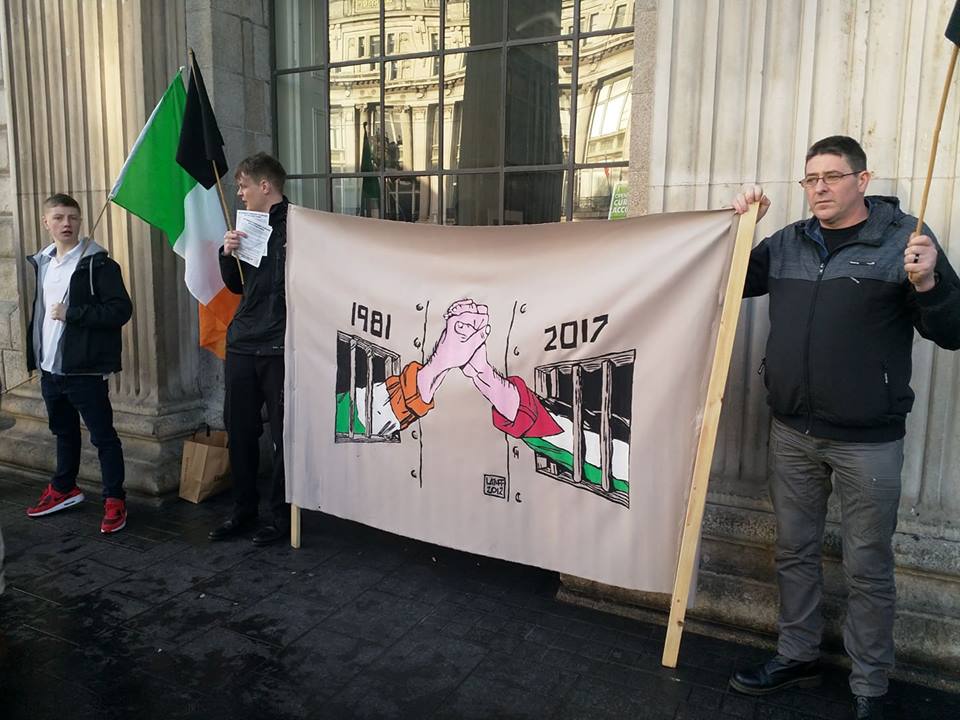
The other group flew a larger tricolour, the Irish national flag, the colours horizontal – and also a Palestinian flag. One of their banners was an enlargement of the cartoon by Brazilian graphic artist Carlos Latuff , showing an Irish hand reaching through prison bars to clasp that of a Palestinian, also emerging through bars.

The first group was of Indians in a protest related to the current tensions between the states of Pakistan and India, while the other had been organised by the Dublin Anti-Internment Committee and was supported by other Republicans and unaligned socialists. The presence of both outside the GPO was a coincidence and they were separated by a little distance.


INTERNMENT WITHOUT TRIAL CONTINUES IN IRELAND

One of the monthly pickets of the DAI Committee to raise awareness of the ongoing internment in Ireland, the picketers combined their action with expressing solidarity with Palestinian political prisoners of which many are held without charge, in “administrative detention”.

The banner depicting Irish and Palestinian political prisoner solidarity, from a cartoon by Latuff.
(photo: Dublin Anti-Internment Committee)

In Ireland, there are other kinds of “administrative detention” but they are not called that; instead they go under the names of “revoking of licence” and “refusal of bail”.

The first category relates only to the occupied Six Counties, where those political prisoners were released under the terms of the Good Friday Agreement; however their licence may be revoked at any time in which case the unfortunate person will be brought straight to jail without trial and held there indefinitely. This has been the fate of a number of former prisoners who remain Republican activists. One of those, Tony Taylor, was released without charge at the end of November last year, having spent nearly a thousand days in custody.

The second category and by far the most common, both in the British colony and the Irish state, is that of refusing bail to Irish Republicans while they await trial on as yet unproven charges. In these circumstances the accused, if judged “not guilty” at their trial, may have spent more than two years in prison by that time. A recent example of refusal of bail was that of Republican activist Alan Lundy arrested for alleged armed burglary on 18th February, despite an alibi apparently confirmed by CCTV footage placing him 40 miles away at the time and highly contradictory evidence from the alleged victims.

The intention of these totally undemocratic measures is an attack on the basic civil rights of Republicans to peacefully organise and to assemble in protest. When bail is granted, the intention is made clear since regularly the conditions attached are that the accused wear an electronic tag, may not participate in political meetings or demonstrations and must observe a curfew. Furthermore, the accused are brought before the no-jury Special Courts of both administrations, where special rules of “evidence” apply.

The Dublin Anti-Internment Committee maintains that these measures amount to internment without trial, a continuation of the policy in which courts are used, as Brigadier Kitson of the British Army proudly declared, as “a propaganda cover for the removal of unwanted members of the public”.

The Dublin Committee has also repeatedly pointed out that these measures are a danger to the civil rights of any and all movements of opposition to the State or its policies and should therefore be opposed by all democratic people, whatever their particular political alignment might be.

The solidarity bouquet (photo: Dublin Anti-Internment Committee)

FLOWERS PRESENTED FOR SOLIDARITY

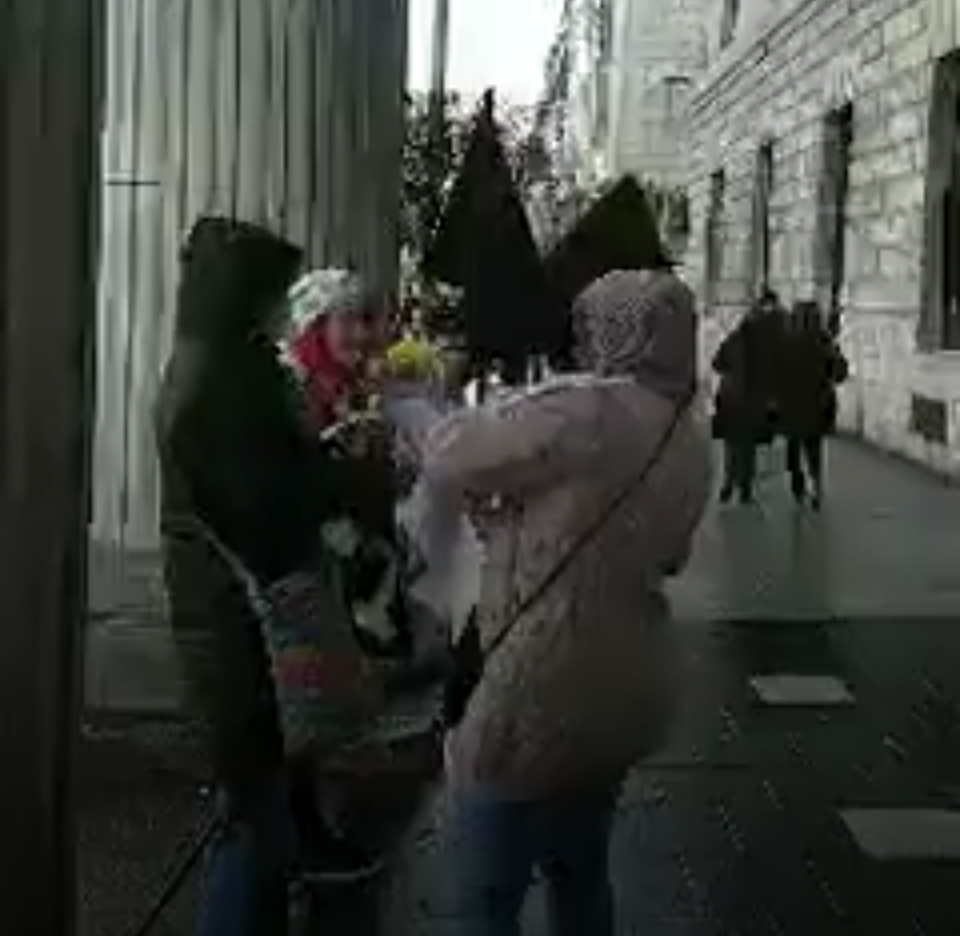
The picketers distributed leaflets to passers-by, some of which took photographs. Two young women who had taken photographs returned a second time, one of them presenting a bouquet of flowers to the surprised protesters. She said that she was doing so in gratitude for she was of Palestinian backround.

Palestinian young woman presenting the flowers to picketers.
(photo: Dublin Anti-Internment Committee)

There are approaching 5,000 Palestinian political prisoners in Israeli jails, of which around 170 are held without trial, in “administrative detention”.

REMEMBERING THE HUNGER STRIKES

At a certain point during the event, the picketers took up black flags and displayed them until the end of the event in remembrance of the ten dead hunger-strikers of 1981 (seven Provisional IRA and three INLA). March 1st was the anniversary of the first day of the hunger strikes of that year fighting British attempts to paint them as criminals, when Bobby Sands embarked on his 66 days of hunger, the first of ten Republican political prisoners to give their lives. Bobby Sands, revolutionary and poet, died on May 5th and over 100,000 people lined the route of his funeral in Belfast, protests took place throughout much of the world and official marks of respect were given, including a statement of solidarity by Palestinian prisoners of the Israeli State. During his hunger strike Bobby Sands had been elected an MP to the British Parliament and two more, Kieran Doherty and Paddy Agnew, were elected members of the Dáil (Irish Parliament) in Cavan-Monaghan, while Joe McDonnell was narrowly defeated in the Sligo-Leitrim constituency.

These events had long term effects even in electoral politics. The British changed electoral law to prevent prisoners ever being elected again (Representation of the People Act 1981), Sinn Féin became a predominantly constitutional party and every Irish Government since 1981 has been a coalition of some kind.

A chríoch.

Another view of a section of the picketers.
(photo: Dublin Anti-Internment Committee)


Short video clip here:https://www.facebook.com/581232915354743/videos/319325982052745/

THE FIRST AND LAST WORDS

View Post

Diarmuid Breatnach

(Reading time: 5 mins)

The Basques have a saying in their language which means “The first and last words in Euskera” (Basque language: “Lehen eta azken hitzak euskeraz”). The Irish would do well to adopt the slogan or dictum for their own: “Na céad focail agus na focail deiridh i nGaeilge”.

The Basques developed their slogan (the word is from the Irish, slua-ghairm: to call the crowd/ multitude/ troop) in their movement to conserve their native language and spread it among those who had lost it. The Basque homeland (certainly once larger than it is now) is today situated on the north-west of the Spanish state and the south-west of the French one. Their language is considered an older arrival than all other languages extant upon the continent, to be not of Indo-European origin and so not of the same family group as any of the nearby Romance languages: Galician, Asturian, Castillian, Languedoc (Occitan), French, Catalan.

Within the territories they control, Spanish and French state administrations have dominated and suppressed all the languages other than respectively Castillian and French; they have done so through official disregard, censure, shaming, even physical punishment and jail. But the Basques have struggled to keep their language alive and to spread it among those who have lost it. And they have been much more successful at doing so than we Irish have at doing the same thing with an Ghaeilge. The Catalans have done even better yet, certainly in Catalunya itself1.

So, why the slogan of “first and last words in Euskera” and what happens in-between? Is it intended like the “cúpla focal” (“couple of words”) of Irish politicians (and increasingly, not even that many), a kind of mini-lip-service? Not at all, its intention is restorative towards the language and is a practical measure which anyone can adopt — indeed we in Ireland should embrace it for our own language.

Dia dhuit

When we meet someone, we greet them and, in Ireland, the majority of us do so in English. Having done so, the rest of the conversation is likely to continue in English too. Taking our leave of them, naturally, we tend to do so in English also.

The impression on anyone within hearing of this exchange and so many like it is that Irish does not exist or, if it does, hardly anyone in Ireland knows it or, if they do, don’t use it in their daily life. Not far from the truth, one might comment. Indeed but the reality is that a lot more know the language (or some of it at least) than one might think.

Let’s return to that interaction touched upon earlier, when one person meets another. It could be a customer in a bar, restaurant or shop. One of them says “Hello”, the other replies likewise and from there onwards the verbal communication is all in English. Or another scenario, a friend or acquaintance of one, introduces another in English and both who are strangers proceed in English also.

Introductions (Source photo: Internet)

Perhaps the customer and the shop assistant, waiter or bartender in the first example were fluent Irish-speakers or at least competent – none knows this about the other and they continue in the dominant language, English; each may return home later without having spoken a word of Irish that day. The strangers being introduced to one another by a mutual acquaintance, perhaps at work on in a social setting, may have a similar experience.

THE FIRST WORDS

Suppose that instead the customer or person being introduced had greeted in Irish? The recipient of the greeting now has the choice, assuming some knowledge of the language, to respond likewise. Should this occur, they can now proceed to the limits of their knowledge of the language or of the situation in which they find themselves. Other factors govern the choice being made but we can discuss those later.

What of the impression on those others within hearing? They might be surprised or even astonished, impressed or embarrassed; however everyone is reminded that Irish exists, that it is a medium of verbal communication and that some people in Ireland use it, even outside the shrinking Irish-language reserves.

Gloine, le do thoill (Source photo: Internet)

Of course, that was perhaps only two people heard speaking it in a whole month or even a year. But what if more people did the same? Why, some of those who overhear might even adopt the same habit, na céad focail in nGaeilge! Gradually at first and then suddenly, everybody would seem to be greeting in Irish! Why, it might even be worth learning a little oneself! At least enough to reply and take the conversation a sentence or two forward ….

In addition, sometimes the experience flushes out other Irish speakers too. On the top deck of a bus heading into the city centre one day, I could hear some young lads at the back of the bus (where else!) speaking in Irish. I could tell that they were not fluent but one at least was doing reasonably well. As they passed me to get off in Sráid Uí Chonaill, I remarked in Irish to them that it was great to hear the language being spoken in public. While they stumbled over a reply to me, the man across the aisle from me addressed them also, in fluent Ulster Irish. What an experience that must have been for the young lads but certainly for us, two Irish speakers a few feet away from one another and totally unaware, until that moment, of the other’s existence.

On another occasion at a demonstration in Dublin, I and another holding a banner between us were conversing in Irish – loudly as of necessity. Ahead of us, another group began to call back in Irish too. Spreagann Gaeilge Gaeilge, commented the comrade on the other end of our banner (“Irish [language] inspires Irish”).

AND THE LAST WORDS

What about the last words being in Irish – just a courtesy or a whim of some kind? Well, imagine one greeted the stranger, shop assistant, waiter or bartender in Irish and the reply came in English (which at the moment would probably be the case)? Thereafter the conversation flows in English but, as the Irish speaker is leaving, she says “Slán”. By now, the other has recovered a little from being somewhat wrong-footed by being addressed in Irish and furthermore, since the customer is leaving, is not worried about exposing what he considers to be his shamefully little knowledge of the language, so he replies also in Irish, “Slán”.

Slán!

Of course, that situation was not momentous for the survival of the language but neither was it totally negative. The Irish speaker draws a little comfort from it. The other feels perhaps a little pride, is maybe even encouraged to respond in Irish should he see that person again or if some other addresses him in Irish. How hard can that be? He’d do it in Greek in Crete, in Spanish in Torremolinos or in Cancun, even though all he has is a few phrases from the tourist guidebook.

SHAME

Of course, it is not the same. In the first place, the linguistic environment in Greece is Greek, in Torremolinos and Cancun, Spanish. Even migrant workers there will have learned the language. Not everyone around one in Ireland is speaking Irish in public, in fact, in most places, almost no-one is.

Secondly, there is no expectation of the English-speaker to be fluent in Greek or in Spanish. No expectation that the Irish person can speak Irish either, one might think. But actually, there kind of is. Inside the head of every Irish person there is the knowledge that this is their language and a feeling, buried deeply or lightly, that perhaps they should be able to speak it.

This feeling or knowledge can manifest itself in a reluctance to expose one’s limited knowledge of Irish to the perverse but understandable extent of refusing to speak it at all. Or of responding aggressively. Those are possible outcomes but so are more positive ones.

A person who has very little Irish may think: “But if I reply ‘Dia’s Muire dhuit’ and she lets loose with a flood of Irish, I won’t know what she’s saying and I’ll be mortified! Better to say nothing at all and not be so ashamed.” Of course, that is one choice. But it is not the only possible one. He could, instead, after she spoke to him some sentences in Irish he did not understand, reply in a sentence learned off by heart: “Gabh mo leithscéil ach níl ach cúpla focal agam” (“Excuse me, I have but a few words”). She might in turn reply: “Go raibh maith agat, úsáid a bhfuil agat” (“Thanks, use what you have”).

And why should the initiative be only with the person fluent in Irish? The person who knows only a few words is just as capable of making greetings and farewells in Irish — in fact I would go further and say that the language needs them to do that, to make that the norm.

In those kinds of exchanges, there will be a positive outcome for each participant. Not a huge step forward for the language in general but for anyone overhearing, a reminder that the Irish language does exist and perhaps that in this case, a person who did not seem know it well, still chose to learn a few words and use them. All of that goes to the credit side of the ledger in the psychological struggle for the maintenance and restoration of Irish.

IMPOLITE

An issue that is often raised with regard to speaking in Irish in the company of non-speakers, is one of politeness. It is generally considered rude to speak in a language that other people in the company do not understand. Strangely enough, people tend to think that more about people speaking Irish in Ireland than they do about people speaking French, German or Spanish among themselves here.

The issue must be faced. Neither of those languages is in any danger but Irish is – and in serious danger. Despite the growth of nurseries, primary and some secondary schools teaching through Irish, the actual daily use of the language is in decline. And the Gaeltachtanna — those areas where the language of the home has always been Irish – are shrinking at an alarming rate.

We need to find social strategies for linguistically-mixed company, whether it be occasional translation for the non-Irish speakers, or the tolerance of the latter – or conversing parts in Irish and parts in English. For the sake of the language we cannot allow the rules of politeness to deprive us of every social occasion to speak in the language other than some tiny domains hidden away somewhere, small groups of us meeting like conspirators in places where we are unlikely to meet anyone we know.

Another issue often raised is related to foreigners, whether they be migrants or visitors. I would say that the same rules apply. Most of those have their own language as well and speak it among themselves, in public too. And they must surely wonder why we don’t speak our own. The children of migrants are learning Irish at school and many are competent, some fluent in it. Some of their parents know a few words too: a Nepalese in a bar serves me through Irish and a Pakistani in a shop thanks me or tells me I am welcome, in Irish also.

SMALL STEPS

In the public library, you may wish to greet in Irish and hand the returned books towards them saying: “Isteach”; the likelihood of you being misunderstood is minimal. Then, with the books you are borrowing, “Amach”. In the Post Office, you can ask for “Stampa i gcóir Sasana, le do thoill” or “Stampa i gcóir na hEorpa”. To the question “Payment by cash or card?” when you present your utility bill, you may wish to show notes and reply “Le h-airgead” or, displaying your card, “Le cárta”. “Do you want a bag?” “Níl, go raibh maith agat”, with a shake of the head. Leaving the bus or the taxi, you could say: “Go raibh maith agat, slán”. Sometimes, you will hear a reply in Irish and it will probably lift your heart a little. And the world around you will hear a little too …. and wonder.

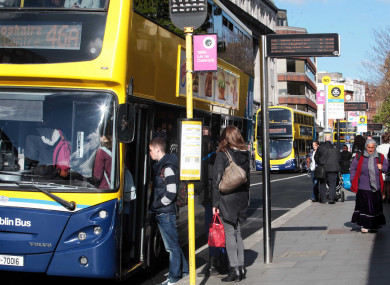
“Dia duit/ Sé do bheatha” — Passengers getting on a bus in Dublin (Photo credit: Leah Farrell, Rolling News)

None of that on its own, of course, will save the Irish language. But I think it will help. And now, on the crest of a small wave, might be a good time to do it: when the number and percentage of students attending all-Irish language schools is at an all-time high; when a survey of third-level students, whatever their feelings about how it was taught, show a majority supporting the retention of Irish as a compulsory subject on the curriculum. However, studies in the 1980s revealed a pattern of fall-off in Irish competency outside the Gaeltachts as the years went by; they need an environment encouraging the regular use of the language – use it or lose it.

The pro-independence political parties in the southern Basque Country make their public speeches either totally in Euskera or bilingually, in Euskera and Castillian. It is the same with the majority Basque trade unions. Also with the feminist and environmental movements, those against repression, against animal abuse, etc. In their public discourse, all organisations and parties in Catalunya that are not specifically Spanish-unionist (and even some of those), use Catalan first in public and Castillian secondly, if at all.

None of Ireland’s political parties (mainstream or oppositional), trade unions or campaigns (other than those specifically for the language) does anything much to promote the Irish language and some are hostile to it. That means it is up to us as individuals – everything we do for it can help at least a little.

So, as the Basques say, the first and last words in the language.

Do ye likewise; go out and multiply.

End.

FOOTNOTES:

1Catalan is spoken elsewhere than in Catalunya, for example in the Paisos Catalans (“Catalan Countries”) such as Valencia and the Balearic Islands, where it is not as strong as it is currently in Catalunya, also in part of Sardinia.

SOURCES AND REFERENCES:

Statistics on Irish-immersion education as of 2018: https://en.wikipedia.org/wiki/Gaelscoil

2019: https://www.irishtimes.com/news/education/number-of-primary-school-pupils-taught-through-irish-at-record-level-1.4011570

Plans to double number of Gaelscoileanna in the state: https://www.irishtimes.com/news/education/plan-to-double-number-of-pupils-in-irish-speaking-schools-1.4127379

Majority second-level students support retention of compulsory Irish on curriculum (but will they use it outside school?): https://www.breakingnews.ie/ireland/majority-of-third-level-students-support-irish-remaining-a-compulsory-subject-1096298.html

IRISH YELLOW VESTS AND QUESTIONS

Diarmuid Breatnach

Recently a number of people have been marching in Dublin, saying that they are the Yellow Vests of Ireland. This is obviously inspired by the Gilets Jaunes (“Yellow Vests”) whose protests against the French Government began in November last year and swelled to huge numbers in Paris demonstrations and riots. Some smaller groups have announced their formation in different parts of Ireland too.  But there are questions concerning them.

Irish Yellow Vest protest crossing O’Connell Bridge 15 December 2019.
(Photo source: Internet)

          The Yellow Vests in Dublin have been meeting on Saturday afternoons at the Custom House and marching from there. I am busy on Saturdays and on the one day I made the time to join them, I did not find them and learned later from their posts that on that occasion they had gone to Dublin Port and apparently blocked the approach road for a period.

Originally the organisers stated that there would be no leaders but then two emerged, Glen Miller and Ben Gilroy. Until last week Gilroy was serving three months for contempt of court, a sentence imposed by a judge when he learned that Gilroy had not completed the community service sentence imposed for a previous contempt of court. Held in contempt of court a number of times Gilroy has always apologised afterwards and had his contempt considered “purged”, i.e cleared. It seems that the judge in this case decided that Gilroy was playing games with the court around the issue of contempt, which is probably a fair assumption (which is not at all to say that such actions are wrong).

Gilroy took a case to the High Court alleging failure to comply with certain legal requirement and on February 4th the Judge granted him liberty on bail in his own recognisance (i.e his own financial bond) while is case was discussed and decided. However this week the Judge ruled that his imprisonment was not unlawful and revoked Gilroy’s bail, which meant he had to return to jail.

In recent years a number of groups have sprung up which oppose a number of unpopular legal procedures, for example evictions, by a mixture of physical obstruction (by numbers of people) to bailiffs but also by appealing to what they claim are laws that take precedence over the legal procedures they are confronting. The “Land League” is one of these (no organic relationship to the 19th Century Irish organisation of Davitt and Parnell) and, not unrelated to the “League” in its reliance on arcane laws and procedures, real or imagined, is the Sovereign Movement, the “Irish Republican Brotherhood” (again, despite their claim of “inheritance”, no organic relationship to the 19th and 20th Century organisation) and the Fremen.

While some people are impressed by these arcane legalisms others are bewildered by or scornful of them and, despite their claims, these organisations seem unable to point to where their legalisms have actually been ultimately successful. They have certainly succeeded in slowing down such actions as repossessions and evictions by taking up court time and numbers turning up to block an eviction will often succeed in delaying the process, without any need to appeal to any kind of legalistic underpinning. Property rights reign supreme under capitalism and certainly the Irish state is no exception to that rule; on the other hand the authorities in the Irish state tend to prefer to carry out the normal business of capitalism with as little confrontation as possible.

Summoning numbers to block or delay an eviction and to support a victim of the system in court are of course tactics of struggle honoured by time and usage in Ireland, whether against the British administration or that of the Irish State. Such reliance on mobilisation of numbers can sometimes produce small or partial victories but they hint at something else – the mass mobilisation of insurrection and revolution. And that is part of the appeal of groups such as the “Land League” and probably in part of the Yellow Vests.

Section of Irish Vest protest Dublin 22 December 2019.
(Photo source: Internet)

But if insurrection and revolution are hinted at, we need to know whether the hints are in earnest. Calling for a general election, one of the demands of the Yellow Vests, hardly seems insurrectionary. How would that change anything? Calling for an end to a number of attacks on working people including evictions is good but how is it to be achieved? Is there an objective of overthrowing capitalism and imperialism in Ireland? We do not hear so if there is. If an insurrection is hinted at, by whom is it to be and for whom?

RACISM

          It is here that we run into a disturbing problem: racism, of which Gilroy and Miller have both been accused. Any movement or organisation led by racists is not going to be one for progressive change in society, let alone a socialist insurrection but worse – it is likely to be a breeding ground for fascism. And of late, fascist forces are gathering throughout most of the world and certainly in Europe. Capitalism is struggling and the workers must be made to pay the cost through keeping wages and social expenditure down and profits high. When persuasion and collaborationist workers’ leaderships are no longer effective, capitalism must fall back on naked force. Fascist movements are the frontline of that force, its leading edge and racism (or religious sectarianism, with which we in Ireland have more experience) is used to divide the lower classes, the ones that will be made to pay.

Of course not all the people supporting the Yellow Vests are racist but when an anti-immigration banner is tolerated on a march1 then it would be remarkable if racism were not being tolerated as well. And with regard to the leadership, Glen Miller’s racism is well established from his posts on social media. He has posted material against immigration, against Muslims, against Travellers and against lesbian, gay and transgender people – classical minority targets of fascism to split the working people. He also shares racist material by others including Tommy Robinson, a fascist public figure operating in England.

Gilroy is not usually so glaringly racist but he has certainly posted an islamophobic rant on social media.

One might argue that Islam is a religion and that being against it is not racism. Perhaps not, if one were against all religion, for example. But ethnicity and religious belief or organisation are often interconnected, at least in particular periods and societies. Most muslims are not white European. And the Irish certainly know from their own experience how easily anti-Catholicism became conflated with anti-Irishness, in Britain for example, in the USA (think of WASPS and the ‘Nativists’) and in Ireland under colonial rule.

Islamophobes fantasise about Moslems taking over the country, anti-immigrationists fantasise about immigrants taking over the country, racists fantasise about non-Europeans taking over the country. There are nuances between them but in the end do they matter that much? The effect is the same: society is portrayed as divided by ethnic origin rather than by class and the focus is diverted from the bankers, gombeen capitalists and their political servants an on to migrants instead.

It might be argued that “looking after our own first” is a natural outlook and not racist. But we need to look at where that comes from and where it leads. It starts from the false premise that there is a great shortage and that we should divide those scarce resources first among the Irish. But in fact there is sufficient wealth produced in Ireland to fund all the education, housing and healthcare needs of all the people, immigrants included. And this is because the wealth is produced by working people – including migrants. The problem for us all is that that huge portions of that wealth is being diverted to fund the market gambling, lifestyles and financial empires of Gombeen (Irish capitalists) and foreign capitalists and bankers. Those are the people who would be rubbing their hands with glee or happily exchanging bribes and payoffs if, instead of uniting to confront them, the workers began to fight amongst themselves, divided by race or religion.

When the 1916 Proclamation declared the objective of the insurgents to “pursue the happiness and prosperity of the whole nation ….oblivious of the differences carefully fostered by an alien government, which have divided the minority from the majority in the past”, it was addressing in part that religious sectarianism by which England had restrained the descendants of its colonists from overthrowing its colonial rule and also the pitting of Protestant against Catholic workers, a division which had been played out before 1916 and was to be enacted to even worse degree later. The “Protestants” were the “immigrants” of those years, along with their descendants2, albeit a privileged minority which migrants rarely are.

In making that statement, the insurgents of 1916 were drawing on an Irish revolutionary tradition stretching back to the United Irish of the 1790s and early 1800s, of the likes of Wolfe Tone, Henry Joy McCracken and Robert Emmett. It was a tradition that ran through every revolutionary movement in Ireland since that time, through the Young Irelanders, the Fenians, the Volunteers and the Irish Citizen Army, a tradition that called for overcoming differences to build unity against the common enemy. That is the unity that fascists and racists seek to shatter.

Fascists may and often do verbally castigate capitalist governments, politicians, industrialists and bankers. But they end up serving them. They split the mass of the working and lower middle classes on the basis of race, they attack the defence organisations of the working class, they target other groups such as gay and lesbians, push women into the most subservient roles possible. The Nazis were “National Socialists” and part of their movement talked about nationalising industry under workers’ control. But they were backed by big capitalists such as Thyssen, Krupp and IG Farben and many others in Germany. In the USA and in Britain they were backed by Henry Ford and promoted by Viscounts Northcliffe and Rothermere, owners of the Daily Mail (until England declared war on Germany and the US entered WWII on the Allied side). The Nazis in Germany took over the trade union offices on Mayday and closed them down, forcing workers instead to join fascist unions controlled from the top, part of the State.

WHAT KIND OF UNITY?

          It is interesting that while fascists divide the working people in order to facilitate their control and undermine the struggles against the capitalist class, they often cry for unity. German unity. Aryan unity. White unity. Spanish unity. British unity. Irish unity. And when people have criticised individual leading figures in these groups, in particular recently of the Yellow Vests in Ireland, they have been accused of dividing, of undermining the struggle and calls for “unity” have been raised.

Whether it is right that the court should consider it criminal for someone to hold it up to disrepute, as Gilroy and some others have done on occasion, is another question and whether three months is a reasonable punishment for “contempt of court” in another. The courts are instruments of the State which in turn is an instrument of the ruling class and as such all revolutionaries must perforce hold them in disrepute and, in my opinion, three months in jail is excessive by normal standards in this state. But cries raised by the Irish Yellow Vests against this seek to glorify Gilroy as some kind of “people’s leader” and in turn to promote the ‘Vests’ as a viable resistance movement.

Workers know that unity in struggle is necessary but have also learned over the years that calls for unity may also be used to allow collaborationist trade union leaders and politicians to continue misleading the workers. Such calls can be employed to silence questions about where the movement is going. And now they are being used, unwittingly by some no doubt, to the effect of trying to silence the challenges to such as Gilroy and Miller about their racism and where they are trying to lead the Yellow Vests.

Such calls are being used not only to stifle the criticism of the leaders’ racism but to undermine the criticism of racism itself, as though racism were some kind of Leftie concept or diversion from the real issues. In a post in defence of Gilroy on 18th January, Miller posted a long ‘plain folksy’ discourse in which he said that Gilroy and he have “no time for political correctness and the posh talk”. So according to that discourse we should ignore the accusations of racism, action is needed, and for that we need unity – we should stop bleating on about racism. But the action is often dubious, the destination vague, the unity based on lack of analysis and stifling of criticism and – ultimately – on the opposite of unity, the division of the working people and the undermining of their resistance to those who are the real source of their misery and discontent.

It is not because of the anti-racist or politically-correct posturing of anyone, whether middle class or not, that socialists stand against racism: it is not just because it is inhumane, either; it is primarily because it splits and weakens the working class and diverts anger and resentment from the real enemy.

The Yellow Vests in Ireland are by no means a fascist or even racist movement. But they tolerate racists, are led by racists and could provide a breeding ground for fascists – something for which fascists are always on the lookout.

WHAT TO DO?

          So what should be our response, as socialists of various kinds?

First, I think we need to step back and examine the situation a little. The Yellow Vests here copy the Yellow Vests in Paris. Awhile back, the Socialist parties (I do not count the Labour Party in this) wanted us to copy the Greek uprising and Syriza’s electoral success. Earlier than that, some people wanted us to emulate the Indignados of Spain. And further back still, others sought to copy the Occupation movement of the USA.

It seems to me that all that striving speaks of a desperate need felt by some elements in our society, a need that cries out that something must be done; something to cure the mess that our Gombeen system has made of our health and welfare systems, of the housing crisis, of cuts to other services; that some stand should be made against paying off the bankers’ gambling debts with our hard-earned money and trying to get us to pay a third tax on our water supply when the money collected already has not been used as it should. A feeling that something should be done about the corruption of that give-away of our natural resources, about the selling of our transport, postal, telecommunications systems, about the funding of private landlords, about renewed emigration of our young. About increased hours and travel time spent just trying to stay still economically but nevertheless slipping slowly back. About evictions of people who have paid the actual building cost of their homes a number of times over. About governments that oversee this rotten system, worrying chiefly about staying in government and pleasing native and foreign capitalists; about a police force in which we find an average of a scandal per year with no end in sight and yet happy to repress people’s resistance …. and with their Armed Response Unit cars to be seen everywhere around the city centre.

Those people are right, of course. Something should be done. Something must be done. But what? There’s the rub, as they say. The working class should rise and take power, is the classic revolutionary socialist answer; also of the socialist Republicans, who tie the question to getting rid of British colonialism. Whether our revolutionary socialists in Ireland are actually revolutionary is a good question however, and in any case they are small parties. Whether our socialist Republicans are actually socialists or Republicans first is another interesting question and in any case they are splintered in groups and independents.

All those movements abroad that various people tried to emulate or reproduce here in Ireland did not succeed in changing the situation in their own lands. The USA, the country with the most billionaires in the world (and in politics!), continues to slide towards eventual downfall, in huge debt as a result of funding its military-industrial-financial system, for which billions around the world and millions inside its own borders pay with misery ….. and still the debt cannot be paid. But a huge sub-class exists, often living in city wastelands of run-down housing estates.

The Spanish state continues to squeeze its citizens, prepares to go to war against a nation seeking independence and fascist groups organise openly. Suicides prior to, during or after evictions are no longer startling news.

The Greek Left-coalition government of Syriza collapsed and prostrated itself to the EU and the IMF and schools had to close in winter for lack of heating fuel.

The French Government has alternated repression with some concessions but ultimately nothing has changed.

The growing vacuum of resistance in Ireland will be filled by a revolutionary movement based on working people in militant resistance to – and directed at – the capitalist system. Or it will be filled by fascism.

To build a revolutionary resistance movement, unity in struggle is needed and for that unity, racism must be driven out of the people’s movements. That will not be done by condemnation of racists alone. It will not be achieved only by calling for unity against capitalism. The revolutionary movement must be built and it is by action that it will distinguish itself and attract support from the militant sections of the people.

It is by its revolutionary critical discussion on politics, history, science and culture that it will inform the mass of its potential and necessary objectives.

It will not be built by theoretical declarations or arguments alone, nor by actions that are either timid or cannot be maintained, or by actions of only a few far in advance of the mass. Some of the actions will, perforce be risky and the State will exert a price.

But it is either that or – fascism awaits.

End.

FOOTNOTES

1Reported on at least one of the marches and I have seen a photograph of it

2Some Protestants were descendants of Catholics who had changed their religion to avoid persecution or land confiscation and some Catholics were descendants of Protestants who had converted or who had married a Catholic who raised their children in that faith. But largely, Anglicans, Presbyterians and other Protestant sects in Ireland were descendants of waves of colonists in particular from the 15th Century onwards, while Catholics were largely descendants of the indigenous Irish and of the Norman invaders.