On 20th September 2017 Spanish police raided Catalan Government offices in Barcelona, arrested some officials and representatives and also besieged the city’s offices of the CUP political party. A documentary film of the events, the spontaneous mobilisation of thousands of Catalans, the management of the event by “the two Jordis” and the CUP resistance was shown in Dublin on 22nd September to an appreciative audience and afterwards a panel of speakers contributed opinions and replied to questions.
Chair of the proceedings for the CDR (Photo: D.Breatnach)
The video, called 20 S – the Documentary follows many of the events of that day and its screening was organised by CDR Dublin. The CDRs, abbreviation for Comites de Defensa de la Republica, were set up after the Spanish police attacks on people voting in the Referendum on October 1st and arrests of independence activists afterwards and may be found in various places in Catlalunya and around the world.
Spontaneously thousands of Catalans gathered in Barcelona on 20th September a year ago to protest the raids but the leaders of the two grassroots organisations of Omnium and ANC respectively, Jordi Cuixart and Jordi Sanchez managed to keep the resistance peaceful while the CUP prevented entry to their offices. The leaders of the Catalan independence movement believe it important to maintain resistance active but peaceful in the face of Spanish police provocation and have been largely successful in maintaining this line to date. The police force invading the Catalan Government offices was the Spanish paramilitary police force of the Guardia Civil, while those besieging the CUP offices were the other Spanish State force of the Policía Nacional.
Panel of speakers (L-R): Liz Castro, Eva Fantova, Clare Boylan. (Photo: D.Breatnach)
The film is remarkable in that parts of it follow both Jordis as they try to negotiate with the police and at the same time inform the crowd and keep it under peaceful. One can see that many in the crowd are reluctant to disperse when asked to by the Jordis. One also sees when they are shocked to learn from demonstrators that police have left firearms in one of the unattended Guardia Civil vehicles parked outside Catalan Government offices.
The viewer also sees the CUP leaders refusing to allow access to their offices to the Policía Nacional who claim they have search warrants but fail to produce them, despite which they remain besieging for hours, with CUP activists barricaded inside the building.
The film of the action is interrupted at times with later commentary from a number of independence activists, including journalists.
Poster for the event organised by CDR Dublin.
The film demonstrated the mass nature of the Catalan pro-independence movement and the nerve and skillful crisis management of a number of its leaders. The extremely prominent role of the leaders of Omnium (Omnium Cultural) and the ANC (Asamblea Nacional de Catalunya) demonstrated eloquently that despite the concentration of news media on the leaders of political parties, it is the grassroots organisations that really hold the mobilising power (a fact demonstrated once again the demonstrations and general strike in Catalunya in the celebration of the Diada on September 11th last year, the Catalan National Day and again this year when police estimates of the pro-independence demonstration in Barcelona put the attendance at one million marchers).
Aerial view of the Diada marchers for independence this year in Barcelona (Photo sourced: Internet)
Despite their clear activity to prevent violence towards the police and to manage the crowd, in October “the two Jordis” were among the Catalan pro-independence activists arrested for “Rebellion” and “Sedition” and have been kept in jail without bail since, awaiting trial (which might not now be held this year). Other Catalan activists, including elected representatives, are in exile.
The showing of the film was well received by the audience in the Pearse Library, Pearse Street and sustained applause broke out as the credits scrolled down the screen.
Section of crowd on one side of the auditorium. (Photo: D.Breatnach)
When the lights came on a representative of Dublin CDR introduced the panel:
Liz Castro, USA Journalist writing much on the Spanish state and Catalunya, Eva Fantova of the ANC (who had appeared in th film, particularly as a commentator) and Clare Boylan, Sinn Féin MEP (member of the European Parliament).
In questions directed towards them by the CDR representative and later by members of the audience, all the panel speakers were clear that they did not expect justice from the Spanish courts for the Catalan independentists and did not believe that a separation between Government and Judiciary existed in the Spanish State.
Both Fantova and Castro referred to the case of the youth from the Basque town of Altsasu who had been sentenced to nine years jail over a late night brawl in a bar with off-duty Spanish police in which the maximum injury was a fractured ankle. The youth had been detained without bail awaiting trial with the State Prosecutor seeking to have them tried under “anti-terror” legislation, with a possible sentence of 30 years jail. However, even under ordinary Spanish criminal law, they had still received nine years in jail. Meanwhile a group of men, two of which were members of State forces, accused of gang-raping a young woman and filming the act, were out on bail while they appealed their short sentences.
With regard to what could be expected from the new Prime Minister and the social-democratic PSOE currently in minority government, the ANC representative commented that the PSOE is a Spanish unionist party also and when in opposition supported the Spanish State and Government’s actions against the Catalan independence movement.
A member of the audience commented that after Franco’s death, the Spanish ruling class had brought both the PSOE and the Spanish Communist Party (PCE), both illegal under Franco, into the State under condition that they accepted the status quo, the union and the monarchy that was being imposed on the people in the state. Their importance was great since each of those parties controlled a large trade union, also previously banned, and together they constitute the vast majority of unionised workers in the Spanish state. Since then those parties worked to control the people’s resistance and prevent any serious change.
A number of questions about what might be expected from the European Union Parliament and from the Irish Parliament were directed towards Clare Boylan, as an MEP and as a member of the Sinn Féin party, which has 22 elected members in the Dáil, the Irish Parliament (out of a total of 158 seats). She said that both the main Spanish Parties belong to the two largest EU Parliamentary Groups, the PP to the Christian Democrats/ Conservatives and the PSOE to Social Democrats, which makes it difficult to get a motion against the Spanish Government agreed in the EU.
With regard to the Irish Government, Boylan expressed pessimism on having them declare in favour of Catalan independence, whatever their personal opinions might be, with no evident support showing among most of the governments of EU countries.
Asked about getting more coverage of the Catalan situation in the world’s media, Liz Castro expressed her puzzlement at the low level of interest generally outside of the Spanish state. Boylan reported that the Irish national broadcaster RTÉ had sent no-one to cover the Catalan independence Referendum of October 1st and when it had been attacked by the Spanish police, as she had been in Catalunya with party colleagues to monitor and to support the Catalan movement, RTÉ had been reduced to phoning her to ask what was happening.
A member of the audience commented that he had no faith in either the Irish Government or the EU and that the first had justified his lack of faith since its creation and that the second was dominated by neo-liberal parties. He did not believe that the lack of interest of the media had to do with lack of space since they managed to cover all kinds of irrelevant gossip about personalities. He said that we need to be our own media to the extent that we can, pointing out that Catalan solidarity organisations CDR Dublin and With Catalonia/ Leis an Chatalóin each have Facebook pages on which news is posted and Casals Catalá d’Irlanda, a cultural organisation, also has a Facebook page and we should be posting information to those pages and sharing some of the information from there on to our own personal pages. The video they had seen was also available on the internet and should be shared. The ANC and Omnium had shown the importance of grassroots movements in Catalunya and we should replicate that in the small way that we can here in Ireland, he said. This contribution was greeted with applause.
The meeting concluded soon after, the speakers and audience being thanked for their attendance and contributions responding with applause for the organisers, the CDC Dublin and for the speakers.
End.
NOTE ON CATALAN POLITICAL PARTIES
The Catalan Govern (Government) is a pro-independence coalition of a left-republican party and a conservative party, both of which themselves are coalitions:
ERC (Esquerra Republicana de Catalunya – Republican Left of Catalonia) and JxCat (Junts per Catalunya – Together for Catalonia).
A further Catalan pro-independence party is the CUP (Canditura d’Unitat Popular – Popular Unity Candidature) in opposition but in support of the Government on independence and against the unionist opposition.
The Spanish unionist opposition to the Government is composed of a number of Catalan sections of parties of the Spanish conservative Right and social democracy:
Cs or Ciutadans (Partido del la Ciudadanía – Citizens’ Party) with currently the most seats; PSC (Partido Socialista de Catalunya – Socialist Party of Catlanunya), Catalan iteration of the PSOE, currently in government of the Spanish state; Partido Popular (Spanish right-wing party recently in government of the Spanish state).
There is also a coalition of groups including the Catalan version of Podemos the actual policy towards independence of which is difficult to nail down. In the Spanish state the Podemos (We Can) party has supported the right of self-determination but opposed its exercise in favour of independence, arguing instead for a social-democratic kind of Spanish federal republic.
On the 80th Anniversary of his death in the Anti-Fascist War in ‘Spain’, the East Wall History Group organised a remembrance of a local man from that dockland Irish area who was the last Irishman to die fighting in the war against Franco and Spanish Fascism. The event was attended by relatives of that Irish antifascist fighter and of another, by a cross-section of Left and Irish Republicans, including historians and by a number of elected representatives from the Dublin City Council and the Dáil (Irish Parliament).
Crowd assembling outside school before event. (Photo: D.Breatnach)
Jack Naltywas the last Irish and one of the last International Brigaders to fight and die in that war. The rest of the Brigaders, those not held as prisoners by Franco’s forces, were withdrawn soon afterwards as the indigenous anti-fascist forces fought on, losing against the Spanish military coupists with their German Nazi and Italian fascist allies.
Those commemorating Jack Nalty met at the St. Joseph’s Co-Educational School on the East Wall Road at 1pm on Sunday (23rd September) and included a cross-section of members of organisations and independent activists, socialists, republicans, communists and anarchists and other members of the local community. At the front entrance of the School a number of relatives of Jack Nalty held a banner along with a son of an Irish International Brigader and the crowd was addressed by Joe Mooney, of the East Wall History Group.
Joe Mooney speaking at start of event, relatives of International Brigaders beside him holding the banner in the colours of the Spanish Republic (Photo: D.Breatnach)
Mooney told the crowd that John Nalty came to the area at the age of six from Galway and on 31st August 1908 entered the East Wall National School on the Wharf Road. Just over thirty years later, 23rd September 1938, he would die on a Spanish battlefield, shot down in a hail of fascist bullets as he engaged in one last heroic act.
“A member of the IRA during the War of Independence, Jack was a Republican, Socialist and trade unionist”, Mooney said, “representing 600 oil workers in Dublin Port. But in 1936 when the Spanish Civil War — or Anti-Fascist War as it should more accurately be called1 – began, he volunteered for the International Brigades to join the fight against European fascism. He was badly wounded and came back to Ireland, but would again go into action and was killed at the Battle of the Ebro. Having being among the first Irish volunteers to travel to Spain, he would die on their last day as they were preparing to withdraw from combat.
Nalty’s unit had been called to retreat when it was realisted that two machine-gunners had been left behind and he went back to collect them. On their retreat they were fired at and Jack Nalty was killed.
Section of crowd lined up in front of house where Jack Nalty had lived (Photo: D.Breatnach)
Mooney also asked those present to remember not only Jack Nalty but the ‘comradeship of heroes’ from Dublin’s Docklands and North Inner City – Dinny Coady, Tommy Wood and others.
The crowd then set off in a march led by a piper to East Road to unveil a memorial plaque. Across the road from Jack Nalty’s former house, the crowd paused to hear Diarmuid Breatnach sing a few verses of Christy Moore’s tribute to the Irish “Brigadistas”: “Viva La Quinze Brigada”.2
UNVEILING THE PLAQUE
Joe Mooney unveiling the plaque not far from Jack Nalty’s former house (Photo: D.Breatnach)The plaque (text difficult to read in photograph) (Photo: D.Breatnach)
The plaque could not be attached to Jack Nalty’s house and was affixed a little further down the road. Joe Mooney siad a few words there and introduced James Nugent who gave a speech he had prepared and the plaque was unveiled. Nugent concluded by saying that “the history of the past helps us to understand the present and to create the future.”
Kate Nugent read a message from the daughters of Steve Nugent (sadly died 2017) who researched the story of his uncle Jack and Mary Murphy read a short post from Vicky Booth (granddaughter of Syd Booth, who was with Jack when he died).
(Photo: D.Breatnach)Piper plays lament by plaque (Photo: D.Breatnach)
Harry Owens gave a short tribute speech on behalf of Friends of the International Brigades and Manus O’Riordan, son of Irish communist and International Brigade Volunteer, sang the chorus ofAmhrán na bhFiann (“The Soldiers’ Song”, Irish national anthem) and the Internationale.
Section of crowd a location of the plaque (Photo: D.Breatnach)At the unveiling ceremony (Photo: D.Breatnach)Also at the unveiling ceremony (Photo: D.Breatnach)
Joe Mooney acknowledged the presence of elected representatives Mary Lou McDonald, Sean Crowe and Cieran Perry and asked people to march to the nearby Sean O’Casey Centre to see the art exhibition and see two short films.
Marching from the plaque site, heading for the SO’C Centre (Photo: D.Breatnach)(Photo: D.Breatnach)Section of the attendance relaxing at the Sean O’Casey Centre between the plaque event and the films to be shown, also examining the art exhibition [see photos at end of post]
Back at the Sean O’Casey Community Centre, two short films were shown. One was a school project film in which a descendant of Jack Nalty interviews the latter’s nephew about his famous uncle. The second was dramatic film in which a Spanish trumpet player joins the fight against the fascist military uprising by Franco and other generals and features also actors playing two Irish International Brigaders, O’Connor and Charlie Donnelly3. When the former trumpet player is shot he sees into the future ….
Eddie O’Neill talked about the pulling out of the International Brigades in October 1938 in a bid to have the “non-interventionist” Western democracies put pressure on Nazi Germany and Fascist Italy to have them withdraw too, which did not happen. They marched through Barcelona on 17th October and were addressed in an emotional rally by La Pasionara4 and Eddie asked Nerea Fernández Cordero to read an English translation.
Nerea on stage just after reading translation of La Pasionara’s farewell to the Brigaders (Photo: D.Breatnach)Eddie O’Neill at the SO’C Centre with concluding speech: “We can’t afford to forget.” (Photo: D.Breatnach)
Nerea told the audience that she is from Extremadura (a province of the Spanish state next to the Border with Portugal) and her grandfather, Antonio Fernández had fought against Franco, been captured, escaped to the mountains but was in time recaptured. Upon his release he had married Nerea’s grandmother and lived a peaceful life. Nerea said that she was proud of her grandfather and those who fought Franco and that “ we know La Pasionara’s speech in Spanish by memory.”
Reading of translation of La Pasionara’s speech to English from Youtube:
At the event the newly published pamphlet “In Pursuit of an Ideal – from East Wall to the Ebro” about Jack Nalty wasmade available for the first time and copies are available from the organisers.
Eddie O’Neill recalled being in the Spanish state with a group from Friends of the International Brigades to commemorate those who fought against Franco during that war and afterwards searching for an appropriate pub in which to socialise. They found a pub with a Guinness sign and went there which however turned out to be one of the most fascist pubs in the area but undeterred, they continued to celebrate the memory of the antifascist fighters there. A lone man in suit and tie asked people as they passed him to use the toilet why they were commemorating people who had died so long ago but when they explained he said he could not understand English.
“We can’t afford to forget,” O’Neill told his audience, “least of all when the forces of fascism are gathering again.”
To conclude the event O’Neill called on Diarmuid Breatnach who sang the whole of Christy Moore’s “Viva La Quinze Brigada”, calling on the audience to join him in the chorus, remembering those who fought and gave their lives in the struggle against fascism.
Eddie O’Neill close at right of photo at unveiling ceremony (Photo: D.Breatnach)
AN ANNUAL EVENT?
The organisers are reputedly considering making this an annual event – it is to be hoped that they do so.
Another section of the crowd at the plaque unveiling. (Photo: D.Breatnach)Also at the plaque unveiling ceremony (Photo: D.Breatnach)
POSTCRIPT: JACK NALTY – ATHLETE COMPETING FOR IRELAND
In publicity prior to the event, the East Wall History group posted the following:
“In addition to his political and trade union activity, Jack Nalty was also a busy athlete, a regular competitor and medal winner with the Dublin Harriers. In 1931 he represented his country at the International Cross Country Championship, held at Baldoyle. Fellow competitor Tim Smyth became the first Irishman to win this competition.
“(The full Irish Group for the event held on 22nd March 1931 is listed as: Frank Mills, J. Behan, John Nalty, J.C. McIntyre, John Timmins, T. King, T. O’Reilly, Thomas Kinsella, Tim Smythe).
“This British Pathe footage shows the runners in action. Somewhere in the group is John (Jack) Nalty, East Wall resident, Republican and hero of the International Brigades. (The Pathe footage is viewable on post on the East Wall History Group event — CS)
“Ironically, the same year as the competition the future leader of Irish Fascism, General Eoin O’Duffy had become the President of the National Athletic and Cycling Association (NACA) , and apparently was an admirer of Jack Nalty as an athlete!”
(Photo: D.Breatnach)
FOOTNOTES
1Basques in the provinces of Bizkaia, Guipuzkoa and Alava say it was not a civil war there, i.e between different sections of Basque society — the fascist forces came from outside. In the fourth southern Basque province of Nafarroa, where the Carlists took control, they wiped out around 2,000 antifascists but it was hardly a war. The Catalans also say that the fascist forces invaded them and that it was not a civil war but an antifascist one. In some other places in the Spanish state many also say that the presence of Nazi German and Fascist Italian military in such numbers invalidated the term “civil war”.
2Also known as “Viva La Quinta Brigada”, which is however also the title of a different song from the Anti-Fascist War. Both titles are correct for this song since the Irish were in the Fifth of the International Brigades but when added to the ten indigenous Brigades (Spanish, Basque, Catalan etc), that became the Fifteenth. Wikipedia quotes authors to report an estimate that “during the entire war, between 32,000 and 35,000 members served in the International Brigades, including 15,000 who died in combat; however, there were never more than 20,000 brigade members present on the front line at one time.”
3Charlie Donnelly was a poet and member of the Republican Congress. He went to Spain to fight against Franco, where he died in February of 1937 at the Battle of Jarama. He is also one of those 19 names mentioned in Christy Moore’s song (“Viva La Quinta Brigada” or “Viva La Quinze Brigada”).
4Isidora Dolores Ibárruri Gómez(9 December 1895 – 12 November 1989), born and brought up in the Basque Country to a Basque mother and Spanish father, founder-member of the Spanish Communist Party and known for her political writing and speeches. She wrote an article when quite young under the pen-name “La Pasionara” (the Passion Flower) and was known by that nickname throughout her life.
People outside the Mexican Embassy in Dublin on Wednesday evening remember the 43 students and call for justice.
(Photo: D.Breatnach)Names of the Disappeared being laid outside the Mexican Embassy (Photo: D.Breatnach)
A short but moving event was held in Dublin yesterday evening (Thursday 26th September) to remember the 43 Mexican students made to “disappear” in Mexico by the authorities or in collusion with them on 26th September 2014. The students from the Ayotzinapa Rural Teachers’ College were kidnapped while they were taking part in an annual commemoration of the Tlatelolco Massacre (of 300-400 students and other civilians by police and military on 2nd October 1968, less than a fortnight before the opening of the Olympics in the city that year). They are widely believed to have been murdered and a supposed investigation by Mexican State authorities petered out without a result.
Names of the Disappeared being laid outside the Mexican Embassy (Photo: D.Breatnach)Some staff leaving the Mexican Embassy in Dublin (Photo: D.Breatnach)Names of the Disappeared being laid outside the Mexican Embassy (Photo: D.Breatnach)(Photo: D.Breatnach)
The event last night was organised by the Mexico Ireland Solidarity Collective (MISC) and Latin America Solidarity Centre (LASC). Sunflowers as a symbol of hope were placed in the railing of the Mexican Embassy in Raglan Road, Dublin and ribbons in the Mexican colours of green, white and red were also tied there. The names of the 43 “disappeared” students were laid on the pavement in front of the Embassy which, like the embassies of a number of other states, is located in a quiet upper-middle class area south of the Grand Canal. Few people passed the remembrance event and staff leaving the Embassy did not stop to talk to the gathering except for the last two who greeted them politely and took a photo of the display.
A spokesperson for MISC said that the event is organised every year so that the people are not forgotten.
People took turns to read the name of each of the 43 from their cards and the traditional “Presente!” was called out after each one, signifying that alive or dead, they are present with us, remembered.
A statement was read and some verses from Woody Guthries’s Plane Crash at Los Gatos were sung and then a long silence was observed, which ended with a call for “Justicia!”
end.
Placing the sunflowers for hope outside the Mexican Embassy (Photo: D.Breatnach) (Photo: D.Breatnach)Reading a statement on the Disappeared outside the Mexican Embassy (Photo: D.Breatnach)
Placing the sunflowers of hope (Photo: D.Breatnach)Protesters in Mexico demanding the authorities reveal what happened to the 43 students. (Photo source: Internet)
(Left to right) Antoinette Keegan, Kate Nash, Stephen Travers and Eamonn McCann at the Garden of Remembrance before the public event. (Photo: Cate McCurry/PA Wire).
Speakers from the massacres at Ballymurphy, Derry, of the Miami Showband and the victims of the Stardust Fire addressed a Dublin Audience on Wednesday evening last (19th September) in the hall of Club na Múinteoiri.
They are victims and also campaigners and their stories held the audience spellbound. The campaigns arising from the Stardust Fire, the massacres of the Miami Showband, Ballymurphy and Derry all put speakers up to address the audience on their need for Truth and Justice under the banner of Justice Delayed Is Justice Denied. It was the personal sides to their stories that were particularly powerful, without losing at all the political thrust; McCann did his usual storming speech which he does very well but somehow, for all the eloquence and good points made, did not have the same impact – at least on this reporter.
Annette Keegan speaking at the event (Photo: D.Breatnach)
STARDUST FIRE
Ann (Antoinette) Keegan, chairing the event and welcoming the attendance, said that she spoke both as a victim and a survivor of the Stardust Fire where 48 young people were killed and 241 injured at a Valentine’s disco on 14th February 1981. Annette survived but lost her two sisters in that fire: Mary and Martina.
She listed the steps in the slow and unjust procedures of alleged investigation that followed the fire at the disco. The first inquest had listed arson as the “probable” cause of the fire which had caused the deaths but the relatives challenged this verdict as incorrect procedurally as well as in fact and eventually had it overturned in 2009. Another inquiry years later under Judge McCartan, appointed by the Government, heard that there had been two emergency calls, one about a small fire of 18” high which could easily be extinguished and another about “smoke pouring from the loft” which had not been discussed in any previous hearing (this is the area that campaigners believe to have been the real origin of the fatal fire – DB).
Ann Keegan recollected that Judge McCartan had said that the families should have located that caller, even after all those years and got her testimony but Anne stated that it was wrong to apportion the responsibility for that to the families.
Historical note: It is a matter of record that the building’s owners, the Butterly brothers, had flagrantly violated many fire safety regulations in the building and that Dublin City Council had failed in its duty of ensuring entertainment venues it licensed were compliant with fire regulations. The Butterlys never even apologised and were compensated under the original verdict of “probable arson” to the sum of Ir£580,000 (€634,869).
Anne Keegan went on to say that the campaign had now decided that any further inquiry would be a waste of time and was calling for the reopening of the inquests as a matter of public interest. They had launched their campaign objective on June 14th at the Dáil and were pressing ahead with it now.
Anne then called a member of the campaign up from the floor to talk about the experiences of her family.
Selina McDermott took the stage and said that she had lost two brothers and a sister in the fire: William (22), George (18) and Marcella (16). Her father, she told the audience, who was known by the nickname of “Minnow” was a Dublin Fireman, though not on duty that evening. Alhough he had saved many people in the course of his career it ate away at him that he could not save his two daughters.
Both he and Selina’s mothers campaigned for the truth but her father’s workmates, who were very supportive of him, calling often at the house when he was off duty, knew he was going against vested interests and the Government and advised him to give it up because he would never win. On the other hand their mother wanted to continue the fight, which led to arguments at home. Selina’s father died six years after the fire.
I thought how sad that so many, particularly in the working class, have become conditioned to the propaganda of the ruling class that the latter cannot be beaten, a way of thinking that is perhaps much weakened now but still influential for all that. It is one of the ways in which the very small minority which is the ruling class can keep down the vast majority from rising up against them.
BLOODY SUNDAY DERRY
Kate Nash speaking on the Derry Bloody Sunday Massacre at the event (Photo: D.Breatnach)
Selina sat down to applause and Anne Keegan called on Kate Nash, of the Bloody Sunday March for Justice campaign to speak.
Kate, like Ann and especially Selina before her, spoke in an informal way, telling the story of her family’s ordeal in Derry in 1972 when 14 unarmed civilians received fatal wounds from British Army bullets and another fourteen survived their injuries.
Kate’s teenage brother William was shot in the chest and three others were shot trying to go to his aid, including his father, Alexander Nash. Kate spoke about going to visit her father in hospital and he telling her that her brother was in the morgue. Her mother was in hospital too and it was considered unsafe to inform her of her son’s killing – until William was to be buried, when it was felt necessary to tell her so that she could attend the funeral. Kate said her mother never spoke until she returned to their home after the burial of her son but no sooner had she set foot inside the house than she let out a scream and broke down.
Kate also spoke about the devastation to the family and how her mother once said to her husband “It should have been you”, to which he replied “I know”, knowing what she meant.
The hurt did not stop there for the British Army alleged that all those shot had been armed and the Widgery Tribunal, convened with unusual speed, agreed with them. The majority of the media supported that verdict and also said nasty things about their family, in addition to alleging that they were IRA supporters (they were not, their allegiance had been to the SDLP1), accusing them also of living in filthy conditions.
Soldiers had also said nasty things to them at the hospital and at the morgue and on the streets afterwards.
Section of Dublin crowd before they burned the British Embassy in Merrion Square in 1972 (Image Source: Stair na hÉireann)The fire takes hold at British Embassy (then in Merrion Square) Dublin 1972 (Photo source: Internet)
Finally the Saville Inquiry was convened in the year 2000 which turned out to be the longest legal inquiry in British history, taking six years and costing a reputed 400 million pounds Sterling (approx. €450,800,000 today), with the families having to wait another six years for the publication of the report. Kate Nash made the point that the cost of the Inquiry was not the responsibility of the families and that “they (i.e the Government) spent that money clearing themselves”. David Cameron’s apology following the publication of the report in June 2010 was “a political thing”, she said.
The campaign wants prosecutions now of the British soldiers who had been identified as participating in the murders of unarmed civilians in 1972 but everything is being delayed and delayed, with the British Army providing legal advice and representation to those same murderers.
This recalled to me the words of Anne Cadwaller, speaking for the Pat Finucane Centre less than a week earlier, in the same building, as part of the Anarchist Bookfair. Cadwaller said that the British Government have what they call “three Ds” to deal with their scandals: Deny, Delay and Death (meaning hoping the accusers die meanwhile). Cadwaller could have added another “D” to her list: Deflect, i.e turn the blame in some other direction.
What Kate Nash did not tell the audience (and could not, considering the association of Sinn Féin with other campaigns represented on the platform), was that relatives and other activists had been dropping out of the Bloody Sunday campaign over the years and that when Cameron voiced his apology, Sinn Féin had called for the ending of the annual Bloody Sunday March, supported by some of the relatives. She and some other relatives and activists disagreed and have kept the march going every year since and it will take place again in Derry in the last weekend in January 2019.
She did not say either that she and some others had collected over 1,000 Derry signatures to a protest petition and conducted a sit-in protest at the “Museum of Free Derry” because of the inclusion of the names of British soldiers killed in the conflict alongside the names of Derry people killed by the Army, including the 14 Bloody Sunday victims. The protest was a success, at least for the time being.
Kate Nash sat down to applause and Ann Keegan called up the next speaker.
THE MIAMI SHOWBAND MASSACRE
Stephen Travers, Miami Showband Massacre survivor and author, photographed on another occasion (Photo source: Internet)
Stephen Travers described himself as the last remaining survivor of the attack on their showband in 1975. For many years he had refused to acknowledge that he was a victim and said that when he did so at last “the wall fell in on me.” Acknowledging yourself as a victim, he told the audience, makes one “lose the sense of self”.
Miami Band Massacre Monument on north side of Parnell Square, across from the Garden of Remembrance. (Photo source: Internet)
Historical note: Showbands were an Irish music phenomenon popular from the mid-1950s to the mid-1980s; a five or six-player dance band playing standard dance numbers, covers of popular music hits and waltzes. The bands’ versatility extended to traditional and folk numbers and even blues and a number of famous Irish musicians and singers got their start in showbands. The typical venue was the dance-hall, cheaply-constructed buildings without an alcohol licence located in towns and villages across the country and to these the bands travelled, usually in their minibus, returning home after the conclusion of their gig.
Stephen told the audience that as a bass guitar player he had been headhunted by major bands of the time but chose the Miami because unlike the others, they did not wear band suits (one needs to remember that even the Beatles and the Animals wore suits at first). He had not been interested in politics, nor had his family and the band included two of Protestant background although apparently religion was not a subject of discussion (or possibly of interest) among them either. However, people should take an interest in current affairs and the political background, he told the audience now.
The band (minus one who lived in Antrim) was returning from a gig in Banbridge Co. Down (one of the Six Counties) and heading to cross the Border (into the Irish state) when they were stopped at what appeared to be a British military checkpoint and asked to get out, which they did. Stephen made a point of saying that he would always refer to those men as “British soldiers” rather than Loyalists or paramilitaries although their membership of the Ulster Defence Regiment is often glossed over or even concealed.2
The soldiers exchanged jocular banter with the band members while they pretended to search the back of the van but were in fact placing a bomb in it. Stephen remarked on the mindset that could permit people to joke like that with those they intended to be their victims. Another man arrived of noticeable military bearing and the demeanour of the other soldiers changed immediately, smartening up and becoming more professional. This man was also in uniform but his beret was of a lighter shade and he had an upper-class English accent (Stephen said he had a good ear and had also worked in England for a period); other band members took him to be a British officer and expected that the whole thing would be expedited now and they would soon be on their way.3
Stephen believes that the plan was for the bomb placed in their van to explode as the band traveled on and that the incident would be used to justify checkpoints and searches of traffic crossing the border in the area, accusing the IRA of using the roads to transport arms and implicating the dead members of the Miami Showband as IRA “carriers” into the bargain.4
Softly spoken but his voice sometimes thickening with emotion, Stephen described how the bomb went off prematurely, dismembering the two UDR/UVF men and blowing the band members over a ditch and into a field. The soldiers then opened fire at the band members. Stephen was shot with a dum-dum bullet which made it impossible for him to walk, although he felt no pain; he could see no blood but his stomach was bloated as the bleeding was internal. He lay down and pretended to be dead. Two band members tried to drag him out of a pile of bodies but were shot down and Stephen described how the handsome Fran O’Toole, keyboard player, was shot many times in the face and a number of times in the groin. A number of band members pleaded not to be killed but were savagely shot amidst a stream of obscenities from their killers.
When the murderers left, there were only two band survivors in the field and the other flagged down a car and was taken to the nearest RUC5 barracks, from where officers hurried to the scene and, for awhile, were afraid to approach Stephen in case the bodies were booby-trapped. Three band members had been killed and two injured non-fatally (although one has died since, leaving Stephen the only survivor).
Stephen referred also to the fact that he had been around the Dublin City centre in 1981 when he learned of a big fire at the Stardust and headed out there in his van. He said he was able to drive right up to it since no attempt had been made by the Gardaí to preserve forensics at the scene of crime.
There was one unexpected postscript in this deeply personal and yet highly political story: Stephen Travers, who loved playing music and gigging, who had been head-hunted as a talented bass guitar player, told us that he never got to play in any showband again. Whenever a band was up on stage helping people to enjoy themselves, they could not afford to have the mood darkened by the survivor of the Miami Showband Massacre sharing the stage with them.
Stephen Travers concluded by saying that all those of whatever political background who had lost people in events of that kind or in the conflict wanted the same thing: truth and justice.
EAMONN McCANN
Eamonn McCann is a journalist and broadcaster from Derry and member of the People Before Profit Alliance (formerly Socialist Workers’ Party) and former elected Member of the Six County statelet’s legislature. He is a veteran campaigner and was prominent in the Civil Rights movement in the Six Counties; he was to be one of the speakers at the rally on what turned out to be Bloody Sunday and supports the ongoing Bloody Sunday March for Justice.
Journalist and activists Eamonn McCann speaking at the event (Photo: D.Breatnach)
McCann generally speaks forcefully without need of notes and in an enclosed space would not need a microphone (but unfortunately was handed one which thankfully failed some time later).
McCann referred to the Ballymurphy and Derry massacres by the Parachute Regiment and other killings by them of unarmed civilians in Ireland, including a drunk Shankill6 character who was heard to shout mockingly at them seconds before they gunned him down.
The Parachute Regiment’s last posting on active service had been Aden, which is in what is now Yemen, he told the audience, where they had been fighting a national liberation insurgency led by FLOSY7.. There the Paras had been engaging in atrocities against the Arabs and they had of course got away with it, so when they were sent to Ireland they did it again. And essentially got away with it there too.
The Saville Enquiry, which McCann said the Irish Government had insisted on as part of the Good Friday Agreement process, had essentially blamed seven low-ranking British Army soldiers. Then CaptainMichael Jackson and General Robert Ford, who were in charge overall and in Derry that day, were not harmed by the incident and Jackson’s career in particular had “taken off like a rocket”, McCann said, as by the time of the Saville Inquiry he was Chief of Staff of the British Army.
David Cameron’s apology for Bloody Sunday in the Westminster House of Commons was “a political thing” (Kate Nash) and “a cover” (Eamonn McCann). (Photo source: Internet)
Jackson had written a false account of the shootings of 14 victims as “terrorists” which could not correspond to any of the actual accounts of what had happened; “in some cases the bullets would have had to go through buildings” stated McCann and recalled that these had been presented to the world press after the murders and became the official British version around the world. However, when confronted with this evidence during the Saville Inquiry, at first Jackson “could not remember” and later “had a vague memory” of doing it.8
“They would not have been able to hold that Inquiry nor to make that apology in the House of Commons if Jackson and Ford were being held up to blame,” McCann told the audience. “They’ll sacrifice a few lower-rank soldiers – they are cannon-fodder and killers, that’s all they are to them – but they won’t blame their own.”
McCann alluded also to the Grenfell Tower disaster in London and was sure that the Inquiry would not end up placing the blame on the local authority and politicians’ connections to property companies. He then went on to draw connections between the Butterlys who owned the Stardust and the ruling class of Ireland on the one hand and the ruling class of Britain on the other, how their crimes are always being covered up and how it is necessary to change the system that protects that class.
After the applause that met McCann’s conclusion, Anne Keegan thanked everyone for their attendance and encouraged them to follow the campaigns and to continue to support them and people dispersed.
Audience and speakers gathering to exchange some words after the meeting. (Photo: D.Breatnach)
COMMENT: THE UNDERLYING REAL STORY?
The Stardust fire was an accident, possibly due to dangerous procedures and/ or lack of safeguards. It was not an accidentthat emergency exits were locked; they were locked deliberately, against all legal fire safety requirements, no doubt to prevent anyone entering without paying at the front entrance. But when the smoke and fire took hold, many people could not escape nor those outside break in to rescue them and 48 young people died and 241 were injured, families and whole communities devastated.
Therefore the owners, the Butterleys, should have faced trial for manslaughter; instead they were compensated to the tune of nearly €635,000. That the Butterlys were not charged, that the matter was badly investigated and that they were exonerated in the first inquest, was due to connections of the owners of the business with the Irish ruling class, and with the leaders of its main political party, Fianna Fáil. The appropriate term for that kind of collusion is criminal conspiracy.
Many people, most perhaps in Europe and the English-speaking world, would think that the sending of the Paratroop Regiment to Ireland and the British encouragement of Loyalist death-squads and active collusion with them was an aberration. Others might think them deliberate plans but the responsibility only of individual officers and politicians. Some would see the massacres carried out by the Paras and the Loyalist murder gangs as unconnected, as different initiatives.
However, any objective evaluation should take the following sequence of events and their nature into account:
The Six Counties was a portion of Ireland which the British colonialists insisted upon holding on to 800 years after their invasion of Ireland (1169), after a guerrilla war encouraged them to withdraw from the rest of the country (1921). It was ruled by a manifestly sectarian regime discriminating against its substantial but minority Catholic population in every area of life but most brutally in law, policing, employment and housing.
Popular resistance begins or is renewed in 1964 after a dormant period reaching a high point in 1968.
Repression is deployed (police baton charges, gas, bullets) in 1968-’69 but fails – resistance increases
British perception is that it is faced with insurgency and begins to deploy its various arms and methods
British Army is sent in 1969
At some point the SAS is also sent in (difficult to pin down the year)
Control of mass media increases over following years (many journalists attend Army briefings in hotel and file their reports without checking with local communities)
Brigadier Frank Kitson installed as Area Commander (1970) with a free hand
Gangs (UDA) and Pseudo-Gangs (MRF) are created under Kitson’s guidance (1970)
More British troops sent in. Raids on Catholic areas and 3-day curfew on Falls Road (1970)
Community resists and first armed retaliation against the British takes place (1970)
British Army arms the gangs through recruiting them into the Army itself (Disbandment of B-Specials and creation the UDR British Regiment January 1970)
Paratroopers sent in (1971)
Gangs (UVF) semi-pseudo gangs (UDA/ UFF) operating fully integrated with British undercover squads and Pseudo-gangs (MRF and UDR) Summer 1971
Internment without trial introduced August 1971
Immediate civilian protests against internment August 1971
Ballymurphy Massacre of protesters by Paratroopers August 1971
Derry giant demonstration against Internment and Ballymurphy Massacre January 1972
Massacre of protesters by Paratroopers January 1972
Formation of highly-secretive and untypical Red Hand Commando Loyalist paramilitary organisation (1972)
British Army-RUC-Loyalist murder gangs (UVF) joint operations
Trial by jury abolished for those charged with resistance “offences” and Diplock Courts founded Aug. 1973
The “conveyor belt” is created – standard torture in Castlereagh Barrack, conviction in courts using tortured “confessions”, prison sentences (1970s-1990s)
Prevention of Terrorism Act is introduced to terrorise and silence the large Irish community in Britain 1974
Nearly a score of innocent people from the Irish community in Britain are framed on bombing charges and sentenced to long terms in prison (if the death penalty were still in force they would have been hanged) 1974
SAS soldiers are detained on undercover operation within the Irish state but are soon released 1976
Rules for Coroner’s Courts in the Six Counties changed to restrict the scope of verdicts from pointing towards the perpetrators (e.g Crown forces) or the legal status of the homicide (e.g “murder”) 1976.
Campaign to break Republican prisoners’ resistance 1976-1981
Change in British electoral legislation to prevent prisoners standing for election (1981see link)
Recruitment of informers and double-agents by Army and RUC intelligence
Elimination of prominent figures in the Resistance unlikely to agree to the deal 1976-19879
Testing the remainder to find supporters for the deal
The deal is offered and some concessions made (but no fundamental ones), resulting in the Good Friday Agreement 1998.
One does not have to be a conspiracy theorist to see here a pretty standard response of a colonial power to insurgency in one of its colonies, escalating to deal with an escalating resistance and aiming, if military defeat seems impossible, for wearing down the resistance and the communities supporting it, then to subvert, suborn and to bring the leadership to negotiate a deal which will end the resistance but not the existence of the colony.
Of course the process was bound to have some tweaks, as this anti-colonial resistance was taking place within Europe and breaking out just 50 years after a national liberation war within that country. Still, overall, a pretty standard colonial war.
And there are many other aspects not dealt with in that timeline, including subversion of the early 20th Century Irish national liberation movement and the subsequent State, bombings and killing of civilians there in the 1970s, recruitment of agents among news reporters, blackmail operations, promotion of pseudo internal communal opposition to the resistance, such as the SDLP and “Peace (sic) Women”, the use of gas and plastic bullets in particular ways and others.
Indeed, it is those who insist on seeing all these factors as unrelated or not part of colonial policy, agreed at the highest level, who are taking the unrealistic view. One has to be determined not to seethe facts and their connection to colonial policy in order to maintain the illusion they insist upon, that the problem was/is one of “some bad apples” and “some bad decisions”.
End.
References and Further Reading (it is not suggested that everything stated in these sources is correct):
Travers, Stephen; Fetherstonhaugh, Neil (2007). The Miami Showband Massacre: A Survivor’s Search for the Truth. Hodder Headline Ireland, Ltd. ISBN978-0-340-93792-1
1 Social and Democratic Labour Party, a reformist party in the Six Counties which displaced the Irish Nationalist Party in nationalist area voter support and later got displaced by Sinn Féin.
2 The Wikipedia entry on the “Miami Showband Killings” (sic) and a Wikipedia entry on showbands (https://en.wikipedia.org/wiki/Irish_showband) which also mentions the incident as contributing to the decline of the showbands both refer to the unit involved entirely as UVF, the Ulster Volunteer Force (a Loyalist paramilitary organisation responsible for more than 500 deaths, mostly Catholic civilians and a great number chosen at random). Only later in the text does it reveal that “at least four of the gunmen were serving soldiers from the British Army’s Ulster Defence Regiment”.
3 In his book, which I have yet to read but referred to in the Wikipedia entry on the massacre, Stephen said that the RUC interviewing him were not willing to accept this description of that individual. The man is believed by some to have been Captain Robert Nairac of the Grenadier Guards regiment but seconded to one of the special undercover units of the British Army. The IRA announced that it had executed Nariac in May 1977, having been captured by them while undercover; his body is still missing.
4 The UVF did in fact issue a lying statement to that effect in a eulogy to two of their dead members.
5 The Royal Ulster Constabulary, notoriously sectarian and armed British colonial police force taking over from the also-armed Royal Irish Constabulary in 1922, soon after the partitioning of Ireland. In 2001 it was rebranded as the Police Service of Northern Ireland (PSNI).
7 The Aden conflict or “emergency” as usually referred to in posts about this British colonial conflict (and totally absent from a number of Wikipedia and other pages about Aden) was an insurgency against British forces in Aden, a British colony since 1839. Although an “emergency” was declared on 10 December 1963, the conflict had been going on for longer. At peak the British Army had 30,000 service personnel there and 15,000 South Arabian troops and of their combined forces suffered 382 killed (227 British Army) 1,714 wounded (510 B.A.). No statistics on the number of Arabs killed by British forces and their allies are easily available. “Britain dropped more than 3,000 heavy bombs and more than 2,500 rockets in a bid to pacify the guerrilla insurgency who used the Radfan Mountains for cover” (Daily Mail article 2017 glorifying the British in general and the Paras in particular).
A joint effort was created between the British forces and the Federation Regular Army (FRA – of the Federation of Southern Emirates, a British protectorate) to combat the National Liberation Front and the Front for the Liberation of Occupied South Yemen (FLOSY). The paramilitary groups initiated a guerrilla campaign of grenade attacks against the British forces. By 1967 the situation in Aden escalated and the evacuation of British families and citizens was enforced. The city erupted in riots, tensions were heightened further by the Six Day War and a mutiny broke out within the Federation Regular Army.
The conflict ended on 30 November 1967. British forces withdrew from Aden and the National Liberation Front seized control of the government. The People’s Republic of South Yemen was declared.
8 In a short piece in the Irish Times in September 2013 (see link in References and Further Reading section) Eamonn McCann cast doubt upon the same testimonies which he denounced in the meeting reported here. McCann attended nearly every day of the Saville Inquiry in London, staying with family there and traveling there and back at his own expense and wrote a weekly report on the Inquiry for the Irish Times.
9 Too many to list all here but covered in a number of publications; the first was probably Máire Drumm of Sinn Féin by the mysterious Red Hand Commando Loyalist paramilitary organisation (also claimed by the UFF) and those convicted afterwards included one “ex British soldier”. The eliminations encompassed the attempted murders of veteran Civil Rights campaigner, ex-MP and active anti-imperialist socialist Bernadette McAlliskey (shot 14 times) and her husband in 1981; the ambush and execution of members of the IRA unit of the East Tyrone Brigade, including IRA Vols. Jim Lynagh and Pádraig McKearney, by the Special Air Service in 1987; and the last perhaps, Dominic McGlinchey 1994 by persons unknown.
Motorbike cops zoom up to junctions at noon in Dublin today, lights flashing and hold traffic up to clear the way for what is coming. But who or what is it that is coming? “Must be some nasty capitalist diplomatic representative from abroad”, we think. “Or maybe one of our own Gombeen Government politicians,” we add as an afterthought. And usually we’d be right — but not this time.
(All photos source: D.Breatnach).
It’s the annual Taxi-Drivers’ Day Out for Special Needs Children.
A quick search failed to find anything on Google about it other than a post from a Journal.ie report dated last year. From that I learned that this is an annual event, first organised in those far-off days of unfunded un-NGO-organised community events — 1960 to be precise.
The report from last year quoted a figure of 400 taxi-drivers signed up for the day but the organiser was appealing for more drivers still. The report stated that the previous year (2016), 1,000 children had been taken on the day out.
The following three paragraphs are from the Journal’s pre-event report last year.
‘On the day, children are picked up from hospitals, care homes or private homes by their own personal taxi driver for the day. From there, they are taken to Parnell Square where all taxis gather for a speech by the Lord Mayor and some music from the Garda Band and DJs.
‘The taxis are then escorted through the city by gardaí to the racecourse where they are treated to music, games, face-painting and finger food.
‘“Our aim is to treat the special needs children of the city to a fun day out and put smiles on faces. That’s exactly what you get when they arrive in Parnell Square and they’re meeting and greeting the mascots and characters,” Matthews (the organiser) said.
These photos were taken from outside Liberty Hall, where I was awaiting a group in order to start a history tour.
PS: Good to see the cops were not masked, wielding batons and pepper-spray canisters or carrying machine-guns and battering-ram.
Again and again we come across activists, journalists, musicians and other artists who are lauded for “speaking truth to power”. They are often praised for that, even idolised. “Speaking truth to power” seems to be brave thing to do. And an important thing. But is it really?
First of all, let us think of who are those usually thought of as “Power”: governments, big companies, military dictators, church leaders, powerful individuals in the media or in the arts …..
Why is it considered a good thing to speak truth to them? It may well be brave to do so and often is. People who spoke the truth in certain situations throughout history and currently have had their careers destroyed, been the subject of all kinds of horrible allegations, been marginalised, lost their families and friends, been framed on charges, jailed as a result or just automatically, tortured, killed and “disappeared”. Yes, we could hardly deny the courage of many of those who chose to take that step. But whether it’s an important thing to do is another thing completely.
What? A courageous act against power not important? What can I be suggesting!
Let’s look at those in power again, taking for examples a government, a military dictatorship and the CEO of a powerful company. In our example, we set out to “speak truth” to them.
For the government, we send them an email, or a letter because there are too many Ministers and Secretaries to address verbally – unless of course we are in some kind of privileged position. They in turn ignore us or send us a dismissive reply (possibly tailored to be quoted) or they have us subjected to surveillance, just in case we should turn out to be a real problem in future. And any government in the world is capable of putting citizens under surveillance.
(Cartoon strip source: Internet)
We send the military dictator a letter and he has us arrested, detained for torture and questioning. Or we accost him when he is somewhere in public …. and his security guards shoot us dead. Or arrest us for torture and questioning.
With regard to the CEO, we send him an email. He ignores it but may have us put under surveillance – just in case. And he’ll have our employment and tax records, families and friends checked out too. Like governments, the CEOs of big companies can easily put people under surveillance and run background checks on them. And CEOs likely last longer in the power position than most governments. Or he might reply dismissively. Or he might have his legal services people threaten us with legal action which, as well as shutting us up, would cost us a lot of money we don’t have, probably bankrupting us.
This is the illusion of liberals and social-democrats but the reality is very different. (Image sourced: Internet)(image source: Internet)
In the military dictator’s case, we are out of the picture. In the case of the other two, nothing further may happen if we shut up now. But if not, well …. there’s that list of bad outcomes I listed above. Brave? Certainly – but to what effect? Have we changed anything?
Some people think we can change the essence of the way those in Power think by Speaking the Truth to them. If only we can say it powerfully enough. Nonsense. Those in the Power have already chosen who they want to be, what side they are on and understood the basic dynamics or been taught them along the way. Many choices made have confirmed them in their roles and ideology. Furthermore they know that to break ranks with their own is a dangerous thing to do which can result in bad outcomes for them too and also expose them to painful and even fatal thrusts from their competitors or rivals. Remember the 1983 film Trading Places? Remember how the main hero falls at first, is shunned, loses his privileges, friends and associates? Unlike the film’s ending, there is no coming back from there.
If those CEOs and company owners ever took a progressive step it was because they were shown it would increase their profitability or at very least were shown it wouldn’t hurt it ….. or they were forced to do so by people’s resistance. Not ever by having “Truth Spoken” to them. Unless it was the truth of resistance (and we’ll come back to that).
I don’t see the point of Speaking Truth to Power … except in very exceptional situations. For example, if we are being sentenced in court, even if the public gallery has been cleared or packed with cops (which has happened even in this state on occasion), we might wish to raise a clenched fist and yell “Death to Fascism!” before the guards jump on us and bundle us to the cells, giving us a few punches on the way.
Or being tortured, if we are capable of it (and while we are still capable) we might want to shout something similar or just plain “Fuck you!” Or in front of a firing squad, to shout “Long live the revolution!” before the order comes to “Fire!”
Will it do any good, make any difference? Without an audience apart from those in Power, almost certainly not. It might affect some soldiers or police in the firing squad or some jailers but such results are usually negligible. But in doing so, we assert our humanity, our spirit against them and it is for ourselves alone, at that moment, that we Speak Truth to Power. Otherwise, there is no point, none at all.
I don’t want to Speak Truth to Power and what’s more, question why anyone else would. Is he or she suffering from some kind of liberal illusion that such words make a difference, can convert or subvert Power? Or from an inflated ego that convinces him or her that they have the gift, the eloquence, the importance to make Power change? Or that somehow, by force of their excellent will, they can overcome history and change reality?
Or even worse, are they signaling to the Power that they are articulate, eloquent even with “alternative” credentials and that they are worth recruiting by the Power?
The Naked Emperor. In Hans Christian Andersen’s subversive tale, an undoctrinated child remarks that, contrary to royal propaganda, the Emperor is naked and the people can then admit this to themselves. The child spoke Truth — but to the People. (image source: Internet)Speaking truth among the people. (Cartoon source: Internet)
I repeat: I don’t want to Speak Truth to Power. I want to Speak Truth alright … but to the PowerLESS! I want to expose the Powerful to the people. I want to show them the long list of the crimes of the Power and that it is unreformable. But I don’t want to just read the people a horror story; I want to show them how I think the monster can be killed. I want to show the people that THEY CAN DO IT! The people can grasp power with which to overthrow the Power. I want to show the people what their forebears have done in rebellions, uprisings, revolution, creation of resistance organisations, art, discovery of science, production ….. I want to share what I think with them, argue with them, encourage them, criticise them. And the only time I want to Speak Truth to Power is when they, the People, are listening, or reading what I am saying. Because then, it’s not to Power, in reality, that I’ll be Speaking Truth; the important audience is not Power at all.
So, Speaking Truth to the People is the thing to do. And will those who do so be safe from painful outcomes, that list given earlier? Having careers destroyed, being the subject of all kinds of horrible allegations, being marginalised, losing families and friends, being framed on charges, jailed as a result or just automatically, tortured, killed and “disappeared”? Alas, no, each of those is a distinct possibility: all have happened even to the people of our small island and nearly all of them fairly recently. Some very recently and even ongoing.
There is no safe way to Speak Truth. But at least this way, there is a chance that Speaking Truth will have some effect, will make a difference. It might even make a big difference. We hope so.
And the final Truth is that words, for all their power on people’s minds, don’t change the real world. People do that, through action.
Dublin City Councillors at their meeting on Thursday (13th September) voted by huge majority not to sell the former Magdalene Laundry building in Seán McDermott Street in the city centre. Deputy City Manager Brendan Kenny had earlier announced the possibility of the Council selling the building at an expected price of €14.5 million to a Japanese company that planned and hotel and supermarket on the site.
A campaign group called Separate Church & State had lobbied for the building to become a memorial to the suffering of the inmates of the Magdalene Laundries. The group called people to support an event outside City Hall to coincide with a motion being put forward to prevent the sale of the building. A range of people attended, seeming mostly Left social and political activists independent of any party and a sprinkling of People Before Profit activists.
The motion was propose by Gary Gannon, a Councilor of a very small political party (with only one member on the Council), the Social Democrats. However the motion was supported by the overwhelming majority of a Independent councillors (i.e of no party) and those belonging to a number of other parties and was passed with 37 voting in favour, eight against and two abstentions.
Campaigners and supporters in front of Dublin City Hall from across the street (Photo: D.Breatnach)
The successful motion called on the Council not to sell the building and land and that instead those who suffered abuse there should be commemorated with a memorial. Other than preventing the sale, exactly how the memorialising might be put into effect remains to be outlined and agreed. There is talk of the State taking it over but whether by donation of the Council or sale has not been clarified. There are very few memorials to the Magdalene Laundry victims and all but one of them are small.
The Sean McDermott building appears to have been the last of the Magdalene Laundries in Ireland and was closed in 1996. It is also the last of those buildings in the possession of Dublin City Council.
(Photo: D.Breatnach)
The significance of the victory is greater than that of elected representatives versus unelected City Managers, the former being more responsive to public pressure than to the demands of high-ranking officials who seem happy to hand over much of the city centre to property speculators, shopping centres, hotels and large student accommodation complexes.
The terms in which the issue was raised are an attack on the legacy of the Catholic Church’s grip on secular society and its relationship with the State. The campaigners clearly see the Council vote as a victory, though a moral one, against that legacy. And they are planning to press ahead with the offensive in the terms indicated by the title of their campaign, indicating further targets such as the national health and education services, along with legislation to follow on the national referendum’s rejection of Amendment 8 of the Constitution outlawing abortion.
The Magdalene Laundries – some brief background
The Magdalene Laundries were a major institution of the Irish Catholic Church from the 18th to the late 20th Century. There were some Protestant parallels too in the Six Counties (“Northern Ireland”) run by the Anglican and Presbyterian churches but the vast majority of the Irish population were of the Catholic faith. The Laundries took in and accommodated women who were considered “fallen women” which at first meant sex workers but later included unmarried women who had a child or children or even women whose behaviour was considered immoral or flirtatious (or even whose beauty attracted male attention) and they were put to work in the laundries for no pay. Ostensibly at first a charitable initiative, their title drew on the New Testament story of Mary Magdalene who, from being a “morally loose” woman, after meeting him became one of the most ardent supporters of Testament’s Jesus.
But if the name was associated with the alleged mercy and lack of judgementalism of the Christ, it also implied moral sin and judgement. In the extremely conservative Catholic Church that it became after the Great Hunger, the main element was likely to be punishment and, when allied to an also socially reactionary political class, the Laundries became an institution of social control of the Catholic Church in Ireland and of the new Irish State.
The Magdalene laundries soon became known to their inmates as places of hard work and ill-treatment, mostly of a psychological nature but also physical. If women left them without permission, they were pursued by the police and brought back. Continuous escapes could lead to jail sentences.
(Photo: D.Breatnach)
During their time in operation an estimated 30,000 Irish women were kept in these institutions in Ireland, approximately 11,000 after the State was created in 1922.
The horrors of these “charitable institutions” began to be revealed to the public during the last decade of the 20th Century, notably in 1993 after a mass grave of 155 corpses was uncovered in the north Dublin convent grounds which housed one of the laundries and the last Laundry was finally closed down in 1996. The Church never accepted any financial responsibility for reparations.
The Irish State set aside a sum of up to €58 million (about half of which has been paid out – see Links) but the religious institutes concerned, the Sisters of Mercy, Sisters of Our Lady of Charity of the Good Shepherd and Sisters of Charity refused demands from the Irish Government, the UN Committee on the Rights of the Child and the UN Committee against Torture, along with other groups in Irish society, to contribute to the compensation fund for the the surviving victims, an estimated 600 of whom were still alive in March 2014 (see Wikipedia in Links).
(Photo: D.Breatnach)
The Taoiseach (Prime Minister) of the Irish State apologised publicly and emotionally in the Dáil (Parliament) in February 2013 but the State never accepted any legal responsibility, its representatives saying that they did not control the Church. When they were reminded that the victims had washed not only clothes and vestments of priests and nuns but had also done laundry service for such state institutions as Aer Lingus, the Irish Army, the Gárdai, the State’s representatives declared that the Laundries were like any other contractor in that regard and that the State could could not accept responsibility for how contractors treated their “employees”. But it is known that State courts sent a number of women to the Magdalene Laundries. And it was the State that allowed the Catholic Church to dominate social care, health care and education, areas which are usually considered the responsibility of the State.
The general story of the Laundries is fairly well-known in Ireland now through media coverage and the testimonies of victims and even abroad in some countries through the 1992 Peter Mullan film Magdalene Sisters (see Links) and a number of documentaries for TV. Mary Coughlan sang a fierce attack on them too the same year as the film, composed by J.Mulhern (see Links for a Youtube video).
View of the protesters outside the meeting (some were inside) looking eastward. (Photo: D.Breatnach)
There are very few monuments to the suffering of the victims of the Magdalene Laundries and they are all of a small size except the statue in Ennis which aroused some local controversy.
The monument at Forster Street, Ennis, Co. Clare, dedicated to the Magdalen women and a subject of some controversy. (Photo: Mike Shaughnessy)
Despite the duration of their existence and numbers involved and the international coverage, the Pope claimed when tackled by some survivors on his recent visit to Dublin that he had no knowledge of the existence of the institutions.
Sale of Council buildings and land – the legal position and some background
Due to a legislative change some years ago, Dublin Council Executives such as the City Manager and Senior Planning Officer can make major decisions without consulting elected Councillors and even against their expressed wishes. In this way, for example, the planning permission for the Shopping Centre Plan over the Moore Street Battleground and Market quarter was firstly agreed and secondly, even after the High Court judgement that it is a national monument, was renewed in 2016 by the Chief Planning officer of the time, Jim Keogan.
Many feel and have felt since such decisions that this is an unhealthy state of affairs, with no democratic controls and leaving key officials open to suspicion of bribery from developers influencing their decisions.
Fortunately however when it comes to the disposal of Council assets, the Councillors must agree by majority. This prevented the “land swap” proposed in 2014 by Joe O’Reilly of buildings in Moore Street, which if successful would have enabled his company to demolish half the 1916 Terrace: responding to campaigners and interested elected Councillors, the Council voted the proposal down against senior officials’ recommendations in November of that year.
This is a short report of very interesting interview of Spain’s Foreign Minister, Josep Borrell, who is both a Catalan and a convinced Spanish unionist.
He says that
§ he would rather have the Catalan political prisoners released on bail;
§ Catalonia is a nation, not a region (but does not have the right to self-determination in violation of the Spanish Constitution);
§ there is no automatic international right to national self-determination and
§ Scotland does not have the legal right to hold a referendum without the permission of the UK Parliament (for which he provides a very convincing argument).
Comment:
Borrelll is no friend of Catalan independence (he would hardly have been chosen by the Spanish Government as its Foreign Minister if he were) and has made some very disparaging remarks about the movement (liking it to “an infection”) and some individuals. He is no democrat either. However it is interesting that he is prepared to express a difference from Spanish Government policy.
His remark about Scotland will not be liked by many Catalan independentists who are fond of quoting Scotland and the referendum there as a model. But I think he is correct, both in his explanation and the situation at the time. It seems to me that the British conceded a referendum, expecting it to fail. It did fail but the result was closer than they expected. But, like self-determination of the occupied Six Counties of Ireland, any vote in favour would have to be ratified by the UK Parliament.
The main difference between the UK and the Spanish State on this is that the UK allowed a referendum but expected it to lose. The Spanish State will not permit a referendum because they know it would succeed.
The Catalan activists, politicians and intellectuals need to stop looking elsewhere for easy examples for comparison. They would be much better served, in my opinion, by examining the general history of imperialist-colonialist states against the struggles of subjugated nations and of course the history of the state in which they find themselves.
No imperialist or colonialist state has ever given up what it considered its property without resorting to violence. When that desire for separation and independence comes from a part of what it considers its own base, the resistance is even stronger and violence highly predictable. And the history of the Spanish State itself? Violent acquisition of all of its neighbouring lands –until Portugal broke away and stopped at the French border (another major thief). Violent suppression of peasants and workers and the overthrow of two democratically-elected Republican governments, followed by violent repression. War conducted against the Basque independentists. The Spanish state will use much more violence than it did on October 1st last year, repressing the Referendum on Catalan independence. The only questions are § when and
§ will the Catalans be prepared for it.
Death threat, fascist salute and Franco’s version of the Spanish flag, all illegal and displayed with impunity at this demonstration against Catalan independence and many other fascist events. (Photo credit: EFE/ Enric Fontcuberta 4651#Agencia EFE)
Some 2,000 people (according to the Urban Police) demonstrated this Sunday in Barcelona to reject any negotiation with Catalan sovereignty and in support of the unity of Spain.
(Translation from Catalan newspaper report — see link below end translation — by D.Breatnach)
The protest, called by real estate entrepreneur and former Guardia Civil (spanish state police — Trans) member Juan Manuel Opazo with the support of the ultra-royalist party Vox, crossed the Avenida del Paralelo under the slogan “No [pacts] with either terrorists or separatists.” Sixty associations and movements such as the Catalan Civic Convivencia, the Catalan Association of Victims of Terrorism, Catalonian Employers or Somatemps supported the event.
At the top of Avenida Mistral the demonstration came in sight of an anti-fascist protest called by anti-fascist movements and booing booing was exchanged from both sides. The Mossos (Catalan Police) kept both groups apart.
The march ended on Avenida María Cristina, where the Parliament is situated. Many of there asked the Spanish Prime Minister, Pedro Sánchez, to not negotiate “with separatists” and to convene elections.
Coaches from 30 cities throughout Spain, such as Alicante, Malaga, Bilbao or Valladolid, among others, brought supporters to the protest.
Photo: Unionist march supporters give the fascist salute and threaten shooting at the anti-fascists and carry Spanish fascist symbols.
COMMENT (D. Breatnach):
The comparatively small size of the march and the fact that it was only possible by bussing in supporters from other parts of the state may be taken as an indication of how small the support base is for this far-right variety of Spanish unionism.
The monster march for independence Diada (Catalan National Day) on Tuesday will provide a useful comparison: one million marchers are expected.
The list of organisations supporting the march gives the lie to their frequent representations as “concerned citizens” who are “opposed to terrorism” etc, particularly the Catalan chapter of the “Association of Victims of Terrorism”, an organisation which for yearshas been hounding Basque independentist organisations with the assistance of the Spanish courts. To outsiders it might seem like a legitimate organisation held together in solidarity against terrorism but it is well known to be an extremely right-wing organisation, composed of ex-military and Spanish police (and no doubt serving members too) and their relatives. Some of them were indeed victims of armed Basque actions but it has to be acknowledged that was in a war which the Spanish state first launched against the Basques themselves, not only during Franco’s time but for decades afterwards too.
The impunity of fascists breaking the laws against fascist symbols, gestures, slogans and against threats, which has often been remarked upon throughout the Spanish state, was once again demonstrated. On the other hand even rap words, a poster, video or a verbal argument with police officers coming from a left-wing or independentist perspective can and have resulted in prison sentences.
Spanish unionism has a number of types and the one displayed in the reported march is the most extreme – the type that led to the creation of the fascist Falange, a military uprising, massacres of surrendered prisoners and civilians, rapes and other tortures and Franco’s dictatorship. But this could not exist on its own. With the collusion of the leaderships of the social-democratic PSOE and the Communist Party of Spain – and their respective trade unions – after the death of Franco, torture and all kinds of undemocratic laws and court rulings continued with the addition of death squads to force a rejected monarchy on the people and the obligatory unity of the state in the Constitution now in force. All of this together is what now confronts the Catalan independentist movement. But it also confronts any Spanish democrat and should call them to mobilise against Spanish unionism which is inextricably bound up with fascist ideology.
Section of the Diada celebration outside the GPO looking northwards (Photo: D.Breatnach)
Catalans made a good showing Sunday in Dublin to mark their national day, La Diada. The official date is actually the 11th but this was the closest weekend day to it, when people would not be at work. In Catalunya, of course, it will be celebrated on Tuesday.
The event was organised by the ANC (Catalan National Assembly) in Ireland and was supported by a number of other organisations, including representation from CDRs in Ireland (Committee for the Defence of the Republic), Casals Catala (Catalan cultural association) and the Irish Catalan solidarity organisation, With Catalonia/ Leis an Chatalóin. It took place outside the iconic General Post Office (HQ of the Irish rebels in 1916 and which still bears the marks of British bullets and artillery shell fragments) in O’Connell Street (Dublin’s main street).
(Photo: D.Breatnach)
The two independentist flags, the Estelada and the Vermelha were both very much in evidence, along with a banner in Irish and English, streamers calling for “Libertat”, T-Shirts of various kinds displaying identification with the Catalan national movement and/or solidarity with political prisoners. In addition there was a Basque Antifa flag flown. The event was held in a friendly atmosphere with a number of supporters having brought their children and, whether by design or happenstance, there were no speakers. The Els Segadors (The Reapers), the Catalan national anthem was of course sung as were a couple of others and a number of tunes were played on the gralla (Catalan reed instrument with a loud sound).
Catalan woman with the “gralla” musical instrument (Photo: D.Breatnach)
Last year the Diada was celebrated in a number of Catalan cities and with up to a million participating through the streets of Barcelona in a demonstration for Catalan self-determination, in a lead-up to the Independence Referendum carried out on October 1st, in defiance of Spanish Government prohibition and which was savagely attacked by Spanish police. The ANC there, a grass-roots organisation, was the major organiser of the Diada, which is no doubt a major reason why its President, Jordi Sanchez i Picanyol, was arrested by the Spanish Government and, along with others, faces charges of “rebellion” and has been in jail without bail since October.
Subsequently the Catalan Government, an independentist coalition, declared the Catalan Republic and then immediately suspended it. The elections in December returned a majority once again for independence.
Catalans in Dublin have also promised to commemorate the Catalan referendum of October last year.
(Photo: D.Breatnach)
Photo shows another view of section of the demonstration and a supporter flies the flag of the Basque Antifascist movement. (Photo source: donated by Catalan supporter)
This year the Diada demonstration in Barcelona, convened under the slogan “Fem la República Catalana” (“Let’s Build the Catalan Republic”) is expected to attract at least a million participants and there will be demonstrations in other Catalan towns too and many other cultural events in addition to marches and rallies. Although the event is organised well and people participate peacefully, the Spanish Government is reputedly sending 6,000 Spanish police – a move which will inevitably be seen – at least by Catalans — as provocative or intimidatory. And indeed evoke memories of Catalans trying to vote in the Referendum last October being batoned by Spanish riot police, as well as dragged, kicked, punched and shot at with rubber bullets (banned in Catalonia).
As the Diada was part of the build-up in the Catalan national movement last year, so it will be this year, although there is currently no plan for another referendum (Catalan political leaders have offered to hold another one but the Spanish Government has replied that would only be permitted if it did not lead to independence but instead to some greater extension of autonomy). Nor is there a prospect of elections this year. Meanwhile, the jailed cultural and political activists await trial without bail, others are in exile and hundreds more face charges. And the the aspiration for independence remains unsatisfied.
(Photo: D.Breatnach)
ORIGINS OF THE DIADA
Dates to celebrate the nation, except when they are those of patron saints, are usually chosen to commemorate an important event in the history of the nation – and not always a happy one. The Diada is one of the latter, commemorating the fall of Barcelona in 1714 to the forces of the French Royal House, the Borbons, after a 14-month siege, with the subsequent removal of Catalan laws and national rights. In a struggle between different pretenders to the Spanish Crown, the Catalans had chosen the losing side. The Irish, having made a similar ill-starred choice twice when the British Parliament overthrew its King, first with Charles I (Stuart) and later with James II (also Stuart), may well sympathise.
Spanish dictator Primo de Rivera banned the commemoration and subsequently, with the inauguration of the Second Spanish Republic in 1931, the Catalans opted to side with it while gaining national autonomy from the Government. However the military uprising against that Republic became what is usually known as the Spanish Civil War and Catalans fought to resist Franco. When Catalonia fell and Franco’s dictatorship was installed, the Catalan language was banned as were any demonstrations of independent Catalan national feeling, which however did not totally prevent some gestures of defiance annually on that day. The Diada has now been celebrated publicly in Catalunya every year since 1976, the first September since the death of Franco.
“Freedom!” (Photo: D.Breatnach)(Photo: D.Breatnach)People holding bunting of “Si” flags, the answer the majority gave in the referendum to the question of whether they wished a Catalan Republic or not (Photo: D.Breatnach)One of many Catalan independence caped crusaders outside the General Post Office. (Photo: D.Breatnach)In the background: children social and climbing — but not social climbers! (Photo: D.Breatnach)View from the pedestrian central reservation (Photo: D.Breatnach)(Photo: D.Breatnach)(Photo: D.Breatnach)Passer-by (tourist) asking what the event is about. (Photo: D.Breatnach)


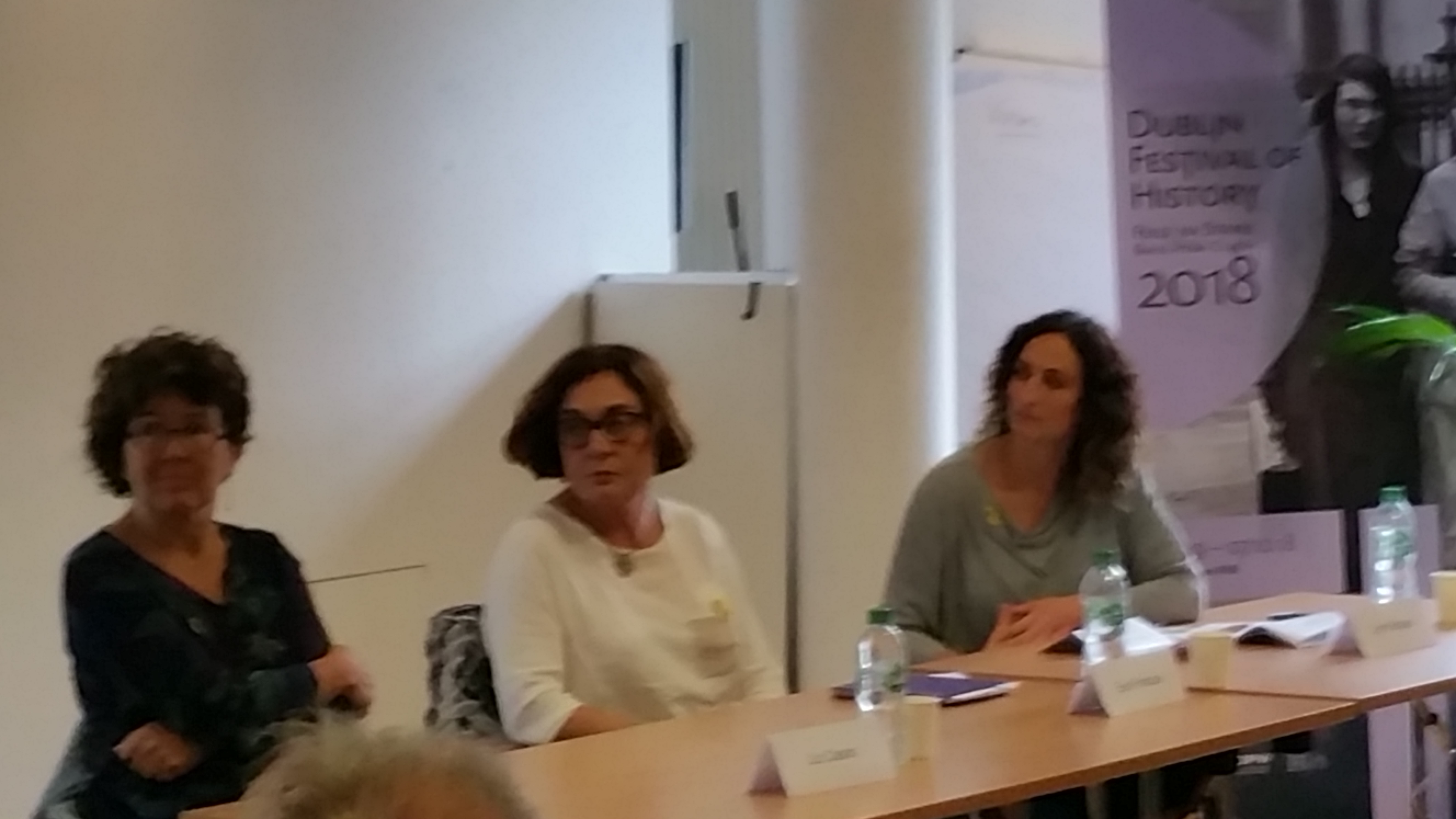


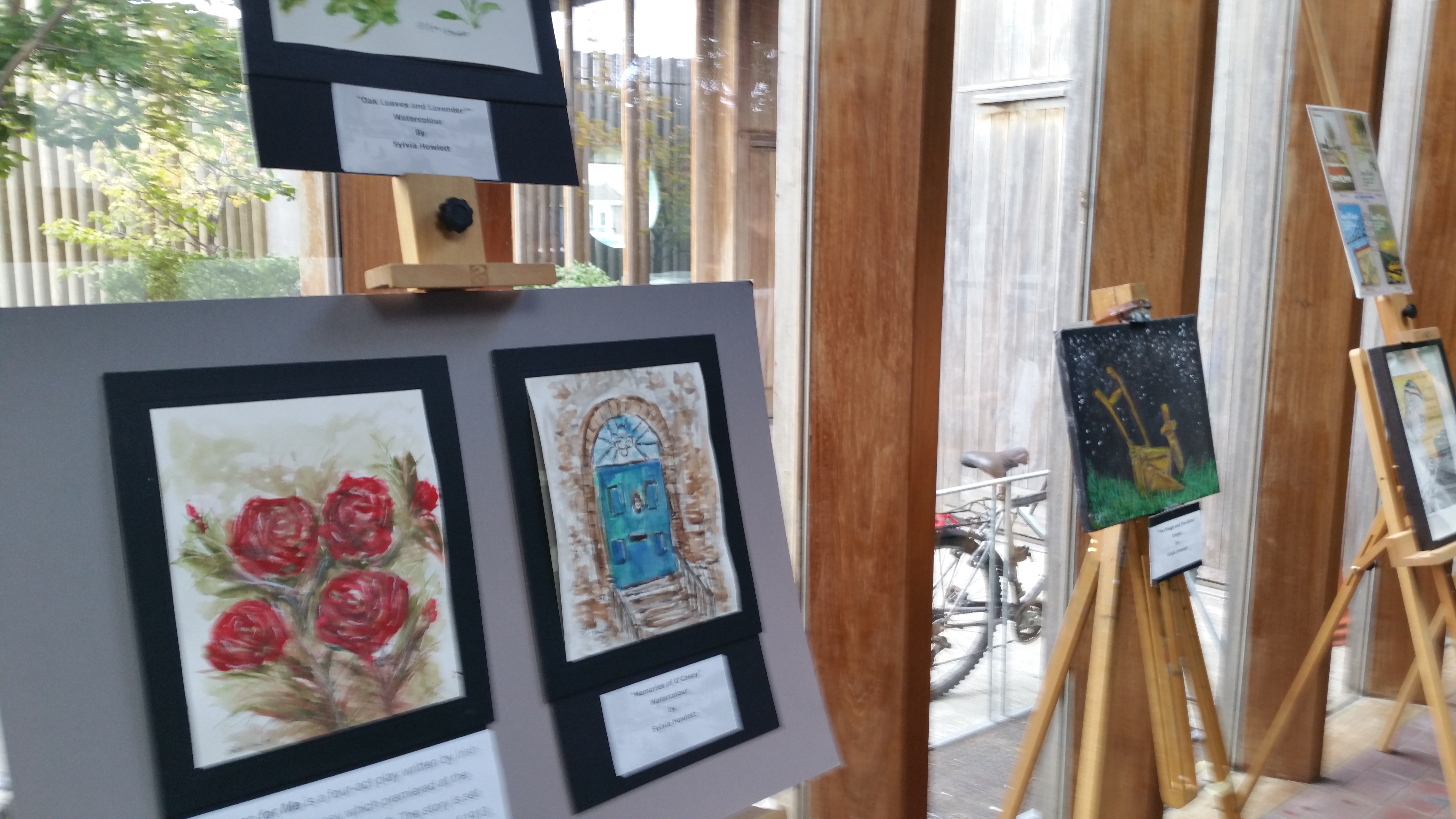
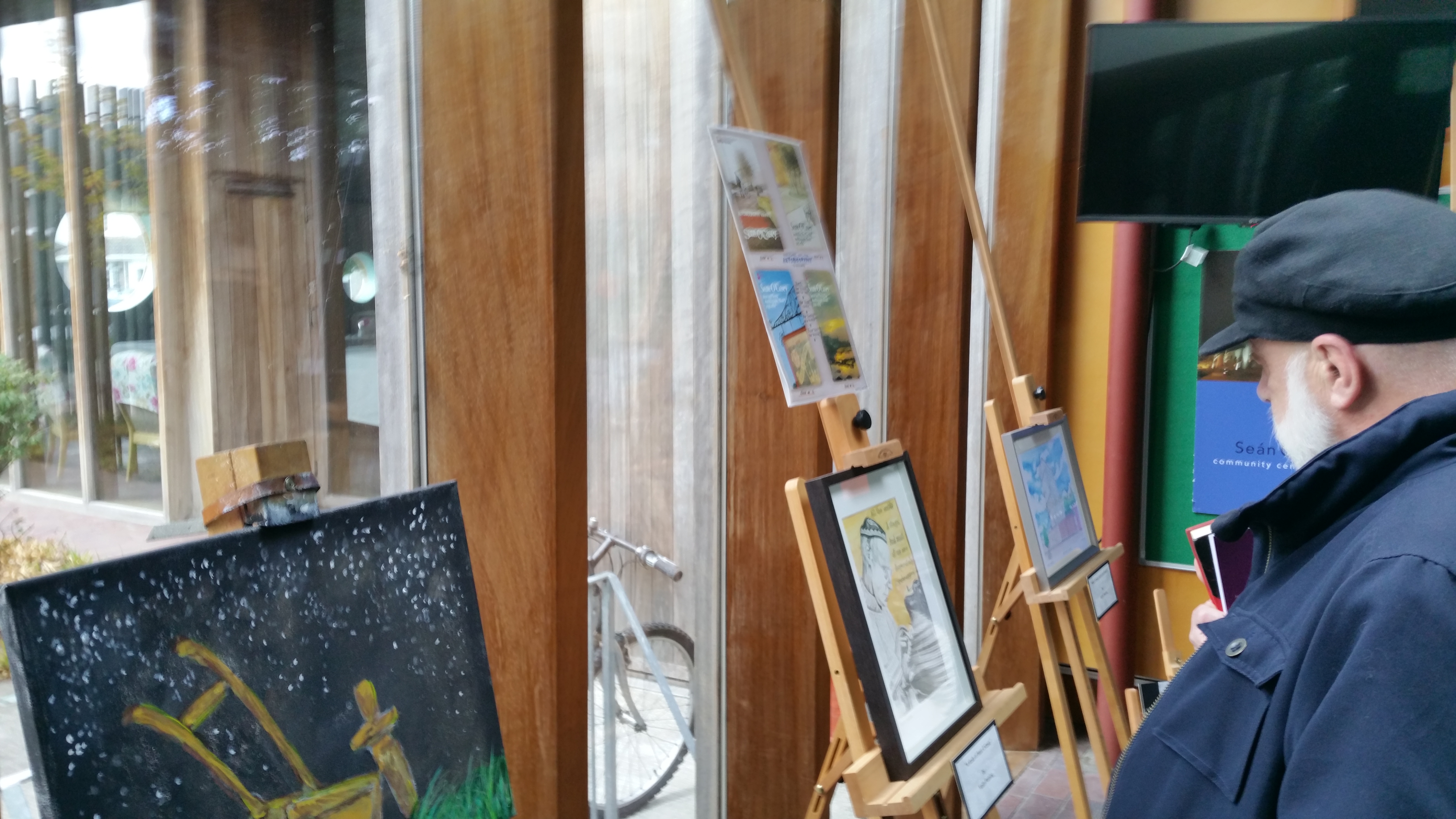


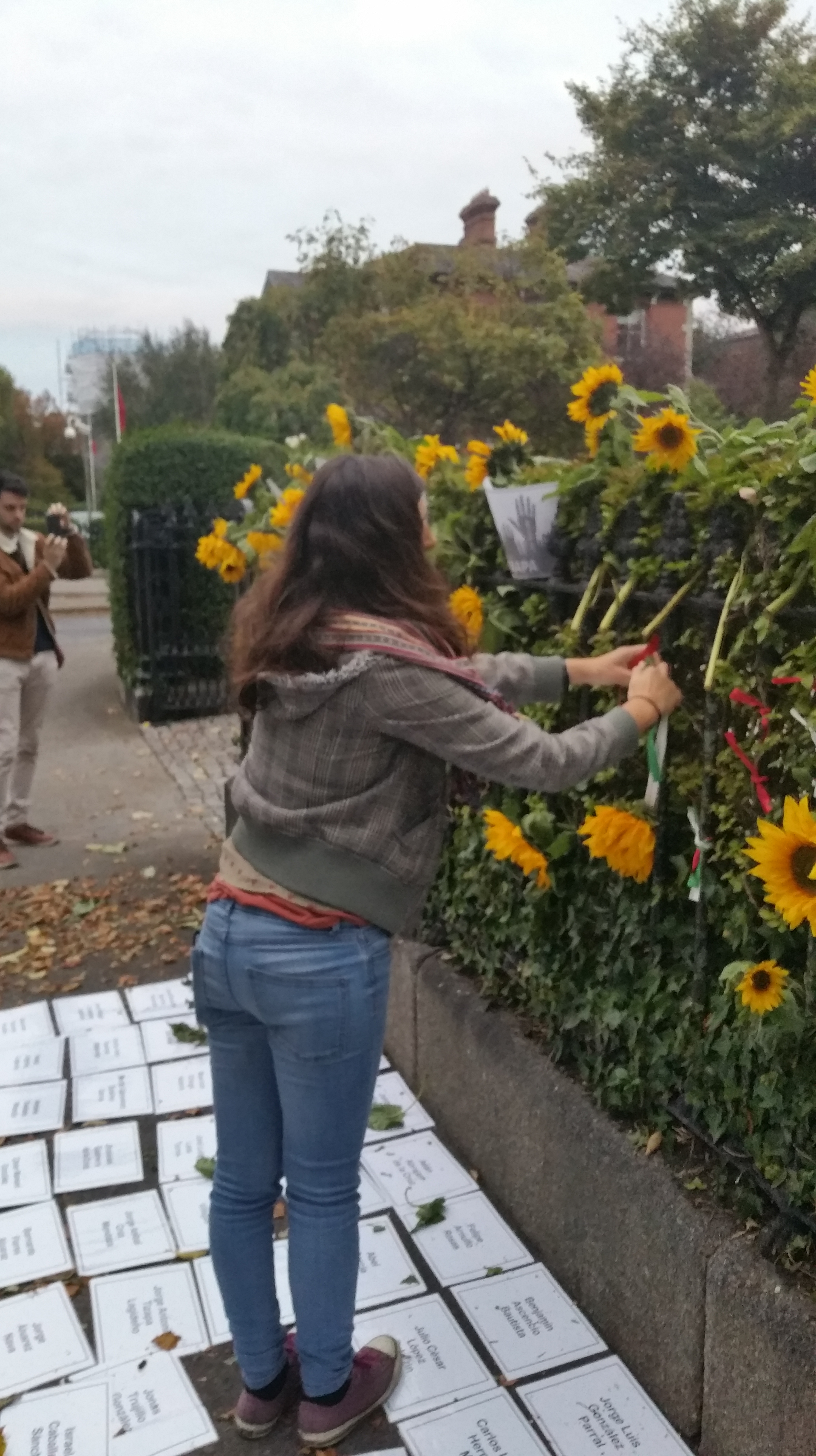


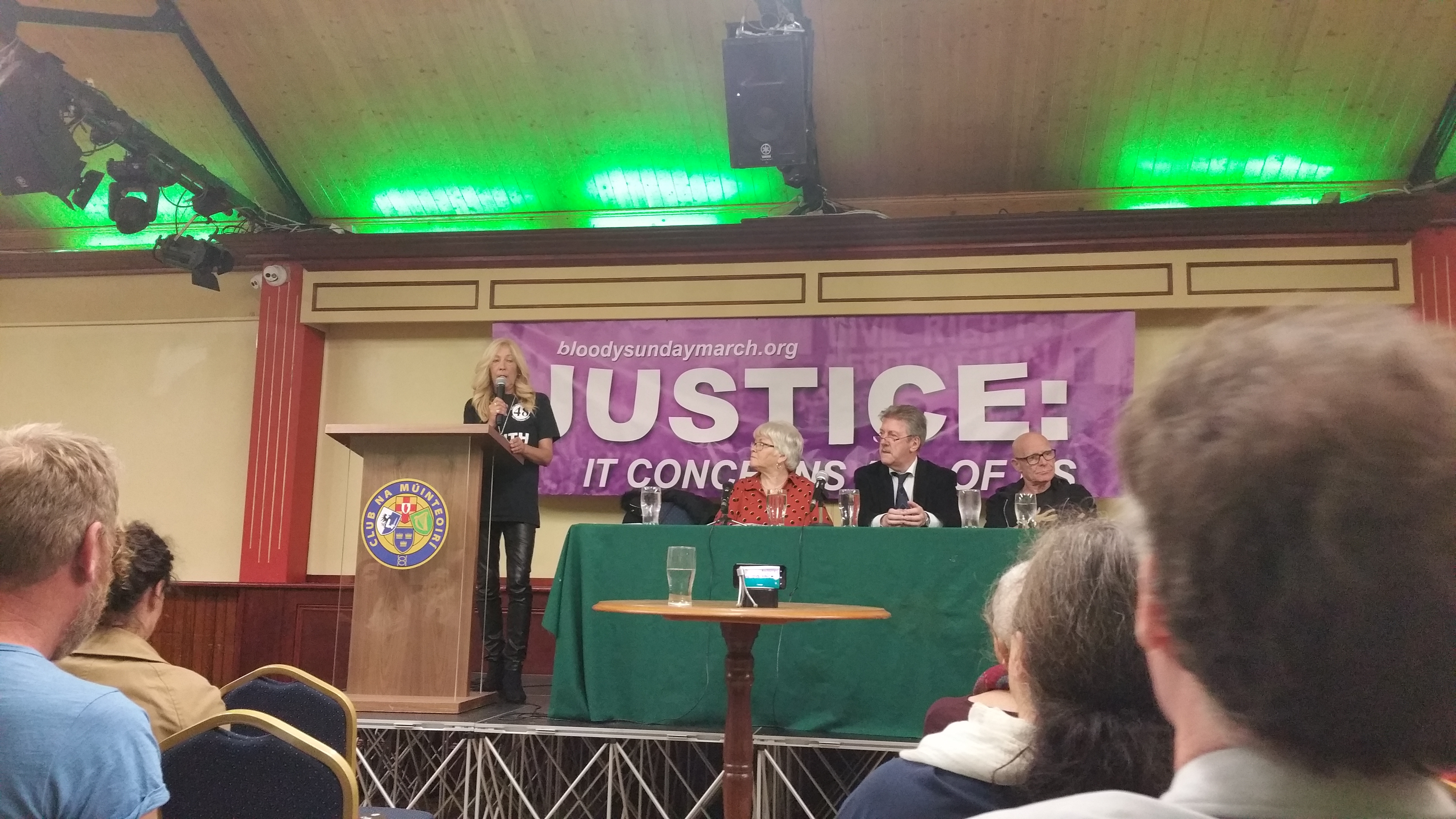


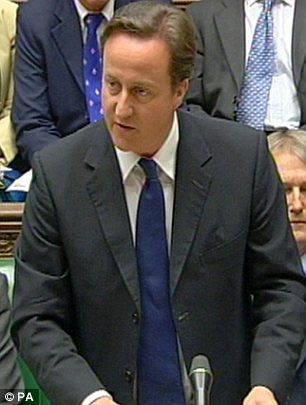




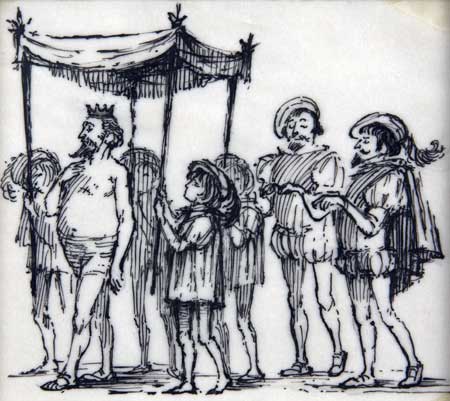
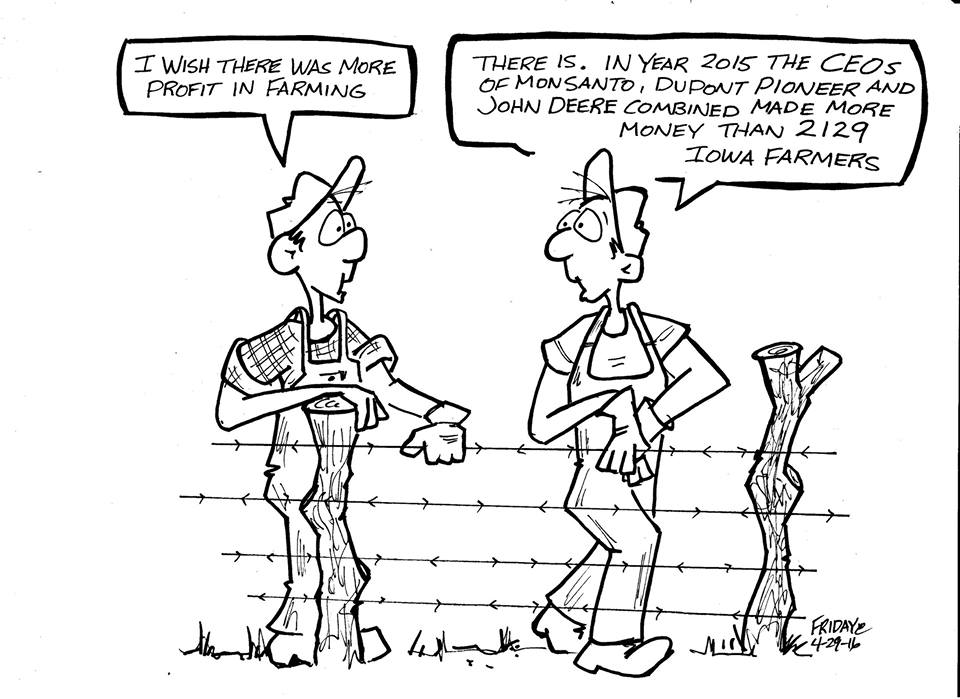


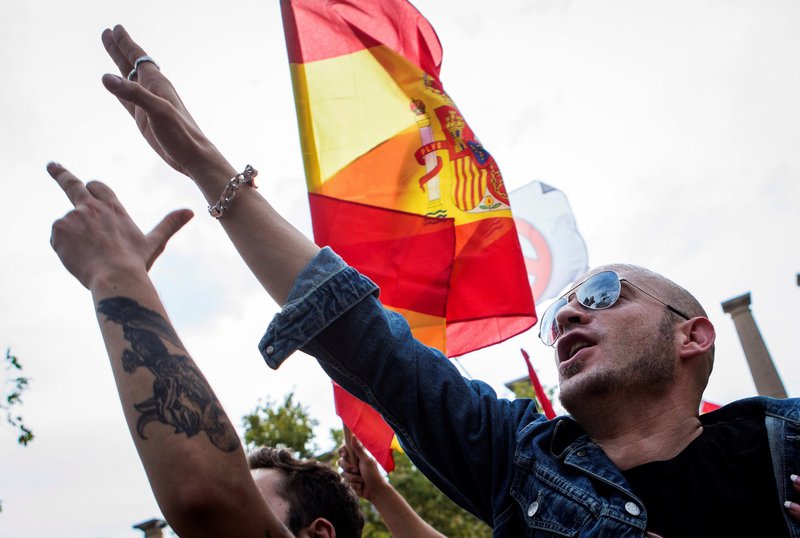
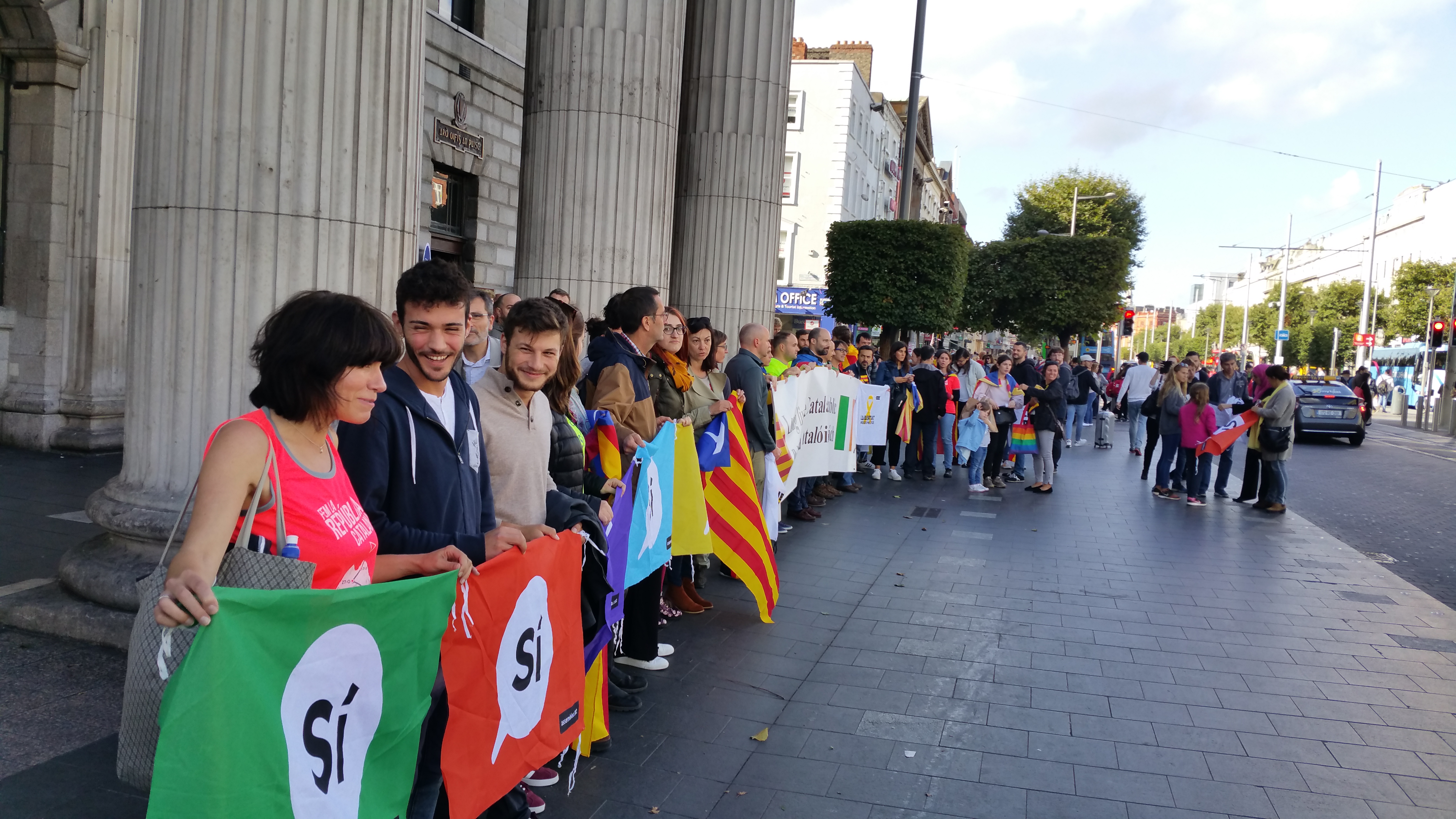
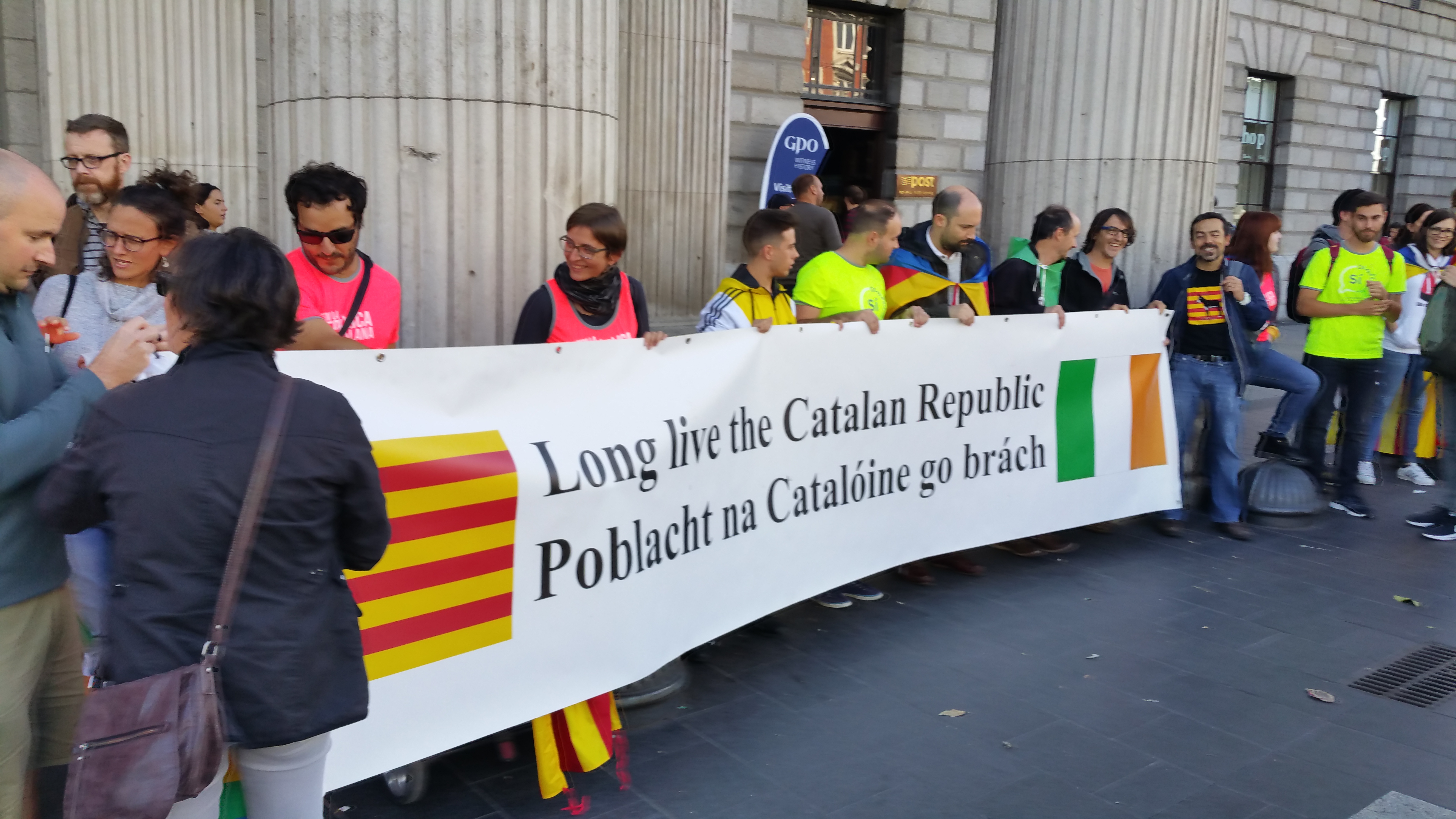
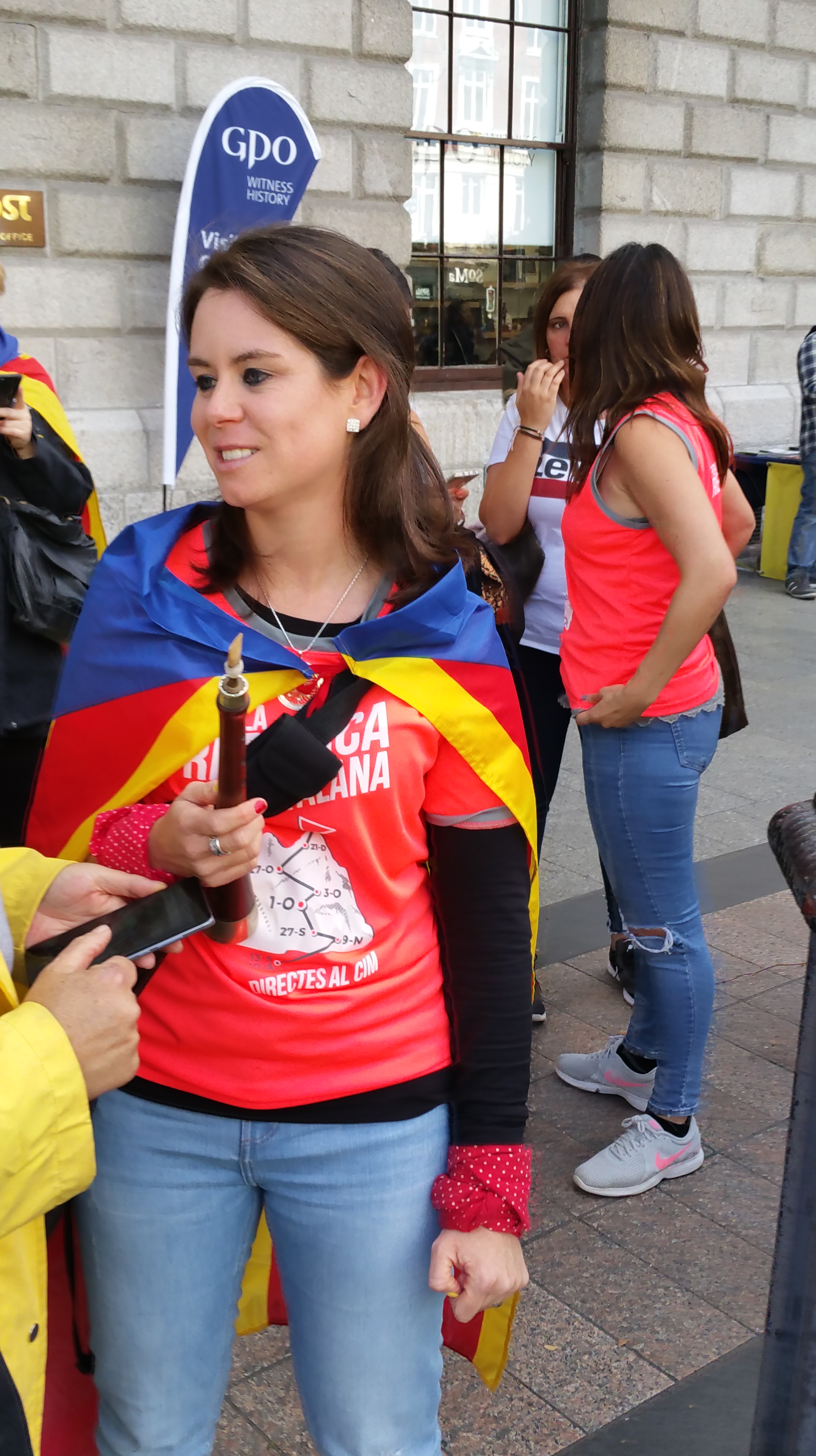
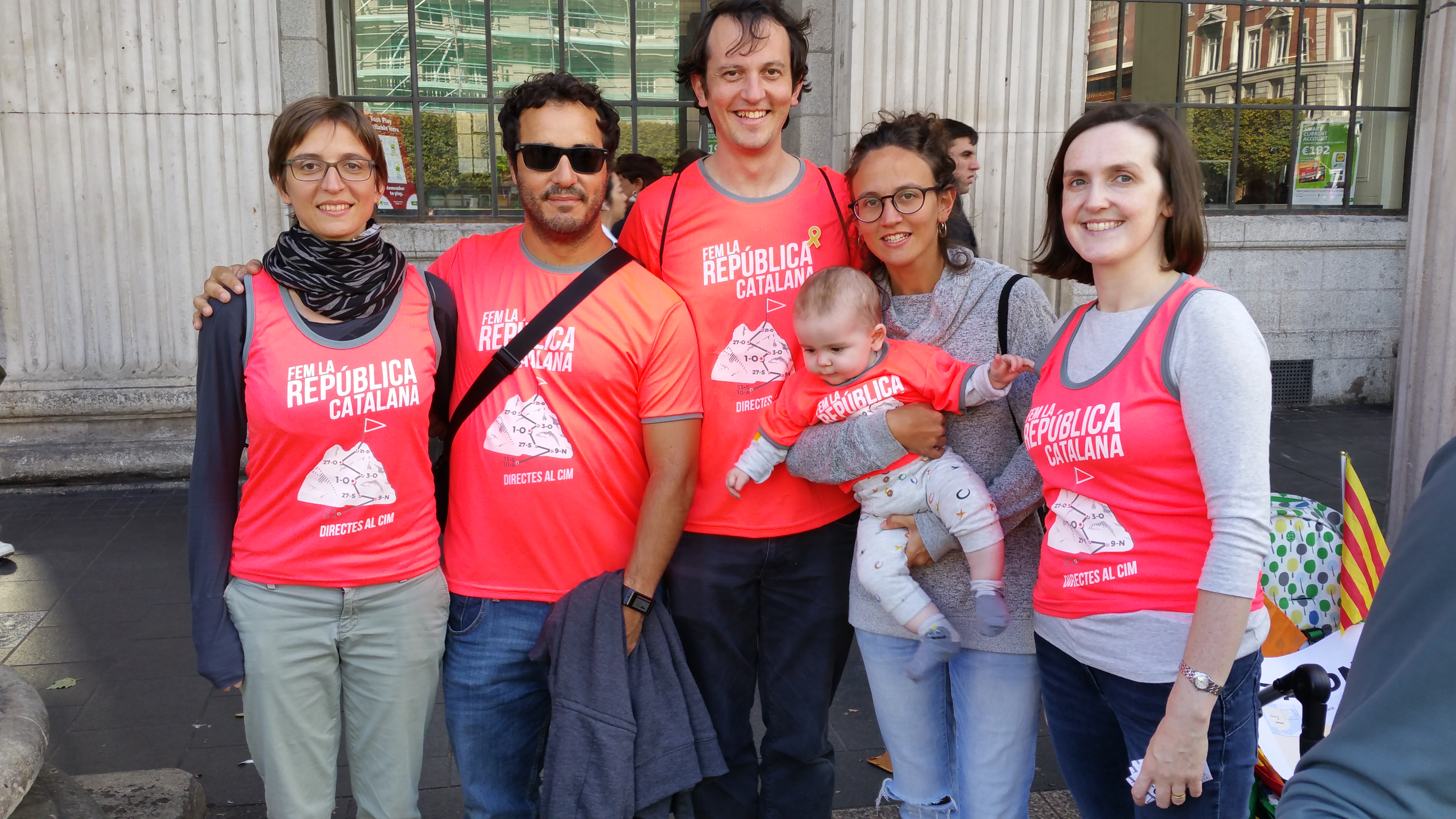
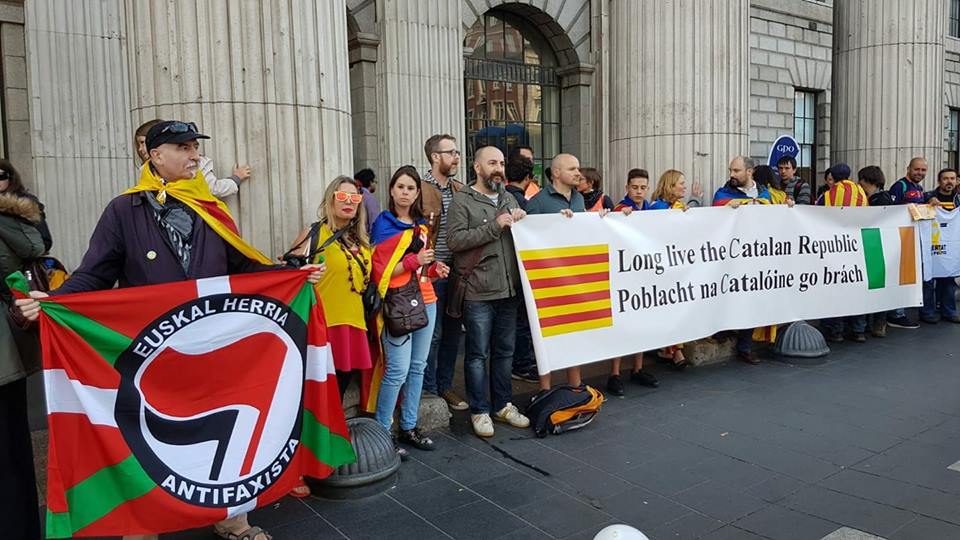
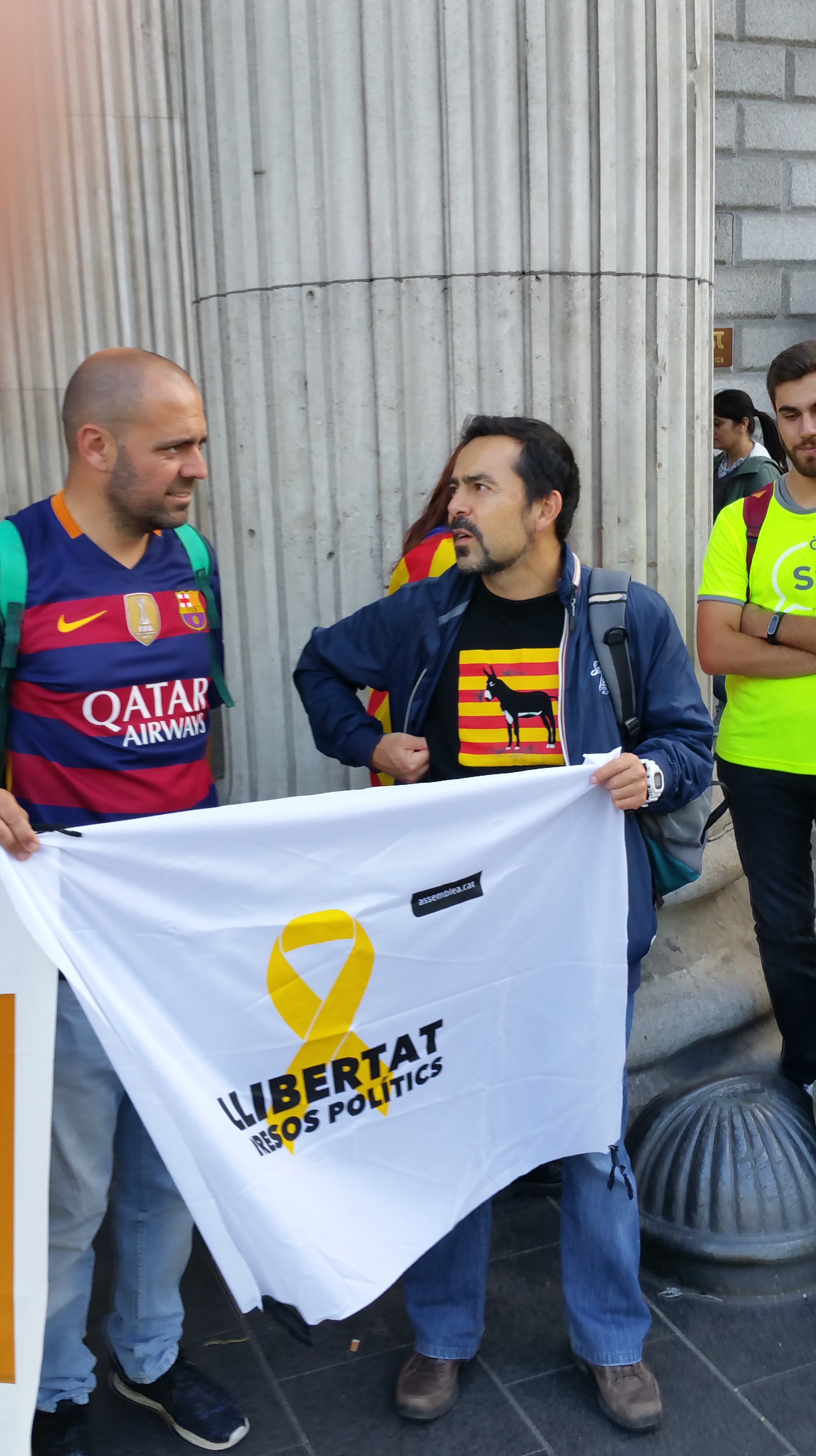
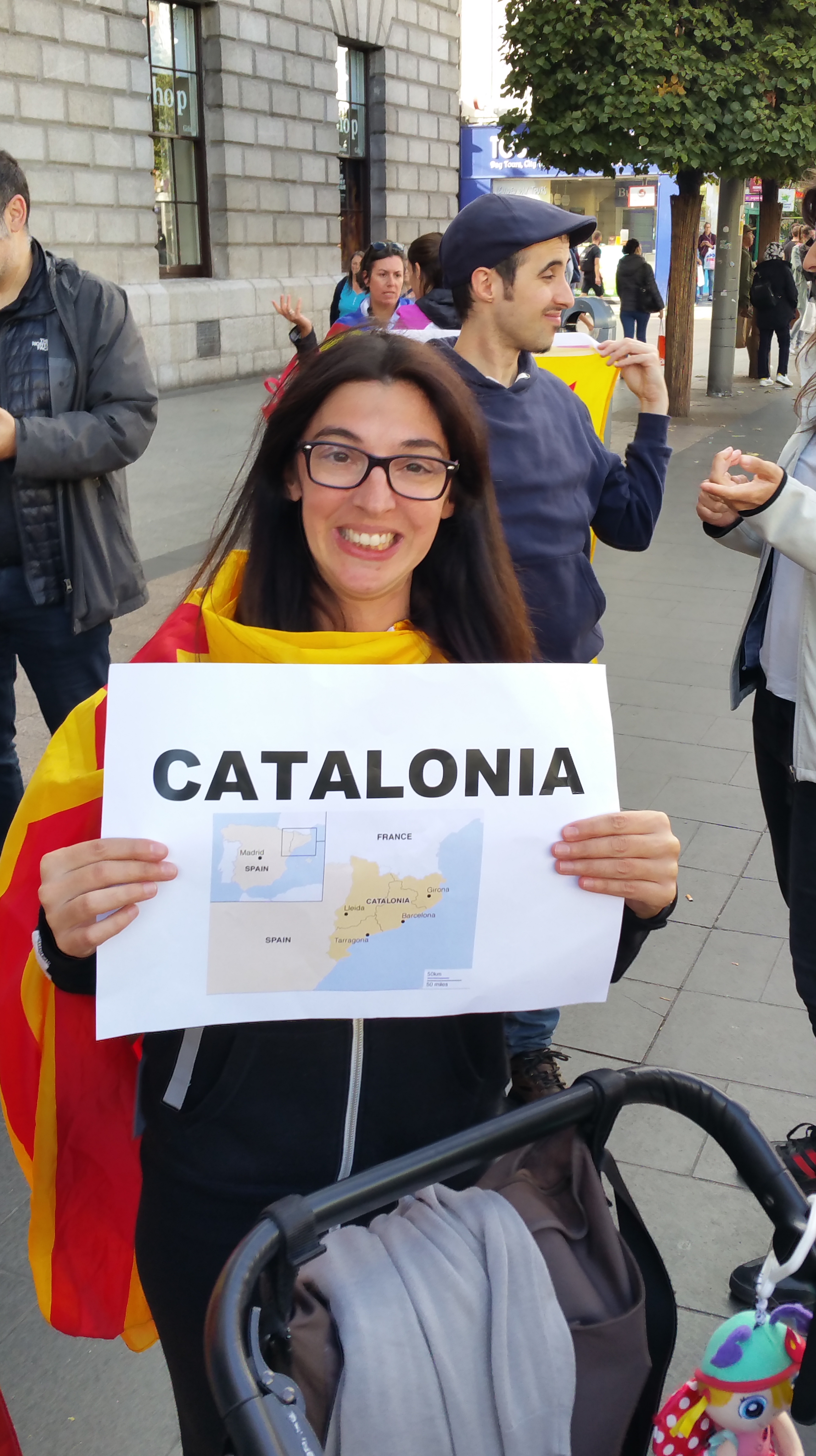
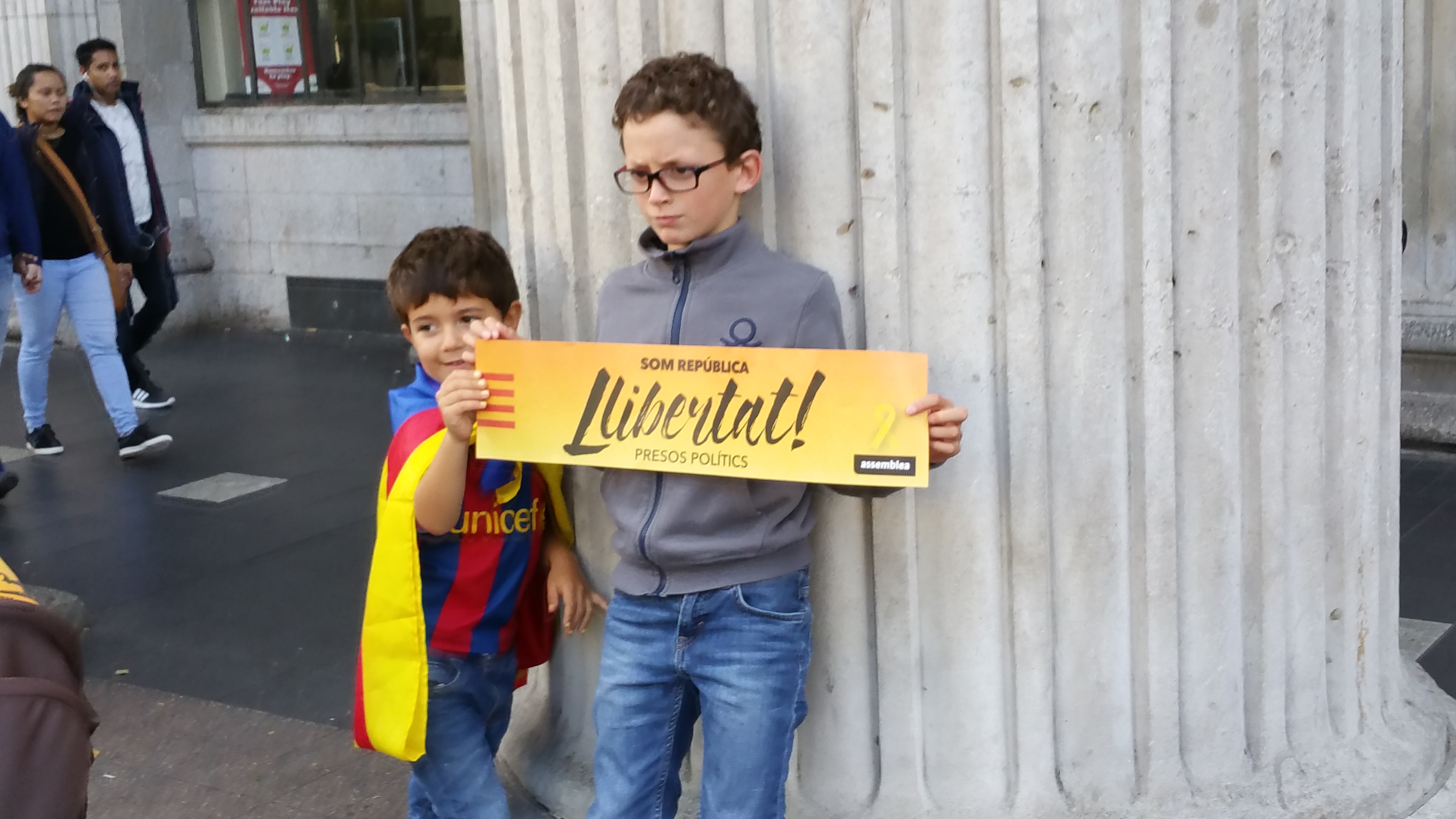
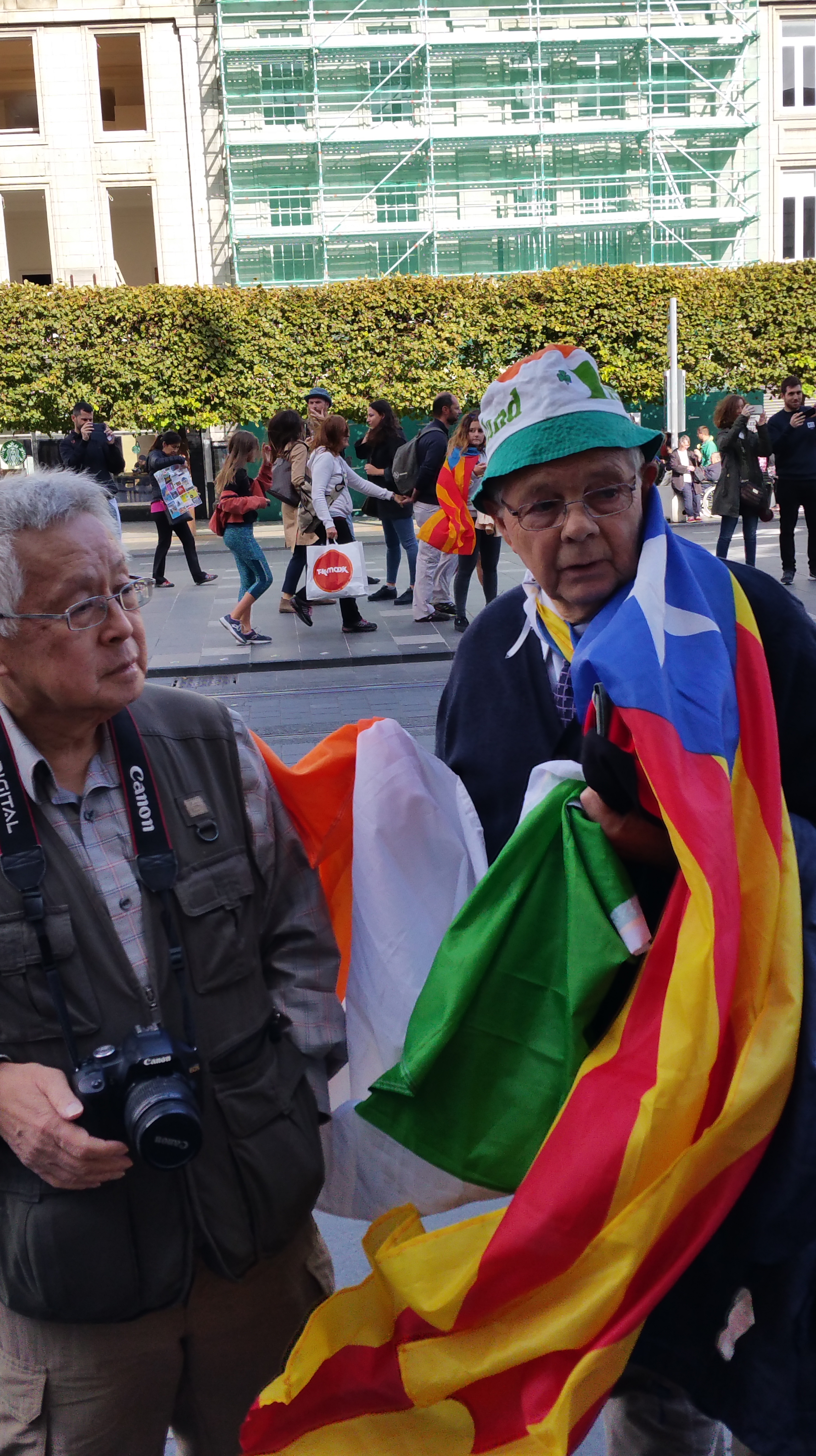
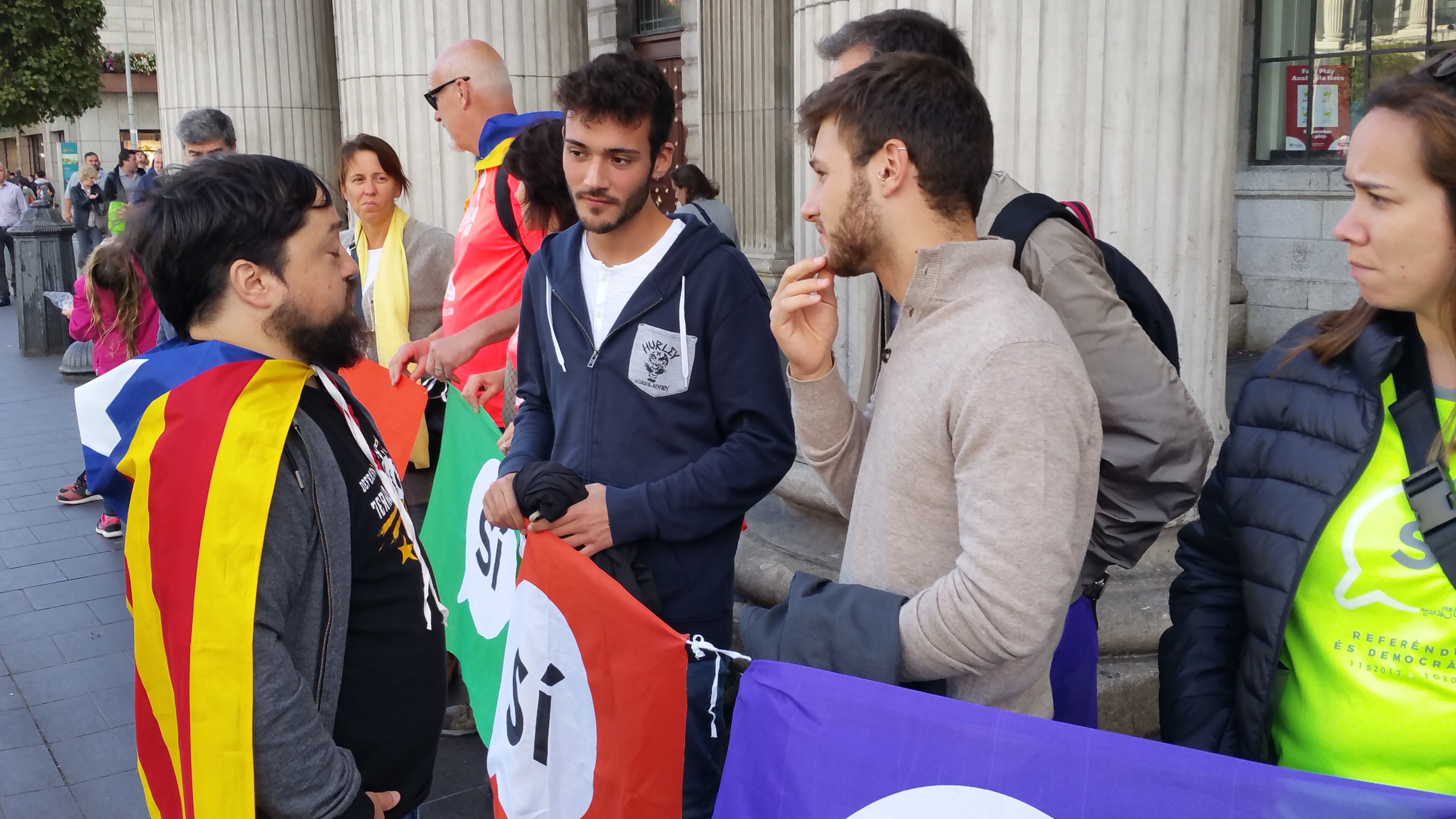
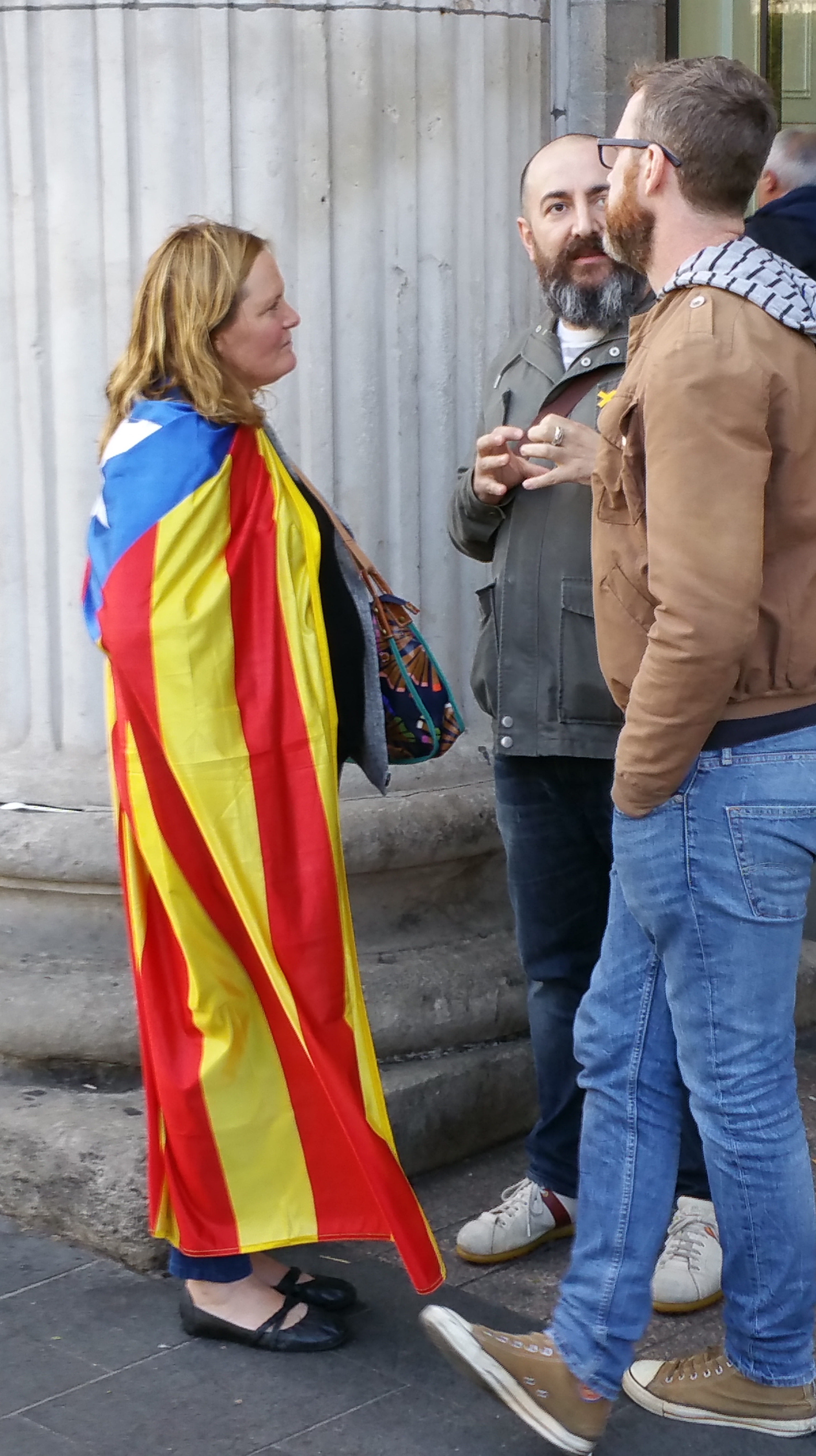
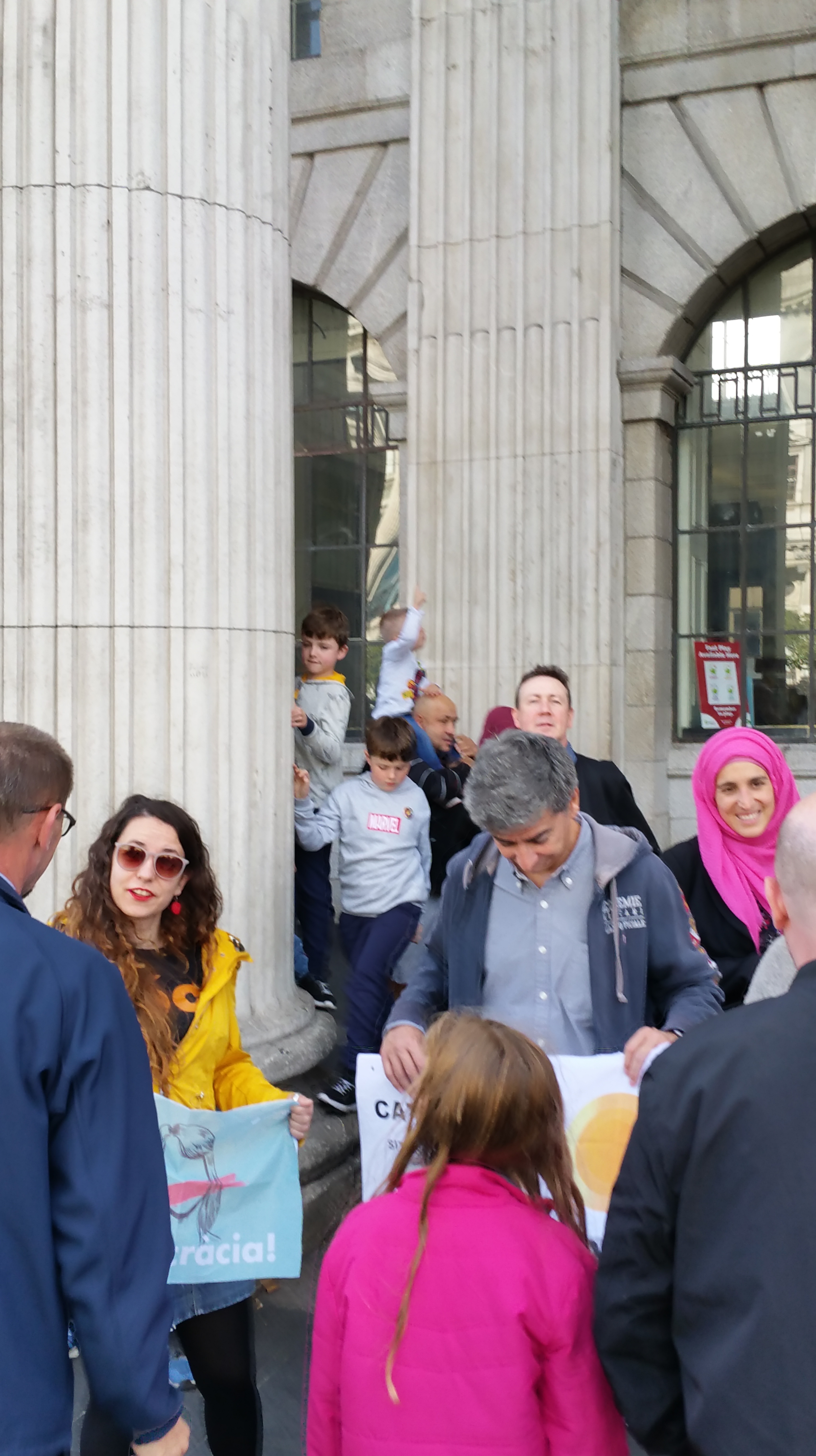
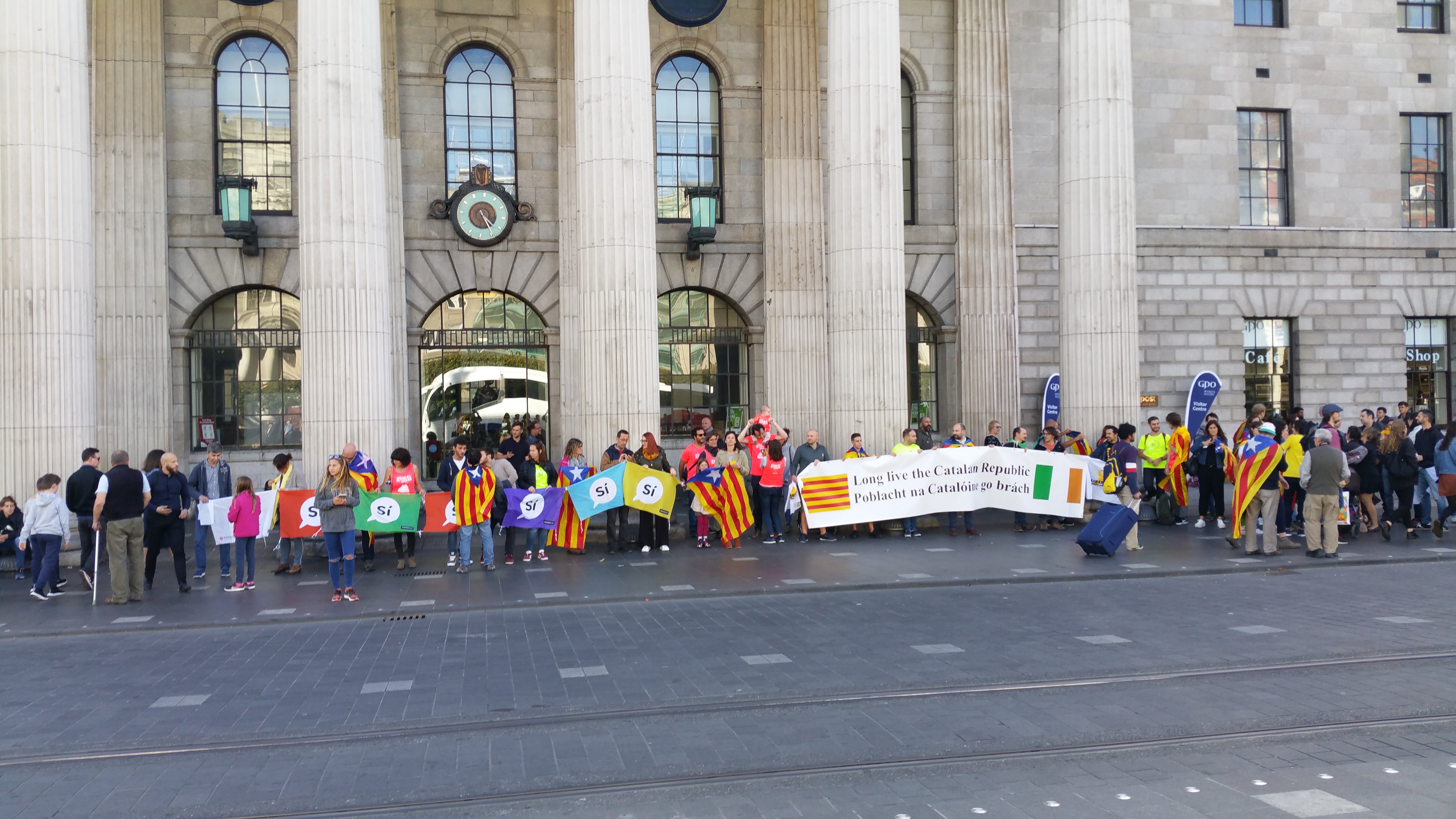
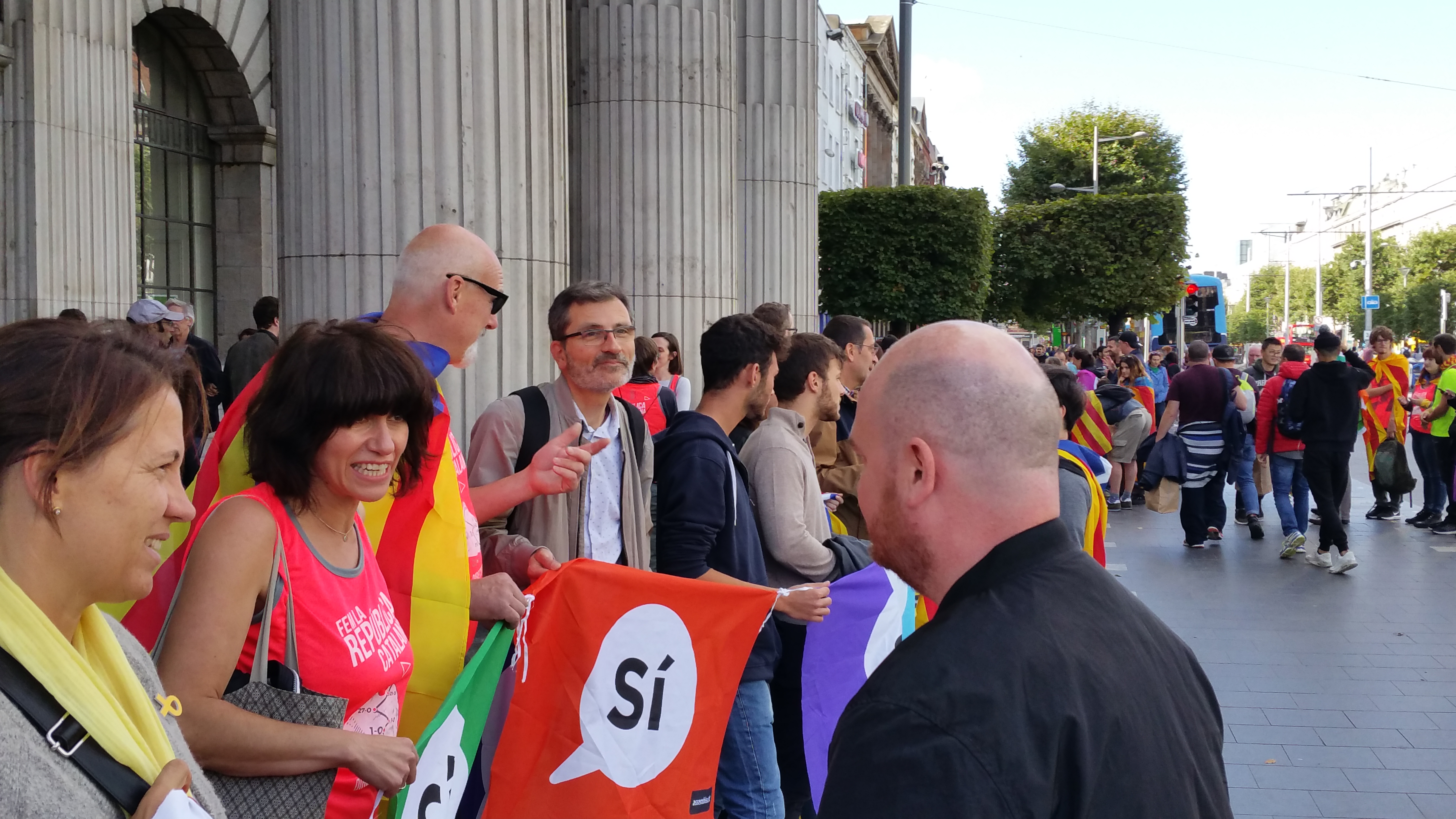
 rebelbreeze