The 24th January 1922 was a quiet Tuesday for the town of Mullingar, Co. Westmeath, what with it being a half-holiday and almost all business closed for the day. An exception was the Hibernian Bank and even that was nearing its closing time of 3 pm when three armed men entered.
With one of the new arrivals standing by the doorway with his revolver and the second holding the staff at gunpoint, the third entered the manager’s office where an accountant had been talking with a customer. After cutting the telephone connection, the third intruder demanded the keys to the strong-room, only to be told by the accountant that the keys were with the manager who was away.
Frustrated, the raider left the office and proceeded to the teller’s box which he quickly cleared of its contents. Having seized the most they could get, the…
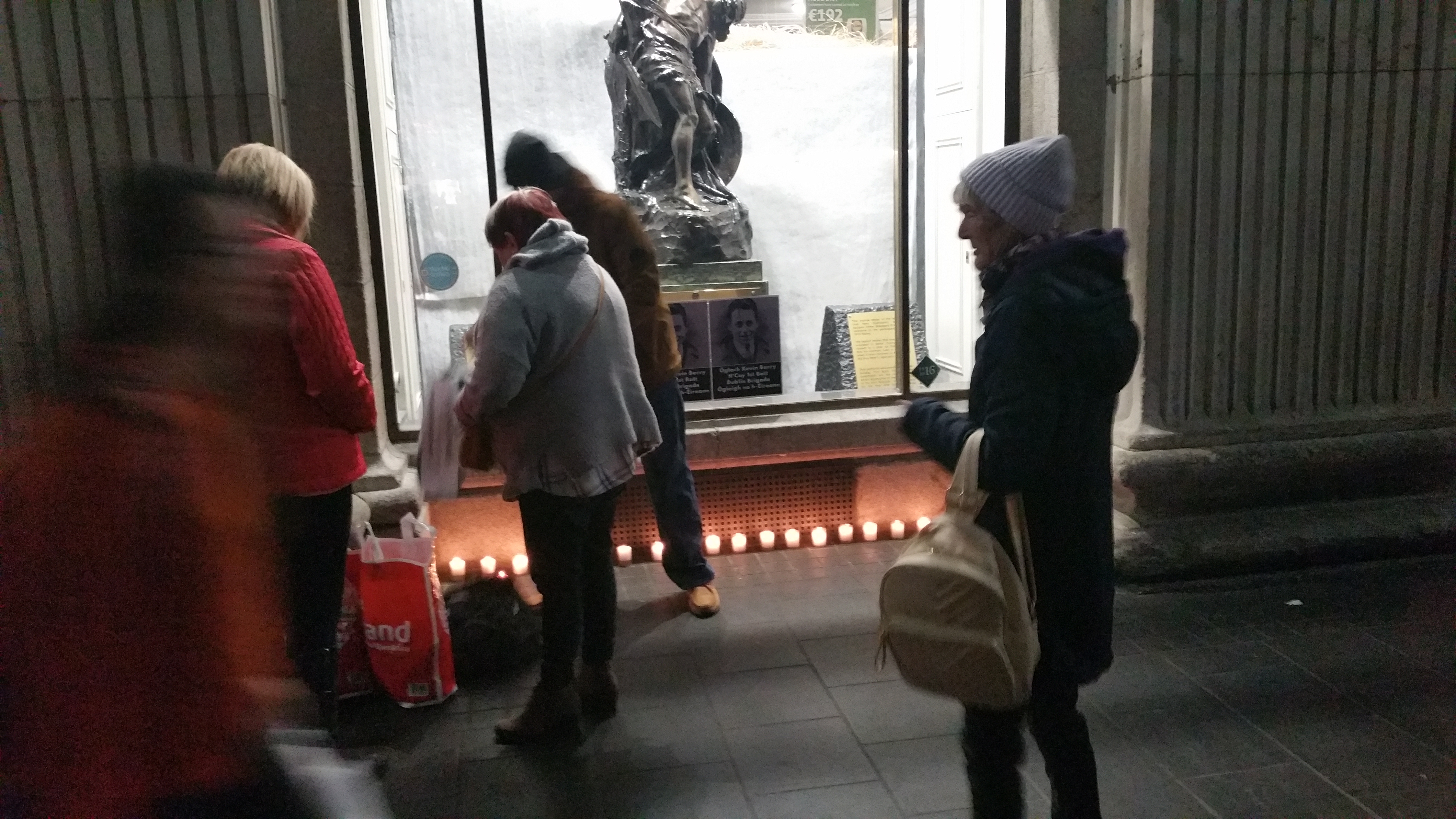
Socialists and Socialist Republicans gathered outside the General Post Office in Dublin on Thursday (Nov 1st) to honour the memory of Volunteer Kevin Barry on the 98th anniversary of his execution. Copies of his portrait were on display with candles lit and the ballad honouring his memory was sung.
Display of images of Kevin Barry and lit candles outside the GPO at the event. (Photo: D.Breatnach)
The event was organised by the Irish Socialist Republicans organisation. Asked about the reason for the commemoration and speaking on behalf of the organisation, Pádraig Drummond said “It is important to honour people in our history who have played an important role, who have displayed characteristics worthy of emulation such as resolution, courage and loyalty. People like Kevin Barry are more worthy of interest for the youth of today than clothing brands or pop idols.”`
Gathering to beign the vigil outside the GPO (Photo: D.Breatnach)
Some members of the public stopped in passing to listen to the song or to engage picketers in conversation.
People carrying out the vigil (Photo: D.Breatnach)
At the time of Kevin Barry’s execution the whole of Ireland was under a centuries-old British occupation and the defeat of the Easter Rising was three years in the past, most of its leaders executed and prisoners released. The first World War had ended. But the Irish Volunteers had reorganised and the War of Independence had begun in January of 1919. The ICA had seen a partial reorganisation and Cumann na mBan had never disbanded and, though it had suffered a few notable resignations, had experienced no split. The UK General Election of December 1918 had delivered a huge majority in Ireland to the newly-organised nationalist-republican coalition of Sinn Féin and in January of 2019 the successful SF delegates set up the Dáil, the first independent Irish Parliament, in defiance of the rule that all delegates elected in a UK election attended the Westminster Parliament in London.
On the same day in a separate development, the War of Irish Independence had begun. To wage war against the British occupation, the Irish Volunteers needed arms so some of its operations were carried out in order to seize arms from the occupiers. Kevin Barry joined the IRA at 15 in Dublin and not much later the IRB and had been on a number of successful raids to seize weapons.
Kevin Barry portrait graffiti of some years on wall in Dublin city centre. (Photo: D.Breatnach)
On 20thSeptember 1920 his unit was to ambush a British unit collecting bread from a bakery and relieve them of their weapons. Collecting breadrations from Patrick Monk’s Bakeryat 79-80, Upper Church Street, near the corner of North King Street, Dublin.
Barry was a medical student and had an examination scheduled for that day which he expected to attend after the operation. Having attended mass that morning, he joined the unit in nearby Bolton Street and when the British Army lorry arrived the volunteers, armed with pistols, ordered the soldiers in the back to drop their rifles, which they did. However a shot rang out, possibly from the front of the lorry and the volunteers opened fire but Barry’s gun jammed twice and he jumped under the truck, being left behind when his comrades retreated. He was discovered and arrested. All five of the British soldiers in the rear of the lorry had been hit and one, 15 years of age, was dead – another two died later.
Kevin Barry attested that he had been beaten up when captured and tortured for information later in Army custody. On 20th October he was tried by military tribunal under the provisions of the Restoration of Order Act of August that year. Brigadier-General Onslow presided on the tribunal and Barry had legal representation who, after Barry announced he would not recognise the court, withdrew. The sentence of the court, given to the Volunteer in his Mountjoy Prison cell that evening, was death by hanging. The sentence became publicly known on the 28th and a fierce campaign began to save his life, not only in Ireland. Terence McSwiney, author, playwright, Lord Mayor of Cork and IRA Volunteer, had died after a hunger strike of 74 days on 25th October and public opinion, especially in Ireland, was highly excited. Nonetheless, Kevin Barry was hanged on November 1st 1920, eighteen years of age. According the priest who accompanied him the gallows, who was not a republican, he went calmly to his death.
On 14 October 2001, the remains of Barry’s body and others were given an Irish state funeral and moved from Mountjoy Prison to be re-interred at Glasnevin Cemetery in Dublin. A stained glass window in his honour was unveiled in 1934 at the Earlsford Terrace address of University College Dublin and was later moved to their new address in the Belfield Camput and restored in 2007.
The Ballad of Kevin Barry, which was sung at the commemoration by Diarmuid Breatnach, was composed around the time of the Volunteer’s execution and has been very popular in Ireland and among the Irish diaspora abroad. The author is unknown despite efforts by his family and others to trace him or her but there were some indications that it had been composed in Glasgow. The song has been recorded by many performers, including non-Irish singers Paul Robeson and Leonard Cohen.
Quite a few pro-Catalan independence people have expressed horror and indignation at the statements of Spanish politician José Manuel García-Margallo in an interview recently. They should instead that be grateful that he spoke much of the truth and dispelled unrealistic illusions about the way forward for Catalonia.
Ex-Foreign Minister of the Spanish State José Garcia-Margallo, photographed recently. (Photo source: VilaWeb)
Did he threaten the independence movement with violence? Yes and not too subtly. That was no doubt his purpose as well as perhaps reassuring Spanish unionists, whether fascist or otherwise. But nevertheless, he spoke an important truth.
Spanish ex-Foreign Minister José Manuel García-Margallo said that Spain would not withdraw ‘peacefully’ from the Principality. ‘It will not deliver the keys to the dependencies and furl up the flag’, he told ‘El morn de Catalunya Ràdio’. He expressed support for the accusations of ‘rebellion’ against the Government of Puigdemont, President Forcadell, Jordi Cuixart, Jordi Sànchez and the General Secretary of ERC, Marta Rovira. According to him, the unilateral way to achieve independence ‘necessarily’ implies violence.
Margallo was raised in a family with close military relatives, two of which died in the anti-colonial Rif uprising, one of whom was a colonial Governor of a town there. The ex-Minister of Foreign Affairs was educated (and presumably brought up in) a part of the occupied Basque Country which must have helped condition him and his early adult life was spent under the Franco dictatorship. His early political career was there too and took shape during the ‘Transition‘ and since.
Translation of the transcript of the excerpt below:
“-Mónica Terribas: Crime of ‘rebellion’, does it exist there are or not, José Manuel? (DB: one of the charges against the Catalan activists but which requires the use of violence).
“-García-Margallo: I think there is a crime of rebellion. I share the theses of Llarena, that is, I believe that what we saw on the streets during the course of the (events outside the) Ministry of Economy was violent. I think that, by definition, unilateral secession can only be achieved by violence. That is, I say that hypothetically this leads to violence. Because? We have discussed it many times and we all agree: the Constitution does not allow secession. Therefore there will be no referendum agreed. Secondly, the Spanish state will not withdraw peacefully, that is, it will not deliver the keys to the dependencies and furl up the flag. So how is the Catalan Republic proclaimed? If it cannot be by agreement and it can not be by unilateral abandonment, then it will have to be by violence. And that necessarily leads to rebellion.”
Margallo’s political party, the Partido Popular is of course a coalition of a number of Franco-fascist organisations, put together to operate in the ‘new’ Spanish state. But the greater truth about the Spanish ruling class is more important than all this.
The Dictatorship ruled as the only face available of the Spanish ruling class – representing “old money”, from the expropriation of the labour power of workers and the plunder of its colonies but also “new money”, appropriated from the losers in the Spanish Anti-Fascist War.
In the 1960s and 1970s the Spanish State began to receive substantial US and other investment, particularly in military form. But the concern of investors was that with the rise of national liberation movements and the upsurge of the youth and student movement around the world, that an unyielding dictatorship would lead to revolution, so pressure began to be applied, although it was understood that attempts at reform after so much repression could also precipitate a revolution. Given the prevailing circumstances within the Spanish state, such a revolution could only be a socialist one.
When General Franco died in November 1975 two years and one month after his chosen successor Admiral Carerro Blanco had been assassinated, the reformers got room to move (internally Opus Dei and externally the US and others, especially the EU or Common Market as it was then). Reform and normalisation of control meant bringing on board of the ship of State two significant political forces with their corresponding large trade unions, illegal until then: the social-democratic PSOE with their UGT trade union and the Marxist CPE with their more militant Comisiones Obreras union. And imposing a Monarchy.
Both those illegal opposition forces agreed, accepted the monarchy and were legalised; then controlled and even sacrificed their own members. They pushed for agreement of the monarchist and unionist Constitution of 1978, in which the majority of a dazed and hopeful population of the state (but not in the Basque Country) voted in favour of it (and which is now being used to illegalise Catalan bids for independence).
Subsequently the PSOE gained an electoral majority and while in government in the 1980s ran assassination squads against the Basques (chiefly GAL and BVE groups, although foreign fascist gunmen were also brought in for individual jobs).
Under alternating governments of the PSOE and of the PP, the State forcesregularly used repression, particularly in the Basque Country, including torture of detainees and jailing people on the basis of ‘confessions’ tortured from them and which they repudiated in court. And they dispersed political prisoners throughout the jails of the State, hundreds or thousands of kilometres from their families.
This Spanish State is one that had at one time ruled much of the world and never ceded territory without a fight — with the English, the French, the Dutch, the North Americans; with native resistance and liberation movements from the Canaries to the Caribbean, to America, the Philippines and Africa. As a monarchy and feudal system, it overthrew the Arab colony of generations and expelled Arabs and Jews, brought in the terror of the Inquisition (the worst of all the states that had it), suppressed the rising of the Comuneros and resistance of the Basque and Catalan nations. As a semi-feudal capitalist monarchy, it overthrew a Republic and then raised a military coup with foreign fascist aid to overthrow another.
So this José Manuel García-Margallo is being on the whole brutally honest here and shattering the illusions many people had, especially those of a liberal or social-democratic turn of mind, that somehow Catalonia would win genuine independence without having to fight a Spanish military repression. But they should look on his utterances as doing them a favour, forcing them to look at reality.
In fact, for all that I have recounted about the particular nature of the Spanish State and its history, the more general historic truth is also that NO capitalist state (not to mention an imperialist one) is going to stand by and see itself being dismembered and losing huge chunks of what it considers its territory and economy.
Nations that won true independence had to fight for it. In the last century alone, how did Algiers win independence from the French? How did Kenya in Africa and Aden in the Middle East expel the British occupation forces? How did the Vietnamese expel the French occupation forces and defeat the US aggressors? How were the Nazi and Italian fascist and Japanese invaders of so many countries defeated?
People who hear the truth, no matter how bitter it tastes, should spend no time in bewailing it but instead concentrate on preparation.
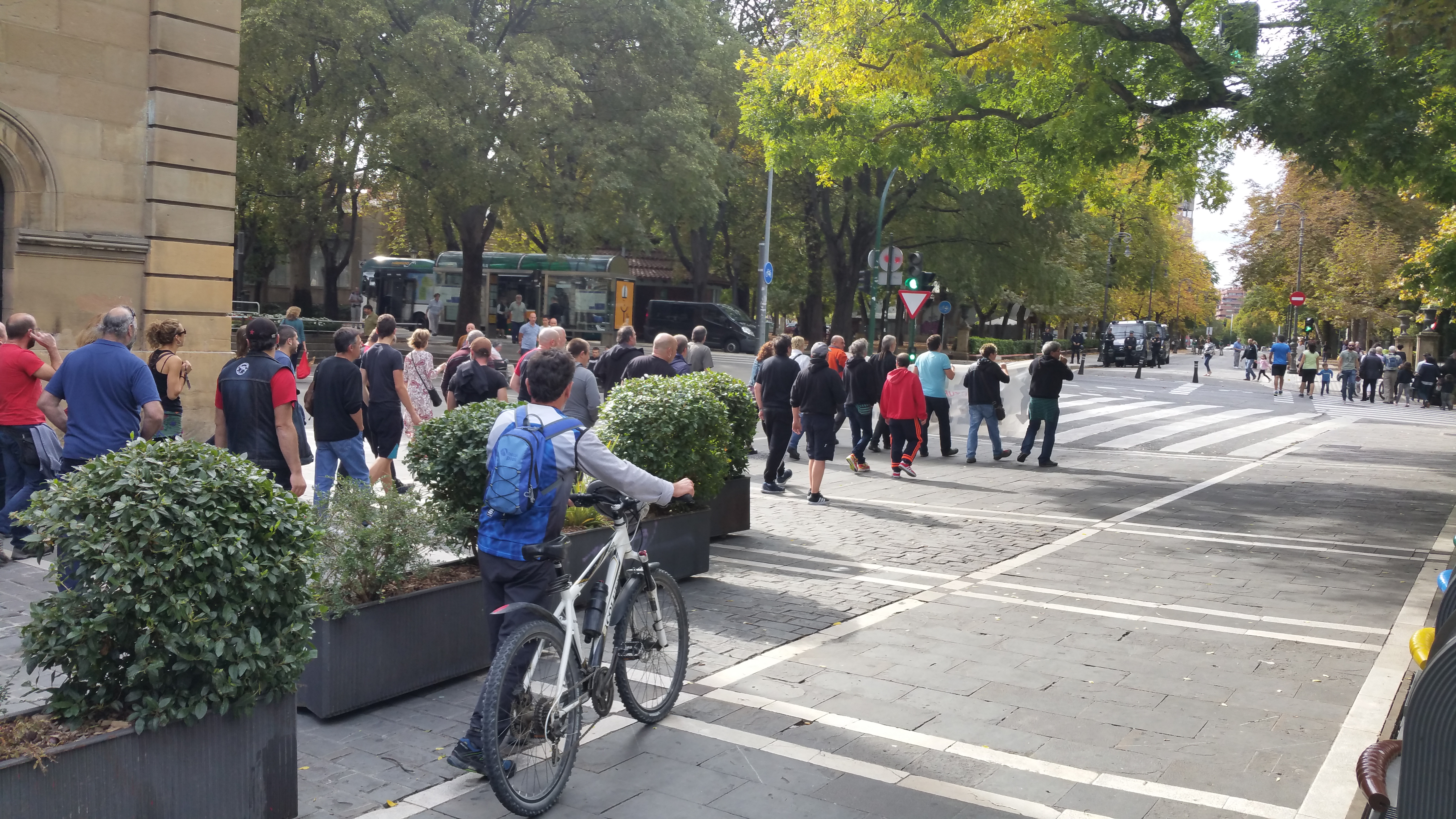
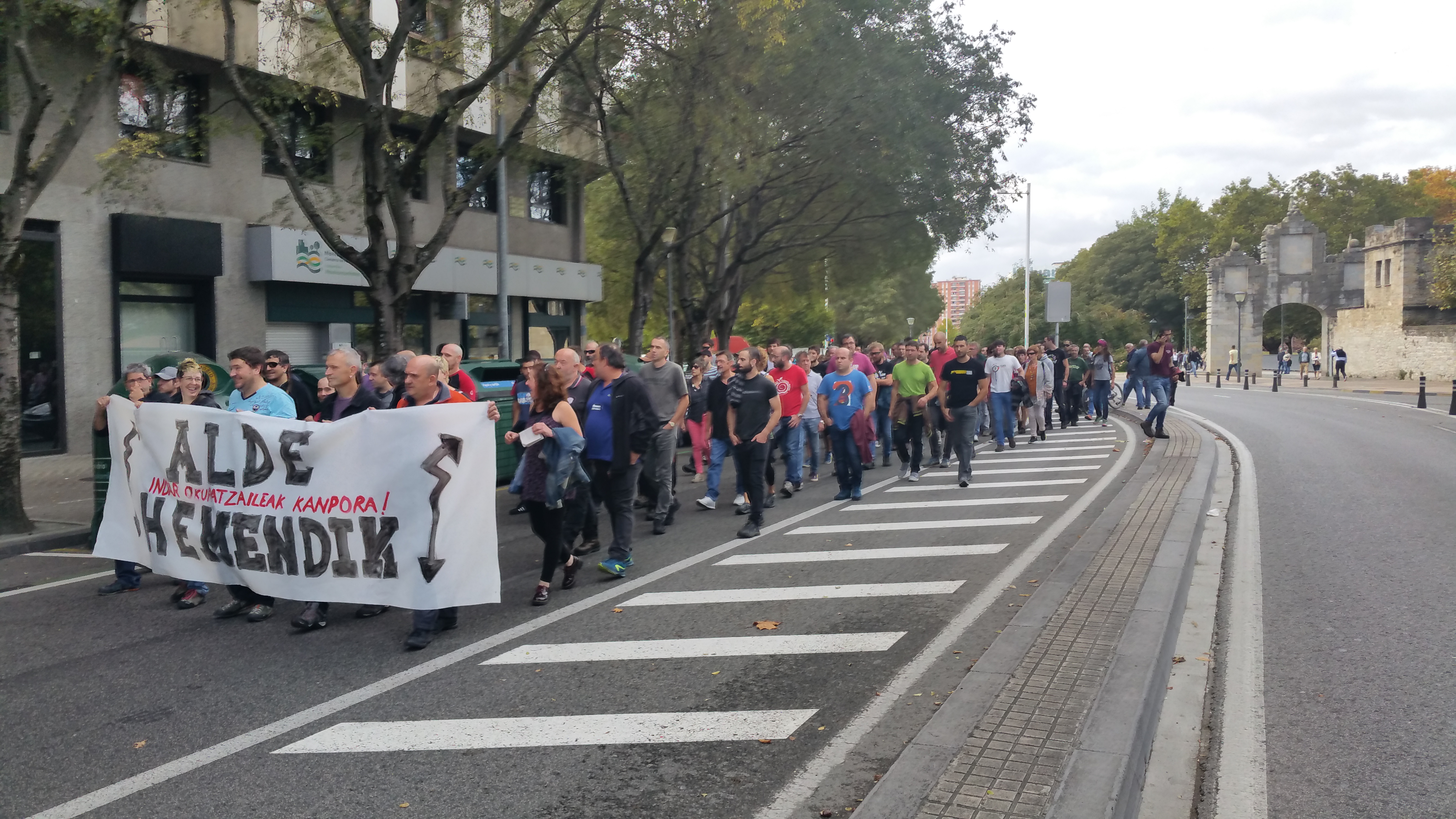
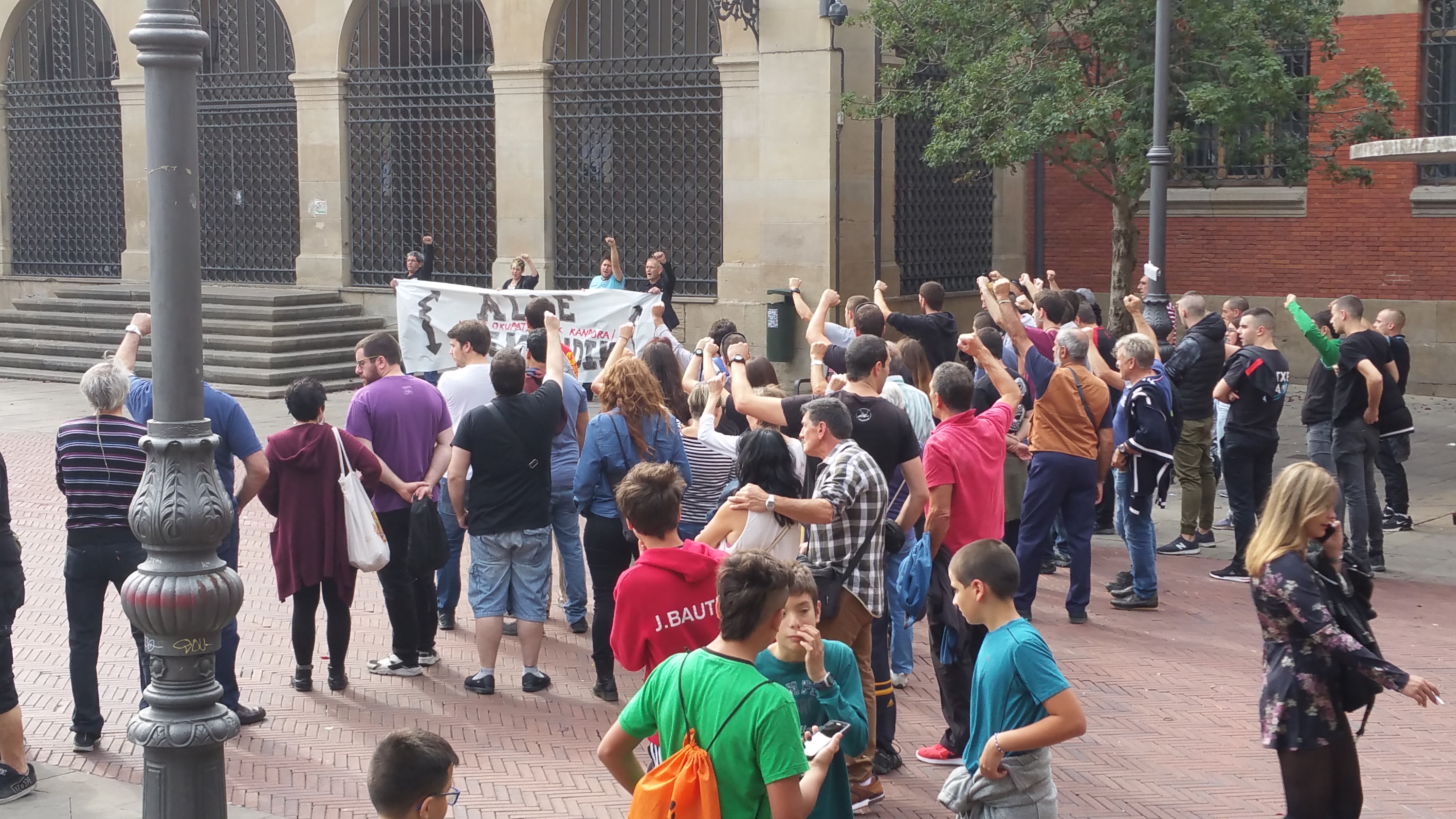
Marchers in Iruňa (Spanish: Pamplona) called “Alde Hemendik!” for the Spanish occupation forces to get out of their country and also called the Nafarroan police “murderers”, in addition to calling for the liberation of Basque political prisoners.
Posters for the march seen in a number of locations in the town (Photo: D.Breatnach)
The marchers were obliged to seek permission from the authorities for the demonstration and route as otherwise, from past experience, a police attack would have been certain. Even when approved, marchers in the past had to pass by ranks of police in full riot gear, which earned the latter the nickname “Romanos”, from their superficial resemblance to Roman Legionaires. Of course the police are given many other names too. On this occasion, the police presence was not as intimidatory as is normally the case.
The event took place on October12th which is national Spanish holiday, the Día de la Hispanidad, in which the State celebrates the spread of the Castillian language through conquest of the Canaries, Americas and part of North Africa. Naturally enough, forces that are opposed to the character of the Spanish State or to its presence in their country tend to hold counter-demonstrations on that day.
The marchers form up and begin (Photo: D.Breatnach)View from almost rear of march (Photo: D.Breatnach)
Although I did see one poster of the ‘official’ Basque Abertzale (pro-Independence) Left in the town I saw no other sign of them except banners on their local HQ (at least that’s what I was told it was). There seemed to be no intention of their holding a demonstration on that day.
The size of the march was perhaps somewhat less than had been hoped for but it made a good show going through the old town. Curiously, the march seemed much reduced by the time it reached the end square.
Front banner and march turning back into the old town after passing the police twice. (Photo: D.Breatnach)
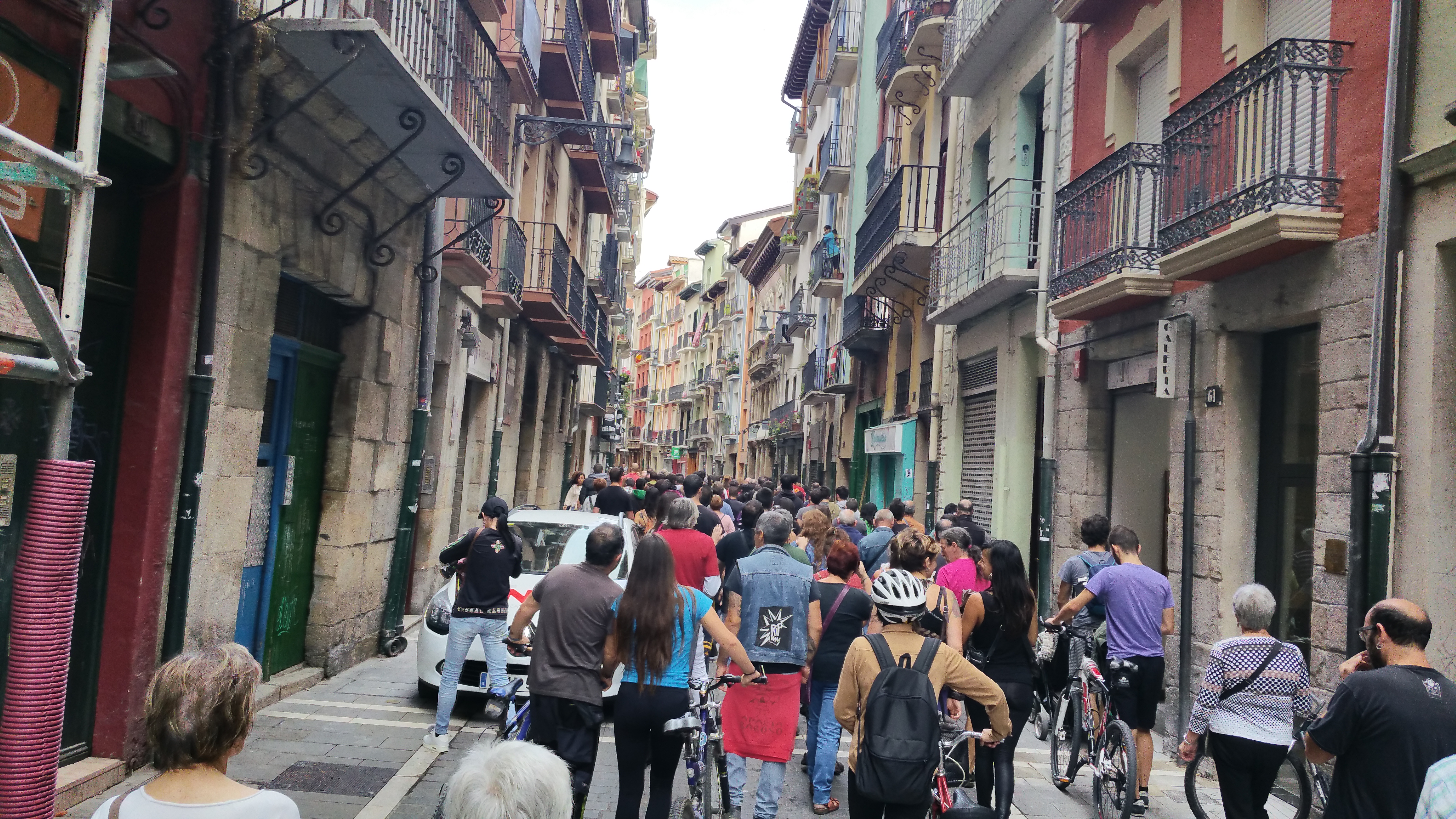
The marchers set the tone from the start with their banner and slogans and did not hesitate to call out “Policia asesina!” (‘police murderers’ in Castillian) as they approached and passed the police. Later people within the march began to lead chants also, some in Castillian and many in Catalan. The march did not pass by the nearby local HQ of the ‘official’ leadership of the Basque Abertzale Left. A marcher told me the were not permitted to do so but I was unsure whether that was an assumption taken for granted or whether they had been refused. However, the march leaders took people on a winding route through the old town, passing by residences, bars, businesses and many tourists.
March wending its way through streets of the old town (Photo: D.Breatnach)In the Plaza de San Francisco singing Basque song ((Photo: D.Breatnach)
Concluding in the Plaza de San Francisco (St. Francis [of Assisi1] square) opposite the Municipal School, to the security bars of which the banner was secured, no speech was given but the marchers sang “Eusko Gudariak” (‘Basque Soldiers’), a Basque song of resistance (and anthem) with clenched fists, at the end of which a woman let out a long irrintzi.
IRUŇA AND NAFFAROA
Iruňa is the capital of the ‘autonomous’ southern Basque province of Nafarroa/ Navarra (and according to some, to be the capital of an independent Basque Country though by no means agreed by all). The Basque Kingdom of the Middle Ages was called the Kingdom of Nafarroa (Navarra in Castillian, Navarre in French). The present-day province is located at the north end of the Spanish state, on the border with the French state, much of that border area in the Pyrenees mountain range. The province has the other southern Basque ‘autonomous’ region of Euskadi (three provinces) to its west and the Aragon region to its east (with Basque provinces on the other side of the French Border too).
“ALDE HEMENDIK! (GET OUT OF HERE!) “Indar okupatzaileak kanpora! (Occupying forces out!) The march banner is left hanging on the security bars of the Municipal School (staff will probably remove it on their first shift after the holiday). (Photo: D.Breatnach)
Until recently, the majority political party there was the mainstream Spanish unionist party, the Partido Popular, now outnumbered and ousted by a coalition of pro-independence Basque parties.
The legal linguistic provision of Nafarroa is unique in the Basque Country as its territory is divided into three distinct linguistic regions: all Castillian-speaking; Castillian and Euskera bilingual; Euskera-speaking. Access to services, education and facilities through Euskera depends on in which area one lives or works, which might seem fair until one remembers that official services through Castillian are available always, no matter the region – it is the official language of the Spanish state. Euskera speakers also complain that in the bilingual region they are not getting the provision which they need and to which their numbers entitle them.
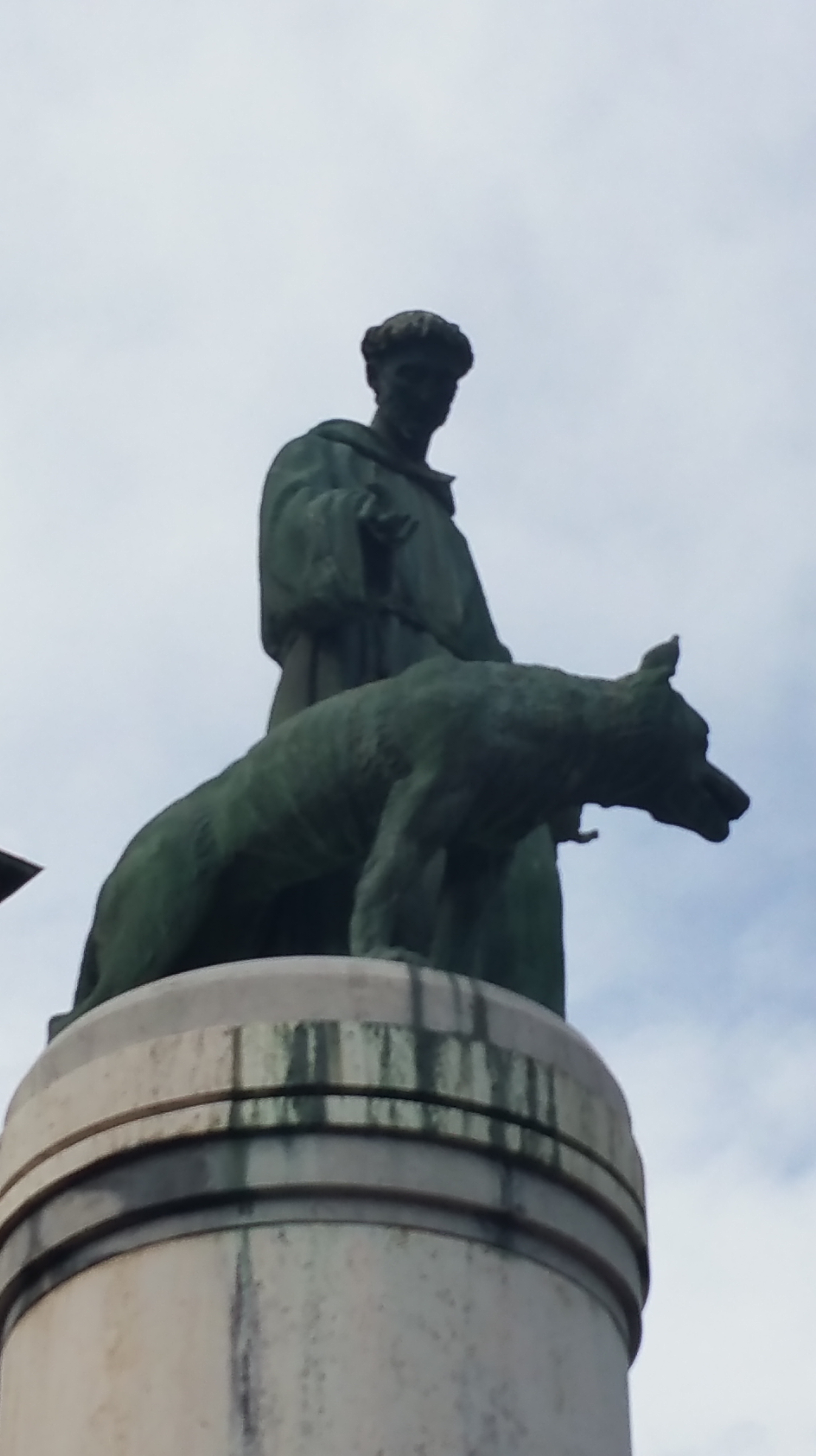
Monument statue of St. Francis of Assisi in the square named after him. (Photo: D.Breatnach)
Nafarroa was the only part of the Basque Country which can be said to have experienced what is called “the Spanish Civil War” (i.e an internal war) since the right-wing Carlists there slaughtered the 3,000 or so active Republicans, Communists and Anarchists — or just anti-fascists — before any of Franco’s troops or the Falange arrived there. As a result, the province was treated more lightly by the Franco dictatorship than the other three southern Basque provinces. This did not prevent repression of the Basque language in Nafarroa nor the armed attack on the more progressive Carlist movement of the 1980s during the “Transition” after Franco’s death.
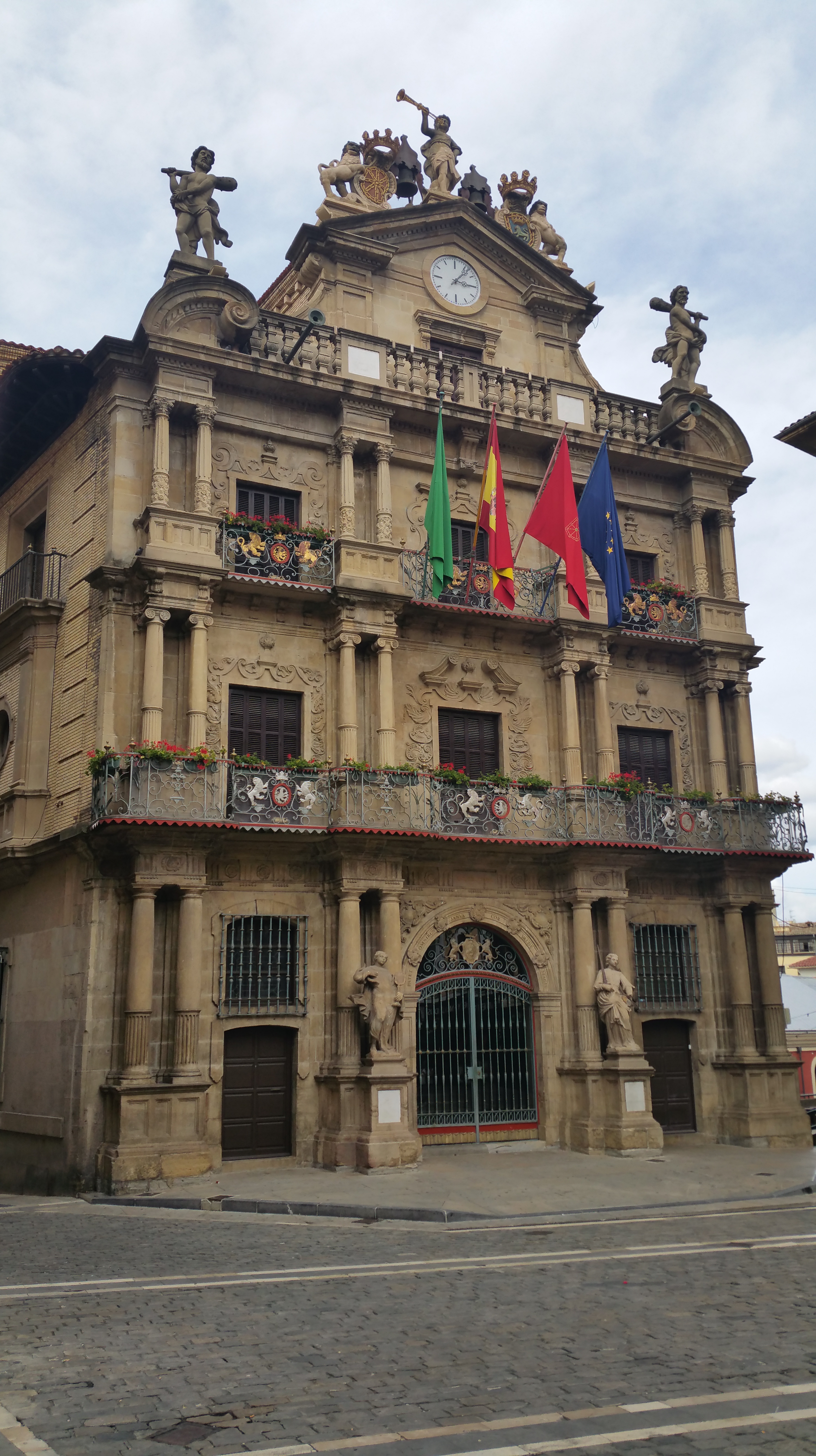
The Town Hall. All such municipal buidlings throughout the Spanish state are required by law to fly the Spanish State flag which must be at equal or higher elevation than all others. (Photo: D.Breatnach)
Many political and physical battles have been fought by pro-independence Basques since the 1930s, even around bringing a giant Basque flag into the main square for the ceremony to begin the San Fermines festival in Iruna/ Pamplona and at this festival too, many women have been molested and one gang-raped in 20162. The shocking nine-years jail sentence over a barroom brawl with Guardia Civil was imposed some months ago on youth from Altsasu, a town in Nafarroa.
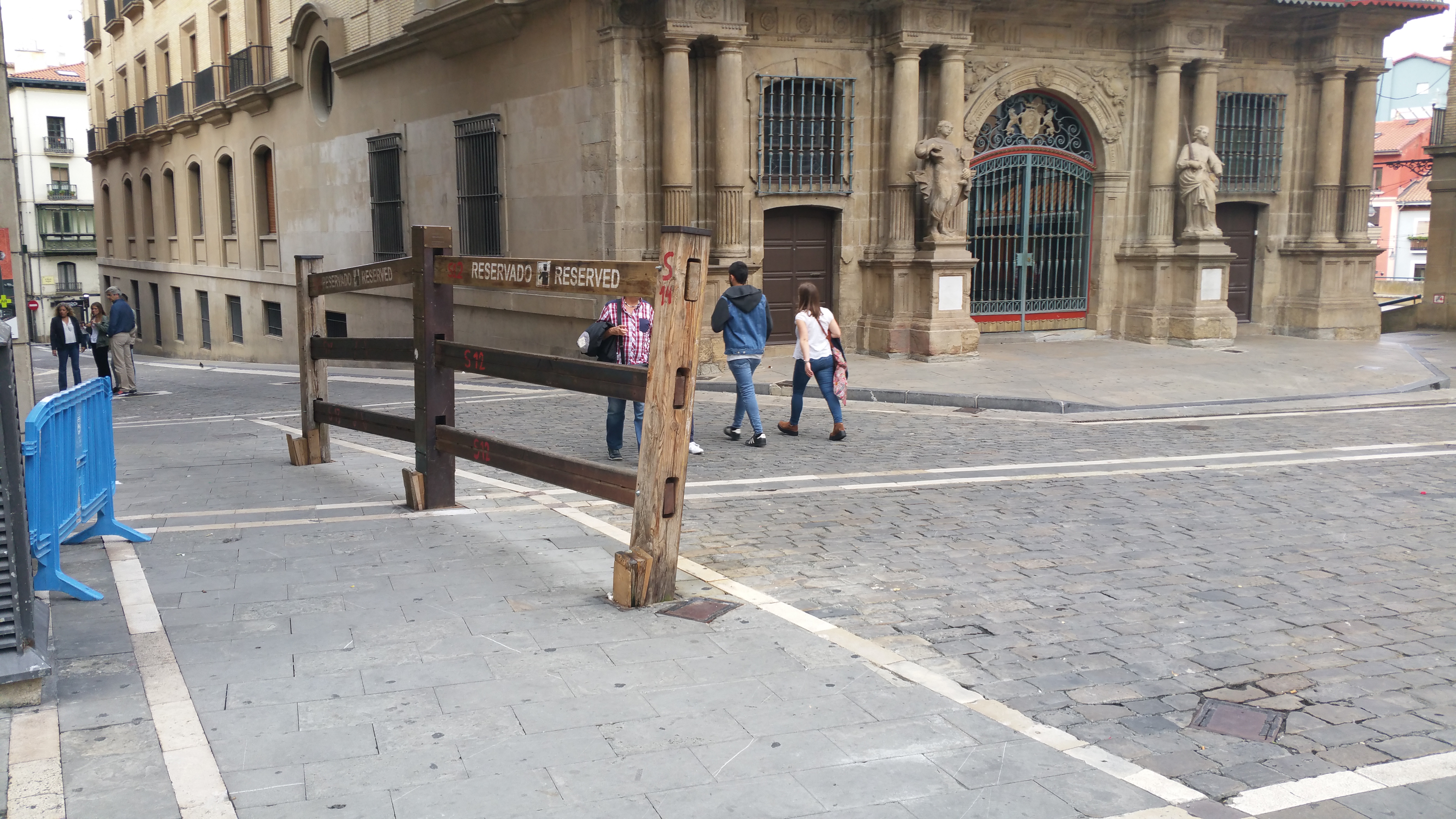
Area through which the bulls run as part of the San Fermines festival. (Photo: D.Breatnach)
FOOTNOTES
1St. Francis Xavier (1506-1562), born in Nafarroa, is the more common St. Francis to find referred to in the Spanish state and many Basques are called Xavier. St. Francis of Assisi (1881/2-1226) was Italian. There’s a story that an airman is falling out of the sky, his parachute having failed and he calls desperately for St. Francis to help him. A giant hand appears under him and as he comes to rest on it, a voice booms from the sky: “Which St. Francis did you mean, my son?” “Of Assisi”, gasps the airman. “I was named after him. Thank you!” “Alas,” the voice replies, “I am St. Francis Xavier.” And the hand is removed ….
I looked at her. Would you? I thought. Would you really?
Image sourced: Internet
And then my mind took off. Not perhaps where she had meant it to go.
Would I try anything, even just once?
Jump out of an airplane hundreds of metres above ground, even with a thrice-safety-checked parachute? No. Not even with TWO parachutes. Not unless the plane was on fire or going to crash – in which case, in a civil aircraft, there wouldn’t be any parachutes anyway.
Jump of a bridge on bungee cords? No. Not even off a high diving board! Yes, I know the water’s soft, serious bodily damage, even much pain extremely unlikely. But no.
Climb big windy, icy mountains? No. Scale cliffs? No.
OK, you’re seeing a connection with height here, right? But it doesn’t end there.
Go deep-sea diving? No. Not after that time on my third ever dive, when – despite a half-hour of air showing on my gauge, I suddenly ran out of it. Luckily I was not far down. Even getting me to dive at that shallow depth again would take some doing.
What else? OK, go against someone who is holding a knife? No. Yes, once in a drinker’s hostel I did take a knife off a guy but he wasn’t brandishing it at me. It certainly was not recommended procedure.
Demonstrate unarmed against soldiers who have proven, like the Israeli Occupation Force, that they don’t mind, even like shooting unarmed protesters? No. Almost certainly. But if I were a Palestinian, being ground down daily? Maybe, just maybe.
Be a cop? No. Be a cop’s tout? No. Take a job evicting people from their homes? Definitely not. Turn off water or electricity on families? No. Repossess cars? Only if I could choose according to circumstances, so that’s a No too.
Rob banks? Probably not. Yes, I know they’re robbing us – it has nothing to do with principle. In that career you end up having to use guns and then people tend to get shot. And they are hardly ever the bank-owners.
Be a surgeon? A bit late for that but probably no too.
Even in sexual categories, where perhaps (I could be flattering myself) I was intended to go …. No, in that tin of Quality Street sexual flavours, in the jar of Liquorice Allsorts, though there’s a lot to like, there are some things I wouldn’t try.
Looking at her, I wondered whether she really would ….
I wondered whether I’d been quiet too long. I’d probably missed my chance to suggest something.
Book-cases line the walls, filling up with biographies, histories, political and social theory from anarchist, marxist, feminist and Basque independentist perspective – and some classical literature. On the low central table are children’s illustrated stories and puzzles. One can see samples in the window too.
Maribel and Diarmuid outside the shop while it was being prepared for opening.
An alternative Left bookshop has opened in the iconic town of Gernika (Guernica in Spanish and in the title of Picasso’s famous painting of the town’s
Maribel and Inigo outside the shop while it was being prepared for opening.
bombing and strafing by the Luftwaffe and Italian air force in 1937). Going by the title of Inuri Gorria (“Red Ant”), the bookshop is a medium-sized (as these things go) one-level shop situated on one of the town’s main streets, with passing one-way traffic of private and public transport. Virtually next door is one of those open-front fruit shops and further down the same street, past bars and other businesses, is the nearby Herriko Taberna (literally “Peoples’ Tavern”. That is one of the many such social centre-taverns run by the official Basque pro-independence Left1 but of which many were ordered closed by the Spanish state in recent years on unsubstantiated accusations that they were linked to the armed organisation ETA, which is now dissolved). Once the people running the ‘Herriko’ and the trend represented by the new bookshop were strongly united but no longer, due to the change in direction adopted by the leadership of the Abertzale (pro-national ndependence) Left in recent years. Of course both trends will still attend at some events, particularly demonstrations about Basque political prisoners.
The Inuri Gorria bookshop opened officially on 12th October, which is a bank holiday in the whole Spanish state; called el Dia de la Hispanidad, it celebrates the spreading of the Castillian language as a result of the conquest of much of the Americas by the Spanish Kingdom in the 15th and 16th Centuries. Not surprisingly, it is also the official day for celebrating the armed forces of the State. Also unsurprisingly, the celebrations are opposed by anti-imperialists throughout the territory of the Spanish state and in particular perhaps by those nations still seeking independence. 2 No doubt many in the Gernika area were glad to have something progressive to celebrate on that date, which they did by gathering at the opening to view the books and eat some pintxos, later repairing to a local bar which displays photos of political prisoners from the local area (as does the Herriko). On this occasion some who would still count themselves members of the “oficialistas”, though likely from an internal critical position, attended also. There was also a Basque traditional festival in the town with many dressing in traditional clothing and taking part in cultural activities.
Closeup of evening of day of traditional Basque festival in Gernika. (Photo: D.Breatnach)Evening of day of traditional Basque festival in Gernika. The banner may have been attached by the ‘official’ independence movement leadership. (Photo: D.Breatnach)
“The material I have here is of an alternative Left and feminist political kind”, said the owner, Maribel Egizabal, when I dropped in again some days later. “I have children’s books and games, of an educational kind about values, sections on feminism and about women, alternative philosophy, social movements, ethnic minorities and racism, city life, ecology, the history and culture of the Basque Country.”
One of the books she stocks is a local history of the nearby Busturia area dealing with the effects of the Anti-Fascist War (1936-1939), a substantial piece of work which she herself had a major part in researching and writing3, produced by one of the groups in which she is active, Laia, a local history group. The history of that period and of the executions and repression that followed the victory of the fascist troops is very much a sharp issue today and not only in the Basque Country but throughout the Spanish state.
Monument in Gernika to George Steer, English journalist and author who broke the Gernika bombing story for the London Times (and put the blame where it was earned). (Photo: D.Breatnach)
The material in Inuri Gorria is mostly in the Euskera and Castillian (Spanish) languages but there are also some 2nd-hand books in French and English and Maribel hopes to add additional material in those languages. “With regard to political philosophy, I stock material in anarchist, marxist, feminist and independentist traditions. I don’t want to just sell books”, she told me “but to also provide a meeting-space for discussion and learning by social and political movements of the people.”
Maribel is a straight-talking woman with a long history in the feminist, Basque independentist and socialist movements, in different organisations, including the Basque internationalist solidarity organisation of Askapena, also Askagintza, an organisation working with people with drug addiction issues as well as the local history group alluded to above. “Inuri Gorria will be interested in material dealing with struggles around the world as well as in the Basque Country,” she tells me, “including of course struggles of other nations within this state such as Catalunya and of movements and organisations within the Spanish Left.”
The shop being prepared on the day I first called. (Photo: D.Breatnach)
When I dropped by a third time, the day before my return to Dublin, Maribel was buoyant at the interest in the shop and its material being shown, especially by younger people.
“They are particularly interested in political theory,” she told me enthusiastically. It has long been remarked that the Abertzale Left movement was lacking in political education of its youthful following. No doubt the repression and banning of a succession of the movement’s youth organisations played a part in this but that does not explain the lack of educational materials, study and discussion groups, lecture series etc.4
View of front window display after shop up and running. (Photo: D.Breatnach)
Gernika is worth a visit on its own and is connected by public train and bus services to Bilbao (also a longer-distance bus service to Bilbao and other areas). The town centre is attractive and hosts the Peace Museum (low charge and well-worth a visit) documenting life before the Anti-Fascist War, during it, including the town’s infamous bombing (which the Fascists tried to blame on the ‘Reds’5) and the ensuing occupation by fascist Spanish, colonial Moroccan and Italian fascist troops. Higher up, the ‘Gernika Tree’ and some of its offspring stand near the Gernika Assemby House (Gernikako Gazteen Etxebizitza/ Casa de Juntas de Gernika), built in 1826 to succeed several other buildings nearby. It was there the lords of Bizkaia (whose original member, according to Basque legend, was a Gael) from medieval times assembled to discuss issues and that the monarchs of the Spanish Kingdom affirmed the Basque rights or Fueros until abrogated in 1876. Entry is free and guided tours are offered by arrangement (but as generally the case with many buildings in the southern Basque Country, it will close between 2pm and 4pm.)
The Inurri Gorria bookshop will normally open 10am-12noon and 4.30-8pm on weekdays and 10-12noon on Saturdays, remaining closed on Sundays but of course may be in use on other occasions by some of the organisations and movements Maribel alluded to.
1Their currrent political parties are Sortu (and the pro-independence social-democratic coalition EH Bildu).
2Ironically, migrants of Latin American origin may be seen celebrating the day also: it is the one day in Spanish calendar that they may feel specifically includes them.
3Busturia 1937-1977 – represión y resistencia de un pueblo (‘repression and resistance of a people’), Maribel Egizabal & Unai Serrano, Busturia (2018), IBSN 978-84-697-8677-2.
4The Abertzale Left is not the only movement one can accuse of such neglect of the political education of youth, one finds the same generally in the Irish Republican movement (both in the Provisionals and in the various splits since).
5Calling all the opponents of the military coup “Rojos” (‘Reds’) was a propaganda policy of the coupist military leaders and fascists (and copied elsewhere, as sometimes in The irish Independent); in fact their opposing broad movement included democratic anti-fascists and constitutionalists, trade unionists, Basque and Catalan nationalists and Republicans as well as Communists and Anarchists. It seems clear that without the intervention of Nazi Germany and Fascist Italy, aided by the “Non-Interventionist” policy of France and the UK, the popular forces would have defeated the military and fascist insurrection.
Deire-Fómhair (‘October’, also “End of Autumn’), an exhibition of art by Eoin Mac Lochlainn, was on show this afternoon in the Olivier Cornet Gallery in Great Denmark Street , Dublin and I went along to view it. An installation and 24 paintings are listed.
Photo: D.Breatnach
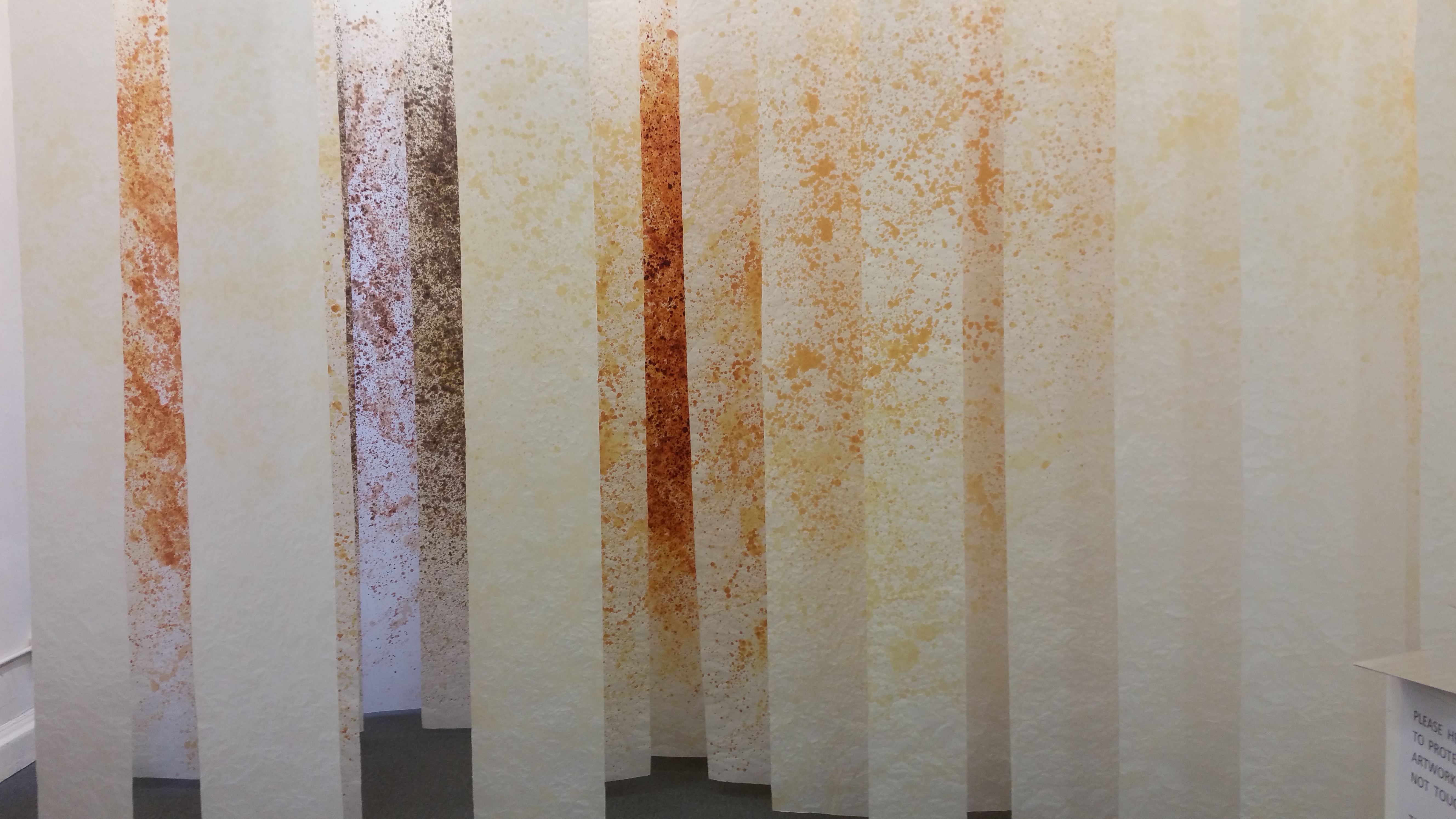
It is of course the installation that first catches the eye, mainly due to its size, secondarily its colours and viewing it one must, I think, come to the conclusion that the space is too small for it. Artists I suppose must use whatever exhibition spaces are available to them. Standing back as far as one can, the installation still does not reveal its full potential. But photographing in the gaps between the hanging pieces in the first row, one sees tree-trunks, dappled with slanting autumnal light through dying leaves, moss and lichen pattern on trunks and the autumn leaves themselves.
A view of almost the full width of the front of the installation (but please see the revealing subsequent photos). Photo: D.BreatnachTree trunks appear in this and subsequent views of the installation. Photo: D.BreatnachAnother view of tree trunks appears. Photo: D.Breatnach
The installation is composed of 64 painted lengths of rice paper and is lit from behind with accompanying recorded bird song which adds to the ambience. In the leaflet accompanying the exhibition, the artist wrote:
This is a traditional paper which originated in ancient China and has been used for centuries for calligraphy, artwork and architecture. It is as white as alabaster, known for its strength and smooth surface, very delicate when wet but said to last for a thousand years – an enchanting medium with which to work.
Earlier views showed tree trunks in an autumnal light, perhaps surrounded by falling or fallen leaves. This is a different view again, the trunks covered in blotches as of alga and lichen or fungal colourations. Photo: D.BreatnachPhoto: D.Breatnach
Photo: D.BreatnachViewing at an angle, the tall trunks appear, most perhaps in the receding distance. Photo: D.Breatnach
Around the wall are a number of watercolour paintings, mostly 15×19, some 12×12 and a few 20×20 and one, very different in style and composition, of 45×33. The latter looks older and by another painter and appropriately so, perhaps, since it is an interpretation of a painting by the German Romantic landscape painter Friedrich (1774-1840), “Solitary Tree”, painted probably (according to Google) in 1822, nearly two centuries ago.
Ó Lochlainn’s interpretation of Friedrich’s “Solitary Tree” (original painted two centuries earlier).
The subject seems to be an oak, its upper trunk dead but with leaves on branches spreading further down. It seems to have weathered many storms and perhaps a lightning strike years ago …. but it yet remains, stubbornly alive.
I do not know what motivated either Friedrich or Mac Lochlainn to take this image as their subject but in the leaflet, the latter has written:
Trees are a link between the past, the present and the future. The majestic stature, the long lifespan and the familiarity give them a monument-like quality but they also have a special aura that is difficult to define. Research has shown that within minutes of being surrounded by trees, our blood pressure drops, our heart rate slows and stress levels begin to reduce.
Less calming no doubt are the images of the watercolours which he titles Dóite (‘burned’ but also: ‘wasted, laid bare, destroyed’). The images are bleak, disturbing, of dead tree-trunks in a wasteland. In the accompanying leaflet, the artist notes:
I have been developing a body of work which explores the effects of climate change and in particular, reflects on the significance of trees.
One of the “Dóite” series, disturbing yet with a horrific beauty. Photo: D.Breatnach
These images could also reflect the negative effects of acid rain, nuclear or chemical contamination or timber monoculture and the exposure of trees thereby to increased likelihood and intensity of infestation by invertebrates and fungi (as for example the latter is attacking pine plantations in the Basque Country).
The watercolour series titled Cosán Coille and Siúlóid Sléibhe are exquisite colour and tone in a way of which I think only watercolours can be. It is surprising then to learn that Mac Lochlainn’s previous work has been in oils and that he found the change exacting:
In recent years, I switched from oils to watercolours in order to have less of an impact on the environment.
The switch has been both challenging and rewarding – challenging to master the idiosyncrasies of the medium but very rewarding in discovering new possibilities and avenues of enquiry for my practice.
The smaller size of the paintings restrains one from being pulled into them, the way a larger painting might do but that does not prevent them from being beautiful, sometimes in an almost painful way.
One of either the Siúlóid Coille or Siúlóid Sléibhe series (I cannot remember). Photo: D.Breatnach
Trees have been called “the lungs of the world” and were considered of great importance to the Celts; the Gaels peppered our place-names with references to them: abhall (apple), áirn (sloe, fruit of the blackthorn), beith (birch), caorthainn (rowan), coll (hazel), cuileann(holly), dair (oak), draighneán (blackthorn), fearnóg (alder), fuinnseog (ash), giúis(fir, pine, deal), iúr (yew), sail or saileach (willow),sceach (whitethorn, normally).1 They appear also in many of our folk-songs.
Prices of paintings range from 380 Euro to 1,200 and the gallery offers a service of payment by installment. The artist, Eoin Ó Lochlainn, who happens to be closely related to Patrick Pearse, has had numerous exhibitions in each year going back to 2013 and has won a number of awards. Collections of his artwork are held inAIB, Bank of Ireland, OPW, Revenue Commissioners, AXA Insurance, Foras na Gaeilge, Gael Linn, the Boyle Civic Collection, Wesley College, University of Limerick, Donegal County, Cló Ceardlann na gCnoc.
One wall with ten paintings hung, including examples of the Siúlóid Coille, Siúlóid Sléibhe and Dóite series. Photo: D.Breatnach
People visit the Basque Country for different reasons — among the touristic reasons are cuisine, folk culture and beach-type tourism including surfing. For some there may be business reasons and possibly on the other end of the spectrum from them there is the political aspect – interest in and solidarity with their struggle for independence and to a lesser extent perhaps, socialism. Eco-tourism and archaeological interest are probably not high on the list for most people but I’d suggest it would be worthwhile to include sites dealing with such aspects in any itinerary.
Many Basques would tell you that their country has a long way to go in environmentally-friendly practices – or at least in those less harmful to the environment; if true, it serves to illustrate just how far behind the desirable are the practices common in Ireland. Everywhere in Basque village or town, one sees the recycling containers in their five different colours for paper, plastic, metal, glass and organic waste. One frequent complaint is about timber-production forestation practices and though much of the Basque country is green with trees, many of those trees are conifersor, even worse, Basques will say, eucalypts in mono-cultural acres. The latter are indeed widespread and are said to suck the moisture out of the soil so that after they are felled, little else can grow there.
Environmentally-friendly timber production is less intensive and more diverse in species, less harmful to biodiversity of plant and animal life and more protective of the soil from erosion, flooding and desiccation. But to business — and therefore mainstream political interests — it is slower in turnover of profit. The perils of this concentration on early profit gain have been underlined this year with the infestation of the main crop pines, the “Monterey pine” (Pinus radiata) by the ‘Mycosphaerella dearnessii’ fungi and ‘Mycosphaerella pini’, said to have originated in Central America, which turns the foliage (needles) brown, eventually leading to the destruction of the tree.
Pines infected by fungi in the southern Basque Country (Photo: El Correo)
That all said, at grassroots (forgive the unintended pun) and often municipal level, there is great interest and support for biodiversity in the Basque Country and discussion around the subject is much more socially widespread than one would find in Ireland or in most of Britain (though perhaps not in some other parts of Europe). There are many national parks and reserves of great beauty and even city Basques tend to have a culture of collecting edible fungi in the woods in the autumn and of hill-walking or mountain-climbing at various times of the year. And small farms can be found dotted throughout the countryside.
Education about the environment for adults, children and even tourists is taken seriously and, apart from schools, centres promoting environmental care can be found in many areas. One such site of interest is the bio-diversity and heritage centre of Madariaga, the Ekoetxea, in the Axpe de Busturia area between the towns of Bermeo and Gernika These are interesting towns in themselves of the coast of Bizkaia (Biscay) province and Gernika was of course made famous by its bombing by the Nazi Luftwaffe, in the service of the fascist generals (Franco et al) in 1937, during what probably most people call the the Spanish Civil War and others, the Iberian Anti-Fascist War. Bus and train services connects both towns and pass through Busturia, both services having a stop or station in Axpe. The bus and train services run at mostly half-hourly intervals, the train all the way to Bilbao, on a single track for much of the line, up and down trains alternating.
I dropped in to a charming tavern in Axpe named after the Basque flower, Eguzkilore: literally “Sun Flower”. This is not the “sunflower” which Van Gogh famously painted, so named because it turns to follow the sun through its journey across the sky; the Basque flower (Carlina acaulis)is a member of the thistle family and is thought to resemble an idealised image of the sun. Dried specimens are often found hanging over the front door of Basque houses as a good-luck symbol, quite probably a remnant of pagan sun-worship (like the Irish “St. Bridget’s Cross” and indeed the traditional Basque symbol of the lauburru is very like that Irish symbol too and interestingly, the Basque tradition related to me was that it was borrowed from the Iberian Celts).
Dried Eguzkilore attached to the outside of a Basque house near the front door (Image sourced: Internet).
The Eguzkilore tavern is owned by a friendly young couple, a Catalan woman and Basque man: he of course speaks Euskera and Castillian (Spanish) fluently, whereas she is fluent in Catalan, Castillian and English, speaks Euskera well and smatterings of other languages. Although I know from experience that their cuisine is excellent, I ordered only a simple kafe esnea there and after finishing it and a chat, set off up the road to the Madariaga Ekoetxea (“eco-house”), an easy walk of perhaps fifteen minutes. Turning left at the roundabout at the crest of the hill the centre was easily visible by the clock-bell tower and the taller viewing tower.
This latter was a defensive construction quite similar to the keeps constructed in Britain and Ireland by the Norman invaders, livestock quartered below and people living on floors above; one of the staff told me that it had been inhabited until the 1930s. Now the floors have been ripped out except for the top one, accessible by a short journey in a lift and once there one can view around something like 160 degrees: steep hills close by beyond the road, land sloping away towards Gernika and distant mountains on another side, beach of the estuary and some marshlands on another.
A view of estuary and marshlands from the Tower observatory — it was a rainy day and the photograph is taken through glass (Photo: D.Breatnach)Closeup view of estuary and marshlands from the Tower observatory — it was a rainy day and the photograph is taken through glass (Photo: D.Breatnach)A view of river/ inlet mouth and headland eastward from the Tower observatory — it was a rainy day and the photograph is taken through glass (Photo: D.Breatnach).The view southward from the Tower observatory is not so appetising but shows the steepness of the hills there. From those wooded slopes owls hooting may be heard night after night. (Photo: D.Breatnach)
The Tower was in fact the last part of the centre which I experienced. It was a showery Sunday in mid-October and the centre was fairly quiet, less that ten vehicles in the car park and nobody but a receptionist immediately available upon entering the building. I used my limited Euskera in addressing her, which is my practice in the Basque Country, and which is usually – but not always – appreciated. The native language has become “politicised” here (as some say it has also in the case of Irish in Ireland), which is another way of saying that it was banned under the Franco dictatorship, that people of a Spanish unionist turn of mind often resent it and native speakers, learners and independentists want to encourage its spread and use in everyday life. Of course in a cultural type of centre in the Basque Country I would not expect any negative response and I was answered politely in Euskera with a quick conversion to Castillian when my limited store of Euskera ran out.
WATER AND BIODIVERSITY
I had seen a small charge advertised outside but there was none on that day or perhaps that time of year to see two standard exhibitions, one on water and the other on biodiversity. The one on water informs visitors that water is a circulatory system: 1) most of it falls from the air in rain or humidity, some of it on to land and some on to lakes or on to the sea; 2) some of that which falls on land is taken up by soil and vegetation and excess runs off into streams, rivers and lakes; 3) some also soaks through permeable or semi-permeable strata of soil and rock and forms underwater reservoirs and lakes. 4) The excess runs out in underground rivers and streams, emerging eventually to empty into seas and lakes, where 5) the sun heats up the top layers again, creating clouds, many of which precipitate on to land, renewing the circle.
Photo panel of rock and limestone deposit formations in a Basque cave.
The diagrams, photos and videos demonstrated this process well and attractively and there were samples of varieties of sandstone and limestone to examine at close quarters. For me, the photos of underground caves formed by the water wearing away the limestone and the various and sometimes fantastic formations caused by chemical-rich water dripping for millenia were the most impressive along with the few examples of invertebrates adapted to life without light and mammals using natural caves were the most interesting, while others might have found the supplying of water to the public of greater interest (and certainly this is an important issue in many countries and not least so in Ireland).
Photo panel of troglodyte spider eating something.Sleeping bat hanging from stalactite in cave.
One of the fantastic shapes created by decades or even centuries of chemically-laden drips. (Photo: D.Breatnach)Photo panel of cave chambers with humans present for scale.
The section dedicated to bio-diversity is divided into different parts, including a room with video screens showing different types of humans (ethnic, gender, possibly sexuality, culture, age) and others dealing with plant, fungi and animal life. Passing through a type of broad corridor with explanations of what is a definition of biodiversity in many languages, one enters a brightly-lit room seemingly constructed entirely of panels, each one of an animal: birds, mammals, fish, reptiles, insects and other invertebrates. Not only the walls but floor and ceiling appear constructed of the panels, a vibrant bright room somewhat evoking the effect of stained glass with light shining through, a church celebrating the diversity of animal life, perhaps.
A kind of foyer before the rest of the exhibition (Photo: D.Breatnach)The room “made of” panels of bio-diverse life, like stained glass: ceiling and two walls. (Photo: D.Breatnach)Floor in the illuminated panels room. (Photo: D.Breatnach)
Walking onwards, one finds a hall filled with large cubes, standing haphazardly upon one another, each carrying the image of an animal or plant. The names of the species are given in Euskera, Castillian and Latin. I find myself at times wishing to see the names in English and then chiding myself for the unreasonableness of this wish. There are images of plants to be seen too, some of plants which we are informed are native to the country and one found only there.
The “Life Cube Hall” (as I think of it). (Photo: D.Breatnach)
ATTRACTIONS IN THE WIDER AREA
A slim informational folded leaflet is available in a number of languages, one version being in English and French, not only about this centre but about a network of them managed by the “Basque Government” (i.e the Government of three of the southern Basque provinces, Biskaia, Gipuzkoa and Alava). These are visited every year by 100,000 people, the booklet informs us, 25,000 of which are schoolchildren; the ekoetxea which I visited receives 2,000 schoolchildren out of a total of 45,000 visitors annually.
Dragonfly and Water-Scorpion panel. The first lives in the water as infant, hunting prey , before its metamorphosis to flying hunter. The second lives always in the water, usually in the higher reaches, also hunting. Its “tail” does not sting people but its proboscis can, though not seriously. (Photo: D.Breatnach)A view of the ‘Cube Life Room’ between cubes. (Photo: D.Breatnach)
Another, more substantial booklet available in English which shows signs of translation probably from Castillian gives more information on the Urdaibai Biosphere Reserve, the wider area in which the Madariaga Ekoetxea is located. This booklet advertises nature trails for hiking or biking, restaurants for Basque cuisine, a cave occupied by prehistoric humans, the Gernika Tree and General Assembly building and museum, markets and folk festivals, cider and wine-houses, painted forest, hermitages, bird-watching and sea activities including surfing and whale and dolphin-watching. Strangely (or not), in its caption about Gernika, it has nothing to say about the bombing of the town in 1937 nor, in its references to human habitation and culture of the wider area, nothing either to say about the Spanish Civil (i.e Anti-Fascist) war or about the occupation of the area by the fascist troops and the repression that followed, nor about the suppression of their language under Franco.
An information panel tells visitors that there are 3,335 different mammal, bird, fish, reptile, amphibian, fungi and plant species etc. in the the Urdaibai reserve and that 85 are in danger of extinction or are of special interest. Some panels showing examples of these would be welcome as would more about the wildlife native to the area (like what species are the owls one can hear hooting at intervals through the night from the forested hill above Axpe, for example).
Extant and Extinct mollusc shells. (Photo: D.Breatnach)
Different species’ seeds containers. (Photo: D.Breatnach)European Mink cube.The centuries-old clock tower; the clock is on the other side but the bell rings out the hour. Also visible are the solar panels. (Photo: D.Breatnach)The Madariaga Tower (Photo: D.Breatnach)The estuary and trees (Photo: D.Breatnach)
From Eoin O’Donnel’s filming and editing via Joe Mooney of East Wall History Group, a recording of Diarmuid Breatnach singing Christy Moore’s wonderful song Viva La Quinze Brigada (also known as Viva la Quinta Brigada which, however, is also the title of another song from the same conflict but in Castillian or Spanish language). The Fifteenth Brigade of the Spanish Republican Army was also the Fifth International Brigade, the mostly English-speaking one. It contained volunteers from English-speaking USA, Canada, Australia, Scotland, Wales, England and ireland but due to high Irish emigration, all those countries also contained Irish diaspora and they were to be found in the contingents from those countries.
The video also contains photos of the commemoration of Jack Nalty, resident of East Wall’s, the last Irishman to die in action during the Iberian Anti-Fascist War (usually known as the “Spanish Civil War”). The day-long event on 28th September (anniversary of his death) included songs and poems, a march led by a lone piper, unveiling of a plaque, booklet launch and showing of two films. It was a celebration in particular of Jack Nalty’s life but more generally of the Irish who, against the position of their Government, the Church of the majority, the dominant media and even, for those in the IRA, against their own organisation’s orders, went to fight against a fascist military uprising against the elected Republican Government of the Spanish state.
It was also a celebration of antifascist resistance around the world and of the principle and practice of internationalist solidarity.
A plaque to the fallen of the Irish volunteers of the International Brigade (containing many names but by no means all of the Irish who fell there). The plaque is on the wall of the Theatre side of Liberty Hall, HQ of SIPTU, Dublin. (Photo D.Breatnach).
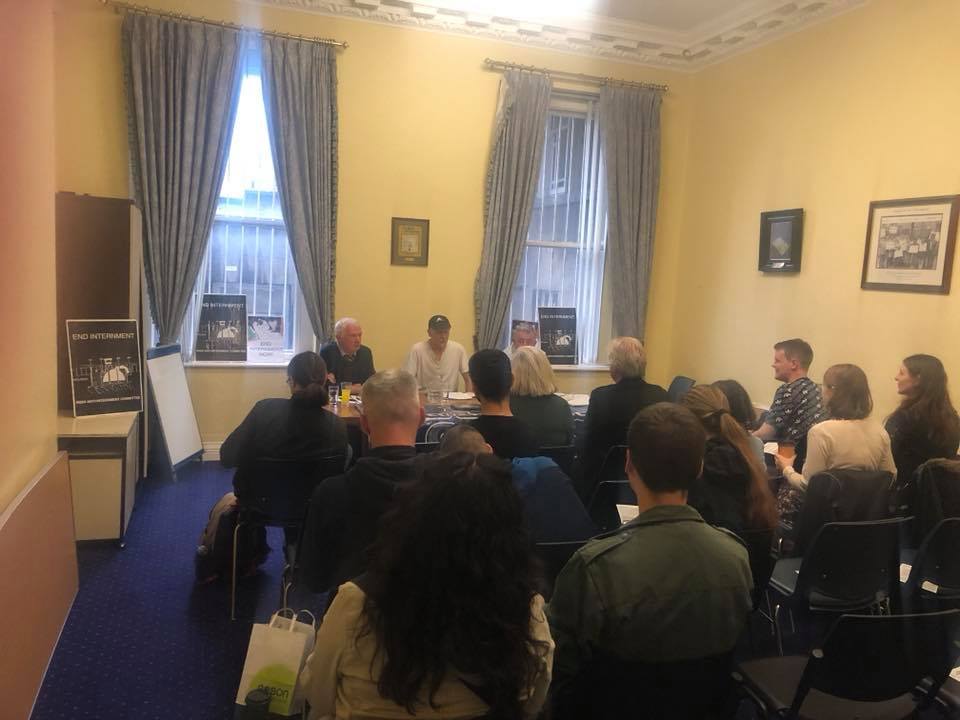
Liam Herrick, Executive Director of the Irish Council for Civil Liberties and Mallachy Steenson, Irish Republican and practicing lawyer, on Friday 7th June addressed a Dublin meeting on The Right to Protest, convened by the Dublin Anti-Internment Committee.
Section of audience and panel at Right to Protest meeting (Photo source: Dublin Anti-Internment Committee)
CHAIR’S INTRODUCTION:
The origins of the Anti-Internment Committee and the Right to Protest
Opening the meeting and speaking for the organisers, the Dublin Anti-Internment Committee, Diarmuid Breatnach welcomed the attendance, introduced the Committee and related how it had grown out of a previous committee, to have Marion Prices released from prison, which had been partially successful (she was released pending trial but her health was destroyed). She and a number of other former Republican prisoners who had been released under license under the Good Friday Agreement, such as Martin Corey and more recently Tony Taylor, had their licenses revoked and were brought to jail without a trial or the right to challenge whatever evidence the Secretary of State for Northern Ireland claimed to have against them. Some considered this a form of internment by some and the Anti-Internment Committee had been set up in June 2013.
Breatnach emphasised that the Dublin Committee had always been and remained — attempts at takeover and accusation notwithstanding — independent of any other organisation and committed to reaching decisions in a democratic manner and conducting themselves in a principled manner towards other organisations. The Committee organises the annual Anti-Internment rally in Newry and holds more-or-less monthly pickets in different parts of Dublin, which anyone is welcome to support, he told the audience.
Chair of meeting Diarmuid Breatnach speaking at Right to Protest meeting (Photo source: Dublin Anti-Internment Committee)
Although the Dublin Anti-Internment Committee updates a list of Republican prisoners in jail and also raises issues about the human rights of Republican prisoners such as right to education and art work, appropriate medical treatment, release from solitary confinement and on occasion about miscarriages of justice such as the Craigavon Two, nine years in jail now – nevertheless the true focus of the Committee is on issues of internment.
Introducing other areas of repression by the states on both sides of the Border which the Committee considers to be types of internment, Breatnach outlined the practice of refusing bail to the accused or of making bail conditional on the individuals removing themselves from all political activity. When the accused justifiably refused to accept these conditions, they were jailed, only perhaps to be found not guilty two or three years later, as had been the case with Stephen Murney. But still having effectively served a jail sentence.
“The right to protest is everywhere under attack” stated Breatnach and declared that maintaining that right was necessary for the winning and maintaining of a wide group of basic social and political rights, from practicing one’s sexuality or religion, or indeed criticising the Church, to forming a trade union, going on strike and marching against unjust laws or measures. Breatnach bemoaned the apparent inability of a number of Republican groups to unite in defence of this right and of Socialists in uniting with them even on this most basic of levels. “We can either stand together or fall separately” he said.
Internment is used by states against political opponents, said Breatnach, recalling that the British had used it in Ireland after the 1916 Rising, the new Irish state had used it during the Civil War and again during WWII under De Valera; the British in the Six Counties between 1971 and 1975.
Internment is a means of “removing unwanted members of the public”, Breatnach said, quoting the words of anti-insurgency specialist Brigadier Frank Kitson, who had been present during the repression of the Malayan resistance and also an operational Commander in Ireland from 1970-1972, years which Breatnach reminded his listeners were those covering the introduction of internment and the massacres of civilians in Ballymurphy and Derry.
Referring to the infamous “Heavy Gang” of the Gárda Síochána whose brutal methods had extracted false confessions on the Sallins Mail Train robbery from socialist republicans in the 1970s and from the family in the Kerry Babies case, Breatnach recalled the formation of the Irish Council for Civil Liberties at that time and that it had been a campaiging organisation unafraid to challenge the State on its repressive actions. Sadly over the years the organisation had fallen away from that path, he said and he was particularly glad to welcome Liam Herrick of the ICCL to speak at the meeting and in the hope that the organisation was returning to its roots.
LIAM HERRICK, ICCL: The Right to Protest and the work of the ICCL.
Liam Herrick, Executive Officer of the ICCL, speaking
After the applause, Liam Herrick thanked the Committee for having invited him to speak. He wished to list some of the efforts in which the Irish Council of Liberties was engaged and also to hear from the audience some of the problems they were encountering.
Briefly covering the early years of his organisation, Herrick related that it had been formed as a response to police repression, mostly of Republicans but also of some Socialists, and in particular due to the activities of the Gárda unit known as the “Heavy Gang”, by academics, activists and lawyers. It had taken up early cases of the ill-treatment of detainees, the use of the Offences Against the State Act, repression of protesters of the Ronald Reagan visit including the case of Petra Breatnach in 1984 and Water protests in the mid-1990s, also in the street-traders’ protests in which Tony Gregory was prominent.
The issue of the right to protest and State repression had come up again a number of times including in 2002 against the Anti-War Movement with the use of the OAS Act and in particular with the Reclaim the Streets protest in 2002, in which video recording of police actions had revealed the extent of police brutality without any arrests. Similar problems had been encountered by protesters at the 2004 EU Council meeting in Dublin, and water canons had even been imported by the State from the UK and widescale repression and had come up again at the Corrib Shell protests.
The ICCL had in 2014 published “Know Your Rights” booklet. And had called for a root and branch review of procedures for dealing with protests, noting that there existed a major gap in rights and policing process and has published a publication by the title of “Take Back the Streets” and has made submissions to the EU and the UN on how states should not just tolerate but manage and create conditions to facilitate the right to protest. The ICCL is part of a network which includes the ACLU in the US.
“If Notifications to the authorities are required should be minimal and reasonable”, Herrick said and gave the contrary example of African Jews who wished to protest against Israeli measures but were charged a 25,000 dollars as a cost of the application for permission.
Police should have a chain of command to deal with protests and be trained not only in weapons and control movements as they are at present but also in de-escalation, in engagement with protesters. Their internal Garda policies should be available to public access but are not.
Herrick said journalists should be facilitated in having access and only just employees of big media organisations but alternative media and individual bloggers whose coverage is often essential to understanding the incidents at an event (in the Reclaim the Streets event such sources were the only source on the Garda violence). There should be restrictions on the use of force as is law and police in Northern Ireland, whatever people might think about practice on the ground, Liam Herrick said. The PSNI every 6 months have to submit a report to the Policing Board which details incidents o the use of force. In the Irish state Gárdaí don’t have to make any report on the use of force which is remarkable in the European context – the use of pepper-spray would seem to be increasing here but no records are available..
Surveillance is an issue and of course can intimidate and have “a chilling effect on protest”, Herrick said. In England face recognition technology is being used which apart from questions about its accuracy, is intrusive. Also trapping of mobile phone activity in the vicinity of a protest. Data collection is an issue and there should be no database on protesters maintained; covert agents have been used and in some cases become personally involved with those they were surveilling – a recording procedure is needed. There needs to be an independent complaint process as the existing process in Ireland has been shown to be inadequate.
At the moment the ICCL is involved in discussions on Gárda reform and the following Friday would be producing a document on Human Rights Policing which people are welcome to read. The international perception is that the law and policy of the PSNI is good, without making any comment on their practice on the ground. The Gardaí should publish a report on their handling of protests every year including statistics (despite the problems on drink-driving statistics) on arrests and the use of non-lethal weapons.
The Gardaí in Ireland have a national security function and there needs to be a discussion on this – in many other countries a separate body is responsible for this. But no legal body is overseeing the operation of the Gardaí on national security or the powers they exercise.
Liam Herrick concluded to applause and Breatnach told the audience that questions could be asked of him and of the next speaker after the conclusion of the latter, then introducing Mallachy Steenson to welcoming applause.
MALLACHY STEENSON: Republicans and the Right to Protest
Mallachy Steenson speaking Section of audience and panel at Right to Protest meeting (Photo source: Dublin Anti-Internment Committee)
Mallachy quoted the right to protest under Article 41 of the Constitution of the State under which document however Republicans would not support.
Moving on to suppression of protests Steenson referred to the most frequently used being the Public Order Act, justification which depends on the subjective view of a cop and is therefore virtually unchallengeable. The result is usually a fine but the use of the Offences Against the State Act is much more serious. In the 1950s there were many arrests of Republicans under the section which prohibits a demonstration within a certain distance of the Dáil and Section 30 was widely used.
Steenson pointed out that almost any gathering of Republicans consitutes some kind of protest due to the basic opposition to the State of Republicans. Funerals are usually protests too, partly in solidarity with the family, partly with movement but also of making a stand and, in the case of the ten dead 1981 Hunger Strikers, in solidarity with their Five Demands.
Steenson believes that most of the protests that occur in the state will be allowed because the they don’t threaten the state from the “trendy liberal side”. For example the housing protests including activist occupations are permitted but when a house was occupied in Charlemont Street and in preparation for moving in a family three years earlier, armed police removed the occupiers.
“The State takes a different view of Republicans” Steenson declared. Referring to the 2016 Sinn Féin Easter 1916 commemorations, Steenson wondered whether they remember their history because the 76th anniversary of the Rising commemoration (1992) was banned and people on the platform arrested. The 66th anniversary commemoration had been beaten off the street in Dublin and people arrested for “membership”, including his own father and others.
“What we have is mostly controlled dissent”, Steenson said. “People remember the Birmingham Six” but are not aware that their campaigners here had their homes raided by police, their jobs visited by the Special Branch, threatened and often lost their jobs.
“What has happened in Ireland is a privatisation of dissent,” Steenson said. “They are funded by the State and he who pays the piper calls the tune.”
The only ones who could really carry out a successful protest in Ireland were the farmers who here, as in France, had no hesitation to block roads and motorways and dump slurry at the Dáil, Steenson declared. The only other really effective protest that hurts the State is the withdrawal of labour as in a general strike – which should have happened when the banks were bailed out — but the trade union movement in Ireland works hand in glove with the State.
“Republicans are well-used to surveillance” Steenson went on to say with a reference to “the new MI5 Garda Commissioner” who declared upon coming into office that the biggest threat to the State is the armed ‘dissident’ Republicans, which Steenson commented were no real threat to anyone except themselves.
“The State is built on the defeat of the Republic,” said Steenson and therefore naturally Republicans are its enemy. Referring to the water protests and their suggested victory, Steenson opined that the success was only due to Fianna Fáil changing sides and he believed that the USC (Universal Social Charge) should be the main object of protest which takes much more out of people’s pockets.
In 1972 the British Embassy in Dublin had been burned in protest at the Bloody Sunday massacre in Derry. Steenson declared that too was managed by the State, having a national Day of Mourning, allowing people to blow off their anger at the sacrifice of a building and listed other protests he believed had been managed or controlled by the State, including the medical cards for the elderly.
People should be able to go to protest without asking the State, Mallachy believed and asked what is a valid protest, referring to gathering protest against the expected visit of Trump while that of Clinton in Dublin passed quietly by without protest. “What is it about Trump?” asked Steenson. “If it’s about killing people, Clinton killed many more. If it’s about treatment of women, well we all know Clinton’s record on that.”
The real problem impacting on most working people is drugs, Steenson said, and the gangs involved in it. Families Against Drugs had been a big campaign but some of the activists were in it to get funding. “People should separate their political activism and their job,” Steenson declared. “We need to move away from having paid groups organise protests”, Mallachy said. “Most protests now are during the week,” he added, “because activists don’t want to interfere with their weekends.”
“We need to look at what is an issue and what is effective”, he said and talked about empty houses and the way housing protesters in the 1960s and ’70s not only occupied them but moved homeless families into them.
“During WWII we didn’t intern Germans or English here”, Steenson commented, “we interned Republicans.”
“Protests will be allowed as long as they don’t threaten the State”, Steenson said, coming to a conclusion and the only ones organising protests that threaten the State are Republicans. He posed the question whether democracy is any use to working people, because it had not brought them much.complained too about police being masked and said that in a normal society you would not have that, nor armed police everyday on the streets. He commented also on the degree of video surveillance used by the State which could track people from leaving the door of the building all the way home.
“Gardaí are there to protect the State, not to protect the citizen, whatever combination of political parties are in government,” he told his audience. “To them and to the State, Republicans are the enemy. That’s just the way it is.”
CONTRIBUTIONS AND QUESTIONS FROM THE AUDIENCE
After the applause following Steenson’s talk, Breatnach opened up the meeting to contribution or questions from the audience, asking them to keep them brief and telling them he was going to take questions in groups and the speakers could choose to which to reply.
Side view of section of the audience (Photo source: Dublin Anti-Internment Committee)
An audience members spoke about the level of repression from Lurgan RUC/PSNI and how eight people had been charged and their bail conditions were not to associate with one another but two of them live near one another.
A contribution declared that Drew Harris being appointed as Garda Commissioner was equivalent to a railroad to jail and related a case of an elderly woman being persecuted in Rossport.
Another directed a question specifically at Liam Herricks about treatment of people in some of the rural courts where protesters were being very badly treated.
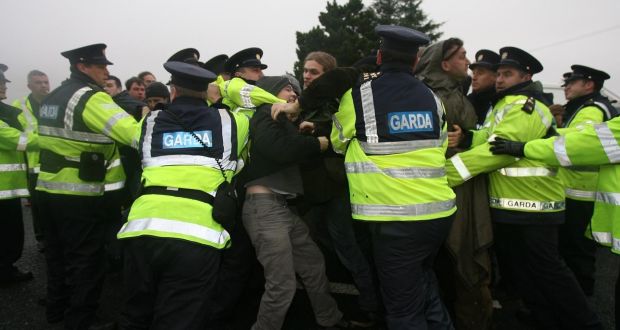
Gardaí attacking protesters
An Ireland Palestine Solidarity Committee activist said that usually they don’t get much trouble from the Gárdaí but more often from the private sectors, from private security personnel when they protest at a business as part of the solidarity campaign. And the Bank of Ireland had closed their account, which caused the organisation considerable difficulty. He wondered whether this was the State’s influence under pressure from the Israelis or others, or instead the banking company under pressure from the same sources or from financial sources. Or whether it was part of the general “de-risking” measures people talked about. The Cuba support group had suffered a similar problem.
Relating his contribution to issues of surveillance, one person described a car journey from an event for about two hours across Dublin, after which he stopped at a fast food takeaway facility. He had felt followed earlier on and when the Garda came in behind him in the takeaway with the usual harassment, he confronted the officer and asked him how had followed him all that way. The Gárda pointed to cameras above on street poles and said: “We don’t have to follow you, they do.”
Another person related how “membership of an illegal organisation” is being frequently used to jail Republicans under the OAS on the word, without the need to display any proof, of a Gárda senior officer.
He thought he had heard of one case where it had been used against a gang member and wanted to know were there any others that the speakers knew of?
Neither had heard of any and Mallachy commented that next year the OAS will be 40 years old. Liam Herrick referred to a piece of research carried out by Nuala Ní Fhaoláin at the UN.
A Polish and a Catalan separately expressed their solidarity with Irish people struggling against repression, briefly alluding to their own struggles and the Polish person mentioning the recent arrest and jailing of a comrade of his in Turkey.
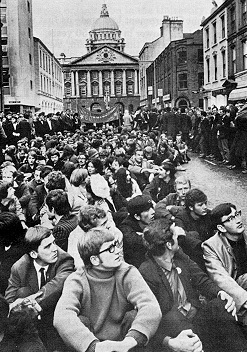
Queens University Belfast students sit-down protest when prevented from marching, 1968.
As there were no further questions or contributions, Breatnach thanked people for their attendance, the speakers for the talks and audience members for their contribution and asked for contribution towards the rent of the room. “This is not the beginning of a broad campaign to defend human rights or if it leads to it, it will not by our Committee leading it,” said Breatnach, adding that no doubt they would be happy to contribute to such a campaign. Urging people present to keep in touch with internment issues through the End Internment Facebook page he stressed once again the need to unite across ideological divisions against State repression.
End.
POSTSCRIPT:
A number of public meetings in Dublin about similar issues followed the one above in quick succession, no doubt coincidentally:
A meeting as part of the Anarchist Bookfair on Saturday 15th September on “State Violence and Cover-ups: Community Responses” heard from a speaker on police infiltration of campaigning groups; from Anne Cadwaller of the Pat Finucane Centre (also author of the “Lethal Allies” exposure) about colonial police and British Army collusion with Loyalist murder gangs; and from Hilary Darcy about what might be considered legitimate reforms to be pursued by revolutionaries.
A public meeting in Abolishthe Special Criminal Courts campaign was held on 17th September and heard from international and Irish speakers.
The Justice Delayed Is Justice Denied group held a public meeting on 19th September, raising issues pertaining to the Ballymurphy and Derry Massacres, the Miami Showband Massacre and the Stardust Fire (report: https://rebelbreeze.wordpress.com/2018/09/24/justice-delayed/ )
Masked Police, Police with machine guns.
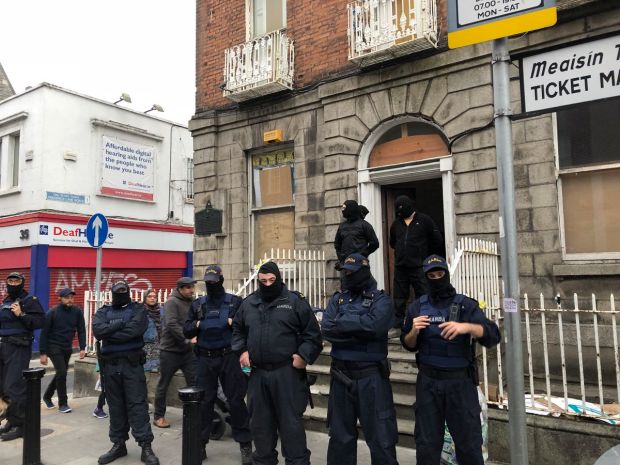
In addition five days after the Right to Protest meeting, masked Gardaí brandishing batons and pepper-spray cannisters assisted a masked “security team” in evicting housing campaigners carrying out a symbolic occupation of an empty building, drawing protest statements from Liam Herrick on behalf of the ICCL to be followed, most unusually, by Colm O’Gorman on behalf of Amnesty International. Five or six housing protesters were detained and at least one was injured..
A few days after that, Gardaí turned up with machine guns and a battering ram to a house where a couple were in dispute with their landlord, leaving when supporters of the couple arrived.
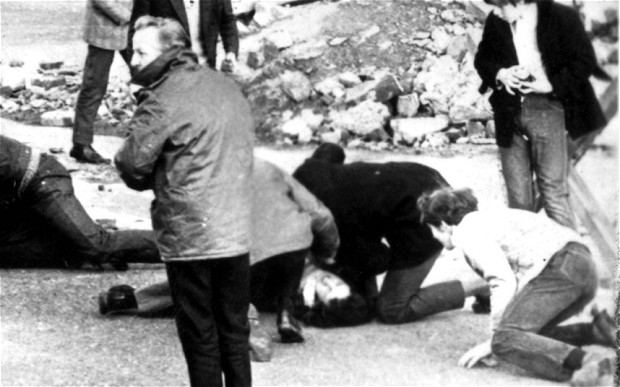
Masked Gardaí and masked “security guards” at eviction of peaceful housing protesters soon after the Right to Protest meeting. (Photo source: Irish Times)1963 Alabama, 17-year-old black civil rights protester attacked by police and police dog. (Photo source: Internet)1972, Derry, part of Bloody Sunday Massacre (Photo source: Internet)Lone man confronting Chines Army tanks on their way to suppress protest in Tienamen Square, 1989Massed Marikana Strikers at Lonmin Mine, South Africa, 2012– 40 were shot dead by police. (Photo source: Internet)

















 rebelbreeze