— BOGOTA — The recent election of Joe Biden as president of the U.S. has been met with a round of applause from left reformist currents in Colombia, some even eager to claim Biden as one of their own. Underlying such praise is the notion that the Democrats are more progressive and will treat Colombia fairly, or at least better than the Republicans. There is no evidence on which to base such a claim.
Historically, some of the greatest blows to Colombia have come from Democratic administrations, starting with the smiling, handsome, charismatic JFK, whose policies left few smiling in the country. It was under JFK that two U.S military delegations visited the country and made recommendations that the Colombian state set up armed civilian groups, which are now commonly referred to as paramilitaries. By 1965, Colombia introduced legislation to give effect to those proposals and thus began a long sordid history of the state setting up death squads and providing them with legal status.
Of course, JFK was a long time ago, some would argue, though obviously no Democrat would countenance publicly criticizing him on such matters. Many of those who rushed to endorse Biden are unaware of this aspect of their history, but not so, the leading politicians such as Senator Gustavo Petro, a former mayor of Bogotá and the most successful left-wing candidate for the presidency ever. They are only too aware of the history of paramilitary violence in the country, yet prefer to ignore it on the altar of realpolitik.
The most recent embodiments of charming, handsome U.S. presidents also get a free pass now, just as they did when they were in power. Bill Clinton is perhaps the most notorious of recent U.S. presidents whose policies can be measured in bodies, forced displacement, and the mass destruction of the environment through the aerial fumigation of coca crops. Clinton was the architect of Plan Colombia, a massive supposed anti-drugs policy, which strengthened the Colombian military and under the guise of a concern for public health helped the Colombian military gain the technical and logistical capacity to wage war, including the expansion of paramilitary units throughout the country.
“Handsome US Presidents”, in particular Democratic ones, have helped Columbian ruling circles carry out a murderous reign of terror against social activists.
(Photo source: Internet)
Plan Colombia was of course, implemented by George W. Bush as Clinton finished his second term shortly after concluding the agreement, a sign that policy on Colombia has always been bipartisan. When Clinton announced the initiative he lied. He stated that the motives were public health ones and that cocaine was killing 50,000 people per year in the U.S., when at the time the CDC put the figure for all deaths from all drug abuse, excluding alcohol and tobacco, but including legal pharmaceuticals at just over 15,000. Alcohol alone doubled that figure. The ruse worked and Congress passed Plan Colombia, thanks in part to Biden, who fought for the plan in the Senate Foreign Relations Committee. Clinton finished his term with controversial presidential pardons, including Marc Rich, but in Colombia, he is remembered for his clemency deal with Harvey Weinig, a U.S. lawyer convicted of laundering $19 million for the Cali Cartel.[1] Whilst attacking impoverished farmers, he indulged the wealthy individuals higher up the chain.
Thanks to the Plan, paramilitaries swept through the country taking over, not only rural areas, but some major urban centers. The Colombian military was in a position to aid them in that and also hold on to those areas, once the dirty work had been done. Their first targets were areas of military and economic strategic importance, with gold and oil deposits and also areas that were earmarked for major transformations in the rural economy. As part of this drugs initiative, peasants were “encouraged” to switch crops. Plan Colombia financed major agribusiness projects, particularly African Palm, and in preparation for the Free Trade Agreement that would be signed under Bush but come into effect under Obama, the country geared its agricultural production toward export markets and opted for importing basic food staples such as rice, beans, and cereals. For example, corn imports from the U.S. began to decline notably from 2008 onwards, but once the FTA came into force in 2012 under the Obama administration, the year of the lowest amount of corn imports in a long time, they quickly increased and by 2016 almost doubled the figure for 2008. By 2018, 80% of all corn consumed in Colombia was imported and barely 20% was produced nationally.
Thanks to Bill Clinton and Obama, Colombia is now one of the major recipients of military aid. Between 2001 and 2019, it received $9 billion in aid, just over 66% of it under the guise of anti-narcotics aid.[1] All anti-narcotics operations in Colombia involve the deployment of ground troops following the strafing of farms by helicopters, displacement of peasant farmers, threats and not infrequently the murder of leaders in the areas. Furthermore, many of these soldiers involved in operations were trained by the U.S. In the same period, 107,486 Colombian military personnel received training from the U.S., making it the largest recipient of such training followed by Afghanistan.[2]Both the aid and training reached their peak under Bush, as part of Clinton’s Plan Colombia, but continued steadily under Obama, though government to government and private arms sales peaked under Obama.
Barak Obama when he was US President with Vice-President, now President Joe Biden. Obama’s presidency was a disaster for the Colombian people and his running mate then, now President too, looks set to follow in his footsteps. (Photo source: Internet)
Nothing could stop Biden and Obama from backing their murderous ally to the south, not even the False Positive scandal. The so called False Positives entailed the luring of young men to rural areas with the promise of work, who were then dressed up in military uniform and executed and presented to the media as guerrillas killed in combat. Amongst the victims were impoverished working-class men, children with cognitive impairments, and even included the kidnapping and murder of professional soldiers recovering from wounds received in combat. The scandal broke in 2008, following the murder of 22 young men from the city of Soacha.
In his preliminary report the UN Special Rapporteur Phillip Alston stated: “But there are two problems with the narrative focused on falsos positivos and Soacha. The first is that the term provides a sort of technical aura to describe a practice which is better characterized as cold-blooded, premeditated murder of innocent civilians for profit. The second is that the focus on Soacha encourages the perception that the phenomenon was limited both geographically and temporally. But while the Soacha killings were undeniably blatant and obscene, my investigations show that they were but the tip of the iceberg.”[3]
He did say they were widespread but not official state policy. However, every soldier who killed one of these young men was paid a bonus by the then Minister of Defense, Juan Manuel Santos, who would become president in 2010. Santos enjoyed the support of Biden and Obama during his tenure and although he began peace talks with the FARC guerrillas in 2012, his regime never stopped murdering social leaders. From 2012 to 2018, 606 social leaders were murdered; there were a further 3371 other acts committed against these leaders, including threats, displacements, and prosecutions. None of this caused Biden or Obama to express their concern. It was business as usual for them. The total number of False Positives is now calculated to be in the region of 10,000 youths, and despite Alston’s diplomatic statement that it was not official policy, no one buys that. We are not even sure whether Alston himself could stand by that statement, outside of his role as a UN diplomat.
It is true that the current regime in Colombia, under Duque, is but a mere remold of the Uribe governments (2002-2010), and the situation has deteriorated in the country. Duque openly backed Trump, and Colombian government officials illegally intervened in the U.S. elections, calling for votes for Trump in Florida. So brazen was their involvement, the U.S. ambassador to Colombia, Phillip S. Goldberg, publicly warned them against campaigning.[5] There may well be a reckoning of some sort with Duque on this point, but it is unlikely that there will be any major change in policy towards the country.
President Iv√°n Duque (L) of Colombia speaks during a meeting with US President Donald Trump at the United Nations in New York September 25, 2018. (Photo by Nicholas Kamm / AFP) (Photo credit should read NICHOLAS KAMM/AFP/Getty Images)
Duque may well be publicly chastised by Biden and given a few well-placed mediatic slaps across the face. It will be mere window dressing. Prior to the implementation of Plan Colombia, Clinton sought and obtained the disbandment of the Colombia’s notorious XX Brigade; charged with intelligence and counterintelligence, it was an exercise in public relations. It did not affect intelligence agencies’ role in the murders, torture, forced displacement, and disappearances, nor the spying on left-wing politicians and human rights organizations, which continues unabated to the present day. On Colombia, the Democrats are very media friendly and good at dressing things up.
The war on drugs is likely to continue in one form or another, and though some left reformists hope that Biden will pressure Duque to restart the stalled peace process with the ELN guerrillas, it is unlikely. During the talks with the FARC, Biden and Obama wouldn’t release from a U.S. jail the FARC commander Simon Trinidad, in jail for his supposed role in the capture and imprisonment of three U.S. Dyncorp mercenaries. The ELN do not represent the same military threat that the FARC did. They are less militarist and much more political, and any threat they may represent is in the political arena. But they have long attacked U.S. companies and oil pipelines, and such attacks may be used as an excuse for further increases in military aid and greater involvement in the conflict. U.S. troops are already involved in the protection of the Caño Limón-Coveñas pipeline as it passes through the ELN stronghold of the department of Arauca. It will be very much business as usual under Biden.
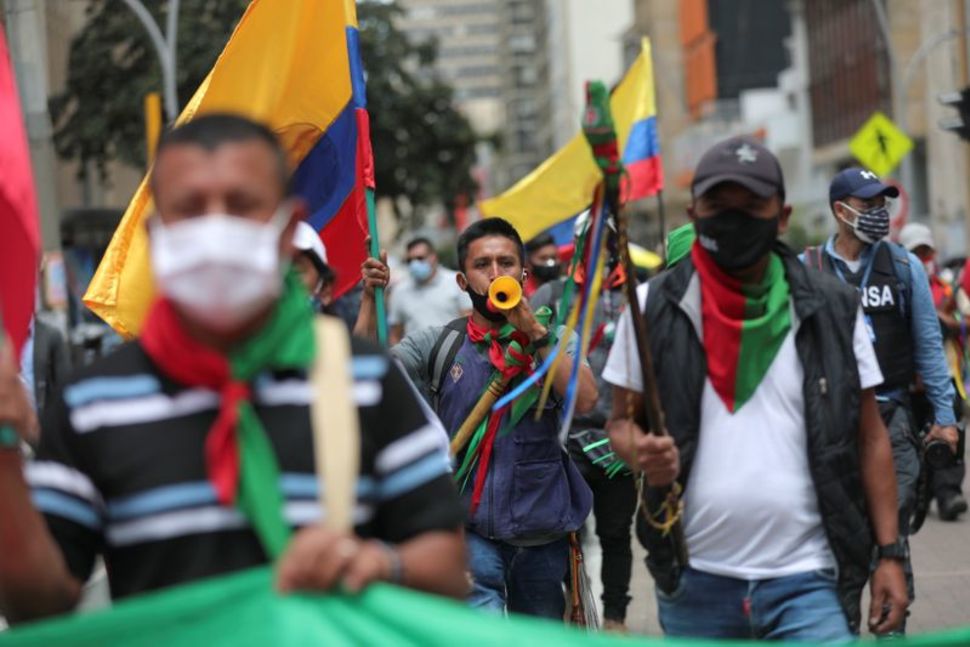
Top photo: Protesters march against President Iván Duque’s policies, including police brutality and disappearances of political activists, in October 2020 in Bogotá. (Louisa Gonzalez / Reuters)
Iran has informed the International Atomic Agency that it is stepping up its uranium enrichment to 20% purity, which significantly exceeds that set by the restrictive 2015 Agreement and which according to media reports places it one step away from achieving weapons grade. This has set off concerns and what might even be interpreted as threats from other states but whether we agree with the existence of nuclear weapons or not, what gives some states the right to have them and to tell others that they can’t?
Iran entered into that Agreement in exchange for ending of the economic blockade on it by the USA. However, recently Trump withdrew the USA from the Agreement, leaving little incentive for Iran to continue restricting its development of nuclear fuel.
Three big European powers signed a public call on Iran to return to the Agreement levels in the hope that Biden will bring the USA back into the Agreement (which he has indicated he will). Meanwhile, some media are reporting that a similar step by Iran prior to the Agreement led Israel to prepare to launch a strike on Iran’s nuclear facilities. And Israel is in fact believed to have assassinated Iran’s foremost nuclear scientist, Mohseh Fakhrizadeh last year.
Map showing states with estimated numbers of nuclear warheads.
(Source image: Arms Control Association)
NUCLEAR WEAPONS GATEKEEPERS
Whether we agree with any state having a nuclear arsenal (and I don’t), what gives some states the right to dictate to others that they can’t have them? And what is the record of these “nuclear weapon gatekeepers”? The partners in the 2015 Agreement were: USA, UK, Germany, France, Russia and China. These are, if we believe the slant of much of the mass media, the states that are justified in telling others that they cannot be permitted to have nuclear weapons.
The USA is one of the states with most nuclear weapons in the world (according to some estimates, Russia has the most, followed by the USA), a state which has been involved in wars of aggression against other peoples and states almost since its creation (10 directly – not through proxies — in the last 20 years alone). Furthermore, it is the only state to have attacked another with not only one but two weapons of mass destruction, causing at least a million casualties of mostly civilians.
Map showing estimated US troops officially based in the Middle East in January 2020 (Source image: Newsweek)
The European states that made that public call on Iran are Germany, France and Britain, of which only Germany does not have nuclear weapons of its own (though it permits them to be sited there). The reason that Germany does not have them is probably because its European neighbours and in particular world powers France and the UK would not allow them to have them, with memories of two world wars in four decades during the last century.
France and the UK are imperialist states with massive armed forces which, when they have not been at war with the other, have attacked nations and peoples across the globe.
The other owners of nuclear weapons are Russia, China, India, Pakistan and North Korea. And Israel, a Zionist occupation-settler state established through ethnic cleansing and which, since its inception, has been at war with its neighbours. And massively supported by the USA, financially, militarily and politically.
IRAN
The Islamic Republic of Iran, on the other hand, has been at war with no-one since it came into existence except Iraq, when the Western powers were supporting Saddam Hussein and all his atrocities because he was attacking Iran. Saddam attacked Iran very soon after the latter’s revolutionary change of regime but within three months its offensive stalled and it began to get pushed back despite the support of the Western powers (including the supply of chemical weapons by the USA and Germany) and the international isolation of the Iranian clerical leadership. Nevertheless the war lasted eight years and was extremely draining for Iran, in particular since it was also facing US-led economic and financial sanctions.
Currently Iran has full diplomatic relations with 97 states and although it has some territorial disputes with the United Arab Emirates in the Gulf and some Caspian sea disputes with Azerbaijan and Turkmenistan, along with some outstanding issues from the Iraq-Iran war, these are being dealt with on the whole peacefully.
In the midst of slanted or even hysterical “reporting” — or beating of war drums — we should be aware of these facts.
End.
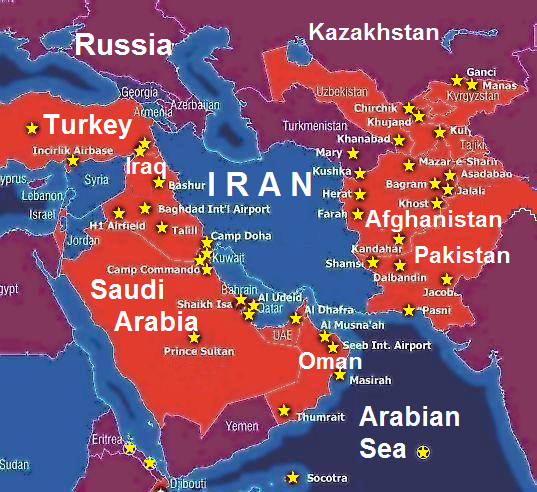
USA Ally States with Bases Surrounding Iran. (Source image: Internet)
NOTE: NOT “NATIONS”
By the way, the news report headline “European nations urge Iran” etc. (see below) is inaccurate: France and Britain (sic, actually the UK) are not “nations” but states, each one containing a number of nations and for example in a number of sporting bodies the existence of nations within the UK is recognised. That a number of such states are permitted to call themselves “nations” for membership of various bodies does not change that fact and journalists should be more exact in using the term.
(Published elsewhere earlier in December, including Red Line; published here with author’s permission and section headings, photo choices (except one) and intro line are by Rebel Breeze editing)
The issue of drugs is one that is never far from public discourse on the Colombian conflict. Biased or just simply lazy journalists use the issue to ascribe motives for an endless list of events, massacre and murders. It is true that drug trafficking has permeated all of Colombian society and there is no sector that has not been impacted by it. But not everyone in Colombia is a drug trafficker. However, once again the King of Clubs is played to describe the conflict in terms of a drug problem.
Several Colombian newspapers have recently published articles on the supposed relationship of the guerrillas of the National Liberation Army (ELN) with drug trafficking and there are already eleven commanders who are under investigation for such crimes and are sought in extradition.[1] They talk as if the ELN dominated the drugs trade, and talk of settling of accounts over drug money, as if they were a crime gang, instead of saying that the ELN takes drastic measures against its members who get involved in drug trafficking and that those internal executions are due to the indiscipline and betrayal of principles of some people and are not an internal dispute over money.[2] Of course, the ELN in an open letter widely distributed on social networks and alternative press, denied any links to the drug trade.[3] But, how true is this new tale? Before looking at the accusations levelled against the ELN it is worth going over the history of drug trafficking in Colombia and the reality of the business in international terms.
POLITICIANS, GUERRILLAS AND BANKS
Let’s start with the obvious. When the FARC and the ELN were founded in 1964 drug trafficking was not a problem in the country and there were no large plantations, i.e. the existence of the guerrillas predates the drugs trade. Later in the 1970s the country went through the marijuana bonanza on the Caribbean coast, but it is the emergence of the large drugs cartels in 1980s around the production of cocaine that would define forever the shape drug trafficking in the country would take. Up till the 1990s the country was not self sufficient in coca leaf, even though it was the main manufacturer of the final product: cocaine. Escobar was dead by the time Colombia achieved self sufficiency and it is in that context that the discourse of blaming the FARC for the drugs trade gained ground, completely ignoring that the main narcos were the founders of the paramilitary groups. One of the most notorious paramilitary groups in the 1980s was the MAS (Death to Kidnappers) founded by the Cali Cartel and other drug traffickers in response to the kidnapping by M-19 of Marta Nieves Ochoa a relative of the Ochoa drug barons.
That discourse, however, was useful in justifying Plan Colombia and there was an element of truth to it, but not that much back then. The FARC’s relationship with the drugs trade has not been static and has evolved over time. Almost everyone accepts that they began by imposing a tax on the production of coca leaf, coca base or cocaine in the territories they controlled. The initial relationship changed and the FARC went from just collecting a revolutionary tax to promoting the crop, protecting laboratories and even having laboratories of their own and in some cases, such as the deceased commander Negro Acacio, got directly involved in the drug trade. There is no doubt on the issue. But neither were they the big drug barons that they tried to have us believe, those barons are in the ranks not just of the Democratic Centre but also the Liberal and Conservative parties. It is forgotten that Samper’s (1994-1998) excuse regarding drug money entering his campaign’s coffers was and still is that it was done behind his back, but no one denies that drug trafficking has to some degree financed every electoral campaign in the country. Although companies like Odebrecht play a role at a national level, at a local and regional level drug trafficking decides who becomes mayor, governor, representative in the house and even senators. Even the brother of the current Vice-President Marta Lucía Ramírez was a drug trafficker and there are loads of photos of many politicians with Ñeñe Hernández and Uribe appears in photos with the son of the paramilitary drug trafficker Cuco Vanoy. It is a matter of public knowledge that several high ranking police officers close to Uribe such as his former head of security Mauricio Santoyo were extradited to the USA for drug related crimes and Uribe’s excuse was the same as Samper’s: it was all done behind his back.
Alvaro Uribe, ex-President of Colombia and patron of current President Duque is under house arrest and investigation for close links with drug cartels and murder paramilitary organisations. (Photo source: Internet)
Late drug mafia boss”Nene” Jose Guillermo Hernandez (r) with President Ivan Duque ((Photo source: La Nueva Prensa)
NOT THE ELN
But when we look at the extent of illicit crops in Colombia, we can clearly see the reason why they are linked to the FARC for so long and not to the ELN. The reason is simple, the majority of the large plantations of coca and opium poppy were to be found in areas under the influence of the FARC. If we look at the crop monitoring carried out by the United Nations Office on Drugs and Crime (UNODC) we can see that in 2001 the main departments (administrative regions: Colombia has 32 — RB editing) where there were crops were almost exclusively FARC fiefdoms.
In 2001, coca was to be found in 22 departments of the country, compared to just 12 in 1999. However, despite the expansion, just two areas accounted for the majority of the crops: Putumayo-Caquetá had 45% of the total amount of coca (about 65,000 hectares) and Meta-Guaviare-Vaupés with 34% of the area (about 49,000 hectares) i.e. 79% of the total area under coca.[4] They were areas that were completely dominated by the FARC, not a single eleno was to be found in those territories and if they did venture in, it was undercover at the risk of execution by the FARC were they discovered as the FARC did not tolerate political competition in their fiefdoms. When one looks at the map of crops back then, one can see not only the concentration in those areas but also almost all the other departments were dominated by the FARC and those where there were significant amounts of coca and also an ELN presence, one finds Cauca with 3,139 hectares, Nariño with 7,494 hectares and the Norte de Santander with 9,145 hectares. But in those areas there was a certain territorial balance between the different guerrillas and one of the few departments where the ELN was clearly the dominant force was Arauca with 2,749 hectares.[5] But when we look at the counties we can see that it is not as clear cut, as in the Norte de Santander 83% of the coca crops were to be found in just one county: Tibú, FARC fiefdom for many years before the paramilitary takeover in 1999.[6] In Arauca the county of Araquita accounted for 60% of the crops in the department and it was also a FARC fiefdom within an area dominated by the ELN. Thus it is obvious as to why they spoke almost exclusively about the role of the FARC in drug trafficking and not the ELN at that time.
Years later the situation had not changed much, the main producing departments were the FARC fiefdoms. The UNODC study on coca crops in the country in 2013 continues to show a concentration in FARC fiefdoms, with a displacement from Putumayo to Nariño due to aerial spraying and the persecution of the FARC by the State. In 2013, there were just 48,000 hectares of coca in the entire country, with significant reductions in some parts. Nariño, Putumayo, Guaviare and Caquetá accounted for 62% of the land under coca, with Norte de Santander representing 13% and Cauca with just 9%.[7] There was a reduction and a displacement of the crops towards new areas with Nariño accounting for the most dramatic increase of all departments.
In 2019, there was 154,000 hectares of coca, a little over three times the amount grown in 2013, though it was slightly down on 2018 when there was 169,000 hectares.[8] Coca production recovered after 2014 in the middle of the peace process with the FARC. It stands out that in 2019, Arauca, a department dominated by the ELN the UNODC did not report any coca crops.[9] Once again Norte de Santander is a department with widespread coca leaf production almost quadrupling the amount reported in 2001. It had 41,749 hectares of coca but the county of Tibú alone had 20,000 hectares and the same UNODC report indicated that these are not new areas and show that the crop has deep roots in the area.[10]
THE BANKS, THE BANKS!
However, despite the role of the FARC in the drugs trade, they weren’t the big drug barons we were led to believe. How can we be sure? Their demobilisation did not alter the flow of cocaine towards the USA and Europe. The big drugs capos in the companies, the Congress of the Republic, the international banks did not stop for a second. Neither did people such as Ñeñe Hernández and other associates of right wing political parties in Colombia stop for a single instant.
Neither the production nor consumption of cocaine halted. The UNODC’s World Drug Report says as much about both phenomena. According to the UNODC consumption of cocaine fell from 2.5% in 2002 to 1.5% in 2011 in the USA, but from that year it increased again reaching 2.0% in 2018 and also there are indications of an increase in the sale of cocaine of high purity at lower prices between 2013 and 2017. The price of a gram fell by 29% and the purity increased by 32%.[11] The report also indicates that in Europe there was a significant increase in various places such as the Netherlands, Norway, Denmark, Estonia and Germany. Nevertheless, some of those countries had seen decreases in consumption in the first years of the century.[12] All of this suggests that there is a greater supply of the drug. This can be seen not only in the previously mentioned figures of an increase in the production of coca leaf in Colombia (or in other countries such as Peru and Bolivia), but can also be seen in drug seizures. An increase in seizures may indicate greater efficiency by the police forces, but combined with stability or an increase in consumption and a reduction in price, rather indicate an increase in production and availability.
According to the UNODC cocaine seizures have increased dramatically since the commencement of Plan Colombia, indicating, although they do not acknowledge it, the failure of their anti-drugs strategy and the tactic of aerial spraying with glyphosate. In 1998 400 tonnes were seized globally and that figure remained relatively stable till 2003, reaching 750 tonnes in 2005 and surpassing the threshold of 900 tonnes in 2015 to finish off at 1,300 tonnes in 2018,[13] i.e. there was no reduction in consumption or the production of cocaine. Throughout the years with or without the FARC there has been coca production and of course the main drug barons never demobilised, the heads of the banks remain in their posts.
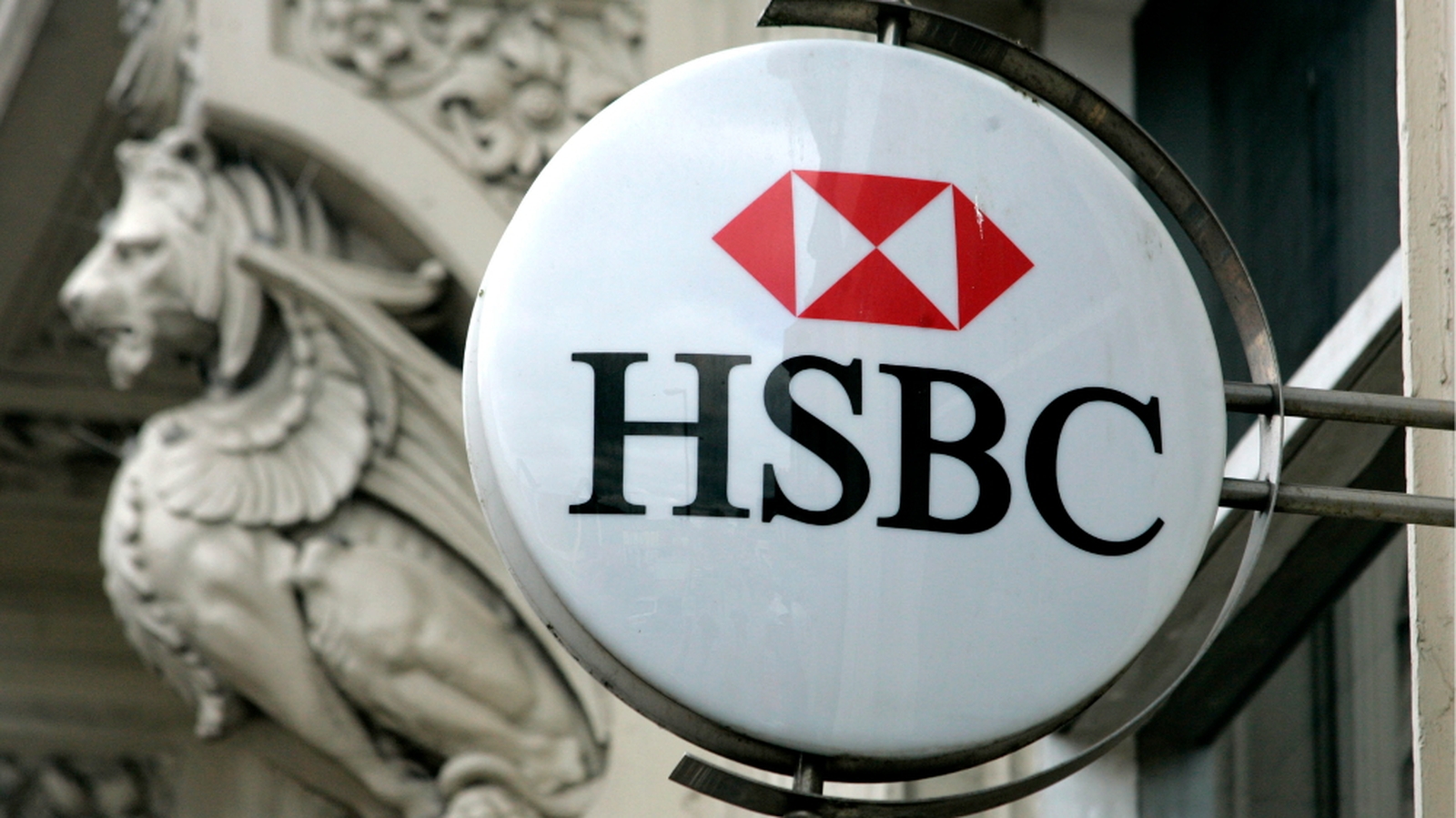
The real drug traffickers wear a tie, own large estates, meet with President Duque, it is not the ELN that moves hundreds of tonnes of cocaine around the world. In 2012, the Swiss bank HSBC reached an agreement with the US authorities to pay a kind of fine of $1,920 million dollars for having laundered $881 million dollars from the Sinaloa Cartel and the Cartel of Northern Valle, Colombia. The bank had, despite everything, classified Mexico as a low risk country, thus excluding $670 billion dollars in transactions from monitoring systems and the bank was notified by the authorities but ignored them.[14] Nobody went to jail, in fact no one was prosecuted. As Senator Warren in a session of the Senate Banking Commission pointed out, no one was going to go to jail for this massive crime. Moreover, the Sub Secretary for Terrorism and Financial Intelligence, David S. Cohen refused to recommend a criminal investigation against the bank. There is no need to state that no ELN commander is on the board of this or other banks. The ELN is usually accused of infiltrating universities, but to date no one has accused them of having infiltrated the boards of banks.
In 2012, the Swiss bank HSBC paid US authorities a penalty of $1,920 million for having laundered $881 million dollars from the Sinaloa Cartel and the Cartel of Northern Valle, Colombia. The bank had classified Mexico as a low risk country (!), thus excluding $670 billion dollars in transactions from monitoring systems. (Photo sourced: Internet)
HSBC bank has bought building of former Central Bank Ireland on Central Plaza, Dame Street, Dublin (Photo sourced: Internet).
It is not the only bank implicated in money laundering, in 2015 London was described as one of the main centres for money laundering the proceeds of drug trafficking.[15] A report by the UK National Crime Agency states, on the basis of a UN calculation that between 2% and 5% of global GDP are laundered funds “that there is a realistic possibility [defined as between 40-50%] that it is in the hundreds of billions of pounds annually”[16] and the majority of it comes from crimes committed outside of the UK. There is no need to say that no ELN commander is a director of those companies, nor is there any need to state that these companies continue to operate and their directors are walking about free and according to the report they could only recover £132 million.[17] The NCA cites favourably the reports of Transparency International. According to this organisation, 1,201 companies operating in the British Overseas Territories inflicted £250 billion in damage through corruption in recent decades. They analysed 237 cases of corruption in the last 30 years. The majority of the companies are registered in the British Virgin Islands (92%) and the majority (90%) of the cases happened there[18] in the favourite headquarters of many companies that operate in Colombia, without mentioning those who finance election campaigns. Once again, the ELN does not operate in those territories, although many mining companies in Colombia are registered there. The report points out that due to legislative changes there are fewer reasons to buy property in the UK through those companies registered in the Overseas Territories, yet the number of properties has remained relatively stable at some 28,000.[19] Of course not all them are the result of illicit funds, however… As far as we know the ELN’s Central Command is not the owner of any of these properties.
Transparency International continued with its investigations and its last report highlighted the number of British companies involved in money laundering or dubious transactions. It states that there are 86 banks and financial institutions, 81 legal firms and 62 accounting companies (including the big four that dominate the market). According to this NGO
Whether unwittingly or otherwise, these businesses helped acquire the following assets and entities used to obtain, move and defend corrupt or suspicious wealth: 2,225 Companies incorporated in the UK, its Overseas Territories and Crown Dependencies directly involved in making payments; 17,000 more companies incorporated in the UK that we have reasonable grounds to suspect have facilitated similar activity; 421 Properties in the UK worth more than £5 billion; 7 Luxury Jets 3 Luxury Yachts worth around £237 million worth around £170 million. [20]
Of course not all the laundered funds are drug related but they are all illicit in origin. However, the USA has not sought in extradition any of the banking capos, legal firms and less still the four big accountancy companies in the world. It would simply collapse the financial system were they to do so.
The extradition of criminals from Colombia has always been problematic in legal and political terms. Nowadays, the majority of those extradited are extradited for drug trafficking. The USA receives 73% of all those extradited from Colombia and 60% of them face charges of drug trafficking or money laundering.[21] Though not all those extradited are guilty and there are various cases of people being returned to Colombia, after their extradition, or others more fortunate who managed to demonstrate their innocence before being extradited, such is the case of Ariel Josué, a carpenter from San Vicente del Caguán who didn’t even know how to use a computer and yet for
… the United States and then the Colombian justice system, Ariel Josué was the head of an electronic money laundering network, and had to pay for his crime in a north American prison.
In the absence of an independent investigation nor the verification of his identity, the Supreme Court issued a court order in favour of his extradition and even President Juan Manuel Santos signed the order for him to be taken.[22]
OPEN LETTER FROM THE ELN
Despite those extradited, when not innocent, being poor people or those who have some relationship with right wing political parties or the economic elites of the country, the media and the Colombian and US governments’ focus on the problem is always the same: the guerrillas and not the banks or business leaders. In fact, one of the most famous people extradited is Simón Trinidad, a FARC commander and part of the negotiating team in the Caguán. Trinidad was extradited for drug trafficking and despite being a FARC commander they didn’t manage to prove any link to the drugs trade and thus resorted to the detention and captivity of three north American mercenaries hired by the Dyncorp company, a company denounced for crimes such as trafficking in minors, prostitution, sexual abuse amongst others.[23] So we should be very careful when it comes to accepting these new allegations against the ELN.
Private company mercenaries in Yemen conflict, paid by United Arab Emirates. Dyncorp have replaced Blackwater/ Academi there, who were faring badly against President-loyal troops and guerrillas’ resistance. Vulture capitalists Cerberus now own Dyncorp which has ex-Vice President USA Dan Quayle and Israeli billionaire Steve Feinberg as directors. (Photo source: voltairenet.org)
The ELN in its open letter acknowledges that they collect taxes from the buyers of coca base and cocaine who come into their areas of influence, as they do with other economic activities. So if the ELN is not involved in drug trafficking, how can we explain the presence of illicit crops[24] in their areas? The ELN commanders explain the presence of these crops in the same manner and the same dynamic they describe could be seen in all the regions where they had to deal with the FARC. There was a dispute between the two organisations as to what to do regarding the crops and drug trafficking itself. Initially the ELN opposed the planting of coca and opium poppy in the regions, but the FARC said yes and they authorised the peasants to grow it and moreover in some parts they were willing to buy base or cocaine itself, depending on the region. Faced with this reality the ELN felt that it had no choice but to allow the growing of the crop, as otherwise they would have to militarily face the FARC and the communities. That is why the ELN is to be found in areas with a coca tradition and as they acknowledge in their open letter they tax the buyers as they do with other economic activities. However, it is worth pointing out that the FARC also initially only charged taxes, but given the long ELN tradition on drugs it is unlikely, though not impossible that they do the same.
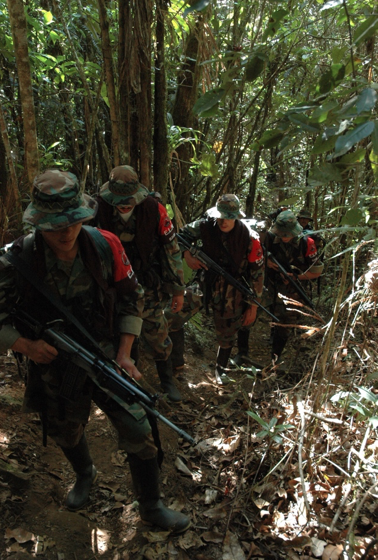
ELN guerrilla patrol in Colombia (Photo source: GL)
Its open letter not only refutes the allegations against it, but they also put forward proposals as to what to do regarding the problem of crops and drug consumption. It extends an invitation to various organisms to carry out in situ visits and inspections to see the reality of their relationship to the drugs trade, but they go further than clearing up the question of their links or otherwise to the drugs trade and they put forward proposals on the drugs problem as such.
PROPOSALS — SOLUTIONS?
To pick up the proposals made on various occasions by the ELN with the aim of reaching an Agreement that overcomes the phenomenon of drug trafficking that includes the participation of the international community, the communities in the regions that suffer this scourge and various sectors of Colombian society.[25]
The issue of drug trafficking is not one that Colombia can solve on its own, it is an international issue in nature, not just in terms of the distribution and consumption of the final products, such as cocaine and heroine or ecstasy and other drugs generally produced in northern countries, but also because Colombia’s obligations on the issue are covered by various international UN treaties. The ELN makes various points.
Only the legalisation of psychotropic substances will put end to the extraordinary profits of drug trafficking and its raison d’être.
This position has been discussed thousands of times in various fora and international settings. It is partially true. No doubt the legalisation demanded by various social organisations, including health organisations, would put an end to the mafia’s profits, but not the profits as such. The medicinal uses of coca and opium have never been banned, rather the International Narcotics Control Board (INCB) regulates and controls its production and end use. The UNODC calculates that in 2018 there just under 12 billion daily doses of opiates available in the legal market, double the amount available in 1998.[26] Cocaine and medicinal opiates, including heroin, have always been used in a medical context and the use and regulation of cannabis is a growing market. The legalisation of recreational consumption is another matter, the state of Colorado in the USA and Uruguay are two places where they legalised the recreational consumption, with various benefits in terms of crime, health and taxes. The profits are lower in these legal markets but they are large, nonetheless, as are they for other legal drugs such as alcohol and tobacco, products that are controlled in terms of quality and their impact on the health of the consumer. The legal marijuana market in Colorado amounted to $1,750 millions in 2019 with 69,960,024 transactions with an average price per transaction of $51.89, but the price to the consumer continues to fall and quality is guaranteed.[27] However, both Colorado and Uruguay have experienced legal problems with the banking system as their legalisation has no international recognition. The ELN’s proposal could only happen in the context of an international debate and a paradigm shift in the states and regulatory bodies at an international level such as the UNODC and the INCB, amongst others and the recent decision by the WHO on the medicinal use of cannabis is a good start.[28]
A pact on shared responsibility between drug producer and consumer countries is required
This pact already exists. There are various UN pacts on the issue starting with the Single Convention of 1961, the Convention on Psychotropic Substances of 1981 and United Nations Convention Against Illicit Traffic in Narcotic Drugs and Psychotropic Substances. This last treaty deals with aspects related to organised crime, precursor chemicals etc. What is lacking is political will, not another pact. The factories where the acids used to make cocaine are not bombarded but they do attack and bombard the producer communities, neither do they bombard the factories of illegal drugs such as ecstasy in the Netherlands. It is not the case that there is a lack of pacts but rather as they say the law is for the ragged and in geopolitical terms, Colombia is very ragged
The drug addicts are sick and should be treated by the states and should not be pursued as criminals.
This is one point that is always overlooked in the discussions on illicit crops and despite the belligerent tone of the USA, both the north American health system and that of the majority of countries in Europe deal with it as such, some countries do not even pursue consumption as such, acknowledging its character as a health problem and only go after related crimes. The UN accepts the need for treatment for drug addicts and calculates in its World Drug Report that 35.6 million people in the world abuse drugs and just 12.5% of those who need treatment get it, i.e. about 4.45 million people.[29]
The peasants who work with illicit use crops, should have alternative plans for food production or industrial raw materials, financed by the states in order to solve their sustenance without seeking recourse in illicit use crops.
Although this point is well intentioned it makes the same mistake as the FARC, the NGOs, international aid etc. Whilst it is true that the peasants should have alternative plans and receive economic support from the states, the problem is a core issue and cannot be solved through projects or credits: the economic aperture ruined the agricultural production of the country and the peasants can’t compete with the imports subsidised by the US and European governments. The underlying problem is not agricultural, nor economic but political and requires national and international changes. The free trade agreements, the monopoly in the agricultural and food sector exercised by multinationals such as Cargill, Nestlé, Barry Callebaut amongst others are not resolved by subsidies or projects.[30]
As well as pursuing the Cartels in the narcotic producing countries they should also pursue the distribution Cartels in the industrialised consuming countries; as well as the Cartels for the precursor chemicals and money laundering of narco funds in the international financial system and the tax havens.
This is a key point. As long as drugs are illegal, they should go after the points in the production chain there, both the banks and the companies that engage in money laundering and the companies whose chemicals are used in the manufacture of cocaine. They don’t do this, one little bit or not much at least. Whilst the USA seek in extradition just about anyone in Colombia, they have never sought nor will they seek the directors of banks such as HSBC.
There are reasons to accept the ELN’s word on the issue of drugs, and there are more than sufficient reasons to accept the debate on drugs and what to do about them. It is a debate that never occurred in the context of the negotiations with the FARC. The FARC opted to negotiate benefits for themselves, their social base and they never touched the structure of the agricultural economy in the country nor the international law in force on drugs.[31]
The allegations against the ELN lack any basis in fact, but the media does not ask us to treat it as truth, rather it serves as an excuse to delegitimise this organisation in the eyes of Colombian people and in the international area they are useful as excuse to continue to militarily support the Colombian state and in a given moment can be used as a pretext for more direct interventions against the ELN and perhaps Venezuela.
End.
“Freedom for political prisoners; Jail for those who oppress the people.”
Cartoon poster from Chile but which applies to Colombia with thousands of political prisoners
(Image sourced: Internet)
[24] Some NGOs prefer the expression illicit use crops, but it is misnomer. The international treaties on the matter leave us in no doubt on the issue, the crop itself is illicit. The Single Convention of 1961, the convention in force on the issue, in Article 22 No.1 demands the total eradication, the coca leaf and its derivatives are banned. The treaty demands that even the plants belonging to indigenous people be destroyed.
Last Saturday (November 28th) saw the centenary of the Kilmichael Ambush, when a column of the West Cork IRA commanded by Tom Barry ambushed two lorry-loads of Auxiliaries and fought them to a finish, losing three of their own in the fight. It was a battle of tremendous importance in rural Ireland during the War of Independence, when the forces of British occupation of the nation turned to undisguised terrorism and employed the Auxiliaries as the knife edge of that terror. Despite the Covid19 pandemic restrictions, the 100th centenary was marked by physical commemorations in addition to on-line talks and articles. However, it appears that the “patriots” of the Far Right and fascists1 in Ireland failed to commemorate this important event – why might this be?
The Auxiliary Division were all ex-British Army officers but were recruited in July 1920 as a mobile strike force to bolster the British colonial police, the paramilitary Royal Irish Constabulary. This was in addition to another police support group which became known as the “Black and Tans”. The massive swelling of the ranks of the police was because the British rulers wanted to deny that they were fighting a liberation war and instead to present it as a policing problem (though they were obliged to use 20,000 British Army nevertheless)2. Both the ‘Tans and the Auxies gained a reputation for rough and arrogant treatment of civilians, torture of captives, theft, drunkenness and general indiscipline. However, a fear of the the “Auxies” had also grown, a feeling that they could not be beaten. The Kilmichael Ambush smashed that myth and was as important in the rural areas as the wiping out of much of the British intelligence network in Dublin was for the city.
Auxies raiding the James Connolly College and Irish Socialist Party at 42 North Gt. Georges Street, November 1920 (they raided the building twice that month, along with many other organisations considered subversive by the colonial authorities).
However although they have been posing as Irish patriots, we saw no sign of the commemorative celebration of the Kilmichael Ambush from the Irish Far-Right and fascists. They have played patriotic ballads and anthems often at events and strutted around under — and sometimes wrapped in — Irish flags. They have tried to appropriate Irish patriot heroes and martyrs including Wolfe Tone, James Connolly and Terence MacSwiney. But they left Tom Barry untouched.
Niall McConnell, head of the fascist organisation (registered as a business) Síol na hÉireann, posted about James Connolly as though Connolly would have supported McConnell’s type of people and claimed Connolly was born in Ireland. Laughable though it may be to think that revolutionary socialist and anti-sectarian, anti-imperialist Connolly would ever have supported a little Ireland religious sectarian and fascist like McConnell, the latter did try to appropriate him. And although Connolly was born to Irish parents in Edinburgh, where he grew up, that was not enough for McConnell, who had to claim he’d been born in Ireland.
Wolfe Tone, a revolutionary patriotic democrat who strove to unite the mass of people in Ireland of different religions and who fought for a secular independent state, would have crossed the street to avoid the likes of McConnell – but that didn’t prevent McConnell from trying to appropriate him.
Recently we passed through the 100th anniversary of the death on hunger strike of Terence MacSwiney – and they tried to appropriate him too. MacSwiney was a devout Catholic but the IRA, of which he was a prominent officer in Cork, was a non-sectarian body. Presumably MacSwiney, like his IRA comrades, fought under the principles of the 1916 Proclamation, part of which read: “The Republic guarantees civil and religious liberty to all ….” Nevertheless, got up somewhat reminiscently of the Ku Klux Klan, McConnell led a small torchlit group allegedly to MacSwiney’s grave and had himself videoed making a speech there.
Dee Wall (real name Dolores Webster), whose Saturday afternoon screeching on behalf of the QAnon negationists and conspiracy theorists assails the ears of people passing the GPO in Dublin and whose social media tries to reach those who avoided that experience, tried to claim MacSwiney too, only she pronounced the surname as rhyming with “tiny” instead of like “sweeney” (as one who had never heard the name before might from the spelling alone).
Jim Dowson, a British fascist and sectarian Loyalist, who has shared a platform with fascists Rowan Croft (aka “Tan” Torino) and Herman Kelly of the Irish Freedom Party (but formerly of UKIP), has cheered the armed fascists of the National Party in attacking unarmed counter-protesters, calling them “my Fenians”. Yes, bizarre to call his fascist comrades anything to do with the revolutionary Irish Republican Brotherhood but even more so when “Fenians” is one of the hate-names of Dowson’s Loyalist brethren for Irish Republicans.
Another centenary we passed by very recently with a number of commemorations held outside the stadium was that of the Bloody Sunday Massacre in Croke Park by Auxiliaries, ‘Tans and RIC. Apparently the fascist National Party sneaked in an early videoed commemoration of their own before anyone else on the day and left a wreath among other floral tributes there.
Yet, despite this focus on recent centenaries in the Irish struggle for independence, the “patriots” of the Far Right and fascists in Ireland seem to have let that great event of the Kilmichael Ambush slip them by without a commemoration of any kind. Not a murmur, not a video, not a post, not a photo, not even a tweet from these publicity-obsessed types.
The start of the action in the Kilmichael Ambush as depicted in a scene from Loach’s film The Wind that Shakes the Barley. (Image sourced: Internet)
THEIR PROBLEM WITH KILMICHAEL AND TOM BARRY
What possible reason could there be for this omission by the fascists and Far Right?
Was it because Tom Barry, who led that ambush was anti-sectarian and proved it by publicly punishing two men who had robbed from a Protestant chapel in West Cork? Doubtful, because that did not stop the fascists trying to appropriate Wolfe Tone, whose main effort was precisely to end sectarianism.
Photo of a young Tom Barry, guerrilla leader, on the cover of a reprint copy of his memoir (Image sourced; Internet)
Or was it because following the Kilmichael Ambush, the IRA were condemned by the Bishop of Cork, Daniel Colohan? We might be on to something there. “Demented” Dee Wall, Niall McConnell and National Party representatives all attended the anti-Muslim protest earlier this year, organised by Gemma O’Doherty, who unfurled a banner bearing the slogan “Make Ireland Catholic Again”, where they prayed the rosary through amplification. The new fascist parties, far-right organisations and the anti-mask people are building on the remaining fundamentalist hard-right reactionary core of the Catholic Church in Ireland who have seen its grip on the social and political life of society slipping over the years, due to its scandals and people’s democratic desire for equality.
By the way, Barry commented in his memoir that, although practicing Catholics, the threat of excommunication deterred the patriots of West Cork not in the least, as they were able to separate their religious from their patriotic views.
It may be that the false patriots have another problem with Barry: he fought against the Free State at least twice. Tom Barry, like the overwhelming majority of the military part of the resistance movement, rejected the terms of the Anglo-Irish Agreement of 1921 and refused allegiance to the 26-County Free State. The latter, in 1922 under Michael Collins, opened artillery fire upon the Republicans, launching a civil war which persisted until 1923 and during which the State, apart from those killed in battle, killed at least another 120, either through shooting prisoners, martial court executions or covert assassinations. Barry was part of the IRA’s leadership in the Civil War.
Bombardment of Republican-held Four Courts in Dublin by Free State forces from the bottom of Winetavern Street (with British artillery on loan) starts the Civil War on 28 June 1922 (Source Internet)
Although because he felt the war could no longer be won and was narrowly outvoted on ending it, Barry had resigned his leadership position shortly before the end of the Civil War, he rejoined the IRA leadership in 1927 and was jailed by the DeValera Government in 1934 for seven months on a charge of illegal possession of firearms.
In March 1936 Barry was suspected — but never charged — of involvement in the assassination of retired Vice-Admiral Henry Somerville at his home in Cork, because he was attempting to recruit people into the British Naval forces3. In 1937 Tom Barry was elected Chief of Staff of the IRA after the resignation of Seán McBride but resigned the position himself in 1938 over a tactical dispute.
Yet another problem for the Far Right and the fascists is that from the 1970s onward, though he publicly disagreed with some of their actions, Tom Barry stated he supported the Provisionalsand later, Republican prisoners in the H-Blocks. At a commemoration at Crossbarry in 1980, the scene of another of Barry’s famous battles, shortly before his death, he was quoted as saying:
‘I don’t want you to fall out4 until the same prayers are said for men who are being crucified in H-block, Long Kesh. I want you to say prayers for them to show our unity with these men, many of whom are completely innocent and are railroaded by the same British that killed these men whom we are commemorating.’
The Far Right and fascist “patriots” have a big problem with the Provisionals5 and others who were, during the recent war of three decades, at the time fighting against British occupation for a united, independent Ireland.
IN CONCLUSION
Of course, given their flexibility with history, logic and integrity6, there is no guarantee that at some time in the future the Far Right and fascists will not try to appropriate the Kilmichael Ambush. However, their present difficulty with commemorating the event and celebrating the memory of a true patriot, Tom Barry, exposed the false patriotism of the Far Right and fascists in Ireland. But it did more: it gave a clear indication of what they do support.
The Far Right and fascists in Ireland support:
the 26-County neo-colonial State
the continuation of British colonial occupation and division of Ireland
a Catholic Church dictating in political and social affairs to the population within the Irish state
The Far Right and fascists, for all their slogans about “freedom”, “free speech” and posturing as “patriots”, are in oppositionto freedom, both national, social and individual. There is nothing patriotic about them.
End.
FOOTNOTES:
1 Though the dividing line in Ireland between most of of the Far Right and committed fascists is a thin one, it nevertheless exists but it is important to note their past cooperation in staging public events and the continued presence of fascists within the Far Right.
2 Wikipedia gives the following figures: British Army 20,000; Royal Irish Constabulary 9,700; Black and Tans 7,000; Auxiliary Division 1,400; Ulster Special Constabulary 4,000 (i.e a total of 42,000 combatants). These were opposed in fighting by little more than 15,000 IRA and about 250 ICA (although those were supported by a large network of formal and informal non-combatants).
3 With the signing of the Anglo-Irish Agreement of 1921, the British had retained the three deepwater “Treaty Ports” of Lough Swilly in Donegal, Berehaven and “Queenstown” (Cóbh) in Cork. The Irish State took these ports over with British agreement in 1938. De Valera’s refusal to allow the UK to use these ports during WW2 led to a threat of invasion by Churchill and the resultant declaration of an “Emergency” by the Irish Government and recruitment into its armed forces; the threat was unfulfilled and the Irish State remained neutral through the war though generally friendly to the Allies.
4 A military parade command: “Fall out” indicates that the parade is formally over and soldiers may disperse for recreation or take up other duties.
5 However the history-illiterate Dee Wall of the QAnon group, protesting outside Maghaberry Jail in solidarity with an anti-masker jailed for a few days in Maghaberry for refusing to give his name, stated that Bobby Sands had died there. Bobby Sands, the first of ten hunger strikers of the Provisional IRA and of the INLA, died on hunger strike in the H-Blocks of the Maze prison, which was closed 20 years ago.
6 Along with their willingness to libel with the most vile and outlandish personal accusations individuals who oppose them
After a military invasion by the Moroccan Kingdom into the “buffer zone” in Western Sahara, the Polisario Front, liberation and resistance organisation of the Saharawi, gave the MINURSO (UN) mission in Western Sahara 12 hours to leave the territory. Meanwhile the Polisario also retaliated against the Moroccan occupation with an attack against the Wall, while young Saharawi confronted occupation forces in a number of localities.
According to sources close to Polisario, the Saharan People’s Liberation Army, in response to the Moroccan invasion, undertook artillery strikes against Moroccan military targets along the Moroccan military wall that cuts through Western Sahara. The targets of the attacks were the following Moroccan military bases and surveillance points along the wall: Moroccan military base No.23 (Mahbes), Moroccan military base No.4 (Hauza), Surveillance Point No.71, Moroccan military base No.17 (Oust), surveillance point No.172, Moroccan military base Nos. 17 and 18. A press release from the Saharan People’s Liberation Army added that its fire on Moroccan military positions led to human casualties and material losses for the Moroccan Army and that Moroccan soldiers fled some of their positions along the Moroccan Wall.
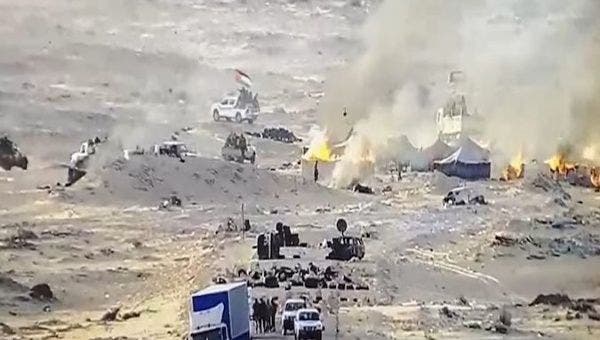
Conflict at the protest camp as Moroccan forces attack civilian protesters.
(Photo source: Telesur)
The Polisario also alleged that Moroccan forces had attacked Saharawi civilians who had gone to protest peacefully at the first breach of the buffer zone, at Guerguerat, civilians which subsequently the Polisario had evacuated safely. Subsequently Moroccan military had breached the zone at another three points, it alleged.
The General Secretary of the Polisario Front, Brahim Ghali, gave a press statement in which he announced the retaliatory attacks against what he called a violation of the 1991 ceasefire, “repeatedly violated by Morocco” but which, with the invasion of the buffer zone, “has now gone past the point of no return”.
Leader of the Polisario, Brahim Ghali, giving a press statement. (Photo source: ec.saharaui)
“DIFFICULT TO RESTRAIN THE YOUTH”
Over the years since 1991, as no progress towards independence seemed to be made, the Polisario leadership has at times found it difficult to restrain its youth from returning to armed struggle. And Moroccan police have carried out much repression of peaceful protest demonstrations, plain-clothes officers beating even women and children in the street. At a conference in Dublin last year (see Rebel Breeze report link below) representatives of the Saharawi people spoke about the human rights abuses by the Moroccan authorities in Western Sahara and about the discrimination and deprivation of the Saharawi people in a number of important areas of life.
At the above conference, despite reference by a number of people to a “Western Saharan peace process”, in reply to a direct question from the floor, the European representative of the Polisario, Mr. Mohamed Belsat, tacitly admitted that no such process existed and talked about the Polisario’s difficulty in restraining the Saharawi youth.
Mohamed Belsat of the Polisario speaking at the conference in Dublin last year (Photo: D.Breatnach)
A source close to Saharan activists from the city of El Aaiún confirmed that dozens of young Saharauis in the El Inach Matalaa and Tatan districts were confronting Moroccan gendarmerie and police patrols during the early hours of Friday evening. According to the sources, these protests against the occupation and support for the start of war against the regime have shifted and hardened in the Ghiyadet, Bucraa and Lahum districts. The source consulted stated that as of Friday night, the riots against the occupation administration in the city of El Aai ún were continuing.
BACKGROUND
The Spanish colony of Western Sahara (also known in the past as “Spanish Sahara”) was abandoned by the Spanish State in 1975; instead of decolonising it and facilitating a referendum on independence, the Spanish State’s evacuation cleared the stage for two neighbouring states to invade the country: the Kingdom of Morocco and Mauritania.
The Saharawi people formed the Polisario Front guerrilla organisation to resist the invasion and occupation of their land and also formed a government in exile, the Saharawi Arab Democratic Republic, in Tindouf in Algeria. Mauritania relinquished the territory it occupied and any claim to Western Sahara in 1979 but Morocco continues to pursue its annexation and its attendant repression of the Saharawi people.
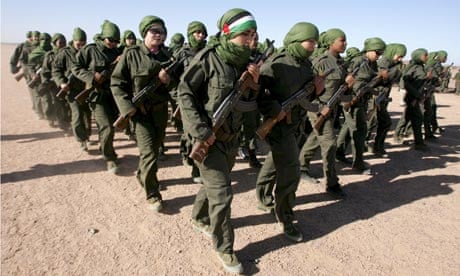
Female fighters of the Polisario about ten years ago (Photo source: Inernet)
“Western Sahara has been described as the last colony in Africa and has been illegally occupied by Morocco since 1975. Morocco is obliged under international law and as a member of the UN to allow a vote of self-determination for the people of the territory. Yet for 35 years 165,000 Saharawi people have lived in refugee camps in Southern Algeria, ethnically cleansed from their own country. Morocco built a 2,700km wall visible from Google earth to stop the Saharawi people returniing to their country.” (From press release at the launch of Western Sahara Ireland Action group in November 2010).
Formally the UN considers that the Saharawi people have the right to self-determination and recognises the Polisario Front as the legitimate representative of the Saharawi people. In 1991 the UN brokered a ceasefire and established a mission on the territory. However over the years the UN has failed to take any action and many people have wondered at the point of its mission there. Interestingly, it is the only UN permanent mission that does not have a human rights watch brief. At the same time, the Moroccan authorities put a media blanket over Western Sahara to prevent reports of repression, including torture, emerging or, if leaked out, being investigated by journalists.
In addition, the ceasefire agreement authorised Morocco to administer two-thirds of the country and most of the Atlantic coastline, which has facilitated its plunder of Western Sahara’s natural resources and by others, including by EU states. One of the big member states of the EU, France is a big supporter of its former colony, the Kingdom of Morocco and the US has also tacitly to date supported Morocco.
A referendum was supposed to be held after 1991 but it kept getting blocked as Morocco disputed the terms under which it would take place. About 85,000 voters were identified by the UN in 1991, nearly half of which were in the Moroccan-controlled parts of Western Sahara, with the others scattered between the Tindouf refugee camps, Mauritania and other places of exile. The Polisario accepted this voter list, as it had done with the previous list presented by the UN (both of them originally based on the Spanish census of 1974), but Morocco refused and, as rejected voter candidates began a mass-appeals procedure, insisted that each application be scrutinised individually. This brought the process to a halt once more.
The ceasefire agreement of 1991 also provided for a buffer zone in Western Sahara which, in effect, protects the Moroccan wall from Saharawi attack but was supposed to protect the Saharawi also from further Moroccan incursion. This zone by Morocco’s Wall was to be patrolled by the UN but it was that same zone which the Moroccan Army has now invaded; the Polisario have obviously lost patience with the state of affairs, retaliated against Morocco’s troops on the Wall and ordered the UN Mission to leave the country.
A soldier of the UN MINICURSO in Western Sahara — where were they when the Moroccan Army came through the buffer zone supposed to be patrolled by the UN? (Photo source: PUSL — para una sahara libre)
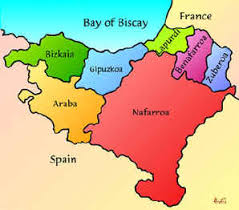
The construction of an Independent and Socialist State that integrates Araba, Bizkaia, Gipuzkoa, Lapurdi, Nafarroa Behera, Nafarroa Garaia and Zuberoa.
(On the 18th I reported on the launch of the Basque organisation Jardun, a coordinating body seeking to unite Basque left-national organisations and collectives in a revolutionary movement. Since then they have published a fuller manifesto of their aims, here translated from the Castillian version.)
The construction of a society based on the power of the Basque working class, on overcoming the class struggle and on the socialization of the means of production.
Overcoming all oppression against working women.
Reunification of Euskal Herria.
Remaking Euskal Herria Basque-speaking.
Map showing the seven provinces of the Basque Country — the three northern ones are currently ruled by the French State, the others by the Spanish State. (Source image: Internet)
The new alternative of the Basque Working People is a pro-independence and socialist political project whose ideological principles have six main points:
Independence.
Socialism.
Internationalism.
Class feminism.
Amnesty.
Environmentalism.
Independence.
The national question is framed within the various oppressions suffered by the Basque Working People, oppression that in the opinion of this coordinating organisation can only be overcome through independence. In other words, when we speak of self-determination, we are referring to the undeniable right of the Basque Working People to separate from the states that oppress them and to undertake a process of building an independent and socialist state.
Socialism.
Before talking about socialism, it is convenient to specify what we mean when we speak of the Basque Working People. The Basque Working People is made up of everyone who lives and sells their labour power in Euskal Herria. Every worker within the Basque Working People, from the moment they suffer exploitation and oppression, that is, from the moment they suffer the blow of capital in a crude way in their day to day life, has the potential to organize the revolution. Therefore, when we speak of socialism, we refer to overcoming the class oppression suffered by the Basque Working People, on the way to creating a classless society.
Internationalism.
We must understand that the Basque Working People cannot undertake the fight against capital alone. It is necessary to maintain contact with the different oppressed peoples and to acceptmutual aid. Even so, JARDUN will always set down an unpassable red line, that the national framework of the Basque working people can never be doubted. (Translator’s note: I was unsure about what exactly was meant by this sentence but one Jardun’s supporters told me it means that any struggle expecting solidarity from Jardun must accept the Basque people as a nation).
Class feminism.
It is necessary to overcome the sex-gender dichotomy and the reproductive role that capital imposes on working women, in order to overcome the oppression suffered by working women and the structural reasons that originate it.
“Freedom for political prisoners; Jail for those who oppress the people.” Cartoon poster from Chile but which summarises the Jardun position. (Image sourced: Internet)
Amnesty.
Amnesty is a strategic term that, going beyond confining itself to the freedom of all those fighterswho have worked for the freedom of Euskal Herria, implies political recognition in the eyes of working people of the struggle they have carried out and placing at the disposal of popular justice those who have systematically oppressed them.
Environmentalism.
Within the current capitalist production model, the environment suffers from overexploitation, responding to the logic of obtaining the highest possible economic performance, generating more waste than can be managed and creating a degradation that in many cases puts living conditions at risk. That is why the environmental struggle can only be approached from a root change in the production processes.
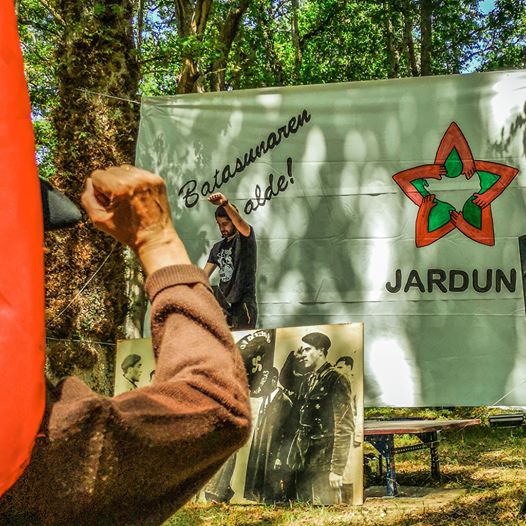
Photo taken during the Albertia battle commemoration and launch of Jardun earlier this month. (Photo source: Jardun)
The six points outlined above that define the ideology of JARDUN cannot be understood or addressed in an isolated way, since if their achievement does not go hand in hand with the others, the only thing that we will achieve will be to perpetuate the oppression suffered by the Basque Working People. In the same way, only by addressing these points from a class point of view will the workers of Euskal Herria be able to obtain control of the productive processes and political power, neutralizing the bourgeoisie.
Although the Basque Working People have the potential to carry out the revolution, only by acquiring awareness of their situation and organizing themselves in pursuit of national and social liberation can they begin the revolutionary process, forming the Basque Revolutionary Proletariat. JARDUN needs to be the organizational space of the Basque Revolutionary Proletariat. At the same time, the working people at an organic levelshould be composed of different sectoral organizations working under the same strategic objectives, for the construction of an independent and socialist Euskal Herria.
In the same way that our predecessors faced the oppression that this people has suffered and fought against fascism in Albertia, today, it is up to us to confront the oppression that working people suffer and for that, unity is necessary, it is necessary join forces. It is time to start joining forces. It is time to start adding forces. It is necessary to get together with different groups in Euskal Herria and defend a common project. It is necessary for different groups to join JARDUN, so that each one from their own fighting trenches can contribute what they can, with a firm commitment, and thus respond as a people, as a working people to capital. Since we are very clear about the way forward and what strategy has to be carried out. And let there be no doubt that we will continue working in that direction. For those who have given their lives, for Euskal Herria and for the workers of Euskal Herria.
“Whaaa ?” You wake up suddenly, wondering what was that noise. Your partner sits up beside you. The bedside clock says it’s 5 a.m While you’re still wondering what it was, there’s another crash. Your front door? “The children!” you think, jumping out of bed to protect them, as you hear men bursting into your house, running up the stairs ….. Too late, they’re in the doorway of your bedroom, shouting at you, at your partner, pointing guns at you … you can hear one of the children screaming ….
On Tuesday this week, 18th August, members of the Garda Armed Response Unit raided the homes of Irish Republicans in Dublin, Cork, Laois and Kerry, smashing through the front doors of their houses, frightening children ….
They took away laptops, phones, paperwork (including children’s school work and test results). In helpless rage or frightened, their victims could only watch ……. they were outnumbered and the invaders of their homes were armed.
Much more than an information-gathering exercise, this was a brutal act of State terror, to intimidate Republican activists, terrify their partners and children.
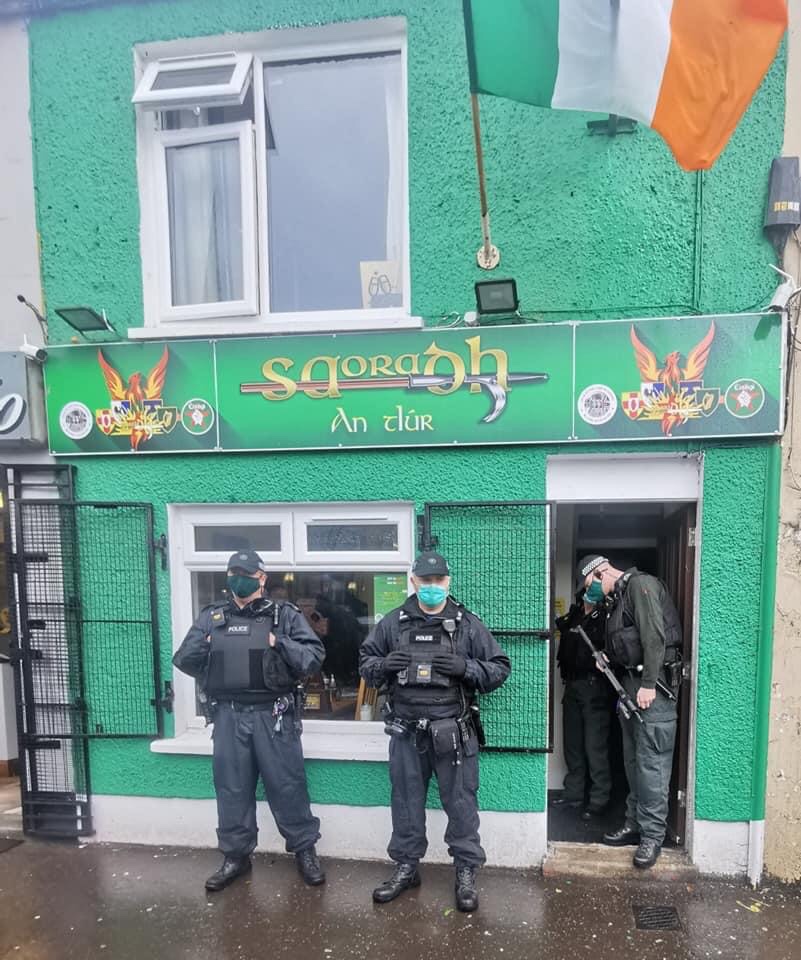
On the other side of the British Border, the counterparts of the Gardaí, the PSNI, armed British colonial police, raided Republican centres in Belfast, Derry, Dungannon and Lurgan, turning the places upside down, confiscating electronic equipment and documents. On Tuesday 18th, they also detained people, holding seven men and two women without charge and, according to a legal firm acting for some of the victims, were intending to hold them for further five days without charge.
PSNI, mostly in their ‘normal’ uniform at one of the scenes of raids (Photo source: Saoradh)
The activists subjected to the early morning raids by the Garda Armed Response Unit are all supporters of the socialist Republican organisation Saoradh and it was their centres that were raided by the PSNI. For months members have had their cars stopped by the PSNI and searched as they went about their lives. The raiding parties claimed to be searching for evidence of involvement in “the New IRA” (a previously unheard of organisation).
SHAMEFUL REPORTING AND FELON-SETTING
The media reporting on this was a shameful exercise in parroting the line of the States involved, giving the victims no voice to tie the “New IRA” (sic) in with the killing of Lyra McKee, which has never been proven and going further to call it “murder” (i.e intentional homicide) which has not been proven either (and was most likely unintentional – an organisation calling itself the “IRA” did claim the shooting and stated the killing was accidental).
Irish newspapers quoted Sinn Féin fears of bomb attacks on them by the organisation on the basis of information they allegedly received from the PSNI, which is dubious reporting at best (hearsay second-hand from an unverifiable source) and absolutely shameful felon-setting collaboration from Provisional Sinn Féin. BBC reporting to its credit did not report the PSF-PSNI allegations, nor call the killing of Lyra McKee “murder”, though it did link “the New IRA” to her killing and also prejudged the detained (who have not even been charged), calling them the “New IRA nine”; interestingly, the report gave MI5 as the source for the intelligence upon which the raids were allegedly based.
Felon-setting: Gerry Kelly and Michelle O’Neill, Vice-President SF, who publicly alleged ‘dissident’ bomb threat against them on the basis of unverified PSNI statement. (Photo source: Internet)
The linking of the raids both sides of the Border on the proclaimed basis of information from the British secret service, MI5, raises questions not only about democratic rights and the powers of the states in question but even about the alleged independence of the Irish State. It intensifies the speculation that was rife when Drew Harris was appointed Garda Commissioner, having come straight from the PSNI, with allegations that he was an MI5 asset.
SOLIDARITY?
What should be our response to these raids, as Irish Republicans, as Socialists or as just plain Democratic people? Clearly it should be solidarity with the victims and condemnation of the attacks by the states. Of whatever the states may or may not suspect the organisation, according to the alleged democratic system, they are supposed to charge them or leave them alone. We are not supposed to tolerate the states deciding they don’t like an organisation or consider it “dangerous” and on that basis set out to harass and intimidate them and terrorise their families. States where that can happen are not democratic and we are all vulnerable to those assumptions of secret services and the actions of police forces. Gárdaí acting in this manner led to the unjust jailing of the IRSP Three, the false confession forced out of Joanna Hayes and her family, the harassment of the McBrearties, etc. In Britain it led to the jailing of a score of innocent Irish people in five different cases in the 1970s (including the Birmingham Six) under the Prevention of Terrorism Act and, in fact, the successor of that Act is now the Terrorism Act in the UK, the one under which nine Republicans are detained currently in the British colony.
PSNI, the British colonial police, next to a Saoradh centre. (Photo source: Saoradh)
It is not too difficult to proclaim one’s solidarity with struggles far from home, particularly when they gather a lot of international support. It is a different matter to stand in solidarity with the victims of the State at home. It is also more of a test when one may not agree with the ideology or some of the actions of those persecuted by the State. But if we do not stand in solidarity with victims of the State, we are telling it, in effect, that it may continue acting in the way it is doing, until the early morning we wake to our own doors being battered down, our own partner and children being terrorised and ourselves sitting in cells without daylight being deprived of sleep and interrogated without access to solicitor, family or our own doctor.
end.
British colonial police, the PSNI, raiding a Republican centre, some with guns unlimbered. (Photo source: Saoradh)
This series of short pieces sets out to demonstrate not only that the “patriotism” claimed by the Far-Right in Ireland is profoundly fake but that so also are their chief symbols. It is not that the flags and songs are false in themselves – far from it — but that they are being employed falsely, i.e in disregard of their origins and in total contradiction to their historical context and meaning. The “patriots” displaying them are fake, not only in their use of the flags and songs but in the contexts in which they employ them, their discourse and the direction in which they wish to take the Irish nation.
OTHERS TO FOLLOW SEPARATELY:
Flag: The “Irish Republic” flag
Flag: The “Starry Plough”
Flag: The Harp on a green field flag
Patriotic song: Amhrán na bhFiann
Patriotic song: A Nation Once Again
The Far-Right creed of fake patriotism
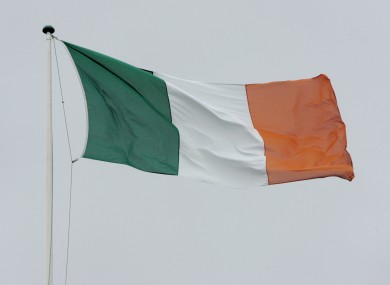
The Irish Tricolour flag (Photo sourced: Internet)
1. THE IRISH TRICOLOUR
This is the flag design most commonly associated with Ireland and the official one of the Irish State, though it was not officially adopted by the State until the Constitution of 1937. The flag gained prominence during the 1916 Rising, when it was flown on the Henry Street corner of the GPO roof and was the flag of the Republic during the War of Independence (1919-1921). The Free State which came into being in 1922 controlling five-sixths of Ireland was not the Irish Republic most people had fought for and, in fact, it went to war against those who upheld that Republic. However, the neo-colonial State feared to leave all the symbols of Irish nationalism in the exclusive hands of its enemies and therefore eventually appropriated the flag, adopted the Irish language as its symbolic first language and the Soldiers’ Song to represent it.
On the other hand its display in public in the Six Counties colony was held to be illegal under the Flags and Emblems Act of 1954 until its repeal in 1987 and a number of street battles took place there when colonial police moved in on people to confiscate it.
Although the first use of the colours of green, white and orange as a tricolour arrangement (on cockades and rosettes) was in 1830, when Irish Republicans celebrated the French revolution of that year restoring the French Tricolour as the flag of France, their first recorded use on a flag was not until 1848.
On 28th July 1846 a group of progressive Irish nationalists had broken from Daniel O’Connell’s movement to Repeal the Union, i.e to give Ireland an Irish parliament again but under ultimate British rule. Meagher was one who led the breakaway, opposing the Repeal Association resolution to refuse the option of armed resistance in any and all circumstance, in a famous speech about the right to use weapons in the struggle for freedom, which earned him the nickname Meagher “of the Sword”.
The group became known disparagingly as The Young Irelanders but, like many mocking names, became fixed with respect in Irish history. One of its leaders was Thomas Davis, co-founder of The Irish Nation newspaper and composer of such iconic works as A Nation Once Again, The West’s Awake (songs) and Fontenoy (poem).
Monument in Dame Street to Thomas Davis, Republican, Young Irelander, author, composer, journalist. (Photo: D.Breatnach)
During what became known as “the Year of Revolutions:, 1848, Meagher went to Paris, which was in the hands of revolutionaries as an envoy to the Provisional Government and was there presented by revolutionary women with the Irish Tricolour, which they had sown in fine silk. They explained that its design was intended to reflect the revolutionary ideal of peace, represented by the colour white, between the Catholic Irish (indigenous and Norman descendants), represented by the colour green and the Protestants, descendants of planters and other colonists, represented by the colour orange. But an active peace, a collaboration in national liberation from English rule and the establishment of a secular Republic.
It would not be surprising had those women been aware of Les Irlandais Unis (the United Irishmen), who had risen less than fifty years earlier for a secular and independent republic and had sought military assistance from the French Republic.
Returning to Ireland with the flag, Meagher unfurled it in public for the first time on 7th March 1848 while speaking from an upper-floor window of the Wolfe Tone Club in Wexford to people celebrating the revolution in Paris. In Dublin it was unfurled in the Music Hall in Lwr. Abbey Street on 15th April 1848 but there was another Irish flag which at the time was more popular and the question of which flag was to represent an independent Ireland (or the movement to achieve such) was left undecided.
Plaque in Waterford recording the first public unfurling of the Irish Tricolour in Ireland. (Photo sourced: internet)
Plaque in Abbey Street recording the first public unfurling of the Irish Tricolour in Dublin. (Photo sourced: internet)
Illustration of the trial of Meagher, McManus and Donohoe. (Image sourced: internet)
Meagher was sentenced to transportation to Van Demien’s Land (now Tasmania), later freed on condition of not returning to Ireland and emigrated to the USA. He supported the Union in the American Civil War for the abolition of slavery and he and his wife actively recruited for the Union Army; he served as a Brigadier General in the Irish Brigade, of which one regiment, the 88th New York, became known as “Mrs. Meagher’s Own”. The Irish Brigade fought many important engagements against the Confederacy and suffered 4,000 dead in the course of the war; two of its commanding officers including Meagher were wounded and three killed. Meagher was believed drowned from a Missouri riverboat on a trip on 1st July 1867, leading some to suspect that he had been murdered, possibly by the nativist anti-migrant organisation known as the “Know Nothings”.1
Thomas Francis Meagher as Union Army officer and Governor of Montana. Plaque in Waterford recording the first public unfurling of the Irish Tricolour in Ireland. (Photo sourced: internet)
The Far-Right in Ireland, composed as it is of racists, fascists, Catholic conservatives and religious sectarians, seeks an Ireland far removed from the republican ethos of the flag, presented by French republican revolutionaries to their Irish republican counterparts. It is a flag symbolising inclusion rather than exclusion and explicitly, in its colours, rejecting religious sectarianism. It flies in declared opposition to those who seek an Ireland “made Catholic again”2, oppose immigration and seek an Ireland based on “Irish ethnicity” (meaning blood), a prescription that would have had no place for Thomas Davis’ Welsh father, nor for Meagher, who led thousands of Irish migrants who fought against slavery of Africans in the USA. Their Ireland would have had no place for the Young Irelanders who, like Thomas Davis, were mostly Protestant Republicans.
The Far-Right in Ireland wave the Tricolour flag outside Leinster House in this protest of theirs demanding “free speech” for racist diatribes in February 2020 in sharp contrast to the flag’s meaning and history. (Photo: D.Breatnach)
The irish Tricolour in Kilmainham Jail (now museum) in the execution yard of 14 patriots of the 1916 Rising (Photo source: Aitor Munoz Munoz, royalty-free).
FOOTNOTES:
1A nickname they earned through their habit of saying that they knew nothing in answer to questions by the police or in court.
2Slogan put forward by notorious racist and conspiracty theorist Gemma Doherty in preparation for an islamophobic rally outside Croke Park on 31st July, supported by fascist organisations Síol na hÉireann and the National Party, both parties opposed to immigration and promoting a racist concept of “Irishness” based on blood.
On 26th July 1914 there was unusual crowding on the East Pier of the fishing harbour of Howth, Dublin and great excitement which grew as the sail of yacht was spotted making for the harbour. Among those gathered on the pier were members of the Irish Volunteers and of Na Fianna Éireann, the Irish Republican youth organisation. As the yacht, the Asgard, maneouvered to pull into position along the pier, mooring ropes thrown were quickly made fast. Then an amazing number of Mauser rifles and ammunition began to be unloaded into eager hands.
Unloading rifles at Howth, 1914, Erskine and Molly Childers in foreground. Erskine was English but would later join the IRA and was executed by the Free State regime in 1922. (Source photo: Internet).
On Sunday 26th July this year the annual commemoration of the historic event was organised by the Anti-Imperialist Action group to take place in Howth. A group of people formed up at the start of the pier and proceeded along to the end, where the commemorative plaque is and where the ceremony was to be held. A small colour party preceded the procession, followed by a banner against the extradition of Liam Campbell, in turn followed by another banner stating: “This Is Our Mandate, This Is Our Republic” (from the Democratic Programme of the First Dáil, 1919), with the rest of the procession following behind.
Attendees or onlookers? (Photo source: Rebel Breeze)
Part of the attendance at the event. (Photo source: Rebel Breeze)
The idea of arming the Irish Volunteers to counter the arming of the Ulster Volunteers, who had declared their aim to prevent the limited autonomy of Home Rule being given to Ireland by the British Government, had been discussed in 1914 by a group that could best be described as Anglo-Irish, middle class and including even an aristocrat – nearly all of Protestant background. The eventual sailing of the gun-laden yacht from off the Belgian coast to Dublin was accomplished by a crew of the Asgard assembled for the purpose: Erskine and Molly Childers, Molly Spring-Rice, Conor O’Brien and two seamen from Gola in Donegal: Patrick McGinley and Charles Duggan. Apart from the Captain, Erskine Childers, they all had some Irish in their backgrounds but only Conor O’Brien and the Donegal men were of indigenous stock, with only the latter two native Irish speakers.
The rifles were successfully landed and were used effectively during the 1916 Rising, though only single-shot against the five-shot magazines of the British Army’s Lee-Enfield rifles, of which the Volunteers had only a few (and no machine-guns at all).
THE COMMEMORATION
When the commemorative procession reached the pier head, the attendance fanned out in a square with an open end facing Margaret McKearney, who was to chair the event. The colour party stood to to one side, the flags bearing the designs of the Irish Citzen Army and Na Fianna Éireann, along with the Tricolour, fluttering in the gentle sea-breeze.
McKearney called for a minute’s silence in remembrance and honour of all those who had given their lives in the struggle for Irish independence, during which the colour party performed the presentation, lowering and raising of the flags. Floral wreaths on behalf of Anti-Imperialist Action and Spirit of Freedom Westmeath were then laid underneath the commemorative plaque to the historic landing of the weapons.
Laying of wreaths by AIAI and by Spirit of Freedom Westmeath. In foreground, Margaret McKearney, chairing the event. (Photo source: Rebel Breeze)
McKearney, a life-long Republican from a Republican family in East Tyrone, had once been described by Scotland Yard as “possibly the most dangerous woman terrorist in Britain” but had legally defeated extradition attempts to extradite her from the Irish state in 1975. Two of her brothers had been killed on active service and another murdered by Loyalists during the three-decades war in the Six Counties; another brother had barely survived 53 days of the 1980 hunger strike upon its termination.
Recounting the events of the obtaining of the rifles and ammunition and their landing at Howth in 1914, McKearney went on to tell of the failure of the colonial Dublin Metropolitan police and British Army to confiscate the weapons and how at Bachelors’ Walk, the King’s Own Scottish Borders opened fire on a crowd mocking their failure and bayoneted at least one, killing four and injuring 38.
The guns had been used in the 1916 Rising, McKearney related and went on to refer to the long struggle for Irish independence since, still uncompleted, with the Good Friday Agreement seeking to draw a line under it and preserve the status quo.
Side view of the colour party with Howth harbour in the background. (Photo source: Rebel Breeze)
Referring to the growing danger of fascism in Ireland and in the world, McKearney pointed out that as the financial losses incurred during the Covid19 epidemic mounted, the ruling class in Ireland and its government would be seeking to break the resistance of the people in order to impose austerity upon them and it was then that they might well turn to the fascists.
The chair then introduced historian Peter Rogers of the Spirit of Freedom who delivered a lengthy speech on the nature of Irish Republicanism and the struggle for independence. Rogers referred to Good Friday Agreement as having failed to resolve the situation with even Francis Molloy (a Provisional Sinn Féin TD, i.e member of the Irish Parliament) remarking that they “had been sold a pup”. The speaker concluded saying that Sinn Féin must be given time to fail in the Dáil when the option of a united Ireland would be more easily embraced.
Peter Rogers of Spirit of Freedom Westmeath giving an oration. (Photo source: Rebel Breeze)
A speaker from Macra – Irish Republican Youth was then called forward and delivered a short statement.
Diarmuid Breatnach, representing the Anti-Internment Group of Ireland, was next to speak. Pointing out that internment without trial of Republican activists was continuing albeit under other forms, Breatnach related how Irish Republicans were being charged and refused bail prior to being brought before non-jury special courts on both sides of the British Border. In the unlikely event of their being found not guilty subsequently, they had nevertheless spent two years in jail. Also the practice of rearresting without trial or even charge of Republican prisoners released on licence constituted a form of internment, Breatnach said.
Going on to speak of the historic Howth event, the speaker remarked upon the varied nature of those who had planned and carried out the operation, including a number who would not have satisfied the criteria for “Irishness” of the current crop of Irish racists and fascists of the Far-Right in Ireland. Yet some involved in the gun-running had made that contribution before leaving the struggle, while most had gone on to fight in the 1916 Rising, joined there also by the workers’s Irish Citizen Army. Many had gone on the fight in the War of Independence and while some had sided with the Free State in the split and Civil War in 1922, most of the fighters had remained on the Republican side.
Diarmuid Breatnach, who spoke on behalf of Anti-Internment Group of Ireland and also sang Amhrán na bhFiann at the end. (Photo source: AIAI)
The lesson he drew from that, Breatnach continued, was that the fight for freedom had to be extended in as broad an alliance as possible but also remaining aware that some of that alliance would be temporary and to prepare accordingly.
The speaker commented on the historical importance of possession of weapons when facing an armed enemy and concluded by saying that though the time for weapons might not be now, the lesson of history is that such a time would come in the future.
McKearney thanked the organisers, attendance and all the speakers for their contributions and announced the handing over of a donation from Anti-Imperialist Action to the Loughgall Memorial Martyrs’ fund.
Donation from AIAI to the Loughgall Martyrs’ Memorial fund against the background of the plaque commemorating the landing of the rifles. (Photo source: Rebel Breeze).
The event then concluded with the singing of a verse and chorus of Amhrán na bhFiann, the Irish national anthem, sung in Irish by Breatnach.
HISTORICAL POSTSCRIPT: THE ASGARD TODAY
The boat was built in Norway by an acclaimed Scottish migrant boat-builder and sold in 1904 to the Erskine Childers and his USA bride, Molly (Mary Alden Osgood), with the interior built to the specifications of Erskine and Molly. Childers, though English and had volunteered for the British armed forces during WWI, nevertheless took up the cause of Irish independence, joining the IRA in the War of Independence and continuing on the Republican side. He was captured by the Free State forces and executed by the State in 1922 (his son Erskine Hamilton Childers was elected the 4th President of the State in 1973).
The Asgard in its separate Exhibition in Collins Barracks. (Photo source: Rebel Breeze)
Part of the deck of the Asgard in its separate exhibition in Collins Barracks. (Photo source: Rebel Breeze)
The Asgard was sold and in 1961 Journalist Liam Mac Gabhann discovered the vessel in the River Truro, Cornwall and wrote about it. After lobbying, the Irish State purchased and overhauled the ship and sailed back to Howth in 1961, where the original event was re-enacted with surviving members of the Irish Volunteers. The Irish Navy used her as a sail training vessel but in 1974 the Yacht was dry-docked in what was in essence a large shed in Kilmainham, partly open to the elements, until new restoration work began in 2007. In 2012 the yacht was moved to the National Museum complex at Collins Barracks, where it has resided since in a separate and permanent exhibiton, along with memorabilia and related information and photographs. In normal times the National Museum is open six days a week and entry is free to both the Asgard exhibition and the general Museum exhibitions.
Anti-Imperialist Action Ireland banner and Starry Plough flags at the event. (Photo source: Rebel Breeze)
It was waiting to happen. For weeks fascists and racists have been flaunting themselves in particular at the GPO in Dublin city centre and on two weekends assaulted a number of anti-fascists protesting peacefully against them — while the police harassed the victims. Today, the tables turned. Fascists marching across O’Connell Bridge were confronted by Irish Republicans picketing there for an end to internment without trial. Punches were thrown and the police arrested an antifascist. Later, fascists outside the GPO were also attacked, their amplifier and microphone confiscated by antifascists and a loudhailer smashed.
The SB harassment of anti-internment picketers can be seen here too from across the road. (Photo source: Bystander)
View of anti-internment picketers on west side of the central pedestrian strip of O’Connell Bridge. (Photo: D.Breatnach)
It was a day of many protests. The usual group of Far-Right, racists and fascists were outside the General Post Office on O’Connell Street, Dublin’s main street, protesting against the Covid19 restrictions, even claiming that the virus does not exist and is rather a creation of governments trying to instal “a world government”. Their weekly protest starts at 2pm but today they moved it back to 1pm, perhaps because another two protests had been scheduled to start at the same time: a national protest of the sacked Debenham workers and a last-minute Black Lives Matter protest.
In addition to the Far-Right at the GPO, another group of the same ilk, led by the fascist Irish Freedom (sic) Party, planned a march – also to start at 1pm — to the location of Radió Teilifís Éireann in Donnybrook. Their intention was to protest against any further lockdown and claiming that the national broadcaster is disseminating lies about the virus.
View of anti-internment protesters on east side of the central pedestrian strip on the Bridge looking southward shortly before the confrontation with the fascist marchers. (Photo: D.Breatnach)
Two weeks ago, a Republican organisation, Saoradh, had advertised a picket to take place today on O’Connell Bridge in protest at continuing internment without trial of Republican activists. The protest was to take place on the anniversary of the introduction of formal internment in the occupied Six Counties in (7th to 9th August) 1971 and was orlginally planned to start at 2pm but, in order to facilitate people supporting the Debenham Workers’ national protest, was re-scheduled to start at 1pm. The picket would also protest the attempted extradition to Lithuania of Liam Campbell, an Irish Republican.
The announcement of the fascist IFP march came a few days before the scheduled picket but, although it was possible that it would pass over O’Connell Bridge and therefore by the picketers, the organisers decided to stick to their schedule and arrangement.
About 30 Irish Republicans and other socialists, including many independent activists took up positions at 1pm on the central pedestrian strip on O’Connell Bridge, unfolding banners and placards against internment and extradition and flying flags of various allegiances: Irish, Irish socialist republican, Basque, Basque Antifa, Palestine.
Another member of the ‘Special Branch’ harassing peaceful protesters. (Photo: D.Breatnach)
(Photo source: Saoradh Dublin)
(Photo source: Saoradh Dublin)
GARDA HARASSMENT
Tall male member and female member of the ‘Special Branch’ harassing peaceful protesters. (Photo: D.Breatnach)
Soon afterwards, the picketers began to be accosted by three plain-clothes political police, generally known as “the Special Branch” and as the cry went up of “Garda harassment!” the picketers began to parade in a circular movement around the central strip. Confrontations developed between the “Branch” and individuals they had targeted to demand their names and addresses. The Branch were using Section 30 of the Offences Against the State Act, “anti-terrorist” (sic) legislation but, since they refused to confirm that they suspected their victims of committing or being about to commit a crime and in fact quoted association with others who had been convicted in the past, they were using it illegally (as they usually do). Although the illegality was pointed out to them, the political police persisted in threatening their victims with arrest if they did not give their names and addresses until eventually some complied.
Meanwhile, the shouts of “Garda harassment” and “Police harassment of a peaceful protest” could be heard both sides of the Bridge and attracted the attention of passing bus passengers, with many tourists and others stopping to watch.
CONFRONTATION WITH FASCISTS
The Branch had taken the names of perhaps no more than three when the fascist march could be seen approaching. By this time a number of other young men and women had taken position on the Bridge and, as Republican picketers stepped into the street to confront the fascists, the newcomers also jumped into the fray.
Uniformed Garda escorting the fascist marchers and those who had taken up positions on the Bridge waded into the antifascists and arrested at least one Republican there. For awhile the ability of the marchers to proceed seemed in doubt but the numbers of the antifascists were insufficient to overcome both police and fascists and so eventually the latter got across the bridge, being pursued down D’Olier Street with the Gardaí blocking antifascists there, the picketers gradually trickling back to the Bridge.
Gardaí protecting the fascists in D’Olier Street by blocking the antifascists. (Photo source: Bystander)
It was not long before the cry of “Garda harassment!” rang out again as the political police, who had stayed well away from the fighting earlier, returned to their undemocratic repressive activity of intimidating and building up files on Republicans. The picketers began to renew their circling of the central strip and at that point it seemed the political police decided to give up, with perhaps a total of four or five having been coerced by the police.
View of part of the scene at the GPO immediately after the antifascist surge into the lines of the Far-Right. (Photo: D.Breatnach)
Shortly after that, at about 1.45, the organisers decided to to end the picket a little early and some of the participants headed up to the GPO. They were not there long when a surge of antifascists, apparently led by anarchists, crossed from the central pedestrian reservation and into the ranks of the fascists. Uniformed Police rushed in and at least one antifascist was seen being held down by two Gardaí but another was running down the road with the fascists’ amplifier. Their microphone had also been seized and trampled and the remains of a loudhailer could be seen on the road. The fascists appeared badly shocked.
Another view of the scene very shortly after the antifascist surge into the lines of the Far Right. (Photo: D.Breatnach)
About five minutes later, the Public Order Unit, otherwise known as the “Riot Squad” arrived in three large police vans, precipitating a general evacuation of anarchists. The POU took up positions in a line near the antifascists, with uniformed police in a line on the other side of the road, i.e near the fascists.
Line of Public Order police near the antifascists with Jim Larkin monument in far distance, marking the spot of police attack on demonstrators on Bloody Sunday 1913, August 1913. (Photo: D.Breatnach)
Line of uniformed police near the badly-shaken Far-Right by the GPO; (Photo: D.Breatnach)
Republicans and some other antifascists remained in the area waiting for the advertised Black Lives Matter protest which did not materialise, nor could it be ascertained who had been allegedly organising it.
Then the Debenham’s Workers march came down O’Connell Street and, turning into Henry Street, proceeded to the site of the former department store (which is still holding stock and equipment). Without warning in the very early days of the Covid19 lockdown, their former employer closed its Irish stores and sacked its workers. They have now been protesting for 121 days and their minimum demand is that they are considered first in the line of creditors for their collective redundancy pay, instead of last of all as is the general practice of capitalism.
Debenham Workers’ march approaching the Spire. (Photo: D.Breatnach)
View of section of the Debenham Workers’ rally outside the closed premises of their employer. (Photo: D.Breatnach)
Central view of the Debenham Workers’ rally in Henry Street. (Photo: D.Breatnach)
Supporters of the Debenham Workers, perhaps mother & daughter. (Photo: D.Breatnach)
(Photo: D.Breatnach)
(Photo: D.Breatnach)
(Photo: D.Breatnach)
(Photo: D.Breatnach)
It was a day in which a number of different aspects of capitalism in crisis and State repression could be observed on the streets of the city centre, all in the space of a few hours.