DELIVEROO RIDERS ARE EMPLOYEES DESPITE EMPLOYER CLAIM

JUDGEMENT OF SPANISH SUPERIOR COURT IN FAVOUR OF THE WORKERS

Report in Publico.es by Pilar Araque Conde.Translation from Castillian by D.Breatnach.

https://www.publico.es/sociedad/deliveroo-tsjm-falla-deliveroo-reconoce-532-riders-trabajadores.html

Deliveroo riders, treated as self-employed workers responsible for their own insurance, without sickness or holiday pay — but in reality employees.
(Photo source: Internet)

Yet another repeat: the nth judicial victory of the riders against Deliveroo. On this occasion, the Superior Court of Justice of Madrid (TSJM) ratified the ruling in favor of 532 deliverers of the digital platform by recognizing them as employees and not as freelancers, as the Labor Inspection of the capital had ruled.

The TSJM dismissed the appeal filed by Roodfoods Spain S.L.U., the holding company of Deliveroo, against the ruling pronounced on July 22nd last year by Madrid’s Social Court No.19. Back then, the court had concluded that the distributors were workers of the company.

“In the provision of services by the deliverers affected by the process, during the period to which the liquidation act refers, labor conditions prevailed, which leads to the judgement of the demand”, states the text accessed by this media. (Trans: ??)

FIRST GREAT COLLECTIVE VICTORY OF THE RIDERS AGAINST DELIVEROO

          Therefore, the TSJM insists on the relationship between the home delivery company and the riders: “The details or characteristics of an employment relationship concur when assessing the existence of habituality, periodic retribution, dependency and subject to orders and business instructions, alienation of benefits and risks and very personal nature of the provision of service”.

A Labor Inspection report estimated that the deliverers were false self-employed and that Deliveroo “covered up” an ordinary labor relationship with them. The General Treasury of Social Security took up the challenge and filed a lawsuit, which was decided by the judge. The oral hearing, held on May 2019, had the testimony of more than 500 riders.

Deliveroo Riders received judgement in their favour in Valencia, Spanish State, last year, displaying placards saying “WE WON” in Catalan on Deliveroo-type background.
(Photo source: Publico.es)

The workers’ lawyer, Esther Comas, highlights the “importance” of the sentence. Not only because it affects 532 workers, “but because it makes a very exhaustive examination of the conditions of employees who, in turn, can be extrapolated to other colleagues in the same company and even from other platforms [Glovo and Uber Eats]”, the member of the Madrid Ronda Collective pointed out to Publico.

Also, the UGT union welcomed the decision of this court: “We consider this judgement very important since it summarises everything that we have been fighting for and which coincides, in its conclusions, with another ruling by the Madrid TSJ on Glovo’s working model,” UGT explained in a press release.

The collective fight of the riders adds another victory. In June 2019, Social Court No.5 of Valencia also ruled in favor of the delivery riders. Delivery riders in cities like Barcelona or Zaragoza await an oral hearing for the law to recognize them as employees, based on the judgements pronounced against Deliveroo and Glovo.

A rider for Just Eat, on similar arrangements to Deliveroo riders, treated as self-employed workers responsible for their own insurance, without sickness or holiday pay — but in reality employees.
(Photo source: Internet)

And, despite the infinity of reports prepared by the Labor Inspectorate in different provinces, digital distribution platforms continue to operate without a regulation that guarantees the rights of their workers. Also, taking into account that the number of employees in the sector is around 14,337 people, UGT estimates that Social Security lose up to 76 million euros, according to the report on digital distribution platforms by Work, presented last September 6th.

end

FURTHER READING:

https://www.independent.ie/life/dublin-deliveroo-worker-i-fell-off-my-bike-when-i-rang-the-call-centre-the-first-thing-they-asked-was-if-the-food-was-okay-35090382.html

https://www.irishtimes.com/news/ireland/irish-news/deliveroo-riders-say-they-are-deliberately-targeted-for-violent-attacks-1.3802955


APPEAL TO ACT IN SELF-RESPECT – an open letter

Diarmuid Breatnach

Friends and Comrades, self-respecting people of all organisations and none, Irish or migrants, who understand what it is to resist colonialism and imperialism and exploitation of labour: this is an appeal to act in defence of our self-respect.

As you must all be aware by now, the current Government of the Irish State plans to hold an event honouring the Royal Irish Constabulary and the Dublin Metropolitan Police in Dublin on the 17th of this month. Some at least are probably already considering how to react to this shameful event; I hope you are and if so, that you will give my suggestions some consideration. If you have not yet decided to respond to this event then I hope all the more that you will consider what I have to say.

The need to protest this event in a large and unified way is great. It is a matter of our self-respect as a nation, as a colonised people (and colonised peoples) that never ceased resisting, as workers, as trade unionists, as Irish Republicans and all varieties of the Left in Ireland.

The RIC and the DMP were not only the eyes and ears of the English colonist regime but also its first rank arm of repression after the British Army; they were the enforcement bodies of the landlords and bosses.

RIC still on site after assisting an eviction — see the battering ram that was used by the bailiffs to demolish much of the wall. (Photo source: Internet)

ROYAL IRISH CONSTABULARY

          Formed in 1822, the armed nationwide Irish Constabulary got the “Royal” appellation from Victoria, the Famine Queen herself, in recognition of that organisation’s role in the suppression of the Fenian uprising of 1867. During the evictions of poor peasants and agricultural labourers from their lowly cottages and huts, the RIC attended every one, having become the FIRST RANK force of repression in Ireland, the Army being relegated to their backup should it be required. The RIC was the ever-present force of repression during the Tithes War, the Great Hunger and the Land War and was the main force responsible for the suppression of the Young Irelanders in 1848. On 5th May 1882 in Ballina, Co. Mayo, there were children among the slain when the RIC opened fire on a demonstration celebrating the release of the Land League leader prisoners.

RIC constables assisting eviction of Thomas Considine and family, Moyasta, Co. Clare 1767.
(Source photo: Internet)

During the 1916 Rising, the RIC again played its part in repression of the resistance movement, particularly outside Dublin and it was they who attacked the Kent house in Cork, killing one son and arresting two others, including Thomas Kent which the British colonial regime executed, being one of the Sixteen the British killed in reprisal for the Rising. The RIC was the principal organisation supplying the names of non-participants in the Rising to be arrested and interned in jails and concentration camps in Britain.

After the Rising, the RIC continued one of its main roles as the eyes and ears of the British occupation in Ireland, collecting information on anyone who sang patriotic songs, spoke for independence or against the landlords, joined an Irish cultural organisation, agitated for women’s suffrage, organised a trade union branch ….

It was largely due to this role that the armed Republican forces made the RIC its first target in the War of Independence and in fact, the very first shots of that war were fired at the RIC in Soloheadbeg, killing two of them – this very month, 21st January 1919, 101 years ago and only four days after the date upon which this quisling State plans to honour that force.

RIC assisting bailiffs carrying out an eviction. The defenders have blocked the door with thorn brush and are throwing hot water out on their attackers.
(Source photo: Internet)

When the “Black and Tans” and “Auxiliaries”, the RIC Special Reserve and the RIC Auxiliary Division to give them their official titles, were dispatched in March 1920 at Churchill’s initiative to terrorise and murder Irish people, outside Dublin they became part of the of the RIC and from then on, the existing RIC became responsible not only for its prior crimes but for those of the ‘Tans and Auxies too, such as the many murders, including those of the Mayors of Cork and Limerick; the torture of suspects and violation of women; the burning of farmhouses and cooperatives and even of villages and towns: Tuam, Trim, Balbriggan, Knockcroghery, Thurles and Cork – among others.

In 1922, while the RIC ceased to exist in the ‘Free State’, they became the Royal Ulster Constabulary in the Six Counties, with their even-more murderous reserve, the B-Specials. The B-Specials were incorporated into the Ulster Defence Regiment in 1970 and the RUC was renamed the PSNI (Police Force of Northern Ireland) in 2001. Both organisations have been active in carrying out or in collusion with sectarian murders, acting as members or in collusion with Loyalist paramilitaries and under British intelligence operatives.

Bailiffs using battering ram to gain entry to evict a family in Ireland. The RIC are present to protect the bailiffs. (Photo source: Internet)
RIC King Street barracks after attack during War of Independence.
(Photo source: Internet)

DUBLIN METROPOLITAN POLICE

          The DMP was the colonial police force specifically responsible for controlling Dublin, the capital city of the colony. During the 1913 Lockout it showed itself capable of serving Irish capitalists, whether native or of colonist background, without discrimination. Indeed the leader of the Dublin 400 capitalists out to break the Irish Transport and General Workers’ Union, was an Irish nationalist, Catholic and owner of The Irish Independent: William Martin Murphy.

Apart from any others this force of tall thugs may have killed or fatally injured with beatings in their cells, the DMP killed a number of workers during the eight months of the struggle, raided houses and sent many to jail. Two workers, James Nolan and John Burke, died of their injuries within days of the DMP’s baton charge on a street meeting in Eden Quay just by Liberty Hall on 30th August 1913. The following day, in what became known as Bloody Sunday Dublin 1913, the DMP was in action again on O’Connell Street and in Princes Street, mercilessly beating people there (including those already knocked down), during which they knocked unconscious Patsy O’Connor, a young Fianna boy of 16 giving first aid to one of the wounded. Patsy died two years later from his injuries at the age of 18.

The DMP in action on O’Connell St on Bloody Sunday 1913, the second day of police riots in Dublin, early during the Lockout.
(Photo source: Internet)

In a rage at the defence by the residents of Corporation Flats of people fleeing the police charge on Eden Quay, the DMP returned there on the 31st, leaving hardly a door or stick of furniture unbroken or person unbeaten, including women and children.

The special political secret police in Dublin were the G Division of the DMP, spying and compiling files on active nationalists, republicans, socialists, suffragettes, Irish speakers, pacifists. After the Surrender of the 1916 Rising, it was they who came among the prisoners to identify them for the British Army, leading to many receiving death and jail sentences. During the 1916 Rising it appears that three DMP officers were killed by the Irish Citizen Army – while many hid in their cells.

Arrest of Jim Larkin by DMP, shortly before the rest of the DMP present attacked supporters and onlookers.
(Photo source: Internet)

During the War of Independence, the DMP G Division spied on and targeted Irish Republicans and other dissident groups. The Irish Republican Army of course targeted this force and killed a number of them. On the day when the IRA mobilised in Dublin to eliminate the special British Army counterinsurgency intelligence network, the DMP and the Auxiliaries seconded to them had already murdered Conor Clune and Volunteers Peadar Clancy and Dick McKee in Dublin Castle.

Later that day, the DMP and RIC went down to attack the GAA and murdered 14 unarmed people, including two players on the field, also injuring 60-70 people.

Aftermath of DMP baton attack on Sinn Féin public meeting in front of ruins of Liberty Hall to arrest Cathal Brugha and George Snr. Plunkett. Inspector John Mills was struck on the head by a hurley and died later in Jervis St. Hospital. His assailant was a member of Na Fianna and he was never apprehended. Mills was the first DMP officer killed after 1916 and the blow was probably not intended to be fatal. A number were shot with intention to kill during the War of Independence.
(Photo source: Internet)

AN ADEQUATE PUBLIC RESPONSE IS NECESSARY

          It is not only appropriate but absolutely necessary, as a matter of self-respect, that we mobilise a public opposition to this disgusting honouring of the spies on our people and the murderers of our martyrs.

There are many ways that this can be done but I would humbly suggest that two in particular are necessary:

  1. A mass public demonstration near the day of the ceremony (or at least near it) and near Dublin Castle (where the event is to be held);

  2. An electronic petition something along the lines of “Self-Respect: Against honouring colonial spies and murderers of our martyrs”.

          Although our people have achieved a number of successes in struggle over the years, we have often failed too. In particular we failed to give an adequate response to the visit of the British Queen (and Commander-in-Chief of the Paratroopers) to Dublin, or to Wall of Shame in Glasnevin Cemetery. There were some other visits of notable imperialists which also did not receive an adequate response.

Failure is not fatal and we can recover from it – but we cannot build on failure. We can only build on success. This public response needs to be a success and in order to achieve that it cannot be the response of one organisation or of two but needs to be a broad one in which anyone can take part who are not racists or fascists. In order to achieve that, the organising committee should be broad enough to include activists from across the oppositional spectrum who are not part of a party of government (or part of previous government) in either jurisdiction in Ireland. Such an organising committee should be able to include representatives of socialist and republican parties and collectives and also trade unionists.

A broad demonstration of that kind should be free of paramilitary displays which would represent only a section and quite probably alienate another. But all Irish and migrant community and trade union flags and banners should be permitted (with the exception of racist or fascist ones) and the broad banner on the front should spell the general theme of the demonstration.

I am conscious that I am nobody in particular to make this call but given that I think such a response is necessary and that I really want to see this, I make the call anyway and pledge myself to help.

End.

FURTHER INFORMATION LINKS

Report on planned commemoration by the Government: https://www.irishtimes.com/news/ireland/irish-news/ric-and-dmp-policemen-to-be-commemorated-for-first-time-by-state-1.4128214

Collection of letters protesting whitewashing of the RIC and DMP to the Irish Times in 2013 found on Internet: http://www.inc-cne.com/RIC-DMP.pdf

NO CHRISTMAS CHEER BUT WORKER FEAR AT IVY RESTAURANT

Diarmuid Breatnach

(Reading and watching time: 2 minutes)

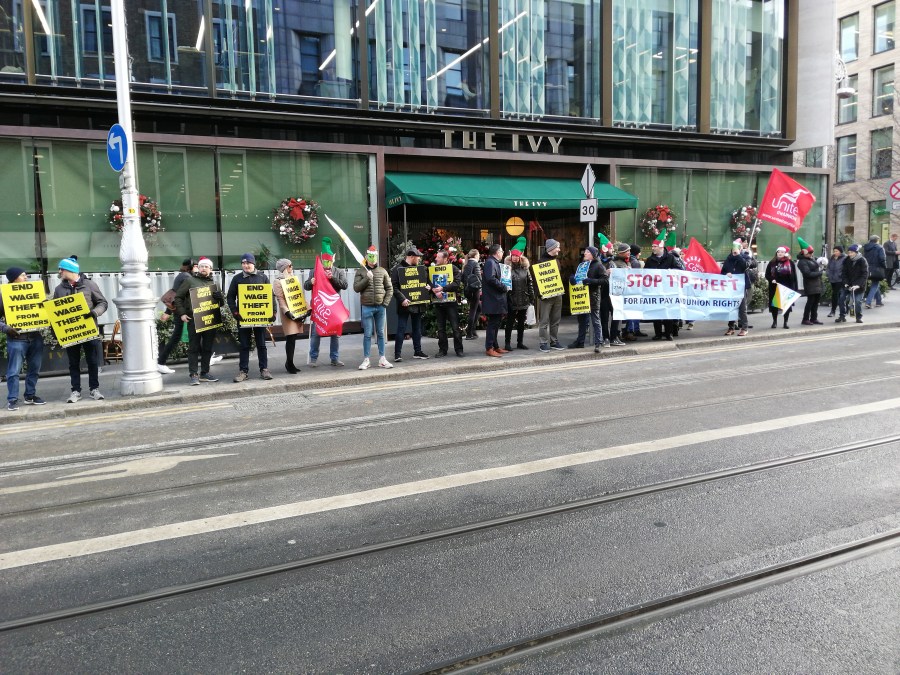
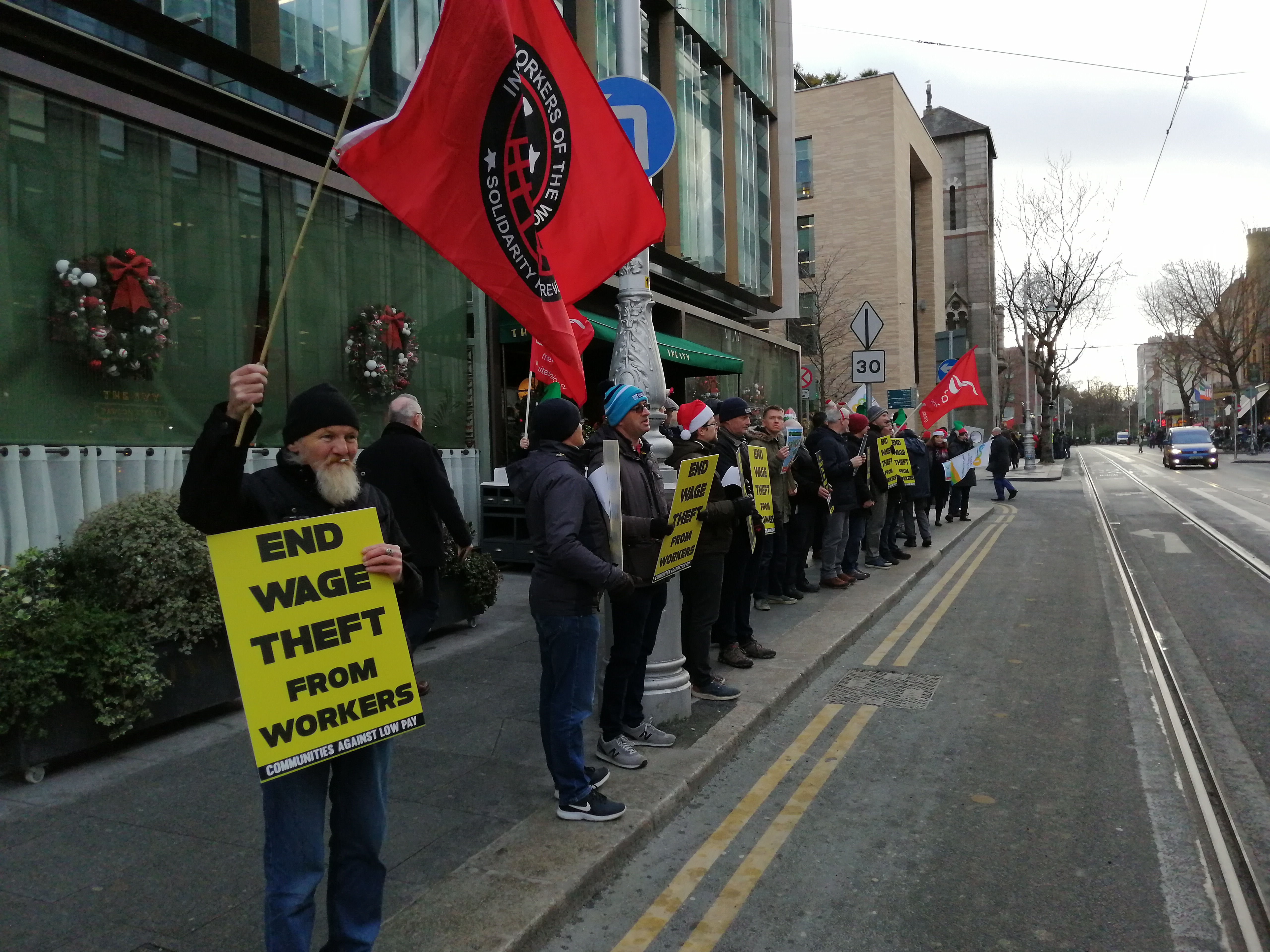
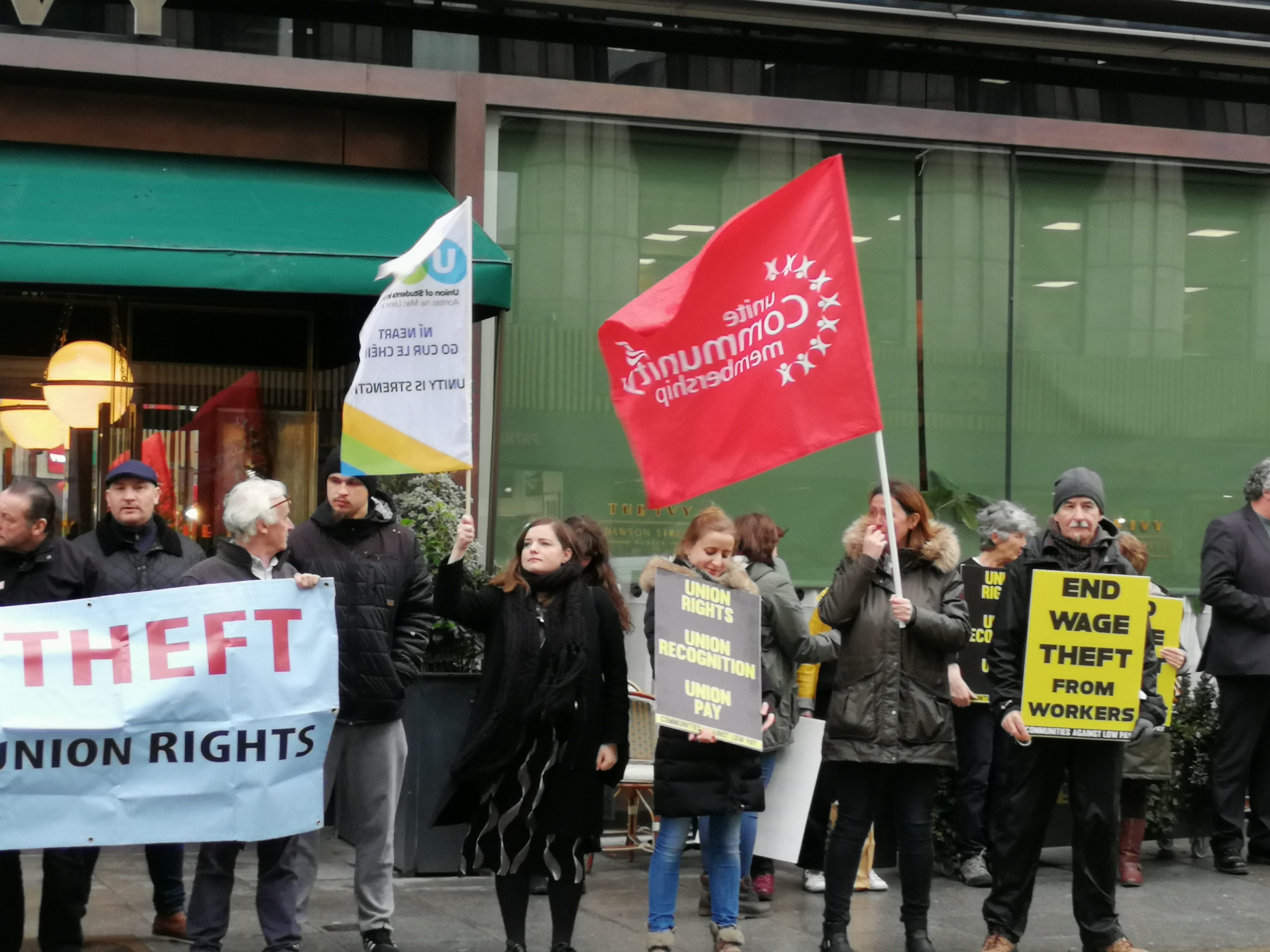
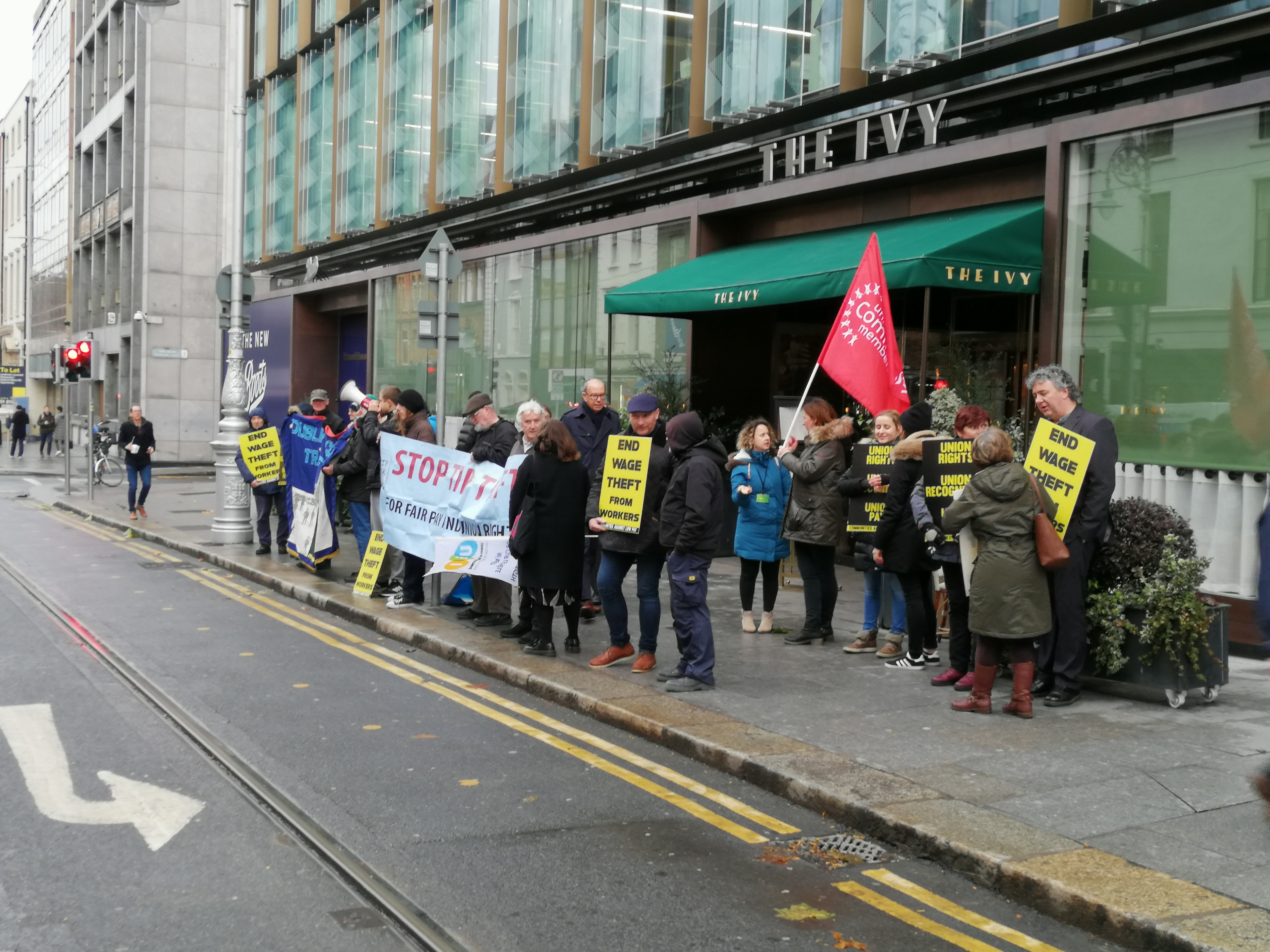
The Ivy Restaurant in Dawson Street Dublin, which steals part of its workers’ tips to make up their wages, continued to do so despite protests throughout 2019 and their only response to the campaigning has been to install and lower blinds whenever the protesters gather outside. Two members of staff were sacked for protesting the theft of tips (which customers assume are going to the staff) and trying to organise a trade union at their workplace.

View northward along Dawson St. in front of the Ivy Restaurant
(Photo: D.Breatnach)

          The Stop Tips Theft Campaign has been focusing on the Ivy not only in order to rectify the injustices there but also in order to clamp down on the practice in some other eateries and to prevent it spreading.

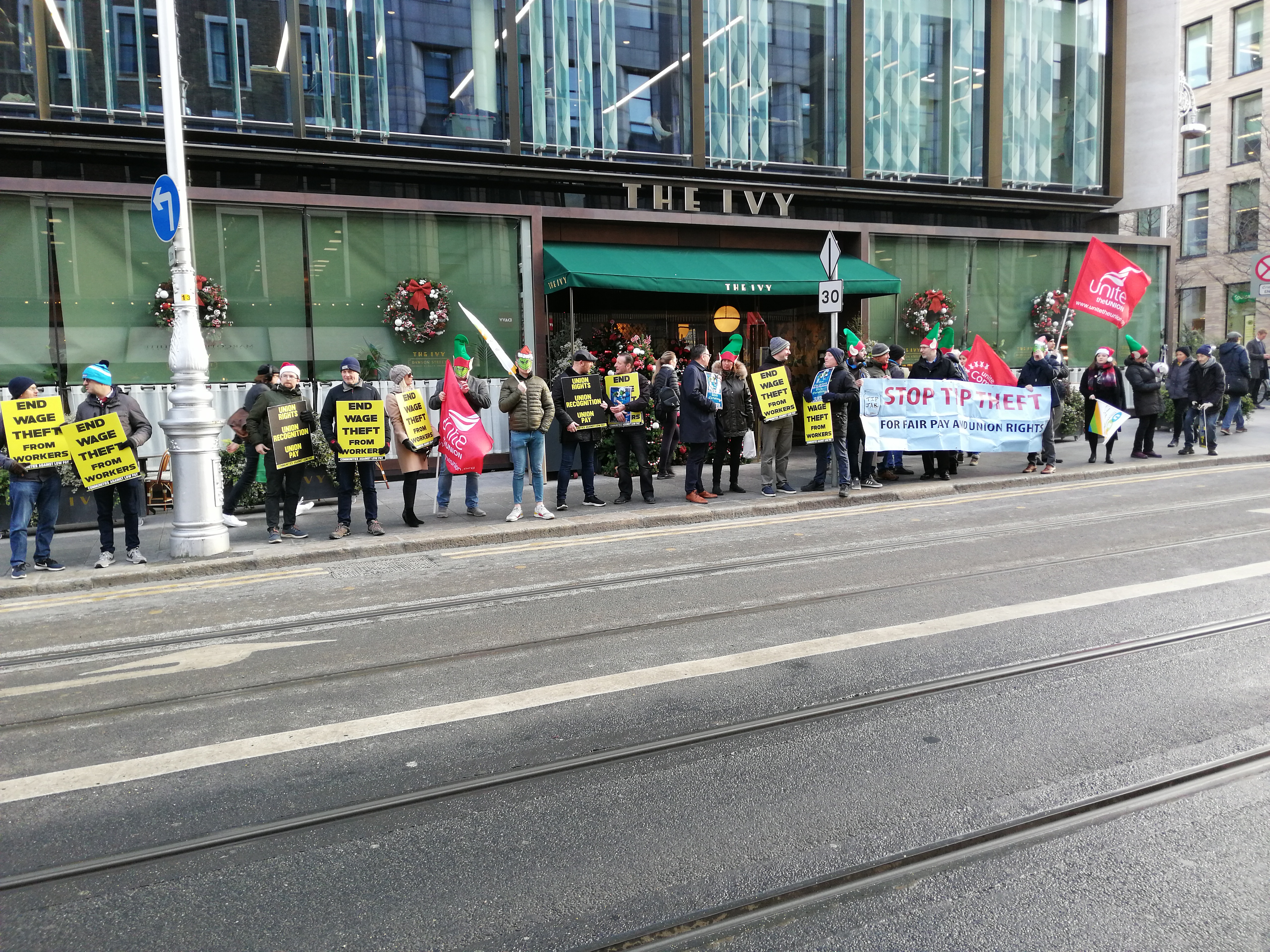
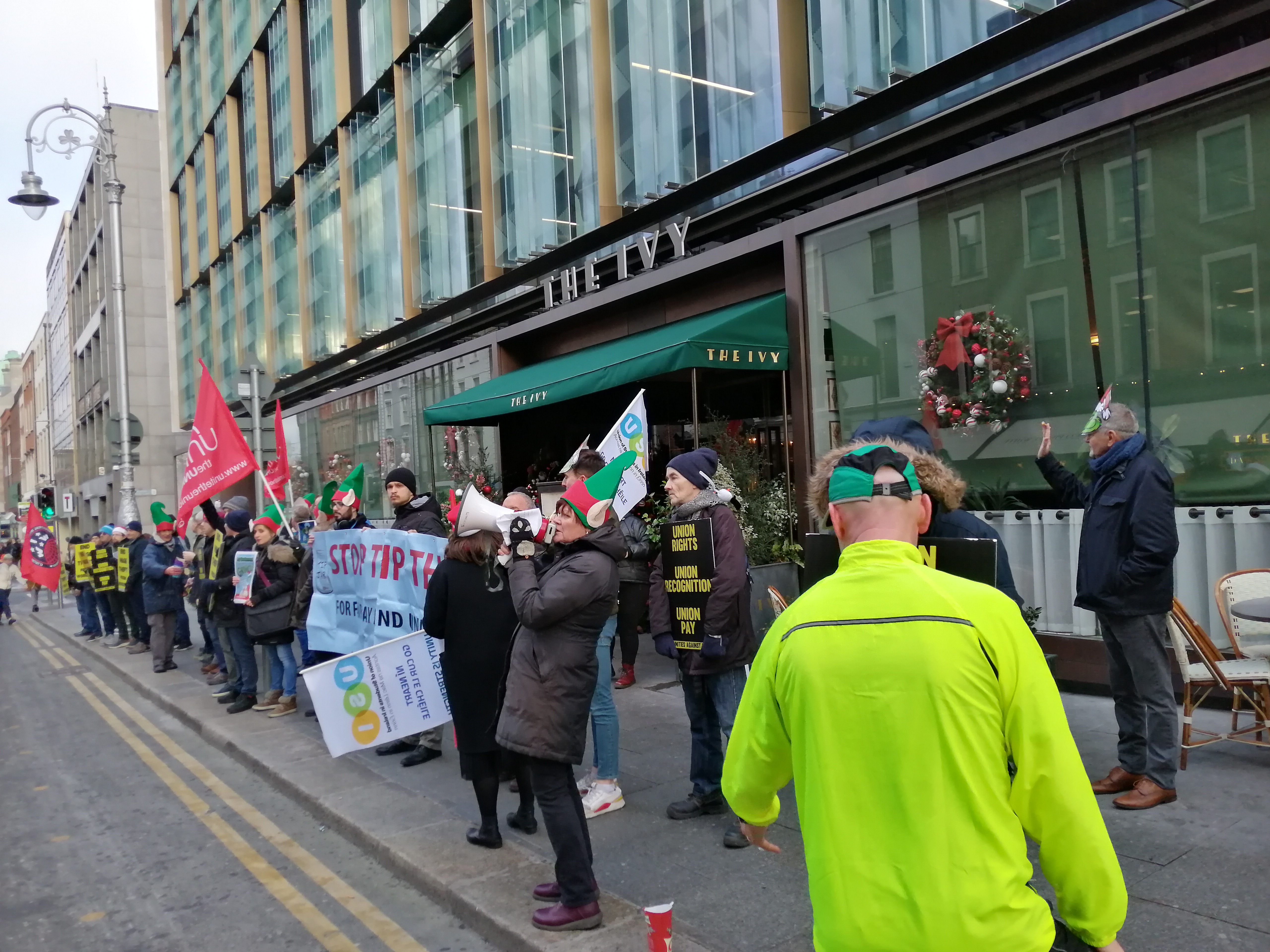
On 17th December 2019, the campaigners again picketed the restaurant for the last time for 2019, mixing serious calls for justice with songs with adapted lyrics and many wearing Christmas regalia.

It is scandalous that tips are being taken from these workers in what is now called the “hospitality sector”, who tend to the least-union-organised and also the worst paid and treated – which is exactly why the Ivy owners and management think they can get away with this.

(Photo: D.Breatnach)

End.

Joan Collins TD, a regular at these protests, with megaphone.
(Photo: D.Breatnach)


FURTHER INFORMATION:

https://www.facebook.com/SupporttheIvyWorkers.ie/


POWERFUL PROTEST AGAINST VIOLENCE AGAINST WOMEN

Diarmuid Breatnach

(Reading time: 1 minute; watching time: 3 minutes per video)


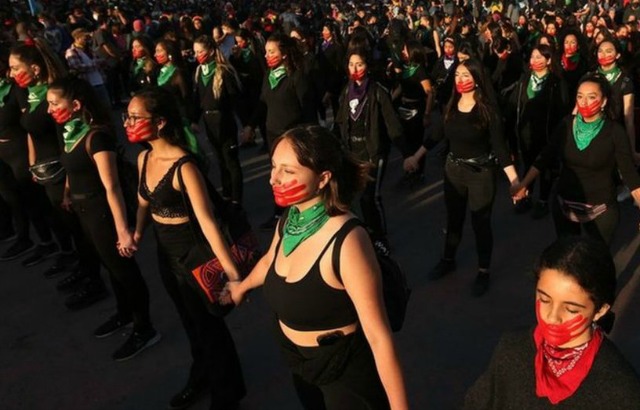
A choreographed protest against violence against women is sweeping the world.  It was first seen on International Day Against Violence Against Women, 27th November in the centre of Santiago, the capital city of Chile. Organised by feminist group La Tesis, it formed part of the popular resistance to the the Sebastián Piñera regime and its repression, since accusations of rape and other sexual violence against the repressive forces have, according to a number of human rights agencies, amounted to 15% of the total (at least 70 separate cases in the first month of protests).

Source: Internet

The lyrics chanted were, in translation:
Patriarchy is a judge who judges us for being born
and our punishment is the violence that you don’t see.
It’s femicide, impunity for my murderer,
it’s disappearance, it’s rape.
And it wasn’t my fault, where I was or how I was dressed.
The rapist is you.  The rapist is you.
It’s the police, the judges, the State, the President.
The oppressive State is a macho rapist.

This was an extremely powerful and effective protest and caught the imagination of others, with videos spread by social media and also appeals across borders by feminist networks.

No doubt the continuation of the protest will take place in other contexts but it remain a powerful and innovative call.

As with other protests in Chile, those congregating in the area were attacked by forces of the State soon afterwards — the same forces against which the protest had been organised.

end.

SOURCES:

Various but chiefly https://theconversation.com/the-rapist-is-you-why-a-viral-latin-american-feminist-anthem-spread-around-the-world-128488?

A COWARD’S CURSE

A poem by Scarecrow.

“No need for a blood sacrifice”, I hear you say…

“Unnecessary violence. Dead innocent children of

a badly thought-out revolution.

Home rule was on the way.” Really?

Defeated three times by those who made the promises …

What trust you must have in our oppressor!

An Englishman’s empty hollow word, and his deeds … full,

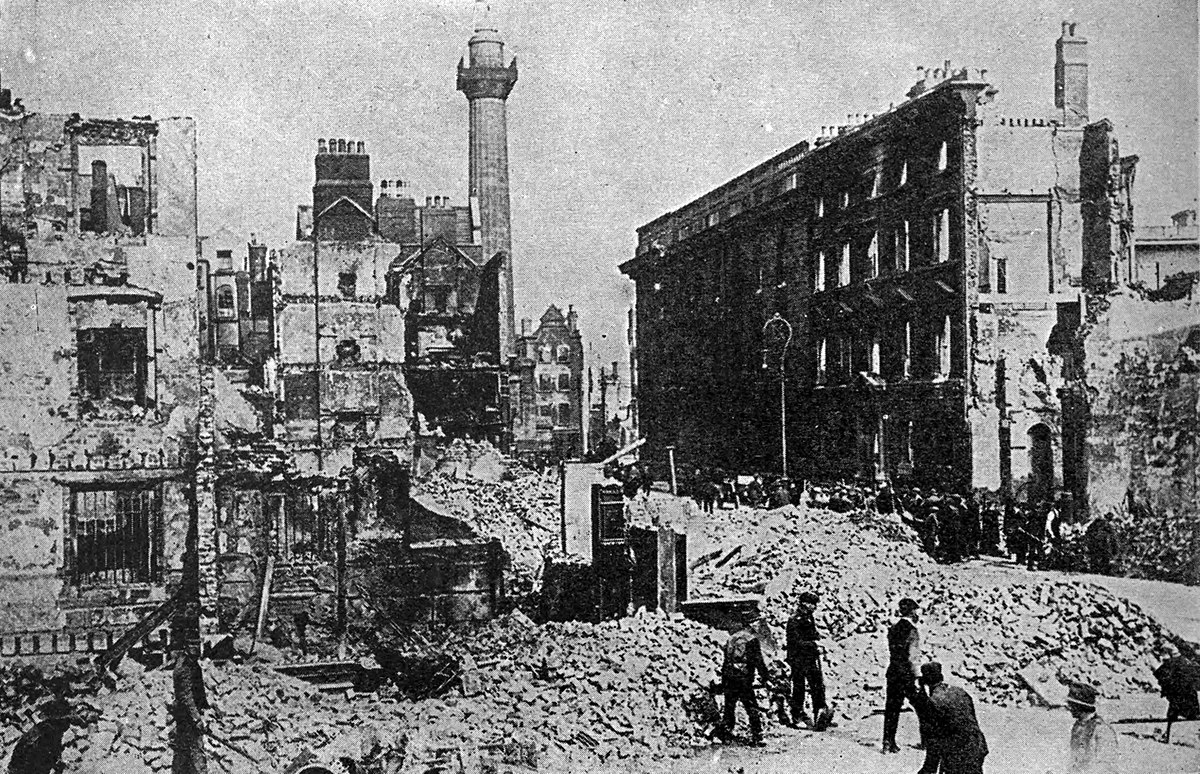
Dublin’s main street, then Sackville, now O’Connell, showing British artillery and fire damage 1916.
(Image sourced: Internet)

Ripe with Irish blood and you trust them.

As still, to-day, our North, a thousand years, lies wrapped in chains.


You, in your suit — and your middle class condescending education.

may sound profound in your leafy suburban period home:

Well fed, well watered, well waxed and shod.


You dare to preach: “No mandate”. For a revolution?

Plauseless re-writing of history

To suit an establishment bent on bending

To the power that was, and still does.

When did power ever concede willingly?

When did power ever concede to power?

When did power ever concede without blood?

Never, is the answer.


Yet pundits heap plaudits upon our enemy.

Praise at every turn. Entertain us with lies. Re-write history.

Ensure the next generations forget, and fall into

a slumber of cheap aristocratic swaddling.

Devoid of meaning, soothing unsettled questioning minds.

Endless obfuscation with mirrors and smoke to thwart newcomers

to this one truly remarkable moment of Irish life.

It was “doomed to fail”…. Did I hear you right?

So, don’t even try? Sit and wait, for the greediest hand

To throw crumbs at you? Give up, let the rot eat

Deeper into the psyche, burn into the soul.


Easy …. condemning, from your comfort, fools for company ….

Sweeping, arrogant, baseless statements …

by fat, lazy, unburdened donkeys …

Always the carrot, never the stick … and preach.

Fat, and warm, surrounded with servant-jesters,

Condemn those who have provided the foundation to build this new Nation.

From which you stand today and look, mealy-mouthed … across the water.

at the old empire for guidance on how to think.


Inhabitants of Dublin tenement house
(Image sourced: Internet)

Not a word from you about starvation. The death toll.

The mortality rate. The worst poverty on all this planet,

in this falling squalid Empire you speak of so lovingly.

Never the smell of fetid flesh, falling, rotting and falling

from living children even before they die … for want of a piece

of bread, from your mouth.

The squalid rancid overcrowding in crumbling Dublin.

As the poorest and lowest, coughing themselves to death.

100 souls in a single house, a toilet, a tap, no furniture, sleep on the floor.

Enough straw for only a cat …. in England’s ‘Second City’…

is four-star accommodation, by your records.


Festering dysentery, cholera, typhus and tuberculosis, every dying breath laboured.

The endless hungry crying of little children…the eternal ‘slumber song’ of the slum.

… And worse again, how horrible that sound, in the silence …. when even they give up…


”It’s safer in Flanders Fields, than in Dublin’s slums”

was your recruitment cry …

Where the strongest Irishmen bartered themselves to

serve their enemy, for a meal, and committed murder for the Crown.

Won your war for you….Won all your bloody wars for you…

Cost them their souls,

their dignity, sanity, their families, their heritage… Hunger, hunger, hunger…

Died in thousands .. Two of every Three Irishmen, in the English Army …

No condemnation from you for the sea of Irish blood spilt by the Crown?

For the Crown?

Soldiers of British Army, WW1, blinded by gas.
(Colour-enhanced image sourced: Internet)


“No need for blood sacrifice”?

What fool today preaches such compliance,

Washing centuries of Irish blood from England’s hands?

Blood: Imperial currency.

What ignorance today speaks such nonsense?

Those who condemn the oppressed. And exaltation for the oppressor?

The agitator, dictator, the sadist, savage, the sick cruel impostor.

Clothed in Ermine and Fur … Dripping in stolen gold and poached Diamonds.

Ignore the strains of ‘Our nearest neighbour’ to

strip all wealth, dignity, labour, song, dreams and aspiration,

from every beating Irish heart, no matter the cost, no matter the pain,

no matter the suffering. Empty the fields. Steal the food from the mouth

Of a hungry nation. Watch as millions starve, while you

… dine on our bounty.


It’s easy, stand back and act like you slew a giant —

when that giant is already dead

which took an empire to bring down.


What callous fool will today condemn those who sought to better their lot:

to stand tall, bear arms against their barbaric persecutors.?

To bring an end to their own subjugation and slavery.

End their tormentor’s grip. Their torturer’s whip.

End the deliberate impoverishment of their own lives ..

What fool would dare condemn any man or woman this right?

What person would judge guilty, this father, mother son or daughter …

who sought a better life for all, at the risk of losing his own?


I’ll tell you:

A coward.

The kind of man who licks the boot that kicks him.

Kisses the foot on his neck.

A man with no blood in his veins, or heart beating in his chest.

A man who thinks that power comes from the Throne and not his own people.

A man who would sacrifice all for a clap on the back from a gloved hand.

Or kiss, on bended knee, a stolen ring.

A compromised man, a weak crawling man.

A man without empathy for his own people.

A man who would see his own suffer, if he would gain

just a little affection from his oppressor ….

A traitor.


Scarecrow May/2016.

DUBLIN COUNTER-RALLY OUTNUMBERS RACISTS AND FASCISTS

Diarmuid Breatnach

On what was an extremely cold day, faith groups joined with migrants and community groups, Irish Republicans, socialists, communists and anarchists to oppose a mobilisation by racists and fascists outside Leinster House, which houses the Oireachtas, the Irish Parliament. There were a couple of moments of surges towards the right-wingers but these were contained without arrests.

          The anti-racist demonstrators responded to a call for the counter-rally and occupied the space from 12.00 noon on 14th December 2019, which left the racists and fascists having to face them from the other side of Kildare Street, at the junction with Molesworth Street but, in any case, they were outnumbered at about ten to one by the anti-racists and anti-fascists. The call came from SARF (Solidarity Alliance against Racism and Fascism), Islamic Foundation of Ireland, United Against Racism and Irish Network Against Racism (INAR).

The two opposing groups facing one another seen from the northern end of Kildare Street. The anti-fascists are to the left of photo.
(Photo: D.Breatnach)

“FREE SPEECH”

          The right-wing group had called for a rally to protest about the legislation proposed by the party in Government, Fine Gael, against “hate speech”. Ironically, Fine Gael are themselves a right-wing party which was formed in part out of the 1930s Irish fascist organisation, known colloquially as “the Blueshirts” (a name by which Fine Gael are known to this day by many). Earlier this year, Gemma O’ Doherty’s Youtube account was suspended and then terminated by Google because of its anti-migrant content, which gave the racists another issue: censorship of “free speech”.

Historically fascists, when their movement is weak, have often mobilised under the banner of “freedom of speech”. This has meant not only freedom to speak out against the government in power (which many anti-fascists would also wish for) but also the freedom to demonise targeted social, ethnic and religious groups and to call for their restriction, expulsion, jailing — or even death. Immediately upon gaining power, fascists restrict the freedom of speech of all others: not only of the social, ethnic and religious groups they targeted but also of their critics, the political opposition and trade unions. In this of course they are not so different from some socialist, communist or Irish Republican groups that rail against suppression and censorship only subsequently to silence criticism within their own ranks by threats, expulsions and censorship in the media they control. The point however is not to be fooled by the “free speech” demands of fascists and racists.

Section of the anti-racist mobilisation seen from a facing northward position. Beyond the irish Tricolour in the foreground, the Catalan estelada may be seen in the background, also Anarchist and Communist flags.
(Photo: D.Breatnach)

All the same, this does not mean that we should support the proposed Fine Gael legislation either. “Anti-Hate Speech” legislation elsewhere was passed in capitalist states under the guise of protection of vulnerable minorities but then at times used for the protection of capitalists, royalty, government ministers and the police. If racist or homophobic incitement is the supposed target, why not specify that? Is hate itself necessarily a bad thing, if the hated object is racism, state suppression, exploitation?

Section of antifascist rally (left of photo) and most of racist rally (right) seen from facing southward position. Those wearing pink hi-viz vests are stewards.
(Photo: D.Breatnach)

A BROAD RIGHT-WING, RACIST COALITION SHELTERING FASCISTS

          The origin of this right-wing coalition seems to have coalesced around former anti-corruption journalist Gemma Doherty who, some time subsequent to being fired by her newspaper after she exposed some aspects of the financial dealings of the paper’s owner, apparently underwent a transformation into a rabid anti-immigration racist. People opposed to legislation legalising gay marriage and permitting greater access to abortion gathered around her, as did others against the State’s problematic child and family agency TUSLA and some others. Accordingly it is a broad but small, generally right-wing movement of many who feel a sense of their values being ignored or undermined. How disparate at times can be judged by their demonstration at the Department of Justice building a little over a month ago, when among their signage was a banner attacking TUSLA and abuses by the Catholic Church, while a woman among their number shook a set of rosary beads at the counter-demonstration!

Viewed from near the southern end of the crowds, the right-wingers across the street to the left of photo, anti-racists closer in foreground.
(Photo: D.Breatnach)

The confusion was illustrated yesterday too when a woman among the right-wingers could be seen flying an estelada, a flag of Catalan independentists. From a number of people from among the counter-demonstrators who spoke to her, including Catalans and other people from the Spanish state, it appears that she equated the demonstration with demanding free speech, which she rightly stated was being denied by the Spanish state to many, including Catalan independentists.

Such groups are often believers in bizarre conspiracies (nor are they alone in that) and current among some of them is a belief that the EU plans to replace Irish people with migrants. For that reason the EU, which many Irish Republicans and socialists also oppose for very different reasons, is one of the targets of this right-wing coalition.

Organised fascists, who are currently a tiny group in the territory of the Irish state (but much larger, in the shape of Loyalists, in the British colony in Ireland, the Six Counties) find themselves generally isolated in society within the Irish state and no doubt threatened too. Therefore they try to infiltrate broader anti-government groups, as they did with a brief emergence of an Irish “Yellow Vest” movement, mostly in Dublin (see https://rebelbreeze.wordpress.com/2019/02/16/irish-yellow-vests-and-questions/) – in which they do not reveal their fascist project but present themselves as being against the Government, against corruption, for remedy of homelessness and as Irish patriots. And of course for free speech.

Nor are organised fascists the only opportunists, as a small number of politicians seeking election (or reelection) have been known to whip up fear of migrants and racist sentiment against Irish Travellers (originally a nomadic group). These offenders very recently have included an Independent TD (parliamentary delegate) from Galway and a Fine Gael candidate seeking election.

At some point of course, if they intend to come to power in society, fascists need to reveal some of their agenda but before they can do that they need to train some of their stormtroopers, public speakers and organisers and they need to command the street, at least in some areas. That was the reason for the 1930s rallies and attempted march on Dublin of the Blueshirts in Ireland, Mussolini’s Blackshirts March on Rome, the rallies and street-fighting of the Brownshirts in Germany and Moseley’s Blackshirts’ failed attempt to penetrate London’s East End. In the Spanish and Portuguese states, the fascists needed a military coup to aid them and, in the former case, the logistical and personnel assistance of the already-fascist states of Germany and Italy (a military coup was feared by the young Fianna Fáil government in 1930s Ireland too). In 2016, the need for a street presence was the reason for the attempted Dublin city centre launch of the European islamophobic organisation Pegida, which was defeated by mass mobilisation and physical opposition (for which some Irish Republicans are still being processed through the Irish courts).

Although Gemma O’Doherty and her supporters had been confronted before in Ireland, yesterday’s was the first large mobilisation against their racist anti-immigration message and it vastly outnumbered that of the racists.

Another view of both sides, mostly the anti-racists, from facing southward position.
(Photo: D.Breatnach)

POLICE AND STEWARDS SAVE RACISTS AND FASCISTS FROM A TROUNCING

          Generally the two opposing forces seemed content with shouting and chanting across the street at one another, apart from the occasional anti-fascist wandering over to verbally confront the opposition. The anti-racists who in the opinion of the police got too close to the racists were sent back by the police but one of the antifascists had to approach the Gardaí (Irish state police) to remove one of the racists who had embedded himself among the anti-fascists. This seemed dangerously like asking the police to deal with the fascists whereas police bias at least is generally against the antifascists. Surely the crowd could have easily expelled him (at least) unaided?

As has been the custom with them and their intention to appear patriotic, the racists and fascists were displaying a host of Irish tricolours but this time there were a number of these also among the antifascists, along with a number of green-and-gold Starry Plough flags, as well as some communist and anarchist flags.

However, when a small group among the right-wingers pulled out the blue-and-white version of the Starry Plough, flag of the Republican Congress of the 1930s, along with the Sunburst flag of the Fianna Éireann (Republican youth group of past generations) and began waving them, a section of Irish Republicans surged forward in outrage and for a few moments the stewards and the Gardaí struggled to contain them.

Those who had brandished those particular flags were clearly delighted with the reaction they had provoked. Since at previous demonstrations of the racists and fascists they had never displayed those particular flags and, since they only made an appearance later in their rally yesterday, it seems clear that they had displayed them solely for the purpose of provocation.

A little later there was another surge from a different point which was again contained.

It was understandable, given the broad composition of the anti-racist rally, that the organisers would wish to prevent physical fighting breaking out from among their ranks on this occasion. However, there is a danger of this kind of stewarding becoming collusion with the State – or at the very least being seen to be so by sections of anti-fascists.

MIGRANTS AND IRELAND

          The bubble expansion of the Irish economy for an unexpectedly long period from the late 1980s to the beginning of this century, provided employment opportunities which could not be filled by the low level of the Irish population (a result of two centuries of heavy migration from Ireland to other countries). These employment opportunities, mostly in construction and services, tended to be availed of by migrants, mostly from European states with declining or stagnant economies but also by some from states in Africa, Latin America, the Middle East and China.

Although Ireland had seen foreign colonisation from Britain for centuries, it had only experienced small emigration from elsewhere, which also tended to restricted to certain periods, for example Huguenots at the end of the 17th Century and Italians in two waves, following each World War. The change in population composition in some areas at the end of the 20th Century was startling and difficult for some to which to accustom themselves (though welcomed by others). When combined with the subsequent bursting of the Irish economic bubble and cuts in public services, severe housing crisis and a health service failing spectacularly, migrants became a handy scapegoat for some people and a useful target for fascists.

Some of the migrant communities in Ireland were represented among the anti-fascists but apart from a sprinkling of black faces, were not so easy to identify. A Catalan estelada (yes, another one) revealed a small group of Catalans representing CDR Dublin and a representative of Asamblea Nacional de Catalunya Ireland also spoke from the PA system earlier in the day. Some Spanish were in evidence and a Basque Antifascist flag could also be seen but undoubtedly the largest migrant antifascist contingent was Italian. Many of these were supporters of the Sardine movement against Italian right-wing populist politician Salvini and which welcomes migrants. Perhaps a hundred strong, they sang antifascist songs, including of course the Bella Ciao and made speeches in Italian and in English.

Section of the Italian ‘Sardine’ movement supporters.
(Photo: D.Breatnach)

THE FUTURE?

          As increasingly around the world governments become more right-wing and fascist organisations mobilise, anti-fascists need to organise too. The thesis that fascism is capitalism in crisis seems well-proven which means that antifascists should not nor cannot rely on the forces of the capitalist State to prevent the growth of fascism or to protect the social and ethnic groups targeted by fascists and racists.

Although the Catholic Church in Ireland no longer has the power it had in the Irish state since its creation in the 1920s and the fascists cannot rely on its heavy backing as in the 1930s, there is no room for complacency in Ireland or anywhere else.

Mobilisation against the fascists and racists to deny them public spaces from which to recruit and to organise is essential. And a broad anti-fascist and ant-racist unity in action needs to be built, similar to what was seen yesterday although within that broad movement there also needs to be struggle against liberal ideology. But one cannot combat sickness purely by countering infection – care needs to be given to cultivation of a healthy body too. The Ireland body is sick: sick from cultural and physical colonialism, sick from territorial partition, from racist Loyalism and native gombeenism, from underdeveloped economy and plundered resources, from housing and health crises. While these remain unresolved we can expect at least sporadic outbreaks of fascist and racist infection and quite possibly an epidemic. It is not only in the struggle against fascism that unity is needed.

end

POSTSCRIPT

          From information either not available to me or unconfirmed at the time, the blue-and-white Starry Plough which had been used to provoke anti-fascists was actually seized by the latter in the scrimmage.  There was apparently another, which was allegedly seized by Republicans after the right-wingers had left for which two men were arrested and handcuffed.

According to reports, one of the right-wing women attempted to kick one of the arrested men while he was handcuffed and she was also arrested.

“IT WAS FUN WHILE IT LASTED”

Diarmuid Breatnach

The indicator climbed the temperature gauges and the ice caps melted. The seas rose and in many of the more developed societies, the rich and better-off had to relocate from scenic coast sites further inland, having to move again as the seas moved higher still but some, the more cautious and far-seeing among them (not a trait in great supply among their kind), transferred to mountains.

Melting Artic ice threatens the Polar Bear but also raises sea level around the world.
(Photo source: Internet)

The prices of property rose and the construction industry had another boom, which was great for those who had directorships or investments in construction companies or materials. Or in banks, which gave out interest loans like they would be out of fashion the following year (which they well might, some said with a laugh – but a hollow one).

Far away from the Artic, a flooded village, probably in the Indian Subcontinent.
(Photo source: Internet)

In the less-developed parts of the world, all the fishing communities had to move further inland and fishing was harder, with lines and nets getting entangled or shredded on the branches of trees and shrubs that were now submerged. Besides, the waters were polluted with flooded sewers, drains, latrines, dumps ….. and plastic.

Some of the nuclear power stations had been built near coasts and they were flooded. Some had exploded, causing unimaginable disaster. Well, what used to be unimaginable. Vast areas of sea, including all that lived in them, from algae and plankton to the great whales, suffered radioactive contamination.

Wind and wave turbines were swamped too and wrecked by storms. Oh, the storms! The changing climate brought great heat to formerly temperate and cold climes while those that had been hotter grew sometimes cold, sometimes even hotter. Those changes created cyclones, hurricanes, great storms that destroyed so many constructions of all types.

Overall, the greatest impact of all this on the human population of the planet was a huge loss of generated energy. Oil and gas fields began to run out and remaining extraction installations to cease working as they were wrecked by storms, flooded or destroyed by climate protesters.

Power station polluting the air. But without power ….!
(Photo source: Internet)

Electrical energy became scarce. Entertainment companies, which would normally have done well in times of disaster, went bust since fewer people could receive their programs. The Internet was taken over by governments for civil defence. All kinds of sophisticated equipment could no longer work. Radio replaced TV in most homes and mobile phones went out of fashion. Bicycles soon outsold cars.

Human-powered friction generators of many types began to be produced. Batteries of all kinds were in great demand, especially the rechargeable ones. Solar panels reached astronomical prices on the black market, the only place they were available. People were killed over them: sometimes as gangs fought for control over a diminishing supply, sometimes as someone was sold a dud and went looking for the seller for a refund.

Now, a strange thing happened – they began to run out of oil-based material. Hard plastic was still around but leak-proof and waterproof polythene bags were hard to find. So too with oil-based material used in clothing, such as acrylic. Bark could be used for clothing but there weren’t enough trees to keep up with the demand. There was less wool and leather as the sheep and cattle herds diminished. After awhile, that was less of a problem as there were less humans to clothe anyway.

(Photo source: Internet)

Employees of State companies and departments considered essential – by their employers – lived in walled communities protected by watchtowers and armed guards. And the rich lived in there too. Being rich meant a lot less than it did in the good old days but still a lot more than most people had now: meals every day, hot and potable cold water in good supply, good shelter, access to waste disposal, available medical supplies and recreational drugs including alcohol, armed protection and transport for self and small family circle. Security workers of all kinds became highly valued and former gang members formed themselves into security companies. Some police departments became private security firms and so also did some military. Although they didn’t talk about it most of the time, the rich lived in fear that their security compounds, walled villages and high-rise fortresses would be overrun. Or that their security services would stage a takeover, which is why they generally employed two companies at the same time and kept them in competition with one another.

Another fear was that there would be no replenishing of their huge stocks of food and goods when they were all used up, which was going to happen someday. Not enough production was still going on and what there was tended to be exchanged in barter, rather than coin or scrip.

Dainfern, northern suburbs of Johannesburg, South Africa, has a four-metre electrified fence with cameras and vibration sensors protecting more than 1,200 houses. Photograph: Jeffrey Barbee

The poor lived in fear too and not just of starvation or of getting sick without access to medical services but of gangs taking what little they had left or of abductions of self or of family members to supply services of all kinds to gang members. Of wars between gangs. Of being in the wrong gang area when a rival gang staged a takeover.

Huge sections of the human population were wiped out, through loss of essential services, starvation, exposure, dehydration, fire, heat, cold, drowning, epidemics, resource wars with other states or internally. Along with them went pets that did not succeed in becoming feral and cattle, sheep and horses. The pigs went feral pretty successfully, overall as did some chickens. Many, many specialised species or in fragile ecosystems became extinct. Over time, some new species began to evolve.

It is said, though the story might be apocryphal (a word perhaps suitable for an apocalypse), that in one of the compounds of the rich overrun by a gang or insurrectionary group, depending on which version one hears, a former petroleum magnate put on trial was asked why he and his kind had not stopped destroying the climate, even after it became clear to even the most stupid politicians (which can reach a very high level of stupidity) what they were doing to the world.

It is said he related the fable of the frog and the scorpion.

In case you don’t know the story, it goes like this: A scorpion wants to cross a river but knows he can’t swim well enough to do that, so he goes in search of a frog. When he finds him – the frog of course keeping his distance – he asks him to take him on his back across the river. The frog replies that as soon as lets him on his back, the scorpion will sting him and the frog is not ready to die yet.

The scorpion pleads with the frog, who sees that the scorpion really means it. And it would be very handy for a frog to have a dangerous animal like a scorpion in his debt. So he agrees.

The frog hops down to the shallow water and the scorpion gets on the frog’s back. The frog tenses in fear but nothing happens. The frog starts to swim, feeling more and more relaxed. Halfway across the river, the scorpion stings the frog. As the poison courses through his body, the frog speaks to the scorpion: “Why did you do that? Not only did you break your promise and kill me but you will die now too, you will drown.”

“I know,” says the scorpion. “I just couldn’t help it. It’s in my nature.”

It is also said that in another compound overrun by hostile forces, as a couple of drug company executives were being taken out to be shot for crimes against humanity, including climate destruction, one of them turned to the other with a smile.

“Cheer up”, she said, “It was fun while it lasted.”

end.

COLOUR, NOT CLUTTER – Grafton Street flower sellers

Diarmuid Breatnach

(Reading time: 4 minutes)


We bring colour to Grafton Street, not ‘clutter’!” was the response of street traders in Grafton Street to a request from multinational property company Hines to Dublin City Council to remove the street trading stalls away from Grafton Street, to which Hines allege they bring “clutter”. The street traders also pointed out that they and their predecessors had been on that street much longer than Hines.

Catherine Claffey, a Grafton Street flower seller, from whom I took the “Colour, not ‘clutter'” quotation. (Photo: D.Breatnach)

          Although the request to Dublin City Council had been made in August, it only hit the news earlier this week and brought a swift response of outrage from the street traders, some public representatives and ordinary members of the public. Broadcaster Joe Duffy joined the chorus and also referred to the difficulties experienced by the street traders on Moore Street with an unhelpful DCC Management.

Hines PR people soon found themselves removing their feet from their mouths and eating not only their words in public but very humble pie.

Dublin architecture, history and soul is under constant attack by property speculators, both native and foreign, to whom everything is a potential ‘development site’ and a possible source of profit – and without the production of a single commodity.

Victoria Dempsey, Grafton Street flower-seller, hugs a friend.
(Photo: D.Breatnach)

GRAFTON STREET THEN AND NOW

          Dublin’s Grafton Street was a premier Dublin residential street as the upper classes deserted the north for the south side of Liffey river in the late 18th and early 19th Centuries. Perhaps that was the spur for the street becoming known for prostitution in the period.  According to Wikipedia: “In the 1870s, 1,500 prostitutes were reputed to work in the street.”

When the O’Connell Bridge (then the Carlisle Bridge) was completed in 1795 (just in time to hang United Irishmen from it), it led not only to the doubling of the length of Drogheda Street, which then became Sackville Street but also to much traffic backwards and forwards across the river to both sides of the city centre. Grafton Street soon became a premier shopping street with many Irish-based companies selling fresh, preserved and tinned food, higher end male and female clothing, jewelry and ‘exotic’ imports such as coffee through Bewley’s Oriental Café (1927). This state of affairs persisted into the late 1960s but in the decades since then however, the profile of the street has changed to feature mostly British high street outlets and a Mac Donalds fast food place.

For two centuries there have been street traders selling a variety of products on the street, of which the flower-sellers, newspaper stand and a hat and jewelry stall are all that remains.

The street was very narrow to accommodate both pedestrian and vehicle traffic both sides of the street and pedestrianisation of Grafton Street began in 1971, however at an extremely pedestrian rate (pun intended), not being completed until 1983 and it was paved the following year, repaved in 1988 and then partially again more recently. The pedestrianisation facilitated performance by buskers (street musicians) and music and song of high quality may be heard any day in different genres from Irish traditional to world rock and classical. Perhaps they would have been the next to be accused of “clutter”?

Flower Sellers, Grafton Street by Norman Teeling.
(Image sourced: Internet)

The Dice Man (Thom McGinty 1952–1995) regularly carried out his performances there too. Dublin world-famous musician Phil Lynott (1949-1986) had a statue commemorating him placed in Harry Street, just off the north end of Grafton Street in 2005 while the statue of fictional sea-food street trader Molly Malone was moved from the north end of Grafton Street to a less crowded space in Suffolk Street in 2014.

The street features in much of Irish literature and some song but also in images: two are particularly striking: IRA men walking up a wet Grafton Street during the Civil War and Flower Sellers, Grafton Street by impressionist Irish artist (and musician) Norman Teeling (b. 1944). It was also the scene of the shooting dead by the IRA of a G-man, the political plain-clothes branch of the Dublin Metropolitan Police, in 1921.

Famous photograph of the IRA proceeding up a rainy Grafton Street in June 1922.

WE BRING COLOUR TO THE STREET, NOT ‘CLUTTER’

          Talking briefly to some street traders there on Wednesday about the threat to move them, one of them remarked: “We bring colour to Grafton Street, not ‘clutter’” and reiterated their declaration that they and their predecessors had been on that street long before Hines.

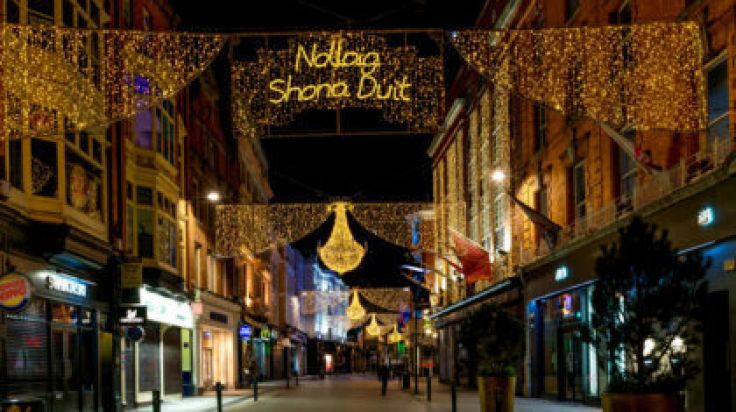
Another controversial recent initiative in Moore Street has been the changing of the traditional Irish-language Christmas lighting decoration and the ‘renaming’ of the street to “the Grafton Quarter”. Irish language comment on the new design? “Tá sé gránna!” Indeed. Sometimes it seems as though the poor property magnates can’t put a foot right.

Perhaps Hines had ideas of greater expansion, changing the street into a “quarter” which, as some Dublin City Councillors have pointed out, does not exist.

All that aside, doing away with Irish language Christmas lighting and wanting to get rid of flower-sellers doesn’t accord very well with Point Four of Hines’ own Guiding Principles: “Hines is committed to fostering an inclusive culture where diversity is respected and valued.” 

Another comment in Irish?  “Seafóid!”

end/ a chríoch

Irish language Christmas illumination now removed.
(Photo sourced: Internet)
The new Christmas lighting (Source image: extra.ie)

REFERENCES

https://www.98fm.com/news/grafton-street-flower-sellers-not-moving-927575?fbclid=IwAR0SX4Nn2Ujr1bOQjN9ao2tHt3lOz5C9nFTpqu4RvLX9C-PHKYF09I4rjxE

https://www.98fm.com/news/grafton-street-flower-sellers-not-moving-927575?fbclid=IwAR0SX4Nn2Ujr1bOQjN9ao2tHt3lOz5C9nFTpqu4RvLX9C-PHKYF09I4rjxE

https://www.hines.com/about

https://en.wikipedia.org/wiki/Grafton_Street

https://www.normanteeling.com/

https://www.irishtimes.com/news/consumer/pressure-increases-to-remove-grafton-quarter-christmas-lights-1.4083339


IVY RESTAURANT PULLS THE BLINDS ON THE TRUTH

Diarmuid Breatnach

(Reading time: 3 minutes)

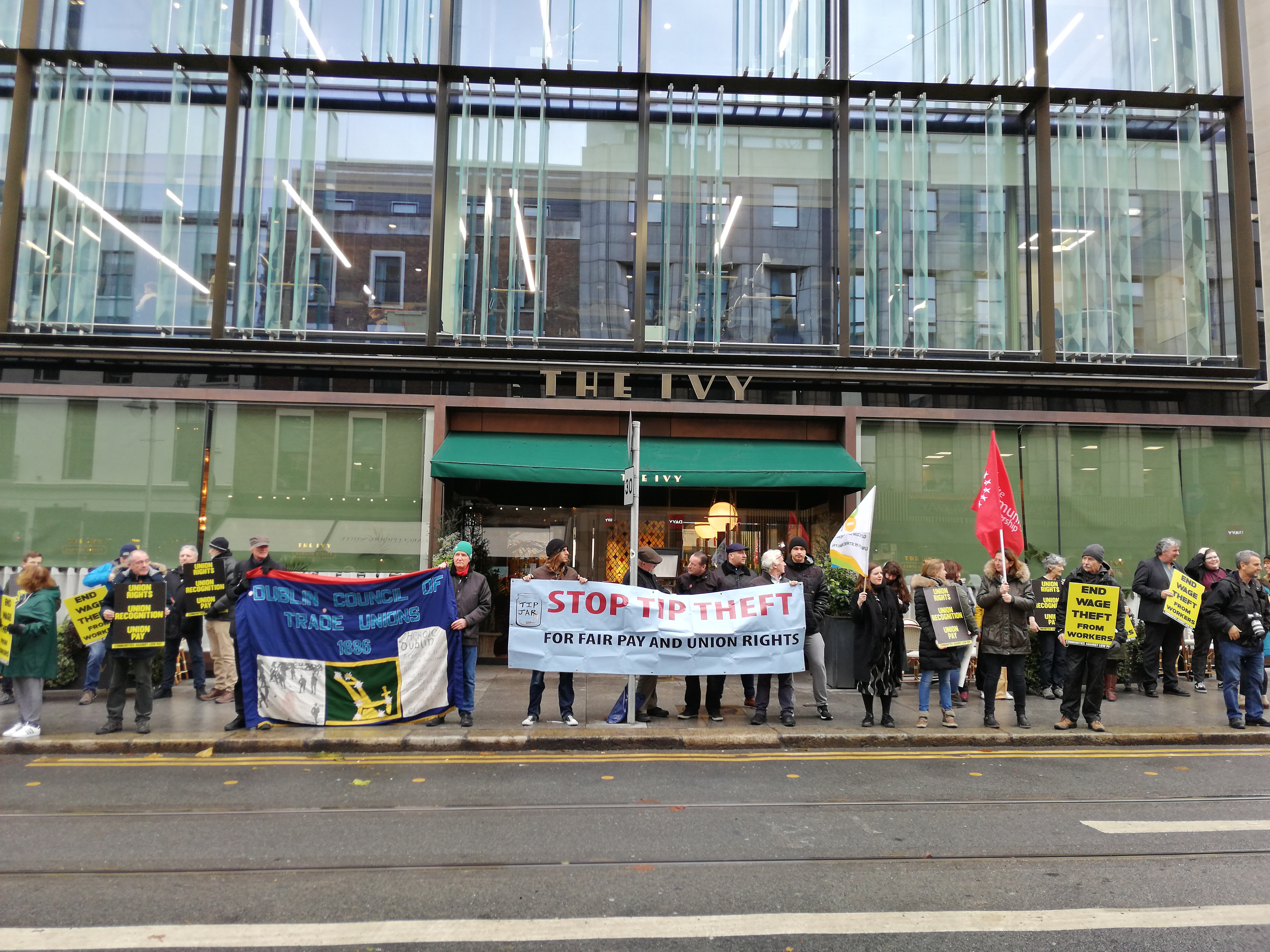
Section of the picketers showing Dublin Trades Council banner.
(Photo: D.Breatnach)

The Ivy Restaurant management in Dublin’s Dawson Street at one o’clock this afternoon ordered the blinds to be pulled down on the windows. This is their usual response when demonstrators arrive to picket their restaurant, as they did today. The Ivy restaurant is part of a profitable chain and in Dublin at least is using tips paid to staff by customers to help make up the staff’s wages. Bluntly, stealing tips that were paid for service by customers who assumed they were in addition to wages already received (which, as everyone knows, are low enough in the “hospitality” trade).

Some passing vehicles beeped in solidarity and many passers-by took photographs or video as the picketers lined up with placards and some banners and shouted:

Eat your steak, eat your chips, pay the staff their well-earned tips.”

Also: “Pay the workers what they’re due!”

Section of picketers
(Photo: D.Breatnach)

One observer enquired why the staff put up with it and did they have a union; he was informed that they had but two staff were sacked for organising the union and the remaining and replacement staff are frightened not only of losing their jobs but also of getting a bad reference for other work. Such staff are often migrants who are vulnerable, in need of work to buy food and pay rent and without a support network such as family in Ireland.

The sector has long been known as one of insecure work, few rights, low unionisation and low pay. However, the deduction of customers’ tips to incorporate them into staff wages seems a new low for this sector and the Ivy is by no means the only restaurant doing this. But here is where the battle has broken out and here it must be won, to encourage workers in this sector and to make it known to restaurant owners that this practice will not be tolerated.

The issue and the practice of the Ivy has been reported a number of times in the mainstream media and the solidarity protesters come every now and again, set up their placards, hand out leaflets to passers-by and shout their slogans. The Management draw the blinds. The picketers leave after about an hour (many to go back to work) and the blinds are lifted again. But the campaign has affected their business. And Unite the Union, which is supporting the sacked staff, is setting up a hospitality sector branch.

Section of picketers including both TDs (members of the Irish Parliament, the Dáil).
(Photo: D.Breatnach)

Today a number of elected public representatives were on the picket line, including Cieran Perry, Independent DC Councillor and Independent TDs Thomas Pringle and Joan Collins.

If you want to support the campaign you may wish to share their posts and find other ways to help through the Stop Tip Theft Facebook page at https://www.facebook.com/SupporttheIvyWorkers.ie/

end.

NULLIFYING FASCISM IN IRELAND

Diarmuid Breatnach

(Reading time10 mins)

As fascism begins again to raise its ugly head in Ireland, it is necessary for all its opponents, whether social-democrats, revolutionary socialists of various types or democrats, to consider effective means to restrain its growth and to nullify its influence upon the ordinary masses of Irish society. These masses are at this point generally hostile to fascism and to racism (a seed-bed of fascism) but that can change and in history, has changed before, not just in other lands but in Ireland too during the 1930s.

          Traditionally, the views on effective means of defeating fascism in western european society have varied between defeating their arguments, legislating against them or denying them any public space within which to grow. It might be useful to briefly examine the premise and experience of these different approaches in order to evaluate their efficacy.

DENYING FASCISM ANY PUBLIC SPACE

          Taking the last case above first, most active antifascists, whether Anarchist, Irish Republican, Communist or Socialist, proclaim the need to physically prevent fascists gathering in public spaces or on platforms. This approach puts these elements into direct confrontation with the forces of the State which see the methods of the Antifa as illegal, as subverting their own roles and, often enough at different times, as a threat to their own plans for repression of resistance to regimes of austerity. 1

In 1970s Britain, those who advocated such an approach, despite the fairly recent history of the War Against Fascism and the 1930s struggles in Britain, were in a small minority and seen, not just by social-democrats and liberals but also by most of the socialist and communist Left, as “ultra-leftists”, “adventurists” or just plain “hooligans and thugs”.

Attempt by Sir Oswald Mosely, leader of the British Union of Fascists (Blackshirts) to rebuild the fascist movement meets clear resistance in 1960s Manchester.
(Photo source: Internet)
Depiction of an earlier anti-fascist event, the Battle of Cable Street 1936, mainly against London Metropolitan Police escorting Blackshirts to Jewish settlement area in East London.
(Photo source: Internet)

A small English marxist-leninist party2, with its African, Asian and Latin American student connections, promoted the “no free speech for fascists” policy and managed, for awhile, to have the similar “no platform for fascists” policy adopted by the National Union of Students. Some revolutionary Communists, Socialists and Anarchists combined with some militant groups of the ethnic minorities targeted by the fascists to pursue this policy on the streets. The National Front and the British Movement found their marches, meetings, concerts3 and rallies attacked and they were eventually driven off the streets, with many sacrifices in the antifascist movement from the deaths of at least two antifascists4 to jail sentences, heavy fines and physical injuries.

In 2016, the islamophobic party Pegida was prevented by popular direct action from launching itself in Dublin. This approach does seem to have been successful in Britain, at least for decades, and in some other European areas, with ethnic and other minorities gaining a space in which to promote their culture and develop their politics. At the same time, it has to be acknowledge that many of the concerns of the ruling British elite had been successfully addressed or contained during the 1980s: restriction on the trade unions through industrial relations legislation, defeat of the National Union of Miners (1984-’85), of the printing unions at Wapping (1986-87), of the dockers through buy-outs and redundancies; repression of the Irish community through the operation of the Prevention of Terrorism (sic) Act 1974 and the jailing of nearly two score Irish people framed on bombing charges in five separate trials; increasing workers’ insecurity and dependence through large-scale change from being renter-occupiers to mortgage holders.

The sinking instead of launching of Pegida in Dublin, 2016.
Cartoon by D.Breatnach)

LEGISLATING AGAINST FASCISM

          Legislating against fascism in western european democracies has largely been imposed opportunistically, as with France, Spain and the UK, as the ruling elites faced up to war with states where fascism was already dominant. In the Spanish state it proved ineffective and heroic popular resistance was ferociously overcome by a military-fascist uprising backed by the resources of two fascist states, while the ‘democracies’ stood by or imposed a blockade on relief for the beleaguered Republic. In France, any measures were nullified by the German Nazi invasion. In the UK, the measures proved effective due to the wartime posture of the ruling elites, facing a possible invasion and needing a mobilisation of the entire population to resist that possibility5. In the Irish state, where a new quasi-Republican government was facing the real possibility of a fascist coup aided by elements in the military, some banning measures were effective but these were preceded and assisted by popular mobilisation and direct action against the Blueshirts.

After the defeat of fascism by war and popular resistance, antifascist legislation was imposed on the defeated fascist states by victorious insurgents or by conquering forces. But today, fascism is on the rise in all those states that have been the subject of antifascist legislation. In the Spanish state, where fascism was victorious and remained so for three decades, fascists and their crimes were actually protected and, despite the democratic veneer of the “Transition”, no action was taken against fascists openly parading, displaying fascist paraphernalia and honouring fascist leaders such as General Franco and Primo Rivera (founder of the fascist Falange).

Liberal, social-democratic and even some socialist elements call for the State to bring in and to enforce legislation against “hate speech”. However, apart from being an insufficient answer, the label of “hate speech” has been used in the Spanish state to penalise denunciation of the Spanish State and its police forces.

DEFEATING THE ARGUMENTS OF FASCISM

          Defeating the arguments of fascism, such as racist propaganda against ethnic minorities and for special rights for one section of the population, conservative and homophobic ideology, arguments in favour of male superiority, are argued to be necessary to defeat fascism since legal repression and active suppression can only drive those forces temporarily underground, from where sooner or later, they will emerge again.

Not quite the same but a similar non-State and pacific line is that the fascists need to be over-awed by the mobilisation of their opponents and their pariah status demonstrated to a passive public by the mass of anti-fascist numbers.

In the 1970s and 1980s in Britain, this was the dominant line among anti-fascists, among social-democrats such as the Labour Party, liberals, the Communist Party of Great Britain and the Trotskyists of the Workers’ Revolutionary Party and of the Socialist Workers’ Party6. Their first tactic upon hearing of a plan for a fascist mobilisation was to build an antifascist mobilisation near the same point, to show large numbers opposing and hopefully outnumbering the fascists.

However, the fascists were already attacking ethnic minorities and other groups and hanging around oppositional mobilisations to pick off individuals or small groups. They had also attacked a number of antifascist public meetings with clubs and bottles and even a gas spray into eyes. Left-wing paper sellers were targeted on the street. Irish solidarity and other solidarity marches and meetings were also attacked and though certainly the Irish proved able to defend themselves, during the scuffles, the police were able to find an excuse to arrest the Irish marchers.

The leaders of the peaceful opposition to fascism policy refused to change their line and, as the likelihood of violent confrontations between fascists and their opponents increased, would call for a rally near the fascist mobilisation and then lead the antifascist march away from the fascists. The SWP promoted youth concerts under the banner of Rock Against Racism, but the fascists continued to mobilise.

In retrospect, it did seem as though the small and large-scale pitched battles with with fascists and with the police escorting and protecting them were what was demoralising the fascists and leading to splits within their organisation, ultimately defeating the fascist offensive of those decades.

Even so, the leaders of AFA (Anti-Fascist Action) which mobilised most of the successful actions against the British fascist organisations and their mobilisations, certainly in London, argued that it was necessary also to defeat fascism politically7 and that failure to do so would ensure a resurgence of fascism at some time in the future. This prediction has surely come true in Britain with EDL and UKIP, for example.

One of the successful antifascist battles in Portland USA, June 2018.
(Photo source: Internet)

EVALUATING CONCLUSION

          In my opinion, each of these approaches is necessary but overall reliance on any individual approach is likely to bring the democratic forces to tragic defeat.

The model of active denial of a public space has a position of central importance; the action to prevent the launch of Pegida proved successful and no doubt such actions will be necessary again in the future (though perhaps learning from that action to prevent or at least minimise arrests of antifascists).

I do not believe it is the role of antifascists to call for capitalist state action against fascists and any prohibitive legislation should be specifically anti-racist, anti-homophobic etc. A wide catch-all “anti-hate speech” legislation will find revolutionaries its targets more often than it does fascists (as is happening in the Spanish state at the moment).

Defeating the arguments of fascism must have a role in denying the fascists many of their recruits. As in European countries in the 1930s including Ireland and Germany in particular, some of the foot soldiers of the fascists are the oppressed poor, the educationally disadvantaged, the misguided as to who their real enemies are and where they are to be found.

In the 1930s the enemy was portrayed as being the Jews, Communists and homosexuals inside the country, whilst today those bogeymen are replaced by migrants, moslems, gays and supporters the right to choose abortion. In the 1930s the external enemy was the then-dominant European powers, France and the UK, as well as the Soviet Union; today, it is the EU.

It is not the role of anti-fascists to defend the EU (which to my mind is indefensible and which in any case will gain us nothing) but rather to point towards the real enemy, Irish capitalism and foreign imperialism. We need to show that through constant demonstration of examples and by leading struggles against those institutions.

In particular in Ireland it is of the utmost necessity to expose the nationalist posture of the fascists and racists. In two showings of Gemma Doherty supporters in Dublin recently, they flew many Irish tricolours, played ‘rebel songs’ and sang the Irish National Anthem (The Soldiers’ Song, by Republican Peadar Kearney). In a confrontation between them and the anti-fascists, it can seem that the fascists and the racists are upholding the honour of the nation. However the Blueshirts actually upheld the partition of the nation and the granting of a portion to a foreign power and fascists will end up supporting our foreign-dependent capitalist class. In addition, Irish fascists have been seen making overtures to Loyalists in the Six Counties, forces loyal to an occupying power.

James Connolly monument, Dublin. This Irish working-class martyr did not see Ireland until he was sent there in the British Army, from which he soon enough deserted.
(Photo source: Internet)
Constance Markievicz in Irish Citizen Army officer uniform. She was born in England to a planter family.
(Photo source: Internet)
Robert Erskine Childers and wife Molly, bringing rifles into Howth for the Irish Volunteers. Molly was from the USA. Childers was English, later he joined the IRA in the War of Independence and in the Civil War. He was executed by the Irish Free State in 1922.

Apart from the fact that we are all descended from migrants, many of those historic heroes celebrated in ‘rebel songs’ were born abroad, were descended from recent migrants or had at least one foreign parent; that list would include Wolfe Tone, Henry Joy and Mary McCracken, Thomas Davis, Tom Clarke, Patrick Pearse, James Connolly, Jim Larkin, Constance Markievicz, Eamon De Valera, Erkine and Molly Childers …..

We need to deny the fascists any place in popular anti-capitalist struggles, as successfully done with the brief flare of Yellow Vests organisation in Dublin and will no doubt need to be done again, for example in housing demonstrations.

Migrants need to organise themselves against attacks and increased exploitation and we need to be active in their support. This is the case too for other targeted groups; liberal cries for justice or for the application of “anti-hate speech” legislation will avail them not at all in the long run.

Recent racist and fascist demonstration at the Dáil against proposed legislation banning “hate speech”.
(Photo source: Internet)

Having said that active denial of a public space for fascists is necessary, I would add that secret mobilisations should be for work that needs to be secret; however it is ludicrous to gather secretly and then to march out to stand in front of the fascists shouting at them. That work of visible opposition does need to be done but publicly, with mass mobilisations – antifascist forces should be able to outnumber the fascist and racist mobilisations in Ireland by a factor of ten to one. We should have effective amplification systems, play antifascist songs, and fly relevant flags (in particular, in my opinion, the Starry Plough, flag of the Irish working class in struggle in 1913 and in 1916).

It is crucial for us to realise that without revolutionary answers to crisis, fascism will present false solutions and diversions, calculated to have an appeal to sections of the population. And the revolutionary answers need to be not only theoretical but seen in practice also, actions that seem as though the revolutionaries and their allies are seriously fighting the system to advance the cause of the working people.

Fascism is one of the faces of Capitalism in specific circumstances. Ultimately, as long as capitalism exists, the danger of Fascism will never be far away.

End.

FOOTNOTES:

1Recently the media reported judgement against a number of people who had allegedly attacked Irish fascists while the latter were on their way to the 2016 attempt to launch the Islamophobic party Pegida in Dublin. Others are currently awaiting trial for allegedly attacking apparently Polish fascists who were trying support the same launch. Of all the European countries where the launch of Pegida had been planned, Ireland may be the only one where this was signally unsuccessful.

2English Communist Movement (Marxist-Leninist), which became the EC Party (m-l). It was mostly active in London and Birmingham. The NUS currently has a a “No Platform” policy but which applies to specific organisations and individuals, including some British fascist and racist organisations.

3For example of the fascist skinhead band Skrewdriver.

4Both were killed by London Metropolitan Police truncheons: Kevin Gately, Leeds student of Irish parents, 1974; Blair Peach, New Zealand teacher, 1979.

5In the USA, fascism was only repressed to any great extent when the USA decided to enter the Second World War, which was after the bombing by the Imperial Japanese of Pearl Harbour.

6There were elements within all these sections that did not agree with official line and some acted in opposition to it. The SWP expelled those who practiced direct action against fascists and many of those elements went on to form Red Action and Anti-Fascist Action.

7For this premise and a partial history of the physical struggle against fascist organisations in 1980s and 1990s Britain, see for example, Beating the Fascists – the untold story of Anti-Fascist Action, by Sean Birchall, Freedom Press, 2010.