On 15 February Ferriter’s column in the Irish Times expressed the opinion that comparison of Sinn Féin with Fianna Fáil in the 1930s only takes us so far. After looking at less of the overall history of the main Irish parties than I had in my article of 11 February in Rebel Breeze but adding some pieces I had not, what was his conclusion that differed so widely from mine? Well, that the military past was too new with SF!
Diarmaid Ferriter in Thinker pose (Source: Internet)
But, actually, not true of Provisional SF with regard to FF, which came into government in 1932, less than two decades after the end of the Civil War and only six years after its split from Sinn Féin. De Valera, President of Fianna Fáil, had been a leader of the Republican side in the Civil War, from which side came the majority of Fianna Fáil’s supporters. By the time PSF gets into Government, it will be LONGER than two decades since Provisional IRA gave up its armed struggle!
On 11 February I posted an article of mine on Rebel Breeze and from there on to Facebook, making the point that, despite hostile media and politician claims to the contrary, Sinn Féin is very like the main Irish political parties – and that that is not a good thing. I traced the main elements of the parties’ history, how they had changed their positions and I elaborated the point that the main difference in their trajectories is that SF’s arrival on the neo-colonial capitalist political field was just more recent.
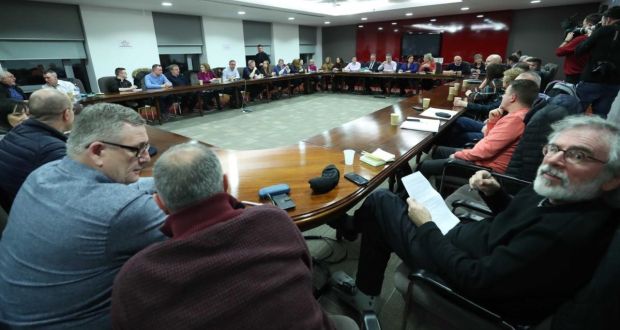
Meeting of Provisional Sinn Féin’s Ard-Choiste (national executive) in February 2020. (Source photo: Niall Carson, AP, Internet)
It is worth noting (a point I had omitted in my piece) that nearly the entire Fianna Fáil government Cabinet in 1932 was composed of Civil War IRA men and that most of the remainder had been in Free State prison during that war.
It is said that imitation is the sincerest form of flattery but I can easily avoid being pleased by Ferriter substantially following my line of historical analysis. This is the man who, during the 2016 High Court hearing about the Government and property speculator plans for Moore Street, wrote a nasty attack on the demonstrators who had occupied the buildings and subsequently blockaded them against demolition. If he had been hoping to influence the High Court’s decision he failed – and spectacularly, because the judgement was that not only the buildings but the whole quarter is a 1916 historical monument.
Frank McDonald had also written an opinion piece during the trial against conservation and the demonstrators in the same newspaper (what WAS the Irish Times up to?) but after the judgement, he had the grace to apologise (sort of: he wrote that he had been in error).
“Sinn Féin is not like other Irish political parties” goes the propaganda campaign against the party by media commentators and rival mainstream politiciansduring the elections. What nonsense! It is exactly like the other main Irish political parties – and that’s the problem.
Their opponents’ main objection seems to be that Provisional Sinn Féin was widely seen as the political wing of the armed resistance group Provisional IRA and, although the IRA have dissolved and decommissioned their weapons, the party still carries that mark in the eyes of its detractors (and, it must be said, fondly in the eyes of some of its supporters).
This propaganda campaign is acutely unhistorical. A few short lessons in Irish history might be of use here.
The Irish Labour Party was founded by, among others, the revolutionary socialist James Connolly and anarcho-sindicalist Jim Larkin. In 1913 both advocated arming union workers to resist armed police attacks. In 1916, the Irish Citizen Army they founded was part of the armed Rising and two of their leaders were among the 16 executed by British firing squads.
The party stayed neutral during the Civil War and was an opposition party to the Cumann na nGaedheal government. Since then, the Labour Party has been in Government only as a coalition partner – most times with the right-wing Fine Gael party. Except for it links with trade unions, the party has little claim to having “Labour” in its name and has turned away from everything if which its founders believed.
Fine Gael was formedin 1933 when two smaller groups joined Cumann na nGaedheal, which had been the governing party of the partitioned Free State from 1923 up until the merger. Michael Collins and his followers were the kind of people The founders of Cumann na nGaedheal were among the pro-Treaty and Free State supporters, i.e people who until then had been active in leading or supporting a campaign of armed resistance to the occupying British forces, including assassinations, ambushes and robberies. The Free State began the Civil War in 1922 by an artillery bombardment of Republican positions in Dublinand over the next few years carried out repression on the civilian population, torture, summary executions of prisoners of war as well as State executions – and assassinations. The victors handed the reins over to Cumann na nGaedheal in 1923.
The parties that joined Cumann na nGaedheal in 1933 were 1) the National Centre Party, essentially a big farmers’ quasi-fascist party and 2) the Army Comrades Association (the fascist “Blueshirts”). Of the mainstream Irish political parties, Fine Gael has stayed truest to its founders and base.
Fianna Fáil emerged from a split from Sinn Féin in 1926; interestingly, much of what is being said against Sinn Féin by establishment political commentators now – and worse — was said then about Fianna Fáil: “murderers”, “revolutionaries” (and even “Communists”!). The party first entered power in 1932, its leader De Valera having been — little more than a decade previously — a leader of the Republicans during the Civil War, opponents of the Treaty and of the Irish Government of the time. It freed the Republican prisoners locked up by the Cumann na nGaedheal government, also having a special police force (“Broy’s Harriers”) to persecute the Blueshirts, who aspired to taking power as had Fascists in Europe.
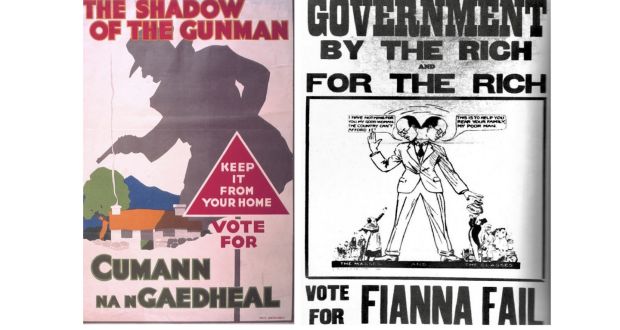
Cumann na nGaedheal (forerunner of Fine Gael) poster against Fianna Fáil during 1930s. (Image sourced: Internet)
By 1939, the Fianna Fáil government had introduced the savage repressive legislation of the Emergency Powers Act to intern republicans without trial and after a successful habeas corpus challenge by Seán McBride (one of the founders of Amnesty International), the Government brought in the Offences Against the State Act, was re-arresting Republicans and interning them without trial again (around 2,000). Two Republicans died on a hunger strike protest in Mountjoy Jail. Under Fianna Fáil the State executed six Republicans and some more are alleged to have died as a result of their treatment in the concentration camp.
In 1957, a Fianna Fáil government once again brought internment without trial into force, the colonial administration of the Six Counties having done the same the year previously. The last prisoner was released by FF in 1959.
Left: Cumann na nGaedheal poster urging votes against FF because of the party’s history. Right: Fianna Fáil poster appealing to the working class and small farmers. (Image sourced: Internet)
From having been seen as the main political party of Irish Republicanism, Fianna Fáil became in a short time the preferred party of the Irish capitalists (the “Gombeen” class) and has been in government more than any other party, more often indeed than the party that won the Civil War and set up the State.
JUST LIKE ANY OTHER IRISH PARTY
There is no historical basis for saying that Sinn Féin is very different from the other Irish mainstream political parties. It has traversed a similar path to all those others, perhaps most similarly to Fianna Fáil – it’s just a more recent arrival on the mainstream scene. It is already very like other main Irish political parties and is getting to be exactly like them.
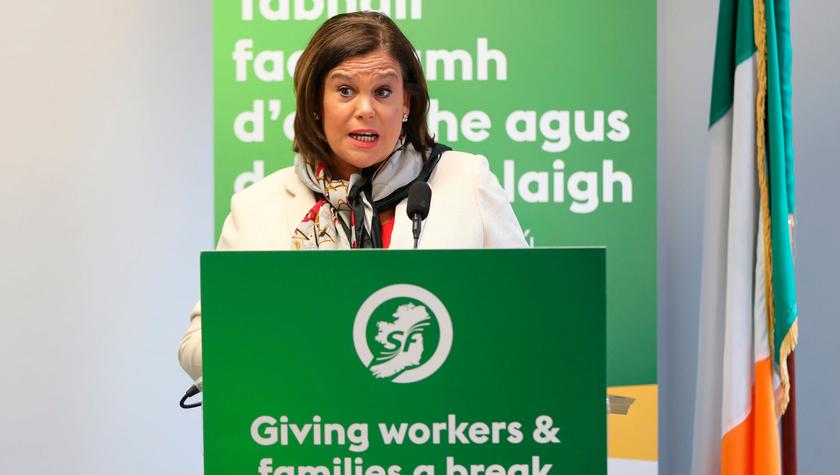
Leader of the Sinn Féin party, Mary Lou McDonald, at the launch of the party’s manifesto. With no intention of overthrowing capitalism it promised reforms for working people. (Photo source: Internet)
That is not a compliment.
This is a party that, in recent decades, had a revolutionary Irish republican – or at least nationalist – position. It strongly opposed the partition of the country and the colonial occupation of one-sixth of the nation’s territory. With the latter came — naturally enough — opposition to the colonial police force, the Royal Ulster Constabulary but this was much more than an ideological opposition: the RUC was an armed force created specifically for the repression of Irish Republicans and acted consistently against the Catholic minority in the Six Counties, which SF sought to represent and among which it organised.
The colonial Statelet itself, with its gerrymandering of electoral boundaries, sectarian allocation of housing and employment and its Special Powers Act, was the sworn enemy of the Sinn Féin party. And when British troops were sent in 1969 to repress the civil rights uprising, of course Provisional Sinn Féin and Provisional IRA fought them too.
The Provisional IRA gave up armed struggle against the British in 1998 and, although it maintained its armed force for control of its community for some time afterwards, eventually dissolved its organisation. By then it had already decommissioned its weapons.
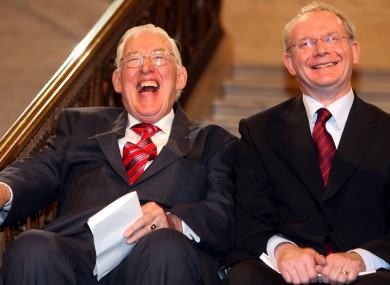
Martin McGuinness (right) of SF, formerly of the IRA, as Deputy Prime Minister of the British colony of the Six Counties. He partnered the Prime Minister Ian Paisley (left), a rabid religious sectarian, Christian fundamentalist and homophobe. They were dubbed “the Chuckle Brothers”. (Photo sourced: Internet)
In 2007 the SF party became part of the British colony’s administration in Stormont, with Martin McGuinness, former chief of the IRA in Derry, partnering Ian Paisley, notorious Loyalist religious sectarian and social bigot.
That same year the party agreed to support the armed and sectarian police force and in the reorganisation of the RUC had the name changed to “the Police Service of Northern Ireland”. The essence of the force, naturally, remains the same.
All the austerity measures inflicted on the working class by the administration since the party entered joint government of the colony have been approved by Sinn Féin MLAs.
Martin McGuinness publicly shaking hand of British colonial Queen when SF officially opposed the visit. However SF did not demonstrate against her visit and Gerry Adams later approved of it. (Photo sourced: Internet)
In 2011, despite an official SF policy of opposition to the visit of the Queen of England, Commander-in-Chief of the British Armed Forces, to the 26 Counties (the Irish state), leaders greeted her (one in person) and urged no protests be made against her visit.
In 2019, SF welcomed Prince Charles on a two-day visit to the colony and to the State; this man is not only son of the English Monarch but ceremonial commander-in-chief of the Parachute Regiment, authors of the massacres of Derry’s Bloody Sunday (14 dead) and Ballymurphy (11 dead) for which not a single soldier or commander has ever been tried. The SF Mayor of Derry, however, refused to meet him.
Gerry Adams shakes hands with Prince Phillip, titular head of the Parachute Regiment (the SF Mayor of Derry refused to meet him). (Photo sourced: Internet)
This year, 2020, the Six-County part of the leadership of Sinn Féin joined others in publicly seeking recruits for the PSNI, while the 26-County leadership withdrew from its previous position of seeking abolition of the repressive emergency powers of the Offences Against the State Act.
In the 26 Counties, SF long ago indicated its willingness to join in a governing coalition with some one of the other mainstream political parties: i.e capitalist, neo-colonial political parties.
On so many occasions, it has shown itself to be like the other parties and prepared to ditch formerly-declared principles for what it considered a political advantage, proving itself a “safe pair of hands” to the rulers of the system.
Yes, Sinn Féin is indeed a party like any other Irish mainstream political party: capitalist, neo-colonial, undemocratic and supporting State repression. As to the latter, why not? It won’t be SF that the State will be repressing — it’ll be Irish Republicans. And if SF ever get where they want to, into majority control of government – they’ll have plenty of opponents themselves to drag before those non-jury courts.
End.
L-R: PSNI Chief Constable Simon Byrne, Anne Connolly, Chairperson of the NI Policing Board, Gerry Kelly MLA, Deputy First Minister Michelle O’Neill and Deputy Chief Constable elect, Mark Hamilton at recruitment launch for the colonial police force.
I write to say how much I admired your attempt to have the Royal Irish Constabulary and the Dublin Metropolitan Police honoured in Ireland. It was never going to be easy to propose such a ceremony in a country that was occupied by les Anglais for nearly eight centuries and a part of which it is still occupying. But you did not flinch! It took real courage and I empathise with you on its failure (temporary, I hope).
Royal Irish Constabulary assisting landlord in relocation of a tenant in Co. Clare. (Photo sourcede: Internet)
Perhaps it was a little too soon. But as you know, I’m sure, once the unthinkable has been proposed, it is no longer unthinkable; then some day ….
It must be particularly galling for you to see the response of the “swinish multitude”, as your own orator Edmund Burke would have had it, result in the pushing into No.1 slot in the ITunes charts of that odious song of Dominic Behan’s, performed by that rabble-rousing folk group, the Wolfe Tones. To see that disgusting song enter the current Irish charts at No.33 –- and from there reach the No.1 played in the British and Irish charts! But go straight to No.1 in Scotland! Not to mention doing well in the USA and in Canada …..
How hurtful also to see the proliferation of mocking cartoons, videos and memes (all over social media, it seems). And coming up to the anniversary of the introduction of that great band of public servants, too: the RIC Special Reserve and the Auxiliaries.
But as I said earlier, it took courage to attempt what you did – something lacking in your silent partners in government, Fianna Fáil, who remained silent until they could see how the public wind would blow. Someone could get hurt in the rush to disassociate! It is the fate of courageous individuals such as yourself, if I may borrow a phrase from a popular science fiction series, “to boldly go where no-one has gone before.” Even if it looks like no-one follows.
Crowd gathering around gallant RIC Inspector felled by a hurley stick in Dublin 1917. (Photo sourcede: Internet)
Would that we had men of your calibre here in France! The legitimacy of the Vichy Government (1940-1945) was denied by ‘Free France‘ during WWII and by all subsequent French governments after that. They maintained that the Vichy government was an illegal one run by traitors – hard to believe, I know but look it up on Wikipedia! A group of us have been trying to get German soldiers and the Vichy police honoured for some time now but can we find even one politician of any stature who would risk his reputation in the attempt? No, we seem to have no Monsieur Flanagans here in France, c’est dommage!
We have a network of people with similar interests in a number of other countries, including Russia, Poland, Vietnam and Algeria – you may smile when you see the network’s acronym: RIC! Of course the letters stand for other words in our case: Rehabilitation of Invader Collaborators. Whether it was the Russians or Poles who aided the German invaders, or the Algerians who aided our French occupation or the Vietnamese who aided the US invaders, they all have something in common: they did a difficult job, hated by most of their compatriots.
Bandying around words like “concentration camps”, “torture”, “massacres”, “rape” and “executions” does not conceal the truth that ultimately these men (and women, it must be said) were obeying orders. Some of those words I hear have been bandied around about the RIC and DMP too, including those of “spies”, “informers”, “shoneens” and “Castle Catholics”. One must admit that the Irish have a capacity for les bon mots, however one might disdain what they mean – while not mincing words they certainly know how to weave them, if you’ll pardon the mixed metaphors.
Perhaps some day when you can be spared from your Ministerial duties (or when you have retired, far away be the day!), you could come and address the annual general meeting of our RIC – it would be a great honour for us.
DMP teaching people respect for the law, Dublin 31 August 1913. Note some agitators are continuing to cause trouble even lying down. (Photo sourced: Internet)
When, some day in the future, the Irish public recognises how deserving the RIC and DMP are of State honouring, the logical consequence will be of course to honour the Black and Tans and the Auxilliaries, who were sent specifically by Churchill to work in support of – and closely with – those two bodies of fine men. And once that has been accepted it should not be difficult to have the successors of the RIC in Northern Ireland honoured too: the Royal Ulster Constabulary and the B-Specials. Of course, there will be some die-hards who will mutter “sectarianism”, “brutality” and “Loyalist murder gang collusion” but one can never quite get rid of those bitter people, can one? God knows, the English tried!
Speaking of bitter words, I hear some Irish people are saying that as Minister for Justice, rather than honouring “traitors” and “murderers” (sic) you should be pursuing the English to disclose their secret papers regarding the murder of 33 people in the Dublin and Monaghan Bombing by alleged British agents in 1974. How unkind! Some people just can’t forget and move on, can they? Do they not realise that those bombers, whoever they were, were just obeying orders too?
And even bitterer! Some have been heard to say that if Michael Collins were alive he’d have had you shot, given that he had enough RIC, ‘Tans and Auxiliaries shot himself. One can understand some bitterness but that is really nasty, given that Collins can be said to be one of the founders of your own party. And who can truthfully say what Collins would or would not have done? He certainly surprised a lot of Republicans in 1922 when he borrowed British cannon to open fire on Republican positions in Dublin!
When the day comes in the future for Irish rehabilitation for those noble collaborators of foreign occupation, the Royal Ulster Constabulary and Dublin Metropolitan Police, then hopefully the Blueshirts, that fine body of men, co-founders of your own party Fine Gael, can be rehabilitated too. And who knows, some day even reconstituted and formally brought into government? It is not beyond the bounds of possibility, even though the sympathisers of those kinds of politics are very few at the moment ….
And then there’s the man they called “Lord Haw Haw”, William Joyce, of similar ideology — was he not an Irishman also? Did he not carry out his orders too? Of course, that might not go down too well with les Anglais due to his broadcasts in English from Nazi Germany — even though he was an informer against the IRA for the British during the War of Independence. Or perhaps precisely because of it: the English can never quite forgive one they consider theirs, once he turns against them, can they? One must be careful sometimes – after all, les Anglais still have quite some influence in the world, especially in your own country, n’est ce pas?
“THERE ARE MORE OF US THAN THERE ARE OF THE BULLIES”
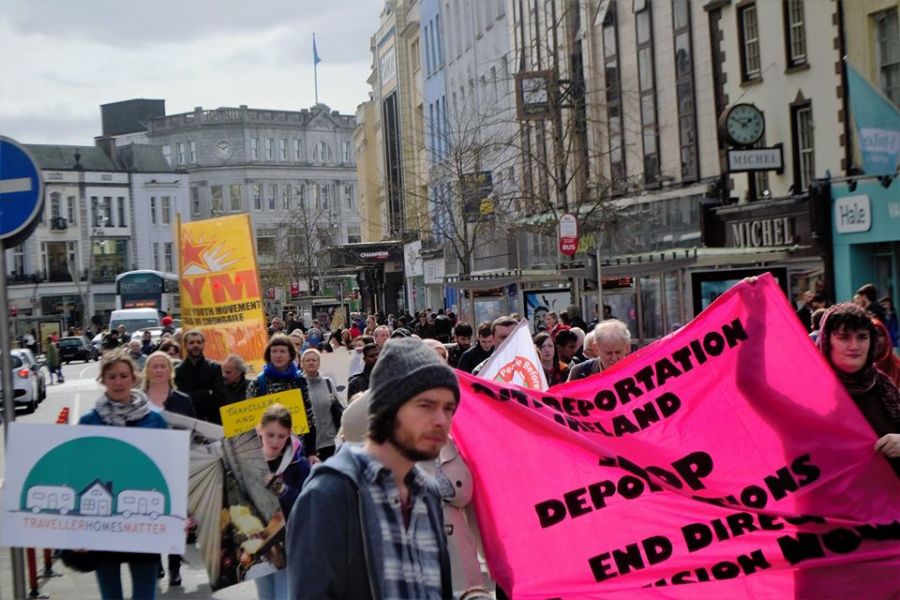
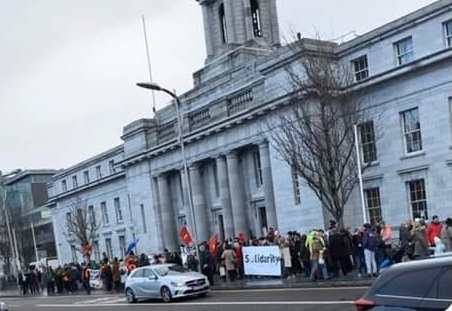
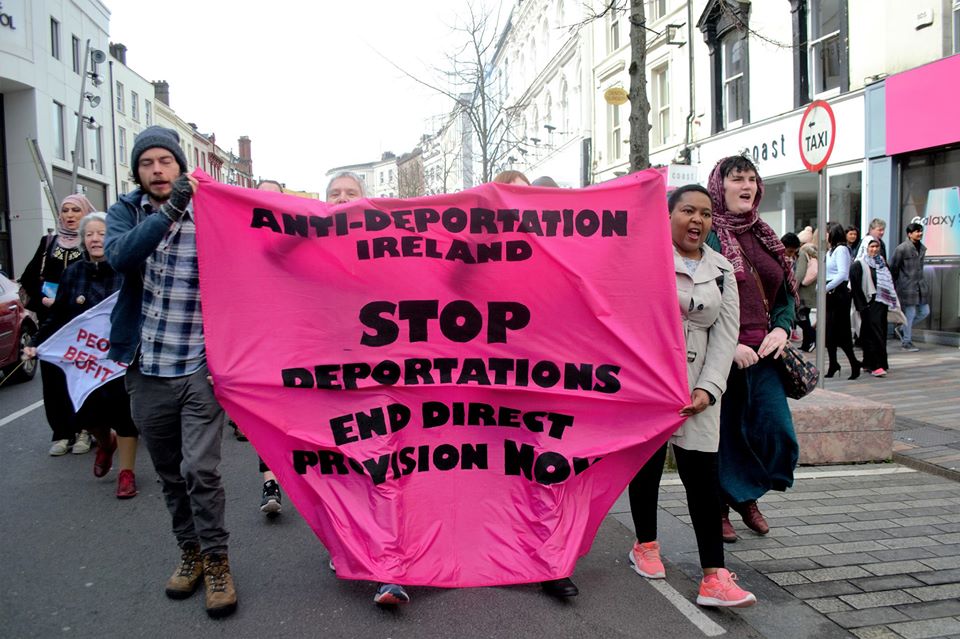
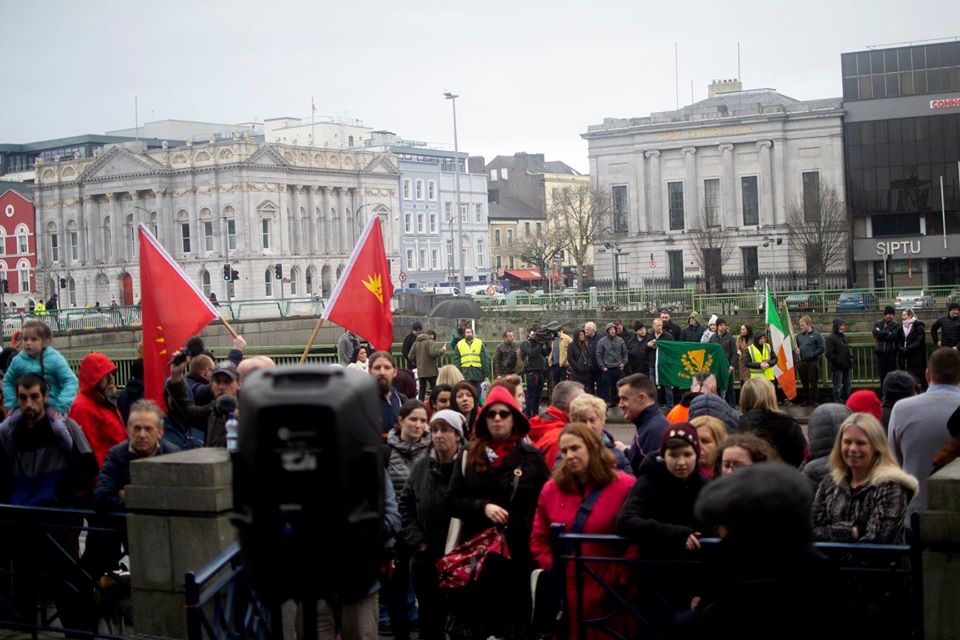
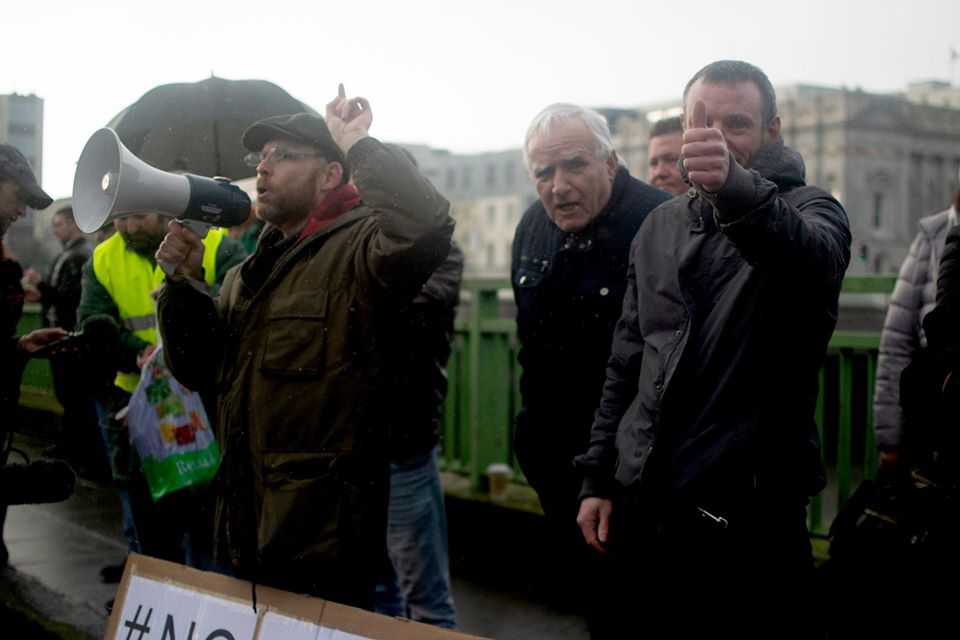
Learning of the intention of a far-Right coalition to hold a rally at Cork Town Hall on 4th December, a coalition of anti-racists and anti-fascists containing a range of Left and Irish Republican organisations, community and anti-deportation groups organised a counter-rally which dwarfed the numbers of the racists and fascists, who object to migrants, asylum seekers and LBGT people. Two TDs and a number of councillors also attended.
One of the organisers, Tracy Ryan, said that she had her two sons with her at the rally. “I’ve brought up my children to believe that everyone is equal and everyone deserves the same opportunities and chances in life,” she said.
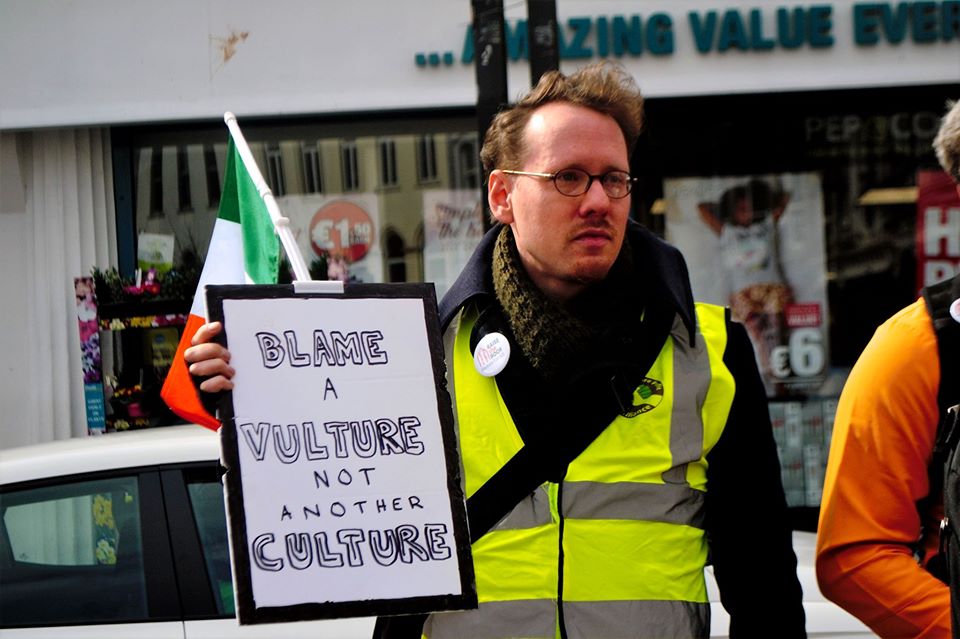
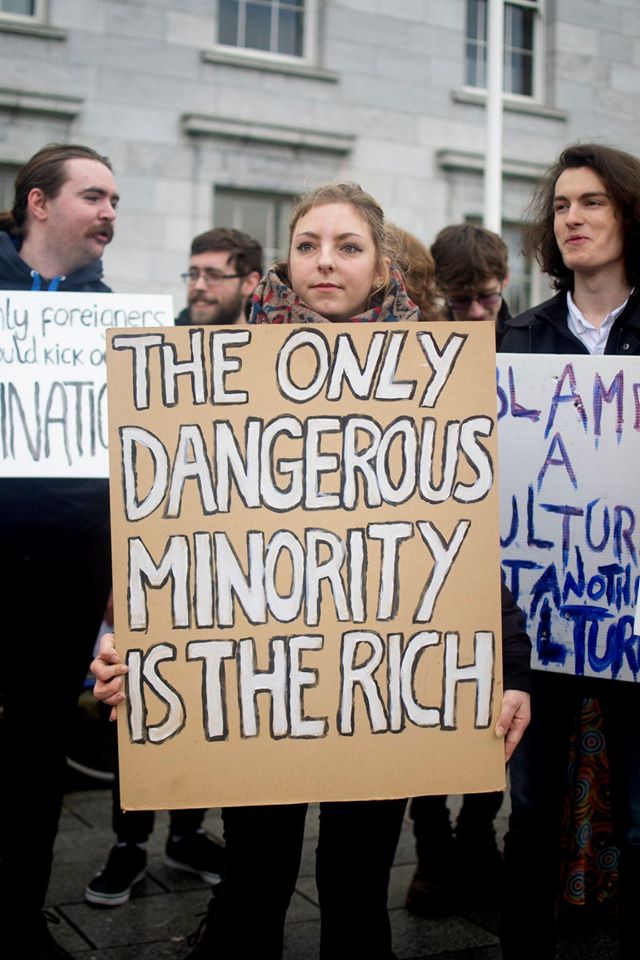
View of counter rally half hour before due to start (Photo: Students Against Racism)Placard displayed at counter-rally (Photo: Shamim Melekian)Anti-racist football club supporters at the counter-rally. (Photo: Shamim Melekian)
FREE SPEECH?
The specific rallying issue for the far-Right on this occasion, as it was in Dublin on 14th December last year (see https://rebelbreeze.wordpress.com/2019/12/15/dublin-counter-rally-outnumbers-racists-and-fascists/), was the legislation proposed by the Fine Gael Government against “hate speech”. The mixture of social conservatives, racists and fascists that make up the far-Right in Ireland have been complaining for some time that they are being denied freedom of speech, in particular since the most prominent member of their ranks, ex-journalist Gemma O’Doherty, had her two Youtube channels shut down by Google in 2019 after, according to Google, she broadcast racist statements and continued to do so after one of the channels was suspended for a week.
There is a wide variety of views on the proposed legislation outside of the far-Right, some socialists and Republicans remarking that “hate speech” is too wide a label and that they have seen such legislation used against themselves when they denounce prominent politicians or businessmen, the police or Loyalists. What unites all these groups demonstrating against the far-Right is not a defence of the Government’s proposed legislation but a determined opposition to allowing the far-Right to gain a foothold in Ireland, from which it may expand to introduce a fascist regime, reversing gains in social legislation, banning oppositional groups, terrorising minorities and restricting further the rights of unionised workers.
One of the groups on the counter-rally (Photo: Shamim Melekian)One of the many pointed placards on the counter-rally held by a supporter. (Photo: Shamim Melekian)
Opponents of the far-Right point out that they begin by seeking freedom of speech to attack minority groups and their political opponents but once they have established a base, move to physically removing their opposition and banning freedom of speech of anyone who disagrees with them.
“There are more of us than there are of the bullies”, said one of the organising group, speaking to news media the day before the counter-rally. Poet and community worker Kathy D’Arcy added: “We are one people, one human race, one unified city whose people are known throughout the world for kindness, friendliness, good humour and inclusiveness.”
Declan Power of Waterford, organiser of a much smaller rally of the far-Right over the same weekend, rejected the accusation that they were racists or had any other agenda than freedom of speech. However at the event Diarmuid Ó Cadhla, of a group called The People’s Convention, revealed that he wanted to limit migration and was against the Government’s policies which, he alleged, are for “globalisation and open borders”. Presumably this was a reference to one of the conspiracy theories of the far-Right, viz. that the EU allegedly has a policy of opening all borders to mass immigration and replacing the Irish with foreigners. Laughable as this may seem to some and flying against all the evidence as it does, it is believed by some on the far-Right and used to whip up fears and hatred of migrants.
View of far-Right rally over section of counter-rally. (Photo: Shamim MelekianCloseup of some of the far-Right group in Cork (Photo: Shamim Melekian)Woman on counter-rally holds up a placard addressing the far-Right (Photo: Shamim Melekian)
HISTORY OF ANTI-RACIST MARCHES IN CORK
The rally on 4th January this year was far from being the first anti-racist demonstration in Cork: an anti-racist march took place in March last year and or five years before that, there had been an anti-racist march in Cork every year.
Speaking in advance of the anti-racist march last year, Joe Moore of Cork Says No to Racism pointed out that while racism still exists in Cork, it is “a small number of people who have racist views towards minority religions, asylum seekers Travellers and the Roma community.”
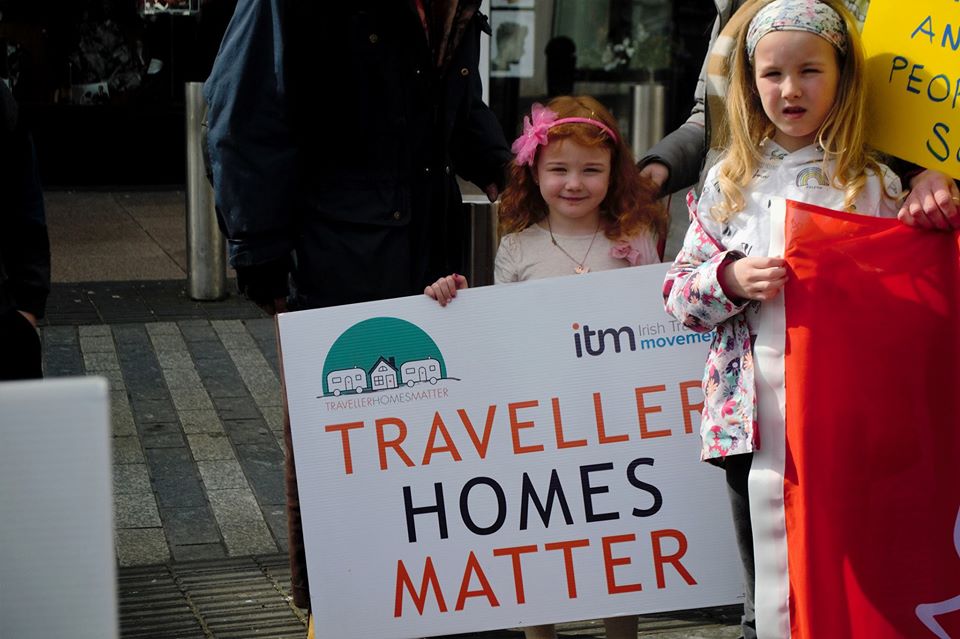
Mr. Moore also pointed out some gaps in State provision, stating that the school books for children contain no mention of the Traveller community in Ireland, which itself has housing and education issues.
There is also a history of fascism in 1930s Cork when the Blueshirt fascist movement was opposed by anti-fascists and socialists inside and outside the IRA. Ironically, while opposition to the Fine Gael Government’s proposed legislation is the purported rallying point for the far-Right, the Blueshirts were one of the three groups that joined to form the Fine Gael party (which is why many opponents of the party call them “Blueshirts” to this day).
Fascist salutes at a Blueshirt rally in 1934 in Charleville, Cork. (Photo source: History Ireland).
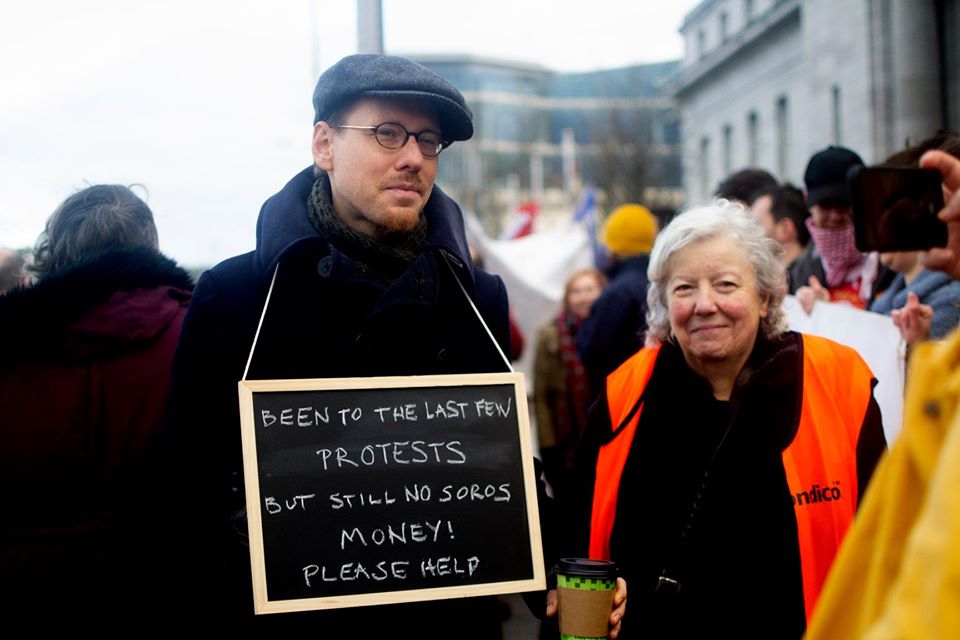
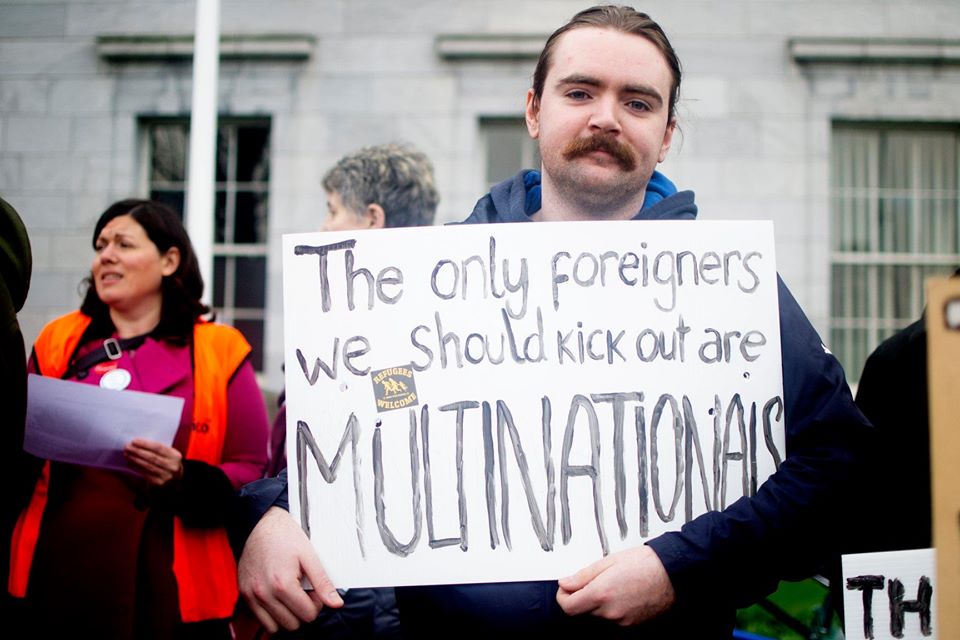
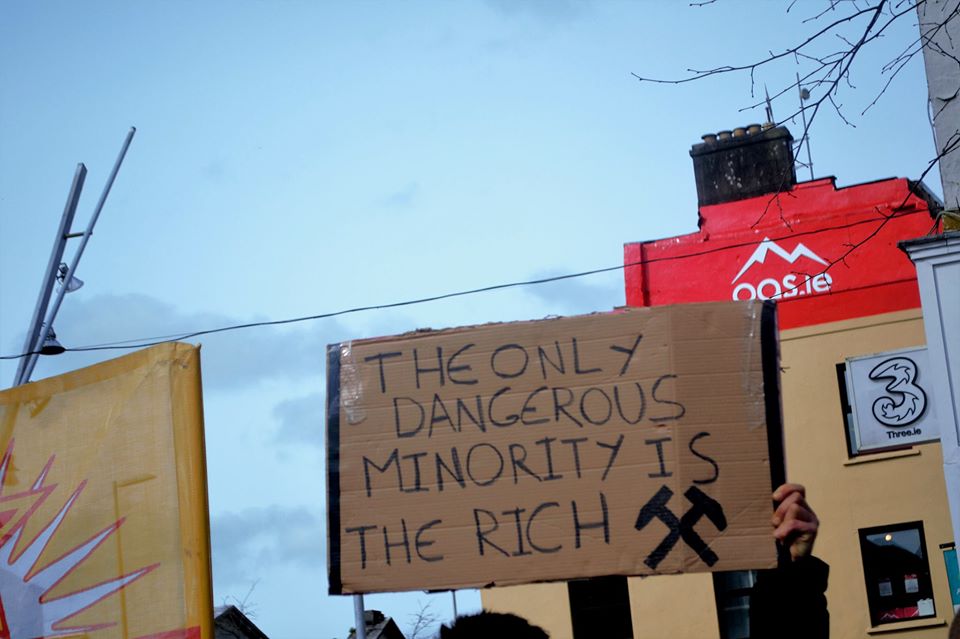
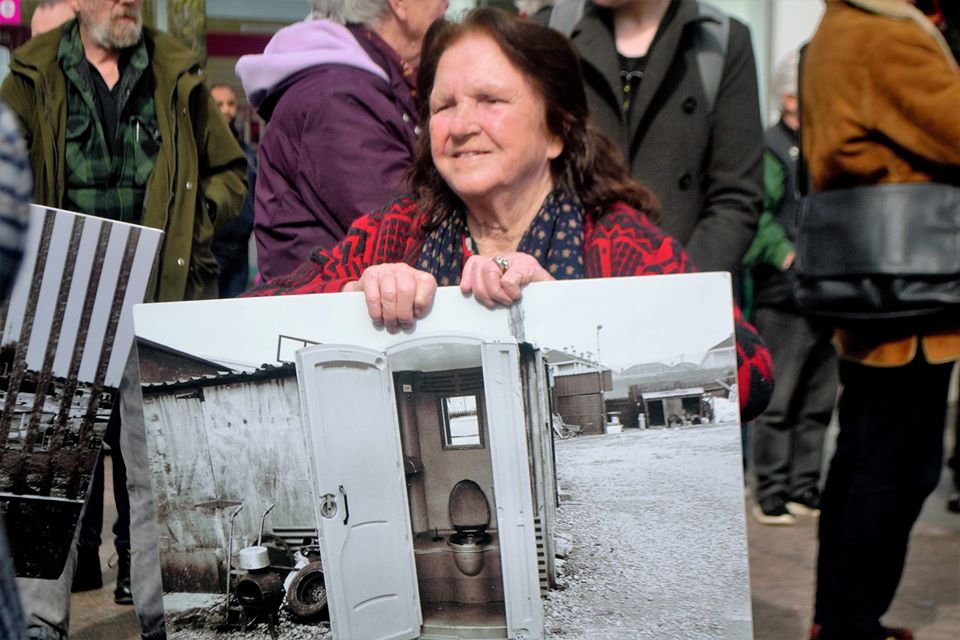
Counter-rally supporter mocks conspiracy theory that Soros Foundation is funding all the anti-racist and anti-fascist activists. (Photo: Shamim Melekian)(Photo: Shamim Melekian)Another pointed placard message on the counter-rally. (Photo: Shamim Melekian)Woman on counter-rally displaying presumably dire conditions on halting sites for Travellers. (Photo: Shamim Melekian)
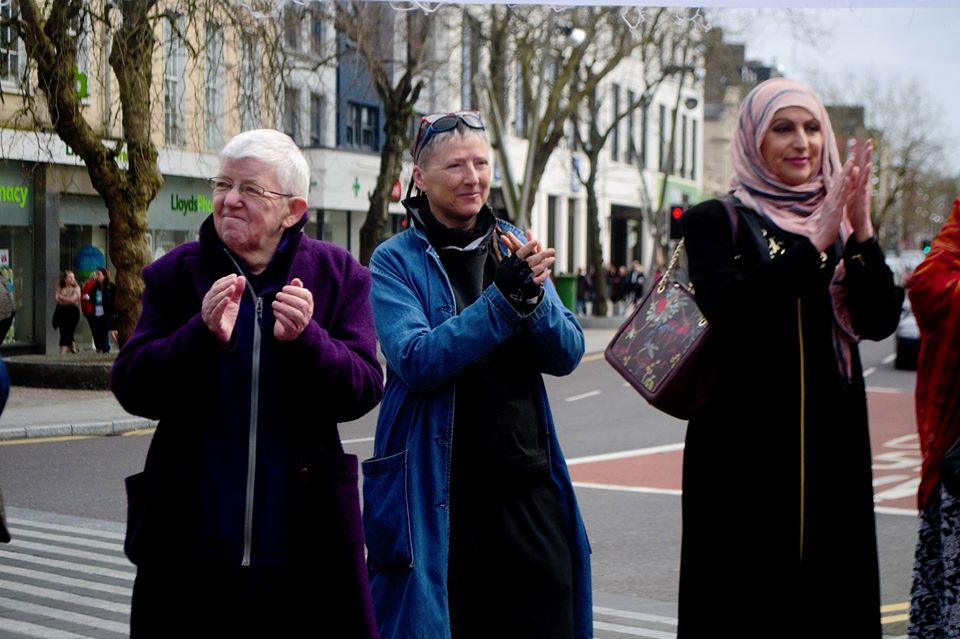
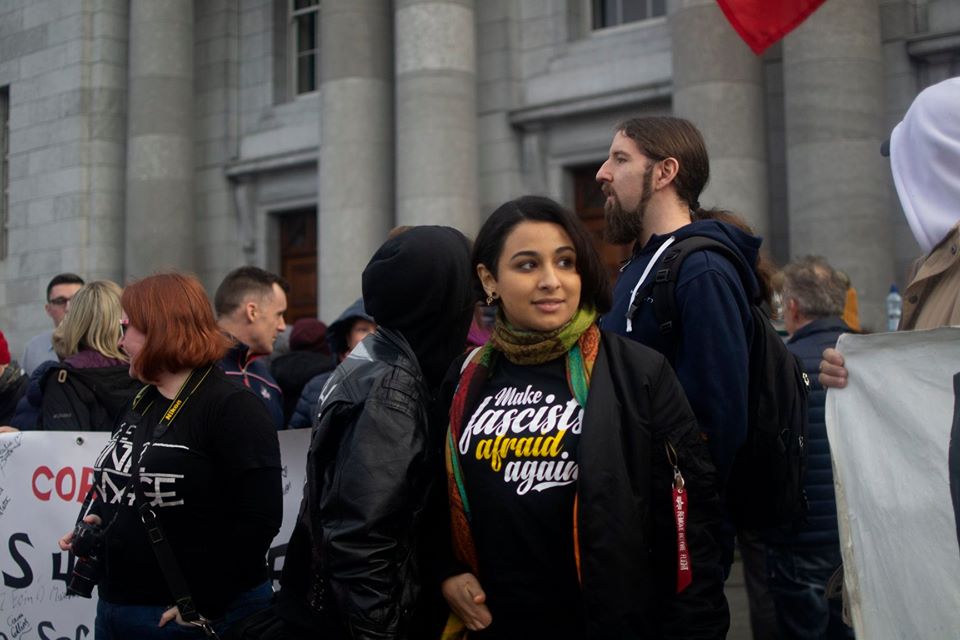
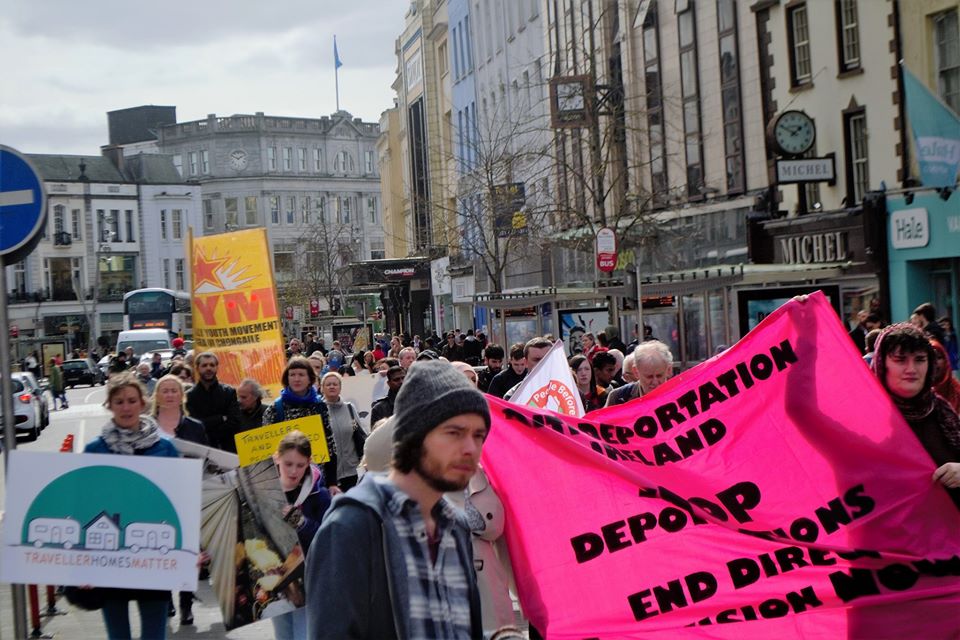
Women of varied ages and backgrounds applauding speaker at counter rally. (Photo: Shamim Melekian)Counter rally supporter sends pointed message on placard (Photo: Shamim Melekian)Young supporter of counter rally sports a T-Shirt display which might become very popular. (Photo: Shamim Melekian)Section of counter rally on the march through Cork city centre. (Photo: Shamim Melekian)
Racists and Fascists, posing as Irish “patriots”, malign migrants to Ireland and target them in racist propaganda. This is a fundamentally unpatriotic activity, flying against not only our own huge history of migration to other lands but also against the great history of migrants’ contribution to the struggle for Irish independence and socialism.
Of the Seven Signatories of the 1916 Proclamation of Independence, two were migrants and two more were sons of migrants.
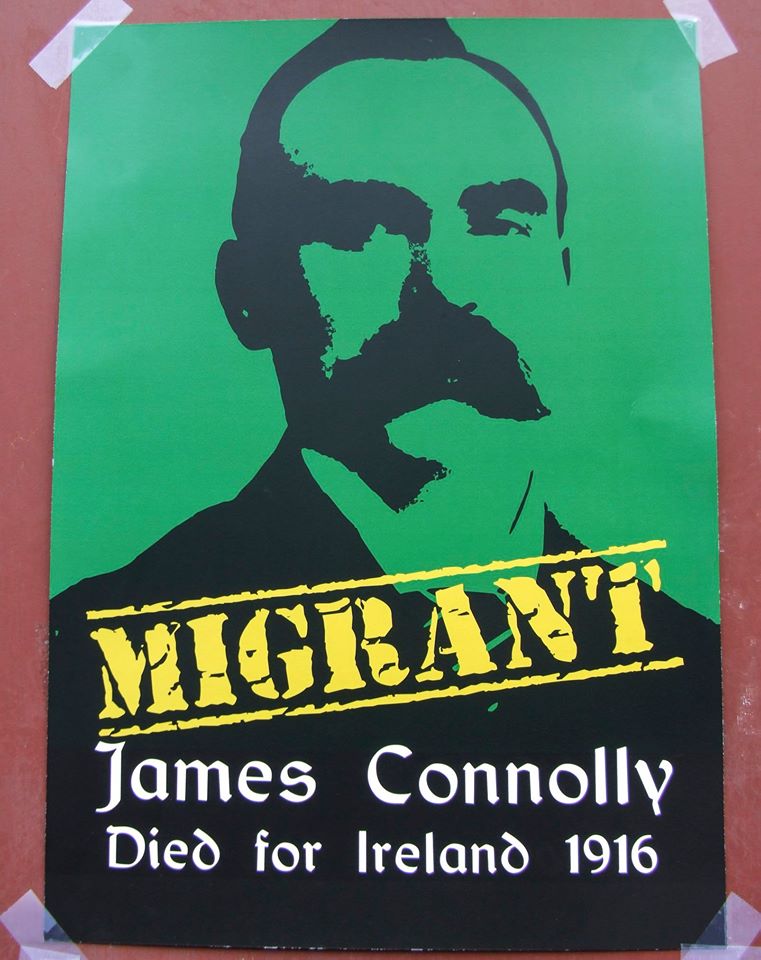
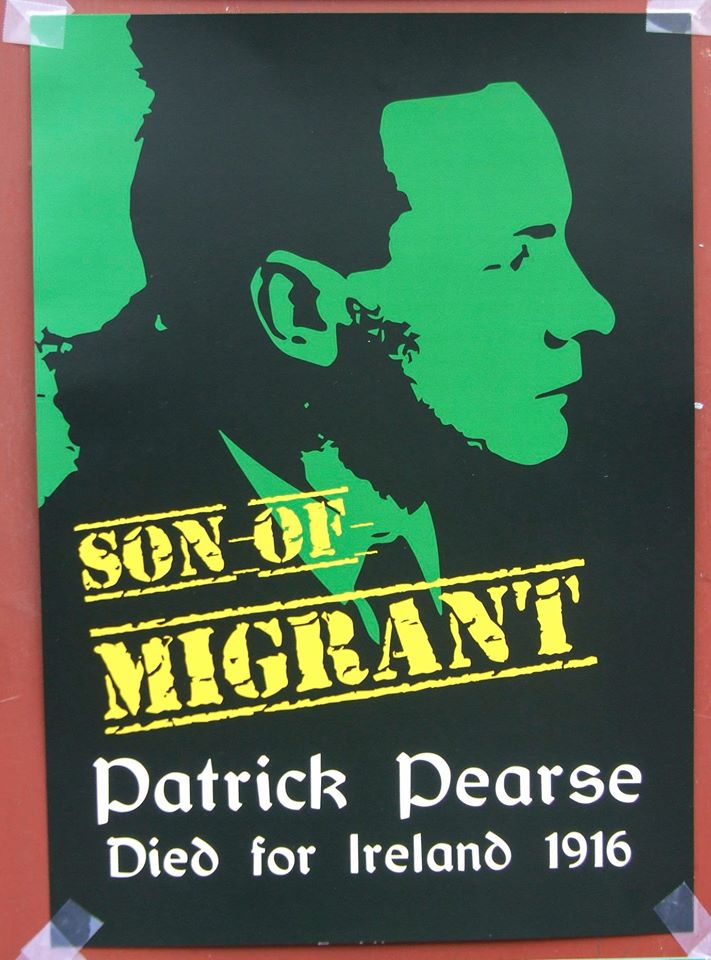
Of the sixteen of the Rising executed by the English, two were migrants (Connolly and Clarke), another three were sons of migrants (Pearse brothers, Mac Donagh) and at least six bore family names of foreign ancestry (Casement, Ceannt, Clarke, Colbert, Kent, Plunkett).
Numerous migrants took part in the 1916 Rising, mostly from England and Scotland but also some from the USA, one from Argentina, another from Finland and yet another from Sweden).
James Connolly, revolutionary socialist and anti-imperialist, author, songwriter, journalist and trade union organiser was a migrant who did not see Ireland until he was a young man. (Design: Maria Castella; photo: B.Hoppenbrouwers)
Constance Markievicz (nee Gore-Booth), feminist, Irish Republican, Socialist, officer in the Irish Citizen Army, first woman elected to the British Parliament, first female Minister of the Dáil and first Labour Minister in the world, was born in England; she was sentenced to death in 1916 by the English but had her sentence commuted. Volunteer Eamon De Valera, a 1916 Rising garrison Commander, was born in the USA to an Irish mother and a Cuban father. The captain of the Asgard yacht that delivered the Mauser rifles for the 1916 Rising was an Englishman, Erskine Childers and among the crew were his wife Molly from the USA and Mary Spring Rice (born London). Childers fought in the War of Independence and the Civil War and was executed by the Irish Free State in 1922.
Jim Larkin, trade union organiser and Lockout resistance leader, who was in the USA during the Rising, was co-founder of the Irish Transport & General Workers’ Union and of the Irish Citizen Army, also of the Irish Labour Party. Larkin was born and raised in Liverpool and did not see Ireland until sent to Belfast by his England-based trade union.
Constance Markievicz, Irish Republican, revolutionary socialist, officer in the Irish Citizen Army, sentenced to death in 1916 but commuted. She was a migrant, born in England. (Image source: Internet)
A LONG HISTORY OF MIGRANT CONTRIBUTION TO IRISH STRUGGLES
The aforesaid should not surprise us as migrants have often participated in struggles for freedom and social progress in their adopted countries and they and their descendants have a long history of taking up those struggles in Ireland – often sacrificing their liberty and even their lives in doing so.
Patrick Sarsfield, a hero of the resistance to William of Orange in the army of James II was of Anglo-Norman descent (he was a prominent member of the Wild Geese and was killed in military service abroad in 1683).
Nearly all the leaders of the Society of United Irishmen, the first Republican revolutionary organisation of Ireland, were Protestants of various sects and descendants of migrants. Henry and Mary Joy McCracken were active in saving Irish traditional melodies; their ancestors were Huguenots (French Protestant refugees).
Henry Joy was executed publicly in Belfast by the English in 1798, his sister walking hand-in-hand with him to the gallows. General Henry Munro, another Antrim Unitedmen leader, also executed in 1798, was of Scottish descent.
Theobald Wolfe Tone, Anglican co-founder of the Unitedmen and often described as the “father of Irish Republicanism”, was also of Huguenot ancestry; he died in jail in Dublin, while his brother Matthew was hanged. Edward Fitzgerald, another leader of the Unitedmen who died of his injuries in a Dublin jail, was a Protestant and descendant of Norman invaders.
Robert Emmet, another famous United Irishman but martyred in 1803, bore a surname of English origin as did one of his prominent comrades, Thomas Russell (“The Man from God Knows Where”), also executed by the English that year.
The Young Irelanders were the next Irish Republican organisation in history, their leaders a mixture of Protestant and Catholic background. One of the most famous was Thomas Davis, the son of a Welshman in the British Army and an Irish woman descended from Irish chieftain Ó Súilleabháin Béara.
Davis founded The Nation newspaper and composed a number of poems and songs, some of the latter being still sung today (e.g A Nation Once Again and The West’s Awake).
James Stephens and a handful of others founded the Irish Republican Brotherhood on 17th March 1858 in Dublin, the third Irish Republican organisation in Irish history and the life of which extended into the 1920s. Stephens is a family name of Anglo-Norman origin.
John Devoy of the Irish Republican Brotherhood in the USA, who was very active in supporting the 1916 Rising and the War of Independence, carried a family name of Welsh origin. Wales was also the likely origin of Michael Davitt’s family name, he who was chief organiser of the Land League’s base membership.
Volunteers Terence McSwiney and Kevin Barry, who both died in the same week in 1920, the first on hunger strike and the second hanged by the English, had family names of foreign origin.
WHO IS NOT A DESCENDANT OF MIGRANTS?
Of course, we are ALL descendants of migrants. The earliest date for human occupation of parts of Ireland has been calculated as being 7,000 BCE.
Since the earliest date given for the existence of homo sapiens is 300,000 years ago in the Horn of Africa (although throwing spears in Germany have been assessed as being between 380,000 and 400,000 years old), it follows that human settlement in Ireland was comparatively late and that all Irish are descended from migrants.
Stone age people arrived first, then the metal workers of bronze, followed by people of Celtic culture working iron.
Subsequently Ireland saw influxes of other groups, from Norse and Danes when they began to settle in parts of Ireland, followed by their cousins based in Normandy (and mercenaries they brought with them), then English and so on.
Religious groups seeking security such as Jews or fleeing persecution, for example the Huguenots, also entered at various times. Just a study of family names common in the Ireland of today reveals some of those ancestries.
The Norse, Danes, Normans and early English came as invaders, some more came subsequently as planters and many others came just to make a living in Ireland, like most migrants of today.
But descendants of all those groups, including of invaders and planters, contributed to and even led the struggle for Irish independence and social progress. Not only that but a significant number of those who arrived as migrants themselves took a stand for Irish independence, some of them paying the ultimate price.
Patrick Pearse, author in Irish and English, poet, journalist, Irish Republican and in overall command of the insurrectionary forces in 1916, was the son of an Englishman, as was his brother William. Both were executed after the surrender. (Design: Maria Castella; photo: B.Hoppenbrouwers)
CONCLUSION
Far from being “patriotic”, maligning migrants simply for being migrants is counter to the history of the general struggle for Irish independence and of Irish Republicanism in particular. It actually undermines the unfinished struggle for Irish independence and unification as well, of course, as the struggle of the working people for socialism.
End.
TRADUCCIÓN AL CASTELLANO:
LOS INMIGRANTES EN LA HISTORIA IRLANDESA
Los racistas y fascistas, haciéndose pasar por “patriotas” irlandeses, atacan a los inmigrantes en Irlanda en su propaganda racista. Esta actividad es fundamentalmente antipatriótica, que vuela no solo contra nuestra enorme historia de migración a otras tierras sino también contra la gran historia de la contribución de los inmigrantes a la lucha por la independencia y el socialismo irlandés.
De los Siete Signatarios de la Proclamación de Independencia de 1916, dos eran inmigrantes y un tercero era hijo de un inmigrante. De los dieciséis del Azamiento ejecutados por los ingleses, dos eran inmigrantes (Connolly y Clarke), otros dos eran hijos de inmigrantes (hermanos Pearse) y al menos seis tenían apellidos de ascendencia extranjera (Casement, Ceannt, Clarke, Colbert, Kent, Plunkett). Numerosos inmigrantes participaron en el Alzantamiento de 1916, principalmente de Inglaterra y Escocia, pero también algunos de los EEUU, uno de Argentina, otro de Finlandia y otro de Suecia).
Constance Markievicz (soltera Gore-Booth), feminista, republicana irlandesa, socialista, oficial del ejército ciudadano irlandés y primera mujer elegida para el Parlamento británico, la primera mujer ministra del Parlamento irlandés y primera ministra femenina de trabajo del mundo, nació en Inglaterra; fue condenada a muerte en 1916 por los ingleses, pero la conmutaron la pena. El voluntario Eamon De Valera, un comandante de la guarnición del Azamiento de 1916, nació en los Estados Unidos de una madre irlandesa y un padre cubano. El capitán del yate Asgard que entregó los fusiles Mauser para el Alzamiento de 1916 era un inglés, Erskine Childers y entre la tripulación estaban su esposa Molly (de los Estados Unidos) y Mary Spring Rice (nacida en Londres). Childers luchó en la Guerra de la Independencia y la Guerra Civil y fue ejecutado por el Estado Libre de Irlanda en 1922.
Jim Larkin, organizador sindical y líder de la resistencia al Cierre Patronal, que estuvo en los EEUU durante el Alzamiento, fue cofundador del Sindicato de Trabajadores Generales y de Transporte de Irlanda y del Ejército de Ciudadanos de Irlanda, también del Partido Laborista. Larkin nació y creció en Liverpool y no vio Irlanda hasta estar enviado a Belfast por su sindicato con sede en Inglaterra.
UNA LARGA HISTORIA DE CONTRIBUCIÓN MIGRANTE A LAS LUCHA IRLANDESA
Lo anterior no debería sorprendernos, ya que los migrantes a menudo han participado en luchas por la libertad y el progreso social en sus países adoptados y ellos y sus descendientes tienen una larga historia de asumir esas luchas en Irlanda, a menudo sacrificando su libertad e incluso sus vidas al hacerlo. .
Patrick Sarsfield, un héroe de la resistencia a Guillermo Naranja en el ejército de Jaime II de Gran Bretaña, era de ascendencia anglo-normanda (era un miembro destacado de los “Gansos Silvestes” y fue asesinado en el servicio militar en el extranjero en 1683).
Casi todos los líderes de la Sociedad de Irlandeses Unidos, la primera organización revolucionaria republicana de Irlanda, eran protestantes de varias sectas y descendientes de inmigrantes. Henry y Mary Joy McCracken fueron activos en salvar las melodías tradicionales irlandesas; sus antepasados eran hugonotes (refugiados protestantes franceses). Henry Joy fue ejecutado públicamente en Belfast por los ingleses en 1798, su hermana caminó de la mano con él hacia la horca. El general Henry Munro, otro líder de Los Irelandeses Unidos de Antrim, también ejecutado en 1798, era de ascendencia escocesa. Theobald Wolfe Tone, cofundador anglicano de los Irelandeses Unidos y a menudo descrito como el “padre del republicanismo irlandés”, también era de ascendencia hugonote; murió en la cárcel de Dublín, mientras que su hermano Matthew fue ahorcado. Edward Fitzgerald, otro líder de los Irelandeses Unidos que murió por sus heridas en una cárcel de Dublín, era protestante y descendiente de invasores normandos.
Robert Emmet, otro famoso de los Irelandeses Unidos pero martirizado en 1803, tenía un apellido de origen inglés, al igual que uno de sus camaradas prominentes, Thomas Russell (“The Man from God Knows Where”), también ejecutado por los ingleses ese año.
Los Jóvenes Irlandeses fueron la próxima organización republicana irlandesa, sus líderes una mezcla de antecedentes protestantes y católicos. Uno de los más famosos fue Thomas Davis, hijo de un galés en el ejército británico y una mujer irlandesa descendiente del jefe irlandés Ó Súilleabháin Béara. Davis fundó el periódico The Nation y compuso una serie de poemas y canciones, algunas de las cuales todavía se cantan hoy (por ejemplo, A Nation Once Again y The West’s Awake).
James Stephens y un puñado de otros fundaron la Hermandad Republicana Irlandesa el 17 de marzo de 1858 en Dublín, la tercera organización republicana irlandesa en la historia de Irlanda y cuya vida se extendió hasta la década de 1920. Stephens es un apellido de origen anglo-normando.
John Devoy, de la Hermandad Republicana Irlandesa en los EEUU, que fue muy activo en el apoyo al Alzamiento de 1916 y la Guerra de la Independencia, llevaba un apellido de origen galés, lo qual también fue el origen probable del apellido de Michael Davitt, el principal organizador de la membresía base de la Liga de la Tierra.
Los Voluntarios del IRA Terence McSwiney y Kevin Barry, quienes murieron en la misma semana en 1920, el primero en huelga de hambre y el segundo ahorcado por los ingleses, tenían apellidos de origen invasor.
¿QUIÉN NO ES UN DESCENDENTE DE MIGRANTES?
Por supuesto, TODOS somos descendientes de migrantes. La fecha más temprana para la ocupación humana de partes de Irlanda se calculó ser en 7,000 aC. Dado que la fecha más temprana dada para la existencia del homo sapiens es hace 300,000 años en lo que hoy es Marruecos, se deduce que el asentamiento humano en Irlanda fue relativamente tarde y que todos los irlandeses son descendientes de migrantes.
Primero llegaron personas de la edad de piedra, luego los trabajadores metalúrgicos de bronce, seguidos por gente de la cultura celta que trabajaban el hierro. Posteriormente, Irlanda vio la afluencia de otros grupos, de nórdicos y daneses cuando comenzaron a establecerse en partes de Irlanda, seguidos por sus primos con sede en Normandía (y mercenarios que trajeron con ellos), luego ingleses, etc. Los grupos religiosos que buscaban seguridad como los judíos o huían de la persecución, por ejemplo los hugonotes, también ingresaron en varios momentos. Un estudio de apellidos comunes en la Irlanda de hoy basta para revelar algunos de esos antepasados.
Los nórdicos, daneses, normandos y los primeros ingleses llegaron como invasores, algunos más llegaron posteriormente como plantadores y muchos otros vinieron para ganarse la vida en Irlanda, como la mayoría de los inmigrantes de hoy. Pero los descendientes de todos esos grupos, incluidos los invasores y plantadores, contribuyeron e incluso lideraron la lucha por la independencia de Irlanda y el progreso social. No solo eso, sino que un número significativo de los que llegaron como migrantes tomaron posición por la independencia de Irlanda, algunos de ellos pagando el precio final.
CONCLUSIÓN
Lejos de ser “patriótico”, difamar a los migrantes simplemente por ser migrantes es contrario a la historia de la lucha general por la independencia de Irlanda y del republicanismo irlandés en particular. De hecho, mina la lucha todavía inconclusa por la independencia y la unificación irlandesa, así como, por supuesto, la lucha de los trabajadores por el socialismo.
“We bring colour to Grafton Street, not ‘clutter’!” was the response of street traders in Grafton Street to a request from multinational property company Hines to Dublin City Council to remove the street trading stalls away from Grafton Street, to which Hines allege they bring “clutter”. The street traders also pointed out that they and their predecessors had been on that street much longer than Hines.
Catherine Claffey, a Grafton Street flower seller, from whom I took the “Colour, not ‘clutter'” quotation. (Photo: D.Breatnach)
Although the request to Dublin City Council had been made in August, it only hit the news earlier this week and brought a swift response of outrage from the street traders, some public representatives and ordinary members of the public. Broadcaster Joe Duffy joined the chorus and also referred to the difficulties experienced by the street traders on Moore Street with an unhelpful DCC Management.
Hines PR people soon found themselves removing their feet from their mouths and eating not only their words in public but very humble pie.
Dublin architecture, history and soul is under constant attack by property speculators, both native and foreign, to whom everything is a potential ‘development site’ and a possible source of profit – and without the production of a single commodity.
Victoria Dempsey, Grafton Street flower-seller, hugs a friend. (Photo: D.Breatnach)
GRAFTON STREET THEN AND NOW
Dublin’s Grafton Street was a premier Dublin residential street as the upper classes deserted the north for the south side of Liffey river in the late 18th and early 19th Centuries. Perhaps that was the spur for the street becoming known for prostitution in the period. According to Wikipedia: “In the 1870s, 1,500 prostitutes were reputed to work in the street.”
When the O’Connell Bridge (then the Carlisle Bridge) was completed in 1795 (just in time to hang United Irishmen from it), it led not only to the doubling of the length of Drogheda Street, which then became Sackville Street but also to much traffic backwards and forwards across the river to both sides of the city centre. Grafton Street soon became a premier shopping street with many Irish-based companies selling fresh, preserved and tinned food, higher end male and female clothing, jewelry and ‘exotic’ imports such as coffee through Bewley’s Oriental Café (1927). This state of affairs persisted into the late 1960s but in the decades since then however, the profile of the street has changed to feature mostly British high street outlets and a Mac Donalds fast food place.
For two centuries there have been street traders selling a variety of products on the street, of which the flower-sellers, newspaper stand and a hat and jewelry stall are all that remains.
The street was very narrow to accommodate both pedestrian and vehicle traffic both sides of the street and pedestrianisation of Grafton Street began in 1971, however at an extremely pedestrian rate (pun intended), not being completed until 1983 and it was paved the following year, repaved in 1988 and then partially again more recently. The pedestrianisation facilitated performance by buskers (street musicians) and music and song of high quality may be heard any day in different genres from Irish traditional to world rock and classical. Perhaps they would have been the next to be accused of “clutter”?
Flower Sellers, Grafton Street by Norman Teeling. (Image sourced: Internet)
The Dice Man (Thom McGinty 1952–1995) regularly carried out his performances there too. Dublin world-famous musician Phil Lynott (1949-1986) had a statue commemorating him placed in Harry Street, just off the north end of Grafton Street in 2005 while the statue of fictional sea-food street trader Molly Malone was moved from the north end of Grafton Street to a less crowded space in Suffolk Street in 2014.
The street features in much of Irish literature and some song but also in images: two are particularly striking: IRA men walking up a wet Grafton Street during the Civil War and Flower Sellers, Grafton Street by impressionist Irish artist (and musician) Norman Teeling (b. 1944). It was also the scene of the shooting dead by the IRA of a G-man, the political plain-clothes branch of the Dublin Metropolitan Police, in 1921.
Famous photograph of the IRA proceeding up a rainy Grafton Street in June 1922.
WE BRING COLOUR TO THE STREET, NOT ‘CLUTTER’
Talking briefly to some street traders there on Wednesday about the threat to move them, one of them remarked: “We bring colour to Grafton Street, not ‘clutter’” and reiterated their declaration that they and their predecessors had been on that street long before Hines.
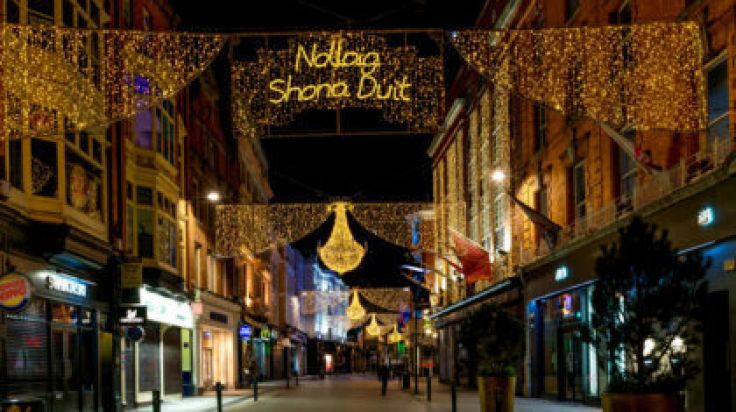
Another controversial recent initiative in Moore Street has been the changing of the traditional Irish-language Christmas lighting decoration and the ‘renaming’ of the street to “the Grafton Quarter”. Irish language comment on the new design? “Tá sé gránna!” Indeed. Sometimes it seems as though the poor property magnates can’t put a foot right.
Perhaps Hines had ideas of greater expansion, changing the street into a “quarter” which, as some Dublin City Councillors have pointed out, does not exist.
All that aside, doing away with Irish language Christmas lighting and wanting to get rid of flower-sellers doesn’t accord very well with Point Four of Hines’ own Guiding Principles: “Hines is committed to fostering an inclusive culture where diversity is respected and valued.”
Another comment in Irish? “Seafóid!”
end/ a chríoch
Irish language Christmas illumination now removed. (Photo sourced: Internet)The new Christmas lighting (Source image: extra.ie)
A representative of the Irish (Fine Gael) Government’s Minister for Foreign Affairs and Trade last night not only called for non-interference in the “internal affairs” of the Spanish State but defended the Spanish Constitution of 1978 and the “independent Spanish judiciary”. She was answering a question regarding the Spanish State and Catalan independence movement and her stance was supported by representatives of the two other traditional parties of Irish Government, Fianna Fáil and Labour. Five Teachtaí Dála, elected members of the Irish Parliament, argued passionately against them.
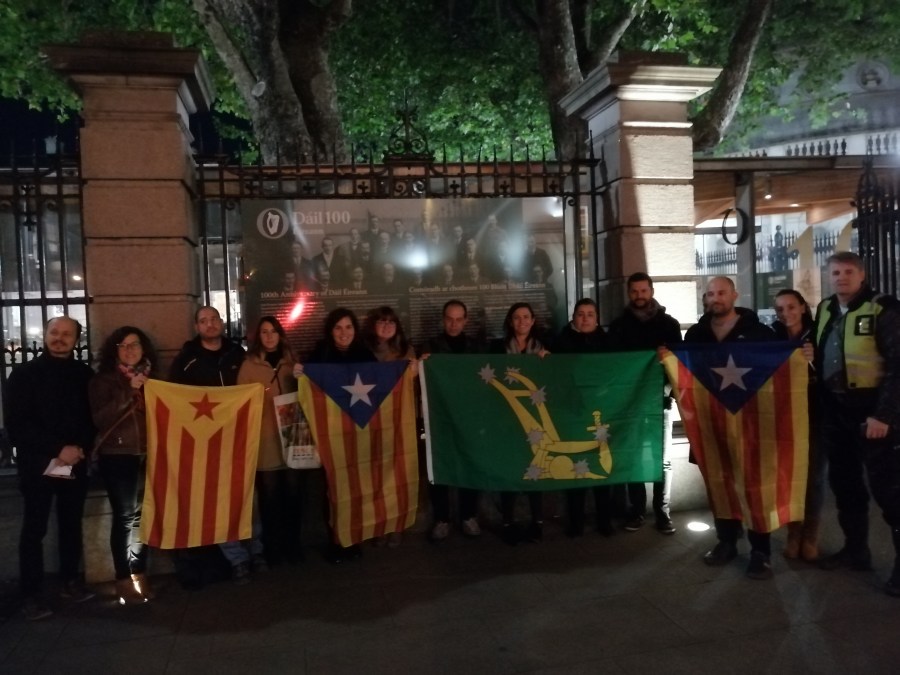
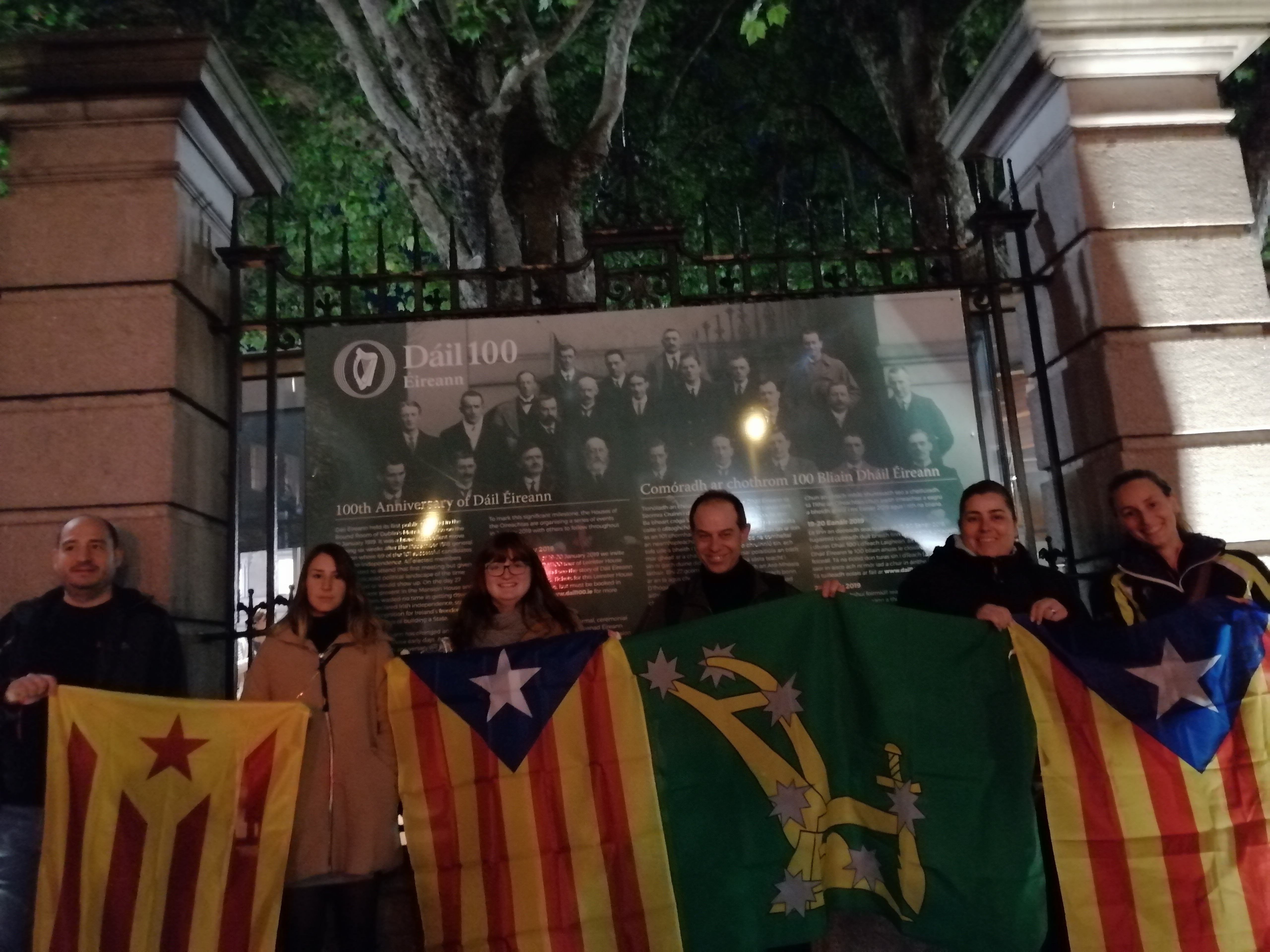
Section of Catalonia supporters in Kildare St. waiting to attend the Foreign Affairs Minister’s Question time. (Photo: Rebel Breeze)
THE VOICES OF THE ESTABLISHMENT
This was Minister’s Question time, when Ministers (or their representatives) appear in the Chamber to answer questions about areas of the remit of their Departments and earlier, Ministers had been quizzed about areas of childcare, social care funding, local government funding ……
The Dáil chamber looked mostly deserted but in the public gallery sat a score of Catalans and some Irish, listening intently. Normally, these sessions are attended only by the TDs asking the questions and the relevant Ministerial spokesperson – and only for the question being asked. And of course also in attendance is the Ceann Comhairle, the presiding person acting as Chair – and secretaries. Sometimes by members of the media but by no means always, since reporters can monitor the televised broadcasts of the session.
The Minister’s reply on the question of Catalan self-determination delivered by Minister of State Helen McEntee TD followed a predictable pattern – predictable because it is so often trotted out: the Irish and Spanish Governments have a long history of good relations and friendly links, lots of Irish people go there on holidays, lots of people from there come to Ireland every year, Spain is a democracy, its constitution must be abided by, it would be wrong to interfere in its internal affairs. Inclusions to that in litany in recent times are that the question of Catalonia is emotive throughout the Spanish State and that Catalan society is divided over it, that the rule of law must be upheld and that violence has no place in politics.
The Fianna Fáil representative, Seán Haughey TD, echoed that line, adding also that the Spanish Constitution of 1978 is unitary and does not allow any part to become independent. He also quoted some survey results that he claimed indicated that support for independence was now in a minority among Catalans.
The Labour Party representative, Jan O’Sullivan TD, went further and specifically supported the present Government of her “sister party in Spain”, the PSOE and suggested that the “inflexible” previous government of Rajoy (of the PP) had helped to bring the current situation about and that Sanchez, the Prime Minister, would help calm the whole situation down. The only concessions she made were to suggest that the lengthy jail sentences were perhaps not the best way to deal with the issue and to include the police by mention in her call for “end to violence by all sides”. However, she went further than others in the Establishment parties with a specific condemnation of the jailed activists when she said that “it is not acceptable for politicians to lead citizens into conflict”.
Early arrivals for the Minister’s Question time line up in Kildare St. below a photo of the First Dáil 1919. (Photo: Rebel Breeze)
THE OPPOSITION
“Reactionary Spanish nationalism”
The first TD to speak in reply to the Establishment politicians was Eoin Ó Broin, a comparatively recent Sinn Féin Deputy (2016) for Dublin Mid-West. Ó Broin was in Catalonia as one of the international observers of the Catalan Referendum on Independence on 1st October, which was attacked by Spanish police with around 1,000 Catalans injured.1
Speaking about his experiences there, Ó Broin related his meeting with 83-year-old Antonio, bruised and with his fractured arm in a sling, beaten while trying to vote earlier that day, queuing again at a polling station in Barceloneta. The SF TD spoke about what he had seen there and the “increasingly reactionary Spanish nationalism”, then went on to list the elected politicians and their jail sentences. Denying it was an internal matter for Spain, Ó Broin said it was about human rights and required international independent mediation. The Dáil would be implicitly in collusion with the Spanish Government if it left the matter to internal resolution only.
“The working class are the incorruptible heirs …”
Paul Murphy TD, a socialist activist2 who has recently left the Socialist Party of Ireland to form a platform called Rise, shared speaking time with Eoin Ó Broin. Calling for a “reality check” he said that jailing politicians and activists for organising a peaceful ballot could hardly be the work of a normal democracy. Responding to the Labour Party spokesperson with regard to the Spanish PSOE Prime Minister, he said that “Sanchez is in Government” and that he was “sending thousands of troops and police” to suppress the Catalan independence movement and mounting “a publicity campaign” to blame the convicted leaders.
The Spanish Government would one day come to be haunted, Murphy said, by the words of James Connolly in 19143 when he said:
“If you strike at, imprison or kill us, out of our graves or prisons we will still evoke a spirit that will thwart you, and perhaps, create a force that will rise up and destroy you. We defy you! Do your worst.”
Murphy said that the Catalan popular movement was impressive with their demonstrations, marches and the recent general strike. Against that, the Spanish police and army were carrying out “a campaign of terror” injuring hundreds and anyone who didn’t believe it only had to go on line and see the videos. “Francoism is baring its ugly head”, Murphy said and pointed out that the Spanish legal systems is riddled with a contempt for democracy, echoed by those at the top in the European Union.
The recent Catalan General Strike, according to Murphy, “showed the way forward” and he quoted again from Connolly, that “the working class are the incorruptible heirs of Irish freedom”. The Spanish State had a long history of suppression of national self-determination, including those of the Basques, Murphy said and the way forward would be for a voluntary socialist federation.
Catalan independence supporters gathering in Kildare St. waiting to attend the Foreign Affairs Minister’s Question time. (Photo: Rebel Breeze)
“The judicialisation of politics”
Next to speak was Thomas Pringle, Independent TD for Donegal since 2011, with a socialist Irish Republican background, a member of Sinn Féin for few years but who left the party in 2004. He opened his contribution by referring to “the judicialisation of politics” in the Spanish state and, in reference to the scale of the Spanish repression, mentioned the 700 Catalan town mayors who await judicial process due to their support for the Catalan Referendum in 2017.
Pringle said the Spanish Constitution purported to guarantee the rights of different people within the state, which would be a joke if the reality were not so grim. “The EU continues to ignore” what is going on in its member Spanish State, “as it did in the Six Counties,” he said.
“Catalonia in 2019 is Ireland a century ago”
“Self-determination is a human right,” said the next to speak: Peadar Tóibín, TD for Meath West since 2011, who left Sinn Féin in 2018 and went on to form Aontú in January 2019. Tóibín reminded all that the First Dáil had sent out a call to the world for recognition of Irish independence in 1919 and that most states had not done so then4.
“Catalonia in 2019 is Ireland a hundred years ago”, Tóibín said and went on to say that if the Irish Government remained silent on repression by the Spanish State then it shared culpability for it.
“ … a short memory in this House”
“We sometimes have a short memory in this House” said Mattie McGrath when it was his turn to speak, a TD since 2007 who has been an Independent since he left the Fianna Fáil party in 2011. McGrath referred to the recent long war in the north-east of Ireland and said that conflict resolution process was the only way to resolve the issue.
McGrath referred to Clare Daly (elected MEP this year after being a socialist TD for some years) and her statements on the issue. “Self-determination is a fundamental human right”, McGrath said, and went on to speak about “the right of freedom of assembly”, which was under attack by the Spanish State.
“Ireland is a small island nation”, Mc Grath said, “very sympathetic to the rights of people” (apparently contrasting this to the attitude of the Establishment in the Dáil).
In the time allowed by procedure for final response from the Minister, her representative reiterated the position she had outlined earlier and, though she conceded that most of the Catalan demonstrations had been peaceful, said that some recent “scenes of violence” had been “of concern”.
Section of Catalonia supporters in Kildare St. waiting to attend the Foreign Affairs Minister’s Question time. Behind them, enlarged photo of the First Dáil, 1919. (Photo: Rebel Breeze)
COMMENT
Fianna Fáil‘s origins are in the split with Sinn Féin led by De Valera in 1926 over the question of taking seats in the “partitionist” Irish parliament, the Dáil, and rapidly became the preferred party of the native Irish capitalist class, having been in government since more than any other Irish party.
The origins of Fine Gael, currently in minority Government at the tolerance of Fianna Fáil, has its origin in the setting up of the Irish State after the War of Independence and represents the victors of the Civil War against the Republicans. It was composed of a coalition of a right-wing Irish Republican party (followers of Michael Collins, Griffiths etc), a small right-wing farmer’s party and the fascist Blueshirts (a name by which FG are still often called by their enemies).
Hard to believe today, the Irish Labour Party was founded by, among others, James Connolly and is the oldest of the three parties. A progressive party in the early days, it was not a participant in the Civil War, during which its representatives criticised the Free State Government about its abuse of civil rights, repression, large-scale arrests, internment without trial, torture and murder. Over the years it lost more and more of its socialist credentials and has been in coalition government with the right-wing Fine Gael on two separate occasions. The main trade unions in Ireland retain connections to the Labour Party, with the possible exception of the rapidly-growing British-based UNITE.
(Photo: Rebel Breeze)
The supposed inviolability of the Spanish Constitution of 1798 is one of the questions at the heart of the matter. The boast of the Spanish Government and its supporters abroad is that the majority of the people within the Spanish State voted for it. Well, so they did, except in the Basque Country – but what of it? If in a wedding, one of the partners says “I do”, does that mean that person is forever forbidden from leaving? Do we not have the right to divorce acknowledged now in most states around the world and certainly in “the democracies”? If one agrees to join a club or organisation, does that mean one can never choose to leave? Well, maybe in the Mafia, or the Cosa Nostra ….
Furthermore, that monarchist Constitution was put forward to a population that had endured four decades of fascist dictatorship, with the collusion of the allegedly socialist and republican PSOE and the allegedly communist and republican Communist Party of Spain, restraining their trade union and party members in the wave of state repression and murders during the Transition to “democracy”. Isn’t there something about the invalidity of agreements made under duress?
The issue of non-interference in the internal affairs of another state is a bogus one, since all governments do that at one time and another and Irish governments and political parties are no exception. In 1936, the representatives of Fine Gael loudly supported the military-fascist uprising led by Franco against the democratically-elected Government of the Spanish State. The Irish Government of Fianna Fáil did nothing to prevent the Blueshirts going off to fight for Franco and the Bishops of the Irish Catholic Church blessed them as they sailed off. The reality is that states that agree with one another generally do not interfere in one another’s internal affairs.
The constant mantra of reference to “the rule of law” and the condemnation of “violence in politics” is not only an irrelevance but turning truth on its head. It was not illegal according to the Spanish Constitution or laws to hold a referendum on independence 5. It is also against the Spanish law to use violence against others and even the police are not legally empowered to do so except in self-defence or in defence of others. On October 1st the actions of the Spanish police had 1,000 people requiring treatment and another few hundred have been injured in recent days. The Internet is full of videos of different incidents of gratuitous Spanish police violence, often the perpetrators showing no fear of being filmed – clearly because Spanish (and more recently, Catalan) police know they have impunity. Recently, however, it seems that some Spanish police have become sensitive to being filmed during their violent acts and have begun to target photo-journalists, both with personal violence and with rubber bullets.
A total of five people have now lost an eye from the impact of the rubber bullets of the Spanish police. Apart from the fact that these are banned in Catalonia, the bullets are supposed to be fired to ricochet and not directly at people, nor are they supposed to be fired at close quarters. Clearly, the rules are not being adhered to and nobody is enforcing them, granting impunity to the Spanish police.
When the representative of the Minister for Foreign Affairs acknowledged the overall peaceful nature of Catalan independence demonstrations but expressed concern over some recent scenes of violence, what was she really saying? It was this: that the violence of the police against the peaceful demonstrators could continue but the victims using force in defence or in retaliation is a cause for concern!
End.
FOOTNOTES
1 Eoin Ó Broin, often described as on the (small) left wing of Sinn Féin (a wing badly needed by that party) has in the past had relations with the Abertzale Left in the Basque Country and wrote a book on the movement there in his time, Matxinada – Basque Nationalism and Radical Basque Youth Movements. He is also author of Sinn Féin and the Politics of Left Republicanism.
2 Paul Murphy has been, while a Socialist Party TD, dragged by police out of a housing protest and with others faced serious charges arising out of a protest about Irish water against a Labour Party Minister, of which he and the others were acquitted by the jury after an infamous trial. He remains in the PBP-Solidarity parliamentary coalition.
3 James Connolly (1868-1916) was at that time active in the Irish Labour Party and leader of the Irish Transport & General Workers’ Union, which was struggling to recover from an 8-month fight against a group of employers that had set out to crush the union (Dublin Lockout). Connolly was a revolutionary socialist, republican, journalist, historian, author and organiser and was horrified by the very idea of the First World War which began in 1914. He was shot dead by British firing squad, along with other leaders and some others of the 1916 Rising.
4 This reference seems particularly appropriate. In January 1919 the majority of MPs elected in Ireland in the UK General Elections of December 1918, carried out the “Sinn Féin” platform’s election promise not to go to Westminster and convened a parliament in Dublin. This is known as “The First Dáil” even by the Irish State, which numbers its parliaments from then onwards. The First Dáil declared independence and called on the states of the world to recognise Irish independence (see References) but only the young USSR did so. Ireland had no legal right under British law to break away from the UK unless it were agreed by majority in Westminster (where the Irish MPs would always be outnumbered by the British). The First Dáil was banned by the British in September of that year and its members were arrested if they could be found.
5 Though possibly the declaration of Republic was – but that was suspended in less than five minutes.
Paul Murphy speaking at his trial and that of others after the famous water protest at Jobstown against Minister Joan Burton (which led to his arrest and long trial before he and others were found not guilty by a jury). (Photo image: D.Breatnach)
Most people within the Irish state will now be aware that that socialist Paul Murphy, TD (member of Irish parliament, the Dáil), has left the Socialist Party and, with some others, intends to set up a new socialist organisation called RISE. His statement on his Facebook page was covered by a host of the capitalist media with little comment by most while left-wing chat room the Cedar Lounge had more comment than I found time or interest in reading.
A common reaction on the street was one of bewilderment at the splitting actions of left-wing parties. Elements of that were to be found in the relevant piece by Miriam Lord (see References), who comments on Dáil politics and politicians in her Irish Times column (though her sharpest treatment was of Brendan Ogle, who had mocked Murphy’s action).
I am myself, if a little surprised, not shocked nor indeed very engaged with the matter and consider it generally of little import on the prospect of a revolution in Ireland.
It strikes me, with little personal knowledge of him but based on material in the public domain, that Paul Murphy is in general a principled socialist politician and furthermore an activist who has not shirked from putting himself physically in the resistance line in Rossport, on the seas to Gaza, in Turkey against its government and in Dublin on water and housing protests. Furthermore, in the short period he was an MEP or supporting Joe Higgins when the latter had the seat, Murphy has had questions asked about the treatment of Basque political prisoners which few other politicians are willing to touch, lest they be associated with the armed liberation organisation ETA (now defunct).
However, I see no prospect of even one step towards revolution in the general conduct of any of the socialist organisations of any size in Ireland, splits or no. Of course it is helpful to have awkward questions asked of the Government in the Dáil and to gain media coverage of issues that would likely remain unmentioned, or to have their critical comments reported where yours or mine would never see the light of day. And Murphy remains in that ambit in Dáil, along with the Solidarity-PBP group — and Independents for Change are there also (now sadly missing Clare Daly and Mick Wallace, who have gone to the EU).
But that is not necessarily revolutionary work.
Meeting of the (First) International Workingmen’s Association. In Britain, the Fenians were accepted into the First International.
A TASK FOR SERIOUS REVOLUTIONARIES
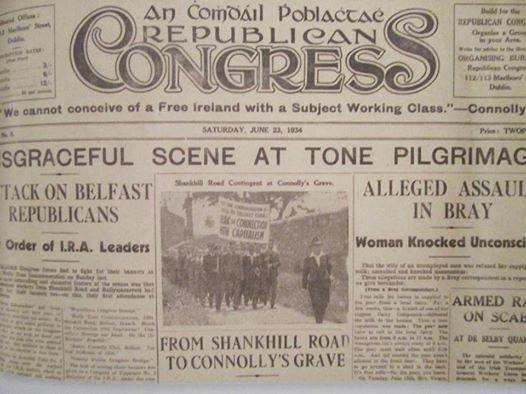
Front page of the newspaper of the short-lived Republican Congress in 1934
Without a conjunction of revolutionary Socialists with revolutionary Republicans, I can see no hope for revolution in Ireland and, without revolution, no hope of a solution to many of the ills in our society, whether in culture, economy, environment or government. In other words, in anything really. That conjunction was a project attempted in part by British socialists and some of the Fenians of the 1840s, later by Connolly and the Irish Citizen Army (1913-’16), later still by the Republican Congress (1934-’36). It remains the unfinished task for serious revolutionaries.
Neither the Socialist Party/ AAA/ Solidarity nor the Socialist Worker/ People Before Profit/ Solidarity formations have made any effort to take up that task (nor have the Republicans, lest my criticism be thought of one part of the equation only). Nor did the anarchist Worker’s Solidarity when it was an active force. The Communist Party of Ireland does not do so nor does the Workers’ Party. So great is the disdain of these formations for revolutionary Republicans that they refuse to even challenge the daily civil rights violations of the Gardaí and PSNI upon active Republicans, or their treatment in the non-jury special courts or jails on both sides of the Border. Indeed, in case they should somehow be accused of siding with these elements, they rarely even allude to the unfinished national liberations struggle of Ireland, nor to the colonial occupation of one-sixth of its territory, while instead fully prepared to support the just national liberation struggles of nations far away.
Interestingly therefore, from public comment, it appears that Murphy wanted more cooperation with “other elements on the Left” or “Left-leaning”, in which context was mentioned Sinn Féin, while the majority in the Socialist Party refused such a project. Some people will view this aspiration of Murphy’s as a laudable attempt to mould a fragmented Left into at least some kind of united action for Irish social and political progress. I do not.
I am not against a temporary alliance of revolutionaries with social democratic forces at certain points for certain objectives. But that does not include Irish political parties who are or have been part of Irish governments or, if possible even less, so a party that is part of the administration of a colonial occupying power. In the latter category I clearly place Sinn Féin and, in the former, the Labour Party, Fianna Fáil and Fine Gael.1 In addition, SF has clearly marked a path for itself to a future coalition partnership with a capitalist, pro-imperialist party or parties in Government.
It says something about the Irish socialists that an important question for them is whether or not to ally with a constitutional capitalist and colonial collaborationst party such as Sinn Féin, whereas the question of whether to ally with revolutionary Republicans is not even on the agenda for discussion.
End.
FOOTNOTES:
1One might make a temporary exception of the Greens, which have been in Government but once for a short while, admittedly shamefully so but with an honourable resignation.
In 1998, An Post, the Irish postal service (through the Department of Post and Telegraphs? Through the Office of Public Works, which manages national monuments?), commissioned a series of ten paintings of 1916 Rising scenes from painter Norman Teeling. For a number of years, these were on display in the General Post Office, site of the Headquarters of the 1916 Rising. Subsequently they were removed and enquirers were informed that they had been taken into storage. Complaints were made by organisations and individuals but no information was forthcoming as to when, if ever, they would be replaced in the GPO or put on display elsewhere. Now, it seems they are up for sale. How can this be?
Wreaths laid at the GPO by ordinary people in one of the many commemorations of Irish martyrs for self-determination. (Photo: D.Breatnach)
THE MISSING PAINTINGS
A recent discussion about the paintings in question led to my being sent a link, where the opening information said that they had been put on display in the Green Gallery, St. Stephen’s Green:
Through perseverance and dedication to the cause, Dermot O’Grady of The Green Gallery has arranged for all 10 paintings to take pride of place in a stunning new 1916exhibition on the Top Floor. St. Stephens Green Ctr Dublin 2. Opened by none other than Pat Liddy himself, the paintings have found an important rebirth and are now able to be enjoyed by everyone once again.
However, a little further down the page, a notice declared that the exhibition had closed.
But elsewhere on the page, it had been announced that, as well as prints of the paintings, the original oil-paintings on canvas were for sale:
This suite of 10 paintings has now become available to the art market. As the original oil on canvas paintings and also, with permission of the artist, in Giclée print format.
How could this be? Had they not been purchased by the State?
A wikipedia search threw up two references to the series of paintings: one for the General Post Office and another for the 1916 Rising, with what seemed to be an excerpt from each. The GPO reference had the following:
An Post History and Heritage – The GPO Museum The 1916 Rising by NormanTeelinga ten-paintingsuite of events of the Easter Rising acquired for permanent ….
And the 1916 reference had this:
The Age, 27 April 1916 Press comments 1916–1996 The 1916 Rising by NormanTeeling a 10-painting suite acquired by An Post for permanent display at the …
So from both of these I should find the information I required, i.e what had happened to the paintings. Right?
But no, neither Wikipedia page had any reference in the text to the painting series nor to the painter! Had the pages once contained the quoted references and more but these had since been removed? However, in the External Links of the both Wikipedia pages I found the sentence “The 1916 Rising by Norman Teeling a ten-painting suite of events of the Easter Rising acquired for permanent display at the GPO.” But they are not, are they?
“Beginning of the siege”, one of the GPO 1916 series of ten paintings by Norman Teeling.
THE EXPLANATION?
A good investigative reporter would make enquiries of the painter, of the Green Gallery, of An Post, of the OPW …. but I am not such a reporter nor do I have the time to make those enquiries and perhaps, as has often been the case in the past, suffer long delays or even be given the run around.
A good investigative reporter would hold off writing until he had got to the bottom of the story or at least exhausted reasonable lines of investigation but, as has already been established, I am not one of those people. So I am putting it out there now, for some of you to make the necessary enquiries or, if you already know, to come back to me.
Had the State never in fact bought the paintings? Or if they had, were they now sold back to the painter or someone else? Had Teeling become frustrated with his paintings not being on display and bought them back from the State? If so, entirely understandable on his part.





















 rebelbreeze