IRISH REPUBLICANS AND ANTIFASCISTS GATHER IN DUBLIN TO HONOUR SEÁN RUSSELL

Clive Sulish

(Reading time: 10 mins)

A few hundred Irish Republicans and other Anti-Fascists gathered today in the Ballybock area north of Dublin city centre to commemorate IRA leader of the 1940s Seán Russell. The event was organised a few weeks after the incumbent Irish Prime Minister, Leo Varadkar, had made a public statement suggesting that Russell was a fascist sympathiser and that his monument and some others in Ireland should be removed. In attendance yesterday (Sunday 21st June) was a cross-section of the Irish Republican movement in addition to independent Irish socialists and anti-fascists.

Note: Photos of the event are from individuals D. Breatnach and C. Perry and organisations Saoradh and Anti-Imperialist Action.

The statue representing Seán Russell on the monument plinth.
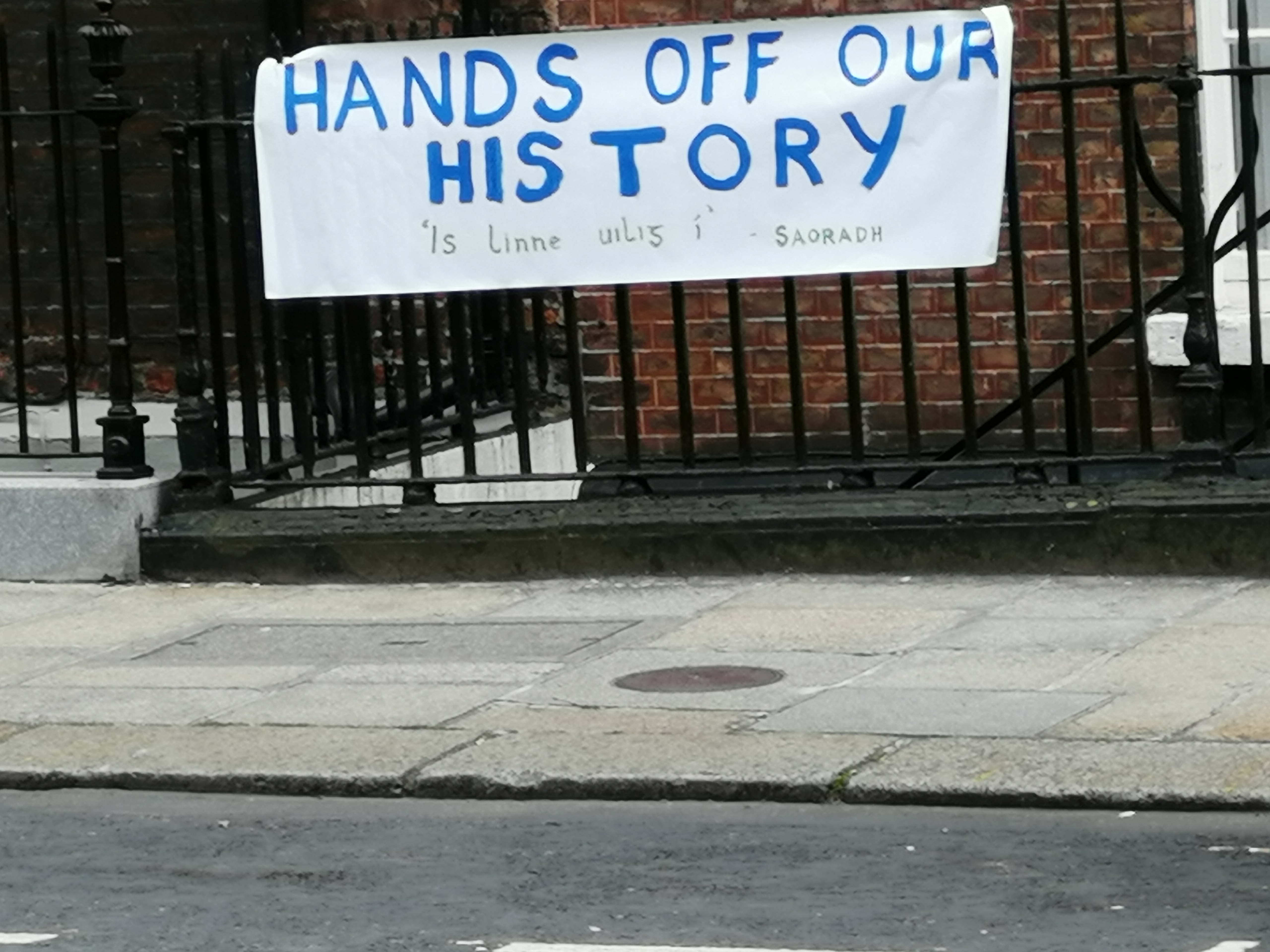
The theme banner crossing Annesley Bridge on the way to Fairview Park.

NAZI COLLABORATOR” SLUR

          Leo Varadkar’s comment that Sean Russell had been “a Nazi collaborator” was made in the course of a TV discussion on racism, arising out of the killing of George Floyd by a police officer in the USA, an event which sparked off huge protests not only in the USA but, because it had been so clearly documented and shared on social and news media, around much of the world. Among the angry retorts in reply had been an Open Letter by Matt Doyle, of the National Graves Association, pointing out that Russell was an Irish Republican with no elements of fascism in his history or ideology and that in fact Varadkar’s party, Fine Gael, was the one built on fascism, i.e the Blue Shirts movement of the 1930s, which Republicans had fought and defeated.

Seán Russell had gone to Nazi Germany in 1940 to seek assistance from them in ridding Ireland of British colonialism but on his way back to Ireland in a German submarine, accompanied by Frank Ryan, Russell had become seriously ill, died and was buried at sea, 20 miles from Galway. Frank Ryan was also an Irish Republican but had been wounded fighting fascists in the Spanish Civil War; after his capture the Nazi German allies of the Spanish fascists had expressed interest in Ryan for the purposes of assisting Irish Republican action against the English occupation of the occupied Six Counties.

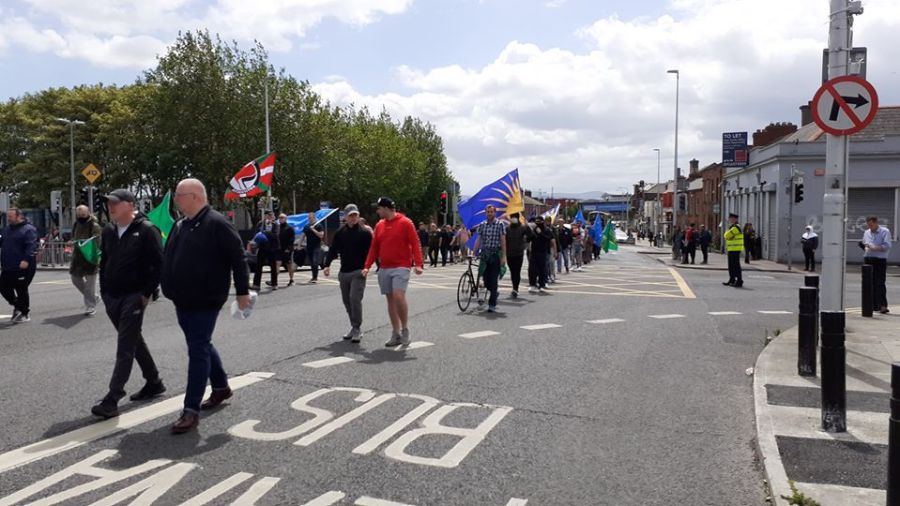
View of section of the parade crossing Annesley Bridge on the way to the monument in Fairview Park.

A BROAD REPUBLICAN PARTICIPATION IN PROCESSION AND RALLY

          The attendance had representation from across the Irish Republican spectrum from “Stickles” to “Provies” to “Dissidents”1, mixed with some independent socialists and antifascists but notably absent was a representation from the Irish socialist and communist parties in any numbers, nor were their flags to be seen. No anarchist flags were in evidence either and only one Antifa flag was, that one from the Basque Country. The event was organised by “Independent Republicans”, a headline permitting a wide attendance free from sectional hostilities or the more fundamental division of for or against the Good Friday Agreement. The flags most in evidence among the attendance were the orange rising sun on a blue field of Na Fianna and both versions of the “Starry Plough”, the one in gold on a green field and the one with white stars on a blue field.

Section of the crowd at the event in Fairview Park with Annesley Bridge Road in the background.

The Starry Plough was the flag of the Irish Citizen Army, founded by James Connolly and Jim Larkin and described as “the first workers’ army in the world”; formed in 1913 to defend the Dublin strikers and locked-out workers from the attacks of the Dublin Metropolitan Police, its ethos was socialist and for Irish independence. The ICA recruited men and women and a number of the latter were officers during the 1916 Rising, including third-in-command in two insurgent garrisons. That version was gold-on-green field version but the Republican Congress of the 1930s had the white-stars-on-blue-field version. The Republican Congress was a short-lived attempt to unite communists, socialists and the Irish Republican movement in one front.

Na Fianna Éireann was an Irish Republican youth organisation founded by Bulmer Hobson of the IRB and Constance Markievicz in 1909 and therefore predated the ICA (and the Irish Volunteers). Members of na Fianna were highly motivated and disciplined and played a prominent part in the collection of Mauser rifles smuggled into Howth in 1914, in the 1916 Rising, the War of Independence and in the Irish Civil War.

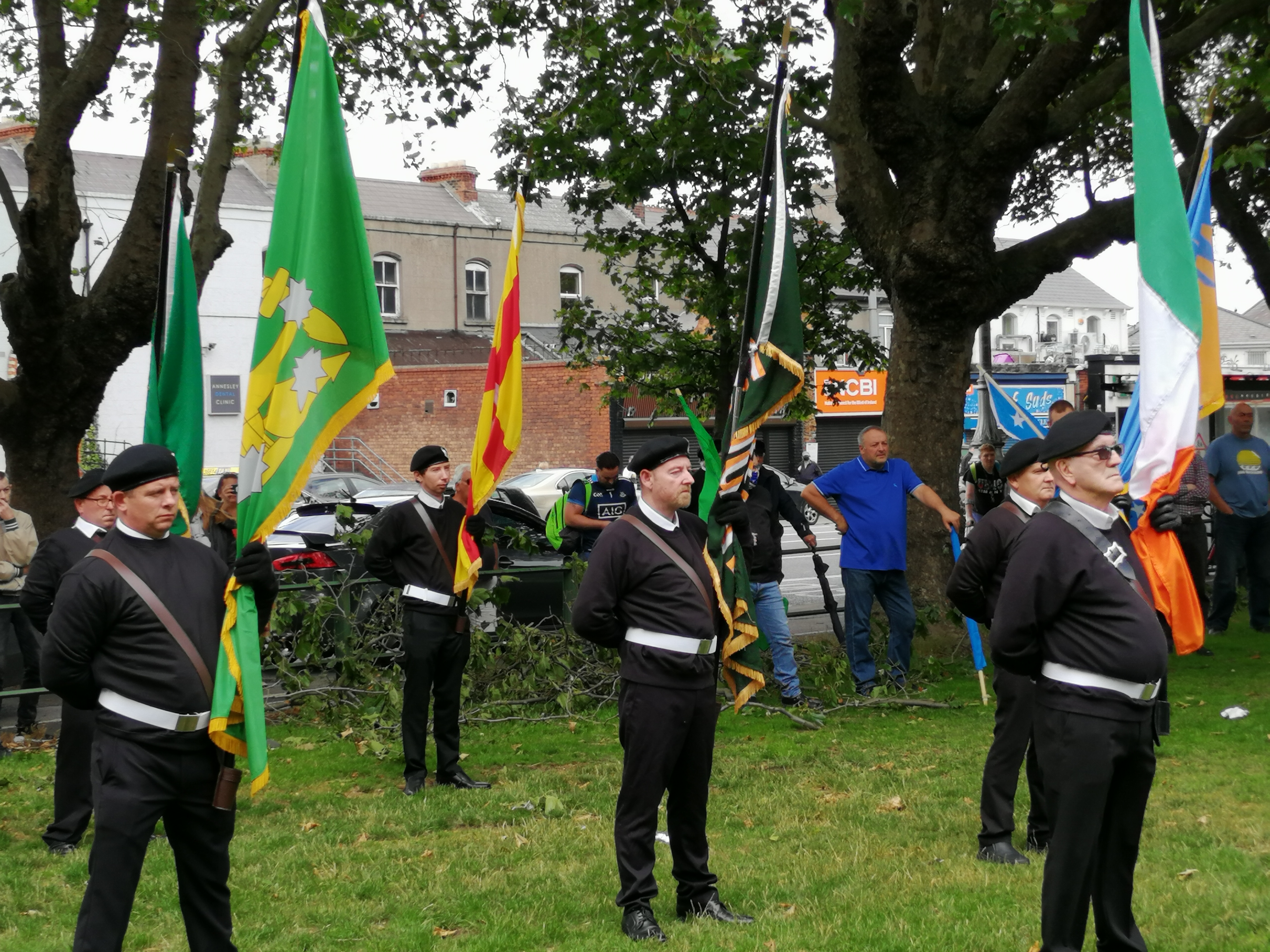
The colour party at the event.  The flags displayed traditionally include the Tricolour, those of the four provinces and that of Na Fianna, along with the Starry Plough (either version but that shown here is the original ICA design).

Led by a traditional Irish Republican colour party and a lone piper, the parade on Sunday set off from under the railway bridge crossing the North Strand road and marched north in the traditional formation of two lines, their flags fluttering in the strong breeze. The procession crossed the Tolka river at Annesley Bridge, scene of a battle in 1916. In fact, the whole area had also been the scene of running battles in 1014 as the defeated Viking mercenaries from Orkneys and Manx ran for their ships, pursued by some of Brian Boróimhe’s (“Boru”) forces, for prior to the draining and reclaiming of the marsh, dunes and mudflats of the “sloblands” to permit laying out of Fairview Park and parts of the East Wall area, the seashore had been there.

Once over the bridge, the procession turned into Fairview Park and marched a short distance under trees until arriving at the Seán Russel monument and its surrounding low iron fence, where a number of people had already gathered. The monument had been erected in 1951 by the National Graves Association, a totally independent NGO and had been attacked twice, once having an arm removed and on the other occasion, its head. The first attack has been attributed to right-wing elements and the second, to antifascists.

The lone piper plays by the monument.

WREATH, SPEECHES AND SONG

          Patrick “Parko” Burke as MC for the event welcomed those in attendance and called for the placing of a floral wreath at the monument on behalf of Dublin Republicans. The piper played a short piece while the flags of the colour party were lowered and a moment’s silence was observed, then as the flags were raised again a short piece was played again.

The wreath to be laid on behalf of Dublin Republicans at the monument.
Laying the wreath at the foot of the monument.

The MC then introduced Gerry Mac Namara, who is a member of the extended Russell family.

Speaking briefly first in Irish and going on to address the gathering in English, the speaker recounted that Russell’s antecedents had been Fenians and that Seán himself was an Irish Republican who fought in the 1916 Rising and War of Independence and continued in the IRA after De Valera led a split to form Fianna Fáil. Mac Namara denounced Varadkar for his comments and commented that if the Prime Minister was in the mood to remove monuments there are a number of memorials of the British occupation and to English landlords in Ireland with which he might make a good beginning. Mac Namara made some comments in a similar vein in reference to Cnclr. Ray McAdam, “the publicity-seeking Fine Gael Councillor” who had recently sought to desecrate the 1798 mass grave monument at Croppies Acre.  “Sean Russell has no grave”, commented Mac Namara, “because he was buried at sea.  This monument is the closest thing to a gravestone he has.”

Gerry Mac Namara, a member of the extended Russell family, speaking at the event.

If Varadkar wanted to talk about racism in Irish history, he would do well to refer to Oliver J. Flanagan, a prominent member of the Fine Gael party and Minister in Fine Gael government, who had in the Dáil in 1943 called called on the Irish Government to do as the Nazis had done and to “rout the Jews out of this country …. where the bees are, there is honey and where the Jews are, there is money.”

Liam Manners, a young man came forward then to read a statement from the Irish Republican prisoners in Maghaberry, Mountjoy and Portlaoise jails. The first of those prisons is of the Six Counties colonial administration while the other two are of the Irish State.

Pat Savage at the event performing an Irish ‘rebel’ ballad. The MC, Patrick “Parko” Burke is holding the microphone for him.
Liam Manners at the event reading statement on behalf of Irish Republican Prisoners.

Pat Savage was called forward and performed the Republican ballad “White, Orange and Green”, about an anonymous teenage Republican girl who refuses to surrender the Irish Tricolour to an English soldier during the War of Independence.

A REPUBLICAN LIKE TONE AND PEARSE”

          Mallachy Steenson came to stand in front of the monument and gave a resumé of Seán Russel’s service to the Republican movement. In seeking help to rid Ireland of British occupation Russell had been not only to Nazi Germany but to imperialist USA and Soviet Russia, however he had not been accused by Varadkar of being a Soviet or a US imperialism collaborator. Russell was ready to receive help from Nazi Germany to get rid of the British occupation, as he said himself but nothing more.

Steenson stated that Russell had been an Irish Republican in the same mold as Patrick Pearse and Theobald Wolfe Tone: Tone had sought help from France and Pearse from Imperial Germany, yet Tone was not a “French collaborator” nor was Pearse a collaborator with German imperialism or monarchy. Steenson commented that “the enemy of my enemy is my friend” has been a well-known tactical slogan on many occasions.

Briefly touching on John Mitchell, whose statue in Newry some had suggested had suggested should be got rid of, Steenson pointed out that Mitchell had opposed English rule in Ireland for which he had been deported to Australia as a convict. From there he had escaped to the USA. While it was unfortunate that he had taken the side there of the slave states of the Confederacy, were it nor for the English he would have been in neither Australia nor America.

Mallachy Steenson, delivering the main speech at the event.

The Sean Russell monument is not only to commemorate Russell, Steenson pointed out and there are names on the pediment of many other Republicans, including those executed by the De Valera government because they had continued the fight which Fianna Fáil had abandoned. The Irish Republicans of the 1940s, of which group Sean Russell was an important member, passed through a particularly difficult period.

Talking about monuments which he said should be removed, Steenson referrred to the wall of names in Glasnvevin Cemetery, which he said should be called “the Wall of Shame” and went on to refer to the attempt to interfere with the Croppies’ Acre memorial2. Steenson said that there was a concerted effort to remove or rewrite Irish history. There had not been too much controversy during the early part of the “Decade of Commemorations” but coming up soon would be the Civil War. How would Varadkar and Fine Gael justify the Free State’s execution of 77 Republicans after a summary court martial, he wondered. Or the Free State army tying of captured Republicans to a land mine and blowing them up? Or the removal from their cells in Mountjoy Jail of four Republican leaders, one from each province before shooting them dead the next day3?

The MC made a mention of the National Graves Association and announcing that the organisation had a big event planned for later in the summer, then called for another song which Pat Savage performed: “Off to Dublin in the Green”, a Republican ballad about the 1916 Rising.

Patrick Burke acknowledged the presence of Dublin City Councillors Cieran Perry and Christy Burke and invited the latter to say a few words.

Like Steenson, Cnclr. Burk referred to the “wall” in Glasnevin but also reminded listeners that in January of this year the Minister for Justice Charlie Flanagan had proposed to commemorate the Black ‘n Tans4 but his plans had been defeated by the public reaction of outrage. Burke referred also to the plan to build a playground on the United Irishmen mass grave at Croppies’ Acre and that a motion by Councillors such as Cieran Perry against any such desecration had won 50% of the vote and since he had been Chair, he had given the additional casting vote in favour of the protective motion. Cnlr. Burke said that he along with Cnclrs. Mannix, Perry and others were preparing a motion to prevent any Republican monument being removed in Dublin.

The formal part of the event concluded with the playing of the chorus of Amhrán na bhFiann, the Irish National Anthem while some remained in the area to take photographs, have theirs taken in front of the monument or catch up with friends or acquaintances whom they had not seen for some time.

INCIDENTS

          There were three minor incidents during the event:

1) Two cyclists had strung a line of bunting in LBTG colours between their bicycles and were at first some distance behind the monument but later moved to the street in front. It is not known whether they were supporting the event or commenting on it in some way.

2) While one of the speakers was addressing the crowd, one of a small group of secret police approached one of the supporters of the event who had become momentarily separated from the general attendance and tried to detain him there for questioning. However, the man shouted to the crowd that he was being “harassed by the Special Branch” and with a snarl the secret policeman stepped out of the man’s way. After all, there were several hundred supporters of the event present but only a handful of secret police!

3) During the proceedings, a middle-aged woman came from behind the monument and stood to one side of it in the space left open, looked at the statue, then at the attendance with an insolent attitude, then stalked away without saying anything.

CONCLUSION

          The event was marked by the absence of any obvious representation of the fascists and racists of the far-Right in Ireland who have been for some time now attempting to represent themselves as “Irish patriots” and who, it was rumoured had been warned not to attend.

The mood at the event was defiant and the speeches militant in form, seeming to reflect a determination to defend Irish Republican history and monuments to the anti-colonial resistance of the Irish people from forces in or outside Government who might wish to destroy or misrepresent them.

The calumny that Sean Russell was in any way a supporter of fascism has been staunchly refuted. However the correctness or otherwise of the general thesis that “the enemy of my enemy is my friend” and its specific application to Nazi Germany or other cases remains a subject of some debate even in Irish Republican circles.

End.

FOOTNOTES

1Popular words used to describe the Official Sinn Féin and IRA and its split, Provisional Sinn Féin and IRA and those Republicans of various groups and none, of armed group or none, that rejected the Good Friday Agreement.

2The “wall” referred to is an installation put up in 2016 by the Glasnevin Cemetery Trust commemorating fatalities during the 1916 Rising but which includes the names of soldiers of the British Army alongside those of freedom fighters of the insurgency. Many in Ireland have objected strenuously to this juxtaposition and the installation has been continually guarded by Gardaí, the police force of the Irish State which has failed to prevent at least two attacks on the “Wall” and there are plans to include Black and Tans and Auxilliaries on it in future.

3Actually more than 77 executions of Republicans, since the number does not include a few executed for armed robberies to raise funds for the struggle. The first of the land mine atrocities was the Ballyseedy Massacre in Kerry, on 7th March 1923, followed by others within 24 hours: five at Countess Bridge near Killarney and four in Cahirsiveen. There were many unofficial executions by the Free State during the Civil War, varying from kidnapping and murders to shooting prisoners of war: of the 32 Republican fighters killed in Kerry in March 1923, only five were killed in combat.

4In January Charlie Flanagan, Minister of Justice of the Fine Gael minority Government, had declared his plan to commemorate the colonial police force of the British occupation of Ireland, the Royal Irish Constabulary. In 1920 these had also included two auxiliary special police forces, the “Black and Tans” and the “Auxiliaries”, whose role was to terrorise the Irish population and who committed torture, murder, arson and theft until they were disbanded in 1921 after the signing of the “Anglo-Irish Treaty”.  A wave of public repugnance had caused the Government to “postpone the event”.

Diarmuid Breatnach Political Agitator Part 1

Mick Healy interviewed me about a number of my experiences in revolutionary work over the years and this is Part 1 (Part 2 will shortly be published), nearly all about some of my three decades in London. It contains a number of errors by me, for example the apartheid rugby team was South Africa’s one which were not called the “All Blacks”, that being New Zealand’s. Also I believe the giant Hunger Strikers solidarity march in London was to Michael Foot’s home, not Tony Benn’s. Still, here it is for what it’s worth with many thanks to Mick.

irishrepublicanmarxisthistoryproject's avataririshrepublicanmarxisthistoryproject

Diarmuid a long time political agitator was active in London from 1967, in interview part one, he talks about his involvement with Marxism-Leninism-Anarchism. His involvement in the Vietnam and Rhodesia solidarity campaigns, Anti-fascist mobilisation, solidarity Ireland, family squatting. In addition the campaign against the Prevention of Terrorism Act and the 1969 Peoples Democracy march from Belfast-Dublin.

View original post

IBRG at the WCML; A Welcome for IBRG at St.Brendan’s Irish Centre.

Dem were de days …. hard days and nights but busy!  1970s Britain in relation to Ireland was the decade in which the British troops were sent into the Six Counties, the war with the IRA began, internment without trial was introduced, Army massacres of civilian protesters took place and the IRA took the war to Britain.  The British State introduced legislation to terrorise the Irish community, the Prevention of Terrorism Act and framed 20 Irish people on murder and murder-related charges.  1980s Britain was the decade in which, due to the hunger strikes, the Irish community stood up, shrugged off the terror of the PTA and took to the streets.  At the start of that decade too, the Irish in Britain Representation Group was founded.

lipstick socialist's avatarlipstick socialist

In the 1980s when IBRG branches were being   set up across the country one of the biggest problems was finding somewhere to meet. There were many  Irish Centres,  but most of them did not want an Irish group with a political agenda meeting there. Most of them were attached to Catholic churches who promoted a reactionary agenda or they were commercial venues who worried about their alcohol licence as well as  police surveillance and threats to their future.

Manchester IBRG found a home at St. Brendan’s Irish  Centre in Stretford.  Originally the Lyceum Cinema, it opened as an Irish Centre on  25th April 1961. Surrounded by streets of Victorian houses it became the home for many of the  Irish who emigrated to the Manchester district in the 1960s.

St Brendans St. Brendan’s Irish Centre

St.Lawrence’s Church which was located next to the Centre organised an Irish community care organisation which met Irish…

View original post 937 more words

Anti-Irish Racism Letter to Irish Times

Anti-Irish racism in Britain

Sir, – Gerard Murphy (Letters, February 27th) and some others doubt the existence of anti-Irish racism in Britain prior to the Brexit debates, claiming never to have experienced or witnessed it themselves.

After the Race Relations Act (1976) drove the blatant discrimination of notices in lodging-house windows and “help wanted” advertisements into concealment, in 1984 the Greater London Council published Liz Curtis’s booklet Nothing But the Same Old Story, full of public examples of anti-Irish racism in print and in drawings over centuries, including cartoons in the Evening Standard during the 1970s.

In the mid-1970s nearly a score of innocent people in five different cases were taken from the Irish community and convicted of murder or in assisting murder while Irish people were being regularly stopped at airports and embarkation points, as well as having their houses raided and being taken into Paddington Green police station, for example, to spend days in underground cells without daylight or access to solicitor, to be eventually released without charge. In the 1970s Granada TV series The Comedians, stand-up performers told sexist and racist jokes, with the Irish often being the butt of the latter. In the 1980s the Irish in Britain Representation Group picketed WH Smith shops until they removed from sale their “Irish mugs”, which had the handle on the inside.

Letters in Irish community newspapers in Britain like the Irish Post and the Irish World regularly complained of anti-Irish racism in print, on TV, on radio and in public places. Anti-Irish racism has a history of centuries but it was all around Britain in the 1970s, 1980s and even the 1990s. – Yours, etc,

DIARMUID BREATNACH,

Baile Átha Cliath 9.

Anti-Irish Racism in Britain: Not a great letter or anything but the first letter of mine the Irish Times has ever published!

Scene outside the Court of Appeal’s 1984 quashing of the convictions of the Guildford Four and Maguire Seven. Gerry Conlon, one of the Four, seen here shouting his anger to the crowd at his unjustly serving 10 years in jail and his father having died in jail. The Birmingham Six were not released until 1991 and Judith Ward in 1992!
(Source photo: Internet)


By Liz Curtis. First published 1984 by the Greater London Council.
(Image source: Johnsbookshop.org)
A dungeon cell in Paddington Green Metropolitan Police Station. Under the provisions of the “Prevention of Terrorism Act” (sic), Irish people were kept in cells like this for up to five days (sometimes longer) without access to solicitor, family or friends, interrogated and often brutalised.
(Photo source: Protesters who occupied the empty building recently — go raibh maith agaibh!)

HAS FERRITER BEEN READING REBEL BREEZE?

Diarmuid Breatnach

(Reading time: 2 minutes)

On 15 February Ferriter’s column in the Irish Times expressed the opinion that comparison of Sinn Féin with Fianna Fáil in the 1930s only takes us so far. After looking at less of the overall history of the main Irish parties than I had in my article of 11 February in Rebel Breeze but adding some pieces I had not, what was his conclusion that differed so widely from mine? Well, that the military past was too new with SF!

Diarmaid Ferriter in Thinker pose
(Source: Internet)

But, actually, not true of Provisional SF with regard to FF, which came into government in 1932, less than two decades after the end of the Civil War and only six years after its split from Sinn Féin. De Valera, President of Fianna Fáil, had been a leader of the Republican side in the Civil War, from which side came the majority of Fianna Fáil’s supporters. By the time PSF gets into Government, it will be LONGER than two decades since Provisional IRA gave up its armed struggle!

On 11 February I posted an article of mine on Rebel Breeze and from there on to Facebook, making the point that, despite hostile media and politician claims to the contrary, Sinn Féin is very like the main Irish political parties – and that that is not a good thing. I traced the main elements of the parties’ history, how they had changed their positions and I elaborated the point that the main difference in their trajectories is that SF’s arrival on the neo-colonial capitalist political field was just more recent.

Meeting of Provisional Sinn Féin’s Ard-Choiste (national executive) in February 2020.
(Source photo: Niall Carson, AP, Internet)

It is worth noting (a point I had omitted in my piece) that nearly the entire Fianna Fáil government Cabinet in 1932 was composed of Civil War IRA men and that most of the remainder had been in Free State prison during that war.

It is said that imitation is the sincerest form of flattery but I can easily avoid being pleased by Ferriter substantially following my line of historical analysis. This is the man who, during the 2016 High Court hearing about the Government and property speculator plans for Moore Street, wrote a nasty attack on the demonstrators who had occupied the buildings and subsequently blockaded them against demolition. If he had been hoping to influence the High Court’s decision he failed – and spectacularly, because the judgement was that not only the buildings but the whole quarter is a 1916 historical monument.

Frank McDonald had also written an opinion piece during the trial against conservation and the demonstrators in the same newspaper (what WAS the Irish Times up to?) but after the judgement, he had the grace to apologise (sort of: he wrote that he had been in error).

But Ferriter? Nary a word.

End.

REFERENCES:

Piece by D. Breatnach in Rebel Breeze: https://rebelbreeze.wordpress.com/2020/02/11/despite-hostile-propaganda-sinn-fein-is-just-another-irish-political-party/

Piece by D. Ferriter in the Irish Times: https://www.irishtimes.com/opinion/diarmaid-ferriter-fianna-f%C3%A1il-s-trajectory-holds-lessons-for-sinn-f%C3%A9in-1.4173709?


DESPITE HOSTILE PROPAGANDA, SINN FÉIN IS JUST ANOTHER IRISH POLITICAL PARTY

Diarmuid Breatnach

(Reading time: 5 minutes)

Sinn Féin is not like other Irish political parties” goes the propaganda campaign against the party  by media commentators and rival mainstream politicians during the elections. What nonsense! It is exactly like the other main Irish political parties – and that’s the problem.

          Their opponents’ main objection seems to be that Provisional Sinn Féin was widely seen as the political wing of the armed resistance group Provisional IRA and, although the IRA have dissolved and decommissioned their weapons, the party still carries that mark in the eyes of its detractors (and, it must be said, fondly in the eyes of some of its supporters).

This propaganda campaign is acutely unhistorical. A few short lessons in Irish history might be of use here.

The Irish Labour Party was founded by, among others, the revolutionary socialist James Connolly and anarcho-sindicalist Jim Larkin. In 1913 both advocated arming union workers to resist armed police attacks. In 1916, the Irish Citizen Army they founded was part of the armed Rising and two of their leaders were among the 16 executed by British firing squads.

The party stayed neutral during the Civil War and was an opposition party to the Cumann na nGaedheal government. Since then, the Labour Party has been in Government only as a coalition partner – most times with the right-wing Fine Gael party. Except for it links with trade unions, the party has little claim to having “Labour” in its name and has turned away from everything if which its founders believed.

Fine Gael was formed in 1933 when two smaller groups joined Cumann na nGaedheal, which had been the governing party of the partitioned Free State from 1923 up until the merger. Michael Collins and his followers were the kind of people The founders of Cumann na nGaedheal were among the pro-Treaty and Free State supporters, i.e people who until then had been active in leading or supporting a campaign of armed resistance to the occupying British forces, including assassinations, ambushes and robberies. The Free State began the Civil War in 1922 by an artillery bombardment of Republican positions in Dublin and over the next few years carried out repression on the civilian population, torture, summary executions of prisoners of war as well as State executions – and assassinations.  The victors handed the reins over to Cumann na nGaedheal in 1923.

The parties that joined Cumann na nGaedheal in 1933 were 1) the National Centre Party, essentially a big farmers’ quasi-fascist party and 2) the Army Comrades Association (the fascist “Blueshirts”). Of the mainstream Irish political parties, Fine Gael has stayed truest to its founders and base.

Fianna Fáil emerged from a split from Sinn Féin in 1926; interestingly, much of what is being said against Sinn Féin by establishment political commentators now – and worse — was said then about Fianna Fáil: “murderers”, “revolutionaries” (and even “Communists”!). The party first entered power in 1932, its leader De Valera having been — little more than a decade previously — a leader of the Republicans during the Civil War, opponents of the Treaty and of the Irish Government of the time.  It freed the Republican prisoners locked up by the Cumann na nGaedheal government, also having a special police force (“Broy’s Harriers”) to persecute the Blueshirts, who aspired to taking power as had Fascists in Europe.

Cumann na nGaedheal (forerunner of Fine Gael) poster against Fianna Fáil during 1930s.
(Image sourced: Internet)

By 1939, the Fianna Fáil government had introduced the savage repressive legislation of the Emergency Powers Act to intern republicans without trial and after a successful habeas corpus challenge by Seán McBride (one of the founders of Amnesty International), the Government brought in the Offences Against the State Act, was re-arresting Republicans and interning them without trial again (around 2,000). Two Republicans died on a hunger strike protest in Mountjoy Jail. Under Fianna Fáil the State executed six Republicans and some more are alleged to have died as a result of their treatment in the concentration camp.

In 1957, a Fianna Fáil government once again brought internment without trial into force, the colonial administration of the Six Counties having done the same the year previously. The last prisoner was released by FF in 1959.

Left: Cumann na nGaedheal poster urging votes against FF because of the party’s history. Right: Fianna Fáil poster appealing to the working class and small farmers.
(Image sourced: Internet)

From having been seen as the main political party of Irish Republicanism, Fianna Fáil became in a short time the preferred party of the Irish capitalists (the “Gombeen” class) and has been in government more than any other party, more often indeed than the party that won the Civil War and set up the State.

JUST LIKE ANY OTHER IRISH PARTY

          There is no historical basis for saying that Sinn Féin is very different from the other Irish mainstream political parties. It has traversed a similar path to all those others, perhaps most similarly to Fianna Fáil – it’s just a more recent arrival on the mainstream scene. It is already very like other main Irish political parties and is getting to be exactly like them.

Leader of the Sinn Féin party, Mary Lou McDonald, at the launch of the party’s manifesto. With no intention of overthrowing capitalism it promised reforms for working people.
(Photo source: Internet)

That is not a compliment.

This is a party that, in recent decades, had a revolutionary Irish republican – or at least nationalist – position. It strongly opposed the partition of the country and the colonial occupation of one-sixth of the nation’s territory. With the latter came — naturally enough — opposition to the colonial police force, the Royal Ulster Constabulary but this was much more than an ideological opposition: the RUC was an armed force created specifically for the repression of Irish Republicans and acted consistently against the Catholic minority in the Six Counties, which SF sought to represent and among which it organised.

The colonial Statelet itself, with its gerrymandering of electoral boundaries, sectarian allocation of housing and employment and its Special Powers Act, was the sworn enemy of the Sinn Féin party. And when British troops were sent in 1969 to repress the civil rights uprising, of course Provisional Sinn Féin and Provisional IRA fought them too.

The Provisional IRA gave up armed struggle against the British in 1998 and, although it maintained its armed force for control of its community for some time afterwards, eventually dissolved its organisation. By then it had already decommissioned its weapons.

Martin McGuinness (right) of SF, formerly of the IRA, as Deputy Prime Minister of the British colony of the Six Counties. He partnered the Prime Minister Ian Paisley (left), a rabid religious sectarian, Christian fundamentalist and homophobe. They were dubbed “the Chuckle Brothers”.
(Photo sourced: Internet)

In 2007 the SF party became part of the British colony’s administration in Stormont, with Martin McGuinness, former chief of the IRA in Derry, partnering Ian Paisley, notorious Loyalist religious sectarian and social bigot.

That same year the party agreed to support the armed and sectarian police force and in the reorganisation of the RUC had the name changed to “the Police Service of Northern Ireland”. The essence of the force, naturally, remains the same.

All the austerity measures inflicted on the working class by the administration since the party entered joint government of the colony have been approved by Sinn Féin MLAs.

Martin McGuinness publicly shaking hand of British colonial Queen when SF officially opposed the visit. However SF did not demonstrate against her visit and Gerry Adams later approved of it.
(Photo sourced: Internet)

In 2011, despite an official SF policy of opposition to the visit of the Queen of England, Commander-in-Chief of the British Armed Forces, to the 26 Counties (the Irish state), leaders greeted her (one in person) and urged no protests be made against her visit.

In 2019, SF welcomed Prince Charles on a two-day visit to the colony and to the State; this man is not only son of the English Monarch but ceremonial commander-in-chief of the Parachute Regiment, authors of the massacres of Derry’s Bloody Sunday (14 dead) and Ballymurphy (11 dead) for which not a single soldier or commander has ever been tried. The SF Mayor of Derry, however, refused to meet him.

Gerry Adams shakes hands with Prince Phillip, titular head of the Parachute Regiment (the SF Mayor of Derry refused to meet him).
(Photo sourced: Internet)

This year, 2020, the Six-County part of the leadership of Sinn Féin joined others in publicly seeking recruits for the PSNI, while the 26-County leadership withdrew from its previous position of seeking abolition of the repressive emergency powers of the Offences Against the State Act.

In the 26 Counties, SF long ago indicated its willingness to join in a governing coalition with some one of the other mainstream political parties: i.e capitalist, neo-colonial political parties.

On so many occasions, it has shown itself to be like the other parties and prepared to ditch formerly-declared principles for what it considered a political advantage, proving itself a “safe pair of hands” to the rulers of the system.

Yes, Sinn Féin is indeed a party like any other Irish mainstream political party: capitalist, neo-colonial, undemocratic and supporting State repression. As to the latter, why not? It won’t be SF that the State will be repressing — it’ll be Irish Republicans. And if SF ever get where they want to, into majority control of government – they’ll have plenty of opponents themselves to drag before those non-jury courts.

End.

L-R: PSNI Chief Constable Simon Byrne, Anne Connolly, Chairperson of the NI Policing Board, Gerry Kelly MLA, Deputy First Minister Michelle O’Neill and Deputy Chief Constable elect, Mark Hamilton at recruitment launch for the colonial police force.

MORE INFORMATION LINKS

“Sinn Féin is not a conventional democratic party”: https://www.irishtimes.com/opinion/sinn-f%C3%A9in-is-not-a-conventional-democratic-party-this-is-undeniable-1.4161818?

The most vicious of unhistorical attacks on SF, although from an alleged historian: https://www.belfasttelegraph.co.uk/opinion/columnists/ruth-dudley-edwards/sinn-feins-rise-akin-to-that-of-nazis-in-1930s-and-is-a-threat-to-democracy-on-this-island-38940177.html

Internment without trial under Fianna Fáil 1957: https://www.anphoblacht.com/contents/19806

Sinn Féin shares in administration of the British colony for the first time: https://www.irishtimes.com/news/sinn-f%C3%A9in-endorses-psni-by-overwhelming-majority-1.1292110?

Sinn Féin accepts the colonial police force: https://www.irishtimes.com/news/sinn-f%C3%A9in-endorses-psni-by-overwhelming-majority-1.1292110?

Relatives of people murdered by Crown forces and allies object to SF support for the PSNI: https://wordpress.com/read/feeds/209838/posts/2580601201

Sinn Féin leader McGuinness welcoming Queen of England to the colony despite SF official policy against her visit: https://www.independent.co.uk/news/uk/home-news/queen-publicly-shakes-hands-with-sinn-feins-martin-mcguinness-after-historic-meeting-7892750.html

SF leader Gerry Adams commenting favourably on Queen’s visit to the Irish State despite official SF policy: https://edition.cnn.com/2012/06/27/world/europe/uk-queen-northern-ireland/index.html

Sinn Féin welcoming Prince Phillip: https://www.irishnews.com/news/northernirelandnews/2019/05/22/news/duchess-1625989/

https://www.bbc.com/news/world-europe-44474996

Gerry Adams meeting Prince Phillip: https://www.bbc.com/news/uk-northern-ireland-32786393

Sinn Féin recruiting for the colonial police force: https://www.irishtimes.com/news/crime-and-law/sinn-f%C3%A9in-presence-at-psni-recruitment-event-seismic-and-historic-1.4161267?

Sinn Féin and the Special Criminal Court: https://www.thejournal.ie/special-criminal-court-explainer-4993281-Feb2020/

https://www.irishexaminer.com/breakingnews/ireland/sinn-fein-call-for-review-not-abolition-of-special-criminal-court-976322.html

February 2020 Election results: https://www.theguardian.com/world/2020/feb/10/irish-general-election-everything-you-need-to-know

DEAR MR. FLANAGAN

Diarmuid Breatnach

Mr. Charlie Flanagan (Photo sourced: Internet)

Dear Mr. Flanagan,

I write to say how much I admired your attempt to have the Royal Irish Constabulary and the Dublin Metropolitan Police honoured in Ireland. It was never going to be easy to propose such a ceremony in a country that was occupied by les Anglais for nearly eight centuries and a part of which it is still occupying. But you did not flinch! It took real courage and I empathise with you on its failure (temporary, I hope).

Royal Irish Constabulary assisting landlord in relocation of a tenant in Co. Clare.
(Photo sourcede: Internet)

          Perhaps it was a little too soon. But as you know, I’m sure, once the unthinkable has been proposed, it is no longer unthinkable; then some day ….

It must be particularly galling for you to see the response of the “swinish multitude”, as your own orator Edmund Burke would have had it, result in the pushing into No.1 slot in the ITunes charts of that odious song of Dominic Behan’s, performed by that rabble-rousing folk group, the Wolfe Tones. To see that disgusting song enter the current Irish charts at No.33 –- and from there reach the No.1 played in the British and Irish charts! But go straight to No.1 in Scotland!  Not to mention doing well in the USA and in Canada …..

How hurtful also to see the proliferation of mocking cartoons, videos and memes (all over social media, it seems). And coming up to the anniversary of the introduction of that great band of public servants, too: the RIC Special Reserve and the Auxiliaries.

But as I said earlier, it took courage to attempt what you did – something lacking in your silent partners in government, Fianna Fáil, who remained silent until they could see how the public wind would blow. Someone could get hurt in the rush to disassociate! It is the fate of courageous individuals such as yourself, if I may borrow a phrase from a popular science fiction series, “to boldly go where no-one has gone before.” Even if it looks like no-one follows.

Crowd gathering around gallant RIC Inspector felled by a hurley stick in Dublin 1917.
(Photo sourcede: Internet)

Would that we had men of your calibre here in France! The legitimacy of the Vichy Government (1940-1945) was denied by Free France during WWII and by all subsequent French governments after that. They maintained that the Vichy government was an illegal one run by traitors – hard to believe, I know but look it up on Wikipedia! A group of us have been trying to get German soldiers and the Vichy police honoured for some time now but can we find even one politician of any stature who would risk his reputation in the attempt? No, we seem to have no Monsieur Flanagans here in France, c’est dommage!

We have a network of people with similar interests in a number of other countries, including Russia, Poland, Vietnam and Algeria – you may smile when you see the network’s acronym: RIC! Of course the letters stand for other words in our case: Rehabilitation of Invader Collaborators. Whether it was the Russians or Poles who aided the German invaders, or the Algerians who aided our French occupation or the Vietnamese who aided the US invaders, they all have something in common: they did a difficult job, hated by most of their compatriots.

Bandying around words like “concentration camps”, “torture”, “massacres”, “rape” and “executions” does not conceal the truth that ultimately these men (and women, it must be said) were obeying orders. Some of those words I hear have been bandied around about the RIC and DMP too, including those of “spies”, “informers”, “shoneens” and “Castle Catholics”. One must admit that the Irish have a capacity for les bon mots, however one might disdain what they mean – while not mincing words they certainly know how to weave them, if you’ll pardon the mixed metaphors.

Perhaps some day when you can be spared from your Ministerial duties (or when you have retired, far away be the day!), you could come and address the annual general meeting of our RIC – it would be a great honour for us.

DMP teaching people respect for the law, Dublin 31 August 1913. Note some agitators are continuing to cause trouble even lying down.
(Photo sourced: Internet)

When, some day in the future, the Irish public recognises how deserving the RIC and DMP are of State honouring, the logical consequence will be of course to honour the Black and Tans and the Auxilliaries, who were sent specifically by Churchill to work in support of – and closely with – those two bodies of fine men. And once that has been accepted it should not be difficult to have the successors of the RIC in Northern Ireland honoured too: the Royal Ulster Constabulary and the B-Specials. Of course, there will be some die-hards who will mutter “sectarianism”, “brutality” and “Loyalist murder gang collusion” but one can never quite get rid of those bitter people, can one? God knows, the English tried!

Speaking of bitter words, I hear some Irish people are saying that as Minister for Justice, rather than honouring “traitors” and “murderers” (sic) you should be pursuing the English to disclose their secret papers regarding the murder of 33 people in the Dublin and Monaghan Bombing by alleged British agents in 1974. How unkind! Some people just can’t forget and move on, can they? Do they not realise that those bombers, whoever they were, were just obeying orders too?

And even bitterer! Some have been heard to say that if Michael Collins were alive he’d have had you shot, given that he had enough RIC, ‘Tans and Auxiliaries shot himself. One can understand some bitterness but that is really nasty, given that Collins can be said to be one of the founders of your own party. And who can truthfully say what Collins would or would not have done? He certainly surprised a lot of Republicans in 1922 when he borrowed British cannon to open fire on Republican positions in Dublin!

When the day comes in the future for Irish rehabilitation for those noble collaborators of foreign occupation, the Royal Ulster Constabulary and Dublin Metropolitan Police, then hopefully the Blueshirts, that fine body of men, co-founders of your own party Fine Gael, can be rehabilitated too. And who knows, some day even reconstituted and formally brought into government? It is not beyond the bounds of possibility, even though the sympathisers of those kinds of politics are very few at the moment ….

And then there’s the man they called “Lord Haw Haw”, William Joyce, of similar ideology — was he not an Irishman also? Did he not carry out his orders too? Of course, that might not go down too well with les Anglais due to his broadcasts in English from Nazi Germanyeven though he was an informer against the IRA for the British during the War of Independence. Or perhaps precisely because of it: the English can never quite forgive one they consider theirs, once he turns against them, can they? One must be careful sometimes – after all, les Anglais still have quite some influence in the world, especially in your own country, n’est ce pas?

En tous cas, courage, mon brave!

In admiration, your servant

Pierre Laval De Quisline.

CORK REBELS FOR PEACE COUNTER FAR-RIGHT RALLY

Diarmuid Breatnach

(Reading time: 3 minutes)

“THERE ARE MORE OF US THAN THERE ARE OF THE BULLIES”

Learning of the intention of a far-Right coalition to hold a rally at Cork Town Hall on 4th December, a coalition of anti-racists and anti-fascists containing a range of Left and Irish Republican organisations, community and anti-deportation groups organised a counter-rally which dwarfed the numbers of the racists and fascists, who object to migrants, asylum seekers and LBGT people. Two TDs and a number of councillors also attended.

One of the organisers, Tracy Ryan, said that she had her two sons with her at the rally. “I’ve brought up my children to believe that everyone is equal and everyone deserves the same opportunities and chances in life,” she said.

View of counter rally half hour before due to start
(Photo: Students Against Racism)
Placard displayed at counter-rally
(Photo: Shamim Melekian)
Anti-racist football club supporters at the counter-rally.
(Photo: Shamim Melekian)

FREE SPEECH?

The specific rallying issue for the far-Right on this occasion, as it was in Dublin on 14th December last year (see https://rebelbreeze.wordpress.com/2019/12/15/dublin-counter-rally-outnumbers-racists-and-fascists/), was the legislation proposed by the Fine Gael Government against “hate speech”. The mixture of social conservatives, racists and fascists that make up the far-Right in Ireland have been complaining for some time that they are being denied freedom of speech, in particular since the most prominent member of their ranks, ex-journalist Gemma O’Doherty, had her two Youtube channels shut down by Google in 2019 after, according to Google, she broadcast racist statements and continued to do so after one of the channels was suspended for a week.

There is a wide variety of views on the proposed legislation outside of the far-Right, some socialists and Republicans remarking that “hate speech” is too wide a label and that they have seen such legislation used against themselves when they denounce prominent politicians or businessmen, the police or Loyalists. What unites all these groups demonstrating against the far-Right is not a defence of the Government’s proposed legislation but a determined opposition to allowing the far-Right to gain a foothold in Ireland, from which it may expand to introduce a fascist regime, reversing gains in social legislation, banning oppositional groups, terrorising minorities and restricting further the rights of unionised workers.

One of the groups on the counter-rally
(Photo: Shamim Melekian)
One of the many pointed placards on the counter-rally held by a supporter.
(Photo: Shamim Melekian)

Opponents of the far-Right point out that they begin by seeking freedom of speech to attack minority groups and their political opponents but once they have established a base, move to physically removing their opposition and banning freedom of speech of anyone who disagrees with them.

“There are more of us than there are of the bullies”, said one of the organising group, speaking to news media the day before the counter-rally. Poet and community worker Kathy D’Arcy added: “We are one people, one human race, one unified city whose people are known throughout the world for kindness, friendliness, good humour and inclusiveness.”

Declan Power of Waterford, organiser of a much smaller rally of the far-Right over the same weekend, rejected the accusation that they were racists or had any other agenda than freedom of speech. However at the event Diarmuid Ó Cadhla, of a group called The People’s Convention, revealed that he wanted to limit migration and was against the Government’s policies which, he alleged, are for “globalisation and open borders”. Presumably this was a reference to one of the conspiracy theories of the far-Right, viz. that the EU allegedly has a policy of opening all borders to mass immigration and replacing the Irish with foreigners. Laughable as this may seem to some and flying against all the evidence as it does, it is believed by some on the far-Right and used to whip up fears and hatred of migrants.

View of far-Right rally over section of counter-rally.
(Photo: Shamim Melekian
Closeup of some of the far-Right group in Cork (Photo: Shamim Melekian)

Woman on counter-rally holds up a placard addressing the far-Right
(Photo: Shamim Melekian)

HISTORY OF ANTI-RACIST MARCHES IN CORK

          The rally on 4th January this year was far from being the first anti-racist demonstration in Cork: an anti-racist march took place in March last year and or five years before that, there had been an anti-racist march in Cork every year.

Speaking in advance of the anti-racist march last year, Joe Moore of Cork Says No to Racism pointed out that while racism still exists in Cork, it is “a small number of people who have racist views towards minority religions, asylum seekers Travellers and the Roma community.”

Mr. Moore also pointed out some gaps in State provision, stating that the school books for children contain no mention of the Traveller community in Ireland, which itself has housing and education issues.

There is also a history of fascism in 1930s Cork when the Blueshirt fascist movement was opposed by anti-fascists and socialists inside and outside the IRA. Ironically, while opposition to the Fine Gael Government’s proposed legislation is the purported rallying point for the far-Right, the Blueshirts were one of the three groups that joined to form the Fine Gael party (which is why many opponents of the party call them “Blueshirts” to this day).

Fascist salutes at a Blueshirt rally in 1934 in Charleville, Cork.
(Photo source: History Ireland).

End.

SOURCES & REFERENCES:

Quotation from Kathy D’Arcy: https://www.echolive.ie/corknews/Rally-for-peace-to-take-place-outside-City-Hall-tomorrow-775f0af9-1083-47b3-9920-48a20ec234ac-ds

Irish Times report: https://www.irishtimes.com/news/ireland/irish-news/cork-rejects-politics-of-hate-from-far-right-groups-rally-hears-1.4131626?

Cork Echo report: https://www.echolive.ie/corklives/New-anti-racism-group-takes-to-streets-of-Cork-2cf76e9c-e240-4653-b2a5-084c8d31d57d-ds?fbclid=IwAR1yfgu5qcL-71qJQMk1jzt-NhtbBmJ4VW9hYm1DMQwGKdD9nunl3Ju-O40

Previous anti-racist marches in Cork: https://www.corkindependent.com/news/topics/articles/2019/03/20/4171273-antiracism-rally-planned/

Blueshirt fascist movement with reference to Cork:

https://www.historyireland.com/20th-century-contemporary-history/eoin-oduffys-blueshirts-and-the-abyssinian-crisis/

https://www.theirishstory.com/2012/05/18/the-blueshirts-fascism-in-ireland/#.XhTtZSOLRsM

Counter-rally supporter mocks conspiracy theory that Soros Foundation is funding all the anti-racist and anti-fascist activists.
(Photo: Shamim Melekian)
Another pointed placard message on the counter-rally.
(Photo: Shamim Melekian)
Woman on counter-rally displaying presumably dire conditions on halting sites for Travellers.
(Photo: Shamim Melekian)


Women of varied ages and backgrounds applauding speaker at counter rally.
(Photo: Shamim Melekian)
Counter rally supporter sends pointed message on placard
(Photo: Shamim Melekian)
Young supporter of counter rally sports a T-Shirt display which might become very popular.
(Photo: Shamim Melekian)
Section of counter rally on the march through Cork city centre.
(Photo: Shamim Melekian)

MIGRANTS IN IRISH HISTORY

(Traducción al castellano de bajo del inglés)

(Reading time: 5 minutes)

Diarmuid Breatnach

Racists and Fascists, posing as Irish “patriots”, malign migrants to Ireland and target them in racist propaganda. This is a fundamentally unpatriotic activity, flying against not only our own huge history of migration to other lands but also against the great history of migrants’ contribution to the struggle for Irish independence and socialism.

          Of the Seven Signatories of the 1916 Proclamation of Independence, two were migrants and two more were sons of migrants.

Of the sixteen of the Rising executed by the English, two were migrants (Connolly and Clarke), another three were sons of migrants (Pearse brothers, Mac Donagh) and at least six bore family names of foreign ancestry (Casement, Ceannt, Clarke, Colbert, Kent, Plunkett).

Numerous migrants took part in the 1916 Rising, mostly from England and Scotland but also some from the USA, one from Argentina, another from Finland and yet another from Sweden).

James Connolly, revolutionary socialist and anti-imperialist, author, songwriter, journalist and trade union organiser was a migrant who did not see Ireland until he was a young man.
(Design: Maria Castella; photo: B.Hoppenbrouwers)

Constance Markievicz (nee Gore-Booth), feminist, Irish Republican, Socialist, officer in the Irish Citizen Army, first woman elected to the British Parliament, first female Minister of the Dáil and first Labour Minister in the world, was born in England; she was sentenced to death in 1916 by the English but had her sentence commuted. Volunteer Eamon De Valera, a 1916 Rising garrison Commander, was born in the USA to an Irish mother and a Cuban father. The captain of the Asgard yacht that delivered the Mauser rifles for the 1916 Rising was an Englishman, Erskine Childers and among the crew were his wife Molly from the USA and Mary Spring Rice (born London). Childers fought in the War of Independence and the Civil War and was executed by the Irish Free State in 1922.

Jim Larkin, trade union organiser and Lockout resistance leader, who was in the USA during the Rising, was co-founder of the Irish Transport & General Workers’ Union and of the Irish Citizen Army, also of the Irish Labour Party. Larkin was born and raised in Liverpool and did not see Ireland until sent to Belfast by his England-based trade union.

Constance Markievicz, Irish Republican, revolutionary socialist, officer in the Irish Citizen Army, sentenced to death in 1916 but commuted. She was a migrant, born in England.
(Image source: Internet)

A LONG HISTORY OF MIGRANT CONTRIBUTION TO IRISH STRUGGLES

          The aforesaid should not surprise us as migrants have often participated in struggles for freedom and social progress in their adopted countries and they and their descendants have a long history of taking up those struggles in Ireland – often sacrificing their liberty and even their lives in doing so.

Patrick Sarsfield, a hero of the resistance to William of Orange in the army of James II was of Anglo-Norman descent (he was a prominent member of the Wild Geese and was killed in military service abroad in 1683).

Nearly all the leaders of the Society of United Irishmen, the first Republican revolutionary organisation of Ireland, were Protestants of various sects and descendants of migrants. Henry and Mary Joy McCracken were active in saving Irish traditional melodies; their ancestors were Huguenots (French Protestant refugees).

Henry Joy was executed publicly in Belfast by the English in 1798, his sister walking hand-in-hand with him to the gallows. General Henry Munro, another Antrim Unitedmen leader, also executed in 1798, was of Scottish descent.

Theobald Wolfe Tone, Anglican co-founder of the Unitedmen and often described as the “father of Irish Republicanism”, was also of Huguenot ancestry; he died in jail in Dublin, while his brother Matthew was hanged. Edward Fitzgerald, another leader of the Unitedmen who died of his injuries in a Dublin jail, was a Protestant and descendant of Norman invaders.

Robert Emmet, another famous United Irishman but martyred in 1803, bore a surname of English origin as did one of his prominent comrades, Thomas Russell (“The Man from God Knows Where”), also executed by the English that year.

The Young Irelanders were the next Irish Republican organisation in history, their leaders a mixture of Protestant and Catholic background. One of the most famous was Thomas Davis, the son of a Welshman in the British Army and an Irish woman descended from Irish chieftain Ó Súilleabháin Béara.

Davis founded The Nation newspaper and composed a number of poems and songs, some of the latter being still sung today (e.g A Nation Once Again and The West’s Awake).

James Stephens and a handful of others founded the Irish Republican Brotherhood on 17th March 1858 in Dublin, the third Irish Republican organisation in Irish history and the life of which extended into the 1920s. Stephens is a family name of Anglo-Norman origin.

John Devoy of the Irish Republican Brotherhood in the USA, who was very active in supporting the 1916 Rising and the War of Independence, carried a family name of Welsh origin. Wales was also the likely origin of Michael Davitt’s family name, he who was chief organiser of the Land League’s base membership.

Volunteers Terence McSwiney and Kevin Barry, who both died in the same week in 1920, the first on hunger strike and the second hanged by the English, had family names of foreign origin.

WHO IS NOT A DESCENDANT OF MIGRANTS?

          Of course, we are ALL descendants of migrants. The earliest date for human occupation of parts of Ireland has been calculated as being 7,000 BCE.

Since the earliest date given for the existence of homo sapiens is 300,000 years ago in the Horn of Africa (although throwing spears in Germany have been assessed as being between 380,000 and 400,000 years old), it follows that human settlement in Ireland was comparatively late and that all Irish are descended from migrants.

Stone age people arrived first, then the metal workers of bronze, followed by people of Celtic culture working iron.

Subsequently Ireland saw influxes of other groups, from Norse and Danes when they began to settle in parts of Ireland, followed by their cousins based in Normandy (and mercenaries they brought with them), then English and so on.

Religious groups seeking security such as Jews or fleeing persecution, for example the Huguenots, also entered at various times. Just a study of family names common in the Ireland of today reveals some of those ancestries.

The Norse, Danes, Normans and early English came as invaders, some more came subsequently as planters and many others came just to make a living in Ireland, like most migrants of today.

But descendants of all those groups, including of invaders and planters, contributed to and even led the struggle for Irish independence and social progress. Not only that but a significant number of those who arrived as migrants themselves took a stand for Irish independence, some of them paying the ultimate price.

Patrick Pearse, author in Irish and English, poet, journalist, Irish Republican and in overall command of the insurrectionary forces in 1916, was the son of an Englishman, as was his brother William. Both were executed after the surrender.
(Design: Maria Castella; photo: B.Hoppenbrouwers)

CONCLUSION

          Far from being “patriotic”, maligning migrants simply for being migrants is counter to the history of the general struggle for Irish independence and of Irish Republicanism in particular. It actually undermines the unfinished struggle for Irish independence and unification as well, of course, as the struggle of the working people for socialism.

End.

TRADUCCIÓN AL CASTELLANO:

LOS INMIGRANTES EN LA HISTORIA IRLANDESA

          Los racistas y fascistas, haciéndose pasar por “patriotas” irlandeses, atacan a los inmigrantes en Irlanda en su propaganda racista. Esta actividad es fundamentalmente antipatriótica, que vuela no solo contra nuestra enorme historia de migración a otras tierras sino también contra la gran historia de la contribución de los inmigrantes a la lucha por la independencia y el socialismo irlandés.

          De los Siete Signatarios de la Proclamación de Independencia de 1916, dos eran inmigrantes y un tercero era hijo de un inmigrante. De los dieciséis del Azamiento ejecutados por los ingleses, dos eran inmigrantes (Connolly y Clarke), otros dos eran hijos de inmigrantes (hermanos Pearse) y al menos seis tenían apellidos de ascendencia extranjera (Casement, Ceannt, Clarke, Colbert, Kent, Plunkett). Numerosos inmigrantes participaron en el Alzantamiento de 1916, principalmente de Inglaterra y Escocia, pero también algunos de los EEUU, uno de Argentina, otro de Finlandia y otro de Suecia).

Constance Markievicz (soltera Gore-Booth), feminista, republicana irlandesa, socialista, oficial del ejército ciudadano irlandés y primera mujer elegida para el Parlamento británico, la primera mujer ministra del Parlamento irlandés y primera ministra femenina de trabajo del mundo, nació en Inglaterra; fue condenada a muerte en 1916 por los ingleses, pero la conmutaron la pena. El voluntario Eamon De Valera, un comandante de la guarnición del Azamiento de 1916, nació en los Estados Unidos de una madre irlandesa y un padre cubano. El capitán del yate Asgard que entregó los fusiles Mauser para el Alzamiento de 1916 era un inglés, Erskine Childers y entre la tripulación estaban su esposa Molly (de los Estados Unidos) y Mary Spring Rice (nacida en Londres). Childers luchó en la Guerra de la Independencia y la Guerra Civil y fue ejecutado por el Estado Libre de Irlanda en 1922.

Jim Larkin, organizador sindical y líder de la resistencia al Cierre Patronal, que estuvo en los EEUU durante el Alzamiento, fue cofundador del Sindicato de Trabajadores Generales y de Transporte de Irlanda y del Ejército de Ciudadanos de Irlanda, también del Partido Laborista. Larkin nació y creció en Liverpool y no vio Irlanda hasta estar enviado a Belfast por su sindicato con sede en Inglaterra.

UNA LARGA HISTORIA DE CONTRIBUCIÓN MIGRANTE A LAS LUCHA IRLANDESA

          Lo anterior no debería sorprendernos, ya que los migrantes a menudo han participado en luchas por la libertad y el progreso social en sus países adoptados y ellos y sus descendientes tienen una larga historia de asumir esas luchas en Irlanda, a menudo sacrificando su libertad e incluso sus vidas al hacerlo. .

Patrick Sarsfield, un héroe de la resistencia a Guillermo Naranja en el ejército de Jaime II de Gran Bretaña, era de ascendencia anglo-normanda (era un miembro destacado de los “Gansos Silvestes” y fue asesinado en el servicio militar en el extranjero en 1683).

Casi todos los líderes de la Sociedad de Irlandeses Unidos, la primera organización revolucionaria republicana de Irlanda, eran protestantes de varias sectas y descendientes de inmigrantes. Henry y Mary Joy McCracken fueron activos en salvar las melodías tradicionales irlandesas; sus antepasados ​​eran hugonotes (refugiados protestantes franceses). Henry Joy fue ejecutado públicamente en Belfast por los ingleses en 1798, su hermana caminó de la mano con él hacia la horca. El general Henry Munro, otro líder de Los Irelandeses Unidos de Antrim, también ejecutado en 1798, era de ascendencia escocesa. Theobald Wolfe Tone, cofundador anglicano de los Irelandeses Unidos y a menudo descrito como el “padre del republicanismo irlandés”, también era de ascendencia hugonote; murió en la cárcel de Dublín, mientras que su hermano Matthew fue ahorcado. Edward Fitzgerald, otro líder de los Irelandeses Unidos que murió por sus heridas en una cárcel de Dublín, era protestante y descendiente de invasores normandos.

Robert Emmet, otro famoso de los Irelandeses Unidos pero martirizado en 1803, tenía un apellido de origen inglés, al igual que uno de sus camaradas prominentes, Thomas Russell (“The Man from God Knows Where”), también ejecutado por los ingleses ese año.

Los Jóvenes Irlandeses fueron la próxima organización republicana irlandesa, sus líderes una mezcla de antecedentes protestantes y católicos. Uno de los más famosos fue Thomas Davis, hijo de un galés en el ejército británico y una mujer irlandesa descendiente del jefe irlandés Ó Súilleabháin Béara. Davis fundó el periódico The Nation y compuso una serie de poemas y canciones, algunas de las cuales todavía se cantan hoy (por ejemplo, A Nation Once Again y The West’s Awake).

James Stephens y un puñado de otros fundaron la Hermandad Republicana Irlandesa el 17 de marzo de 1858 en Dublín, la tercera organización republicana irlandesa en la historia de Irlanda y cuya vida se extendió hasta la década de 1920. Stephens es un apellido de origen anglo-normando.

John Devoy, de la Hermandad Republicana Irlandesa en los EEUU, que fue muy activo en el apoyo al Alzamiento de 1916 y la Guerra de la Independencia, llevaba un apellido de origen galés, lo qual también fue el origen probable del apellido de Michael Davitt, el principal organizador de la membresía base de la Liga de la Tierra.

Los Voluntarios del IRA Terence McSwiney y Kevin Barry, quienes murieron en la misma semana en 1920, el primero en huelga de hambre y el segundo ahorcado por los ingleses, tenían apellidos de origen invasor.

¿QUIÉN NO ES UN DESCENDENTE DE MIGRANTES?

          Por supuesto, TODOS somos descendientes de migrantes. La fecha más temprana para la ocupación humana de partes de Irlanda se calculó ser en 7,000 aC. Dado que la fecha más temprana dada para la existencia del homo sapiens es hace 300,000 años en lo que hoy es Marruecos, se deduce que el asentamiento humano en Irlanda fue relativamente tarde y que todos los irlandeses son descendientes de migrantes.

Primero llegaron personas de la edad de piedra, luego los trabajadores metalúrgicos de bronce, seguidos por gente de la cultura celta que trabajaban el hierro. Posteriormente, Irlanda vio la afluencia de otros grupos, de nórdicos y daneses cuando comenzaron a establecerse en partes de Irlanda, seguidos por sus primos con sede en Normandía (y mercenarios que trajeron con ellos), luego ingleses, etc. Los grupos religiosos que buscaban seguridad como los judíos o huían de la persecución, por ejemplo los hugonotes, también ingresaron en varios momentos. Un estudio de apellidos comunes en la Irlanda de hoy basta para revelar algunos de esos antepasados.

Los nórdicos, daneses, normandos y los primeros ingleses llegaron como invasores, algunos más llegaron posteriormente como plantadores y muchos otros vinieron para ganarse la vida en Irlanda, como la mayoría de los inmigrantes de hoy. Pero los descendientes de todos esos grupos, incluidos los invasores y plantadores, contribuyeron e incluso lideraron la lucha por la independencia de Irlanda y el progreso social. No solo eso, sino que un número significativo de los que llegaron como migrantes tomaron posición por la independencia de Irlanda, algunos de ellos pagando el precio final.

CONCLUSIÓN

          Lejos de ser “patriótico”, difamar a los migrantes simplemente por ser migrantes es contrario a la historia de la lucha general por la independencia de Irlanda y del republicanismo irlandés en particular. De hecho, mina la lucha todavía inconclusa por la independencia y la unificación irlandesa, así como, por supuesto, la lucha de los trabajadores por el socialismo.

Fin.

A COWARD’S CURSE

A poem by Scarecrow.

“No need for a blood sacrifice”, I hear you say…

“Unnecessary violence. Dead innocent children of

a badly thought-out revolution.

Home rule was on the way.” Really?

Defeated three times by those who made the promises …

What trust you must have in our oppressor!

An Englishman’s empty hollow word, and his deeds … full,

Dublin’s main street, then Sackville, now O’Connell, showing British artillery and fire damage 1916.
(Image sourced: Internet)

Ripe with Irish blood and you trust them.

As still, to-day, our North, a thousand years, lies wrapped in chains.


You, in your suit — and your middle class condescending education.

may sound profound in your leafy suburban period home:

Well fed, well watered, well waxed and shod.


You dare to preach: “No mandate”. For a revolution?

Plauseless re-writing of history

To suit an establishment bent on bending

To the power that was, and still does.

When did power ever concede willingly?

When did power ever concede to power?

When did power ever concede without blood?

Never, is the answer.


Yet pundits heap plaudits upon our enemy.

Praise at every turn. Entertain us with lies. Re-write history.

Ensure the next generations forget, and fall into

a slumber of cheap aristocratic swaddling.

Devoid of meaning, soothing unsettled questioning minds.

Endless obfuscation with mirrors and smoke to thwart newcomers

to this one truly remarkable moment of Irish life.

It was “doomed to fail”…. Did I hear you right?

So, don’t even try? Sit and wait, for the greediest hand

To throw crumbs at you? Give up, let the rot eat

Deeper into the psyche, burn into the soul.


Easy …. condemning, from your comfort, fools for company ….

Sweeping, arrogant, baseless statements …

by fat, lazy, unburdened donkeys …

Always the carrot, never the stick … and preach.

Fat, and warm, surrounded with servant-jesters,

Condemn those who have provided the foundation to build this new Nation.

From which you stand today and look, mealy-mouthed … across the water.

at the old empire for guidance on how to think.


Inhabitants of Dublin tenement house
(Image sourced: Internet)

Not a word from you about starvation. The death toll.

The mortality rate. The worst poverty on all this planet,

in this falling squalid Empire you speak of so lovingly.

Never the smell of fetid flesh, falling, rotting and falling

from living children even before they die … for want of a piece

of bread, from your mouth.

The squalid rancid overcrowding in crumbling Dublin.

As the poorest and lowest, coughing themselves to death.

100 souls in a single house, a toilet, a tap, no furniture, sleep on the floor.

Enough straw for only a cat …. in England’s ‘Second City’…

is four-star accommodation, by your records.


Festering dysentery, cholera, typhus and tuberculosis, every dying breath laboured.

The endless hungry crying of little children…the eternal ‘slumber song’ of the slum.

… And worse again, how horrible that sound, in the silence …. when even they give up…


”It’s safer in Flanders Fields, than in Dublin’s slums”

was your recruitment cry …

Where the strongest Irishmen bartered themselves to

serve their enemy, for a meal, and committed murder for the Crown.

Won your war for you….Won all your bloody wars for you…

Cost them their souls,

their dignity, sanity, their families, their heritage… Hunger, hunger, hunger…

Died in thousands .. Two of every Three Irishmen, in the English Army …

No condemnation from you for the sea of Irish blood spilt by the Crown?

For the Crown?

Soldiers of British Army, WW1, blinded by gas.
(Colour-enhanced image sourced: Internet)


“No need for blood sacrifice”?

What fool today preaches such compliance,

Washing centuries of Irish blood from England’s hands?

Blood: Imperial currency.

What ignorance today speaks such nonsense?

Those who condemn the oppressed. And exaltation for the oppressor?

The agitator, dictator, the sadist, savage, the sick cruel impostor.

Clothed in Ermine and Fur … Dripping in stolen gold and poached Diamonds.

Ignore the strains of ‘Our nearest neighbour’ to

strip all wealth, dignity, labour, song, dreams and aspiration,

from every beating Irish heart, no matter the cost, no matter the pain,

no matter the suffering. Empty the fields. Steal the food from the mouth

Of a hungry nation. Watch as millions starve, while you

… dine on our bounty.


It’s easy, stand back and act like you slew a giant —

when that giant is already dead

which took an empire to bring down.


What callous fool will today condemn those who sought to better their lot:

to stand tall, bear arms against their barbaric persecutors.?

To bring an end to their own subjugation and slavery.

End their tormentor’s grip. Their torturer’s whip.

End the deliberate impoverishment of their own lives ..

What fool would dare condemn any man or woman this right?

What person would judge guilty, this father, mother son or daughter …

who sought a better life for all, at the risk of losing his own?


I’ll tell you:

A coward.

The kind of man who licks the boot that kicks him.

Kisses the foot on his neck.

A man with no blood in his veins, or heart beating in his chest.

A man who thinks that power comes from the Throne and not his own people.

A man who would sacrifice all for a clap on the back from a gloved hand.

Or kiss, on bended knee, a stolen ring.

A compromised man, a weak crawling man.

A man without empathy for his own people.

A man who would see his own suffer, if he would gain

just a little affection from his oppressor ….

A traitor.


Scarecrow May/2016.