Packed Concert Commemorates Return of the Irish Brigadista Volunteers

Diarmuid Breatnach

A mixed audience of anti-fascists were entertained on 23rd November by a range of artists from the Irish trad-folk scene and a Spanish band performing to commemorate on its 80th anniversary the return of the Irish survivors of the International Brigades to Ireland. The event, “The Return of the Connolly Column” was organised by the Friends of the International Brigades in Ireland (FIBI) and the venue, the Workman’s Club on Wellington Quay of the Dublin City Centre, was packed.

The event began with Dougie Dalby introducing Harry Owens, a Spanish Civil War historian and founder member of the FIBI. Owens gave a speech, recalling how the social-democratic PSOE Government in the Spanish State in the 1980s had not wished to support the marking and conservation of graves of International Brigaders who had fallen in battle but had been convinced to do so by Edward Heath, British Prime Minister and by the leader of the Irish Labour Party at the time, Dick Spring. FIBI had become part of that commemoration effort in visiting some of the sites but also in erecting monuments and plaques in various parts of Ireland.

Colm Morgan from Co. Louth followed, with guitar and voice, with some of his own compositions, including one about Frank Ryan – excellent material in my opinion – to be followed by Mick Hanley (guitar and voice again) accompanied by Donal Lunny. Hanley and Lunny have history, of course, not least in that great band of the past, Moving Hearts; both belong to that honourable class of Irish musicians who have not been afraid to support progressive causes including some in their own country – and who have never performed for “any English King or Queen”.

(L-R) Dónal Lunny and Mick Hanley performing at the FIBI event.
(Photo source: FIBI)

Lunny accompanied various artists at different times during the evening, sometimes on keyboard and sometimes with guitar, as well as adding vocals once also. After his pairing with Hanley, he accompanied Tony Sweeney’s excellent lively accordion-playing which drew more than one whoop from the audience. All however quietened down for Justin McCarthy reading “The Tolerance of Crows” by Charlie Donnelly, Irish poet, member of Republican Congress and Field Commander of a unit of the International Brigades and who fell at the Battle of Jarama on 27th February 1937.

Muireann Ní Amhlaoibh on whistle accompanied by Dónal Lunny
(Photo source: FIBI)

After the break excellent singer Muireann Ní Amhlaoibh sang (accompanied by Lunny) and her rendition of Sliabh Geal gCua na Féile, a song composed by an Irish emigrant working in a Welsh coalmine in the late 19th Century, was particularly beautiful. It is a lament for home and language by Pádraig Ó Míléadha, from the Déise (‘Deci’) area of Wateford.

John Faulkner, virtuoso composer and singer-songwriter, raised in London of Irish background and for many years a resident of Kinvara, Co. Galway (but almost Co.Clare) accompanied himself singing a number of songs, including Patrick Galvin’s great composition Where Oh Where Is Our James Connolly? He performed an anti-war song by Eric Bogle also, All the Fine Young Men, which he introduced saying that some wars need to be fought.

Andy Irvine playing and singing at the concert (Photo source: FIBI)

Andy Irvine took the stage second-to-last of the acts for the evening, another London import to Ireland for which Irish folk and traditional music is very grateful, a composer, singer-songwriter and player of a number of instruments, accompanied once again by Lunny, who shares a history with him in Moving Hearts and Planxty. Irvine performed a number of songs, including Woody Guthrie’s All You Fascists Bound to Lose which, though not very creative in lyrics has a chorus with which the audience joined enthusiastically.

Gallo Rojo performing at the event (Photo source: FIBI)

Last on for the evening was Edinburgh-based Gallo Rojo1, anti-fascist musical collective, opening with a reading in the original Castillian of La Pasionara’s farewell speech to the International Brigaders at their demobilisation parade in Barcelona (see Links). It seemed to me that this would have worked better for an Irish audience with a simultaneous or interspersed reading in English but it received strong applause from the audience. This was followed by Ay Carmela!, then Lorca’s Anda Jaleo! I had to leave after that but I could hear the band starting on Bella Ciao, the song of Italian anti-fascist resistance of the 1940s but based on an older song of oppressed women agricultural workers.

It did occur to me at that point that among all the great material of the evening, I had heard no song to represent the International Brigaders of nations other than Ireland which is often the case at such events. More unusually, no reference I could recall was made to growing fascism in Europe and especially in the Spanish State (it never went away there), nor to antifascists facing trial arising out of mobilisation against the attempted Dublin launch of the fascist organisation Pegida in February 2012.

Immediately outside the concert hall, the bar area held a large number of people, perhaps as many as a quarter again of the audience inside. The performances inside were being conveyed by electronic speakers to them too but I am unsure how many were listening. There was a FIBI stall there too selling antifascist material.

Overall, the audience appeared to be mostly Irish with some foreign nationals and from a broad range of political backgrounds: Communist Party of Ireland, Sinn Féin, Anarchists and independent supporters and activists of mainly socialist and/or Republican ideology.

I am informed that FIBI are currently finalising the editing of a video of the concert and this will be available as soon as possible.

HISTORICAL BACKGROUND:

1. THE INTERNATIONAL BRIGADES

The International Brigades were raised through Communist parties around the world to assist in the defence of the republican Popular Front Government of the Spanish State against a military coup with Spanish fascist (and Basque Carlist) support, aided by Nazi Germany and Fascist Italy. The Brigades consisted of volunteers from at least 65 nations2 and included Jews from a number. Early Irish volunteers enlisted chiefly in units of British and USA organisation but were present in groups from Australia and Canada too but later some made their way directly from Ireland; later too some of the Irish came to be known as the Connolly Column. The English-speaking units and some others were formed3 into the 15th International Brigade (originally the Fifth, but when added to the ten indigenous brigades of the Spanish Republic – Spanish, Catalan and Basque – became the Fifteenth). Not all foreign anti-fascist volunteers enlisted through the International Brigades, some joined Anarchist or Trotkyist militias4 and at least one, an Irishman, joined a Basque unit.

The Republican Government of the Spanish state disbanded the International Brigades on 23rd September 1938 in an unsuccessful bid to have the non-fascist European powers5 pressure their German and Italian fascist counterparts to withdraw their logistics, soldiers and airforce support from the Spanish military-fascist forces. By that time many of the “Brigadistas” were dead or captured as they had borne some of the heaviest prolonged fighting at Madrid (1936); Jarama, Brunete and Belchite (all 1937); Fuentes del Ebro and the Ebro itself (1938).

Famous photo by Robert Capa, war reporter from Hungary, showing emotional face of Brigadistas saluting (and perhaps singing the Internationale) at their demobilisation parade in Barcelona.
(Photo source: Internet)

Their formal demobilisation parade with their auxiliary recruits (including women) was held in Barcelona on 28th October, where they received the famous oration from the Basque Dolores Ibárruri, “La Pasionara”, prominent anti-fascist and activist of the Communist Party of Spain (see Links). It is notable that she addressed her oration to “communists, socialists, republicans, anarchists” as not only communists fought and died in the ranks of the Brigadistas.

Section of survivors of the International Brigades at their demobilisation parade in Barcelona.  (Photo source: Internet)
Another close-up from the demobilisation parade in Barcelona
(Photo source: Internet)


2. A DIFFERENT IRELAND

The Irish Brigadistas returning to Ireland found a society very different from that of today. Anti-communist hysteria was prevalent, whipped up in particular by the Catholic Church and supported in particular – but not exclusively – by Fine Gael (which formed in part from Blueshirts6). The Fianna Fáil Government was not fascist but was of the Irish capitalist class relying heavily on Catholic Church support and so contributed to anti-communism; all of the main media was anti-communist and finally the IRA, as well as having forbidden any of its Volunteers to fight for any other cause than Ireland’s, had expelled communists from the IRA in 1934. As with the time of repression of Republicans by the Free State, the USA seemed a good option for some of the Irish Brigadistas (some had enlisted there anyway) but there too, many antifascist war veterans found themselves subject to anti-communist hysteria and even later, when the USA was fighting fascist powers, labelled as “premature antifascists”!

Today here in Ireland the general attitude is one of respect or even pride in that part of our history, when Irish Volunteers went abroad to fight in defence of democracy and socialism against fascism7. The best-known song to date about the Irish Brigadistas is undoubtedly Viva La Quinze Brigada8 by Ireland’s best-known folk singer-songwriter, Christy Moore. Published accounts by Irish participants include The Connolly Column by Michael O’Riordan (1979) and Brigadista (2006) by Bob Doyle. Moore’s song is very popular in Ireland (and among the Irish diaspora in Britain) and a plaque listing some of the Irish martyrs is fixed to the wall by the entrance to the Theatre building of the major Irish trade union, SIPTU.

Funeral in May 1983 of Michael O’Riordan, survivor Irish Brigadista and General Secretary of the Communist Party of Ireland (among other positions and activities).
(Photo source: Indymedia)

Michael O’Riordan survived the War and was prominent in the Communist Party of Ireland, dying in Dublin in 1983. Bob Doyle was the last surviving known Brigadista from Ireland; on 22nd January 2009 he died in England, where he had been living and had raised a family. On February 14th that year his ashes were carried by relatives and admirers in a march from the Garden of Remembrance in Dublin city centre to Liberty Hall, where a reception was held. An optimistic photographer with the byline of “anarchaeologist” reported the following day in Indymedia: “…. in a display of left unity and solidarity we will doubtless see more of on the streets of Dublin over the coming months ….. Groups attending the celebration included the main unions, Éirigí, the WSM, the IRSP and Dublin Sinn Féin. Banners were also carried by the International Brigades Memorial Trust and the Inistiogue George Brown Memorial Committee. Supporters of the Dublin branch of the Irish Basque Solidarity Campaign demonstrating outside the GPO dipped their flags as a mark of respect as the crowd passed by”. The DIBSC actually wheeled in behind the march as the tail end passed, though the reporter seems not to have noticed that.9

Supporters of the Dublin Basque Solidarity Committee lower Basque flags in honour as ashes of last Irish Brigadista to die are carried down O’Connell Street in procession.
(Photo source: Indymedia)
Relatives and friends leading procession with Bob Doyle’s ashes give clenched fist salute to Basque solidarity demonstrators they are passing (see other photo with Basque flags).
(Photo source: Indymedia)

FRIENDS OF THE INTERNATIONAL BRIGADES IN IRELAND


The aim of the concert was to honour the enduring legacy of the 15th International Brigade and its ongoing contribution in the war against fascism”, a spokesperson for FIBI said in a statement. “As such, it was both a commemoration of the 80th anniversary of the disbandment of the Brigade and the subsequent return of the survivors to Ireland but it was also a celebration of their spirit in choosing to sacrifice everything for working-class principles.”

FIBI is an entirely voluntary organisation but does incur costs in erecting memorials, research, promotion etc. “This concert was designed to raise a modest amount to ensure the continuation of this work without having to resort to piecemeal fundraising over the next year or two. We are delighted to say we met our twin objectives of hosting a fitting occasion to coincide with the 80th anniversary of what became known as The Connolly Column and raising funds to help us continue with our efforts to ensure those who went are never forgotten.”

With its work of commemoration ceremonies and erection of plaques and monuments around the country, a work which not only reminds us of the Irish contribution in general but also links it to specific individuals from specific areas, the Friends of the International Brigades in Ireland has been deepening the wider attitude of respect for the International Brigades and pride in the Irish volunteers which has been growing steadily.

Hopefully all of this will combine with and inform any action necessary to halt the rise of fascism throughout the world and of course to prevent it taking hold in Ireland.

End.

REFERENCES AND USEFUL LINKS

Friends of the International Brigades in Ireland:

http://fibi-ireland.com/site/

States from which volunteers went to fight against Spanish fascism:

http://www.international-brigades.org.uk/content/volunteers-63-countries

English translation of La Passionara’s speech read by Maxine Peake: https://www.youtube.com/watch?v=0Xfm3o45iIE

La Passionara’s speech read in the original Castillian in front of an audience by Esperanza Alonso:

https://www.youtube.com/watch?v=H3HtLLelVeo

Brief account of some anti-communist violence in 1930s Ireland: https://comeheretome.com/2012/07/19/anti-communism-animal-gangs-and-april-days-of-violence-in-1936/

IRA expulsion of communists:

https://en.wikipedia.org/wiki/Republican_Congress

Video compilation of concert:

FOOTNOTES

1Not to be confused with the Mexico-based rock-ska-Latin band of the same name.

2“63 countries” are listed in one reference and I have added two, Scotland and Wales, on the assumption that they are unlisted but included under “Britain” or “UK”: http://www.international-brigades.org.uk/content/volunteers-63-countries

3 The Balkan Dimitrov Battalion and the Franco-Belgian Sixth February Battallion.

4George Orwell, who wrote Homage to Catalonia, probably the most famous English-language account of the war by a participant, enlisted in the militia of the POUM (Partido Obrero de Unifacción Marxista), a coalition of Trotskyis organisations (but whose alliance with the Right Opposition was renounced by Trotsky himself). The much larger anarcho-syndicalist trade union and movement Confederación Nacional del Trabajo (CNT), closely associated with the Federación Anarquista Ibérica (FAI), also had militias, of which the Durruti Collumn was the largest and is the best known today. Some foreigners also enlisted in those militias.

5These powers, such as France and the UK, were following an allegedly “non-interventionist” policy but effectively forming part of the blockade preventing the Republican Government from receiving aid. Later the governments of those two states in particular tried a policy of appeasement of Nazi Germany and Fascist Italy which was unsuccessful (except in encouraging further aggression) and they ended up going to war.

6Former IRA leader Eoin O’Duffy had, with Irish Catholic Church endorsement, recruited many more Irishmen to fight alongside the Spanish military-fascist forces but they acquired a reputation for ill-discipline and in one of their only two brief military engagement mistakenly fired on fascists; they went home in disgrace in late June 1937 (a year before the International Brigades were demobilised and the surviving, non-prisoner Irish were able to return home.

7Republicans and Communists had fought the fascist Blueshirts in Ireland too and the significant contribution of participants from the Irish diaspora to the famous antifascist victory of the Battle of Cable Street (and following guerrilla attacks on fascists at Hyde Park) in London has more recently been recognised (though not yet on the main relevant Wikipedia entry).

8Originally written as Viva La Quinta Brigada (i.e “the Fifth”); however that is the name of a song in Castillian contemporary with the War and later versions of Moore’s song include a line acclaiming “the Fifteenth International Brigade” which would be “la Decimiquinta” which has three syllables too many and so “Quinze”, i.e ‘Fifteen’.

9The DIBSC had already scheduled and advertised a picket to take place on the same day in Dublin’s main street, protesting against Spanish State repression of the Basque independence movement and treatment of prisoners. Upon learning of the planned march to honour Bob Doyle’s memory, I suggested holding our Basque solidarity event earlier, lowering the flags in respect when the march approached and then following it as the tail end passed us. I was unsure of what the reaction of Doyle’s relatives and supporters might be but as soon as those at the front saw what we were doing, a number of them raised clenched fists. It was an emotional moment for me, certainly.
RECENT HISTORY: DEEP SOUTH & DEEP NORTH

Report by Diarmuid Breatnach

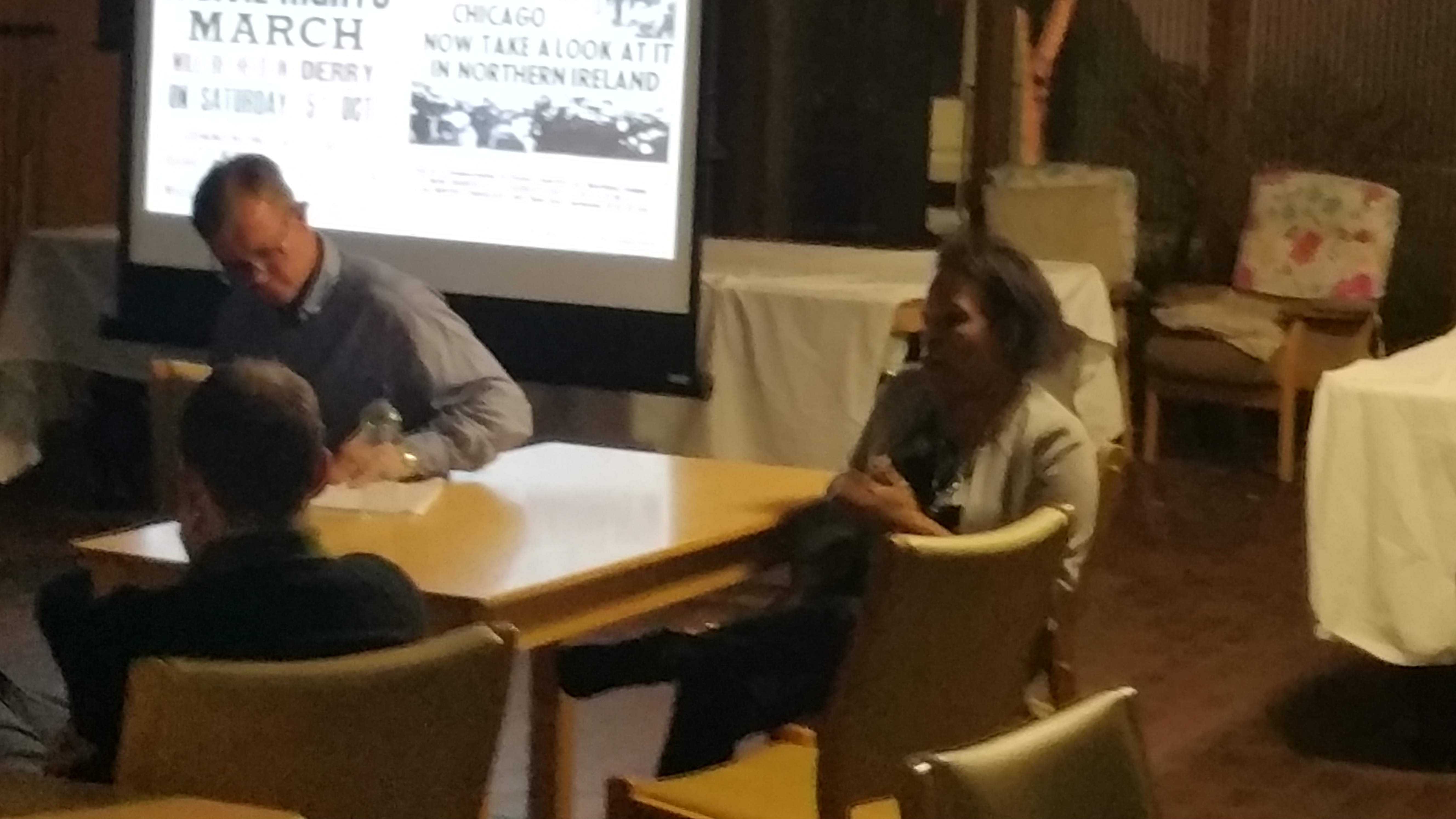
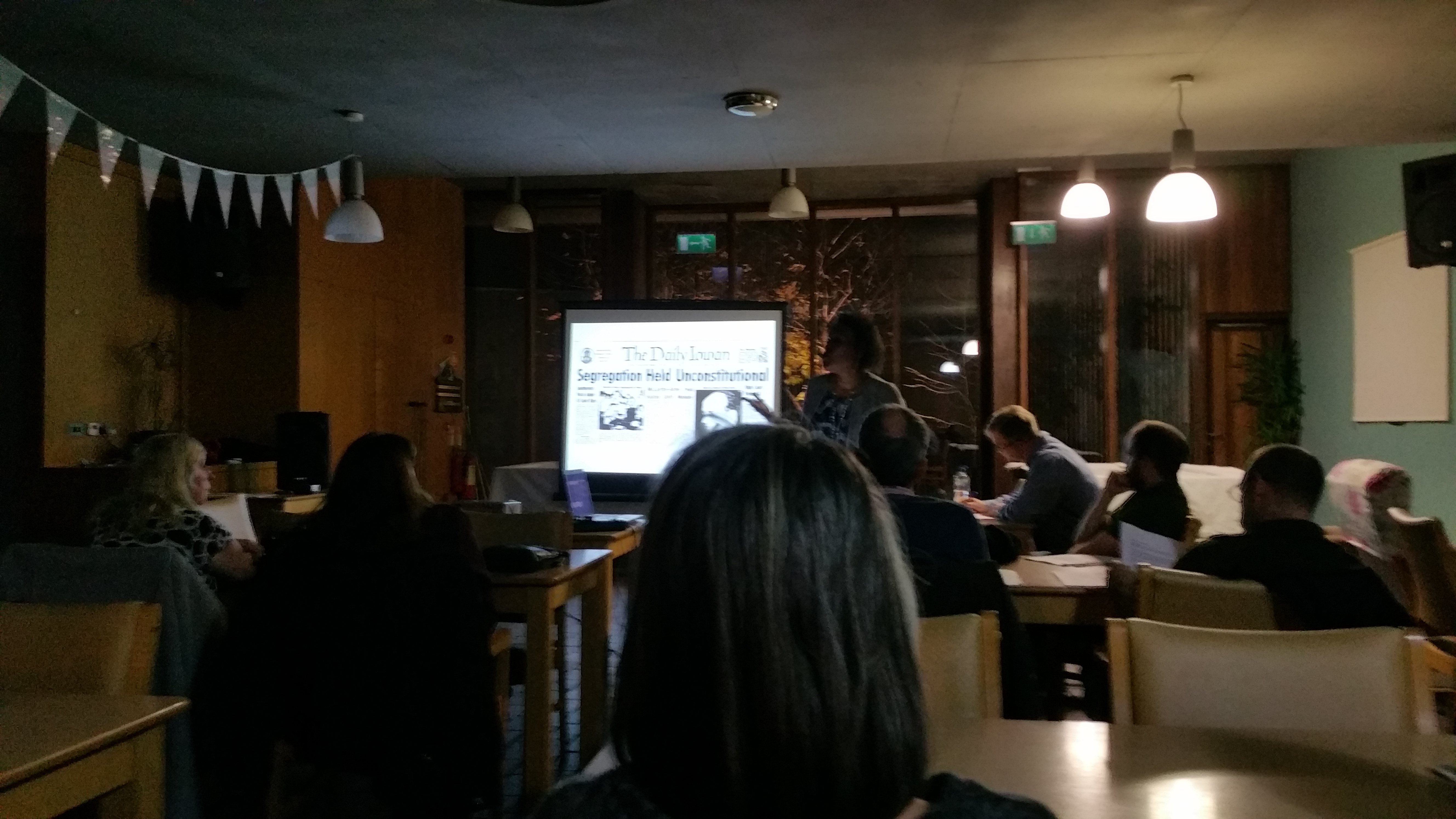
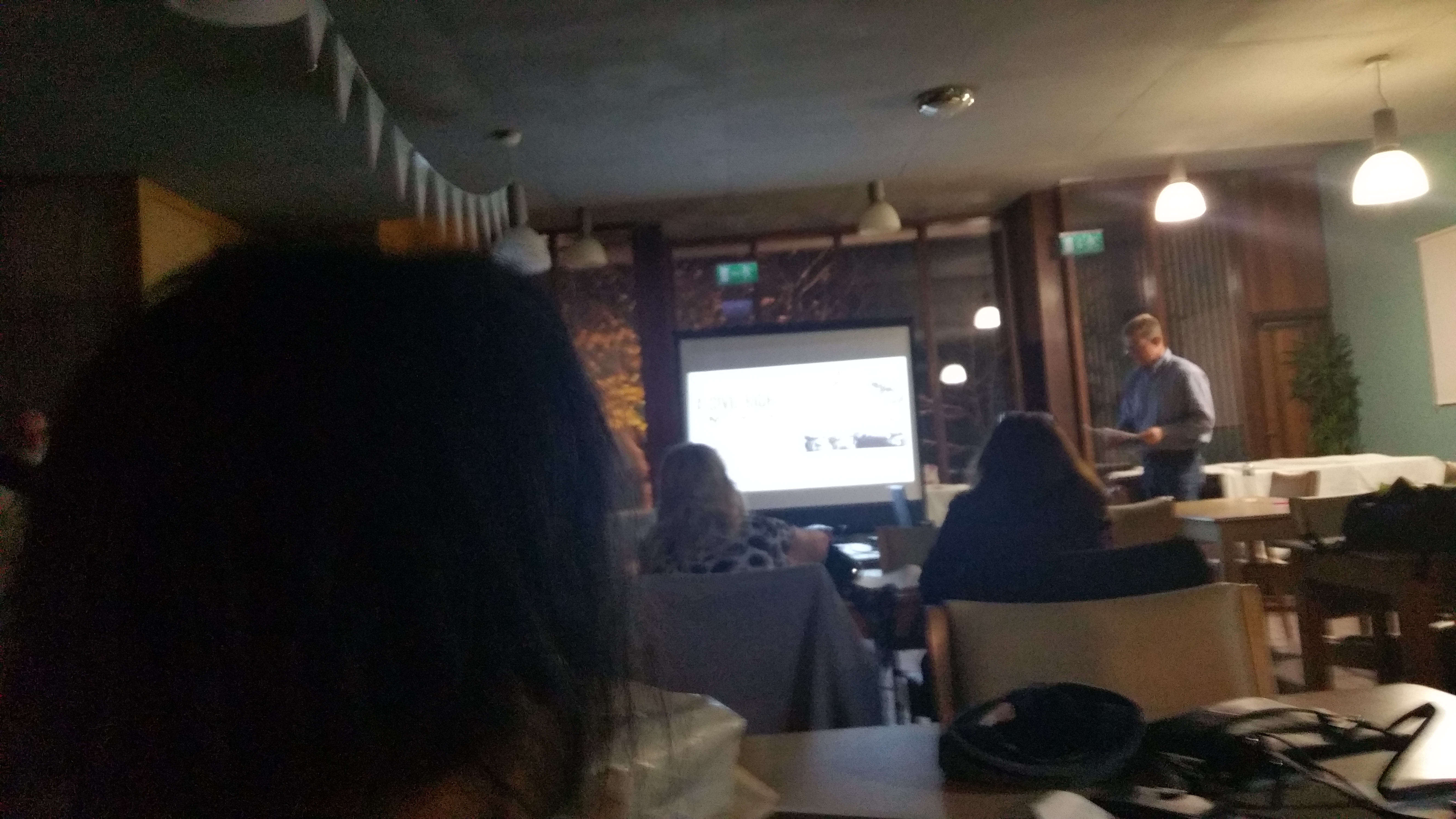
Two very interesting talks were given last night as part of a series of history talks at the Sean O’Casey Community Centre in East Wall, Dublin. The theme was black civil rights in the USA and Catholic civil rights in the Six Counties of Ireland (‘Northern Ireland’ according to some).

Joe Mooney of the East Wall History Society introduced the speakers and chaired the question-and-answer session afterwards.

The session opened at 8pm and Cecilia Hartsell had a lot of ground to cover. She spoke on the history of the Civil Rights movement of blacks in the USA, going through the history of seminal events, illustrated with Powerpoint slides and recordings of two White House phone calls between President JF Kennedy and Ross Barnett, Governor of Mississippi and key figure trying to prevent the historic enrollment of James Meredith, a black man, into the University of Mississippi.

Cecilia Hartsell delivering her talk on the black civil rights movement in the USA

Recalling that in the first two years of his term, JF Kennedy had little to say about black civil rights but was focusing on other issues,Cecilia Hartsell somewhat undermined the (incorrect) image we tend to have in Ireland of Kennedy as an ardent civil rights fighter. In fact he was enforcing Federal legislation on equality and trying to go slowly, while the black campaigners were pushing the agenda along and white racist reaction was holding the USA up to international ridicule and opprobrium during the Cold War with the Soviet Union.

When Brian Hanley took the floor for his talk he fairly zipped along, which he does very well. Hanley undermined some myths or wrong impressions too. Early organisers of the civil rights marches and other events such as the Dungannon house occupation were Irish Republicans; Loyalists had killed four people before the first Civil Rights march. The rhetoric of SDLP and Labour Party notables was much more militant in the early years and Fine Gael was agitating more about issues of discrimination in the Six Counties than was Fianna Fáil, the party in government. And FF had been pushing a referendum to do away with the proportional representation electoral system at the same time that the PR system was among the demands of civil rights campaigners in the Six Counties.

Brian Hanley delivering his talk on the civil rights movement in the Six Counties.

In the session for questions, answers and contributions later, Hanley pointed out that the Southern Democratic Party was the pro-slavery party historically and, after the Civil War, anti-integration and civil rights, whereas the Republican Party was anti-slavery (debunking another false image we tend to have in Ireland).

Both historians made the point that a hundred years is not as long as some might think (this is especially true in ‘historical memory’).  The 1940s, when some historians would say, as Hartsell told us, is the date from which to date the renewed fight for black equality in the USA, as surviving black soldiers returned from WWII, was only 80 years from when Federal troops were withdrawn from the former Confederate states.  The partitioning of Ireland had been carried out less than 50 years before the Civil Rights protests broke out in the Six Counties, Hanley reminded his audience and many Catholics still lived who remembered vividly the fierce repression that had accompanied it.

It also emerged that albeit there were many similarities, there were also profound differences between the two movements. The black campaigners in the USA were saying that they were citizens of the USA State and demanding the same rights as other citizens, they often marched with the Stars and Stripes flag and even called for the intervention of US troops to defend their rights. The Catholics marching for civil rights in the Six Counties mostly saw themselves as Irish citizens and would never march with the Union Jack. Some did call for the intervention of British troops but many did not; it was mostly Irish troops they hoped would intervene.

The importance of the presence of news photographers at events and their covering in newspaper reports and on television broadcasts was an important factor in both struggles.

USA soldiers facing unarmed marchers for black civil rights.  (Source: Internet).

Cecilia Hartsell did not feel that the Black Power movement could have survived Southern racist repression in the 1940s, ’50s and early ’60s and most of the big gains on desegregation of education, public transport, eateries and voter registration and effective right to vote in the Southern States were won during those years with peaceful marches and pickets and legislation (which however were met by much racist violence, including a number of murders). By the time the Black Power movement was coming on to the political stage, so was the Vietnam War and huge changes were taking place in the US, including many mass violent struggles on race and other issues.

Section of march for civil rights in the Six Counties (Source: Internet).

TERMINOLOGY AND DEEPER MEANING

Wikipedia: “Though often used in history books to refer to the seven states that originally formed the Confederacy, the term “Deep South” did not come into general usage until long after the Civil War ended. Up until that time, “Lower South” was the primary designation for those states. When “Deep South” first began to gain mainstream currency in print in the middle of the 20th century, it applied to the states and areas of Georgia, southern Alabama, Florida, Mississippi, north Louisiana, and East Texas, all historic areas of cotton plantations and slavery. This was the part of the South many considered the “most Southern”.”

Later, the general definition expanded to include all of South Carolina, Georgia, Alabama, Mississippi, and Louisiana, and often taking in bordering areas of East Texas and North Florida. In its broadest application today, the Deep South is considered to be “an area roughly coextensive with the old cotton belt from eastern North Carolina through South Carolina west into East Texas, with extensions north and south along the Mississippi”.

Lower South” probably originally referred to its location on the typical north-orientated map of the USA. But I speculate that “Deep” has another meaning – a deeper psychological one, in fact. It suggests that this is a place difficult to understand for people not from there, which means most people. Different rules apply there, we might believe.

I speculate further that after the initial first years of the Civil Rights movement in the Six Counties, that area and the people living in it came to be seen as “different” too. Of course, it was different in that it was a colony (as had the whole country been only 50 years earlier) and that it was run along blatantly sectarian lines, the Catholics a minority there, unlike in the rest of Ireland. And of course, people in a different environment respond differently. But they were still people and the substantial Catholic minority were so clearly oppressed in a statelet into which the Irish ruling class had delivered them. For many people in the 26 Counties it became easier to think of them as somehow foreign in a foreign kind of land, hence my description as “Deep North”.

Cecilia Hartsell and Brian Hanley during the question-and-answer session.

THE SPEAKERS (as posted by EWHG)

Cecelia Hartsell is a researcher of American history. She has been a contributor to the RTE History Show and Radio Kerry on topics in U.S. history and frequently gives U.S. history talks for the Dublin Festival of History and in the Dublin Public Libraries. Cecelia has a Masters degree in U.S. history from Fordham University and a Masters degree in History from UCD.

Brian Hanley is an historian and author. He is currently a Research Fellow at the School of Classics, History and Archaeology, University of Edinburgh . He has lectured at a number of major Irish universities and was Historian in Residence at Dublin City Library and Archives . His books include “A Documentary History of the IRA, 1916-2005” (Dublin, Gill and MacMillan, 2010) with his most recent being “The impact of the Troubles on the Republic of Ireland, 1968-79: boiling volcano?” (Manchester University Press, 2018).

NEXT HISTORY TALK

There will be another talk in the series next week when Dr. Mary Muldowney will present a talk on “The 1918 Election – the Woman Who Stood for a Worker’s Republic.”

VIVA LA QUINZE BRIGADA

Clive Sulish


From Eoin O’Donnel’s filming and editing via Joe Mooney of East Wall History Group, a recording of Diarmuid Breatnach singing Christy Moore’s wonderful song Viva La Quinze Brigada (also known as Viva la Quinta Brigada which, however, is also the title of another song from the same conflict but in Castillian or Spanish language).  The Fifteenth Brigade of the Spanish Republican Army was also the Fifth International Brigade, the mostly English-speaking one.  It contained volunteers from English-speaking USA, Canada, Australia, Scotland, Wales, England and ireland but due to high Irish emigration, all those countries also contained Irish diaspora and they were to be found in the contingents from those countries.

The video also contains photos of the commemoration of Jack Nalty, resident of East Wall’s, the last Irishman to die in action during the Iberian Anti-Fascist War (usually known as the “Spanish Civil War”).  The day-long event on 28th September (anniversary of his death) included songs and poems, a march led by a lone piper, unveiling of a plaque, booklet launch and showing of two films. It was a celebration in particular of Jack Nalty’s life but more generally of the Irish who, against the position of their Government, the Church of the majority, the dominant media and even, for those in the IRA, against their own organisation’s orders, went to fight against a fascist military uprising against the elected Republican Government of the Spanish state.

It was also a celebration of antifascist resistance around the world and of the principle and practice of internationalist solidarity.

A plaque to the fallen of the Irish volunteers of the International Brigade (containing many names but by no means all of the Irish who fell there). The plaque is on the wall of the Theatre side of Liberty Hall, HQ of SIPTU, Dublin.
(Photo D.Breatnach).


EAST WALL REMEMBERS ANTI-FASCIST BRIGADISTA JACK NALTY

Clive Sulish

On the 80th Anniversary of his death in the Anti-Fascist War in ‘Spain’, the East Wall History Group organised a remembrance of a local man from that dockland Irish area who was the last Irishman to die fighting in the war against Franco and Spanish Fascism. The event was attended by relatives of that Irish antifascist fighter and of another, by a cross-section of Left and Irish Republicans, including historians and by a number of elected representatives from the Dublin City Council and the Dáil (Irish Parliament).

Crowd assembling outside school before event. (Photo: D.Breatnach)

Jack Nalty was the last Irish and one of the last International Brigaders to fight and die in that war. The rest of the Brigaders, those not held as prisoners by Franco’s forces, were withdrawn soon afterwards as the indigenous anti-fascist forces fought on, losing against the Spanish military coupists with their German Nazi and Italian fascist allies.

Those commemorating Jack Nalty met at the St. Joseph’s Co-Educational School on the East Wall Road at 1pm on Sunday (23rd September) and included a cross-section of members of organisations and independent activists, socialists, republicans, communists and anarchists and other members of the local community. At the front entrance of the School a number of relatives of Jack Nalty held a banner along with a son of an Irish International Brigader and the crowd was addressed by Joe Mooney, of the East Wall History Group.

Joe Mooney speaking at start of event, relatives of International Brigaders beside him holding the banner in the colours of the Spanish Republic (Photo: D.Breatnach)

Mooney told the crowd that John Nalty came to the area at the age of six from Galway and on 31st August 1908 entered the East Wall National School on the Wharf Road. Just over thirty years later, 23rd September 1938, he would die on a Spanish battlefield, shot down in a hail of fascist bullets as he engaged in one last heroic act.

A member of the IRA during the War of Independence, Jack was a Republican, Socialist and trade unionist”, Mooney said, “representing 600 oil workers in Dublin Port. But in 1936 when the Spanish Civil War — or Anti-Fascist War as it should more accurately be called1 – began, he volunteered for the International Brigades to join the fight against European fascism. He was badly wounded and came back to Ireland, but would again go into action and was killed at the Battle of the Ebro. Having being among the first Irish volunteers to travel to Spain, he would die on their last day as they were preparing to withdraw from combat.

Nalty’s unit had been called to retreat when it was realisted that two machine-gunners had been left behind and he went back to collect them. On their retreat they were fired at and Jack Nalty was killed.

Section of crowd lined up in front of house where Jack Nalty had lived (Photo: D.Breatnach)

Mooney also asked those present to remember not only Jack Nalty but the ‘comradeship of heroes’ from Dublin’s Docklands and North Inner City – Dinny Coady, Tommy Wood and others.

The crowd then set off in a march led by a piper to East Road to unveil a memorial plaque. Across the road from Jack Nalty’s former house, the crowd paused to hear Diarmuid Breatnach sing a few verses of Christy Moore’s tribute to the Irish “Brigadistas”: “Viva La Quinze Brigada”.2

UNVEILING THE PLAQUE

Joe Mooney unveiling the plaque not far from Jack Nalty’s former house (Photo: D.Breatnach)
The plaque (text difficult to read in photograph)
(Photo: D.Breatnach)

The plaque could not be attached to Jack Nalty’s house and was affixed a little further down the road. Joe Mooney siad a few words there and introduced James Nugent who gave a speech he had prepared and the plaque was unveiled. Nugent concluded by saying that “the history of the past helps us to understand the present and to create the future.”

Kate Nugent read a message from the daughters of Steve Nugent (sadly died 2017) who researched the story of his uncle Jack and Mary Murphy read a short post from Vicky Booth (granddaughter of Syd Booth, who was with Jack when he died).

(Photo: D.Breatnach)
Piper plays lament by plaque
(Photo: D.Breatnach)

Harry Owens gave a short tribute speech on behalf of Friends of the International Brigades and Manus O’Riordan, son of Irish communist and International Brigade Volunteer, sang the chorus of Amhrán na bhFiann (“The Soldiers’ Song”, Irish national anthem) and the Internationale.

Section of crowd a location of the plaque (Photo: D.Breatnach)
At the unveiling ceremony (Photo: D.Breatnach)
Also at the unveiling ceremony
(Photo: D.Breatnach)

Joe Mooney acknowledged the presence of elected representatives Mary Lou McDonald, Sean Crowe and Cieran Perry and asked people to march to the nearby Sean O’Casey Centre to see the art exhibition and see two short films.


Marching from the plaque site, heading for the SO’C Centre
(Photo: D.Breatnach)(Photo: D.Breatnach)
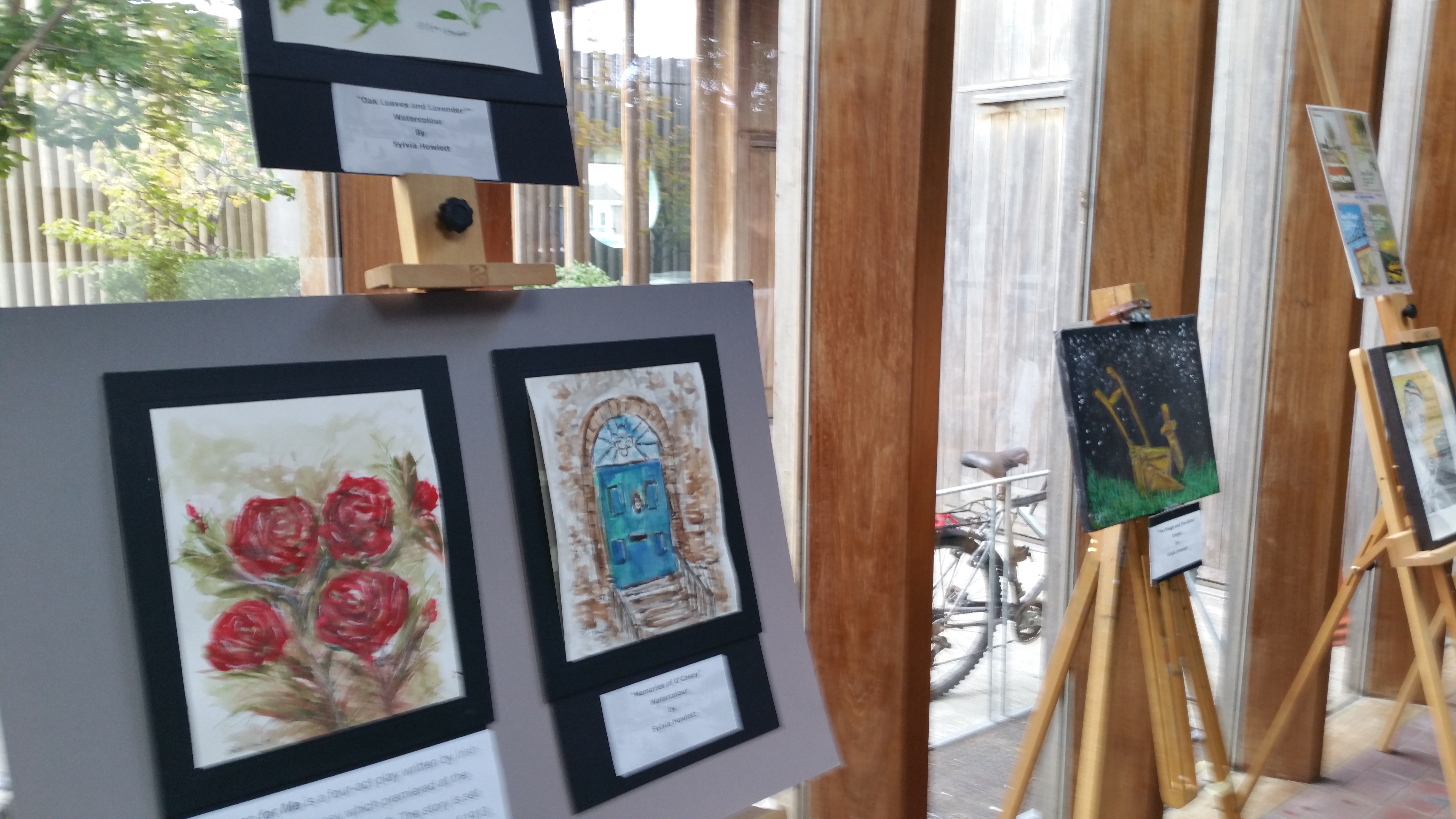
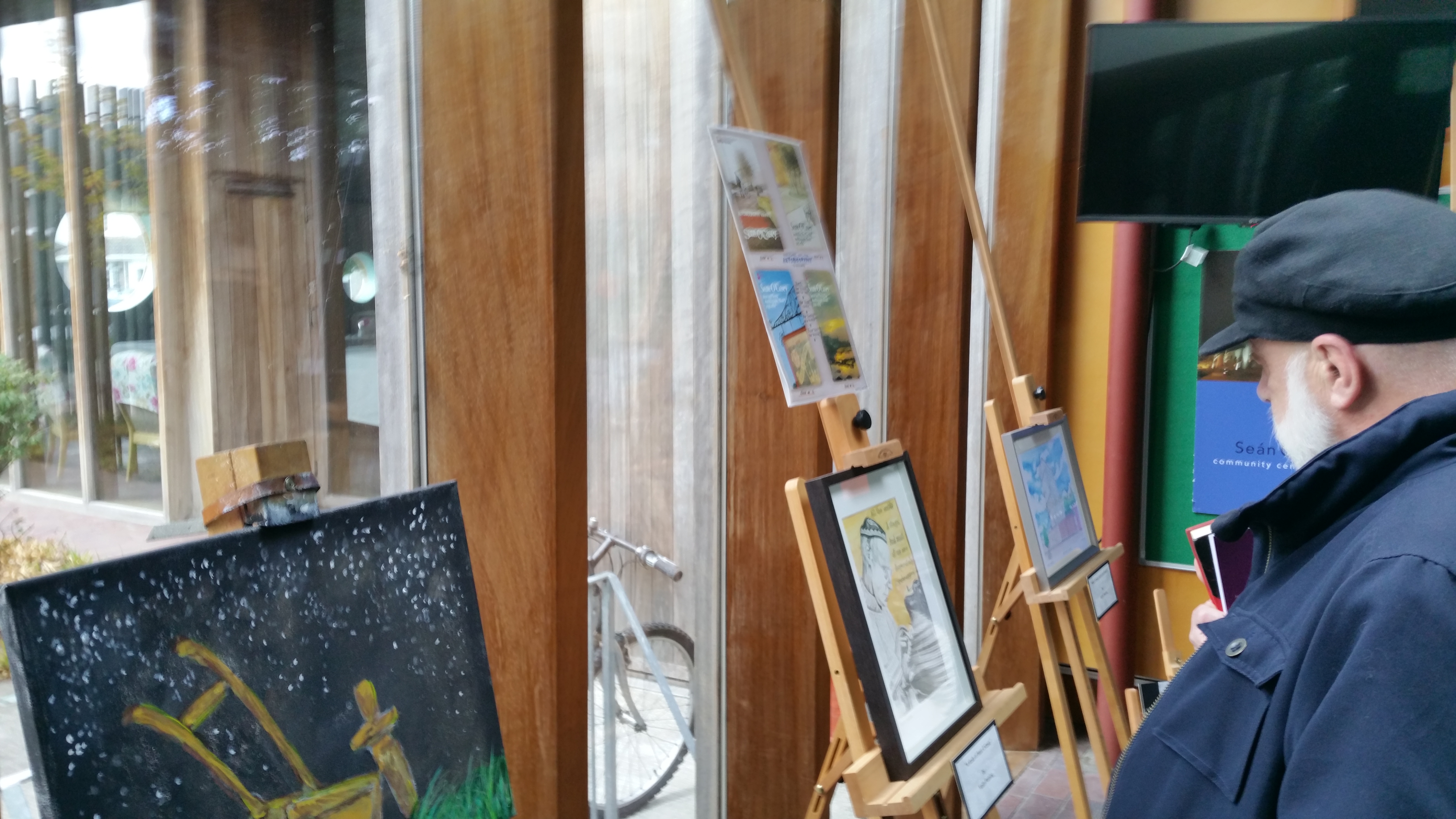
Section of the attendance relaxing at the Sean O’Casey Centre between the plaque event and the films to be shown, also examining the art exhibition [see photos at end of post]

Back at the Sean O’Casey Community Centre, two short films were shown. One was a school project film in which a descendant of Jack Nalty interviews the latter’s nephew about his famous uncle. The second was dramatic film in which a Spanish trumpet player joins the fight against the fascist military uprising by Franco and other generals and features also actors playing two Irish International Brigaders, O’Connor and Charlie Donnelly3. When the former trumpet player is shot he sees into the future ….

Eddie O’Neill talked about the pulling out of the International Brigades in October 1938 in a bid to have the “non-interventionist” Western democracies put pressure on Nazi Germany and Fascist Italy to have them withdraw too, which did not happen. They marched through Barcelona on 17th October and were addressed in an emotional rally by La Pasionara4 and Eddie asked Nerea Fernández Cordero to read an English translation.

Nerea on stage just after reading translation of La Pasionara’s farewell to the Brigaders
(Photo: D.Breatnach)
Eddie O’Neill at the SO’C Centre with concluding speech: “We can’t afford to forget.”
(Photo: D.Breatnach)

Nerea told the audience that she is from Extremadura (a province of the Spanish state next to the Border with Portugal) and her grandfather, Antonio Fernández had fought against Franco, been captured, escaped to the mountains but was in time recaptured. Upon his release he had married Nerea’s grandmother and lived a peaceful life. Nerea said that she was proud of her grandfather and those who fought Franco and that “ we know La Pasionara’s speech in Spanish by memory.”

Reading of translation of La Pasionara’s speech to English from Youtube:

At the event the newly published pamphlet “In Pursuit of an Ideal – from East Wall to the Ebroabout Jack Nalty was made available for the first time and copies are available from the organisers.

Eddie O’Neill recalled being in the Spanish state with a group from Friends of the International Brigades to commemorate those who fought against Franco during that war and afterwards searching for an appropriate pub in which to socialise. They found a pub with a Guinness sign and went there which however turned out to be one of the most fascist pubs in the area but undeterred, they continued to celebrate the memory of the antifascist fighters there. A lone man in suit and tie asked people as they passed him to use the toilet why they were commemorating people who had died so long ago but when they explained he said he could not understand English.

We can’t afford to forget,” O’Neill told his audience, “least of all when the forces of fascism are gathering again.”

To conclude the event O’Neill called on Diarmuid Breatnach who sang the whole of Christy Moore’s “Viva La Quinze Brigada”, calling on the audience to join him in the chorus, remembering those who fought and gave their lives in the struggle against fascism.

Eddie O’Neill close at right of photo at unveiling ceremony
(Photo: D.Breatnach)

AN ANNUAL EVENT?

The organisers are reputedly considering making this an annual event – it is to be hoped that they do so.

Another section of the crowd at the plaque unveiling.
(Photo: D.Breatnach)
Also at the plaque unveiling ceremony
(Photo: D.Breatnach)

POSTCRIPT: JACK NALTY – ATHLETE COMPETING FOR IRELAND

In publicity prior to the event, the East Wall History group posted the following:
“In addition to his political and trade union activity, Jack Nalty was also a busy athlete, a regular competitor and medal winner with the Dublin Harriers. In 1931 he represented his country at the International Cross Country Championship, held at Baldoyle. Fellow competitor Tim Smyth became the first Irishman to win this competition.

(The full Irish Group for the event held on 22nd March 1931 is listed as: Frank Mills, J. Behan, John Nalty, J.C. McIntyre, John Timmins, T. King, T. O’Reilly, Thomas Kinsella, Tim Smythe).

This British Pathe footage shows the runners in action. Somewhere in the group is John (Jack) Nalty, East Wall resident, Republican and hero of the International Brigades. (The Pathe footage is viewable on post on the East Wall History Group event — CS)

Ironically, the same year as the competition the future leader of Irish Fascism, General Eoin O’Duffy had become the President of the National Athletic and Cycling Association (NACA) , and apparently was an admirer of Jack Nalty as an athlete!”

(Photo: D.Breatnach)


FOOTNOTES


1Basques in the provinces of Bizkaia, Guipuzkoa and Alava say it was not a civil war there, i.e between different sections of Basque society — the fascist forces came from outside.  In the fourth southern Basque province of Nafarroa, where the Carlists took control, they wiped out around 2,000 antifascists but it was hardly a war. The Catalans also say that the fascist forces invaded them and that it was not a civil war but an antifascist one. In some other places in the Spanish state many also say that the presence of Nazi German and Fascist Italian military in such numbers invalidated the term “civil war”.

2Also known as “Viva La Quinta Brigada”, which is however also the title of a different song from the Anti-Fascist War. Both titles are correct for this song since the Irish were in the Fifth of the International Brigades but when added to the ten indigenous Brigades (Spanish, Basque, Catalan etc), that became the Fifteenth. Wikipedia quotes authors to report an estimate that “during the entire war, between 32,000 and 35,000 members served in the International Brigades, including 15,000 who died in combat; however, there were never more than 20,000 brigade members present on the front line at one time.”

3Charlie Donnelly was a poet and member of the Republican Congress. He went to Spain to fight against Franco, where he died in February of 1937 at the Battle of Jarama. He is also one of those 19 names mentioned in Christy Moore’s song (“Viva La Quinta Brigada” or “Viva La Quinze Brigada”).

4Isidora Dolores Ibárruri Gómez (9 December 1895 – 12 November 1989), born and brought up in the Basque Country to a Basque mother and Spanish father, founder-member of the Spanish Communist Party and known for her political writing and speeches. She wrote an article when quite young under the pen-name “La Pasionara” (the Passion Flower) and was known by that nickname throughout her life.

APPROPRIATE MEMORIAL FOR MAGDALENE LAUNDRIES VICTIMS: CAMPAIGN WINS IMPORTANT BATTLE IN DUBLIN CITY COUNCIL

Diarmuid Breatnach

Dublin City Councillors at their meeting on Thursday (13th September) voted by huge majority not to sell the former Magdalene Laundry building in Seán McDermott Street in the city centre. Deputy City Manager Brendan Kenny had earlier announced the possibility of the Council selling the building at an expected price of €14.5 million to a Japanese company that planned and hotel and supermarket on the site.

A campaign group called Separate Church & State had lobbied for the building to become a memorial to the suffering of the inmates of the Magdalene Laundries. The group called people to support an event outside City Hall to coincide with a motion being put forward to prevent the sale of the building.  A range of people attended, seeming mostly Left social and political activists independent of any party and a sprinkling of People Before Profit activists.

The motion was propose by Gary Gannon, a Councilor of a very small political party (with only one member on the Council), the Social Democrats. However the motion was supported by the overwhelming majority of a Independent councillors (i.e of no party) and those belonging to a number of other parties and was passed with 37 voting in favour, eight against and two abstentions.

Campaigners and supporters in front of Dublin City Hall from across the street
(Photo: D.Breatnach)

The successful motion called on the Council not to sell the building and land and that instead those who suffered abuse there should be commemorated with a memorial. Other than preventing the sale, exactly how the memorialising might be put into effect remains to be outlined and agreed. There is talk of the State taking it over but whether by donation of the Council or sale has not been clarified. There are very few memorials to the Magdalene Laundry victims and all but one of them are small

The Sean McDermott building appears to have been the last of the Magdalene Laundries in Ireland and was closed in 1996. It is also the last of those buildings in the possession of Dublin City Council.

(Photo: D.Breatnach)

The significance of the victory is greater than that of elected representatives versus unelected City Managers, the former being more responsive to public pressure than to the demands of high-ranking officials who seem happy to hand over much of the city centre to property speculators, shopping centres, hotels and large student accommodation complexes.

The terms in which the issue was raised are an attack on the legacy of the Catholic Church’s grip on secular society and its relationship with the State.  The campaigners clearly see the Council vote as a victory, though a moral one, against that legacy.  And they are planning to press ahead with the offensive in the terms indicated by the title of their campaign, indicating further targets such as the national health and education services, along with legislation to follow on the national referendum’s rejection of Amendment 8 of the Constitution outlawing abortion.

The Magdalene Laundries – some brief background

       The Magdalene Laundries were a major institution of the Irish Catholic Church from the 18th to the late 20th Century. There were some Protestant parallels too in the Six Counties (“Northern Ireland”) run by the Anglican and Presbyterian churches but the vast majority of the Irish population were of the Catholic faith. The Laundries took in and accommodated women who were considered “fallen women” which at first meant sex workers but later included unmarried women who had a child or children or even women whose behaviour was considered immoral or flirtatious (or even whose beauty attracted male attention) and they were put to work in the laundries for no pay. Ostensibly at first a charitable initiative, their title drew on the New Testament story of Mary Magdalene who, from being a “morally loose” woman, after meeting him became one of the most ardent supporters of Testament’s Jesus.

But if the name was associated with the alleged mercy and lack of judgementalism of the Christ, it also implied moral sin and judgement. In the extremely conservative Catholic Church that it became after the Great Hunger, the main element was likely to be punishment and, when allied to an also socially reactionary political class, the Laundries became an institution of social control of the Catholic Church in Ireland and of the new Irish State.

The Magdalene laundries soon became known to their inmates as places of hard work and ill-treatment, mostly of a psychological nature but also physical. If women left them without permission, they were pursued by the police and brought back. Continuous escapes could lead to jail sentences.

(Photo: D.Breatnach)

During their time in operation an estimated 30,000 Irish women were kept in these institutions in Ireland, approximately 11,000 after the State was created in 1922.

The horrors of these “charitable institutions” began to be revealed to the public during the last decade of the 20th Century, notably in 1993 after a mass grave of 155 corpses was uncovered in the north Dublin convent grounds which housed one of the laundries and the last Laundry was finally closed down in 1996. The Church never accepted any financial responsibility for reparations.

The Irish State set aside a sum of up to €58 million (about half of which has been paid out – see Links) but the religious institutes concerned, the Sisters of Mercy, Sisters of Our Lady of Charity of the Good Shepherd and Sisters of Charity refused demands from the Irish Government, the UN Committee on the Rights of the Child and the UN Committee against Torture, along with other groups in Irish society, to contribute to the compensation fund for the the surviving victims, an estimated 600 of whom were still alive in March 2014 (see Wikipedia in Links).

(Photo: D.Breatnach)

The Taoiseach (Prime Minister) of the Irish State apologised publicly and emotionally in the Dáil (Parliament) in February 2013 but the State never accepted any legal responsibility, its representatives saying that they did not control the Church. When they were reminded that the victims had washed not only clothes and vestments of priests and nuns but had also done laundry service for such state institutions as Aer Lingus, the Irish Army, the Gárdai, the State’s representatives declared that the Laundries were like any other contractor in that regard and that the State could could not accept responsibility for how contractors treated their “employees”. But it is known that State courts sent a number of women to the Magdalene Laundries. And it was the State that allowed the Catholic Church to dominate social care, health care and education, areas which are usually considered the responsibility of the State.

The general story of the Laundries is fairly well-known in Ireland now through media coverage and the testimonies of victims and even abroad in some countries through the 1992 Peter Mullan film Magdalene Sisters (see Links) and a number of documentaries for TV. Mary Coughlan sang a fierce attack on them too the same year as the film, composed by J.Mulhern (see Links for a Youtube video).

View of the protesters outside the meeting (some were inside) looking eastward.
(Photo: D.Breatnach)

There are very few monuments to the suffering of the victims of the Magdalene Laundries and they are all of a small size except the statue in Ennis which aroused some local controversy.

The monument at Forster Street, Ennis, Co. Clare, dedicated to the Magdalen women and a subject of some controversy.
(Photo: Mike Shaughnessy)

Despite the duration of their existence and numbers involved and the international coverage, the Pope claimed when tackled by some survivors on his recent visit to Dublin that he had no knowledge of the existence of the institutions.


Sale of Council buildings and land – the legal position and some background

Due to a legislative change some years ago, Dublin Council Executives such as the City Manager and Senior Planning Officer can make major decisions without consulting elected Councillors and even against their expressed wishes. In this way, for example, the planning permission for the Shopping Centre Plan over the Moore Street Battleground and Market quarter was firstly agreed and secondly, even after the High Court judgement that it is a national monument, was renewed in 2016 by the Chief Planning officer of the time, Jim Keogan.

Many feel and have felt since such decisions that this is an unhealthy state of affairs, with no democratic controls and leaving key officials open to suspicion of bribery from developers influencing their decisions.

Fortunately however when it comes to the disposal of Council assets, the Councillors must agree by majority. This prevented the “land swap” proposed in 2014 by Joe O’Reilly of buildings in Moore Street, which if successful would have enabled his company to demolish half the 1916 Terrace: responding to campaigners and interested elected Councillors, the Council voted the proposal down against senior officials’ recommendations in November of that year.

Links:

Separate Church & State campaign group: https://www.facebook.com/separatechurchandstate/

Short article on the Dublin Council lobby and vote in Look Left: https://www.lookleftonline.org/2018/09/dcc-votes-not-to-sell-off-ex-magdalene-laundry-site/

Closing of the Magdalene Laundry on Sean McDermott Street: https://www.irishtimes.com/culture/last-days-of-a-laundry-1.89388

Proposed sale of the Sean McDermott Street building: http://www.thejournal.ie/sean-mcdermott-magdalene-laundry-3941031-Apr2018/

State compensation package: https://www.rte.ie/news/2013/0626/458868-magdalene-report/ and https://www.irishexaminer.com/ireland/flanagan-257m-paid-out-to-682-magdalene-laundry-survivors-462711.html

The Magdalene Laundries on Wikipedia: https://en.wikipedia.org/wiki/Magdalene_Laundries_in_Ireland

The Pope “had no knowledge”: https://www.buzz.ie/latest/pope-magdalene-laundries-297205

Film The Magdalene Sisters, Peter Mullan (1992): https://en.wikipedia.org/wiki/The_Magdalene_Sisters

Song Magdalene Laundry by Mulhern and sung by Mary Coughlan (Sentimental Killer album (1992)): https://www.youtube.com/watch?v=GHWsLYtxzz0


(Photo: G.Guilfoyle)
Irish TV (RTÉ) cameraman filming the protest (Photo: D.Breatnach)


Section of protest (Photo: D.Breatnach)

OREGON USA: NO FREE SPEECH FOR FASCISTS!

Diarmuid Breatnach


Like fascists in many other parts of the world, those on the Oregon demonstration marched under the slogan of “free speech”.  NO FREE SPEECH FOR FASCISTS!


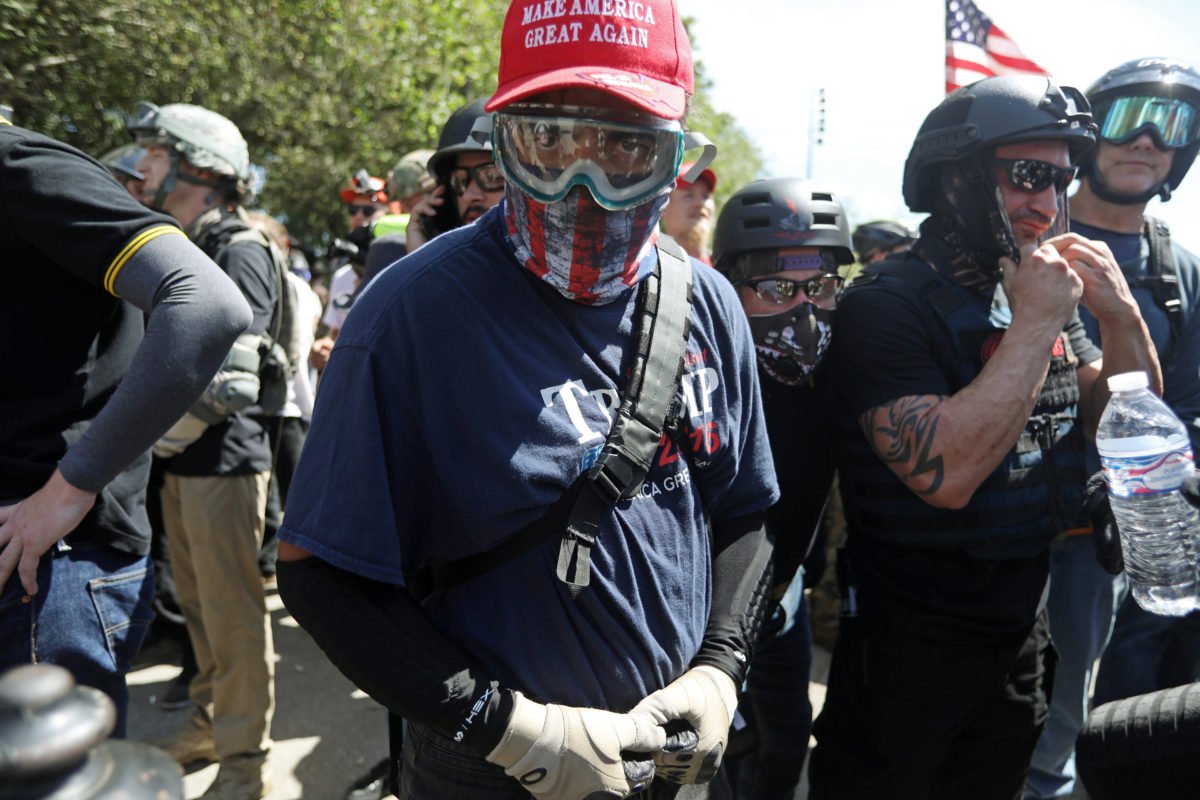
Police in Oakland, Oregon, went into riot police mode at a fascist march on Saturday (4th August 2018) which was opposed by anti-fascists. After maintaing a presence between the two forces for some time they eventually moved to break them up and employed ‘flash-bangs’ and other methods. The march without a permit by fascists was organised by the Patriot Prayer organisation led by Joey Gibson who is running for election to the US Senate and who declares that they are demonstrating for free speech.

Right-wing supporters of the Patriot Prayer group gather during a rally in Portland, Oregon, U.S. August 4, 2018. REUTERS/Jim Urquhart – RC1E0096DB40

Feelings in the town are already running high after a Patriot Prayer supporter was charged with stabbing a man who allegedly intervened to defend from harassment two women on a light-rail train last year, one of whom was wearing a hijab.

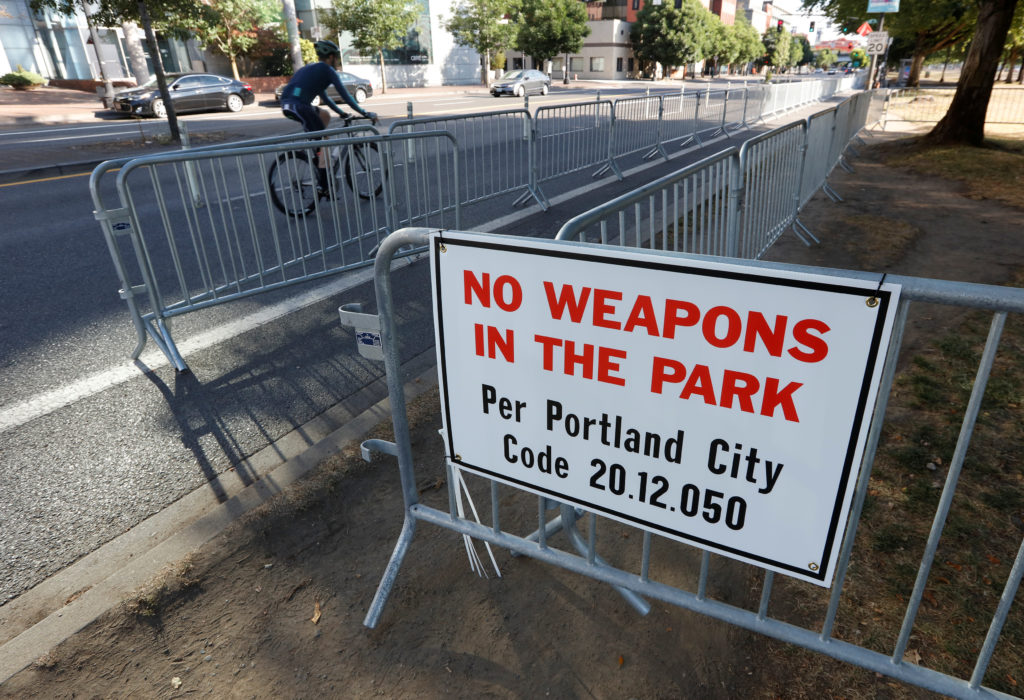
According to reports, Gibson declared to supporters that they were there “to teach a lesson to the country” minutes before they began to march. On June 30th, a previous Patriot Prayer event led to clashes with anti-fascist demonstrators, during which the Oakland police revoked the permit for the demonstration and declared a riot. Earlier on Saturday, in a response to Oakland Police reminding people of a city code banning carrying weapons in the public park, Gibson posted: We’ve always had guns at the rally. I cannot think of one rally when we didn’t have guns with us. Everywhere we go, we have guns.”

Anti-fascist opposition to Patriot Prayer march in Oregon USA. Note mixed attitudes of people wearing improvised riot gear and a placard apparently calling for peaceful opposition
(photo US Media).

Earlier, Portland Mayor Wheeler had expressed concern about the planned Patriot Prayer march, as had the Police Chief. Portland Police Bureau Chief Outlaw (yes, honestly) was appointed to post last year; an African-American woman, she started her career as a patrol officer and was appointed Deputy Chief to Oakland’s police department in 2013.

FASCISM AND FREE SPEECH ACROSS THE WORLD

In 2016 Tommy Robinson led a couple of hundred supporters in Birmingham, Britain to launch the anti-Muslim group Pegida UK, which he founded as part of a Europe-wide fascist initiative intending to launch Pegida in a city in every European state (they failed spectacularly in Dublin, see Rebel Breeze report in Links). Two years earlier, he had led the Islamophobic English Defence League which soon split and melted away.

(photo US Media).

Like Robinson, who was recently given a 13-month sentence for contempt of court in Britain and even more recently released on bail for retrial, the call of fascists when not in power or in position of strong dominance is always for “free speech”. Once dominance is achieved, the fascist call for “free speech” changes to slogans such as ending freedom of speech if it is considered “unpatriotic”, advocating “race-mixing” or “moral degeneracy” and, of course “communist propaganda”. When in power they enforce the elimination of what they consider undesirable free speech, including criticism of policies or leadership even from within their own ranks. When in a dominant position in a country, region or area, fascists enforce their control of “free speech” through terror attacks on their opposition or target communities, with or without collusion with the State, military or local police force. When fascists have state control, they limit free speech through laws, court and prison, in addition to extra-legal fascist attacks and assassination squads.1

Fascists seek to establish a safe “beach head” upon which to build and from which to extend. If successful, they attract more and more followers, while they intimidate their opposition and their targets. But in failure, as when driven off the street, their opposition and targets grow in confidence and the fascist organisations usually disintegrate in internal struggles between cliques and denunciations of their unsuccessful leaders.

That is the well-documented history of fascism which the fascists try to conceal while weak but in which they glorify when in power. Unfortunately, liberals, whose bodies exist in the real world but whose ideology lives in a world of make-believe, unknowingly collude with this trajectory. Again and again they insist that the fascists and racists which they abhor must be given freedom of speech and even accuse the anti-fascists of a kind of fascist authoritarianism.

When liberals do turn to wanting to control the freedom of fascists to organise, as some do at some stages, they always appeal to the State to carry out that task for them. Sometimes, according to its interests at the time, the State will oblige, with measures sometimes including a wholesale banning2 but will often simultaneously ban progressive resistance movements.  More often it will oblige liberals by fines or short prison sentences on fascists or by anti-racist or anti-”hate” legislation. And often, fascists attempt to turn these too to their advantage, projecting themselves as martyrs of “free speech”.

The only effective remedy is that anywhere and everywhere, fascists are denied free speech – not by the State (whose capitalist interests are anti-socialist and will often recognise the usefulness of fascists) but by the alliance of anti-fascist interests: ethnic minorities, LBGT groups, communists, women, trade unions. This thesis has emerged out of an ideological battle that has been largely won decades ago among the Left and Republican movement in Ireland but which the general Left at times fails to put into practice – had it been left to them, Pegida’s attempted Dublin launch would not have been quite the ignominious defeat it was.

In this context the stand of the “Resist Patriot Prayer” march must be applauded. Their Facebook event description included the following sentence: “We make no apologies for the use of force in keeping our communities safe from the scourge of right-wing violence.”


End.

LINKS

Oregon, Oakland events, report by PBSO News Hour: https://www.pbs.org/newshour/nation/portland-police-city-officials-prepare-for-right-wing-rally-and-counter-protest

and Associated Press in ABC7 News: http://abc7.com/politics/heavy-police-presence-as-right-wing-rally-begins-in-portland/3883335/

Rebel Breeze report on failed Pegida launch in Dublin: https://rebelbreeze.wordpress.com/2016/02/08/pegida-planned-launch-ends-in-sinking-survivors-take-to-lifeboats/).

Attempted coordination of Fascist movement from USA across Europe: https://www.theguardian.com/uk-news/2018/jul/29/tommy-robinson-far-right-resurgence-steve-bannon-us-support


FOOTNOTES

1 Fascist movements and states are often plagued by splits, attempted coups and conspiracies. In June 1934, the Nazi SS and Gestapo attacked their former allies, the Nazi SA (Brownshirts), wiping out the leadership and dispersing the organisation in the event often called “The Night of the Long Knives”. They also wiped out a number of conservative anti-nazis. The death-toll has been widely debated, some estimates placing it between 700 and 1,000.

2  As by the British state of the British Union of Fascists during WWII, while their leader Oswald Mosely was placed under house arrest in a comfortable country house and land (or by De Valera of the Blueshirt movement in 1930s Irish state). However, less than a decade earlier in 1936, at the Battle of Cable Street when anti-fascists defeated the Blackshirts’ attempted invasion of London’s East End, the primary force fighting the anti-fascist resistance was 7,000 foot police and all the mounted police in London.

DEMOCRACY AS A SAFE OPTION

Diarmuid Breatnach

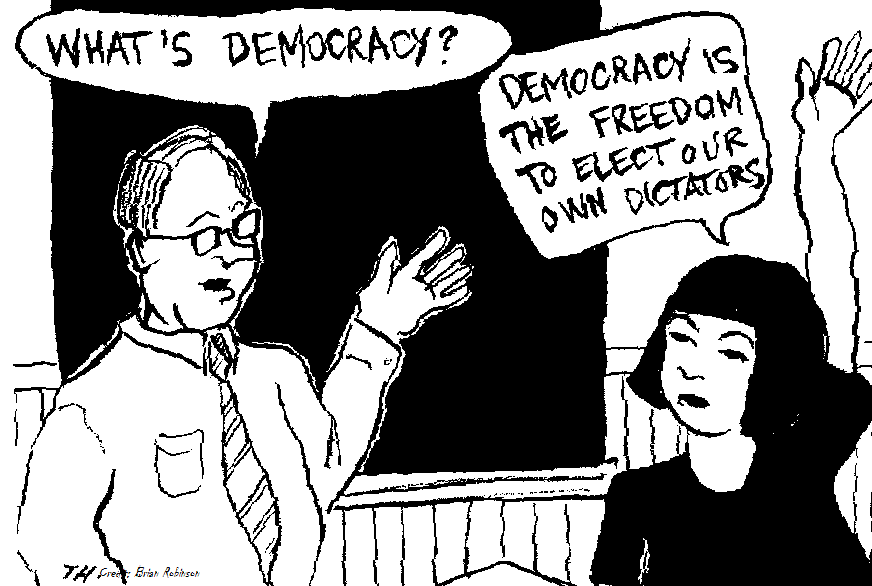
In most of the World, most people would say that they are in favour of a system of democratic rule – whether their states embrace that system or not. The typical western European system of government is usually called a “democracy” or a “western democracy”, with political parties representing different interests competing for popular support in general elections, the victorious party or parties then forming a government.

Image source: Internet

Since these states are capitalist and, whatever about the victory of one political party or another are clearly run to protect and expand the interests of big business (monopoly capitalism), we must ask ourselves why for the most part the capitalists and their supporting parties support the “western democratic” system and why parties who make much of their support for social justice support this system too. And why the majority of people, who are of course not at all capitalists but are in fact exploited by them, participate in this system.

But first, let us note that there are those who don’t at all like the western democratic system: chief among these are the monarchists and the fascists. Monarchists aspire to a system where society is ruled by (usually) a single individual, whose entitlement to that office is through bloodline, through ancestry. Traditionally the rule of the monarch was influenced or moderated by advisors, whether officially appointed by the monarch or by interest groups, or unofficially as with the monarch’s personal friends or lovers.

Monarchy has a long history in human society, with inheritance mostly through male lines but by no means always. Usually it was supported by a social caste or two, an upper stratum in society, or aristocrats or priesthood and often the higher priests were themselves from the aristocratic caste. This system was called feudalism and the aristocrats and monarchy controlled land, taxing the various productive classes within society. Within the aristocracy there were frequent struggles for extension of their power and (taxable) lands and, at times, against the King also.

These struggles went backwards and forwards in societies and between states also until capitalism overthrew feudalism and put its own power in place. And since capitalists have always been in a minority and as capitalism was particularly weak in its early days, the bourgeoisie (capitalists) needed the support of small businessmen, artisans, labourers of town and country, small farmers …. to be successful, they had to give those masses a reason to support the capitalists. What they gave them was some variant of democracy. The capitalists (bourgeoisie) promoted “liberty” (freedom), as in freedom of thought and speech, of religious worship, of assembly, of writing, of movement but all within certain boundaries, the extent of these depending on the country and the times. Increasingly the bourgeoisie had to grant the right to elect a government not just to themselves but to other social groups also. Second-to-last to be granted after many struggles was universal male suffrage, which included workers without any property, but last of all was womanhood, also after fierce struggles.

Another view of western democracy
(Image source: Internet)

Fascists are neither monarchists nor feudalists and though often having a single figurehead who would seem to wield monarchical power, their source is clearly within capitalism. In Germany and in Italy, fascism was supported by big industrialists but in the latter also by big landlords (who still ruled in quite a feudal way in parts of the country). Even in countries where fascist movements did not succeed in coming to power (for example the Blueshirts in Ireland and the Blackshirts in Britain), fascism was supported by elements of the ruling classes.

“EVERYBODY’S A DEMOCRAT”

Aside from the exceptions then, of monarchists, feudalists and fascists, everybody’s for democracy, right? Well, not really. The capitalists who support western democracy today may support the fascists tomorrow, if they consider it necessary. And some of the principal opponents of the capitalists, the communists, don’t support it either. They call it “bourgeois democracy” and see it as a way in which the capitalists fool the people that they are making choices to make a real difference while whichever party or parties come to power are going to ensure that the measures they take will benefit the capitalists or at the very least not harm their interests. James Connolly, a Scottish-Irish Marxist without a party, declared that “governments in capitalist society are but committees of the rich to manage the affairs of the capitalist class”.1

In fact we may observe here that many people who are not communists believe something similar, which may account for the fact that routinely around 30% of those eligible in the Irish state do not vote.2 In Scotland, England and Wales the average turnout traditionally has been slightly higher, until the huge slump in 2001 which recorded an overall UK turnout of below 60% for the first time.3 Post-Nazi West German general election turnout climbed from over 70% to reach its highest point of over 90% in 1972 and has been falling steadily since to over 72% in 2017.4

From the highest-performing of the Nordic countries to big European powers, the average legislature election turnout varies from between just over 60% to just over 80%, while in the USA it is around 55%, which means that between 20% and 45% of people in the western democracies do not participate in their elections.5 Such ironic statements as “It doesn’t matter who you vote for, the Government gets in” are common enough and “all the parties are the same” is an even more commonly-expressed sentiment. The satirical comment from Britain that “Guy Fawkes6 was the only man to enter Parliament with honest intentions” finds a general acceptance, even often among people who do vote.

The trend towards small majorities in winning parties and of coalition governments (or governments ruling with the tolerance of an opposition party) also suggests that people can see less and less difference between the established political parties. The Irish state for example has had coalition governments of some kind since the 1981 General Election (and that itself was a very interesting year electorally, with the election and near-election of a number of Republican Hunger Strikers on both sides of the Border).

SOCIAL DEMOCRACY

People vote for all kinds of reasons apart from a belief in the party for which they are voting. Some vote according to local or family tradition, while others vote for one party in order to keep out another they consider worse. Voting for a popular individual is by no means rare. Some vote to exercise what was a hard-won right and also to try and get what they consider the best out of the system. But voting in general elections does not really reflect the fundamental social desires of the population. We can see this when for example polls show that most people do not want cuts in services, yet all the main parties either propose cuts in services or have refused to rule them out of their program when in government.

It might appear that people could put together a party campaigning for social justice, get the workers and a section of the lower middle class to vote for it and take power in that way. That is certainly the whole basis on which social democratic political parties with trade union backing have sold themselves for the past two centuries. But it seems possible only in the absence of examining history and the current realities.

Public opinion is formed not only by people’s experience but also by years of the system’s indoctrination and by the current mass media – the latter not only favour the system in place but often the newspapers, radio stations and TV programs are owned by one or two capitalists. When the mass media is owned instead by the State, it follows the interests of the ruling sections of society. Low confidence in the people’s own potential also plays a big part. There are in addition legal and financial constraints, domestic and foreign, on a party in government breaking with the capitalist norms. In the last analysis, there is always the Armed Forces and the coup.

The best that a worker’s party can do through the electoral system is to cause the capitalists some difficulties around particular initiatives or introduce a few reforms but without changing the system itself.

DEMOCRACY: THE SAFEST OPTION

Given the apparent potential, despite all its difficulties, for a party to hamper the designs of the capitalist class, why do capitalists continue to support this system and as a general rule to prefer it over others, even over fascism? It’s not just because in general, despite wide-scale cynicism and falling election participation, the system works well for them. And it’s not just because fascist societies are inherently unstable in the longer run. No, it’s because the democratic system is much better for capitalism than the other alternative, which is social revolution.

When enough people feel that they are suffering under a system and that that system cannot be changed through voting, what will be logical conclusion? Clearly that a new system is necessary, one that serves the people rather than the capitalists — but that system cannot be achieved through voting. Have enough of the people thinking that and becoming organised around imagined alternatives and social revolution will be the result. Western democracy perpetuates the illusion of potential to change the system to reflect the people’s needs and desires, while fascism clearly does not.

Therefore the capitalists, who in their daily dealings of expropriation of the labour power of billions and natural resources have no belief whatsoever in democracy, go to substantial lengths to promote parliamentary democracy as either the best system of government or at least the best possible system in an imperfect world. For the capitalists, parliamentary democracy is the safer option and it worries them that engagement with the process is falling. The capitalists promote parliamentary democracy through the history and principles taught in the educational system, through laws enacted, through the mass media, through novels and films and through promotion of political or philosophy commentators. And also through denigration of who they see as opponents of their system historically or in the present. The ideal of democracy, whatever about its actual practice, is high in our culture.

ORIGINS OF DEMOCRATIC SYSTEMS

The word “democracy” comes to us from the combination of two Greek words: “demos” and “kratos” The first word means “people” and the second “power”, literally “people’s power” or “rule by the people”. It is supposed to describe the Athenian city state system developed and practiced five centuries Before the Common Era (or 500 BC) and which waxed and waned for many years until the city came under Roman dominion. However this democracy of voting rights extended only to male freemen, a very small portion of the population. Around the same time, the city state of Rome also developed a kind of democracy, built around distinct voting colleges or social groups but ruled overall by the Senate, where most of the members were upper-class patricians. Women and slaves were again excluded from this democracy, as were immigrants.

The big slave-owning societies gave way to feudalism and much is made of the Magna Carta of 1215 in Britain when barons forced King John into a written agreement to respect laws and rights – but whose? Yes, in the main, the barons’, with some limited rights for serfs and ‘free men’ (whom the barons would have needed to fight for them against the king if necessary).

The first successful overthrow of monarchy by capitalism was in Britain in 1649, when a majority of Parliament, backed by commercial and financial interests in the City of London, rebelled against King Charles I (and eventually beheaded him). At the same time, movements such as the Levellers and the Diggers sought to impose their concepts of the rights of working people on to the Parliamentarians. Over the centuries there have been many struggles for rights to vote, to belong a trade union, for relief from heavy taxation and expropriation, for fair trial etc., including the Peasant’s Uprising of 1381 and the Chartist’s struggle of 1838 to 1857. People struggling for some measure of democracy and rights were dismissed from work, exiled, jailed, deported to penal colonies, tortured and executed. But universal suffrage, with the right to vote of every citizen at the age of majority (originally 21, then reduced to 18 in 1969) did not enter the British system until 1928. The Irish Free State beat that by five years, with voting rights in the 26 Counties for men and women over 21 years of age in 1923. Of course, this was also a time of considerable repression in the land.

Meeting of Chartists and supporters in 1845 at Kennington Common, SE London. Their movement has been described as the first mass working class movement in Britain. Two of their foremost leaders were Irish.   (Image source: Internet)


LOOKING TO THE FUTURE

The communists espouse a system they call “proletarian democracy” but it has not had a great record overall so far. In Soviet Russia the Bolsheviks turned quickly on their former political party allies and on movements that had supported them among workers, peasants and the armed forces and after that on many members of their own party.

Other revolutionary socialist trends such as Anarchists, Trotskists and some Marxist-Leninists say the problem was not proletarian democracy but the “bureaucratic”, “revisionist” or “Stalinist” way in which it was administered. But how did that proletarian democracy allow itself to be used in such a way? Might that not point to a serious flaw in that system?

On the other hand, Anarchism and Trotskyism have not managed to hold a society long enough for us to judge their own systems of democracy (although critics would say that their general behaviour in managing their own organisations does not give cause for optimism) and states run by people claiming to be marxist-leninists opposed to the USSR have not produced anything like democracy for the people either.

Clearly a way for people to have an equal say in decisions and to participate in their implementation is a necessity for any kind of egalitarian social or political system. Clearly also, if a fair and just society is to be achieved, power must be taken out of the hands of those who use it to exploit the labouring people and to steal natural resources. Perhaps, after a revolution and the expropriation of the rich, the broad outlines of the parliamentary democratic system can be used by the people, combined with checks prohibiting for example involvement in any profit-making schemes and the power of instant recall of a representative when a certain number of the electors demand it. Constituencies might be based on industrial and agricultural sectors and other social groups rather than as they are now, on area alone.

We might want to do away with political parties and have individuals stand on declared policies for election. We could restrict the amount of electoral literature and posters permitted per individual. Of course, we could not prevent such individuals belonging to a party but their election would be as individuals advocating certain policies and they could be elected even if disowned by their party. Such a system would help erode the practice of putting the party first before the needs of the people and encourage the election of individuals on policy advocated and on track record.

Some advocate a decentralised system of self-governing communities relating freely with one another but it is difficult to see what chance such a system would have of working initially, when the old is being overthrown but also possibly mobilising for a comeback and with other parts of the world still under capitalism.

Much more than voting will be required for a real democracy, such as means of engaging people in decision-making at all levels and in toleration of criticism. In this latter area the performance of certain political individuals and all socialist or Irish Republican parties does not give reason for optimism. Again and again we see critics expelled or silenced, or even maligned and threatened, the cult of the individual, cliques pushing for power, the promotion of the party above the interests of the masses, written words censored, untruths promoted, critical thinking discouraged. And sadly, we see many people willing to go along with these practices, whether out of physical fear, fear of isolation or simply not wishing to desert a comfortable path.

It is uncomfortable to be criticised and it is easy to lose patience with critics. However, criticism should be tolerated not only in order to encourage freedom of speech but because no matter how right we think we are and how much we’ve thought it through, we can’t always be right. At the very least, the critics oblige us to justify whatever programs we put forward and criticism can reveal faults, great or small that might otherwise have been overlooked. Toleration of criticism also helps us to relegate our egos to second place next to what is good for an egalitarian social system.

It seems clear that toleration of criticism must be an essential component of any genuine revolutionary democracy. And if that is to be practiced after the revolution, it must be practiced NOW, in our organisations of struggle whether political or social. That practice of toleration of criticism in pre-revolutionary society is one of the most important fronts of organisational struggle at this moment, in preparation for the revolution and the construction of a just society on the rubble of the old. If we fail in this, everything else we do, no matter how well, will come to naught.

end

LINKS AND SOURCES OTHER THAN IN FOOTNOTES

https://en.wikipedia.org/wiki/Athenian_democracy#Etymology

http://www.theirishstory.com/2013/04/08/democracy-in-ireland-a-short-history/#.WtYBgCMrJsM

FOOTNOTES

1  James Connolly (2008). “Socialism and the Irish Rebellion: Writings from James Connolly”, Red & Black Pub

6 Guido (Guy) Fawkes was an anti-English Reformation Catholic who was discovered in the Gunpowder Plot of 1605 to blow up the Houses of Parliament, for which he and others were executed in 1606.

Glasgow & Dublin Joint GPO Protest Against Internment

End Internment FB page

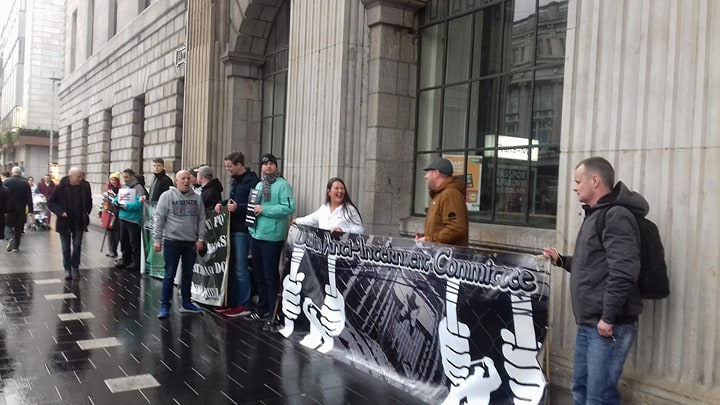
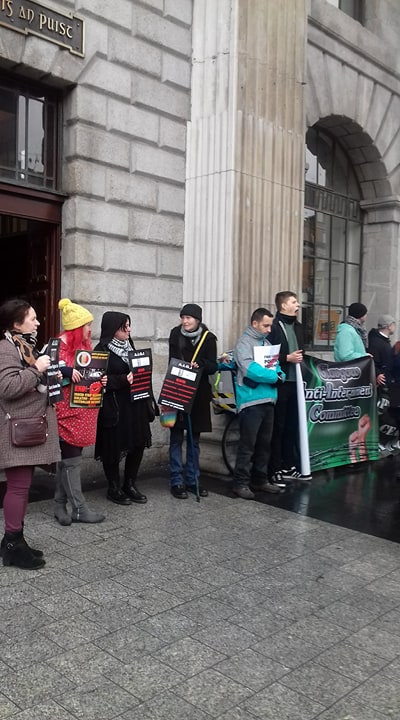
Glasgow and Dublin Anti-Internment Committees joined forces on 18th February in a protest against continuing internment without trial in Ireland. Around two score protesters gathered outside the iconic General Post Office building in Dublin city centre’s main thoroughfare, O’Connell Street. They displayed the anti-internment banners of the Dublin and Glasgow committees and placards against internment, including one against the jailing of Catalan political activists by the Spanish state (also refused bail).

Section of protesters outside the GPO building, O’Connell Street, Dublin (Photo source: End Internment FB page)
(Photo source: End Internment FB page)

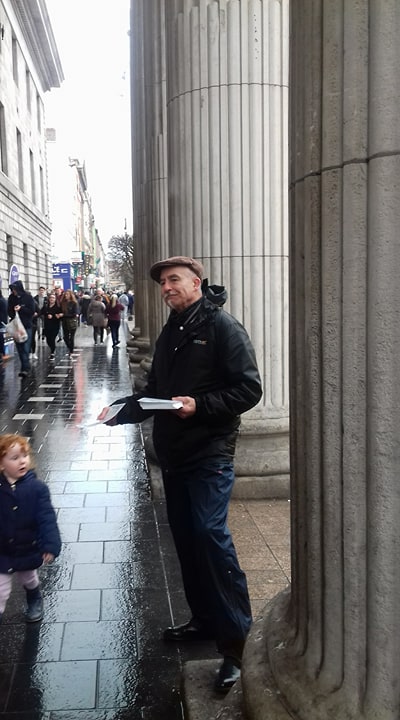
Leaflets of the Anti-Internment Group of Ireland were distributed to shoppers and visitors passing by, along with others about the conviction of Brendan McConville and John Paul Wooton (the Craigavon Two), framed and jailed in 2009 and still in jail, serving life sentences. Songs about internment and political prisoners were played on a sound system, as well as Labi Siffre’s Something Inside So Strong and Christy Moore’s Viva La Quinze Brigada.

Young passer-by accepts leaflet from Dublin Committee leafleter (Photo source: End Internment FB page)

Despite the official end of internment by the British in 19751 and by the Irish state in 19572, Republican activists continue to be jailed without trial in a number of ways: Licence revoked and bail refused or revoked.

(Photo source: End Internment FB page)

When a Republican leaves jail under license, she or he can be returned there without any court hearing or the presentation of any evidence against them; this is what has happened to Tony Taylor and Gerry Mackle, for example. Refusing bail for accused Republicans has become almost standard, despite the fact that this is supposed to be a last resort, for example when there is a serious risk of the accused fleeing the administration, or interfering with witnesses – which has rarely applied to Republicans refused bail. The real reason has usually been revealed when they have been granted bail: they are required not to attend protests, meetings or to associate with other active Republicans. In other words, they are being prevented from exercising their civil rights to express their opinions and to organise politically.

Welcoming the participation of the Glasgow Committee in Dublin, a spokesperson for the Dublin Committee stated that “members of the Dublin Committee have been proud to attend anti-internment protests in Glasgow in the past” and went on to say that “we look forward to future cooperation with the Irish diaspora and internationally against political repression, particularly of jailing without trial of political activists.”

Another Dublin Committee leafleter.
(Photo source: End Internment FB page)

The Dublin Anti-Internment Committee is entirely independent of any political party or organisation and holds regular awareness-raising protests at different locations. The Committee welcomes the participation of other organisations or individuals in their protests but asks them not to bring political party material etc to the anti-internment protests.

On its FB page the Committee also maintains a list of Republican prisoners in jails on both sides of the British Border, updating it from time to time.

FOOTNOTES

1 By then more than 1,900 people – only around 100 of them Loyalists – had been interned, many of them tortured; it was during protests against it in 1971 in Ballymurphy and 1972 in Derry that the Parachute Regiment killed 25 unarmed people.
2Introduced by De Valera’s government in July 1957 during the “Border Campaign” of the IRA.
(Photo source: End Internment FB page)

“GAELIC IRELAND” WITH A SNEER

Diarmuid Breatnach


When one hears or reads the words “Gaelic Ireland”, the reference usually takes one of four forms:

  1. Historical

  2. Geographical-cultural

  3. Nostalgical

  4. Sneering

Historically

Gaelic Ireland”, when used in a historical sense, is a reference to either a time when the majority of Irish people spoke the Irish language (up to 1800 CE many scholars agree) or to a time when the Gaelic order of society was dominant or when the Gaelic Order survived in some part of Ireland (for example up to the Flight of the Earls in 1607) .

Geographically-Culturally

Perhaps used to describe those shrinking parts of Ireland where Irish remains the mother tongue, more normally called the “Gaeltacht” or “Gaeltachtaí”.

Nostalgically

This is a usage which corresponds somewhat to the historical sense above but is also imbued with nostalgia, a regret for what passed then and perhaps a wish to restore it. Despite the accusations of many of those hostile to the Irish language, relatively few people — including among Irish speakers, have any wish to return to that historical period.

Sneeringly

When referred to in this way, it is to link Irish-speaking with out-of-date things, some kind of anachronism, a backward thing, not suitable for our modern society; frequently linked also to Irish nationalism and De Valera’s concept of the desirable kind of society for Ireland and the 1937 Constitution, therefore linked also to the social and political dominance of the Catholic Church. Such a disdainful attitude is often connected to the disparaging way in which a person may speak about a “Gaeilgeoir” — it is as though the person referring to the Gaeilgeoir, which originally meant only “Irish language speaker”, has in mind a devout Catholic wearing an Aran jumper and generally unfashionable clothes and hairstyle, with a gold “fáinne” (a ring-shaped pin awarded for proficiency in Irish) in his or her jacket (probably Irish tweed).

I fear that this type of attitude is present in most enunciations of “Gaelic Ireland” — certainly outside those of the historical sense.

Although by no means associating the writer of a recent article with this contemptuous opinion of Irish speakers, there was more than a hint of a disparaging attitude expressed, in my opinion, in an article much-praised by many Republicans and some socialists, commenting on the racist expressions of some people after the recent lethal incident in Drogheda recently. Dieter Reinisch, whom I understand to be a left-wing Irish Republican, wrote to separate Irish racist commentators on the recent fatal incident in Drogheda from Irish Republicanism.

The article had a progressive intent and made some valuable points but it also linked this Irish racism with “Gaelic Ireland nationalism”1. Although the article does this through reference to individuals it smears “Gaelic Ireland” through doing so. I would doubt that those Irish racists were even Irish speakers, never mind campaigners for the retention of the language.

IRISH NATIONALISM AND REPUBLICANISM

Reinisch is of course correct historically to say that Irish Republicanism is not fundamentally linked to “Gaelic Ireland” but what is the point he is making? Irish nationalism as a force, in the sense of wanting and acting to achieve an Ireland under its own cultural-social order and not under the economic, social and political rule of a foreign power, can be traced as far back as the time of the O’Neill and O’Donnell partnership, who tried to unite the clans of the native people, the Gael, to oust English occupation from Ireland. They came close to succeeding but in the end, failed and with their exile and that of other Irish clan chiefs the Gaelic Order of society collapsed. The Gaelic Order by the way was in many ways socially superior to that of the feudal Norman invaders, which is one reason why most of the invaders adopted so much of it that, less than two centuries after the start of their invasion of Ireland, their England-based relatives called them “the degenerate English” and passed laws to forbid their adoption of Irish custom and law and end their integration into Gaelic Ireland.2

Irish nationalism continued to try to assert itself, finding large-scale expression at two particular moments in the 17th Century – firstly against Cromwell and secondly against William of Orange. Irish nationalism at that point fought in alliance with the Gall-Ghael, the Irish-speaking or bilingual descendants of the Norman invaders (“the degenerate English”, according to their England-based relatives in 1366), who were mostly concerned with preserving and defending their religion against the imposition of the English Reformation.

A kind of Irish nationalism later began to develop among the colonial settlers, a similar type to that expatriate or colonist nationalism developing among the colonists of Northern America and of what is now called Latin America. Since what made them Irish rather than English, Welsh or Scots was that they lived in Ireland (and for many, had been there for a few generations), they looked through the history of Gaelic Ireland to establish a historical background. They organised the Granard Harp Festival in 1786 and the Belfast Harp Festival in 1792. Edward Bunting noted down the airs played at the latter and published a collection in 1796 (and twice again over following decades).

The colonists of North and Latin America did not, for the most part, incorporate the original natives into their new nationalism3. They did not incorporate them in Ireland either but the United Irishmen did have that as their program and they did try to make it a reality. When Grattan’s attempt to open the Anglican-sectarian Irish Parliament to Presbyterians and Catholics failed through bribery and fear of Anglicans being outvoted, of planters losing the lands their ancestors had grabbed, the United Men became convinced that only armed insurrection could bring about a majority (male) democracy and Irish control of Irish affairs. And the symbol on their flag was that of Gaelic Ireland: the Harp. Underneath it, they had the words: “It is new-strung and shall be heard”.

United Irishmen Harp Motif
(Image sourced on Internet)

Reinisch in his article quotes approvingly on three separate occasions from the writings and speeches of Seán Ó Brádaigh. It might surprise some readers to know that this same Ó Brádaigh and his brother the late Ruairí, were Irish-speakers and writers and promoted the speaking of the language. They were for a Gaelic Ireland, albeit a Republican one. They and the organisation they helped create, Provisional Sinn Féin and Provisional IRA, unfortunately in many ways bowed to the influence of the Catholic Church, even though the hierarchy and many clergy denounced them continuously. Mac Stiofáin, who also gets a mention in Reinisch’s article, told me once that although he believed Church and State should be separated, in true republican fashion, also maintained that there should be no freedom to propagandise against religion!

Could Irish Republicanism in the 1700s not have adopted the language of the majority of the people? Some did indeed learn Irish and probably most Ulster Presbyterians, at least outside Belfast city, were at least competent in the basics up to 1798 and many probably fluent. It is hard to imagine that anyone living in Mayo in that year, whether planter or native, was not conversant with the Irish language and certainly it would have been the language of the vast majority there and in the surrounding counties. Wexford is generally agreed an exception by historians, in having been the most Anglicised of Irish counties in 1798.

English was the dominant language of the State and of the colonist administration. But also of the United Irishmen leaders, we can assume – certainly it was the dominant language of their political discourse as recorded in both their own publications and in the reports of the Crown spies and witnesses. Radical and revolutionary ideas were coming in from Revolutionary France and from the revolutionaries of the United States, as Reinisch relates but also very importantly from England – for example Tom Paine’s “The Rights of Man”. The native Irish were either totally excluded from the strata of society where – and the language in which — these ideas were being discussed or they occupied a much more insecure position in which they tried to improve their situation through English without calling down disfavour or even repression upon themselves. There was probably a strata which tried to advance itself under colonial rule and considered that Irish would ‘hold them back’.

There is very little contemporary folk record in existence in Irish of the United Irishmen and one must go to Mícheál Óg Ó Longáin4, Irish language scholar, poet and Unitedman who was “out” or “up” that fateful year, to find his “Buachaillí Loch Garman” (“the Boys of Wexford”) and lyrics of “Sliabh na mBan” to the song’s wonderful air …. and probably “Maidin Luan Chincíse” too.5

The Rising of 1798 failed as did Emmet’s attempt in 1803. Irish Republicanism and Irish nationalism continued to exist and were partly asserted by O’Connell’s campaigns for Catholic civil rights and repeal of the Union as well as by trends such as those of Mitchell and the “Young Irelanders”, most of the latter being Protestants and often hostile to what they saw as O’Connell’s linking Irish nationalism to Catholicism. Mitchell was not a democratic republican but other Young Irelanders were.

Here again, the creation (or renewal) of an Irish nationalism did not incorporate the Irish language although there were nods in its direction. Again, most of its leaders were Protestants but they looked back, as others of colonist background had before, to a Gaelic Ireland. Take Thomas Davis’ celebration of the 1798 uprising in Mayo:

That chainless wave and lovely land 
Freedom and nationhood demand; 
Be sure the great God never planned 
For slumb’ring slaves a home so grand. 
And long a brave and haughty race 
Honoured and sentinelled the place. 
Sing, Oh! not even their sons’ disgrace 
Can quite destroy their glory’s trace. 

For often, in O’Connor’s van, 
To triumph dashed each Connacht clan. 
And fleet as deer the Normans ran 
Thro’ Corrsliabh Pass and Ardrahan; 
And later times saw deeds as brave, 
And glory guards Clanricard’s grave, 
Sing, Oh! they died their land to save 
At Aughrim’s slopes and Shannon’s wave. 

Davis here looks to the history of the Gaelic clans of Connacht resisting foreign invasion, incorporating also the mostly Gaelicised Norman-Irish clan of Clanricarde, the Mac Williams who became Burkes or De Búrca.

It is well to remember, particularly for those who link “Gaelic Ireland” with Irish Catholic nationalism, that many of those prominent in the latter category had no time for the Irish language – in fact, on that issue at least, they would have seemed very at home among those today who say the words “Gaelic Ireland” with a sneer. Daniel O’Connell, who was a native Irish speaker and apparently spoke only Irish until five years of age, stated that he was “sufficiently utilitarian not to regret ….. the gradual abandonment” (of the Irish language) – and this at a time when probably 40% of the country’s population were Irish-speaking.

Portrait of Daniel O’Connell, campaigner for Catholic rights and the repeal of the Union — but no lover of the Irish language
(Image source: Internet)

Irish nationalism and republicanism continued as a strong thread through Irish history, peaking again in the late 19th Century with the Fenians. The Irish Republican Brotherhood or ‘Fenians’ as we know them in that period today contained many Irish-speakers including the famous O’Donabháin Rosa, who wrote his biography in Irish but the Irish language was still not their main language of political literature.

Some of the IRB were deeply working class and they were accepted into the First International Working Men’s Association in England, championed by Marx and Engels (the latter was learning Irish with the intention of writing a history of Ireland which sadly he did not bring to fruition). In the USA also most of the Fenians would have been working class although they included some of the upper middle class among the Irish diaspora. The Fenian conspiracy in Ireland was discovered and plans for insurrection largely upset, leaders and journalists arrested and the military units considered at risk sent away out of Ireland.

IRISH LANGUAGE REVIVAL

Another kind of Irish nationalism saw a resurgence in the later years of the 20th Century and, again, it was the Anglo-Irish, descendants of planters and mostly Protestant, who were the intelligentsia leading it. A kind of antiquarian and romantic interest in the Irish language and culture was followed by a more practical and restorative one and the Gaelic League (now Connradh na Gaeilge) was founded in 1893 by a group led by Douglas Hyde (Dubhghlas de hÍde)6, an Anglican and son of Anglican clergy, who became fluent in the language. This was followed in 1898 with the founding of the Irish Texts Society, a publishing initiative with Hyde as one of the founders and its publication of Dineen’s thick dictionary, Foclóir Gaedhilge agus Béarla, which was first published in 1904 (and still a wonderful source of words and phrases).

The Gaelic League promoted Irish dance, games and culture in addition to the language. Although Hyde’s passion for an Ghaeilge originated in his childhood and early adolescence in Co. Roscommon, he graduated in 1884 as a Moderator in Modern Literature from Trinity College, Dublin, where he had became fluent in French, Latin, German, Greek and Hebrew.

The League/ Connradh grew fast, branches and courses attracting not only the Anglo-Irish aristocracy and upper middle classes but also other social strata. In fact it became a mass movement, with 600 branches in 1903 and through its influence the language was introduced to 1,300 national schools.7

A year later, Conradh na Gaeilge’s membership extended to some 50,000 members in 600 branches8, probably assisted by rising nationalist feeling but in turn it certainly fed that outlook. As a mass movement, it took in professionals and others of middle-class background, as well as labourers and tradesmen.

Among the many prominent Irish nationalists and Republicans (called “progressive nationalists” at the time) of those years was Patrick Pearse/ Pádraig Mac Piarais and Reinisch reminds us that his father was not Irish. Son of a Cornishman and Unitarian who formally converted to Catholicism, Pearse soon gained prominence as a writer and speaker in both English and the Irish language and also founded a school to teach through the medium of the Irish language.

Like many other active Republicans of his day, Pearse was recruited into the IRB and chosen to give the seminal oration at the interment of repatriated Fenian O’Donobháin Rosa’s body in 1915. As related earlier, O’Donobháin Rosa was an Irish speaker and when Pearse spoke at his grave, first in Irish which is rarely quoted, in the rest of his speech in English he said: “The clear true eyes of this man almost alone in his day visioned Ireland as we of to-day would surely have her: not free merely, but Gaelic as well; not Gaelic merely, but free as well.”

Pearse was chosen again as Commander-in-Chief of the insurrectionary forces in the 1916 Rising. Pearse’s memory is often attacked by ‘revisionist’ historians and some of the “Gaelic Ireland with a sneer” crowd – accusations of a repressed homosexual identity, of ‘green nationalism’, of blood-thirst etc. However, a fair assessment of his life would reveal a political activist who sympathised with the workers fighting the Lockout in 1913 and objected to Redmond’s refusal to allow women to speak at a meeting on Home Rule; would find also an individual generous with his time and energy, a talented writer who sought the creation of a modern literature in Irish on a par with those of England, France and Germany, as well as being an educator and proponent of progressive youth educational theory that stands well the test of time.

Pearse was among the people that Hyde accused of politicising the language, which Hyde gave as his reason for resignation of the Presidency of Connradh na Gaeilge. Looking back now, we might well ask how could it have been otherwise? Everything cultural of a national aspect was becoming politicised in those years: sport, song, drama, literature, journalism, oratory, lectures, representational art – even cooperatives, trade unions and some commercial ventures – why expect language to be any different? In fact, surely instead expect politicisation there first of all!

The other Irish nationalists of the time, the Irish Parliamentary Party led by John Redmond, ‘constitutionalist’, Catholic and socially conservative, expressed no great interest in the Irish language. Another branch of Irish constitutional nationalism, represented by William Martin Murphy, was no friend of the Irish language either and ran the most vicious campaigns against the Irish Republicans.

Of the Seven Signatories of the 1916 Proclamation of Independence, four (Ceannt, MacDiarmada, Mac Donagh and Patrick Pearse) were members of the Connradh. The remaining three were at least neutral or approving of the movement. Of the fifteen executions by British firing squads and one by hanging following the Rising, at least six were members of the Gaelic League. Large numbers of activists and leaders in the Republican movement from 1916 to 1922 were Irish speakers, either fluent or at least competent and christening records of the period show increasing numbers of Irish language names (or Irish versions of names from abroad) given to children. This period was the last great flowering of the Irish language as a mass movement in modern history.9

What of the Left in Ireland? A house painter by trade, Peadar Kearney (Peadar Ó Cearnaigh)10 of Catholic background joined the Gaelic League and at some point attendees at Irish classes he taught included the socialist writer and founder of the Irish Citizen Army, Sean O’Casey11 (Seán Ó Cathasaigh), of Anglican background. Irish was taught in Liberty Hall, HQ of the Irish Transport & General Workers’ Union.

Later, native Irish speaker Peadar O’Donnell, republican fighter, socialist activist and writer, was employed for a while teaching in Aranmore, Co. Donegal, an Irish-speaking area, where he apparently adopted socialism and joined the IT&GWU, for which he also became an organiser. In later years he founded the ill-fated Republican Congress, fought against Franco and founded The Bell literary journal. O’Donnell seems to have written little in Irish but in his acclaimed “Islanders”, the construction of dialogue is clearly derived from the Irish language. Later still, Brendan Behan (Breandán Ó Beacháin), a socialist Republican, wrote in Irish and in English and a Republican who became a Marxist, Connemara man Máirtín Ó Cadhain12, wrote in Irish and campaigned on the rights of Irish speakers and of people living in the Gaeltacht.

In and around those names there would have been many others, Left activists and supporters, unknown now but native speakers or those who learned the language, thought it important and spoke it.

Many socialists seem sometimes to think that the “unity of the working class” is best achieved by doing away with different cultures. They seem to forget that though there is one working class, there are a great many national cultures — and what a poor world it would be if those cultures disappeared.

THE STATE AND POLITICAL PARTIES

Some of the attacks on “Gaelic Ireland” seek to tie it first of all to the right-wing neo-colonial state set up in 1921, or the form it took after 1922, or as mentioned earlier, the De Valera/ Fianna Fáil state from the mid-1930s.

The New State

When the Irish Free State was set up as a compromise with British imperialism and colonialism, backed by a section of the nationalist-Republican movement and in alliance with Irish gombeen capitalism and the Catholic Church, it was actually a very insecure and uncertain endeavour. This perhaps explains the ferocity of the State in the Civil War and afterwards, with large-scale repression, 83 official executions and around a 120 assassinations of Republicans – in less than a 12-month period. Two years later, in 1924 the State faced an attempted Army mutiny and possible coup d’etat, led by Major-General Liam Tobin, with a number of prominent right-wing nationalist politicians in support.

The new owners of the State tried to ensure that nationalist symbols were not left unclaimed to be appropriated by Irish Republicans and so appropriated them themselves: the Tricolour, the Soldiers’ Song and the Irish language. However, this was no foregone conclusion nor an easy process. They had to bear in mind also the British, who had merely stepped off stage into the wings, who were also on stage in the Six Counties, as well as the large constituency of Unionists on both sides of the Border.

For example, God Save the King was played and sung at some State and many other formal occasions, though The Soldiers’ Song was sung by many Republicans. Let Erin Remember was the song favoured by some in the State and it was the air played for the Irish State at the 1924 Paris Olympics. After a struggle, The Soldiers’ Song was finally agreed as the National Anthem in 1926.

Far from being enthusiasts for any kind of “Gaelic Ireland”, the new State continued to use English as the language of administration, even in areas where 80% of the population were Irish-speaking.

A qualification in Irish was required to apply for state jobs but a high level of fluency was not needed13, “and few public employees were ever required to use Irish in the course of their work. On the other hand, state employees had to have perfect command of English and had to use it constantly. Because most public employees had a poor command of Irish, it was impossible to deal with them in Irish. If an Irish speaker wanted to apply for a grant, obtain electricity, or complain about being over-taxed, they would typically have had to do so in English.”14 As late as 1986, a Bord na Gaeilge report noted “…the administrative agencies of the state have been among the strongest forces for Anglicisation in Gaeltacht areas”15

The two main daily newspapers at the time in Ireland were the right-wing nationalist Irish Independent and the Unionist-minded Anglophile Irish Times16 and neither promoted the Irish language nor even covered Gaelic games, although they reported on rugby and cricket matches.

Fianna Fáil and the Blueshirts

Fianna Fail was created early in 1926 and in 1932, only six years later it was in government of the State. One year later, the right-wing Army Comrades Association adopted the uniform which included the blue shirt and by that time had over 30,000 members and battles were taking place between them and the IRA and other Republicans. Eoin O’Duffy had been an IRA guerrilla leader in the Irish War of Independence, a general in the Free State Army in the Civil War and Commissioner of the state’s police force, the Garda Síochána from 1922 to 1933. After Fianna Fáil’s easy re-election in February 1933, De Valera dismissed O’Duffy as Commissioner and a few months later O’Duffy took leadership of the ACA and renamed it the National Guard, adopting the straight-arm Roman salute favoured by the fascists.

That same year the Blueshirts planned a march on Dublin, believed my many historians to be a prelude to a coup d’etat; certainly De Valera thought so and, unsure of the Army’s loyalty, banned the march and subsequently outlawed the organisation. That year also Fine Gael was formed, incorporating the Blueshirts, Cumann na nGaedhal and the National Centre Party, with O’Duffy as its President.

De Valera founded the daily newspaper Irish Press in 1931 which had an alternative version of its title in Irish – Scéala Éireann – and as well as covering the GAA games, had sections in Irish. However the position of the Irish language in the affairs of the State did not change.

Though the Great Hunger caused he most impressive loss of Irish-speaking modern Ireland on the map, the percentage lost by the Irish state is greater.
(Image source: Internet)

Throughout Fianna Fáil and Fine Gael governments, the Gaeltacht – the Irish-speaking areas – continued to suffer deprivation of resources. Even by the early 1960s, many homes in those areas did not have electricity, running water or sewage drains. Primary schools typically had a headmaster and female teacher to administer and teach all subjects at all levels. Deprivation led to massive emigration, not only to the metropolis but also to the USA and to Britain. Today, the Gaeltacht is 9.1% the size of what it was when the Irish State was created or, in other words, the State has presided over a Gaeltacht decline of over 90%17 — as a friend commented: “Not even Cromwell or the Great Hunger wreaked such linguistic devastation”.

In the 1960s, no matter what party was in government or in local authority, Irish-language campaigners had to fight for minimal funding for land allocation, schools and broadcasting in Irish. People went to jail for civil disobedience and were fined for refusing to pay for their TV and radio licences and, briefly, a pirate Gaeltacht radio station was in operation.

The Labour Party and Sinn Féin

The Labour Party, whether to the right or left, has never shown itself to be a friend of the Irish language.

Sinn Fein (Provisional) would nominally be expected to be supportive of the Irish language but the real test is in its campaigning and practice within its own party. Its public and internal meetings are held in English (as with other Republican parties) and throughout the three decades of the war in the Six Counties it did not organise or mobilise the Gaeltacht people to improve their position and defend their communities from emigration and the penetration and eventual supremacy of the English language.

In conclusion, to associate the Irish language or culture with any of the political parties or any administration of the State is fundamentally incorrect from a historical point of view.

FOCAL SCOIR OR IN CONCLUSION

Would those who sneer when they say “Gaelic Ireland” do likewise at the mention of “French France”, “Spanish Spain”18, “Italian Italy”, “German Germany” or “Polish Poland”? I think not. No, national cultures are not sneered at by the Right or the Left in Ireland – only Irish culture and, particularly, the language.

John Kells Ingram19, an academic, mathematician and writer of planter descent from southeast Donegal (and probably bilingual), in 1843 wrote the lyrics “In Memory of the Dead” (better known as “Who Fears to Speak of ’98”). He was decrying the distancing by Daniel O’Connell and his Catholic movement from the deeds and principles of the United Irish Men in 1798. If I may paraphrase him a little to refer to the kind of Irish person today who says “Gaelic Ireland” with a sneer: “He’s all a knave or half a slave, who slights his people’s culture thus”.

Fanon20 would agree, I’m sure.

A chríoch.

SOME SOURCES AND REFERENCES:

https://me.eui.eu/dieter-reinisch/blog/dundalk-racism-republicanism/

https://en.wikipedia.org/wiki/Amhr%C3%A1n_na_bhFiann#Official_adoption

https://en.wikipedia.org/wiki/Irish_Army_Mutiny

https://en.wikipedia.org/wiki/Blueshirts

https://en.wikipedia.org/wiki/History_of_the_Irish_language#Independent_Ireland_and_the_language

Black Skin, White Masks (1952), (1967 translation by Charles Lam Markmann: New York: Grove Press)

The Wretched of the Earth (1961), (1963 translation by Constance Farrington: New York: Grove Weidenfeld)

1 “……. individual Republican activists use Gaelic Nationalism to justify their anti-migrant and racist parochialism”

3The North American republicans did not admit the Indigenous People as citizens and many set out to exterminate them. Many also condoned slavery and some owned slaves. The Latin American republicans also mostly sought the expropriation of Indigenous people and also organised massacres but, for the most part, abandoned slavery earlier than the USA.

4Cork poet and strong Republican Mícheál Óg Ó Longáin (1766/-1837) is usually credited with writing Buachaillí Loch Garman and Sliabh na mBan (although one source, probably mistaken, credits his son Peadar with the latter two). Mícheál’s work as a scribe, scholar and teacher was a useful cover for acting as a United Irishmen courier.

5There are a few songs from Mayo too, by unknown authors.

6Douglas Hyde (Dubhghlas De hÍde) was elected first Uachtarán na hÉireann (President of the Irish state) from 1938-1945.

9The last to date but hopefully not the last.

10Peadar Kearney was a member of the Irish Volunteers and IRB, fought in 1916 and was interned; he became a prolific writer of nationalist ballads — but also of “Labour’s Call”, a song with very socialist lyrics – and is the co-author with Patrick Heeney of “The Soldiers’ Song”, the national anthem of the Irish state.

11Sean O’Casey (1880-1964) was born in Dublin into a lower middle-class family in straitened circumstances.

12Máirtín Ó Cadhain (1906-1970); interned by the Irish State during the 2nd World War years and later activist for the Gaeltacht which led to the founding of the Rath Cairn Gaeltacht in Co. Meath. Ó Cadhain’s most famous written work, the novel “Cré na Cille” (1949) was later translated into many languages. Ó Cadhain was also a founder and leading activist of the original Irish-language civil rights campaign Misneach which engaged in agitation and civil disobedience (another campaign by the same name now exists) in Dublin and other places.

13Hence the jibe about the mere “cúpla focal” of Irish of politicians and civil servants.

14See Wikipedia in Sources

15 Advisory Planning Committee of Bord na Gaeilge, The Irish Language in a Changing Society: Shaping The Future, p.41. Criterion, 1986 (quoted in Wikipedia – see Sources).

16Both had called for the punishment by the British of the 1916 Rising leaders but the Independent had actually called for the executions of Connolly and Mac Diarmada.

17Extrapolation from the Census statistics of the years 1926, when there were 246,811 Irish speakers in the Gaeltacht and the 2016 Census when 20,586 remained, which is 8.34% of the 1926 number or a reduction of 91%. http://www.cso.ie/en/media/csoie/census/census1926results/volume8/C_1926_VOL_8_T8,9,10.pdf

18In fact, there are ground for objecting to the terminology of “French France” and “Spanish Spain” but only because those two states do not value and even suppress the other national languages within their state boundaries, e.g Euskera, Catalan, Occitan, Corse, Asturian, Galician ….

19John Kells Ingram (1823-1907)

20Franz Omar Fanon (1925-1961) was born and raised in Martinique; qualifying as an MD and psychiatrist, practised in Algeria during the war of liberation against the French, where he was a covert member of the resistance. Fanon was a politically radical intellectual, Pan-Africanist and Marxist humanist whose written work is very influential in particular in “post-colonial studies”. He described the psychopathology of colonisation in quite accessible writing, showing how – among other things – the colonised internalise the image of themselves projected by the coloniser and aspire to the “sophistication” of the latter and his culture (see two of his works listed in the Sources & References section.

“Be Moderate” (or “We Only Want the Earth”) by James Connolly

The lyrics were written by James Connolly and published in his songbook Songs of Freedom in New York in 1907.  Diarmuid replaced the words “labour” with “workers” and “true men” with “true hearts”.  There was no indication of to what air the song should be sung (quite common, the expectation being that being would use a popular air at the time) and it has been put to at least three airs.

Diarmuid Breatnach here sings it to the air of A Nation Once Again (by Thomas Davis, ‘Young Irelander’) which is the air he heard it sung by Cornelius Cardew, an English communist composer.  This air suits it and the arrangement provides a chorus in which people can join.

The recording was done at the weekly Save Moore Street From Demolition campaign table (Saturdays 11.30am-1.30pm) with Bart Hoppenbrouwers videoing.

James Connolly was one of around 350 men and women who occupied the Moore Street area during the 1916 Rising after the evacuation of the burning GPO, which had been the HQ of the Rising.  Connolly was one of five signatories of the Proclamation who spent their last hours of freedom in those houses and one of six of the fourteen executed after they surrendered in Moore Street.

The Irish Government, property speculators and the Planning Dept. of Dublin City Council are all pushing that only four buildings in that battleground be saved and a huge supermarket be built over the whole area but the SMSFD campaign wants the whole quarter saved and sensitively developed.

end.

https://www.facebook.com/save.moore.st.from.demolition/