WHEN DUBLIN WANTED MAYO TO WIN — MEN OF THE WEST AND THE MAN FROM DUBLIN

Diarmuid Breatnach

As Mayo began to prepare for a replay of the 2016 championship Gaelic Football final against Dublin, I stood with others on a very wet day in Dublin’s Croppies’ Acre to commemorate and honour Robert Emmet and the United Irishmen – an event replete with Mayo connections.

line-enniscorthy-group-at-monument
Eniscorthy Historical Reenactment Society inside the monument during the ceremony. (Photo: Paddy Reilly)

The event, organised by the Asgard Howth 1916 Society, was graced by the presence of the Enniscorthy Historical Reenactment Society, men and women in 1798 costume bearing pikes, including officer uniforms – they had travelled up from Wexford that morning to attend the event. Donal Fallon, historian, blogger, tour guide and broadcaster was to give the oration. Padraig Drummond, the organising persona, had asked me to sing two songs at the event, one near the start and the other near the end.

For the first song, I had chosen the Bold Robert Emmet ballad1 (originally known as The Last Moments of Robert Emmet2), a song that commonly sung more often a few decades ago but still reasonably well remembered. For the second, I was spoiled for choice of relevant songs: Anne Devlin, Boolavogue, The Croppy Boy, Henry Joy, The Irish Soldier Laddie. Kelly the Boy from Killane, The Rising of the Moon, Rodaí Mac Corlaí, Sliabh na mBan, the Three Flowers, The West’s Awake, The Wind That Shakes the Barley …… or I could finish learning some of which I knew bits, like the Sean Bhean Bhocht, General Munroe, Memory of the Dead (Who Fears to Speak of ’98?) or the Mayo version of An Spailpín Fánach.

Drawing depicting the trial of Robert Emmet in Green Street Courthouse, Dublin
Drawing depicting the trial of Robert Emmet in Green Street Courthouse, Dublin. (Photo source: Internet)

Though a beautiful song in lyrics and air, I felt Sliabh na mBan was too long for the event and cutting it would also feel wrong. Anne Devlin remembers an extremely brave comrade of the United Irishmen and gives rare acknowledgement to the role of women in the struggle for Irish freedom, which had me veering towards that choice. However, I eventually settled on Men of the West, celebrating the 1798 uprising in Mayo when a small French force under General Humbert landed to support them.

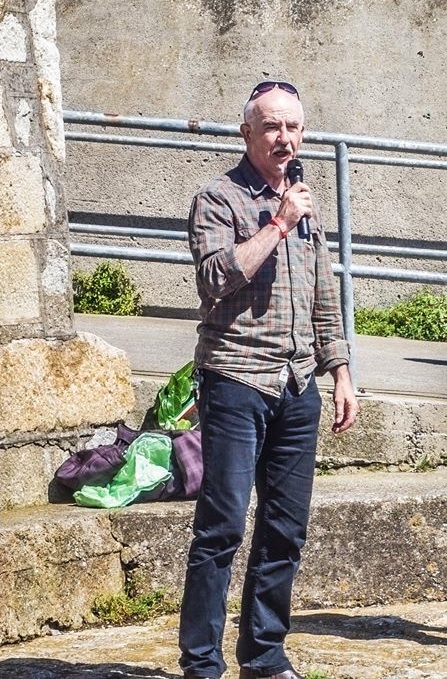
Diarmuid Breatnach singing "Men of the West/ Fir an Iarthair". (Photo: Paddy Reilly)
Diarmuid Breatnach singing “Men of the West/ Fir an Iarthair”.
(Photo: Paddy Reilly)

MEN OF THE WEST

The Mayo connection in the forthcoming GAA final was one reason for the choice, another was that this time of year is that which witnessed the repression in Mayo after the defeat of the last rising of that year (and the last forever, the British and their Orange supporters may have thought, until Emmet came out five years later). And other reasons were that I could sing it as a macaronic song (with some of the verses in Irish and some in English), the song was not too long and it has a chorus in which participants could join.
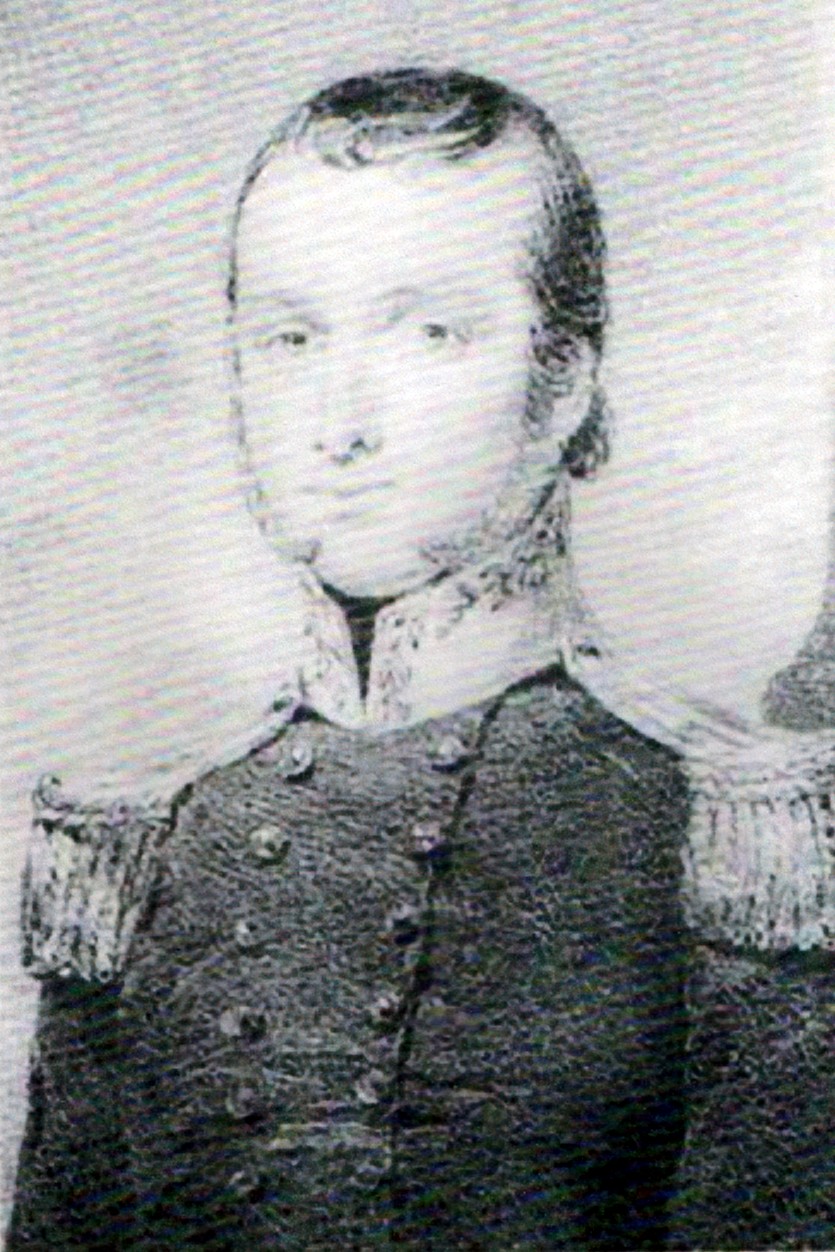
Bartholomew Teeling, with the French who landed at Mayo, captured when they surrendered at Baile na Muc. Hung in Dublin and his body thrown into the "Croppy Hole".
Bartholomew Teeling, with the French who landed at Mayo, captured when they surrendered at Baile na Muc. Hung in Dublin and his body thrown into the “Croppy Hole”. (Photo source: Internet)

There were yet other reasons for the choice too – not in our culture of song and game, nor in the calendar, but in the ground under our feet, for somewhere under there in what was first called “The Croppies’ Hole” and later “Croppies’ Acre”, the mass grave of many United Irish, lie the bodies of the executed Matthew Tone — younger brother of Theobald Wolfe Tone (who was soon after to give his own life to the Rising) – and Bartholomew Teeling. The younger Tone and Teeling had landed with the French in Mayo, been taken prisoner after the surrender of the French at Baile na Muc, in Co.Longford, brought to Dublin and, despite their French Republican Army officer rank, tried as rebels and hung there.

And in researching background for this article, I came across even further Mayo connections.

The lyrics of Men of the West were written by William Rooney and put to the air of an Irish song called Eoghan Chóir written in turn — and also air apparently composed — by a Mayo United Irishman and songwriter, Riocard Bairéad (Richard Barrett3), who composed the even better-known Preab San Ól4.

The lyrics of Men of the West were later translated into Irish by Conchúr Mag Uidhir, who won a prize for that work at a Feis Ceoil in 1903 – again in Mayo. It was the lyrics of both these versions that I combined to make the macaronic version I chose to sing at the commemoration at Croppies’ Acre5.

THE DUBLIN SONGWRITER — BACKGROUND

While I need to do some research to find out more about this Mag Uidhir, quite a lot is known about William Rooney (Liam Ó Maolruanaigh). Born in the Dublin former red-light district known as “The Monto”6 in 1873, Rooney grew up in a what had been considered the second city of the British Empire but had declined in status with the abolition of the Irish (colonial) Parliament in 1800. The city contained the residence of the Crown’s representative in Ireland, a number of British army barracks and the administration apparatus of the colony, the latter in Dublin Castle. Dublin also contained a substantial loyalist population of the Ascendancy, in addition to “Castle Catholics”7. However, Dublin was also a focal point in Irish nationalist and separatist politics. Relatives and descendants of members and sympathisers of the United Irishmen of 1798 and 1803 lived in the city and the events were in the living memories of some.
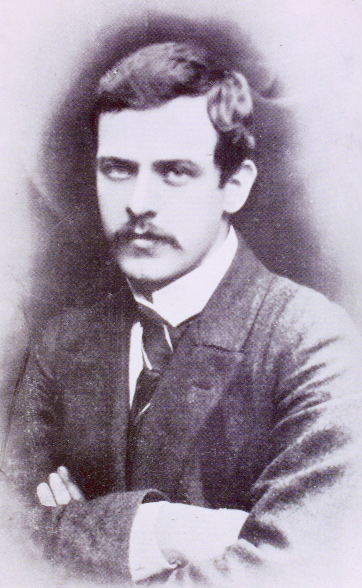
William Rooney, journalist, organiser, Irish language revivalist and author of songs.
William Rooney, journalist, organiser, Irish language revivalist and author of songs. (Photo source: Internet)

Irish Republicanism had seen a resurgence with the Young Irelanders of 1848 and some of their supporters were easily alive when William Rooney was born in 1873 and during his childhood. The founding of the Irish Republican Brotherhood in 1858 preceded Rooney’s birth by only 15 years and although the raid on the The Irish People newspaper took place in 1865, followed by the trial and conviction to penal servitude of Ó Donnobháin Rosa, Thomas Clarke Luby and John O’Leary, they would have been still talked about during Rooney’s childhood.

The following year, 1866 saw the failed rising of the Fenians in Ireland and also their shock invasion of Canada and, in 1867, the stirring freeing of the American Fenian prisoners in Manchester and the subsequent hanging of the three martyrs, Allen, Larkin and O’Brien. The spectacular rescue of escaping Fenian prisoners from Australia by the Catalpa and their celebrated delivery to the freedom in the United States took place in 1876.

Although these events were all over (or just occurring, in the case of the Catalpa) by the date of Rooney’s birth, their echoes remained – in living memory, in the cause of prisoners serving sentences in English jails or penal colonies and in agitation for a political prisoners’ amnesty. And God Save Ireland8, written to commemorate the Manchester Martyrs in 1866 by Timothy Daniel Sullivan would have been an extremely popular song among a wide section of the Dublin population during Rooney’s childhood, along with patriotic verses and songs by Thomas Moore (1779-1852), Thomas Davis (1814-1845) and James Clarence Mangan (1803-1849). Verse and songs by these poets were learned by ear and recited or sung but were also available in printed form, in songbooks, song sheets and nationalist publications.

Sullivan was a journalist, owning and editing the publications The Nation, Dublin Weekly News and Young Ireland. As a journalist, Sullivan published reports of meetings of the banned National League in December 1887, for which he was convicted and imprisoned for two months by the British administration. William Rooney was in his late teens at that time and Sullivan lived until 1914.

At the age of around thirteen William Rooney became acquainted with a leading Irish nationalist of his times, Arthur Griffith, through Rooney’s membership of The Irish Fireside Club, a literary discussion group. Both of them joined the Leinster Debating Society (which later became the Leinster Literary Society) which they soon led, Griffith as presidents and Rooney as Secretary. The early 1890s controversy surrounding Parnell’s relationship with Catherine O’Shea caused a serious disruption in the nationalist movement of the time and caused a serious split in the Irish Parliamentary Party of which the Leinster Literary Society became a casualty.

Rooney then formed the Celtic Literary Society in 1893, of which he became president; he also edited An Seanachuidhe (old spelling of “Seanchaí”, a story-teller, a relater of things past), the Society’s journal. The Society’s aims were the study of the Irish language, history, literature and music; it had branches in different parts of the country and its members included John O’Leary, Frank Hugh O’Donnell and Arthur Griffith.

AN GHAEILGE

William Rooney was fluent enough in the Irish language to write and to give orations in it and journalists of his times, after summarising a speech in English from the same platform, generally wrote only that he had spoken in Irish9. When he learned his Irish is not clear but he was teaching it in the offices of the Celtic Society. Then Eoin MacNeill got him to join the Gaelic League/ Connradh na Gaeilge after it was formed in 1893.

The Connradh was mainly concerned with promoting the Irish language and literature but also became a social focus in later years, hosting céilidhe (dances and occasion for songs, recitations). Patrick Pearse advocated a more political approach to promoting Irish culture and this accorded with Rooney’s opinion. On the other hand Rooney regarded Irish independence without the revival of the language and culture as meaningless and he castigated the Irish Parliamentary Party for its inaction on the Irish language.

Rooney gave an alternative example, traveling the country speaking publicly in Irish and in English on the need for Irish independence and for the revival of the Irish language.

JOURNALISM AND POLITICAL ORGANISATION

Building on his earlier writing in An Seanachuidhe, Rooney founded with Griffith The United Irishman newspaper in 1899 and his articles and other writings were published in a number of publications of his times:United Ireland, The Shamrock, Weekly Freeman, The Evening Herald, Shan Van Vocht and Northern Patriot (the latter two in Belfast).

Near the end of 1900, again in conjunction with Griffith, William Rooney helped found Cumann na nGaedheal.  The former Fenian John O’Leary was president and the Cumann was intended as an umbrella organisation to co-ordinate the activities of a number of nationalist groups (it was merged with others in 1907 to form the original Sinn Féin).

As the centenary of the 1798 Uprising approached, there was something of a fever of preparation with many indicating an interest in participation. Rooney would see his 25th birthday during centenary year and became of the most prominent organisers for the National Commemoration committee, if not, indeed, the main one.

The year 1898, somewhat similarly to the current centenary of the the 1916 Rising, saw commemorative plaques and monuments being erected, along with talks, meetings, lectures, articles and songs being written. According to historian Ruan O’Donnell, a feeling that the 1889 events had not reached an appropriate level led in 1903 to substantial commemorative events of Emmet’s rising in 1803. Many political working relationships were made during those years which were to survive into much more active days less than two decades since. Many of the songs we have today about the 1798 Rising were written during this period too and Rooney’s Men of the West was presumably also.

In the year of the 1798 centenary commemoration, one of the main centenary commemorations was held in Croppies’ Acre, attended by a reported 100,00010. Rooney was one of the main organisers and a stone was laid on the site which is there to this day.

Stone laid (or unveilled) during commemoration event in Croppies' Acre in 1898, the first centenary of the Rising. (Photo: Paddy Reilly)
Stone laid (or unveilled) during commemoration event in Croppies’ Acre in 1898, the first centenary of the Rising. The stone is on the ground near the north-west gate and corner of the park. (Photo: Paddy Reilly)

WILLIAM ROONEY IN MAYO

(The following text is taken from an article by Brian Hoban in the on-line edition of the Castlebar News for 22, Apr 2011)

William Rooney had visited Castlebar with Maud Gonne in 1898 for the centenary celebrations of ‘The Year of the French’. He gave a passionate speech in Irish in which he exhorted people to think for themselves, to educate themselves, and not to take their teachings from others.

He founded Castlebar’s first Public Library at the Town Hall, to which he dedicated his books. Three years later, at the early age of twenty-eight, William Rooney was dead, but the esteem in which he was held in Castlebar continued to grow. In 1911, a new Hurling Club in the town was named the ‘William Rooney’ in his honour. The following year “The Rooney Hall” was opened in Tucker Street. It became a local landmark for several generations, much used by various civic and voluntary organisations, including the PTAA.

The one surviving connection is in ‘Poems and Ballads’, a collection of Rooney’s poetry edited by Arthur Griffith and published in 1902, a year after his death. An original of this title is held by Mayo County Library where it can be consulted.

1798 Centennial Celebrations

William Rooney was one of the main protagonists in establishing the National Commemoration to celebrate the centennial of the 1798 rebellion. Only one month after its inception nationalists in Mayo formed the “Castlebar Central and Barony of Carra ’98 Centenary Association with James Daly appointed as president of the Connaught ’98 Centenary Council. On the 9th January 1898 a commemoration, which was presided over by James Daly, was held at Frenchill, near Castlebar. This was attended by Maud Gonne Mac Bride and addressed by James Rooney. ……………….

James Daly pointed out that the event was both about remembering dead patriots and undertaking “to abide by the principles of the men of ’98 until their country was free again and took its place among the nations of the earth.”

EARLY DEATH AND MEMORY

William Rooney died of TB in 1901 at the age of 27, shortly before he was due to marry. He is buried in Glasnevin Cemetery.

In 1902 the United Irishman published a collection of his writings and in 1908 a collection of his work edited by Griffith, Poems and Ballads of William Rooney, was published. The publication was reviewed disparagingly in the Daily Express that year by James Joyce but Yeats dedicated the 1908 edition of Cathleen Ni Houlihan “To the Memory of William Rooney”. A collection of his lectures and articles, from the United Irishman was published by M.H. Gill the following year.

Griffith described William Rooney as “the Thomas Davis of the new movement”. Brian Ó hUigín (“Brian na Banban1882–1963), editor for many years of The Wolfe Tonne Annual and himself no slouch as a writer of songs and verse, said of Rooney that “he blazed the trail to 1916 and gave his life for Ireland”.

And many of William Rooney’s songs are still being sung.

End.

Wreath being laid by Pól Ó Scannaill inside the monument on behalf of a number of groups. (Photo: Paddy Reilly)
Wreath being laid by Pól Ó Scannaill inside the monument on behalf of a number of groups.  Padraig Drummond of Asgard 1916 Society MC of event.
(Photo: Paddy Reilly)


APPENDIX

THE MACARONIC VERSION OF MEN OF THE WEST/ FIR AN IARTHAIR

(Arranged by D.Breatnach)

1.

Má mholtar le dán is le h-amhrán,

Na fir a bhi tréan agus fíor,
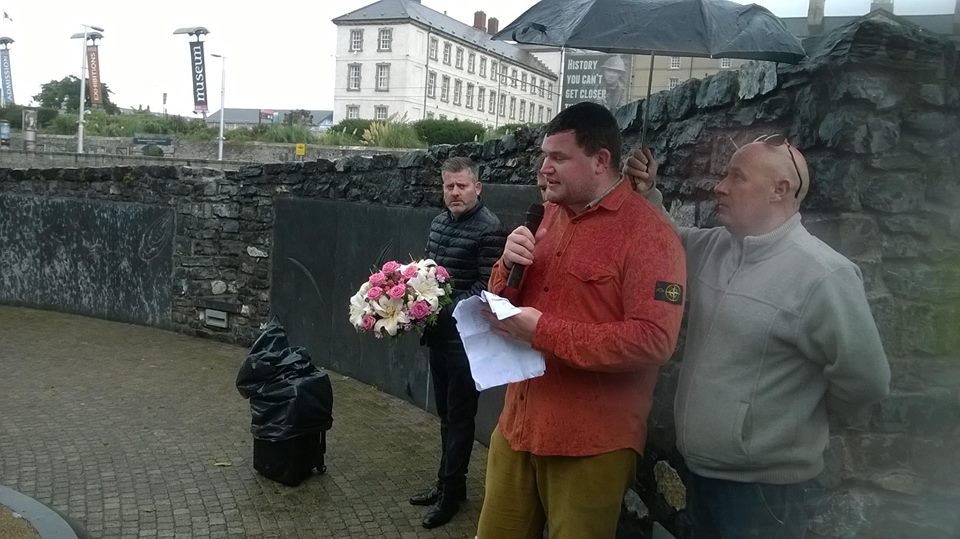
Donal Fallon, historian, blogger, tour guide and broadcaster who gave the main oration

Chuir clú agus cáil lena ndánacht

Ar shruthán ‘s gleann agus sliabh:
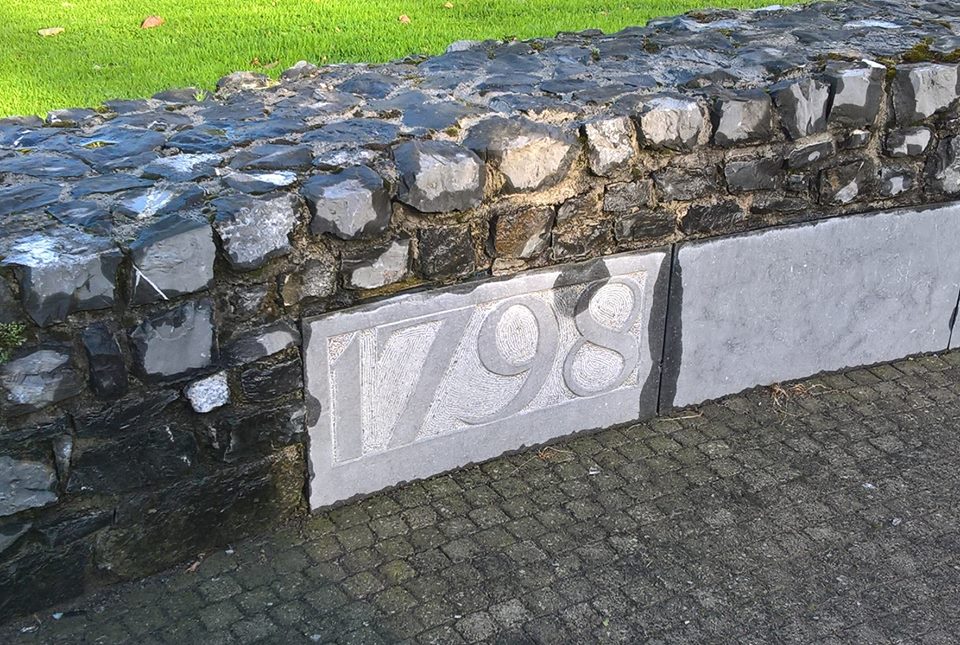
1798-panel-monument-wall
One of the panels inside the circular monument. (Photo: Paddy Reilly)

Ná fágaidh ar deire na tréan-fhir

Do chruinnigh ar phlánai Mhuigheo –

Nuair a ghnóthaí na Gail I Loch gCarman,

Said muinntir an Iarthair ‘bhí beo.

Chorus

I give you the gallant old West, boys,

Where rallied our bravest and best;

When Ireland lay broken and bleeding:

Hurrah boys, hurrah for the West!
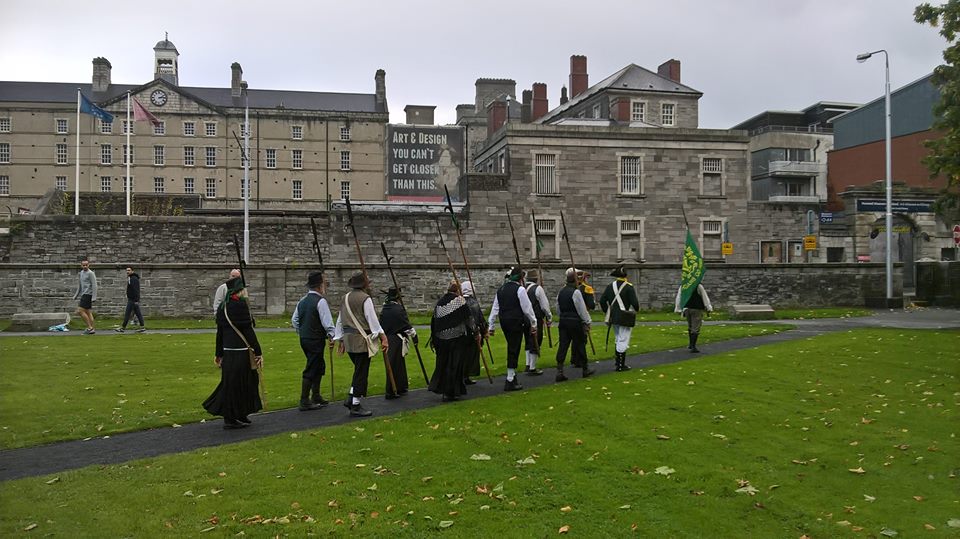
enniscorthy-marching-to-gat
(Photo: Paddy Reilly)

2.

The hilltops with glory were glowing

‘twas the eve of a bright harvest day,

And the ships we’d been wearily awaiting

Sailed into Killalla’s broad bay.

And over the hills went the slogan

To awaken in everyone’s breast

That spirit that’s never been broke’ boys

Among the true hearts of the West.

Curfá

Seo sláinte muinntir an Iarthair daoibh,

Section of Croppies Acre showing circular 1798 monument in middle distance and Collins Barracks Museum in the far background. View is from NE gate on Wolfe Tone Quay. (Photo: D.Breatnach)
Section of Croppies Acre on a drier day, showing open circular 1798 monument in middle distance and Collins Barracks Museum in the far background. View is from SE gate on Wolfe Tone Quay. (Photo: D.Breatnach)

Do chruinnigh le cunamh san áir,

Mar sheas siad in aimsir an ghéar-chaill:

Seo sláinte fear Chonnacht go brách!

3.

Níor bhuail sé an dó dhéag san oíche

Gur ghlan’mar Cill Ala go breá:

‘S ní dheachaidh an ghrian síos ‘na dhiadh sin

Go raibh brat glas ar chúirt Bhéal an Átha.

Chruinnigh na céadta le cúnamh,

Agus mairfidh an scéal sin go buan;

An chaoi inar ruaigeadh na redcoats

As Caisleán an Bharraigh go Tuaim!

Chorus

I give you the gallant old West, boys,

Where rallied our bravest and best;

When Ireland lay broken and bleeding:

Hurrah boys, hurrah for the West!

4.

Agus gairim na Franncaigh breá láidre

Do tháining le Humbert anall,

Mar thug siad dúinn croí agus misneach

Nuair a bhíomar go brónach sa ngabháil.

Agus trócaire Dé ar na céadta

Do thuit is do leagadh san áir;

Tá a gcnámha faoi fhód ghlas na hÉireann

‘s cuimhneoidh muid orthu go brách.

Curfá

Seo sláinte muinntir an Iarthair daoibh,

Do chruinnigh le cúnamh san áir,

Mar sheas siad in aimsir an ghéar-chaill:

Seo sláinte fear Chonnacht go brách!

5.

Though all the bright dreamings we cherished

Went down in disaster and woe,

That spirit of old is still with us

That never will yield to the foe;

And Connacht is ready and awaiting

When the loud rolling tuck of the drum

Rings out to awaken the echoes

to tell us the morning has come.

Chorus.

I give you the gallant old West, boys,

Where rallied our bravest and best;

When Ireland lay broken and bleeding:

And looked for revenge to the West!

THE VERSES OMITTED IN THE MACARONIC VERSION

IN THE TRANSLATION INTO IRISH

2.

Tháinig na longa lá Fómhair,

Go cuan Chill Ala ag snámh,

‘S bhíomar chomh fada ag súil leo

Gur shíleamar nach dtiocfadh go brách.

Agus thosaigh na hadharca ag séideadh,

Ag fógairt go raibh siad ar fáil,

Agus corraíodh spreagadh in Éirinn

Nach múchfar i gConnacht go brách!

5,

Má caitheadh le fána ár smaointe,

S ár ndóchas faoi scrios agus léan,

Tá an fíor-spiorad beo inár gcroíthe

Nach ngéillfidh don námhaid go héag!

Agus féach: Táimid réidh ar an nóiméad

A chluinfimid torann an áir

Ag fógairt ar chlanna na hÉireann

Go bhfuail saoirse ár n-oileáin ar fáil!

Also, the final chorus in the Irish version:

Seo sláinte na gConnachtach fíora

Do chruinnigh le cúnamh san ár!

Siad togha agus rogha na tíre:

Seo sláinte sean-Chonnacht go bráth!

IN THE ENGLISH ORIGINAL

1.

While you honour in song and in story

the names of the patriot men,

Whose valour has covered with glory

full many a mountain and glen,

Forget not the boys of the heather,

who marshalled their bravest and best,

When Éire was broken in Wexford,

and looked for revenge to the West.

4.

And pledge we “The stout sons of France”, boys,

bold Humbert and all his brave men,

Whose tramp, like the trumpet of battle,

brought hope to the drooping again.

Since Éire has caught to her bosom

on many a mountain and hill

The gallants who fell so they’re here, boys,

to cheer us to victory still.

MODERN LAST VERSE ADDITION TO “BOLD ROBERT EMMET”

11Erin, mo mhuirnín, my love and my country!

Ireland, my Ireland, though dead I shall be,

Hear now the words of my final oration:

Write me no epitaph ‘til my country is free!

FOOTNOTES

1

Unknown author but sometimes credited to Tom Maguire (1892– 1993, famed leader of the Mayo Flying Column [yet another Mayo connection!] in the War of Independence, who later took the Republican side in the Civil War). On the other hand Zimmermann (1967) gives the song its earliest appearance as c.1900, when Maguire would have been around only eight years of age. For Tom Maguire credit see http://thewildgeese.irish/profiles/blogs/robert-emmet and a number of other references, some of which state inaccurately that Emmet was “hung, drawn and quartered”; that was indeed his sentence but the British practice of cutting the body of “traitors and rebels”open while still alive to access the entrails had been discontinued for decades although the decapitation part was still practiced and was carried out on Emmet.

2Bottom p.159, Remember Emmet, Ruan O’Donnell

3In the very brief research I carried out on the Mayo songwriter, I came across another songwriter by the name of Richard “Richie” Barrett (1933– 2006), an Afro-American who was also a singer, musician and band promoter, involved with such famous rythm ‘n blues groups as the Chantels and Three Degrees. One might hope for a family connection ….

4Translated later into English, recorded by the Dubliners folk and ballad group under the title Another Round.

5For lyrics, see the Appendix after article body and Sources.

6No.39 Mabbot Street, D1

7A pejorative term to describe Catholics who cooperated with the colonial Ascedancy regime in Ireland and sought admission to their social circles (for example, to balls and receptions held at the Castle in the 19th Century). An even more contemptuous description for the behaviour of this stratum was the Irish “ag sodar i ndiaidh na h-uaisle” (‘trotting after the nobles’, i.e. like dogs or perhaps servants)

8He also wrote the All for Ireland! anthem, Song from the Backwoods and the Michael Dwyer ballad.

11This last verse was written in 2014 by Alan P. Barrett

INFORMATION SOURCES:

http://www.castlebar.ie/Nostalgia/HISTORIC-PAINTING-RETRIEVED.shtml

http://www.anphoblacht.com/contents/4034

http://www.ricorso.net/rx/az-data/authors/r/Rooney_W/life.htm

http://www.iol.com/~fagann/1798/songs.htm

http://www.ainm.ie/Bio.aspx?ID=1038 (NB: I am not the Diarmuid Breathnach, joint author of this piece — please note the slightly different spelling of his family name)

http://www.historyireland.com/20th-century-contemporary-history/and-william-rooney-spoke-in-irish/

https://rebelbreeze.wordpress.com/2016/08/01/mass-croppies-burial-ground-open-to-the-public-once-again/

https://rebelbreeze.wordpress.com/2014/03/23/captain-bartholomew-teeling-united-irishmen-hero-believed-to-be-buried-in-croppies-acre/

O’Donnell, Ruan: Remember Emmet: Images of the Life and Legacy of the Irish Revolutionary Robert Emmet, National Library of Ireland (2003)

Zimmermann, Georges-Denis, Songs of Irish Rebellion: Political Street Ballads and Rebel Songs 1780-1900 (1967), Allen Figgis, Dublin; reprinted (2012) by Four Courts Press.

BASQUE PIRATES ON THE WAVES

Diarmuid Breatnach

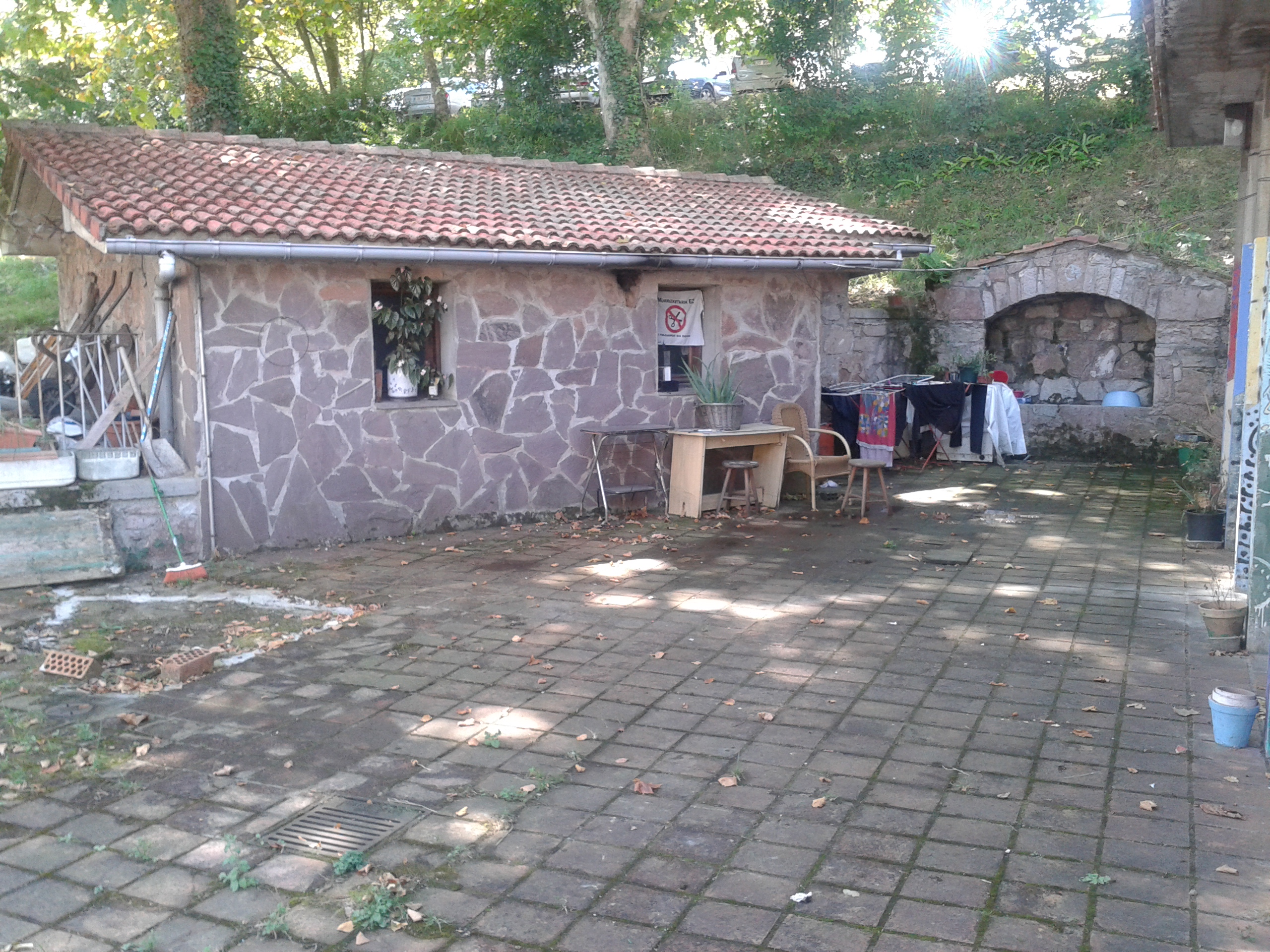
One of my appointments on a recent trip to Euskal Herria, the Basque Country, was with a “free radio station”, with a dual purpose: to learn about their operation and to give them an interview about my thinking on the political phenomena known to most people as “peace processes”. The radio station in question is Zintilik and located in the Orereta area of Errenteria town, not far north from Donosti/ San Sebastian, in the souther Basque province of Gipuzkoa and my hosts were Hektor Gartzia and Julen Etxegarai. 

View of side of building which houses Zintilik. Photo D.Breatnach
Julen and Hektor setting up for the interview Photo D.Breatnach
Julen and Hektor setting up for the interview
Photo D.Breatnach

Not long after I arrived, one of my hosts related his memory of events in the area after a local ETA fighter had been killed. The Guardia Civil had swamped the area to prevent an “homenaje” (an event honouring the dead) taking place, guns pointing at men and women; the children, of which he had been one, gathered into their grandparents’ house ….. He showed me where the police vehicle had parked at the end of the street, his sweeping hand indicating the places where the armed police had stood.

THE “FREE RADIO”

The “free radio station”, also known as “pirate radio” has been broadcasting for 32 years, which I find amazing. It began broadcasting from an “okupa”, an occupation of a private empty building, turning it into an alternative social and political centre. Under popular pressure, the local authority, under the control at the time of the PSE, i.e. (Spanish unionist social democratic party), granted them the building they currently use.

Front of Zintilik building. Photo D.Breatnach
Front of Zintilik building from the street.
Photo D.Breatnach

Originally built to house a smithy, for some reason the building never saw service in that capacity. It is in my estimation an attractive building in a traditional-enough local style, of thick stone, compact without being squat. It has an attractive back yard, no doubt intended at one time to receive the horses with hooves in need of iron shoes, fitted and nailed. The roof is tiled in what seems the usual way for the Basque Country.

Zintilik broadcasts 24 hours a day, which it is able to do using repeats.  The Zintilik collective owns its equipment and funds itself through fund-raising concerts, txosnak (stalls/ marquees) at festivals and occasional donations. They run advertisements for

Julen and Hektor again. Photo D.Breatnach
Julen and Hektor again.
Photo D.Breatnach

local community groups and announce events but accept no commercial sponsorship – nor does their wish for independence stop there. “We don’t receive any funding from the local authority or from the Basque Autonomous Government,” declares Julen, “nor do we wish to.”

Funding from such sources comes with strings attached”, adds Hektor.

Or one becomes dependent on it and unable to function without it”, further explains Julen.

Partial scenic view from the back of the building. A block of flats to right just out of shot does restrict it however. (Photo D.Breatnach}
Partial scenic view from the back of the building. A block of flats to right just out of shot does restrict it however.
(Photo D.Breatnach}

As a further illustration of self-reliance, they tell me how they climbed on to the roof of their building to repair a leak, rather than ask the municipal authorities to do it. And it was the same when branches of a nearby plane tree needed cutting to prevent them knocking against the radio aerial on windy days.

We know it’s work that the local authority owes us and that we and the rest of the community pay their salaries but we prefer not to depend on them,” they explain.

As an example of how dependency – although of a different sort – can undermine a community resource, they relate the story of building which was occupied in order to be used as a community resource. As time passed, many were using it as a social resource but less people were volunteering for the work involved in maintenance at any level. Appeals of the four or so committed people who ended up doing everything fell on the deaf ears of the clientele until one day the four locked the centre doors after the last user had left for the evening and, the next day, handed the keys over to the local authority.

The back yard to the building where we ate a meal after the interview. Photo D.Breatnach
The back yard to the building where we ate a meal after the interview.  The structure there is an outhouse.  (Photo D.Breatnach)

As you imagine, this was a great shock to the clientele,” they tell me, “but it was the result of their own lack of commitment to the project.”

I reflect that many activists will identify in one way or another with that sad experience.

RECORDING THE INTERVIEW

Julen and Hektor discuss the format and general content of the interview with me and map it out, do sound checks and then we go to it. Hektor, who knows quite a bit about the more recent Irish history and about the current situation in the Six Counties, is my interviewer, while Julen monitors from the control room and occasionally joins in with comment or question.

Interview room. Photo D.Breatnach
Interview room.
Photo D.Breatnach

For music in between sections of interview, Irish Ways and Irish Laws (John Gibbs) and Where Is Our James Connolly? (Patrick Galvin) have been chosen, both sung by Christy Moore and Joe McDonnell (Brian Warfield), by the Wolfe Tones.

They also invited me to sing Back Home in Derry, Christy Moore’s lyrics arrangement of Bobby Sands’ poem – but to the air I composed for it. I am happy to oblige – I enjoy singing but it is more than that: I want the air I composed to get a hearing. Christy Moore used Gordon Lightfoot’s air to The Wreck of the Edmund Fitzgerald for Sands’ poem and, excellent though that fit is, especially with Moore’s chorus, I think that the poem (and its author) deserves an air of its own.

Recording room. Photo D.Breatnach
Recording room.
Photo D.Breatnach

Although the main focus of the interview was the phenomenon of “peace (sic) processes”, we discussed aspects of Irish, Spanish, Palestinian and South African recent history, including the 1916 Rising in Ireland, along with the backgrounds to the songs chosen. For the most part, I left it to my interviewers to draw conclusions relating to their experience of political processes in their own country.

FESTIVALS AND STORMS

Upstairs in the broadcasting/ recording and interview rooms, all is in good order: equipment and facilities. After the interview, I note that downstairs, in the main space, things are a in a bit of a mess, for which Julen apologises (he has never seen the state of my flat).

Some of the community groups we support store their placards and banners here,” he says. “Besides, we’ve just finished our local festival and everyone relaxes, dumps their equipment and goes on holiday.” Throughout the Summer and early Autumn, each village, town, city and even area will have its own week-long festival for which the community groups and campaigns will organise and participate.

Down in Donostia (San Sebastian), to where Hektor and Julen accompanied me after we ate the food they had prepared, the city was in the midst of its own festival and was heaving with people – tourists from everywhere, it seemed, as well as Basques.

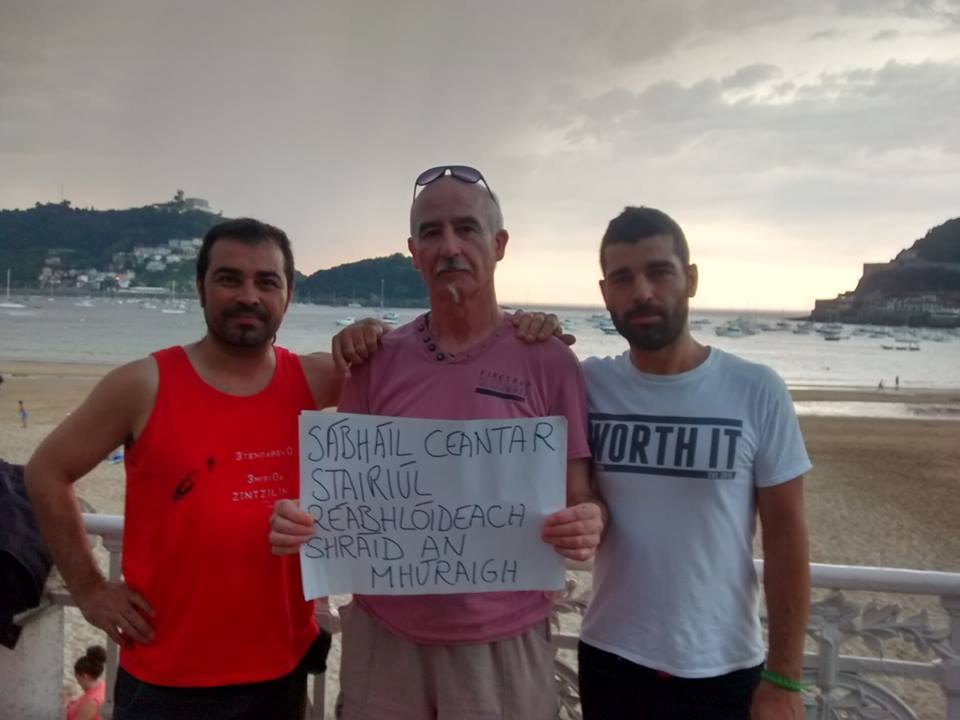
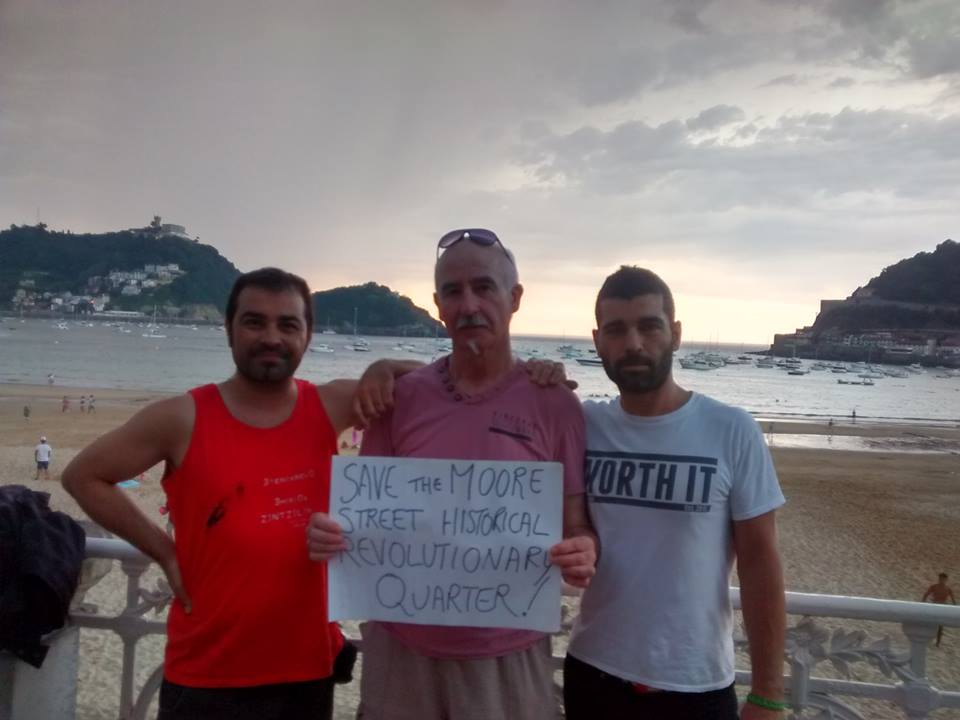
With that picturesque bay and its island in our background, they got a passing young woman to take our photo, the three of us – the conversation with her was in Euskara only. I held up the placards I had prepared for the photo in turn, one in Irish and another in English, supporting the Moore Street quarter in Dublin.

R-L: Julen, Diarmuid, Hektor. Donosti bay in the background with island partly visible. Storm building in the sky.

Save M St Quarter Donosti backgroundDark clouds were gathering overhead and on the horizon the sky was a baleful orange. A storm or at least a downpour was being promised and, as we turned back towards the bus station, the first drops began to fall. In the humid heat, the light rain was welcome for awhile but for part of my solitary journey back to Bilbo, it formed a silvery curtain in the coach’s headlights and streamed down the windows.

I remembered being told that one can frequently witness a violent storm in the Donosti bay while not so far away in Bilbao, as a result of local conditions, all is calm. As for winter storms in Donosti, the waves hitting and surging over the seafront and piers have to be seen to be believed; occasionally the sea reaches inland, floods cellars and converts parked cars into boats or semi-submarines.

The rain eased off and stopped about half-way through my journey and when I got into San Mames station in Bilbo, the streets were not even wet.

end

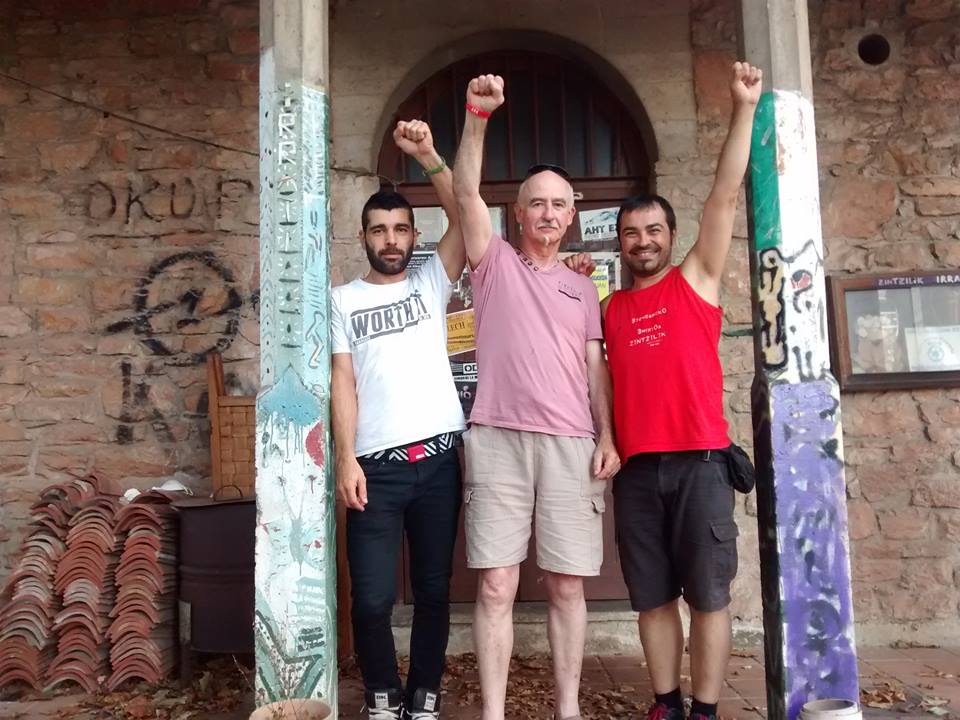
Clenched Fists 3 Tzintilik Irratia 2016

THREE EVENTS IN ONE ON HOWTH PIER

Clive Sulish

Foreign tourists and Irish-based visitors looked on with curious interest at a gathering at the foot of the East Pier, Howth on Sunday 24th – the group contained a number in military-type uniform, some were carrying flags, each one of a different design and a number of people in ordinary civilian clothes were carrying floral wreaths.

The Asgard, Molly Childers and Mary Spring-Rice on board at Howth
The Asgard, Molly Childers and Mary Spring-Rice on board at Howth (photos from Internet)

Participants, Tourists and Visitors
Participants, Tourists and Visitors (photo D.Breatnach)

Most onlookers at that point would not have known that those gathered there had a threefold purpose:

  • to commemorate the landing of Mauser rifles for the Irish Volunteers

  • to commemorate the massacre of civilians by enraged soldiers later that same day on Bachelors Walk and to

  • launch the Asgard 1916 Society.


The men and women in uniform formed up with the flags as a colour party and led the procession the full length of the pier to its end. There the procession came to a halt in front of a plaque on the wall commemorating the landing of 900 Mauser M1871 single-shot rifles and 29,000 rounds of ammunition in 1914 by a crew skippered by Erskine Childers with his wife Molly and friend Mary Spring Rice. The arms were taken ashore and whisked away in an operation planned by Bulmer Hobson of the IRB and carried out by the Irish Volunteers and Na Fianna Éireann.

Colour Party Marching
Colour Party marching along the pier towards the ceremony (photo D.Breatnach)

The Dublin Metropolitan Police and British Army were mobilised by Dublin Castle authorities to seize the guns (unlike at the previous much larger operation by the Loyalist UVF at Larne) but only managed to get a few. As the disgruntled Scottish Borderers marched back into town, they were jeered by Dublin crowds and some cabbage stalks were thrown at them. On Bachelors Walk, very near the Ha’penny Bridge, an officer brought them to a halt and they faced the crowd with guns pointed, then opened fire. Three men and a woman were killed and 38 wounded, including the father of singer Luke Kelly of the Dubliners ballad group (also called Luke). One of the victims died of bayonet wounds.

Margaret McKearney speaking and chairing the occasion on the pier
Margaret McKearney speaking and chairing the occasion on the pier (photo D.Breatnach)

Margaret McKearney, who has had three brothers killed in the Six Counties during the 30-years war, stepped forward to address the crowd as tourists and visitors took photos or watched and listened. After giving a brief account of the Howth landing and of the massacre on the Dublin quays, also of the smaller landing at Kilcoole, McKearney called forward Pól Ó Scanaill of the 1916 Societies to read the 1916 Proclamation of Independence. After he had finished, McKearney called for the young bearers of two floral wreaths to make their presentations:
Ellen O’Neill, with a wreath in memory of those killed and injured by the British soldiers at Bachelors’ Walk;

Roibeard Drummond, whose uncle Michael Moore was a crew member of the Nugget, landing rifles at Kilcoole, laying a wreath for the Asgard 1916 Society to commemorate the landing of the rifles and those who carried them in battle in 1916.

Last of the wreath-layers was Denise Ní Chanain on behalf of the Anti-Internment Group of Ireland.

Ellie after laying wreath in memory of the dead and injured in the Bachelors' Walk massacre
Ellie O’Neill after laying wreath in memory of the dead and injured in the Bachelors’ Walk massacre (photo D.Breatnach)


MOORE STREET SPEECH

Roibeard Drummond, after laying wreath on behalf of the Asgard 1916 Society
Roibeard Drummond, after laying wreath on behalf of the Asgard 1916 Society (photo D.Breatnach)

Niamh McDonald gave a short speech on the current situation in the struggle to save the revolutionary quarter of Moore Street. She informed her audience that NAMA had sold the debt of the Irish speculator company Chartered Land (Joe O’Reilly) to Hammerson, a British-based vulture capitalist company, who are continuing with the plan to build a huge shopping centre over the whole historic quarter. Meanwhile, the Minister for Heritage, Heather Humphreys, is appealing the High Court judgement that the whole quarter is a national monument. McDonald asked people to keep an eye on the campaign’s

Denise Ní Chatháin bringing forth the wreath from the Anti-Internment Group of Ireland
Denise Ní Chanain bringing forth the wreath from the Anti-Internment Group of Ireland (photo D.Breatnach)

Facebook page for updates and for calls to support actions.

McKearney then called on Diarmuid Breatnach to sing Me Old Howth Gun, pointing out that guns landed at Howth had been the first to fire on the Lancers in O’Connell Street on Easter Monday 1916. Breatnach introduced the song as having been written apparently in 1921, that is a year before the outbreak of the Civil War, by James Doherty, who also used the pseudonym Seamas Mac Gallogly.

Niamh McDonald speaking on behalf of the Moore Street 2016 campaign
Niamh McDonald speaking on behalf of the Moore Street 2016 campaign (photo D.Breatnach)

MAIN SPEAKER — JOHN CRAWLEY FROM THE MARITA ANN
The next speaker to be introduced by McKearney was John Crawley who was arrested on board the Marita Ann trawler, intercepted off the Kerry coast by the Irish Naval Service on September 29, 1984, when seven tonnes of arms were seized. The US heavy machine guns recovered on the Marita Ann had special mountings allowing them to be used as anti-aircraft weapons. Another of those detained on board – and later jailed for 10 years – was Martin Ferris who went on to become a Kerry TD for Sinn Fein, while John Crawley has taken a line of opposition to the Good Friday Agreement.

John Crawley giving his oration with the plaque commemorating the landing of the Howth guns behind him
John Crawley giving his oration with the plaque commemorating the landing of the Howth guns behind him (photo D.Breatnach)

John Crawley gave the main speech at Howth, in which he traced the history of the struggle for the Irish Republic from the Volunteers onwards, pointing out that many who fought the British in 1916 had different aspirations for the country, which explained why they parted ways in 1921. Crawley stated that the British have always been able to pick out those whose primary intention was to survive the struggle from those whose intention was if necessary to give their lives for the objective of the Irish Republic.

Pól Ó Scanaill reading the 1916 Proclamation
Pól Ó Scanaill reading the 1916 Proclamation at the head of the East Pier, Howth (photo D.Breatnach)

Crawley pointed out that some people had led a section of the Republican movement in accepting the right of a foreign country to decide the future of a part of our country; they had joined in the colonial administration and had accepted the colonial police force.

After the applause for the speech died down, McKearney thanked those who had participated and asked Diarmuid Breatnach again to step forward to sing the national anthem. Breatnach sang it in Irish, first verse and chorus (and noticeably sang “Sinne Laochra Fáil” instead of “Sinne Fianna Fáil”). Participants joined in with the chorus and then all made their way along the pier towards a local pub where refreshments had been made available by the new 1916 Society.

Diarmuid Breatnach singing Amhrán na bhFiann at end of the ceremony. Earlier he had sung "Me Old Howth Gun".
Diarmuid Breatnach singing Amhrán na bhFiann at end of the ceremony. Earlier he had sung “Me Old Howth Gun”. (Photo: Des Keane from Sean Heuston 1916 Society page)

end

Video of the event by John Rooney and put on Youtube by him, posted on FB by Mick O’Riordan (see below)
https://www.youtube.com/watch?v=RrG_7VLytfw

http://https://www.youtube.com/watch?v=RrG_7VLytfw

MARCH FOR MOORE STREET CONSERVATION FOLLOWS FOOTSTEPS OF 1916 RISING

The march called to save “the Revolutionary Quarter” of Moore Street followed the footsteps of the GPO garrison on Easter Monday but, upon reaching the GPO, continued on along the that week’s Saturday surrender route up to the Rotunda.  Wheeling left then, the march proceeded on to the junction with Moore Street, where the British Army had their barricade and machine gun on Friday Easter Week — the cause, along with the sniper in the Rotunda tower, of many deaths and injuries in Moore Street.  The march wheeled left again into Moore Street and proceeded to the rally outside the GPO, where speakers were to address them and artists to perform.

from Save Moore Street 2016 campaign

https://www.facebook.com/SaveMooreStreet2016/photos/?tab=album&album_id=1260539983971351

The Save Moore Street 2016 campaigners and supporters gathered well over an hour before the advertised time outside Liberty Hall where their wardrobe department was busy outfitting people while a steward organised people for photo shoots, leafleting and kept the crowd informed.

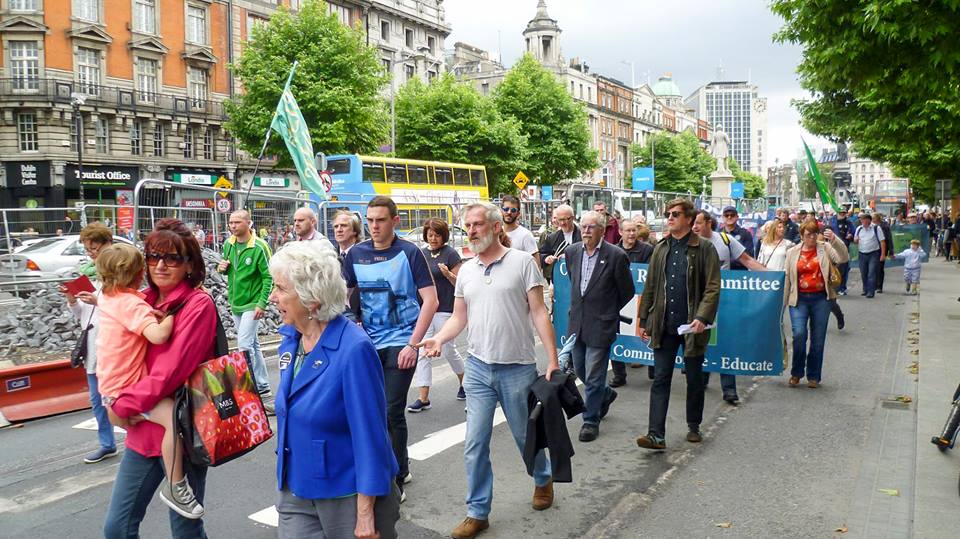
By the time the march set off from Liberty Hall it had gathered many, quite a few in period costume and some others joined it along the way. Many had come already dressed in period costume or were decked out by the wardrobe department of the Save Moore Street 2016 campaign and a solid group of them marched behind the new campaign banner.

Longish View March Abbey St Xroads DB megaphone
Section of march crossing to west side O’Connell Street in foreground; section of march in background passing Wynne’s Hotel in Lower Abbey Street. (Photo: )

Others marched behind the original Save Moore Street (from demolition) 2016 banner while others carried banners of some organisations supporting the march: the Cabra 1916 Society, O’Hanrahan Car1ow 1916 Society, Dublin Says No, Munster Anti-Internment Committee, Republican Sinn Féin, Dublin IRSP …..

Led by two people with megaphones and, at times, spontaneously, they shouted: “Save Moore Street from demolition!”

With reference to the Chartered Land and now Hammerson’s huge shopping centre plan for the area, the marchers shouted:

Do we need another shopping centre? No! Do we need our heritage? Yes! Do we need our street market? Yes!” Also, “What do we want? Hammerson out! When do we want it? Now!”

Other slogans included: “Our history! Our heritage! Our street! Our Rising!”

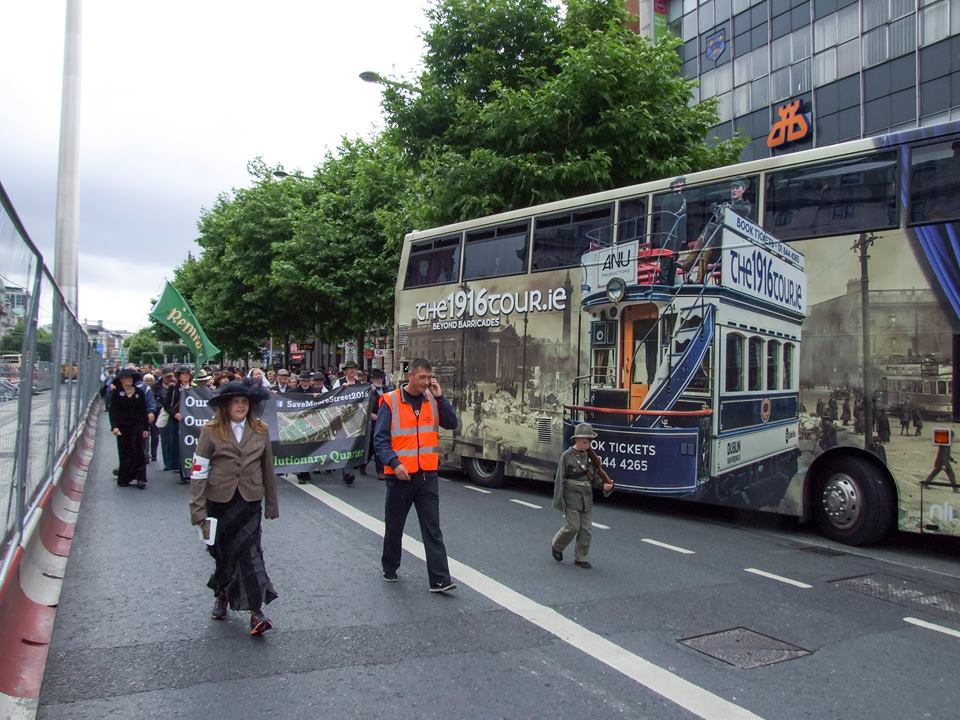
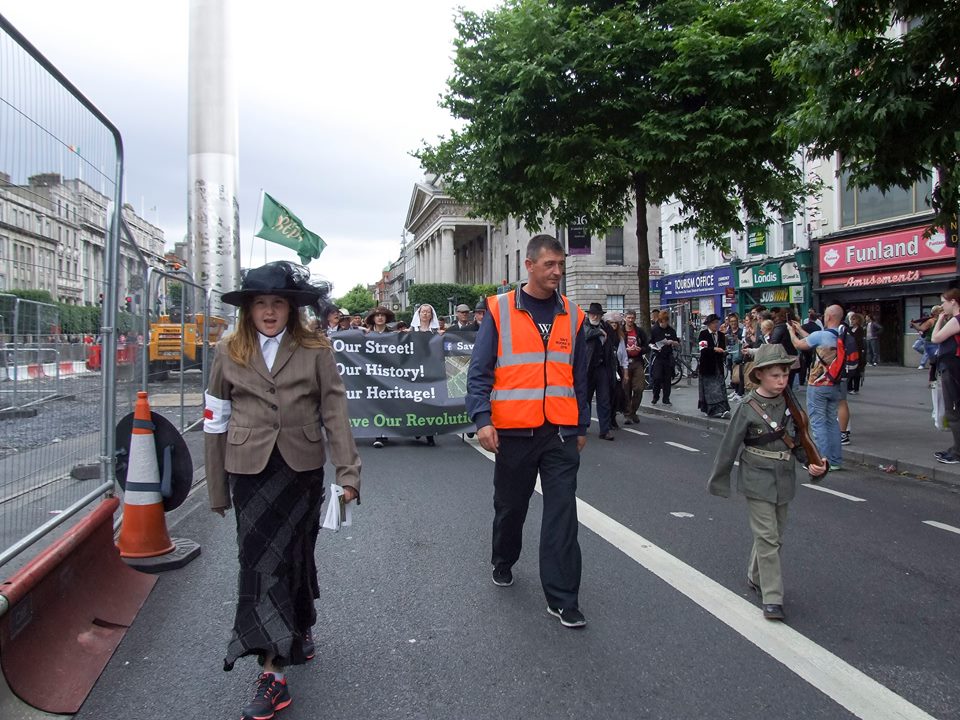
Moor St March passing 1916 Bus Tour.jpeg
Amy and Josh youth supporters flank a march steward as the march passes one of the many kinds of 1916 tours being run in the city this year. (Photo: B.Hoppenbrouwers)

Amy Alan Josh leading OConnell StUp Lower Abbey Street the marchers went, in the footsteps of the GPO Garrison on that Easter Monday morning, past Wynne’s Hotel where Cumann na mBan had been formed in 1913, past the former Hibernia Bank on the corner of Abbey and O’Connell Street, where Volunteers fought and where Irish Volunteer Captain Thomas Weafer, from Enniscorthy was killed and his body consumed by the flames caused along the street by British shelling.

Turning into O’Connell Street, the marchers passed the location of Bloody Sunday 1913 when, after Jim Larkin defied a court ban to speak, the Dublin Metropolitan Police ran riot beating Lockout strikers and onlookers down to the ground with their truncheons.

COUNCILLORS, TDs, PROMINENT CAMPAIGNERS, ARTISTS AND HISTORIANS MARCHING

A number of elected representatives supported the march: seen in the crowd were Dublin City Councillors Cieran Perry, Pat Dunne, Anthony Conaghy and former Mayor Críona Ní Dhálaigh, also TDs Joan Collins and Maureen O’Sullivan.

OSullivan Johnsons Ballagh Cooney
Section of the march in upper O’Connell Street, heading northwards, showing prominent supporters TD Maureen O’Sullivan in foreground and Robert Ballagh in middle section, flanked by Patrick Cooney, one of the founders of the 1916 relatives’ campaign Save Moore Street.

Among the artistic and dramatic sector whose participation was noted were artist and activist Robert Ballagh, drama director Frank Allen (who also organised the first Arms Around Moore Street event in 2009 — and has the T-shirt to prove it!), Brendan O’Neill — also an actor and long-time campaigner — and actor Ger O’Leary.

Relatives of prominent fighters in 1916 also participated and Jim Connolly Heron, great-grandson of James Connolly and among the earliest campaigners for Moore Street and Donna Cooney, great-grandniece of Elizabeth O’Farrell, who went out into the killing zone to organise the surrender, were both noted marching. Patrick Cooney, also of the specific 1916 relatives’ group that brought the legal challenge to the High Court marched along too and spoke from the platform at the rally. Gabriel Brady, grand-nephew of the printer of the 1916 Proclamation, Christopher Brady, was there too, as was Eoin Mac Lochlainn, a relative of the Pearse brothers and a relative of Seán Mac Diarmada was also present and in fact helped carry one of the SMS2016 banners.

A number of historians walked among the marchers, including Ruan O’Donnell, Dónal Fallon, Ray Bateson, Hugo McGuinness, along with local history activists such as Joe Mooney (of East Wall History Group) and Terry Fagan (of North Dublin Inner City Folklore Project). Ciarán Murphy, joint blogger and joint author with Dónal Fallon of the Come Here To Me publication marched along too. From the non-history world of academia, Paul Horan, lecturer of Trinity College (and who wrote the letter published in the Irish Independent on July 2nd denouncing the Minister of Heritage appealing the Barrett High Court judgement that the whole Moore Street quarter is a national monument) marched in period costume too.

THE SURRENDER ROUTE

Passing the General Post Office, the marchers continued along the route of the GPO/ Moore Street Garrison as they surrendered on the Saturday of Easter Week, up to the Gresham, where they laid down their weapons and on to the Rotunda, in the garden of which many had been kept for two days without food or water, while detectives of G Division from Dublin Castle came down to identify prisoners for execution. On the way the marchers passed the Parnell Monument, where British officers had displayed the battle-damaged “Irish Republic” flag upside down as a trophy for a photographer.

On this Saturday in 2016, volunteers (some in costume) accompanied the marchers along the route, handing out leaflets, which were eagerly taken by onlookers, while others – all in costume — collected donations along the way, distributing stickers in exchange. Well in excess of five hundred leaflets were distributed in the period of the short march.

SILENCE IN MOORE STREET

Minute Silence Moore St 9 July2016 T Byrne
The march stopped in Moore Street for a minute’s silence. (The building to the left is a section of the ILAC shopping centre; to the right may be seen a section of the hoarding in front of five buildings in the ‘1916 Terrace’ and the banner illegally placed on four of those houses (declared a ‘national monument’ since 2007) by the Department of Arts, Gaeltacht and Heritage.

Turning into and a little along Moore Street, the marchers were called to stop for a minute’s silence out of respect for the Irish Volunteers, Citizen Army and civilians who had been shot down in that street by British Army guns, for the six who had been shot by firing squad after they surrendered and for those who had risked their lives in an uprising against the biggest empire the world has ever seen.

All sound in the street died: marchers, street traders, bystanders, shoppers — all stood silent in a street which would otherwise be filled with the noise of a street market and busy shopping thoroughfare on a Saturday afternoon.

At the conclusion of the minute’s silence, the march recommenced, calling its demands with renewed vigour, out into Henry Street, right to O’Connell Street to form up for the rally by the stage in front of the GPO.

SPEAKERS AND PERFORMERS

The rapper Temper-Mental MissElayneous (Elaine Harrington) from Finglas was the first on the stage and performed her “Fakes and Manners” and “Buachaillí Dána” raps but continuous problems with the sound amplification at this stage of the rally meant much of what she was saying could not reach the audience (fortunately this was amended later).

Elayne Harrington torso stage
Rapper Temper-Mental MissElayneous (Elayne Harrington) from Finglas performing with bodhrán

Niamh McDonald, chairing the rally, welcomed the crowd and said that the campaign to save the Moore Street quarter was at a crossroads; developments had brought Irish property developers and the State into opposition to the appropriate conservation of the quarter but also now foreign vulture capitalists. “Save Moore Street 2016 will do what it takes to defend this historic quarter” she said, reiterating three basic demands of the campaign:

  • That a full independent expert assessment be carried out of the battlefield area

  • that all construction or remedial work be accessible to expert independent monitoring and

  • that the whole process by transparent to the public.

It was time for the campaign now to take the fight to the speculators and the next in a series of monthly events would be a demonstration against Hammerson themselves, McDonald told the rally.

Niamh Speaking, DB, Donal Fallon
Niamh McDonald, chairing the rally and speaking on behalf of Save Moore Street 2016 addressing the rally as one of the march stewards (in period costume) holds the megaphone for her. (Photo: )

The first speaker was then announced, historian and author Ruan O’Donnell, who reminded the rally that the Government of the time had been prepared to demolish Kilmainham Jail. The site had languished until volunteers took up the work of restoring it as a museum and now it is so successful that one has to queue to gain access to it.

Ruan O'Donnell speaking
Ruan O’Donnell, historian, lecturer and author addressing the rally. (Photo: )

O’Donnell castigated the attitude and thinking of successive Irish governments and pointed out that the GPO and Moore Street are sites of crucial importance in the struggle of the Irish people for nationhood.

O’Donnell’s speech, as did McDonald’s, received cheering and applause a number of times during their course as well as at the end.

Dónal Fallon, also author and historian, then stepped up to address the rally and also denounced the Gombeen state that had followed the struggle for independence, in which property speculators grew fat while the people suffer in a housing crisis.

Donal Fallon speaking
Donal Fallon, blogger, author & historian addressing the rally. (Photo: )

He reminded the rally of the struggle to save the Viking archaelogical site at Wood Quay and how, with Dublin City Council building over it, the writer and author of Strumpet City, James Plunkett, had said that Dublin had “shamed itself before the world.” Fallon said that Dublin needs to redeem itself and will do so in the struggle to save the Moore Street quarter.

Patrick Cooney (of the relatives’ group that took the High Court challenge against the Minister of Heritage) was then introduced and spoke of the recent Appeal Court appearance where the Minister’s team had been castigated by a Judge who insisted they had to specify against which part of Judge Barrett’s judgement they were appealing – her Department could not take a blanket position and say that they were against it all (SMS2016 comment: indeed, part of the judgement was that the banner erected on Nos.14-17 had been erected illegally, and the Minister has already stated that work would commence to remove it and to fill in the holes the builders put into the face of those buildings in order to fix the banner there). Cooney welcomed the announcement that the appeal would not be heard until December 2017, saying that this would give time for more pressure and perhaps a change of government.

Cooney also spoke of the long struggle to have the importance of the site acknowledged and to save it from property speculators and in passing also paid tribute to those who had occupied the building in January of this year.

Sean Doyle speaking
Sean Doyle, in period costume, addressing the rally. (Photo: )

Last to speak was Seán Doyle, speaking on behalf of the Save Moore Street 2016 campaign. Seán questioned whether we were worthy of the inheritance which had been bestowed upon us.

Referring to speculators and their facilitators, Doyle concluded by saying that “men in suits can be more dangerous than men in armour”.

All those speeches were enthusiastically applauded.

By this time the technical problems of the sound amplification had been overcome with the assistance of a member of the audience and Paul O’Toole stepped up to the microphone. He recalled that the best stage he had ever performed upon had been a couple of pallets drawn up in front of No.16 Moore Street in order to play at a rallying event there.

Paul O'Toole performing
Paul O’Toole playing and singing during the rally. (Photo: )

He then sang and played “The Foggy Dew” and “The Cry of the Morning”, followed by his own composition “We Will Not Lie Down”. The event could not end without Temper-Mental MissElayneous being given an opportunity to perform with the sound amplification in full working order and she launched into her “Fakes and Manners” rap.

The crowd having applauded the performers, everyone was thanked for contributing to the event, banners were rolled up and costumes packed back into cases.  Some people stood around chatting while the lorry that had provided the stage pulled out into the traffic, one of the organisers gave a radio interview to Newstalk and MissElayneous, on a roll now, performed for a small audience and video camera with the GPO as a background.

Across the road, outside the GPO, to which it relocated after some of its activists went to participate in the march, having earlier completed its 94th Saturday on Moore Street through which it has collected more than 50,000 signatures in support of Moore Street, the Save Moore Street From Demolition campaign table was also wrapping up.

And, despite threatening sky and pessimistic forecasts – it hadn’t rained once.

end

PROTEST OUTSIDE LEINSTER HOUSE IN SOLIDARITY WITH DUBLIN THREE

Diarmuid Breatnach

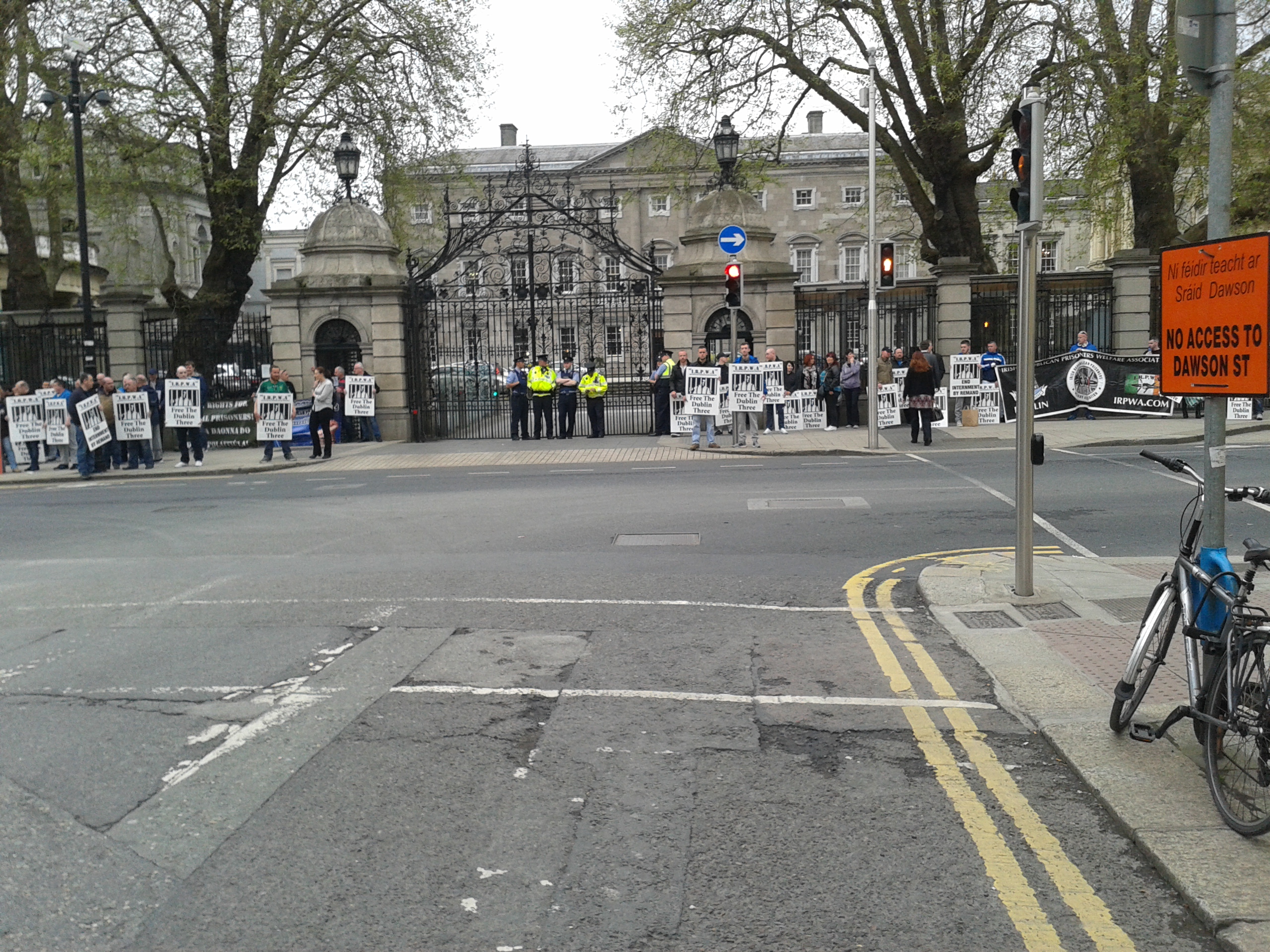
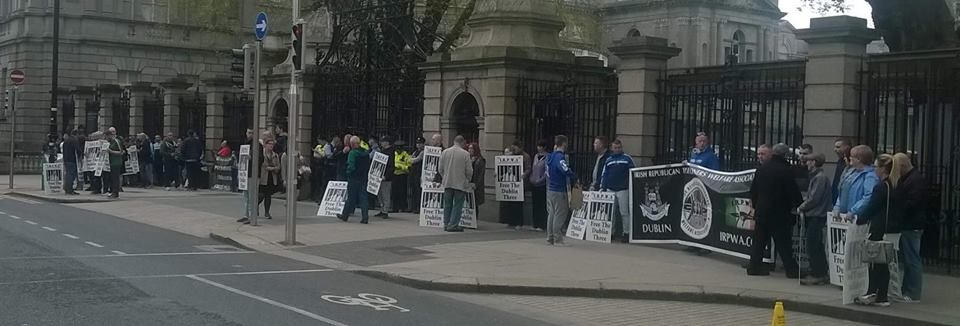
On Tuesday 10th May a large crowd picketed Leinster House, the Irish Parliament, at short notice to protest the denial of civil rights to three irish Republicans by the Police Service of Northern Ireland who detained, arrested and charged them and by the judiciary who remanded them in custody, denying them bail.

Line of protesters outside Leinster House (Photo from Dublin Anti-Internment Committee)
Section of protesters outside Leinster House (Photo from Dublin Anti-Internment Committee)
Fifteen had been detained by the Police Service of Northern Ireland in harassment of a Republican funeral. Twelve are from the Six Counties and were released after some hours without charge. Three are from Dublin and were
a) charged and
b) refused bail.

The protesters at Leinster House chanted slogans such as “Free, free, the Dublin Three” and “End internment by remand”. A couple of songs were also sung: The Felons of Our Land” and “Take It Down From the Mast”.Long View Dail Picket Dublin 3

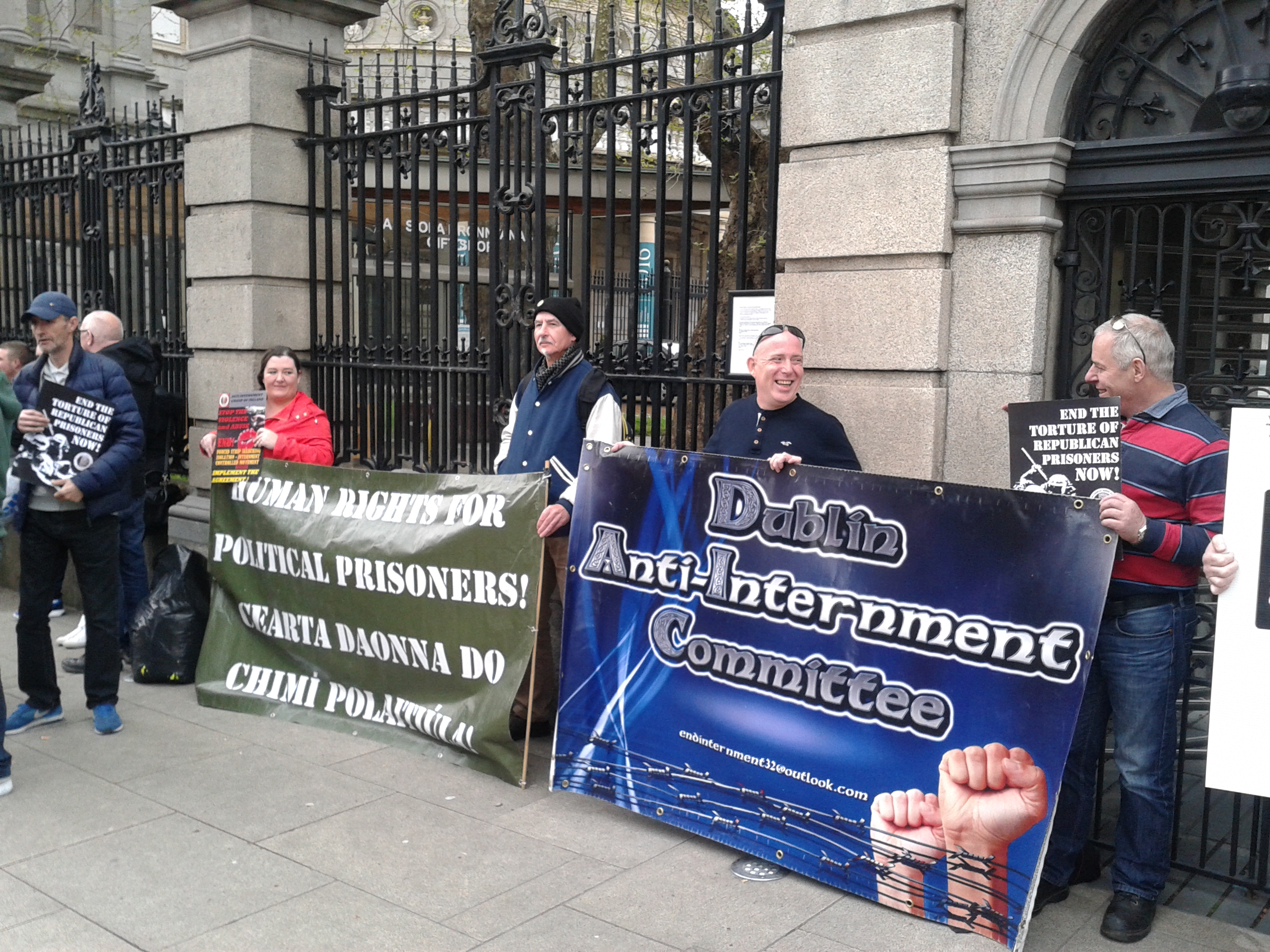
The protest was organised by the Irish Prisoners’ Welfare Association and was attended by other Republicans and by members of the Dublin Anti-Internment Committee, as well as by family members of the three men from Dublin.

Shortly after they convened, most of the protesters were approached by the Gardaí Special Branch and had their names and addresses taken by them in what was a clear case of politically-motivated intimidation and abuse of the rights to hold political beliefs, to organise politically and to peacefully demonstrate.  In fact, a similar harassment to that practiced by their brethren in the Six Counties.

Banner of the Dublin Anti-Internment Committee alongside another outside Leinster House

Statement by IRPWA DEMANDS END TO POLITICAL POLICING

“On Thursday 5th May the 35th anniversary of the death of hunger striker Bobby Sands Republicans peacefully laid Republican Michael Barr to rest.

“After the funeral the PSNI arrested 15 IRPWA activists and released 12 of them with no charge after being held for a number of hours.
Three of those arrested were charged and refused bail for the sole reason of that they were from the 26 counties.

“Only a few short weeks after the Irish Government commemorated the 1916 rising we now have the situation were British courts in Ireland are locking up Irish citizens for no other reason that they live in the 26 counties.

Car of Special Branch (Irish plainclothes political police) who were watching and filming the protesters from across the road

“The IRPWA calls on the Irish Government to lobby for their immediate release and to make sure those responsible for this blatant abuse of power are held accountable for their actions.
We take this opportunity to remind you of the protest that takes place outside of Leinster House today at 6pm and call for all Republicans to support.

“We would also encourage everyone who is available tomorrow to attend the Belfast High courts at 9.30am and support the 3 men and their families.”


POSTSCRIPT

The three Dublin men were finally granted bail Wednesday morning but face further inconvenience, worry and expense in having to attend future court dates in the Six Counties.

WORKING CLASS HERO IS COMMEMORATED IN THE EAST WALL AREA WHERE HE LIVED

Diarmuid Breatnach

On Sunday 8th May a working-class hero was commemorated in the East Wall area in which he lived. Walter Carpenter was a native of Kent, in SE England and came to Ireland to help found the Socialist Party of Ireland 1 with James Connolly in 1909 in Dublin. Among other activities a campaigner around housing issues for the Dublin working class, he reared his sons in socialist belief so that it was no surprise that both Wally (Walter jnr) and Peter joined the Irish Citizen Army and fought in the 1916 Rising. As a result of the repression of the Rising, one son ended up in Frongoch concentration camp in Wales, while the other was in hiding. Later, both brothers also fought against the Free State in the Irish Civil War; Wally was interned and went on hunger strike.

Lining Up Outside SOCC
Assembling to march outside the Sean O’Casey Community Centre

Jailed for opposing British Royal visit to Dublin

Rising to be Secretary of the Dublin Branch of the SPI in 1911, Walter Carpenter was jailed for a month for the production while speaking on a public platform of Connolly’s leaflet attacking the Royal visit that same year. Soon afterwards he was an organiser for the newly-formed Irish & Transport Workers’ Union. During the Lockout, he was sent by Connolly to Britain to rally the support of trade unionists for the struggle of the Dublin workers and was apparently an effective speaker there. That same year Walter Carpenter was elected General Secretary of the Tailors, Machinists and Pressers’ trade union, generally known as “the Jewish Union” due to the preponderance of its members being from that background.

Two sections march
United in purpose but fragmented in marching

Walter also became active in municipal politics, striving to make Dublin City Council meet its housing regulation responsibilities in the terrible housing conditions of the city of that time. There were many other sides to this campaigner too, which a read of Ellen Galvin’s pamphlet will reveal.

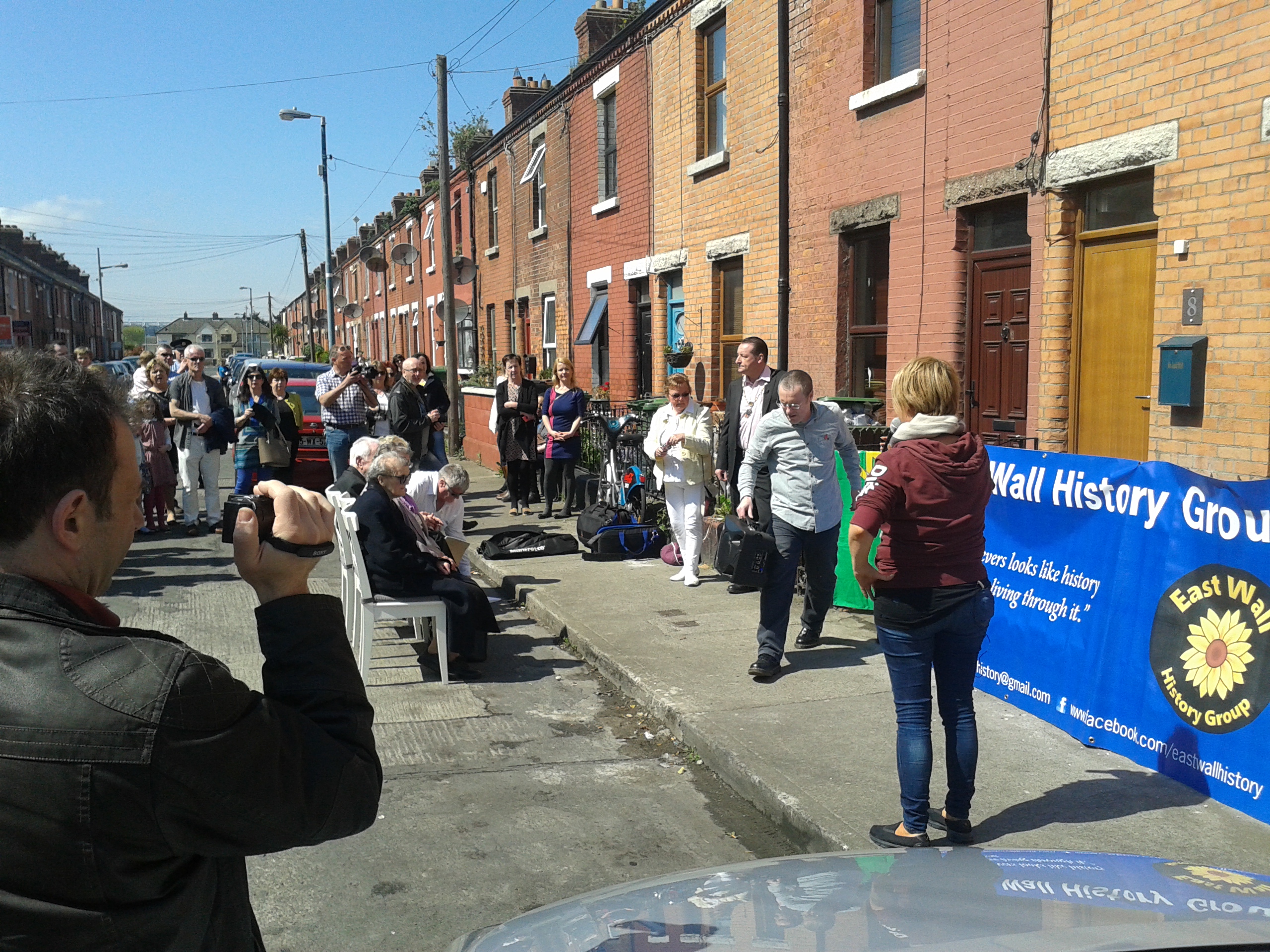
The East Wall History Group had earlier had a plaque erected on the wall of the house where he had lived, No.8 Caledon Road and organised an event around its unveiling on Sunday. The event began with a gathering at the Sean O’Casey Community Centre in East Wall, where an introduction to the event and to Walter Carpenter’s importance in the revolutionary and radical social history of Ireland was given by Joe Mooney, one of the organisers of the event. As well as local historians, socialists and Republicans, the event was attended by his surviving grandson, great-grandchildren and partners and their children. Also present was Ellen Galvin, who wrote a booklet on his life which was launched after the unveiling, back in the Sean O’Casey Centre.

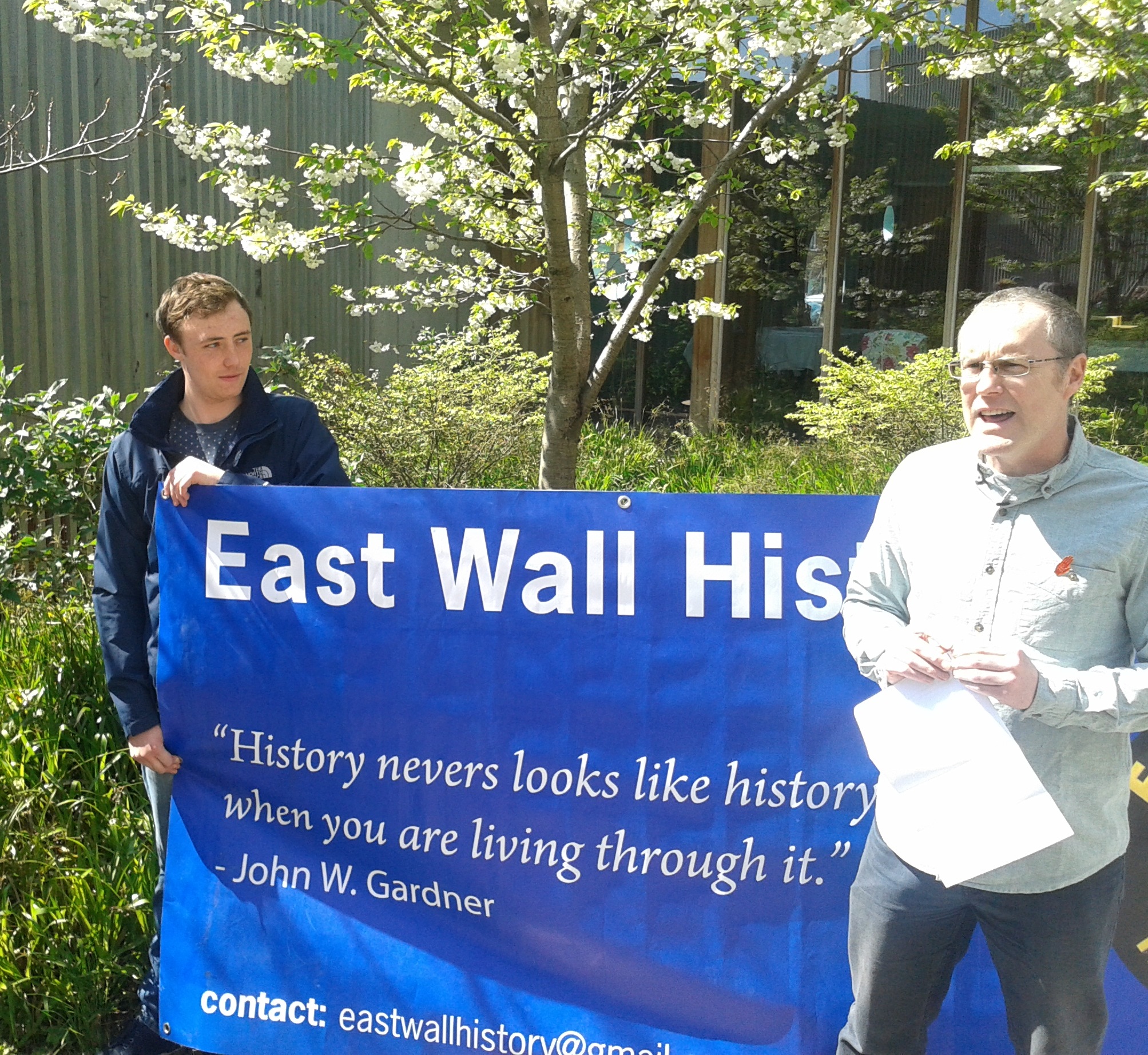
Joe Mooney with a few preliminary words about Walter Carpenter and the history of the area

Misfortune struck the event before it had even begun, with the news that Christy O’Brien, the piper who was to lead a march to the unveiling, had his pipes stolen from his car that very morning. Christy gives his service as a piper to many commemorative events, funerals etc. and, with the announcement of the misfortune, Joe Mooney also called for the spreading of the news in order to aid the recovery of the instrument. A set of bagpipes will cost thousands to buy or have made but it would be a rare musician or pawnshop that would negotiate for a stolen set (one which furthermore might be recognised at a musical event in the future).
(see also https://www.facebook.com/eastwallhistory/photos/a.593335330735681.1073741828.580261572043057/1042532349149308/?type=3&theater)

March to plaque past previous addresses of Irish resistance fighters

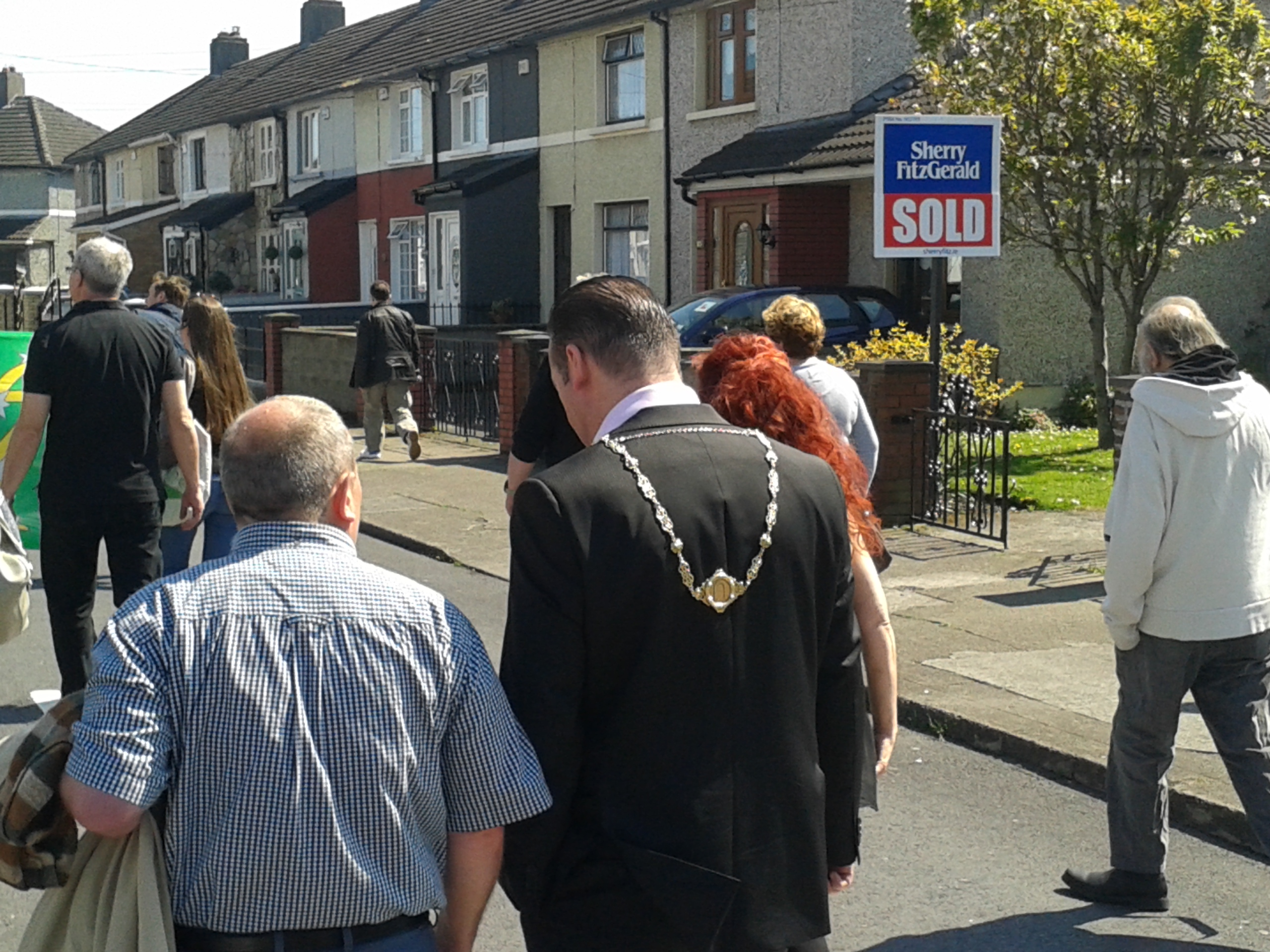
The march set off from the Sean O’Casey Centre without the piper, led by supporters carrying the banner of the East Wall History Group, a Tricolour and a Starry Plough (original green and gold version). Walking alongside were two Gárdaí and one wit commented that not only were descendants of the Irish Citizen Army present but also of the Dublin Metropolitan Police! 2

Caitríona Ní Casaidthe presiding over the plaque unveiling
Deputy Dublin Mayor Cieran Perry in the march -- he also spoke at the unveiling.
Deputy Dublin Mayor Cieran Perry in the march — he also spoke at the unveiling.

Joe Mooney had told the crowd before the march began that they would pass a number of locations where fighters for Irish and working-class freedom had lived. These were: St Marys Road, Tim O’Neill at No.8 and father and daughter Patrick Kavanagh and May Kavanagh at No.24. Christy Byrne lived at No.45 and his brother Joseph Byrne was from Boland’s Cottages off Church Road, where also Christopher Carberry lived on Myrtle Terrace on Church Rd. All these were Irish Volunteers, while May was in Cumann na mBan. In Northcourt Avenue (now demolished, roughly where the Catholic Church stands), Patrick & William Chaney were in the Irish Citizen Army and in Hawthorn Terrace lived James Fox (Irish Volunteer) and Willie Halpin (ICA).

Joe added that at the junction of St. Mary’s Road and Church Street, the local Irish Volunteers had mustered to participate in the Rising, 100 years ago and also reminded the gathering that that very day, the 8th of May, was the centenary of the executions by British firing squad of Michael Mallin of the Irish Citizen Army and of Irish Volunteers Eamonn Ceannt, Sean Heuston and Con Colbert.

Eamon Carpenter, 94, grandson of Walter Carpenter (Photo D.Breatnach)

Upon reaching No. 8 Caledon Road, the former home of Walter Carpenter, Caitríona Ní Chasaide of the East Wall History Group introduced Eamon Carpenter, 94 years of age and a grandson of Walter Carpenter, who addressed the crowd in thanks and also about the life of his grandfather.

“The struggles of the past are not merely for commemoration”

Next Caitríona introduced the Deputy Mayor of Dublin, Cieran Perry, who pointed out the parallels between the dire housing situation in the early part of the last century, which Walter Carpenter had campaigned against, and the housing crisis in Dublin today. He castigated the officials of Dublin City Council who, despite the votes of elected Left Councillors, refused to use all the land available to them on a number of sites to build social housing and were instead preparing it for private development with a only fraction for social housing. For as little as 5% of the €4 billion of Minister Kelly’s oft-repeated proposed finance for social housing. i.e. €200 million, Dublin City Council could build over 1,300 homes. The struggles of the past are not merely for commemoration, Cieran went on to say, but are for celebration and for continuation, as he concluded to applause.

Caitríona then called on James Carpenter to unveil the plaque, which he did, to loud applause.Walter Carpenter plaque

After relatives and others had taken photos and been photographed in turn by the plaque and/or beside James Carpenter, Joe Mooney called on Diarmuid Breatnach to sing The Felons Of Our Land. Joe explained that Walter Carpenter had been fond of singing that son, that in the course of their participation in the struggle he and his son had also been felons, as had Larkin and many others. Joe also informed the gathering that Sean O’Casey related that during his childhood, there had been a tram conductor who had been fond of singing patriotic songs, including the Felons Of Our Land, of which Casey’s mother had disapproved. It had been an revelation for O’Casey that one could be a Protestant and an Irish patriot too.

Diarmuid, dressed in approximation of period clothing, stepped forward and sang the four verses, of which the final lines are:

Diarmuid Breatnach singing "Felons of Our Land" outside former home of Walter Carpenter. (Photo East Wall History Group)
Diarmuid Breatnach singing “Felons of Our Land” outside former home of Walter Carpenter.
(Photo East Wall History Group)

Let cowards sneer and tyrants frown
O! little do we care–
A felon’s cap’s the noblest crown
An Irish head can wear.
And every Gael in Innisfail
(Who scorns the serf’s vile brand)
From Lee to Boyne would gladly join
The felons of our land.

The crowd then marched back to the Sean O’Casey Centre to attend the launch of the booklet on Carpenter’s life.

Launch of book on Walter Carpenter by his granddaughter and grandson of his comrade

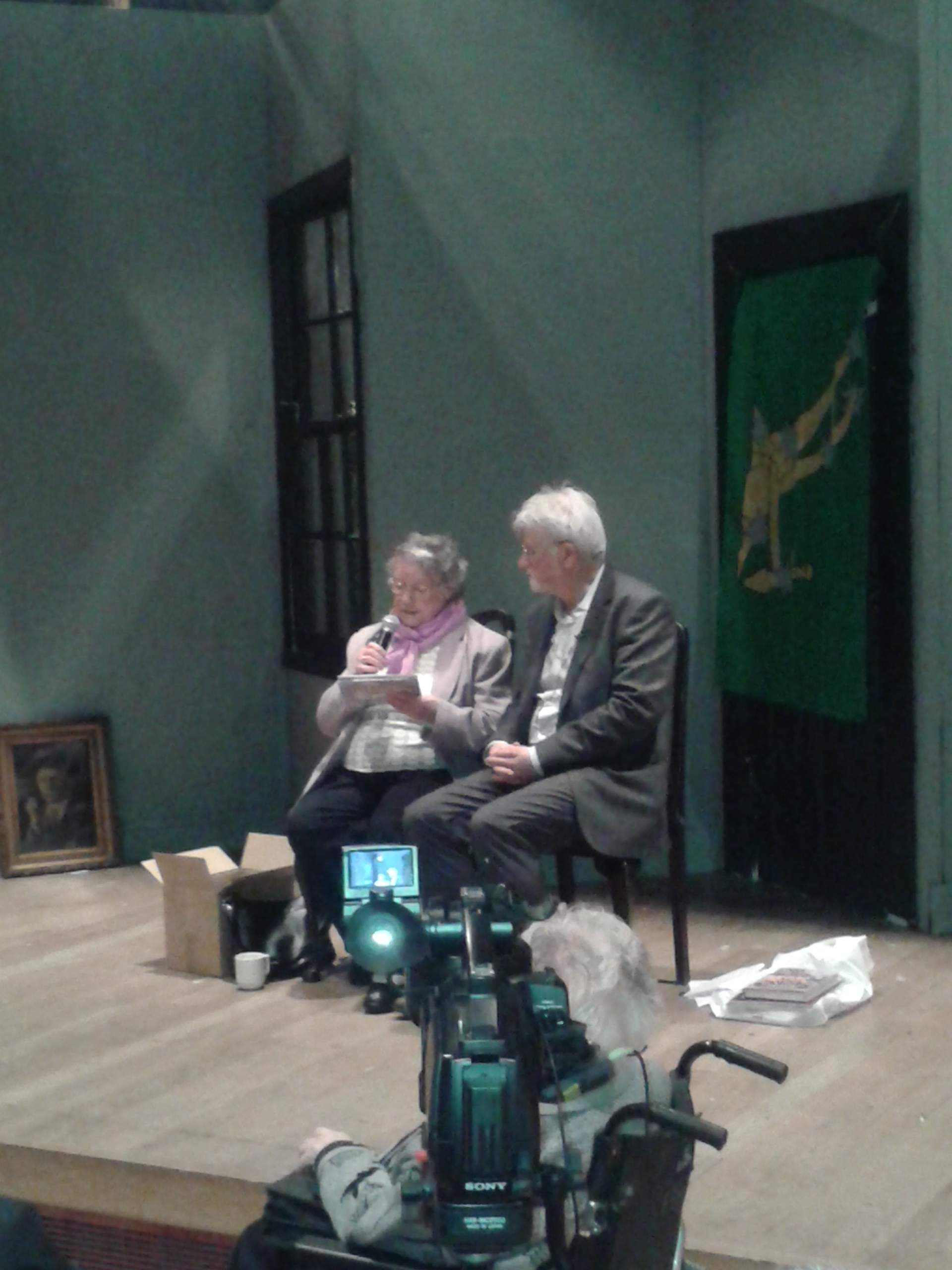
On the stage in the Centre’s theatre, were seated the author of the booklet, Ellen Galvin, alongside Michael O’Brien of O’Brien Press.

Ellen Galvin on stage at the Sean O'Casey Community Centre theatre and Michael O'Brien launching the book about Walter Carpenter. (Photo D.Breatnach)
Ellen Galvin on stage at the Sean O’Casey Community Centre theatre and Michael O’Brien launching the book about Walter Carpenter. (Photo D.Breatnach)

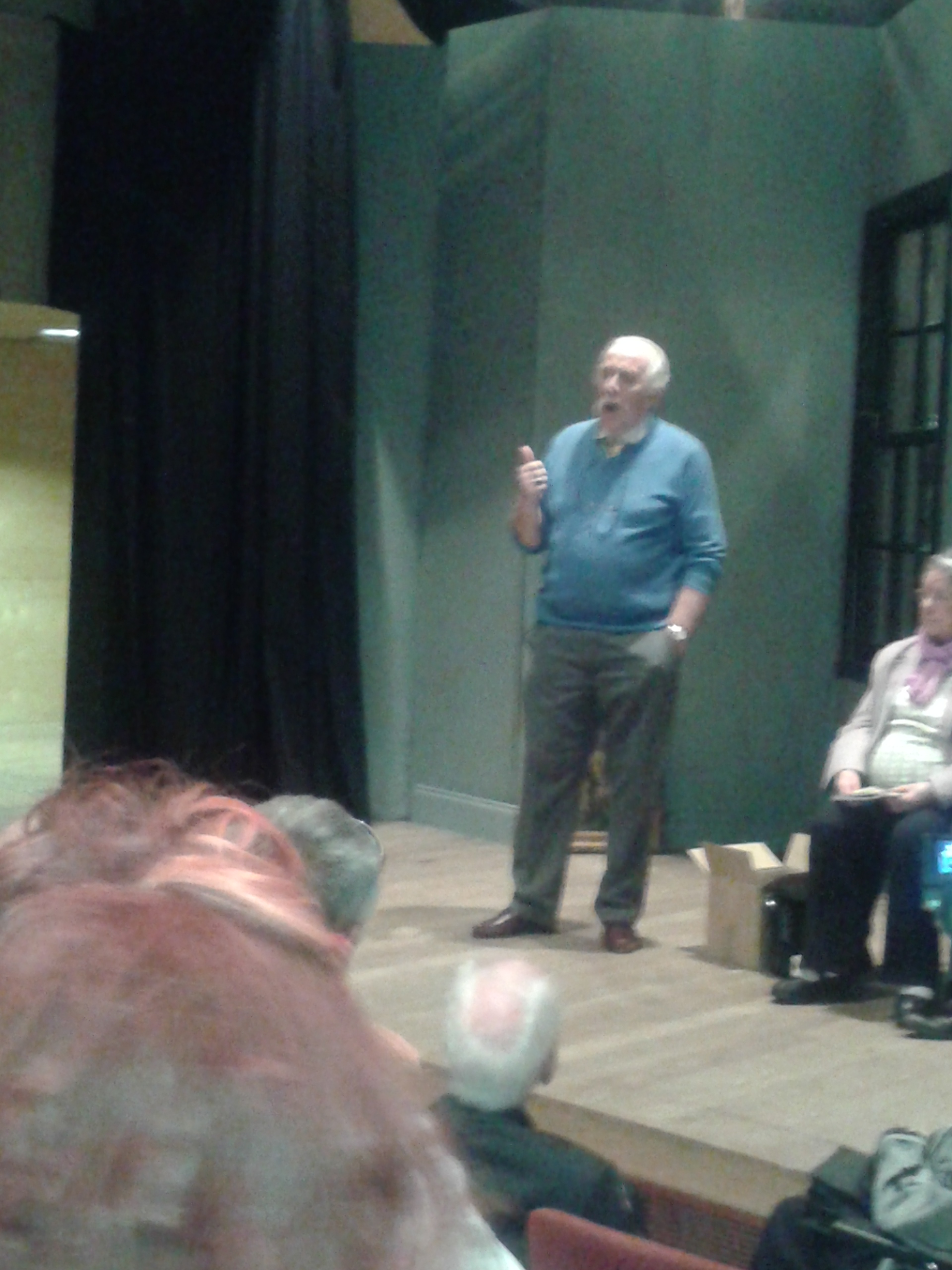
Michael O’Brien, addressing the audience, said he had wondered what qualification he might have to launch the book but on investigation discovered that he had not a few connections. His own grandfather, who was Jewish, had been a founder member of the Tailors, Machinists and Pressers’ Union, of which Carpenter had been the General Secretary until his retirement and so they must have known one another at least fairly well.

Also, Bill O’Brien’s father, Thomas, had been a communist and was active with Walter Carpenter in the Republican Congress in the 1930s. Walter Carpenter and Thomas O’Brien had both also been active in the Bacon Shops’ Strike of the early 1930s. Thomas O’Brien had been jailed during that strike along with Jack Nalty and Dinny Coady, both of whom had East Wall connections; subsequently Thomas went to fight Franco and fascism in Spain, where Nalty and Coady were both killed.

Joe Mooney called on Tommy Seery to sing The Bold Labour Men, a song about the 1913 Lockout written by a local man, which he did to strong applause. (Tommy is a member of the East Wall PEG Drama and Variety Group, in which he acts and also often sings – a recent performance, from which Tommy was unfortunately absent due to illness, may be seen here https://rebelbreeze.wordpress.com/2016/05/02/from-lockout-to-revolution-performance-of-east-wall-peg-drama-variety-group/).

Tommy Seery singing "The Bold Labour Men" about the 1913 Lockout (Photo D.Breatnach)
Tommy Seery singing “The Bold Labour Men” about the 1913 Lockout (Photo D.Breatnach)

Ellen Galvin spoke about Walter Carpenter’s life and his dedication to the advance of the working class and the struggle for justice.  Walter had been a supporter of equality for all, including gender, a man who read much and widely, who apparently learned Irish and campaigned for allotments for rent on Council-owned land while it was unused for housing.  He was against the consumption of alcohol but sympathised with people driven to its use by terrible housing conditions.

Joe then called on Diarmuid Breatnach to sing Be Moderate, written by James Connolly, to illustrate what it was that people like Connolly and those of the Irish Citizen Army fought for and for which some had given their lives. Diarmuid took the stage and explained that the song had been published in New York in 1910, the same year that he had returned to Ireland from the USA. There had been no indication of an air to accompany the lyrics, as a result of which it has been sung to a number of airs. Diarmuid heard it sung in London by an English communist to the air of a Nation Once Again 3 and at least one good thing about this is that it provides a chorus, with which he encouraged the audience to join in. He then sang the song, of which the final lines are:

For workers long, with sighs and tears,
To their oppressors knelt.
But never yet, to aught save fears,
Did heart of tyrant melt.
We need not kneel, our cause is high
Of true hearts 4 there’s no dearth
And our victorious rallying cry
Shall be “We want the Earth!”

Many in the audience joined in on the chorus:
We only want the Earth, 
We only want the Earth,
And our demands most moderate are:
We only want the Earth!

Eamon Carpenter delivered an impromptu tribute to Ellen Galvin, who he told the audience had lost her mother at the age of 13 years of age, from which time she had taken over the mother’s role for her younger siblings, ensuring the were fed, dressed and cared for. This tribute was warmly applauded while Ellen seemed embarrassed but also pleased.

This was another successful commemoration of the revolutionary history and, in particular, of the working class history of their area by the East Wall History Group. It is of great importance that the working class be appraised of their own history as distinct from the dominant historical narratives and that their revolutionary traditions be remembered, not as something dead and in the past but as part of a continuum of struggle for the emancipation of the class.

If there is a weakness in a number of such commemorations it is the lack of participation by local adolescent youth in these events – which may also imply a lack of engagement by this age-group. Nevertheless, should they go searching at some future date for the information and their connection to the history of place and class, they will find a treasure trove waiting for them in the work of this History Group.

Children & Parents left plaque

CONTACTS
The East Wall History Group may be contacted or viewed on FB at https://www.facebook.com/eastwallhistory/?fref=ts

Mother & 2 Daughters

Local Photographer Exhibition SOCC

FOOTNOTES

 There exists today an organisation called the Socialist Party of Ireland (which often organises under the banner of the Anti-Austerity Alliance) but it is not directly descended from the party founded in Ireland in 1909; rather it is closer to being an offshoot of the Socialist Party of England and Wales, with which it has close fraternal relations.
The Dublin Metropolitan Police gained particular notoriety for the violence against organised workers on behalf of Dublin employers, especially during the 1913 Lockout, during which they killed a number of workers with their truncheons. In later years, the force became a Dublin police force under the Free State, which was later subsumed into the Garda Síochána, a fact not generally known.

3  Written by Thomas Davis, first published in The Nation, Dublin, 1844.

4  “of true men there’s no dearth” in the original

FROM LOCKOUT TO REVOLUTION — PERFORMANCE OF EAST WALL PEG DRAMA & VARIETY GROUP

“From the Lockout to Revolution”, performance of the East Wall PEG Drama & Variety Group at City Hall on April 9th 2016. This was part of a program of events organised in conjunction with the Cabra 1916 Rising Committee and Dublin City Council.


At the outset of the Easter Rising, City Hall was occupied by a detachment of the Irish Citizen Army and was the location of fierce fighting until the insurgents were forced to surrender.  Their commanding officer and another three fighters were killed there.

( Video produced and edited by Eoin McDonnell )

East Wall PEG Drama & Variety Group performers: Rebecca Dillon, Mary Colmey, Monica Horan, Paul Horan, Colm Meehan, Séamus Murphy, Tréasa Woods, with Diarmuid Breatnach.

THE FIGHT FOR THE MOORE STREET HISTORICAL QUARTER IS A SOCIALIST STRUGGLE

Diarmuid Breatnach 

The struggle for the preservation of Moore Street that is currently in the news (but has been going on for fifteen years) is one not only for nationalists and Republicans, but for socialists too. And for socialists of revolutionary ideology as well as for radical social democrats. But currently these sectors, apart from individuals independent of political party (and one or two belonging to parties), are keeping away from the issue. In this they are seriously mistaken and are doing the working class in Ireland and indeed internationally a disservice.

Aerial view of Moore Street in the days when the speculators and supermarkets had only just begun to reduce it (Photo from Internet)

BACKGROUND TO MOORE STREET STRUGGLE

For those who may not be aware of the historical background, roughly 300 men and women of the GPO garrison in 1916, having to evacuate the burning building, made their way to Moore Street and occupied the terrace from the junction with Henry Place to what is now O’Rahilly Parade, entering at No.10 and tunneling through up to No.25 at the end of the terrace. On the following day, the decision was taken to surrender. Despite its historical status, nothing was done by the State to protect the ‘1916 Terrace’ for decades, although a small commemorative plaque was put on No.16 in 1966, when a number of such plaques were erected at sites throughout the city.

Fifteen years ago a campaign was started, by the National Graves Association and mostly by descendants of people who participated in the 1916 Rising, to have an appropriate historical monument on the site. In 2007 the State named buildings No.14-17 as a ‘National Monument’ but would take no steps regarding the other twelve buildings in the Terrace. By that time the four buildings belonged to a property speculator who allowed them to deteriorate but compliance with maintenance and upkeep obligations to a national monument were not enforced by the State. Also, shortly afterwards, the speculator put in a planning application for a huge shopping centre entailing the demolition of 12 houses of the Terrace and the State approved it.

Paul O'Toole, who played a number of sets at an "Arms Around Moore Street event in June 2015, including singing some songs of his own composition. The event was organised by Save Moore Street From Demolition group.
Paul O’Toole, who played a number of sets at an “Arms Around Moore Street event in June 2015, including singing some songs of his own composition. The event was organised by Save Moore Street From Demolition group.

Other threats emerged later, such as planning applications to extend the ILAC centre further into Moore Street and to build a tall budget hotel at the Moore Lane/ O’Rahilly Parade intersection; these were approved by Dublin City Council’s Planning Department although the majority of the Councillors have voted to preserve the 1916 Terrace and indeed the Historical Quarter.

Donna Cooney, great-grandniece of Elizabeth O'Farrell, speaking on behalf of the 1916 Relatives' Assocation
Donna Cooney, great grandniece of Elizabeth O’Farrell, speaking on behalf of the 1916 Relatives’ Association, at an “Arms Around Moore Street, event in June 2015. To her left is Mel Mac Giobúin, one of the principal organisers of the SMSFD group.

At the end of 2015 the State bought the four houses of the ‘national monument’ from the speculator, paying him €1 million each for them and proposed to knock down houses either side of it. As soon as the intention to proceed with imminent demolitions became clear, emergency demonstrations were called in the street by a newer group, Save Moore Street From Demolition (founded in September 2014). A five-day occupation of the buildings ensued, ending only on foot of an order of the Court that no demolition take place while a High Court challenge to the Dept. of Heritage was awaited.

Section of the January march to save Moore Street, organised by the Save Moore Street 2016 umbrella group
Section of the January march to save Moore Street, organised by the Save Moore Street 2016 umbrella group. In photo foreground, two of the principal organisers of the SMSFD group, (L-R) Mel Mac Giobúin and Diarmuid Breatnach. (Also in shot, Dave Swift, supporter of the campaign, in Irish Citizen Army uniform).   (Photo source: Donal Higgins)

A number of protest actions have taken place since then including a street concert and a march from Liberty Hall to Moore Street ending in a rally at the GPO.   The struggle continues at the time of writing with further events planned and the SMSFD group have joined with others, including people who occupied the buildings, to form the ‘Save Moore Street 2016’ group. It is a broad group containing activists from a number of Republican organisations and independents of community action, socialist and Republican background.

In a separate development, a High Court challenge against the process undertaken by the State to buy the properties and demolish others on either side opened on February 9th and has been adjourned a number of times since, apparently due to the State not having got its papers together.

NATIONAL HISTORY

Socialists may argue that the cause lying behind the struggle is one of preservation of Republican or even nationalist history. I would argue that is only partly true – but what if it were so? Who actually makes history? It is the masses of people that make history, even if individuals among all classes at certain times are thrust – or throw themselves – upon the stage. In that sense, ALL history of progressive social history belongs to the working class.

Furthermore, the underlying historical reason for which many are seeking to preserve the 1916 Terrace and, indeed, the Moore Street historical quarter, is because it related to a struggle against colonialism, against an immense colonial empire. Are socialists to say that they take no interest in anti-colonial struggles and their history? Or is it that they do, so long as they be in some other part of the world? And if the latter be their position, what possible political justification could they offer for it?

STREET MARKET – SOCIAL HISTORY

In the development of this city, Dublin, street traders have played a part – as indeed they have in the development of probably every city in the world. Working people and small-time entrepreneurs, working hard from dawn to dusk in all weathers to feed themselves and their families, a link between town and country or between coast and inner city. They brought fresh food to the city dwellers of all classes and brought colour to what was often a drab environment, colour to the eye and to the ear also.

Moore Street is the last remaining street of a traditional street market centuries old, the rest of which now lies buried under the ILAC centre and which even now threatens to extend further into Moore Street, squeezing the market street still further. This street market and its history as well as being physically threatened by the proposed extension of the ILAC, squeezed commercially by Dunne’s and Lidl, is threatened also by a planned budget hotel building of many floors and of course the giant shopping centre plan of Chartered Land/ Hammerson. Have the socialist groups nothing to say about this or, if they are against this monopoly capitalist assault, why do they distain to take their place in the ranks of the resistance?

AGAINST WORLD WAR

Some of the Volunteers undoubtedly planned the Rising to take place during the first imperialist World War purely on the basis of the maxim that ‘England’s difficulty is Ireland’s opportunity’.  But others, including the revolutionary socialist leader James Connolly, also clearly wanted a rising against the slaughter of workers in a war between imperialists.  Connolly wrote a number of articles denouncing this slaughter which socialists of his time had pledged themselves to fight but which few had actually done, when it came to the crunch.  However, that position remains the correct one for the working class: in a situation where your masters wish to send you out to fight your class brothers abroad, turn your guns on your masters instead.  The 1916 Rising stands as an example of this, the first of the 20th Century and world history would have to wait until the following year for another example in Europe.

WORKERS’ HISTORY

All the Irish socialist groups, as far as I’m aware, right across the spectrum from Anarchist to Communist, hold the memory of James Connolly and of the Irish Citizen Army in high esteem. And so do the radical social democrats.

James Connolly led the Irish Citizen Army into alliance with the Irish Volunteers, Cumann na mBan and na Fianna. The ICA, a trade union-based militia, had been formed to defend demonstrating and picketing workers against the attacks of the Dublin Metropolitan Police in 1913. When the ICA went out in the 1916 Rising, Ireland was the first country in the world that century for a workers’ armed unit to fight in its own uniforms and under its own leaders.

Irish Citizen Army on parade at the Irish Transport & General Workers' Union building and grounds in Fairview, Dublin
Irish Citizen Army on parade at the Irish Transport & General Workers’ Union building and grounds in Fairview, Dublin. (Photo source: Internet)

The ICA were allocated the Stephens Green and Dublin Castle areas but also had members in the GPO garrison. So when the GPO garrison retreated from the burning building, ICA members were part of that retreat. At least one died on that journey, struck down in Henry Place by British Army bullets at the intersection with what is now Moore Lane.

When the GPO garrison took possession of the 16 houses of the Terrace in Moore Street, tunneling from house to house, the ICA were part of that. And when the decision to surrender was taken, the ICA laid down their arms with the rest.

The 1916 Rising and the occupation of the Moore Street terrace and backyards is part of the ICA’s history and is therefore part of the history of the Irish working class and, indeed, of the international working class. If the socialist groups don’t wish to celebrate that episode in the history of the class, why? If, on the other hand, they do celebrate it, why then do they not join the struggle to have the place of their last stand preserved from demolition and to have the ICA’s place in history marked by a fitting monument?

The lack of engagement of most of the revolutionary and radical left with the Moore Street struggle has also meant no noticeable pressure within the trade unions, where the left have some influence, to even declare verbally for the preservation of the 1916 Terrace. To date, only one section of one trade union, the Construction Section of SIPTU, has declared in favour of saving the Terrace.

WOMEN

The struggle for gender equality is an important part of the struggle for the emancipation of the working class, i.e. for socialism: women represent slightly over one-half of the human race and this is true also for the working class. In addition, the oppression of one part of the class serves as a wedge into the solidarity of the class as a whole.

In 1916 women served as auxiliaries in Cumann na mBan and as equals in the Irish Citizen Army. That year was the first in the World in which women participated in an insurrection in a unit of their own, wearing a uniform of their own and under their own female officers, as was the case with Cumann na mBan. It was also the first time in the 20th Century in which women had formal equality with men in an armed workers’ organisation, as they did in the Irish Citizen Army.

Constance Markievicz, ICA officer, fighting in the Stephen's Green area. She poses here with a gun prior to the Rising to underline her position that women can and should take part in armed revolutionary struggle, on a par with the men.
Constance Markievicz, ICA officer, fighting in the Stephen’s Green area. She poses here with a gun prior to the Rising to underline her position that women can and should take part in armed revolutionary struggle, on a par with the men. (Photo source: Internet)

The Proclamation was the first insurrectionary call to arms to address itself specifically to women alongside men (“Irish men and Irish women …”, it begins) and had been signed in secret a little earlier by the seven male signatories (or by most of them) in the alternative cafe and agricultural product cooperative run by Jenny Wyse Power at No.21 Henry Street.

1916 CUMANN na mBAN & ICA 1917
Women of Cumann na mBan and ICA who participated in the 1916 Rising in a group photo a year later (photo sourced Internet)


         CAPITALISM & THE STATE

The campaign for the saving and appropriate renovation of the 1916 Terrace first of all confronted the capitalist property speculator Joe Reilly and his Chartered Land company, while it lobbied the State to take over the Terrace.

When in 2007 the State declared four houses in the Terrace to be a ‘national monument’, the campaign continued confronting the speculator but now calling, without success, on the State to oblige Mr. O’Reilly to comply with his maintenance obligations to a national monument. When the State granted, with some changes, planning permission for the speculator’s giant shopping centre, the campaign moved into confrontation with the State, a confrontation which intensified after the State purchased the four buildings and prepared to demolish the buildings on either side.

The whole saga was an object demonstration of the function of the State in facilitating capitalist property speculation and furthermore, of the neo-colonial nature of a capitalist class unable to consider saving such a national historical treasure even with the support of the vast majority of the population.

In such a struggle, with people with democratic objectives on one side and, on the other, rapacious property speculators and a capitalist State facilitating those speculators, where does the duty of socialists lie? It is clear on which side they should stand if they should stand on the issue at all. And they should take a stand on it – how can the development of that struggle do anything but strengthen the democratic movement in general, including the movement for socialism, and harm its opponents, the State and capitalism in Ireland? And surely in the course of that struggle, with socialists side by side with Republicans, alliances would be formed which could be built upon for more ambitious projects later?

Monument in Dublin to James Connolly, revolutionary sociailist writer, historian, theorist, union organiser, publisher -- his last location of freedom was the Moore Street 1916 Terrace, before he was shot by British firing squad
Monument in Dublin to James Connolly, revolutionary sociailist writer, historian, theorist, union organiser, publisher — his last location of freedom was the Moore Street 1916 Terrace, before he was shot by British firing squad (Photo source: Internet)

IN CONCLUSION:

For all the reasons given above, its social history, its anti-colonial history, the history of the common people as well as that of intellectuals, the history of the working class to assert its independence and dominance of the movement for liberation, the history of women’s struggles, and the current struggle of people against property speculator capital and State, the place of socialists, revolutionary and radical, is right there with the Moore Street 1916 Terrace campaigners. But where are they?

With the exception of a few honourable exceptions, they are notable by their absence. Yet, they will wonder at times why the mass of people do not follow them; why, for the most part, they regard them and their organisations as an irrelevance.

End.

THE GREAT HUNGER – WAS IT GENOCIDE?

Diarmuid Breatnach

That was the subject of a debate between historians Tim Pat Coogan and Liam Kennedy on Wednesday 20th, organised by the 1916 Societies’ San Heuston branch and held in Club na Múinteoirí, Parnell Square, Dublin.

Coogan has a long track record as a journalist and historian of a nationalist/ Republican perspective: for nearly two decades Editor of the now-defunct nationalist daily Irish Press, broadcaster and author of many works including The IRA, Ireland Since the Rising and biographies of Michael Collins and Éamonn De Valera. Kennedy is Professor Emeritus of Economic and Social History at Queen’s University, Belfast. He is the author of a number of articles and of books, most of the latter collaborations, including (with L.A. Clarkson et al), Mapping the Great Irish Famine (Dublin: Four Courts Press, 1999). His most recent, on his own, is Unhappy the Land: The Most Oppressed People Ever, the Irish? (Dublin: Irish Academic Press, 2015).

"Irish Famine Memorial/ Leacht Cuimneacháin na nGael" in Philadelphia. USA (Photo from Internet)
“Irish Famine Memorial/ Leacht Cuimneacháin na nGael” in Philadelphia. USA
(Photo from Internet)

Given that the Great Hunger or Famine is a subject on which historians tend to take oppositional sides and with at least one prominent historian on the panel, I would have expected a very large turnout. Therefore when I arrived and looked at the seats in the large hall of Club na Múinteoirí, I was surprised to see that although there was a respectable number in attendance, some of the seats laid out were unoccupied.

I had got the start time wrong (yes, even though I had shared the poster for the event on my Facebook page!) and so missed some of Tim Pat Coogan’s presentation (but a friend told me Coogan had mistaken the subject and began to talk about the 1916 Rising until he came back on track). When I entered, Coogan was dealing with the Great Hunger’s death toll and referring to the “accelerated deaths” method of calculating population loss that took into account further likely births had early deaths of potential parents not occurred. By that method, Coogan estimated the deaths at two million, not counting those who died on the “coffin ships” or after arrival at their destination.

Tim Pat Coogan (Photo from Internet)
Tim Pat Coogan
(Photo from Internet)

Coogan said that New York State included study of the Great Hunger under “Holocaust Studies” which he thought entirely appropriate and concluded by stating that the Great Hunger was indeed genocide.

Liam Kennedy
Liam Kennedy

Liam Kennedy then took the floor and began with a personal anecdote of the unveiling of a stained glass window in Belfast, dedicated to the Famine, at which he had been invited to speak some years ago. It was a somewhat rambling story through which his audience sat quietly, awaiting his arrival at the question up for debate.

During his anecdote, Kennedy related that he had, in the course of his speech, referred to punishment shootings and exiling” (instructions to leave the country) carried out by both Republican and Loyalist paramilitaries, which had angered in particular his Republican audience, including Gerry Adams (which he described but did not name). So of course, in retelling, he was once again referring to it – in a debate about whether the Great Hunger was genocide or not. Kennedy related this in the alleged context of showing that the Hunger is a controversial subject – of course it is, so it hardly needs any other controversial subjects dragged into the discussion.

Kennedy went on to allude to “amnesia” around the subject of the Great Hunger, which he compared to a similar “amnesia” which he believed attached to the issue of the thousands of Irishmen who had “fought for the Empire (or he may have said “England”, or “the UK”) and for Ireland during WWI.” Yes, it seem to me that he was engaging in a certain amount of coat-trailing in front of his audience which, given the Dublin location and the 1916 Societies host, he must have assumed to have many Republicans in its midst.

Eventually he got the job for which he had been invited and began, helpfully, by quoting part of a definition of “Genocide”. I cannot recall which authority he quoted but a search reveals many definitions, most of which entail intent. One of the most recent authorities is Article 6 of the Rome Statute which provides that “ “genocide” means any of the following acts committed with intent to destroy, in whole or in part, a national, ethnical, racial or religious group …” and goes on to describe a number of means of carrying that out.

It was clear that Kennedy was going to rely on denying the intention to cause, rather than to deny the effect of the catastrophe; this was entirely as I expected and it is the stock approach of genocide deniers and colonial apologists (not always the same thing). But in reality he had little to say on this subject, other than to point at the “laissez-faire” nature of the UK Government’s economic policy at the time and the weakness of the Whig party in power, managing a minority government. To be fair, it is extremely difficult to prove lack of intent but all the same I would have expected something better.

In its absence, Liam Kennedy went on to talk about culpability, which is not the same thing – one might be to blame for something which one didn’t, however, intend. And Kennedy spread the net of blame pretty wide, throwing it not only over the British Government but on the Irish middle class (could have done more), the Catholic and Protestant Churches (opposition to emigration and continued church-building), the Irish landlords (absentee or callous), the Young Irelanders (had no solutions), O’Connell’s 40 MPs at Westminster (didn’t raise much trouble at Westminster, although they were supporting the minority government).

Kennedy didn’t stint however on the severity of the Great Hunger nor on its huge impact on Ireland and on its diaspora. On that he said he agreed with Coogan, although his estimate of deaths was closer to 1.5 than two million. Any disaster in which one in seven died was an extremely severe one — it was the worst disaster in Irish history and one of the worst internationally, Kennedy stated. And it was most severe on the poor – and here Kennedy quoted a sentence of Karl Marx – and proportionally struck hardest at the Irish-speaking areas.

THE DEBATE OPENED TO THE FLOOR

When Kennedy finished, the Chairperson Kevin Keane summed up the main points elaborated by each speaker and the meetings was thrown open to questions and contributions from the floor. I wanted to get my comment in early, as I was scheduled to sing as soon as the questions and answers were over; since for a moment no-one stirred, my hand was the first up. Handed the roving microphone, I thanked both speakers and remarked that the question of intentionality did not relate only to the Government of the time but also to the ruling class of the time – the British capitalist class. An analysis of their opinions as expressed in correspondence and in their media of the time, for example editorials in the London Times, has indeed revealed the intention to get rid of the Irish cottier class and, to a degree, the Irish landlord class too. They wanted most Irish agricultural land turned to grazing and deliberately used the opportunity to do so.

Other contributors talked about food leaving Ireland while people starved, the low numbers of Irish permitted to vote; another countered the criticism of the Young Irelanders by pointing to the Rising they attempted in 18481. Yet another contributor pointed to comparisons with famine in other areas due to the potato blight such as the Highlands of Scotland, Belgium and the Netherlands – but did not express an opinion from those studies on the question being debated here. One contributor amusingly took Kennedy to task on standard academic grounds relating to questions on examination papers: “Read the question carefully, prepare your answers, ensure they are relevant …”

RESPONSES OF THE SPEAKERS

Returning to both speakers for the final responses, Kennedy admitted that the Government had wanted to get rid of the Irish cottier class but not by famine and disease. The “coffin ships” were only relevant to one year of the Great Hunger, he maintained and also that the Irish had, according to statistics, survived the journey in better health than for example the Germans, who had a much higher mortality rate during the journey and on arrival. On hearing that, I wondered whether he was taking into account the giant graveyard of Grosse Isle on the St. Lawrence, where “5,424 persons who fleeing from Pestilence and Famine in Ireland in the year 1847 found in America but a Grave.”2

Grosse Isle Memorial bilingual notice, Quebec (Photo from Internet)
Grosse Isle Memorial bilingual notice, Quebec — 5,424 Irish people got no further than this spot, where they died and were buried, in 1847


The island mass graveyard of Grosse Isle, Quebec, from a distance (Photo from Internet)
The island mass graveyard of Grosse Isle, Quebec, from a distance
(Photo from Internet)

Kennedy returned again to the question of the “laissez-faire” economic doctrine and maintained that the rulers of the UK at that time were convinced that government interference in economics was not only undesirable but would make things ultimately worse. He also stated that we should not judge the people of then by the knowledge and beliefs of today – another argument often put forward by bourgeois historians (and to which I was going to reply in a very short poem I had written on the subject).

Tim Pat Coogan had the final say in the debate and wandered somewhat while however displaying the breadth of his learning. With regard to the Catholic Church he related that the Papacy in Rome had dictated to the Irish Church that they should continue building churches during the Great Hunger and he went on to criticise Rome in terms that might come as a surprise to those familiar with Irish nationalists/ Republicans of Coogan’s generation. He accused the Papacy, through a certain Cardinal, of instructing the Bishops in the Church to cover up cases of abuse, by the Cardinal’s admonition that the Bishops were to act as fathers to the priests and not as policemen.3 Coogan also defended O’Connell who was already sick then, dying in 1847, and the Irish MPs, having to go to Westminster, where they were in a small minority, to put their case and to where letters from Ireland could take a week to arrive.

Returning to the subject under discussion, Coogan made the trenchant point that the Government runs the country and ultimately responsibility lies with it; if it does not, then there is in fact no responsibility for anything, he implied. It was a good point with regard to culpability and he went on to deal with intentionality. He drew attention to a London gentlemen’s club whose members were influential in forming Government economic opinion, and a discussion reported among two members that one million deaths would be required to bring Ireland to a healthy economic state while the other disagreed, saying that two million would be required. “The potato blight gave them the opportunity and they took it”, said Coogan. “It was genocide.”

IN CONCLUSION

Poster for the event (image from 1916 Societies)
Poster for the event
(image from 1916 Societies)

Some points which did not get a response in my opinion were the issues of “bad Irish landlords” and “chaotic land tenancy” and perhaps the others “to blame” apart, of course, from the British ruling class and their Government. Briefly, who was to blame for the absentee landlord situation in Ireland? Who stole the land for them and then protected them and their agents with soldiers and police? Who bought out the Irish Parliament in 1800, giving the political class even less reason to hang around in Ireland? This was the result of invasion, colonisation, planting, repression and bribery – the principal culprit all along was English colonialism.

Yes the peasantry (and landless tenantry’s) situation was chaotic and yes they depended too much on the potato crop. Whose fault was that? Who organised the land in that way (and refused security of tenancy, penalised tenants for improvements by raising the rents, etc)? Who stifled profitable Irish industry if it competed with English and taxed Irish production for the English Crown? Again, British colonialism.  Could the country’s economics have been differently organised, to support that population (and even larger) in reasonable comfort?  Of course it could — but at that point in history, it would have needed an independent national capitalist class to organise it, something Ireland did not have (and has not had since that section of it she had in 1798 was beaten by Crown forces).

In the last analysis, it does not matter how badly one group or another behaved during the failure of the potato crop – the British Government was the principal body with the power to act to avert catastrophe and the real power behind them, the British ruling class, were the ones with the interest in doing nothing to avert the disaster.

Finally, a thought worth considering: would the British ruling class have tolerated a disaster on this scale in Britain? Laissez-faire economics or not, I am pretty sure they would not.

The 1916 Societies and in particular their Sean Heuston branch have been putting on talks and debates on important Irish historical questions for some time, some of which I have been fortunate to attend. The Great Hunger debate was worth having and the contenders were well known with a track record in historical studies and public fame – the debate promised to be interesting. Despite this however, I found the event overall somewhat flat. Kennedy’s presentation manner was hesitant in speech and devoid of liveliness; Coogan wandered off the core subject too often. One cannot blame the 1916 Societies for that, however.

HISTORY AND “SKIBBEREEN”

I was called up to the stage to sing my song which had been announced earlier; by now there were about half the audience remaining. I explained that the song I was going to sing was called “Skibbereen”, published in Boston in 1880, not far from the time of the Great Hunger, and attributed to Patrick Carpenter, a poet and native of Skibereen. The song is in the form of a dialogue between a migrant father and his son but I sing it as though his dialogue is with his daughter. I also intended to omit a verse, one which has the man’s wife dying in shock during the eviction – I felt that women were much stronger than that.

“That’s revisionist!” interjected Tim Pat Coogan.
“That’s right,” I replied, “but progressive revisionism.”

It’s revisionist!” Coogan said again.

I felt like reminding him that I had not heckled him during his public speaking. Instead I said

All history is revisionist. The issue is what kind of revisionism.
“No it’s not – not good history!” Coogan replied.

Reading the short poem "History" (Tim Pat Coogan in background) (photo Denis Finegan)
Reading the short poem “History” (Tim Pat Coogan in background)
(photo Denis Finegan)

I turned from him and read a short poem.

ALL our history is important,

not just 1916,


teaching us what we are


and what we have been.


How we came to reach the now;


of those who fought

or those who bowed,


                                                                                  through bloody pages,

                                                                                 down through the ages;


                                                                                  it relives the struggle to be free


                                                                                 and whispers soft what we might yet be.

                                                                                 (Diarmuid Breatnach, January 2016)

DB Singing Skibereen
Singing “Skibbereen”. In the background, L-R: Liam Kennedy, Kevin Keane and Tim Pat Coogan. (photo Denis Finegan)

I then sang Skibbereen.

As I leaned over to hand back the microphone after finishing the song, Coogan told me his mother had loved that song. I took this as a peace overture and smiled, murmuring something about it being a good song to love. But no, I was mistaken: “And she liked that verse”, he added.

“Well, that was her opinion,” I replied, “and this is mine,” and left the stage.

Liam Kennedy was much more polite. Up in the bar, in passing, he thanked me for the song and added that he had heard the slogan “Revenge for Skibbereen” (also an alternate title for the song) alright but never the song. I expressed amazement at this, since the song is well known and even more so among people of his generation. Kennedy was born “in rural Tipperary” and, I believe, raised there too.  There must have been many a kitchen and pub where that song was sung in Tipperary, surely?

End.

1In a longer debate, I could have pointed out that James Connolly himself had criticised the Young Irelanders’ response the the Hunger but that his solution would not have pleased Kennedy either – Connolly wrote that the Young Irelanders should have led the people in breaking open the granaries, feeding the starving and preventing food from leaving the country.

2http://www.historyireland.com/18th-19th-century-history/grosse-ile-canadas-island-famine-memorial/
3Actually, a highly secret instruction, including requirement of vows of secrecy and threats of excommunication for whistle-blowers, had been circulated by the Papacy to bishops around the world as far back 1962 http://www.theguardian.com/world/2003/aug/17/religion.childprotection

LAUNCH OF “BATTLEGROUND 1916 — THE LANEWAYS OF HISTORY”

Diarmuid Breatnach

On a very stormy Wednesday night (17 Nov. 2015) in Dublin around 150 people attended the launch of the video “Laneways of History” at Wynne’s Hotel, Lwr. Abbey Street.

Poster Launch Video


The video maker is Marcus Howard who has videoed a number of interviews with relatives of 1916 heroes as part of a campaign to preserve the historic Moore Street 1916 Terrace and the laneways surrounding it. Marcus also videoed the second Arms Around Moore Street event, which was organised by the Save Moore Street Demolition campaign.

The video itself uses footage shot in a Dublin of today, tracing the footsteps in Easter Week 1916 of James Connolly from Williams Lane to the GPO, then of the garrison’s retreat from the burning building to Moore Street. It also stops at 21 Henry St. where the 1916 Proclamation was signed and follows the ill-fated heroic charge led by The O’Rahilly up Moore Street against the British barricade at the end, on Parnell Street.Musicians

The narrative is provided by Jim Connolly Heron (great grandson of James Connolly) and Proinsias O Rathaille, grandson of The O’Rahilly, and also by excerpts from witness statements of participants read by Marcus Howardand a woman whose name I did not catch (but will record when I find out).Citizen Army on guard

Sound effects on images of the past are firing from artillery, rifles and machine guns and clips from the Cabra Historical Society are used to good effect.  The video also includes recent footage from the campaign, including Taoiseach (Prime Minister) Enda Kenny being shown around the Moore Street Battlefield and the 2nd Arms Around Moore Street event, which was organised by the Save Moore Street from Demolition campaign.

Volunteers in various outfits

Around the function room there were men and women in Ctiizen Army and Volunteer uniforms and typical IRA War of Independence dress to protect us from a raid by the British Army, Dublin Metropolitan Police or the Auxillaries (or perhaps to keep an eye out for unruly elements).

Music and some songs were provided before the speakers by two members of the Dublin band The Invincibles, one of which Paul Stone, sang Where Is Our James Connolly to a hushed room.

The main speakers were James Connolly Heron, Críona Ní Dhálaigh (SF Mayor of Dublin), Proinsias O Rathaille and Marcus Howard. Also called up to speak a few words were long-time supporters of the campaign TD Maureen O’Sullivan and Frank Allen.

Frank Allen speaking from the podium

Frank unveilled the 1916 Commemoration Bond and invited everyone to buy one at €100 each. Frank announced that the aim is to make sufficient on sales at home and abroad, to buy the threatened 1916 Terrace.

Presentations of the first three bonds were made to long-time supporters of the campaign Brendan O NeillColette Palsgraaf and Pat Waters (who had written the song for the “16 Signatories” production).

Crowding outside the bar

Frank also thanked Diarmuid and Mel (also thanked by Marcus Howard) for their long presence in Moore Street (the Save Moore Street from Demolition Campaign, which also includes Bróna Uí Loing).

Pat Waters in conversation in the bar

There were some questions and interventions from the floor before people repaired to buy a DVD and/or a bond and thence to the bar, to chat and no doubt plot further steps in the campaign.  Among the contributors from the floor were TV presenter Duncan Stewart, Donna Cooney (PRO 1916 Relatives’ Committee and grand-niece of Elizabeth O’Farrell), Manus O’Riordan (includ. Friends of the International Brigades in Ireland), Diarmuid Breatnach (includ. Save Moore Street from Demolition campaign), Bernie Hughes (Finglas community campaigner against the Water Charge).  A Dutch woman living here 15 years made the point that migrants should be included in the vision — a point echoed by at least another two from the floor, one of whom drew attention to the fact that James Connolly had been a migrant.

Some more from inside the bar (an ID parade?)

Indeed, this was so, both to the USA and to Ireland, as was the case with Jim Larkin too; Tom Clarke had been born in England also and a number of those who fought for the Republic in the Rising (especially the Kimmage group) had been born and brought up in British cities and a few had no Irish connections at all.

Two women drew attention to the exclusion of the Irish language from the video and presentation.  This last was a particularly relevant point, given that one of the seven signatories of the Proclamation was a writer in Irish and in English, as well as an educator and that five of them had been members of the Gaelic League (as were others of the executed or who died in the fight).  One asked what the strategic purpose of the bonds was and how this fit into the campaign.

Overall, any criticisms or doubts aside, everyone who spoke was positive about the video and wholeheartedly in favour of the retention of the historic buildings and laneways.  It was notable that no-one, from panel, podium or the floor, expressed faith in the Government or in most politicians — quite the contrary.

Among the historians present were Lorcán Ó Coilleáin and Mícheál Ó Doibhlín.  Also seen were Aengus Ó Snodaigh TD, Robert Ballagh (Reclaim the Spirit of 1916) and Barry Lyons (Save 16 Moore Street).


(Photos, mostly long-range dodgy mobile ones: D.Breatnach)

A chríoch.


Links:

Personnell in costume were provided by Dave Swift of Claoímh (http://www.claiomh.ie) and Irish Volunteers commemorative association (http://irishvolunteers.org)

Copies of video DVDs €10 each NOT including post and package from email are available through easterrisingstories@gmail.com

Save Moore Street from Demolition: https://www.facebook.com/groups/757869557584223/?fref=ts and https://www.facebook.com/save.moore.st.from.demolition/?fref=ts

Save 16 Moore Street: https://www.facebook.com/groups/114656558567416/?fref=ts